Retirement Transitioning Advice from AI?

Season Greetings and Happy New Year from your Pennsylvania Music Educators Association State Retired Member Coordinator. Best wishes for a happy, healthy, and prosperous 2025!

First, on Christmas Eve, here are a few announcements geared to PA music educators… those who have retired from full-time teaching and anyone considering retirement over the next one to five years.

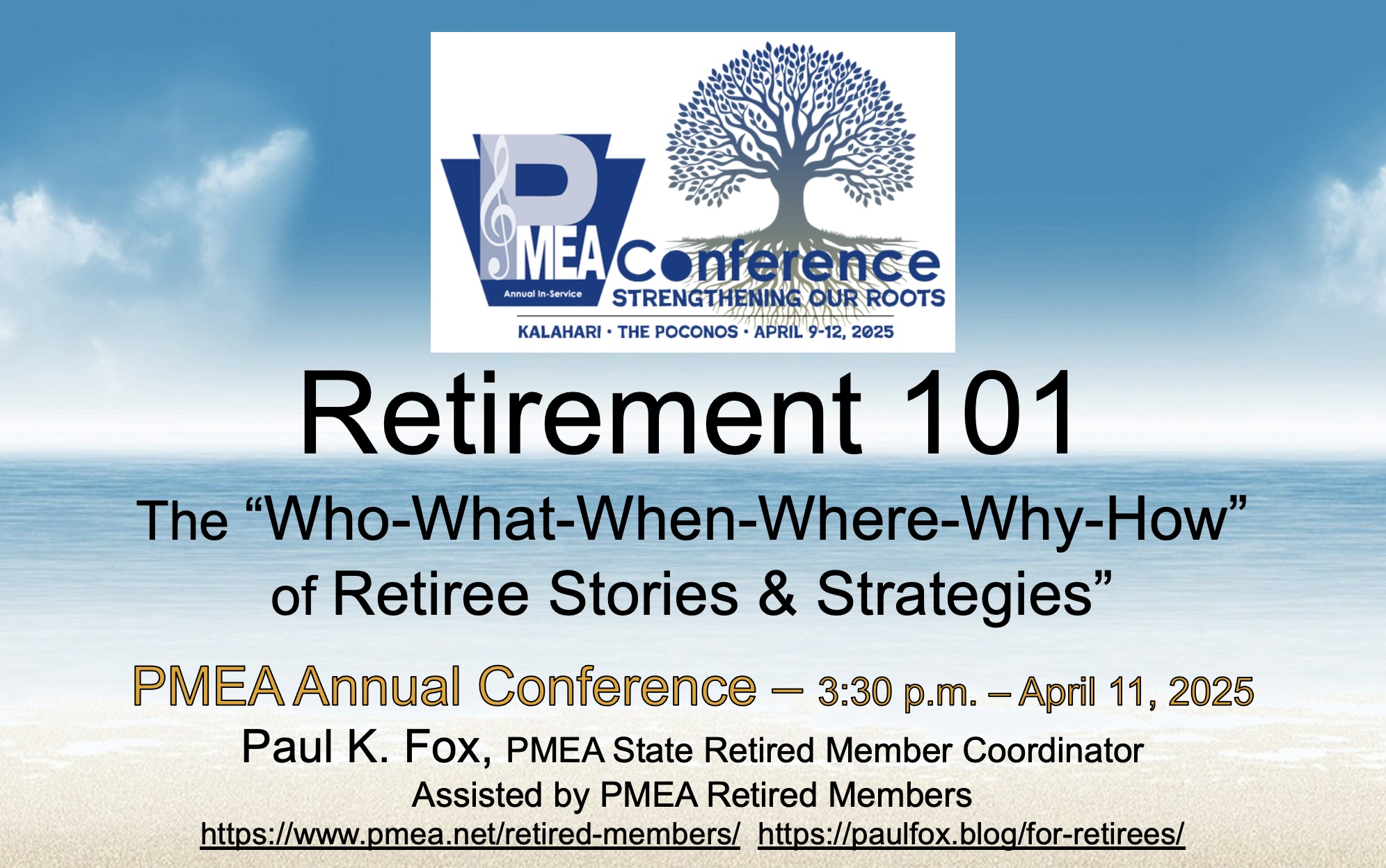
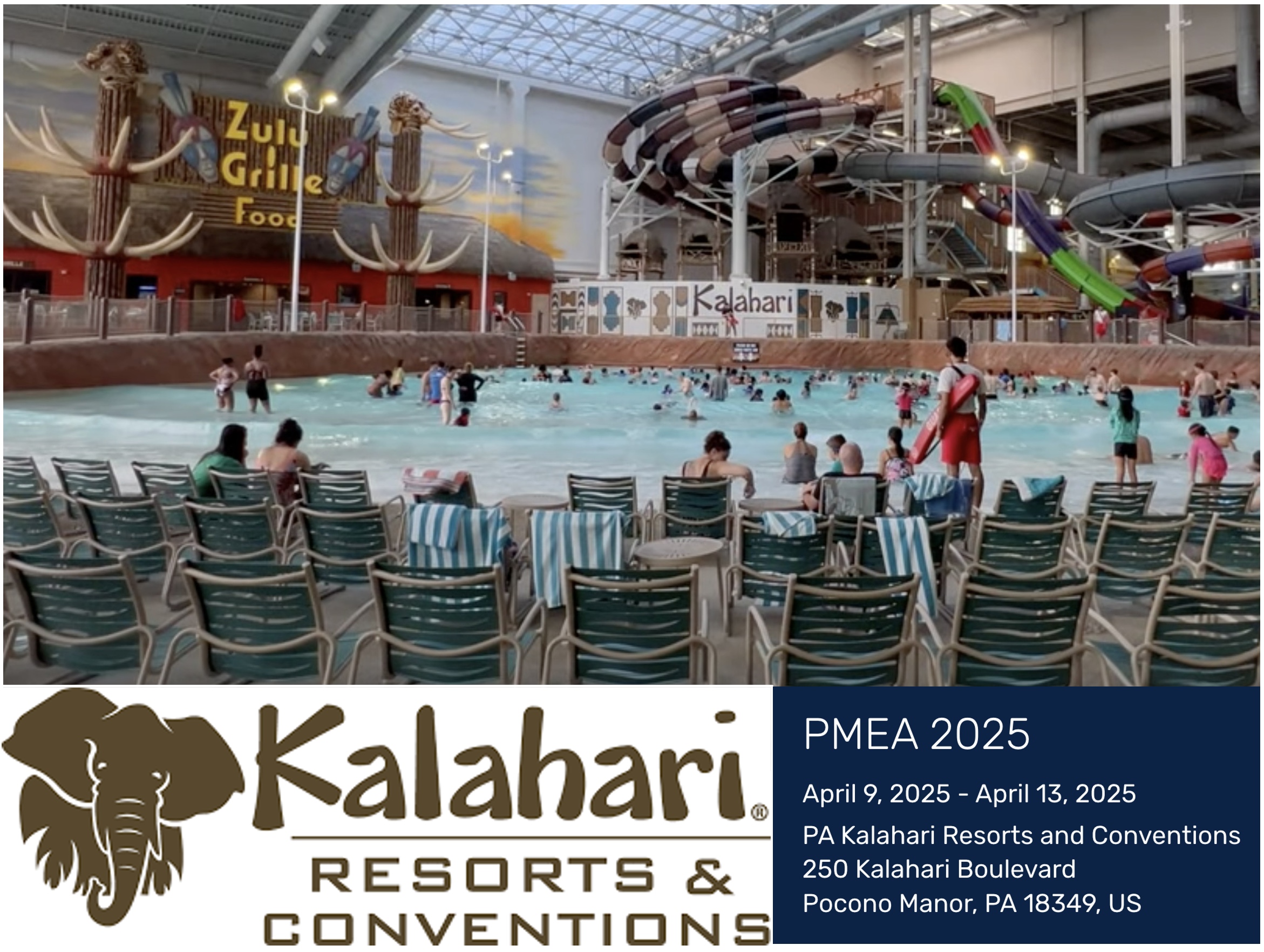
Back by popular demand (or is that just ego and in my head?), we will offer the session “Retirement 101 – the Who, What, When, Where, Why and How of Retiree Stories & Strategies” on Friday, April 11, 2025 (3:30 p.m.) during the PMEA Annual Conference at the Kalahari Resort in the Poconos. A guest panel of PMEA Retired Members will assist and offer their advice answering key questions like the following:

  1. How have you found happiness and success in retirement?
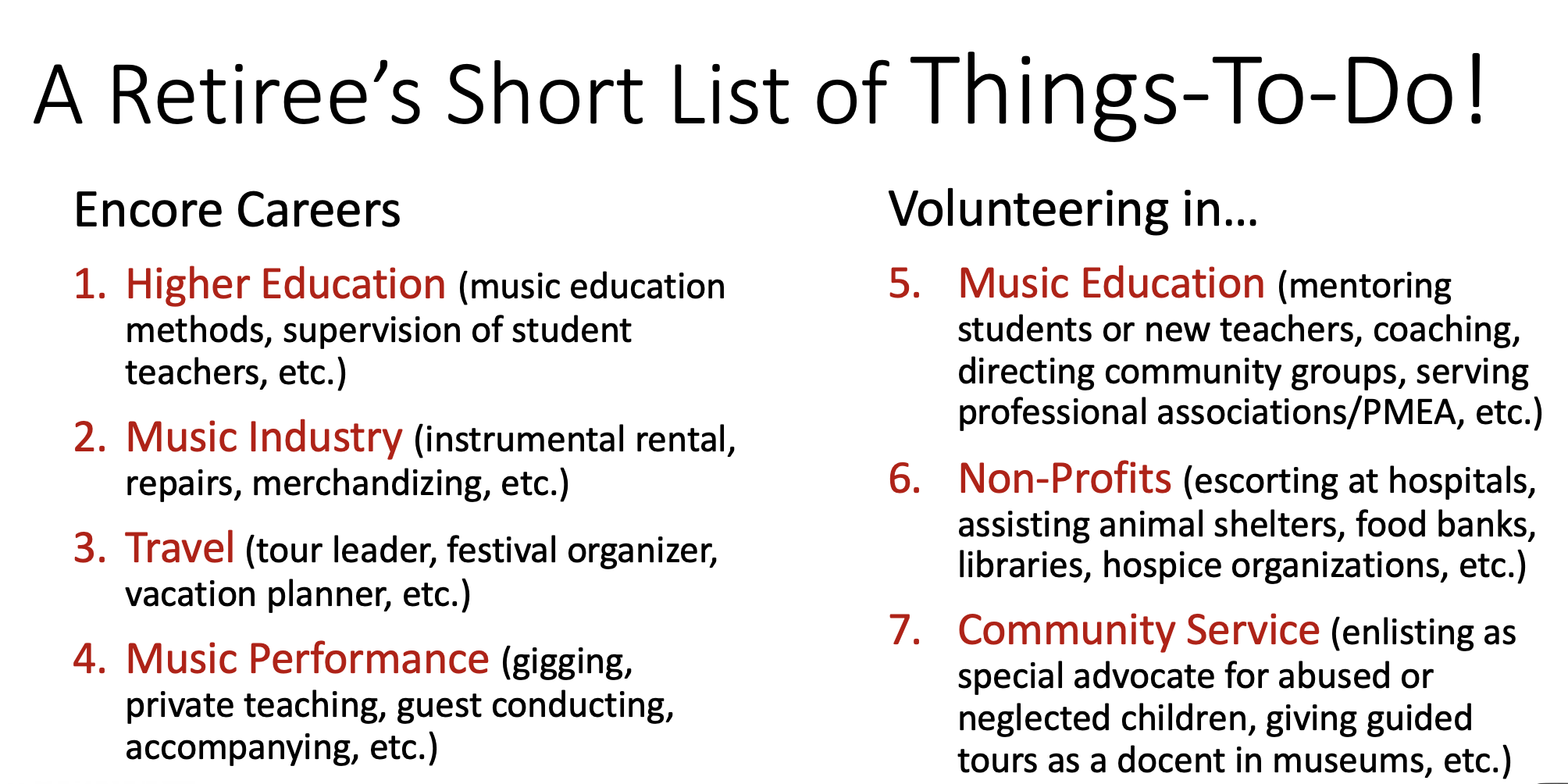
  2. What “new” hobbies, volunteer projects, trips, family connections, and encore careers have you been exploring?
  3. What did you do to reinvent yourself and how did you satisfy those essential “big three” goals of post-full-time employment: finding purpose, structure, and community?
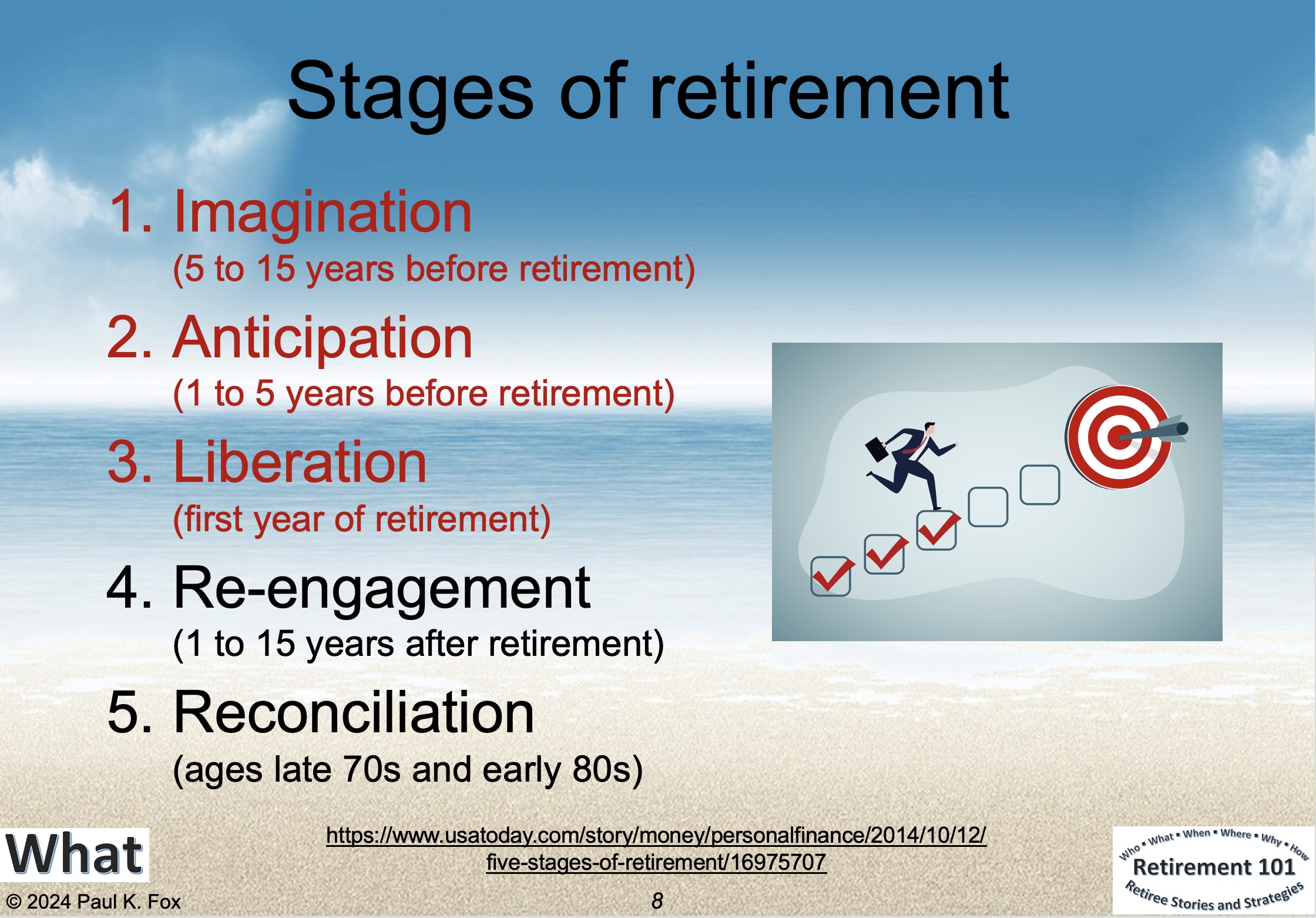
  4. How did you navigate the early phases of retirement? imagination, anticipation, liberation, etc.
  5. What were some of the transitional “ups and downs” you experienced and how did you cope with them?
  6. What are you still doing in music and education?

We are looking for more PMEA retiree volunteers who are planning to attend the conference to join “expert panelists” Rick Coulter, Jeffrey Dent, Dan Klingbeil, Chuck Neidhardt, Louise Victor, and Rich Victor. (Just email me if you’re interested.)

Retired Members are a valuable resource to PMEA. Many of us already serve on PMEA Councils and in District or State official positions. All of us in the profession benefit from the sharing of their extensive “boots-on-the-ground” experiences and wisdom. At the upcoming conference, Retired Members can serve as Presiding Chairs and introduce a session/concert or two. In addition, plans are also underway to sponsor (possibly on Thursday, April 9) a “coffee & conversation” corner or an “ask the expert” lounge. Spaces and the schedule are packed, but if it is possible, Executive Director Abi Young is trying to fit in an informal sitting area with retirees and mentors as “friendly folks” to serve as “gurus” for PCMEA members, newcomers to a music education specialty, or recent transfers to the field. Won’t you join us?

A longstanding tradition, we will be treated to a PMEA Retired Member Breakfast on Friday morning. (Just check the box on the registration form if you are coming… and, by the way, the conference fee is only $20 for Retired Members! What a deal!)

Why Attend the PMEA Annual Conference?

“For some of us, it’s a just chance to catch-up with our colleagues, see our friends, and socialize. Others are more focused and take advantage of the near-perfect opportunity to network with other professionals, perhaps seeking new working relationships, partnerships, or even employment. Many are on a look-out for newly published music, that perfect music lesson or teaching strategy, technology tools, fund-raisers, advance educational venues, or much-needed equipment to purchase for our ensembles or classrooms. Most come to hear/see the “state of the art” in music education – concerts, demonstrations, keynote speeches, panel discussions, exhibits, research presentations, and workshops. PMEA’s PD Council would likely submit that the primary purpose of a conference is for professional self-improvement… What did Stephen Covey call it? His Habit #7 of “sharpening the saw” – to build a balanced program of self-renewal in the four areas of your life: physical, social/emotional, mental, and spiritual. Covey would insist we embrace “the process that empowers us to move on an upward spiral of growth and change, of continuous improvement.” So, in short, conferences help us “grow” – to revive, re-inspire, re-energize, rejuvenate, re-direct, and re-motivate all of us – pre-service, active in-service, and retired teachers towards making successful new connections, updating our knowledge & skills, and forming new goals.”  – PMEA Retired Member Network eNEWS Winter 2024

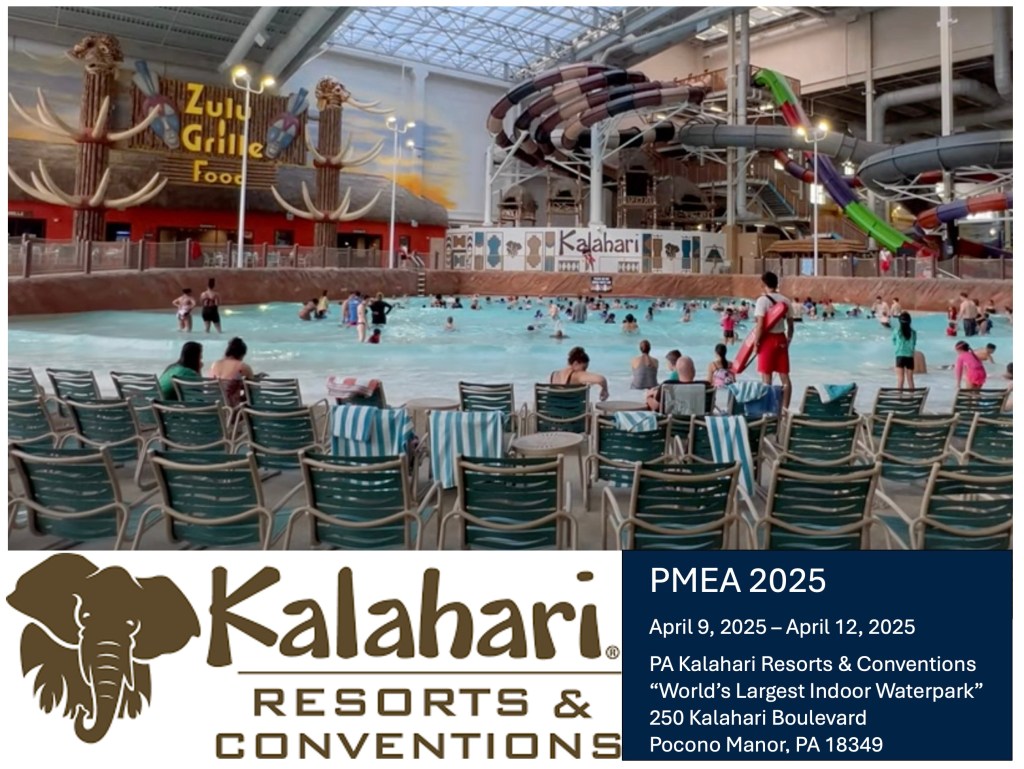
In addition, Kalahari Resort boasts “the world’s largest indoor water park,” the perfect place to bring family members to enjoy… especially (grand)children, (grand)nieces/nephews, etc.

Next month’s retirement blog by guest author Sierra Powell

One final announcement: In several weeks at this blog-site, we plan to feature a new guest blog entitled “Five Things You Need for a Comfortable Retirement” by Sierra Powell, along with updates of other resources for “living the dream!” See you next year?

OK, What is that “AI Thing?”

This 69-year old educator who has spent more than five decades in fostering creative self-expression in his students is fervently opposed to artificial intelligence. Actually, I thought I was allergic to “AI!” Every time I receive an Apple iPhone update or some new download for my computer, I complain, “Why have they moved that button? It doesn’t look or work the same! Why does everything have to change every month?” Slow down, techies!

However, to dabble in this new technology everyone’s talking about, I printed in my last PMEA Retired Member Network eNEWS on page one a sample article (click here for the Winter issue) compiled by AI Overview (Google). I shared this with an adult violin student from my Saturday orchestra who decided to show me the power of AI (not the old AI I am more familiar with – artistic intelligence!). She used her subscription to a ChatGPT to process my brief outline on the topic “retirement transitioning.” Below is the result generated from a few of my random notes. Created in the first person, AI matched my writing style, a chatty/informal letter printed for soon-to-retire colleagues along with research citations. Frankly, it scares me how close this sounds like something I could have composed! Can you tell it was artificially generated? Does this mean we will we have to teach this old dog (fox) new tricks?

Check out these valuable retirement hints courtesy of ChatGPT!

The Retiree Life: Navigating the Art of Reinvention & Emotional Balance

Here with some reflections, tips, and maybe even a little nudge for us all as we continue this grand adventure called retirement. Whether you’re still finding your rhythm or already feel like a pro at this, there’s always room to reflect, grow, and laugh along the way.

This week, let’s talk about something near and dear to every retiree’s journey: reinventing yourself and coping with the emotional ups and downs that come with this new chapter.

Reinventing Yourself: A Second Act Worth Applauding

Remember when we taught our students to embrace creativity and adapt to change? Turns out, retirement demands the same skills. It’s no longer just about what you did—it’s about who you are.

Reinvention isn’t about completely overhauling your identity. Think of it as expanding your repertoire. Studies show that retirees who actively pursue new interests or roles report higher life satisfaction (Wang et al., 2011). Whether it’s picking up the instrument you haven’t touched in decades, volunteering, traveling, or even starting a small business, the key is to stay engaged.

Here’s a thought experiment: What did you always wish you had time to do but never could because of lesson planning, rehearsals, or concerts? Now’s your chance. I’ve recently heard about retirees dabbling in everything from watercolor painting to writing mystery novels. One retiree even became a beekeeper—talk about a sweet second act!

(From past blogs, the Retirement 101 session, and Retired Member Network eNEWS reviews)

The Emotional Journey: Ups, Downs, and Everything in Between

Let’s not sugarcoat it: retirement is a mixed bag. There’s the freedom (hooray!), but also the occasional pang of loss—of identity, routine, or the camaraderie we had in our teaching careers.

The good news? You’re not alone. Research by Pinquart and Schindler (2007) highlights how important it is to acknowledge these feelings rather than sweep them under the rug. Adjusting to retirement is a process, and it’s okay to feel a little off-balance at times.

Here are a few tried-and-true strategies to help you navigate the emotional terrain:

  • Stay Connected: Loneliness can creep in when you least expect it. Keep up with PMEA activities, or start a retirees’ coffee group. Who better to laugh with about the time your marching band got rained out?
  • Practice Mindfulness: Before you roll your eyes, hear me out! Even just five minutes of quiet reflection a day can reduce stress and boost mood (Chopra et al., 2020).
  • Find Meaning: Volunteering or mentoring can give you a sense of purpose that’s deeply fulfilling. You’ve got a wealth of wisdom—share it!

AI of the future?

The Bottom Line

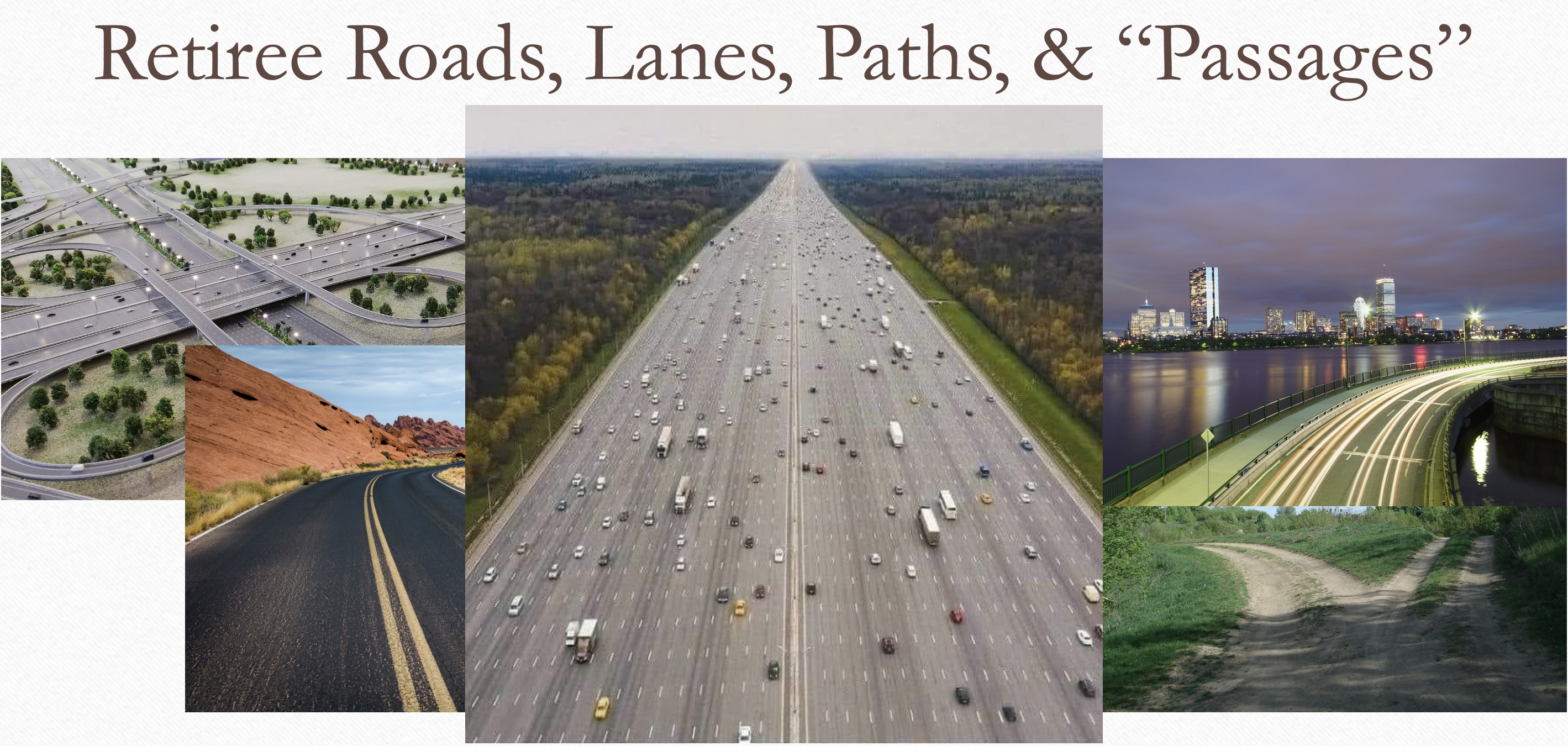
Retirement isn’t a destination; it’s a journey. And like any good road trip, it comes with unexpected detours, scenic overlooks, and, yes, the occasional pothole. The trick is to embrace it all with curiosity and a sense of humor.

If you’re struggling, remember: reinventing yourself doesn’t happen overnight. Take it one day at a time, and don’t be afraid to reach out for support—whether it’s from family, friends, or your fellow PMEA retirees.

Let’s keep the conversation going. What’s your “second act”? Have you discovered a new hobby or way to cope with the emotional shifts of retirement? Shoot me an email or share your story at our next meeting. Together, we’ll continue to learn, grow, and make this chapter one to remember.

Until next time, keep smiling and stay curious!

References:

Wang, M., Henkens, K., & van Solinge, H. (2011). Retirement adjustment: A review of theoretical and empirical advancements. American Psychologist, 66(3), 204–213.

Pinquart, M., & Schindler, I. (2007). Changes of life satisfaction in the transition to retirement: A latent-class approach. Psychology and Aging, 22(3), 442–455.

Chopra, A., Anthonisen, S., & Reeves, A. (2020). The role of mindfulness in retirement satisfaction. Mindfulness in Aging Journal, 7(4), 312–320.

PKF

© 2024 Paul K. Fox
Our Next Chapter

Bookends – Stage 5: “Living the Dream”

Welcome back to my blog site for music educators… actually hopefully thought-provoking reflections for teachers in any subject area or grade level, school administrators, classified school staff (secretaries, aides, custodians, etc.), and professionals in all fields.

It has taken me more than a year to revisit (and expand on) all of the sections from my workshop (October 2023) presented to Seton Hill University music education students, and now we close with “The Final Chapter” – a focus on self-reinvention and transitioning to retirement in anticipation of successfully Crossing the Rubicon to enjoy our “senior years.” This entire presentation was inspired by the mission statement of the Pennsylvania Music Educators Association (PMEA) Council for Teacher Training, Recruitment, and Retention – “The Life Cycle of a Music Educator” – for which I had the privilege of serving eight years as the State Chair (still a council member). To recap, here is an outline of my previous blogs on the evolution of an educator, a journey through career “passages” to follow:

Stage 5: Next Chapter/Living the Dream Years –
Retirement Prep & Mastery

To start with, the term “retirement” is a misnomer. Typically, in most dictionaries (online and printed), it is defined as “the withdrawal from one’s career, occupation, or office usually because of age,” or even the synonyms “seclusion from the world,” “privacy,” “the act of going away,” “retreating,” or “disappearing.” No, perhaps more appropriate definitions would support the advances in medical science, a better standard-of-living, our healthier lifestyles and improvements in self-care, and longer lifespans. Retiring from your first career may only be the halfway point! Sample online quotes:

“The ‘new retirement’ is not an ending, it’s a new beginning, the start of a new life journey of vastly expanded proportion.” Dr. Richard Johnson, Flourishing in Retirement

“Retirement now is mostly about change. And it may not look all that different from what immediately precedes it.” Huffington Post: http://www.huffingtonpost.com/arianna-huffington/its-time-to-retire-our-definition-of-retirement_b_5774878.html

Retirement is “reinventing yourself for the life you’ve always wanted.” Steven Price, How to Survive Retirement, Skyhorse Publishing, 2015

In my experience hosting the annual PMEA conference session “Retirement 101 – the Who, What, When, Where, Why and How” and sharing retiree stories and strategies, I have come to the conclusion that there are many other misconceptions about taking this big step:

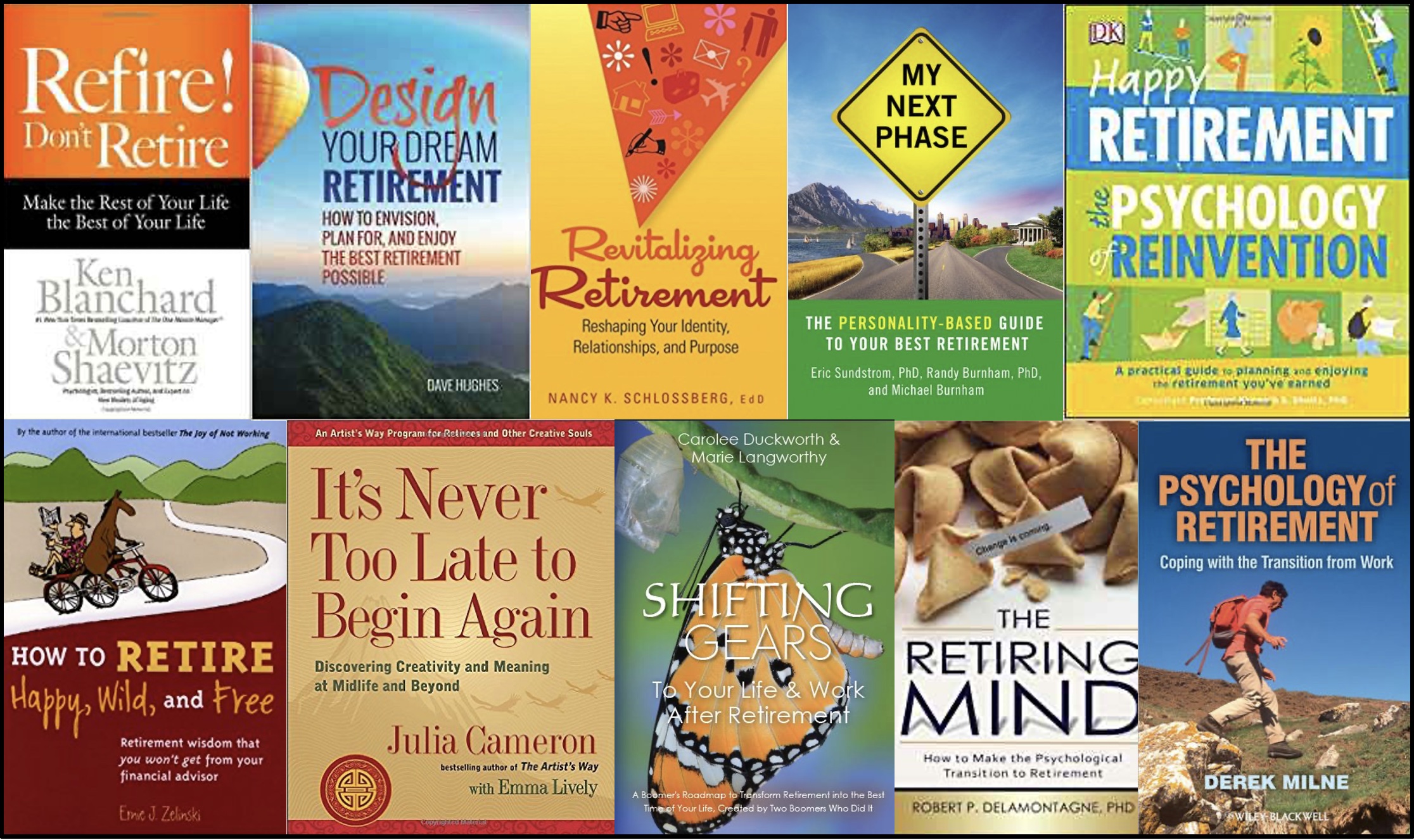
  • You retire FROM something. (Nope! You need to retire TO your next phase of life, new goals, pursuits, etc., and not run away from your past. We have often paraphrased the theme of author Ernie Zelinski writings in past paulfox.blogs: Retirees must search for and define the things that your job had provided in the past: 1) Purpose/new life mission, 2) Structure/schedule, and 3) Community/interaction with people.)
  • It’s an easy transition. (For many, it can feel like the most tumultuous transition ever experienced with “change,” sometimes overwhelming swings in emotions, and personal challenges!)
  • It takes little time to prepare. You just fall into it! (No, the research recommends “intentional and comprehensive” advance preparation, starting at least 3-5 years before you “pull your plug.”)
  • The decision is based almost entirely “on the money.” (True, a soon-to-be-retiree should draft a post-employment household budget, analyze net worth and pension/social security benefits, pay off as many loans as possible, and make appointments with an estate planner, elder attorney, and/or financial advisor. However, we retire for a host of very personal reasons – travel, relocation, encore or new careers, caring for family members, etc., and the likely greater challenge is a renewed exploration of self-reinvention, defining new pathways, renewing relationships, and mapping out your rest-of-life strategies and goals. In other words, what are you going to be when you grow up?)
  • It’s completely different from anything you’re doing right now. (Music educators have a variety of skill sets that they will likely retain in future part/full-time employment or volunteer work. They can advance their personal artistry in the singing or playing an instrument, accept solo “gigs” or perform in community or professional ensembles. They can teach privately, direct church or community bands, orchestras, choirs or jazz groups, coach sectionals, compose music or design halftime shows, judge school groups, present workshops, choreograph/direct musicals, serve in college music education programs, etc. The list goes on and on… and is only limited by the retiree’s imagination and interest.)

In almost every book on retirement, there are discussions about the “stages of retirement” (defined by gerontologists – experts on aging) that graphically show the importance of advance planning. (See below.) The first three stages certainly provide opportunities to rethink, recharge, reinvent, retool, and redefine one’s life purpose and meaning, become productive, and begin that new chapter in their lives.

Retirement can be a little bumpy. It’s not unusual to feel many “up’s and down’s” through the transition. A lot may have to do with whether you had really wanted to leave your job when you did or if you took the necessary steps in retirement preparation. Many have suggested to take a year or two “internship” to explore your options, rest a little and take a break from all of that stress, celebrate the free time (you seem to) instantly have, and then assess and “test” what might be your next (more permanent) steps.

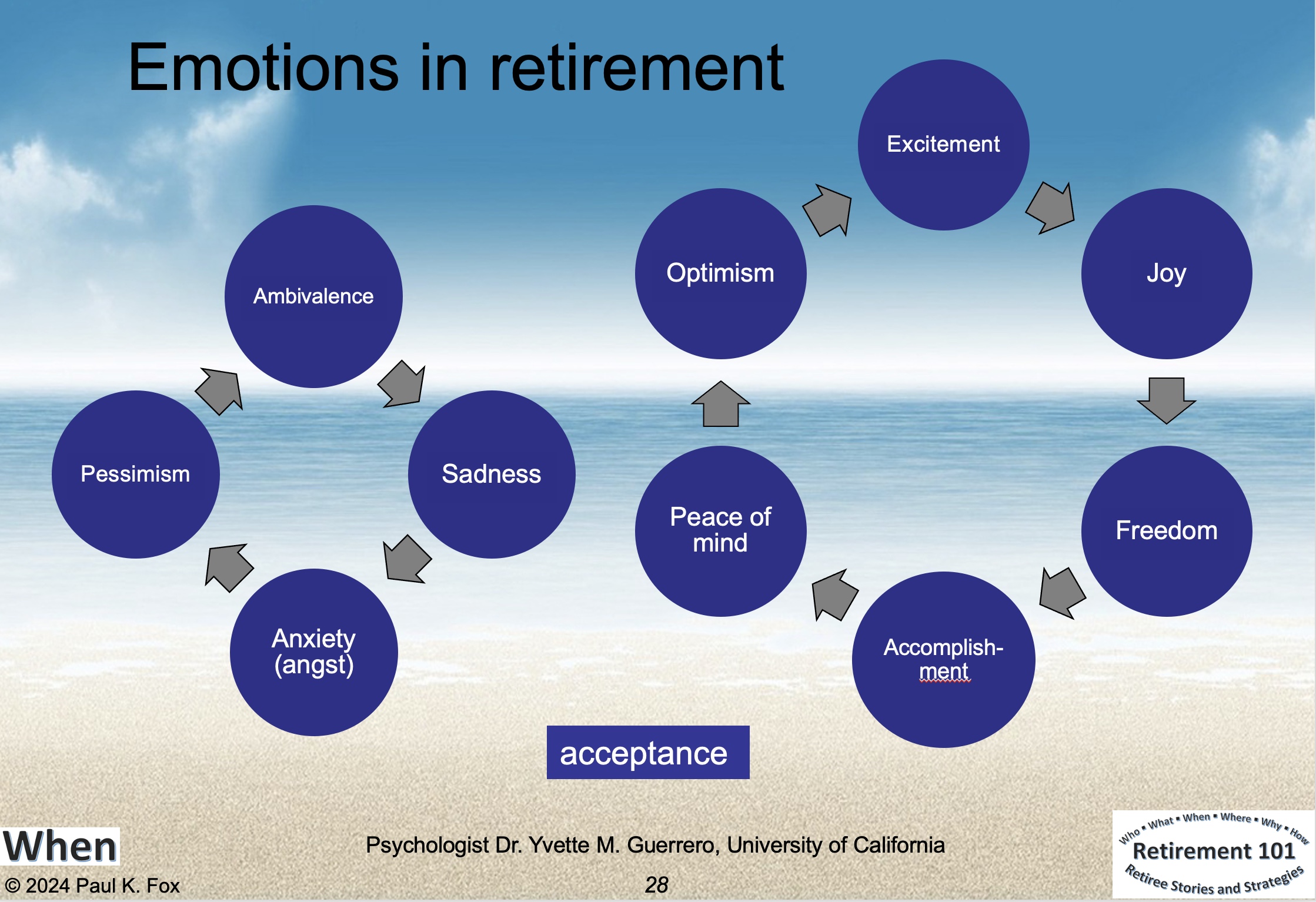
Prepare for the emotional roller-coaster! Initially, you are very EXCITED about your upcoming retirement. You feel pure JOY about the anticipated FREEDOM, and everyone throws you a party or two. You take moments to sum up your career legacy and ACCOMPLISHMENTS. A blessed PEACE-OF-MIND envelopes you, no longer having to worry about that next concert, recruitment campaign, or lesson target. With the future in front of you, you feel OPTIMISM. And then, after the excitement dies down…

At times, you feel a little AMBIVALENT about all of this “change!” SADNESS could come saying good-bye to your colleagues and experiencing a loss in professional identity and sense of purpose. Perhaps you may experience ANXIETY (angst) about what the future will hold, and PESSIMISM on whether you will “get it together” in your new life.

But, finally… ACCEPTANCE and adjustment!

Both emotional cycles may happen at different times or nearly simultaneously. These are normal “speed bumps,” and the perfect reason why you should remain as active as you can with your relationships, especially with people who have already made the retirement journey.

Are you ready to retire over the next 3-5 years? Well, as the PMEA Retired Member Coordinator for ten years (with the help of numerous inspirational music teacher retirees in PMEA), I have spent a lot of time preparing what amounts to be a “mock instructional manual” and other resource materials for fellow PMEA members. These are all posted here on the PMEA website. (This one of the best reasons to maintain your PMEA professional association and pay your dues… We continue to advocate, advise, and assist all PA music educators… from preservice to “living the dream!”)

Free “nuts and bolts” are listed below for you to peruse as you prepare for this life-changing passage.

What’s next? How about attending the PMEA Annual Conference on April 9-13, 2025 at the Kalahari Resort/Poconos (“home of the world’s largest indoor water park!”) and enjoy some time away from it all? The Kalahari offers some family-fun recreation and PMEA will provide concerts, keynotes, exhibits, and sessions of stimulating professional development for the entire “life cycle of the music educator.”

PMEA members, I hope you plan to attend my Friday session at the conference…

Looking forward to seeing you there! At any time, if you need help or more ideas on retirement prep, I’m just a quick email away. (Click here.) Let me hear from you!

PKF

© 2024 Paul K. Fox
Update… Bigger & Better Things!

T-minus Twelve Months to Year 70!

Wow! I can’t believe it’s been three whole months since I posted a blog here! Where’s the time gone? Excuses? Well, what first leaps to my mind are several quotes from this Southern Living website about being an extremely busy retiree:

“The trouble with retirement is that you never get a day off.” — Abe Lemons

“I need to retire from retirement.” — Sandra Day O’Connor

“The harder you work, the harder it is to surrender.” — Vince Lombardi

“I wanted to have more time to play and reflect, but I find retirement more stressful than having a nice, steady job because I have to make decisions about where I want to be.” — Walter Cronkite

“I see retirement as just another of these reinventions, another chance to do new things and be a new version of myself.” — Walt Mossberg

“Living each day as if it were your last doesn’t mean your last day of retirement on a remote island. It means to live fully, authentically and spontaneously with nothing being held back.” — Jack Canfield

“Do not grow old, no matter how long you live. Never cease to stand like curious children before the great mystery into which we were born.” —Albert Einstein

To my friends and colleagues in the profession, yes I am “living the dream” and having fun in retirement! Health remains good, and the days of my wife and I are filled with personal enrichment, unique new and renewed adventures, and meaningful service to the causes that matter to us both! Our only complaint? There are only 24 hours in a day… But, that means, as we head to bed each night, we have lots on our ever-expanding to-do lists motivating us to get up even earlier the next day to accomplish!

So, the following will be a quick (?) update, ramblings in the format of “streams of consciousness” of what’s happening in our lives, geared to my more faithful friends and followers, and perhaps modeling the activities of two happily retired music teachers. I promise that future blogs will re-engage with our series on “Bookends…” (life cycle of a music educator), ethics training of educators, and interviewing skills of newcomers to the profession (the season of job screenings will soon be upon us!), not to mention more tips towards a smooth transition to retirement for those who are planning to “pull their pin” and leave their full-time employment in the near future. Thanks for hanging in there with us!

PMEA Conference

Both my wife Donna, her cousin Judy, our two dogs Gracie and Brewster, and I just returned from Erie, PA participating in the PMEA Annual In-Service Conference. This was unique in that, for the first time since we retired in 2013, Donna could attend “the big event” with me. Judy served as our dog babysitter (we don’t believe in “jailing” our pups!), and the Bayfront Sheraton, Courtyard Marriott, and Erie Convention Center were pet-friendly. We reserved adjoining rooms, and the dogs were content to walking all around the Bayfront Area/Lake Erie and returning at night to sleep with us.

To my PMEA colleagues and other PA educators, in case you missed it, here is the link to more than 1,000 photos I took at the conference (sessions, meetings, exhibits, and performances). Attendees, I challenge you: CAN YOU FIND YOURSELF & YOUR STUDENTS?

As usual, Executive Director Abi Young, PD Council Chair Martha Heise and her conference planning committee, PMEA state EXCOM and staffers planned another outstanding event. If you have never gone to a PMEA conference, mark next year’s dates April 9-12, 2025 on your calendar, which will be held in the luxurious Kalahari Resort in the Poconos. Besides, the “world’s largest indoor water park” is a fun place to bring your (grand)children! In addition, several other professional development and career enhancement venues are on the horizon available to members of NAfME and PMEA:

  • PMEA Summer Summit (Leadership Conference), Reading, PA
    July 15-17, 2024
  • NAfME Biennial Music Research and Teacher Education Conference, Atlanta, GA
    September 25-28, 2024
  • NAfME Eastern Division Conference and Honors Ensembles Festival, Hartford, CT
    April 24-26, 2025

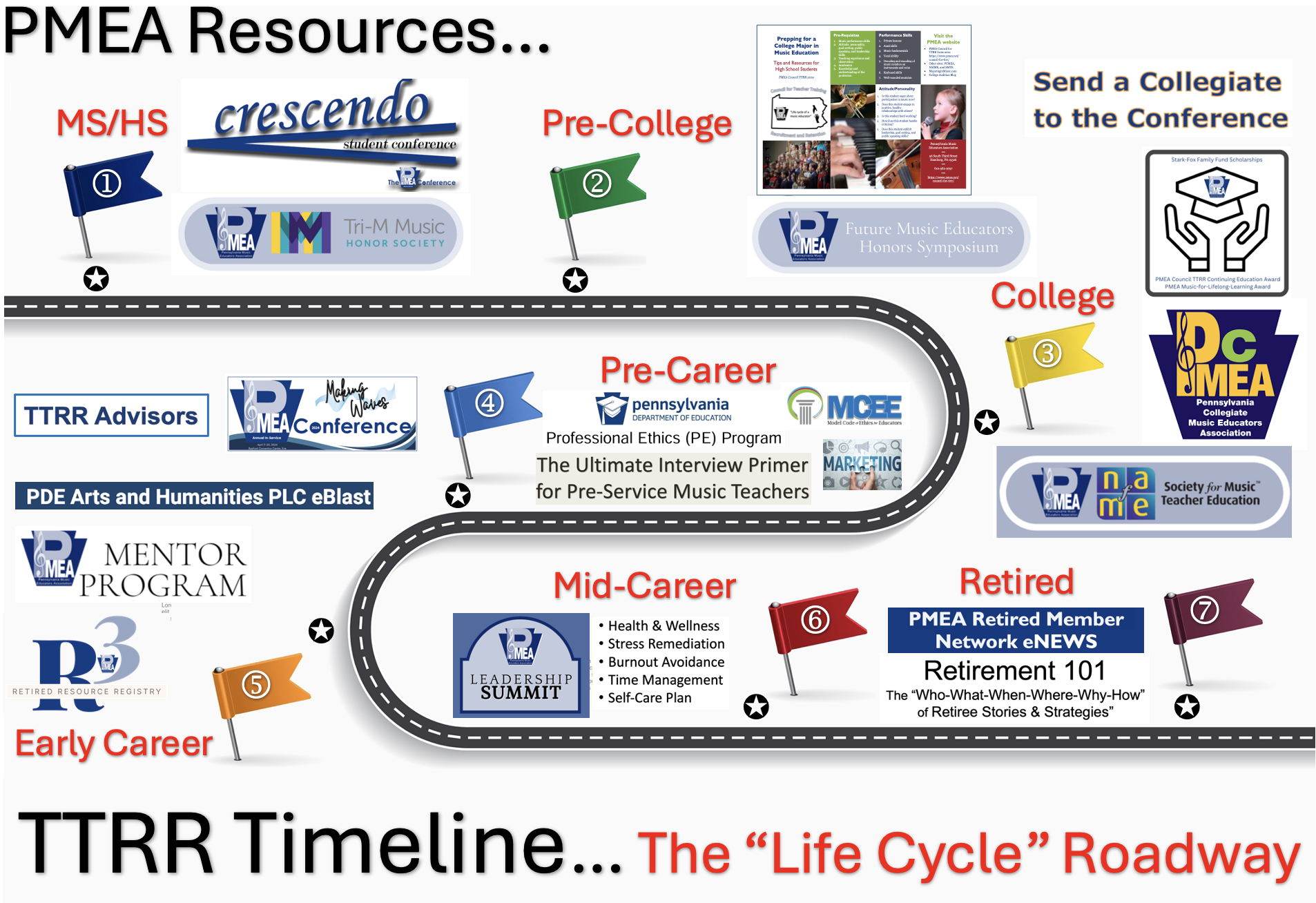
At the Erie conference, I hosted my last PMEA Council for Teacher Training, Recruitment, and Retention and TTRR SHOWCASE. At our annual meeting, I stepped down as the state chair, but will continue as State Retired Member Coordinator on the Council TTRR. We’re in excellent hands, with TRI-M Chair Tina Bennett being elected to the state TTRR Council Chair position. Joining her is the visionary leadership of State SMTE Chair Dr. Kathleen Melago, Mentor Co-Chairs Lisa Endler and Eric Plum, PCMEA Student President Ellie Vito, Future Music Teachers Honors Symposium Chairs Aaron and Stephanie Magaro, PDE Fine Arts Education Consultant David Deitz, and Higher Education Representatives Paul Doerksen, Jessica Vaughan-Marra, Sarah Watts, Debbie Wolf, among others.

Below is a copy of the “Everything You Always Wanted to Know About Council TTRR” SHOWCASE slides which were presented to a whopping 60 PCMEA members during our breakfast meeting at the conference. (Perhaps the food motivated more collegiates to get up extra-early for that first session?)

Scholarships

One of the concerns repeatedly expressed at Council TTRR meetings was the funding issues of college students. Besides an anonymous donor funding the PCMEA breakfast at the SHOWCASE on April 18, PMEA instituted a “send a collegiate to the conference” campaign (complimentary registrations) and in 2023, also announced two major scholarship (college expense reimbursement) opportunities endowed by our Stark-Fox Family Fund in memory of our parents:

  • PMEA Council TTRR Award for Music Education Majors
  • PMEA Music for Lifelong Learning for STEM Students in College Music

In the spring of 2023, three $5K PMEA Council TTRR Scholarships were awarded to:

  • Elizabeth Corbett (Duquesne University)
  • Adam Hanna (Susquehanna University)
  • Mitchell Hourt (Moravian University

Unfortunately, last year no applications were submitted for the PMEA Music for Lifelong Learning Award. A concerted effort has been made to “reachout” to this population of students who are pursuing a science-related field and participating in their PA college band, chorus, jazz, or orchestra program. Please spread the word! Deadline to register is May 29, 2024. More information is posted here.

Upcoming Workshops

I was pleased to learn that two of my sessions were accepted for the Kappan 2024 Educators Rising National Conference scheduled for June 28-July 1, 2024, in Washington, D.C. at the Marriott Marquis:

  • Embarking the E3-Train – Essentials for Future Educators – What It Takes to Become a Teacher: Ethos, Ethics, and Engagement
  • Interviewing and Branding 101 – The Art and Science of Marketing Yourself for Employment Screening

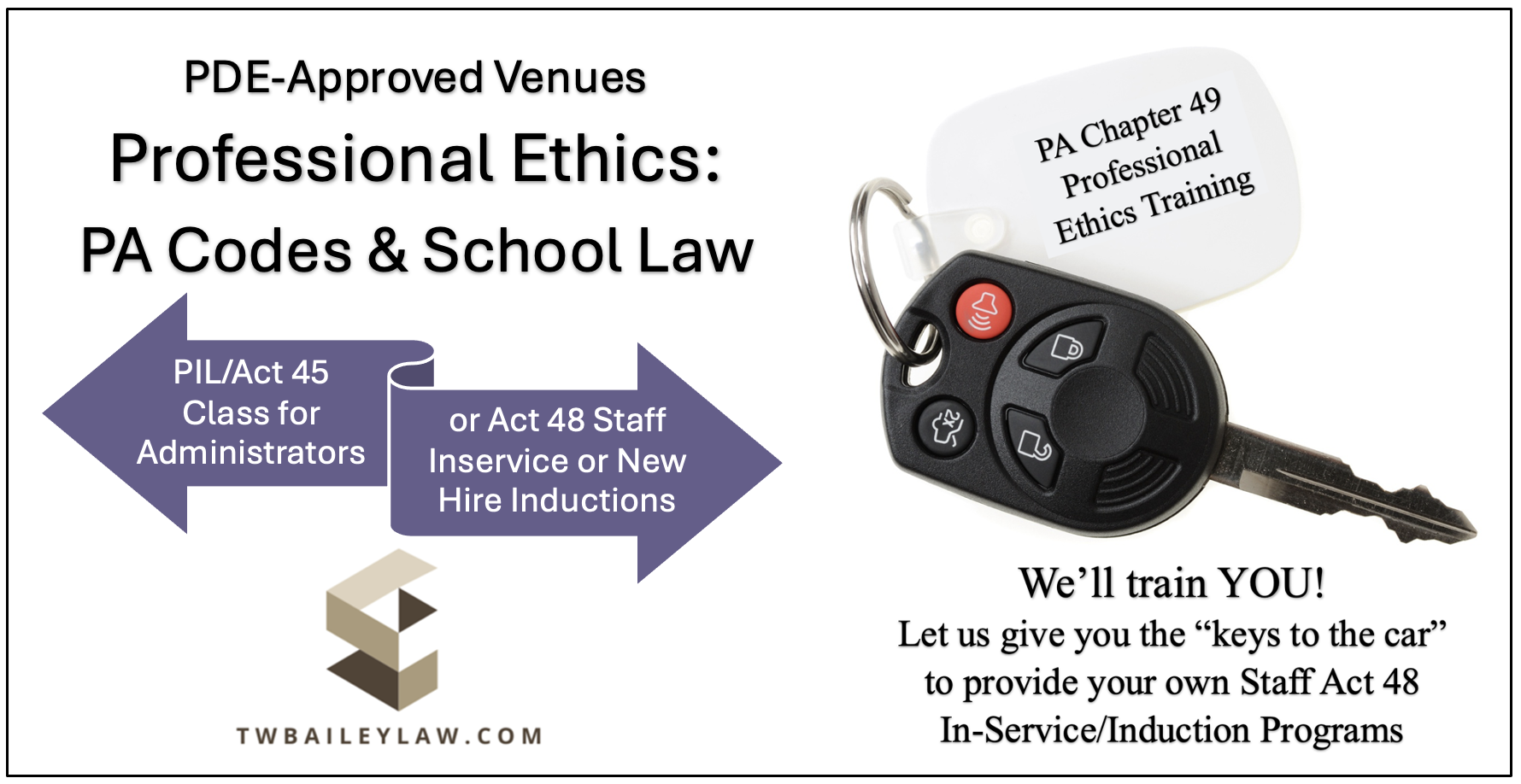
In addition, I remain active in supporting my colleague Thomas Bailey in providing PDE-approved Act 45 and Act 48 ethics training courses for PA educators. Currently, we’re teaching our fifth series of classes (25 PIL hours) for school system leaders and have presented more than 14 additional professional development workshops, webinars, or conference sessions of in depth interactive discussions of ethics and daily educator decision-making. Our next focus area is to help PA administrators to incorporate the newly mandated PA Chapter 49 ethics competencies into their school induction programs.

To learn more about course offerings or read court case blogs on ethics in education, visit Tom Bailey’s website here. This blog-site also provides a comprehensive library of past articles on educator ethics.

Who Really Reads These Blogs?

That’s a good question! Although I have always provided a “comment” link at the top of each posting and seek feedback and even “guest authors” to feature in future blogs, very few people respond to these articles. I have always hoped that “my meanderings” could help music teachers at all stages of their careers, from pre-college and music/music education majors to veteran educators to retirees. At least, this WordPress site allows me to permanently archive my writings with the hope this exhaustive but always-accessible supply of resources, links and viewpoints could be used in the future. Share on!

So recently, I was pleasantly surprised when Becca Robinson, a tutor of homeschooled children, reached out to me and said Jeremy, one of her students, did extra-credit research after reading one of my blogs on retirement resources. We are adding his recommendation for this link to the Transportation Resource Guide for Seniors & Individuals with Disabilities in the “Retiree” menu section at the top of the page. This comprehensive article by Cole Neder documenting the following is a valuable read for senior citizens and anyone who is experiencing personal mobility challenges:

    • Public Transit
    • Paratransit Services
    • Demand Responsive Services
    • Non-Emergency Transportation
    • Ride-Sharing and Taxis Services
    • Service Resources by State

    On a Personal Note…

    Yes, last week was my 69th birthday! I never imagined getting that old… er, I mean, mature! Neither my mother nor my father made it to their seventh decade! I attribute my positive attitude and active lifestyle (even though at times I could unintentionally forget your name at the drop of a hat) to embracing what Ernie Zelinski, author of How to Retire Happy, Wild and Free, says is absolutely essential to maintain in retirement: “finding purpose, structure, and community.” It is a paramount of importance to feel we matter and are needed every day, exercise both sides of our brain (the analytical and the creative), keep physically fit, jump out of our bed with purpose, maintain busy schedules and accept a lot on our plate, and stay connected to the people surrounding us. To that end, my wife and I continue to teach the pursuit “creative self-expression,” directing a community ensemble (the South Hills Junior Orchestra), teaching, walking our dogs, and pushing wheelchairs at our local hospital. At times, this latter activity allows us to catch up with our former music students, their parents, school staff, and neighbors. What FUN it is to meet someone who I taught many years ago in middle school, now grown up and busy raising their own “band” of musicians! God willing, I hope to continue with good health, a sharp mind, and motivation to live to Moses age (150 years old?), or at least have a ball along the way!

    I leave you this month with a copy of the one-of-the-kind birthday card one of my adult students (who claims me as her “adopted father?”) created using Photoshop. Three generations of her family play in our Saturday orchestra. Caption: Left is our Gracie, a bichon frise, and right is Brewster, a yorkie-poo. I’m depicted in the middle with my SHJO bow-tie, of course!)

    Happy trails, retirees and active educators alike! Keep in touch!

    PKF

    © 2024 Paul K. Fox
    A Penny

    by Kathy Merlino, guest blogger

    Kathy Merlino is the author of kathysretirementblog.com, a blog about her perspective and thoughts on the emotional side of retirement and her journey as a caregiver. She is one of the most thought-provoking and influential writers on non-financial retirement topics. Kathy believes retirement is a journey, not a destination. Readers can leave a comment on Twitter:@kathysretiremnt

    Kathy’s article was originally posted on November 26, 2022. All rights reserved. Reprinted with permission.

    PKF: This personal reflection is timely for all of us retiring and retired individuals, especially those of us with elderly or ailing family members. For a loss of a loved one, we all have to face and cope with the five stages of grief:

    • Denial
    • Anger
    • Bargaining
    • Depression
    • Acceptance

    Grief is personal and individual, and every person experiences its nuances differently. Your personality, your support system, your natural coping mechanisms and many other things will determine how loss will affect you. There are no rules, no timetables, and no linear progression. Some people feel better after a few weeks or months, and for others it may take years. And in the midst of recovery there may be setbacks — this nonlinear process can’t be controlled. It’s critical that you treat yourself with patience and compassion and allow the process to unfold.

    https://healgrief.org/understanding-grief

    PKF: Check out their excellent article on the common signs and symptoms, triggers, myths and facts about grief as well as ways to take care of yourself, posted by healgrief.org here.

    A Penny by Kathy Merlino

    Shortly after Martin died, I walked down my long driveway to fetch the mail. Usually, I have little or none.  But, in the days following his death, my mailbox held more than junk mail. There were sympathy cards and official letters from various institutions. As I pulled out the cache of the day, I saw something I’d never seen in my mail. A penny. It lay underneath the cards and letters and the ubiquitous junk mail. A penny so tarnished it almost faded into the background of the black metal floor of the box.

    My mind flooded with the rhetorical questions. Who would leave a penny in my mailbox and why and how? I lived on a busy road, so someone walking by was unlikely. The leaving must have been thoughtful, intentional. “A penny for your thoughts” (Sir Thomas More) came to mind. Was it my faithful mail lady who left it? I lifted the penny out, slid it into my jean pocket, and walked back to the house. Inside, before turning my attention to the mail, I fished it out and set it on a mosaic trivet Martin had made in an art class. 

    Over the next couple of days, I eyed the penny still wondering how it got in my mailbox. Did a penny have any significance? “See a penny and pick it up and all day you’ll have good luck” (Mother Goose Nursery Rhymes). Since we can pretty much Google anything these days, my curiosity finally gave way to asking Google. To my surprise, a penny has significance for the deceased or their loved ones. In the case of a veteran, a penny left at the grave means someone visited. For a widow like myself, a penny in the mailbox represents a new beginning, a rebirth, renewal of your life. A penny being first and one represents singularity. If you are part of a couple, one of you will die first leaving the other alone, single.

    I’ve been alone for nearly eighteen months. While Martin still lived, it was not with me. If there is a silver lining here, it’s that I had ample time to adapt to my aloneness and grieve this impending, profound, enormous loss in my life. The outcome? I was not filled with the expected feelings of grief. Rather, as I held Martin during his final moments, I cried tears of gratitude for the end of his suffering. He was free of this disease. I was free of this disease. Our family was free of this disease. Relief instead of deep sorrow. Comfort in knowing he was at peace. As I stroked his face, I noted how serene his countenance. Peace at last.

    Though I’ve had fits of grief, I’ve also felt immense joy when contemplating my future. During the last year, I deliberately divested myself of anything which smacked of negativity in my life. I decluttered the house paring my personal belongings. I feel washed clean, ready for a new start. Martin would want that for me. A friend asked if I thought Martin’s spirit left the penny. I would like to think so. I may never know who left the penny in my mailbox, but it is now my talisman for fresh beginnings, rebirth, a reawakening of my life’s potential. And a second chance at the retirement we dreamed of.

    Other articles by Kathy Merlino. Thank you for sharing!

    PKF

    © 2022 Paul K. Fox

    PMEA’s Unique “Together” Conference

    The return of in-person gatherings of PA music educators and students!

    Here’s a “sneak preview” of the upcoming annual professional development convention for members of the Pennsylvania Music Educators Association (PMEA) and Pennsylvania Collegiate Music Educators Association (PCMEA).

    https://www.pmea.net/pmea-annual-in-service-conference/

    After being “hunkered down” for two years of online workshops, virtual conferences, digital music industry exhibits, and Zoom rehearsals of PMEA All-State ensembles, we can now “crush COVID-19” with “face-to-face” meetings of the PMEA TOGETHER CONFERENCE on April 6-9, 2022 at the Kalahari Resort in the Poconos.

    Not just a “play on words,” this LIVE event brings TOGETHER the awesome and inspiring vision and efforts of the PMEA Professional Development Council, state officers, and staff, along with a twist from tradition – offering a place to getaway from it all!

    Ask your spouse or “significant other,” children or grandchildren, nieces or nephews, other fun-loving family members, or close friends if they are available to join you for a three-day escape to the Poconos – “the world’s largest indoor waterpark” at Kalahari Resort! Experience great music, career development sessions, catching-up with colleagues, reconnection with your loved-ones, and entertainment for all ages – all wrapped up in one location.

    https://www.kalahariresorts.com/pennsylvania/

    Bring the family? Each spacious hotel room comes equipped with two double beds, a pullout sofa, microwave, and refrigerator, and the discounted $149/night conference rate allows you to register up to four people with access to all the resort’s amenities for no extra charge!

    What resort amenities? Enjoy rides and slides (lots to “splash in” or just relax on the lazy river), a “big game” room, mini golf, mini bowling, 7-D motion theater, gourmet restaurants, spa, salon, fitness center, and amazing shopping and sightseeing excursions in PA’s northeastern region. While YOU are attending PMEA keynote sessions, clinics, concerts, and exhibits, the rest of your party could be “living it up” on as many as 29 waterpark thrills (from “mild” to “wild,” check out all of them on their website):

    • Anaconda
    • Barreling Baboon
    • Bugs Burrow
    • Cheetah Race
    • Coral Cove
    • Elephant’s Trunk
    • Flowrider
    • Indoor Outdoor Spas
    • Kenya Korkscrew
    • Lazy RIver
    • Lost Lagoon
    • Outdoor Pool
    • Rippling Rhino
    • Sahara Sidewinders
    • Screaming Hyena
    • Shark Attack
    • Splashdown Safari
    • Tiko’s Watering Hole
    • Victoria Falls
    • VR Waterslide
    • Wave Pool
    • Wild Wildebeest
    • Zig Zag Zebra

    Source: Pocono Mountains Visitor Bureau

    A joyful car trip to local scenes and attractions? The word “Pocono” means “the stream between two mountains.” This region encompasses 2,400 square miles of lakes, rivers, and woodlands just waiting to be discovered. Just how adventurous are you?

    • Explore numerous opportunities to hike, bike, bird watch, ski, fish, and photograph the wildlife, waterfalls, and other breathtaking landscapes.
    • Peruse the various exhibits of local artists at the White Mills Art Factory, 736 Texas Palmyra Highway (Route 6) from 10 a.m. to 5 p.m. (closed Wednesdays).
    • Try your luck at the Mount Airy Casino Resort Spa.
    • Or be a “wandering tourist” and visit nearby Stroudsburg, Milford, Jim Thorpe Honesdale, Lake Wallenpaupack, Hawley, Skytop, Bushkill, Lake Harmony, or Tannersville.
    • Check out this Poconos Mountains interactive map: https://www.poconomountains.com/interactivemap/.

    Keynote speakers David Wish and Lesley Moffat

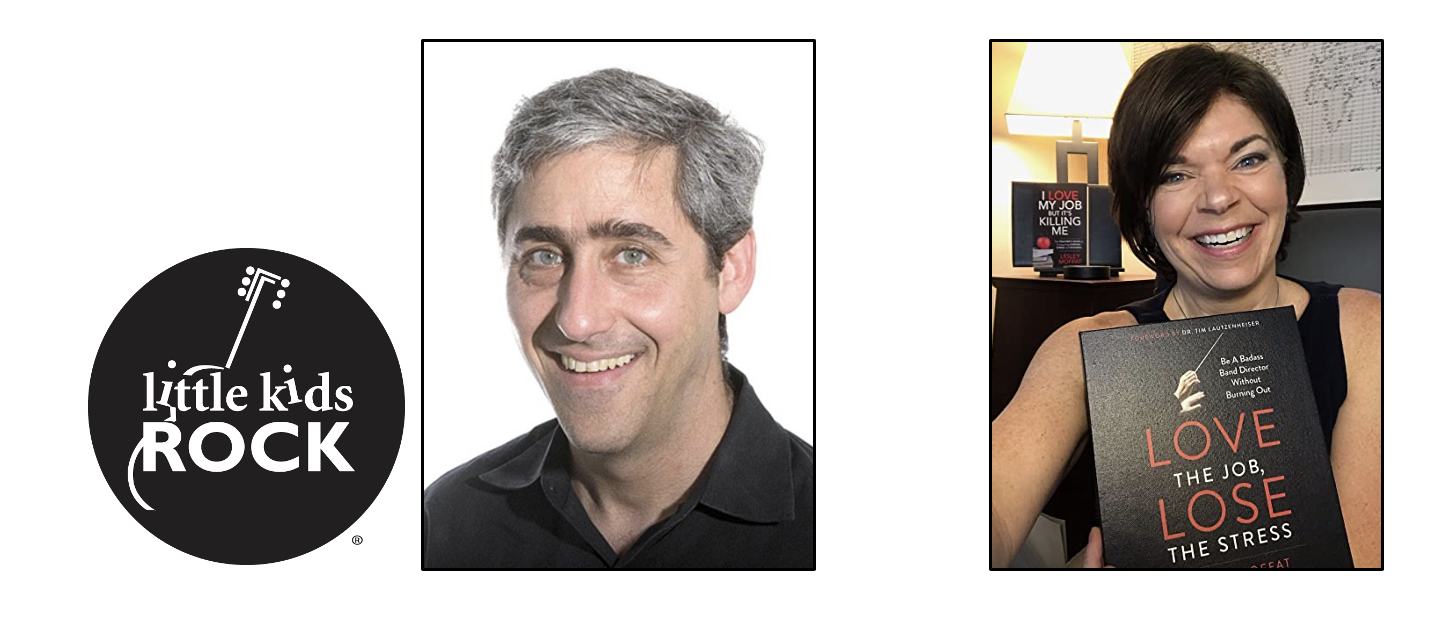
    Now down to the business of professional development! In your free time from the above refreshing and re-invigorating moments of “down time,” you won’t want to miss the PMEA general sessions featuring keynoters David Wish of Little Kids Rock and Lesley Moffat, author of Love the Job, Lose the Stress. After opening the music industry and collegiate exhibits, numerous workshops, interactive demonstrations, and panel discussions will be hosted on a variety of “state-of-the-art” and timely topics:

    • Adjudication
    • Assessment
    • Career Development
    • Choral
    • Collegiate
    • Curriculum Development
    • Diversity/Equity/Inclusion
    • Exceptional Learners
    • Health and Wellness
    • Instrumental
    • Leadership/Mentoring
    • Modern Band
    • Music Technology

    Draft of proposed 2022 PMEA Conference sessions

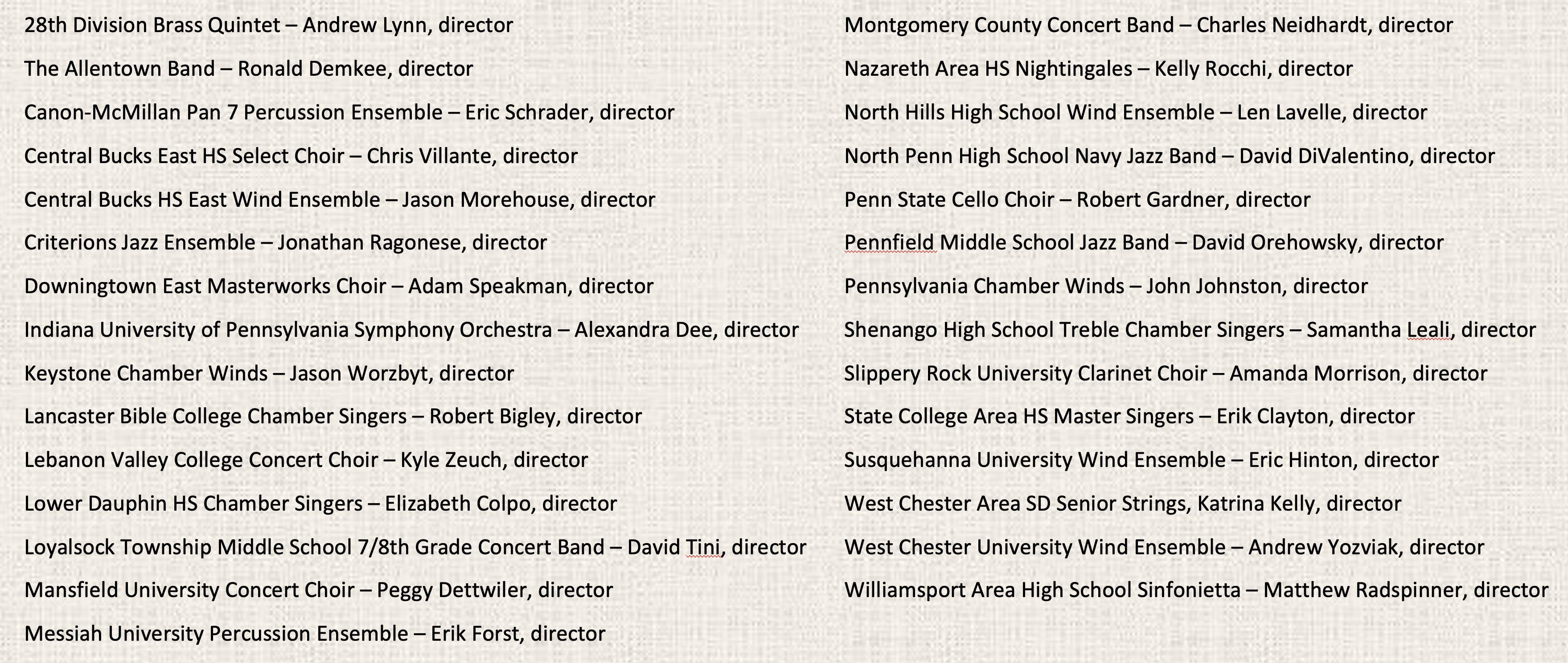
    Sandwiched in between these clinics and meetings of PCMEA, PA Society for Music Teacher Education, PMEA Council for Teacher Training, Recruitment, and Retention, PMEA Retired Members, Pennsylvania-Delaware String Teachers Association, and others will be opportunities to observe rehearsals and performances of the PMEA All-State Band, Chorus, Jazz, Orchestra, and Vocal Jazz, and attend concerts of guest performing ensembles – among “Pennsylvania’s finest.” Congratulations to:

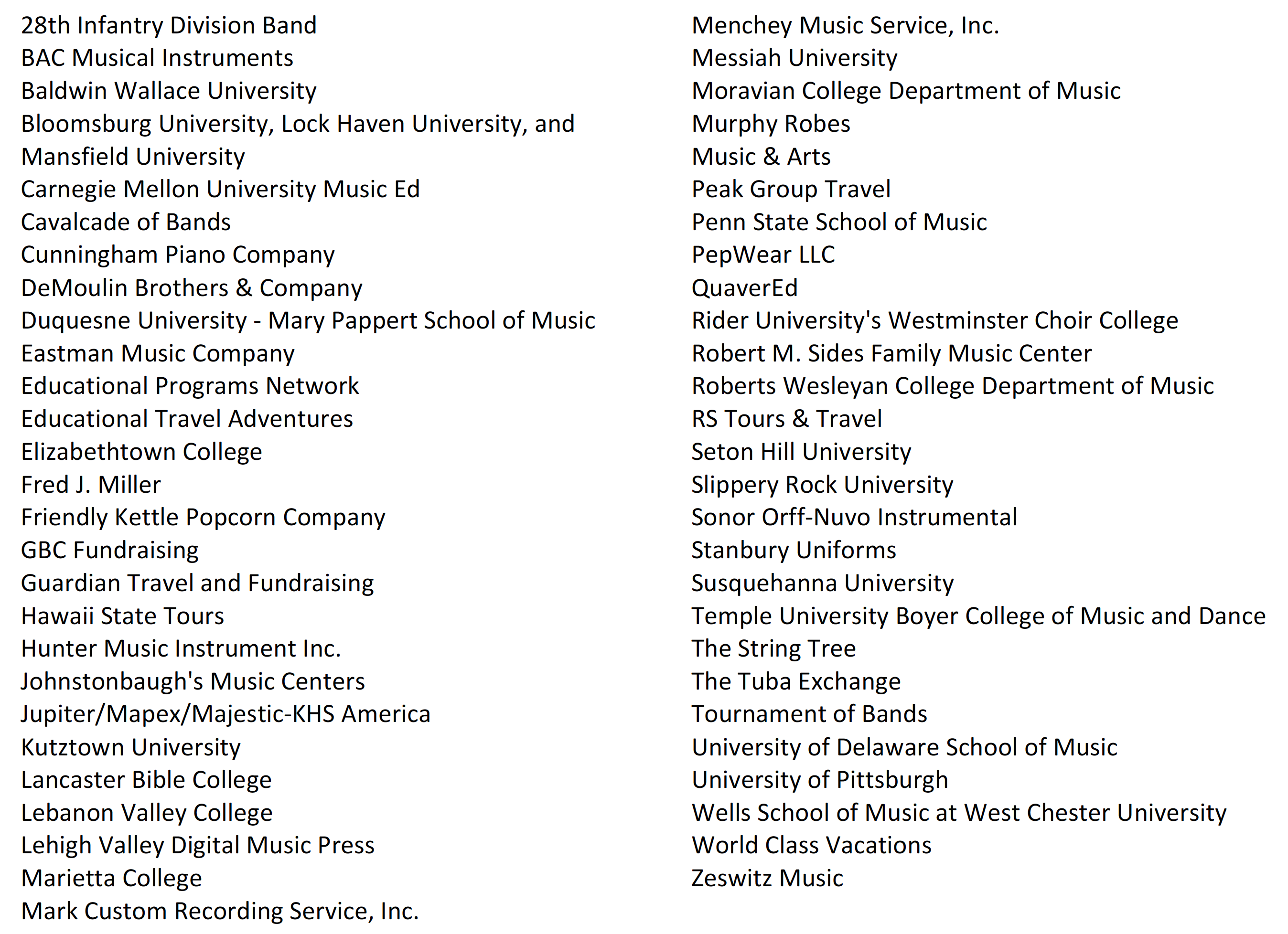
    Looking for that new classroom accessory, concert selection, educational travel group, fundraiser, instrument, technology tool, or uniform, or seeking to talk to representatives from music schools? Take time to visit the exhibits. PMEA thanks the continuing support of its PMEA Corporate Sponsors.

    Early-bird registration of 2022 PMEA Conference Exhibitors

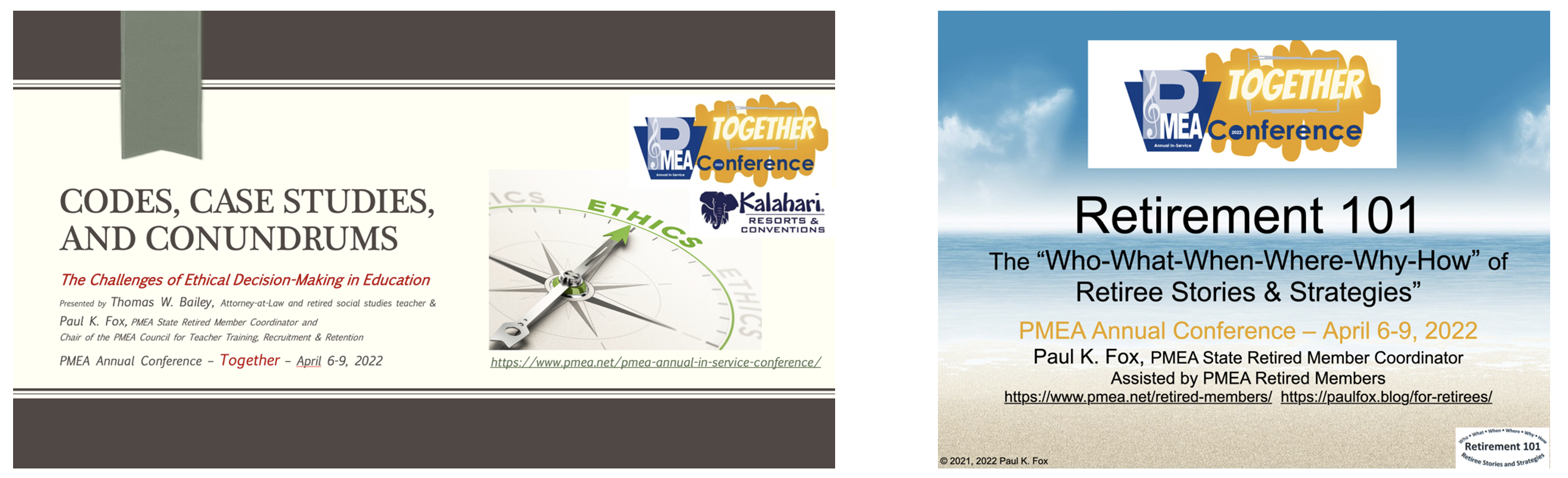
    Yours truly (blogger) is proud to announce he is presenting three sessions at the conference:

    • CODES, CASE STUDIES, and CONUNDRUMS – The Challenges of Ethical Decision-Making in Education
    • THE INTERVIEW CLINIC – Practicing and Playacting to Improve Your Performance at Employment Screenings
    • RETIREMENT 101 – The Who, What, When, Where, Why, & How of Preparing for Post-Employment

    PMEA will need volunteers to assist as presiding chairs or to serve at the INFO BOOTH near registration. In addition, the PMEA Retired Member Coordinator is seeking retirees to help serve on a guest panel of “semi-experts” for the retirement session.

    It’s still a little early for much additional detail. However, check out this MOVIE TRAILER preview of the 2022 Conference, featuring The Pennsylvania March composed by PMEA retired member Ron DeGrandis.

    As of January 17, 2022 (Martin Luther King Jr. Day), Kalahari Resort room reservations are open! The link to conference registration will be coming soon. For more information, please visit the PMEA website. Keep your eye out for revisions in future PMEA News, UPDATES, and other e-publications.

    PKF

    © 2022 by Paul K. Fox

    New Year’s Resolutions for Retirees

    Do you believe in formulating annual goals or drafting a couple “New Year’s Resolutions?”

    THE STATS DON’T LIE

    Every year around this time, the web highlights many so-called experts touting the benefits of making personal improvement plans… and is just as quick to admonish us for breaking them. The statistics are not encouraging:

    Success/Failure rates over the first 6 months

    • Of those who make a New Year’s resolution, after 1 week, 75% are still successful in keeping it.
    • After two weeks, the number drops to 71%.
    • After 1 month, the number drops again to 64%.
    • And after 6 months, 46% of people who make a resolution are still successful in keeping it.
    • In comparison, of those people who have similar goals but do not set a resolution, only 4% are still successful after 6 months.

    Overall success/failure rates

    • According to a 2016 study, of the 41% of Americans who make New Years resolutions, by the end of the year only 9% feel they are successful in keeping them.
    • An earlier study in 2007 showed that 12% of people who set resolutions are successful even though 52% of the participants were confident of success at the beginning.

    Reasons for failure

    • In one 2014 study, 35% of participants who failed their New Year’s Resolutions said they had unrealistic goals.
    • 33% of participants who failed didn’t keep track of their progress.
    • 23% forgot about their resolutions.
    • About one in 10 people who failed said they made too many resolutions.

    https://discoverhappyhabits.com/new-years-resolution-statistics/

    Of course, it does not have to be this way! Last year, yours truly made a promise to “practice what music teachers preach” and “make meaningful music” at least a little every day on his instrument. How did it go? Success! I made it to the middle of July without missing a day (until I sprained my left hand). But the goal led me to playing better than I have for decades, more self-confidence, a lot of fun polishing off movements from my favorite sonatas and concertos, and even the purchase of a new viola. Now? It is time for me to find a tuba, dive into my past “brass flame,” and join a community band! 

    As we succeed in everything else for our lives, the process of setting aside time to analyze our personal pathways, assessing our needs, and making new goals is healthy. For the eternal pursuit of happiness and self-fulfillment in retirement, I found these secrets to a ”winning” set of New Year’s Resolutions in the “Top-10 List” by the UAB School of Medicine:

    1. Start with specific micro-goals. (Keep them small, simple, and easy to accomplish.)
    2. Set resolutions for the right reasons. (Choose what is important to you, not someone else’s expectations.)
    3. Document your progress. (Write it down.)
    4. Practice patience and forgiveness. (No one is perfect. Just keep at it despite the curve balls thrown at you.)
    5. Schedule time to achieve goals. (Dedicate the necessary resolve and resources to accomplish them.)
    6. Embrace the buddy system. (Share in collaborating on group goals. You don’t have to achieve them alone!)
    7. Consider your budget. (Finances may play a role. Stay within your means.)
    8. Slow down and meditate. (Breathe, refocus, and be mindful.)
    9. Reward yourself for achievements. (No matter how big or small, treat yourself for reaching your targets.)
    10. Ask others to keep you accountable. (Publicize your intentions. They might help you achieve your goals.)

    https://www.uabmedicine.org/-/10-secrets-of-people-who-keep-their-new-year-s-resolutions

    SAMPLE RESOLUTIONS

    You probably do not need someone to suggest things-to-do in 2022 or ways to self-improve. Effective goals and action plans must come from within yourself. However, there are countless advisors “out there” offering ideas to motivate you:

    • Keep a Positive Mindset
    • Commit to at least 10 Minutes of Exercise Daily
    • Make Better Dietary Choices
    • Stay Young-at-Heart – Surround Yourself with Young People
    • Stimulate Your Mind
    • Get Enough Sleep
    • Reach Out to Old Friends and Make New Ones
    • Kick Your Bad Habits
    • Maintain Your Purpose in Life as You Age
    • Give Back – Explore New Volunteer Opportunities

    — Example sites: https://www.luthermanor.org/new-years-resolutions-for-seniors/ and https://www.healthinaging.org/tools-and-tips/tip-sheet-top-10-healthy-new-years-resolutions-older-adults 

    Pennsylvania Music Educators Association (PMEA)

    ENGAGEMENT, ADVOCACY, & ASSOCIATION IN MUSIC EDUCATION

    Modeling PROFESSIONALISM, these terms promote the power of “collaboration” and connections among music education colleagues and stakeholders (music students, parents, and the general public). To foster a broader picture and devise “bigger than self” New Year’s Resolutions, we should embrace forming partnerships throughout our pre-service, in-service, and retirement years with enhanced goals of active engagement, advocacy, and support of our professional associations.

    In many past blog posts here and articles in PMEA News, Retired Member Network eNEWS, and NAfME Music in a Minuet, we have addressed ways that retirees can share their awesome “musical gifts,” know-how, and perspective to promote creative self-expression. If you are looking to adopt a 2022 New Year’s Resolution to “make a difference” in the music education profession, revisit this free archive here: https://www.pmea.net/wp-content/uploads/2021/09/PMEA-Retired-Member-Network-eNEWS-s090721.pdf and also peruse this link: https://paulfox.blog/2021/11/10/giving-back-to-the-association/.

    On a personal note, besides getting back to my viola practice and resuming my love of playing the tuba, I resolve to continue a focus on “giving back” whenever possible to my local community, PMEA, and the music education profession. How will I do this in 2022? By bestowing the gifts of SERVICE:

    • Chair of the PMEA Council for Teacher Training, Recruitment, and Retention
    • Coordinator of PMEA Retired Members
    • Artistic Director of the South Hills Junior Orchestra
    • Trustee and Communications Director of the Community Foundation of Upper St. Clair
    • Volunteer Escort for the St. Clair Health
    • Author, clinician, and workshop presenter on the topics of educator ethics, interviewing and job search, professional standards, retirement, and self-care

    Additional blog posts on the topic of New Year’s Resolutions and helping others in retirement:

    PKF

    © 2021 Paul K. Fox

    iStockphoto.com graphic: Merry Christmas and Happy New Year by Tasha Art

    Pixabay.com graphics:

    Merry Christmas and Happy New Year from the Fox Household!

    Those Were the Good Ol’ Days

    The “E” in RETIREMENT is for Energy, Engagement, Excitement, and Endurance

    This blog is all about how to stay young and vibrant – BECOMING A VOLUNTEER! Geared to those of us who have retired, this is very personal and unique to every individual, no matter what the age!

    Do you remember the song, “Those Were the Days” performed by Mary Hopkins (1968), the Fifth Dimension (1969), and even Dolly Parton (2000)?

    Those were the days my friend
    We thought they’d never end
    We’d sing and dance forever and a day
    We’d live the life we choose
    We’d fight and never lose
    For we were young and sure to have our way.
    La la la la
    Those were the days, oh yes those were the days

    In June 2021, I went back to work. Well, not exactly full-time… but it felt that way!

    Remember the times as music educators we spent 15-18 hours a day or more thinking, planning, creating, teaching, problem-solving, schlepping stuff, sweating, and working out beyond the regular school day and during summer months with major music projects like the marching band, spring musical, music adjudication trip, etc.?

    Asked by my friend and current Upper St. Clair School District performing arts curriculum leader/HS band director Dr. John Seybert, I signed on to the newly-expanded extracurricular activity (ECA) position as administrative assistant and announcer of the marching band for the school from which I had retired. Filling in the gaps, taking attendance, handling mounds of paperwork, interacting with a whole new generation of music students, and learning a few new software applications along the way like FamilyID, Canvas, Remind, and the district’s Blackboard website, I threw my hat in the ring, not just to continue to serve as the voice of the “Pride of Upper St. Clair” at football games halftime shows (now in my 36th year), but to manage the full schedule of rehearsals, meetings, performances, and blessedly (?) exhausting 24/7 week-long band camp. I forgot how it felt to get up at 6 a.m. and return home around 9:30 p.m.

    It has been exhilarating. It has been exhausting!

    On another stage, when the local COVID stats fell two months ago, I was invited back to our local community hospital to serve as a volunteer – discharging patients from their rooms or escorting them from the outpatient surgery or endoscopy units. Yes, I was called upon to somehow restore the physical demands I (used-to) place on my personal stamina. Fully fatigued and expended after a shift of 4-7 hours of driving my wheelchair taxis (sometimes carrying over-sized people even though we’re only supposed to move those weighing 250 pounds or less), I find myself yearning for a retiree “power-nap,” only to regroup for the next day’s challenging schedule and another early-morning wake-up.

    The best part of these 8-15 hours per week? Choosing one of the finest medical facilities in our metropolitan area – St. Clair Hospital (now “Health”) – I have the chance to meet former music students (grown up), their kids, parents and grandparents, friends, and other acquaintances at their greatest need. And, there’s almost no finer escort “call” than going to the family birth center and bringing to the car a new mommy and two-day-old baby… sharing that special moment with an alum or school staff member!

    It has been exhilarating. It has been exhausting!

    WHAT

    In past articles on a satisfying retirement, I often quote the book How to Retire Happy, Wild, and Free, the search for self-reinvention and new avenues for fulfilling those essential needs of “purpose, structure, and community” that employment had previously provided us. Author Ernie Zelinski’s definition of “purpose” are these goals:

    • To make a difference in people’s lives
    • To make a contribution
    • To find creative expression
    • To take part in discovery
    • To help preserve the environment
    • To accomplish or achieve a challenging task
    • To improve health and well-being

    We learn from Revitalizing Retirement: Reshaping Your Identity, Relationships, and Purpose by Nancy Schlossberg that for retirees it is important to feel “needed” and that pursuits that foster “mattering” are crucial to a positive self-esteem, good mental health, and stable life balance.

    It has been suggested that one problem of retirement is that one no longer matters; others no longer depend on us…

    The reward of retirement, involving a surcease from labor, can be the punishment of not mattering. Existence loses its point and savor when one no longer makes a difference.”   

    – Rosenberg and McCullough

    The opposite of “mattering” is feeling “marginalized.” I would rather feel worn-out than useless/ignored/discarded!

    In his book Design Your Dream Retirement, Dave Hughes recaps with his four essential ingredients of life balance:

    1. Physical activity
    2. Mental stimulation
    3. Social interaction
    4. Personal fulfillment

    If you read my bio in the “about” tab above, I think all would agree: mission accomplished! I’ve made myself extremely busy. (Perhaps I “matter” a little too much?) “It’s a good thing I am retired… I would not have enough time to do all of these things if I still had a job!”

    Yes, it FEELS good!

    WHY

    Now some rationale from the online pundits. First, review the article “Why Elderly People Should Volunteer.” According to the “experts,” volunteering is:

    • Socially beneficial
    • Good for mental cognition
    • Giving back to the community
    • Physically engaging
    • An opportunity to learn something new
    • Flexible
    • A strategy to fill up your day
    • The reason you get out of bed in the morning

    Of course, one has to be careful and follow your doctor’s advice on what tasks will not overwhelm you! The CDC and other medical professionals urge adopting a “safe” routine of regular physical activity as a part of an older adult’s life. Check out websites like https://www.cdc.gov/physicalactivity/basics/activities-olderadults.htm and https://www.cdc.gov/mmwr/preview/mmwrhtml/00001482.htm. Besides keeping your mind active, increasing your physical activity as a volunteer while “living the dream” in retirement will:

    • Reduce the risk of serious illnesses (heart disease, type II diabetes, and depression
    • Help you manage a “healthy weight”
    • Improve your balance and coordination
    • Decrease the risk of falls or other injuries

    Talk with your doctor to find out if your health condition limits, in any way, your ability to be active. Then, work with your doctor to come up with a physical activity plan that matches your abilities. If your condition stops you from meeting the minimum recommended activity levels, try to do as much as you can. What’s important is that you avoid being inactive.

    Centers for Disease Control and Prevention

    Volunteering is all about being more eleemosynary (adjective defined as “generous, charitable, gratuitous, or philanthropic”). In my workshops on retirement transitioning, I frequently quote two gurus on the benefits of “giving back.”

    With a frequently untapped wealth of competencies and experiences, older people have much to give. This fact, coupled with fewer requirements for their time, gives them unique opportunity to assume special kinds of helping roles.

    – Mary Baird Carlsen – Meaning-Making: Therapeutic Processes in Adult Development

    Our increased longevity and generally better health has opened our eyes to new and increased opportunities to contribute to the betterment of society through civic, social, and economic engagement in activities we believe in.

    – Jo Ann Jenkins, CEO of AARP – Disrupt Aging

    HOW

    But you already knew all of this, right? There are so many ways to “bring it on” and “make a difference” in your “golden years.” (Wow – three cliches in a row!)

    There are so many directions you can go to offer your free time to volunteer:

    • Escort at local hospital or nursing home
    • Walk dogs at animal shelter
    • Serve in charitable fund-raising projects
    • Assist food banks and meals-on-wheels agencies
    • Enlist as special advocate for abused or neglected children
    • Work as hospice volunteer
    • Maintain parks, trails, nature habitats, or recreation centers
    • Host an international student
    • Become a youth director, mentor, or scout leader
    • Teach summer school, night classes or Performing Arts workshops
    • Give guided tours or lectures as a docent at a local museum
    • Apply office management and clerical skills to benefit libraries and other nonprofit associations
    • Run a school club (share your hobby)

    As trained music educators, we can share our precious skills in creative self-expression :

    • Accompany, coach, or guest conduct school/community groups, college ensembles, or music festivals.
    • Run for office or chair a committee or council of your state or local MEA association
    • Serve as presiding chair or member of the your state’s MEA planning committee or listening committees for the music in-service conferences
    • Participate as guest lecturer or panel discussion member at a conference, workshop, or college methods program
    • Judge adjudication festivals
    • Help plan or manage a local festival or workshop
    • Assist the local music teacher in private teaching, piano playing, marching band charting, sectional coaching, set-up of music technology, instrument repair, etc.
    • Write for your professional organizations’ publications (like PMEA or NAfME)

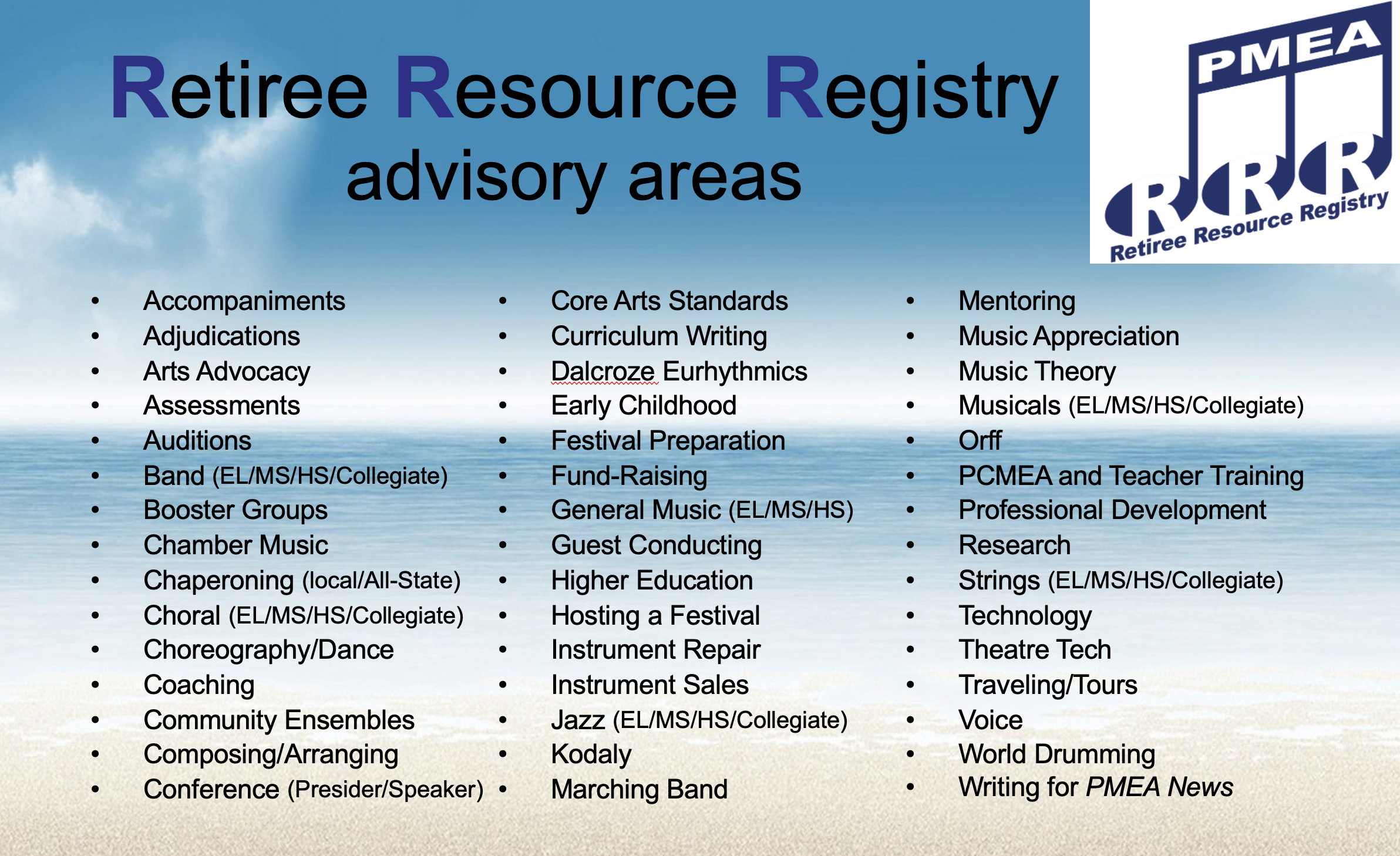
    If you are a retired music teacher and member of PMEA, you could sign-up for the Retiree Resource Registry and serve as an informal consultant to others still “slugging it out” in the trenches. Go to the PMEA retired member focus area for more information.

    More sources to peruse on this subject:

    Anyway, back to a little “bragging!” At least “yours truly” is holding his own and hopefully contributing what he can to the success and welfare of others! Are you? In my retirement pastime, I refuse to sit idle, binge-watch movies on Netflix, or view hours of boring TV. To quote another song’s lyrics, this “senior citizen” will never lament…

    Life is so unnerving
    For a servant who’s not serving
    He’s not whole without a soul to wait upon
    Ah, those good old days when we were useful
    Suddenly those good old days are gone
    Ten days we’ve been rusting
    Needing so much more than dusting
    Needing exercise, a chance to use our skills
    Most days we just lay around the castle
    Flabby, fat, and lazy
    You walked in and oops-a-daisy!

    “Be Our Guest” from Beauty and the Beast

    So, what’s your story?

    PKF

    iStock by Getty images:

    Images from Pixabay:

    © 2021 Paul K. Fox

    In Defense of Dogs

    Pet Ownership in Retirement

    Part 5 of a series of articles featuring the “Foxes-and-Hounds” pack

    I’m writing this blog at 3:30 in the morning because Brewster decided he needed to go out… three hours earlier than usual! Now, in lieu of struggling to go back to sleep, I decided to sit down behind my computer with one sleeping dog in my lap and reflect on my thoughts why I feel so lucky to have my two “pups!”

    Like grandparents “bragging” about their extended family, dog owners have no compunction to stop and talk to perfect strangers and share their photographs and stories of their pets… especially the wonderful (and sometimes quirky) personality characteristics of their dogs! So, shamelessly, it’s my turn! Here are my two “love and joys” who joined our household literally months after I retired from full-time school music teaching in 2013. Get ready to smile… (and with my best marching band announcer’s voice): “We proudly present ‘Gracie’ (a female Bichon Frise) and ‘Brewster’ (a male Yorkiepoo, Yorkshire Terrier/Poodle mix).”

    My wife and I would recommend to all retirees who are not planning to travel out-of-town a lot and are no longer facing that grueling 8-12 hour daily regiment of work (or volunteering) to consider caring for a dog. We knew we were going to take advantage of our major “life style” change when we left our careers… it was just a matter of what dog or dogs to pick… or which ones would pick us!

    We went to a local outlet of a national pet store chain just to waste time “looking at the cute doggie beds and toys,” never expecting that they would actually sell puppies in cages from behind the glass! (Most experts would agree that to avoid the promotion of “puppy mills” and the dangers of acquiring unhealthy animals, you should only buy from a reputable breeder. But, this was an accident!) After determining there were no cat adoptions in the store (my wife is very allergic to their fur/dander), we walked in to view on the wall an amazing array of the most adorable four-legged furry companions begging for our attention. As we sat in the area designated as “pet introduction booths,” we sampled many young pups. Gracie picked my wife, and Brewster picked me – the rest is history!

    Do individual dogs or breeds have personalities?

    Brewster

    According to the American Kennel Club and other sources, these specific characteristics are common. First, for Brewster:

    “The Yorkiepoo is a high-energy, happy dog who’s often enthused about life. They thrive off attention and love to keep their family entertained and be the star of the show.”

    “They love to play, and will be happy to take part in a quick game of fetch — but that will almost always be followed up with a desire for a cuddle (and maybe a nap on the couch).”

    “Yorkiepoos quickly attach to their family, and will happily spend the day following their ‘people’ around the home. Their families are not the only people that Yorkiepoos like—they’re happy to see anyone, and will greet both friends and strangers with the same enthusiasm.”

    “If you’re willing to play a lot with your pet, a Yorkiepoo is a great match.”

    The Yorkiepoo Dog Profile by Whitney Coy (Rover.com)

    Now, here are the tendencies for a Brichon Frise, our “Gracie,” minus the formal (fluffy) “show cut” that some purebred enthusiasts ask from their groomers.

    Gracie

    “Bichons are adaptable companions who get on well with other dogs and children. Alert and curious, Bichons make nice little watchdogs—but they are lovers, not fighters, and operate under the assumption that there are no strangers, just friends they haven’t met yet. Their confidence and size make them ideal city dogs. Bichons train nicely and enjoy performing for their loved ones. Finally, there’s the happy-go-lucky Bichon personality that draws smiles and hugs wherever they go.”

    American Kennel Club

    The American Kennel Club offers a lot of insight to help you match the dog breed to your own pet-ownership experience and life style. If you are thinking of rescuing or purchasing a new pet (especially if this is your first time), we recommend reviewing their dog breed selection site.

    What about dog personalities?

    Surfing the ‘Net, I came upon an intriguing but seemingly inactive set of websites (nonworking phone number, email address, and contact form) that propose to “analyze” dogs into these categories:

    • left brain introvert – “sofa spud”
    • right brain introvert – “status seeker”
    • left brain extrovert – “socialite”
    • right brain extrovert – “nervous nelly”

    According to the mystery bloggers at (two different spellings) doganality.net and dogenlity.com, dog energy levels are critical to your pet selection.

    “A dog’s energy level is a crucial component of its overall ‘Dogenality.’ Coupling their behavior with a form of temperament gives you a better idea of who your dog is, what it is that drives them, and how you should go about forming a relationship with them that will be mutually beneficial.”

    https://dogenality.com/new-energy-levels/

    They offer a free-trial “dogenality” assessment and even canine DNA testing. Watch Angie Wood’s video here and even peruse their other informative blogs here (posted in 2018):

    • Fear’s Effect on Dogs
    • Dog Psychology vs. Human Psychology
    • Does Your Dog Get Enough Exercise
    • Bringing Home a New Dog
    • Laser Pointer Syndrome in Dogs
    • Why Some Dogs Are Afraid of Men
    • Seasonal Dog Allergies
    • A Dog’s Work vs. Vacation
    Brewster during COVID-19 “red phase” before pet grooming resumed.

    In keeping with the paulfox.blog philosophy to research sources for further study, here are more (probably more current) sites to explore:

    “Dogs come in all different shapes, sizes, and personalities. That’s part of why we love them. But it can be easy to fall into the trap of seeing your dog not as what they are, but as you wish they could be, and treating them accordingly. When we assume our dogs enjoy something just because they are dogs, we not only do them a disservice and set them up for failure, we set ourselves up for frustration when they fail to live up to our expectations.”

    “All dogs, regardless of their breeding, are individuals. It’s essential to look beyond your dog’s breed to try to understand the traits that make up their personality. The better you know your dog, the fewer misunderstandings you’ll have in the future. As a professional dog trainer, I convey this message constantly to my clients.”

    Dog Personalities from A to Z: Which One is Your Pup? by Shoshi Parks

    The happy hysteria of day-to-day doggie life!

    Can we go out for a walk?

    As a dog owner, you expect to live many moments of basic insanity:

    • It takes years of experience for you to resolve the propensity of your two pups trying to go in opposite directions and tying you up with their leashes while taking a walk.
    • You keep buying them bones until at some point you discovered their larder is ridiculously large, encompassing a reserve in multiple plastic containers in three or four rooms throughout the house.
    • One of your cupboards is crammed full of treats, many of which were past purchases that were rejected “paws down.” You cater to the unique tastes of both dogs; of course, they don’t like the same things.
    • “You have been trained” to give out everything in pairs. At times, you take into account the alpha dog’s competitive spirit (Gracie) and her desire to steal the bone from the easy-going one (Brewster). That means you have on-hand two identical bones. If Gracie doesn’t get the bone that Brewster has in his mouth (the only one she wants), she barks him down until he gives it up. To keep the peace, after she grabs it and sets off to consume it, you unobtrusively hand Brewster another one.
    • On the day of your 40th wedding anniversary, you go out and buy one of the dogs it’s own desk chair so she can sit next to you while you’re on the computer. Yes, this means that since you have two dogs, there are two extra chairs cluttering up the space in your office.
    • Your dogs have more patience with little children than you do. As you walk them up the street, they suddenly jerk to a stop and stare at the front door of a neighbor’s house, waiting for the “human critters” to come out and play with them.
    • You acquiesce. One dog is frequently insisting that you pick him up and carry him with you. The other one, not as often. At times, Brewster can be stubborn and “hit the brakes” on a walk, simply refusing to go where you want him to go. Of course, as well trained as you are, you comply.
    • When one of your furry friends is having a bad day, you’re having a bad day. Black or blue moods spread very easily. But, in a snap of your fingers, life is joyful again, and yippee, all is forgotten.
    Gracie’s favorite spot on the bed

    Who’s training whom?

    Dog owners share a common vocabulary and unique language. Some of it sounds a little like baby talk… (Check out the American Kennel Club’s piece, Study Shows Dogs Really Do Respond to Baby Talk by Linda Lombardi)

    • “Wanna go outside?”
    • “Need to go potty?”
    • “Good dog!”
    • “Isn’t he cute?”
    • “Did you do this?”
    • “He did his number two.”
    • “This is puppy heaven!”
    • “She gave me a kiss!” or “Give mommy a kiss! No kiss?”

    Ever count how many times YOU “cave-in” to your pet’s requests? They stare at you with those big sad eyes (“Daddy, please share a scrap of food from the table…”), and when the “alpha” spouse turns her back… (“Oh-oh, something just fell off the table!”)

    Our pooches know how to distract us, reach directly into our hearts, make us smile no matter what our mood, and finagle yet one more treat out of the bag… and, yes, we love their trickery! Hey, exactly who is in charge, here?

    You should read this amusing article from an obviously experienced dog trainer Casey Lomonaco writing in DogStarDaily. We dog owners only have ourselves to blame (if we even care about their “controlling behavior!”) For me: “Been there, done that, drank the Kool-Aid, and bought the t-shirt!”

    FYI, I found a promising book on this subject: Who’s Training Whom? – Six Easy Lessons to Put Any Dog Owner Back in the Driver’s Seat and in Control of Their Dog. by Carols Puentes.

    The best part – learning MY dogs’ quirks

    There are times when Brewster’s and Gracie’s “doganalities” seem to be much more pronounced. Here are a few “fun” anecdotes!

    • You would think I just gave Brewster filet mignon, witnessing all the excitement of full-throttle chasing after, pouncing on, tossing around, and eventually chewing up an ice cube!
    • Gracie’s demonstrates her athleticism with a remarkable burst of energy to run up three flights of stairs to get on the bed to retrieve a bone.
    • One of Brewster’s favorite things-to-do is to jump onto “good grass” (devoid of branches, acorns, or leaves) rubbing his back in semi-circles as if doing the back stroke in a swimming pool. Of course, I have to pull up on his leash to stop him. (Wife is also allergic to mold and grass!)
    • Both Brewster and Gracie sleep with us in our queen-size bed. Did I say, they take up more than 2/3’s of the bed? Brewster needs to jam himself against me to nestle in the small of my back, while Gracie chooses a spot near my feet.
    • My two dogs like to play tug-a-war with one another, albeit very briefly, fighting over a toy or Brewster grabbing one of their beds with his teeth, taunting Gracie with it, and then dragging it across the floor.
    • Gracie’s internal clock is amazing, and so is her command of “people” language. At precisely 5 p.m. when she is usually fed, she jumps off the chair, stairs at one of us, and if we say, “ten minutes,” she sighs and goes over to her beanbag chair, only to return in exactly ten minutes to remind us “dinner is past due!”
    • No matter how I often I do it, when I nuzzle Brewster’s ear, he repays the compliment by licking my wrist. “Thank you, Daddy!”
    • To make house guests laugh (even our dog groomers), if you ever ask, “Need to go outside?” – Brewster will turn around and look at his butt.

    You embrace their differences, laugh at the signature looks, gestures, and motions, and especially revel in their one-of-kind “prancing.” (Brewster hops like a kangaroo when he’s at his happiest times!) As educators, we know that “differentiation is essential.” It’s no different with dogs. And, you can always tell who’s-who in the dark by the unique sounds of their “gate” and the nails on our hardwood floors.

    Unlike your human children or the students in your classes at school, you are always the centerpiece of their lives, what they live for, yearning to spend 100% of their time next to their “heroes” who can do no wrong, and (of course) they simply become the center of your life.

    Recap: Rationale for fostering a furry friend!

    So now that you are retired, have you settled on your self-reinvention and found the mandatory “purpose, structure, and community” referred to by best-selling author Ernie Zelinzski in How to Retire Happy, Wild, and Free?

    For our Finale, these are Fox’s reasons for Finding a Forever yours pet!

    • Fitness (help you to get up, get moving, and get out of the house)
    • Forecasting (they seem to be able to predict your mood, the weather, or the Future, and they certainly know when something is going on outside)
    • Friendliness (despite COVID-19 restrictions, they Fight isolation and Favor meeting people and getting to know your neighbors – even a random passerby!)
    • One last burst of alliteration: Fun, Frivolity, Festivity, and Fascination (literally what they add to “the joy of life!”). You can’t beat that!

    I invite you to revisit my other four “blogs on dogs!”

    PKF

    © 2020 Paul K. Fox

    Sleep and Retirement

    Are you getting enough (or too much) rest?

    Saying goodbye to work life can mean a change in your sleep schedule. Learn how to sleep well during this new stage of life.

    “Sleep, and the Workplace” at Sleep.org

    cartoon what time do you want to get up

    Did you know there really exists a National Sleep Foundation? Now that we are retired from full-time music teaching and the day-to-day stress of managing classes and a busy music program, do you think we need it? Can’t we sit back and enjoy “living the life of Riley” without experiencing any work-related tension or fears for the future?

    Maybe not! What is that old Chinese proverb? “The gem cannot be polished without friction, nor man perfected without trials.” After all, as humans, we all seek new and unique challenges to grow (and that brings on stress), and sleep is a complicated issue!

    But, no worries! Several someones have “our back” (or should I say “our pillow!”). Here is a collection of insightful resources on promoting better sleep habits and relaxation techniques from a variety of research-based and/or medical authorities.

    bed-2932284_1280_naobim

    I didn’t set an alarm for four months. I quickly learned that one of my favorite times of the day was 30 minutes after I first woke up. For the first time in decades, there wasn’t a rush to get out of bed. I’d let myself fade in and out of sleep several times, savoring the fact that I could let myself fall back into the hazy sleep rather – into the shower to wake myself for the morning drive. I’d gotten up at 5:30 AM for years the found that about 7:15 AM was a natural time for my body to wake up. The dogs seem to enjoy this new routine as well. We have four dogs, all of whom compete for space on the bed. Which ever one happen to be near my hand would nozzle under my fingers when they felt me start to wake up, being content to enjoy our laziness together as a new way to start our new days.

    The Keys to a Successful Retirement by Fritz Gilbert

    The perks of retirement are many, including the “freedom” to do new things and spend more time with family and friends as well as on travel, personal music-making, hobbies, babysitting loved-ones (or care-giving our elderly relatives), volunteering, and other projects or pursuits of “self-reinvention” suggested by “retiree gurus” like Dave Hughes, Robin Ryan, Kenneth Schultz, Hyrum Smith, and Ernie Zelinski.

    Another benefit of post-employment? MORE sleep! According to Sleep.org, “people sleep approximately 20 minutes longer at night after retirement. Those who skimped on sleep the most during their working years see the biggest gains, increasing their nightly sessions by around 45 minutes compared to pre-retirement.”

    The National Sleep Foundation website also offers articles on the “science of sleep.”

    • Sleep Cycles – Stages of Sleep
    • Circadian Rhythms
    • What Is Microsleep?
    • How to Fall Asleep Fast
    • What is the Sleep-Wake Cycle?

    as well as mattress reviews and life style choices that may affect our sleep.

    newspaper-149623_1280


    The “serious stuff” for serious sleep issues

    Experts do believe that “normal aging” brings on some changes to sleep… Basically, older adults tend to get sleepy earlier in the evening, and tend to sleep less deeply than when they were younger.

    So it’s probably not realistic to expect that as you get older, you’ll sleep as long or as soundly as when you were younger.

    That said, although aging by itself does change sleep, it’s also quite common for older adults to develop health problems that can cause sleep disturbances. So when your older relatives say they aren’t sleeping well, you’ll want to help them check for these. Figuring out what’s going on is always the first step in being able to improve things.

    Better Health While Aging blogs by Dr. Leslie Kernisan here and here

    The definitions, causes, and treatments of sleep disruption are described in great detail by Leslie Kernisan, M.D., authoring “5 Top Causes of Sleep Problems in Aging and Proven Ways to Treat Insomnia” outlined here:

    1. Underlying medical problems
    2. Sleep-related breathing disorders (snoring, sleep apnea, etc.)
    3. Restless leg syndrome (RLS)
    4. Periodic limb movements (PLM)
    5. Insomnia

    Painful nighttime leg cramps may also interrupt sleep, as referenced by the American Family Physician, Mayo Clinic and WebMD.

    Dr. Kernisan advises us against using sleeping pills or other sedatives. She prefers the following remedies which have shown great promise, backed up by published research:

    1. Cognitive behavioral therapy: New York Times and Mayo Clinic
    2. Brief behavioral treatment: Journal of Clinical Sleep Medicine and National Institute of Health
    3. Mindfulness meditation: Journal of the American Medical Association and Mindfulness Awareness Research Center at UCLA
    4. Exercise: Science Direct, National Institute of Health, and New York Times

    The Division of Sleep Medicine at the Harvard Medical School also offers these “Twelve Simple Tips to Improve Your Sleep.”

    1. Avoid caffeine, alcohol, nicotine, and other chemicals that interfere with sleep.
    2. Turn your bedroom into a sleep-inducing environment.
    3. Establish a soothing pre-sleep routine.
    4. Go to sleep when you are truly tired.
    5. Don’t be a night-time clock-watcher.
    6. Use light to your advantage.
    7. Keep your internal clock set with a consistent sleep schedule.
    8. Nap early, or not at all.
    9. Lighten up on evening meals.
    10. Balance fluid intake.
    11. Exercise early.
    12. Follow-through.

    Another “sleep checklist” worth a quick examination is available from WebMD.

    cat-30689_1280


    Should we take cat naps? The jury is out.

    At first glance, the National Sleep Foundation basically says NO! Napping during the day may “throw your body clock off and keep you awake at night.”

    However, the truth may be more about how long to doze off during the daylight hours…

    You may think that taking a catnap will make you feel more tired than skipping it altogether, but that’s not necessarily true.

    The key to waking up refreshed from a nap is all about timing. Just 20 minutes is all you need to get the benefits of napping, such as improved alertness, enhanced performance, and a better mood. Naps of that length keep you in the lightest stage of non-REM sleep, making it easier for you to get up and go after your snooze session. Be sure to set an alarm so you don’t snooze for too long and wake up all groggy.

    Nap for 30 to 60 minutes and you’ll hit the deeper stages of sleep, where your brain waves slow down, making you feel groggy (as if you have a sleep hangover) when you wake up…

    It might not be worth it to nap at all if you’re going to nap for this amount of time because you’ll likely come out of your shuteye feeling less alert than before.

    “How Long Is an Ideal Nap” at Sleep.org

    The benefits and drawbacks of napping are further examined by the Mayo Clinic and even TIME magazine.

    camping-32112_1280

    Can too much sleep be bad for you?

    According to new research carried out by Online Opinions, over-60s need to make sure that they are not in fact getting too much sleep once they are retired, as this can actually have an adverse effect on health.

    According to the National Sleep Federation, the optimum amount of sleep for adults aged up to 64 to get each night is between seven and nine hours, while for over-64s, between eight and nine hours is deemed to be best.

    You need to remember that your body isn’t as young as it once was and needs a decent amount of rest, but not too much, but the organization warns that more than ten hours’ sleep a night could be stopping people from using their bodies and brains as much as they need to in order to keep them active and hold on to their cognitive functions. In other words, too much sleep could carry a small extra risk of dementia development.

    But there’s no need to worry too much; as long as you get plenty of exercise, keep your brain ticking, and lead a healthy lifestyle during the hours that you’re awake, there shouldn’t be too much cause for concern.

    Just Group

    WebMD warns that oversleeping has been linked to a host of medical problems, including diabetes, heart disease, depression, and increased risk of death.” The article “Physical Side Effects of Oversleeping” delineates the causes and effects of too much sleep, and points to an online “sleep habits assessment” to help you evaluate your needs.

    This research seems to be supported by several other sources:

    The amount of sleep you need varies significantly over the course of your lifetime. It depends on your age and activity level as well as your general health and lifestyle habits. For instance, during periods of stress or illness, you may feel an increased need for sleep. But although sleep needs differ over time and from person to person, experts typically recommend that adults should sleep between 7 and 9 hours each night.

    WebMD

    meditation-4674442_1280

    More on retirement and “mindfulness”

    From the author of one of my favorite “teacher self-care books,” I Love My Job But It’s Killing Me by Lesley Moffat, I personally recommend trying the “M-Power Method” of mindfulness practice during meals, movement, music, and what Lesley describes as the “5 S’s of clearing,” cited by the website dailyom.com:

    • Slowing Down
    • Simplifying
    • Sensing
    • Surrendering
    • Self-care

    Jason Ong, a sleep psychologist at the Rush University Medical Center, offers these reminders of “Seven Tips for Falling Asleep” based on mindful practices of health and wellness (visit his site here to study these more in depth):

    1. Beginner’s mind
    2. Non-striving
    3. Letting go
    4. Non-judging
    5. Acceptance
    6. Trust
    7. Patience

    Finally, if you want to immerse yourself in a comprehensive “mindfulness journey,” visit the blogs of Cindy’s Mindful Retirement to peruse “Mindfulness After Sixty: 21 Practices.”

    moon-4546977_1280_ArtsyBee

    Can you “trick” your brain into going to sleep?

    One last interesting resource I stumbled on… how to “drum yourself to sleep” if you are having difficulty in calming the thoughts swirling around in your mind at night. This technique intrigued me enough to include it as one of the digital SHJO.clips for my community orchestra musicians sent out as a remote learning opportunity:

    CLIP #22C: View and try the techniques in this YouTube “How to Trick Your Brain into Falling Asleep” by Jim Donovan (TEDtalk) using a simple 2 to 3-minute rhythm tapping and breathing “cool-down.”

    https://www.youtube.com/watch?v=A5dE25ANU0k

    Now, although anticipated, I am not necessarily looking forward to website comments or emailed responses from mattress and sleep accessory manufacturers, sending me their advertisements, recommendations, and industry reviews. Regardless, one thing is true: “What you sleep on has a major effect on achieving a quality rest!” I can confirm this fact “living it” with a recent replacement upgrade to our master bedroom. If you are in this situation, you need to take ample time to explore all of your options in any new purchase of beds, adjustable or nonadjustable bases, mattresses, bedding, and pillows. Essential in education; here, too: you need to personalize and customize everything to meet your needs!

    Just to stave off a few of these companies, here are a few websites to visit if you are in the market to buy a new bed, mattress, pillow, or other bedding:

    asleep-1296292_1280

    The final word? If you prefer a few “more heady” academic studies and statistics on retirement + sleep, look up “Sleep Before and After Retirement” from the National Institute of Health, the “Reduction in Sleep Disturbances at Retirement” dissertation from Cambridge University Press, or review the case studies discussed by Health.Talk.org in “Sleep Problems Later in Life.”

    Have a good night!

    PKF


    © 2020 Paul K. Fox


    Photo credits (in order)

    From Pixabay.com