The “New” Model for Modern Music Education

by Katherine Langford

We welcome this month’s guest blogger, Katherine Langford, who describes herself as “a digital marketing consultant, writer, freelancer, WordPress enthusiast, and coffee lover.” Thank you, Katherine! PKF

Music education has transformed dramatically in recent years. Traditional classrooms and rigid lessons are giving way to creative, flexible learning models that blend technology, collaboration, and real-world experience. The new model for modern music education isn’t just about mastering an instrument anymore—it’s about nurturing creativity, adaptability, and digital fluency.

Whether you’re a teacher, a student, or a parent trying to understand this shift, this guide will walk you through everything you need to know about the new model for modern music education and how it’s reshaping the way we learn, teach, and perform music.

What Defines the “New” Model for Modern Music Education?

The new model for modern music education is built on accessibility, inclusivity, and innovation. In the past, learning music often required private lessons, expensive instruments, and long practice hours under strict instruction. Now, technology has made learning more interactive, affordable, and engaging.

This model integrates online platforms, digital tools, and peer learning to create a dynamic environment. Students can watch video tutorials, join virtual ensembles, or even receive online class help from experienced musicians. It allows learners to progress at their own pace while receiving instant feedback and guidance.

Another major shift is the focus on creativity over perfection. Instead of emphasizing technical mastery alone, educators now encourage improvisation, digital composition, and personal expression. This approach builds confidence and helps students connect emotionally with their craft.

The Rise of Online Learning in Music Education

Online learning has become a cornerstone of modern music education. With platforms like YouTube, MasterClass, and specialized e-learning sites, anyone can access lessons from world-class musicians. Students can now learn piano, guitar, singing, or music production without leaving home.

These online classes are highly interactive, offering personalized feedback and practice tools. Some programs include live sessions, enabling real-time interaction with instructors and classmates. The flexibility to study from anywhere attracts learners of all ages and skill levels.

Online music education also supports busy professionals and students balancing multiple commitments. Many ask, Can I take my online class for music while working full-time? The answer is yes. With self-paced modules, recorded lessons, and flexible scheduling, anyone can continue learning without disrupting daily life.

Key Features of Modern Music Education

The new model for music learning focuses on a few core features that make it different from traditional instruction.

1. Technology Integration
Modern classrooms use music software, apps, and digital instruments. Tools like GarageBand, Ableton Live, and Sibelius help students compose, record, and edit their music. This hands-on digital experience prepares them for real-world music careers.

2. Collaboration and Global Access
Students can collaborate with others worldwide through online jam sessions or group projects. This exposure broadens cultural understanding and inspires new creative styles.

3. Personalized Learning Paths
AI-driven platforms now assess student progress and customize lesson plans. Learners receive targeted exercises that focus on areas needing improvement. This keeps motivation high and ensures steady progress.

4. Performance and Portfolio Building
Instead of graded recitals, students can build online portfolios, showcasing their songs or performances. This practical experience helps them prepare for music schools or careers in the industry.

Why Modern Music Education Matters Today

Music education today goes beyond traditional training. It prepares students for an evolving creative economy where adaptability and digital literacy matter.

The new model equips students with real-world skills such as sound design, audio editing, and digital marketing for music. These are essential for anyone pursuing a career in the modern music industry.

Additionally, it nurtures emotional intelligence. Creating and performing music helps students manage stress, improve focus, and build resilience. These soft skills translate into better academic and personal outcomes.

Another reason this new approach matters is its inclusivity. Learners who once couldn’t access quality lessons due to location or cost can now participate through online classes. Music education is no longer limited to elite institutions—it’s open to everyone.

The Role of Teachers in Modern Music Education

Teachers remain at the heart of music education, but their role has evolved. Instead of being strict evaluators, they now act as mentors, facilitators, and collaborators.

Educators guide students through self-directed learning, helping them explore interests while mastering key concepts. They encourage experimentation and critical thinking rather than rote memorization.

Teachers also integrate multimedia tools into lessons, using interactive notation software, metronome apps, and virtual instruments. This keeps learning engaging and relevant.

Modern instructors understand that today’s learners consume music differently. They balance traditional techniques with contemporary styles, helping students connect classical foundations to genres like pop, jazz, or digital soundscapes.

The Impact of Technology on Music Learning

Technology has completely reshaped how music is created and taught. From recording studios to smartphone apps, innovation drives engagement and creativity.

Students can record, mix, and share their music instantly. They can join online communities, collaborate virtually, or receive detailed feedback through smart analysis tools.

Some schools use virtual reality to simulate live performance environments. This helps students overcome stage anxiety and refine their skills before performing in real-life situations.

Moreover, digital sheet music platforms make learning more interactive. Instead of flipping pages, learners can annotate, loop sections, and practice efficiently.

Technology also enables inclusive learning. Students with disabilities can use adaptive devices or apps that make instruments more accessible. This reinforces the principle that music truly belongs to everyone.

How Online Class Help Supports Music Learners

Many students struggle with consistency or technical challenges while learning online. That’s where online class help becomes valuable. Expert tutors assist learners in managing lessons, assignments, and projects.

They provide feedback, correct mistakes, and ensure students stay on track. This type of support bridges the gap between traditional mentoring and independent study.

For example, if a student is learning music theory but struggles with notation, they can seek online class help for one-on-one guidance. This approach ensures understanding without the stress of falling behind.

It’s especially useful for those pursuing formal music degrees remotely. Expert assistance ensures academic integrity while keeping the learning experience enriching.

Common Question: Is Online Music Education as Effective as In-Person Lessons?

Many learners wonder if virtual learning can match the impact of face-to-face instruction. The short answer is yes, it can be just as effective—sometimes even more.

Online music education offers flexibility and access to diverse expertise that local lessons may lack. You can study jazz composition with a teacher from New York or classical violin from a maestro in Vienna.

Additionally, digital lessons allow unlimited practice and playback. Students can review recorded sessions anytime, reinforcing understanding and mastery.

However, success depends on commitment and quality instruction. Active participation, consistent practice, and seeking feedback are key to thriving in online music education.

Challenges Facing the New Model for Modern Music Education

While modern approaches have many benefits, challenges still exist. Internet connectivity, lack of physical interaction, and screen fatigue can affect engagement.

Students may also struggle with motivation when learning alone. This is where teacher support and community involvement become crucial. Encouraging virtual collaborations and online performances helps maintain enthusiasm.

Another concern is access to instruments. Not every learner can afford quality equipment or digital tools. Schools and institutions need to bridge this gap by providing resources or scholarships for talented students.

Despite these obstacles, the benefits of digital and hybrid learning far outweigh the drawbacks. With ongoing innovation, these challenges are gradually being addressed.

The Future of Modern Music Education

The future of music education looks bright and interconnected. We’ll see more hybrid classrooms combining online and offline experiences. Students might attend physical rehearsals while collaborating digitally with international peers.

Artificial intelligence will continue shaping learning paths, analyzing performances, and suggesting improvements. Virtual and augmented reality will simulate live concerts and recording studios for immersive training.

Most importantly, inclusivity and creativity will remain the foundation of this evolving system. Every learner, regardless of background, will have the opportunity to express themselves musically.

The new model is creating musicians who not only play instruments but also understand technology, production, and storytelling. They’ll be ready to thrive in an industry that values both art and innovation.

How Students Can Get the Most Out of Modern Music Education

If you’re a student exploring the new world of music learning, here are some helpful tips:

  1. Set clear goals. Decide what you want to achieve before starting lessons.
  2. Stay consistent. Practice regularly, even if only for short sessions.
  3. Use technology wisely. Try apps, online lessons, and recording tools to track progress.
  4. Engage with others. Join online groups, perform live sessions, and exchange feedback.
  5. Seek guidance. Don’t hesitate to reach out for online class help when needed.

These small steps ensure that your learning remains enjoyable and productive.

The Cultural Shift in How We Value Music Education

In the past, music education was often viewed as a luxury. Today, it’s recognized as a vital part of cognitive and emotional development. Studies show that learning music improves memory, discipline, and communication skills.

The modern model has made music more inclusive, integrating it into mainstream education and digital life. Whether through school programs, online platforms, or personal study, students now see music as both an art and a skill for life.

Cultural acceptance has grown too. Parents now appreciate the value of creative subjects, realizing they develop critical thinking and empathy. This shift has expanded the reach of music education across age groups and professions.

Conclusion: Embracing the New Model for Modern Music Education

The new model for modern music education is more than just a trend, it’s a necessary evolution. It reflects how we live, learn, and connect in the digital age.

By combining technology, collaboration, and creativity, this approach empowers learners to explore their potential fully. Whether you’re learning to produce music, master an instrument, or compose original songs, the tools and opportunities are at your fingertips.

PKF

© 2025 Katherine Langford and Paul K. Fox
Creative Ways Musicians Can Earn Extra Income

Making Digital Music, Money and Merchandising!

We welcome back guest blogger Ed Carter and his article on a subject I know next-to-nothing about… except that I, too, am a consumer of online media. We thank him for his research and insight! (Featured image by Freepik). PKF

TL;DR

Musicians today are diversifying income streams far beyond traditional gigs and streaming
royalties. From sync licensing and sample packs to branded teaching content and micro-
niche merch, the modern artist’s toolkit is packed with opportunity. Below, we explore 10
ways to earn more — creatively, sustainably, and independently.

Host Micro-Events and “Living Room” Concerts

Forget stadium tours. Many fans crave intimacy. Many online platforms let artists perform
in unconventional venues — apartments, cafes, or backyards. You can set your own prices,
meet new fans directly, and keep the lion’s share of the door revenue.

Checklist for a Successful Small Show:

  • Pick a host with good acoustics and space for 20–40 people
  • Bring a small merch table (vinyl, zines, handmade items)
  • Capture the set for future promo content
  • Ask for tips digitally (Venmo or QR code)

Start a Music-Related Side Business

If you’re ready to formalize your music venture — whether selling courses, beats, or
branded merch — start it as a small business entity.

Launching a business might sound intimidating, but it doesn’t have to be. With an all-in-one
platform like ZenBusiness, you can form an LLC, manage compliance, create your website,
and even track finances in one place. A structured setup means tax deductions, legal
protection, and scalable growth.

License Your Music for Sync (Film, TV & Games)

Sync licensing has exploded. Sites like Epidemic Sound connect independent artists with
producers, ad agencies, and filmmakers. A single placement can earn $500–$5,000.
Pro Tip: Tag your tracks with clear mood and genre descriptors (e.g., uplifting cinematic
pop) so curators find you faster.

Offer Fan Subscriptions

Platforms like Bandzoogle let musicians monetize loyalty, not just streams. Offer behind-
the-scenes videos, early demos, or private songwriting sessions.

Create & Sell Sample Packs

If you produce, you can sell your drum kits, synth presets, and loops. Marketplaces like
Noiiz let you upload your sounds and get royalties whenever producers use them.

How-To (Mini Guide):

  1. Curate your 50–100 best loops or hits.
  2. Label by BPM, key, and genre.
  3. Include a “demo track” showing them in action.
  4. Submit to platforms or sell directly on your site.

Teach (Without Leaving Your Studio)

Music education is booming online. Start by offering short video lessons on YouTube. Build
a following, then convert viewers into paying students.

Bullet List: Why Teaching Works

  • Generates recurring income
  • Builds your authority as a musician
  • Introduces new fans to your music

License Your Merch to Other Creators

Many artists overlook merch licensing. Your designs, logos, or slogans can appear on third-
party apparel via dropship sites like Redbubble.

Offer limited-run designs — scarcity sells.

Join Micro-Sync & Creator Libraries

YouTube creators and podcasters constantly need affordable background music. Sites like
AudioJungle pay per download or license. Even better: some offer recurring revenue if your
track gets consistent usage.

Sell Exclusive Content NFTs or Digital Collectibles

Though the NFT buzz has cooled, niche fan communities still buy one-of-a-kind assets —
unreleased demos, lyric art, or collectible stems. Marketplaces like Zora make it musician-
friendly again.

Offer Mixing, Mastering, or Session Work

You don’t have to be touring to make great money. Offer your technical expertise on
SoundBetter. Even basic editing jobs can supplement your main income stream — and help
you network globally.

FAQ: Quick Answers for Indie Artists

Do I need a large following to make real money?
No. Many creators with <1,000 dedicated fans make sustainable income by diversifying — think 10 income streams, not 10,000 followers.
What’s the best income path for producers?
Sync licensing and sample packs. They scale globally without physical touring.
Should I register my brand name as a business?
Yes, especially if you sell products or hire collaborators. Forming an LLC can protect your
personal finances and simplify taxes.

Glossary

  • Fan Subscriptions: Ongoing payments from fans for exclusive content.
  • LLC: A “Limited Liability Company” — a legal structure separating your business
    and personal assets.
  • Micro-Sync: Low-cost music licensing for YouTubers, podcasts, and small ads.
  • NFT (Non-Fungible Token): A unique digital identifier recorded on a blockchain that serves as a public certificate of ownership and authenticity for a specific digital or physical asset. Artists and creators can use NFTs to distribute their work, engage with fans, and potentially earn royalties from secondary sales, providing a new revenue stream.
  • Sample Pack: A bundle of sounds and loops producers can buy and reuse.
  • Sync Licensing: Letting TV, film, or brands use your music for a fee.

Conclusion

The modern musician’s mantra? Don’t wait for discovery — build income like an
entrepreneur. With smart licensing, direct-to-fan models, and structured business tools, you
can turn your creativity into stability — one micro stream at a time.

Check out other articles by Guest Author Ed Carter at this blog site:

© 2025 by Paul K. Fox and Ed Carter

Sharing is Caring!

Join the “Fox Network”

“There is no joy in possession without sharing.”
— Erasmus

“Share your knowledge. It is a way to achieve immortality.”
— His Holiness the Dalai Lama

“There is no delight in owning anything unshared.”
— Seneca

“The miracle is this: The more we share the more we have.”
— Leonard Nimoy

This is a quick blog-post to announce my upcoming professional development initiatives, and an invitation to share your own pet peeves or “thoughts, theories, and teachings.” Of course, I will give you full credit for any contributions, “tips and techniques,” background research, or “quotables” provided!

It has been a challenge motivating any reactions to these articles. Although they would be most welcomed, we typically receive very few online remarks. (If you would like to voice your opinion or add anything to the conversation, PLEASE click on the “comment” button next to the title at the top of the page.)

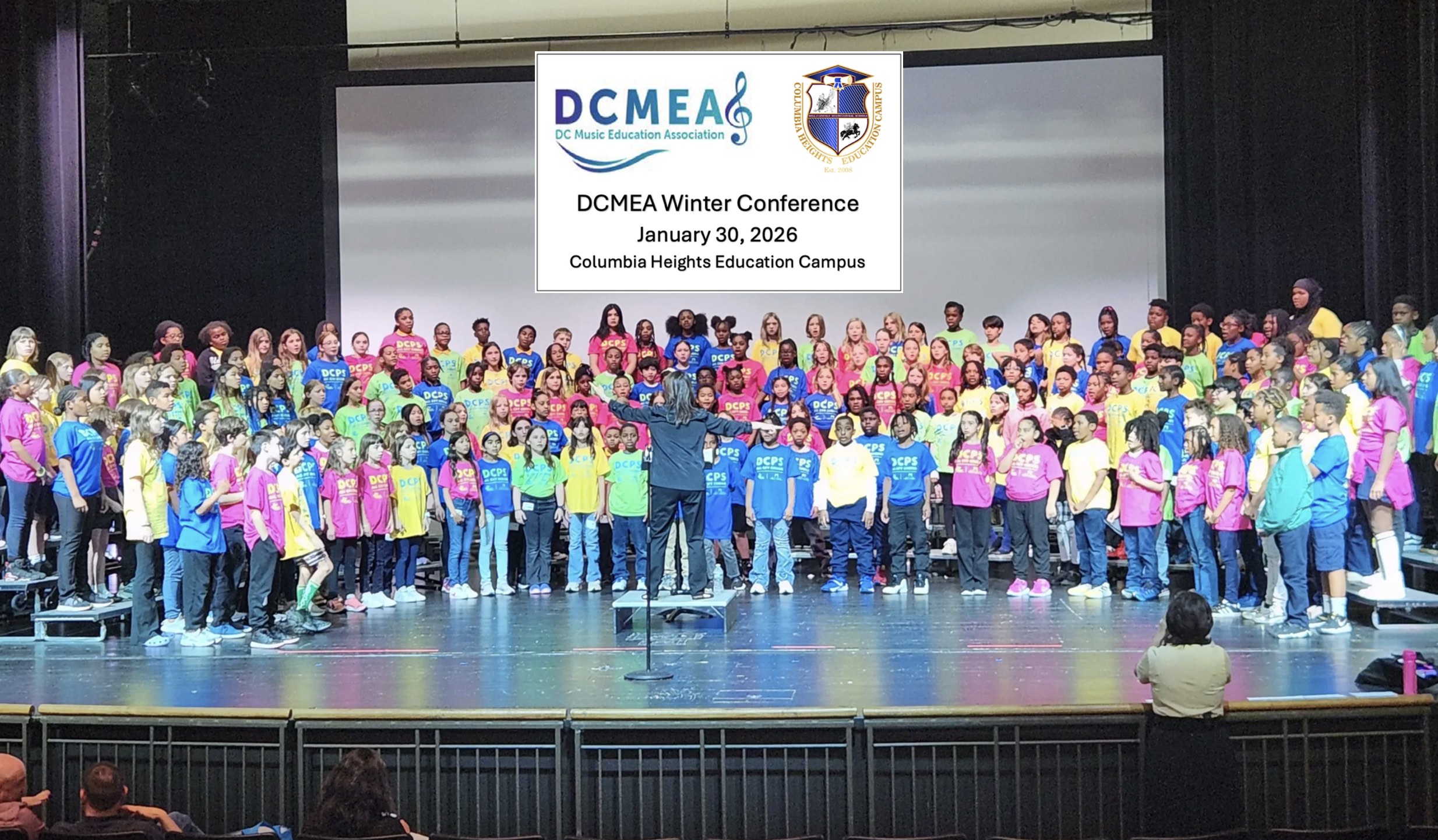
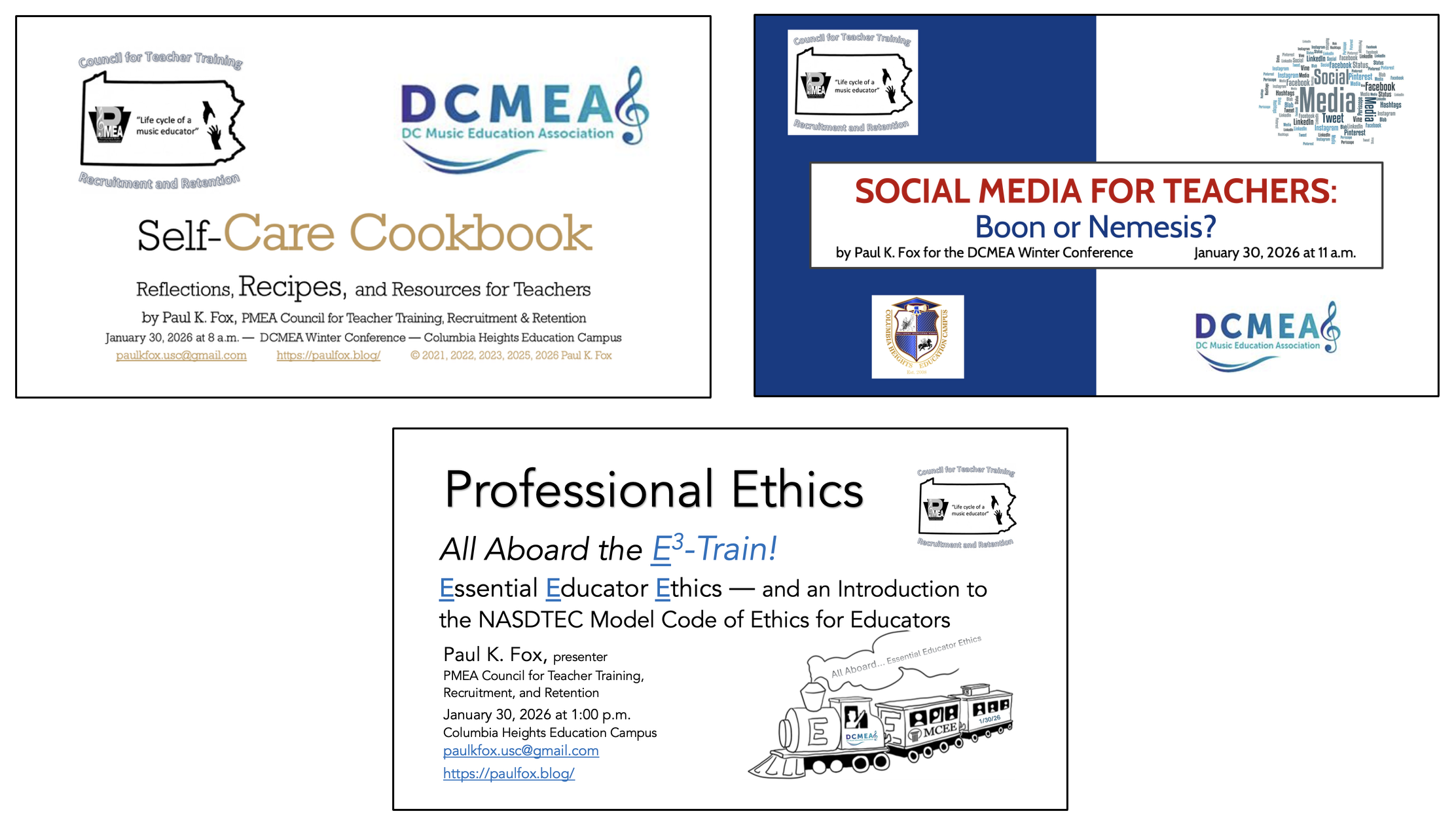
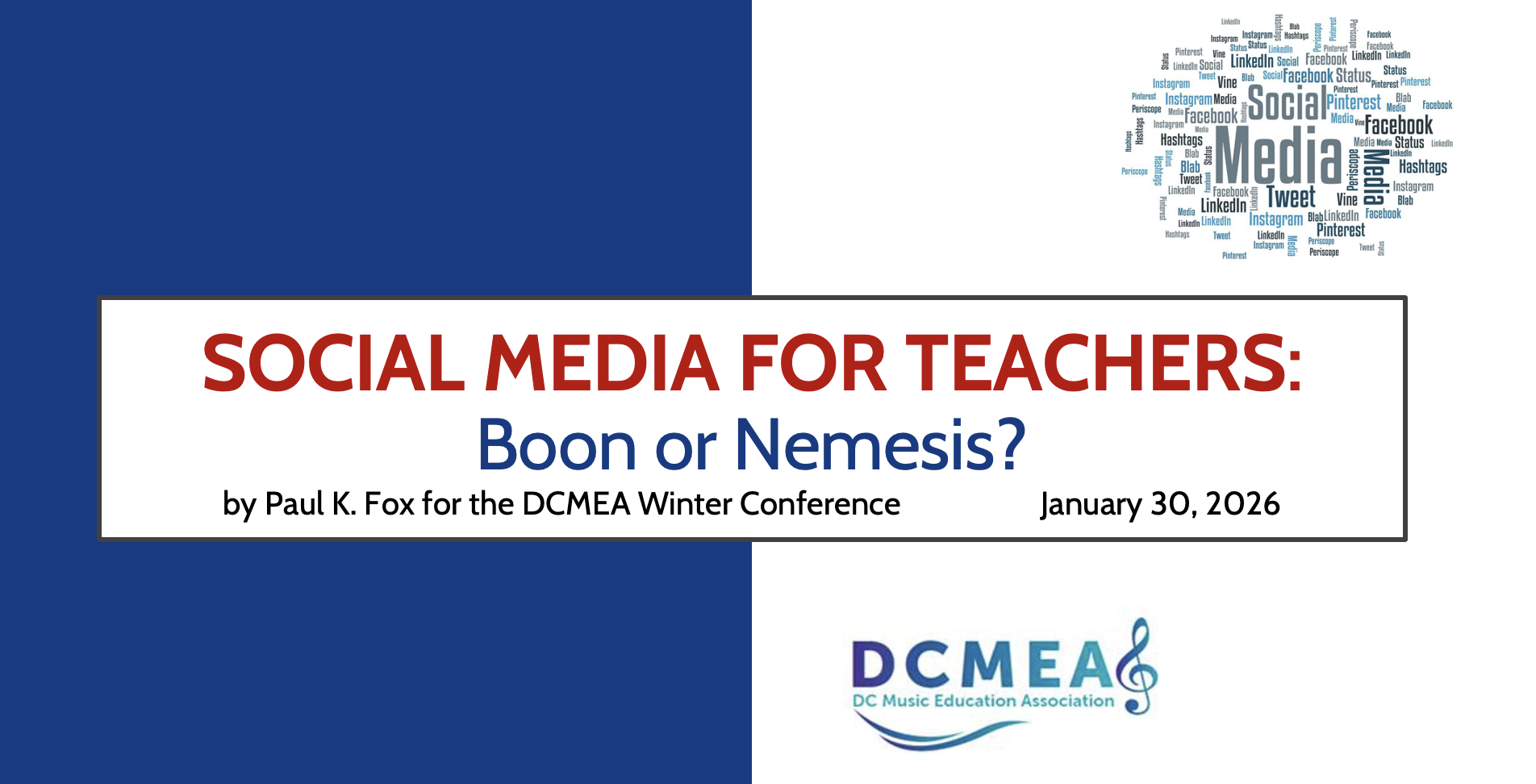
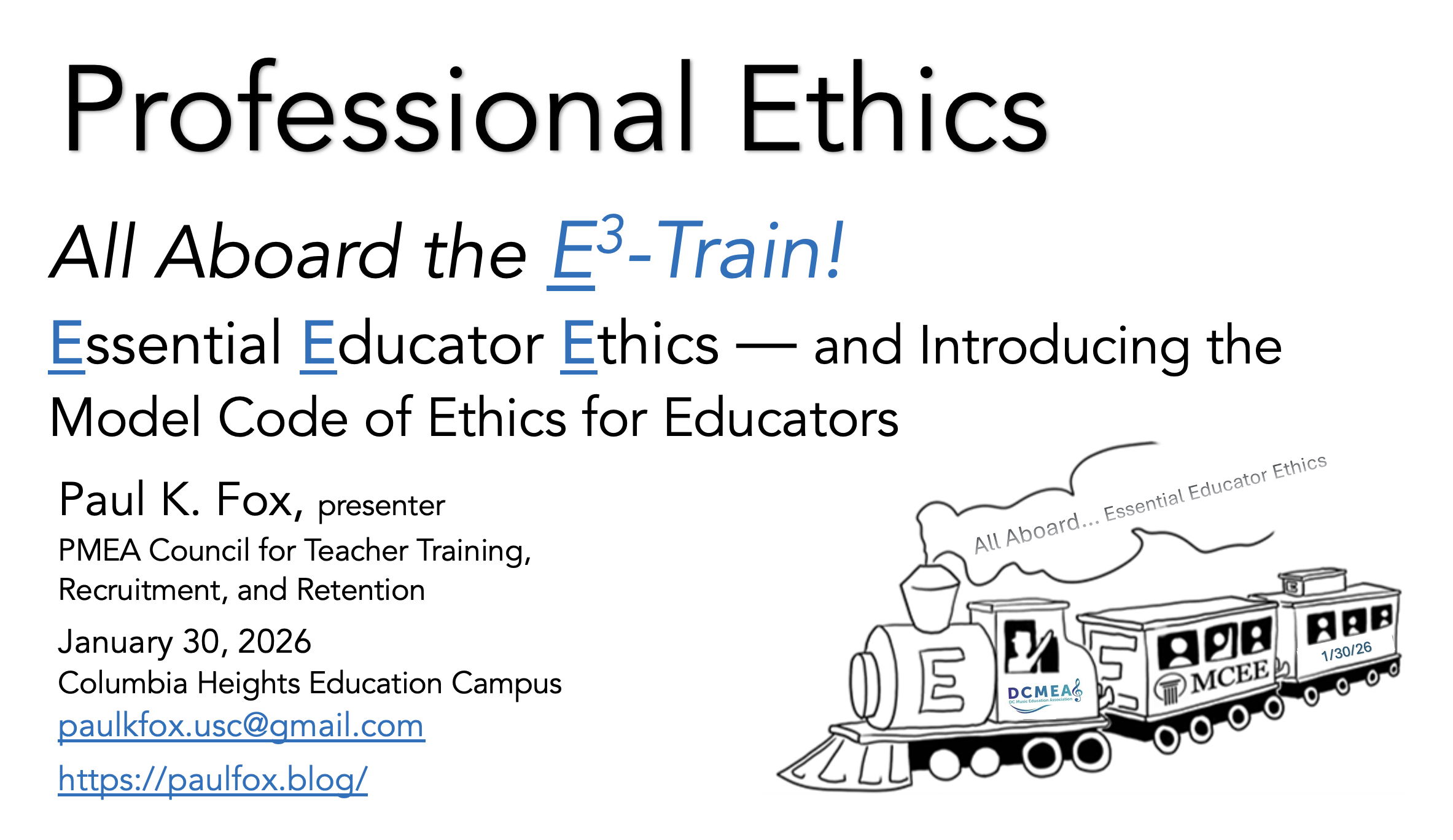
I feel privileged to have been asked to present three sessions at the DCMEA Winter Conference at the Columbia Heights Education Campus (3101 16th St NW, Washington, DC 20010) on January 30, 2026. These are for music educators undergoing pre- and in-service training and include the following:

  • SOCIAL MEDIA – Boon or Nemesis?
  • ALL ABOARD THE E3 TRAIN – Essential Ethics for Educators
  • SELF-CARE COOKBOOK – Reflections, RECIPES, and Resources for Music Teachers

I would especially appreciate learning about any of YOUR “success stories” or resources on…

  • Favorite examples of “safe and meaningful” social media for teaching music students.
  • Anecdotes of ethical “conundrums” or issues in the daily decision-making of music educators.
  • Sample “stress-reducers,” time management tips, and other self-care strategies to avoid music teacher burnout.

In addition, I am in the process of updating my INTERVIEW 101 and EMPOWERING EDUCATOR & STUDENT LEADERSHIP clinics for future blog posts and clinics. Any thoughts?

Finally, I would also love to hear from you if you have any feedback on a proposed future sharing session for the parents of music students called ADVICE TO MUSIC BOOSTERS. If you have ever sponsored a music parents advocacy group for your school music program, what suggestions would you give to your colleagues and booster officers?

Feel free to reach out to me via email here. Thank you for your willingness to help our profession!

Editor’s Note (things to look forward to): In mid-July, our next blog for this series geared to “the life cycle of a music educator” will be from guest author Ed Carter entitled “Bigger Dreams, Bigger Home: How Retirees Can Upsize for Homesteading and Hosting.” In addition, I plan to share links to materials of the “Retirement 101 – It’s Not All About the Money,” a free workshop I am presenting to residents at the Upper St. Clair Township Library on July 10, 2025.

PKF

© 2025 Paul K. Fox
The Get-a-Job Toolbox

Preparing for Those Upcoming Employment Screenings

So much of what I do at this blog-site is to archive articles offering advice on a host of topics:

Surveying my past blogs, I feel like I had to repeat (repackage) the content until my readers reached that particular stage in their career. Once they experience first-hand that sometimes tumultuous “passage,” they would be ready to reflect on this information. But, I doubt they would closely examine it until then. As an example, for more than a decade as the PMEA Retired Member Coordinator, these past articles I wrote for PMEA News and the PMEA Annual Conference’s session Retirement 101 revisit the voluminous insight of gerontologists exploring the “who, what, when, where, and why” of retirement. Regardless at how often it is presented, you tend not to consume advice on coping with post-employment until you feel you are “ready” to retire. This is the same issue for soon-to-graduate collegiates and those transitioning to a new job; who wants to read about branding, marketing, and interviewing until they are in the middle of seeking first-time (or new) employment?

Please click on the “plethora” of links throughout this article to be redirected to these past writings. My apologies in advance to what may seem like to be a lot of duplication!

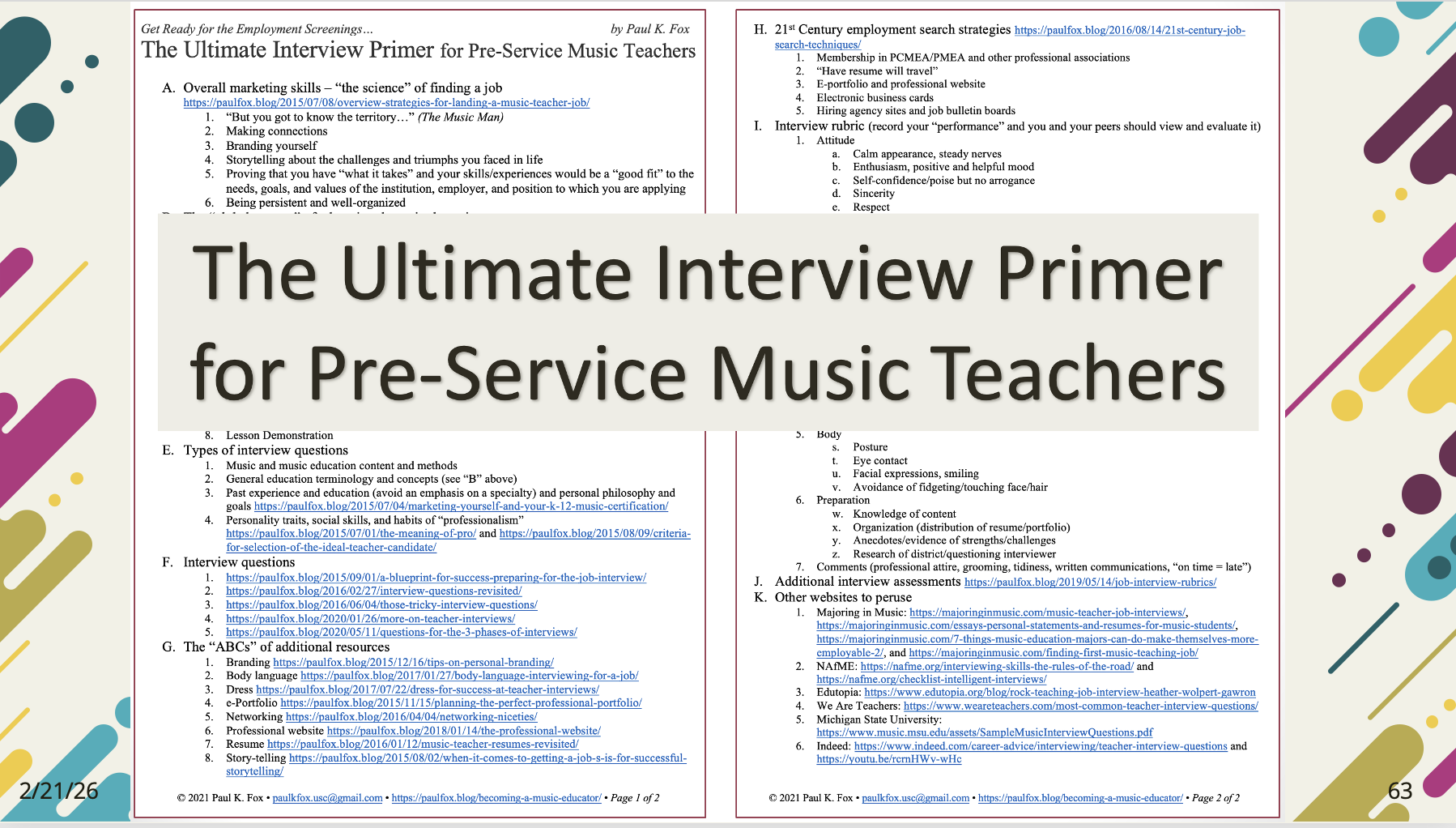
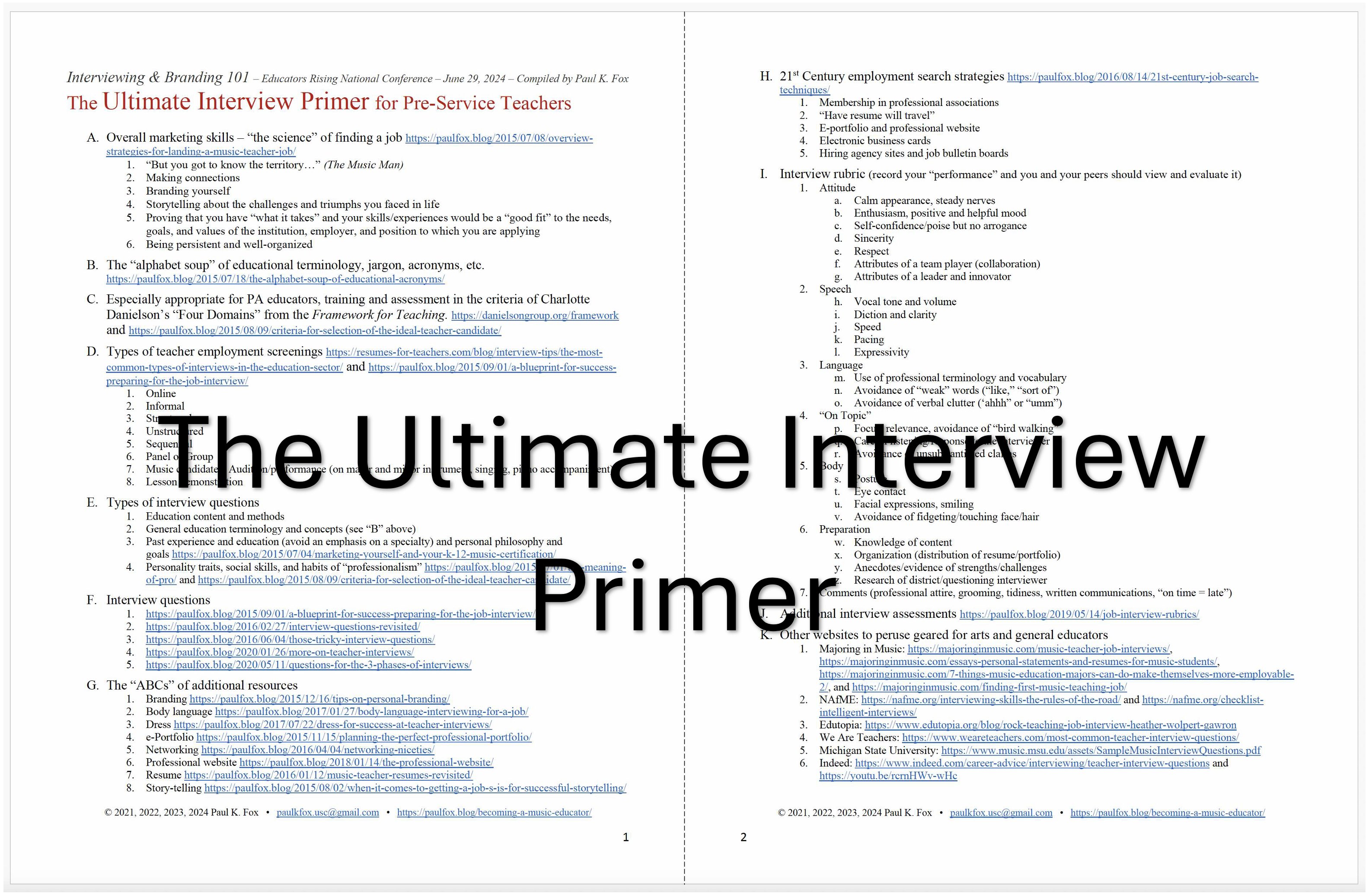
I went as far as updating the most comprehensive and “perfect” PowerPoint for collegiates: Bookends – The Life Cycle of a Successful and Happy Music Educator – portions of which I have presented several times to Professor Jessica Vaughan-Marra’s Seton Hill University music student teachers. This slide handout starts with the material from the first three bullets in the first paragraph above and then adds information about teacher health and wellness, time management, and retirement. We offer Bookends… to preservice music educators in their junior, senior, or graduate years and “rookies” to the profession. I encourage you to download this resource, visit the PCMEA website (click here/scroll down) to read past issues of Collegiate Communique, and the paulfox.blog posts. While you’re at it, acquire your own copy of the Ultimate Interview Primer. Click away before these links become inactive.

Soon it will time for graduates to enter the workforce… and boy, do we need you! By most accounts in PA and the surrounding states, we are experiencing a teacher shortage. School districts are seeking quality candidates to apply for their open positions. But, much of what happens in the job screening process seems to be influenced by chance. Collegiates, ask yourself: Are you truly prepared to market your experiences and abilities, share your brand and stories of your interactions with children in educational programs, and relate positive anecdotes of your teaching, problem solving skills, and other professional attributes? I may have been a little Type-A when I first applied for those music teaching positions back in 1978, focused on saturation publicity and persistence, and organized with a large paper portfolio of past experiences, but I was clueless in responding to those tricky interview questions and what administrators actually wanted to see in prospective new members of their staff.

One more piece advice for first-year and recent transfers to music education: Seek out a PMEA mentor and/or a member of the Retired Resource Registry (access from the PMEA Retired Member focus area after you login to your member portal)… both are groups of volunteers willing and able to help “newbies.”

Have a question about selecting music for your ensemble, a dynamic lesson plan, classroom management issue, interviewing, curriculum innovation, or a conducting tip? Stop by the “coffee and conversations” informal lounge at the PMEA Annual Conference on April 10 and “sit-a-spell” with us!

In conclusion, the following is a sequential outline – a “to-do in this order” list – a preservice toolbox of past posts and other resources for you to assemble a marketing plan. Take time to sort through these “nuts and bolts” (all links in this blog), process the information, save anything you want to read further, and then “practice, practice, practice!” This “gift” to PCMEA and music education majors embraces my best wishes for successfully finding the job you always wanted and preparing yourself for the greatest “calling” of your life – an enriching and satisfying lifelong career in music education! Good luck!

Using the Collegiate Toolbox – A Roadmap for Becoming a Music Educator

  1. Peruse everything in this and past paulfox.blog postings.
  2. Download the PDF documents to your hard drive. Review a portion of them each week!
  3. On your computer, create a “ME” file documenting your accomplishments, awards, experiences interacting with children, etc. – a library of the things you may wish to include in your future resume, professional website, and (e-)portfolio. Add to this folder throughout your college years.
  4. To reflect on your perceived strengths and weaknesses, complete a self-assessment of YOU from a typical professional evaluation form, these ideal effective teacher attributes and more criteria
  5. Prioritize what you think you need most. Write down your goals! Pobody is nerfect!
  6. While you are still attending college, work on shoring up any weak content areas or specialty skills (e.g., how is your “piano chops,” knowledge of specific methods, grade level repertoire, etc.?)
  7. Write a philosophy of school music education (overview) and your mission statement: “Why do you want to teach?”
  8. Be ready to answer the question (and defend your response), “What is your vision of the role of music education in the schools?”
  9. Be ready to define your “brand.” What are your professional attributes? What makes you unique? Why would you be a good candidate for a school music position?
  10. Begin to assemble a list of stories that would “show not tell” your positive attributes.
  11. Identify the impressions you want to “sell” yourself, and practice strategic storytelling.
  12. Practice answering interview questions and use a rubric to evaluate your performance. If you can, share all of this with your peers and sponsor mock interview sessions. Record/assess yourself.
  13. Get started on drafting the marketing tools you will need (e.g., your professional website, resume, portfolio, etc.)
  14. Review educational acronyms, jargon, and terminology such as this list plus these recent additions: CR-SE (Culturally Relevant & Sustaining Education), DEIB (Diversity, Equity, Inclusion, Belonging), and SEL (Social-Emotional Learning). These terms may come up at your next interview.
  15. Read cover-to-cover your PA code of conduct (CPPC) and the Model Code of Ethics for Educators.
  16. Practice ethical decision-making (with your peers) by reviewing these mock scenarios, first deciding what level of misconduct (if any) is reached in each case study, and then more discussion on the incident’s effect on the students, parents, staff, and community, and what proactive steps may be taken to remediate the situation.
  17. Join and become active in appropriate music education professional organizations (renew your memberships and add new ones): ACDA, AOSA, ASTA, NAfME, NBA, PMEA, etc. to name a few.
  18. Attend a conference of your professional association(s) and network with other colleagues. For PA colleagues, register for the PMEA Annual Conference (April 9-12) at the Kalahari Resort (Poconos).

Feel free to leave comments about this blog. (See the link just below the title.) How did you use these tools? What was particularly beneficial? What suggestions would you have for future music teacher applicants?

To PCMEA chapter officers/members, music education majors, and college instructors: I am available to present Bookends or other online or in-person workshops for college students. Send me an email.

© 2025 Paul K. Fox
Unleashing Your Sound: A Musician’s Guide to Making Waves and Gaining Fans

Guest Blog-Post by Ed Carter

Editor’s Note: I am taking several weeks off (a retiree’s summer vacation?) from writing articles and creating new material or proposals for workshop presentations on “the life cycle of a music educator – from preservice training to retirement.” Frequent guest contributor Ed Carter (see his past blogs here, here, and here) has graciously offered the piece below on advice for musicians to promote/market their music. Thanks for your insight, Ed!

In today’s digital age, getting your music discovered isn’t just about creating great art; it’s about strategic visibility and connection. For musicians, the realm of possibilities is expansive, yet selecting the right path can significantly influence your success. This article shared courtesy of Paul K. Fox delves into practical strategies to amplify your presence, engage with your audience, and carve a distinctive niche in the bustling world of music.
Dive into the Heart of Your Community

Embracing local music festivals and events can be a game-changer for your music career. These gatherings are not just events but a vibrant ecosystem of music lovers eager to explore new sounds. By participating, you’re not merely performing; you’re immersing yourself in a community that thrives on discovery. The connections made here, both with fans and other artists, can lead to collaborations and opportunities that extend far beyond the festival grounds.

Creating a Website

In the era of streaming, the significance of owning your distribution channel cannot be overstated. Setting up your own website brings your music directly to fans without intermediaries. This approach not only boosts your earnings but also strengthens your relationship with your audience. Offering exclusive content or merchandise can further personalize the experience, making your listeners feel like part of a special circle.

Crafting the Perfect Pitch

Waiting for discovery is a path of uncertainty. Seize the initiative by reaching out to publishing and media outlets with your music. Crafting a compelling pitch requires understanding what makes your music unique and conveying it in a way that resonates with journalists and bloggers. This proactive approach can lead to coverage that boosts your visibility exponentially, attracting new listeners and opening doors to new opportunities.

Mastering the Business of Music

Consider bridging the gap between music and marketing by going back to school for a business degree to sharpen your business acumen, essential for marketing and selling your art. A business degree equips you with vital skills in marketing strategies and financial management, crucial for a sustainable career in the arts. The convenience of online degree programs allows you to pursue education while continuing to create. Indeed, this could be the ticket to not just creating art but making a living from it.

Develop a Press Kit

A well-crafted press kit can be your passport to gaining attention in the music industry. This toolkit should encapsulate your music, personality, and achievements, providing a comprehensive snapshot to journalists and industry insiders. High-quality photos, a compelling bio, and standout music samples can make your press kit an irresistible introduction to your sounds.

Hosting Your Own Event

Why wait for an invitation when you can create your own event? Hosting your own event or showcase puts you in the driver’s seat, allowing you to present your music exactly as you envision it. This initiative not only demonstrates your entrepreneurial spirit but also creates a buzz around your work, attracting both fans and industry professionals to see what you’re all about.

Harmony and Philanthropy

Aligning your music with charitable causes is a powerful way to expand your reach while contributing to the greater good. Offering your talents for charity events or auctions showcases your commitment to social causes and can endear you to a broader audience. This approach not only elevates your profile but also enriches your musical journey with meaningful connections and experiences.

The journey to getting your music discovered is multifaceted, requiring creativity not just in your art but in your approach to marketing and community engagement. By exploring local music festivals, leveraging your online presence, and engaging directly with the media, you’re building a foundation for success. Supplementing your artistic talents with business skills and giving back to the community add depth to your career, making your music resonate on a deeper level. With dedication and strategic effort, your sound can rise above the noise, connecting with fans and opening doors to new opportunities.

© 2024 Paul K. Fox
Update… Bigger & Better Things!

T-minus Twelve Months to Year 70!

Wow! I can’t believe it’s been three whole months since I posted a blog here! Where’s the time gone? Excuses? Well, what first leaps to my mind are several quotes from this Southern Living website about being an extremely busy retiree:

“The trouble with retirement is that you never get a day off.” — Abe Lemons

“I need to retire from retirement.” — Sandra Day O’Connor

“The harder you work, the harder it is to surrender.” — Vince Lombardi

“I wanted to have more time to play and reflect, but I find retirement more stressful than having a nice, steady job because I have to make decisions about where I want to be.” — Walter Cronkite

“I see retirement as just another of these reinventions, another chance to do new things and be a new version of myself.” — Walt Mossberg

“Living each day as if it were your last doesn’t mean your last day of retirement on a remote island. It means to live fully, authentically and spontaneously with nothing being held back.” — Jack Canfield

“Do not grow old, no matter how long you live. Never cease to stand like curious children before the great mystery into which we were born.” —Albert Einstein

To my friends and colleagues in the profession, yes I am “living the dream” and having fun in retirement! Health remains good, and the days of my wife and I are filled with personal enrichment, unique new and renewed adventures, and meaningful service to the causes that matter to us both! Our only complaint? There are only 24 hours in a day… But, that means, as we head to bed each night, we have lots on our ever-expanding to-do lists motivating us to get up even earlier the next day to accomplish!

So, the following will be a quick (?) update, ramblings in the format of “streams of consciousness” of what’s happening in our lives, geared to my more faithful friends and followers, and perhaps modeling the activities of two happily retired music teachers. I promise that future blogs will re-engage with our series on “Bookends…” (life cycle of a music educator), ethics training of educators, and interviewing skills of newcomers to the profession (the season of job screenings will soon be upon us!), not to mention more tips towards a smooth transition to retirement for those who are planning to “pull their pin” and leave their full-time employment in the near future. Thanks for hanging in there with us!

PMEA Conference

Both my wife Donna, her cousin Judy, our two dogs Gracie and Brewster, and I just returned from Erie, PA participating in the PMEA Annual In-Service Conference. This was unique in that, for the first time since we retired in 2013, Donna could attend “the big event” with me. Judy served as our dog babysitter (we don’t believe in “jailing” our pups!), and the Bayfront Sheraton, Courtyard Marriott, and Erie Convention Center were pet-friendly. We reserved adjoining rooms, and the dogs were content to walking all around the Bayfront Area/Lake Erie and returning at night to sleep with us.

To my PMEA colleagues and other PA educators, in case you missed it, here is the link to more than 1,000 photos I took at the conference (sessions, meetings, exhibits, and performances). Attendees, I challenge you: CAN YOU FIND YOURSELF & YOUR STUDENTS?

As usual, Executive Director Abi Young, PD Council Chair Martha Heise and her conference planning committee, PMEA state EXCOM and staffers planned another outstanding event. If you have never gone to a PMEA conference, mark next year’s dates April 9-12, 2025 on your calendar, which will be held in the luxurious Kalahari Resort in the Poconos. Besides, the “world’s largest indoor water park” is a fun place to bring your (grand)children! In addition, several other professional development and career enhancement venues are on the horizon available to members of NAfME and PMEA:

  • PMEA Summer Summit (Leadership Conference), Reading, PA
    July 15-17, 2024
  • NAfME Biennial Music Research and Teacher Education Conference, Atlanta, GA
    September 25-28, 2024
  • NAfME Eastern Division Conference and Honors Ensembles Festival, Hartford, CT
    April 24-26, 2025

At the Erie conference, I hosted my last PMEA Council for Teacher Training, Recruitment, and Retention and TTRR SHOWCASE. At our annual meeting, I stepped down as the state chair, but will continue as State Retired Member Coordinator on the Council TTRR. We’re in excellent hands, with TRI-M Chair Tina Bennett being elected to the state TTRR Council Chair position. Joining her is the visionary leadership of State SMTE Chair Dr. Kathleen Melago, Mentor Co-Chairs Lisa Endler and Eric Plum, PCMEA Student President Ellie Vito, Future Music Teachers Honors Symposium Chairs Aaron and Stephanie Magaro, PDE Fine Arts Education Consultant David Deitz, and Higher Education Representatives Paul Doerksen, Jessica Vaughan-Marra, Sarah Watts, Debbie Wolf, among others.

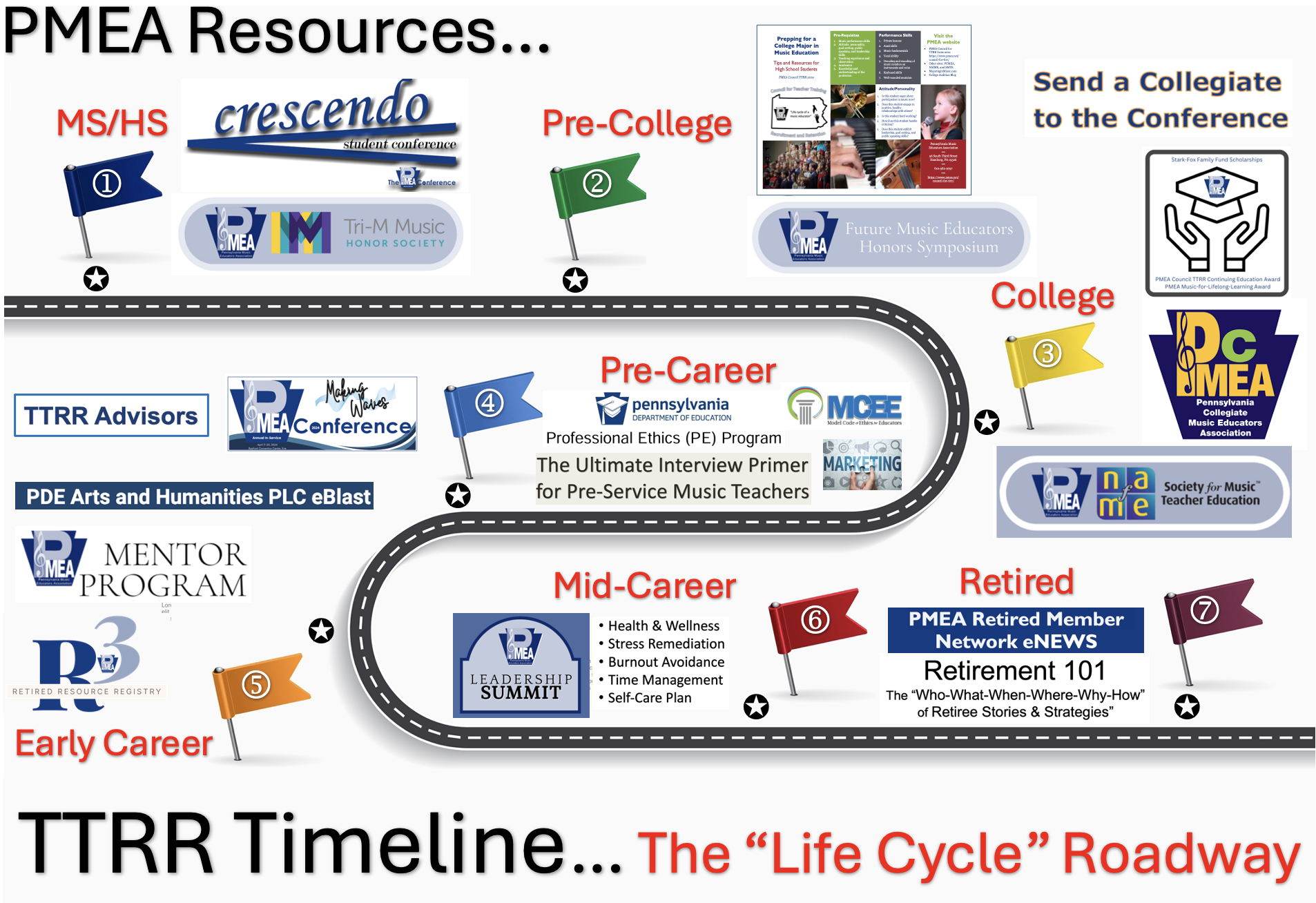
Below is a copy of the “Everything You Always Wanted to Know About Council TTRR” SHOWCASE slides which were presented to a whopping 60 PCMEA members during our breakfast meeting at the conference. (Perhaps the food motivated more collegiates to get up extra-early for that first session?)

Scholarships

One of the concerns repeatedly expressed at Council TTRR meetings was the funding issues of college students. Besides an anonymous donor funding the PCMEA breakfast at the SHOWCASE on April 18, PMEA instituted a “send a collegiate to the conference” campaign (complimentary registrations) and in 2023, also announced two major scholarship (college expense reimbursement) opportunities endowed by our Stark-Fox Family Fund in memory of our parents:

  • PMEA Council TTRR Award for Music Education Majors
  • PMEA Music for Lifelong Learning for STEM Students in College Music

In the spring of 2023, three $5K PMEA Council TTRR Scholarships were awarded to:

  • Elizabeth Corbett (Duquesne University)
  • Adam Hanna (Susquehanna University)
  • Mitchell Hourt (Moravian University

Unfortunately, last year no applications were submitted for the PMEA Music for Lifelong Learning Award. A concerted effort has been made to “reachout” to this population of students who are pursuing a science-related field and participating in their PA college band, chorus, jazz, or orchestra program. Please spread the word! Deadline to register is May 29, 2024. More information is posted here.

Upcoming Workshops

I was pleased to learn that two of my sessions were accepted for the Kappan 2024 Educators Rising National Conference scheduled for June 28-July 1, 2024, in Washington, D.C. at the Marriott Marquis:

  • Embarking the E3-Train – Essentials for Future Educators – What It Takes to Become a Teacher: Ethos, Ethics, and Engagement
  • Interviewing and Branding 101 – The Art and Science of Marketing Yourself for Employment Screening

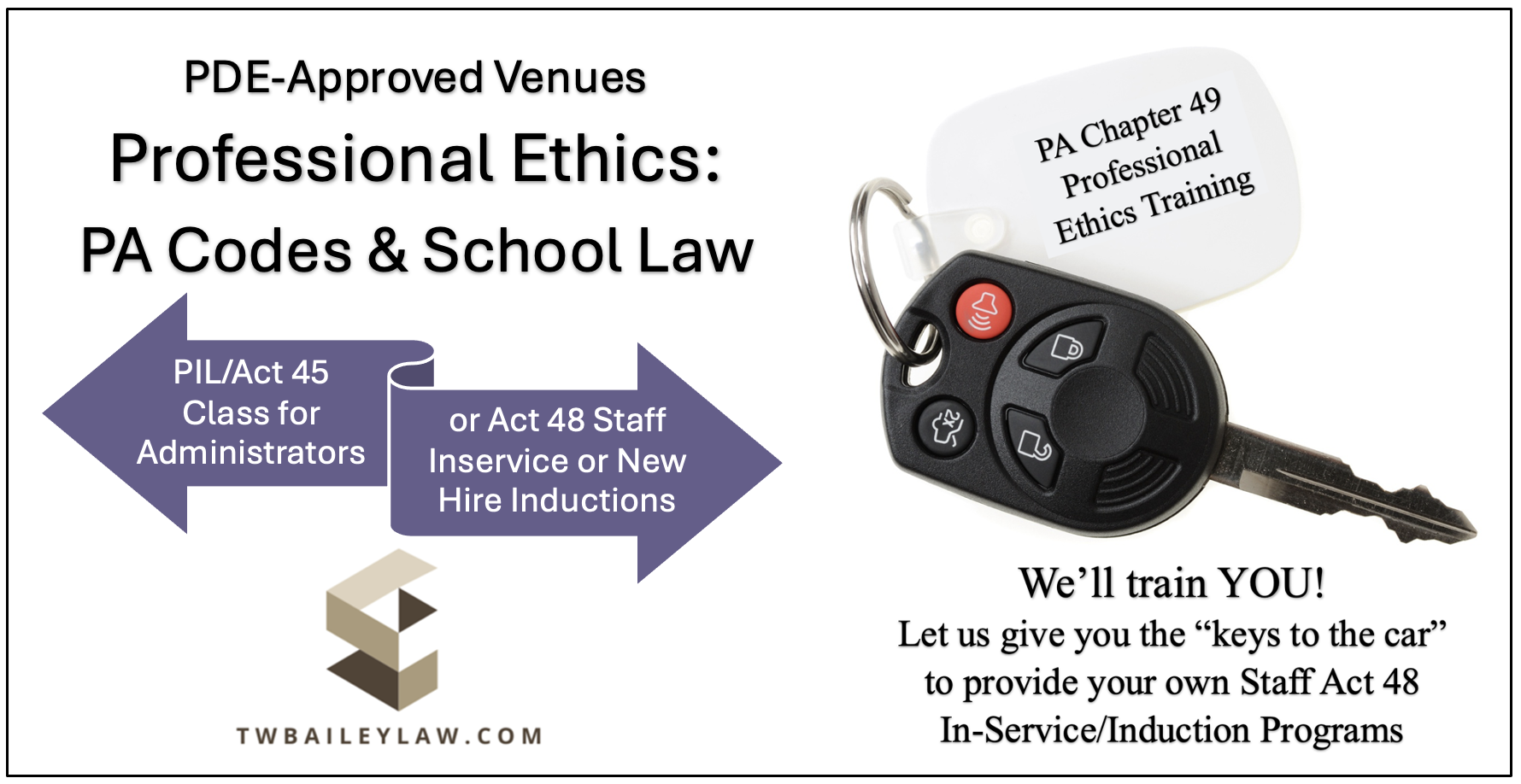
In addition, I remain active in supporting my colleague Thomas Bailey in providing PDE-approved Act 45 and Act 48 ethics training courses for PA educators. Currently, we’re teaching our fifth series of classes (25 PIL hours) for school system leaders and have presented more than 14 additional professional development workshops, webinars, or conference sessions of in depth interactive discussions of ethics and daily educator decision-making. Our next focus area is to help PA administrators to incorporate the newly mandated PA Chapter 49 ethics competencies into their school induction programs.

To learn more about course offerings or read court case blogs on ethics in education, visit Tom Bailey’s website here. This blog-site also provides a comprehensive library of past articles on educator ethics.

Who Really Reads These Blogs?

That’s a good question! Although I have always provided a “comment” link at the top of each posting and seek feedback and even “guest authors” to feature in future blogs, very few people respond to these articles. I have always hoped that “my meanderings” could help music teachers at all stages of their careers, from pre-college and music/music education majors to veteran educators to retirees. At least, this WordPress site allows me to permanently archive my writings with the hope this exhaustive but always-accessible supply of resources, links and viewpoints could be used in the future. Share on!

So recently, I was pleasantly surprised when Becca Robinson, a tutor of homeschooled children, reached out to me and said Jeremy, one of her students, did extra-credit research after reading one of my blogs on retirement resources. We are adding his recommendation for this link to the Transportation Resource Guide for Seniors & Individuals with Disabilities in the “Retiree” menu section at the top of the page. This comprehensive article by Cole Neder documenting the following is a valuable read for senior citizens and anyone who is experiencing personal mobility challenges:

    • Public Transit
    • Paratransit Services
    • Demand Responsive Services
    • Non-Emergency Transportation
    • Ride-Sharing and Taxis Services
    • Service Resources by State

    On a Personal Note…

    Yes, last week was my 69th birthday! I never imagined getting that old… er, I mean, mature! Neither my mother nor my father made it to their seventh decade! I attribute my positive attitude and active lifestyle (even though at times I could unintentionally forget your name at the drop of a hat) to embracing what Ernie Zelinski, author of How to Retire Happy, Wild and Free, says is absolutely essential to maintain in retirement: “finding purpose, structure, and community.” It is a paramount of importance to feel we matter and are needed every day, exercise both sides of our brain (the analytical and the creative), keep physically fit, jump out of our bed with purpose, maintain busy schedules and accept a lot on our plate, and stay connected to the people surrounding us. To that end, my wife and I continue to teach the pursuit “creative self-expression,” directing a community ensemble (the South Hills Junior Orchestra), teaching, walking our dogs, and pushing wheelchairs at our local hospital. At times, this latter activity allows us to catch up with our former music students, their parents, school staff, and neighbors. What FUN it is to meet someone who I taught many years ago in middle school, now grown up and busy raising their own “band” of musicians! God willing, I hope to continue with good health, a sharp mind, and motivation to live to Moses age (150 years old?), or at least have a ball along the way!

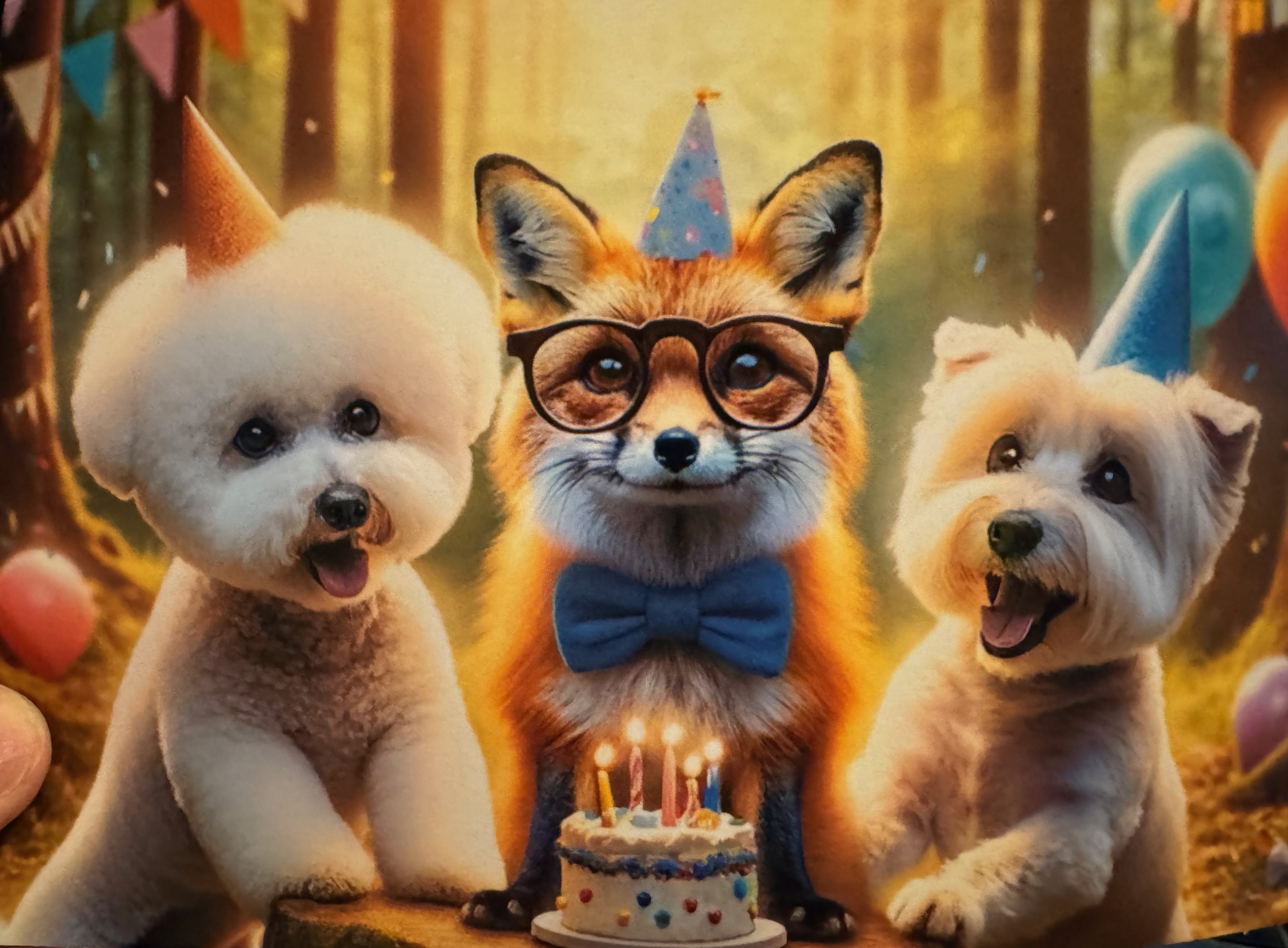
    I leave you this month with a copy of the one-of-the-kind birthday card one of my adult students (who claims me as her “adopted father?”) created using Photoshop. Three generations of her family play in our Saturday orchestra. Caption: Left is our Gracie, a bichon frise, and right is Brewster, a yorkie-poo. I’m depicted in the middle with my SHJO bow-tie, of course!)

    Happy trails, retirees and active educators alike! Keep in touch!

    PKF

    © 2024 Paul K. Fox

    Bookends – Part Two

    The Life Cycle of a Successful and Happy Music Educator

    Joyous Holidays, Season Greetings, and Happy New Year from “The Foxes!” This is a time for reflection and gratitude… and we feel blessed for all the opportunities allowing us to share our insights, gifts and experiences with other music education professionals.

    We hope to inspire YOU and literally model the concepts in this blog series. We continue with our discussion first introduced a month ago in Bookends – Part One – The Life Cycle of a Successful and Happy Music Educator, exploring:

    • Stage 3: Inservice/Growing Years (this blog)
    • Stage 4: Veteran/Sustaining Years (future blog)
    • Stage 5: Next Chapter/Living the Dream (future blog)

    This article is an abstract from a session presented to Seton Hill University music education student teachers on October 17, 2023. Click on this link to download the slide summary in PDF format.

    “I have written a lot of articles in support of these topics… now compiling them for your easy access. Depending on your current status and interests, feel free to peruse the checklists (links) in this series. It is possible a few of the resources contained within these blogs have gone inactive, but I believe enough are there for you to gain the insight, tools and motivation to achieve professional development for life.”

    – Paul Fox

    Stage 3 – Inservice/Growing Years

    [ ] 8. Becoming a Music Educator: For a review of Bookends – Part One, take a step backward and revisit what you have done to “get ready” for your “rookie years.” Take special note on the things-to-do list (“secrets”) as a first-year educator (perhaps completed during your student teaching semester):

    • Subscribe to a discounted NAfME + PMEA first-year membership (If you are a recent college graduate in your first year of teaching, or if you are the spouse of a current or retired NAfME member, contact NAfME at 800-336-3768 or email memberservices@nafme.org) to find out if you qualify for a reduced rate.
    • Hook up to PMEA Mentor or other state’s MEA support program for new teachers.
    • Look into finding an informal advisor in the PMEA Retiree Resource Registry for PA music teachers.
    • Need to fill in a few gaps missing from your college courses in skills and knowledge? Continue your “enrichment” viewing PMEA Webinars and the exhaustive video library in the NAfME Academy.
    • Take advantage of earning professional development credits just for reading an article in the NAfME Music Educators Journal
    • At some point you will be writing/editing curriculum, so research the awesome resource of Model Curriculum Framework (Have to be a PMEA member)
    • Too busy to participate in the PMEA Annual Conference or NAfME national events? Look into going to a PMEA summer conference (usually at a lower-cost!). Check out your own state’s MEA discounts and offers for collegiate members and new teachers!
    • Numerous free and timely blog posts from NAfME Music in a Minuet and here (paulfox.blog).

    [ ] 9. The Care & Feeding of Your Principal: Although not covered in any detail during the Seton Hill University presentation, it is recommended that you read in its entirety “The New Teacher’s Guide to Fostering Positive Relations and Good Interactions with School Administrators” offering a wealth of excellent recommendations from these trustworthy sources:

    A favorite question I pose to college music ed seniors is, “In what professional associations are you a member and actively involved?” For the price of consuming one fewer Starbucks latte a week, you can open up the Wonderful World of “C’s” – Contacts, Coachings, and other Connections, including research and resources that will benefit your Continuing Education. You can’t afford NOT to join groups like these.

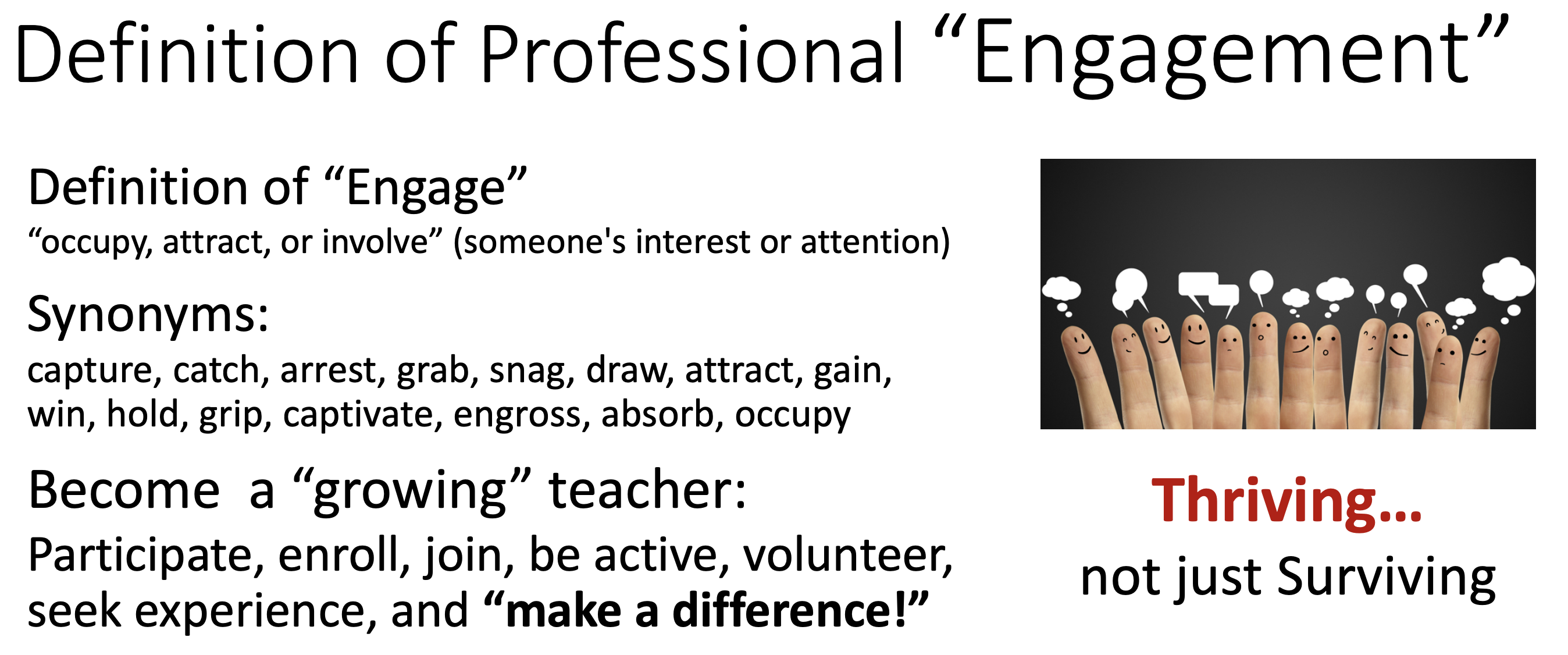
    To help “nail down” a few related definitions critical to personal growth and career development in our profession, especially “engagement,” “professionalism,” “collaboration,” and “networking,” please take a little time to travel and consume the following archived blog postings.

    [ ] 10. The Meaning of PRO: This is one of the oldest articles at the paulfox.blog site. How about a little soul searching? Are you truly a professional? Do you have the skills, habits, and attitudes of a professional in the field of education?

    [ ] 11. Transitioning from Collegiate to Professional (Part II): New teachers have to move away from “book learning” or higher education research and emphasize “practical application,” and at the same time, assess the precise areas needed for immediate (re-)training… everything from new exposure to specialized teaching areas and grade level focus for the job to which you have been assigned, to the enhanced skills of classroom management, student assessment, curriculum writing, class or ensemble warm-up materials, music repertoire and programming, etc.

    While we are on the subject, it is important to intentionally seek out mentors or consultants in your early years of becoming an educator. PMEA offers a mentoring program (read all about it here) and PMEA Retired Members are also an excellent resource to “phone a friend” for advice as needed (see their section on the PMEA website here). That leads us to the next most essential “habit” of attending professional conferences… #12 below.

    [ ] 12. Getting the Most Out of Music Conferences: Our PMEA Annual Conference sites are cyclical. This article, written on March 5, 2017, showcased that year’s event at the Erie Bayfront Convention Center – coincidentally the same location for this year’s PMEA Annual Conference: April 17-20, 2023. For a sneak peek at the proposed sessions and guest performers, click here.

    There are a myriad of conferences offered every year… something for everybody in just about every state. Make plans to go, “recharge your batteries,” and pick up new state-of-the-art ideas, lessons, music, technology, etc. Again, you cannot afford NOT to attend… or becoming stale in your teaching or “stuck in a rut!” Besides, going to your state’s or national conferences and regional workshops are FUN places to meet other like-minded, inspiring colleagues! This is how professionals network, collaborate, and share their “latest and greatest!

    A couple upcoming events:

    What are you waiting for? It’s time to DIVE INTO your customized career development!

    Coming Soon…

    Bookends Part Three – Stages 4 & 5

    PKF

    © 2023 Paul K. Fox
    Interviewing Boo-Boos

    Dodging a Few Potholes & Pratfalls at Job Screenings That Could Eliminate You from Consideration

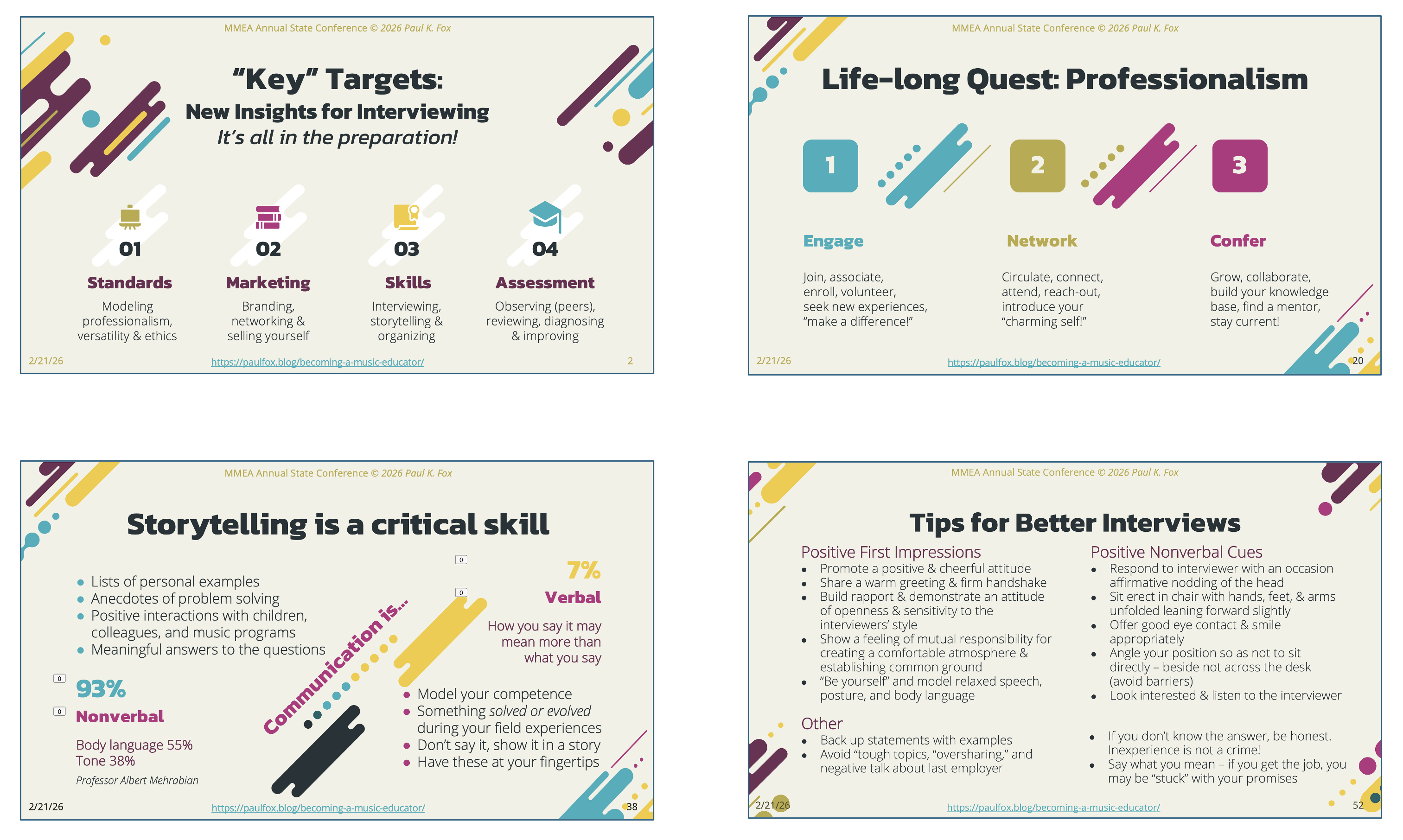
    By now, I hope all music education college graduates, newcomers to the profession, or transfers who have satisfied the credential and certification requirements for the state in which you intend to live and work, have had at least one interview! With the looming teacher shortage across the country coupled with an onslaught of openings due to retirements, resignations, leaves, etc., this may be the BEST time to apply for a music teacher position. If you have not had much success at recent interviews or the job search process altogether, this blog post, supported by the many other articles I have written on the same topic (see list at the bottom), may “cut to the chase” and highlight any bad habits you may be exhibiting that take you out of the running! I heartily recommend you “dissect” the problem and analyze your less-than-professional communication skills or what “image” you are unintentionally projecting, and then do a self-assessment of your “interview performance” (just like any other performance) to determine what you need to “fix” in order to improve your chances and market yourself for the job offer you always wanted. The bottom line? The advice I always give at workshops is that you need to enlist the help of your family members, friends, or peers, record yourself doing “mock interviews,” and evaluate your “performances” looking for any flaws (and let your onlookers offer feedback, too!). Then it’s time to rewind: PRACTICE-PRACTICE-PRACTICE!

    PKFox

    FIRST… THE BAD HABITS

    1. Repeated verbal pauses, or exclamations of “Umm” or “Ahhh” or “Like…”
    2. Unsubstantiated or unsupported statements
    3. Use of “weak words” that suggest a lack of conviction (“kind of” or “sort of” or “I feel like”)
    4. Failure to look directly at the interviewer(s)
    5. Verbal clutter (too many long run-on statements)
    6. Fidgeting (tapping your foot, spinning a pen between your fingers, wiggling in your seat, etc.)
    7. Fast talking or dropping the ends of your words
    8. Answers that are too casual, personal, or informal, or “flip” conversation
    9. “Bird walking,” changing of the subject, irrelevant or unclear responses to a question
    10. Touching of your hair, clothes, nose, mouth, or anywhere else on your body
    11. Responses that go overboard and/or volunteer too much
    12. Forceful, dominating, one-sided, opinionated views or arrogant attitudes
    13. Nonverbal cues that reflect nerves, insecurity or lack of confidence (slouching or poor posture, looking down, failure to smile, clenching or keeping hands in lap)
    14. Hollow, insincere, or disingenuous conversation

    These additional tips were provided by the Novoresume Career Blog:

    1. Going unprepared10. Making it all about you19. Not being prepared to answer salary questions
    2. Arriving late11. Sharing personal details20. Selling yourself too much
    3. Arriving early12. Being too personal with the interviewer21. Failing to sell yourself
    4. Appearing unpolished13. Using your phone22. Neglecting the “biggest weakness” question
    5. Displaying low energy14. Badmouthing past employers23. Failing to recover from a mistake
    6. Displaying too much energy15. Talking in circles24. Not having any questions of your own
    7. Not getting the tone right16. Talking too much25. Not asking about next steps
    8. No paying attention17. Messing up body language26. Forgetting to follow-up
    9. Not rehearsing in advance18. Bringing up salary and benefits first27. Following up too aggressively
    https://novoresume.com/career-blog/interview-mistakes

    Now, from my own past experience in assisting hiring seven new music staff members for my school district, here are a few “interview pet peeves,” common blunders or misdirections which may eliminate you before you even have a chance to get started.

    TELL PERSONAL STORIES –

    Don’t regurgitate data, titles, grades, and past jobs.

    “Stories are up to 22 times more effective than facts alone.”

    “We are wired to remember stories much more than data, facts, and figures.”

    “A story can illustrate a journey that may more than inform but move or persuade the listener.”

    https://leanin.org/education/harnessing-the-power-of-stories

    Most interview panels are made up of administrators who have limited knowledge of (and perhaps no personal practice in) the Fine and Performing Arts. You may be surprised that “they” (the ones with the most influence during public school employment screenings) may not be as impressed with your level of virtuosity or artistry… singing a recitative in a Wagner opera or playing a Paganini Caprice. Stick to anecdotes about your interaction with children and dealing with (the number 1, 2, 3 questions) classroom management, assessment of learning, and accommodation of students with special needs.

    DON’T “BIRD-WALK” OR GO OFF-TOPIC!

    Back up statements with examples. Try to make specific and to-the-point responses to the interview questions. Be careful in talking about the “tough topics” (see https://paulfox.blog/2016/06/04/those-tricky-interview-questions/) and avoid “oversharing” personal reflections on weaknesses. I am always amused at candidates who dig a hole for themselves by sharing too much information or negative past experiences. If somehow a mistake you made in a former job comes up at an interview, tell what you learned from it and how you remediated the problem.

    WHO ARE YOU AND WHAT ARE YOUR GOALS?

    Are you a specialist or a “total music educator.” DO NOT downgrade your abilities nor broadcast a limited educational philosophy, mission, or vision by stating “I’m a band director.” If you are certified to teach PreK-12 Music and want to promote an image of being “qualified,” than present yourself as proficient in all areas of music. You teach children, not a subject.

    MORE DON’TS TO AVOID

    NEVER talk negatively about your last employer. Right or wrong, this will usually imply you have poor interpersonal skills and tend to not get along well with other staff or supervisors.

    DO NOT bring up questions about salary and benefits (especially in the first or second interviews – in education, these are pre-determined by the teachers’ contract – but you can ask the HR rep about them just before you sign on the dotted line).

    If you don’t know an answer or understand the meaning of a term, be honest. Just say so! Inexperience is not a crime!

    MORE DO’S

    You CAN and SHOULD ask about the definition of the job assignment (grade level/subjects) for which you are under consideration and whether the opening is a permanent contractual position or a long-term substitute offering.

    Bring your updated resume, (e-)portfolio, and a business card with the link to your professional website.

    Be prepared with a list of your own questions about the school district, community, music program, etc.

    Say what you mean – if you get the job, you may be “stuck” with your promises. I would not tell an administrator (just to make yourself look good) that you are interested in becoming the assistant marching band director, choreographer for the musical, yearbook sponsor, and the girls volleyball coach. (Anyway, it would not be practical that you offer to do a boatload of extra-curriculars in your first year that are not a part of your main job assignment!)

    NOW THE GOOD HABITS TO PORTRAY AT THE INTERVIEWS

    It is easier to share the bad habits, but let’s recap by focusing on the positive recommendations.

    Positive First Impressions

    • Promote a positive and cheerful attitude.
    • Share a warm greeting and firm handshake
    • Build rapport and demonstrate an attitude of openness and sensitivity to the interviewers’ style
    • Show a feeling of mutual responsibility for creating a comfortable atmosphere and establishing common ground
    • “Be yourself” and model relaxed speech, posture, and body language

    Positive Nonverbal Cues

    • Respond to interviewer with an occasion affirmative nodding of the head
    • Sit erect in chair with hands, feet, and arms unfolded leaning forward slightly
    • Offer good eye contact and smile appropriately
    • Angle your position a little so as not to sit directly across from the interviewer (avoid barriers)
    • Look interested and listen to the interviewer

    DEBRIEFING – Learning from Your Mistakes

    • Write down everything you feel you handled right and wrong
    • Note information you need to include in future correspondence/follow-ups
    • Add names to your contact files.
    • Write a personalized thank-you letter or email
    • Follow-up your visit by making phone calls, sending requested materials, etc., but do not become a NAG!
    • If you are not selected, don’t take it personally. You may not have been the right “fit!” this time.
    • Prepare for the next interview… “DO BETTER!”

    MORE RESOURCES – “MY TOP-THREE FAVORITE BLOGS”

    Or check out all of my previous interview blog-posts (in reverse chronological order) here.

    GOOD LUCK!

    PKF

    © 2023 Paul K. Fox

    Hacks for Music Teachers – Part 2

    More Tips, Tricks, & Techniques to Help You Organize

    As you can see, it has been awhile since I shared a blog-post. It looks like I went on vacation and skipped the entire month of July!

    Well, truth be told, familiar to many of my band director friends, we are hitting the streets with a plethora of summer clinics, rehearsals, and camps to prepare for and usher in the season of parades, halftime shows, pre-games, festivals, competitions, etc., and although I am officially “retired,” I chose to re-up as “admin” to the “Pride of Upper St. Clair” – the marching band of the school from which I left in 2013. Serving as announcer for now more than 37 years, I decided to “put the pedal to the metal” and join the “band leadership team” to discover the joy of watching our ensemble “hatch” their new shows from scratch, re-awaken and build on their technique, inspire and grow their membership, and focus on “practice-practice-practice” and “making music!” I just finished a grueling week of those 12-14 hour band camp days spent in close partnership with 100+ of my favorite high school musicians.

    Fantastic? Yes. Exhausting? Absolutely! It reminds me of 30-years-worth of nonstop days and nights of leading the annual spring musical as director/producer, including missing meals, dragging myself home to re-acquaint myself with my wife (who went through this, too), and dropping into bed. I have always said, quoting Ernie Zeliniski in his book How to Retire Happy, Wild and Free, it is important to find PURPOSE, structure, and community in retirement… but this hectic pace of frenzied activity at times tests my endurance. And, it feels a little like I never left teaching….

    Therefore, I thought it would be appropriate to share some “advice from the experts” in terms of organizational tools and quick fixes or “hacks.” (See Part 1 on this topic.) This is only a gourmet “taste” of their ideas to simplify your life, work, and teaching. You should do yourself a favor and take more time to research the websites below for a complete explanation of their recommendations. We appreciate their generosity and willingness to be “free and open” to permit us to repeat their ideas in this forum.

    Easy Time Savers for Instrumental Teachers

    Photo and article excerpt by Wendy Higdon

    To get started with a “bang,” let’s visit Wendy Higdon’s “On and Off the Podium” website here, or the NAfME “Music in a Minuet” blog site which reprinted her Clever Music Teacher Hacks That Will Make Your Year Amazing – Getting Ahead of the Time Crunch.

    • “Use rubber pencil grips as inexpensive thumb rest cushions on clarinets by cutting them in thirds. (see photo)
    • Pink erasers work well as emergency rock stops for your cello and bass players
    • Purchase golf pencils on the cheap to keep in the classroom so that forgetting a pencil never becomes an excuse. Kids won’t love using these short, little pencils, so they are less likely to walk away at the end of class.
    • Three ring binders with sheet protectors help students keep organized and also cut down on lost music. If you want to be super-organized, add a pencil pouch and tab dividers in the binder.
    • Strips of velcro on the carpeting work well as guides to where chairs should go and allow your students to quickly and easily straighten up the rows. (see photo)
    • Print a sign with important information that your students frequently need (music store phone number, website addresses, etc.) and have them take a picture with their phone so they won’t have to ask you in the future. Do the same for important dates, locker combinations or anything else that is easily forgotten.
    • Locker mirrors can be purchased cheaply during school supply sales. Buy a class set and use them to check embouchure and more!
    • Did a clarinet or sax player forget their ligature? Or worse. . . it got stepped on and now it is as flat as a pancake! Use a rubber band to hold the reed on the mouthpiece until the student can get a new one.
    • Does your baton get buried under all your conductor scores? Use a binder clip on the side of your music stand, and it will always be handy! (see photo)
    • Do your beginning flute players have trouble remembering which keys the fingers of their left hand go on? Use “Avery Dot” stickers to mark the keys. You can do the same with clarinet pinky keys. Color code the keys on the right and left hand to assist students in learning their alternate fingerings. (see photo)”

    There are a lot more “why didn’t I think of that” time management hints throughout the article. Also, be sure to check out her interesting Microsoft Word and Excel templates to use for your seating and locker assignments.

    Band Directors Collaborate!

    Photo and article excerpt by Mike Doll

    The middle school band directors in South Carolina got together and created a brainstorming session to share teaching tips and strategies with each other in order to improve their music programs. According to Mike Doll, editor of one of the blog posts Band Directors Talk Shop, “After the success of the first meeting, we decided to continue this on a regular basis, and we now do this 2-3 times a year for the past 10 years. These ‘best practices’ gatherings have been very informative, and we always walk away with several new ideas to try in our classrooms.”

    Here are several ingenious ideas from their “toolkit” of Tricks of the Trade – Five Organizational Tips.

    1. Music sorter stick
    “One of our directors shared a neat way to sort music back into score order without multiple piles of different parts scattered around them on the floor. If you go online and search for Plastic Sort All, you will find the tool they use for this trick.”

    “The director then used a label maker and created labels for each instrument in score order and attached them to the sorter in place of the letters and numbers on the end. “

    2. Lines/tape on the floor for easy chair placement
    “One director, with a tile floor, mentioned they would check with their maintenance folks and find out when the wax would be stripped from the floor. At that point, they would tie a string to their director stand and measure the distance to the first row. They would then attach a sharpie to the other end of the string and use it like a compass to draw arcs on the floor. Once the floor was waxed, the lines never came up. Gaffers tape also works on carpeted floors. At the end of each class, the director would have everyone look down to make sure the front chair legs were on the arc. Clean neat rows in seconds at the end of each period.”

    5. SMART Band Student.

    “Quick and clean set of expectations for your band students. A SMART band student is one who is:

    • Silent
    • Marks Mistakes
    • Attentive
    • Respectful
    • Team Player”

    The article’s “Tip #4” on Band Binders is reminiscent of what I had applied to my grades 5-8 string program. My wife utilizes something similar for her online music lessons. Rookie or new teachers, especially, check it out!

    In addition, you should peruse their website for an inspiring collection of articles on a host of other topics:

    Band Room Hacks

    Photo from Google’s Search of “Band Room Hacks on Pinterest” by Julia Arenas

    How timely and appropriate! I stumbled on this Pinterest site, Band Room Hacks, a collection by Julia Arenas, and since I did not get advance permission to reprint her library of images, I will invite you to go explore them for yourself. At a quick glance, I see she has assembled from music colleagues a lot of excellent storage solutions as well as music teaching tools that may inspire you to modify/add your own new time-saving shortcuts.

    Time and Task Management on Steroids

    We round off our organizational hacks for music teachers with the brilliance of Ashley Danyew, and excerpts from her blog post 9 Time-Saving Tools and Tactics for Busy Music Teachers and Directors.

    Although productivity experts like Stephen Covey in Seven Habits of Highly Effective People and the originators of the aforementioned (in Part 1) Priority Management System (a favorite of mine) may be most helpful, we can all learn from Ashley as she sums things up with these tips on supercharging ourselves in planning for a good start to the school year. (You’ll have to visit her post to get the full gist of what to do!)

    1. Put all your to-do’s in one place.
    2. Track your time.
    3. Batch related tasks.
    4. Limit social media.
    5. Divide your work-day into time blocks.
    6. Set aside time to send and respond to emails.
    7. Close documents and browser tabs you are not currently using.
    8. Go into meetings with an agenda or outline.
    9. Make templates.

    I particularly love this introduction to her article:

    “One thing I hear over and over from church musicians and music educators (well, everyone, really) is that there never seems to be enough time to get it all done.”

    Time to teach
    Time to rehearse
    Time to write
    Time to practice
    Time to be with family
    Time to be a good friend
    Time to read
    Time to exercise
    Time to learn

    “We’re always looking for new ways to be more productive, get more done in the little time we seem to have, and save time in places where, like money, we might be overspending. Am I right?”

    “That’s one of my favorite ways to think about time – as money. It’s a commodity. We all have the same number of hours in the day – it’s how we spend them that makes the difference.”

    Where (and how) do you want to spend your time? What’s important to you?

    “Once you can answer this question, you’ll be motivated to make it happen – to take control of how you’re spending your time and look for ways to save it, where you can.”

    9 Time-Saving Tools & Tactics for Busy Music Teachers and Directors
    by Ashley Danyew

    Couldn’t have said it better myself!

    Have a great school year!

    PKF

    Music and Literacy Skills

    How to Use One to Improve the Other

    Editor’s Note: For this month’s blog, we bring back guest writer Ed Carter, a retired financial planner. (See his website here.) His piece, perfect for new music parents, summarizes many of the “intangibles” that music education provides to foster child development, especially the enhancement of language skills. In 2019, I wrote the blog “The Importance of Music Education” (click here) based on an interview I did for a local community news program on the essentiality of teaching music that covered many of these concepts. Special thanks go to Ed Carter for sharing his research and perspective. 

    Parents and educators are always looking for ways to improve their children’s learning –
    especially when it comes to reading. Sometimes, though, unconventional approaches can work wonders. Experts believe the best way to boost a student’s reading is actually to expand their knowledge and vocabulary by teaching them history, science, literature and the arts.

    Understanding the Connection

    Children who learn to play an instrument or who join a choir have a longer attention span and better listening skills. Music stimulates the brain in so many ways. In fact, playing music may help the human brain more than any other activity. Some researchers even suggest that musical training can alter the nervous system in a way that improves learning in a way that offsets the academic gap between affluent students and students from lower income backgrounds.

    Music improves language skills in particular because there is a neurological connection between maintaining rhythm and reading. Scientific American notes that when children learn how to keep a beat, they are better able to concentrate on a passage and decipher the meanings behind the words. A child’s reading ability relies on making a connection between the symbols they see on the page and the sounds of letters.

    The Best Age for Music Lessons?

    There is no such thing as a kid being too young for music. Many parents even expose their child to melody and rhythm before they are even born in an attempt to stimulate brain activity. Drumming is a great place to start. It is more important they gain experience with music and learn to develop a meaningful relationship with it at a young age. Children as young as 3 can develop skills like identifying a beat, melody and instruments in music.

    By the age of 5, your child may be ready for formal lessons with beginner instruments such as drums, the piano, violin, recorder, guitar or ukulele. If your 5-year-old is not ready to start formal lessons with an instrument, they can still develop their musical skills online. Invest in a kid-friendly laptop and some durable headphones that allow them to interact with online music programs and apps that develop skills that can translate to playing an instrument in time.

    To exhibit your genuine interest in your kid’s growing skills, consider creating a music room for them to be able to learn and hone their craft. This dedicated space is a perfect place for distraction-free lessons. It’s a good idea to soundproof the room, too, so others in the home aren’t disturbed. Having a bonus room that can act as a multipurpose room can increase your home’s appraisal value should you decide to sell anytime soon, as such upgrades are what many buyers look for.

    Music Mistakes to Avoid

    While some children pick up an instrument like a fish to water, all children develop differently. If you push your child into music lessons too early, they can become overwhelmed. Not progressing in their skill can hurt their self-esteem and discourage their progress. Let your child ease into their musical lessons gradually with time.

    You can’t just throw money at a music tutor and expect that to be enough. If you want your child to grow in their skills, sit with them as they practice each day. Consistent practice is more effective than long lessons and your presence provides discipline and encouragement.

    There is going to be a moment where your child expresses a desire to quit their instrument. Instead of letting them give everything up too soon, always talk with your child about why they feel like quitting and adjust their lesson goals to make playing music fun again rather than a chore. Encouraging your child to stick with it rather than quit teaches your child how important perseverance is in life.

    Children all over the country struggle with reading. Adding music lessons to your child’s schooling can help improve their language skills and reading comprehension. There’s no exact age for starting music lessons, but incorporating music into other activities is a great way to start introducing them to rhythm and melody. As they grow up, involve yourself in your child’s learning and measure progress by the goals they reach and the amount of fun they have.

    PKF

    © 2022 Paul K. Fox

    Photo credits: