More on Teacher Care

“Books & Links & Resources… Oh, My”

Now retired and “far from ground zero,” I admit I don’t have a clear roadmap nor “magic pill” for a definitive plan to remediate educator stress, burnout, exhaustion, demoralization, and negative school climate. My disclaimer: So-called “expert recommendations” on self-care strategies towards better health and wellness, coping skills, and time management may not be applicable to every setting, situation, nor individual need. In other words, no prescription can cure every educator’s symptoms.

However, from recent conversations with those “still in the trenches” and colleagues who endured those horrible COVID (and post-pandemic) years in the schools, we need to address “the elephant in the room” (viewpoints of systemic breakdowns and loss of admin or community supports) and propose fresh looks into self- and school system improvements.

My friend Thomas Bailey (who has created a comprehensive ethics course for PA teachers and admins alike – refer to these past blogs 1, 2, & 3) and I have heard many “horror stories” of day-to-day dysfunctions, micromanagement and disrespect of teachers, a general lack of support and professionalism, and unhealthy/unsustainable policies, practices, and patterns of work environments at school. We have witnessed angry parents storming school board meetings, staff shortages with some positions going unfulfilled for months or longer, uncertified teachers placed in classrooms, overloaded teaching schedules, classroom management problems, increased risks and incidents of school violence, class sizes on the rise, and significantly less educator planning time.

In short, according to the blog Teacher Burnout Statistics – Why Teachers Quit in 2026, K-12 educators are in the most burned out profession in the world:

  • 57% of U.S. teachers reported burnout in 2026, versus 36% of similar working adults (RAND, 2026)
  • 18% of teachers intended to leave their jobs in 2026 (RAND, 2026)
  • Managing student behavior is the #1 source of teacher stress, cited by 52% of teachers (RAND, 2026)
  • 77% of teachers say their job is frequently stressful, and 68% say it is overwhelming (Pew Research Center, 2024)
  • 78% of teachers have thought about quitting since the pandemic (University of Missouri, 2025)
  • 74% of public schools struggled to fill at least one teaching vacancy for the 2024-25 school year (NCES)
  • K-12 teachers were the most burned-out profession in Gallup’s most recent occupational ranking, at 52% (Gallup, 2022)
  • About 8% of public school teachers leave the profession each year (NCES)
  • Teachers worked an average of 49 hours per week in 2025, about 10 more than they were contracted for (RAND, 2025)

So, since the intent for this paulfox.blog site is to serve as a repository of professional development and insightful conversations for career development, I feel there is a need to share any new “finds,” innovative ideas (even those considered controversial), research, and other resources with the hopes that they may spark even an infinitesimal growth in sustained advancements in personal and staff resilience, self-care, motivation and passion for teaching, and work/life balance… as well as the goal for philosophical and structural changes in school climate and culture in order to promote positive employee morale and wellbeing.

Past blogs on this subject (and, when available, their accompanying conference slides decks) should be reviewed:

If you peruse the above links to my past articles, you will find the mentioning of several outstanding books to begin your journey towards the rejuvenescence of self-care. Please beg, borrow, (ahem – steal?), or purchase these to begin.

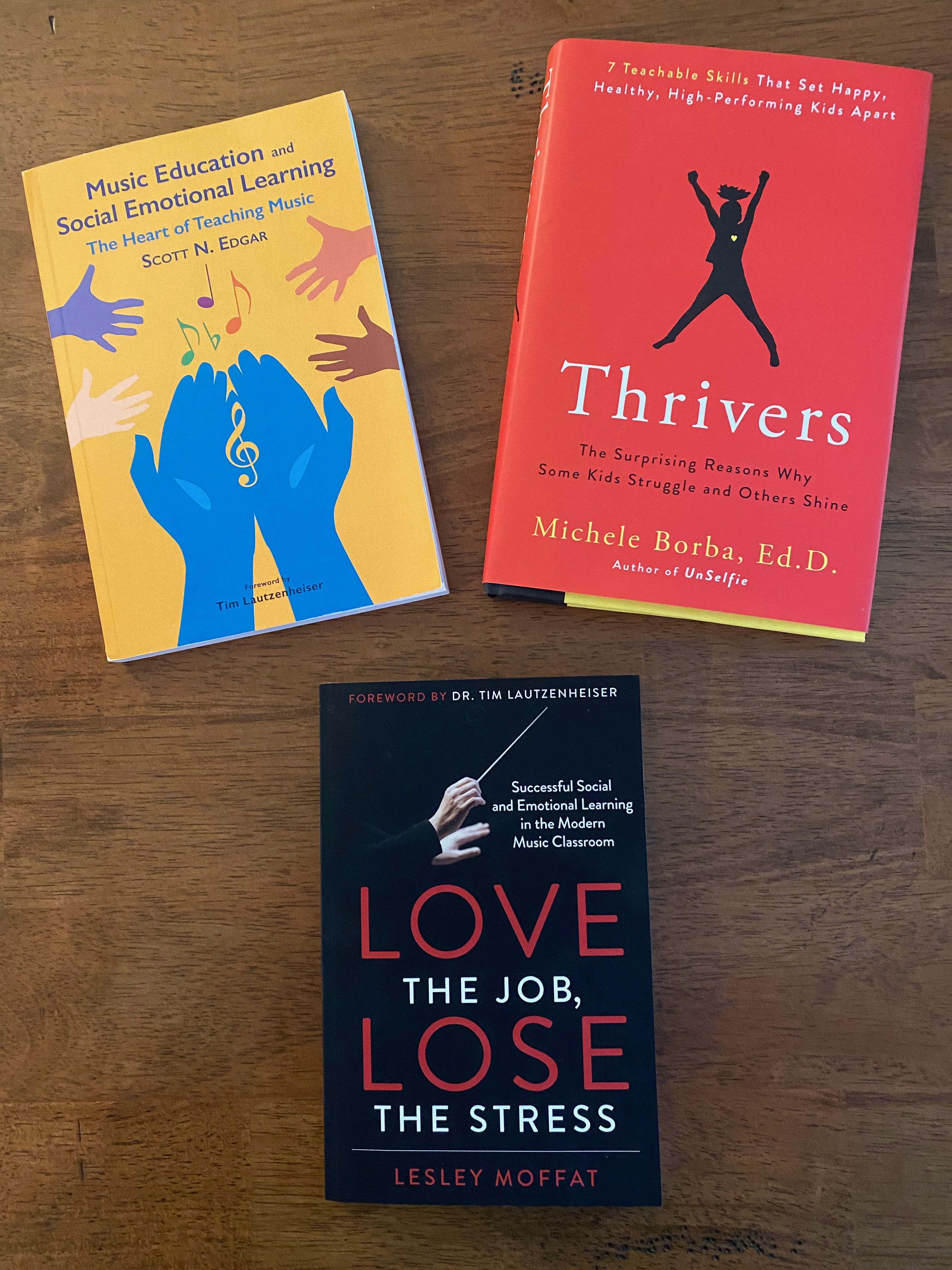
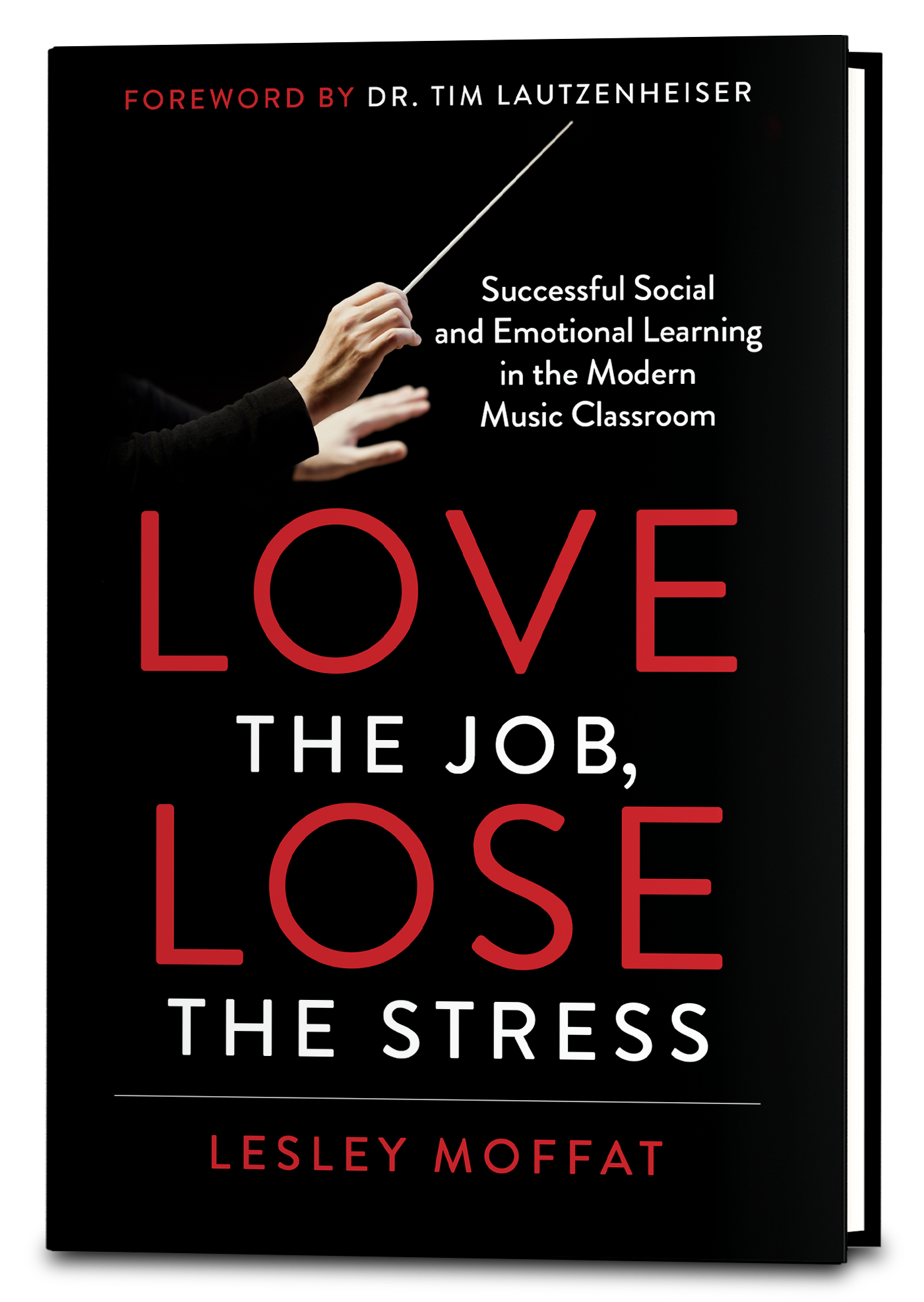
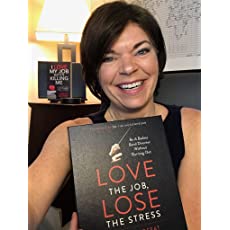
The Lesley Moffat Series (both are SUPER!)
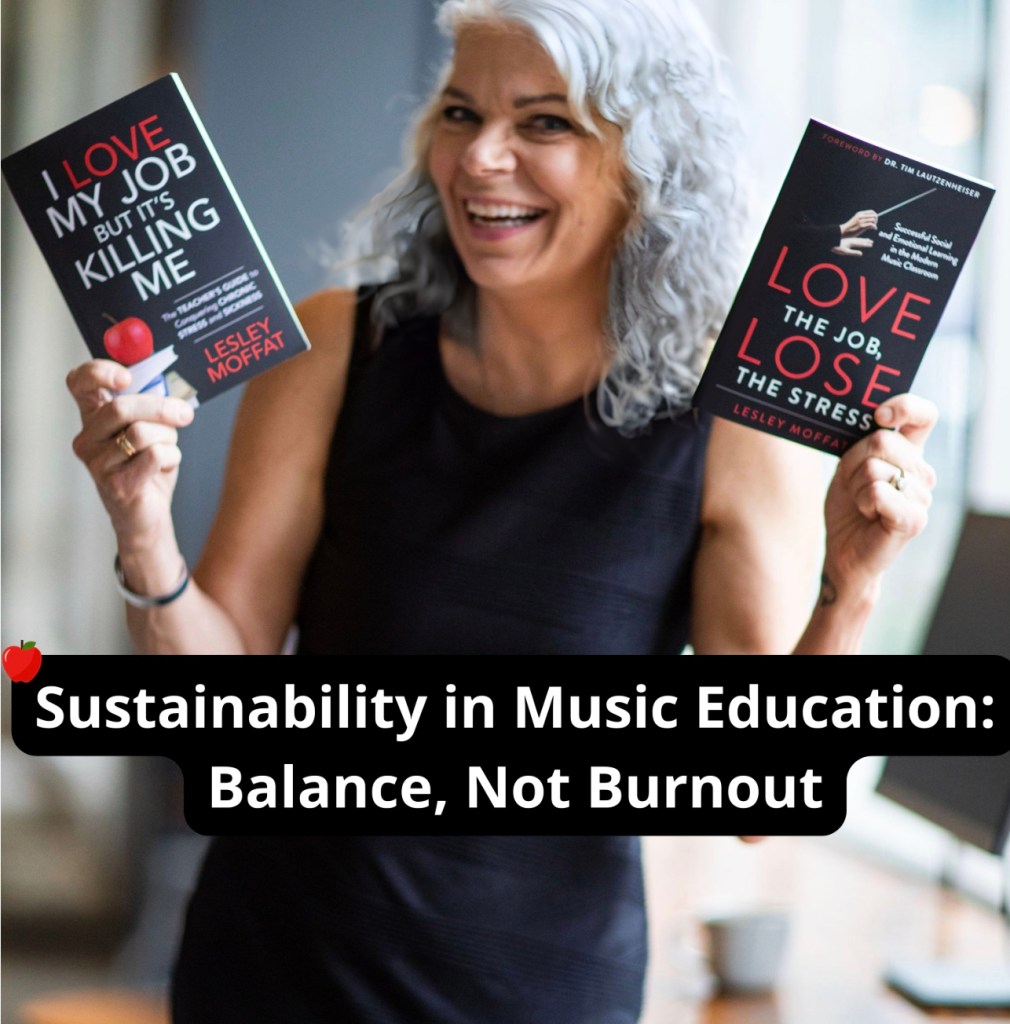
Click here for her website.

In addition to I Love My Job But It’s Killing Me and Love the Job, Lose the Stress, you should also check out her newest publication, The Balanced Band Director! Her notes:

Over the years, I realized something important:
Most band directors don’t need more ideas. They need fewer drains on their energy.
They need systems that respect their values, their standards, and their humanity.

That belief is at the heart of everything I share now—through my books, my podcast, my coaching, and the tools I’ve built specifically for music educators. The strategies I teach aren’t theoretical. They’re the same ones that have helped me and hundreds of others move from constant depletion to a career that still challenges me without consuming me.

Being a Balanced Band Director doesn’t mean lowering the bar.
It means removing the noise, the overload, and the unnecessary friction that makes this job harder than it has to be.


Upbeat – Mindset, Mindfulness & Leadership in Music Education & Beyond by Matthew Arau

Click here for his website.

The book is divided into three parts – Ignite, Inspire, and Lead – and addresses numerous topics such as these:

  • Self-care for optimal mental, emotional, and physical wellness
  • The transformative power of positivity and gratitude
  • Growth mindset
  • Mindful breathing and listening in an ensemble setting
  • Internal self-reflection to outward expressions of leadership …and more!

Valuable contributions by author Angela Watson

Click here for her website.

She defines the goal of Awakened – Change Your Mindset to Transform Your Teaching:

Showing up in the classroom as the best version of yourself each day requires serious mental fortitude. This book will empower you to develop the resilient, flexible, positive mindset you need to:

Change your perception of setbacks by replacing judgment with curiosity.
Observe your thoughts and select the ones that create results you want.
Honor your intuition, mind-body connection, and emotions for the insights they provide.
Let go of bias, unrealistic expectations, standards, and comparisons.
Practice radical acceptance to stay motivated even when you don’t see results.
Realize a sense of accomplishment in a job that’s truly never done.

In addition, as a closure to my own self-care workshops, I have always used these “motivating beliefs” illustrated in her first book, Fewer Things Better:

  • I am worthy of better and change is possible for me right now.
  • I set my own expectations in life and in teaching.
  • I know what is important and allocate time accordingly.
  • I ensure my needs are met to prevent overwhelm and exhaustion.

Now for the “Newer” Curriculum
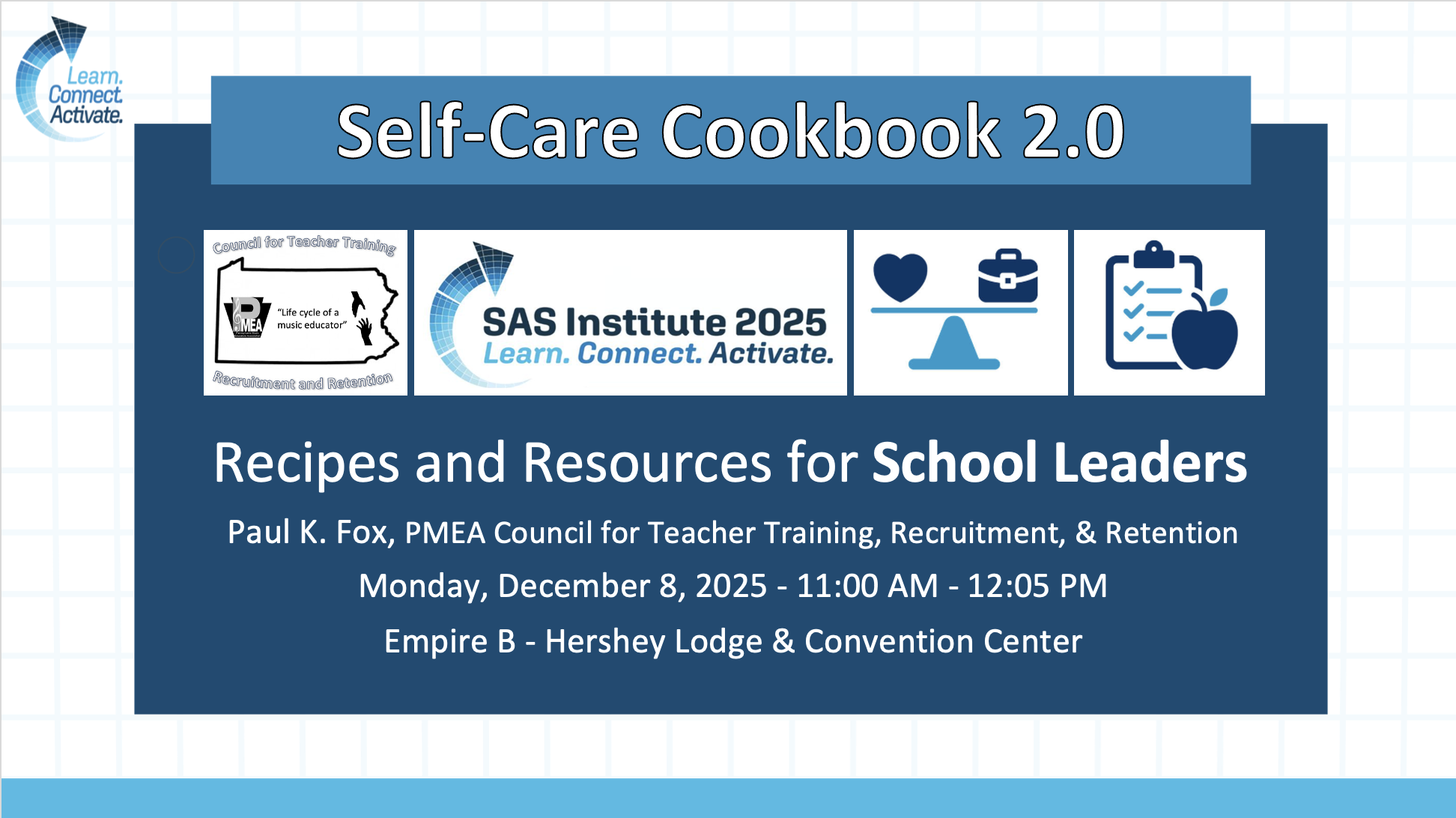
If we could “wave a magic wand” and instantly transform the climate and culture in the schools, what would we do? During my PA Department of Education SAS Institute presentation for admins in December 2025, we explored a wide variety of key concepts, concentrated on more “teacher asks of administration” that are backed by multiple sources:

  • Give teachers the respect that they deserve.
  • Show that you value their time.
  • Streamline communications. Hold fewer or shorter team or faculty meetings (substitute some with emails?).
  • Set and adhere to healthy boundaries for work/life balance.
  • Prove that you trust them.
  • Protect classroom time by minimizing interruptions.
  • Reduce unnecessary accountability documentation.
  • Never underestimate your staff. Professionalize your language when discussing your staff with parents and other stakeholders.
  • Acknowledge their struggles and show that you appreciate the work they are doing.
  • Involve teachers in the creation of targeted professional development activities that are the most meaningful for them.
  • Ask teachers about what specific help they need to improve classroom management.
  • Ask teachers what mental health or other supports they need to cope with their own distress.
  • Reframe your role as school leader. Shift from a school principal’s current focus on operations and compliance to a fuller picture of instructional leadership: a more “hands-on” approach to supports for student success, social-emotional learning, and a deeper emphasis on school culture, wellness, and community engagement.

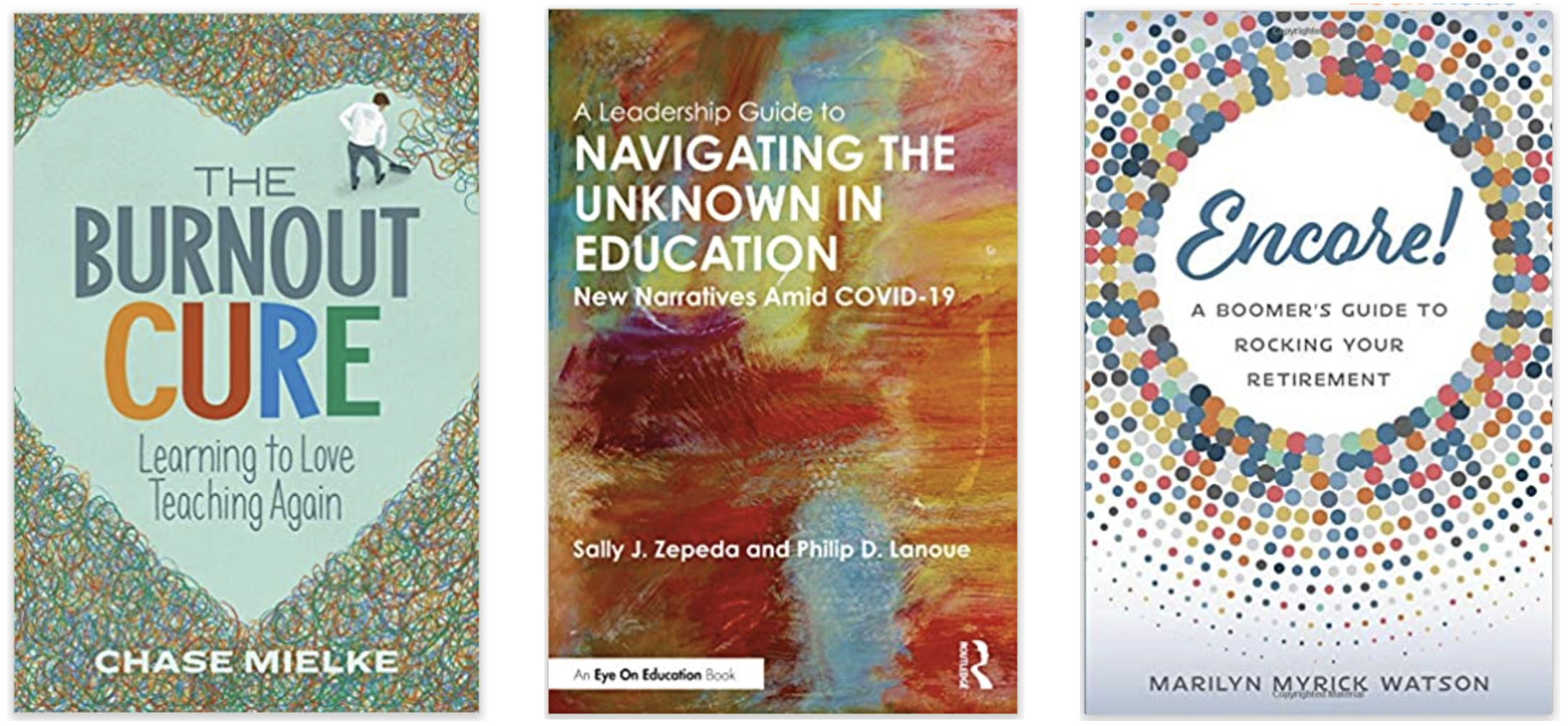
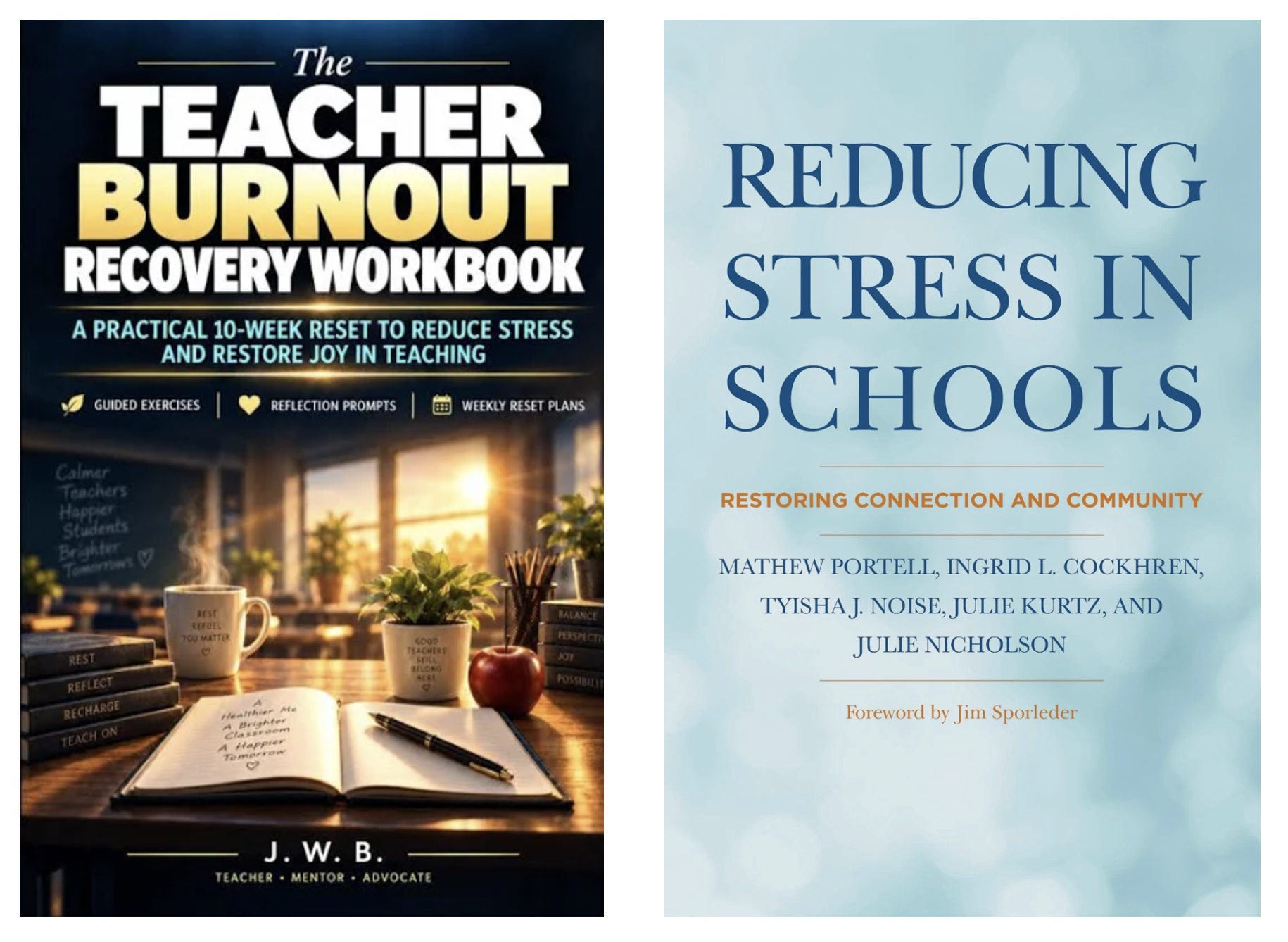
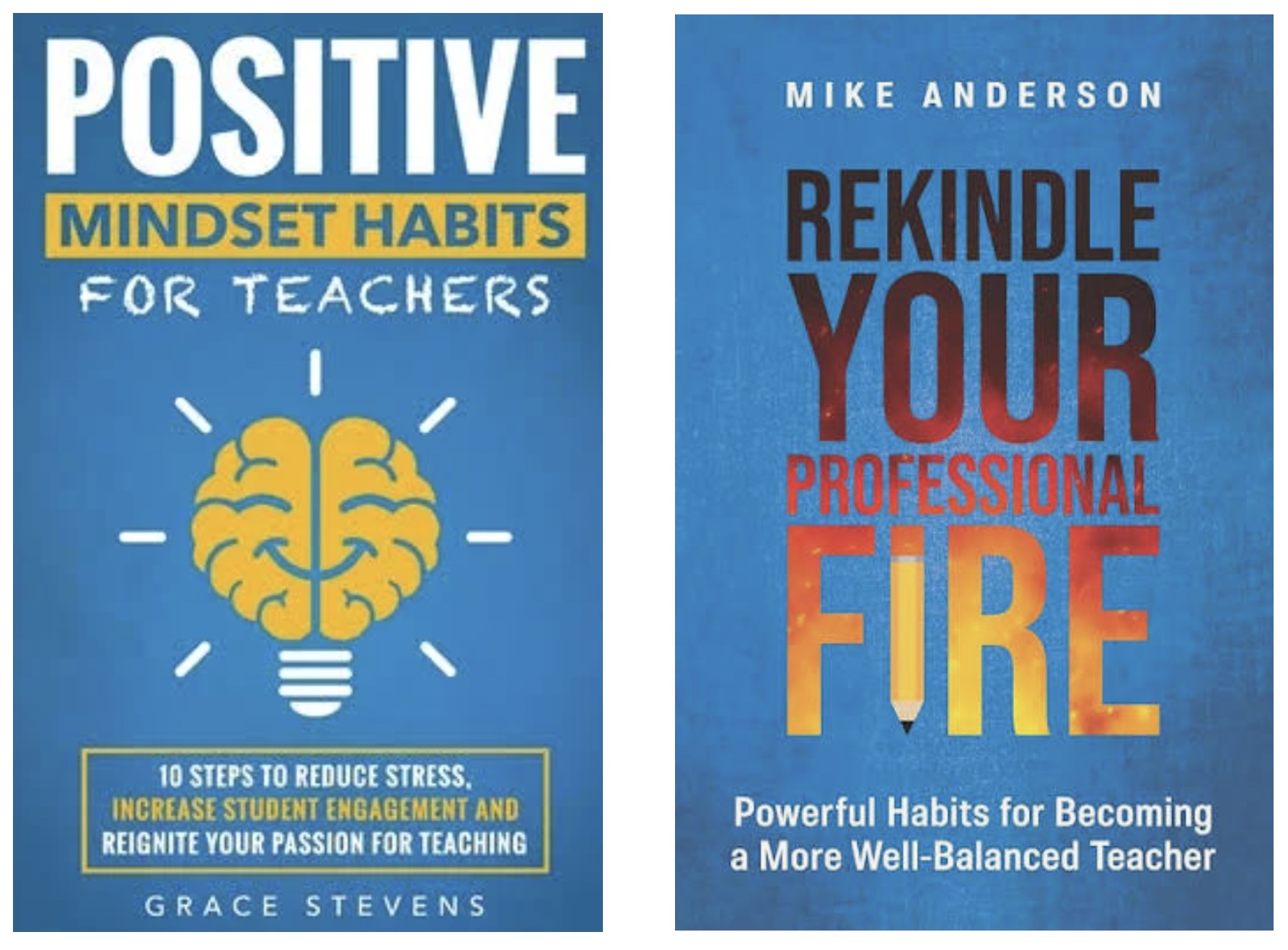
Over the next 6-12 months, I plan to post a handful of new research and resources for your perusal. Here is a sneak preview of several books for an advanced and closer look.
Additional References

These were updated from my last conference handout for Self-Care Cookbook 2.0. Enjoy!

PKF

© 2026 Paul K. Fox
The Four Rs of Music Education

Reflection, Reinvention, Retreat, and Restoration

Guest post by Katherine Langford

We welcome the return of guest blogger Katherine Langford, who offers insights on how music education nurtures creativity, balance, and lasting passion for learning. Her last article was “The New Model of Modern Music Education” (2025). She describes herself as “a digital marketing consultant, writer, freelancer, WordPress enthusiast, and coffee lover.” Thank you, Katherine! PKF

Music education is more than just learning notes, scales, and chords. It’s about growth, creativity, and self-discovery. Whether you’re a student, a teacher, or a lifelong learner, the journey of music unfolds through cycles of learning and renewal. The concept of the Four Rs of Music Education: Reflection, Reinvention, Retreat, and Restoration beautifully captures this ongoing process.

These four principles help musicians reconnect with their passion, refine their skills, and rediscover purpose. Let’s explore how each “R” plays a role in shaping better musicians, educators, and learners—both in classrooms and in online class help settings where flexibility meets creativity.

Reflection in Music Education

Reflection is the first step toward genuine growth in music. It’s about looking back to understand what worked, what didn’t, and what could improve. Musicians often rush through practice sessions, but without reflection, progress stalls.

Reflecting on past performances helps identify patterns and habits. Maybe your rhythm feels slightly off, or your phrasing needs more emotion. When students pause to think about their experiences, they start connecting technique with meaning. This process deepens understanding beyond mere repetition.

For teachers, reflection shapes lesson plans and teaching styles. It’s not just about evaluating students but also self-assessing methods. Asking questions like, Did my students grasp the concept? Could I have explained it better? opens new possibilities.

Practical reflection can include journaling after lessons or recording performances to analyze later. Even in music education online, where feedback may seem distant, reflection bridges that gap. Students who revisit recordings of their practice can hear their growth over time.

Reinvention in Music Education

Once reflection takes place, the next step is reinvention. Reinvention is where creativity flourishes. It encourages musicians to reshape their identity, experiment with new techniques, and explore unfamiliar styles.

Every musician reaches a plateau. Reinvention helps overcome it. Trying different genres, instruments, or teaching methods revitalizes motivation. A classical pianist might explore jazz improvisation, or a vocalist might learn digital music production. These changes broaden understanding and strengthen adaptability.

In music education, reinvention keeps learning exciting. Teachers who incorporate technology, apps, or virtual performances engage students better. Reinvention also applies to learners using online class help platforms. They can explore theory, composition, or ear training with tailored support, matching personal learning speeds.

A big part of reinvention is embracing mistakes. Growth often comes from stepping outside the comfort zone. Students who reimagine failure as feedback develop resilience. Music thrives on such transformation. Reinvention keeps passion alive, no matter how many years someone has played.

Retreat in Music Education

Retreat might sound like stepping away, but in music, it’s a necessary pause. Taking breaks gives musicians time to breathe, reset, and process what they’ve learned. Creativity demands rest as much as effort.

Many students push themselves to practice endlessly. Yet over-practicing can lead to burnout or injury. A strategic retreat helps restore energy and focus. Stepping back for a while often leads to stronger comebacks. It’s similar to letting silence enhance the beauty of a melody.

Teachers also benefit from retreating. When educators allow time for reflection and relaxation, they return with renewed enthusiasm. This creates a more balanced environment for both themselves and their students.

Retreats don’t have to be long. A short pause between lessons, a quiet walk, or even a few mindful breaths before playing can make a difference. In music education, retreats remind learners that music isn’t just performance—it’s also presence.

Even students studying through online class help programs can benefit from short retreats. Logging off for a day or switching focus from performance to listening exercises can refresh the mind. This pause often leads to more meaningful progress later.

Restoration in Music Education

Restoration is where renewal begins. After reflection, reinvention, and retreat, musicians rediscover their connection with music. It’s the emotional and spiritual healing that brings purpose back into playing or teaching.

In music education, restoration often comes through rediscovering joy. When practice feels heavy, restoring one’s motivation means reconnecting with why music mattered in the first place. Listening to old favorites, collaborating with others, or simply playing for pleasure can spark that feeling again.

For teachers, restoration also means finding balance between structure and spontaneity. Students sense when their instructor feels inspired. Restored energy flows naturally into lessons, making learning more engaging and alive.

Restoration also ties into self-care. A healthy mind and body fuel creativity. Simple habits—staying hydrated, taking breaks, and celebrating small wins—help musicians sustain passion over time. Restoration is not a one-time event but a recurring phase in every artist’s journey.

Even in digital learning, restoration is vital. Students using online class help platforms can restore focus by revisiting the joy of learning, rather than rushing toward exams or performance goals. With patience and care, their progress becomes both steady and fulfilling.

Why the Four Rs of Music Education Matter

Together, the Four Rs—Reflection, Reinvention, Retreat, and Restoration—form a continuous cycle of artistic and personal growth. They keep music education holistic, addressing both skill and soul.

This framework encourages balance. Instead of chasing perfection, it invites progress and peace. Each “R” nurtures a different part of the learning experience:

  • Reflection builds awareness.
  • Reinvention fuels creativity.
  • Retreat restores clarity.
  • Restoration renews passion.

When integrated into daily practice, these principles prevent burnout and promote sustainable growth. Whether in traditional classrooms or through online class help, the Four Rs offer a roadmap for lifelong musicianship.

How the Four Rs Apply to Online Learning

Modern music education extends far beyond physical classrooms. Online platforms allow students to learn instruments, theory, and composition from anywhere. Yet, this shift brings new challenges. Maintaining motivation and connection can be harder in virtual spaces. That’s where the Four Rs come in.

  • Reflection helps students assess progress through recorded lessons and digital assignments.
  • Reinvention encourages exploring online tools like digital keyboards or rhythm apps.
  • Retreat prevents screen fatigue by balancing screen time with hands-on practice.
  • Restoration ensures students stay inspired by joining online communities and virtual performances.

Using these principles keeps learning balanced, even in a fast-paced digital world. Whether a student says, “I need someone to take my online class,” or just wants extra support, embracing the Four Rs ensures the journey remains meaningful.

Common Reader Question: How Can Music Students Stay Motivated Long-Term?

Many learners wonder how to stay motivated when progress feels slow. The answer lies in the Four Rs. Reflection shows how far you’ve come. Reinvention keeps practice exciting. Retreat helps avoid burnout. Restoration renews joy when motivation fades.

Music is a lifelong pursuit, not a quick achievement. Balancing effort and rest keeps the journey enjoyable. Motivation isn’t constant, but using these principles ensures it always returns.

Practical Ways to Apply the Four Rs in Music Education

Let’s look at simple ways to bring the Four Rs into practice for both students and teachers.

  1. Daily Reflection: Spend five minutes after each session writing what worked and what didn’t.
  2. Creative Reinvention: Try a new piece or improvise on a familiar melody weekly.
  3. Mini Retreats: Take short breaks after intense sessions to refresh your focus.
  4. Emotional Restoration: Listen to music that inspired you to start learning.

Teachers can also schedule reflection days or host open discussions about learning challenges. For online learners, creating digital journals or participating in peer reviews builds community.

The Four Rs and Emotional Wellbeing

Music doesn’t exist in isolation. It’s deeply tied to emotion and identity. The Four Rs not only shape better musicians but also healthier humans. Reflection teaches self-awareness. Reinvention builds confidence through experimentation. Retreat prevents burnout. Restoration fosters gratitude and peace.

This emotional balance benefits students and teachers alike. When lessons include empathy and patience, the environment becomes nurturing. Learning music becomes a joyful experience rather than a stressful task.

Bringing the Four Rs into the Classroom

Incorporating these principles into music education doesn’t require a full curriculum overhaul. Small steps make a big difference. For example, dedicate time for students to reflect after performances or introduce creative projects that allow reinvention.

Encourage retreats during exam periods, reminding students that rest improves retention. Use restoration activities such as group jam sessions or collaborative projects to reignite enthusiasm.

Even in virtual classrooms, teachers can use reflective discussions, creative challenges, and feedback sessions to make learning more interactive. The Four Rs build a culture of respect and curiosity, which every classroom needs.

Why Balance Is Key in Music Education

Balance keeps passion alive. Musicians who only focus on technical mastery risk losing emotional connection. Those who only chase creativity may neglect discipline. The Four Rs bring equilibrium by blending introspection, experimentation, rest, and renewal.

Music thrives when learners stay curious and teachers stay inspired. Balance ensures that both continue growing. Whether through physical practice or online class help, balance transforms learning into a rewarding, lifelong adventure.

Conclusion

The Four Rs of Music Education: Reflection, Reinvention, Retreat, and Restoration remind us that music is not just about sound. It’s about growth, emotion, and connection. These principles guide musicians to learn deeply, teach wisely, and live creatively.

Every stage of music education benefits from these cycles. Reflection helps you understand your progress. Reinvention sparks creativity. Retreat allows you to pause and recharge. Restoration brings your heart back into music.Whether you’re attending lessons in person or seeking online class help, applying these Four Rs ensures that your musical journey stays balanced, joyful, and deeply human.

© 2026 Katherine Langford and Paul K. Fox

Bookends – Part 3

As summer draws to a close and schools begin to reopen, we look forward to the coming autumn season (and hopefully some relief from the scorching weather). After all, tomorrow will be the first day of classes at my former place of employment (and the dress rehearsal for Friday’s marching band senior show). Soon we’ll enjoy one of my favorite transitions of the year! In Western Pennsylvania, deciduous trees will gradually change color (some bright red, orange and yellow) and then shed their leaves… the perfect metaphor for the final sections of my “Bookends” series.

(Yes, fall is a month away… but, as you can see, the stores are way ahead in anticipation of the changing seasons!)

Autumn is a season of harvest, a time to reap the rewards of our hard work and reflect on the blessings in our lives. The Fall Equinox is a reminder for us to assess our accomplishments instead of our shortcomings.

– www.inspiringactions.com

We return to a discussion first introduced last October in Bookends – Part One – The Life Cycle of a Successful and Happy Music Educator, exploring:

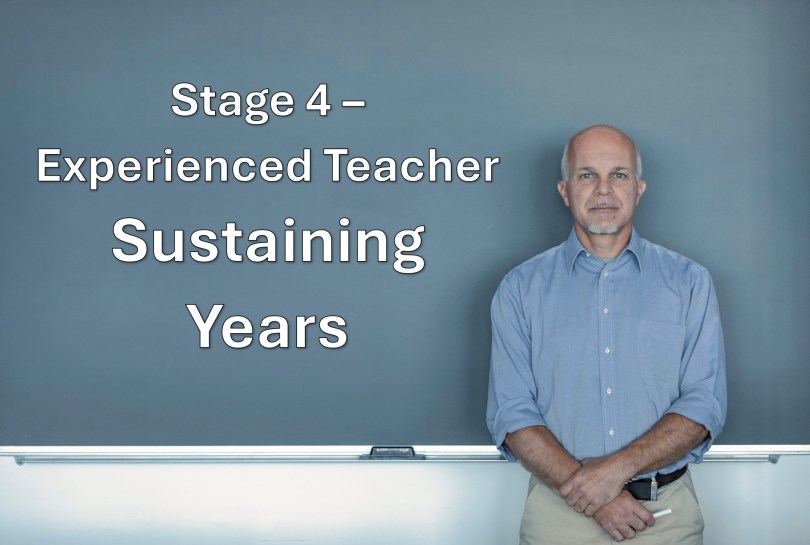
  • Stage 4: Veteran/Sustaining Years (this blog)
  • Stage 5: Next Chapter/Living the Dream (future blog)

When do we become “experts” in our field? When are we “master teachers?” Do we ever reach the apex of our achievements, the crowning glory of our career, or the pinnacle of our profession?

Never! You snooze, you lose. If you stop expanding on your knowledge and skills, forgo exploring new ideas, methods, and media, or become stagnant and settling into a rut at work, you might as well RETIRE (“Stage 5”). Instead, I direct you to revisit “Stage 3” in Bookends II here. As dedicated educators, the focus must be on constant retooling… reviewing/revising “best practices,” setting new goals, and building on the existing networks and engagement in the profession. These have always been the essential elements of a true professional.

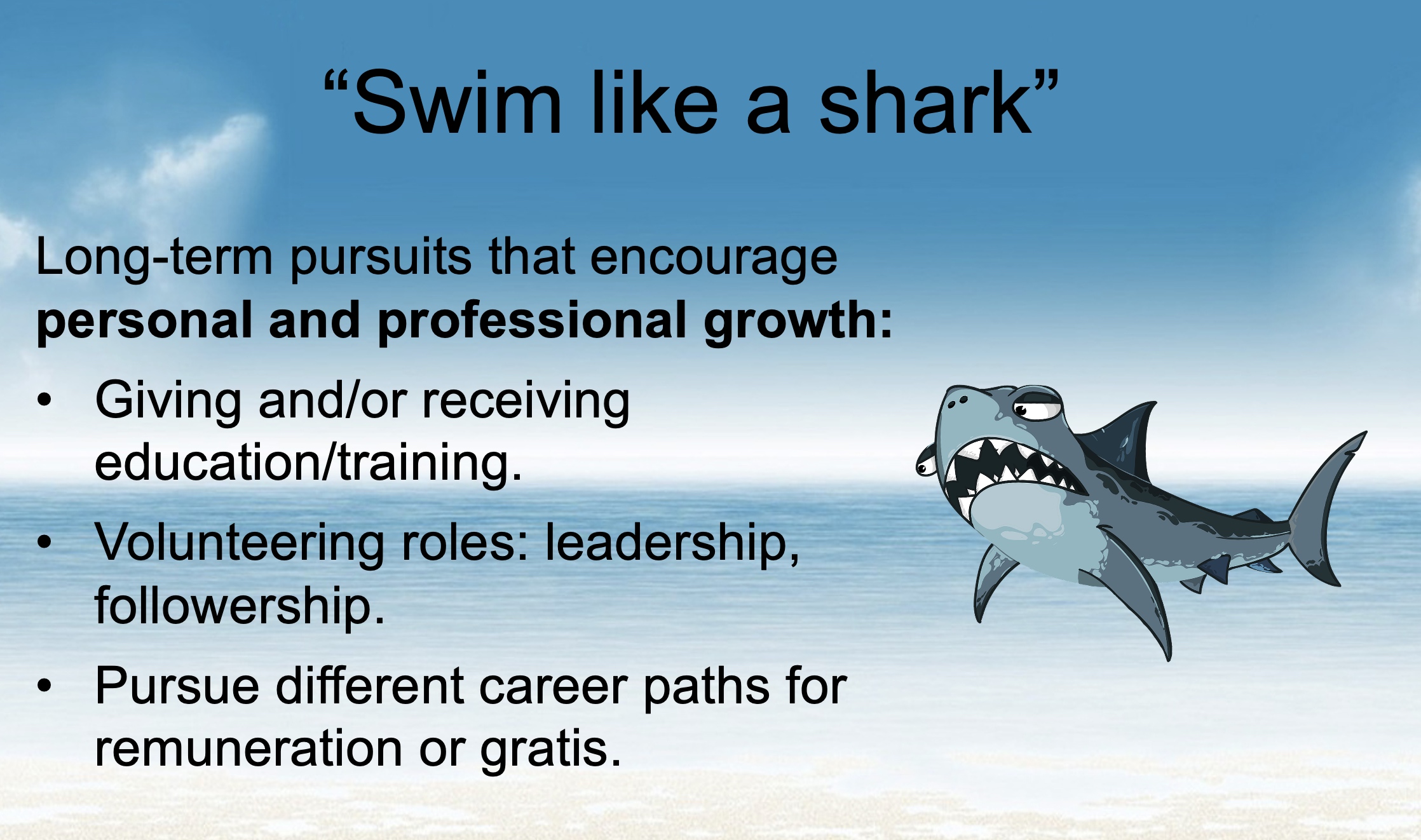
Now I should mention that during our middle-years, we sometimes return to education, get advanced degrees, new certifications or teaching specialties, apply for new job assignments, etc. When my PMEA colleague and fellow music teacher retiree John D’Ascenzo left full-time teaching, he went on to pursue a doctorate degree. Also appropriate for our next Bookends section, I have often quoted his analogy for all career stages to “swim like a shark” (since a shark never stops moving, even when it is sleeping). Sage advice for us all!

During my whirlwind of more than five decades in the field of music education, I went through several “first-year-of-teaching” passages, such as accepting my first job in general music at Edgewood School District (1978-1980), then being hired to direct strings (grades 6-12) at Upper St. Clair School District in 1979 followed by a 16-year appointment to the USCHS choral program of over 200 singers in 1980 on… transitions requiring massive job retraining and revitalized professional development. I may have not appreciated the stress of these “hurry up and relearn” periods at the time, but these periodic challenges made me GROW. In the end, I “lived” and embraced Robert Frost’s poem, “The Road Not Taken.” It may have not been the initial pathway I imagined for myself when I started in music education, but “I took the one less traveled by, And that has made all the difference.”

To this day, this violist and orchestra director has NO REGRETS teaching so many years outside of his so-called “specialty” or emphasis! It comes back to me every time I run into former choral or musical students, those I taught in those early years of being a vocal novice (at times when I felt less prepared). My past instrumentalists/singers/actors reminisce a little and literally rave about their musical experiences and what they meant to them.

My emphasis to foster success in our “veteran years” is also on teacher self-care: health and wellness, burnout prevention or remediation, stress and time management, and personal life and work balance.

Let’s start with examining the probable causes of STRESS in TEACHERS:

  • Overwhelming workload, long hours, and/or challenging classroom situations
  • Lack of administrative or social supports
  • Feeling a lack of respect, loss of job autonomy, or not being valued or appreciated in the organization or assignment
  • Dysfunctional or hostile work environment
  • Inconsistent hydration and consumption of a balanced diet and healthy quantities (length, depth, and frequency) of rest and sleep
  • Irregular amounts of daily aerobic physical exercise
  • Misuse of the voice at work and inadequate hearing conservation and protection from over-exposure to sound
  • Deficient scheduling of opportunities for mindfulness, meditation, and/or reflection
  • Deprivation of personal outlets for creative self-expression (not related to job) and the lack of time to explore hobbies, interests, and socialization with family and friends
  • Infrequent use of sick days or vacations even when they are needed for restorative health

We all have experienced at least a few of these “bumps along the road” (but hopefully NOT most of them). Although I generally had very supportive administrators throughout my years in the public schools (and no one would claim I exhibited any symptoms of “burnout”), I did model a few of the inconsistent habits of personal health (diet, sleep, etc.) and an unbalanced work/personal life schedule. And, perhaps it could be said that I did some of my best work totally exhausted!

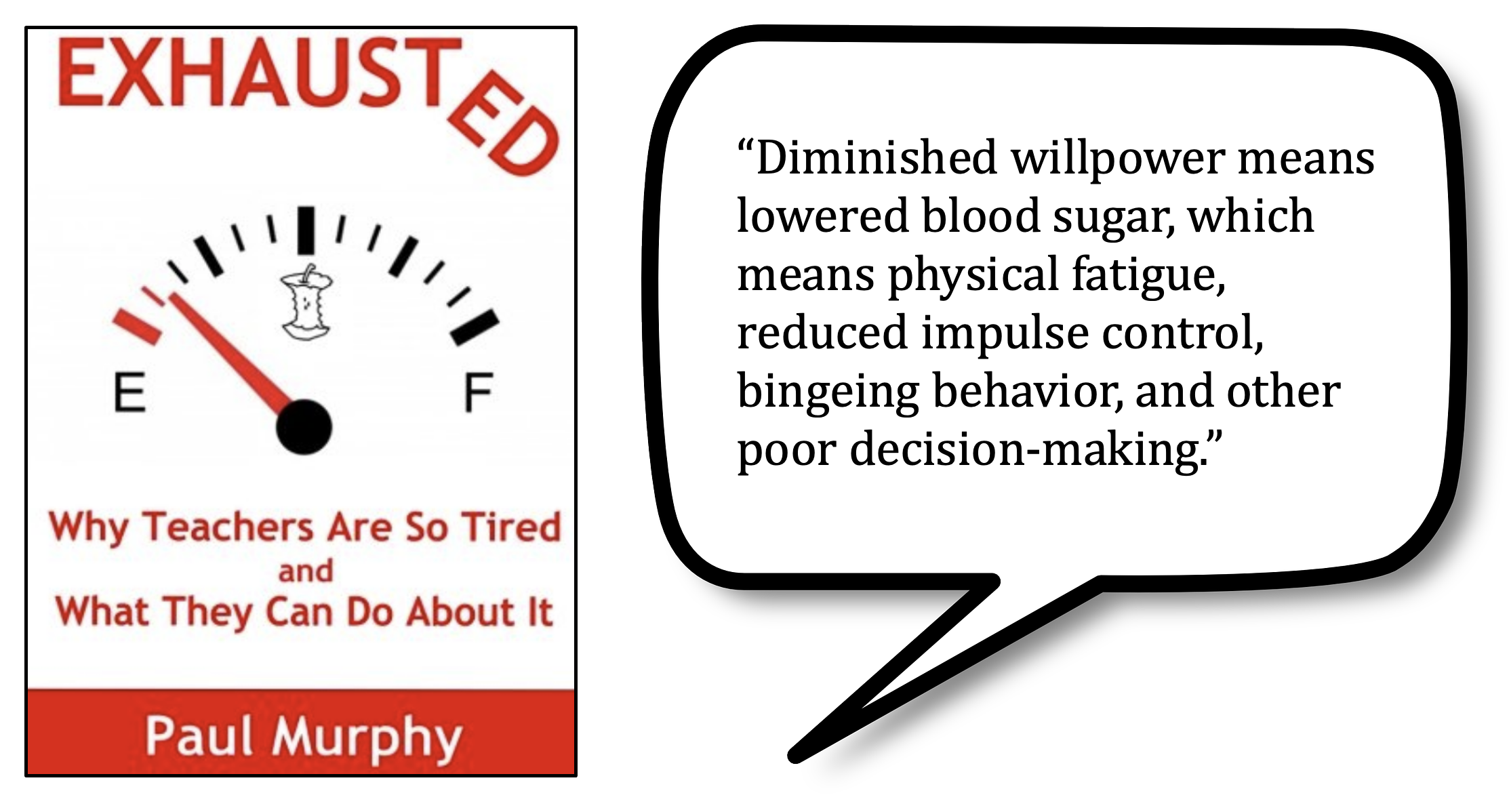
As I have written in past blogs (especially here in “Burned Out or Bummed Out”), the best book I know on “teacher exhaustion” is by Paul Murphy (2017), and subtitled Why Teachers Are Do Tired and What They Can Do About It. I strongly recommend it as “a required read” for all new AND veteran teachers.

Besides being aware of your “body chemistry” (especially what the challenges of constant willpower, deferred gratification, and relentless scheduling can do to lower your blood glucose levels later in the day), to quote Murphy, some of his suggestions for remediation are NOT so easy to follow:

  • Work less/fewer hours
  • Time before school is worth more than twice as much as time after school
  • Use class time to check work
  • Leverage technology
  • Don’t grade everything
  • Stop assigning things

Sorry! My wife and I modeled the behavior of “more-than-full-time” music teachers with after-school rehearsals of marching bands, musicals, community orchestras, chamber ensembles, private lessons, music festival preparation, etc. How in the world do you work fewer hours? Also, since most music teachers do not assign “paper” homework requiring teacher correction, “checking for understanding” and in-class formative assessment could improve efficiency. Sometimes we are own worst enemies… We should “keep it simple” and focus on the priorities. That brings us to time management.

My favorite strategies for organizing our time and fostering a better work/life balance involve these resources (click on links below to past blogs at this site). PLEASE STUDY THESE!

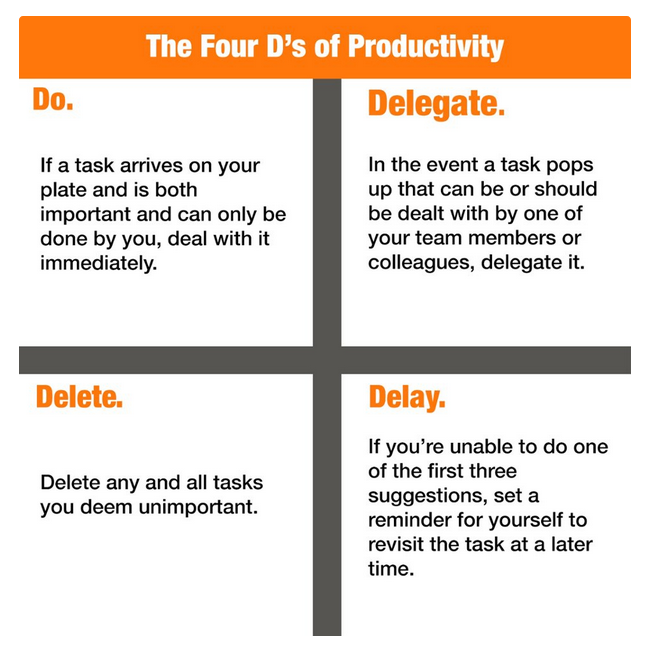
I return to the “Four D’s” concepts several times in past writings, and the “system” can be applied digitally as well… as long as you make a concerted effort to take the necessary time (10-20 minutes) every day to manage the up-front decision-making to “do immediately,” file, or weed out most of the “voluminous noise” (distractions) you get in email, texts, voicemail, snail-mail, etc. Get ready to push the “delete” button… over and over again!

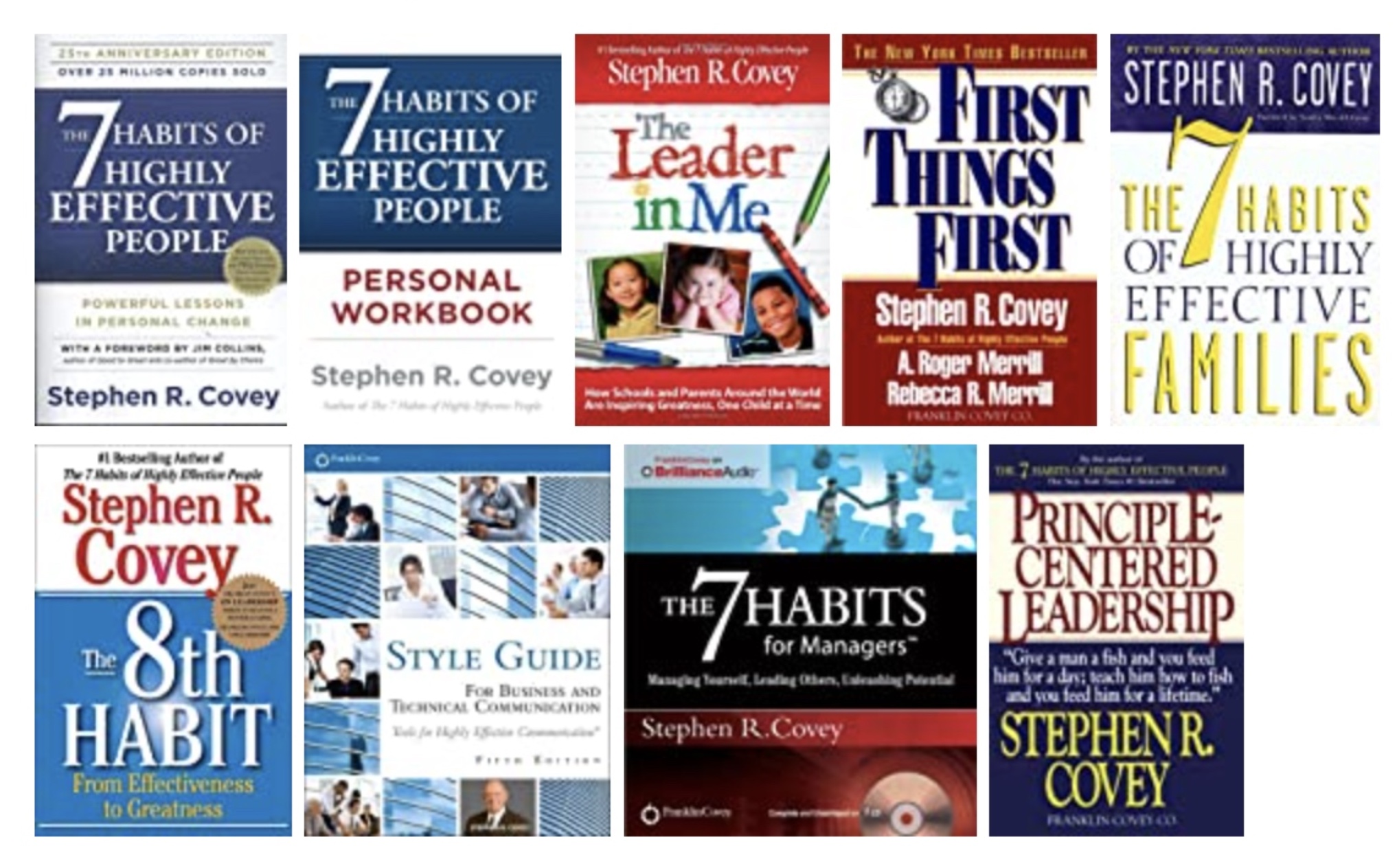
Then there are a few more ideas in “Top Ten Organizing Tips…” and any of the books by Stephen Covey (below). I particularly like the philosophy/demonstration attributed to him re: “start with the big rocks!”

Also, if you are a member of NAfME (National Association for Music Education), search their vast library of related blogs here, several articles to which I was fortunate to have contributed.

Final thoughts for the “sustaining years” of your profession and to avoid any touches of BURNOUT is to develop a self-care plan. My first go-to for building meaningful wellness habits comes from “What Self-Care Is and What it Isn’t.” In past health and wellness workshops, I echo these “basics.”

  • Promote a nutritious, healthy diet, and hydrate often.
  • Get enough sleep.
  • Exercise.
  • Follow-up with medical care.
  • Use relaxation exercises and/or practice meditation.
  • Spend enough time with loved ones.
  • Do at least one relaxing activity every day, whether it’s taking a walk or spending 30 minutes unwinding.
  • Do at least one pleasurable activity every day, from going to the cinema, cooking, or meeting with friends.
  • Find opportunities to laugh.

Self-care can take many forms, such as physical, spiritual, and emotional self-care. It’s an important factor in maintaining health and well-being.

Self-care might range from a hot soak and yoga to everyday activities like preparing meals you want to eat or dressing in your choice of style.

Self-care is not an indulgence. The WHO recognizes it as a crucial aspect of health maintenance.

Tailoring self-care for your budget, season in life, and personal needs for whole body wellness, inside and out, can be energizing and exciting in itself.

– https://psychcentral.com/blog/what-self-care-is-and-what-it-isnt

Veteran full-time educators: To sustain and nurture success in the middle to twilight years of your career (Stage 4), seek to understand and practice personal wellness and work/life balance while continuing your pursuits in self-motivation, self-assessment, self-energizing, self-(re)invention, and “growing” personally and professionally, and if it becomes necessary, promote the diagnosis, prevention and self-remediation of debilitating stress and burnout.

PKF

© 2024 Paul K. Fox
Storytelling, etc. – Part 2

More on Developing Employment Marketing Skills

If you have not read it, as a warm-up, check out our first blog-post: “When It Comes to Getting a Job, ‘S’ is for Successful Storytelling.”

Since posting a plethora of resources on the job search, interview preparation and questions, branding, and networking, we came upon a few more perspectives, tips, and hands-on exercises you can use to “practice – practice – practice” landing gainful employment as a school music teacher – especially on building your capacity to “tell your own story,” who you have become, what unique qualities you bring to the mix, and how/why you have chosen music education as your “calling!”

Probably the most extensive set of links ever compiled on the subject can be downloaded from here:

But, be warned! It may take you days to read and absorb all of these past blog-posts and articles! They represent the ideal prerequisite – knowledge is power! Before going any further, take the afternoon off, find an easy chair, and focus your attention on creating a successful “action plan” for handling your upcoming employment screenings.

The Exercises

In a recent session for the Pennsylvania Music Educators Association Annual Conference in Kalahari/Poconos, we explored the following reflective/interactive activities. These work best in pairs or small groups, but you can adapt/individualize them for self-study:

  1. Close your eyes. Who had the greatest influence on you becoming a music educator? (Do you see his/her face?) What did your “model” musician or music educator have or exhibit… name at least three attractive personality or professional traits he/she had and that you would desire to develop in yourself? WRITE THEM DOWN – LIST #1. In a group setting, share at least one of these with your neighbor. (Swap!)
  2. Now it’s time to turn the attention on YOU. On a separate piece of paper, WRITE DOWN (LIST #2) YOUR three most redeeming qualities, unique professional/personal traits that any employer would be proud to know about you. Again, in a group setting, share at least one of these with your neighbor.
  3. For now, put these lists aside. There are no RIGHT or WRONG answers, but in past interview workshops, these terms often get repeated (for both Lists #1 and #2): Charisma, Creativity, Dedication, Dynamo, Excitement, Expertise, Humor, Intuition, Kindness, Leadership, Musicianship, Problem-Solver, Sensitivity, Tirelessness, Versatility, Virtuosity, and Visionary. On another piece of paper, add 1-3 more of these you may not have originally thought were among your positive attributes – WRITE THEM DOWN ON LIST #3.
  4. According to “The California BTES – Overview of the Ethnographic Study” by David Berliner and William Tikunoff, effective teachers (the ones for whom HR/employers are searching) score high on these skill sets/characteristics: Accepting, Adult Involvement, Attending, Consistency of Message, Conviviality, Cooperation, Student Engagement, Knowledge of Subject, Monitoring Learning, Optimism, Pacing, Promoting Self-Sufficiency, Spontaneity, Structuring. Do a self-assessment and apply these to yourself. WRITE DOWN 3-4 OF THESE ON LIST #4. Pick new ones you have not mentioned in #1 through #3.
  5. Now comes the FUN part. It’s time to generate stories about past experiences you have had that would model these terms. For this exercise, we recommend writing down at least one unique anecdote from each list which would “show not say” your ability, new learning, or achievement. The “plot” of your story should be concise, focused on the one trait, and when told out loud, not take longer than a minute. Instead of “bragging” you are a problem-solver or adaptable, tell that story of how you had to instantly initiate a “plan b” lesson when it was obvious that the students needed more work on a concept you thought they had already mastered. Remember how you handled your first discipline problem or a child in crisis? If you feel you have the qualities of a leader or a team player, share specific examples of your interactions with children in high school, college, field observations/student teaching, church or community groups, volunteer jobs, etc. If you have trouble coming up with these, try to remember the funny or surprising moments, or even the challenging miscues or big boo-boo’s – all okay to share as long as you resolved the situation positively, created a solution that resolved the problem, or learned a new insight or skill to handle future episodes. No one expects perfection from a new teacher, just enthusiasm, professionalism, willingness to self-assess, and commitment to the cause.
  6. Now you should have a library of stories ready to practice on your roommate, friends and fellow collegiates. You cannot bring the scripts with you, so these have to be at your fingertips: memorized, well-rehearsed, short and sweet (and if you can make them humorous, go for it!).
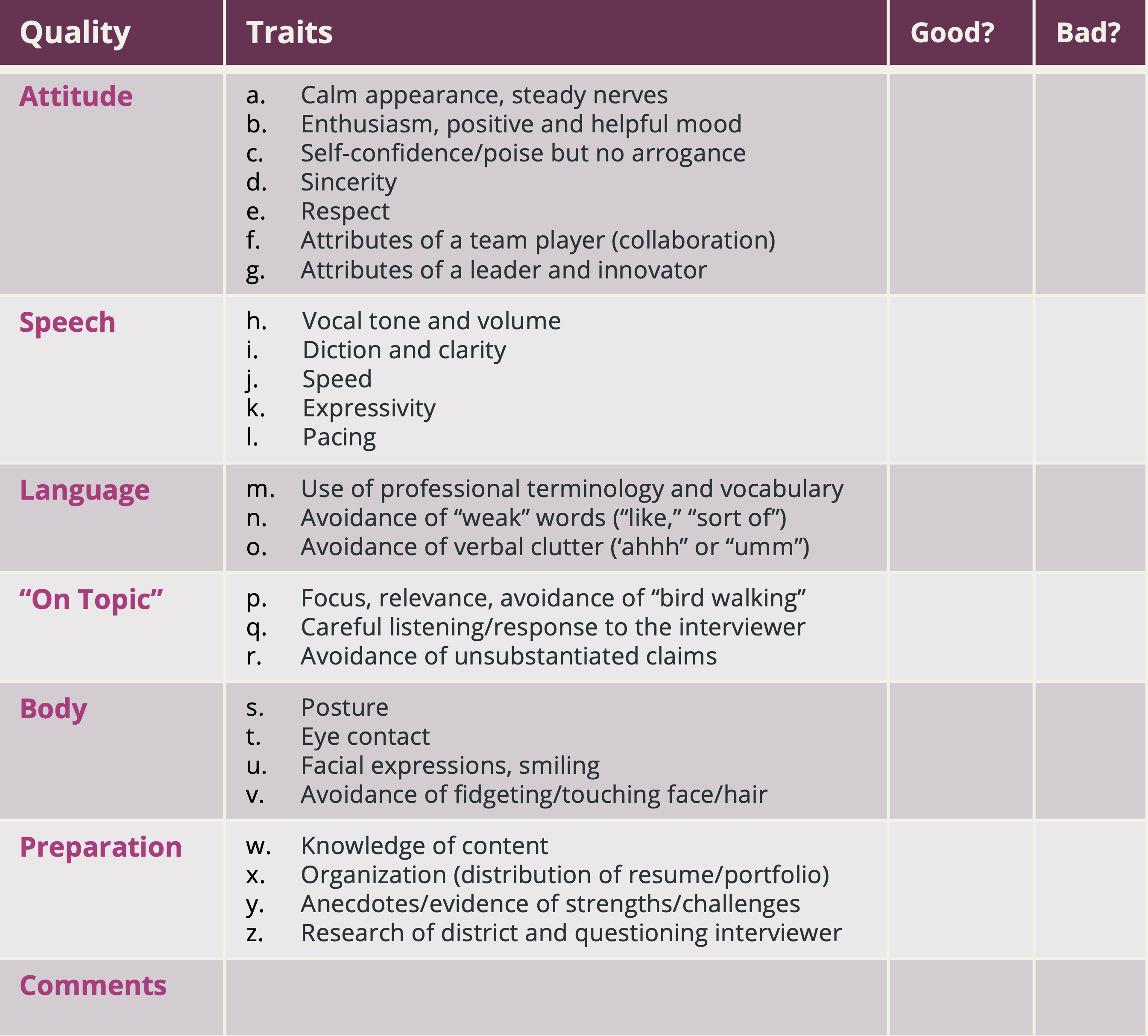
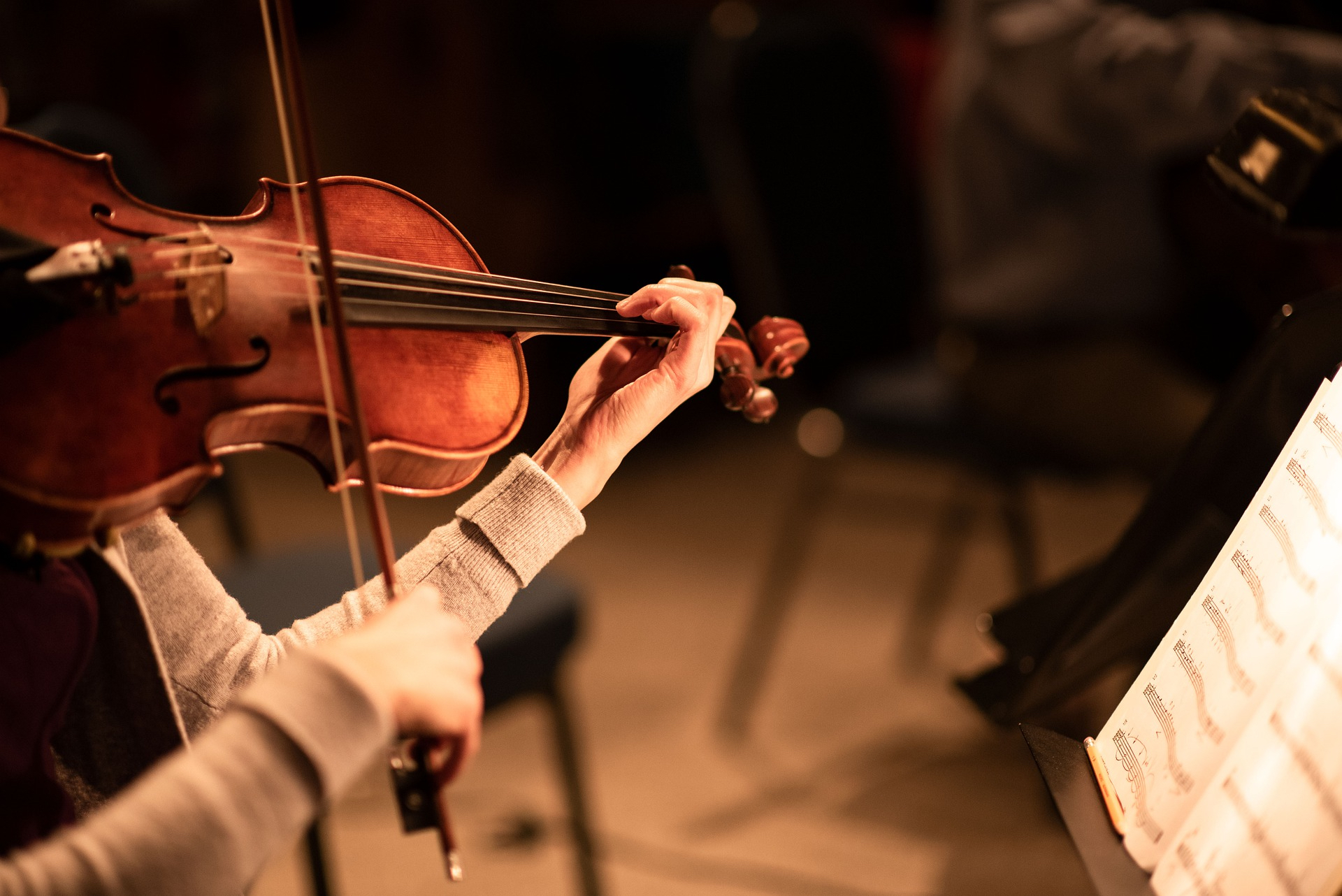
  7. Every week from now through the job search process, add new stories to your collection. Scan your (e-)portfolio for more ideas. These are the criteria used by my former school district (from where I retired) to evaluative prospective candidates. Ideally, you should have anecdotes that cover each area:

My Favorite Rubric

At some point, you are going to have to “face the music” and practice swapping these stories with family members, friends, and/or fellow job seeking students. We’re all in this together! At your next college chapter of NAfME, music education methods class, or student teachers’ wrap-up meeting, try to schedule some “down time” to appoint each other to serve as interviewers/ees. At first, it may not be easy. Using randomly selected questions from the Ultimate Interview Primer above (pull numbers out of a hat), tell a story or two to exemplify your past history, competencies, and professional traits. Your “buddy” (who will be on the hot seat next) could evaluate your performance using the following rubric. Apply the Oreo cookie format (something good first/top cookie, something needing improvement/cream in the center, and end with something positive/bottom cookie) to avoid crushing anyone’s ego. Consider recording your mock interviews for future assessment. Here is a copy of the form with sample questions.

More Odds and Ends on Storytelling

These outside sources focus on the essential skill of storytelling, the whole point of the above exercises. After reading these, you may be able to assemble more meaningful anecdotes that truly model your positive qualities and experiences by telling “short stories” – and “actions do speak louder than words!”

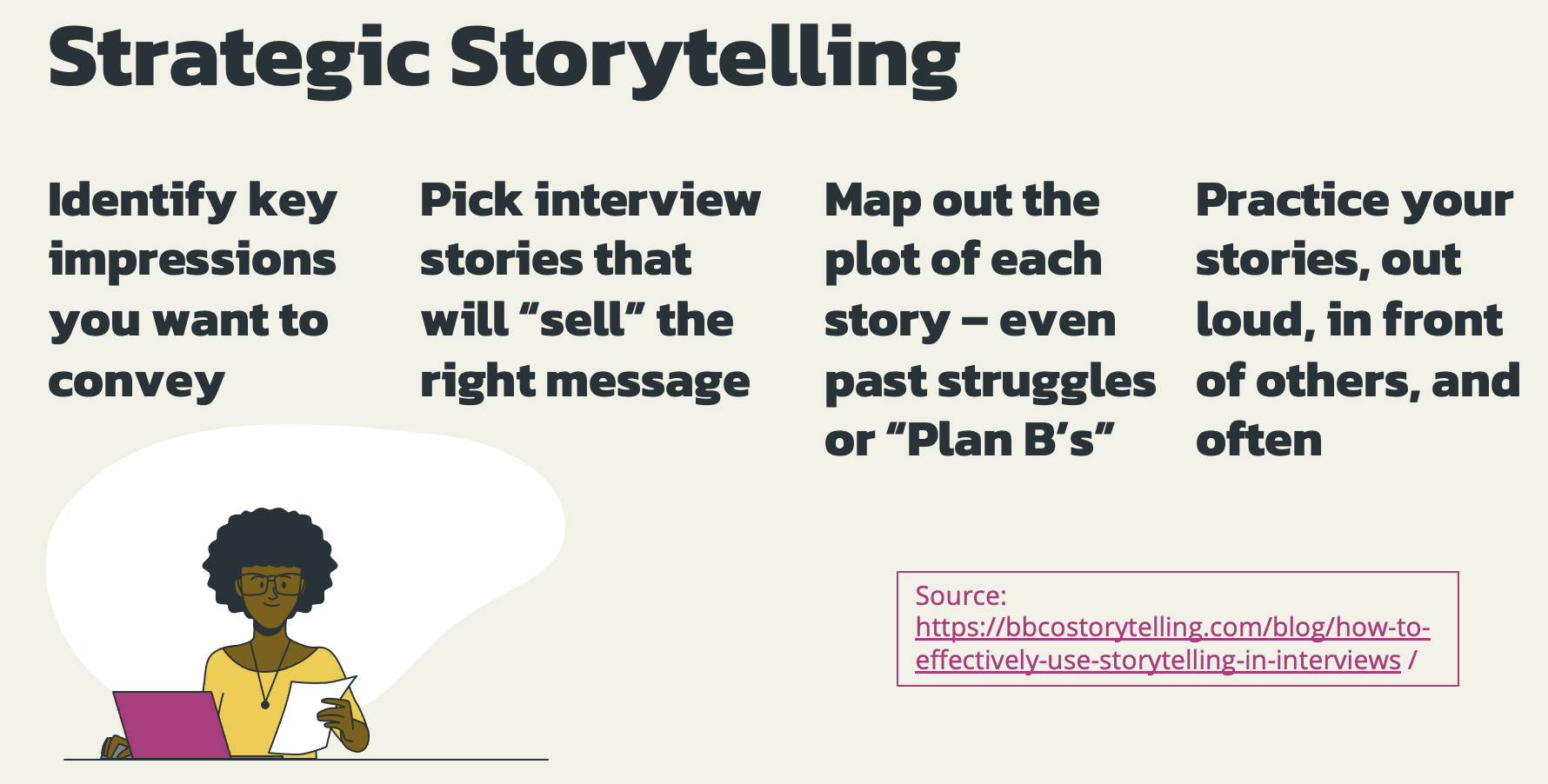
We found this excellent website “How to Effectively Use Storytelling in Interviews” by Bill Baker on “strategic storytelling” that is worth your perusal. It sums up everything above nicely.

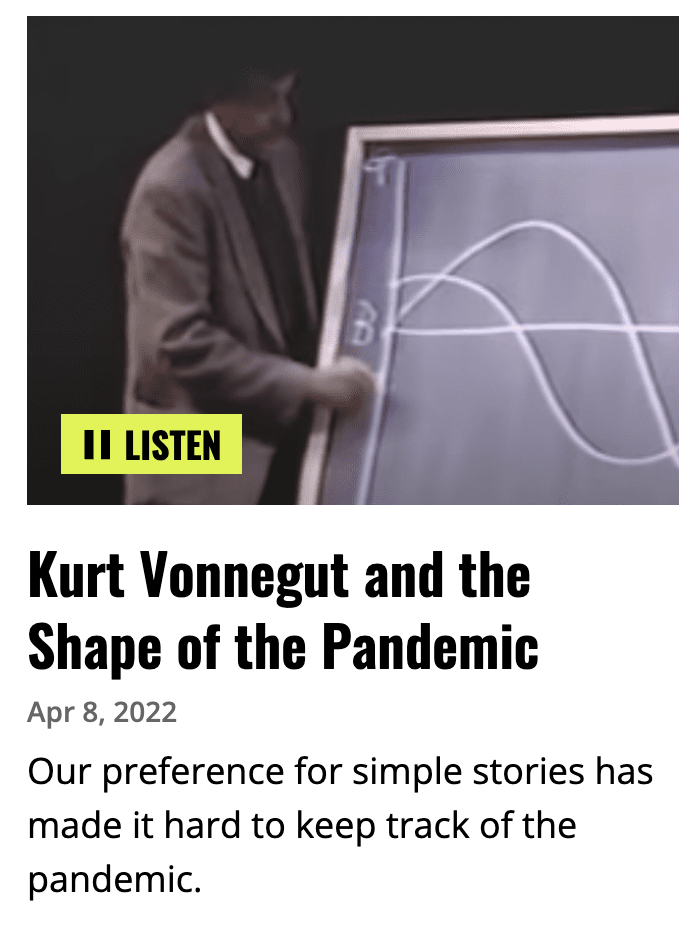
On the Media from NYC Public Radio offered an interesting radio show, coincidentally aired during my 5.5 hour drive back from the 2022 PMEA Annual Conference in Kalahari/Poconos. They dove into the geometric shapes of stories… and what they have to do with reporting on the pandemic AND perhaps (my perspective) considerations for telling better narratives (including ups and downs) at job interviews: https://www.wnycstudios.org/podcasts/otm/segments/kurt-vonnegut-and-shape-pandemic2

Even the popular website indeed advises us on interview stories: “10 Storytelling Interview Questions With Sample Answers.” This STAR approach is discussed with specific examples of questions and anecdotes:

  • Situation: Describe a situation you experienced in the workplace relevant to the question.
  • Task: Mention a task you had to complete in this situation.
  • Action: Summarize the actions you took to complete the task.
  • Result: Discuss the outcome of your actions.

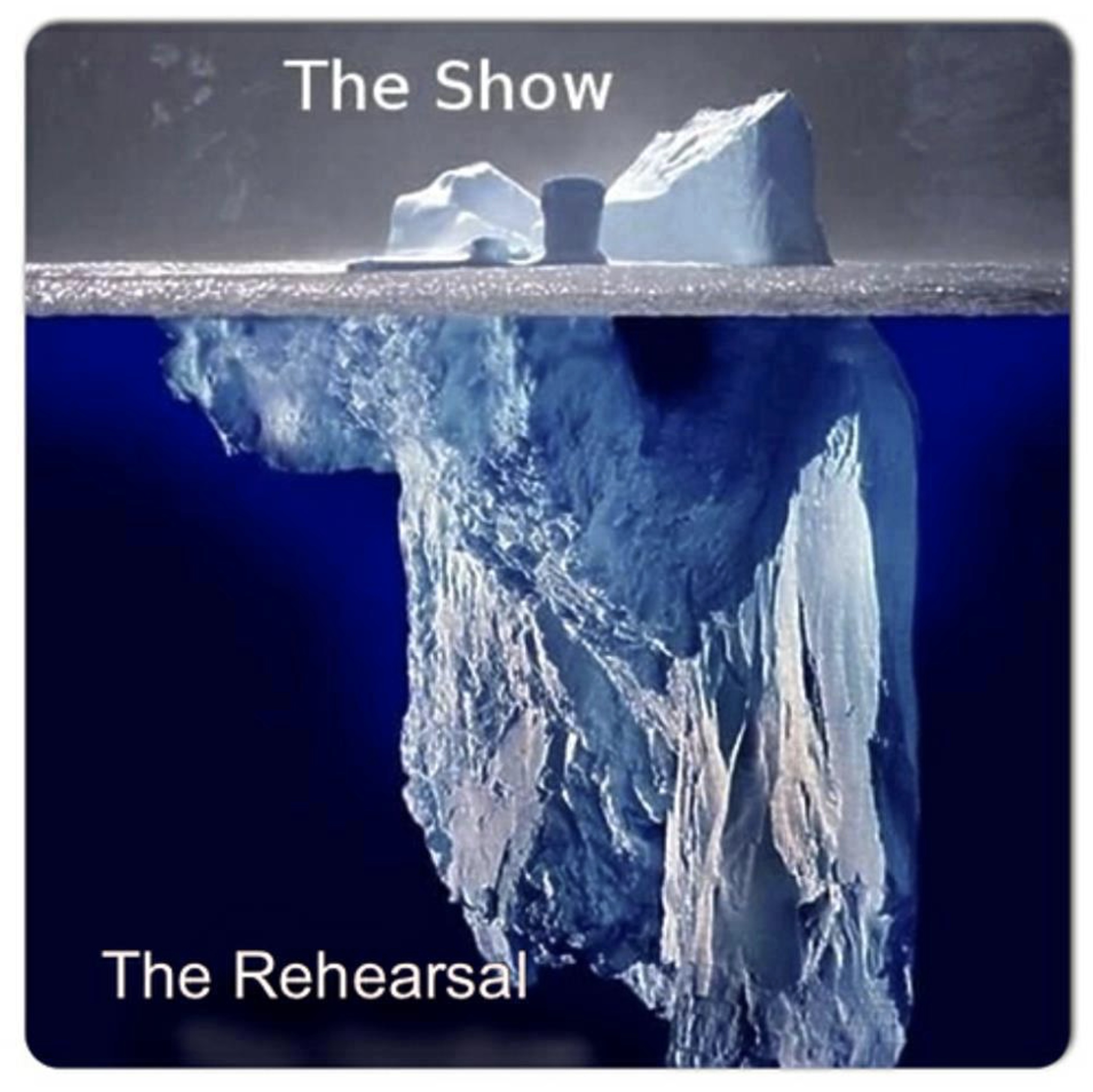
Finally, here are a handful of YouTube videos… just the tip of the iceberg. Remember that iceberg metaphor? The part that you see above the ocean is the performance, the show, the interview, the product… while the mandatory practice, rehearsals, preparations, and planning take up much more space and are almost never seen. ARE YOU READY TO TELL YOUR STORIES?

Enjoy! Now the ball is in YOUR court!

PKF

© 2022 Paul K. Fox

RECAP – Retirement Resources

A Treasure Chest of Tips for Living the Dream!

Are you retiring soon? Thinking about “taking the plunge” and “Crossing the Rubicon” into your “second beginnings” or “next chapter” of senior life?

No matter how busy you are now, you need to “take five” from your work or personal to-do’s and review the following recommendations from past blog posts at this site. Consider this a personal toolbox for the retired and soon-to-retire professional… and assigned HOMEWORK!

A good starting point would be to pick-up “The Myths of Retirement” and “Three Exit Lanes to Self-Help Retirement Guides,” or if you prefer to tackle everything at once, check out the omnibus “monster” resource guide posted here.

Now the top-ten list – a well-balanced collection of online essays. The more you read, the better you will be able to embrace a healthy transition through this major life passage!

1. Plan ahead for retirement: “It’s Not Only About the Money”

Read the entire article here.

It is agreed that a period of adjustment will occur during the first years of “interning” as a retiree, especially critical during the “pre-retirement” stage (believe-it-or-not, as many as six to ten years prior to “taking the big leap” to FREEDOM!). The solution to a smooth transition is to be prepared: communicate your intentions with your family members, and reflect on the vast considerations of the “who, what, when, where, how, and why” of retirement. This prep to your “golden years” is the perfect time for a little self-assessment and self-reinvention in finding new purpose, meaning, and fulfillment in your life.

2. Identify and take steps to alleviate the stress of leaving your job:
“The Good, The Bad, and The Ugly”

Read the entire article here.

The phases of retirement are discussed in greater depth here, as well as different departure scenarios and the usual post-employment “cycles of emotions.” This piece is particularly good if you have ever felt pushed into early retirement or experienced being unappreciated, disrespected, uninspired, unsupported, or “burned out” in your career.

3. Are you really ready? “Signs it is time to retire… OR “Signs is NOT okay.”

Read the entire article here.

This “countdown to retirement” article poses the essential question “Are you psychologically (or emotionally) prepared to retire?” and offers a “road map” of seven easy steps towards closure for prospective music teacher retirees.

For more insight, you should also peruse “When Should You Retire.”

4. Determine your retirement destination:
“Do you know where you’re going to…?”

Read the entire article here.

This early blog post proposed several factors to consider for the choice of where you want to live in retirement… both geography and floor plans. Another good source to read on this topic is the book that was published two years later by the retirement guru and former PMEA session presenter Dave Hughes: The Quest for Retirement Utopia – How to Find the Retirement Spot That’s Right for You.

5. Maintain your professional associations:
“Ask not what PMEA can do for you, but what you can do for PMEA!”

Read several articles:

A retired educator is a valuable resource. If you care about the profession, there are many ways you can continue to contribute your experience and wisdom, albeit less stressful and time-consuming moments, but still assist your colleagues who continue to “fight the good fight” in the field.

6. Acquire a more carefree attitude: “It’s Not Your Sandbox”

Read the entire article here.

It may be at times a challenge to surrender your urge to continue as “an agent of change” or, as E.A. Wynne has written in “The Moral Dimension of Teaching” (Teaching: Theory into Practice, 1995), habits of “moral professionalism.” Learn how chill out and NOT to stress out over someone else’s supposedly poorly run “sandbox” and limit the need to provide unsolicited advice or major problem-solving for other organizations. 

7. Make music: “Dust off your chops” and 8. “Sing your heart out…”

Read the both articles here and here.

What led you to select a career in (and the “calling” of) music education? Retirement is the perfect place and time to expand on your love and skills in creative self-expression. When a music educator retires, among the many joys and fruits of his/her career in the arts is a sudden life-style change – the glorious transformation of being set free from those things you no longer want nor need to do (routine day-to-day drudgery, paperwork, meetings, etc.), embarking on new journeys to explore and embrace revised personal goals – hopefully including a renewed refocus on making your own music!

9. Explore mind-stimulating engagements: “Have you fed your brain today?”

Read the entire article here.

The mind is a terrible thing to waste, even during retirement. Discover something new every day! Maximize your “brain health” with a host of these ideas to consider for your bucket list.

10. Take time to “give back” and volunteer:
“What does it mean to be eleemosynary?”

Read both of these articles here and here.

In the scheduling our free time in retirement, it is important to feel “needed” and find activities that foster “mattering” to promote a positive self-esteem, good mental health, and stable life balance. Are you making choices to contribute to the musical and personal success and welfare of others? For the realization of the mission of this blogger’s retirement pastime: “I refuse to sit idle, binge-watch movies on Netflix, or view hours of boring TV.” To quote the song’s lyrics, this “senior citizen” will never lament…

Life is so unnerving
For a servant who’s not serving
He’s not whole without a soul to wait upon
Ah, those good old days when we were useful
Suddenly those good old days are gone
Ten days we’ve been rusting
Needing so much more than dusting
Needing exercise, a chance to use our skills
Most days we just lay around the castle
Flabby, fat, and lazy
You walked in and oops-a-daisy!

– “Be Our Guest” from Beauty and the Beast

Stay Connected with PA Music Education

PMEA Annual Conference April 6-9, 2022 at the Kalahari Resort (Poconos)

PMEA retired members, please take note of these special events especially geared to YOU:

  • Free Retired Member Breakfast Meeting (including take-away gifts) on April 8 at 8 a.m.
  • Retirement 101 session on April 8 at 11:30 a.m. – Retired music teachers are encouraged to participate on the guest panel to “tell your own story” to help any interested soon-to-retire colleagues.
  • Three keynote speakers will join this year’s event: Dr. Tim Lautzenheiser, Lesley Moffat, and David Wish.
  • The U.S. Army Band “Pershing’s Own” will be featured on Thursday evening (April 7).
  • See last month’s blog for more details on the conference, tentative session schedule and exhibitors, AND the PMEA website.

PKF

© 2022 Paul K. Fox
Graphics from Pixabay.com:

New Year’s Resolutions for Retirees

Do you believe in formulating annual goals or drafting a couple “New Year’s Resolutions?”

THE STATS DON’T LIE

Every year around this time, the web highlights many so-called experts touting the benefits of making personal improvement plans… and is just as quick to admonish us for breaking them. The statistics are not encouraging:

Success/Failure rates over the first 6 months

  • Of those who make a New Year’s resolution, after 1 week, 75% are still successful in keeping it.
  • After two weeks, the number drops to 71%.
  • After 1 month, the number drops again to 64%.
  • And after 6 months, 46% of people who make a resolution are still successful in keeping it.
  • In comparison, of those people who have similar goals but do not set a resolution, only 4% are still successful after 6 months.

Overall success/failure rates

  • According to a 2016 study, of the 41% of Americans who make New Years resolutions, by the end of the year only 9% feel they are successful in keeping them.
  • An earlier study in 2007 showed that 12% of people who set resolutions are successful even though 52% of the participants were confident of success at the beginning.

Reasons for failure

  • In one 2014 study, 35% of participants who failed their New Year’s Resolutions said they had unrealistic goals.
  • 33% of participants who failed didn’t keep track of their progress.
  • 23% forgot about their resolutions.
  • About one in 10 people who failed said they made too many resolutions.

— https://discoverhappyhabits.com/new-years-resolution-statistics/

Of course, it does not have to be this way! Last year, yours truly made a promise to “practice what music teachers preach” and “make meaningful music” at least a little every day on his instrument. How did it go? Success! I made it to the middle of July without missing a day (until I sprained my left hand). But the goal led me to playing better than I have for decades, more self-confidence, a lot of fun polishing off movements from my favorite sonatas and concertos, and even the purchase of a new viola. Now? It is time for me to find a tuba, dive into my past “brass flame,” and join a community band! 

As we succeed in everything else for our lives, the process of setting aside time to analyze our personal pathways, assessing our needs, and making new goals is healthy. For the eternal pursuit of happiness and self-fulfillment in retirement, I found these secrets to a ”winning” set of New Year’s Resolutions in the “Top-10 List” by the UAB School of Medicine:

  1. Start with specific micro-goals. (Keep them small, simple, and easy to accomplish.)
  2. Set resolutions for the right reasons. (Choose what is important to you, not someone else’s expectations.)
  3. Document your progress. (Write it down.)
  4. Practice patience and forgiveness. (No one is perfect. Just keep at it despite the curve balls thrown at you.)
  5. Schedule time to achieve goals. (Dedicate the necessary resolve and resources to accomplish them.)
  6. Embrace the buddy system. (Share in collaborating on group goals. You don’t have to achieve them alone!)
  7. Consider your budget. (Finances may play a role. Stay within your means.)
  8. Slow down and meditate. (Breathe, refocus, and be mindful.)
  9. Reward yourself for achievements. (No matter how big or small, treat yourself for reaching your targets.)
  10. Ask others to keep you accountable. (Publicize your intentions. They might help you achieve your goals.)

— https://www.uabmedicine.org/-/10-secrets-of-people-who-keep-their-new-year-s-resolutions

SAMPLE RESOLUTIONS

You probably do not need someone to suggest things-to-do in 2022 or ways to self-improve. Effective goals and action plans must come from within yourself. However, there are countless advisors “out there” offering ideas to motivate you:

  • Keep a Positive Mindset
  • Commit to at least 10 Minutes of Exercise Daily
  • Make Better Dietary Choices
  • Stay Young-at-Heart – Surround Yourself with Young People
  • Stimulate Your Mind
  • Get Enough Sleep
  • Reach Out to Old Friends and Make New Ones
  • Kick Your Bad Habits
  • Maintain Your Purpose in Life as You Age
  • Give Back – Explore New Volunteer Opportunities

— Example sites: https://www.luthermanor.org/new-years-resolutions-for-seniors/ and https://www.healthinaging.org/tools-and-tips/tip-sheet-top-10-healthy-new-years-resolutions-older-adults 

Pennsylvania Music Educators Association (PMEA)

ENGAGEMENT, ADVOCACY, & ASSOCIATION IN MUSIC EDUCATION

Modeling PROFESSIONALISM, these terms promote the power of “collaboration” and connections among music education colleagues and stakeholders (music students, parents, and the general public). To foster a broader picture and devise “bigger than self” New Year’s Resolutions, we should embrace forming partnerships throughout our pre-service, in-service, and retirement years with enhanced goals of active engagement, advocacy, and support of our professional associations.

In many past blog posts here and articles in PMEA News, Retired Member Network eNEWS, and NAfME Music in a Minuet, we have addressed ways that retirees can share their awesome “musical gifts,” know-how, and perspective to promote creative self-expression. If you are looking to adopt a 2022 New Year’s Resolution to “make a difference” in the music education profession, revisit this free archive here: https://www.pmea.net/wp-content/uploads/2021/09/PMEA-Retired-Member-Network-eNEWS-s090721.pdf and also peruse this link: https://paulfox.blog/2021/11/10/giving-back-to-the-association/.

On a personal note, besides getting back to my viola practice and resuming my love of playing the tuba, I resolve to continue a focus on “giving back” whenever possible to my local community, PMEA, and the music education profession. How will I do this in 2022? By bestowing the gifts of SERVICE:

  • Chair of the PMEA Council for Teacher Training, Recruitment, and Retention
  • Coordinator of PMEA Retired Members
  • Artistic Director of the South Hills Junior Orchestra
  • Trustee and Communications Director of the Community Foundation of Upper St. Clair
  • Volunteer Escort for the St. Clair Health
  • Author, clinician, and workshop presenter on the topics of educator ethics, interviewing and job search, professional standards, retirement, and self-care

Additional blog posts on the topic of New Year’s Resolutions and helping others in retirement:

PKF

© 2021 Paul K. Fox

iStockphoto.com graphic: Merry Christmas and Happy New Year by Tasha Art

Pixabay.com graphics:

Merry Christmas and Happy New Year from the Fox Household!

Giving Back to the Association

A Pep Talk for Teachers to Become “Team Members!”

I found myself this past Monday morning with a few extra minutes checking my almost empty “to-do” list and, with the exception of planning to watch the Pittsburgh Steelers football game and the endless chore of raking leaves in my yard (I immediately rejected the latter), I discovered I had very few professional or personal priorities to focus on this week! Wow! Some additional “free time!” Shh… don’t tell anyone!

Down time? As I mentioned in a previous blog-post, since the summer, things had been a little hectic for “this retiree.” When I accepted the position of “admin” to the marching band of the school from where I retired, I discovered how fast we can fill up our schedules with meetings, rehearsals, and performances… to the point that it is hard to imagine how I could possibly have done all of this unless I retired from the regular job! My wife jokingly said, “Those were the days!” (perhaps a little unsympathetically?) as she watched me takeoff for band camp, parent salute nights, late night away football games, etc., while she remained cozy at home. “Been there. Done that! Not anymore!”

Only one professional association got me through more than five decades in music education and 35+ years of full-time directing, equipping me to handle the twists and turns of an ever-changing career (e.g., becoming a choral director even though I had never sang in a high school or college choir), and even attending music festivals as a viola and tuba student for four years in the Penn Hills school district. Who do I credit for giving me this “life force,” “teacher chops,” and music mastery? PMEA. We are so fortunate to have this priceless “collaboration of our colleagues,” numerous resources for the benefit of our own professional development, and services we provide to our music students. Cut me and I bleed PMEA blue!

How Are YOU Feeling?

This blog’s “call to action” is necessary because of the turmoil the pandemic has left the arts education community, new school health and safety mandates, re-prioritization of district resources (in some places away from the arts in spite of the need for more not less social emotional learning), reports of the drop in music participant enrollments, decrease in membership renewals, and teacher shortages.

The crush of COVID-19 and all of the program delays, suspensions, (and hopefully not) permanent losses have made this one of the most challenging times I can ever recall. The only way we can get through this is “together…” and frankly, “if you’re not part of the solution, you’re part of the problem!” This is NO TIME to let your membership and involvement lapse! PMEA and other professional music education organizations (like NAfME, ACDA, ASTA) need your “dedication to the cause,” willingness to help “the team” and one other,  and active participation.

Collegiate members, full active members, and retired members – all of us joining forces – can truly “make a difference!” No matter how busy or stressed you are and how much you feel you are “slugging it out in the trenches” alone, we all need to become partners and devote time for and dedication to the associations we are blessed to have right now that support music educators in the Commonwealth, the nation, and the profession.

The Essential Role of Associations

It does not matter which profession you have chosen! You NEED an ASSOCIATION!

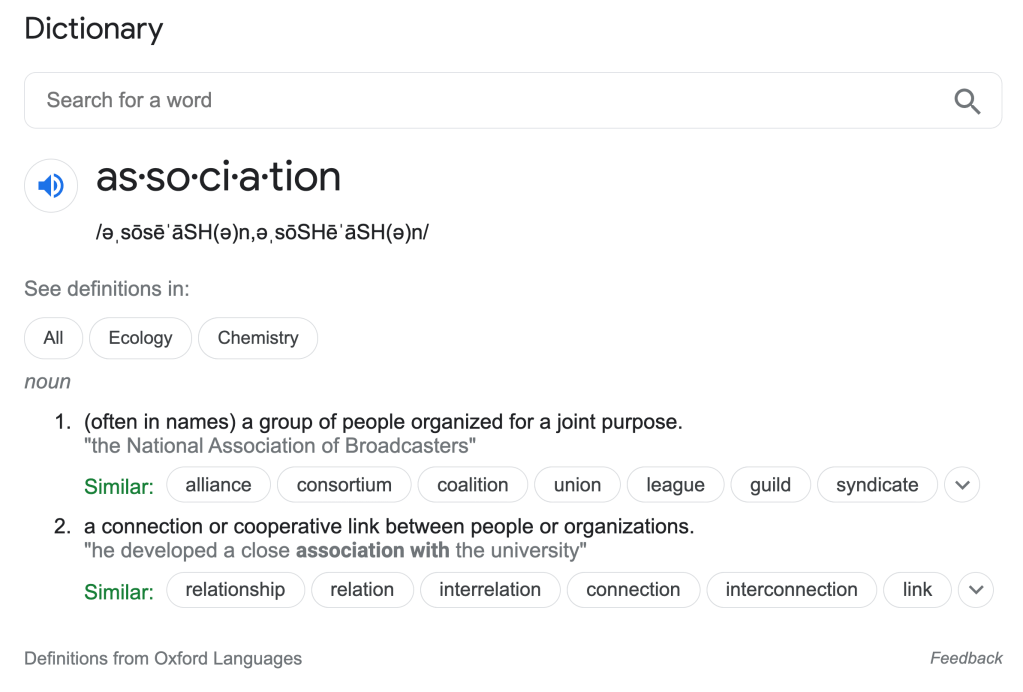
Google English Dictionary provided by Oxford Languages

The architects may have defined “this essential bond” best:

Membership in the relevant professional organization is one of the things that separates a profession from a conventional job. It is a key element that defines a professional. Membership in one’s professional organization is expected of all professionals. It is important to support the advancement of one’s profession, and becoming a member of the professional organization is a part of that advancement.

Involvement with a professional society will afford the participant an opportunity to network with other colleagues in industry and practice. Making connections with others who have similar interests reinforces why one has chosen this career. It enables new professionals to associate with senior members of the profession and learn from them. Joining a professional organization is critical in keeping abreast of the latest knowledge and practices locally, regionally, and globally. It helps the professional to stay abreast of current issues and opportunities and will also assist in personal advancement for the member who becomes involved.

Many professional organizations offer continuing education, seminars, and lectures along with other opportunities for learning. An active participant will have the opportunity to serve in professional development. Working with people outside of one’s own firm and volunteering will build leadership skills. Opportunities for working with the community for the betterment of society and the local economy will be available. There will be possibilities for making real contributions to the human condition through projects the professional organization may take on as a part of giving back to the community. There are events that will call for public speaking skills and professional visibility which will assist in moving one’s career to another level by connecting with other professions and local leaders in the area. The profession will benefit from members’ service and the members will be rewarded in return by such things as personal fulfillment, professional enrichment, and building a stronger resume as a result.

Further definition of the professional responsibilities and ethical practices will come in part from the professional organization. It is a central core for regulation, education, revitalization, networking and service. Joining a professional organization provides occasions and experiences to renew one’s enthusiasm for the practice of interior design. The interaction can be both inspirational and enlightening. Being a member of a professional organization is a symbiotic relationship between the organization and the member that will benefit them both.

Alabama Board for Registered Interior Designers

My “top-ten” benefits for membership in a professional association like PMEA are:

  1. Development and sharing of the standards and best practices of the profession
  2. Student festivals and music performance assessments
  3. Professional development and career advancement opportunities: workshops, conferences, and publications
  4. Leadership training
  5. Collaborative projects such as health and wellness seminars, ethics training, library of online resources, etc.
  6. Networking opportunities
  7. Models and resources for curriculum writing
  8. Coaching and mentoring resources
  9. Resources in job hunting and interviewing techniques
  10. Advocacy of music education and “a voice” (more political “clout”) in defining future government public policy

So, What’s in it for Me?

Review a few of the synonyms of “association” mentioned above: “alliance,” “consortium,” “coalition,” “connection,” etc. I am sure you’ve heard the saying: “TEAM stands for Together Everyone Achieves More.” Or, to quote the philosopher Aristotle: “the whole is greater than the sum of its parts.”

The easiest way for me to show the value of joining PMEA and becoming more active, engaged, and successful in your teaching assignment (no matter what the primary specialty – general music, vocal, band, strings, jazz, music theory, technology, etc) is to take a snapshot of the benefits displayed on the www.pmea.net website. Why try to reinvent the wheel? You might be surprised the extent of the HELP that is available just around the corner! Go ahead… click away! Take a peek at what you may be missing!

On a personal note, PMEA has provided me the insight, inspiration, and opportunities for substantial career growth, “places to go and people to meet” to fill-in-the-gaps of the skill training I may have felt were missing, for example methods and media for teaching a high school choral program for more than 16 years and directing/producing 37+ musicals. In addition, PMEA and NAfME have been the sole institutions that I have turned to for more than 50 years for their sponsorship of choral and orchestral music festivals and other enrichment that have provided my students new and highly motivating musical challenges and countless state-of-the-art once-in-a-lifetime experiences.

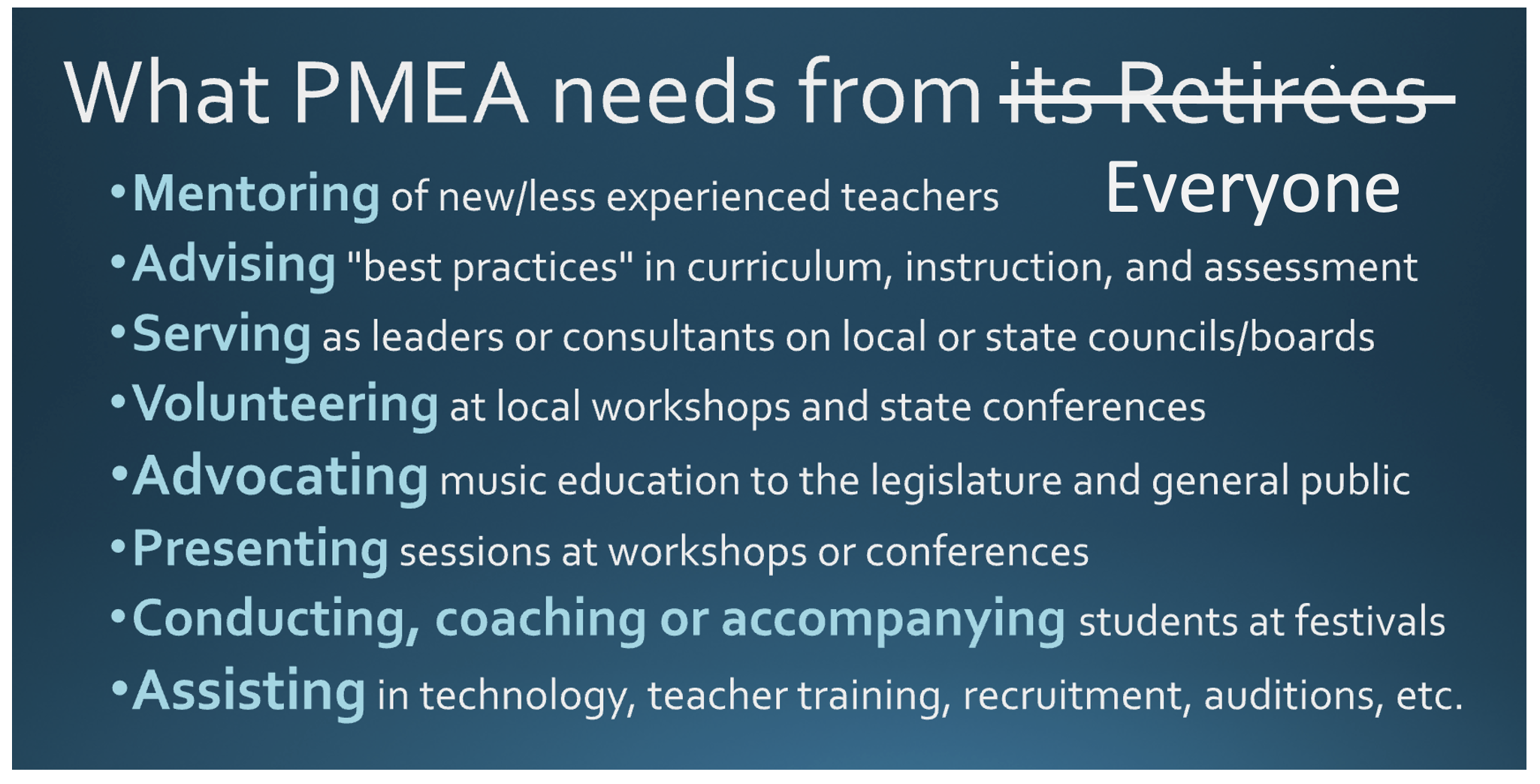
So now, reflect on the title of this blog! It is essential to give back to our association – to help it achieve its mission: “to advance comprehensive and innovative music education for all students through quality teaching, rigorous learning, and meaningful music engagement.” We’re all in this together, and together we can make it better! Slide #6 at the bottom of the retired members’ webpage proposes what PMEA needs from all members (not just retirees):

The number one thing you can do for ANY association is to pay your annual dues, attend its meetings, be active and HELP OUT! In return, PMEA can assist you in finding and sustaining your passions! What are you waiting for? If you have not renewed for the 2021-2022 year, please visit this PMEA membership webpage.

PKF

© 2021 Paul K. Fox

Pictures from Pixabay.com by artist Augusto Ordóñez

Those Were the Good Ol’ Days

The “E” in RETIREMENT is for Energy, Engagement, Excitement, and Endurance

This blog is all about how to stay young and vibrant – BECOMING A VOLUNTEER! Geared to those of us who have retired, this is very personal and unique to every individual, no matter what the age!

Do you remember the song, “Those Were the Days” performed by Mary Hopkins (1968), the Fifth Dimension (1969), and even Dolly Parton (2000)?

Those were the days my friend
We thought they’d never end
We’d sing and dance forever and a day
We’d live the life we choose
We’d fight and never lose
For we were young and sure to have our way.
La la la la
Those were the days, oh yes those were the days

In June 2021, I went back to work. Well, not exactly full-time… but it felt that way!

Remember the times as music educators we spent 15-18 hours a day or more thinking, planning, creating, teaching, problem-solving, schlepping stuff, sweating, and working out beyond the regular school day and during summer months with major music projects like the marching band, spring musical, music adjudication trip, etc.?

Asked by my friend and current Upper St. Clair School District performing arts curriculum leader/HS band director Dr. John Seybert, I signed on to the newly-expanded extracurricular activity (ECA) position as administrative assistant and announcer of the marching band for the school from which I had retired. Filling in the gaps, taking attendance, handling mounds of paperwork, interacting with a whole new generation of music students, and learning a few new software applications along the way like FamilyID, Canvas, Remind, and the district’s Blackboard website, I threw my hat in the ring, not just to continue to serve as the voice of the “Pride of Upper St. Clair” at football games halftime shows (now in my 36th year), but to manage the full schedule of rehearsals, meetings, performances, and blessedly (?) exhausting 24/7 week-long band camp. I forgot how it felt to get up at 6 a.m. and return home around 9:30 p.m.

It has been exhilarating. It has been exhausting!

On another stage, when the local COVID stats fell two months ago, I was invited back to our local community hospital to serve as a volunteer – discharging patients from their rooms or escorting them from the outpatient surgery or endoscopy units. Yes, I was called upon to somehow restore the physical demands I (used-to) place on my personal stamina. Fully fatigued and expended after a shift of 4-7 hours of driving my wheelchair taxis (sometimes carrying over-sized people even though we’re only supposed to move those weighing 250 pounds or less), I find myself yearning for a retiree “power-nap,” only to regroup for the next day’s challenging schedule and another early-morning wake-up.

The best part of these 8-15 hours per week? Choosing one of the finest medical facilities in our metropolitan area – St. Clair Hospital (now “Health”) – I have the chance to meet former music students (grown up), their kids, parents and grandparents, friends, and other acquaintances at their greatest need. And, there’s almost no finer escort “call” than going to the family birth center and bringing to the car a new mommy and two-day-old baby… sharing that special moment with an alum or school staff member!

It has been exhilarating. It has been exhausting!

WHAT

In past articles on a satisfying retirement, I often quote the book How to Retire Happy, Wild, and Free, the search for self-reinvention and new avenues for fulfilling those essential needs of “purpose, structure, and community” that employment had previously provided us. Author Ernie Zelinski’s definition of “purpose” are these goals:

  • To make a difference in people’s lives
  • To make a contribution
  • To find creative expression
  • To take part in discovery
  • To help preserve the environment
  • To accomplish or achieve a challenging task
  • To improve health and well-being

We learn from Revitalizing Retirement: Reshaping Your Identity, Relationships, and Purpose by Nancy Schlossberg that for retirees it is important to feel “needed” and that pursuits that foster “mattering” are crucial to a positive self-esteem, good mental health, and stable life balance.

It has been suggested that one problem of retirement is that one no longer matters; others no longer depend on us…

The reward of retirement, involving a surcease from labor, can be the punishment of not mattering. Existence loses its point and savor when one no longer makes a difference.”   

– Rosenberg and McCullough

The opposite of “mattering” is feeling “marginalized.” I would rather feel worn-out than useless/ignored/discarded!

In his book Design Your Dream Retirement, Dave Hughes recaps with his four essential ingredients of life balance:

  1. Physical activity
  2. Mental stimulation
  3. Social interaction
  4. Personal fulfillment

If you read my bio in the “about” tab above, I think all would agree: mission accomplished! I’ve made myself extremely busy. (Perhaps I “matter” a little too much?) “It’s a good thing I am retired… I would not have enough time to do all of these things if I still had a job!”

Yes, it FEELS good!

WHY

Now some rationale from the online pundits. First, review the article “Why Elderly People Should Volunteer.” According to the “experts,” volunteering is:

  • Socially beneficial
  • Good for mental cognition
  • Giving back to the community
  • Physically engaging
  • An opportunity to learn something new
  • Flexible
  • A strategy to fill up your day
  • The reason you get out of bed in the morning

Of course, one has to be careful and follow your doctor’s advice on what tasks will not overwhelm you! The CDC and other medical professionals urge adopting a “safe” routine of regular physical activity as a part of an older adult’s life. Check out websites like https://www.cdc.gov/physicalactivity/basics/activities-olderadults.htm and https://www.cdc.gov/mmwr/preview/mmwrhtml/00001482.htm. Besides keeping your mind active, increasing your physical activity as a volunteer while “living the dream” in retirement will:

  • Reduce the risk of serious illnesses (heart disease, type II diabetes, and depression
  • Help you manage a “healthy weight”
  • Improve your balance and coordination
  • Decrease the risk of falls or other injuries

Talk with your doctor to find out if your health condition limits, in any way, your ability to be active. Then, work with your doctor to come up with a physical activity plan that matches your abilities. If your condition stops you from meeting the minimum recommended activity levels, try to do as much as you can. What’s important is that you avoid being inactive.

– Centers for Disease Control and Prevention

Volunteering is all about being more eleemosynary (adjective defined as “generous, charitable, gratuitous, or philanthropic”). In my workshops on retirement transitioning, I frequently quote two gurus on the benefits of “giving back.”

With a frequently untapped wealth of competencies and experiences, older people have much to give. This fact, coupled with fewer requirements for their time, gives them unique opportunity to assume special kinds of helping roles.

– Mary Baird Carlsen – Meaning-Making: Therapeutic Processes in Adult Development

Our increased longevity and generally better health has opened our eyes to new and increased opportunities to contribute to the betterment of society through civic, social, and economic engagement in activities we believe in.

– Jo Ann Jenkins, CEO of AARP – Disrupt Aging

HOW

But you already knew all of this, right? There are so many ways to “bring it on” and “make a difference” in your “golden years.” (Wow – three cliches in a row!)

There are so many directions you can go to offer your free time to volunteer:

  • Escort at local hospital or nursing home
  • Walk dogs at animal shelter
  • Serve in charitable fund-raising projects
  • Assist food banks and meals-on-wheels agencies
  • Enlist as special advocate for abused or neglected children
  • Work as hospice volunteer
  • Maintain parks, trails, nature habitats, or recreation centers
  • Host an international student
  • Become a youth director, mentor, or scout leader
  • Teach summer school, night classes or Performing Arts workshops
  • Give guided tours or lectures as a docent at a local museum
  • Apply office management and clerical skills to benefit libraries and other nonprofit associations
  • Run a school club (share your hobby)

As trained music educators, we can share our precious skills in creative self-expression :

  • Accompany, coach, or guest conduct school/community groups, college ensembles, or music festivals.
  • Run for office or chair a committee or council of your state or local MEA association
  • Serve as presiding chair or member of the your state’s MEA planning committee or listening committees for the music in-service conferences
  • Participate as guest lecturer or panel discussion member at a conference, workshop, or college methods program
  • Judge adjudication festivals
  • Help plan or manage a local festival or workshop
  • Assist the local music teacher in private teaching, piano playing, marching band charting, sectional coaching, set-up of music technology, instrument repair, etc.
  • Write for your professional organizations’ publications (like PMEA or NAfME)

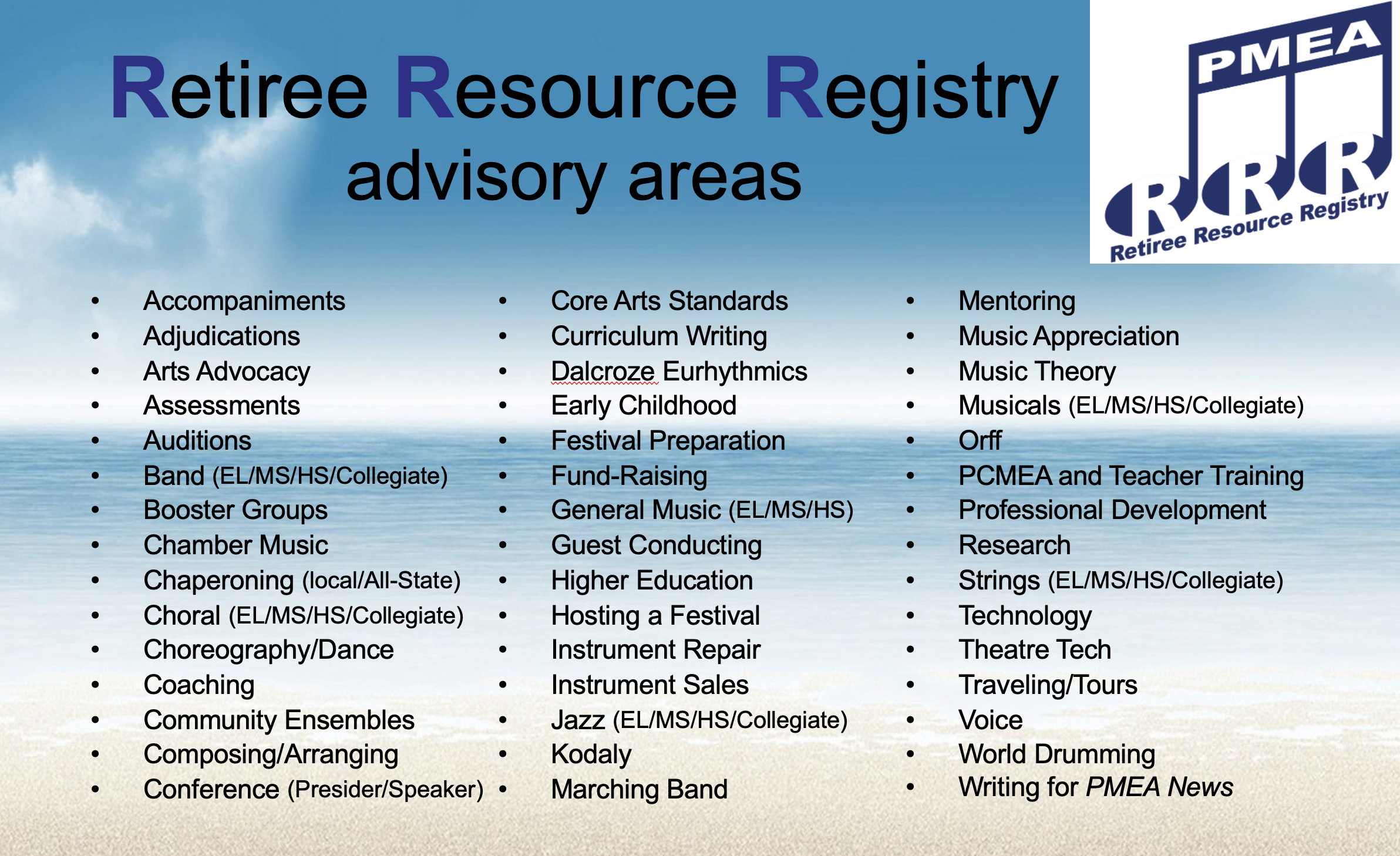
If you are a retired music teacher and member of PMEA, you could sign-up for the Retiree Resource Registry and serve as an informal consultant to others still “slugging it out” in the trenches. Go to the PMEA retired member focus area for more information.

More sources to peruse on this subject:

Anyway, back to a little “bragging!” At least “yours truly” is holding his own and hopefully contributing what he can to the success and welfare of others! Are you? In my retirement pastime, I refuse to sit idle, binge-watch movies on Netflix, or view hours of boring TV. To quote another song’s lyrics, this “senior citizen” will never lament…

Life is so unnerving
For a servant who’s not serving
He’s not whole without a soul to wait upon
Ah, those good old days when we were useful
Suddenly those good old days are gone
Ten days we’ve been rusting
Needing so much more than dusting
Needing exercise, a chance to use our skills
Most days we just lay around the castle
Flabby, fat, and lazy
You walked in and oops-a-daisy!

– “Be Our Guest” from Beauty and the Beast

So, what’s your story?

PKF

iStock by Getty images:

Images from Pixabay:

© 2021 Paul K. Fox

Summer Reading

Teachers, you’re in the home stretch now! You are within weeks of a long vacation break and the chance to rest, refresh, recharge, rewind, and rejuvenate. After what COVID-19 dished out to us, you deserve some time off! Here comes much-anticipated trips, family visits, sleeping in, and going dormant for at least 2-3 weeks!

However, most music educators never totally shut down. We seek out new enrichment opportunities by attending conferences or music reading workshops, researching new methods, and “retooling” for our lessons ahead.

Modeling the annual Peanuts comic strip’s January theme of Lucy Van Pelt assigning Charlie Brown a long and unwanted list of New Year’s Resolutions, yours truly (a retired teacher with a lot less stress) is about to do the same and recommend YOU kick off your shoes, climb into a comfortable lounge chair, tune out all extraneous noise and media distractions, and crack open some “serious summer reading…”

Here are my three favorite books for the season to take with you when you go to the beach or sit by the pool!

In keeping with an alliteration of all those “r’s” to promote healing and health during this “recess,” take time to prepare for 2021-2022 and reflect on and restock your reservoir of resilience, robustness, and resourcefulness!

Teachers Pay Teachers SEL blog

S is for “SEL”

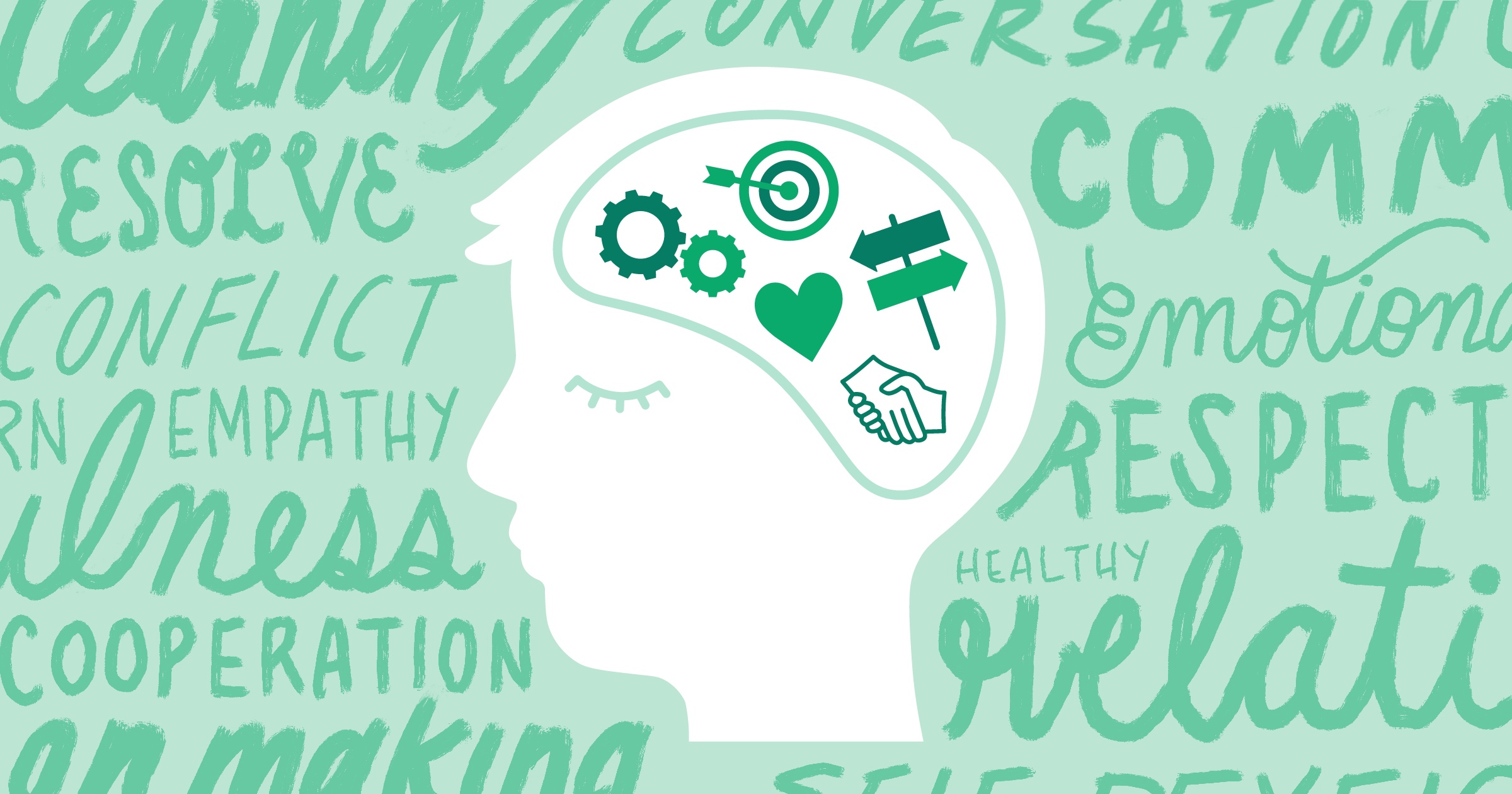
Yes, the values and life skills of emotional/mental/social “balance” begin at home. But the expectation is that schools and teachers are always relied upon to be the “safety net” – pick up the pieces or fulfill the needs not provided at home. And it should not have taken a pandemic for us to discover how important social emotional learning (SEL) is to the health, wellness, and success of every child (and their family members) we serve in our classrooms, ensembles, lessons, and after-school programs.

“Music educators are in a prime position to help students become socially and emotionally competent while at the same time develop excellent musicianship. For every child to be successful in the music classroom, teachers need to be aware of the whole student. How do music educators create success when students every day struggle with social awareness, bullying, communication, problem solving, and other challenges? This pioneering book by Scott Edgar addresses how music educators can utilize Social Emotional Learning (SEL) to maximize learning in the choral, instrumental, and general music classroom at all levels, and at the same time support a student’s social and emotional growth.”

— back cover of Music Education and Social Emotional Learning – The Heart of Teaching Music

“Finally! Thank you, Scott Edgar, for your willingness to walk boldly into this often trodden, but rarely addressed aspect of music education you have rightfully labeled social emotional learning. For every music educator, from preschool through a PhD program, we know the opportunity to “develop the whole person” is right in front of us each and every day. Where else in the academic community is there such a perfect forum that cultivates both the cognitive and effective growth of those involved? Ultimately, the rehearsal room/music classroom becomes a society within society, and the skills needed to grow and succeed at the highest levels are simultaneously offered in content and context. And yet, there are very few resources to guide the mentor in a positive, productive fashion. Now there is and this book is a powerful blueprint leading us to a worthy outcome and more.”

— Foreword by Tim Lautzenheiser for Music Education and Social Emotional Learning – The Heart of Teaching Music

Probably the most authoritative textbook on SEL for music teachers, it may be hard to believe that Scott Edgar wrote it in 2017, long before the crush of COVID-19. SEL is now coming to forefront due to the “pandemic-related” problems of students feeling disconnected, stressed, over- or underwhelmed, and unmotivated during their physical isolation from in-person schooling and remote learning (See Edutopia at https://www.edutopia.org/article/3-ways-support-students-emotional-well-being-during-pandemic and Education Week https://www.edweek.org/leadership/the-pandemic-will-affect-students-mental-health-for-years-to-come-how-schools-can-help/2021/03).

SEL sources

You have a wide variety of choices to explore this topic, and all of these are from Scott Edgar!

The NAfME Professional Learning Community: Music Education and SEL – An Advocacy Tool for Music Educators accessible as a video: https://vimeo.com/426070325

Music for All webinar series:

  • Episode 1 – Teaching Music Through Social Emotional Learning – Composing with Heart hosted by Scott N. Edgar with guest presenters Brian Balmages, Brandon Boyd, Richard Saucedo, Alex Shapiro (composers) and Bob Morrison https://youtu.be/6HIbK23TmaE
  • Episode 10 – Teaching Music Through Social Emotional Learning – Narwhals and Waterfalls hosted by Scott N. Edgar with guest presenters Paige Bell and Adrien Palmer: https://youtu.be/BlbxX1DP-5c

The NAfME Music in a Minuet blog: https://nafme.org/music-education-social-emotional-learning/

Music Education and Social Emotional Learning – The Heart of Teaching Music in book form is available from Amazon and https://giamusic.com/store/resource/music-education-and-social-emotional-learning-book-g9418?artist=tpVEu30fe0uy.

Check out his all-encompassing Table of Contents:

Section One – Teaching Music Beyond the Notes

  • Chapter 1: What is Social Emotional Learning
  • Chapter 2: Socialization in the Music Classroom by Jacqueline Kelly-McHale
  • Chapter 3: Bullying in the Music Classroom by Jared Rawlings
  • Chapter 4: Music Educators Are Not Counselors

Section Two – Social Emotional Learning (SEL) and Music Education

  • Chapter 5: Self-Awareness and Self-Management in Music Education – Self-Discipline and the Music WIthin
  • Chapter 6: Social-Awareness and Relationship Skills in Music Education – Sharing and Communicating Through Music
  • Chapter 7: Responsible Decision-Making in Music Education – Problem Solving Through Music

Conclusion: The Heart of Music Education – Our Common Bond

SEL – the new “buzz word?” What is Social and Emotional Learning?

“Social and emotional learning (SEL) is the process through which children and adults acquire and effectively apply the knowledge, attitudes, and skills necessary to understand and manage emotions, set and achieve positive goals, feel and show empathy for others, establish and maintain positive relationships, and make responsible decisions.” — Collaborative for Academic, Social, & Emotional Learning

Social emotional learning describes the development of skills in three domains: self, others, and responsible decision making.

“Self” includes:

  • Self-awareness skills such as ability to identify and recognize emotions
  • Self management skills such as perseverance in the ability to manage impulse control

“Others” includes:

  • Relationship skills such as cooperation, empathy, and respectful communication
  • Social awareness skills such as the ability to recognize diverse thoughts and opinions.

“Responsible decision-making” includes:

  • Behavioral skills such as situation analysis, anticipating consequences and generating alternative solutions.
  • Cooperative skills such as balancing personal in group expectations.

The three key pillars of SEL:

  1. identity
  2. belonging
  3. agency

Probably the best conclusion I have ever read about the value of SEL in the arts comes from Scott Edgar in the last section of his book:

“The music classroom is a melting pot of students from different backgrounds, musics of different cultures, varied personalities, and diverse values. All of this diversity is united under the common bond of music… Music classrooms, possibly more profoundly than any other academic setting, can help students and teachers cooperate to recognize diversity, engage in respectful dialogue to resolve conflict, and empathetically respect human dignity, because this is how music has functioned for centuries. Music classrooms are social because making music is, has, and always will be a social activity. In a time when there are so many divisive forces, music and music education can be a powerful uniting weapon. The tenets of SEL interwoven into a musical education strengthens both entities. Emphasizing self- and social-awareness makes music education richer and more personal. Music education brings humanity and culture into a world of personal and interpersonal interactions.”

Sunshine Parenting video by Audrey Monke featuring Dr. Michele Borba

Seven Teachable Skills to Cultivate & Nurture THRIVERS

The latest book by Michele Borba, Ed.D., Thrivers – The Surprising Reasons Why Some Kids Struggle and Others Shine, is a definite must-read from cover-to-cover.

“Michele Borba has been a teacher, educational consultant, and parent for 40 years – and she’s never been more worried about kids than she is right now. The high-achieving students she talks with every day are more accomplished, better educated, and more privileged than ever before. But the old markers of success (grades, test scores) aren’t what these kids need to thrive in these uncertain times – and they know it. They’re more stressed, unhappier, and struggling with anxiety, depression, and burnout at younger and younger ages – “We’re like pretty packages with nothing inside,” said one teen. Thrivers are different: they flourish in our fast-paced, digital-driven, ever-changing world. Why? Dr. Borba combed scientific studies on resilience, spoke to dozens of researchers/experts in the field, and interviewed more than 100 young people from all walks of life, and she found something surprising: the difference between those who struggle and those who succeed comes down not to grades or test scores, but the seven character traits that set Thrivers apart (and set them up for happiness and greater accomplishment later in life).”


— from the front flap of Thrivers

The first thing you need to do (after you order and read both her original best-seller UnSelfie – Why Empathetic Kids Succeed in Our All-About-Me World and this sequel) is to download her give-away “Core Assets Survey” from https://www.micheleborba.com/wp-content/uploads/2021/03/Thrivers_CoreAssets.pdf. Here is a sample page of her assessment checklist for her seven character strengths.

How to use Borba’s book

Although it is generally marketed as a guide for parents (and grandparents), this is a perfect “program and process” for everyone who serves as youth caregivers and educational professionals. Borba prescribes these steps to use the book with the above evaluation tool:

  1. Assess your child’s character strengths: self-confidence, empathy, integrity, self-control, curiosity, perseverance, and optimism.
  2. Tally up the points, prioritize his needs, and address initially the one or two traits receiving the lowest score.
  3. Read each chapter of “evidence-backed strategies and skills” which can be easily transferred and taught to your child from preschool through high school.
  4. Motivate and help your child to adopt each character strength “as a lifelong habit to optimize his potential in thrive.”
  5. Choose one ability a month, focus on it, and “practice it with your child a few minutes a day until he can use it without reminders.”

For teachers, this is a wonderful “soft curriculum” for nurturing these seven essential personal traits, each broken down into “character strength description,” “abilities to teach,” and “outcomes.” It will become apparent to you that these are directly related to SEL.

Besides the character strengths (#1 above), the reader is introduced to several revised definitions and new acronyms that may help to reshape our perspectives for teaching kids (these are a few samples): C.A.L.M. (chill-assert-look strong-mean it – p. 239), C.A.R.E. (console, assist, reassure, empathize – p. 90), comebacks (p. 240), creativity (p. 178), C.U.R.I.O.U.S (child-driven-unmanaged-risky-intrinsic-open-ended-unusual-solitude, p. 175), digital limits (p. 78), emotions (p. 76), goals (p. 209), gratitude (p. 86), growth mindset (p. 205), micromanaging (p. 171), mindfulness (p. 133), moral identity (p. 148), multitask (p. 110), “the four P’s of peers, passion, projects, and play” (p. 163), parenting styles (dysfunctional) – “enabler,” “impatient,” “coddler,” “competitor,” “rescuer” (p. 127), triggers (p. 121), self-esteem (p. 33), T.A.L.E.N.T. (tenacity-attention-learning-eagerness-need-tone – p. 39), and well-rounded (p. 36).

Activities throughout the book are categorized for age-suitability: Y = young children, toddlers, and preschoolers; s = school-age; t = tweens and older; a = all ages.

In the final pages of the book, Borba poses some excellent group discussion questions to facilitate a thorough review of her work. A few of these especially resonated with me:

  • Do you think raising children who can thrive today is easier, no different, or more difficult than when your parents raised you? Why?
  • What influences children’s character and thriving development most: peers, media, education, parents, pop culture, or something else?
  • Which of the seven character strengths are more difficult to teach to children today? Why?
  • What kind of person do you want your child (or your student) to become? How will you help your child become that person?
  • What are some of the sayings, proverbs, or experiences you recall from your childhood that helped you define your values?
  • [As a teacher] what would you like your greatest legacy to be for your [students]? What will you do to ensure that your [children] attain that legacy?

Her specific anecdotes, object lessons, and research for each character strength are priceless!

Lesley Moffat at Carnegie Hall

LOVE the Job, LOSE the Stress

In my “New Year’s blog” posted on December 29, 2020, I shared my advice on “how to make a difference in 2021” and told readers to find their own good role models and “positive gurus” to sustain their vision, motivation, and drive throughout the year.

Someone who has recently become inspirational to me is the wonderfully uplifting Lesley Moffat, probably an expert on the search for “mindfulness” in personal life and even during her band warm ups. In my opinion, her transformative stories provide the roadmap for happiness and wellbeing! She now has published two books (you need to read both) – I Love My Job But It’s Killing Me, and Love the Job, Lose the Stress, and if you are still teaching music full-time, you need to peruse her website: https://mpowerededucator.com/.

Now her latest book ties in all of the above enrichment and enlightenment – “successful social and emotional learning in the modern music classroom” – and adds an essential focus on teacher self-care and wellness. What was that saying attributed to Molesey Crawford in Unlocking the Queen Code?

  • Know thyself.
  • Love thyself.
  • Heal thyself.
  • Be thyself.

Lesley Moffat has taught high school band for over 32 years in the Pacific Northwest, with her ensembles earning superior ratings and performing all over the US, Canada, and even in Carnegie Hall. She was planning to retire at the end of 2019-2020 when the pandemic hit. (As far as I know at this time, she has not retired yet – “for the sake of her kids” she stayed throughout this challenging time of COVID-19 and the slow reopening of schools!) She clarifies this in the introduction to her Love the Job, Lose the Stress book:

“I completed the first draft of this manuscript on March 3, 2020. Ten days later, schools across the world began shutting down as the coronavirus began sweeping the globe… The ultimate purpose of this book is to share the protocol I created that has become the basis of the social and emotional learning needs for my students (and truth be told, for me). Everything I talk about in this book was true before the pandemic, and it has proven to be as powerful in a virtual environment as it is in person… The great news is that you can give your students the gift of learning to self-regulate, calm down, and focus without distraction through intentional design and practice.”

She offers an intriguing set of easy-to-read chapters in her “hard to put down” 191-page work.

  1. My Life’s Work Is So Much More Than Just A Job
  2. I Love My Job But It’s Killing Me
  3. The Badass Band Director’s Bible
  4. Step One: The Moffat Music Teacher Mojo Meter
  5. Step Two: Identifying the Three C’s – Care, Clarity, and Consistency
  6. Step Three: Identifying Your Priorities
  7. Step Four: SNaP Strategies for Music Teachers
  8. Step Five: Tuning Our Bodies
  9. Step Six: Creating Your Own First Four Minute Protocols
  10. Coda
  11. Fine

Highlights of suggestions from Love the Job, Lose the Stress

Like her last book, the Moffat Music Teacher Mojo Meter returns. If you are ever privileged to have her as a clinician for a local workshop, it is likely she may send out this survey to the participants in advance. These fifteen questions will provide her an individualized needs assessment of the stressors attendees are experiencing so she can differentiate the planning of her “help session” (page 48).

You’ll have a lot more questions to answer in Chapter 5 (page 50). Read and identify (and define for yourself) her three C’s for success: care, clarity, consistency.

In Chapter 6 (page 67), she wants you to identify your priorities. This is your chance to dream big! You’ll have to read her story (with wide swings of emotion) about her Jackson HS Honors Wind Ensemble performing at Carnegie Hall.

Also returning from her previous book, Chapter 7 (page 81) shares her Start Now and Progress – or SNaP to it – strategies for music teachers. Revisit her amazing tale about doing (of all things) push-ups: “By taking small incremental steps that build upon what I did each day before, I was able to take a skill that was very difficult for me on April 1 and do it 60 times just 30 days later.” She sums up three SNaP Strategies “for busy band directors” (page 90).

  1. Gratitude for the attitude
  2. Time stealers
  3. Reset yourself

Don’t miss her Chapter 10 (page 156) and “Lesley’s Top Ten Badass Band Director Tips!”

Finally, probably worth 1000-times the price of the book and all the time you will put into it is her Chapter 8 “Tuning Our Bodies” (page 103) and Chapter 9 “Creating Your Own First Four Minute Protocol” (page 129). This is where you will take what you read, reflect on her philosophies and system of classroom management and warm-ups, and adapt it to your situation. Adding to your teacher’s toolbox the techniques of mindfulness, breathing exercises, and listening skills – and practicing them with your students daily – will make all the difference in the SEL of your own lessons and overall program.

BRAVO and thank you Lesley for being so intuitive, upfront, and personal… and being so generous in sharing your secrets!

We applaud your efforts, and agree with Dr. Tim Lautzenheiser who said in the Foreword to Love the Job, Lose the Stress:

“This latest-greatest contribution offers a tried-and-true blueprint for vocational success while embracing the critical importance of fueling one’s mental, emotional and physical health. Spot on! Bull’s eye!”

“This is not a book you read and then put on the shelf; rather it is a file cabinet of priceless data certain to boister the health, happiness, and good fortune of every (music) teacher.”

“As music teachers, we teach students how to develop all kinds of skills, from mental to physical, in order for them to be well-rounded musicians. We show them how to properly form and embouchure, the correct fingerings to use, how to read music, what proper posture looks like, how to be artistic and expressive, and so much more. And we always tell them to “pay attention and “focus.” But do we ever teach them how to pay attention and focus? The secret to getting students engaged, focused, and curious so you can teach them all the cool stuff about music is teaching them how to actually build those skills until they become habits. Once you’ve taught them how to learn, then everything else becomes a million times easier for you and for them.”

— from the back cover of the Love the Job, Lose the Stress

Now you have it… a collection of at least three potential life-changing inspirations for summer study.

In addition to these “finds,” I need to mention a couple other educational publications for your consideration (see picture below). But, first-things-first as Stephen Covey would say! Check out Music Education and Social Emotional Learning – The Heart of Teaching Music by Scott Edgar, Thrivers – The Surprising Reasons Why Some Kids Struggle and Others Shine by Michele Borba, and Love the Job, Lose the Stress by Lesley Moffat. PKF

Future Book Reviews

© 2021 Paul K. Fox
Image by csharker from Pixabay

Giving Thanks

Take a moment.

Close your eyes.

Take a deep breath.

Reflect on the people for whom you are thankful to know.

Think about the things for which you are thankful to have.

Stop all the backstabbing, badmouthing, belly-aching, and bickering!

The glass is half-full… the sun will come up tomorrow… the future is great!

No complaining… or blaming!

Make Thanksgiving a “no-rant” day!

Just today, forget about your fears, troubles, or problems.

Focus on the positive: Why are YOU so blessed?

We gather on this day to be thankful for what we have, the family we love, the friends we cherish, and the blessings that will come.

Soon we will all depart from the challenging year of 2020! Hurray!

Have trust…

Faith…

Hope!

From my family to yours – best wishes for the attainment of all of the essential “R’s” during the coming winter break – a refreshing, restful, reawakening, reviewing, recreating, reviving, rejuvenating, replenishing, and re-invigorating New Year!

PKF

© 2020 Paul K. Fox
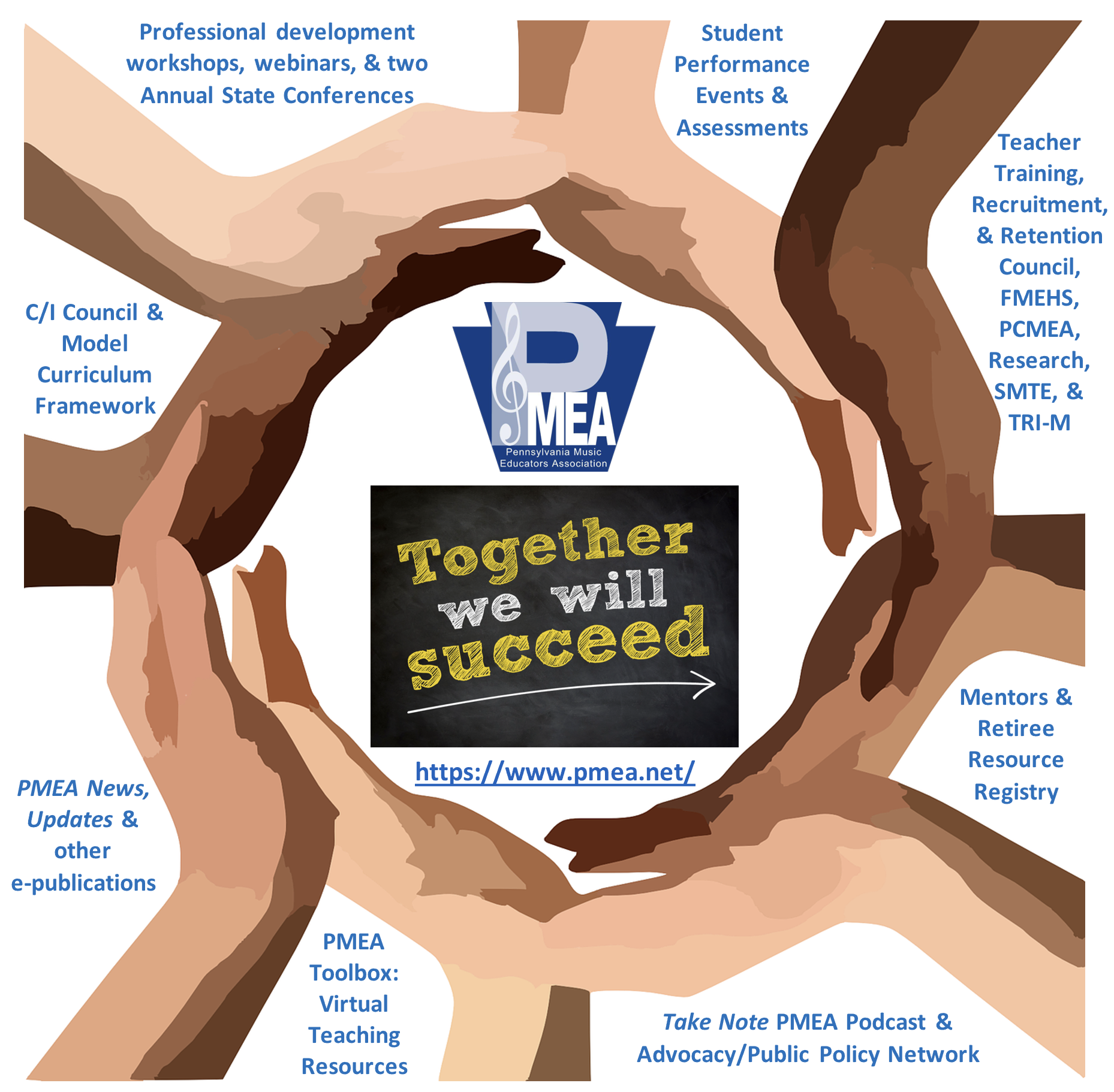
Past special-occasion blogposts

Tips for Retirees on Managing Stress During the Coming Winter Celebrations

Random Acts and Other Resolutions

Happy Thanksgiving, Newbies!

Resolutions for Retirees

Embracing the Intangibles and my LinkedIn post

We are grateful to John Hain for his Pixabay.com graphics