Leaders Flush!

Leadership lessons for the classroom or staff development

This blog is a follow-up resource for my Empowering Educator and Student Leadership presentation at the PA Department of Education SAS INSTITUTE state conference on December 9, 2025 and provides a “fill-in-the-gap” narrative about many of the concepts we have already presented at this blog site:

If you would like to review my PDF slide summary from the SAS INSTITUTE, click here.

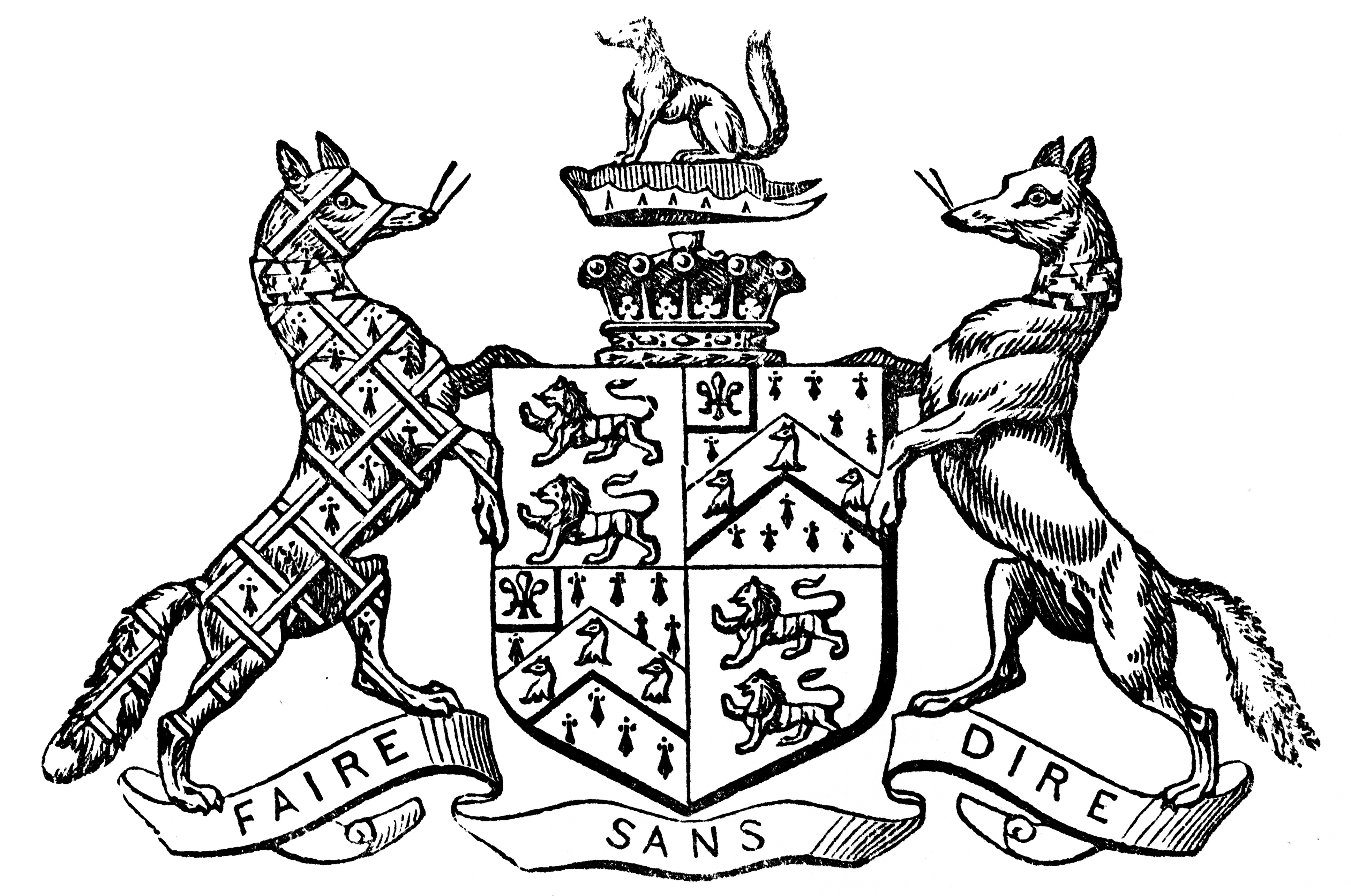
Did the main title (above) get your attention? What on earth could “leaders flush” have to do with this topic? In teaching (and modeling) leadership skills to my students, we discuss what it means to Faire sans Dire or “do without saying,” the English translation to this crest:

Heraldry coat of arms emblem: Earl of Ilchester

In other words, if you see something that needs to be done (flush the toilet?), don’t assume it’s someone else’s job. A true leader embraces the philosophy Carpe Diem (“seize the day”), identifies the problem and its solution, rolls up his/her sleeve, and “gets it done!”

Why teach leadership in the curriculum & extracurricular activities?

“Leadership is an essential skill that extends beyond the classroom, shaping how students engage with the world around them. Whether leading a group project, organizing an event, or voicing their opinions in discussions, leadership skills empower students to take initiative and make meaningful contributions. These abilities are not only beneficial during school years but also serve as the foundation for lifelong personal and professional success.”
Bloomster

In the past, I have used a multitude of opportunities and settings to teach these life skills in summer leadership camps, section leader and student conductor seminars, drum major and marching band captain auditions, student director, producer, and musical crew head staff meetings, and for 25+ years, preparing student counselors for a comprehensive, six-day, grades 8-12 Township String Camp program.

To sum it up, teaching leadership in Grades K-12 and college settings will:

  • Develop communication skills
  • Build confidence & self-awareness
  • Enhance problem-solving abilities
  • Encourage teamwork & collaboration
  • Shape future success

Why teach leadership to educators?

My December session at SAS Institute was geared to school/system leaders, department heads, and other administrators, but actually the focus on leadership as a skill set necessary for school/staff/individual professional improvement is essential for all educators and school support staff.

From district administrators and school principals to instructional coaches and curriculum coordinators, leaders in education have a direct impact on the learning outcomes of all students. According to UNESCO, educational leadership is considered one of the most influential factors on student outcomes, falling just behind engaging teaching. As a result, leadership training for educators has become an essential part of the professional development experience for teachers at all levels of education.
“Building Leadership Skills – From Classroom Teacher to Educational Leader”

School improvement rarely occurs without effective leadership, and school leadership is only second to classroom teaching in its influence on student achievement. A new evidence review report from Global School Leaders paints a complex and ever-changing picture of school leaders, with their roles, responsibilities, and impact varying around the world.
3 Reasons Why School Leadership Is Vital to Teacher Success”

The literature suggests that empowering educators with leadership training will:

  • Improve student achievement
  • Empower and retain teachers
  • Support new staff members
  • Drive innovation and adaptability
  • Bridge the gap between instruction and administration
  • Build/model a positive attitude
  • Enhance strategic thinking and decision-making
  • Promote a positive and collaborative school climate
  • Develop soft skills such as communication, conflict resolution, and building trust… both in and outside the classroom

Leadership assessments

“A leadership skills assessment is a formal evaluation used to identify and measure a person’s leadership potential and competencies, such as communication, decision-making, and emotional intelligence. These assessments can be used by organizations to evaluate current leaders, identify high-potential candidates for promotions, and inform hiring decisions. Common methods include personality tests, scenario-based assessments, and 360-degree feedback, with tools like CliftonStrengths, Hogan Assessments, and DISC being popular examples.” 
“Leadership Assessment Test – A Complete Guide 2025”

There is a large body of information out there, especially commercial resources, for evaluating the leadership quotient and achievement of corporate managers, CEOs, CFOs, etc. I was impressed with the scope and depth of the research, including these sample firms advertising the availability of third-party consultants and advisors.

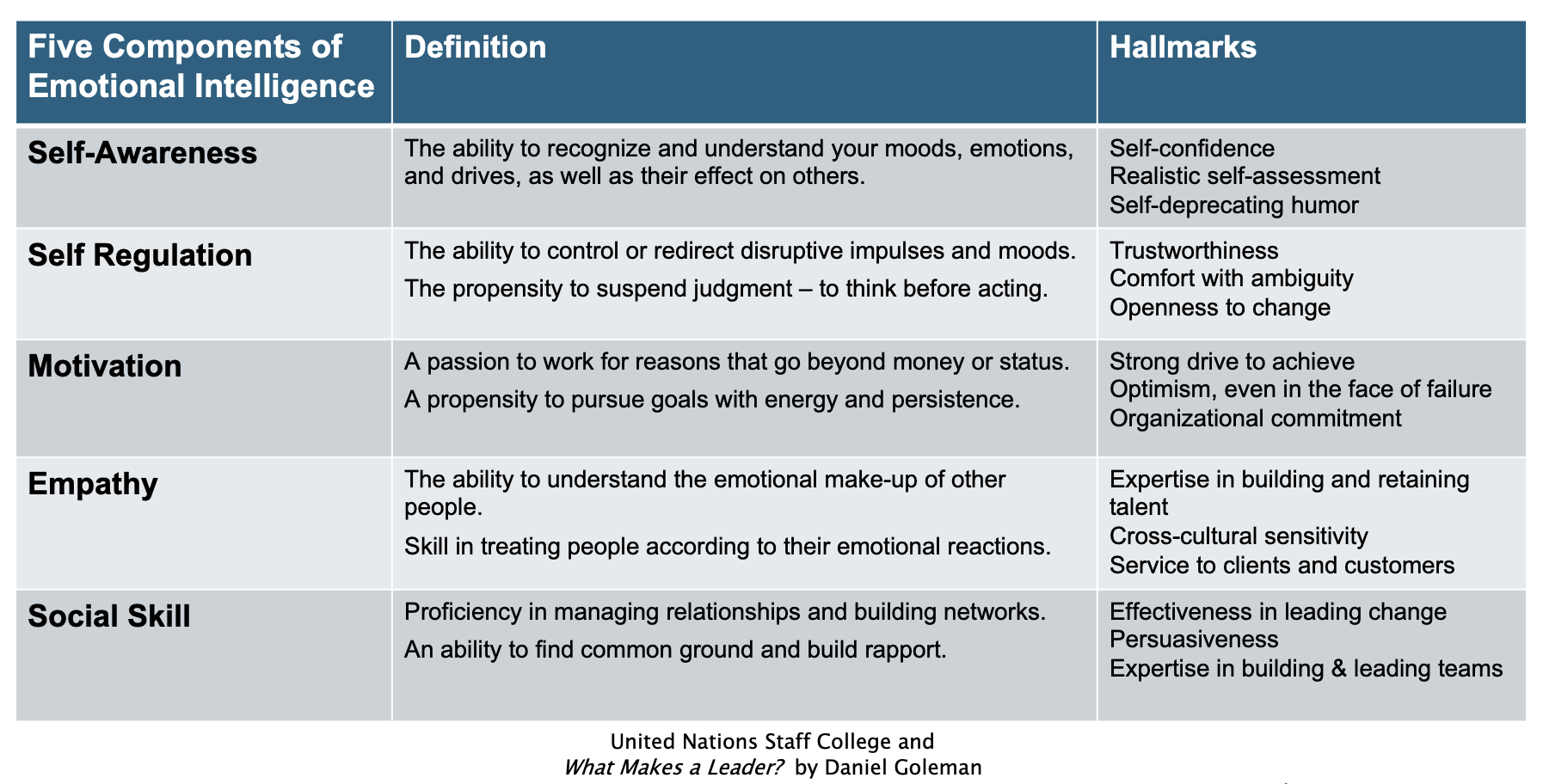
One night I randomly scanned through a handful of YouTube reels of company fraud and mismanagement (e.g., “Revenge of the Coffee Pot,” “Revenge with Karen,” and “Silent Revenge”), painting (fictitious) stories of bosses stealing intellectual property or assuming credit for the innovations/achievements of their subordinates, patent infringement, nepotism or incompetent hirings… all with arrogance, lack of professionalism, the total disregard of employee morale, and blatant patterns of poor executive decision-making, communication, emotional intelligence, strategic thinking, and the ability to influence and guide a team. “Emotional intelligence” (as defined above by Daniel Goleman in What Makes a Leader? also attributed to the United Nations Staff College) should include the “best practices” of self-awareness, self regulation, motivation, empathy, and social skills. Added to these YouTube (fake) scripted deficiencies are the mitigating effects of corporate politics, inconsistent application of compliance or HR policies, unclear contract language, and problems in the chain of command… with the eventual result of the boss receiving a fall from grace, termination, and other legal consequences. Most of these episodes imply only the Board of Directors evaluates the top executives (like school superintendents?), and even with the inclusion of employee satisfaction surveys, staff retention data, third-party auditors, and whistle-blower protections in some instances, the catastrophic actions of these leaders nearly destroy the businesses. For these videos, it seems that leadership assessments and goals are never ongoing, the benchmarks are seldom reviewed, and nothing is PROACTIVE… and therefore not preventive. Therefore, for the school district and corporate worlds alike, we need to intentionally provide formative assessments of our leaders (and ourselves). Exactly what do we need to know and do to improve?

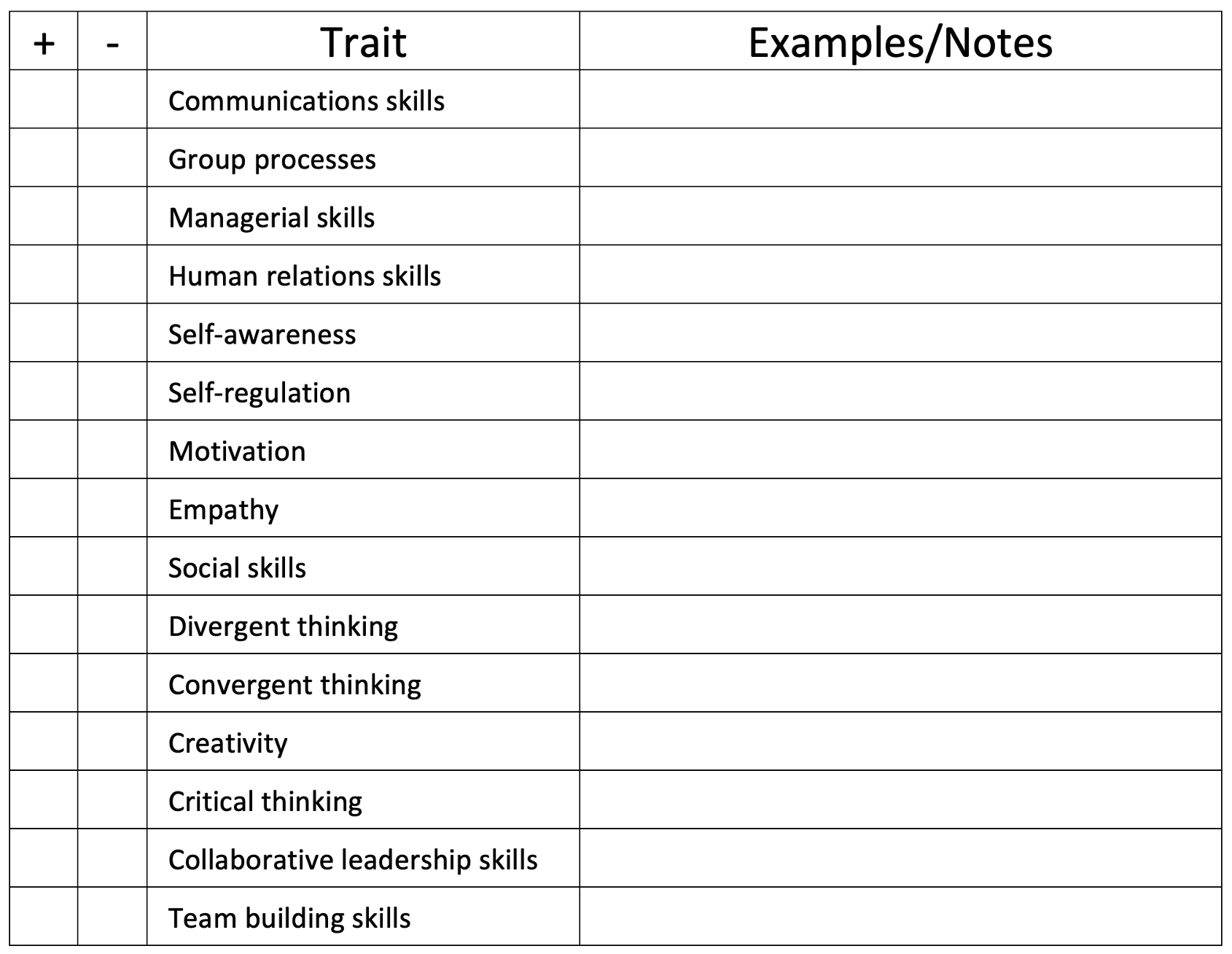
In my blog Growing Student Leaders and the SAS Institute 2025 presentation, I offered the above image as an informal personal checklist to evaluate leadership traits. Coincidentally, while I was writing this article, a scholarship committee of the Community Foundation of Upper St. Clair (for which I serve as Communications Director and Arts Chair) was developing an assessment rubric for ranking applications of a new student leadership scholarship. Although still under development, here are a few of the categories being considered:

  • Communication: Includes listening skills, clarity in speaking, and the ability to make others feel heard.
  • Integrity: Acting ethically, being trustworthy, and aligning actions with words.
  • Accountability: Taking ownership of actions and commitments.
  • Collaboration: Working effectively with others, valuing different perspectives, and resolving conflicts.
  • Self-awareness: Understanding one’s own strengths, weaknesses, and biases.
  • Drive/Initiative: A bias for action and the ability to move projects forward.
  • Courage: The bravery to speak truthfully, admit shortcomings, and make difficult decisions.
  • Humility: Recognizing the contributions of others and remaining a lifelong learner.

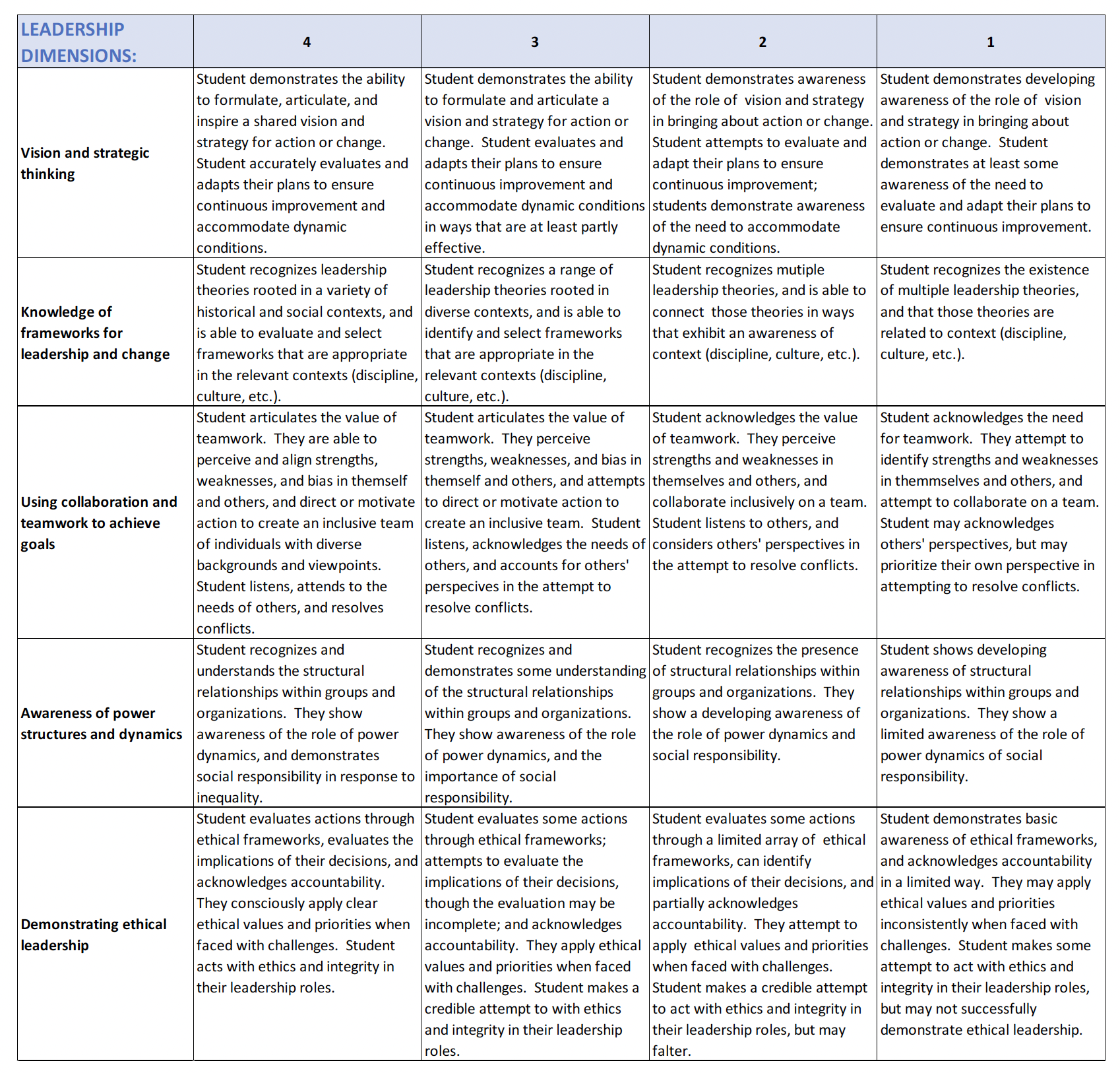
The University of Massachusetts Lowell developed the above rubric for their River Hawk Experience Distinction Leadership Program, defining specific criteria with a clear description of what each trait should look like at different performance levels, in order to provide a standardized way of measuring and assessing leadership skills

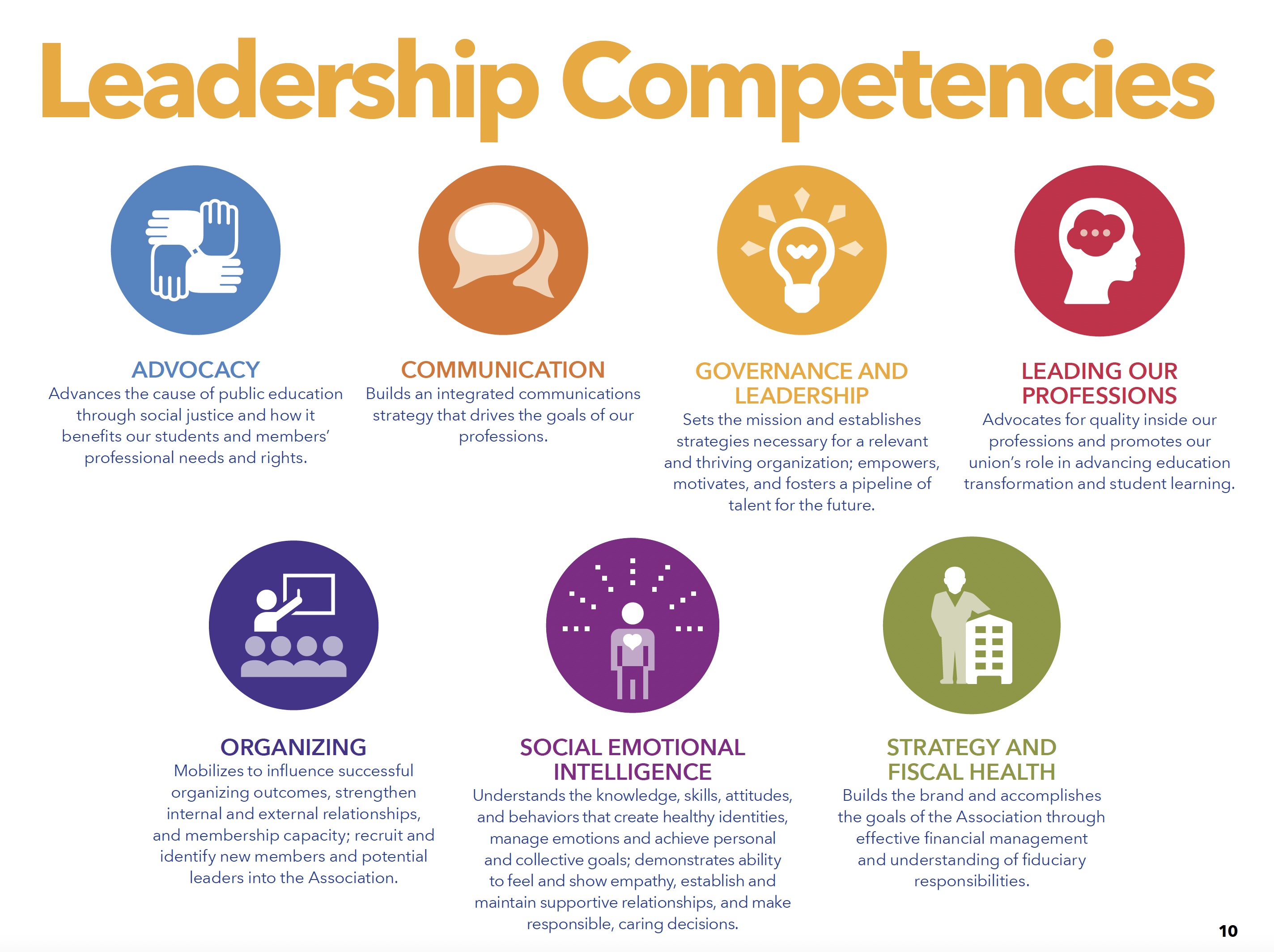
In addition, the National Education Association has created the above NEA Leadership Competency Guide worth downloading.

My favorite inspirational speaker Simon Sinek has also weighed in on this topic of “What Makes a Great Leader?” refining/simplifying it to just three traits:

  • Courage
  • Integrity
  • Communication

Additional resources

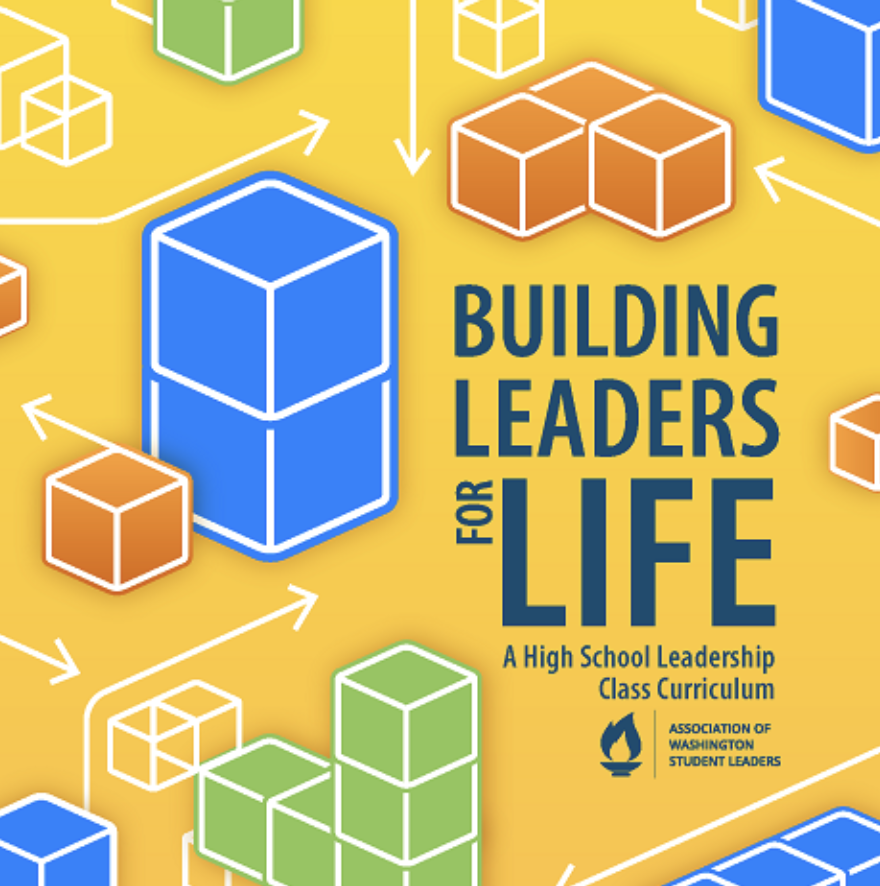
If you are an educator looking for supplemental material on developing leadership skills in your students, besides these SAS INSTITUTE 2025 slides (of which the original PowerPoint file is available to download for free in order to adapt for your classroom – please email me), I recommend perusing the full-blown “Building Leaders for Life” (second edition) curriculum (94 lessons in five subject areas, 355 pages of lesson materials, 137 student handouts) created by the Association of Washington Student Leaders (a division of the Washington School Principals’ Education Foundation). Click here to view their website. They also have a middle school and elementary series!

If you attend my SAS INSTITUTE workshop on December 9, 2025 (starting at 9:40 a.m. in Magnolia C, Hershey Lodge & Convention Center), ask me to see sample materials from their high school course of study.

Finally, here is the “homework for future leaders” I provided at the SAS INSTITUTE and during a 2024 summer camp at Upper St. Clair High School, providing additional links to many inspiring minds. Enjoy!


Leadership is not about being in charge. It is about taking care of those in your charge. — Simon Sinek

A leader is one who knows the way, goes the way, and shows the way. — John C. Maxwell

Do not follow where the path may lead. Go instead where there is no path and leave a trail.
— Ralph Waldo Emerson

The greatest leader is not necessarily the one who does the greatest things. He is the one who gets people to do the greatest things. — Ronald Reagan

What you do has far greater impact than what you say. — Stephen Covey

PKF

© 2025 Paul K. Fox
Engaging Retiring/Retired Educators

Ask not what NAfME or your state MEA can do for you, but what YOU, a retiree, can do for your professional association and music education.
An adaptation of the famous excerpt from the 35th U.S. President John F. Kennedy’s inaugural address of January 20, 1961.

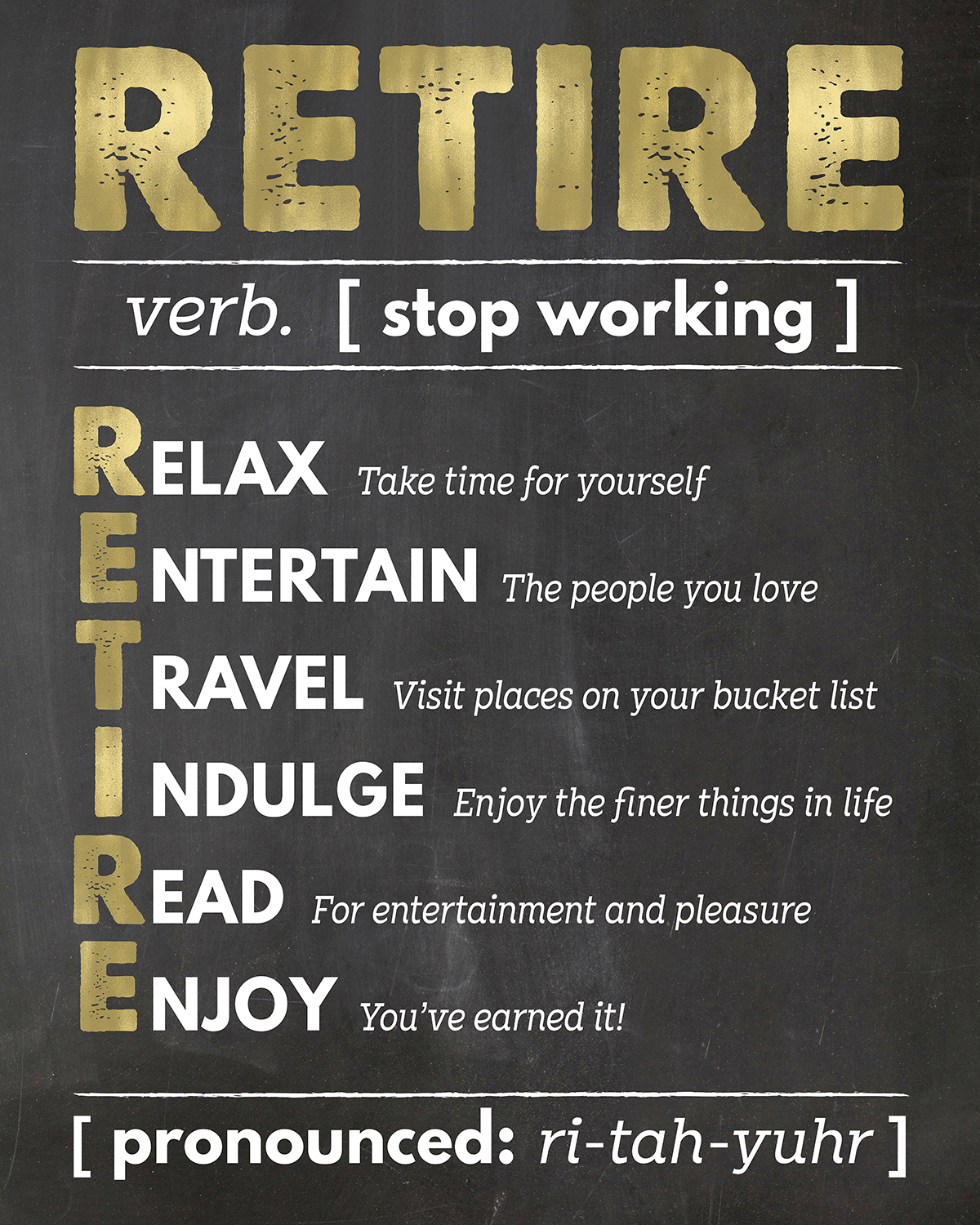
Surfing the ‘Net, I found an appropriate acronym for R.E.T.I.R.E. by Tangled Tulip Designs in pinterestRelax, Entertain, Travel, Indulge, Read and Enjoy! Most retirees would probably agree! The cessation of full-time employment may offer a great release from the day-to-day stress and drudgery of the job and the freedom to venture out, self-reinvent, make future goals, nurture relationships, and explore new personal growth opportunities.

Many attribute embracing a career in music education as “a calling” as opposed to just a form of employment or livelihood. From my experience, I have witnessed that most music educators are passionate for the cause of fostering creative self-expression in their students, more of a 24/7 mission, bringing intense focus and dedication to their lifework.

More to the point: Do we ever truly retire from making music ourselves and fostering this love in others?

THE “WHY!” Retirees matter and are critically needed!

One of my favorite inspirational speakers (Simon Sinek) would say, “start with the WHY!” WHY is this discussion on professional engagement of retired educators so important today?

  1. Their need: An informal poll of my former local educators and administrators revealed that half of them “hate retirement!” According to Dr. Robert P. Delamontagne in his book Retiring Mind (Fairview Imprints), “50% of retirees will suffer some form of acute emotional distress. This is potentially a very large problem given the fact that 10,000 people are becoming eligible for Social Security every day for the next 20 years in the US alone.” Remember this statistic the next time a senior citizen cuts you off on the road or bangs a shopping cart into your leg at the checkout!
  2. Our need: We are facing shortages of qualified teaching candidates across the country with unfilled openings in public school music positions and the critical need of training/mentoring the new hires.
  3. Society’s need: All of our voices should be combined to support the advocacy of music education, actively promoting access to school music by sharing its academic and social benefits with decision-makers, building relationships with administrators and policymakers, and utilizing resources from organizations like NAfME and the NAMM Foundation.

Despite its proven benefits, music education is often the first program to face budget cuts in schools. This is especially concerning in underserved communities, where access to music programs can be life-changing. Now more than ever, we must advocate for music education to ensure that every child has the opportunity to experience its benefits. Investing in music education is an investment in the future of our communities — helping to cultivate the next generation of creative, resilient, and innovative leaders. 
“Why Music Education Matters More Now Than Ever” by Music Will, February 2025

For eleven years (and counting), I serve as the Pennsylvania Music Educators Association (PMEA) Retired Member State Coordinator, as well as the Past State Chair (current member) of the PMEA Council for Teacher Training, Recruitment and Retention. I believe my responsibility to the state association is two-fold:

  • Assist soon-to-retire professionals in achieving a smooth transition to a happy and satisfying retirement; to help them cope with the commonly-experienced emotional ups-and-downs of this life passage, wrestling with the question “what do you want to be or do when you grow up?” and making new life lesson plans and personal goals.
  • Reach out to and build meaningful connections with retirees in order to fully engage them towards becoming active in their professional association; to recount, represent, and revitalize the activities of our post full-time employed music educators.

This article proposes a roadmap of crucial pathways to help music teachers approach “retirement bliss” while tapping into their hard-earned knowledge, strengths, and experiences by cultivating the benefits of their renewed participation in our professional associations.

What can NAfME and State MEAs offer retirees?

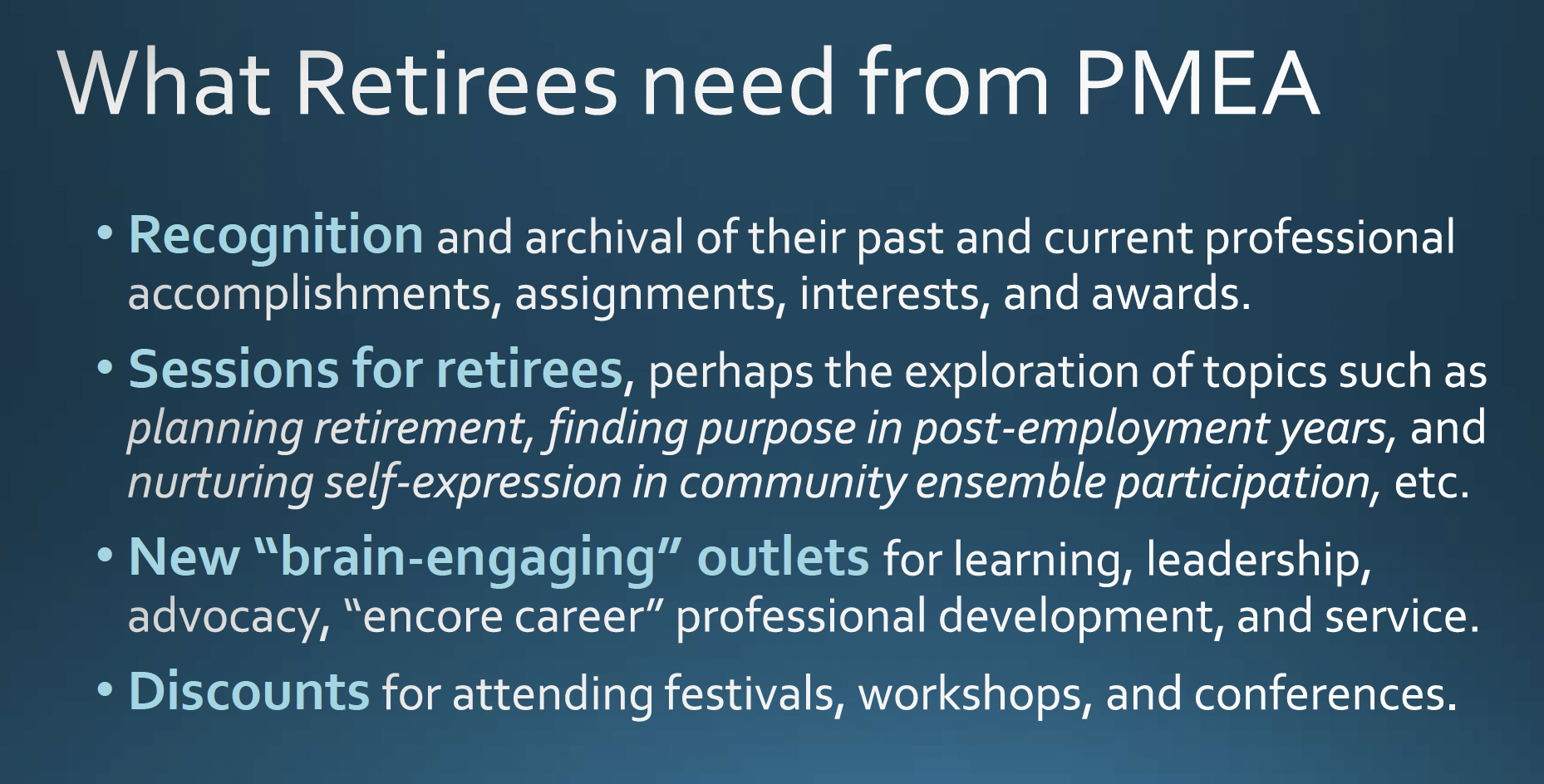
You have devoted your entire life to inspiring the development of personal artistry and “ah-ha” musical moments in others. Now it is your turn to reap the benefits (and privileges) of this commitment to the profession. NAfME and your MEAs can provide the resources and motivation of “sharing and caring,” directing retirees “places to go, people to meet, and things to do” for fulfilling that “next chapter” or (perhaps better terms) the “refirement” or “rewirement” of senior living.

Do you feel “needed” and know you “make a difference?” Research has shown that the one of the most important motivators for involvement in a professional association is that its members recognize that they are essential to its success. This quote is from Revitalizing Retirement: Reshaping Your Identity, Relationships, and Purpose by Nancy Schlossberg, attributed to Rosenberg/McCullough:

 “It has been suggested that one problem of retirement is that one no longer matters; others no longer depend on us… The reward of retirement, involving a surcease from labor, can be the punishment of not mattering. Existence loses its point and savor when one no longer makes a difference.”

Most people who are one to five years away from “pulling their pin” and putting in their walking papers “do not know what they do not know.” Experts agree: “Retirement preparation is not only about the money!” Our silver-haired colleagues who have already Crossed the Rubicon and are now “living the dream” in retirement can share their trials, tribulations, and (more importantly) numerous success stories about coping with this transition!

NAfME, PMEA and this paulfox.blog/for-retirees site have archived an exhaustive number of self-help articles. Check out this omnibus NAfME blog “Retirement Prep Top-Ten Treasures.”

The benefits of retired MEA membership are numerous. Besides providing helpful transitioning advice, these advantages also come to mind:

  1. Answers to questions like “What have you always wanted to sing, compose, play, record, conduct, write, publish or present?” and “Where can I share my hard-won expertise and help others in the field?”
  2. Networks and contacts to help you develop “encore careers” in other musical or educational arenas (e.g., higher education, music industry, festival organization, travel/tour planning, composition, guest conducting, private studio teaching, church music, etc.)
  3. Opportunities to “rekindle your expressiveness” by participation in adult community or full/part time performance groups (playing “gigs”)
  4. Places to go/things to see/hear: NAfME/MEA conferences, workshops, and concerts
  5. Exclusive discounts and other benefits (reduced dues and registration fees)

What can retirees offer NAfME and their state MEA?

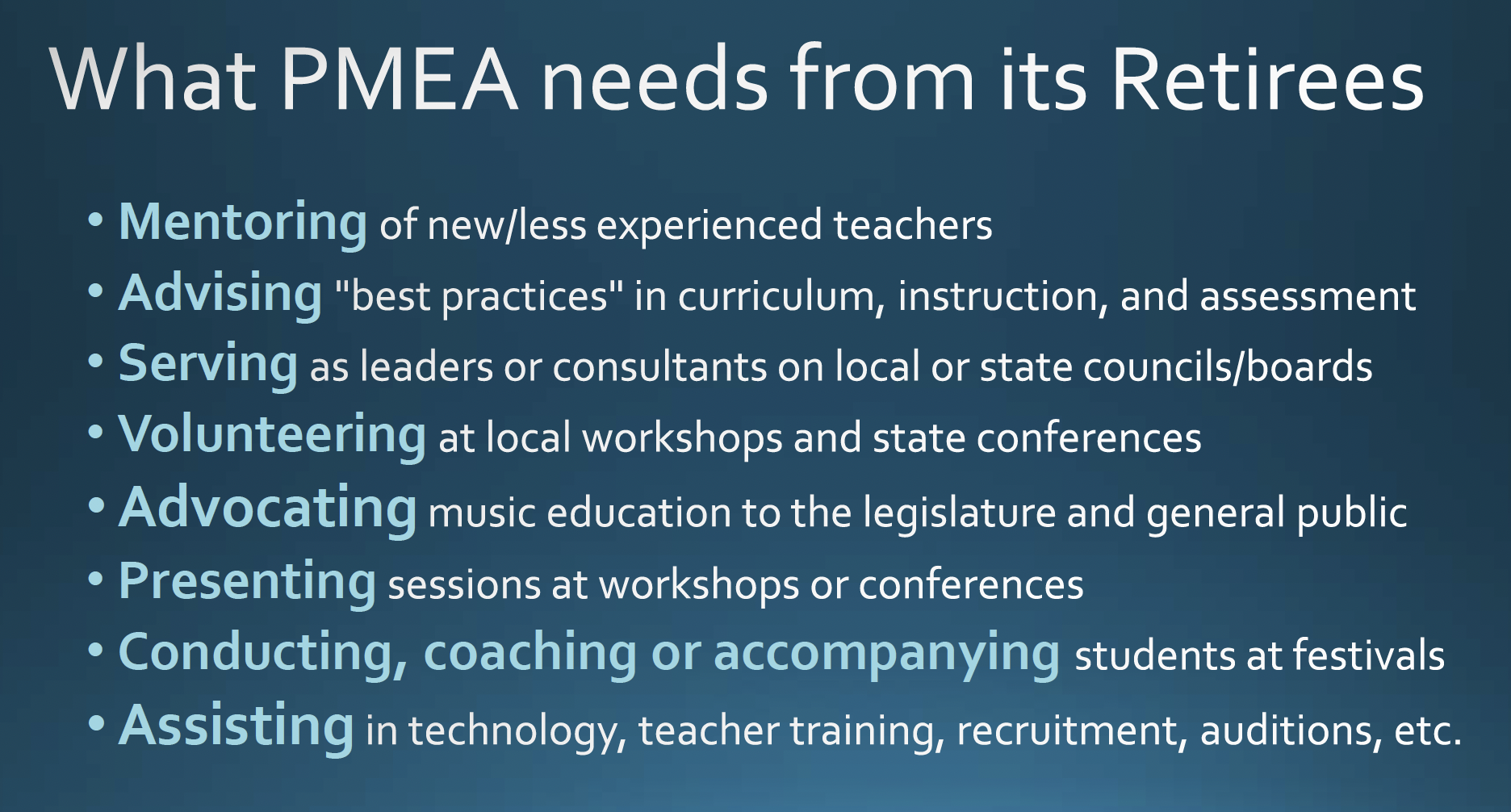
The relationship of active and retired membership in our MEAs is symbiotic. We know from the history of our associations, “giving back to the profession” remains a high priority with most retirees. This may come in many forms and settings:

  • Leadership or membership in local, state, or national MEA/NAfME office, staff, advisor, or council/committee position
  • Advocates for the promotion of music education to local and state government officials
  • Service as presiding chair or member of the conference or workshop planning committee
  • Service as evaluator of performance groups, conference sessions, or articles for publication
  • Judges of local/state MEA adjudication or commercial festival
  • Accompanists, coaches, arrangers, or guest conductors for festivals or school/community groups
  • Services to the local music teacher in private teaching, piano playing, marching band charting, sectional coaching, choreography, music technology, instrumental repair, stage tech, etc.
  • Writers for state MEA and NAfME publications and blog sites
  • Contributors to online music education forums or the NAfME Connections
  • Donors to and/or fund-raisers of music education charitable projects, scholarship initiatives, etc.

The PMEA Model of Retired Member Participation

PMEA values the vast wealth of experience and contributions of our retired members. We’re proud of the many programs we offer to retirees and invite you to visit our website to peruse additional information and sample digital newsletters and articles.

Retired members in Pennsylvania are involved in:

  • PMEA elected and appointed offices, staff, committee chairs, and membership on councils
  • PMEA Strategic Plan and Bylaws, Conference Planning, and other state/regional committees
  • Retired Resource Registry* (informal mentoring for new teachers and transfers)
  • How-to-Retire Webinar, Prepping for Retirement, and the Ultimate Retiree Resource Guide
  • Retired Member Breakfast at PMEA Annual Conference
  • Retirement 101 (The Who, What, When, Where, Why, and How) session at PMEA Annual Conference (training for all members retiring or soon-to-retire)
  • Maintenance of PA Community Band, Chorus, Orchestra, and Theater group catalogs
  • Maintenance of PMEA member compositions library
  • Mock Job Interview Committee for music education majors
  • Coffee & Conversations informal “ask an expert” lounge at PMEA Annual Conference
  • Volunteering as presiding chairs for sessions and registration aides at conferences/workshops
  • Pool of conference clinicians, guest lecturers, and members on discussion panels
  • Participation in “Sponsor a Collegiate to Attend the Conference” campaigns
  • All-State Program Patron, or contributor to the annual Irene Christman Scholarship or Margaret Bauer Grant programs.

As of October 1, 2025, there are 61 advisors in the PMEA Retired Resource Registry.

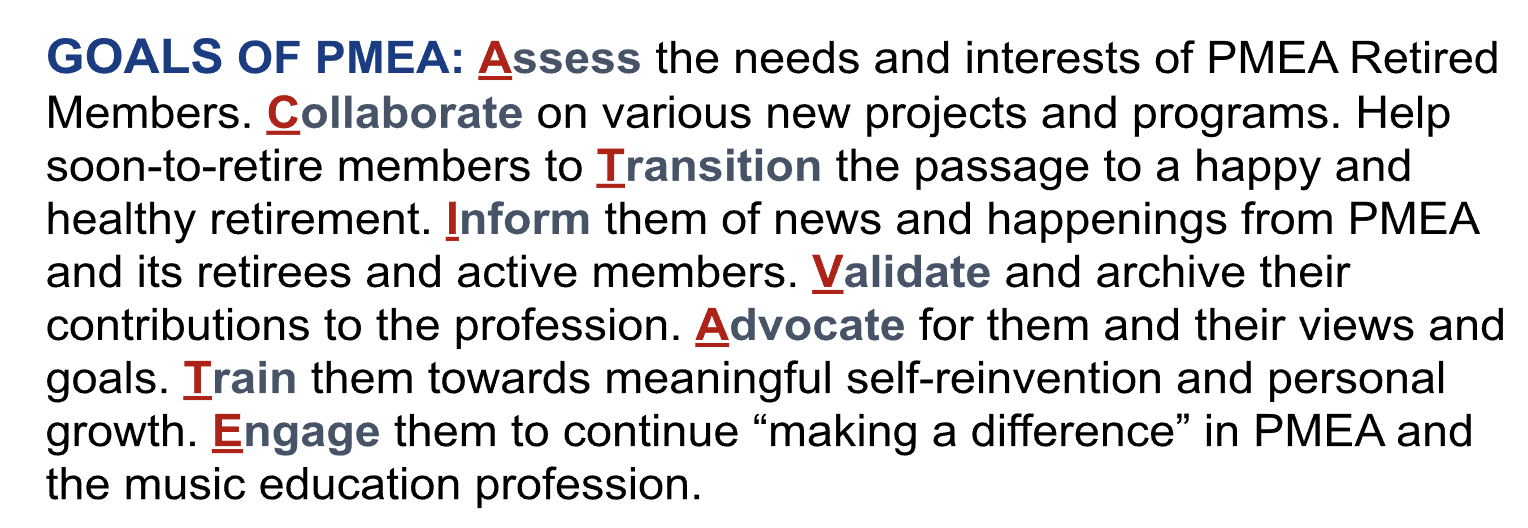
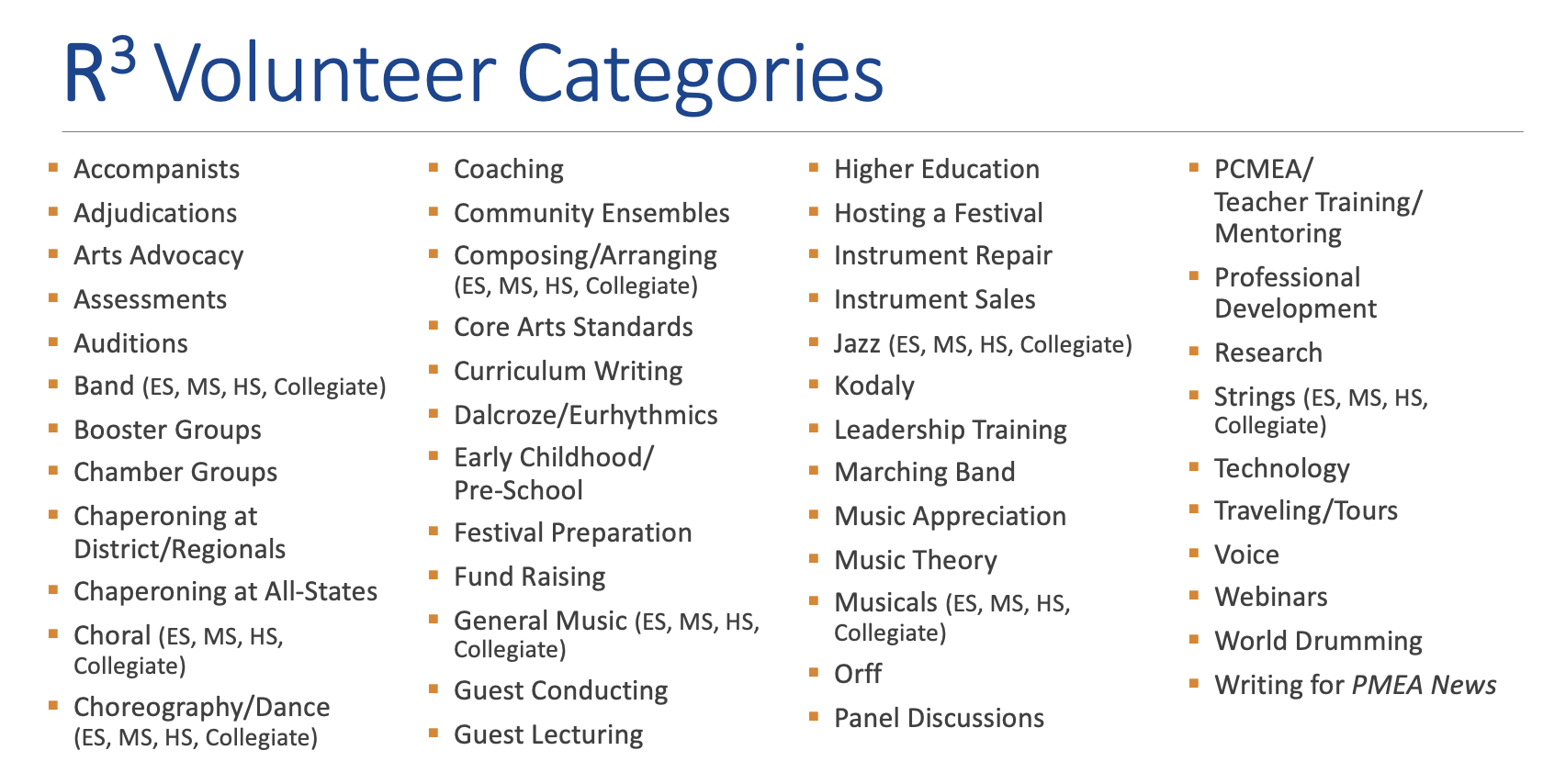
*During their annual membership registration, PMEA Retired Members may choose to sign-up for the R3 Retired Member Registry (above volunteer categories) to become available to informally offer advice to college music education majors, new hires, transfers, and newcomers to any music specialty. R3 members may handle inquiries like “What warm-up would you recommend for my middle school choir?” OR “Do you have an idea for an elementary string ensemble concert opener?” OR “How do you teach improvisation… steady beat… breath support?”

The other option with more time commitment is that Retired Members can be officially “trained” as a PMEA Mentor and be assigned to specific individuals who request assistance in their early career assignments.

Coda

How can we help?

What is the future of retired music educator professional engagement? In a word: connections!

Last month, I reached out to Elizabeth Welsh Lasko, NAfME Assistant Executive Director for Membership, Organizational Development, and Marketing Communications and “volunteered” OUR assistance. I suggested that, in keeping with the NAfME 2022 Vision Statement “…an association where all people are heard, seen, and feel they belong throughout their lifelong experiences in music” we should all intentionally recruit more hands-on involvement of our retirees. I pointed out that in the late 1980s, we had a Music Educators National Conference (MENC) Committee for Retired Members led by a National Chairman who served on the NAfME National Assembly. (An excellent booklet, TIPS: Retirement for Music Educators, Copyright © 1989 MENC, was compiled by A. Verne Wilson, then the Past National Chairman of the MENC Committee for Retired Music Educators.)

Ms. Lasko encouraged me to “reach out to retirees” beginning with this article. At the next NAfME Eastern Division Conference, I plan to hold a meeting of retired members, and also connect with all state MEA retired member coordinators (those states who have them). We’re available and on the move! Let’s collaborate and share our resources!

Finally, just for fun, I recently posted the blog “For Book Lovers – Retired or Not” on NAfME Connections (formerly called Amplify). There are already 1,810 members in the NAfME “Retired Members Community.” Please JOIN US! Using this forum, get in touch with me, and respond with YOUR OWN retirement stories, strategies, perspectives on this “life passage,” and more ideas to grow the professional engagement of our music teacher retirees.

Happy trails!

© 2025 Paul K. Fox
Social Media – Revisited

Before you begin reading this article, please take a moment and peruse these past blog posts:

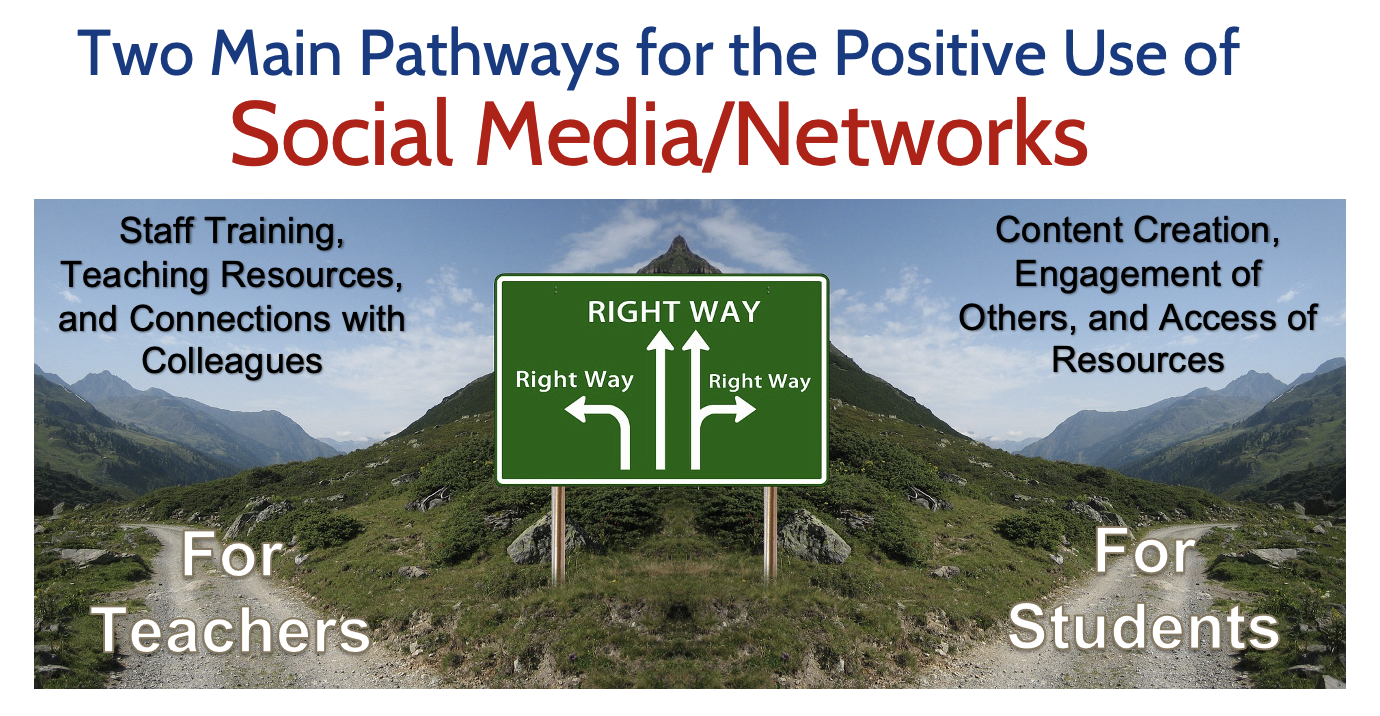
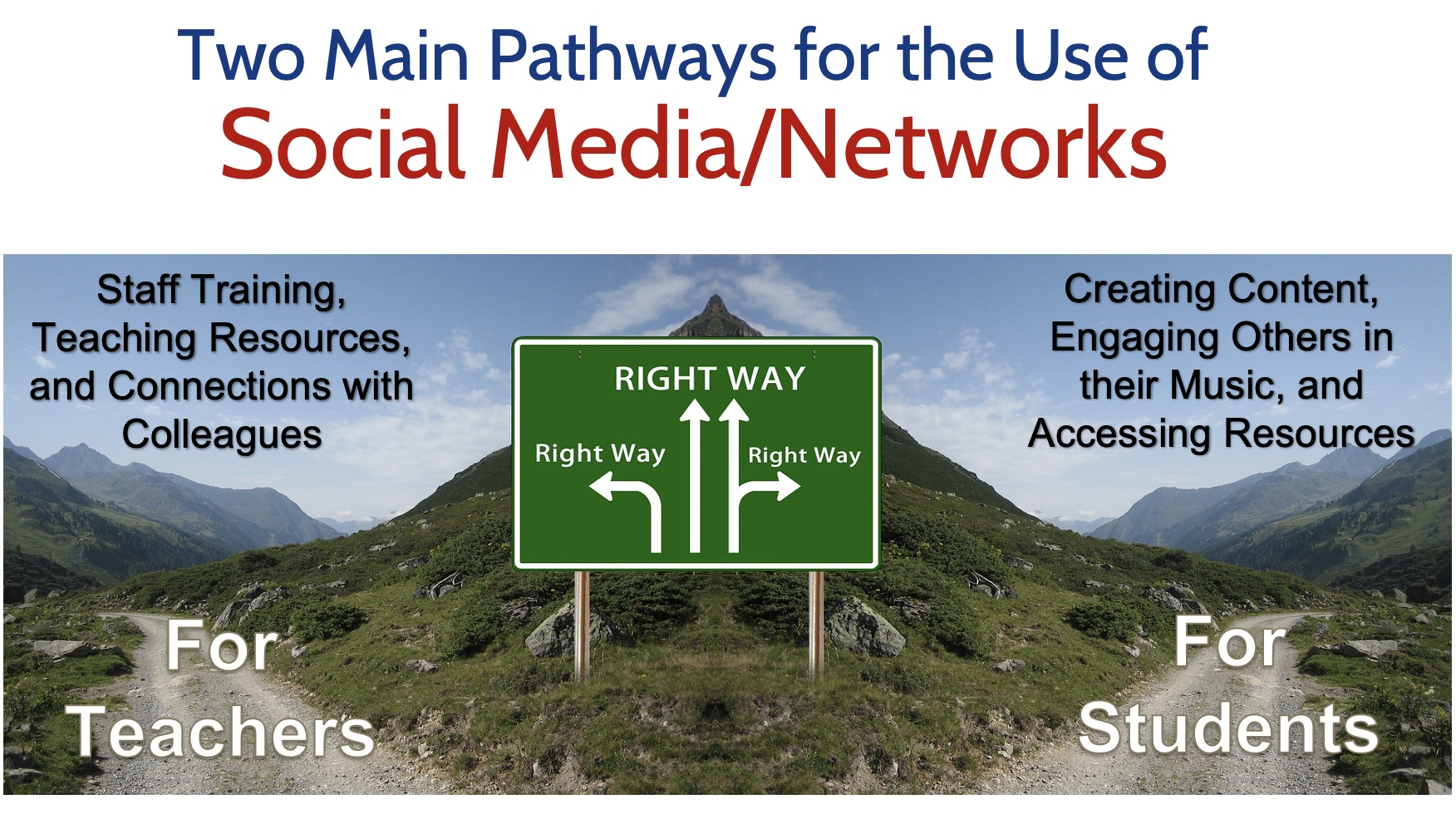
Although several of the cited research links may have expired (for example, PA Department of Education modified most of their website’s URLs), these provided the foundations of background information and references for the presentation I prepared for the DCMEA Virtual Conference in 2020 (during COVID) and serve as the starting point for the workshop I will share in-person at the DCMEA Winter Conference in January 2026. This blog provides updates and additional perspectives. Taken in combination with the above sources, you will be able to identify the benefits, positive models, precautions, and dangers of social media, social networks, professional learning networks, and sample emerging technologies as they apply to teachers’ professional development and education of students.


“THE WHY”

Before every clinic or publication I develop, I always try to spotlight the theme of “THE WHY” as preached by one of my favorite authors and motivational speakers – Simon Sinek! According to him, for organizations and individuals alike, “THE WHY” (rationale and priority) is more important than “THE WHAT” and “THE HOW.” (See this video.)

WHY is a collaborative discussion on social media essential? Why now?

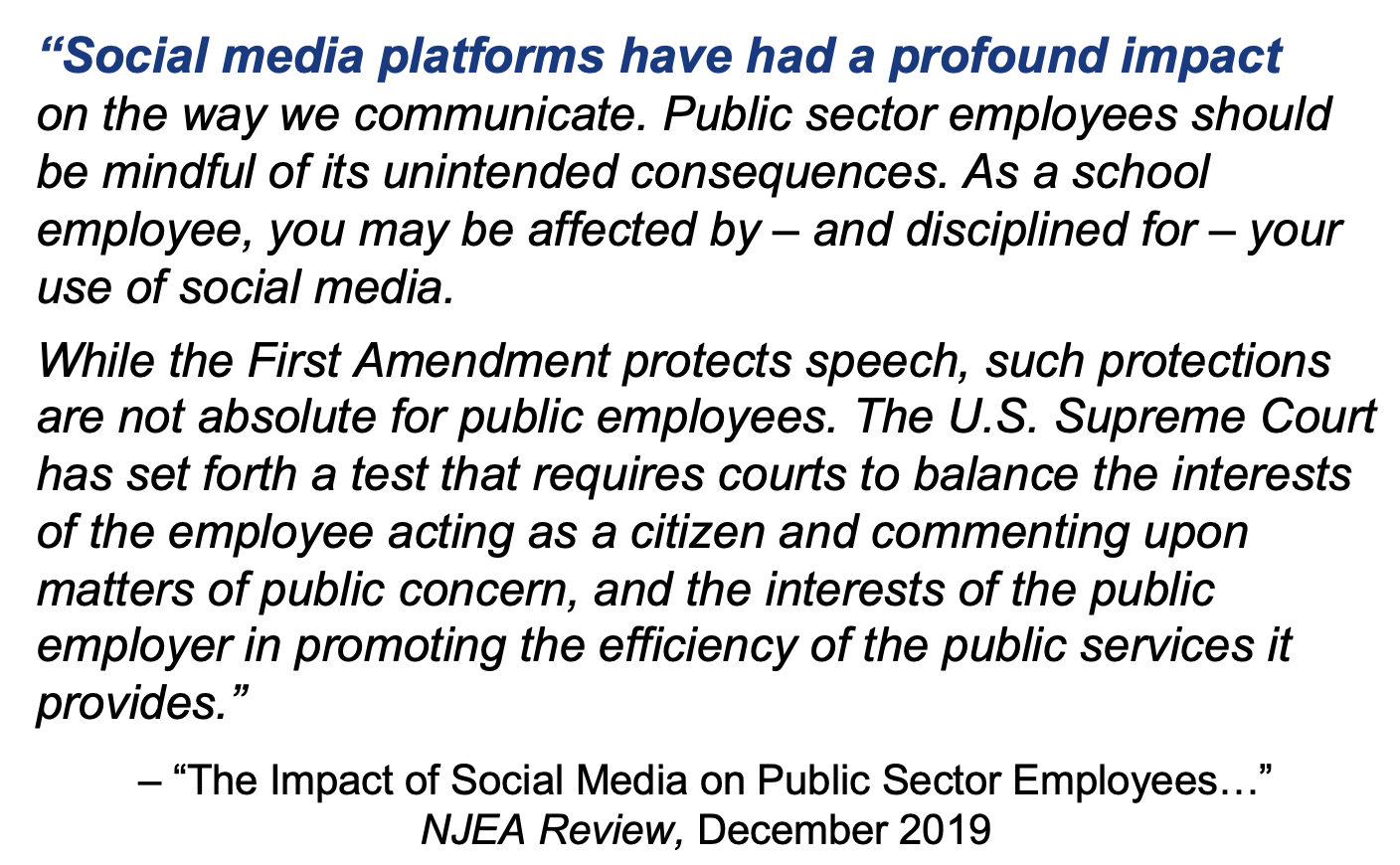
 ”There’s a growing body of evidence suggesting that educators are facing increasing scrutiny regarding their social media use. Concerns include unprofessional conduct, inappropriate interactions with students, and the potential for cyberbullying and other negative impacts on student well-being.”

“Educators are increasingly concerned about how social media influences students’ social-emotional development and their interactions with others.” 
NEA Member Polling on Social Media…
NEA Impact on Social Media and Personal Devices on Mental Health
HHS Youth Mental Health and Social Media

Frankly, there is still a lot of confusion about the dangers of social media, social networking, and other technology integrations into education. In Social Media – Boon or Nemesis, we mentioned that teachers should “debunk the free speech myth.” We demonstrated how the improper application of social media could get educators in trouble. Check out these sites for more info and corroborative stats:
Teacher Student Misconduct and the Critical Role of Social Media Screening
NCBA Social Media for School Employees
Social Media Hazards and Tips for Teachers

As always, our goal is to promote ethical practices in maintaining professionalism in the digital world.


“THE WHAT” Review of Definitions

“Social Media”

Social media are “websites and applications that enable users to create and share content or to participate in social networking.”
— Oxford Lexico.com online dictionary

“Social Network”

A social network is, 1. a network of social interactions and personal relationships.; 2. a dedicated website or other application which enables users to communicate with each other by posting information, comments, messages, images, etc.
— Oxford Lexico.com online dictionary

Professional Learning Community” (PLC)

A PLC is “a group of educators who meet regularly…” (usually in-person) “…to strategically enhance their teaching skills and improve student outcomes.”

versus “Professional Learning Network” (PLN)

A PLN is “a group of educators who gather more informally…” (usually in online communications) “…to problem-solve and generate ideas to enhance classroom practices. A PLN… often takes the form of an open forum, where participants can ask and answer questions based on their experiences.”
https://edtechmagazine.com/k12/article/2024/08/pln-vs-plc-perfcon


“THE HOW” Ethos of Care

Teachers use social media to…

  • Get inspired with new teaching ideas
  • Find resources for the classroom
  • Connect with other educators
  • Stay on top of trends and news
  • participate in an online community
  • Find teacher discounts and deals
  • Follow education companies and organizations

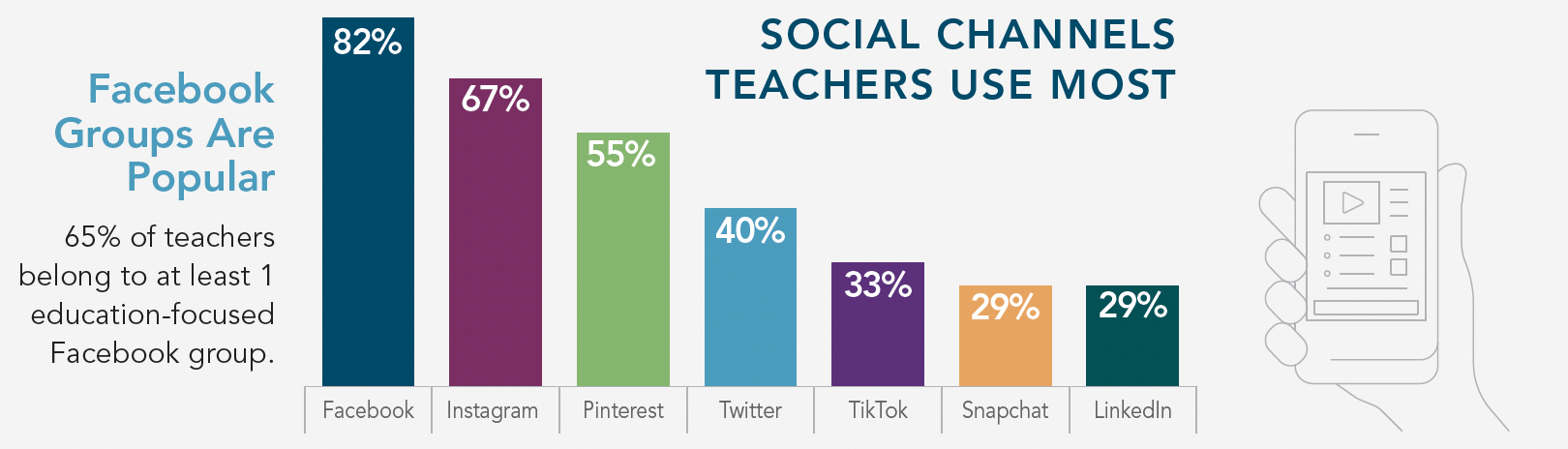
How Teachers Use Social Media
Teachers Social Media Use

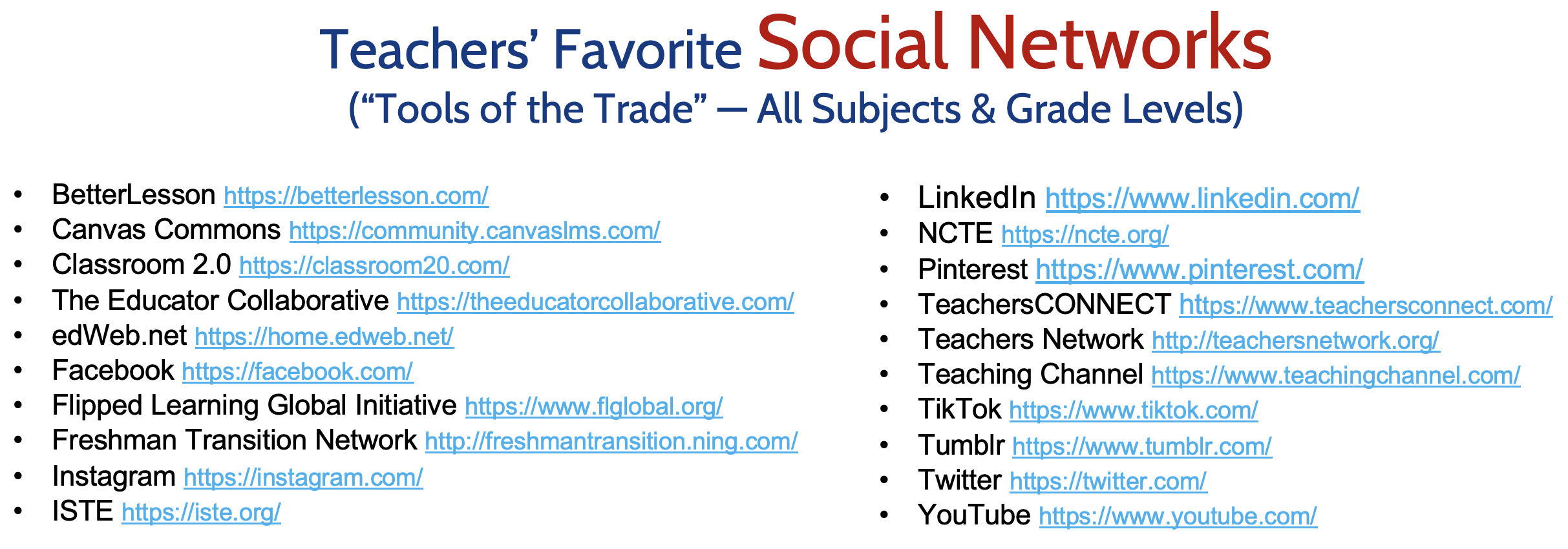
Social Networks for Teachers

We acknowledge that the benefits of social networking for educators are numerous by promoting professional collaboration and connections, including:

  1. Acquiring information to enhance understanding
  2. Keeping informed about latest developments in education
  3. Enhancing communications with students, parents, and the school community
  4. Fostering connections with colleagues in the field to expand an educator’s professional network.

Benefits of Social Media as an Educator

However, educators must exercise “sound judgment” and proper professional boundaries when using social media/networks with students. While the introduction of new technology provides many opportunities for teaching and learning, it is important to establish clear rules for appropriate student-teacher communication. In order to promote safety and appropriate boundaries while transitioning to a virtual teaching and learning environment, the Pennsylvania Professional Standards and Practices Commission offers suggestions to help educators protect themselves and their students.

  1. All technological resources and applications should be school entity-approved and only used in the manner prescribed. Ensure that you are familiar with the tools you are using in order to use them properly. 
  2. Communication with students should occur at designated times, consistent with traditional school day hours. Maintain transparency and protect yourself by keeping a record of all communications with students. 
  3. Clearly communicate when and how students should contact you and provide a timeframe for when students should expect responses to questions. 
  4. Avoid one-to-one interactions with students in chatrooms, FaceTime, Skype, or any other online space. School psychologists, school counselors and others providing one-to-one services to students should consult with school administration about the best mode of communication. 
  5. Use approved forms of communication by your school entity to connect with students and parents (i.e. Remind), use only your school email to communicate, and copy administration when communicating with parents or students. 
  6. When creating content or interacting in an online space with students, conduct yourself as you would if you were in school. If appearing on camera, dress professionally and be mindful of your surroundings and the camera’s view. 
  7. Do not “friend” or follow students on social media and do not allow students to “friend” or follow you on your personal social media. Remember, you do not have a “social” relationship with your students. 
  8. Keep your personal and professional lives separate. Do not share overly personal information about yourself with students.

PSPC Digital Tips for Educators

While exercising responsibility to maintain a respectful, safe, online environment, there are many benefits for the application of social media for students in the classroom:

  • Real-time communications can increase student engagement, collaboration, communication and overall participation
  • Many students may find it easier to participate in online discussions that in the classroom
  • Students can easily ask each other or their teacher questions about assignments outside of class
  • Students & teachers can quickly share resources at any time.
  • Teachers can easily share class announcements.
  • Social media can provide a contingency plan for last minute remote learning scenarios.
  • Students can organize school events with each other or with the help of a teacher.
  • Teachers can augment an online-only class by establishing a social media page or account simply for building community.
  • Students can practice using social platforms responsibly, including maintaining a respectful online discourse.
  • Teachers can communicate directly with parents as needed, and parents can stay informed of school news via a convenient, easily accessible platform.

However, please watch out for these potential drawbacks:

  • Social media can be a major distraction, especially if students are accessing their personal accounts independently.
  • If students primarily use social platforms to participate in class discussions, they can miss out on practicing face-to-face conversations and respectful in-person discourse.
  • Some students may see social media assignments as an opportunity to cyberbully their classmates, and there is always a risk of someone posting inappropriate content or language.

Social Media in Education


“THE WHAT” Several Success Stories

Balancing the positives and negatives and taking into account all of these precautions in order to maintaining professional boundaries, the integration of new technology into the classroom may offer excellent enrichment and increase student motivation for advanced learning. This may take many forms. Here are a few interesting models.

Prior to preparing for the DCMEA online session in 2020, I stumbled upon a truly inspiring post from Derek Muller, a gifted teacher, physicist, filmmaker, and founder of the YouTube channel Vertiasium which has captured millions of subscribers. He offers one of the BEST models of using social media to enrich the understanding of learning math and science (applicable to all fields of study), while at the same time, provides warnings against unbridled use of so-called “innovation for innovation’s sake.”

“I feel like people over the years are invariably drawn to use these words:  revolutionize and education. And there’s this sort of amnesia that we’ve had a hundred years’ worth of these predictions, worth of really groundbreaking technologies that have transformed other areas in our lives but have failed to fundamentally change the way we do education. So, I stand here today as a voice of caution, to think that the future of education is not one of revolutions…”

You need to watch this: How is Social Media Transforming the Future of Education? (2016)
Derek Muller

Say what you want about how COVID significantly disrupted our educational programs, evidence of learning loss, problems in socio-emotional development, decline of student engagement and self-motivation, rise in mental health struggles, decreased instructional time, and the effects of a new digital divide of under-served students (Annie E. Casey Foundation), happily there were surprisingly a few positive advancements the results of exploring new tools and methodologies we had to employ to tread water and cope with the catastrophe. (“When life hands you lemons, make lemonade!”)

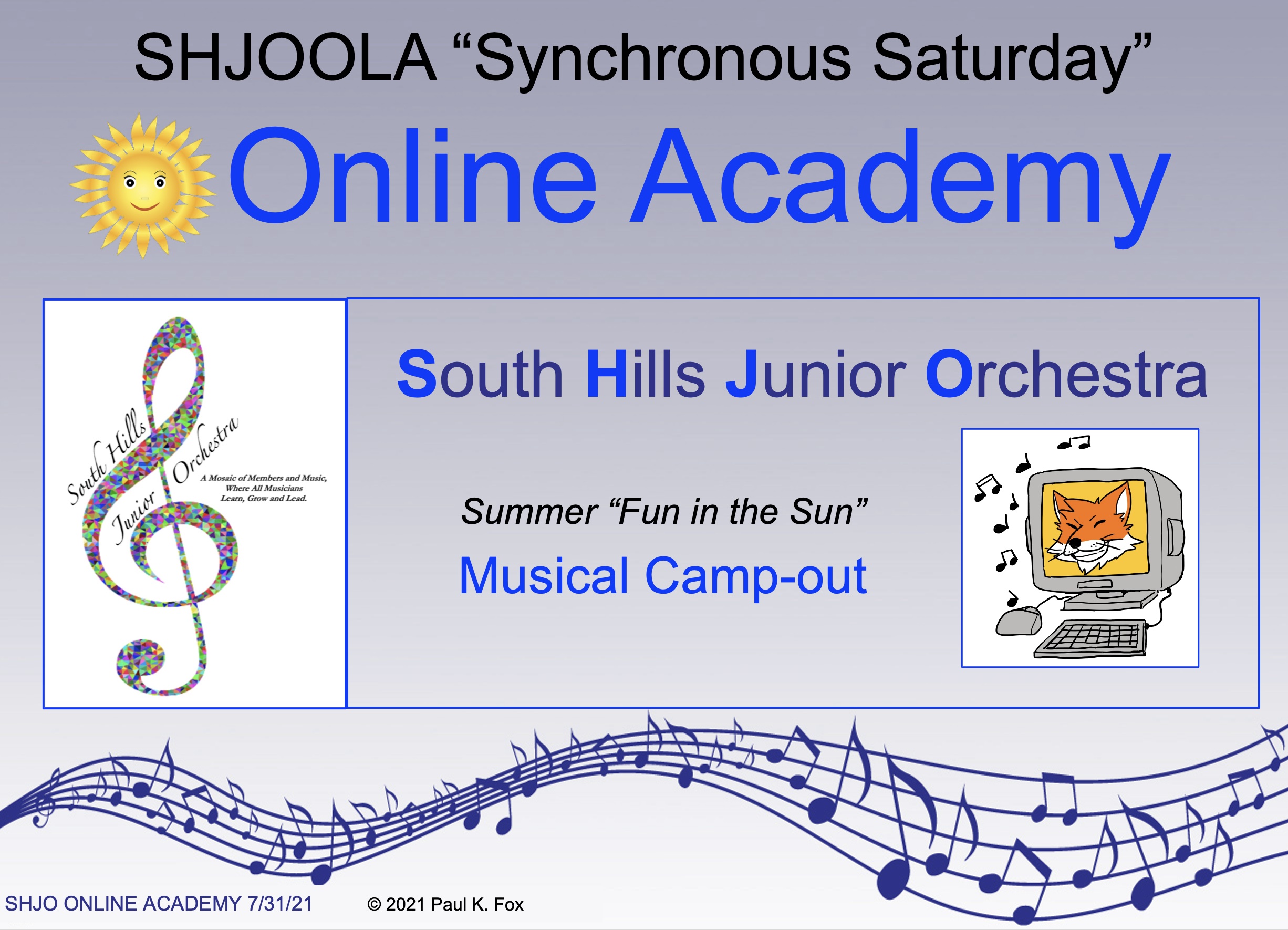
As one example, in the middle of preparing music for my community orchestra, we were shut down in 2020. No in-person rehearsals at the school. I then pivoted to creating my own online platform called SHJOOLA (South Hills Junior Orchestra Online Academy) in 2021 using MusicFirst. For a nominal yearly subscription fee, I was able to continue my Saturday morning classes (synchronous) as well as asynchronous (on-their-own time) learning using excellent applications in a virtual environment: MusicFirst Classroom, Focus on Sound, PracticeFirst, Sight-Reading Factory, Musition, Auralia, a web-based music notation program, and a huge library of method books and ensemble music. Several past blogs showed how we rolled out SHJOOLA:

The latter link above also provided a comprehensive list of supplementary resources (at the time) for online music education. Please peruse these even though some of them may have now gone inactive. We will provide supplemental links at the bottom of this article.

Another direction accented by the onslaught of the pandemic was digital streaming performances, incorporating technology in both the solo and ensemble settings. The following are two of my favorite examples of these to be viewed on YouTube:

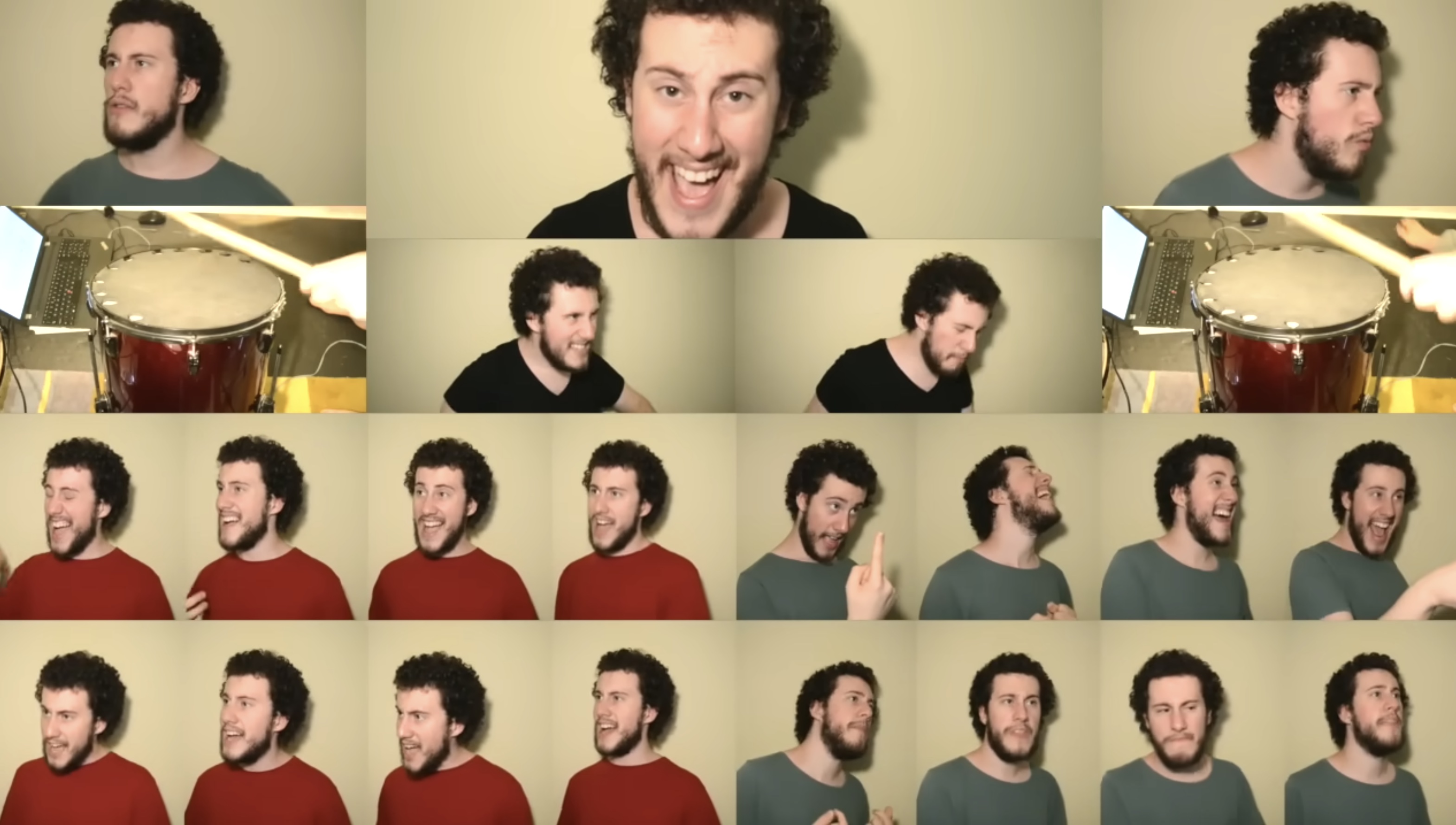
Circle of Life from Disney’s Lion King (2015-18) by Sam Robson, arranger, innovator and performer using multitrack recording of a single performer mixing as many as 50 voices at one time.

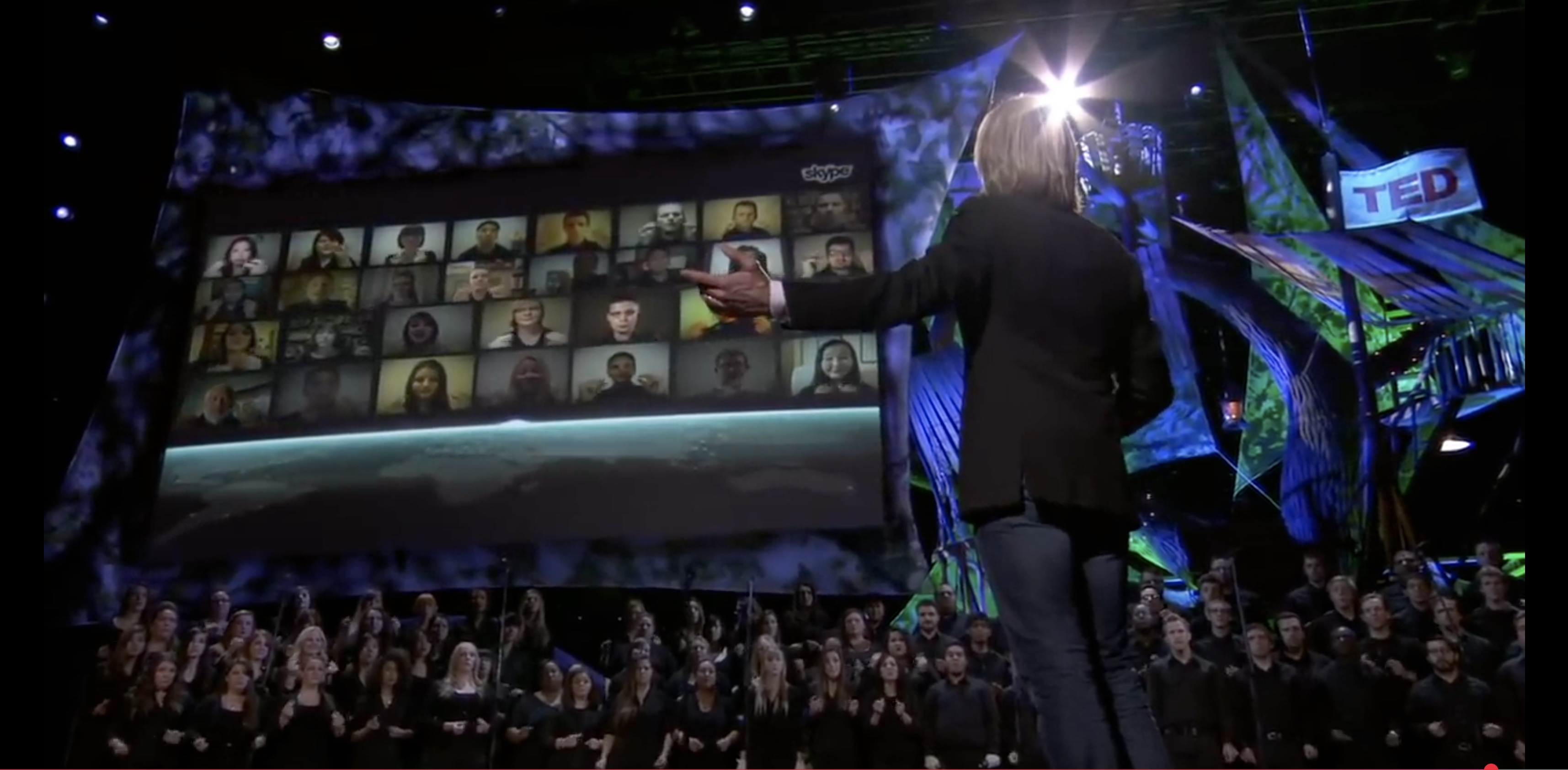
Cloudburst, a Virtual & Live Choir and TEDTALK (2013) by Eric Whitacre

Well… sorry this blog has grown to be so large! If you admit to understanding the potential hazards of and precautions for integrating social media, social networks and other technologies into education, we’ll close with the following bibliography of additional resources for further study. If that is not enough to whet your curiosity, stop back in several months to download a copy of my slide summary for the session I will present at the DCMEA Winter Conference on January 30, 2026.

Be careful stay safe and professionalbut ENJOY!

Sample Blogs

Several Major Platforms

Examples of Music Applications/Websites

PKF

© 2025 Paul K. Fox
Sharing is Caring!

Join the “Fox Network”

“There is no joy in possession without sharing.”
— Erasmus

“Share your knowledge. It is a way to achieve immortality.”
— His Holiness the Dalai Lama

“There is no delight in owning anything unshared.”
— Seneca

“The miracle is this: The more we share the more we have.”
— Leonard Nimoy

This is a quick blog-post to announce my upcoming professional development initiatives, and an invitation to share your own pet peeves or “thoughts, theories, and teachings.” Of course, I will give you full credit for any contributions, “tips and techniques,” background research, or “quotables” provided!

It has been a challenge motivating any reactions to these articles. Although they would be most welcomed, we typically receive very few online remarks. (If you would like to voice your opinion or add anything to the conversation, PLEASE click on the “comment” button next to the title at the top of the page.)

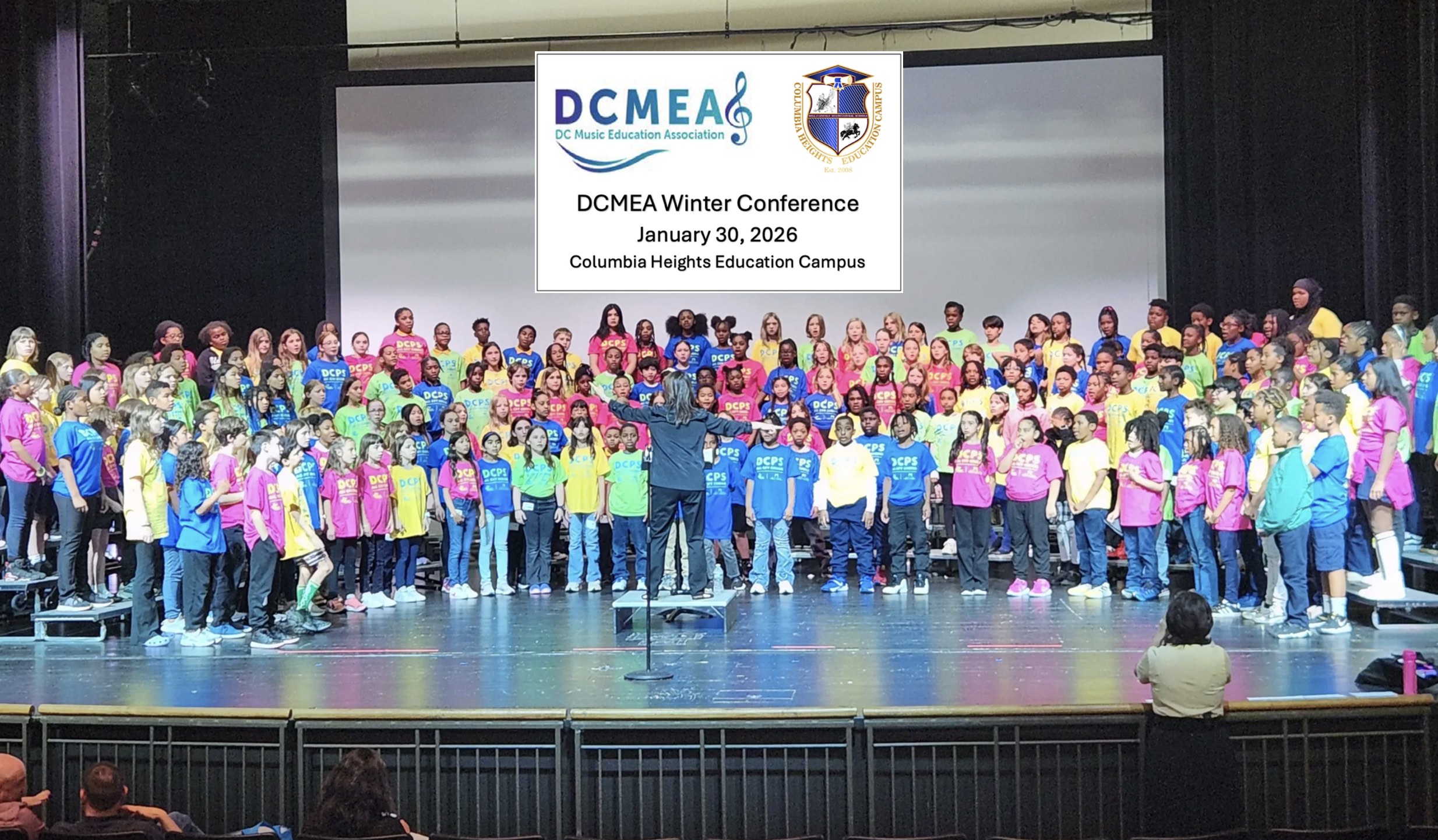
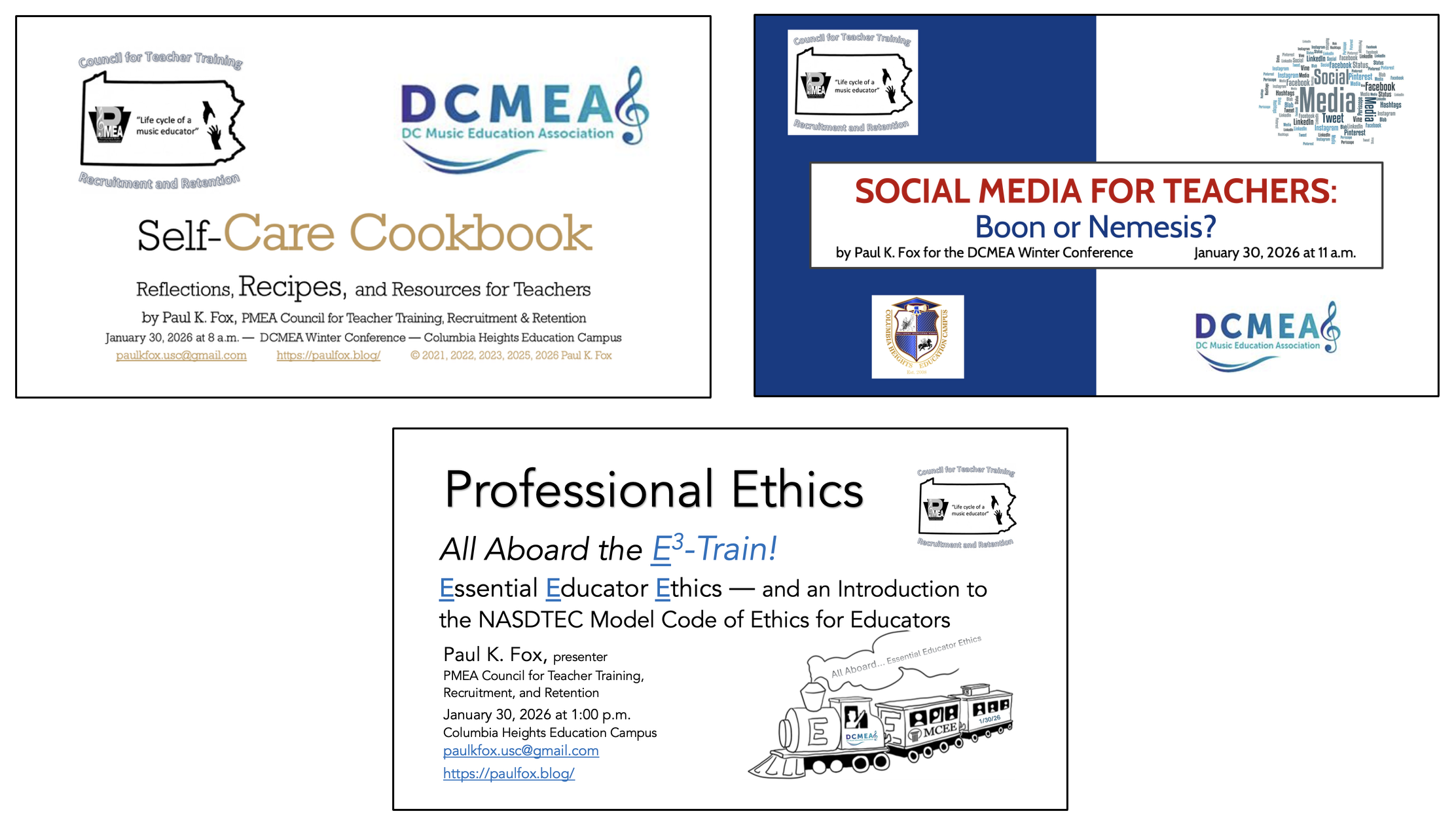
I feel privileged to have been asked to present three sessions at the DCMEA Winter Conference at the Columbia Heights Education Campus (3101 16th St NW, Washington, DC 20010) on January 30, 2026. These are for music educators undergoing pre- and in-service training and include the following:

  • SOCIAL MEDIA – Boon or Nemesis?
  • ALL ABOARD THE E3 TRAIN – Essential Ethics for Educators
  • SELF-CARE COOKBOOK – Reflections, RECIPES, and Resources for Music Teachers

I would especially appreciate learning about any of YOUR “success stories” or resources on…

  • Favorite examples of “safe and meaningful” social media for teaching music students.
  • Anecdotes of ethical “conundrums” or issues in the daily decision-making of music educators.
  • Sample “stress-reducers,” time management tips, and other self-care strategies to avoid music teacher burnout.

In addition, I am in the process of updating my INTERVIEW 101 and EMPOWERING EDUCATOR & STUDENT LEADERSHIP clinics for future blog posts and clinics. Any thoughts?

Finally, I would also love to hear from you if you have any feedback on a proposed future sharing session for the parents of music students called ADVICE TO MUSIC BOOSTERS. If you have ever sponsored a music parents advocacy group for your school music program, what suggestions would you give to your colleagues and booster officers?

Feel free to reach out to me via email here. Thank you for your willingness to help our profession!

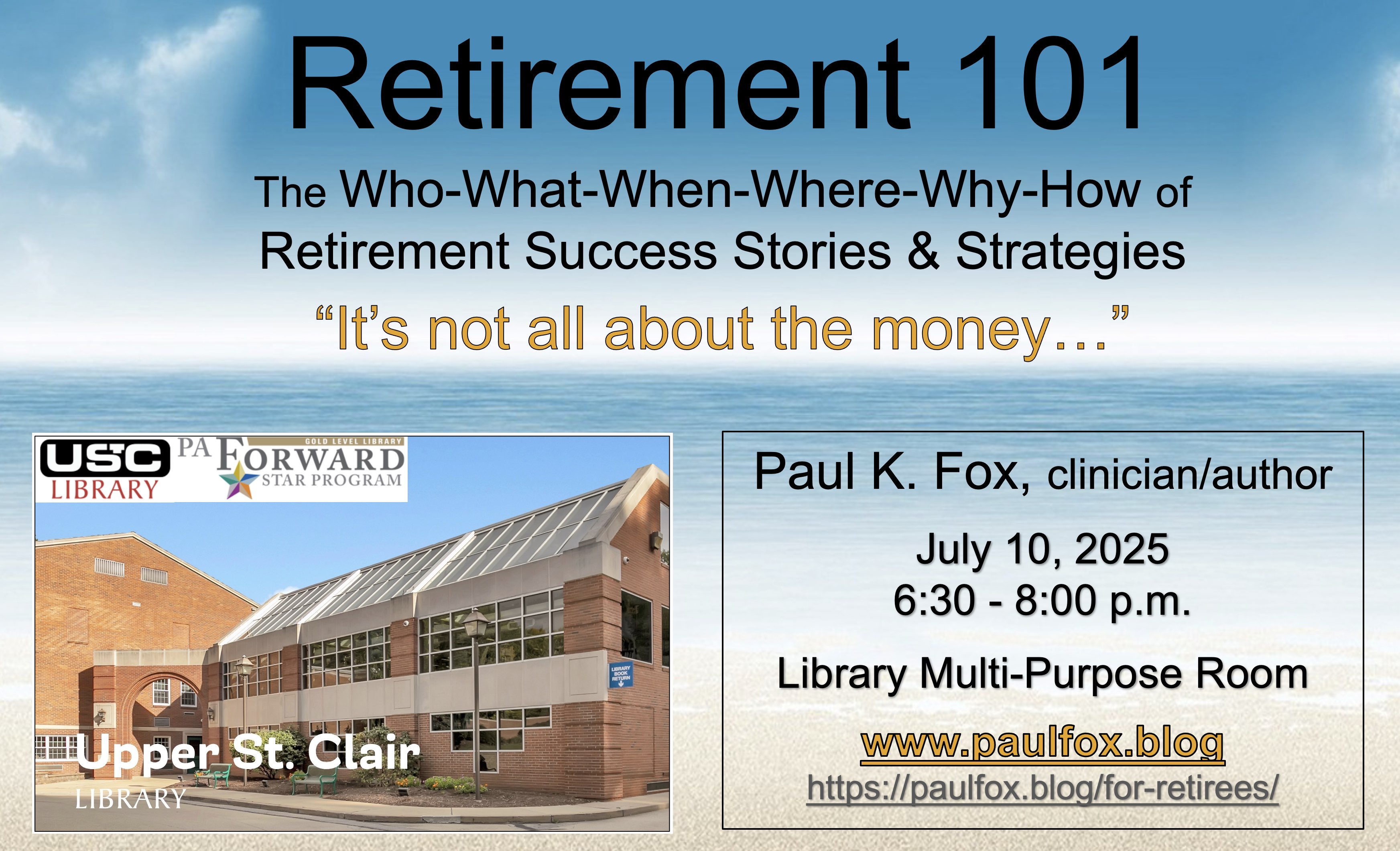
Editor’s Note (things to look forward to): In mid-July, our next blog for this series geared to “the life cycle of a music educator” will be from guest author Ed Carter entitled “Bigger Dreams, Bigger Home: How Retirees Can Upsize for Homesteading and Hosting.” In addition, I plan to share links to materials of the “Retirement 101 – It’s Not All About the Money,” a free workshop I am presenting to residents at the Upper St. Clair Township Library on July 10, 2025.

PKF

© 2025 Paul K. Fox
For Book-Lovers (Retired or Not)

Summer is the Time to Catch-up on Your Reading!

The character “Robert McCall” (played by Denzel Washington) in the vigilante action-thriller film series The Equalizer (directed by Antoine Fuqua) mentioned that his late wife was working through “The 100 Books Everybody Should Read” when she died, so he decided to carry on the tradition. It is not clear the exact list he was referring to, but we found a blog by Gillian that settled on Goodreads 100 Books from The Equalizer, for which a checklist is provided by https://uncomplicatedspaces.substack.com/p/100-books-everyone-should-read-pdf.

How many of these can you claim to have read?

Personally, I go through stages… seeking new releases, exploring best-sellers, perusing used or discounted book stores and thrift shops, and revisiting past favorites in my library.

Recently, I have “relaunched a personal voyage” to consume the entire series in sequence of the memorable adventures of classic historical fiction from the Napoleonic Wars, featuring Captains Horatio Hornblower (by C.S. Forester), Richard Bolitho and his nephew Adam Pascoe Boltho (by Alexander Kent, pseudonym of Douglas Reeman), and Lord Nicholas Ramage (by Dudley Pope). You should “cruise” samples of all of these!

If you are a history buff, please enjoy each edition slowly, reveling in the authors’ craftsmanship and immersing yourself in the language, settings, culture, customs, and what life must have been like during that period (~1800-1850) of intense conflicts between France (led by Napoleon Bonaparte) and England (most notably, paralleling the real-life of British naval hero, Horatio Nelson) and the coalition of European powers following the French Revolutionary Wars. A previously blog (here) related the relevance of Hornblower and learning leadership principles. However, I am especially amazed at the depth and breadth (similar style and content) of the Alexander Kent collection. But, better schedule a lot of uninterrupted quiet time on vacation or at the pool, deck, patio, or beach! It will take you awhile to read all 30 of the Kent books (list below provided in order by www.addall.com):

  1. Midshipman Bolitho (1975)
  2. Midshipman Bolitho and the Avenger (1976)
  3. Band of Brothers (2005)
  4. Stand Into Danger (1976)
  5. In Gallant Company (1977)
  6. Sloop of War (1972)
  7. To Glory We Steer (1968)
  8. Command a King’s Ship (1973)
  9. Passage to Mutiny (1976)
  10. With All Despatch (1988)
  11. Form Line of Battle (1969)
  12. Enemy in Sight (1970)
  13. The Flag Captain (1971)
  14. Signal, Close Action! (1974)
  15. The Inshore Squadron (1978)
  16. A Tradition of Victory (1981)
  17. Success to the Brave (1983)
  18. Colours Aloft! (1986)
  19. Honour This Day (1987)
  20. The Only Victor (1990)
  21. Beyond the Reef (1992)
  22. The Darkening Sea (1993)
  23. For My Country’s Freedom (1995)
  24. Cross of St. George (1996)
  25. Sword of Honour (1998)
  26. Second to None (1999)
  27. Relentless Pursuit (2001)
  28. Man of War (2003)
  29. Heart of Oak (2007)
  30. In the King’s Name (2011)

Yes, we should be turning our attention to nonfiction books, too. According to financial guru and famous talk-show host Dave Ramsey, all of us should have a nonfiction book or two on our bed stand.

Want to be a millionaire? Turn off your television. The average millionaire reads a nonfiction book a month. This is how you make your life better: having knowledge tomorrow that you didn’t have today, and then applying it.  –  Ramsey on Facebook

Dave’s list of books starts off with one of his own: The Total Money Makeover. He also recommends The 7 Habits of Highly Effective People by Stephen Covey, Think and Grow Rich by Napoleon Hill, Good to Great by James C. Collins, The Richest Man in Babylon by George Samuel Clason, Who Moved My Cheese by Spencer Johnson, The E-Myth Revisited by Michael E. Gerber, and How to Win Friends and Influence People by Dale Carnegie.

On a slow day pushing wheelchairs at the local hospital in the Western PA suburbs where I live, my fellow volunteers (Jerry, Rod, and Douglas) and I, all true “bibliophiles” and retirees, brainstormed what were our most inspiring reads. Their list is more spiritual, faith-based, or metaphysical than most:

  • Book of Joy by Dalai Lama and Archbishop Desmond Tutu
  • Conversations with God by Neale Donald Walsch
  • Jesus CEO by Laurie Beth Jones
  • Many Lives, Many Masters by Dr. Brian L. Weiss
  • Mutant Message Down Under by Marlo Morgan
  • Return to Laugher by Elenore Smith Bowen
  • Tying Rocks to Clouds by William Elliott
  • When Bad Christians Happen to Good People by Dave Burchett

Now to the “how-to section,” especially focusing on the quest for “living the dream” in our senior years.

Some of the best books about retirement are really about living life well. It’s been said that a reader lives a thousand lives before he dies. So, if words on a page can introduce us to what it’s like to live in another century or a faraway land, then why not introduce us to life in retirement, too?

Want something new and refreshing for those of us who are already retired or will soon retire? I found this November 2024 Kiplinger post offering “Five Books About Retirement to Prepare You for Your Golden Years” by Jacob Schroeder: https://www.kiplinger.com/retirement/books-about-retirement-prepare-you-for-golden-years

  1. Die with Zero: Getting All You Can from Your Money and Your Life by Bill Perkins
  2. My Brilliant Friend by Elena Ferrante
  3. From Strength to Strength: Finding Success, Happiness and Deep Purpose in the Second Half of Life by Arthur Brooks
  4. The Midnight Library by Matt Haig
  5. The Year of Magical Thinking by Joan Didion

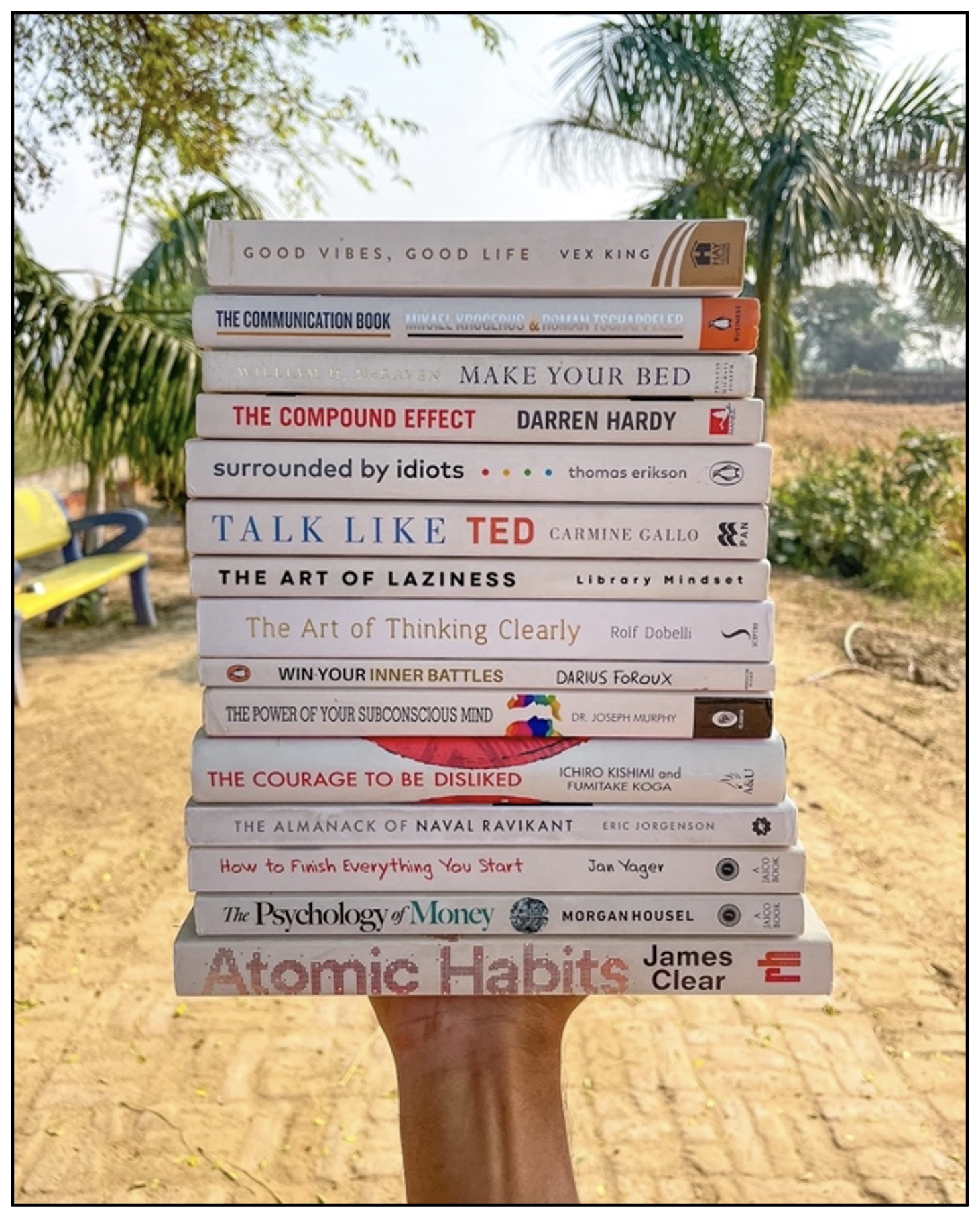
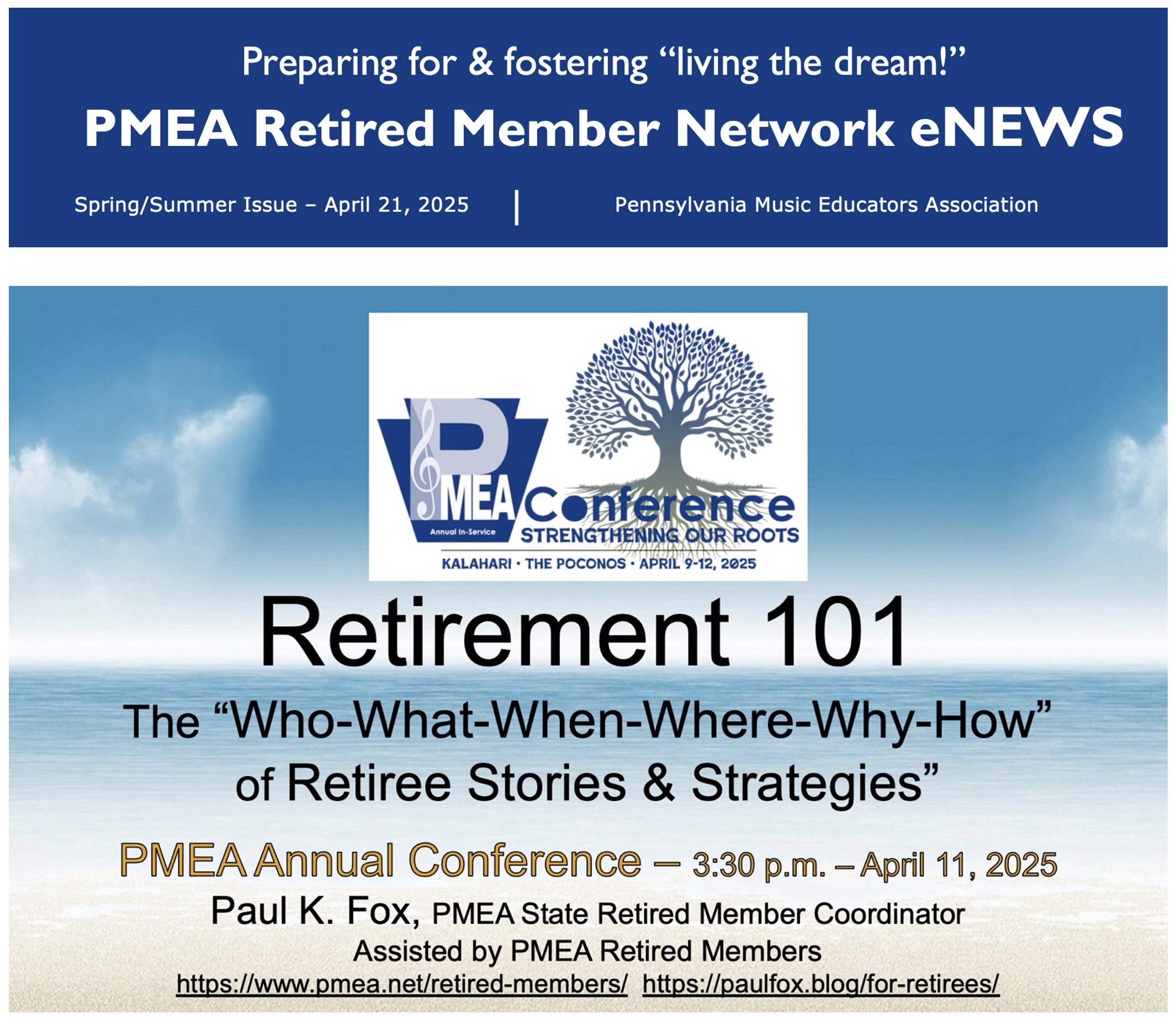
As PMEA State Retired Member Coordinator and editor of Retired Member Network eNEWS, I “float” many images of recommended retirement books to my PA music educator colleagues. If you did not attend the Retirement 101 session at the recent PMEA Annual Conference at Kalahari Resort in the Poconos, take a peek at my annual session’s PDF handout: https://www.pmea.net/wp-content/uploads/2025/04/Retirement-101-PMEA-conference-revised-s041125.pdf.

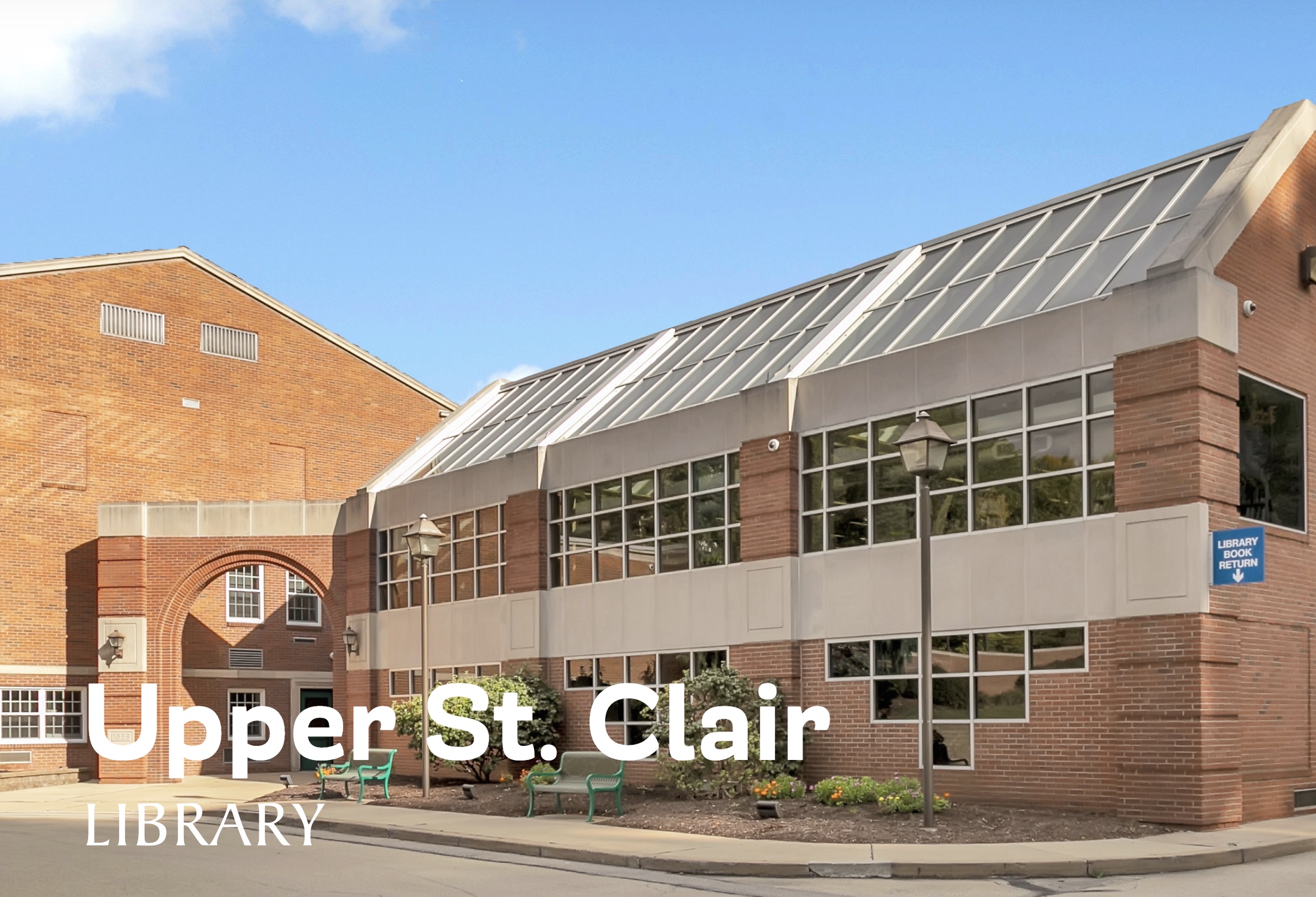
1820 McLaughlin Run Road, Pittsburgh, PA 15241

I am presenting this workshop at the Upper St. Clair Library on July 10, 2025 at 6:30 p.m. in the Multi-Purpose Room. To my local (Western PA) friends: Come see it for yourself!

Finally, if you are looking for additional resources on how to prepare for that major life passage of transitioning to retirement, many books and websites suggested by numerous expert “silver-haired” colleagues who have already “Cross the Rubicon,” all you need do is visit the Retired Member focus area on the PMEA website. (This is a benefit of PMEA membership and why everyone should continue participating in their professional association even after a complete retirement!) For a sneak preview, click on these links:

Best wishes to you and yours. Feel free to comment on this post (top right link near title), or even refer us to other sites of book lists and retirement prep resources.

PKF

© 2025 Paul K. Fox
February Updates…

PROfessional Development!

Education, ethics, professionalism, and lifelong learning.

Hope you are enjoying the winter season and, for many of you, the anticipation of warmer weather returning soon! Sorry, skiers! I am sick of shoveling snow!!

Here’s a quick “catch-up” on things going on in educator professional development.

For PA School Administrators & Educators

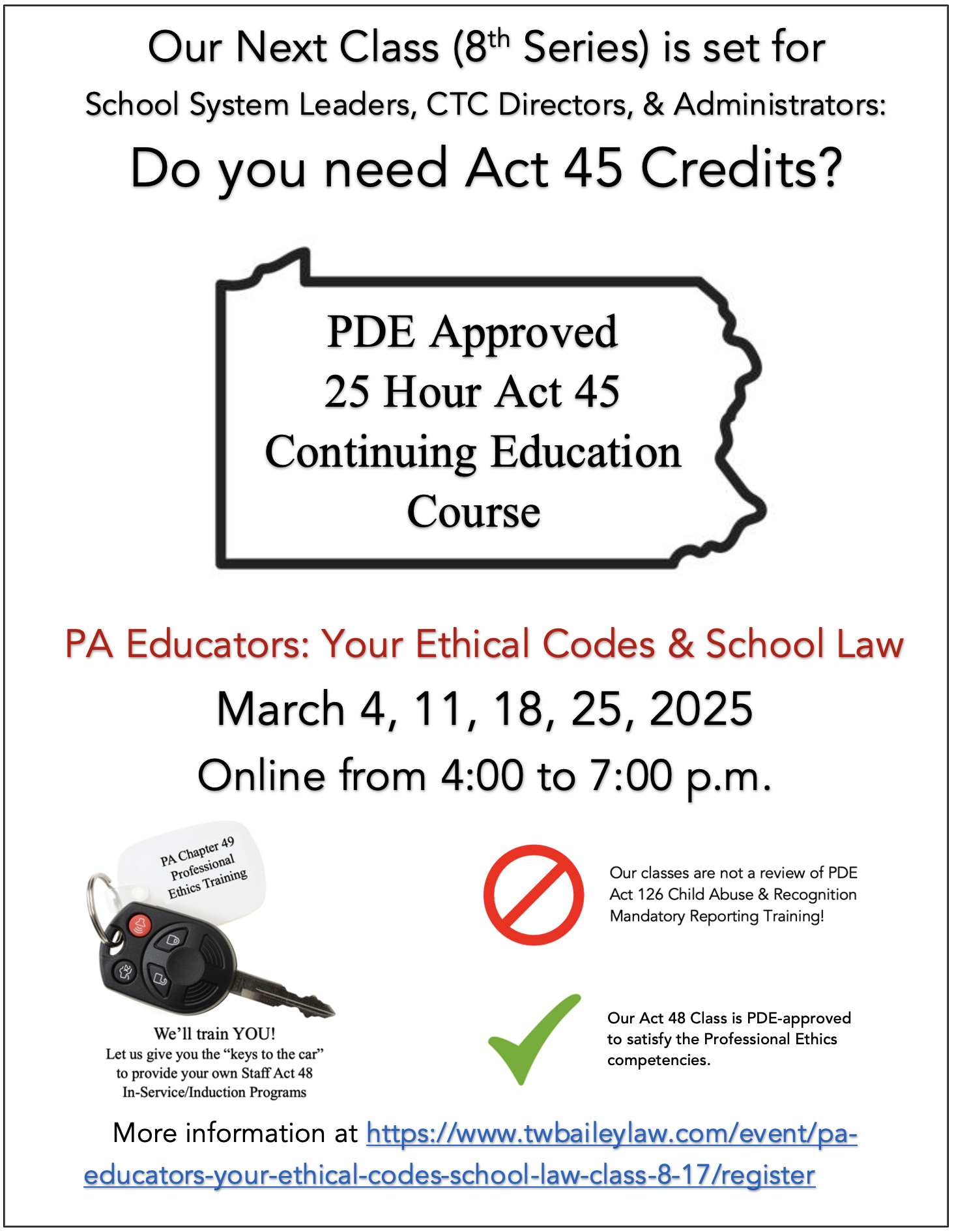
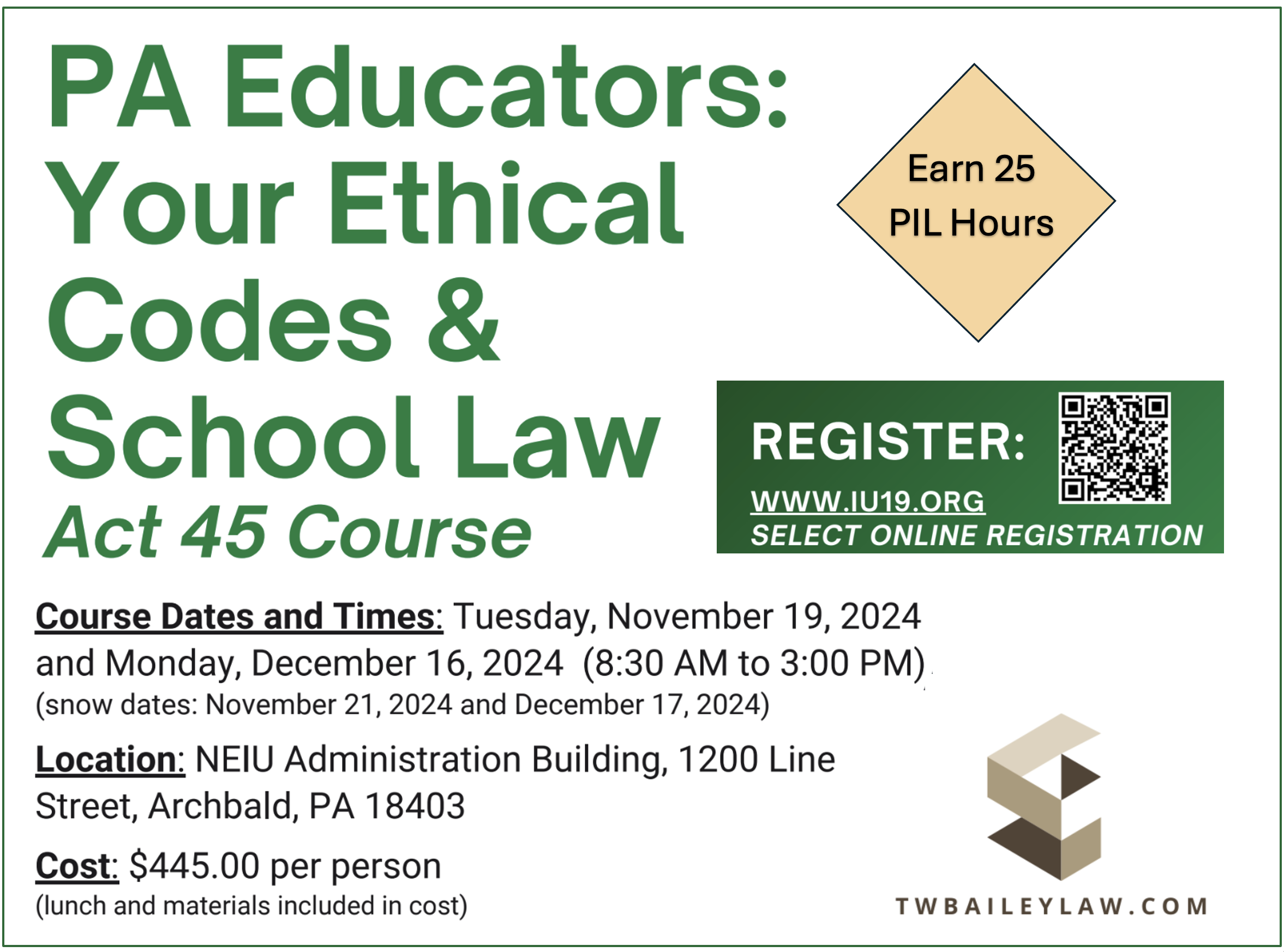
There is still time to register for the upcoming 25-hour, PDE-approved, Act 45 course, “PA Educators: Your Ethical Codes & School Law,” which will cover the recently mandated PA Title 22 Chapter 49 (Certification) Professional Ethics Competencies. The next online series of Act 45 classes will be held Tuesday afternoons in March, and provide “the keys to the car” planning for your own school district’s future continuing education and induction programs in ethics training as required by the PDE.

Now sponsoring our eighth series of classes, I am designated a “qualified instructor” in partnership with the course’s creator/facilitator, retired social studies teacher and attorney Thomas W. Bailey. For more information, please click on these links to his website:

In addition, since over the past year PDE revised their website (and changed most of the content links), I compiled a super-index of “places-to-go” and “things-to-read,” sites of supplemental resources on school ethics here. I recommend visiting this blog if you are interested in our library of links to the Pennsylvania Code of Professional Practice and Conduct, the Model Code of Ethics for Educators, the PA Educators Discipline Act, and research and citations from the PDE, PA Professional Standards and Practices Commission, Connecticut State Department of Education, and Iowa Board of Educational Examiners, among many others.

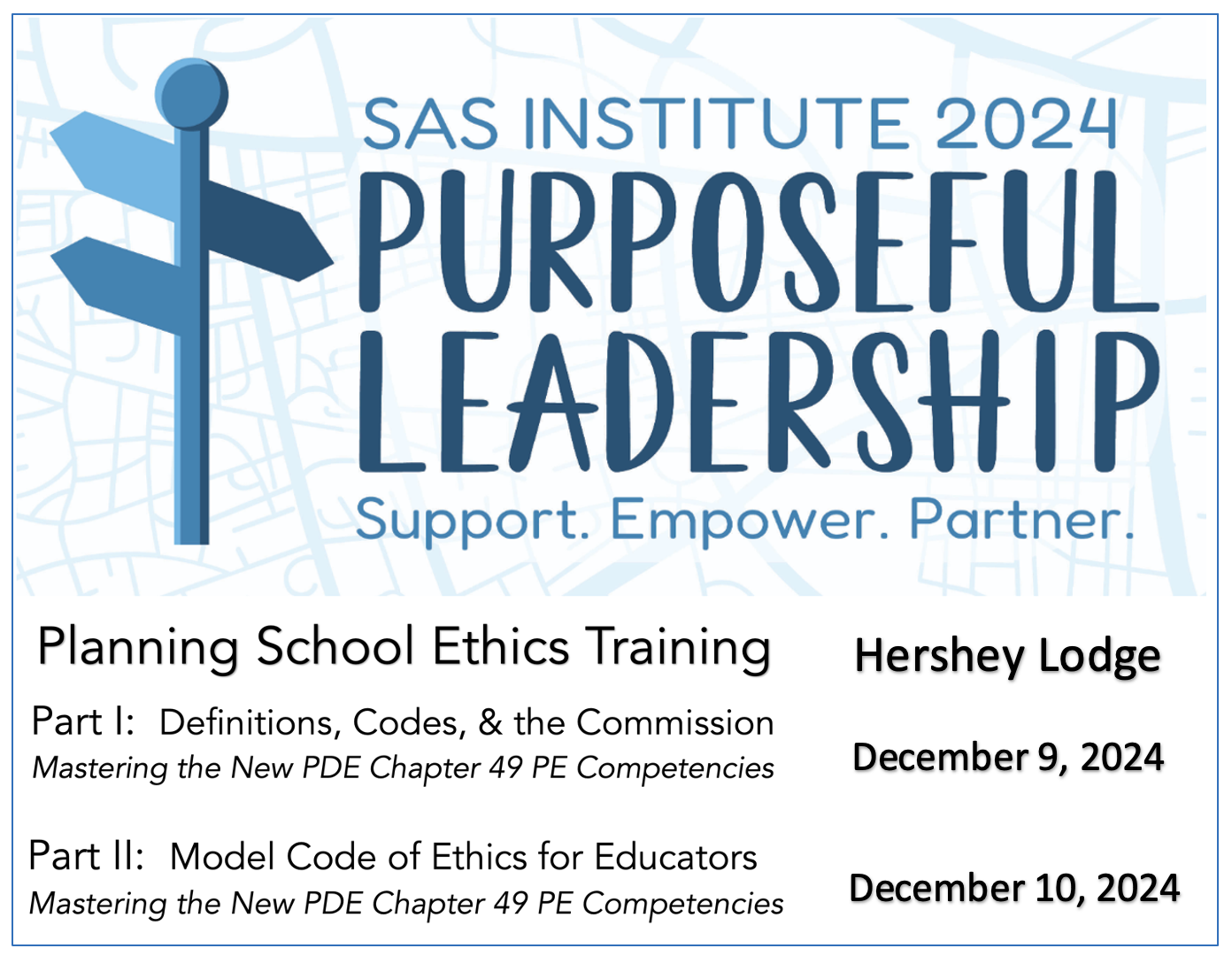
If you would like to see the kind of things we cover in these classes, take a look at the slide summaries I posted from my presentation at the PDE SAS Institute “Purposeful Leadership” state conference last December:

From Pre-Service to Veteran Music Teachers!

It’s that time of the year… again! The PMEA Annual Conference on April 9-12, 2025 will be held in the family-friendly, perfect-for-a-mini-vacation spot in northeastern PA: the Kalahari Resort in the Poconos.

There is still time to register! (Click here.) If you would like to see a summary of the sessions and performances, go to the PMEA website here or download this PDF brochure.

Why attend the conference? In my five-plus decades in education, I may have missed only two or three of the annual PMEA state events, and heartily recommend you remain actively involved in your professional association. This is what I wrote about it in a recent PMEA Retired Member Network eNEWS:

For some of us, it’s a just chance to catch-up with our colleagues, see our friends, and socialize. Others are more focused and take advantage of the near-perfect opportunity to network with other professionals, perhaps seeking new working relationships, partnerships, or even employment. Many are on a look-out for newly published music, that perfect music lesson or teaching strategy, technology tools, fundraisers, advance educational venues, or much-needed equipment to purchase for our ensembles or classrooms. Most come to hear/see the “state of the art” in music education – concerts, demonstrations, keynote speeches, panel discussions, exhibits, research presentations, and workshops. PMEA’s PD Council would likely submit that the primary purpose of a conference is for professional self-improvement… What did Stephen Covey call it? His Habit #7 of “sharpening the saw” – to build a balanced program of self-renewal in the four areas of your life: physical, social/emotional, mental, and spiritual. Covey would insist we embrace “the process that empowers us to move on an upward spiral of growth and change, of continuous improvement.” So, in short, conferences help us “grow” – to revive, re-inspire, re-energize, rejuvenate, re-direct, and re-motivate all of us – pre-service, active in-service, and retired teachers towards making successful new connections, updating our knowledge and skills, and forming new goals. This is how we “keep up” with all the new standards, benchmarks, and cutting-edge advances, and meet the “movers-and-shakers,” visionaries, and leaders in the profession!

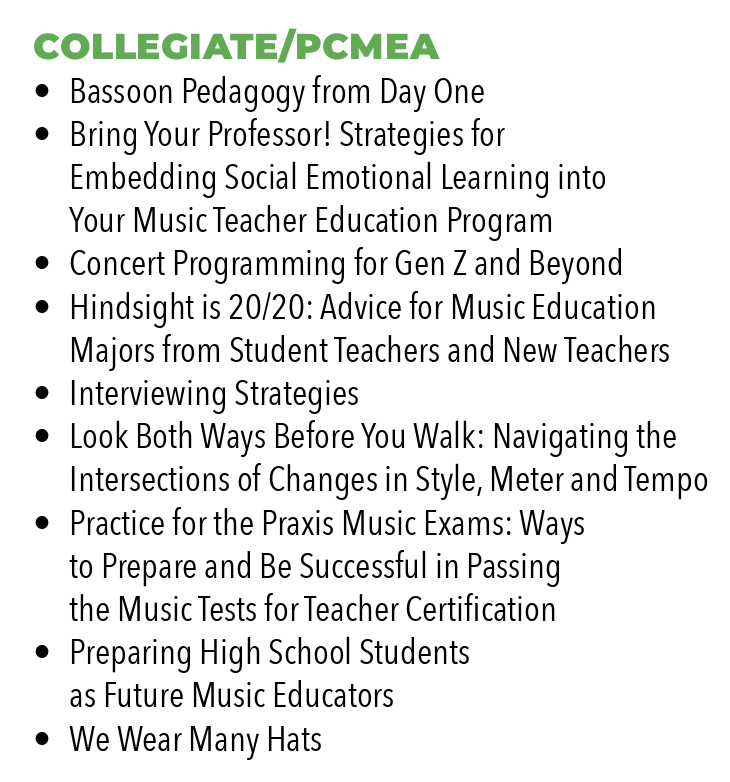
There’s a lot in store for college music education majors. Besides the aforementioned state meetings, concerts, clinics, and keynote addresses no one should miss, the music industry exhibits (new innovations in sheet music, instruments, technology, summer school and graduate programs, etc.), and the chance to introduce yourself to other music colleagues (aren’t some of you looking for a job soon?), there will be a “coffee and connections” informal lounge to ASK-AN-EXPERT on Thursday afternoon to pick-the-brains of PMEA mentors and retirees on any subject. Do you have a question about conducting technique, musical literature, lesson plan idea, classroom or time management tip, or teaching method? And, just take look these sessions the PMEA Professional Development Council has targeted specifically for YOU:

For Retirees… They are special, too!

PMEA Retired Members, consider this your personal invitation to join us at the Kalahari Resort in the Poconos for the chance to catch-up, connect, collaborate and communicate with other colleagues throughout the Commonwealth! (a plethora of “C’s!”)

As usual, we will “break bread” together Friday morning (April 11, 2025) with the annual retiree breakfast. Be sure to register soon for the PMEA Annual Conference (now only $25) and check the “yes” box that you will attend our meeting. Those in attendance will be treated to some “conference swag!”

Retirees are a valuable resource to PMEA! Our experienced retired members are among the best-trained (unofficial) mentors in PMEA. Facing many years of “boots on the ground,” we have at our fingertips numerous strategies to solve problems in education. Frankly, in my opinion, we have a lot to offer “the future of the profession!”

If you are a retired PA music educator, hopefully you have maintained your PMEA membership (dues significantly discounted), and have signed up for the Retired Member Resource Registry to help future “rookie” music educators. (To reach the R3, first login to your PMEA portal here.)

On Friday, April 11, at 3:30 p.m., we are offering a special sharing session for soon-to-retire teachers… the annual one-hour Retirement 101 workshop joined by a panel of experienced retirees: Rick Coulter, Jeffrey Dent, Sister Kathleen Doutt, Dan Klingbeil, Chuck Neidhardt, and Louise & Richard Victor. Active educators who plan to retire over the 1-5 years can learn valuable techniques from us for a smooth transition to post-full-time employment and successfully reinvent, reprogram, and “recharge” themselves to modifying those essential elements of purpose, structure, and community throughout their “golden years!”

My Professional Advertisement

You may have noticed in my last blog-post an outline of past article topics archived at this site, and a complaint that I feel I must repeat myself (or repackage the material) to meet the changing personalized “bookends” – life cycles – specific passages of my readers. The earlier February post was mostly for job seekers. If you were not looking for employment or coming fresh out of college, it may have seemed irrelevant. The same goes for specialty articles on self-care, ethics training, or retirement transitioning… WHEN WOULD YOU BE MOTIVATED TO STUDY THESE?

I have decided to maintain a comprehensive index of my writings (see “Inside” link in the top menu bar). Please visit the sections of this blog-site that matter to you most… and, when things change, come back and look again. You may find something that “hits the spot” or satisfies the needs of your new journey in education or personal/professional life.

I remain willing and able (aka “very interested”) in doing in-person or online sessions for college methods classes, PCMEA chapter meetings, PMEA festival directors’ meetings, PMEA District or Regional PD workshops, or school district/department inservices. Just give me a call. My contact information can be found in the top “About” link. Please visit this section for catalogs of my presentations and articles. FYI, I created this trifold of some of my past work.

Best wishes on your future successes in career development and professional goal setting.

PKF

© 2025 Paul K. Fox
The Get-a-Job Toolbox

Preparing for Those Upcoming Employment Screenings

So much of what I do at this blog-site is to archive articles offering advice on a host of topics:

Surveying my past blogs, I feel like I had to repeat (repackage) the content until my readers reached that particular stage in their career. Once they experience first-hand that sometimes tumultuous “passage,” they would be ready to reflect on this information. But, I doubt they would closely examine it until then. As an example, for more than a decade as the PMEA Retired Member Coordinator, these past articles I wrote for PMEA News and the PMEA Annual Conference’s session Retirement 101 revisit the voluminous insight of gerontologists exploring the “who, what, when, where, and why” of retirement. Regardless at how often it is presented, you tend not to consume advice on coping with post-employment until you feel you are “ready” to retire. This is the same issue for soon-to-graduate collegiates and those transitioning to a new job; who wants to read about branding, marketing, and interviewing until they are in the middle of seeking first-time (or new) employment?

Please click on the “plethora” of links throughout this article to be redirected to these past writings. My apologies in advance to what may seem like to be a lot of duplication!

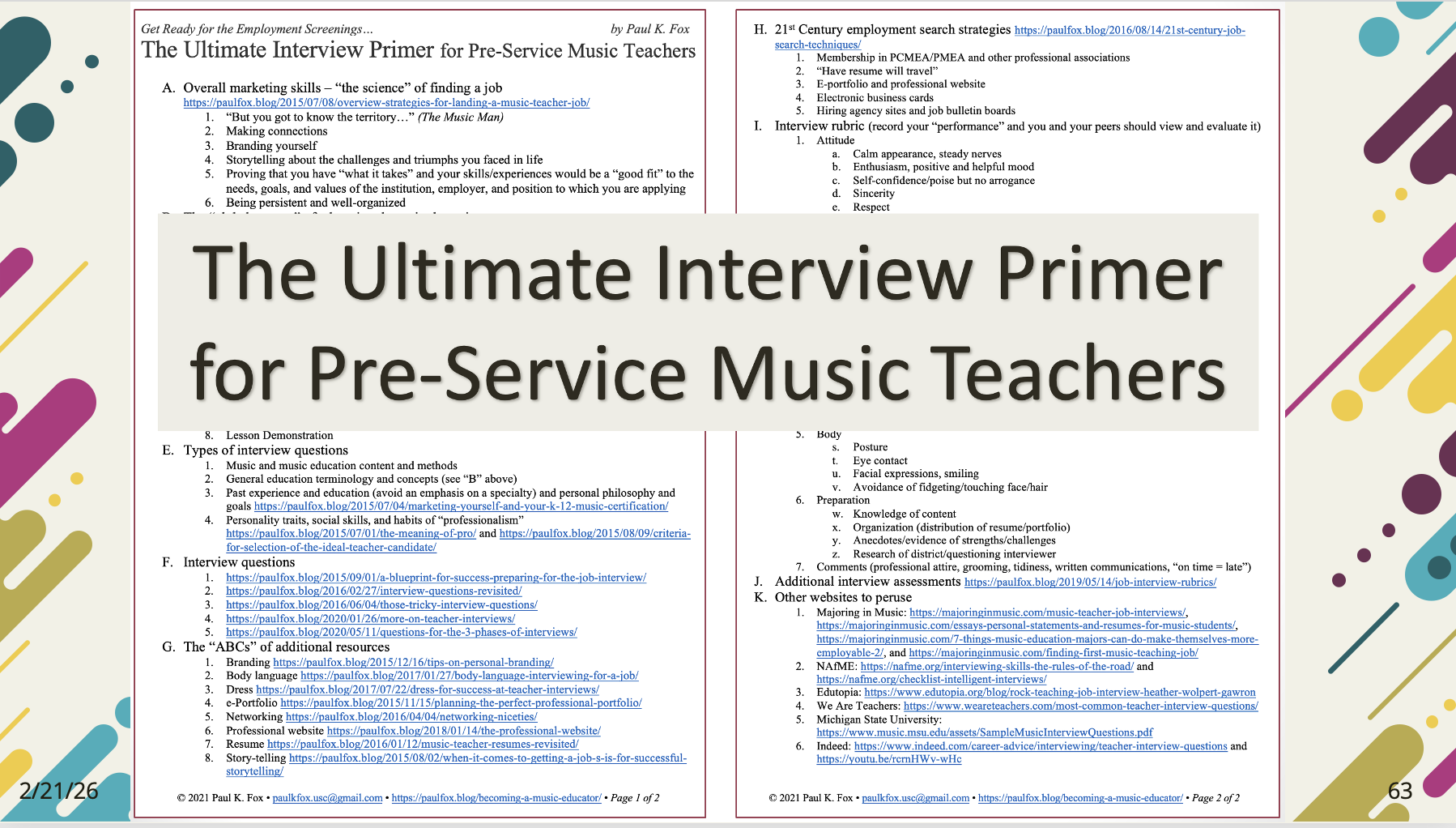
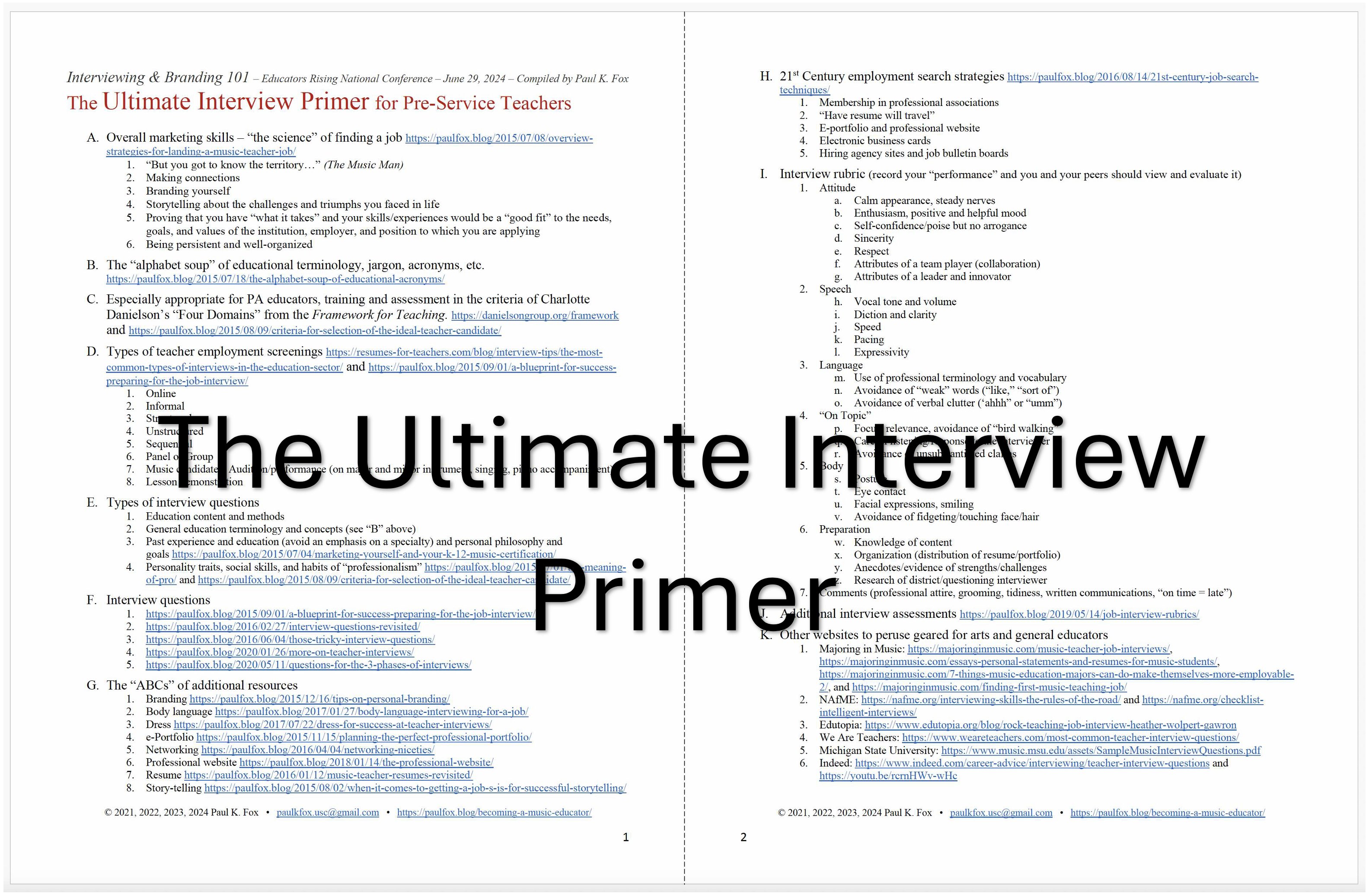
I went as far as updating the most comprehensive and “perfect” PowerPoint for collegiates: Bookends – The Life Cycle of a Successful and Happy Music Educator – portions of which I have presented several times to Professor Jessica Vaughan-Marra’s Seton Hill University music student teachers. This slide handout starts with the material from the first three bullets in the first paragraph above and then adds information about teacher health and wellness, time management, and retirement. We offer Bookends… to preservice music educators in their junior, senior, or graduate years and “rookies” to the profession. I encourage you to download this resource, visit the PCMEA website (click here/scroll down) to read past issues of Collegiate Communique, and the paulfox.blog posts. While you’re at it, acquire your own copy of the Ultimate Interview Primer. Click away before these links become inactive.

Soon it will time for graduates to enter the workforce… and boy, do we need you! By most accounts in PA and the surrounding states, we are experiencing a teacher shortage. School districts are seeking quality candidates to apply for their open positions. But, much of what happens in the job screening process seems to be influenced by chance. Collegiates, ask yourself: Are you truly prepared to market your experiences and abilities, share your brand and stories of your interactions with children in educational programs, and relate positive anecdotes of your teaching, problem solving skills, and other professional attributes? I may have been a little Type-A when I first applied for those music teaching positions back in 1978, focused on saturation publicity and persistence, and organized with a large paper portfolio of past experiences, but I was clueless in responding to those tricky interview questions and what administrators actually wanted to see in prospective new members of their staff.

One more piece advice for first-year and recent transfers to music education: Seek out a PMEA mentor and/or a member of the Retired Resource Registry (access from the PMEA Retired Member focus area after you login to your member portal)… both are groups of volunteers willing and able to help “newbies.”

Have a question about selecting music for your ensemble, a dynamic lesson plan, classroom management issue, interviewing, curriculum innovation, or a conducting tip? Stop by the “coffee and conversations” informal lounge at the PMEA Annual Conference on April 10 and “sit-a-spell” with us!

In conclusion, the following is a sequential outline – a “to-do in this order” list – a preservice toolbox of past posts and other resources for you to assemble a marketing plan. Take time to sort through these “nuts and bolts” (all links in this blog), process the information, save anything you want to read further, and then “practice, practice, practice!” This “gift” to PCMEA and music education majors embraces my best wishes for successfully finding the job you always wanted and preparing yourself for the greatest “calling” of your life – an enriching and satisfying lifelong career in music education! Good luck!

Using the Collegiate Toolbox – A Roadmap for Becoming a Music Educator

  1. Peruse everything in this and past paulfox.blog postings.
  2. Download the PDF documents to your hard drive. Review a portion of them each week!
  3. On your computer, create a “ME” file documenting your accomplishments, awards, experiences interacting with children, etc. – a library of the things you may wish to include in your future resume, professional website, and (e-)portfolio. Add to this folder throughout your college years.
  4. To reflect on your perceived strengths and weaknesses, complete a self-assessment of YOU from a typical professional evaluation form, these ideal effective teacher attributes and more criteria
  5. Prioritize what you think you need most. Write down your goals! Pobody is nerfect!
  6. While you are still attending college, work on shoring up any weak content areas or specialty skills (e.g., how is your “piano chops,” knowledge of specific methods, grade level repertoire, etc.?)
  7. Write a philosophy of school music education (overview) and your mission statement: “Why do you want to teach?”
  8. Be ready to answer the question (and defend your response), “What is your vision of the role of music education in the schools?”
  9. Be ready to define your “brand.” What are your professional attributes? What makes you unique? Why would you be a good candidate for a school music position?
  10. Begin to assemble a list of stories that would “show not tell” your positive attributes.
  11. Identify the impressions you want to “sell” yourself, and practice strategic storytelling.
  12. Practice answering interview questions and use a rubric to evaluate your performance. If you can, share all of this with your peers and sponsor mock interview sessions. Record/assess yourself.
  13. Get started on drafting the marketing tools you will need (e.g., your professional website, resume, portfolio, etc.)
  14. Review educational acronyms, jargon, and terminology such as this list plus these recent additions: CR-SE (Culturally Relevant & Sustaining Education), DEIB (Diversity, Equity, Inclusion, Belonging), and SEL (Social-Emotional Learning). These terms may come up at your next interview.
  15. Read cover-to-cover your PA code of conduct (CPPC) and the Model Code of Ethics for Educators.
  16. Practice ethical decision-making (with your peers) by reviewing these mock scenarios, first deciding what level of misconduct (if any) is reached in each case study, and then more discussion on the incident’s effect on the students, parents, staff, and community, and what proactive steps may be taken to remediate the situation.
  17. Join and become active in appropriate music education professional organizations (renew your memberships and add new ones): ACDA, AOSA, ASTA, NAfME, NBA, PMEA, etc. to name a few.
  18. Attend a conference of your professional association(s) and network with other colleagues. For PA colleagues, register for the PMEA Annual Conference (April 9-12) at the Kalahari Resort (Poconos).

Feel free to leave comments about this blog. (See the link just below the title.) How did you use these tools? What was particularly beneficial? What suggestions would you have for future music teacher applicants?

To PCMEA chapter officers/members, music education majors, and college instructors: I am available to present Bookends or other online or in-person workshops for college students. Send me an email.

© 2025 Paul K. Fox

Exceptional Ethics Training

A Follow-up to the Pennsylvania Educators E-TRAIN

SCHOOL SYSTEM LEADERS, CTC DIRECTORS, & OTHER ADMINISTRATORS:
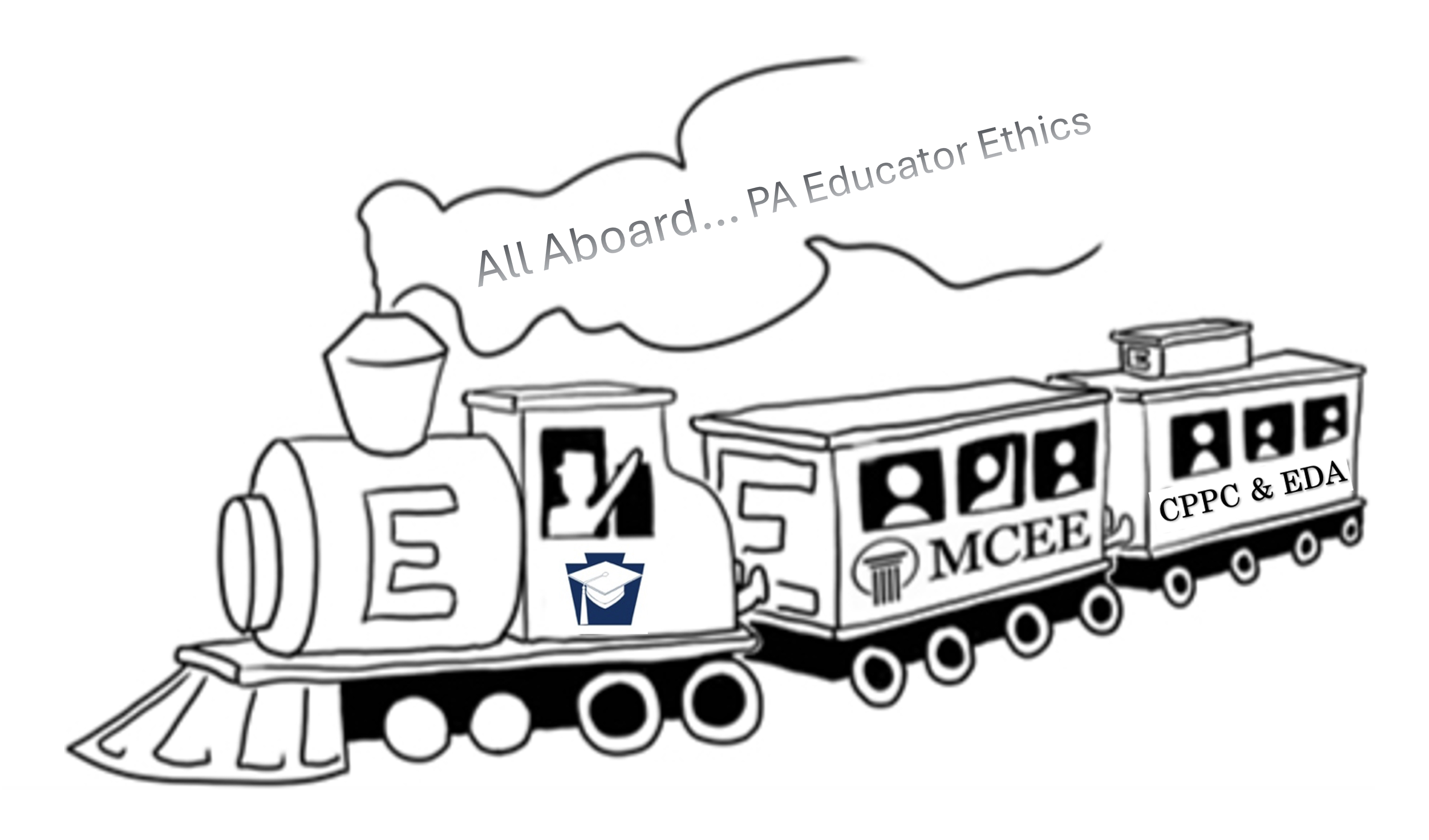
In case you missed my last update here in September 2024, this “express car” blog post will help you “catch-up” on the PDE “company line,” “supply new freight” to your continuing professional development and induction programs, get back “on track” and avoid being “sidetracked” or “derailed” for meeting the newly revised PA Chapter 49 “guard rails” of professional ethics training competencies.

THE ETHICAL WHEELS GO ROUND & ROUND…

You may have noticed that due to compliance regulations, the PDE website was revised with many of its former URL “tracks” leading to “train wrecks.” This “propelled” us towards making an “overhaul” to “connect” the new references (research “destinations”) in my slide presentations. Please use the following index (substituting old “routes”) and travel to our renovated “union station” with the new schedules.

Okay… I will stop “conducting” any more train “puns!”

Recent Ethics Sessions

Slide Summaries for the PDE Purposeful Leadership Conference (if you attended) are available from the SAS Institute’s conference app: Eventsquid.

Upon completion of the 25-hour course, the PowerPoints for all four sessions of the Thomas W. Bailey Act 45 class series were emailed to the participants.

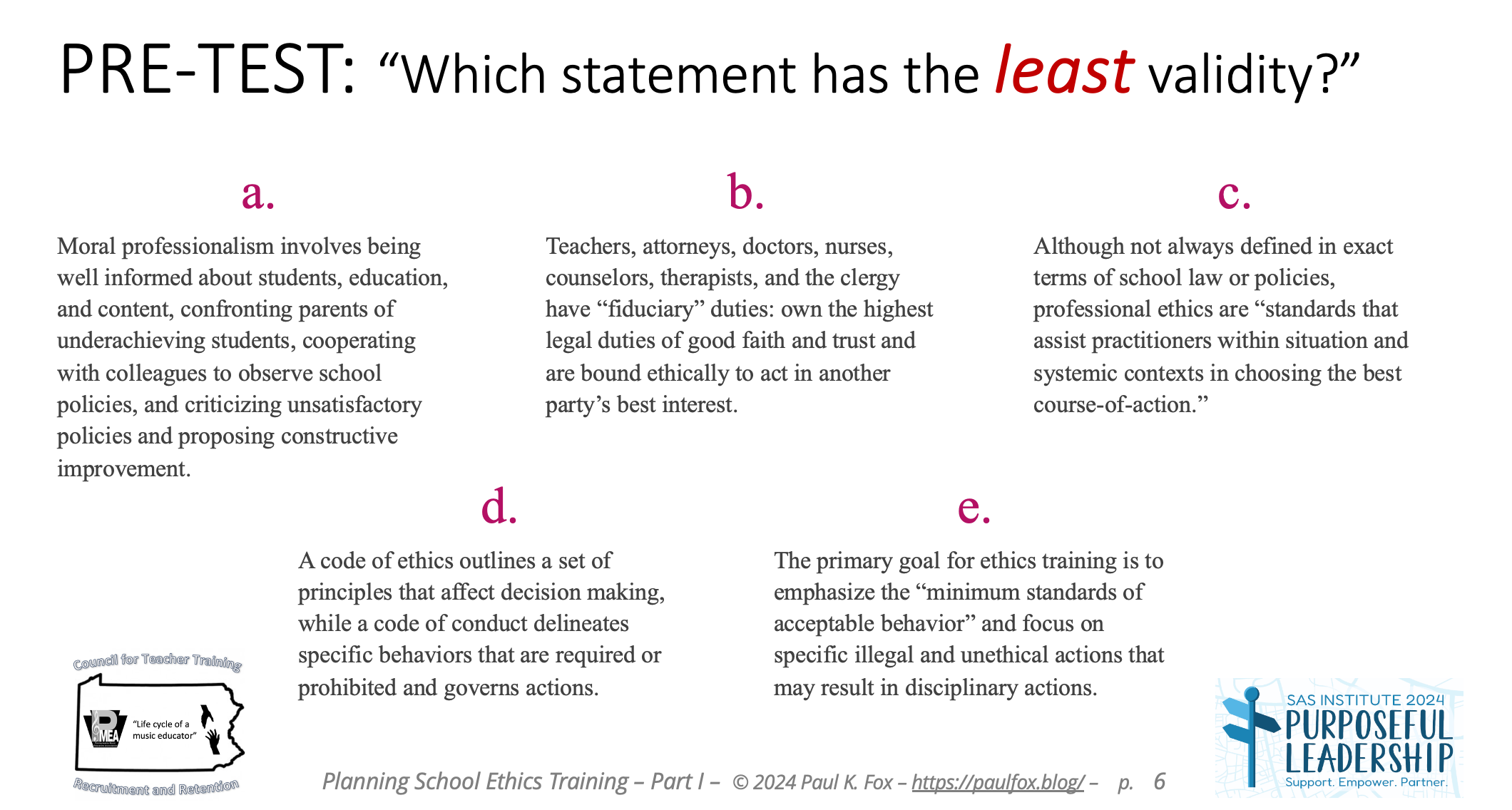
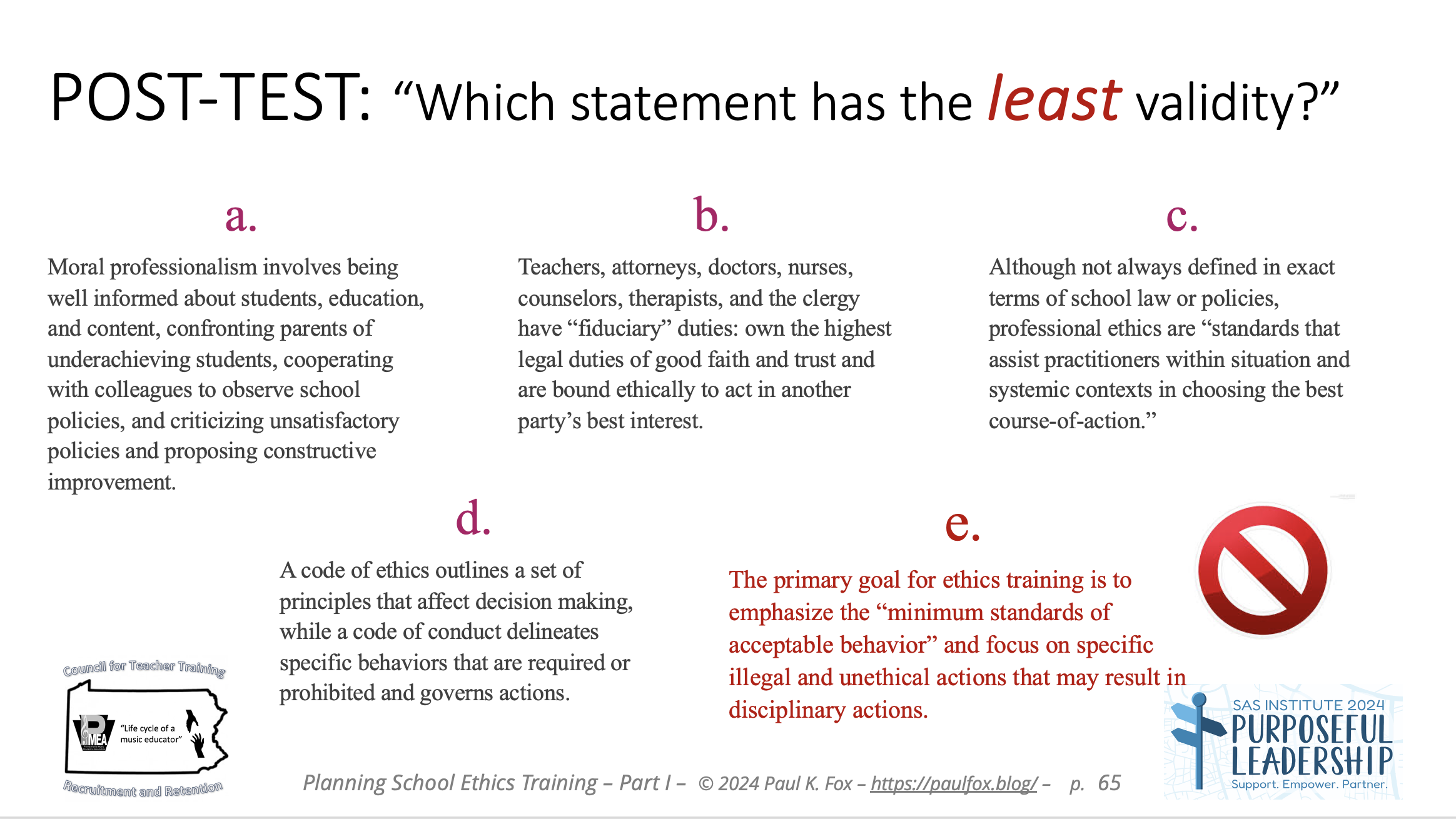
Here is the PRE-TEST for both events.

What is your “best guess?”

UPDATES TO RESEARCH LINKS

Act 126 Child Abuse and Reporting Training
https://www.pa.gov/agencies/pspc/content-pages/outreach/act-126-training.html

Adjudications & Orders (PA Certificate Actions)
https://www.pa.gov/agencies/education/programs-and-services/educators/educator-misconduct/certification-actions.html

Attorney (PA) Rules of Professional Conduct
https://www.padisciplinaryboard.org/for-attorneys/rules

California BTES – Overview of the Ethnographic Study by David Berliner and William Tikunoff
https://journals.sagepub.com/doi/abs/10.1177/002248717602700107?journalCode=jtea

Certificate Actions (Adjudications & Orders)
https://www.pa.gov/agencies/education/programs-and-services/educators/educator-misconduct/certification-actions.html

Chapter 49 Ethics Training
https://www.pa.gov/agencies/pspc/resources/chapter-49-ethics-training.html

Cleveland Board of Education v. James Loudermill (US Supreme Court 1985)
https://www.twbaileylaw.com/blog/educator-court-case-blog-1/may-a-school-district-employee-be-dismissed-without-prior-opportunity-to-respond-to-allegations-of-wrongdoing-4

Code of Professional Practice and Conduct
https://www.pacodeandbulletin.gov/Display/pacode?file=/secure/pacode/data/022/chapter235/chap235toc.html&d=reduce OR
https://paulfox.blog/wp-content/uploads/2024/12/code-of-conduct-revised.pdf

Codes (Conduct vs. Ethics), Types of
https://www.amazon.com/Music-Education-Your-Hands-Introduction/dp/0415800900

Commission Publications (Professional Standards & Practices Commission)
https://www.pa.gov/agencies/pspc/resources/commission-publications.html

Connecticut State Department of Education TEAM Program Manual
https://portal.ct.gov/sde/team/teacher-education-and-mentoring-team-program/documents

Contract Termination 11-1122 Public School Code of 1949
https://govt.westlaw.com/pac/Document/NB5B9C950342F11DA8A989F4EECDB8638?viewType=FullText&originationContext=documenttoc&transitionType=CategoryPageItem&contextData=(sc.Default)

Criminal History 1-111 Public School Code of 1949
https://govt.westlaw.com/pac/Document/NB6D6E91007EE11EA8D85D136C641FF9C?viewType=FullText&originationContext=documenttoc&transitionType=CategoryPageItem&contextData=(sc.Default)

The Danielson Group
https://danielsongroup.org/

Digital Tips (Online Boundaries) for Educators (Professional Standards and Practices Commission)
https://www.pa.gov/agencies/pspc/resources/commission-publications/digital-tips-for-educators.html

Educator Discipline Act
https://www.pa.gov/content/dam/copapwp-pagov/en/pspc/documents/statutes-regs-forms/educator%20discipline%20act.pdf and
https://www.pspc.education.pa.gov/Statutes-Regulations-Policies-Forms/Educator-Discipline-Act/Pages/default.aspx

Educator Misconduct
https://www.pa.gov/agencies/education/programs-and-services/educators/educator-misconduct.html

Ethical Dilemmas of In-Service Music Educators by Joelle L. Lien
https://act.maydaygroup.org/articles/Lien11_1.pdf

The Ethical Educator (Frequently Asked Questions)
https://www.pa.gov/content/dam/copapwp-pagov/en/pspc/documents/ethical-practices/publications/the%20ethical%20educator%20and%20professional%20practices.pdf

Ethical Equilibrium – Troy Hutchings’ work
https://slideplayer.com/slide/12243050/ and
https://vimeo.com/126979216

Ethics Toolkit – Teacher Preparation Programs (missing from revised PDE website?)
https://www.pa.gov/agencies/pspc/resources/information-for-school-administrators/teacher-preparation-programs.html
Web archive: https://web.archive.org/web/20240807121601/https://www.pspc.education.pa.gov/Promoting-Ethical-Practices-Resources/Ethics-Toolkit/Pages/default.aspx

General Assembly (PA)
tps://www.legis.state.pa.us/

Iowa Board of Education Examiners (Moral vs. Ethical Standards)
https://slideplayer.com/slide/12203932/

Loudermill Hearings – Court Case Blog (US Supreme Court 1985)
https://www.twbaileylaw.com/blog/educator-court-case-blog-1/may-a-school-district-employee-be-dismissed-without-prior-opportunity-to-respond-to-allegations-of-wrongdoing-4

Model Code of Ethics for Educators
https://www.nasdtec.net/page/MCEE_Doc and
https://www.nasdtec.net/page/MCEE_Video_Series

Moral Development Philosophy by Lawrence Kohlberg
https://archive.org/details/essaysonmoraldev0000kohl

Moral Professionalism (Wynne, E. A. (1995). The moral dimension of teaching)
https://www.itejournal.org/wp-content/pdfs-issues/spring-2013/08bergman.pdf

Moral v. Ethical Standards (Iowa Board of Educational Examiners)
https://slideplayer.com/slide/12203932/

National Association of State Directors of Teacher Education and Certification
https://www.nasdtec.net/ and
https://www.nasdtec.net/page/MCEE_Video_Series

Pennsylvania Code & Bulletin (Title 22 Education)
https://www.pacodeandbulletin.gov/Display/pacode?titleNumber=022&file=/secure/pacode/data/022/022toc.html&searchunitkeywords=&operator=OR&title=null

Pennsylvania Code (Title 23 Child Protection Services)
https://govt.westlaw.com/pac/Document/NAD136501756B11E88795828A65D8C1A1?viewType=FullText&originationContext=documenttoc&transitionType=CategoryPageItem&contextData=(sc.Default)

Professional Ethics Program Framework Competencies
https://www.pa.gov/content/dam/copapwp-pagov/en/education/documents/educators/certifications/professional%20ethics%20program%20framework%20guidelines.pdf

Professional Standards and Practices Commission
https://www.pa.gov/agencies/pspc.html and
https://www.pacodeandbulletin.gov/Display/pacode?file=/secure/pacode/data/022/chapter233/chap233toc.html and
https://www.pa.gov/agencies/pspc/resources/commission-publications.html

Public School Code of 1949
https://www.legis.state.pa.us/WU01/LI/LI/US/HTM/1949/0/0014..HTM or
https://govt.westlaw.com/pac/Document/NB5B9C950342F11DA8A989F4EECDB8638?viewType=FullText&originationContext=documenttoc&transitionType=CategoryPageItem&contextData=(sc.Default)

Rules for Teachers (1872 & 1915)
https://www.openculture.com/2013/09/rules-for-teachers-in-1872-1915-no-drinking-smoking-or-trips-to-barber-shops-and-ice-cream-parlors.html

Simon Sinek
https://simonsinek.com/

Slater v. PDE Case Citation
https://caselaw.findlaw.com/court/pa-commonwealth-court/1465107.html

Statutes, Regulations, Policies and Forms (Department of Education)
https://www.pa.gov/search.html#q=Statutes%20Regulations&f-copapwpagency=Department%20of%20Education,Department%20of%20Health or
https://www.pa.gov/agencies/education/programs-and-services/educators.html

Teacher Preparation Programs
https://www.pa.gov/en/agencies/pspc/resources/information-for-school-administrators/teacher-preparation-programs.html

Thomas W. Bailey Court Case Blogs
https://www.twbaileylaw.com/blog

Thomas W. Bailey PDE-Approved Act 45/PIL and Act 48 Courses
https://www.twbaileylaw.com/

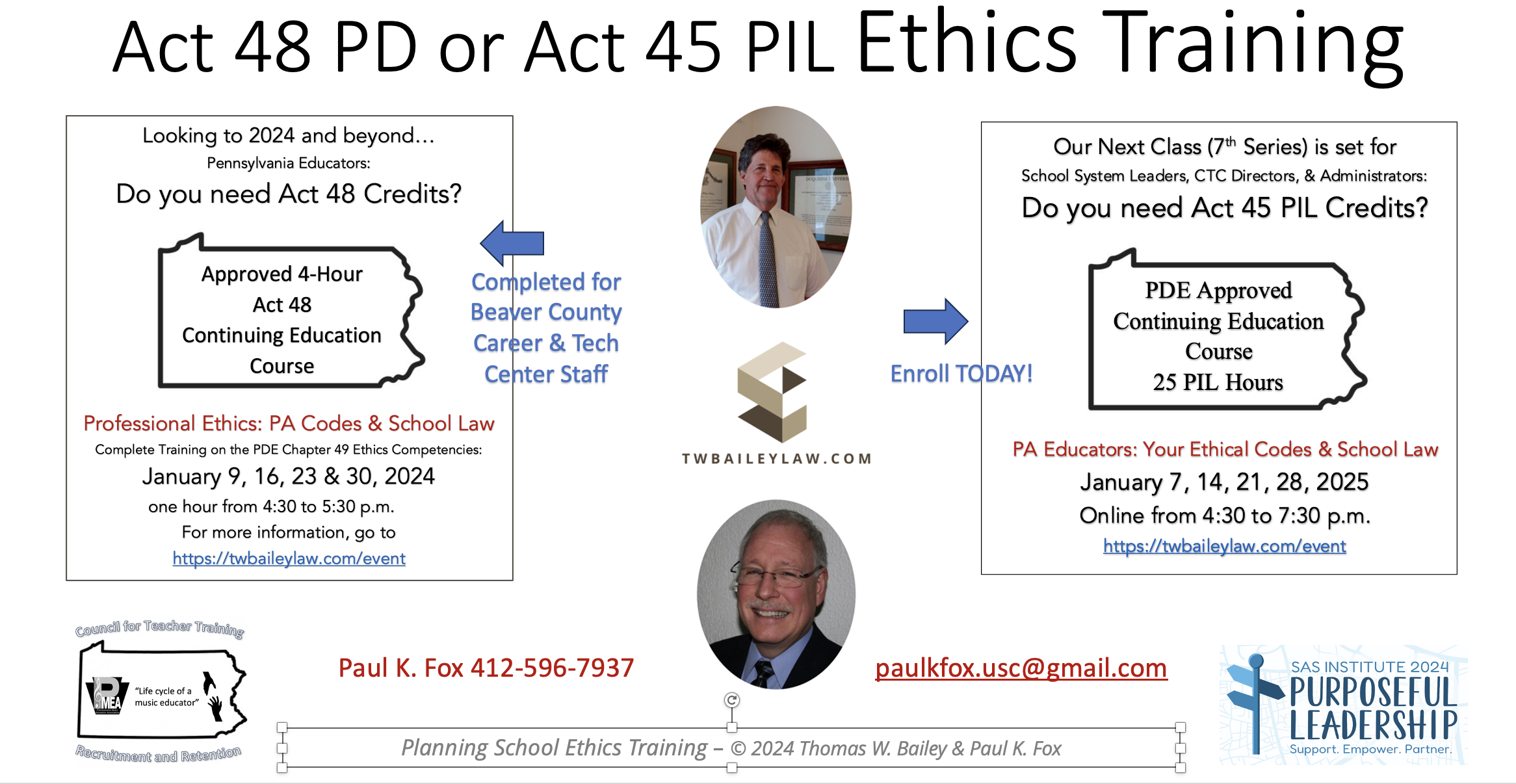
If you missed the SAS Institute 2024 in Hershey and still need help in designing your own educator ethics training in-service or mentor/mentee induction programs, check out the Thomas W. Bailey website here. Consider registering for our next 25-hour PDE-approved Act 45 online course.

Finally, the answer to the above PRE-TEST is letter “D” (NOT):

Please reach out to Paul Fox (click here) if you find any of the above links have gone inactive or have suggestions/updates to this blog-post.

PKF

© 2024 Paul K. Fox
Our Next Chapter

Bookends – Stage 5: “Living the Dream”

Welcome back to my blog site for music educators… actually hopefully thought-provoking reflections for teachers in any subject area or grade level, school administrators, classified school staff (secretaries, aides, custodians, etc.), and professionals in all fields.

It has taken me more than a year to revisit (and expand on) all of the sections from my workshop (October 2023) presented to Seton Hill University music education students, and now we close with “The Final Chapter” – a focus on self-reinvention and transitioning to retirement in anticipation of successfully Crossing the Rubicon to enjoy our “senior years.” This entire presentation was inspired by the mission statement of the Pennsylvania Music Educators Association (PMEA) Council for Teacher Training, Recruitment, and Retention – “The Life Cycle of a Music Educator” – for which I had the privilege of serving eight years as the State Chair (still a council member). To recap, here is an outline of my previous blogs on the evolution of an educator, a journey through career “passages” to follow:

Stage 5: Next Chapter/Living the Dream Years –
Retirement Prep & Mastery

To start with, the term “retirement” is a misnomer. Typically, in most dictionaries (online and printed), it is defined as “the withdrawal from one’s career, occupation, or office usually because of age,” or even the synonyms “seclusion from the world,” “privacy,” “the act of going away,” “retreating,” or “disappearing.” No, perhaps more appropriate definitions would support the advances in medical science, a better standard-of-living, our healthier lifestyles and improvements in self-care, and longer lifespans. Retiring from your first career may only be the halfway point! Sample online quotes:

“The ‘new retirement’ is not an ending, it’s a new beginning, the start of a new life journey of vastly expanded proportion.” Dr. Richard Johnson, Flourishing in Retirement

“Retirement now is mostly about change. And it may not look all that different from what immediately precedes it.” Huffington Post: http://www.huffingtonpost.com/arianna-huffington/its-time-to-retire-our-definition-of-retirement_b_5774878.html

Retirement is “reinventing yourself for the life you’ve always wanted.” Steven Price, How to Survive Retirement, Skyhorse Publishing, 2015

In my experience hosting the annual PMEA conference session “Retirement 101 – the Who, What, When, Where, Why and How” and sharing retiree stories and strategies, I have come to the conclusion that there are many other misconceptions about taking this big step:

  • You retire FROM something. (Nope! You need to retire TO your next phase of life, new goals, pursuits, etc., and not run away from your past. We have often paraphrased the theme of author Ernie Zelinski writings in past paulfox.blogs: Retirees must search for and define the things that your job had provided in the past: 1) Purpose/new life mission, 2) Structure/schedule, and 3) Community/interaction with people.)
  • It’s an easy transition. (For many, it can feel like the most tumultuous transition ever experienced with “change,” sometimes overwhelming swings in emotions, and personal challenges!)
  • It takes little time to prepare. You just fall into it! (No, the research recommends “intentional and comprehensive” advance preparation, starting at least 3-5 years before you “pull your plug.”)
  • The decision is based almost entirely “on the money.” (True, a soon-to-be-retiree should draft a post-employment household budget, analyze net worth and pension/social security benefits, pay off as many loans as possible, and make appointments with an estate planner, elder attorney, and/or financial advisor. However, we retire for a host of very personal reasons – travel, relocation, encore or new careers, caring for family members, etc., and the likely greater challenge is a renewed exploration of self-reinvention, defining new pathways, renewing relationships, and mapping out your rest-of-life strategies and goals. In other words, what are you going to be when you grow up?)
  • It’s completely different from anything you’re doing right now. (Music educators have a variety of skill sets that they will likely retain in future part/full-time employment or volunteer work. They can advance their personal artistry in the singing or playing an instrument, accept solo “gigs” or perform in community or professional ensembles. They can teach privately, direct church or community bands, orchestras, choirs or jazz groups, coach sectionals, compose music or design halftime shows, judge school groups, present workshops, choreograph/direct musicals, serve in college music education programs, etc. The list goes on and on… and is only limited by the retiree’s imagination and interest.)

In almost every book on retirement, there are discussions about the “stages of retirement” (defined by gerontologists – experts on aging) that graphically show the importance of advance planning. (See below.) The first three stages certainly provide opportunities to rethink, recharge, reinvent, retool, and redefine one’s life purpose and meaning, become productive, and begin that new chapter in their lives.

Retirement can be a little bumpy. It’s not unusual to feel many “up’s and down’s” through the transition. A lot may have to do with whether you had really wanted to leave your job when you did or if you took the necessary steps in retirement preparation. Many have suggested to take a year or two “internship” to explore your options, rest a little and take a break from all of that stress, celebrate the free time (you seem to) instantly have, and then assess and “test” what might be your next (more permanent) steps.

Prepare for the emotional roller-coaster! Initially, you are very EXCITED about your upcoming retirement. You feel pure JOY about the anticipated FREEDOM, and everyone throws you a party or two. You take moments to sum up your career legacy and ACCOMPLISHMENTS. A blessed PEACE-OF-MIND envelopes you, no longer having to worry about that next concert, recruitment campaign, or lesson target. With the future in front of you, you feel OPTIMISM. And then, after the excitement dies down…

At times, you feel a little AMBIVALENT about all of this “change!” SADNESS could come saying good-bye to your colleagues and experiencing a loss in professional identity and sense of purpose. Perhaps you may experience ANXIETY (angst) about what the future will hold, and PESSIMISM on whether you will “get it together” in your new life.

But, finally… ACCEPTANCE and adjustment!

Both emotional cycles may happen at different times or nearly simultaneously. These are normal “speed bumps,” and the perfect reason why you should remain as active as you can with your relationships, especially with people who have already made the retirement journey.

Are you ready to retire over the next 3-5 years? Well, as the PMEA Retired Member Coordinator for ten years (with the help of numerous inspirational music teacher retirees in PMEA), I have spent a lot of time preparing what amounts to be a “mock instructional manual” and other resource materials for fellow PMEA members. These are all posted here on the PMEA website. (This one of the best reasons to maintain your PMEA professional association and pay your dues… We continue to advocate, advise, and assist all PA music educators… from preservice to “living the dream!”)

Free “nuts and bolts” are listed below for you to peruse as you prepare for this life-changing passage.

What’s next? How about attending the PMEA Annual Conference on April 9-13, 2025 at the Kalahari Resort/Poconos (“home of the world’s largest indoor water park!”) and enjoy some time away from it all? The Kalahari offers some family-fun recreation and PMEA will provide concerts, keynotes, exhibits, and sessions of stimulating professional development for the entire “life cycle of the music educator.”

PMEA members, I hope you plan to attend my Friday session at the conference…

Looking forward to seeing you there! At any time, if you need help or more ideas on retirement prep, I’m just a quick email away. (Click here.) Let me hear from you!

PKF

© 2024 Paul K. Fox

Educator Ethics Training Revisited!

ALL ABOARD THE E-TRAIN… Embarking and Embracing a Journey of Essential Educator Ethics

The wheels of the train go round and round…

“All black, well stacked, goin’ down the track clickety clack” = the train looked good on the visual roll-by inspection.

“Highball it out of here” = proceed at maximum permissible speed

“Let’s pull the pin and roll” = uncouple so we can get out of here

The fall season is bringing upon us a series of ethical workshops, classes, and the creation of other resources, and the perfect time to warehouse everything at the main rail terminal! Take an excursion below to learn more about “staying on track” with research on the responsibilities and “regs” for serving as an educator.

Can you name the exact title of your Code of Conduct? What agency enforces it? Do educators have a Code of Ethics? Are school teachers fiduciaries or model exemplars? What does all of this mean?

First, let’s take a pretest of your knowledge and experience on the subject of school ethics. Which of the following statements has the least validity?

  1. Moral professionalism involves being well informed about students, education, and content, confronting parents of underachieving students, cooperating with colleagues to observe school policies, and criticizing unsatisfactory policies and proposing constructive improvement.
  2. Teachers, attorneys, doctors, nurses, counselors, therapists, and the clergy have “fiduciary” duties: own the highest legal duties of good faith and trust and are bound ethically to act in another party’s best interest.
  3. Although not always defined in exact terms of school law or policies, professional ethics are “standards that assist practitioners within situation and systemic contexts in choosing the best course-of-action.”
  4. A code of ethics outlines a set of principles that affect decision making, while a code of conduct delineates specific behaviors that are required or prohibited and governs actions.
  5. The primary goal of professional ethics training is to emphasize the “minimum standards of acceptable behavior” and focus on specific illegal and unethical actions that may result in disciplinary actions.

After a thorough exploration of the materials below, you should feel confident in responding to this question. (If you need help, scroll down to answer at the end of this blog-post.)

Classes and Conferences on Ethics, Oh My!

I am looking forward to sharing insights on ethical issues and especially the seeming “conundrums” or conflicts in the myriad of snap judgments of daily decision-making, both in and outside of our classrooms. Upcoming opportunities are on the ethics e-train schedule.

Currently, we are completing the sixth series of our 25-hour PDE-approved Act 45/PIL online course for school/system leaders, career and technical center directors, and other administrators. Sponsored by my colleague Thomas W. Bailey (check out his website here), the next class “PA Educators: Your Ethical Codes & School Law” begins on October 22 for four consecutive Tuesdays from 4:30 to 7:30 p.m.

Thomas Bailey and I were also invited to present this Act 45/PIL course for the Northeastern Intermediate Unit #19 as a two-day workshop on November 19 and December 16, 2024. Visit http://www.iu19.org or click here to register.

I am venturing out of the Western PA to Eagleville, PA (near Valley Forge) to provide a 70-minute in-service, a school ethics “refresh” for the faculty at Methacton School District on October 14, 2024. Click here to download a copy of the slide summary with all links active.

Finally, I am happy to report that I was invited back to the PDE SAS Institute to do two sessions: “Planning School Ethics Training, Part I – Definitions, Codes, and the Commission” and Planning School Ethics Training, Part II – Model Code of Ethics for Educators. My proposal to present the session “CATCH THE E-TRAIN – Codes, Case Studies, and the Challenges of Ethical Decision-Making” was not approved for the 2025 PMEA Annual Conference in Kalahari Resort (Poconos). However, a facsimile of similar slides from past NAfME/PMEA workshops and webinars on educator ethics is available here.

Supplemental Resources for the Study of Codes, Case Studies, and the Challenges of Daily Decision-Making in Education

And now, the grand daddy of school ethics destinations…

Past paulfox.blog posts on educator ethics

Especially for Pennsylvania educators, pre-service students, and newcomers to the Commonwealth (citing the PA Professional Practices and Standards Commission website)

From other state governments (all rights reserved)

An additional sampling of articles

WHY STUDY ETHICS? Answer to the PRETEST above.

A code of ethics sets a higher threshold than regulatory codes of conduct or even a nonprofit organization’s bylaws and compliance rules enforced by the government. A code of conduct, such as the Pennsylvania “Code of Professional Practices and Conduct” of the PSPC, provides absolutes for employment, licensure, and/or civil/criminal sanctions. In contrast, the Model Code of Ethics for Educators document serves more as a general compass to help steer professionals towards sound judgment in their daily decision-making. What is unique about a true code of ethics vs. a code of conduct is that the principles are not defined in exact terms of law or policies, nor do they necessarily model family morals or values on which we as individual educators have been raised. The proposed standards are not about definite issues of right/wrong or black/white, but shades of grey. They are more open-ended, offering opportunities to discuss recommendations for consideration from a set of possible choices based on the circumstances of each ethical dilemma or resolution.

– excerpt from “The Ethical Music Educator,” Winter 2020 issue of PMEA News

Teachers are ethical professionals. Our moral aspirations, the “codes” and “standards” we subscribe to, and our professionalism are important to us, our students, our programs, and our communities. Essentially, these are the beliefs for which we stand, the values and behavior we model in our day-to-day decision-making to “make a difference” in the lives of our students, and the overall integrity of the profession. Therefore, the answer to the PRETEST above is #5. (#1-4 are TRUE!) But, as stated in #5, the goal of meaningful ethics training is NOT to emphasize the minimum standards of acceptable behavior or to focus on specific illegal and unethical actions that may result in disciplinary actions.

Do you have anything to add to this collection? ALL ABOARD! The conductor would appreciate feedback! Please feel free to make a comment to this blog (see link next to the title).

PKF

© 2024 Paul K. Fox