Sharing is Caring!

Join the “Fox Network”

“There is no joy in possession without sharing.”
— Erasmus

“Share your knowledge. It is a way to achieve immortality.”
— His Holiness the Dalai Lama

“There is no delight in owning anything unshared.”
— Seneca

“The miracle is this: The more we share the more we have.”
— Leonard Nimoy

This is a quick blog-post to announce my upcoming professional development initiatives, and an invitation to share your own pet peeves or “thoughts, theories, and teachings.” Of course, I will give you full credit for any contributions, “tips and techniques,” background research, or “quotables” provided!

It has been a challenge motivating any reactions to these articles. Although they would be most welcomed, we typically receive very few online remarks. (If you would like to voice your opinion or add anything to the conversation, PLEASE click on the “comment” button next to the title at the top of the page.)

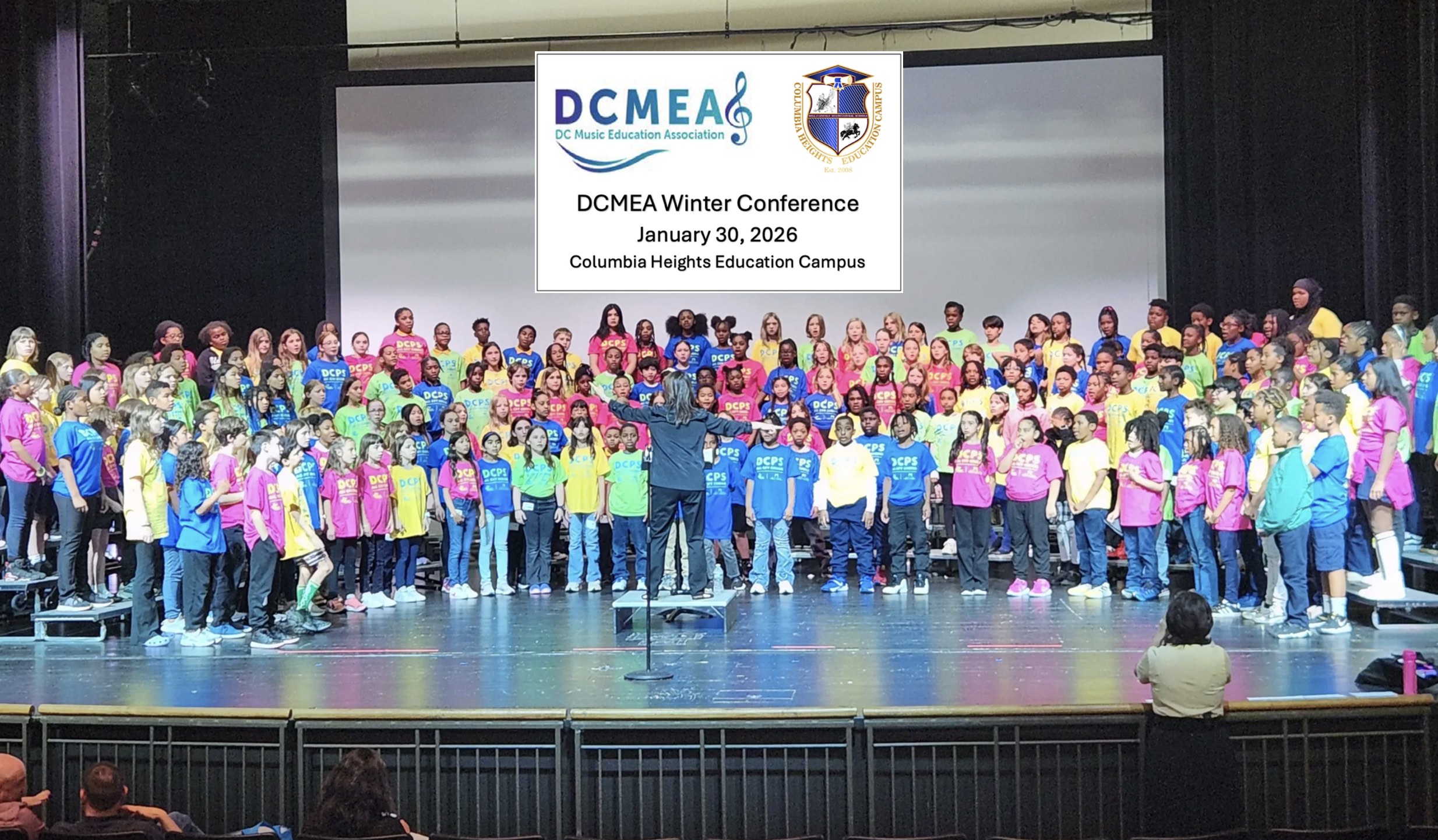
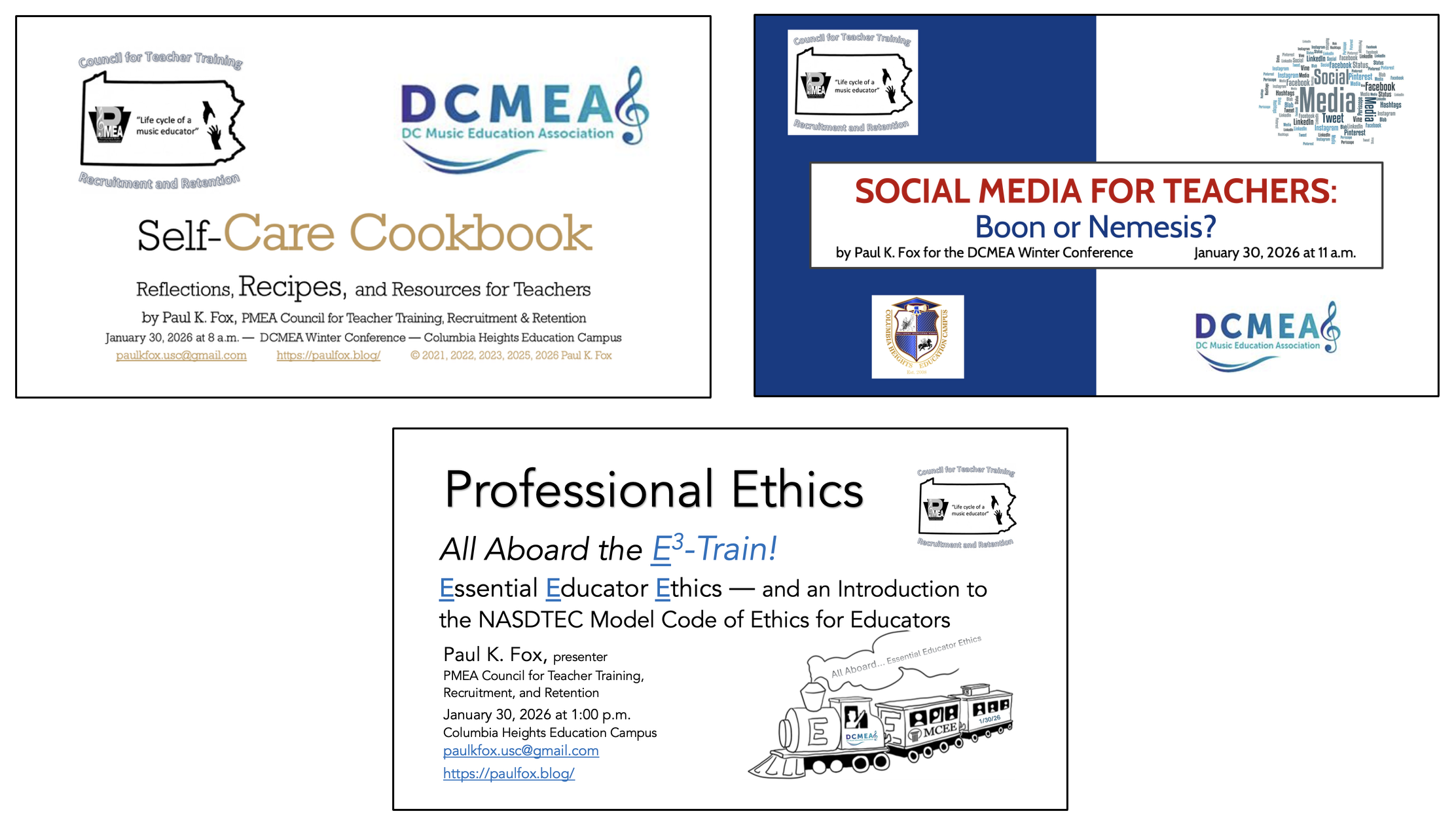
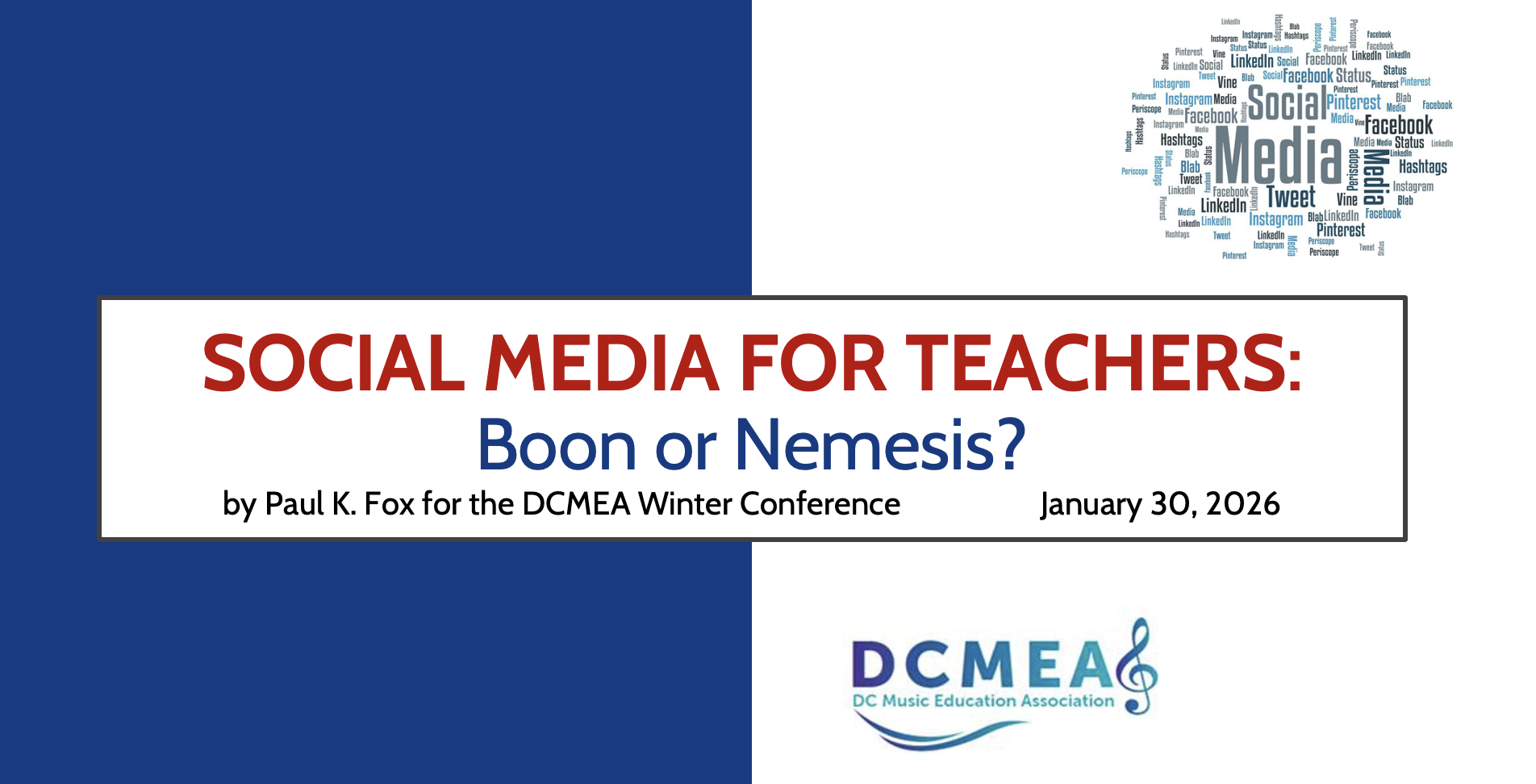
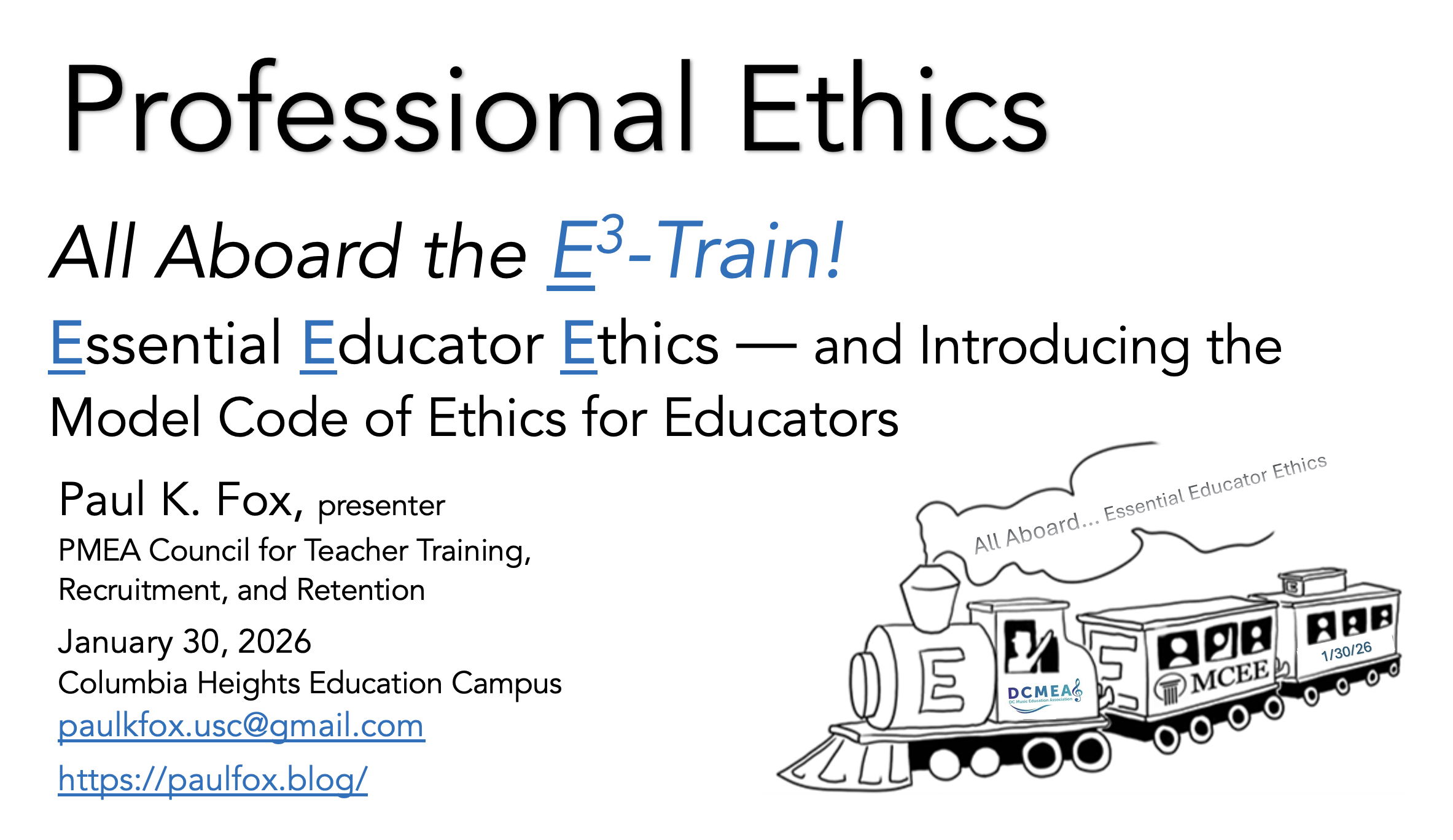
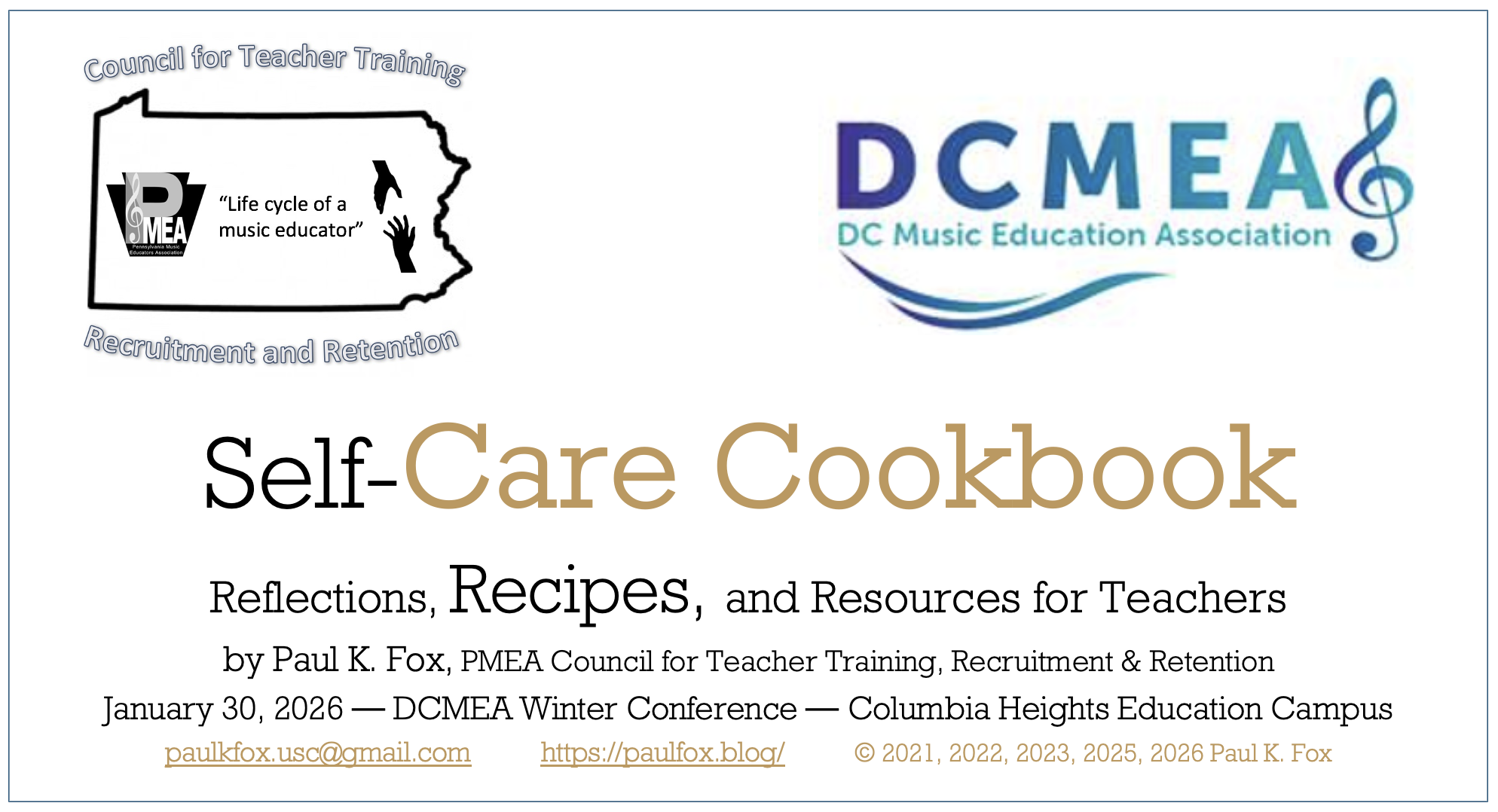
I feel privileged to have been asked to present three sessions at the DCMEA Winter Conference at the Columbia Heights Education Campus (3101 16th St NW, Washington, DC 20010) on January 30, 2026. These are for music educators undergoing pre- and in-service training and include the following:

  • SOCIAL MEDIA – Boon or Nemesis?
  • ALL ABOARD THE E3 TRAIN – Essential Ethics for Educators
  • SELF-CARE COOKBOOK – Reflections, RECIPES, and Resources for Music Teachers

I would especially appreciate learning about any of YOUR “success stories” or resources on…

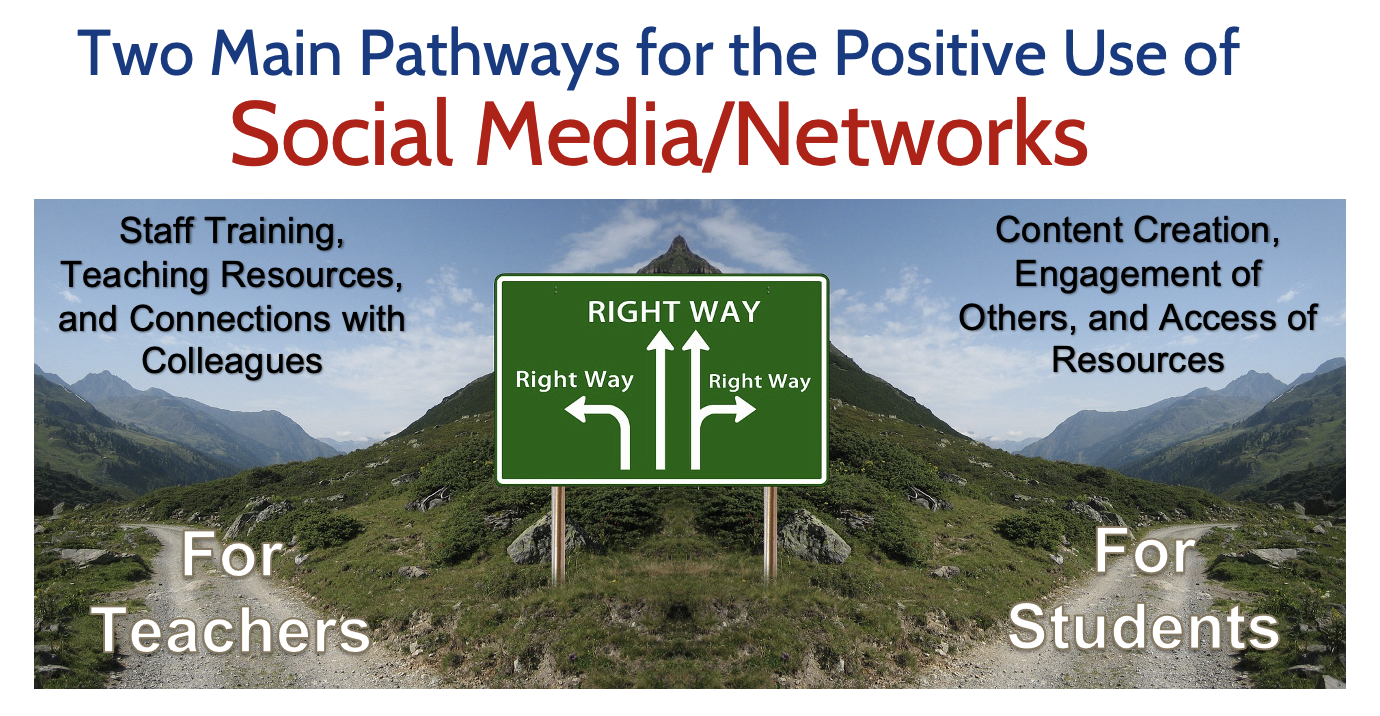
  • Favorite examples of “safe and meaningful” social media for teaching music students.
  • Anecdotes of ethical “conundrums” or issues in the daily decision-making of music educators.
  • Sample “stress-reducers,” time management tips, and other self-care strategies to avoid music teacher burnout.

In addition, I am in the process of updating my INTERVIEW 101 and EMPOWERING EDUCATOR & STUDENT LEADERSHIP clinics for future blog posts and clinics. Any thoughts?

Finally, I would also love to hear from you if you have any feedback on a proposed future sharing session for the parents of music students called ADVICE TO MUSIC BOOSTERS. If you have ever sponsored a music parents advocacy group for your school music program, what suggestions would you give to your colleagues and booster officers?

Feel free to reach out to me via email here. Thank you for your willingness to help our profession!

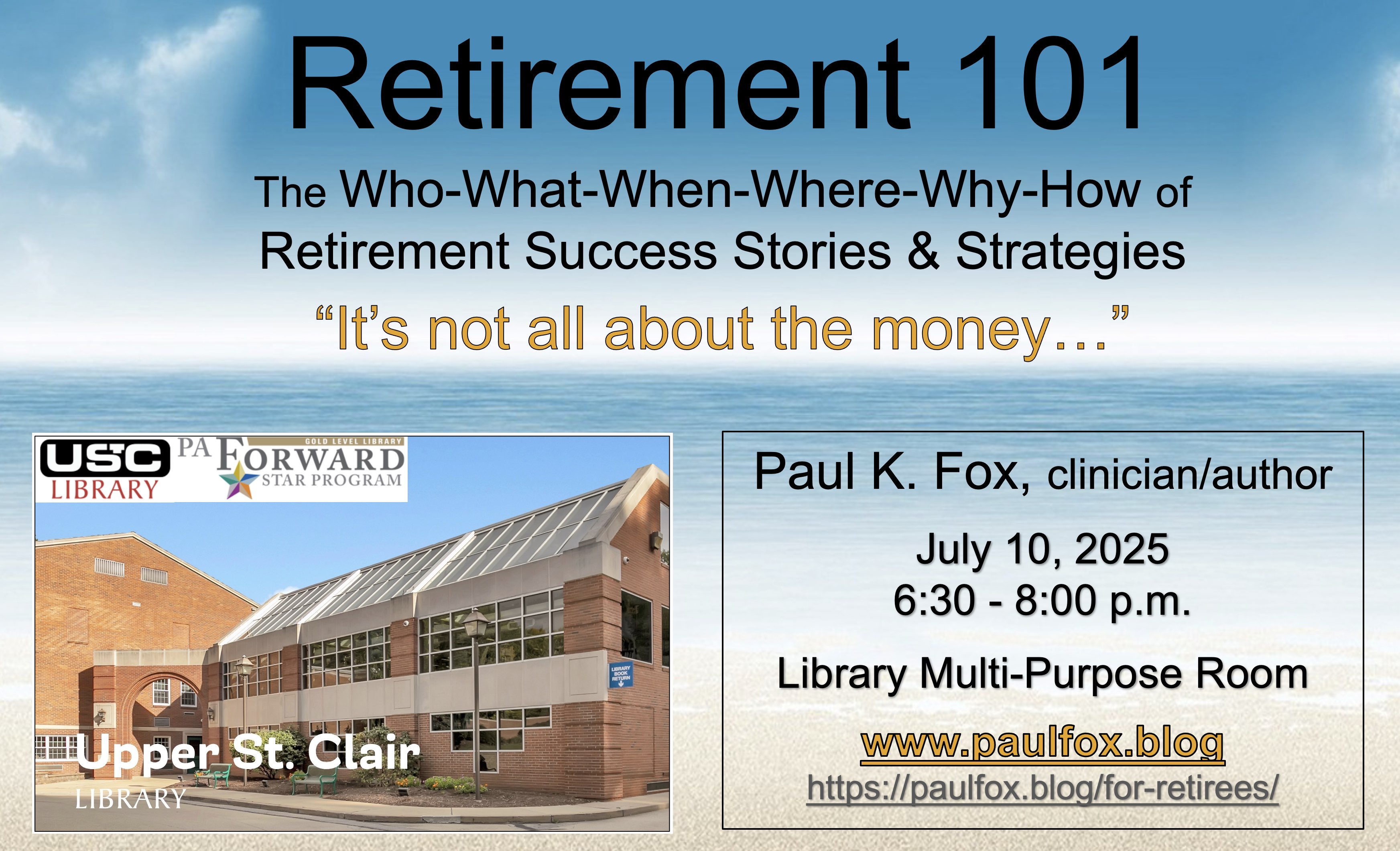
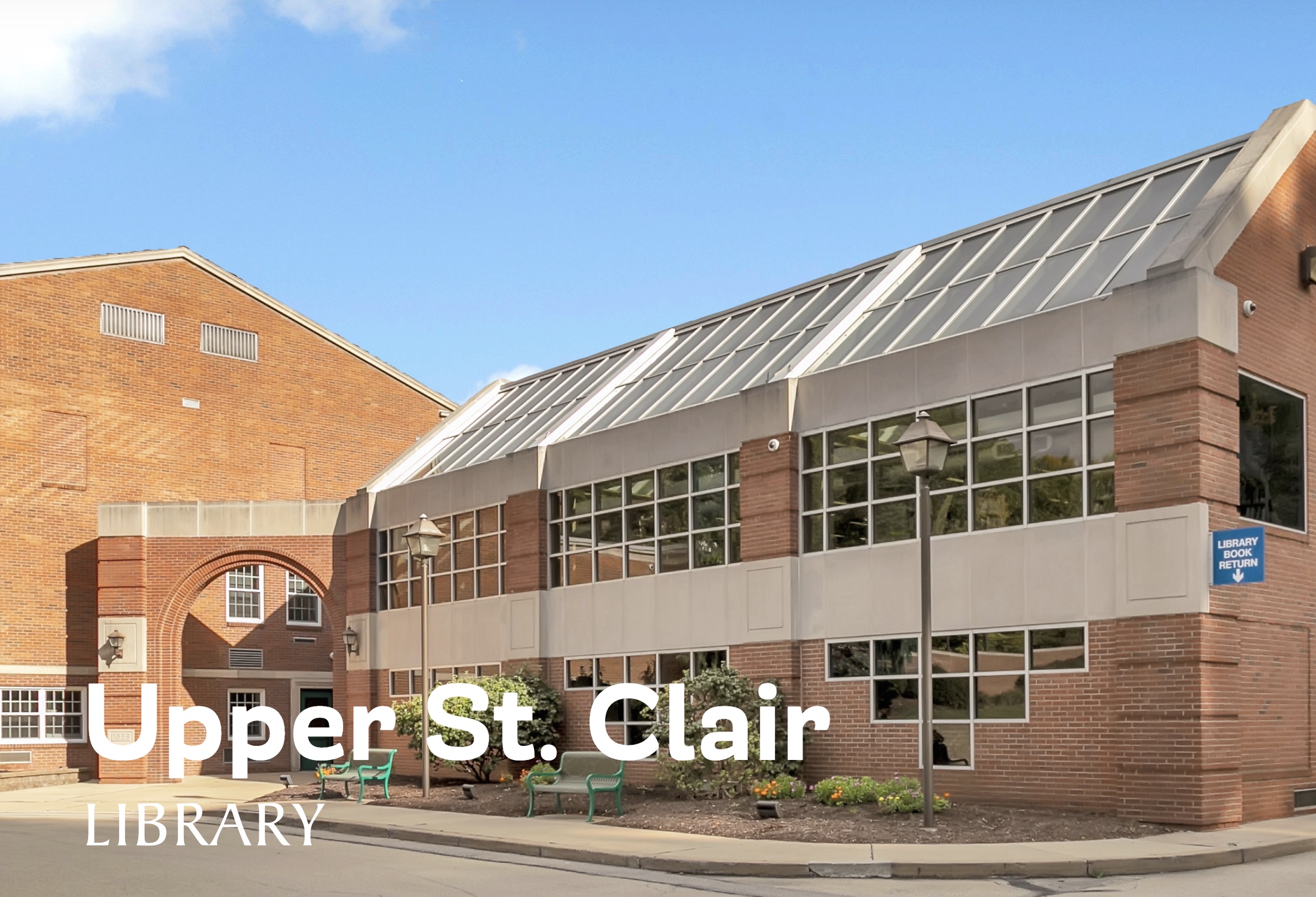
Editor’s Note (things to look forward to): In mid-July, our next blog for this series geared to “the life cycle of a music educator” will be from guest author Ed Carter entitled “Bigger Dreams, Bigger Home: How Retirees Can Upsize for Homesteading and Hosting.” In addition, I plan to share links to materials of the “Retirement 101 – It’s Not All About the Money,” a free workshop I am presenting to residents at the Upper St. Clair Township Library on July 10, 2025.

PKF

© 2025 Paul K. Fox

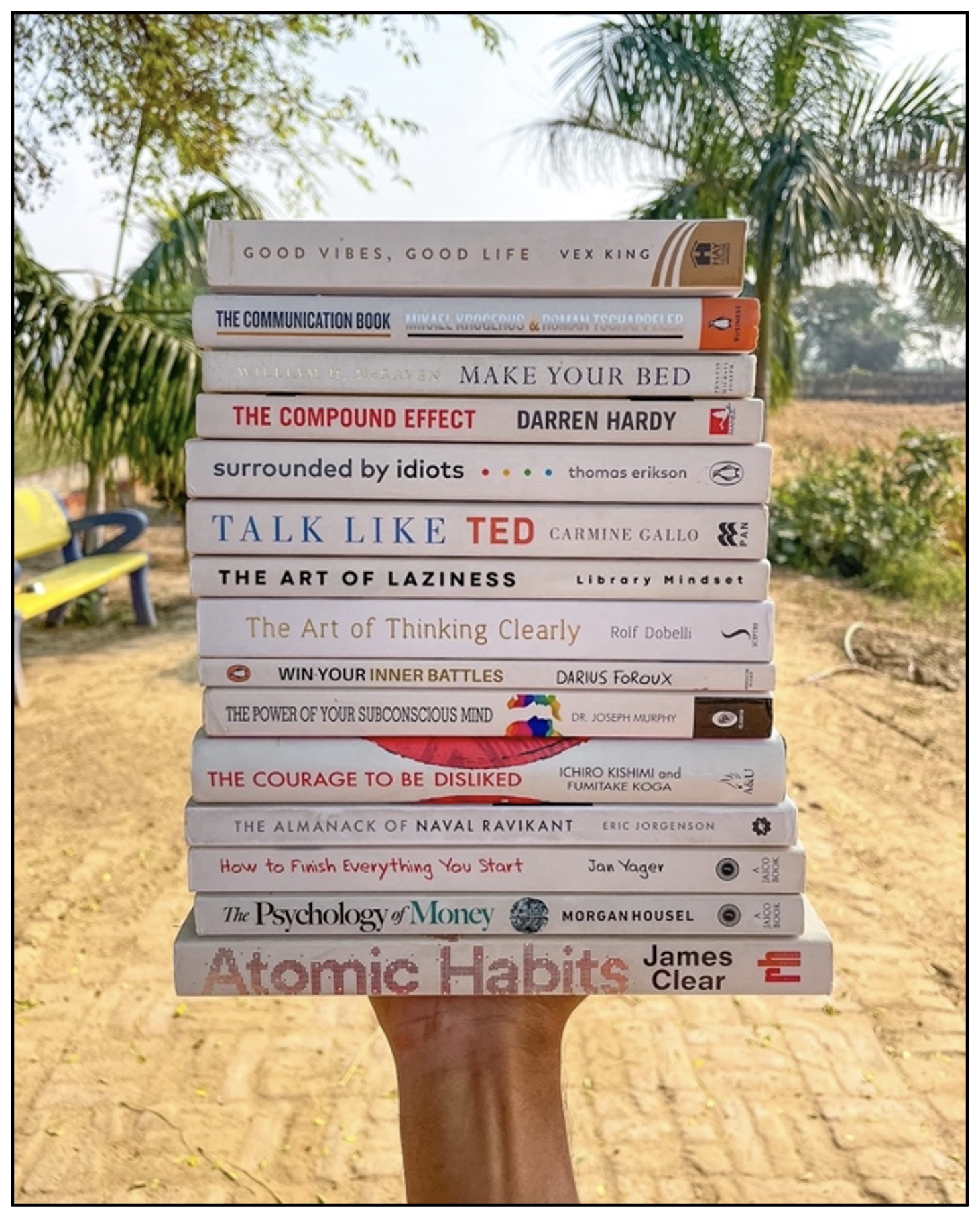
For Book-Lovers (Retired or Not)

Summer is the Time to Catch-up on Your Reading!

The character “Robert McCall” (played by Denzel Washington) in the vigilante action-thriller film series The Equalizer (directed by Antoine Fuqua) mentioned that his late wife was working through “The 100 Books Everybody Should Read” when she died, so he decided to carry on the tradition. It is not clear the exact list he was referring to, but we found a blog by Gillian that settled on Goodreads 100 Books from The Equalizer, for which a checklist is provided by https://uncomplicatedspaces.substack.com/p/100-books-everyone-should-read-pdf.

How many of these can you claim to have read?

Personally, I go through stages… seeking new releases, exploring best-sellers, perusing used or discounted book stores and thrift shops, and revisiting past favorites in my library.

Recently, I have “relaunched a personal voyage” to consume the entire series in sequence of the memorable adventures of classic historical fiction from the Napoleonic Wars, featuring Captains Horatio Hornblower (by C.S. Forester), Richard Bolitho and his nephew Adam Pascoe Boltho (by Alexander Kent, pseudonym of Douglas Reeman), and Lord Nicholas Ramage (by Dudley Pope). You should “cruise” samples of all of these!

If you are a history buff, please enjoy each edition slowly, reveling in the authors’ craftsmanship and immersing yourself in the language, settings, culture, customs, and what life must have been like during that period (~1800-1850) of intense conflicts between France (led by Napoleon Bonaparte) and England (most notably, paralleling the real-life of British naval hero, Horatio Nelson) and the coalition of European powers following the French Revolutionary Wars. A previously blog (here) related the relevance of Hornblower and learning leadership principles. However, I am especially amazed at the depth and breadth (similar style and content) of the Alexander Kent collection. But, better schedule a lot of uninterrupted quiet time on vacation or at the pool, deck, patio, or beach! It will take you awhile to read all 30 of the Kent books (list below provided in order by www.addall.com):

  1. Midshipman Bolitho (1975)
  2. Midshipman Bolitho and the Avenger (1976)
  3. Band of Brothers (2005)
  4. Stand Into Danger (1976)
  5. In Gallant Company (1977)
  6. Sloop of War (1972)
  7. To Glory We Steer (1968)
  8. Command a King’s Ship (1973)
  9. Passage to Mutiny (1976)
  10. With All Despatch (1988)
  11. Form Line of Battle (1969)
  12. Enemy in Sight (1970)
  13. The Flag Captain (1971)
  14. Signal, Close Action! (1974)
  15. The Inshore Squadron (1978)
  16. A Tradition of Victory (1981)
  17. Success to the Brave (1983)
  18. Colours Aloft! (1986)
  19. Honour This Day (1987)
  20. The Only Victor (1990)
  21. Beyond the Reef (1992)
  22. The Darkening Sea (1993)
  23. For My Country’s Freedom (1995)
  24. Cross of St. George (1996)
  25. Sword of Honour (1998)
  26. Second to None (1999)
  27. Relentless Pursuit (2001)
  28. Man of War (2003)
  29. Heart of Oak (2007)
  30. In the King’s Name (2011)

Yes, we should be turning our attention to nonfiction books, too. According to financial guru and famous talk-show host Dave Ramsey, all of us should have a nonfiction book or two on our bed stand.

Want to be a millionaire? Turn off your television. The average millionaire reads a nonfiction book a month. This is how you make your life better: having knowledge tomorrow that you didn’t have today, and then applying it.  –  Ramsey on Facebook

Dave’s list of books starts off with one of his own: The Total Money Makeover. He also recommends The 7 Habits of Highly Effective People by Stephen Covey, Think and Grow Rich by Napoleon Hill, Good to Great by James C. Collins, The Richest Man in Babylon by George Samuel Clason, Who Moved My Cheese by Spencer Johnson, The E-Myth Revisited by Michael E. Gerber, and How to Win Friends and Influence People by Dale Carnegie.

On a slow day pushing wheelchairs at the local hospital in the Western PA suburbs where I live, my fellow volunteers (Jerry, Rod, and Douglas) and I, all true “bibliophiles” and retirees, brainstormed what were our most inspiring reads. Their list is more spiritual, faith-based, or metaphysical than most:

  • Book of Joy by Dalai Lama and Archbishop Desmond Tutu
  • Conversations with God by Neale Donald Walsch
  • Jesus CEO by Laurie Beth Jones
  • Many Lives, Many Masters by Dr. Brian L. Weiss
  • Mutant Message Down Under by Marlo Morgan
  • Return to Laugher by Elenore Smith Bowen
  • Tying Rocks to Clouds by William Elliott
  • When Bad Christians Happen to Good People by Dave Burchett

Now to the “how-to section,” especially focusing on the quest for “living the dream” in our senior years.

Some of the best books about retirement are really about living life well. It’s been said that a reader lives a thousand lives before he dies. So, if words on a page can introduce us to what it’s like to live in another century or a faraway land, then why not introduce us to life in retirement, too?

Want something new and refreshing for those of us who are already retired or will soon retire? I found this November 2024 Kiplinger post offering “Five Books About Retirement to Prepare You for Your Golden Years” by Jacob Schroeder: https://www.kiplinger.com/retirement/books-about-retirement-prepare-you-for-golden-years

  1. Die with Zero: Getting All You Can from Your Money and Your Life by Bill Perkins
  2. My Brilliant Friend by Elena Ferrante
  3. From Strength to Strength: Finding Success, Happiness and Deep Purpose in the Second Half of Life by Arthur Brooks
  4. The Midnight Library by Matt Haig
  5. The Year of Magical Thinking by Joan Didion

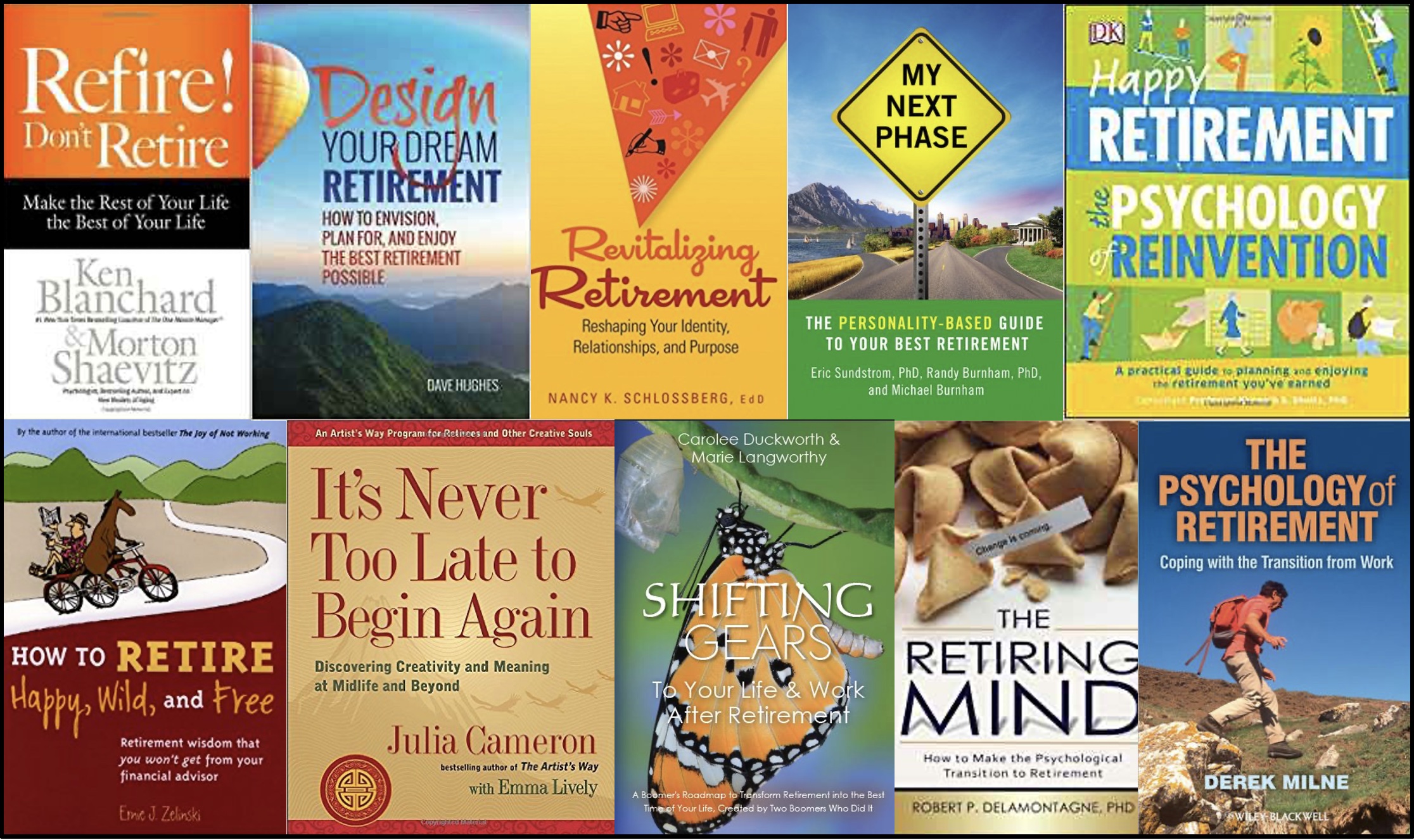
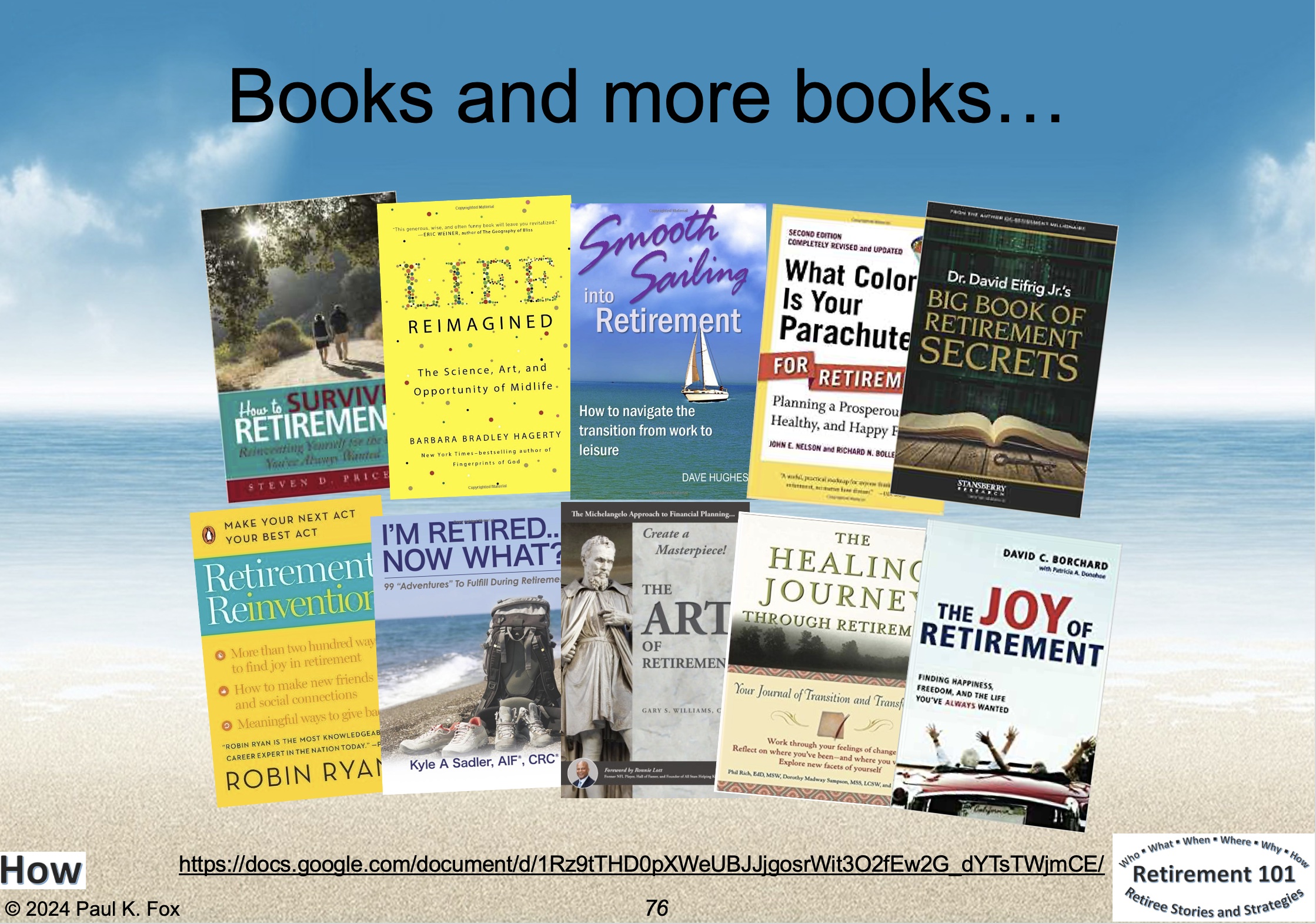
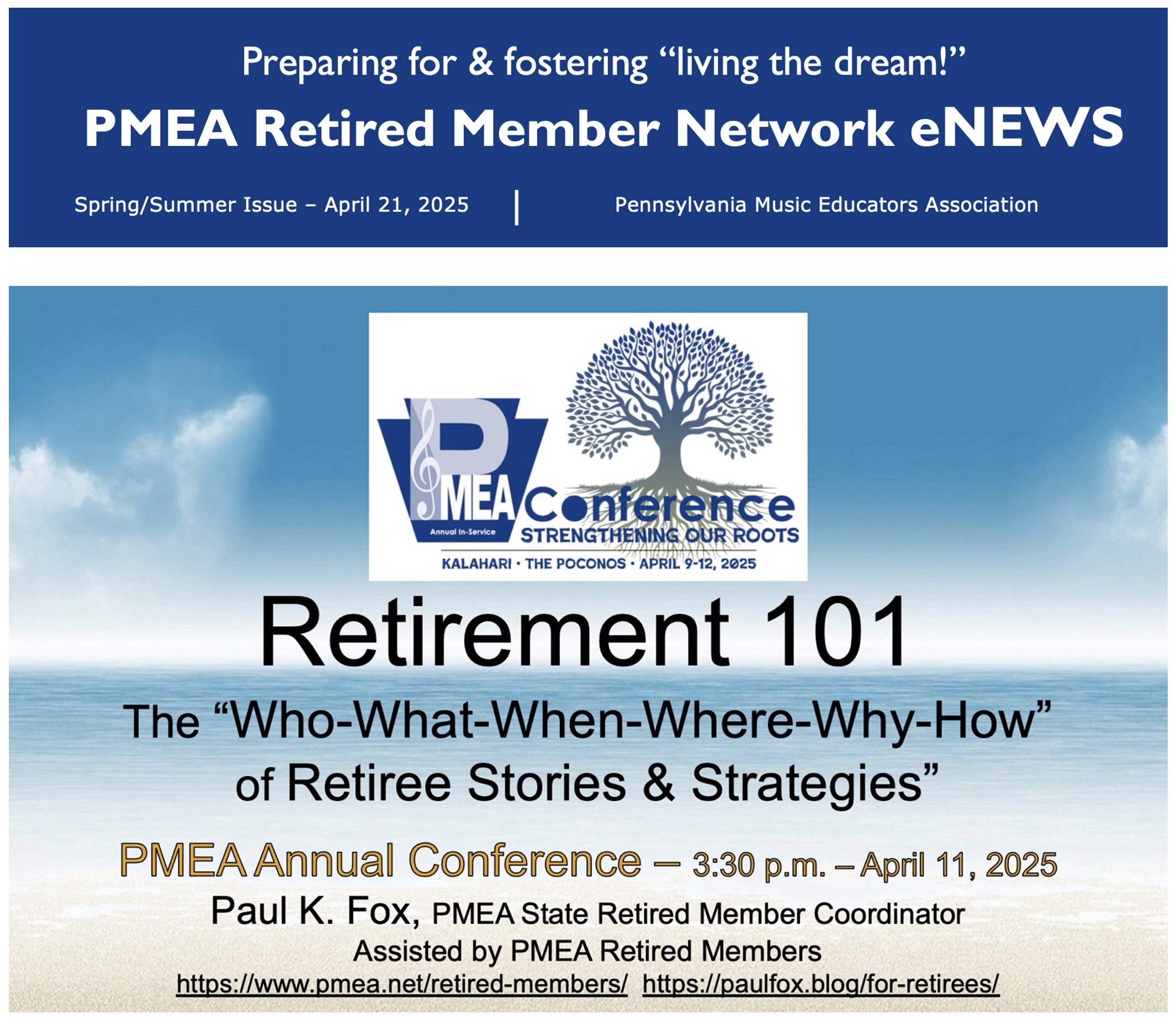
As PMEA State Retired Member Coordinator and editor of Retired Member Network eNEWS, I “float” many images of recommended retirement books to my PA music educator colleagues. If you did not attend the Retirement 101 session at the recent PMEA Annual Conference at Kalahari Resort in the Poconos, take a peek at my annual session’s PDF handout: https://www.pmea.net/wp-content/uploads/2025/04/Retirement-101-PMEA-conference-revised-s041125.pdf.

1820 McLaughlin Run Road, Pittsburgh, PA 15241

I am presenting this workshop at the Upper St. Clair Library on July 10, 2025 at 6:30 p.m. in the Multi-Purpose Room. To my local (Western PA) friends: Come see it for yourself!

Finally, if you are looking for additional resources on how to prepare for that major life passage of transitioning to retirement, many books and websites suggested by numerous expert “silver-haired” colleagues who have already “Cross the Rubicon,” all you need do is visit the Retired Member focus area on the PMEA website. (This is a benefit of PMEA membership and why everyone should continue participating in their professional association even after a complete retirement!) For a sneak preview, click on these links:

Best wishes to you and yours. Feel free to comment on this post (top right link near title), or even refer us to other sites of book lists and retirement prep resources.

PKF

© 2025 Paul K. Fox
February Updates…

PROfessional Development!

Education, ethics, professionalism, and lifelong learning.

Hope you are enjoying the winter season and, for many of you, the anticipation of warmer weather returning soon! Sorry, skiers! I am sick of shoveling snow!!

Here’s a quick “catch-up” on things going on in educator professional development.

For PA School Administrators & Educators

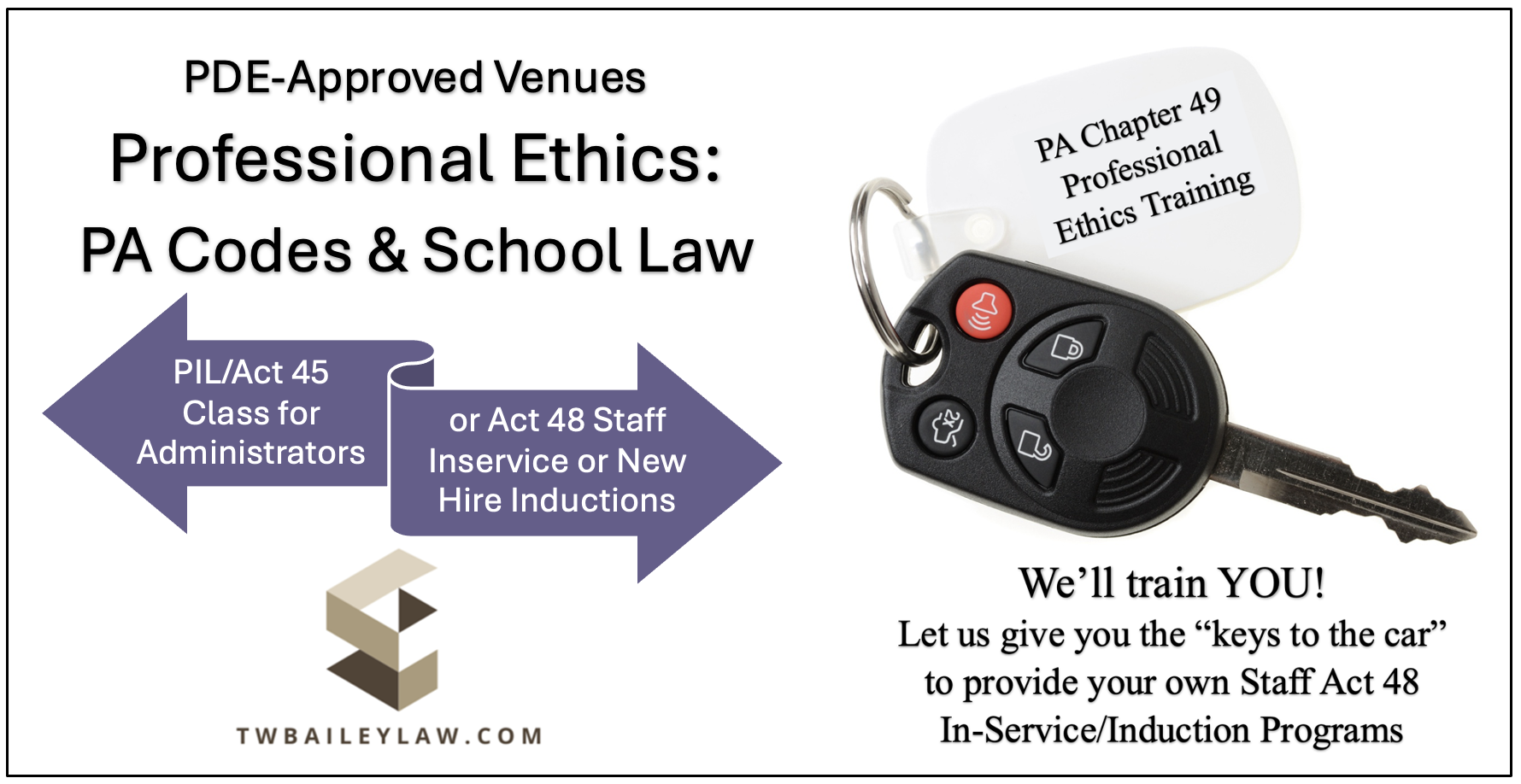
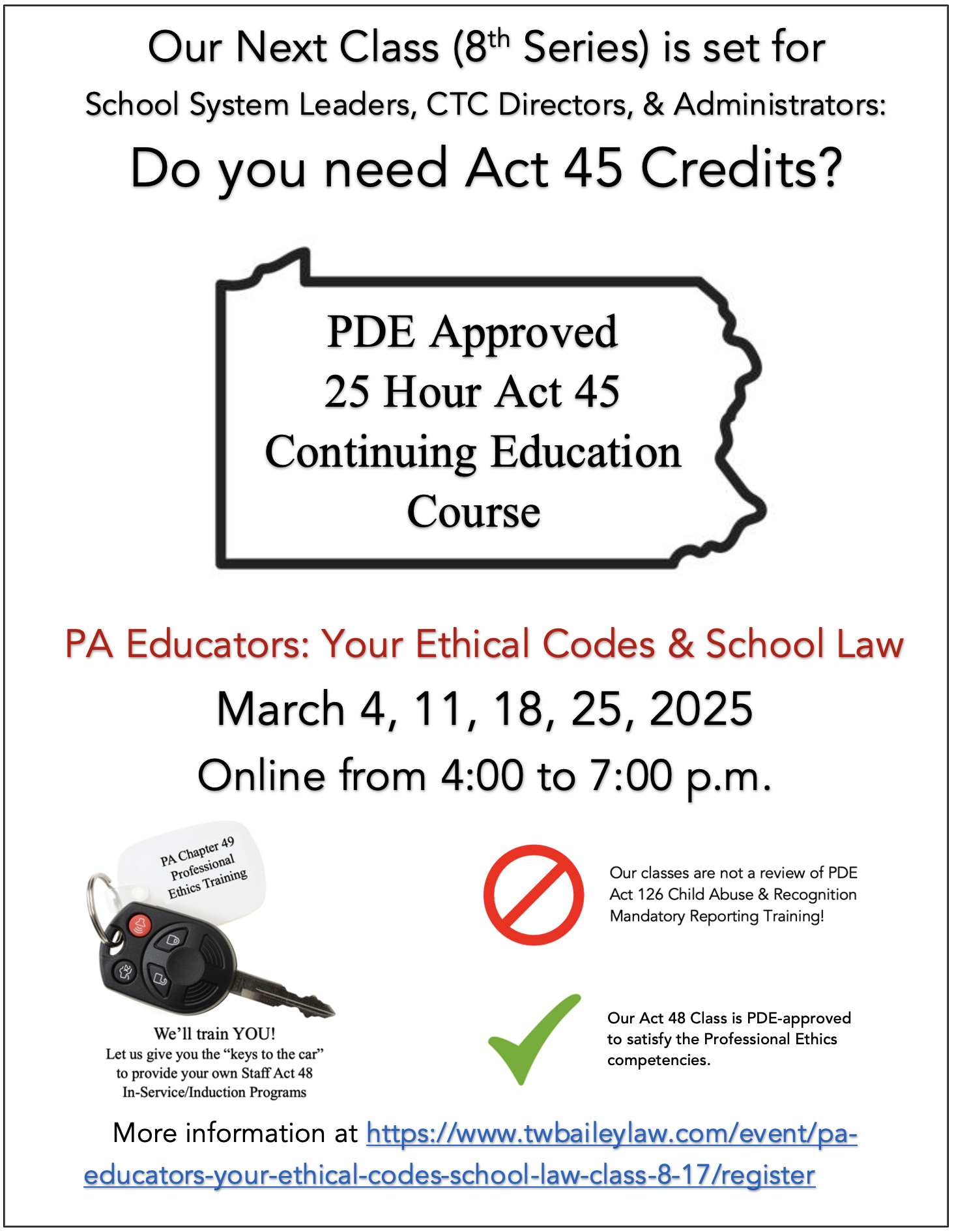
There is still time to register for the upcoming 25-hour, PDE-approved, Act 45 course, “PA Educators: Your Ethical Codes & School Law,” which will cover the recently mandated PA Title 22 Chapter 49 (Certification) Professional Ethics Competencies. The next online series of Act 45 classes will be held Tuesday afternoons in March, and provide “the keys to the car” planning for your own school district’s future continuing education and induction programs in ethics training as required by the PDE.

Now sponsoring our eighth series of classes, I am designated a “qualified instructor” in partnership with the course’s creator/facilitator, retired social studies teacher and attorney Thomas W. Bailey. For more information, please click on these links to his website:

In addition, since over the past year PDE revised their website (and changed most of the content links), I compiled a super-index of “places-to-go” and “things-to-read,” sites of supplemental resources on school ethics here. I recommend visiting this blog if you are interested in our library of links to the Pennsylvania Code of Professional Practice and Conduct, the Model Code of Ethics for Educators, the PA Educators Discipline Act, and research and citations from the PDE, PA Professional Standards and Practices Commission, Connecticut State Department of Education, and Iowa Board of Educational Examiners, among many others.

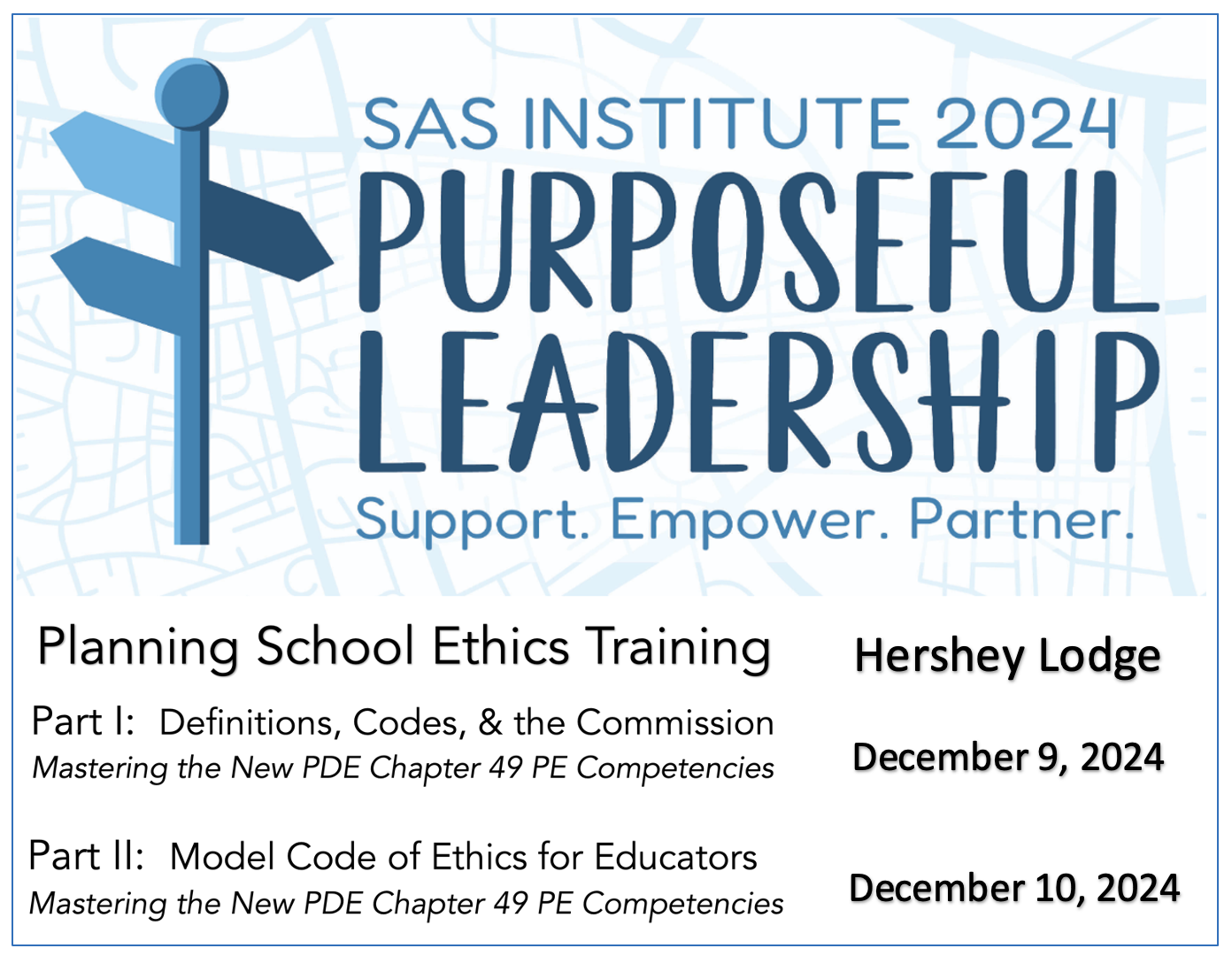
If you would like to see the kind of things we cover in these classes, take a look at the slide summaries I posted from my presentation at the PDE SAS Institute “Purposeful Leadership” state conference last December:

From Pre-Service to Veteran Music Teachers!

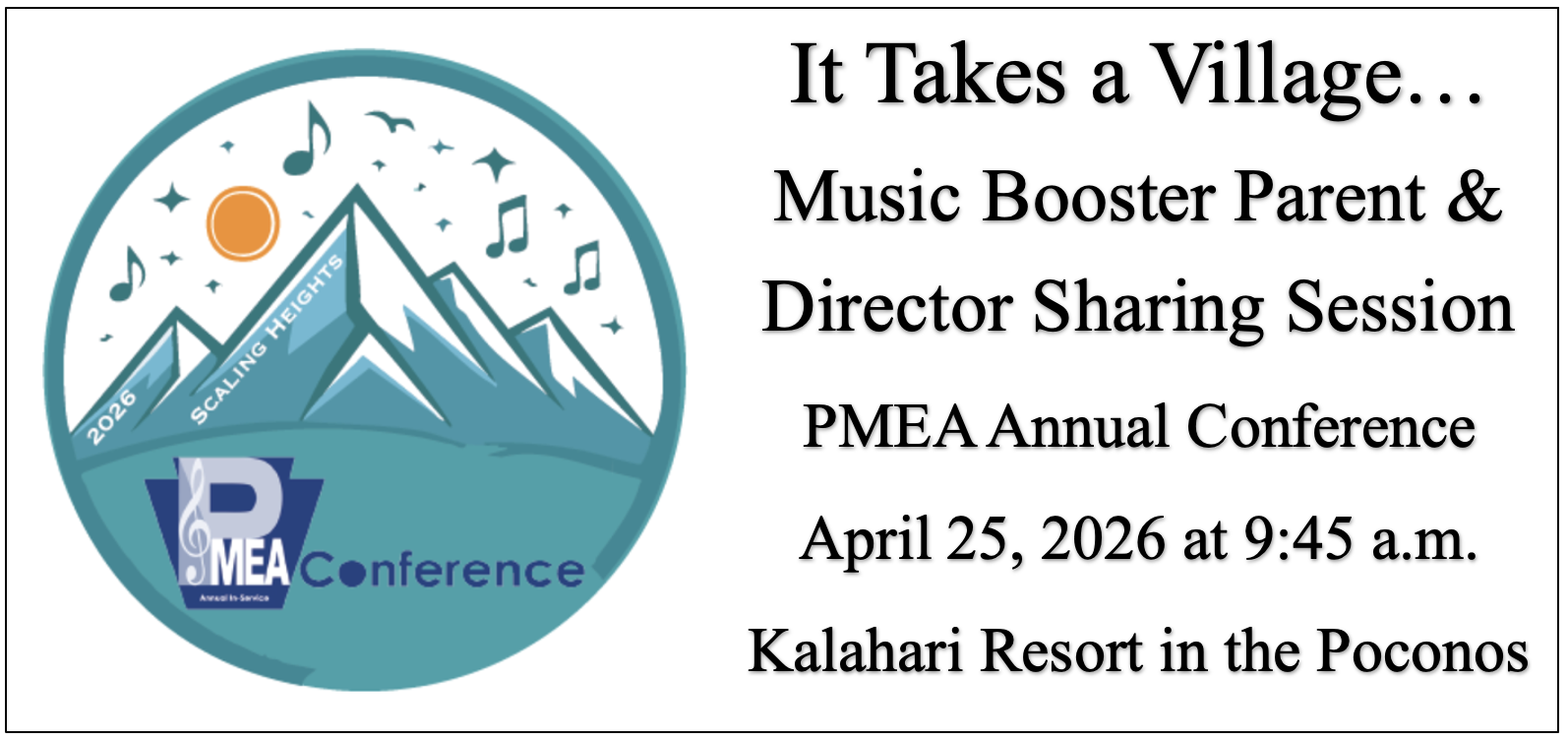
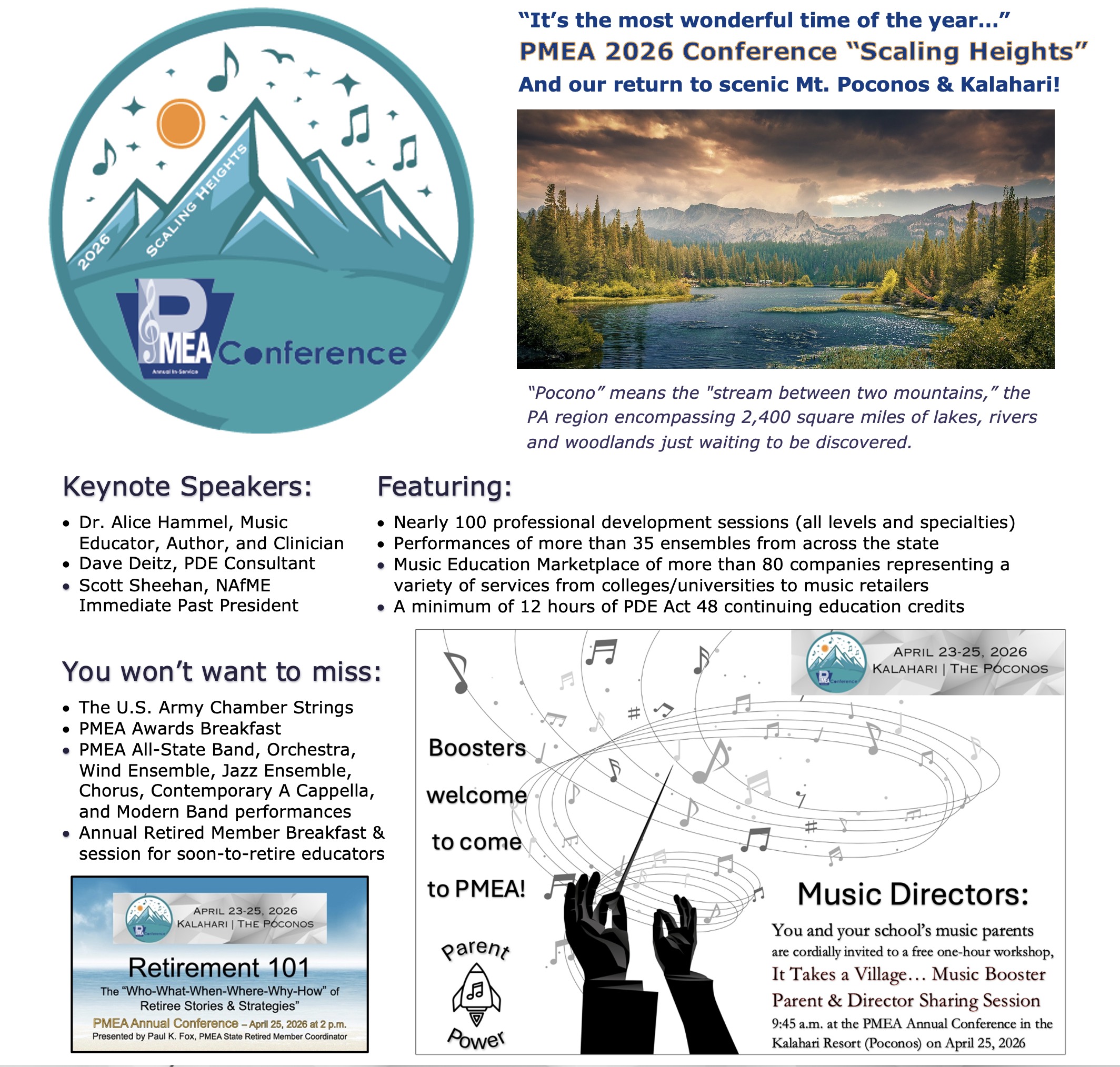
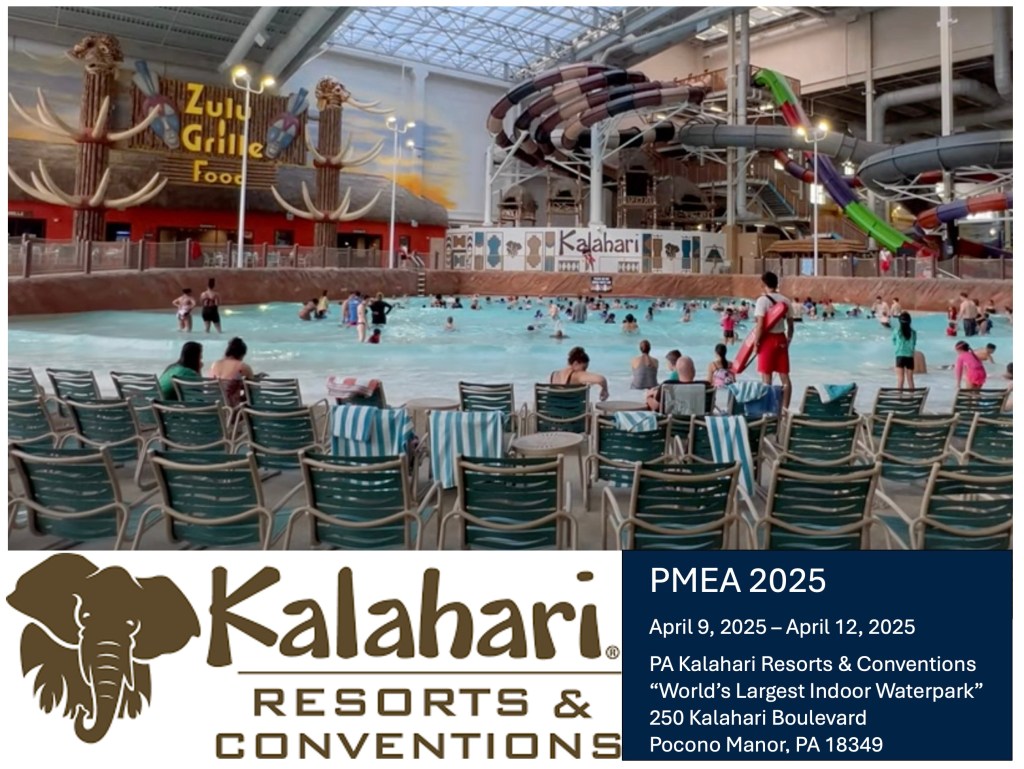
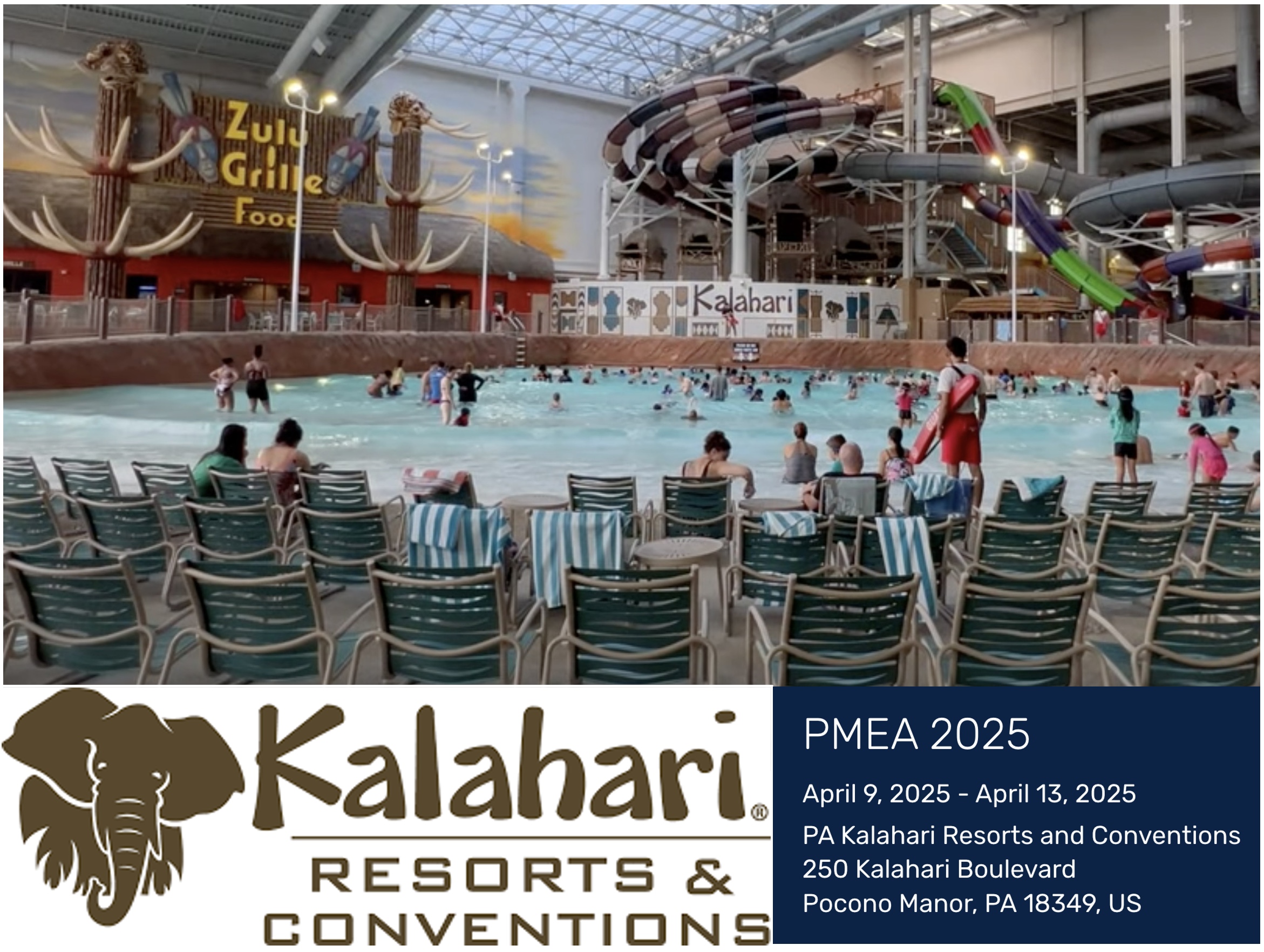
It’s that time of the year… again! The PMEA Annual Conference on April 9-12, 2025 will be held in the family-friendly, perfect-for-a-mini-vacation spot in northeastern PA: the Kalahari Resort in the Poconos.

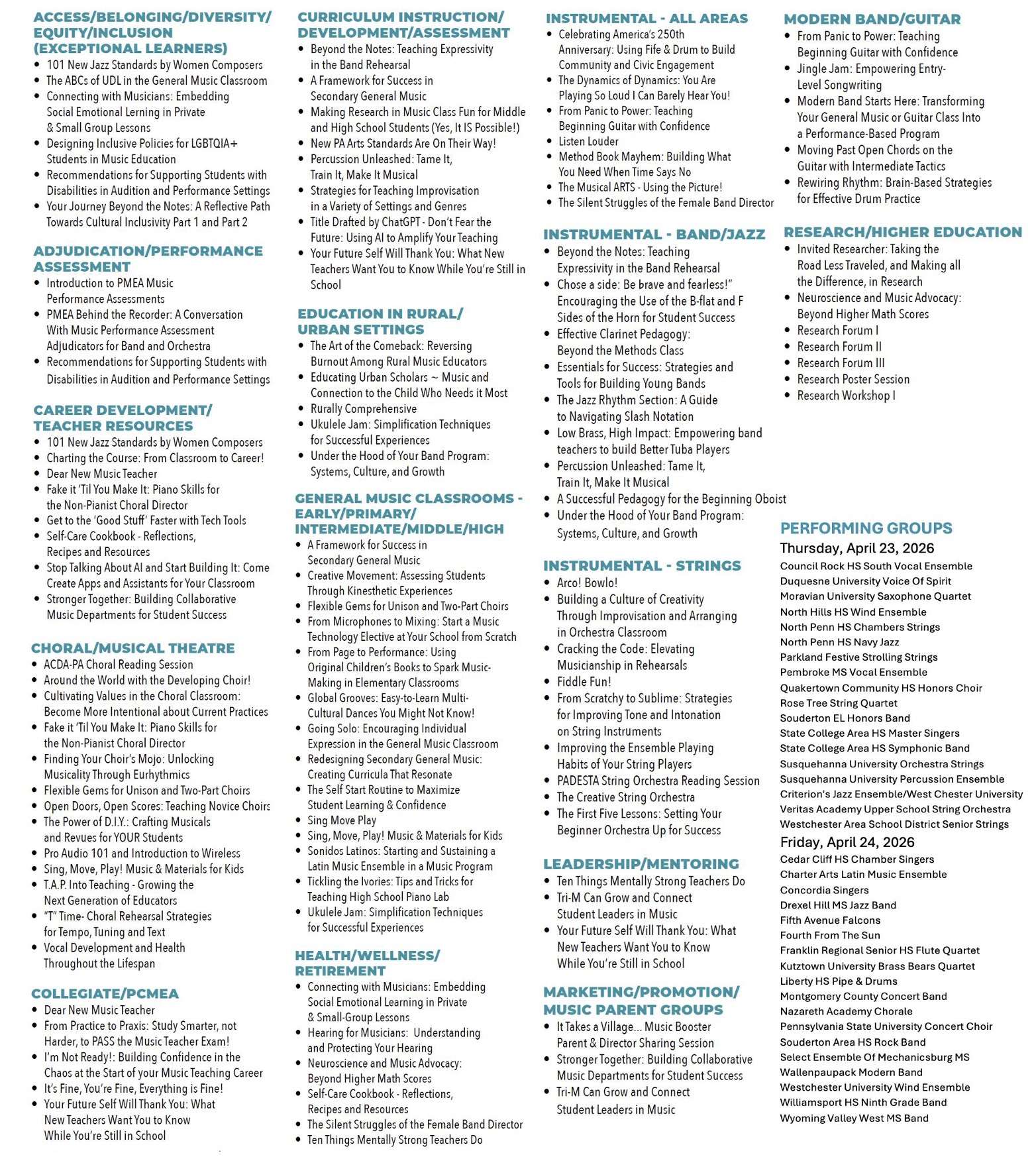
There is still time to register! (Click here.) If you would like to see a summary of the sessions and performances, go to the PMEA website here or download this PDF brochure.

Why attend the conference? In my five-plus decades in education, I may have missed only two or three of the annual PMEA state events, and heartily recommend you remain actively involved in your professional association. This is what I wrote about it in a recent PMEA Retired Member Network eNEWS:

For some of us, it’s a just chance to catch-up with our colleagues, see our friends, and socialize. Others are more focused and take advantage of the near-perfect opportunity to network with other professionals, perhaps seeking new working relationships, partnerships, or even employment. Many are on a look-out for newly published music, that perfect music lesson or teaching strategy, technology tools, fundraisers, advance educational venues, or much-needed equipment to purchase for our ensembles or classrooms. Most come to hear/see the “state of the art” in music education – concerts, demonstrations, keynote speeches, panel discussions, exhibits, research presentations, and workshops. PMEA’s PD Council would likely submit that the primary purpose of a conference is for professional self-improvement… What did Stephen Covey call it? His Habit #7 of “sharpening the saw” – to build a balanced program of self-renewal in the four areas of your life: physical, social/emotional, mental, and spiritual. Covey would insist we embrace “the process that empowers us to move on an upward spiral of growth and change, of continuous improvement.” So, in short, conferences help us “grow” – to revive, re-inspire, re-energize, rejuvenate, re-direct, and re-motivate all of us – pre-service, active in-service, and retired teachers towards making successful new connections, updating our knowledge and skills, and forming new goals. This is how we “keep up” with all the new standards, benchmarks, and cutting-edge advances, and meet the “movers-and-shakers,” visionaries, and leaders in the profession!

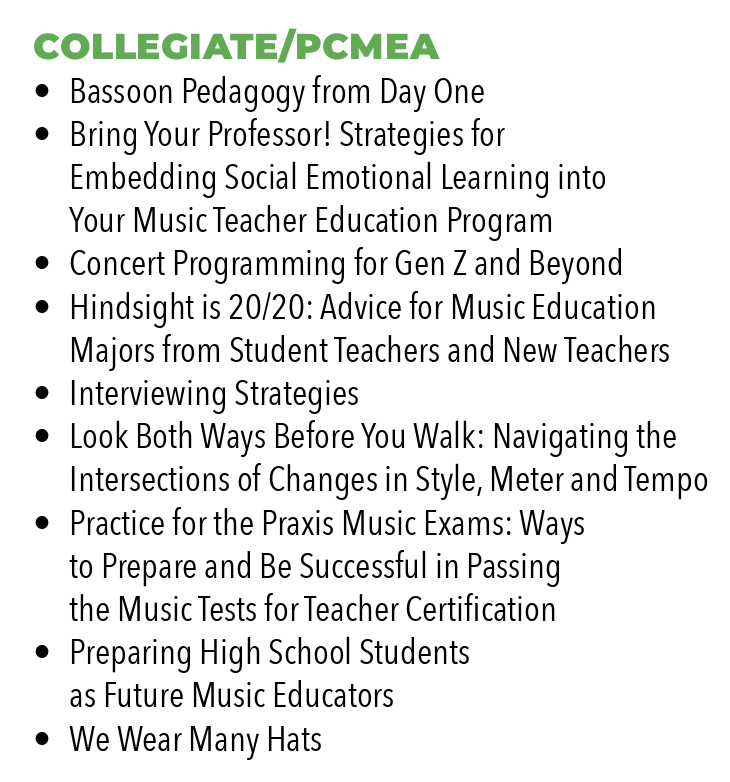
There’s a lot in store for college music education majors. Besides the aforementioned state meetings, concerts, clinics, and keynote addresses no one should miss, the music industry exhibits (new innovations in sheet music, instruments, technology, summer school and graduate programs, etc.), and the chance to introduce yourself to other music colleagues (aren’t some of you looking for a job soon?), there will be a “coffee and connections” informal lounge to ASK-AN-EXPERT on Thursday afternoon to pick-the-brains of PMEA mentors and retirees on any subject. Do you have a question about conducting technique, musical literature, lesson plan idea, classroom or time management tip, or teaching method? And, just take look these sessions the PMEA Professional Development Council has targeted specifically for YOU:

For Retirees… They are special, too!

PMEA Retired Members, consider this your personal invitation to join us at the Kalahari Resort in the Poconos for the chance to catch-up, connect, collaborate and communicate with other colleagues throughout the Commonwealth! (a plethora of “C’s!”)

As usual, we will “break bread” together Friday morning (April 11, 2025) with the annual retiree breakfast. Be sure to register soon for the PMEA Annual Conference (now only $25) and check the “yes” box that you will attend our meeting. Those in attendance will be treated to some “conference swag!”

Retirees are a valuable resource to PMEA! Our experienced retired members are among the best-trained (unofficial) mentors in PMEA. Facing many years of “boots on the ground,” we have at our fingertips numerous strategies to solve problems in education. Frankly, in my opinion, we have a lot to offer “the future of the profession!”

If you are a retired PA music educator, hopefully you have maintained your PMEA membership (dues significantly discounted), and have signed up for the Retired Member Resource Registry to help future “rookie” music educators. (To reach the R3, first login to your PMEA portal here.)

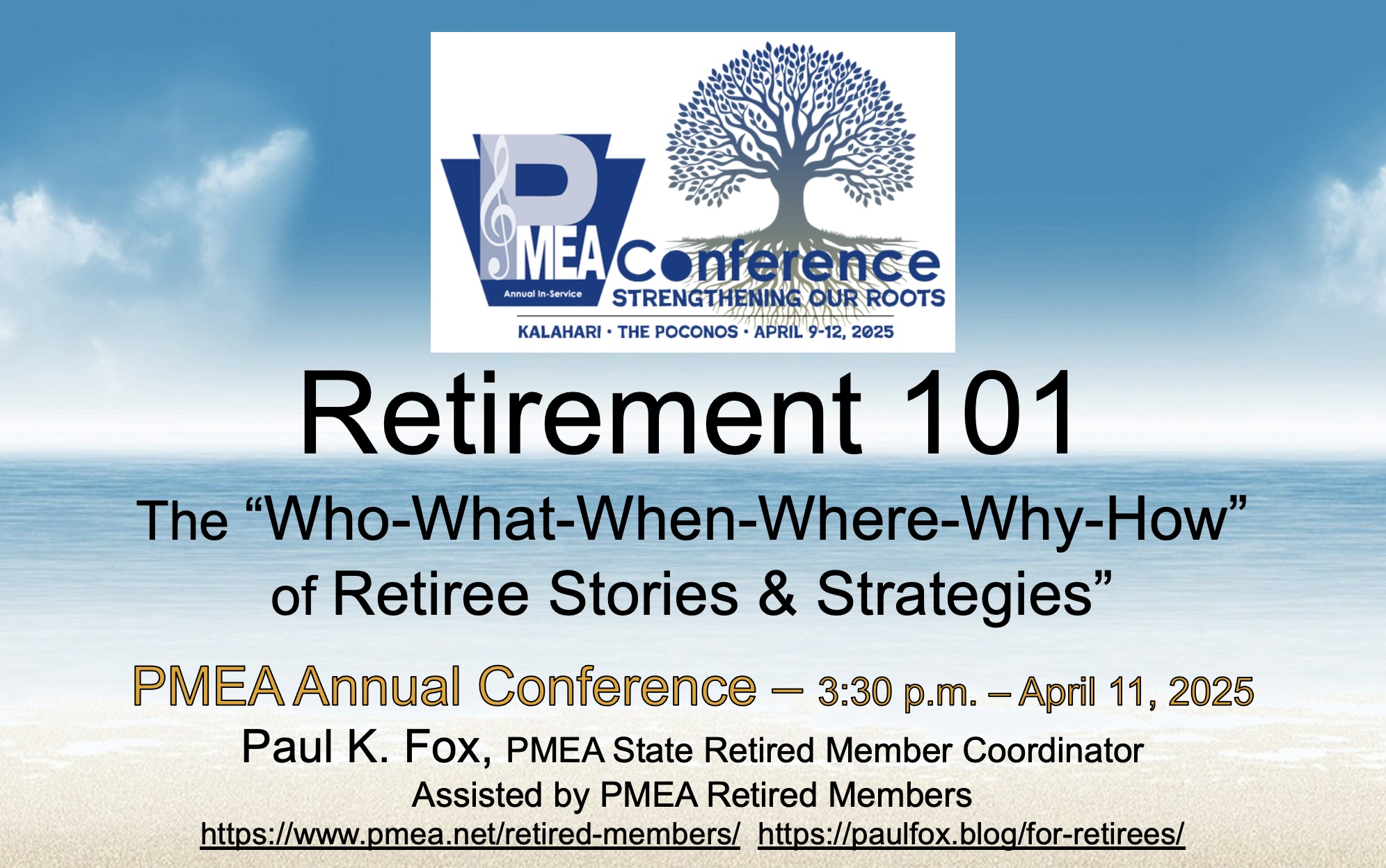
On Friday, April 11, at 3:30 p.m., we are offering a special sharing session for soon-to-retire teachers… the annual one-hour Retirement 101 workshop joined by a panel of experienced retirees: Rick Coulter, Jeffrey Dent, Sister Kathleen Doutt, Dan Klingbeil, Chuck Neidhardt, and Louise & Richard Victor. Active educators who plan to retire over the 1-5 years can learn valuable techniques from us for a smooth transition to post-full-time employment and successfully reinvent, reprogram, and “recharge” themselves to modifying those essential elements of purpose, structure, and community throughout their “golden years!”

My Professional Advertisement

You may have noticed in my last blog-post an outline of past article topics archived at this site, and a complaint that I feel I must repeat myself (or repackage the material) to meet the changing personalized “bookends” – life cycles – specific passages of my readers. The earlier February post was mostly for job seekers. If you were not looking for employment or coming fresh out of college, it may have seemed irrelevant. The same goes for specialty articles on self-care, ethics training, or retirement transitioning… WHEN WOULD YOU BE MOTIVATED TO STUDY THESE?

I have decided to maintain a comprehensive index of my writings (see “Inside” link in the top menu bar). Please visit the sections of this blog-site that matter to you most… and, when things change, come back and look again. You may find something that “hits the spot” or satisfies the needs of your new journey in education or personal/professional life.

I remain willing and able (aka “very interested”) in doing in-person or online sessions for college methods classes, PCMEA chapter meetings, PMEA festival directors’ meetings, PMEA District or Regional PD workshops, or school district/department inservices. Just give me a call. My contact information can be found in the top “About” link. Please visit this section for catalogs of my presentations and articles. FYI, I created this trifold of some of my past work.

Best wishes on your future successes in career development and professional goal setting.

PKF

© 2025 Paul K. Fox
The Get-a-Job Toolbox

Preparing for Those Upcoming Employment Screenings

So much of what I do at this blog-site is to archive articles offering advice on a host of topics:

Surveying my past blogs, I feel like I had to repeat (repackage) the content until my readers reached that particular stage in their career. Once they experience first-hand that sometimes tumultuous “passage,” they would be ready to reflect on this information. But, I doubt they would closely examine it until then. As an example, for more than a decade as the PMEA Retired Member Coordinator, these past articles I wrote for PMEA News and the PMEA Annual Conference’s session Retirement 101 revisit the voluminous insight of gerontologists exploring the “who, what, when, where, and why” of retirement. Regardless at how often it is presented, you tend not to consume advice on coping with post-employment until you feel you are “ready” to retire. This is the same issue for soon-to-graduate collegiates and those transitioning to a new job; who wants to read about branding, marketing, and interviewing until they are in the middle of seeking first-time (or new) employment?

Please click on the “plethora” of links throughout this article to be redirected to these past writings. My apologies in advance to what may seem like to be a lot of duplication!

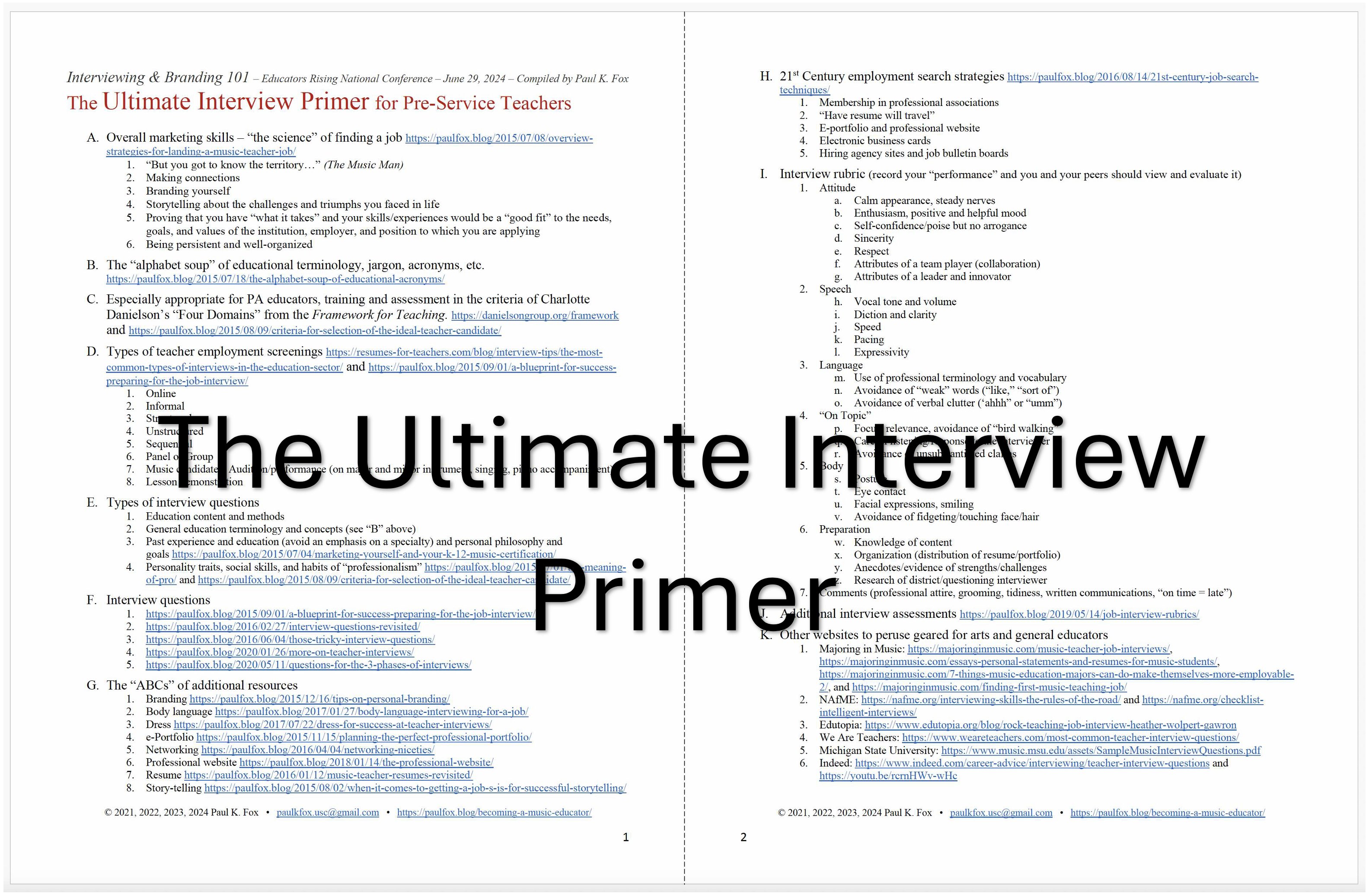
I went as far as updating the most comprehensive and “perfect” PowerPoint for collegiates: Bookends – The Life Cycle of a Successful and Happy Music Educator – portions of which I have presented several times to Professor Jessica Vaughan-Marra’s Seton Hill University music student teachers. This slide handout starts with the material from the first three bullets in the first paragraph above and then adds information about teacher health and wellness, time management, and retirement. We offer Bookends… to preservice music educators in their junior, senior, or graduate years and “rookies” to the profession. I encourage you to download this resource, visit the PCMEA website (click here/scroll down) to read past issues of Collegiate Communique, and the paulfox.blog posts. While you’re at it, acquire your own copy of the Ultimate Interview Primer. Click away before these links become inactive.

Soon it will time for graduates to enter the workforce… and boy, do we need you! By most accounts in PA and the surrounding states, we are experiencing a teacher shortage. School districts are seeking quality candidates to apply for their open positions. But, much of what happens in the job screening process seems to be influenced by chance. Collegiates, ask yourself: Are you truly prepared to market your experiences and abilities, share your brand and stories of your interactions with children in educational programs, and relate positive anecdotes of your teaching, problem solving skills, and other professional attributes? I may have been a little Type-A when I first applied for those music teaching positions back in 1978, focused on saturation publicity and persistence, and organized with a large paper portfolio of past experiences, but I was clueless in responding to those tricky interview questions and what administrators actually wanted to see in prospective new members of their staff.

One more piece advice for first-year and recent transfers to music education: Seek out a PMEA mentor and/or a member of the Retired Resource Registry (access from the PMEA Retired Member focus area after you login to your member portal)… both are groups of volunteers willing and able to help “newbies.”

Have a question about selecting music for your ensemble, a dynamic lesson plan, classroom management issue, interviewing, curriculum innovation, or a conducting tip? Stop by the “coffee and conversations” informal lounge at the PMEA Annual Conference on April 10 and “sit-a-spell” with us!

In conclusion, the following is a sequential outline – a “to-do in this order” list – a preservice toolbox of past posts and other resources for you to assemble a marketing plan. Take time to sort through these “nuts and bolts” (all links in this blog), process the information, save anything you want to read further, and then “practice, practice, practice!” This “gift” to PCMEA and music education majors embraces my best wishes for successfully finding the job you always wanted and preparing yourself for the greatest “calling” of your life – an enriching and satisfying lifelong career in music education! Good luck!

Using the Collegiate Toolbox – A Roadmap for Becoming a Music Educator

  1. Peruse everything in this and past paulfox.blog postings.
  2. Download the PDF documents to your hard drive. Review a portion of them each week!
  3. On your computer, create a “ME” file documenting your accomplishments, awards, experiences interacting with children, etc. – a library of the things you may wish to include in your future resume, professional website, and (e-)portfolio. Add to this folder throughout your college years.
  4. To reflect on your perceived strengths and weaknesses, complete a self-assessment of YOU from a typical professional evaluation form, these ideal effective teacher attributes and more criteria
  5. Prioritize what you think you need most. Write down your goals! Pobody is nerfect!
  6. While you are still attending college, work on shoring up any weak content areas or specialty skills (e.g., how is your “piano chops,” knowledge of specific methods, grade level repertoire, etc.?)
  7. Write a philosophy of school music education (overview) and your mission statement: “Why do you want to teach?”
  8. Be ready to answer the question (and defend your response), “What is your vision of the role of music education in the schools?”
  9. Be ready to define your “brand.” What are your professional attributes? What makes you unique? Why would you be a good candidate for a school music position?
  10. Begin to assemble a list of stories that would “show not tell” your positive attributes.
  11. Identify the impressions you want to “sell” yourself, and practice strategic storytelling.
  12. Practice answering interview questions and use a rubric to evaluate your performance. If you can, share all of this with your peers and sponsor mock interview sessions. Record/assess yourself.
  13. Get started on drafting the marketing tools you will need (e.g., your professional website, resume, portfolio, etc.)
  14. Review educational acronyms, jargon, and terminology such as this list plus these recent additions: CR-SE (Culturally Relevant & Sustaining Education), DEIB (Diversity, Equity, Inclusion, Belonging), and SEL (Social-Emotional Learning). These terms may come up at your next interview.
  15. Read cover-to-cover your PA code of conduct (CPPC) and the Model Code of Ethics for Educators.
  16. Practice ethical decision-making (with your peers) by reviewing these mock scenarios, first deciding what level of misconduct (if any) is reached in each case study, and then more discussion on the incident’s effect on the students, parents, staff, and community, and what proactive steps may be taken to remediate the situation.
  17. Join and become active in appropriate music education professional organizations (renew your memberships and add new ones): ACDA, AOSA, ASTA, NAfME, NBA, PMEA, etc. to name a few.
  18. Attend a conference of your professional association(s) and network with other colleagues. For PA colleagues, register for the PMEA Annual Conference (April 9-12) at the Kalahari Resort (Poconos).

Feel free to leave comments about this blog. (See the link just below the title.) How did you use these tools? What was particularly beneficial? What suggestions would you have for future music teacher applicants?

To PCMEA chapter officers/members, music education majors, and college instructors: I am available to present Bookends or other online or in-person workshops for college students. Send me an email.

© 2025 Paul K. Fox

Retirement Transitioning Advice from AI?

Season Greetings and Happy New Year from your Pennsylvania Music Educators Association State Retired Member Coordinator. Best wishes for a happy, healthy, and prosperous 2025!

First, on Christmas Eve, here are a few announcements geared to PA music educators… those who have retired from full-time teaching and anyone considering retirement over the next one to five years.

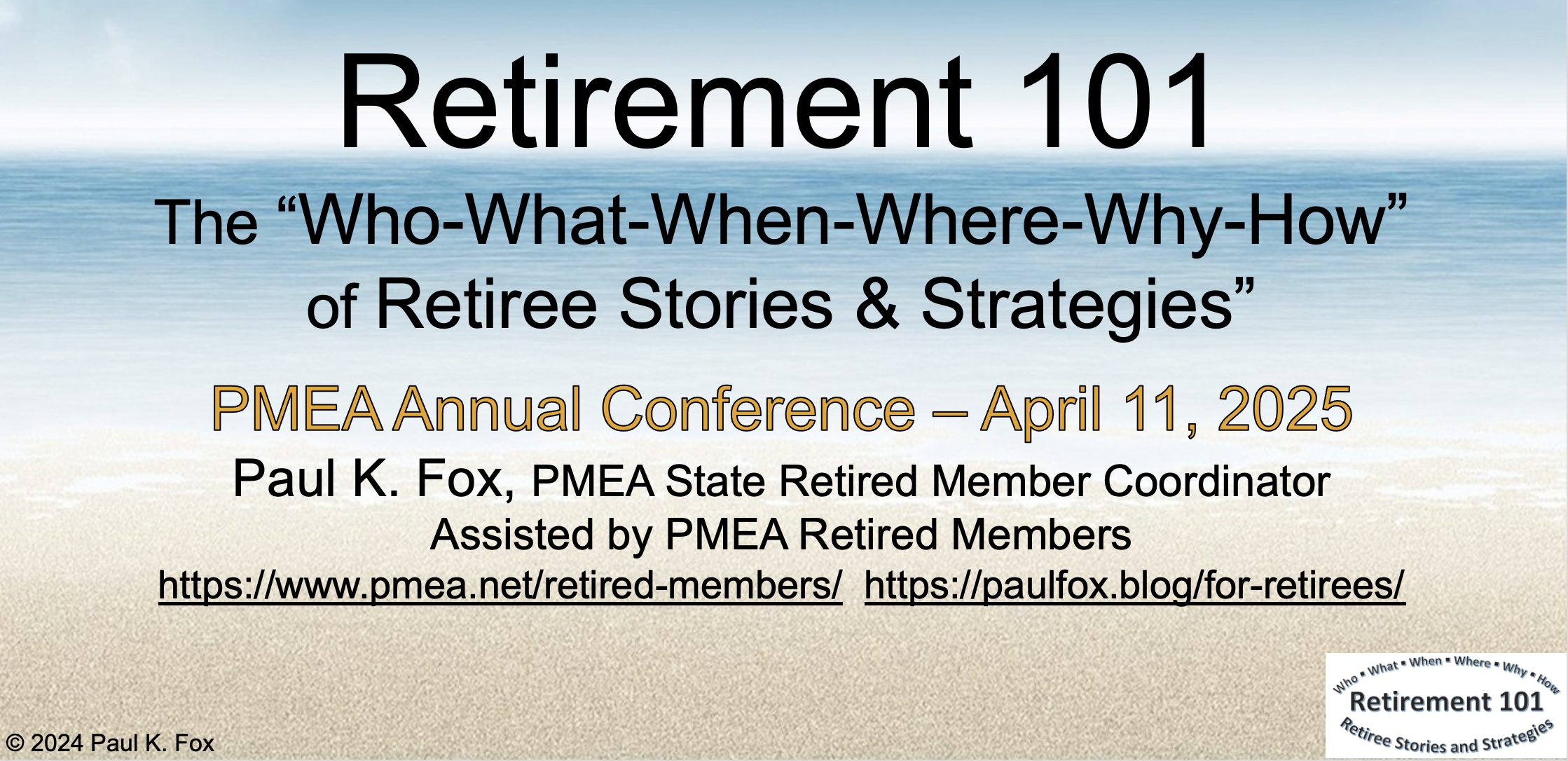
Back by popular demand (or is that just ego and in my head?), we will offer the session “Retirement 101 – the Who, What, When, Where, Why and How of Retiree Stories & Strategies” on Friday, April 11, 2025 (3:30 p.m.) during the PMEA Annual Conference at the Kalahari Resort in the Poconos. A guest panel of PMEA Retired Members will assist and offer their advice answering key questions like the following:

  1. How have you found happiness and success in retirement?
  2. What “new” hobbies, volunteer projects, trips, family connections, and encore careers have you been exploring?
  3. What did you do to reinvent yourself and how did you satisfy those essential “big three” goals of post-full-time employment: finding purpose, structure, and community?
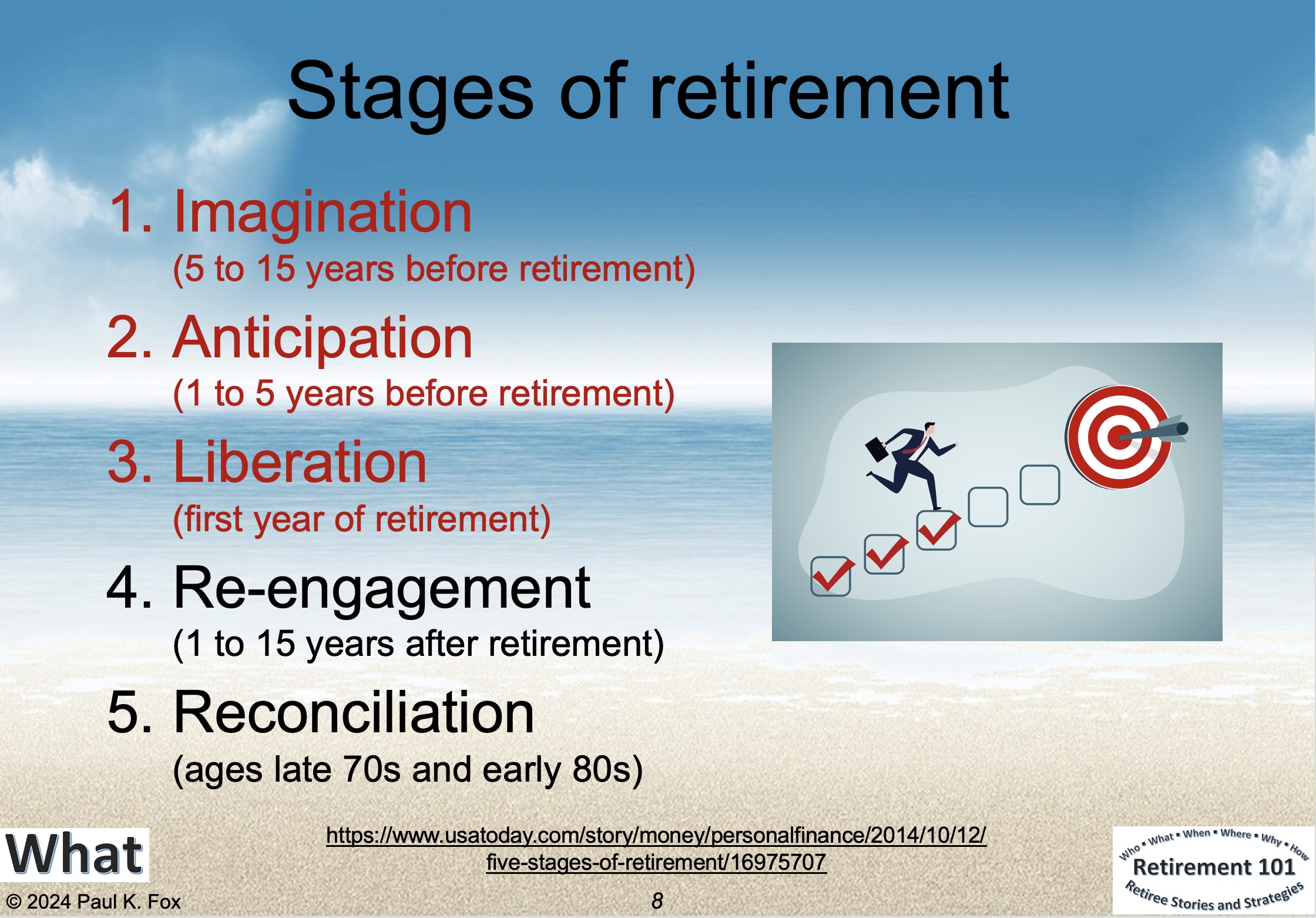
  4. How did you navigate the early phases of retirement? imagination, anticipation, liberation, etc.
  5. What were some of the transitional “ups and downs” you experienced and how did you cope with them?
  6. What are you still doing in music and education?

We are looking for more PMEA retiree volunteers who are planning to attend the conference to join “expert panelists” Rick Coulter, Jeffrey Dent, Dan Klingbeil, Chuck Neidhardt, Louise Victor, and Rich Victor. (Just email me if you’re interested.)

Retired Members are a valuable resource to PMEA. Many of us already serve on PMEA Councils and in District or State official positions. All of us in the profession benefit from the sharing of their extensive “boots-on-the-ground” experiences and wisdom. At the upcoming conference, Retired Members can serve as Presiding Chairs and introduce a session/concert or two. In addition, plans are also underway to sponsor (possibly on Thursday, April 9) a “coffee & conversation” corner or an “ask the expert” lounge. Spaces and the schedule are packed, but if it is possible, Executive Director Abi Young is trying to fit in an informal sitting area with retirees and mentors as “friendly folks” to serve as “gurus” for PCMEA members, newcomers to a music education specialty, or recent transfers to the field. Won’t you join us?

A longstanding tradition, we will be treated to a PMEA Retired Member Breakfast on Friday morning. (Just check the box on the registration form if you are coming… and, by the way, the conference fee is only $20 for Retired Members! What a deal!)

Why Attend the PMEA Annual Conference?

“For some of us, it’s a just chance to catch-up with our colleagues, see our friends, and socialize. Others are more focused and take advantage of the near-perfect opportunity to network with other professionals, perhaps seeking new working relationships, partnerships, or even employment. Many are on a look-out for newly published music, that perfect music lesson or teaching strategy, technology tools, fund-raisers, advance educational venues, or much-needed equipment to purchase for our ensembles or classrooms. Most come to hear/see the “state of the art” in music education – concerts, demonstrations, keynote speeches, panel discussions, exhibits, research presentations, and workshops. PMEA’s PD Council would likely submit that the primary purpose of a conference is for professional self-improvement… What did Stephen Covey call it? His Habit #7 of “sharpening the saw” – to build a balanced program of self-renewal in the four areas of your life: physical, social/emotional, mental, and spiritual. Covey would insist we embrace “the process that empowers us to move on an upward spiral of growth and change, of continuous improvement.” So, in short, conferences help us “grow” – to revive, re-inspire, re-energize, rejuvenate, re-direct, and re-motivate all of us – pre-service, active in-service, and retired teachers towards making successful new connections, updating our knowledge & skills, and forming new goals.”  – PMEA Retired Member Network eNEWS Winter 2024

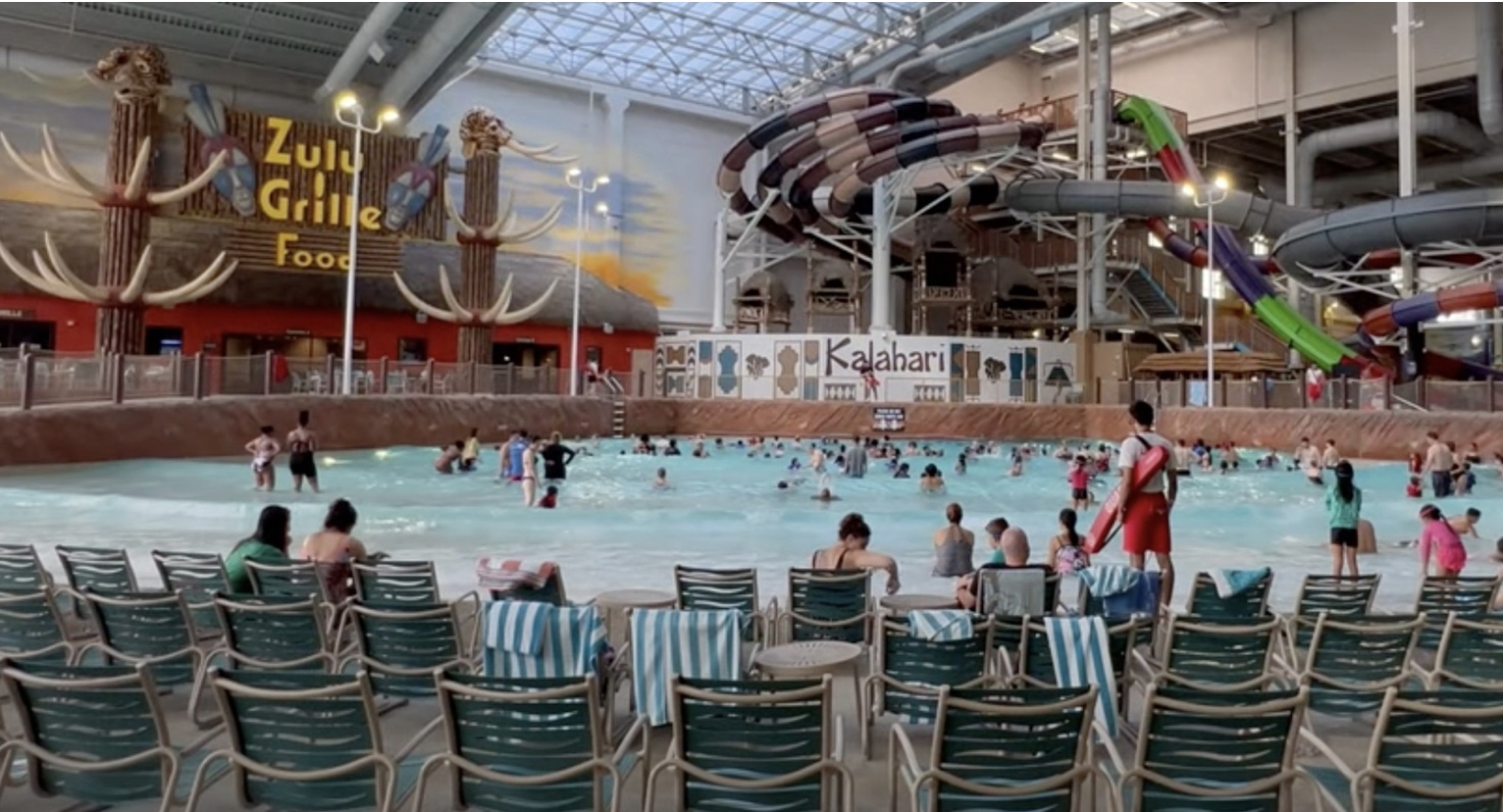
In addition, Kalahari Resort boasts “the world’s largest indoor water park,” the perfect place to bring family members to enjoy… especially (grand)children, (grand)nieces/nephews, etc.

Next month’s retirement blog by guest author Sierra Powell

One final announcement: In several weeks at this blog-site, we plan to feature a new guest blog entitled “Five Things You Need for a Comfortable Retirement” by Sierra Powell, along with updates of other resources for “living the dream!” See you next year?

OK, What is that “AI Thing?”

This 69-year old educator who has spent more than five decades in fostering creative self-expression in his students is fervently opposed to artificial intelligence. Actually, I thought I was allergic to “AI!” Every time I receive an Apple iPhone update or some new download for my computer, I complain, “Why have they moved that button? It doesn’t look or work the same! Why does everything have to change every month?” Slow down, techies!

However, to dabble in this new technology everyone’s talking about, I printed in my last PMEA Retired Member Network eNEWS on page one a sample article (click here for the Winter issue) compiled by AI Overview (Google). I shared this with an adult violin student from my Saturday orchestra who decided to show me the power of AI (not the old AI I am more familiar with – artistic intelligence!). She used her subscription to a ChatGPT to process my brief outline on the topic “retirement transitioning.” Below is the result generated from a few of my random notes. Created in the first person, AI matched my writing style, a chatty/informal letter printed for soon-to-retire colleagues along with research citations. Frankly, it scares me how close this sounds like something I could have composed! Can you tell it was artificially generated? Does this mean we will we have to teach this old dog (fox) new tricks?

Check out these valuable retirement hints courtesy of ChatGPT!

The Retiree Life: Navigating the Art of Reinvention & Emotional Balance

Here with some reflections, tips, and maybe even a little nudge for us all as we continue this grand adventure called retirement. Whether you’re still finding your rhythm or already feel like a pro at this, there’s always room to reflect, grow, and laugh along the way.

This week, let’s talk about something near and dear to every retiree’s journey: reinventing yourself and coping with the emotional ups and downs that come with this new chapter.

Reinventing Yourself: A Second Act Worth Applauding

Remember when we taught our students to embrace creativity and adapt to change? Turns out, retirement demands the same skills. It’s no longer just about what you did—it’s about who you are.

Reinvention isn’t about completely overhauling your identity. Think of it as expanding your repertoire. Studies show that retirees who actively pursue new interests or roles report higher life satisfaction (Wang et al., 2011). Whether it’s picking up the instrument you haven’t touched in decades, volunteering, traveling, or even starting a small business, the key is to stay engaged.

Here’s a thought experiment: What did you always wish you had time to do but never could because of lesson planning, rehearsals, or concerts? Now’s your chance. I’ve recently heard about retirees dabbling in everything from watercolor painting to writing mystery novels. One retiree even became a beekeeper—talk about a sweet second act!

(From past blogs, the Retirement 101 session, and Retired Member Network eNEWS reviews)

The Emotional Journey: Ups, Downs, and Everything in Between

Let’s not sugarcoat it: retirement is a mixed bag. There’s the freedom (hooray!), but also the occasional pang of loss—of identity, routine, or the camaraderie we had in our teaching careers.

The good news? You’re not alone. Research by Pinquart and Schindler (2007) highlights how important it is to acknowledge these feelings rather than sweep them under the rug. Adjusting to retirement is a process, and it’s okay to feel a little off-balance at times.

Here are a few tried-and-true strategies to help you navigate the emotional terrain:

  • Stay Connected: Loneliness can creep in when you least expect it. Keep up with PMEA activities, or start a retirees’ coffee group. Who better to laugh with about the time your marching band got rained out?
  • Practice Mindfulness: Before you roll your eyes, hear me out! Even just five minutes of quiet reflection a day can reduce stress and boost mood (Chopra et al., 2020).
  • Find Meaning: Volunteering or mentoring can give you a sense of purpose that’s deeply fulfilling. You’ve got a wealth of wisdom—share it!

AI of the future?

The Bottom Line

Retirement isn’t a destination; it’s a journey. And like any good road trip, it comes with unexpected detours, scenic overlooks, and, yes, the occasional pothole. The trick is to embrace it all with curiosity and a sense of humor.

If you’re struggling, remember: reinventing yourself doesn’t happen overnight. Take it one day at a time, and don’t be afraid to reach out for support—whether it’s from family, friends, or your fellow PMEA retirees.

Let’s keep the conversation going. What’s your “second act”? Have you discovered a new hobby or way to cope with the emotional shifts of retirement? Shoot me an email or share your story at our next meeting. Together, we’ll continue to learn, grow, and make this chapter one to remember.

Until next time, keep smiling and stay curious!

References:

Wang, M., Henkens, K., & van Solinge, H. (2011). Retirement adjustment: A review of theoretical and empirical advancements. American Psychologist, 66(3), 204–213.

Pinquart, M., & Schindler, I. (2007). Changes of life satisfaction in the transition to retirement: A latent-class approach. Psychology and Aging, 22(3), 442–455.

Chopra, A., Anthonisen, S., & Reeves, A. (2020). The role of mindfulness in retirement satisfaction. Mindfulness in Aging Journal, 7(4), 312–320.

PKF

© 2024 Paul K. Fox

Our Next Chapter

Bookends – Stage 5: “Living the Dream”

Welcome back to my blog site for music educators… actually hopefully thought-provoking reflections for teachers in any subject area or grade level, school administrators, classified school staff (secretaries, aides, custodians, etc.), and professionals in all fields.

It has taken me more than a year to revisit (and expand on) all of the sections from my workshop (October 2023) presented to Seton Hill University music education students, and now we close with “The Final Chapter” – a focus on self-reinvention and transitioning to retirement in anticipation of successfully Crossing the Rubicon to enjoy our “senior years.” This entire presentation was inspired by the mission statement of the Pennsylvania Music Educators Association (PMEA) Council for Teacher Training, Recruitment, and Retention – “The Life Cycle of a Music Educator” – for which I had the privilege of serving eight years as the State Chair (still a council member). To recap, here is an outline of my previous blogs on the evolution of an educator, a journey through career “passages” to follow:

Stage 5: Next Chapter/Living the Dream Years –
Retirement Prep & Mastery

To start with, the term “retirement” is a misnomer. Typically, in most dictionaries (online and printed), it is defined as “the withdrawal from one’s career, occupation, or office usually because of age,” or even the synonyms “seclusion from the world,” “privacy,” “the act of going away,” “retreating,” or “disappearing.” No, perhaps more appropriate definitions would support the advances in medical science, a better standard-of-living, our healthier lifestyles and improvements in self-care, and longer lifespans. Retiring from your first career may only be the halfway point! Sample online quotes:

“The ‘new retirement’ is not an ending, it’s a new beginning, the start of a new life journey of vastly expanded proportion.” Dr. Richard Johnson, Flourishing in Retirement

“Retirement now is mostly about change. And it may not look all that different from what immediately precedes it.” Huffington Post: http://www.huffingtonpost.com/arianna-huffington/its-time-to-retire-our-definition-of-retirement_b_5774878.html

Retirement is “reinventing yourself for the life you’ve always wanted.” Steven Price, How to Survive Retirement, Skyhorse Publishing, 2015

In my experience hosting the annual PMEA conference session “Retirement 101 – the Who, What, When, Where, Why and How” and sharing retiree stories and strategies, I have come to the conclusion that there are many other misconceptions about taking this big step:

  • You retire FROM something. (Nope! You need to retire TO your next phase of life, new goals, pursuits, etc., and not run away from your past. We have often paraphrased the theme of author Ernie Zelinski writings in past paulfox.blogs: Retirees must search for and define the things that your job had provided in the past: 1) Purpose/new life mission, 2) Structure/schedule, and 3) Community/interaction with people.)
  • It’s an easy transition. (For many, it can feel like the most tumultuous transition ever experienced with “change,” sometimes overwhelming swings in emotions, and personal challenges!)
  • It takes little time to prepare. You just fall into it! (No, the research recommends “intentional and comprehensive” advance preparation, starting at least 3-5 years before you “pull your plug.”)
  • The decision is based almost entirely “on the money.” (True, a soon-to-be-retiree should draft a post-employment household budget, analyze net worth and pension/social security benefits, pay off as many loans as possible, and make appointments with an estate planner, elder attorney, and/or financial advisor. However, we retire for a host of very personal reasons – travel, relocation, encore or new careers, caring for family members, etc., and the likely greater challenge is a renewed exploration of self-reinvention, defining new pathways, renewing relationships, and mapping out your rest-of-life strategies and goals. In other words, what are you going to be when you grow up?)
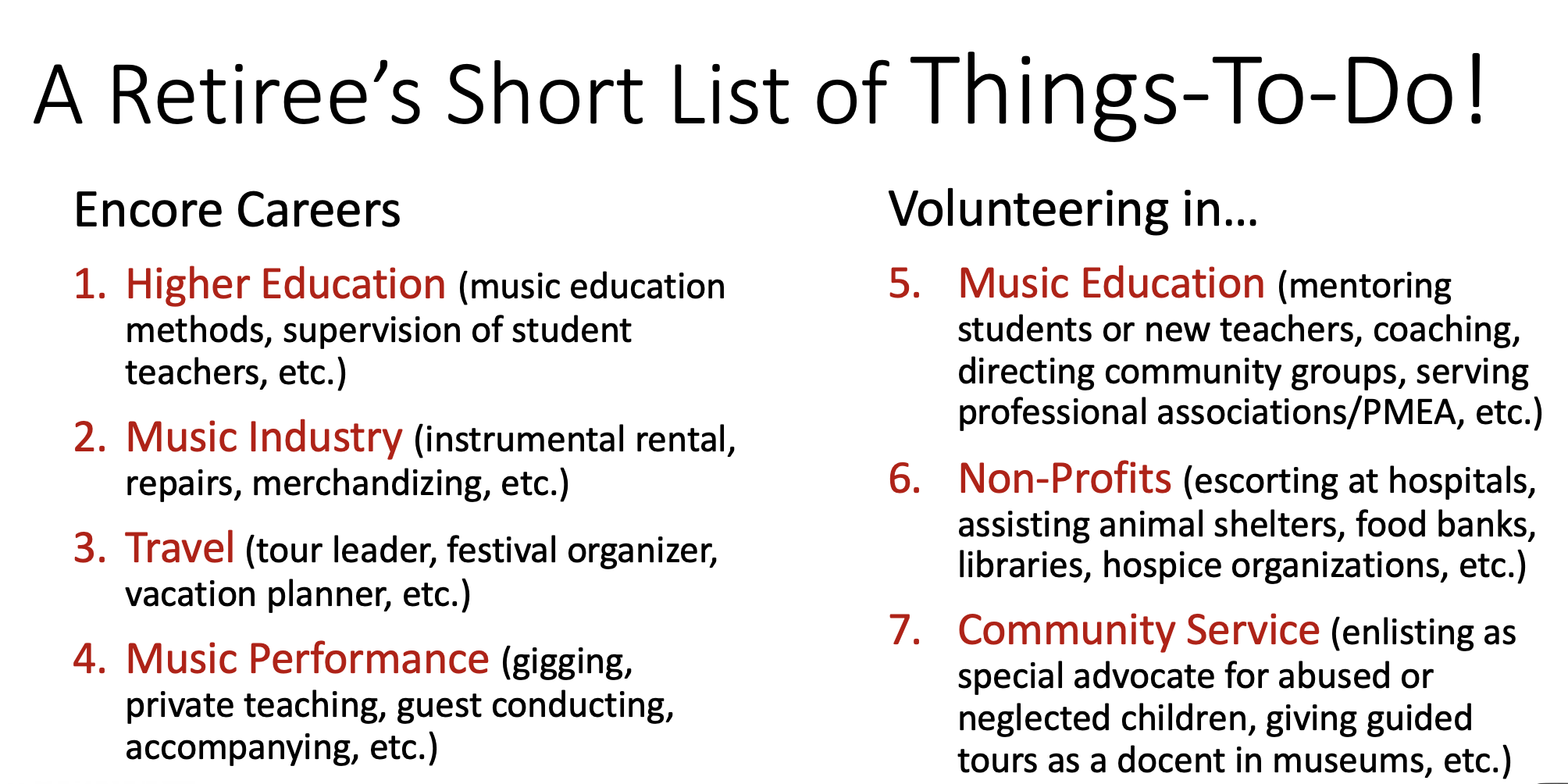
  • It’s completely different from anything you’re doing right now. (Music educators have a variety of skill sets that they will likely retain in future part/full-time employment or volunteer work. They can advance their personal artistry in the singing or playing an instrument, accept solo “gigs” or perform in community or professional ensembles. They can teach privately, direct church or community bands, orchestras, choirs or jazz groups, coach sectionals, compose music or design halftime shows, judge school groups, present workshops, choreograph/direct musicals, serve in college music education programs, etc. The list goes on and on… and is only limited by the retiree’s imagination and interest.)

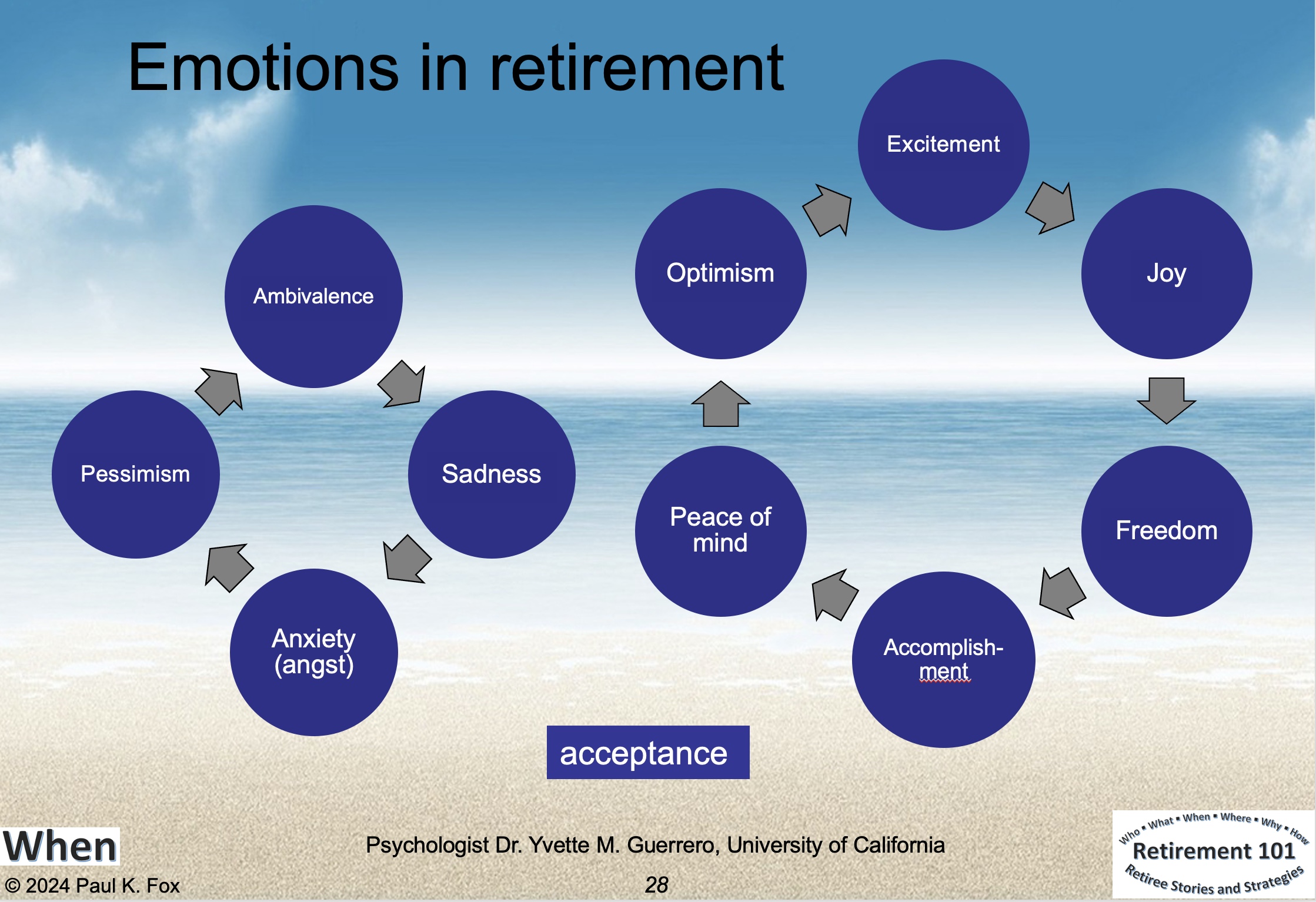
In almost every book on retirement, there are discussions about the “stages of retirement” (defined by gerontologists – experts on aging) that graphically show the importance of advance planning. (See below.) The first three stages certainly provide opportunities to rethink, recharge, reinvent, retool, and redefine one’s life purpose and meaning, become productive, and begin that new chapter in their lives.

Retirement can be a little bumpy. It’s not unusual to feel many “up’s and down’s” through the transition. A lot may have to do with whether you had really wanted to leave your job when you did or if you took the necessary steps in retirement preparation. Many have suggested to take a year or two “internship” to explore your options, rest a little and take a break from all of that stress, celebrate the free time (you seem to) instantly have, and then assess and “test” what might be your next (more permanent) steps.

Prepare for the emotional roller-coaster! Initially, you are very EXCITED about your upcoming retirement. You feel pure JOY about the anticipated FREEDOM, and everyone throws you a party or two. You take moments to sum up your career legacy and ACCOMPLISHMENTS. A blessed PEACE-OF-MIND envelopes you, no longer having to worry about that next concert, recruitment campaign, or lesson target. With the future in front of you, you feel OPTIMISM. And then, after the excitement dies down…

At times, you feel a little AMBIVALENT about all of this “change!” SADNESS could come saying good-bye to your colleagues and experiencing a loss in professional identity and sense of purpose. Perhaps you may experience ANXIETY (angst) about what the future will hold, and PESSIMISM on whether you will “get it together” in your new life.

But, finally… ACCEPTANCE and adjustment!

Both emotional cycles may happen at different times or nearly simultaneously. These are normal “speed bumps,” and the perfect reason why you should remain as active as you can with your relationships, especially with people who have already made the retirement journey.

Are you ready to retire over the next 3-5 years? Well, as the PMEA Retired Member Coordinator for ten years (with the help of numerous inspirational music teacher retirees in PMEA), I have spent a lot of time preparing what amounts to be a “mock instructional manual” and other resource materials for fellow PMEA members. These are all posted here on the PMEA website. (This one of the best reasons to maintain your PMEA professional association and pay your dues… We continue to advocate, advise, and assist all PA music educators… from preservice to “living the dream!”)

Free “nuts and bolts” are listed below for you to peruse as you prepare for this life-changing passage.

What’s next? How about attending the PMEA Annual Conference on April 9-13, 2025 at the Kalahari Resort/Poconos (“home of the world’s largest indoor water park!”) and enjoy some time away from it all? The Kalahari offers some family-fun recreation and PMEA will provide concerts, keynotes, exhibits, and sessions of stimulating professional development for the entire “life cycle of the music educator.”

PMEA members, I hope you plan to attend my Friday session at the conference…

Looking forward to seeing you there! At any time, if you need help or more ideas on retirement prep, I’m just a quick email away. (Click here.) Let me hear from you!

PKF

© 2024 Paul K. Fox

Update… Bigger & Better Things!

T-minus Twelve Months to Year 70!

Wow! I can’t believe it’s been three whole months since I posted a blog here! Where’s the time gone? Excuses? Well, what first leaps to my mind are several quotes from this Southern Living website about being an extremely busy retiree:

“The trouble with retirement is that you never get a day off.” — Abe Lemons

“I need to retire from retirement.” — Sandra Day O’Connor

“The harder you work, the harder it is to surrender.” — Vince Lombardi

“I wanted to have more time to play and reflect, but I find retirement more stressful than having a nice, steady job because I have to make decisions about where I want to be.” — Walter Cronkite

“I see retirement as just another of these reinventions, another chance to do new things and be a new version of myself.” — Walt Mossberg

“Living each day as if it were your last doesn’t mean your last day of retirement on a remote island. It means to live fully, authentically and spontaneously with nothing being held back.” — Jack Canfield

“Do not grow old, no matter how long you live. Never cease to stand like curious children before the great mystery into which we were born.” —Albert Einstein

To my friends and colleagues in the profession, yes I am “living the dream” and having fun in retirement! Health remains good, and the days of my wife and I are filled with personal enrichment, unique new and renewed adventures, and meaningful service to the causes that matter to us both! Our only complaint? There are only 24 hours in a day… But, that means, as we head to bed each night, we have lots on our ever-expanding to-do lists motivating us to get up even earlier the next day to accomplish!

So, the following will be a quick (?) update, ramblings in the format of “streams of consciousness” of what’s happening in our lives, geared to my more faithful friends and followers, and perhaps modeling the activities of two happily retired music teachers. I promise that future blogs will re-engage with our series on “Bookends…” (life cycle of a music educator), ethics training of educators, and interviewing skills of newcomers to the profession (the season of job screenings will soon be upon us!), not to mention more tips towards a smooth transition to retirement for those who are planning to “pull their pin” and leave their full-time employment in the near future. Thanks for hanging in there with us!

PMEA Conference

Both my wife Donna, her cousin Judy, our two dogs Gracie and Brewster, and I just returned from Erie, PA participating in the PMEA Annual In-Service Conference. This was unique in that, for the first time since we retired in 2013, Donna could attend “the big event” with me. Judy served as our dog babysitter (we don’t believe in “jailing” our pups!), and the Bayfront Sheraton, Courtyard Marriott, and Erie Convention Center were pet-friendly. We reserved adjoining rooms, and the dogs were content to walking all around the Bayfront Area/Lake Erie and returning at night to sleep with us.

To my PMEA colleagues and other PA educators, in case you missed it, here is the link to more than 1,000 photos I took at the conference (sessions, meetings, exhibits, and performances). Attendees, I challenge you: CAN YOU FIND YOURSELF & YOUR STUDENTS?

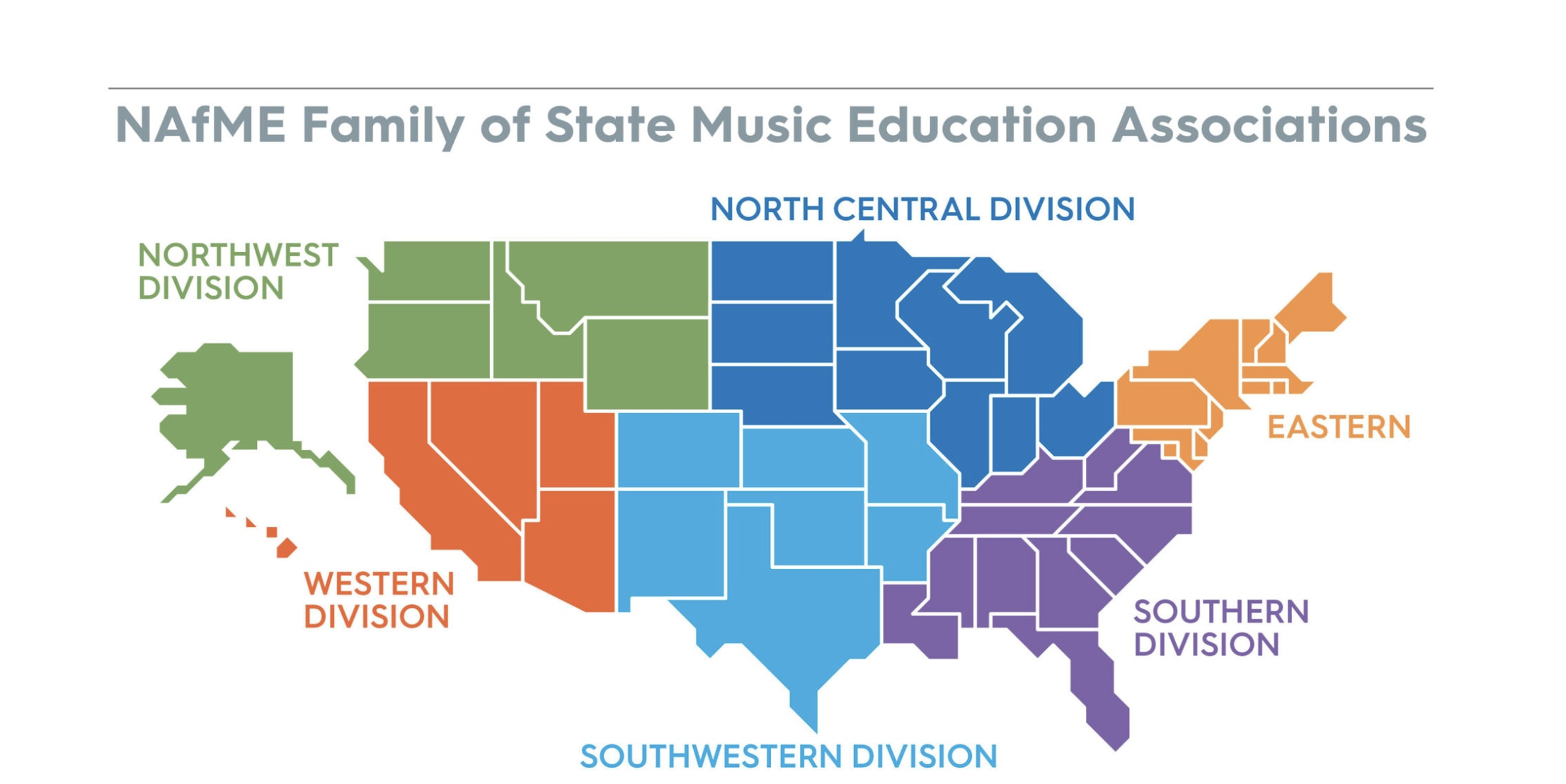
As usual, Executive Director Abi Young, PD Council Chair Martha Heise and her conference planning committee, PMEA state EXCOM and staffers planned another outstanding event. If you have never gone to a PMEA conference, mark next year’s dates April 9-12, 2025 on your calendar, which will be held in the luxurious Kalahari Resort in the Poconos. Besides, the “world’s largest indoor water park” is a fun place to bring your (grand)children! In addition, several other professional development and career enhancement venues are on the horizon available to members of NAfME and PMEA:

  • PMEA Summer Summit (Leadership Conference), Reading, PA
    July 15-17, 2024
  • NAfME Biennial Music Research and Teacher Education Conference, Atlanta, GA
    September 25-28, 2024
  • NAfME Eastern Division Conference and Honors Ensembles Festival, Hartford, CT
    April 24-26, 2025

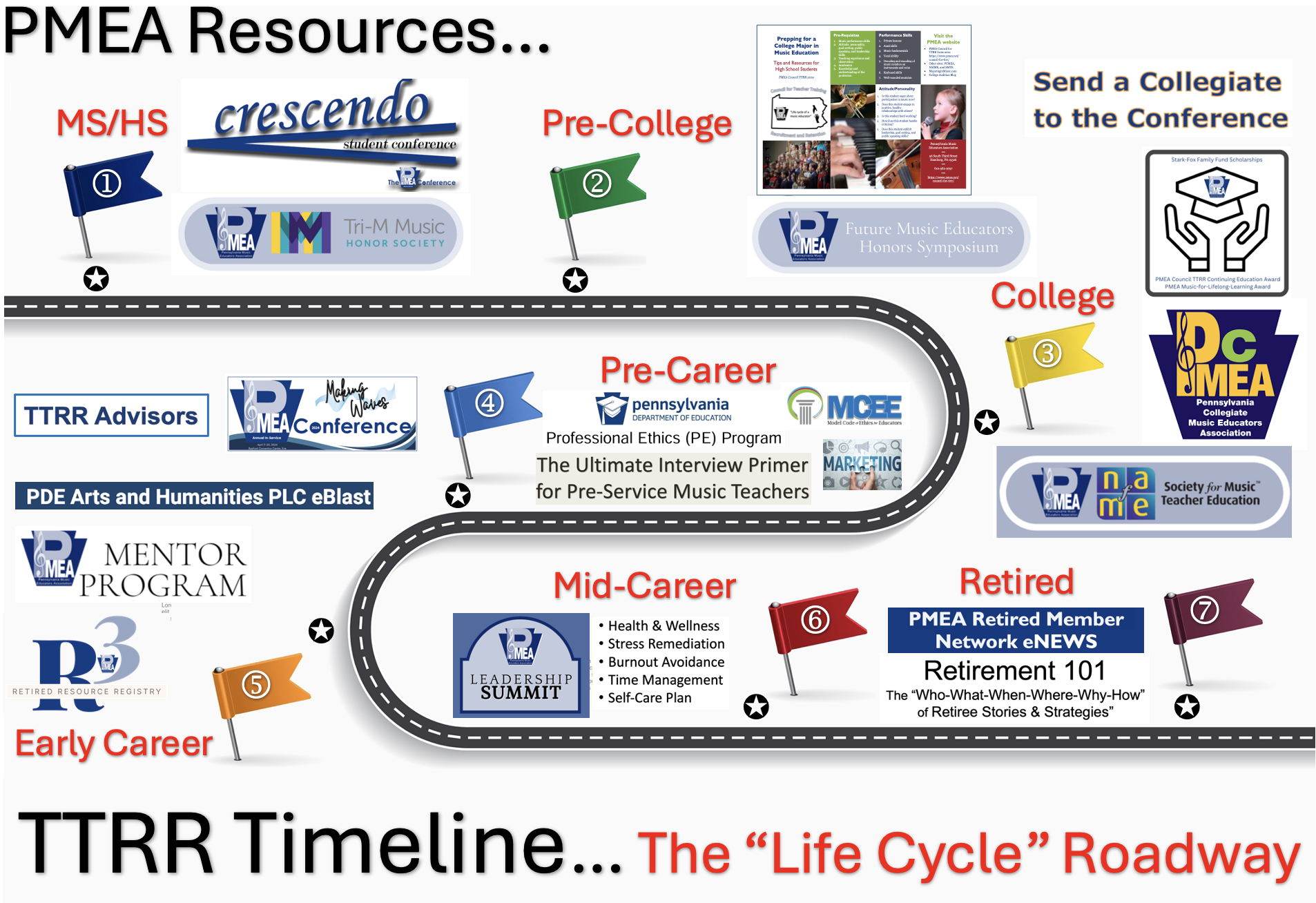
At the Erie conference, I hosted my last PMEA Council for Teacher Training, Recruitment, and Retention and TTRR SHOWCASE. At our annual meeting, I stepped down as the state chair, but will continue as State Retired Member Coordinator on the Council TTRR. We’re in excellent hands, with TRI-M Chair Tina Bennett being elected to the state TTRR Council Chair position. Joining her is the visionary leadership of State SMTE Chair Dr. Kathleen Melago, Mentor Co-Chairs Lisa Endler and Eric Plum, PCMEA Student President Ellie Vito, Future Music Teachers Honors Symposium Chairs Aaron and Stephanie Magaro, PDE Fine Arts Education Consultant David Deitz, and Higher Education Representatives Paul Doerksen, Jessica Vaughan-Marra, Sarah Watts, Debbie Wolf, among others.

Below is a copy of the “Everything You Always Wanted to Know About Council TTRR” SHOWCASE slides which were presented to a whopping 60 PCMEA members during our breakfast meeting at the conference. (Perhaps the food motivated more collegiates to get up extra-early for that first session?)

Scholarships

One of the concerns repeatedly expressed at Council TTRR meetings was the funding issues of college students. Besides an anonymous donor funding the PCMEA breakfast at the SHOWCASE on April 18, PMEA instituted a “send a collegiate to the conference” campaign (complimentary registrations) and in 2023, also announced two major scholarship (college expense reimbursement) opportunities endowed by our Stark-Fox Family Fund in memory of our parents:

  • PMEA Council TTRR Award for Music Education Majors
  • PMEA Music for Lifelong Learning for STEM Students in College Music

In the spring of 2023, three $5K PMEA Council TTRR Scholarships were awarded to:

  • Elizabeth Corbett (Duquesne University)
  • Adam Hanna (Susquehanna University)
  • Mitchell Hourt (Moravian University

Unfortunately, last year no applications were submitted for the PMEA Music for Lifelong Learning Award. A concerted effort has been made to “reachout” to this population of students who are pursuing a science-related field and participating in their PA college band, chorus, jazz, or orchestra program. Please spread the word! Deadline to register is May 29, 2024. More information is posted here.

Upcoming Workshops

I was pleased to learn that two of my sessions were accepted for the Kappan 2024 Educators Rising National Conference scheduled for June 28-July 1, 2024, in Washington, D.C. at the Marriott Marquis:

  • Embarking the E3-Train – Essentials for Future Educators – What It Takes to Become a Teacher: Ethos, Ethics, and Engagement
  • Interviewing and Branding 101 – The Art and Science of Marketing Yourself for Employment Screening

In addition, I remain active in supporting my colleague Thomas Bailey in providing PDE-approved Act 45 and Act 48 ethics training courses for PA educators. Currently, we’re teaching our fifth series of classes (25 PIL hours) for school system leaders and have presented more than 14 additional professional development workshops, webinars, or conference sessions of in depth interactive discussions of ethics and daily educator decision-making. Our next focus area is to help PA administrators to incorporate the newly mandated PA Chapter 49 ethics competencies into their school induction programs.

To learn more about course offerings or read court case blogs on ethics in education, visit Tom Bailey’s website here. This blog-site also provides a comprehensive library of past articles on educator ethics.

Who Really Reads These Blogs?

That’s a good question! Although I have always provided a “comment” link at the top of each posting and seek feedback and even “guest authors” to feature in future blogs, very few people respond to these articles. I have always hoped that “my meanderings” could help music teachers at all stages of their careers, from pre-college and music/music education majors to veteran educators to retirees. At least, this WordPress site allows me to permanently archive my writings with the hope this exhaustive but always-accessible supply of resources, links and viewpoints could be used in the future. Share on!

So recently, I was pleasantly surprised when Becca Robinson, a tutor of homeschooled children, reached out to me and said Jeremy, one of her students, did extra-credit research after reading one of my blogs on retirement resources. We are adding his recommendation for this link to the Transportation Resource Guide for Seniors & Individuals with Disabilities in the “Retiree” menu section at the top of the page. This comprehensive article by Cole Neder documenting the following is a valuable read for senior citizens and anyone who is experiencing personal mobility challenges:

    • Public Transit
    • Paratransit Services
    • Demand Responsive Services
    • Non-Emergency Transportation
    • Ride-Sharing and Taxis Services
    • Service Resources by State

    On a Personal Note…

    Yes, last week was my 69th birthday! I never imagined getting that old… er, I mean, mature! Neither my mother nor my father made it to their seventh decade! I attribute my positive attitude and active lifestyle (even though at times I could unintentionally forget your name at the drop of a hat) to embracing what Ernie Zelinski, author of How to Retire Happy, Wild and Free, says is absolutely essential to maintain in retirement: “finding purpose, structure, and community.” It is a paramount of importance to feel we matter and are needed every day, exercise both sides of our brain (the analytical and the creative), keep physically fit, jump out of our bed with purpose, maintain busy schedules and accept a lot on our plate, and stay connected to the people surrounding us. To that end, my wife and I continue to teach the pursuit “creative self-expression,” directing a community ensemble (the South Hills Junior Orchestra), teaching, walking our dogs, and pushing wheelchairs at our local hospital. At times, this latter activity allows us to catch up with our former music students, their parents, school staff, and neighbors. What FUN it is to meet someone who I taught many years ago in middle school, now grown up and busy raising their own “band” of musicians! God willing, I hope to continue with good health, a sharp mind, and motivation to live to Moses age (150 years old?), or at least have a ball along the way!

    I leave you this month with a copy of the one-of-the-kind birthday card one of my adult students (who claims me as her “adopted father?”) created using Photoshop. Three generations of her family play in our Saturday orchestra. Caption: Left is our Gracie, a bichon frise, and right is Brewster, a yorkie-poo. I’m depicted in the middle with my SHJO bow-tie, of course!)

    Happy trails, retirees and active educators alike! Keep in touch!

    PKF

    © 2024 Paul K. Fox
    Bookends – Part Two

    The Life Cycle of a Successful and Happy Music Educator

    Joyous Holidays, Season Greetings, and Happy New Year from “The Foxes!” This is a time for reflection and gratitude… and we feel blessed for all the opportunities allowing us to share our insights, gifts and experiences with other music education professionals.

    We hope to inspire YOU and literally model the concepts in this blog series. We continue with our discussion first introduced a month ago in Bookends – Part One – The Life Cycle of a Successful and Happy Music Educator, exploring:

    • Stage 3: Inservice/Growing Years (this blog)
    • Stage 4: Veteran/Sustaining Years (future blog)
    • Stage 5: Next Chapter/Living the Dream (future blog)

    This article is an abstract from a session presented to Seton Hill University music education student teachers on October 17, 2023. Click on this link to download the slide summary in PDF format.

    “I have written a lot of articles in support of these topics… now compiling them for your easy access. Depending on your current status and interests, feel free to peruse the checklists (links) in this series. It is possible a few of the resources contained within these blogs have gone inactive, but I believe enough are there for you to gain the insight, tools and motivation to achieve professional development for life.”

    – Paul Fox

    Stage 3 – Inservice/Growing Years

    [ ] 8. Becoming a Music Educator: For a review of Bookends – Part One, take a step backward and revisit what you have done to “get ready” for your “rookie years.” Take special note on the things-to-do list (“secrets”) as a first-year educator (perhaps completed during your student teaching semester):

    • Subscribe to a discounted NAfME + PMEA first-year membership (If you are a recent college graduate in your first year of teaching, or if you are the spouse of a current or retired NAfME member, contact NAfME at 800-336-3768 or email memberservices@nafme.org) to find out if you qualify for a reduced rate.
    • Hook up to PMEA Mentor or other state’s MEA support program for new teachers.
    • Look into finding an informal advisor in the PMEA Retiree Resource Registry for PA music teachers.
    • Need to fill in a few gaps missing from your college courses in skills and knowledge? Continue your “enrichment” viewing PMEA Webinars and the exhaustive video library in the NAfME Academy.
    • Take advantage of earning professional development credits just for reading an article in the NAfME Music Educators Journal
    • At some point you will be writing/editing curriculum, so research the awesome resource of Model Curriculum Framework (Have to be a PMEA member)
    • Too busy to participate in the PMEA Annual Conference or NAfME national events? Look into going to a PMEA summer conference (usually at a lower-cost!). Check out your own state’s MEA discounts and offers for collegiate members and new teachers!
    • Numerous free and timely blog posts from NAfME Music in a Minuet and here (paulfox.blog).

    [ ] 9. The Care & Feeding of Your Principal: Although not covered in any detail during the Seton Hill University presentation, it is recommended that you read in its entirety “The New Teacher’s Guide to Fostering Positive Relations and Good Interactions with School Administrators” offering a wealth of excellent recommendations from these trustworthy sources:

    A favorite question I pose to college music ed seniors is, “In what professional associations are you a member and actively involved?” For the price of consuming one fewer Starbucks latte a week, you can open up the Wonderful World of “C’s” – Contacts, Coachings, and other Connections, including research and resources that will benefit your Continuing Education. You can’t afford NOT to join groups like these.

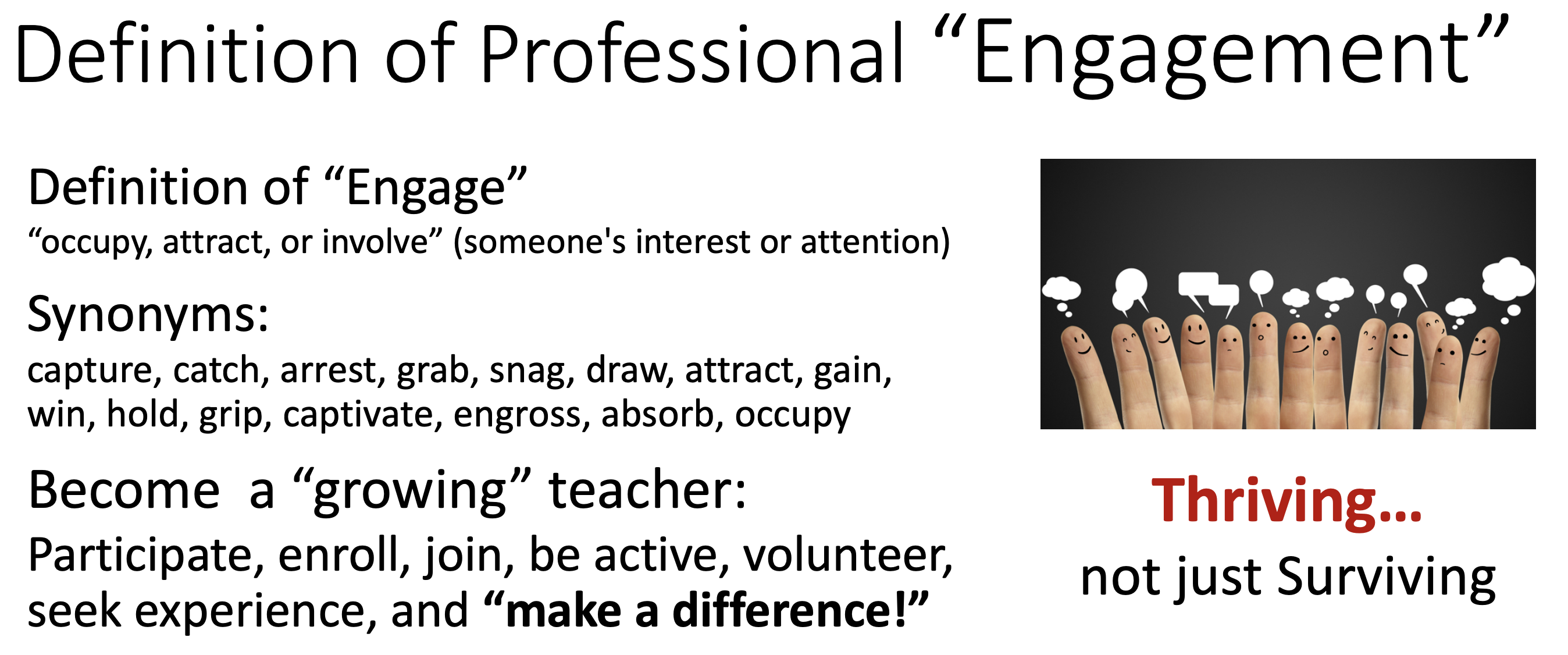
    To help “nail down” a few related definitions critical to personal growth and career development in our profession, especially “engagement,” “professionalism,” “collaboration,” and “networking,” please take a little time to travel and consume the following archived blog postings.

    [ ] 10. The Meaning of PRO: This is one of the oldest articles at the paulfox.blog site. How about a little soul searching? Are you truly a professional? Do you have the skills, habits, and attitudes of a professional in the field of education?

    [ ] 11. Transitioning from Collegiate to Professional (Part II): New teachers have to move away from “book learning” or higher education research and emphasize “practical application,” and at the same time, assess the precise areas needed for immediate (re-)training… everything from new exposure to specialized teaching areas and grade level focus for the job to which you have been assigned, to the enhanced skills of classroom management, student assessment, curriculum writing, class or ensemble warm-up materials, music repertoire and programming, etc.

    While we are on the subject, it is important to intentionally seek out mentors or consultants in your early years of becoming an educator. PMEA offers a mentoring program (read all about it here) and PMEA Retired Members are also an excellent resource to “phone a friend” for advice as needed (see their section on the PMEA website here). That leads us to the next most essential “habit” of attending professional conferences… #12 below.

    [ ] 12. Getting the Most Out of Music Conferences: Our PMEA Annual Conference sites are cyclical. This article, written on March 5, 2017, showcased that year’s event at the Erie Bayfront Convention Center – coincidentally the same location for this year’s PMEA Annual Conference: April 17-20, 2023. For a sneak peek at the proposed sessions and guest performers, click here.

    There are a myriad of conferences offered every year… something for everybody in just about every state. Make plans to go, “recharge your batteries,” and pick up new state-of-the-art ideas, lessons, music, technology, etc. Again, you cannot afford NOT to attend… or becoming stale in your teaching or “stuck in a rut!” Besides, going to your state’s or national conferences and regional workshops are FUN places to meet other like-minded, inspiring colleagues! This is how professionals network, collaborate, and share their “latest and greatest!

    A couple upcoming events:

    What are you waiting for? It’s time to DIVE INTO your customized career development!

    Coming Soon…

    Bookends Part Three – Stages 4 & 5

    PKF

    © 2023 Paul K. Fox

    Bookends – Part One

    The Life Cycle of a Successful & Happy Music Educator

    “There are no secrets to success. It is the result of preparation, hard work, and learning from failure.”

    Colin Powell

    I feel blessed to have spent five decades in the field of music education. No other career has offered so much personal satisfaction, discoveries and growth of hidden potentials and skills I never knew I had, sharing my love of creative self-expression, and facilitating others to seek their own connections to music. I am trying to follow my own “retirement” advice, remaining active in the profession in ways that matter, helping others find their own success, and embracing author Ernie Zelinski’s mantra to “find purpose, structure, and community” throughout my years as a retiree.

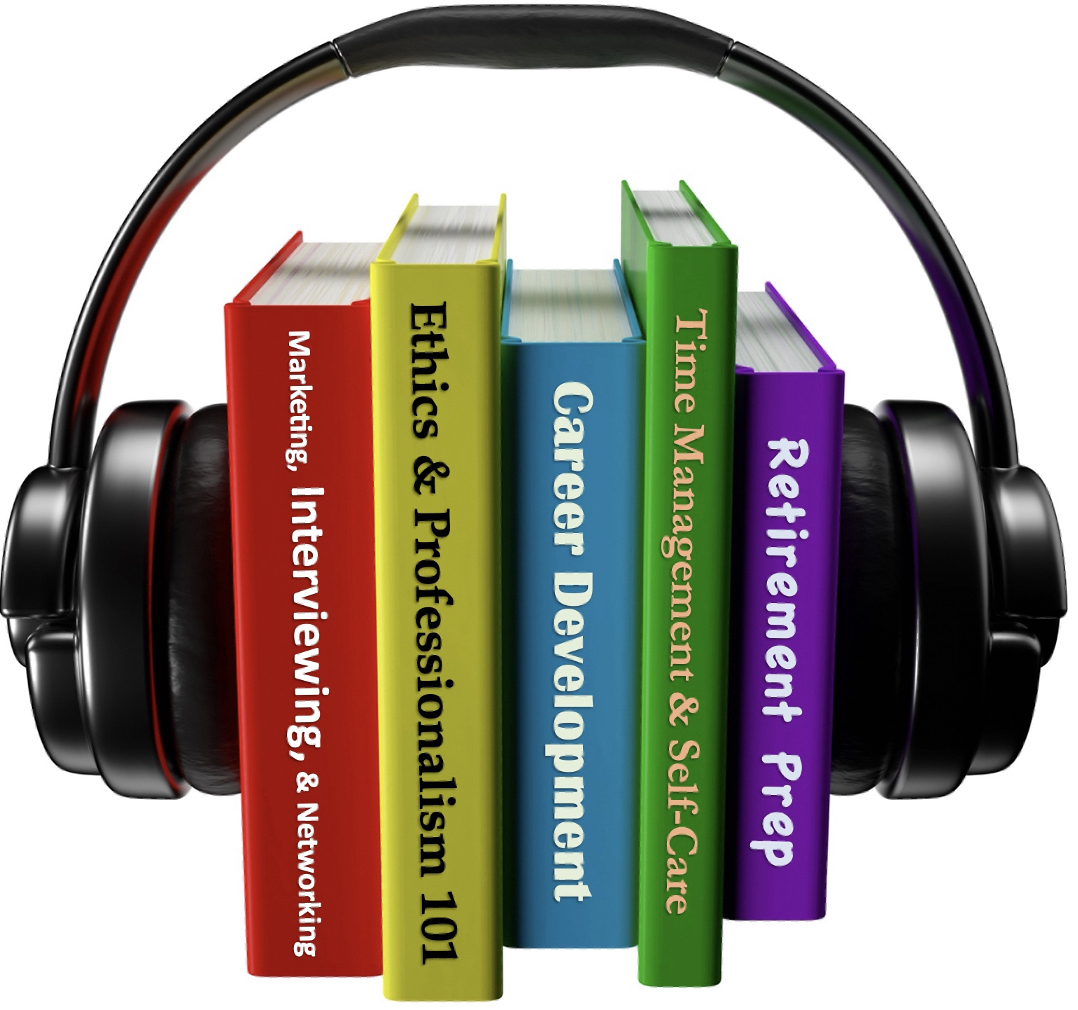
    Parallel to the mission of the Pennsylvania Music Educators Association Council for Teacher Training, Recruitment, and Retention, serving “the life cycle of a music educator,” this blog site is my “gift” to future and current music educators and those contemplating retirement. Recently, I presented a workshop on this topic for student teachers in music education at Seton Hill University (Westmoreland County, Greensburg, PA), summarizing a framework for “professional development for life” in order to foster these goals and nurture meaningful successes of pre-service music educators. No “road map” (or to retain the analogy in my title, “library” of resources) is applicable to everyone nor will the journeys/readings be the same… but since my collections of past blogs over ten years are now vast, I offer this simplified checklist for any “newbie” interested to seek their own pathway. Happy travels!

    1. Preservice/Training Years: Marketing, Interviewing, & Networking
    2. Rookie/Practicing Years: Ethics & Professionalism 101
    3. Inservice/Growing Years: Career Development (next blog post)
    4. Veteran/Sustaining Years: Time Management & Self-Care (next blog post)
    5. Next Chapter/Living the Dream Years: Retirement Prep & Mastery (next blog post)

    The slides to the entire presentation are open to anyone to view below.

    However, here’s a shamelessly offered advertisement. It would make more sense to see this “in-person” or online with my moderation. I would be happy to present this session (giving me at least an hour to allow for more interactive discussion) to collegiate members, a music education methods class, a regional workshop, or festival meeting via Zoom or in-person (in PA). If interested or to inquire, please send me an email here.

    Now… the checklists. Depending on your current status and interests, peruse the following resources. It is possible a few of the links contained within these blogs have gone inactive, but I believe enough is there for you to gain the insight, tools and motivation to achieve “professional development for life.”

    Stage 1 – Preservice/Training Years

    The focus during our early years in any profession is learning the “shtick” and getting ready for the job search and interviewing. Probably before anything, we revisit our inspiration and what Simon Sinek directs us to “the why” of any organization… in this case, “the why” of becoming a music educator – our philosophy, mission, vision, and understanding of the purpose/role of music education n the schools.

    [ ] 1. The Meaning of Pro: Are you a professional? Do you have the skills, habits, and attitudes of a professional in the field of education?

    [ ] 2. Marketing Yourself and Your Pre-K to 12 Music Certification: What is your professional “brand?” Do you plan to “sell” yourself as a specialist, e.g., “band director” or “elementary general music teacher, etc.? To those potential job candidate screeners, promote the image of being proficient – “a total music educator” – and don’t emphasize your major/emphasis or perceived skill or experience limitations. The only thing that really matters is whether you are the “right fit” for a particular opening, and of course, deciding whether or not to accept the offer. Your license (certification) implies that you do indeed have the necessary training to teach all K-12 music classes. Don’t sell yourself short!

    [ ] 3. Criteria for Selection of the “Ideal” Teacher Candidate: The best way to prepare for a job interview is to become aware of how you will be judged in comparison with your peers. What are the standards (or behaviors or criteria) of outstanding teachers? For what are administrators looking to fill the vacancies and build/maintain a quality staff?

    [ ] 4. “S” is for Successful Storytelling: The number one method to land a job is “SHOW, don’t TELL!” Stories are up to 22 times more effective than facts alone. Identify the key impressions you want to convey. Pick interview stories that will “sell” the right message. Learn how to share unique personal examples of your interactions with children, colleagues, and music programs. These additional resources can be shared about “strategic storytelling” and how to prepare (a.k. practice) telling your anecdotes:

    [ ] 5. The Ultimate Interview Primer for Pre-Service Music Teachers: This super-packet has a collection of more tips on marketing yourself and mastering the “science” of finding a job, interview strategies and sample questions, evaluative rubrics, follow-ups, “bad habits” to avoid, etc. Take the time to download and explore these excellent tools!

    Homework for Stage 1 – Developing a Marketing Plan

    • Standards: Define your personal mission, goals, and philosophy for teaching music, modeling the highest ideals of professionalism, and becoming the “total music educator.”
    • Marketing: Design and distribute a “state-of-the-art” résumé, e-portfolio, website, and business card.
    • Skills: Compile a list of anecdotes and true stories of you overcoming challenges, solving problems, and demonstrating  “best practices” of professionalism and self-improvement.
    • Assessment: Practice, record, and evaluate yourself answering job interview questions.

    Stage 2 – Rookie/Practicing Years

    [ ] 6. Ethics for Music Educators – Part I, Part II, and Part III: You may think that the primary focus for our early years as a novice teacher would be the reinforcement of what we learned about education – curriculum, content, methods, classroom management, and assessment, but something else trumps all! Before we ever step foot in a classroom, rehearsal room, or stage, it is essential we first review those ethical standards in education, terminology, philosophy, and “the codes” that bind us. We should be able to show in depth understanding of these concepts:

    • Fiduciary
    • Moral Standard
    • Ethical Standard
    • Ethical Equilibrium
    • Moral Professionalism
    • Differences Between a Code of Conduct and a Code of Ethics
    • Student-Teacher Boundaries and the Slippery Slope of Ambiguous Relationships
    • Function/Relevance of “The Codes” to Daily Teacher Decision-Making

    For nearly every presentation I do on “ethics for pre-service music educators,” I hold up a fifty dollar bill and ask, “Who wants this? Can you name the exact title of your state’s code of conduct for educators and the government agency that enforces it?” So far, no one has made me $50 poorer. Indeed, few active teachers “in the trenches” have read their “codes,” and frankly, that is surprising. Violation of any major provision in our code of conduct will result in a serious reprimand, being fired, losing one’s certificate to teach anywhere, and/or criminal/civil prosecutions. Wouldn’t you think all of us would be intimately familiar with the “rules” of our professional?

    For my Pennsylvania colleagues, please download and READ these:

    [ ] 7. Ethical Scenarios (and More): The study of morality in professional decision-making is essential to pre- and in-service training of music teachers. Our goal should be to reinforce recommendations for the avoidance of inappropriate behavior (or even the appearance of impropriety), and defining and modeling the “best practices” of a serving as a “fiduciary” by promoting trust, fostering a safe environment for learning, acting in the best interests of our students, and upholding the overall integrity of the profession.

    One of the best ways to accomplish this is to discuss ethical scenarios in small peer groups, an interactive exchange of opinions – “what would you do?” – in analyzing hypothetical case studies. Perhaps in a college methods class, student teaching seminar, department meeting, faculty committee, or PLC (Professional Learning Community), the following thought-provoking questions from the Facilitator Guide for Professional Responsibilities – Module 5, written by the Connecticut State Department of Education T.E.A.M. (Teacher Education & Mentoring) manual should be discussed in an open, reflective, nonthreatening setting:

    1. What possible issues/concerns might this scenario raise?
    2. How could this situation become a violation of the law, the “Code” or other school/district policies?
    3. In this situation, what are some potential negative consequences for the teacher, students, parents, and/or school staff?
    4. How would this episode affect a teacher’s efficacy in his/her classroom, demean the employing school entity, or damage her position as a moral exemplar in the community?

    Please visit link #7 (above) for sources of ethical scenarios to study, including my “conundrum series.”

    Homework for Stage 2 – Are you an Ethical Educator?

    1. Self-assess your own habits of professionalism, and identify goals for at least two “personal improvement projects.”
    2. Read “cover-to-cover” any documents relating to your own state’s code of conduct and the NASDTEC Model Code of Ethics for Educators.
    3. Discuss the ramifications of “choices” and teacher decision-making in context by reading a few of the fictitious scenarios highlighting ethical precautions, disputes, and “conundrums.”

    Coming Soon…

    Bookends Part Two

    PKF

    © 2023 Paul K. Fox
    “The Codes” & School Law

    Free Five-Part Series on PA Educator Ethics Updates

    Since the NAfME and PMEA conferences in April, we have been busy creating additional opportunities for professional development in PA educator ethics training. My colleague Thomas Bailey and I have been preparing a Zoom meeting/video series for interested Pennsylvania school system leaders, administrators, department heads, educators, and PA Act 45 or 48 continuing education providers.

    Please see the schedule below. The first seminar was recorded.

    Session 1: 
    William Penn vs. PDE – May 30, 2023 @ 4:30 p.m. 
    Click here to view the video.

    Session 2: 
    Model Code of Ethics for Educators June 6, 2023 @ 4:30 p.m.

    Session 3: 
    PA Code of Professional Practice and Conduct June 13, 2023 @ 4:30 p.m.

    Session 4: 
    PA Professional Standards & Practices Commission June 20 @ 4:30 p.m.

    Session 5:
    Educator Discipline Act June 27 @ 4:30 p.m.

    To join the Zoom meetings and participate “live” in the upcoming question-and-answer sessions with our speakers, go to this link and scroll down to the bottom of the page. After completion, the YouTube URL for each seminar will also be posted here.

    An intriguing follow-up resource is to visit Thomas Bailey’s website, especially the informative educator blog he has published including analysis of the William Penn vs. PDE hearings on equitable school funding in the PA Commonwealth Court (first session above) and other “ethical conundrums” and issues in the news.

    I am also happy to report that we are expanding our PIL Act 45 professional development class offerings and Thomas has reapplied for PDE approval of a revised version of our Act 48 workshop on “PA Educators – Your Ethical Codes and School Law.” Click below to download a copy of our trifold brochure on the PIL course and summer in-service programs.

    Finally, to all of my music educator friends in the Commonwealth, I hope you have registered for the PMEA Summer Conference, being held in the Red Lion Hotel Harrisburg/Hershey on July 17-19, 2023. This event is in conjunction with the annual PMEA Board of Directors meeting on July 17 and the PMEA “Day of Service” assisting the Harrisburg Symphony and the Whitaker Center for Science and the Arts on July 19. In addition, I am looking forward hearing a performance of the Yankee Brass Band:

    Since 1987, the Yankee Brass Band has both entertained audiences throughout New England and championed the cause of “historically informed performance” within the field of American band music. 2023 marks our 36th season. Using rare and authentic period instruments, and outfitted in appropriate uniforms, the Yankee Brass Band presents the music of the “Golden Age of Bands” played in much the same manner as in the mid to late 19th century. 

    The workshops, clinicians, and details for registration are posted on the PMEA website here.

    Hope to see you there!

    PKF

    © 2023 Paul K. Fox