
Social Media – Revisited

Before you begin reading this article, please take a moment and peruse these past blog posts:

Although several of the cited research links may have expired (for example, PA Department of Education modified most of their website’s URLs), these provided the foundations of background information and references for the presentation I prepared for the DCMEA Virtual Conference in 2020 (during COVID) and serve as the starting point for the workshop I will share in-person at the DCMEA Winter Conference in January 2026. This blog provides updates and additional perspectives. Taken in combination with the above sources, you will be able to identify the benefits, positive models, precautions, and dangers of social media, social networks, professional learning networks, and sample emerging technologies as they apply to teachers’ professional development and education of students.


“THE WHY”

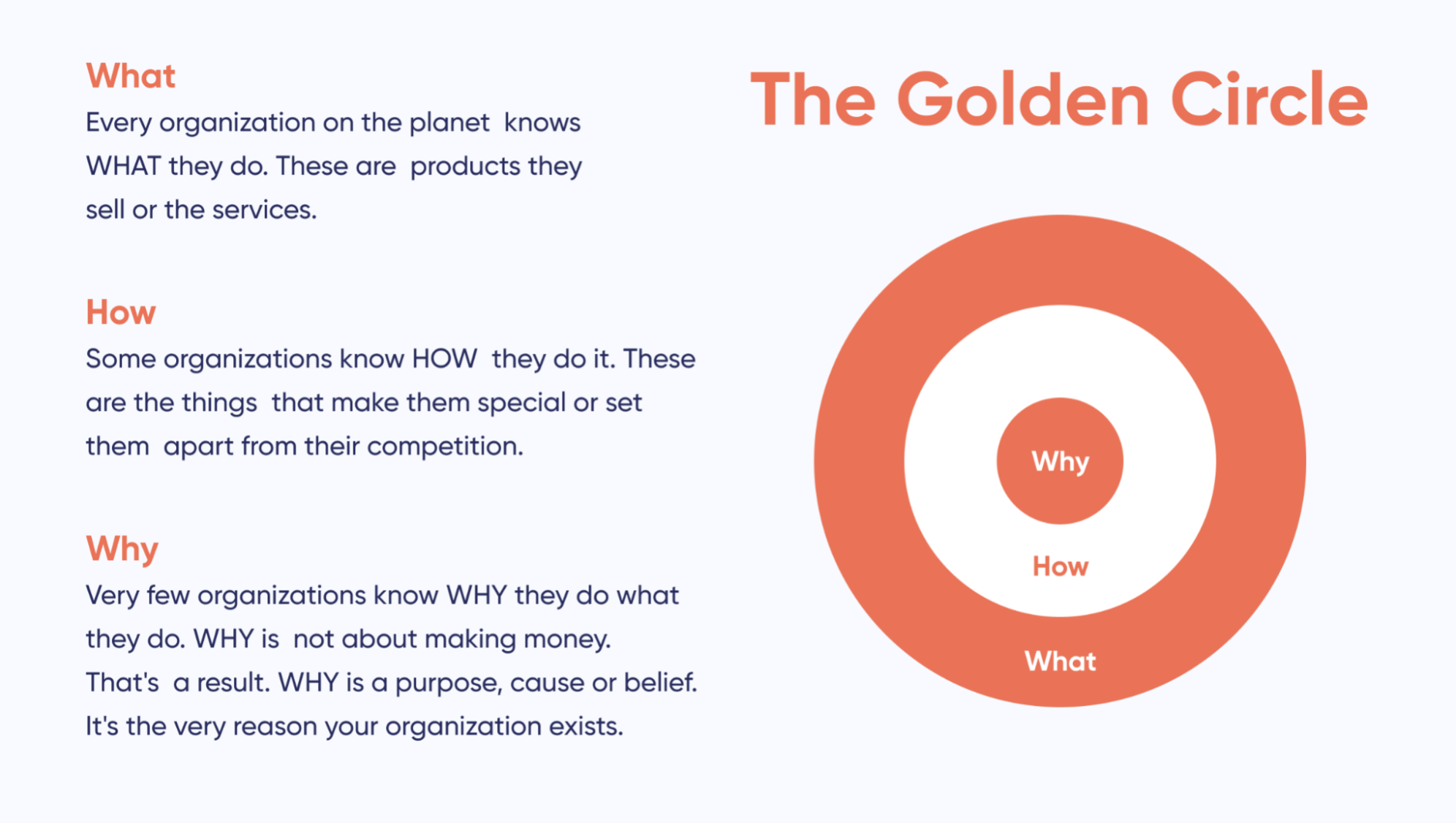
Before every clinic or publication I develop, I always try to spotlight the theme of “THE WHY” as preached by one of my favorite authors and motivational speakers – Simon Sinek! According to him, for organizations and individuals alike, “THE WHY” (rationale and priority) is more important than “THE WHAT” and “THE HOW.” (See this video.)

WHY is a collaborative discussion on social media essential? Why now?

 ”There’s a growing body of evidence suggesting that educators are facing increasing scrutiny regarding their social media use. Concerns include unprofessional conduct, inappropriate interactions with students, and the potential for cyberbullying and other negative impacts on student well-being.”

“Educators are increasingly concerned about how social media influences students’ social-emotional development and their interactions with others.” 
NEA Member Polling on Social Media…
NEA Impact on Social Media and Personal Devices on Mental Health
HHS Youth Mental Health and Social Media
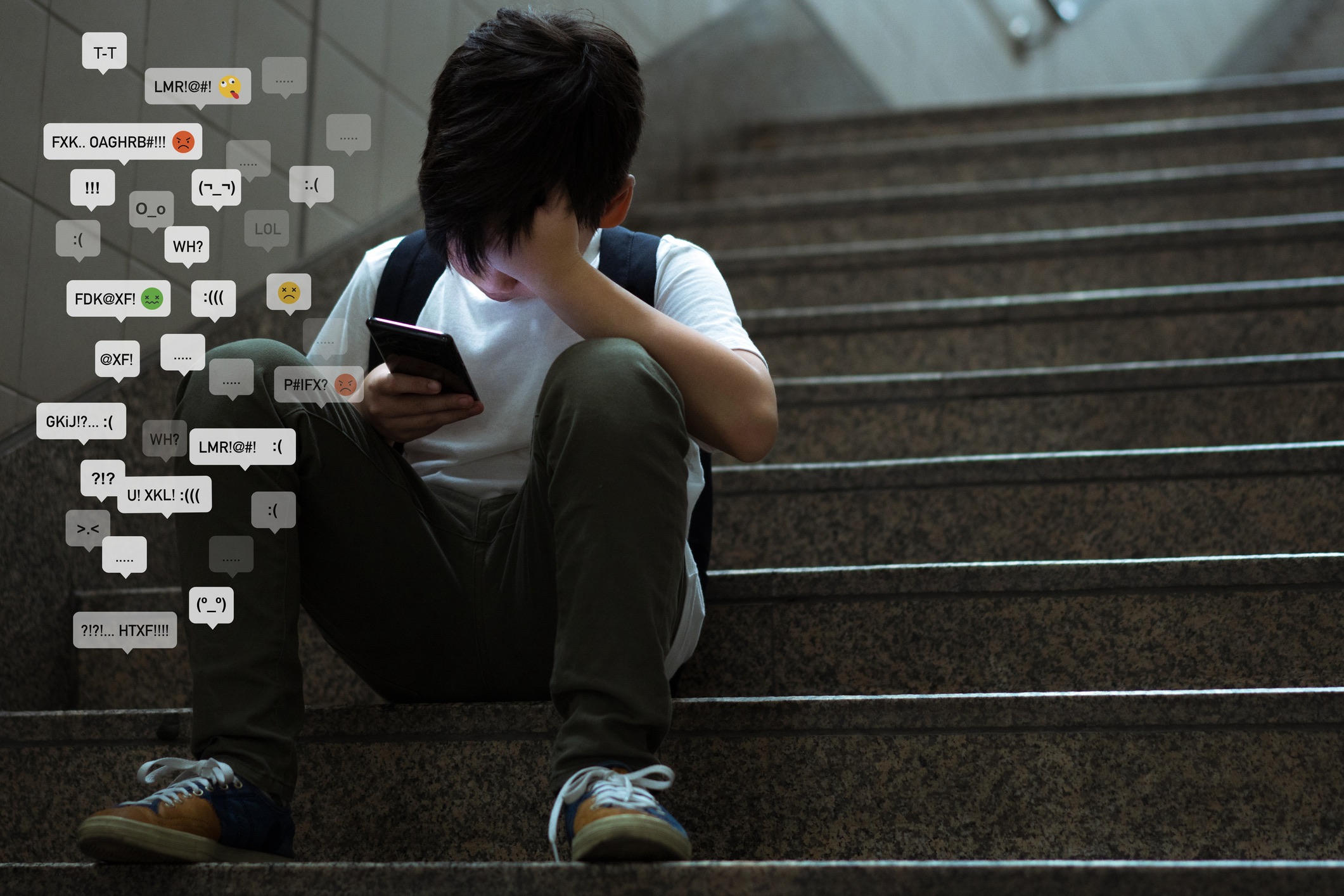
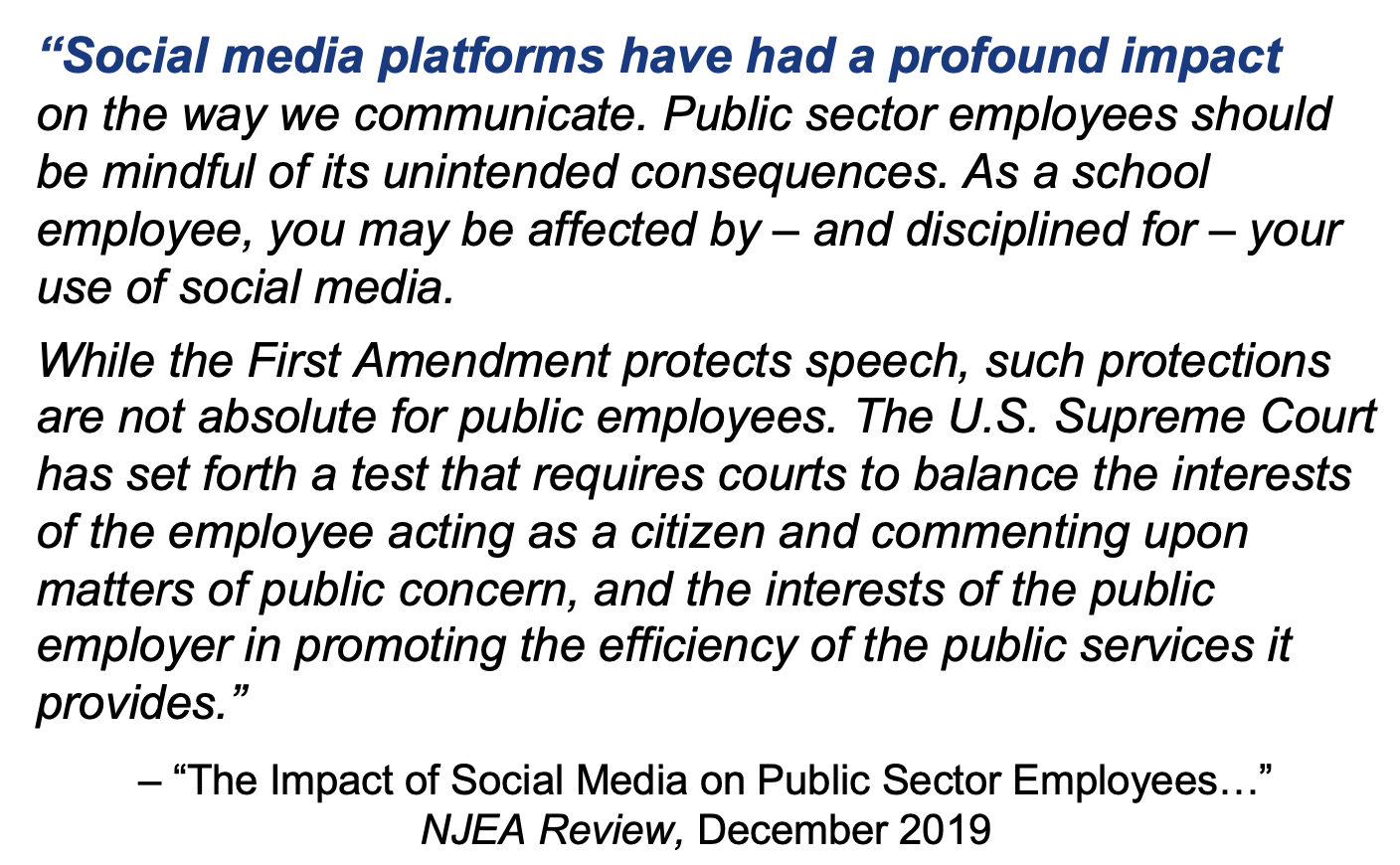
Frankly, there is still a lot of confusion about the dangers of social media, social networking, and other technology integrations into education. In Social Media – Boon or Nemesis, we mentioned that teachers should “debunk the free speech myth.” We demonstrated how the improper application of social media could get educators in trouble. Check out these sites for more info and corroborative stats:
Teacher Student Misconduct and the Critical Role of Social Media Screening
NCBA Social Media for School Employees
Social Media Hazards and Tips for Teachers
As always, our goal is to promote ethical practices in maintaining professionalism in the digital world.


“THE WHAT” Review of Definitions

“Social Media”

Social media are “websites and applications that enable users to create and share content or to participate in social networking.”
— Oxford Lexico.com online dictionary

“Social Network”

A social network is, 1. a network of social interactions and personal relationships.; 2. a dedicated website or other application which enables users to communicate with each other by posting information, comments, messages, images, etc.
— Oxford Lexico.com online dictionary

Professional Learning Community” (PLC)

A PLC is “a group of educators who meet regularly…” (usually in-person) “…to strategically enhance their teaching skills and improve student outcomes.”

versus “Professional Learning Network” (PLN)

A PLN is “a group of educators who gather more informally…” (usually in online communications) “…to problem-solve and generate ideas to enhance classroom practices. A PLN… often takes the form of an open forum, where participants can ask and answer questions based on their experiences.”
https://edtechmagazine.com/k12/article/2024/08/pln-vs-plc-perfcon


“THE HOW” Ethos of Care

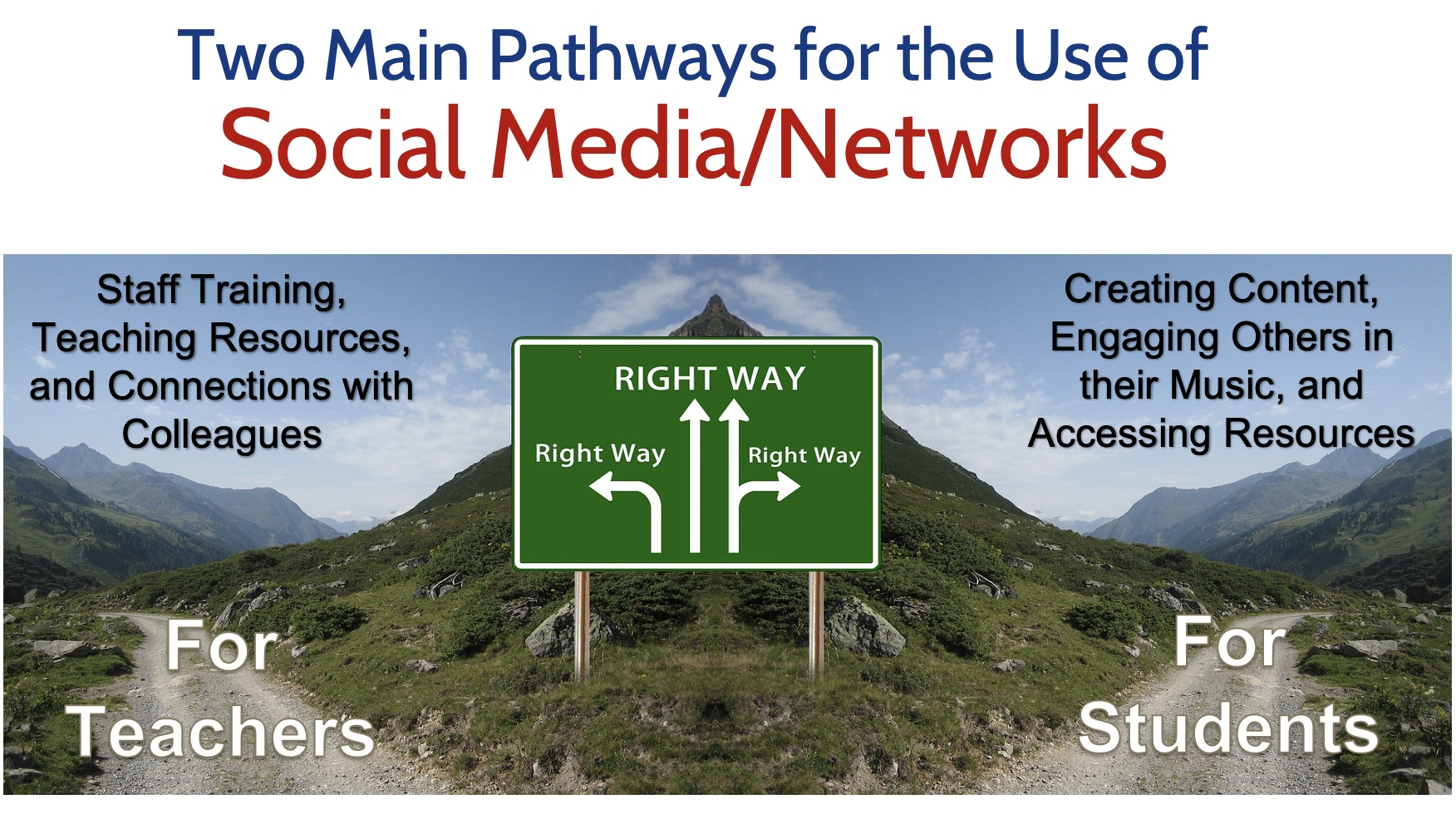
Teachers use social media to…

  • Get inspired with new teaching ideas
  • Find resources for the classroom
  • Connect with other educators
  • Stay on top of trends and news
  • participate in an online community
  • Find teacher discounts and deals
  • Follow education companies and organizations
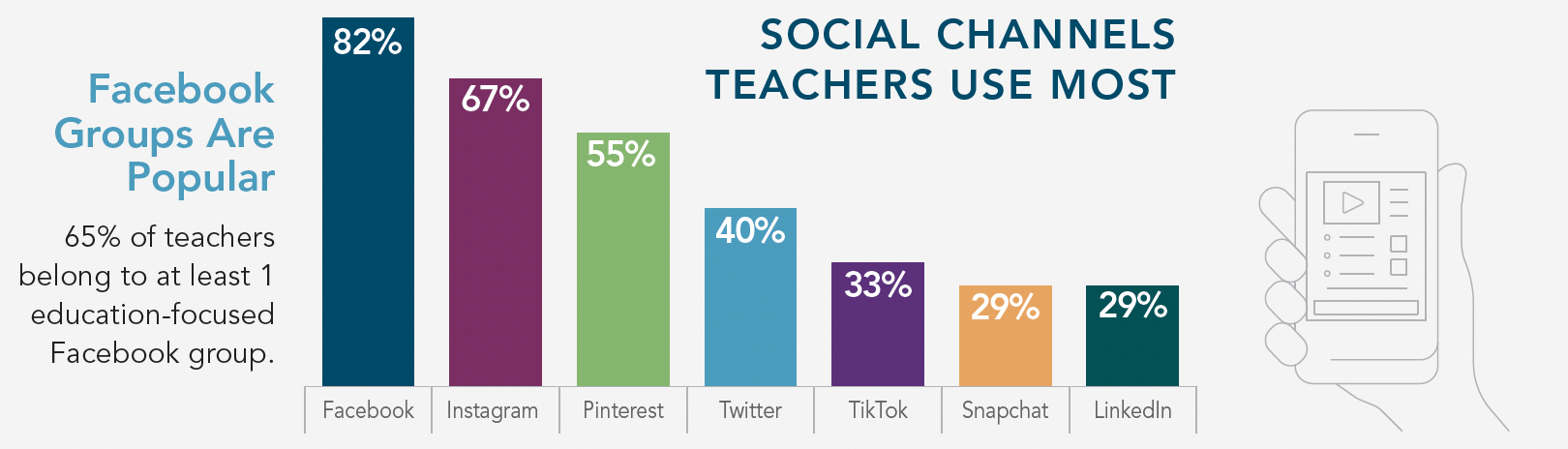
How Teachers Use Social Media
Teachers Social Media Use

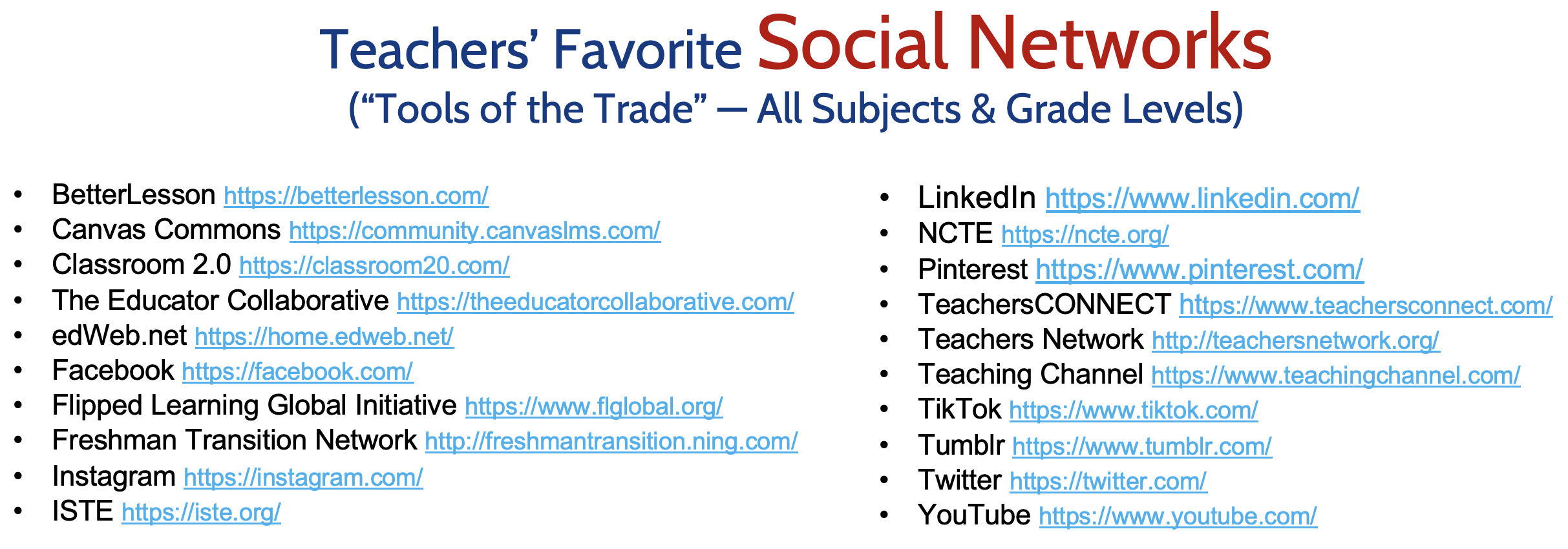
Social Networks for Teachers

We acknowledge that the benefits of social networking for educators are numerous by promoting professional collaboration and connections, including:

  1. Acquiring information to enhance understanding
  2. Keeping informed about latest developments in education
  3. Enhancing communications with students, parents, and the school community
  4. Fostering connections with colleagues in the field to expand an educator’s professional network.

Benefits of Social Media as an Educator
However, educators must exercise “sound judgment” and proper professional boundaries when using social media/networks with students. While the introduction of new technology provides many opportunities for teaching and learning, it is important to establish clear rules for appropriate student-teacher communication. In order to promote safety and appropriate boundaries while transitioning to a virtual teaching and learning environment, the Pennsylvania Professional Standards and Practices Commission offers suggestions to help educators protect themselves and their students.

  1. All technological resources and applications should be school entity-approved and only used in the manner prescribed. Ensure that you are familiar with the tools you are using in order to use them properly. 
  2. Communication with students should occur at designated times, consistent with traditional school day hours. Maintain transparency and protect yourself by keeping a record of all communications with students. 
  3. Clearly communicate when and how students should contact you and provide a timeframe for when students should expect responses to questions. 
  4. Avoid one-to-one interactions with students in chatrooms, FaceTime, Skype, or any other online space. School psychologists, school counselors and others providing one-to-one services to students should consult with school administration about the best mode of communication. 
  5. Use approved forms of communication by your school entity to connect with students and parents (i.e. Remind), use only your school email to communicate, and copy administration when communicating with parents or students. 
  6. When creating content or interacting in an online space with students, conduct yourself as you would if you were in school. If appearing on camera, dress professionally and be mindful of your surroundings and the camera’s view. 
  7. Do not “friend” or follow students on social media and do not allow students to “friend” or follow you on your personal social media. Remember, you do not have a “social” relationship with your students. 
  8. Keep your personal and professional lives separate. Do not share overly personal information about yourself with students.

PSPC Digital Tips for Educators

While exercising responsibility to maintain a respectful, safe, online environment, there are many benefits for the application of social media for students in the classroom:

  • Real-time communications can increase student engagement, collaboration, communication and overall participation
  • Many students may find it easier to participate in online discussions that in the classroom
  • Students can easily ask each other or their teacher questions about assignments outside of class
  • Students & teachers can quickly share resources at any time.
  • Teachers can easily share class announcements.
  • Social media can provide a contingency plan for last minute remote learning scenarios.
  • Students can organize school events with each other or with the help of a teacher.
  • Teachers can augment an online-only class by establishing a social media page or account simply for building community.
  • Students can practice using social platforms responsibly, including maintaining a respectful online discourse.
  • Teachers can communicate directly with parents as needed, and parents can stay informed of school news via a convenient, easily accessible platform.

However, please watch out for these potential drawbacks:

  • Social media can be a major distraction, especially if students are accessing their personal accounts independently.
  • If students primarily use social platforms to participate in class discussions, they can miss out on practicing face-to-face conversations and respectful in-person discourse.
  • Some students may see social media assignments as an opportunity to cyberbully their classmates, and there is always a risk of someone posting inappropriate content or language.

Social Media in Education


“THE WHAT” Several Success Stories

Balancing the positives and negatives and taking into account all of these precautions in order to maintaining professional boundaries, the integration of new technology into the classroom may offer excellent enrichment and increase student motivation for advanced learning. This may take many forms. Here are a few interesting models.
Prior to preparing for the DCMEA online session in 2020, I stumbled upon a truly inspiring post from Derek Muller, a gifted teacher, physicist, filmmaker, and founder of the YouTube channel Vertiasium which has captured millions of subscribers. He offers one of the BEST models of using social media to enrich the understanding of learning math and science (applicable to all fields of study), while at the same time, provides warnings against unbridled use of so-called “innovation for innovation’s sake.”

“I feel like people over the years are invariably drawn to use these words:  revolutionize and education. And there’s this sort of amnesia that we’ve had a hundred years’ worth of these predictions, worth of really groundbreaking technologies that have transformed other areas in our lives but have failed to fundamentally change the way we do education. So, I stand here today as a voice of caution, to think that the future of education is not one of revolutions…”

You need to watch this: How is Social Media Transforming the Future of Education? (2016)
Derek Muller

Say what you want about how COVID significantly disrupted our educational programs, evidence of learning loss, problems in socio-emotional development, decline of student engagement and self-motivation, rise in mental health struggles, decreased instructional time, and the effects of a new digital divide of under-served students (Annie E. Casey Foundation), happily there were surprisingly a few positive advancements the results of exploring new tools and methodologies we had to employ to tread water and cope with the catastrophe. (“When life hands you lemons, make lemonade!”)
As one example, in the middle of preparing music for my community orchestra, we were shut down in 2020. No in-person rehearsals at the school. I then pivoted to creating my own online platform called SHJOOLA (South Hills Junior Orchestra Online Academy) in 2021 using MusicFirst. For a nominal yearly subscription fee, I was able to continue my Saturday morning classes (synchronous) as well as asynchronous (on-their-own time) learning using excellent applications in a virtual environment: MusicFirst Classroom, Focus on Sound, PracticeFirst, Sight-Reading Factory, Musition, Auralia, a web-based music notation program, and a huge library of method books and ensemble music. Several past blogs showed how we rolled out SHJOOLA:

The latter link above also provided a comprehensive list of supplementary resources (at the time) for online music education. Please peruse these even though some of them may have now gone inactive. We will provide supplemental links at the bottom of this article.

Another direction accented by the onslaught of the pandemic was digital streaming performances, incorporating technology in both the solo and ensemble settings. The following are two of my favorite examples of these to be viewed on YouTube:
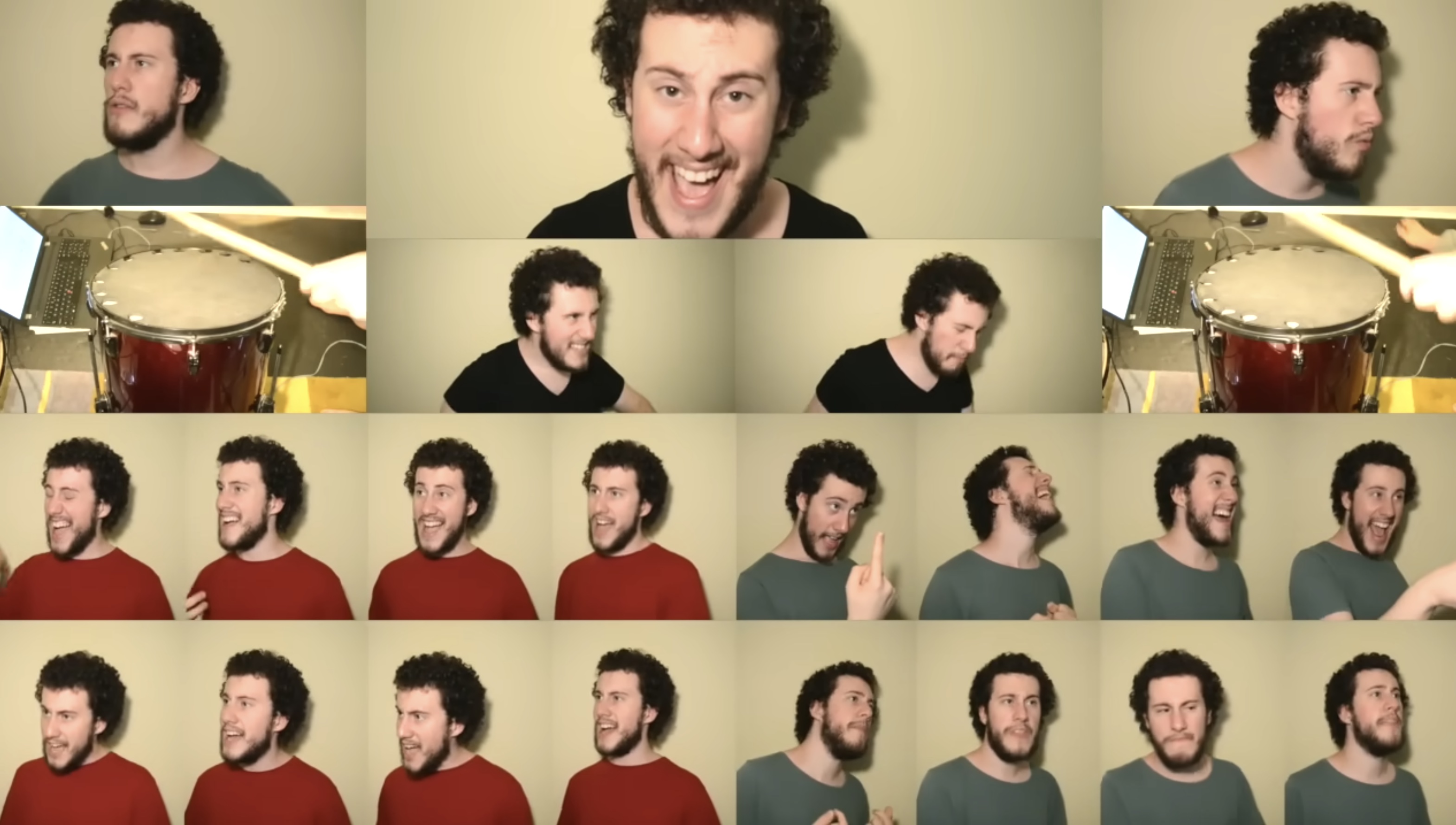
Circle of Life from Disney’s Lion King (2015-18) by Sam Robson, arranger, innovator and performer using multitrack recording of a single performer mixing as many as 50 voices at one time.
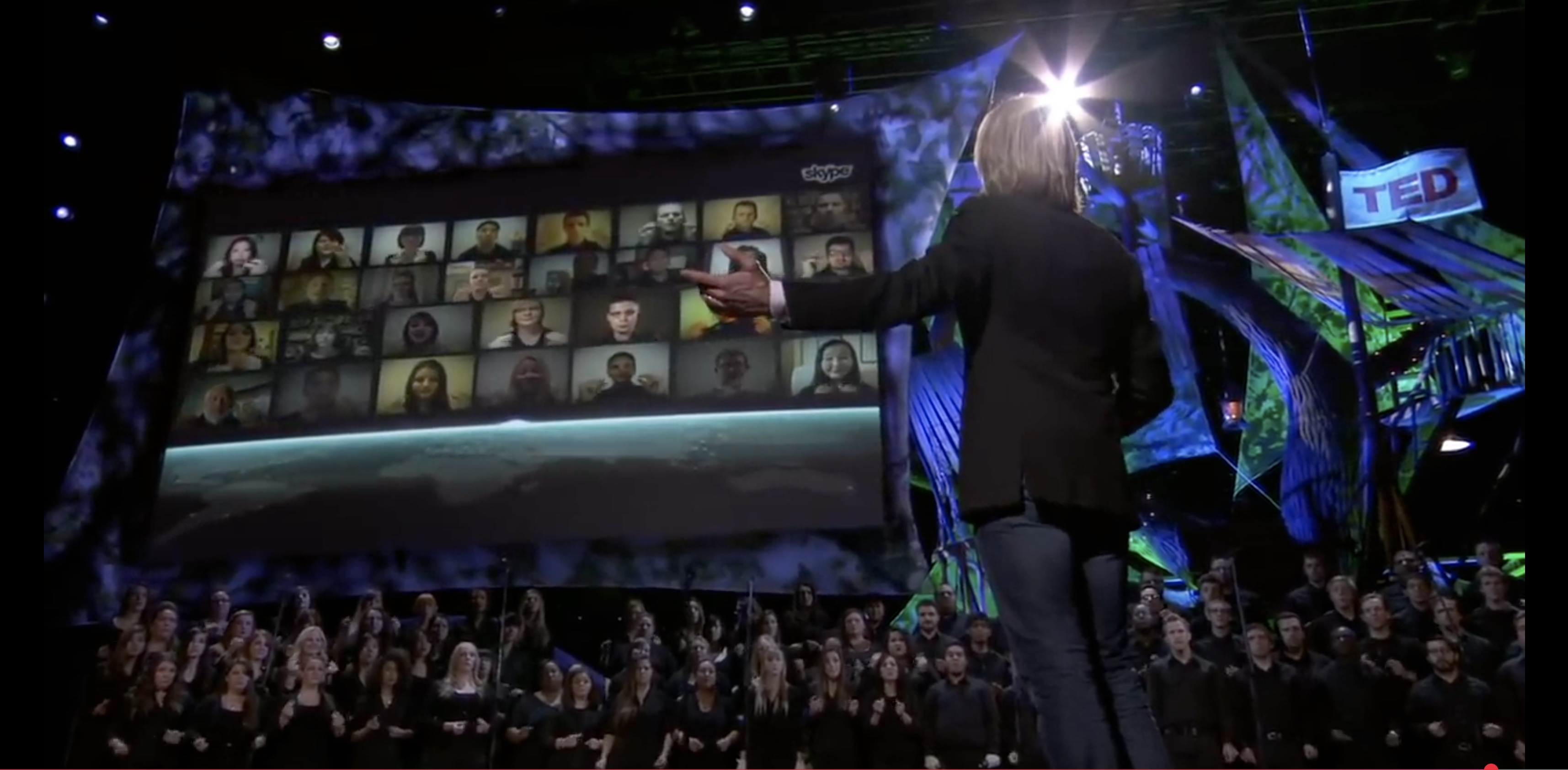
Cloudburst, a Virtual & Live Choir and TEDTALK (2013) by Eric Whitacre

Well… sorry this blog has grown to be so large! If you admit to understanding the potential hazards of and precautions for integrating social media, social networks and other technologies into education, we’ll close with the following bibliography of additional resources for further study. If that is not enough to whet your curiosity, stop back in several months to download a copy of my slide summary for the session I will present at the DCMEA Winter Conference on January 30, 2026.

Be careful stay safe and professionalbut ENJOY!

Sample Blogs

Several Major Platforms

Examples of Music Applications/Websites

PKF

© 2025 Paul K. Fox
February Updates…

PROfessional Development!

Education, ethics, professionalism, and lifelong learning.

Hope you are enjoying the winter season and, for many of you, the anticipation of warmer weather returning soon! Sorry, skiers! I am sick of shoveling snow!!

Here’s a quick “catch-up” on things going on in educator professional development.

For PA School Administrators & Educators

There is still time to register for the upcoming 25-hour, PDE-approved, Act 45 course, “PA Educators: Your Ethical Codes & School Law,” which will cover the recently mandated PA Title 22 Chapter 49 (Certification) Professional Ethics Competencies. The next online series of Act 45 classes will be held Tuesday afternoons in March, and provide “the keys to the car” planning for your own school district’s future continuing education and induction programs in ethics training as required by the PDE.

Now sponsoring our eighth series of classes, I am designated a “qualified instructor” in partnership with the course’s creator/facilitator, retired social studies teacher and attorney Thomas W. Bailey. For more information, please click on these links to his website:

In addition, since over the past year PDE revised their website (and changed most of the content links), I compiled a super-index of “places-to-go” and “things-to-read,” sites of supplemental resources on school ethics here. I recommend visiting this blog if you are interested in our library of links to the Pennsylvania Code of Professional Practice and Conduct, the Model Code of Ethics for Educators, the PA Educators Discipline Act, and research and citations from the PDE, PA Professional Standards and Practices Commission, Connecticut State Department of Education, and Iowa Board of Educational Examiners, among many others.

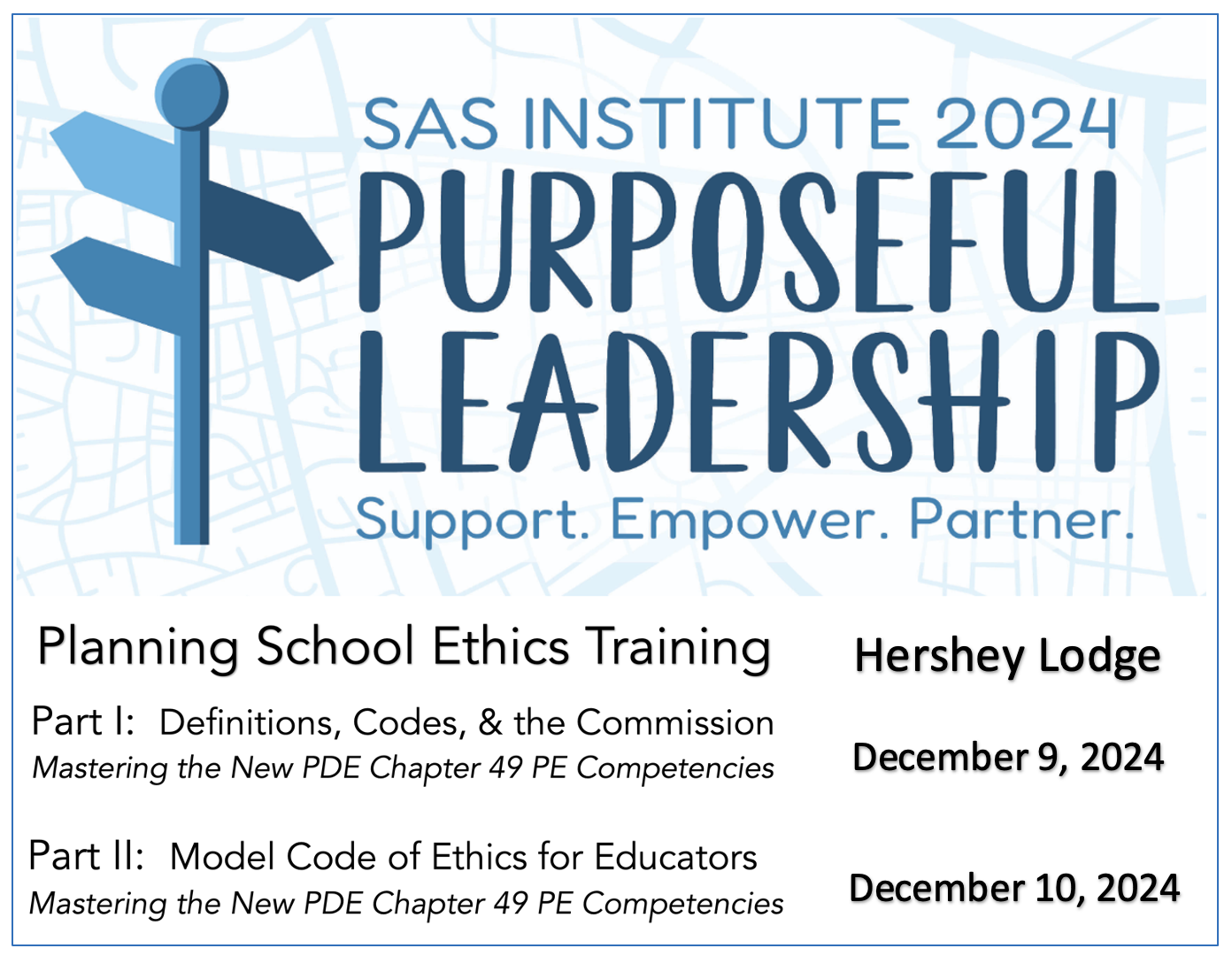
If you would like to see the kind of things we cover in these classes, take a look at the slide summaries I posted from my presentation at the PDE SAS Institute “Purposeful Leadership” state conference last December:

From Pre-Service to Veteran Music Teachers!

It’s that time of the year… again! The PMEA Annual Conference on April 9-12, 2025 will be held in the family-friendly, perfect-for-a-mini-vacation spot in northeastern PA: the Kalahari Resort in the Poconos.

There is still time to register! (Click here.) If you would like to see a summary of the sessions and performances, go to the PMEA website here or download this PDF brochure.

Why attend the conference? In my five-plus decades in education, I may have missed only two or three of the annual PMEA state events, and heartily recommend you remain actively involved in your professional association. This is what I wrote about it in a recent PMEA Retired Member Network eNEWS:

For some of us, it’s a just chance to catch-up with our colleagues, see our friends, and socialize. Others are more focused and take advantage of the near-perfect opportunity to network with other professionals, perhaps seeking new working relationships, partnerships, or even employment. Many are on a look-out for newly published music, that perfect music lesson or teaching strategy, technology tools, fundraisers, advance educational venues, or much-needed equipment to purchase for our ensembles or classrooms. Most come to hear/see the “state of the art” in music education – concerts, demonstrations, keynote speeches, panel discussions, exhibits, research presentations, and workshops. PMEA’s PD Council would likely submit that the primary purpose of a conference is for professional self-improvement… What did Stephen Covey call it? His Habit #7 of “sharpening the saw” – to build a balanced program of self-renewal in the four areas of your life: physical, social/emotional, mental, and spiritual. Covey would insist we embrace “the process that empowers us to move on an upward spiral of growth and change, of continuous improvement.” So, in short, conferences help us “grow” – to revive, re-inspire, re-energize, rejuvenate, re-direct, and re-motivate all of us – pre-service, active in-service, and retired teachers towards making successful new connections, updating our knowledge and skills, and forming new goals. This is how we “keep up” with all the new standards, benchmarks, and cutting-edge advances, and meet the “movers-and-shakers,” visionaries, and leaders in the profession!

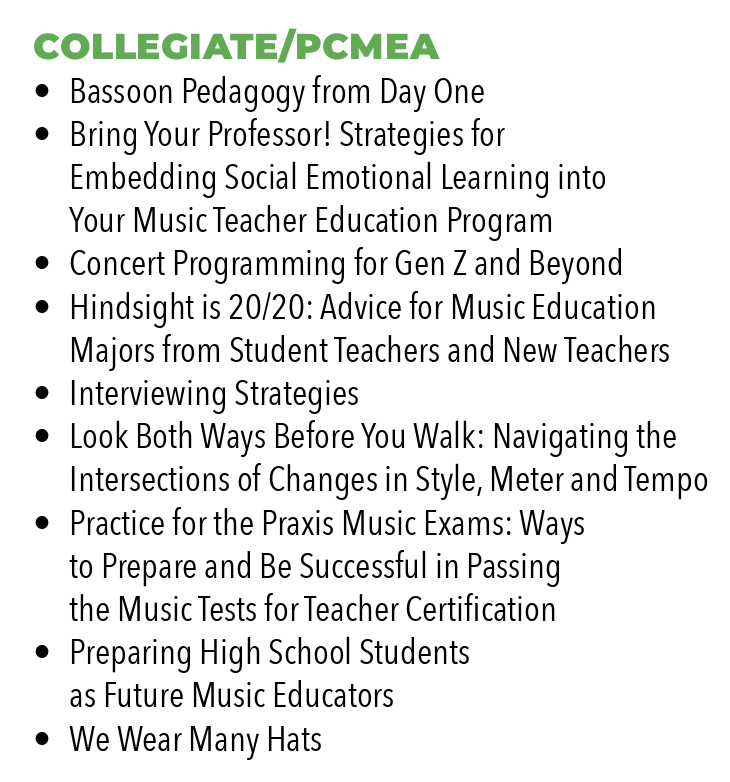
There’s a lot in store for college music education majors. Besides the aforementioned state meetings, concerts, clinics, and keynote addresses no one should miss, the music industry exhibits (new innovations in sheet music, instruments, technology, summer school and graduate programs, etc.), and the chance to introduce yourself to other music colleagues (aren’t some of you looking for a job soon?), there will be a “coffee and connections” informal lounge to ASK-AN-EXPERT on Thursday afternoon to pick-the-brains of PMEA mentors and retirees on any subject. Do you have a question about conducting technique, musical literature, lesson plan idea, classroom or time management tip, or teaching method? And, just take look these sessions the PMEA Professional Development Council has targeted specifically for YOU:

For Retirees… They are special, too!

PMEA Retired Members, consider this your personal invitation to join us at the Kalahari Resort in the Poconos for the chance to catch-up, connect, collaborate and communicate with other colleagues throughout the Commonwealth! (a plethora of “C’s!”)

As usual, we will “break bread” together Friday morning (April 11, 2025) with the annual retiree breakfast. Be sure to register soon for the PMEA Annual Conference (now only $25) and check the “yes” box that you will attend our meeting. Those in attendance will be treated to some “conference swag!”

Retirees are a valuable resource to PMEA! Our experienced retired members are among the best-trained (unofficial) mentors in PMEA. Facing many years of “boots on the ground,” we have at our fingertips numerous strategies to solve problems in education. Frankly, in my opinion, we have a lot to offer “the future of the profession!”

If you are a retired PA music educator, hopefully you have maintained your PMEA membership (dues significantly discounted), and have signed up for the Retired Member Resource Registry to help future “rookie” music educators. (To reach the R3, first login to your PMEA portal here.)

On Friday, April 11, at 3:30 p.m., we are offering a special sharing session for soon-to-retire teachers… the annual one-hour Retirement 101 workshop joined by a panel of experienced retirees: Rick Coulter, Jeffrey Dent, Sister Kathleen Doutt, Dan Klingbeil, Chuck Neidhardt, and Louise & Richard Victor. Active educators who plan to retire over the 1-5 years can learn valuable techniques from us for a smooth transition to post-full-time employment and successfully reinvent, reprogram, and “recharge” themselves to modifying those essential elements of purpose, structure, and community throughout their “golden years!”

My Professional Advertisement

You may have noticed in my last blog-post an outline of past article topics archived at this site, and a complaint that I feel I must repeat myself (or repackage the material) to meet the changing personalized “bookends” – life cycles – specific passages of my readers. The earlier February post was mostly for job seekers. If you were not looking for employment or coming fresh out of college, it may have seemed irrelevant. The same goes for specialty articles on self-care, ethics training, or retirement transitioning… WHEN WOULD YOU BE MOTIVATED TO STUDY THESE?

I have decided to maintain a comprehensive index of my writings (see “Inside” link in the top menu bar). Please visit the sections of this blog-site that matter to you most… and, when things change, come back and look again. You may find something that “hits the spot” or satisfies the needs of your new journey in education or personal/professional life.

I remain willing and able (aka “very interested”) in doing in-person or online sessions for college methods classes, PCMEA chapter meetings, PMEA festival directors’ meetings, PMEA District or Regional PD workshops, or school district/department inservices. Just give me a call. My contact information can be found in the top “About” link. Please visit this section for catalogs of my presentations and articles. FYI, I created this trifold of some of my past work.

Best wishes on your future successes in career development and professional goal setting.

PKF

© 2025 Paul K. Fox

Exceptional Ethics Training

A Follow-up to the Pennsylvania Educators E-TRAIN

SCHOOL SYSTEM LEADERS, CTC DIRECTORS, & OTHER ADMINISTRATORS:
In case you missed my last update here in September 2024, this “express car” blog post will help you “catch-up” on the PDE “company line,” “supply new freight” to your continuing professional development and induction programs, get back “on track” and avoid being “sidetracked” or “derailed” for meeting the newly revised PA Chapter 49 “guard rails” of professional ethics training competencies.

THE ETHICAL WHEELS GO ROUND & ROUND…

You may have noticed that due to compliance regulations, the PDE website was revised with many of its former URL “tracks” leading to “train wrecks.” This “propelled” us towards making an “overhaul” to “connect” the new references (research “destinations”) in my slide presentations. Please use the following index (substituting old “routes”) and travel to our renovated “union station” with the new schedules.

Okay… I will stop “conducting” any more train “puns!”

Recent Ethics Sessions

Slide Summaries for the PDE Purposeful Leadership Conference (if you attended) are available from the SAS Institute’s conference app: Eventsquid.

Upon completion of the 25-hour course, the PowerPoints for all four sessions of the Thomas W. Bailey Act 45 class series were emailed to the participants.

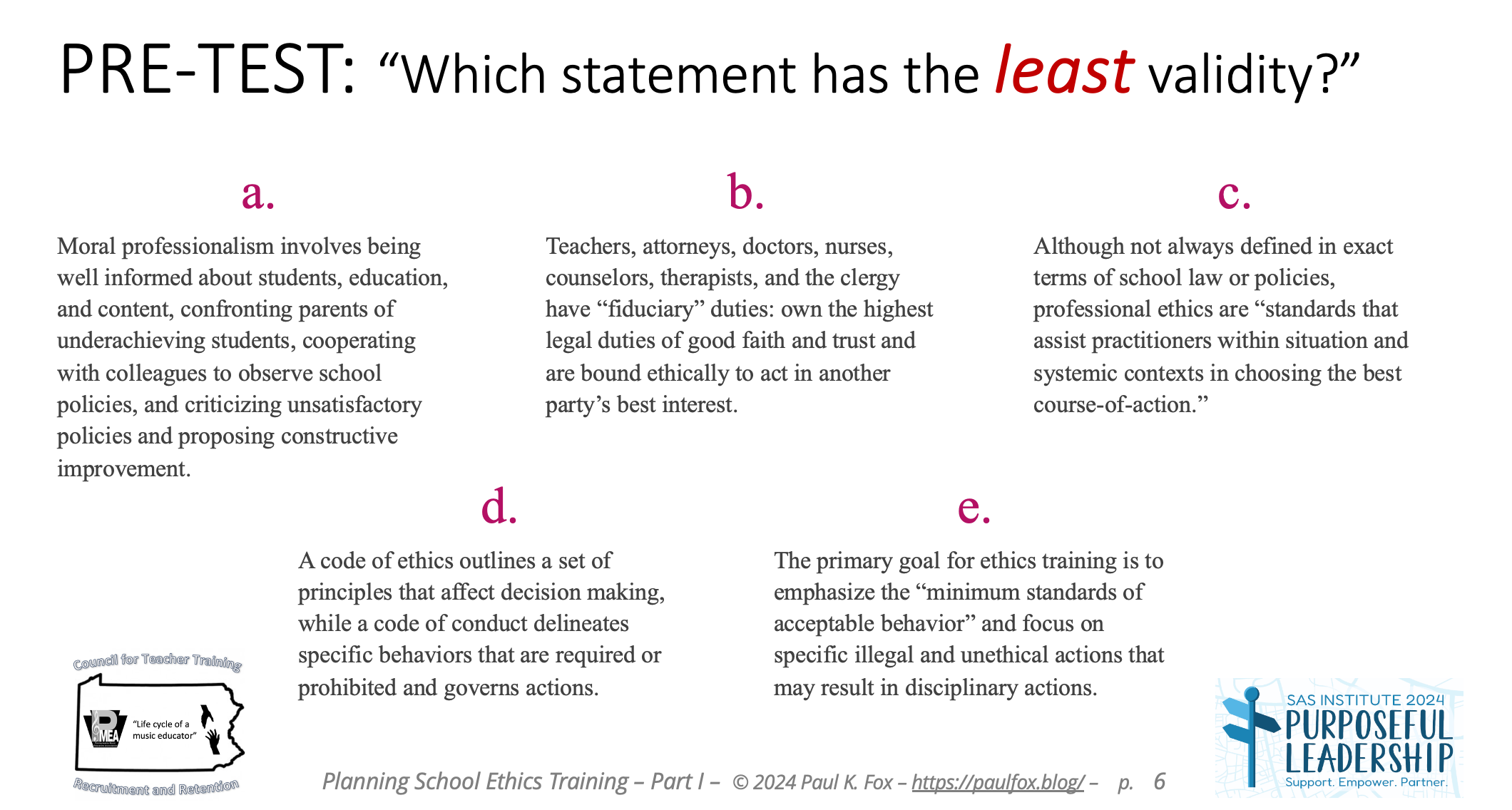
Here is the PRE-TEST for both events.

What is your “best guess?”

UPDATES TO RESEARCH LINKS

Act 126 Child Abuse and Reporting Training
https://www.pa.gov/agencies/pspc/content-pages/outreach/act-126-training.html

Adjudications & Orders (PA Certificate Actions)
https://www.pa.gov/agencies/education/programs-and-services/educators/educator-misconduct/certification-actions.html

Attorney (PA) Rules of Professional Conduct
https://www.padisciplinaryboard.org/for-attorneys/rules

California BTES – Overview of the Ethnographic Study by David Berliner and William Tikunoff
https://journals.sagepub.com/doi/abs/10.1177/002248717602700107?journalCode=jtea

Certificate Actions (Adjudications & Orders)
https://www.pa.gov/agencies/education/programs-and-services/educators/educator-misconduct/certification-actions.html

Chapter 49 Ethics Training
https://www.pa.gov/agencies/pspc/resources/chapter-49-ethics-training.html

Cleveland Board of Education v. James Loudermill (US Supreme Court 1985)
https://www.twbaileylaw.com/blog/educator-court-case-blog-1/may-a-school-district-employee-be-dismissed-without-prior-opportunity-to-respond-to-allegations-of-wrongdoing-4

Code of Professional Practice and Conduct
https://www.pacodeandbulletin.gov/Display/pacode?file=/secure/pacode/data/022/chapter235/chap235toc.html&d=reduce OR
https://paulfox.blog/wp-content/uploads/2024/12/code-of-conduct-revised.pdf

Codes (Conduct vs. Ethics), Types of
https://www.amazon.com/Music-Education-Your-Hands-Introduction/dp/0415800900

Commission Publications (Professional Standards & Practices Commission)
https://www.pa.gov/agencies/pspc/resources/commission-publications.html

Connecticut State Department of Education TEAM Program Manual
https://portal.ct.gov/sde/team/teacher-education-and-mentoring-team-program/documents

Contract Termination 11-1122 Public School Code of 1949
https://govt.westlaw.com/pac/Document/NB5B9C950342F11DA8A989F4EECDB8638?viewType=FullText&originationContext=documenttoc&transitionType=CategoryPageItem&contextData=(sc.Default)

Criminal History 1-111 Public School Code of 1949
https://govt.westlaw.com/pac/Document/NB6D6E91007EE11EA8D85D136C641FF9C?viewType=FullText&originationContext=documenttoc&transitionType=CategoryPageItem&contextData=(sc.Default)

The Danielson Group
https://danielsongroup.org/

Digital Tips (Online Boundaries) for Educators (Professional Standards and Practices Commission)
https://www.pa.gov/agencies/pspc/resources/commission-publications/digital-tips-for-educators.html

Educator Discipline Act
https://www.pa.gov/content/dam/copapwp-pagov/en/pspc/documents/statutes-regs-forms/educator%20discipline%20act.pdf and
https://www.pspc.education.pa.gov/Statutes-Regulations-Policies-Forms/Educator-Discipline-Act/Pages/default.aspx

Educator Misconduct
https://www.pa.gov/agencies/education/programs-and-services/educators/educator-misconduct.html

Ethical Dilemmas of In-Service Music Educators by Joelle L. Lien
https://act.maydaygroup.org/articles/Lien11_1.pdf

The Ethical Educator (Frequently Asked Questions)
https://www.pa.gov/content/dam/copapwp-pagov/en/pspc/documents/ethical-practices/publications/the%20ethical%20educator%20and%20professional%20practices.pdf

Ethical Equilibrium – Troy Hutchings’ work
https://slideplayer.com/slide/12243050/ and
https://vimeo.com/126979216

Ethics Toolkit – Teacher Preparation Programs (missing from revised PDE website?)
https://www.pa.gov/agencies/pspc/resources/information-for-school-administrators/teacher-preparation-programs.html
Web archive: https://web.archive.org/web/20240807121601/https://www.pspc.education.pa.gov/Promoting-Ethical-Practices-Resources/Ethics-Toolkit/Pages/default.aspx

General Assembly (PA)
tps://www.legis.state.pa.us/

Iowa Board of Education Examiners (Moral vs. Ethical Standards)
https://slideplayer.com/slide/12203932/

Loudermill Hearings – Court Case Blog (US Supreme Court 1985)
https://www.twbaileylaw.com/blog/educator-court-case-blog-1/may-a-school-district-employee-be-dismissed-without-prior-opportunity-to-respond-to-allegations-of-wrongdoing-4

Model Code of Ethics for Educators
https://www.nasdtec.net/page/MCEE_Doc and
https://www.nasdtec.net/page/MCEE_Video_Series

Moral Development Philosophy by Lawrence Kohlberg
https://archive.org/details/essaysonmoraldev0000kohl

Moral Professionalism (Wynne, E. A. (1995). The moral dimension of teaching)
https://www.itejournal.org/wp-content/pdfs-issues/spring-2013/08bergman.pdf

Moral v. Ethical Standards (Iowa Board of Educational Examiners)
https://slideplayer.com/slide/12203932/

National Association of State Directors of Teacher Education and Certification
https://www.nasdtec.net/ and
https://www.nasdtec.net/page/MCEE_Video_Series

Pennsylvania Code & Bulletin (Title 22 Education)
https://www.pacodeandbulletin.gov/Display/pacode?titleNumber=022&file=/secure/pacode/data/022/022toc.html&searchunitkeywords=&operator=OR&title=null

Pennsylvania Code (Title 23 Child Protection Services)
https://govt.westlaw.com/pac/Document/NAD136501756B11E88795828A65D8C1A1?viewType=FullText&originationContext=documenttoc&transitionType=CategoryPageItem&contextData=(sc.Default)

Professional Ethics Program Framework Competencies
https://www.pa.gov/content/dam/copapwp-pagov/en/education/documents/educators/certifications/professional%20ethics%20program%20framework%20guidelines.pdf

Professional Standards and Practices Commission
https://www.pa.gov/agencies/pspc.html and
https://www.pacodeandbulletin.gov/Display/pacode?file=/secure/pacode/data/022/chapter233/chap233toc.html and
https://www.pa.gov/agencies/pspc/resources/commission-publications.html

Public School Code of 1949
https://www.legis.state.pa.us/WU01/LI/LI/US/HTM/1949/0/0014..HTM or
https://govt.westlaw.com/pac/Document/NB5B9C950342F11DA8A989F4EECDB8638?viewType=FullText&originationContext=documenttoc&transitionType=CategoryPageItem&contextData=(sc.Default)

Rules for Teachers (1872 & 1915)
https://www.openculture.com/2013/09/rules-for-teachers-in-1872-1915-no-drinking-smoking-or-trips-to-barber-shops-and-ice-cream-parlors.html

Simon Sinek
https://simonsinek.com/

Slater v. PDE Case Citation
https://caselaw.findlaw.com/court/pa-commonwealth-court/1465107.html

Statutes, Regulations, Policies and Forms (Department of Education)
https://www.pa.gov/search.html#q=Statutes%20Regulations&f-copapwpagency=Department%20of%20Education,Department%20of%20Health or
https://www.pa.gov/agencies/education/programs-and-services/educators.html

Teacher Preparation Programs
https://www.pa.gov/en/agencies/pspc/resources/information-for-school-administrators/teacher-preparation-programs.html

Thomas W. Bailey Court Case Blogs
https://www.twbaileylaw.com/blog

Thomas W. Bailey PDE-Approved Act 45/PIL and Act 48 Courses
https://www.twbaileylaw.com/

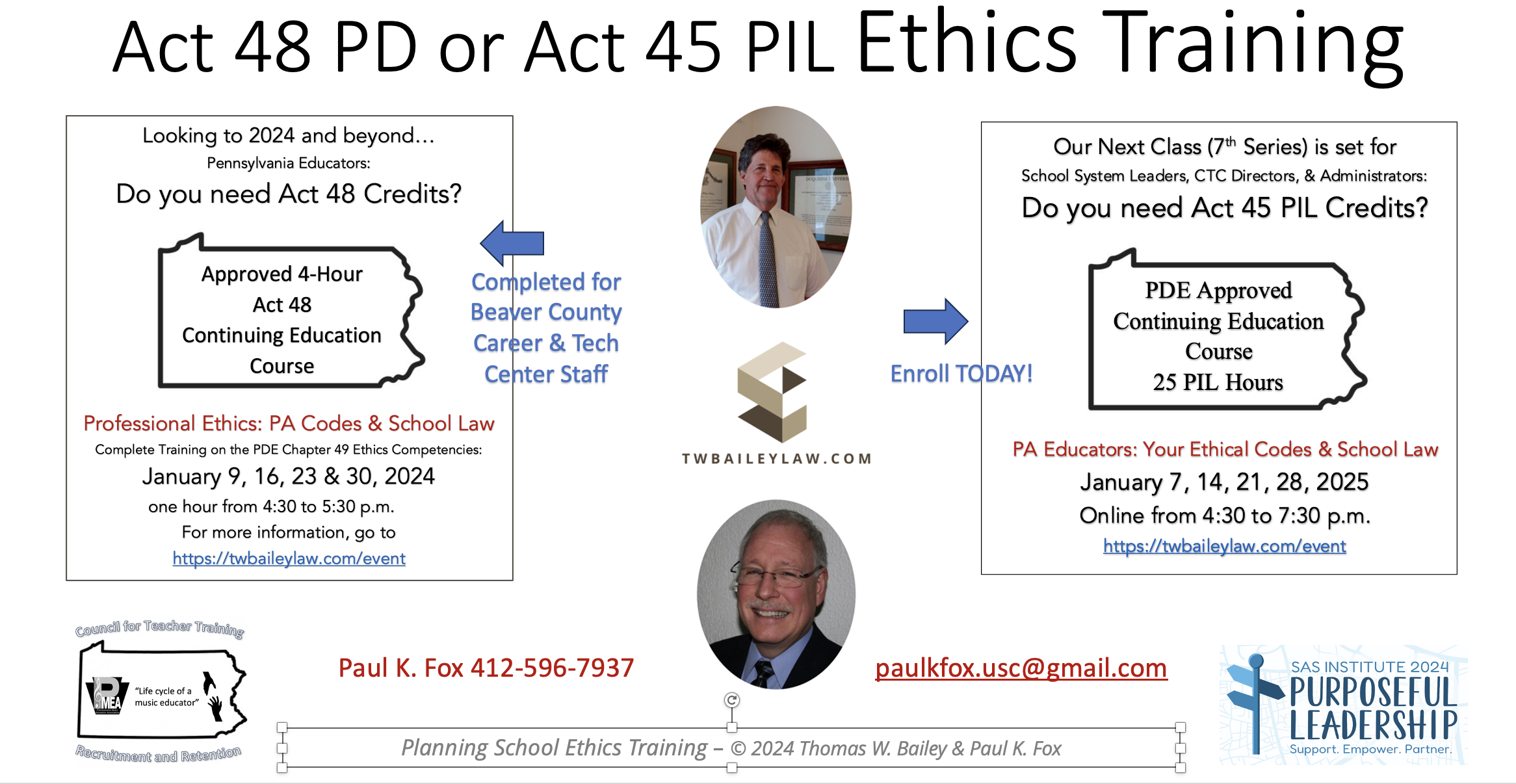
If you missed the SAS Institute 2024 in Hershey and still need help in designing your own educator ethics training in-service or mentor/mentee induction programs, check out the Thomas W. Bailey website here. Consider registering for our next 25-hour PDE-approved Act 45 online course.

Finally, the answer to the above PRE-TEST is letter “D” (NOT):

Please reach out to Paul Fox (click here) if you find any of the above links have gone inactive or have suggestions/updates to this blog-post.

PKF

© 2024 Paul K. Fox
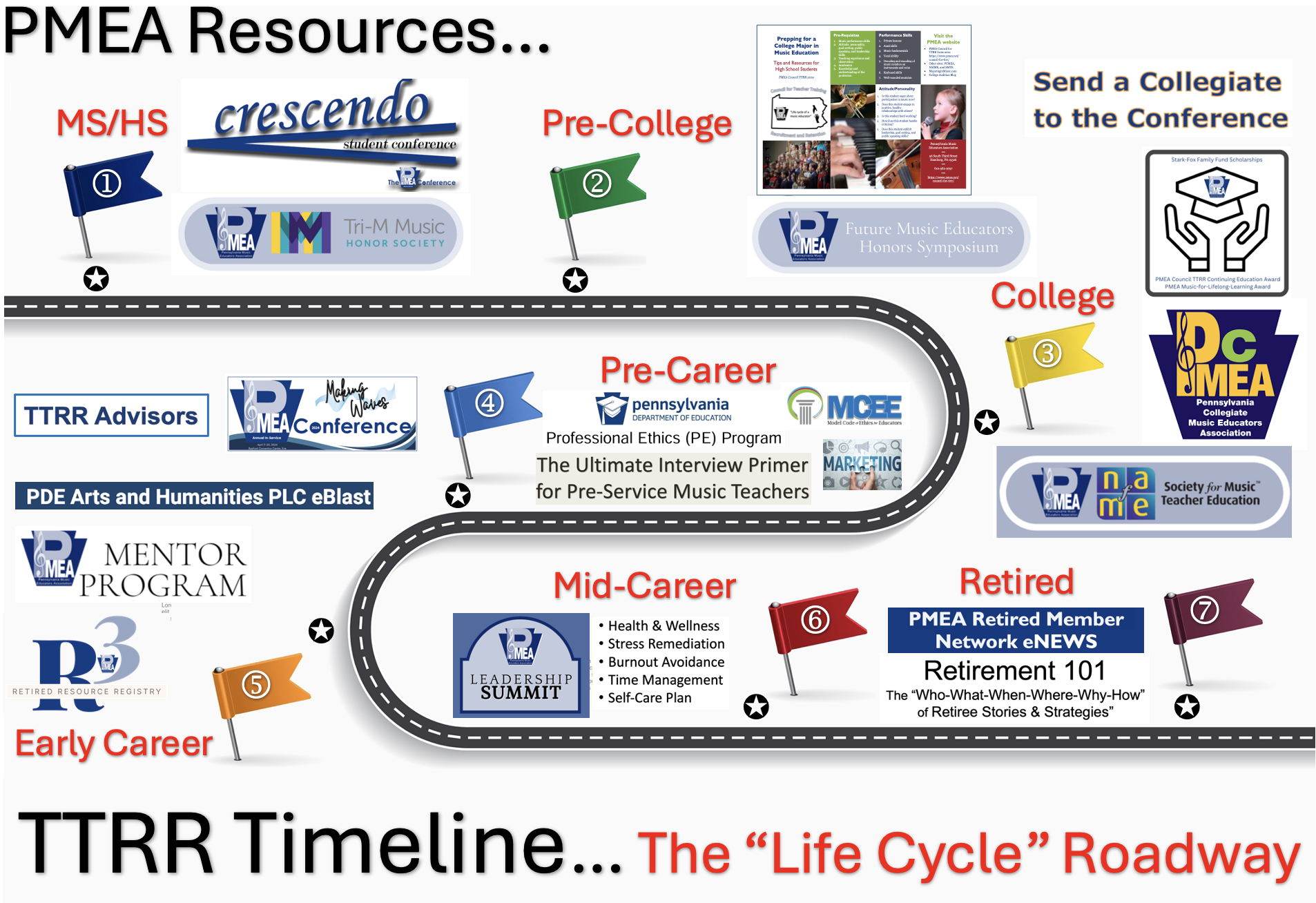
Educator Ethics Training Revisited!

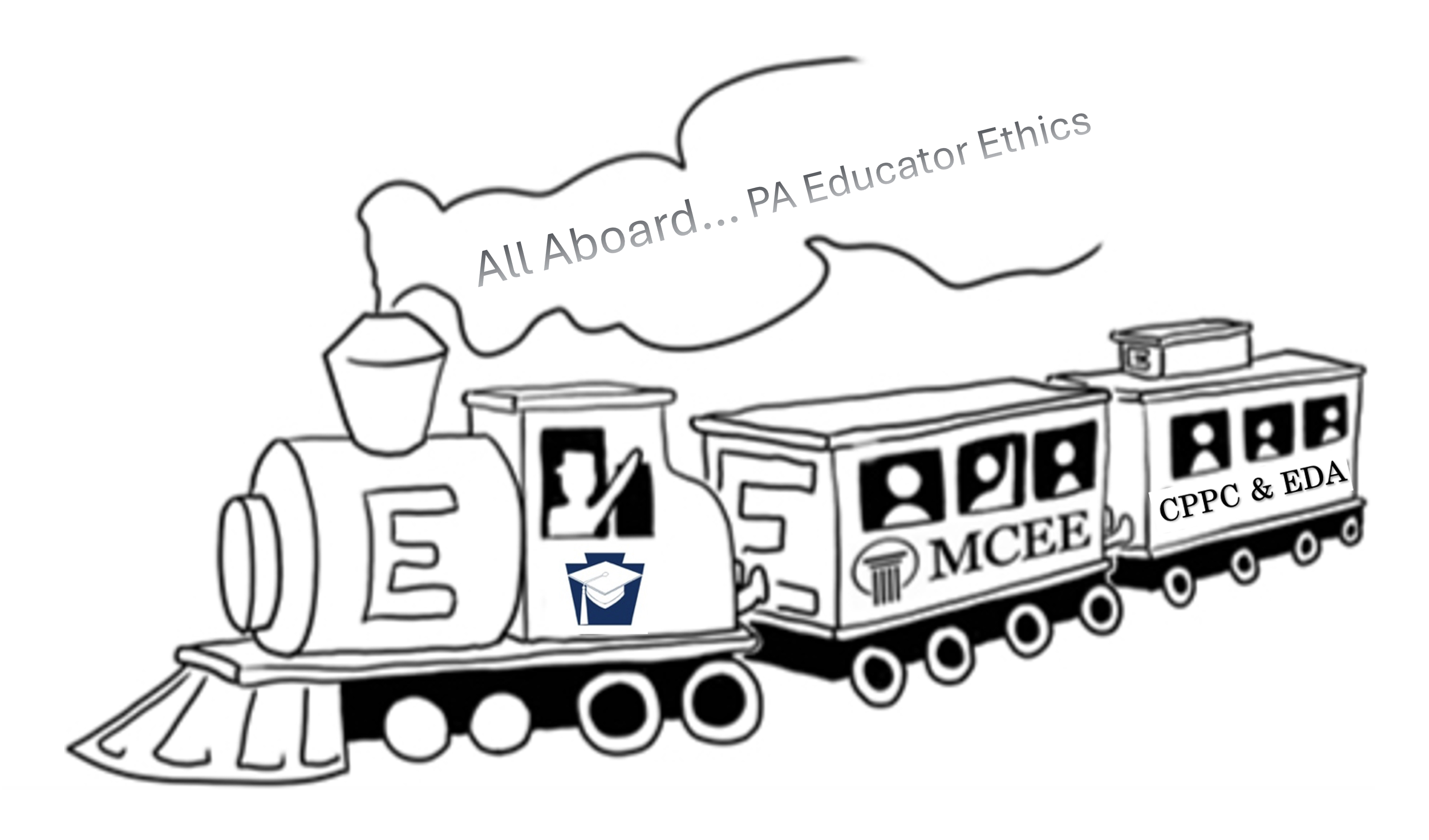
ALL ABOARD THE E-TRAIN… Embarking and Embracing a Journey of Essential Educator Ethics

The wheels of the train go round and round…

“All black, well stacked, goin’ down the track clickety clack” = the train looked good on the visual roll-by inspection.

“Highball it out of here” = proceed at maximum permissible speed

“Let’s pull the pin and roll” = uncouple so we can get out of here

The fall season is bringing upon us a series of ethical workshops, classes, and the creation of other resources, and the perfect time to warehouse everything at the main rail terminal! Take an excursion below to learn more about “staying on track” with research on the responsibilities and “regs” for serving as an educator.

Can you name the exact title of your Code of Conduct? What agency enforces it? Do educators have a Code of Ethics? Are school teachers fiduciaries or model exemplars? What does all of this mean?

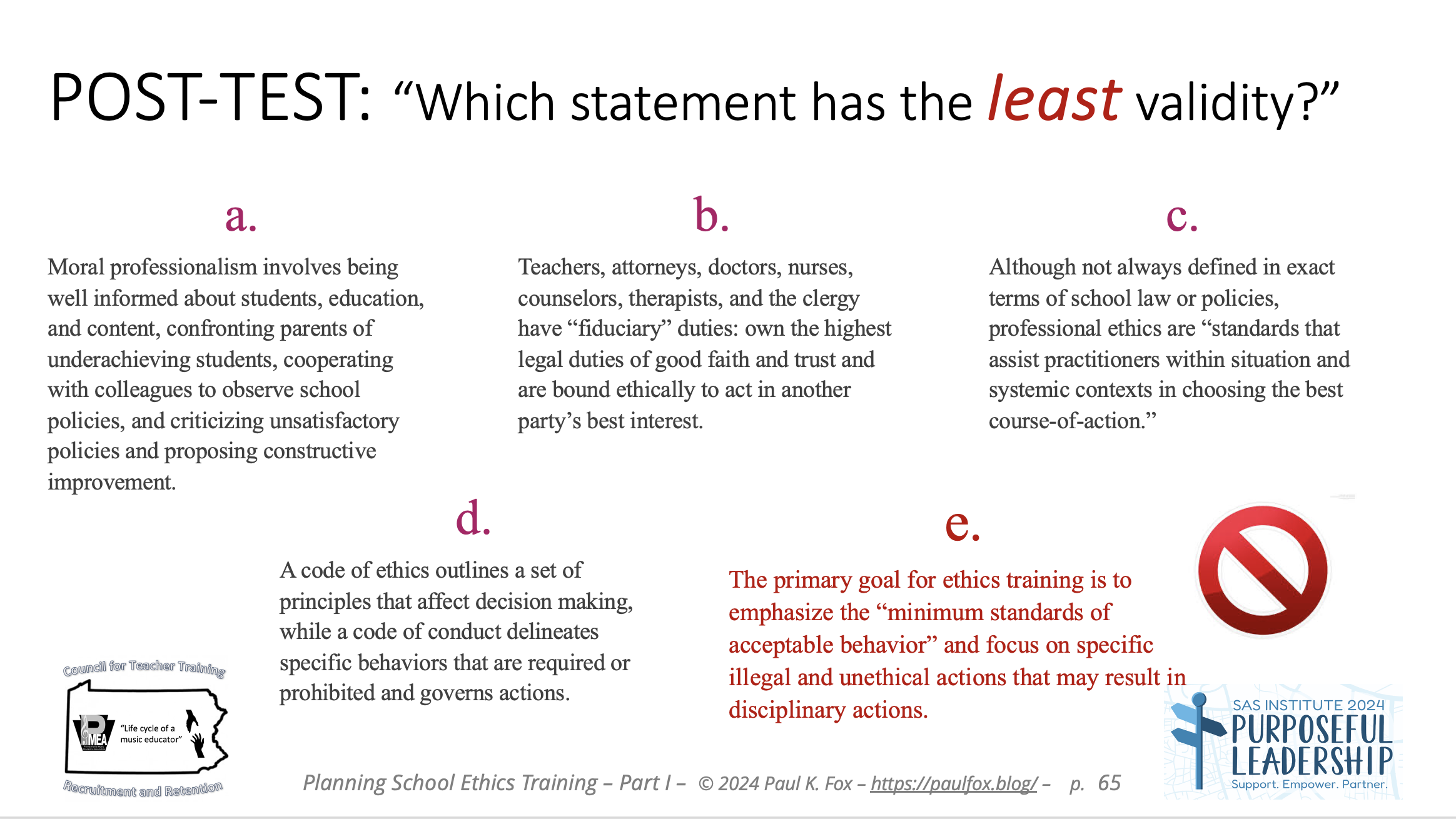
First, let’s take a pretest of your knowledge and experience on the subject of school ethics. Which of the following statements has the least validity?

  1. Moral professionalism involves being well informed about students, education, and content, confronting parents of underachieving students, cooperating with colleagues to observe school policies, and criticizing unsatisfactory policies and proposing constructive improvement.
  2. Teachers, attorneys, doctors, nurses, counselors, therapists, and the clergy have “fiduciary” duties: own the highest legal duties of good faith and trust and are bound ethically to act in another party’s best interest.
  3. Although not always defined in exact terms of school law or policies, professional ethics are “standards that assist practitioners within situation and systemic contexts in choosing the best course-of-action.”
  4. A code of ethics outlines a set of principles that affect decision making, while a code of conduct delineates specific behaviors that are required or prohibited and governs actions.
  5. The primary goal of professional ethics training is to emphasize the “minimum standards of acceptable behavior” and focus on specific illegal and unethical actions that may result in disciplinary actions.

After a thorough exploration of the materials below, you should feel confident in responding to this question. (If you need help, scroll down to answer at the end of this blog-post.)

Classes and Conferences on Ethics, Oh My!

I am looking forward to sharing insights on ethical issues and especially the seeming “conundrums” or conflicts in the myriad of snap judgments of daily decision-making, both in and outside of our classrooms. Upcoming opportunities are on the ethics e-train schedule.

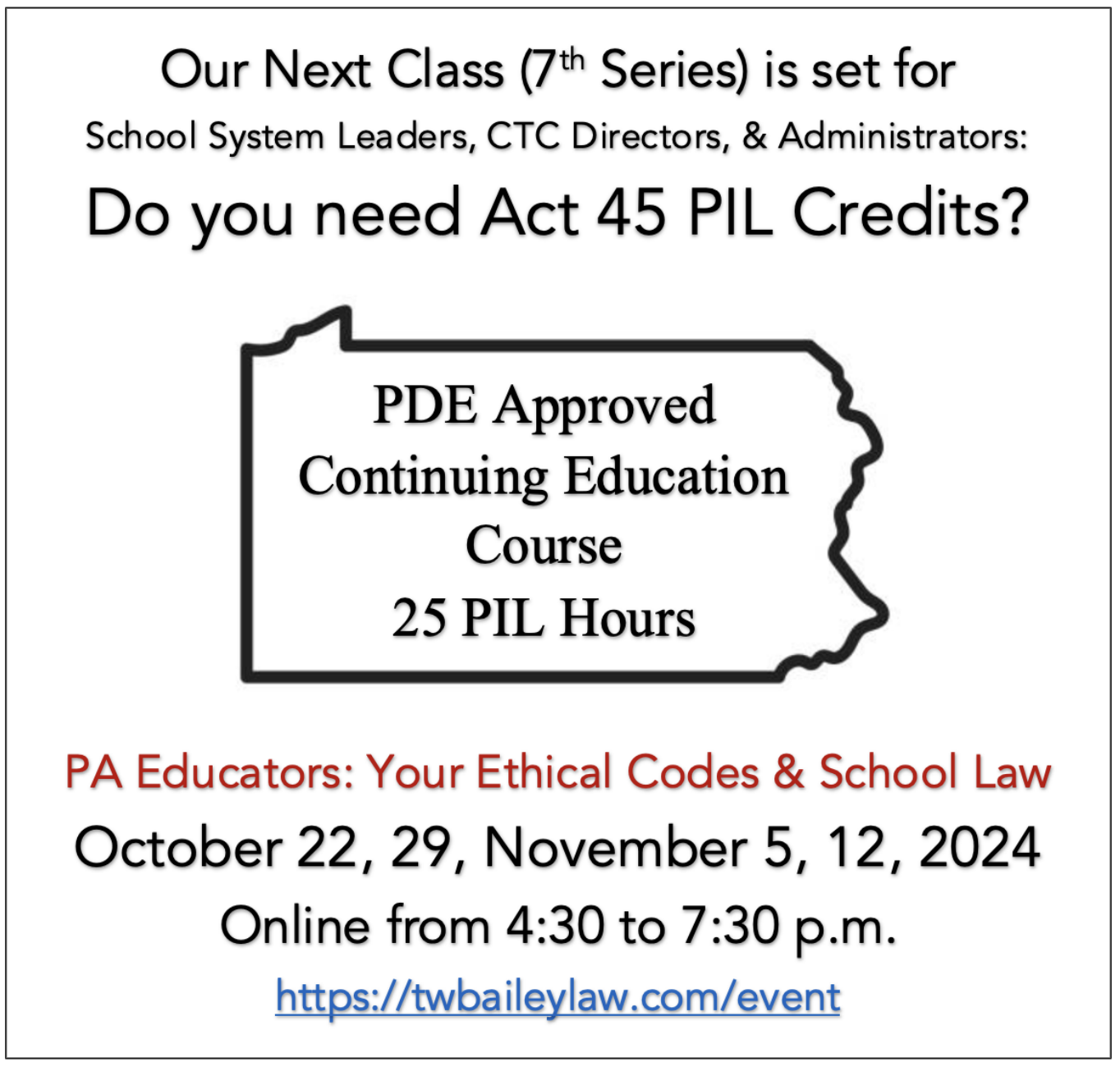
Currently, we are completing the sixth series of our 25-hour PDE-approved Act 45/PIL online course for school/system leaders, career and technical center directors, and other administrators. Sponsored by my colleague Thomas W. Bailey (check out his website here), the next class “PA Educators: Your Ethical Codes & School Law” begins on October 22 for four consecutive Tuesdays from 4:30 to 7:30 p.m.

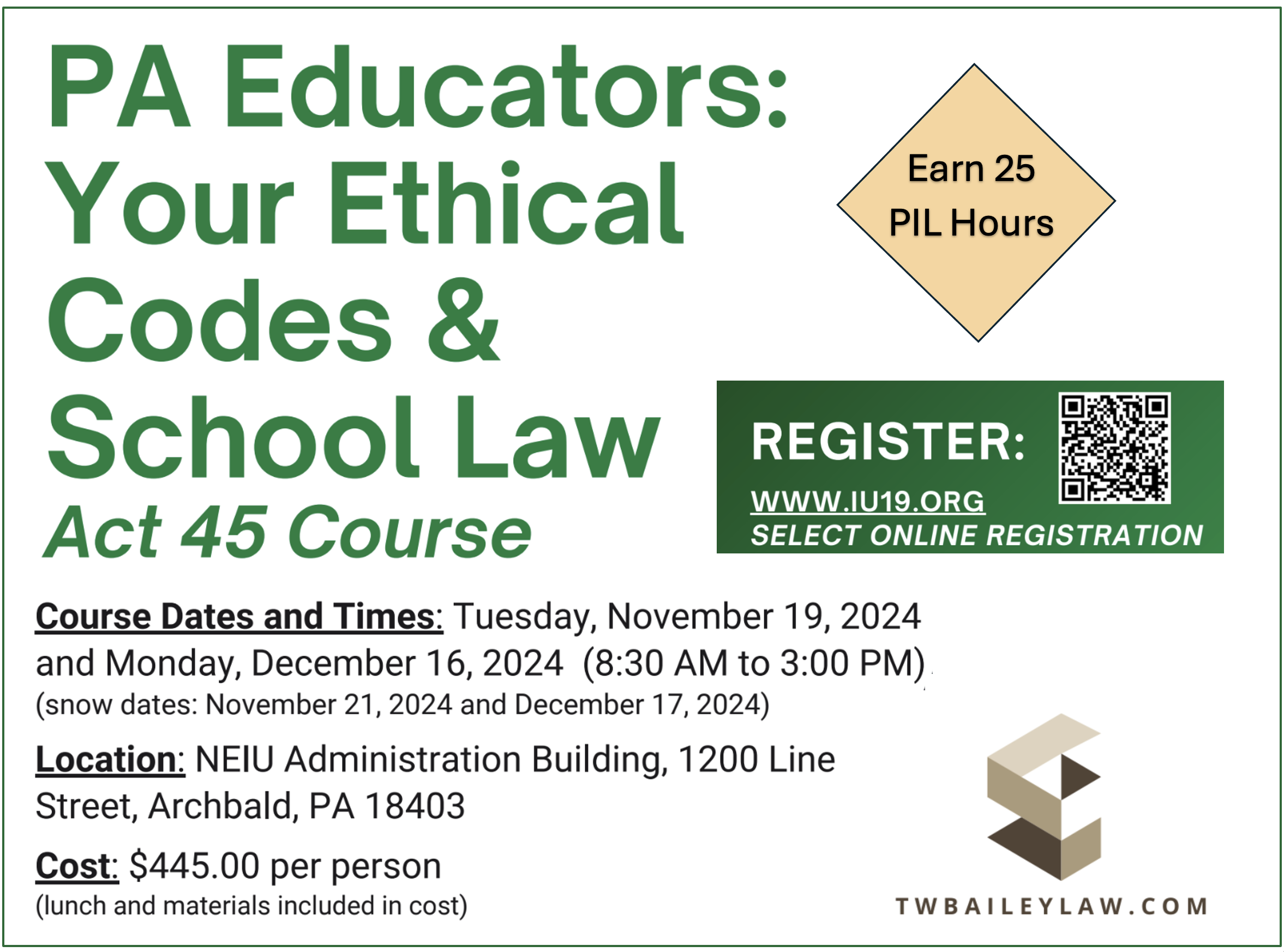
Thomas Bailey and I were also invited to present this Act 45/PIL course for the Northeastern Intermediate Unit #19 as a two-day workshop on November 19 and December 16, 2024. Visit http://www.iu19.org or click here to register.

I am venturing out of the Western PA to Eagleville, PA (near Valley Forge) to provide a 70-minute in-service, a school ethics “refresh” for the faculty at Methacton School District on October 14, 2024. Click here to download a copy of the slide summary with all links active.

Finally, I am happy to report that I was invited back to the PDE SAS Institute to do two sessions: “Planning School Ethics Training, Part I – Definitions, Codes, and the Commission” and Planning School Ethics Training, Part II – Model Code of Ethics for Educators. My proposal to present the session “CATCH THE E-TRAIN – Codes, Case Studies, and the Challenges of Ethical Decision-Making” was not approved for the 2025 PMEA Annual Conference in Kalahari Resort (Poconos). However, a facsimile of similar slides from past NAfME/PMEA workshops and webinars on educator ethics is available here.

Supplemental Resources for the Study of Codes, Case Studies, and the Challenges of Daily Decision-Making in Education

And now, the grand daddy of school ethics destinations…

Past paulfox.blog posts on educator ethics

Especially for Pennsylvania educators, pre-service students, and newcomers to the Commonwealth (citing the PA Professional Practices and Standards Commission website)

From other state governments (all rights reserved)

An additional sampling of articles

WHY STUDY ETHICS? Answer to the PRETEST above.

A code of ethics sets a higher threshold than regulatory codes of conduct or even a nonprofit organization’s bylaws and compliance rules enforced by the government. A code of conduct, such as the Pennsylvania “Code of Professional Practices and Conduct” of the PSPC, provides absolutes for employment, licensure, and/or civil/criminal sanctions. In contrast, the Model Code of Ethics for Educators document serves more as a general compass to help steer professionals towards sound judgment in their daily decision-making. What is unique about a true code of ethics vs. a code of conduct is that the principles are not defined in exact terms of law or policies, nor do they necessarily model family morals or values on which we as individual educators have been raised. The proposed standards are not about definite issues of right/wrong or black/white, but shades of grey. They are more open-ended, offering opportunities to discuss recommendations for consideration from a set of possible choices based on the circumstances of each ethical dilemma or resolution.

– excerpt from “The Ethical Music Educator,” Winter 2020 issue of PMEA News

Teachers are ethical professionals. Our moral aspirations, the “codes” and “standards” we subscribe to, and our professionalism are important to us, our students, our programs, and our communities. Essentially, these are the beliefs for which we stand, the values and behavior we model in our day-to-day decision-making to “make a difference” in the lives of our students, and the overall integrity of the profession. Therefore, the answer to the PRETEST above is #5. (#1-4 are TRUE!) But, as stated in #5, the goal of meaningful ethics training is NOT to emphasize the minimum standards of acceptable behavior or to focus on specific illegal and unethical actions that may result in disciplinary actions.

Do you have anything to add to this collection? ALL ABOARD! The conductor would appreciate feedback! Please feel free to make a comment to this blog (see link next to the title).

PKF

© 2024 Paul K. Fox

Update… Bigger & Better Things!

T-minus Twelve Months to Year 70!

Wow! I can’t believe it’s been three whole months since I posted a blog here! Where’s the time gone? Excuses? Well, what first leaps to my mind are several quotes from this Southern Living website about being an extremely busy retiree:

“The trouble with retirement is that you never get a day off.” — Abe Lemons

“I need to retire from retirement.” — Sandra Day O’Connor

“The harder you work, the harder it is to surrender.” — Vince Lombardi

“I wanted to have more time to play and reflect, but I find retirement more stressful than having a nice, steady job because I have to make decisions about where I want to be.” — Walter Cronkite

“I see retirement as just another of these reinventions, another chance to do new things and be a new version of myself.” — Walt Mossberg

“Living each day as if it were your last doesn’t mean your last day of retirement on a remote island. It means to live fully, authentically and spontaneously with nothing being held back.” — Jack Canfield

“Do not grow old, no matter how long you live. Never cease to stand like curious children before the great mystery into which we were born.” —Albert Einstein

To my friends and colleagues in the profession, yes I am “living the dream” and having fun in retirement! Health remains good, and the days of my wife and I are filled with personal enrichment, unique new and renewed adventures, and meaningful service to the causes that matter to us both! Our only complaint? There are only 24 hours in a day… But, that means, as we head to bed each night, we have lots on our ever-expanding to-do lists motivating us to get up even earlier the next day to accomplish!

So, the following will be a quick (?) update, ramblings in the format of “streams of consciousness” of what’s happening in our lives, geared to my more faithful friends and followers, and perhaps modeling the activities of two happily retired music teachers. I promise that future blogs will re-engage with our series on “Bookends…” (life cycle of a music educator), ethics training of educators, and interviewing skills of newcomers to the profession (the season of job screenings will soon be upon us!), not to mention more tips towards a smooth transition to retirement for those who are planning to “pull their pin” and leave their full-time employment in the near future. Thanks for hanging in there with us!

PMEA Conference

Both my wife Donna, her cousin Judy, our two dogs Gracie and Brewster, and I just returned from Erie, PA participating in the PMEA Annual In-Service Conference. This was unique in that, for the first time since we retired in 2013, Donna could attend “the big event” with me. Judy served as our dog babysitter (we don’t believe in “jailing” our pups!), and the Bayfront Sheraton, Courtyard Marriott, and Erie Convention Center were pet-friendly. We reserved adjoining rooms, and the dogs were content to walking all around the Bayfront Area/Lake Erie and returning at night to sleep with us.

To my PMEA colleagues and other PA educators, in case you missed it, here is the link to more than 1,000 photos I took at the conference (sessions, meetings, exhibits, and performances). Attendees, I challenge you: CAN YOU FIND YOURSELF & YOUR STUDENTS?

As usual, Executive Director Abi Young, PD Council Chair Martha Heise and her conference planning committee, PMEA state EXCOM and staffers planned another outstanding event. If you have never gone to a PMEA conference, mark next year’s dates April 9-12, 2025 on your calendar, which will be held in the luxurious Kalahari Resort in the Poconos. Besides, the “world’s largest indoor water park” is a fun place to bring your (grand)children! In addition, several other professional development and career enhancement venues are on the horizon available to members of NAfME and PMEA:

  • PMEA Summer Summit (Leadership Conference), Reading, PA
    July 15-17, 2024
  • NAfME Biennial Music Research and Teacher Education Conference, Atlanta, GA
    September 25-28, 2024
  • NAfME Eastern Division Conference and Honors Ensembles Festival, Hartford, CT
    April 24-26, 2025

At the Erie conference, I hosted my last PMEA Council for Teacher Training, Recruitment, and Retention and TTRR SHOWCASE. At our annual meeting, I stepped down as the state chair, but will continue as State Retired Member Coordinator on the Council TTRR. We’re in excellent hands, with TRI-M Chair Tina Bennett being elected to the state TTRR Council Chair position. Joining her is the visionary leadership of State SMTE Chair Dr. Kathleen Melago, Mentor Co-Chairs Lisa Endler and Eric Plum, PCMEA Student President Ellie Vito, Future Music Teachers Honors Symposium Chairs Aaron and Stephanie Magaro, PDE Fine Arts Education Consultant David Deitz, and Higher Education Representatives Paul Doerksen, Jessica Vaughan-Marra, Sarah Watts, Debbie Wolf, among others.

Below is a copy of the “Everything You Always Wanted to Know About Council TTRR” SHOWCASE slides which were presented to a whopping 60 PCMEA members during our breakfast meeting at the conference. (Perhaps the food motivated more collegiates to get up extra-early for that first session?)

Scholarships

One of the concerns repeatedly expressed at Council TTRR meetings was the funding issues of college students. Besides an anonymous donor funding the PCMEA breakfast at the SHOWCASE on April 18, PMEA instituted a “send a collegiate to the conference” campaign (complimentary registrations) and in 2023, also announced two major scholarship (college expense reimbursement) opportunities endowed by our Stark-Fox Family Fund in memory of our parents:

  • PMEA Council TTRR Award for Music Education Majors
  • PMEA Music for Lifelong Learning for STEM Students in College Music

In the spring of 2023, three $5K PMEA Council TTRR Scholarships were awarded to:

  • Elizabeth Corbett (Duquesne University)
  • Adam Hanna (Susquehanna University)
  • Mitchell Hourt (Moravian University

Unfortunately, last year no applications were submitted for the PMEA Music for Lifelong Learning Award. A concerted effort has been made to “reachout” to this population of students who are pursuing a science-related field and participating in their PA college band, chorus, jazz, or orchestra program. Please spread the word! Deadline to register is May 29, 2024. More information is posted here.

Upcoming Workshops

I was pleased to learn that two of my sessions were accepted for the Kappan 2024 Educators Rising National Conference scheduled for June 28-July 1, 2024, in Washington, D.C. at the Marriott Marquis:

  • Embarking the E3-Train – Essentials for Future Educators – What It Takes to Become a Teacher: Ethos, Ethics, and Engagement
  • Interviewing and Branding 101 – The Art and Science of Marketing Yourself for Employment Screening

In addition, I remain active in supporting my colleague Thomas Bailey in providing PDE-approved Act 45 and Act 48 ethics training courses for PA educators. Currently, we’re teaching our fifth series of classes (25 PIL hours) for school system leaders and have presented more than 14 additional professional development workshops, webinars, or conference sessions of in depth interactive discussions of ethics and daily educator decision-making. Our next focus area is to help PA administrators to incorporate the newly mandated PA Chapter 49 ethics competencies into their school induction programs.

To learn more about course offerings or read court case blogs on ethics in education, visit Tom Bailey’s website here. This blog-site also provides a comprehensive library of past articles on educator ethics.

Who Really Reads These Blogs?

That’s a good question! Although I have always provided a “comment” link at the top of each posting and seek feedback and even “guest authors” to feature in future blogs, very few people respond to these articles. I have always hoped that “my meanderings” could help music teachers at all stages of their careers, from pre-college and music/music education majors to veteran educators to retirees. At least, this WordPress site allows me to permanently archive my writings with the hope this exhaustive but always-accessible supply of resources, links and viewpoints could be used in the future. Share on!

So recently, I was pleasantly surprised when Becca Robinson, a tutor of homeschooled children, reached out to me and said Jeremy, one of her students, did extra-credit research after reading one of my blogs on retirement resources. We are adding his recommendation for this link to the Transportation Resource Guide for Seniors & Individuals with Disabilities in the “Retiree” menu section at the top of the page. This comprehensive article by Cole Neder documenting the following is a valuable read for senior citizens and anyone who is experiencing personal mobility challenges:

    • Public Transit
    • Paratransit Services
    • Demand Responsive Services
    • Non-Emergency Transportation
    • Ride-Sharing and Taxis Services
    • Service Resources by State

    On a Personal Note…

    Yes, last week was my 69th birthday! I never imagined getting that old… er, I mean, mature! Neither my mother nor my father made it to their seventh decade! I attribute my positive attitude and active lifestyle (even though at times I could unintentionally forget your name at the drop of a hat) to embracing what Ernie Zelinski, author of How to Retire Happy, Wild and Free, says is absolutely essential to maintain in retirement: “finding purpose, structure, and community.” It is a paramount of importance to feel we matter and are needed every day, exercise both sides of our brain (the analytical and the creative), keep physically fit, jump out of our bed with purpose, maintain busy schedules and accept a lot on our plate, and stay connected to the people surrounding us. To that end, my wife and I continue to teach the pursuit “creative self-expression,” directing a community ensemble (the South Hills Junior Orchestra), teaching, walking our dogs, and pushing wheelchairs at our local hospital. At times, this latter activity allows us to catch up with our former music students, their parents, school staff, and neighbors. What FUN it is to meet someone who I taught many years ago in middle school, now grown up and busy raising their own “band” of musicians! God willing, I hope to continue with good health, a sharp mind, and motivation to live to Moses age (150 years old?), or at least have a ball along the way!

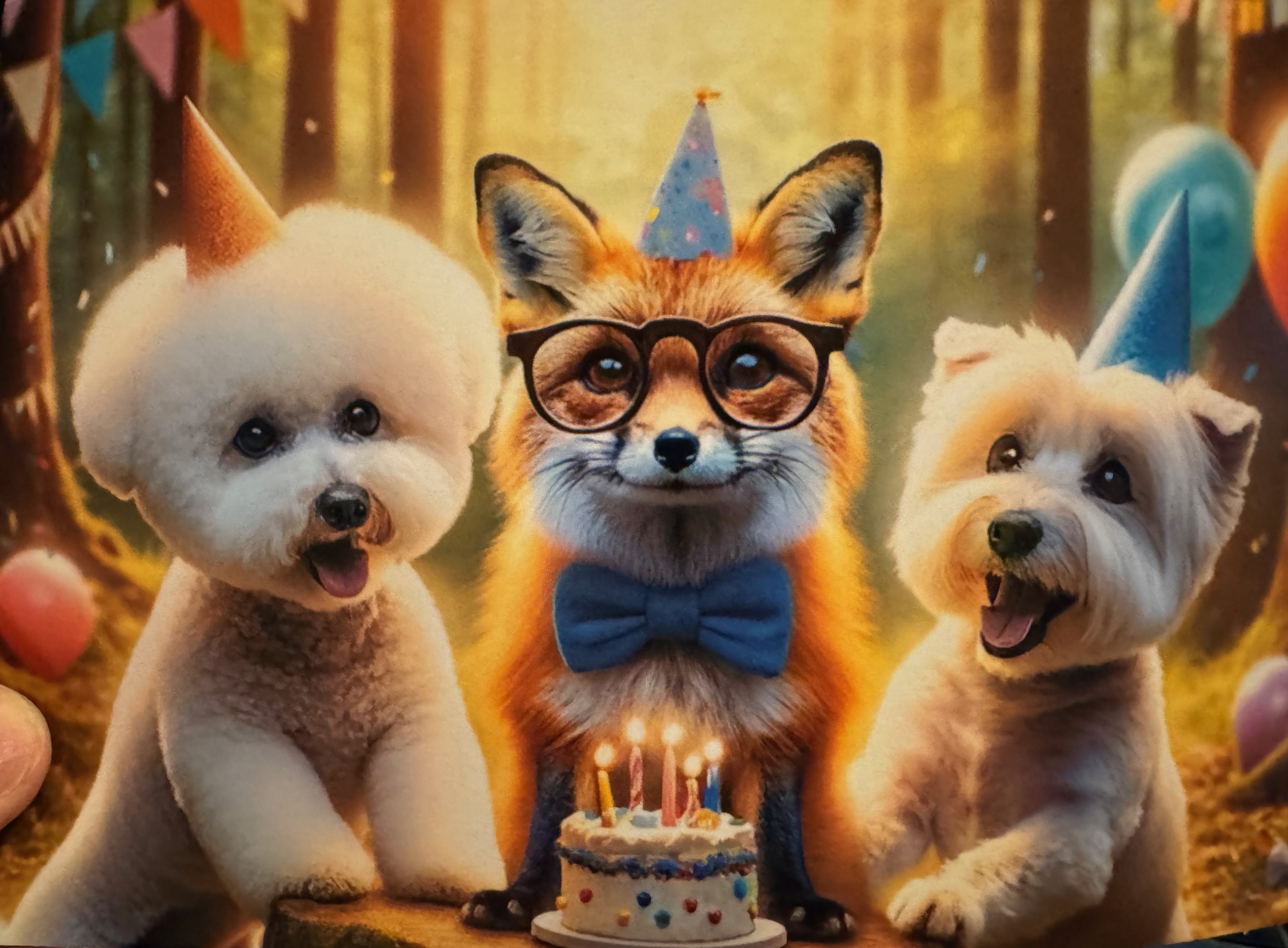
    I leave you this month with a copy of the one-of-the-kind birthday card one of my adult students (who claims me as her “adopted father?”) created using Photoshop. Three generations of her family play in our Saturday orchestra. Caption: Left is our Gracie, a bichon frise, and right is Brewster, a yorkie-poo. I’m depicted in the middle with my SHJO bow-tie, of course!)

    Happy trails, retirees and active educators alike! Keep in touch!

    PKF

    © 2024 Paul K. Fox
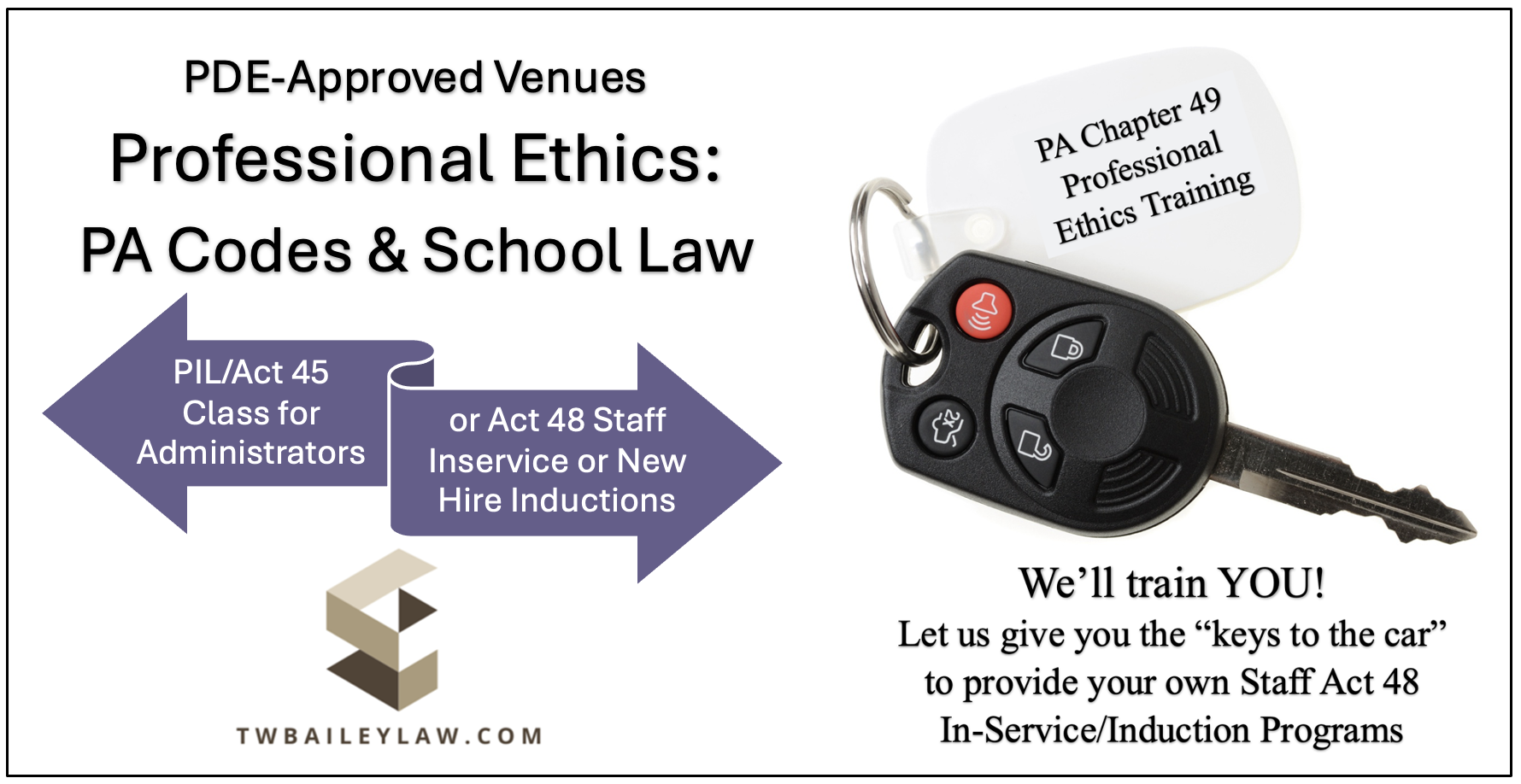
    Launching PA Educator Ethics Training

    Implementing the NEW PDE Chapter 49 “PE” Competencies – “The WHO, WHAT, WHY, & HOW!”

    Blogger’s Note: We will return to Part II of “Bookends” next month to explore:

    • Stage 3: Inservice/Growing Years
    • Stage 4: Veteran/Sustaining Years
    • Stage 5: Next Chapter/Living the Dream

    Instead, our November blog will share methods, modes, media, and other materials to provide meaningful professional development on ETHICS for EDUCATORS in the Commonwealth, resources from my upcoming presentation to school administrators at the Pennsylvania Department of Education’s SAS Institute – Successful Leadership – Shaping Your School’s Story to be held in the Hershey Lodge and Convention Center on December 11-13, 2023. Click below for my handouts.


    PKFox

    Interested in joining us at the Hershey Lodge on December 11-13, 2023? Please click here for more information or to register.

    A Summary of My SAS Institute Ethics Session

    To paraphrase the wisdom of one of my favorite recent visionaries and online workshop presenters, Simon Sinek, “Every organization should begin with “the WHY!” According to SmartInsights, Sinek’s Golden Circle theory explains “how leaders can inspire cooperation, trust and change in a business based on his research into how the most successful organizations think, act and communicate if they start with why.” On his website, he declares his own WHY: “We are here to inspire people to do the things that inspire them so that, together, each of us can change our world for the better.” I love his mission!

    https://www.smartinsights.com/digital-marketing-strategy/online-value-proposition/start-with-why-creating-a-value-proposition-with-the-golden-circle-model/

    “Your WHY is your purpose, cause, or belief. WHY does your company exist? WHY do you get out of bed every morning? And WHY should anyone care about the work you do?” – Simon Sinek

    So… lets ask the questions that define our own golden circle, my session, and this article:

    • WHY should we be so concerned about professional development in ethics for PA educators?
      (Why should you even be reading this blogpost?)
    • HOW should we train our staff?
    • WHAT should be introduced and reinforced over the long term?

    And, I will add one additional question: WHO is responsible for all of this?

    Well, the quick response to that last query is EVERYONE in the profession. However, this blog is particularly geared to school system leaders, career and technical center directors, and administrators charged with the responsibility of continuing education/professional development and induction programs for their PA educators.

    The “WHY!”

    Quick. Calling on all PA teachers! Without looking on the Internet, can you identify the exact title of your “code of conduct” (1)? Do you know the PA agency responsible for writing this code and adjudicating its rules (2)? Can you name the “code of ethics” recently adopted by PDE and the Board of Education which provides school staff comprehensive guidance in professional decision-making based on context (3)?

    Hints? How about a few acronyms?

    1. CPPC
    2. PSPC
    3. MCEE?

    Don’t you think “we” should at least be familiar with the commission that grants us the license to teach in PA as well as the document that “governs” our behavior, violations of which could remove us from our job or revoke our certificate?

    Of course, six years ago, even I didn’t know we had a PA “code of conduct!” (I started teaching in the public schools in 1978 and it wasn’t written until 1992!) After retiring from full-time teaching in 2013, I was asked to present my first ethics workshop back in 2017 for a Pennsylvania Music Educators Association (PMEA) Regional In-Service Program. Already scheduling me for two other sessions, the organizer came to me, “Could you add a presentation on educator ethics?” My first reaction was, WHY? Why would this be necessary? I promised him I would do a little research before getting back to him… and found these (now updated) statistics. Here’s the WHY in a nutshell!

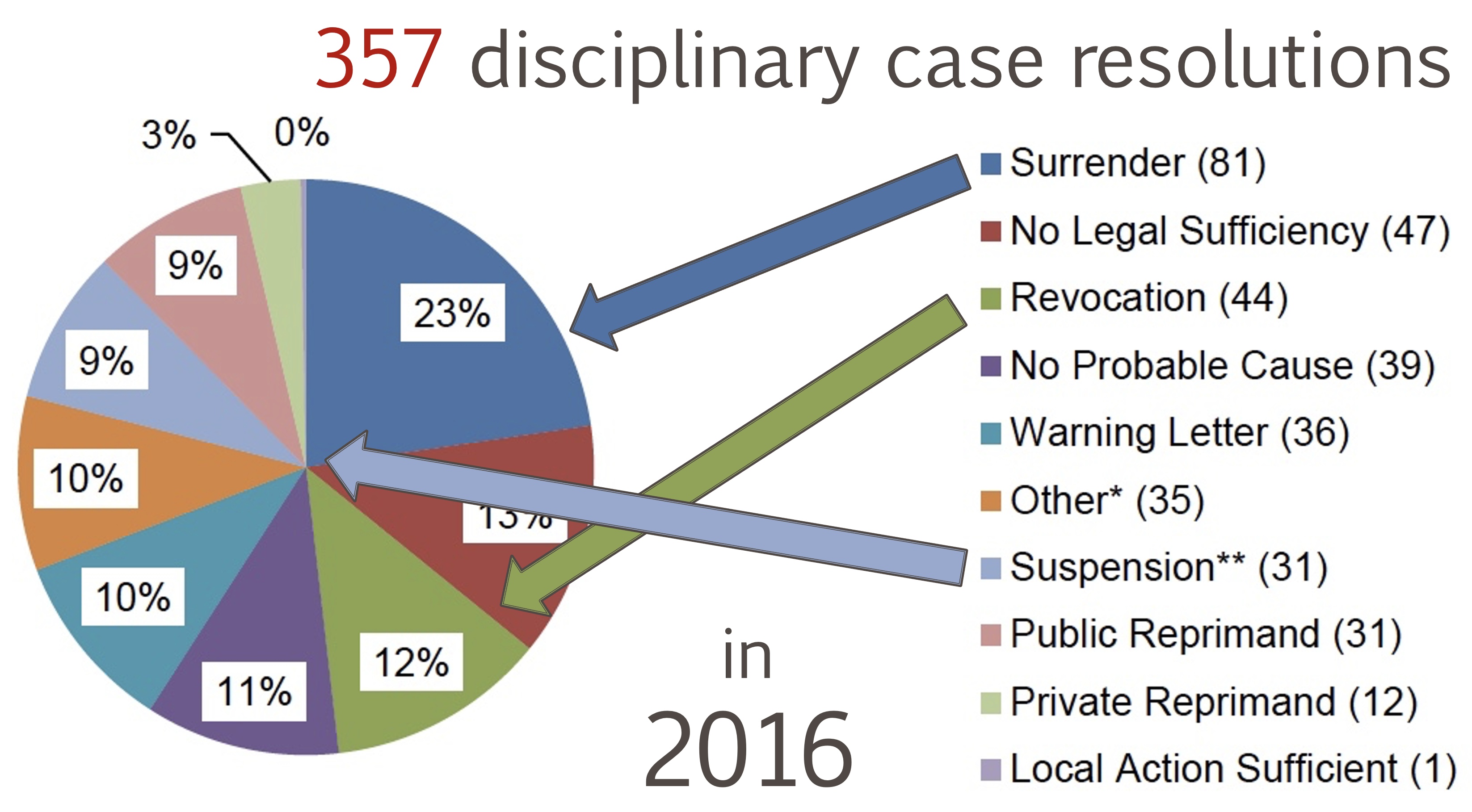
    HORRIBLE! These are the number of PA educators by year who had misconduct complaints filed against them. Sure, a majority of their cases were not always fully prosecuted nor did they all result in a “guilty” verdict or plea, as this glimpse of educator disciplinary resolutions for 2016 (out of 672) for comparison shows (statistics from PDE):

    But, if you can read the above graphic, that means that in 2016, 156 educators surrendered their license or had their certificate suspended or revoked! Obviously, no matter how you interpret the stats, this is a SERIOUS PROBLEM! And it may be due to a lack of training or understanding of the regulations and principles of ethical decision-making!

    Why is this topic crucial for all pre-service, “rookie,” AND experienced professional educators? It is essential… not so much to serve as a reminder of the penalties for ethical infractions or spotlighting the occurrences you read or hear about in the news… but, because ETHICS are what we all stand for, the values we exhibit in our day-to-day decision-making, the integrity of the profession, and our “making a difference” in the lives of the students.

    Ignorance of the law is no excuse for breaking it.

    (Oliver Wendell Holmes)

    The “WHAT!”

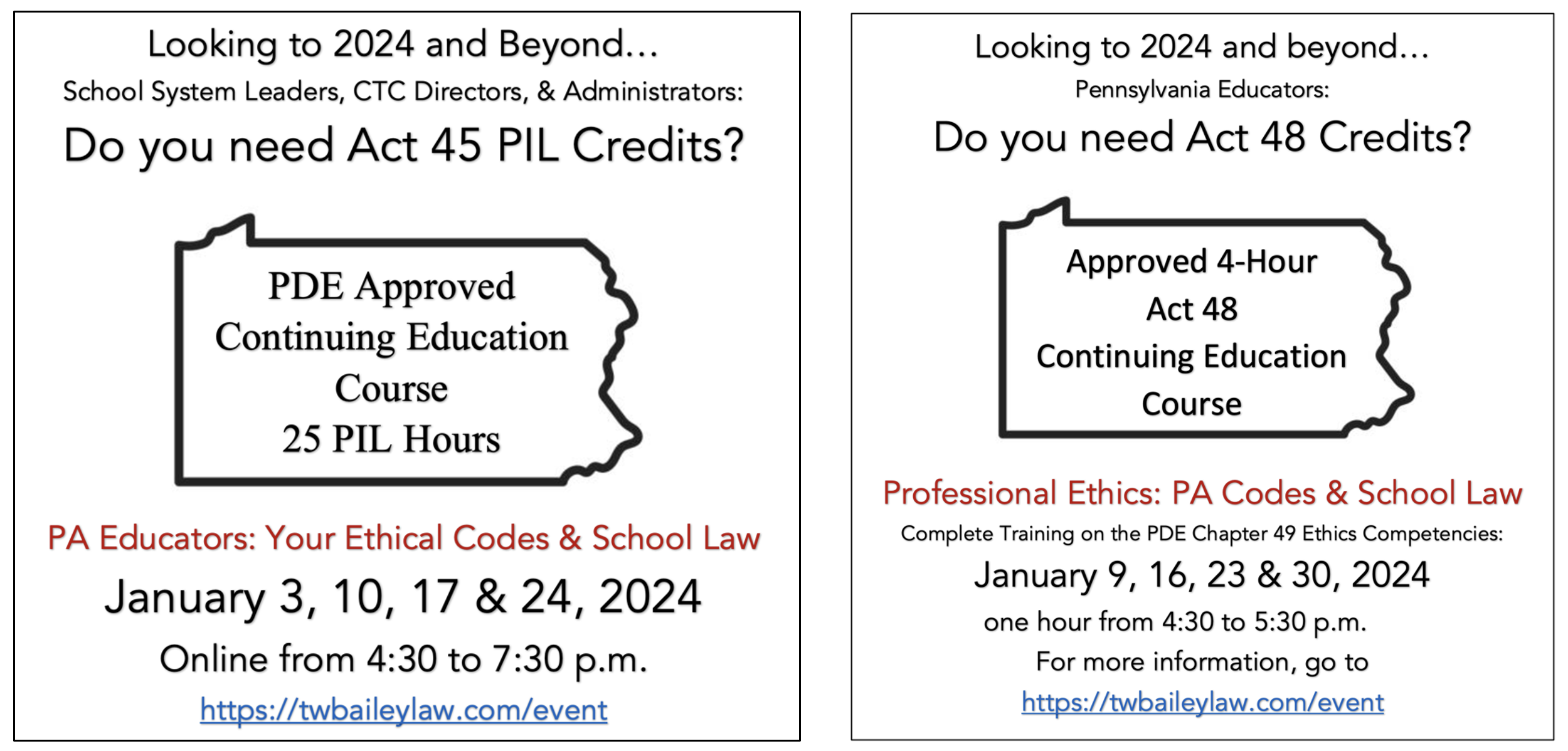
    My colleague Thomas W. Bailey, a retired social studies teacher who reinstated his law license, and I set ourselves the goal of creating continuing education courses to provide REAL ethics training for PA educators. Thomas applied to the Pennsylvania Department of Education and received approval for a four-hour online Act 48 continuing education course for all PA educators (earning credits in PERMS) and a 25-hour online Act 45 PIL continuing education course for school system leaders, career and technical center directors, and other administrators responsible for planning the professional development of their school staff. The dates for our next two series of classes with open for enrollment in January 2024 are:

    To register for either course, please go to Tom’s website: https://www.twbaileylaw.com/event.

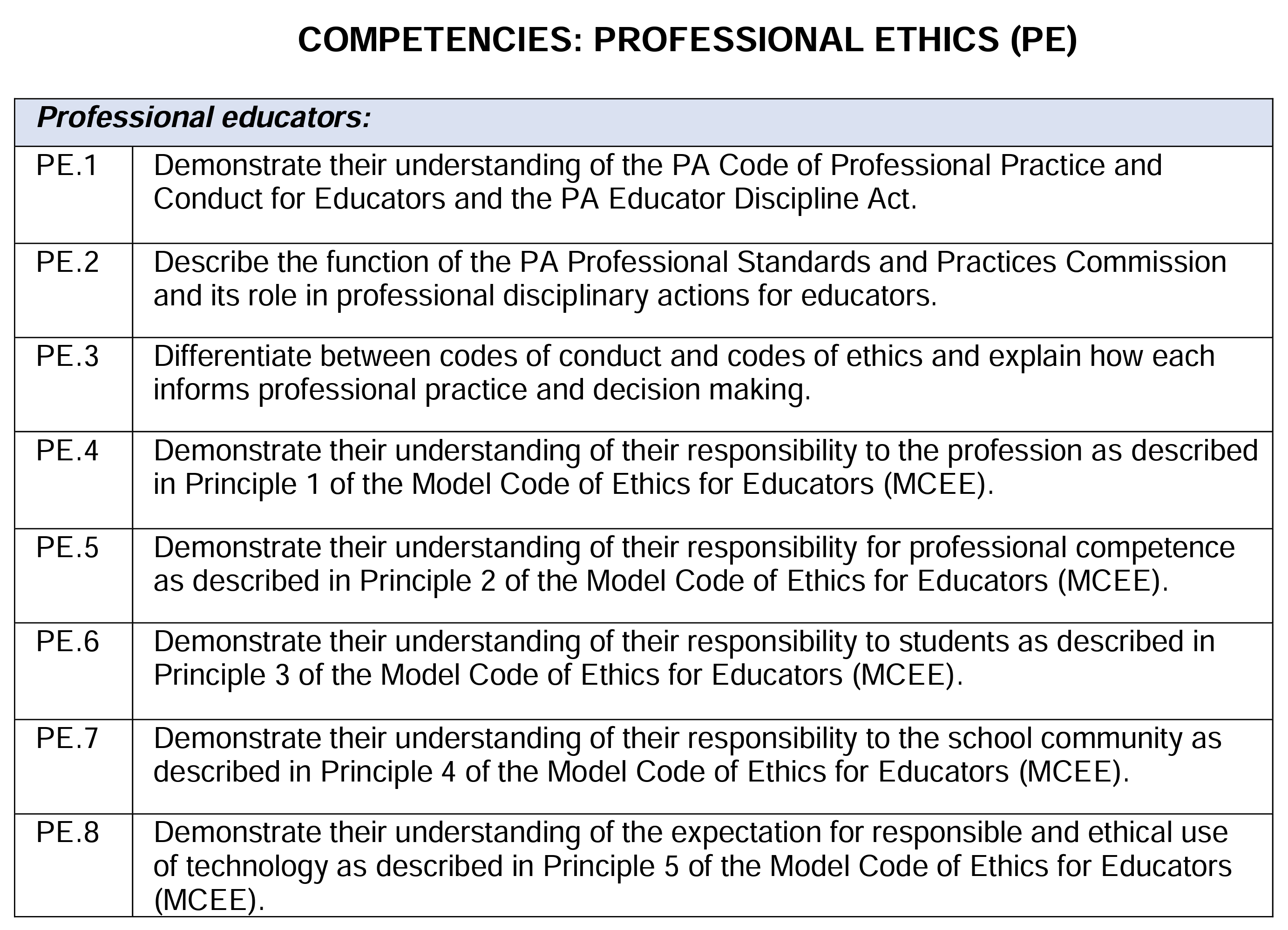
    Both of our courses satisfy the recently revised PDE Chapter 49 requirements of learning the “professional ethics” program framework guidelines:

    For school system leaders and other administrators, PDE has set high expectations with the release of the following DEADLINES in April 2022:

    “Chapter 49 requires instruction in professional ethics to be integrated in educator preparation, induction, and continuing professional development programs as follows.

    • Continuing professional development programs must integrate the professional ethics competencies no later than the 2023-24 academic year.
    • Educator preparation and induction programs must integrate the professional ethics competencies no later than the 2024-25 academic year.

    Our Act 45 and Act 48 courses cover the following subjects, definitions, and applications of these terms:

    • Fiduciary
    • Ethical Equilibrium
    • Personal Morality
    • Regulations of Law
    • Professional Ethics
    • Professional Dispositions
    • Moral Professionalism
    • Differences Between Moral and Ethical Standards (with Examples)
    • Codes of Conduct (Examples)
    • Codes of Ethics (Examples)
    • Differences Between a Code of Conduct and a Code of Ethics
    • PA Professional Standards and Practices Commission
    • Paths of Educator Discipline in PA (Local and State)
    • Loudermill Hearings
    • State Discipline System (from Misconduct Complaint to Appeals)
    • PA Code of Professional Practice and Conduct
    • The Educator Discipline Act
    • National Association of State Directors of Teacher Education and Certification
    • Model Code of Ethics for Educators

    The “How!”

    I know this will sound a lot like bragging, but what makes the Thomas Bailey + Paul Fox ethics courses truly effective and different from everyone else in the game (albeit there are few “classes on the codes” sponsored in our geographic area) is the process – a focus on top-down training (administrator to teacher to student), interactive discussion, and a major emphasis on borrowing from the research of “Principled Teaching” in Domains 4a, 4d, 4e, and 4f of the Charlotte Danielson Framework for Teaching, the Teacher Education And Mentoring (TEAM) Module 5 Guide of the Connecticut State Department of Education, and the Facilitators Guide of the Iowa Board of Educational Examiners.

    In my SAS presentation, I review several different modes of case study analysis, from simple to comprehensive, modeling small group interactive peer review, encouraging healthy discussions of diverse opinions in an “open,” non-threatening environment. The following approaches could be adapted to your setting of in-service programs or inductions:

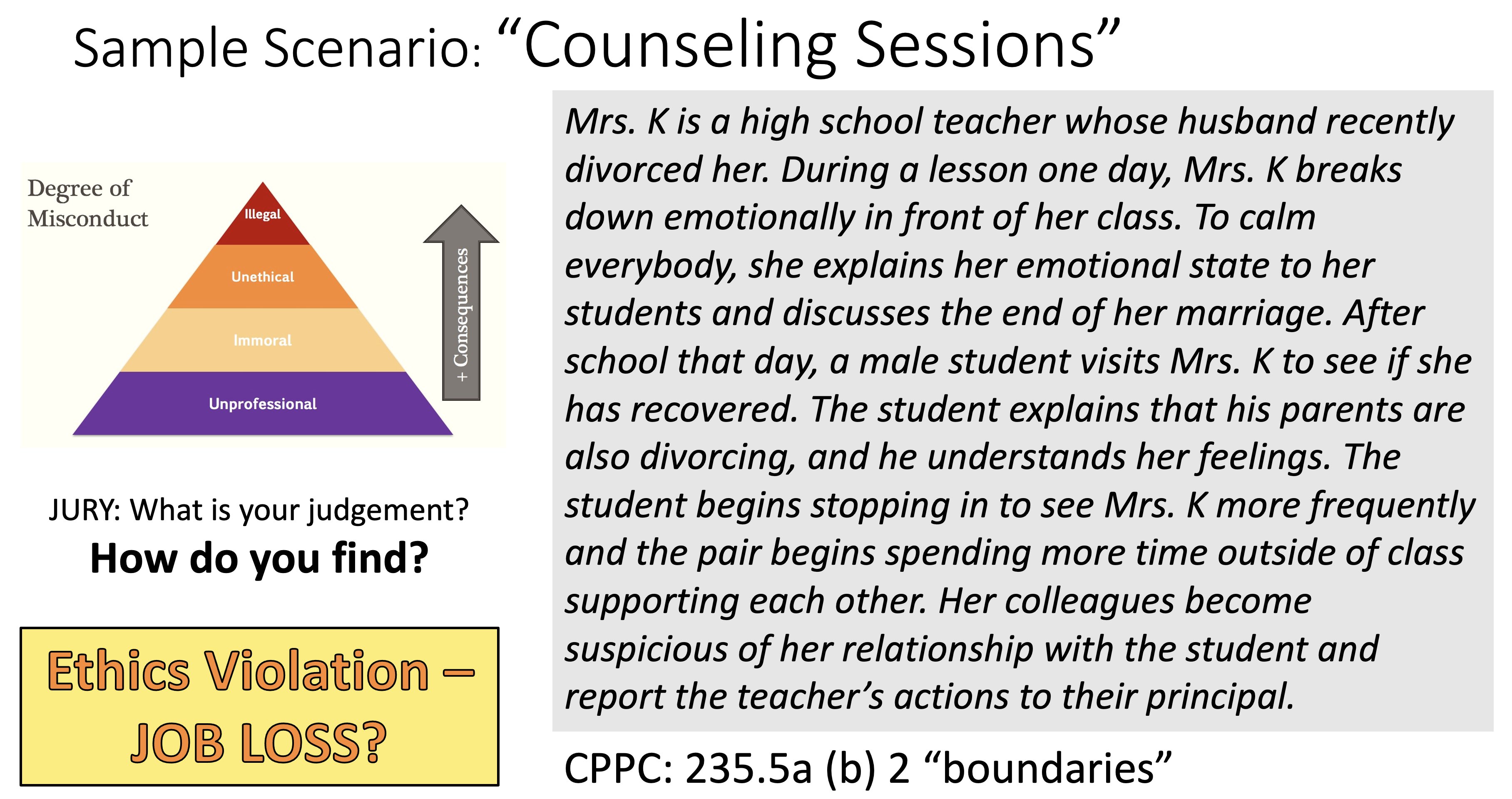
    MOCK JURY

    Degree of Misconduct, scenarios for learning the PA Code of Professional Practice and Conduct (CPPC): For more details, revisit the application of my misconduct rubric and explanation in the blog “Ethical Scenarios” here.

    In collegiate sessions, I have used color-coded popsicle sticks and handouts of different hypothetical case studies for “the jury” to evaluate the behavior and “find the relevant code” in the CPPC.

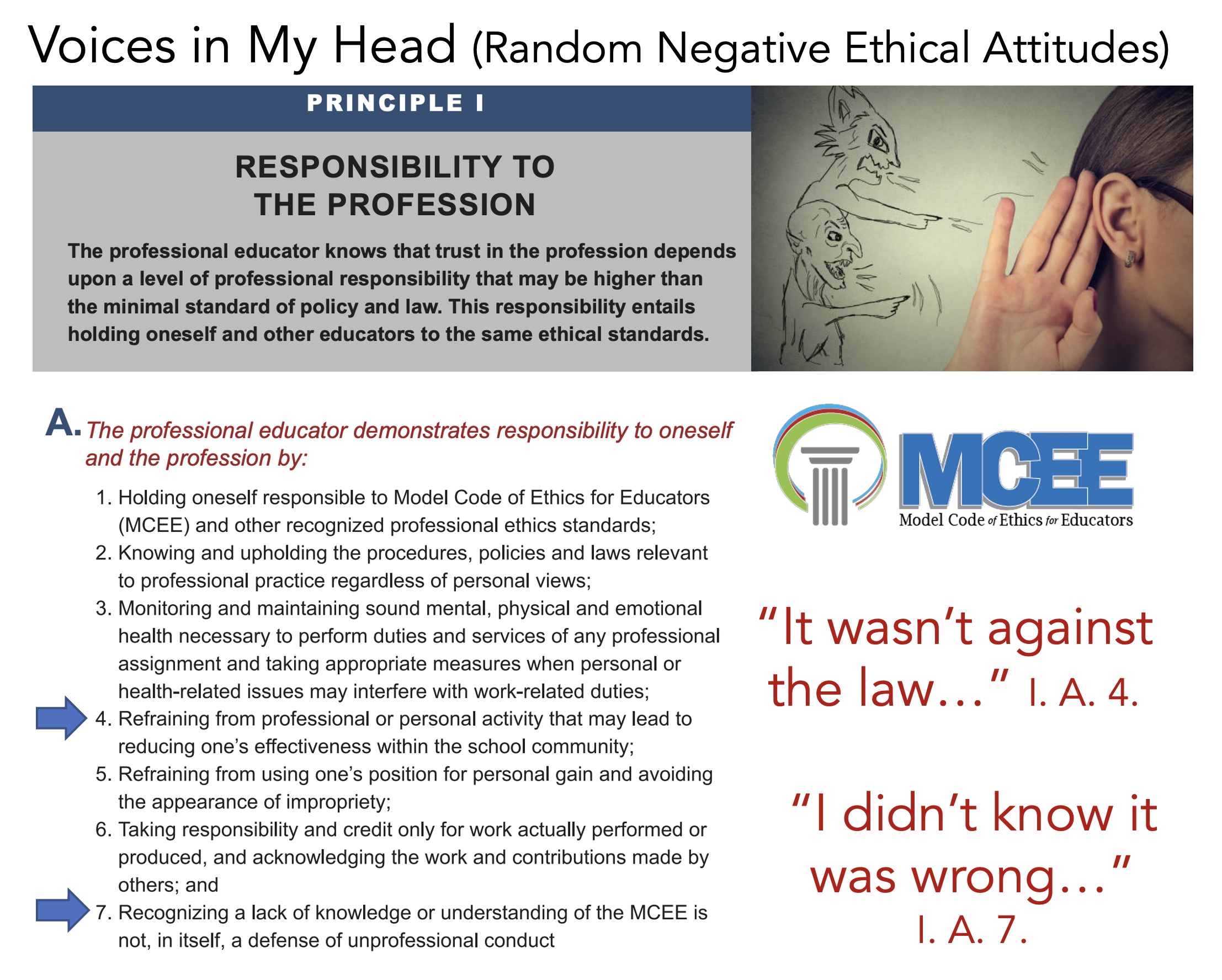
    VOICES IN MY HEAD

    Random Bad Attitudes for review of the standards in the Model Code of Ethics for Educators: I doubt (or sincerely hope) you would not hear too many of these directly from the school staff, but comments like, “Don’t ask for permission, beg for forgiveness” are NOT ethical precepts! Let’s dissect these bad boys!

    SEARCH FOR THE STANDARDS

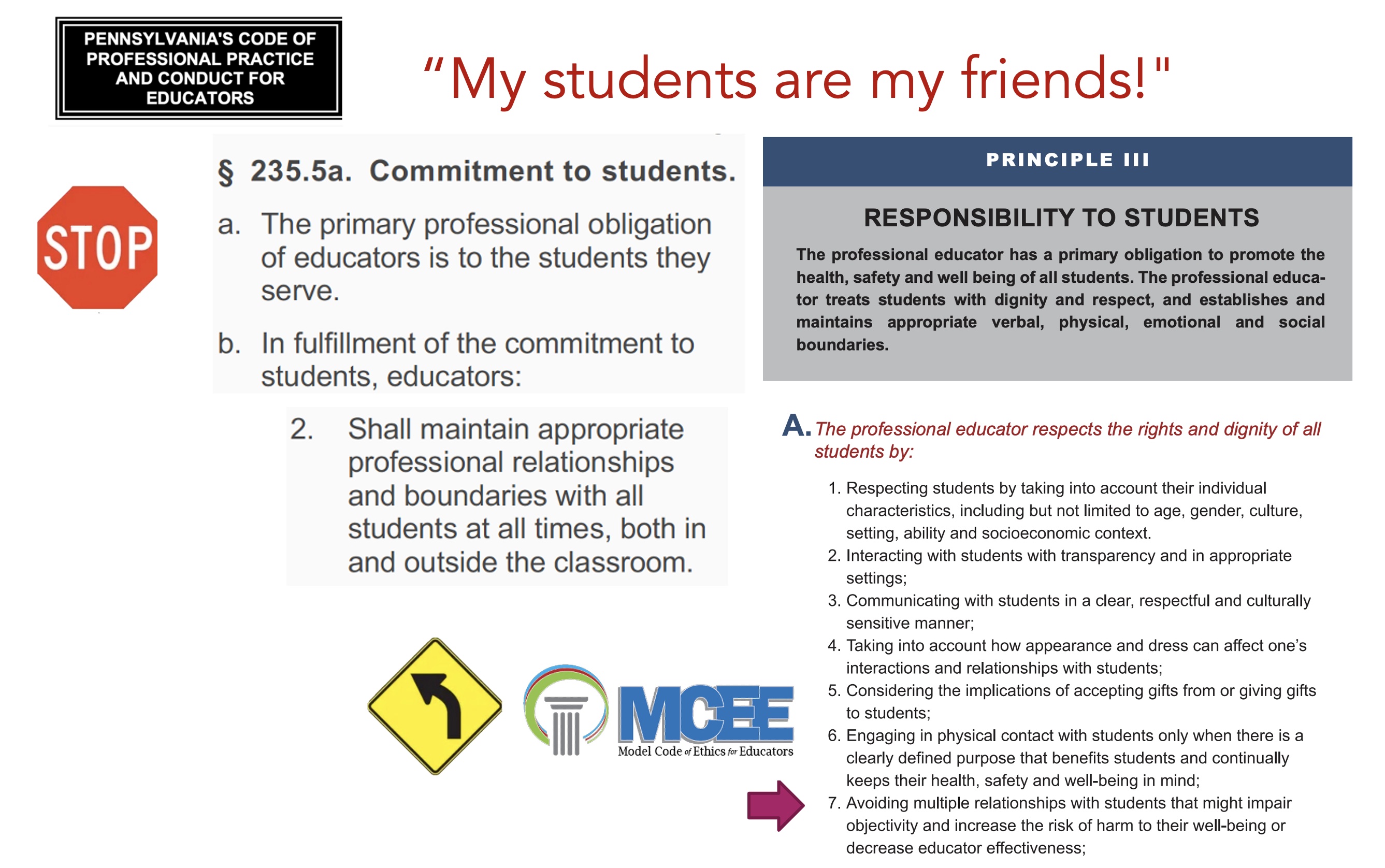
    Hybrid Approach for using “the negative voices” and researching appropriate provisions in both the CPPC and MCEE: Select a single bad attitude and break off into two or three teams, each focused on corroborating related ethical principles in CPPC, MCEE, and even the PA Educator Discipline Act (EDA).

    ALL CODES

    Deep Dive” Case Study Analyses in small group break outs for comprehensive interactive discussions using an adaptation of the questions in the Connecticut State Department of Education TEAM Manual:

    1. What possible issues/concerns might this scenario raise?
    2. How could this situation conflict with school policy, CPPC, EDA, MCEE, or case law?
    3. In this situation, what are some potential negative consequences for the educator’s students, fellow educators, and the school community-at-large?
    4. What responses/actions will result in a more positive outcome and/or what proactive measures might be considered?

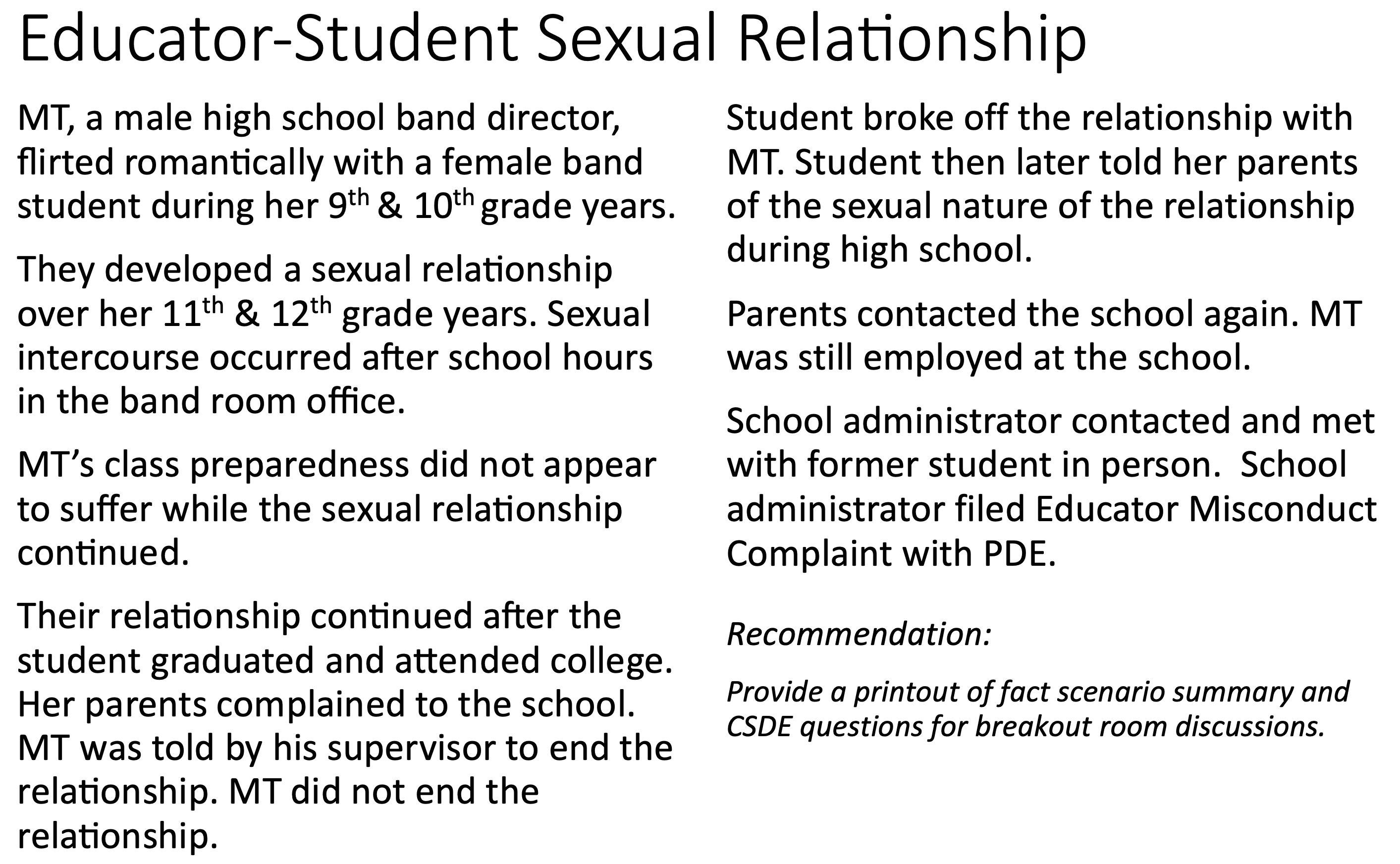
    A single hypothetical scenario would first be presented to the full group, and then the educators would break off into 4-6 smaller groups to review these questions. Individuals may or may not all agree. A group leader is usually appointed to record their responses and then upon reconvening, report back to “the whole.” Here is a sample case study (painful reading; fictitious but based on actual past incidents):

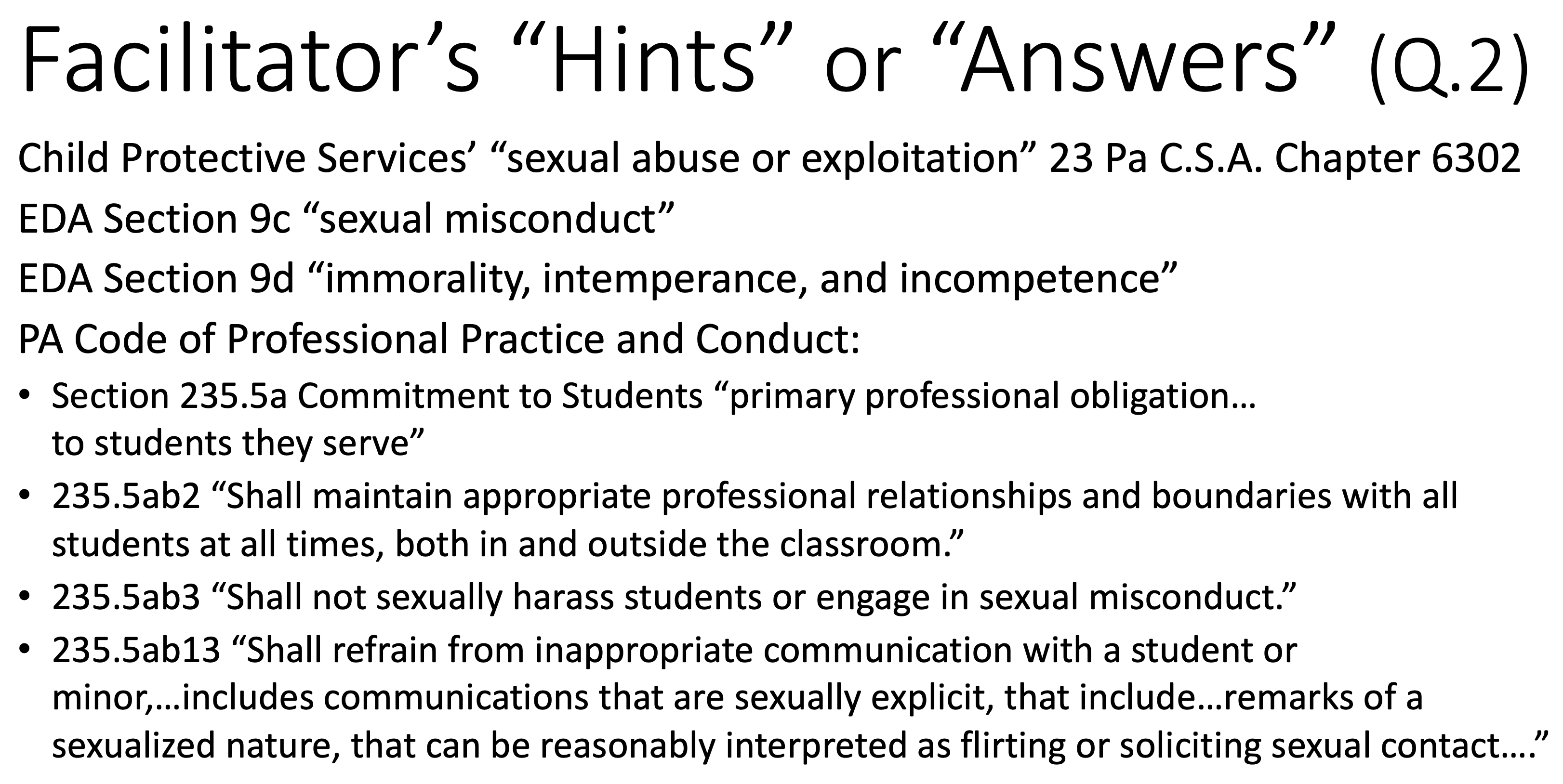
    The moderator may promote further discussion (sample answers below) and even pose additional questions like the following:

    1. What if the relationship was always of mutual consent?
    2. What if the teacher never taught the student while she was enrolled in his school?
    3. What if the relationship did not start until after the student graduated?
    4. What if his student was over the age of 18 during the time of the relationship?

    It deserves mention here that this final training mode, representing perhaps the highest degree of scaffolding of the learning for the ethics training of your staff, proposes the establishment of a permanent school district Professional Learning Community (PLC) or ethics committee. We know from our past experiences in providing continuing professional development of educators that promote free, open, healthy sharing of potential professional decision-making conflicts or ethical “conundrums” – “what would you do” scenarios – will foster lasting long-term benefits. Danielson Framework for Teaching (Domain 4) and CSDE reinforce this philosophy of peer collaboration.

    “Teachers must engage in district-facilitated conversations that focus on ethical and professional dilemmas and their professional responsibility to students, the larger school/district educational community, and to families.”

    Connecticut State Department of Education

    My educator ethics mentor and “hero” Troy Hutchings, Senior Policy Advisor to the National Association of State Directors of Teacher Education and Certification, admitted that in his early years of teaching, he felt a little reticent about going to his principal for advice in handling a situation of a student developing a “romantic crush” on him. To paraphrase his remarks during his webinar, “I was concerned that my supervisor might think I was encouraging the girl… Who could I turn to?” Sharing these anecdotes and talking informally with other faculty members will go far in building teamwork, mentor-mentee relationships, and intra-building trust in allowing more peer review towards enhanced educator decision-making.

    If you need a resource on PLCs, my colleague (PA Principal of the Year to be honored at the upcoming 2023 SAS Institute) Dr. Tim Wagner recommended the handbook Learning by Doing by Richard DuFour, Rebecca DuFour, Robert Eaker, Thomas W. Many, and Mike Mattos (Solution Tree Press, 2016).

    The authors’ summary of reasons to implement a PLC in your school building(s) are to:

    1. Improve staff’s individual and collective practice
    2. Build on staff’s “shared knowledge and experiences”
    3. Build clarity and understanding in the use of a common vocabulary
    4. Develop a library of accessible tools, templates, and protocols (i.e., ethical scenarios)
    5. Promote non-threatening, thought-provoking discussion on ethical decision-making

    Wrapping It Up with More Resources

    Every school setting is different, and your application of these staff ethics training ideas will be unique. Hopefully I have given any interested PA school system leader, CTC director, professional development or building administrator, or department chair some “food for thought.” For example, if you wanted to set up a PLC to meet regularly to discuss ethical issues, many of you may need to involve your teacher’s professional association and/or review their contract… or perhaps on-your-own implement a rotation of educators to experience these case study discussions during pre-scheduled inservice or induction days.

    For “the keys to the car” to build your own local ethics professional development programs, we encourage you to sign-up for one of our classes here. For our PIL series, Thomas Bailey shares the native files of his PowerPoint presentations so that they can be turned around and taught to other educators, and then even students who are studying their own discipline code or online anti-bullying school policies. Here is an image of our PIL brochure which will be offered beginning on January 3, 2024.

    I also suggest perusing Thomas Bailey’s free videos on this topic, slide #61 (page 31) from the handouts to my SAS Institute presentation (above), and these links to other blogs on paulfox.blog.

    NOW YOU HAVE IT… the entire toolkit and rationale… the “who, what, how, and why” of educator ethics training and satisfying the new PDE Chapter 49 “PE” competencies.

    © 2023 Paul K. Fox
    “The Codes” & School Law

    Free Five-Part Series on PA Educator Ethics Updates

    Since the NAfME and PMEA conferences in April, we have been busy creating additional opportunities for professional development in PA educator ethics training. My colleague Thomas Bailey and I have been preparing a Zoom meeting/video series for interested Pennsylvania school system leaders, administrators, department heads, educators, and PA Act 45 or 48 continuing education providers.

    Please see the schedule below. The first seminar was recorded.

    Session 1: 
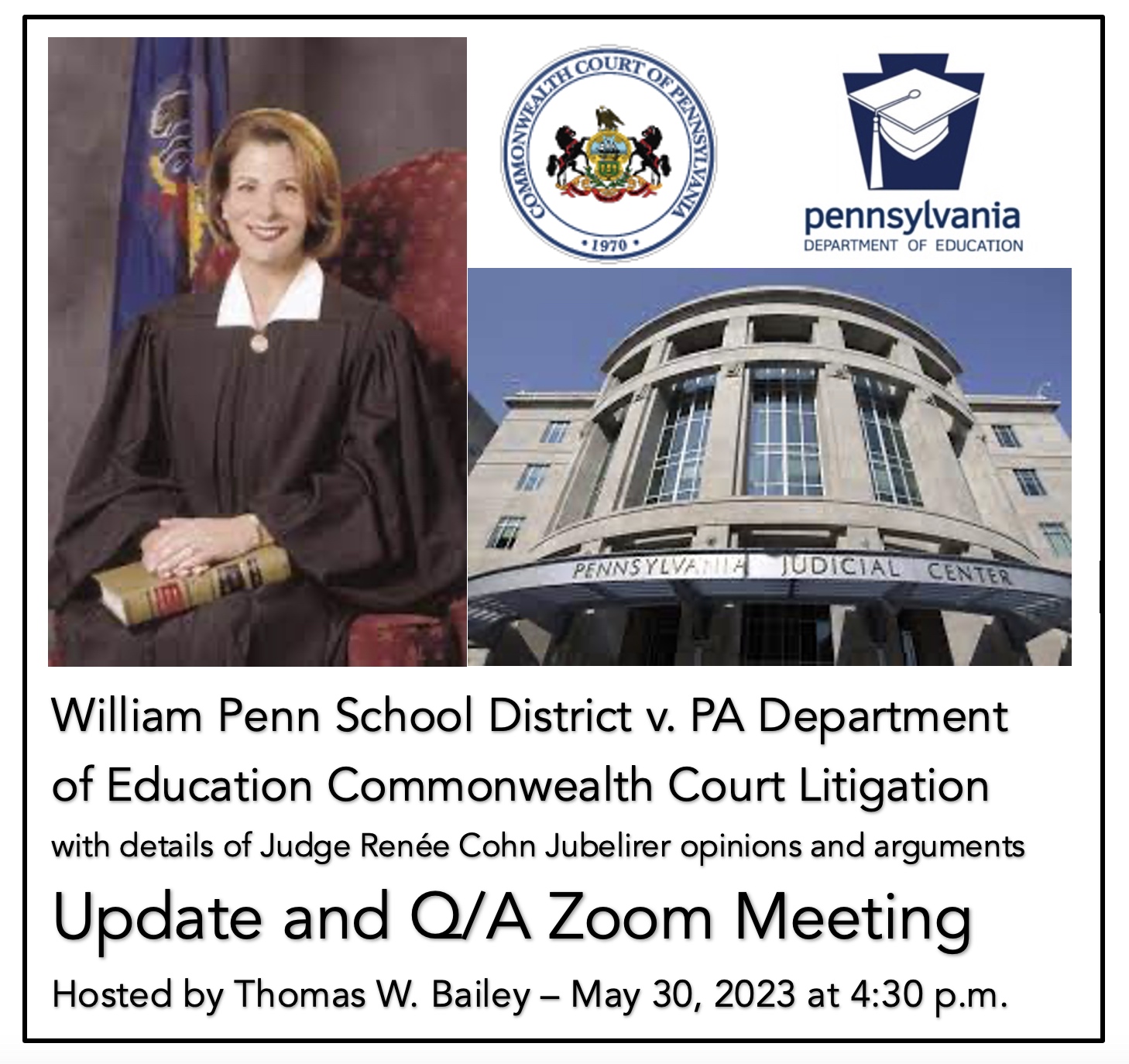
    William Penn vs. PDE – May 30, 2023 @ 4:30 p.m. 
    Click here to view the video.

    Session 2: 
    Model Code of Ethics for Educators June 6, 2023 @ 4:30 p.m.

    Session 3: 
    PA Code of Professional Practice and Conduct June 13, 2023 @ 4:30 p.m.

    Session 4: 
    PA Professional Standards & Practices Commission June 20 @ 4:30 p.m.

    Session 5:
    Educator Discipline Act June 27 @ 4:30 p.m.

    To join the Zoom meetings and participate “live” in the upcoming question-and-answer sessions with our speakers, go to this link and scroll down to the bottom of the page. After completion, the YouTube URL for each seminar will also be posted here.

    An intriguing follow-up resource is to visit Thomas Bailey’s website, especially the informative educator blog he has published including analysis of the William Penn vs. PDE hearings on equitable school funding in the PA Commonwealth Court (first session above) and other “ethical conundrums” and issues in the news.

    I am also happy to report that we are expanding our PIL Act 45 professional development class offerings and Thomas has reapplied for PDE approval of a revised version of our Act 48 workshop on “PA Educators – Your Ethical Codes and School Law.” Click below to download a copy of our trifold brochure on the PIL course and summer in-service programs.

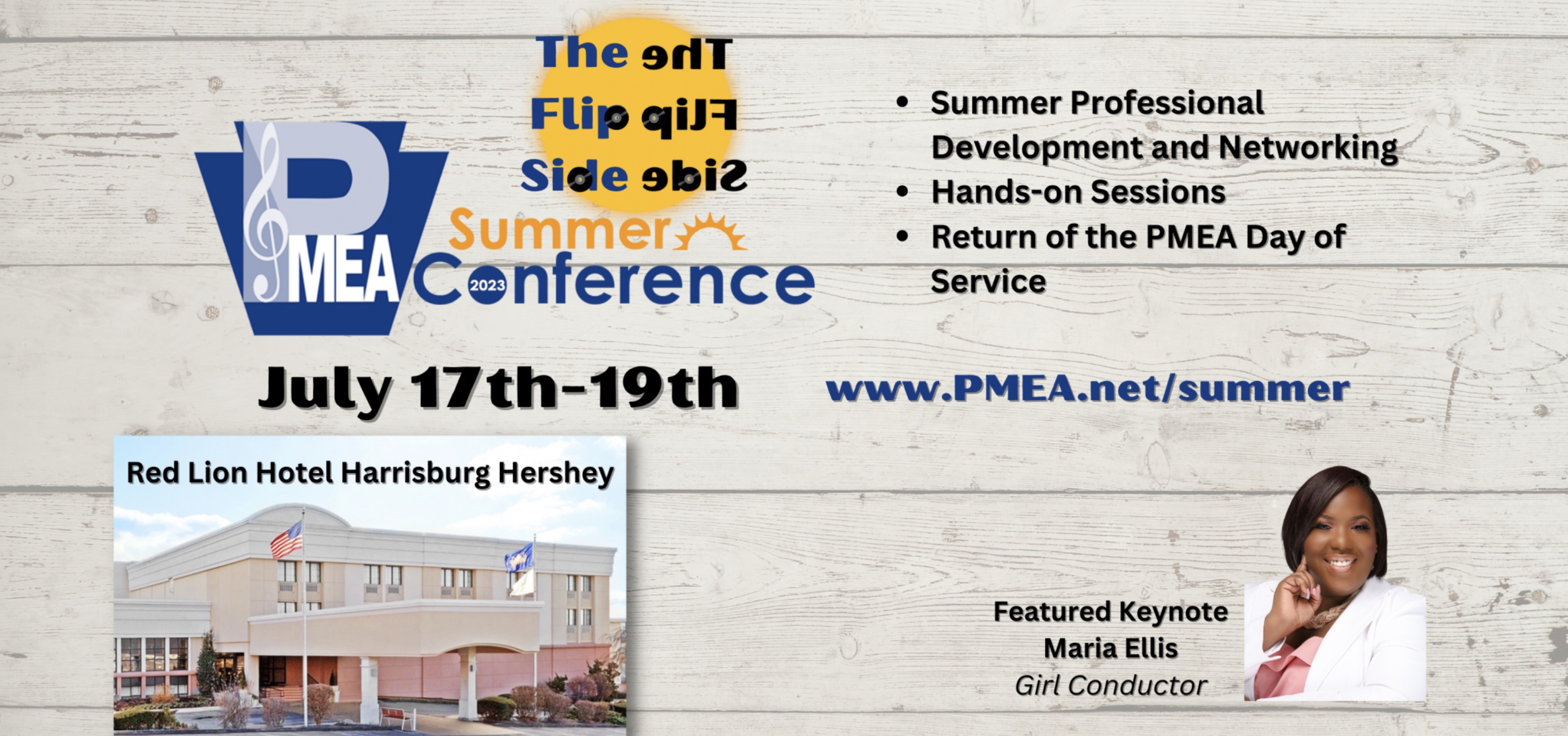
    Finally, to all of my music educator friends in the Commonwealth, I hope you have registered for the PMEA Summer Conference, being held in the Red Lion Hotel Harrisburg/Hershey on July 17-19, 2023. This event is in conjunction with the annual PMEA Board of Directors meeting on July 17 and the PMEA “Day of Service” assisting the Harrisburg Symphony and the Whitaker Center for Science and the Arts on July 19. In addition, I am looking forward hearing a performance of the Yankee Brass Band:

    Since 1987, the Yankee Brass Band has both entertained audiences throughout New England and championed the cause of “historically informed performance” within the field of American band music. 2023 marks our 36th season. Using rare and authentic period instruments, and outfitted in appropriate uniforms, the Yankee Brass Band presents the music of the “Golden Age of Bands” played in much the same manner as in the mid to late 19th century. 

    The workshops, clinicians, and details for registration are posted on the PMEA website here.

    Hope to see you there!

    PKF

    © 2023 Paul K. Fox
    On the Road Again (2023)

    “Doing My Thing…” — Professional Development Conferences for Music Educators

    It’s been awhile since I posted here… arguably the longest editorial break I have taken since retirement and starting this blog-site. What’s that line retirees often say? “It’s a good thing I am retired from my job; otherwise I would not have enough time to do everything!”

    This has been an extremely busy couple months of renovating three bathrooms, promoting the 30th Anniversary Gala Celebration of the Community Foundation of Upper St. Clair featuring a CASINO NIGHT & the local band NO BAD JUJU (to which I can’t even go because it is on the same day as PMEA), staffing a transition of new editors and an office manager for the UPPER ST. CLAIR TODAY community magazine, “keeping my hand in” by conducting a small nonprofit community ensemble (now in our 40th season of the South Hills Junior Orchestra), volunteering at the hospital (see my Tales from a Wheelchair Jockey article), developing new PDE Act 45 and 48 programs on ethics (school system leaders and educators respectively), and… (deep breath): preparing four PowerPoint presentations for two music conferences in April. Yes, and loving every minute of this frenzied activity!

    Pennsylvania and Eastern Division music education colleagues: Hopefully by now, you have registered for the coming conferences on the horizon:

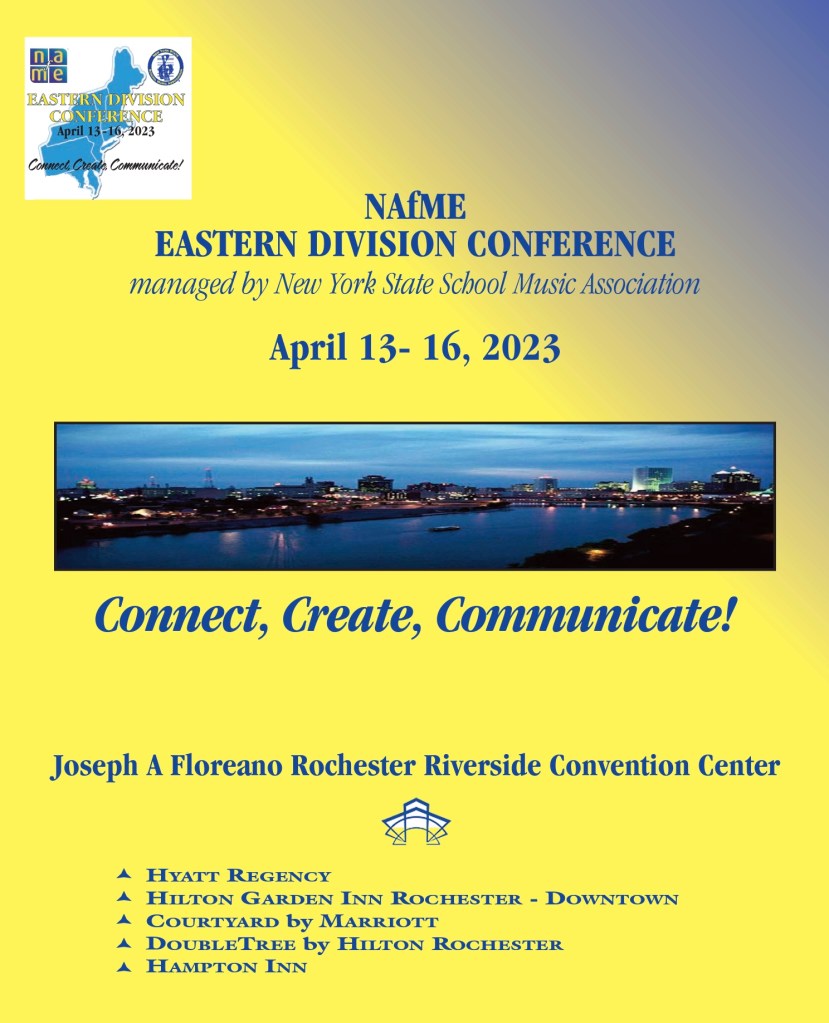
    NAfME Eastern Division Conference, April 13-16, 2023, Rochester, NY

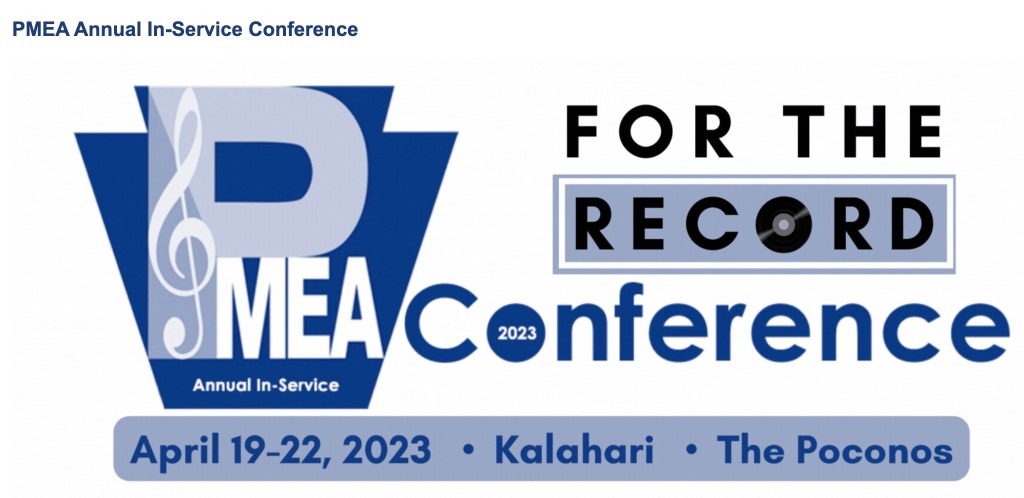
    PMEA Annual Conference, April 19-22, 2023, in the Poconos

    Now to quote the inspiration of Simon Sinek — his theory of value proposition to ‘start with why’ — how leaders can inspire cooperation, trust, and change based on research into how the most successful organizations think, act, and communicate if they start with why. Check out his rationale with The Golden Circle:

    The “why” of attending your professional development conferences, “sharpening your saw” (self-renewal by Stephen Covey) aka “recharging your batteries,” learning what’s new and innovative on the forefront of “the state of the art,” and networking with colleagues, and has been addressed often in past blogs:

    Simply put — to maintain your mastery of music and methods and build on your “best practices” and professionalism, you MUST attend as many educational conferences and workshops as possible!

    Now to my “bags of tricks” for April 2023

    Mark your calendars:

    April 15, 2023 at 10:45 a.m. in Hyatt Susan B. Anthony (NAfME) – OR –
    April 21, 2023 at 11:30 p.m. in Kalahari Suite 40/50 (PMEA)

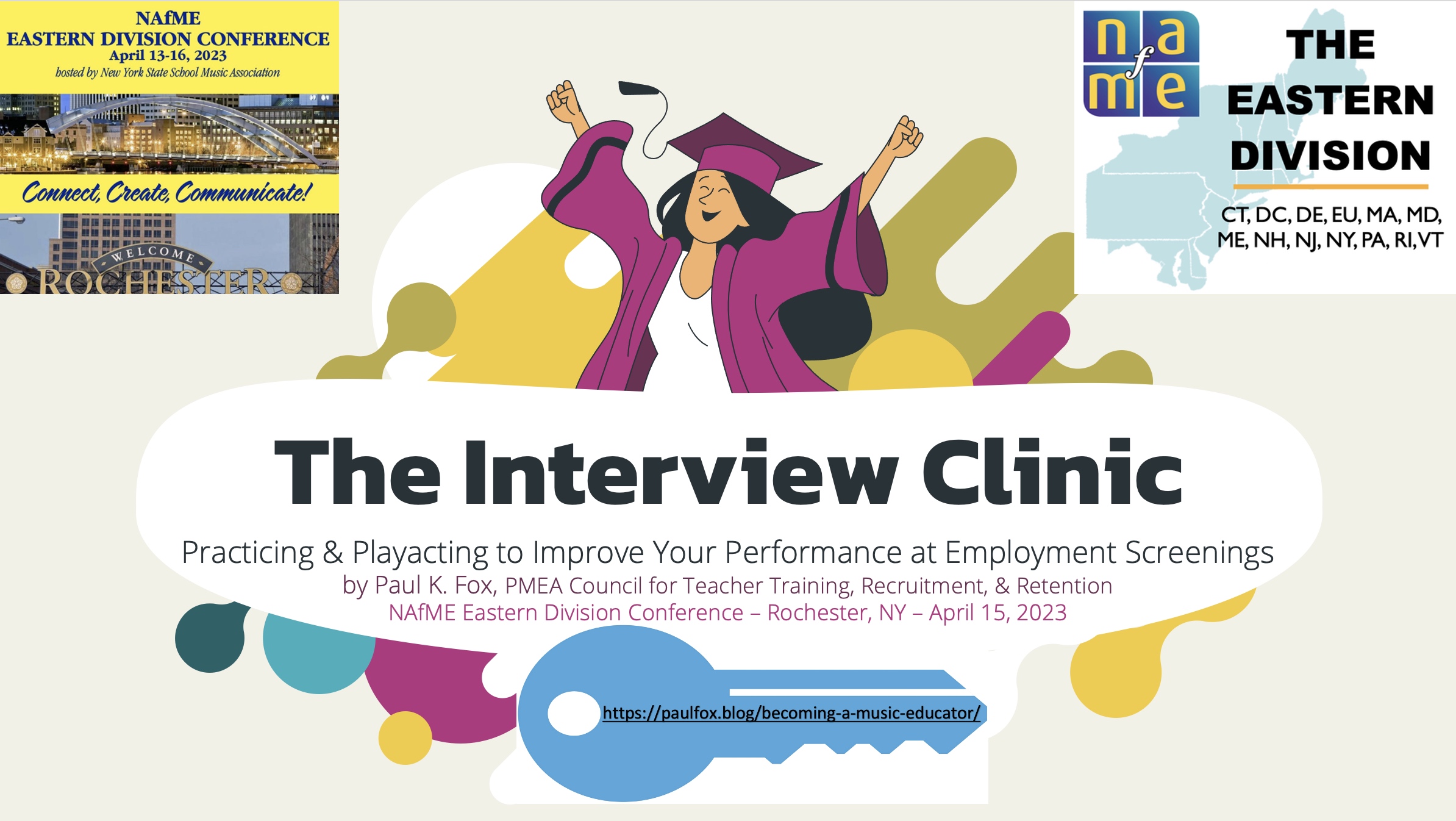
    I was blessed to have been asked to present THE INTERVIEW CLINIC — Practicing & Playacting to Improve Your Performance at Employment Screenings at both the NAfME and PMEA conferences. This will be FUN! Perfect for college music education majors, soon-to-be or recent graduates, new transfers to the profession, teachers seeking to change positions while openings seem to be “heating up,” or first-timers looking for employment, the session targets will provide interactive exercises to build self-confidence and develop better insights, practices, and strategies to successfully land a job. “The key is in the preparation” of:

    • Standards—Defining/modeling professionalism, versatility, and ethics
    • Marketing—Branding, networking, and selling yourself
    • Skills—Interviewing, storytelling, and organizing
    • Assessment—Observing, reviewing, diagnosing, and improving

    Interactive exercises, you say? Yes! Get ready to meet new people and perhaps dive into a few activities slightly outside your “comfort zone!” (We promise NOT to embarrass anyone!) We will break up into small groups or “duet partners,” and explore defining our professional “essence,” telling anecdotes about our strengths and past problems we have “crushed,” and focusing on learning “the golden gift of gab” — storytelling.

    Portions of this workshop will come from material in the past posts Storytelling, etc. Part 2 and When it Comes to Getting-a-Job, S Is for Successful Storytelling. (Your homework? Peruse these before coming to either session at NAfME or PMEA!)

    As always, articles, resources, and slide summaries will be posted under the “Training/Jobs” menu tab (above).

    Mark your calendars:

    April 20, 2023 at 3:00 p.m. in Kalahari Suite 30 (PMEA)

    How many of you feel at times a little overwhelmed, exhausted, stressed out, disorganized, demoralized, or disenfranchised?

    Are you at the end of your rope and wondering how you’re going to “keep it all together” over the next week, month, year?

    Is your health is interfering with your ability to do your job and find success, balance, and meaning in your personal life and relationships? Then… it is time for a change.

    We are still dealing with the effects of the pandemic which has brought on a “gap year” to most of our music programs, the stress of “working harder not smarter,” more teacher burnouts, and the resulting bail outs, staff shortages, and/or job cuts. We need to embrace NEW strategies for personal self-care and SEL (social and emotional learning). Do you still enjoy teaching? How have you coped with all of the changes? How will you achieve a better work/life balance and skills in time/priority management and personal health and wellness?

    The prescriptions and RECIPES towards stress reduction and developing a self-care plan are here! Doug Sands, a consulting hypnotist and founder of AnywhereHypnosis.com, joins me to “throw in everything and the kitchen sink” to alleviate these problems, with NO cookie-cutter, “one-size-fits-all” solutions from the chefs:

    • What has COVID done to all of us?
    • Instant personal online stress assessment
    • Taking an inventory of the ingredients towards a healthier lifestyle
    • Definitions, symptoms, and remediations for teacher stress and burnout
    • Why teachers are so exhausted and what to do about it
    • Time management tips
    • Breathe like a Navy SEAL
    • Coping and learning “acceptance”
    • How to “coach overwhelm!”
    • The role of meals, movement, music, and mindfulness (thank you, Lesley Moffat!)
    • From MEJ: A suggested self-care plan and “cognitive distortions” to avoid
    • Focusing on ONE self-care strategy from a “sea of solutions”

    We’re in this together… so we need to join forces and SHARE the secret recipes for a happier life! Add your own “baking tips,” and I promise, you’ll leave with a better understanding of how we all can celebrate the coming year or decades in music education!

    By the way, my “mindfulness partner” for this workshop, Doug Sands, promises us he will not hypnotize any of us during this session (although he could!).

    For more about his work, including “15 Rapid Tools (and Counting) to Wipe Out Anxiety, Stress, and Panic,” please go to his website here.

    You are invited to stop in to see him at his PMEA booth in the Kalahari exhibit hall.

    POST-CONFERENCE NOTE: Doug sent us his Anti-Panic Toolkit entitled, 15 Rapid Tools (and Counting) to Wipe out Anxiety, Stress, and Panic – Wherever They Strike! Click here.

    If you would like a sneak preview of the revised handout for the Self-Care workshop, go to the Care menu section at the top menu bar.

    Taking a peek at our recent past…

    Workshop for Orchestra & String Teachers

    In case you missed the PMEA District 5 Professional Development Day, my wife Donna and I presented “Plucking Our Minds” at Grove City College on February 20, 2023.

    We were privileged to “share some of our secret sauces” gleaned from over 80 combined years of experience on a variety of topics:

    • CommUNITY Music-Making
    • Online Academy
    • Summer String Camp
    • Assessment Projects
    • Collaborative/Creativity Projects
    • Library of “Fox Firesides”

    If would be a shame to waste these resources… and reading them could inspire new adaptations to your instrumental program.

    Click here for a copy of the slide handouts. Feel free to comment (above) or send an email to me (paulkfox.usc@gmail.com) if you have any questions.

    Our Crystal Ball

    Future Accredited Workshops on Ethics in Education

    Are you aware that the Pennsylvania Department of Education (PDE) has recently revised the PA educators’ Code of Professional Practice and Conduct AND adopted the Model Code of Ethics for Educators developed by the National Association of State Directors for Teacher Education and Certification? Have you seen the new Professional Ethics Program Framework Guidelines? PA Chapter 49 requires instruction in professional ethics to be integrated in educator preparation, induction, and continuing professional development programs as follows:

    • Continuing professional development programs must integrate the professional ethics competencies no later than the 2023-24 academic year.
    • Educator preparation and induction programs must integrate the professional ethics competencies no later than the 2024-25 academic year.

    Not one to let grass grow (or mud sink) under his feet, retired social studies teacher, current attorney-at-law, and past PMEA conference presenter Thomas Bailey has partnered with me to design new ethics training classes for school system leaders (25-hour Act 45 PIL course) and educators (four-hour Act 48 continuing education course). In addition, we are introducing a new “hybrid” program for school administrators involving four-hour pre-recorded asynchronous webcasts (site license), along with a three-hour synchronous webinar using the webcast videos and adding facilitated interactive discussions of three ethical case studies either via Zoom OR in-person follow-up workshops led by both clinicians.

    In Depth Ethics Training for PA Educators:

    • PA Model Code of Ethics for Educators
    • PA Code of Professional Practice and Conduct
    • Professional Standards and Practices Commission
    • PA Educator Discipline Act

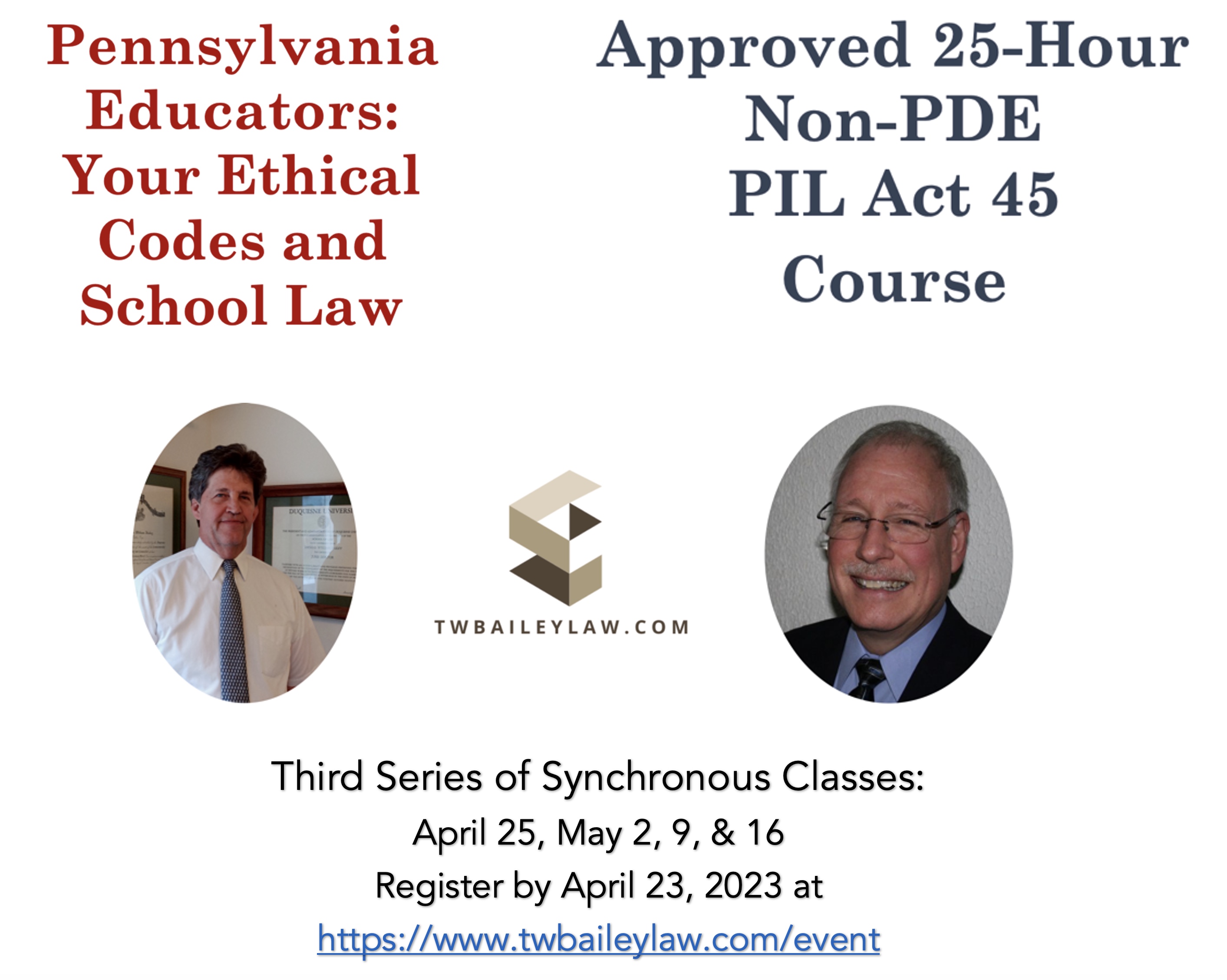
    Click here for to register for Act 45 PIL Course.
    Next series: April 25, May 2, 9, & 16, 2023

    Click here for more information on the Ethics Webcast/Webinar and general information/landing page for the TWBaileyLaw website.

    Click here for timeline of educator ethics presentations and clinicians’ bios.

    Also review the Educators Court Case Blog and William Penn SD vs. PDE Blog.

    Numerous articles have already been published on the subject of educator ethics, professionalism, and decision-making:

    Hope to see you at one of these conferences or workshop sessions! Yes, it means a lot more to attend these IN PERSON!

    PKF

    © 2023 Paul K. Fox
    Ethics Follow-up


    Part IV: More Perspectives and Resolving a Few “Loose Ends”

    Prior to this article, I recommend reading the following:


    ethics-cropped-2110605_1920-edman_eu

    Just when you thought it was safe to read another of my blog-posts… you bump into another one on ethics and music education!

    When my colleague and friend James Kimmel, PMEA District 7 Professional Development Chair, approached me to consider doing an “ethics workshop” for his annual in-service conference (October 9, 2017 at Ephrata Middle School), two questions immediately popped into my mind: “Why is this necessary?” and “Who would want to attend a session on ethics?”

    Of course, being retired and having a little more unassigned time on my hands, I took it as a challenge and began some preliminary research.

    The first thing I discovered is that almost no one in the public-school music education sector has had formal ethics training (myself included), unless you count a couple thirty-minute segments at a teacher induction or staff in-service program on sensitivity training, nondiscrimination and diversity awareness, anti-bullying or workplace sexual harassment policies, or a review of FERPA (family educational rights and privacy act) and HIPAA (health insurance portability and accountability act) as “ethics!”

    Okay all you Pennsylvania music teachers: Before this blog series, did any of you ever see a copy of the Pennsylvania Code of Professional Practices and Conduct for Educators? Prior to working on this project, neither did I, nor did a single band director to whom I spoke at two large fall marching band festivals and several football games! Do you know that earning a teaching certificate from your state and becoming eligible to be hired as an educator means you automatically agree to be legally bound by the prevailing government’s “Code?” The ethical or discipline code of your state will define the proper interactions between the individual teacher, students, schools, and other professionals, and make explicit the values of the education profession as well as regional standards and expectations. Wouldn’t you agree that NOW would be a good time to learn the details of these inherent responsibilities?


    What is a Fiduciary?

    club-2492011_1920-qimonoEducators are among the singular professions which have a “fiduciary” responsibility. The term “fiduciary” can be defined as “a person or organization that owes to another the duties of good faith and trust, the highest legal duty of one party to another, and being bound ethically to act in the other’s best interests.” Joining doctors, lawyers, clergy, and mental health therapists, educators ascribe to the highest standards of training, moral decision-making (“code of ethics”), behavior (“code of conduct”), and self-regulation and assessment of the “best practices” regarding the mastery of skills and subject areas necessary to their field. However, unlike these other professionals, teachers do not receive regular and systematic pre- and in-service training on ethics, and our “clients” are a “captive audience.”  Regardless, the duty of all teachers is to act as a fiduciary in their students’ best interest and to create and maintain a safe environment for them at all times.


    Ethics Violations in the News

    You must have seen the news stories! In a word, the trending statistics of state and USA teacher ethics violations and misconducts are abominable! For example, according to the Pennsylvania Department of Education (PDE) where I taught and currently live, in the year 2015, there was a 200 percent increase in PA educator misconduct investigations (768 reports) compared to the number of complaints filed in 2011 (256). Within PDE disciplinary case resolutions in 2015, 41% resulted in job loss and a permanent revocation or surrender of the teaching certificate.

    If your curiosity is a little on the morbid side, you can look up on the PDE website and find the names of more than 1740 educators (“offenders” and their “offenses”) who have violated their ethics and received discipline and/or criminal prosecutions or civil proceedings from March 2004 to June 2017.

    Well, we don’t have to just pick on Pennsylvania “bad-boys” (and girls). According to https://www.washingtonpost.com/posteverything/wp/2015/01/20/more-teachers-are-having-sex-with-their-students-heres-how-schools-can-stop-them/?utm_term=.6ee23703b040, the following statistics give teachers everywhere a black eye from shore to shore!

    • Texas had a 27% increase over 2015-17 of alleged inappropriate teacher-student relationships
    • Kentucky schools reported more than 45 sexual relationships between teachers and students in 2011, up from 25 just a year earlier.
    • Alabama investigated 31 cases during the year ending July 2013, nearly triple the number it had investigated just four years earlier.

    cube-cropped-2110612_1920-3dman_eu

    Eric Simpson shared more bad news in the Journal of Music Teacher Education. His study, “An examination of the relationship of teacher certification area to sexual misconduct: Florida as a case study,” analyzed 383 samples of FL teacher discipline cases in 2007-2010 and their area(s) of certification, with these results:

    • Teachers with multiple-certifications = 35.51%
    • Music teachers ~5%
    • Most frequent offense = sexual misconduct 25.77%

    But, 60% of the offending music teachers in the sample were disciplined for sexual misconduct!

    Can the data get any worse? In 2004, the U.S. Department of Education released the results of the Shakeshaft national study by the American Association of University Women, with 9.6 percent of students reporting that they had suffered some form of sexual abuse during their school careers. According to http://www.slate.com/articles/news_and_politics/explainer/2012/02/is_sexual_abuse_in_schools_very_common_.html “the list of such conduct included lewd comments, exposure to pornography, peeping in the locker room, and sexual touching or grabbing. Around one in 10 students said they had been the victim of one or more such things from a teacher or other school employee, and two-thirds of those reported the incident involved physical contact.”

    If these numbers are accurate and truly representative of the student population nationwide, 4.5 million students currently in grades K-12 have suffered some form of sexual abuse by an educator or school staff member.


    Mandatory Reporting

    Another area I did not dive into during the last three articles is our legal mandate to report colleagues who violate “The Code,” especially for sexual misconduct. My own state’s regulations (similar to most) are as follows:

    “All educators who know of any action, inaction or conduct which may constitute sexual abuse or exploitation or sexual misconduct are now required to file a mandatory report with the Department and shall report such misconduct to his or her chief school administrator and immediate supervisor.”

    ― Pennsylvania Department of Education: http://www.pspc.education.pa.gov/Educator-Discipline-System-and-Reporting/Mandatory-Reporting/Pages/default.aspx


    If you are an administrator, the statute is more wide-ranging:

    “Specifically, whenever you believe that an educator is involved in misconduct that implicates his or her fitness to serve children in the schools of Pennsylvania, you should report the misconduct to the Department…”

    “Reporting to PDE does not relieve [the administrator] of any other duty to report to either law enforcement and/or child protective services.”

    ― Pennsylvania Department of Education: http://www.pspc.education.pa.gov/Educator-Discipline-System-and-Reporting/Mandatory-Reporting/Pages/default.aspx

    Another moral obligation is to simply look out for our student’s welfare and keep our eyes open for any unusual behavior, conflicts, or inconsistencies.

    questions-2212771_1920-geralt_euAlways looking for the signs of…

    • Physical abuse
    • Self-abuse or thoughts of suicide
    • Sexual abuse
    • Signs of neglect
    • Patterns of abuse

    Teachers are required to report any suspicions of child abuse, neglect, drug or alcohol use, and mental health problems.

    Most school districts have an internal mechanism of reporting to school counselors or administrators any observations (or suspicions) of these issues… everything from falling asleep in class, being “accident-prone” (lots of unexplained injuries), confirming a high absentee rate, exhibiting mood swings (up and down), and coming to school with blurry or blood-shot eyes, etc. No accusations! You just handover your comments to the authorities, and report on what you see, not necessarily what your interpretations are for the causes of the problems.

    Music teachers often work with students in close proximity before or after-school hours, and sometimes on weekends. As a marching band assistant, musical producer, festival chaperone, or trip sponsor, I always had the personal or cell phone number of my building principal in case I needed to reach out for help.


    Confidentiality

    These are the regulations on protecting student privacy rights, and violations of which (even unintentionally) are “breaking the law.” (Sources: www.pc3connect.org/otherdocs/confidentiality%20and%20the%20law.pdf and http://searchhealthit.techtarget.com/definition/HIPAA.)

    • Family Educational Rights and Privacy Act (FERPA) of 1974 sets parameters on accessibility and disclosure of students records.
    • Grassley Amendment (1994) details privacy of student participation in surveys, analysis, and evaluation.
    • confidential-cropped-1726367_1920-HypnoArtHealth Insurance Portability and Accountability Act (HIPAA) of 1996 provides data privacy and security provisions for safeguarding medical information.
    • Drug and alcohol treatment records of students kept by any institution receiving federal assistance are protected under Drug Abuse Office and Treatment Act (1976).
    • Records of students in special education are affected by the above laws plus Individuals with Disabilities Education Act (IDEA, 1997).

    Here are few additional ethical “conundrums” on which to reflect:

    • Discussing student information in open or common areas
      • How many times have you walked through a busy hallway discussing news or concerns about a student with another colleague or family member?
      • Avoid inadvertently disclosing any personal information about students and staff members “in public.”
      • Also, one should resist speaking to students in these areas as it could become violation of student confidentiality if overheard.
    • Sharing information with other colleagues who are not directly related to the student’s situation.
      • You might be tempted to reveal interesting cases or anecdotes to colleagues… DON’T!
      • FERPA regulations state that school officials must have a “legitimate educational interest” when sharing information.
      • Just because someone is employed in the district with you does not mean they have lawful access to student info.
      • There is a great risk of others passing on this information… like gossip!
      • Rules of thumb: Ask yourself, “Why am I sharing this information?” and “How will it benefit the student?”
    • However, you should be aware of exceptions to student privacy concerns.
      • Reporting of physical abuse, sexual assault, sexual harassment, or sexual violence.
      • Suspicion of serious mental health issues that may result in danger to the student (such as suicide)
      • On the occasion when a staff member working with a student is unsure how to proceed (e.g. seeking advice on disability)


    woman-441415_1920-geralt

    The “Grandma Litmus Test”

    We have talked about many principles in this series on “Ethics for Music Educators.” Here is something about the “process,” an “ethical decision-making model” based on…

    • “What would grandma think about my action, behavior, or decision” and
    • “How would I feel if my actions are tomorrow’s breaking news?”

    Answer the following questions about the contemplated activity or decision:

    1. Is it legal?
    2. Is it consistent with the profession’s values?
    3. Is it consistent with the teacher’s code of conduct?
    4. Is it consistent with your district’s policies?
    5. Would you be comfortable if this decision was published online or in the newspaper (or made known to your “grandma”)?
    6. Does it feel right? (Is it the right thing to do?)

    If you answered “NO” to any one of the questions (1, 3, and 5), do not engage in the contemplated activity and seek additional guidance.

    If you answered “YES” to all of the questions (2, 4, and 6), then you may proceed with the contemplated activity. However, if you have any lingering doubts, do not hesitate to seek additional guidance.

    http://www.royceassociates.com/the-grandma-litmus-test-for-ethical-behaviour/


    Final Thoughts

    “It’s easier to ask forgiveness than it is to get permission.”

    – Rear Admiral Mary Brace Hopper, an early computer programmer

    board-1848717_1920-geraltProponents of this belief will tell you to go ahead and stick your neck out, feel free to do something “for the good of the order,” and later “beg for forgiveness” if/when it goes south and your administrators say they do not approve.

    This may or may not work, and I cannot label this orientation as “ethical!”

    Music teachers are usually the “lone rider” in their building when it comes to doing their job. Music directors, especially those who are involved in extra-curricular activities, are deluged with making many decisions every day… sometimes even on the hour. Few people (models or mentors) will be there to help guide you in your content area.

    My advice: Less experienced teachers, run everything through your fellow colleagues (informally) and principal (formally). Don’t fall back on the lame “oops” and “beg for forgiveness.” I may have felt differently when I had twice as many years of experience than the building administrators who were assigned to “supervise” me… but, even then, “venturing out without a paddle” usually did not serve the best interests of the students… There’s no reason to place “the teacher’s convenience” over the safety/welfare of the students, without first obtaining the legal and political “backup” of your bosses. “Better safe than sorry!” (I am running out of cliches!)

    “Perception is reality.”

    – Lee Atwater

    Perceptions/appearances vs. motivation and reality: It means that your behavior and its results matter infinitely more than your intentions.

    It is the responsibility of the teacher to control his or her “public brand” – how he or she wants to be perceived by students, parents, colleagues, and the public. One’s public brand can and does impact perceptions, which in turn can impinge upon effectiveness.

    males-2110573_1920-3dman_euMy advice: “Forget your rights” and be more aware of your image and how your actions will look to the public. Reputations are hard to restore. Being an effective teacher is all about trust and integrity, and (sorry, one more cliche) “your actions speak louder than words!”


    Teaching is the most honorable and rewarding career on this planet. The rewards far outweigh the challenges and additional responsibilities. “Making a difference” in the lives of our music students has always inspired me, and the fact we have to uphold the highest standards in moral professionalism and behavior does not phase me in the least.


    The purpose of these blog-posts on ethics, sort of a “refresher” course to reflect on our internal decision-making compass, was to reinforce Lawrence Kohlman’s sixth stage of moral development – principles of conscience – and the “best practices” of professional attitudes, values, and beliefs that guide the problem-solving we face in their daily work. Hopefully this content will promote thought-provoking discussion about doing what’s right when no one is looking… because, your mother would say, “You know better!”

    Please feel free to comment… I would appreciate hearing from you!

    business-1753098_1280-Maialisa

    PKF

    © 2017 Paul K. Fox


    Photo credits (in order): from FreeImages.com: “Ethics” by Olivier Le Moal; from pixabay.com “Ethics” by 3dman_eu, “Club” by qimono_eu, “Cube” by 3dman_eu, “Questions” by geralt_eu, “Confidential” by HypoArt, “Woman” by geralt_eu, “Board” by geralt_eu, “Males” by 3dman_eu, “Business” by Maialisa.

    ESSA, PDE, and Lessons in Creativity IV

    Advocate the Arts and Creativity by Providing Feedback to Your State’s Education Department

    “With this bill [ESSA], we reaffirm that fundamentally American ideal—that every child, regardless of race, income, background, the zip code where they live, deserves the chance to make of their lives what they will.” — President Barack Obama

    In the constantly changing climate of “educational reform,” the Every Student Succeeds Act (ESSA) signed by President Obama in December 2015 is the latest “flavor” of educational law to come down from Congress, serving as the re-authorization opmeaf the 50-year-old Elementary and Secondary Education Act (ESEA). Each state must now develop and adopt their own “plan” of ESSA implementation. For example, the Pennsylvania Department of Education (PDE) is considering some very broad topics for inclusion in its state plan, and is currently asking for feedback from the general public on the following (source – Pennsylvania Music Educators Association – PMEA –  http://www.pmea.net/specialty-areas/advocacy/):

    Assessments

    • Can we reduce the amount of time students spent on statewide PSSA testing (grades 3-8)?
    • Is it feasible to test students at multiple times across the school year instead of only once?
    • Can we eliminate double testing for middle school Algebra I students? (Would need to add advance math test in high school for those students.)

    Accountability – Measures

    • Future Ready PA Index – a proposed tool to measure school success
    • Increased weight on growth in test scores  versus point-in-time achievement
    • Local options for additional assessments
    • Career ready indicators and meaningful post-secondary student engagement
    • More holistic measures of student success
    • Measures of both inputs (i.e., course offerings) and outcomes (achievement scores)

    essaAccountability – Interventions

    • Tailored to local context and school based needs assessment.
    • Intervention for lowest performing schools to include BOTH academic and holistic strategies
    • Level of state intervention to be responsive to student progress over time.

    Educator Preparation and Evaluation

    • What are the best strategies to ensure effective, diverse educators and school leaders for all students?
    • What changes in teacher preparation do we need to consider to improve the readiness of new teachers?
    • How to promote alternative pathways to teacher certification?

    Mark Despokatis, Chair of the PMEA Council for the Advancement of Music Education, says that music teachers and parents “don’t have to respond to every suggestion, but please feel free to respond to those on which you can provide opinions and feedback.” Comments should be shared directly with the PDE at RA-edESSA@pa.gov. Also, PMEA members should submit their feedback to PMEA via email to Mark Despotakis at mark.despotakis@progrmusic.com.

    PDE has provided a PowerPoint presentation about the public listening tour and with a little more background on the above listed suggestions on their website at http://www.education.pa.gov/Pages/tour.aspx#tab-1.

    pen-tablet-girl-1511024

    This blog-series on “creativity and education” maintains the position that a focus on the development of self-expression and artistry in the schools should be at the top of the critical “big four list” for satisfying  “the real purpose of education” – personal discovery, self-improvement, and developing the building blocks for success and happiness in life:

    • Creativity
    • Literacy
    • Logic
    • Global understanding

    “Talk is cheap! Educational research, the Partnership for 21st Century Skills movement, and other leading-edge groups, company managers, HR Directors, and the general employee job market have known for a long time what is best for kids and the economy… in a nutshell, the need for more exploration, teaching, and mastery of student creativity, including inquisitiveness, ingenuity, inventiveness, flexibility of thought, and inquiry-based learning! In this era standardized testing, the Common Core revolution, and relentless “teaching to the test,” are we embracing the best practices of “whole child” learning? True customization, individualization, and personalization of education dictate a change in emphasis from not relying purely on lesson targets and assessments of simple objective, one-answer-only, convergent thinking, but moving towards the more complex (and richly meaningful) higher-order, multiple-pathway, divergent thinking – greatly valued skills of analyzing, evaluating, and synthesizing.” — Paul K. Fox in “Creativity in Education” https://paulkfoxusc.wordpress.com/creativity-in-education/
    Here is your next installment of research and resources on rationale and application of helping our students become more creative. However, do not be shy in vocally expressing your own views and support of the arts to your state legislators and and governor. For the future of education, this is probably the most important role a music advocate can play!

    Girl drawing back to school

    Google’s Most Cited Sources for Creative Teaching and Learning

    • Creativity in Education edited by Anna Craft, Bob Jeffrey, and Mike Leibling (Continuum 2007)
    • Creativity and Education by Robina Shaheen (Scientific Research 2010) http://file.scirp.org/Html/3369.html
    • Creativity and Education by Hugh Lytton (Routledge 1971/2012)

    “Throughout the world, national governments are reorganizing their education systems to meet the challenges of the twenty-first century. One of the priorities is promoting creativity and innovation. In the new global economies, the capacity to generate and implement new ideas is vital to economic competitiveness. But education has more than economic purposes: it must enable people to adapt positively to rapid social change and to have lives with meaning and purpose at a time when established cultural values are being challenged on many fronts.” — Ken Robinson in the Preface of Creativity in Education

    Creativity in Education provides insightful essays by Margaret A. Boden, Ken Gale, Laura Haringman, Susan Humphries, Dame Tamsyn Imison, Mathilda Marie Joubert, Jenny Leach, Bill Lucas, Bethan Marshall, Kevin McCarthy, Susan Rowe, Leslie Safran, and Peter Woods. The book is divided into two general sections and thirteen chapters:

    Part One: Creativity and Individual Empowerment

    • The Art of Creative Teaching
    • Creative Teaching, Teaching Creativity, and Creative Learning
    • Little “c” Creativity
    • Creative Literacy
    • Creativity as “Mindful” Learning: A Case from Learner-Based Education

    Part Two: Creativity and Pedagogy

    potter-1518976

    • Creativity and Knowledge
    • Teacher Education within Post-Compulsory Education and Training: A Call for a Creative Approach
    • Creating Danger: The Place of the Arts in Education Policy
    • Poised at the Edge: Spirituality and Creativity in Religious Education
    • Creative Leadership” Innovative Practices in a Secondary School
    • Effective Teaching and Learning: The Role of the Creative Parent-Teacher
    • Creating a Climate for Learning at Coombes Infant and Nursery School
    • A Hundred Possibilities: Creativity, Community, and ICT

    Although conceived more than ten years ago, this set of comprehensive articles are a “must read.” As Sir Ken Robinson endorsed, these contributions provide arguments that “educating for creativity is a rigorous process based on knowledge and skill; that creativity is not confined to particular activities or people; that creativity flourishes under certain conditions and, in this sense, can be taught.”

    Creativity and Education comes to us via Scientific Research Open Access of “Creative Education” 2010, Vol. 1, No. 3. Robina Shaheen shares interesting research focused in her three sections of her paper:

    • The Link Between Creativity and Education
    • Changing Role of Education
    • The Inclusion of Creativity Within Education

    She cites numerous authorities in support of the essential rationale for promoting  creativity in schools.

    “Fostering creativity in education is intended to address many concerns. As a summary, this includes dealing with ambiguous problems, coping with the fast changing world and facing an uncertain future ( Parkhurst, 1999). Perhaps the most dominant current argument for policy is the economic one. The role of creativity in the economy is being seen as crucial (Burnard, 2006) to assist nations for attaining higher employment, economic achievement (Davies, 2002) and to cope with increased competition. It is for this reason that creativity cannot be “ignored or suppressed through schooling” (Pool e, 1980) or its development be left to chance and mythology” (NESTA, 2002). It is predominantly for this reason that there is a call for its inclusion in education as a fundamental life skill” (Craft, 1999) which needs to be developed to prepare future generations (Parkhurst, 1999) so that they can survive as well as thrive in the twentyfirst century” (Parkhurst, 2006). Developing children’s creativity during their years in education is the start of building human capitalupon which, according to Adam Smith and successive commentators, depends the “wealth of nations (Walberg, 1988).” — Robina Shaheen

    child-laptop-1243096Shaheen discloses the new focus of the Foundation Stage Curriculum and National Curriculum for schools in England, with the aim that the school should “enable pupils to think creatively and critically, to solve problems and to make a difference for the better. It should give them the opportunity to become creative, innovative, and enterprising.” The key points on the National Curriculum website are:

    • What is creativity?
    • Why is creativity important?
    • How can you spot creativity?
    • How can teachers promote creativity?
    • How can heads and managers promote creativity?

    She concludes that there has been a recent upsurge in “creativity and education” in most European, American, Australian, and East Asian countries, as reflected in their policy documents. She cites the example of what UNESCO now proposes should be taught to Asian students:

    • Rather than “learning how to learn” – “learning how to learn critically”
    • Rather than “learning how to do” – “learning how to do creatively”
    • Rather than “learning how to work together” – “learning how to work constructively”
    • Rather than “learning how to be” – “learning how to be wise.”

    Another excellent reading, the book Creativity and Education rounds off the third most cited online reference on this subject.

    drama-1436610-1

    Author Hugh Lytton (1921-2002) was a distinguished scholar in the field of developmental psychology. His table of contents displays an amazing wealth of thought-provoking material:

    1. The creative process
      • Imagination and intuition
      • Creative moments
      • The poet’s inspiration
      • The scientist’s insight
    2. “Convergent” and “divergent” thinking, or how intelligent is a creative and how creative is an intelligent person?
      • Origins of intelligence tests
      • Mechanics of intelligence tests
      • Theory of intellect
      • “Intelligence” and “creativity”
      • Do “creativity tests” measure creativity
    3. What are creative people like?
      • Creative men
      • Young creatives
      • Madness and genius
    4. dancing-1240581Nurturing creativity
      • Home background
      • Pre-school education
      • Developing productive thinking
    5. The creative child at school
      • Is education biased against creativity?
      • Teachers’ and pupils’ attitudes
      • Achievements
      • A propitious school climate
      • Teaching for creativity
      • Specialization in arts or science
    6. Retrospect

    Although a little pricey, the book is currently available for purchase on Amazon, which provides the following description.

    “The author provides a lucid account of creativity and its educational context. He discusses the creative process, the character of different kinds of creativity, creative people, developing creativity, and the creative child at school, to give his readers an understanding of the issues that home or school have to face in fostering a creative, non-habit-bound child. The book should be particularly welcome to all concerned with education in view of the present stress on child-centerd education and on the development of individual children’s abilities, especially their powers of original thought and search to the full.” — Amazon re: Creativity and Education by Hugh Lytton

    artist-palette-1172463

    Politically, very little is in the forefront on nurturing creativity in education. Our legislators, administrators, and curriculum revisionists continue to be more concerned about standardized tests, the Common Core, and the “basics” of math, reading, and writing. Most states (PA included) do not embrace the recently revised and released National Core Arts Standards, for which “creating” has three major essential targets:

    • Anchor Standard #1: Generate and conceptualize artistic ideas and work
    • Anchor Standard #2: Organize artistic ideas and work
    • Anchor Standard #3: Refine and complete artistic work

    As stated in the first “lessons in creativity,” we should all venture out on our own expedition… to find additional strategies to implement teaching and learning creativity. As you can see, there is a lot of material to review, at least on the rationale of creativity in education, if not the “how to” of bringing it into the classroom. Happy hunting!

    PKF

    © 2017 Paul K. Fox
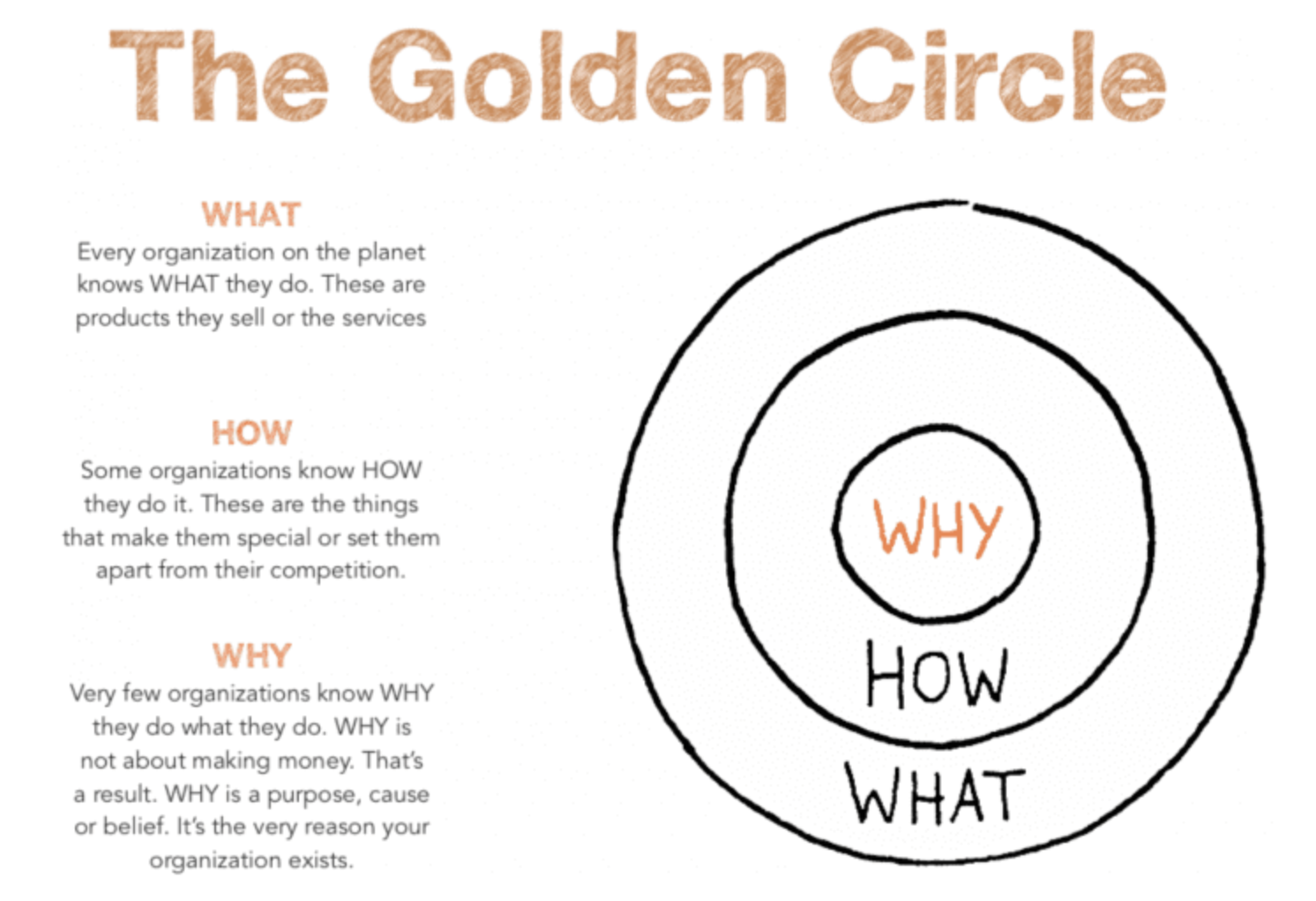
     

    Picture credits: Photographers Collwyn Cleveland, Cienpies Design, Nevvit Dilmen, Shamseer Sureash Kumar, John Nyberg, Gerrit Prenger, Jeff Vergara and cover photo artist Cecilia Johansson at http://www.freeimages.com