The Get-a-Job Toolbox

Preparing for Those Upcoming Employment Screenings
So much of what I do at this blog-site is to archive articles offering advice on a host of topics:

Surveying my past blogs, I feel like I had to repeat (repackage) the content until my readers reached that particular stage in their career. Once they experience first-hand that sometimes tumultuous “passage,” they would be ready to reflect on this information. But, I doubt they would closely examine it until then. As an example, for more than a decade as the PMEA Retired Member Coordinator, these past articles I wrote for PMEA News and the PMEA Annual Conference’s session Retirement 101 revisit the voluminous insight of gerontologists exploring the “who, what, when, where, and why” of retirement. Regardless at how often it is presented, you tend not to consume advice on coping with post-employment until you feel you are “ready” to retire. This is the same issue for soon-to-graduate collegiates and those transitioning to a new job; who wants to read about branding, marketing, and interviewing until they are in the middle of seeking first-time (or new) employment?

Please click on the “plethora” of links throughout this article to be redirected to these past writings. My apologies in advance to what may seem like to be a lot of duplication!

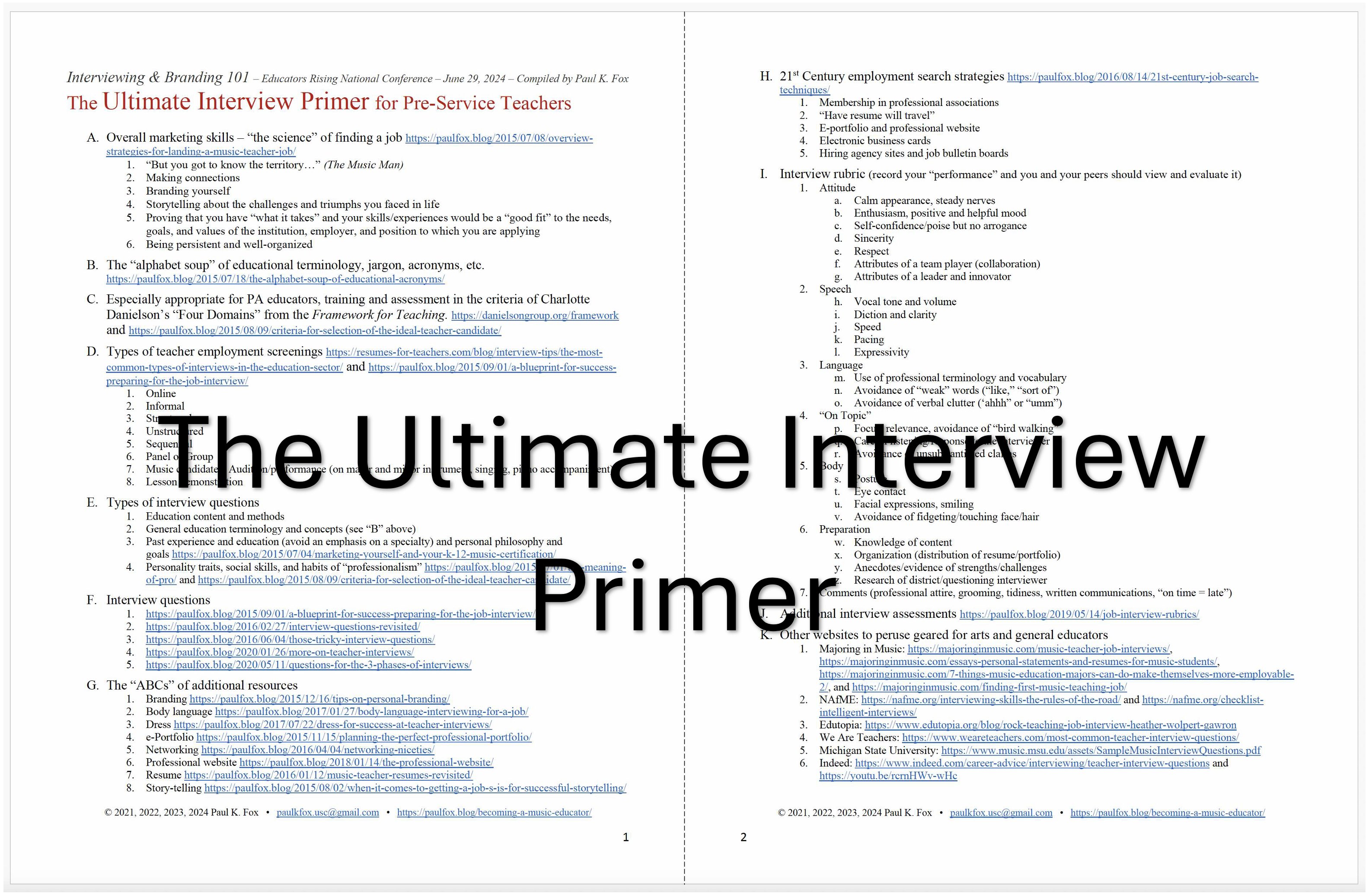
I went as far as updating the most comprehensive and “perfect” PowerPoint for collegiates: Bookends – The Life Cycle of a Successful and Happy Music Educator – portions of which I have presented several times to Professor Jessica Vaughan-Marra’s Seton Hill University music student teachers. This slide handout starts with the material from the first three bullets in the first paragraph above and then adds information about teacher health and wellness, time management, and retirement. We offer Bookends… to preservice music educators in their junior, senior, or graduate years and “rookies” to the profession. I encourage you to download this resource, visit the PCMEA website (click here/scroll down) to read past issues of Collegiate Communique, and the paulfox.blog posts. While you’re at it, acquire your own copy of the Ultimate Interview Primer. Click away before these links become inactive.
Soon it will time for graduates to enter the workforce… and boy, do we need you! By most accounts in PA and the surrounding states, we are experiencing a teacher shortage. School districts are seeking quality candidates to apply for their open positions. But, much of what happens in the job screening process seems to be influenced by chance. Collegiates, ask yourself: Are you truly prepared to market your experiences and abilities, share your brand and stories of your interactions with children in educational programs, and relate positive anecdotes of your teaching, problem solving skills, and other professional attributes? I may have been a little Type-A when I first applied for those music teaching positions back in 1978, focused on saturation publicity and persistence, and organized with a large paper portfolio of past experiences, but I was clueless in responding to those tricky interview questions and what administrators actually wanted to see in prospective new members of their staff.
One more piece advice for first-year and recent transfers to music education: Seek out a PMEA mentor and/or a member of the Retired Resource Registry (access from the PMEA Retired Member focus area after you login to your member portal)… both are groups of volunteers willing and able to help “newbies.”

Have a question about selecting music for your ensemble, a dynamic lesson plan, classroom management issue, interviewing, curriculum innovation, or a conducting tip? Stop by the “coffee and conversations” informal lounge at the PMEA Annual Conference on April 10 and “sit-a-spell” with us!

In conclusion, the following is a sequential outline – a “to-do in this order” list – a preservice toolbox of past posts and other resources for you to assemble a marketing plan. Take time to sort through these “nuts and bolts” (all links in this blog), process the information, save anything you want to read further, and then “practice, practice, practice!” This “gift” to PCMEA and music education majors embraces my best wishes for successfully finding the job you always wanted and preparing yourself for the greatest “calling” of your life – an enriching and satisfying lifelong career in music education! Good luck!
Using the Collegiate Toolbox – A Roadmap for Becoming a Music Educator

  1. Peruse everything in this and past paulfox.blog postings.
  2. Download the PDF documents to your hard drive. Review a portion of them each week!
  3. On your computer, create a “ME” file documenting your accomplishments, awards, experiences interacting with children, etc. – a library of the things you may wish to include in your future resume, professional website, and (e-)portfolio. Add to this folder throughout your college years.
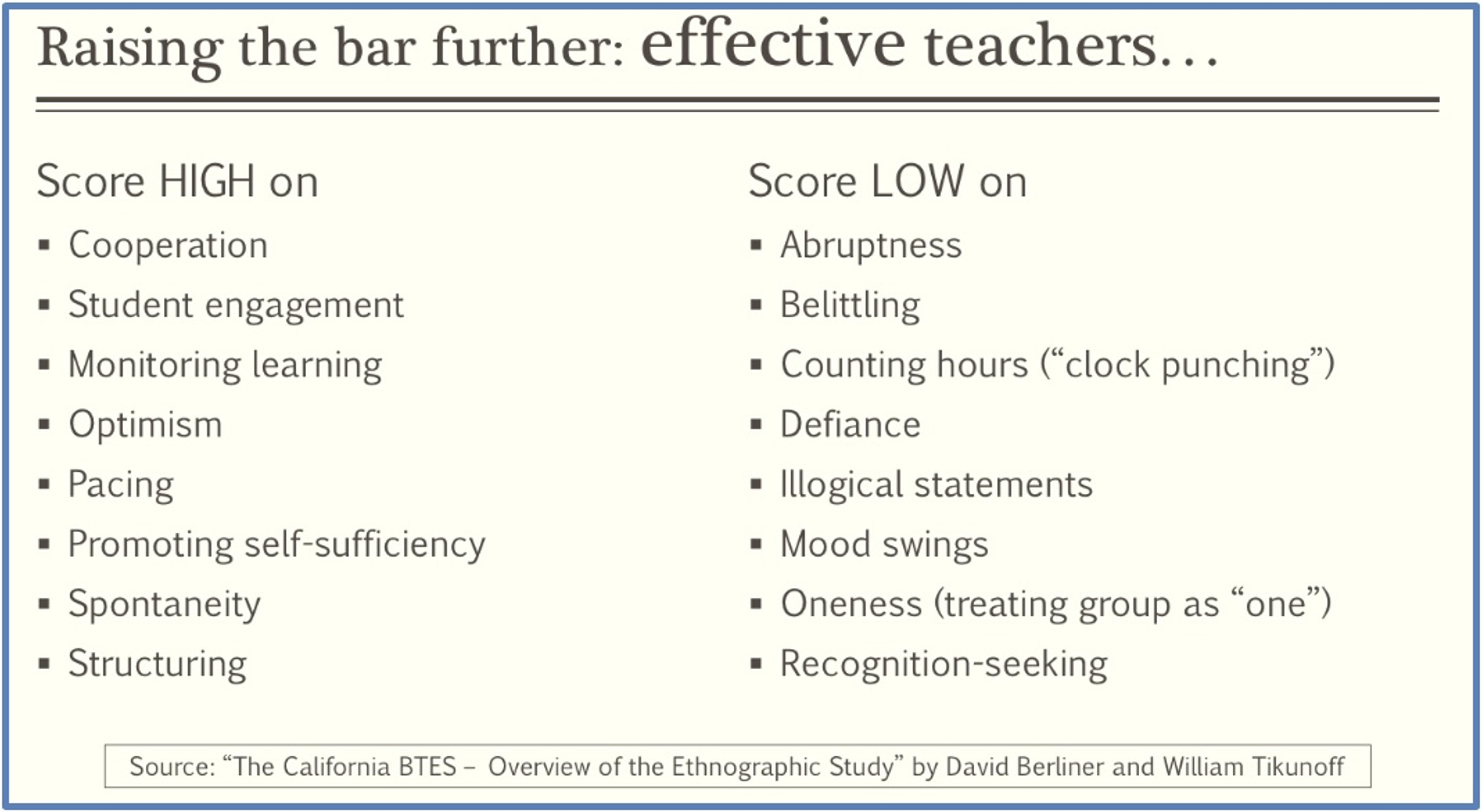
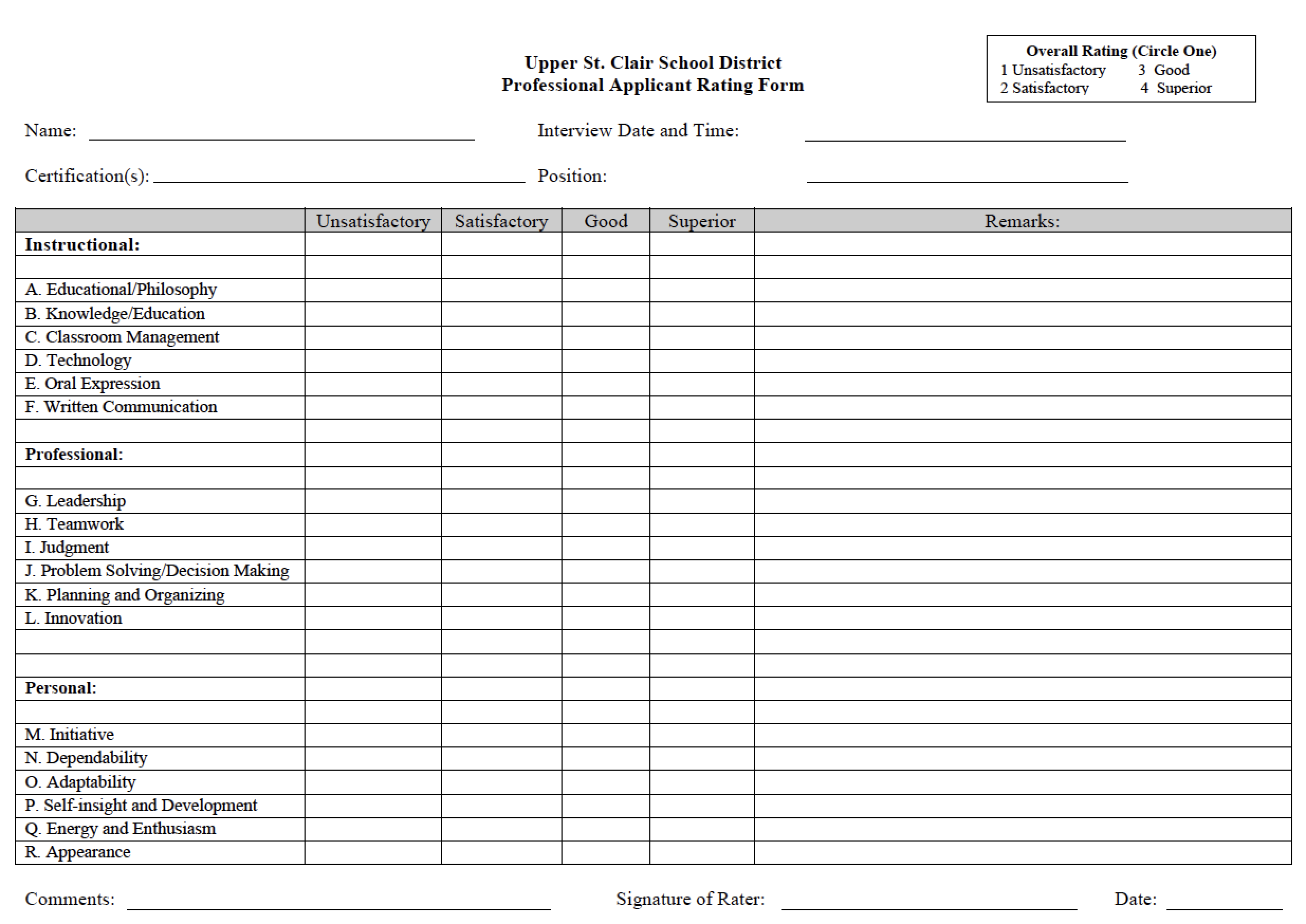
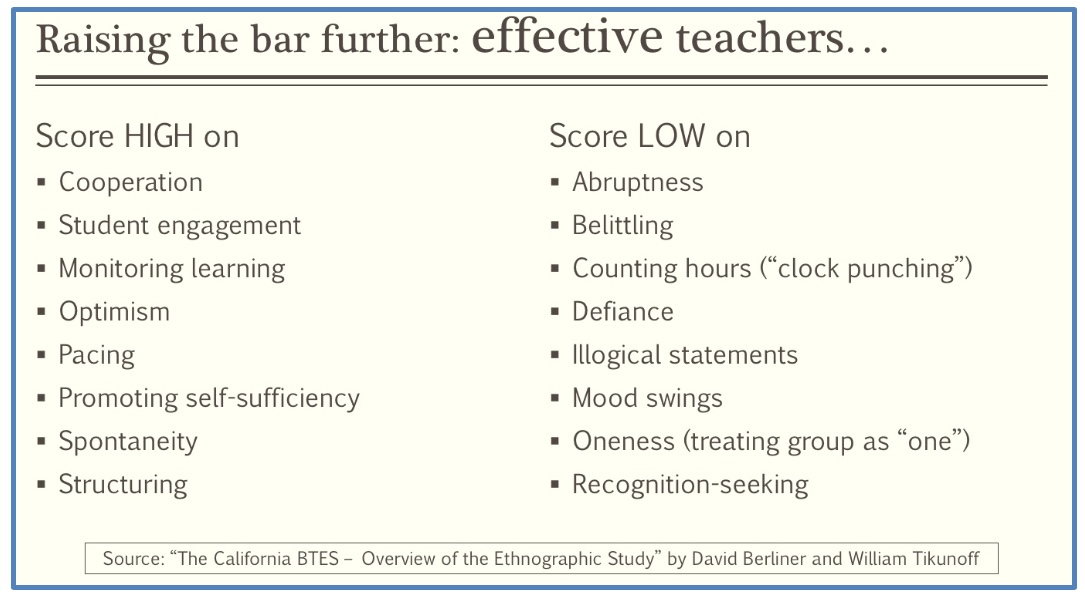
  4. To reflect on your perceived strengths and weaknesses, complete a self-assessment of YOU from a typical professional evaluation form, these ideal effective teacher attributes and more criteria
  5. Prioritize what you think you need most. Write down your goals! Pobody is nerfect!
  6. While you are still attending college, work on shoring up any weak content areas or specialty skills (e.g., how is your “piano chops,” knowledge of specific methods, grade level repertoire, etc.?)
  7. Write a philosophy of school music education (overview) and your mission statement: “Why do you want to teach?”
  8. Be ready to answer the question (and defend your response), “What is your vision of the role of music education in the schools?”
  9. Be ready to define your “brand.” What are your professional attributes? What makes you unique? Why would you be a good candidate for a school music position?
  10. Begin to assemble a list of stories that would “show not tell” your positive attributes.
  11. Identify the impressions you want to “sell” yourself, and practice strategic storytelling.
  12. Practice answering interview questions and use a rubric to evaluate your performance. If you can, share all of this with your peers and sponsor mock interview sessions. Record/assess yourself.
  13. Get started on drafting the marketing tools you will need (e.g., your professional website, resume, portfolio, etc.)
  14. Review educational acronyms, jargon, and terminology such as this list plus these recent additions: CR-SE (Culturally Relevant & Sustaining Education), DEIB (Diversity, Equity, Inclusion, Belonging), and SEL (Social-Emotional Learning). These terms may come up at your next interview.
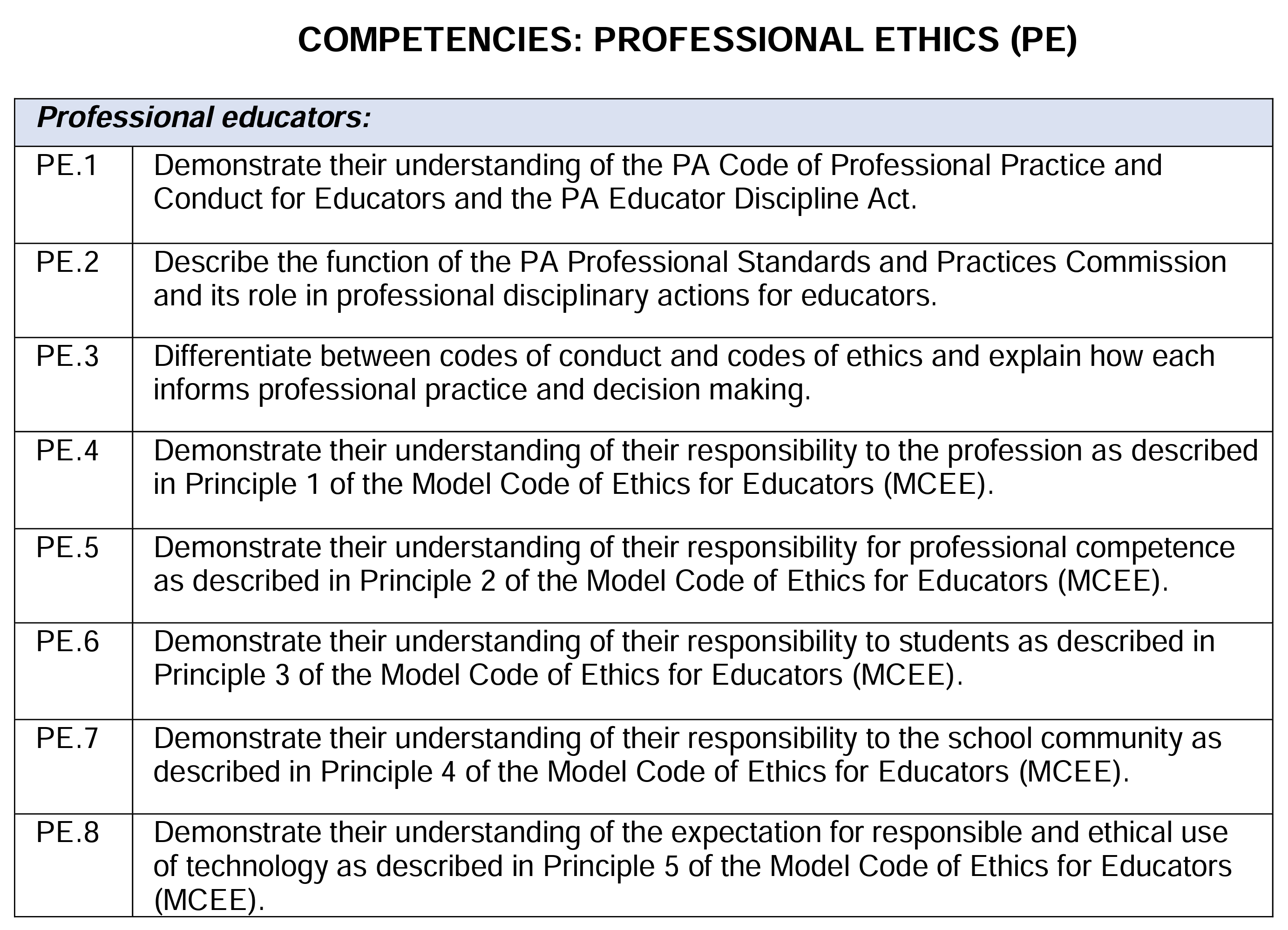
  15. Read cover-to-cover your PA code of conduct (CPPC) and the Model Code of Ethics for Educators.
  16. Practice ethical decision-making (with your peers) by reviewing these mock scenarios, first deciding what level of misconduct (if any) is reached in each case study, and then more discussion on the incident’s effect on the students, parents, staff, and community, and what proactive steps may be taken to remediate the situation.
  17. Join and become active in appropriate music education professional organizations (renew your memberships and add new ones): ACDA, AOSA, ASTA, NAfME, NBA, PMEA, etc. to name a few.
  18. Attend a conference of your professional association(s) and network with other colleagues. For PA colleagues, register for the PMEA Annual Conference (April 9-12) at the Kalahari Resort (Poconos).

Feel free to leave comments about this blog. (See the link just below the title.) How did you use these tools? What was particularly beneficial? What suggestions would you have for future music teacher applicants?

To PCMEA chapter officers/members, music education majors, and college instructors: I am available to present Bookends or other online or in-person workshops for college students. Send me an email.

© 2025 Paul K. Fox

On the Road Again (2023)

“Doing My Thing…” — Professional Development Conferences for Music Educators

It’s been awhile since I posted here… arguably the longest editorial break I have taken since retirement and starting this blog-site. What’s that line retirees often say? “It’s a good thing I am retired from my job; otherwise I would not have enough time to do everything!”

This has been an extremely busy couple months of renovating three bathrooms, promoting the 30th Anniversary Gala Celebration of the Community Foundation of Upper St. Clair featuring a CASINO NIGHT & the local band NO BAD JUJU (to which I can’t even go because it is on the same day as PMEA), staffing a transition of new editors and an office manager for the UPPER ST. CLAIR TODAY community magazine, “keeping my hand in” by conducting a small nonprofit community ensemble (now in our 40th season of the South Hills Junior Orchestra), volunteering at the hospital (see my Tales from a Wheelchair Jockey article), developing new PDE Act 45 and 48 programs on ethics (school system leaders and educators respectively), and… (deep breath): preparing four PowerPoint presentations for two music conferences in April. Yes, and loving every minute of this frenzied activity!

Pennsylvania and Eastern Division music education colleagues: Hopefully by now, you have registered for the coming conferences on the horizon:

NAfME Eastern Division Conference, April 13-16, 2023, Rochester, NY

PMEA Annual Conference, April 19-22, 2023, in the Poconos

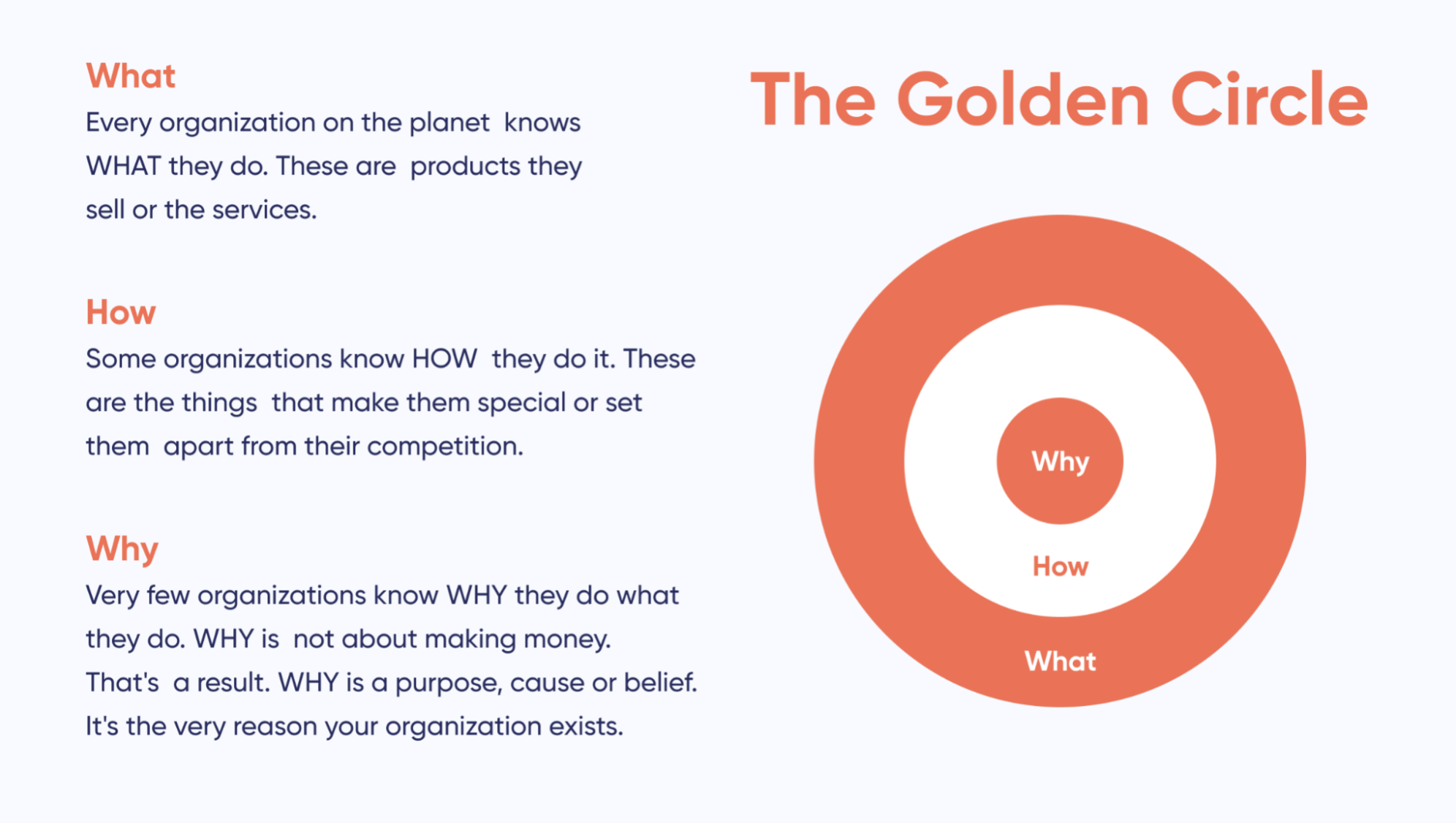
Now to quote the inspiration of Simon Sinek — his theory of value proposition to ‘start with why’ — how leaders can inspire cooperation, trust, and change based on research into how the most successful organizations think, act, and communicate if they start with why. Check out his rationale with The Golden Circle:

The “why” of attending your professional development conferences, “sharpening your saw” (self-renewal by Stephen Covey) aka “recharging your batteries,” learning what’s new and innovative on the forefront of “the state of the art,” and networking with colleagues, and has been addressed often in past blogs:

Simply put — to maintain your mastery of music and methods and build on your “best practices” and professionalism, you MUST attend as many educational conferences and workshops as possible!

Now to my “bags of tricks” for April 2023

Mark your calendars:

April 15, 2023 at 10:45 a.m. in Hyatt Susan B. Anthony (NAfME) – OR –
April 21, 2023 at 11:30 p.m. in Kalahari Suite 40/50 (PMEA)

I was blessed to have been asked to present THE INTERVIEW CLINIC — Practicing & Playacting to Improve Your Performance at Employment Screenings at both the NAfME and PMEA conferences. This will be FUN! Perfect for college music education majors, soon-to-be or recent graduates, new transfers to the profession, teachers seeking to change positions while openings seem to be “heating up,” or first-timers looking for employment, the session targets will provide interactive exercises to build self-confidence and develop better insights, practices, and strategies to successfully land a job. “The key is in the preparation” of:

  • Standards—Defining/modeling professionalism, versatility, and ethics
  • Marketing—Branding, networking, and selling yourself
  • Skills—Interviewing, storytelling, and organizing
  • Assessment—Observing, reviewing, diagnosing, and improving

Interactive exercises, you say? Yes! Get ready to meet new people and perhaps dive into a few activities slightly outside your “comfort zone!” (We promise NOT to embarrass anyone!) We will break up into small groups or “duet partners,” and explore defining our professional “essence,” telling anecdotes about our strengths and past problems we have “crushed,” and focusing on learning “the golden gift of gab” — storytelling.

Portions of this workshop will come from material in the past posts Storytelling, etc. Part 2 and When it Comes to Getting-a-Job, S Is for Successful Storytelling. (Your homework? Peruse these before coming to either session at NAfME or PMEA!)

As always, articles, resources, and slide summaries will be posted under the “Training/Jobs” menu tab (above).

Mark your calendars:

April 20, 2023 at 3:00 p.m. in Kalahari Suite 30 (PMEA)

How many of you feel at times a little overwhelmed, exhausted, stressed out, disorganized, demoralized, or disenfranchised?

Are you at the end of your rope and wondering how you’re going to “keep it all together” over the next week, month, year?

Is your health is interfering with your ability to do your job and find success, balance, and meaning in your personal life and relationships? Then… it is time for a change.

We are still dealing with the effects of the pandemic which has brought on a “gap year” to most of our music programs, the stress of “working harder not smarter,” more teacher burnouts, and the resulting bail outs, staff shortages, and/or job cuts. We need to embrace NEW strategies for personal self-care and SEL (social and emotional learning). Do you still enjoy teaching? How have you coped with all of the changes? How will you achieve a better work/life balance and skills in time/priority management and personal health and wellness?

The prescriptions and RECIPES towards stress reduction and developing a self-care plan are here! Doug Sands, a consulting hypnotist and founder of AnywhereHypnosis.com, joins me to “throw in everything and the kitchen sink” to alleviate these problems, with NO cookie-cutter, “one-size-fits-all” solutions from the chefs:

  • What has COVID done to all of us?
  • Instant personal online stress assessment
  • Taking an inventory of the ingredients towards a healthier lifestyle
  • Definitions, symptoms, and remediations for teacher stress and burnout
  • Why teachers are so exhausted and what to do about it
  • Time management tips
  • Breathe like a Navy SEAL
  • Coping and learning “acceptance”
  • How to “coach overwhelm!”
  • The role of meals, movement, music, and mindfulness (thank you, Lesley Moffat!)
  • From MEJ: A suggested self-care plan and “cognitive distortions” to avoid
  • Focusing on ONE self-care strategy from a “sea of solutions”

We’re in this together… so we need to join forces and SHARE the secret recipes for a happier life! Add your own “baking tips,” and I promise, you’ll leave with a better understanding of how we all can celebrate the coming year or decades in music education!

By the way, my “mindfulness partner” for this workshop, Doug Sands, promises us he will not hypnotize any of us during this session (although he could!).

For more about his work, including “15 Rapid Tools (and Counting) to Wipe Out Anxiety, Stress, and Panic,” please go to his website here.

You are invited to stop in to see him at his PMEA booth in the Kalahari exhibit hall.

POST-CONFERENCE NOTE: Doug sent us his Anti-Panic Toolkit entitled, 15 Rapid Tools (and Counting) to Wipe out Anxiety, Stress, and Panic – Wherever They Strike! Click here.

If you would like a sneak preview of the revised handout for the Self-Care workshop, go to the Care menu section at the top menu bar.

Taking a peek at our recent past…

Workshop for Orchestra & String Teachers

In case you missed the PMEA District 5 Professional Development Day, my wife Donna and I presented “Plucking Our Minds” at Grove City College on February 20, 2023.

We were privileged to “share some of our secret sauces” gleaned from over 80 combined years of experience on a variety of topics:

  • CommUNITY Music-Making
  • Online Academy
  • Summer String Camp
  • Assessment Projects
  • Collaborative/Creativity Projects
  • Library of “Fox Firesides”

If would be a shame to waste these resources… and reading them could inspire new adaptations to your instrumental program.

Click here for a copy of the slide handouts. Feel free to comment (above) or send an email to me (paulkfox.usc@gmail.com) if you have any questions.

Our Crystal Ball

Future Accredited Workshops on Ethics in Education

Are you aware that the Pennsylvania Department of Education (PDE) has recently revised the PA educators’ Code of Professional Practice and Conduct AND adopted the Model Code of Ethics for Educators developed by the National Association of State Directors for Teacher Education and Certification? Have you seen the new Professional Ethics Program Framework Guidelines? PA Chapter 49 requires instruction in professional ethics to be integrated in educator preparation, induction, and continuing professional development programs as follows:

  • Continuing professional development programs must integrate the professional ethics competencies no later than the 2023-24 academic year.
  • Educator preparation and induction programs must integrate the professional ethics competencies no later than the 2024-25 academic year.

Not one to let grass grow (or mud sink) under his feet, retired social studies teacher, current attorney-at-law, and past PMEA conference presenter Thomas Bailey has partnered with me to design new ethics training classes for school system leaders (25-hour Act 45 PIL course) and educators (four-hour Act 48 continuing education course). In addition, we are introducing a new “hybrid” program for school administrators involving four-hour pre-recorded asynchronous webcasts (site license), along with a three-hour synchronous webinar using the webcast videos and adding facilitated interactive discussions of three ethical case studies either via Zoom OR in-person follow-up workshops led by both clinicians.

In Depth Ethics Training for PA Educators:

  • PA Model Code of Ethics for Educators
  • PA Code of Professional Practice and Conduct
  • Professional Standards and Practices Commission
  • PA Educator Discipline Act

Click here for to register for Act 45 PIL Course.
Next series: April 25, May 2, 9, & 16, 2023

Click here for more information on the Ethics Webcast/Webinar and general information/landing page for the TWBaileyLaw website.

Click here for timeline of educator ethics presentations and clinicians’ bios.

Also review the Educators Court Case Blog and William Penn SD vs. PDE Blog.

Numerous articles have already been published on the subject of educator ethics, professionalism, and decision-making:

Hope to see you at one of these conferences or workshop sessions! Yes, it means a lot more to attend these IN PERSON!

PKF

© 2023 Paul K. Fox

Mock Interviews

Unraveling “the Puzzle” of Landing a Music Teacher Job

Assembling the pieces: Interview Questions and Assessment Criteria

Soon it will be the season of new school district postings of employment openings and opportunities to be hired! Hurray! At long last, college music education majors have made it through all of the music and methods courses, recitals and concerts, competency exams, field observations, student teaching, and Praxis testing. Or, perhaps you are a veteran teacher looking to relocate and find a new job? You’ve come to the right place!

With rumors of retirements, sabbaticals, teacher shortages, and HR staff and administrators scrambling to find people to fill positions, NOW is the time to “bone up” on marketing yourself and practicing your interviewing skills – to get together with your friends and fellow “rookies” and schedule mock interview sessions to interrogate and evaluate each other. Record your mock interviews and sit back, watch, critique, and learn.

A large number of past blog-posts within this “jobs/training” section were provided to assist prospective new or transferring music educators in preparing for the often-stressful job search process. Scroll down for a summary of “the basics” to help you gain the tools, knowledge, competence, and confidence to succeed at your next interview!

Good luck! PKF

Let’s put the pieces together to ace those employment screenings!

How would YOU respond to these interview questions?

Special thanks to Michigan State University: https://www.music.msu.edu/assets/SampleMusicInterviewQuestions.pdf

  1. Tell us something about your professional strengths, challenges, and goals for the future.
  2. Who had the greatest influence on you becoming a music teacher and why?
  3. What are the most important qualities of an outstanding music educator?
  4. Describe a successful lesson plan you have developed and how did you assess the learning?
  5. How will you accommodate students with special needs or varied interests in your music program?
  6. How would you recruit/encourage students and “grow” interest and participation in the music program?
  7. Why is it important for students to be actively engaged in the performing arts?
  8. What is the role of sacred music in the school choral program?
  9. Describe the ultimate choral program in your school – types and make-up of ensembles.
  10. You are meeting a middle school student for the first time How would you convince him to join your _____ (band, strings, choir)?
  11. There’s a guidance counselor who is not a supporter of the ___. He discourages students from including music in their schedule. How would you try to improve the situation?
  12. How important are competitions and festivals to you?
  13. How do you select soloists, leadership positions, or rank seating in your ensemble?
  14. Discuss your approach for teaching improvisation for the first time.
  15. Discuss your background in Orff, Kodaly, Gordon, Suzuki, and Dalcroze.
  16. Give some examples of materials you would use to build a diverse repertoire.
  17. Discuss the process you use in developing the singing voice.
  18. How do teach a group of 5th graders who are having trouble mastering dotted note values?
  19. Describe your classroom management procedures. What kind of discipline do you require?
  20. What personal qualities do you have that would make you an effective leader… team member?
  21. If offered the job, how do you see your involvement in our district (both music and nonmusic)?
  22. Name 3 vital emphases in your teaching. What is most important: content, outcome, or process?
  23. How would your students describe you? How would your friends and/or colleagues?

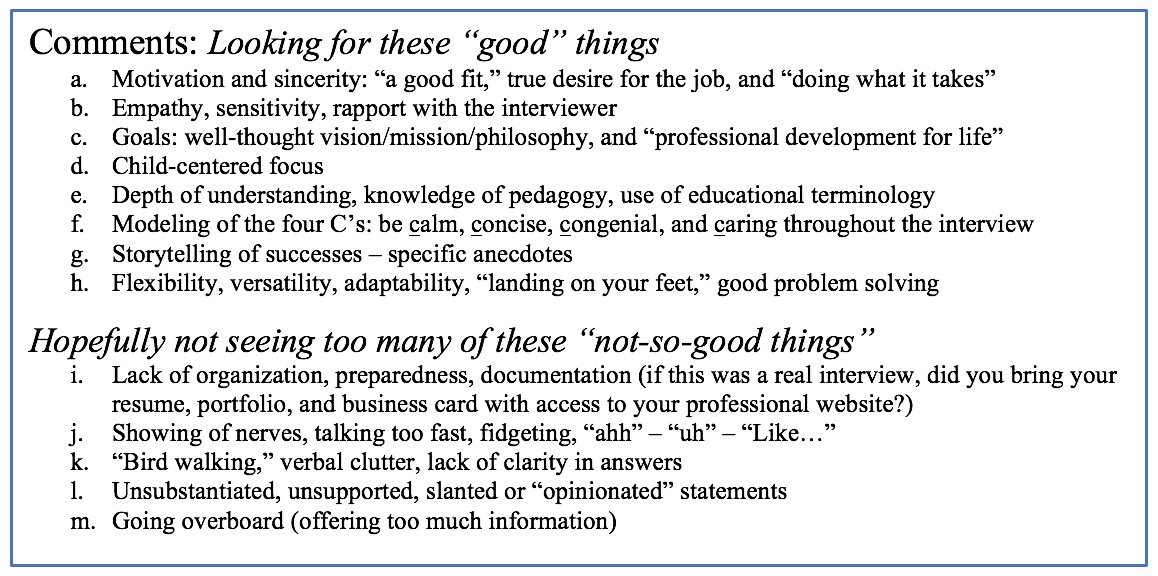
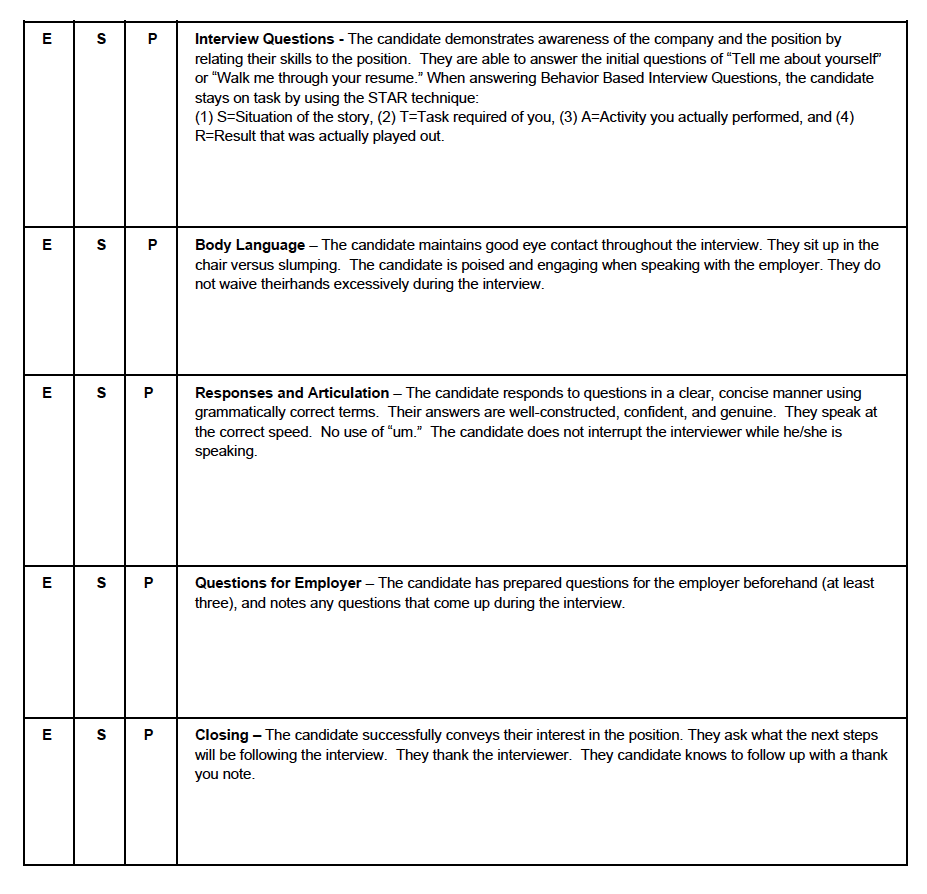
What are the interviewers looking for?

Actual sample candidate rating form

This form was used at the school district from which the author retired:

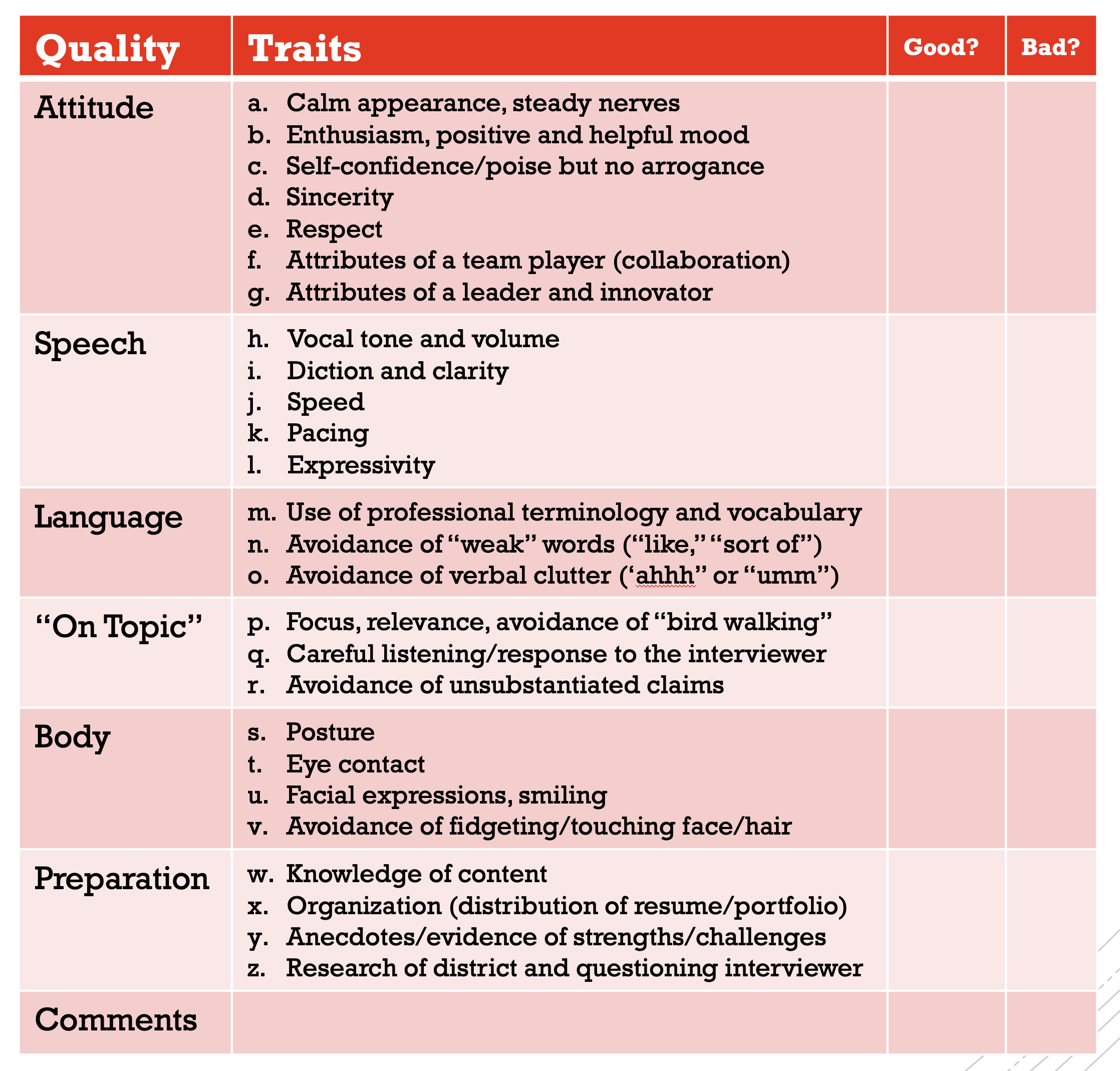
During the mock sessions, here’s an assessment tool you (and those observing your “performance”) can use. For emphasis, place the letter of the criteria under either the “good” or “bad” column.

Are you missing any more pieces of the puzzle?

TOP-TEN LIST:

The ultimate outline interview primer for pre-service music teachers

  1. Overall marketing skills – “the science” of finding a job https://paulfox.blog/2015/07/08/overview-strategies-for-landing-a-music-teacher-job/
    • “But you got to know the territory…” (The Music Man)
    • Making connections
    • Branding yourself
    • Storytelling about the challenges and triumphs you faced in life
    • Proving that you have “what it takes” and your skills/experiences would be a “good fit” to the needs, goals, and values of the institution, employer, and position to which you are applying
    • Being persistent and well-organized
  2. The “alphabet soup” of educational terminology, jargon, acronyms, etc. https://paulfox.blog/2015/07/18/the-alphabet-soup-of-educational-acronyms/
  3. In PA, training and assessment in the criteria of Charlotte Danielson’s “Four Domains” from the Framework for Teaching. https://danielsongroup.org/framework and https://paulfox.blog/2015/08/09/criteria-for-selection-of-the-ideal-teacher-candidate/
  4. Types of music teacher employment screenings https://resumes-for-teachers.com/blog/interview-tips/the-most-common-types-of-interviews-in-the-education-sector/ and https://paulfox.blog/2015/09/01/a-blueprint-for-success-preparing-for-the-job-interview/
    • Online
    • Informal
    • Structured
    • Unstructured
    • Sequential
    • Panel or Group
    • Audition/Performance (on major and minor instrument, singing, piano accompaniment)
    • Lesson Demonstration
  5. Types of interview questions
  6. Interview questions
  7. The “ABCs” of additional employment marketing topics
  8. 21st Century employment search strategies https://paulfox.blog/2016/08/14/21st-century-job-search-techniques/
    • Membership in PCMEA/PMEA and other professional associations
    • “Have resume will travel”
    • E-portfolio and professional website
    • Electronic business cards
    • Hiring agency sites and job bulletin boards 
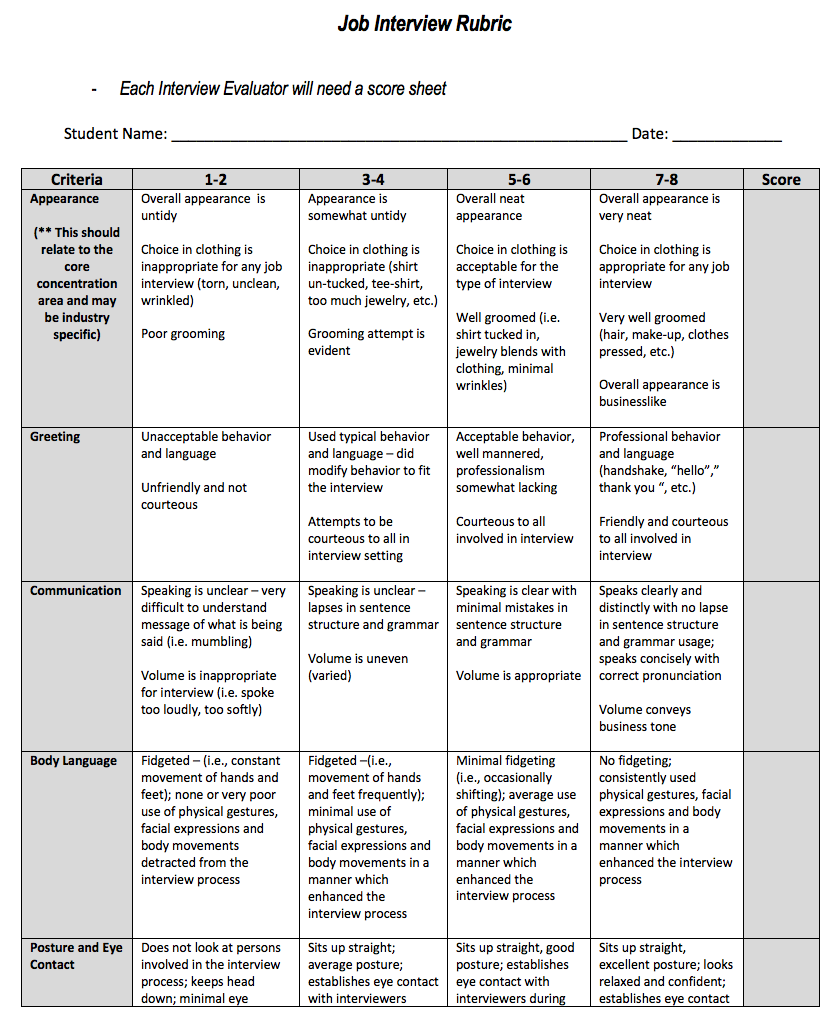
  9. Additional interview assessments https://paulfox.blog/2019/05/14/job-interview-rubrics/
  10. Other websites to peruse

“You can take it with you…” The above list is available here as an easy-to-print PDF file.

© 2021 Paul K. Fox

PIXABAY.COM GRAPHICS:

Questions for the 3 Phases of Interviews

Asks for “The Before,” “The During,” and “The After”

interview-2204251_1920_Geralt

These Responses Are Critical for Marketing Yourself & Landing a Job

pcmea

This article was inspired by my recent participation in virtual mock interviews on Zoom for PCMEA members and senior music education majors.

It is up to you to do the research and plan ahead!

What is that “scout’s motto?” Be prepared!

Or, to put it another way, more “near and dear” to the average music student:

  • “How do you get to Carnegie Hall?” (Practice, practice, practice!)
  • “How do you get a job?” (Practice, practice, practice!) AND
    (Prepare, prepare, prepare!)
    a focus on the BEFORE, DURING, and AFTER phases of an interview!

magnifying-glass-4785076_1920_geralt


The Before

Prior to every job screening, walk in well-informed. Investigate in advance the background information of the school district:

  • The job opening and responsibilities
  • Details about the overall music program, number of staff, courses offered, etc.
  • School district’s mission/vision/value statements
  • Validation of administrative support for the arts
  • Examples of community support for music education
  • Work environment and employee attitudes

Be a detective! Look for responses to these inquiries “surfing the ‘Net,” studying the district’s website, reading local media releases, and, if you are able to, finding someone who is already employed there:

  1. What do you know about this school district?
  2. What is the average make-up (socioeconomic, education, racial, etc.) of the community? Is it mostly urban, rural, suburban? Are the majority of the jobs blue collar, white collar, entrepreneurial, agricultural, or mixed?
  3. What educational, cultural, and sport/leisure activities are available to the residents in and around the area?
  4. What philosophies or approaches are emphasized in the school district’s strategic plan and/or annual Board of School Director’s goals?
  5. What are samples of student, staff, building, and school district awards and traditions?
  6. magnifying-glass-106803_1920_geraltHow many class periods (not counting lunch) are structured for the academic day? Are specific grade levels or buildings organized in block scheduling, “period 0” and/or before/after-school curricular or co-curricular classes, lesson pullouts, period rotations or A/B weeks, etc.?

  7. How often is the curriculum revised or updated?
  8. What is the school district grading scale and music grading policy/practice?
  9. What music classes and extra-curricular activities are offered?
  10. Are any specialties or disciplines emphasized or promoted, e.g. Kodaly, Orff, Dalcroze, Little Kids Rock or Modern Band, World Drumming, Suzuki, Competitive Marching Band, Strolling Strings, etc.?
  11. What position(s) is(are) open and what duties are required?
  12. What avenues of professional development exist?
  13. What percentage of students are in the music program?
  14. What percentage of the music students own instruments, take lessons, and seek participation in outside ensembles?
  15. What indicators of cooperative parental and community support exist (concert attendance, private teachers, booster groups, community arts organizations, etc.)?
  16. What resources are budgeted (sheet music, music technology, field trips, piano tuning, instruments and instrumental repair, teacher in-service, festivals, etc.)

What answers you cannot find, you may ask at the end of the interview.

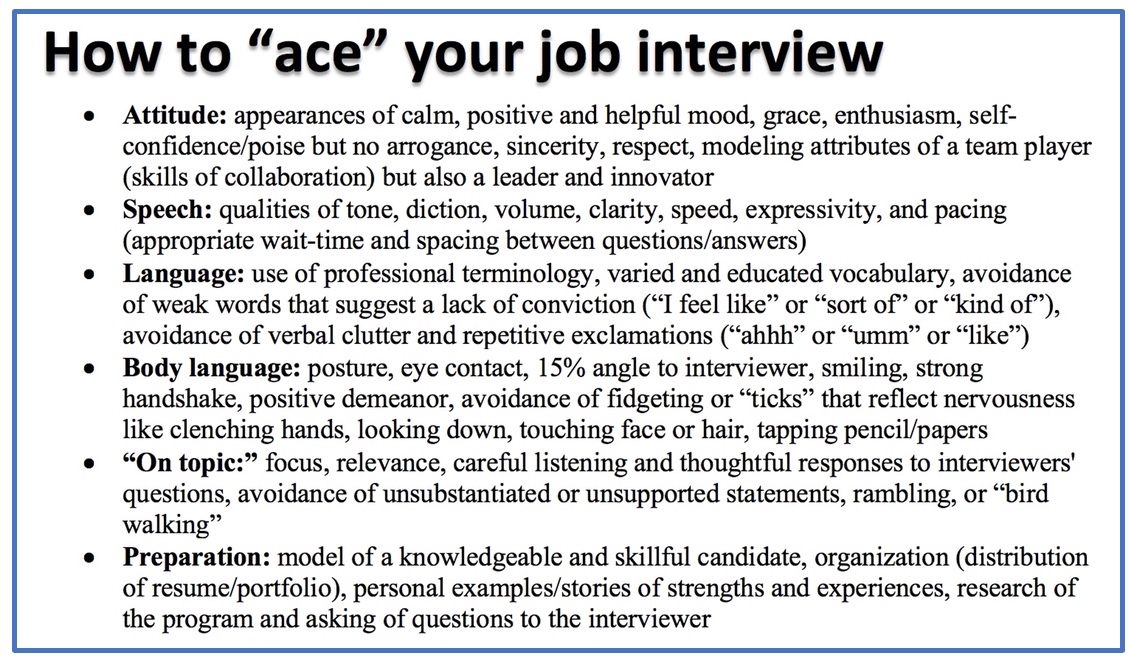
how to ace your job interview


The During

So much has already been written about commonly asked interview questions. (Please revisit the blogs posted at https://paulfox.blog/becoming-a-music-educator/.) To “let the cat out of the bag,” when I am asked to do “mock interviews” for music education majors, the following are “my favorites.” You may also want to read my last article, “Coaching Advice for Acing Those Employment Interview Questions” at https://paulfox.blog/2020/01/26/more-on-teacher-interviews/.

  1. Tell us something about yourself… your strengths, weaknesses, and goals for the future.
  2. Who had the greatest influence on you becoming a music teacher and why?
  3. What are the most important qualities of an outstanding music educator?
  4. Describe a successful lesson plan you have developed.
  5. How will you accommodate students with special needs or varied interests in your music program?
  6. How would you recruit/encourage students and “grow” interest and participation in the music program?
  7. interview-2207741_1920_geraltDescribe your approach to introducing a musical concept: singing matching pitches, keeping a steady

  8. Why is it important for students to be actively engaged in the performing arts?
  9. Why should I hire you for this position?
  10. Describe your background and knowledge of each of the following methodologies, and for a general music position, which one is your favorite? Orff, Kodaly, Dalcroze?
  11. Describe a lesson that did not materialize in a manner that you expected. What did you learn from this experience?
  12. If you were hired as a high school band director at the last minute the third week of September, and the marching style was contrary to your preference to teach, how would you adapt?
  13. What are three adjectives students would use to describe you?
  14. How would you assess the learning in your rehearsals?
  15. What is most important to you? Music outcomes, content, or process?

You will probably be asked, “Do you have any questions for me?” by the interviewer. You should show your interest, forethought, and advanced preparation by coming up with a few, or adapt several of the 16 pre-interview samples in the “Before” section above. At the very least, if the principal or supervisor of the posted position happens to be in the room, you could inquire: “Where do you see the program in 10 years?” or “What is the most valued attribute of a ______ School District educator?”

Raising the bar


The After

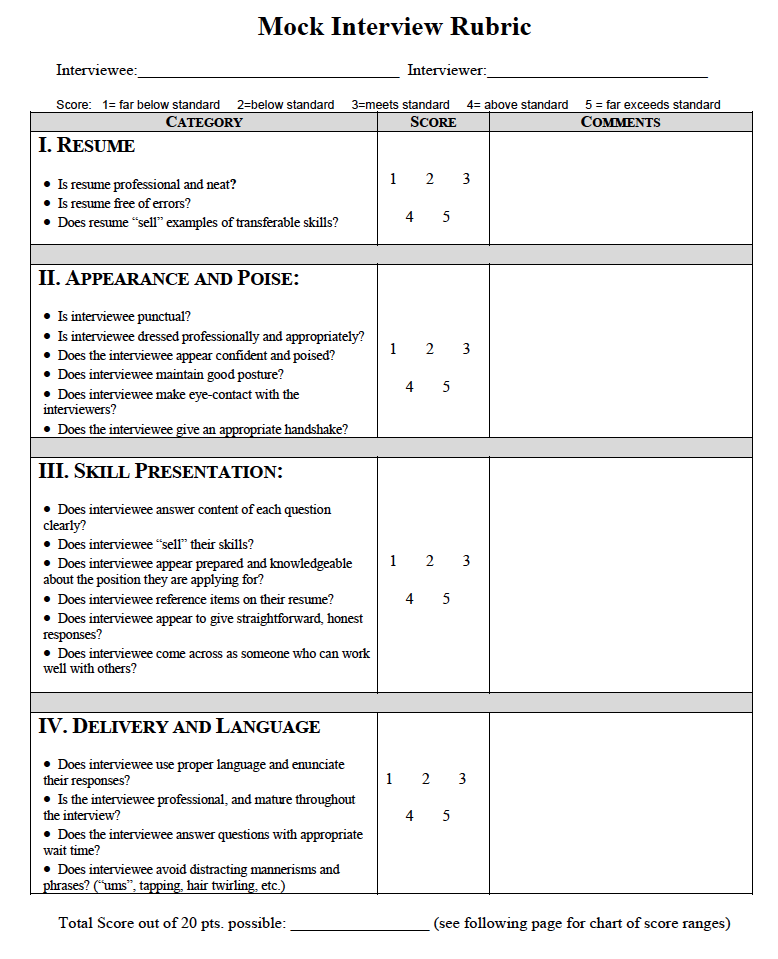
As soon as it is over (immediately when you get home – don’t put it off!), debrief yourself. Do an assessment of your positives and areas for improvement or needs for further practice. To formalize this process, try any number of evaluative rubrics (for examples, visit https://paulfox.blog/2019/05/14/job-interview-rubrics/). Or, just summarize your observations into strengths (+) and weaknesses (-) referencing the elements of attitude, speech, language, body language, content/on topic, and preparation. (See the first box above.)

feedback-796140_1920_geraltAre you telling me it’s time to bring up more questions? Yep, to finalize your interview’s “postmortem,” reflect on these queries, which will become your focal points in preparation of your next job screening.

The first “biggie critique” might take a little while to follow-up and re-train. This is important since most of the professionals who serve on interview screening committees are administrators, HR staff members, or curriculum supervisors (not music content specialists). And, in the same breath, most music education majors are not well versed on these “buzz words” since they may be only briefly mentioned during their music courses.

1.     How many times did you use appropriate general educational terminology and current school jargon? Here are a few samples of “the ABCs.” If you do not know the meanings, Google search them or look up sites like https://resilienteducator.com/classroom-resources/education-terminology-jargon/, https://www.teachervision.com/dictionary-educational-jargon, and https://wwndtd.wordpress.com/education-jargon/. (If you really want to dive into an interesting “lingo generator,” experiment with https://www.sciencegeek.net/lingo.html, which may also help you define associations among related educational terms used in the composition of reports, grant applications, and other documents for accreditation.)

  • Assessments – Authentic, Formative (“for learning”), Summative (“of learning”), and Diagnostic
  • CCCC (The Four C’s) – 21st Century Learning Skills of Creativity, Collaboration, Communication, and Critical Thinking
  • Classroom Management and the concepts of “Assertive Discipline” and “Ladder of Referral”
  • Charlotte Danielson’s Four Domains – Planning and Preparation, Classroom Environment, Instruction, and Professional Responsibilities
  • DOK – Depth of Knowledge and HOTS – Higher Order Thinking Skills
  • ESSA – Every Student Succeeds Act (2015), successor to NCLB (No Child Left Behind)
  • knowledge-5014345_1920_geraltIEPs  – Individualized Education Program, including IDEA (disabilities), 504 plans, accommodations for special needs, differentiated and customized learning, etc.

  • LMS – Learning Management System (software used by schools to track grades, take attendance, deliver curriculum, and offer/evaluate courses, etc.)
  • Middle School (or Middle Level Learner) Philosophy
  • PLN/PLC – A Personal Learning Network or Professional Learning Community
  • PBL – One of two different concepts: Project-Based or Problem-Based Learning
  • SEL – Social-Emotional Learning
  • SAS – Standards Aligned Systems of the PDE (Pennsylvania Department of Education)
  • STEAM – Science, Technology, Engineering, Arts, and Math
  • UBD – Understanding by Design, “backwards-design” curriculum development with EU (Enduring Understandings) and EQ (Essential Questions)

Of course, if you were “nailed” by not knowing terminology or acronyms of which you never heard, don’t “fake it!” Just be honest with the interviewers (they cannot expect a “raw recruit” fresh out of college to know everything), but never-the-less, look it up as soon as you return home. You’ll be ready for the next interview. (“Catch me once, shame on you. Catch me twice, shame on me!”)

More questions to help you evaluate your performance:

2.     At the interview, did you project the image that you are solely qualified to serve as a specific music content-area specialist? In other words, are you only a “band director,” “vocal conductor,” EL/MS general music teacher, piano/guitar accompanist, jazz instructor, music theorist, or string “maestro?” Did you basically imply to the screener(s) that you would not accept any assignment outside your “comfort zone,” and that your Music Pre-K-12 Instructional I Certificate is not worth the paper on which it is printed?

3.     If you had videotaped the interview, how would you characterize your rapport with the screening individual or committee? To what extent did you demonstrate an attitude of openness, cooperation, sensitivity to the interviewer’s style/personality, and fostering of the four C’s of the model interviewee behavior – be calm, caring (motivated), congenial, and considerate?

4.     Were you “engaged” in treating the session as a mutually beneficial exchange of information?

5.     learn-3653430_1920_geraltDid you respond to the interviewer’s questions “on topic” with clear, concise, and substantiated statements, supported by specific anecdotes/stories or examples of your skills or experiences?



6.     Did you avoid “bird walking,” “tap-dancing,” having verbal clutter (too many run-on statements), rambling, fast talking, sounding verbose, being flip or too casual/informal in conversation, or going overboard with your answers?

7.     How many times (count them) did you use the words “ah,” “um,” or “like?”

8.     Did you promote your strengths and all experiences (musical and non-musical) you have had interacting positively with children, and not discount your potential and capabilities due to a limited past job record or shortened time in student teaching?

9.     How successful were you in controlling your nerves, looking interested, “being yourself,” and demonstrating good eye contact, pleasant facial expressions, and relaxed and professional speech, posture, and body language?

10.  Did you avoid the use of “weak words” that suggest a lack of conviction: “kind of,” or “sort of,” or “I feel like?”

11.  Did you limit any form of “fidgeting,” such as tapping or shuffling feet, cracking knuckles, touching hair or face, drumming or spinning a pen between your fingers, wiggling in your seat, etc.?

12.  How many times did you use the name of the interviewer(s) during your interview? It shows respect and is the best way to get/keep his/her attention.


Observations at interview

In summary, treat the job search process more scientific:

  • Be diligent in practicing mock interviewing with classmates, friends, and family members,
  • Plan ahead, and
  • Formalize your questions and self-assessments.

The jobs are out there… waiting for you to “hook them in,” and as every good fisherman knows: “Nothing replaces time on the water, patience, and the ability to admit to yourself there is always something to learn and a better way to do it.”

PKF


hand-648448_1920_geralt

Photo credits from Pixabay.com by Gerd Altmann (geralt):


© 2020 Paul K. Fox

More on Teacher Interviews

Coaching Advice for Acing Those Employment Interview Questions

There is a huge body of information on preparing for the job search process, interviews, and marketing yourself previously posted at this site. Where should you go first? Be sure to survey the following blogs:

What else do you think we should cover on this topic? How about some specific “coaching” in recommended answers to commonly asked interview questions… tips from the experts, HR staff, interviewers, supervisors, and the like. We give each resource “the baton” and “the podium” to offer a glimpse in the triumphs, pitfalls, and pratfalls of frequently observed interviewee responses. For grasping the full comprehension and context, follow-up by reading the entire article posted at each link.

Many of these suggestions are geared to “general education” teacher interviews, but you can apply them to whatever specialty or grade level to which you are applying. After all, the person sitting at the other side of the desk is probably an administrator or director of curriculum, not a current/former music educator.

Again, be sure to visit each website. All told, there are more than 108 sample questions and responses in these collections below!

woman-613309_1920_Jared_Soto

What is your teaching philosophy?

Teacher interview questions like this ask, “Are you a good fit for our school?” It’s the teaching equivalent of “tell me about yourself.” But —

Don’t answer elementary teacher interview questions for an unstructured school with, “I believe in structured learning.”

Take the time to learn the school’s philosophy before the interview.

Example answer: “I believe in teaching to each student’s passion. For instance, in one kindergarten class, my students had trouble with punctuation. I observed that one student, Mary, suddenly got excited about apostrophes. I fueled her passion with a big book on punctuation. Her enthusiasm was contagious, and soon the entire class was asking bright and animated questions. Whenever possible, I try to deliver structured lessons in an unstructured way like this.”

That answer uses the S.T.A.R. approach to teaching interview questions. It shows a Situation, a Task, an Action, and a Result.

“25 Teacher Interview Questions and Answers” by Tom Gerencer

This is from a Zety “career toolbox” website. They also offer an outstanding app to “build” a resume, CV, and cover letter, all with excellent examples.


Why do you want to be a teacher/work with children?

You have to know who you are as an individual and as an educator, and you have to know what you can bring to the school… This question gets to the heart of that self-awareness and passion. The interviewer wants to know: What drew you to this field, specifically?

How to answer it: It’s obvious of course, but you don’t want to say, “Summer vacations!” This should be easy to answer simply because there’s probably something you can think of that made you want to get into education. Maybe you love teaching your friends new things, or are a facts wizard bursting with knowledge, or love connecting with children. Focus not just on what you like about teaching but also on what you can… bring to the table.

For example, you might say: “I really admired my third grade teacher, Mrs. Kim, when I was younger, and even after I left her class I still felt myself drawn to her for advice and guidance over the years. It’s that sense of warmth and acceptance she provided me that inspired me to become a teacher. I want to be that person others can lean on as they navigate the oftentimes tough waters of growing up.”

“15 Common Questions Asked in a Teacher Interview (and How to Answer Them With Ease)” by Alyse Kalish

In addition, the site above shares several important pointers from Calvin Brown, Senior Recruiter at Alignstaffing, an education staffing firm, and Dan Swartz, Managing Director at Resolve Talent Consulting, LLC, a firm that specializes in education recruitment.

Reaffirming the blog S is for storytelling at interviews: “If you have a situation or a story with a great outcome, absolutely share [it],” says Brown. “Stories are also a great ways to highlight your expertise and skill set if you don’t come with a traditional background in education.” Swartz adds, “Even if you’re not a teacher with experience, you can still highlight how you go about your work by giving past examples and scenarios of engaging others.”

job-interview-437026_1920_connectadabara

How would you handle a difficult student?

Mary Findley, Senior Teacher Success Manager at Skillshare, former Teach for America Core Member and elementary school teacher, suggests this scenario and answer:

“When students are disengaged, it’s either because the content’s too challenging, it’s too easy, or there could be some outside-of-school factors,” explains Findley. A good answer delves into figuring out the cause, as that’s often the most important step.

Then, your response should show that “you’re meeting the student where they’re at and building on their strengths,” she says. It should also emphasize that you’re “collaboratively discussing” solutions with the student rather than ordering them around. If you have an example story to tell, that’s a great way to state your case.

You could say: “For me, the first step would be to pull them aside and address the issue privately. My biggest questions would be about deciphering what might be the root cause of this student’s bad behavior. Once I know what may be contributing to their difficulty, I really try to work with them to come up with a solution. I used this strategy in my last classroom, where I had a student who couldn’t seem to stay in his seat during lessons. We talked about how his behavior affected the rest of the class and why he kept moving around, and we agreed that when he was feeling really anxious he could raise his hand and I’d let him take a lap around the classroom, but only when it was appropriate. I also decided to make some of my lessons more active and hands-on so that other students could benefit from getting out of their seats every once in a while.”

“15 Common Questions Asked in a Teacher Interview (and How to Answer Them With Ease)” by Alyse Kalish

child-1439468_1920_Counselling

How do you incorporate social-emotional learning in your lessons?

Many states and districts have added requirements for social-emotional learning into their standards. Explain how you will not only tend to the academic needs of your students but tie in lessons that satisfy the core SEL competencies. Describe how you will help students build their self- and social-awareness skills, how you will support them in building relationships, and how you will give them the skills to make responsible decisions. 

“18 Interview Questions Every Teacher Must Be Able to Answer” by Brandie Freeman

If you have never heard the term “core SEL competencies” in your methods classes, peruse the online article “Building SEL Competency in the Elementary School Music Classroom” by Lindsey Jackson, posted on the NAfME Music in a Minuet website.

How will you meet the needs of the students in your class who are advanced or say they’re bored?

and

How will you engage reluctant learners?

School leaders don’t want to hear canned responses about how you can differentiate; they want you to give some concrete answers and support your ideas. Perhaps you help get kids prepared for scholastic competitions once they’ve mastered the standard (spelling bee or chemistry olympiad, anyone?). Maybe you offer more advanced poetry schemes for your English classes or alternate problem-solving methods for your math students. Whatever it is, make sure that you express the importance that all students are engaged, even the ones that are already sure to pass the state standardized test.

Teaching in an age when we must compete with Fortnite, Snapchat, and other forms of instant entertainment makes this question valid and necessary. How will you keep students’ heads off their desks, their pencils in their hands, and their phones in their pockets? Share specific incentive policies, engaging lessons you’ve used, or ways you’ve built relationships to keep students on task. An anecdote of how a past student (remember to protect privacy) that you taught was turned on to your subject because of your influence would also help your credibility here.

“18 Interview Questions Every Teacher Must Be Able to Answer” by Brandie Freeman

women-1687852_1920_melysernaWhat are your greatest weaknesses?

Considered one of the “trick” or unfair questions by many, you should still be ready for it. One of the keys to sounding sincere is to personalize your response, and provide specific examples of the “problem,” self-improvement goals, and positive growth and progress.

At some point during the interview process, you may be asked to describe your personal strengths and weaknesses. Many job candidates are unsure about how to approach this question. However, by establishing the appropriate context, you can give hiring managers an honest, thoughtful answer that highlights both your self-awareness and professionalism.

Preparing ahead of time for this question is a valuable use of your time before the interview. Even if you aren’t asked about your strengths and weaknesses specifically, scripting out your response to this common question will give you a candid yet compelling description of what you bring to the table and how you wish to grow in the future.

job-interview-2552411_1920_shaukingBecause we all have weaknesses but rarely want to admit to them, it’s best to begin with a truthful answer and build your script from there. Select an answer that a hiring manager would not consider to be essential qualities or skills for the position as well as qualities that you are actively improving.

Some examples of weaknesses include:

  • Disorganized
  • Self-Critical/Sensitive
  • Perfectionism (Note: this can be a strength in many roles, so be sure you have an example of how perfectionism can be a problem to demonstrate that you’ve thought deeply about this trait)
  • Shy/Not adept at public speaking
  • Competitive (Note: Similarly to perfectionism, this can be a strength)
  • Limited experience in a non-essential skill (especially if obvious on your resume)
  • Not skilled at delegating tasks
  • Take on too much responsibility
  • Not detail-oriented/Too detail-oriented
  • Not comfortable taking risks
  • Too focused/Lack of focus

Example weakness: Perfectionism

“I tend to be a perfectionist and can linger on the details of a project which can threaten deadlines. Early on in my career, when I worked for ABC Inc., that very thing happened. I was laboring over the details and in turn, caused my manager to be stressed when I almost missed the deadline on my deliverables. I learned the hard way back then, but I did learn. Today I’m always aware of how what I’m doing affects my team and management. I’ve learned how to find the balance between perfect and very good and being timely.”

target-1414775_1920_DeedsterExample weakness: Difficulty with an area of expertise
“Math wasn’t my strongest subject in school. To be honest, as a student, I didn’t understand how it would be applicable in my adult life. Within a few years of being in the working world, though, I realized that I wanted to take my career in a more analytical direction. At first, I wasn’t sure where to begin, but I found some free online courses that refreshed the important basics for me. In my most recent job, this new foundation has enabled me to do my own goal setting and tracking. Actually, getting over the math anxiety I had when I was younger has been incredibly empowering.”

“50 Teacher Interview Questions and Answers to Help You Prepare” from Indeed.com

One final resource, perhaps more focused on business or company interviews, but still applicable to education positions, is the work of author, career counselor and interview coach Robin Ryan. Knowing that college students are by necessity drawn to “free stuff,” I would first view one of her YouTube videos such as https://www.youtube.com/watch?v=J_lgyK37JJM or venture into reading her “how-to” articles at http://www.robinryan.com/index.php/articles. There are some excellent gems perfect for “collegiates” here:

60 seconds and youre hiredFocusing on Robin Ryan’s “interview tools” such as “the five-point agenda” and “60-second sell,” her book 60 Seconds and You’re Hired ” is inspiring and provides much greater depth (76 pages!) on answering those “thorny” interview questions. Nearly all of the sample questions above are also analyzed, offering easy-to-understand comments and recommendations for specific career paths. For example, Robin Ryan also weighs in on that inquiry “What is your greatest weakness?” – first offering to joke about it “I cannot resist chocolate!” and then, if it is reiterated, endorsing a strategy to share a work habit problem (like being a “Type-A” person) on which you are currently improving but is not critical for the position they are seeking to fill.


To sum up the book, these are my favorite sections:

  • Chapter 2: The Five Point Agenda
  • Chapter 3: The 60-Second Sell
  • Chapter 5: Interview Etiquette (including tips on proper dress, good manners, nonverbal and verbal communication, the hand shake, and eye contact)
  • Chapter 7: 60-Second Answers to Tough, Tricky Answers
  • Chapter 12: 12 Pitfalls to Avoid

In conclusion, as stated throughout all of this literature on interview techniques, the keys to success are preparation and practice… just like getting ready for your semester jury or senior recital. After studying these materials, collaborate with your peers to hold “mock interviews,” video-record yourself answering the questions, and take time to review and self-assess. Yes, you CAN and WILL do well at future employment screenings!

PKF

men-1979261_1920_Werner_Heiber

Photo credits (in order) from Pixabay.com:

© 2020 Paul K. Fox


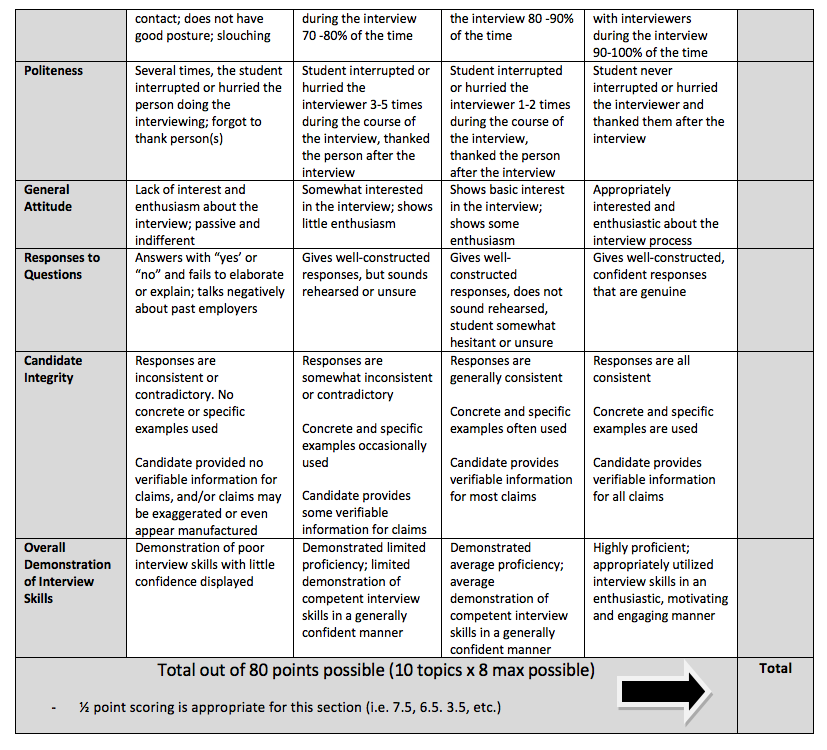
Job Interview Rubrics

Sample “Assessment Keys” for Teacher Candidates

How do “they” judge prospective educators? What skill-sets are wanted and scored?

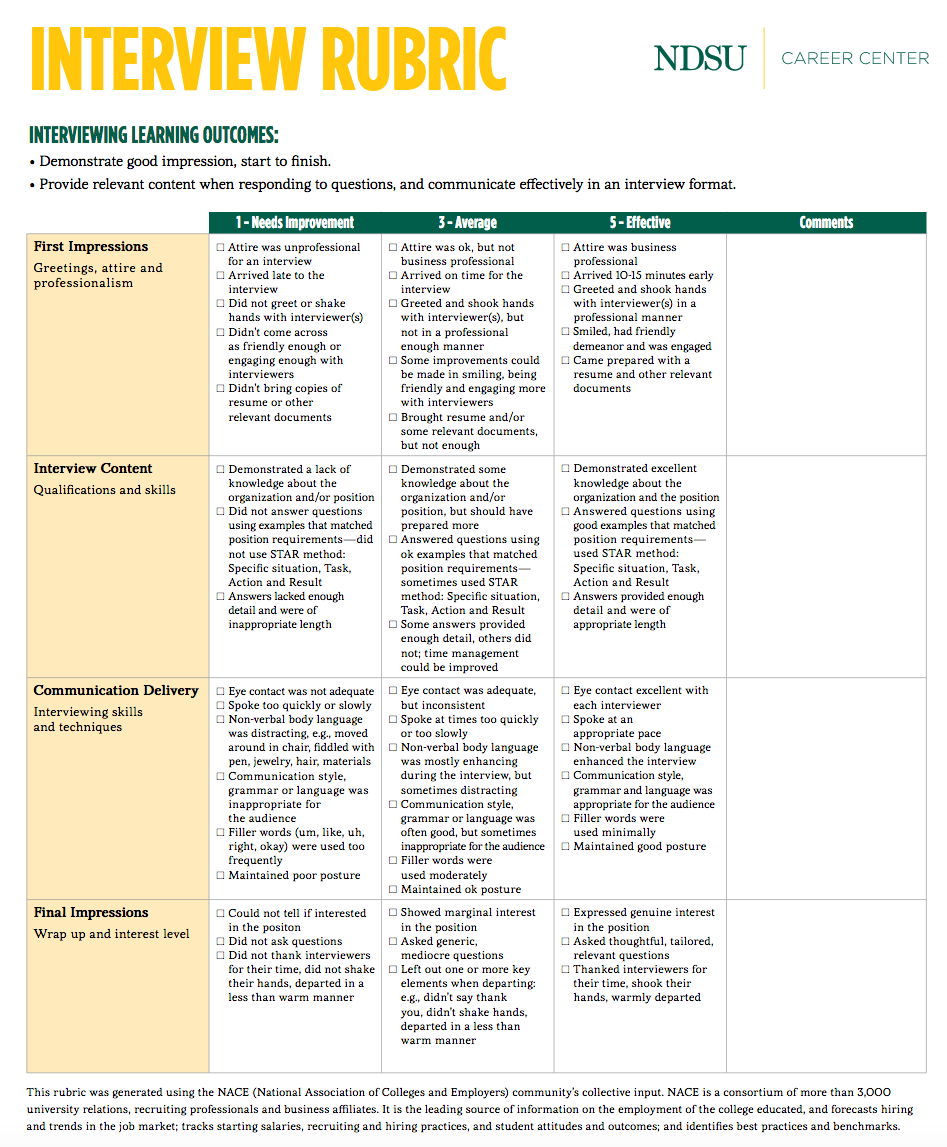
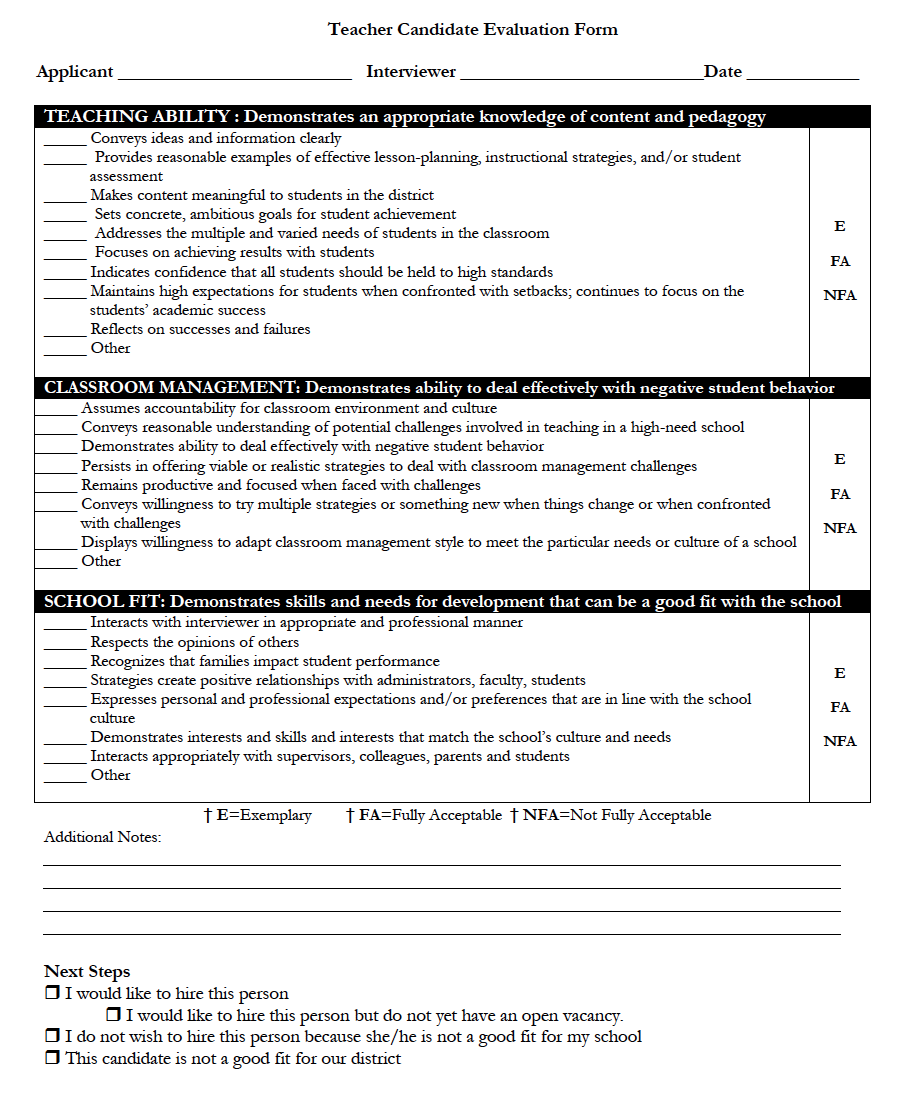
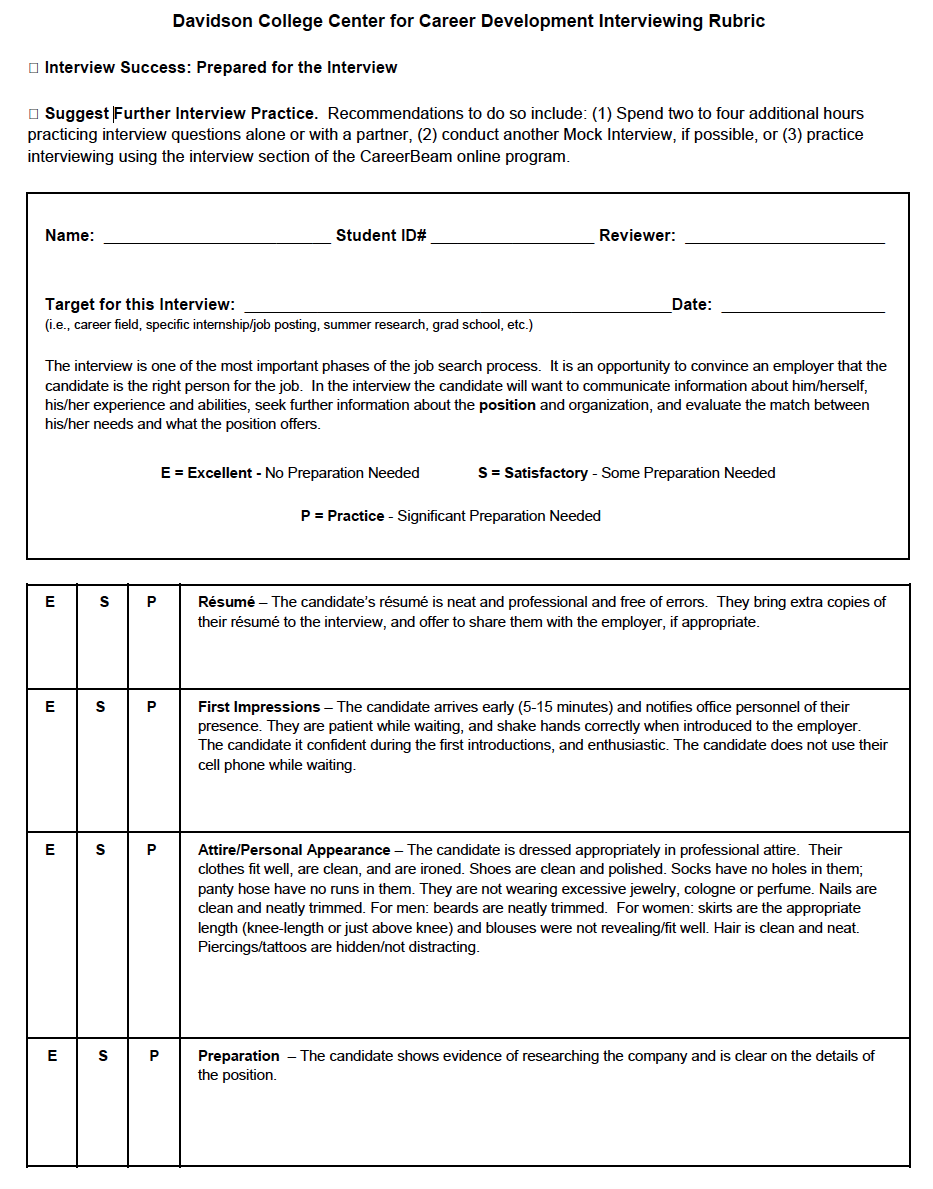
Here is a sampling of the rubrics or evaluation tools that employment screening committees may use to rank (and eliminate) the applicants they interrogate. Sources listed below, these were found online and represent a wide variety of benchmarks.

Here’s your opportunity to practice answering interview questions – alone, with your college roommate, friends, or peers in music education methods classes or the NAfME collegiate chapter.

This blog-post should be used in conjunction with these past articles on tips, criteria, and questions suitable for hosting mock interview practice sessions:

Be sure to record your mock interview and assess your performance using these forms. Alternate the evaluation with different rubrics. Remember: PRACTICE MAKES PERFECT!

Good luck! PKF


#1

mockinterviewpp1mockinterviewpp2


#2

WVU_interview_pp1

WVU_interview_pp2


#3

Workplace Learning Connection


#4

ndsu.png


#5

scranton


#6

Edl.io 2009


#7

Baltimore Public Schools (TNTP) Sample Final Eval Form

#8

Davidson COllege pp1Davidson COllege pp2

Special thanks to the contributions of these institutions:

  1. University of North Carolina Wilmington
  2. West Virginia Department of Education
  3. Kirkwood Community College
  4. North Dakota State University
  5. University of Scranton (National Association of Colleges and Employers)
  6. Edl.io Interview Rubric 2009
  7. Baltimore Public Schools (TNTP)
  8. Davidson School Center for Career Development


Image by Tumisu from Pixabay


© 2019 Paul K. Fox


Ethical Conundrums Revisited – Part II

More About Ethics in Education

“Food for Thought” for Teachers

Resolving Problems in Daily Professional Decision-Making


Business Ethics

For a review of Part I of this article, please visit https://paulkfoxusc.wordpress.com/2018/08/20/ethical-conundrums-revisited-part-i/. The entire blog-series can be read (in reverse chronological order) at https://paulkfoxusc.wordpress.com/category/ethics/.

Regardless of whether you are a first-year teacher, recently hired or transferred, or someone who has many years of experience, we know that little training is provided for handling our daily contradictions or controversies in school ethics. This investigation illustrates several additional obstacles in maintaining appropriate professional and ethical behavior and exploring the application of the moral decision-making “compass” for educators. Here we will rehash more modern-day dilemmas using “mock scenarios” in the workplace, encourage business-woman-2137559_1920_andreas160578you to reflect and respond to “what would you do?” and even re-orient you to the paradoxes in which you may encounter that may not seem to offer an obvious resolution.

It’s time to put on your “thinking caps!” What are your initial impressions of a few of these “conundrums” or conflicts?

MCEETo foster meaningful scrutiny and study of the bulleted issues in bold above, we will sort these problems by Principle III “Responsibility to Students” and Principle IV “Responsibility to the School Community” of the National Association of State Directors of Teacher Education and Certification (NASDTEC) “Model Code of Ethics for Educators” (MCEE):  https://www.nasdtec.net/general/custom.asp?page=MCEE_Doc. In addition, whenever possible, a link to a scenario or case study about the subject will be shared. It is recommended that, in a small group of your peers, you view each video/text resource and assess its ramifications on the ethical appearances (professional image) and actions (intent and interpretation). In my opinion, this is the BEST way to study ethical dilemmas. Here are a few key essential questions to help promote in-depth dialogue:

  1. What possible ethical concerns might this scenario raise?
  2. How could this situation become a violation of state law, the “Code” or school/district policies?
  3. In this situation, what are some potential negative consequences for the teacher, student, parents, school staff, and/or community?
  4. How would this episode affect a teacher’s efficacy in his/her classroom, demean the employing school entity, or damage his/her position as a moral exemplar in the community?


fear-2012536_1920_ElisaRiva


Responsibility to Students

MCEE III A 2, 5, 6

Study scenarios on INAPPROPRIATE RELATIONSHIPS:

CONUNDRUM: Coming home from a successful musical performance, my wife noticed on my tuxedo stains of stage make-up caused by several actors’ “musical hugs.” “Should you let the performers hug you backstage?” she asked, and scolded me to “be more careful!”

“No touch” policies for teachers in schools really do not make a lot of sense. There are many who agree that casual contact like a pat on the back may even be helpful. See:

MY ADVICE: Music teachers “touch” their students all the time; it is part of the natural process of assisting them to hold and play a new instrument. I am not opposed to an occasional celebratory or consoling hug. The factors that may contribute to the moment being judged “okay” vs. “inappropriate” boil down to:hug-1315552_1920_markzfilter

  • Intent
  • Setting
  • Length of time
  • Frequency or patterns of repetition
  • Comfort level of the student
  • Age level of the student
  • Being in public
  • Who started it?

If a child is in distress, pulling him/her aside from the rest of the class and consoling with a light/half/side hug should not be a problem. This issue is one that requires judgement based on common sense – don’t encourage repeated contacts or “get carried away.”

However, young/rookie teachers may be surprised about one violation included in the official definition of “sexual misconduct,” judged as “crossing the boundaries” and inappropriate by most state codes: “exchange of gifts with no educational purpose.” (Reference from the PA Professional Standards and Practices Commission)


bag-1868758_1920_Pexels

MCEE III C 1, 2, 3

Study scenarios on STUDENT PRIVACY RIGHTS:

Legal protections for student confidentiality are mandated by the Family Educational Rights and Privacy Act (FERPA) and other Federal regulations. (See previous blog-post, “Ethics Follow-up” at https://paulkfoxusc.wordpress.com/category/ethics/.) You must remain very discrete about divulging or transferring any “non-directory data” about “your charges.” The operative saying is, “When in doubt, don’t give it out.”

privacy-policy-1624400_1920_succo

REMEMBER – NEVER GOSSIP! Discussing an incident or behavior concern with another teacher in the hallway between classes or sitting down in the teacher’s room is never advisable, and it is probably illegal! Educators must, at all costs, avoid inadvertently disclosing personal information about the lives or actions of our students “in public.” Even carrying on a conversation with a student in an open or common area that could be construed as a “private matter” may be accidentally overheard, and therefore violate a student’s privacy rights.

EXCEPTIONS to third-party disclosure prohibitions (source):

  • Other educators or officials within the same school who have legitimate educational interests in the student.
  • When disclosure of information is necessary to protect the safety and health of the student.
  • Another school to which a student is transferring.
  • In order to comply with a judicial order.
  • Interested parties who are determining a student’s financial aid eligibility.

CONUNDRUM: How do you resolve the apparent contradiction of the recommendation of never holding a meeting alone with a student with the need to provide a safe/secure place to share information?

MY SOLUTION: Confer with your student in a place with sight-lines to the hallway (windows) but sound insulated from hearing the voices inside and/or where there is a high probability of someone interrupting and stopping the conversation.


conference-2110770_1920_geralt

Responsibility to the School Community

MCEE IV A 1, 2

Study scenarios and articles on INTERACTIONS WITH PARENTS AND STAFF:

CONUNDRUM: You receive a call from an angry parent who wants to know why her daughter was not awarded the lead in the school play. The mother wants a detailed assessment of her child’s skills and advice on how to prepare for future auditions.

board-3700116_1920_athree23MY SOLUTION: This is more common than you would like. This episode compels you to figure out how to wear two unique hats simultaneously – the educator and the judge. Assuming you were clear (in writing) on the requirements of the try-outs, even sharing the blank rubric that would be used for the evaluations, you are now charged to find the “best” person for each lead assignment based on a number of criteria:


  • Needed solo character parts in the play
  • Voice part of the candidate
  • Musical skills
  • Dramatic skills, which may be further categorized/ranked by oral/voice technique, projection, character development, understanding of text, and stage presence
  • Dancing/movement skills
  • Type of projection: the potential for acting a comedic vs. romantic role
  • Height (relevant if partnered with another character)
  • Overall preparation

Of course, these expectations and targeted assessments should have been shared with everyone before the auditions were held.

Parents want “what is right” for their kids and for them to feel successful. You as the director want the ideal cast for the show, providing the best chance for the entire company’s success in performance, but must show that the entire process is impartial, consistent, and fair.  As a teacher, it is your responsibility to listen to the students’ and parents’ concerns, but I feel it is not realistic nor appropriate for you to “adjudicate” each actor’s audition. I wrote about this distinction HERE in my last “Fox’s Fireside” blog-post. This is an article you can “pass around” prior to your next tryout.


argument-238529_1920_RyanMcGuire.jpg

MCEE IV B 1, 2, 4, 8

CONUNDRUM: Maintaining professional relationships with your teaching colleagues vs. the mandatory reporting of unethical behavior and inappropriate speech/actions.

A member of the staff is “bad mouthing” you, the principal or other school staff members in public. You are assigned to work side-by-side with him, and yet he does not interact with the staff with civility or respect, nor does he support the academic achievement and related goals that promote the best interests of students.

MY SOLUTION: Thankfully, I have had no personal experience with this scenario, but can recommend that you first try to deal directly with the unethical colleague. According to MCEE, professionals must collaborate and maintain effective and appropriate relationships with the faculty, “resolving conflicts, whenever possible, privately and respectfully and in accordance with district policy.” Before you bring up the matter with your supervisor or building administrator (which you have the right and even responsibility to do, especially if the students hear any improper speech first-hand or that the incidents rise to the level of bullying or aggressive behavior), talk to the unhappy team member one-on-one. Be calm and sensitive, but hold your ground: you must assert that his/her behavior/language is unacceptable and will not be tolerated in the future.

The suggestions of Mind Tool’s article “Five Ways to Deal With Rudeness at the enraged-804311_1920_johnhainWorkplace” are applicable (read their entire blog-post at https://www.mindtools.com/pages/article/five-ways-deal-with-rudeness.htm):

  1. Be a good role model.
  2. Don’t ignore it.
  3. Deal directly with the culprit.
  4. Listen.
  5. Follow-up on any offender.

As for anything that is a violation of the teachers’ code of ethical conduct, you are mandated to report the transgressions of a colleague that threaten the health and safety of the students, especially any observations (or even suspicions) of verbal, physical, or sexual abuse/misconducts.

As for one’s “freedom of expression” to complain about administrators or co-workers, especially in the use of social media, the National Education Association responds:

“Let’s debunk the free speech myth: Many teachers believe they have the absolute First Amendment right to post anything they want on social networking sites, including party pix and diatribes about the boss. After all, they’re on their own time and using their own resources. Sadly, the courts say otherwise.”


music-students-246844_1920_musikschule

As a follow-up, visit additional resources in “Becoming a Music Educator.” Please feel free to leave your comments and links to share other scenarios of ethical “conundrums.”

PKF

© 2018 Paul K. Fox

Photo credits (in order) from Pixabay.com: “meadow” by geralt, “business woman” by andreas160578, “trumpeter” by klimkin, “fear” by ElisaRiva, “fear” by markzfilter , “bag” by Pexels, “privacy policy” by succo, “conference” by geralt, “Board” by athree23, “argument” by RyanMcGuire, “enraged” by johnhain, and “music students” by musikschule.

Auditions, Adjudications, & Screenings

The Tools of Music Selection and Evaluation – An Insider’s Look at Student Placement

foxsfiresides

Do you know the differences among the terms screening, audition and adjudication?

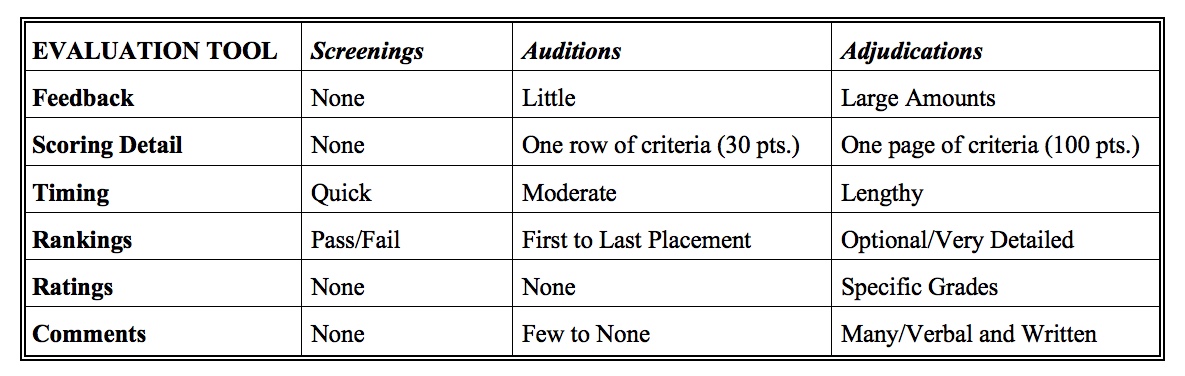
Listed in order of low to high feedback, these evaluation tools furnish staff, students and parents methods for identifying the talent, level of achievement, preparation and potential success for participation in future music and drama productions, festivals or special ensembles, or for rewarding solo parts, seating placement, musical leads, and other student leadership positions.

A screening (sometimes called a pre-audition) is the simplest form of selecting students on a quick “pass” or “fail” basis. One or more judges usually listen for one or two characteristics such as overall preparation or a prerequisite proficiency to determine “thumbs up” or “thumbs down.” In many cases, participants who earn a “passing mark” go on to a more detailed audition to determine ranking for a particular ensemble or part.

pmeaExample of a screening: Pennsylvania Music Educators Association (PMEA) District One regularly sponsors a pre-audition for sopranos and altos auditioning for District SHS Chorus, as well as flute, clarinet and trumpet players for seating in Honors Band and other instrumental festivals.

In some cases, the application form itself is the initial “screening” for a particular event. For example, to participate in a music education association (MEA) like PMEA Junior High Chorus, you must be a 7th through 9th grade student, member in good standing of your school’s choral ensemble, and sponsored by the school music director who is a current MEA member and attending the try-outs. If an applicant does not meet these simple qualifications, then he/she is automatically eliminated from the selection process.

An audition (sometimes called try-out) is the process by which a panel of three or more judges rate a candidate based on a series of specific characteristics or “audition criteria” using a numerical score (usually 1 to 10 or 1 to 5). The sum of these scores from all of the judges reflects an overall ranking, often listed by voice type or instrumental section.

Here are a few local examples of audition criteria:

MEA Ensemble Placement Try-outs: Tone, Rhythm, Intonation, Technique, Musicality and Preparedness

Spring Musical Cast Auditions: Voice (intonation, expression, technique, range), Projection (tone quality, dynamics, overall loudness), Clarity (diction, rhythm, timing, dialect), Movement (blocking, flexibility, grace, coordination), Expression (animation, emotion, presence, characterization), Attitude (stability, reliability, desire, takes direction?)

Frequently very competitive, membership in a particular organization or the assignment of solo parts or leadership positions is usually very limited. Auditions are used to select the “very best” from the pool of contestants—a well-defined “cut-off” is made to fulfill the size of the ensemble/group or availability of solo/lead openings. Every year in most schools, hundreds of students audition for competitive festivals, drama/musical leads, scholarships, or leadership positions—less than 5% earn recognition or “win” a position at the conclusion of these auditions.

hi-res logo 2018

While auditions may select or “deselect” students for an event, they cannot be used as instruments of individual evaluation or “grading.” Judges are not expected to write comments or make “value judgments” about the overall achievement, improvement, strengths or weaknesses of each candidate. There simply is not enough time to provide detailed individual feedback from an audition process or to issue a performance rating (such as “superior,” “excellent” or “good”). Therefore, since an audition is only a “snapshot” ranking of people at a specific moment in time and for a specific goal, no references should be made about an individual’s aptitude for success.

This is where the adjudication comes in. The most costly and time-consuming process of the three evaluations, adjudication provides specific comments, ratings and (in some) rankings for determining the strengths and weaknesses of an individual or ensemble. Judges in an adjudication (called adjudicators) are charged with evaluating each candidate or group with a “page” of musical criteria (not just a row or line of scores), defining the assets and needs of the performer(s) and making specific comments about focus areas and methods for improvement.

The best example of group adjudication is the international music festival enrolled by school performing arts groups during their spring music trips. The bands, choruses, jazz ensembles, and orchestras typically perform in front of three adjudicators who each record personal observations on a digital recorder during the music, write a one-page (or more) report on the positive and negative aspects of the group’s level of achievement (accuracy and mastery of technique, tone—blend and balance, ensemble-playing skills, appropriateness of musical selection and stylistic interpretation, poise, overall appearance, preparation, etc.), score the presentation (usually up to 100 points), and grade each group with “superior” or “excellent” ratings in comparison wusctaglineith all groups at all adjudications. When I was teaching at the Upper St. Clair High School, this adjudication process took more than a day for all of our ensembles to participate—thirty minutes per performance, costing as much as $50/student, and involving more than ten professional adjudicators and fifteen festival staff members for a multitude of adjudication sites.

For detailed individual appraisals, your MEA may offer noncompetitive Solo or Small/Large Group Adjudication Festivals (see your school music teacher for details). In addition, the hiring of a qualified private music instructor to evaluate your son’s or daughter’s abilities is an excellent idea. Pay for a month’s worth of music lessons (for theater students: drama and dance lessons, too.) and ask for an analysis of his/her strengths and weaknesses. A list of several local private voice or instrumental teachers may be available from your school music director.

Selection Tool Grid

In order to build self-motivation, creativity, leadership, self-confidence, teamwork and self-discipline, and to achieve greater skills in problem solving, personal goal setting and stress/time management, music teachers frequently encourage their students to participate in extra-curricular activities. As a further enrichment to the educational program, many musicians, actors, and dancers enroll in screenings, auditions and/or adjudications. However, the competitors in these activities need to develop (and update) realistic self-appraisals and understand the major differences of each evaluative tool. Most of all, we must all learn how to “lose gracefully” and not allow the diminishing of our self-esteem when positive results and recognition are not immediately forthcoming.

Another point: We cannot all be number one! For example, a musical production “team” needs multi-talented members from all skills and ability levels. Some performers need to be in the chorus, others in the dance ensemble for the production numbers, while still  others are suited for solos depending on the roles in the play. We need technical and stage operators (otherwise the curtain will not be raised, and backdrops and props will not appear!) After all, a football team would look silly at a game with only quarterbacks. Experts say explore your hidden talents, don’t be afraid to try new things, set “reasonably attainable goals,” prepare hard and long, and, most of all, persevere!

Parents: Does all of this make it a little easier to understand? When your child tells you he/she is planning to participate in the school play, or sign-up for drum major, captain, section leader, or other leadership position in marching band, please review the selection procedures carefully and these three definitions of student placement tools: screening, audition, and adjudication. Make sure both of you are aware of the audition criteria, what is expected, music or conducting assignments, and to allow for ample time for preparation and practice. I recommend to my students to video-record “mock tryouts” and playback and self-assess their progress. Listen to professional recordings of the selections. When appropriate, memorize your lines/music. Add expressive elements to your performance, such as an extended range of emotion,  phrasing, and dynamics. Repetition counts! Remember: practice does not necessarily make perfect… repeated “perfect practice” makes perfect.

seriestoshare-logo-01

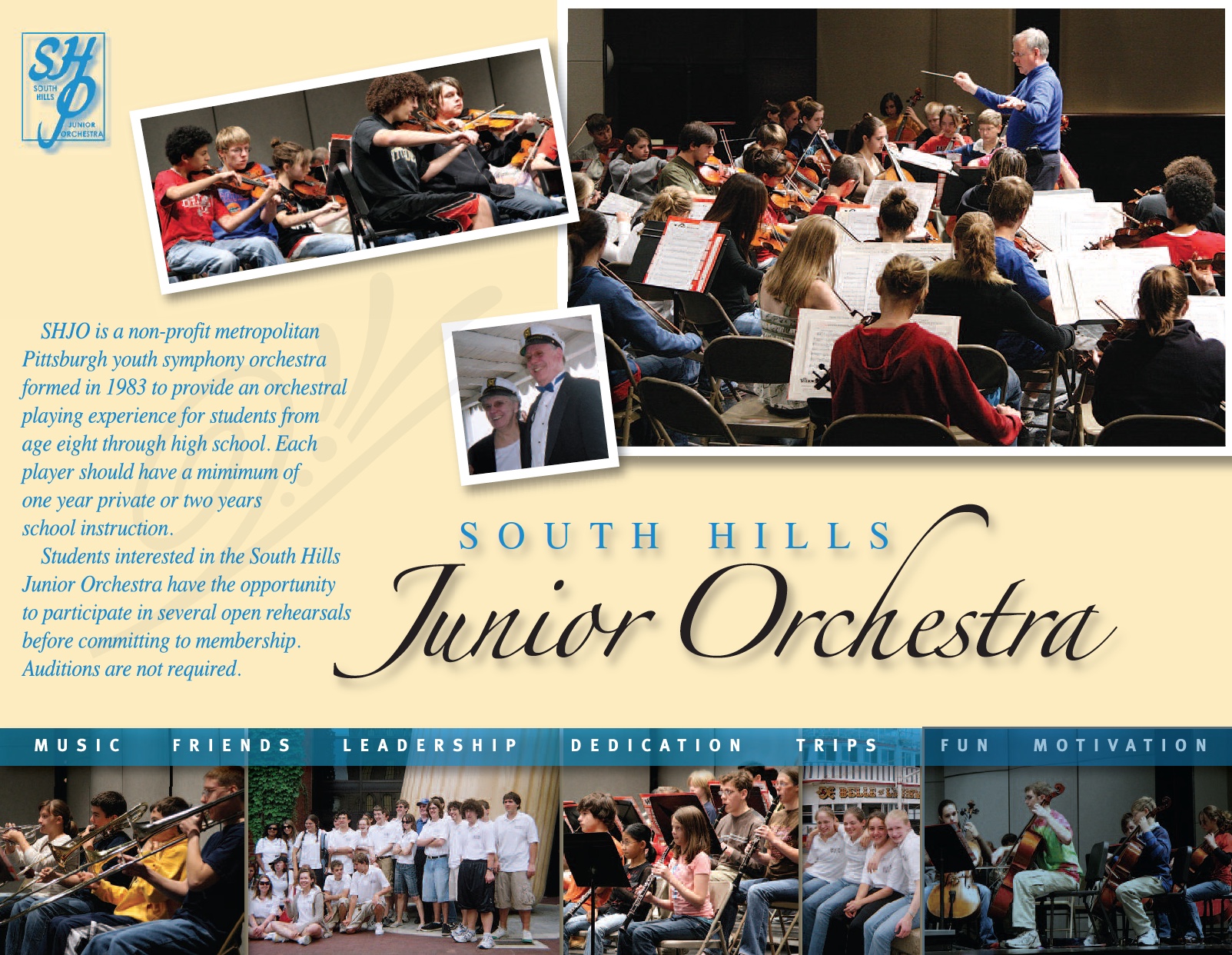
The mission of South Hills Junior Orchestra, which rehearses and performs at the Upper St. Clair High School in Pittsburgh, PA, is to support and nurture local school band and orchestra programs, to develop knowledge, understanding, performance skills, and an appreciation of music, to increase an individual member’s self-esteem and self-motivation, and to continue to advance a life-long study of music. Members of the Orchestra learn, grow, and achieve positions of leadership to serve their fellow members. (For more information about SHJO, please visit www.shjo.org.) This blog-post is free and available to share with other music students, parents, and directors.

Click here for a printable copy.

Other “Fox Firesides” are available at https://paulkfoxusc.wordpress.com/foxs-firesides/.

SHJO recruit

© 2018 Paul K. Fox

Photo credit from Pixabay.com: “Amber” by Pexels