Engaging Retiring/Retired Educators

Ask not what NAfME or your state MEA can do for you, but what YOU, a retiree, can do for your professional association and music education.
An adaptation of the famous excerpt from the 35th U.S. President John F. Kennedy’s inaugural address of January 20, 1961.
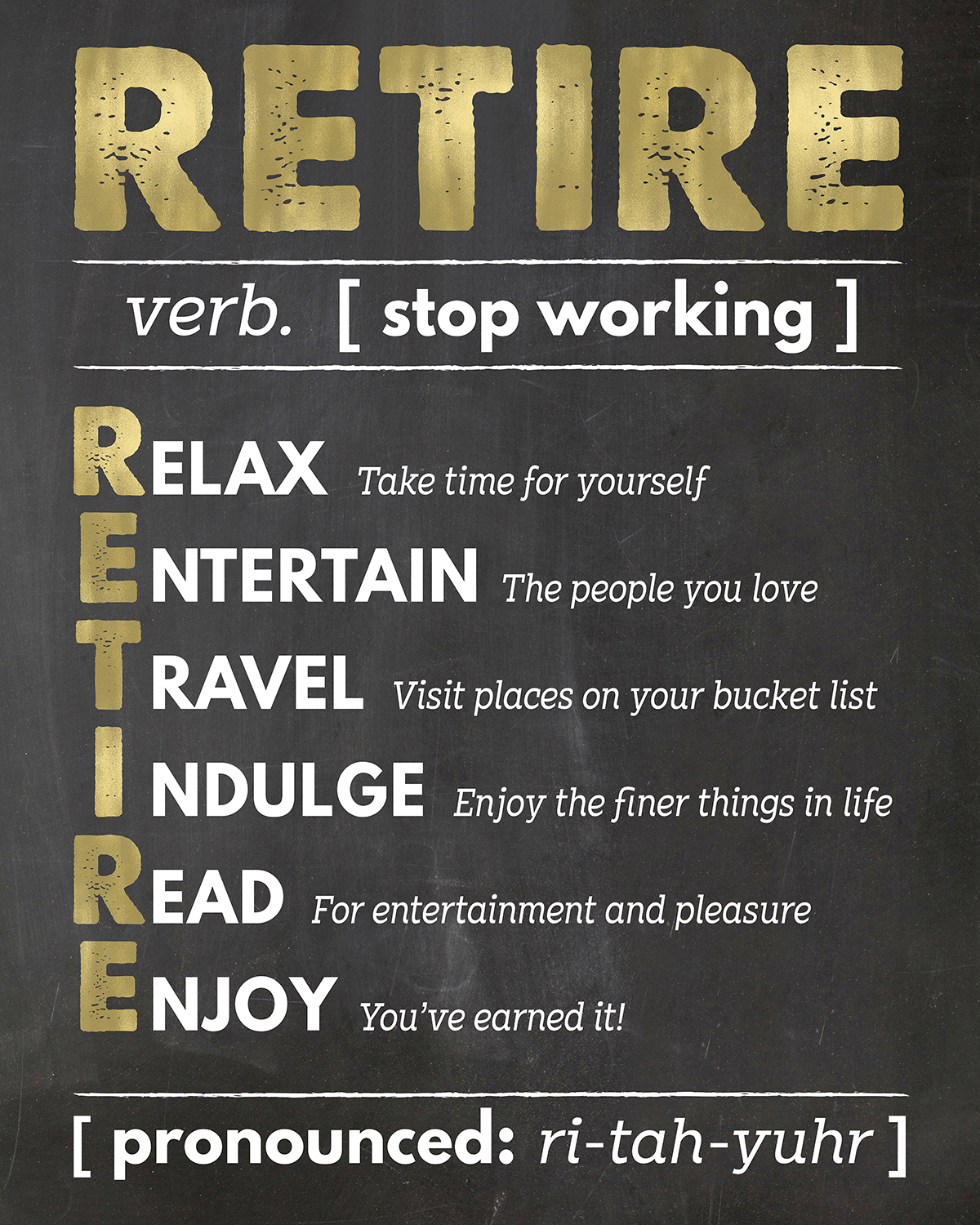
Surfing the ‘Net, I found an appropriate acronym for R.E.T.I.R.E. by Tangled Tulip Designs in pinterestRelax, Entertain, Travel, Indulge, Read and Enjoy! Most retirees would probably agree! The cessation of full-time employment may offer a great release from the day-to-day stress and drudgery of the job and the freedom to venture out, self-reinvent, make future goals, nurture relationships, and explore new personal growth opportunities.

Many attribute embracing a career in music education as “a calling” as opposed to just a form of employment or livelihood. From my experience, I have witnessed that most music educators are passionate for the cause of fostering creative self-expression in their students, more of a 24/7 mission, bringing intense focus and dedication to their lifework.

More to the point: Do we ever truly retire from making music ourselves and fostering this love in others?

THE “WHY!” Retirees matter and are critically needed!

One of my favorite inspirational speakers (Simon Sinek) would say, “start with the WHY!” WHY is this discussion on professional engagement of retired educators so important today?

  1. Their need: An informal poll of my former local educators and administrators revealed that half of them “hate retirement!” According to Dr. Robert P. Delamontagne in his book Retiring Mind (Fairview Imprints), “50% of retirees will suffer some form of acute emotional distress. This is potentially a very large problem given the fact that 10,000 people are becoming eligible for Social Security every day for the next 20 years in the US alone.” Remember this statistic the next time a senior citizen cuts you off on the road or bangs a shopping cart into your leg at the checkout!
  2. Our need: We are facing shortages of qualified teaching candidates across the country with unfilled openings in public school music positions and the critical need of training/mentoring the new hires.
  3. Society’s need: All of our voices should be combined to support the advocacy of music education, actively promoting access to school music by sharing its academic and social benefits with decision-makers, building relationships with administrators and policymakers, and utilizing resources from organizations like NAfME and the NAMM Foundation.

Despite its proven benefits, music education is often the first program to face budget cuts in schools. This is especially concerning in underserved communities, where access to music programs can be life-changing. Now more than ever, we must advocate for music education to ensure that every child has the opportunity to experience its benefits. Investing in music education is an investment in the future of our communities — helping to cultivate the next generation of creative, resilient, and innovative leaders. 
“Why Music Education Matters More Now Than Ever” by Music Will, February 2025

For eleven years (and counting), I serve as the Pennsylvania Music Educators Association (PMEA) Retired Member State Coordinator, as well as the Past State Chair (current member) of the PMEA Council for Teacher Training, Recruitment and Retention. I believe my responsibility to the state association is two-fold:

  • Assist soon-to-retire professionals in achieving a smooth transition to a happy and satisfying retirement; to help them cope with the commonly-experienced emotional ups-and-downs of this life passage, wrestling with the question “what do you want to be or do when you grow up?” and making new life lesson plans and personal goals.
  • Reach out to and build meaningful connections with retirees in order to fully engage them towards becoming active in their professional association; to recount, represent, and revitalize the activities of our post full-time employed music educators.

This article proposes a roadmap of crucial pathways to help music teachers approach “retirement bliss” while tapping into their hard-earned knowledge, strengths, and experiences by cultivating the benefits of their renewed participation in our professional associations.

What can NAfME and State MEAs offer retirees?

You have devoted your entire life to inspiring the development of personal artistry and “ah-ha” musical moments in others. Now it is your turn to reap the benefits (and privileges) of this commitment to the profession. NAfME and your MEAs can provide the resources and motivation of “sharing and caring,” directing retirees “places to go, people to meet, and things to do” for fulfilling that “next chapter” or (perhaps better terms) the “refirement” or “rewirement” of senior living.

Do you feel “needed” and know you “make a difference?” Research has shown that the one of the most important motivators for involvement in a professional association is that its members recognize that they are essential to its success. This quote is from Revitalizing Retirement: Reshaping Your Identity, Relationships, and Purpose by Nancy Schlossberg, attributed to Rosenberg/McCullough:

 “It has been suggested that one problem of retirement is that one no longer matters; others no longer depend on us… The reward of retirement, involving a surcease from labor, can be the punishment of not mattering. Existence loses its point and savor when one no longer makes a difference.”

Most people who are one to five years away from “pulling their pin” and putting in their walking papers “do not know what they do not know.” Experts agree: “Retirement preparation is not only about the money!” Our silver-haired colleagues who have already Crossed the Rubicon and are now “living the dream” in retirement can share their trials, tribulations, and (more importantly) numerous success stories about coping with this transition!
NAfME, PMEA and this paulfox.blog/for-retirees site have archived an exhaustive number of self-help articles. Check out this omnibus NAfME blog “Retirement Prep Top-Ten Treasures.”

The benefits of retired MEA membership are numerous. Besides providing helpful transitioning advice, these advantages also come to mind:

  1. Answers to questions like “What have you always wanted to sing, compose, play, record, conduct, write, publish or present?” and “Where can I share my hard-won expertise and help others in the field?”
  2. Networks and contacts to help you develop “encore careers” in other musical or educational arenas (e.g., higher education, music industry, festival organization, travel/tour planning, composition, guest conducting, private studio teaching, church music, etc.)
  3. Opportunities to “rekindle your expressiveness” by participation in adult community or full/part time performance groups (playing “gigs”)
  4. Places to go/things to see/hear: NAfME/MEA conferences, workshops, and concerts
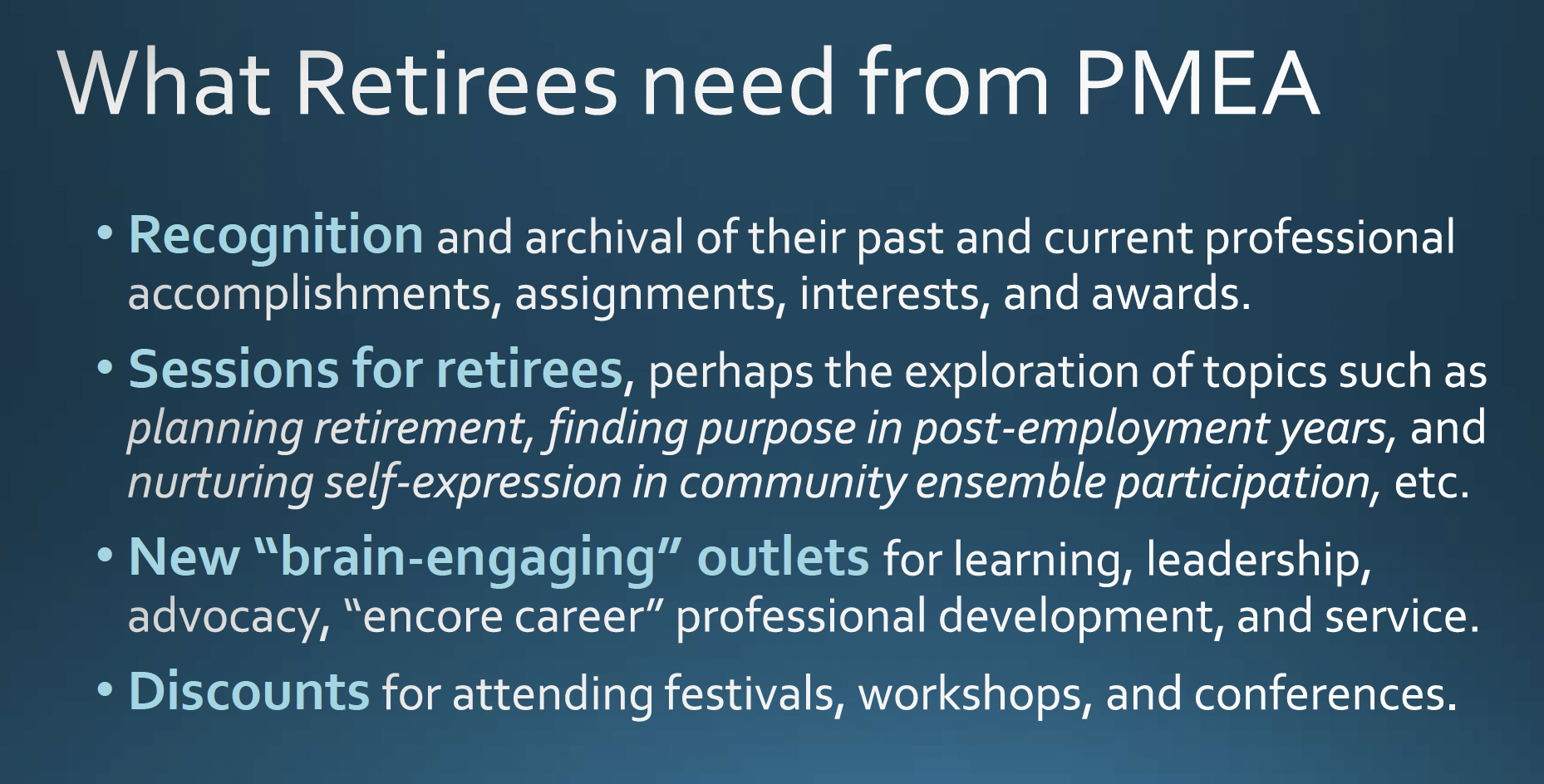
  5. Exclusive discounts and other benefits (reduced dues and registration fees)
What can retirees offer NAfME and their state MEA?

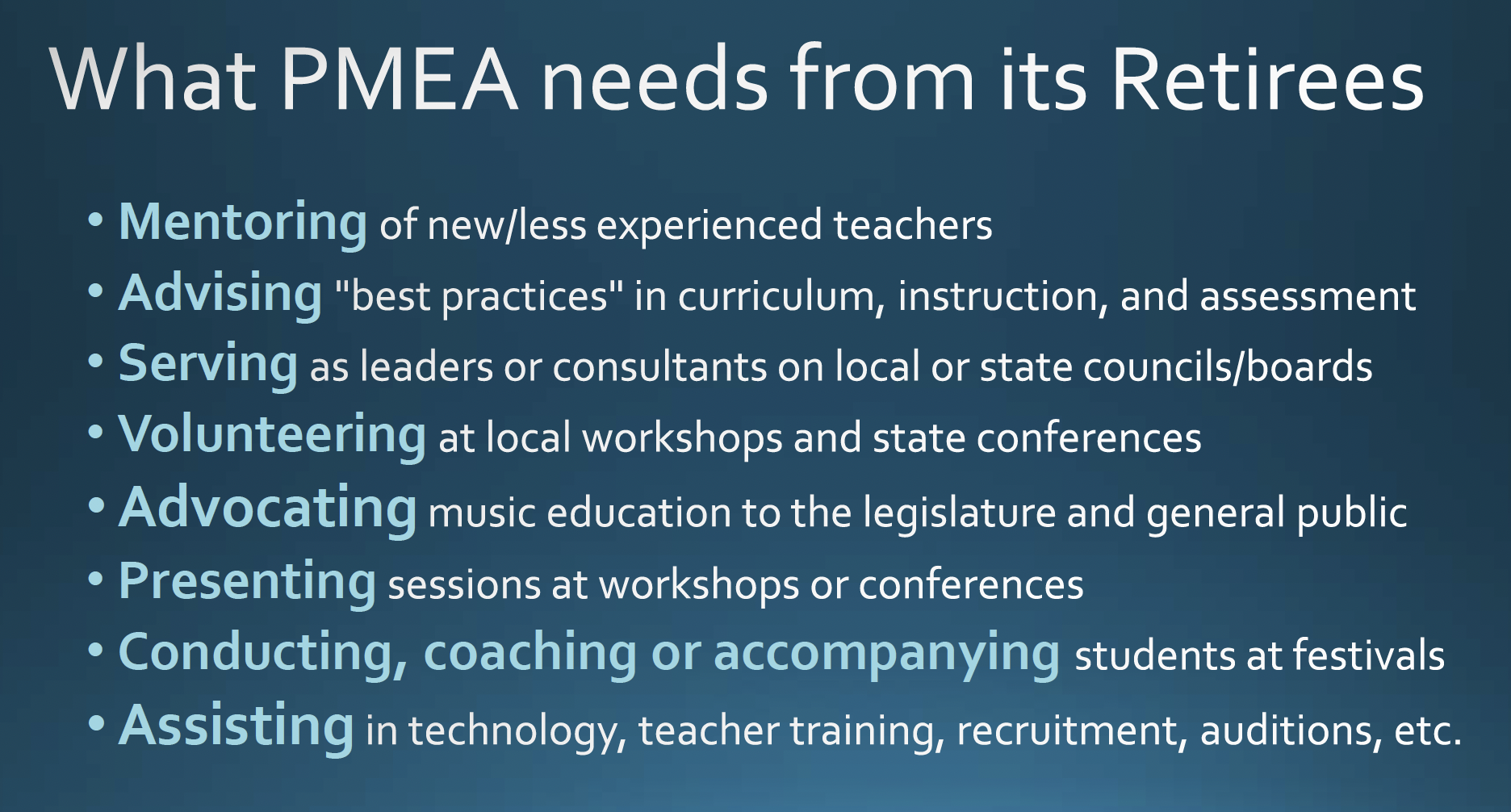
The relationship of active and retired membership in our MEAs is symbiotic. We know from the history of our associations, “giving back to the profession” remains a high priority with most retirees. This may come in many forms and settings:

  • Leadership or membership in local, state, or national MEA/NAfME office, staff, advisor, or council/committee position
  • Advocates for the promotion of music education to local and state government officials
  • Service as presiding chair or member of the conference or workshop planning committee
  • Service as evaluator of performance groups, conference sessions, or articles for publication
  • Judges of local/state MEA adjudication or commercial festival
  • Accompanists, coaches, arrangers, or guest conductors for festivals or school/community groups
  • Services to the local music teacher in private teaching, piano playing, marching band charting, sectional coaching, choreography, music technology, instrumental repair, stage tech, etc.
  • Writers for state MEA and NAfME publications and blog sites
  • Contributors to online music education forums or the NAfME Connections
  • Donors to and/or fund-raisers of music education charitable projects, scholarship initiatives, etc.
The PMEA Model of Retired Member Participation
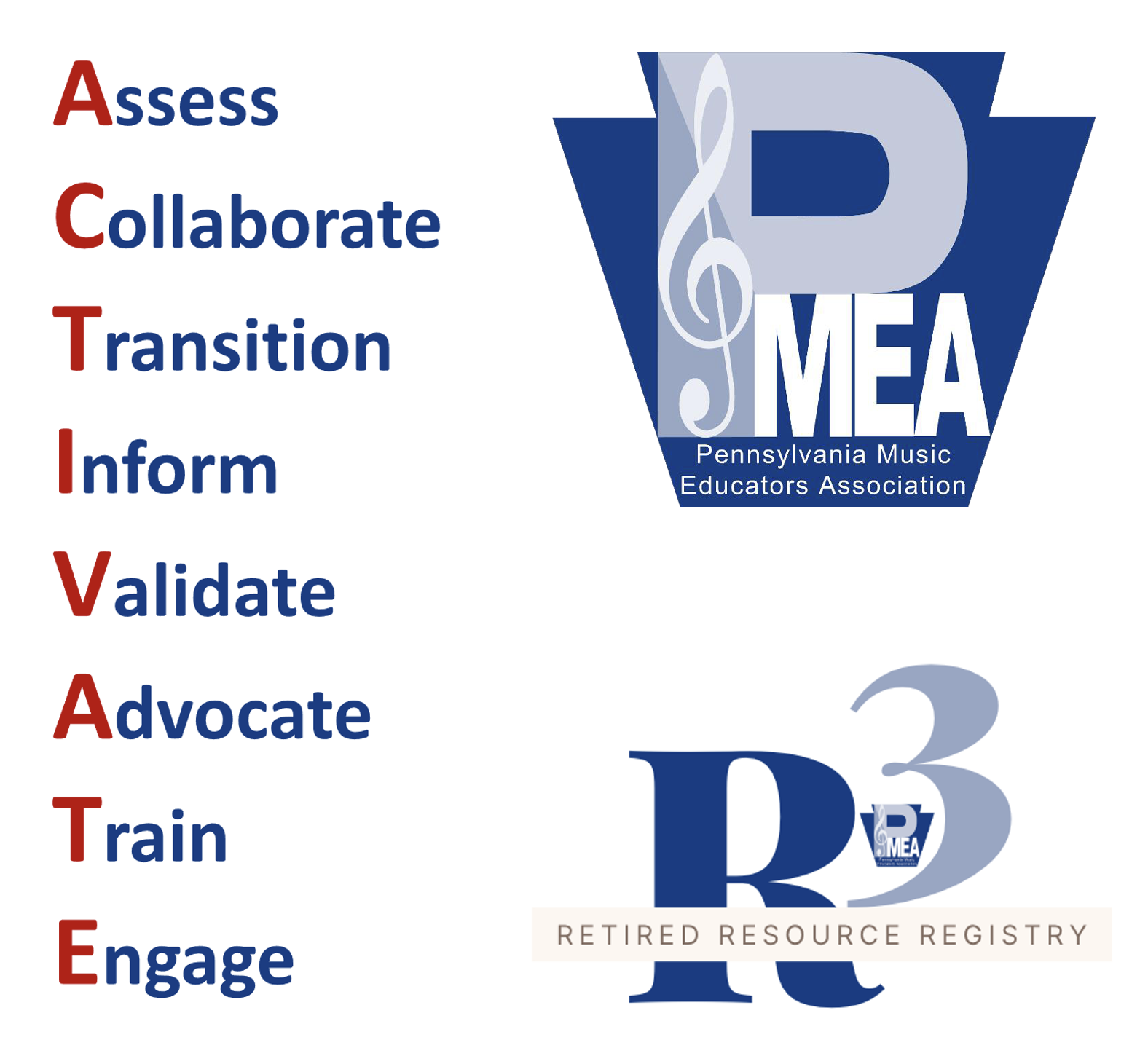
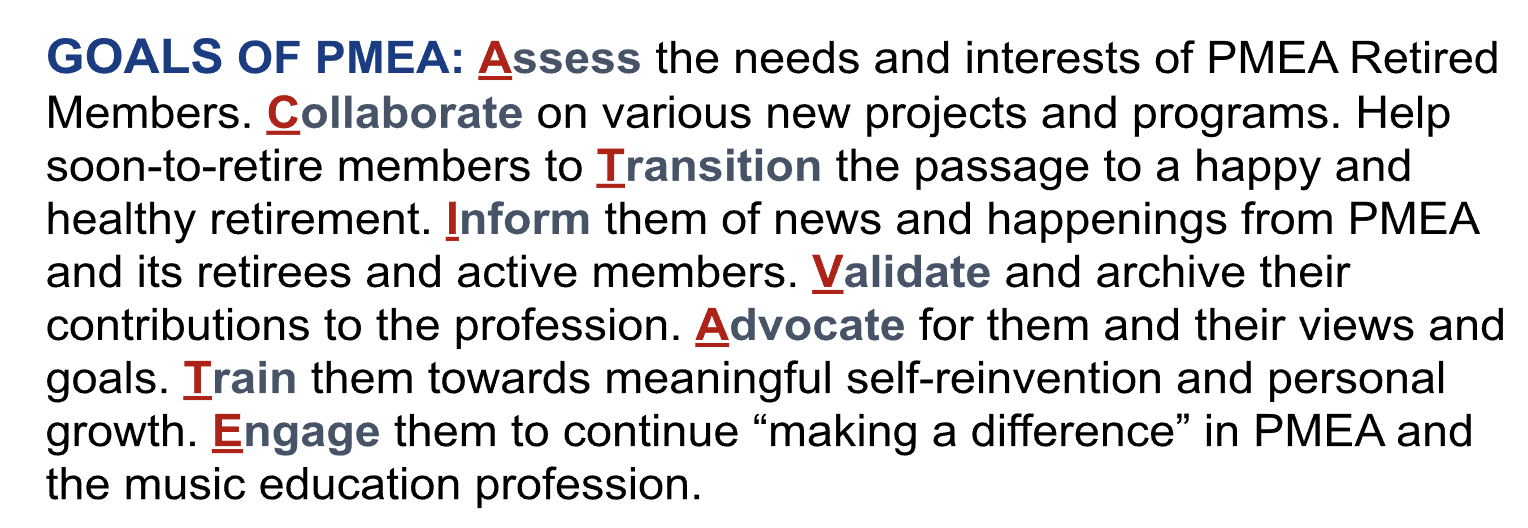
PMEA values the vast wealth of experience and contributions of our retired members. We’re proud of the many programs we offer to retirees and invite you to visit our website to peruse additional information and sample digital newsletters and articles.

Retired members in Pennsylvania are involved in:

  • PMEA elected and appointed offices, staff, committee chairs, and membership on councils
  • PMEA Strategic Plan and Bylaws, Conference Planning, and other state/regional committees
  • Retired Resource Registry* (informal mentoring for new teachers and transfers)
  • How-to-Retire Webinar, Prepping for Retirement, and the Ultimate Retiree Resource Guide
  • Retired Member Breakfast at PMEA Annual Conference
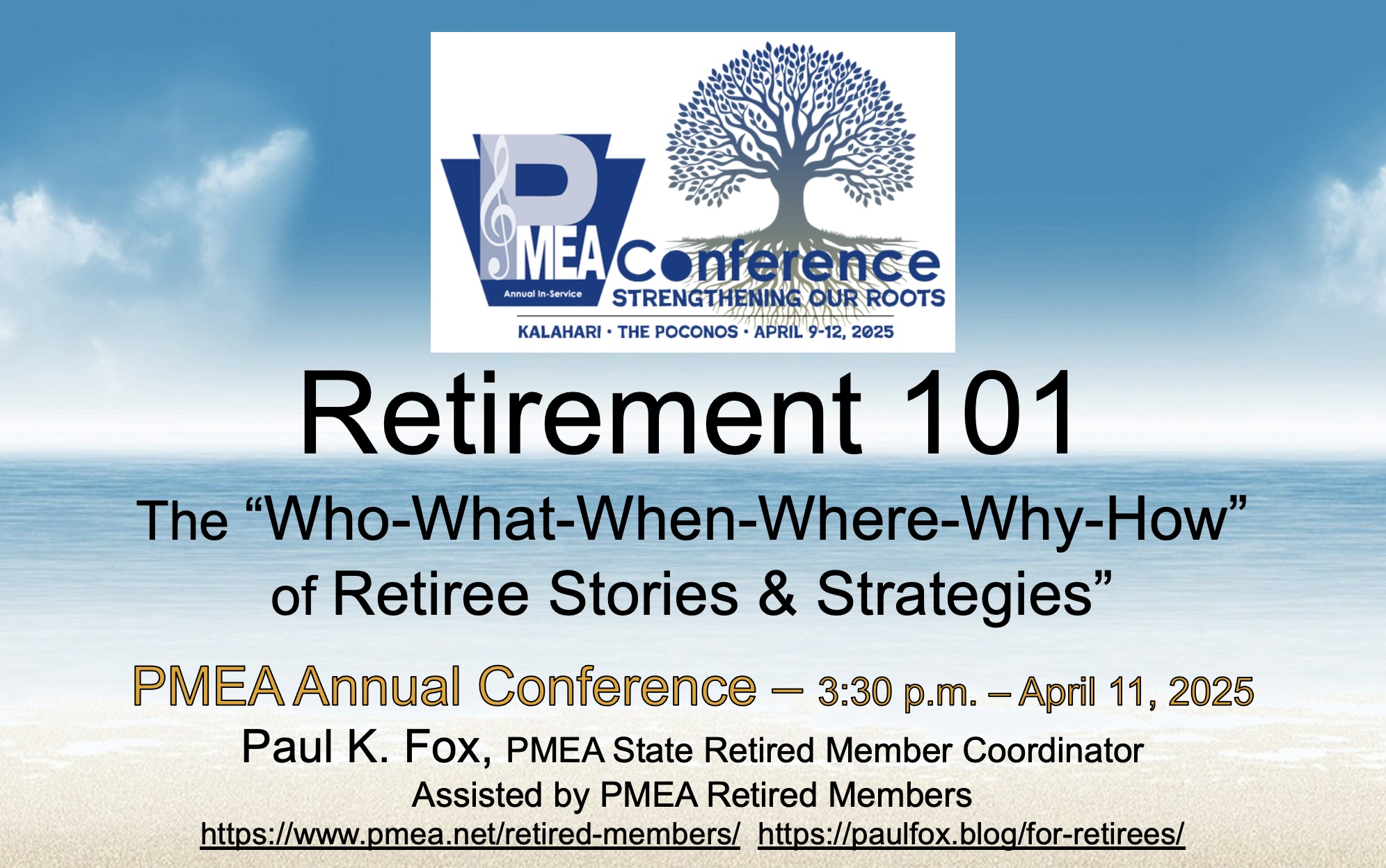
  • Retirement 101 (The Who, What, When, Where, Why, and How) session at PMEA Annual Conference (training for all members retiring or soon-to-retire)
  • Maintenance of PA Community Band, Chorus, Orchestra, and Theater group catalogs
  • Maintenance of PMEA member compositions library
  • Mock Job Interview Committee for music education majors
  • Coffee & Conversations informal “ask an expert” lounge at PMEA Annual Conference
  • Volunteering as presiding chairs for sessions and registration aides at conferences/workshops
  • Pool of conference clinicians, guest lecturers, and members on discussion panels
  • Participation in “Sponsor a Collegiate to Attend the Conference” campaigns
  • All-State Program Patron, or contributor to the annual Irene Christman Scholarship or Margaret Bauer Grant programs.
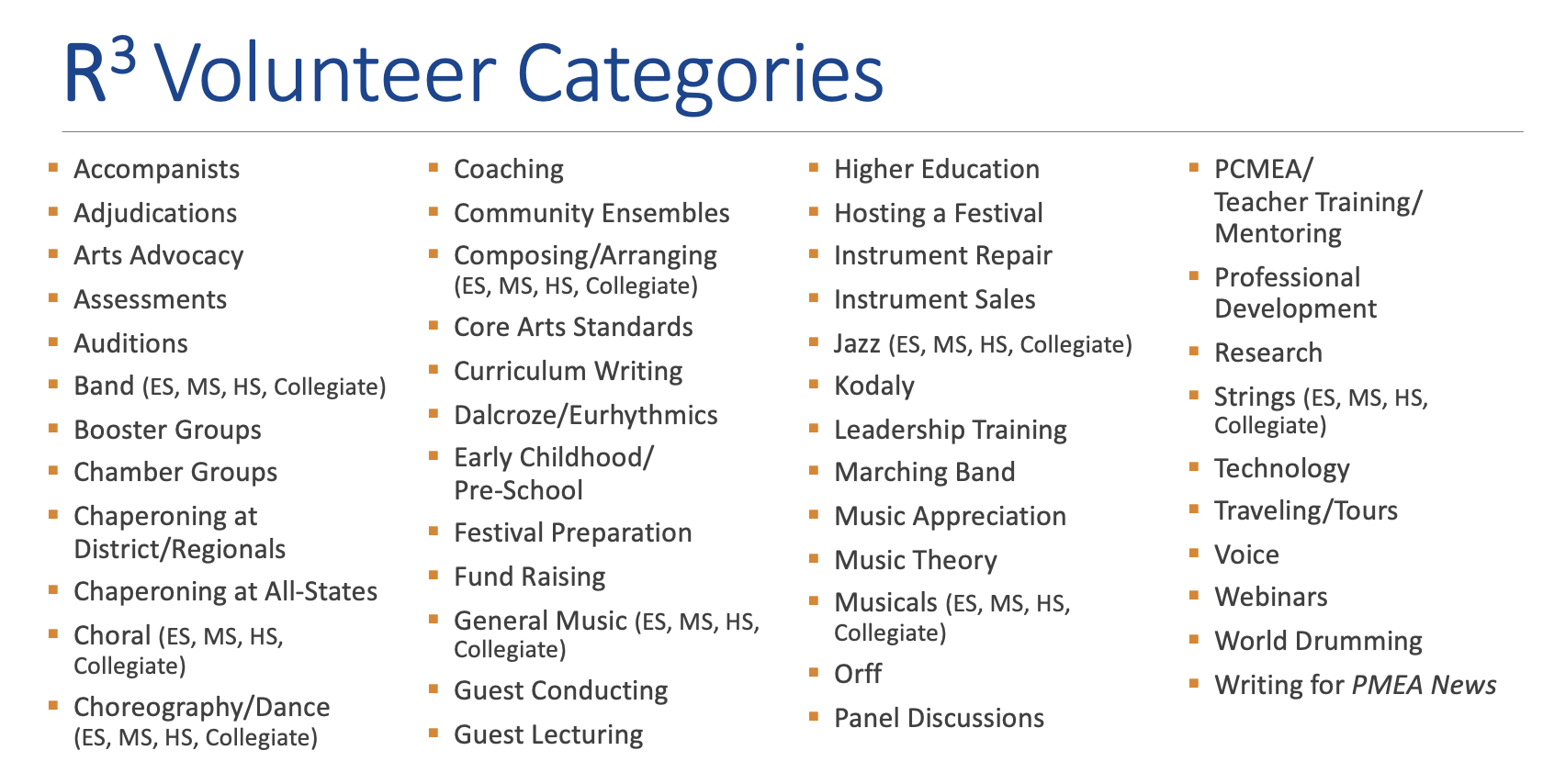
As of October 1, 2025, there are 61 advisors in the PMEA Retired Resource Registry.

*During their annual membership registration, PMEA Retired Members may choose to sign-up for the R3 Retired Member Registry (above volunteer categories) to become available to informally offer advice to college music education majors, new hires, transfers, and newcomers to any music specialty. R3 members may handle inquiries like “What warm-up would you recommend for my middle school choir?” OR “Do you have an idea for an elementary string ensemble concert opener?” OR “How do you teach improvisation… steady beat… breath support?”

The other option with more time commitment is that Retired Members can be officially “trained” as a PMEA Mentor and be assigned to specific individuals who request assistance in their early career assignments.

Coda

How can we help?

What is the future of retired music educator professional engagement? In a word: connections!

Last month, I reached out to Elizabeth Welsh Lasko, NAfME Assistant Executive Director for Membership, Organizational Development, and Marketing Communications and “volunteered” OUR assistance. I suggested that, in keeping with the NAfME 2022 Vision Statement “…an association where all people are heard, seen, and feel they belong throughout their lifelong experiences in music” we should all intentionally recruit more hands-on involvement of our retirees. I pointed out that in the late 1980s, we had a Music Educators National Conference (MENC) Committee for Retired Members led by a National Chairman who served on the NAfME National Assembly. (An excellent booklet, TIPS: Retirement for Music Educators, Copyright © 1989 MENC, was compiled by A. Verne Wilson, then the Past National Chairman of the MENC Committee for Retired Music Educators.)

Ms. Lasko encouraged me to “reach out to retirees” beginning with this article. At the next NAfME Eastern Division Conference, I plan to hold a meeting of retired members, and also connect with all state MEA retired member coordinators (those states who have them). We’re available and on the move! Let’s collaborate and share our resources!
Finally, just for fun, I recently posted the blog “For Book Lovers – Retired or Not” on NAfME Connections (formerly called Amplify). There are already 1,810 members in the NAfME “Retired Members Community.” Please JOIN US! Using this forum, get in touch with me, and respond with YOUR OWN retirement stories, strategies, perspectives on this “life passage,” and more ideas to grow the professional engagement of our music teacher retirees.

Happy trails!

© 2025 Paul K. Fox

February Updates…

PROfessional Development!

Education, ethics, professionalism, and lifelong learning.

Hope you are enjoying the winter season and, for many of you, the anticipation of warmer weather returning soon! Sorry, skiers! I am sick of shoveling snow!!

Here’s a quick “catch-up” on things going on in educator professional development.

For PA School Administrators & Educators

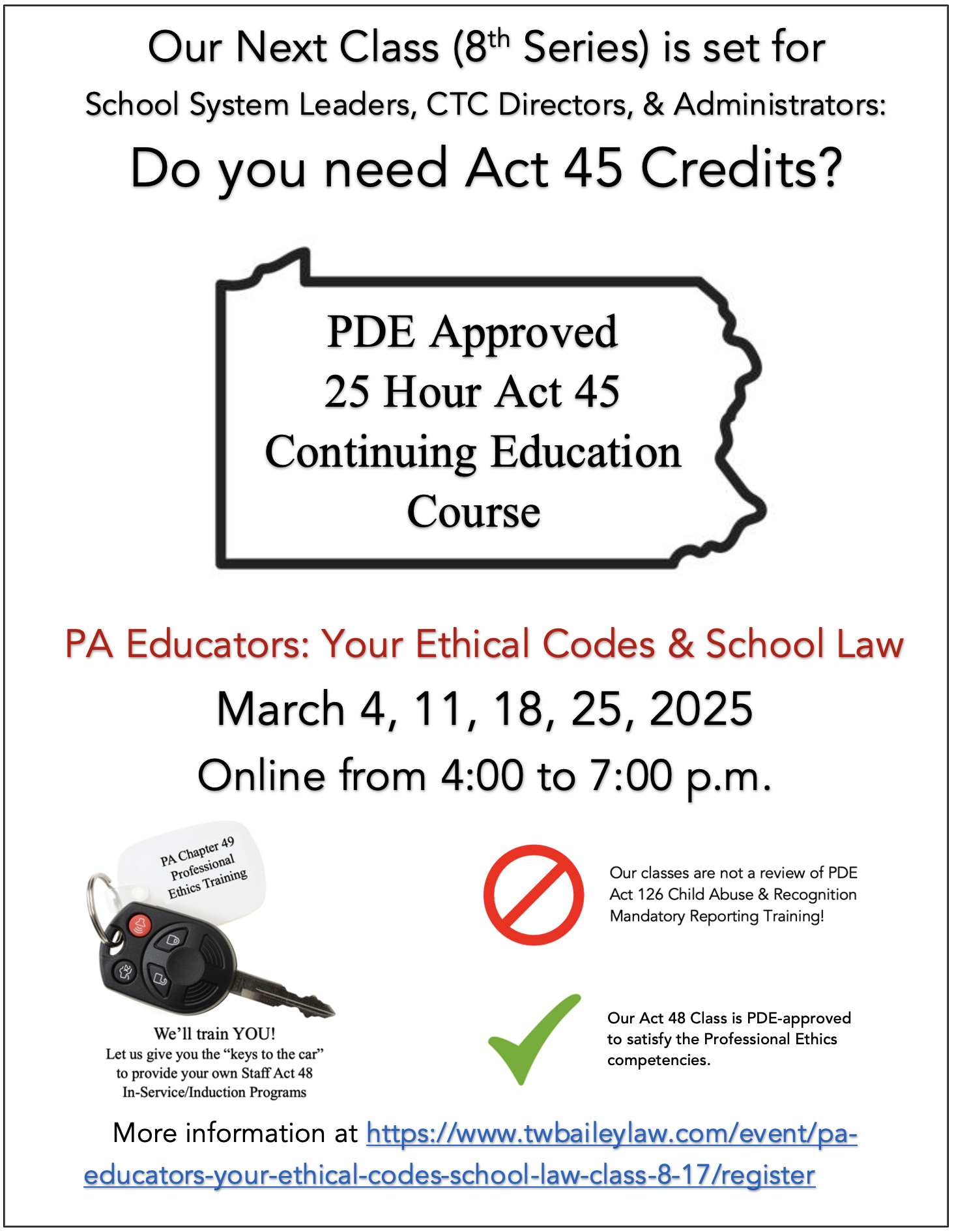
There is still time to register for the upcoming 25-hour, PDE-approved, Act 45 course, “PA Educators: Your Ethical Codes & School Law,” which will cover the recently mandated PA Title 22 Chapter 49 (Certification) Professional Ethics Competencies. The next online series of Act 45 classes will be held Tuesday afternoons in March, and provide “the keys to the car” planning for your own school district’s future continuing education and induction programs in ethics training as required by the PDE.

Now sponsoring our eighth series of classes, I am designated a “qualified instructor” in partnership with the course’s creator/facilitator, retired social studies teacher and attorney Thomas W. Bailey. For more information, please click on these links to his website:

In addition, since over the past year PDE revised their website (and changed most of the content links), I compiled a super-index of “places-to-go” and “things-to-read,” sites of supplemental resources on school ethics here. I recommend visiting this blog if you are interested in our library of links to the Pennsylvania Code of Professional Practice and Conduct, the Model Code of Ethics for Educators, the PA Educators Discipline Act, and research and citations from the PDE, PA Professional Standards and Practices Commission, Connecticut State Department of Education, and Iowa Board of Educational Examiners, among many others.

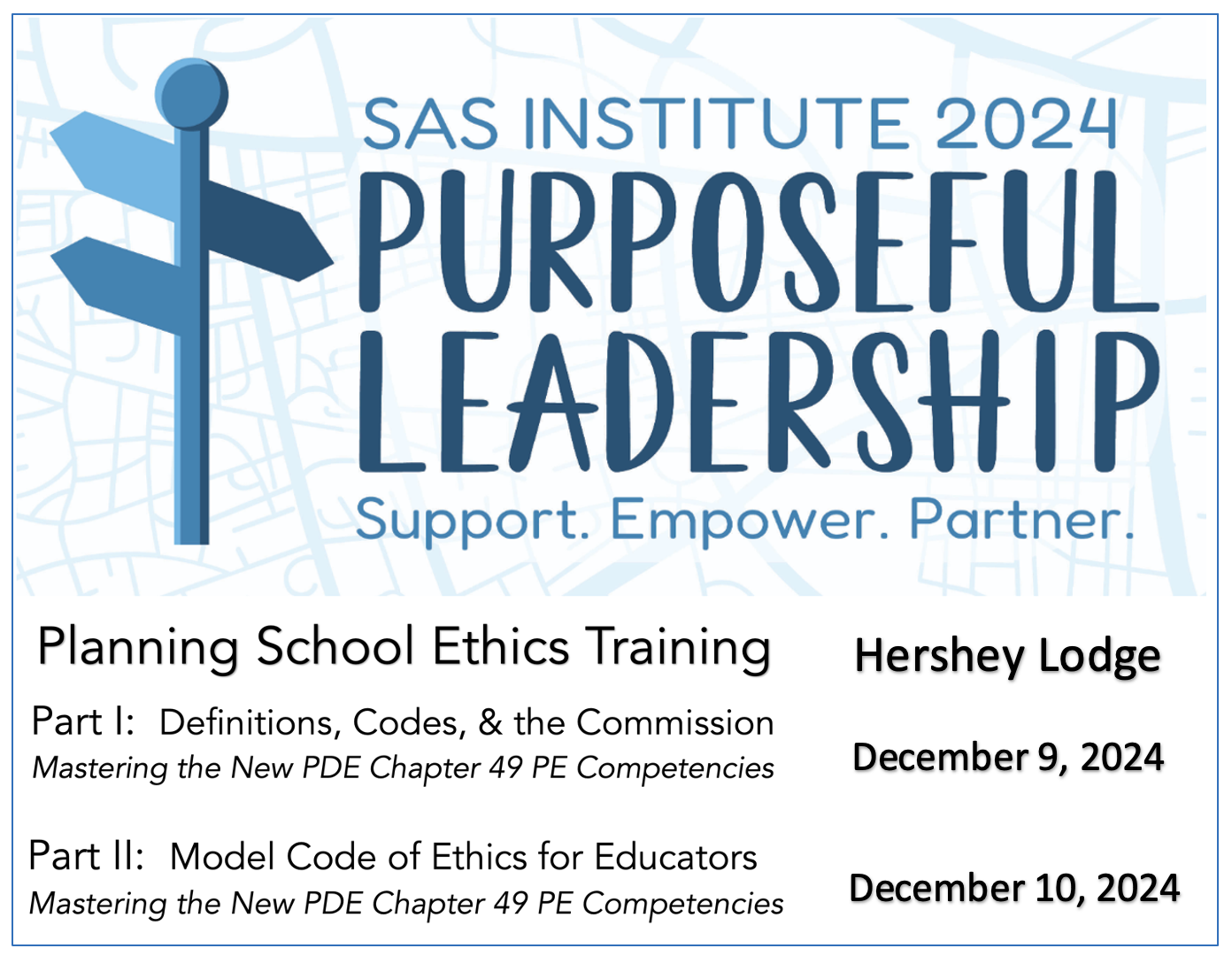
If you would like to see the kind of things we cover in these classes, take a look at the slide summaries I posted from my presentation at the PDE SAS Institute “Purposeful Leadership” state conference last December:

From Pre-Service to Veteran Music Teachers!

It’s that time of the year… again! The PMEA Annual Conference on April 9-12, 2025 will be held in the family-friendly, perfect-for-a-mini-vacation spot in northeastern PA: the Kalahari Resort in the Poconos.

There is still time to register! (Click here.) If you would like to see a summary of the sessions and performances, go to the PMEA website here or download this PDF brochure.

Why attend the conference? In my five-plus decades in education, I may have missed only two or three of the annual PMEA state events, and heartily recommend you remain actively involved in your professional association. This is what I wrote about it in a recent PMEA Retired Member Network eNEWS:

For some of us, it’s a just chance to catch-up with our colleagues, see our friends, and socialize. Others are more focused and take advantage of the near-perfect opportunity to network with other professionals, perhaps seeking new working relationships, partnerships, or even employment. Many are on a look-out for newly published music, that perfect music lesson or teaching strategy, technology tools, fundraisers, advance educational venues, or much-needed equipment to purchase for our ensembles or classrooms. Most come to hear/see the “state of the art” in music education – concerts, demonstrations, keynote speeches, panel discussions, exhibits, research presentations, and workshops. PMEA’s PD Council would likely submit that the primary purpose of a conference is for professional self-improvement… What did Stephen Covey call it? His Habit #7 of “sharpening the saw” – to build a balanced program of self-renewal in the four areas of your life: physical, social/emotional, mental, and spiritual. Covey would insist we embrace “the process that empowers us to move on an upward spiral of growth and change, of continuous improvement.” So, in short, conferences help us “grow” – to revive, re-inspire, re-energize, rejuvenate, re-direct, and re-motivate all of us – pre-service, active in-service, and retired teachers towards making successful new connections, updating our knowledge and skills, and forming new goals. This is how we “keep up” with all the new standards, benchmarks, and cutting-edge advances, and meet the “movers-and-shakers,” visionaries, and leaders in the profession!

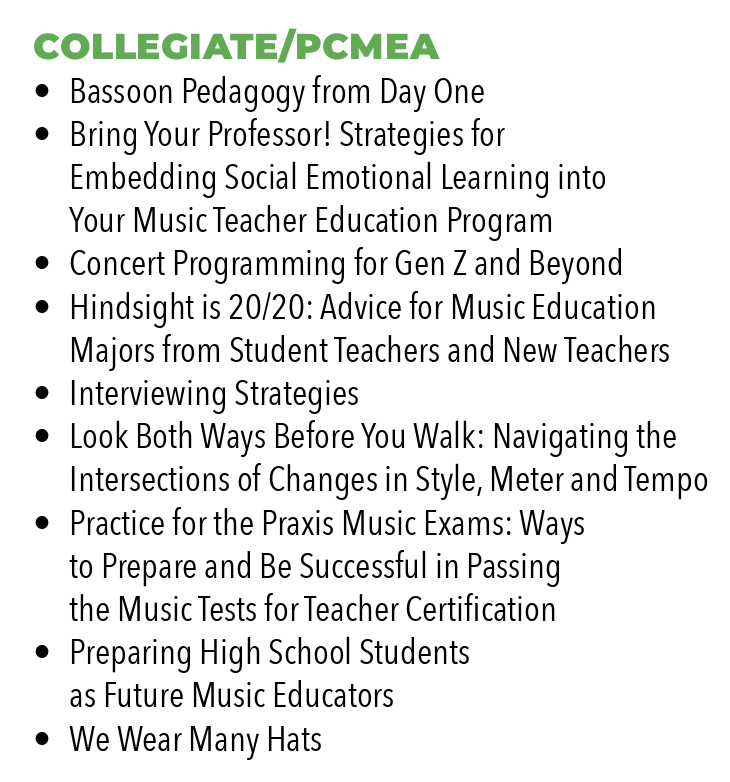
There’s a lot in store for college music education majors. Besides the aforementioned state meetings, concerts, clinics, and keynote addresses no one should miss, the music industry exhibits (new innovations in sheet music, instruments, technology, summer school and graduate programs, etc.), and the chance to introduce yourself to other music colleagues (aren’t some of you looking for a job soon?), there will be a “coffee and connections” informal lounge to ASK-AN-EXPERT on Thursday afternoon to pick-the-brains of PMEA mentors and retirees on any subject. Do you have a question about conducting technique, musical literature, lesson plan idea, classroom or time management tip, or teaching method? And, just take look these sessions the PMEA Professional Development Council has targeted specifically for YOU:

For Retirees… They are special, too!

PMEA Retired Members, consider this your personal invitation to join us at the Kalahari Resort in the Poconos for the chance to catch-up, connect, collaborate and communicate with other colleagues throughout the Commonwealth! (a plethora of “C’s!”)

As usual, we will “break bread” together Friday morning (April 11, 2025) with the annual retiree breakfast. Be sure to register soon for the PMEA Annual Conference (now only $25) and check the “yes” box that you will attend our meeting. Those in attendance will be treated to some “conference swag!”

Retirees are a valuable resource to PMEA! Our experienced retired members are among the best-trained (unofficial) mentors in PMEA. Facing many years of “boots on the ground,” we have at our fingertips numerous strategies to solve problems in education. Frankly, in my opinion, we have a lot to offer “the future of the profession!”

If you are a retired PA music educator, hopefully you have maintained your PMEA membership (dues significantly discounted), and have signed up for the Retired Member Resource Registry to help future “rookie” music educators. (To reach the R3, first login to your PMEA portal here.)

On Friday, April 11, at 3:30 p.m., we are offering a special sharing session for soon-to-retire teachers… the annual one-hour Retirement 101 workshop joined by a panel of experienced retirees: Rick Coulter, Jeffrey Dent, Sister Kathleen Doutt, Dan Klingbeil, Chuck Neidhardt, and Louise & Richard Victor. Active educators who plan to retire over the 1-5 years can learn valuable techniques from us for a smooth transition to post-full-time employment and successfully reinvent, reprogram, and “recharge” themselves to modifying those essential elements of purpose, structure, and community throughout their “golden years!”

My Professional Advertisement

You may have noticed in my last blog-post an outline of past article topics archived at this site, and a complaint that I feel I must repeat myself (or repackage the material) to meet the changing personalized “bookends” – life cycles – specific passages of my readers. The earlier February post was mostly for job seekers. If you were not looking for employment or coming fresh out of college, it may have seemed irrelevant. The same goes for specialty articles on self-care, ethics training, or retirement transitioning… WHEN WOULD YOU BE MOTIVATED TO STUDY THESE?

I have decided to maintain a comprehensive index of my writings (see “Inside” link in the top menu bar). Please visit the sections of this blog-site that matter to you most… and, when things change, come back and look again. You may find something that “hits the spot” or satisfies the needs of your new journey in education or personal/professional life.

I remain willing and able (aka “very interested”) in doing in-person or online sessions for college methods classes, PCMEA chapter meetings, PMEA festival directors’ meetings, PMEA District or Regional PD workshops, or school district/department inservices. Just give me a call. My contact information can be found in the top “About” link. Please visit this section for catalogs of my presentations and articles. FYI, I created this trifold of some of my past work.

Best wishes on your future successes in career development and professional goal setting.

PKF

© 2025 Paul K. Fox

RECAP – Retirement Resources

A Treasure Chest of Tips for Living the Dream!

Are you retiring soon? Thinking about “taking the plunge” and “Crossing the Rubicon” into your “second beginnings” or “next chapter” of senior life?

No matter how busy you are now, you need to “take five” from your work or personal to-do’s and review the following recommendations from past blog posts at this site. Consider this a personal toolbox for the retired and soon-to-retire professional… and assigned HOMEWORK!

A good starting point would be to pick-up “The Myths of Retirement” and “Three Exit Lanes to Self-Help Retirement Guides,” or if you prefer to tackle everything at once, check out the omnibus “monster” resource guide posted here.

Now the top-ten list – a well-balanced collection of online essays. The more you read, the better you will be able to embrace a healthy transition through this major life passage!

1. Plan ahead for retirement: “It’s Not Only About the Money”

Read the entire article here.

It is agreed that a period of adjustment will occur during the first years of “interning” as a retiree, especially critical during the “pre-retirement” stage (believe-it-or-not, as many as six to ten years prior to “taking the big leap” to FREEDOM!). The solution to a smooth transition is to be prepared: communicate your intentions with your family members, and reflect on the vast considerations of the “who, what, when, where, how, and why” of retirement. This prep to your “golden years” is the perfect time for a little self-assessment and self-reinvention in finding new purpose, meaning, and fulfillment in your life.

2. Identify and take steps to alleviate the stress of leaving your job:
“The Good, The Bad, and The Ugly”

Read the entire article here.

The phases of retirement are discussed in greater depth here, as well as different departure scenarios and the usual post-employment “cycles of emotions.” This piece is particularly good if you have ever felt pushed into early retirement or experienced being unappreciated, disrespected, uninspired, unsupported, or “burned out” in your career.

3. Are you really ready? “Signs it is time to retire… OR “Signs is NOT okay.”

Read the entire article here.

This “countdown to retirement” article poses the essential question “Are you psychologically (or emotionally) prepared to retire?” and offers a “road map” of seven easy steps towards closure for prospective music teacher retirees.

For more insight, you should also peruse “When Should You Retire.”

4. Determine your retirement destination:
“Do you know where you’re going to…?”

Read the entire article here.

This early blog post proposed several factors to consider for the choice of where you want to live in retirement… both geography and floor plans. Another good source to read on this topic is the book that was published two years later by the retirement guru and former PMEA session presenter Dave Hughes: The Quest for Retirement Utopia – How to Find the Retirement Spot That’s Right for You.

5. Maintain your professional associations:
“Ask not what PMEA can do for you, but what you can do for PMEA!”

Read several articles:

A retired educator is a valuable resource. If you care about the profession, there are many ways you can continue to contribute your experience and wisdom, albeit less stressful and time-consuming moments, but still assist your colleagues who continue to “fight the good fight” in the field.

6. Acquire a more carefree attitude: “It’s Not Your Sandbox”

Read the entire article here.

It may be at times a challenge to surrender your urge to continue as “an agent of change” or, as E.A. Wynne has written in “The Moral Dimension of Teaching” (Teaching: Theory into Practice, 1995), habits of “moral professionalism.” Learn how chill out and NOT to stress out over someone else’s supposedly poorly run “sandbox” and limit the need to provide unsolicited advice or major problem-solving for other organizations. 

7. Make music: “Dust off your chops” and 8. “Sing your heart out…”

Read the both articles here and here.

What led you to select a career in (and the “calling” of) music education? Retirement is the perfect place and time to expand on your love and skills in creative self-expression. When a music educator retires, among the many joys and fruits of his/her career in the arts is a sudden life-style change – the glorious transformation of being set free from those things you no longer want nor need to do (routine day-to-day drudgery, paperwork, meetings, etc.), embarking on new journeys to explore and embrace revised personal goals – hopefully including a renewed refocus on making your own music!

9. Explore mind-stimulating engagements: “Have you fed your brain today?”

Read the entire article here.

The mind is a terrible thing to waste, even during retirement. Discover something new every day! Maximize your “brain health” with a host of these ideas to consider for your bucket list.

10. Take time to “give back” and volunteer:
“What does it mean to be eleemosynary?”

Read both of these articles here and here.

In the scheduling our free time in retirement, it is important to feel “needed” and find activities that foster “mattering” to promote a positive self-esteem, good mental health, and stable life balance. Are you making choices to contribute to the musical and personal success and welfare of others? For the realization of the mission of this blogger’s retirement pastime: “I refuse to sit idle, binge-watch movies on Netflix, or view hours of boring TV.” To quote the song’s lyrics, this “senior citizen” will never lament…

Life is so unnerving
For a servant who’s not serving
He’s not whole without a soul to wait upon
Ah, those good old days when we were useful
Suddenly those good old days are gone
Ten days we’ve been rusting
Needing so much more than dusting
Needing exercise, a chance to use our skills
Most days we just lay around the castle
Flabby, fat, and lazy
You walked in and oops-a-daisy!

– “Be Our Guest” from Beauty and the Beast

Stay Connected with PA Music Education

PMEA Annual Conference April 6-9, 2022 at the Kalahari Resort (Poconos)

PMEA retired members, please take note of these special events especially geared to YOU:

  • Free Retired Member Breakfast Meeting (including take-away gifts) on April 8 at 8 a.m.
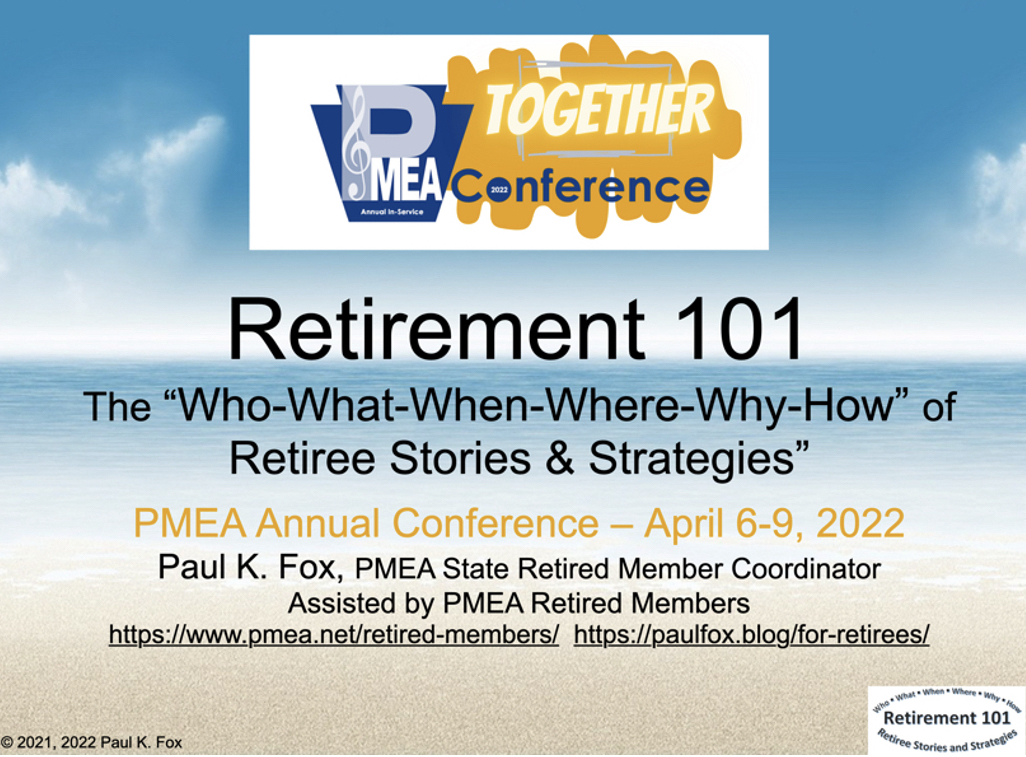
  • Retirement 101 session on April 8 at 11:30 a.m. – Retired music teachers are encouraged to participate on the guest panel to “tell your own story” to help any interested soon-to-retire colleagues.
  • Three keynote speakers will join this year’s event: Dr. Tim Lautzenheiser, Lesley Moffat, and David Wish.
  • The U.S. Army Band “Pershing’s Own” will be featured on Thursday evening (April 7).
  • See last month’s blog for more details on the conference, tentative session schedule and exhibitors, AND the PMEA website.

PKF

© 2022 Paul K. Fox

Graphics from Pixabay.com:

Retiree Concepts

Random Terms Re: Retirement Transitioning

dictionary-1619740_1920_stevepbThe “new” definition of retirement includes a unique collection of synonyms. Gone are the designations “seclusion,” “privacy,” “withdrawal,” “retreating” and “disappearing” based on archaic models of retiring when the average life expectancy at birth in the 1800s was 38 and in the 1900s was 47. (Merriam-Webster and others still show these words on their online dictionaries!) Now, some of the more creative descriptors for retirement are “renewment,” “rewirement,” “rest-of-life,” “second beginnings,” and “reinvention.” (Also see http://www.cbsnews.com/news/how-do-you-define-retirement/.)
In addition to these, there are a few nontraditional terms that may come up during the passage from full-time employment to “living the dream” (hopefully) in retirement. These will not show up in a typical book for retirees… but, understanding them can “make a difference” through this roller-coaster ride of coping with life-style changes/altered expectations, and finding creative new ways to self-reinvent and thrive.


volunteer-1326758_1280-1_maialisa

Marginality and Mattering

Do you feel “needed” and “making a difference” to others? The definition of “mattering” is “the belief that we matter to someone else.” This is an essential part of what author Ernie Zelinski of the best-seller Retire Happy, Wild, and Free emphasizes the importance of “finding purpose, structure, and community in retirement.”

“It has been suggested that one problem of retirement is that one no longer matters; others no longer depend on us… The reward of retirement, involving a surcease from labor, can be the punishment of not mattering. Existence loses its point and savor when one no longer makes a difference.”   – Rosenberg and McCullough Quoted in Revitalizing Retirement: Reshaping Your Identity, Relationships, and Purpose by Nancy Schlossberg (APA, 2017)

According to counseling psychologist Nancy Schlossberg, Rosenberg’s concept of “mattering” is “a universal, lifelong issue that connects us all.”  Her four dimensions of mattering are:

  • Attention – the feeling that a person has the interest of another;
  • Importance – the feeling that others care about what you want, think, and do;
  • Ego-Extension – the feeling that others will be proud of your successes and/or saddened by your failures;
  • Dependence – the feeling that a person can depend on someone else.

Although initially attributed to collegiate retention, persistence and “getting students connected” (https://sites.google.com/site/uscedco030/Home/theorist-pages/marginality-mattering-and-validation-theory-nancy-schlossberg-laura-rendon/schlossberg), Schlossberg defines “maginality” as “a sense of not fitting in” and which “can lead to self consciousness, irritability and depression. For some, these feelings can be permanent conditions.” Furthermore, “feelings of marginality often occur when individuals take on new roles, especially when they are uncertain about what a new role entails.”

Just like the sometimes tumultuous passage to and emotional ups-and-downs during your “life after the work?”


stress-2902537_1920_thedigitalartist

PTSD

What does “post-traumatic stress disorder” have to do with leaving your job? Hopefully it does not apply to you, but…

If are among the surprisingly large number of music teachers who lost their job “involuntarily,” you may be undergoing the same “stages of grief and loss” often shared during the breakup of a marriage or the dealth of a loved one:

  • Denial (disbelief, numbness, shock)
  • Bargaining (preoccupation with “what could have been,” guilt, remorse)
  • Depression (sadness, loneliness, emptiness, isolation, self-pity)
  • Anger (feelings of helplessness, abandonment)
  • Acceptance (emotional resolution, healing)

checkmate-1511866_1920_stevepbFeeling you were “kicked to the curb,” “downsized,” “minimized,” or somehow “forced” to resign or retire comes from many scenarios:

  • Music or staff are eliminated from the curriculum or building in which you teach.
  • You feel you must retire early before the end of the contract to avoid losing existing medical or other contractual benefits.
  • While voluntarily retiring from the full-time “day” job, you hope to continue serving in the capacity as assistant director (marching band, musical, etc.), but are not re-assigned or asked to return.
  • The new head coach of the sport in which you have assisted for many years fires you to bring in his “cronies.”
  • The perception that the program to which you have devoted your whole career is being dissembled or de-emphasized for the next “flavor-of-the-year.”

Most mental health experts agree, you cannot self-diagnose PTSD. However, the “warning signs” are probably evident. If you are having trouble sleeping, difficulty with relationships, or find yourself feeling significantly depressed or lethargic, visit your health care professional.


head-1345060_1920_johnhain

Losing old habits…

“Surrendering your urge to be an agent of change!”

The next retiree concept is more of a habit or tendency, something that those of us who retired from education may find it a little hard to stop doing at first. Among the core values of “moral professionalism,” we consistently seek ways to reform “the system,” much like efficiency experts. In other words, “break it if it needs fixed,” or seek new practices or approaches to solve problems. This means we seldom accept the status quo or “that’s the way it’s always have been done.”

I found that in my volunteer work, when I come up to a challenge like a policy that isn’t working, I look for better ways of doing it. Teachers always self-assess and seek changes for “the good of the order,” but these “systems” are not our classrooms. Educators were expected to “monitor and adjust,” modify our lesson targets, rip down old bulletin boards and put up new with more exciting media, re-write curriculum, etc. – always with the mission to “build a better mouse trap” for more efficient delivery of instruction to all.

comic-characters-2026313_1280_OpenClipart-VectorsIn retirement, this can be frustrating. You can’t tell somebody else how to run their operation. Some people do not want to hear criticism, nor do they care what your opinion is, nor do they want to change their traditions or fine-tuned (?) step-by-step procedures. You on the other hand want things to improve, e.g. better training, more consistent application of the rules, etc., and therefore you feel “unrequited stress.”

Throughout my whole “professional life,” I never looked the other way. I try to fix things. But that’s not everybody’s inclination, and the world is not going to come to end if someone doesn’t take your advice. As retirees, remove the unnecessary hassle. You have two choices. Resign from the activity, or step back from being its self-appointed critic, accept the situation, and let everyone go back to playing their own way in their “sandbox.”


grandfather-2043611_1920_kko699

Caregivers anchor

Many retirees choose to be part- or full-time caregivers, perhaps babysitting or serving as the custodian of a senior family member.

If you are fortunate enough to have grandchildren (your own or adopted ones), enjoy them! Your generous super-competent daycare services may provide ever-so-essential attention to your loved-ones. “Playing with the kids” is wonderful for your own mood, perspective, and mental health. And, how many times have I heard the sage advice to “immerse yourself around young people and you will stay forever young!”

grandparents-1969824_1920_sylvieblissHowever, invest your time wisely. Retirees deserve a life of their own and opportunities for unstructured “time-off.” Don’t forget the other items on your “bucket lists” (like travel, “encore career,” and volunteering). Serving as your family’s childcare “safety net” is nice, but don’t let this schedule dominate everything you do in your retirement… trading one job for another… with no financial compensation (but a whole lot of fun, I know).
Sometimes the responsibility of taking care of an elderly family member comes to you unexpectedly (like an ill parent or grandparent). When this “all-encompassing” duty is thrust upon you, it may consume every free moment in your schedule.

This excellent advice is from the blog-site “A Place for Mom.”

Many of us do end up deciding to become family caregivers, a demanding role that often includes advocating for your loved one, coordinating providers, and performing home medical care tasks.

In fact, over 65.7 million Americans currently provide care for a family member or loved one, according to the National Alliance for Caregiving, and 36% of those are caring for an elderly parent.

Being prepared for the role of caregiver means taking a lot of different factors into consideration. You will need to ask yourself hard questions about how your own availability and care-giving capabilities will affect your ability to provide effective care — for your loved one and yourself.

  – https://www.aplaceformom.com/blog/2-24-14-caregiver-questions-to-as/

Several of the “big questions” from their site:

  1. Am I financially prepared for the extra costs of care-giving?
  2. Am I really capable of taking care of Dad or Mom all by myself?
  3. Do I have the social support and resources I’m going to need?
  4. How will care-giving affect my physical and mental health?
  5. Will I be able to make time for myself and my family?

seniors-1505938_1920_geraltAgain, that focus on “first things first” (remember the book of the same name by Stephen Covey?) and “take care of yourself, too!”


In her book In A Different Voice (Harvard University Press), author Carol Gilligan describes the philosophy of moral development based on “evolving steps of caring.”

  1. Decisions based solely on care for their needs. (GOOD)
  2. Decisions based on care for the needs of others. (BETTER)
  3. Decisions based on care for themselves and others. (THE BEST)

As mentioned in a previous blog, we could all hope to prescribe to Kathy Merlino’s “independent-living manifesto” ― being actively involved in her children’s lives, but NOT leaving them the ultimate chore of “taking care of mom!”

shopping-mall-2605815_1920_stocksnap

“Stressed over the season”

Finally, while we are on the subject of care-giving, here are a few links to alleviating stress, especially around the coming winter holidays:

Also, although I wrote my own blogs about “the happiest time of the year,” (see https://paulkfoxusc.wordpress.com/2015/11/29/tips-for-retirees-on-managing-stress-during-the-coming-winter-celebrations/ and https://paulkfoxusc.wordpress.com/2015/12/22/random-acts-and-other-resolutions/, I found more wisdom re: “stress for seniors.”

Best wishes for you and yours to enjoy the festive season and a Happy New Year!

PKF

© 2017 Paul K. Fox


senior-2642041_1920_RitaE

Photo credits from Pixabay.com: “person” by RitaE, “dictionary” by stevepb, “volunteer” by maialisa, “stress” by thedigitalartist, “checkmate” by stevepb, “head” by johnhain, “comic-characters” by OpenClipart-Vectors, “grandfather” by kko699, “grandparents” by sylviebliss, “seniors” by geralt, “shopping-mall” by stocksnap, and “senior” by RitaE

T-Minus Three Years… and Counting!

Countdown to a Smooth and Satisfying Retirement

KONICA MINOLTA DIGITAL CAMERA

Are you retired, retiring this year or next, or thinking about “Crossing the Rubicon” to post-employment bliss over the next three or more years?

According to Ken Dychtwald, psychologist, gerontologist, and CEO of Age Wave, research on aging, health, and work issues defines five stages of retirement:

  • Stage 1: Imagination (5 to 15 years before retirement)
  • Stage 2: Anticipation (1 to 5 years before retirement)
  • Stage 3: Liberation (first year of retirement)OLYMPUS DIGITAL CAMERA
  • Stage 4: Re-engagement (1 to 15 years after retirement)
  • Stage 5: Reconciliation (ages late 70s and early 80s)

As reported by USA TODAY at https://www.usatoday.com/story/money/personalfinance/2014/10/12/five-stages-of-retirement/16975707/, these first three stages provide opportunities to rethink, recharge, reinvent, and even retool new ways to redefine one’s life-purpose and meaning, become productive, and begin that new chapter in their lives. The studies emphasize the need for the famous Boy Scouts’ motto – “be prepared” – and you should start reflecting on “what you are going to be when you grow up” at least three years prior to “the big day!”

Many people want to continue to work. In fact, 72% of pre-retirees, age 50 and older, say they want to keep working after they retire, according to a recent survey sponsored by Merrill Lynch in partnership with Age Wave. Almost half (47%) of current retirees either are working, have worked, or plan to work in retirement, the survey found.

Many people also want to devote more time to their family and friends. Some want to continue to learn, and others want to enjoy their favorite hobbies and develop new ones…

— Ken Dychtwald

The bottom line is, as suggested in “Retire Happy – What You Can Do Now to Guarantee a Great Retirement” in the USA TODAY/Nolo Series by Ralph Warner and Richard Stim, prior to leaving the work force, you should make a concerted effort to anticipate “life after work,” including:

  • Cultivate interests outside work
  • Lead a healthier lifestyle
  • Revitalize family relationships
  • Spend more time with spouse
  • Embrace spirituality or meditation
  • Nurture friendships and make new friends.


old-couple-1429242

FIRST THINGS FIRST

So, are YOU ready to retire from full-time music teaching? Are you sure?

For me, I cry out HURRAY for the FREEDOM, and enthusiastically take on exploring raising puppies, home improvements, more personal music making, conducting, writing, photography, community service, and volunteer work. And, as you can imagine, my calendar is as full as it has ever been!

However, not all of our newly retired colleagues feel the same way… at least, not at first. It should be said that not everyone may be ready to retire. Often heard employment complaints aside, “be careful for what you wish!” In general, few are ambivalent about this transition… leaving the day-to-day highly pressured, detailed, “rat-race” most music teachers embrace to jumping into the wide-open horizons of new vision, focus, and directions. Recent retirees either love or hate this “passage.”

— Paul K. Fox

If you are not sure of your current mental and financial preparation for retirement, checkout “7 Signs It’s Time to Retire” at http://www.plannersearch.org/financial-planning/7-signs-its-time-to-retire, and equally as important, “Ten Signs It’s Not Okay to Retire” at http://www.investopedia.com/articles/personal-finance/021716/10-signs-you-are-not-ok-retire.asp.

Have you seen this quote by Dr. Robert P. Delamontagne from his book Retiring Mind (Fairview Imprints, 2010), which provides statistics that are actually a little alarming?

50% of retirees will suffer some form of acute emotional distress. This is potentially a very large problem given the fact that 10,000 people are becoming eligible for Social Security every day for the next 20 years in the US alone.

— Dr. Robert P. Delamontagne

I also recommend taking the quiz, “Are You Psychologically Ready for Retirement?” at http://www.nextavenue.org/quiz-are-you-psychologically-ready-for-retirement/ from the book, Happy Retirement: The Psychology of Reinvention by Kenneth S. Shultz (DK Publishing, 2015), asking these five essential questions:

  1. How important is your job when it comes to getting a sense of life satisfaction?
  2. How many non-work activities do you have that give you a sense of purpose?
  3. How do you imagine your life to be once you stop working?
  4. How do you think retirement will affect your relationship with family and friends?
  5. How much energy for work do you have these days?


senior-portraits-2-1258401-loretta-humble

HAVE A PLAN

In the article “Are You Emotionally Ready to Retire?” published by the Wisconsin Medical Journal, Maureen E. Hansen illustrates the need for an “emotional retirement plan.” (Please visit https://www.wisconsinmedicalsociety.org/_WMS/publications/wmj/pdf/103/4/53.pdf).

The transition from a structured to an unstructured lifestyle can be unnerving if you are not prepared. When our clients retire, they often feel as if they are on vacation for the first month or so. After that, the realization that they are not returning to work starts to sink in. This is when anxiety can creep in. However, the process of adjusting can be far less stressful if you establish a plan well in advance.

— Maureen E. Hansen

She emphasizes that both financial and non-financial aspects of retirement need to be addressed. “Long before your going-away party at the office, you need to decide what you want for your retirement—leisure time, volunteer work, establishing a legacy?” Here are her several key issues to consider:

  1. Set lifestyle goals.
  2. Build a network.
  3. Consider your spouse’s feelings.
  4. Live your dream.

From Bankrate (http://www.bankrate.com/retirement/10-things-to-do-before-you-retire/), here is a checklist of considerations you should revisit as often as necessary before taking the retirement plunge:

  1. Prepare a balance sheet
  2. Get rid of debt
  3. Conduct a house check
  4. Assess life insurance needs
  5. Think about long-term care insurance
  6. Consider variable annuities
  7. Oversee estate planning
  8. Ditch college expenses
  9. Look at the big picture with a planner
  10. Prepare a budget

The Internet is deluged with a multitude of recommendations on retirement prep. Here are couple more to peruse at your leisure:


senior-portraits-1-1258399-loretta-humble

DOWN TO MORE SPECIFICS

In the August 26, 2017 PMEA Retired Member Network eNEWS, I shared the link to the AARP blog-post “10 Steps to Get You Ready for Retirement” at http://www.aarp.org/work/social-security/info-05-2011/10-steps-to-retire-every-day.html, with the following “executive summary” (but be sure to read the entire article for the detail):

  • Step 1: Define Your Retirement
  • Step 2: Take Stock of Your “Assets”
  • Step 3: Evaluate Your Health – Now
  • Step 4: Determine When to Collect Social Security
  • Step 5: Network Through Social Media & Other Methods
  • Step 6: Decide How Much You Want (or Need) to Work
  • Step 7: Create a Retirement Budget
  • Step 8: Find New Ways to Cut Your Expenses (Start Saving More)
  • Step 9: Prepare for the Unexpected
  • Step 10: Stick to Your Plan

I also offered my (now) “top-seven tips” for getting ready to “living the dream” for future PA music educator retirees:

  1. Download the Ultimate Retiree Resource Guide and peruse the myriad of contributions by “true experts in the field of retirement” posted on the PMEA retired member website: https://www.pmea.net/wp-content/uploads/2014/10/ultimate-retiree-resource-guide-111717.pdf.
  2. Scan through the plethora of other blog-posts at https://paulkfoxusc.wordpress.com/for-retirees/ and the official PMEA Retired Members’ website: https://www.pmea.net/retired-members/.
  3. Purchase a book or two by the “masters” of retirement transitioning (check out these authors and others from the sources above: David Borchard, Julie Cameron, Robert Delmontagne, Dave Hughes, Steven Price, Kenneth Shultz, Hyrum Smith, Verne Wilson, and Ernie Zelinski).
  4. Family Meeting: If you are married, sit down with your spouse (with no distractions) and map out the essential “who, what, when, where, and how” of retirement. Are you both ready to venture into your “golden years?” Are you and your wife/husband on the same page?
  5. dad-1-tommi-gronlundPSERS (PA pension fund) Planning: 12 months or more away from your projected retirement date, attend a “Foundations for Your Future” program (even attend it more than once), and request a retirement estimate (form PSRS-151), after which you will need to schedule the all-important “Exit Counseling Session.”
  6. Make an appointment with an estate planner, elder attorney, and/or financial advisor (probably all three). Bring a copy of your bank and investment statements, PSERS reports, social security, annuities, and insurance documents. You may need help in determining which PSERS “plan” to adopt. While you’re at it, update your will and other legal documents.
  7. To stay “connected” with your professional associations (e.g. Pennsylvania Music Educators Association and National Association for Music Education), be sure to update your personal profile at “headquarters” with your personal (not school) email address. Continue to participate in music and education, and reap the benefits of significantly discounted retired membership dues and conference registration fees. See the blog-post “PMEA in Retirement – What’s in it for Me?” at https://paulkfoxusc.wordpress.com/2016/12/15/pmea-in-retirement-whats-in-it-for-me/.

Finally, if you have not done so, I encourage you to revisit my last retirement blog-post   (https://paulkfoxusc.wordpress.com/2017/08/03/new-dreams-and-horizons/). Review those six essential things to do when you are a couple years “out” from making that “great leap to freedom,” solid advice from TIPS – Retirement for Music Educators book by Verne A. Wilson (MENC 1989), and to learn more about “nipping in the bud” those pesky retirement conundrums:

  1. Self-Identity and Change
  2. Free Time?
  3. Energy and Fortitude
  4. Losing Control and Perpetual Care

Yes, planning ahead makes all the difference. On this topic, our last inspiration also comes from TIPS – Retirement for Music Educators.

If you were planning to spend the rest of your life in another country, you would want to learn as much about it as possible. You would read books about the climate, people, history, and architecture. You would talk to people who had lived there. You might even learn a bit of its language. Old age is like another country. You’ll enjoy it more if you have prepared yourself before you go.

— B. F. Skinner and Margaret Vaughn

Best wishes for a happy retirement!

senior-portraits-4-1258408-loretta-humble

PKF

© 2017 Paul K. Fox


Photo credits from FreeImages.com (in order): “Happy Days” by Crissy Pauley, “Senior with Red Wine” by Walter Groesel, “Hour-Glass” by Aleksandra P., “Old Couple” by Ricardo Santengini, and “Senior Portraits 2” by Loretta Humble, “Senior Portraits 1” by Loretta Humble, “Dad 1” by Tommi Gronlund, and “Senior Portraits 4” by Loretta Humble.