 Once the COVID-19 emergency was declared and universally all schools and outside activities were cancelled (for who knows how long?), the 37th spring season of my community youth (of all ages) orchestra was also “clobbered!” Up to this time, the Western PA-based South Hills Junior Orchestra (SHJO) regularly met on Saturdays from 10:30 a.m. to 12:30 p.m. at the school from where I retired: Upper St. Clair High School.
It immediately became apparent I must reach-out to my instrumentalists and keep them “at it” to continue their music practice and artistic enrichment. How should we stimulate our music students and embrace those activities most of us “traditional” music teachers may be less skilled/experienced in approaching:
- digital
- virtual
- remote
- alternative or
- distance music learning?
First, using a free-version of Mailchimp, a software tool that helps generate and send out group emails, we messaged our ensemble players, trying to inspire “re-connections” and independent learning, and giving them “pep talks” like this one on March 30, 2020: https://mailchi.mp/129b1cfdc54e/music-and-artistic-enrichment-3922957.
Then, it was time to research the wonderful world of online music education, such as this huge collection of ideas from “professionals in the know.” (See my last blog-post at https://mailchi.mp/129b1cfdc54e/music-and-artistic-enrichment-3922957 OR this regularly updated link on the PMEA Council for Teacher Training, Recruitment, and Retention website.)
The results of all of this are the following SHJO.clips, being distributed to our SHJO families several times a week. This is an ongoing process, and we welcome YOUR COMMENTS – questions, concerns, and new suggestions, too.
[All of these and future posts are available as PDF files at http://www.shjo.org/clips.]

CLIP #1
Inspire: Have you ever tried the “experiments” in Chrome Music Lab?
What can you create?
https://musiclab.chromeexperiments.com/Experiments
Listen: Critique this YouTube recording of the Fugue in G Minor
https://www.youtube.com/watch?v=QmZURoUJQe0
Questions for self-reflection:
- What are a few of the strengths or positive attributes of this performance?
- Generally, how were the quarter notes articulated? Legato, marcato, staccato? In your opinion, how should they have been played?
- What improvements would you offer for the posture of the performers?
- What sections in the music did the ensemble “hang together” and when did they “fall apart?”
Practice: Select and play your favorite major key…
…performing a scale up and down on your instrument:
- Long tones (quarter notes), focusing on good tone and intonation. Quarter note = 60
- Four eighth notes per pitch in a legato articulation (same tempo).
- Two eight notes per pitch (same tempo)
- One eighth note per pitch (same tempo)
Every day you practice, change the key (start on a different note).

CLIP #2
Listen: Easy Guide to Appreciating Classical Music
https://www.youtube.com/watch?v=v11OJNEdIn8
Sit back (wash your hands and pass the popcorn) and enjoy this introductory video for listening to Classical Music.
Did you know the definitions of opus, fugue, subject, recap?
How was the nickname “Moonlight” assigned to Beethoven’s famous Piano Sonata?
How many different periods of Classical music does the moderator mention? Could you name them?
Inspire: Are you a little bored staying home from school?
Just for fun, here are a few online music games your parents would approve of you playing to review terminology, composers, and notation.
Practice: “The Ladder of Music Achievement”
Ever wonder how a music teacher knows what and when to teach a specific musical concept? Here’s the “rubric!” Start at the bottom and work yourself up “step by step.” Take a passage from our music. How high can you go?
- Level 12: I played expressively.
- Level 11: I played with self-confidence.
- Level 10: I played with phrasing.
- Level 9: I played with the dynamics as marked.
- Level 8: I played with characteristic tone (with vibrato).
- Level 7: I played with the correct bowing style (legato/detaché, staccato/martelé, or spiccato).
- Level 6: I played with the correct articulation (legato, marcato, or staccato).
- Level 5: I played the bowings (down and up) and slurs correctly.
- Level 4: I played the pitches with accurate intonation.
- Level 3: I played the correct fingerings and pitches.
- Level 2: I played the rhythm accurately.
- Level 1: I held a steady beat.

CLIP #3
Create: Learning to Hear & Compose Harmony for Our Favorite Theme
Video: https://www.youtube.com/watch?v=RomMDJmMUUc&fbclid=IwAR1TKISv7ICT7DouuQo5CZsyIQ6z7w_WTtQRoc3s-QykJFHopT8uvv5QARo
Score: https://www.noteflight.com/scores/view/f7c3185d04f2c9307dff1114e7ad6596eb46da3c
Website for Noteflight: https://www.noteflight.com/home
Not sure if SHJO members have access to Noteflight, a free program for generating sheet music, but just watching the video, you can learn a lot about creating harmony. If you are interested in “jumping into” learning Noteflight, go to their website above (ask for permission to sign-up – purchasing the premium version is not needed).
Listen: “Warren Music” series
Although focused on “popular” music and at times a bit repetitious, WARRENMUSIC provides a library of music theory and ear-training (even play-by-ear) lessons, enough to keep you busy for hours! Do you play guitar? You’ll love Warren! See samples below. If you want to “hit the street running,” peruse #5 and then videos #9 on.
https://www.youtube.com/watch?v=7wAux1hh9wU&list=PLz4ee9SDzhrpJ1v-o5VSqHSyMC3-rXjtP&index=1
https://www.youtube.com/watch?v=GWD5-xmSovo&list=PLz4ee9SDzhrpJ1v-o5VSqHSyMC3-rXjtP&index=5
https://www.youtube.com/watch?v=v7l6Y6fTPDw&list=PLz4ee9SDzhrpJ1v-o5VSqHSyMC3-rXjtP&index=9
Practice: “The Ladder of Music Achievement – Part 2”
Now let’s assess your practice. Pick out a passage from the SHJO folder or any excerpt (several measures or lines) from other challenging solo/ensemble repertoire. Play the same section every day for a week. Create a journal with the date, problem solving observations, other comments, and rate your daily achievement using this meter:
- Level 12: I played expressively. _______________________________________
- Level 11: I played with self-confidence. _______________________________________
- Level 10: I played with phrasing. _______________________________________
- Level 9: I played with the dynamics as marked. _______________________________________
- Level 8: I played with characteristic tone (with vibrato). _______________________________________
- Level 7: I played with the correct bowing style (legato/detaché, staccato/martelé, or spiccato). _______________________________________
- Level 6: I played the correct articulation (legato, marcato, staccato). _______________________________________
- Level 5: I played bowings (down/up) & slurs correctly. _______________________________________
- Level 4: I played the pitches with accurate intonation. _______________________________________
- Level 3: I played the correct fingerings and pitches. _______________________________________
- Level 2: I played the rhythm accurately. _______________________________________
- Level 1: I held a steady beat. _______________________________________
Inspire: 126+ More Musical Games and Quizzes!
http://www.musictechteacher.com/music_quizzes/music_quizzes.htm
Check the above link of MusicTechTeacher’s entire collection! You can review concepts while having fun GAMING!
CLIP #4
Inspire: “A Message from The Foxes’ Favorite Master Motivator”
“Dr. Tim!”
Did you sit down and view “A Message from Dr. Tim Lautzenheiser” we sent out in the last Mailchimp newsletter? If you do nothing else today, this should be your number one priority! (Share this with your family members.)
Here is the link: https://www.youtube.com/watch?v=4MwWVkBBREw
Think about trying one or two of the things he suggested for helping yourself and others during this break.
Listen: Pittsburgh Symphony “Extraordinary Measures”
We are always looking for more SHJO.clips, and Mackenzie Cloutier researched and found this link of five videos! Even live performances of the PSO have been cancelled, but they are playing “on the web” just for you! Go to:
https://pittsburghsymphony.org/pso_home/web/extraordinary-measures
Practice: “The Wheel of Fortune”
SHJO Practice Spinner
Do you need help deciding on WHAT TO PRACTICE? How about going tech with an online SPINNER to SELECT what you should work on? Mrs. Fox found this cool website: https://pickrandom.com/random-wheel/.
Spin to cover at least 3 categories a day. Use the setting that removes the number after you spin it (no repeats).
- Zero = WARMUPS
- One = SCALES
- Two = ETUDES
- Three = SOLOS
- Four = ENSEMBLE MUSIC
- Five = MEMORIZE A TUNE
- Six = SIGHT-READ SOMETHING NEW
- Seven = “OLDIES”
- Eight = RECORD A SELECTION
- Nine = PLAY A DUET WITH YOURSELF
- Ten = PERFORM FOR SOMEONE
Share: We’re looking for more online games…
…that review music theory, history, notation, terms, etc.
Did you try all of these? http://www.musictechteacher.com/music_quizzes/music_quizzes.htm
Sometimes music learning can be a lot like GAMING! Mr. Fox found another website with which to experiment:
Ultimate List of Online Music Games: https://cornerstoneconfessions.com/2012/08/the-ultimate-list-of-online-music.html
If you find something interesting – any game, recording, or website – share it by emailing Mr. Fox at pfox@shjo.org.
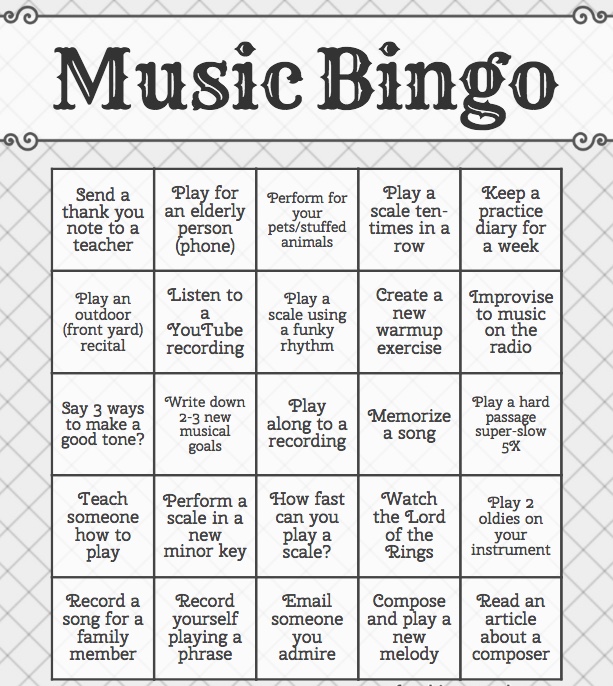
Create: BINGO CARD!
We are also looking for someone to design a fun practice card like this one: https://christina-yunghans.squarespace.com/s/Music-Bingo-Cards-sample.pdf.
Send a single copy to pfox@shjo.org.
CLIP #5
Share: “On the Ear” News Reporter
Broadcast your own music review!
For this activity, you will need a device with voice recording capabilities, and a different device to listen to music selections, such as a radio or a record player, CD player, tape recorder, Music Choice channels on cable TV, or a computer on which you can view a YouTube selection, etc. Listen to an orchestral music selection or a recording of a selection for the instrument you play. (Examples: Bach Fugue in G minor, “The Lesser” or Haydn Trumpet Concerto, and so on.) As you listen to the music on one device, have you voice recorder ready to make running comments, just like a music reviewer or “play by play” sports event reporter. Download all of the instructions here: http://www.shjo.org/s/Music-Reporter-032620.pdf
Inspire: “The Musicologist”
Free music theory review, courtesy of musictheory.net
We learned a lot last year using our Alfred Music Theory series. How much of it can you recall defining the “fundamentals of music notation?” (You do not have to purchase their Tenuto app as advertised on the website, although it is a reasonably priced option for further study! If you are a serious musician, Mr. Fox recommends it.)
Complimentary online instruction is available at https://www.musictheory.net/lessons.
To test your knowledge, here is the free link: https://www.musictheory.net/exercises.
Listen: “How Bad Can It Get?”
Classical music “fails” – just for fun!
Do you need a good laugh… conductors losing batons, concert disruptions, and much more? If you can get past the hideously out-of-tune and badly played introduction, see if you can find a violist making fun of a cell phone going off during his recital: https://www.youtube.com/watch?v=vPA31kvEUyY
Practice: “Mr. Fox’s Music Bingo”
A few ideas to keep on practicing and “give back” your music!
If you want to print your own copy of the card or re-arrange the order of the activities, download from this link: https://christina-yunghans.squarespace.com/s/Music-Bingo-Cards-sample.pdf.
Practice: “Mr. Sheehan’s Practice Guide”
If you prefer a more cerebral plan, download/read/apply the excellent manual “What to Do When You Practice” written by the band director from Hollidaysburg Area Senior High School (PA), and the new President-Elect of the National Association for Music Education: http://www.shjo.org/s/What-to-Do-When-You-Practice-Booklet.pdf
CLIP #6
Share: “Easy Classical Music Games”
Teach a younger sibling or neighbor the “basics of music!”
SHJO has a membership of all ages. Some of these clever activities are pretty easy, so “show your stuff” to a friend or family member: https://www.classicsforkids.com/games.html
Inspire: “Budding Composers: How to Avoid Getting Sued”
Mr. Fox’s latest YouTube video “find!”
How many Classical music themes seemed to be “borrowed” in popular music? A few tips on copyright law, too! Closer to home, do you remember SHJO’s playing of “Aura Lee?” Do you know the origins of the tune, who originally wrote the lyrics and music, and what popular piece/group used the melody? (Hint: Elvis Presley)
“14 Songs That Rip Off Classical Music” from the UK https://www.youtube.com/watch?v=yknBXOSlFQs
Practice: “Musical Dice”
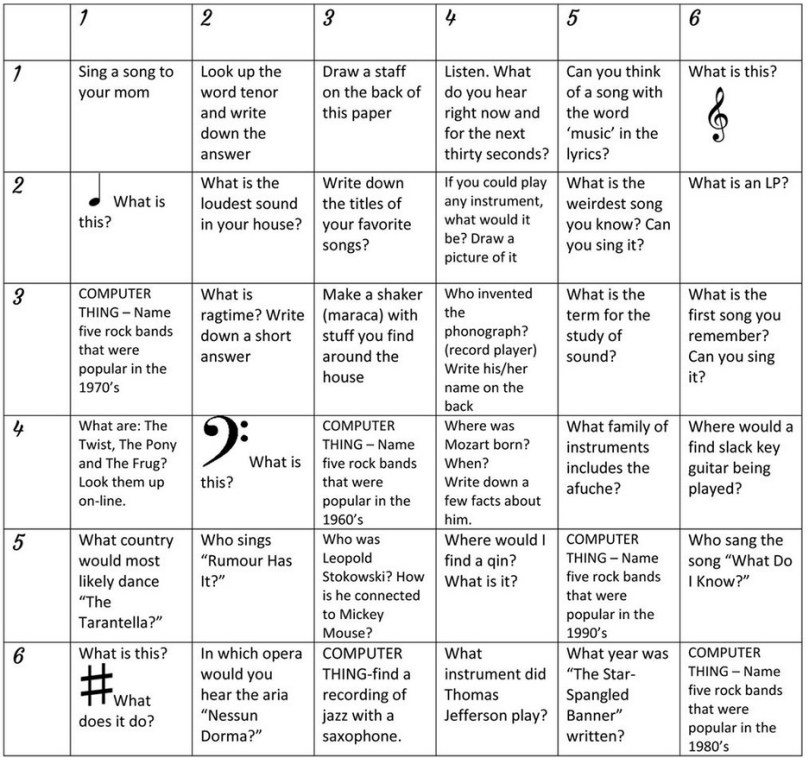
A roll of the dice can lead to different pathways of music learning.
If you don’t have a dice, use this random number generator: https://www.random.org/dice/
Start off with a “scavenger hunt” of researching music. First roll is the row, second is the column. (SEE ABOVE GRAPHIC)
Then, try a simpler dice game for individual practice on your instrument, rolling only once:
- Major or minor (alternate) scale and arpeggio
- A band or orchestra warmup (long tones, tuning, etc.)
- Slow lyrical section from your SHJO music (alternate)
- Favorite piece (solo, school ensemble, or SHJO)
- Fast passage from your SHJO music
- Section of a memorized piece (solo, school or SHJO) OR play along with a recording
Create: “Musical Dice II”
This time, YOU create-your-own practice game with the dice!
Write down and number six musical objectives you have, short school or SHJO sections, technical exercises, or solo pieces you want to learn. Divide up each “goal” into gradually more challenging success levels – focus on different excerpts, more measures, faster speeds, add dynamics, phrasing, articulations, etc.
CLIP #7
Listen: “YouTube Kids Playlist”
Discover new online music videos!
Parents: Did you know you can set up a free account for “completely safe viewings” of YouTube media? Go to https://www.youtubekids.com/. Mr. Fox took an entire afternoon off perusing these recordings, a little something for everyone (a flute player, cellists, sax quartet, etc. who will “knock your socks off!”) The marble machine is just for fun… one link is a machine, the other a live band. What is “looping?” Registration may be required to access links:
Share: “Whack-a-Note”
Name these notes… fast!
http://artsedge.kennedy-center.org/interactives/steprightup/whackanote/
Like “Easy Classical Music Games” in CLIP #6, teach someone basic notation… or just have fun with it yourself.
Create: “Song or Music Writing”
A Few “Basics” for Getting Started with Composing (sample websites)
Inspire: “Music Exploration and Reflections”
Maintain a journal to keep track of your work.
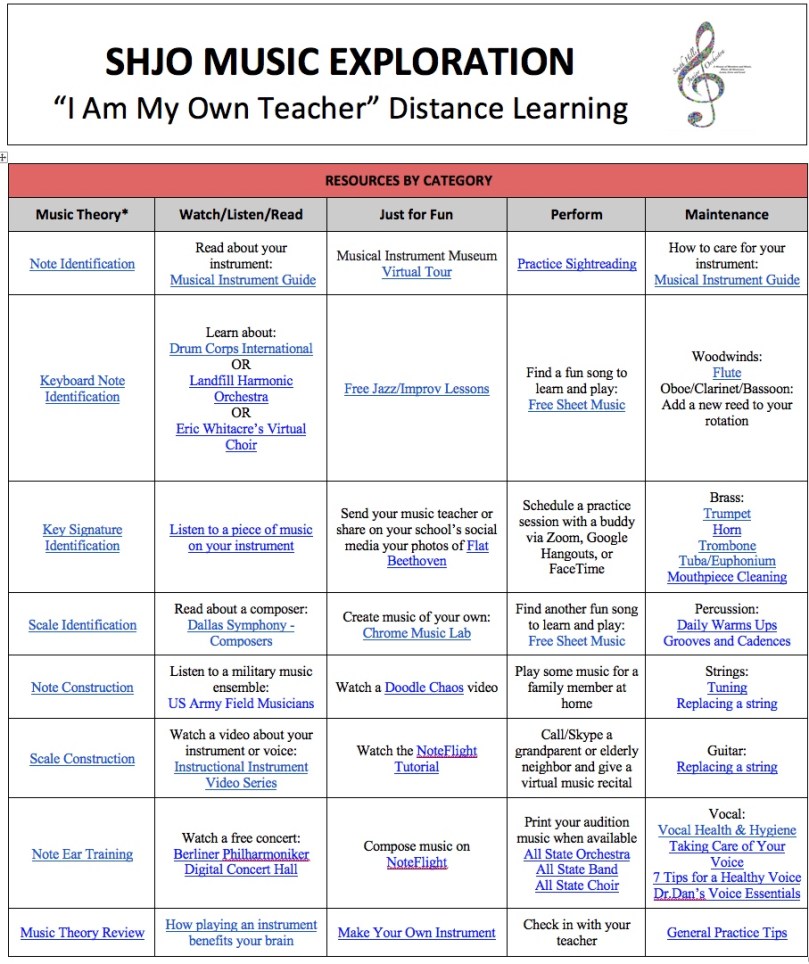
(SEE ABOVE GRAPHIC – Special thanks to the Greeley-Evans Weld County School District 6 for sharing their music grades 6-12 materials.)
First, download the original, full-size two-page document (so that the links will work with “click and go”) from the SHJO.clips page: http://www.shjo.org/clips. (Word file is best so you can write on it; if needed, this PDF version is also available: SHJO Music Exploration).
The grid on the second page will allow you to write down your progress, time spent, and reflections.
You act as your own music teacher – seeking out ways to enrich yourself with new knowledge of music.
© 2020 Paul K. Fox



 No teacher will have any patience listening to your whining or remarks of “could have,” “would have,” or “should have been” excuses. What have we always wished for? “If only I had enough time to learn that new scale, étude, or song!” “With all of my other academic assignments, sports events, and extracurricular activities, how can I fit in moments for listening to bands, orchestras, or classical virtuoso artists performing on the web?” “When am I ever going to have the chance to compose…” (or “arrange” or “record” or “memorize” or “conduct” or “choreograph”) “…that piece?” “When will I get around to learn this new technique, practice sight-reading, or dive into those drills designed to improve my key literacy, rhythmic precision, tone, intonation, range, form, coordination, embouchure, stick rudiments, or bow control?
 The mission of South Hills Junior Orchestra, which rehearses and performs at the Upper St. Clair High School in Pittsburgh, PA, is to support and nurture local school band and orchestra programs, to develop knowledge, understanding, performance skills, and an appreciation of music, to increase an individual member’s self-esteem and self-motivation, and to continue to advance a life-long study of music. Members of the Orchestra learn, grow, and achieve positions of leadership to serve their fellow players.















 Welcome back to our series on music teacher (and other professionals) self-care.
 Practice emotional first aid… Do you beat yourself up when you experience failure or make a mistake? [Find] ways to break the negative patterns of thought.
 twice as long as the length of the inhale. For example, inhale to the count of four, pause briefly, and exhale to the count of eight. Repeat three times.
 Her common examples of cognitive distortions include the following. Do any of these sound familiar?
 Learn something new.
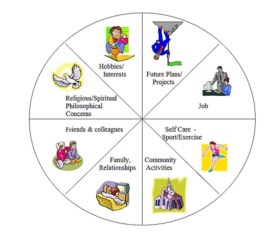 In almost every health and wellness article, we hear the emphasis of prioritizing and seeking a more equitable use of personal time, achieving what Ernie Zelinski, author of the best-selling book How to Retire Happy, Wild, and Free, refers to as “work/life balance.” Future blogs on samples of “super stress reducers” in “setting boundaries,” time management, and innovative organizational tools will be forthcoming.



 html
html The other day, I watched on CBS This Morning an interview of World Series Champion Washington National’s star outfielder Gerardo Parra

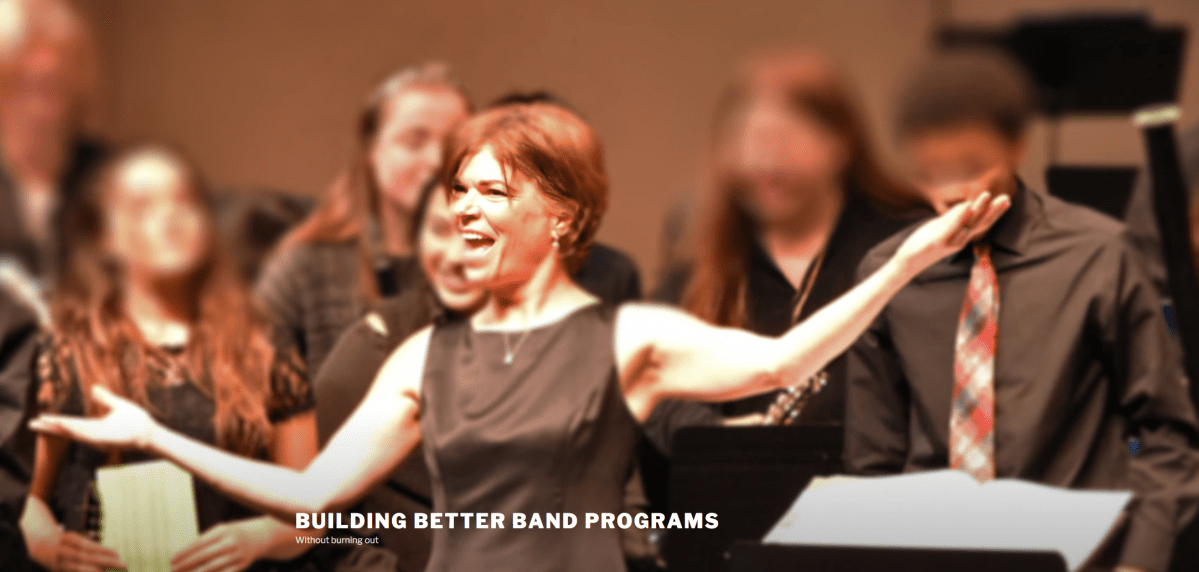


 Now in her fourth decade as a high school band director, Lesley Moffat has worked with thousands of people, helping them not only achieve musical goals (including repeated performances at Carnegie Hall, Disney Theme Parks, Royal Caribbean cruise ships, and competitions and festivals all over the US and Canada), but also teaching them how to develop the long-term life skills they need to be successful in the world.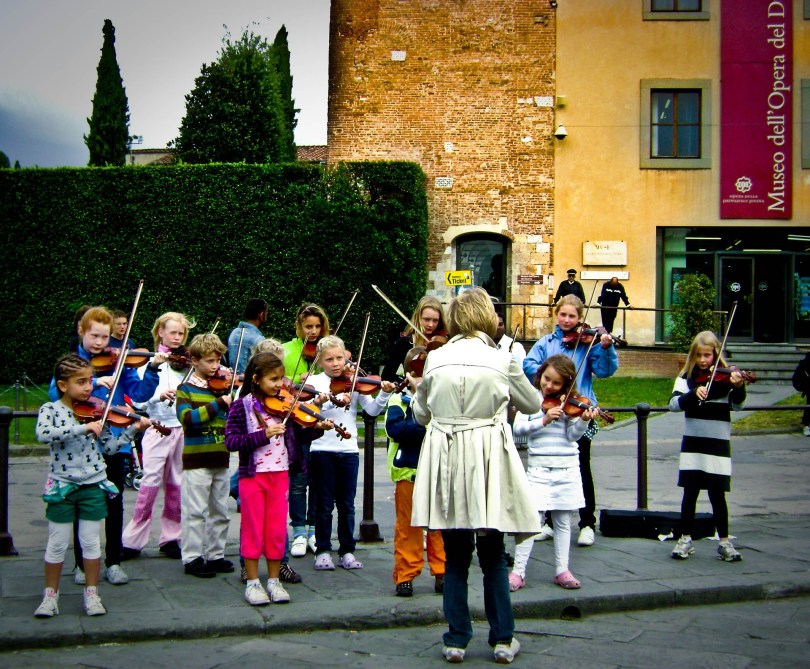


 Discounted NAfME + PMEA first-year membership: only $90. (If you are a recent college graduate in your first year of teaching, or if you are the spouse of a current or retired NAfME member, contact NAfME at 800-336-3768 or email
 Bring to any employment screening your resume, business card, and an e-portfolio referencing a professional website which archives everything in #1 and #2 above.
 Clean-up and curate your social media sites, treating your Facebook pages as another “personal branding resource.” Experts recommend that “your profile information should reflect integrity and responsibility… You should expand or add content that projects a professional image, shows a friendly, positive personality, demonstrates that you are well-rounded with wide range of interests, and models… great communication skills.”
 As a courtesy to the writer (and modeling good preparation on your part), give at least two to three weeks’ notice (more is better). Remember: “Lack of planning on your part does not constitute an emergency on the teacher’s part.” It would also be polite to “gently remind” the staff member about the final deadline of the recommendation (at least one weekend’s notice). For SHJO, one Saturday ahead of the final deadline would be ideal.