The Four Rs of Music Education

Reflection, Reinvention, Retreat, and Restoration

Guest post by Katherine Langford

We welcome the return of guest blogger Katherine Langford, who offers insights on how music education nurtures creativity, balance, and lasting passion for learning. Her last article was “The New Model of Modern Music Education” (2025). She describes herself as “a digital marketing consultant, writer, freelancer, WordPress enthusiast, and coffee lover.” Thank you, Katherine! PKF

Music education is more than just learning notes, scales, and chords. It’s about growth, creativity, and self-discovery. Whether you’re a student, a teacher, or a lifelong learner, the journey of music unfolds through cycles of learning and renewal. The concept of the Four Rs of Music Education: Reflection, Reinvention, Retreat, and Restoration beautifully captures this ongoing process.

These four principles help musicians reconnect with their passion, refine their skills, and rediscover purpose. Let’s explore how each “R” plays a role in shaping better musicians, educators, and learners—both in classrooms and in online class help settings where flexibility meets creativity.

Reflection in Music Education

Reflection is the first step toward genuine growth in music. It’s about looking back to understand what worked, what didn’t, and what could improve. Musicians often rush through practice sessions, but without reflection, progress stalls.

Reflecting on past performances helps identify patterns and habits. Maybe your rhythm feels slightly off, or your phrasing needs more emotion. When students pause to think about their experiences, they start connecting technique with meaning. This process deepens understanding beyond mere repetition.

For teachers, reflection shapes lesson plans and teaching styles. It’s not just about evaluating students but also self-assessing methods. Asking questions like, Did my students grasp the concept? Could I have explained it better? opens new possibilities.

Practical reflection can include journaling after lessons or recording performances to analyze later. Even in music education online, where feedback may seem distant, reflection bridges that gap. Students who revisit recordings of their practice can hear their growth over time.

Reinvention in Music Education

Once reflection takes place, the next step is reinvention. Reinvention is where creativity flourishes. It encourages musicians to reshape their identity, experiment with new techniques, and explore unfamiliar styles.

Every musician reaches a plateau. Reinvention helps overcome it. Trying different genres, instruments, or teaching methods revitalizes motivation. A classical pianist might explore jazz improvisation, or a vocalist might learn digital music production. These changes broaden understanding and strengthen adaptability.

In music education, reinvention keeps learning exciting. Teachers who incorporate technology, apps, or virtual performances engage students better. Reinvention also applies to learners using online class help platforms. They can explore theory, composition, or ear training with tailored support, matching personal learning speeds.

A big part of reinvention is embracing mistakes. Growth often comes from stepping outside the comfort zone. Students who reimagine failure as feedback develop resilience. Music thrives on such transformation. Reinvention keeps passion alive, no matter how many years someone has played.

Retreat in Music Education

Retreat might sound like stepping away, but in music, it’s a necessary pause. Taking breaks gives musicians time to breathe, reset, and process what they’ve learned. Creativity demands rest as much as effort.

Many students push themselves to practice endlessly. Yet over-practicing can lead to burnout or injury. A strategic retreat helps restore energy and focus. Stepping back for a while often leads to stronger comebacks. It’s similar to letting silence enhance the beauty of a melody.

Teachers also benefit from retreating. When educators allow time for reflection and relaxation, they return with renewed enthusiasm. This creates a more balanced environment for both themselves and their students.

Retreats don’t have to be long. A short pause between lessons, a quiet walk, or even a few mindful breaths before playing can make a difference. In music education, retreats remind learners that music isn’t just performance—it’s also presence.

Even students studying through online class help programs can benefit from short retreats. Logging off for a day or switching focus from performance to listening exercises can refresh the mind. This pause often leads to more meaningful progress later.

Restoration in Music Education

Restoration is where renewal begins. After reflection, reinvention, and retreat, musicians rediscover their connection with music. It’s the emotional and spiritual healing that brings purpose back into playing or teaching.

In music education, restoration often comes through rediscovering joy. When practice feels heavy, restoring one’s motivation means reconnecting with why music mattered in the first place. Listening to old favorites, collaborating with others, or simply playing for pleasure can spark that feeling again.

For teachers, restoration also means finding balance between structure and spontaneity. Students sense when their instructor feels inspired. Restored energy flows naturally into lessons, making learning more engaging and alive.

Restoration also ties into self-care. A healthy mind and body fuel creativity. Simple habits—staying hydrated, taking breaks, and celebrating small wins—help musicians sustain passion over time. Restoration is not a one-time event but a recurring phase in every artist’s journey.

Even in digital learning, restoration is vital. Students using online class help platforms can restore focus by revisiting the joy of learning, rather than rushing toward exams or performance goals. With patience and care, their progress becomes both steady and fulfilling.

Why the Four Rs of Music Education Matter

Together, the Four Rs—Reflection, Reinvention, Retreat, and Restoration—form a continuous cycle of artistic and personal growth. They keep music education holistic, addressing both skill and soul.

This framework encourages balance. Instead of chasing perfection, it invites progress and peace. Each “R” nurtures a different part of the learning experience:

  • Reflection builds awareness.
  • Reinvention fuels creativity.
  • Retreat restores clarity.
  • Restoration renews passion.

When integrated into daily practice, these principles prevent burnout and promote sustainable growth. Whether in traditional classrooms or through online class help, the Four Rs offer a roadmap for lifelong musicianship.

How the Four Rs Apply to Online Learning

Modern music education extends far beyond physical classrooms. Online platforms allow students to learn instruments, theory, and composition from anywhere. Yet, this shift brings new challenges. Maintaining motivation and connection can be harder in virtual spaces. That’s where the Four Rs come in.

  • Reflection helps students assess progress through recorded lessons and digital assignments.
  • Reinvention encourages exploring online tools like digital keyboards or rhythm apps.
  • Retreat prevents screen fatigue by balancing screen time with hands-on practice.
  • Restoration ensures students stay inspired by joining online communities and virtual performances.

Using these principles keeps learning balanced, even in a fast-paced digital world. Whether a student says, “I need someone to take my online class,” or just wants extra support, embracing the Four Rs ensures the journey remains meaningful.

Common Reader Question: How Can Music Students Stay Motivated Long-Term?

Many learners wonder how to stay motivated when progress feels slow. The answer lies in the Four Rs. Reflection shows how far you’ve come. Reinvention keeps practice exciting. Retreat helps avoid burnout. Restoration renews joy when motivation fades.

Music is a lifelong pursuit, not a quick achievement. Balancing effort and rest keeps the journey enjoyable. Motivation isn’t constant, but using these principles ensures it always returns.

Practical Ways to Apply the Four Rs in Music Education

Let’s look at simple ways to bring the Four Rs into practice for both students and teachers.

  1. Daily Reflection: Spend five minutes after each session writing what worked and what didn’t.
  2. Creative Reinvention: Try a new piece or improvise on a familiar melody weekly.
  3. Mini Retreats: Take short breaks after intense sessions to refresh your focus.
  4. Emotional Restoration: Listen to music that inspired you to start learning.

Teachers can also schedule reflection days or host open discussions about learning challenges. For online learners, creating digital journals or participating in peer reviews builds community.

The Four Rs and Emotional Wellbeing

Music doesn’t exist in isolation. It’s deeply tied to emotion and identity. The Four Rs not only shape better musicians but also healthier humans. Reflection teaches self-awareness. Reinvention builds confidence through experimentation. Retreat prevents burnout. Restoration fosters gratitude and peace.

This emotional balance benefits students and teachers alike. When lessons include empathy and patience, the environment becomes nurturing. Learning music becomes a joyful experience rather than a stressful task.

Bringing the Four Rs into the Classroom

Incorporating these principles into music education doesn’t require a full curriculum overhaul. Small steps make a big difference. For example, dedicate time for students to reflect after performances or introduce creative projects that allow reinvention.

Encourage retreats during exam periods, reminding students that rest improves retention. Use restoration activities such as group jam sessions or collaborative projects to reignite enthusiasm.

Even in virtual classrooms, teachers can use reflective discussions, creative challenges, and feedback sessions to make learning more interactive. The Four Rs build a culture of respect and curiosity, which every classroom needs.

Why Balance Is Key in Music Education

Balance keeps passion alive. Musicians who only focus on technical mastery risk losing emotional connection. Those who only chase creativity may neglect discipline. The Four Rs bring equilibrium by blending introspection, experimentation, rest, and renewal.

Music thrives when learners stay curious and teachers stay inspired. Balance ensures that both continue growing. Whether through physical practice or online class help, balance transforms learning into a rewarding, lifelong adventure.

Conclusion

The Four Rs of Music Education: Reflection, Reinvention, Retreat, and Restoration remind us that music is not just about sound. It’s about growth, emotion, and connection. These principles guide musicians to learn deeply, teach wisely, and live creatively.

Every stage of music education benefits from these cycles. Reflection helps you understand your progress. Reinvention sparks creativity. Retreat allows you to pause and recharge. Restoration brings your heart back into music.Whether you’re attending lessons in person or seeking online class help, applying these Four Rs ensures that your musical journey stays balanced, joyful, and deeply human.

© 2026 Katherine Langford and Paul K. Fox

Boosters – Part 2

Clearinghouse of Corroborative Materials for
IT TAKES A VILLAGE

Booster Session at the Annual PMEA Conference

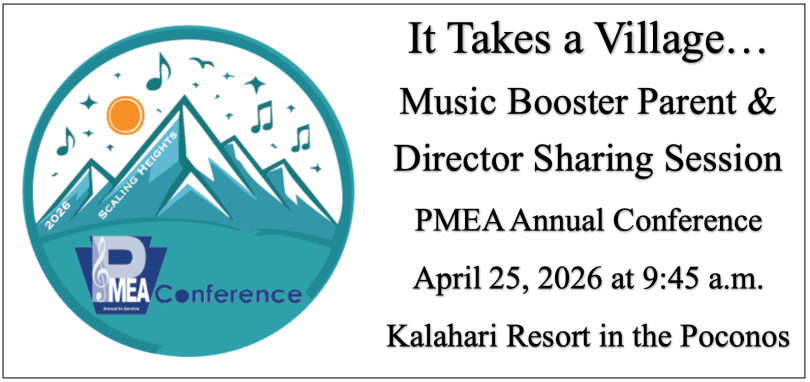
We hope you had the opportunity to attend our booster brainstorming session on Saturday morning at the 2026 PMEA Annual Conference in Kalahari/Poconos. This previous blog-post references the IT TAKES A VILLAGE workshop’s description, objectives, and “hot topics” to help lead collaborative discussions among the attendees. It is our hope that in future conferences, we will schedule additional venues to share local strategies and “best practices” to build numbers and the engagement of its booster members, improve their overall effectiveness and efficiency, “re-energize” their support groups’ mission, vision, goals, and action plans, and provide tips and tools to guide their associations’ motivations, actions, and legal compliance.

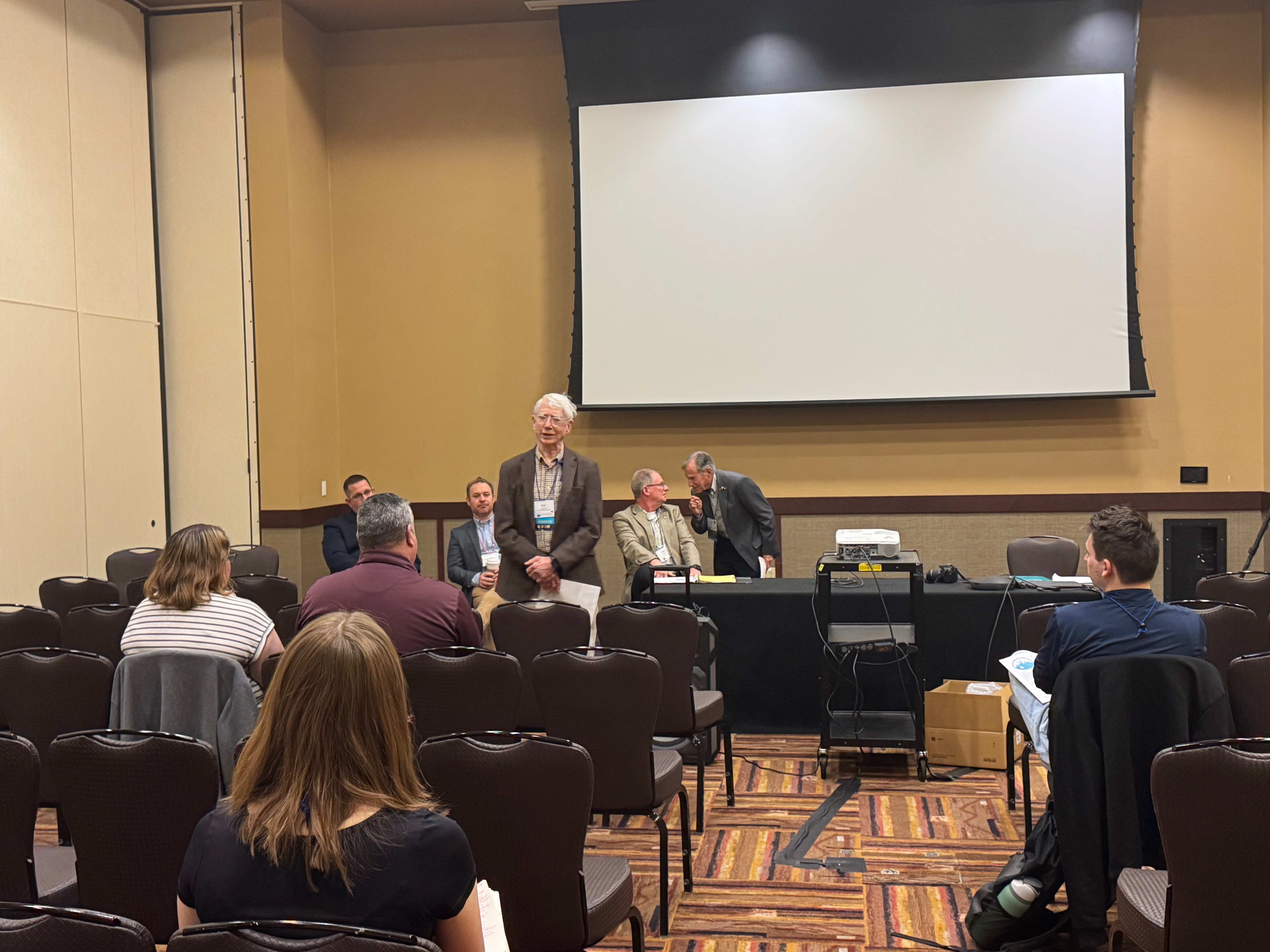
Dr. Robert Dell and panelists address attendees at the IT TAKES A VILLAGE Booster Sharing Session on April 25, 2026 during the PMEA Annual Conference.

These were the handouts and samples distributed on April 25, 2026. They are reprinted here with the permission of the authors, members on the session’s guest panel (and many of whom have presented on this subject at past conferences).

When they become available, additional files will be posted for download in the space below.

If you have boosters materials you are willing to share here, please send files to paulkfox.usc@gmail.com.


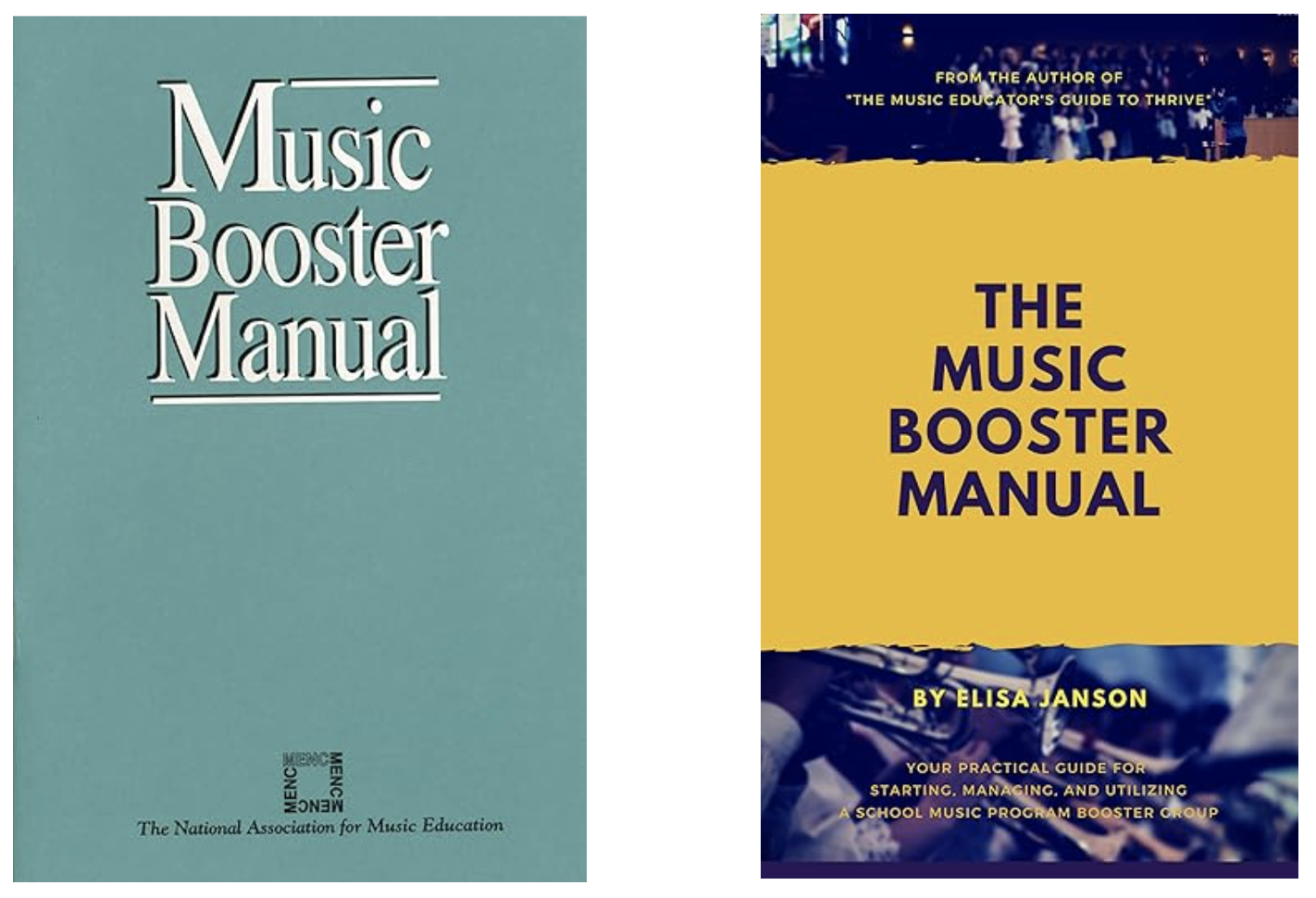
Two References on “Music Boosters”

If you are planning to start or enhance your own school music support group, consider a purchase of these publications (Amazon):

Music Booster Manual, published by MENC – The National Association for music Education (1989)

The Music Booster Manual: Your Step-by-Step Guide to Launching a Music Booster Group in Your School by Elisa Janson Jones Kindle Edition (2018)

Staying Connected… Across the Commonwealth

If you would like to sign-up to receive future emails of additional music parent/director support group resources, please click here. If there is sufficient interest, we will send out communications with additional research, forms, workshop handouts, etc.

Finally, if you have something you would like to share with the stakeholders (parents, directors, community members) of the PMEA music booster affiliates, send an email with Word or PDF files to paulkfox.usc@gmail.com (use subject line “boosters”).

PKF

© 2026 Paul K. Fox

Interview Clinic Revisited

A Quick Update from the MMEA Annual State Conference

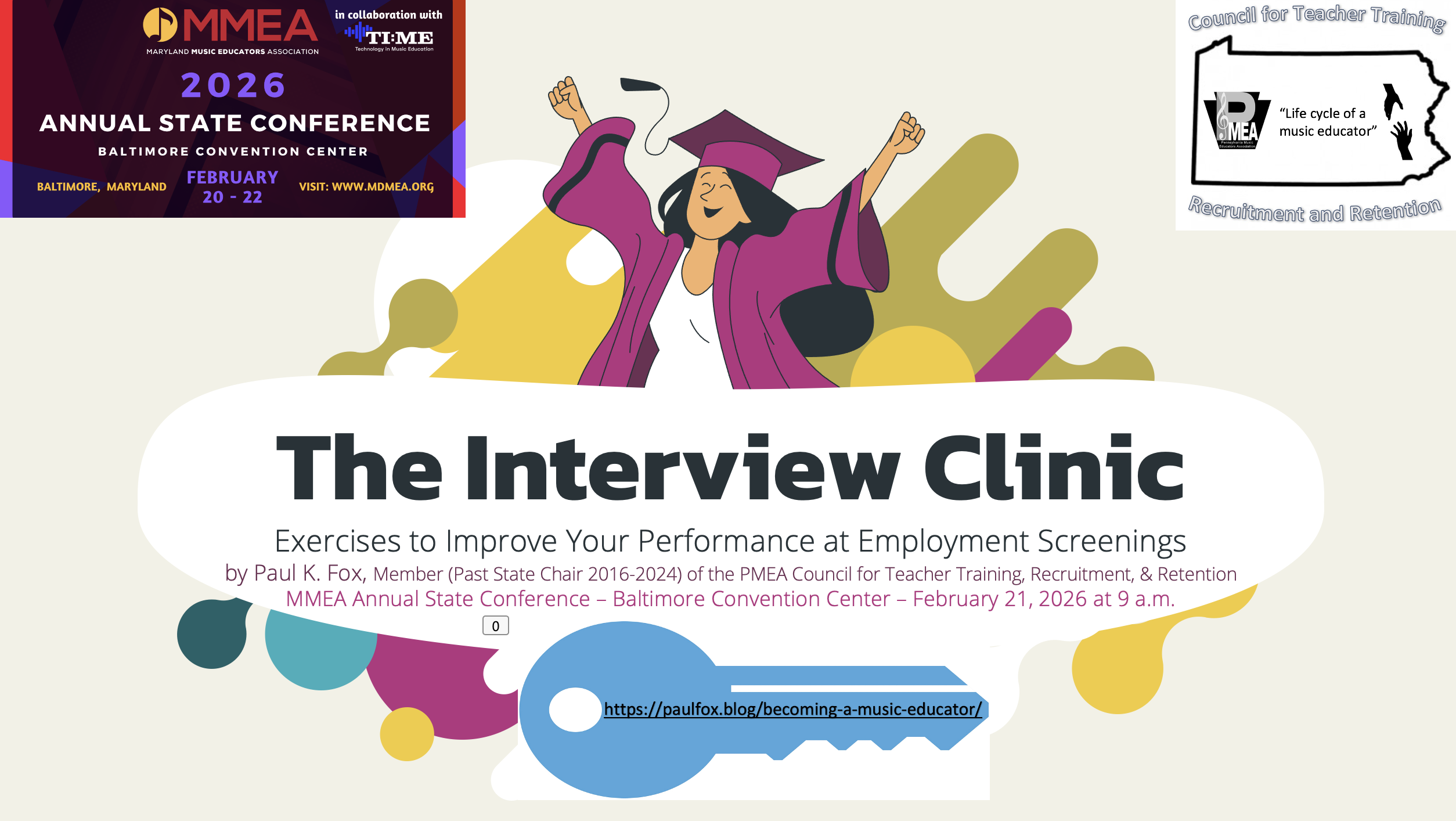
Today (February 21, 2026) it was my pleasure to present at the Maryland Music Educators Association (MMEA) Annual State Conference in the Baltimore Convention Center.

The session was revised from past workshops at PMEA Annual and NAfME Eastern Division Conferences. Feel free to share these materials with fellow music education majors and NAfME college chapters… even hold meetings with them to sponsor group demonstrations of mock interviews to provide an audience and feedback for your practice sessions.

To-Do’s for Future Educators Seeking Employment

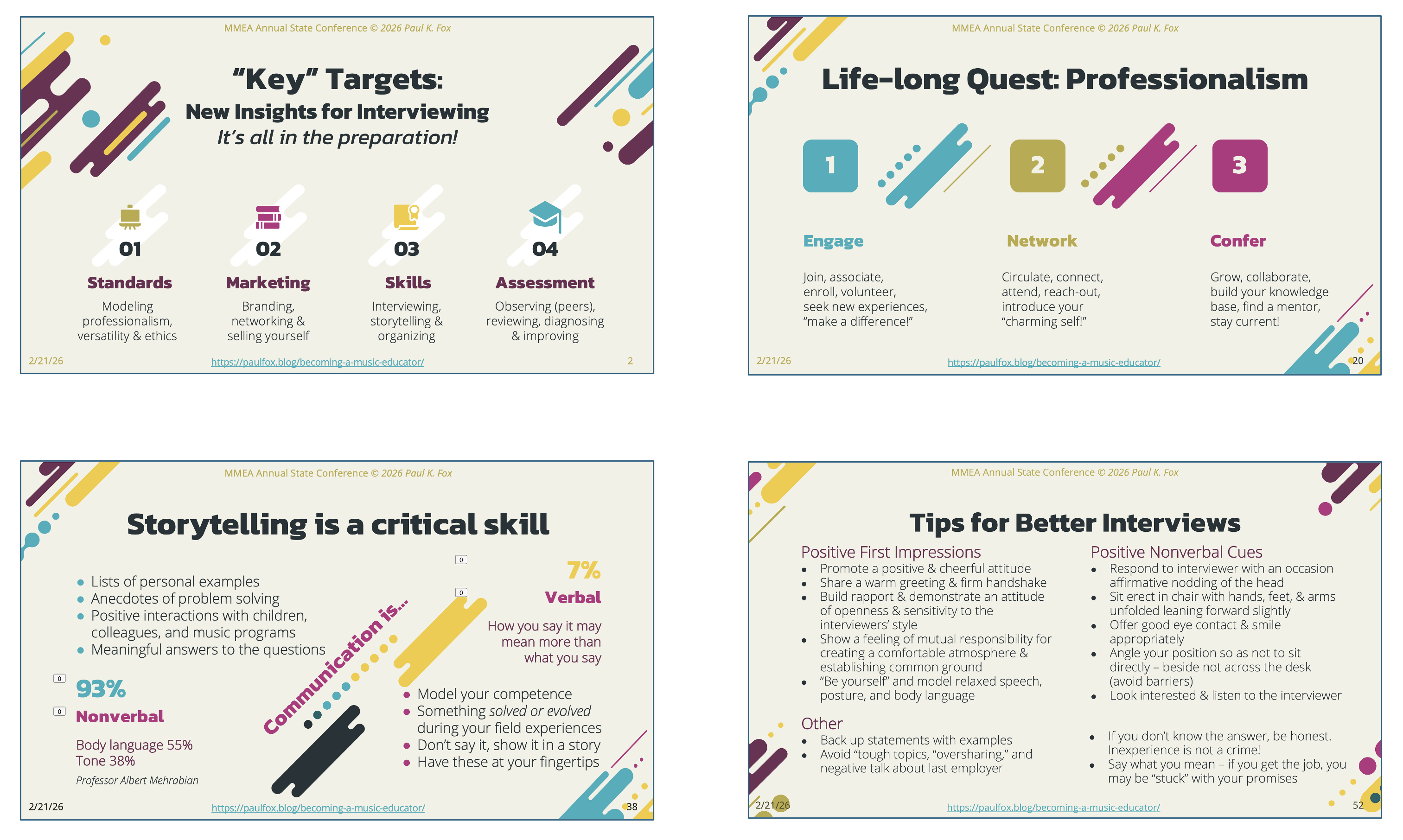
We have covered a lot of the concepts of “the art and science” of interviewing. As a review, here’s recap homework for anyone interested in developing better marketing, branding, and networking techniques, skills in storytelling at interviews, and improving their performance at employment screenings:

Standards: Define your personal mission, goals, and philosophy for teaching music, modeling the highest ideals of professionalism, ethics, and becoming the “total music educator.” Have you read the Model Code of Ethics for Educators brochure?

Marketing: Design and distribute a “state-of-the-art” résumé, e-portfolio, website, and business card.

Skills: Compile a list of anecdotes and true stories of you overcoming challenges, solving problems, and demonstrating  “best practices” of professionalism and self-improvement.

Assessment: Practice, record, and evaluate yourself answering behavioral & typical job interview questions

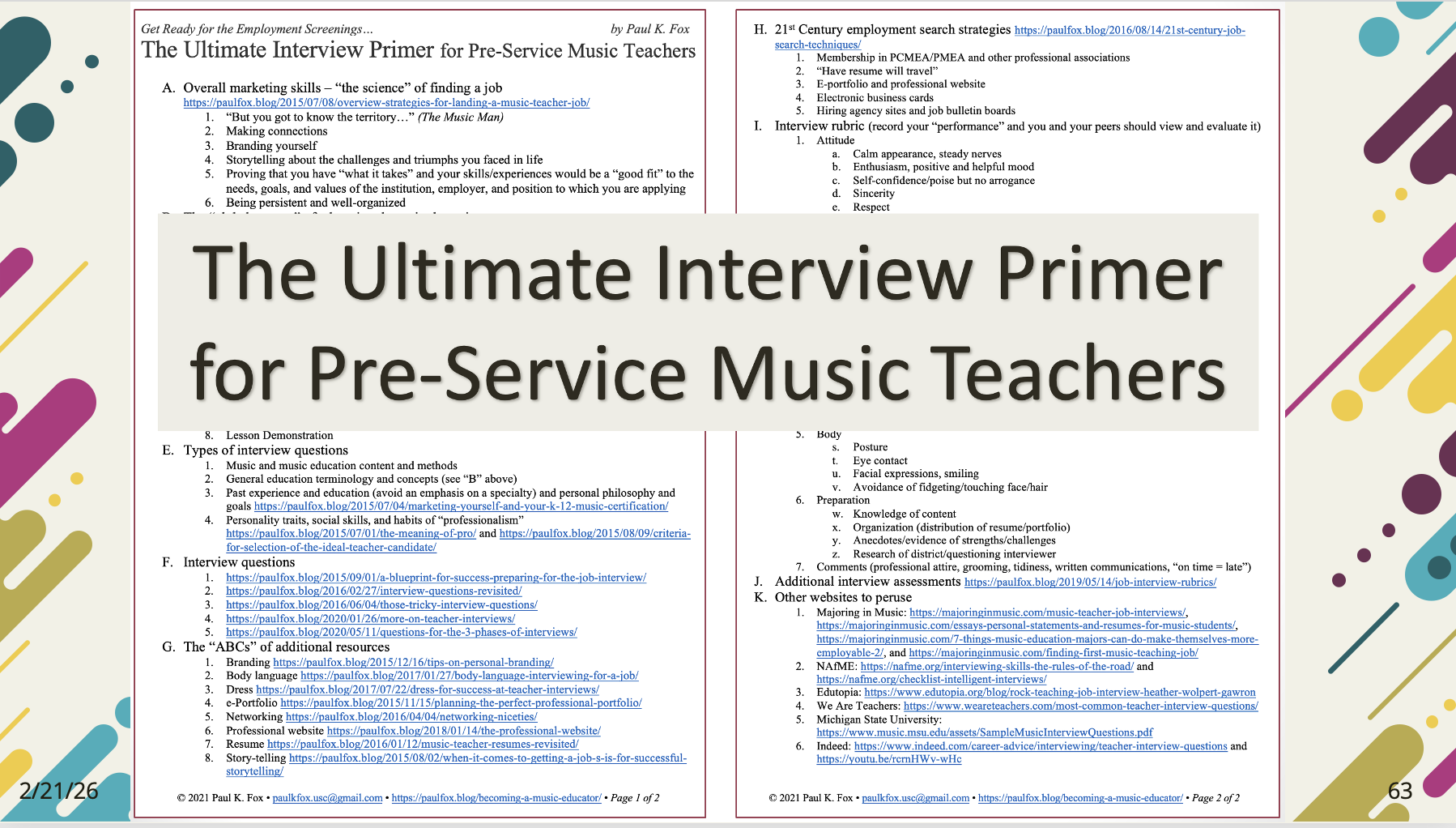
Review all the links here and this updated Ultimate Interview Primer handout and slide summary from the MMEA Annual State Conference.

Sample Slides

Click here for the entire slide summary.

Follow-up Reflections — The Top Ten!

Be ready to answer these in depth and with supportive evidence and sincerity at interviews:

  1. What is your philosophy for the study of music and the arts in the public schools?
  2. Why do you want to become a teacher? What motivates you to pursue this career path?
  3. What should be the most important emphasis in school curriculum — the mastery of content, outcome, or process?
  4. What is your personal mission, goals, and planned career trajectory?
  5. What are your most unique and essential personality characteristics and core values? (What matters to you most?)
  6. What are your most unique and essential professional habits that would equip you in becoming an effective educator?
  7. What is your proudest professional accomplishment? Why is this important to you? How would this relate to your teaching?
  8. What stories about your past positive interactions with children in education settings would demonstrate you modeled care, competence, compassion, and problem solving?
  9. How have you evolved in becoming a qualified educator during your pre-service field experiences?
  10. How and when have you “collected” and practiced responses to a large number of interview questions, including S.T.A.R. (Situation/Task/Action/Results) behavioral inquiries, and then recorded and assessed yourself doing these in a mock interviews or sessions of peer reviews?

One-Stop Help

In conclusion, about a year ago, I posted this Get-a-Job Toolbox blog. Please revisit the article, scroll down below the toolkit graphic, and follow in sequence as many of the published eighteen steps as possible.

High in the Himalayan mountains lived a wise old man. Periodically, he ventured down into the local village to entertain the villagers with his special knowledge and talents. One of his skills was to psychically tell the villagers the contents in their pockets, boxes, or minds. A few young boys from the village decided to play a joke on the wise old man and discredit his special abilities. One boy came up with the idea to capture a bird and hide it in his hands. He knew of course, the wise old man would know the object in his hands was a bird. The boy devised a plan. Knowing the wise old man would correctly state the object in his hands was a bird, the boy would ask the old man if the bird was dead or alive. If the wise man said the bird was alive, the boy would crush the bird in his hands, so that when he opened his hands the bird would be dead. But, if the wise man said the bird was dead, the boy would open his hands and let the bird fly free. So no matter what the old man said, the boy would prove the old man a fraud. The following week, the wise old man came down from the mountain into the village. The boy quickly caught a bird and cupping it out of sight in his hands, walked up to the wise old man and asked, “Old man, old man, what is it that I have in my hands?” The wise old man said, “You have a bird, my son.” And he was right. The boy then asked, “Old man, old man, tell me: Is the bird alive or is it dead?” The wise old man looked at the boy, thought for a moment and said, “The bird is as you choose it to be. It’s destiny is in your hands.”
Larry Broughton (also attributed to the Unitarian Universalist Association parable and Indian folk tale)

Indeed, regards to the preparation and practice of taking employment interviews and landing your “ideal job,” YOUR DESTINY IS IN YOUR HANDS.

A Plethora of Additional Resources

© 2026 Paul K. Fox

Learning New Skills and Hobbies

A Musician’s Guide to Staying Curious and Creative

by Ed Carter

For musicians, educators, professionals and soon-to-be retirees everywhere, guest blogger Ed Carter returns with this article on exploring new pastimes and adventures while “living the dream” during and after full-time employment. What are you planning to be (or do) when you grow up? PKF

Musicians are lifelong learners by nature. Whether you’re a touring guitarist, a bedroom producer, or a choir director, you already know that growth happens when curiosity meets practice. Learning new skills and hobbies isn’t just a way to pass the time—it’s a way to deepen musicianship, prevent burnout, and build a richer creative life. From hands-on crafts to movement and language, the right skill can feed your music in surprising ways.


The Fast Takeaway Most Musicians Need

Learning something new works best when it’s low-pressure, connected to your existing creative instincts, and practiced in short, repeatable sessions. Choose skills that train your ears, hands, body, or sense of story. Let progress be uneven. Consistency matters more than talent.


Skills That Pair Surprisingly Well With Music

Here’s a quick, varied list of skills and hobbies that musicians often enjoy—and actually benefit from:

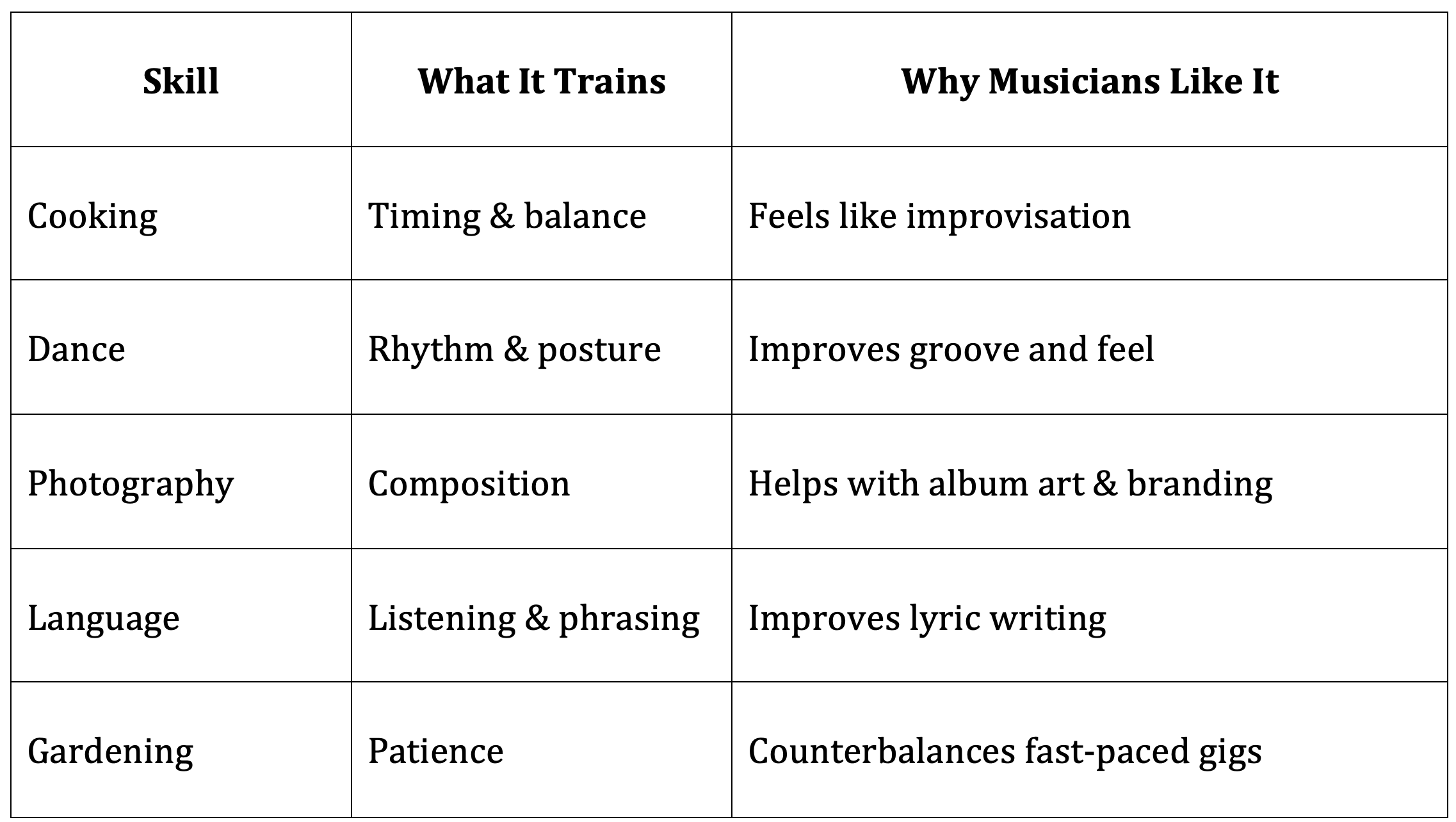
  • Cooking: Teaches timing, improvisation, and sensory awareness
  • Gardening: Builds patience, seasonal thinking, and long-term care
  • Photography: Sharpens composition, contrast, and mood
  • Sewing or basic clothing repair: Encourages precision and rhythm
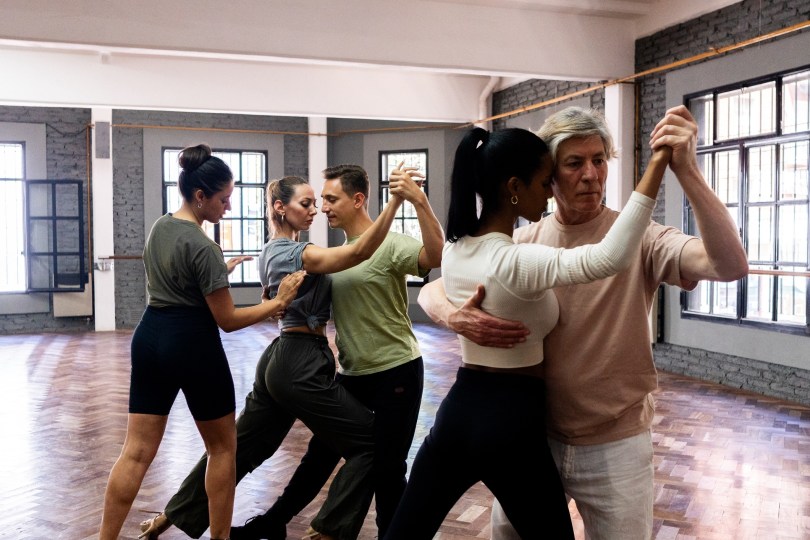
  • Dancing: Improves mood, posture, and body awareness
  • Visual art (drawing, painting, collage): Expands emotional expression
  • Learning a new language: Trains listening, phrasing, and memory
  • Playing a second (or third) instrument: Resets beginner’s mind

Each of these taps into skills musicians already use—just in a different form.


A Simple How-To for Learning Any New Skill

Use this checklist-style approach to avoid overwhelm and keep momentum:

  1. Start smaller than you think
    Commit to 10–15 minutes a few times a week. That’s enough to build a habit.
  2. Choose tools, not perfection
    One good knife, one sketchbook, one dance class, one app. Avoid overbuying.
  3. Practice in public (a little)
    Share a photo, cook for a friend, attend a beginner class. Light accountability helps.
  4. Connect it back to music
    Ask: How does this change how I listen, move, or think creatively?
  5. Let yourself be bad
    Beginners progress faster when they’re not trying to impress anyone.

Learning Skills Side-by-Side: A Comparison


When a Hobby Turns Into a Calling

Sometimes a skill stops being “just for fun.” You fall in love with it, invest more time, and start wondering if it could become part of your career. Many musicians eventually return to school to formalize a passion—whether that’s audio engineering, education, therapy, or technology. Finding a program that supports your interests matters; for example, if you want to build skills in IT, programming, and computer science theory, earning a computer science degree can open doors, and this may be a good option. Online programs can be especially helpful for busy musicians, allowing you to study around rehearsals, gigs, and tours.


A Resource Worth Exploring

If you’re curious about picking up creative skills at your own pace, Skillshare offers beginner-friendly classes in photography, illustration, writing, productivity, and more. Many courses are short, project-based, and taught by working creatives.


Frequently Asked Questions

Do I need to be “talented” to start a new hobby?
No. Skill comes from repetition, not personality traits.

How many hobbies is too many?
If you feel scattered or stressed, scale back. One or two at a time is plenty.

Will learning non-musical skills really help my music?
Often, yes. Cross-training creativity keeps your musical thinking flexible.

What if I quit?
Quitting is data. You learned what didn’t fit—and that still counts.


Learning new skills and hobbies keeps musicians adaptable, curious, and creatively healthy. You don’t need a master plan—just a willingness to start small and stay open. Some skills will quietly support your music; others may change your direction entirely. Either way, the act of learning itself keeps you in tune with growth.

© 2026 by Ed Carter and Paul Fox

‘Tis a New Year of Music Conferences!

According to the Smithsonian, 2026 is “The Year of the Fire Horse.”

The Chinese Lunar New Year begins February 17, 2026, and starts the Spring Festival season that ends fifteen days later on the evening of the Lantern Festival. The Chinese zodiac rotates through a 12-year cycle of animals and the traditional five elements: wood, fire, earth, metal, and water… The horse ushers in the seventh year of the 12-year cycle, following the Year of the Snake. Different regions across Asia celebrate Lunar New Year in many ways and may follow a different zodiac.  
Smithsonian

The Horse embodies enthusiasm, speed and fieriness, bringing a year focused on bold moves and exploration, according to Chengxin Li from Astrala. Those born in a Year of the Horse are often seen as confident, agreeable, and responsible, although they also tend to dislike being reined in by others. Celebrities born in a Year of the Horse include Nelson Mandela, Paul McCartney, Barbra Streisand, Calvin Klein, Jerry Seinfeld, Jackie Chan, John Travolta, Janet Jackson, Usher, Kobe Bryant and Jennifer Lawrence. “In their zodiac year, Horses experience highs and lows in love, work, and health. Breakthroughs are possible through persistence, while balanced self-care and steady finances ensure long-term success,” according to Sophie Song from Astrala.
Lauren Kobley

Colligating these online sources, one might say that this could be the year we all embrace “enthusiasm,” “exploration,” “breakthroughs,” “boldness,” and “persistence.” In other words – “professional development!”

I heartily recommend you remain actively involved in your professional music/education association and attend at least one state or national conference or regional workshop every year. Yes, this suggestion is good for pre-service (collegiate or soon-to-be) educators and retirees, too! This often-repeated quote from a past issue of PMEA Retired Member Network eNEWS clearly states “the why” (“rationale” – the focal point of many keynoter Simon Sinek’s presentations) to participate in continuing professional development sessions:

For some of us, it’s a just chance to catch-up with our colleagues, see our friends, and socialize. Others are more focused and take advantage of the near-perfect opportunity to network with other professionals, perhaps seeking new working relationships, partnerships, or even employment. Many are on a look-out for newly published music, that perfect music lesson or teaching strategy, technology tools, fundraisers, advance educational venues, or much-needed equipment to purchase for our ensembles or classrooms. Most come to hear/see the “state of the art” in music education – concerts, demonstrations, keynote speeches, panel discussions, exhibits, research presentations, and workshops. PMEA’s PD Council would likely submit that the primary purpose of a conference is for professional self-improvement… What did Stephen Covey call it? His Habit #7 of “sharpening the saw” – to build a balanced program of self-renewal in the four areas of your life: physical, social/emotional, mental, and spiritual. Covey would insist we embrace “the process that empowers us to move on an upward spiral of growth and change, of continuous improvement.” So, in short, conferences help us “grow” – to revive, re-inspire, re-energize, rejuvenate, re-direct, and re-motivate all of us – pre-service, active in-service, and retired teachers towards making successful new connections, updating our knowledge and skills, and forming new goals. This is how we “keep up” with all the new standards, benchmarks, and cutting-edge advances, and meet the “movers-and-shakers,” visionaries, and leaders in the profession!

Where to go? What to see? What’s YOUR pleasure? Pick a location: Washington D.C., Baltimore, or The Poconos in Northeastern Pennsylvania! I’ll be attending all three!

DCMEA

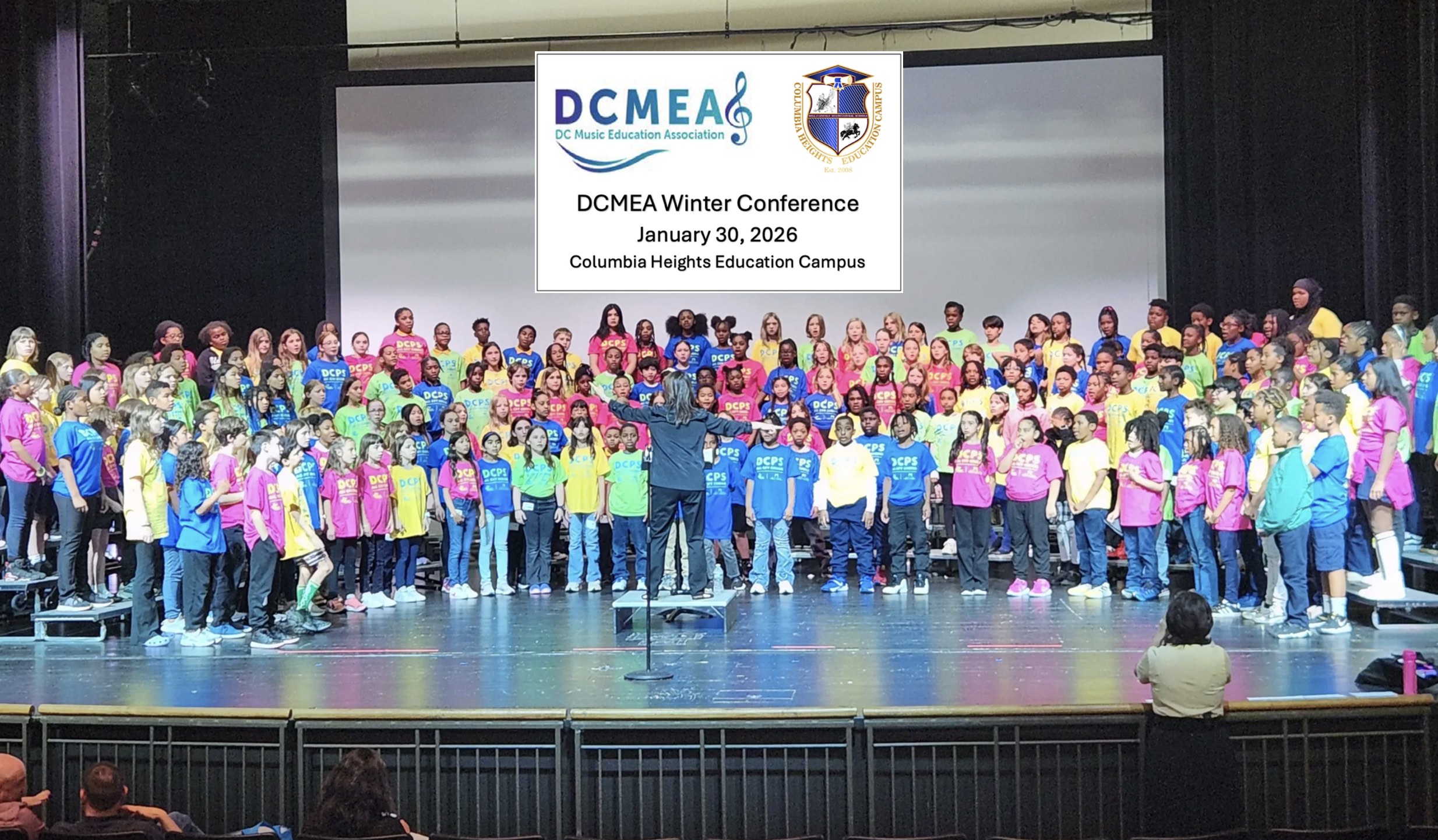
The earliest conference workshop series on my docket for 2026 is coming up in three weeks: DCMEA Winter Conference. For out-of-town attendees, DCMEA offers a discounted hotel stay at the Line Hotel D.C.

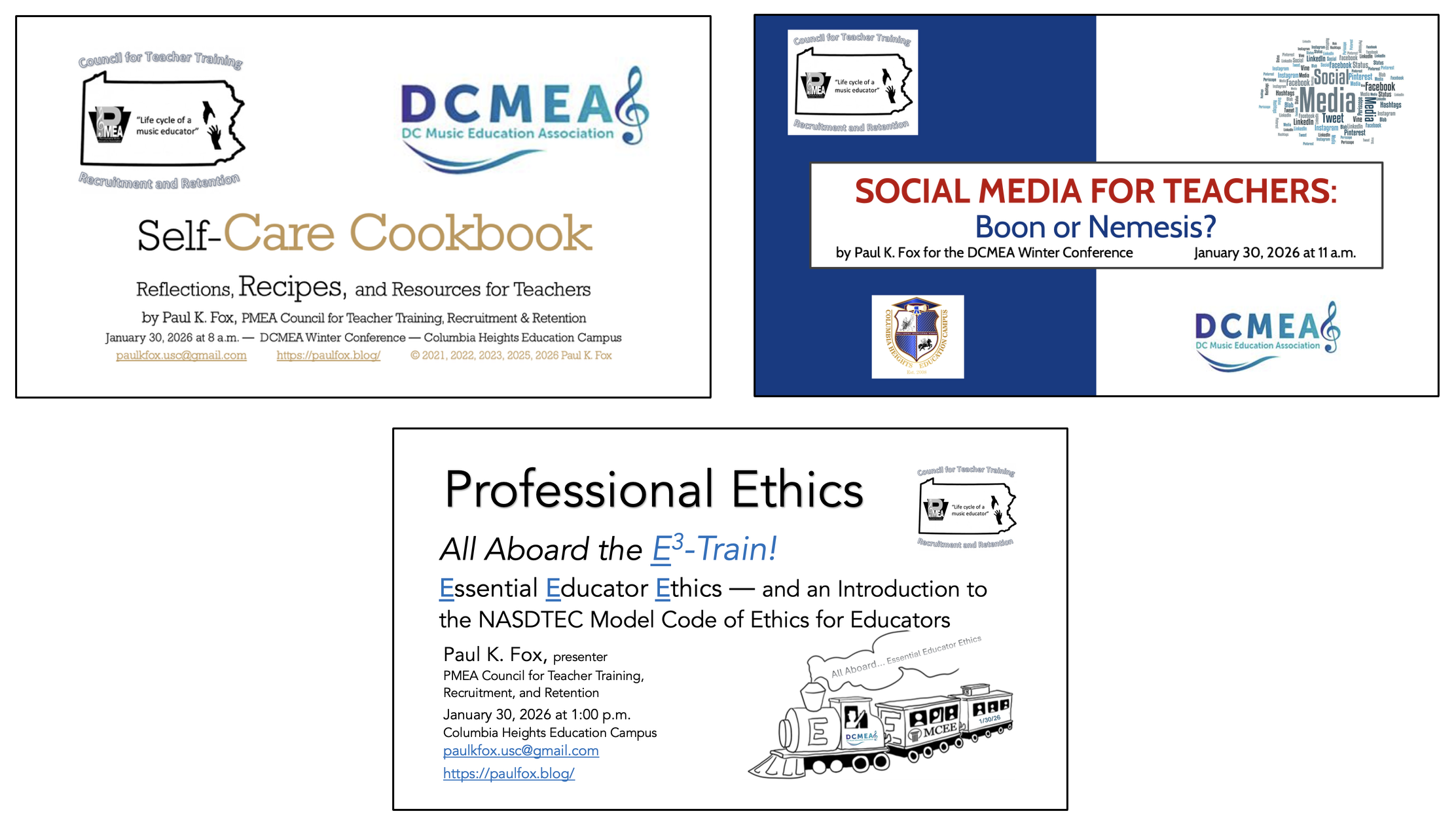
I feel privileged to have been invited to present the following three sessions at DCMEA Winter Conference.

Self-Care Cookbook – Reflections, Recipes, and Resources

Time: 8:00 a.m.
Self-Care Handout
Self-Care Slide Summary

Description: The purpose of this session is to empower teachers with skills and attitudes needed to make informed decisions to promote their own lifelong health and wellbeing, and to remediate stress and burnout. With the introduction of new resources for self-assessment and study, we will explore these essential questions:

  • What are suggestions, strategies, and samples for the development of a personal self-care plan?
  • Why is it essential to personal health to achieve balance in our lives, and how can we achieve it?
  • How does dedication to wellness impact the risk of illness, injury, and the quality of a person’s life?
  • What are the consequences of our choices in terms of time and stress management?
  • How do effective decision-making skills and goal setting influence healthier lifestyle choices?

This workshop will provide the takeaway of “two-for-one” follow-up slide decks: Self-Care (1.0) to foster in the individual teachers themselves the acquisition of new techniques for self-assessment, self-care goal setting, and work/life balance, and the other, Self-Care 2.0 recently presented at the PA Department of Education’s state conference SAS INSTITUTE for school leaders to cultivate in their staff better habits of health and wellness and to improve school climate and culture.

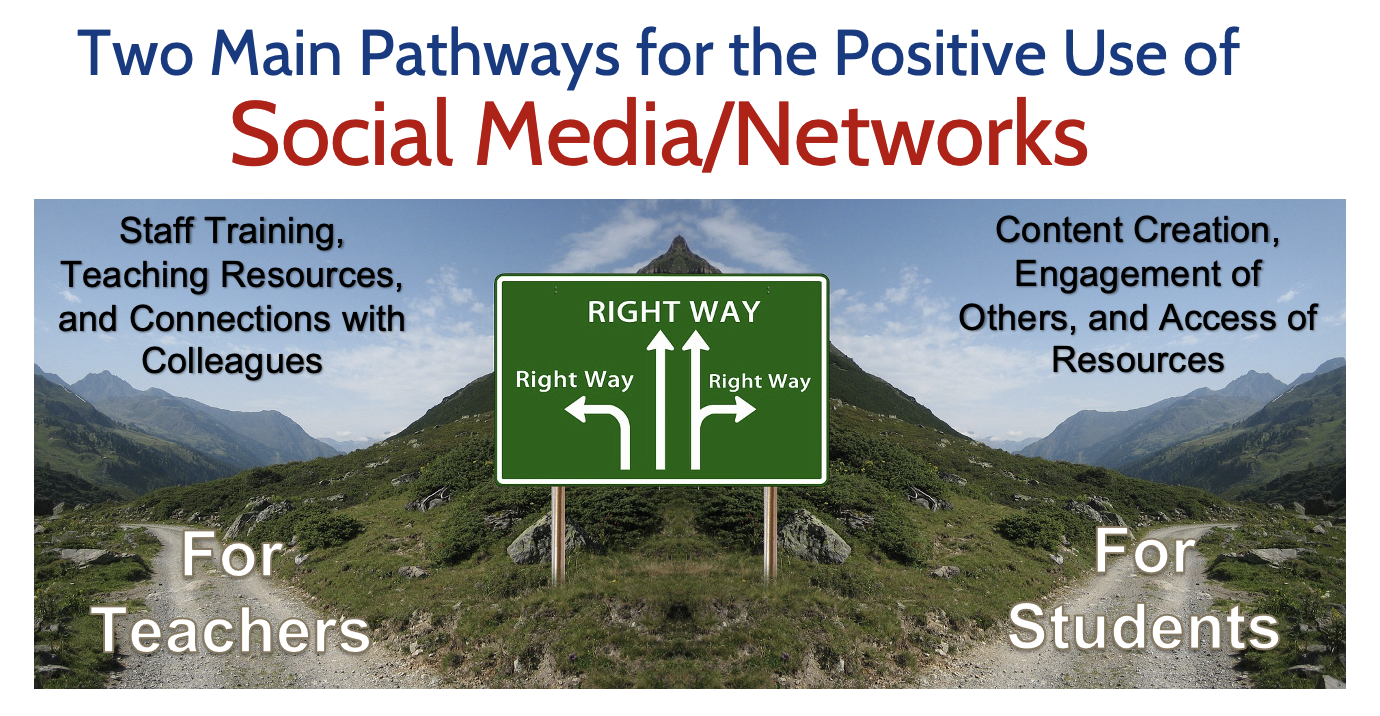
Social Media – Boon or Nemesis?

Time: 11 a.m.
Social Media Handout
Social Media Slide Summary

Description: The presentation will touch-on various legal issues, the ethical framework necessary to guide teacher decision-making and the avoidance of unacceptable “appearances or actions,” and precautions for the use of digital communications and social networks. Sample success stories, “exemplars,” and resources for the safe use of tech tools and applications of social media/remote/alternative/distance learning will be shared.

All Aboard the E3-Train! ⏤ Essential Educator Ethics…

and introducing NASDTEC’s Model Code of Ethics for Educators

Time: 1:00 p.m.
Ethics Handout
Ethics Slide Summary

Description: Teachers make thousands of decisions every day resolving conflicts in pedagogy, enforcement, resource allocation, relationships, and diversity. Many of these are “snap judgments” relying on gut feelings, intuition, past experiences, and a personal moral compass. And, although Johnny Cash may have sung “I walk the line…” in his love song, in education it is often a perilous “fine line” to maintain the standards and appearances of professionalism, integrity, and ethical codes both in and outside the school community.

This workshop will foster interactive facilitated discussions on risk assessment and resolution of ethical disputes and “conundrums” both in and outside the workplace. We will introduce the National Association of State Directors of Teacher Education and Certification Model Code of Ethics for Educators (MCEE) and empanel a mock jury of volunteer attendees to analyze and judge sample (real or hypothetical – “what would you do?”) scenarios for new perspectives in managing day-to-day decision-making in music education.

MMEA

Our next professional development journey takes us to the three-day MMEA Annual State Conference in Baltimore.

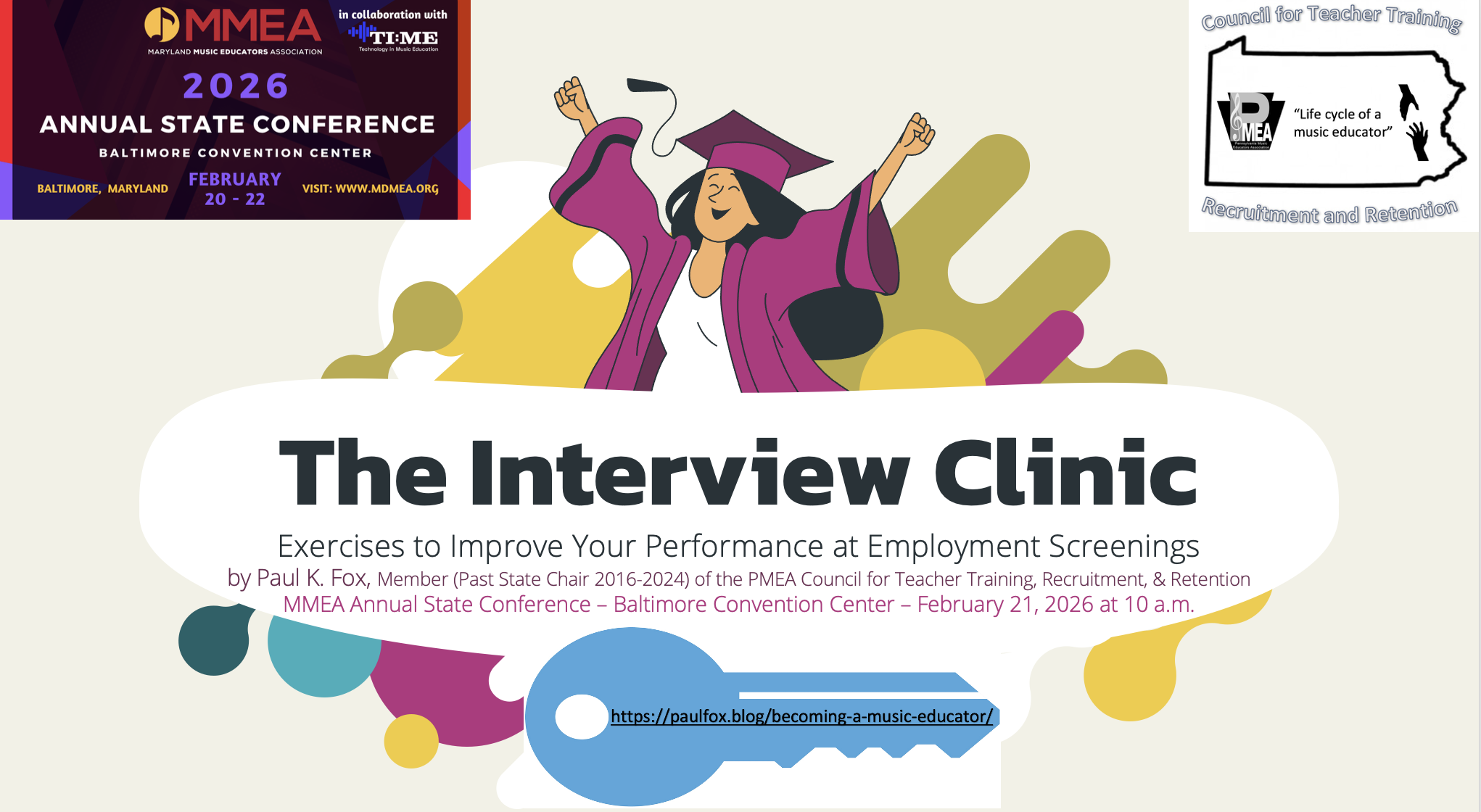
My session The Interview Clinic will be presented on Saturday, February 21 at 10:00 a.m. in Room 325. Geared to the coaching of college music majors, pre-service, unemployed, educators in transition, or those teachers seeking new positions, this workshop will provide hands-on interactive exercises to improve candidate performance at employment screenings.

Description: How do you get to Carnegie Hall? Practice, practice, practice! How do you succeed at job interviews? Practice, practice, practice! Are you looking for your first job over the next year or so? Or, are you trying to “move up” to a better position? This workshop will provide hands-on tips, tricks, techniques, and trial exercises for developing skills in professional marketing, branding, storytelling, and networking.

The valuable resource, The Ultimate Interview Primer for the Preservice Music Teacher, will be shared archiving an extensive library of supplemental self-help links to interview questions, good/bad habits at employment screenings, and additional strategies for landing the job you always wanted.


PMEA

It probably will not come as a surprise to readers of this blog that my favorite professional development venue is the Pennsylvania Music Educators Association Annual Conference… of which I have missed perhaps only three of these “celebrations” over nearly five decades of involvement in music education, all starting with my HS participation in PMEA All-State Band (tuba) and PMEA All-State Orchestra (viola). PMEA Annual Conference is the main event providing “state of the art” keynoters, clinicians, educators, expert innovators, performers, curriculum designers, and supportive vendors, and more than any other source, probably has had the greatest influence on sustaining my growth as a music educator. Like many other “diversified colleagues,” throughout my career I had to go through transitions of teaching new grade levels and content specialties (although orchestra and strings were my “thing,” new job assignments required retooling and fostering renewed skills in music theory, technology, choral, musicals, and even elementary band)… and PMEA’s professional development offerings were always my “go to!”

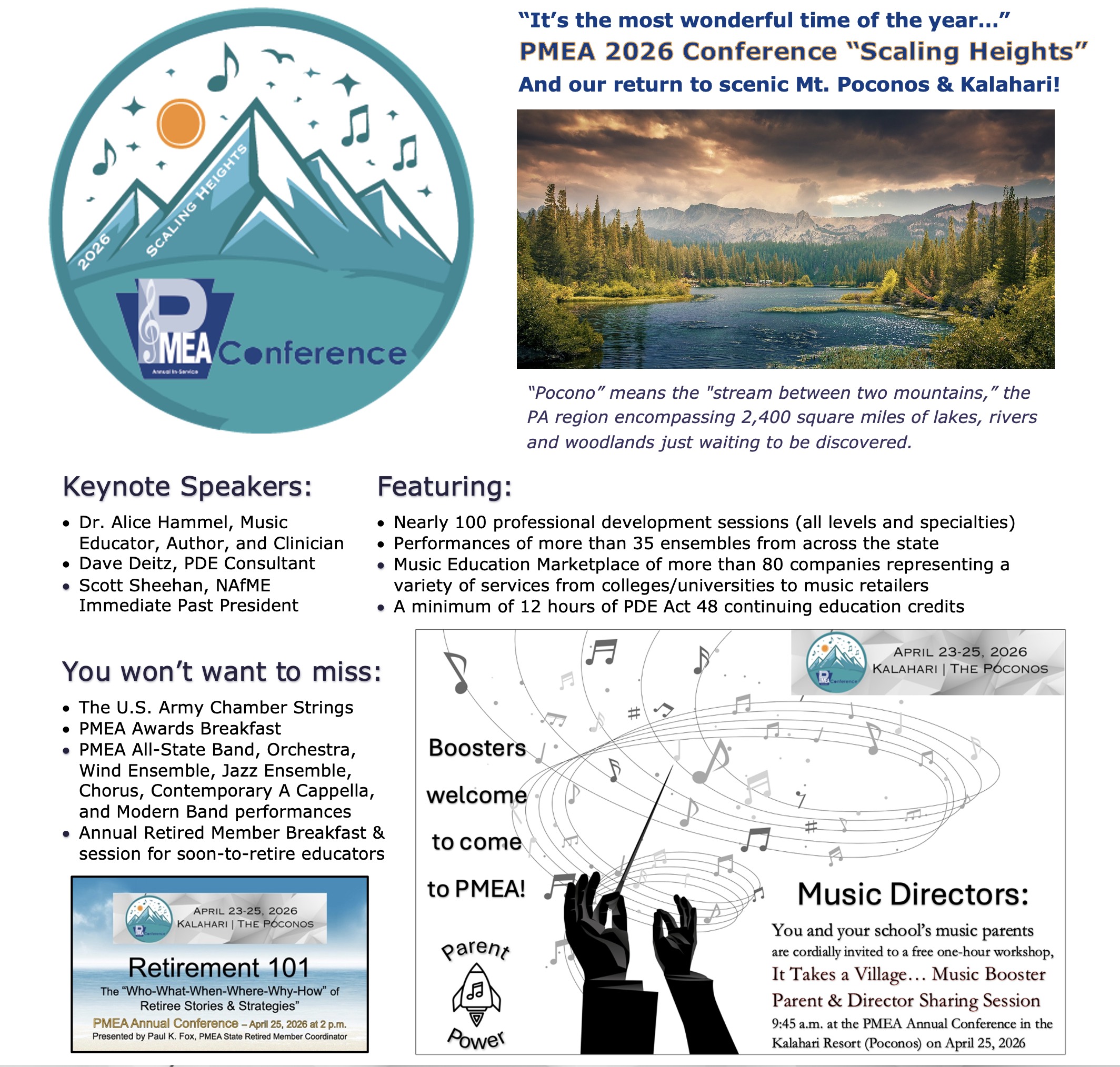
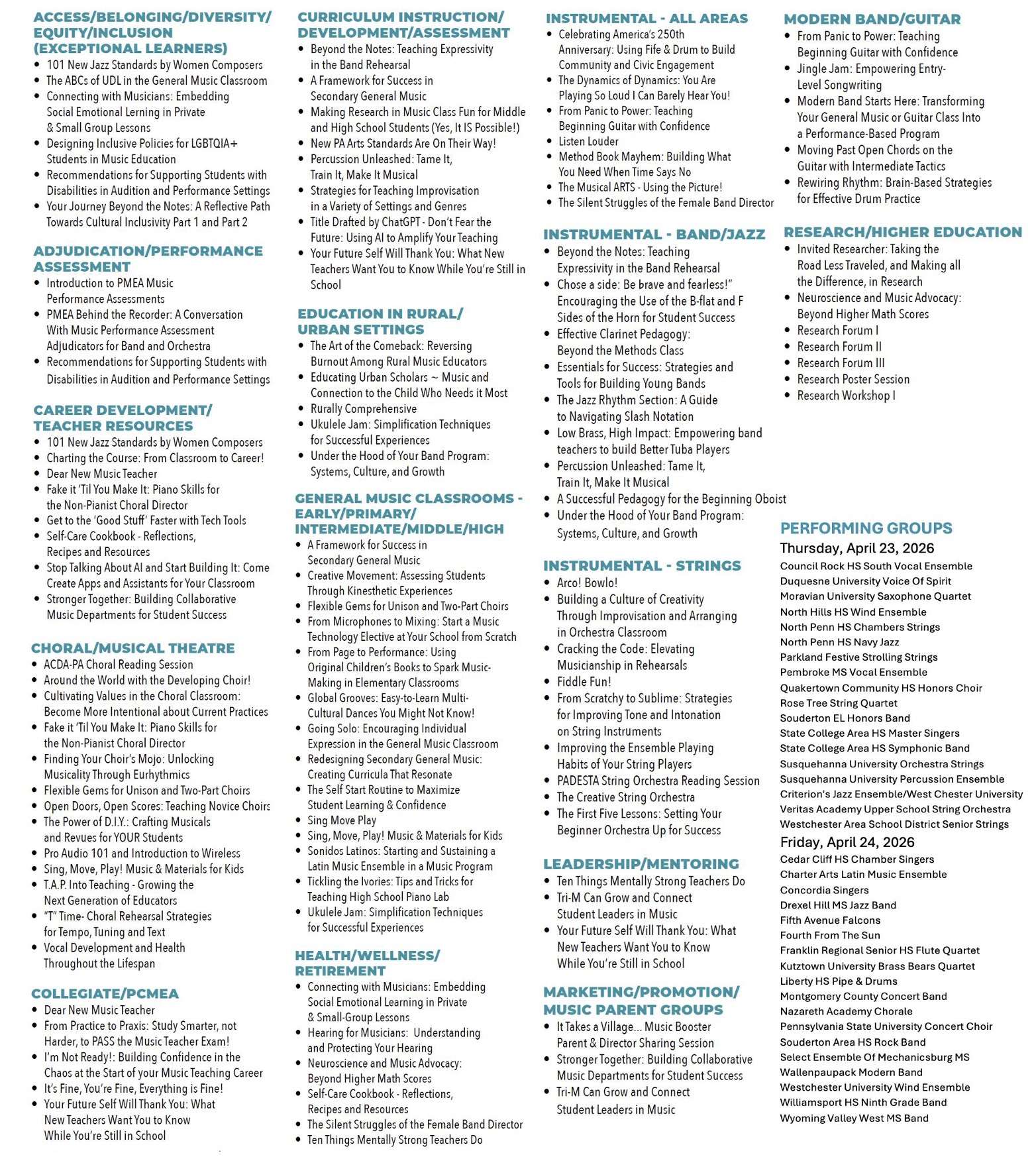
If you live in or near the Commonwealth, you should drop everything today and register for the PMEA Annual Conference at the Kalahari Resort in the Poconos.

I am happy to announce that I will present/facilitate several sessions at PMEA’s Scaling Heights 2026:

  • April 23: Self-Care Cookbook – Reflections, Recipes, and Resources
  • April 24: Retirement 101 – Retiree Stories and Strategies
  • April 25: It Takes a Village – Music Booster Parent and Director Sharing Session

More details about these session will be coming in future blog posts.

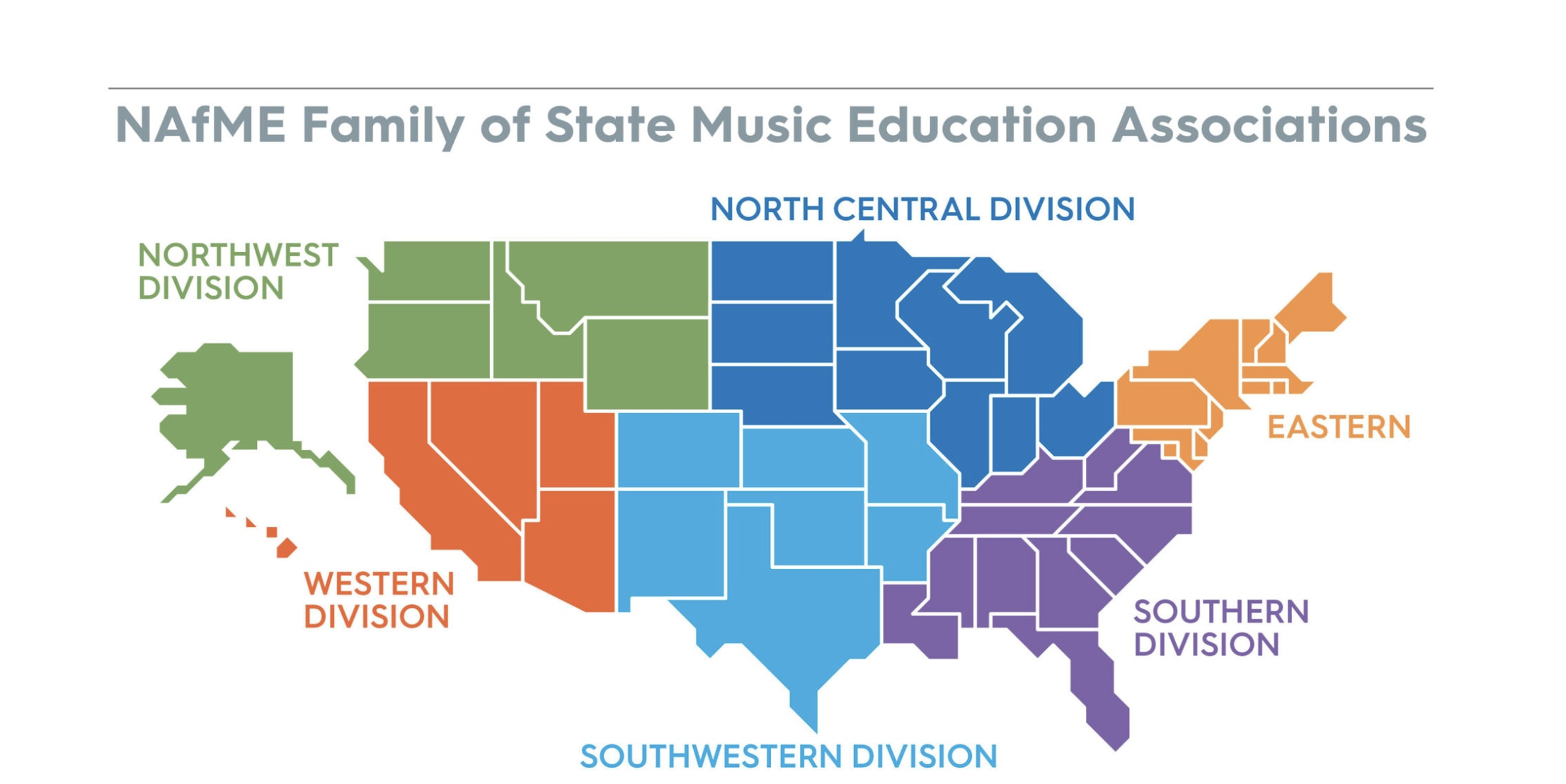
These conferences are only the tip of the iceberg! If you need to consider other MEA sites or more convenient locations to where you live, peruse the NAfME website here, where there is a quick count of more than 52 (state) music education associations, most with one or more conferences per year!

So, now are you interested in galloping or just trotting through The Year of the Fire Horse? Make a New Year’s Resolution to attend one MEA event in 2026. Apathy is not an option! Excuses will NOT be accepted!

PKF

© 2026 Paul K. Fox

Engaging Retiring/Retired Educators

Ask not what NAfME or your state MEA can do for you, but what YOU, a retiree, can do for your professional association and music education.
An adaptation of the famous excerpt from the 35th U.S. President John F. Kennedy’s inaugural address of January 20, 1961.

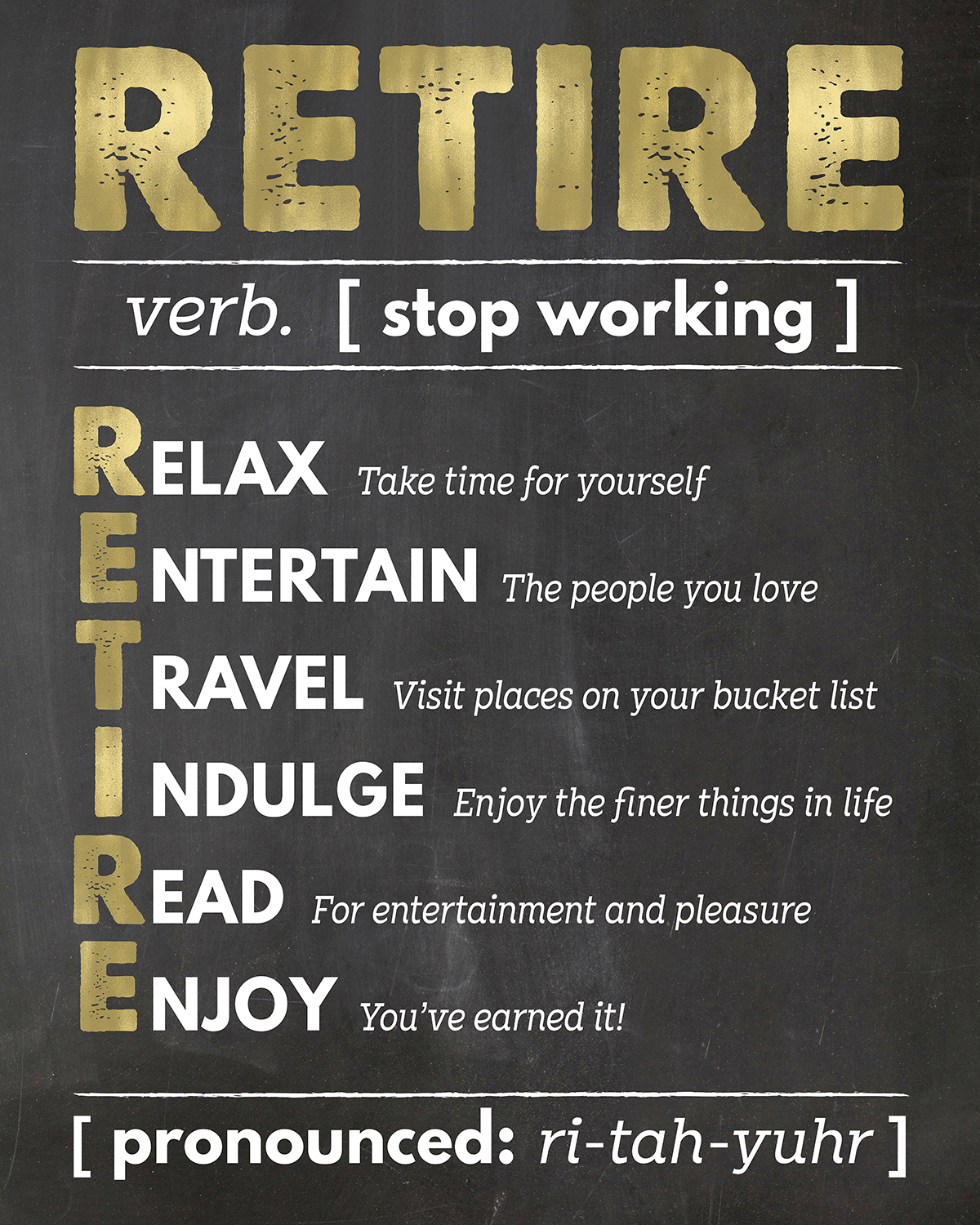
Surfing the ‘Net, I found an appropriate acronym for R.E.T.I.R.E. by Tangled Tulip Designs in pinterestRelax, Entertain, Travel, Indulge, Read and Enjoy! Most retirees would probably agree! The cessation of full-time employment may offer a great release from the day-to-day stress and drudgery of the job and the freedom to venture out, self-reinvent, make future goals, nurture relationships, and explore new personal growth opportunities.

Many attribute embracing a career in music education as “a calling” as opposed to just a form of employment or livelihood. From my experience, I have witnessed that most music educators are passionate for the cause of fostering creative self-expression in their students, more of a 24/7 mission, bringing intense focus and dedication to their lifework.

More to the point: Do we ever truly retire from making music ourselves and fostering this love in others?

THE “WHY!” Retirees matter and are critically needed!

One of my favorite inspirational speakers (Simon Sinek) would say, “start with the WHY!” WHY is this discussion on professional engagement of retired educators so important today?

  1. Their need: An informal poll of my former local educators and administrators revealed that half of them “hate retirement!” According to Dr. Robert P. Delamontagne in his book Retiring Mind (Fairview Imprints), “50% of retirees will suffer some form of acute emotional distress. This is potentially a very large problem given the fact that 10,000 people are becoming eligible for Social Security every day for the next 20 years in the US alone.” Remember this statistic the next time a senior citizen cuts you off on the road or bangs a shopping cart into your leg at the checkout!
  2. Our need: We are facing shortages of qualified teaching candidates across the country with unfilled openings in public school music positions and the critical need of training/mentoring the new hires.
  3. Society’s need: All of our voices should be combined to support the advocacy of music education, actively promoting access to school music by sharing its academic and social benefits with decision-makers, building relationships with administrators and policymakers, and utilizing resources from organizations like NAfME and the NAMM Foundation.

Despite its proven benefits, music education is often the first program to face budget cuts in schools. This is especially concerning in underserved communities, where access to music programs can be life-changing. Now more than ever, we must advocate for music education to ensure that every child has the opportunity to experience its benefits. Investing in music education is an investment in the future of our communities — helping to cultivate the next generation of creative, resilient, and innovative leaders. 
“Why Music Education Matters More Now Than Ever” by Music Will, February 2025

For eleven years (and counting), I serve as the Pennsylvania Music Educators Association (PMEA) Retired Member State Coordinator, as well as the Past State Chair (current member) of the PMEA Council for Teacher Training, Recruitment and Retention. I believe my responsibility to the state association is two-fold:

  • Assist soon-to-retire professionals in achieving a smooth transition to a happy and satisfying retirement; to help them cope with the commonly-experienced emotional ups-and-downs of this life passage, wrestling with the question “what do you want to be or do when you grow up?” and making new life lesson plans and personal goals.
  • Reach out to and build meaningful connections with retirees in order to fully engage them towards becoming active in their professional association; to recount, represent, and revitalize the activities of our post full-time employed music educators.

This article proposes a roadmap of crucial pathways to help music teachers approach “retirement bliss” while tapping into their hard-earned knowledge, strengths, and experiences by cultivating the benefits of their renewed participation in our professional associations.

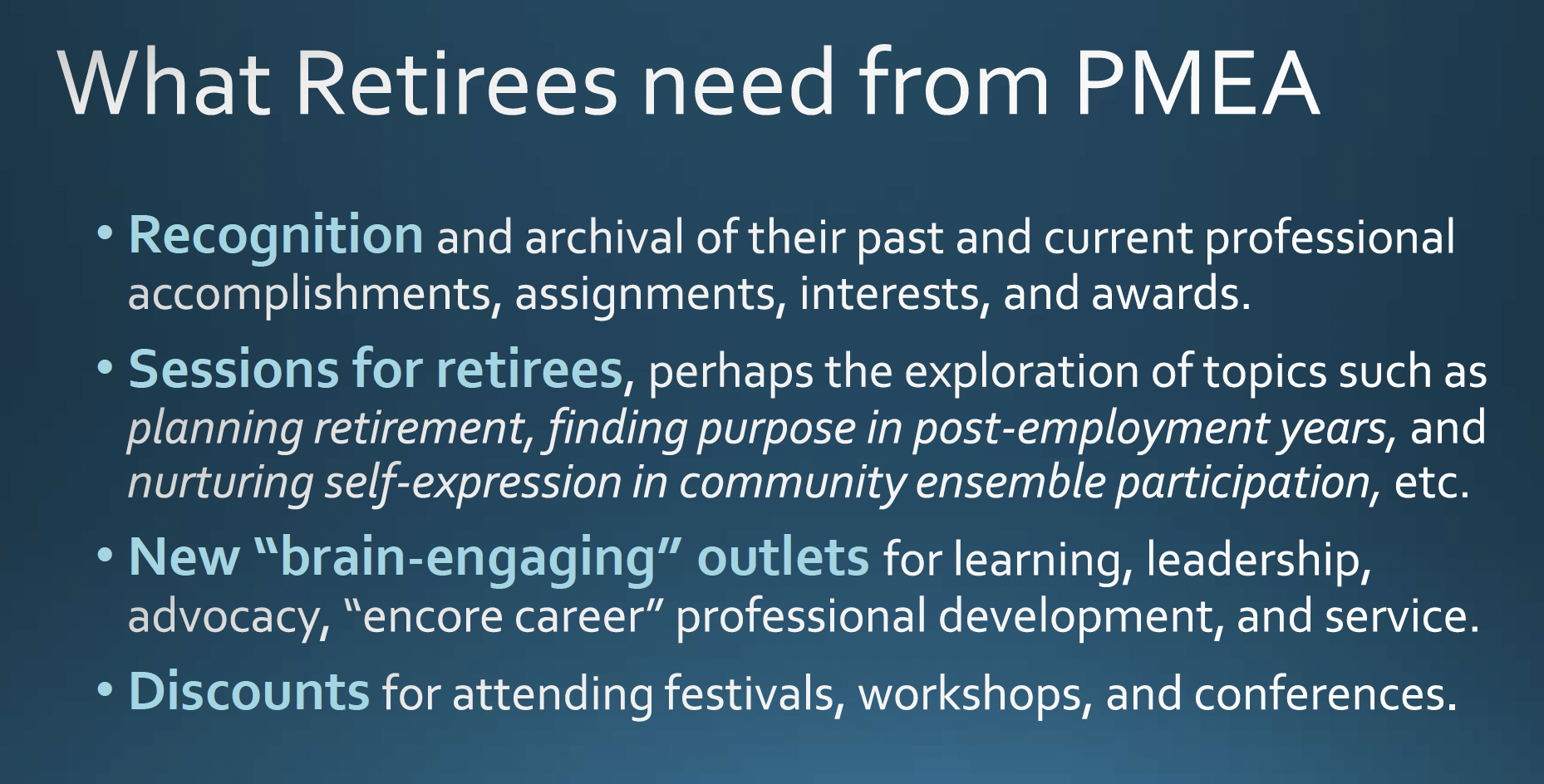
What can NAfME and State MEAs offer retirees?

You have devoted your entire life to inspiring the development of personal artistry and “ah-ha” musical moments in others. Now it is your turn to reap the benefits (and privileges) of this commitment to the profession. NAfME and your MEAs can provide the resources and motivation of “sharing and caring,” directing retirees “places to go, people to meet, and things to do” for fulfilling that “next chapter” or (perhaps better terms) the “refirement” or “rewirement” of senior living.

Do you feel “needed” and know you “make a difference?” Research has shown that the one of the most important motivators for involvement in a professional association is that its members recognize that they are essential to its success. This quote is from Revitalizing Retirement: Reshaping Your Identity, Relationships, and Purpose by Nancy Schlossberg, attributed to Rosenberg/McCullough:

 “It has been suggested that one problem of retirement is that one no longer matters; others no longer depend on us… The reward of retirement, involving a surcease from labor, can be the punishment of not mattering. Existence loses its point and savor when one no longer makes a difference.”

Most people who are one to five years away from “pulling their pin” and putting in their walking papers “do not know what they do not know.” Experts agree: “Retirement preparation is not only about the money!” Our silver-haired colleagues who have already Crossed the Rubicon and are now “living the dream” in retirement can share their trials, tribulations, and (more importantly) numerous success stories about coping with this transition!

NAfME, PMEA and this paulfox.blog/for-retirees site have archived an exhaustive number of self-help articles. Check out this omnibus NAfME blog “Retirement Prep Top-Ten Treasures.”

The benefits of retired MEA membership are numerous. Besides providing helpful transitioning advice, these advantages also come to mind:

  1. Answers to questions like “What have you always wanted to sing, compose, play, record, conduct, write, publish or present?” and “Where can I share my hard-won expertise and help others in the field?”
  2. Networks and contacts to help you develop “encore careers” in other musical or educational arenas (e.g., higher education, music industry, festival organization, travel/tour planning, composition, guest conducting, private studio teaching, church music, etc.)
  3. Opportunities to “rekindle your expressiveness” by participation in adult community or full/part time performance groups (playing “gigs”)
  4. Places to go/things to see/hear: NAfME/MEA conferences, workshops, and concerts
  5. Exclusive discounts and other benefits (reduced dues and registration fees)

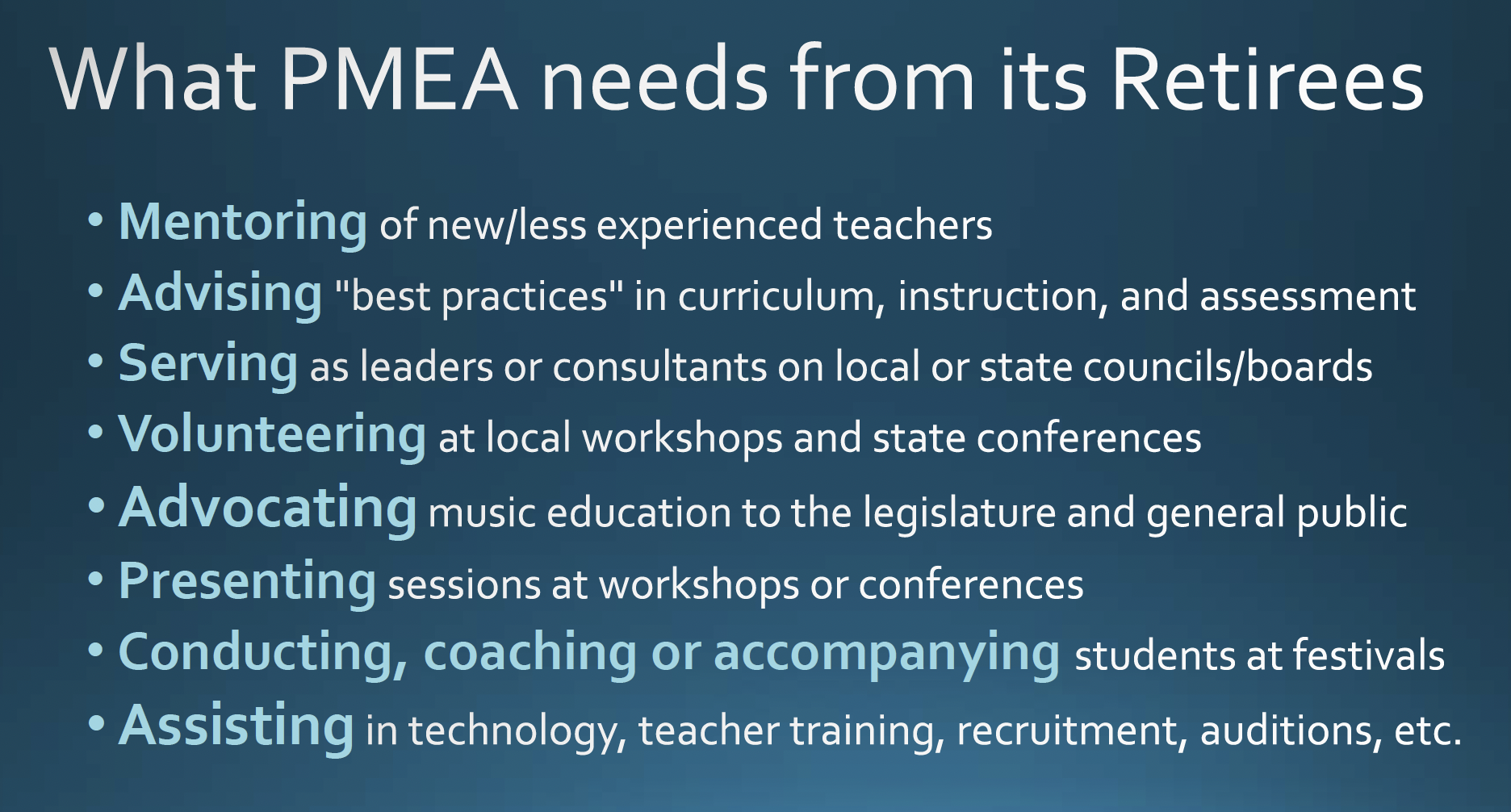
What can retirees offer NAfME and their state MEA?

The relationship of active and retired membership in our MEAs is symbiotic. We know from the history of our associations, “giving back to the profession” remains a high priority with most retirees. This may come in many forms and settings:

  • Leadership or membership in local, state, or national MEA/NAfME office, staff, advisor, or council/committee position
  • Advocates for the promotion of music education to local and state government officials
  • Service as presiding chair or member of the conference or workshop planning committee
  • Service as evaluator of performance groups, conference sessions, or articles for publication
  • Judges of local/state MEA adjudication or commercial festival
  • Accompanists, coaches, arrangers, or guest conductors for festivals or school/community groups
  • Services to the local music teacher in private teaching, piano playing, marching band charting, sectional coaching, choreography, music technology, instrumental repair, stage tech, etc.
  • Writers for state MEA and NAfME publications and blog sites
  • Contributors to online music education forums or the NAfME Connections
  • Donors to and/or fund-raisers of music education charitable projects, scholarship initiatives, etc.

The PMEA Model of Retired Member Participation

PMEA values the vast wealth of experience and contributions of our retired members. We’re proud of the many programs we offer to retirees and invite you to visit our website to peruse additional information and sample digital newsletters and articles.

Retired members in Pennsylvania are involved in:

  • PMEA elected and appointed offices, staff, committee chairs, and membership on councils
  • PMEA Strategic Plan and Bylaws, Conference Planning, and other state/regional committees
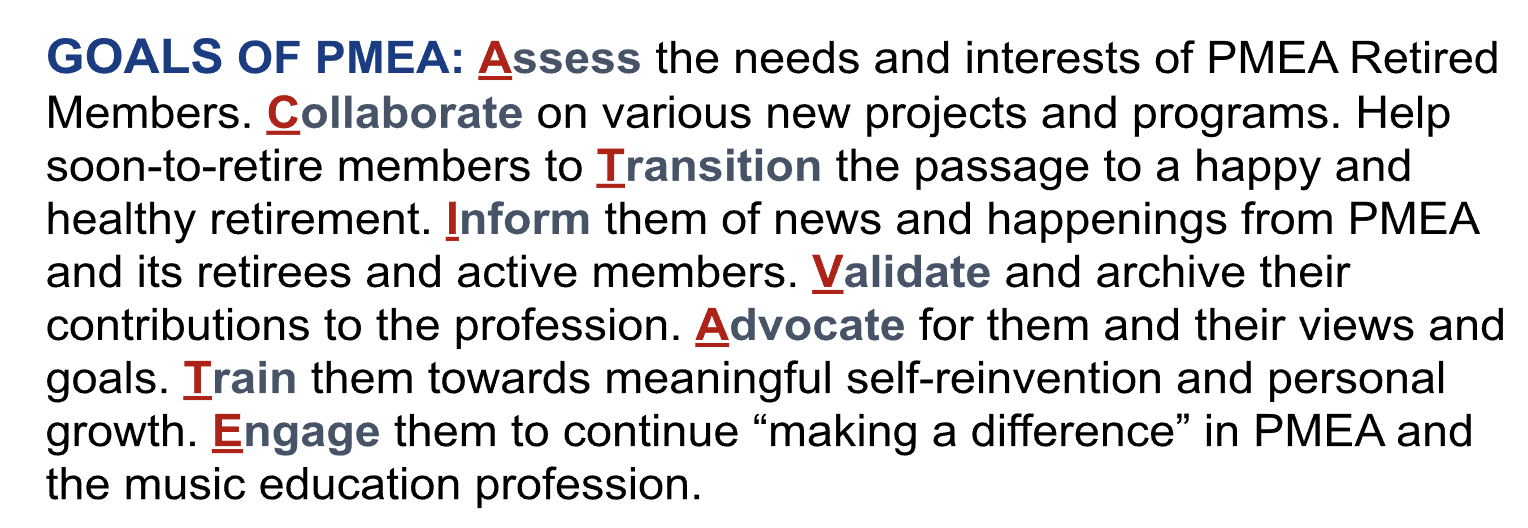
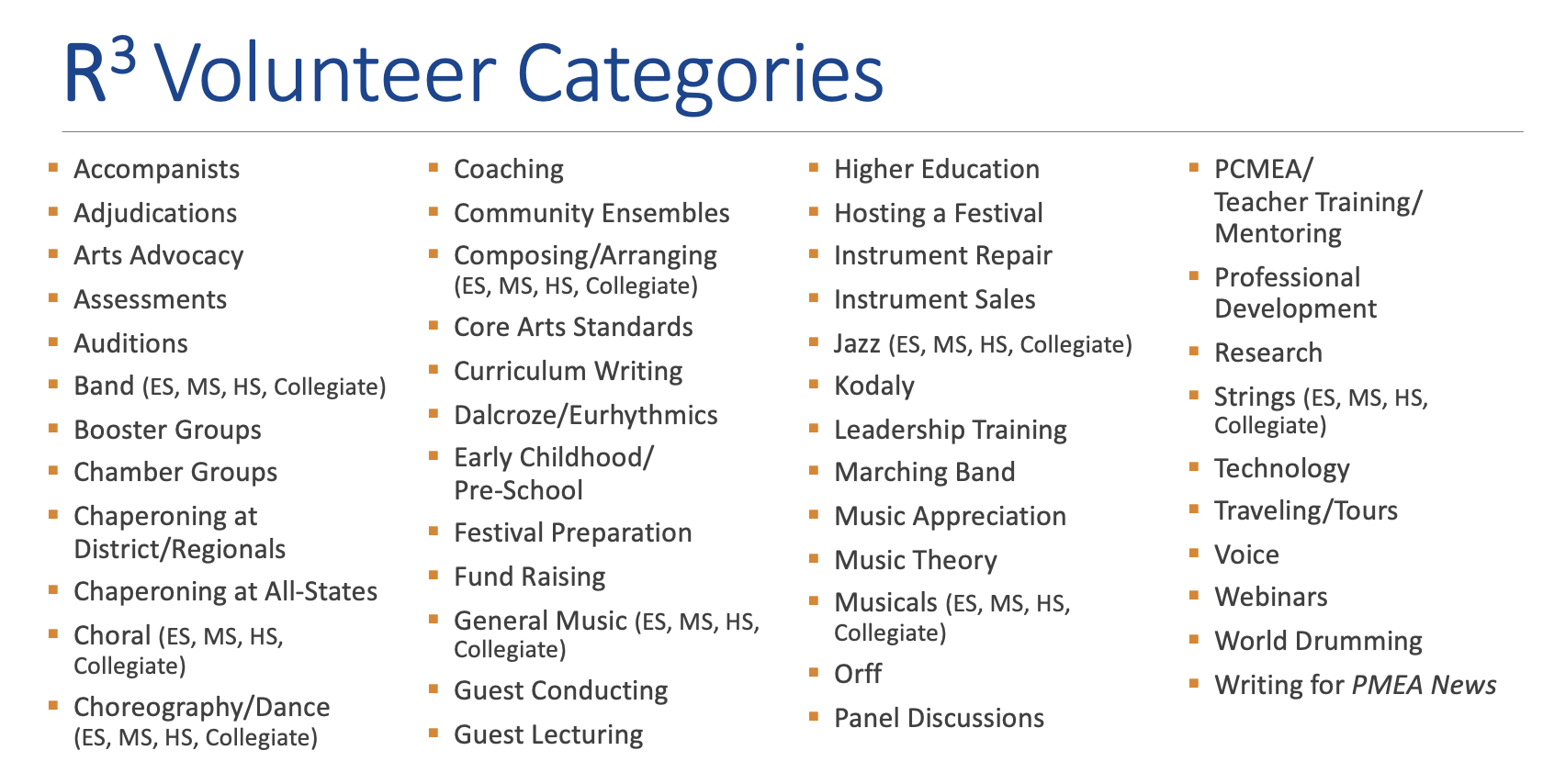
  • Retired Resource Registry* (informal mentoring for new teachers and transfers)
  • How-to-Retire Webinar, Prepping for Retirement, and the Ultimate Retiree Resource Guide
  • Retired Member Breakfast at PMEA Annual Conference
  • Retirement 101 (The Who, What, When, Where, Why, and How) session at PMEA Annual Conference (training for all members retiring or soon-to-retire)
  • Maintenance of PA Community Band, Chorus, Orchestra, and Theater group catalogs
  • Maintenance of PMEA member compositions library
  • Mock Job Interview Committee for music education majors
  • Coffee & Conversations informal “ask an expert” lounge at PMEA Annual Conference
  • Volunteering as presiding chairs for sessions and registration aides at conferences/workshops
  • Pool of conference clinicians, guest lecturers, and members on discussion panels
  • Participation in “Sponsor a Collegiate to Attend the Conference” campaigns
  • All-State Program Patron, or contributor to the annual Irene Christman Scholarship or Margaret Bauer Grant programs.

As of October 1, 2025, there are 61 advisors in the PMEA Retired Resource Registry.

*During their annual membership registration, PMEA Retired Members may choose to sign-up for the R3 Retired Member Registry (above volunteer categories) to become available to informally offer advice to college music education majors, new hires, transfers, and newcomers to any music specialty. R3 members may handle inquiries like “What warm-up would you recommend for my middle school choir?” OR “Do you have an idea for an elementary string ensemble concert opener?” OR “How do you teach improvisation… steady beat… breath support?”

The other option with more time commitment is that Retired Members can be officially “trained” as a PMEA Mentor and be assigned to specific individuals who request assistance in their early career assignments.

Coda

How can we help?

What is the future of retired music educator professional engagement? In a word: connections!

Last month, I reached out to Elizabeth Welsh Lasko, NAfME Assistant Executive Director for Membership, Organizational Development, and Marketing Communications and “volunteered” OUR assistance. I suggested that, in keeping with the NAfME 2022 Vision Statement “…an association where all people are heard, seen, and feel they belong throughout their lifelong experiences in music” we should all intentionally recruit more hands-on involvement of our retirees. I pointed out that in the late 1980s, we had a Music Educators National Conference (MENC) Committee for Retired Members led by a National Chairman who served on the NAfME National Assembly. (An excellent booklet, TIPS: Retirement for Music Educators, Copyright © 1989 MENC, was compiled by A. Verne Wilson, then the Past National Chairman of the MENC Committee for Retired Music Educators.)

Ms. Lasko encouraged me to “reach out to retirees” beginning with this article. At the next NAfME Eastern Division Conference, I plan to hold a meeting of retired members, and also connect with all state MEA retired member coordinators (those states who have them). We’re available and on the move! Let’s collaborate and share our resources!

Finally, just for fun, I recently posted the blog “For Book Lovers – Retired or Not” on NAfME Connections (formerly called Amplify). There are already 1,810 members in the NAfME “Retired Members Community.” Please JOIN US! Using this forum, get in touch with me, and respond with YOUR OWN retirement stories, strategies, perspectives on this “life passage,” and more ideas to grow the professional engagement of our music teacher retirees.

Happy trails!

© 2025 Paul K. Fox
Did You Take the Summer Off?

Rebuilding instrumental technique after a long break

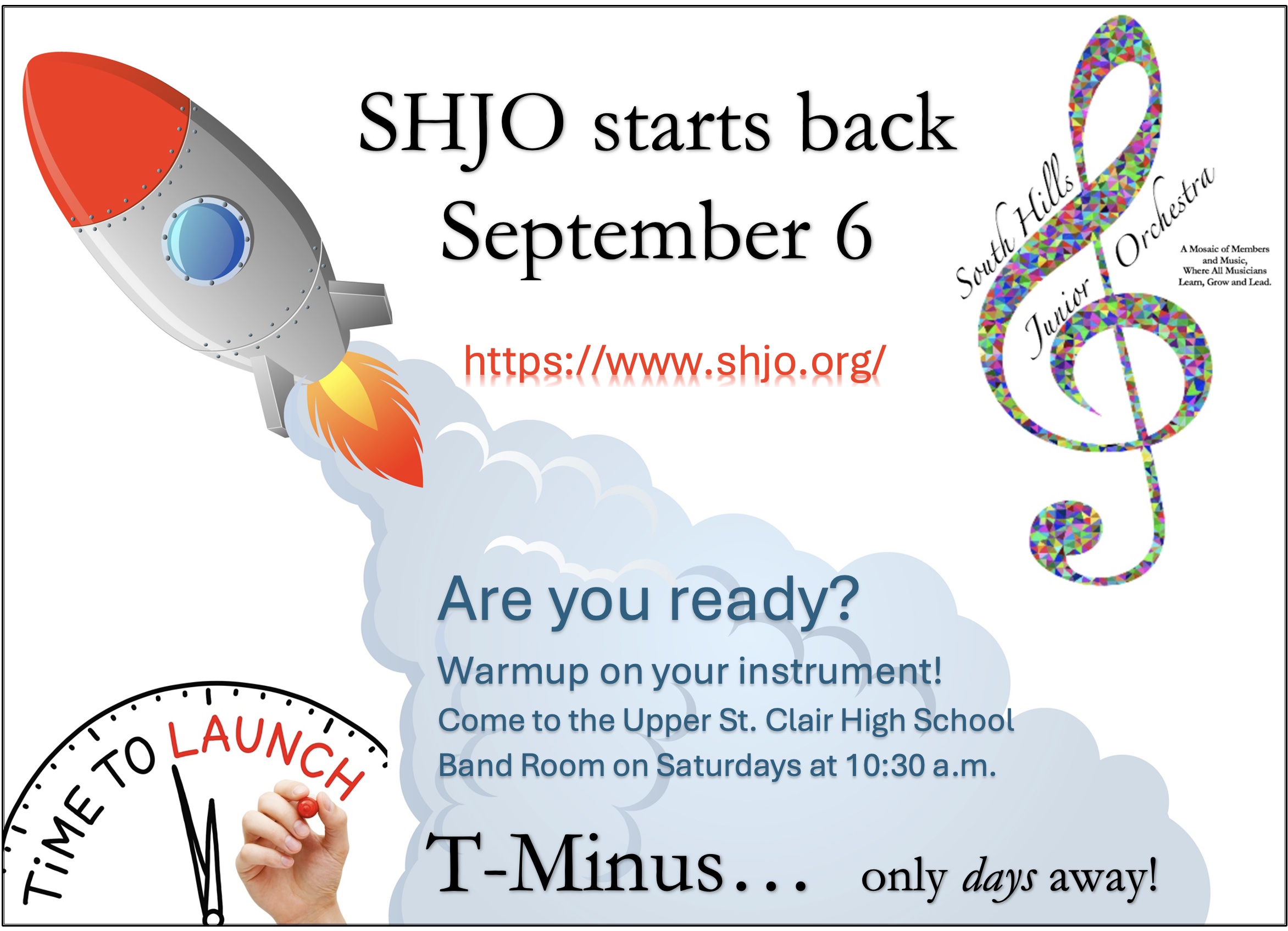
Director’s Note: This is the week to get ready for the return of the South Hills Junior Orchestra after all our vacations! If you live in the Southwestern PA area, we hope you will consider this a personal invitation to “TRY SHJO” and participate in several free and open rehearsals of our community orchestra – a totally “judgment-free” place for creative self-expression of all ages and ability levels. Practices are held in the Upper St. Clair High School Band (1825 McLaughlin Run Road, Pittsburgh, PA 15241) on Saturdays from 10:30 a.m. to 12:30 p.m.

A Google search on my computer fetched the following “AI Overview,” a nearly perfect summary for wind players to recover their “chops” and bring back good tone, intonation, breath support, flexibility of the embouchure, key literacy, and practice habits. For players of all orchestral instrumental sections, I recommend revisiting other articles in the Fox’s Fireside Library to develop a “practice plan” and adopt new musical goals. PKF

To rebuild your brass and woodwind instrumental technique after a long break, focus on the following gradual, three-stage process: first, restore your tone and response, then regain flexibility and dexterity, and finally, rebuild range and endurance. Prioritize short, consistent practice sessions, and avoid pushing too hard too early to prevent injury and bad habits.

Stage 1: Restore tone and response

Your primary goal is to reacquaint your body with the fundamentals of playing by focusing on soft dynamics and your lowest register.

  • Breathing exercises: Start without your instrument. Practice deep, diaphragmatic breathing to re-engage your respiratory system and expand your lung capacity. You can use simple routines like inhaling for four counts and exhaling for eight, or try the “pinwheel” exercise to visualize steady airflow.
  • Buzzing: Brass players should spend time buzzing with just their mouthpiece to get their lips vibrating efficiently again.
  • Long tones: On your instrument, play sustained, steady notes at a soft volume in your lower-to-middle range. Focus on producing a clear, characteristic tone. Use a tuner to monitor your pitch stability.
  • Short practice sessions: Limit your initial sessions to 5–20 minutes, with plenty of rest in between. This prevents over-straining your facial muscles and embouchure.

Stage 2: Regain flexibility and dexterity

Once your tone and response feel stable, you can begin to expand your comfortable playing range and improve finger speed.

  • Scales and arpeggios: Practice basic scales and arpeggios at a slow, controlled tempo. This helps rebuild muscle memory for your fingers while keeping the focus on even, beautiful tone.
  • Slurred partials (brass) and lip slurs (woodwind): Practice smoothly transitioning between notes without using your tongue. This strengthens your embouchure and improves air control.
  • Simple music: Play easy, melodic pieces you know well. This helps you focus on phrasing and musicality without the pressure of a difficult score.
  • Increase session length gradually: Slowly add time to your practice sessions, perhaps moving to 15–30 minutes at a time. Continue to take frequent breaks.

Stage 3: Rebuild range and endurance

After re-establishing your fundamentals, you can begin to increase the intensity and duration of your playing to return to your previous level.

  • Expand your range: Gently start working your way into your upper and lower registers, but maintain a soft dynamic level. Only increase volume once you can play a note softly with a good tone.
  • Louder dynamics: Once your full range is accessible, begin practicing with louder dynamics. This is physically demanding, so continue to take frequent rests.
  • Articulation: Incorporate tonguing exercises. Start with basic single tonguing before adding more complex techniques like double and triple tonguing.
  • Listen to your body: Your body will be the ultimate guide. If you feel any pain or unusual fatigue, ease up and incorporate more rest into your routine.
  • Mental preparation and practical tips
  • Listen to music: Remind yourself of what inspires you and listen to your favorite players to reconnect with the joy of playing.
  • Record yourself: Objectively evaluate your progress by listening back to recordings. This helps you identify areas that need work and celebrate your improvements.
  • Revisit old notebooks: Look back at any old lesson journals for useful reminders and insight into your past tendencies.
  • Service your instrument: A leaky pad or sticky valve can make returning to your instrument unnecessarily difficult. Have a technician give your instrument a “clean, oil, and adjust” to ensure it’s in prime playing condition.
  • Be patient: You are not expected to be at your former playing level immediately. Trust that your muscle memory will return with consistent, smart practice.

Click here to download a printer-friendly copy of this article.

 Here are additional resources shared in the SHJO eUPDATE newsletter (August 30, 2025):

PKF

© 2025 Paul K. Fox
Social Media – Revisited

Before you begin reading this article, please take a moment and peruse these past blog posts:

Although several of the cited research links may have expired (for example, PA Department of Education modified most of their website’s URLs), these provided the foundations of background information and references for the presentation I prepared for the DCMEA Virtual Conference in 2020 (during COVID) and serve as the starting point for the workshop I will share in-person at the DCMEA Winter Conference in January 2026. This blog provides updates and additional perspectives. Taken in combination with the above sources, you will be able to identify the benefits, positive models, precautions, and dangers of social media, social networks, professional learning networks, and sample emerging technologies as they apply to teachers’ professional development and education of students.


“THE WHY”

Before every clinic or publication I develop, I always try to spotlight the theme of “THE WHY” as preached by one of my favorite authors and motivational speakers – Simon Sinek! According to him, for organizations and individuals alike, “THE WHY” (rationale and priority) is more important than “THE WHAT” and “THE HOW.” (See this video.)

WHY is a collaborative discussion on social media essential? Why now?

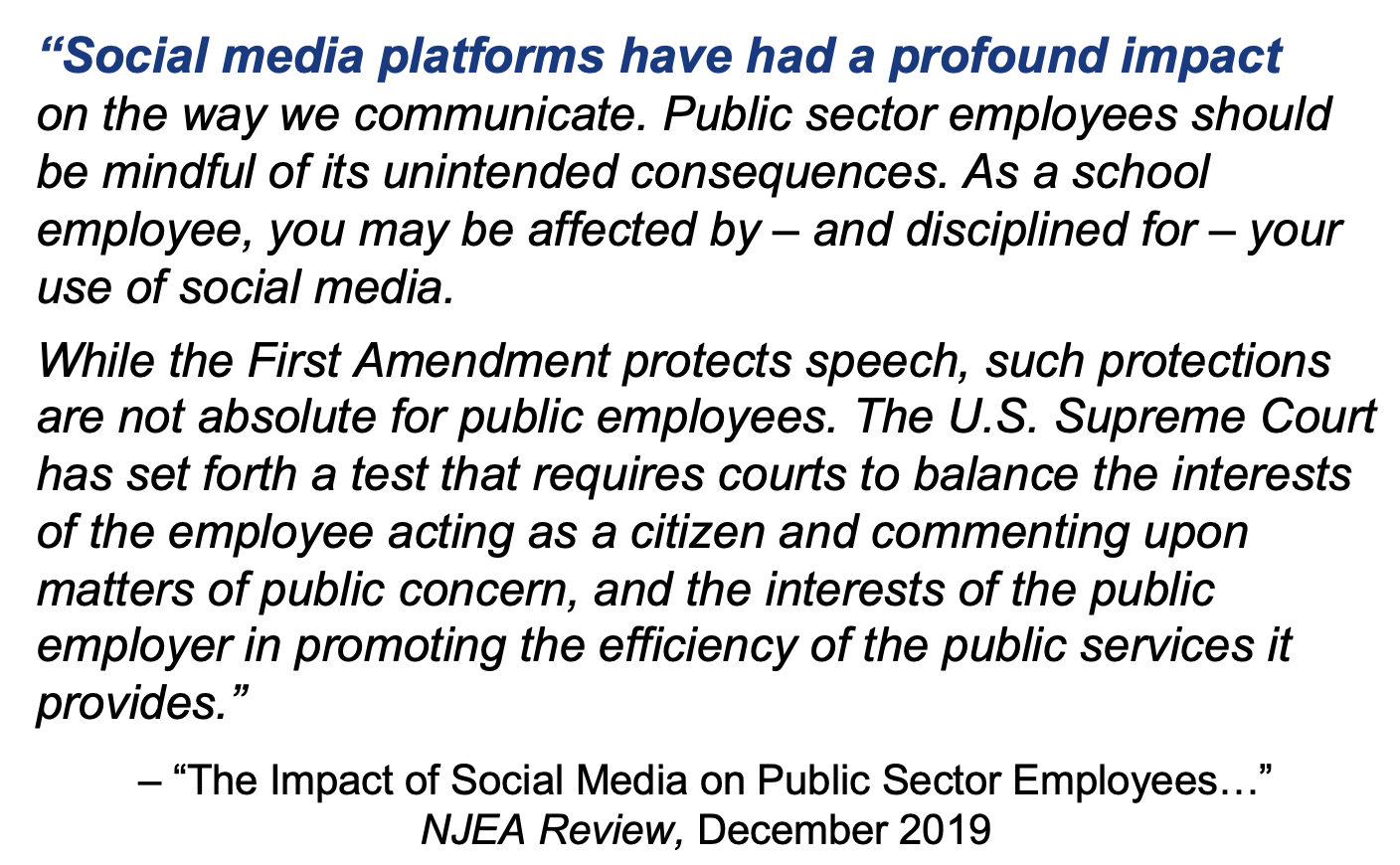
 ”There’s a growing body of evidence suggesting that educators are facing increasing scrutiny regarding their social media use. Concerns include unprofessional conduct, inappropriate interactions with students, and the potential for cyberbullying and other negative impacts on student well-being.”

“Educators are increasingly concerned about how social media influences students’ social-emotional development and their interactions with others.” 
NEA Member Polling on Social Media…
NEA Impact on Social Media and Personal Devices on Mental Health
HHS Youth Mental Health and Social Media

Frankly, there is still a lot of confusion about the dangers of social media, social networking, and other technology integrations into education. In Social Media – Boon or Nemesis, we mentioned that teachers should “debunk the free speech myth.” We demonstrated how the improper application of social media could get educators in trouble. Check out these sites for more info and corroborative stats:
Teacher Student Misconduct and the Critical Role of Social Media Screening
NCBA Social Media for School Employees
Social Media Hazards and Tips for Teachers

As always, our goal is to promote ethical practices in maintaining professionalism in the digital world.


“THE WHAT” Review of Definitions

“Social Media”

Social media are “websites and applications that enable users to create and share content or to participate in social networking.”
— Oxford Lexico.com online dictionary

“Social Network”

A social network is, 1. a network of social interactions and personal relationships.; 2. a dedicated website or other application which enables users to communicate with each other by posting information, comments, messages, images, etc.
— Oxford Lexico.com online dictionary

Professional Learning Community” (PLC)

A PLC is “a group of educators who meet regularly…” (usually in-person) “…to strategically enhance their teaching skills and improve student outcomes.”

versus “Professional Learning Network” (PLN)

A PLN is “a group of educators who gather more informally…” (usually in online communications) “…to problem-solve and generate ideas to enhance classroom practices. A PLN… often takes the form of an open forum, where participants can ask and answer questions based on their experiences.”
https://edtechmagazine.com/k12/article/2024/08/pln-vs-plc-perfcon


“THE HOW” Ethos of Care

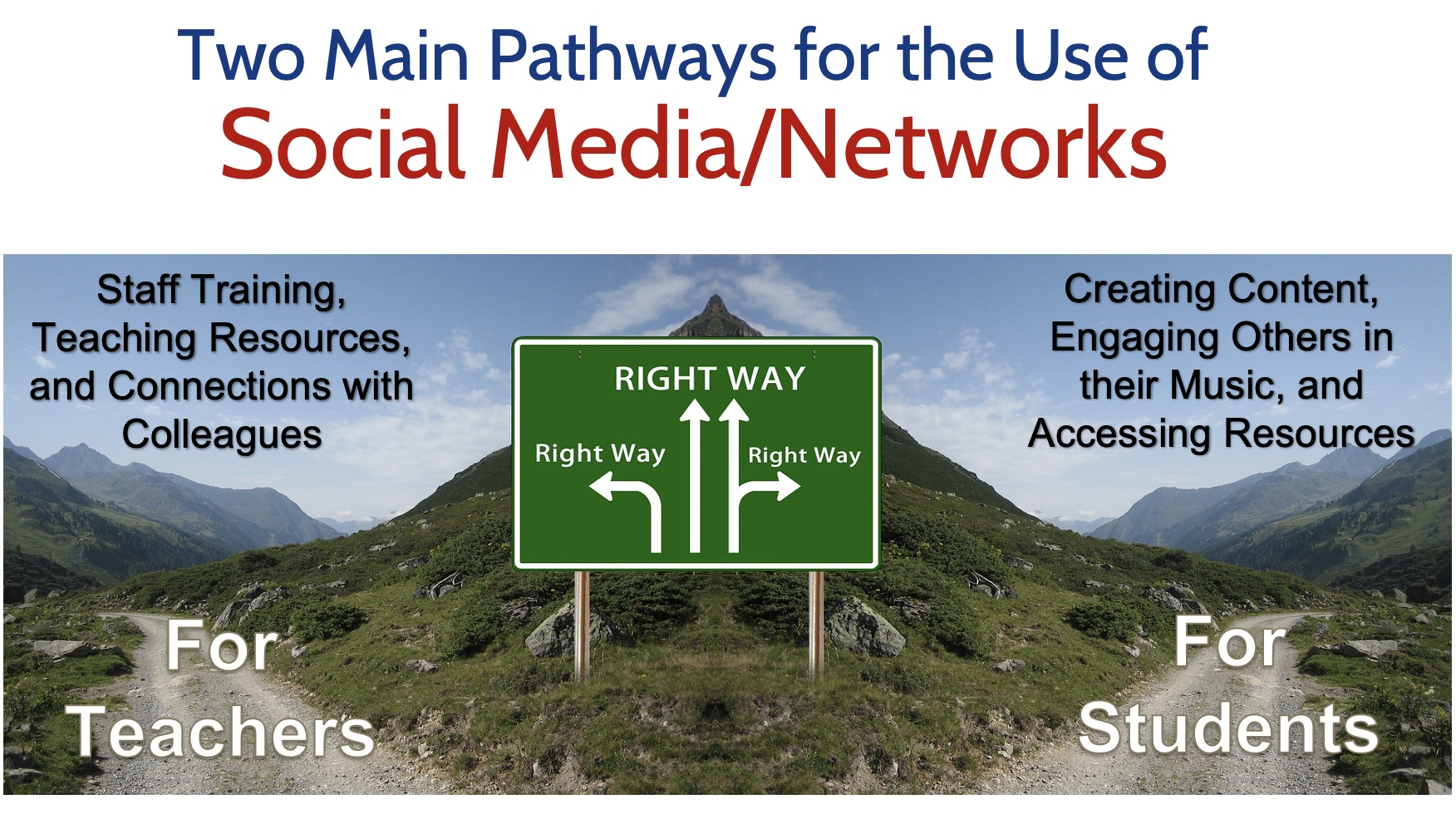
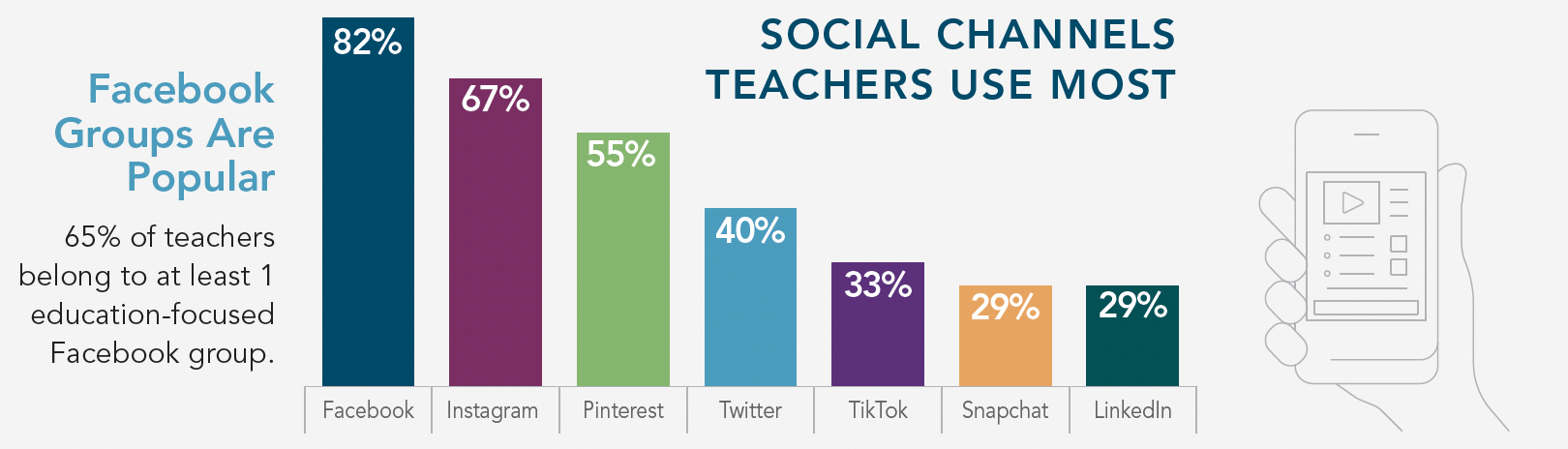
Teachers use social media to…

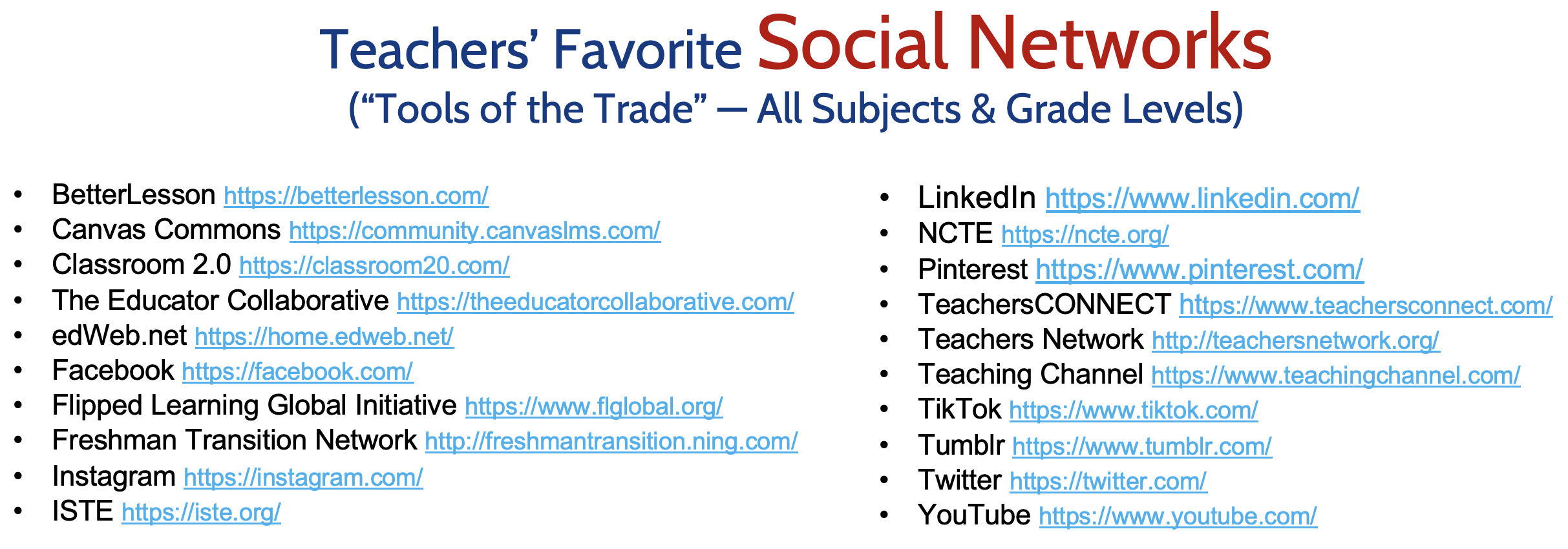
  • Get inspired with new teaching ideas
  • Find resources for the classroom
  • Connect with other educators
  • Stay on top of trends and news
  • participate in an online community
  • Find teacher discounts and deals
  • Follow education companies and organizations

How Teachers Use Social Media
Teachers Social Media Use

Social Networks for Teachers

We acknowledge that the benefits of social networking for educators are numerous by promoting professional collaboration and connections, including:

  1. Acquiring information to enhance understanding
  2. Keeping informed about latest developments in education
  3. Enhancing communications with students, parents, and the school community
  4. Fostering connections with colleagues in the field to expand an educator’s professional network.

Benefits of Social Media as an Educator

However, educators must exercise “sound judgment” and proper professional boundaries when using social media/networks with students. While the introduction of new technology provides many opportunities for teaching and learning, it is important to establish clear rules for appropriate student-teacher communication. In order to promote safety and appropriate boundaries while transitioning to a virtual teaching and learning environment, the Pennsylvania Professional Standards and Practices Commission offers suggestions to help educators protect themselves and their students.

  1. All technological resources and applications should be school entity-approved and only used in the manner prescribed. Ensure that you are familiar with the tools you are using in order to use them properly. 
  2. Communication with students should occur at designated times, consistent with traditional school day hours. Maintain transparency and protect yourself by keeping a record of all communications with students. 
  3. Clearly communicate when and how students should contact you and provide a timeframe for when students should expect responses to questions. 
  4. Avoid one-to-one interactions with students in chatrooms, FaceTime, Skype, or any other online space. School psychologists, school counselors and others providing one-to-one services to students should consult with school administration about the best mode of communication. 
  5. Use approved forms of communication by your school entity to connect with students and parents (i.e. Remind), use only your school email to communicate, and copy administration when communicating with parents or students. 
  6. When creating content or interacting in an online space with students, conduct yourself as you would if you were in school. If appearing on camera, dress professionally and be mindful of your surroundings and the camera’s view. 
  7. Do not “friend” or follow students on social media and do not allow students to “friend” or follow you on your personal social media. Remember, you do not have a “social” relationship with your students. 
  8. Keep your personal and professional lives separate. Do not share overly personal information about yourself with students.

PSPC Digital Tips for Educators

While exercising responsibility to maintain a respectful, safe, online environment, there are many benefits for the application of social media for students in the classroom:

  • Real-time communications can increase student engagement, collaboration, communication and overall participation
  • Many students may find it easier to participate in online discussions that in the classroom
  • Students can easily ask each other or their teacher questions about assignments outside of class
  • Students & teachers can quickly share resources at any time.
  • Teachers can easily share class announcements.
  • Social media can provide a contingency plan for last minute remote learning scenarios.
  • Students can organize school events with each other or with the help of a teacher.
  • Teachers can augment an online-only class by establishing a social media page or account simply for building community.
  • Students can practice using social platforms responsibly, including maintaining a respectful online discourse.
  • Teachers can communicate directly with parents as needed, and parents can stay informed of school news via a convenient, easily accessible platform.

However, please watch out for these potential drawbacks:

  • Social media can be a major distraction, especially if students are accessing their personal accounts independently.
  • If students primarily use social platforms to participate in class discussions, they can miss out on practicing face-to-face conversations and respectful in-person discourse.
  • Some students may see social media assignments as an opportunity to cyberbully their classmates, and there is always a risk of someone posting inappropriate content or language.

Social Media in Education


“THE WHAT” Several Success Stories

Balancing the positives and negatives and taking into account all of these precautions in order to maintaining professional boundaries, the integration of new technology into the classroom may offer excellent enrichment and increase student motivation for advanced learning. This may take many forms. Here are a few interesting models.

Prior to preparing for the DCMEA online session in 2020, I stumbled upon a truly inspiring post from Derek Muller, a gifted teacher, physicist, filmmaker, and founder of the YouTube channel Vertiasium which has captured millions of subscribers. He offers one of the BEST models of using social media to enrich the understanding of learning math and science (applicable to all fields of study), while at the same time, provides warnings against unbridled use of so-called “innovation for innovation’s sake.”

“I feel like people over the years are invariably drawn to use these words:  revolutionize and education. And there’s this sort of amnesia that we’ve had a hundred years’ worth of these predictions, worth of really groundbreaking technologies that have transformed other areas in our lives but have failed to fundamentally change the way we do education. So, I stand here today as a voice of caution, to think that the future of education is not one of revolutions…”

You need to watch this: How is Social Media Transforming the Future of Education? (2016)
Derek Muller

Say what you want about how COVID significantly disrupted our educational programs, evidence of learning loss, problems in socio-emotional development, decline of student engagement and self-motivation, rise in mental health struggles, decreased instructional time, and the effects of a new digital divide of under-served students (Annie E. Casey Foundation), happily there were surprisingly a few positive advancements the results of exploring new tools and methodologies we had to employ to tread water and cope with the catastrophe. (“When life hands you lemons, make lemonade!”)

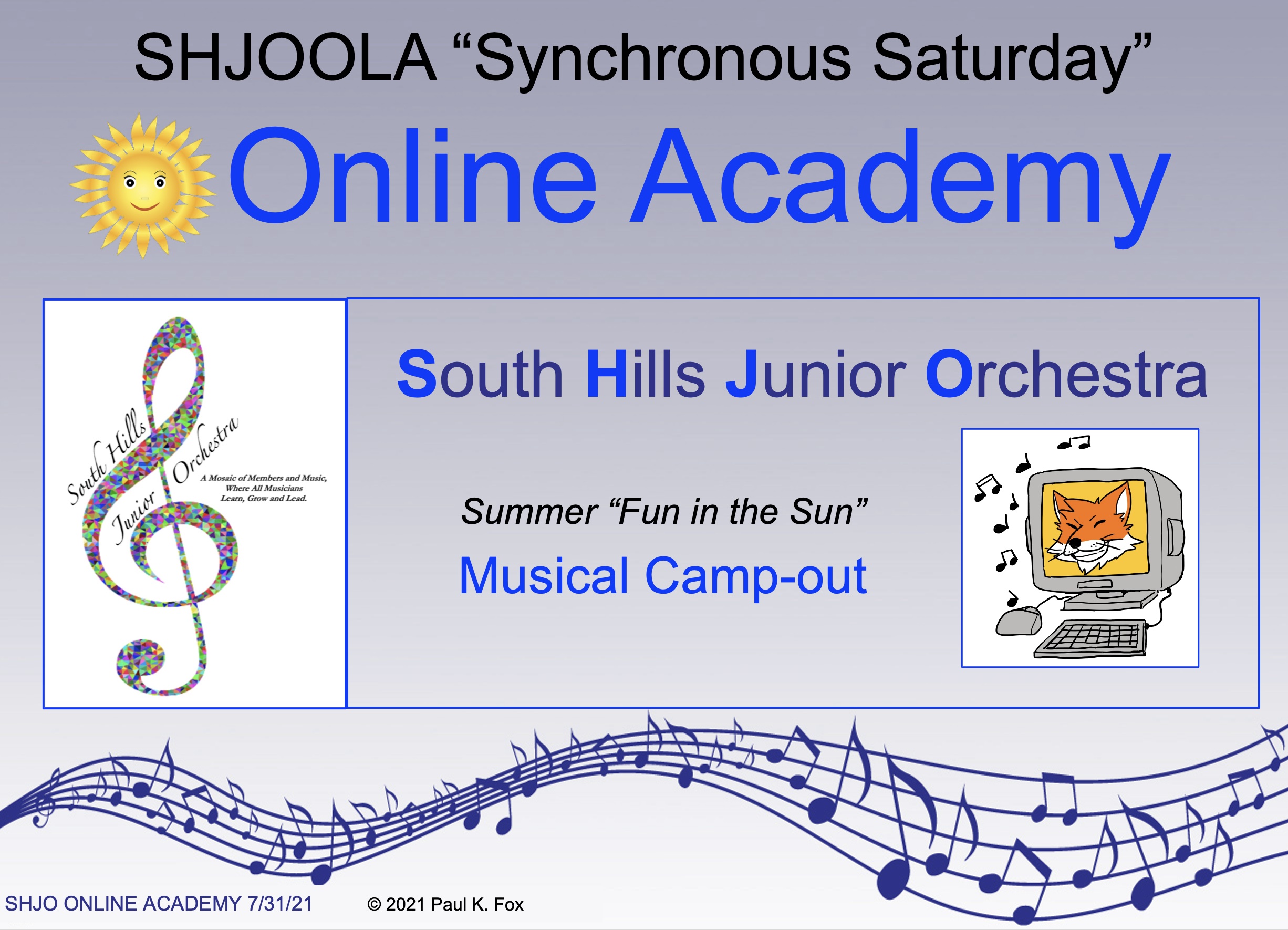
As one example, in the middle of preparing music for my community orchestra, we were shut down in 2020. No in-person rehearsals at the school. I then pivoted to creating my own online platform called SHJOOLA (South Hills Junior Orchestra Online Academy) in 2021 using MusicFirst. For a nominal yearly subscription fee, I was able to continue my Saturday morning classes (synchronous) as well as asynchronous (on-their-own time) learning using excellent applications in a virtual environment: MusicFirst Classroom, Focus on Sound, PracticeFirst, Sight-Reading Factory, Musition, Auralia, a web-based music notation program, and a huge library of method books and ensemble music. Several past blogs showed how we rolled out SHJOOLA:

The latter link above also provided a comprehensive list of supplementary resources (at the time) for online music education. Please peruse these even though some of them may have now gone inactive. We will provide supplemental links at the bottom of this article.

Another direction accented by the onslaught of the pandemic was digital streaming performances, incorporating technology in both the solo and ensemble settings. The following are two of my favorite examples of these to be viewed on YouTube:

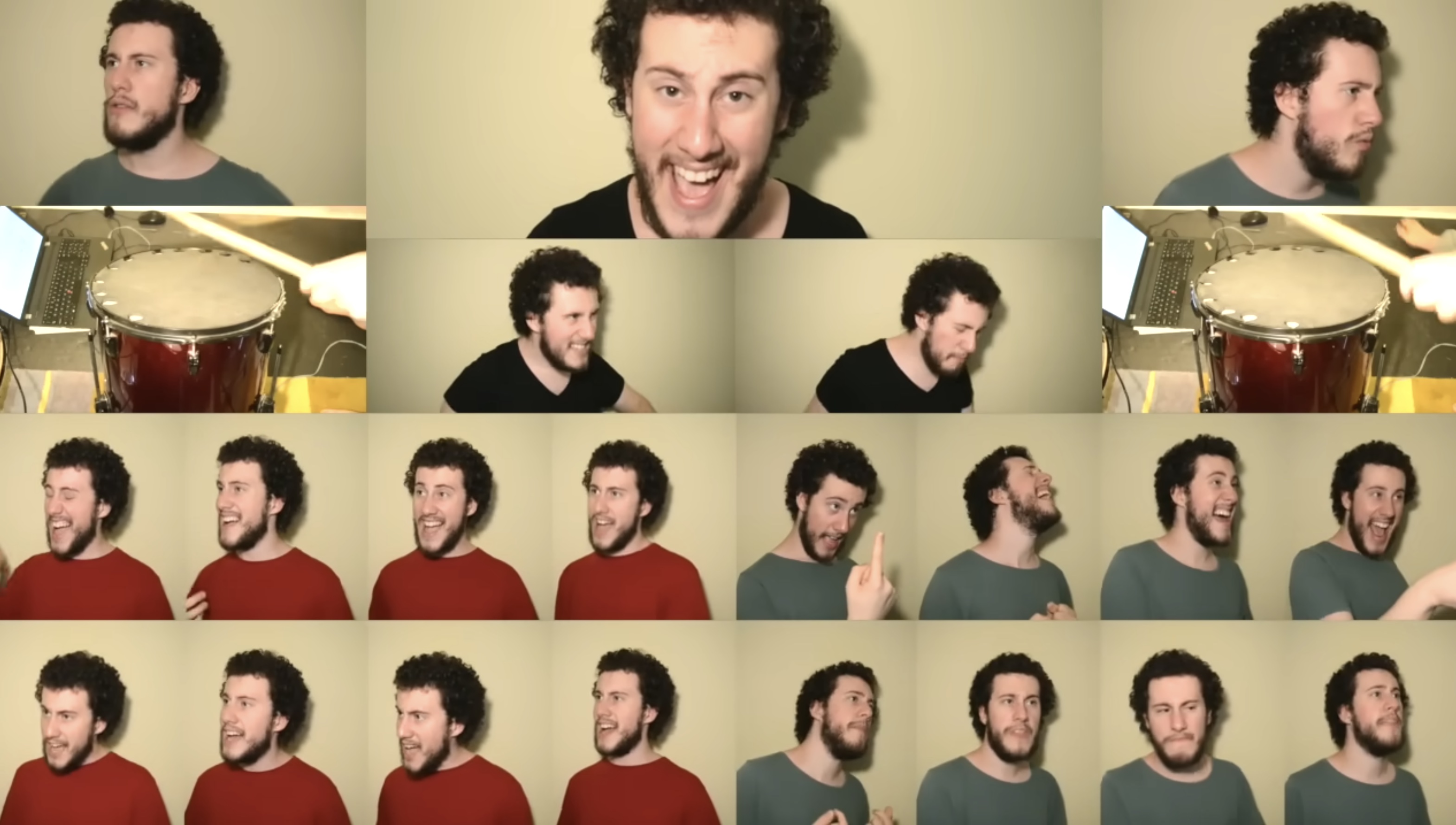
Circle of Life from Disney’s Lion King (2015-18) by Sam Robson, arranger, innovator and performer using multitrack recording of a single performer mixing as many as 50 voices at one time.

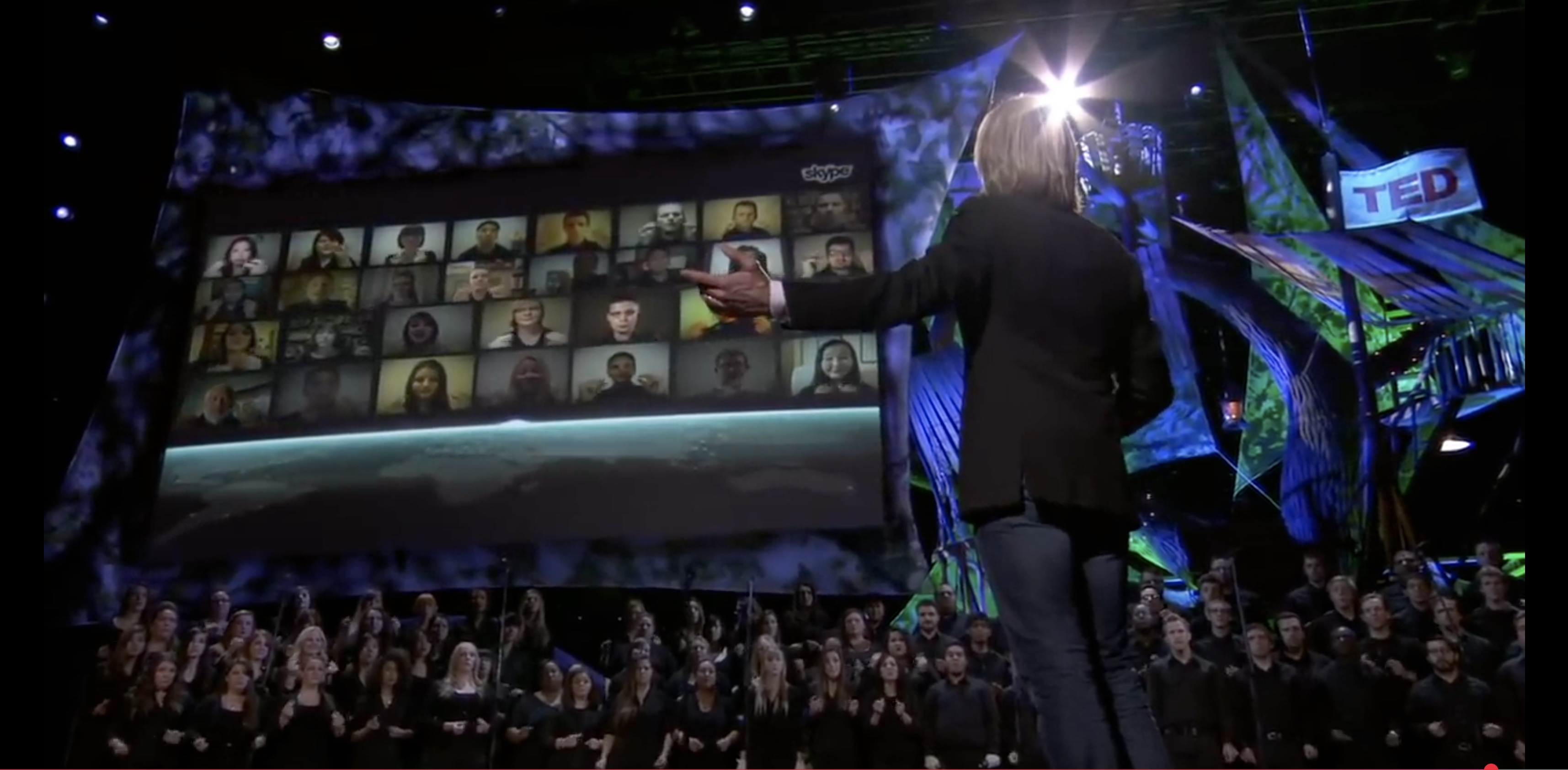
Cloudburst, a Virtual & Live Choir and TEDTALK (2013) by Eric Whitacre

Well… sorry this blog has grown to be so large! If you admit to understanding the potential hazards of and precautions for integrating social media, social networks and other technologies into education, we’ll close with the following bibliography of additional resources for further study. If that is not enough to whet your curiosity, stop back in several months to download a copy of my slide summary for the session I will present at the DCMEA Winter Conference on January 30, 2026.

Be careful stay safe and professionalbut ENJOY!

Sample Blogs

Several Major Platforms

Examples of Music Applications/Websites

PKF

© 2025 Paul K. Fox
Sharing is Caring!

Join the “Fox Network”

“There is no joy in possession without sharing.”
— Erasmus

“Share your knowledge. It is a way to achieve immortality.”
— His Holiness the Dalai Lama

“There is no delight in owning anything unshared.”
— Seneca

“The miracle is this: The more we share the more we have.”
— Leonard Nimoy

This is a quick blog-post to announce my upcoming professional development initiatives, and an invitation to share your own pet peeves or “thoughts, theories, and teachings.” Of course, I will give you full credit for any contributions, “tips and techniques,” background research, or “quotables” provided!

It has been a challenge motivating any reactions to these articles. Although they would be most welcomed, we typically receive very few online remarks. (If you would like to voice your opinion or add anything to the conversation, PLEASE click on the “comment” button next to the title at the top of the page.)

I feel privileged to have been asked to present three sessions at the DCMEA Winter Conference at the Columbia Heights Education Campus (3101 16th St NW, Washington, DC 20010) on January 30, 2026. These are for music educators undergoing pre- and in-service training and include the following:

  • SOCIAL MEDIA – Boon or Nemesis?
  • ALL ABOARD THE E3 TRAIN – Essential Ethics for Educators
  • SELF-CARE COOKBOOK – Reflections, RECIPES, and Resources for Music Teachers

I would especially appreciate learning about any of YOUR “success stories” or resources on…

  • Favorite examples of “safe and meaningful” social media for teaching music students.
  • Anecdotes of ethical “conundrums” or issues in the daily decision-making of music educators.
  • Sample “stress-reducers,” time management tips, and other self-care strategies to avoid music teacher burnout.

In addition, I am in the process of updating my INTERVIEW 101 and EMPOWERING EDUCATOR & STUDENT LEADERSHIP clinics for future blog posts and clinics. Any thoughts?

Finally, I would also love to hear from you if you have any feedback on a proposed future sharing session for the parents of music students called ADVICE TO MUSIC BOOSTERS. If you have ever sponsored a music parents advocacy group for your school music program, what suggestions would you give to your colleagues and booster officers?

Feel free to reach out to me via email here. Thank you for your willingness to help our profession!

Editor’s Note (things to look forward to): In mid-July, our next blog for this series geared to “the life cycle of a music educator” will be from guest author Ed Carter entitled “Bigger Dreams, Bigger Home: How Retirees Can Upsize for Homesteading and Hosting.” In addition, I plan to share links to materials of the “Retirement 101 – It’s Not All About the Money,” a free workshop I am presenting to residents at the Upper St. Clair Township Library on July 10, 2025.

PKF

© 2025 Paul K. Fox
For Book-Lovers (Retired or Not)

Summer is the Time to Catch-up on Your Reading!

The character “Robert McCall” (played by Denzel Washington) in the vigilante action-thriller film series The Equalizer (directed by Antoine Fuqua) mentioned that his late wife was working through “The 100 Books Everybody Should Read” when she died, so he decided to carry on the tradition. It is not clear the exact list he was referring to, but we found a blog by Gillian that settled on Goodreads 100 Books from The Equalizer, for which a checklist is provided by https://uncomplicatedspaces.substack.com/p/100-books-everyone-should-read-pdf.

How many of these can you claim to have read?

Personally, I go through stages… seeking new releases, exploring best-sellers, perusing used or discounted book stores and thrift shops, and revisiting past favorites in my library.

Recently, I have “relaunched a personal voyage” to consume the entire series in sequence of the memorable adventures of classic historical fiction from the Napoleonic Wars, featuring Captains Horatio Hornblower (by C.S. Forester), Richard Bolitho and his nephew Adam Pascoe Boltho (by Alexander Kent, pseudonym of Douglas Reeman), and Lord Nicholas Ramage (by Dudley Pope). You should “cruise” samples of all of these!

If you are a history buff, please enjoy each edition slowly, reveling in the authors’ craftsmanship and immersing yourself in the language, settings, culture, customs, and what life must have been like during that period (~1800-1850) of intense conflicts between France (led by Napoleon Bonaparte) and England (most notably, paralleling the real-life of British naval hero, Horatio Nelson) and the coalition of European powers following the French Revolutionary Wars. A previously blog (here) related the relevance of Hornblower and learning leadership principles. However, I am especially amazed at the depth and breadth (similar style and content) of the Alexander Kent collection. But, better schedule a lot of uninterrupted quiet time on vacation or at the pool, deck, patio, or beach! It will take you awhile to read all 30 of the Kent books (list below provided in order by www.addall.com):

  1. Midshipman Bolitho (1975)
  2. Midshipman Bolitho and the Avenger (1976)
  3. Band of Brothers (2005)
  4. Stand Into Danger (1976)
  5. In Gallant Company (1977)
  6. Sloop of War (1972)
  7. To Glory We Steer (1968)
  8. Command a King’s Ship (1973)
  9. Passage to Mutiny (1976)
  10. With All Despatch (1988)
  11. Form Line of Battle (1969)
  12. Enemy in Sight (1970)
  13. The Flag Captain (1971)
  14. Signal, Close Action! (1974)
  15. The Inshore Squadron (1978)
  16. A Tradition of Victory (1981)
  17. Success to the Brave (1983)
  18. Colours Aloft! (1986)
  19. Honour This Day (1987)
  20. The Only Victor (1990)
  21. Beyond the Reef (1992)
  22. The Darkening Sea (1993)
  23. For My Country’s Freedom (1995)
  24. Cross of St. George (1996)
  25. Sword of Honour (1998)
  26. Second to None (1999)
  27. Relentless Pursuit (2001)
  28. Man of War (2003)
  29. Heart of Oak (2007)
  30. In the King’s Name (2011)

Yes, we should be turning our attention to nonfiction books, too. According to financial guru and famous talk-show host Dave Ramsey, all of us should have a nonfiction book or two on our bed stand.

Want to be a millionaire? Turn off your television. The average millionaire reads a nonfiction book a month. This is how you make your life better: having knowledge tomorrow that you didn’t have today, and then applying it.  –  Ramsey on Facebook

Dave’s list of books starts off with one of his own: The Total Money Makeover. He also recommends The 7 Habits of Highly Effective People by Stephen Covey, Think and Grow Rich by Napoleon Hill, Good to Great by James C. Collins, The Richest Man in Babylon by George Samuel Clason, Who Moved My Cheese by Spencer Johnson, The E-Myth Revisited by Michael E. Gerber, and How to Win Friends and Influence People by Dale Carnegie.

On a slow day pushing wheelchairs at the local hospital in the Western PA suburbs where I live, my fellow volunteers (Jerry, Rod, and Douglas) and I, all true “bibliophiles” and retirees, brainstormed what were our most inspiring reads. Their list is more spiritual, faith-based, or metaphysical than most:

  • Book of Joy by Dalai Lama and Archbishop Desmond Tutu
  • Conversations with God by Neale Donald Walsch
  • Jesus CEO by Laurie Beth Jones
  • Many Lives, Many Masters by Dr. Brian L. Weiss
  • Mutant Message Down Under by Marlo Morgan
  • Return to Laugher by Elenore Smith Bowen
  • Tying Rocks to Clouds by William Elliott
  • When Bad Christians Happen to Good People by Dave Burchett

Now to the “how-to section,” especially focusing on the quest for “living the dream” in our senior years.

Some of the best books about retirement are really about living life well. It’s been said that a reader lives a thousand lives before he dies. So, if words on a page can introduce us to what it’s like to live in another century or a faraway land, then why not introduce us to life in retirement, too?

Want something new and refreshing for those of us who are already retired or will soon retire? I found this November 2024 Kiplinger post offering “Five Books About Retirement to Prepare You for Your Golden Years” by Jacob Schroeder: https://www.kiplinger.com/retirement/books-about-retirement-prepare-you-for-golden-years

  1. Die with Zero: Getting All You Can from Your Money and Your Life by Bill Perkins
  2. My Brilliant Friend by Elena Ferrante
  3. From Strength to Strength: Finding Success, Happiness and Deep Purpose in the Second Half of Life by Arthur Brooks
  4. The Midnight Library by Matt Haig
  5. The Year of Magical Thinking by Joan Didion

As PMEA State Retired Member Coordinator and editor of Retired Member Network eNEWS, I “float” many images of recommended retirement books to my PA music educator colleagues. If you did not attend the Retirement 101 session at the recent PMEA Annual Conference at Kalahari Resort in the Poconos, take a peek at my annual session’s PDF handout: https://www.pmea.net/wp-content/uploads/2025/04/Retirement-101-PMEA-conference-revised-s041125.pdf.

1820 McLaughlin Run Road, Pittsburgh, PA 15241

I am presenting this workshop at the Upper St. Clair Library on July 10, 2025 at 6:30 p.m. in the Multi-Purpose Room. To my local (Western PA) friends: Come see it for yourself!

Finally, if you are looking for additional resources on how to prepare for that major life passage of transitioning to retirement, many books and websites suggested by numerous expert “silver-haired” colleagues who have already “Cross the Rubicon,” all you need do is visit the Retired Member focus area on the PMEA website. (This is a benefit of PMEA membership and why everyone should continue participating in their professional association even after a complete retirement!) For a sneak preview, click on these links:

Best wishes to you and yours. Feel free to comment on this post (top right link near title), or even refer us to other sites of book lists and retirement prep resources.

PKF

© 2025 Paul K. Fox