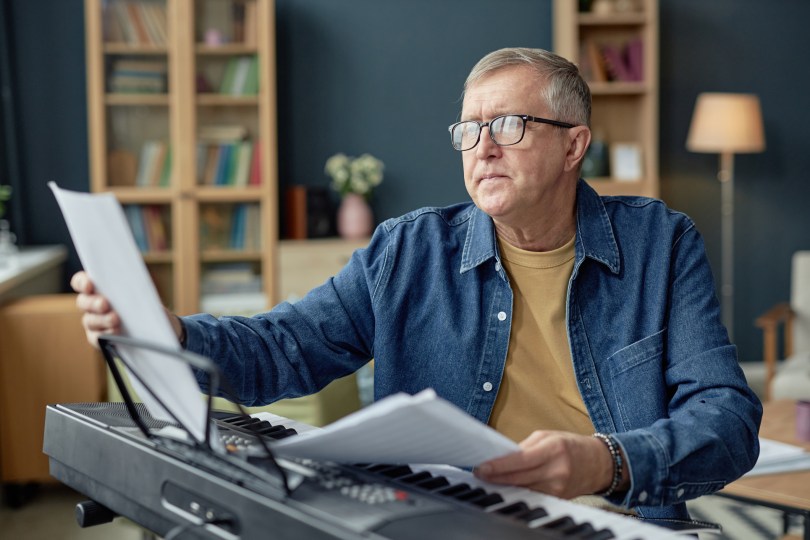
Engaging Retiring/Retired Educators

Ask not what NAfME or your state MEA can do for you, but what YOU, a retiree, can do for your professional association and music education.
An adaptation of the famous excerpt from the 35th U.S. President John F. Kennedy’s inaugural address of January 20, 1961.
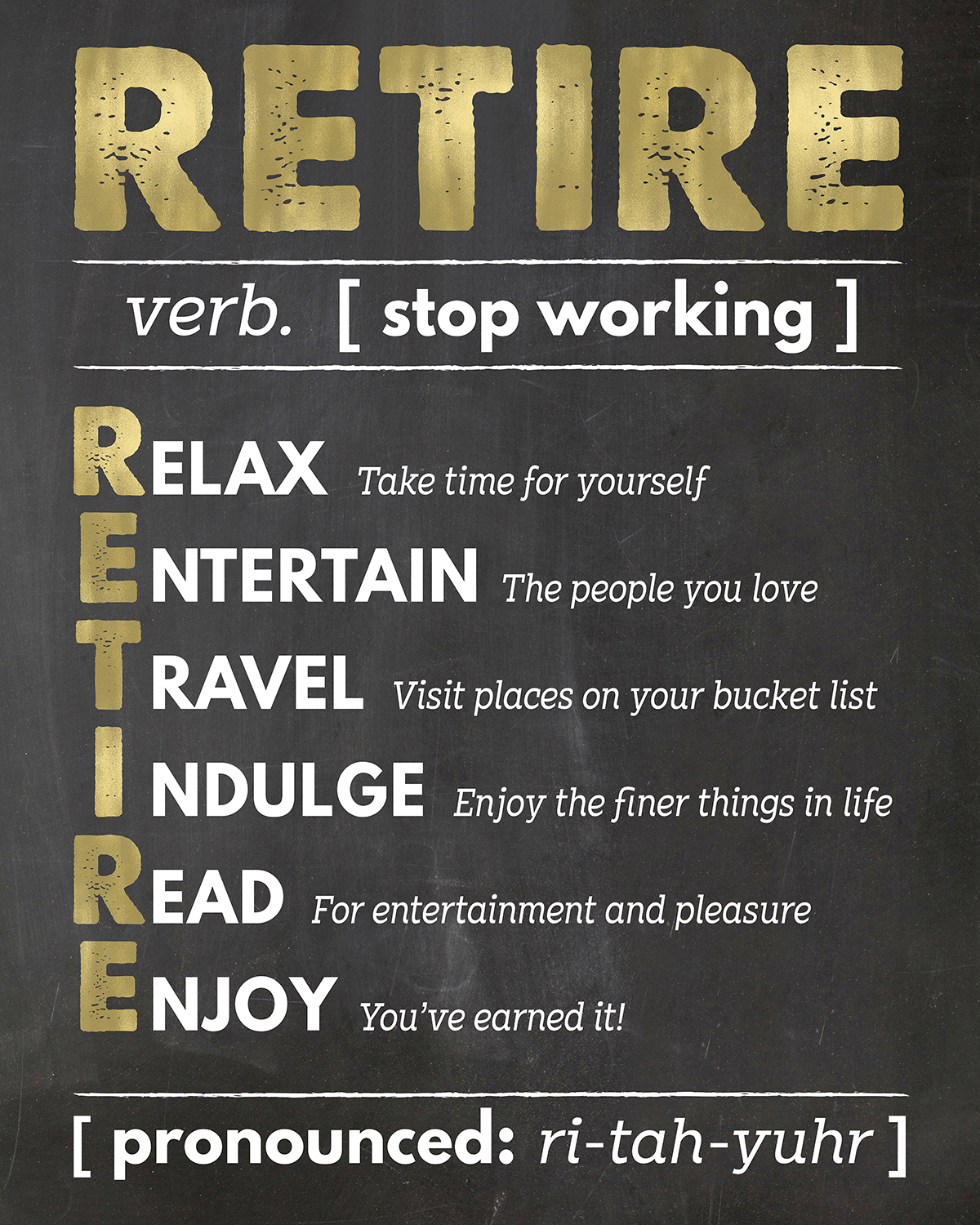
Surfing the ‘Net, I found an appropriate acronym for R.E.T.I.R.E. by Tangled Tulip Designs in pinterestRelax, Entertain, Travel, Indulge, Read and Enjoy! Most retirees would probably agree! The cessation of full-time employment may offer a great release from the day-to-day stress and drudgery of the job and the freedom to venture out, self-reinvent, make future goals, nurture relationships, and explore new personal growth opportunities.

Many attribute embracing a career in music education as “a calling” as opposed to just a form of employment or livelihood. From my experience, I have witnessed that most music educators are passionate for the cause of fostering creative self-expression in their students, more of a 24/7 mission, bringing intense focus and dedication to their lifework.

More to the point: Do we ever truly retire from making music ourselves and fostering this love in others?

THE “WHY!” Retirees matter and are critically needed!

One of my favorite inspirational speakers (Simon Sinek) would say, “start with the WHY!” WHY is this discussion on professional engagement of retired educators so important today?

  1. Their need: An informal poll of my former local educators and administrators revealed that half of them “hate retirement!” According to Dr. Robert P. Delamontagne in his book Retiring Mind (Fairview Imprints), “50% of retirees will suffer some form of acute emotional distress. This is potentially a very large problem given the fact that 10,000 people are becoming eligible for Social Security every day for the next 20 years in the US alone.” Remember this statistic the next time a senior citizen cuts you off on the road or bangs a shopping cart into your leg at the checkout!
  2. Our need: We are facing shortages of qualified teaching candidates across the country with unfilled openings in public school music positions and the critical need of training/mentoring the new hires.
  3. Society’s need: All of our voices should be combined to support the advocacy of music education, actively promoting access to school music by sharing its academic and social benefits with decision-makers, building relationships with administrators and policymakers, and utilizing resources from organizations like NAfME and the NAMM Foundation.

Despite its proven benefits, music education is often the first program to face budget cuts in schools. This is especially concerning in underserved communities, where access to music programs can be life-changing. Now more than ever, we must advocate for music education to ensure that every child has the opportunity to experience its benefits. Investing in music education is an investment in the future of our communities — helping to cultivate the next generation of creative, resilient, and innovative leaders. 
“Why Music Education Matters More Now Than Ever” by Music Will, February 2025

For eleven years (and counting), I serve as the Pennsylvania Music Educators Association (PMEA) Retired Member State Coordinator, as well as the Past State Chair (current member) of the PMEA Council for Teacher Training, Recruitment and Retention. I believe my responsibility to the state association is two-fold:

  • Assist soon-to-retire professionals in achieving a smooth transition to a happy and satisfying retirement; to help them cope with the commonly-experienced emotional ups-and-downs of this life passage, wrestling with the question “what do you want to be or do when you grow up?” and making new life lesson plans and personal goals.
  • Reach out to and build meaningful connections with retirees in order to fully engage them towards becoming active in their professional association; to recount, represent, and revitalize the activities of our post full-time employed music educators.

This article proposes a roadmap of crucial pathways to help music teachers approach “retirement bliss” while tapping into their hard-earned knowledge, strengths, and experiences by cultivating the benefits of their renewed participation in our professional associations.

What can NAfME and State MEAs offer retirees?

You have devoted your entire life to inspiring the development of personal artistry and “ah-ha” musical moments in others. Now it is your turn to reap the benefits (and privileges) of this commitment to the profession. NAfME and your MEAs can provide the resources and motivation of “sharing and caring,” directing retirees “places to go, people to meet, and things to do” for fulfilling that “next chapter” or (perhaps better terms) the “refirement” or “rewirement” of senior living.

Do you feel “needed” and know you “make a difference?” Research has shown that the one of the most important motivators for involvement in a professional association is that its members recognize that they are essential to its success. This quote is from Revitalizing Retirement: Reshaping Your Identity, Relationships, and Purpose by Nancy Schlossberg, attributed to Rosenberg/McCullough:

 “It has been suggested that one problem of retirement is that one no longer matters; others no longer depend on us… The reward of retirement, involving a surcease from labor, can be the punishment of not mattering. Existence loses its point and savor when one no longer makes a difference.”

Most people who are one to five years away from “pulling their pin” and putting in their walking papers “do not know what they do not know.” Experts agree: “Retirement preparation is not only about the money!” Our silver-haired colleagues who have already Crossed the Rubicon and are now “living the dream” in retirement can share their trials, tribulations, and (more importantly) numerous success stories about coping with this transition!
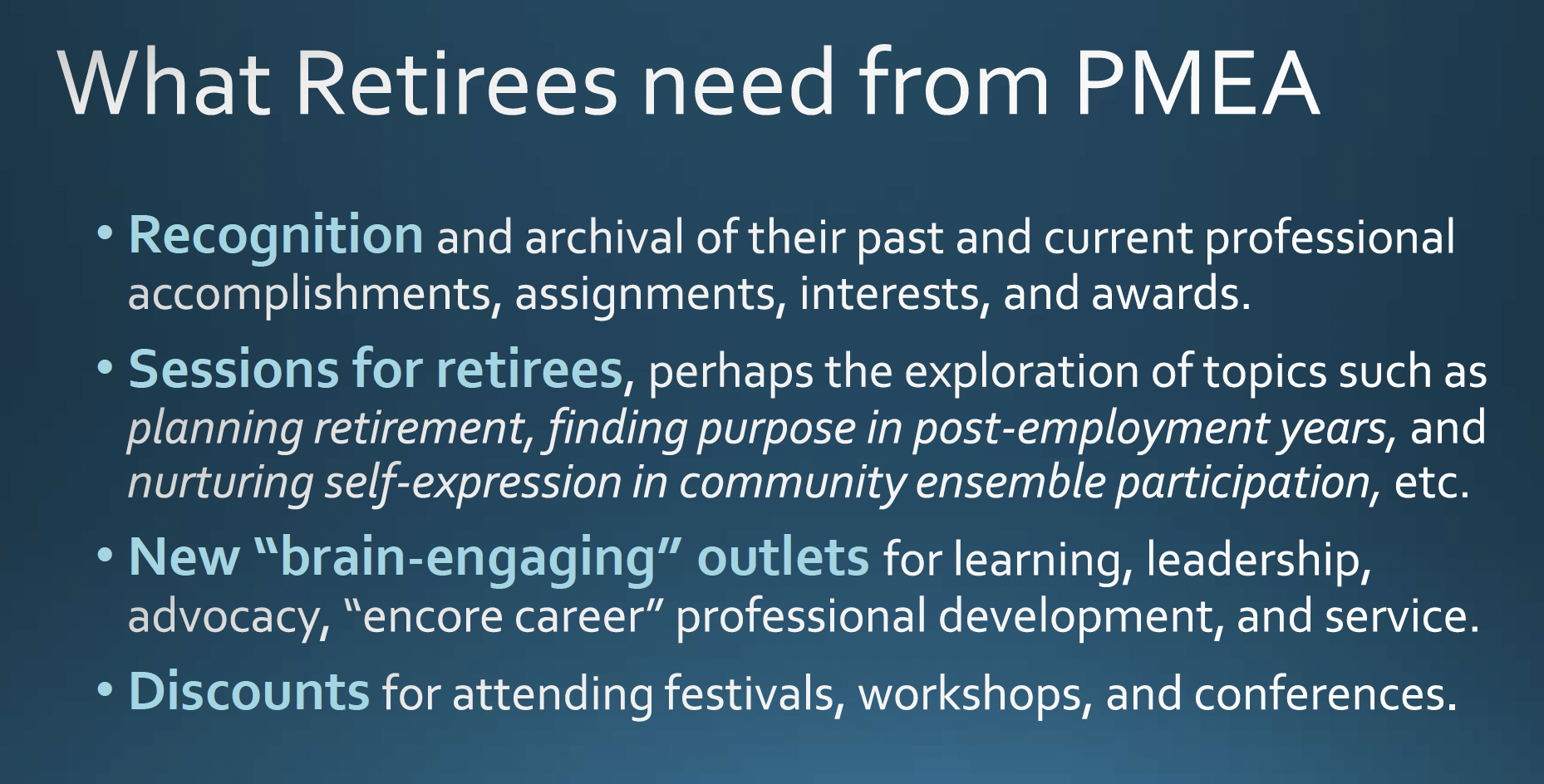
NAfME, PMEA and this paulfox.blog/for-retirees site have archived an exhaustive number of self-help articles. Check out this omnibus NAfME blog “Retirement Prep Top-Ten Treasures.”

The benefits of retired MEA membership are numerous. Besides providing helpful transitioning advice, these advantages also come to mind:

  1. Answers to questions like “What have you always wanted to sing, compose, play, record, conduct, write, publish or present?” and “Where can I share my hard-won expertise and help others in the field?”
  2. Networks and contacts to help you develop “encore careers” in other musical or educational arenas (e.g., higher education, music industry, festival organization, travel/tour planning, composition, guest conducting, private studio teaching, church music, etc.)
  3. Opportunities to “rekindle your expressiveness” by participation in adult community or full/part time performance groups (playing “gigs”)
  4. Places to go/things to see/hear: NAfME/MEA conferences, workshops, and concerts
  5. Exclusive discounts and other benefits (reduced dues and registration fees)
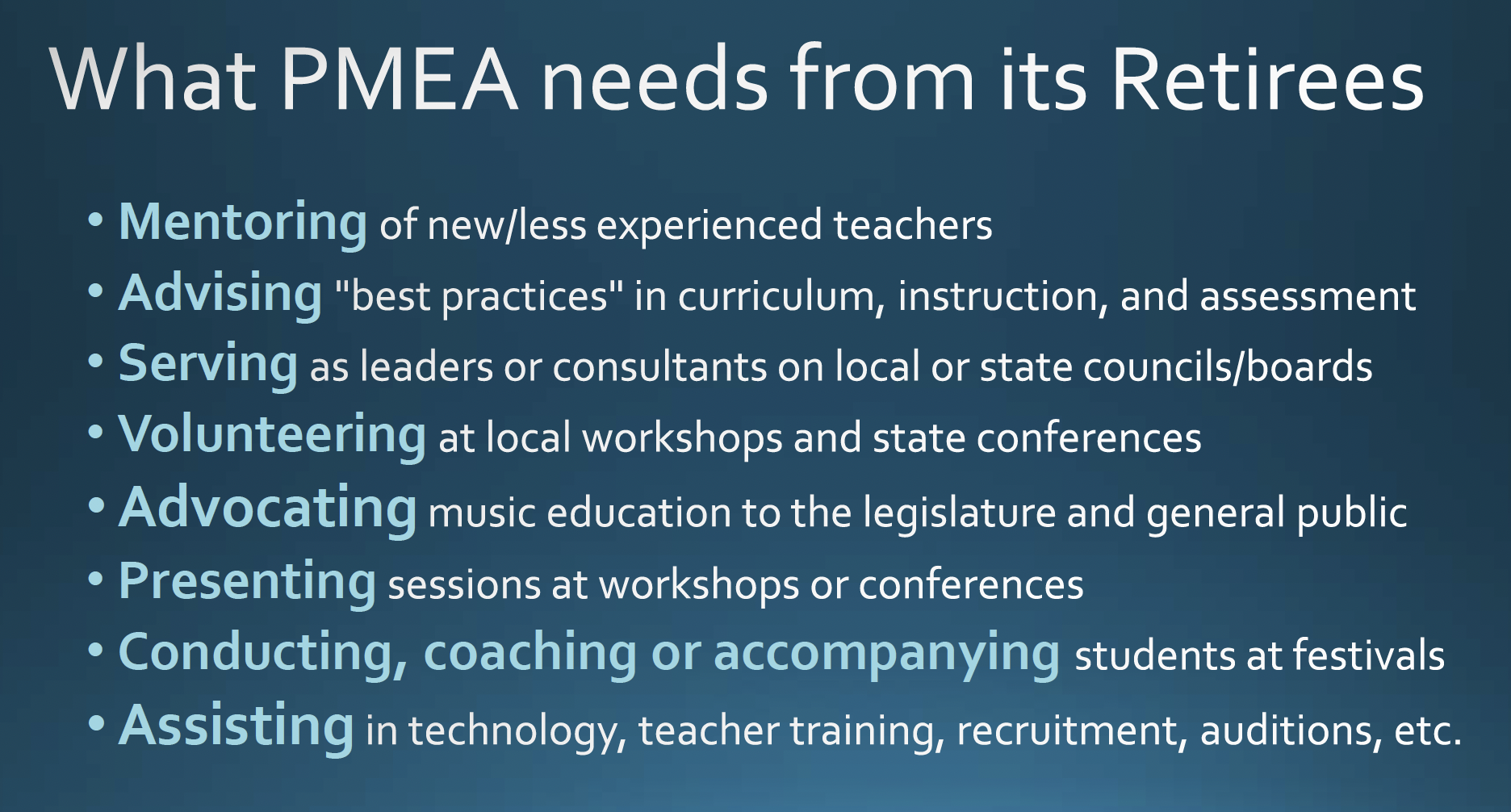
What can retirees offer NAfME and their state MEA?

The relationship of active and retired membership in our MEAs is symbiotic. We know from the history of our associations, “giving back to the profession” remains a high priority with most retirees. This may come in many forms and settings:

  • Leadership or membership in local, state, or national MEA/NAfME office, staff, advisor, or council/committee position
  • Advocates for the promotion of music education to local and state government officials
  • Service as presiding chair or member of the conference or workshop planning committee
  • Service as evaluator of performance groups, conference sessions, or articles for publication
  • Judges of local/state MEA adjudication or commercial festival
  • Accompanists, coaches, arrangers, or guest conductors for festivals or school/community groups
  • Services to the local music teacher in private teaching, piano playing, marching band charting, sectional coaching, choreography, music technology, instrumental repair, stage tech, etc.
  • Writers for state MEA and NAfME publications and blog sites
  • Contributors to online music education forums or the NAfME Connections
  • Donors to and/or fund-raisers of music education charitable projects, scholarship initiatives, etc.
The PMEA Model of Retired Member Participation
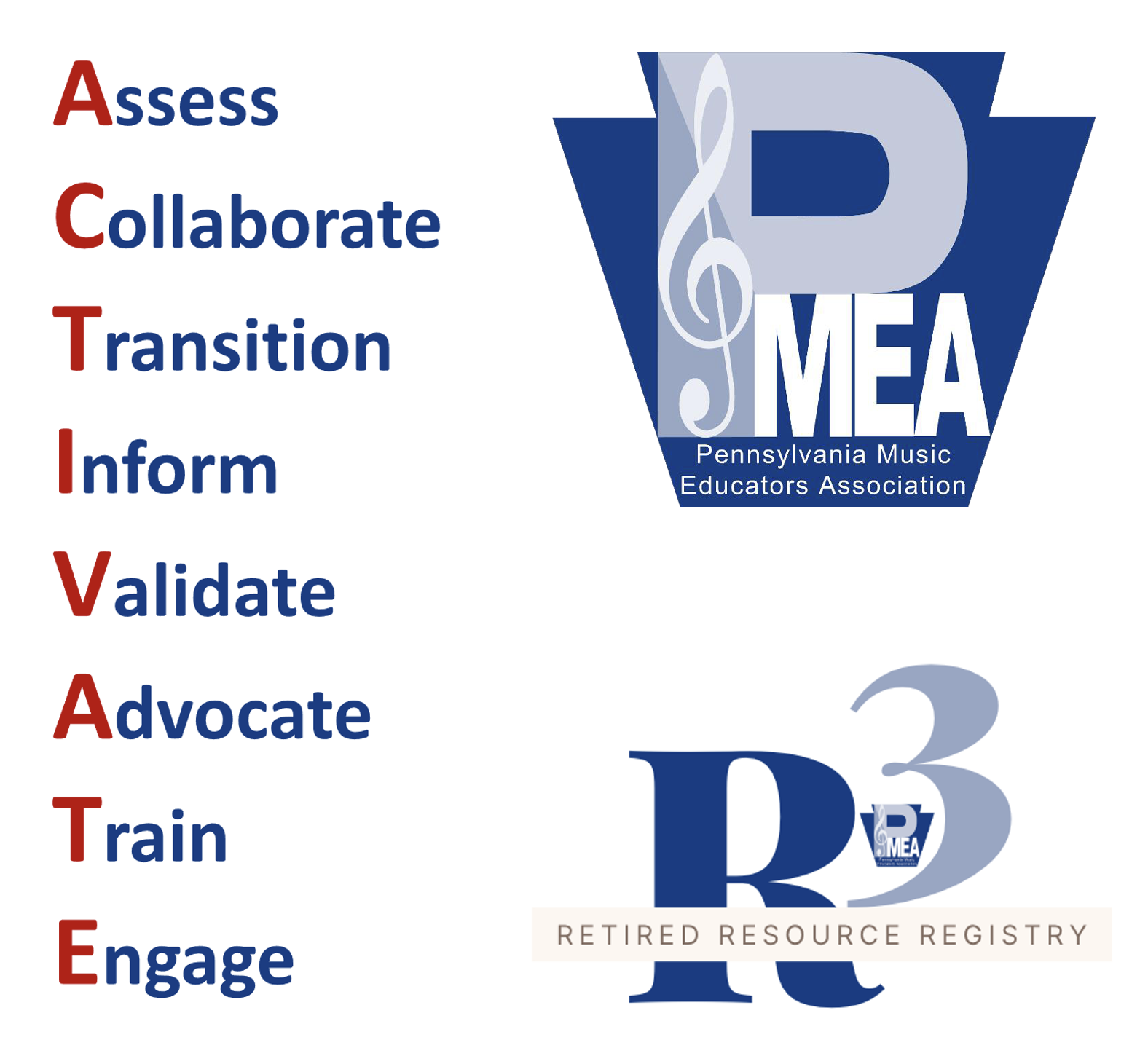
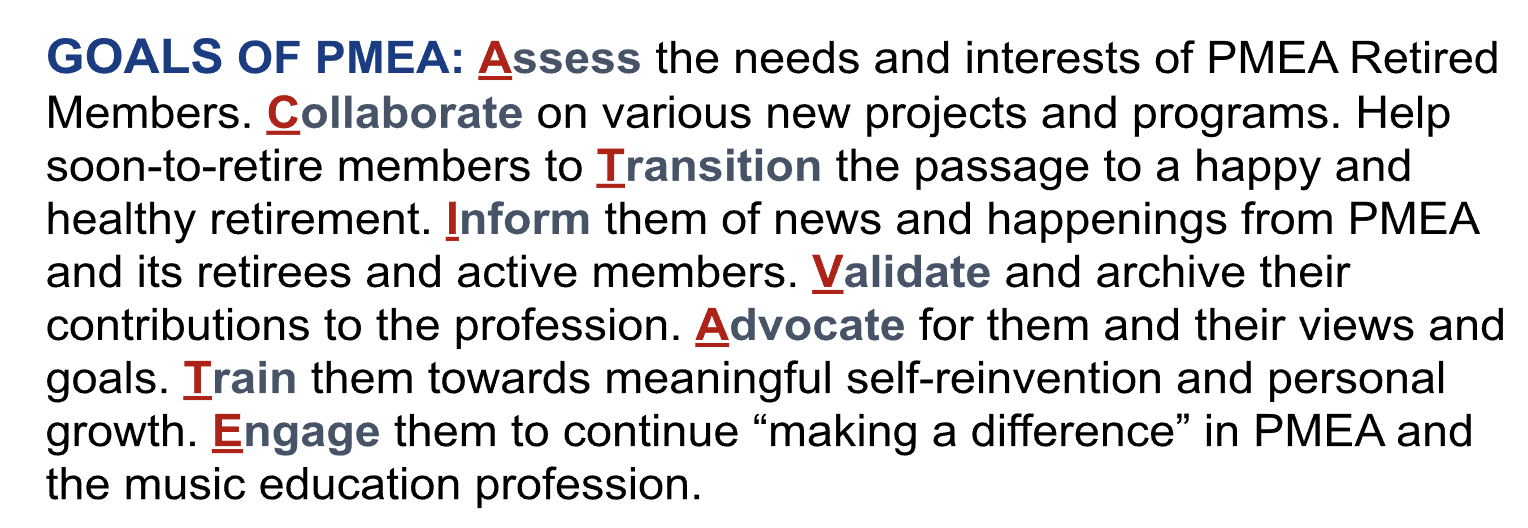
PMEA values the vast wealth of experience and contributions of our retired members. We’re proud of the many programs we offer to retirees and invite you to visit our website to peruse additional information and sample digital newsletters and articles.

Retired members in Pennsylvania are involved in:

  • PMEA elected and appointed offices, staff, committee chairs, and membership on councils
  • PMEA Strategic Plan and Bylaws, Conference Planning, and other state/regional committees
  • Retired Resource Registry* (informal mentoring for new teachers and transfers)
  • How-to-Retire Webinar, Prepping for Retirement, and the Ultimate Retiree Resource Guide
  • Retired Member Breakfast at PMEA Annual Conference
  • Retirement 101 (The Who, What, When, Where, Why, and How) session at PMEA Annual Conference (training for all members retiring or soon-to-retire)
  • Maintenance of PA Community Band, Chorus, Orchestra, and Theater group catalogs
  • Maintenance of PMEA member compositions library
  • Mock Job Interview Committee for music education majors
  • Coffee & Conversations informal “ask an expert” lounge at PMEA Annual Conference
  • Volunteering as presiding chairs for sessions and registration aides at conferences/workshops
  • Pool of conference clinicians, guest lecturers, and members on discussion panels
  • Participation in “Sponsor a Collegiate to Attend the Conference” campaigns
  • All-State Program Patron, or contributor to the annual Irene Christman Scholarship or Margaret Bauer Grant programs.
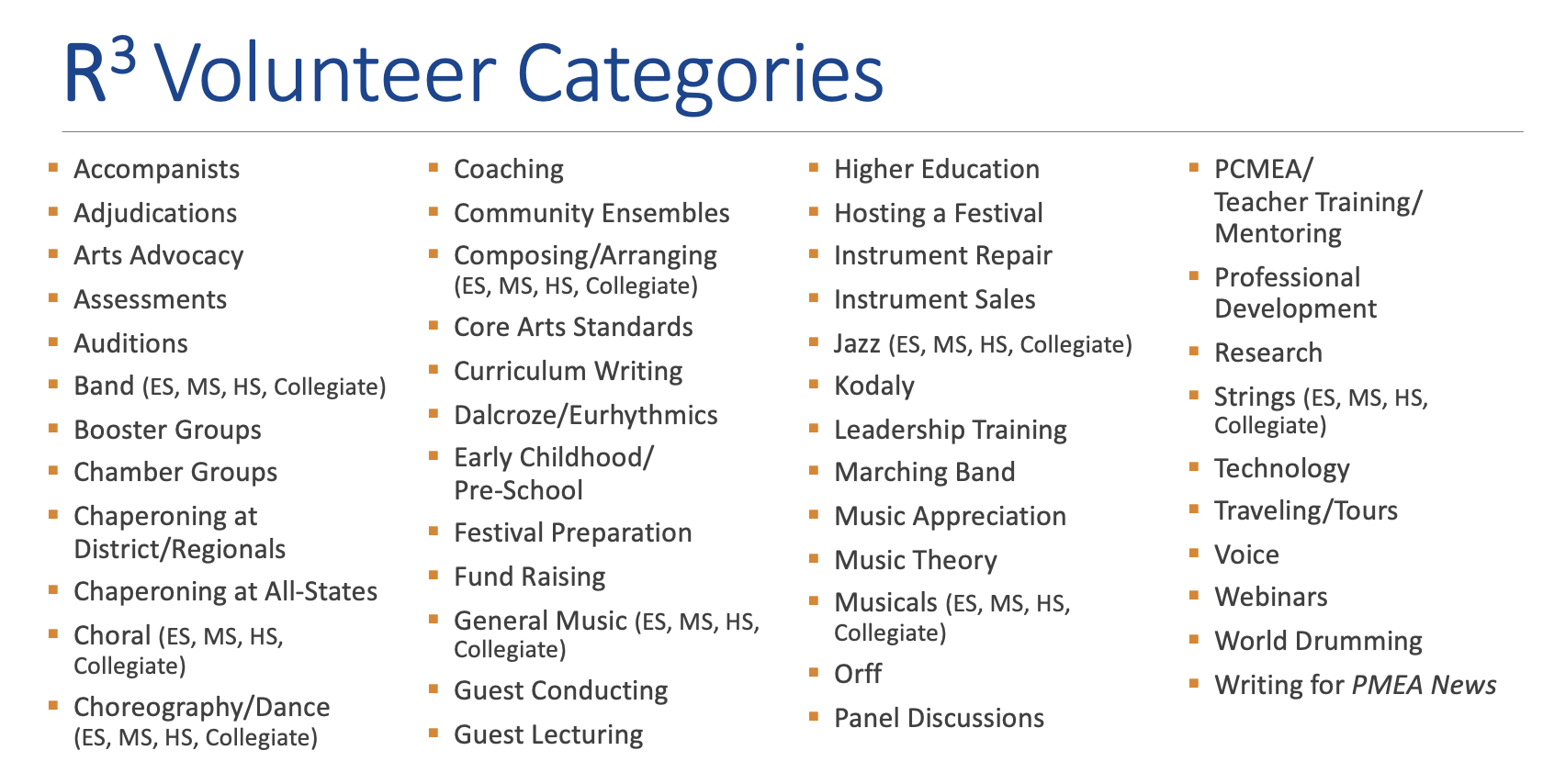
As of October 1, 2025, there are 61 advisors in the PMEA Retired Resource Registry.

*During their annual membership registration, PMEA Retired Members may choose to sign-up for the R3 Retired Member Registry (above volunteer categories) to become available to informally offer advice to college music education majors, new hires, transfers, and newcomers to any music specialty. R3 members may handle inquiries like “What warm-up would you recommend for my middle school choir?” OR “Do you have an idea for an elementary string ensemble concert opener?” OR “How do you teach improvisation… steady beat… breath support?”

The other option with more time commitment is that Retired Members can be officially “trained” as a PMEA Mentor and be assigned to specific individuals who request assistance in their early career assignments.

Coda

How can we help?

What is the future of retired music educator professional engagement? In a word: connections!

Last month, I reached out to Elizabeth Welsh Lasko, NAfME Assistant Executive Director for Membership, Organizational Development, and Marketing Communications and “volunteered” OUR assistance. I suggested that, in keeping with the NAfME 2022 Vision Statement “…an association where all people are heard, seen, and feel they belong throughout their lifelong experiences in music” we should all intentionally recruit more hands-on involvement of our retirees. I pointed out that in the late 1980s, we had a Music Educators National Conference (MENC) Committee for Retired Members led by a National Chairman who served on the NAfME National Assembly. (An excellent booklet, TIPS: Retirement for Music Educators, Copyright © 1989 MENC, was compiled by A. Verne Wilson, then the Past National Chairman of the MENC Committee for Retired Music Educators.)

Ms. Lasko encouraged me to “reach out to retirees” beginning with this article. At the next NAfME Eastern Division Conference, I plan to hold a meeting of retired members, and also connect with all state MEA retired member coordinators (those states who have them). We’re available and on the move! Let’s collaborate and share our resources!
Finally, just for fun, I recently posted the blog “For Book Lovers – Retired or Not” on NAfME Connections (formerly called Amplify). There are already 1,810 members in the NAfME “Retired Members Community.” Please JOIN US! Using this forum, get in touch with me, and respond with YOUR OWN retirement stories, strategies, perspectives on this “life passage,” and more ideas to grow the professional engagement of our music teacher retirees.

Happy trails!

© 2025 Paul K. Fox

The Get-a-Job Toolbox

Preparing for Those Upcoming Employment Screenings

So much of what I do at this blog-site is to archive articles offering advice on a host of topics:

Surveying my past blogs, I feel like I had to repeat (repackage) the content until my readers reached that particular stage in their career. Once they experience first-hand that sometimes tumultuous “passage,” they would be ready to reflect on this information. But, I doubt they would closely examine it until then. As an example, for more than a decade as the PMEA Retired Member Coordinator, these past articles I wrote for PMEA News and the PMEA Annual Conference’s session Retirement 101 revisit the voluminous insight of gerontologists exploring the “who, what, when, where, and why” of retirement. Regardless at how often it is presented, you tend not to consume advice on coping with post-employment until you feel you are “ready” to retire. This is the same issue for soon-to-graduate collegiates and those transitioning to a new job; who wants to read about branding, marketing, and interviewing until they are in the middle of seeking first-time (or new) employment?

Please click on the “plethora” of links throughout this article to be redirected to these past writings. My apologies in advance to what may seem like to be a lot of duplication!

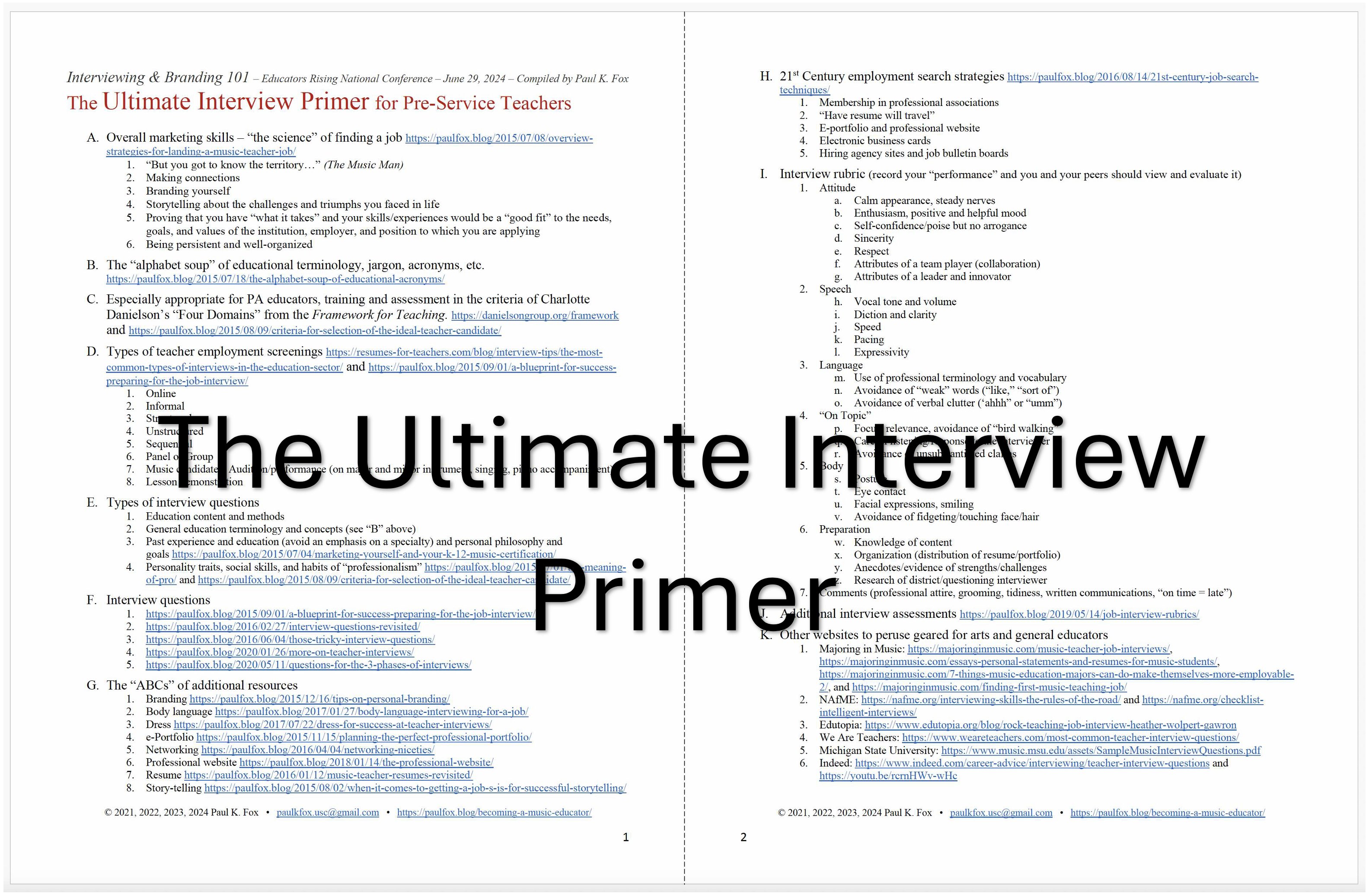
I went as far as updating the most comprehensive and “perfect” PowerPoint for collegiates: Bookends – The Life Cycle of a Successful and Happy Music Educator – portions of which I have presented several times to Professor Jessica Vaughan-Marra’s Seton Hill University music student teachers. This slide handout starts with the material from the first three bullets in the first paragraph above and then adds information about teacher health and wellness, time management, and retirement. We offer Bookends… to preservice music educators in their junior, senior, or graduate years and “rookies” to the profession. I encourage you to download this resource, visit the PCMEA website (click here/scroll down) to read past issues of Collegiate Communique, and the paulfox.blog posts. While you’re at it, acquire your own copy of the Ultimate Interview Primer. Click away before these links become inactive.

Soon it will time for graduates to enter the workforce… and boy, do we need you! By most accounts in PA and the surrounding states, we are experiencing a teacher shortage. School districts are seeking quality candidates to apply for their open positions. But, much of what happens in the job screening process seems to be influenced by chance. Collegiates, ask yourself: Are you truly prepared to market your experiences and abilities, share your brand and stories of your interactions with children in educational programs, and relate positive anecdotes of your teaching, problem solving skills, and other professional attributes? I may have been a little Type-A when I first applied for those music teaching positions back in 1978, focused on saturation publicity and persistence, and organized with a large paper portfolio of past experiences, but I was clueless in responding to those tricky interview questions and what administrators actually wanted to see in prospective new members of their staff.

One more piece advice for first-year and recent transfers to music education: Seek out a PMEA mentor and/or a member of the Retired Resource Registry (access from the PMEA Retired Member focus area after you login to your member portal)… both are groups of volunteers willing and able to help “newbies.”

Have a question about selecting music for your ensemble, a dynamic lesson plan, classroom management issue, interviewing, curriculum innovation, or a conducting tip? Stop by the “coffee and conversations” informal lounge at the PMEA Annual Conference on April 10 and “sit-a-spell” with us!

In conclusion, the following is a sequential outline – a “to-do in this order” list – a preservice toolbox of past posts and other resources for you to assemble a marketing plan. Take time to sort through these “nuts and bolts” (all links in this blog), process the information, save anything you want to read further, and then “practice, practice, practice!” This “gift” to PCMEA and music education majors embraces my best wishes for successfully finding the job you always wanted and preparing yourself for the greatest “calling” of your life – an enriching and satisfying lifelong career in music education! Good luck!

Using the Collegiate Toolbox – A Roadmap for Becoming a Music Educator

  1. Peruse everything in this and past paulfox.blog postings.
  2. Download the PDF documents to your hard drive. Review a portion of them each week!
  3. On your computer, create a “ME” file documenting your accomplishments, awards, experiences interacting with children, etc. – a library of the things you may wish to include in your future resume, professional website, and (e-)portfolio. Add to this folder throughout your college years.
  4. To reflect on your perceived strengths and weaknesses, complete a self-assessment of YOU from a typical professional evaluation form, these ideal effective teacher attributes and more criteria
  5. Prioritize what you think you need most. Write down your goals! Pobody is nerfect!
  6. While you are still attending college, work on shoring up any weak content areas or specialty skills (e.g., how is your “piano chops,” knowledge of specific methods, grade level repertoire, etc.?)
  7. Write a philosophy of school music education (overview) and your mission statement: “Why do you want to teach?”
  8. Be ready to answer the question (and defend your response), “What is your vision of the role of music education in the schools?”
  9. Be ready to define your “brand.” What are your professional attributes? What makes you unique? Why would you be a good candidate for a school music position?
  10. Begin to assemble a list of stories that would “show not tell” your positive attributes.
  11. Identify the impressions you want to “sell” yourself, and practice strategic storytelling.
  12. Practice answering interview questions and use a rubric to evaluate your performance. If you can, share all of this with your peers and sponsor mock interview sessions. Record/assess yourself.
  13. Get started on drafting the marketing tools you will need (e.g., your professional website, resume, portfolio, etc.)
  14. Review educational acronyms, jargon, and terminology such as this list plus these recent additions: CR-SE (Culturally Relevant & Sustaining Education), DEIB (Diversity, Equity, Inclusion, Belonging), and SEL (Social-Emotional Learning). These terms may come up at your next interview.
  15. Read cover-to-cover your PA code of conduct (CPPC) and the Model Code of Ethics for Educators.
  16. Practice ethical decision-making (with your peers) by reviewing these mock scenarios, first deciding what level of misconduct (if any) is reached in each case study, and then more discussion on the incident’s effect on the students, parents, staff, and community, and what proactive steps may be taken to remediate the situation.
  17. Join and become active in appropriate music education professional organizations (renew your memberships and add new ones): ACDA, AOSA, ASTA, NAfME, NBA, PMEA, etc. to name a few.
  18. Attend a conference of your professional association(s) and network with other colleagues. For PA colleagues, register for the PMEA Annual Conference (April 9-12) at the Kalahari Resort (Poconos).

Feel free to leave comments about this blog. (See the link just below the title.) How did you use these tools? What was particularly beneficial? What suggestions would you have for future music teacher applicants?

To PCMEA chapter officers/members, music education majors, and college instructors: I am available to present Bookends or other online or in-person workshops for college students. Send me an email.

© 2025 Paul K. Fox
New Year’s Resolutions for Retirees

Do you believe in formulating annual goals or drafting a couple “New Year’s Resolutions?”

THE STATS DON’T LIE

Every year around this time, the web highlights many so-called experts touting the benefits of making personal improvement plans… and is just as quick to admonish us for breaking them. The statistics are not encouraging:

Success/Failure rates over the first 6 months

  • Of those who make a New Year’s resolution, after 1 week, 75% are still successful in keeping it.
  • After two weeks, the number drops to 71%.
  • After 1 month, the number drops again to 64%.
  • And after 6 months, 46% of people who make a resolution are still successful in keeping it.
  • In comparison, of those people who have similar goals but do not set a resolution, only 4% are still successful after 6 months.

Overall success/failure rates

  • According to a 2016 study, of the 41% of Americans who make New Years resolutions, by the end of the year only 9% feel they are successful in keeping them.
  • An earlier study in 2007 showed that 12% of people who set resolutions are successful even though 52% of the participants were confident of success at the beginning.

Reasons for failure

  • In one 2014 study, 35% of participants who failed their New Year’s Resolutions said they had unrealistic goals.
  • 33% of participants who failed didn’t keep track of their progress.
  • 23% forgot about their resolutions.
  • About one in 10 people who failed said they made too many resolutions.

https://discoverhappyhabits.com/new-years-resolution-statistics/

Of course, it does not have to be this way! Last year, yours truly made a promise to “practice what music teachers preach” and “make meaningful music” at least a little every day on his instrument. How did it go? Success! I made it to the middle of July without missing a day (until I sprained my left hand). But the goal led me to playing better than I have for decades, more self-confidence, a lot of fun polishing off movements from my favorite sonatas and concertos, and even the purchase of a new viola. Now? It is time for me to find a tuba, dive into my past “brass flame,” and join a community band! 

As we succeed in everything else for our lives, the process of setting aside time to analyze our personal pathways, assessing our needs, and making new goals is healthy. For the eternal pursuit of happiness and self-fulfillment in retirement, I found these secrets to a ”winning” set of New Year’s Resolutions in the “Top-10 List” by the UAB School of Medicine:

  1. Start with specific micro-goals. (Keep them small, simple, and easy to accomplish.)
  2. Set resolutions for the right reasons. (Choose what is important to you, not someone else’s expectations.)
  3. Document your progress. (Write it down.)
  4. Practice patience and forgiveness. (No one is perfect. Just keep at it despite the curve balls thrown at you.)
  5. Schedule time to achieve goals. (Dedicate the necessary resolve and resources to accomplish them.)
  6. Embrace the buddy system. (Share in collaborating on group goals. You don’t have to achieve them alone!)
  7. Consider your budget. (Finances may play a role. Stay within your means.)
  8. Slow down and meditate. (Breathe, refocus, and be mindful.)
  9. Reward yourself for achievements. (No matter how big or small, treat yourself for reaching your targets.)
  10. Ask others to keep you accountable. (Publicize your intentions. They might help you achieve your goals.)

https://www.uabmedicine.org/-/10-secrets-of-people-who-keep-their-new-year-s-resolutions

SAMPLE RESOLUTIONS

You probably do not need someone to suggest things-to-do in 2022 or ways to self-improve. Effective goals and action plans must come from within yourself. However, there are countless advisors “out there” offering ideas to motivate you:

  • Keep a Positive Mindset
  • Commit to at least 10 Minutes of Exercise Daily
  • Make Better Dietary Choices
  • Stay Young-at-Heart – Surround Yourself with Young People
  • Stimulate Your Mind
  • Get Enough Sleep
  • Reach Out to Old Friends and Make New Ones
  • Kick Your Bad Habits
  • Maintain Your Purpose in Life as You Age
  • Give Back – Explore New Volunteer Opportunities

— Example sites: https://www.luthermanor.org/new-years-resolutions-for-seniors/ and https://www.healthinaging.org/tools-and-tips/tip-sheet-top-10-healthy-new-years-resolutions-older-adults 

Pennsylvania Music Educators Association (PMEA)

ENGAGEMENT, ADVOCACY, & ASSOCIATION IN MUSIC EDUCATION

Modeling PROFESSIONALISM, these terms promote the power of “collaboration” and connections among music education colleagues and stakeholders (music students, parents, and the general public). To foster a broader picture and devise “bigger than self” New Year’s Resolutions, we should embrace forming partnerships throughout our pre-service, in-service, and retirement years with enhanced goals of active engagement, advocacy, and support of our professional associations.

In many past blog posts here and articles in PMEA News, Retired Member Network eNEWS, and NAfME Music in a Minuet, we have addressed ways that retirees can share their awesome “musical gifts,” know-how, and perspective to promote creative self-expression. If you are looking to adopt a 2022 New Year’s Resolution to “make a difference” in the music education profession, revisit this free archive here: https://www.pmea.net/wp-content/uploads/2021/09/PMEA-Retired-Member-Network-eNEWS-s090721.pdf and also peruse this link: https://paulfox.blog/2021/11/10/giving-back-to-the-association/.

On a personal note, besides getting back to my viola practice and resuming my love of playing the tuba, I resolve to continue a focus on “giving back” whenever possible to my local community, PMEA, and the music education profession. How will I do this in 2022? By bestowing the gifts of SERVICE:

  • Chair of the PMEA Council for Teacher Training, Recruitment, and Retention
  • Coordinator of PMEA Retired Members
  • Artistic Director of the South Hills Junior Orchestra
  • Trustee and Communications Director of the Community Foundation of Upper St. Clair
  • Volunteer Escort for the St. Clair Health
  • Author, clinician, and workshop presenter on the topics of educator ethics, interviewing and job search, professional standards, retirement, and self-care

Additional blog posts on the topic of New Year’s Resolutions and helping others in retirement:

PKF

© 2021 Paul K. Fox

iStockphoto.com graphic: Merry Christmas and Happy New Year by Tasha Art

Pixabay.com graphics:

Merry Christmas and Happy New Year from the Fox Household!

Giving Back to the Association

A Pep Talk for Teachers to Become “Team Members!”

I found myself this past Monday morning with a few extra minutes checking my almost empty “to-do” list and, with the exception of planning to watch the Pittsburgh Steelers football game and the endless chore of raking leaves in my yard (I immediately rejected the latter), I discovered I had very few professional or personal priorities to focus on this week! Wow! Some additional “free time!” Shh… don’t tell anyone!

Down time? As I mentioned in a previous blog-post, since the summer, things had been a little hectic for “this retiree.” When I accepted the position of “admin” to the marching band of the school from where I retired, I discovered how fast we can fill up our schedules with meetings, rehearsals, and performances… to the point that it is hard to imagine how I could possibly have done all of this unless I retired from the regular job! My wife jokingly said, “Those were the days!” (perhaps a little unsympathetically?) as she watched me takeoff for band camp, parent salute nights, late night away football games, etc., while she remained cozy at home. “Been there. Done that! Not anymore!”

Only one professional association got me through more than five decades in music education and 35+ years of full-time directing, equipping me to handle the twists and turns of an ever-changing career (e.g., becoming a choral director even though I had never sang in a high school or college choir), and even attending music festivals as a viola and tuba student for four years in the Penn Hills school district. Who do I credit for giving me this “life force,” “teacher chops,” and music mastery? PMEA. We are so fortunate to have this priceless “collaboration of our colleagues,” numerous resources for the benefit of our own professional development, and services we provide to our music students. Cut me and I bleed PMEA blue!

How Are YOU Feeling?

This blog’s “call to action” is necessary because of the turmoil the pandemic has left the arts education community, new school health and safety mandates, re-prioritization of district resources (in some places away from the arts in spite of the need for more not less social emotional learning), reports of the drop in music participant enrollments, decrease in membership renewals, and teacher shortages.

The crush of COVID-19 and all of the program delays, suspensions, (and hopefully not) permanent losses have made this one of the most challenging times I can ever recall. The only way we can get through this is “together…” and frankly, “if you’re not part of the solution, you’re part of the problem!” This is NO TIME to let your membership and involvement lapse! PMEA and other professional music education organizations (like NAfME, ACDA, ASTA) need your “dedication to the cause,” willingness to help “the team” and one other,  and active participation.

Collegiate members, full active members, and retired members – all of us joining forces – can truly “make a difference!” No matter how busy or stressed you are and how much you feel you are “slugging it out in the trenches” alone, we all need to become partners and devote time for and dedication to the associations we are blessed to have right now that support music educators in the Commonwealth, the nation, and the profession.

The Essential Role of Associations

It does not matter which profession you have chosen! You NEED an ASSOCIATION!

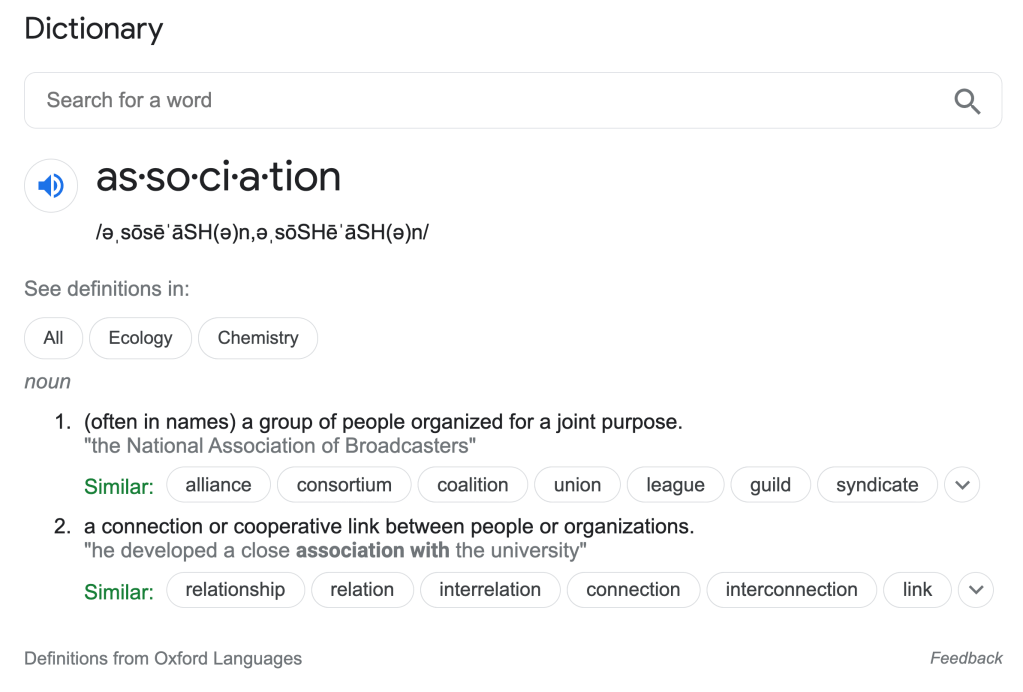
Google English Dictionary provided by Oxford Languages

The architects may have defined “this essential bond” best:

Membership in the relevant professional organization is one of the things that separates a profession from a conventional job. It is a key element that defines a professional. Membership in one’s professional organization is expected of all professionals. It is important to support the advancement of one’s profession, and becoming a member of the professional organization is a part of that advancement.

Involvement with a professional society will afford the participant an opportunity to network with other colleagues in industry and practice. Making connections with others who have similar interests reinforces why one has chosen this career. It enables new professionals to associate with senior members of the profession and learn from them. Joining a professional organization is critical in keeping abreast of the latest knowledge and practices locally, regionally, and globally. It helps the professional to stay abreast of current issues and opportunities and will also assist in personal advancement for the member who becomes involved.

Many professional organizations offer continuing education, seminars, and lectures along with other opportunities for learning. An active participant will have the opportunity to serve in professional development. Working with people outside of one’s own firm and volunteering will build leadership skills. Opportunities for working with the community for the betterment of society and the local economy will be available. There will be possibilities for making real contributions to the human condition through projects the professional organization may take on as a part of giving back to the community. There are events that will call for public speaking skills and professional visibility which will assist in moving one’s career to another level by connecting with other professions and local leaders in the area. The profession will benefit from members’ service and the members will be rewarded in return by such things as personal fulfillment, professional enrichment, and building a stronger resume as a result.

Further definition of the professional responsibilities and ethical practices will come in part from the professional organization. It is a central core for regulation, education, revitalization, networking and service. Joining a professional organization provides occasions and experiences to renew one’s enthusiasm for the practice of interior design. The interaction can be both inspirational and enlightening. Being a member of a professional organization is a symbiotic relationship between the organization and the member that will benefit them both.

Alabama Board for Registered Interior Designers

My “top-ten” benefits for membership in a professional association like PMEA are:

  1. Development and sharing of the standards and best practices of the profession
  2. Student festivals and music performance assessments
  3. Professional development and career advancement opportunities: workshops, conferences, and publications
  4. Leadership training
  5. Collaborative projects such as health and wellness seminars, ethics training, library of online resources, etc.
  6. Networking opportunities
  7. Models and resources for curriculum writing
  8. Coaching and mentoring resources
  9. Resources in job hunting and interviewing techniques
  10. Advocacy of music education and “a voice” (more political “clout”) in defining future government public policy

So, What’s in it for Me?

Review a few of the synonyms of “association” mentioned above: “alliance,” “consortium,” “coalition,” “connection,” etc. I am sure you’ve heard the saying: “TEAM stands for Together Everyone Achieves More.” Or, to quote the philosopher Aristotle: “the whole is greater than the sum of its parts.”

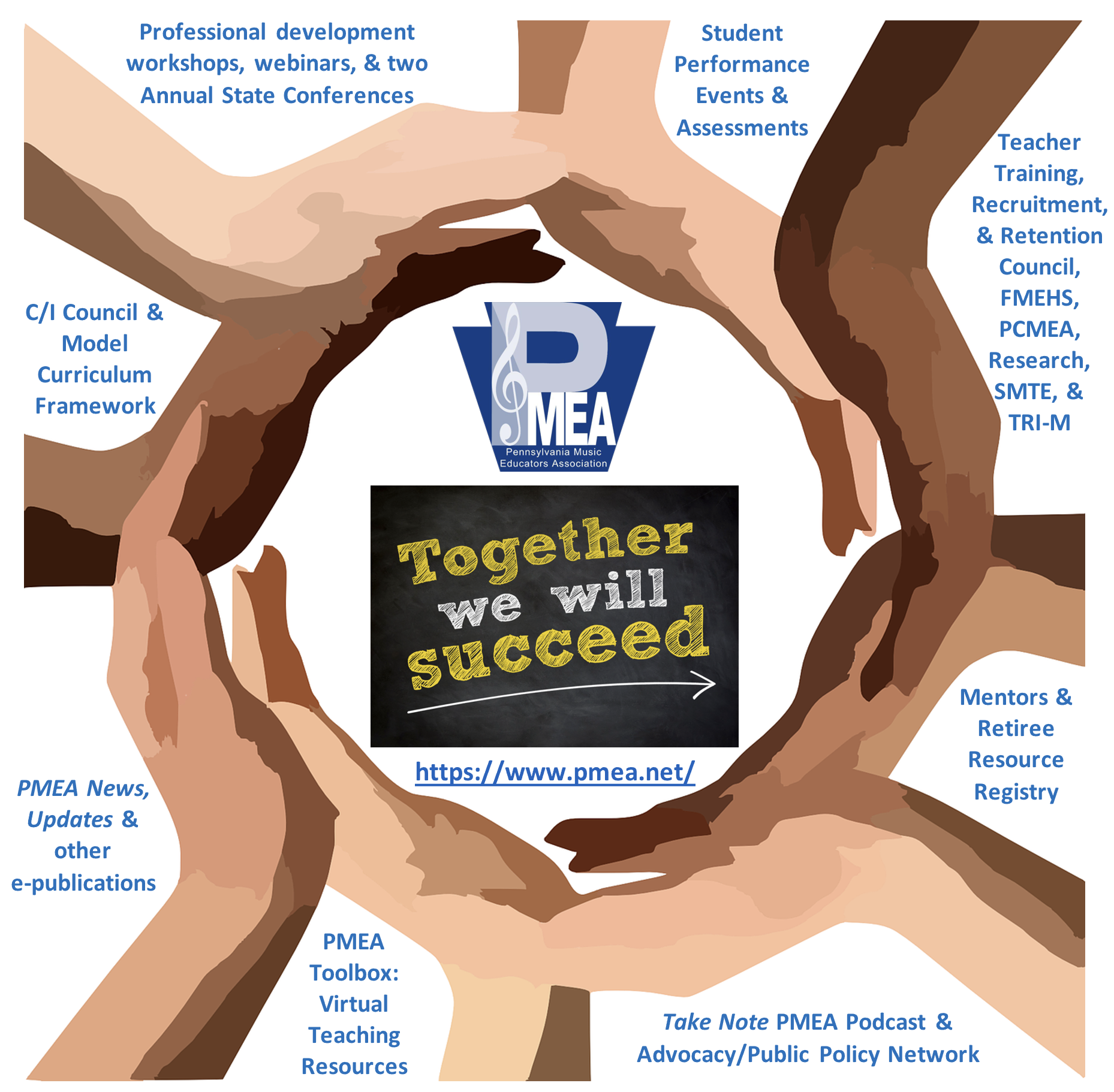
The easiest way for me to show the value of joining PMEA and becoming more active, engaged, and successful in your teaching assignment (no matter what the primary specialty – general music, vocal, band, strings, jazz, music theory, technology, etc) is to take a snapshot of the benefits displayed on the www.pmea.net website. Why try to reinvent the wheel? You might be surprised the extent of the HELP that is available just around the corner! Go ahead… click away! Take a peek at what you may be missing!

On a personal note, PMEA has provided me the insight, inspiration, and opportunities for substantial career growth, “places to go and people to meet” to fill-in-the-gaps of the skill training I may have felt were missing, for example methods and media for teaching a high school choral program for more than 16 years and directing/producing 37+ musicals. In addition, PMEA and NAfME have been the sole institutions that I have turned to for more than 50 years for their sponsorship of choral and orchestral music festivals and other enrichment that have provided my students new and highly motivating musical challenges and countless state-of-the-art once-in-a-lifetime experiences.

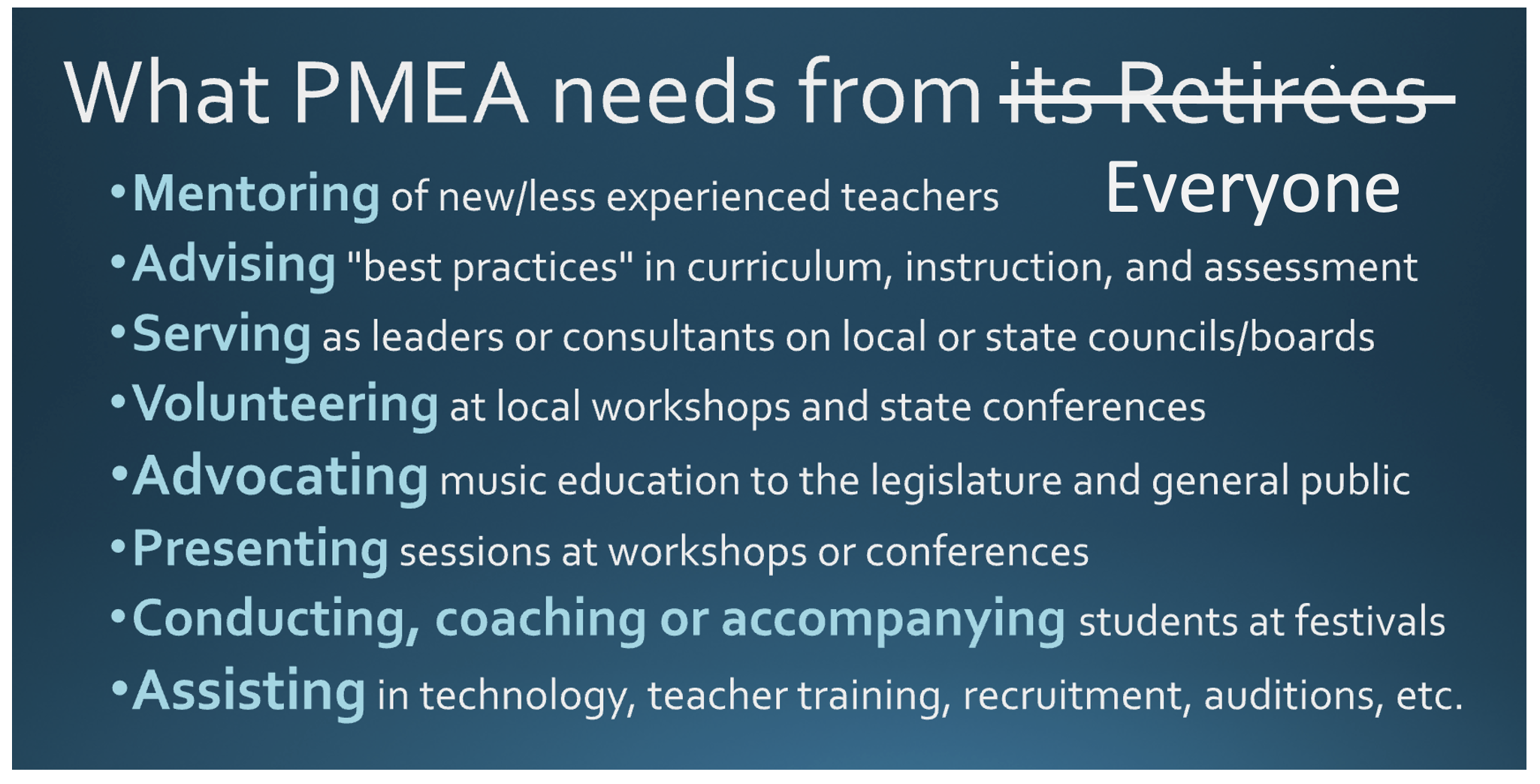
So now, reflect on the title of this blog! It is essential to give back to our association – to help it achieve its mission: “to advance comprehensive and innovative music education for all students through quality teaching, rigorous learning, and meaningful music engagement.” We’re all in this together, and together we can make it better! Slide #6 at the bottom of the retired members’ webpage proposes what PMEA needs from all members (not just retirees):

The number one thing you can do for ANY association is to pay your annual dues, attend its meetings, be active and HELP OUT! In return, PMEA can assist you in finding and sustaining your passions! What are you waiting for? If you have not renewed for the 2021-2022 year, please visit this PMEA membership webpage.

PKF

© 2021 Paul K. Fox

Pictures from Pixabay.com by artist Augusto Ordóñez

Transitioning from Collegiate to Professional – Part III

The Final Leap from Pre-Service to In-Service:

The Metamorphosis and Integration of Philosophy, Maturity, and Teacher Preparation

trumpet-1495108_1920_congerdesignTo “wrap-up” our final segment, we will review the development of a professional “marketing plan.” This is blog #3 out of 3. (Be sure to also check out #1 and #2, too.)

These are three critical skills you need to foster in the search for a school music position, marketing yourself, interviewing, and landing a “good” job:

  • Personal branding (who are you, what makes you unique, and what do you have to offer?)
  • Story telling (anecdotes) of your positive attributes and personal brand, including a record of your habits of “engagement” in music education, and
  • Networking (associating with other professionals and getting your positive stories “out there”).


skills-3262172_1920_diwou

branding

Personal Branding

“Personal branding is the practice of people marketing themselves and their careers as brands. While previous self-help management techniques were about self-improvement, the personal-branding concept suggests instead that success comes from self-packaging… Personal branding is essentially the ongoing process of establishing a prescribed image or impression in the mind of others about an individual, group, or organization.”

– Wikipedia: https://en.wikipedia.org/wiki/Personal_branding

What is the difference between marketing and branding? According to some, “marketing is what you do, branding is what you are.” (www.tronviggroup.com/the-difference-between-marketing-and-branding/)

phone-2840244_1920_RobinWiggins13Shama Hyder posted “7 Things You Can Do to Build an Awesome Personal Brand” at http://www.forbes.com/sites/shamahyder/2014/08/18/7-things-you-can-do-to-build-an-awesome-personal-brand/, including the following outlined summary:
  1. Start thinking of yourself as a brand
  2. Audit your online presence
  3. Secure a personal website
  4. Find ways to produce value
  5. Be purposeful in what you share
  6. Associate with other strong brands
  7. Reinvent

During these waning months for college music education seniors, now is the time to finalize the preparations for personal branding and beginning the employment search! Personal branding is critical to help you “stand above the rest,” showing that you have what it takes and would be a major asset to a prospective employer, and defining and marketing your own unique qualities that would make you “a good fit” for the specific job openings.

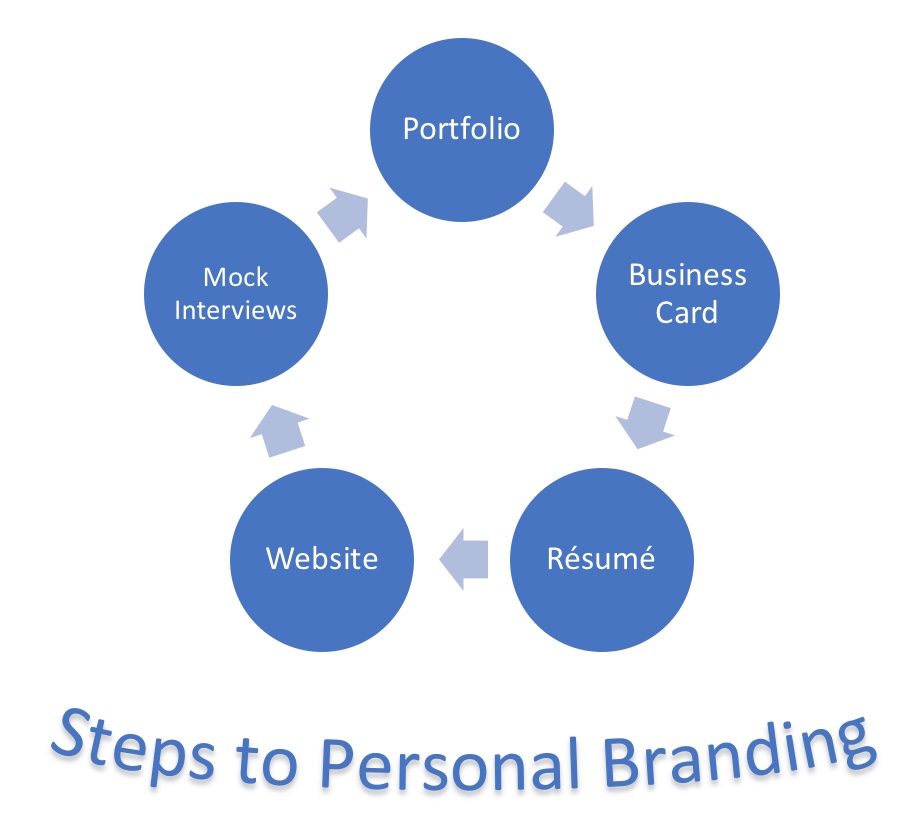
Steps to Personal BrandingThe branding process involves first developing your philosophy of music education, archiving your awards and accomplishments, documenting your grades and ok-3061659_1920_RobinHiggins12experiences, and collecting stories/personal anecdotes of your strengths. The next steps include the creation of a written and electronic portfolio, business card, resume, and website. Finally, you must compile/assemble everything together and practice (and self-assess) your “story-telling skills” to answer those important questions at well-rehearsed “mock interviews.”


You will likely not have enough time to complete all of these tasks during methods classes or student teaching seminars. That’s okay. If you are serious about prepping yourself to find a great music teaching job, the valuable links (see below) and articles are out there… just manage your time and start reading.

feedback-2990424_1920_geralt

networking

Networking

According to the article “Network Your Way to Secure a Teaching Job” at https://resumes-for-teachers.com/job-search-help/teacher-network/, many people are unaware of the basics of networking and how to use them it to their advantage in securing a job:

“Networking simply refers to finding job-related contacts. Most teachers who are just beginning their careers may feel that they have few, if any, networking contacts in the teaching field. It is important to consider the many different areas of networking as you create your own group of networking contacts to help you secure a teaching job. It is interesting to note that many of the teaching positions that are filled each year are filled by those who came to the attention of personnel managers by recommendation.”

“Always think about adding to your teaching network. When meeting new people, be certain to add them to your network. Talk to them about your skills, education, experience, and learn about their jobs. Make sure that you always ask for a business card.”

Do you have a business card? Is your résumé updated and available online on your professional website?

young-3061653_1920As I laid out in a previous blog “Networking Niceties: The ‘How-To Schmooze’ Guide for Prospective Music Teachers” at https://paulkfoxusc.wordpress.com/2016/04/04/networking-niceties/, the concept of networking is two-way communications. Just like collective sets of nerve synapses, two-way connections are expected to fire repeatedly in all directions. That’s actually the science behind memory. For professional networking, it is your “charge” to create multiple pathways to/from school HR managers and secretaries, administrators, music supervisors and department heads, and music teachers… and YOU – your skills, accomplishments, unique qualities, experience, education, and personality traits.
pcmeaThe above blog-post also explores setting up a good organizational system to manage your professional contacts.
If you are a Pennsylvania collegiate member (PCMEA), I heartily recommend the article “Networking 101” by Dr. Kathleen Melago, PCMEA State Advisor and Associate Professor of Music Education at Slippery Rock University, published in the Summer 2017 issue of the state journal PMEA News (pages 40-42). Here are several quotes from her work:

“One of the most common ways music educators can plan to network is at conventions. First, try to avoid interacting only with people from your school or people you already know from other schools. Go to sessions that interest you and look for opportunities to meet people there. Before the session starts, introduce yourself to people sitting around you. Use your social skills to assess whether they seem like they want to engage in a conversation or not. After the session, go up and meet the presenter.”

“Of course, social media is another great way to build your network. Networking with professionals already in the field can help you see what they are doing and help you build ideas of what you would like to do in your program someday.”

“Sometimes, you might find yourself networking unexpectedly. For example, you might go into school to work with their clarinet section during band camp and just happened to meet the choir teacher. That is networking!”

“To help your networking be most effective you need to have good communication skills. When interacting with others in a networking situation, be sure to focus on the person with whom you are speaking. Avoid looking off into the distance as if you were to anticipating someone else more important coming by. But your cell phone away and be present to the conversation.”

“Be yourself in your networking interactions. If you pretend that you are someone you are not, you will either end up unhappy or you’ll be discovered is someone who is not genuine.”

Dr. Melago goes on to provide a myriad of excellent examples of networking skills and opportunities.

Another resource specifically for networking at music teachers conferences is posted at https://nafme.org/getting-music-conferences/.


music-1237358-2 ricardo vasquez


engagement

Engagement

Here is an excellent definition of “professional engagement” from “Domains of Teaching” of the Australian Institute for Teaching and School Leadership at https://www.aitsl.edu.au/teach/understand-the-teacher-standards/domains-of-teaching.

Teachers model effective learning. They identify their own learning needs and analyze, evaluate and expand their professional learning, both collegially and individually.

Teachers demonstrate respect and professionalism in all their interactions with students, colleagues, parents/carers and the community. They are sensitive to the needs of parents/carers and can communicate effectively with them about their children’s learning.

Teachers value opportunities to engage with their school communities within and beyond the classroom to enrich the educational context for students. They understand the links between school, home and community in the social and intellectual development of their students.

Engagement for prospective music teacher may include synonyms like “participate,” “enroll,” “join,” “be active,” “volunteer,” “seek experience,” and “make a difference!”

Are you a member of your professional music education associations?

  • NAfME National Association for Music Education
  • PCMEA Pennsylvania Collegiate Music Educators Association, or another state’s local NAfME collegiate chapter
  • pmeaPMEA Pennsylvania Music Educators Association, or another state’s NAfME-affiliated MEA
  • ACDA American Choral Directors Association
  • ASTA American String Teachers Association
  • NBA National Band Association

Did (or will) you attend your state music teachers’ conference and local workshops on music education and professional development?

To prove you are “professionally engaged,” I would expect to see a consistent record of modeling in the following areas:

  1. excited-3126449_1920_RobinHiggins9Self-reflection of the professional’s teaching practices and modification of these as needed to match changes in the environment and circumstances
  2. Self-assessment of the professional’s methods and approaches, as well as the progress of the students’ learning, using both formative and summative methods for constant and ongoing improvement
  3. Identification and planning of professional learning needs.
  4. Unsupervised (or unplanned by school administration) goal-setting and self-guided implementation of opportunities for professional development
  5. Association with professional learning communities, school and community meetings, and other collaborative projects
  6. Volunteer service in music and music education
  7. Membership and subscription to music education journals and participation in online professional community discussion groups

Many have said that aspiring to be a music educator is a lot like a calling. One school superintendent I know said he expected prospective new recruits to show high energy, enthusiasm, sense of purpose, and dedication during the interview… even a supposed willingness to “lay down in front of a school bus” or “do what ever it takes” to make the students (and the educational program) successful. That’s engagement!

classical-music-1838390_1920_Pexels

In summary, becoming a music educator is about finding your inner confidence, a mindset that you know what you’re doing, and that you’re ready for that real world experience. You’ve learned those essential skills in conducting, piano accompaniment, arranging, student behavior modification and discipline, music diagnosis and remediation, and even how to market your professionalism. Now… drum roll, please! Here’s… a master music teacher!

target-3306771_1920_geralt

In closing, here are supplementary materials to help you to “get your feet wet,” all free and available online. The following lists, although not comprehensive, are a good place to start (courtesy of https://www.pmea.net/wp-content/uploads/2012/10/Collegiate-Communique-No11-022218-2.pdf):

Good luck!


Personal Branding, Marketing, and Networking

Business Cards

Résumés

Portfolios and Websites

Interview Questions, Techniques, and Skills of “Story-Telling”


PKF

© 2018 Paul K. Fox


Photo credits (in order) from Pixabay.com: “tutor” by nrjfalcon1, “trumpet” by congerdesign, “skills” by diwou, “phone” by Robin-Higgins, “OK” by Robin-Higgins, “feedback” by geralt, “young” by Robin-Higgins, “music” by ricardo-vasquez, “excited” by Robin-Higgins, and “classical-music” by pexels.