Advocate the Arts and Creativity by Providing Feedback to Your State’s Education Department
“With this bill [ESSA], we reaffirm that fundamentally American ideal—that every child, regardless of race, income, background, the zip code where they live, deserves the chance to make of their lives what they will.” — President Barack Obama
In the constantly changing climate of “educational reform,” the Every Student Succeeds Act (ESSA) signed by President Obama in December 2015 is the latest “flavor” of educational law to come down from Congress, serving as the re-authorization o f the 50-year-old Elementary and Secondary Education Act (ESEA). Each state must now develop and adopt their own “plan” of ESSA implementation. For example, the Pennsylvania Department of Education (PDE) is considering some very broad topics for inclusion in its state plan, and is currently asking for feedback from the general public on the following (source – Pennsylvania Music Educators Association – PMEA – http://www.pmea.net/specialty-areas/advocacy/):
Assessments
- Can we reduce the amount of time students spent on statewide PSSA testing (grades 3-8)?
- Is it feasible to test students at multiple times across the school year instead of only once?
- Can we eliminate double testing for middle school Algebra I students? (Would need to add advance math test in high school for those students.)
Accountability – Measures
- Future Ready PA Index – a proposed tool to measure school success
- Increased weight on growth in test scores versus point-in-time achievement
- Local options for additional assessments
- Career ready indicators and meaningful post-secondary student engagement
- More holistic measures of student success
- Measures of both inputs (i.e., course offerings) and outcomes (achievement scores)
 Accountability – Interventions
- Tailored to local context and school based needs assessment.
- Intervention for lowest performing schools to include BOTH academic and holistic strategies
- Level of state intervention to be responsive to student progress over time.
Educator Preparation and Evaluation
- What are the best strategies to ensure effective, diverse educators and school leaders for all students?
- What changes in teacher preparation do we need to consider to improve the readiness of new teachers?
- How to promote alternative pathways to teacher certification?
Mark Despokatis, Chair of the PMEA Council for the Advancement of Music Education, says that music teachers and parents “don’t have to respond to every suggestion, but please feel free to respond to those on which you can provide opinions and feedback.” Comments should be shared directly with the PDE at RA-edESSA@pa.gov. Also, PMEA members should submit their feedback to PMEA via email to Mark Despotakis at mark.despotakis@progrmusic.com.
PDE has provided a PowerPoint presentation about the public listening tour and with a little more background on the above listed suggestions on their website at http://www.education.pa.gov/Pages/tour.aspx#tab-1.
This blog-series on “creativity and education” maintains the position that a focus on the development of self-expression and artistry in the schools should be at the top of the critical “big four list” for satisfying “the real purpose of education” – personal discovery, self-improvement, and developing the building blocks for success and happiness in life:
- Creativity
- Literacy
- Logic
- Global understanding
“Talk is cheap! Educational research, the Partnership for 21st Century Skills movement, and other leading-edge groups, company managers, HR Directors, and the general employee job market have known for a long time what is best for kids and the economy… in a nutshell, the need for more exploration, teaching, and mastery of student creativity, including inquisitiveness, ingenuity, inventiveness, flexibility of thought, and inquiry-based learning! In this era standardized testing, the Common Core revolution, and relentless “teaching to the test,” are we embracing the best practices of “whole child” learning? True customization, individualization, and personalization of education dictate a change in emphasis from not relying purely on lesson targets and assessments of simple objective, one-answer-only, convergent thinking, but moving towards the more complex (and richly meaningful) higher-order, multiple-pathway, divergent thinking – greatly valued skills of analyzing, evaluating, and synthesizing.” — Paul K. Fox in “Creativity in Education” https://paulkfoxusc.wordpress.com/creativity-in-education/
Here is your next installment of research and resources on rationale and application of helping our students become more creative. However, do not be shy in vocally expressing your own views and support of the arts to your state legislators and and governor. For the future of education, this is probably the most important role a music advocate can play!

Google’s Most Cited Sources for Creative Teaching and Learning
- Creativity in Education edited by Anna Craft, Bob Jeffrey, and Mike Leibling (Continuum 2007)
- Creativity and Education by Robina Shaheen (Scientific Research 2010) http://file.scirp.org/Html/3369.html
- Creativity and Education by Hugh Lytton (Routledge 1971/2012)
“Throughout the world, national governments are reorganizing their education systems to meet the challenges of the twenty-first century. One of the priorities is promoting creativity and innovation. In the new global economies, the capacity to generate and implement new ideas is vital to economic competitiveness. But education has more than economic purposes: it must enable people to adapt positively to rapid social change and to have lives with meaning and purpose at a time when established cultural values are being challenged on many fronts.” — Ken Robinson in the Preface of Creativity in Education
Creativity in Education provides insightful essays by Margaret A. Boden, Ken Gale, Laura Haringman, Susan Humphries, Dame Tamsyn Imison, Mathilda Marie Joubert, Jenny Leach, Bill Lucas, Bethan Marshall, Kevin McCarthy, Susan Rowe, Leslie Safran, and Peter Woods. The book is divided into two general sections and thirteen chapters:
Part One: Creativity and Individual Empowerment
- The Art of Creative Teaching
- Creative Teaching, Teaching Creativity, and Creative Learning
- Little “c” Creativity
- Creative Literacy
- Creativity as “Mindful” Learning: A Case from Learner-Based Education
Part Two: Creativity and Pedagogy
- Creativity and Knowledge
- Teacher Education within Post-Compulsory Education and Training: A Call for a Creative Approach
- Creating Danger: The Place of the Arts in Education Policy
- Poised at the Edge: Spirituality and Creativity in Religious Education
- Creative Leadership” Innovative Practices in a Secondary School
- Effective Teaching and Learning: The Role of the Creative Parent-Teacher
- Creating a Climate for Learning at Coombes Infant and Nursery School
- A Hundred Possibilities: Creativity, Community, and ICT
Although conceived more than ten years ago, this set of comprehensive articles are a “must read.” As Sir Ken Robinson endorsed, these contributions provide arguments that “educating for creativity is a rigorous process based on knowledge and skill; that creativity is not confined to particular activities or people; that creativity flourishes under certain conditions and, in this sense, can be taught.”
Creativity and Education comes to us via Scientific Research Open Access of “Creative Education” 2010, Vol. 1, No. 3. Robina Shaheen shares interesting research focused in her three sections of her paper:
- The Link Between Creativity and Education
- Changing Role of Education
- The Inclusion of Creativity Within Education
She cites numerous authorities in support of the essential rationale for promoting creativity in schools.
“Fostering creativity in education is intended to address many concerns. As a summary, this includes dealing with ambiguous problems, coping with the fast changing world and facing an uncertain future ( Parkhurst, 1999). Perhaps the most dominant current argument for policy is the economic one. The role of creativity in the economy is being seen as crucial (Burnard, 2006) to assist nations for attaining higher employment, economic achievement (Davies, 2002) and to cope with increased competition. It is for this reason that creativity cannot be “ignored or suppressed through schooling” (Pool e, 1980) or its development be left to “chance and mythology” (NESTA, 2002). It is predominantly for this reason that there is a call for its inclusion in education as a “fundamental life skill” (Craft, 1999) which needs to be developed to prepare future generations (Parkhurst, 1999) so that they can “survive as well as thrive in the twenty–first century” (Parkhurst, 2006). Developing children’s creativity during their years in education is the start of building “human capital” upon which, according to Adam Smith and successive commentators, depends the “wealth of nations” (Walberg, 1988).” — Robina Shaheen
 Shaheen discloses the new focus of the Foundation Stage Curriculum and National Curriculum for schools in England, with the aim that the school should “enable pupils to think creatively and critically, to solve problems and to make a difference for the better. It should give them the opportunity to become creative, innovative, and enterprising.” The key points on the National Curriculum website are:
- What is creativity?
- Why is creativity important?
- How can you spot creativity?
- How can teachers promote creativity?
- How can heads and managers promote creativity?
She concludes that there has been a recent upsurge in “creativity and education” in most European, American, Australian, and East Asian countries, as reflected in their policy documents. She cites the example of what UNESCO now proposes should be taught to Asian students:
- Rather than “learning how to learn” – “learning how to learn critically”
- Rather than “learning how to do” – “learning how to do creatively”
- Rather than “learning how to work together” – “learning how to work constructively”
- Rather than “learning how to be” – “learning how to be wise.”
Another excellent reading, the book Creativity and Education rounds off the third most cited online reference on this subject.
Author Hugh Lytton (1921-2002) was a distinguished scholar in the field of developmental psychology. His table of contents displays an amazing wealth of thought-provoking material:
- The creative process
- Imagination and intuition
- Creative moments
- The poet’s inspiration
- The scientist’s insight
- “Convergent” and “divergent” thinking, or how intelligent is a creative and how creative is an intelligent person?
- Origins of intelligence tests
- Mechanics of intelligence tests
- Theory of intellect
- “Intelligence” and “creativity”
- Do “creativity tests” measure creativity
- What are creative people like?
- Creative men
- Young creatives
- Madness and genius
 Nurturing creativity
- Home background
- Pre-school education
- Developing productive thinking
- The creative child at school
- Is education biased against creativity?
- Teachers’ and pupils’ attitudes
- Achievements
- A propitious school climate
- Teaching for creativity
- Specialization in arts or science
- Retrospect
Although a little pricey, the book is currently available for purchase on Amazon, which provides the following description.
“The author provides a lucid account of creativity and its educational context. He discusses the creative process, the character of different kinds of creativity, creative people, developing creativity, and the creative child at school, to give his readers an understanding of the issues that home or school have to face in fostering a creative, non-habit-bound child. The book should be particularly welcome to all concerned with education in view of the present stress on child-centerd education and on the development of individual children’s abilities, especially their powers of original thought and search to the full.” — Amazon re: Creativity and Education by Hugh Lytton

Politically, very little is in the forefront on nurturing creativity in education. Our legislators, administrators, and curriculum revisionists continue to be more concerned about standardized tests, the Common Core, and the “basics” of math, reading, and writing. Most states (PA included) do not embrace the recently revised and released National Core Arts Standards, for which “creating” has three major essential targets:
- Anchor Standard #1: Generate and conceptualize artistic ideas and work
- Anchor Standard #2: Organize artistic ideas and work
- Anchor Standard #3: Refine and complete artistic work
As stated in the first “lessons in creativity,” we should all venture out on our own expedition… to find additional strategies to implement teaching and learning creativity. As you can see, there is a lot of material to review, at least on the rationale of creativity in education, if not the “how to” of bringing it into the classroom. Happy hunting!
PKF
© 2017 Paul K. Fox
 Reprinted from the Fall 2016 PMEA News, the state journal of the Pennsylvania Music Educators Association
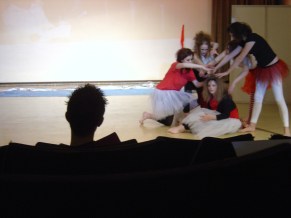 With the help of PMEA State Director of Member Engagement Joshua Gibson, PMEA retired members researched and compiled a PA community theater directory, to join the listings of bands, orchestras, and choruses posted on the PMEA retired members’ website.
 “Two essentials for successful retirement are sufficient funds to live on and sufficient things to live for. You may have the funds and a list of interests, hobbies, and leisure activities that will keep you busy. Nonetheless, if you want your retirement to be satisfying, these activities may not be enough. You may need an overriding purpose.
 This will sound like an advertisement (it is)… for retaining one’s professionalism, keeping involved albeit less active in the profession, supporting the future of music education, and on occasion lending a hand to PMEA throughout retirement! In return, the association will provide you opportunities to record and post your career accomplishments and position assignments (past and in the future), network with your friends and colleagues retired or still “in the trenches,” and nurture your personal quest for creative self-expression and artistry… everything from guest conducting or adjudicating ensembles to writing for PMEA publications or presenting sessions at the conferences. It is all about YOU!
 Research indicates that people either LOVE retirement or HATE it, and their journey to the blessed “golden years” can have many ups and downs, especially for type-A, peak-performing individuals who (used to) spend large amounts of time and personally identified with “the job…” like many music educators. Since retiring myself from the Upper St. Clair School District in June 2013, my goal has been to help others enjoy this life-changing passage, cope with life-style changes/altered expectations, and find creative new ways to self-reinvent and thrive. Objectives for retired members in 2016-18 are:
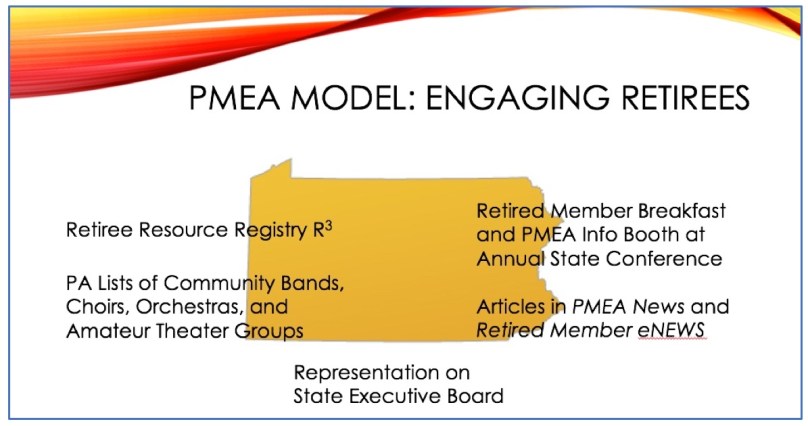
 Are you still willing to “lend a hand” on PMEA projects or share your expertise and provide a free (but priceless) consultant service to new/transferred PMEA members and officers? We constantly update and publish a Retiree Resource Registry
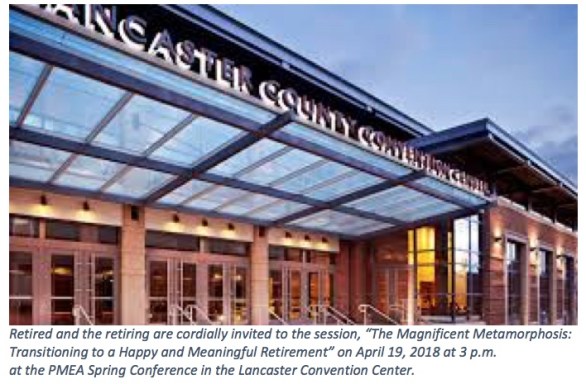
  In addition, retired member registration at the annual PMEA Spring Conference is… (drum-roll, please!) ONLY $10 early-bird! Our next spring conference will be held on April 19-21, 2018 at the Lancaster Marriott & Convention Center. Music teacher retirees get to enjoy some social time to “swap stories” with a FREE breakfast on Friday, April 20. In addition, we are looking for volunteers to help man the PMEA Info Booth… of course, “retired members to the rescue!” Invitations and more details will go out to current members next month, but check out this section on the PMEA website for more information about the conference:
  As a part of reflection and sharing of positive strategies for “Crossing the Rubicon” to a happy, healthy, and meaningful retirement, I have assembled a super-site of every website, article, book, publication, etc. of post-employment “gurus” that I could find. Visit the top menu link
 Music is one of life’s greatest treasures!
  Your joy of creative self-expression and “making music” will sustain you through almost anything… and will transfer to your students’ success in life.
 r mistakes (and there will be many) will be forgiven. Besides, there are usually no “single right answers” in music and art – only opportunities for divergent and flexible thinking, adaptability, and personal expression.
 Music For All:
  someone else, or sing solos at a local nursing home or senior center.
 Spend a lot of time sight-reading… especially on the piano. To take your ear-training training a step further, pull out your old folk-song sight-reading series or Hindemith’s Elementary Training for Musicians and practice musicianship exercises.


 Denial


 Here is your next installment (part three) on a collaborative exploration of “teaching more creatively and teaching creativity.”
 Catmull, Ed (2014). Creativity, Inc.: Overcoming Unseen Forces in Way of Inspiration. Random H. From Ed Catmull, co-founder (with Steve Jobs and John Lasseter) of Pixar Animation Studios, the Academy Award–winning studio behind Inside Out and Toy Story, comes an incisive book about creativity in business and leadership.
 Robinson, Sir Ken (2013). Finding Your Element: How to Discover Your Talents and Passions. The Element gives readers an inspirational and practical guide to self-improvement, happiness, creativity, and personal transformation, introducing the concept of self-fulfillment through the convergence of natural talents and personal passions. Among the questions that the book dives into include:
 The authors have made an online version of this work available under a Creative Commons Attribution-Noncommercial-Share Alike 3.0 License. For details, go to
 While she suggests new ways to “activate your students” developing neural networks of skill-sets for “cognitive flexibility,” she defines several new opposing concepts: “inattentional blindness” vs. open-minded vision, and divergent thinking vs. the factory model of education. She provides excellent examples of lesson activities as she sums up her thoughts on learning transfer: “When you provide learners with opportunities to transfer their learning to novel applications, you’re extending their cross-brain connections and creative potentials.”

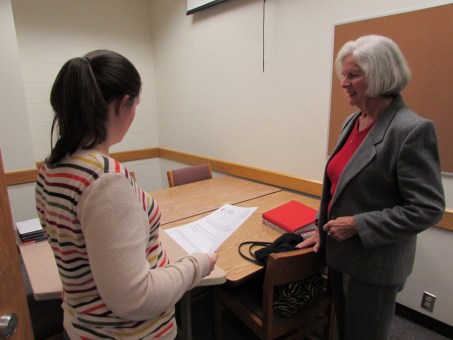

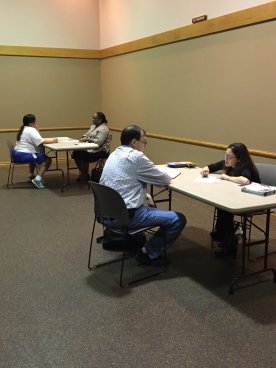 You may be asked to say something about another student or applicant. Speak only of your abilities & strengths. It is acceptable for an interviewer to ask you about other interviews, job offers & salary offers. You are not under an obligation to give a direct answer.


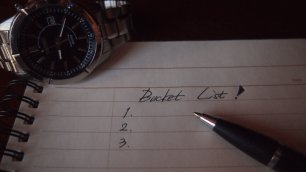 Nope. I cannot accept these archaic definitions! My translation for what it means to face this life-style shift of changing perspectives and expectations, “Crossing the Rubicon” into retirement, is finding alternative but purposeful pursuits, fulfilling “bucket lists,” and reshaping fresh new goals leading to creative ways to self-reinvent and thrive.
 five stages of retirement that he predicts most people go through after leaving their full-time job.
  “The Five Top Stressors in Retirement and How to Cope” by Nanci Hellmich (2014) at USA TODAY

 y engaged man. One example, he transformed his backyard by moving a truckload of large rocks around his garden when he was 80 years old. I attended his 100th birthday party where he played an hour-plus recital with three generations of the Reichenfelds. He always told prospective teachers, “Surround yourself with young people and you’ll never grow old.” The comment I wrote in memory of Eugene Reichenfeld in the online guest book (legacy.com) came from the heart: “With our mentor’s passing, orchestra music and education in our area will never be the same. However, thankfully, Maestro Reichenfeld’s legacy is that he ‘passed on the baton’ and inspired so many future teachers to follow in his footsteps… sharing his love of and skill in strings for eternity! The music lives on!”
 The number one “tool” for finding a job is not a tool at all – it is all about modeling professionalism, networking with other college students and music teachers, and becoming actively engaged in your state/national music education associations (click on the acronyms to go to their websites) – National Association for Music Education
  Your “travel document” (paper copy you bring to the interview or “one-of-kind” attachment in response to email application) should be easy-to-modify based on the specific job posting to which you are applying. Your philosophy, goals, education, and teaching experience should focus on and reflect your competencies in alignment with the requirements for the music position. Your professional website and online resume should be more “general” and not rule out being considered for employment assignments outside your major. The PA teaching certificate states you are licensed to teach music in grades pre-K to 12… which means you should be qualified for any opening in elementary, middle, and high school general music, band, choir, jazz, keyboard lab, and strings, right?
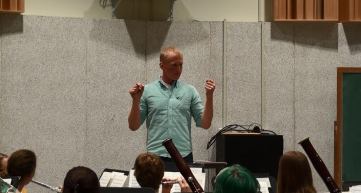
 band for a year, conducting a small instrumental ensemble to accompany your youth church choir, giving a few summer lessons to the bell players in the local drum line where you live, etc. In addition, prior to the first employment screening and mock lesson at the interviews, you could “bone up” on your instrumental methods, suitable middle and elementary band warmups/literature, the meaning/concept of “middle school education,” and perhaps even pull out and brush up playing a few scales on that flute (or whatever) in your closet.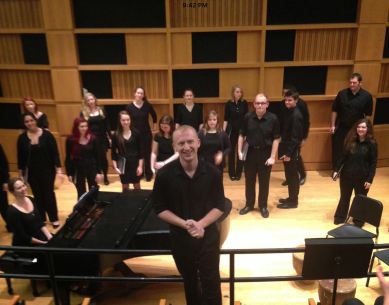
 Another great reason you should be a member of your professional association (PMEA or PCMEA) if you are looking for a job in PA is… the PMEA Job Board. Many PMEA members have relied on the Job Board for the most recent information when it comes to available PA music teacher positions.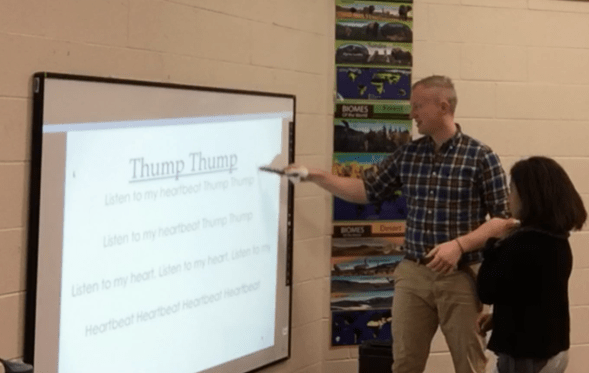

 Take a deep breath, find an easy chair, ignore your cell phone’s texts/calls, and plunge into her full website:
 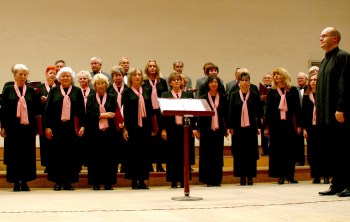 As a music educator, this last title peaked my interest. We urge every retiree to revisit their creativity roots and seek renewed opportunities to enjoy music as a lifelong pursuit. (We have already posted reprints of several of my articles on this subject from PMEA News, the state journal of the Pennsylvania Music Educators Association, including
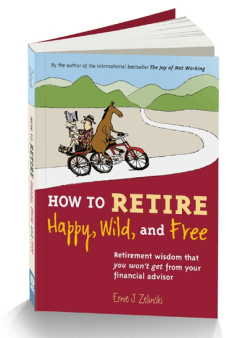
  Generally, I am not much in favor of perusing commercial websites on planning for retirement, especially those by investment counselors, but Ernie Zelinski (author of bestsellers like How to Retire Happy, Wild, and Free) sent me this link:
  The final entry at goldretiree.com, AARP is worth mentioning here
  p Guides,”

 Updates to my presentation “Surviving and Reveling in Retirement” for the PMEA Summer 2016 Conference are posted on the PMEA retired members website: