Post-Employment Prep – New Places to Go

Follow the Wonderful “Gold Brick Road” to More Retirement Resources

yellow-brick-road-1192123

This blog-site will continuously explore new/better research on and suggestions for a happy, healthy, and meaningful transition to retirement. This month, it seems we hit the mother-lobe of recent discoveries for this journey… four more for the road! (To catch-up reading all the blogs for retirees, click on the category link “Retirement Resources” at the right.)

Jean Potuchek

Probably one of the most insightful and expansive treasures of online articles on retirement is Stepping Into the Future – A Retirement Journal by Jean Potuchek, who defines herself as “a professional sociologist who has just stepped into the next phase of my life, retirement, after more than thirty years of college teaching.” She succinctly states her purpose: “This blog is about my experience of that new phase of life.”

enjoying-retirement-1358850-1Take a deep breath, find an easy chair, ignore your cell phone’s texts/calls, and plunge into her full website: https://stepintofuture.wordpress.com/category/retirement-transition/. Or, if you prefer, set aside 30 minutes and read a few of her individual posts (below). I have just begun to “crack this nut” – her blog-site is more extensive than anything else I have found!

choir-1438273As a music educator, this last title peaked my interest. We urge every retiree to revisit their creativity roots and seek renewed opportunities to enjoy music as a lifelong pursuit. (We have already posted reprints of several of my articles on this subject from PMEA News, the state journal of the Pennsylvania Music Educators Association, including Sing Your Heart Out, Now and in Retirement and It’s Time to “Dust off Your Chops” (join a community band/orchestra).
Potuchek relates her rationale for a quest in more spontaneity in her retired life and participating in a “creative aging singing workshop” sponsored by the Portland Public Library:

I am never going to be a totally spontaneous free spirit; it’s just not in my character. I like structure, and I don’t see myself giving up scheduling as a way to structure my days and weeks. But as I get weekly practice in spontaneity, I am learning to loosen up and be more flexible with my schedules. My first spontaneous jump into a new activity has brought the joys of choral singing back into my life, introduced me to some new friends, and helped me to recover long-forgotten skills (like reading music). Who says you can’t teach an old dog new tricks? For this old dog, retirement is proving to be a time of growth and learning. – Jean Potuchek

Top 55 Retirement Planning Websites

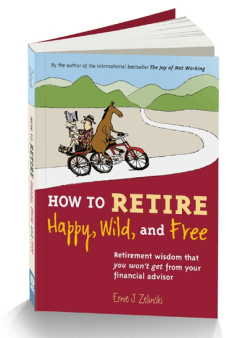
the-end-of-the-road-1207268-1Generally, I am not much in favor of perusing commercial websites on planning for retirement, especially those by investment counselors, but Ernie Zelinski (author of bestsellers like How to Retire Happy, Wild, and Free) sent me this link: http://goldretiree.com/retirement-planning. Zelinski’s own “Retirement Cafe” (http://www.retirement-cafe.com/) is the second website listed, and seems to archive the foundations of much of his subsequent writings. Here is his “10 Dumbest Retirement Moves.”

  1. Purchasing a larger home than you need or than you can afford
  2. Watching a lot of TV — more than an hour and a half a day is excessive!
  3. Gambling
  4. Spending a lot of time shopping
  5. Complaining about life
  6. Being afraid to spend the kid’s inheritance
  7. Being a miser with your money
  8. Planning to work forever — something NOT advocated in The World’s Best Retirement Book.
  9. Neglecting your health by not indulging in vigorous physical exercise every day
  10. Not making new friendships and neglecting old friends

If you are concerned about your personal finances, investment, life styles, travel, or other issues in planning for your “golden years,” goldretiree.com may be valuable. Besides Zelinski’s site, I was taken with the following writers:

aarpThe final entry at goldretiree.com, AARP is worth mentioning here (http://www.aarp.org/). I was one of those 40-something spouses who automatically became a member when his wife turned 50 and she joined; I was neither ready nor expecting it. However, the AARP magazine and online materials are excellent, and span topics about travel, health care and coping with aging, finance, dining and cooking, etc. plus special discounts and benefits.
If you like, the entire listing of retirement websites is provided at this link: GoldRetiree.com

Stephen Price

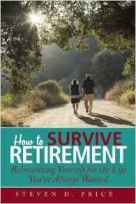
In my last blog-post on retirement, “Three Exit Lanes to Retirement Self-Helhowtosurviveretirement_pricep Guides,” I briefly mentioned Stephen Price’s book “How to Survive Retirement: Reinventing Yourself for the Life You’ve Always Wanted.” No one resource has everything… but this book comes closest to covering the greatest variety of subjects, exploring such possibly mundane (?) topics of financial planning, making your home elder-friendly, and social security information, to riding the up-and-down emotions of “change” and retirement. The book’s table of contents is eclectic:

  1. Entering Retirement
  2. Discovering the New You
  3. The New Realities of Money
  4. Making a Move: Post-Retirement Relocating
  5. Do Unto Others: Opportunities to Volunteer
  6. Travel
  7. Encore Employment, or Returning to Work
  8. Planning for a Healthy Retirement

Volunteer Gardener

Of special merit, Price shares 14 pages of ideas on volunteering, with a gang of valuable websites on which to follow-up… everything from animal shelters, museums, zoos, aquariums, and conservation groups to business mentoring, foster grand-parenting, senior companions, and child advocates.

The last full chapter, written by Laurence Burd, MD, starts with a quote by the late PA Senator Arlen Specter: “There’s nothing more important than our good health – that’s our principal capital asset,” and dives into the effects of aging and how to maintain good health throughout “our maturing years” (or second childhood?).  I have never seen a manual for retirees that goes into such detail on these issues:

  • Decline of Organ Performance and Function
  • Wrinkles and Dry Skin
  • Gray Hair
  • Balding
  • Hearing Loss
  • Decreased Vision
  • Dental Problems
  • Skeletal System
  • Cardiovascular System
  • High Blood Pressure (Hypertension)medicine-1419753
  • Swelling of Ankles and Feet
  • Heartburn
  • Constipation
  • Urination Irregularities
  • Decreased Sex Drive
  • Memory Loss
  • Help, I’ve Fallen and I Can’t Get Up
  • Insomnia
  • Depression and Anxiety

This is definitely a book worth buying, reading, and keeping!

Although a life of ease may have been your dream, retirement brings with it a host of questions, problems, and responsibilities that never occurred to you and may now seem insurmountable. How to Survive Retirement will help you plan for most any eventuality during the golden years. – Steven Price/back cover

Finally… The Ultimate Resource Guide/Bibliography

I tried to revise, assemble, and share in one place all of the retirement resources I have found. Click on this link to download the ultimate retiree resource guide 072216. You do not have to be a former music educator to use this reference list to gain a perspective on research and assistance to preparing and managing the life-changing adventure of retirement.

This document is my present to you. It cannot get much more comprehensive or convenient to find/use this collection of “sound advice” from advisors who themselves have successfully found happiness, good health, and real purpose in retirement life.

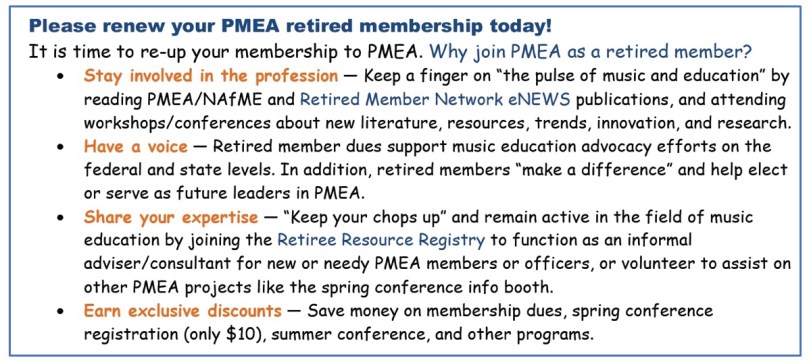
pmeaUpdates to my presentation “Surviving and Reveling in Retirement” for the PMEA Summer 2016 Conference are posted on the PMEA retired members website:  http://www.pmea.net/retired-members/. If you are music teacher retiree and taught or live in the state of Pennsylvania, we recommend joining PMEA to enjoy the numerous benefits of networking with fellow colleagues, reading publications, supporting music advocacy efforts, realizing ongoing professional and leadership development, and other programs. One advantage of being “senior citizens” is that our dues and conference registration fees are significantly reduced! For more information, please go to the PMEA website: http://www.pmea.net/membership-information/.

retirement-life-1385597-1

PKF

© 2016 Paul K. Fox

More Lessons in Creativity

Your daily experiences should all be about curiosity, divergent thinking, creative self-expression, and life-long learning!


What did you think of my May blog-post “Lessons in Creativity” (part 1) on this subject? Did you review the sample opportunities to stimulate your brain, build your artistic sensitivity, and nurture your expressive soul… resources like the following?

If you have not read the first article in this series, please go back to https://paulkfoxusc.wordpress.com/2016/05/01/lessons-in-creativity/. For a survey of all blogs on this subject, click on the link (to the right) “Creativity and Education.”

preschool-class-activities2-2-1251386My “soapbox” in this forum has always been that we need to do things in education  intentionally – in the classrooms, written/posted weekly lesson targets, and curriculum. In school, we have spent an inordinate amount of time developing convergent thinking, a.k.a. one-answer-only principles/laws/inarguable facts.What is needed is MORE divergent thinking – multiple solutions or pathways to the resolution of a problem, open-ended “out-of-the-box” proposals – generating fresh views and novel solutions. Best practices in education would be a combination of both convergent and divergent thinking techniques – the ultimate role of our profession – mastery of the essential 21st century learning skill of critical thinking.

Here and in future blogs, “the plan” is to offer more ideas on becoming more creative – improving self-awareness, experimentation, and enjoyment of inventiveness, innovation, and flexibility/adaptability – openness to new and diverse perspectives.

This is a good place to post your opinions and perspective. Thanks for responding with comments to this blog series.

And now, the next bi-monthly installment of research, resources, and my own ramblings to consider….

Cultivating Curiosity

Cultivating Curiosity book - 1I stumbled on a free ASCD webinar for July 28, 2016 that will “detail ways to foster student curiosity through novelty and play; questioning and critical thinking; and experimenting and problem solving.” Based on Dr. Wendy Ostroff’s book, Cultivating Curiosity in K–12 Classrooms: How to Promote and Sustain Deep Learning, the online session will dive into the concept of a structured, student-centered environment that allows for openness and surprise, where inquiry guides authentic learning. “When a classroom is grounded in curiosity, teachers have the unique opportunity to mine students’ deepest held wonder, making their engagement natural and effortless and allowing them to fully open up to learning.” For more information on the workshop, go to http://ascd.org/professional-development/webinars.aspx.

The book Cultivating Curiosity in K-12 Classrooms itself is an excellent find. Dr. Wendy Ostroff defines her rationale in support of curiosity as critical to student success in school:

  • Curiosity jump-starts and sustains intrinsic motivation, allowing deep learning to happen with ease.
  • Curiosity releases dopamine, which not only brings pleasure, but also improves observation and memory.
  • Curious people exhibit enhanced cognitive skills.

The chapters layout a plan to foster student curiosity through exploration, novelty, and play; questioning and critical thinking; and experimenting and problem solving.

 The Artist’s Way

The Artist WayThe “power” of journal writing and brainstorming is so essential to the creative process. Author and educator Julia Cameron has written a series of books on the subject of “unblocking your inner artist.” The Artist’s Way, the title of one of her international best-sellers, has been transformed into a movement of artists helping other artists, a program she says is “used in hospitals, prisons, universities, human potential centers, and often among therapist doctors aids groups in battered woman’s programs, not to mention fine art studios, theological programs, and music conservatories.”

Her lessons included two fundamental tools, morning pages and artist date. Morning pages are three pages of daily longhand writing, strictly free stream-of-consciousness, a.k.a. “brain drain,” absent from any form of censorship or (as she calls it) “logic brain.” Her other tool, artist date, is “a block of time, perhaps two hours weekly, especially set aside and committed to nurturing your creative consciousness…” quality time spent alone with your “creative child.” For painters, 3D artists, writers, photographers, musicians, singers, and actors, I heartily recommend her tutorials The Artist’s Way and for retirees It’s Never Too Late to Begin Again: Discovering Creativity and Meaning at Midlife and Beyond.

More Best of Bonk!

The World is Open bookOne of my “heroes” on the subject of instructional strategies in creativity, critical thinking, motivation, and collaboration is Professor Curtis J. Bonk, Indiana University (Bloomington) School of Education and author of The World is Open: How Web Technology Is Revolutionizing Education. His course materials and creativity exercises are amazing, and he has been very generous in sharing the slide presentations of his classes. If you have not already done so, you should peruse his “Best of Bonk” website at http://www.indiana.edu/~bobweb/r546/index.html (click on the creativity module), and find out the meaning of these terms:

  • Six hats
  • KWL
  • Reverse brainstorming
  • Checkerboarding
  • Wet ink
  • Second best answer
  • Pruning the tree
  • Fish bowl

If these intrigue you, take a gander at Dr. Bonk’s blog TravelinEdMan where he reflects on his speaking experiences around the world, and posts articles, recommended reading lists, links to other bloggers/sites, etc. at http://travelinedman.blogspot.com/.

He also shared his book, 100+ Activities for Motivating and Retaining Learners Online, available as a free download from http://tec-variety.com/freestuff.php.

Two Ideas for Music Teachers

cornet-593661_1920For school music directors, I would suggest to offer a weekly “create a warm-up” opportunity run by student conductors. Many well-intentioned “school maestros” are guilty of setting up the rigid format of a “benevolent dictatorship” (“my way or the highway”) and not allowing the individual participants to share any input in running practices or interpreting the music. For the first five minutes of the rehearsal, ask student volunteers to choose the articulation or key of a scale, and even create a drill from the challenging rhythmic motives introduced by the music in the folder. Variations on tempo and dynamics can be lead by the student leaders.

My mother had an elementary lesson of free association, “rapid writing” in response to looking at a large picture posted in the front of the classroom. Although probably not as valued by her unimaginative principal (to be fair, this was in the 60s, and phonetics drill was preferable over creative writing), her concept is much like the nonjudgmental practice of brainstorming… “do not stop to edit or evaluate what comes out of your head” and “there are no wrong answers or interpretations.” Save any proofreading and assessment of merit, categorizing, prioritizing, spellchecking, and fixing punctuation or grammar for later drafts. This artistic process can be adapted for singers or instrumentalists. Take two minutes out of a practice, post a giant photograph of just about any scene, and have the musicians express their feelings via random improvisations, communicating “on the spot” what they see, feel, and think about from their observation of the picture. Encourage the communication of their “views” using contrasts of the various musical elements: major/minor tonality, tempo, rhythms, articulations, dynamics, phrasing, etc.

Until next time…

clay-1220105_1920As quoted on the back cover of the Cultivating Curiosity in K-12 Classrooms, “We learn by engaging and exploring, asking questions and testing out answers. Yet our classrooms are not always places where such curiosity is encouraged and supported.” As important as literacy and logic, how can we nurture creativity in the schools? For this forum, can you share your thoughts on additional lessons in creativity?

PKF

© 2016 Paul K. Fox

Other Blogs on Creativity in Education at This Site

3 Exit Lanes to Self-Help Retirement Guides

For Transitioning to a Happy, Healthy, and Meaningful Retirement, These Books Should Be REQUIRED Reading!

3arrowsI submit there are basically three ways to learn something new by reading about it. One is the tutorial format, a.k.a. an instrument of “programmed learning.” Another approach is the comprehensive reference manual or user guide. Finally, many people prefer a narrative story, perhaps a fictitious account that features characters exploring and revealing insights on the topic you are studying.

Do you recall the first time you had to learn a complicated new computer application? After installing it to your computer and some initial nail-biting, you trotted down to the bookstore to purchase “something” to teach you Corel WordPerfect for DOS or Adobe Pagemaker for Mac (two historic examples that are no longer available today). Usually, you were greeted with a choice… a comprehensive user manual or a tutorial workbook!

I am applying this concept to three mini book reviews of preparation for retirement. All you have to do is select your favorite “learning style.”

ZelinskiIf you were looking for the reference manual, I recommend Ernie Zelinski’s How to Retire Happy, Wild, and Free (2016). The chapters are laid out by general concepts you need to understand. However, as in many user guides, you could turn to almost any page in the volume, jump around (in any order) to specific areas on which to focus, e.g. tips on travel (page 165)  to health/wellness (page 109), and not lose the overall meaning.

How to Retire Happy, Wild, and Free is one of the most easy-to-read and humorous publications on the market and best resources for a frank discussion of the emotional aspects of coping with retiree life-style changes/altered expectations, and finding creative new ways to self-reinvent and thrive. Quoted from the book’s Preface:

Retirement can be both exciting and demanding, bringing new challenges, new experiences, and new uncertainties. Regardless of how it turns out, retirement normally turns out far different from what people first envision. For some, it is a big disappointment. For others, it is merely a big annoyance. And still for others – much to their delight – retirement becomes an opportunity to live life like never before.

Here is Zelinski’s Table of Contents:

  • Chapter 1: Thank Heaven for Retirement!
  • Chapter 2: Retirement – A Time to Become Much More Than You Have Ever Been
  • Chapter 3: So Many Worlds, So Much to Do!
  • Chapter 4: Take Special Care of Yourself – Because No One Else Will
  • Chapter 5: Learning Is for Life
  • Chapter 6: Your Wealth Is Where Your Friends Are
  • Chapter 7: Travel for Fun, Adventure, and More
  • Chapter 8: Relocate to Where Retirement Living Is Best
  • Chapter 9: Happiness Doesn’t Care How You Get There

Angled Open Book

The tutorial’s approach is a logical progression of chapters/how-to sections that must be read and completed in order. There are often worksheets, exercises, or activities to complete at the end of each chapter. The hierarchy of these “units” build a sequential set of competencies for which you must master one by one, a prerequisite before going on to the next section. Julia Cameron’s book It’s Never Too Late to Begin Again (2016) is a perfect example of this method. Actually, it is based on her earlier work, The Artist’s Way (also a tutorial), plus 25 years of teaching artists to “unblock their creativity” using her tools “Morning Pages” (stream-of-consciousness writing) and “Artist Date” (reserved weekly block of time to nurture your creativity). Perhaps both editions should be consumed/and worked chapter by chapter.

In It’s Never Too Late to Begin Again, Cameron’s introduction sets the tone for her “lessons” on “defining and creating the life you want to have as you redefine and recreate yourself.”

In this book you will find the common problems facing the newly retired: too much time, lack of structure, a sense that our physical surroundings suddenly seem outdated, excitement about the future coupled with a palpable fear of the unknown. As a friend of mine worried recently, “All I do is work. When I stop working, will I do… nothing?”

The answer is no. You will not do “nothing.” You will do many things. You will be surprised and delighted by the well of inspiration that lies within you – a well that you alone can tap. You will discover you are not alone in your desires, and that there are creativity tools that can help you navigate the specific issues of retirement.

quiet-read-1496189The contents of It’s Never Too Late to Begin Again are divided into a weekly course of study:

  • Week One: Reigniting a Sense of Wonder
  • Week Two: Reigniting a Sense of Freedom
  • Week Three: Reigniting a Sense of Connection
  • Week Four: Reigniting a Sense of Purpose
  • Week Five: Reigniting a Sense of Honesty
  • Week Six: Reigniting a Sense of Humility
  • Week Seven: Reigniting a Sense of Resilience
  • Week Eight: Reigniting a Sense of Joy
  • Week Nine: Reigniting a Sense of Motion
  • Week Ten:: Reigniting a Sense of Vitality
  • Week Eleven: Reigniting a Sense of Adventure
  • Week Twelve: Reigniting a Sense of Faith

Finally, in the usual Ken Blanchard inspirational style of creating characters that act out a story, the book Refire! Don’t Retire (2015) sets the stage for an easy-to-understand narrative, specifically how to “make the rest of your life the best of your life.”

the-story-1243694The fictitious “Larry and Janice Sparks” share anecdotes of their experiences, modeling potential opportunities of retirees enhancing their relationships, stimulating their minds, revitalizing their bodies, growing spiritually… basically rekindling passion in every area of their lives.

Co-authors Ken Blanchard and Morton Shaevitz relate their chance first meeting on a business trip:

“So what are you into and what’s new in your life,” was the beginning of our plane conversation. For the next fifteen minutes, we spoke with growing enthusiasm and animation. We talked about the things we were doing, and especially what we were excited about. When Morton mention he was working in the area of older adults and looking at aging from a new and different perspective, Ken piped up and said he’d been thinking about similar issues. The term he was using was “refire” – an attitude of embracing the years ahead with enthusiasm rather than apathy. At that moment, this book was born.

Their story, a “parable” on coming to grips with retirement, is organized in five sections:

  • The First Key: Refiring Emotionally
  • The Second Key: Refiring Intellectually
  • The Third Key: Refiring Physically
  • The Fourth Key: Refiring Spiritually
  • Putting It All Together

book-eyes-1251357You will notice that all three texts cover many of the same subjects, but are vastly different in methodology, style/design, and overall structure.

If you need additional ideas, I can also recommend these three fairly recent releases on retirement preparation:

  • Disrupt Aging: A Bold New Path to Living Your Best Life at Every Age by Jo Ann Jenkins, CEO of AARP (2016)
  • Happy Retirement – The Psychology of Reinvention: A Practical Guide to Planning and Enjoying the Retirement You’ve Earned by Kenneth S. Shultz (2015)
  • How to Survive Retirement: Reinventing Yourself for the Life You’ve Always Wanted by Steven Price (2015)

With a focus on music educator retirees, all of my past articles are archived on this blog-post: https://paulkfoxusc.wordpress.com/category/retirement-resources/.

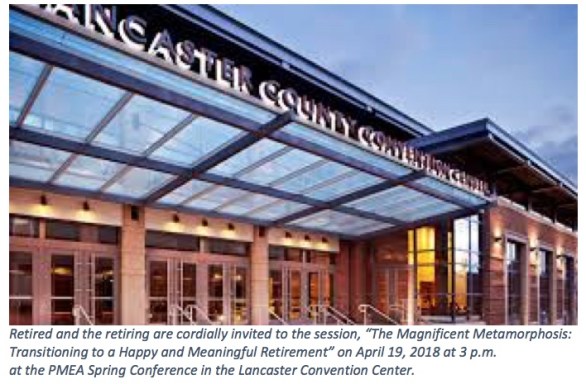
Finally, feel free to peruse the ultimate retiree resource guide rev 071416,  a handout for the Pennsylvania Music Educators Association Summer Conference session entitled “Surviving and Reveling in Retirement,” which was held pages-1426262at the Seven Springs Mountain Resort in Pennsylvania on July 11-13, 2016.

More critical than any instruction manual for using a computer program that will likely “come and go” over a short period of time, making sense of the “awesome” passage to retirement and finding satisfaction and meaning in your “golden years” are essential. These 5-star rated books provide excellent insight in facing this issue squarely, and taking steps to plan for your retirement. I recommend getting your hands on and browsing all of these resources.

To sum it up, I will echo Ernie Zelinski’s final thoughts:

The way I see it, you will have attained true freedom in this world when you can get up in the morning when you want to get up; go to sleep when you want to go to sleep; and in the interval, work and play at the things you want to work and play at – all at your own pace. The great news is that retirement allows you the opportunity to attain this freedom.

KONICA MINOLTA DIGITAL CAMERA

PKF

© 2016 Paul K. Fox

Those Tricky Interview Questions

Much has already been written and posted here for prospective music educators to market their professionalism, learn personal branding, networking, and prepare to “ace” those interviews. If you have not read them previously, take a few moments to acquaint yourself with my past articles that explore these subjects in greater detail. Click on the above link, “Becoming a Music Educator.” – Paul K. Fox

On your way to your first music teacher employment screening? “Break a leg,” as they say, but watch out for several possibly stressful moments during the interrogations.

Whether you are dealing with an inexperienced interviewer or a pro who’s deliberately trying to catch you off guard to see how you handle yourself, awkward questions are sometimes asked of you that seem to come out of left field.

And, sorry, in this competitive market, it’s your job to deal with them!

ball-605592_1920Be prepared for anything, and don’t slip up on “interview potholes” – any of these “terrifying, treacherous, tricky, and troubling” inquiries or potentially hot topics like…

  • What is your greatest weakness?
  • What was your most embarrassing moment in front of the class?
  • What was your greatest professional failure.
  • Why did you leave your last employer?

The U.S. News & World Report MONEY online site offered “How to Answer the 5 Toughest Job Interview Questions” by Robin Madell (http://money.usnews.com/money/blogs/outside-voices-careers/2014/03/18/how-to-answer-the-5-toughest-job-interview-questions), including the biggie, “Tell me about a time you failed,” often asked of applicants to any field.

Quoting career coach Christie Mims, Madell recommends to respond honestly. “Highlight a failure and then follow up with what you learned and how you changed,” she says. “Interviewers are less concerned with the failure than how you handled it. (You are human, after all.) They want to know that you are capable of thoughtful growth and can handle stress under pressure.” And, as for “What are your greatest shortcomings?” – again, be honest. Madell cites Medallia Vice President David Reese: “Many interviewers are not really looking to find out whether a candidate’s organizational skills could use improvement, or that they struggle with presenting to large groups or even leading large teams,” he says. “They’re trying to find out whether they have self-awareness, whether they are able to be critical, and most importantly, whether they’re able to tell the truth – when it’s difficult.”

looking-for-a-job-1257233_1920According to Lee E. Miller at http://www.theladders.com/career-advice/how-to-answer-tell-me-about-yourself-interview-question, one common “open-ended” question begins with, “Tell me something about yourself.” It demonstrates how the candidates will handle themselves in an unstructured situation, show how articulate and confident they were, and “what type of impression they would make on the people with whom they came into contact on the job.” Your response should be positive and focus the interview on your strengths and accomplishments. You should not answer with a snappy, “What do you want to know?” Miller says this implies that you are unprepared for the interview and likely to be equally unprepared of the job.

Another good perusal is “5 Great Answers to Awkward Interview Questions,” by Dominique Rogers, Monster Contributing Writer (http://www.monster.com/career-advice/article/great-answers-to-awkward-interview-questions), which revisits “Tell me about yourself!” and also includes a discussion on several other “thorny” questions:
  • What’s your passion?
  • Why are you looking to leave your current job? and How do we know you’ll stay?
  • If you were a fruit or a pizza topping, what would you be?
  • How do you rate yourself on a scale of 1 to 10?
  • What would you do if you were given multiple tasks to accomplish in a day—and you knew it was flat-out impossible to do them all?
  • Have you ever had to confront the situation where someone on a team wasn’t pulling their weight? If so, what did you do?

human-1211467_1280Instead of a traditional interview (like most of the above) stating opinions about yourself, you may be faced with a behavioral interview. This type of employment screening requires job candidates to relate stories about how they handled challenges related to the skills and qualifications the company requires for the position. For this, you are encouraged to read “Acing the Behavioral Interview” by Jeanne Knight at http://www.theladders.com/career-advice/acing-behavioral-interview. She goes into great detail about how to define appropriate skill sets and develop specific anecdotes to support your experiences and growth in these areas. Knight concludes, “Familiarizing yourself with the behavioral interview style, crafting and practicing your stories and doing some homework on the position you seek will ensure that you won’t be caught off guard should you encounter a behavioral interview.”

The Ladders website also offers excellent insight on how to respond diplomatically to inappropriate interview questions based on age, nationality, religion, marital/family status, etc. (see article by Lisa Vaas at http://www.theladders.com/career-advice/dont-answer-interview-question).

It is likely you will be asked about your philosophy of student discipline at least once during the screening process. Develop a proactive classroom management perspective. Do not fall into settling for “sending the bad kids to the principal’s office” as a solution to poor behavior. Preventive discipline, confidence, and control in handling your own class are absolutely critical. Again, this would be an excellent time for storytelling, giving an example about a specific disciplinary incident, something you had to solve in student teaching, subbing, or at a previous job.

questions-1151886In the unlikely event it gets asked, how would you respond to, “You say you are a musician? Are you temperamental?” Administrators want assurances and evidence that you are levelheaded, responsible, organized, reliable, and indeed NOT temperamental. Freelance singers and instrumentalists often have active performance calendars. Your principal may come out and ask if you will be available to “make the music” with your students after-school or evenings, and that your “gigs” and other non-district related activities will not interfere with school concerts, open houses, field trips, festivals, parent meetings, and other educational events for the growth and development of the total music program.

Here are a few final tips, in summary:

  • Be true to yourself. Say what you mean. (If you get the job, you may have to “eat your words!”)
  • Do not try to predict what the members on the interview panel want to hear from you.
  • Do not get carried away and volunteer too much information.
  • Avoid badmouthing previous bosses, school districts, or job assignments.
  • Be inquisitive, interested, motivated, and actively engaged in the “give and take” of the interview.
  • Never ask at the first interview what you would receive in pay and benefits.

What’s that saying? “Never let them see you sweat? At a job interview, always remain cool, calm, and collected. In advance, prepare answers and supportive anecdotes in response to all interview questions, and “go for the gold!” Good luck!

puzzle-693871_1920

PKF

© 2016 Paul K. Fox


Retired from What?

concert-662851_1920Do music teachers ever retire? Not really!

The other night, I was attending a community foundation meeting for which I serve as trustee. One of the other members came up to me and made a little fun of the fact that he noticed I list my previous employment on the footer of my email.

I have to admit I was taken aback and a little embarrassed. I recalled that several months after I retired from public school teaching, I prepared some business cards to distribute at music education conferences and collegiate seminars which included the job titles I assumed when I was working full-time at Upper St. Clair. You have to admit it may be a little ironic. Why would a retiree use a business card to help broadcast his skills and experience for possible future employment opportunities… something no longer needed?

choir-1438273

Then it hit me. Most people retire and want nothing to do with the daily grind to which they were assigned during their career. Many want to forget everything and wash their hands of all memories of their former position(s) in sales, management, law, medicine, trades, manufacturing, service industry, etc. – perhaps, even non-arts related education!

Musicians and music teachers are definitely unique. Our job is really more of a “calling,” never just a place to go to work and earn a paycheck. We were inspired to make music and then share this fantastic process with our students and audiences. Our employment was never 9-to-5. And, all of the Performing Arts have no notion of a 9-to-5 goal…  “Hurry up, let’s finish learning this piece, play it, and then go to the bar and have a few drinks.”

serenata-1191504

The mission of music education is to facilitate creative self-expression, to nurture understanding of ourselves, our culture, and our artistic heritage, and to seek out as many opportunities to “make music” in collaboration with other instrumentalists and vocalists. You have heard it before: “Music is lifelong learning!” That means there are no limits to lifelong participation in the arts based on race, color, religion, gender, sex, national origin (ancestry), disability, marital status, military status, and most importantly, age!

I know very few music education professionals who do not “bring home their music…” looking for more ways to experience it in their free time:

  1. Play, sing, act, or dance in a community ensemble
  2. Direct or accompany a church or community group
  3. street-musicians-1436714Practice and go out on a few gigs with your own jazz, rock, Barbershop, or chamber music group
  4. Teach private lessons
  5. Coach or compose for local marching bands, etc.

All of these activities become magnified when you retire. Once we are “set free” from the day-to-day academic schedule, lesson planning, faculty meetings, etc., we can focus our attention on what we really love to do. We are probably the luckiest professionals alive… we want to revisit our creative roots, not run away from them.

My previous experience (on my business card or e-mail footer) is relevant and I will no longer apologize for sharing it. I am not “stuck in the past,” but focused on the future! It means I am still active in the profession, available to mentor or help others in the field, always learning and growing, and exploring new directions and avenues to inspire my own artistry.

How many of you retirees agree that you are really just moving on to different pursuits in performance and/or music singer-1535103education? Of course, the best part of retirement is that you get to pick what you want to do every day for the rest of your life. So go ahead and say yes to those extra conducting gigs, writing/publishing your own “Mr. Holland’s Opus,” working with the church or community choir, accompanying a handful recitals, volunteering to help your favorite local marching band or civic theater, serving as an adjudicator for a music festival, supervising student teachers or teaching college music education methods classes, etc.

If you rearrange the letters, “retired” becomes “retried,” not “retread.” Yes, I embrace many of those other “re- words” meaning “growth,” such as redefining, retraining, re-targeting, re-tailoring, remaking, retooling, re-energizing, reflecting, and revitalizing, but not those negative or low-energy terms such as reverting, returning, regretting, retreating, recycling, refusing, regrouping, regressing, or retreading.

concert-1-1438833As long as I am alive, I will continue to inspire in others that music makes a difference!

Lessons in Creativity


anvil-1169340_1920

Sharing the thoughts of others on inspiring innovation, ingenuity, divergent thinking, and creative self-expression in the schools is my lifelong mission. I place this perspective at the top of the critical “big four list” for satisfying  “the real purpose of education” – personal discovery, self-improvement, and developing the building blocks for success and happiness in life:

  • Creativity
  • Literacy
  • Logic
  • Global understanding

wondering-1434779-1

Even though I am now retired, my “mind energizing” routine every morning is to take several moments to “surf the net,” looking for interesting articles on the subject of cultivating creativity in education. A typical online journey might include “waking up” with the following progression (but, this is NOT a fixed script, since this is all about becoming more self-aware and practicing  the skills of inventiveness, personal initiative, and flexibility – openness to new and diverse perspectives).

  1. Visit https://curiosity.com/ and “sit a spell.” Read several mind-expanding articles.
  2. Connect with other professionals with Edutopia.com. Today I  “found” several interesting sections to satisfy my thirst for discussions on infusing the arts in education:
  3. If you have not explored the National Creativity Network website, go to http://nationalcreativitynetwork.org/blog/.
  4. woman-1172718_1920Randomly check out what’s happening in the arts’ scene on the World Wide Web:
  5. Troll for new ideas and sites with a general (and ever-changing Google search). Several results of “lessons in creativity” are shared below.

OLYMPUS DIGITAL CAMERA

As a non-casual observer of most traditional instruction in the schools, I note that teachers are generally very well trained at facilitating in their classes the “left-brain” attributes of speech, language, writing, linear and sequential thinking, understanding of symbols, and logical progression. They focus more on the final product – not the process, laws and rules – not ambiguity, convergent (one-answer-only) thinking – not open-ended questioning, and summative – not formative assessments. Of course, mastery of reading comprehension, writing skills, vocabulary, and understanding of mathematical expressions are essential for a “good education,” but to make the learning authentic and personalized, the habits of creative self-expression, adaptability, self-direction, and intrinsic motivation are equal in importance. And, to the main point of my thesis, this “equality” should not be relegated to the high school students’ enrollment in an “optional” arts elective or two!

Throughout my research in nurturing one’s creative inner self and nourishing more of the “right brain” attributes (divergent and holistic thinking, spontaneity, intuition, artistic expression, etc.) into every day life, these five terms/concepts keep coming up:

  • daydreaming-1568518Curiosity
  • Daydreams or fantasies
  • Focus
  • Play
  • Risk-taking

To glean a new perspective for prioritizing “originality” in school and in life, let’s peruse a few online expert’s “lessons in creativity.” (The following just lists the lessons; you need take the time to read the authors’ entire articles to gain full understanding.)

9 Illuminating Lessons on Creativity

by Margarita Tarakovsky (World of Psychology) http://psychcentral.com/blog/archives/2013/04/14/9-illuminating-lessons-on-creativity/

  1. Creativity is about showing up.
  2. learn-2-1237605Creativity is about getting curious.
  3. Creativity is limitless.
  4. Focus on the process, not the product.
  5. Being creative does not mean being skilled.
  6. Forget perfection, and find the “magic threshold.”
  7. Creativity is full of surprises.
  8. Creativity is full of ups and downs.
  9. Everyone is creative.

18 Things Highly Creative People Do Differently

by Carolyn Gregoire (The Huffington Post) http://www.huffingtonpost.com/2014/03/04/creativity-habits_n_4859769.html

  1. They daydream.
  2. They observe everything.
  3. They work the hours that work for them.
  4. They take time for solitude.
  5. They turn life’s obstacles around.
  6. They seek out new experiences.
  7. They “fail up.”
  8. They ask the big questions.
  9. They people-watch.
  10. ideas-1439573They take risks.
  11. They view all of life as an opportunity for self-expression.
  12. They follow their true passions.
  13. They get out of their own heads.
  14. They lose track of time.
  15. They surround themselves with beauty.
  16. They connect the dots.
  17. They constantly shake things up.
  18. They make time for mindfulness.

5 Lessons on Creativity from Former Disney Imagineer

by Jonha Revesencio (The Huffington Post) http://www.huffingtonpost.com/jonha-revesencio/creativity_b_5350605.html

  1. In order to be great, you need to get started.
  2. Focus on what you do best.
  3. Add value. Don’t just criticize.
  4. See things differently.
  5. Stay curious.

education-548105_1920As soon as I posted these wonderful resources, several new ones popped up. Also, please look up the following:

These is just a gourmet sampling of what’s out there. You should venture out on your own expedition… there is a lot of material to review, at least on the rationale of creativity in education, if not the “how to” of bringing it into the classroom. That’s the next step… fodder for future articles. Happy hunting!

creativity-1187107

PKF

© 2016 Paul K. Fox

Other Blogs on Creativity in Education at This Site

preschool-class-activities2-2-1251386

preschool-class-activities2-1-1439482

Sing Your Heart Out… Now and in Retirement

pmeaReprinted from the Spring 2016 issue of PMEA News, the state journal of the Pennsylvania Music Educators Association.


choir-1258225_1280

Isn’t the Internet a wonderful place to validate something you have always known? After only a brief Google search, the research seems overwhelming! Here are my top five reasons all of us should participate in a choir… throughout our adult lives!

  1. Singing promotes a healthy immune system.

lungs-39980_1280If you’ve ever been in a choir, you’ve probably been told that the proper way to sing is from your belly.

The idea is to use your diaphragm – the large muscle that separates your chest and abdominal cavities – to push air out through your vocal cords.

Using your diaphragm to sing is a good way to promote a healthy lymphatic system, which in turn promotes a healthy immune system.

Dr. Ben Kim at http://drbenkim.com/articles-singing-for-health.htm.

  1. Singing soothes the savage beast… and makes you feel better!

relax-1183452_1920As the popularity of group singing grows, science has been hard at work trying to explain why it has such a calming yet energizing effect on people. What researchers are beginning to discover is that singing is like an infusion of the perfect tranquilizer, the kind that both soothes your nerves and elevates your spirits.

Group singing is cheaper than therapy, healthier than drinking, and certainly more fun than working out.  It is the one thing in life where feeling better is pretty much guaranteed.

Stacy Horn at http://ideas.time.com/2013/08/16/singing-changes-your-brain/

  1. Don’t you want to live longer? Singing is “heart healthy!”

aorta-151145_1280Regular exercising of the vocal cords can even prolong life, according to research done by leading vocal coach and singer Helen Astrid, from The Helen Astrid Singing Academy in London. “It’s a great way to keep in shape because you are exercising your lungs and heart.”

Singing… helps you live longer according to the findings of a joint Harvard and Yale study, which showed that choral singing increased the life expectancy of the population of New Haven, Connecticut. The report concluded that this was because singing promoted both a healthy heart and an enhanced mental state.

Heart Research UK at http://heartresearch.org.uk/fundraising/singing-good-you

  1. Think “karaoke!” Singing builds “connections” with each other and social confidence.

singer-84874_1920Colette Hiller, director of Sing The Nation, is convinced that singing builds social confidence by helping individuals connect to each other, and to their environment. “Think of a football stadium with everyone singing,” she says. “There’s an excitement, you feel part of it, singing bonds people and always has done. There’s a ‘goosebumpy’ feeling of connection.”

Chorus America, an organization of singing groups in the United States of America, conducted a survey a few years ago, and found that more people in the U.S. and Canada take part in choral singing more than in any other performing art, since they feel that singing in a chorus builds social confidence. Nikki Slade, who runs The Priory, a chanting and voice-work class, believes that the benefits of singing are linked to the primacy and power of the human voice – and that it is our basic instinct to use it. “People are naturally free and expressive,” she says, “but it’s something that has been lost on a day-to-day basis.” Singing can help restore that lost connection.

http://www.shankarmahadevanacademy.com/community/articles/view/6/

  1. Singing reduces stress and pain, and benefits “senior citizens” especially well.

stress-1277561_1920Studies have linked singing with a lower heart rate, decreased blood pressure, and reduced stress, according to Patricia Preston-Roberts, a board-certified music therapist in New York City. She uses song to help patients who suffer from a variety of psychological and physiological conditions.

“Some people who have been traumatized often want to leave the physical body, and using the voice helps ground them to their bodies,” Preston-Roberts says. “Singing also seems to block a lot of the neural pathways that pain travels through.”

Singing, particularly in a chorus, seems to benefit the elderly particularly well. As part of a three-year study examining how singing affects the health of those 55 and older, a Senior Singers Chorale was formed by the Levine School of Music in Washington, D.C.

choir-305535_1280The seniors involved in the chorale (as well as seniors involved in two separate arts groups involving writing and painting) showed significant health improvements compared to those in the control groups. Specifically, the arts groups reported an average of:

  • 30 fewer doctor visits
  • Fewer eyesight problems
  • Less incidence of depression
  • Less need for medication
  • Fewer falls and other injuries

The seniors themselves also noticed health improvements, said Jeanne Kelly, director of the Levine School of Music, Arlington Campus, who led the choral group. The seniors reported:

  • Feeling better both in daily life and while singing
  • Their everyday voice quality was better
  • The tone of their speaking voice did not seem to age as much
  • Easier breathing
  • Better posture

http://www.sixwise.com/newsletters/06/06/07/how_singing_improves_your_health_even_if_other_people_shouldnt_hear_you_singing.htm

female-1299085_1280Okay, besides that crack about “elderly” in that last article (we’re not “old,” yet!), the evidence seems conclusive! For our general health, feelings of well-being, improved social connections, and “just having fun,” we should all be motivated TODAY to go out and find a community choir and start singing regularly in a group. Enough said?

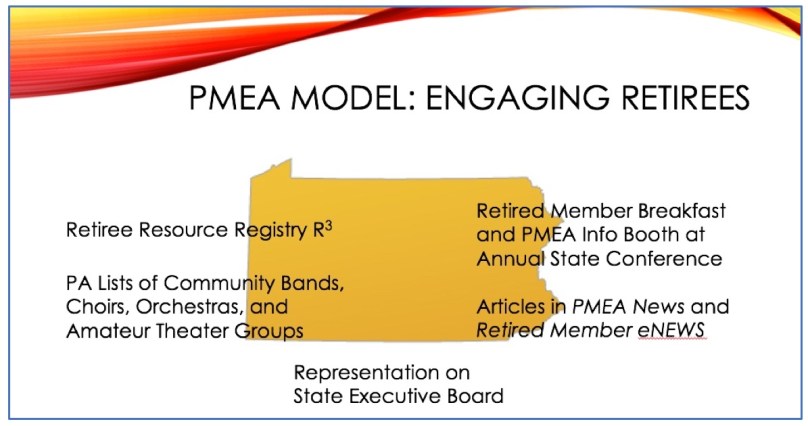
Similar to the “nearly comprehensive” instrumental ensemble listing published by PMEA retired members in the Fall 2015 issue of PMEA News, check out the recently released directory of Pennsylvania community choruses.  Sorted by ensemble’s name and also by location, these files of PA community bands/orchestras and choirs will be updated (new groups added) from time to time, and new revisions will be posted online under “focus areas” and “retired members” of the PMEA website: http://www.pmea.net/retired-members/. (If you have any corrections or additions, please send them to paulkfox.usc@gmail.com.)

choir-783666_1920For both the instrumental and choral groups, we are most thankful to the contributions of our “dream team” of PMEA researchers and editors (as of April 13, 2016): Jan Burkett, Craig Cannon, Jo Cauffman, Deborah Confredo, Susan Dieffenbach, Timothy Ellison, Paul Fox, Joshua Gibson, Rosemary Haber, Estelle Hartranft, Betty Hintenlang, Ada Jean Hoffman, Thomas Kittinger, Chuck Neidhardt, Sarah Riggenbach, Ron Rometo, Joanne Rutkowski, Marie Weber, Lee Wesner, and Terri Winger-Wittreich. We are especially grateful to the efforts of Director of Member Engagement Joshua Gibson who located the counties and e-mail addresses in the choir directory.

Now, what are you waiting for? Go out and… sing!

PKF

© 2016 Paul K. Fox

eric-whitacre-522604_1920

Networking Niceties

The “How to Schmooze” Guide for Prospective Music Teachers

key-to-success-1307591Do you have a business card, e-portfolio, resume, and professional website?

There are three critical skills you need to foster searching for a school music position, marketing yourself, interviewing, and landing a job:

  • Personal branding (who are you, what makes you unique, and what do you have to offer?)
  • Story telling (anecdotes) of your positive attributes and personal brand, and
  • Networking (associating with other professionals and getting your stories “out there”).
In previous articles posted in this blog series, we have discussed the essential need for the development and constant revisions of a professional e-portfolio, resume, and website. If you have not read them, click on the following:

connected-people-1165937Merriam-Webster defines “networking” (noun) as “the exchange of information or services among individuals, groups, or institutions; the cultivation of productive relationships for employment or business.”

The concept of networking is two-way communications. Just like collective sets of nerve synapses, two-way connections are expected to fire repeatedly in all directions. That’s actually the science behind memory. For professional networking, it is your “charge” to create multiple pathways to/from school administrators, HR managers and secretaries, music supervisors and department heads, and music teachers… and you – your skills, accomplishments, unique qualities, experience, education, and personality traits.

Business Cards – One of the Earliest Known Methods of Networking

Do you know the history of the business card? How long ago was it introduced?

You might have guessed it was first “kicked-off” in the 1980s, the decade that corporations expanded on the adoption of the 3.5 by 2-inch rectangle business card format we know today.

However, according to Design Float Blog [Source: “A Brief History of Business Cards” posted at http://www.designfloat.com/blog/2012/04/02/history-business-cards/], its origin can be traced back to 15th century China. They were first known as “visiting cards” and used to announce one’s intention of meeting with another individual.

king-louis-at-versailles-1553663During the 17th century, especially during the reign of Louis the 14th, the “calling card” made its heyday in Europe. “…An individual’s success or failure in society often depended on the strength of their personal promotion.”

Etiquette was involved in the deployment of “acquaintance cards” in the 17-18th century.

“…A strict protocol existed to ensure that calling cards were employed correctly. If a gentleman wished to call on a lady, he had a lot to think about. On making a first call, he had to make sure there is a separate card for each lady of the household. Alternatively, he could fold his card down the middle to indicate it was meant for all members of the household. Cards had to be left with the servant; admission to the house would only be permitted after the hostess had examined the card. Calling cards were to be collected on a small tray kept in the hallway, which would be presented by a servant on the palm of his left hand. While a gentleman may carry his cards loose in his pocket, a lady should use a card case. If the gentleman received no acknowledgement of his card, he had to accept that there would be no continuation of the acquaintance. And on no account was it ever acceptable to sneak a peak at cards that had been left by other callers.”

Later in the 17th century, London merchants used “trade cards.” At a time when street numbers were not in popular use, these cards were crucial in promoting the business and hands-3-hand-holding-a-card-1440323informing customers of its location and services available.

So how do you collect and distribute your business cards? What methods do you use to record and store the contacts you meet on a daily basis? How is your contact information given out to every professional you meet, especially at conferences, mass employment screenings, or job fairs?

Business Card Basics

Today’s professionals still exchange this “old-fashioned invention” called a business card as part of employment and business networking. (Who knows? Maybe someday we will be doing this electronically. Perhaps, our new “super-smart phones” will automatically talk to one another and seamlessly pass on our contact information.)

According to Ivan Misner, contributor to the online Entrepreneur website (http://www.entrepreneur.com/article/159492), “The business card is the most powerful single business tool – dollar for dollar – you can invest in. It’s compact, energy-efficient, low-cost, low-tech, and keeps working for you hours, weeks and even years after it leaves your hands!”

He outlines what it does in support of person-to-person networking:

  • The business card tells people your name and the name of your business.
  • It provides prospects a way to contact you.
  • business-card-1525590It gives others a taste of your work, style and personality.
  • It can be so unusual or attractive or strange or charming or funny that it tends to stick in the memory of the prospective employer like a great radio or television ad.
  • It can be reused, passes from person to person, giving the same message to each person who comes in contact with it.

What data should be shared  on a business card? The quick (and obvious) answer is your name, mailing address (street, city, state, zip), cell phone (and if you still have a landline telephone number), email address, and extremely important – a link to your professional website (and password if needed).

Your Personal Brand Displayed on a Piece of Cardboard

Huffington Post provides some insightful recommendations on the design of business cards (see http://www.huffingtonpost.com/2011/11/12/designing-a-business-card_n_997449.html):

  1. Your card should look professional and project your image.
  2. Do not use clip art.
  3. Consider printing a QR code with direct access to your webpage.
  4. Resist a cluttered business card layout.
  5. Do not try to save money and buy cheap business cards.

Like it or not, your business card will convey (accurately or inaccurately) your image – possibly an instant snapshot of your professionalism, proficiency, and personality – to potential HR people and the decision-makers that hire future staff. What do you want to business-card-1237839display… traits of artistry, collaboration, commitment, discipline, even temperament, goal-minded, initiative, leadership, mastery of music and music education, organization, positive outlook, style, tact, and/or teamwork… or just the opposite?

Check out the unique examples and design elements (size, shape, color, style, materials, effects, printing methods, etc.) at http://www.webdesignerdepot.com/2010/06/how-to-design-your-business-card/. A wooden business card? How crazy do you want to be? Just remember, educational leaders are generally very “conservative” in the search for filling teaching positions in the public schools.

Readability and clarity are important (#4 above). After retirement, I had a lot of fun designing a new business card. Many retirees (myself included) lean towards putting more information than what is generally needed on their card. I was also guilty of printing a hodgepodge of all of my past school positions. Ironic, isn’t it? The business card is not really the device to archive past successes, especially for a retiree who is not trying to find PaulFox_Logoa new full-time job!

I even went as far as to hire a professional layout artist to create a new personal logo. Can you tell my focus areas and favorite composer from the image to the right?

The Act of Sharing

When you meet someone for the first time, the unspoken code/decorum of networking and professionalism directs you to flash your most charming smile, look the person in the eye, introduce yourself (“hi, my name is…”), and offer/give a firm handshake. Repeat his/her name (place it permanently in your memory), and use it to strike up a short conversation to familiarize/update each other about where he/she works, and where you have most recently graduated or been employed.

First impressions mean a lot. Experts say that early judgments about you are made in the business-man-modified-1241003first ten seconds, and after four minutes, it’s all over. For employment consideration, others have written that you are evaluated by 7% what you say, 38% by your vocal tone, and 55% by your facial expressions.

Be very positive and be sure to closely listen to the other professional, responding to his/her questions or topics. Be outgoing and energetic (but not pushy) and friendly (but not overly personal). My former superintendent commented on a music teacher interview he experienced that did not go very well. The potential candidate did not seem to show personal initiative or self-direction, and lacked any overt displays of excitement or energy. Administrators want to see that you are truly committed to making a music program successful (“will go that extra mile”), have creative ideas to help “grow the program,” and love to work with children.

Before you close your “network connection,” be sure to swap business cards (have yours handy – nothing slows things down more than fumbling in your wallet or coat pocket), and make a promise to touch base with him/her again.

Gathering Data from Your End

One of the most important concepts about networking is how you use the information you collect. You need to “tag” or catalog the names of individuals with whom you come in contact, to help sort and create an easy-access index of professional resources.

stocking-for-business-1240257After the opportunity presents itself to exchange business cards, you need to save and organize his/her data in a way to be able to place/find the acquaintance for future reference. Why was this professional important to you to remember his or her name? How, when, and where did you meet? Reference the subjects you may have discussed, school affiliation, title, and locality of the contact, so at some point, you can lay your fingers on the name in your file; just search on the “key” word or phrase like “choral director” or “XYZ School District.”

As soon as possible, copy the new contact’s name, information, and subject areas into your smartphone’s (and computer’s) contact app. If he/she was a potential administrator, department head, or teacher in the district, you are well within your rights to follow-up with an e-mail. “Do you know of any possible future music positions (or retirements) in your district?” “Should I send a letter to the superintendent for his consideration?”

Now Get Out There and “Meet and Greet!”

According to Devora Zack in her blog “Ten Tips for People Who Hate Networking” (a great read, see http://www.careerealism.com/hate-networking-tips/), “…Real networking is about establishing mutually beneficial, lasting connections, one person at a time… This new and improved definition of networking means being true to you, capitalizing on your strengths, and tossing aside ‘rules’ that don’t match your temperament.” She proposes several unique “rules for the road” for making positive peer connections from the book Networking for People Who Hate Networking (Berrett-Koehler 2010):

  1. Be true to you
  2. Realize less is more
  3. interview-607713_1920Plan your first impression
  4. Volunteer
  5. Get in line
  6. Set challenging yet achievable networking goals
  7. Show, don’t tell
  8. Research
  9. Listen
  10. Follow-up, or forget about it

Another good resource for quiet/unassuming personality types is the online article “Twelve Tips for Shy People” by Meredith Levinson: http://www.cio.com/article/2437488/relationship-building-networking/how-to-network–12-tips-for-shy-people.html.

Conclusion

Take advantage of any chance you have to present your personal brand, “sell yourself,” and connect with colleagues in the field of music education. Practice a few “schmoozing” techniques, but really try to be open, positive, true to yourself, and well-organized. The business card helps you to “call on” and make a lasting impression to potential employers. Good luck, and happy job hunting!

business-card-1238267

Sources for this article and additional hints on the use of business cards and networking may be found at the following sites. Here’s YOUR homework for further reading!

PKF

© 2016 Paul K. Fox

Downsized… and Out!

Coping with the Unexpected Loss of a Music Teaching Job

Quotes from the movie “Mr. Holland’s Opus” directed by Stephen Herek

Vice Principal Wolters (William H. Macy): I care about these kids just as much as you do. And if I’m forced to choose between Mozart and reading and writing and long division, I choose long division.

Glenn Holland (Richard Dreyfuss): Well, I guess you can cut the arts as much as you want, Gene. Sooner or later, these kids aren’t going to have anything to read or write about.

Glenn Holland: I’m 60 years old, Gene. What are you going to do: write me a recommendation for the morgue?

* * *

Glenn Holland: It’s almost funny. I got dragged into this gig kicking and screaming, and now it’s the only thing I want to do.

Glenn Holland: You work for 30 years because you think that what you do makes a difference, you think it matters to people, but then you wake up one morning and find out, well no, you’ve made a little error there, you’re expendable.

worried-man-against-white-free-photos-1430353On the subject of music teachers exiting the job market, one area we have not ventured into with these blogs on “retirement resources” is the most difficult to handle – having to face a forced resignation or involuntary leave.

Being laid off, especially from what was a long-term position, is very much like losing a close friend or relative. The loss is palpable.

No matter the reason… budget cuts, downsizing the program, position re-assignments, new administrative directives, or health problems, the feeling is inexplicable. Helplessness. Frustration. Resentment. Resignation.

According to Easter Becker-Smith, Leadership Development and Life Coaching at http://www.slideshare.net/coacheaster/the-emotions-of-losing-your-job-5597103, it is normal to go through four stages of grieving after losing your job:

  1. Denial
  2. despair-work-falure-computer-1494555Depression
  3. Anger
  4. Acceptance

Your past experiences in professional development, employment transfers, moving, coping with change, or understanding management or hiring practices, do not help a bit…  you are “kicked to the curb” and left speechless.

For the music educator and school employee, the scenarios of “getting the ax” are many:
  • Music is eliminated from the curriculum or the building in which you teach.
  • You feel you must retire (earlier than you want) to avoid losing existing medical benefits due to problems with ongoing negotiations of the new teachers’ contract.
  • You were last hired and several arts teachers are furloughed due to a budget crisis.
  • You voluntarily retire from the full-time job, but hope to continue as assistant marching band director (to complete your 30th year). Due to “politics” unrelated to you, a board member withdraws your name from the agenda and you never receive approval.
  • The new head coach of the sport in which you have assisted for ten years fires you to bring in his “cronies.”
  • With no warning, the school secretary (not the administrator himself) informs you that “your services are no longer required” in an extra-curricular assignment you have served for 25+ years.

OLYMPUS DIGITAL CAMERA

Just like any regular retirement, you instantly become an outsider and unknown, and lose your former “member of the team” standing (e.g. the ID badge no longer works to unlock doors or operate the photocopier, and you are asked to return your keys). It even seems you and your history have already been forgotten. Of course this hurts – we are all human. Even if we do not care to admit it, we seek approval and validation from our supervisors and peers alike, as well as appreciation from our “clients” (the parents and students we are charged to serve). We want to know that what we did made a difference, were appreciated, and would somehow serve as a model for future employees. And, most of the time, regardless of the length of time and the meritorious contributions you gave to the school district, you will not hear words of gratitude or thanks from your former boss!

KONICA MINOLTA DIGITAL CAMERA

I hate the terms “twilight” or “golden” years (a possible subject of a future blog), but during this “life passage,” things are definitely “going away.” Against our will, we say goodbye to our day-to-day “life’s mission” – a career in school music education – as well as many of our associations with coworkers, that hectic 24/7 schedule and the constant busyness it generated (thank god), and a lot of those social engagements that were a part of our career development and staff camaraderie.

We need to refocus on the future and forget the past. Change happens. Do you recall that famous John Lennon line? “Life is what happens while you are busy making other plans!” Or an appropriate saying for musicians: “Life itself is not a dress rehearsal.”

Suggestive readings on how to cope? First, I would peruse NOLO’s “Losing a Job: Ten Things You  Can Do to Make It Less Painful” http://www.nolo.com/legal-encyclopedia/losing-job-ten-things-that-help-29761.html.

Check out Lifehacker’s “Nine Things You Should and Shouldn’t Do if You Lose Your Job” by Shannon Smith: http://lifehacker.com/nine-things-you-should-and-shouldnt-do-if-you-lose-you-509536697.

Keep an eye on the health effects that your sudden job loss may have on you: http://www.helpguide.org/articles/stress/job-loss-and-unemployment-stress.htm.

me-and-my-worried-thoughts-1475594Evaluate your response to stress since you were summarily eliminated from your district. It is worth reviewing the definition of PTSD and see if it should be applied to your behavior and the emotional upheaval you are feeling (from the online blog of the Dr. Oz Show at http://www.doctoroz.com/article/how-recognize-post-traumatic-stress-disorder):

“Post-traumatic stress disorder (PTSD) is often associated with people who deal with high-stress situations, such as emergency medical technicians, firefighters, police officers or soldiers. But every person has the potential to be struck by this debilitating anxiety disorder. The loss of a family member, severe injury, losing your job or your home – these are just some circumstances that put you at greater risk for PTSD.”

Another good website on the subject of PTSD is http://www.nimh.nih.gov/health/topics/post-traumatic-stress-disorder-ptsd/index.shtml. However, PTSD is next to impossible to self-diagnose, so see your primary care physician or a therapist.

Finally, for music educators, I have written numerous articles (more to come) about the things you might consider to do with your newfound freedom… satisfying goals to fill and fulfill exciting new bucket lists:

To quote from the above Easter Becker-Smith resource:

“The Bureau of Labor Statistics has never estimated the number of times people change careers in a lifetime, but they did examine the number of jobs the younger baby boomers held between the ages of 18 and 36. It was found to be an average of 9.6 jobs. Other reports show that the average person would have 5-7 career changes…

Remember that losing a job always brings emotions and you will need time to work through those feelings. Lastly, remember that your goal is to always move forward.”

Exactly! Move forward! There’s a great future just awaiting your embrace!

PKF

© 2016 Paul K. Fox

retirement-1350003

If I Were a School Superintendent…

Creativity” Would JoinLiteracy” and “Logic” as the Top Three Educational Priorities


OLYMPUS DIGITAL CAMERA


“Passion is one great force that unleashes creativity, because if you’re passionate about something, then you’re more willing to take risks.” – Yo-Yo Ma

One of the advantages of teaching and learning in the state of Pennsylvania is that many aspects of specific curriculum and instruction is under local control. We do not have a precocious-432664_1920unified county or state system. “Big Brother” does not dictate all aspects of what is taught.

Of course, the immediate disclaimer is that the local school boards cannot decide everything. You would hear complaints from superintendents about the many federal and state mandates (often unfunded). In addition, I would add my voice against the politics and obsessive focus on standardized testing, coursework with the sole goal of achieving high scores, and the hysterical single-mindedness on providing learning experiences to develop convergent thinking (as opposed to divergent thinking), recently made even worse by the Common (and much more limited) Core movement and curriculum. In some places, this has caused a significant de-emphasis (and in some cases elimination) of the arts, a strategy that fails to meet the needs of “The Whole Child” nor nurtures the development of the 21st Century skills of creativity, critical thinking, communication, and collaboration.

However, in my experience as a teacher and Curriculum Leader, each individual school district has some autonomy and can devise their own mission/vision and educational plan. This can include the customization and individualization of their academic programs with a new, comprehensive, and actively engaging curriculum, taking into account the special computer-monitor-tablet-and-mobile-1241520needs of a very diversified clientele.

I saw this in action when teachers and administrators designed the K-12 Technology Curriculum at Upper St. Clair School District. Care was taken to include elements of creativity (not originally placed in the first draft). After several revisions, the curriculum committee was proud to publish the competency target “I can apply creative thinking to the creation of original works using technology” under the Grades K-12 strand Creativity and Innovation. Perhaps small steps towards our goal, but for a big purpose!

As Daniel Pink points out, we have already moved away from the total reliance and dominance of the Agricultural Age and Industrial Age, and now even the Information Age that superseded them. One of my favorite quotes from his book A Whole New Mind: Why Right Brainers Will Rule the World is, “The era of ‘left brain’ dominance, and the Information Age that it engendered, are giving way to a new world in which ‘right brain’ qualities – inventiveness, empathy, meaning – predominate.” Referring to the Conceptual Age (creators and empathizes) as the current fourth stage, students need to acquire the tools cornet-593661_1920for success in today’s higher education and jobs. Sure, we want our children to excel at reading, writing, understanding and solving math problems, but now more than ever, we need to place higher priority and greater amounts of time and resources to the goal of teaching students to create and express themselves, and to learn originality, inventiveness, personal innovation, initiative, self-direction, flexibility, adaptability, openness to new and diverse perspectives, and ambiguity.

So, with my “thinking cap on” and the unbridled enthusiasm and freedom to fantasize the creation of a “perfect school,” here are eight ideas from a retired music teacher imagining he accepted the position as “superintendent for a year.” (No one has ever dared to give me this kind of “power!” Besides, I would spend too much money!)

“To raise new questions, new possibilities, to regard old problems from a new angle, requires creative imagination and marks real advance in science.” – Albert Einstein

1. Staff training

mark-589858_1920My first act as superintendent would be the planning and institution of several new teacher in-service programs.

ASCD (formerly the Association for Supervision and Curriculum Development) has recently released a new online course based on the readings and ideas from Patti Drapeau’s book Sparking Student Creativity: Practical Ways to Promote Innovative Thinking and Problem Solving. Six professional development modules will teach integration of creativity into content to meet and extend curriculum standards. ASCD promises that the participants will use a “creativity road map” to plan instruction, and develop strategies to enhance creative tasks and assess creativity lessons:

  • Module 1: Intentional Creativity
  • Module 2: Practical Creativity
  • Module 3: Creativity and Standards
  • Module 4: Creativity and Imagination
  • Module 5: Innovation and Creative Problem Solving
  • Module 6: Creativity and Assessment

For the opening day keynote speaker, barring having the necessary funding (reputed to be unbelievably high) to bring in creativity-in-education expert Sir Ken Robinson, I would invite Daniel Pink to address the staff and share the importance of designing curriculum and instruction around his six “senses” or aptitudes:

  • Design – Moving beyond function to engage the sense.
  • Story – Narrative added to concepts, products, and services – not just argument. Best of the six senses.
  • Symphony – Adding invention and big picture thinking (not just detail focus).
  • Empathy – Going beyond logic and engaging emotion and intuition.
  • Play – Bringing humor and light-hardheartedness to education, business, consumer products, and… life, in general.
  • kids-1093758_1920Meaning – the purpose is the journey, giving more meaning to life from inside yourself.

Sponsoring future workshops (spring semester) on what I call “the meat and potatoes” of teaching more creatively and teaching creativity, we would be inspired to have Dr. Curtis Bonk (Indiana University of Bloomington) unpack many of his pedagogical strategies with hands-on breakout sessions for the teachers exploring (his terms) brainstorming and reverse brainstorming, metaphoric thinking, checkerboarding, wet inking/free writing, simulations, semantic webbing or mapping, role playing, etc. (See http://www.indiana.edu/~bobweb/cv_hand.html).

“We are the facilitators of our own creative evolution.” – Bill Hicks

2. Staffing

usctaglineTaking a page from the leadership philosophy of the current superintendent (Dr. Patrick O’Toole) for the Upper St. Clair School District, my former employer, I would install new administrative positions that foster creative self-expression and educational innovation. Our “customization” tagline (logo to the right) is ambitious, unique for most public schools, and articulates the USC organization’s core functions, culture and mission. However, I believe it needed the intentional assignment of extra managerial manpower and flexible foresight in staffing in order to fulfill the school district mission statement: “Developing lifelong learners and responsible citizens for a global society is the mission of the Upper St. Clair School District, served by a responsive and innovative staff who in partnership with the community provides learning experiences that nurture the uniqueness of each child and promotes happiness and success.”

Copying from Dr. O’Toole’s HR playbook, for my imaginary school district in the first year, I would hire a new Supervisor of Customized and Online Learning and an Associate Principal of Program Planning and Innovation, and have both of them report directly to me (the superintendent) every month.

“I believe this passionately: that we don’t grow into creativity, we grow out of it. Or rather, we get educated out if it.” – Sir Ken Robinson

3. Improving the climate for risk-taking

risk-884117_1280Sir Ken Robinson says the studies show the longer students stay in school the less creative they become. It is all about the willingness to accept risk, instead of seeking conformity or the “one right answer.” We need to venture out from our “comfort zone,” be different, try new ideas or angles, and even fail miserably once in awhile along the way.

Peter Dewitt wrote an interesting blog on the climate of school risk-taking from the perspective of a principal:  http://blogs.edweek.org/edweek/finding_common_ground/2012/10/does_your_school_culture_encourage_risk-taking_or_rule_following.html.

I also recommend reading the article “The Keys to Inquiry (Section II): Big Messages to Communicate Around Learning from Experience” by Tina Grotzer (Harvard Graduate School of Education):  http://hea-www.harvard.edu/ECT/Inquiry/inquiry2text.html.

idea-1020343_1920In our society, at times we do value risk taking. Steven E. Landsburg, author of Armchair Economist: Economics and Everyday Life says that the reason we pay CEOs so much money (in the millions plus stock options and golden parachutes) is to provide enough security for the company executive to take more chances and find new ways to make even more money. Quoted from his book:

“Why are executive salaries so high? Remember that stockholders want executives to take more risks. One way to encourage a person to take risks is to make him wealthy. Other things being equal, multimillionaires are a lot mellower about losing their jobs than people who are worried about how to put their children through college. If you want your corporate president to be receptive to the rocket-powered running shoe project, you need to encourage that kind of mellowness. A high salary helps a lot in that direction.”

caveman-159359_1280Speaking of balancing “risk and rules,” just how creative are YOU? Have you heard about Chindogu, the Japanese concept that combines ingenuity and inventiveness with the absurb? (See http://www.weirdworm.com/10-bizarre-japanese-inventions/.) Created by amateur inventor Kenji Kawakami in the 1980s, “…a chindogu must be both useless and useful at the same time” and have a real purpose (other than making people laugh) but “also be completely unusable.” According to weirdworm.com, “A real prototype of the invention must be made for it to be called chindogu. Unfortunately, the rules also state that chindogu are not to be sold. Once used for commercial gain, the artifact would no longer be chindogu, but a commercially viable product. Chindogu are also not to be patented, but are instead to be considered a gift to the world. Fortunately, many chindogu have been sold, albeit as novelty items, but they are rarely patented.”

“Creativity requires the courage to let go of certainties.” – Erich Fromm

4. Generating a daily/weekly lesson target of divergent thinking

think-975605_1920To improve the instruction, both in learning creativity and more creative teaching, let’s move towards practicing more divergent thinking. Teachers would be asked to post in front of their class the “innovative idea of the week” or “creative target for the day.”

Monthly faculty meetings would offer the chance to share some of these “aha” moments and new teaching/learning techniques. This also means we will make a concerted effort to share the creative work of our students. Regarding the education profession, whoever said, “It’s not the sage on the stage, but the guide on the side,” was absolutely right!

My best example of approaching a problem “outside the box” is the nine-dot-puzzle and puzzle solutions. How about a math lesson that asks how many different ways a student could solve the problem 1 + 1 + 1 = , or how to justify these answers: 3 (the sum, the obvious response), 11 (binary), 1 (drawing the Roman Numeral I in three strokes)? Additional examples for teachers of all subjects is about “inventions” and comes from TeacherVision: https://www.teachervision.com/inventions/teacher-resources/6636.html.

“But the person who scored well on an SAT will not necessarily be the best doctor or the best lawyer or the best businessman. These tests do not measure character, leadership, creativity, and perseverance.” – William Julius Wilson

5. Adjusting for balance

We have to re-examine our historic emphasis on summative assessments and final grades vs. providing meaningful feedback using formative assessments. Personally, I have never learned a thing or improved my knowledge or skill from a standardized test. Alternative in-giving-we-receive-1241576assessments, often called authentic, comprehensive, or performance assessments, are usually designed by the teacher to gauge students’ understanding of material. Examples of these measurements are open-ended questions, written compositions, oral presentations, projects, experiments, and portfolios of student work.

I believe that assessment for learning (formative) is preferable and should occur more often than assessment of learning (summative). Yes, we need both, and must print something on the report card. But, classroom activities should model our lives outside… fostering all of the words with “self” prefixes: self-motivation towards self-discovery for self-improvement and self-sufficiency. Creativity is all about “life long learning.”

“Art in the classroom not only spurs creativity, it also inspires learning.” – Mickey Hart

6. Requiring daily instruction in the arts for every student regardless of grade level

school-1063561_1920Day one, there would be more rigorous high school graduation requirements of four years of music or art courses for every student enrolled at the high school. Yes, that would mean hiring a few more teachers… but the payoffs would be instantly evident and promote exponential growth in the creative quotient of every student!

You cannot expect a true understanding of the artistic process without creating your own original work in art or music. Some students try to go through four years of high school, four or more years in a college or university, and another 2-4 years in postgraduate courses, never experiencing a single “goosebump” moment in personal self-expression.

In addition, I was also amazed to find so many building principals and curriculum supervisors who themselves have never completed a single hands-on arts course in high school or college.

Really, this is as silly as not expecting every educator to be computer literate, having advance reading and writing skills, or capable of doing math (grading exams), etc.

clay-1220105_1920Every administrator and teacher in my buildings would be expected to “practice what we preach” and develop their own artistry by participating in an instrumental ensemble, chorus, classes in painting or drawing, pottery or jewelry making, sewing, woodworking, acting, dancing, etc. Sure, as “the boss,” I would even allow some of this during school time. Can you imagine the positive effect it would have on the ensemble programs in all buildings if the teachers, principals, and other school staff also explored singing, playing in the band or orchestra, or performing on stage in the musicals?

“Art is permitted to survive only if it renounces the right to be different, and integrates itself into the omnipotent realm of the profane.” – Theodor Adorno

7. Expanding arts integration in all classes and disciplines

My hypothetical school district would embrace the definition of “arts integration” from the Kennedy Center’s Changing Education Through the Arts (CETA) Program: “Arts Integration is an APPROACH to TEACHING in which students construct and demonstrate UNDERSTANDING through an ART FORM. Students engage in a CREATIVE PROCESS, which CONNECTS an art form and another subject area and meets EVOLVING OBJECTIVES in both.”

woman-1172718_1920According to CETA, “This approach to teaching is grounded in the belief that learning is actively built, experiential, evolving, collaborative, problem-solving, and reflective. These beliefs are aligned with current research about the nature of learning and with the Constructivist learning theory.” CETA outlined the following “best practices” of this theory that align with arts integration:

  • Drawing on students prior knowledge;
  • Providing active hands-on learning with authentic problems for students to solve in divergent ways;
  • Arranging opportunities for students to learn from each other to enrich their understandings;
  • Engaging students in reflection about what they learned, how they learned it, and what it means to them;
  • Using student assessment of their own and peers’ work as part of the learning experience;
  • Providing opportunities for students to revise and improve their work and
  • Building a positive classroom environment where students are encouraged and supported to take risks, explore possibilities, and where a social, cooperative learning community is created and nurtured.

“The arts, quite simply, nourish the soul. They sustain, comfort, inspire. There is nothing like that exquisite moment when you first discover the beauty of connecting with others in celebration of larger ideals and shared wisdom.” – Gordon Gee

8. Bringing creativity to the Common Core

school-1063552_1920A lot more (ahem) innovative research is needed to merge both creativity and the Common Core (and other so-called “new” educational initiatives when they inevitably come down the pike). Below are a few additional resources. In my “administration,” it would be common practice to share these at faculty and staff meetings… and look for more ways to intentional bring creativity skill instruction to the forefront.

TEACHHUB.com “Creativity Within the Common Core State Standards” http://www.teachhub.com/creativity-within-common-core-state-standards

Just ASK “Creativity and the Common Core” www.justaskpublications.com/just-ask-resource-center/e-newsletters/mccca/creativity-and-the-common-core/

The Arts Education Collaborative has the best bibliography exploring the Common Core and the Arts (http://www.aep-arts.org/resources-2/common-core-and-the-arts/):

Special Report on Education 2012: Arts Education at the Core (December 2013) – A report based on the findings of the Theatre Communications Group’s 2012 Education Survey discussing the impact of Common Core on arts education.

Art and the Common Core (February 2013) – A PowerPoint presentation from an Education Week webinar about arts integration within the Common Core, featuring Susan M. Riley and Lynne Munson, and moderated by Erik Robelen.

The Arts and the Common Core (December 2012) – A report prepared by the College Board monument-1027560_1920for NCASS on connections between the CCSS and the Next Generation Arts Standards.

Use Arts Integration to Enhance Common Core (November 2012) – This post by Susan Riley from Edutopia’s Education Trends blog discusses arts integration as a means to enhance the Common Core.

Guiding Principles for the Arts: Grades K-12 – Developed by David Coleman, this is a discussion on the ways in which arts education intersects with the Common Core areas.

The Arts and the Common Core Curriculum Mapping Project – A guide utilizing the arts in a Common Core curriculum.

Creativity, Critical Thinking, and the New Common Core State Standards (March 2012) – A symposium co-hosted by the Los Angeles Unified School District Arts Education Branch and the Museum of Contemporary Art, bringing together school leaders, teachers, and educators from arts organizations to discuss the impact of the Common Core on their work.

“I have come to believe that a great teacher is a great artist and that there are as few as there are any other great artists. Teaching might even be the greatest of the arts since the medium is the human mind and spirit.” – John Steinbeck

My aforementioned school superintendent, a definite arts advocate who “puts his money where his mouth is” in the funding and staffing of an excellent Fine and Performing Arts program at Upper St. Clair, would probably laugh me out of his office for these zany ideas. With the possible exception of a new start-up charter or cyber school or private institution, it is unlikely any elected School Board would ever have the courage to support a total creativity-based curriculum. At least, my wild imagination and arts perspective may have started you thinking on a few improvements that can be considered instead of the cookie-cutter, one-size-fits-all schooling. Please stay tuned for more “lessons on creativity,” revisit my past blogs on creativity in education, and feel free to comment on anything!

PKF

inspiration-951843_1920

© 2016 Paul K. Fox