Transitioning from Collegiate to Professional – Part III

The Final Leap from Pre-Service to In-Service:

The Metamorphosis and Integration of Philosophy, Maturity, and Teacher Preparation
trumpet-1495108_1920_congerdesignTo “wrap-up” our final segment, we will review the development of a professional “marketing plan.” This is blog #3 out of 3. (Be sure to also check out #1 and #2, too.)

These are three critical skills you need to foster in the search for a school music position, marketing yourself, interviewing, and landing a “good” job:

  • Personal branding (who are you, what makes you unique, and what do you have to offer?)
  • Story telling (anecdotes) of your positive attributes and personal brand, including a record of your habits of “engagement” in music education, and
  • Networking (associating with other professionals and getting your positive stories “out there”).

 

skills-3262172_1920_diwou

branding

Personal Branding

“Personal branding is the practice of people marketing themselves and their careers as brands. While previous self-help management techniques were about self-improvement, the personal-branding concept suggests instead that success comes from self-packaging… Personal branding is essentially the ongoing process of establishing a prescribed image or impression in the mind of others about an individual, group, or organization.”

– Wikipedia: https://en.wikipedia.org/wiki/Personal_branding

What is the difference between marketing and branding? According to some, “marketing is what you do, branding is what you are.” (www.tronviggroup.com/the-difference-between-marketing-and-branding/)

phone-2840244_1920_RobinWiggins13Shama Hyder posted “7 Things You Can Do to Build an Awesome Personal Brand” at http://www.forbes.com/sites/shamahyder/2014/08/18/7-things-you-can-do-to-build-an-awesome-personal-brand/, including the following outlined summary:

  1. Start thinking of yourself as a brand
  2. Audit your online presence
  3. Secure a personal website
  4. Find ways to produce value
  5. Be purposeful in what you share
  6. Associate with other strong brands
  7. Reinvent

During these waning months for college music education seniors, now is the time to finalize the preparations for personal branding and beginning the employment search! Personal branding is critical to help you “stand above the rest,” showing that you have what it takes and would be a major asset to a prospective employer, and defining and marketing your own unique qualities that would make you “a good fit” for the specific job openings.
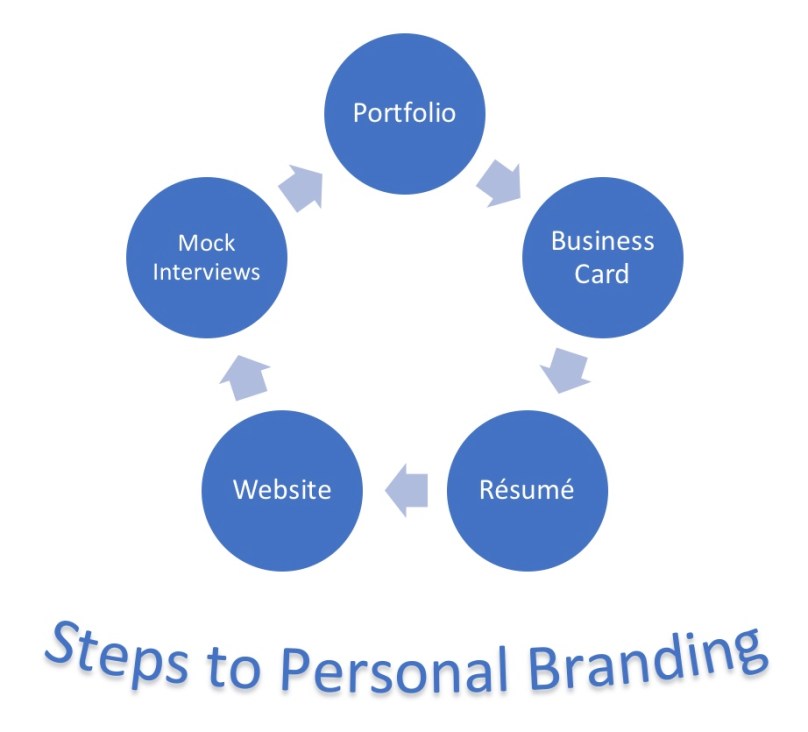
Steps to Personal BrandingThe branding process involves first developing your philosophy of music education, archiving your awards and accomplishments, documenting your grades and ok-3061659_1920_RobinHiggins12experiences, and collecting stories/personal anecdotes of your strengths. The next steps include the creation of a written and electronic portfolio, business card, resume, and website. Finally, you must compile/assemble everything together and practice (and self-assess) your “story-telling skills” to answer those important questions at well-rehearsed “mock interviews.”

You will likely not have enough time to complete all of these tasks during methods classes or student teaching seminars. That’s okay. If you are serious about prepping yourself to find a great music teaching job, the valuable links (see below) and articles are out there… just manage your time and start reading.

feedback-2990424_1920_geralt

networking

Networking

According to the article “Network Your Way to Secure a Teaching Job” at https://resumes-for-teachers.com/job-search-help/teacher-network/, many people are unaware of the basics of networking and how to use them it to their advantage in securing a job:

“Networking simply refers to finding job-related contacts. Most teachers who are just beginning their careers may feel that they have few, if any, networking contacts in the teaching field. It is important to consider the many different areas of networking as you create your own group of networking contacts to help you secure a teaching job. It is interesting to note that many of the teaching positions that are filled each year are filled by those who came to the attention of personnel managers by recommendation.”

“Always think about adding to your teaching network. When meeting new people, be certain to add them to your network. Talk to them about your skills, education, experience, and learn about their jobs. Make sure that you always ask for a business card.”

Do you have a business card? Is your résumé updated and available online on your professional website?

young-3061653_1920As I laid out in a previous blog “Networking Niceties: The ‘How-To Schmooze’ Guide for Prospective Music Teachers” at https://paulkfoxusc.wordpress.com/2016/04/04/networking-niceties/, the concept of networking is two-way communications. Just like collective sets of nerve synapses, two-way connections are expected to fire repeatedly in all directions. That’s actually the science behind memory. For professional networking, it is your “charge” to create multiple pathways to/from school HR managers and secretaries, administrators, music supervisors and department heads, and music teachers… and YOU – your skills, accomplishments, unique qualities, experience, education, and personality traits.
pcmeaThe above blog-post also explores setting up a good organizational system to manage your professional contacts.

If you are a Pennsylvania collegiate member (PCMEA), I heartily recommend the article “Networking 101” by Dr. Kathleen Melago, PCMEA State Advisor and Associate Professor of Music Education at Slippery Rock University, published in the Summer 2017 issue of the state journal PMEA News (pages 40-42). Here are several quotes from her work:

“One of the most common ways music educators can plan to network is at conventions. First, try to avoid interacting only with people from your school or people you already know from other schools. Go to sessions that interest you and look for opportunities to meet people there. Before the session starts, introduce yourself to people sitting around you. Use your social skills to assess whether they seem like they want to engage in a conversation or not. After the session, go up and meet the presenter.”

“Of course, social media is another great way to build your network. Networking with professionals already in the field can help you see what they are doing and help you build ideas of what you would like to do in your program someday.”

“Sometimes, you might find yourself networking unexpectedly. For example, you might go into school to work with their clarinet section during band camp and just happened to meet the choir teacher. That is networking!”

“To help your networking be most effective you need to have good communication skills. When interacting with others in a networking situation, be sure to focus on the person with whom you are speaking. Avoid looking off into the distance as if you were to anticipating someone else more important coming by. But your cell phone away and be present to the conversation.”

“Be yourself in your networking interactions. If you pretend that you are someone you are not, you will either end up unhappy or you’ll be discovered is someone who is not genuine.”

Dr. Melago goes on to provide a myriad of excellent examples of networking skills and opportunities.

Another resource specifically for networking at music teachers conferences is posted at https://nafme.org/getting-music-conferences/.
 

music-1237358-2 ricardo vasquez


engagement

Engagement

Here is an excellent definition of “professional engagement” from “Domains of Teaching” of the Australian Institute for Teaching and School Leadership at https://www.aitsl.edu.au/teach/understand-the-teacher-standards/domains-of-teaching.

Teachers model effective learning. They identify their own learning needs and analyze, evaluate and expand their professional learning, both collegially and individually.

Teachers demonstrate respect and professionalism in all their interactions with students, colleagues, parents/carers and the community. They are sensitive to the needs of parents/carers and can communicate effectively with them about their children’s learning.

Teachers value opportunities to engage with their school communities within and beyond the classroom to enrich the educational context for students. They understand the links between school, home and community in the social and intellectual development of their students.

Engagement for prospective music teacher may include synonyms like “participate,” “enroll,” “join,” “be active,” “volunteer,” “seek experience,” and “make a difference!”

Are you a member of your professional music education associations?

  • NAfME National Association for Music Education
  • PCMEA Pennsylvania Collegiate Music Educators Association, or another state’s local NAfME collegiate chapter
  • pmeaPMEA Pennsylvania Music Educators Association, or another state’s NAfME-affiliated MEA
  • ACDA American Choral Directors Association
  • ASTA American String Teachers Association
  • NBA National Band Association

Did (or will) you attend your state music teachers’ conference and local workshops on music education and professional development?

To prove you are “professionally engaged,” I would expect to see a consistent record of modeling in the following areas:

  1. excited-3126449_1920_RobinHiggins9Self-reflection of the professional’s teaching practices and modification of these as needed to match changes in the environment and circumstances
  2. Self-assessment of the professional’s methods and approaches, as well as the progress of the students’ learning, using both formative and summative methods for constant and ongoing improvement
  3. Identification and planning of professional learning needs.
  4. Unsupervised (or unplanned by school administration) goal-setting and self-guided implementation of opportunities for professional development
  5. Association with professional learning communities, school and community meetings, and other collaborative projects
  6. Volunteer service in music and music education
  7. Membership and subscription to music education journals and participation in online professional community discussion groups

Many have said that aspiring to be a music educator is a lot like a calling. One school superintendent I know said he expected prospective new recruits to show high energy, enthusiasm, sense of purpose, and dedication during the interview… even a supposed willingness to “lay down in front of a school bus” or “do what ever it takes” to make the students (and the educational program) successful. That’s engagement!

classical-music-1838390_1920_Pexels

In summary, becoming a music educator is about finding your inner confidence, a mindset that you know what you’re doing, and that you’re ready for that real world experience. You’ve learned those essential skills in conducting, piano accompaniment, arranging, student behavior modification and discipline, music diagnosis and remediation, and even how to market your professionalism. Now… drum roll, please! Here’s… a master music teacher!

target-3306771_1920_geralt

In closing, here are supplementary materials to help you to “get your feet wet,” all free and available online. The following lists, although not comprehensive, are a good place to start (courtesy of https://www.pmea.net/wp-content/uploads/2012/10/Collegiate-Communique-No11-022218-2.pdf):

Good luck!


Personal Branding, Marketing, and Networking

Business Cards

Résumés

Portfolios and Websites

Interview Questions, Techniques, and Skills of “Story-Telling”


PKF

© 2018 Paul K. Fox


Photo credits (in order) from Pixabay.com: “tutor” by nrjfalcon1, “trumpet” by congerdesign, “skills” by diwou, “phone” by Robin-Higgins, “OK” by Robin-Higgins, “feedback” by geralt, “young” by Robin-Higgins, “music” by ricardo-vasquez, “excited” by Robin-Higgins, and “classical-music” by pexels.

Transitioning from Collegiate to Professional – Part I

The Final Leap from Pre-Service to In-Service:

The Metamorphosis and Integration of Philosophy, Maturity, and Teacher Preparation

Are you ready to assume the role of a music teacher? Besides the completion of your coursework and field experiences, have you acquired the necessary attitude and personal skills? Do you “have what it takes” to become an ethical role-model, leader, and “fiduciary” responsible for the welfare and special needs of your students?

music-3090204_1920_brendageisseBefore long, you will shed the label and function of a “college student” (although still remaining a life-long learner… and never stop the quest for new knowledge and self-improvement!). The focus will shift from YOU to YOUR STUDENTS. The prerequisites for a career in education are unique and do not resemble the same challenges as success in business, manufacturing, retail, service industry, or becoming an entrepreneur, blue-collar worker, or even a composer or professional musician. The sooner you realize these are world’s apart, the better, and now is the time to finish your major and life-changing transformation to… a professional music educator.

This series for college music education majors will explore perspectives and definitions involving the evolution and (dare we say?) “modulation” to a productive and successful career in music teaching.


profession

Professionalism

What does a “professional educator” look like? Do you belong as a member of this group?

  • Succeeded in and continues to embrace “higher education”
  • idea-3082824_1920Updates self with “constant education” and retooling

  • Seeks change and finding better ways of doing something
  • Like lawyers/doctors, “practices” the job; uses different techniques for different situations
  • Accepts criticism (tries to self-improve)
  • Proposes new and better things “for the good of the order”
  • Can seemingly work unlimited hours (24 hours a day, 7 days per week?)
  • Is salaried (does not think in terms of hourly compensation, nor expects pay for everything)
  • Is responsible for self and many others
  • Allows others to reap the benefits and receive credit for something he/she does
  • Has obligations for communications, attending meetings, and fulfilling deadlines
  • Values accountability, teamwork, compromise, group goals, vision, support, creativity, perseverance, honesty/integrity, fairness, and timeliness/promptness
  • Accepts and models a very high standard of behavior, etiquette, appearance, language, and ethics.

In addition to mastery of their subject matter, skills in collaboration, communication, critical thinking (problem solving), and creativity (also known as “the four C’s”), according to “The California BTES – Overview of the Ethnographic Study” by David Berliner and William Tikunoff, effective teachers regularly demonstrate these traits:

  • Accepting
  • Adult involvement
  • Attending
  • Consistency of message
  • Conviviality
  • woman-3061656_1920_RobinHigginsCooperation
  • Engagement of students
  • Knowledge of subject
  • Monitoring learning
  • Optimism
  • Pacing
  • Promoting self-sufficiency
  • Spontaneity
  • Structuring

However, effective teachers DO NOT score high on the negative attributes of abruptness, belittling, clock punching or counting hours, defiance, illogical views or statements, mood swings, oneness (treating the whole group as “one”), or self-recognition. Human resource personnel and administrators look for candidates who model (and can confirm their history of) the habits of the first group, with no evidence of the latter behaviors.

The bar is raised even further. In addition to holding oneself up to the highest standards of the education profession, teachers also exemplify “moral professionalism” in their daily work. As cited in the chapter “The Moral Dimension of Teaching” in Teaching: Theory Into Practice by E.A. Wynne, teachers must

  • Come to work regularly and on time;
  • Be well informed about their students and subject content-matter;
  • Plan and conduct classes with care;
  • Regularly review and update instructional practices;
  • Cooperate with, or if necessary, confronting parents of underachieving students;
  • Cooperate with colleagues and observe school policies so the whole institution works effectively;
  • Tactfully but firmly criticize unsatisfactory school policies and propose constructive improvement.


ethics


Ethics

Have you viewed your state’s teacher expectations, code of ethics, and code of conduct? It may surprise you that a number of seasoned professionals have never seen these documents. You may be ahead of the game if educator ethics were even mentioned briefly in a methods class, as indoctrination to student teaching, or orientation within the induction program of your first job.

The “code” defines the interactions between the individual educator, students, schools, and other professionals, what you can and cannot do or say, and the explicit values of the education profession.

No excuses! Better go look this stuff up. If you reside in Pennsylvania and plan to become employed there, go immediately to http://www.pspc.education.pa.gov/Pages/default.aspx. If your state does not have a code of ethics or state-specific conduct standards, download and consume this excellent reference: http://www.nasdtec.net/?page=MCEE_Doc. The young-3061652_1920_RobinHiggins2National Association of State Directors of Teacher Education and Certification proposes these principles:
  • Responsibility to the Profession
  • Responsibility for Professional Competence
  • Responsibility to Students
  • Responsibility to the School Community
  • Responsible and Ethical Use of Technology

After reading all of this, what would be on proverbial “ethics test?” Well, can you answer questions like these?

  • How do ethics inform a teacher’s personal and professional actions?
  • What does it mean to be a “moral exemplar” or “role model” in the community?
  • What are the professional expectations for working with diverse populations of students, parents, and colleagues?
  • How should teachers handle social media and other electronic interactions with students?
  • Do you see yourself as a potential “friend” or “confident” of the music students in your classes?
  • Is it okay to accept personal gifts from students, their parents, or music vendors who do business with your school… or to give presents to students for no educational reasons?

For the last two questions, the response should be a resounding NO!


fiduciaryHere’s another query. What five groups of people are both “professionals” and “fiduciaries…” and have a legal responsibility to serve the best interests of their “clients?” The answer is… doctors/nurses, lawyers, counselors (both mental health and investment), the clergy, and… teachers.

singer-84874_1920_BEPAlthough teachers seem to be the only one of these who DO NOT have formal pre- or in-service ethics training, and our “charges” represent a “captive audience,” our duty is clear: to act as a fiduciary for our students’ best interest, and to create and maintain a safe environment for them at all times.


The keystone of “right or wrong” and what your mother always said was “behaving appropriately when no one is watching you” are all about professional ethical standards that guide decision-making. The work of Troy Hutchings (among other leaders in this field) helps to further clarify these sometimes-blurred definitions:

Personal Morality: “Personal values and beliefs derived from one’s life experiences… subjective and may/may not align with community mores.”
Regulations of Law: “Policies, statues, and judicial activity that articulate conduct absolutes.”
Professional Ethics: “Professional ethical standards that assist practitioners within situation and systemic contexts in choosing the best course-of-action.”
Professional Dispositions: “Agreed-upon professional attitudes, values, and beliefs to be held by educational practitioners.”

For a comprehensive review on “Ethics for Music Educators,” please visit these links:

All of these are available at https://paulkfoxusc.wordpress.com/category/ethics/.

At this point, if most of this makes you feel uneasy or uncertain, then perhaps it is time to switch majors and look into pursuing another line of work!

yin-yang-1410178_1920_Printoid.png

Philosophy

Have you written your personal philosophy of music education?

Regina Zona wrote in her article, “For Teachers: Writing a Music Teaching Philosophy Statement” that a music education philosophy statement is “a way to connect on a personal level to your students (current and potential) by stating who you are as a teacher (your beliefs and ideals), how you do what you do, and how that positively impacts the study of music.” If you have not completed your philosophy, here are her essential questions to guide your thoughts:

  • music-2323517_1920_davorkrajinovicWhat do you believe about teaching?
  • What do you believe about learning? Why?
  • How is that played out in your studio/class?
  • How does student identity and background make a difference in how you teach?
  • What do you still struggle with in terms of teaching and student learning?

She adds, “If you are having a hard time answering these questions, maybe because you haven’t been teaching very long, think on a teacher who made an impact on you (positive or negative), your education, your life. How did they communicate? Did they have passion for their work and if so, how did they express that passion? What were their methods of imparting the information?”

Read Zona’s entire blog-post at http://musiclessonsresource.com/writing-a-teaching-philosophy-statement.

Borrowed from the esteemed colleague and CEO of MusicFirst, Jim Frankel, is the introduction to many of his music education technology sessions, the foundation for teaching music in the schools:

  • What is your personal mission? Why?
  • What is the role of music in a child’s education?
  • Are we creating performers, theorists, teachers… or lifelong music lovers?

If you are looking for sample philosophical statements, there are many “out there” on the Web. Here are several of my favorites:

isolated-3061649_1920Take time to peruse these and others. Most of these sites also offer excellent examples of personal branding and marketing of the prospective job hunters’ experiences, skills, and achievements… material for our next blog on this topic.



Future blogs in this series will continue with a focus on these concepts:

  • Moving from “Book Learning” to “Practical Application”
  • Cultivating a Mentor or Two
  • Personal Branding
  • Engagement
  • Networking


orchestra-2770149_1920_ernestoeslava

PKF

© 2018 Paul K. Fox


Photo credits (in order) from Pixabay.com: “tutor” by nrjfalcon1, “music” by brendageisse, “idea” by RobinHiggins, “woman” by RobinHiggins, “young” by RobinHiggins, “singer” by BEP, “ying-yang” by Printoid, “music” by davorkrajinovic, “isolated” by RobinHiggins, and “orchestra” by ernestoeslava.


Help! How Does One Keep Up?

Time, Task, & Media Management for Pre-Service/New Music Educators


This article is in memory of the late Thomas Labanc (October 1946 – November 2017), my friend, colleague, Upper St. Clair School District social studies teacher, curriculum leader, and assistant to the superintendent, school historian, brilliant visionary and fellow risk-taker, who taught me the basics of Priority Management and collaborated on many of our school district’s communications and public relations projects, including the establishment of the highly successful community publication UPPER ST. CLAIR TODAY magazine. PKF


children-2685070_1920-mochilazocultural


Imagine there is a bank that credits your account each morning with $86,400.
It carries over no balance from day to day. Every evening the bank deletes whatever part of the balance you failed to use during the day.
What would you do? Draw out every cent, of course!!!
Each of us has such a bank. Its name is TIME.
Every morning, it credits you with 86,400 seconds.
Every night it writes off, as lost, whatever of this you have failed to invest to good purpose.
It carries over no balance. It allows no overdraft.
Each day it opens a new account for you.
Each night it burns the remains of the day.
If you fail to use the day’s deposits, the loss is yours.
There is no going back. There is no drawing against the “tomorrow.”
You must live in the present on today’s deposits.
Invest it so as to get from it the utmost in health, happiness, and success!
The clock is running. Make the most of today.
To realize the value of ONE YEAR, ask a student who failed a grade.
To realize the value of ONE MONTH, ask a mother who gave birth to a premature baby.
To realize the value of ONE WEEK, ask the editor of a weekly newspaper.
To realize the value of ONE HOUR, ask the lovers who are waiting to meet.
To realize the value of ONE MINUTE, ask a person who missed the train.
To realize the value of ONE SECOND, ask a person who just avoided an accident.
Treasure every moment that you have! And reassure it more because you shared it with someone special, special enough to spend your time.
Remember that time waits for no one.
Yesterday is history. Tomorrow is mystery. Today is a gift.
That’s why it’s called the present! – Pratheek Naidu


Philosophies of Time Management

stopwatch-2061848_1920-geraltEven though it is from a book on post-employment transitioning (Purposeful Retirement: How to Bring Happiness and Meaning to Your Retirement), the author Hyrum W. Smith suggests several thought-provoking questions on prioritizing time:

  1. Does your management of time reflect your governing values?
  2. Are you giving the most time to that which matters most?
  3. What can you do tomorrow to ensure your time aligns with your priorities?

A similar perspective but providing much more detail, I recommend consuming from cover-to-cover First Things First by Stephen R. Covey, who succinctly defines this conundrum about using time wisely.

“For many of us, there’s a gap between the compass and the clock – between what’s deeply important to us and the way we spend our time. And this gap is not closed by the traditional “time management” approach of doing things faster. In fact, many of us find that increasing our speed only makes things worse.” – Stephen Covey

The four sections of Covey’s book dive into these concepts:

  • The Clock and the Compass
  • The Main Thing is to Keep the Main Thing the Main Thing
  • The Synergy of Interdependence
  • The Power of and Peace of Principle-Centered Living

In addition, I found additional insight and inspiration in the philosophy of managing time from these links:

For those of you who have already begun your career in music education or even working as a day-to-day music sub, try these classroom and time management tips (thanks to NAfME):


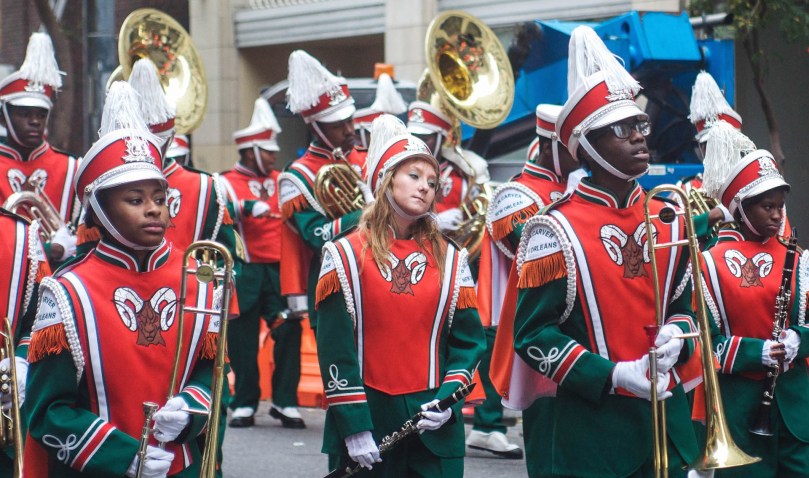
parade-2657823_1920-Marmiche


The 4 D’s

Have you ever heard of a system called Priority Management (PM)? PM proposes methodology and business tools to immediately route every piece of paper and your daily “to-do tasks” that come into your life to one of the four D’s:

  • Do it! (now)
  • Date it! (assign it to the future)
  • Delegate it! (give it to someone else to do) or
  • Dump it! (into the trash)

PM’s “WorkingSm@rt method” promises to help you “gain control over your day, find balance, prioritize your work, and reach your goals,” giving you time to focus on the tasks that are important to you. The bottom line – every digital or printed post-it-note, piece of mail, receipt, publication, email or other communication – must be “put in its place” on the spot – either completed instantly, deferred to another time, given to someone else to do, or THROWN OUT!

time-management-2323612_1920-mohamed1982egYours truly, a “late baby boomer,” never enjoyed that prophesied and romanticized revolution of a “paperless society.” Did you? PM recommends the creation of a “future reading” file, a subcategory of “date it.” Experts on Google Mail will extol the merits of creating a folder and categorizing/storing messages such as emailed issues of MEJ, Kappan, SB&O, and other digital editions of professional newsletters. I have found that this doesn’t work very well, even in retirement. The file folder just fills up, and I never seem to get around to reviewing the things I thought were so important to save. Nor did the practice of our grandmothers’ generation clipping articles (and coupons) out of newspapers. You would think you could solve this media overload by just printing a small excerpt of what you want to peruse later and putting it in a letter tray near your desk? Nope. It just piles up! However, probably the ideal solution would be to designate a specific 15 minutes or more every day for something they used to give to the middle school students I taught: “silent and sustained reading.”

choir-458173_1920-intmurr


“Pros” Wrestle Control of Their “Free Time!” You Can Do That, Too!

“When you get right down to it, intentional living is about living your best story.”

time-481444_1920-geraltHow many times have you heard it? Make your plans and goals “intentional!” Besides all of the upcoming deadlines and appointments to which you are committed, include in your daily and weekly schedule opportunities for individual reflection and growth.


Plan 30-60 minutes of professional enrichment every day, throughout the year. The list below is based on an hour, but when time is really at a premium, just divide everything in half.

  • Read an article in a professional journal or digital newsletter (15 minutes)
  • “Keep up your chops” in ear training, sight-reading, and score reading. Have you ever used something like Elementary Training for Musicians by Hindenmith and practiced exercises that make you sing in syllables, tap a different rhythm independently with your left hand, conduct the beat pattern with your right hand, and beat your foot to the pulse? Revisit your college solfeggio assignments, and of course, sight-singing anything is also most beneficial. (10 minutes)
  • Perform on the piano, rotating weekly to different styles and forms of music. If you’re not a piano major or an accomplished choral  accompanist, include playing at sight several different voice parts simultaneously from choral octavos. (10 minutes)
  • Research and add professionals to update your contact file. Did you run into any new music teachers or school administrators this week? Search school district websites for the names of music department chairs and supervisors. (5 minutes)
  • Practice your story-telling skills (organized and “polished” telling of anecdotes about your achievements, teaching experience, “personality pluses,” and problem solving. Role play answering job-screening questions in video-recorded mock interviews, and allow time to assess your “performance.” (10 minutes)
  • Work on personal branding and marketing projects: making, refining, and customizing your e-portfolio, business card, professional website, and resume. (10 minutes)

The last three bullets above are covered extensively within this blog. Try these links:

If you “think” you are ready for the job search process, complete the self-assessment at https://paulkfoxusc.wordpress.com/2017/04/24/intereviewing-the-situation-and-jobs/.


box-2953722_1920-rawpixel

What about vacations or academic breaks when it seems there’s more time to spare? With some repetition to the above, in the December 2017 issue of Collegiate Communique, a digital publication of the PMEA Council for Teacher Training, Recruitment, and Retention (in support of the Pennsylvania Collegiate Music Educators Association and Society for Music Teacher Education), these recommendations were offered for college music majors who are leaving school for their winter or summer recesses.

“After you finish your semester finals, juries, concerts, writing assignments, and other projects, you may have several weeks before you have to return to full-time classes at the university. Besides catching up on your sleep and visiting your family and friends, how many of these enrichment activities can you accomplish?”

  1. Share your musical gifts.
  2. Sit in with a church or community choir, orchestra, or band.
  3. Learn something new about music… even outside your specialty.
  4. Spend a lot of time sight-reading.
  5. Improve your score reading and analysis.
  6. Volunteer to coach/conduct music rehearsals at the local public school.
  7. Attend as many concerts as you can.
  8. Compose a short seasonal, folk, jazz, or classical piece.
  9. Record video/audio excerpts of your major instrument/voice in preparation for placement in your e-portfolio.
  10. For upcoming employment prep and practice of mock interviews, review the marketing professionalism articles at https://paulkfoxusc.wordpress.com/becoming-a-music-educator/.

– Collegiate Communique #8

Of course, from a 35-year veteran teacher now retired, a snide remarkbusinessman-2929721_1920-Fotomek in response to feeling a little “stressed over the schedule” could be to “get used to the 24/7 nature of the job.” A music teacher works from sun-up (and before) to sun-down (and after), and constantly has to juggle multi-tasking on a wide variety of to-do’s, all landing at the same time: writing lesson plans, arranging music or drills, preparing scores or accompaniments, planning and rehearsing ensembles, managing the grade book and attendance records, attending faculty meetings and parent conferences, writing curriculum, student assessments, and lesson targets, preparing for extra-curricular activities like marching band, chorus, or the musical, finishing your own homework for graduate courses, district inductions, or professional development assignments, ETC.
But, if you “get organized,” you will love it! There is nothing better (albeit hectic) than the “calling” of serving your students and the profession as a music educator, inspiring creative self-expression, artistry, music appreciation, and life-long learning.

PKF

© 2017 Paul K. Fox


Photo credits from Pixabay.com: “hourglass” by annca, “children” by mochilazocultural, “stopwatch” by geralt, “parade” by Marmiche, “time management” by mohamed1982eg, “choir” by intmurr, “time” by geralt, “box” by rawpixel, and “businessman” by Fotomek.

Ethics for Music Educators II

Part II: The Nitty Gritty

(This blog-post is the second in a series of three articles. For an introduction to this topic, you should first read “Part I: Back to Basics” at https://paulkfoxusc.wordpress.com/2017/08/28/ethics-for-music-educators-i/)

A good teacher is a doctor who heals ignorance and an artist who inspires creativity. ― author unknown

Societal Changes Promoting Ethical Disputes

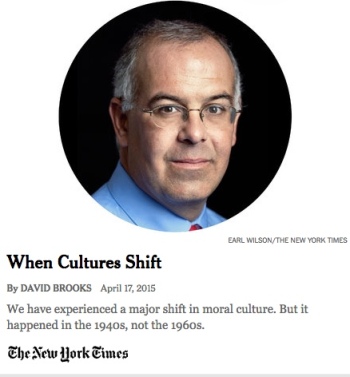
Brooks When Cultures ShiftMany have suggested that there has been a decline in moral standards that have contributed to ethical disputes in modern society (and in the public schools). Some say that this is attributed to a breakdown or lessening of the influence of organized religion and family values. “When Cultures Shift,” an excellent article in the New York Times (April 17, 2015), David Brooks explores some of causes and effects of this “slip” to our value systems, ethics, and renewed focus on self:
  • Cultural shift in personal mores
  • Consumerism
  • Self-esteem movement, narcissism, and “the big me”
  • Trends towards acceptance of informality and casual behavior
  • Social media and other technology

Brooks remarked, “The big shift in American culture did not happen around the time of Woodstock and the Age of Aquarius. It happened in the late 1940s, and it was the members of the Greatest Generation that led the shift.”

We now live in a world in which commencement speakers tell students to trust themselves, listen to themselves, follow their passions, to glorify the Golden Figure inside. We now live in a culture of the Big Me, a culture of meritocracy where we promote ourselves and a social media culture where we broadcast highlight reels of our lives. What’s lost is the more balanced view, that we are splendidly endowed but also broken. And without that view, the whole logic of character-building falls apart. You build your career by building on your strengths, but you improve your character by trying to address your weaknesses.

So perhaps the culture needs a re-balance. The romantic culture of self-glorification has to be balanced with an older philosophic tradition, based on the realistic acknowledgment that we are all made of crooked timber and that we need help to cope with our own tendency to screw things up. That great tradition and body of wisdom was accidentally tossed aside in the late 1940s. It’s worth reviving and modernizing it. ― David Brooks

Read his entire piece at https://www.nytimes.com/2015/04/17/opinion/david-brooks-when-cultures-shift.html.

The Role of Education in Upholding Standards of Behavior

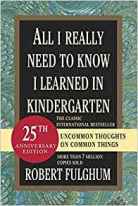
All I Ever Learned KDo schools, not necessarily families, serve as the “safety net” for socializing its citizens, and teaching morality, manners, and the values of human relationships? Are teachers held to a higher standard of behavior in order to model these principles and charged with the responsibility of indoctrinating the meaning of “right and wrong” and how to get along with each other? Many would seem to agree, including sample codes of ethics for teachers and this from Robert Fulghum (https://www.scrapbook.com/poems/doc/842.html):

Most of what I really need
To know about how to live
And what to do and how to be
I learned in kindergarten.
Wisdom was not at the top
Of the graduate school mountain,
But there in the sand-pile at Sunday school.

These are the things I learned:

Share everything.
Play fair.
Don’t hit people.
Put things back where you found them.
Clean up your own mess.
Don’t take things that aren’t yours.
Say you’re sorry when you hurt somebody.
Wash your hands before you eat.
Flush.
Warm cookies and cold milk are good for you.
Live a balanced life –
Learn some and think some
And draw and paint and sing and dance
And play and work everyday some.
Take a nap every afternoon.
When you go out into the world,
Watch out for traffic,
Hold hands and stick together.
Be aware of wonder.

― Robert Fulghum in All I Really Need to Know I Learned in Kindergarten

Philosophies in Moral Development

According to Jacques S. Benninga in “Moral and Ethical Issues in Teacher Education” from Eric Digest (https://www.ericdigests.org/2004-4/moral.htm), “Though codes of ethics may not have played a significant role in teacher preparation programs in the past, professional ethical dispositions of teachers must now be addressed as part of the National Council for Accreditation of Teacher Education (NCATE) accreditation process (NCATE, 2002).” He describes the Four-Component Model of Moral Maturity, a program of ethical education first developed for dental professionals at the University of Minnesota since adapted to other professional training programs including the training of teachers. The program assumes that moral behaviors are built on a series of component processes (Bebeau, Rest, & Narvaez, 1999). “Each component is clearly defined, and educational goals, teaching strategies and assessment methods can be derived from those definitions.”

  1. Moral sensitivity, the awareness of how our actions affect other people.
  2. Moral judgment about complex human activities (Piaget 1965 and Kohlberg 1984)
  3. Moral motivation, a prioritization of moral values over personal values
  4. Moral character (acting on one’s convictions)

three-frogs-with-a-message-1316215 Gerla Brakkee.jpgIn Essays on Moral Development: The Philosophy of Moral Development (New York: Harper Collins 1981), Lawrence Kohlberg illustrates his “Six Stages of Moral Development” from ethical decisions based on adherence to rules/regulations and avoidance of punishment to acceptance of universal principles of justice and respect for human life.

Here is a brief outline of Kohlberg’s six moral stages:

  1. Obedience and punishment orientation
  2. Naively egoistic orientation (satisfying self-needs)
  3. Good-boy, good-girl (approval/conformity) orientation
  4. Authority and social-order-maintaining orientation
  5. Contractual/legalistic orientation (social contracts)
  6. Individual principles of conscience

However,  Carol Gilligan proposes a contrasting theme, “Three Evolving Steps of Caring,” in her book, In A Different Voice (Cambridge, MA:  Harvard University Press 1982).

  1. Decisions based solely on care for their needs.
  2. Decisions based on care for the needs of others.
  3. Decisions based on care for themselves and others.

The Professional Standards and Practices Commission of the Pennsylvania Department of Education resolved these apparently incompatible philosophies:

Despite their contrasting lenses on moral development, when applied to the teaching profession, these two ethical perspectives complement each other.  Teachers should be motivated by a universal respect for human life and also be guided by principles of caring.  In fact, teachers have a fiduciary duty to act in a way that is in the best interest of their students. Inherent in a fiduciary relationship is an imbalance of power where the students place their trust /confidence in the teachers, who are responsible for caring for their students and respecting their needs.  This overarching responsibility of teachers provides an ethical standard of professional practice to which professional educators must abide and has powerful practical and legal implications for their personal and professional lives.

http://www.pspc.education.pa.gov/Promoting-Ethical-Practices-Resources/Ethics-Toolkit/Unit1/Pages/The-Ethics-of-Teaching.aspx

Sample Code of Professional Practices and Conduct

eye-see-you-1239025 Donald CookAs I said in Part I of this blog series, one of the first acts of a new or transferred teacher upon being hired to a specific school district is to visit the website of his/her state’s education department, and make a thorough search on the topic of “code of ethics” or “code of conduct.” There is no defense for ignorance of the codes and statutes relevant to the state you are/will be employed.



A few quotes and material from the Pennsylvania “Code of Professional Practices and Standards for Educators” are listed below. For a complete listing, go to http://www.pspc.education.pa.gov/Statutes-Regulations-Policies-Forms/Code-of-Professional-Practice-Conduct/Pages/default.aspx or download the PDF file from http://www.pspc.education.pa.gov/Documents/Statutes%20Regs%20Forms/Code%20of%20Conduct.pdf.


PA PSPC logo

In addition, if you live and work in Pennsylvania, I would strongly recommend you peruse the comprehensive Educator Ethics and Conduct Toolkit produced by Dr. Oliver Dreon, Sandi Sheppeard, and the PA Professional Standards and Practices Commission, a multiple-week induction program with coursework, essential questions, scenarios, and researched sources on teacher ethics (for which permission was given to share segments of their text below in professional development forums and workshops). Go to: http://www.pspc.education.pa.gov/Promoting-Ethical-Practices-Resources/Ethics-Toolkit/Pages/default.aspx.

  1. Professional educators shall abide by the Public School Code of 1949 (24 P. S. § § 1-101 – 27-2702), other school laws of the Commonwealth, sections 1201(a)(1), (2) and (4) and (b)(1), (2) and (4) of the Public Employee Relations Act (43 P. S. § § 1101.1201(a)(1), (2) and (4) and (b)(1), (2) and (4)) and this chapter.
  2. Professional educators shall be prepared, and legally certified, in their areas of assignment. Educators may not be assigned or willingly accept assignments they are not certified to fulfill.
  3. Professional educators shall maintain high levels of competence throughout their careers.
  4. Professional educators shall exhibit consistent and equitable treatment of students, fellow educators and parents. They shall respect the civil rights of all and not discriminate on the basis of race, national or ethnic origin, culture, religion, sex or sexual orientation, marital status, age, political beliefs, socioeconomic status, disabling condition or vocational interest. This list of bases or discrimination is not all-inclusive.
  5. Professional educators shall accept the value of diversity in educational practice. Diversity requires educators to have a range of methodologies and to request the necessary tools for effective teaching and learning.
  6. Professional educators shall impart to their students principles of good citizenship and societal responsibility.
  7. Professional educators shall exhibit acceptable and professional language and communication skills. Their verbal and written communications with parents, students and staff shall reflect sensitivity to the fundamental human rights of dignity, privacy and respect.
  8. Professional educators shall be open-minded, knowledgeable and use appropriate judgment and communication skills when responding to an issue within the educational environment.
  9. Professional educators shall keep in confidence information obtained in confidence in the course of professional service unless required to be disclosed by law or by clear and compelling professional necessity as determined by the professional educator.
  10. Professional educators shall exert reasonable effort to protect the student from conditions which interfere with learning or are harmful to the student’s health and safety.

― Section 4: PA Code of Professional Practices and Standards for Educators


school-1465744-1 elias minasi

The Teacher-Student Relationship

Trust has evolved into the operative foundation of the relationship of students with their teachers. The duty of teachers is to act as a fiduciary in their students’ best interest and to create and maintain a safe environment for their students derives. When a teacher enters into an inappropriate relationship with a student, the teacher violates the recognized student-teacher boundary and thereby redefines the boundary inappropriately. Some unintentionally fall prey to the “slippery slope” of misconduct. The inappropriate relationship shifts to serving the needs of the teacher and not the needs of the student.

When teachers become confidants, friends, or counselors of students, a dual relationship is created which creates an ambiguity in the student-teacher relationship where roles are less defined. This ambiguity helps to foster inappropriate actions and educator misconduct.

headphones-1415466In addition, in almost every state education system, there are “mandatory reporting” regulations. Teachers are held responsible to ensure that their colleagues conform to the appropriate standards of ethical practice as well. In other words, if you know something is wrong and you do not report it to an administrator, you could also be liable and subject to hearings, discipline, and even prosecutions for negligence of your duty to protect the best interests, health, and safety of the student(s) involved.

 

Vulnerabilities

Teachers who are experiencing difficulties in their personal lives or are socially or emotionally immature may be particularly susceptible to the “slippery slope” of blurred teacher-student boundaries. Typical vulnerabilities include the following:

  • Viewing students as peers
  • Suffering from adult relationship issues
  • Immaturity
  • Need for attention
  • that-s-lame-bad-and-or-stupid-1537799 Daino_16A sense of invulnerability
  • Absence of a developed personal moral compass
  • Lack of personal crisis management skills

New or inexperienced teachers, those near their students’ ages, educators who look or act “cool” or “trendy,” or share common interests or an overlapping circle of friends, may be tempted to share inappropriate feelings or become “too close” with their children.

Every behavior or decision made by a teacher with respect to his or her students should be prefaced with the question:  “Whose needs are being met by my course of action?” There can only be one acceptable answer to this question: “The needs of the student!”


Social Media

In terms of teacher ethics, communicating digitally or electronically with students may lead to a blurring of appropriate teacher-student boundaries and create additional challenges to maintaining and protecting one’s privacy. Texts, emails, and social media postings are not private, and may be seen by others, forwarded, and/or copied or printed. Out of context, they may be misinterpreted, appear to be inappropriate, and/or lead to a violation of “The Code.”

computer-and-apple-1241514 Ales CerinIt is the responsibility of the teacher to control his or her “public brand” – how he or she wants to be perceived by students, parents, colleagues, and the public.  One’s public brand can and does impact perceptions, which in turn can impinge upon effectiveness.

When I started teaching in 1978, we did not have “social media.” (Actually, if you can imagine this, there was no Internet yet, most of us did not have computers, and flip or smartphones and tablets were only the subject of science fiction or Star Trek.) Guidelines for use (or abuse) of social media were not even a “seed” in our imaginations.

When MySpace and Facebook came upon the scene in 2003-2004, most school administrators recommended “stay away from these.” The online sharing and archiving of photos initiated the adoption of many other social media apps (Flickr and later Instagram, Tumblr, Snapchat, etc.), which provoked new challenges in maintaining privacy, appropriateness, and professionalism. However, soon after, school leaders started rolling out “teacher pages” and school web-pages, online bulletin board services, interactive forums, virtual learning environments like Blackboard and Blended Schools, and other educational tools that encouraged two-way communications among students in a class and the teacher. Technology is here to stay… so how should we use it safely?

The American Board for the Certification of Teacher Excellence (ABCTE), a non-profit organization dedicated to placing qualified teachers in the classroom, released its “10 Social Media Rules for Teachers,” appropriate tips for protecting educators:

  1. Know your school district or state’s policies on social media.
  2. Never “friend” or “follow” students on your personal accounts.
  3. Keep your profile photos clean.
  4. Do not affiliate yourself with your school on a personal profile.
  5. Do not geo-tag your posts with your school’s location.
  6. “Snaps” are forever! Anyone can take a screen shot of your posts.
  7. Never mention your school or the names of staff or students in any post.
  8. Set your Instagram account to private.
  9. Never complain about your job online.
  10. Never post photos of your students on social media.

―Summarized from https://www.americanboard.org/blog/?p=249

girl-with-smart-phone-1616794 Eric Gross


To be continued…

Part III: Issues and Scenarios in Music Education… will review:

  • Pedagogy
  • Enforcement
  • Finances and Resource Allocation
  • Relationships
  • Diversity
  • More Scenarios – How Would You Judge These Incidents?
  • Bibliography


Special thanks and credits go to Dr. Oliver Dreon, Associate Professor at Millersville University (in Pennsylvania), and one of the authors of the Pennsylvania’s Educator Ethics and Conduct Toolkit, the source of much of the research, quotes, and perspective of this three-part series comes.


PKF

© 2017 Paul K. Fox


Photo credits (in order) from FreeImages.com: “Ethics” by Olivier Le Moal, “Three Frogs with a Message” by Gerla Brakkee,  “Eye See You” by Donald Cook, “School” by Elias Minasi, “Headphones” by Benjamin Earwicker, “That’s Lame, Bad, and Stupid” by Daino_16, “Computer and Apple” by Ales Cerin, and “Girl With Smart Phone” by Eric Gross.


Ethics for Music Educators I

Part I: Back to Basics

I keep a close watch on this heart of mine
I keep my eyes wide open all the time
I keep the ends out for the tie that binds
Because you’re mine, I walk the line.  — Johnny Cash

Johnny Cash sang his love song, “I walk the line…” but for teachers in the education profession, it is a “fine line” to maintain the standards and appearances of professionalism, morality, and ethical codes of conduct in the school workplace.

piano-prodigy-1508755

The purpose of this blog series is to explore an introduction to the definitions, philosophy, and practices of teacher ethics, integrity, professional standards, and behavior “codes,” and some of the available resources, perspectives, and “legalese” on proper relationships among students, parents, and other professionals, appropriate student-teacher boundaries, warnings of vulnerabilities and dilemmas at the workplace, and tips to avoid the problems of unacceptable appearances and actions.

ethics 3However, the disclaimer is that I am not an attorney, human resource manager, nor scholar on school ethics, nor was I ever trained in a single workshop, college class, teacher induction or in-service program on this subject. After reading this article, you should immediately visit the website of your state’s education department, and search on the topic of “code of ethics” or “code of conduct.” A few examples of the “real deal” are listed below, and yes, you must study “every word of” the entire document and  applicable rules from the state you are/will be employed.

Teacher Rules — The Good Old Days?

OLYMPUS DIGITAL CAMERAAccording to Snopes (see http://www.snopes.com/language/document/1872rule.asp), the following “rules of conduct for teachers” — one of the similar “the way we were” documents of questionable origin — may have been circulating since at least the 1930s.

“Nobody has ever been able to verify the authenticity of this list of rules. It has been reproduced in countless newspapers and books over the last fifty years, and copies of it have been displayed in numerous museums throughout North America, with each exhibitor claiming that it originated with their county or school district.”

However accurate, one can only marvel at the real or perceived grimness of the late nineteenth/early twentieth century American schoolteacher’s lot: “the profession was lowly regarded, the work was physically demanding and involved long hours on the job, the position paid poorly, retirement benefits were non-existent, and teachers were expected to be among the most morally upright members of their community.”

Sample Rules for (Female) Teachers 1915

  1. You will not marry during the term of your contract.
  2. You are not to keep company with men.
  3. You must be home between the hours of 8 PM and 6 AM unless attending a school function.
  4. You may not loiter downtown in ice cream stores.
  5. You may not travel beyond the city limits unless you have the permission of the chairman of the board.
  6. You may not ride in a carriage or automobile with any man except your father or brother.
  7. You may not smoke cigarettes.
  8. You may not dress in bright colors.
  9. You may under no circumstances dye your hair.
  10. You must wear at least two petticoats.
  11. Your dresses may not be any shorter than two inches above the ankles.
  12. To keep the classroom neat and clean, you must sweep the floor at least once a day, scrub the floor at least once a week with hot, soapy water, clean the blackboards at least once a day, and start the fire at 7 AM to have the school warm by 8 AM.

— http://www.snopes.com/language/document/1872rule.asp

Professionalism

Like medicine and law, teaching is a “professional practice,” a “conservative” occupation with high expectations and close public scrutiny. Although many have considered the 24/7 nature of a career in music education a “calling,” the true qualities of the teaching professional include these values also embraced by doctors and attorneys:

  • on-the-phone-closing-the-deal-1241406 Michael RoachAchievement of higher education, constant training and retooling, specific goals, and self-improvement

  • Adoption and refinement of “best practices”
  • Habits of creativity, critical thinking, problem solving, and communication skills
  • Acceptance of criticism, peer review, teamwork, compromise, and group vision
  • High standards of behavior, etiquette, appearance, language, and ethics

According to “The California BTES – Overview of the Ethnographic Study” by David Berliner and William Tikunoff, “an effective teacher” is distinguished by exceptionally high standards:

Effective teachers score high on accepting, adult involvement, attending, consistency of message, conviviality, cooperation, student engagement, knowledge of subject, monitoring learning, optimism, pacing, promoting self-sufficiency, and structuring.

Effective teachers score low on abruptness, belittling, counting hours or “clock punching,” defiance, illogical statements, mood swings, oneness (treating whole as “one”), and recognition-seeking. — David Berliner and William Tikunoff

Referred to as “moral professionalism” (see Wynne, E.A. 1995. “The moral dimension of teaching.” In A.C. Ornstein Ed. Teaching: Theory into Practice. pp. 190-202. Boston: Alyn and Bacon),  the bar is further raised:

  • Coming to work regularly and on time
  • Being well informed about their student-matter
  • Planning and conducting classes with care
  • Regularly reviewing and updating instructional practices
  • Cooperating with, or if necessary, confronting parents of underachieving students
  • Cooperating with colleagues and observing school policies so the whole institution works effectively
  • Tactfully but firmly criticizing unsatisfactory school policies and proposing constructive improvement


balance-1172786 Stephen Stacey

Ethics

Webster’s definition of eth·ics is “the discipline dealing with what is good and bad and with moral duty and obligation” or “a set of moral principles.” Others have tried to clarify the meaning of these terms with more in depth interpretations:

Ethics is knowing the difference between what you have a right to do and what is right to do. — Potter Stewart

Ethical behavior is doing the right thing when no one else is watching – even when doing the wrong thing is legal. — Aldo Leopold

Ethics and morals relate to “right” and “wrong” conduct. While they are sometimes used interchangeably, they are different: ethics refer to rules provided by an external source, e.g., codes of conduct in workplaces or principles in religions. Morals refer to an individual’s own principles regarding right and wrong.

— “Ethics vs. Morals” at Diffen http://www.diffen.com/difference/Ethics_vs_Morals

According to Laurie Futterman, former Heart Transplant Coordinator at Jackson Memorial Medical Center and now chair of the science department and gifted middle school science teacher at David Lawrence Jr. K-8 Center, “ethics is a branch of moral philosophy.” Futterman wrote the following in the March 31, 2015 issue of Miami Herald about how ethics “involves defending and recommending concepts of right and wrong conduct.”

“In discussion however, ethics can become eclipsed by commingling concepts of values and morals. They all provide behavioral rules, so what are the differences?

  • Values are rules from which we make our personal decisions about what is right and what is wrong, good or bad. Values help direct us to what is more important and past what is less important. This helps guide us when making decisions.
  • Morals tend to be broad yet are more far reaching because of their strong link to good and bad. We judge others by their morals rather than their values.
  • Ethics, in contrast, are a set of rules that tend to be adopted and upheld by a group of people. This could include medical ethics, journalism and advertising ethics and educational ethics. So ethics or intent, tends to be viewed as something upheld and adopted internally, such as professionalism, while morals are ideals we impose on others.”

http://www.miamiherald.com/news/local/community/miami-dade/community-voices/article17030966.html#storylink=cpy

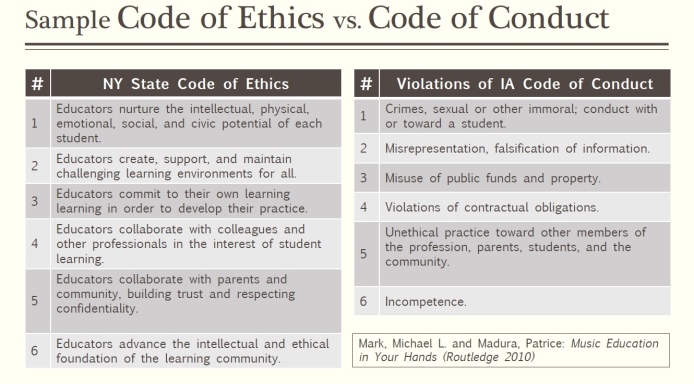
In addition, there are distinctions between “Codes of Conduct” and “Codes of Ethics.” Although they both provide self-regulation of (un)acceptable  behaviors,  frequently the Code of Ethics outlines a set of principles that affect/govern decision making, while the Code of Conduct delineates specific behaviors that are required or prohibited and governs actions.

ethics 29

For the sake of our discussion here about ethics in education, I will add the qualifier that gavel-1238036JasonMorrisona “violation of ethics” is usually associated with significant consequences or punishment, like charges of medical malpractice or lawyers facing an “ethics committee” hearing. Confirmed unethical behavior may result in censure, suspension of license or certification, or other discipline action. Most state education governing entities post legally-binding “educator discipline acts” or codes of professional standards, ethics, and/or behavior, with extensive penalties.
 

Discipline

The grounds for imposition of discipline are broad and far-reaching, and will be governed by the state or county education system to where you are employed. As an example, “the laws” defining infractions in Pennsylvania are:

  • Immorality
  • Incompetency
  • Intemperance
  • Cruelty
  • Negligence
  • Sexual misconduct, abuse or exploitation
  • Violation of the PA Code for Professional Practice and Conduct Section 5(a)(10)
  • Illegal use of professional title
  • Failure to comply with duties under this act, including the mandatory reporting duties in section 9a.
  • Actions taken by an educator to threaten, coerce or discriminate or otherwise retaliate against an individual who in good faith reports actual or suspected misconduct under this act or against complainants, victims, witnesses or other individuals participating or cooperating in proceedings under this act.

— PA Educator’s Discipline Act: 24 P.S. §§2070.1 et seq. Chapter 237/Definition of Terms: http://www.pacode.com/secure/data/022/chapter237/chap237toc.html

For more discussion on these definitions, visit http://www.pspc.education.pa.gov/Promoting-Ethical-Practices-Resources/Ethics-Toolkit/The-Commission-Professional-Discipline-and-the-code/Pages/Educator-Misconduct.aspx.

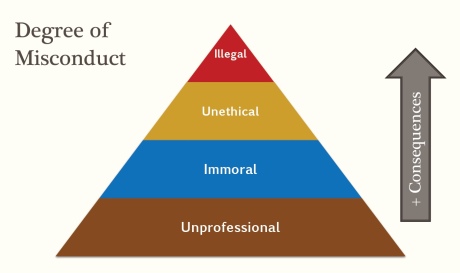
Violations range from exhibiting poor behavior or even the semblance of impropriety to “breaking the code” or criminal offenses. (Yes, “appearances” can get you in trouble, due to one’s interpretations of the above charges of “immorality,” “intemperance,” and “negligence!”) In short, from bad (unprofessional) to worse (illegal), this illustration ethics 22defines misconducts.

The first two on the bottom of the figure (unprofessional or immoral incidents) may only (?) result in damage to one’s professional reputation, lowering the year-end teacher evaluation score, earning a “warning” or “write-up” by the principal/supervisor, or a job re-assignment, but unethical or illegal conduct usually results in further investigation and possible major (and often permanent) disciplinary action:

  • Private Reprimand
  • Public Reprimand
  • Suspension (temporary termination of certificate)
  • Revocation (termination of certificate)
  • Surrender (of certificate)
  • Supplemental Sanctions
  • Legal (Criminal) Action (fines, suspension, jail time, other penalties)
  • Civil Action


Ethical Equilibrium: Consequential “Codes of Conduct” vs. Professional Ethics

“From a decision-making standpoint, I tend to look at it from the perspective of Ethical Equilibrium (some work by Troy Hutchings). Teachers weigh the moral (personal) dimensions with regulatory ones (the law) with the ethics of the profession (ethics of teaching?). While focusing on consequences is important, I worry that teachers may interpret this to mean that as long as they don’t break the law, they can still be unprofessional and immoral.”

– Dr. Oliver Dreon, Associate Professor at Millersville University and author of the Pennsylvania Professional Standards and Practices Commission Ethics Tool Kit.

The foundations of “what’s right or wrong” and what your mother always said was “behaving appropriately when no one is watching you” are all about professional ethical standards that guide decision-making. The work of Troy Hutchings (among other leaders in this field) helps to further clarify these sometimes blurred definitions:

  • Personal Morality: “Personal values and beliefs derived from one’s life experiences… subjective and may/may not align with community mores.”
  • Regulations of Law: “Policies, statues, and judicial activity that articulate conduct absolutes.”
  • Professional Ethics: Professional ethical standards that assist practitioners within situation and systemic contexts in choosing the best course-of-action.”
  • Professional Dispositions: “Agreed upon professional attitudes, values and beliefs to be held by educational practitioners.”

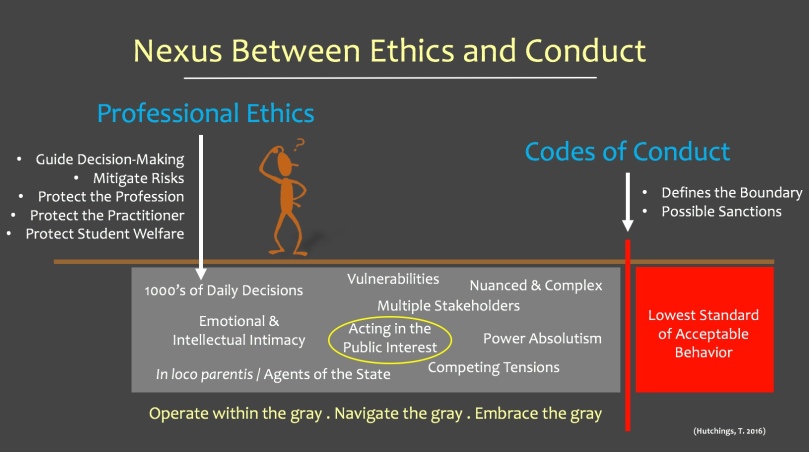
See the slide below borrowed from the American Association of Colleges for Teacher Education webinar presentation “Beyond the Obvious: The Intersection of Educator Dispositions, Ethics, and Law” by Troy Hutchings and David P. Thompson.

Hutchings Nexus Between Ethics and Conduct

In other words, the intent of these essays on ethics is not to emphasize the “lowest standards of acceptable behavior” or the consequences of misconduct for music teachers. We will strive to move from “obedience and punishment orientation” (stage 1) and “self-interest orientation” (stage 2) to “social contract orientation” (stage 5) and “universal ethical principles (stage 6) of Lawrence Kohlberg’s “Six Stages of Moral Development.” (See http://ww3.haverford.edu/psychology/ddavis/p109g/kohlberg.stages.html).


Sample Codes of Ethics

MCEEOne of the best examples endorsed by many states, college education methods programs, and other institutions, the National Association of State Directors of Teacher Education and Certification has published its “Model Code of Ethics for Educators” (see http://www.nasdtec.net/?page=MCEE_Doc) outlining the following principles:
  • Responsibility to the Profession
  • Responsibility for Professional Competence
  • Responsibility to Students
  • Responsibility to the School Community
  • Responsible and Ethical Use of Technology

In addition, it would be valuable to study the standards proclaimed by other organizations, such as

The latter “Music Code of Ethics” was revised and ratified in 1973 by the Music Educators National Conference (now the National Association for Music Education), American Federation of Musicians, and the American Association of School Administration (now the School Superintendent’s Association). It is worth reading mutual agreement of these parties regarding which performance events are sanctioned for music education programs and those that are only appropriate for professional musicians who make their livelihood in the field of “entertainment.”

music-1237358-1


To be continued…

Part II: The Nitty Gritty will review:

  • Societal Changes Promoting Ethical Disputes
  • The Role of Education in Upholding Standards of Behavior
  • Philosophies in Moral Development
  • Sample Code of Professional Practices and Conduct
  • The Teacher-Student Relationship
  • Vulnerabilities
  • Social Media


Special thanks and credits go to Dr. Oliver Dreon, Associate Professor at Millersville University (in Pennsylvania), and one of the authors of the Pennsylvania’s Educator Ethics and Conduct Toolkit, the source of much of the research, quotes, and perspective of this three-part series comes.


PKF

© 2017 Paul K. Fox


Photo credits (in order) from FreeImages.com: “Ethics” by Olivier Le Moal, “Piano Prodigy” by Crissy Pauley, “Old School House” by Vikki Hansen, “On the Phone Closing the Deal” by Michael Roach, “Balance” by Stephen Stacey, “Gavel” by Jason Morrison, and “Music” by Ricardo Vasquez.


Dress for Success at Teacher Interviews

Tips for Modeling the “Proficient Professional” Look

“Make no mistake — you are being judged as soon as you walk into the room and the interviewer has made an initial impression of you in the first few seconds they see you based on how you look. That may not be fair but it is reality in many cases. An interviewer is expecting you to dress appropriately for the interview. If not, you are showing the interviewer that you don’t understand the basics of what it takes to be successful in the workplace. If this is the case, you already have one strike against you.”  —  Andy Teach, author of From Graduation to Corporation, http://www.amazon.com/From-Graduation-Corporation-Practical-Corporate/dp/1438930631

Trolling online for a consensus on what to wear to school employment screenings, I found repetitions of the words “professional,” “appropriate,” and “comfortable,” but no single standard of dress. Most agree that you must exhibit an image of confidence, optimism-1241418-1competence, and responsibility, and should probably error on the side of more formal attire rather than day-to-day casual.

Dressing appropriately for your teacher interview makes your critical first impression on the interview committee. Betsy Weigle from Classroom Connection explains in a YouTube video how to avoid common mistakes plus tells you what to bring along for success at https://www.youtube.com/watch?v=r1FvnI7Bivg.

  1. Dress comfortably but dressier than what you would wear teaching in a classroom.
  2. Your appearance should be professional and appropriate, and show that you really want to be considered for the job.
  3. The focus should be on you, not what you are wearing.
  4. Ladies should wear a skirt or slacks, blouse and a little sweater. A dress would be fine, too (but don’t be too dressy).
  5. Shoes and jewelry should be comfortable AND yet not be noisy or distracting.
  6. No perfume or cologne: Your presence should not enter the room before you do.
  7. For men, a collared shirt is recommended. Dress-up a little bit.
  8. Jeans are never appropriate for a job interview.
  9. For both men and women, adding a little color is a great choice.
  10. Do not wear a mini-skirt, t-shirt, shorts, or sport shoes.

Hannah Hudson shares six hints in “Real Teachers Spill: What to Wear to a Teacher Interview” from We Are Teachers. She provides good photographic examples of her thoughts maintaining style and comfort while exhibiting professionalism, so be sure to read the entire article at https://www.weareteachers.com/best-of-teacher-helpline-what-to-wear-to-a-teacher-interview/.

  1. sharp-dressed-breast-1241310Suits are always a good choice.
  2. If a suit isn’t an option, try a pair of dress pants or skirt with coordinating top and blazer or cardigan.
  3. Women, consider a black sheath dress.
  4. For men who don’t want to go the suit route, we advise a button-down shirt and pants.
  5. Don’t forget the footwear!
  6. Choose a fun accessory.

In a blog entitled “Teacher Interview Style” posted on Classy in the Classroom at http://classyinaclassroom.blogspot.com/2014/07/teacher-interview-style.html, a very upbeat Amy Disbrow personally models her professional attire with remarks on selecting specific styles and colors.

Pictures are also provided in “How to Dress for an Interview” by Alison Doyle from the balance. Start reading the entire blog-post at https://www.thebalance.com/how-to-dress-for-an-interview-2061163. Sample interview outfits and advice for men are posted at https://www.thebalance.com/interview-outfits-for-men-2061090 and for women at https://www.thebalance.com/interview-outfits-for-women-2061091.

Michigan State University’s Career Services Network “Dressing for Interviews” offers additional recommendations (some hopefully under the category of “common sense”) at https://edubirdie.com/blog/dressing-for-interviews

  1. It is rarely appropriate to “dress down” for an interview, regardless of company [or school district] dress code policy. When in doubt, go conservative.
  2. Avoid loud colors and flashy ties.
  3. Clothing should be neat, clean, and pressed. If you don’t have an iron, either buy one or be prepared to visit the dry-cleaner’s often.
  4. Shower or bathe the morning of the interview. Wear deodorant. Don’t wear cologne or aftershave. You don’t want to smell overpowering or worse, cause an allergic reaction.
  5. Make sure you have fresh breath. Brush your teeth before you leave for the interview, and don’t eat before the interview. Don’t smoke right before an interview.

Finally, it is probably worth reading excerpts regarding school institutional dress codes. Good examples include the following:

caring-teacher-1622554-1

  • From Education World at http://www.educationworld.com/a_admin/admin/admin422_a.shtml: “The staff policy prohibits jeans, see-through clothing, torn clothing, short or very tight-fitting clothing, sweat suits, shorts, hats, with exception of religious head-wear, thongs (flip flops), and sneakers or athletic shoes, although gym teachers are permitted to wear athletic shoes.”
  • From the Association for American Educators at https://www.aaeteachers.org/index.php/blog/802-teacher-dress-codes: “Litchfield Elementary School District in Arizona piloted a policy designed to prohibit rubber-sole flip-flops, visible undergarments, any visible cleavage, bare midriffs, clothes that are deemed too tight, too loose or transparent, bare shoulders, short skirts and exercise pants. Administrators in the district also suggested guidelines for natural hair color, limiting piercings, and covering tattoos — all of which can come across as unprofessional.”
  • From Teaching Community “What Teachers Should Never (Ever) Wear” at http://teaching.monster.com/careers/articles/8431-what-teachers-should-never-ever-wear: “How you choose to dress each morning reflects how you feel about your job — that you take your position seriously, that you are ready to work and that you pay attention to detail and know what you expect to encounter that day. You wouldn’t go to a construction site in your favorite four-inch stilettos, right? Of course not, you’d go in a hard hat, because it’s appropriate for the situation. Appearances matter!”
  • From Edutopia “How Should Teachers Dress” by Kevin Jarrett at https://www.edutopia.org/discussion/how-should-teachers-dress: “There is a LOT to consider between formal district dress code policies, personal taste and preference, teaching assignment, community norms, individual income levels, and even climate concerns. As a new teacher, you obviously are going to get your cues from the existing teaching staff, and will probably aim a tad higher, at least initially, while you get established. For most men, this will mean a long-sleeve dress shirt and tie, maybe even a sport coat too. A suit is not out of the question.”

Over the span of my 35+ years in education, I, too, have noticed a significant “slip” or shift to more casual and informal clothing. Some change was expected. After all, in the Rules for Teaching 1915 (see http://www.openculture.com/2013/09/rules-for-teachers-in-1872-1915-no-drinking-smoking-or-trips-to-barber-shops-and-ice-cream-parlors.html), these guidelines were strictly enforced (mostly for woman teachers):

  • You may not smoke cigarettes.
  • You may not dress in bright colors.
  • You may under no circumstances dye your hair.
  • You must wear at least two petticoats.
  • Your dresses may not be any shorter than two inches above the ankles.

interview-1238367-1My view? Teaching is still among the most conservative of occupations. That is how it is viewed by the general public, parents of school-aged children, School Boards, administrators, and interview panels. You can certainly exercise your right to wear whatever you want and show-off numerous body piercings or tattoos… but, like it or not, the school districts are within their rights to choose someone else.

In dealing with our most “treasured blessings” – the students and future hopes of mankind – educators’ ethics and code of professional practices should continue to reach for the highest standards of conduct and appearances. Why? Our kids deserve it!

Hope these online sources help to give you a balanced perspective! Check out the rest of my articles on “Becoming a Music Educator” (click here). PKF

© 2017 Paul K. Fox

Photo credits (in order) from FreeImages.com: Rita Mezzela, Michael Roach, Keith Syvinski, Heriberto Herrera, and Martin Boulanger

inteREVIEWING the situation… and jobs

Senior Music Education Majors’ Employment Prep

Did you miss your state MEA conference?

Three of the most important recommendations for PCMEA members and other new or prospective music teachers wanting to develop a “personal brand” and presence on the job market are:

  1. Being an active member of your national (NAfME), state (PMEA), and local (college chapter) professional music teacher associations,
  2. Attending every possible music education meeting, workshop and conference, and
  3. Reading everything you can get your hands on from the first two resources above, modeling well-practiced habits of professionalism and networking skills, and getting yourself focused, organized, and prepared for the upcoming interviews.

That’s how you will get land your first employment as a full-time music educator.

pmea

If you live or go to school in PA, you should have attended the PMEA Spring Conference in Erie, PA last week. Just to “rub it in” a little, here are a few of the excellent sessions you missed that were especially geared for collegiate pre-service music teachers:

  • Getting the Most Out of Your Student Teaching Experience
  • Cracking the Graduate School Code: When, Where, Why, How, & How Much
  • Starting with the End in Mind – or – You’ve Got 4 Years, Use Them Wisely
  • Music Education & Gaming: Interdisciplinary Connections for the Classroom
  • Ready for Hire! Interview Strategies to Land a Job
  • Planning Strategies to Develop a Responsive Teaching Mindset

More importantly, if you are in your 4th year and were a no-show to your state conference this year, you missed out the chance to do a little networking, to “put your ear to the ground” listening for market trends and possible position openings for next year. You could have rubbed elbows at a bar (drinking a diet coke) or clinic or concert with a music supervisor, department chair, administrator, or high school band/choir director who knows who is taking a sabbatical or retiring from his/her school upon completion of the current semester.

Successful professionals stay up-to-date with their journals

PMEA NewsAs a “professional,” you have an open, inquisitive mind, constantly strive for self-improvement, continuing education, and retooling, embrace change and better ways of doing something, and “practice” your craft. This means you read your educational publications from cover to cover. For example, these were a few of the tips in a recent PMEA News article, “I’ve Got an Interview, Now What?” shared by Dr. Kathleen Melago, PCMEA State Advisor and Associate Professor of Music Education at Slippery Rock University, and Doug Bolasky, retired band and orchestra teacher and former Department Chair of the Southern Lehigh School District:


  1. “The interview process at each school district is likely as unique as the district itself, and while there is no foolproof way to know in advance what questions will be asked of you, it helps to give some thought to what questions may come your way.”
  2. “It’s easy to tell someone what you would like to do; more valuable to the interviewers is what you DID do. Be ready to cite instances from your student teaching and even field experiences.”
  3. “Think about items you could place into your portfolio that would help you answer the questions. For example, if you are answering a question about an idea you implemented that was creative, consider including an artifact in your portfolio that provides credibility to your answer. Avoid simply passing around your portfolio during the interview. Instead, use it as a visual aid…”
  4. “Enlist the aid of a friend and use a webcam to record yourself answering the questions as in a mock interview. Look for distracting mannerisms like playing with your hair, saying ‘um’ or ‘like,’ and so forth.

Are you ready? Assess yourself! Then, DO YOUR HOMEWORK NOW!

For those who are nearing completion of their coursework for a teaching certificate, the season of professional school interviews is coming… At this point, you should be familiar with assessment rubrics and other evaluative tools used in education. Right NOW how well do you stack up in prepping for employment screenings? Complete this checklist as honestly as possible. I am citing and “reviewing” past articles I have written at this blog-site… a perfect opportunity for you to “fill in the missing gaps” and get started on this process of finding the perfect job!

quiz-1-1189422

  1. [   ] I am familiar with numerous criteria for assessing teacher candidates (for what the employment screening committee may be looking), including specific instructional, professional, and personal skills, experiences, behaviors, or ”core teaching standards” of “Unsatisfactory,” “Satisfactory,” “Good,” or “Superior.” I know the Charlotte Danielson Framework (one evaluative model for professional development used by the PA Dept. of Education – (https://www.danielsongroup.org/) or sample school district assessment forms. DO YOUR HOMEWORK NOW: https://paulkfoxusc.wordpress.com/2015/08/09/criteria-for-selection-of-the-ideal-teacher-candidate/ and https://paulkfoxusc.wordpress.com/2015/09/01/a-blueprint-for-success-preparing-for-the-job-interview/.
  2. [   ] I have developed a comprehensive unified philosophy of music education that spotlights my abilities from the perspective of a generalist not a specialist. I can model competency and experience in general music, piano playing, vocal and instrumental (band, strings, and guitar) music, Classical, jazz, pop, and folk music styles, improvisation, composition and music theory, and technology teaching grades Pre-K to 12. DO YOUR HOMEWORK NOW: https://paulkfoxusc.wordpress.com/2015/07/04/marketing-yourself-and-your-k-12-music-certification/.
  3. [   ] I am comfortable with today’s jargon, current trends, and key “buzz words” in general education. This includes everything from “The Common Core” to “The Four C’s” of 21st Century learning, and all of those constantly changing acronyms like HOTS, DOK, RTI, and UBD. These terms may come up at interviews, so I have at least a precursory understanding about them, and if I am “stumped” with a particular question, I will admit needing clarification (and I will look it up when I get home). DO YOUR HOMEWORK NOW: https://paulkfoxusc.wordpress.com/2015/07/18/the-alphabet-soup-of-educational-acronyms/.
  4. [   ] I am becoming a proficient storyteller and have prepared a set of personal anecdotes to potential questions that may be asked at the interviews. I have practiced responding with specific examples of my past experience and accomplishments, not just “telling” my strengths but allowing the listener(s) to make his/her(their) own deductions about me from my stories. DO YOUR HOMEWORK NOW: https://paulkfoxusc.wordpress.com/2015/08/02/when-it-comes-to-getting-a-job-s-is-for-successful-storytelling/.
  5. [   ] I have practiced taking “mock interviews” in front of my peers and recorded myself for self-assessment of my ability to answer employment screening questions. DO YOUR HOMEWORK NOW: https://paulkfoxusc.wordpress.com/2015/10/11/the-dos-and-donts-of-interviewing/, https://paulkfoxusc.wordpress.com/2016/02/27/interview-questions-revisited/, https://paulkfoxusc.wordpress.com/2016/06/04/those-tricky-interview-questions/, and https://paulkfoxusc.wordpress.com/2017/01/27/body-language-interviewing-for-a-job/.
  6. I understand the concepts of…
  7. I have a high-quality…

What was YOUR score… out of 11?

Get to work… so you can get work!

job-concept-2-1140644-1

PKF

Photo credits: FreeImages.com, photographers hvaldez1 (studying for a test), Tory Byrne (quiz), and Svilen Milev (hire).

© 2017 Paul K. Fox

The PMEA State Conference Primer

Getting the Most Out of Music Conferences… Suggestions for First-Time Attendees or New Teachers

Music conferences offer students as well as seasoned musicians a wealth of professional opportunities. They are motivating and help recharge your battery. They even help set future goals. Consider music conferences an essential component of your training and career…

CLICK HERE TO READ MORE – The original release of this article is at http://majoringinmusic.com/music-conferences/

Education’s purpose is to replace an empty mind with an open one. – Malcolm Forbes

The greatest benefits of attending an academic or professional conference are the opportunities to build your network and increase your awareness of new trends happening in your area of interest. – Emad Rahim http://www.coloradotech.edu/resources/blogs/june-2013/professional-conference

Networking with others in the field, getting new and innovative ideas, self-reflection and re-thinking of previous methods, and improving communication skills are just a few of the ways professionals can grow and develop.  – Conferences and Professional Development by the Grand Canyon University Center for Innovation in Research and Teaching https://cirt.gcu.edu/research/developmentresources/research_ready/presentationready/prof_develop

For professional networking, it is your “charge” to create multiple pathways to/from school administrators, HR managers and secretaries, music supervisors and department heads, and music teachers… and you – your skills, accomplishments, unique qualities, experience, education, and personality traits. Paul K. Fox https://paulkfoxusc.wordpress.com/2016/04/04/networking-niceties/

pcmea

Welcome to the annual state conference! For Pennsylvania Collegiate Music Education Association (PCMEA) members and soon-to-be-hired music educator prospects, this guide will help you get the most out of attending the 2017 Pennsylvania Music Educators Association (PMEA) Spring Conference (and future professional development events).

Reasons to “drop everything” and attend an in-service conference:

  1. Conferences “grow” your professional network and opportunities for future collaboration.
  2. Conferences build your knowledge base: to hear about potential job openings, stay current in the field, learn new ideas, music literature, classroom materials, curriculum initiatives, research, technology, and unique approaches to problems, and to see “state-of-the-art” (“model”) performances of student and professional music ensembles.
  3. Conferences expand your resources.
  4. Conference motivate (a.k.a. “recharge batteries”) and help you plan future goals.

People in academics cultivate exceptional resources—and they’re excited to share them with like-minded colleagues. During the conference, I had an opportunity to test out new technology, review upcoming publications, share teaching tools and techniques and obtain samples of textbooks, software and mobile applications. Conferences are full of people promoting new ideas, vendors selling new products, and consultants teaching new methodologies. I always take advantage of this opportunity to fill up my academic tool-shed with new techniques and technology to improve my career. – Emad Rahim

bayfront1_highThe annual PMEA Spring Conference will be held on April 19-22, 2017 at the Erie Bayfront Convention Center. These sessions may be “perfect for PCMEA!”
  • Opening General Session with Tim Lautzenheiser Thursday 8:30 a.m.
  • PCMEA meetings Thursday 10:30 a.m. and Friday 11:15 a.m.
  • Getting the Most Out of Your Student Teaching Experience Thursday 1:30 p.m.
  • Cracking the Graduate School Code: When, Where, Why, How, & How Much Thursday 3 p.m.
  • Starting with the End in Mind – or – You’ve Got Four Years, Use Them Wisely Thursday 4:30 p.m.
  • Music Education & Gaming: Interdisciplinary Connections for the Classroom Friday 8:15 a.m.
  • Ready for Hire! Interview Strategies to Land a Job Friday 9:45 a.m.
  • Planning Strategies to Develop a Responsive Teaching Mindset Friday 2:15 p.m.
  • Final General Session with NAfME Eastern Division President Scott Sheehan Friday 3:45 p.m.

For a complete conference schedule, consult PMEA News or this web-link: http://www.pmea.net/wp-content/uploads/2017/01/2017-PMEA-Annual-Conference-Schedule-for-Winter-News.pdf.

pmeaFirst things first! Prepare yourself in advance. Grab your winter or spring issue of PMEA News. Review the program of sessions which is usually laid out in chronological order and also by content strands (e.g. advocacy, choral, classroom music, collegiate, curriculum development/assessment, higher education research, instrumental, music technology, World Music, and special interest topics), as well as the list of keynote speakers, guest clinicians, showcase (music industry) demonstrations, association meetings (like PCMEA), and performances. Using an “old-fashioned” 20th century tool, mark up the conference schedule with two different colors of highlighter marking pens, first targeting “high interest” areas in yellow, and then “must attend” events in hot pink or other favorite color.
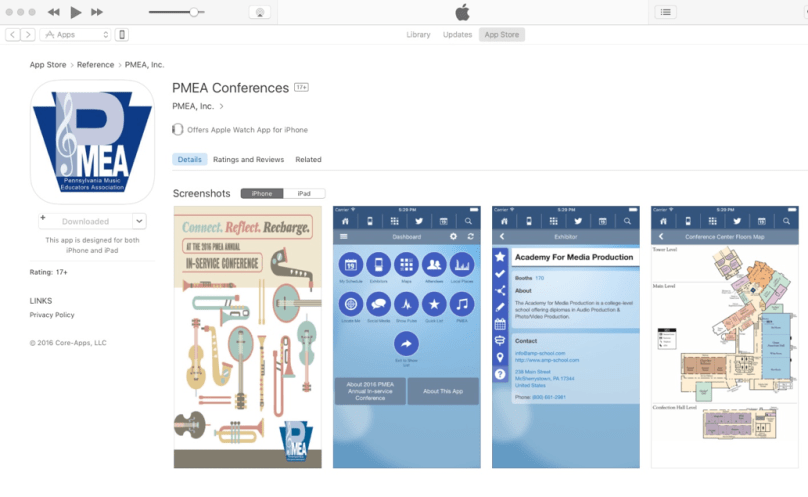

Next, download the PMEA Conference App (usually from Core-Apps.com). This is the 21st Century technique for setting up your conference schedule (“where to go and what to do”), reading the bios of the presenters, locating the session rooms and exhibit booths, finding out who is attending, taking and storing your notes, and learning about last minute changes. Here is the picture of the 2016 PMEA app:

pmea-app

More DO’s and DON’Ts for effective conference attendance:

  1. DON’T remain in your “comfort zone” by sitting exclusively with your friends or college buddies at every session and concert. DO socialize with your peers at meals, and DO attend meetings of your PCMEA. However, if you are trying to take advantage of networking opportunities, to get to know other professionals, possible job screeners, administrators, etc., DON’T just sit with people you know at every other event.
  2. SONY DSCDON’T focus exclusively on attending sessions or concerts in your specialty or most proficient areas, such as band if you’re a woodwind, brass or percussion major, orchestra if you are a string player, general music/choral if you are a vocalist or pianist. DO go to sessions that are not directly related to your major. You might be surprised at the connections you discover or the new interests that arise. Imagine “they” want to hire you next year as the next middle school jazz coach, HS marching band show designer, choreographer for the elementary musical, conductor of the string orchestra, teacher of AP music theory, etc. Could you select music for an elementary band (or choral) concert, create a bulletin board display for a middle school general music unit, set-up a composition project, or lead folk dancing at the kindergarten level?

  3. DO stay at (or near to) the hotel where the conference is being held… to see and DO more!
  4. Learn and DO the best practices of networking, personal branding, business card creation and distribution, and record-keeping of conference notes, job openings, and contact information. DO read my blog-post on Networking Niceties: The “How to Schmooze Guide” for Prospective Music Teachers at https://paulkfoxusc.wordpress.com/2016/04/04/networking-niceties/.
  5. playing-harp-1563567DON’T be shy! A conference is no place for being timid or afraid to start up a discussion with a more experienced music teacher. PMEA is all about circulating and introducing yourself, exhibiting your “charming self,” exploring resources and who are the experts/leaders in music education, getting the “lay of the land,” and adding as many names and emails to your professional contact data base as possible. Of course, DO follow-up with anyone who suggests that there may be a future employment posting from their school district!
  6. DO attend both general sessions, one usually scheduled on Thursday morning and the other on Friday afternoon. These will feature the keynote speakers and a special performance or award presentation. Since it is free and another opportunity to network, DO attend the Saturday morning awards breakfast and general membership meeting.
  7. DON’T be the first person to leave a session, and definitely DON’T “hop around” from one clinic or concert to another. Many attendees consider leaving early disruptive and rude, and it does not allow you to get the “whole picture” of the presentation. DON’T run in and grab the handouts… they will not have much meaning unless you attend the entire one-hour workshop. DO interact with the clinicians and conductors. If someone gave a talk, introduce yourspiano-and-laptop-1508835elf and ask a thoughtful question on some issue about which you are curious or found interesting.

  8. DO attend (and participate in) at least one panel discussion, music reading workshop, and technology session. DO search for special sessions held for college students on interviewing and landing a job. DO visit the displays of the PMEA Research Forums and the Exhibits.
  9. DON’T expect to get a lot of sleep at the conference. DON’T miss the interesting concerts to attend at night as well as early morning breakfast meetings and evening receptions. But, whatever you do, DO have FUN at your first music teacher conference!

Actually, PMEA represents only one of a series of outstanding music education conferences offered to school music teachers. In addition, you should look at:nafme

Hopefully, these tips on networking and taking advantage of the many professional benefits for attending an in-service conference will assist your successful pursuit for “landing” a job, discovering your own “calling” in the field of music education, and contributing a lifetime of meaningful work to our profession. See you in Erie!

Suggested Additional Readings:

  • Caffarella, R. S., & Zinn, L. F. (1999). Professional development for faculty: A conceptual framework of barriers and supports. Innovative Higher Education, 23(4), 241-254.
  • Guskey, T. R., & Huberman, M. (1995). Professional development in education: New paradigms and practices. Teachers College Press, 1234 Amsterdam Avenue, New York, NY 10027 (paperback: ISBN-0-8077-3425-X; clothbound: ISBN-0-8077-3426-8).
  • Guskey, T. R. (2000). Evaluating professional development. Corwin Press.
  • Snow-Gerono, J. L. (2005). Professional development in a culture of inquiry: PDS teachers identify the benefits of professional learning communities. Teaching and teacher education, 21(3), 241-256.
  • Sunal, D. W., Hodges, J., Sunal, C. S., Whitaker, K. W., Freeman, L. M., Edwards, L., … & Odell, M. (2001). Teaching science in higher education: Faculty professional development and barriers to change. School Science and Mathematics, 101(5), 246-257.

PKF

© 2017 Paul K. Fox

Photo credits: saxophone 24youphotography, harpist Gerrit Prenger, and computer/music keyboard LeslieR at FreeImages.com

Ethics for Job Seekers

Employment Etiquette & Standards of Morality

Ethics is knowing the difference between what you have a right to do and what is right to do. – Potter Stewart from http://www.brainyquote.com

Definitions

Google defines ETHICS as “moral principles that govern a person’s or group’s behavior.”

For more detail and an analysis of the “essential questions” on ETHICS, check out the blog “What is Ethics?” from the Markkula Center for Applied Ethics: https://www.scu.edu/ethics/ethics-resources/ethical-decision-making/what-is-ethics/.

From another perspective, according to Investopedia, “BUSINESS ETHICS is the study of proper business policies and practices regarding potentially controversial issues, such as corporate governance, insider trading, bribery, discrimination, corporate social responsibility and fiduciary responsibilities.” The full article can be read at http://www.investopedia.com/terms/b/business-ethics.asp.

the-truth-shall-make-you-free-1201069

Declining Standards of Behavior?

Jean Twenge, the author of the 2006 book Generation Me, considers Millennials (born between 1977 and 1994), along with younger members of Generation X, to be part of what she calls “Generation Me,” possessing a preponderance of the traits of confidence and tolerance, but also a strong sense of entitlement and narcissism. Wikipedia identifies the (older) “Me” generation in the United States, referring to “the baby boomer generation and the self-involved qualities that some people associated with it.”

According to Psychology Today in a blog-post The Truth About Lying by Allison Kornet (https://www.psychologytoday.com/articles/199705/the-truth-about-lying), “Deception is rampant—and sometimes we tell the biggest lies to those we love most.”

If, as the cliché has it, the 1980s was the decade of greed, then the quintessential sin of the 1990s might just have been lying. After all, think of the accusations of deceit leveled at politicians like Bob Packwood, Marion Barry, Dan Rostenkowski, Newt Gingrich, and Bill Clinton.

Regardless of these labels of societal trends, “generalizations about the generations,” and reflections on current social values and conscience in the media, how do you come to terms with the recent headlines of inconsistent (or “inconvenient”) ethics and morality?

  • State-sponsored doping of Russian athletes
  • Volkswagen emission cheating
  • Students saying, “If we don’t get caught” or “If they don’t find out,” it’s OK.
  • The rise of online plagiarism-checking programs such as turnitin.com.
  • The cynicism about “ethics in advertising: do we expect lies?”
hand-on-a-bible-1417265

And yet, some of us still recite the Boy Scouts oath (“honesty”), “swear to tell the truth” (on a bible) in a court of law, and strive to maintain an atmosphere of honesty in the workplace (see http://www.businessinsider.com/3-essential-rules-to-workplace-honesty-2013-1  and http://smallbusiness.chron.com/create-atmosphere-honesty-workplace-10098.html).

So, are we “losing” our moral compass? Does “our word” mean anything? Do we take the easy way out and “fake a little” here and “wink a little” there? Is it affecting the way we interact with each other, in educational institutions, the marketplace, family life, and even presenting ourselves to be hired for a job?

Blame it on upbringing? Past experience? Perhaps it is safe to say one’s personal judgment may be affected by ethics. If a member of your family has a handicap parking placard, is it ever used when the handicapped individual is not riding in the car? In terms of judgment and feelings of entitlement, it is probably ill-advised to bring up anything to do with driving… fighting over parking places, cutting off someone, tooting horns at slow drivers, etc. Besides, who actually ever comes to a complete stop at a stop sign?

In the pre-employment planning stages, it is essential for you to make a honest personal and professional assessment, prepare to represent yourself accurately at interviews and on your resume and  e-portfolio, and model ethical personal branding. I would agree that “you cannot ‘fib’ and claim you are a ‘master’ of everything,” but if you are certified to teach music in grades K-12, not just band, or general music, or choir, or strings… you should state your proficiency to teach “the whole kit and caboodle.” At employment screenings, it’s more important to show you have learned the necessary 21st Century skills of critical thinking, problem-solving, collaboration, communications, creativity, and flexibility/adaptability… rather than whether you can play Paganini on the violin, sing a high “A,” improvise modern jazz styles, or piano accompany a musical production.

25774792772_259d73f98c_b

Stretching Things a Bit?

The concept of a “stretched resume” is detailed online by “Employee’s Ethics: Getting a Job, Getting a Promotion, Leaving,” Chapter 6 from the book Business Ethics. The author tells the true story of Robert Irvine, who used to host the Food Network’s popular Dinner: Impossible. He was fired when he was caught “lying” or providing gross exaggerations on his resume. You should read the interesting full account at this site: http://2012books.lardbucket.org/books/business-ethics/s10-employee-s-ethics-getting-a-jo.html.

The kind of resume misrepresentations are categorized as the following:

  • False credentials
  • False experience
  • Embellished experience
  • False chronology
  • False references

The best quote from this reference suggests that the outcome of resume misrepresentation is not worth the chances you would take if/when you are caught:

Ethical egoism means your moral responsibility is to act in your own interest no matter what that may require. This provides a license for outright résumé invention… But, as is always the case with egoism, the question must be asked whether job seekers really serve their own interests when they claim things that may later be revealed to be false or when they land jobs they later won’t be able to perform because their qualifications were fake.

This source led me to the webpage http://fakeresume.com/ (aptly named) selling the book Fake Resume: The Machiavellian Guide to Getting a Job by Max Stirner (something I am not promoting!) You can peruse a segment of his work, “Five Reasons Why You Must Lie on Your Resume To Get a Job Today” at http://fakeresume.com/five-reasons-why-you-must-lie-on-your-resume.pdf. This excerpt is from his “Everyone Lies on Their Resume” section of his website:

fake-resume-ebook-vertical

The firm Hire Right released some interesting statistics that show how rampant resume fraud is in the United States. The company’s numbers show that 80 percent of all resumes are misleading. They also show that 20 percent state fraudulent degrees and 30 percent show altered employment dates. As if those numbers are not shocking enough, 40 percent have inflated salary claims and 30 percent have inaccurate job descriptions. Furthermore, the study shows 25 percent of people listing companies that no longer exist, and 27 percent giving falsified references; and these are only the people they have caught!

Guides to Employment Ethics

Regardless of what others do or say they do, marketing exaggeration and even falsehoods will not be in your best interest.

Richard Fein, Director of Career Management, Isenberg School of Management, University of Massachusetts-Amherst via Monstertrak.com wrote an excellent career guide on this subject: “Etiquette and Ethics in Your Job Search. What Are They and Why Should You Care?” Download the following to review the definitions, distinctions, and job search scenarios involving the terms “etiquette” and “ethics.” http://www.bu.edu/hospitality/files/pdf/ETIQUETTEANDETHICSINYOURJOBSEARCH1.pdf.

Another excellent resource is the “Job Search Ethics Brochure” from the University of Pennsylvania: http://www.vpul.upenn.edu/careerservices/files/Job_Search_Ethics_Brochure.pdf. In this thoughtful publication, additional terms are defined, such as “professional,” “integrity,” and “honor.”

word-true-on-the-dices-1237241

In addition, it should be “worth your while” to access some of the Franklin College’s “Helpful Handouts” under the Career Service section of their website: http://franklincollege.edu/student-life/career-services/students-alumni/helpful-handouts/. In particular, what stood out to me was their document “Job Search Ethics and Protocol,” which Assistant Dean of Students & Director of Career Services Kirk Bixler has graciously granted me permission to reprint below. (This is an excellent summary of many of the topics/tips we have posted at this site. Click on the “Marketing Professionalism” link to the right to read past blog-posts.)

  • Do NOT give into the temptation of carelessly completing an application. Do NOT make statements on an application like “see attached résumé.” Never leave spaces blank.
  • Apply for a job only if you have some realistic level of interest.
  • Absolute honesty on your résumé is imperative. Don’t overstate or understate. Don’t downplay your skills because you haven’t been featured in Business Week.
  • Request permission to use a person as a reference. Be prepared to explain to your reference what your job search plans are. Provide the reference with examples of qualities you possess. Offer a copy of your résumé. When interviewing, have your list of references on hand.
  • Don’t take advantage of an expense account when traveling for job interviews.
  • Show up for your interview. If you are visiting a person’s place of work, make sure your appearance, including mode of dress, is appropriate for that environment. You are not a student going to class. Consider yourself a professional trying to make a positive impression. How you present yourself is a partial reflection on the person with whom you are meeting.
  • Be a bit early for your appointment. Be mindful of the other person’s time. Come in prepared with questions & knowledge of the business.
  • Ask “How would you like to be addressed?” Be on the safe side; few people are offended by “Mister” or “Ms.” Be courteous to everyone you meet.
  • Everything you say must be true. On the other hand, you don’t need to say everything.
  • 25957630814_ee6ff87fe5_oYou may be asked to say something about another student or applicant. Speak only of your abilities & strengths. It is acceptable for an interviewer to ask you about other interviews, job offers & salary offers. You are not under an obligation to give a direct answer.


  • Be aware of illegal inquires. Employers may not ask, “How much alcohol do you drink?” “Have you ever been treated for mental health problems?” “What prescription drugs do you currently take?”
  • Thank you! Thank you! Thank you! Thank-you notes are a MUST in the job search process. They may be handwritten or typed. Address them to the person with whom you had the interview.
  • Be aware of drug screening requirements.
  • Call to inquire about your status in the employer’s hiring process. If a specific time has been communicated, wait until that time has passed before contacting the employer.
  • Let the employer be the first to mention salary. End it early if you are not interested. Let the employer know you are not interested in pursuing employment.
  • When offered the job, ask for time to think it over & ask for a formal offer letter.
  • You may receive one or more job offers you decide to reject. You should convey your decision to reject a job offer orally & in writing. The considerations here are speed & certainty of delivery. Call the person who signed your offer letter. Write a brief letter, also. Do both in a timely manner.
  • Only accept a job if you are really interested. Don’t settle. Once you accept a job offer, formally remove yourself from all other job searches. DO NOT continue looking.

These final bulleted items are echoed by another prestigious institution. “Ethical Internship and Job Search Policies” is posted on the University of Notre Dame’s Career Center webpage (http://careercenter.nd.edu/students/ethical-job-search-policies/):

When accepting an offer of full-time employment or an internship (either paid or unpaid), one must have every intention of honoring that commitment.  If a student accepts an offer of employment, admission to a graduate or professional school, or other post-graduate career opportunity, he/she must withdraw from the recruiting process immediately. This includes but is not limited to:

  • Not applying to future job postings.
  • Declining all future interview invitations.
  • Canceling any active applications.
  • Contacting all recruiters to inform them of your wish to be removed from the interviewing and recruitment process (this includes all scheduled interviews).

Ethics? It all boils down to two questions: “Who are you?” and “For what do you stand?” Besides the fear of “getting caught in lies” and being fired for misrepresentation (or doing an incompetent job because you did not have the qualities for which your employer was looking), it centers on “liking what you see” when you look at yourself in the mirror. Anyway, didn’t you mommy tell you your nose gets longer when you tell a fib?

mirror-on-wall-1413751

Ethics is nothing else than reverence for life.  – Albert Schweitzer
from http://www.brainyquote.com
PKF
© 2016 Paul K. Fox

Criteria for Selection of the “Ideal” Teacher Candidate

“A good teacher can inspire hope, ignite the imagination, and instill a love of learning.”    – Brad Henry

Standards and Benchmarks of Top-Rated Educators in Music and Other Academic Subjects

OLYMPUS DIGITAL CAMERA

The best way to prepare for a job interview is to become aware of how you will be judged in comparison with your peers. What are the standards (or behaviors or criteria) of outstanding teachers? For what are administrators looking to fill the vacancies and build/maintain a quality staff?

Interviews will sort out (and rank) the competencies, certifications, education levels, and overall experience of the candidates. Obviously, mastery of subject content and teaching methods will be evaluated. However, you may be surprised that significant focus will be placed on personality traits, social skills, and evidence of personal drive, reliability, versatility, vision, and habits of professionalism.

In short, you may be the best musician this side of the Mississippi, the “model lesson planner,” and can conduct Orff’s Carmina Burana or Shostakovich‘s Festive Overture blindfolded, but if you cannot inspire students, work with coworkers, and communicate effectively, your interview and chances for being hired are doomed from the start.

Adapted from David Berliner and William Tikunoff, “The California BTES: Overview of the Ethnographic Study,” effective teachers score high on…

  • Accepting
  • Adult involvement
  • Attending
  • Consistency of message
  • Conviviality
  • OLYMPUS DIGITAL CAMERACooperation
  • Student engagement
  • Knowledge of subject
  • Monitoring learning
  • Optimism
  • Pacing
  • Promoting self-sufficiency
  • Spontaneity
  • Structuring

Effective teachers score low on…

  • Abruptness
  • Belittling
  • Student defiance
  • Counting hours or “clock punching”
  • Illogical statements
  • Mood swings
  • Oneness (treats whole group as “one”)
  • Recognition-seeking

In previous blogs (e.g. https://paulkfoxusc.wordpress.com/2015/07/01/the-meaning-of-pro/), I have defined the qualities of a “professional.” How many of these traits do you model?

  • Succeeded in and continues to embrace “higher education”
  • Updates self with “constant education” and retooling
  • Seeks change and finding better ways of doing something
  • Like lawyers/doctors, “practices” the job; uses different techniques for different situations
  • Accepts criticism (always trying to self-improve)
  • Proposes new things “for the good of the order”
  • interview-1238367Can seemingly work unlimited hours (24 hours a day, 7 days per week)
  • Is salaried (does not think in terms of hourly compensation, nor expects pay for everything)
  • Is responsible for self and many others
  • Allows others to reap benefits and credits for something he/she does
  • Has obligations for communications, attending meetings, and fulfilling deadlines
  • Values accountability, teamwork, compromise, group goals, vision, support, creativity, perseverance, honesty/integrity, fairness, and timeliness/promptness
  • Accepts and models a corporate standard of behavior and appearance

It is worth reading “Weigh In: What Makes a Great Teacher” by Jacqueline Heinze in the Winter 2011 issue of Administr@tor Magazine (see http://www.scholastic.com/browse/article.jsp?id=3755567). Among the numerous responses were these notable quotes:

  • “A great teacher must be resilient.”
  • “Great teachers are instructional leaders and curriculum designers.”
  • “Great teachers love what they do and perceive teaching as their calling.”
  • “Great teachers are empathetic and engaged.”

Also check out these websites for additional insight on the characteristics of a exemplary educator:

students-1460768Since the process of teacher selection in the public schools involves recruitment, screening, hiring, placement, induction, and evaluation, it is advisable for prospects to know the assessment practices already in place. According to the Pennsylvania Department of Education, Pennsylvania has adopted The Framework for Teaching as the overarching vision for effective instruction in the Commonwealth.

The Framework for Teaching is written by Charlotte Danielson, an internationally-recognized expert in the area of teacher effectiveness specializing in the design of teacher evaluation systems that, while ensuring teacher quality, also promote professional learning.

The introduction to The Framework of Instruction Evaluation Instrument 2013 states its purpose:

“The Framework for Teaching identifies those aspects of a teacher’s responsibilities that have been documented through empirical studies and theoretical research as promoting improved student learning. While the Framework is not the only possible description of practice, these responsibilities seek to define what teachers should know and be able to do in the exercise of their profession.” – Charlotte Danielson

The model focuses the complex activity of teaching by defining four domains of teaching responsibility:

  1. Planning and Preparation
  2. Classroom Environment
  3. Instruction
  4. Professional Responsibilities

The domains can be further broken down into…

danielsons_image_dom1-4

Domain 1: Planning and Preparation

  • 1a Demonstrating Knowledge of Content & Pedagogy
  • 1b Demonstrating Knowledge of Students
  • 1c Setting Instructional Objectives
  • 1d Demonstrating Knowledge of Resources
  • 1e Designing Coherent Instruction
  • 1f Designing Student Assessments

Domain 2: Classroom Environment

  • 2a Creating an Environment of Respect and Rapport
  • 2b Establishing a Culture for Learning
  • 2c Managing Classroom Procedures
  • 2d Managing Student Behavior
  • 2e Organizing Physical Space

Domain 3: Instruction

  • 3a Communicating with Students
  • 3b Using Questioning and Discussion Techniques
  • 3c Engaging Students in Learning
  • 3d Using Assessment in Instruction
  • 3e Demonstrating Flexibility and Responsiveness

inside-a-class-room-school-1435436Domain 4: Professional Responsibilities

  • 4a Reflecting on Teaching
  • 4b Maintaining Accurate Records
  • 4c Communicating with Families
  • 4d Participating in a Professional Community
  • 4e Growing and Developing Professionally
  • 4f Showing Professionalism

Many Pennsylvania districts assess their professional staff and verify their teacher’s professional growth via rubrics or other evaluative tools, as well as the collection of artifacts that support these domains. Archives of these “best practices” would be assembled in portfolios for the principal’s year-end review (samples printed in blue below are possible artifacts for music educators in particular):

Domain 1: Planning

  • Assessment Tools
  • Lesson Plans
  • New Curriculum Innovations
  • Personal/Professional Goals
  • Music Repertoire/Program Lists
  • Subject Outlines

Domain 2: Classroom Environment

  • Audio-Visual Resources Including Recordings
  • Formal Observations
  • Informal Observations
  • PowerPoint Presentations
  • Sample Classroom Displays/Bulletin Boards

Domain 3: Instruction

  • Arrangements (Teacher Composed)
  • Conferences with Colleagues/PLCs/Teams
  • Meetings with Mentors/Curriculum Leaders/Principals
  • Printed Concert, Musical, Drama, or Recital Programs
  • pencils-1240400Sample Homework and Worksheets
  • Student Composed Music/Lyrics/Exercises
  • Warmup Drills and Style/History Handouts

Domain 4: Professionalism

  • Act 48 Clinics and Workshops
  • Congratulatory Notes from Parents/Staff
  • Grade Books and Attendance Records
  • Letters/Newsletters Sent Home
  • Minutes of Department Meetings
  • Professional Development Programs
  • Student Recommendations
  • Student Records

Individual school districts define their own “vision of a model teacher,” aligning the selection criteria with the goals of the school system and the needs of the individual schools. For example, Upper St. Clair School District (an Allegheny County public school system located in southwestern Pennsylvania, and where I worked 33 years as music educator and seven years as Performing Arts Curriculum Leader) adopted the following Assessment Criteria for Teacher Candidates (developed by Superintendent Dr. William Pope, Human Resource Director Ms. Jean Toner, and other staff). “In a nutshell,” these are what USC calls “core behaviors” or standards of personality traits, skills, and knowledge, and serve as categories for assessment of all job applicants during the interview process:

Instructional

  • Educational Philosophy
  • Knowledge/Experience
  • Classroom Management
  • Technology
  • Oral Expression
  • Written Communications

college-1241412Professional

  • Leadership
  • Teamwork
  • Judgment
  • Problem Solving
  • Planning & Organizing
  • Innovation

Personal

  • Initiative
  • Dependability
  • Adaptability
  • Self-Insight and Development
  • Energy and Enthusiasm
  • Appearance

My next blog on this subject will provide examples of music teacher interview questions for each of the above criteria… suitable for individual practice or group mock interview sessions, and to assist in the formulation of stories/anecdotes that would support a candidate’s mastery of each standard. The importance of this preparation is explored in a previous blog: https://paulkfoxusc.wordpress.com/2015/08/02/when-it-comes-to-getting-a-job-s-is-for-successful-storytelling/.

PKF

© 2015 Paul K. Fox

This post is featured by Twinkl in their ‘Teaching Writing’ blog.