Engaging Retiring/Retired Educators

Ask not what NAfME or your state MEA can do for you, but what YOU, a retiree, can do for your professional association and music education.
An adaptation of the famous excerpt from the 35th U.S. President John F. Kennedy’s inaugural address of January 20, 1961.
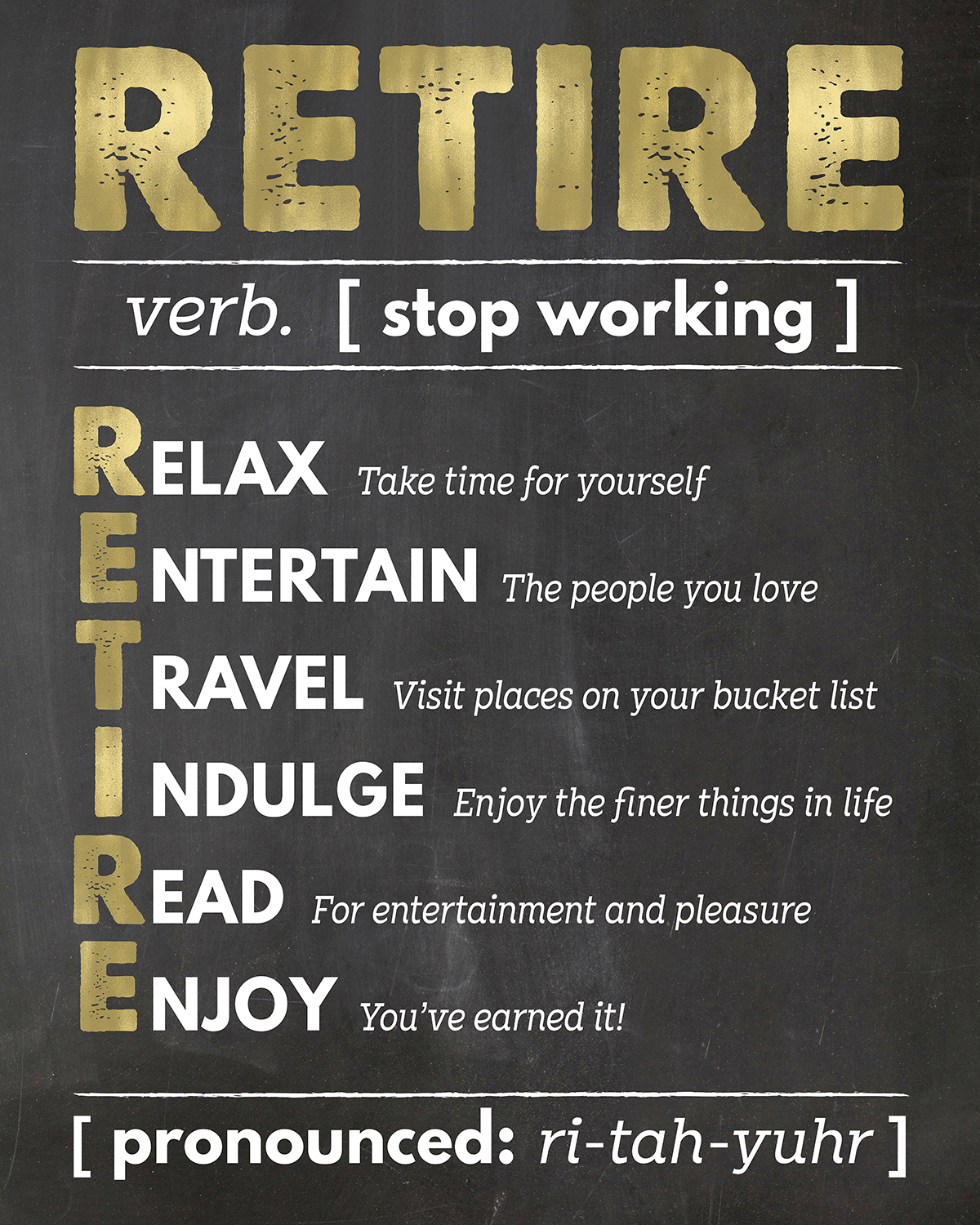
Surfing the ‘Net, I found an appropriate acronym for R.E.T.I.R.E. by Tangled Tulip Designs in pinterestRelax, Entertain, Travel, Indulge, Read and Enjoy! Most retirees would probably agree! The cessation of full-time employment may offer a great release from the day-to-day stress and drudgery of the job and the freedom to venture out, self-reinvent, make future goals, nurture relationships, and explore new personal growth opportunities.

Many attribute embracing a career in music education as “a calling” as opposed to just a form of employment or livelihood. From my experience, I have witnessed that most music educators are passionate for the cause of fostering creative self-expression in their students, more of a 24/7 mission, bringing intense focus and dedication to their lifework.

More to the point: Do we ever truly retire from making music ourselves and fostering this love in others?

THE “WHY!” Retirees matter and are critically needed!

One of my favorite inspirational speakers (Simon Sinek) would say, “start with the WHY!” WHY is this discussion on professional engagement of retired educators so important today?

  1. Their need: An informal poll of my former local educators and administrators revealed that half of them “hate retirement!” According to Dr. Robert P. Delamontagne in his book Retiring Mind (Fairview Imprints), “50% of retirees will suffer some form of acute emotional distress. This is potentially a very large problem given the fact that 10,000 people are becoming eligible for Social Security every day for the next 20 years in the US alone.” Remember this statistic the next time a senior citizen cuts you off on the road or bangs a shopping cart into your leg at the checkout!
  2. Our need: We are facing shortages of qualified teaching candidates across the country with unfilled openings in public school music positions and the critical need of training/mentoring the new hires.
  3. Society’s need: All of our voices should be combined to support the advocacy of music education, actively promoting access to school music by sharing its academic and social benefits with decision-makers, building relationships with administrators and policymakers, and utilizing resources from organizations like NAfME and the NAMM Foundation.

Despite its proven benefits, music education is often the first program to face budget cuts in schools. This is especially concerning in underserved communities, where access to music programs can be life-changing. Now more than ever, we must advocate for music education to ensure that every child has the opportunity to experience its benefits. Investing in music education is an investment in the future of our communities — helping to cultivate the next generation of creative, resilient, and innovative leaders. 
“Why Music Education Matters More Now Than Ever” by Music Will, February 2025

For eleven years (and counting), I serve as the Pennsylvania Music Educators Association (PMEA) Retired Member State Coordinator, as well as the Past State Chair (current member) of the PMEA Council for Teacher Training, Recruitment and Retention. I believe my responsibility to the state association is two-fold:

  • Assist soon-to-retire professionals in achieving a smooth transition to a happy and satisfying retirement; to help them cope with the commonly-experienced emotional ups-and-downs of this life passage, wrestling with the question “what do you want to be or do when you grow up?” and making new life lesson plans and personal goals.
  • Reach out to and build meaningful connections with retirees in order to fully engage them towards becoming active in their professional association; to recount, represent, and revitalize the activities of our post full-time employed music educators.

This article proposes a roadmap of crucial pathways to help music teachers approach “retirement bliss” while tapping into their hard-earned knowledge, strengths, and experiences by cultivating the benefits of their renewed participation in our professional associations.

What can NAfME and State MEAs offer retirees?

You have devoted your entire life to inspiring the development of personal artistry and “ah-ha” musical moments in others. Now it is your turn to reap the benefits (and privileges) of this commitment to the profession. NAfME and your MEAs can provide the resources and motivation of “sharing and caring,” directing retirees “places to go, people to meet, and things to do” for fulfilling that “next chapter” or (perhaps better terms) the “refirement” or “rewirement” of senior living.

Do you feel “needed” and know you “make a difference?” Research has shown that the one of the most important motivators for involvement in a professional association is that its members recognize that they are essential to its success. This quote is from Revitalizing Retirement: Reshaping Your Identity, Relationships, and Purpose by Nancy Schlossberg, attributed to Rosenberg/McCullough:

 “It has been suggested that one problem of retirement is that one no longer matters; others no longer depend on us… The reward of retirement, involving a surcease from labor, can be the punishment of not mattering. Existence loses its point and savor when one no longer makes a difference.”

Most people who are one to five years away from “pulling their pin” and putting in their walking papers “do not know what they do not know.” Experts agree: “Retirement preparation is not only about the money!” Our silver-haired colleagues who have already Crossed the Rubicon and are now “living the dream” in retirement can share their trials, tribulations, and (more importantly) numerous success stories about coping with this transition!
NAfME, PMEA and this paulfox.blog/for-retirees site have archived an exhaustive number of self-help articles. Check out this omnibus NAfME blog “Retirement Prep Top-Ten Treasures.”

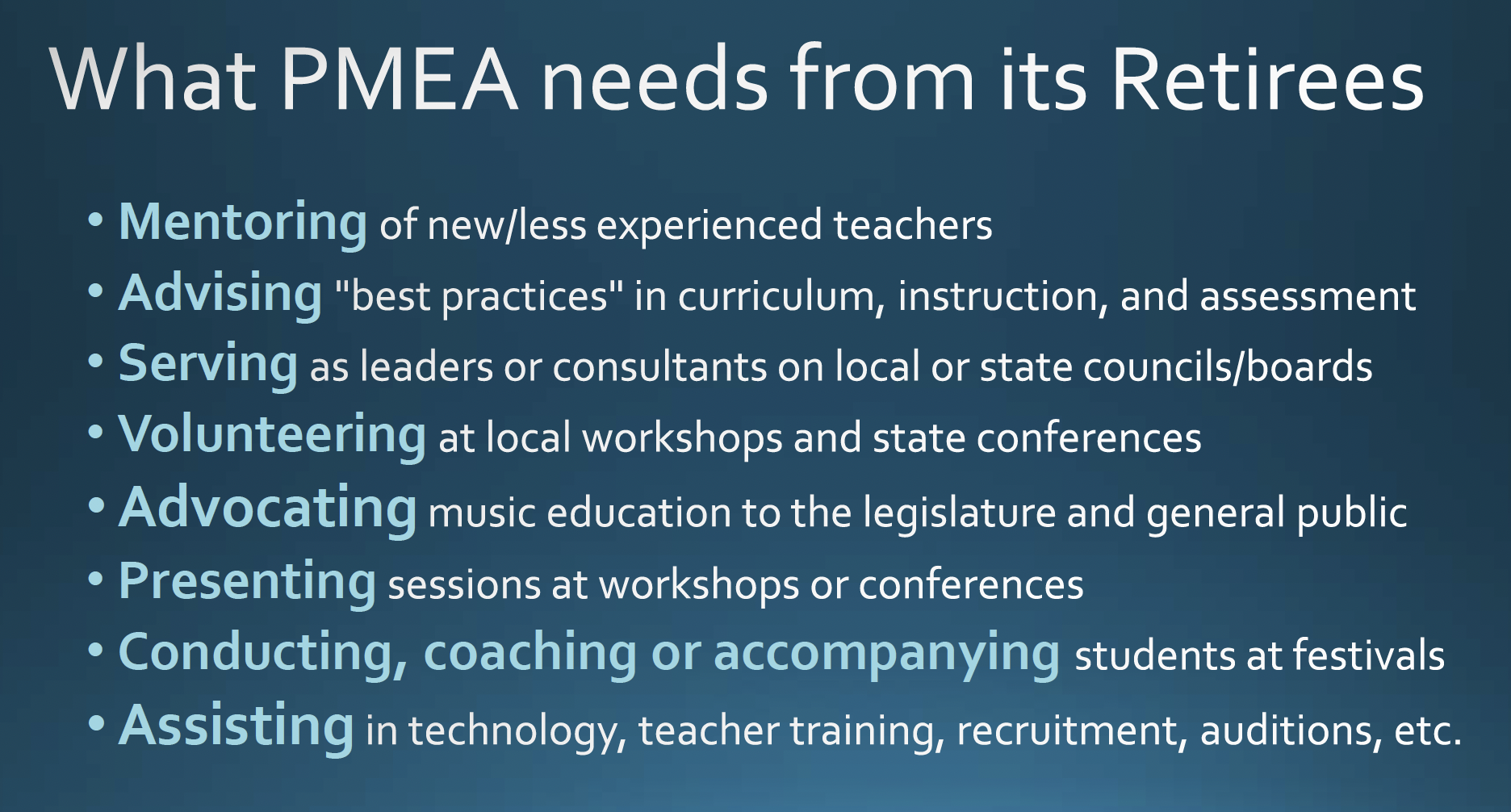
The benefits of retired MEA membership are numerous. Besides providing helpful transitioning advice, these advantages also come to mind:

  1. Answers to questions like “What have you always wanted to sing, compose, play, record, conduct, write, publish or present?” and “Where can I share my hard-won expertise and help others in the field?”
  2. Networks and contacts to help you develop “encore careers” in other musical or educational arenas (e.g., higher education, music industry, festival organization, travel/tour planning, composition, guest conducting, private studio teaching, church music, etc.)
  3. Opportunities to “rekindle your expressiveness” by participation in adult community or full/part time performance groups (playing “gigs”)
  4. Places to go/things to see/hear: NAfME/MEA conferences, workshops, and concerts
  5. Exclusive discounts and other benefits (reduced dues and registration fees)
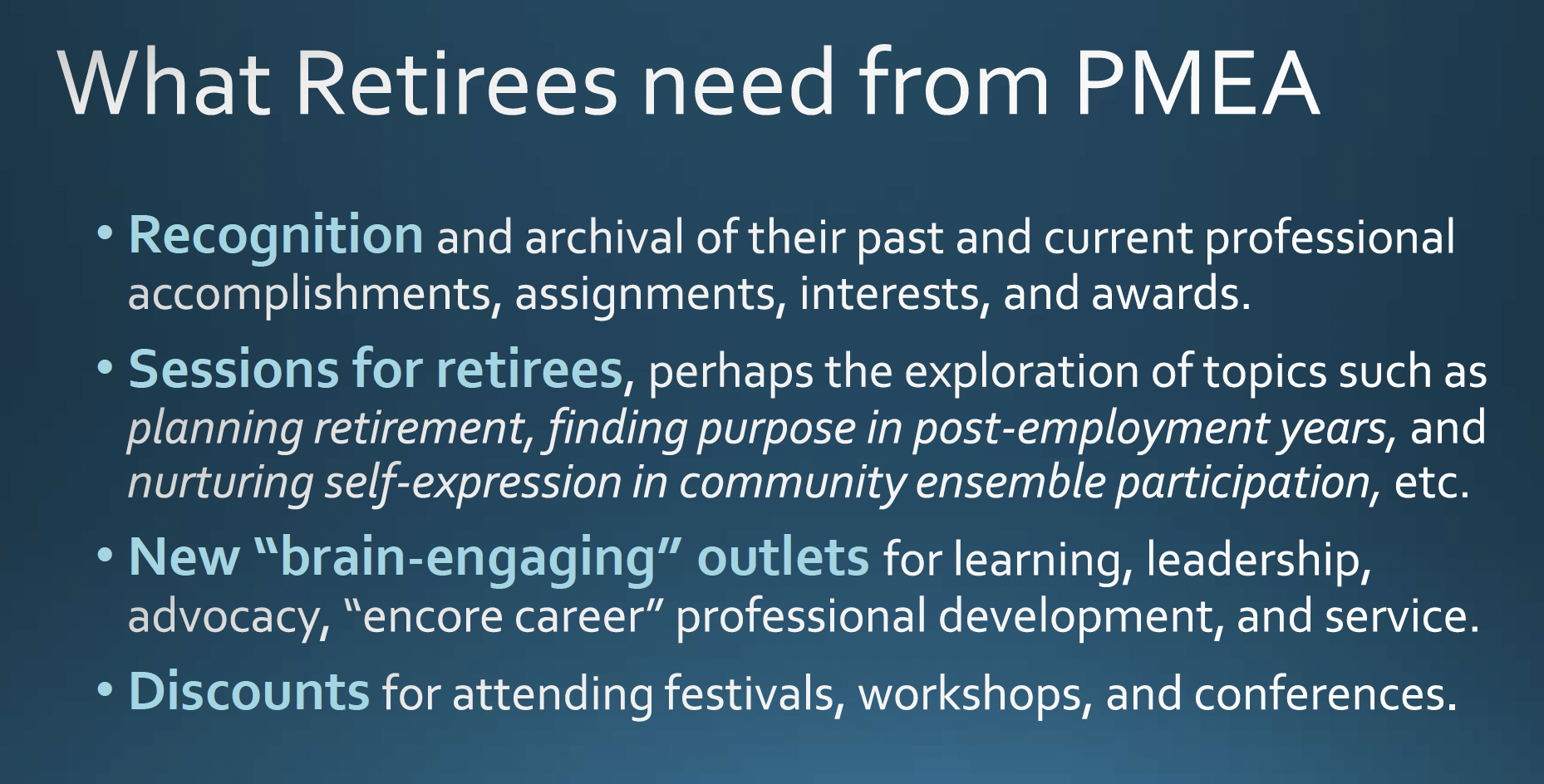
What can retirees offer NAfME and their state MEA?

The relationship of active and retired membership in our MEAs is symbiotic. We know from the history of our associations, “giving back to the profession” remains a high priority with most retirees. This may come in many forms and settings:

  • Leadership or membership in local, state, or national MEA/NAfME office, staff, advisor, or council/committee position
  • Advocates for the promotion of music education to local and state government officials
  • Service as presiding chair or member of the conference or workshop planning committee
  • Service as evaluator of performance groups, conference sessions, or articles for publication
  • Judges of local/state MEA adjudication or commercial festival
  • Accompanists, coaches, arrangers, or guest conductors for festivals or school/community groups
  • Services to the local music teacher in private teaching, piano playing, marching band charting, sectional coaching, choreography, music technology, instrumental repair, stage tech, etc.
  • Writers for state MEA and NAfME publications and blog sites
  • Contributors to online music education forums or the NAfME Connections
  • Donors to and/or fund-raisers of music education charitable projects, scholarship initiatives, etc.
The PMEA Model of Retired Member Participation
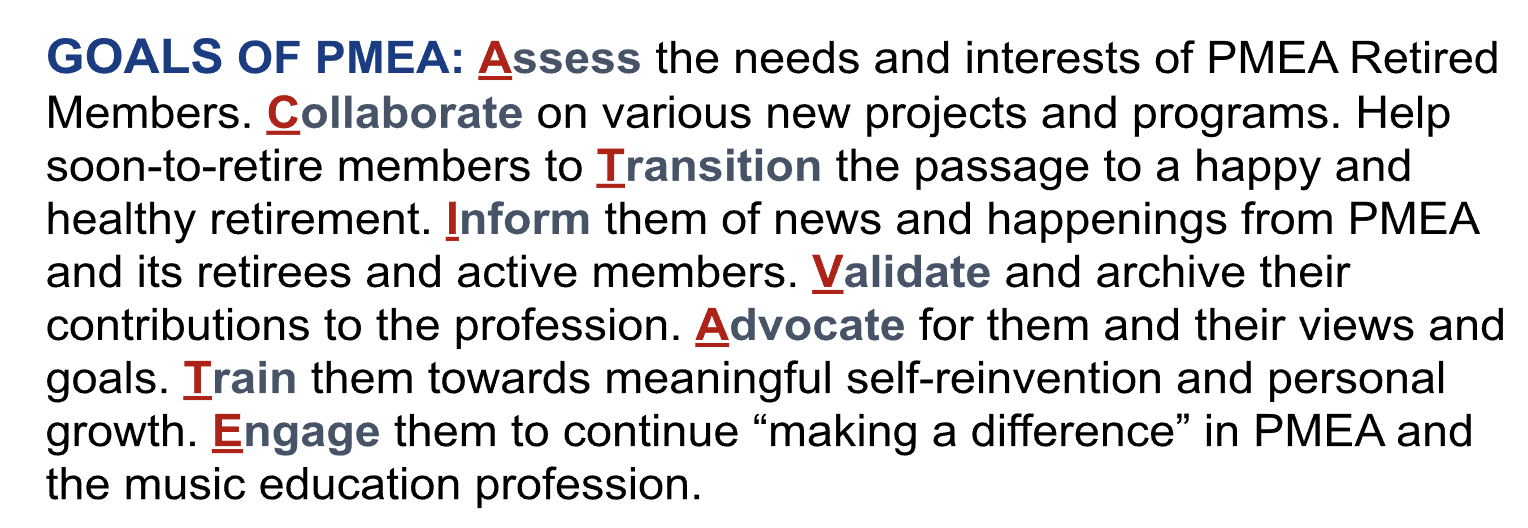
PMEA values the vast wealth of experience and contributions of our retired members. We’re proud of the many programs we offer to retirees and invite you to visit our website to peruse additional information and sample digital newsletters and articles.

Retired members in Pennsylvania are involved in:

  • PMEA elected and appointed offices, staff, committee chairs, and membership on councils
  • PMEA Strategic Plan and Bylaws, Conference Planning, and other state/regional committees
  • Retired Resource Registry* (informal mentoring for new teachers and transfers)
  • How-to-Retire Webinar, Prepping for Retirement, and the Ultimate Retiree Resource Guide
  • Retired Member Breakfast at PMEA Annual Conference
  • Retirement 101 (The Who, What, When, Where, Why, and How) session at PMEA Annual Conference (training for all members retiring or soon-to-retire)
  • Maintenance of PA Community Band, Chorus, Orchestra, and Theater group catalogs
  • Maintenance of PMEA member compositions library
  • Mock Job Interview Committee for music education majors
  • Coffee & Conversations informal “ask an expert” lounge at PMEA Annual Conference
  • Volunteering as presiding chairs for sessions and registration aides at conferences/workshops
  • Pool of conference clinicians, guest lecturers, and members on discussion panels
  • Participation in “Sponsor a Collegiate to Attend the Conference” campaigns
  • All-State Program Patron, or contributor to the annual Irene Christman Scholarship or Margaret Bauer Grant programs.
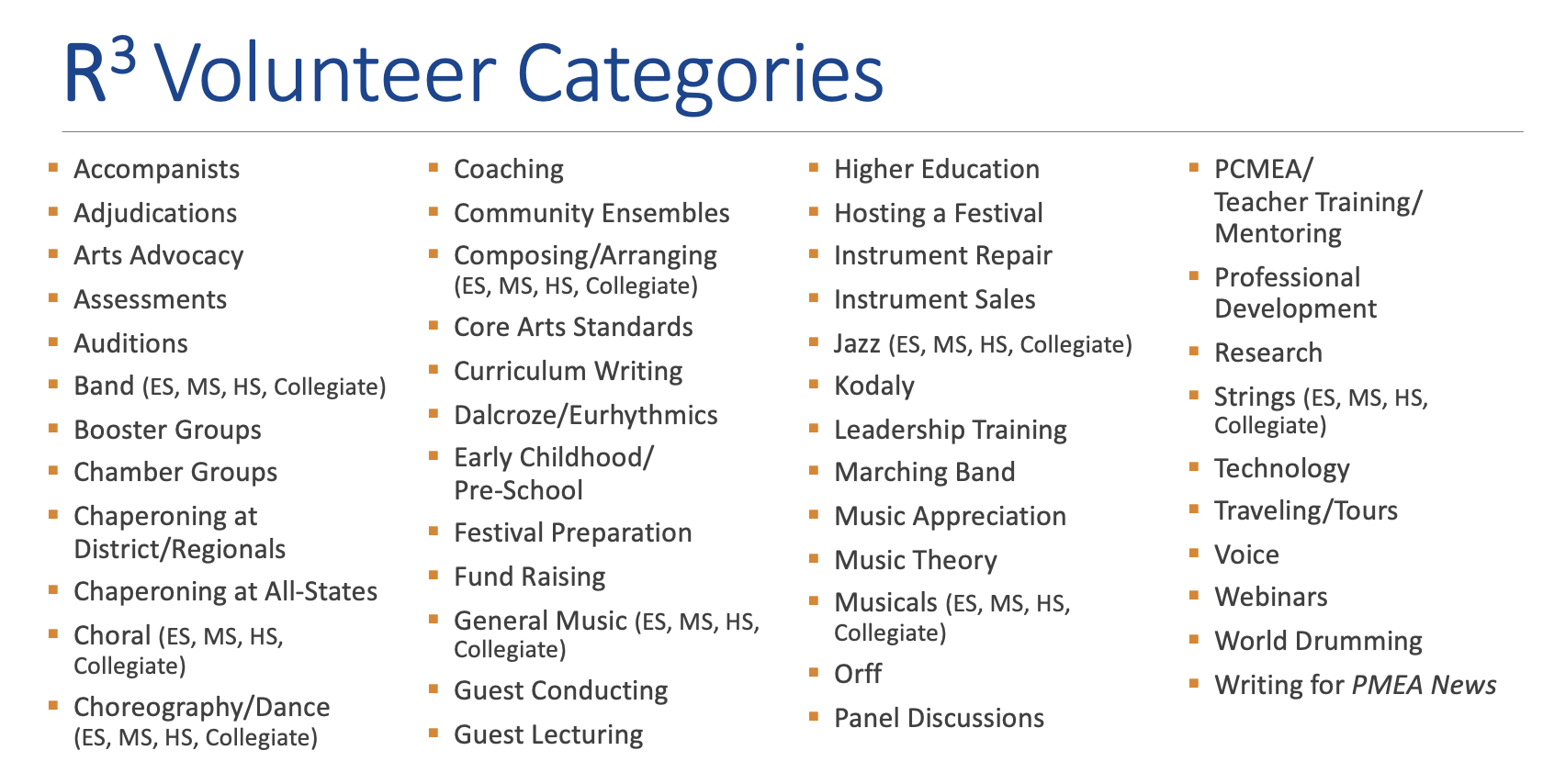
As of October 1, 2025, there are 61 advisors in the PMEA Retired Resource Registry.

*During their annual membership registration, PMEA Retired Members may choose to sign-up for the R3 Retired Member Registry (above volunteer categories) to become available to informally offer advice to college music education majors, new hires, transfers, and newcomers to any music specialty. R3 members may handle inquiries like “What warm-up would you recommend for my middle school choir?” OR “Do you have an idea for an elementary string ensemble concert opener?” OR “How do you teach improvisation… steady beat… breath support?”

The other option with more time commitment is that Retired Members can be officially “trained” as a PMEA Mentor and be assigned to specific individuals who request assistance in their early career assignments.

Coda

How can we help?

What is the future of retired music educator professional engagement? In a word: connections!

Last month, I reached out to Elizabeth Welsh Lasko, NAfME Assistant Executive Director for Membership, Organizational Development, and Marketing Communications and “volunteered” OUR assistance. I suggested that, in keeping with the NAfME 2022 Vision Statement “…an association where all people are heard, seen, and feel they belong throughout their lifelong experiences in music” we should all intentionally recruit more hands-on involvement of our retirees. I pointed out that in the late 1980s, we had a Music Educators National Conference (MENC) Committee for Retired Members led by a National Chairman who served on the NAfME National Assembly. (An excellent booklet, TIPS: Retirement for Music Educators, Copyright © 1989 MENC, was compiled by A. Verne Wilson, then the Past National Chairman of the MENC Committee for Retired Music Educators.)

Ms. Lasko encouraged me to “reach out to retirees” beginning with this article. At the next NAfME Eastern Division Conference, I plan to hold a meeting of retired members, and also connect with all state MEA retired member coordinators (those states who have them). We’re available and on the move! Let’s collaborate and share our resources!

Finally, just for fun, I recently posted the blog “For Book Lovers – Retired or Not” on NAfME Connections (formerly called Amplify). There are already 1,810 members in the NAfME “Retired Members Community.” Please JOIN US! Using this forum, get in touch with me, and respond with YOUR OWN retirement stories, strategies, perspectives on this “life passage,” and more ideas to grow the professional engagement of our music teacher retirees.

Happy trails!

© 2025 Paul K. Fox
In Defense of Dogs

Pet Ownership in Retirement

Part 5 of a series of articles featuring the “Foxes-and-Hounds” pack

I’m writing this blog at 3:30 in the morning because Brewster decided he needed to go out… three hours earlier than usual! Now, in lieu of struggling to go back to sleep, I decided to sit down behind my computer with one sleeping dog in my lap and reflect on my thoughts why I feel so lucky to have my two “pups!”

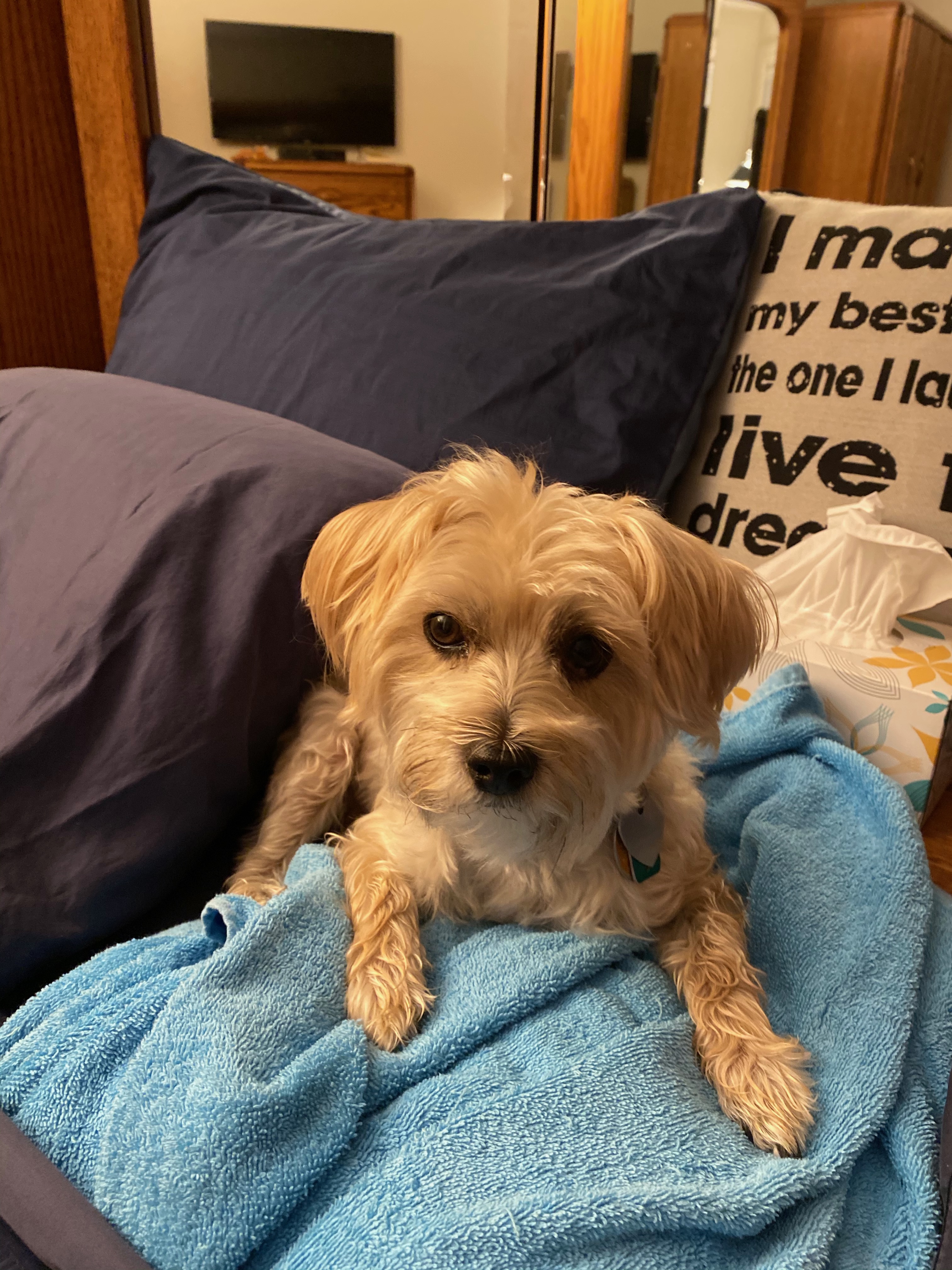
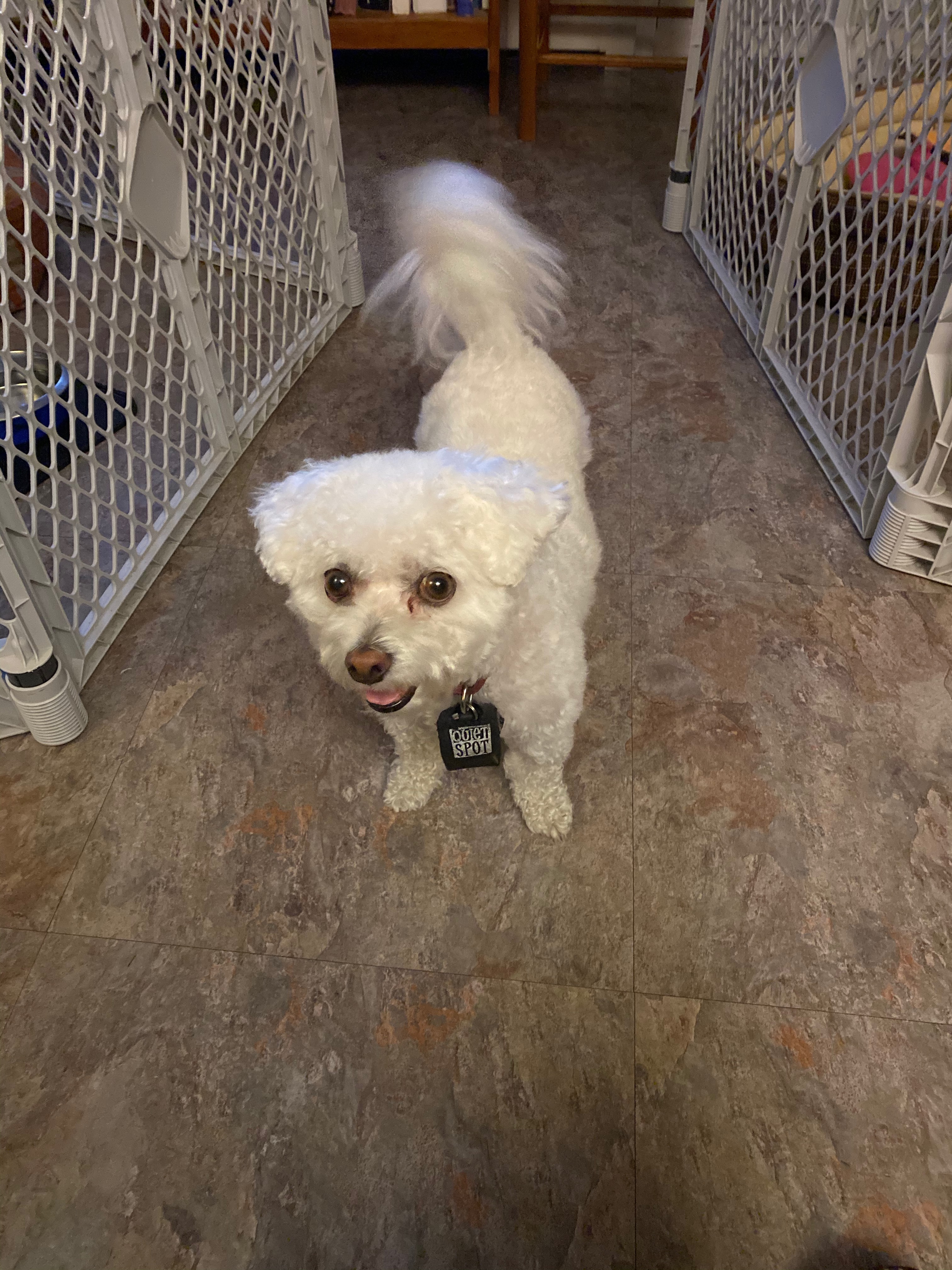
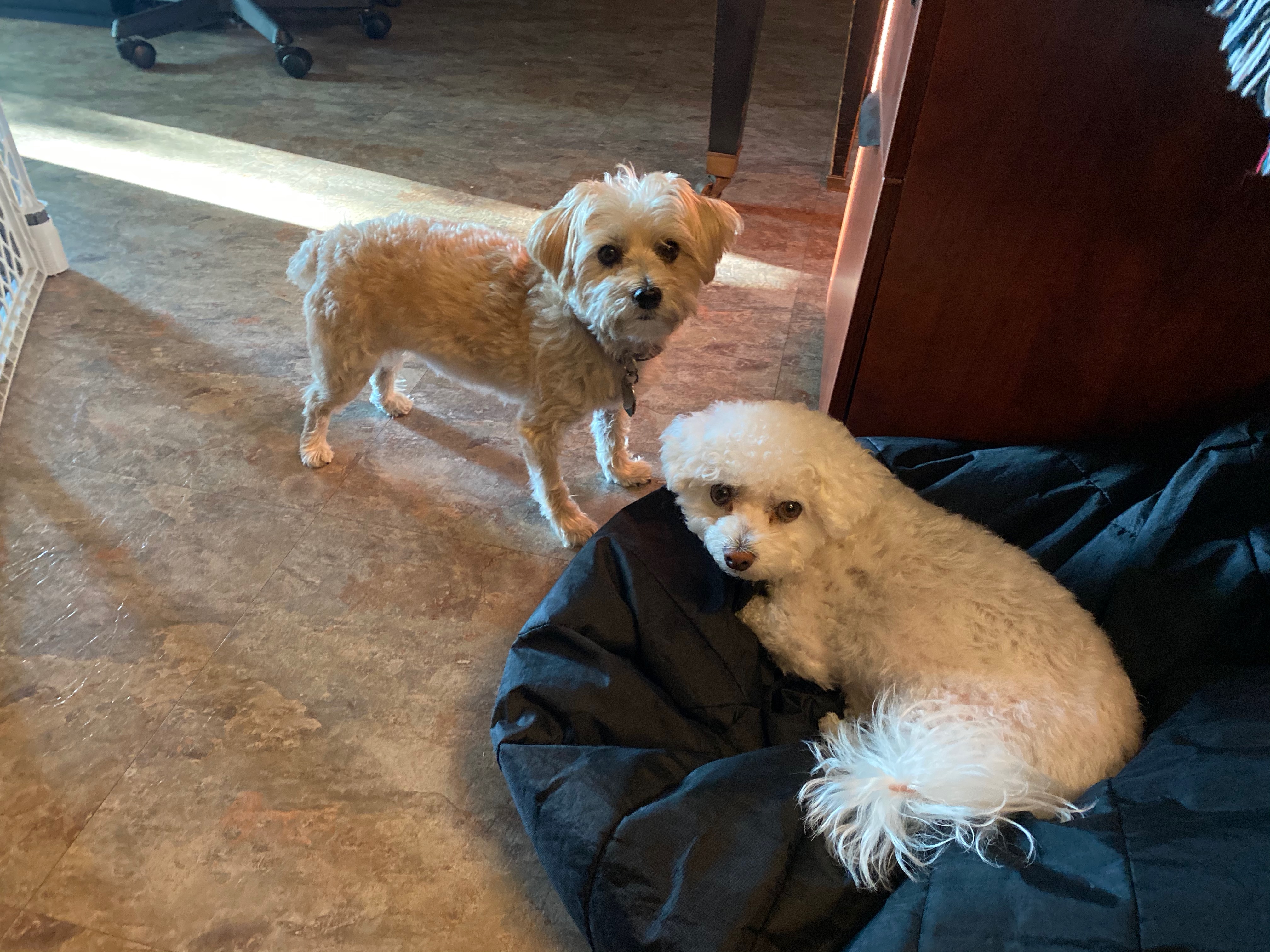
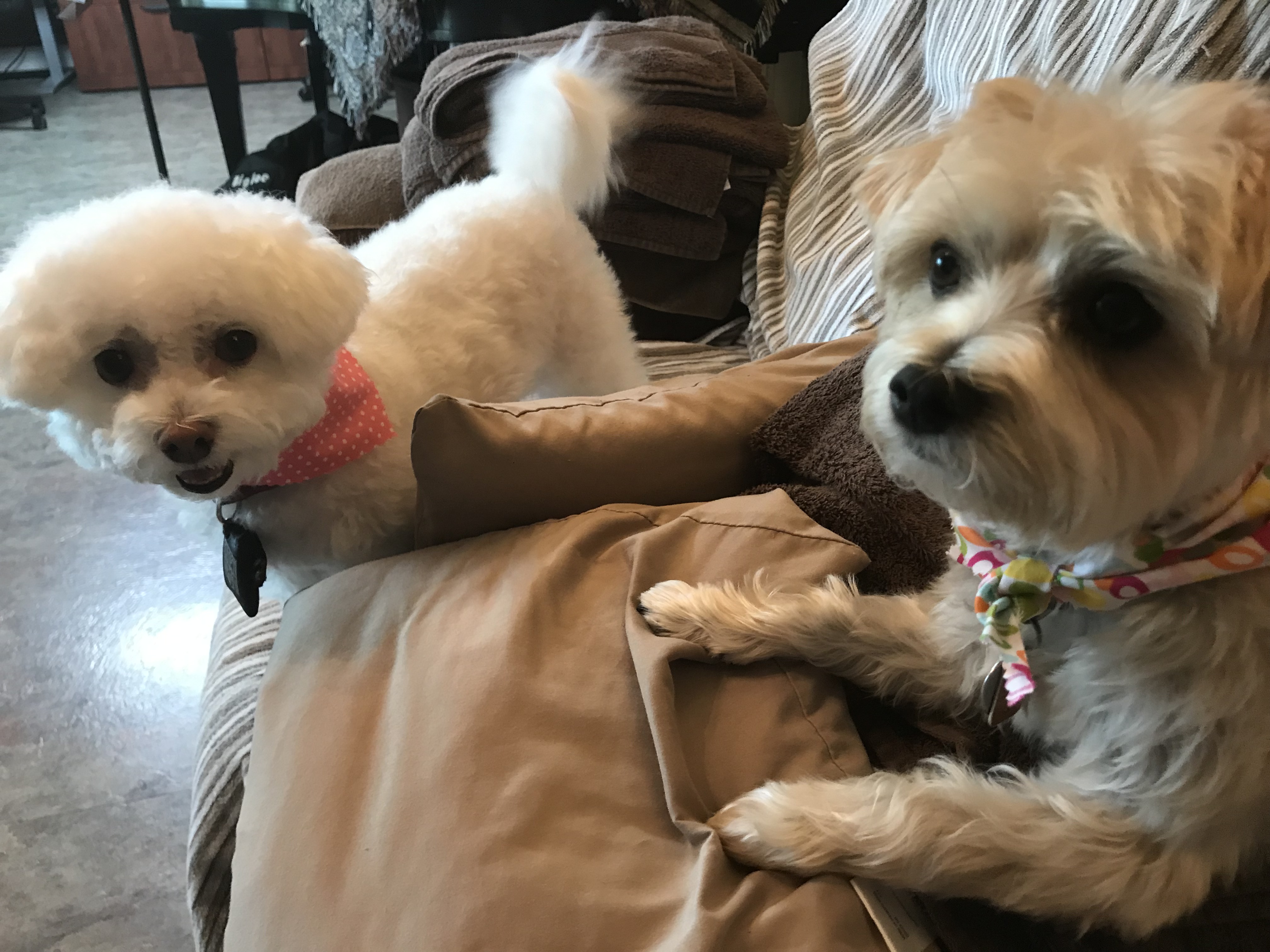
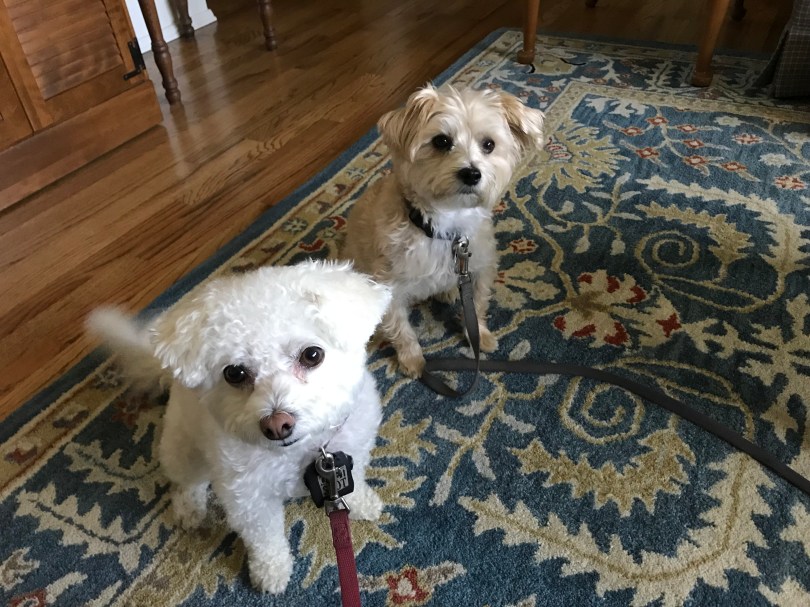
Like grandparents “bragging” about their extended family, dog owners have no compunction to stop and talk to perfect strangers and share their photographs and stories of their pets… especially the wonderful (and sometimes quirky) personality characteristics of their dogs! So, shamelessly, it’s my turn! Here are my two “love and joys” who joined our household literally months after I retired from full-time school music teaching in 2013. Get ready to smile… (and with my best marching band announcer’s voice): “We proudly present ‘Gracie’ (a female Bichon Frise) and ‘Brewster’ (a male Yorkiepoo, Yorkshire Terrier/Poodle mix).”

My wife and I would recommend to all retirees who are not planning to travel out-of-town a lot and are no longer facing that grueling 8-12 hour daily regiment of work (or volunteering) to consider caring for a dog. We knew we were going to take advantage of our major “life style” change when we left our careers… it was just a matter of what dog or dogs to pick… or which ones would pick us!

We went to a local outlet of a national pet store chain just to waste time “looking at the cute doggie beds and toys,” never expecting that they would actually sell puppies in cages from behind the glass! (Most experts would agree that to avoid the promotion of “puppy mills” and the dangers of acquiring unhealthy animals, you should only buy from a reputable breeder. But, this was an accident!) After determining there were no cat adoptions in the store (my wife is very allergic to their fur/dander), we walked in to view on the wall an amazing array of the most adorable four-legged furry companions begging for our attention. As we sat in the area designated as “pet introduction booths,” we sampled many young pups. Gracie picked my wife, and Brewster picked me – the rest is history!

Do individual dogs or breeds have personalities?

Brewster

According to the American Kennel Club and other sources, these specific characteristics are common. First, for Brewster:

“The Yorkiepoo is a high-energy, happy dog who’s often enthused about life. They thrive off attention and love to keep their family entertained and be the star of the show.”

“They love to play, and will be happy to take part in a quick game of fetch — but that will almost always be followed up with a desire for a cuddle (and maybe a nap on the couch).”

“Yorkiepoos quickly attach to their family, and will happily spend the day following their ‘people’ around the home. Their families are not the only people that Yorkiepoos like—they’re happy to see anyone, and will greet both friends and strangers with the same enthusiasm.”

“If you’re willing to play a lot with your pet, a Yorkiepoo is a great match.”

The Yorkiepoo Dog Profile by Whitney Coy (Rover.com)

Now, here are the tendencies for a Brichon Frise, our “Gracie,” minus the formal (fluffy) “show cut” that some purebred enthusiasts ask from their groomers.

Gracie

“Bichons are adaptable companions who get on well with other dogs and children. Alert and curious, Bichons make nice little watchdogs—but they are lovers, not fighters, and operate under the assumption that there are no strangers, just friends they haven’t met yet. Their confidence and size make them ideal city dogs. Bichons train nicely and enjoy performing for their loved ones. Finally, there’s the happy-go-lucky Bichon personality that draws smiles and hugs wherever they go.”

American Kennel Club

The American Kennel Club offers a lot of insight to help you match the dog breed to your own pet-ownership experience and life style. If you are thinking of rescuing or purchasing a new pet (especially if this is your first time), we recommend reviewing their dog breed selection site.

What about dog personalities?

Surfing the ‘Net, I came upon an intriguing but seemingly inactive set of websites (nonworking phone number, email address, and contact form) that propose to “analyze” dogs into these categories:

  • left brain introvert – “sofa spud”
  • right brain introvert – “status seeker”
  • left brain extrovert – “socialite”
  • right brain extrovert – “nervous nelly”

According to the mystery bloggers at (two different spellings) doganality.net and dogenlity.com, dog energy levels are critical to your pet selection.

“A dog’s energy level is a crucial component of its overall ‘Dogenality.’ Coupling their behavior with a form of temperament gives you a better idea of who your dog is, what it is that drives them, and how you should go about forming a relationship with them that will be mutually beneficial.”

https://dogenality.com/new-energy-levels/

They offer a free-trial “dogenality” assessment and even canine DNA testing. Watch Angie Wood’s video here and even peruse their other informative blogs here (posted in 2018):

  • Fear’s Effect on Dogs
  • Dog Psychology vs. Human Psychology
  • Does Your Dog Get Enough Exercise
  • Bringing Home a New Dog
  • Laser Pointer Syndrome in Dogs
  • Why Some Dogs Are Afraid of Men
  • Seasonal Dog Allergies
  • A Dog’s Work vs. Vacation
Brewster during COVID-19 “red phase” before pet grooming resumed.

In keeping with the paulfox.blog philosophy to research sources for further study, here are more (probably more current) sites to explore:

“Dogs come in all different shapes, sizes, and personalities. That’s part of why we love them. But it can be easy to fall into the trap of seeing your dog not as what they are, but as you wish they could be, and treating them accordingly. When we assume our dogs enjoy something just because they are dogs, we not only do them a disservice and set them up for failure, we set ourselves up for frustration when they fail to live up to our expectations.”

“All dogs, regardless of their breeding, are individuals. It’s essential to look beyond your dog’s breed to try to understand the traits that make up their personality. The better you know your dog, the fewer misunderstandings you’ll have in the future. As a professional dog trainer, I convey this message constantly to my clients.”

Dog Personalities from A to Z: Which One is Your Pup? by Shoshi Parks

The happy hysteria of day-to-day doggie life!

Can we go out for a walk?

As a dog owner, you expect to live many moments of basic insanity:

  • It takes years of experience for you to resolve the propensity of your two pups trying to go in opposite directions and tying you up with their leashes while taking a walk.
  • You keep buying them bones until at some point you discovered their larder is ridiculously large, encompassing a reserve in multiple plastic containers in three or four rooms throughout the house.
  • One of your cupboards is crammed full of treats, many of which were past purchases that were rejected “paws down.” You cater to the unique tastes of both dogs; of course, they don’t like the same things.
  • “You have been trained” to give out everything in pairs. At times, you take into account the alpha dog’s competitive spirit (Gracie) and her desire to steal the bone from the easy-going one (Brewster). That means you have on-hand two identical bones. If Gracie doesn’t get the bone that Brewster has in his mouth (the only one she wants), she barks him down until he gives it up. To keep the peace, after she grabs it and sets off to consume it, you unobtrusively hand Brewster another one.
  • On the day of your 40th wedding anniversary, you go out and buy one of the dogs it’s own desk chair so she can sit next to you while you’re on the computer. Yes, this means that since you have two dogs, there are two extra chairs cluttering up the space in your office.
  • Your dogs have more patience with little children than you do. As you walk them up the street, they suddenly jerk to a stop and stare at the front door of a neighbor’s house, waiting for the “human critters” to come out and play with them.
  • You acquiesce. One dog is frequently insisting that you pick him up and carry him with you. The other one, not as often. At times, Brewster can be stubborn and “hit the brakes” on a walk, simply refusing to go where you want him to go. Of course, as well trained as you are, you comply.
  • When one of your furry friends is having a bad day, you’re having a bad day. Black or blue moods spread very easily. But, in a snap of your fingers, life is joyful again, and yippee, all is forgotten.
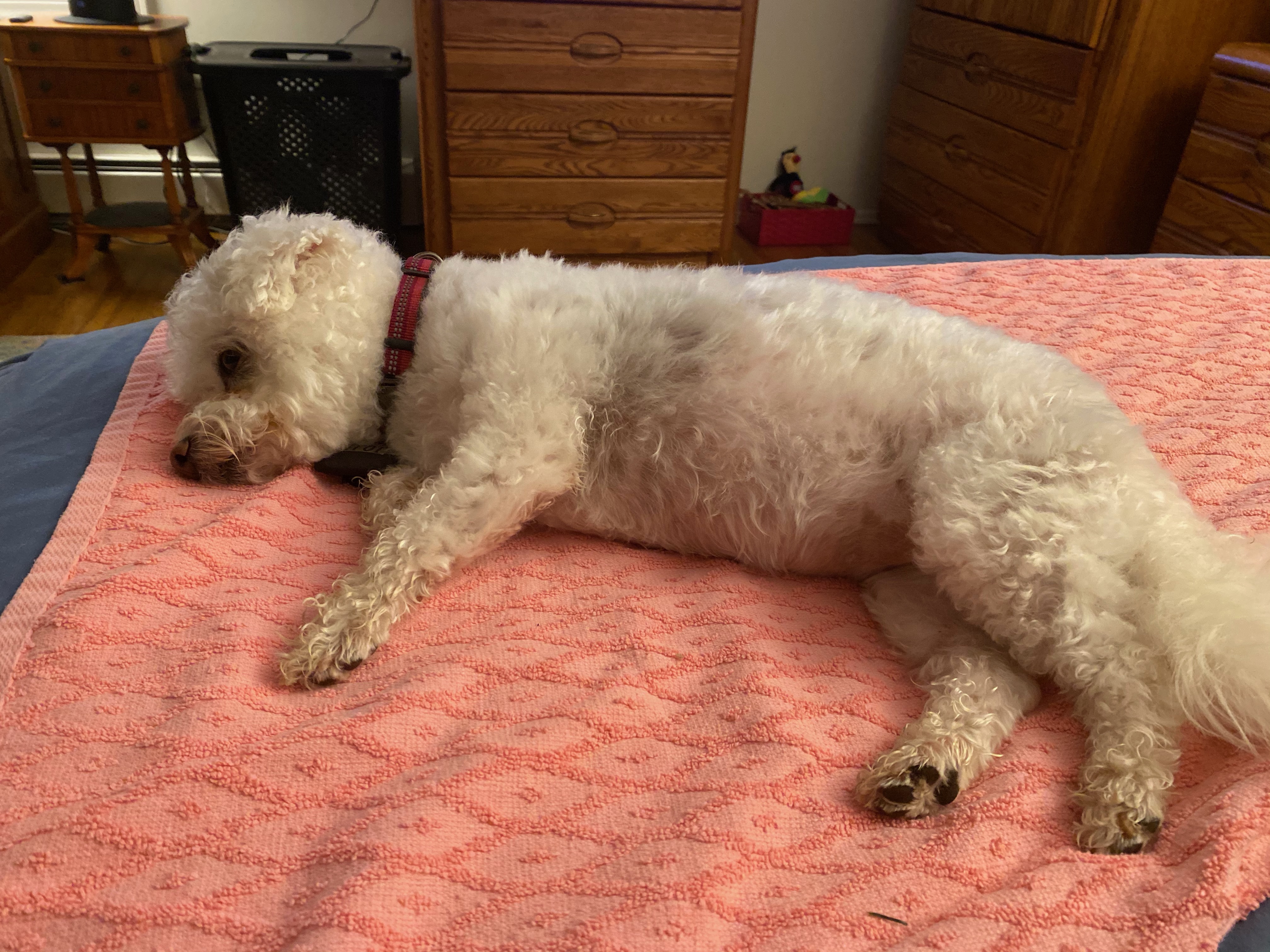
Gracie’s favorite spot on the bed

Who’s training whom?

Dog owners share a common vocabulary and unique language. Some of it sounds a little like baby talk… (Check out the American Kennel Club’s piece, Study Shows Dogs Really Do Respond to Baby Talk by Linda Lombardi)

  • “Wanna go outside?”
  • “Need to go potty?”
  • “Good dog!”
  • “Isn’t he cute?”
  • “Did you do this?”
  • “He did his number two.”
  • “This is puppy heaven!”
  • “She gave me a kiss!” or “Give mommy a kiss! No kiss?”

Ever count how many times YOU “cave-in” to your pet’s requests? They stare at you with those big sad eyes (“Daddy, please share a scrap of food from the table…”), and when the “alpha” spouse turns her back… (“Oh-oh, something just fell off the table!”)

Our pooches know how to distract us, reach directly into our hearts, make us smile no matter what our mood, and finagle yet one more treat out of the bag… and, yes, we love their trickery! Hey, exactly who is in charge, here?

You should read this amusing article from an obviously experienced dog trainer Casey Lomonaco writing in DogStarDaily. We dog owners only have ourselves to blame (if we even care about their “controlling behavior!”) For me: “Been there, done that, drank the Kool-Aid, and bought the t-shirt!”

FYI, I found a promising book on this subject: Who’s Training Whom? – Six Easy Lessons to Put Any Dog Owner Back in the Driver’s Seat and in Control of Their Dog. by Carols Puentes.

The best part – learning MY dogs’ quirks

There are times when Brewster’s and Gracie’s “doganalities” seem to be much more pronounced. Here are a few “fun” anecdotes!

  • You would think I just gave Brewster filet mignon, witnessing all the excitement of full-throttle chasing after, pouncing on, tossing around, and eventually chewing up an ice cube!
  • Gracie’s demonstrates her athleticism with a remarkable burst of energy to run up three flights of stairs to get on the bed to retrieve a bone.
  • One of Brewster’s favorite things-to-do is to jump onto “good grass” (devoid of branches, acorns, or leaves) rubbing his back in semi-circles as if doing the back stroke in a swimming pool. Of course, I have to pull up on his leash to stop him. (Wife is also allergic to mold and grass!)
  • Both Brewster and Gracie sleep with us in our queen-size bed. Did I say, they take up more than 2/3’s of the bed? Brewster needs to jam himself against me to nestle in the small of my back, while Gracie chooses a spot near my feet.
  • My two dogs like to play tug-a-war with one another, albeit very briefly, fighting over a toy or Brewster grabbing one of their beds with his teeth, taunting Gracie with it, and then dragging it across the floor.
  • Gracie’s internal clock is amazing, and so is her command of “people” language. At precisely 5 p.m. when she is usually fed, she jumps off the chair, stairs at one of us, and if we say, “ten minutes,” she sighs and goes over to her beanbag chair, only to return in exactly ten minutes to remind us “dinner is past due!”
  • No matter how I often I do it, when I nuzzle Brewster’s ear, he repays the compliment by licking my wrist. “Thank you, Daddy!”
  • To make house guests laugh (even our dog groomers), if you ever ask, “Need to go outside?” – Brewster will turn around and look at his butt.

You embrace their differences, laugh at the signature looks, gestures, and motions, and especially revel in their one-of-kind “prancing.” (Brewster hops like a kangaroo when he’s at his happiest times!) As educators, we know that “differentiation is essential.” It’s no different with dogs. And, you can always tell who’s-who in the dark by the unique sounds of their “gate” and the nails on our hardwood floors.

Unlike your human children or the students in your classes at school, you are always the centerpiece of their lives, what they live for, yearning to spend 100% of their time next to their “heroes” who can do no wrong, and (of course) they simply become the center of your life.

Recap: Rationale for fostering a furry friend!

So now that you are retired, have you settled on your self-reinvention and found the mandatory “purpose, structure, and community” referred to by best-selling author Ernie Zelinzski in How to Retire Happy, Wild, and Free?

For our Finale, these are Fox’s reasons for Finding a Forever yours pet!

  • Fitness (help you to get up, get moving, and get out of the house)
  • Forecasting (they seem to be able to predict your mood, the weather, or the Future, and they certainly know when something is going on outside)
  • Friendliness (despite COVID-19 restrictions, they Fight isolation and Favor meeting people and getting to know your neighbors – even a random passerby!)
  • One last burst of alliteration: Fun, Frivolity, Festivity, and Fascination (literally what they add to “the joy of life!”). You can’t beat that!

I invite you to revisit my other four “blogs on dogs!”

PKF

© 2020 Paul K. Fox

3 Simple Words – KEEP AT IT!

How Are You Spending YOUR Time?


FoxsFiresides

This is probably the most important message we can share with you during this period of coronavirus self-isolation.

learn-3653430_1920_geralt

No matter what this pandemic throws at us, or how long we remain away from close human interaction and participation in our ensembles or classes at the now closed “brick and mortar” schools, let’s keep a focus on maintaining our “chops,” building on our “musical momentum,” and practicing every day.

From an eco-friendly (“save our natural resources”) slant as well as an economist’s perspective, you have invested too much time and money on playing an instrument to give up now! So, nature and the COVID-19 have thrown you a few curve-balls these past seven weeks?

The only way we should respond to the challenge is to meet it head-on!

Take advantage of all of this available “free” stay-at-home time to further your artistic enrichment and make “new and improved” musical goals!

dual graphics

crying-146425_1280No teacher will have any patience listening to your whining or remarks of “could have,” “would have,” or “should have been” excuses. What have we always wished for? “If only I had enough time to learn that new scale, étude, or song!” “With all of my other academic assignments, sports events, and extracurricular activities, how can I fit in moments for listening to bands, orchestras, or classical virtuoso artists performing on the web?” “When am I ever going to have the chance to compose…” (or “arrange” or “record” or “memorize” or “conduct” or “choreograph”) “…that piece?” “When will I get around to learn this new technique, practice sight-reading, or dive into those drills designed to improve my key literacy, rhythmic precision, tone, intonation, range, form, coordination, embouchure, stick rudiments, or bow control?
The answer is… now only one word: NOW! 

What are you waiting for? You have too much at stake here, and soon, this crisis will pass, and we will all come back together – only much stronger and wiser for making good choices in the use of our time!

SHJOclips

We divided up the SHJO.clips into categories to develop your “well rounded” musicianship:

  • C = Create, invent, explore
  • L = Listen
  • I = Inspire, read, analyze
  • P = Practice, perform
  • S = Share, show others, play for fun

(Download the interactive CLIP JOURNAL here!)

How many of these have you accomplished? In your clip journal, do you show progress in all focus areas? Can you advise SHJO family members and directors on your recommendations on future projects to further our “collective” knowledge, skills, and appreciations in music? (We would LOVE to hear from you!)

Now get out there and learn, create, and share meaningful moments in music!

PKF


hi-res logo 2018The mission of South Hills Junior Orchestra, which rehearses and performs at the Upper St. Clair High School in Pittsburgh, PA, is to support and nurture local school band and orchestra programs, to develop knowledge, understanding, performance skills, and an appreciation of music, to increase an individual member’s self-esteem and self-motivation, and to continue to advance a life-long study of music. Members of the Orchestra learn, grow, and achieve positions of leadership to serve their fellow players.
(For more information about SHJO, please visit www.shjo.org.)

This and all Fox’s Fireside blog-posts are free and available to share with other music students, parents, directors, and supporters of the arts.

Click here for a printable copy of this article and the Interactive Clip Journal.

Other “Fox Firesides” are available at https://paulfox.blog/foxs-firesides/.


© 2020 Paul K. Fox

Photo credits from Pixabay.com:

“Campfire Stick Fire Flame Camping” by Free-Photos

“Learn Student Laptop Internet” by geralt

“Crying Smiley Emotion Sad” by OpenClipart-Vectors

Tis the Season for Musicals

Support and Participate in Your School Productions!

And now… a non-paid advertisement in support of MS/HS music drama programs… also perfect for celebrating “Music in Our Schools’ Month!” Please pass this on!

The coming springtime brings birds, flowers, bees, and… the magic of live theater! Lasting from early March to late May, the season of school musicals is now upon us! Here’s a friendly reminder from a retired public-school musical director/producer to attend one or more of your local shows! I guarantee it: You won’t be sorry! (For singers and instrumentalists already in a youth, church, or community ensemble, this is message is probably “singing to the choir!”)

dance-430553_1920_ bigter choiThe school musical allows all of the Fine and Performing Arts the chance to collaborate, create, communicate, and “come together” in the presentation of a new transformed art form… everything from acting, dancing, choral, chamber, and solo singing, and instrumental accompaniment… to costumes, make-up, sets, props, lighting, sound, and special-effects. The music and stage crafts “make the magic” to stir your imagination for an evening or matinee of wonderful entertainment and enlightenment!

Many of our local high school musicals secure the rights for the same licensed productions that you see in downtown professional productions (like Pittsburgh Civic Light Opera and PNC Broadway series in my area) – one might say “professional grade” intended to be performed by seasoned professionals and not “watered down.” But, regardless of the incredibly challenging vocal ranges, dance steps and athleticism, virtuoso musical passages, and instant scene changes, the students always “rise to the occasion,” and perform amazingly artistic, realistic, funny, serious, romantic, thought-provoking, and inspiring numbers, providing a once-in-a-lifetime opportunity to share with your entire family!

supercharge the musical box
https://paulfox.blog/2015/08/18/52-creative-tips-to-supercharge-the-school-musical/

The scripts and scores for each show provide only the barest information on how to put everything together. The directors, choreographers, and set designers have to determine the selection and placement of the cast on the stage (defining their blocking and all entrances/exits) as well as the kind of backdrops, props, and platforms to build, position, and move (in and out) from scene to scene. Because of this, I can offer you the assurance that no two presentations of a single production will ever be the same. In addition, no two shows performed at different sites will even be remotely similar. The variety and unique talents of the leads, chorus, dancers, pit orchestra, and production crews, as well as the vision and leadership of the artistic staff, will assure that the audience will experience many surprises and excitement every time they come to the theater!

Support your talented musicians, singers, dancers, and production-crew members. Buy a ticket. Invite other members of your extended family, coworkers, and neighbors to escape their wintry doldrums and enjoy an outing. Do you love theater? Consider volunteering to help the musical, assisting in the peripheral such as sewing costumes, distributing posters, selling tickets, building sets, painting the scenery, buying a program advertisement or well-wisher announcement, or chaperoning the parties. Contact the school’s musical director or Performing Arts chairperson to find out additional ways to help “make a difference” in your school’s Performing Arts.

ShrekThe school district at which I am proud to have served for 33 years as music teacher, 30 years as HS producer, and 7 years as Performing Arts Curriculum Leader is putting on SHREK – The Musical. Their “grand opening” for two weeks of shows is March 6, 2020 at 7:30 p.m. in the Upper St. Clair HS Theater, 1825 McLaughlin Run Rd., Pittsburgh, PA 15241.

What else is happening in our southwestern PA area? At the time of this blog-post, we learned of a few of these upcoming HS musicals. (Be sure to check in with your local district to find out what is playing, dates, and times, and how to reserve show tickets. If all else fails and you cannot find the announcement on their school website, call the building principal’s secretary who usually knows “what’s going on!”)

Sampling of High School Spring Musicals

(Southwestern Pennsylvania from March 5 to May 9, 2020)

  • Ringgold HS: Thoroughly Modern Millie on March 5-7, 2020
  • Upper St. Clair HS: Shrek – The Musical! on March 6-8, 12-14
  • Thomas Jefferson HS Disney’s Newsies! on March 12-15
  • Bethel Park HS: Guys and Dolls on March 18-21
  • Bentworth HS: Shrek – The Musical on March 19-21
  • Peters Township HS: Big Fish on March 19-22
  • Chartiers Houston HS: Beauty and the Beast on March 20-22
  • West Allegheny HS: 9 to 5: The Musical on March 20-22, 27-28
  • West Mifflin HS: The Addams Family on March 26-29
  • South Park HS: Chicago: High School Edition on March 26-29
  • Baldwin HS: The Addams Family on April 1-4
  • Burgettstown MSHS: The Music Man, Jr. on April 2-4
  • Brentwood HS: Annie on April 2-4
  • Elizabeth Forward HS: Drowsy Chaperone on April 2-5
  • Mt. Lebanon HS: Once Upon a Mattress on May 7-9

PKF


hi-res logo 2018The mission of South Hills Junior Orchestra, which rehearses and performs at the Upper St. Clair HS in Pittsburgh, PA, is to support and nurture local school band and orchestra programs, to develop knowledge, understanding, performance skills, and an appreciation of music, to increase an individual member’s self-esteem and self-motivation, and to continue to advance a life-long study of music. Members of the Orchestra learn, grow, and achieve positions of leadership to serve their fellow players.

(For more information about SHJO, please visit www.shjo.org.)

This and all Fox’s Fireside blog-posts are free and available to share with other music students, parents, directors, and supporters of the arts.

Click here for a printable copy of Tis the Season for Musicals.

Other “Fox Firesides” are available at https://paulfox.blog/foxs-firesides/.


© 2020 Paul K. Fox


Photo credits from Pixabay.com: “Staging” by Mauricio Keller and “Dance” by bigter choi

Creativity in Education… More Updates

It’s been awhile since I have ventured back into searches for “creativity in education” with blogging on the philosophy and practice of creative learning and creative teaching, two of the most essential needs (and deficiencies) in public school education.

After being inspired by the likes of Sir Ken Robinson (especially from his TedTalks), Ronald A. Beghetto and James C. Kaufman, Curtis Bonk, Eric Booth, Susan M. Brookhart, Susan Engel, Daniel Pink, Robert J. Sternberg and Wendy M. Williams, Robert and Michele Root-Bernstein, Roger von Oechand, Peter Webster, and many others, I periodically try to fulfill my ongoing mission of spreading the importance of fostering creativity in education, and finding research (and hands-on) material on the related subjects of innovation, inventiveness, curiosity, flexibility, adaptability, critical thinking, artistry, and self-expression.

Here is the latest installment of newly found resources for your perusal.

violin-1906127_1920_pixel2013

Creativity at Work

Linda Naiman, the founder of Creativity at Work, an international consortium of creativity and innovation experts, design thinkers, and arts-based learning practitioners, offers “trainings and workshops to help leaders and their teams develop the creativity, innovation and leadership capabilities required to adapt to change, stay competitive, improve business performance, and make a positive difference in the world. Clients include Fortune 500 companies, non-profits, educational institutions and government organizations.”

From a Creativity at Work blog, Seven Habits of Highly Creative People,  the following points are outlined in homage to Stephen Covey (Oct 24, 1932 – July 16, 2012):

  1. Prepare the ground
  2. Plant seeds for creativity
  3. Live in the question
  4. Feed your brain
  5. Experiment and explore
  6. Replenish your creative stock
  7. Play like a child: the secret to liberating your creativity


Newsweek-Logo

The Creativity Crisis

I don’t know how I missed this… Bo Bronson and Ashley Merryman wrote an education article, The Creativity Crisis, for Newsweek, posted on their website on July 10, 2010. Selected excerpts:

Back in 1958, Ted Schwarzrock was an 8-year-old third grader when he became one of the “Torrance kids,” a group of nearly 400 Minneapolis children who completed a series of creativity tasks newly designed by professor E. Paul Torrance. Schwarzrock still vividly remembers the moment when a psychologist handed him a fire truck and asked, “How could you improve this toy to make it better and more fun to play with?” He recalls the psychologist being excited by his answers. In fact, the psychologist’s session notes indicate Schwarzrock rattled off 25 improvements, such as adding a removable ladder and springs to the wheels. That wasn’t the only time he impressed the scholars, who judged Schwarzrock to have “unusual visual perspective” and ‘an ability to synthesize diverse elements into meaningful products.”

Today, Schwarzrock is independently wealthy—he founded and sold three medical-products companies and was a partner in three more. His innovations in health care have been wide ranging, from a portable respiratory oxygen device to skin-absorbing anti-inflammatories to insights into how bacteria become antibiotic-resistant. His latest project could bring down the cost of spine-surgery implants 50 percent. “As a child, I never had an identity as a ‘creative person,’ ” Schwarzrock recalls. “But now that I know, it helps explain a lot of what I felt and went through.”

Creativity has always been prized in American society, but it’s never really been understood. While our creativity scores decline unchecked, the current national strategy for creativity consists of little more than praying for a Greek muse to drop by our houses. The problems we face now, and in the future, simply demand that we do more than just hope for inspiration to strike. Fortunately, the science can help: we know the steps to lead that elusive muse right to our doors.

Newsweek: Bo Bronson and Ashley Merryman


man-816967_1920_TanteTati

Not to be outdone by Newsweek, TIME published a compilation The Science of Creativity – a series of articles divided into four large chapters:

  1. The Creative Animal
  2. The Creative Mind
  3. Creativity in Action
  4. Creativity at Any Age

The essays, penned by a myriad of authors, are eclectic and intriguing, many of which have appeared in past issues of TIME magazine:

  • The Science of CreativityIntroduction: Striving for the New
  • This Is Your Brain on Creativity
  • Learning from Leonardo
  • Under the Hood
  • Are Neurotics More Creative?
  • A Fine Madness
  • The Power of Sleep
  • Inside the Creative Space
  • Seven Secrets to Unleashing Creativity
  • Pushing Your Envelope
  • Does Screen Time Stunt Kids’ Creativity?
  • You’re Never Too Old
  • When Schools Get Creative
  • How Parents Can Excite and Inspire
  • Eureka Moments
  • The Last Word

Creativity is one of the most human of qualities. But what is creativity, and what makes us creative? The Science of Creativity takes a look at both the science and the art of this world-changing trait—how we define it, how we measure it and what encourages it. With insights from the editors of TIME, this new Special Edition features thought-provoking articles on the meaning of creativity, its part in human history and its role in our future. 

Amazon review of TIME special edition


nafme

Creativity in Orchestra

A recent NAfME article was written specifically for orchestral players and their music directors. Even after more than 43 years of conducting orchestras, I would have to admit that helping my instrumentalists to become more creative musicians has always been a challenge. In the Music Educators Journal, Volume 105, Number 3, March 2019, “Integrating Creative Practices into the Orchestra Classroom,” author Leon Park seeks to explore the realm of the “less traditional” in rationale, goals, and techniques to build the capacity of his students’ imagination, innovation, and creativity.

My primary objective as a high school orchestra educator is to help students develop and refine their perpetual and technical acuities as orchestra musicians – from understanding and applying proper instrument-playing technique in functional music theory as they relate to repertoire to reading and translating music notation with accuracy and confidence to interpreting musical compositions with an understanding of the composer’s intent and a sensitive sensitivity toward performing in an expressive manner.

The daily regime of helping my students of achieve these objectives is an extraordinarily enriching yet time-consuming endeavor. As such, I find that opportunities to engage students in experiences that reach beyond the purview of traditional orchestra musicianship – such as improvisation, songwriting, remixing, soundscape in, recording, and looping – are rare.

— Leo Park

After providing a list of hardware, devices, web apps, software, and iOS apps, Park proposes a series of exercises and other creative practices:

  • MEJDrone Improvisation
  • Circle Stringing
  • Soundscapes
  • Melodizing over Chords
  • Recontextualization
  • Songwriting

He also shares a video playlist of creative approaches, primarily string players engaging in creative music-making.

If you currently teach instrumental music, I recommend you read this piece. (You must be a member of the National Association of Music Education for access to its periodical Music Educators Journal.)

Creativity should be at the heart of all the affective areas of the curriculum. Its context is imagination, origination, and invention; but it goes beyond that to include interpretation and personalized imitation. Characteristically it calls upon preference and decision to a greater extent than other modes of thought. It is especially important as “a way of coming to know” through independent, innovative responses to ideas into means of expression.

— John Paynter in Sound and Structure


Educational Commission of the States

ECS_Vertical_Tag_1300pxIn a more recent release of EdNote (July 2018), How School Leaders Can Inspire Daily Creativity makes a good case that, “As building-level leaders, school principals play a key role in ensuring every student has access to high-quality and equitable arts learning as part of a well-rounded education,” citing numerous supportive sources:

The article concluded with the following salient statements:

From identifying the arts in a school’s budget to supporting student performances and gallery displays, principals can engage parents and the school community in the school’s educational goals.

While our [administrators’] daily routines may feel less inspired than other activities, it is through innovative ideas and acts of self-expression that shape everyday life as we know it. The arts can provide students with these same opportunities, setting them up for success in school, work and life.

EdNote: Cassandra Quille


creative-869200_1920_Foundry


The Conversation

Check out What Creativity Really Is – and Why Schools Need It  by Liane Gabora from The Conversation.

Associate Professor of Psychology and Creative Studies, University of British Columbia, Gabora explores “the creative process” in studies from the Interdisciplinary Creativity Research Group.

She examines sorting out these apparently antipodal/opposing concepts:

  • The Conversationinventors vs. imitators
  • creators vs. conformers
  • innovation vs. over-stimulation
  • devaluation of creative personality attributes such as risk taking, impulsivity and independence vs. focus on the reproduction of knowledge and obedience at school

She shares three insightful suggestions on cultivating creativity in the classroom:

  1. “Focus less on the reproduction of information and more on critical thinking and problem solving.”
  2. “Curate activities that transcend traditional disciplinary boundaries…”
  3. “Pose questions and challenges, and follow up with opportunities for solitude and reflection.”


fantasy-2890925_1920_KELLEPICS

Additional Links

A couple more “finds” for your reading pleasure:

Hopefully, readers/followers of this website will send in their own “gems” on creativity. Please feel free to comment and share your own references… so we can collaborate on and re-energize this dialogue.

If you have not had the opportunity to read my past blog-posts on creativity, please take a moment and examine these:

Now go out there and… teach, learn, and be creative!

PKF

© 2019 Paul K. Fox


wooden-train-2066492_1920_Couleur

Photo credits in order from Pixabay.com: