Stamp Out the PHOBIA of Amateur Music-Making

Expanded from “Recreational Music-Making,” published in the Fall 2024 UPPER ST CLAIR TODAY magazine.

The definition of a “phobia” is “an anxiety disorder involving excessive and persistent fear of a situation or object.” It is known that exposure to the source of the fear may trigger an immediate anxiety response. And, according to the National Institute of Mental Health, approximately 12.5% of adults in the U.S. will deal with a specific phobia in their lifetime.

Some of the most common phobias include arachnophobia (fear of spiders), acrophobia (fear of heights), aerophobia (fear of flying), claustrophobia (fear of enclosed spaces), mysophobia (fear of germs), and trypanophobia (fear of needles), to name a few.

But why on earth do we have a “fear of amateur music-making?”

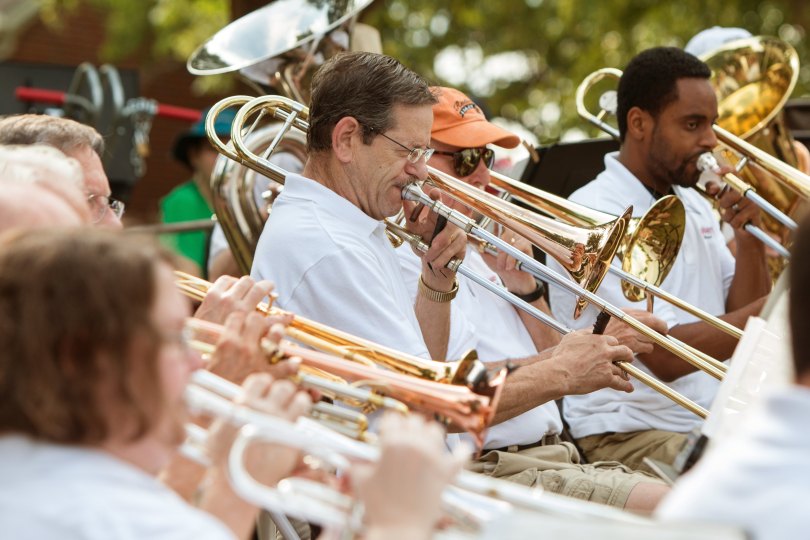
Okay, I doubt there is any true rational cause for anyone to be afraid of picking up an instrument or singing in a group, except for a touch of stage fright (if it’s in public) or that always-present “fear of failure” (possibly resisting the urge to make a fool of ourselves?). But, making music or opening ourselves up to creative self-expression is one of the greatest gifts we have to personally experience and share. No one hesitates to play a game of cards, catch a ball, or swim with the kids… even if “we are not all that good at it!” So, why are some adults so reticent about letting down their hair, finding and dusting off that old band or string instrument in the attic, warming up their “chops,” brushing up on the fundamentals, and playing a few notes? Remember all the fun you had in school music? (Sure, you might be more than a little rusty, but that’s understandable. Do you recall your music teacher’s instructions on how to hold the instrument, read the notes, and “find” the fingerings? It’s not too hard to re-orient and recapture those early steps.)
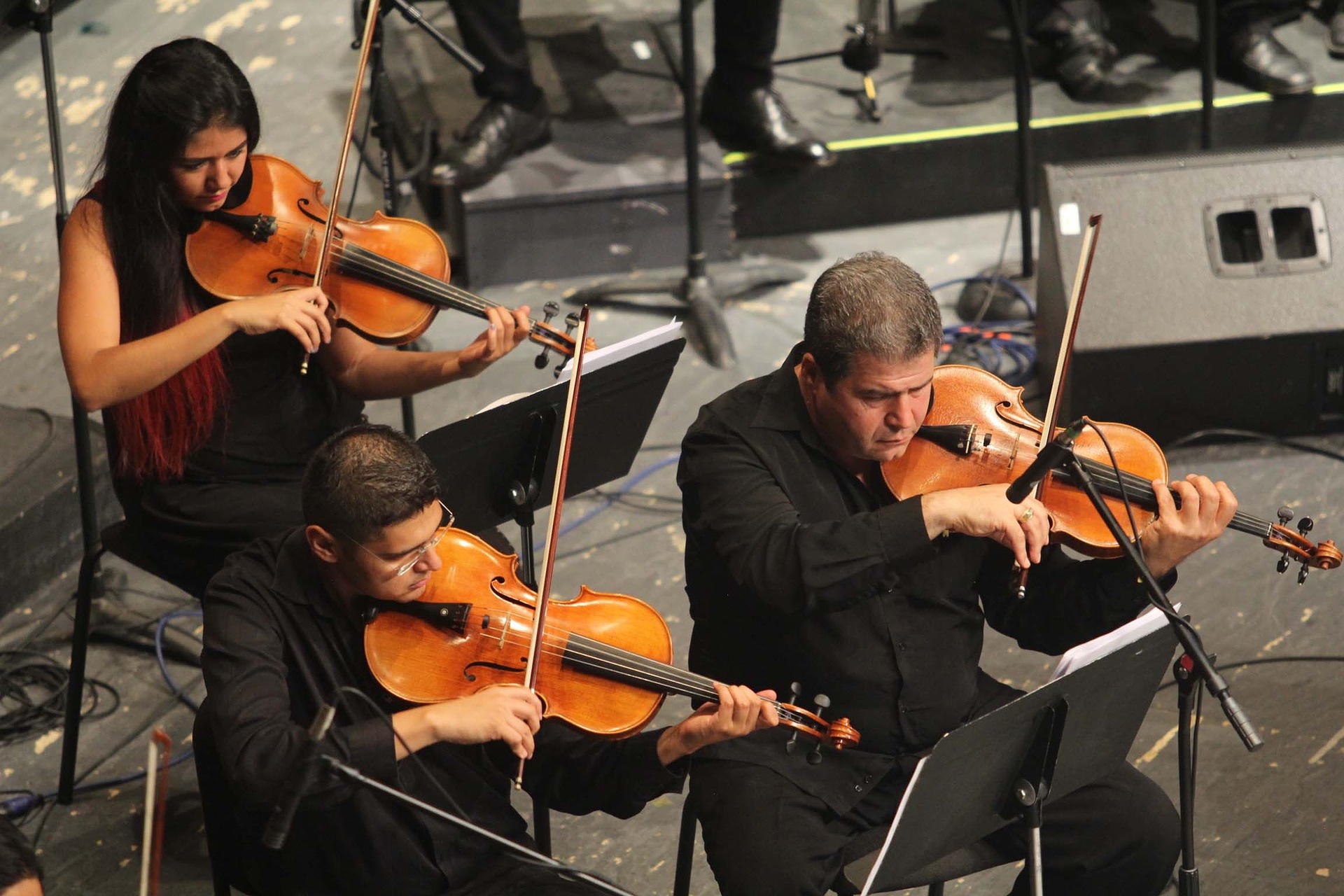
We can and should be inspired by those breathtaking performances of professional musicians, singers, dancers, and actors – their amazing artistry always looks and sounds so perfect! But are you telling me that art is only for the virtuosos, maestros, or experts? No, music is for everyone! It is timeless and does not discriminate by age. It offers meaningful life-long learning for all stages, past experiences, and ability levels.
As if you really need stats to prove the benefits of music, please peruse the NAMM Foundation website here: https://www.nammfoundation.org/articles/2014-06-01/Benefits-learning-and-playing-music-adults. They quote “the value of recreational music-making to be scientifically proven” to help the U.S. workplace by reducing employee stress, depression, burnout, and improving worker retention. In addition, as a music teacher and former school choral and orchestra director, I frequently share this quote by Don McMannis in “Use Music to Develop Kids’ Skill and Character” from the March 19, 2009 online post of Edutopia:

“Music has positive effects on people’s emotions and creativity. When we sing together, we synchronize our breathing and feel more connected. Music is also an effective, almost magical medium for learning and retaining information, [because] it activates three different centers of the brain at the same time: language, hearing, and rhythmic motor control. By inducing emotions, it also creates a heightened condition of awareness and mental acuity…”
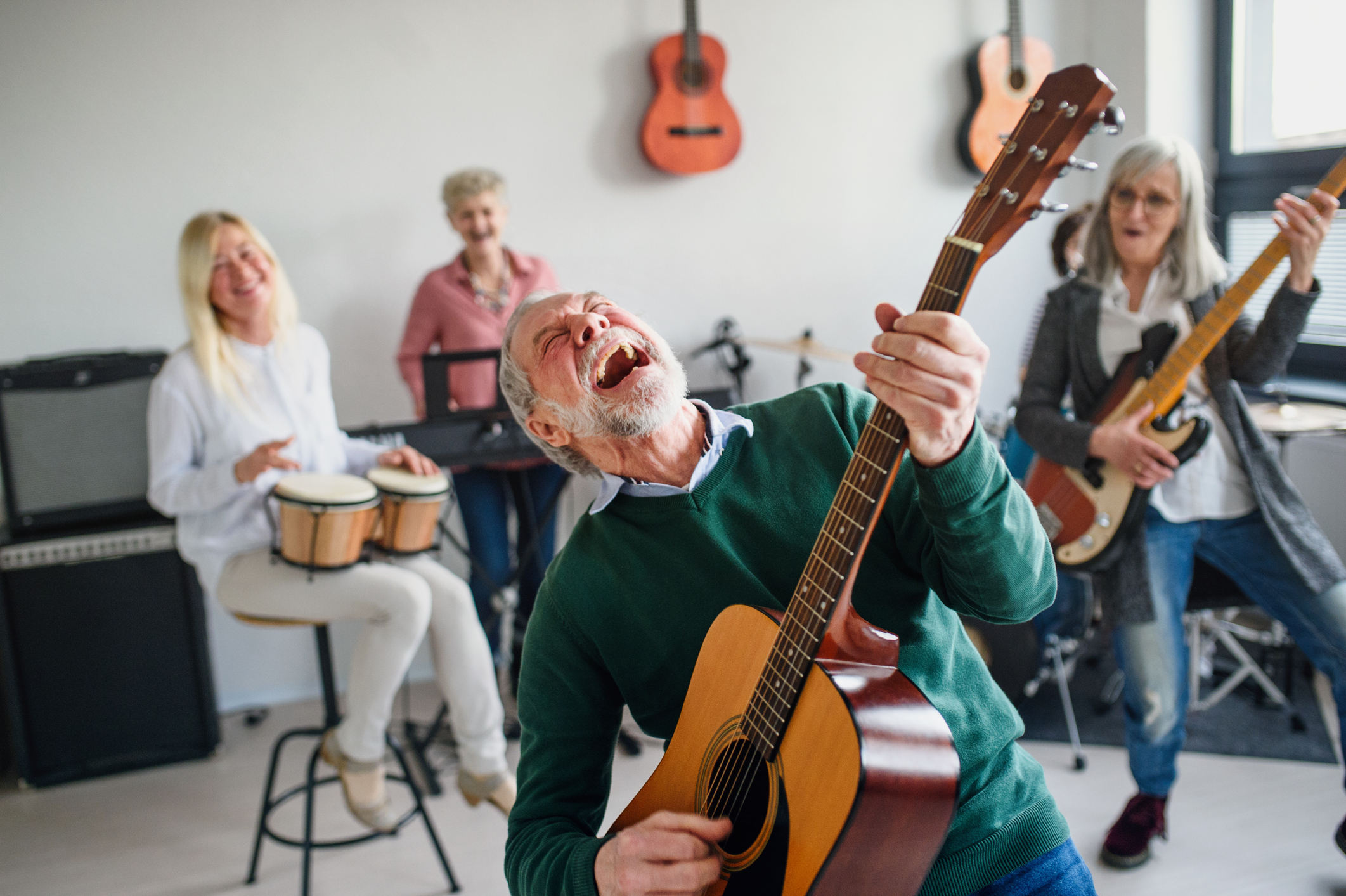
As for “us seniors,” there are so many amazing benefits of music lessons throughout our “golden years!”

  1. Cognitive well-being (“reduce the risk of cognitive decline…”)
  2. Emotional resilience (“provide a powerful outlet for self-expression and emotional release…”)
  3. Physical benefits (“improve motor skills, enhance coordination, increase overall physical activity…”)
  4. Stress reduction (“therapeutic escape from daily worries… relax and unwind…”)
  5. Lifelong learning (“promote a sense of ongoing personal growth… the joy of learning and mastering new techniques…”)
  6. Social connection (“bringing people together… combat social isolation… and create a sense of belonging.”)

Check out additional information at the New York Musician’s Center blog here: https://nymcmusic.com/f/the-remarkable-benefits-of-music-lessons-for-senior-citizens

Truly, you have no valid excuses! I am guessing there are many community choral, jazz, band, and orchestra ensembles inside and outside the surrounding areas where you live. And don’t forget to consider visiting a local church to join their choir!

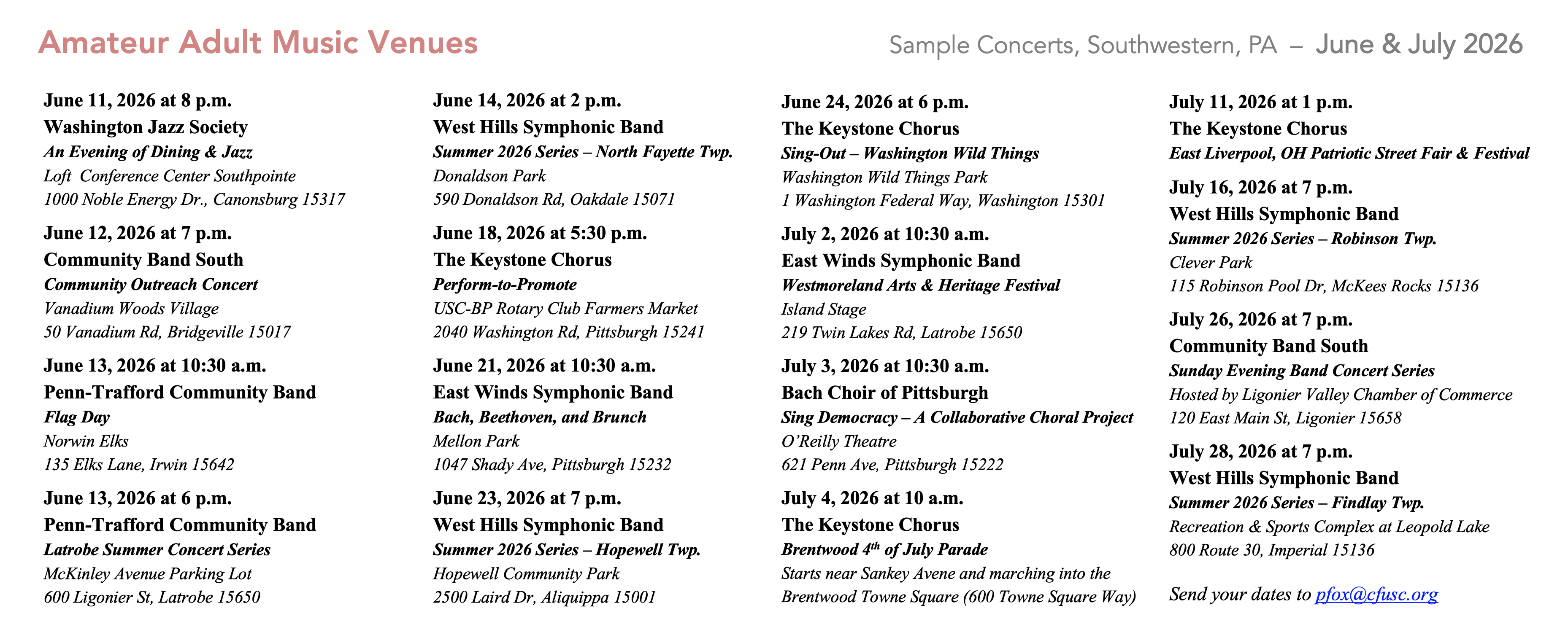
In the southwestern Pennsylvania area where I reside, there are numerous opportunities for getting involved in adult amateur music, art, dance, and drama venues. I have the links to 20 ensembles from the Greater Pittsburgh area alone on the Community Foundation of Upper St. Clair Arts page here. Take a look at a few of their upcoming June and July concerts below.
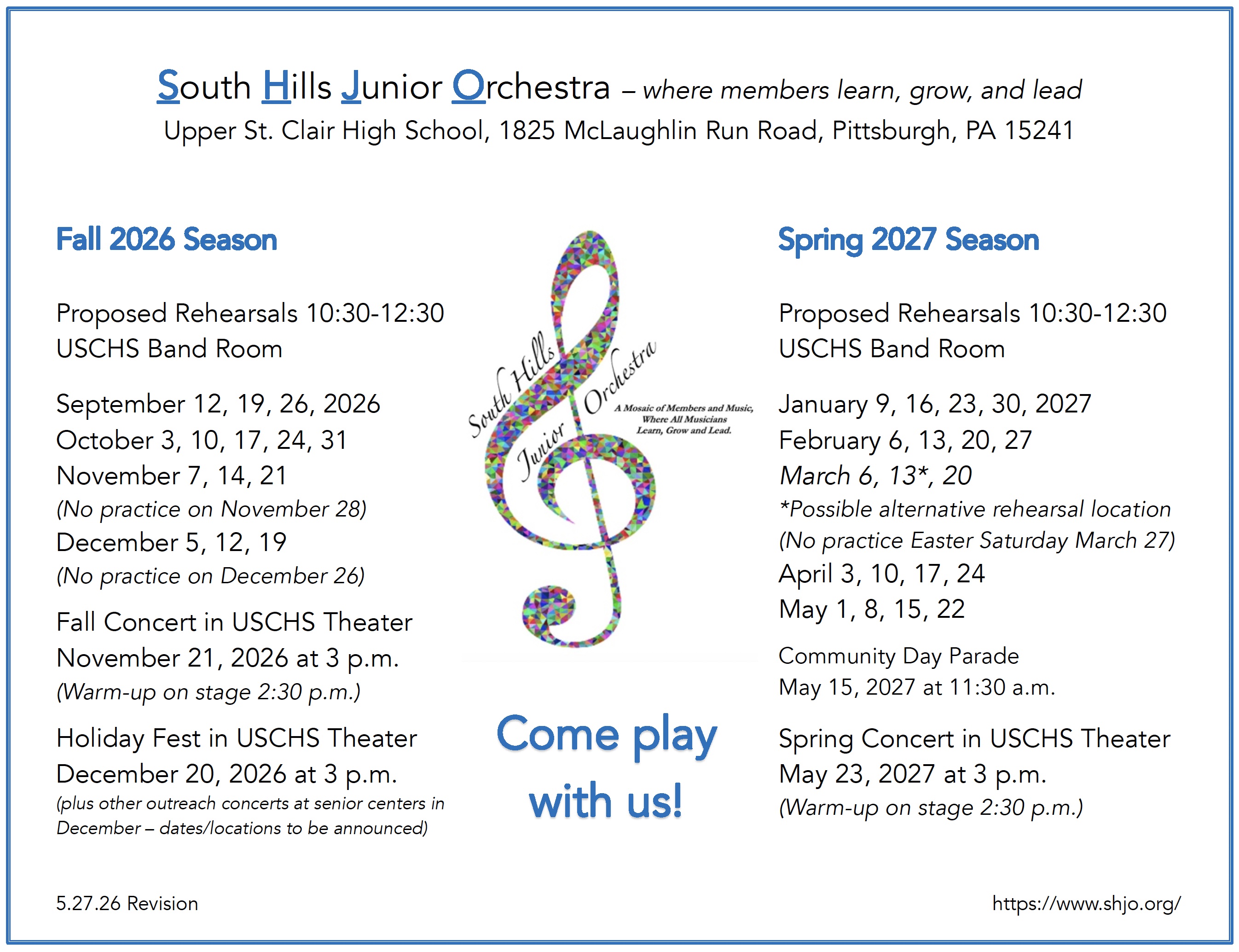
This fall, adults and “music lovers of all ages” should drop-in to several open, free-trial, no-obligation-to-join rehearsals of the South Hills Junior Orchestra (SHJO) on Saturdays from 10:30 a.m. to 12:30 p.m. in the Upper St. Clair High School (USCHS) Band Room. After the successes of SHJO’s annual spring concert on May 23 and a community outreach performance at the Paramount Senior Living Facility in Peters Township on May 30, we’re taking a break over the summer. But mark your calendars! Our next practice is scheduled for September 12, 2026. Here are our proposed dates for 2026-27:
If you live in the South Hills/Pittsburgh area, musicians are also invited to another group that rehearses at USCHS, the Community Band South (adults only). Directed by Max Gonano, CBS meets most Monday evenings at 7:30 p.m., even over the summer months! Bring your instrument!

The next time you host a dinner party, bring out that old song book or pick up your fiddle or flute! Gather around the piano and encourage your family and friends to join in a sing-along. Hopefully it does not take a few glasses of wine before everyone can shed their inhibitions and relax a little… and enjoy the incredible effects of communal music-making! What do you have to lose? There’s no time like the present!

Stamp out the phobia of amateur music-making!

PKF

© 2024, 2026 Paul K. Fox
Transitioning from Collegiate to Professional – Part III

The Final Leap from Pre-Service to In-Service:

The Metamorphosis and Integration of Philosophy, Maturity, and Teacher Preparation

trumpet-1495108_1920_congerdesignTo “wrap-up” our final segment, we will review the development of a professional “marketing plan.” This is blog #3 out of 3. (Be sure to also check out #1 and #2, too.)
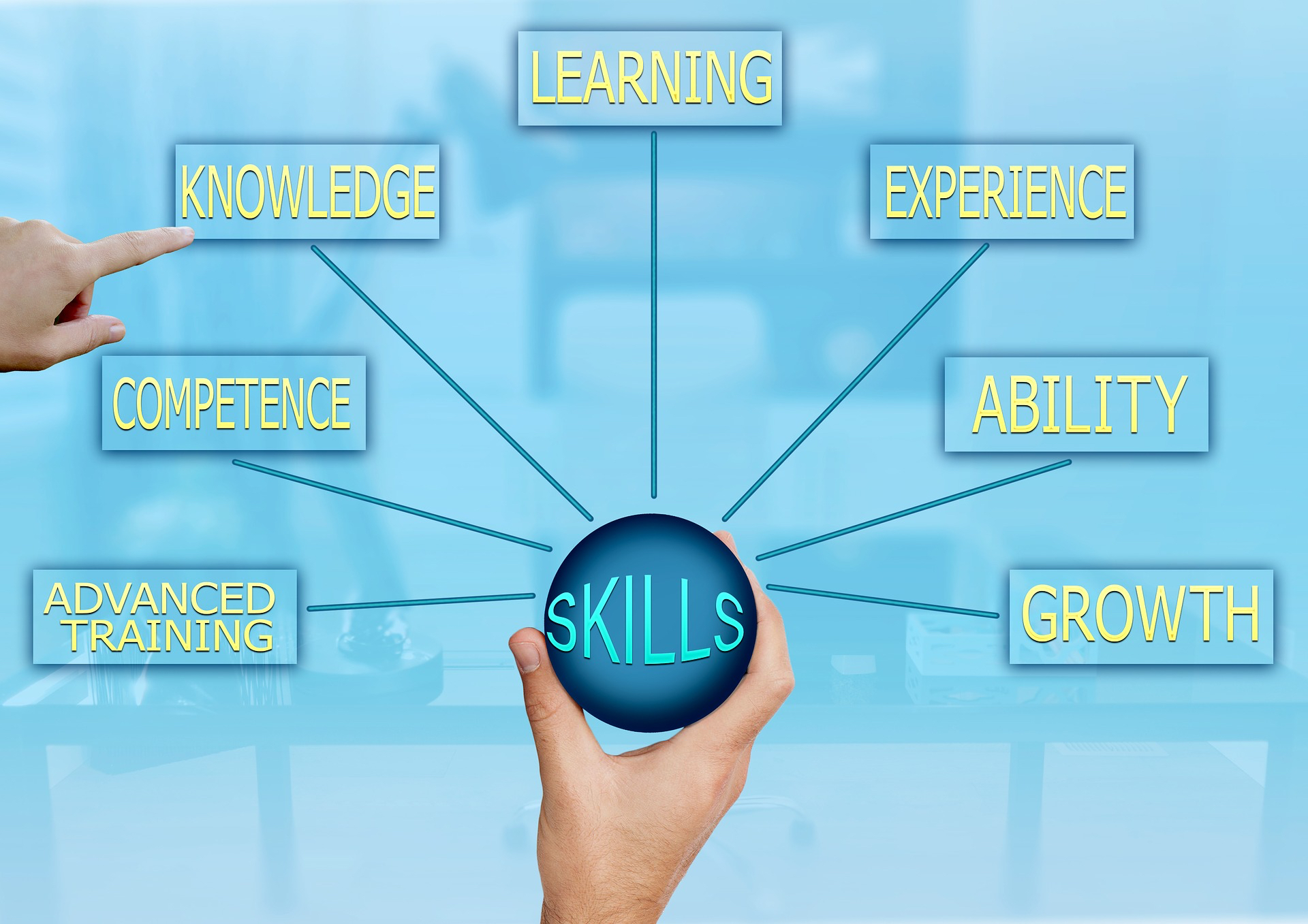
These are three critical skills you need to foster in the search for a school music position, marketing yourself, interviewing, and landing a “good” job:

  • Personal branding (who are you, what makes you unique, and what do you have to offer?)
  • Story telling (anecdotes) of your positive attributes and personal brand, including a record of your habits of “engagement” in music education, and
  • Networking (associating with other professionals and getting your positive stories “out there”).


skills-3262172_1920_diwou

branding

Personal Branding

“Personal branding is the practice of people marketing themselves and their careers as brands. While previous self-help management techniques were about self-improvement, the personal-branding concept suggests instead that success comes from self-packaging… Personal branding is essentially the ongoing process of establishing a prescribed image or impression in the mind of others about an individual, group, or organization.”

– Wikipedia: https://en.wikipedia.org/wiki/Personal_branding

What is the difference between marketing and branding? According to some, “marketing is what you do, branding is what you are.” (www.tronviggroup.com/the-difference-between-marketing-and-branding/)

phone-2840244_1920_RobinWiggins13Shama Hyder posted “7 Things You Can Do to Build an Awesome Personal Brand” at http://www.forbes.com/sites/shamahyder/2014/08/18/7-things-you-can-do-to-build-an-awesome-personal-brand/, including the following outlined summary:
  1. Start thinking of yourself as a brand
  2. Audit your online presence
  3. Secure a personal website
  4. Find ways to produce value
  5. Be purposeful in what you share
  6. Associate with other strong brands
  7. Reinvent

During these waning months for college music education seniors, now is the time to finalize the preparations for personal branding and beginning the employment search! Personal branding is critical to help you “stand above the rest,” showing that you have what it takes and would be a major asset to a prospective employer, and defining and marketing your own unique qualities that would make you “a good fit” for the specific job openings.

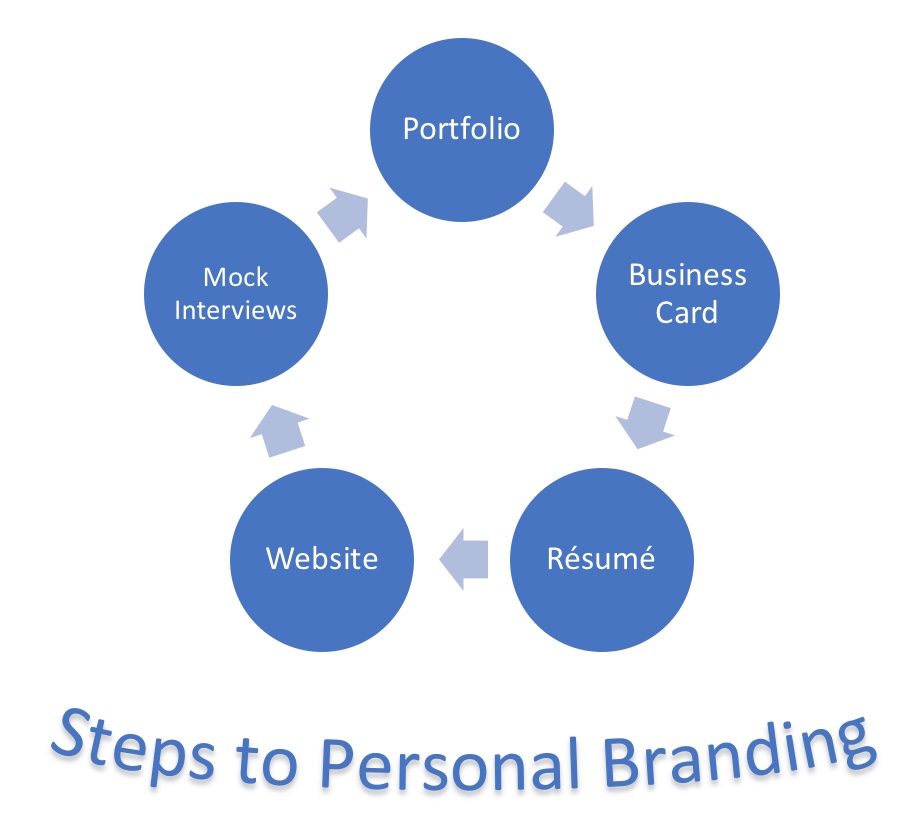
Steps to Personal BrandingThe branding process involves first developing your philosophy of music education, archiving your awards and accomplishments, documenting your grades and ok-3061659_1920_RobinHiggins12experiences, and collecting stories/personal anecdotes of your strengths. The next steps include the creation of a written and electronic portfolio, business card, resume, and website. Finally, you must compile/assemble everything together and practice (and self-assess) your “story-telling skills” to answer those important questions at well-rehearsed “mock interviews.”


You will likely not have enough time to complete all of these tasks during methods classes or student teaching seminars. That’s okay. If you are serious about prepping yourself to find a great music teaching job, the valuable links (see below) and articles are out there… just manage your time and start reading.

feedback-2990424_1920_geralt

networking

Networking

According to the article “Network Your Way to Secure a Teaching Job” at https://resumes-for-teachers.com/job-search-help/teacher-network/, many people are unaware of the basics of networking and how to use them it to their advantage in securing a job:

“Networking simply refers to finding job-related contacts. Most teachers who are just beginning their careers may feel that they have few, if any, networking contacts in the teaching field. It is important to consider the many different areas of networking as you create your own group of networking contacts to help you secure a teaching job. It is interesting to note that many of the teaching positions that are filled each year are filled by those who came to the attention of personnel managers by recommendation.”

“Always think about adding to your teaching network. When meeting new people, be certain to add them to your network. Talk to them about your skills, education, experience, and learn about their jobs. Make sure that you always ask for a business card.”

Do you have a business card? Is your résumé updated and available online on your professional website?

young-3061653_1920As I laid out in a previous blog “Networking Niceties: The ‘How-To Schmooze’ Guide for Prospective Music Teachers” at https://paulkfoxusc.wordpress.com/2016/04/04/networking-niceties/, the concept of networking is two-way communications. Just like collective sets of nerve synapses, two-way connections are expected to fire repeatedly in all directions. That’s actually the science behind memory. For professional networking, it is your “charge” to create multiple pathways to/from school HR managers and secretaries, administrators, music supervisors and department heads, and music teachers… and YOU – your skills, accomplishments, unique qualities, experience, education, and personality traits.
pcmeaThe above blog-post also explores setting up a good organizational system to manage your professional contacts.
If you are a Pennsylvania collegiate member (PCMEA), I heartily recommend the article “Networking 101” by Dr. Kathleen Melago, PCMEA State Advisor and Associate Professor of Music Education at Slippery Rock University, published in the Summer 2017 issue of the state journal PMEA News (pages 40-42). Here are several quotes from her work:

“One of the most common ways music educators can plan to network is at conventions. First, try to avoid interacting only with people from your school or people you already know from other schools. Go to sessions that interest you and look for opportunities to meet people there. Before the session starts, introduce yourself to people sitting around you. Use your social skills to assess whether they seem like they want to engage in a conversation or not. After the session, go up and meet the presenter.”

“Of course, social media is another great way to build your network. Networking with professionals already in the field can help you see what they are doing and help you build ideas of what you would like to do in your program someday.”

“Sometimes, you might find yourself networking unexpectedly. For example, you might go into school to work with their clarinet section during band camp and just happened to meet the choir teacher. That is networking!”

“To help your networking be most effective you need to have good communication skills. When interacting with others in a networking situation, be sure to focus on the person with whom you are speaking. Avoid looking off into the distance as if you were to anticipating someone else more important coming by. But your cell phone away and be present to the conversation.”

“Be yourself in your networking interactions. If you pretend that you are someone you are not, you will either end up unhappy or you’ll be discovered is someone who is not genuine.”

Dr. Melago goes on to provide a myriad of excellent examples of networking skills and opportunities.

Another resource specifically for networking at music teachers conferences is posted at https://nafme.org/getting-music-conferences/.


music-1237358-2 ricardo vasquez


engagement

Engagement

Here is an excellent definition of “professional engagement” from “Domains of Teaching” of the Australian Institute for Teaching and School Leadership at https://www.aitsl.edu.au/teach/understand-the-teacher-standards/domains-of-teaching.

Teachers model effective learning. They identify their own learning needs and analyze, evaluate and expand their professional learning, both collegially and individually.

Teachers demonstrate respect and professionalism in all their interactions with students, colleagues, parents/carers and the community. They are sensitive to the needs of parents/carers and can communicate effectively with them about their children’s learning.

Teachers value opportunities to engage with their school communities within and beyond the classroom to enrich the educational context for students. They understand the links between school, home and community in the social and intellectual development of their students.

Engagement for prospective music teacher may include synonyms like “participate,” “enroll,” “join,” “be active,” “volunteer,” “seek experience,” and “make a difference!”

Are you a member of your professional music education associations?

  • NAfME National Association for Music Education
  • PCMEA Pennsylvania Collegiate Music Educators Association, or another state’s local NAfME collegiate chapter
  • pmeaPMEA Pennsylvania Music Educators Association, or another state’s NAfME-affiliated MEA
  • ACDA American Choral Directors Association
  • ASTA American String Teachers Association
  • NBA National Band Association

Did (or will) you attend your state music teachers’ conference and local workshops on music education and professional development?

To prove you are “professionally engaged,” I would expect to see a consistent record of modeling in the following areas:

  1. excited-3126449_1920_RobinHiggins9Self-reflection of the professional’s teaching practices and modification of these as needed to match changes in the environment and circumstances
  2. Self-assessment of the professional’s methods and approaches, as well as the progress of the students’ learning, using both formative and summative methods for constant and ongoing improvement
  3. Identification and planning of professional learning needs.
  4. Unsupervised (or unplanned by school administration) goal-setting and self-guided implementation of opportunities for professional development
  5. Association with professional learning communities, school and community meetings, and other collaborative projects
  6. Volunteer service in music and music education
  7. Membership and subscription to music education journals and participation in online professional community discussion groups

Many have said that aspiring to be a music educator is a lot like a calling. One school superintendent I know said he expected prospective new recruits to show high energy, enthusiasm, sense of purpose, and dedication during the interview… even a supposed willingness to “lay down in front of a school bus” or “do what ever it takes” to make the students (and the educational program) successful. That’s engagement!

classical-music-1838390_1920_Pexels

In summary, becoming a music educator is about finding your inner confidence, a mindset that you know what you’re doing, and that you’re ready for that real world experience. You’ve learned those essential skills in conducting, piano accompaniment, arranging, student behavior modification and discipline, music diagnosis and remediation, and even how to market your professionalism. Now… drum roll, please! Here’s… a master music teacher!

target-3306771_1920_geralt

In closing, here are supplementary materials to help you to “get your feet wet,” all free and available online. The following lists, although not comprehensive, are a good place to start (courtesy of https://www.pmea.net/wp-content/uploads/2012/10/Collegiate-Communique-No11-022218-2.pdf):

Good luck!


Personal Branding, Marketing, and Networking

Business Cards

Résumés

Portfolios and Websites

Interview Questions, Techniques, and Skills of “Story-Telling”


PKF

© 2018 Paul K. Fox


Photo credits (in order) from Pixabay.com: “tutor” by nrjfalcon1, “trumpet” by congerdesign, “skills” by diwou, “phone” by Robin-Higgins, “OK” by Robin-Higgins, “feedback” by geralt, “young” by Robin-Higgins, “music” by ricardo-vasquez, “excited” by Robin-Higgins, and “classical-music” by pexels.