
Engaging Retiring/Retired Educators

Ask not what NAfME or your state MEA can do for you, but what YOU, a retiree, can do for your professional association and music education.
An adaptation of the famous excerpt from the 35th U.S. President John F. Kennedy’s inaugural address of January 20, 1961.

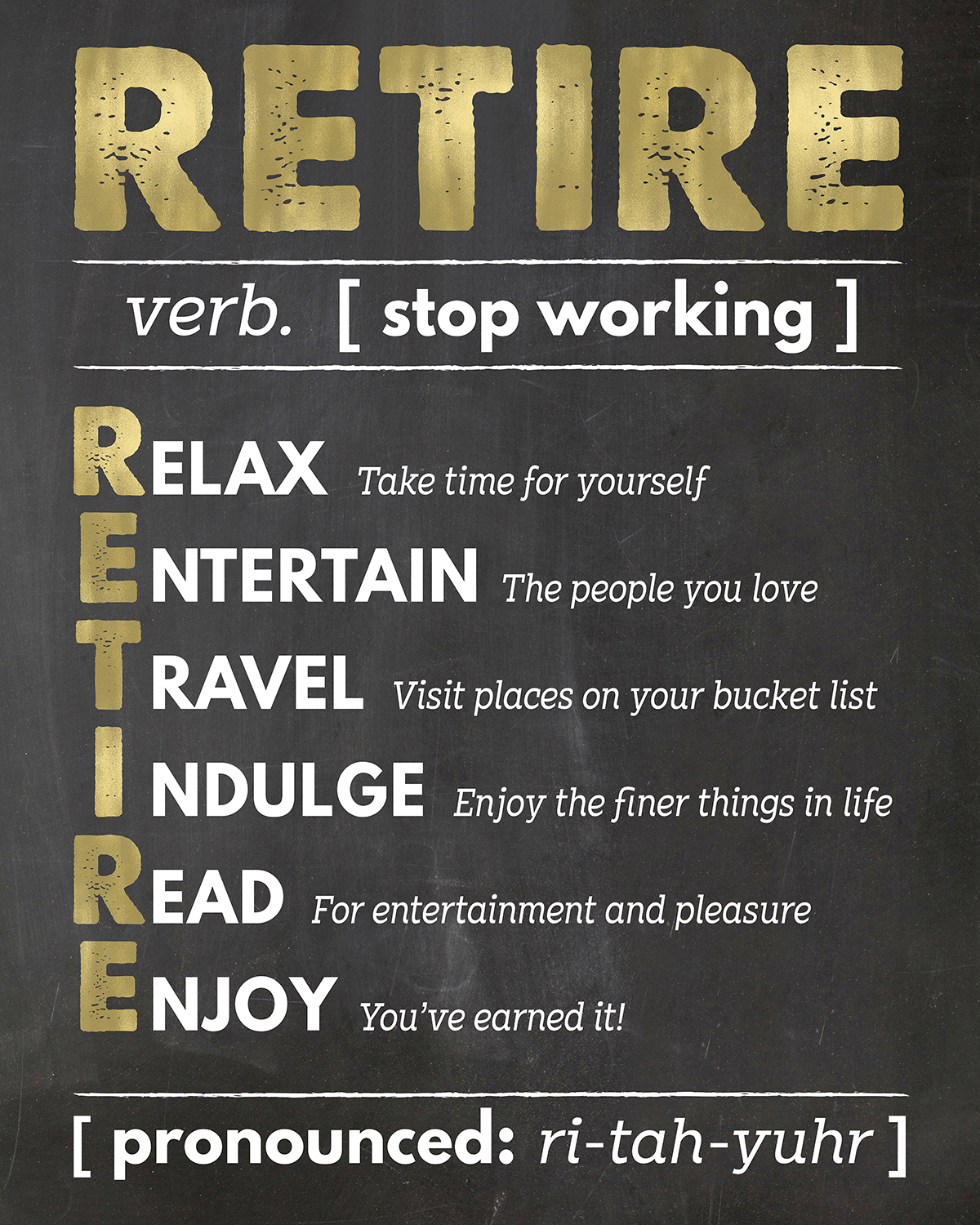
Surfing the ‘Net, I found an appropriate acronym for R.E.T.I.R.E. by Tangled Tulip Designs in pinterestRelax, Entertain, Travel, Indulge, Read and Enjoy! Most retirees would probably agree! The cessation of full-time employment may offer a great release from the day-to-day stress and drudgery of the job and the freedom to venture out, self-reinvent, make future goals, nurture relationships, and explore new personal growth opportunities.

Many attribute embracing a career in music education as “a calling” as opposed to just a form of employment or livelihood. From my experience, I have witnessed that most music educators are passionate for the cause of fostering creative self-expression in their students, more of a 24/7 mission, bringing intense focus and dedication to their lifework.

More to the point: Do we ever truly retire from making music ourselves and fostering this love in others?

THE “WHY!” Retirees matter and are critically needed!

One of my favorite inspirational speakers (Simon Sinek) would say, “start with the WHY!” WHY is this discussion on professional engagement of retired educators so important today?

  1. Their need: An informal poll of my former local educators and administrators revealed that half of them “hate retirement!” According to Dr. Robert P. Delamontagne in his book Retiring Mind (Fairview Imprints), “50% of retirees will suffer some form of acute emotional distress. This is potentially a very large problem given the fact that 10,000 people are becoming eligible for Social Security every day for the next 20 years in the US alone.” Remember this statistic the next time a senior citizen cuts you off on the road or bangs a shopping cart into your leg at the checkout!
  2. Our need: We are facing shortages of qualified teaching candidates across the country with unfilled openings in public school music positions and the critical need of training/mentoring the new hires.
  3. Society’s need: All of our voices should be combined to support the advocacy of music education, actively promoting access to school music by sharing its academic and social benefits with decision-makers, building relationships with administrators and policymakers, and utilizing resources from organizations like NAfME and the NAMM Foundation.

Despite its proven benefits, music education is often the first program to face budget cuts in schools. This is especially concerning in underserved communities, where access to music programs can be life-changing. Now more than ever, we must advocate for music education to ensure that every child has the opportunity to experience its benefits. Investing in music education is an investment in the future of our communities — helping to cultivate the next generation of creative, resilient, and innovative leaders. 
“Why Music Education Matters More Now Than Ever” by Music Will, February 2025

For eleven years (and counting), I serve as the Pennsylvania Music Educators Association (PMEA) Retired Member State Coordinator, as well as the Past State Chair (current member) of the PMEA Council for Teacher Training, Recruitment and Retention. I believe my responsibility to the state association is two-fold:

  • Assist soon-to-retire professionals in achieving a smooth transition to a happy and satisfying retirement; to help them cope with the commonly-experienced emotional ups-and-downs of this life passage, wrestling with the question “what do you want to be or do when you grow up?” and making new life lesson plans and personal goals.
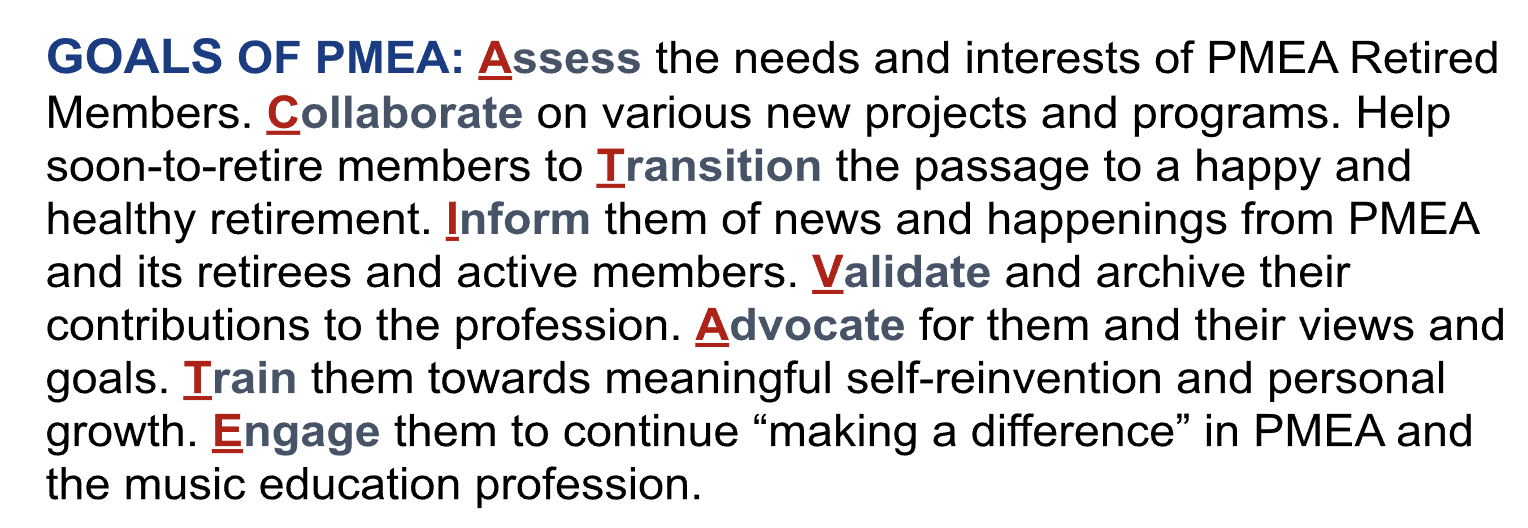
  • Reach out to and build meaningful connections with retirees in order to fully engage them towards becoming active in their professional association; to recount, represent, and revitalize the activities of our post full-time employed music educators.

This article proposes a roadmap of crucial pathways to help music teachers approach “retirement bliss” while tapping into their hard-earned knowledge, strengths, and experiences by cultivating the benefits of their renewed participation in our professional associations.

What can NAfME and State MEAs offer retirees?

You have devoted your entire life to inspiring the development of personal artistry and “ah-ha” musical moments in others. Now it is your turn to reap the benefits (and privileges) of this commitment to the profession. NAfME and your MEAs can provide the resources and motivation of “sharing and caring,” directing retirees “places to go, people to meet, and things to do” for fulfilling that “next chapter” or (perhaps better terms) the “refirement” or “rewirement” of senior living.

Do you feel “needed” and know you “make a difference?” Research has shown that the one of the most important motivators for involvement in a professional association is that its members recognize that they are essential to its success. This quote is from Revitalizing Retirement: Reshaping Your Identity, Relationships, and Purpose by Nancy Schlossberg, attributed to Rosenberg/McCullough:

 “It has been suggested that one problem of retirement is that one no longer matters; others no longer depend on us… The reward of retirement, involving a surcease from labor, can be the punishment of not mattering. Existence loses its point and savor when one no longer makes a difference.”

Most people who are one to five years away from “pulling their pin” and putting in their walking papers “do not know what they do not know.” Experts agree: “Retirement preparation is not only about the money!” Our silver-haired colleagues who have already Crossed the Rubicon and are now “living the dream” in retirement can share their trials, tribulations, and (more importantly) numerous success stories about coping with this transition!

NAfME, PMEA and this paulfox.blog/for-retirees site have archived an exhaustive number of self-help articles. Check out this omnibus NAfME blog “Retirement Prep Top-Ten Treasures.”

The benefits of retired MEA membership are numerous. Besides providing helpful transitioning advice, these advantages also come to mind:

  1. Answers to questions like “What have you always wanted to sing, compose, play, record, conduct, write, publish or present?” and “Where can I share my hard-won expertise and help others in the field?”
  2. Networks and contacts to help you develop “encore careers” in other musical or educational arenas (e.g., higher education, music industry, festival organization, travel/tour planning, composition, guest conducting, private studio teaching, church music, etc.)
  3. Opportunities to “rekindle your expressiveness” by participation in adult community or full/part time performance groups (playing “gigs”)
  4. Places to go/things to see/hear: NAfME/MEA conferences, workshops, and concerts
  5. Exclusive discounts and other benefits (reduced dues and registration fees)

What can retirees offer NAfME and their state MEA?

The relationship of active and retired membership in our MEAs is symbiotic. We know from the history of our associations, “giving back to the profession” remains a high priority with most retirees. This may come in many forms and settings:

  • Leadership or membership in local, state, or national MEA/NAfME office, staff, advisor, or council/committee position
  • Advocates for the promotion of music education to local and state government officials
  • Service as presiding chair or member of the conference or workshop planning committee
  • Service as evaluator of performance groups, conference sessions, or articles for publication
  • Judges of local/state MEA adjudication or commercial festival
  • Accompanists, coaches, arrangers, or guest conductors for festivals or school/community groups
  • Services to the local music teacher in private teaching, piano playing, marching band charting, sectional coaching, choreography, music technology, instrumental repair, stage tech, etc.
  • Writers for state MEA and NAfME publications and blog sites
  • Contributors to online music education forums or the NAfME Connections
  • Donors to and/or fund-raisers of music education charitable projects, scholarship initiatives, etc.

The PMEA Model of Retired Member Participation

PMEA values the vast wealth of experience and contributions of our retired members. We’re proud of the many programs we offer to retirees and invite you to visit our website to peruse additional information and sample digital newsletters and articles.

Retired members in Pennsylvania are involved in:

  • PMEA elected and appointed offices, staff, committee chairs, and membership on councils
  • PMEA Strategic Plan and Bylaws, Conference Planning, and other state/regional committees
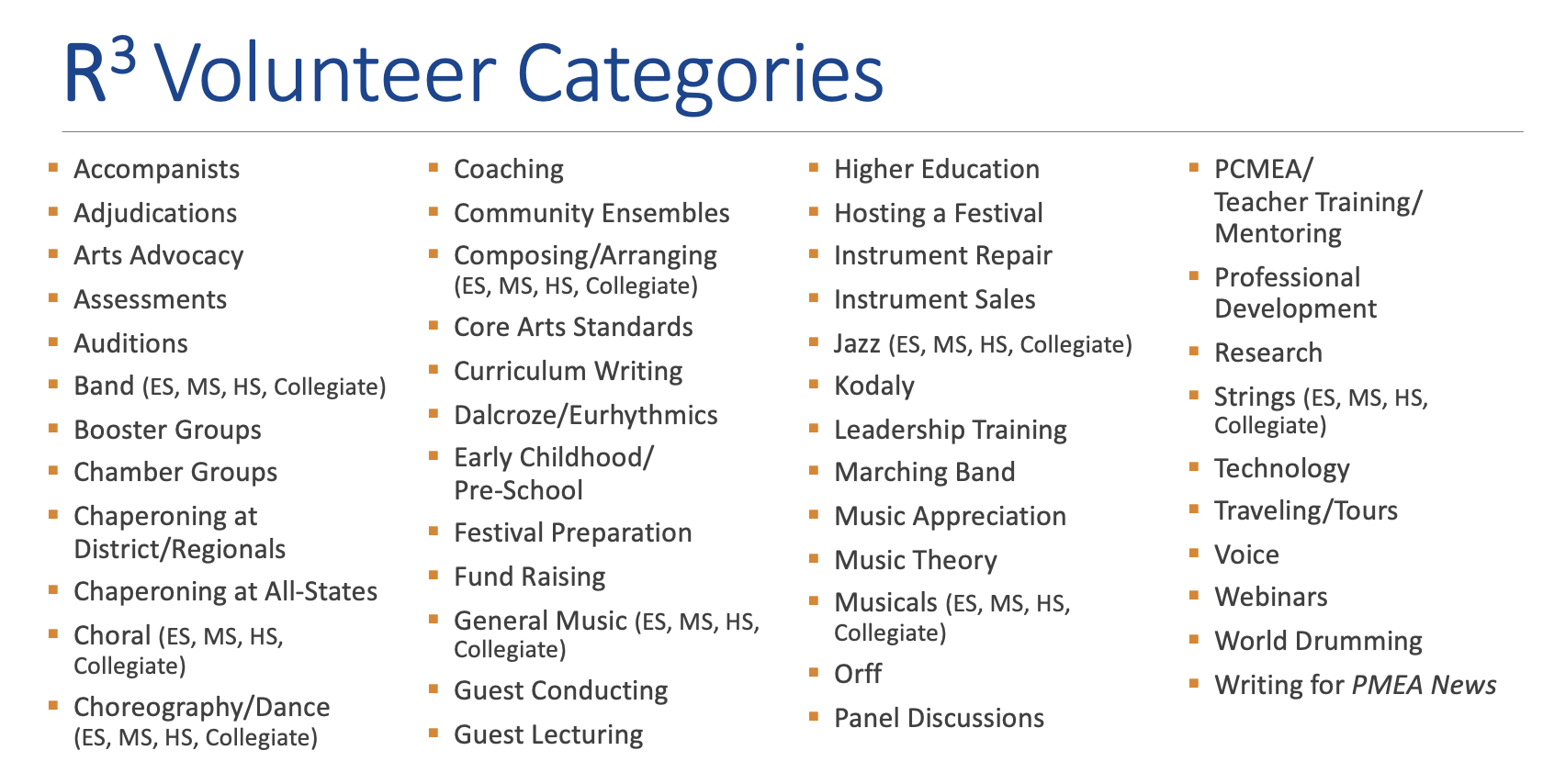
  • Retired Resource Registry* (informal mentoring for new teachers and transfers)
  • How-to-Retire Webinar, Prepping for Retirement, and the Ultimate Retiree Resource Guide
  • Retired Member Breakfast at PMEA Annual Conference
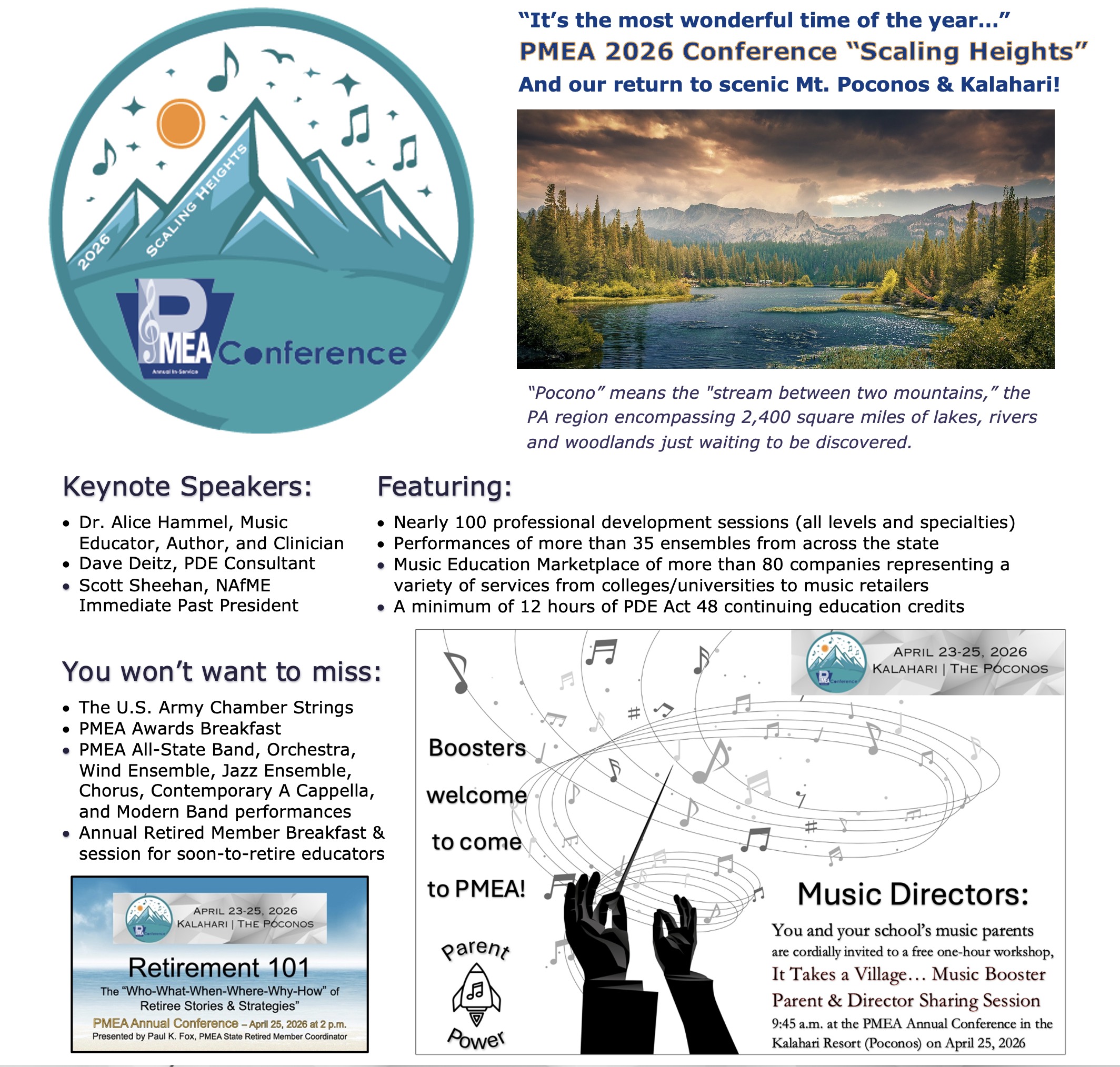
  • Retirement 101 (The Who, What, When, Where, Why, and How) session at PMEA Annual Conference (training for all members retiring or soon-to-retire)
  • Maintenance of PA Community Band, Chorus, Orchestra, and Theater group catalogs
  • Maintenance of PMEA member compositions library
  • Mock Job Interview Committee for music education majors
  • Coffee & Conversations informal “ask an expert” lounge at PMEA Annual Conference
  • Volunteering as presiding chairs for sessions and registration aides at conferences/workshops
  • Pool of conference clinicians, guest lecturers, and members on discussion panels
  • Participation in “Sponsor a Collegiate to Attend the Conference” campaigns
  • All-State Program Patron, or contributor to the annual Irene Christman Scholarship or Margaret Bauer Grant programs.

As of October 1, 2025, there are 61 advisors in the PMEA Retired Resource Registry.

*During their annual membership registration, PMEA Retired Members may choose to sign-up for the R3 Retired Member Registry (above volunteer categories) to become available to informally offer advice to college music education majors, new hires, transfers, and newcomers to any music specialty. R3 members may handle inquiries like “What warm-up would you recommend for my middle school choir?” OR “Do you have an idea for an elementary string ensemble concert opener?” OR “How do you teach improvisation… steady beat… breath support?”

The other option with more time commitment is that Retired Members can be officially “trained” as a PMEA Mentor and be assigned to specific individuals who request assistance in their early career assignments.

Coda

How can we help?

What is the future of retired music educator professional engagement? In a word: connections!

Last month, I reached out to Elizabeth Welsh Lasko, NAfME Assistant Executive Director for Membership, Organizational Development, and Marketing Communications and “volunteered” OUR assistance. I suggested that, in keeping with the NAfME 2022 Vision Statement “…an association where all people are heard, seen, and feel they belong throughout their lifelong experiences in music” we should all intentionally recruit more hands-on involvement of our retirees. I pointed out that in the late 1980s, we had a Music Educators National Conference (MENC) Committee for Retired Members led by a National Chairman who served on the NAfME National Assembly. (An excellent booklet, TIPS: Retirement for Music Educators, Copyright © 1989 MENC, was compiled by A. Verne Wilson, then the Past National Chairman of the MENC Committee for Retired Music Educators.)

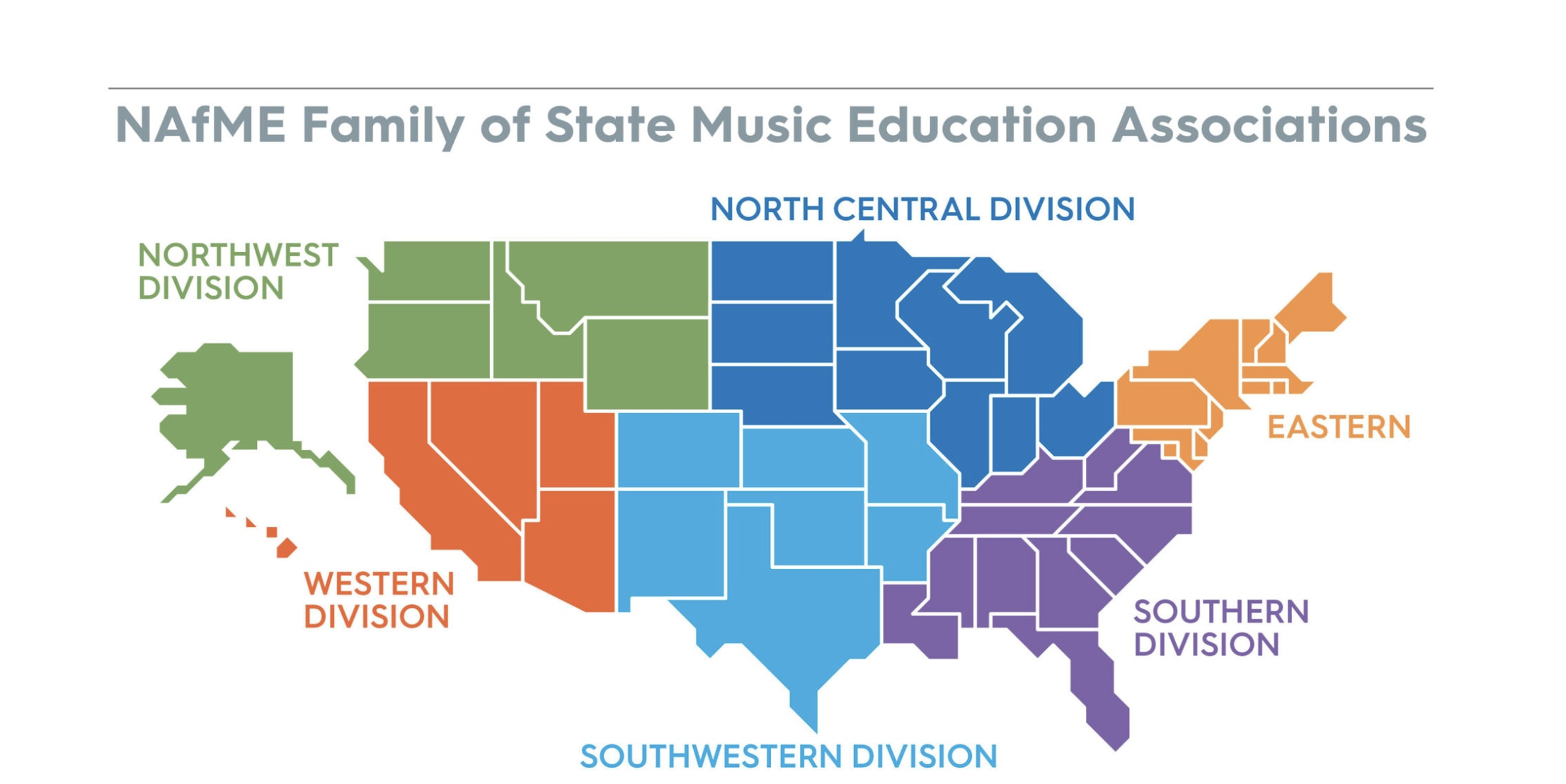
Ms. Lasko encouraged me to “reach out to retirees” beginning with this article. At the next NAfME Eastern Division Conference, I plan to hold a meeting of retired members, and also connect with all state MEA retired member coordinators (those states who have them). We’re available and on the move! Let’s collaborate and share our resources!

Finally, just for fun, I recently posted the blog “For Book Lovers – Retired or Not” on NAfME Connections (formerly called Amplify). There are already 1,810 members in the NAfME “Retired Members Community.” Please JOIN US! Using this forum, get in touch with me, and respond with YOUR OWN retirement stories, strategies, perspectives on this “life passage,” and more ideas to grow the professional engagement of our music teacher retirees.

Happy trails!

© 2025 Paul K. Fox
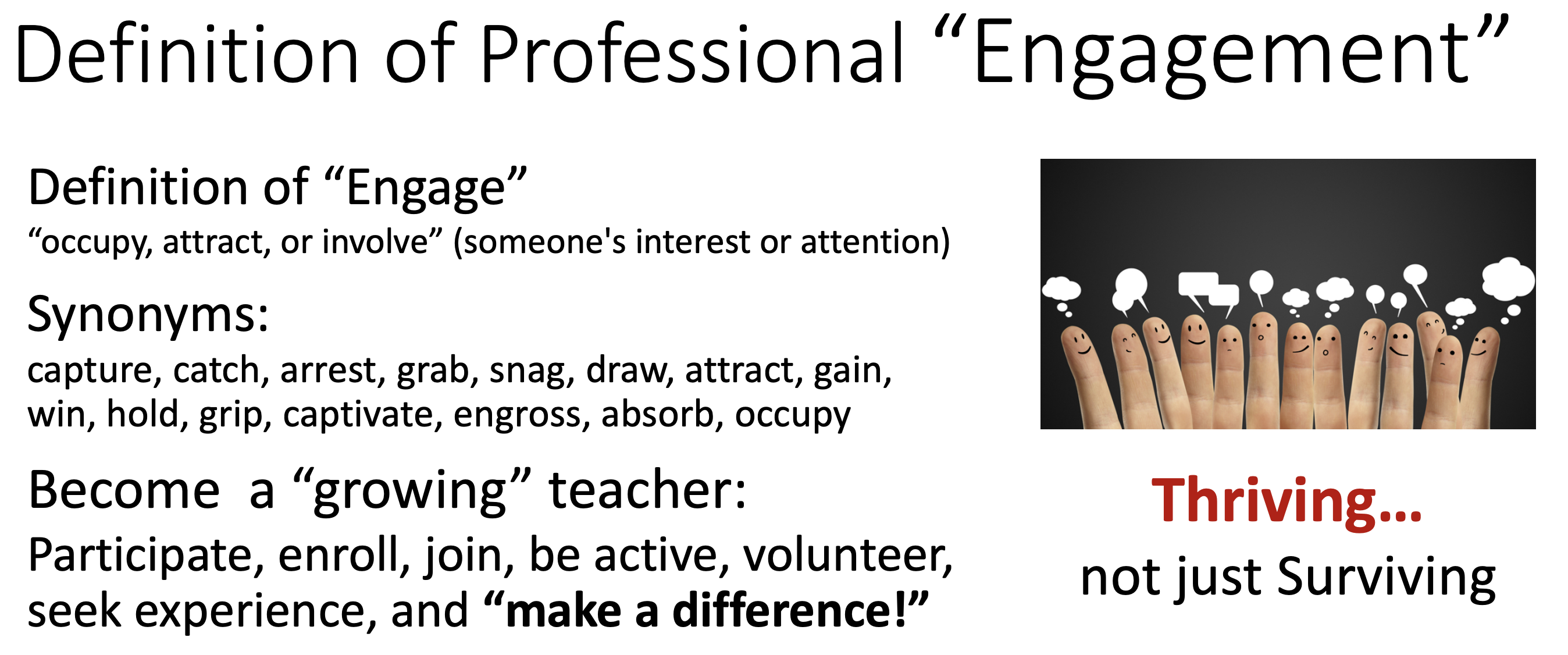
Update… Bigger & Better Things!

T-minus Twelve Months to Year 70!

Wow! I can’t believe it’s been three whole months since I posted a blog here! Where’s the time gone? Excuses? Well, what first leaps to my mind are several quotes from this Southern Living website about being an extremely busy retiree:

“The trouble with retirement is that you never get a day off.” — Abe Lemons

“I need to retire from retirement.” — Sandra Day O’Connor

“The harder you work, the harder it is to surrender.” — Vince Lombardi

“I wanted to have more time to play and reflect, but I find retirement more stressful than having a nice, steady job because I have to make decisions about where I want to be.” — Walter Cronkite

“I see retirement as just another of these reinventions, another chance to do new things and be a new version of myself.” — Walt Mossberg

“Living each day as if it were your last doesn’t mean your last day of retirement on a remote island. It means to live fully, authentically and spontaneously with nothing being held back.” — Jack Canfield

“Do not grow old, no matter how long you live. Never cease to stand like curious children before the great mystery into which we were born.” —Albert Einstein

To my friends and colleagues in the profession, yes I am “living the dream” and having fun in retirement! Health remains good, and the days of my wife and I are filled with personal enrichment, unique new and renewed adventures, and meaningful service to the causes that matter to us both! Our only complaint? There are only 24 hours in a day… But, that means, as we head to bed each night, we have lots on our ever-expanding to-do lists motivating us to get up even earlier the next day to accomplish!

So, the following will be a quick (?) update, ramblings in the format of “streams of consciousness” of what’s happening in our lives, geared to my more faithful friends and followers, and perhaps modeling the activities of two happily retired music teachers. I promise that future blogs will re-engage with our series on “Bookends…” (life cycle of a music educator), ethics training of educators, and interviewing skills of newcomers to the profession (the season of job screenings will soon be upon us!), not to mention more tips towards a smooth transition to retirement for those who are planning to “pull their pin” and leave their full-time employment in the near future. Thanks for hanging in there with us!

PMEA Conference

Both my wife Donna, her cousin Judy, our two dogs Gracie and Brewster, and I just returned from Erie, PA participating in the PMEA Annual In-Service Conference. This was unique in that, for the first time since we retired in 2013, Donna could attend “the big event” with me. Judy served as our dog babysitter (we don’t believe in “jailing” our pups!), and the Bayfront Sheraton, Courtyard Marriott, and Erie Convention Center were pet-friendly. We reserved adjoining rooms, and the dogs were content to walking all around the Bayfront Area/Lake Erie and returning at night to sleep with us.

To my PMEA colleagues and other PA educators, in case you missed it, here is the link to more than 1,000 photos I took at the conference (sessions, meetings, exhibits, and performances). Attendees, I challenge you: CAN YOU FIND YOURSELF & YOUR STUDENTS?

As usual, Executive Director Abi Young, PD Council Chair Martha Heise and her conference planning committee, PMEA state EXCOM and staffers planned another outstanding event. If you have never gone to a PMEA conference, mark next year’s dates April 9-12, 2025 on your calendar, which will be held in the luxurious Kalahari Resort in the Poconos. Besides, the “world’s largest indoor water park” is a fun place to bring your (grand)children! In addition, several other professional development and career enhancement venues are on the horizon available to members of NAfME and PMEA:

  • PMEA Summer Summit (Leadership Conference), Reading, PA
    July 15-17, 2024
  • NAfME Biennial Music Research and Teacher Education Conference, Atlanta, GA
    September 25-28, 2024
  • NAfME Eastern Division Conference and Honors Ensembles Festival, Hartford, CT
    April 24-26, 2025

At the Erie conference, I hosted my last PMEA Council for Teacher Training, Recruitment, and Retention and TTRR SHOWCASE. At our annual meeting, I stepped down as the state chair, but will continue as State Retired Member Coordinator on the Council TTRR. We’re in excellent hands, with TRI-M Chair Tina Bennett being elected to the state TTRR Council Chair position. Joining her is the visionary leadership of State SMTE Chair Dr. Kathleen Melago, Mentor Co-Chairs Lisa Endler and Eric Plum, PCMEA Student President Ellie Vito, Future Music Teachers Honors Symposium Chairs Aaron and Stephanie Magaro, PDE Fine Arts Education Consultant David Deitz, and Higher Education Representatives Paul Doerksen, Jessica Vaughan-Marra, Sarah Watts, Debbie Wolf, among others.

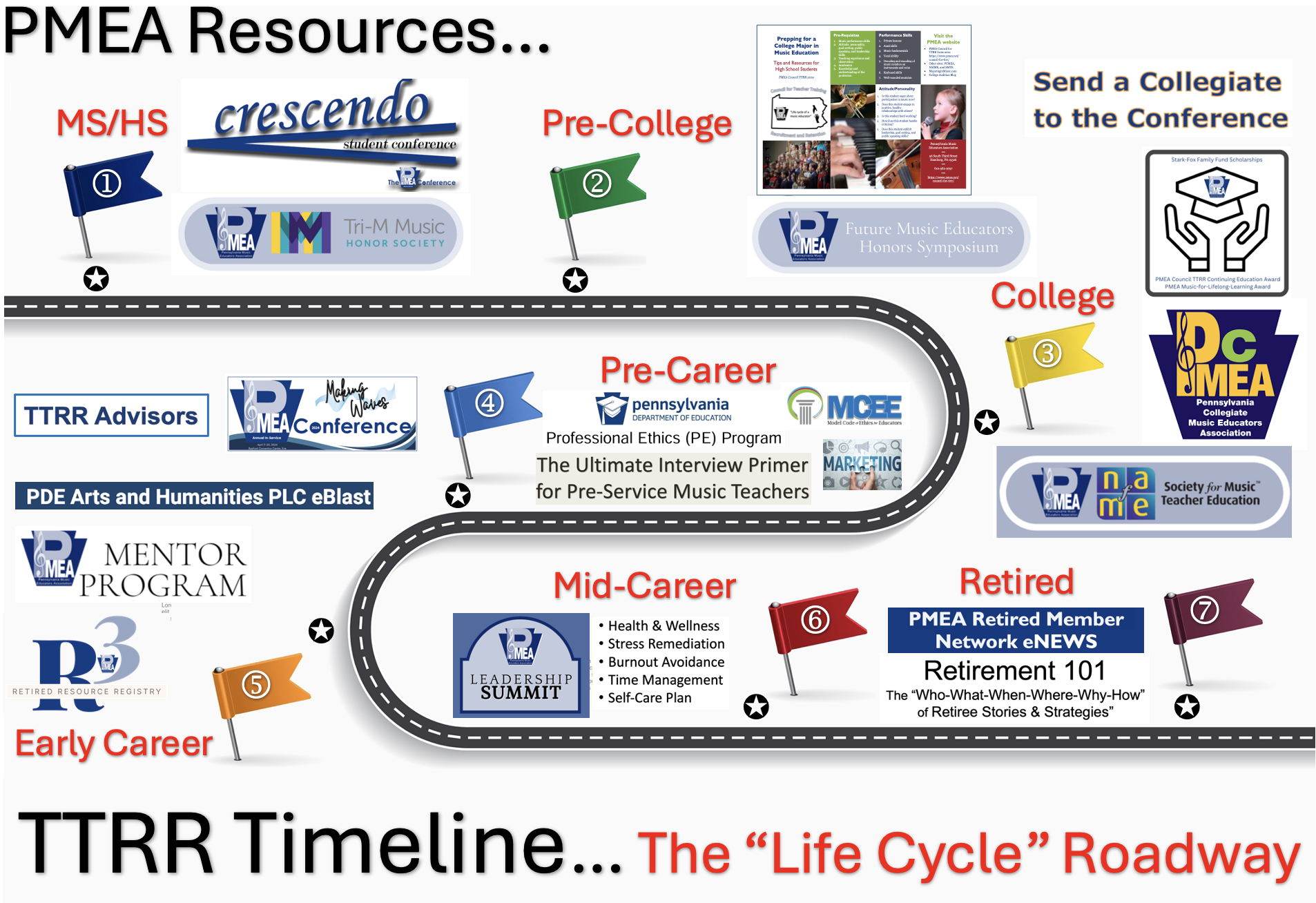
Below is a copy of the “Everything You Always Wanted to Know About Council TTRR” SHOWCASE slides which were presented to a whopping 60 PCMEA members during our breakfast meeting at the conference. (Perhaps the food motivated more collegiates to get up extra-early for that first session?)

Scholarships

One of the concerns repeatedly expressed at Council TTRR meetings was the funding issues of college students. Besides an anonymous donor funding the PCMEA breakfast at the SHOWCASE on April 18, PMEA instituted a “send a collegiate to the conference” campaign (complimentary registrations) and in 2023, also announced two major scholarship (college expense reimbursement) opportunities endowed by our Stark-Fox Family Fund in memory of our parents:

  • PMEA Council TTRR Award for Music Education Majors
  • PMEA Music for Lifelong Learning for STEM Students in College Music

In the spring of 2023, three $5K PMEA Council TTRR Scholarships were awarded to:

  • Elizabeth Corbett (Duquesne University)
  • Adam Hanna (Susquehanna University)
  • Mitchell Hourt (Moravian University

Unfortunately, last year no applications were submitted for the PMEA Music for Lifelong Learning Award. A concerted effort has been made to “reachout” to this population of students who are pursuing a science-related field and participating in their PA college band, chorus, jazz, or orchestra program. Please spread the word! Deadline to register is May 29, 2024. More information is posted here.

Upcoming Workshops

I was pleased to learn that two of my sessions were accepted for the Kappan 2024 Educators Rising National Conference scheduled for June 28-July 1, 2024, in Washington, D.C. at the Marriott Marquis:

  • Embarking the E3-Train – Essentials for Future Educators – What It Takes to Become a Teacher: Ethos, Ethics, and Engagement
  • Interviewing and Branding 101 – The Art and Science of Marketing Yourself for Employment Screening

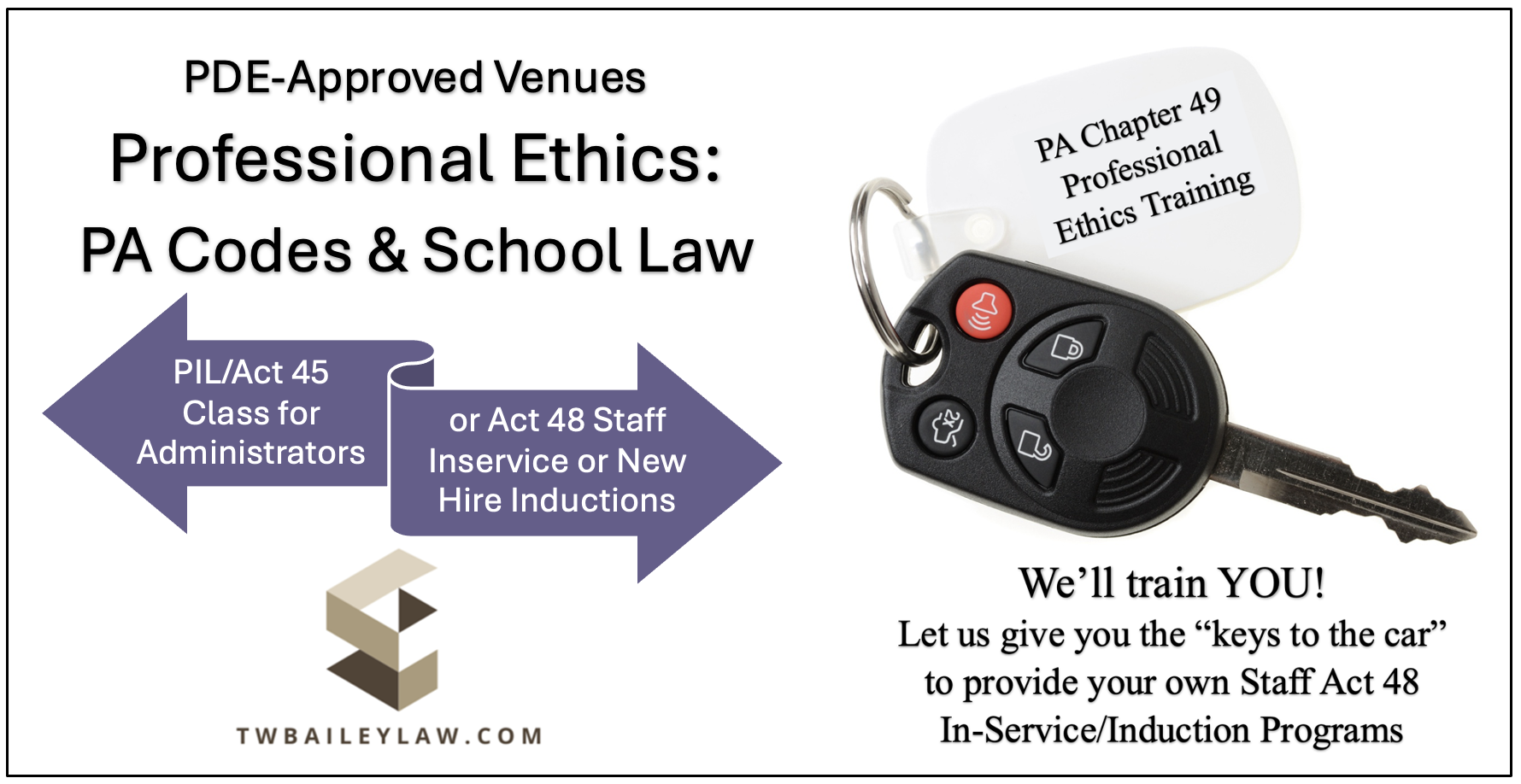
In addition, I remain active in supporting my colleague Thomas Bailey in providing PDE-approved Act 45 and Act 48 ethics training courses for PA educators. Currently, we’re teaching our fifth series of classes (25 PIL hours) for school system leaders and have presented more than 14 additional professional development workshops, webinars, or conference sessions of in depth interactive discussions of ethics and daily educator decision-making. Our next focus area is to help PA administrators to incorporate the newly mandated PA Chapter 49 ethics competencies into their school induction programs.

To learn more about course offerings or read court case blogs on ethics in education, visit Tom Bailey’s website here. This blog-site also provides a comprehensive library of past articles on educator ethics.

Who Really Reads These Blogs?

That’s a good question! Although I have always provided a “comment” link at the top of each posting and seek feedback and even “guest authors” to feature in future blogs, very few people respond to these articles. I have always hoped that “my meanderings” could help music teachers at all stages of their careers, from pre-college and music/music education majors to veteran educators to retirees. At least, this WordPress site allows me to permanently archive my writings with the hope this exhaustive but always-accessible supply of resources, links and viewpoints could be used in the future. Share on!

So recently, I was pleasantly surprised when Becca Robinson, a tutor of homeschooled children, reached out to me and said Jeremy, one of her students, did extra-credit research after reading one of my blogs on retirement resources. We are adding his recommendation for this link to the Transportation Resource Guide for Seniors & Individuals with Disabilities in the “Retiree” menu section at the top of the page. This comprehensive article by Cole Neder documenting the following is a valuable read for senior citizens and anyone who is experiencing personal mobility challenges:

    • Public Transit
    • Paratransit Services
    • Demand Responsive Services
    • Non-Emergency Transportation
    • Ride-Sharing and Taxis Services
    • Service Resources by State

    On a Personal Note…

    Yes, last week was my 69th birthday! I never imagined getting that old… er, I mean, mature! Neither my mother nor my father made it to their seventh decade! I attribute my positive attitude and active lifestyle (even though at times I could unintentionally forget your name at the drop of a hat) to embracing what Ernie Zelinski, author of How to Retire Happy, Wild and Free, says is absolutely essential to maintain in retirement: “finding purpose, structure, and community.” It is a paramount of importance to feel we matter and are needed every day, exercise both sides of our brain (the analytical and the creative), keep physically fit, jump out of our bed with purpose, maintain busy schedules and accept a lot on our plate, and stay connected to the people surrounding us. To that end, my wife and I continue to teach the pursuit “creative self-expression,” directing a community ensemble (the South Hills Junior Orchestra), teaching, walking our dogs, and pushing wheelchairs at our local hospital. At times, this latter activity allows us to catch up with our former music students, their parents, school staff, and neighbors. What FUN it is to meet someone who I taught many years ago in middle school, now grown up and busy raising their own “band” of musicians! God willing, I hope to continue with good health, a sharp mind, and motivation to live to Moses age (150 years old?), or at least have a ball along the way!

    I leave you this month with a copy of the one-of-the-kind birthday card one of my adult students (who claims me as her “adopted father?”) created using Photoshop. Three generations of her family play in our Saturday orchestra. Caption: Left is our Gracie, a bichon frise, and right is Brewster, a yorkie-poo. I’m depicted in the middle with my SHJO bow-tie, of course!)

    Happy trails, retirees and active educators alike! Keep in touch!

    PKF

    © 2024 Paul K. Fox
    Bookends – Part Two

    The Life Cycle of a Successful and Happy Music Educator

    Joyous Holidays, Season Greetings, and Happy New Year from “The Foxes!” This is a time for reflection and gratitude… and we feel blessed for all the opportunities allowing us to share our insights, gifts and experiences with other music education professionals.

    We hope to inspire YOU and literally model the concepts in this blog series. We continue with our discussion first introduced a month ago in Bookends – Part One – The Life Cycle of a Successful and Happy Music Educator, exploring:

    • Stage 3: Inservice/Growing Years (this blog)
    • Stage 4: Veteran/Sustaining Years (future blog)
    • Stage 5: Next Chapter/Living the Dream (future blog)

    This article is an abstract from a session presented to Seton Hill University music education student teachers on October 17, 2023. Click on this link to download the slide summary in PDF format.

    “I have written a lot of articles in support of these topics… now compiling them for your easy access. Depending on your current status and interests, feel free to peruse the checklists (links) in this series. It is possible a few of the resources contained within these blogs have gone inactive, but I believe enough are there for you to gain the insight, tools and motivation to achieve professional development for life.”

    – Paul Fox

    Stage 3 – Inservice/Growing Years

    [ ] 8. Becoming a Music Educator: For a review of Bookends – Part One, take a step backward and revisit what you have done to “get ready” for your “rookie years.” Take special note on the things-to-do list (“secrets”) as a first-year educator (perhaps completed during your student teaching semester):

    • Subscribe to a discounted NAfME + PMEA first-year membership (If you are a recent college graduate in your first year of teaching, or if you are the spouse of a current or retired NAfME member, contact NAfME at 800-336-3768 or email memberservices@nafme.org) to find out if you qualify for a reduced rate.
    • Hook up to PMEA Mentor or other state’s MEA support program for new teachers.
    • Look into finding an informal advisor in the PMEA Retiree Resource Registry for PA music teachers.
    • Need to fill in a few gaps missing from your college courses in skills and knowledge? Continue your “enrichment” viewing PMEA Webinars and the exhaustive video library in the NAfME Academy.
    • Take advantage of earning professional development credits just for reading an article in the NAfME Music Educators Journal
    • At some point you will be writing/editing curriculum, so research the awesome resource of Model Curriculum Framework (Have to be a PMEA member)
    • Too busy to participate in the PMEA Annual Conference or NAfME national events? Look into going to a PMEA summer conference (usually at a lower-cost!). Check out your own state’s MEA discounts and offers for collegiate members and new teachers!
    • Numerous free and timely blog posts from NAfME Music in a Minuet and here (paulfox.blog).

    [ ] 9. The Care & Feeding of Your Principal: Although not covered in any detail during the Seton Hill University presentation, it is recommended that you read in its entirety “The New Teacher’s Guide to Fostering Positive Relations and Good Interactions with School Administrators” offering a wealth of excellent recommendations from these trustworthy sources:

    A favorite question I pose to college music ed seniors is, “In what professional associations are you a member and actively involved?” For the price of consuming one fewer Starbucks latte a week, you can open up the Wonderful World of “C’s” – Contacts, Coachings, and other Connections, including research and resources that will benefit your Continuing Education. You can’t afford NOT to join groups like these.

    To help “nail down” a few related definitions critical to personal growth and career development in our profession, especially “engagement,” “professionalism,” “collaboration,” and “networking,” please take a little time to travel and consume the following archived blog postings.

    [ ] 10. The Meaning of PRO: This is one of the oldest articles at the paulfox.blog site. How about a little soul searching? Are you truly a professional? Do you have the skills, habits, and attitudes of a professional in the field of education?

    [ ] 11. Transitioning from Collegiate to Professional (Part II): New teachers have to move away from “book learning” or higher education research and emphasize “practical application,” and at the same time, assess the precise areas needed for immediate (re-)training… everything from new exposure to specialized teaching areas and grade level focus for the job to which you have been assigned, to the enhanced skills of classroom management, student assessment, curriculum writing, class or ensemble warm-up materials, music repertoire and programming, etc.

    While we are on the subject, it is important to intentionally seek out mentors or consultants in your early years of becoming an educator. PMEA offers a mentoring program (read all about it here) and PMEA Retired Members are also an excellent resource to “phone a friend” for advice as needed (see their section on the PMEA website here). That leads us to the next most essential “habit” of attending professional conferences… #12 below.

    [ ] 12. Getting the Most Out of Music Conferences: Our PMEA Annual Conference sites are cyclical. This article, written on March 5, 2017, showcased that year’s event at the Erie Bayfront Convention Center – coincidentally the same location for this year’s PMEA Annual Conference: April 17-20, 2023. For a sneak peek at the proposed sessions and guest performers, click here.

    There are a myriad of conferences offered every year… something for everybody in just about every state. Make plans to go, “recharge your batteries,” and pick up new state-of-the-art ideas, lessons, music, technology, etc. Again, you cannot afford NOT to attend… or becoming stale in your teaching or “stuck in a rut!” Besides, going to your state’s or national conferences and regional workshops are FUN places to meet other like-minded, inspiring colleagues! This is how professionals network, collaborate, and share their “latest and greatest!

    A couple upcoming events:

    What are you waiting for? It’s time to DIVE INTO your customized career development!

    Coming Soon…

    Bookends Part Three – Stages 4 & 5

    PKF

    © 2023 Paul K. Fox
    On the Road Again (2023)

    “Doing My Thing…” — Professional Development Conferences for Music Educators

    It’s been awhile since I posted here… arguably the longest editorial break I have taken since retirement and starting this blog-site. What’s that line retirees often say? “It’s a good thing I am retired from my job; otherwise I would not have enough time to do everything!”

    This has been an extremely busy couple months of renovating three bathrooms, promoting the 30th Anniversary Gala Celebration of the Community Foundation of Upper St. Clair featuring a CASINO NIGHT & the local band NO BAD JUJU (to which I can’t even go because it is on the same day as PMEA), staffing a transition of new editors and an office manager for the UPPER ST. CLAIR TODAY community magazine, “keeping my hand in” by conducting a small nonprofit community ensemble (now in our 40th season of the South Hills Junior Orchestra), volunteering at the hospital (see my Tales from a Wheelchair Jockey article), developing new PDE Act 45 and 48 programs on ethics (school system leaders and educators respectively), and… (deep breath): preparing four PowerPoint presentations for two music conferences in April. Yes, and loving every minute of this frenzied activity!

    Pennsylvania and Eastern Division music education colleagues: Hopefully by now, you have registered for the coming conferences on the horizon:

    NAfME Eastern Division Conference, April 13-16, 2023, Rochester, NY

    PMEA Annual Conference, April 19-22, 2023, in the Poconos

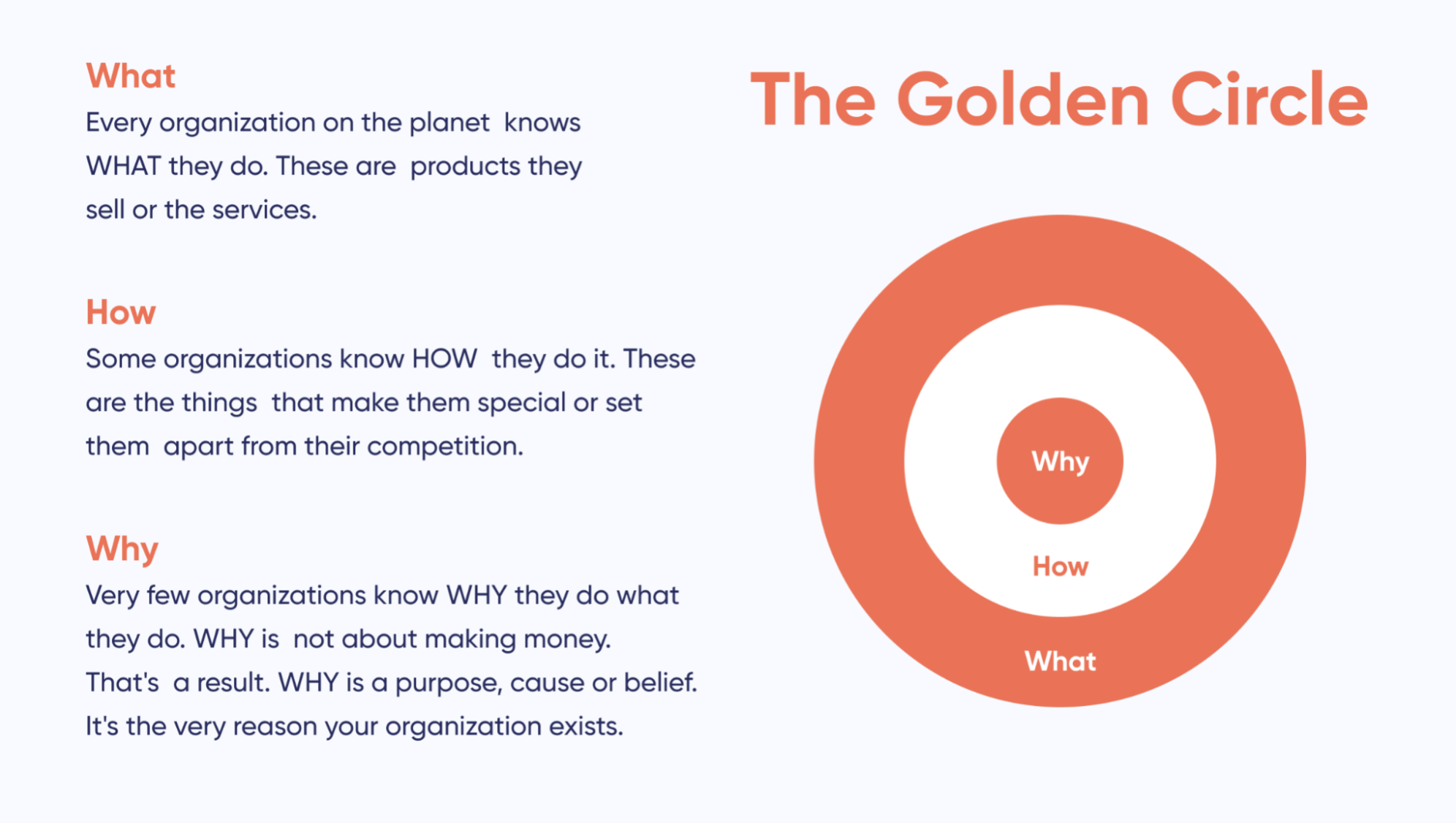
    Now to quote the inspiration of Simon Sinek — his theory of value proposition to ‘start with why’ — how leaders can inspire cooperation, trust, and change based on research into how the most successful organizations think, act, and communicate if they start with why. Check out his rationale with The Golden Circle:

    The “why” of attending your professional development conferences, “sharpening your saw” (self-renewal by Stephen Covey) aka “recharging your batteries,” learning what’s new and innovative on the forefront of “the state of the art,” and networking with colleagues, and has been addressed often in past blogs:

    Simply put — to maintain your mastery of music and methods and build on your “best practices” and professionalism, you MUST attend as many educational conferences and workshops as possible!

    Now to my “bags of tricks” for April 2023

    Mark your calendars:

    April 15, 2023 at 10:45 a.m. in Hyatt Susan B. Anthony (NAfME) – OR –
    April 21, 2023 at 11:30 p.m. in Kalahari Suite 40/50 (PMEA)

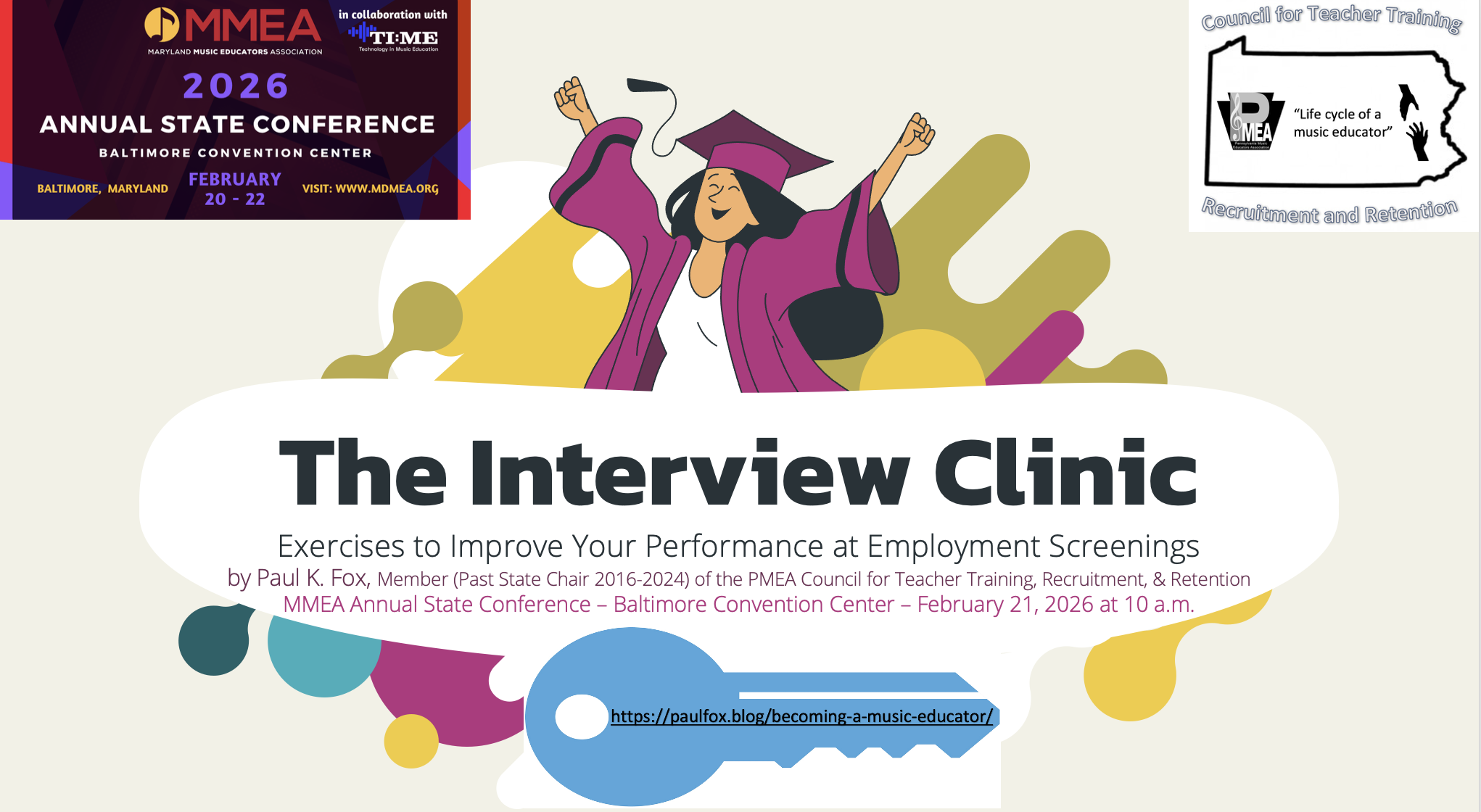
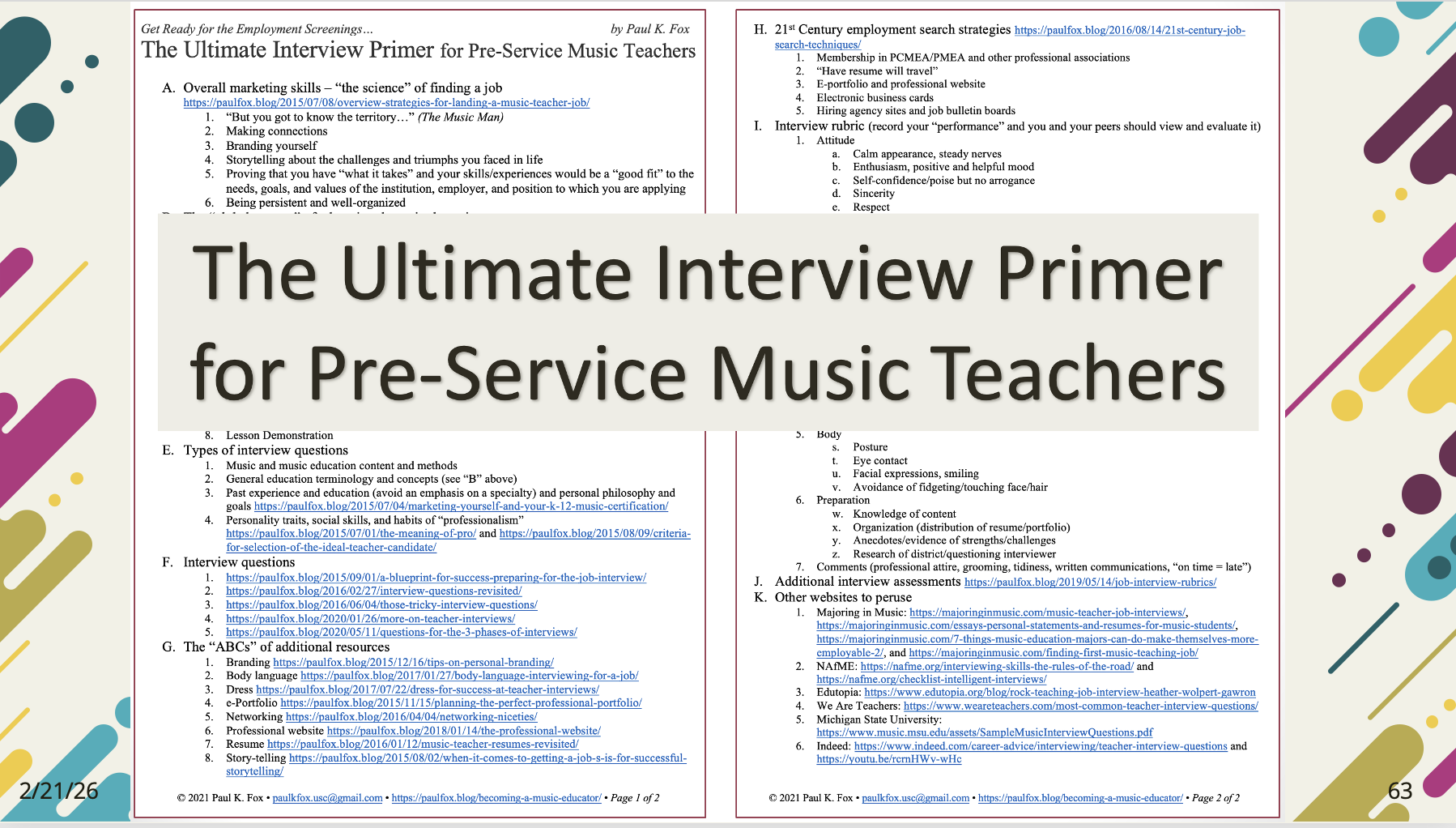
    I was blessed to have been asked to present THE INTERVIEW CLINIC — Practicing & Playacting to Improve Your Performance at Employment Screenings at both the NAfME and PMEA conferences. This will be FUN! Perfect for college music education majors, soon-to-be or recent graduates, new transfers to the profession, teachers seeking to change positions while openings seem to be “heating up,” or first-timers looking for employment, the session targets will provide interactive exercises to build self-confidence and develop better insights, practices, and strategies to successfully land a job. “The key is in the preparation” of:

    • Standards—Defining/modeling professionalism, versatility, and ethics
    • Marketing—Branding, networking, and selling yourself
    • Skills—Interviewing, storytelling, and organizing
    • Assessment—Observing, reviewing, diagnosing, and improving

    Interactive exercises, you say? Yes! Get ready to meet new people and perhaps dive into a few activities slightly outside your “comfort zone!” (We promise NOT to embarrass anyone!) We will break up into small groups or “duet partners,” and explore defining our professional “essence,” telling anecdotes about our strengths and past problems we have “crushed,” and focusing on learning “the golden gift of gab” — storytelling.

    Portions of this workshop will come from material in the past posts Storytelling, etc. Part 2 and When it Comes to Getting-a-Job, S Is for Successful Storytelling. (Your homework? Peruse these before coming to either session at NAfME or PMEA!)

    As always, articles, resources, and slide summaries will be posted under the “Training/Jobs” menu tab (above).

    Mark your calendars:

    April 20, 2023 at 3:00 p.m. in Kalahari Suite 30 (PMEA)

    How many of you feel at times a little overwhelmed, exhausted, stressed out, disorganized, demoralized, or disenfranchised?

    Are you at the end of your rope and wondering how you’re going to “keep it all together” over the next week, month, year?

    Is your health is interfering with your ability to do your job and find success, balance, and meaning in your personal life and relationships? Then… it is time for a change.

    We are still dealing with the effects of the pandemic which has brought on a “gap year” to most of our music programs, the stress of “working harder not smarter,” more teacher burnouts, and the resulting bail outs, staff shortages, and/or job cuts. We need to embrace NEW strategies for personal self-care and SEL (social and emotional learning). Do you still enjoy teaching? How have you coped with all of the changes? How will you achieve a better work/life balance and skills in time/priority management and personal health and wellness?

    The prescriptions and RECIPES towards stress reduction and developing a self-care plan are here! Doug Sands, a consulting hypnotist and founder of AnywhereHypnosis.com, joins me to “throw in everything and the kitchen sink” to alleviate these problems, with NO cookie-cutter, “one-size-fits-all” solutions from the chefs:

    • What has COVID done to all of us?
    • Instant personal online stress assessment
    • Taking an inventory of the ingredients towards a healthier lifestyle
    • Definitions, symptoms, and remediations for teacher stress and burnout
    • Why teachers are so exhausted and what to do about it
    • Time management tips
    • Breathe like a Navy SEAL
    • Coping and learning “acceptance”
    • How to “coach overwhelm!”
    • The role of meals, movement, music, and mindfulness (thank you, Lesley Moffat!)
    • From MEJ: A suggested self-care plan and “cognitive distortions” to avoid
    • Focusing on ONE self-care strategy from a “sea of solutions”

    We’re in this together… so we need to join forces and SHARE the secret recipes for a happier life! Add your own “baking tips,” and I promise, you’ll leave with a better understanding of how we all can celebrate the coming year or decades in music education!

    By the way, my “mindfulness partner” for this workshop, Doug Sands, promises us he will not hypnotize any of us during this session (although he could!).

    For more about his work, including “15 Rapid Tools (and Counting) to Wipe Out Anxiety, Stress, and Panic,” please go to his website here.

    You are invited to stop in to see him at his PMEA booth in the Kalahari exhibit hall.

    POST-CONFERENCE NOTE: Doug sent us his Anti-Panic Toolkit entitled, 15 Rapid Tools (and Counting) to Wipe out Anxiety, Stress, and Panic – Wherever They Strike! Click here.

    If you would like a sneak preview of the revised handout for the Self-Care workshop, go to the Care menu section at the top menu bar.

    Taking a peek at our recent past…

    Workshop for Orchestra & String Teachers

    In case you missed the PMEA District 5 Professional Development Day, my wife Donna and I presented “Plucking Our Minds” at Grove City College on February 20, 2023.

    We were privileged to “share some of our secret sauces” gleaned from over 80 combined years of experience on a variety of topics:

    • CommUNITY Music-Making
    • Online Academy
    • Summer String Camp
    • Assessment Projects
    • Collaborative/Creativity Projects
    • Library of “Fox Firesides”

    If would be a shame to waste these resources… and reading them could inspire new adaptations to your instrumental program.

    Click here for a copy of the slide handouts. Feel free to comment (above) or send an email to me (paulkfox.usc@gmail.com) if you have any questions.

    Our Crystal Ball

    Future Accredited Workshops on Ethics in Education

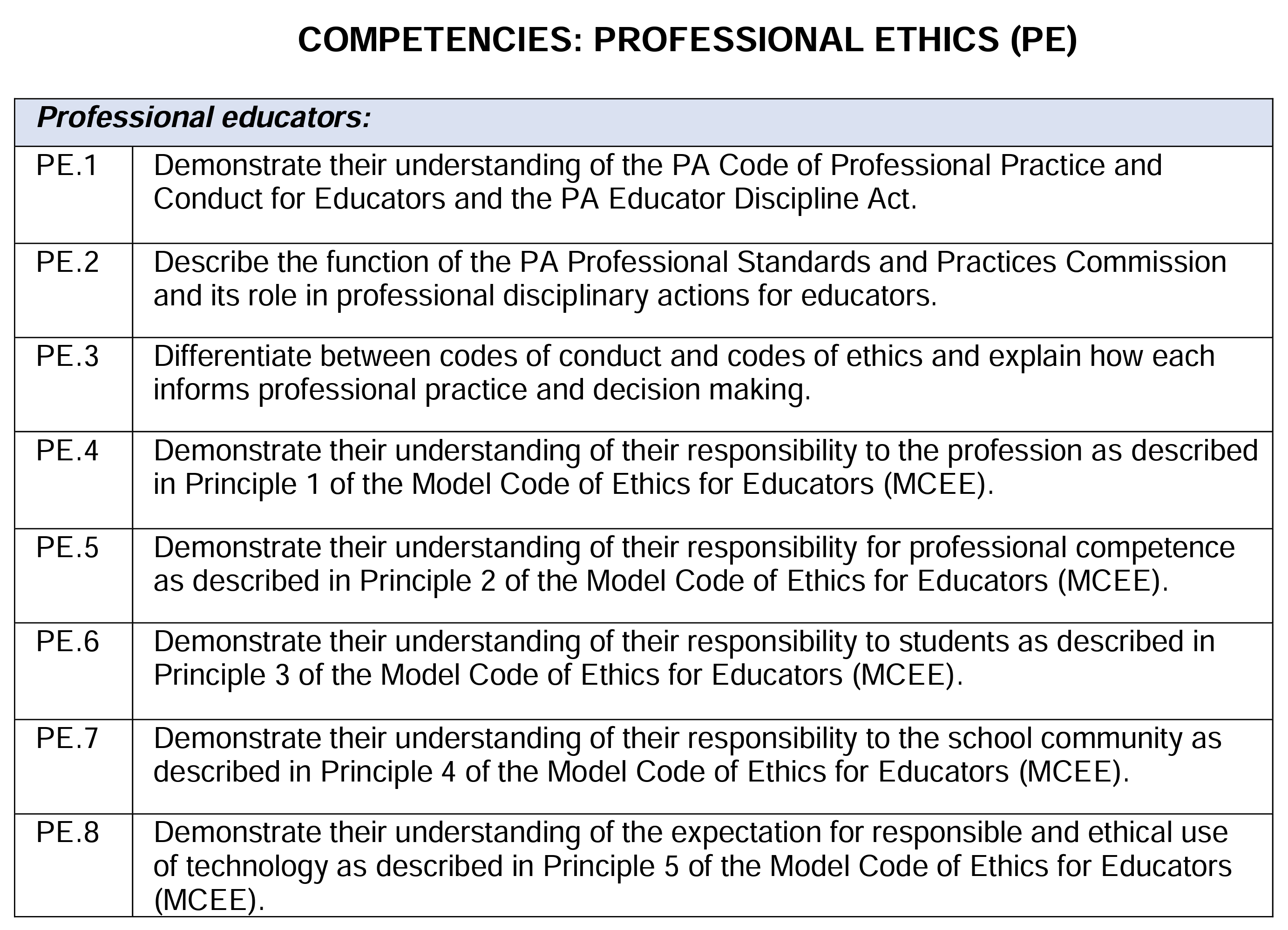
    Are you aware that the Pennsylvania Department of Education (PDE) has recently revised the PA educators’ Code of Professional Practice and Conduct AND adopted the Model Code of Ethics for Educators developed by the National Association of State Directors for Teacher Education and Certification? Have you seen the new Professional Ethics Program Framework Guidelines? PA Chapter 49 requires instruction in professional ethics to be integrated in educator preparation, induction, and continuing professional development programs as follows:

    • Continuing professional development programs must integrate the professional ethics competencies no later than the 2023-24 academic year.
    • Educator preparation and induction programs must integrate the professional ethics competencies no later than the 2024-25 academic year.

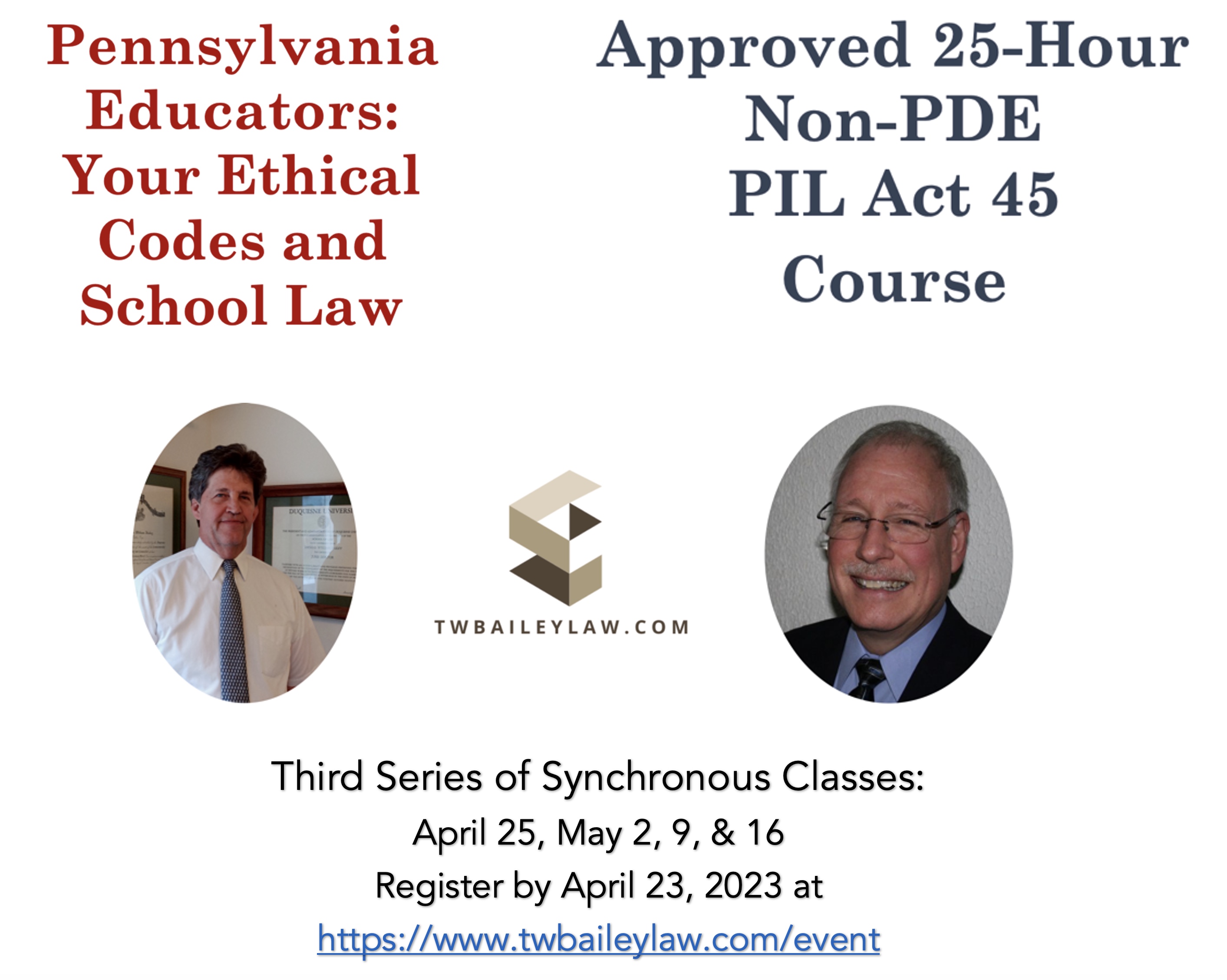
    Not one to let grass grow (or mud sink) under his feet, retired social studies teacher, current attorney-at-law, and past PMEA conference presenter Thomas Bailey has partnered with me to design new ethics training classes for school system leaders (25-hour Act 45 PIL course) and educators (four-hour Act 48 continuing education course). In addition, we are introducing a new “hybrid” program for school administrators involving four-hour pre-recorded asynchronous webcasts (site license), along with a three-hour synchronous webinar using the webcast videos and adding facilitated interactive discussions of three ethical case studies either via Zoom OR in-person follow-up workshops led by both clinicians.

    In Depth Ethics Training for PA Educators:

    • PA Model Code of Ethics for Educators
    • PA Code of Professional Practice and Conduct
    • Professional Standards and Practices Commission
    • PA Educator Discipline Act

    Click here for to register for Act 45 PIL Course.
    Next series: April 25, May 2, 9, & 16, 2023

    Click here for more information on the Ethics Webcast/Webinar and general information/landing page for the TWBaileyLaw website.

    Click here for timeline of educator ethics presentations and clinicians’ bios.

    Also review the Educators Court Case Blog and William Penn SD vs. PDE Blog.

    Numerous articles have already been published on the subject of educator ethics, professionalism, and decision-making:

    Hope to see you at one of these conferences or workshop sessions! Yes, it means a lot more to attend these IN PERSON!

    PKF

    © 2023 Paul K. Fox

    In Case You’re Worried… the Status of “The Fox”

    If you are a frequent visitor to this blog site, you may have noticed that, for some reason, I haven’t posted anything for almost two whole months. Cat got my tongue? Nothing to add? Busy with other things?

    We have been doing what comes naturally! The most important “stuff!” Although hectic at times and in a frenzied pace, all is well! My wife and I are healthy, happy, actively engaged in the projects that matter to us, and mastering those all-essential ingredients in a healthy lifestyle (retired or not): “finding purpose, structure, and community” (reference to the book How to Retire Happy, Wild, and Free by Ernie Zelinski).

    Well, I can tell you I am still vested in volunteering my expertise, experiences, and services on a number of fronts. Normally extremely verbal, I just have not had a couple hours to spare to write anything down or contribute to the voluminous material to what has become a massive archive of articles (editorials and how-to’s), links, and other resources.

    What have I been doing lately?

    First off, we are just finishing up our marching band season. As the official admin and announcer for the “Pride of Upper St. Clair” Marching Band (I spend my time inside, not directing practices on the fields), I attend all rehearsals as attendance bookkeeper, forms manager, librarian, quasi-nurse, and when necessary, act as a sounding board or shoulder to lean on for “the band director.” This was our first year going “competitive,” participating in regional festivals of Pennsylvania Interscholastic Marching Band Association (PIMBA), and by all accounts, “we” achieved excellence. The band is unrecognizable from past years – the students are much more committed and focused – but we still have a ways to go!

    Of course, all during this, our football team made it to the playoffs. On Friday, we will support our team in the “first round” WPIAL Class 5A match at Gateway HS. The extended season brings with it challenges of its own (keeping the band members on-task and embracing new goals), but the rewards outweigh the extra rehearsals. And, all through this, we are making plans (and building excitement) for the launch of the first-ever USCHS winter guard and drumline programs!

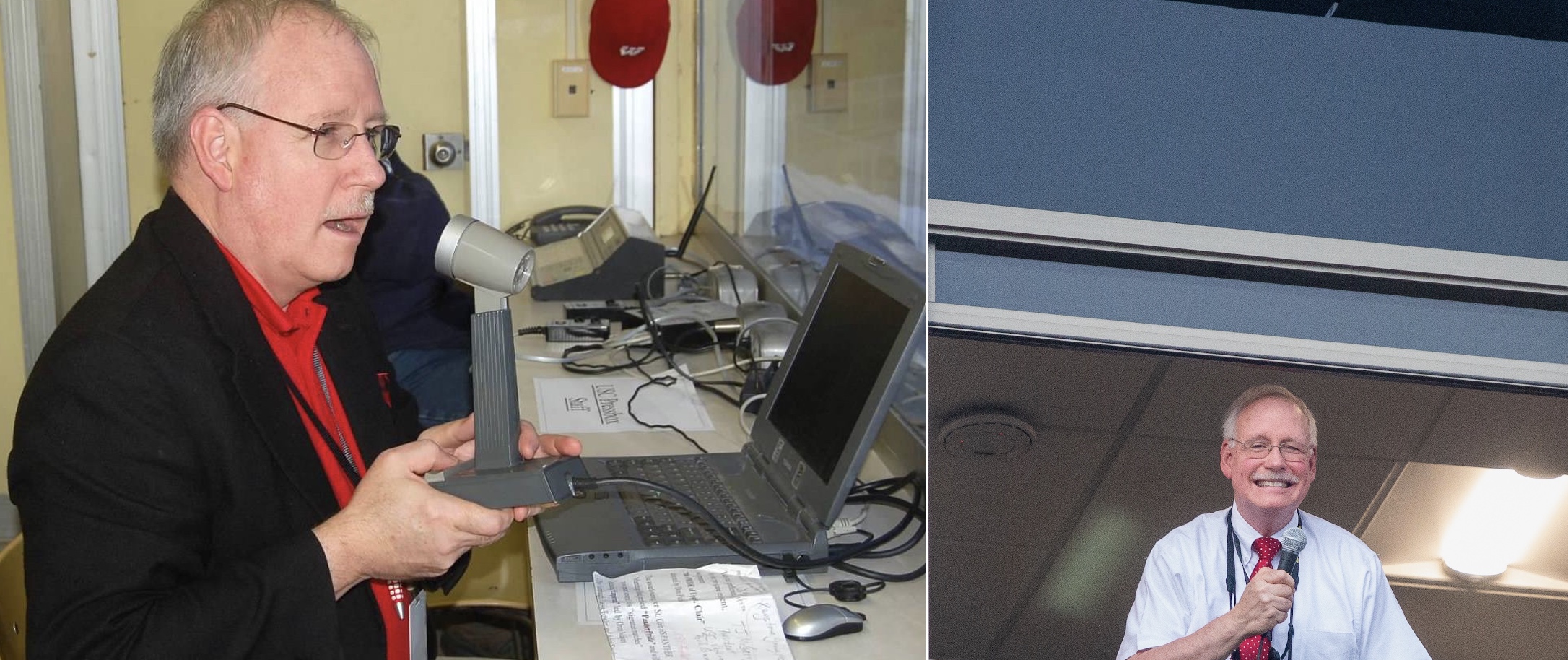
    Funny thing! I’m now a part of the band’s “brand.” For 38+ years, I have been “the voice” announcing the pregame and halftime shows for Upper St. Clair High School. I’ve also emceed a couple dozen of the USCHS Marching Band Festivals, plus senior recognitions, USC Halls-of-Fame exhibitions in the stadium, and outside music invitationals. It is truly a joy to “cheerlead” our musicians… and my wife would tell you, I have a very loud broadcaster’s voice! And now, ladies and gentlemen…

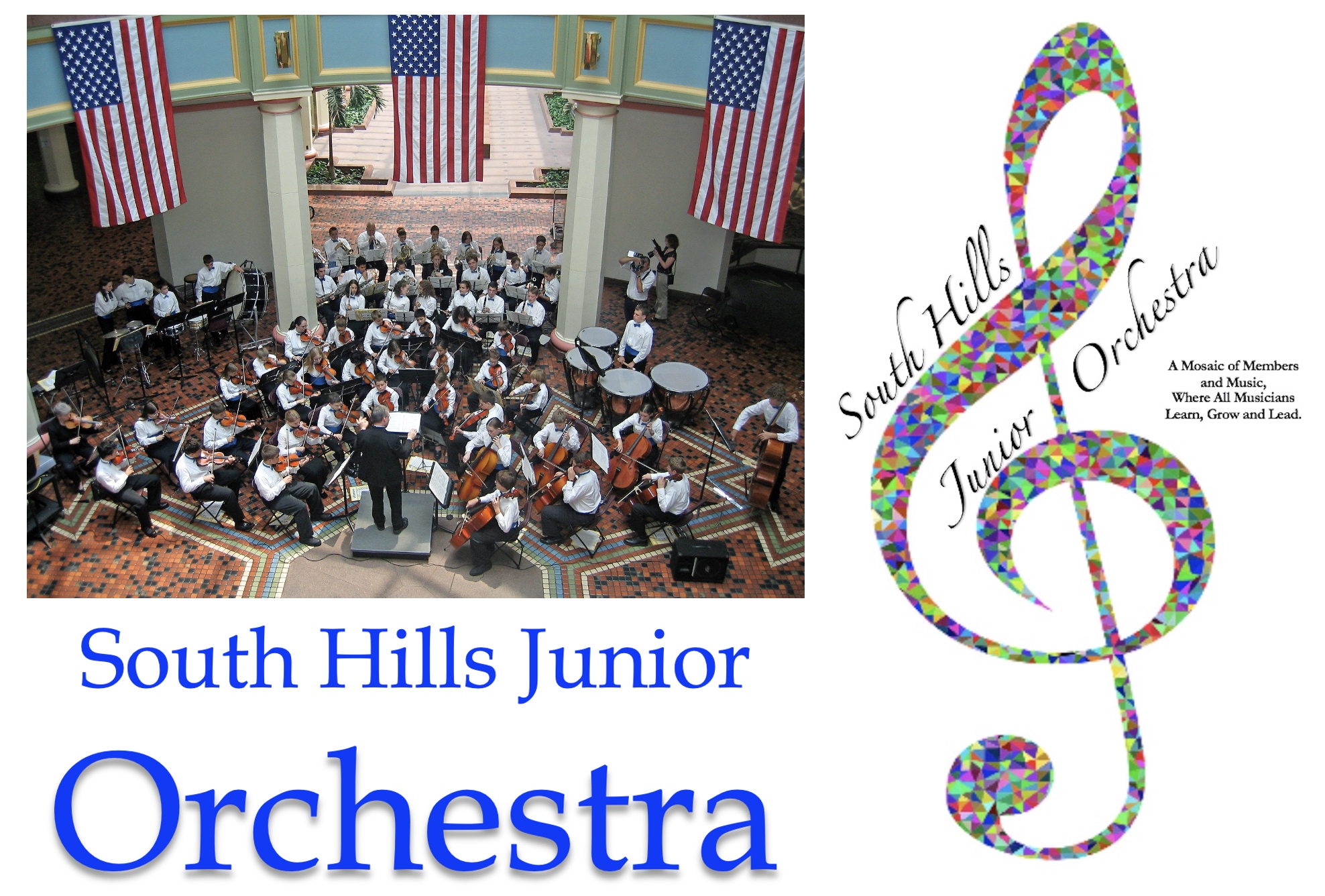
    In two weeks, I will conduct the fall concert of our community ensemble South Hills Junior Orchestra, now in its 40th year. Although COVID did its best to wipe out our enrollments and recruitment efforts, our online academy kept things going, and we now support a small but dedicated chamber group. (Surprisingly, I have a good balance of instrumentation including sometimes rarely-found musicians on French Horn, bassoon, bass clarinet, electric bass, and piano, but one of my trumpet players is having to read clarinet parts.) Our theme is in support of Ukraine. We just “stumbled upon” several appropriate folk songs from the region, including the tribal tunes of Russian Fantasy (Robert Bennett Brown), the ever-popular Ukrainian Bell Carol, Dance of the Slave Maidens from “Prince Igor” (by Borodin, part of the “Russian Five”), and Slovakian Folk Songs (bordering Ukraine).

    After this concert, we will prepare a holiday program for a nearby assisted-living facility with most of the SHJO members each taking a turn to conduct the sing-along of carols and seasonal favorites.

    If interested, we warehoused a lot of our old SHJO Online Academy media and lessons here. (Use the password symphony.)

    Staying involved in my professional associations, I am happy to report I was accepted to present at two conferences, the National Association for Music Education (NAfME) Eastern Division event in Rochester, NY on April 13-16, 2023 and the Pennsylvania Music Educators Association (PMEA) Annual In-Service at the Kalahari Resort/Poconos on April 20-22, 2023. I have been asked to do my interview clinic session at both conferences and a workshop for PMEA on music educator burnout remediation, self-care, health and wellness.

    In the meanwhile, not to let any grass grow under my feet (or more leaves to fall on my head), locally I have been giving teacher ethics presentations at Slippery Rock University of Pennsylvania (a wonderful class of 44 freshman music education majors – the future looks good!) and Washington & Jefferson College undergraduate and graduate education majors.

    I open my session offering to give a hundred dollar bill to the first student who can correctly name the exact title of their educator’s code of conduct (PA Code of Professional Practice and Conduct – CPPC) and identify the agency which enforces it (PA Professional Standards and Practices Commission – PSPC). No one ever guesses it. (I could also likely get away with this challenge at any school faculty meeting in the Commonwealth! Educators seldom receive formal ethics training in our state – that’s why I am sharing these recent updates from the PA Department of Education!) Now that I have publicized “the big question,” I guess I’d better put away that C-note for good!

    A sampling of my slides and handouts are available for perusal from the top section of the “Training/Jobs” menu bar link here, or you can find past blogs on the subject of educator decision-making presented in reverse chronological order here.

    In a similar vein (and with equal passion), I have teamed-up with retired social studies teacher and attorney-at-law Thomas Bailey to sponsor continuing education classes for both educators and administrators. I am inspired by Tom’s knowledge of the PA regulation framework and school law. We just finished an excellent 25-hour approved non-PDE Act 45 course for school system leaders. You should visit his informative website here, and especially check out his court case blog here. If you are a school superintendent or administrator, our next series of online classes will begin on November 29; register for the course here.

    Additional future projects include assisting on the PMEA Strategic Planning committee for “member engagement,” planning for the PMEA CRESCENDO virtual student conference scheduled for January 31, 2023 (more info here), and serving on the PMEA Council for Teacher Training, Recruitment, and Retention (I am state chair) – “the life cycle of an educator.” A wealth of free information for music educators (which I try to revise frequently) is available on sections of the PMEA website: the Council TTRR focus area (click here) and Retired Members (click here).

    Outside the scope of teaching profession, I have been active as Communications Director, Fine and Performing Arts Chair, and Trustee of the Community Foundation of Upper St. Clair (CFUSC). I publicize a weekly eUPDATE (samples on the website here) to announce our township events for donors and supporters, serve as “the duck maestro” – the mascot for the annual duck races on USC Community Day, and look forward to organizing “a really big party” in celebration of the CFUSC’s 30th anniversary on April 21, 2023 at the St. Clair Country Club… although I will be in the Poconos on the same date doing a PMEA workshop! The Fox calendar is bursting with a few overlapping dates!

    Besides all of the above, I am still volunteering at the hospital several days a week, pushing wheelchairs to/from procedure rooms at St. Clair Health. One thing you realize helping out in your hometown (the place you taught all those years)… you will run into many of your former students now grown up with kids of their own. It is a real joy to see them again (albeit due to the need for a colonoscopy or surgical procedure), and catch up with all those memories, their life’s successes, and future dreams.

    The only personal goal that remains unfinished is consideration on how I can better distribute (dare I say “promote”) the numerous blogs that remain timely and relevant at this website. It’s just a little too overwhelming (and dense) for some passersby. A few of the links in the earlier postings may have expired and need to be updated. However, a lot of my insight, hard earned perspective (with sweat and tears), and past experiences have been poured into these writings, and I could only hope many of them could become useful tools for college music education majors, the rookie educator, those feeling challenged by today’s post-COVID times, or anyone recently transferring into the profession. Here’s another list of menus… go ahead, sight-see and enjoy the journey!

    As you can see, I am not really retired… perhaps a better term would be “refired” or “redirected” or “reinvented.” If you are already “living the dream” in your post-full-time employment years or anticipate this happening in the near future, that’s how it’s done. That’s what I wish for you, too! Do you want to live-it-up to Moses’ age – supposedly 120 years old? Then, you better plan to be physically and mentally active and engaged! After all, a mind is a terrible thing to waste!

    PKF

    © 2022 Paul K. Fox
    Giving Back to the Association

    A Pep Talk for Teachers to Become “Team Members!”

    I found myself this past Monday morning with a few extra minutes checking my almost empty “to-do” list and, with the exception of planning to watch the Pittsburgh Steelers football game and the endless chore of raking leaves in my yard (I immediately rejected the latter), I discovered I had very few professional or personal priorities to focus on this week! Wow! Some additional “free time!” Shh… don’t tell anyone!

    Down time? As I mentioned in a previous blog-post, since the summer, things had been a little hectic for “this retiree.” When I accepted the position of “admin” to the marching band of the school from where I retired, I discovered how fast we can fill up our schedules with meetings, rehearsals, and performances… to the point that it is hard to imagine how I could possibly have done all of this unless I retired from the regular job! My wife jokingly said, “Those were the days!” (perhaps a little unsympathetically?) as she watched me takeoff for band camp, parent salute nights, late night away football games, etc., while she remained cozy at home. “Been there. Done that! Not anymore!”

    Only one professional association got me through more than five decades in music education and 35+ years of full-time directing, equipping me to handle the twists and turns of an ever-changing career (e.g., becoming a choral director even though I had never sang in a high school or college choir), and even attending music festivals as a viola and tuba student for four years in the Penn Hills school district. Who do I credit for giving me this “life force,” “teacher chops,” and music mastery? PMEA. We are so fortunate to have this priceless “collaboration of our colleagues,” numerous resources for the benefit of our own professional development, and services we provide to our music students. Cut me and I bleed PMEA blue!

    How Are YOU Feeling?

    This blog’s “call to action” is necessary because of the turmoil the pandemic has left the arts education community, new school health and safety mandates, re-prioritization of district resources (in some places away from the arts in spite of the need for more not less social emotional learning), reports of the drop in music participant enrollments, decrease in membership renewals, and teacher shortages.

    The crush of COVID-19 and all of the program delays, suspensions, (and hopefully not) permanent losses have made this one of the most challenging times I can ever recall. The only way we can get through this is “together…” and frankly, “if you’re not part of the solution, you’re part of the problem!” This is NO TIME to let your membership and involvement lapse! PMEA and other professional music education organizations (like NAfME, ACDA, ASTA) need your “dedication to the cause,” willingness to help “the team” and one other,  and active participation.

    Collegiate members, full active members, and retired members – all of us joining forces – can truly “make a difference!” No matter how busy or stressed you are and how much you feel you are “slugging it out in the trenches” alone, we all need to become partners and devote time for and dedication to the associations we are blessed to have right now that support music educators in the Commonwealth, the nation, and the profession.

    The Essential Role of Associations

    It does not matter which profession you have chosen! You NEED an ASSOCIATION!

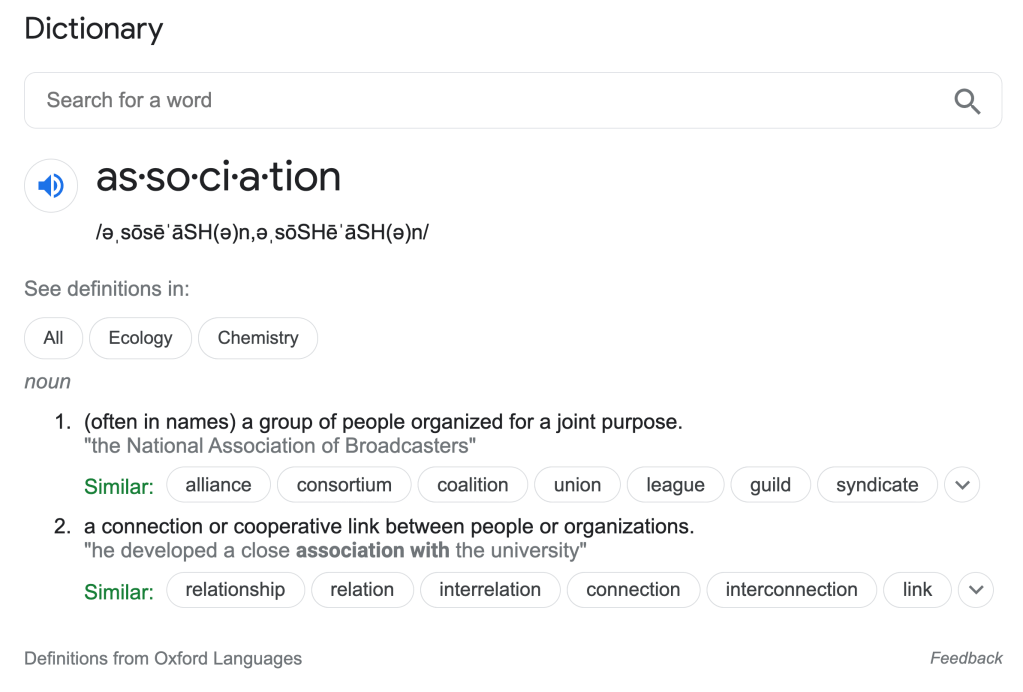
    Google English Dictionary provided by Oxford Languages

    The architects may have defined “this essential bond” best:

    Membership in the relevant professional organization is one of the things that separates a profession from a conventional job. It is a key element that defines a professional. Membership in one’s professional organization is expected of all professionals. It is important to support the advancement of one’s profession, and becoming a member of the professional organization is a part of that advancement.

    Involvement with a professional society will afford the participant an opportunity to network with other colleagues in industry and practice. Making connections with others who have similar interests reinforces why one has chosen this career. It enables new professionals to associate with senior members of the profession and learn from them. Joining a professional organization is critical in keeping abreast of the latest knowledge and practices locally, regionally, and globally. It helps the professional to stay abreast of current issues and opportunities and will also assist in personal advancement for the member who becomes involved.

    Many professional organizations offer continuing education, seminars, and lectures along with other opportunities for learning. An active participant will have the opportunity to serve in professional development. Working with people outside of one’s own firm and volunteering will build leadership skills. Opportunities for working with the community for the betterment of society and the local economy will be available. There will be possibilities for making real contributions to the human condition through projects the professional organization may take on as a part of giving back to the community. There are events that will call for public speaking skills and professional visibility which will assist in moving one’s career to another level by connecting with other professions and local leaders in the area. The profession will benefit from members’ service and the members will be rewarded in return by such things as personal fulfillment, professional enrichment, and building a stronger resume as a result.

    Further definition of the professional responsibilities and ethical practices will come in part from the professional organization. It is a central core for regulation, education, revitalization, networking and service. Joining a professional organization provides occasions and experiences to renew one’s enthusiasm for the practice of interior design. The interaction can be both inspirational and enlightening. Being a member of a professional organization is a symbiotic relationship between the organization and the member that will benefit them both.

    Alabama Board for Registered Interior Designers

    My “top-ten” benefits for membership in a professional association like PMEA are:

    1. Development and sharing of the standards and best practices of the profession
    2. Student festivals and music performance assessments
    3. Professional development and career advancement opportunities: workshops, conferences, and publications
    4. Leadership training
    5. Collaborative projects such as health and wellness seminars, ethics training, library of online resources, etc.
    6. Networking opportunities
    7. Models and resources for curriculum writing
    8. Coaching and mentoring resources
    9. Resources in job hunting and interviewing techniques
    10. Advocacy of music education and “a voice” (more political “clout”) in defining future government public policy

    So, What’s in it for Me?

    Review a few of the synonyms of “association” mentioned above: “alliance,” “consortium,” “coalition,” “connection,” etc. I am sure you’ve heard the saying: “TEAM stands for Together Everyone Achieves More.” Or, to quote the philosopher Aristotle: “the whole is greater than the sum of its parts.”

    The easiest way for me to show the value of joining PMEA and becoming more active, engaged, and successful in your teaching assignment (no matter what the primary specialty – general music, vocal, band, strings, jazz, music theory, technology, etc) is to take a snapshot of the benefits displayed on the www.pmea.net website. Why try to reinvent the wheel? You might be surprised the extent of the HELP that is available just around the corner! Go ahead… click away! Take a peek at what you may be missing!

    On a personal note, PMEA has provided me the insight, inspiration, and opportunities for substantial career growth, “places to go and people to meet” to fill-in-the-gaps of the skill training I may have felt were missing, for example methods and media for teaching a high school choral program for more than 16 years and directing/producing 37+ musicals. In addition, PMEA and NAfME have been the sole institutions that I have turned to for more than 50 years for their sponsorship of choral and orchestral music festivals and other enrichment that have provided my students new and highly motivating musical challenges and countless state-of-the-art once-in-a-lifetime experiences.

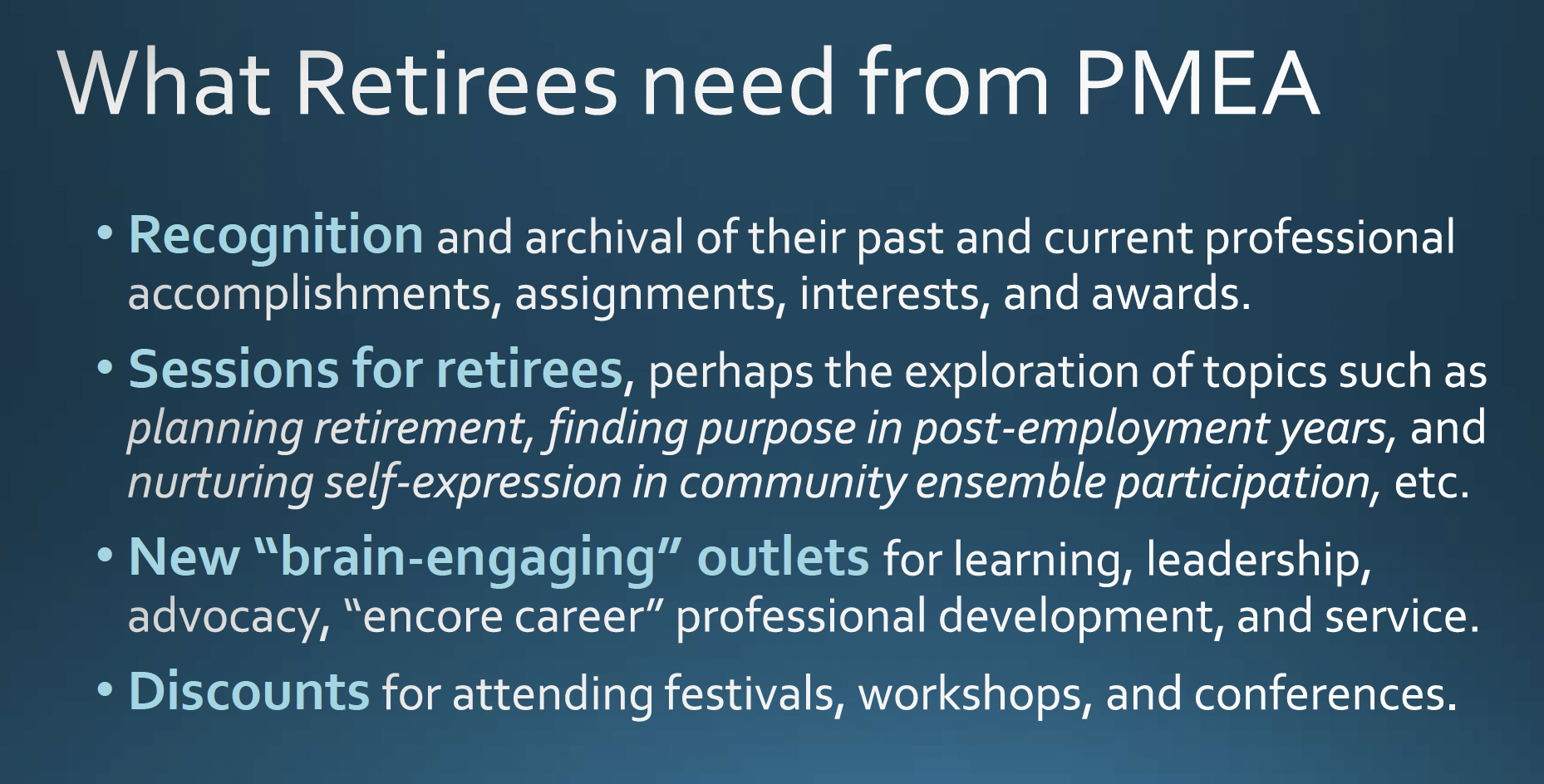
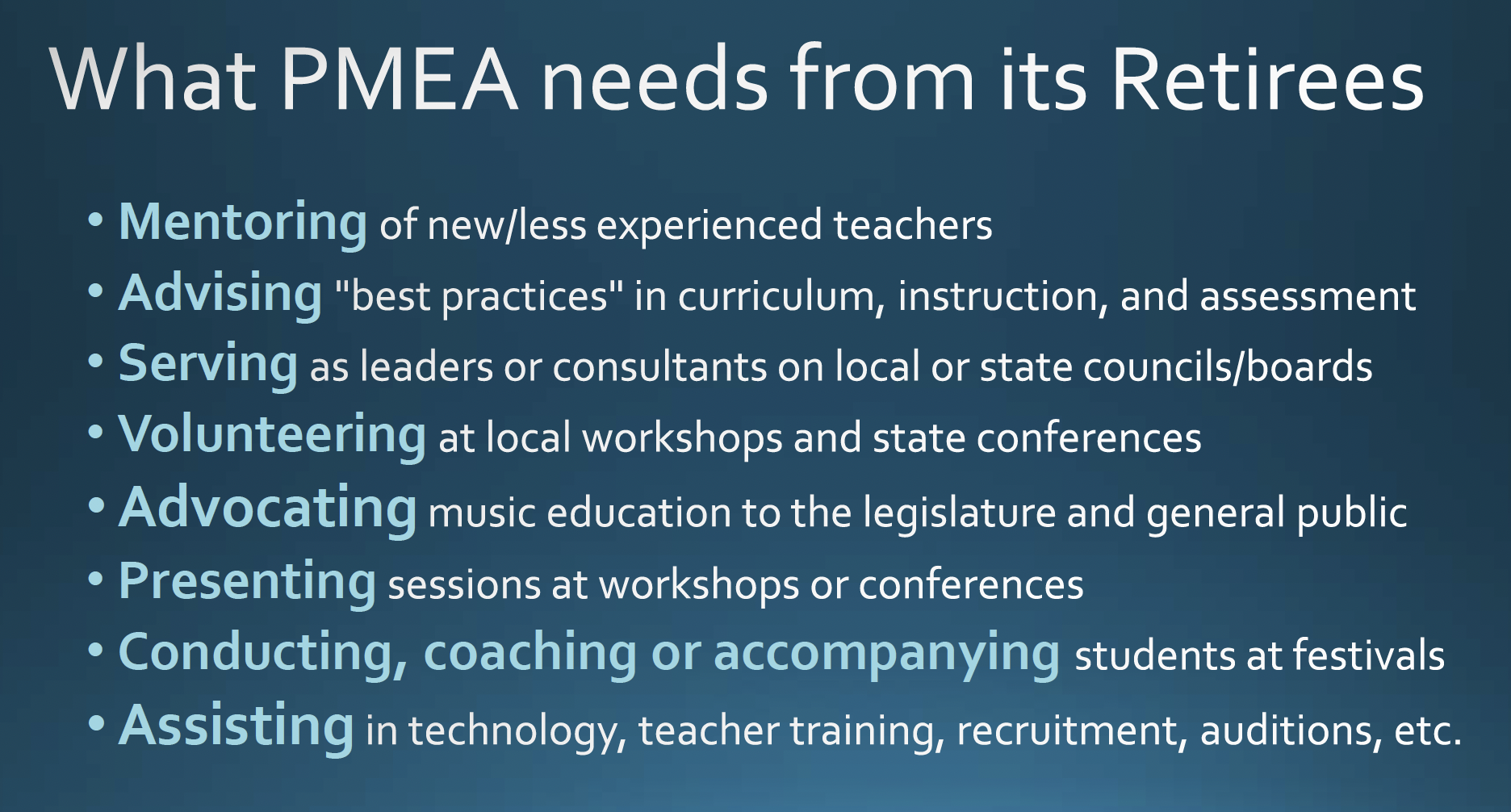
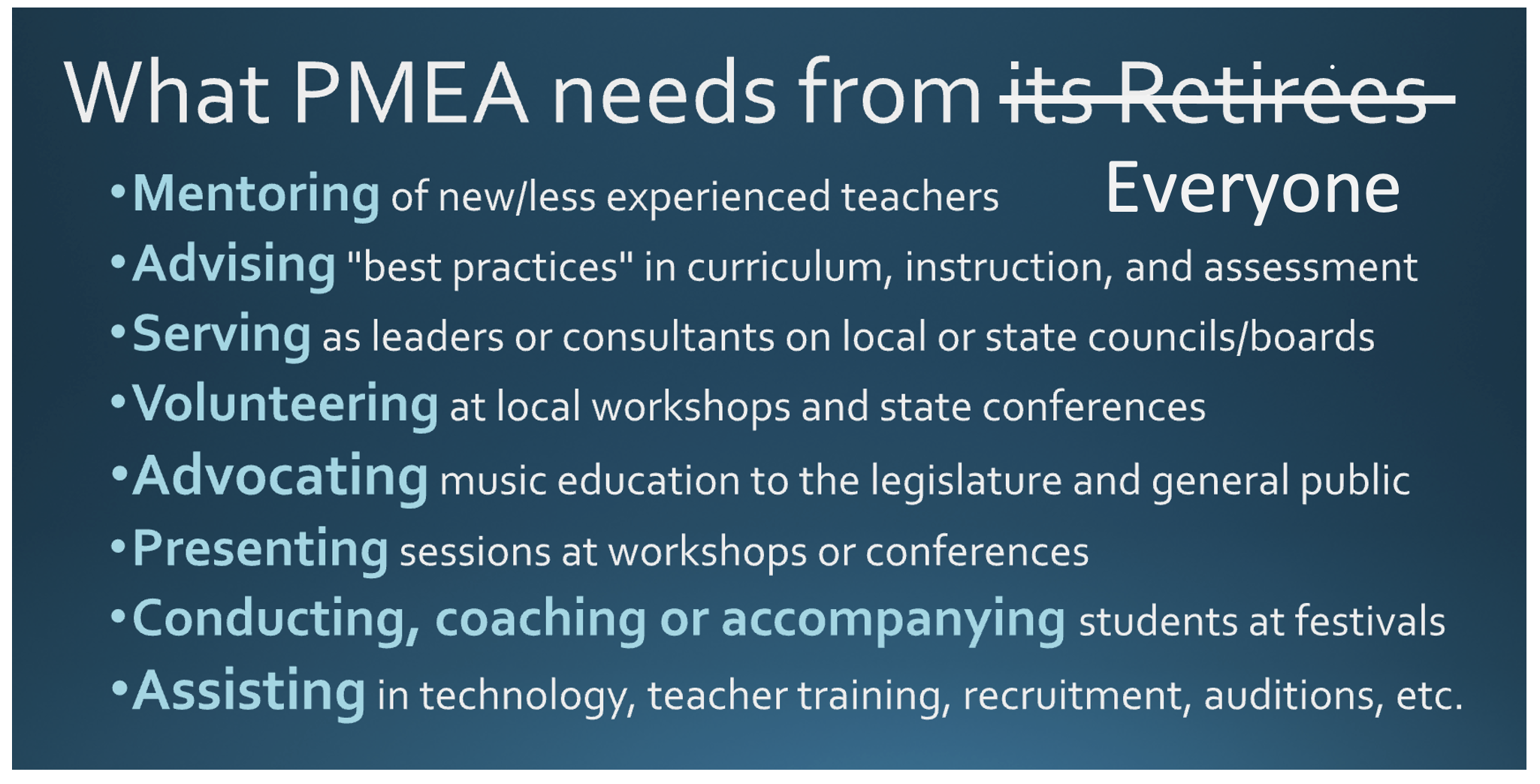
    So now, reflect on the title of this blog! It is essential to give back to our association – to help it achieve its mission: “to advance comprehensive and innovative music education for all students through quality teaching, rigorous learning, and meaningful music engagement.” We’re all in this together, and together we can make it better! Slide #6 at the bottom of the retired members’ webpage proposes what PMEA needs from all members (not just retirees):

    The number one thing you can do for ANY association is to pay your annual dues, attend its meetings, be active and HELP OUT! In return, PMEA can assist you in finding and sustaining your passions! What are you waiting for? If you have not renewed for the 2021-2022 year, please visit this PMEA membership webpage.

    PKF

    © 2021 Paul K. Fox
    Pictures from Pixabay.com by artist Augusto Ordóñez

    Spring is for… Music Conferences!

    In our neck of the woods (Allegheny County in Western PA), we are thawing out from what was a pretty mild winter, and welcome the sounds of birds chirping and sights of flowers blooming and grass turning green! Spring is the time for re-birth and growth… including professional development of all kinds for music educators – everyone from pre-service (future music educators) to in-service teachers and even retirees!

    Let’s get recharged, re-energized, and re-inspired! Sign-up for one or more of these conferences.

    COVID-19 has placed restrictions on all of our PMEA and NAfME venues, and so far, 2021 conferences will be held in a “virtual” platform. This is both good and bad news. The disadvantage remains that we cannot “get close and personal,” shake hands, network, collaborate, and “catch-up” with our friends and colleagues, meet new people, and sight-see places like the Poconos, Erie, Reading, or Pittsburgh! However, the advantage of these online events is that all sessions are being offered “on-demand” for at least several months after each closing event. In the virtual setting, you can take the time and view every workshop at your leisure!

    If you have never attended a music education conference, take a moment and review one of these articles:

    Yours truly is privileged to present several sessions on some of his “favorite topics” previously posted on this site:

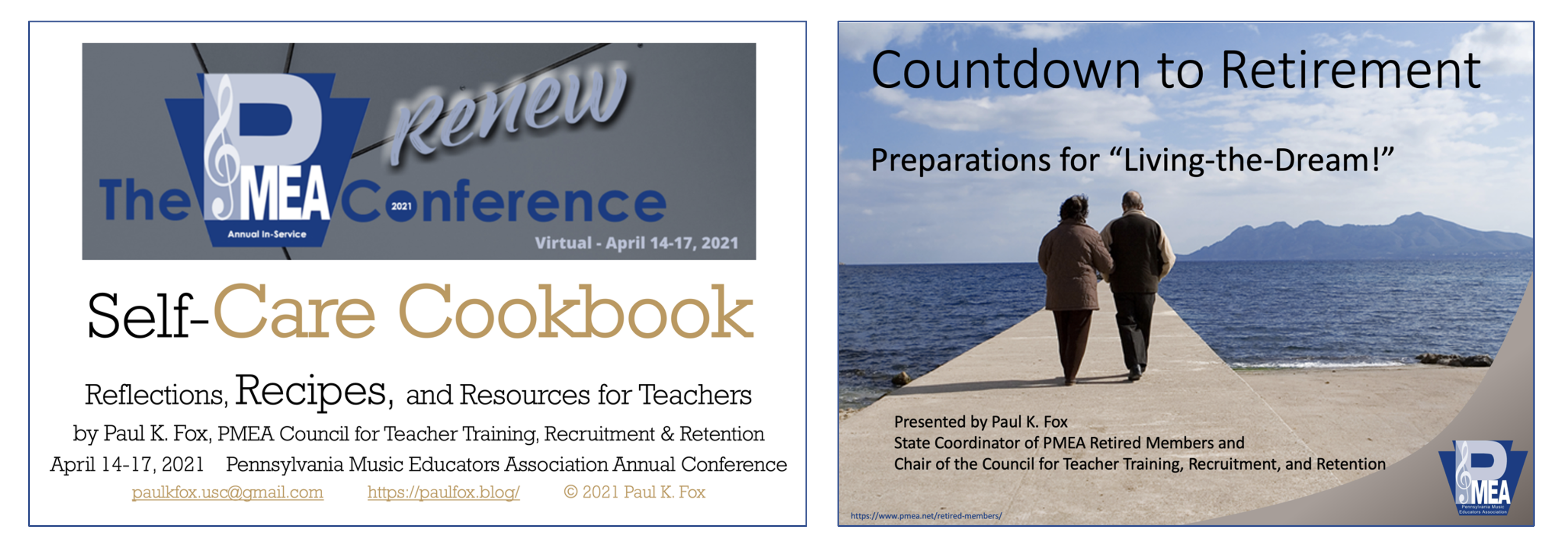
    • Self-Care Cookbook – Reflections, Recipes, and Resources for Teachers (PMEA ANNUAL CONFERENCE)
    • Countdown to Retirement – Preparations for “Living-the-Dream” (PMEA ANNUAL CONFERENCE)
    • Hands-On Conducting (PMEA CRESCENDO FOR STUDENTS)
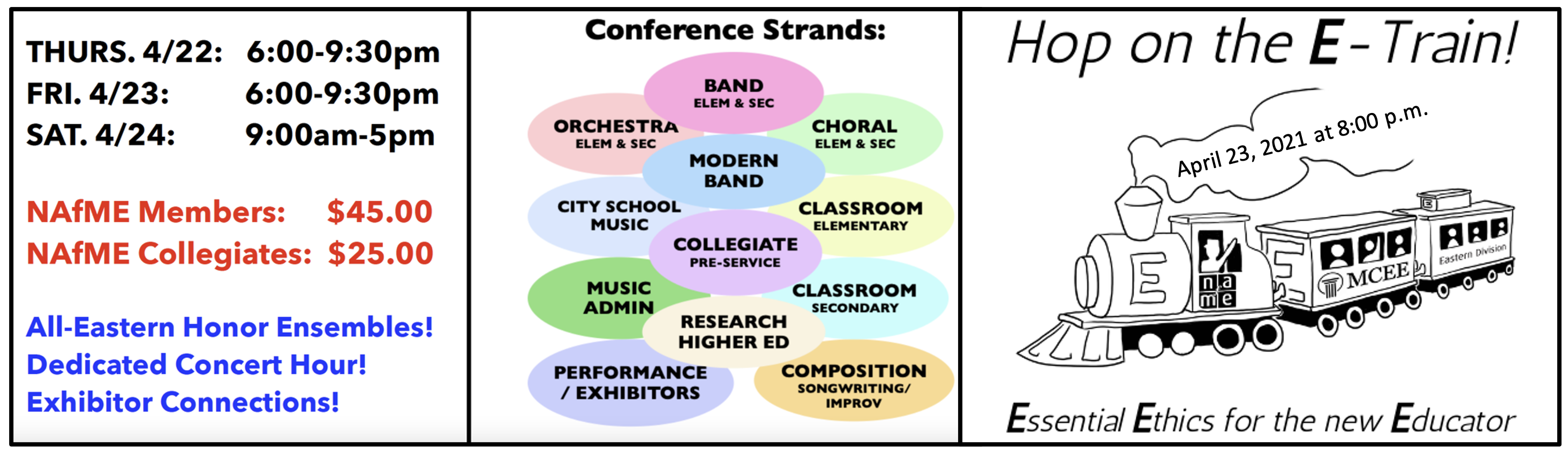
    • Hop on the E-Train – Essential Ethics for the new Educator (NAfME EASTERN DIVISION)

    Update on 5/27/21:

    PMEA Summer Conference 2021 – Rejuvenate!

    The 2021 PMEA Summer Conference will be held virtually beginning Wednesday, July 21 and concluding on Friday, July 23. Most sessions will be presented live and will be recorded for attendees to access at a later time. 

    For more information, go to https://www.pmea.net/pmea-summer-conference/.

    PMEA Annual Conference 2021 – Renew!

    The PMEA Annual Conference kicks-off on April 14, 2021 for three days and four nights of professional development activities.

    PMEA will utilize the same online platform for this event as it did for its 2020 Summer Conference. The virtual annual conference will also include a virtual exhibit hall. With the theme of Renew, the 2021 Conference invites music educators to use this time together to Renew the way you think about music education, to Renew plans for the 2021-22 school year, to Renew connections with fellow music educators, to Renew our hope for a return to making music together, and to Renew our collective passion for the power of music education. All registrants will have access to the majority of the conference content for 90 days. Online registration is available. 

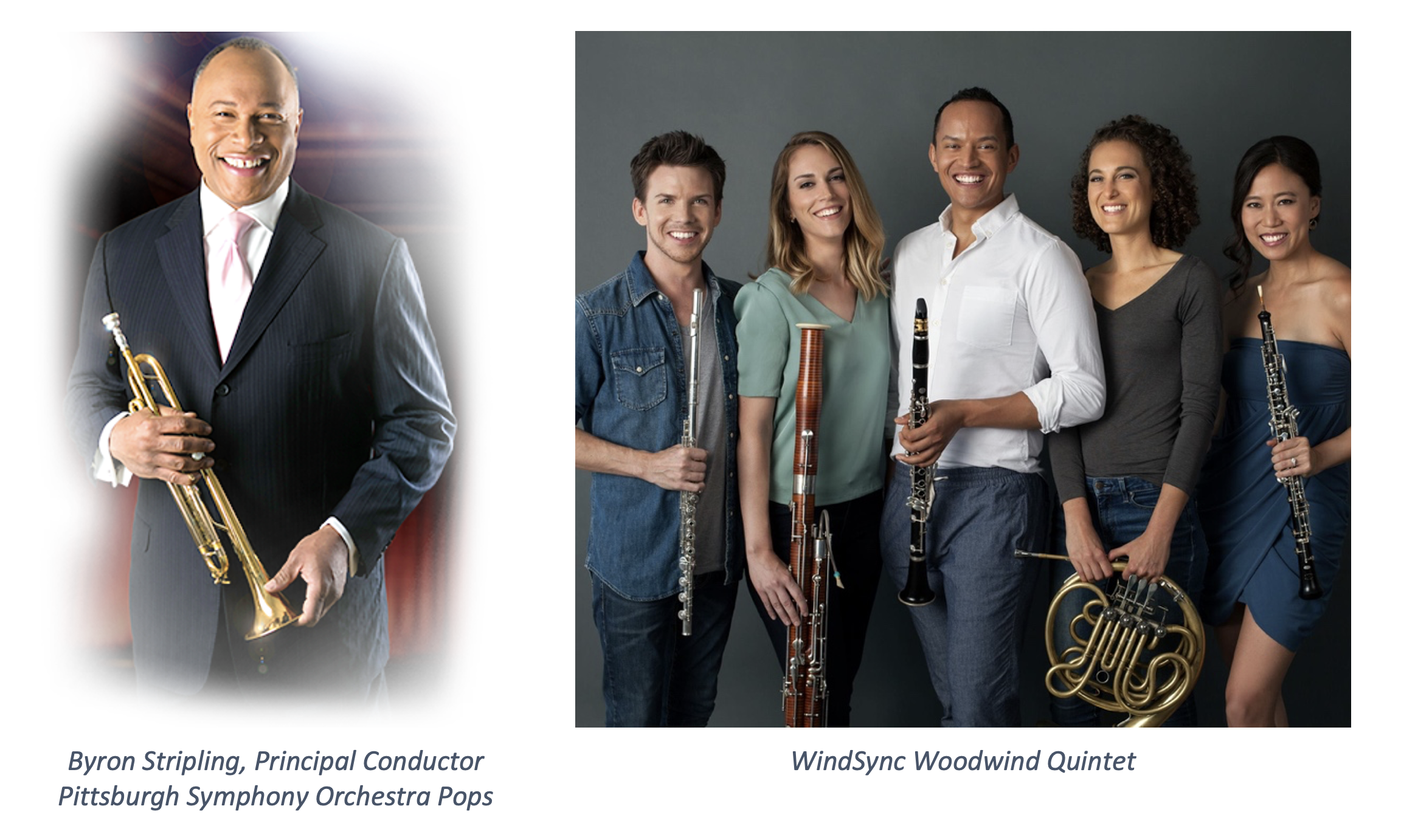
    Thursday evening will feature synchronous open forum discussions and an Invited Researcher session with Elizabeth Parker, Temple University, as well as a keynote presentation by Byron Stripling, Principal Pops Conductor, Pittsburgh Symphony Orchestra. The evening will end with college/university receptions, held in the virtual space this year.

    Synchronous research sessions will also be available on Friday in the late afternoon/early evening. The Saturday schedule includes a performance by the woodwind quintet WindSync and a presentation by Julie Duty, Founder & Executive Director of United Sound, an organization which offers the solution for music educators who desire to include students with disabilities in their music programs but struggle with the “how” and the “when.”

    This year’s event will also include opportunities to network with fellow attendees, as well as an online Music Education Marketplace (exhibit hall) – allowing participants to connect directly with exhibitors within the platform. While the exhibit hall will be “open” the duration of the event, there will be specific hours, beginning Wednesday evening and concluding Saturday afternoon, when the exhibitors will be available for live interaction.

    CRESCENDO Virtual Conference for Students

    Students in grades 8-12 are invited to participate in the first-of-its-kind PMEA CRESCENDO, an online event to be held on April 17, 2021. Designed for student musicians who are interested in learning about opportunities to make music or find a career in music, the one-day conference will bring together some of the best speakers and teachers from a variety of music worlds.

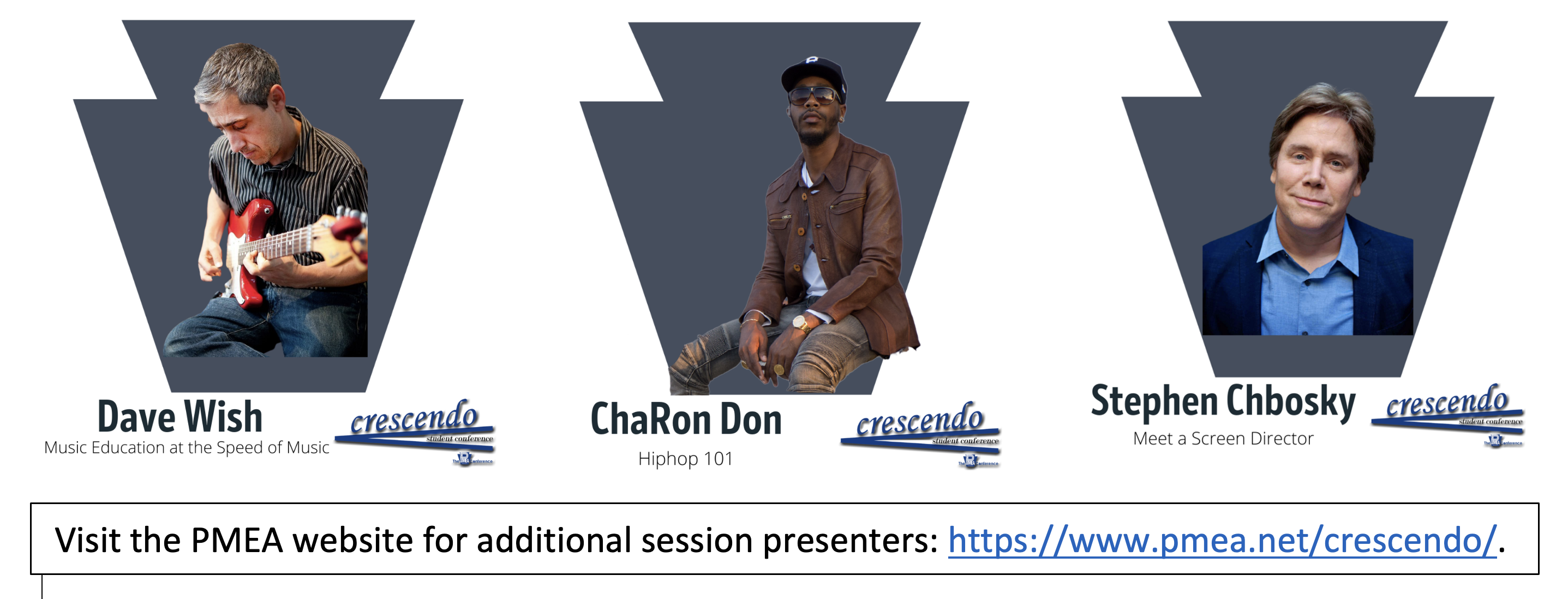
    Keynoters will feature Dave Wish, founder/CEO of Little Kids Rock, and ChaRonDon, rapper/hip-hop artist.

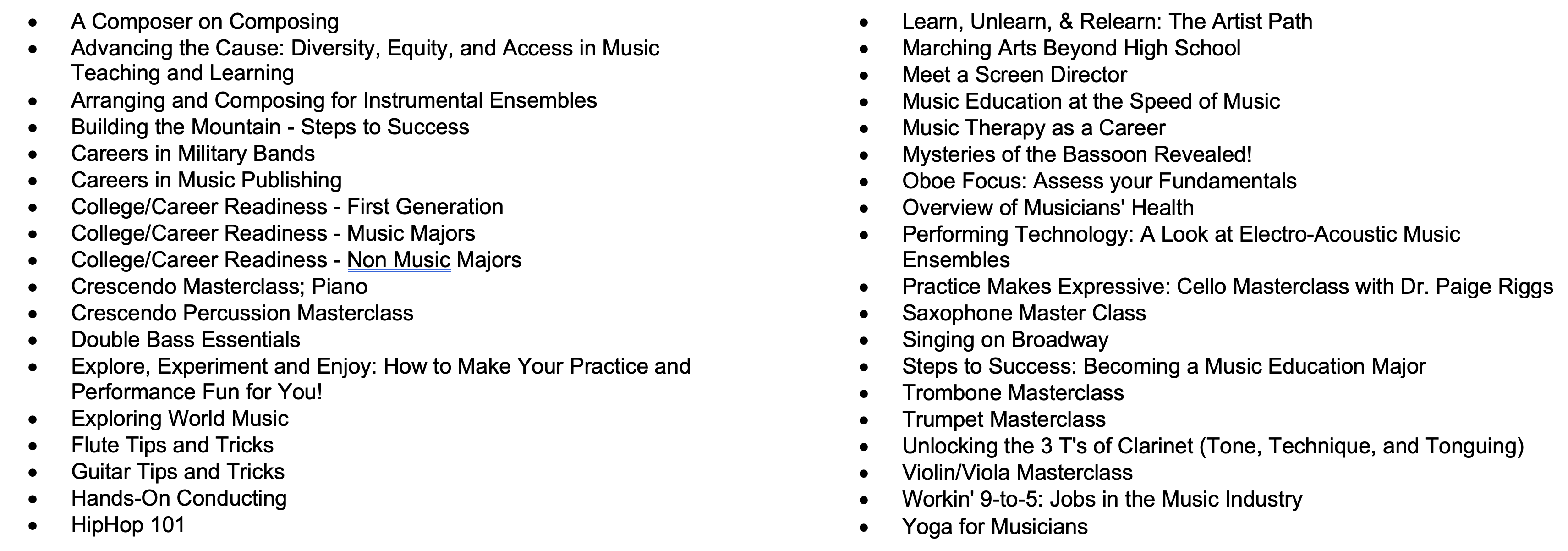
    Sessions will include:

    • Careers in music (areas like music therapy, musical theatre, music education, military careers, music performance, music publishing, composition, retail and repair, and music production)
    • Breakout sessions (learning about drum corps, conducting, meet a composer, music technology, song writing, yoga for musicians, rap/hip hop, vocal jazz, leadership, and more!)
    • Masterclasses from experts on their instruments. Students will have the chance to spend some time learning more about their instrument or vocal performance area and get tips from the pros in unique online masterclass settings.

    Proposed mini-workshops:

    PA STUDENTS interested in participating in PMEA CRESCENDO should fill out this form.

    PA MUSIC EDUCATORS recommending a student for this conference should fill out this form.

    57th Biennial NAfME Eastern Division Conference

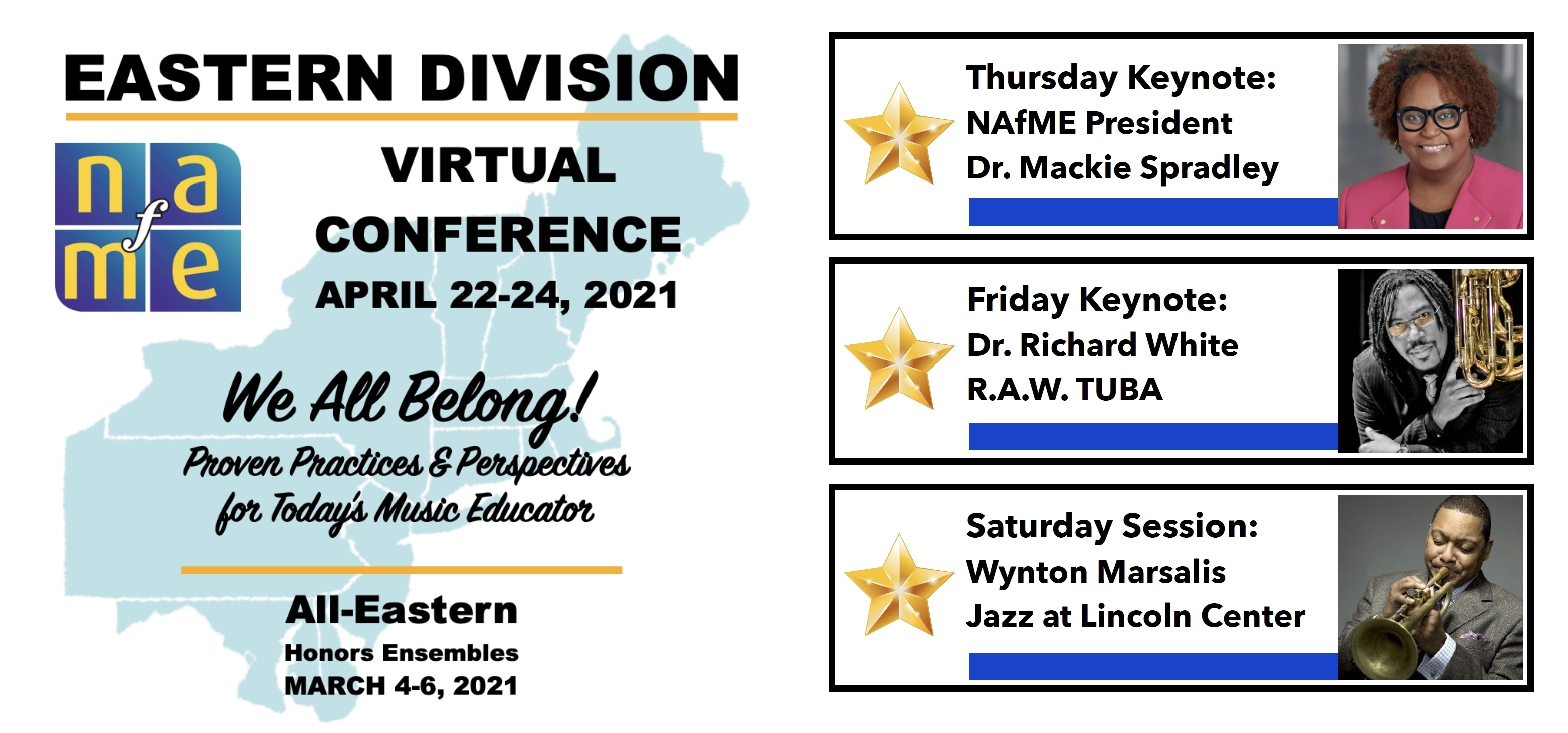
    Finally, you won’t want to miss the following week’s frenzy of enriching and enlightening professional development, the 57th Biennial NAfME Eastern Division Virtual Conference!

    In addition to the NAfME workshop sessions being only 30-minutes (colleagues sharing quick “tips, techniques, and solutions” and more opportunities to peruse additional sessions), there will be a designated Thursday evening “concert time” with 5 programs to play at 8:45 p.m. (Orchestra, Chorus, Band, Jazz, Modern Band) along with performances from the Division’s colleges and universities. 

    The master schedule is posted here. Registration can be completed here. Hope to “see” you there!

    © 2021 Paul K. Fox
    Coming Soon… Books to Put on Your Reading List

    Pixabay spring picture: Crocus-Flower-Spring by MichaelGaida

    Virtual/Remote/Alternative Music Ed

    Resources for Teaching Music Online During the COVID-19 Pandemic

    COVID-19

    The dreaded messages came to almost every educator:

    EMERGENCY ALERT:

    Out of an abundance of caution relating to the prevention of spreading the coronavirus, beginning on _____, all after-school, extra-curricular, and outside group meetings and rehearsals are postponed until further notice.

    * * *

    Dear Students, Parents, and Staff:

    All ______ school programs such as sports, band and jazz concert, spring musical, choir festival, dance and voice recitals, booster meetings and fund-raisers, and the music department adjudication trip, are cancelled.

    * * *

    Important announcement:

    The spring concert scheduled for March 28 at the Performance Hall will not take place. A decision about whether to cancel this performance or postpone it to another date will be made as the community health situation continues to evolve.

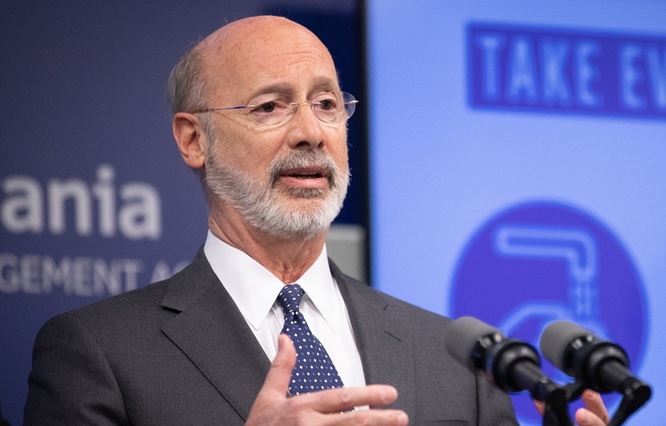
    And then, the Governor closed the schools for two to eight weeks (or more?).

    Governor Wolf
    Pennsylvania Governor Tom Wolf

    Dear Families,

    Thanks for your patience as we work through the events that have been occurring and planning for what lies ahead. We hope you and your family are staying well, and we know that many of you are looking forward to a Virtual Learning experience for your child.

    We want to share some important information with all of you as we prepare this transition. While we do not know how long our buildings will be closed, we want to be prepared for ______ Virtual Learning for as long as it is necessary.

    The immediate effect? Suddenly, our kids were sent home for an extra-early spring break, hopefully remembering to bring their instruments and music! Trying to “embrace” this world emergency (from a safe distance, of course), no one had a “crystal ball” to predict or even imagine the far-reaching effects, many of which we are still awaiting answers!

    • When will we be able to go back to school?
    • How can we collaborate, grow, and share our music learning, personal progress, repertoire and skills learned over the past year?
    • What will happen to everything all of us were forced to leave unscheduled, unfinished, or “in production?”
    • Will commencement be cancelled, too?
    • Worst yet, will our seniors fail to graduate, receive their diplomas, and start college on time next fall?

    Every music teacher I know cried out, “How can I reach-out to my students to help them find alternative avenues to making music? The challenge is now thrust upon us to find ways to inspire our students to continue building on their “musical momentum” in daily practice, as well as stimulate other sources of artistic enrichment and the self-motivation to create new music goals.

    My first act as a community youth director was to “fire up” my orchestra’s website and Facebook page. We regularly send out Fox’s Firesides of articles on practice tips, music problem-solving techniques, goal-setting, keeping a journal, developing teamwork, learning to conduct, acquiring college references, showing concert etiquette, etc. and other notices to the members and parents using a free-version of Mailchimp.

    SHJOclips

    In addition, we launched something called SHJO.clips, low-tech but hopefully effective in “exciting” future music enrichment and exploration: online music games, worksheets, sample recordings and videos, practice excerpts, music theory exercises, sight-reading and ear training assignments, and much more… a treasure chest of FUN things-to-do or c.l.i.p.s. to do ON THEIR OWN: Create, Listen, Inspire, Practice, Share.

    Archives of both Fox’s Firesides and SHJO.clips are available by clicking the menu at the top or visiting http://www.shjo.org/ (look under “resources”).

    Are we permitted access to our students and classes online during the official closures? Does your school use Canvas or other virtual educational environments to hold digital classes, post learning activities, make assignments, provide feedback, and/or assess your students’ achievement? (Are you even allowed to do so? I cannot answer this essential question because I do not know school law and I retired from the public schools in 2013.)

    smartmusic and musicfirst

    Are you one of the “lucky ones” who had previously set-up either the Smartmusic or MusicFirst online platforms (and the students know how to use the it) and can continue encouraging your band instrumentalists, string players, or vocalists to sight-read, practice, explore new literature, perform, record, and assess themselves?

    Do you and your students need cheering up with a “pep-talk” by Dr. Tim Lautzenheiser, the famous “music educator’s guru,” guest speaker and expert motivator often presented as the kick-off keynote session at music conferences. “Dr. Tim” challenges us all to focus on what’s important and how we can put our time to good use:

    “Life is about 10% what happens to me and 90% how I react to it.”

    The pessimist sees the challenge in every opportunity, but the optimist sees the opportunity in every challenge.”


    Set aside 17 minutes to recharge with this video. Then, share it with your students!

    I am proud to admit that, in a single act, our profession has so far risen to the occasion. In an effort to help our “stranded” programs and motivate music educators and their students, so many tech experts jumped into the fray to post their recommendations and resources. At the end of this blog-post is a (very long) list of links from them, at least active as of today, for distance learning strategies and virtual music education.

    logo 2
    https://www.pmea.net/council-for-ttrr/

    We have taken the time to compile many of these suggestions and warehouse them on the Pennsylvania Music Educators Association State Council for Teacher Training, Recruitment, and Retention website here. Look under the heading “Virtual Music Learning – Engaging Students During the Break.” This is the impetus for this article. The samples provided below (probably only the “tip of the iceberg” and already out-of-date) are by no means all-comprising and fully comprehensive. With every minute of the day dragging on during this crisis and we are still “shut in” our homes away from our music students, new solutions are being posted to Facebook groups like Music Educators Creating Online Learning.

    Click here if you would like a printable PDF file of this revision of resources.

    Take the time to research what might work for you. At the very least, pass on the music games and puzzles offered at sites like Music Tech Teacher or Cornerstone Confessions. Venture into learning new apps like Zoom.com for webinar/meeting management.

    Music does make a difference in all of our lives… and we need to keep our musicians and singers “at it” even during this catastrophe!

    Best wishes to you and yours. Stay safe and healthy! Thank you for your dedication and contributions to music education!

    (Editor’s Note: We have continued adding many more updates to the list below at the website of the PMEA Council for Teacher Training, Recruitment, and Retention accessible from this link.)

    PKF


    Sources of Online Music Media and Instruction

    Photo credit from Pixabay.com: “child-play-game-technology-3264751” by ExplorerBob

    © 2020 Paul K. Fox
    A Collection of Collegiate “Treasures”

    3 by 3: Essential Books + Websites for Music Ed Majors

    By now, at least several weeks after the holiday/winter break, most of you have probably returned to school and are “back at it” fulfilling your studies in music and education methods. Welcome to the New Year (2019) and good luck on meeting your goals!

    It has been my pleasure to present numerous workshops and conference sessions for pre-service, in-service, and retired music educators on a variety of topics: interviewing for a job, marketing professionalism, ethics, transitioning to retirement, supercharging the musical, etc., and have been asked on occasion, “Where do you find all of the information, research, and resources for your blog-posts and talks?

    Well.. I’m glad you asked!

    book-841171_1920_PourquoiPas

    It would be hard to credit one or a few sources on reliable data, insights, and recommendations for career development. The following “gems” – a few ideas from someone who has taught music for more than 40 years – are just my New Year’s “gifts” to you… hopefully useful in your undergraduate or advance degree studies. Please enjoy!

    This is probably the wrong time to suggest making a few “buys” for the sake of educational enrichment. College students are bombarded with many required readings of their (often expensive) textbooks and handouts from their comprehensive higher education courses of study. It is somewhat daunting to “cover all the bases,” especially when you may want specific advice and “answers” as a result of being recently thrown into “the real world” of field observations and student teaching. What else would a prospective music teacher need or have time to read? How can we better prepare you for the challenges of our profession?

    Since you have to order books (or borrow them from a library), we’ll start with the printed publications. Here are my “top three” for your immediate consideration.


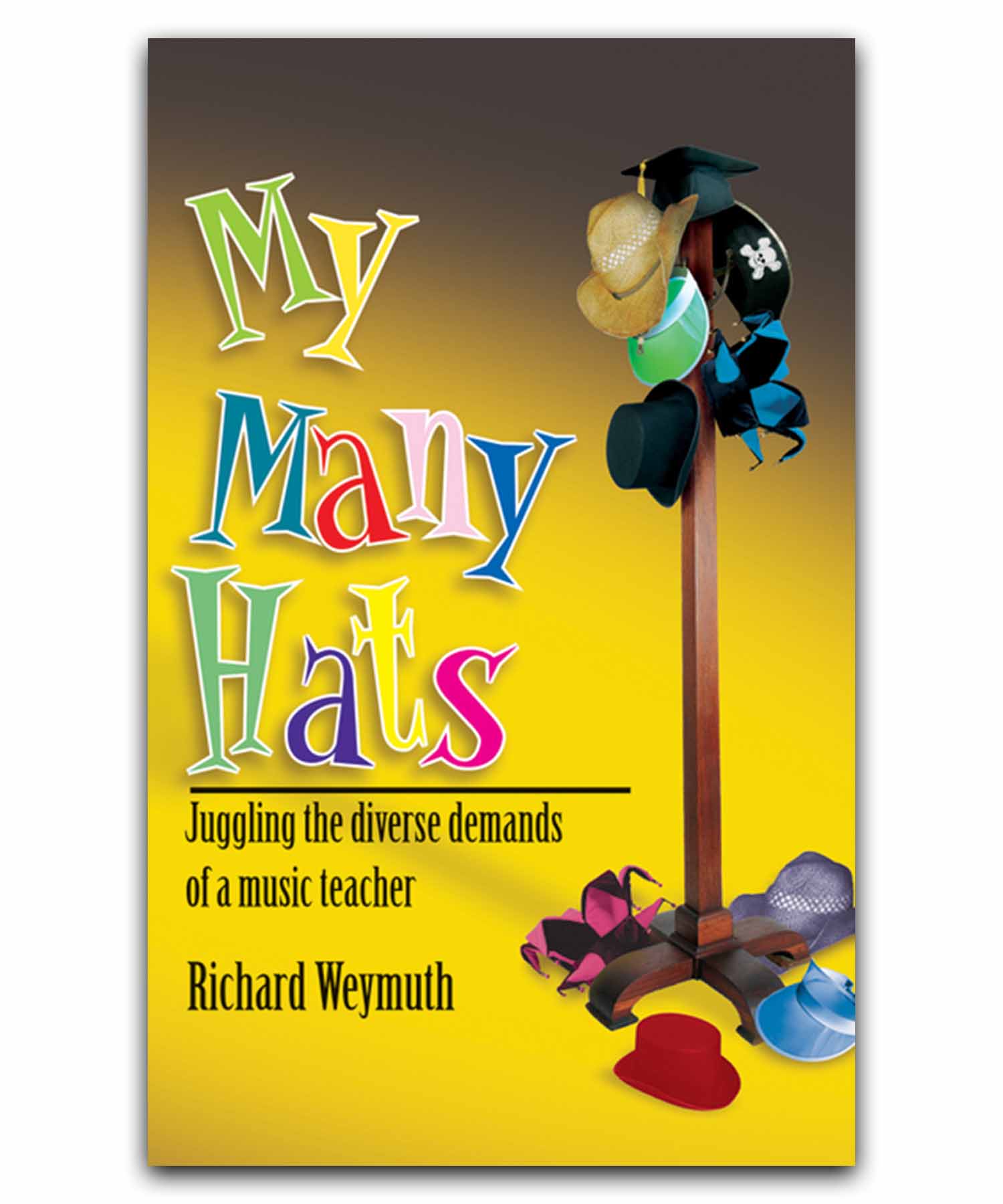
    My Many Hats

    My Many HatsIn the category of “things I wishes someone would have told me before I was hired to be a school music educator,” the inspirational book, My Many Hats: Juggling the Diverse Demands of a Music Teacher by Richard Weymuth, is a recommended “first stop” and easy “quick-read.” Published by Heritage Music Press (2005), the 130-page paperback serves as an excellent summary of the attributes (or “hats”) of a “master music teacher.” Based on the photos in his work (great “props”), I would have loved to have seen Weymuth’s conference presentations in person as he donned each hat symbolizing the necessary skill-set for a successful educator.

    A quote from the author in his Introduction:

    “I want my hats to put a smile on your face as you read this book, just as they do for the airport security guards as they go through my bags at the airport. They ask, “Are you a magician? A clown? An entertainer?” My answer is, “Yes, I am a teacher.”

    His Table of Contents tells it all:

    1. The Hat of a Ringmaster: Managing your classroom and your time
    2. The Hat of a Leader: Setting the direction and tone of your classroom
    3. The Hat of a Scholar: Learning when “just the facts” are just fine, and when they aren’t
    4. The Hat of a Disciplinarian: The Three C’s: Caring, Consistency, and Control
    5. The Hat of an Eagle: Mastering your eagle eye
    6. The Hat of a Crab: Attitude is everything; what’s yours?
    7. The Hat of a Juggler: Balancing a complicated and demanding class schedule
    8. The Hat of a Banker: Fund raising and budgeting
    9. The Hat of an Artistic Director: Uniforms and musicals and bulletin boards, oh my!
    10. The Hat of a Lobster: Establishing the proper decorum with your students
    11. The Hat of a Pirate: Finding a job you will treasure
    12. The Hat of a Bear: Learning to “grin and bear it” in difficult situations
    13. The Hat of a Peacock: Having and creating pride in your program
    14. The Hat of Applause: Rewarding and recognizing yourself
    15. The Hat of a Flamingo: Sticking out your neck and flapping your wings

    Here are a couple sections that should be emphasized if you are currently a junior or senior music education major.

    All student or first-year teachers should focus on his/her three C’s of class discipline in Chapter 4: “Caring, Consistency, and Control.” In order to resolve problems and seek advice from local mentors (especially help from second and third-year teachers who may have just gone through similar conflicts), he poses these questions:

    • What is the specific discipline problem that is currently bothering you?
    • Who could you interview in your educational community to help with this problem?
    • How did they handle the problem?
    • What discipline solutions worked and what didn’t work?

    girl-3718522_1920_nastya_gepp

    Those getting ready for the job search and interviewing process this year must turn to Chapter 11 immediately! “Just like a pirate, you are searching for your treasure, or at least a job you will treasure.” Suggesting that first-year teachers should stay in their assignment for a minimum of three years (to show “you are a stable teacher and are dedicated to the district”), Weymuth offers guidance in these areas:

    • The Application Process
      • Cover Letter
      • Résumé
    • The Interview
      • Make a Good Impression
      • The First-Class Interview
      • Frequently Asked Questions
    • The Second Interview

    The book is worth the $17.95 price alone for the interview questions on pages 85-88.

    Once you “land a job” and are assigned extra-curricular duties like directing after-school ensembles, plays, and perhaps fund-raising for trips, shows, uniforms, or instruments, come back to Chapter 8 for “The Hat of a Banker” and Chapter 9 for “The Hat of an Artistic Director.” His guidelines for moneymaking and record-keeping include insightful sub-sections on:

    • Planning and Administering a Fund-Raising Activity
    • Possible Fund-Raisers
    • Motivating Students to Sell, Sell, Sell (Set Goals, Prizes, and Tracking)
    • Budgeting

    Having previously posted a blog on “Supercharging the School Musical,”  I was impressed with his pages 65-69 on “Show and Concert Choir Dress” and The Musical,” and especially the “Appendix – Resources Books for Producing a Musical” in the back of the book.


    Case Studies in Music Education

    Case Studies in Music EducationNext, I would like to direct pre-service and new music teachers to Case Studies in Music Education by Frank Abrahams and Paul D. Head. This would be an invaluable aid to “facilitate dialogue, problem posing, and problem solving” from college students (in methods classes?) and “rookie” teachers to veteran educators.

    Using the format of Introduction, Exposition, Development, Improvisation, and Recapitulation known by all music professionals, each chapter presents a scenario with a moral dilemma that many music educators face in the daily execution of their teaching responsibilities.


    “How should a music teacher balance learning and performing? What is the best way to handle an angry parent? What are the consequences of the grades teachers assign? What are the best ways to discipline students? How should teachers relate to the administrators and to other teachers? The emphasis here is not on the solution, but on the process. There are many viable approaches to nearly every obstacle, but before any meaningful long-term solutions can be made, teachers must identify their own personal philosophy of music education and recognize those traits that are admirable in another’s style.”

    ―Excerpt from back cover of Case Studies in Music Education, Second Edition, by Frank Abrahams and Paul D. Head

    Case Studies in Music Education provides a frank discussion about the critical real-world issues music teachers face but are rarely addressed in college courses:

    • Balancing the goals of learning and performing music
    • Communications and relationships with parents, administrators, and other staff
    • “Fair use” and other copyright laws

    If you are seeking more reflection and peer review of ethical issues in the music education profession, good for you! Few music teachers ever talk about the “e” word. What’s important is not only becoming aware of your state’s/district’s statues on the “teacher’s code of conduct” and dress/behavior expectations, but developing your own ethical “compass” for all professional decision-making. A good companion to the Abrahams and Head book is to peruse my previous blogs on ETHICS (posted in reverse chronological order).


    fatigued-1822678_1920_sasint

    Enhancing the Professional Practice of Music Teachers

    “Book number three” is probably the most expensive, and I could only wish you were already exposed to it in one of your music education courses. If you have not seen it, go ahead and “bite the bullet” in the purchase of Enhancing the Professional Practice of Music Teachers: 101 Tips that Principals Want Music Teachers to Know and Do by Paul G. Young, published by Rowman & Littlefield in 2009. [Note: Be sure to give them your NAfME membership number for a 25% discount!]

    “If you want to improve your professional performance and set yourself apart from your colleagues—in any discipline—these tips are for you. If you desire anything less than achieving the very best, you won’t want this book. Rather than addressing research and theory about music education or the “how-to’s” of teaching, Enhancing the Professional Practice of Music Teachers focuses on common-sense qualities and standards of performance that are essential for success-everywhere. Whether you’re considering a career in music education, entering your first year of teaching, or nearing the end of a distinguished tenure, this advice applies to musicians in any setting. Affirming quality performance for experienced teachers and guiding, nurturing, and supporting the novice, Young outlines what great music teachers do. Easy to read and straightforward, read it from beginning to end or focus on tips of interest. Come back time and again for encouragement, ideas, and affirmation of your choice to teach music.”

    – https://nafme.org/reading-list-music-educators/

    ENhancing the Professional Practice of Music TeachersHis chapters are organized into six tips:

    • Tips That Establish Effective Practice with Students
    • Tips That Support Recruitment
    • Tips That Enhance Instruction
    • Tips That Enhance the Profession
    • Tips for Personal Growth
    • Tips for Professional Growth

    Paul Young is a musician and band director who later became an elementary school principal. His book is derived from his experience as a music student, music teacher, and educational leader. The intent of the publication is to guide both new and experienced teachers in continued personal and professional growth. He uses his experience as an administrator to point out to music teachers the traits he has seen in individuals who have become successful in the profession.

    Now that you ordered at least one of these for personal research and growth, I should point out other sources of book recommendations for the budding music educator, courtesy of NAfME:


    Online Resources

    Okay, now comes the “easy-peasy” part, and even more importantly, it’s mostly FREE!

    NAfME blogThe first thing I want you to do (and you don’t even have to be a member of NAfME yet, although you should be!) is to take at least a half-hour, scroll down, and read through numerous NAfME “Music in a Minuet” blog-posts, bookmarking any you want to return to at a later date. Go to https://nafme.org/category/news/music-in-a-minuet/. Get ready to be totally immersed into the music education profession in a way no college professor can do, with articles like the following (just a recent sampling):


    learn-868815_1920_geralt

    Hopefully you did receive a little cash in your Christmas stocking… or something from grandma! Now is time to “belly up to the bar” and pay your dues. Every professional school music educator should be a member of their “national association…” NAfME!

    Once you do this, get ready to reap countless benefits! First, besides offering a discounted rate for all collegiate members, you will be eligible for a significant price break for full active membership renewal during your first-year of teaching! Then, the doors will open wide to you for all of the many NAfME member services such as classroom resources, professional development, news and publications, special offers for members, etc.

    Amplify

    Once you are a NAfME member, open up your browser, and go immediately to the NAfME AMPLIFY community discussion platform, instructions posted here. Getting started on AMPLIFY is easy:

    • Go to community.nafme.org.
    • Edit your profile using your NAfME.org member username and personal password.
    • Control what information is visible on your profile.
    • Join/subscribe to communities of your choice – you will automatically be enrolled in Music Educator Central, our general community for all NAfME Members.
    • Control the frequency and format of email notifications from Amplify.

    If you prefer, they have created a video or quick-start guide here to set-up your account’s profile, demonstrate the features, and provide some help navigating through the AMPLIFY menus.

    Once you familiarize yourself with the forum, find the “Music Educator Central” and “Collegiate” discussion groups… and start reading. If you have a question, post it. AMPLIFY connects you with as many as 60,000 other NAfME members… a powerful resource for networking and finding out “tried and true” techniques, possible solutions to scenarios or problems in the varied settings of school music assignments, and the sharing of news, trends, perspectives, and more!

    Try it… you’ll like it! When you feel comfortable with the platform, contribute your own posts, thoughtful responses to comments from the reflections of your “colleagues,” teaching anecdotes, personal pet-peeves, and ???  – you name it! The sky is the limit!

    brass-3099922_1920_emkanicepic

    Tooting My Own Horn… the “Paulkfoxusc” Website (now paulfox.blog)

    Finally, if you have indeed “blown the budget” over family holiday purchases, I can suggest one freebie website that archives a comprehensive listings of blog-posts, links, and books. Under the category of “marketing professionalism,” you can search through blogs placed online in reverse chronological order at https://paulkfoxusc.wordpress.com/category/marketing-professionalism/ or you can “take everything in” from one super-site entitled “Becoming a Music Educator” at https://paulkfoxusc.wordpress.com/becoming-a-music-educator/.

    Of course, I have a few “favorite” articles which may provide you a great start to your journey of self-fulfillment:

    ipad-820272_1920_1_fancycrave1

    Best wishes on you continuing your advancement and personal enrichment towards the realization of a wonderful career in music education!

    PKF

    © 2019 Paul K. Fox
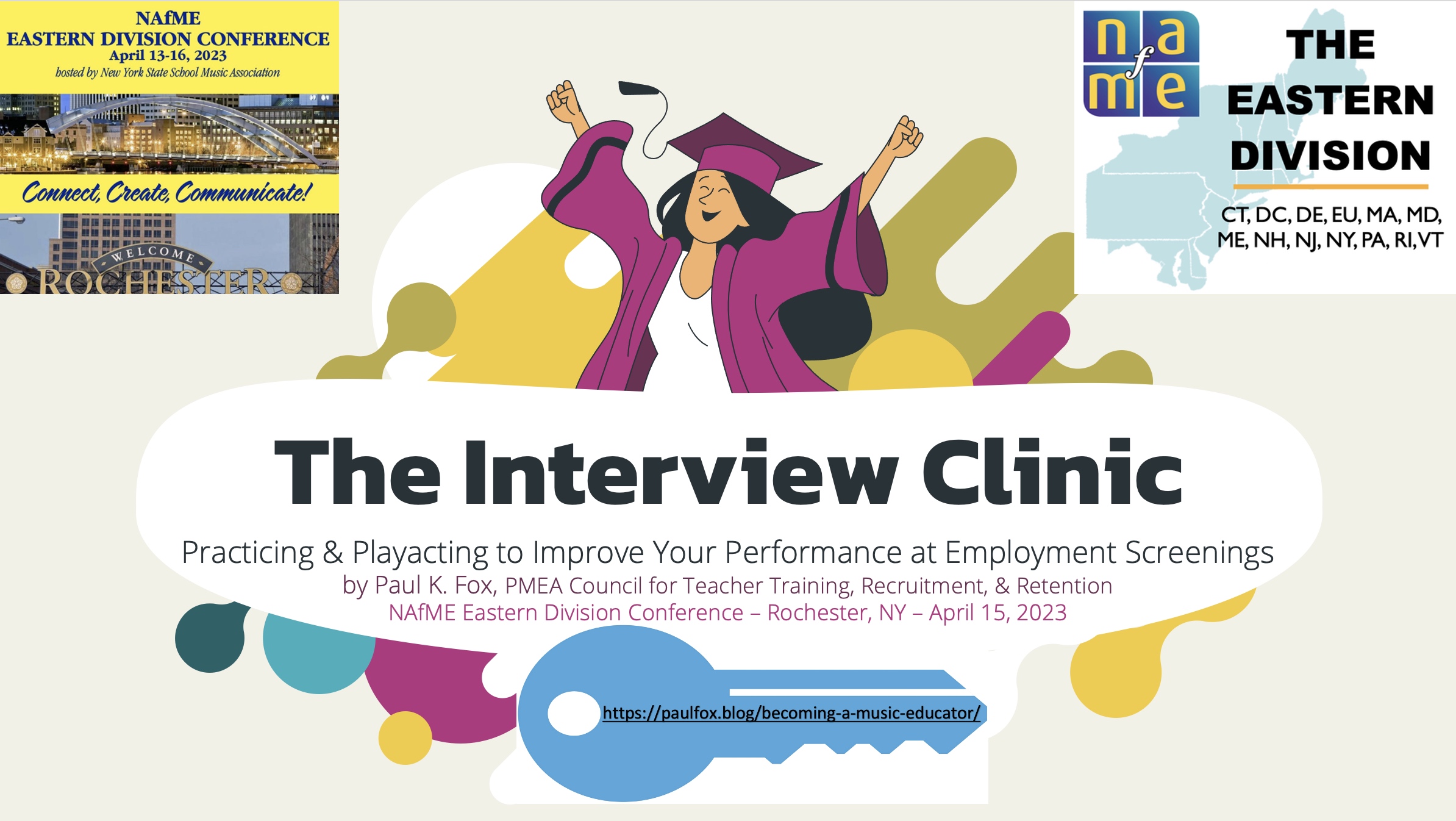
     

    Photo credits in order from Pixabay.com: “student” by geralt, “book” by PourquoiPas, “girl” by nastya_gepp, “fatigued” by sasint, “learn” by geralt, “brass” by emkanicepic, and “iPad” by fancycrave1


    Resolutions for Retirees

    [Portions reprinted from the PMEA Retired Member Network eNEWS, January 3, 2019]


    Twas the morning after Christmas, and all through the house.

    Not a creature was stirring, not even a mouse…

    Wouldn’t this be the perfect time to make a New Year’s Resolution?


    hate-1216881_1280_cabrasjoan

    Many do believe that ushering in the New Year is all about pursuing new directions, a sort of “rebirth,” analyzing and revising our personal goals/visions, and making promises for self-improvements… perhaps a little like the personal renaissance of retirement.

    However, it is likely that after all the festive celebrations and squarely facing the first several weeks in January, if you had made New Year’s resolutions, you may have forgotten them or fell short of even starting your 2019 aspirations. My new approach is to examine and expand on what I was planning to do anyway… not to propose lofty ambitions like losing 30 pounds or exercising an hour a day (both not likely to ever happen, no matter my best intentions). What I have learned about setting personal goals (and I taught these concepts during student leadership training sessions) is that you need to “keep them simple,” “write them down,” “make them measurable,” “revisit and revise your plans often” and “publish or announce them” somehow. Tell your spouse, “This is what I am going to accomplish in the New Year.” A great place to post your “promises” for everyone to see is where you get up in the morning… perhaps on or near your bedroom or bathroom mirror.

    The last time I wrote an article about New Year’s resolutions for retirees was back in December 2015. You can see it here (also printed in a Retired Member Network eNEWS): https://paulkfoxusc.wordpress.com/2015/12/22/random-acts-and-other-resolutions/

    new-years-eve-3865292_1920_Gellinger

    Well, I suppose I better sketch out a “new plan!” Let’s see if any of these “strike a chord” with you… possible your own considerations for 2019? (I admit this is a little self-serving like the Peanuts cartoon character Lucy van Pelt dictating New Year’s resolutions for Charlie Brown. Well, as they say, if the shoe fits…)

    1. Read at least one new book each month.
    2. Take time for regular physical exercise.
    3. “Keep around young people and you will stay forever young!”
    4. Enjoy travel and “see the world,” and go on trips while the kids you used to teach are still in school.
    5. Do something creative every day: make/create music, art, dance, drama, photography, writing, etc.
    6. Complete one new “random act of kindness” every week (but don’t call attention or take any credit for it!).
    7. Continue to be an advocate for music education.* (see last link below)

    The American Psychological Association at https://www.apa.org/helpcenter/resolution.aspx recommends these tips on “making your New Year’s resolution stick.”

    1. Start small.
    2. Change one behavior at a time.
    3. Talk about it.
    4. Don’t beat yourself up.
    5. Ask for support.

    The online Self magazine has even more suggestions: https://www.self.com/story/new-year-resolution-handbook.

    Some even say, skip the formal process of adopting a New Year’s resolution altogether: https://www.rd.com/advice/quitting-new-years-resolutions/ or https://www.pocketmindfulness.com/why-you-shouldnt-set-new-years-resolution/ or https://www.lifehack.org/articles/featured/new-years-resolutions-dont-work-heres-why.html.

    idea-3857708_1920_geralt

    Here are additional links to “inspire” your own “pursuit of self-reinvention,” that is, if you decide you are willing to truly commit the time and energy for a “growth-spurring” exercise. My apologies for the multiple references to the term “seniors” below. I don’t know about you, but I don’t consider myself a senior until I hit a hundred years old!

    The final bullet above is from Mike Blakeslee, our NAfME CEO/Executive Director. Even though most of us now have “less contact” with music students, his message is still timely and relevant. Many retired music teachers are still involved in supervising student teachers, conducting youth ensembles, performing in church or community groups, coaching sports, voice or instrumental sections, or teaching private lessons… so be an advocate and active supporter (leading by example) to help achieve diversity and inclusion in the profession… bringing quality music education for all!

    doors-1767563_1920-1_qimono

    Best wishes for a happy, healthy, prosperous, meaningful, and musical New Year!

    PKF

    © 2018 Paul K. Fox

    Photo credits in order from Pixabay.com: “start-line” by mohamed_hassa, “hate” by cabrasjoan, “new-years-eve” by Gellinger, “idea” by geralt, and “doors” by qimono.