Creative Ways Musicians Can Earn Extra Income

Making Digital Music, Money and Merchandising!

We welcome back guest blogger Ed Carter and his article on a subject I know next-to-nothing about… except that I, too, am a consumer of online media. We thank him for his research and insight! (Featured image by Freepik). PKF

TL;DR

Musicians today are diversifying income streams far beyond traditional gigs and streaming
royalties. From sync licensing and sample packs to branded teaching content and micro-
niche merch, the modern artist’s toolkit is packed with opportunity. Below, we explore 10
ways to earn more — creatively, sustainably, and independently.

Host Micro-Events and “Living Room” Concerts

Forget stadium tours. Many fans crave intimacy. Many online platforms let artists perform
in unconventional venues — apartments, cafes, or backyards. You can set your own prices,
meet new fans directly, and keep the lion’s share of the door revenue.

Checklist for a Successful Small Show:

  • Pick a host with good acoustics and space for 20–40 people
  • Bring a small merch table (vinyl, zines, handmade items)
  • Capture the set for future promo content
  • Ask for tips digitally (Venmo or QR code)
Start a Music-Related Side Business

If you’re ready to formalize your music venture — whether selling courses, beats, or
branded merch — start it as a small business entity.

Launching a business might sound intimidating, but it doesn’t have to be. With an all-in-one
platform like ZenBusiness, you can form an LLC, manage compliance, create your website,
and even track finances in one place. A structured setup means tax deductions, legal
protection, and scalable growth.

License Your Music for Sync (Film, TV & Games)

Sync licensing has exploded. Sites like Epidemic Sound connect independent artists with
producers, ad agencies, and filmmakers. A single placement can earn $500–$5,000.
Pro Tip: Tag your tracks with clear mood and genre descriptors (e.g., uplifting cinematic
pop) so curators find you faster.

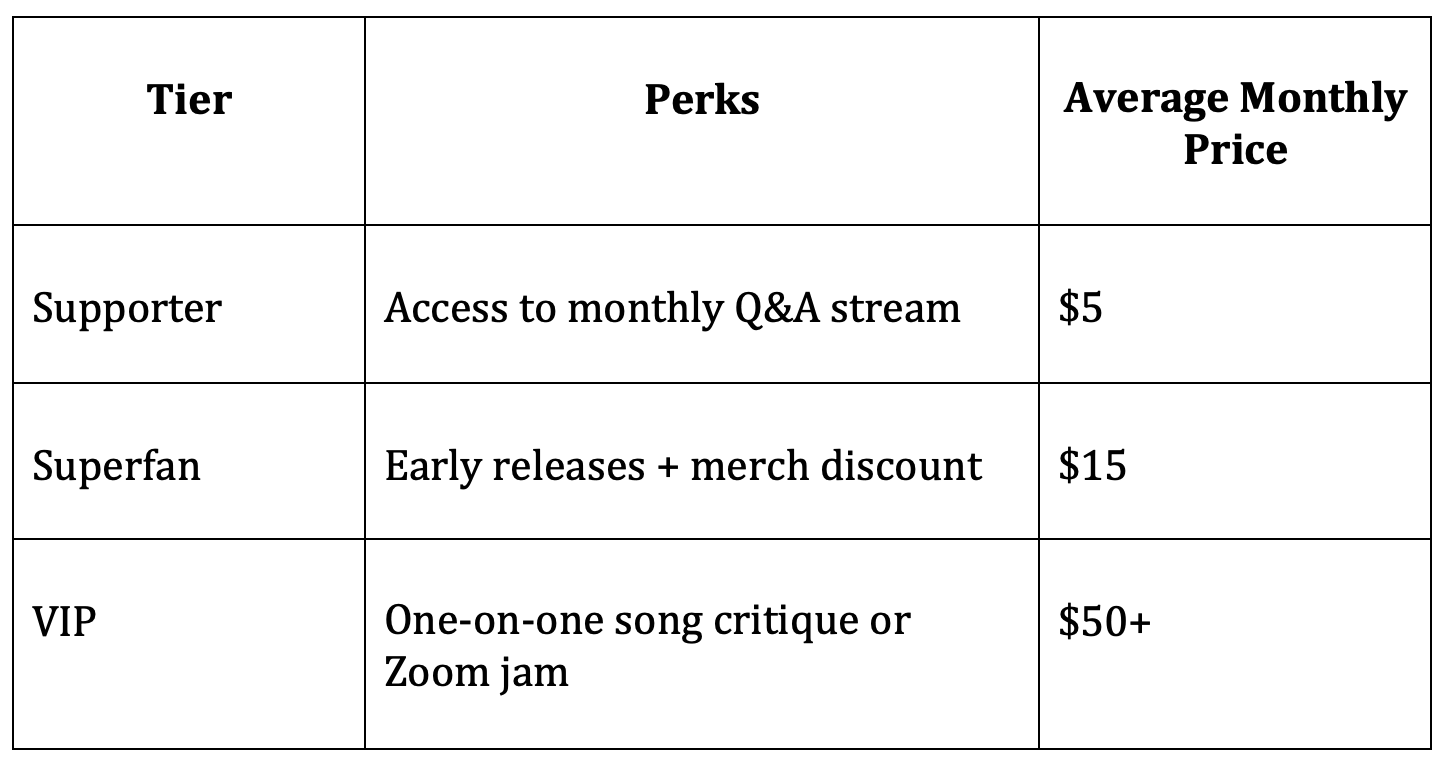
Offer Fan Subscriptions

Platforms like Bandzoogle let musicians monetize loyalty, not just streams. Offer behind-
the-scenes videos, early demos, or private songwriting sessions.
Create & Sell Sample Packs

If you produce, you can sell your drum kits, synth presets, and loops. Marketplaces like
Noiiz let you upload your sounds and get royalties whenever producers use them.

How-To (Mini Guide):

  1. Curate your 50–100 best loops or hits.
  2. Label by BPM, key, and genre.
  3. Include a “demo track” showing them in action.
  4. Submit to platforms or sell directly on your site.

Teach (Without Leaving Your Studio)

Music education is booming online. Start by offering short video lessons on YouTube. Build
a following, then convert viewers into paying students.

Bullet List: Why Teaching Works

  • Generates recurring income
  • Builds your authority as a musician
  • Introduces new fans to your music

License Your Merch to Other Creators

Many artists overlook merch licensing. Your designs, logos, or slogans can appear on third-
party apparel via dropship sites like Redbubble.

Offer limited-run designs — scarcity sells.

Join Micro-Sync & Creator Libraries

YouTube creators and podcasters constantly need affordable background music. Sites like
AudioJungle pay per download or license. Even better: some offer recurring revenue if your
track gets consistent usage.

Sell Exclusive Content NFTs or Digital Collectibles

Though the NFT buzz has cooled, niche fan communities still buy one-of-a-kind assets —
unreleased demos, lyric art, or collectible stems. Marketplaces like Zora make it musician-
friendly again.

Offer Mixing, Mastering, or Session Work

You don’t have to be touring to make great money. Offer your technical expertise on
SoundBetter. Even basic editing jobs can supplement your main income stream — and help
you network globally.

FAQ: Quick Answers for Indie Artists

Do I need a large following to make real money?
No. Many creators with <1,000 dedicated fans make sustainable income by diversifying — think 10 income streams, not 10,000 followers.
What’s the best income path for producers?
Sync licensing and sample packs. They scale globally without physical touring.
Should I register my brand name as a business?
Yes, especially if you sell products or hire collaborators. Forming an LLC can protect your
personal finances and simplify taxes.

Glossary

  • Fan Subscriptions: Ongoing payments from fans for exclusive content.
  • LLC: A “Limited Liability Company” — a legal structure separating your business
    and personal assets.
  • Micro-Sync: Low-cost music licensing for YouTubers, podcasts, and small ads.
  • NFT (Non-Fungible Token): A unique digital identifier recorded on a blockchain that serves as a public certificate of ownership and authenticity for a specific digital or physical asset. Artists and creators can use NFTs to distribute their work, engage with fans, and potentially earn royalties from secondary sales, providing a new revenue stream.
  • Sample Pack: A bundle of sounds and loops producers can buy and reuse.
  • Sync Licensing: Letting TV, film, or brands use your music for a fee.

Conclusion

The modern musician’s mantra? Don’t wait for discovery — build income like an
entrepreneur. With smart licensing, direct-to-fan models, and structured business tools, you
can turn your creativity into stability — one micro stream at a time.

Check out other articles by Guest Author Ed Carter at this blog site:

© 2025 by Paul K. Fox and Ed Carter

Engaging Retiring/Retired Educators

Ask not what NAfME or your state MEA can do for you, but what YOU, a retiree, can do for your professional association and music education.
An adaptation of the famous excerpt from the 35th U.S. President John F. Kennedy’s inaugural address of January 20, 1961.

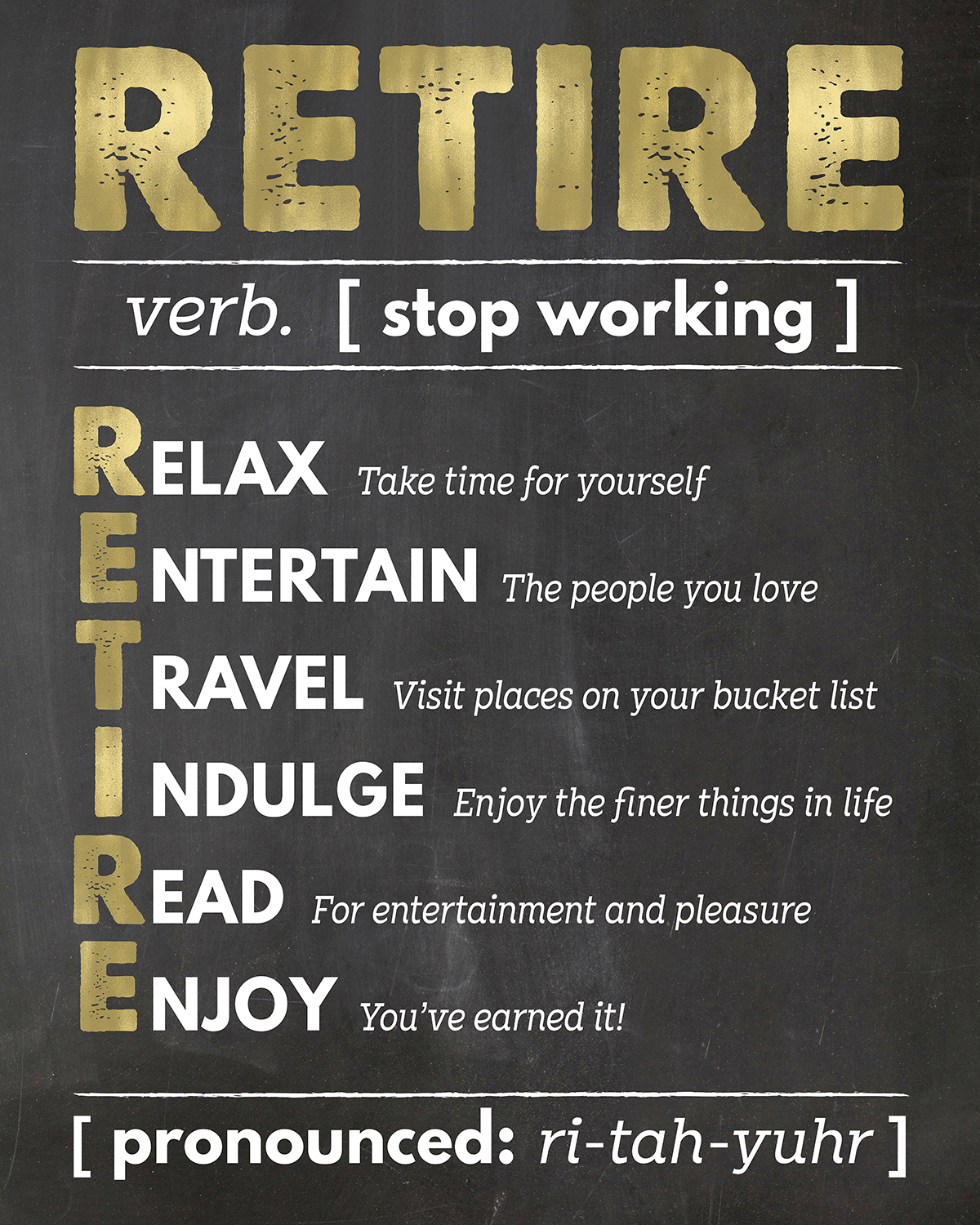
Surfing the ‘Net, I found an appropriate acronym for R.E.T.I.R.E. by Tangled Tulip Designs in pinterestRelax, Entertain, Travel, Indulge, Read and Enjoy! Most retirees would probably agree! The cessation of full-time employment may offer a great release from the day-to-day stress and drudgery of the job and the freedom to venture out, self-reinvent, make future goals, nurture relationships, and explore new personal growth opportunities.

Many attribute embracing a career in music education as “a calling” as opposed to just a form of employment or livelihood. From my experience, I have witnessed that most music educators are passionate for the cause of fostering creative self-expression in their students, more of a 24/7 mission, bringing intense focus and dedication to their lifework.

More to the point: Do we ever truly retire from making music ourselves and fostering this love in others?

THE “WHY!” Retirees matter and are critically needed!

One of my favorite inspirational speakers (Simon Sinek) would say, “start with the WHY!” WHY is this discussion on professional engagement of retired educators so important today?

  1. Their need: An informal poll of my former local educators and administrators revealed that half of them “hate retirement!” According to Dr. Robert P. Delamontagne in his book Retiring Mind (Fairview Imprints), “50% of retirees will suffer some form of acute emotional distress. This is potentially a very large problem given the fact that 10,000 people are becoming eligible for Social Security every day for the next 20 years in the US alone.” Remember this statistic the next time a senior citizen cuts you off on the road or bangs a shopping cart into your leg at the checkout!

  2. Our need: We are facing shortages of qualified teaching candidates across the country with unfilled openings in public school music positions and the critical need of training/mentoring the new hires.
  3. Society’s need: All of our voices should be combined to support the advocacy of music education, actively promoting access to school music by sharing its academic and social benefits with decision-makers, building relationships with administrators and policymakers, and utilizing resources from organizations like NAfME and the NAMM Foundation.

Despite its proven benefits, music education is often the first program to face budget cuts in schools. This is especially concerning in underserved communities, where access to music programs can be life-changing. Now more than ever, we must advocate for music education to ensure that every child has the opportunity to experience its benefits. Investing in music education is an investment in the future of our communities — helping to cultivate the next generation of creative, resilient, and innovative leaders. 
“Why Music Education Matters More Now Than Ever” by Music Will, February 2025

For eleven years (and counting), I serve as the Pennsylvania Music Educators Association (PMEA) Retired Member State Coordinator, as well as the Past State Chair (current member) of the PMEA Council for Teacher Training, Recruitment and Retention. I believe my responsibility to the state association is two-fold:

  • Assist soon-to-retire professionals in achieving a smooth transition to a happy and satisfying retirement; to help them cope with the commonly-experienced emotional ups-and-downs of this life passage, wrestling with the question “what do you want to be or do when you grow up?” and making new life lesson plans and personal goals.
  • Reach out to and build meaningful connections with retirees in order to fully engage them towards becoming active in their professional association; to recount, represent, and revitalize the activities of our post full-time employed music educators.

This article proposes a roadmap of crucial pathways to help music teachers approach “retirement bliss” while tapping into their hard-earned knowledge, strengths, and experiences by cultivating the benefits of their renewed participation in our professional associations.

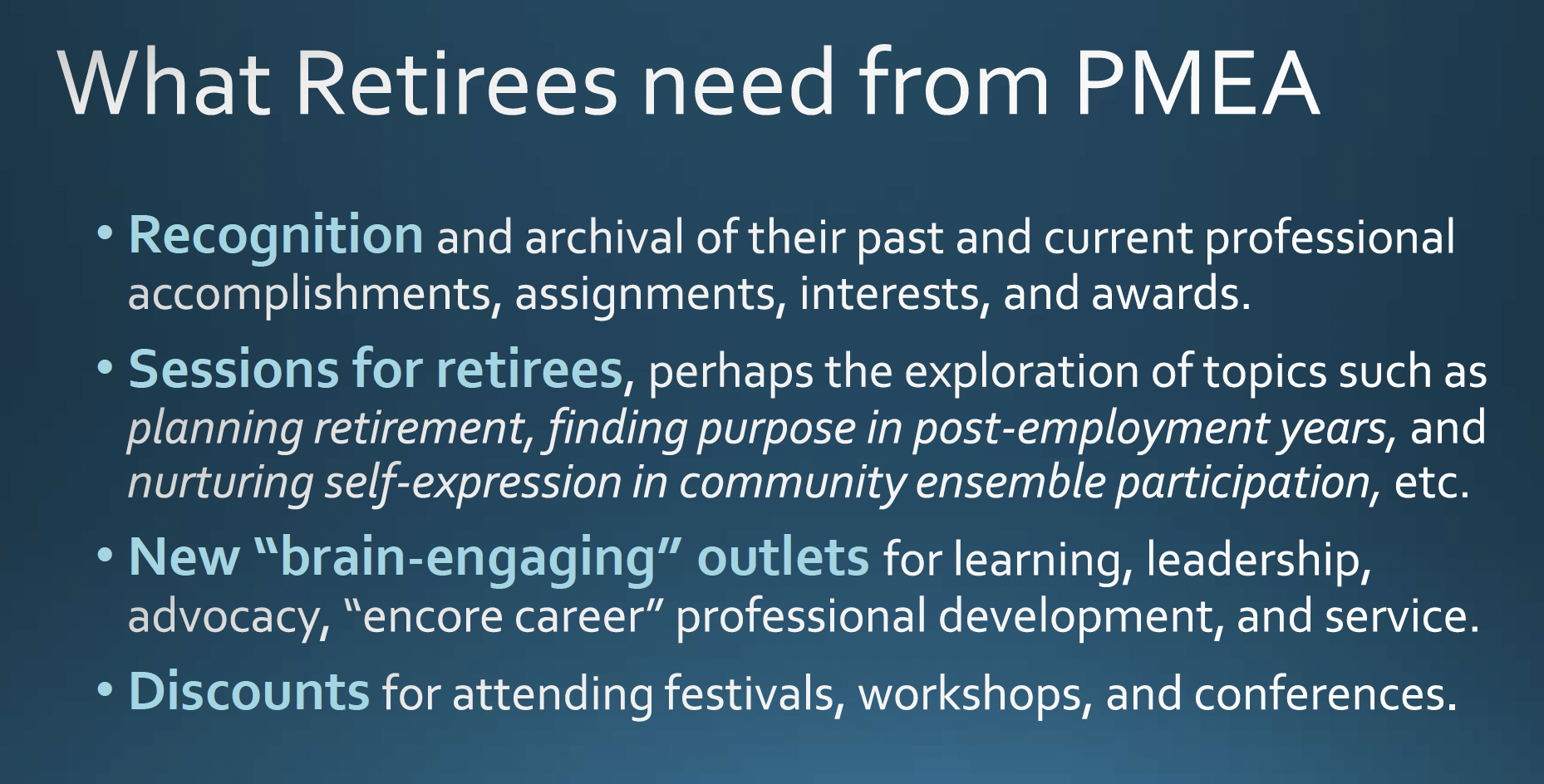
What can NAfME and State MEAs offer retirees?

You have devoted your entire life to inspiring the development of personal artistry and “ah-ha” musical moments in others. Now it is your turn to reap the benefits (and privileges) of this commitment to the profession. NAfME and your MEAs can provide the resources and motivation of “sharing and caring,” directing retirees “places to go, people to meet, and things to do” for fulfilling that “next chapter” or (perhaps better terms) the “refirement” or “rewirement” of senior living.

Do you feel “needed” and know you “make a difference?” Research has shown that the one of the most important motivators for involvement in a professional association is that its members recognize that they are essential to its success. This quote is from Revitalizing Retirement: Reshaping Your Identity, Relationships, and Purpose by Nancy Schlossberg, attributed to Rosenberg/McCullough:

 “It has been suggested that one problem of retirement is that one no longer matters; others no longer depend on us… The reward of retirement, involving a surcease from labor, can be the punishment of not mattering. Existence loses its point and savor when one no longer makes a difference.”

Most people who are one to five years away from “pulling their pin” and putting in their walking papers “do not know what they do not know.” Experts agree: “Retirement preparation is not only about the money!” Our silver-haired colleagues who have already Crossed the Rubicon and are now “living the dream” in retirement can share their trials, tribulations, and (more importantly) numerous success stories about coping with this transition!

NAfME, PMEA and this paulfox.blog/for-retirees site have archived an exhaustive number of self-help articles. Check out this omnibus NAfME blog “Retirement Prep Top-Ten Treasures.”

The benefits of retired MEA membership are numerous. Besides providing helpful transitioning advice, these advantages also come to mind:

  1. Answers to questions like “What have you always wanted to sing, compose, play, record, conduct, write, publish or present?” and “Where can I share my hard-won expertise and help others in the field?”
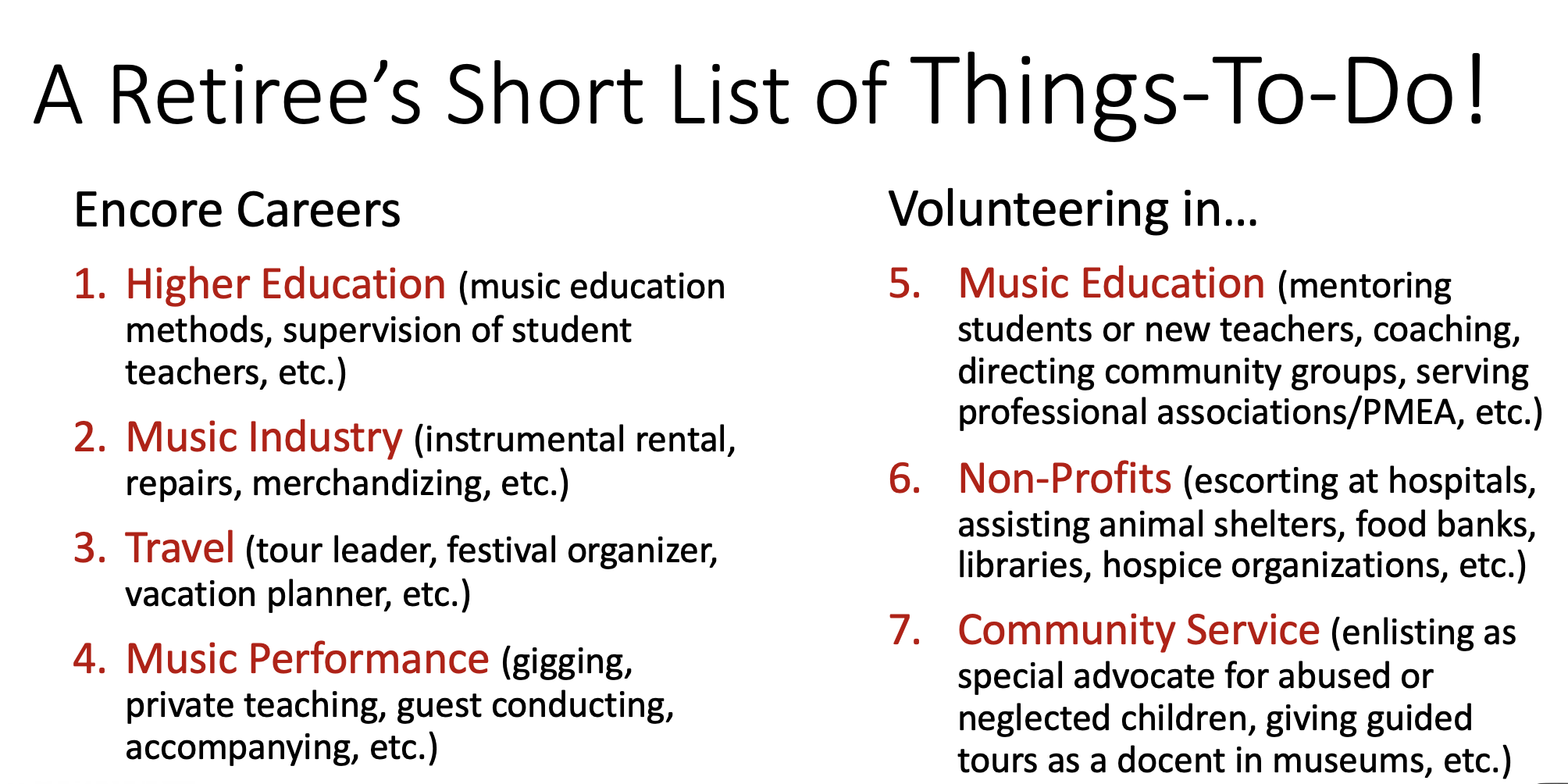
  2. Networks and contacts to help you develop “encore careers” in other musical or educational arenas (e.g., higher education, music industry, festival organization, travel/tour planning, composition, guest conducting, private studio teaching, church music, etc.)
  3. Opportunities to “rekindle your expressiveness” by participation in adult community or full/part time performance groups (playing “gigs”)
  4. Places to go/things to see/hear: NAfME/MEA conferences, workshops, and concerts
  5. Exclusive discounts and other benefits (reduced dues and registration fees)

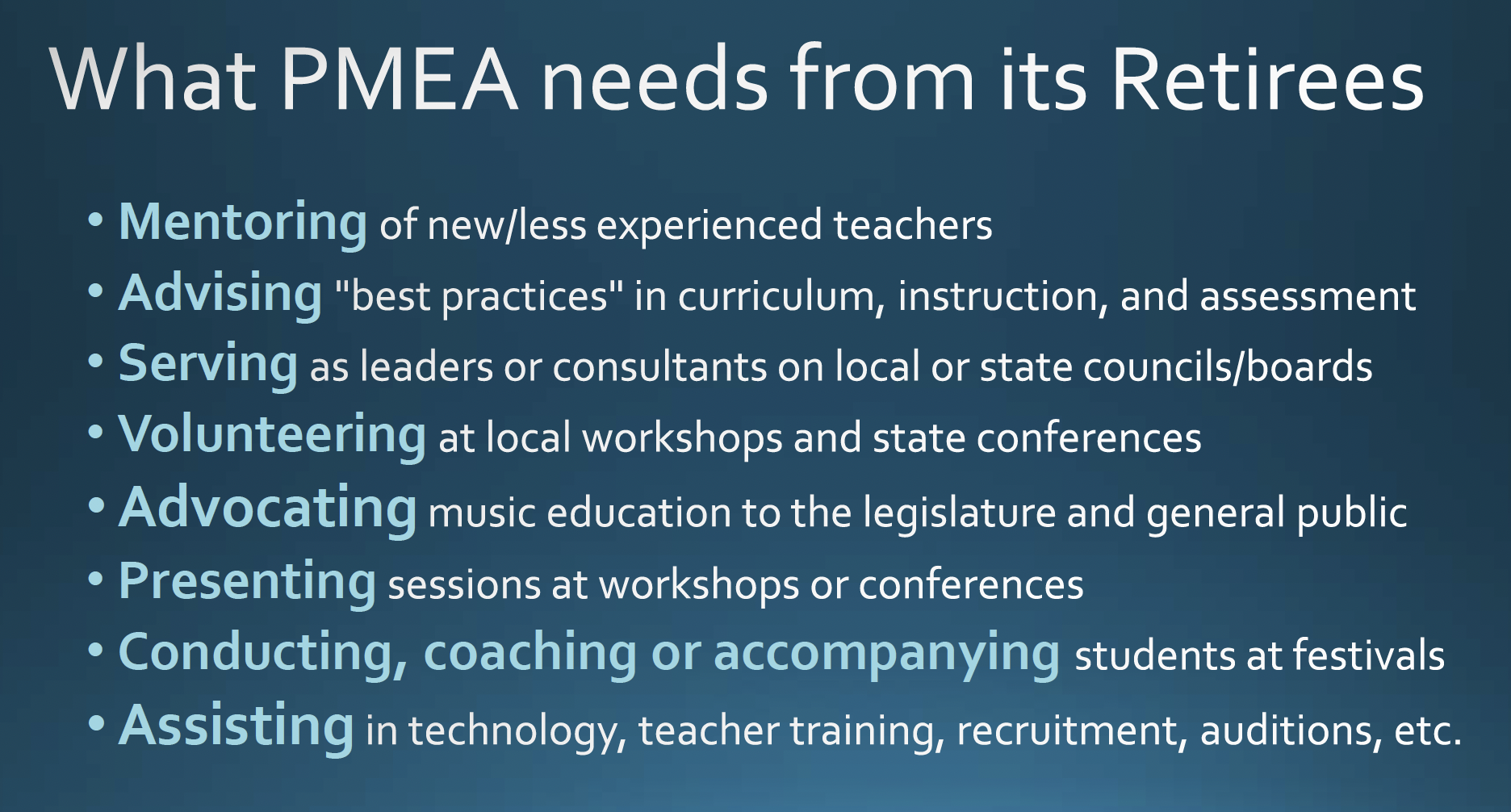
What can retirees offer NAfME and their state MEA?

The relationship of active and retired membership in our MEAs is symbiotic. We know from the history of our associations, “giving back to the profession” remains a high priority with most retirees. This may come in many forms and settings:

  • Leadership or membership in local, state, or national MEA/NAfME office, staff, advisor, or council/committee position
  • Advocates for the promotion of music education to local and state government officials
  • Service as presiding chair or member of the conference or workshop planning committee
  • Service as evaluator of performance groups, conference sessions, or articles for publication
  • Judges of local/state MEA adjudication or commercial festival
  • Accompanists, coaches, arrangers, or guest conductors for festivals or school/community groups
  • Services to the local music teacher in private teaching, piano playing, marching band charting, sectional coaching, choreography, music technology, instrumental repair, stage tech, etc.
  • Writers for state MEA and NAfME publications and blog sites
  • Contributors to online music education forums or the NAfME Connections
  • Donors to and/or fund-raisers of music education charitable projects, scholarship initiatives, etc.

The PMEA Model of Retired Member Participation

PMEA values the vast wealth of experience and contributions of our retired members. We’re proud of the many programs we offer to retirees and invite you to visit our website to peruse additional information and sample digital newsletters and articles.

Retired members in Pennsylvania are involved in:

  • PMEA elected and appointed offices, staff, committee chairs, and membership on councils
  • PMEA Strategic Plan and Bylaws, Conference Planning, and other state/regional committees
  • Retired Resource Registry* (informal mentoring for new teachers and transfers)
  • How-to-Retire Webinar, Prepping for Retirement, and the Ultimate Retiree Resource Guide
  • Retired Member Breakfast at PMEA Annual Conference
  • Retirement 101 (The Who, What, When, Where, Why, and How) session at PMEA Annual Conference (training for all members retiring or soon-to-retire)
  • Maintenance of PA Community Band, Chorus, Orchestra, and Theater group catalogs
  • Maintenance of PMEA member compositions library
  • Mock Job Interview Committee for music education majors
  • Coffee & Conversations informal “ask an expert” lounge at PMEA Annual Conference
  • Volunteering as presiding chairs for sessions and registration aides at conferences/workshops
  • Pool of conference clinicians, guest lecturers, and members on discussion panels
  • Participation in “Sponsor a Collegiate to Attend the Conference” campaigns
  • All-State Program Patron, or contributor to the annual Irene Christman Scholarship or Margaret Bauer Grant programs.

As of October 1, 2025, there are 61 advisors in the PMEA Retired Resource Registry.

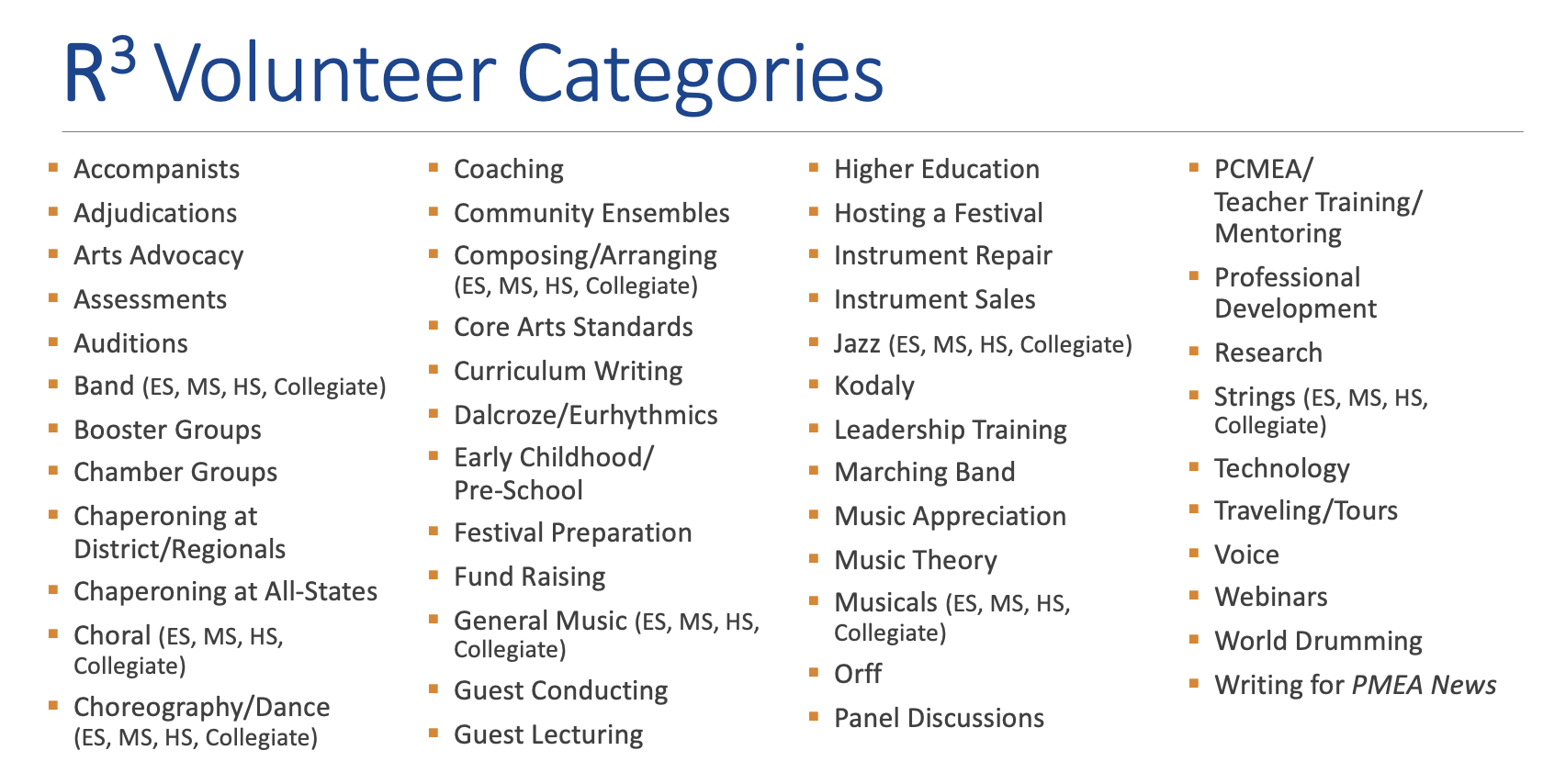
*During their annual membership registration, PMEA Retired Members may choose to sign-up for the R3 Retired Member Registry (above volunteer categories) to become available to informally offer advice to college music education majors, new hires, transfers, and newcomers to any music specialty. R3 members may handle inquiries like “What warm-up would you recommend for my middle school choir?” OR “Do you have an idea for an elementary string ensemble concert opener?” OR “How do you teach improvisation… steady beat… breath support?”

The other option with more time commitment is that Retired Members can be officially “trained” as a PMEA Mentor and be assigned to specific individuals who request assistance in their early career assignments.

Coda

How can we help?

What is the future of retired music educator professional engagement? In a word: connections!

Last month, I reached out to Elizabeth Welsh Lasko, NAfME Assistant Executive Director for Membership, Organizational Development, and Marketing Communications and “volunteered” OUR assistance. I suggested that, in keeping with the NAfME 2022 Vision Statement “…an association where all people are heard, seen, and feel they belong throughout their lifelong experiences in music” we should all intentionally recruit more hands-on involvement of our retirees. I pointed out that in the late 1980s, we had a Music Educators National Conference (MENC) Committee for Retired Members led by a National Chairman who served on the NAfME National Assembly. (An excellent booklet, TIPS: Retirement for Music Educators, Copyright © 1989 MENC, was compiled by A. Verne Wilson, then the Past National Chairman of the MENC Committee for Retired Music Educators.)

Ms. Lasko encouraged me to “reach out to retirees” beginning with this article. At the next NAfME Eastern Division Conference, I plan to hold a meeting of retired members, and also connect with all state MEA retired member coordinators (those states who have them). We’re available and on the move! Let’s collaborate and share our resources!

Finally, just for fun, I recently posted the blog “For Book Lovers – Retired or Not” on NAfME Connections (formerly called Amplify). There are already 1,810 members in the NAfME “Retired Members Community.” Please JOIN US! Using this forum, get in touch with me, and respond with YOUR OWN retirement stories, strategies, perspectives on this “life passage,” and more ideas to grow the professional engagement of our music teacher retirees.

Happy trails!

© 2025 Paul K. Fox

Did You Take the Summer Off?

Rebuilding instrumental technique after a long break

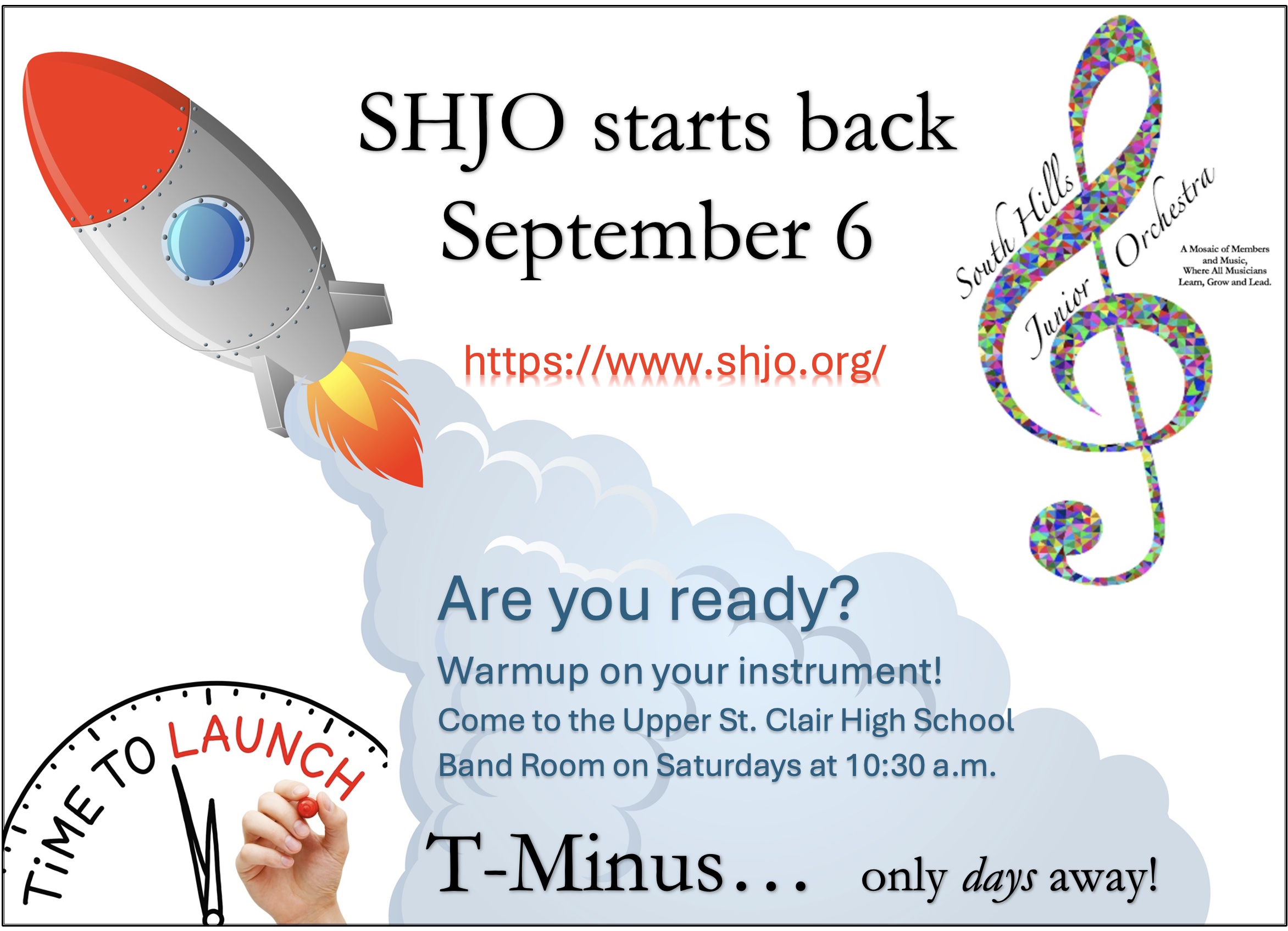
Director’s Note: This is the week to get ready for the return of the South Hills Junior Orchestra after all our vacations! If you live in the Southwestern PA area, we hope you will consider this a personal invitation to “TRY SHJO” and participate in several free and open rehearsals of our community orchestra – a totally “judgment-free” place for creative self-expression of all ages and ability levels. Practices are held in the Upper St. Clair High School Band (1825 McLaughlin Run Road, Pittsburgh, PA 15241) on Saturdays from 10:30 a.m. to 12:30 p.m.

A Google search on my computer fetched the following “AI Overview,” a nearly perfect summary for wind players to recover their “chops” and bring back good tone, intonation, breath support, flexibility of the embouchure, key literacy, and practice habits. For players of all orchestral instrumental sections, I recommend revisiting other articles in the Fox’s Fireside Library to develop a “practice plan” and adopt new musical goals. PKF

To rebuild your brass and woodwind instrumental technique after a long break, focus on the following gradual, three-stage process: first, restore your tone and response, then regain flexibility and dexterity, and finally, rebuild range and endurance. Prioritize short, consistent practice sessions, and avoid pushing too hard too early to prevent injury and bad habits.

Stage 1: Restore tone and response

Your primary goal is to reacquaint your body with the fundamentals of playing by focusing on soft dynamics and your lowest register.

  • Breathing exercises: Start without your instrument. Practice deep, diaphragmatic breathing to re-engage your respiratory system and expand your lung capacity. You can use simple routines like inhaling for four counts and exhaling for eight, or try the “pinwheel” exercise to visualize steady airflow.
  • Buzzing: Brass players should spend time buzzing with just their mouthpiece to get their lips vibrating efficiently again.
  • Long tones: On your instrument, play sustained, steady notes at a soft volume in your lower-to-middle range. Focus on producing a clear, characteristic tone. Use a tuner to monitor your pitch stability.
  • Short practice sessions: Limit your initial sessions to 5–20 minutes, with plenty of rest in between. This prevents over-straining your facial muscles and embouchure.

Stage 2: Regain flexibility and dexterity

Once your tone and response feel stable, you can begin to expand your comfortable playing range and improve finger speed.

  • Scales and arpeggios: Practice basic scales and arpeggios at a slow, controlled tempo. This helps rebuild muscle memory for your fingers while keeping the focus on even, beautiful tone.
  • Slurred partials (brass) and lip slurs (woodwind): Practice smoothly transitioning between notes without using your tongue. This strengthens your embouchure and improves air control.
  • Simple music: Play easy, melodic pieces you know well. This helps you focus on phrasing and musicality without the pressure of a difficult score.
  • Increase session length gradually: Slowly add time to your practice sessions, perhaps moving to 15–30 minutes at a time. Continue to take frequent breaks.

Stage 3: Rebuild range and endurance

After re-establishing your fundamentals, you can begin to increase the intensity and duration of your playing to return to your previous level.

  • Expand your range: Gently start working your way into your upper and lower registers, but maintain a soft dynamic level. Only increase volume once you can play a note softly with a good tone.
  • Louder dynamics: Once your full range is accessible, begin practicing with louder dynamics. This is physically demanding, so continue to take frequent rests.
  • Articulation: Incorporate tonguing exercises. Start with basic single tonguing before adding more complex techniques like double and triple tonguing.
  • Listen to your body: Your body will be the ultimate guide. If you feel any pain or unusual fatigue, ease up and incorporate more rest into your routine.
  • Mental preparation and practical tips
  • Listen to music: Remind yourself of what inspires you and listen to your favorite players to reconnect with the joy of playing.
  • Record yourself: Objectively evaluate your progress by listening back to recordings. This helps you identify areas that need work and celebrate your improvements.
  • Revisit old notebooks: Look back at any old lesson journals for useful reminders and insight into your past tendencies.
  • Service your instrument: A leaky pad or sticky valve can make returning to your instrument unnecessarily difficult. Have a technician give your instrument a “clean, oil, and adjust” to ensure it’s in prime playing condition.
  • Be patient: You are not expected to be at your former playing level immediately. Trust that your muscle memory will return with consistent, smart practice.

Click here to download a printer-friendly copy of this article.

 Here are additional resources shared in the SHJO eUPDATE newsletter (August 30, 2025):

PKF

© 2025 Paul K. Fox

Social Media – Revisited

Before you begin reading this article, please take a moment and peruse these past blog posts:

Although several of the cited research links may have expired (for example, PA Department of Education modified most of their website’s URLs), these provided the foundations of background information and references for the presentation I prepared for the DCMEA Virtual Conference in 2020 (during COVID) and serve as the starting point for the workshop I will share in-person at the DCMEA Winter Conference in January 2026. This blog provides updates and additional perspectives. Taken in combination with the above sources, you will be able to identify the benefits, positive models, precautions, and dangers of social media, social networks, professional learning networks, and sample emerging technologies as they apply to teachers’ professional development and education of students.


“THE WHY”

Before every clinic or publication I develop, I always try to spotlight the theme of “THE WHY” as preached by one of my favorite authors and motivational speakers – Simon Sinek! According to him, for organizations and individuals alike, “THE WHY” (rationale and priority) is more important than “THE WHAT” and “THE HOW.” (See this video.)

WHY is a collaborative discussion on social media essential? Why now?

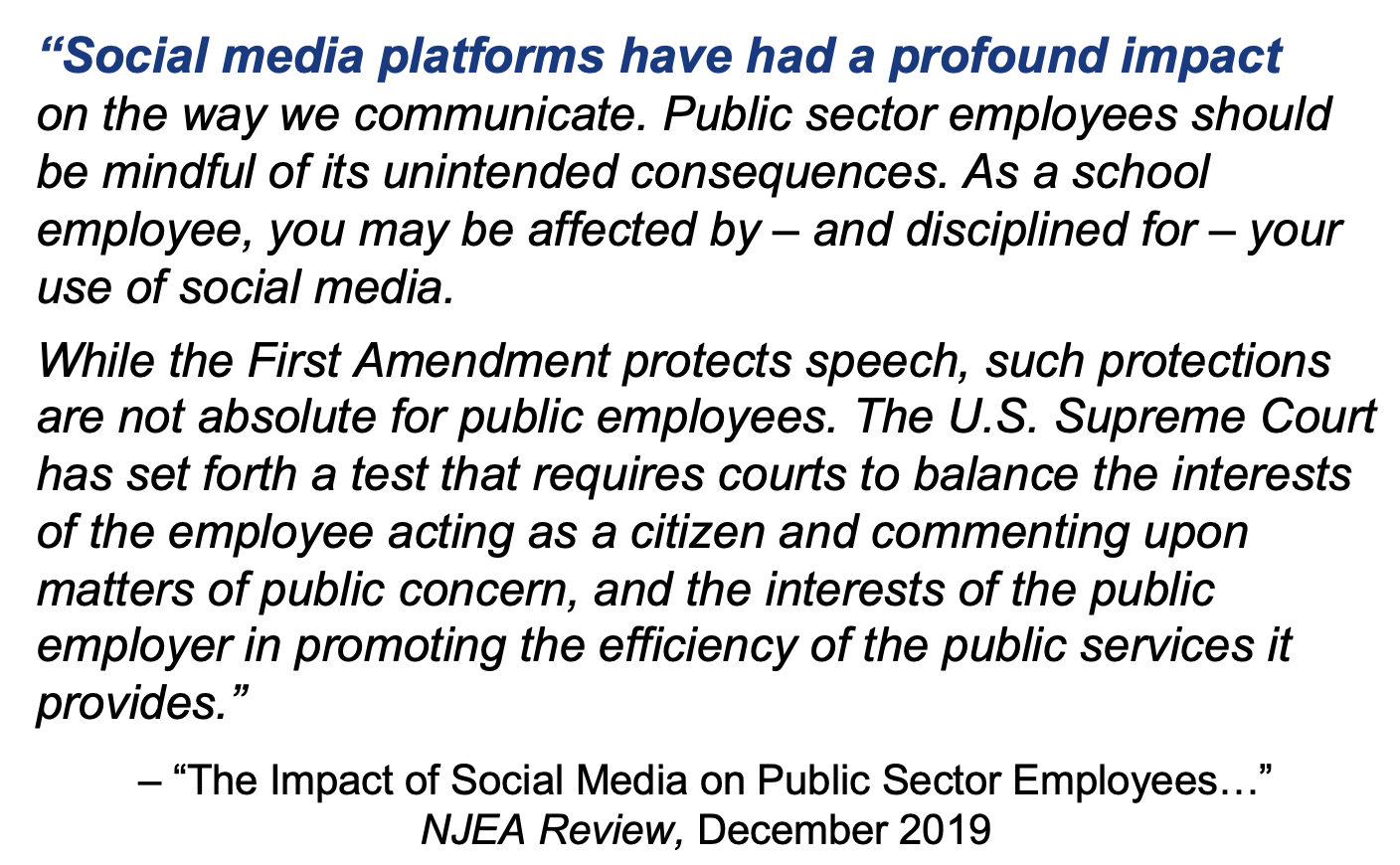
 ”There’s a growing body of evidence suggesting that educators are facing increasing scrutiny regarding their social media use. Concerns include unprofessional conduct, inappropriate interactions with students, and the potential for cyberbullying and other negative impacts on student well-being.”

“Educators are increasingly concerned about how social media influences students’ social-emotional development and their interactions with others.” 
NEA Member Polling on Social Media…
NEA Impact on Social Media and Personal Devices on Mental Health
HHS Youth Mental Health and Social Media

Frankly, there is still a lot of confusion about the dangers of social media, social networking, and other technology integrations into education. In Social Media – Boon or Nemesis, we mentioned that teachers should “debunk the free speech myth.” We demonstrated how the improper application of social media could get educators in trouble. Check out these sites for more info and corroborative stats:
Teacher Student Misconduct and the Critical Role of Social Media Screening
NCBA Social Media for School Employees
Social Media Hazards and Tips for Teachers

As always, our goal is to promote ethical practices in maintaining professionalism in the digital world.


“THE WHAT” Review of Definitions

“Social Media”

Social media are “websites and applications that enable users to create and share content or to participate in social networking.”
— Oxford Lexico.com online dictionary

“Social Network”

A social network is, 1. a network of social interactions and personal relationships.; 2. a dedicated website or other application which enables users to communicate with each other by posting information, comments, messages, images, etc.
— Oxford Lexico.com online dictionary

Professional Learning Community” (PLC)

A PLC is “a group of educators who meet regularly…” (usually in-person) “…to strategically enhance their teaching skills and improve student outcomes.”

versus “Professional Learning Network” (PLN)

A PLN is “a group of educators who gather more informally…” (usually in online communications) “…to problem-solve and generate ideas to enhance classroom practices. A PLN… often takes the form of an open forum, where participants can ask and answer questions based on their experiences.”
https://edtechmagazine.com/k12/article/2024/08/pln-vs-plc-perfcon


“THE HOW” Ethos of Care

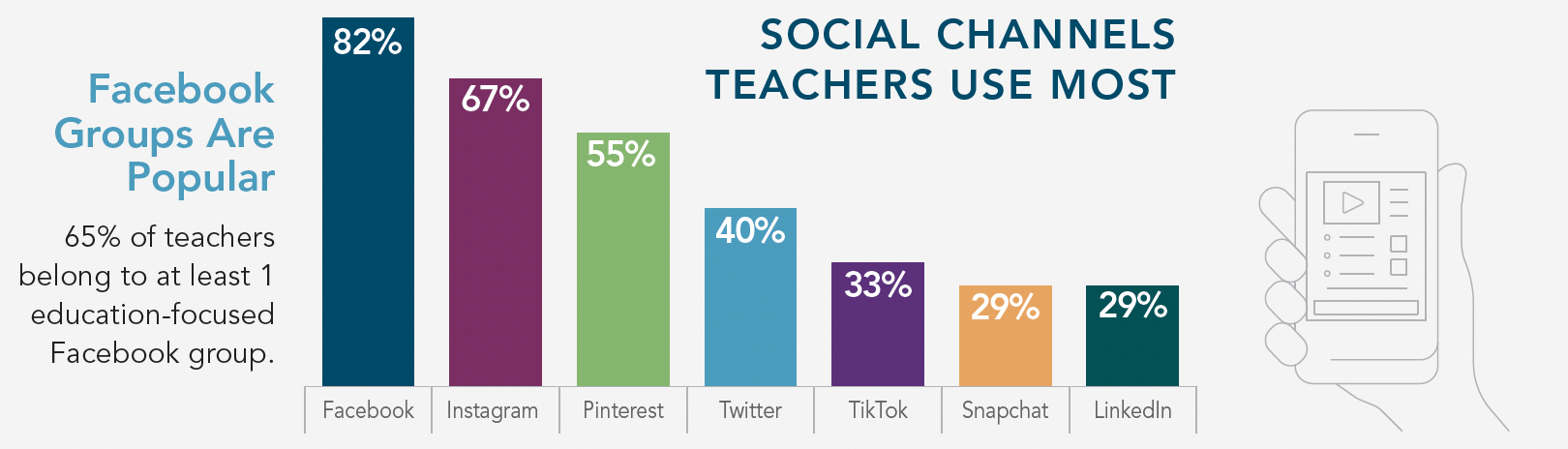
Teachers use social media to…

  • Get inspired with new teaching ideas
  • Find resources for the classroom
  • Connect with other educators
  • Stay on top of trends and news
  • participate in an online community
  • Find teacher discounts and deals
  • Follow education companies and organizations

How Teachers Use Social Media
Teachers Social Media Use

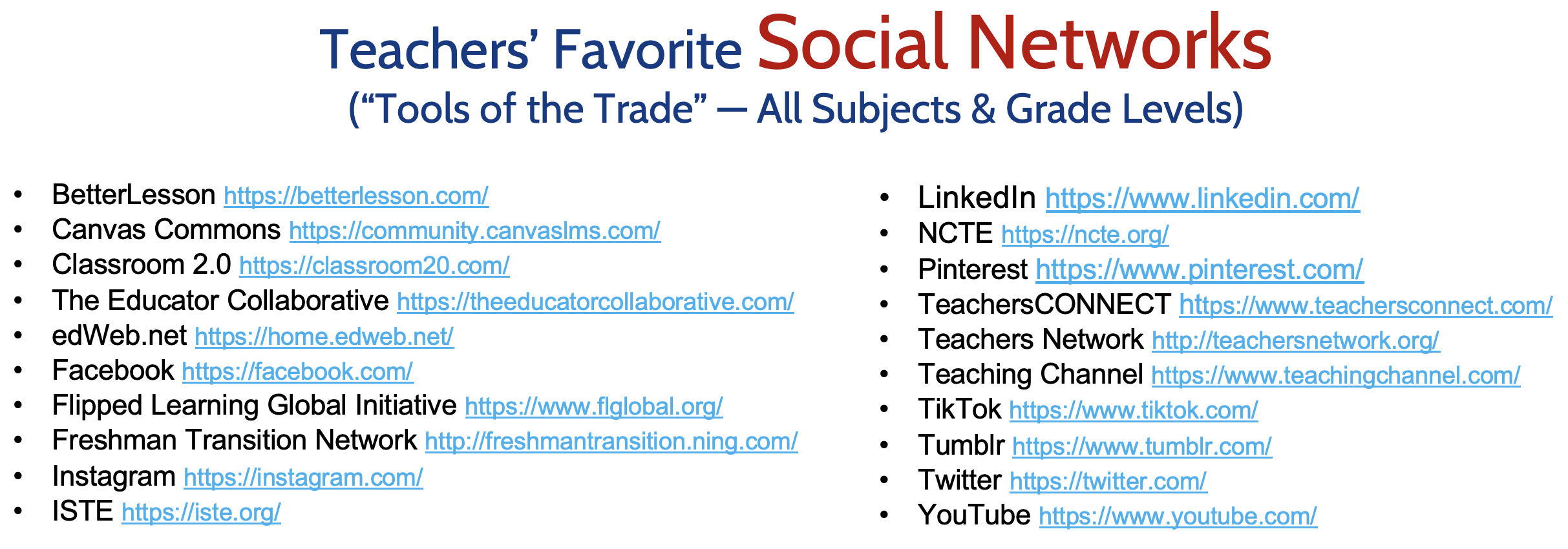
Social Networks for Teachers

We acknowledge that the benefits of social networking for educators are numerous by promoting professional collaboration and connections, including:

  1. Acquiring information to enhance understanding
  2. Keeping informed about latest developments in education
  3. Enhancing communications with students, parents, and the school community
  4. Fostering connections with colleagues in the field to expand an educator’s professional network.

Benefits of Social Media as an Educator

However, educators must exercise “sound judgment” and proper professional boundaries when using social media/networks with students. While the introduction of new technology provides many opportunities for teaching and learning, it is important to establish clear rules for appropriate student-teacher communication. In order to promote safety and appropriate boundaries while transitioning to a virtual teaching and learning environment, the Pennsylvania Professional Standards and Practices Commission offers suggestions to help educators protect themselves and their students.

  1. All technological resources and applications should be school entity-approved and only used in the manner prescribed. Ensure that you are familiar with the tools you are using in order to use them properly. 
  2. Communication with students should occur at designated times, consistent with traditional school day hours. Maintain transparency and protect yourself by keeping a record of all communications with students. 
  3. Clearly communicate when and how students should contact you and provide a timeframe for when students should expect responses to questions. 
  4. Avoid one-to-one interactions with students in chatrooms, FaceTime, Skype, or any other online space. School psychologists, school counselors and others providing one-to-one services to students should consult with school administration about the best mode of communication. 
  5. Use approved forms of communication by your school entity to connect with students and parents (i.e. Remind), use only your school email to communicate, and copy administration when communicating with parents or students. 
  6. When creating content or interacting in an online space with students, conduct yourself as you would if you were in school. If appearing on camera, dress professionally and be mindful of your surroundings and the camera’s view. 
  7. Do not “friend” or follow students on social media and do not allow students to “friend” or follow you on your personal social media. Remember, you do not have a “social” relationship with your students. 
  8. Keep your personal and professional lives separate. Do not share overly personal information about yourself with students.

PSPC Digital Tips for Educators

While exercising responsibility to maintain a respectful, safe, online environment, there are many benefits for the application of social media for students in the classroom:

  • Real-time communications can increase student engagement, collaboration, communication and overall participation
  • Many students may find it easier to participate in online discussions that in the classroom
  • Students can easily ask each other or their teacher questions about assignments outside of class
  • Students & teachers can quickly share resources at any time.
  • Teachers can easily share class announcements.
  • Social media can provide a contingency plan for last minute remote learning scenarios.
  • Students can organize school events with each other or with the help of a teacher.
  • Teachers can augment an online-only class by establishing a social media page or account simply for building community.
  • Students can practice using social platforms responsibly, including maintaining a respectful online discourse.
  • Teachers can communicate directly with parents as needed, and parents can stay informed of school news via a convenient, easily accessible platform.

However, please watch out for these potential drawbacks:

  • Social media can be a major distraction, especially if students are accessing their personal accounts independently.
  • If students primarily use social platforms to participate in class discussions, they can miss out on practicing face-to-face conversations and respectful in-person discourse.
  • Some students may see social media assignments as an opportunity to cyberbully their classmates, and there is always a risk of someone posting inappropriate content or language.

Social Media in Education


“THE WHAT” Several Success Stories

Balancing the positives and negatives and taking into account all of these precautions in order to maintaining professional boundaries, the integration of new technology into the classroom may offer excellent enrichment and increase student motivation for advanced learning. This may take many forms. Here are a few interesting models.

Prior to preparing for the DCMEA online session in 2020, I stumbled upon a truly inspiring post from Derek Muller, a gifted teacher, physicist, filmmaker, and founder of the YouTube channel Vertiasium which has captured millions of subscribers. He offers one of the BEST models of using social media to enrich the understanding of learning math and science (applicable to all fields of study), while at the same time, provides warnings against unbridled use of so-called “innovation for innovation’s sake.”

“I feel like people over the years are invariably drawn to use these words:  revolutionize and education. And there’s this sort of amnesia that we’ve had a hundred years’ worth of these predictions, worth of really groundbreaking technologies that have transformed other areas in our lives but have failed to fundamentally change the way we do education. So, I stand here today as a voice of caution, to think that the future of education is not one of revolutions…”

You need to watch this: How is Social Media Transforming the Future of Education? (2016)
Derek Muller

Say what you want about how COVID significantly disrupted our educational programs, evidence of learning loss, problems in socio-emotional development, decline of student engagement and self-motivation, rise in mental health struggles, decreased instructional time, and the effects of a new digital divide of under-served students (Annie E. Casey Foundation), happily there were surprisingly a few positive advancements the results of exploring new tools and methodologies we had to employ to tread water and cope with the catastrophe. (“When life hands you lemons, make lemonade!”)

As one example, in the middle of preparing music for my community orchestra, we were shut down in 2020. No in-person rehearsals at the school. I then pivoted to creating my own online platform called SHJOOLA (South Hills Junior Orchestra Online Academy) in 2021 using MusicFirst. For a nominal yearly subscription fee, I was able to continue my Saturday morning classes (synchronous) as well as asynchronous (on-their-own time) learning using excellent applications in a virtual environment: MusicFirst Classroom, Focus on Sound, PracticeFirst, Sight-Reading Factory, Musition, Auralia, a web-based music notation program, and a huge library of method books and ensemble music. Several past blogs showed how we rolled out SHJOOLA:

The latter link above also provided a comprehensive list of supplementary resources (at the time) for online music education. Please peruse these even though some of them may have now gone inactive. We will provide supplemental links at the bottom of this article.

Another direction accented by the onslaught of the pandemic was digital streaming performances, incorporating technology in both the solo and ensemble settings. The following are two of my favorite examples of these to be viewed on YouTube:

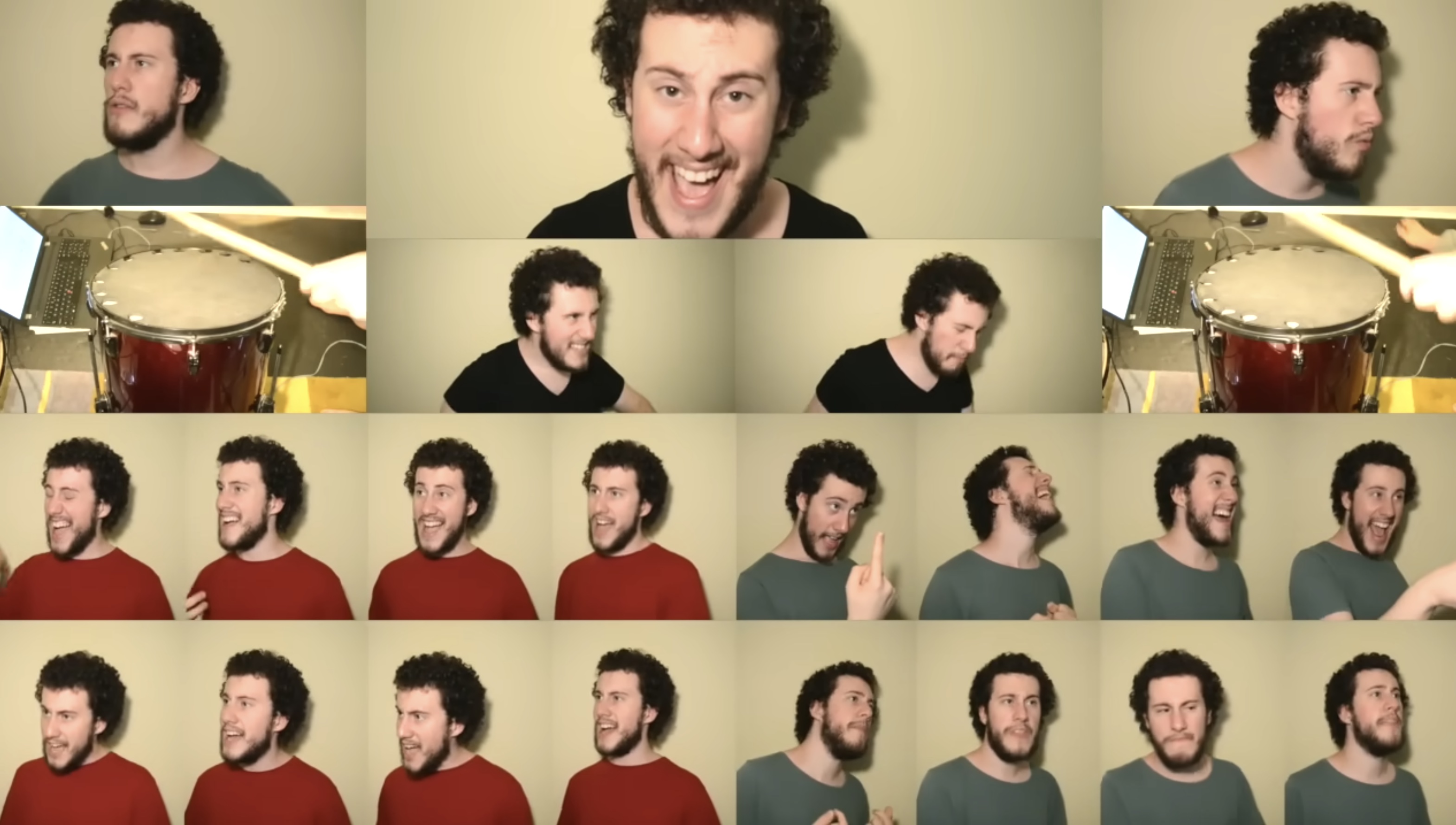
Circle of Life from Disney’s Lion King (2015-18) by Sam Robson, arranger, innovator and performer using multitrack recording of a single performer mixing as many as 50 voices at one time.

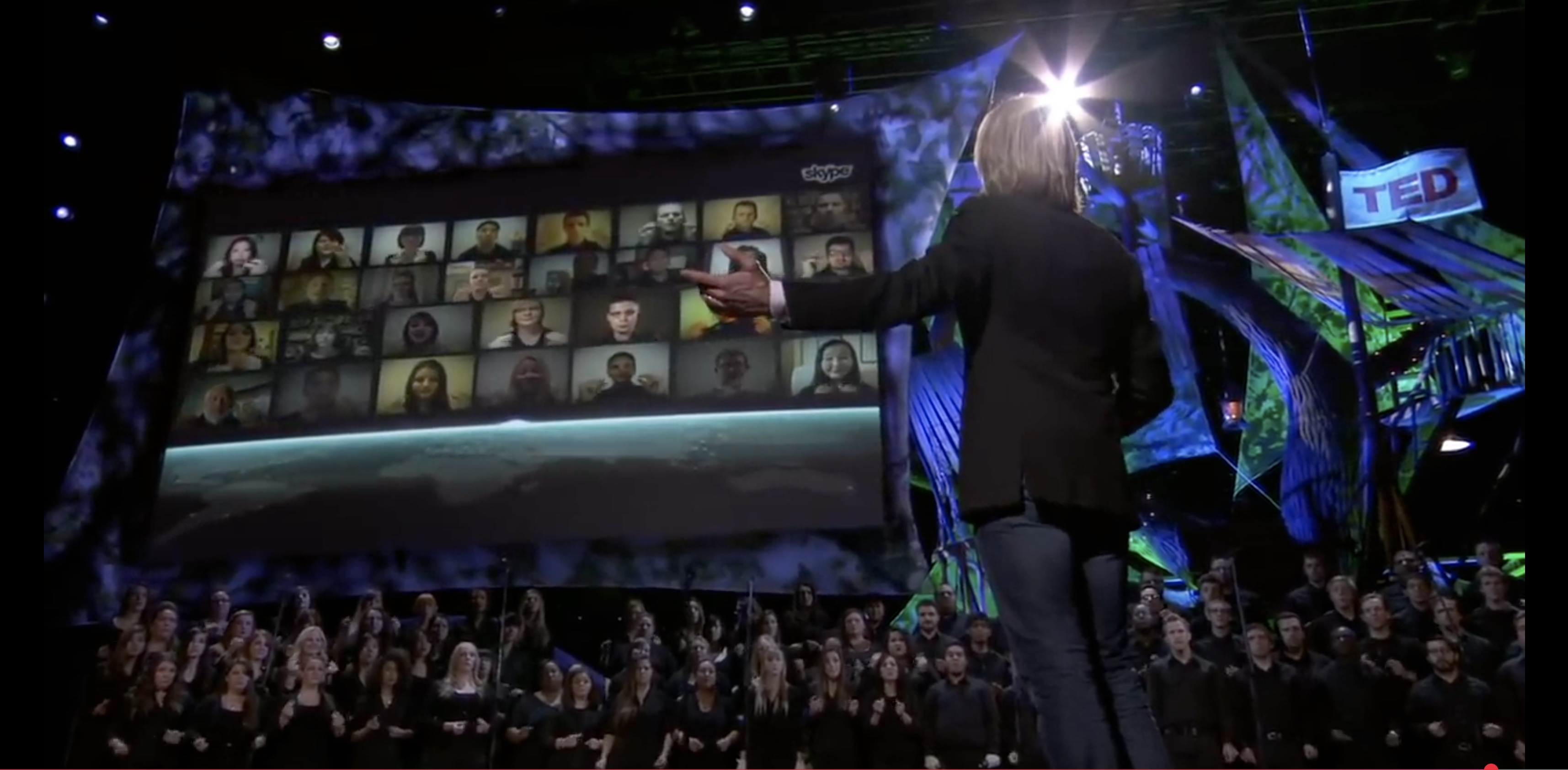
Cloudburst, a Virtual & Live Choir and TEDTALK (2013) by Eric Whitacre

Well… sorry this blog has grown to be so large! If you admit to understanding the potential hazards of and precautions for integrating social media, social networks and other technologies into education, we’ll close with the following bibliography of additional resources for further study. If that is not enough to whet your curiosity, stop back in several months to download a copy of my slide summary for the session I will present at the DCMEA Winter Conference on January 30, 2026.

Be careful stay safe and professionalbut ENJOY!

Sample Blogs

Several Major Platforms

Examples of Music Applications/Websites

PKF

© 2025 Paul K. Fox

February Updates…

PROfessional Development!

Education, ethics, professionalism, and lifelong learning.

Hope you are enjoying the winter season and, for many of you, the anticipation of warmer weather returning soon! Sorry, skiers! I am sick of shoveling snow!!

Here’s a quick “catch-up” on things going on in educator professional development.

For PA School Administrators & Educators

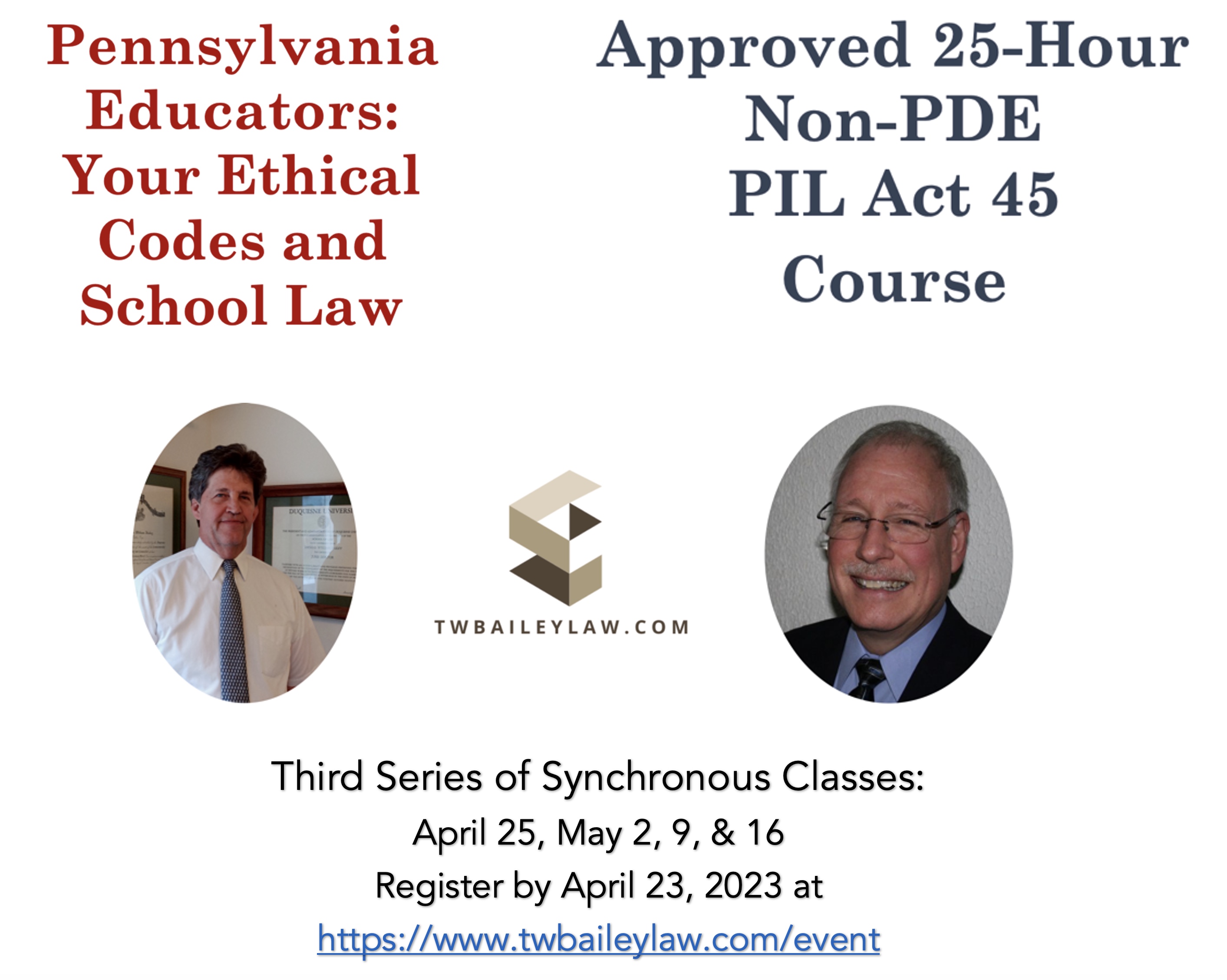
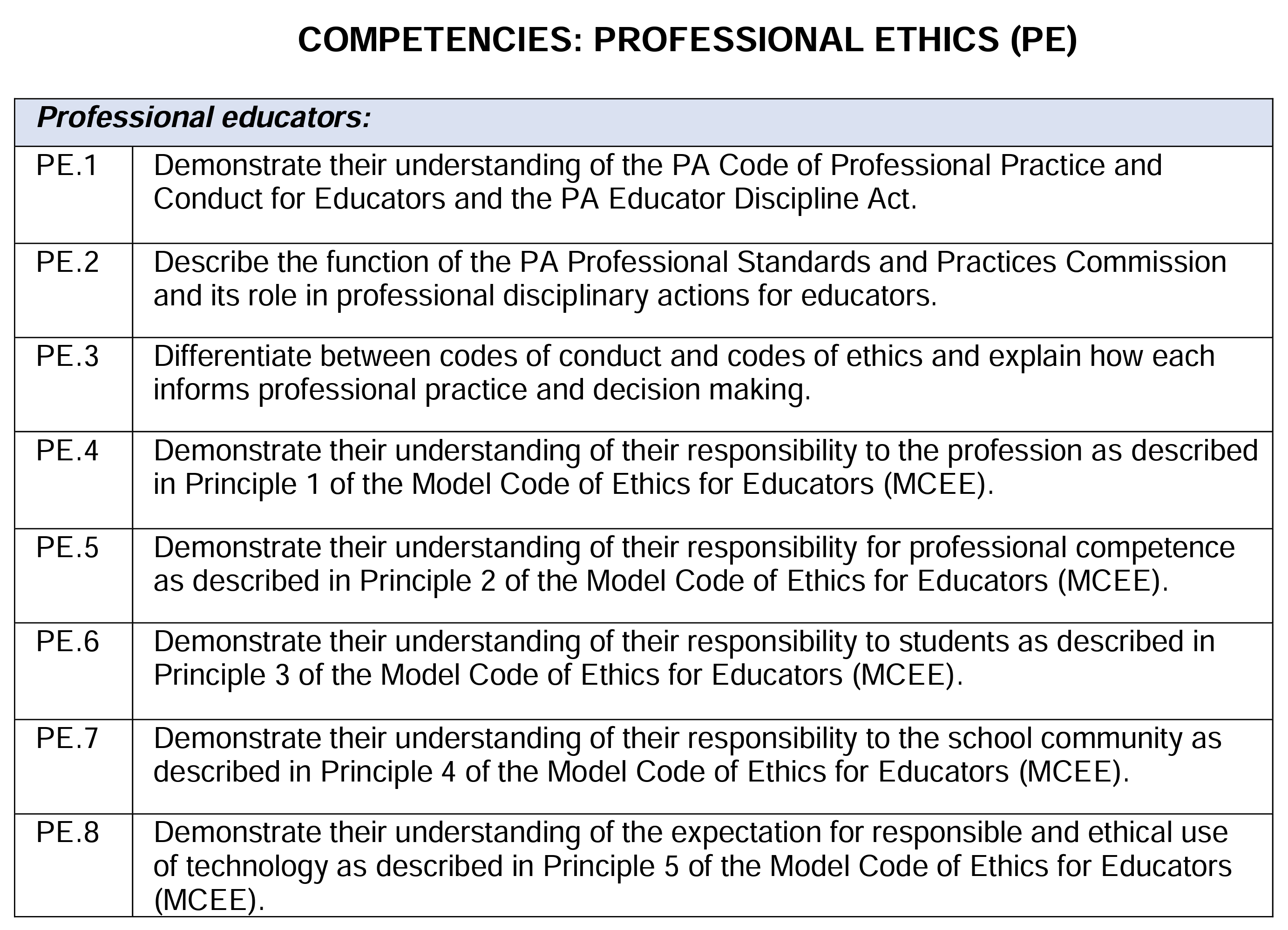
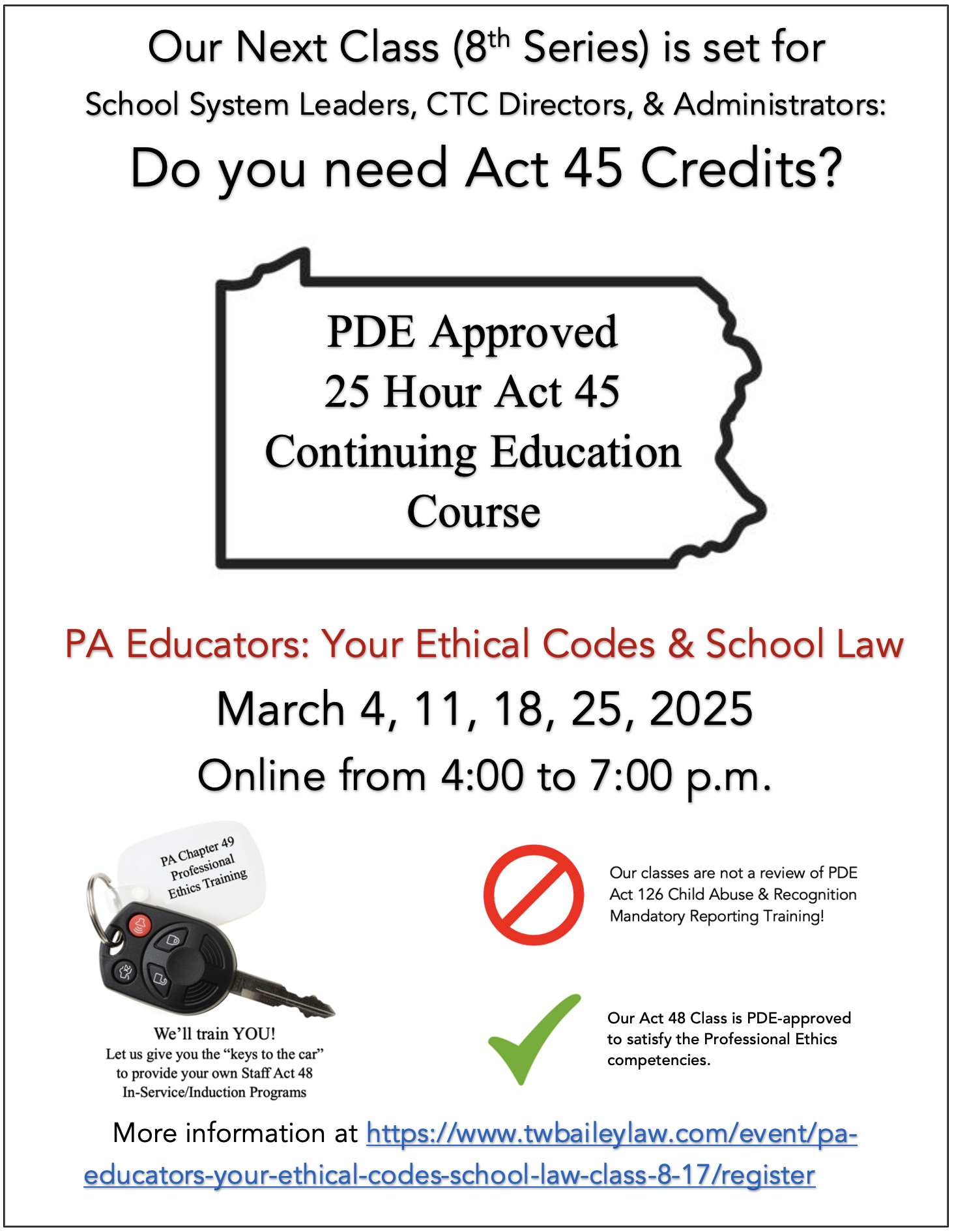
There is still time to register for the upcoming 25-hour, PDE-approved, Act 45 course, “PA Educators: Your Ethical Codes & School Law,” which will cover the recently mandated PA Title 22 Chapter 49 (Certification) Professional Ethics Competencies. The next online series of Act 45 classes will be held Tuesday afternoons in March, and provide “the keys to the car” planning for your own school district’s future continuing education and induction programs in ethics training as required by the PDE.

Now sponsoring our eighth series of classes, I am designated a “qualified instructor” in partnership with the course’s creator/facilitator, retired social studies teacher and attorney Thomas W. Bailey. For more information, please click on these links to his website:

In addition, since over the past year PDE revised their website (and changed most of the content links), I compiled a super-index of “places-to-go” and “things-to-read,” sites of supplemental resources on school ethics here. I recommend visiting this blog if you are interested in our library of links to the Pennsylvania Code of Professional Practice and Conduct, the Model Code of Ethics for Educators, the PA Educators Discipline Act, and research and citations from the PDE, PA Professional Standards and Practices Commission, Connecticut State Department of Education, and Iowa Board of Educational Examiners, among many others.

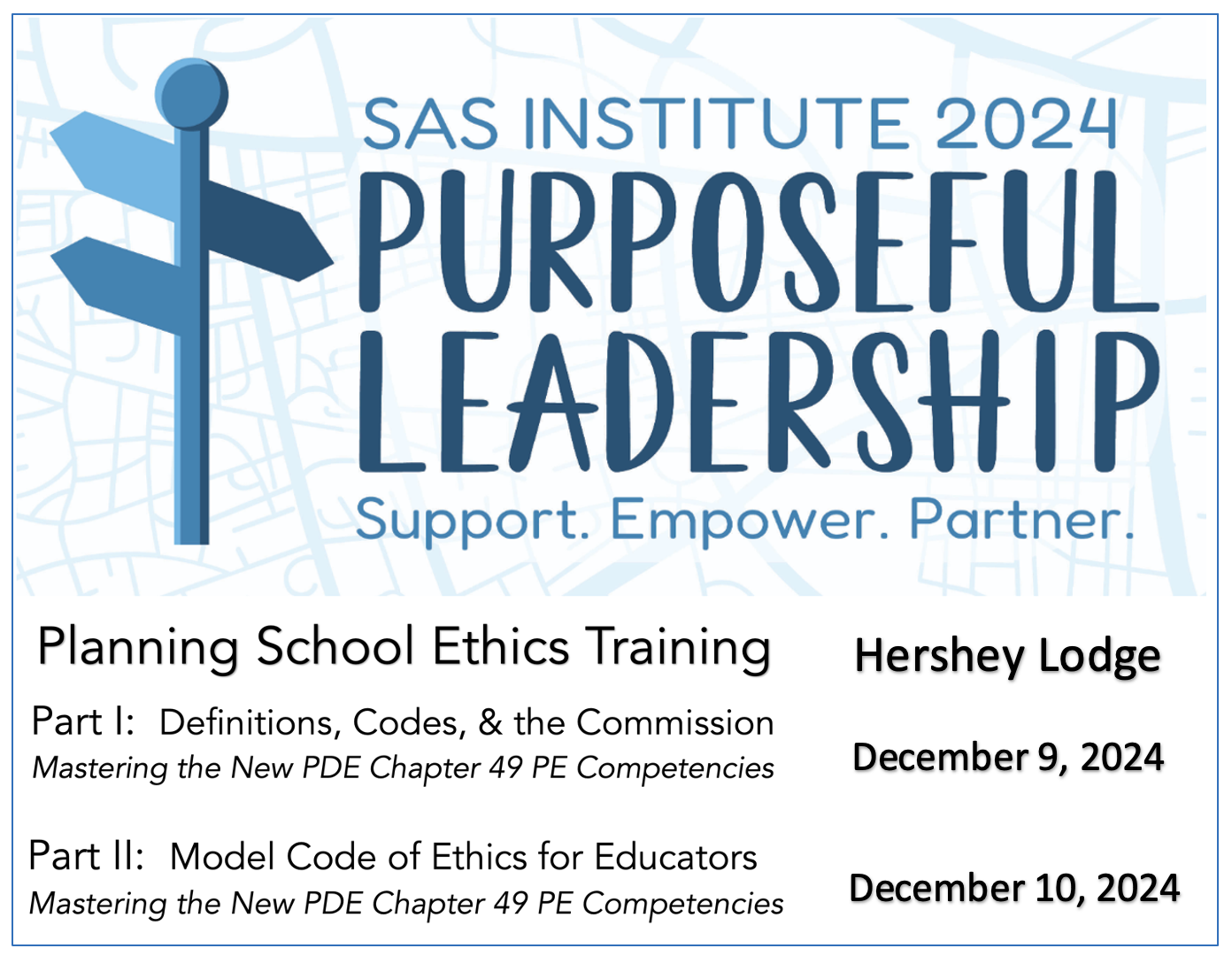
If you would like to see the kind of things we cover in these classes, take a look at the slide summaries I posted from my presentation at the PDE SAS Institute “Purposeful Leadership” state conference last December:

From Pre-Service to Veteran Music Teachers!

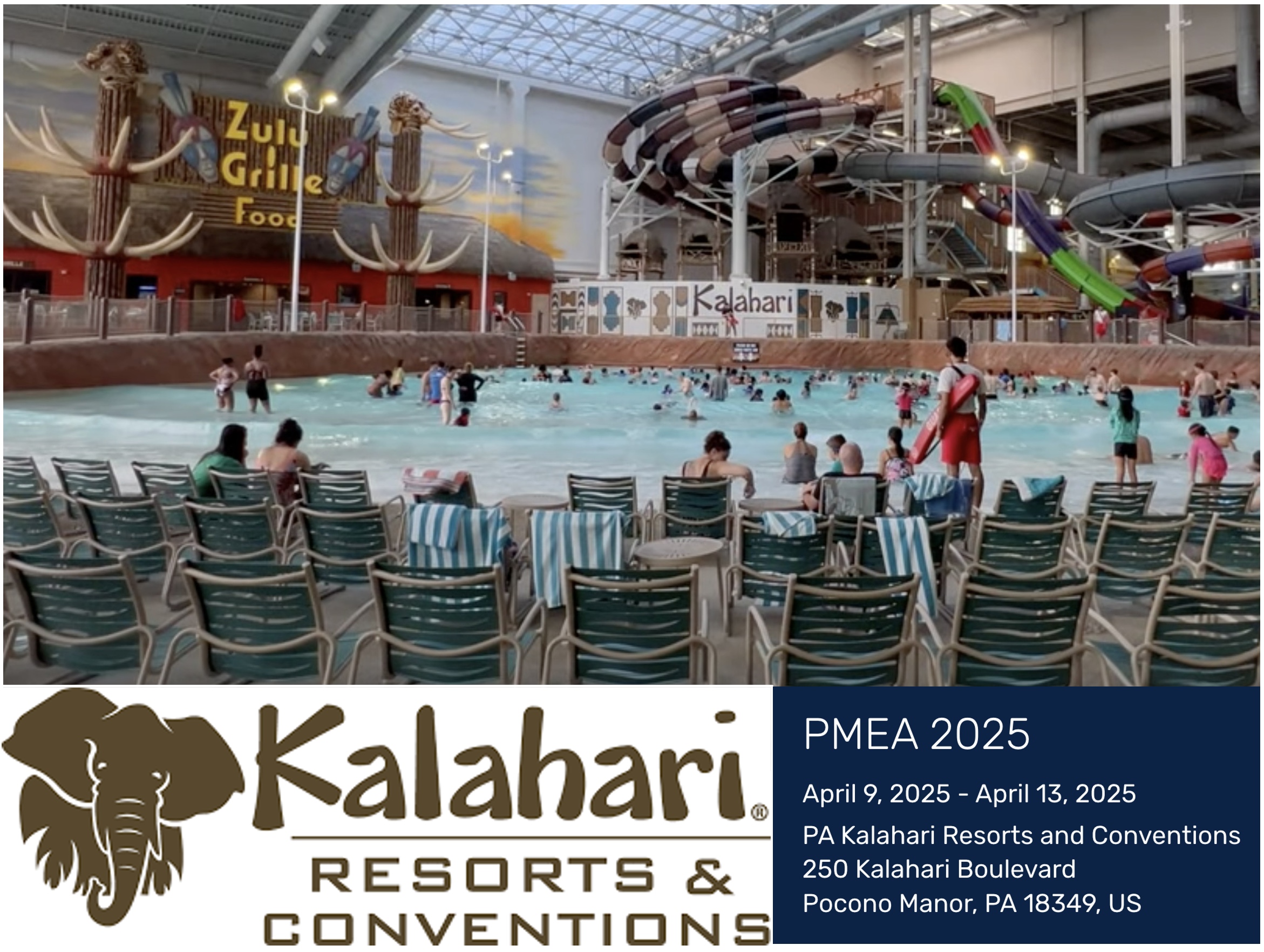
It’s that time of the year… again! The PMEA Annual Conference on April 9-12, 2025 will be held in the family-friendly, perfect-for-a-mini-vacation spot in northeastern PA: the Kalahari Resort in the Poconos.

There is still time to register! (Click here.) If you would like to see a summary of the sessions and performances, go to the PMEA website here or download this PDF brochure.

Why attend the conference? In my five-plus decades in education, I may have missed only two or three of the annual PMEA state events, and heartily recommend you remain actively involved in your professional association. This is what I wrote about it in a recent PMEA Retired Member Network eNEWS:

For some of us, it’s a just chance to catch-up with our colleagues, see our friends, and socialize. Others are more focused and take advantage of the near-perfect opportunity to network with other professionals, perhaps seeking new working relationships, partnerships, or even employment. Many are on a look-out for newly published music, that perfect music lesson or teaching strategy, technology tools, fundraisers, advance educational venues, or much-needed equipment to purchase for our ensembles or classrooms. Most come to hear/see the “state of the art” in music education – concerts, demonstrations, keynote speeches, panel discussions, exhibits, research presentations, and workshops. PMEA’s PD Council would likely submit that the primary purpose of a conference is for professional self-improvement… What did Stephen Covey call it? His Habit #7 of “sharpening the saw” – to build a balanced program of self-renewal in the four areas of your life: physical, social/emotional, mental, and spiritual. Covey would insist we embrace “the process that empowers us to move on an upward spiral of growth and change, of continuous improvement.” So, in short, conferences help us “grow” – to revive, re-inspire, re-energize, rejuvenate, re-direct, and re-motivate all of us – pre-service, active in-service, and retired teachers towards making successful new connections, updating our knowledge and skills, and forming new goals. This is how we “keep up” with all the new standards, benchmarks, and cutting-edge advances, and meet the “movers-and-shakers,” visionaries, and leaders in the profession!

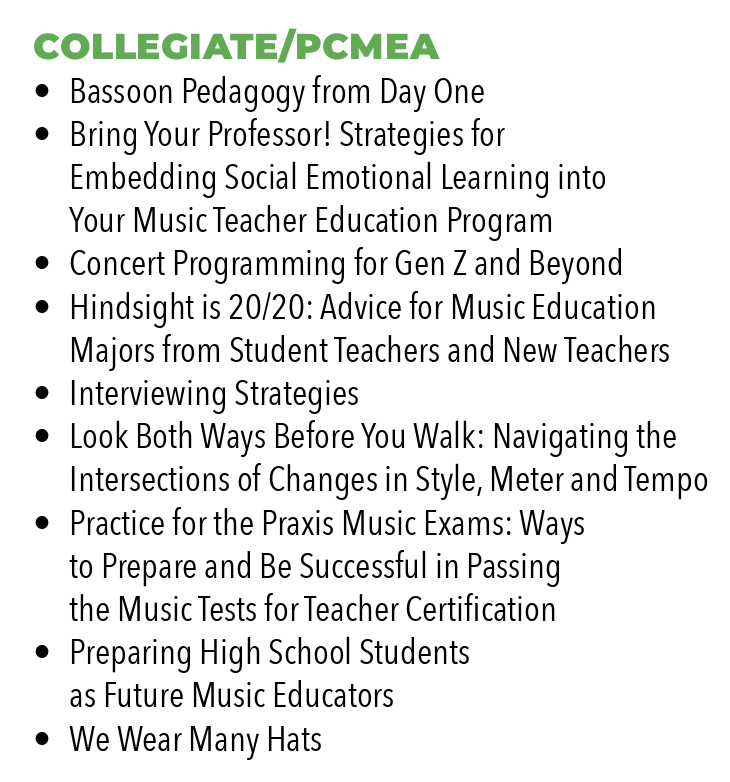
There’s a lot in store for college music education majors. Besides the aforementioned state meetings, concerts, clinics, and keynote addresses no one should miss, the music industry exhibits (new innovations in sheet music, instruments, technology, summer school and graduate programs, etc.), and the chance to introduce yourself to other music colleagues (aren’t some of you looking for a job soon?), there will be a “coffee and connections” informal lounge to ASK-AN-EXPERT on Thursday afternoon to pick-the-brains of PMEA mentors and retirees on any subject. Do you have a question about conducting technique, musical literature, lesson plan idea, classroom or time management tip, or teaching method? And, just take look these sessions the PMEA Professional Development Council has targeted specifically for YOU:

For Retirees… They are special, too!

PMEA Retired Members, consider this your personal invitation to join us at the Kalahari Resort in the Poconos for the chance to catch-up, connect, collaborate and communicate with other colleagues throughout the Commonwealth! (a plethora of “C’s!”)

As usual, we will “break bread” together Friday morning (April 11, 2025) with the annual retiree breakfast. Be sure to register soon for the PMEA Annual Conference (now only $25) and check the “yes” box that you will attend our meeting. Those in attendance will be treated to some “conference swag!”

Retirees are a valuable resource to PMEA! Our experienced retired members are among the best-trained (unofficial) mentors in PMEA. Facing many years of “boots on the ground,” we have at our fingertips numerous strategies to solve problems in education. Frankly, in my opinion, we have a lot to offer “the future of the profession!”

If you are a retired PA music educator, hopefully you have maintained your PMEA membership (dues significantly discounted), and have signed up for the Retired Member Resource Registry to help future “rookie” music educators. (To reach the R3, first login to your PMEA portal here.)

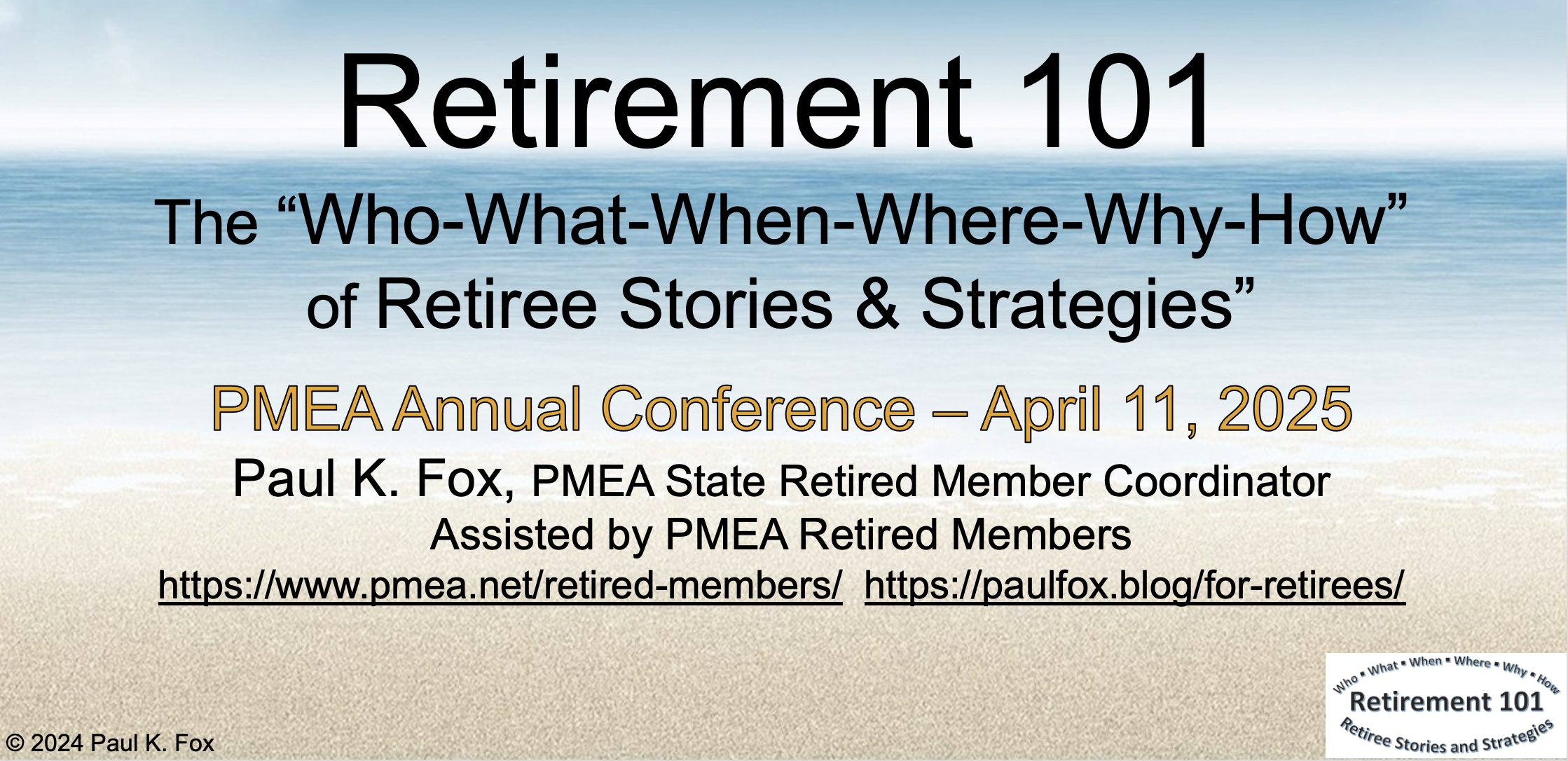
On Friday, April 11, at 3:30 p.m., we are offering a special sharing session for soon-to-retire teachers… the annual one-hour Retirement 101 workshop joined by a panel of experienced retirees: Rick Coulter, Jeffrey Dent, Sister Kathleen Doutt, Dan Klingbeil, Chuck Neidhardt, and Louise & Richard Victor. Active educators who plan to retire over the 1-5 years can learn valuable techniques from us for a smooth transition to post-full-time employment and successfully reinvent, reprogram, and “recharge” themselves to modifying those essential elements of purpose, structure, and community throughout their “golden years!”

My Professional Advertisement

You may have noticed in my last blog-post an outline of past article topics archived at this site, and a complaint that I feel I must repeat myself (or repackage the material) to meet the changing personalized “bookends” – life cycles – specific passages of my readers. The earlier February post was mostly for job seekers. If you were not looking for employment or coming fresh out of college, it may have seemed irrelevant. The same goes for specialty articles on self-care, ethics training, or retirement transitioning… WHEN WOULD YOU BE MOTIVATED TO STUDY THESE?

I have decided to maintain a comprehensive index of my writings (see “Inside” link in the top menu bar). Please visit the sections of this blog-site that matter to you most… and, when things change, come back and look again. You may find something that “hits the spot” or satisfies the needs of your new journey in education or personal/professional life.

I remain willing and able (aka “very interested”) in doing in-person or online sessions for college methods classes, PCMEA chapter meetings, PMEA festival directors’ meetings, PMEA District or Regional PD workshops, or school district/department inservices. Just give me a call. My contact information can be found in the top “About” link. Please visit this section for catalogs of my presentations and articles. FYI, I created this trifold of some of my past work.

Best wishes on your future successes in career development and professional goal setting.

PKF

© 2025 Paul K. Fox

The Get-a-Job Toolbox

Preparing for Those Upcoming Employment Screenings

So much of what I do at this blog-site is to archive articles offering advice on a host of topics:

Surveying my past blogs, I feel like I had to repeat (repackage) the content until my readers reached that particular stage in their career. Once they experience first-hand that sometimes tumultuous “passage,” they would be ready to reflect on this information. But, I doubt they would closely examine it until then. As an example, for more than a decade as the PMEA Retired Member Coordinator, these past articles I wrote for PMEA News and the PMEA Annual Conference’s session Retirement 101 revisit the voluminous insight of gerontologists exploring the “who, what, when, where, and why” of retirement. Regardless at how often it is presented, you tend not to consume advice on coping with post-employment until you feel you are “ready” to retire. This is the same issue for soon-to-graduate collegiates and those transitioning to a new job; who wants to read about branding, marketing, and interviewing until they are in the middle of seeking first-time (or new) employment?

Please click on the “plethora” of links throughout this article to be redirected to these past writings. My apologies in advance to what may seem like to be a lot of duplication!

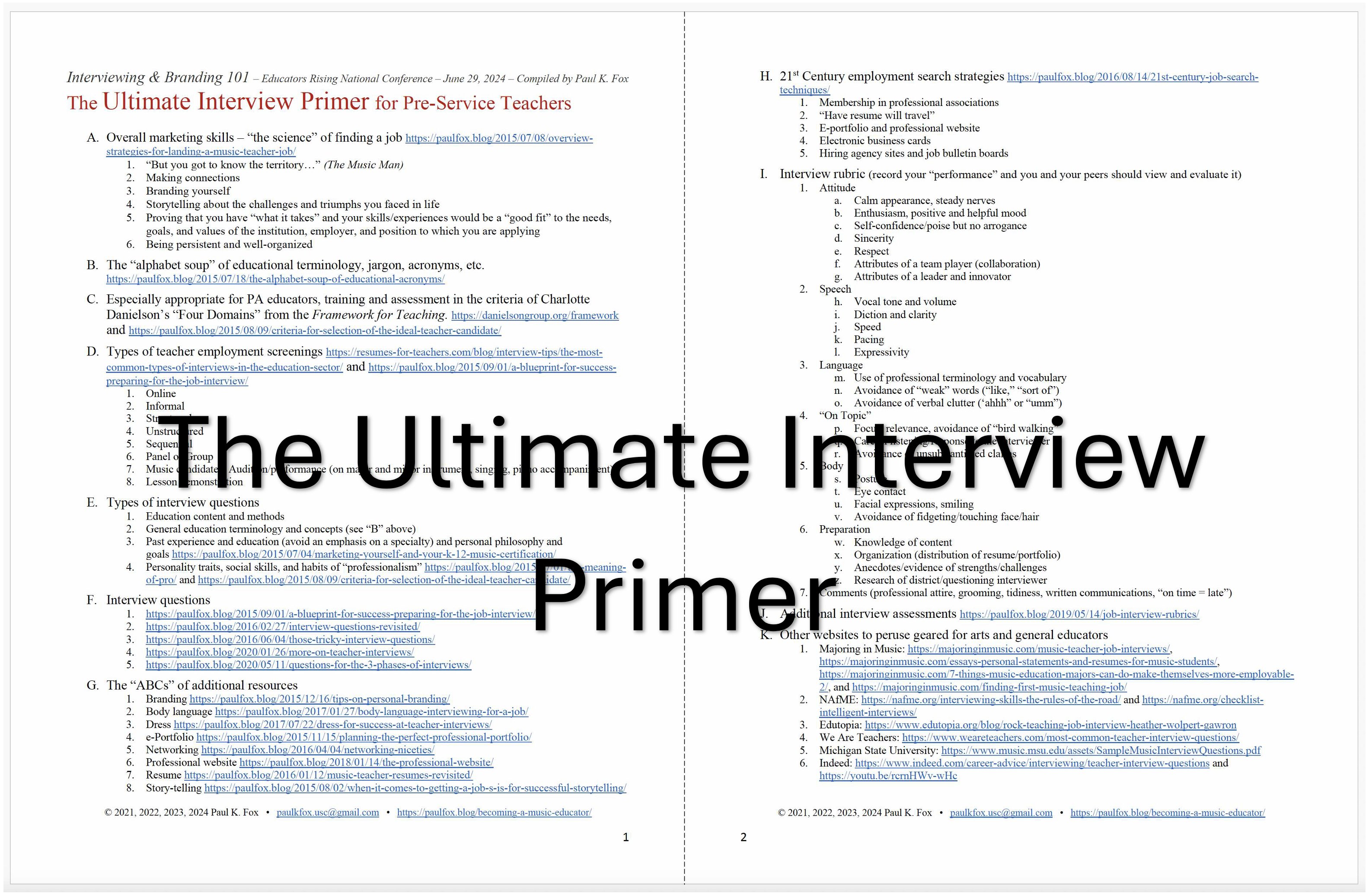
I went as far as updating the most comprehensive and “perfect” PowerPoint for collegiates: Bookends – The Life Cycle of a Successful and Happy Music Educator – portions of which I have presented several times to Professor Jessica Vaughan-Marra’s Seton Hill University music student teachers. This slide handout starts with the material from the first three bullets in the first paragraph above and then adds information about teacher health and wellness, time management, and retirement. We offer Bookends… to preservice music educators in their junior, senior, or graduate years and “rookies” to the profession. I encourage you to download this resource, visit the PCMEA website (click here/scroll down) to read past issues of Collegiate Communique, and the paulfox.blog posts. While you’re at it, acquire your own copy of the Ultimate Interview Primer. Click away before these links become inactive.

Soon it will time for graduates to enter the workforce… and boy, do we need you! By most accounts in PA and the surrounding states, we are experiencing a teacher shortage. School districts are seeking quality candidates to apply for their open positions. But, much of what happens in the job screening process seems to be influenced by chance. Collegiates, ask yourself: Are you truly prepared to market your experiences and abilities, share your brand and stories of your interactions with children in educational programs, and relate positive anecdotes of your teaching, problem solving skills, and other professional attributes? I may have been a little Type-A when I first applied for those music teaching positions back in 1978, focused on saturation publicity and persistence, and organized with a large paper portfolio of past experiences, but I was clueless in responding to those tricky interview questions and what administrators actually wanted to see in prospective new members of their staff.

One more piece advice for first-year and recent transfers to music education: Seek out a PMEA mentor and/or a member of the Retired Resource Registry (access from the PMEA Retired Member focus area after you login to your member portal)… both are groups of volunteers willing and able to help “newbies.”

Have a question about selecting music for your ensemble, a dynamic lesson plan, classroom management issue, interviewing, curriculum innovation, or a conducting tip? Stop by the “coffee and conversations” informal lounge at the PMEA Annual Conference on April 10 and “sit-a-spell” with us!

In conclusion, the following is a sequential outline – a “to-do in this order” list – a preservice toolbox of past posts and other resources for you to assemble a marketing plan. Take time to sort through these “nuts and bolts” (all links in this blog), process the information, save anything you want to read further, and then “practice, practice, practice!” This “gift” to PCMEA and music education majors embraces my best wishes for successfully finding the job you always wanted and preparing yourself for the greatest “calling” of your life – an enriching and satisfying lifelong career in music education! Good luck!

Using the Collegiate Toolbox – A Roadmap for Becoming a Music Educator

  1. Peruse everything in this and past paulfox.blog postings.
  2. Download the PDF documents to your hard drive. Review a portion of them each week!
  3. On your computer, create a “ME” file documenting your accomplishments, awards, experiences interacting with children, etc. – a library of the things you may wish to include in your future resume, professional website, and (e-)portfolio. Add to this folder throughout your college years.
  4. To reflect on your perceived strengths and weaknesses, complete a self-assessment of YOU from a typical professional evaluation form, these ideal effective teacher attributes and more criteria
  5. Prioritize what you think you need most. Write down your goals! Pobody is nerfect!
  6. While you are still attending college, work on shoring up any weak content areas or specialty skills (e.g., how is your “piano chops,” knowledge of specific methods, grade level repertoire, etc.?)
  7. Write a philosophy of school music education (overview) and your mission statement: “Why do you want to teach?”
  8. Be ready to answer the question (and defend your response), “What is your vision of the role of music education in the schools?”
  9. Be ready to define your “brand.” What are your professional attributes? What makes you unique? Why would you be a good candidate for a school music position?
  10. Begin to assemble a list of stories that would “show not tell” your positive attributes.
  11. Identify the impressions you want to “sell” yourself, and practice strategic storytelling.
  12. Practice answering interview questions and use a rubric to evaluate your performance. If you can, share all of this with your peers and sponsor mock interview sessions. Record/assess yourself.
  13. Get started on drafting the marketing tools you will need (e.g., your professional website, resume, portfolio, etc.)
  14. Review educational acronyms, jargon, and terminology such as this list plus these recent additions: CR-SE (Culturally Relevant & Sustaining Education), DEIB (Diversity, Equity, Inclusion, Belonging), and SEL (Social-Emotional Learning). These terms may come up at your next interview.
  15. Read cover-to-cover your PA code of conduct (CPPC) and the Model Code of Ethics for Educators.
  16. Practice ethical decision-making (with your peers) by reviewing these mock scenarios, first deciding what level of misconduct (if any) is reached in each case study, and then more discussion on the incident’s effect on the students, parents, staff, and community, and what proactive steps may be taken to remediate the situation.
  17. Join and become active in appropriate music education professional organizations (renew your memberships and add new ones): ACDA, AOSA, ASTA, NAfME, NBA, PMEA, etc. to name a few.
  18. Attend a conference of your professional association(s) and network with other colleagues. For PA colleagues, register for the PMEA Annual Conference (April 9-12) at the Kalahari Resort (Poconos).

Feel free to leave comments about this blog. (See the link just below the title.) How did you use these tools? What was particularly beneficial? What suggestions would you have for future music teacher applicants?

To PCMEA chapter officers/members, music education majors, and college instructors: I am available to present Bookends or other online or in-person workshops for college students. Send me an email.

© 2025 Paul K. Fox

Our Next Chapter

Bookends – Stage 5: “Living the Dream”

Welcome back to my blog site for music educators… actually hopefully thought-provoking reflections for teachers in any subject area or grade level, school administrators, classified school staff (secretaries, aides, custodians, etc.), and professionals in all fields.

It has taken me more than a year to revisit (and expand on) all of the sections from my workshop (October 2023) presented to Seton Hill University music education students, and now we close with “The Final Chapter” – a focus on self-reinvention and transitioning to retirement in anticipation of successfully Crossing the Rubicon to enjoy our “senior years.” This entire presentation was inspired by the mission statement of the Pennsylvania Music Educators Association (PMEA) Council for Teacher Training, Recruitment, and Retention – “The Life Cycle of a Music Educator” – for which I had the privilege of serving eight years as the State Chair (still a council member). To recap, here is an outline of my previous blogs on the evolution of an educator, a journey through career “passages” to follow:

Stage 5: Next Chapter/Living the Dream Years –
Retirement Prep & Mastery

To start with, the term “retirement” is a misnomer. Typically, in most dictionaries (online and printed), it is defined as “the withdrawal from one’s career, occupation, or office usually because of age,” or even the synonyms “seclusion from the world,” “privacy,” “the act of going away,” “retreating,” or “disappearing.” No, perhaps more appropriate definitions would support the advances in medical science, a better standard-of-living, our healthier lifestyles and improvements in self-care, and longer lifespans. Retiring from your first career may only be the halfway point! Sample online quotes:

“The ‘new retirement’ is not an ending, it’s a new beginning, the start of a new life journey of vastly expanded proportion.” Dr. Richard Johnson, Flourishing in Retirement

“Retirement now is mostly about change. And it may not look all that different from what immediately precedes it.” Huffington Post: http://www.huffingtonpost.com/arianna-huffington/its-time-to-retire-our-definition-of-retirement_b_5774878.html

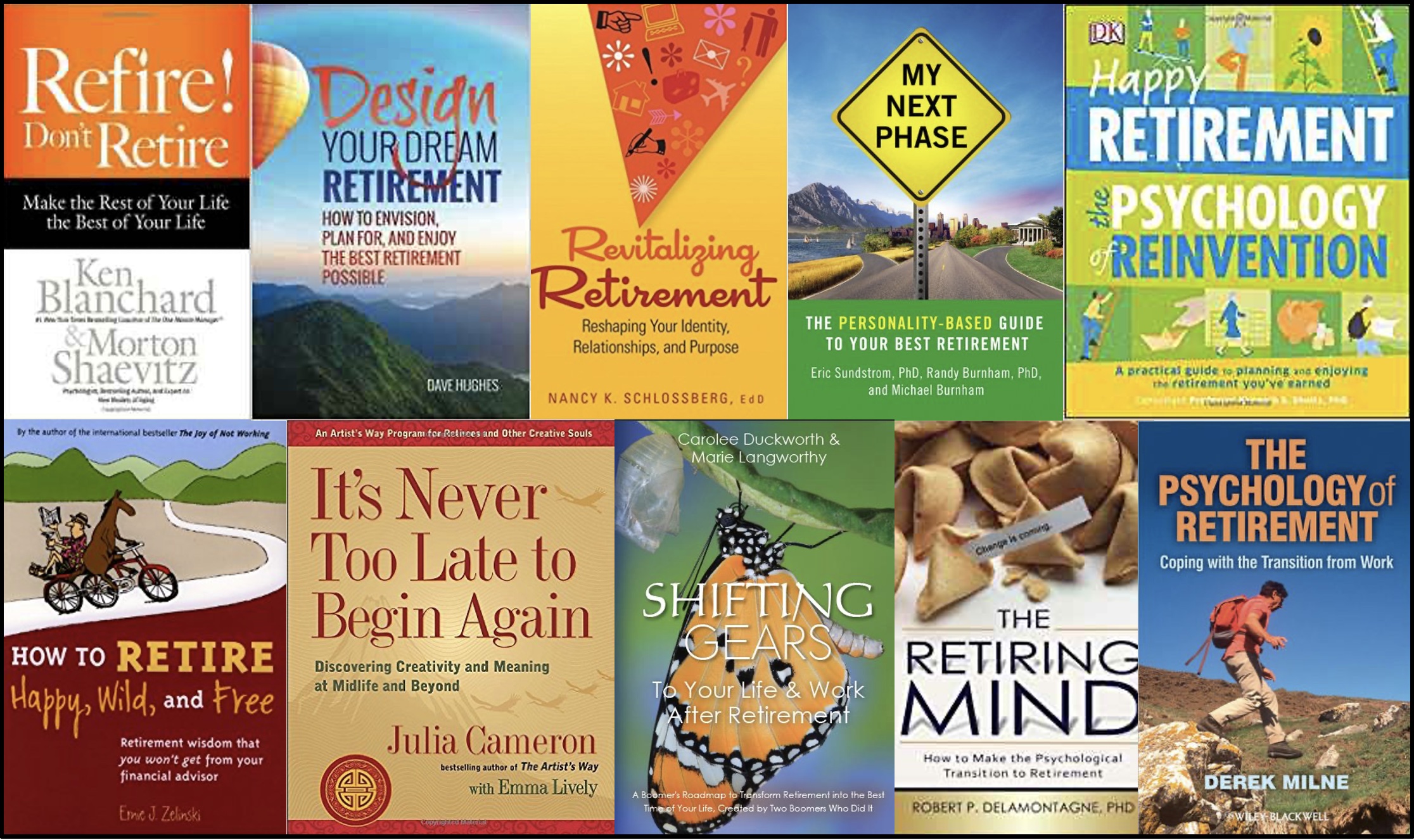
Retirement is “reinventing yourself for the life you’ve always wanted.” Steven Price, How to Survive Retirement, Skyhorse Publishing, 2015

In my experience hosting the annual PMEA conference session “Retirement 101 – the Who, What, When, Where, Why and How” and sharing retiree stories and strategies, I have come to the conclusion that there are many other misconceptions about taking this big step:

  • You retire FROM something. (Nope! You need to retire TO your next phase of life, new goals, pursuits, etc., and not run away from your past. We have often paraphrased the theme of author Ernie Zelinski writings in past paulfox.blogs: Retirees must search for and define the things that your job had provided in the past: 1) Purpose/new life mission, 2) Structure/schedule, and 3) Community/interaction with people.)
  • It’s an easy transition. (For many, it can feel like the most tumultuous transition ever experienced with “change,” sometimes overwhelming swings in emotions, and personal challenges!)
  • It takes little time to prepare. You just fall into it! (No, the research recommends “intentional and comprehensive” advance preparation, starting at least 3-5 years before you “pull your plug.”)
  • The decision is based almost entirely “on the money.” (True, a soon-to-be-retiree should draft a post-employment household budget, analyze net worth and pension/social security benefits, pay off as many loans as possible, and make appointments with an estate planner, elder attorney, and/or financial advisor. However, we retire for a host of very personal reasons – travel, relocation, encore or new careers, caring for family members, etc., and the likely greater challenge is a renewed exploration of self-reinvention, defining new pathways, renewing relationships, and mapping out your rest-of-life strategies and goals. In other words, what are you going to be when you grow up?)
  • It’s completely different from anything you’re doing right now. (Music educators have a variety of skill sets that they will likely retain in future part/full-time employment or volunteer work. They can advance their personal artistry in the singing or playing an instrument, accept solo “gigs” or perform in community or professional ensembles. They can teach privately, direct church or community bands, orchestras, choirs or jazz groups, coach sectionals, compose music or design halftime shows, judge school groups, present workshops, choreograph/direct musicals, serve in college music education programs, etc. The list goes on and on… and is only limited by the retiree’s imagination and interest.)

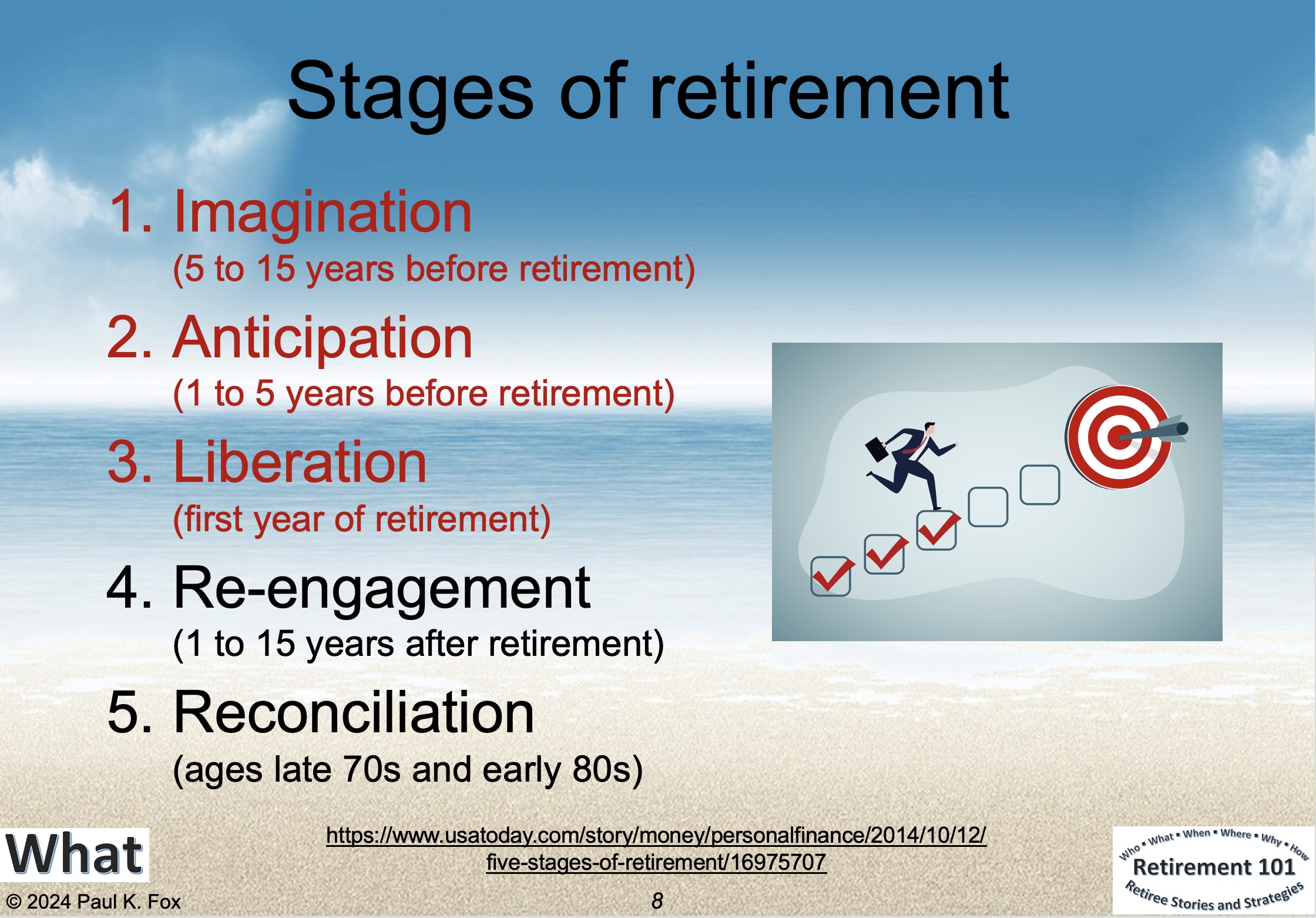
In almost every book on retirement, there are discussions about the “stages of retirement” (defined by gerontologists – experts on aging) that graphically show the importance of advance planning. (See below.) The first three stages certainly provide opportunities to rethink, recharge, reinvent, retool, and redefine one’s life purpose and meaning, become productive, and begin that new chapter in their lives.

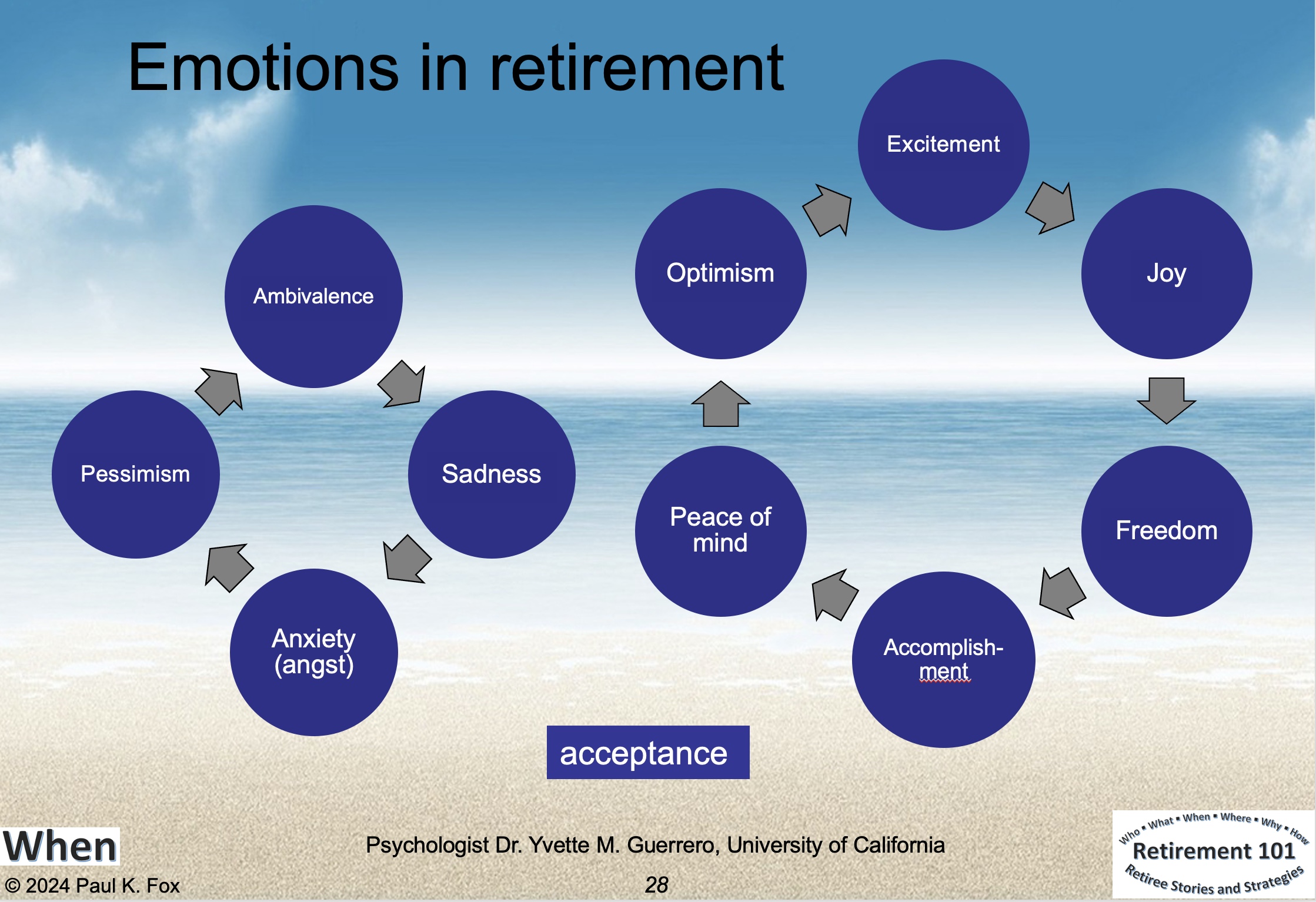
Retirement can be a little bumpy. It’s not unusual to feel many “up’s and down’s” through the transition. A lot may have to do with whether you had really wanted to leave your job when you did or if you took the necessary steps in retirement preparation. Many have suggested to take a year or two “internship” to explore your options, rest a little and take a break from all of that stress, celebrate the free time (you seem to) instantly have, and then assess and “test” what might be your next (more permanent) steps.

Prepare for the emotional roller-coaster! Initially, you are very EXCITED about your upcoming retirement. You feel pure JOY about the anticipated FREEDOM, and everyone throws you a party or two. You take moments to sum up your career legacy and ACCOMPLISHMENTS. A blessed PEACE-OF-MIND envelopes you, no longer having to worry about that next concert, recruitment campaign, or lesson target. With the future in front of you, you feel OPTIMISM. And then, after the excitement dies down…

At times, you feel a little AMBIVALENT about all of this “change!” SADNESS could come saying good-bye to your colleagues and experiencing a loss in professional identity and sense of purpose. Perhaps you may experience ANXIETY (angst) about what the future will hold, and PESSIMISM on whether you will “get it together” in your new life.

But, finally… ACCEPTANCE and adjustment!

Both emotional cycles may happen at different times or nearly simultaneously. These are normal “speed bumps,” and the perfect reason why you should remain as active as you can with your relationships, especially with people who have already made the retirement journey.

Are you ready to retire over the next 3-5 years? Well, as the PMEA Retired Member Coordinator for ten years (with the help of numerous inspirational music teacher retirees in PMEA), I have spent a lot of time preparing what amounts to be a “mock instructional manual” and other resource materials for fellow PMEA members. These are all posted here on the PMEA website. (This one of the best reasons to maintain your PMEA professional association and pay your dues… We continue to advocate, advise, and assist all PA music educators… from preservice to “living the dream!”)

Free “nuts and bolts” are listed below for you to peruse as you prepare for this life-changing passage.

What’s next? How about attending the PMEA Annual Conference on April 9-13, 2025 at the Kalahari Resort/Poconos (“home of the world’s largest indoor water park!”) and enjoy some time away from it all? The Kalahari offers some family-fun recreation and PMEA will provide concerts, keynotes, exhibits, and sessions of stimulating professional development for the entire “life cycle of the music educator.”

PMEA members, I hope you plan to attend my Friday session at the conference…

Looking forward to seeing you there! At any time, if you need help or more ideas on retirement prep, I’m just a quick email away. (Click here.) Let me hear from you!

PKF

© 2024 Paul K. Fox

Bookends – Part One

The Life Cycle of a Successful & Happy Music Educator

“There are no secrets to success. It is the result of preparation, hard work, and learning from failure.”

Colin Powell

I feel blessed to have spent five decades in the field of music education. No other career has offered so much personal satisfaction, discoveries and growth of hidden potentials and skills I never knew I had, sharing my love of creative self-expression, and facilitating others to seek their own connections to music. I am trying to follow my own “retirement” advice, remaining active in the profession in ways that matter, helping others find their own success, and embracing author Ernie Zelinski’s mantra to “find purpose, structure, and community” throughout my years as a retiree.

Parallel to the mission of the Pennsylvania Music Educators Association Council for Teacher Training, Recruitment, and Retention, serving “the life cycle of a music educator,” this blog site is my “gift” to future and current music educators and those contemplating retirement. Recently, I presented a workshop on this topic for student teachers in music education at Seton Hill University (Westmoreland County, Greensburg, PA), summarizing a framework for “professional development for life” in order to foster these goals and nurture meaningful successes of pre-service music educators. No “road map” (or to retain the analogy in my title, “library” of resources) is applicable to everyone nor will the journeys/readings be the same… but since my collections of past blogs over ten years are now vast, I offer this simplified checklist for any “newbie” interested to seek their own pathway. Happy travels!

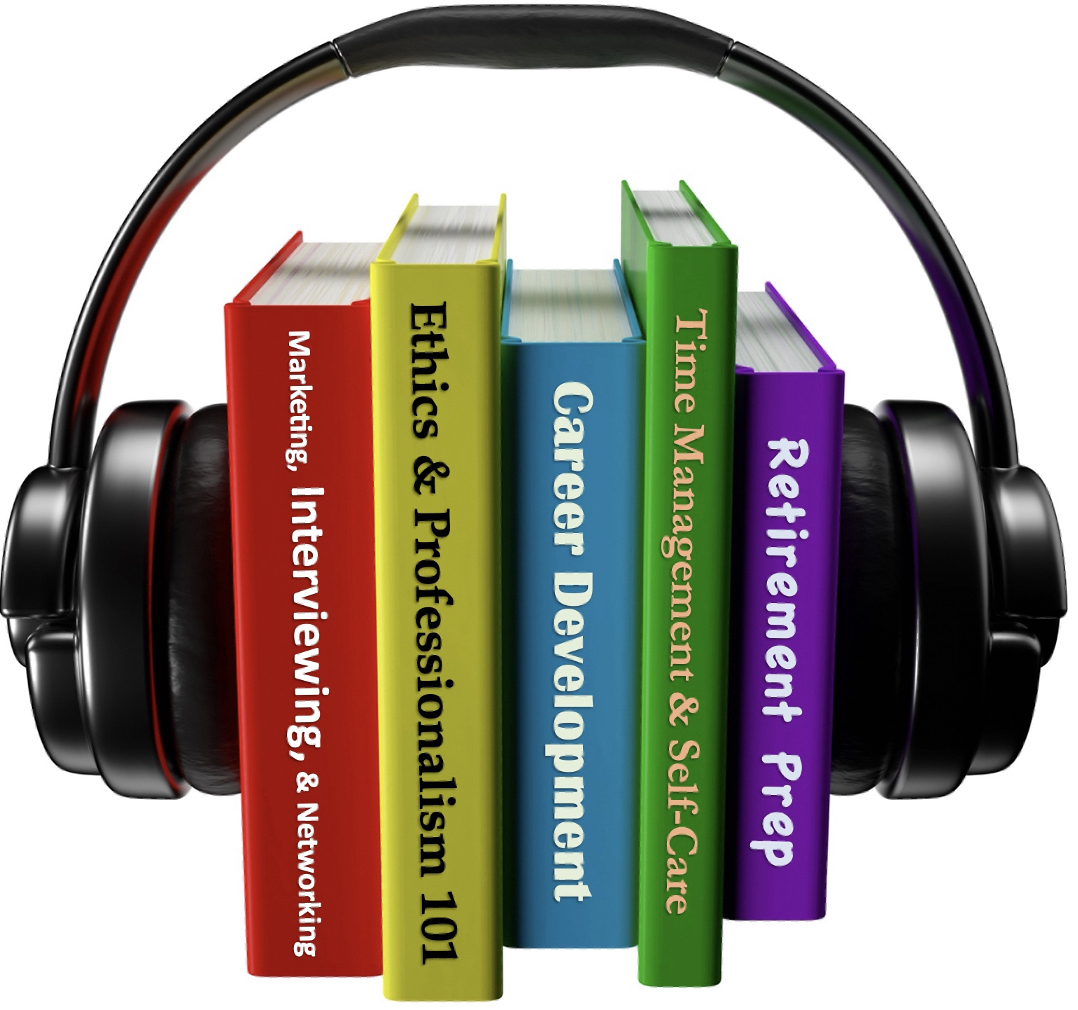
  1. Preservice/Training Years: Marketing, Interviewing, & Networking
  2. Rookie/Practicing Years: Ethics & Professionalism 101
  3. Inservice/Growing Years: Career Development (next blog post)
  4. Veteran/Sustaining Years: Time Management & Self-Care (next blog post)
  5. Next Chapter/Living the Dream Years: Retirement Prep & Mastery (next blog post)

The slides to the entire presentation are open to anyone to view below.

However, here’s a shamelessly offered advertisement. It would make more sense to see this “in-person” or online with my moderation. I would be happy to present this session (giving me at least an hour to allow for more interactive discussion) to collegiate members, a music education methods class, a regional workshop, or festival meeting via Zoom or in-person (in PA). If interested or to inquire, please send me an email here.

Now… the checklists. Depending on your current status and interests, peruse the following resources. It is possible a few of the links contained within these blogs have gone inactive, but I believe enough is there for you to gain the insight, tools and motivation to achieve “professional development for life.”

Stage 1 – Preservice/Training Years

The focus during our early years in any profession is learning the “shtick” and getting ready for the job search and interviewing. Probably before anything, we revisit our inspiration and what Simon Sinek directs us to “the why” of any organization… in this case, “the why” of becoming a music educator – our philosophy, mission, vision, and understanding of the purpose/role of music education n the schools.

[ ] 1. The Meaning of Pro: Are you a professional? Do you have the skills, habits, and attitudes of a professional in the field of education?

[ ] 2. Marketing Yourself and Your Pre-K to 12 Music Certification: What is your professional “brand?” Do you plan to “sell” yourself as a specialist, e.g., “band director” or “elementary general music teacher, etc.? To those potential job candidate screeners, promote the image of being proficient – “a total music educator” – and don’t emphasize your major/emphasis or perceived skill or experience limitations. The only thing that really matters is whether you are the “right fit” for a particular opening, and of course, deciding whether or not to accept the offer. Your license (certification) implies that you do indeed have the necessary training to teach all K-12 music classes. Don’t sell yourself short!

[ ] 3. Criteria for Selection of the “Ideal” Teacher Candidate: The best way to prepare for a job interview is to become aware of how you will be judged in comparison with your peers. What are the standards (or behaviors or criteria) of outstanding teachers? For what are administrators looking to fill the vacancies and build/maintain a quality staff?

[ ] 4. “S” is for Successful Storytelling: The number one method to land a job is “SHOW, don’t TELL!” Stories are up to 22 times more effective than facts alone. Identify the key impressions you want to convey. Pick interview stories that will “sell” the right message. Learn how to share unique personal examples of your interactions with children, colleagues, and music programs. These additional resources can be shared about “strategic storytelling” and how to prepare (a.k. practice) telling your anecdotes:

[ ] 5. The Ultimate Interview Primer for Pre-Service Music Teachers: This super-packet has a collection of more tips on marketing yourself and mastering the “science” of finding a job, interview strategies and sample questions, evaluative rubrics, follow-ups, “bad habits” to avoid, etc. Take the time to download and explore these excellent tools!

Homework for Stage 1 – Developing a Marketing Plan

  • Standards: Define your personal mission, goals, and philosophy for teaching music, modeling the highest ideals of professionalism, and becoming the “total music educator.”
  • Marketing: Design and distribute a “state-of-the-art” résumé, e-portfolio, website, and business card.
  • Skills: Compile a list of anecdotes and true stories of you overcoming challenges, solving problems, and demonstrating  “best practices” of professionalism and self-improvement.
  • Assessment: Practice, record, and evaluate yourself answering job interview questions.

Stage 2 – Rookie/Practicing Years

[ ] 6. Ethics for Music Educators – Part I, Part II, and Part III: You may think that the primary focus for our early years as a novice teacher would be the reinforcement of what we learned about education – curriculum, content, methods, classroom management, and assessment, but something else trumps all! Before we ever step foot in a classroom, rehearsal room, or stage, it is essential we first review those ethical standards in education, terminology, philosophy, and “the codes” that bind us. We should be able to show in depth understanding of these concepts:

  • Fiduciary
  • Moral Standard
  • Ethical Standard
  • Ethical Equilibrium
  • Moral Professionalism
  • Differences Between a Code of Conduct and a Code of Ethics
  • Student-Teacher Boundaries and the Slippery Slope of Ambiguous Relationships
  • Function/Relevance of “The Codes” to Daily Teacher Decision-Making

For nearly every presentation I do on “ethics for pre-service music educators,” I hold up a fifty dollar bill and ask, “Who wants this? Can you name the exact title of your state’s code of conduct for educators and the government agency that enforces it?” So far, no one has made me $50 poorer. Indeed, few active teachers “in the trenches” have read their “codes,” and frankly, that is surprising. Violation of any major provision in our code of conduct will result in a serious reprimand, being fired, losing one’s certificate to teach anywhere, and/or criminal/civil prosecutions. Wouldn’t you think all of us would be intimately familiar with the “rules” of our professional?

For my Pennsylvania colleagues, please download and READ these:

[ ] 7. Ethical Scenarios (and More): The study of morality in professional decision-making is essential to pre- and in-service training of music teachers. Our goal should be to reinforce recommendations for the avoidance of inappropriate behavior (or even the appearance of impropriety), and defining and modeling the “best practices” of a serving as a “fiduciary” by promoting trust, fostering a safe environment for learning, acting in the best interests of our students, and upholding the overall integrity of the profession.

One of the best ways to accomplish this is to discuss ethical scenarios in small peer groups, an interactive exchange of opinions – “what would you do?” – in analyzing hypothetical case studies. Perhaps in a college methods class, student teaching seminar, department meeting, faculty committee, or PLC (Professional Learning Community), the following thought-provoking questions from the Facilitator Guide for Professional Responsibilities – Module 5, written by the Connecticut State Department of Education T.E.A.M. (Teacher Education & Mentoring) manual should be discussed in an open, reflective, nonthreatening setting:

  1. What possible issues/concerns might this scenario raise?
  2. How could this situation become a violation of the law, the “Code” or other school/district policies?
  3. In this situation, what are some potential negative consequences for the teacher, students, parents, and/or school staff?
  4. How would this episode affect a teacher’s efficacy in his/her classroom, demean the employing school entity, or damage her position as a moral exemplar in the community?

Please visit link #7 (above) for sources of ethical scenarios to study, including my “conundrum series.”

Homework for Stage 2 – Are you an Ethical Educator?

  1. Self-assess your own habits of professionalism, and identify goals for at least two “personal improvement projects.”
  2. Read “cover-to-cover” any documents relating to your own state’s code of conduct and the NASDTEC Model Code of Ethics for Educators.
  3. Discuss the ramifications of “choices” and teacher decision-making in context by reading a few of the fictitious scenarios highlighting ethical precautions, disputes, and “conundrums.”

Coming Soon…

Bookends Part Two

PKF

© 2023 Paul K. Fox

On the Road Again (2023)

“Doing My Thing…” — Professional Development Conferences for Music Educators

It’s been awhile since I posted here… arguably the longest editorial break I have taken since retirement and starting this blog-site. What’s that line retirees often say? “It’s a good thing I am retired from my job; otherwise I would not have enough time to do everything!”

This has been an extremely busy couple months of renovating three bathrooms, promoting the 30th Anniversary Gala Celebration of the Community Foundation of Upper St. Clair featuring a CASINO NIGHT & the local band NO BAD JUJU (to which I can’t even go because it is on the same day as PMEA), staffing a transition of new editors and an office manager for the UPPER ST. CLAIR TODAY community magazine, “keeping my hand in” by conducting a small nonprofit community ensemble (now in our 40th season of the South Hills Junior Orchestra), volunteering at the hospital (see my Tales from a Wheelchair Jockey article), developing new PDE Act 45 and 48 programs on ethics (school system leaders and educators respectively), and… (deep breath): preparing four PowerPoint presentations for two music conferences in April. Yes, and loving every minute of this frenzied activity!

Pennsylvania and Eastern Division music education colleagues: Hopefully by now, you have registered for the coming conferences on the horizon:

NAfME Eastern Division Conference, April 13-16, 2023, Rochester, NY

PMEA Annual Conference, April 19-22, 2023, in the Poconos

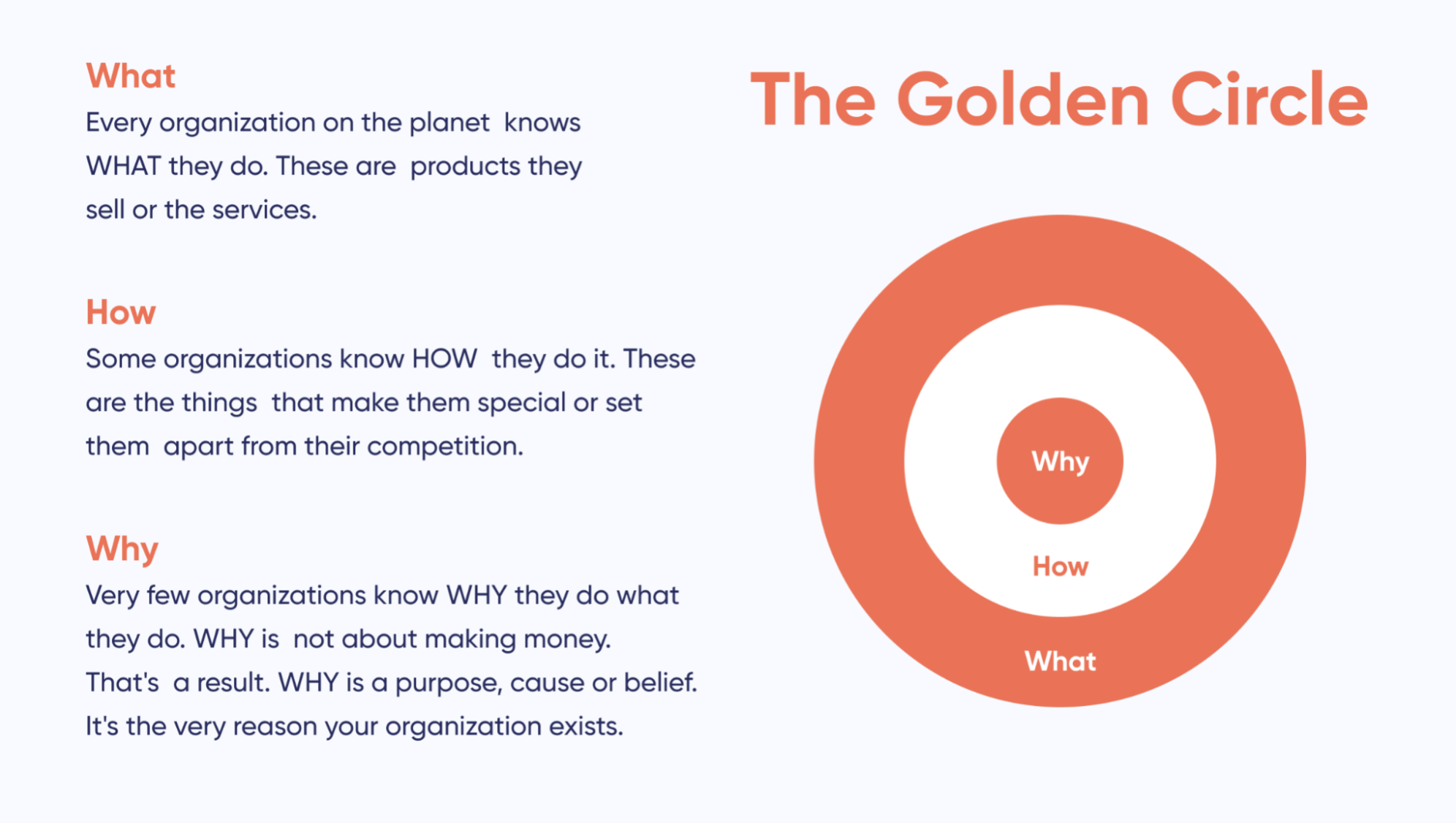
Now to quote the inspiration of Simon Sinek — his theory of value proposition to ‘start with why’ — how leaders can inspire cooperation, trust, and change based on research into how the most successful organizations think, act, and communicate if they start with why. Check out his rationale with The Golden Circle:

The “why” of attending your professional development conferences, “sharpening your saw” (self-renewal by Stephen Covey) aka “recharging your batteries,” learning what’s new and innovative on the forefront of “the state of the art,” and networking with colleagues, and has been addressed often in past blogs:

Simply put — to maintain your mastery of music and methods and build on your “best practices” and professionalism, you MUST attend as many educational conferences and workshops as possible!

Now to my “bags of tricks” for April 2023

Mark your calendars:

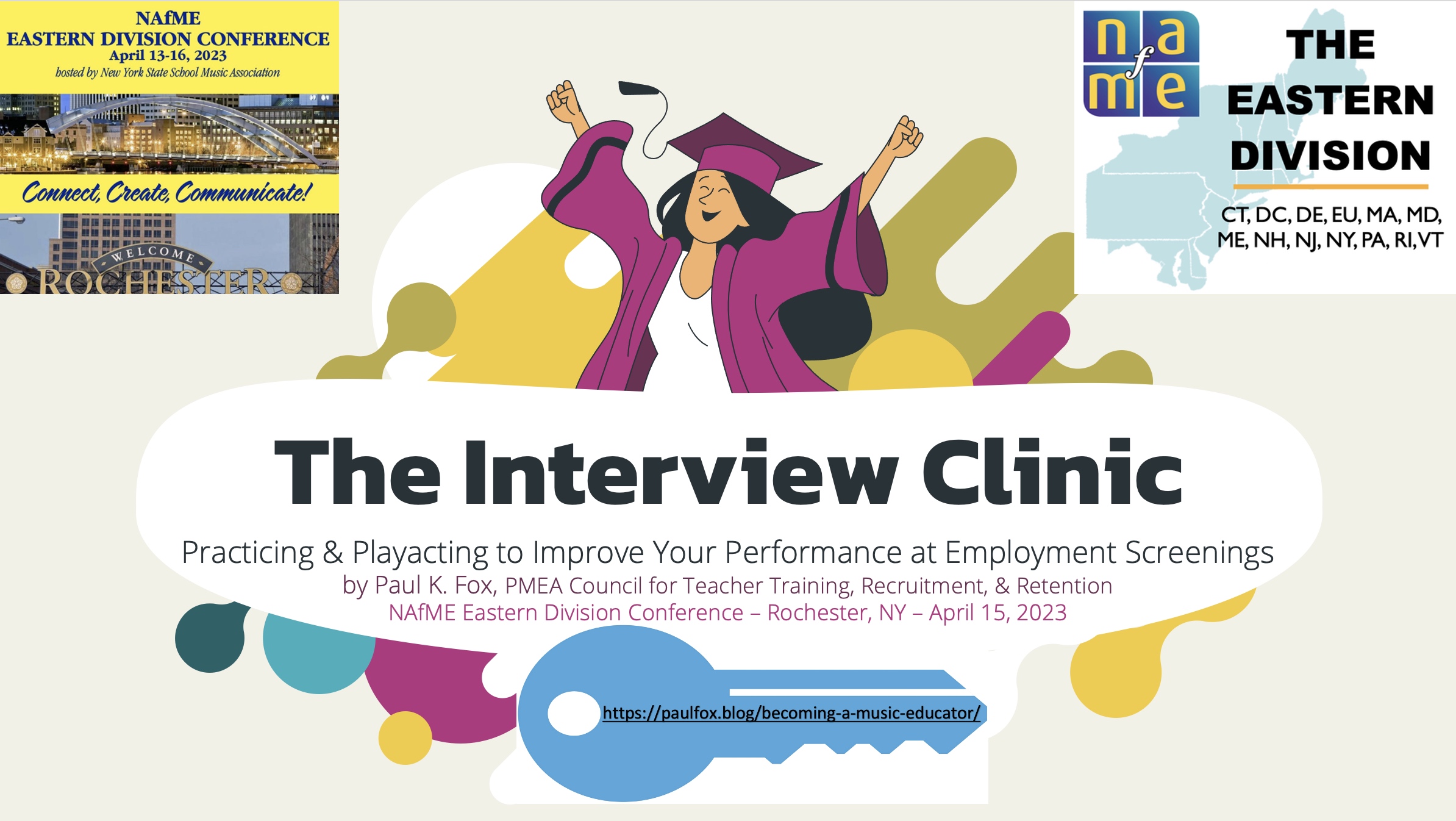
April 15, 2023 at 10:45 a.m. in Hyatt Susan B. Anthony (NAfME) – OR –
April 21, 2023 at 11:30 p.m. in Kalahari Suite 40/50 (PMEA)

I was blessed to have been asked to present THE INTERVIEW CLINIC — Practicing & Playacting to Improve Your Performance at Employment Screenings at both the NAfME and PMEA conferences. This will be FUN! Perfect for college music education majors, soon-to-be or recent graduates, new transfers to the profession, teachers seeking to change positions while openings seem to be “heating up,” or first-timers looking for employment, the session targets will provide interactive exercises to build self-confidence and develop better insights, practices, and strategies to successfully land a job. “The key is in the preparation” of:

  • Standards—Defining/modeling professionalism, versatility, and ethics
  • Marketing—Branding, networking, and selling yourself
  • Skills—Interviewing, storytelling, and organizing
  • Assessment—Observing, reviewing, diagnosing, and improving

Interactive exercises, you say? Yes! Get ready to meet new people and perhaps dive into a few activities slightly outside your “comfort zone!” (We promise NOT to embarrass anyone!) We will break up into small groups or “duet partners,” and explore defining our professional “essence,” telling anecdotes about our strengths and past problems we have “crushed,” and focusing on learning “the golden gift of gab” — storytelling.

Portions of this workshop will come from material in the past posts Storytelling, etc. Part 2 and When it Comes to Getting-a-Job, S Is for Successful Storytelling. (Your homework? Peruse these before coming to either session at NAfME or PMEA!)

As always, articles, resources, and slide summaries will be posted under the “Training/Jobs” menu tab (above).

Mark your calendars:

April 20, 2023 at 3:00 p.m. in Kalahari Suite 30 (PMEA)

How many of you feel at times a little overwhelmed, exhausted, stressed out, disorganized, demoralized, or disenfranchised?

Are you at the end of your rope and wondering how you’re going to “keep it all together” over the next week, month, year?

Is your health is interfering with your ability to do your job and find success, balance, and meaning in your personal life and relationships? Then… it is time for a change.

We are still dealing with the effects of the pandemic which has brought on a “gap year” to most of our music programs, the stress of “working harder not smarter,” more teacher burnouts, and the resulting bail outs, staff shortages, and/or job cuts. We need to embrace NEW strategies for personal self-care and SEL (social and emotional learning). Do you still enjoy teaching? How have you coped with all of the changes? How will you achieve a better work/life balance and skills in time/priority management and personal health and wellness?

The prescriptions and RECIPES towards stress reduction and developing a self-care plan are here! Doug Sands, a consulting hypnotist and founder of AnywhereHypnosis.com, joins me to “throw in everything and the kitchen sink” to alleviate these problems, with NO cookie-cutter, “one-size-fits-all” solutions from the chefs:

  • What has COVID done to all of us?
  • Instant personal online stress assessment
  • Taking an inventory of the ingredients towards a healthier lifestyle
  • Definitions, symptoms, and remediations for teacher stress and burnout
  • Why teachers are so exhausted and what to do about it
  • Time management tips
  • Breathe like a Navy SEAL
  • Coping and learning “acceptance”
  • How to “coach overwhelm!”
  • The role of meals, movement, music, and mindfulness (thank you, Lesley Moffat!)
  • From MEJ: A suggested self-care plan and “cognitive distortions” to avoid
  • Focusing on ONE self-care strategy from a “sea of solutions”

We’re in this together… so we need to join forces and SHARE the secret recipes for a happier life! Add your own “baking tips,” and I promise, you’ll leave with a better understanding of how we all can celebrate the coming year or decades in music education!

By the way, my “mindfulness partner” for this workshop, Doug Sands, promises us he will not hypnotize any of us during this session (although he could!).

For more about his work, including “15 Rapid Tools (and Counting) to Wipe Out Anxiety, Stress, and Panic,” please go to his website here.

You are invited to stop in to see him at his PMEA booth in the Kalahari exhibit hall.

POST-CONFERENCE NOTE: Doug sent us his Anti-Panic Toolkit entitled, 15 Rapid Tools (and Counting) to Wipe out Anxiety, Stress, and Panic – Wherever They Strike! Click here.

If you would like a sneak preview of the revised handout for the Self-Care workshop, go to the Care menu section at the top menu bar.

Taking a peek at our recent past…

Workshop for Orchestra & String Teachers

In case you missed the PMEA District 5 Professional Development Day, my wife Donna and I presented “Plucking Our Minds” at Grove City College on February 20, 2023.

We were privileged to “share some of our secret sauces” gleaned from over 80 combined years of experience on a variety of topics:

  • CommUNITY Music-Making
  • Online Academy
  • Summer String Camp
  • Assessment Projects
  • Collaborative/Creativity Projects
  • Library of “Fox Firesides”

If would be a shame to waste these resources… and reading them could inspire new adaptations to your instrumental program.

Click here for a copy of the slide handouts. Feel free to comment (above) or send an email to me (paulkfox.usc@gmail.com) if you have any questions.

Our Crystal Ball

Future Accredited Workshops on Ethics in Education

Are you aware that the Pennsylvania Department of Education (PDE) has recently revised the PA educators’ Code of Professional Practice and Conduct AND adopted the Model Code of Ethics for Educators developed by the National Association of State Directors for Teacher Education and Certification? Have you seen the new Professional Ethics Program Framework Guidelines? PA Chapter 49 requires instruction in professional ethics to be integrated in educator preparation, induction, and continuing professional development programs as follows:

  • Continuing professional development programs must integrate the professional ethics competencies no later than the 2023-24 academic year.
  • Educator preparation and induction programs must integrate the professional ethics competencies no later than the 2024-25 academic year.

Not one to let grass grow (or mud sink) under his feet, retired social studies teacher, current attorney-at-law, and past PMEA conference presenter Thomas Bailey has partnered with me to design new ethics training classes for school system leaders (25-hour Act 45 PIL course) and educators (four-hour Act 48 continuing education course). In addition, we are introducing a new “hybrid” program for school administrators involving four-hour pre-recorded asynchronous webcasts (site license), along with a three-hour synchronous webinar using the webcast videos and adding facilitated interactive discussions of three ethical case studies either via Zoom OR in-person follow-up workshops led by both clinicians.

In Depth Ethics Training for PA Educators:

  • PA Model Code of Ethics for Educators
  • PA Code of Professional Practice and Conduct
  • Professional Standards and Practices Commission
  • PA Educator Discipline Act

Click here for to register for Act 45 PIL Course.
Next series: April 25, May 2, 9, & 16, 2023

Click here for more information on the Ethics Webcast/Webinar and general information/landing page for the TWBaileyLaw website.

Click here for timeline of educator ethics presentations and clinicians’ bios.

Also review the Educators Court Case Blog and William Penn SD vs. PDE Blog.

Numerous articles have already been published on the subject of educator ethics, professionalism, and decision-making:

Hope to see you at one of these conferences or workshop sessions! Yes, it means a lot more to attend these IN PERSON!

PKF

© 2023 Paul K. Fox

Two New PMEA Scholarships

This message goes out to all of my Pennsylvania music education colleagues and especially any currently enrolled Freshman through Graduate college students in the Commonwealth.

My wife and I are proud to announce the launch of two new scholarships for the 2023-24 school year, financed by the Stark-Fox Family Fund, and managed by the Pennsylvania Music Educators Association (PMEA). Official applications will be available soon (spring semester 2023) on the PMEA website here. All materials are due on or before June 1, 2023.

Do you know someone who is currently attending a PA university, college, or conservatory? Is he or she majoring in music education AND is a member of Pennsylvania Collegiate Music Educators Association (PCMEA) OR majoring in a science-technology-engineering-mathematics (or related) field of study AND participating in their collegiate music ensemble for credit?

Then… SPREAD THE WORD!

Here is a general summary of the eligibility requirements and expectations for application approval, subject to change by the PMEA EXCOM and staff. A performance video (or submission of an original composition) is required for either scholarship, and interested candidates could begin now (during the semester break) to prepare their piece(s), update their resume, assemble a digital portfolio, and write the essay.

PMEA Council TTRR Continuing Music Education Award

  • Amount and number of scholarships may vary from year-to-year
  • Full-time enrollment of at least one year (two complete semesters) as an undergraduate or graduate music education major in an accredited PA institution
  • Nonrenewable (selection of a different candidate each year)
  • Paid directly to candidate as reimbursement for college tuition, dorm/apartment rent, meals on campus, textbook purchases, and/or the purchase of a new instrument (must provide receipts)
  • Blind judging by PMEA members with at least one member from the PMEA Council of Teacher Training, Recruitment, and Retention, PMEA EXCOM, and/or PMEA staff
  • Criteria for selection
    • A minimum of at least one year as PCMEA member in good standing with letter of affirmation from the PCMEA sponsor
    • Submission of college transcript reflecting 3.5 GPA or higher
    • Demonstration of solo performance skills (recorded video) or submission of composition(s)
    • Presentation of a music education portfolio with sample lesson plans, philosophy, and development of creative instructional activities with a focus on the arts at the center of STEAM
    • Participation in at least one PMEA-sponsored professional development program e.g., the Annual Conference, Summer Conference, Webinar, or Regional Workshop
    • Completion of essay in response to the question “Why have you chosen a career in music education?” and portrayal of leadership and well-defined goals and aspirations towards a career in music education.
    • Letter of recommendation from at least one music education professor
https://www.pmea.net/council-for-ttrr/

PMEA Music-for-Lifelong-Learning Award

  • Amount of scholarship may vary from year-to-year
  • Full-time enrollment of at least one year (two complete semesters) as an undergraduate or graduate science-technology-engineering-mathematics major in an accredited PA institution
  • Enrollment for at least one semester in a music performance course e.g., band, chamber music, chorus, jazz, or orchestra earning the letter grade of an “A” or equivalent with submission of letter of recommendation (and transcript) from ensemble director
  • Nonrenewable (selection of a different candidate each year)
  • Paid directly to candidate as reimbursement for college tuition, dorm/apartment rent, meals on campus, textbook purchases, and/or the purchase of a new instrument (must provide receipts)
  • Blind judging by PMEA members with at least one member from the PMEA Council of Teacher Training, Recruitment, and Retention, PMEA EXCOM, and/or PMEA staff
  • Criteria for selection
    • 3.5 GPA or higher on college transcripts
    • Demonstration of solo performance skills (recorded video)
    • Presentation of a music portfolio with high school and college history of participation in music ensembles and pursuits in creative self-expression, concert programs, and/or evidence of the development of creative activities or projects with a focus on the arts at the center of STEAM
    • Completion of essay that reflects musical leadership, community service, and/or the ccandidate’s rationale and aspirations for the continuation of “music study as a life-skill”
    • Response to the question, “How does the study of music enhance your knowledge, skills, and depth of understanding for a career in science-technology-engineering-mathematics?”

We are hopeful that these will become annual awards of substantial amounts (with a goal of at least $5K to $15K per person based on market conditions), provided as reimbursement of the scholarship recipient’s higher education expenses. If you are a potentially eligible candidate, get to work on the selection process and documentation NOW and… good luck!

PKF

The Stark-Fox Family Fund supports PMEA and PCMEA.

© 2022 Paul K. Fox