Admins Helping Teachers

This is an introductory blog-post perusing my early research and resources on supporting educator health/wellness in advance to my presentation Self-Care Cookbook 2.0 – Recipes and Resources for School Leaders for the PA Department of Education’s SAS Institute 2025 state conference scheduled for December 8-10, 2025 in Hershey, PA. Here is the summary description for the workshop:
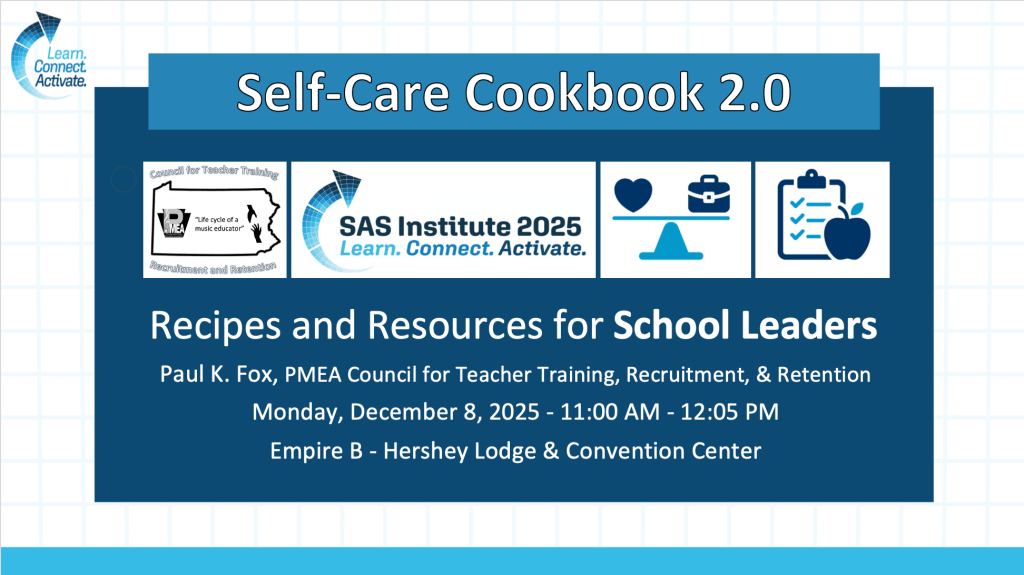
“Do you find the harried pace of our profession overwhelming and at times crushing when buried beneath decades of keeping our noses to the grindstone and putting everyone else’s needs above our own? Do some of your staff members say they are stressed out, constantly tired, plagued by one ailment after another, or wondering how they’re going to “keep up?” If health is interfering with your colleagues’ abilities to do their jobs and find success, balance, and meaning in their lives, then it is time for change. The purpose of this session is to empower school leaders and teachers with skills and attitudes needed to make informed decisions to promote self-improvements in their lifelong health and wellbeing, to LEARN tools for better time management and to help remediate fatigue, stress and burnout, CONNECT and collaborate with your staff to inspire unique strategies for better personal self-care, and ACTIVATE creative new approaches to foster an improved workplace environment.”

Actually, previous articles at this site have dived into this subject of educator stress, burnout, and the development of a health and wellness self-care plan to build resilience, work/life balance, and reignite our motivation and passion for teaching. For a complete overview, I recommend you revisit these:

Always start with “THE WHY”

(Inspired by keynote speaker/author Simon Sinek): Why is this discussion so important now?
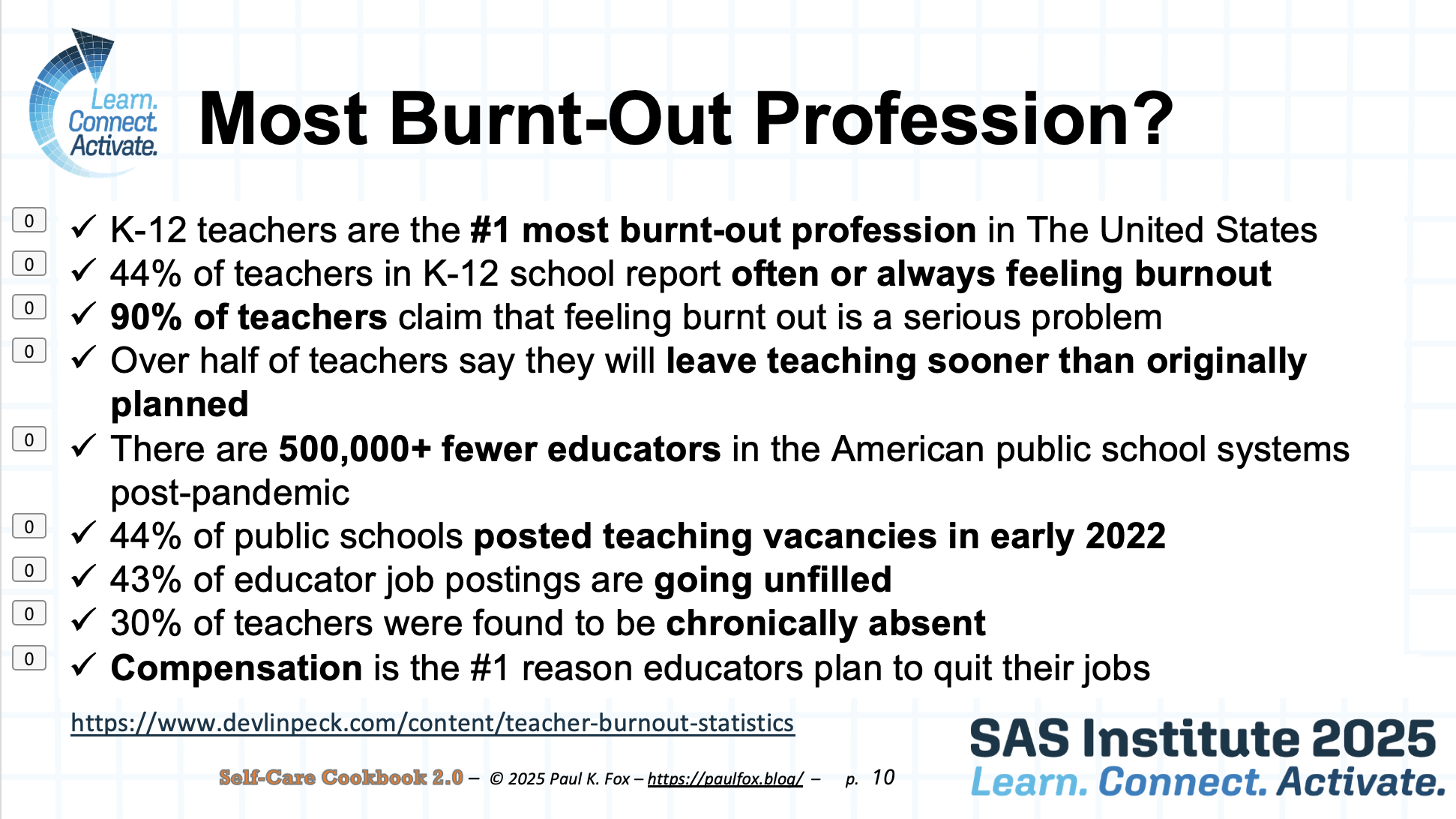
When I mentioned my research to my colleague (and former student) Dr. Timothy Wagner, Principal, Upper St. Clair High School (my former placement for full-time employment), he mentioned that this topic was timely and highly relevant, and suggested that perhaps there might be more statistics and resources “out there” on the stress of health-care workers and first-responders, which I found to be true. However, early looks have shown numerous parallels to the information in my 2023 Self-Care session.

My PDE SAS Institute session will become a “two-for-one” presentation, including the opportunity for school/system leaders, building administrators, and directors of school district professional development to also download my original “Self-Care Cookbook” (1.0) slides, recently updated for the DCMEA Annual State Conference (January 20, 2026). This self-help workshop is geared for educators to “on-their-own” explore strategies, implement use of individualized tools/remedies, and formulate new goals to improve health and wellness. Both sessions hope to cover these key questions:

  • Why is it essential to personal health to achieve balance in our lives, and how can we achieve it?
  • How does dedication to wellness lower the risk of illness, injury, and the quality of a person’s life?
  • What are the consequences of our choices in terms of time and stress management?
  • How do effective decision-making skills and goal setting influence healthier lifestyle choices?
  • What are suggestions, strategies, and samples for the development of a personal self-care plan?
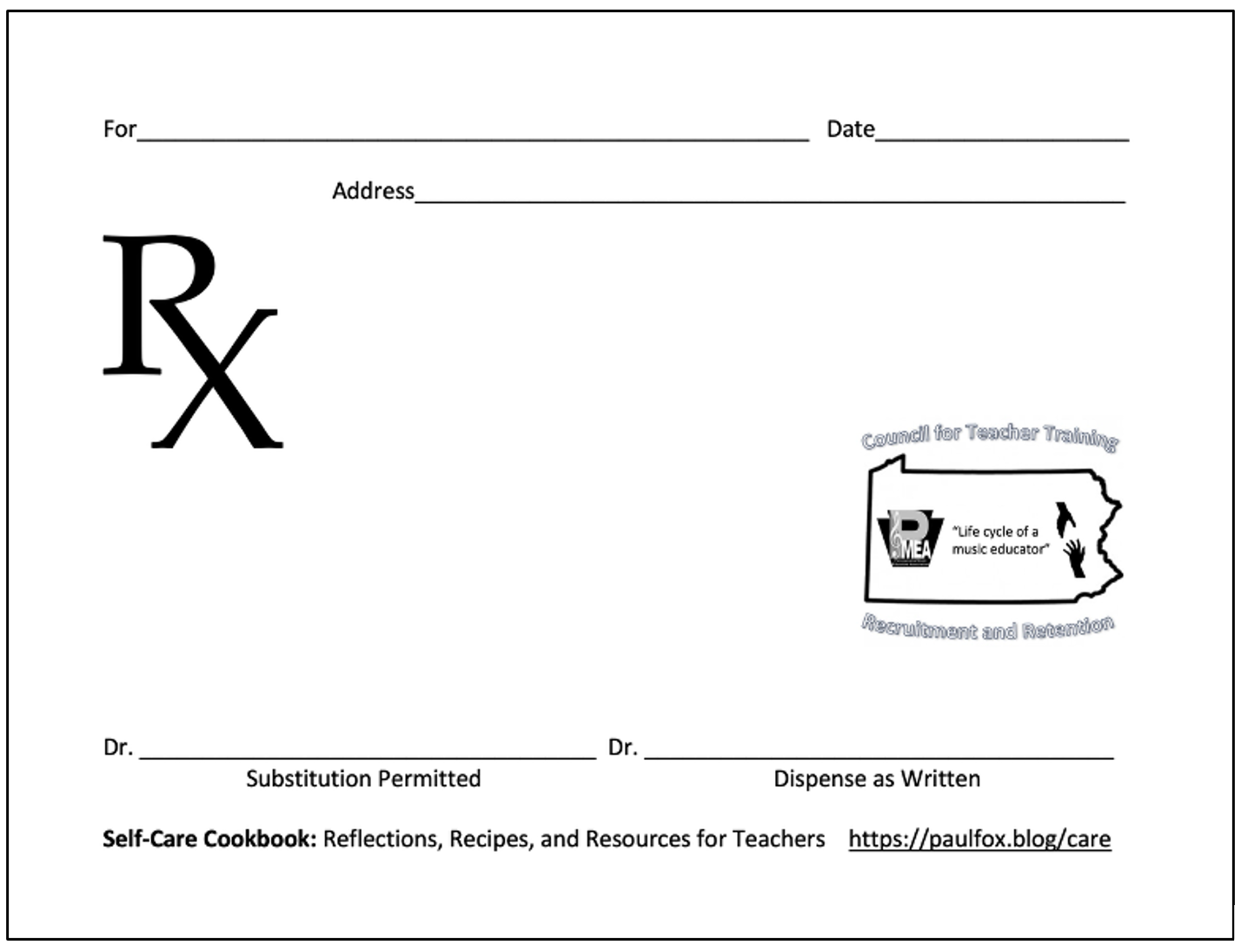
Using a facsimile of a prescription pad in Self-Care 1.0, I posed these personal reflections:

  1. How do I usually feel daily throughout the school year?
  2. What are the emotional and physical tolls of my job?
  3. What specific self-care activities do I need to incorporate to recharge and prevent burnout? 
  4. What boundaries do I need to set around my work to honor personal time?
  5. What support systems can I build and/or professional help should I seek to create a sustainable practice?
Good ideas…

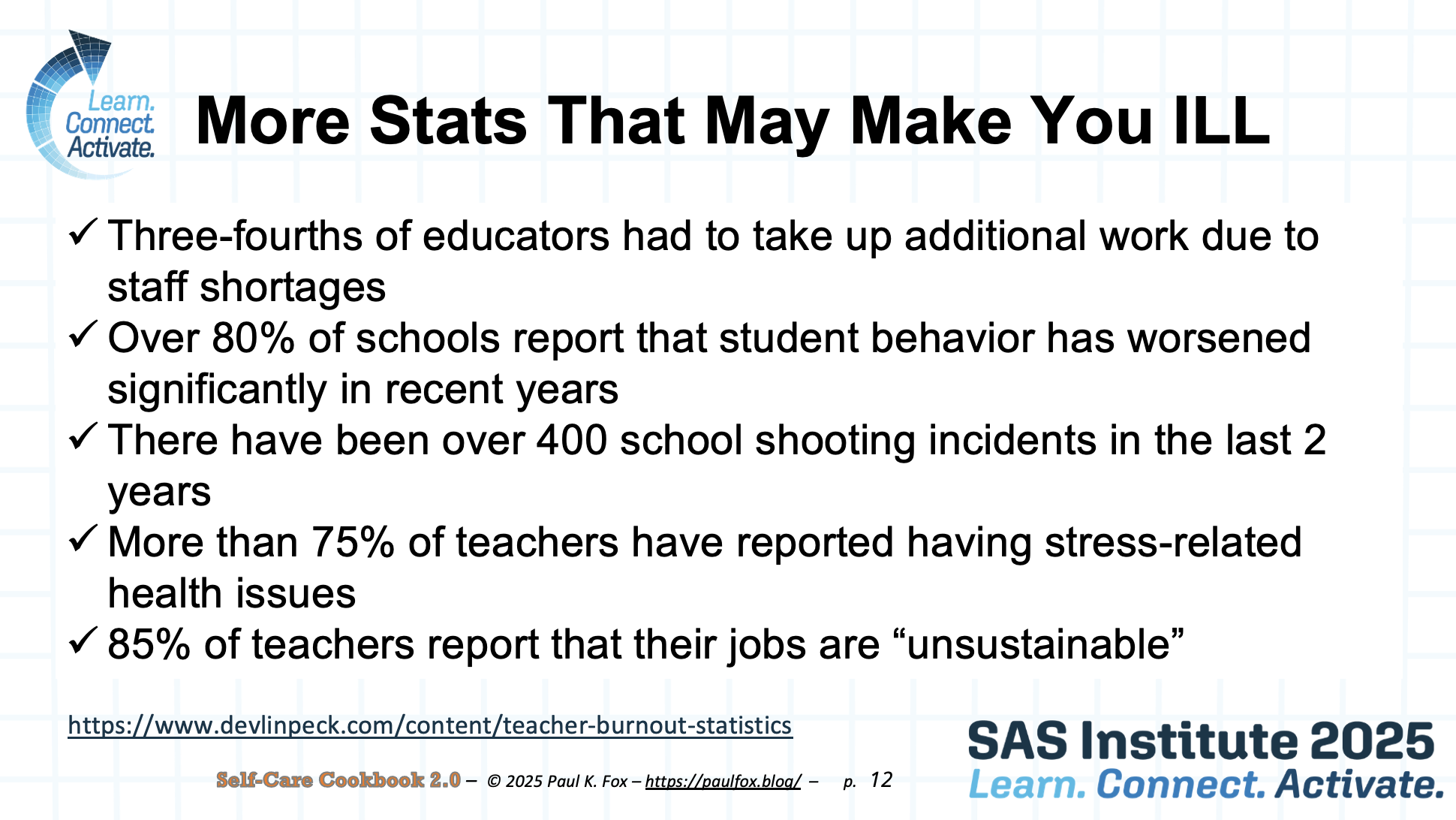
How can school admins support their staff in dealing with the climbing incidences of health problems, teacher exhaustion, call-offs, evidence of burnout, and high turnover rate? Sorting through a compendium of online research, these recommendations for school leaders occur repeatedly:

  1. Probably should go without saying: Show high visibility (“be seen by all”), recognition, and know everybody’s name. This goes a long way in building a sense of belonging of the staff and students.
  2. Provide more time for breaks and planning. Engage teachers in problem solving teams to identify and implement substantive ways to give them more time. Examples: cutting back on testing and data analysis; holding fewer and shorter meetings; putting a hold on new academic initiatives while increasing mental health initiatives conducted by school-based mental health professionals; hiring individuals who can assist with administrative tasks; compensating teachers for extra work; protecting classroom time by minimizing interruptions; reducing teaching hours to allow for more prep time and follow-up time.
  3. Foster a supportive community through mentorship programs.
  4. Distill high-impact strategies into a handful of manageable priorities. Once the goals are set, give teachers specific time within the school day or week to focus solely on them.
  5. Communicate directly, clearly, and frequently. “Supportive administrators know that a teacher’s time is valuable and that administrative meetings compete with individualized education programs, data teams, professional learning committees, cross-curricular planning meetings, and much more. So if a meeting is only for sharing straightforward information, it can be an email instead. It’s not necessary to have a meeting simply because the schedule says that faculty meetings are in the cafeteria on Mondays.” – Edutopia: “4 Practical Ways Administrators Support Teachers”
  6. Treat teachers with respect like the professionals they are, increasing mutual trust by decreasing micromanagement or reducing unnecessary accountability documentation.
  7. Shadow multiple teachers to experience first-hand the reality of their typical day.
  8. Allow educators the option to attend meetings and professional development activities virtually.
  9. Involve teachers in the creation of targeted professional development activities that are the most meaningful for them.
  10. Ask teachers about what specific help they need to improve classroom management.
  11. Develop a plan (with the Board of Education?) to increase teacher compensation over time, taking into account that many administrative and clerical tasks that are now required of teachers might ultimately be delegated to less highly compensated individuals.
  12. Address staff performance issues on an individual basis rather than issuing global reprimands that don’t apply to most teachers.
  13. Implement policies that encourage work-life balance. For example, recognize measurable indications of quality teaching rather than behaviors that signal a “more is better” approach (always coming in early and staying late, volunteering for everything, talking about working all weekend to catch up, etc.).
  14. Support educators by acknowledging stress, providing professional development on self-care, and creating a culture where asking for help is normalized.
  15. Ask teachers what mental health or other supports they need to cope with their own distress. Research has demonstrated the effectiveness of introducing trauma-informed strategies, including an emphasis on compassion fatigue and secondary trauma, as well as mindfulness strategies that are part of institutionalized wellness routines.
  16. Provide “safe spaces” (SEL) where educators can express themselves without fear of being judged, and practice “Mindful Leadership” to connect with and listen to them. “Getting to know your teachers on a more personal level makes it easier to identify the best thing you can do to support them, even if teachers aren’t sure what they need. The goal should be making sure everyone made it to work okay and that they’re in good spirits and ready to tackle the day.” – 7 MINDSETS: “5 Ways Administrators Can Support SEL for Teachers”
  17. Counteract “toxic positivity” by acknowledging that teachers are hurting and need space to grieve the continued losses associated with the pandemic.

Bad ideas…

These strategies cited by Effective School Solutions will NOT help teachers in the long-term:

  1. While “wear your jeans to work” days and offering coffee and donuts occasionally are nice employee appreciation efforts, they do nothing to address the underlying issues.
  2. Offering one-shot seminars or newsletters with suggestions about individual self-care activities (breathing exercises, physical exercise, time for self, etc.) can inadvertently place further burdens on teachers, conveying the impression that they are responsible for both creating and addressing the stress that is structural in nature.
  3. Don’t conduct teacher surveys or focus groups about how to reduce teacher stress and then proceed to ignore their suggestions about what would make things better.
  4. Don’t assume that short bursts of extra time (e.g., ending a meeting early to give teachers more time) is useful. Small, unexpected pieces of free time do not help teachers catch up with work that requires concentration and focus.
  5. Don’t avoid difficult conversations to address the performance problems of individual teachers by making blanket statements/warnings to all teachers, most of whom are not engaging in the problem behavior.

“Be careful not to adopt a stance of “Toxic Positivity,” that is, a stance that accentuates the positive (“we are all in this together,” “we are strong,” “it could be worse,” “look on the bright side”) while invalidating the very real pain that everyone is experiencing. Denying or ignoring unpleasant emotions tends to make them worse, not better.
Effective School Solutions

Free Downloads

I am putting on the final touches to the SAS INSTITUTE 2025 Self-Care Cookbook 2.0 session, but have already assembled a huge bibliography of resources for your review (see below). For a “sneak preview” of my slide summary, click here. Future updates will be posted here: https://paulfox.blog/care/.

Better yet, register for the SAS Institute 2025 to see everything in person.

Sample Books

  • 180 Days of Self-Care for Busy Educators by Tina H. Boogren, Solution Tree Press (2020)
  • Awakened – Change Your Mindset to Transform Your Teaching by Angela Watson, Due Season Press & Educational Services (2023)
  • The Balanced Band Director – Productivity and Wellness Tips to Amplify Your Impact, Not Your Workload by Lesley Moffat, Morgan James Publishing (2025)
  • Demoralized – Why Teachers Leave the Profession They Love and How They Can Stay by Doris Santoro, Harvard Education Press (2018)
  • Exhausted – Why Teachers Are So Tired and What They Can Do About It by Paul Murphy, CreateSpace Independent Publishing Platform (2017)
  • Fewer Things, Better by Angela Watson (2019)
  • The Happy Teacher Habits by Michael Linsin, JME Publishing (2016)
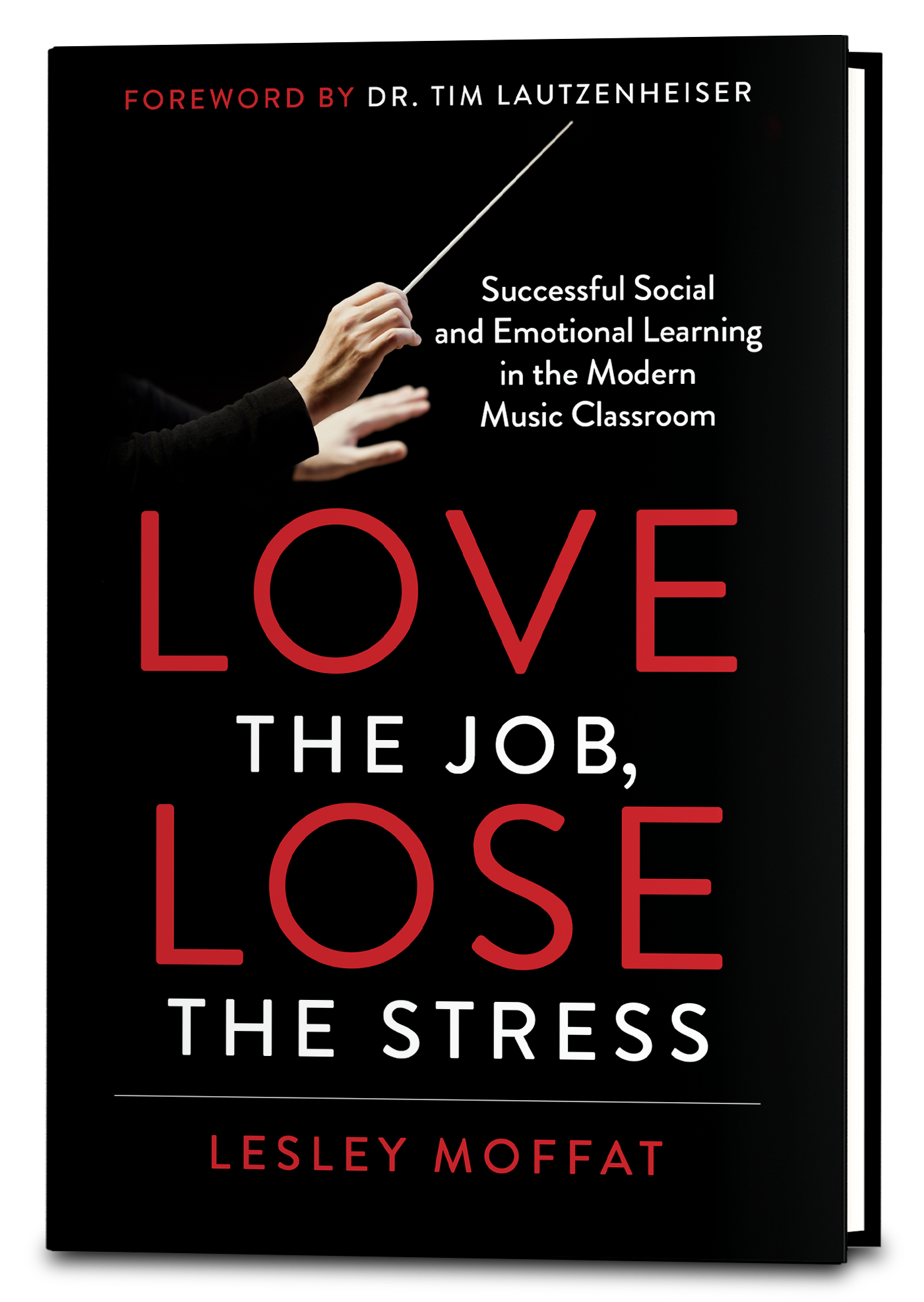
  • Love the Job, Lose the Stress: Successful Social and Emotional Learning in the Modern Music Classroom by Lesley Moffat (2022)
  • Positive Mindset Habits for Teachers by Grace Stevens, Red Lotus 2018
  • Rekindle Your Professional Fire – Powerful Habits for Becoming a More Well-Balanced Teacher by Mike Anderson, ASCD (2024)
  • The Teacher’s Guide to Self-Care – Build Resilience, Avoid Burnout, and Bring a Happier and Healthier You to the Classroom by Sarah Forst, The Designer Teacher (2020)
  • The Teacher’s Guide to Self-Care – The Ultimate Cheat Sheet for Thriving Through the School Year by Melanie J. Pellowski, Skyhorse Publishing (2020)
  • Upbeat – Mindset, Mindfulness, and Leadership in Music Education and Beyond by Matthew Arau (GIA Publications (2022)
  • The Weekend Effect: The Life-Changing Benefits of Taking Time Off and Challenging the Cult of Overwork by Katrina Onstad, HarperOne (2024)

Sample Websites

PKF

© 2025 Paul K. Fox
Engaging Retiring/Retired Educators

Ask not what NAfME or your state MEA can do for you, but what YOU, a retiree, can do for your professional association and music education.
An adaptation of the famous excerpt from the 35th U.S. President John F. Kennedy’s inaugural address of January 20, 1961.

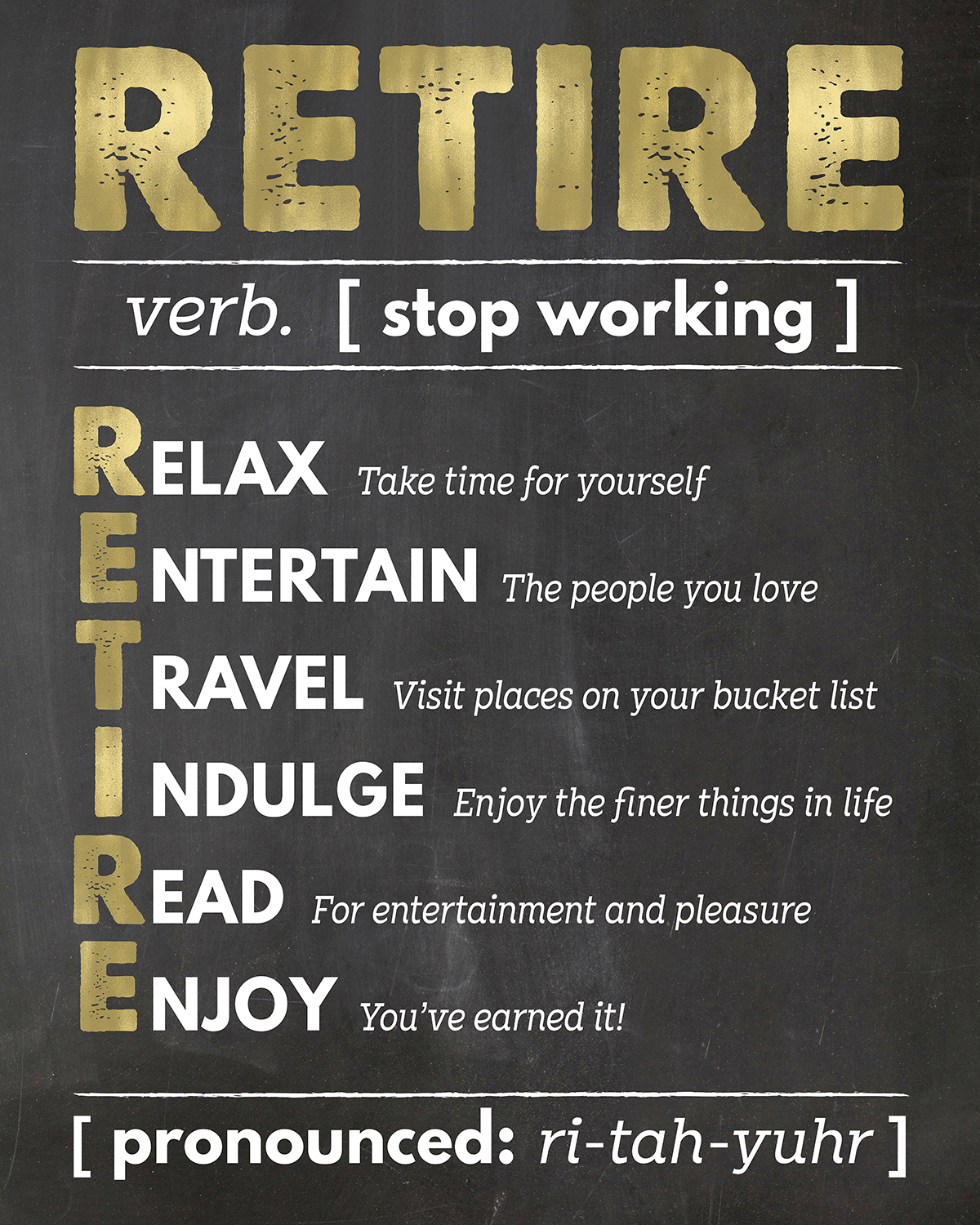
Surfing the ‘Net, I found an appropriate acronym for R.E.T.I.R.E. by Tangled Tulip Designs in pinterestRelax, Entertain, Travel, Indulge, Read and Enjoy! Most retirees would probably agree! The cessation of full-time employment may offer a great release from the day-to-day stress and drudgery of the job and the freedom to venture out, self-reinvent, make future goals, nurture relationships, and explore new personal growth opportunities.

Many attribute embracing a career in music education as “a calling” as opposed to just a form of employment or livelihood. From my experience, I have witnessed that most music educators are passionate for the cause of fostering creative self-expression in their students, more of a 24/7 mission, bringing intense focus and dedication to their lifework.

More to the point: Do we ever truly retire from making music ourselves and fostering this love in others?

THE “WHY!” Retirees matter and are critically needed!

One of my favorite inspirational speakers (Simon Sinek) would say, “start with the WHY!” WHY is this discussion on professional engagement of retired educators so important today?

  1. Their need: An informal poll of my former local educators and administrators revealed that half of them “hate retirement!” According to Dr. Robert P. Delamontagne in his book Retiring Mind (Fairview Imprints), “50% of retirees will suffer some form of acute emotional distress. This is potentially a very large problem given the fact that 10,000 people are becoming eligible for Social Security every day for the next 20 years in the US alone.” Remember this statistic the next time a senior citizen cuts you off on the road or bangs a shopping cart into your leg at the checkout!
  2. Our need: We are facing shortages of qualified teaching candidates across the country with unfilled openings in public school music positions and the critical need of training/mentoring the new hires.
  3. Society’s need: All of our voices should be combined to support the advocacy of music education, actively promoting access to school music by sharing its academic and social benefits with decision-makers, building relationships with administrators and policymakers, and utilizing resources from organizations like NAfME and the NAMM Foundation.

Despite its proven benefits, music education is often the first program to face budget cuts in schools. This is especially concerning in underserved communities, where access to music programs can be life-changing. Now more than ever, we must advocate for music education to ensure that every child has the opportunity to experience its benefits. Investing in music education is an investment in the future of our communities — helping to cultivate the next generation of creative, resilient, and innovative leaders. 
“Why Music Education Matters More Now Than Ever” by Music Will, February 2025

For eleven years (and counting), I serve as the Pennsylvania Music Educators Association (PMEA) Retired Member State Coordinator, as well as the Past State Chair (current member) of the PMEA Council for Teacher Training, Recruitment and Retention. I believe my responsibility to the state association is two-fold:

  • Assist soon-to-retire professionals in achieving a smooth transition to a happy and satisfying retirement; to help them cope with the commonly-experienced emotional ups-and-downs of this life passage, wrestling with the question “what do you want to be or do when you grow up?” and making new life lesson plans and personal goals.
  • Reach out to and build meaningful connections with retirees in order to fully engage them towards becoming active in their professional association; to recount, represent, and revitalize the activities of our post full-time employed music educators.

This article proposes a roadmap of crucial pathways to help music teachers approach “retirement bliss” while tapping into their hard-earned knowledge, strengths, and experiences by cultivating the benefits of their renewed participation in our professional associations.

What can NAfME and State MEAs offer retirees?

You have devoted your entire life to inspiring the development of personal artistry and “ah-ha” musical moments in others. Now it is your turn to reap the benefits (and privileges) of this commitment to the profession. NAfME and your MEAs can provide the resources and motivation of “sharing and caring,” directing retirees “places to go, people to meet, and things to do” for fulfilling that “next chapter” or (perhaps better terms) the “refirement” or “rewirement” of senior living.

Do you feel “needed” and know you “make a difference?” Research has shown that the one of the most important motivators for involvement in a professional association is that its members recognize that they are essential to its success. This quote is from Revitalizing Retirement: Reshaping Your Identity, Relationships, and Purpose by Nancy Schlossberg, attributed to Rosenberg/McCullough:

 “It has been suggested that one problem of retirement is that one no longer matters; others no longer depend on us… The reward of retirement, involving a surcease from labor, can be the punishment of not mattering. Existence loses its point and savor when one no longer makes a difference.”

Most people who are one to five years away from “pulling their pin” and putting in their walking papers “do not know what they do not know.” Experts agree: “Retirement preparation is not only about the money!” Our silver-haired colleagues who have already Crossed the Rubicon and are now “living the dream” in retirement can share their trials, tribulations, and (more importantly) numerous success stories about coping with this transition!

NAfME, PMEA and this paulfox.blog/for-retirees site have archived an exhaustive number of self-help articles. Check out this omnibus NAfME blog “Retirement Prep Top-Ten Treasures.”

The benefits of retired MEA membership are numerous. Besides providing helpful transitioning advice, these advantages also come to mind:

  1. Answers to questions like “What have you always wanted to sing, compose, play, record, conduct, write, publish or present?” and “Where can I share my hard-won expertise and help others in the field?”
  2. Networks and contacts to help you develop “encore careers” in other musical or educational arenas (e.g., higher education, music industry, festival organization, travel/tour planning, composition, guest conducting, private studio teaching, church music, etc.)
  3. Opportunities to “rekindle your expressiveness” by participation in adult community or full/part time performance groups (playing “gigs”)
  4. Places to go/things to see/hear: NAfME/MEA conferences, workshops, and concerts
  5. Exclusive discounts and other benefits (reduced dues and registration fees)

What can retirees offer NAfME and their state MEA?

The relationship of active and retired membership in our MEAs is symbiotic. We know from the history of our associations, “giving back to the profession” remains a high priority with most retirees. This may come in many forms and settings:

  • Leadership or membership in local, state, or national MEA/NAfME office, staff, advisor, or council/committee position
  • Advocates for the promotion of music education to local and state government officials
  • Service as presiding chair or member of the conference or workshop planning committee
  • Service as evaluator of performance groups, conference sessions, or articles for publication
  • Judges of local/state MEA adjudication or commercial festival
  • Accompanists, coaches, arrangers, or guest conductors for festivals or school/community groups
  • Services to the local music teacher in private teaching, piano playing, marching band charting, sectional coaching, choreography, music technology, instrumental repair, stage tech, etc.
  • Writers for state MEA and NAfME publications and blog sites
  • Contributors to online music education forums or the NAfME Connections
  • Donors to and/or fund-raisers of music education charitable projects, scholarship initiatives, etc.

The PMEA Model of Retired Member Participation

PMEA values the vast wealth of experience and contributions of our retired members. We’re proud of the many programs we offer to retirees and invite you to visit our website to peruse additional information and sample digital newsletters and articles.

Retired members in Pennsylvania are involved in:

  • PMEA elected and appointed offices, staff, committee chairs, and membership on councils
  • PMEA Strategic Plan and Bylaws, Conference Planning, and other state/regional committees
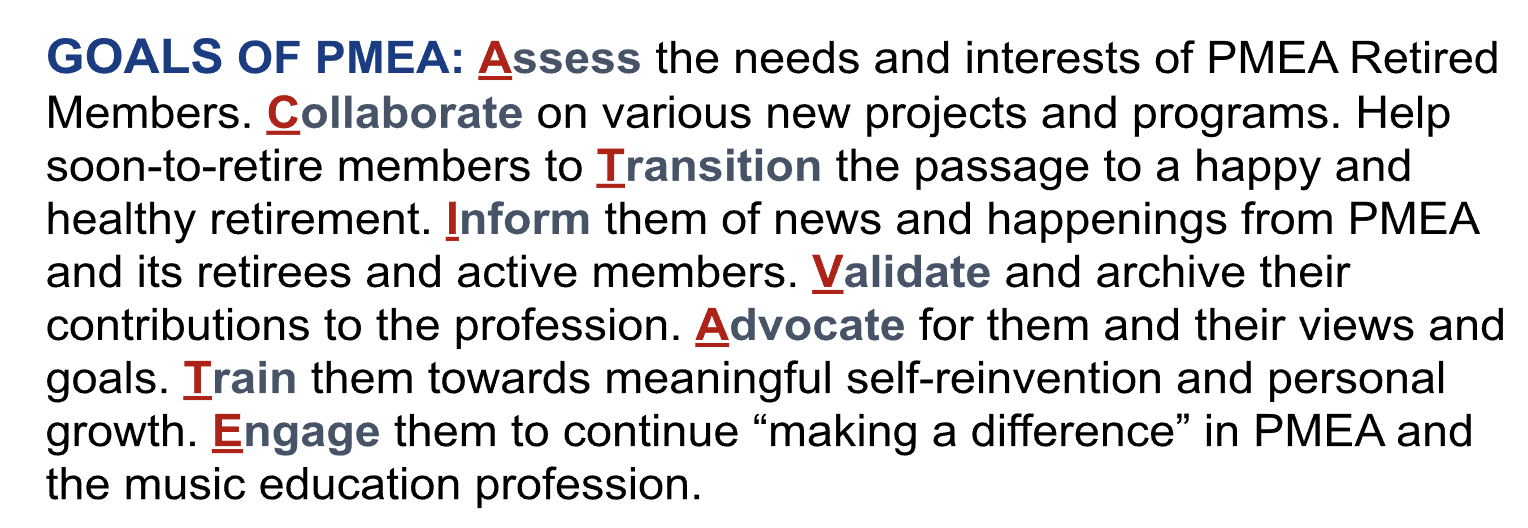
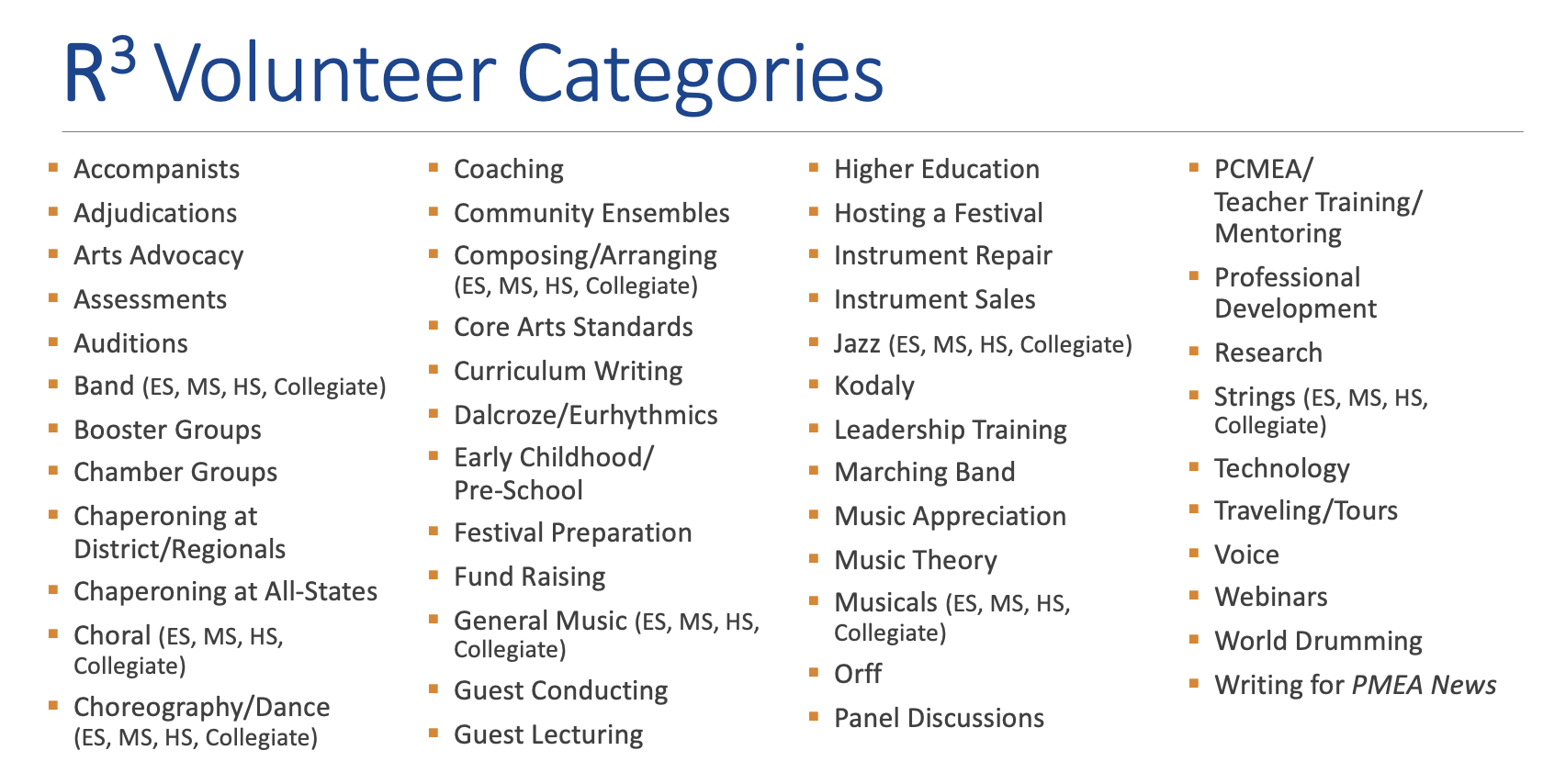
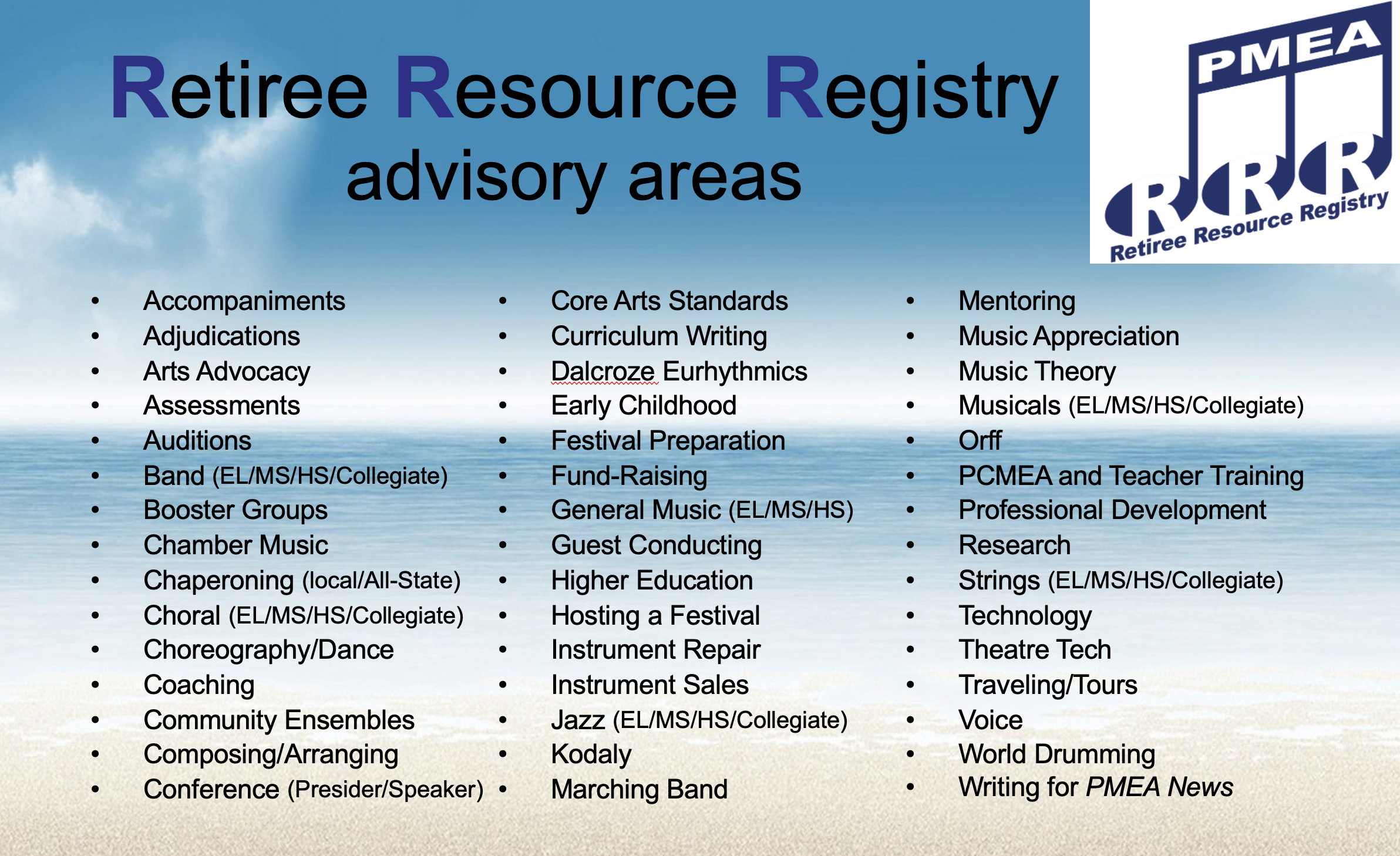
  • Retired Resource Registry* (informal mentoring for new teachers and transfers)
  • How-to-Retire Webinar, Prepping for Retirement, and the Ultimate Retiree Resource Guide
  • Retired Member Breakfast at PMEA Annual Conference
  • Retirement 101 (The Who, What, When, Where, Why, and How) session at PMEA Annual Conference (training for all members retiring or soon-to-retire)
  • Maintenance of PA Community Band, Chorus, Orchestra, and Theater group catalogs
  • Maintenance of PMEA member compositions library
  • Mock Job Interview Committee for music education majors
  • Coffee & Conversations informal “ask an expert” lounge at PMEA Annual Conference
  • Volunteering as presiding chairs for sessions and registration aides at conferences/workshops
  • Pool of conference clinicians, guest lecturers, and members on discussion panels
  • Participation in “Sponsor a Collegiate to Attend the Conference” campaigns
  • All-State Program Patron, or contributor to the annual Irene Christman Scholarship or Margaret Bauer Grant programs.

As of October 1, 2025, there are 61 advisors in the PMEA Retired Resource Registry.

*During their annual membership registration, PMEA Retired Members may choose to sign-up for the R3 Retired Member Registry (above volunteer categories) to become available to informally offer advice to college music education majors, new hires, transfers, and newcomers to any music specialty. R3 members may handle inquiries like “What warm-up would you recommend for my middle school choir?” OR “Do you have an idea for an elementary string ensemble concert opener?” OR “How do you teach improvisation… steady beat… breath support?”

The other option with more time commitment is that Retired Members can be officially “trained” as a PMEA Mentor and be assigned to specific individuals who request assistance in their early career assignments.

Coda

How can we help?

What is the future of retired music educator professional engagement? In a word: connections!

Last month, I reached out to Elizabeth Welsh Lasko, NAfME Assistant Executive Director for Membership, Organizational Development, and Marketing Communications and “volunteered” OUR assistance. I suggested that, in keeping with the NAfME 2022 Vision Statement “…an association where all people are heard, seen, and feel they belong throughout their lifelong experiences in music” we should all intentionally recruit more hands-on involvement of our retirees. I pointed out that in the late 1980s, we had a Music Educators National Conference (MENC) Committee for Retired Members led by a National Chairman who served on the NAfME National Assembly. (An excellent booklet, TIPS: Retirement for Music Educators, Copyright © 1989 MENC, was compiled by A. Verne Wilson, then the Past National Chairman of the MENC Committee for Retired Music Educators.)

Ms. Lasko encouraged me to “reach out to retirees” beginning with this article. At the next NAfME Eastern Division Conference, I plan to hold a meeting of retired members, and also connect with all state MEA retired member coordinators (those states who have them). We’re available and on the move! Let’s collaborate and share our resources!

Finally, just for fun, I recently posted the blog “For Book Lovers – Retired or Not” on NAfME Connections (formerly called Amplify). There are already 1,810 members in the NAfME “Retired Members Community.” Please JOIN US! Using this forum, get in touch with me, and respond with YOUR OWN retirement stories, strategies, perspectives on this “life passage,” and more ideas to grow the professional engagement of our music teacher retirees.

Happy trails!

© 2025 Paul K. Fox
The Get-a-Job Toolbox

Preparing for Those Upcoming Employment Screenings

So much of what I do at this blog-site is to archive articles offering advice on a host of topics:

Surveying my past blogs, I feel like I had to repeat (repackage) the content until my readers reached that particular stage in their career. Once they experience first-hand that sometimes tumultuous “passage,” they would be ready to reflect on this information. But, I doubt they would closely examine it until then. As an example, for more than a decade as the PMEA Retired Member Coordinator, these past articles I wrote for PMEA News and the PMEA Annual Conference’s session Retirement 101 revisit the voluminous insight of gerontologists exploring the “who, what, when, where, and why” of retirement. Regardless at how often it is presented, you tend not to consume advice on coping with post-employment until you feel you are “ready” to retire. This is the same issue for soon-to-graduate collegiates and those transitioning to a new job; who wants to read about branding, marketing, and interviewing until they are in the middle of seeking first-time (or new) employment?

Please click on the “plethora” of links throughout this article to be redirected to these past writings. My apologies in advance to what may seem like to be a lot of duplication!

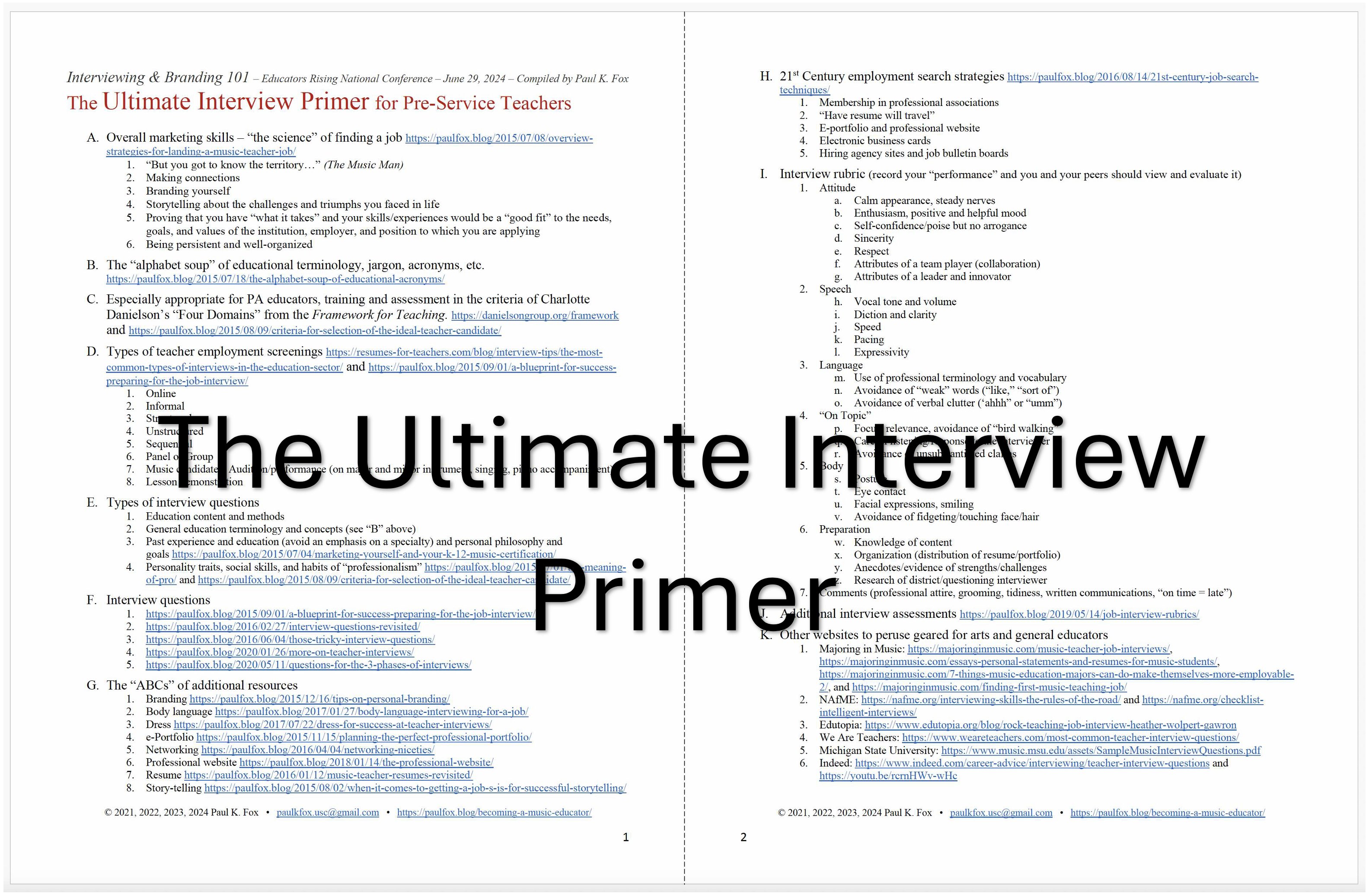
I went as far as updating the most comprehensive and “perfect” PowerPoint for collegiates: Bookends – The Life Cycle of a Successful and Happy Music Educator – portions of which I have presented several times to Professor Jessica Vaughan-Marra’s Seton Hill University music student teachers. This slide handout starts with the material from the first three bullets in the first paragraph above and then adds information about teacher health and wellness, time management, and retirement. We offer Bookends… to preservice music educators in their junior, senior, or graduate years and “rookies” to the profession. I encourage you to download this resource, visit the PCMEA website (click here/scroll down) to read past issues of Collegiate Communique, and the paulfox.blog posts. While you’re at it, acquire your own copy of the Ultimate Interview Primer. Click away before these links become inactive.

Soon it will time for graduates to enter the workforce… and boy, do we need you! By most accounts in PA and the surrounding states, we are experiencing a teacher shortage. School districts are seeking quality candidates to apply for their open positions. But, much of what happens in the job screening process seems to be influenced by chance. Collegiates, ask yourself: Are you truly prepared to market your experiences and abilities, share your brand and stories of your interactions with children in educational programs, and relate positive anecdotes of your teaching, problem solving skills, and other professional attributes? I may have been a little Type-A when I first applied for those music teaching positions back in 1978, focused on saturation publicity and persistence, and organized with a large paper portfolio of past experiences, but I was clueless in responding to those tricky interview questions and what administrators actually wanted to see in prospective new members of their staff.

One more piece advice for first-year and recent transfers to music education: Seek out a PMEA mentor and/or a member of the Retired Resource Registry (access from the PMEA Retired Member focus area after you login to your member portal)… both are groups of volunteers willing and able to help “newbies.”

Have a question about selecting music for your ensemble, a dynamic lesson plan, classroom management issue, interviewing, curriculum innovation, or a conducting tip? Stop by the “coffee and conversations” informal lounge at the PMEA Annual Conference on April 10 and “sit-a-spell” with us!

In conclusion, the following is a sequential outline – a “to-do in this order” list – a preservice toolbox of past posts and other resources for you to assemble a marketing plan. Take time to sort through these “nuts and bolts” (all links in this blog), process the information, save anything you want to read further, and then “practice, practice, practice!” This “gift” to PCMEA and music education majors embraces my best wishes for successfully finding the job you always wanted and preparing yourself for the greatest “calling” of your life – an enriching and satisfying lifelong career in music education! Good luck!

Using the Collegiate Toolbox – A Roadmap for Becoming a Music Educator

  1. Peruse everything in this and past paulfox.blog postings.
  2. Download the PDF documents to your hard drive. Review a portion of them each week!
  3. On your computer, create a “ME” file documenting your accomplishments, awards, experiences interacting with children, etc. – a library of the things you may wish to include in your future resume, professional website, and (e-)portfolio. Add to this folder throughout your college years.
  4. To reflect on your perceived strengths and weaknesses, complete a self-assessment of YOU from a typical professional evaluation form, these ideal effective teacher attributes and more criteria
  5. Prioritize what you think you need most. Write down your goals! Pobody is nerfect!
  6. While you are still attending college, work on shoring up any weak content areas or specialty skills (e.g., how is your “piano chops,” knowledge of specific methods, grade level repertoire, etc.?)
  7. Write a philosophy of school music education (overview) and your mission statement: “Why do you want to teach?”
  8. Be ready to answer the question (and defend your response), “What is your vision of the role of music education in the schools?”
  9. Be ready to define your “brand.” What are your professional attributes? What makes you unique? Why would you be a good candidate for a school music position?
  10. Begin to assemble a list of stories that would “show not tell” your positive attributes.
  11. Identify the impressions you want to “sell” yourself, and practice strategic storytelling.
  12. Practice answering interview questions and use a rubric to evaluate your performance. If you can, share all of this with your peers and sponsor mock interview sessions. Record/assess yourself.
  13. Get started on drafting the marketing tools you will need (e.g., your professional website, resume, portfolio, etc.)
  14. Review educational acronyms, jargon, and terminology such as this list plus these recent additions: CR-SE (Culturally Relevant & Sustaining Education), DEIB (Diversity, Equity, Inclusion, Belonging), and SEL (Social-Emotional Learning). These terms may come up at your next interview.
  15. Read cover-to-cover your PA code of conduct (CPPC) and the Model Code of Ethics for Educators.
  16. Practice ethical decision-making (with your peers) by reviewing these mock scenarios, first deciding what level of misconduct (if any) is reached in each case study, and then more discussion on the incident’s effect on the students, parents, staff, and community, and what proactive steps may be taken to remediate the situation.
  17. Join and become active in appropriate music education professional organizations (renew your memberships and add new ones): ACDA, AOSA, ASTA, NAfME, NBA, PMEA, etc. to name a few.
  18. Attend a conference of your professional association(s) and network with other colleagues. For PA colleagues, register for the PMEA Annual Conference (April 9-12) at the Kalahari Resort (Poconos).

Feel free to leave comments about this blog. (See the link just below the title.) How did you use these tools? What was particularly beneficial? What suggestions would you have for future music teacher applicants?

To PCMEA chapter officers/members, music education majors, and college instructors: I am available to present Bookends or other online or in-person workshops for college students. Send me an email.

© 2025 Paul K. Fox

Bookends – Part Two

The Life Cycle of a Successful and Happy Music Educator

Joyous Holidays, Season Greetings, and Happy New Year from “The Foxes!” This is a time for reflection and gratitude… and we feel blessed for all the opportunities allowing us to share our insights, gifts and experiences with other music education professionals.

We hope to inspire YOU and literally model the concepts in this blog series. We continue with our discussion first introduced a month ago in Bookends – Part One – The Life Cycle of a Successful and Happy Music Educator, exploring:

  • Stage 3: Inservice/Growing Years (this blog)
  • Stage 4: Veteran/Sustaining Years (future blog)
  • Stage 5: Next Chapter/Living the Dream (future blog)

This article is an abstract from a session presented to Seton Hill University music education student teachers on October 17, 2023. Click on this link to download the slide summary in PDF format.

“I have written a lot of articles in support of these topics… now compiling them for your easy access. Depending on your current status and interests, feel free to peruse the checklists (links) in this series. It is possible a few of the resources contained within these blogs have gone inactive, but I believe enough are there for you to gain the insight, tools and motivation to achieve professional development for life.”

– Paul Fox

Stage 3 – Inservice/Growing Years

[ ] 8. Becoming a Music Educator: For a review of Bookends – Part One, take a step backward and revisit what you have done to “get ready” for your “rookie years.” Take special note on the things-to-do list (“secrets”) as a first-year educator (perhaps completed during your student teaching semester):

  • Subscribe to a discounted NAfME + PMEA first-year membership (If you are a recent college graduate in your first year of teaching, or if you are the spouse of a current or retired NAfME member, contact NAfME at 800-336-3768 or email memberservices@nafme.org) to find out if you qualify for a reduced rate.
  • Hook up to PMEA Mentor or other state’s MEA support program for new teachers.
  • Look into finding an informal advisor in the PMEA Retiree Resource Registry for PA music teachers.
  • Need to fill in a few gaps missing from your college courses in skills and knowledge? Continue your “enrichment” viewing PMEA Webinars and the exhaustive video library in the NAfME Academy.
  • Take advantage of earning professional development credits just for reading an article in the NAfME Music Educators Journal
  • At some point you will be writing/editing curriculum, so research the awesome resource of Model Curriculum Framework (Have to be a PMEA member)
  • Too busy to participate in the PMEA Annual Conference or NAfME national events? Look into going to a PMEA summer conference (usually at a lower-cost!). Check out your own state’s MEA discounts and offers for collegiate members and new teachers!
  • Numerous free and timely blog posts from NAfME Music in a Minuet and here (paulfox.blog).

[ ] 9. The Care & Feeding of Your Principal: Although not covered in any detail during the Seton Hill University presentation, it is recommended that you read in its entirety “The New Teacher’s Guide to Fostering Positive Relations and Good Interactions with School Administrators” offering a wealth of excellent recommendations from these trustworthy sources:

A favorite question I pose to college music ed seniors is, “In what professional associations are you a member and actively involved?” For the price of consuming one fewer Starbucks latte a week, you can open up the Wonderful World of “C’s” – Contacts, Coachings, and other Connections, including research and resources that will benefit your Continuing Education. You can’t afford NOT to join groups like these.

To help “nail down” a few related definitions critical to personal growth and career development in our profession, especially “engagement,” “professionalism,” “collaboration,” and “networking,” please take a little time to travel and consume the following archived blog postings.

[ ] 10. The Meaning of PRO: This is one of the oldest articles at the paulfox.blog site. How about a little soul searching? Are you truly a professional? Do you have the skills, habits, and attitudes of a professional in the field of education?

[ ] 11. Transitioning from Collegiate to Professional (Part II): New teachers have to move away from “book learning” or higher education research and emphasize “practical application,” and at the same time, assess the precise areas needed for immediate (re-)training… everything from new exposure to specialized teaching areas and grade level focus for the job to which you have been assigned, to the enhanced skills of classroom management, student assessment, curriculum writing, class or ensemble warm-up materials, music repertoire and programming, etc.

While we are on the subject, it is important to intentionally seek out mentors or consultants in your early years of becoming an educator. PMEA offers a mentoring program (read all about it here) and PMEA Retired Members are also an excellent resource to “phone a friend” for advice as needed (see their section on the PMEA website here). That leads us to the next most essential “habit” of attending professional conferences… #12 below.

[ ] 12. Getting the Most Out of Music Conferences: Our PMEA Annual Conference sites are cyclical. This article, written on March 5, 2017, showcased that year’s event at the Erie Bayfront Convention Center – coincidentally the same location for this year’s PMEA Annual Conference: April 17-20, 2023. For a sneak peek at the proposed sessions and guest performers, click here.

There are a myriad of conferences offered every year… something for everybody in just about every state. Make plans to go, “recharge your batteries,” and pick up new state-of-the-art ideas, lessons, music, technology, etc. Again, you cannot afford NOT to attend… or becoming stale in your teaching or “stuck in a rut!” Besides, going to your state’s or national conferences and regional workshops are FUN places to meet other like-minded, inspiring colleagues! This is how professionals network, collaborate, and share their “latest and greatest!

A couple upcoming events:

What are you waiting for? It’s time to DIVE INTO your customized career development!

Coming Soon…

Bookends Part Three – Stages 4 & 5

PKF

© 2023 Paul K. Fox

Giving Back to the Association

A Pep Talk for Teachers to Become “Team Members!”

I found myself this past Monday morning with a few extra minutes checking my almost empty “to-do” list and, with the exception of planning to watch the Pittsburgh Steelers football game and the endless chore of raking leaves in my yard (I immediately rejected the latter), I discovered I had very few professional or personal priorities to focus on this week! Wow! Some additional “free time!” Shh… don’t tell anyone!

Down time? As I mentioned in a previous blog-post, since the summer, things had been a little hectic for “this retiree.” When I accepted the position of “admin” to the marching band of the school from where I retired, I discovered how fast we can fill up our schedules with meetings, rehearsals, and performances… to the point that it is hard to imagine how I could possibly have done all of this unless I retired from the regular job! My wife jokingly said, “Those were the days!” (perhaps a little unsympathetically?) as she watched me takeoff for band camp, parent salute nights, late night away football games, etc., while she remained cozy at home. “Been there. Done that! Not anymore!”

Only one professional association got me through more than five decades in music education and 35+ years of full-time directing, equipping me to handle the twists and turns of an ever-changing career (e.g., becoming a choral director even though I had never sang in a high school or college choir), and even attending music festivals as a viola and tuba student for four years in the Penn Hills school district. Who do I credit for giving me this “life force,” “teacher chops,” and music mastery? PMEA. We are so fortunate to have this priceless “collaboration of our colleagues,” numerous resources for the benefit of our own professional development, and services we provide to our music students. Cut me and I bleed PMEA blue!

How Are YOU Feeling?

This blog’s “call to action” is necessary because of the turmoil the pandemic has left the arts education community, new school health and safety mandates, re-prioritization of district resources (in some places away from the arts in spite of the need for more not less social emotional learning), reports of the drop in music participant enrollments, decrease in membership renewals, and teacher shortages.

The crush of COVID-19 and all of the program delays, suspensions, (and hopefully not) permanent losses have made this one of the most challenging times I can ever recall. The only way we can get through this is “together…” and frankly, “if you’re not part of the solution, you’re part of the problem!” This is NO TIME to let your membership and involvement lapse! PMEA and other professional music education organizations (like NAfME, ACDA, ASTA) need your “dedication to the cause,” willingness to help “the team” and one other,  and active participation.

Collegiate members, full active members, and retired members – all of us joining forces – can truly “make a difference!” No matter how busy or stressed you are and how much you feel you are “slugging it out in the trenches” alone, we all need to become partners and devote time for and dedication to the associations we are blessed to have right now that support music educators in the Commonwealth, the nation, and the profession.

The Essential Role of Associations

It does not matter which profession you have chosen! You NEED an ASSOCIATION!

Google English Dictionary provided by Oxford Languages

The architects may have defined “this essential bond” best:

Membership in the relevant professional organization is one of the things that separates a profession from a conventional job. It is a key element that defines a professional. Membership in one’s professional organization is expected of all professionals. It is important to support the advancement of one’s profession, and becoming a member of the professional organization is a part of that advancement.

Involvement with a professional society will afford the participant an opportunity to network with other colleagues in industry and practice. Making connections with others who have similar interests reinforces why one has chosen this career. It enables new professionals to associate with senior members of the profession and learn from them. Joining a professional organization is critical in keeping abreast of the latest knowledge and practices locally, regionally, and globally. It helps the professional to stay abreast of current issues and opportunities and will also assist in personal advancement for the member who becomes involved.

Many professional organizations offer continuing education, seminars, and lectures along with other opportunities for learning. An active participant will have the opportunity to serve in professional development. Working with people outside of one’s own firm and volunteering will build leadership skills. Opportunities for working with the community for the betterment of society and the local economy will be available. There will be possibilities for making real contributions to the human condition through projects the professional organization may take on as a part of giving back to the community. There are events that will call for public speaking skills and professional visibility which will assist in moving one’s career to another level by connecting with other professions and local leaders in the area. The profession will benefit from members’ service and the members will be rewarded in return by such things as personal fulfillment, professional enrichment, and building a stronger resume as a result.

Further definition of the professional responsibilities and ethical practices will come in part from the professional organization. It is a central core for regulation, education, revitalization, networking and service. Joining a professional organization provides occasions and experiences to renew one’s enthusiasm for the practice of interior design. The interaction can be both inspirational and enlightening. Being a member of a professional organization is a symbiotic relationship between the organization and the member that will benefit them both.

Alabama Board for Registered Interior Designers

My “top-ten” benefits for membership in a professional association like PMEA are:

  1. Development and sharing of the standards and best practices of the profession
  2. Student festivals and music performance assessments
  3. Professional development and career advancement opportunities: workshops, conferences, and publications
  4. Leadership training
  5. Collaborative projects such as health and wellness seminars, ethics training, library of online resources, etc.
  6. Networking opportunities
  7. Models and resources for curriculum writing
  8. Coaching and mentoring resources
  9. Resources in job hunting and interviewing techniques
  10. Advocacy of music education and “a voice” (more political “clout”) in defining future government public policy

So, What’s in it for Me?

Review a few of the synonyms of “association” mentioned above: “alliance,” “consortium,” “coalition,” “connection,” etc. I am sure you’ve heard the saying: “TEAM stands for Together Everyone Achieves More.” Or, to quote the philosopher Aristotle: “the whole is greater than the sum of its parts.”

The easiest way for me to show the value of joining PMEA and becoming more active, engaged, and successful in your teaching assignment (no matter what the primary specialty – general music, vocal, band, strings, jazz, music theory, technology, etc) is to take a snapshot of the benefits displayed on the www.pmea.net website. Why try to reinvent the wheel? You might be surprised the extent of the HELP that is available just around the corner! Go ahead… click away! Take a peek at what you may be missing!

On a personal note, PMEA has provided me the insight, inspiration, and opportunities for substantial career growth, “places to go and people to meet” to fill-in-the-gaps of the skill training I may have felt were missing, for example methods and media for teaching a high school choral program for more than 16 years and directing/producing 37+ musicals. In addition, PMEA and NAfME have been the sole institutions that I have turned to for more than 50 years for their sponsorship of choral and orchestral music festivals and other enrichment that have provided my students new and highly motivating musical challenges and countless state-of-the-art once-in-a-lifetime experiences.

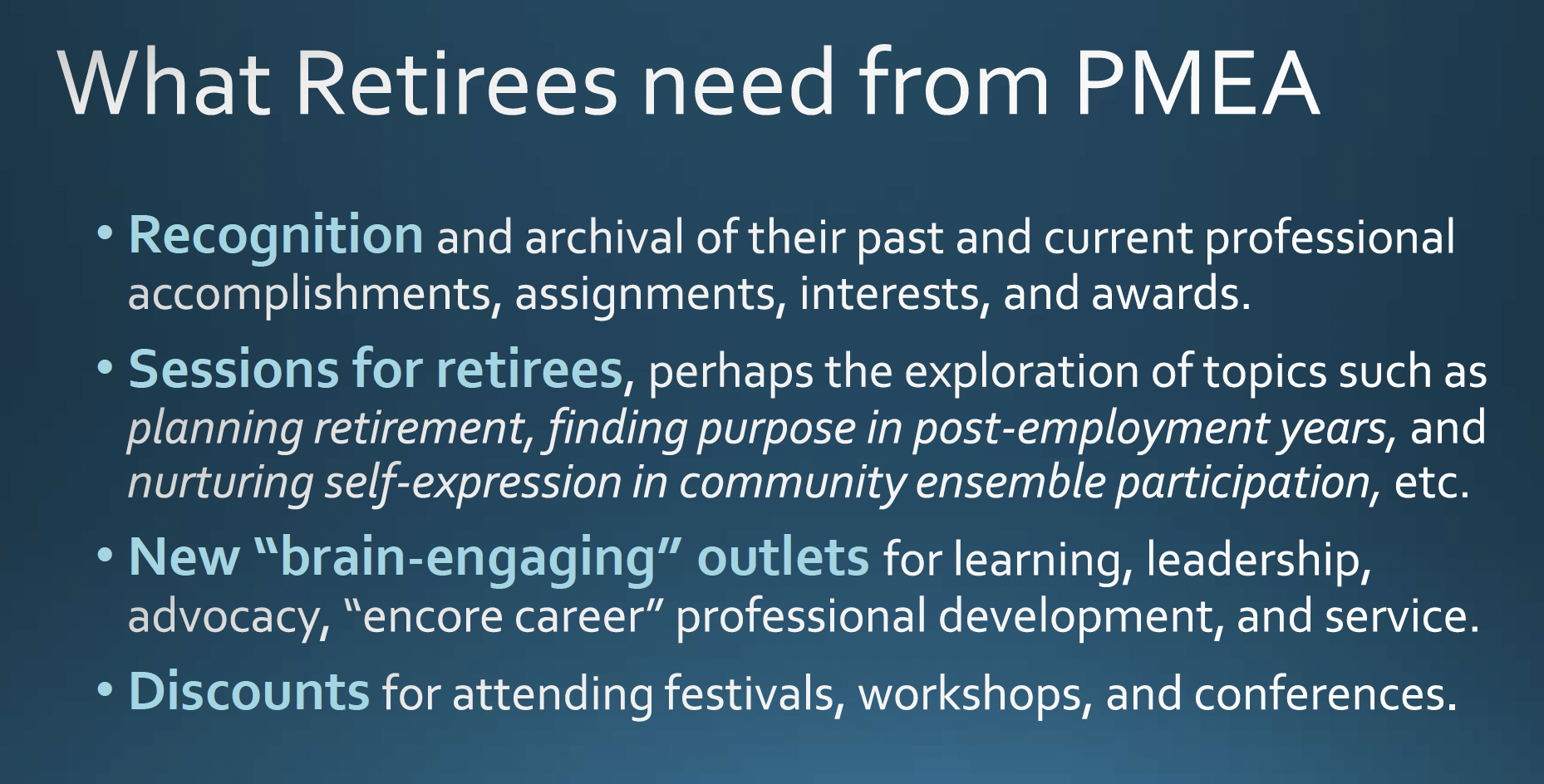
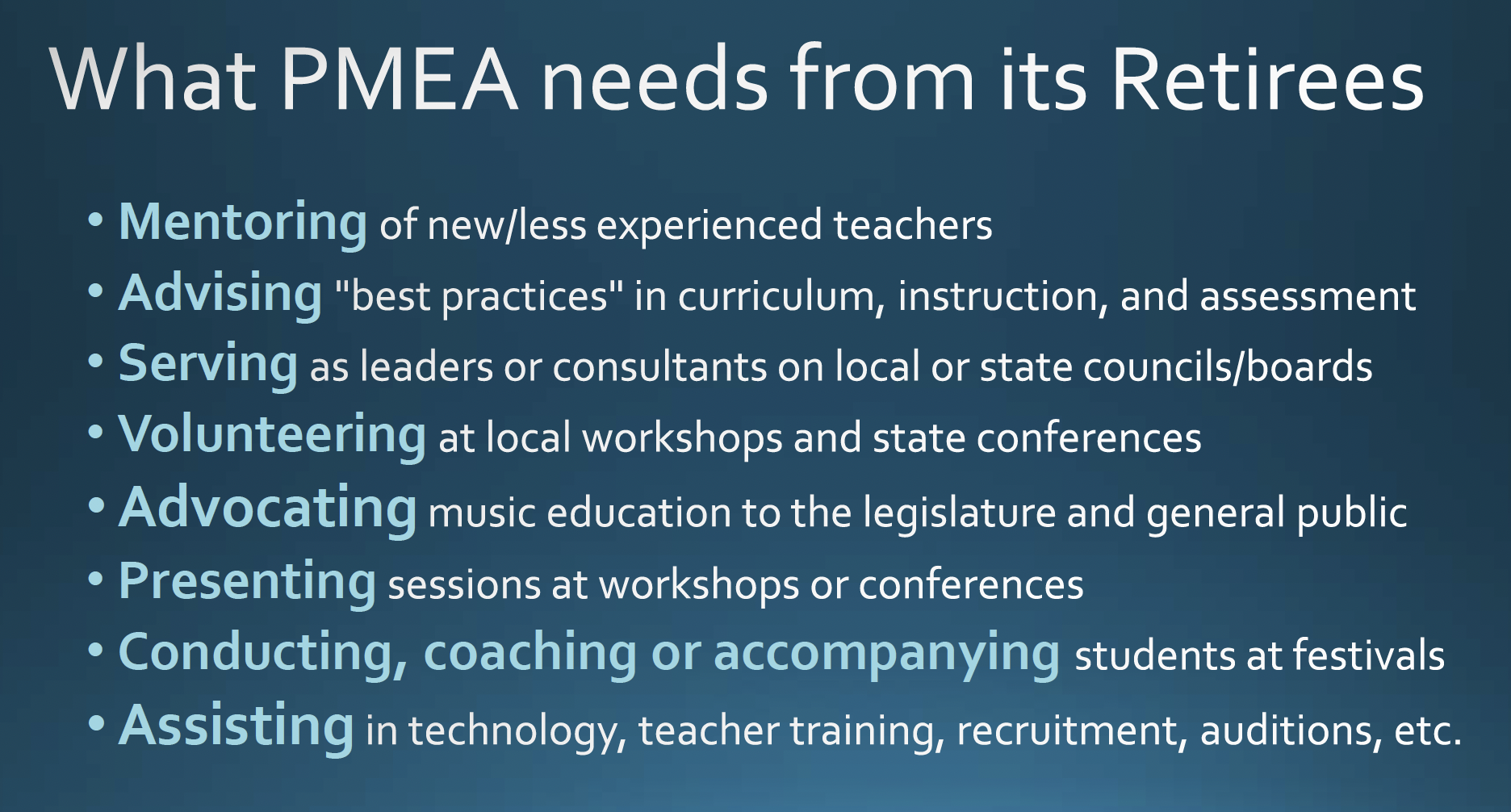
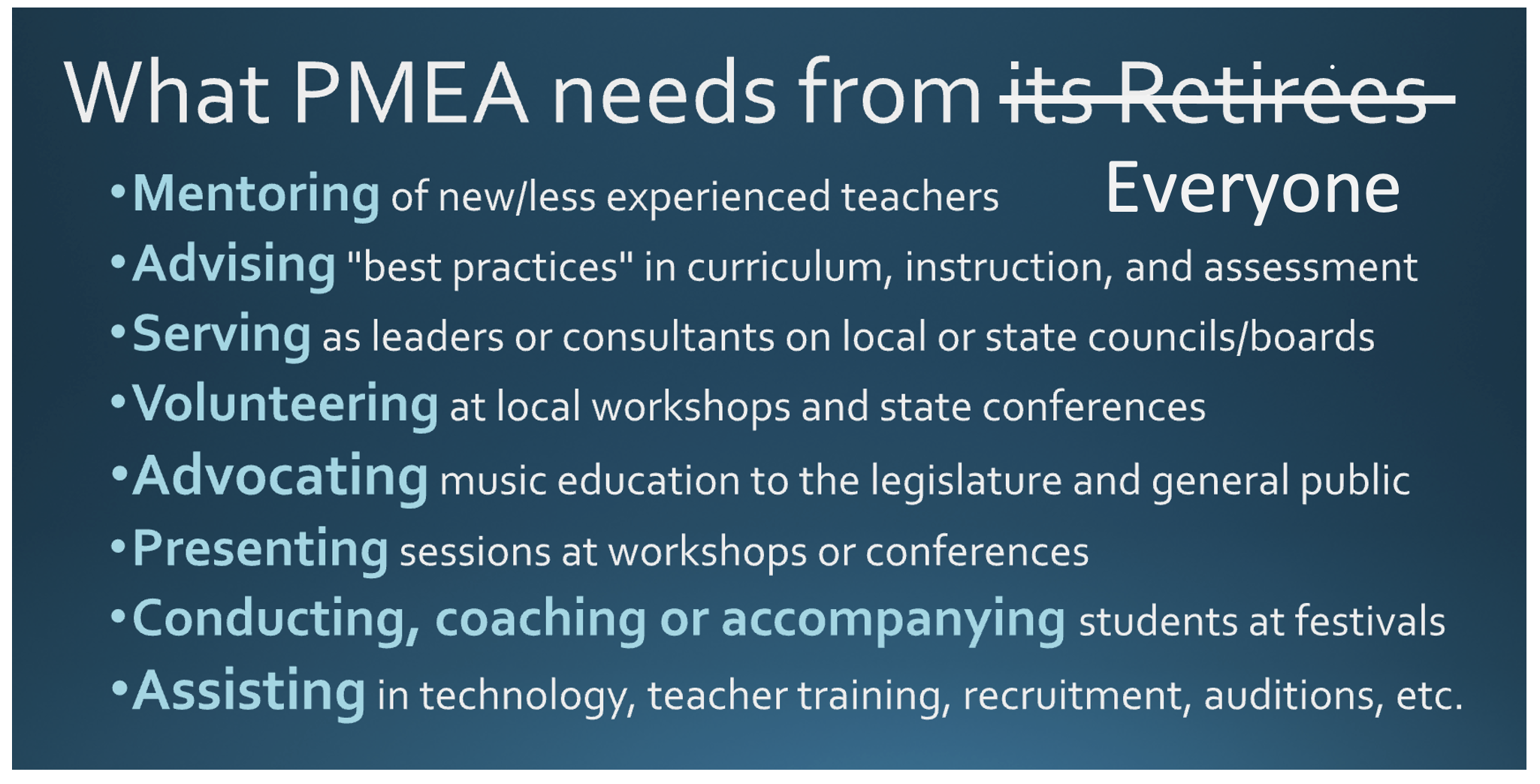
So now, reflect on the title of this blog! It is essential to give back to our association – to help it achieve its mission: “to advance comprehensive and innovative music education for all students through quality teaching, rigorous learning, and meaningful music engagement.” We’re all in this together, and together we can make it better! Slide #6 at the bottom of the retired members’ webpage proposes what PMEA needs from all members (not just retirees):

The number one thing you can do for ANY association is to pay your annual dues, attend its meetings, be active and HELP OUT! In return, PMEA can assist you in finding and sustaining your passions! What are you waiting for? If you have not renewed for the 2021-2022 year, please visit this PMEA membership webpage.

PKF

© 2021 Paul K. Fox

Pictures from Pixabay.com by artist Augusto Ordóñez

Those Were the Good Ol’ Days

The “E” in RETIREMENT is for Energy, Engagement, Excitement, and Endurance

This blog is all about how to stay young and vibrant – BECOMING A VOLUNTEER! Geared to those of us who have retired, this is very personal and unique to every individual, no matter what the age!

Do you remember the song, “Those Were the Days” performed by Mary Hopkins (1968), the Fifth Dimension (1969), and even Dolly Parton (2000)?

Those were the days my friend
We thought they’d never end
We’d sing and dance forever and a day
We’d live the life we choose
We’d fight and never lose
For we were young and sure to have our way.
La la la la
Those were the days, oh yes those were the days

In June 2021, I went back to work. Well, not exactly full-time… but it felt that way!

Remember the times as music educators we spent 15-18 hours a day or more thinking, planning, creating, teaching, problem-solving, schlepping stuff, sweating, and working out beyond the regular school day and during summer months with major music projects like the marching band, spring musical, music adjudication trip, etc.?

Asked by my friend and current Upper St. Clair School District performing arts curriculum leader/HS band director Dr. John Seybert, I signed on to the newly-expanded extracurricular activity (ECA) position as administrative assistant and announcer of the marching band for the school from which I had retired. Filling in the gaps, taking attendance, handling mounds of paperwork, interacting with a whole new generation of music students, and learning a few new software applications along the way like FamilyID, Canvas, Remind, and the district’s Blackboard website, I threw my hat in the ring, not just to continue to serve as the voice of the “Pride of Upper St. Clair” at football games halftime shows (now in my 36th year), but to manage the full schedule of rehearsals, meetings, performances, and blessedly (?) exhausting 24/7 week-long band camp. I forgot how it felt to get up at 6 a.m. and return home around 9:30 p.m.

It has been exhilarating. It has been exhausting!

On another stage, when the local COVID stats fell two months ago, I was invited back to our local community hospital to serve as a volunteer – discharging patients from their rooms or escorting them from the outpatient surgery or endoscopy units. Yes, I was called upon to somehow restore the physical demands I (used-to) place on my personal stamina. Fully fatigued and expended after a shift of 4-7 hours of driving my wheelchair taxis (sometimes carrying over-sized people even though we’re only supposed to move those weighing 250 pounds or less), I find myself yearning for a retiree “power-nap,” only to regroup for the next day’s challenging schedule and another early-morning wake-up.

The best part of these 8-15 hours per week? Choosing one of the finest medical facilities in our metropolitan area – St. Clair Hospital (now “Health”) – I have the chance to meet former music students (grown up), their kids, parents and grandparents, friends, and other acquaintances at their greatest need. And, there’s almost no finer escort “call” than going to the family birth center and bringing to the car a new mommy and two-day-old baby… sharing that special moment with an alum or school staff member!

It has been exhilarating. It has been exhausting!

WHAT

In past articles on a satisfying retirement, I often quote the book How to Retire Happy, Wild, and Free, the search for self-reinvention and new avenues for fulfilling those essential needs of “purpose, structure, and community” that employment had previously provided us. Author Ernie Zelinski’s definition of “purpose” are these goals:

  • To make a difference in people’s lives
  • To make a contribution
  • To find creative expression
  • To take part in discovery
  • To help preserve the environment
  • To accomplish or achieve a challenging task
  • To improve health and well-being

We learn from Revitalizing Retirement: Reshaping Your Identity, Relationships, and Purpose by Nancy Schlossberg that for retirees it is important to feel “needed” and that pursuits that foster “mattering” are crucial to a positive self-esteem, good mental health, and stable life balance.

It has been suggested that one problem of retirement is that one no longer matters; others no longer depend on us…

The reward of retirement, involving a surcease from labor, can be the punishment of not mattering. Existence loses its point and savor when one no longer makes a difference.”   

– Rosenberg and McCullough

The opposite of “mattering” is feeling “marginalized.” I would rather feel worn-out than useless/ignored/discarded!

In his book Design Your Dream Retirement, Dave Hughes recaps with his four essential ingredients of life balance:

  1. Physical activity
  2. Mental stimulation
  3. Social interaction
  4. Personal fulfillment

If you read my bio in the “about” tab above, I think all would agree: mission accomplished! I’ve made myself extremely busy. (Perhaps I “matter” a little too much?) “It’s a good thing I am retired… I would not have enough time to do all of these things if I still had a job!”

Yes, it FEELS good!

WHY

Now some rationale from the online pundits. First, review the article “Why Elderly People Should Volunteer.” According to the “experts,” volunteering is:

  • Socially beneficial
  • Good for mental cognition
  • Giving back to the community
  • Physically engaging
  • An opportunity to learn something new
  • Flexible
  • A strategy to fill up your day
  • The reason you get out of bed in the morning

Of course, one has to be careful and follow your doctor’s advice on what tasks will not overwhelm you! The CDC and other medical professionals urge adopting a “safe” routine of regular physical activity as a part of an older adult’s life. Check out websites like https://www.cdc.gov/physicalactivity/basics/activities-olderadults.htm and https://www.cdc.gov/mmwr/preview/mmwrhtml/00001482.htm. Besides keeping your mind active, increasing your physical activity as a volunteer while “living the dream” in retirement will:

  • Reduce the risk of serious illnesses (heart disease, type II diabetes, and depression
  • Help you manage a “healthy weight”
  • Improve your balance and coordination
  • Decrease the risk of falls or other injuries

Talk with your doctor to find out if your health condition limits, in any way, your ability to be active. Then, work with your doctor to come up with a physical activity plan that matches your abilities. If your condition stops you from meeting the minimum recommended activity levels, try to do as much as you can. What’s important is that you avoid being inactive.

Centers for Disease Control and Prevention

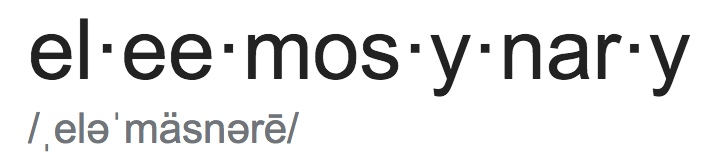
Volunteering is all about being more eleemosynary (adjective defined as “generous, charitable, gratuitous, or philanthropic”). In my workshops on retirement transitioning, I frequently quote two gurus on the benefits of “giving back.”

With a frequently untapped wealth of competencies and experiences, older people have much to give. This fact, coupled with fewer requirements for their time, gives them unique opportunity to assume special kinds of helping roles.

– Mary Baird Carlsen – Meaning-Making: Therapeutic Processes in Adult Development

Our increased longevity and generally better health has opened our eyes to new and increased opportunities to contribute to the betterment of society through civic, social, and economic engagement in activities we believe in.

– Jo Ann Jenkins, CEO of AARP – Disrupt Aging

HOW

But you already knew all of this, right? There are so many ways to “bring it on” and “make a difference” in your “golden years.” (Wow – three cliches in a row!)

There are so many directions you can go to offer your free time to volunteer:

  • Escort at local hospital or nursing home
  • Walk dogs at animal shelter
  • Serve in charitable fund-raising projects
  • Assist food banks and meals-on-wheels agencies
  • Enlist as special advocate for abused or neglected children
  • Work as hospice volunteer
  • Maintain parks, trails, nature habitats, or recreation centers
  • Host an international student
  • Become a youth director, mentor, or scout leader
  • Teach summer school, night classes or Performing Arts workshops
  • Give guided tours or lectures as a docent at a local museum
  • Apply office management and clerical skills to benefit libraries and other nonprofit associations
  • Run a school club (share your hobby)

As trained music educators, we can share our precious skills in creative self-expression :

  • Accompany, coach, or guest conduct school/community groups, college ensembles, or music festivals.
  • Run for office or chair a committee or council of your state or local MEA association
  • Serve as presiding chair or member of the your state’s MEA planning committee or listening committees for the music in-service conferences
  • Participate as guest lecturer or panel discussion member at a conference, workshop, or college methods program
  • Judge adjudication festivals
  • Help plan or manage a local festival or workshop
  • Assist the local music teacher in private teaching, piano playing, marching band charting, sectional coaching, set-up of music technology, instrument repair, etc.
  • Write for your professional organizations’ publications (like PMEA or NAfME)

If you are a retired music teacher and member of PMEA, you could sign-up for the Retiree Resource Registry and serve as an informal consultant to others still “slugging it out” in the trenches. Go to the PMEA retired member focus area for more information.

More sources to peruse on this subject:

Anyway, back to a little “bragging!” At least “yours truly” is holding his own and hopefully contributing what he can to the success and welfare of others! Are you? In my retirement pastime, I refuse to sit idle, binge-watch movies on Netflix, or view hours of boring TV. To quote another song’s lyrics, this “senior citizen” will never lament…

Life is so unnerving
For a servant who’s not serving
He’s not whole without a soul to wait upon
Ah, those good old days when we were useful
Suddenly those good old days are gone
Ten days we’ve been rusting
Needing so much more than dusting
Needing exercise, a chance to use our skills
Most days we just lay around the castle
Flabby, fat, and lazy
You walked in and oops-a-daisy!

“Be Our Guest” from Beauty and the Beast

So, what’s your story?

PKF

iStock by Getty images:

Images from Pixabay:

© 2021 Paul K. Fox

COVID-19 vs. New Year’s Resolutions?

How to “Make a Difference” in 2021

Of those who make a New Year’s resolution, after 1 week 75% are still successful in keeping it. After two weeks, the number drops to 71%. After 1 month, the number drops again to 64%. And after 6 months, 46% of people who make a resolution are still successful in keeping it. In comparison, of those people who have similar goals but do not set a resolution, only 4% are still successful after 6 months.

New Year’s Resolutions Statistics (Updated 2020) from Discover Happy Habits

Although we may be seeing the first signs of “the light at the end of the tunnel” with the distribution of the vaccines, coronavirus still has its grip on us… off-the-chart infection rates, record-breaking hospital admissions, schedule disruptions, restrictions on restaurants and small businesses, mandatory mask wearing, social distancing, precautionary self-isolation, etc. By all accounts, mindfulness, self-care, patience, and a positive outlook for the future are keys to making personal and professional goals as the pandemic rages on…

This article spotlights an age-old but usually neglected perspective – “think first” before you formulate any New Year’s Resolutions! For this to really work, you need a little research and reflection… and then COMMIT TO YOUR GOALS! Read on!

Start Out by Being S.M.A.R.T.

Admittedly, 44+ years in teaching has affected how I view goal-setting – “make it intention!” Adopt the often published S.M.A.R.T. approach to any plan. Make goals that are…

  • Specific
  • Measurable
  • Achievable
  • Relevant
  • Time-Bound

What goals do you want to satisfy in 2021? “Keep it simple” and S.M.A.R.T. Like lesson plans, write your resolution(s) in behavioral terms… “by the end of this class, the students will…” For example, the easiest way to limit the intake of fried food in your diet is to write on a post-it note, “I will not eat anything fried this week” and place it on your bathroom mirror.

A lot of these resolutions fail because they’re not the right resolutions. And a resolution may be wrong for one of three main reasons: 1) It’s a resolution created based on what someone else (or society) is telling you to change. 2) It’s too vague. 3) You don’t have a realistic plan for achieving your resolution.

How to Make and Keep a New Year’s Resolution by Jen A. Miller (New York Times)

Review the Usual Ones…

According to Brad Zomick in his GoSkills blog, these are the most common New Year’s Resolutions:

  • Exercise more
  • Lose weight
  • Get organized
  • Learn a new skill or hobby 
  • Live life to the fullest
  • Save more money / spend less money
  • Quit smoking
  • Spend more time with family and friends
  • Travel more
  • Read more

Just as important to WHAT you choose is HOW you approach it. In his article, Zomick provides a “how-to” roadmap to success, if you follow his steps:

  1. Mentally prepare for change.
  2. Set a goal that motivates you.
  3. Limit resolutions to a manageable amount.
  4. Be specific.
  5. Break up big goals into smaller goals.
  6. Write down your goals.
  7. Share your resolutions with others.
  8. Automate when possible.
  9. Review your resolution regularly.
  10. If you fall off track, get back on quick.

Do these recommendations sound familiar? They should if you are a disciple of the aforementioned S.M.A.R.T plan. Also, the concept of “writing down your goals” should ring a bell if you recall the supposed 1979 Harvard Business School MBA Study on Goal Setting (urban legend?) reviewed by Wanderlust Worker here:

Have you set written goals and created a plan for their attainment? Prior to graduation, it was determined that 84% of the entire class had set no goals at all. 13% of the class had set written goals but had no concrete plans. 3% of the class had both written goals and concrete plans. The results? Well, you’ve likely somewhat guessed it. 10 years later, the 13% of the class that had set written goals but had not created plans, were making twice as much money as the 84% of the class that had set no goals at all. However, the apparent kicker is that the 3% of the class that had both written goals and a plan, were making ten times as much as the rest of the 97% of the class. 

The Harvard MBA Study on Goal Setting from Wanderlust Worker

Whether the Harvard (or Yale) study is fact or faction is probably irrelevant. The point here is that to improve the odds for accomplishing our goals, we need to take the time to write them down, announce our intentions (your spouse or significant-other), and define the details with “action plans.”

The Glass Is Half Full

Have you heard the joke about the identical twins, one an optimist and the other a pessimist?

A psychiatrist has one son who is a total pessimist, and another who is a complete optimist.  He decides on an experiment.  For Christmas he fills the pessimist’s room with hundreds of beautifully wrapped gifts, and dumps a heap of horse manure in the optimist’s room. On Christmas morning he sees the pessimist boy sitting motionless at the center of his room, eyeing his gifts suspiciously. But over in the optimist’s room he sees his boy filled with joy, digging happily in the odorous pile. He asks the kid what he’s doing and he answers:  “Daddy, with all this horse dung, there’s gotta be a pony in here someplace.”

The Center for Optimism

It’s time to cheer-up, look to the future, and embrace HOPE for tomorrow!

Are you kidding? You want me to “put on a happy face” after all the pandemic has done? YES!

One remedy for “losing the blue funk” is to reject all “blame and complain” speech or behavior! It is so easy to get caught up in negativity… family adversity or “challenges” of a medical or employment nature, or simply being forced to remain distant from each other, daily news media reports about COVID-19, political dissension and the polarization of viewpoints, angry rants on social media, etc. literally fanning the flames of an unprecedented perpetual global “bad mood!” I even found myself in the throes of periodic bouts of public distemper, griping on Facebook about a Dial for Men product that made my hair dry (my FB friends responded, “Thanks for the heads-up” – ha, ha!), or grumbling about the roll-out of new revisions of WordPress and Constant Contact program editors that are not backwards-compatible nor fail to support the “look and feel” of previous versions. The effect of exposure to or expression of all of these “B” words (badmouth, beef, bellyache, bemoan, bicker, b*tch) is to make you even more bitter… not fostering the “can-do’s” for taking steps towards helping others, self-renewal, or an optimistic attitude.

Do you find your emotions swinging rapidly from sadness to elation to anger or fear during the lockdown? If your mood is all over the place at the moment, that’s completely understandable. This is not a normal situation. It’s a hugely disruptive, sudden change to our daily lives that nobody was prepared for. It isn’t surprising that many people are experiencing unpredictable moods. “It is going to affect everyone’s mood in many, and sometimes unexpected, ways,” reveals psychotherapist Mark Bailey. “Whether it’s worry, anxiety, feeling overwhelmed, discombobulated, angry and even perhaps unexpected emotions like relief as we accept some of our current situation, it’s useful to know that as we experience one emotion it doesn’t nullify or negate another.”

COVID-19: How to Manage Mood Swings... by Natalie Healey

Get Inspired by Good Role Models and “Positive Gurus”

Many music educators attend the keynote addresses at state MEA/NAfME conferences to “recharge their batteries.” A few of my favorite “master motivators” are Tim Lautzenheiser, Peter Boonshaft, and Fran Kick. As a sample, check out this video (sponsored by MusicFirst) that featured “Dr. Tim” – One Person Can Make a Difference!

Who can have a positive influence on us or serve as a “catalyst for change” to help us realize our resolutions? Practically anyone! I bumped into this provocative article by Professor Dr Ger Graus: Good Role Models – How Has COVID-19 Changed Pupils’ Career Aspirations? He relates these criteria “to elevate a person or profession to role model status” (at least in the eyes of a child) – possibly an excellent framework for creating your plan.

  1. Demonstrate passion for what you do and have the capacity to infect others with it.
  2. Show a clear set of values and live them in their world. Lead by example. Children admire people who act in ways that support their beliefs. It helps them understand how their own values are part of who they are and how they might seek fulfilling roles as adults.
  3. Demonstrate commitment to community. Be others-focused as opposed to self-focused. Freely give your time and talents to benefit people.
  4. Show selflessness and acceptance of others who are different to you. Be fair.
  5. Demonstrate the ability to overcome obstacles. Young people admire those who show them that success is possible.

Someone who has recently become inspirational to me is the wonderfully uplifting Lesley Moffat, probably an expert on the search for “mindfulness” in personal life and even during her band warmups. In my opinion, her transformative stories provide the blueprint for happiness and wellbeing! She now has two published books (you need to read both) – I Love My Job But It’s Killing Me, and Love the Job, Lose the Stress, and if you are still teaching music full-time, you need to peruse her website: https://mpowerededucator.com/. For a good laugh, view her recent “rap” – Moffat’s HamJam for Band – for which she performed for her music students.

Apply the concepts of social and emotional learning (SEL), EMPATHY, and “corona kindness” to yourself and loved-ones! Seek out advice from a few of these experts: Manju Durairaj, Scott N. Edgar, Bob Morrison, and Edward Varner.

Social and emotional learning (SEL) is the process through which children and adults acquire and effectively apply the knowledge, attitudes, and skills necessary to understand and manage emotions, set and achieve positive goals, feel and show empathy for others, establish and maintain positive relationships, and make responsible decisions. The key components of SEL are self-awareness, social awareness, responsible decision-making, self-management, and relationship skills.

Finding Sanctuary – Social and Emotional Learning and Visual and Performing Arts by Edward Varner

Sum it Up – Fox’s “Top-Ten Tips”

  1. Renew your efforts to intentionally reach-out, connect, and engage with people, albeit virtually for now.
  2. Focus on the things you can control.
  3. Remind yourself about the good things in your life and your personal resilience.
  4. Start small and change one behavior at a time.
  5. Don’t beat yourself up when things get a little rocky
  6. Don’t be afraid to ask for help.
  7. Seek creative new ways to reduce your stress.
  8. Exercise, meditate, go outside, and plan better meals.
  9. Share your experiences with family and friends.
  10. Implement one or two S.M.A.R.T. goals and embrace the “spirit” of self-improvement.

It’s easy to become an idealist when the new year rolls around, but it’s important to remember that New Year’s resolutions are ultimately a tool to help you grow into the person you want to be. Take some time this New Year’s Eve to really consider who you want to be in the future, and then employ S.M.A.R.T. goals to help you fulfill your vision. Making a resolution to live your life with purpose and passion is a beautiful and exciting thing, not something to dread.

How to Keep Your New Year’s Resolutions by Using S.M.A.R.T. Goals by Mary McCoy

PKF

© 2020 Paul K. Fox

Resources

Credits:

iStock.com photos (in order): “2021” #1280953227 by phototechno, “SMART Goals” #1134658098 by BrianAJackson, “New Years Goals List 2021” #1266648329 by Olena Sakhnenko, “Half Empty to Half Full” #1128990168 by Fokusiert, “Lead by Example” #849367144 by Michail_Petrov-96, and “2021 Happy New Year” #1273431483 by Weedezign

“Happy Face” VectorStock.com/467693 

Living Your Legacy

Teacher Retirees: Not to be morose, but have you undergone a little soul-searching and introspection into how you want to leave your mark on this world? Since you’ve departed from your full-time career, do you feel your past/current goals and pursuits will make a difference?

How will you be remembered once you’re gone?

If someone else was to “put me on the spot” and ask me this, my quick rejoinder would be, “Music and education are my life!”

How about you?

school-1063561_1920_geralt

Let’s start with a review of the broad definition from Merriam-Webster:

legacy

noun: 1. a gift by will especially of money or other personal property, 2. something transmitted by or received from an ancestor or predecessor or from the past

adjective: of, relating to, associated with, or carried over from an earlier time, technology, business, etc.

synonyms: bequest, birthright, heritage, inheritance, patrimony

Legacy is [how] most people… want to be remembered, loved, and revered.

A legacy is not something that we have complete control over. After all, we cannot control how other people perceive us, we can only control our own actions.

So how can we leave the world with a legacy of our choosing?

What we must do is inspire through our own actions. If you go back through time and analyze the most influential legacies, you’ll see that they all inspired action through their own action. They didn’t just think about doing things, or tell others to do them; they went out and got things done on their own!

These legacies began while they were still alive, except I’m sure they weren’t thinking about them in those terms. Their ACCOMPLISHED GOALS became their legacy, which lives on today.

— Amy Clover in Strong Inside Out

place-name-sign-1647341_1920_geralt

It may boil down to two thought-provoking inquiries posed in “What Will Be Your Legacy?” What do you want to leave for the world that will affect it when you are gone? AND How do you want to change the future?

Thanks to blogger Marelisa Fabrega, here’s more food for thought and self-examination:

  1. What do you want your life to stand for?
  2. How do you want to be remembered by your family and friends?
  3. What will those beyond your circle of family friends remember you for?
  4. What kind of impact do you want to have on your community?
  5. How will the world be a better place because you were in it?
  6. What contributions do you want to make to your field?
  7. Whose lives will you have touched?
  8. What lessons would you like to pass on to future generations?
  9. What do you want to leave behind?
  10. How can you serve?


Dead Poets Society-bardfilm.blogspot.com

In her article “How to Leave a Lasting Legacy,” Fabrega also shares several activities for the creation of a personal legacy, everything from the Stephen Covey exercise on writing your own obituary or designing the words you want etched on your tombstone to adding your own “meaning of life” verse to the Walt Whitman poem Oh Me Oh Life as English teacher John Keating (played by Robin Williams) taught in the film Dead Poets Society.

Your legacy is putting your stamp on the future. It’s a way to make some meaning of your existence: “Yes, world of the future, I was here. Here’s my contribution, here’s why I hope my life mattered.”

— Bart Astor in Forbes


hand-229777_1920_2_geralt

Getting Your Affairs in Order

A legacy is more than a large donation to your favorite church, foundation, or charity. Of course, this process should begin with self-reflection, advance planning, hiring an attorney, and making your financial intentions and final instructions clear in writing.

Do you have a legal will, ethical will, living trust, Power of Attorney, and advance directive? Have you updated your important documents to take care of the needs of your family? Have you notified your spouse, adult children, and other relatives where they can find these legal papers, passwords, and other digital files? If not, please review my blog “Estate Planning.”

But, legacy is so much more, including strategies for passing on your values and goals after you are no longer here!

Ethical Wills.png13 years ago, I first learned about an ancient tradition for passing on personal values, beliefs, blessings, and advice to future generations called an “ethical will.” At a subconscious level, I must remember the custom, because when my father was diagnosed with lung cancer in 1990, I asked him to write a letter about the things that he valued. About a month before he died, my dad gave me two hand-written pages in which he spoke about the importance of being honest, getting a good education, helping people in need, and always remaining loyal to family. That letter – his ethical will – meant more to me than any material possession he could have bequeathed.

— Barry K. Baines in Ethical Wills

As we have also noted in a previous blog-post, you should reflect on what you would say to those nearest and dearest to you if you couldn’t (or didn’t) tell them in person. Consider writing individual letters to your partner, children, or other family members “as a way of leaving a few last words.” Check out Frish Brandt’s “Last[ing] Letters.”


flower-8539_1920_GLady

Your Contributions “In Memoriam”

The idea of leaving a legacy is the need or the desire to be remembered for what you have contributed to the world. In some cases, that contribution can be so special that the universe is unalterably changed. However, for most of us mere mortals walking this earth, we will leave a more modest legacy that doesn’t necessarily change the world but does leave a lasting footprint that will be remembered by those whose lives you touched.

You hope your life matters in some way. I know I do. I’ve been teaching since the age of 22 and teaching is my legacy, my contribution that hopefully enlightened the lives of my students whether they became actors, scientists, doctors, mothers or yogis. My teaching is a gift that keeps on giving because it leads me to other learning and knowing experiences that I share with others.

— Joan Moran in HUFFPOST

(I bolded “teaching is my legacy” in the above quote because I hope that will be considered as my own preeminent legacy.)

To borrow from the inspiration and expertise of others, I found this insightful and stimulating self-help article offering “Five Ways to Leave a Great Legacy” by Joan Moran.

Moran describes in detail these tips:

  1. ornament-1899065_1920_2_xsonicchaosSupport the people and causes that are important to you.
  2. Reflect and decide what is most important to you in your life.
  3. Share your blessings with others.
  4. Be a mentor to others.
  5. Pursue your passions because they are infectious.

She sums it up succinctly: “Leaving a legacy is an important part of your life’s work. A legacy develops from a life dedicated to self-reflection and purpose. What will be revealed and what will endure is a truthful and value driven body of living.”

The straightforward way to live a life of significance is simply to share your three t’s: time, talent, and treasure. Our lives are meant to give away – to significant causes, to loving families, to friends in need, to lasting relationships. Find a way that your gifts can serve others. Your time, energy, and money are precious resources – they are limited, and you are the sole owner. If you spend them in one area you can’t spend them in another. When we say “yes” to one thing, by default we saying “no” to something else. The key to winning is to say “yes” to the significant things in your life.

— Lee Colan in Inc.

the-conference-3248255_1920_photomix

Giving Back… Getting Personal

eleemosynary

adjective: of, relating to, or supported by charity

synonyms: altruistic, beneficent, benevolent, charitable, do-good, good, humanitarian, philanthropic

Fancy SAT vocabulary term! No, we do not need a visit from Charles Dickens’ three ghosts to learn altruism! Everyone should want to be remembered as eleemosynary or generous souls! Especially during my retirement years (2013 to the present), I want to model volunteerism:

  • Fox_Paul_SHJODirecting the South Hills Junior Orchestra (non-salaried sharing of my teaching)
  • Serving as a volunteer escort for the St. Clair Memorial Hospital (three days/week)
  • Promoting communications and marketing strategies of the Community Foundation of Upper St. Clair
  • Supporting the Pennsylvania Music Educators Association in various projects including teacher training, recruitment, retention, and retirement prep.
  • Writing articles and presenting workshops/webinars that help other teachers

These wishes will need to be updated from time to time, just like revising mission/vision statements, goals and objectives.

In addition, future monetary bequeaths from “what’s left” of our remaining assets will serve as “random acts of kindness from the grave” in support our current values, funding hereafter projects and pursuits (subscribing Moran’s tips #1-3 above) that matter to us.

How to Make an Educator Smile

My wife and I never had kids, so admittedly we live vicariously when we “bump into” our former students and revel in their major life-passages and accomplishments. It warms a retired music teacher’s heart to “catch-up” with a combined 53+-year history of past pupils from our music classes, choirs, bands, orchestras, and musical/play productions, and learn that they are happy, healthy, prosperous, and thriving. It gives us a special thrill to hear they are still “making music” and/or passing on their love of the arts to their own kids. That is indeed part of every teacher’s wish for a lasting legacy.

During our retirement, we continue to attend many concerts, recitals, weddings, receptions, Eagle Scout ceremonies, etc. of our former “charges.” We feel blessed to be invited to participate in these special occasions to share in their joy, love, and success.

In some small way, we fervently hope our efforts to bring creative self-expression and the appreciation of the arts have made a difference to our students’ lives and their development into caring, responsible, and “artistic” adults.

In Conclusion: The Fox Vision and Values — “These Things I Believe”

  1. Equal-access to high quality and meaningful music education programs is an essential part to the intellectual, emotional, and artistic development of all children.
  2. The primary goal of an education in the arts is to nurture creative self-expression.
  3. Regardless of talent or privilege, every individual on earth can find inspiration and success in some form of music or the arts.
  4. Our life purpose involves relationships. It is more about people than about things.
  5. We were put on this planet to understand and help others, to foster more than a mere tolerance for diverse individuals and perspectives, rather to emphasize the values and practices of acceptance, respect, empathy, and collaboration.
  6. Our primary goal is to empower volunteerism, to make a difference in the lives of others less fortunate or experienced, and to give freely of our time, talents, passions, and resources.

PKF


Photo credits (in order) from Pixabay.com


Photo of Robin Williams portraying John Keating in the movie Dead Poets Society was by bardfilm.blogspot.com


© 2020 Paul K. Fox
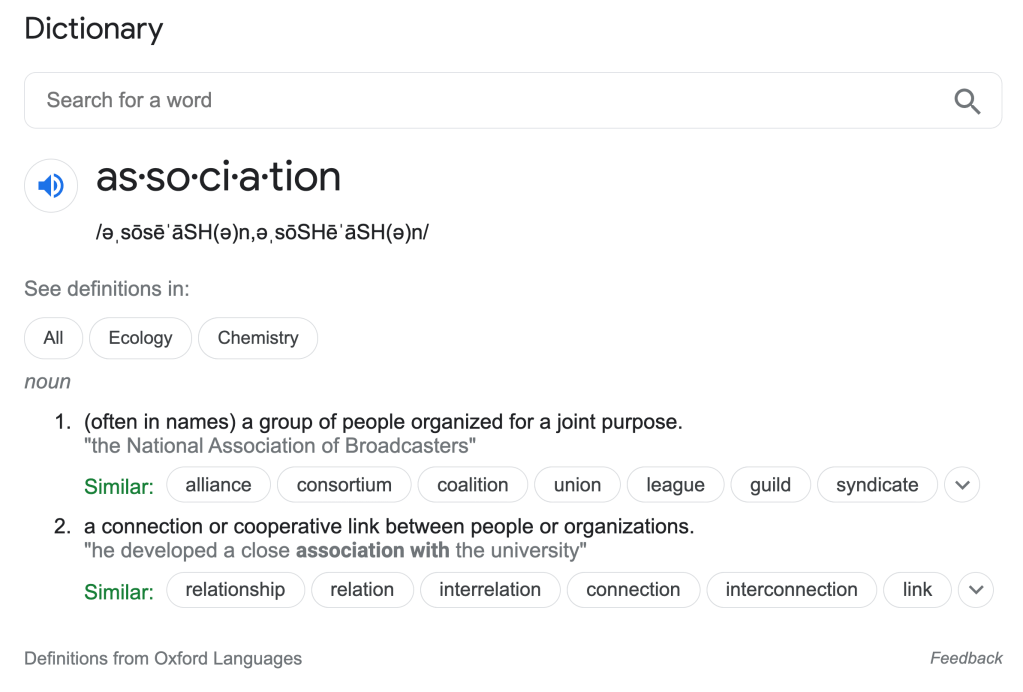
Becoming a School Music Educator

[A quick summary, portions reprinted from the April 17, 2019 posting on LinkedIn: https://www.linkedin.com/pulse/becoming-school-music-teacher-paul-fox/]

One of my goals after retiring from 35 years as an educator and administrator in the public schools was to reach-out to college music education majors and offer some tips and techniques for preparing for this honorable career.

I have assembled a library of blog-posts on a variety of topics at my website (https://paulfox.blog/), and invite you to peruse the section “Becoming a Music Educator” at https://paulfox.blog/becoming-a-music-educator/.

If you are a junior or senior in college, assigned to field experiences or student teaching, or a recent graduate or transfer looking for a job or otherwise unemployed, I hope I can help you!

Please review the following categorized outlines of links to articles and other resources.

big-band-1608691_1920_KeithJJ


Student Teaching

First stop: Tips on Student Teaching.

Also check out these past issues of PMEA Collegiate Communique:


“Secrets” for that First Year

  1. maestro-3020019_1920_mohamed_hassanDiscounted NAfME + PMEA first-year membership: only $90. (If you are a recent college graduate in your first year of teaching, or if you are the spouse of a current or retired NAfME member, contact NAfME at 800-336-3768 or email memberservices@nafme.org) to find out if you qualify for a reduced rate.
  2. PMEA Mentor or other state’s MEA support program for new teachers.
  3. R3 = Retiree Resource Registry for PA music teachers.
  4. PMEA Webinars.
  5. NAfME Academy of numerous videos (only a $20 annual subscription).
  6. Professional development credits just for reading an article in NAfME Music Educators Journal
  7. Model Curriculum Framework (Have to be a PMEA member)
  8. What a deal! PMEA summer conference  as little as $30/person. Check out your own state’s MEA discounts and offers for collegiate members and new teachers!
  9. Numerous helpful blog posts from NAfME Music in a Minuet and paulfox.blog.


logo 2

Everything… Including the Kitchen Sink

Check out the online resources on the PMEA Council for Teacher Training, Recruitment, and Retention website, free/open to all music teachers. Especially take note of the supplemental links on a variety of topics posted here.


Job Seekers

A summary of my re-occurring themes on marketing your professionalism and a few “pet peeves” include the following:

  1. Create a multi-media digital portfolio, video recording excerpts of your memorable solo, chamber, and ensemble performances, teaching experiences, and other opportunities you have had in working with children of all ages. To the interviews, bring both a printed version and jump drive (the latter to leave with the screening committee) of these artifacts and a list of your other activities, awards, accomplishments, mission/vision, transcripts, music education and class management philosophies, recommendations, etc.
  2. Take the time to assemble “the stories of your life, work, and teaching experiences” (both successes and the “glitches” or “snags” along the way which you had to resolve) that demonstrate your competencies, relationships with students, personality traits, acquired skills, problem-solving, and maturity.
  3. woman-613309_1920_jsotoBring to any employment screening your resume, business card, and an e-portfolio referencing a professional website which archives everything in #1 and #2 above.
  4. Avoid one-word responses or short answers to most interview questions. Instead, seek ways to incorporate the anecdotes you have made ready at your fingertips (#1 above) that model those characteristics a prospective employer is seeking in a music teacher.
  5. If you want to be the one “in control” of the possible jobs that may come your way, avoid marketing your skills as a “music specialist” (e.g. band director or elementary music teacher). Most degree programs prepare the students for teaching certification in “Music Grades Pre-K to 12.” If you are looking to expand your opportunities, don’t limit your capabilities or options upfront. You CAN teach all forms and levels of music!
  6. music-818459_1920-thedanwClean-up and curate your social media sites, treating your Facebook pages as another “personal branding resource.” Experts recommend that “your profile information should reflect integrity and responsibility… You should expand or add content that projects a professional image, shows a friendly, positive personality, demonstrates that you are well-rounded with wide range of interests, and models… great communication skills.” Source: https://paulfox.blog/2019/03/01/collegiates-clean-up-your-social-media/.
  7. How to your get to Carnegie Hall? Practice, practice, practice! How do you ace your interview? Practice, practice, practice! Put yourself through “mock interviews” and record and later assess your “performance.” Sample questions are posted at my blog-site.

choir-458173_1920_intmurr

 Collegiates, welcome to the profession!

“Break a leg” at your employment interviews!

PKF


Photo credits in order from Pixabay.com:


wooden-train-2066492_1920_Couleur

© 2019 Paul K. Fox

Now What?

Guest blog-post by Colonel (Retired) Thomas H. Palmatier


Originally printed in the School Band and Orchestra (SB&O) Digital Magazine, June 2019. Reprinted with permission. All rights reserved. http://digitaleditiononline.com/publication/?i=593349#{%22issue_id%22:593349,%22page%22:26}

This was also featured in the August 2019 edition of the PMEA Retired Member Network eNEWS, archived at https://www.pmea.net/retired-member-network-enews-archive/.

Motor City Band Festival Palmatier

At some point, every band or orchestra director will either retire or move to another career. While there is much emphasis on mentorship and other ways to assist new directors, there are almost no programs to help us with the potential a more difficult transition. The U.S. Army has a mandatory program for anyone leaving the service to prepare them for the next phase of their life. Even without assistance, leaving a job that you love is tough for everyone. I want to share some lessons that I learned in the research I’ve done into this issue.

Pershing's OwnIn my case, I had over 37 years where I had established an identity as a music director and as a soldier. Prior to retirement from the army, I was the senior music director in the U.S. Armed Forces and was on speed dial of many officials in the department of defense, the Congress, and of course, the media. I received 500 to 600 emails daily from all over the world. By the way, I also was leader and commander of the US Army Band “Pershing‘s Own,” one of the largest (and busiest) military music units in the world. Then, one day I was no longer in the army, my phone wasn’t ringing constantly, the email stopped, and my schedule was mostly free. Sounds great, right? As a band or orchestra director, you were probably the most well-known and well liked person in your community. You have students, parents, and administrators who rely on you. And then suddenly, you are not that person any longer. For each of us there are emotional/psychological, social/family, and financial impacts of this transition.

MotorCityFestival Palmatier

The identity that you have developed over the years is now essentially gone. I was fortunate to have a colleague warm me up that about six months after retiring, I would hit a wall of depression, and he was so right. Because I have been warned about it, I was able to act with my health care provider.  Now, imagine if upon your transition, you are now spending more time with your spouse/partner then you would ever have before but then find yourself unhappy. Studied show increased divorce rates soon after retirement or a career transition because people make the mistake and assumption that their Brett_Favre_Super_Bowl_50depression is related to spending time with their spouse.
Brett Favre reportedly said when ending his first retirement from pro football that “the one thing about having nothing to do is that it doesn’t take long to do it.” To overcome boredom (and depression), it’s important that you know how you see yourself now and how you want others to see you. For many years, your identity was band/orchestra director. What’s your identity going to be now?

The impact on your social relationships can be equally challenging. Most of us develop the circle of friends in the music and education communities. When you are no longer in “the biz,” who will your friends be now? What will you talk about besides the awesome halftime show that you are no longer writing? This all goes back to who you are now, not who you used to be.

MidWest Clinic Palmatier

The financial impacts of retirement or transition are unique to every individual. However, if you intended to now be self-employed, be serious about it. Create a limited liability company (LLC). Most states let you do it online and it usually cost no more than $100. Keep meticulous records and don’t mess with the IRS. Done right, you can legally deduct lots of things as business expenses. Remember, you don’t have a music library anymore so you will be buying lots of scores (don’t be one of those folks whose library is full of illegal photocopies!).

If you’re going to follow the self-employed path, be aware of that self marketing, maintaining a website (see mine at ThomasPalmatier.com), and bookkeeping take a lot of time.

Palmatier at Liberty North.png

There is one terrific way to stay relevant in our profession – being a mentor. I encourage you to read my article in the August 2018 issue of SBO Digital Magazine called “Be a Mentor – Get a Mentor.”

Here are my top five takeaways for those approaching retirement or a career transition:

  • Start preparing as far in advance as possible.
  • Be prepared for the inevitable challenges. If you were unhappy or depressed, get help!
  • You get to define yourself now.
  • Stay relevant – be a mentor.
  • Enjoy it!


Col. Thomas H. Palmatier
Colonel Palmatier served as guest conductor of the 2017 PA Intercollegiate Band Festival at Grove City College in PA

Colonel (retired) Thomas H. Palmatier is the former leader and commander of the U.S. Army Band “Pershing‘s Own” and commander and conductor of the United States Army Field Band. He holds degrees in music education from the Crane School of Music (State University of New York at Potsdam) and Truman State University, as well as a Master if Strategic Studies degree from the US Army War College. He is an active clinician, adjudicator, and guest conductor of concert bands, orchestras, British-style brass bands, jazz ensembles, and marching bands. He is a Conn-Selmer clinician and a member of the American Bandmasters Association.

© 2019 Paul K. Fox