

A Treasure Chest of Tips for Living the Dream!

Are you retiring soon? Thinking about “taking the plunge” and “Crossing the Rubicon” into your “second beginnings” or “next chapter” of senior life?
No matter how busy you are now, you need to “take five” from your work or personal to-do’s and review the following recommendations from past blog posts at this site. Consider this a personal toolbox for the retired and soon-to-retire professional… and assigned HOMEWORK!
A good starting point would be to pick-up “The Myths of Retirement” and “Three Exit Lanes to Self-Help Retirement Guides,” or if you prefer to tackle everything at once, check out the omnibus “monster” resource guide posted here.

Now the top-ten list – a well-balanced collection of online essays. The more you read, the better you will be able to embrace a healthy transition through this major life passage!
1. Plan ahead for retirement: “It’s Not Only About the Money”
Read the entire article here.
It is agreed that a period of adjustment will occur during the first years of “interning” as a retiree, especially critical during the “pre-retirement” stage (believe-it-or-not, as many as six to ten years prior to “taking the big leap” to FREEDOM!). The solution to a smooth transition is to be prepared: communicate your intentions with your family members, and reflect on the vast considerations of the “who, what, when, where, how, and why” of retirement. This prep to your “golden years” is the perfect time for a little self-assessment and self-reinvention in finding new purpose, meaning, and fulfillment in your life.

2. Identify and take steps to alleviate the stress of leaving your job:
“The Good, The Bad, and The Ugly”
Read the entire article here.
The phases of retirement are discussed in greater depth here, as well as different departure scenarios and the usual post-employment “cycles of emotions.” This piece is particularly good if you have ever felt pushed into early retirement or experienced being unappreciated, disrespected, uninspired, unsupported, or “burned out” in your career.
3. Are you really ready? “Signs it is time to retire… OR “Signs is NOT okay.”
This “countdown to retirement” article poses the essential question “Are you psychologically (or emotionally) prepared to retire?” and offers a “road map” of seven easy steps towards closure for prospective music teacher retirees.
For more insight, you should also peruse “When Should You Retire.”

4. Determine your retirement destination:
“Do you know where you’re going to…?”
Read the entire article here.
This early blog post proposed several factors to consider for the choice of where you want to live in retirement… both geography and floor plans. Another good source to read on this topic is the book that was published two years later by the retirement guru and former PMEA session presenter Dave Hughes: The Quest for Retirement Utopia – How to Find the Retirement Spot That’s Right for You.
5. Maintain your professional associations:
“Ask not what PMEA can do for you, but what you can do for PMEA!”
Read several articles:
A retired educator is a valuable resource. If you care about the profession, there are many ways you can continue to contribute your experience and wisdom, albeit less stressful and time-consuming moments, but still assist your colleagues who continue to “fight the good fight” in the field.

6. Acquire a more carefree attitude: “It’s Not Your Sandbox”
Read the entire article here.
It may be at times a challenge to surrender your urge to continue as “an agent of change” or, as E.A. Wynne has written in “The Moral Dimension of Teaching” (Teaching: Theory into Practice, 1995), habits of “moral professionalism.” Learn how chill out and NOT to stress out over someone else’s supposedly poorly run “sandbox” and limit the need to provide unsolicited advice or major problem-solving for other organizations.
7. Make music: “Dust off your chops” and 8. “Sing your heart out…”
Read the both articles here and here.
What led you to select a career in (and the “calling” of) music education? Retirement is the perfect place and time to expand on your love and skills in creative self-expression. When a music educator retires, among the many joys and fruits of his/her career in the arts is a sudden life-style change – the glorious transformation of being set free from those things you no longer want nor need to do (routine day-to-day drudgery, paperwork, meetings, etc.), embarking on new journeys to explore and embrace revised personal goals – hopefully including a renewed refocus on making your own music!

9. Explore mind-stimulating engagements: “Have you fed your brain today?”
Read the entire article here.
The mind is a terrible thing to waste, even during retirement. Discover something new every day! Maximize your “brain health” with a host of these ideas to consider for your bucket list.
10. Take time to “give back” and volunteer:
“What does it mean to be eleemosynary?”
Read both of these articles here and here.
In the scheduling our free time in retirement, it is important to feel “needed” and find activities that foster “mattering” to promote a positive self-esteem, good mental health, and stable life balance. Are you making choices to contribute to the musical and personal success and welfare of others? For the realization of the mission of this blogger’s retirement pastime: “I refuse to sit idle, binge-watch movies on Netflix, or view hours of boring TV.” To quote the song’s lyrics, this “senior citizen” will never lament…
Life is so unnerving
– “Be Our Guest” from Beauty and the Beast
For a servant who’s not serving
He’s not whole without a soul to wait upon
Ah, those good old days when we were useful
Suddenly those good old days are gone
Ten days we’ve been rusting
Needing so much more than dusting
Needing exercise, a chance to use our skills
Most days we just lay around the castle
Flabby, fat, and lazy
You walked in and oops-a-daisy!

Stay Connected with PA Music Education
PMEA Annual Conference April 6-9, 2022 at the Kalahari Resort (Poconos)
PMEA retired members, please take note of these special events especially geared to YOU:
- Free Retired Member Breakfast Meeting (including take-away gifts) on April 8 at 8 a.m.
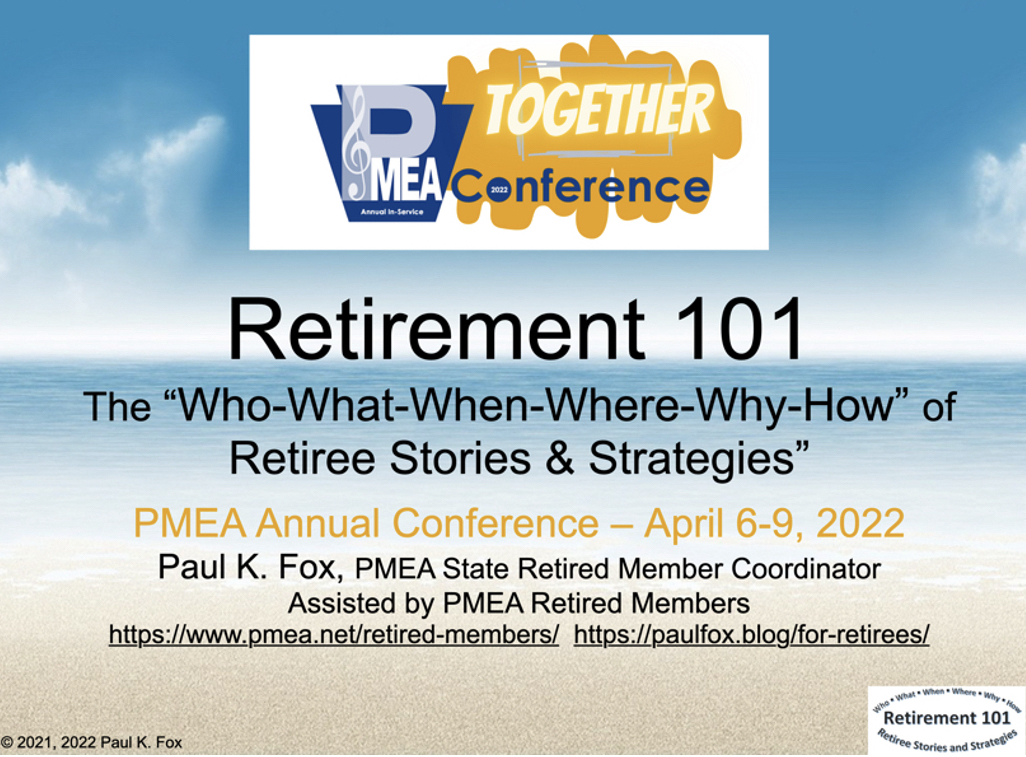
- Retirement 101 session on April 8 at 11:30 a.m. – Retired music teachers are encouraged to participate on the guest panel to “tell your own story” to help any interested soon-to-retire colleagues.
- Three keynote speakers will join this year’s event: Dr. Tim Lautzenheiser, Lesley Moffat, and David Wish.
- The U.S. Army Band “Pershing’s Own” will be featured on Thursday evening (April 7).
- See last month’s blog for more details on the conference, tentative session schedule and exhibitors, AND the PMEA website.
PKF
© 2022 Paul K. Fox
Graphics from Pixabay.com:





 paulfox.blog