The “New” Model for Modern Music Education

by Katherine Langford

We welcome this month’s guest blogger, Katherine Langford, who describes herself as “a digital marketing consultant, writer, freelancer, WordPress enthusiast, and coffee lover.” Thank you, Katherine! PKF

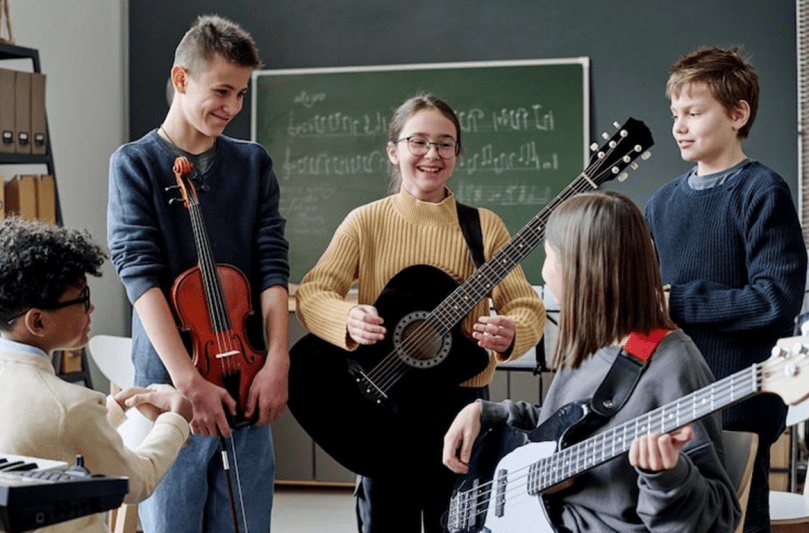
Music education has transformed dramatically in recent years. Traditional classrooms and rigid lessons are giving way to creative, flexible learning models that blend technology, collaboration, and real-world experience. The new model for modern music education isn’t just about mastering an instrument anymore—it’s about nurturing creativity, adaptability, and digital fluency.

Whether you’re a teacher, a student, or a parent trying to understand this shift, this guide will walk you through everything you need to know about the new model for modern music education and how it’s reshaping the way we learn, teach, and perform music.

What Defines the “New” Model for Modern Music Education?

The new model for modern music education is built on accessibility, inclusivity, and innovation. In the past, learning music often required private lessons, expensive instruments, and long practice hours under strict instruction. Now, technology has made learning more interactive, affordable, and engaging.

This model integrates online platforms, digital tools, and peer learning to create a dynamic environment. Students can watch video tutorials, join virtual ensembles, or even receive online class help from experienced musicians. It allows learners to progress at their own pace while receiving instant feedback and guidance.

Another major shift is the focus on creativity over perfection. Instead of emphasizing technical mastery alone, educators now encourage improvisation, digital composition, and personal expression. This approach builds confidence and helps students connect emotionally with their craft.

The Rise of Online Learning in Music Education

Online learning has become a cornerstone of modern music education. With platforms like YouTube, MasterClass, and specialized e-learning sites, anyone can access lessons from world-class musicians. Students can now learn piano, guitar, singing, or music production without leaving home.

These online classes are highly interactive, offering personalized feedback and practice tools. Some programs include live sessions, enabling real-time interaction with instructors and classmates. The flexibility to study from anywhere attracts learners of all ages and skill levels.

Online music education also supports busy professionals and students balancing multiple commitments. Many ask, Can I take my online class for music while working full-time? The answer is yes. With self-paced modules, recorded lessons, and flexible scheduling, anyone can continue learning without disrupting daily life.

Key Features of Modern Music Education

The new model for music learning focuses on a few core features that make it different from traditional instruction.

1. Technology Integration
Modern classrooms use music software, apps, and digital instruments. Tools like GarageBand, Ableton Live, and Sibelius help students compose, record, and edit their music. This hands-on digital experience prepares them for real-world music careers.

2. Collaboration and Global Access
Students can collaborate with others worldwide through online jam sessions or group projects. This exposure broadens cultural understanding and inspires new creative styles.

3. Personalized Learning Paths
AI-driven platforms now assess student progress and customize lesson plans. Learners receive targeted exercises that focus on areas needing improvement. This keeps motivation high and ensures steady progress.

4. Performance and Portfolio Building
Instead of graded recitals, students can build online portfolios, showcasing their songs or performances. This practical experience helps them prepare for music schools or careers in the industry.

Why Modern Music Education Matters Today

Music education today goes beyond traditional training. It prepares students for an evolving creative economy where adaptability and digital literacy matter.

The new model equips students with real-world skills such as sound design, audio editing, and digital marketing for music. These are essential for anyone pursuing a career in the modern music industry.

Additionally, it nurtures emotional intelligence. Creating and performing music helps students manage stress, improve focus, and build resilience. These soft skills translate into better academic and personal outcomes.

Another reason this new approach matters is its inclusivity. Learners who once couldn’t access quality lessons due to location or cost can now participate through online classes. Music education is no longer limited to elite institutions—it’s open to everyone.

The Role of Teachers in Modern Music Education

Teachers remain at the heart of music education, but their role has evolved. Instead of being strict evaluators, they now act as mentors, facilitators, and collaborators.

Educators guide students through self-directed learning, helping them explore interests while mastering key concepts. They encourage experimentation and critical thinking rather than rote memorization.

Teachers also integrate multimedia tools into lessons, using interactive notation software, metronome apps, and virtual instruments. This keeps learning engaging and relevant.

Modern instructors understand that today’s learners consume music differently. They balance traditional techniques with contemporary styles, helping students connect classical foundations to genres like pop, jazz, or digital soundscapes.
The Impact of Technology on Music Learning

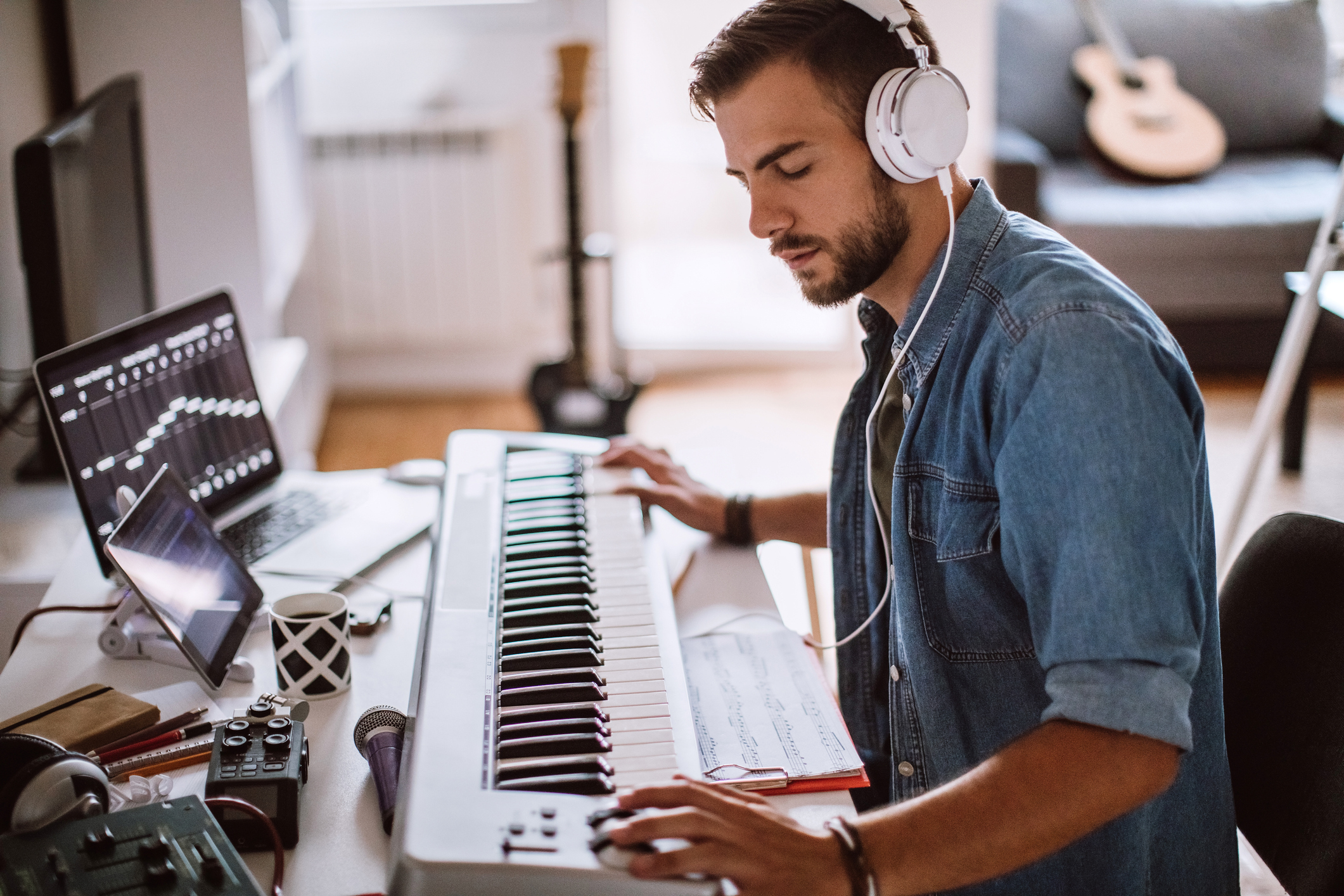
Technology has completely reshaped how music is created and taught. From recording studios to smartphone apps, innovation drives engagement and creativity.

Students can record, mix, and share their music instantly. They can join online communities, collaborate virtually, or receive detailed feedback through smart analysis tools.

Some schools use virtual reality to simulate live performance environments. This helps students overcome stage anxiety and refine their skills before performing in real-life situations.

Moreover, digital sheet music platforms make learning more interactive. Instead of flipping pages, learners can annotate, loop sections, and practice efficiently.

Technology also enables inclusive learning. Students with disabilities can use adaptive devices or apps that make instruments more accessible. This reinforces the principle that music truly belongs to everyone.

How Online Class Help Supports Music Learners

Many students struggle with consistency or technical challenges while learning online. That’s where online class help becomes valuable. Expert tutors assist learners in managing lessons, assignments, and projects.

They provide feedback, correct mistakes, and ensure students stay on track. This type of support bridges the gap between traditional mentoring and independent study.

For example, if a student is learning music theory but struggles with notation, they can seek online class help for one-on-one guidance. This approach ensures understanding without the stress of falling behind.

It’s especially useful for those pursuing formal music degrees remotely. Expert assistance ensures academic integrity while keeping the learning experience enriching.
Common Question: Is Online Music Education as Effective as In-Person Lessons?

Many learners wonder if virtual learning can match the impact of face-to-face instruction. The short answer is yes, it can be just as effective—sometimes even more.

Online music education offers flexibility and access to diverse expertise that local lessons may lack. You can study jazz composition with a teacher from New York or classical violin from a maestro in Vienna.

Additionally, digital lessons allow unlimited practice and playback. Students can review recorded sessions anytime, reinforcing understanding and mastery.

However, success depends on commitment and quality instruction. Active participation, consistent practice, and seeking feedback are key to thriving in online music education.

Challenges Facing the New Model for Modern Music Education

While modern approaches have many benefits, challenges still exist. Internet connectivity, lack of physical interaction, and screen fatigue can affect engagement.

Students may also struggle with motivation when learning alone. This is where teacher support and community involvement become crucial. Encouraging virtual collaborations and online performances helps maintain enthusiasm.

Another concern is access to instruments. Not every learner can afford quality equipment or digital tools. Schools and institutions need to bridge this gap by providing resources or scholarships for talented students.

Despite these obstacles, the benefits of digital and hybrid learning far outweigh the drawbacks. With ongoing innovation, these challenges are gradually being addressed.

The Future of Modern Music Education

The future of music education looks bright and interconnected. We’ll see more hybrid classrooms combining online and offline experiences. Students might attend physical rehearsals while collaborating digitally with international peers.

Artificial intelligence will continue shaping learning paths, analyzing performances, and suggesting improvements. Virtual and augmented reality will simulate live concerts and recording studios for immersive training.

Most importantly, inclusivity and creativity will remain the foundation of this evolving system. Every learner, regardless of background, will have the opportunity to express themselves musically.

The new model is creating musicians who not only play instruments but also understand technology, production, and storytelling. They’ll be ready to thrive in an industry that values both art and innovation.

How Students Can Get the Most Out of Modern Music Education

If you’re a student exploring the new world of music learning, here are some helpful tips:

  1. Set clear goals. Decide what you want to achieve before starting lessons.
  2. Stay consistent. Practice regularly, even if only for short sessions.
  3. Use technology wisely. Try apps, online lessons, and recording tools to track progress.
  4. Engage with others. Join online groups, perform live sessions, and exchange feedback.
  5. Seek guidance. Don’t hesitate to reach out for online class help when needed.

These small steps ensure that your learning remains enjoyable and productive.

The Cultural Shift in How We Value Music Education

In the past, music education was often viewed as a luxury. Today, it’s recognized as a vital part of cognitive and emotional development. Studies show that learning music improves memory, discipline, and communication skills.

The modern model has made music more inclusive, integrating it into mainstream education and digital life. Whether through school programs, online platforms, or personal study, students now see music as both an art and a skill for life.

Cultural acceptance has grown too. Parents now appreciate the value of creative subjects, realizing they develop critical thinking and empathy. This shift has expanded the reach of music education across age groups and professions.

Conclusion: Embracing the New Model for Modern Music Education

The new model for modern music education is more than just a trend, it’s a necessary evolution. It reflects how we live, learn, and connect in the digital age.

By combining technology, collaboration, and creativity, this approach empowers learners to explore their potential fully. Whether you’re learning to produce music, master an instrument, or compose original songs, the tools and opportunities are at your fingertips.

PKF

© 2025 Katherine Langford and Paul K. Fox
Engaging Retiring/Retired Educators

Ask not what NAfME or your state MEA can do for you, but what YOU, a retiree, can do for your professional association and music education.
An adaptation of the famous excerpt from the 35th U.S. President John F. Kennedy’s inaugural address of January 20, 1961.

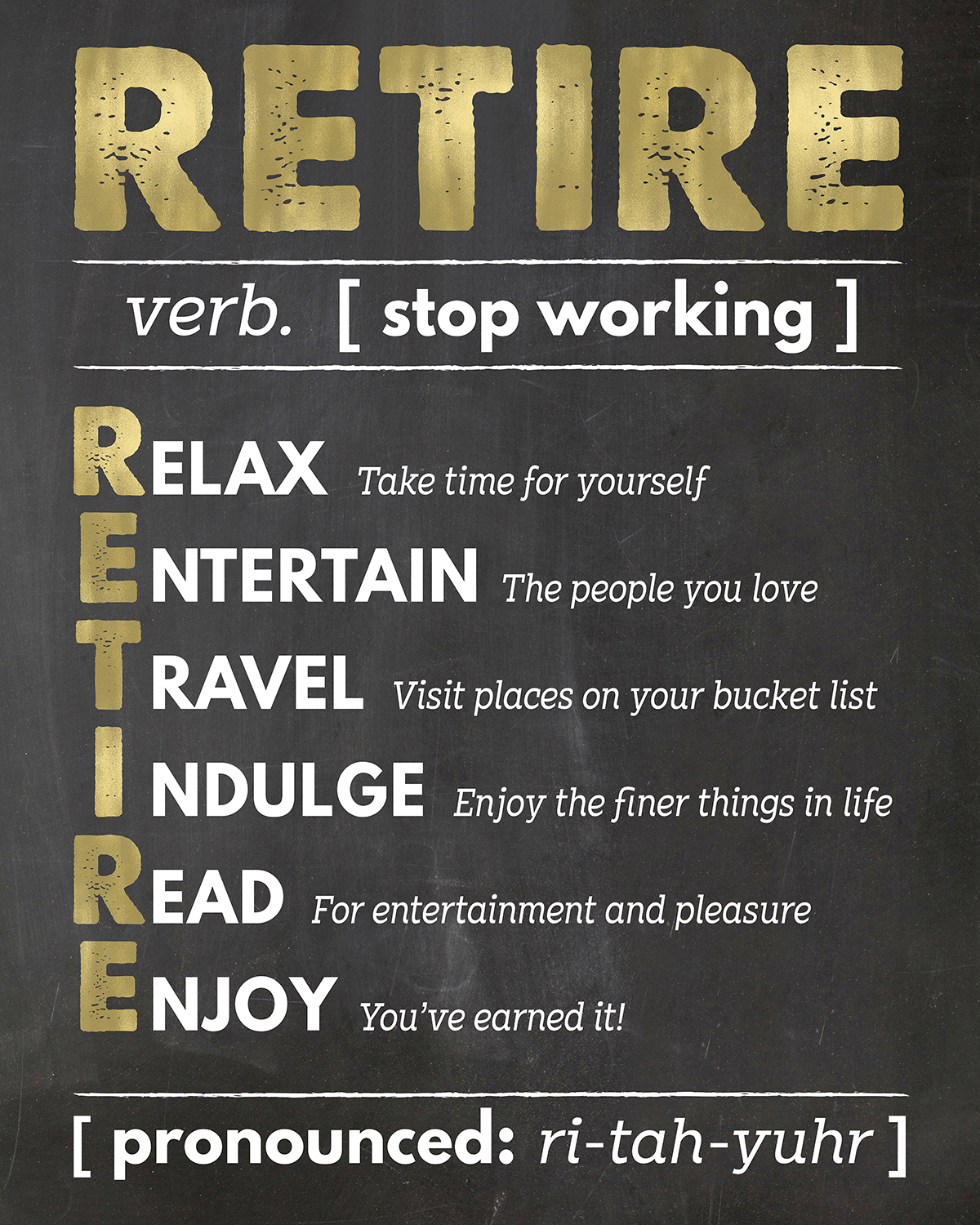
Surfing the ‘Net, I found an appropriate acronym for R.E.T.I.R.E. by Tangled Tulip Designs in pinterestRelax, Entertain, Travel, Indulge, Read and Enjoy! Most retirees would probably agree! The cessation of full-time employment may offer a great release from the day-to-day stress and drudgery of the job and the freedom to venture out, self-reinvent, make future goals, nurture relationships, and explore new personal growth opportunities.

Many attribute embracing a career in music education as “a calling” as opposed to just a form of employment or livelihood. From my experience, I have witnessed that most music educators are passionate for the cause of fostering creative self-expression in their students, more of a 24/7 mission, bringing intense focus and dedication to their lifework.

More to the point: Do we ever truly retire from making music ourselves and fostering this love in others?

THE “WHY!” Retirees matter and are critically needed!

One of my favorite inspirational speakers (Simon Sinek) would say, “start with the WHY!” WHY is this discussion on professional engagement of retired educators so important today?

  1. Their need: An informal poll of my former local educators and administrators revealed that half of them “hate retirement!” According to Dr. Robert P. Delamontagne in his book Retiring Mind (Fairview Imprints), “50% of retirees will suffer some form of acute emotional distress. This is potentially a very large problem given the fact that 10,000 people are becoming eligible for Social Security every day for the next 20 years in the US alone.” Remember this statistic the next time a senior citizen cuts you off on the road or bangs a shopping cart into your leg at the checkout!
  2. Our need: We are facing shortages of qualified teaching candidates across the country with unfilled openings in public school music positions and the critical need of training/mentoring the new hires.
  3. Society’s need: All of our voices should be combined to support the advocacy of music education, actively promoting access to school music by sharing its academic and social benefits with decision-makers, building relationships with administrators and policymakers, and utilizing resources from organizations like NAfME and the NAMM Foundation.

Despite its proven benefits, music education is often the first program to face budget cuts in schools. This is especially concerning in underserved communities, where access to music programs can be life-changing. Now more than ever, we must advocate for music education to ensure that every child has the opportunity to experience its benefits. Investing in music education is an investment in the future of our communities — helping to cultivate the next generation of creative, resilient, and innovative leaders. 
“Why Music Education Matters More Now Than Ever” by Music Will, February 2025

For eleven years (and counting), I serve as the Pennsylvania Music Educators Association (PMEA) Retired Member State Coordinator, as well as the Past State Chair (current member) of the PMEA Council for Teacher Training, Recruitment and Retention. I believe my responsibility to the state association is two-fold:

  • Assist soon-to-retire professionals in achieving a smooth transition to a happy and satisfying retirement; to help them cope with the commonly-experienced emotional ups-and-downs of this life passage, wrestling with the question “what do you want to be or do when you grow up?” and making new life lesson plans and personal goals.
  • Reach out to and build meaningful connections with retirees in order to fully engage them towards becoming active in their professional association; to recount, represent, and revitalize the activities of our post full-time employed music educators.

This article proposes a roadmap of crucial pathways to help music teachers approach “retirement bliss” while tapping into their hard-earned knowledge, strengths, and experiences by cultivating the benefits of their renewed participation in our professional associations.

What can NAfME and State MEAs offer retirees?

You have devoted your entire life to inspiring the development of personal artistry and “ah-ha” musical moments in others. Now it is your turn to reap the benefits (and privileges) of this commitment to the profession. NAfME and your MEAs can provide the resources and motivation of “sharing and caring,” directing retirees “places to go, people to meet, and things to do” for fulfilling that “next chapter” or (perhaps better terms) the “refirement” or “rewirement” of senior living.

Do you feel “needed” and know you “make a difference?” Research has shown that the one of the most important motivators for involvement in a professional association is that its members recognize that they are essential to its success. This quote is from Revitalizing Retirement: Reshaping Your Identity, Relationships, and Purpose by Nancy Schlossberg, attributed to Rosenberg/McCullough:

 “It has been suggested that one problem of retirement is that one no longer matters; others no longer depend on us… The reward of retirement, involving a surcease from labor, can be the punishment of not mattering. Existence loses its point and savor when one no longer makes a difference.”

Most people who are one to five years away from “pulling their pin” and putting in their walking papers “do not know what they do not know.” Experts agree: “Retirement preparation is not only about the money!” Our silver-haired colleagues who have already Crossed the Rubicon and are now “living the dream” in retirement can share their trials, tribulations, and (more importantly) numerous success stories about coping with this transition!

NAfME, PMEA and this paulfox.blog/for-retirees site have archived an exhaustive number of self-help articles. Check out this omnibus NAfME blog “Retirement Prep Top-Ten Treasures.”

The benefits of retired MEA membership are numerous. Besides providing helpful transitioning advice, these advantages also come to mind:

  1. Answers to questions like “What have you always wanted to sing, compose, play, record, conduct, write, publish or present?” and “Where can I share my hard-won expertise and help others in the field?”
  2. Networks and contacts to help you develop “encore careers” in other musical or educational arenas (e.g., higher education, music industry, festival organization, travel/tour planning, composition, guest conducting, private studio teaching, church music, etc.)
  3. Opportunities to “rekindle your expressiveness” by participation in adult community or full/part time performance groups (playing “gigs”)
  4. Places to go/things to see/hear: NAfME/MEA conferences, workshops, and concerts
  5. Exclusive discounts and other benefits (reduced dues and registration fees)

What can retirees offer NAfME and their state MEA?

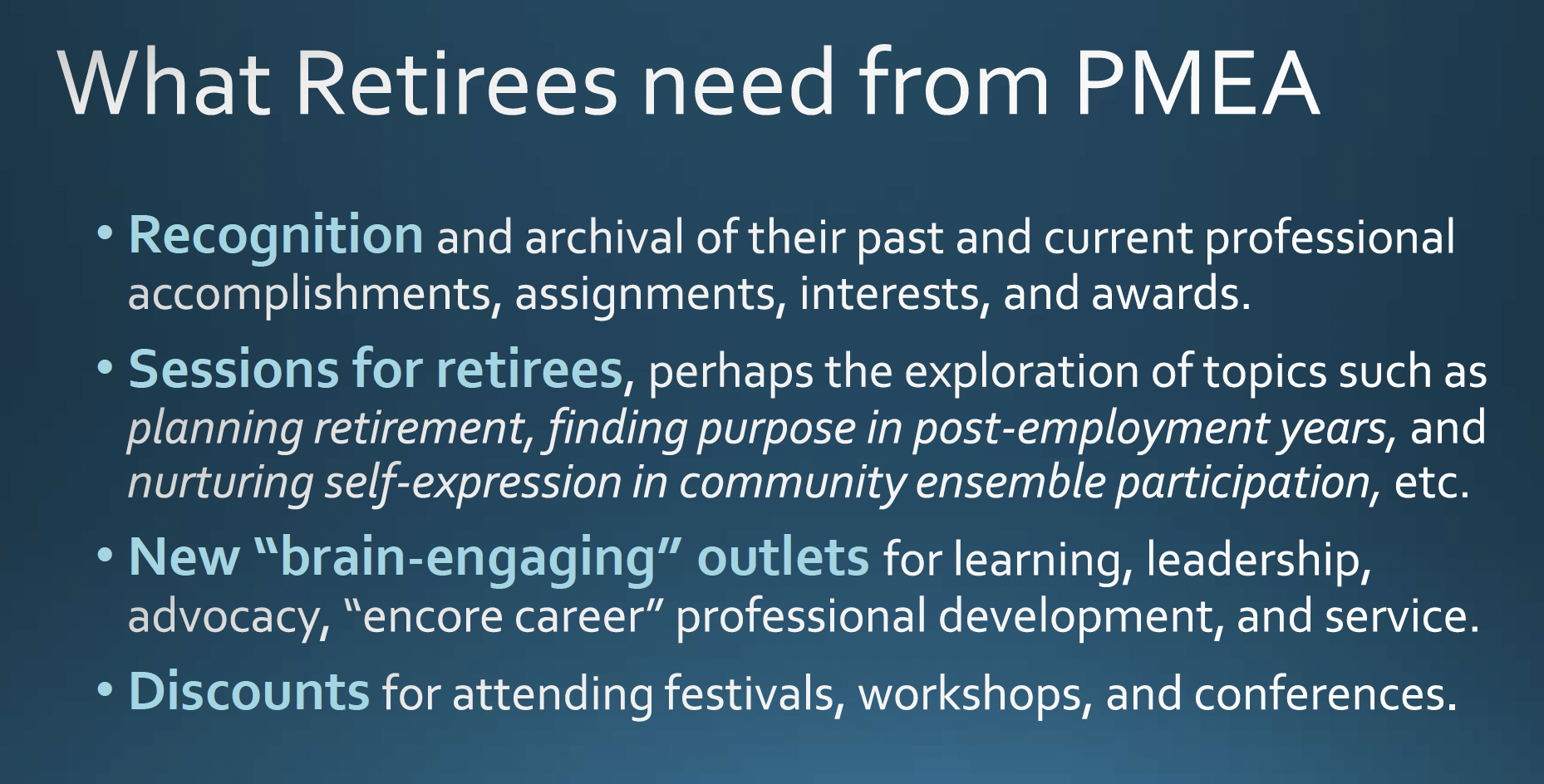
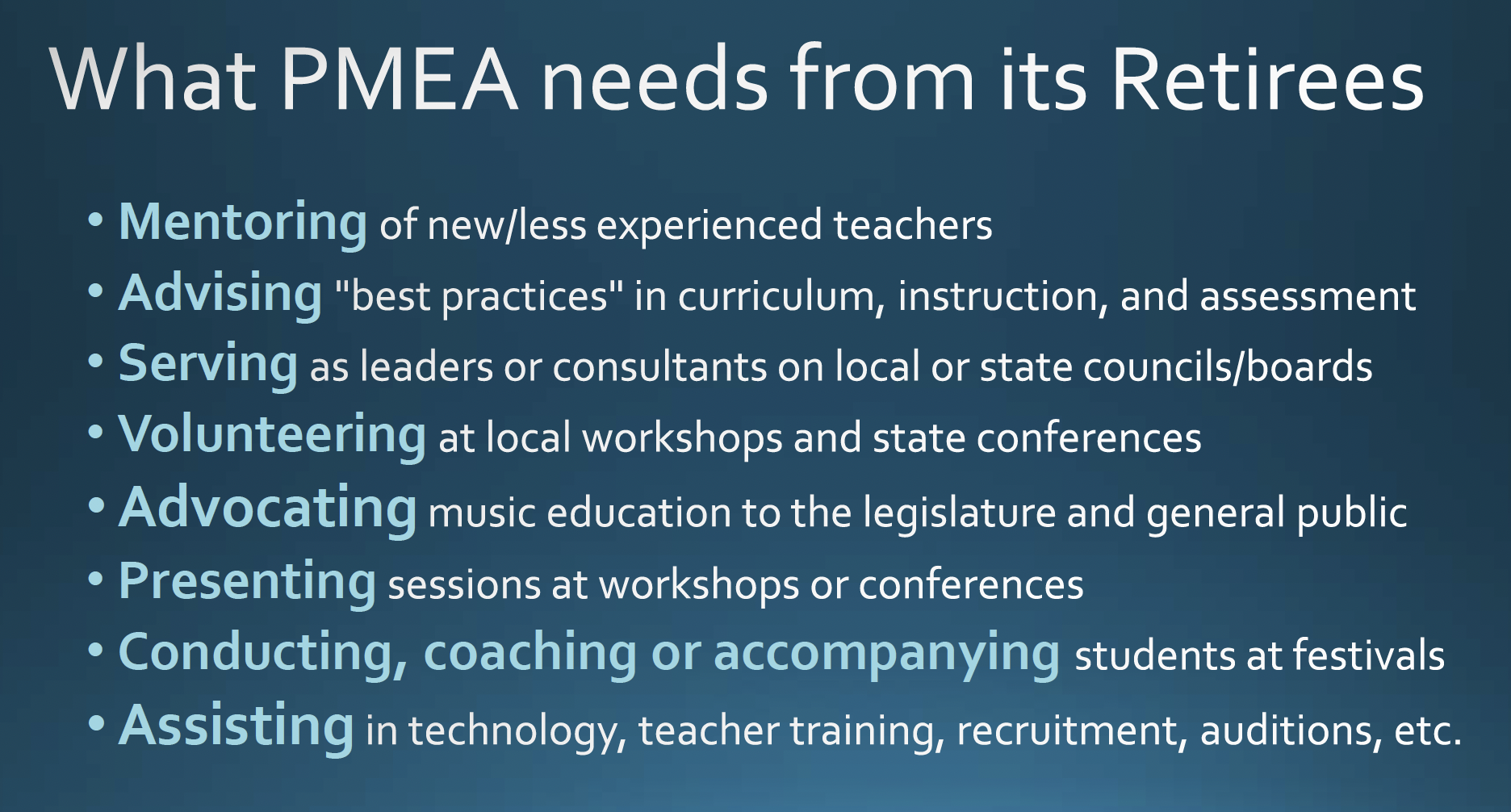
The relationship of active and retired membership in our MEAs is symbiotic. We know from the history of our associations, “giving back to the profession” remains a high priority with most retirees. This may come in many forms and settings:

  • Leadership or membership in local, state, or national MEA/NAfME office, staff, advisor, or council/committee position
  • Advocates for the promotion of music education to local and state government officials
  • Service as presiding chair or member of the conference or workshop planning committee
  • Service as evaluator of performance groups, conference sessions, or articles for publication
  • Judges of local/state MEA adjudication or commercial festival
  • Accompanists, coaches, arrangers, or guest conductors for festivals or school/community groups
  • Services to the local music teacher in private teaching, piano playing, marching band charting, sectional coaching, choreography, music technology, instrumental repair, stage tech, etc.
  • Writers for state MEA and NAfME publications and blog sites
  • Contributors to online music education forums or the NAfME Connections
  • Donors to and/or fund-raisers of music education charitable projects, scholarship initiatives, etc.

The PMEA Model of Retired Member Participation

PMEA values the vast wealth of experience and contributions of our retired members. We’re proud of the many programs we offer to retirees and invite you to visit our website to peruse additional information and sample digital newsletters and articles.

Retired members in Pennsylvania are involved in:

  • PMEA elected and appointed offices, staff, committee chairs, and membership on councils
  • PMEA Strategic Plan and Bylaws, Conference Planning, and other state/regional committees
  • Retired Resource Registry* (informal mentoring for new teachers and transfers)
  • How-to-Retire Webinar, Prepping for Retirement, and the Ultimate Retiree Resource Guide
  • Retired Member Breakfast at PMEA Annual Conference
  • Retirement 101 (The Who, What, When, Where, Why, and How) session at PMEA Annual Conference (training for all members retiring or soon-to-retire)
  • Maintenance of PA Community Band, Chorus, Orchestra, and Theater group catalogs
  • Maintenance of PMEA member compositions library
  • Mock Job Interview Committee for music education majors
  • Coffee & Conversations informal “ask an expert” lounge at PMEA Annual Conference
  • Volunteering as presiding chairs for sessions and registration aides at conferences/workshops
  • Pool of conference clinicians, guest lecturers, and members on discussion panels
  • Participation in “Sponsor a Collegiate to Attend the Conference” campaigns
  • All-State Program Patron, or contributor to the annual Irene Christman Scholarship or Margaret Bauer Grant programs.

As of October 1, 2025, there are 61 advisors in the PMEA Retired Resource Registry.

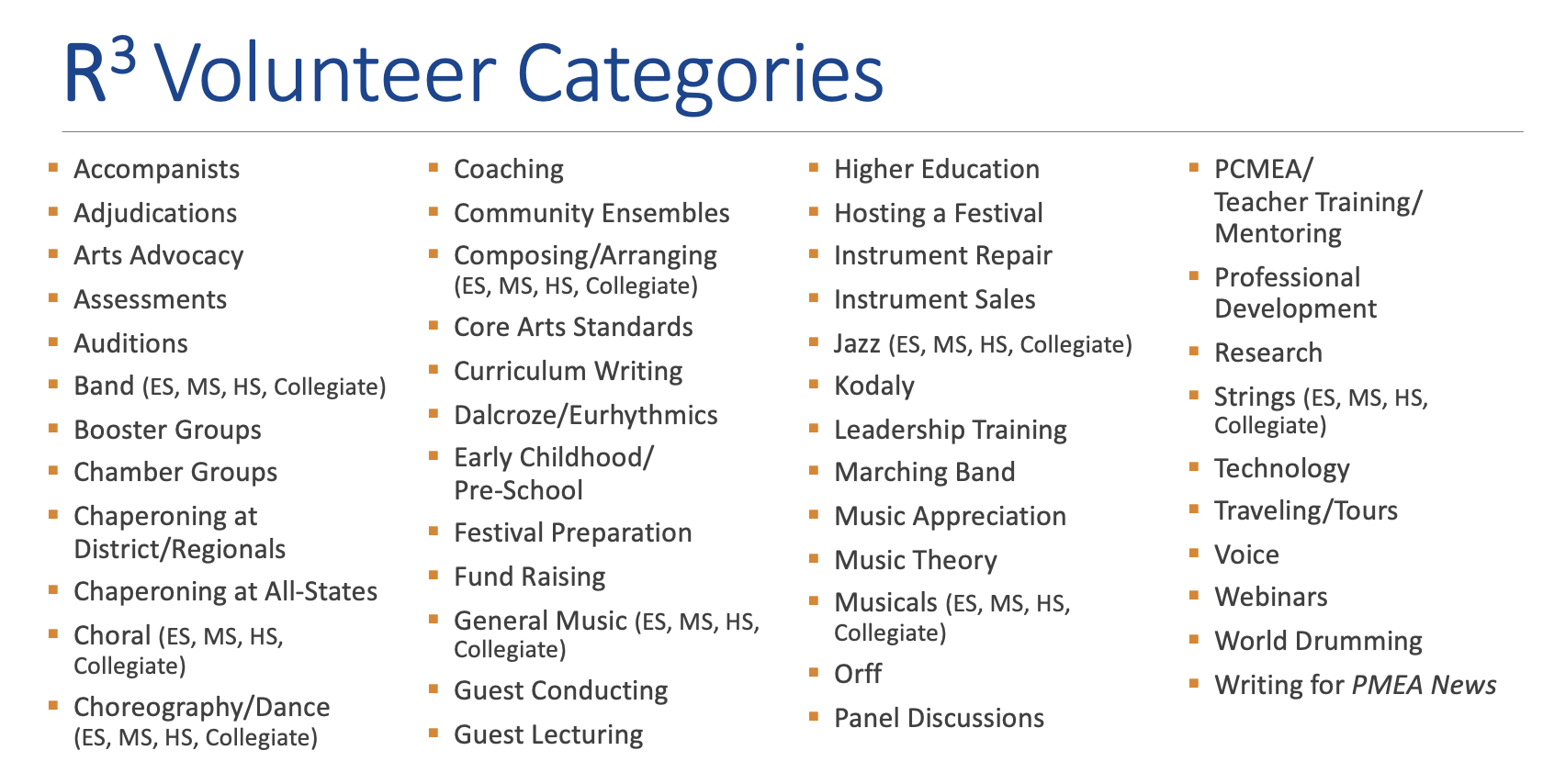
*During their annual membership registration, PMEA Retired Members may choose to sign-up for the R3 Retired Member Registry (above volunteer categories) to become available to informally offer advice to college music education majors, new hires, transfers, and newcomers to any music specialty. R3 members may handle inquiries like “What warm-up would you recommend for my middle school choir?” OR “Do you have an idea for an elementary string ensemble concert opener?” OR “How do you teach improvisation… steady beat… breath support?”

The other option with more time commitment is that Retired Members can be officially “trained” as a PMEA Mentor and be assigned to specific individuals who request assistance in their early career assignments.

Coda

How can we help?

What is the future of retired music educator professional engagement? In a word: connections!

Last month, I reached out to Elizabeth Welsh Lasko, NAfME Assistant Executive Director for Membership, Organizational Development, and Marketing Communications and “volunteered” OUR assistance. I suggested that, in keeping with the NAfME 2022 Vision Statement “…an association where all people are heard, seen, and feel they belong throughout their lifelong experiences in music” we should all intentionally recruit more hands-on involvement of our retirees. I pointed out that in the late 1980s, we had a Music Educators National Conference (MENC) Committee for Retired Members led by a National Chairman who served on the NAfME National Assembly. (An excellent booklet, TIPS: Retirement for Music Educators, Copyright © 1989 MENC, was compiled by A. Verne Wilson, then the Past National Chairman of the MENC Committee for Retired Music Educators.)

Ms. Lasko encouraged me to “reach out to retirees” beginning with this article. At the next NAfME Eastern Division Conference, I plan to hold a meeting of retired members, and also connect with all state MEA retired member coordinators (those states who have them). We’re available and on the move! Let’s collaborate and share our resources!

Finally, just for fun, I recently posted the blog “For Book Lovers – Retired or Not” on NAfME Connections (formerly called Amplify). There are already 1,810 members in the NAfME “Retired Members Community.” Please JOIN US! Using this forum, get in touch with me, and respond with YOUR OWN retirement stories, strategies, perspectives on this “life passage,” and more ideas to grow the professional engagement of our music teacher retirees.

Happy trails!

© 2025 Paul K. Fox
Returning to the Classroom in Retirement

Smart Planning for a Fulfilling Experience

Blog photo credit: pexels-cottonbro-6158658

In a past retirement articles (e.g. this one) and conference or workshop presentations for soon-to-retire music educators, I echoed the views of my esteemed music education colleague Dr. John D’Ascenzo on the importance of post-employment learning. (He earned his PhD after his retirement from teaching!) John shared three primary concepts with references: “Swim like a shark” (encouraging retirees to continue long-term pursuits that involve personal and professional growth; the analogy: sharks never stop swimming – even in their sleep!); “Lose the fear of failure and need for approval” (promoting strategies to build confidence and self-efficacy); “Network, Network, Network.” (developing more social and professional interactions, activities not necessarily centered on music or education, but those that broaden horizons by producing personal satisfaction and a sense of purpose and maintaining overall health). See page 5 in the PMEA Retired Member Network eNEWS, August 2018

Ed Carter, our guest blogger for March 2025, brings us new perspectives on a return to education and self-reinvention once retirees choose to “pull their pin” and leave their initial profession. Previous articles by Ed Carter at this site include Monetizing Our Skills and Passions – Creative Ways for Musicians to Make Money Beyond Gigs, Unleashing Your Sound – A Musicians Guide to Making Waves and Gaining Fans, Music and Literacy Skills – How to Use One to Improve the Other, and Do You Have a Side-Gig? Four Tips for Artists Seeking An Extra Income Stream. Thank you, Ed! (PKF)

Article by Ed Carter

Retirement marks the beginning of a new chapter, and for many, that includes the pursuit of education. Whether it’s earning a degree, gaining new skills, or exploring personal interests, going back to school later in life offers intellectual stimulation, social engagement, and personal fulfillment. However, it’s important to approach this decision with careful planning – considering financial factors, time commitments, and the right learning environment. With the right strategy, furthering education in retirement can be both rewarding and transformative.

Improving Campus Accessibility for Retirees

When considering a return to school during retirement, evaluating campus accessibility is vital. With a significant portion of retirees no longer driving, understanding available transportation options becomes crucial. Many campuses offer amenities like elevators and ramps, but these may not be comprehensive, posing challenges for those with mobility issues. By thoroughly researching and planning for these logistical aspects, you can significantly enhance your educational experience and ensure a smoother transition back to academia.

Upgrading Your Retirement with Online Education

Pursuing an online degree during retirement offers a flexible and convenient way to enrich your skills and knowledge. This approach allows you to balance studies with other commitments, making it an ideal choice for lifelong learning. Also, if you’re looking to enhance your leadership and project management abilities, the importance of bachelor of business management studies cannot be overstated. Plus the networking opportunities provided by such programs can lead to valuable connections and potential job prospects, as many positions are filled through personal referrals.

Rediscovering the Joy of Learning

When considering a return to school during retirement, it’s essential to focus on the joy of learning rather than career advancement. Embracing lifelong learning can significantly enhance your personal growth and satisfaction, offering a chance to stay mentally active and engaged. By adopting this mindset, you enrich your life and maintain relevance in a rapidly changing world, even if re-entering the workforce is not your primary goal.

Budgeting for Education in Retirement

When planning to return to school during retirement, it’s essential to anticipate and budget for potential educational expenses. These costs can include commuting, whether through maintaining a personal vehicle or using public transportation. While these expenses might not be as high as when you were working, they remain significant. Additionally, technology expenses, such as purchasing a new laptop or software, can quickly add up. Supplies like textbooks and other materials are another area where costs can unexpectedly rise, impacting your overall retirement budget.

Choosing Between In-Person and Online Learning

When planning to return to education during retirement, weighing the benefits of in-person versus online learning is essential. Attending classes on campus can be challenging due to daily travel, which might be inconvenient if you live far from the institution. This could lead to increased costs and time spent on transportation, potentially affecting your overall learning experience. On the other hand, online classes offer the convenience of studying from home, eliminating the need for a commute and providing access to course materials at any time. This flexibility not only saves time and money but also allows you to manage other commitments more effectively. However, it’s important to consider potential feelings of isolation that can come with online learning.

Protecting Your Data in Educational Platforms

As you plan to return to school during retirement, it’s essential to understand the importance of safeguarding your personal data on educational platforms. The digital education sector is a significant repository of personal information, making it a target for cybercriminals. The education industry has been experiencing high rates of cyber threats, including phishing scams and ransomware attacks. To protect your data, it’s crucial to implement strong cybersecurity practices, such as being cautious of suspicious emails and ensuring your devices are secure against malware.

Volunteering: A Path to Enriching Retirement

Engaging in campus volunteering during retirement offers a fulfilling way to connect with diverse individuals and make a positive societal impact. By participating in community projects, you can build relationships with students, faculty, and local residents, fostering a sense of shared purpose. These initiatives often tackle important issues like environmental sustainability and educational support, allowing you to contribute to meaningful causes. Volunteering not only enhances personal growth by developing valuable skills but also strengthens community bonds.

Returning to school in retirement is more than just an academic pursuit – it’s an opportunity to grow, connect, and embrace lifelong learning. Choosing the right program, managing costs, and setting realistic goals can help ensure a meaningful and enjoyable experience. Whether for career advancement, personal enrichment, or the joy of learning, education at any age is a powerful investment in yourself and your future.

© 2025 Paul K. Fox and Ed Carter
Unleashing Your Sound: A Musician’s Guide to Making Waves and Gaining Fans

Guest Blog-Post by Ed Carter

Editor’s Note: I am taking several weeks off (a retiree’s summer vacation?) from writing articles and creating new material or proposals for workshop presentations on “the life cycle of a music educator – from preservice training to retirement.” Frequent guest contributor Ed Carter (see his past blogs here, here, and here) has graciously offered the piece below on advice for musicians to promote/market their music. Thanks for your insight, Ed!

In today’s digital age, getting your music discovered isn’t just about creating great art; it’s about strategic visibility and connection. For musicians, the realm of possibilities is expansive, yet selecting the right path can significantly influence your success. This article shared courtesy of Paul K. Fox delves into practical strategies to amplify your presence, engage with your audience, and carve a distinctive niche in the bustling world of music.
Dive into the Heart of Your Community

Embracing local music festivals and events can be a game-changer for your music career. These gatherings are not just events but a vibrant ecosystem of music lovers eager to explore new sounds. By participating, you’re not merely performing; you’re immersing yourself in a community that thrives on discovery. The connections made here, both with fans and other artists, can lead to collaborations and opportunities that extend far beyond the festival grounds.

Creating a Website

In the era of streaming, the significance of owning your distribution channel cannot be overstated. Setting up your own website brings your music directly to fans without intermediaries. This approach not only boosts your earnings but also strengthens your relationship with your audience. Offering exclusive content or merchandise can further personalize the experience, making your listeners feel like part of a special circle.

Crafting the Perfect Pitch

Waiting for discovery is a path of uncertainty. Seize the initiative by reaching out to publishing and media outlets with your music. Crafting a compelling pitch requires understanding what makes your music unique and conveying it in a way that resonates with journalists and bloggers. This proactive approach can lead to coverage that boosts your visibility exponentially, attracting new listeners and opening doors to new opportunities.

Mastering the Business of Music

Consider bridging the gap between music and marketing by going back to school for a business degree to sharpen your business acumen, essential for marketing and selling your art. A business degree equips you with vital skills in marketing strategies and financial management, crucial for a sustainable career in the arts. The convenience of online degree programs allows you to pursue education while continuing to create. Indeed, this could be the ticket to not just creating art but making a living from it.

Develop a Press Kit

A well-crafted press kit can be your passport to gaining attention in the music industry. This toolkit should encapsulate your music, personality, and achievements, providing a comprehensive snapshot to journalists and industry insiders. High-quality photos, a compelling bio, and standout music samples can make your press kit an irresistible introduction to your sounds.

Hosting Your Own Event

Why wait for an invitation when you can create your own event? Hosting your own event or showcase puts you in the driver’s seat, allowing you to present your music exactly as you envision it. This initiative not only demonstrates your entrepreneurial spirit but also creates a buzz around your work, attracting both fans and industry professionals to see what you’re all about.

Harmony and Philanthropy

Aligning your music with charitable causes is a powerful way to expand your reach while contributing to the greater good. Offering your talents for charity events or auctions showcases your commitment to social causes and can endear you to a broader audience. This approach not only elevates your profile but also enriches your musical journey with meaningful connections and experiences.

The journey to getting your music discovered is multifaceted, requiring creativity not just in your art but in your approach to marketing and community engagement. By exploring local music festivals, leveraging your online presence, and engaging directly with the media, you’re building a foundation for success. Supplementing your artistic talents with business skills and giving back to the community add depth to your career, making your music resonate on a deeper level. With dedication and strategic effort, your sound can rise above the noise, connecting with fans and opening doors to new opportunities.

© 2024 Paul K. Fox
Bookends – Part Two

The Life Cycle of a Successful and Happy Music Educator

Joyous Holidays, Season Greetings, and Happy New Year from “The Foxes!” This is a time for reflection and gratitude… and we feel blessed for all the opportunities allowing us to share our insights, gifts and experiences with other music education professionals.

We hope to inspire YOU and literally model the concepts in this blog series. We continue with our discussion first introduced a month ago in Bookends – Part One – The Life Cycle of a Successful and Happy Music Educator, exploring:

  • Stage 3: Inservice/Growing Years (this blog)
  • Stage 4: Veteran/Sustaining Years (future blog)
  • Stage 5: Next Chapter/Living the Dream (future blog)

This article is an abstract from a session presented to Seton Hill University music education student teachers on October 17, 2023. Click on this link to download the slide summary in PDF format.

“I have written a lot of articles in support of these topics… now compiling them for your easy access. Depending on your current status and interests, feel free to peruse the checklists (links) in this series. It is possible a few of the resources contained within these blogs have gone inactive, but I believe enough are there for you to gain the insight, tools and motivation to achieve professional development for life.”

– Paul Fox

Stage 3 – Inservice/Growing Years

[ ] 8. Becoming a Music Educator: For a review of Bookends – Part One, take a step backward and revisit what you have done to “get ready” for your “rookie years.” Take special note on the things-to-do list (“secrets”) as a first-year educator (perhaps completed during your student teaching semester):

  • Subscribe to a discounted NAfME + PMEA first-year membership (If you are a recent college graduate in your first year of teaching, or if you are the spouse of a current or retired NAfME member, contact NAfME at 800-336-3768 or email memberservices@nafme.org) to find out if you qualify for a reduced rate.
  • Hook up to PMEA Mentor or other state’s MEA support program for new teachers.
  • Look into finding an informal advisor in the PMEA Retiree Resource Registry for PA music teachers.
  • Need to fill in a few gaps missing from your college courses in skills and knowledge? Continue your “enrichment” viewing PMEA Webinars and the exhaustive video library in the NAfME Academy.
  • Take advantage of earning professional development credits just for reading an article in the NAfME Music Educators Journal
  • At some point you will be writing/editing curriculum, so research the awesome resource of Model Curriculum Framework (Have to be a PMEA member)
  • Too busy to participate in the PMEA Annual Conference or NAfME national events? Look into going to a PMEA summer conference (usually at a lower-cost!). Check out your own state’s MEA discounts and offers for collegiate members and new teachers!
  • Numerous free and timely blog posts from NAfME Music in a Minuet and here (paulfox.blog).

[ ] 9. The Care & Feeding of Your Principal: Although not covered in any detail during the Seton Hill University presentation, it is recommended that you read in its entirety “The New Teacher’s Guide to Fostering Positive Relations and Good Interactions with School Administrators” offering a wealth of excellent recommendations from these trustworthy sources:

A favorite question I pose to college music ed seniors is, “In what professional associations are you a member and actively involved?” For the price of consuming one fewer Starbucks latte a week, you can open up the Wonderful World of “C’s” – Contacts, Coachings, and other Connections, including research and resources that will benefit your Continuing Education. You can’t afford NOT to join groups like these.

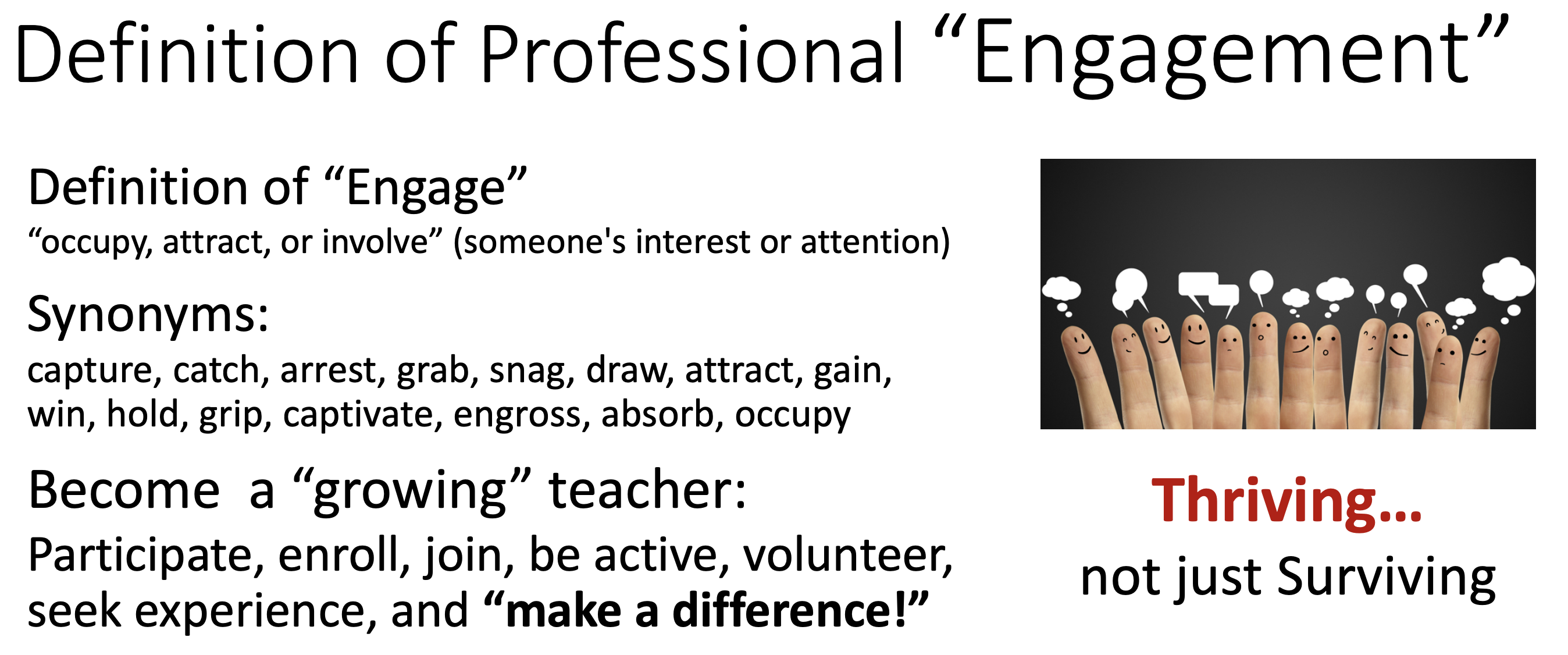
To help “nail down” a few related definitions critical to personal growth and career development in our profession, especially “engagement,” “professionalism,” “collaboration,” and “networking,” please take a little time to travel and consume the following archived blog postings.

[ ] 10. The Meaning of PRO: This is one of the oldest articles at the paulfox.blog site. How about a little soul searching? Are you truly a professional? Do you have the skills, habits, and attitudes of a professional in the field of education?

[ ] 11. Transitioning from Collegiate to Professional (Part II): New teachers have to move away from “book learning” or higher education research and emphasize “practical application,” and at the same time, assess the precise areas needed for immediate (re-)training… everything from new exposure to specialized teaching areas and grade level focus for the job to which you have been assigned, to the enhanced skills of classroom management, student assessment, curriculum writing, class or ensemble warm-up materials, music repertoire and programming, etc.

While we are on the subject, it is important to intentionally seek out mentors or consultants in your early years of becoming an educator. PMEA offers a mentoring program (read all about it here) and PMEA Retired Members are also an excellent resource to “phone a friend” for advice as needed (see their section on the PMEA website here). That leads us to the next most essential “habit” of attending professional conferences… #12 below.

[ ] 12. Getting the Most Out of Music Conferences: Our PMEA Annual Conference sites are cyclical. This article, written on March 5, 2017, showcased that year’s event at the Erie Bayfront Convention Center – coincidentally the same location for this year’s PMEA Annual Conference: April 17-20, 2023. For a sneak peek at the proposed sessions and guest performers, click here.

There are a myriad of conferences offered every year… something for everybody in just about every state. Make plans to go, “recharge your batteries,” and pick up new state-of-the-art ideas, lessons, music, technology, etc. Again, you cannot afford NOT to attend… or becoming stale in your teaching or “stuck in a rut!” Besides, going to your state’s or national conferences and regional workshops are FUN places to meet other like-minded, inspiring colleagues! This is how professionals network, collaborate, and share their “latest and greatest!

A couple upcoming events:

What are you waiting for? It’s time to DIVE INTO your customized career development!

Coming Soon…

Bookends Part Three – Stages 4 & 5

PKF

© 2023 Paul K. Fox

In Case You’re Worried… the Status of “The Fox”

If you are a frequent visitor to this blog site, you may have noticed that, for some reason, I haven’t posted anything for almost two whole months. Cat got my tongue? Nothing to add? Busy with other things?

We have been doing what comes naturally! The most important “stuff!” Although hectic at times and in a frenzied pace, all is well! My wife and I are healthy, happy, actively engaged in the projects that matter to us, and mastering those all-essential ingredients in a healthy lifestyle (retired or not): “finding purpose, structure, and community” (reference to the book How to Retire Happy, Wild, and Free by Ernie Zelinski).

Well, I can tell you I am still vested in volunteering my expertise, experiences, and services on a number of fronts. Normally extremely verbal, I just have not had a couple hours to spare to write anything down or contribute to the voluminous material to what has become a massive archive of articles (editorials and how-to’s), links, and other resources.

What have I been doing lately?

First off, we are just finishing up our marching band season. As the official admin and announcer for the “Pride of Upper St. Clair” Marching Band (I spend my time inside, not directing practices on the fields), I attend all rehearsals as attendance bookkeeper, forms manager, librarian, quasi-nurse, and when necessary, act as a sounding board or shoulder to lean on for “the band director.” This was our first year going “competitive,” participating in regional festivals of Pennsylvania Interscholastic Marching Band Association (PIMBA), and by all accounts, “we” achieved excellence. The band is unrecognizable from past years – the students are much more committed and focused – but we still have a ways to go!

Of course, all during this, our football team made it to the playoffs. On Friday, we will support our team in the “first round” WPIAL Class 5A match at Gateway HS. The extended season brings with it challenges of its own (keeping the band members on-task and embracing new goals), but the rewards outweigh the extra rehearsals. And, all through this, we are making plans (and building excitement) for the launch of the first-ever USCHS winter guard and drumline programs!

Funny thing! I’m now a part of the band’s “brand.” For 38+ years, I have been “the voice” announcing the pregame and halftime shows for Upper St. Clair High School. I’ve also emceed a couple dozen of the USCHS Marching Band Festivals, plus senior recognitions, USC Halls-of-Fame exhibitions in the stadium, and outside music invitationals. It is truly a joy to “cheerlead” our musicians… and my wife would tell you, I have a very loud broadcaster’s voice! And now, ladies and gentlemen…

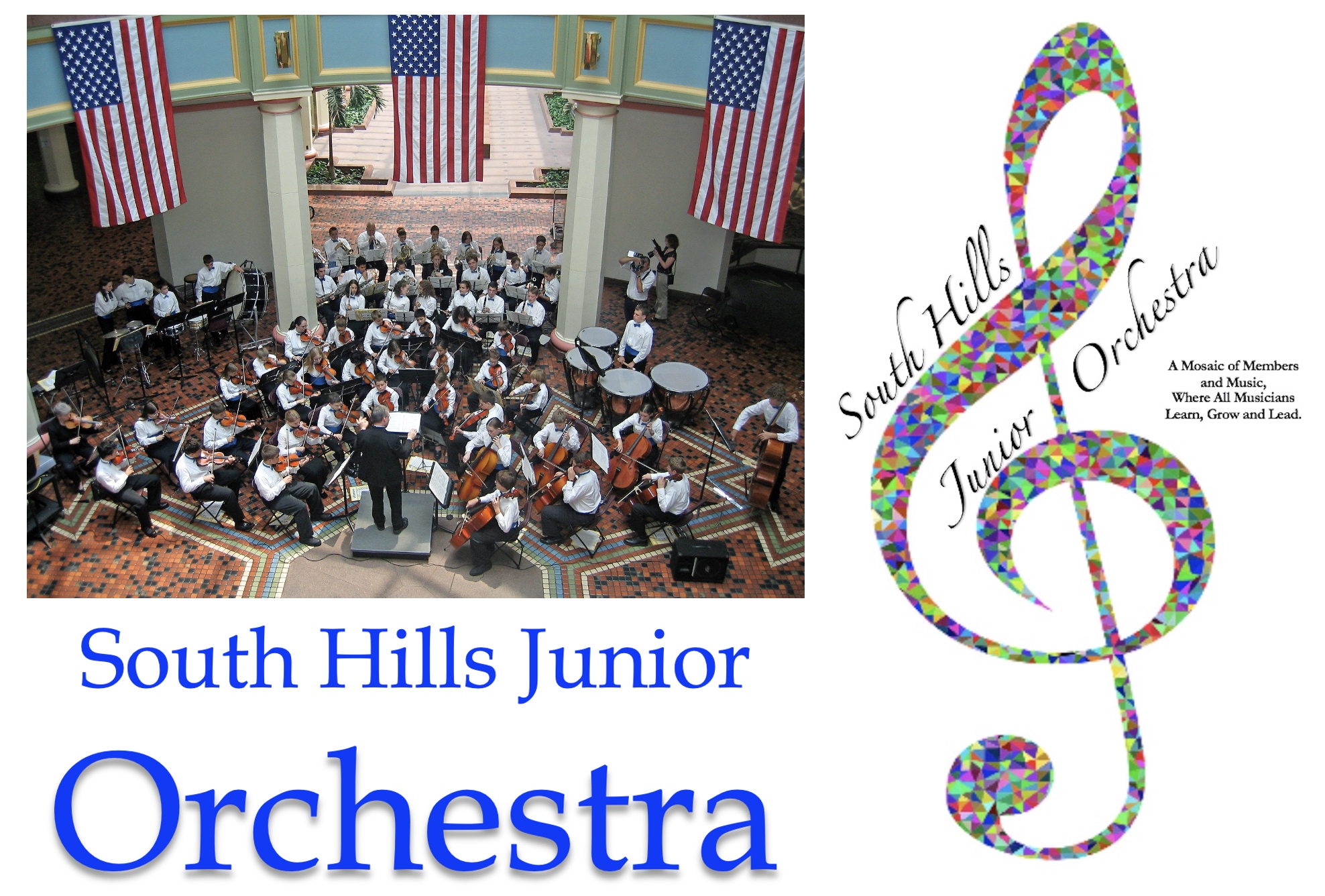
In two weeks, I will conduct the fall concert of our community ensemble South Hills Junior Orchestra, now in its 40th year. Although COVID did its best to wipe out our enrollments and recruitment efforts, our online academy kept things going, and we now support a small but dedicated chamber group. (Surprisingly, I have a good balance of instrumentation including sometimes rarely-found musicians on French Horn, bassoon, bass clarinet, electric bass, and piano, but one of my trumpet players is having to read clarinet parts.) Our theme is in support of Ukraine. We just “stumbled upon” several appropriate folk songs from the region, including the tribal tunes of Russian Fantasy (Robert Bennett Brown), the ever-popular Ukrainian Bell Carol, Dance of the Slave Maidens from “Prince Igor” (by Borodin, part of the “Russian Five”), and Slovakian Folk Songs (bordering Ukraine).

After this concert, we will prepare a holiday program for a nearby assisted-living facility with most of the SHJO members each taking a turn to conduct the sing-along of carols and seasonal favorites.

If interested, we warehoused a lot of our old SHJO Online Academy media and lessons here. (Use the password symphony.)

Staying involved in my professional associations, I am happy to report I was accepted to present at two conferences, the National Association for Music Education (NAfME) Eastern Division event in Rochester, NY on April 13-16, 2023 and the Pennsylvania Music Educators Association (PMEA) Annual In-Service at the Kalahari Resort/Poconos on April 20-22, 2023. I have been asked to do my interview clinic session at both conferences and a workshop for PMEA on music educator burnout remediation, self-care, health and wellness.

In the meanwhile, not to let any grass grow under my feet (or more leaves to fall on my head), locally I have been giving teacher ethics presentations at Slippery Rock University of Pennsylvania (a wonderful class of 44 freshman music education majors – the future looks good!) and Washington & Jefferson College undergraduate and graduate education majors.

I open my session offering to give a hundred dollar bill to the first student who can correctly name the exact title of their educator’s code of conduct (PA Code of Professional Practice and Conduct – CPPC) and identify the agency which enforces it (PA Professional Standards and Practices Commission – PSPC). No one ever guesses it. (I could also likely get away with this challenge at any school faculty meeting in the Commonwealth! Educators seldom receive formal ethics training in our state – that’s why I am sharing these recent updates from the PA Department of Education!) Now that I have publicized “the big question,” I guess I’d better put away that C-note for good!

A sampling of my slides and handouts are available for perusal from the top section of the “Training/Jobs” menu bar link here, or you can find past blogs on the subject of educator decision-making presented in reverse chronological order here.

In a similar vein (and with equal passion), I have teamed-up with retired social studies teacher and attorney-at-law Thomas Bailey to sponsor continuing education classes for both educators and administrators. I am inspired by Tom’s knowledge of the PA regulation framework and school law. We just finished an excellent 25-hour approved non-PDE Act 45 course for school system leaders. You should visit his informative website here, and especially check out his court case blog here. If you are a school superintendent or administrator, our next series of online classes will begin on November 29; register for the course here.

Additional future projects include assisting on the PMEA Strategic Planning committee for “member engagement,” planning for the PMEA CRESCENDO virtual student conference scheduled for January 31, 2023 (more info here), and serving on the PMEA Council for Teacher Training, Recruitment, and Retention (I am state chair) – “the life cycle of an educator.” A wealth of free information for music educators (which I try to revise frequently) is available on sections of the PMEA website: the Council TTRR focus area (click here) and Retired Members (click here).

Outside the scope of teaching profession, I have been active as Communications Director, Fine and Performing Arts Chair, and Trustee of the Community Foundation of Upper St. Clair (CFUSC). I publicize a weekly eUPDATE (samples on the website here) to announce our township events for donors and supporters, serve as “the duck maestro” – the mascot for the annual duck races on USC Community Day, and look forward to organizing “a really big party” in celebration of the CFUSC’s 30th anniversary on April 21, 2023 at the St. Clair Country Club… although I will be in the Poconos on the same date doing a PMEA workshop! The Fox calendar is bursting with a few overlapping dates!

Besides all of the above, I am still volunteering at the hospital several days a week, pushing wheelchairs to/from procedure rooms at St. Clair Health. One thing you realize helping out in your hometown (the place you taught all those years)… you will run into many of your former students now grown up with kids of their own. It is a real joy to see them again (albeit due to the need for a colonoscopy or surgical procedure), and catch up with all those memories, their life’s successes, and future dreams.

The only personal goal that remains unfinished is consideration on how I can better distribute (dare I say “promote”) the numerous blogs that remain timely and relevant at this website. It’s just a little too overwhelming (and dense) for some passersby. A few of the links in the earlier postings may have expired and need to be updated. However, a lot of my insight, hard earned perspective (with sweat and tears), and past experiences have been poured into these writings, and I could only hope many of them could become useful tools for college music education majors, the rookie educator, those feeling challenged by today’s post-COVID times, or anyone recently transferring into the profession. Here’s another list of menus… go ahead, sight-see and enjoy the journey!

As you can see, I am not really retired… perhaps a better term would be “refired” or “redirected” or “reinvented.” If you are already “living the dream” in your post-full-time employment years or anticipate this happening in the near future, that’s how it’s done. That’s what I wish for you, too! Do you want to live-it-up to Moses’ age – supposedly 120 years old? Then, you better plan to be physically and mentally active and engaged! After all, a mind is a terrible thing to waste!

PKF

© 2022 Paul K. Fox

New Year’s Resolutions for Retirees

Do you believe in formulating annual goals or drafting a couple “New Year’s Resolutions?”

THE STATS DON’T LIE

Every year around this time, the web highlights many so-called experts touting the benefits of making personal improvement plans… and is just as quick to admonish us for breaking them. The statistics are not encouraging:

Success/Failure rates over the first 6 months

  • Of those who make a New Year’s resolution, after 1 week, 75% are still successful in keeping it.
  • After two weeks, the number drops to 71%.
  • After 1 month, the number drops again to 64%.
  • And after 6 months, 46% of people who make a resolution are still successful in keeping it.
  • In comparison, of those people who have similar goals but do not set a resolution, only 4% are still successful after 6 months.

Overall success/failure rates

  • According to a 2016 study, of the 41% of Americans who make New Years resolutions, by the end of the year only 9% feel they are successful in keeping them.
  • An earlier study in 2007 showed that 12% of people who set resolutions are successful even though 52% of the participants were confident of success at the beginning.

Reasons for failure

  • In one 2014 study, 35% of participants who failed their New Year’s Resolutions said they had unrealistic goals.
  • 33% of participants who failed didn’t keep track of their progress.
  • 23% forgot about their resolutions.
  • About one in 10 people who failed said they made too many resolutions.

https://discoverhappyhabits.com/new-years-resolution-statistics/

Of course, it does not have to be this way! Last year, yours truly made a promise to “practice what music teachers preach” and “make meaningful music” at least a little every day on his instrument. How did it go? Success! I made it to the middle of July without missing a day (until I sprained my left hand). But the goal led me to playing better than I have for decades, more self-confidence, a lot of fun polishing off movements from my favorite sonatas and concertos, and even the purchase of a new viola. Now? It is time for me to find a tuba, dive into my past “brass flame,” and join a community band! 

As we succeed in everything else for our lives, the process of setting aside time to analyze our personal pathways, assessing our needs, and making new goals is healthy. For the eternal pursuit of happiness and self-fulfillment in retirement, I found these secrets to a ”winning” set of New Year’s Resolutions in the “Top-10 List” by the UAB School of Medicine:

  1. Start with specific micro-goals. (Keep them small, simple, and easy to accomplish.)
  2. Set resolutions for the right reasons. (Choose what is important to you, not someone else’s expectations.)
  3. Document your progress. (Write it down.)
  4. Practice patience and forgiveness. (No one is perfect. Just keep at it despite the curve balls thrown at you.)
  5. Schedule time to achieve goals. (Dedicate the necessary resolve and resources to accomplish them.)
  6. Embrace the buddy system. (Share in collaborating on group goals. You don’t have to achieve them alone!)
  7. Consider your budget. (Finances may play a role. Stay within your means.)
  8. Slow down and meditate. (Breathe, refocus, and be mindful.)
  9. Reward yourself for achievements. (No matter how big or small, treat yourself for reaching your targets.)
  10. Ask others to keep you accountable. (Publicize your intentions. They might help you achieve your goals.)

https://www.uabmedicine.org/-/10-secrets-of-people-who-keep-their-new-year-s-resolutions

SAMPLE RESOLUTIONS

You probably do not need someone to suggest things-to-do in 2022 or ways to self-improve. Effective goals and action plans must come from within yourself. However, there are countless advisors “out there” offering ideas to motivate you:

  • Keep a Positive Mindset
  • Commit to at least 10 Minutes of Exercise Daily
  • Make Better Dietary Choices
  • Stay Young-at-Heart – Surround Yourself with Young People
  • Stimulate Your Mind
  • Get Enough Sleep
  • Reach Out to Old Friends and Make New Ones
  • Kick Your Bad Habits
  • Maintain Your Purpose in Life as You Age
  • Give Back – Explore New Volunteer Opportunities

— Example sites: https://www.luthermanor.org/new-years-resolutions-for-seniors/ and https://www.healthinaging.org/tools-and-tips/tip-sheet-top-10-healthy-new-years-resolutions-older-adults 

Pennsylvania Music Educators Association (PMEA)

ENGAGEMENT, ADVOCACY, & ASSOCIATION IN MUSIC EDUCATION

Modeling PROFESSIONALISM, these terms promote the power of “collaboration” and connections among music education colleagues and stakeholders (music students, parents, and the general public). To foster a broader picture and devise “bigger than self” New Year’s Resolutions, we should embrace forming partnerships throughout our pre-service, in-service, and retirement years with enhanced goals of active engagement, advocacy, and support of our professional associations.

In many past blog posts here and articles in PMEA News, Retired Member Network eNEWS, and NAfME Music in a Minuet, we have addressed ways that retirees can share their awesome “musical gifts,” know-how, and perspective to promote creative self-expression. If you are looking to adopt a 2022 New Year’s Resolution to “make a difference” in the music education profession, revisit this free archive here: https://www.pmea.net/wp-content/uploads/2021/09/PMEA-Retired-Member-Network-eNEWS-s090721.pdf and also peruse this link: https://paulfox.blog/2021/11/10/giving-back-to-the-association/.

On a personal note, besides getting back to my viola practice and resuming my love of playing the tuba, I resolve to continue a focus on “giving back” whenever possible to my local community, PMEA, and the music education profession. How will I do this in 2022? By bestowing the gifts of SERVICE:

  • Chair of the PMEA Council for Teacher Training, Recruitment, and Retention
  • Coordinator of PMEA Retired Members
  • Artistic Director of the South Hills Junior Orchestra
  • Trustee and Communications Director of the Community Foundation of Upper St. Clair
  • Volunteer Escort for the St. Clair Health
  • Author, clinician, and workshop presenter on the topics of educator ethics, interviewing and job search, professional standards, retirement, and self-care

Additional blog posts on the topic of New Year’s Resolutions and helping others in retirement:

PKF

© 2021 Paul K. Fox

iStockphoto.com graphic: Merry Christmas and Happy New Year by Tasha Art

Pixabay.com graphics:

Merry Christmas and Happy New Year from the Fox Household!

Dear Music Parents…

We Need Your Help to Support Your “Kids” and Make Music Education More Effective

This message was sent to the parents and partners of the nonprofit community ensemble “for instrumentalists of all ages” – The South Hills Junior Orchestra – and participants in the SHJO Online Academy (SHJOOLA), but is applicable to all music families. School music directors everywhere need your assistance!

[http://www.shjo.org/]

Another first! A special “reach-out” via Fox’s Fireside geared exclusively to music parents.

Before we start with the nitty-gritty, on behalf of music educators everywhere, let us thank you in advance for all of your commitment and collaborative efforts in support of your child’s music program!

We hope this finds “you and yours” healthy, safe, productive, and happily engaged. Since many of the schools are within a month to the end of their fall semester and second nine-week grading periods, we thought now would be a good time to step back a little and offer our assessment of how things are going.

“When life hands you lemons, you make lemonade.” In spite of the limitations brought on by the pandemic, the directors are doing everything in their power to connect with, stimulate, and enlighten the players and singers. In general, we are satisfied with the musical progress of everyone – the students are showing technical growth, mastery of the music, and even more importantly, great resiliency in dealing with these challenging times. SHJOOLA and other remote teaching or alternative music learning serve only as a temporary stopgap measures until all of us can return to our the normal “live and in-person” rehearsals. However, it looks like this may not be until Spring 2021 or later.

[Feel free to share this blogpost or this PDF link.]

We would like to elicit the help of our music parents to check in and observe the online activities of your son or daughter, and if necessary, intervene on behalf of them. This would help us improve the quality of the virtual music programs run smoothly. We have all found that online teaching is very hard. The limitations of this technology (latency and inability to sync the visual and audio portions of zoom meetings) will not allow the chance to hear in real-time performances of individual players or the group altogether. The most important “takeaway” from this message is the camera on your household device needs to be operative and used every time we sponsor a class. In addition, it is not satisfactory for anyone to position their device so that we cannot see them, leave the meeting early, mute or disengage from the virtual lesson discussions, or turn off their camera at any time. Video feedback is the only avenue available to “monitor and adjust” our instruction during any “synchronous sessions.” We have found that Zoom runs quite well on smartphones and tablets, and the cameras on these devices will suffice if the computer hardware is not up to the task.

So, effective immediately, if your SHJOOLA child seems to be having trouble with his camera, we will notify you.

(Please let us know if you need any technical assistance. The cost of purchasing a new “web cam,” is as low as $16 at WalMart. If we cannot help you, we’ll find someone who can!)

As the character Jean-Luc Picard says in the Star Trek Next Generation series: ENGAGE! What are the number one concerns of all educators during this disruption to education caused by COVID-19, shared even by the “Plan B” strategies for music? – Loss of individual attention, sensitivity, communications, connectivity, empathy, and self-empowerment towards the pursuit of the students’ own inspired initiatives in learning!

In other words, “distance learning should not be distant.” To be effective, it needs to promote an exchange of dialogue, responsible online citizenship, and goals to reach-out and engage within this unique “music community!” (For those of you who enjoy reading about learning theory, feel free to peruse Mr. Fox’s recent educator blogpost about social emotional learning, “teacher presence,” emotional intelligence, “character” curriculum, and habits of empathy: https://paulfox.blog/2020/11/03/embracing-the-intangibles/.)  

[New players may join SHJOOLA at any time. We accept out-of-town musicians, too!]

Following the advice of several members and to keep the team more “connected,” our initial SHJOOLA Zoom meetings will open 10 minutes early to allow for a little informal chit-chat! How are you doing?

REMINDER: Whether hybrid or online, attendance is mandatory. Music directors understand that, on occasion, there will be illness, family, business, or other educational conflicts necessitating the missing of a Zoom meeting. For SHJOOLA, our attendance policy is flexible, but notification of the SHJO Managing Director in advance is mandated: mdirector@shjo.org. (Please include your name and the reason for missing the session.) Considering all of the prep time your music directors are devoting to the lessons, it would only be “common courtesy” for the absentees to keep themselves up to date on what was presented, view any available archived rehearsal videos or slides posted (for SHJOOLA posted weekly at http://www.shjo.org/online-academy), and make-up all missed work within a few days of the absence. Ensembles are teams and rely on camaraderie and responsibility: “the whole is greater than the sum of the parts!”

FYI, the software embedded in our SHJOOLA MusicFirst Classroom provides access to a valuable subscription that will last through June 2021. There are a lot of great applications for members to freely explore asynchronously (on-their-own at their convenience) in order to foster self-improvements in ear training, music theory, performance assessment, sight reading, and writing/analyzing music.

In conclusion, parents, we need you to “stop on by” and observe what’s happening!   For SHJOOLA, our goal is to continue offering our free professional services in making meaningful music, playing duets, performing with online soundtracks, learning new (and in greater detail) musical concepts to “grow” our musicianship and comprehension of orchestral literature, and to just have fun being successful. PKF

These things are “NOT COOL” during online music classes…

  • Arriving late to scheduled meetings (“early is on-time!”)
  • Missing sessions and not “catching up” on the missed work
  • Failing to download and print the music in advance
  • Not having instrument and music (in order) ahead of the start of the meeting
  • Turning off or re-positioning your camera so we cannot see you
  • Failing to respond to questions or participate in the discussions
  • Texting, emailing, or using any other device that distracts your attention
  • Allowing interruptions or loud noises during the class
  • Eating or drinking during rehearsals

Other “Fox Firesides” are available at https://paulfox.blog/foxs-firesides/.

© 2020 Paul K. Fox
Photo credit from Pixabay.com:
“Blaze-Fireplace-Campfire-Bonfire” by Pexels
“Learn Student Laptop Internet” by geralt

Embracing the Intangibles

Teaching Empathy and Engagement

Admittedly, if we keep piling on more mandates for earning a teaching degree and professional certificate, our music education majors would have to continue several more years at the university. What has been added to the forefront of education? You name it: “backwards-designed curriculum,” ethics, the “four C’s” (creativity, critical thinking, collaboration, and communication), Common Core, social-emotional learning, special education, new technology, etc. We are already wrestling with the limits of time to cover a mastery of personal musicianship and artistry to find space to “squeeze in” at least a cursory study of the other more abstract but important “soft skills” of character development, cultural diversity and sensitivity training, nurture of emotional health and wellness, stress management, “charismatic” leadership, time management, and… humanity!

“Back in the dark ages” when I attended Carnegie-Mellon University, the pathway for becoming a teacher was to complete (and pay full-tuition!) five years to graduate with a Bachelor of Fine Arts degree and license to teach in the public schools. The fifth year was when we did our student teaching along with additional graduate credits applied towards a Master of Fine Arts in Music Education. This was conferred after a full year’s employment “in the field” (Year #6) and completion of additional summer courses of Philosophy in Music Education, Administration of Music Education, several more credits, and a master’s thesis addressing a self-targeted educational problem at our job. For my entire time at CMU, 80% of the coursework on my transcript was singularly focused on performance classes (lessons on piano and the “major” – mine was on viola – as well as chamber and large group ensemble rehearsals), conducting, instrumental and vocal methods, music history, sight-reading/ear training, harmony, orchestration, etc.

What’s Missing in Music Teacher Training?

It is amazing what we must learn “on our own” after we receive our diploma. Yes, I was competent to read a score, assess a solo, band, chamber group, choral, orchestra, or theatrical performance, compose/arrange and accompany a piece for a string class, coach a vocalist on warming up her voice, apply my knowledge of a composer’s life and music to interpret a masterwork, and start a new student on the cello or flute or tuba or drum! However, a quick reminiscence of “the ABCs for the 2009 opening day” agenda I presented to my music staff as their Performing Arts Curriculum Leader had little bearing on the pre-service training all of us received in higher education:

  • Assessment “of” (“Summative”) and “for” (“Formative”) Learning
  • Blackboard and Blended Schools
  • Bloom’s Taxonomy and Webb’s Depth of Knowledge
  • Curriculum Mapping and the Rubicon Atlas web program
  • Customization and Differentiation of Instruction
  • Essential Questions and Enduring Understandings
  • Multiple Intelligences Theory
  • The Pennsylvania Department of Education’s Standards-Aligned System
  • Teaching the “Whole Child”

So, if I became a “superintendent for a day” (or much longer), what would I now prioritize for induction and/or in-service training of educators?

We’ll start out with a taste of the inspiration led by my mentor and former superintendent of schools of Upper St. Clair School District where I taught for 33 years, the man who probably had the greatest influence for my getting hired and seeing something in me to channel my energy towards succeeding in several challenging assignments: Dr. William A. Pope. Way back in the 90’s, Bill was a proponent for studying “the stuff of human relationships,” including the introduction of elementary and middle level units on caring/compassion, courage, empathy, honesty, kindness, sensitivity, trust, among many others. Yes, you CAN teach values and acquiring a “moral compass” in the public schools!

I recently recalled many of these terms as they resonated within me during a motivating “The Presence of a Teacher” session presented by Penn State University Associate Professor of Theater Dr. Susan Russell. She opened the Pennsylvania Collegiate Music Educators Association Region III Virtual Workshop on November 1, 2020 with a “Zoom discussion” brainstorming the essential tools for building every teacher’s “presence” and “connectivity” with his/her students:

  • empathy
  • engagement
  • enthusiasm
  • listening
  • personal story-telling
  • self-care
  • sharing
  • vulnerability (acceptance to show)

A Different Kind of “Bucket List!’

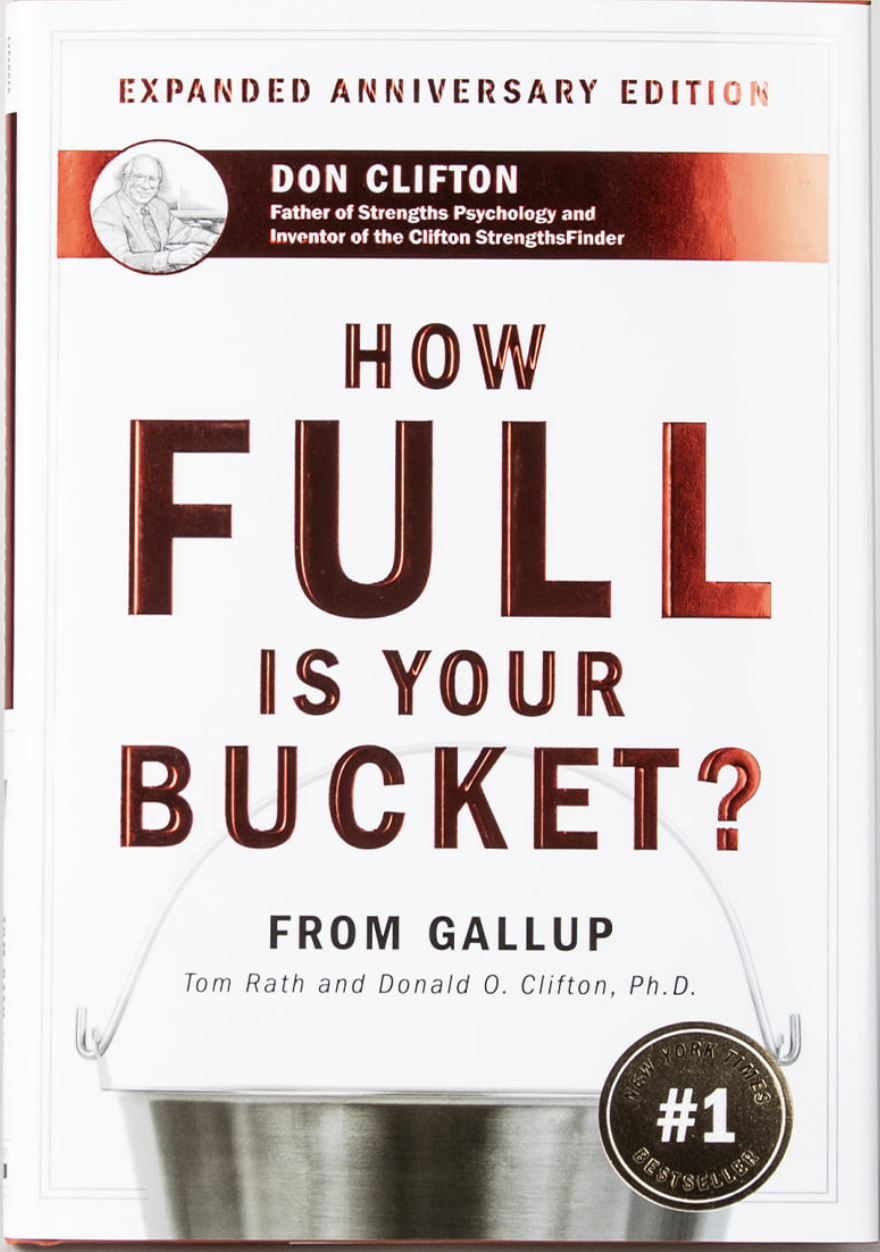
Next, let’s add to this mix the easy-to-read book How Full Is Your Bucket by Tom Rath and Donald Clifton, organized around the simple metaphor of a dipper and a bucket. Their work is grounded in 50 years of research and will show you how to greatly increase the positive moments in your work and your life – while reducing the negative – which, of course, can be applied to benefit your interactions with students (of paramount importance!), their parents, and school staff.

Admittedly, at times, this may be difficult. As I sit here putting on the finishing touches to a lesson plan for a virtual rehearsal of my online music academy – a “best I can do” replacement to in-person practices of our community youth orchestra’s 39th season, while absorbing the awful media broadcasts of recent spikes in the coronavirus across my region and the country, and trying to ignore the very angry rhetoric of a divided nation in the yet unresolved presidential election: How does one find “positivity” or project an image of hope? What’s that saying? “When the going gets tough, the tough get going!”

A “Thoughtful Drop” from a “Full Bucket” would emphasize the

  • Focus on the positive
  • Sharing of frequent small positive acts daily
  • Positive reinforcement to motivate learning
  • Promotion of positive emotions for your own good health

“How did you feel after your last interaction with another person?”

“Did that person – your spouse, best friend, coworker, or even a stranger – “fill your bucket” by making you feel more positive? Or did that person “dip from your bucket,” leaving you more negative than before?”

https://www.gallup.com/press/176132/full-bucket.aspx
https://crystalecho.com/gallup-profiling/

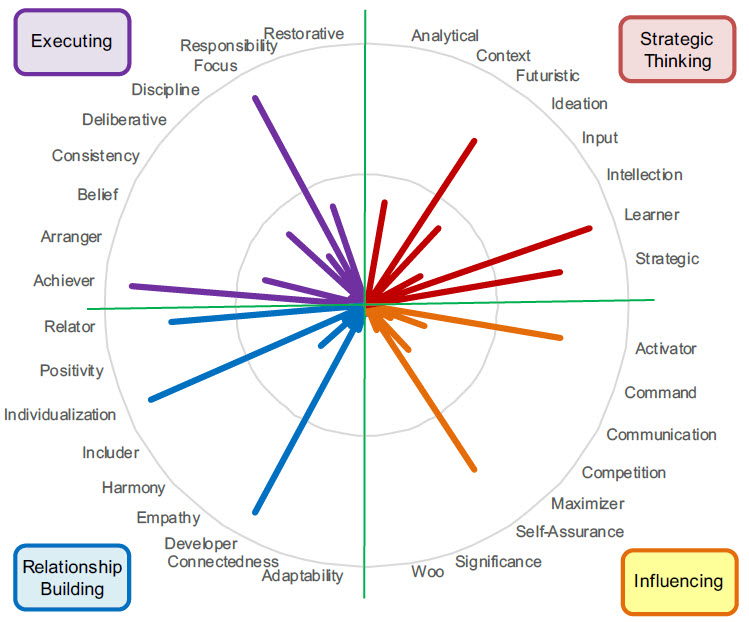
You can even take their Gallup Clifton Strengths poll to understand your “personality DNA” (above) and assess your potential: https://www.gallup.com/cliftonstrengths/en/home.aspx

Raising Caring, Successful Kids in a “Plugged-In, Trophy-Driven World”

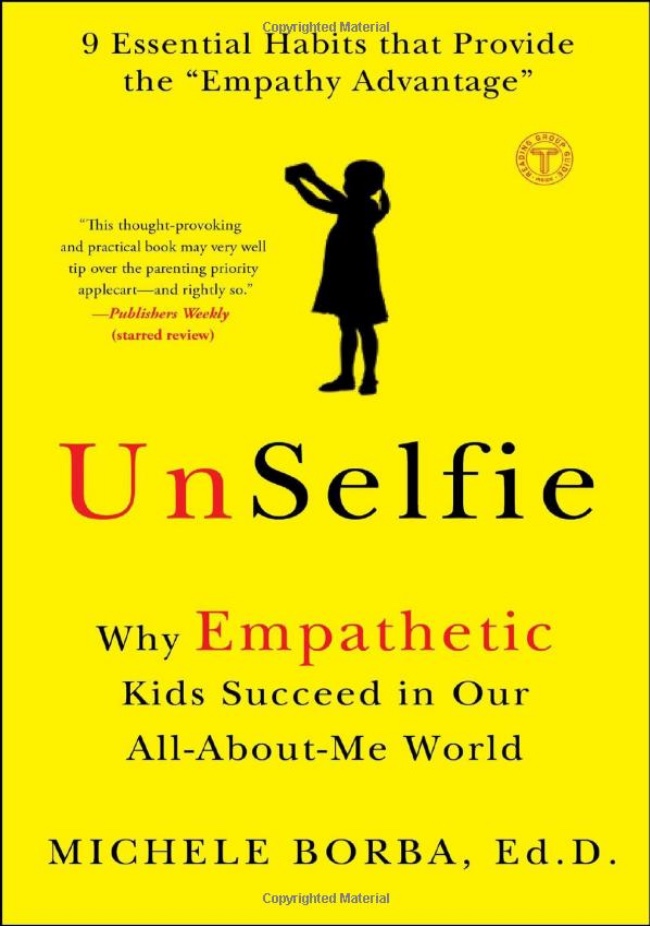
In any discussion on what children need most, are you surprised that the word “empathy” keeps coming up? We turn to, in my opinion, “the single most revolutionary book of our time,” UnSelfie – Why Empathetic Kids Succeed in Our All-About-Me World by Dr. Michele Borba, Ed.D., with her framework of nine essential habits of empathy:

  1. Emotional Literacy (recognition of the feelings and needs of self and others)
  2. Moral Identity (adoption of caring values that guide integrity and activate empathy)
  3. Perspective Taking (appreciation of another person’s feelings, thoughts, and views)
  4. Moral Imagination (use of literature, films, and emotionally charged images as a source of inspiration to feel with others)
  5. Self-Regulation (management of strong emotions and reduction of personal distress)
  6. Practicing Kindness (increased concern about the welfare and feelings of others)
  7. Collaboration (working together in the achievement of shared goals)
  8. Moral Courage (resolution to speak out, step in, and help others)
  9. Altruistic Leadership (motivation to make a difference for others)

Michele Borba emphasizes that the “selfie syndrome” is leading to excessive “self-promotion, personal branding, and self-interest at the exclusion of others’ feelings, needs, and concerns. It’s permeating our culture and slowly eroding our children’s character.” In short, she charges educators and parents alike to focus on enhancing the children’s “social-emotional competencies, resilience, academic success, leadership, healthy relationships, moral courage, happiness and mental health.”

I wrote this article for PMEA News about this phenomenon, examples of my impressions of the “dumbing down” or numbing of emotional quotient, less focus on “team” orientation, omission of studying “character” in our schools, and the seemingly increased emphasis on “the me – not the we!”

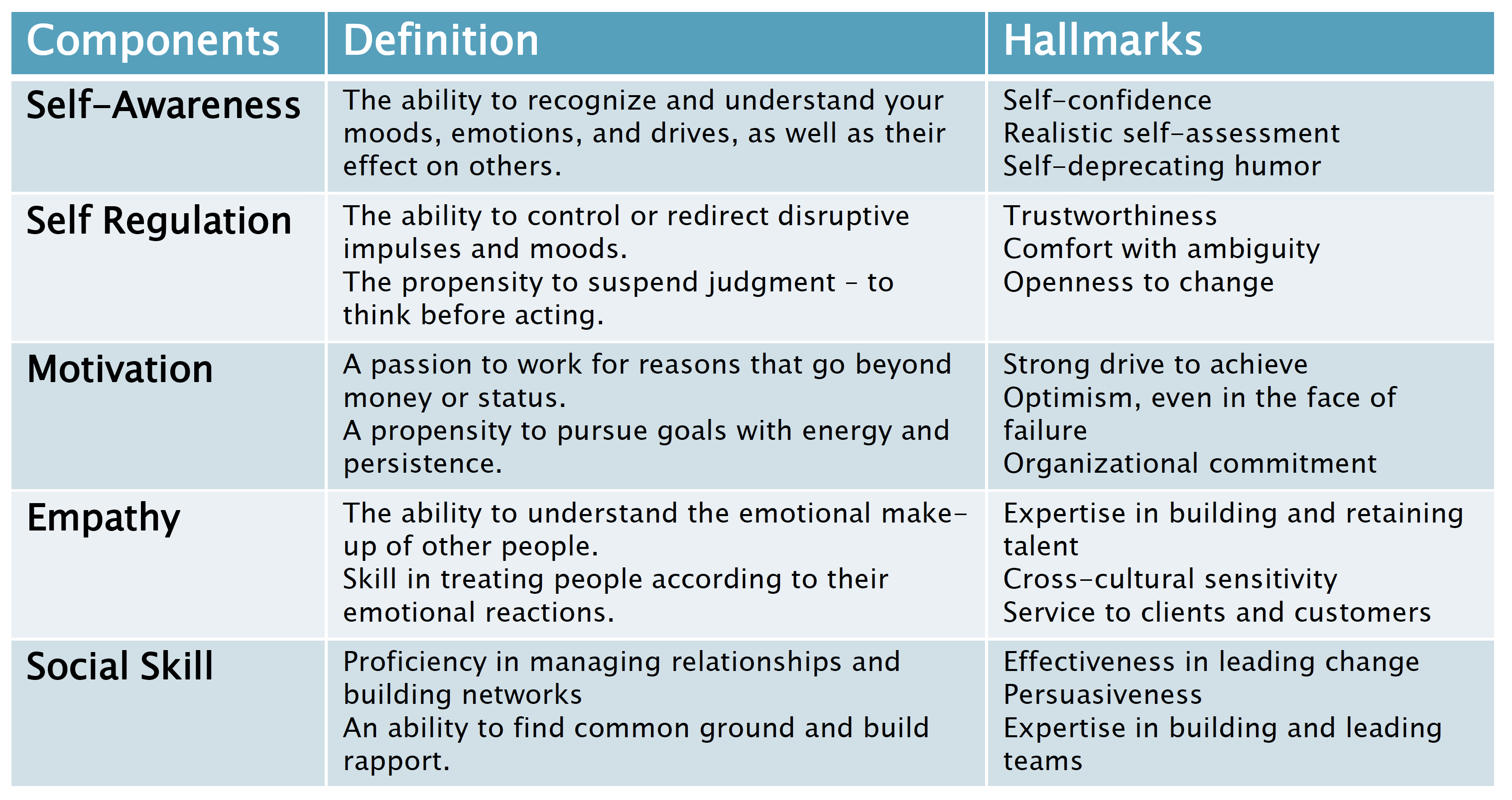
“Social-emotional learning” (SEL) was not a part of a college music education course catalog, even a few years ago. And yet, today more than ever, it is probably the single most valued “teaching skill” necessary for the care and engagement of students during the pandemic. Educators are “leaders” and often have a lasting influence (maybe only second to their parents) on the social-emotional health of their “charges!” Let’s review the principles of emotional intelligence (EI):

“Most effective leaders have a high degree of emotional intelligence: self-awareness, self-regulation, motivation, empathy, and social skills.”

United Nations Staff College https://www.unssc.org/ and What Makes a Leader? by Daniel Goleman https://hbr.org/2004/01/what-makes-a-leader

Why is SEL so important?

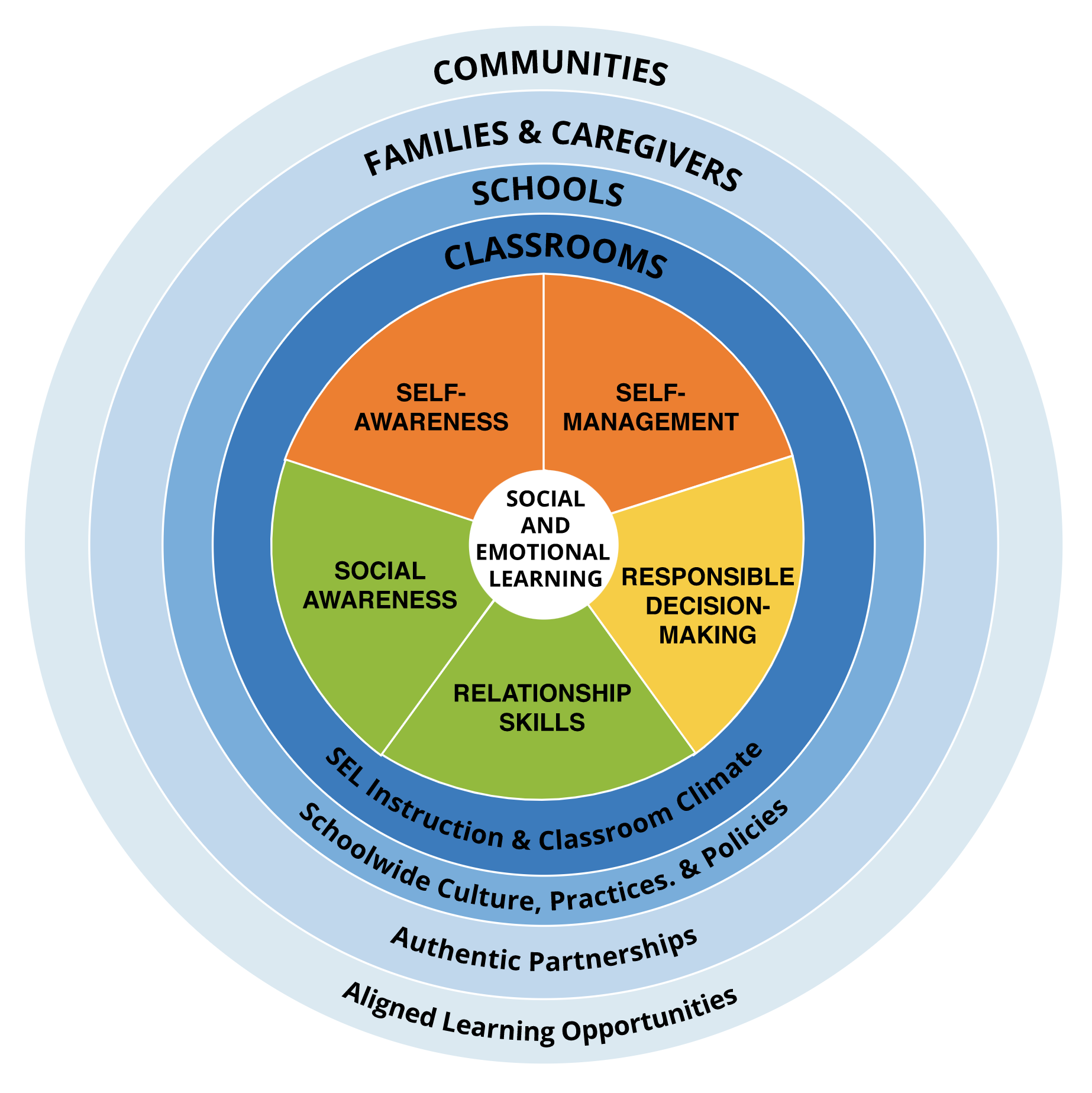
SEL provides a foundation for safe and positive learning, and enhances our students’ ability to succeed in school, careers, and life.

https://casel.org/sel-framework/

Social and emotional learning (SEL) is the process through which children and adults acquire and effectively apply the knowledge, attitudes, and skills necessary to understand and manage emotions, set and achieve positive goals, feel and show empathy for others, establish and maintain positive relationships, and make responsible decisions.

https://casel.org/overview-sel/

SEL can provide students with the SKILLS to confront their challenges by being self-aware, socially-aware, and to make responsible decisions. According to Associate Professor of Music, Music Education Chair, and Director of Bands at Lake Forest College Dr. Scott Edgar, this may take the form of reflection, discussion, and lecture, but to be most effective, it needs to be embedded in curriculum.

“For me, the music teacher can do this in a much more authentic way—through music… SEL should not feel like one more thing; it is THE thing. We teach music; we teach self-discipline; we teach collaboration. SEL is in our classrooms already; our job is to make it explicit, consistent, and structured.”

Dr. Scott Edgar https://nafme.org/music-education-social-emotional-learning/

According to Edgar, music teachers can help teach SEL by:

  • encouraging students to set their own musical goals
  • devising solutions for individual or group errors (instead of us always giving the answers)
  • navigating performance anxiety
  • understanding the power of music for social change

One more purchase recommendation:
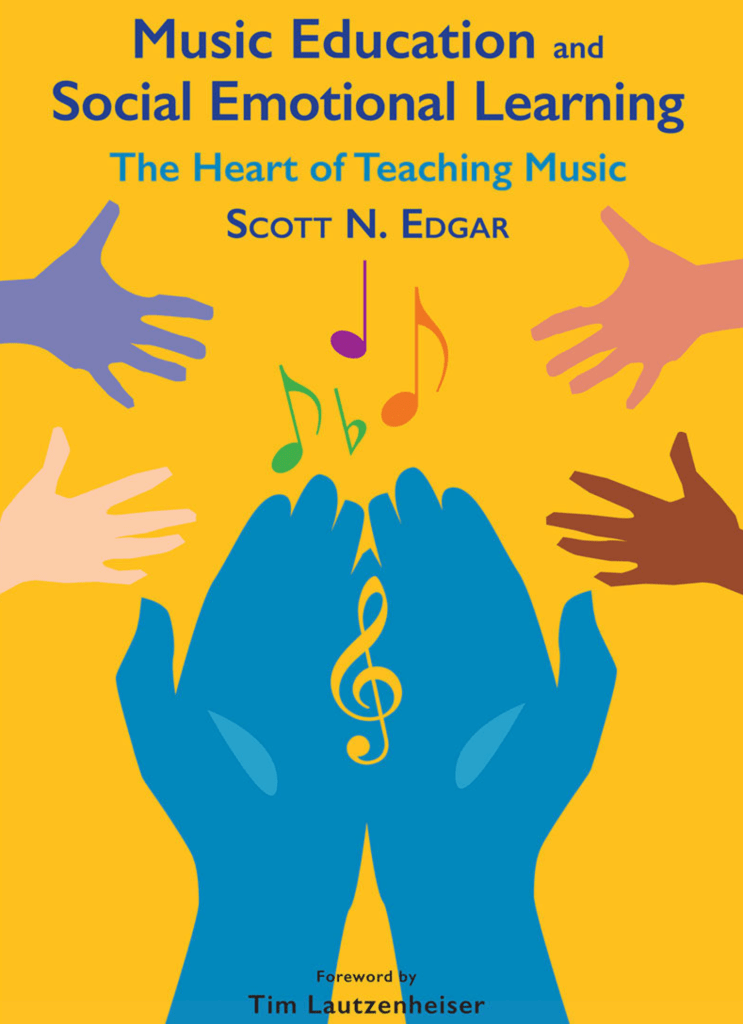
Music Education and Social and Emotional Learning – The Heart of Teaching Music
by Scott N. Edgar

“Music education helps our students learn how to be dedicated, to persevere, and to work together. It is our job to help students see that these skills are not isolated to the music classroom. These are the skills they need to be successful outside of music and to confront their challenges with strength and skill. Music can be the preventative mental health our students need so they have the skills to confront the life challenges ahead of them.”

Dr. Scott Edgar https://nafme.org/music-education-social-emotional-learning/

For a full understanding of SEL, it might be best to review the well-known “CASEL Wheel” (shown above) online at https://casel.org/sel-framework/. I also suggest you download this PDF file.

We have many additional resources to peruse for developing SEL:

When COVID-19 crashed into our lives wrecking havoc to almost all forms of live/in-person instruction, quarantining elements of the population, enforcing isolation and social-distancing requirements, closing schools and even cancelling most close-collaborative artistic ventures (music lessons, rehearsals, concerts, musicals, etc.), educators everywhere looked for a way to reconnect with their kids… and settled for the less-than-satisfactory, latency-prone, desensitizing virtual-conference environment! Overnight, schools and teachers resorted to “very” remote models of online learning only to view rows and rows of “trapped,” emotionally-detached, mummy or wax-museum-like faces of their students in windows of Zoom, Google Meet, or GoToMeeting platforms.

It’s time to retool and revamp. The most important thing we can do right now is to reach-out to, re-engage, and re-energize our music students, find out how they are doing, foster moments of meaningful dialogue, and share (there’s that word again) empathy… and that we care. We need to immerse ourselves into and apply the principles of human relationships, teacher presence, “bucket drops,” and recommended habits of empathy, EI and SEL explored above by a few wise educational leaders (a.k.a. “our models”).

PKF

Photo credits from Pixabay.com:

© 2020 Paul K. Fox
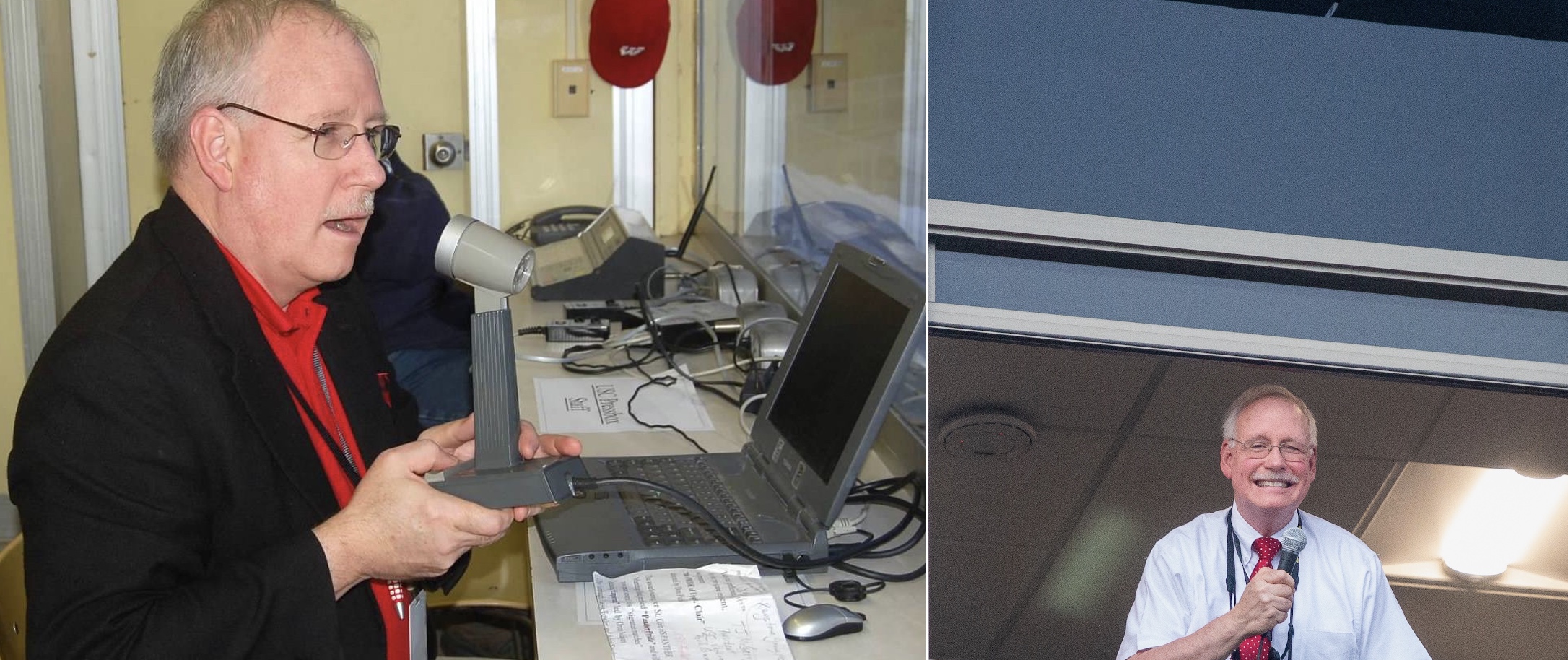
Burned Out or Bummed Out?

More on Teacher Self-Care: Diagnosis and Remediation

This is Part VI in a series of articles on educator health and wellness, following “Stressed Out!” and “Teacher Self-Care During the Pandemic.”

burnout-90345_1920_geralt

Do you recognize these signs of burnout experienced  by yourself, a coworker, neighbor, or someone you love?

  • Physical: tired, lowered immunity, illnesses, aches and pains, loss of appetite or sleep
  • Emotional: sense of self-doubt, failure, helplessness, loneliness, cynicism, loss of satisfaction/motivation
  • Behavioral: withdrawal, isolation, skipping work, procrastination, frustration, overuse of food, drugs, alcohol

By the time it gets to that third bullet, probably everyone would be aware of the trouble.

You may be on the road to burnout if:

  • Every day is a bad day.
  • Caring about your work or home life seems like a total waste of energy.
  • You’re exhausted all the time.
  • The majority of your day is spent on tasks you find either mind-numbingly dull or overwhelming.
  • You feel like nothing you do makes a difference or is appreciated.

Burnout Prevention and Recovery by Melinda Smith, M.A., Jeanne Segal, Ph.D., and Lawrence Robinson


star-5031540_1920_geralt

Gregory S. Perkins and Angela M. Guerriero, licensed Music Therapists from the Tempo! Music Therapy Services, provided much more detailed definitions of self-care in a session at the PMEA 2020 Virtual Summer Conference. (PMEA members may continue to register and view a video of this workshop until mid-September 2020.) You should know and be on the lookout for these terms:

The United Nations defines self-care as the actions that individuals take in order to develop, protect, maintain, and improve their own health and well being. Self-care involves a personal investment in maintaining physical, psychological and spiritual health, and pursuing a fulfilling, well-rounded life.

Brownout: “A practitioner essentially gives up or performs in a perfunctory manner when confronted with too much stress and too little gratification.” Guy, J. & Norcross, J. (2007). Leaving it at the office: a guide to psychotherapist self-care. New York, NY: Guilford Publications, Inc.

Burnout: “A syndrome of physical exhaustion including a negative self-concept, negative job attitude, and loss of concern and feelings.” Keidel, G. (2002). Burnout and compassion fatigue among hospice caregivers. American Journal of Hospice and Palliative Care, 19(3), 200-205

Recognizing the Need: Self-Care for Music Educators by Gregory S. Perkins, MT-BC, and Angela M. Guerriero, PhD, MT-BC

The Mayo Clinic offers numerous symptoms of “burnout.” How many of these have you “felt” too or noticed in someone else’s demeanor or behavior?

  1. Disillusionment over the job
  2. Cynicism at work
  3. Impatience with co-workers, administrators, and students
  4. Lack of satisfaction in accomplishments
  5. Dragging yourself to work and trouble getting started once you’re there
  6. Lack of energy
  7. Unexplained aches/pains
  8. Self-medicating with food, drugs, or alcohol
  9. Changes in sleep/eating patterns


despair-1235582_1920_geralt

Education Week adds many more danger signs. Are any of these striking close to home?

Exhaustion. This is a fatigue so deep that there’s no way to “turn it off,” no matter how badly you want to. It’s deep in your bones. The kind of tired where you just want to ooze into your bed and disconnect from life.

Extreme graveness. Realizing you go hours without smiling or laughing, or days without a belly laugh.

Anxiety. The constant, nagging feeling that you can and should do more, while simultaneously realizing you need to unplug and spend more time with your family. But there are so many things to do.

Being overwhelmed. Questioning how they can possibly add one more task, expectation, or mandate to your plate. Compromising your values of excellence just so you can check-off 15 more boxes to stay in compliance. All the while knowing it still won’t be enough.

Seeking. Losing your creativity, imagination, patience, and enthusiasm for daily challenges. Craving reflection time and productive collaboration rather than group complaining.

Isolation. Wanting to head for the deepest, darkest cave where no one will see your vulnerability. A place where your limits are unseen and unquestioned and all is quiet.

— Six Signs of and Solutions for Teacher Burnout by Wendi Pillars 
 

autonomy-298474_1920_geralt

What about the causes of burnout or brownout? Where should we place the blame?

According to Paul Murphy in his book, Exhausted – Why Teachers Are So Tired and What They Can Do About It, the stress of a few problems may stand out as leading culprits at your place of employment:

  1. Lack of autonomy
  2. Dysfunctional work environment
  3. Inadequate social support
  4. Extremes of activity
  5. Poor work/life balance

But, you have no one else but yourself to blame! You must take responsibility for your own health and welfare. Most of the sources in this blog-post (including a few mentioned in past articles from this “care” category) suggest solutions to better self-care, many of which offer answers to address the issue and CAN BE DONE RIGHT NOW.

Here are a few more self-care tips from PsychCentral:

  • Create a “no” list, with things you know you don’t like or you no longer want to do. Examples might include: Not checking emails at night, not attending gatherings you don’t like, not answering your phone during lunch/dinner.
  • Promote a nutritious, healthy diet.
  • Get enough sleep. Adults usually need 7-8 hours of sleep each night.
  • Exercise. In contrast to what many people think, exercise is as good for our emotional health as it is for our physical health. It increases serotonin levels, leading to improved mood and energy. In line with the self-care conditions, what’s important is that you choose a form of exercise that you like!
  • Follow-up with medical care. It is not unusual to put off checkups or visits to the doctor.
  • Use relaxation exercises and/or practice meditation. You can do these exercises at any time of the day.
  • Spend enough time with your loved ones.
  • Do at least one relaxing activity every day, whether it’s taking a walk or spending 30 minutes unwinding.
  • Do at least one pleasurable activity every day; from going to the cinema, to cooking or meeting with friends.
  • Look for opportunities to laugh!

What Self-Care Is and What It Isn’t by Raphailia Michael, MA


successful-2668386_1920_geralt

We should also review “Five Tips for Avoiding Teacher Burnout” by Mary Beth Hertz, an Edutopia blog (read the entire article for greater depth and clarity):

  1. Maintain your “other” life.
  2. Be a stakeholder when changes are made.
  3. Find lessons and opportunities in everything.
  4. Nurture peer connections.
  5. Keep it light.

Edutopia, from the George Lucas Educational Foundation, is a wonderful resource. Most recently, three valuable “streams” of articles have been released on coping with the preparations and stress in the reopening of schools for the 2020-2021 year:

I also recommend this blog-post of the Regional Education Laboratory Program which describes “teacher well being” as “the reaction to the individual and collective physical, environmental, and social events that shape how educators respond to their students and colleagues.” They discuss how three prominent human behavior frameworks— Maslow’s Hierarchy of Needs, the Five Stages of Grief and Loss, and the Concerns-Based Adoption Model (CBAM)— can be used to address the challenges that teachers face when adapting to change and identify approaches to support teacher well being.


help-4955863_1920_geralt

In addition, the following perspectives come from a variety of self-proclaimed practitioners:

“One of Leonardo da Vinci’s seven essential elements of genius is known as Sfumato, Italian for ‘smoked,’ or ‘going up in smoke.’ This principle is the ability to embrace uncertainty, the unknown, and the unknowable. In my interpretation, it’s also an ability to ‘let go’ of everything that’s left undone when you know you’ve done your best. Embrace Sfumato.”  — Wendy Pillars

“Self-care needs to be something you actively plan, rather than something that just happens. It is an active choice and you must treat it as such.” — Raphailia Michael

“Remember that example about putting on your own oxygen mask before helping others? This is where that analogy really comes in to play. It’s time for you to take a good hard look at your self-care versus your care for others and decide if you are in a place where you have a good balance or if you need to make this a priority… Why is self-care… such a critical component of your physical and mental health? Because in order for you to function at your peak, you need to meet the needs your body and mind have for rejuvenation, relaxation, and rebirth. If you are constantly putting out efforts toward other people and events but never taking time to refuel yourself, then you will run out of steam and it will manifest in your body as an illness, weight gain, acne, joint pain – you know the drill – again.” — Lesley Moffat in I Love My Job But It’s Killing Me

“It’s estimated that teachers make about 1,500 decisions every school day. When you combine those decisions with all the necessary self-regulation involved with teaching kids, it’s no wonder our willpower is gone by five o’clock. We are exhausted.” — Paul Murphy

The term “unprecedented times” has become a hallmark for describing the context in which leaders must respond to changing needs during the COVID-19 pandemic. Effective responses in education are dependent upon teachers as the front-line workers in classrooms, so it’s essential that administrators take care of teachers. When they do so, they also take care of students.

When teachers don’t have the resources they need, and especially when sustained job demands are high, teachers experience chronic stress — and eventually burnout.

Teachers who are burned out are less effective as teachers, have less supportive relationships with students and, in turn, the students they teach have lower academic and social outcomes.

How to Prevent Teacher Burnout During the Coronavirus Pandemic by Laura Sokal, Jeff Babb, and Leslie Eblie Trudel


man-4957154_1920_geralt

We should all read the above blog-post from The Conversation, which offers these conclusions based on a national Canadian education survey conducted in May 2020:

  1. Teachers’ concern for vulnerable students is one of the most stressful aspects of their jobs right now.
  2. Teachers are seeing magnified inequities.
  3. When giving teachers initial resources, less is more.
  4. Perceived support matters to teachers’ resiliency.
  5. Teachers are concerned about effectively engaging students through remote learning, and professional collaboration can help.

Finally, we’ll end this epistle on “things to do to avoid burnout” with a timely and practical article from Carlee Adams found on the We Are Teachers site: 15 Smart Ways to Prevent Teacher Burnout That Really Work. Repeating many of the suggestions above, these “find these” remedies resonated with me:

  • “Find someone you can be vulnerable with…”
  • “When you feel hopeless, find perspective…”
  • “Find your own voice and allow it to change over time…”
  • “Find your people; they get you!”

The bottom line? If you “feel” consistent periods of burnout, brownout, or being bummed out in your career as negative influences to your “calling” as a teacher, you cannot sit back and let things continue “as is!” Most professionals cannot self-diagnose this problem (but, perhaps a family member may clue you in!). If you notice that you are continually having trouble sleeping, difficulty with relationships or communicating your thoughts to others, or find yourself feeling significantly depressed or lethargic, it may be time to visit your health care professional.

PKF


Photo credits (in order) from Pixabay.com by Gerd Altmann


© 2020 Paul K. Fox