
ALL ABOARD THE E-TRAIN… Embarking and Embracing a Journey of Essential Educator Ethics
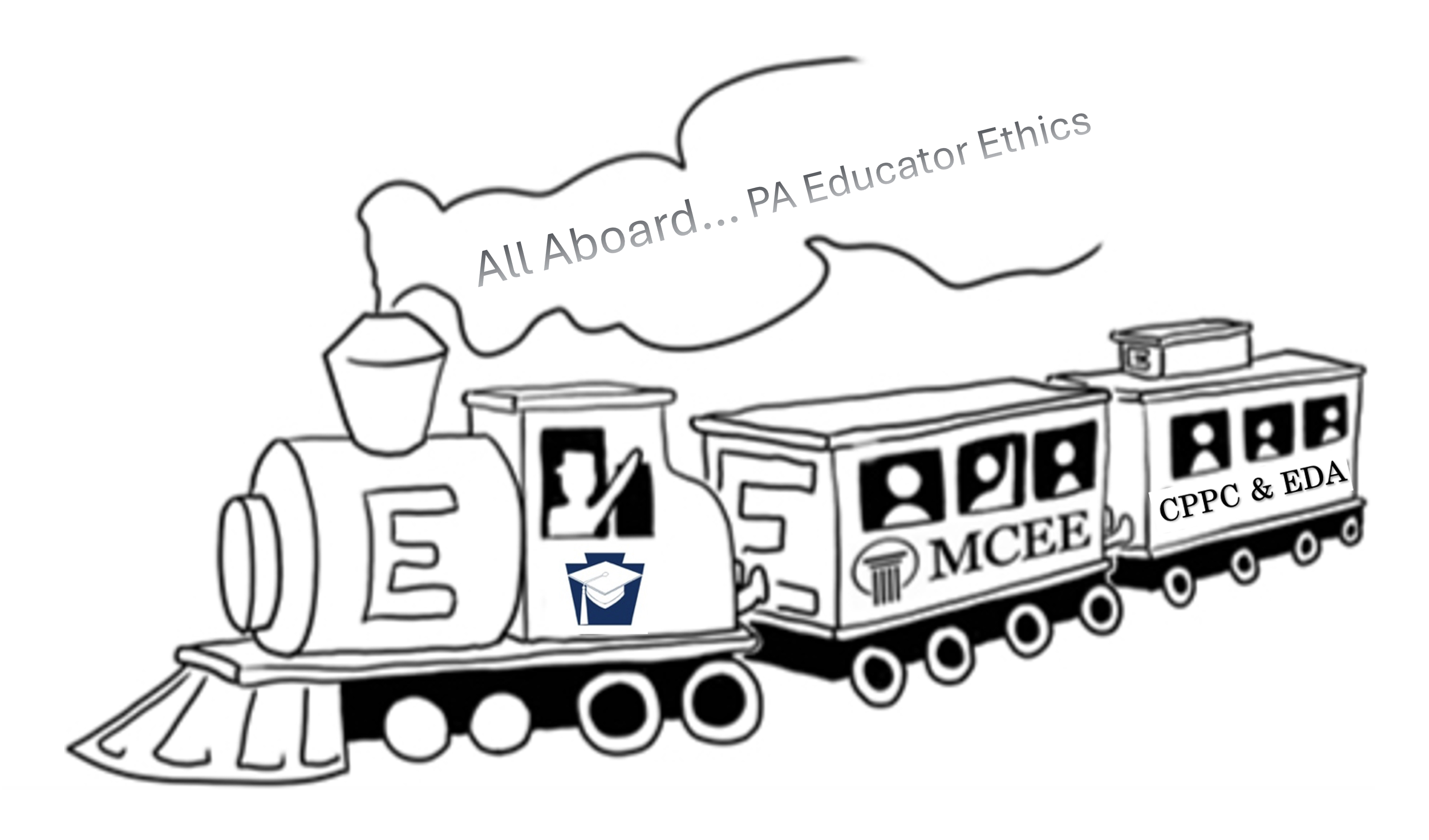
The wheels of the train go round and round…
“All black, well stacked, goin’ down the track clickety clack” = the train looked good on the visual roll-by inspection.
“Highball it out of here” = proceed at maximum permissible speed
“Let’s pull the pin and roll” = uncouple so we can get out of here
The fall season is bringing upon us a series of ethical workshops, classes, and the creation of other resources, and the perfect time to warehouse everything at the main rail terminal! Take an excursion below to learn more about “staying on track” with research on the responsibilities and “regs” for serving as an educator.
First, let’s take a pretest of your knowledge and experience on the subject of school ethics. Which of the following statements has the least validity?
- Moral professionalism involves being well informed about students, education, and content, confronting parents of underachieving students, cooperating with colleagues to observe school policies, and criticizing unsatisfactory policies and proposing constructive improvement.
- Teachers, attorneys, doctors, nurses, counselors, therapists, and the clergy have “fiduciary” duties: own the highest legal duties of good faith and trust and are bound ethically to act in another party’s best interest.
- Although not always defined in exact terms of school law or policies, professional ethics are “standards that assist practitioners within situation and systemic contexts in choosing the best course-of-action.”
- A code of ethics outlines a set of principles that affect decision making, while a code of conduct delineates specific behaviors that are required or prohibited and governs actions.
- The primary goal of professional ethics training is to emphasize the “minimum standards of acceptable behavior” and focus on specific illegal and unethical actions that may result in disciplinary actions.
After a thorough exploration of the materials below, you should feel confident in responding to this question. (If you need help, scroll down to answer at the end of this blog-post.)
Classes and Conferences on Ethics, Oh My!
I am looking forward to sharing insights on ethical issues and especially the seeming “conundrums” or conflicts in the myriad of snap judgments of daily decision-making, both in and outside of our classrooms. Upcoming opportunities are on the ethics e-train schedule.
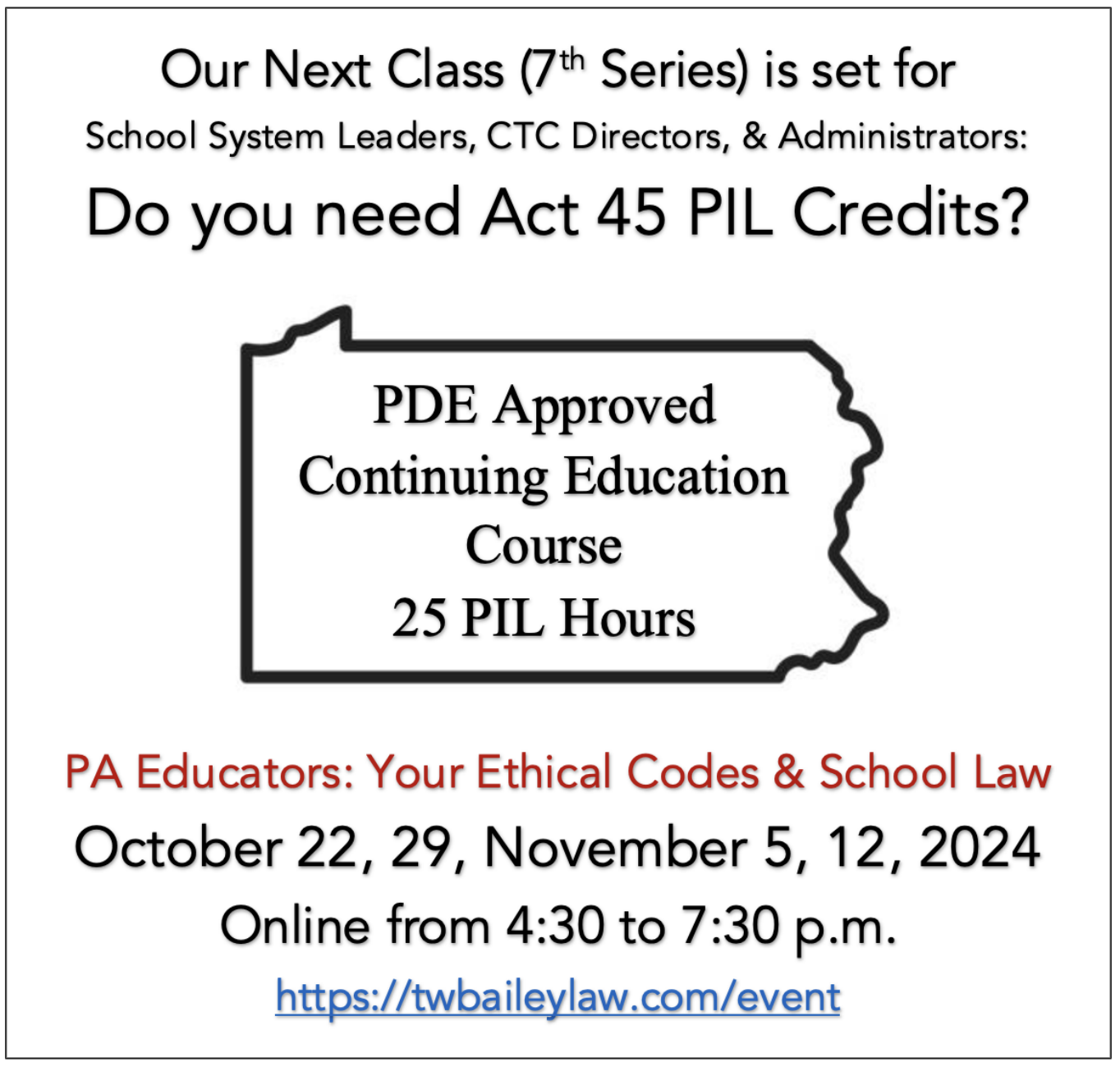
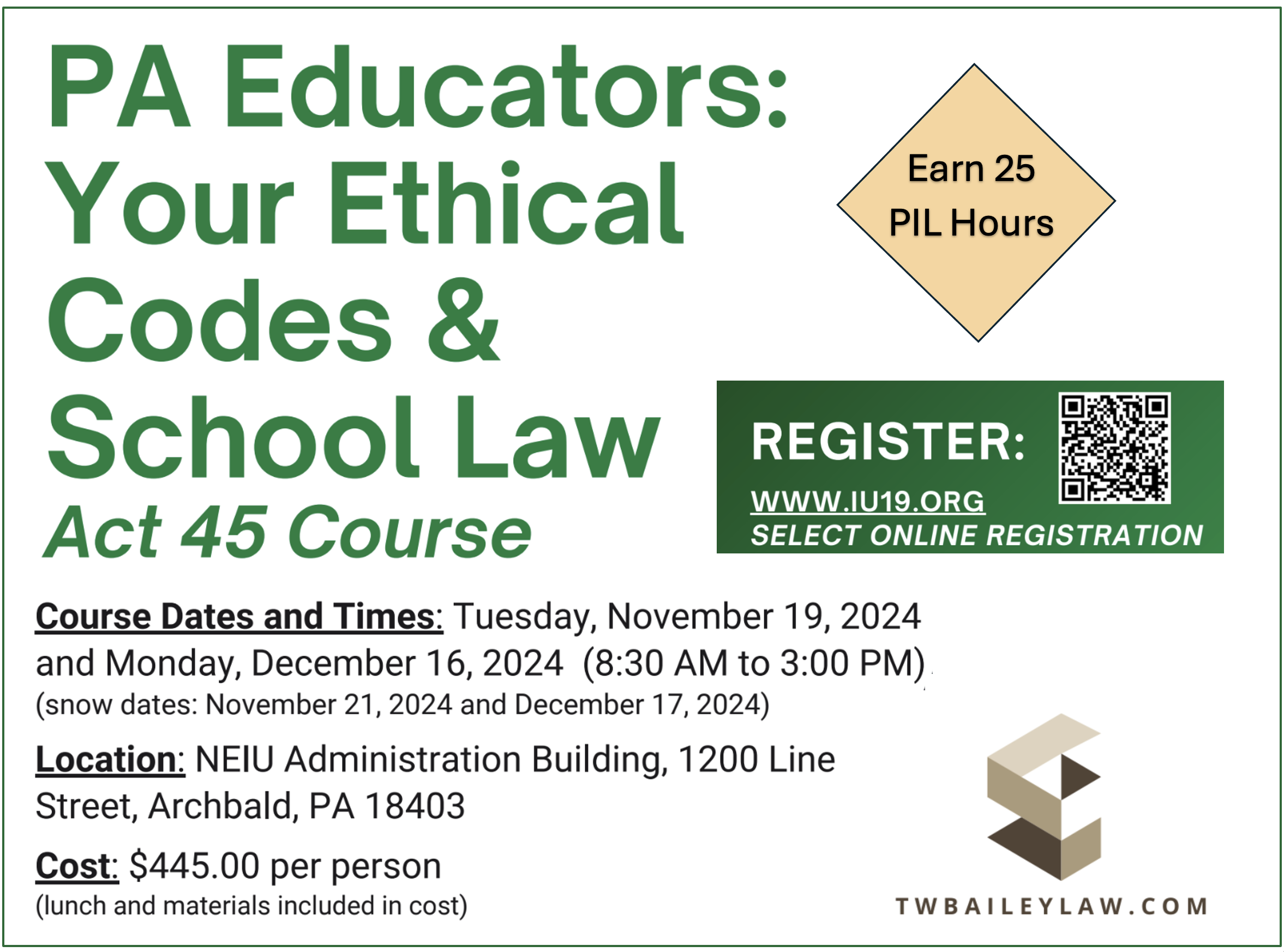
Currently, we are completing the sixth series of our 25-hour PDE-approved Act 45/PIL online course for school/system leaders, career and technical center directors, and other administrators. Sponsored by my colleague Thomas W. Bailey (check out his website here), the next class “PA Educators: Your Ethical Codes & School Law” begins on October 22 for four consecutive Tuesdays from 4:30 to 7:30 p.m.
Thomas Bailey and I were also invited to present this Act 45/PIL course for the Northeastern Intermediate Unit #19 as a two-day workshop on November 19 and December 16, 2024. Visit http://www.iu19.org or click here to register.
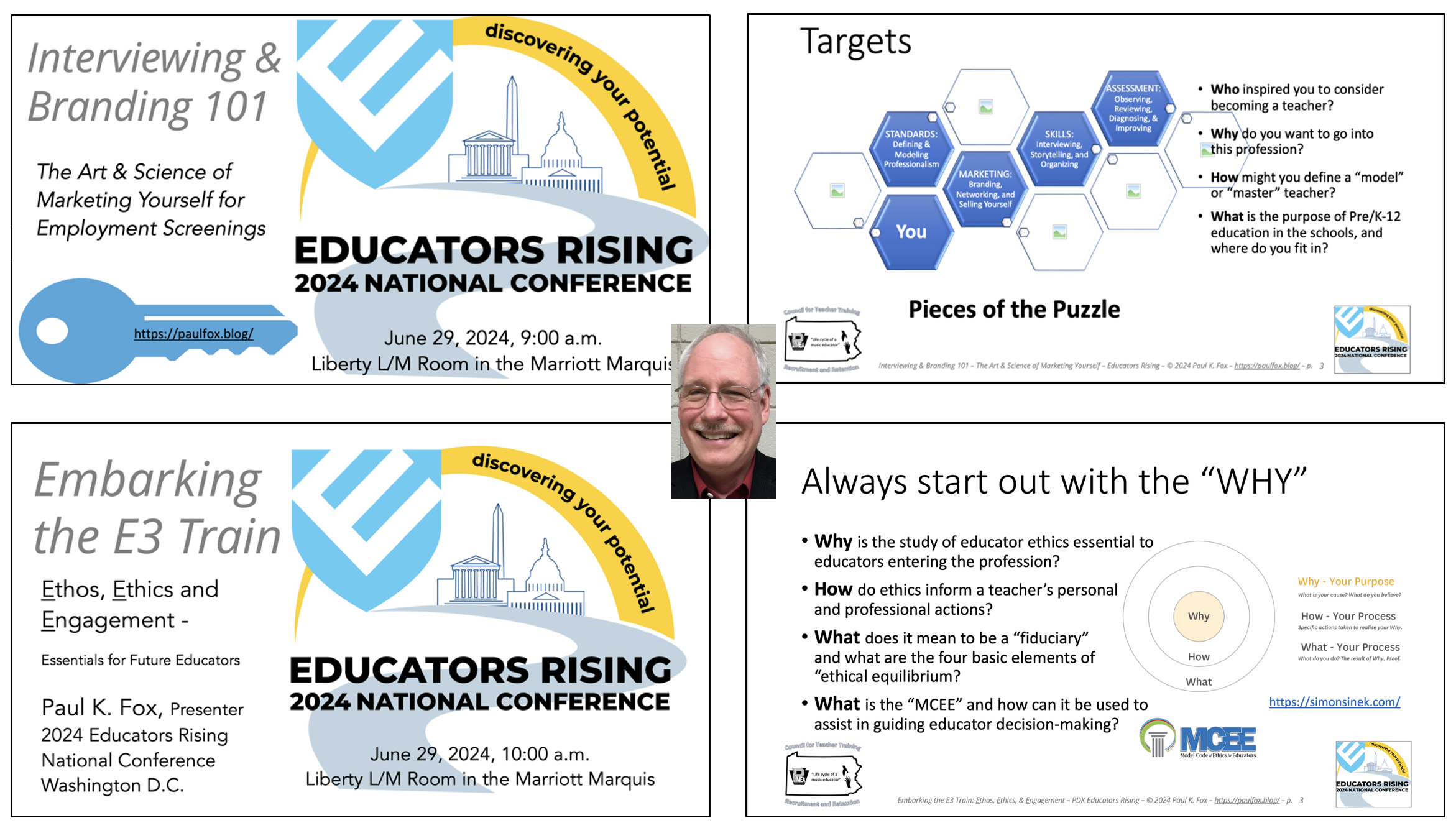
I am venturing out of the Western PA to Eagleville, PA (near Valley Forge) to provide a 70-minute in-service, a school ethics “refresh” for the faculty at Methacton School District on October 14, 2024. Click here to download a copy of the slide summary with all links active.
Finally, I am happy to report that I was invited back to the PDE SAS Institute to do two sessions: “Planning School Ethics Training, Part I – Definitions, Codes, and the Commission” and Planning School Ethics Training, Part II – Model Code of Ethics for Educators. My proposal to present the session “CATCH THE E-TRAIN – Codes, Case Studies, and the Challenges of Ethical Decision-Making” was not approved for the 2025 PMEA Annual Conference in Kalahari Resort (Poconos). However, a facsimile of similar slides from past NAfME/PMEA workshops and webinars on educator ethics is available here.
Supplemental Resources for the Study of Codes, Case Studies, and the Challenges of Daily Decision-Making in Education
And now, the grand daddy of school ethics destinations…
Past paulfox.blog posts on educator ethics
- Ethical Conundrums Revisited — Part I (August 20, 2018)
- Ethical Conundrums Revisited — Part II (October 14, 2018)
- Ethical Scenarios (July 16, 2019)
- Ethics for Music Educators — Part I (August 28, 2017)
- Ethics for Music Educators — Part II (August 30, 2017)
- Ethics for Music Educators — Part III (September 1, 2017)
- Ethics Follow-up (October 19, 2017)
- Launching PA Educators Ethics Training (November 26, 2023)
- Model Code of Ethics for Educators (February 11, 2021)
- PA Educator Ethics Update (October 6, 2021)
- Rising Educators Conference (June 12, 2024)
- Studies in Educator Ethics Case Law (June 26, 2021)
Especially for Pennsylvania educators, pre-service students, and newcomers to the Commonwealth (citing the PA Professional Practices and Standards Commission website)
- Code of Professional Practice and Conduct (printable/one-page/two-sided)
- Commission Publications
- Discipline System Overview
- Educator Ethics and Conduct Tool Kit
- Model Code of Ethics for Educators (full color brochure)
- Model Code of Ethics for Educators (NASDTEC website)
- Model Code of Ethics for Educators (preview of free video series)
- Promoting Ethical Practices
- Statutes, Regulations, Policies, and Forms
From other state governments (all rights reserved)
- Connecticut State Department of Education TEAM Overview Module 5
- Connecticut State Department of Education TEAM Introduction to Module 5 SLIDES (2021)
- Connecticut State Department of Education TEAM Facilitators Guide Module 5 (2024)
- Connecticut State Department of Education TEAM Participants Workbook Module 5 (2024)
- Iowa Board of Educators Examiners Ethics Facilitators Guide (2017)
- Iowa Board of Educational Examiners Educator Ethics SLIDES (2017)
- Texas Education Agency Lesson Plan Ethical Standards for Educators (2017)
- Texas Education Agency Teacher Ethics Training Module – Boundaries (sample video)
An additional sampling of articles
- EDUCATION WEEK: Schools Are Full of Ethical Dilemmas – Can Ethicists Help? by Benjamin Herald
- EDUTOPIA: Various articles on “educator ethics”
- Ethics in Education – The Importance of Good Leadership by John Pijanowski
- PASCD: Got Ethics? An Introduction to a Teacher’s Moral Decision-Making Compass by Paul Fox
- Professional Ethics Education for Future Teachers – A Narrative Review of the Scholarly Writings by Bruce Maxwell and Marina Schwimmer
- Protecting the Profession – Professional Ethics in the Classroom by Troy Hutchings
- Teachers’ Critical Incidents – Ethical Dilemmas in Teaching Practice by Orly Shapira-Lishchinsky
- Using Ethical Dilemmas in the Classroom by David B. Wangaard
WHY STUDY ETHICS? Answer to the PRETEST above.
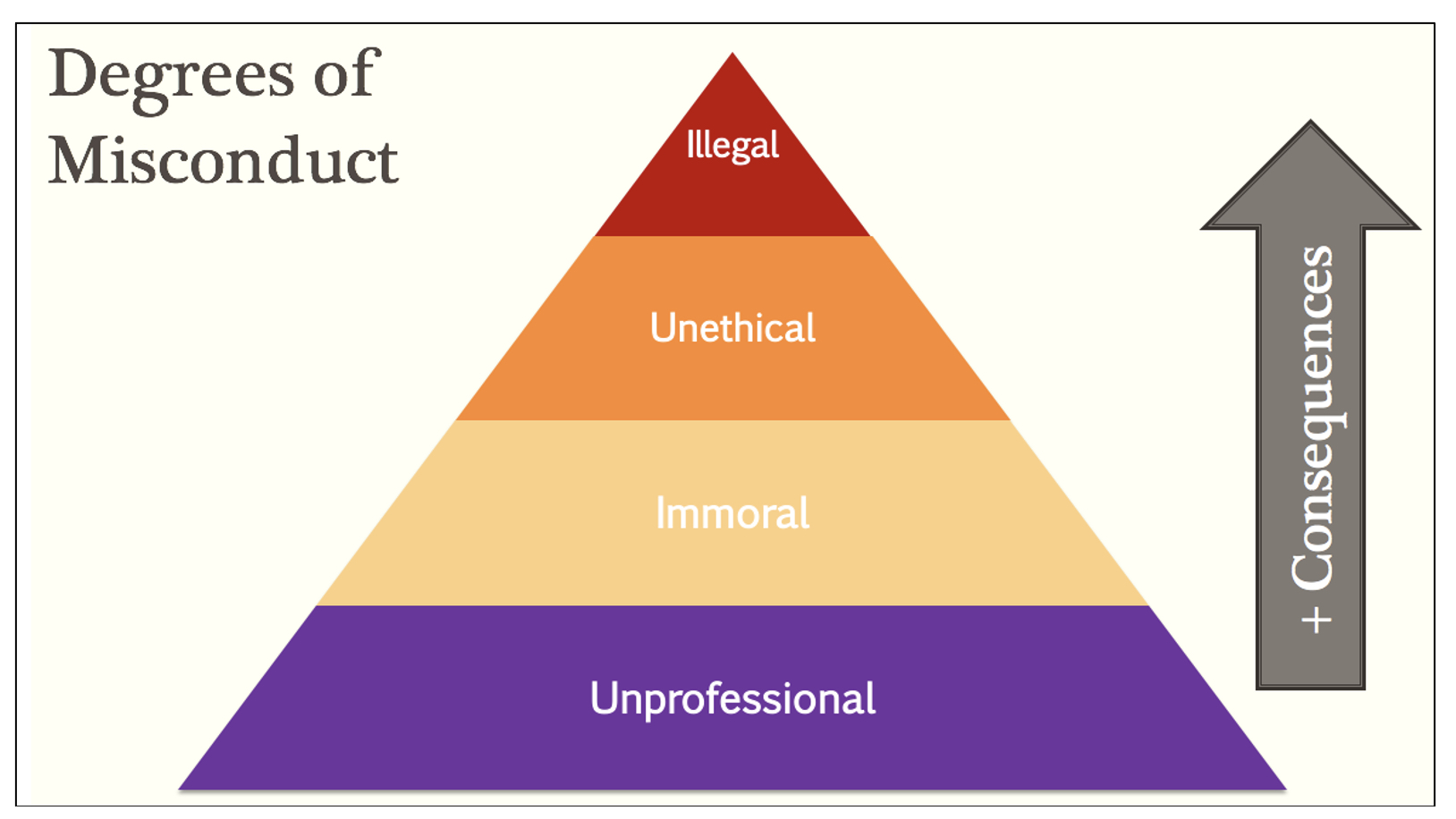
A code of ethics sets a higher threshold than regulatory codes of conduct or even a nonprofit organization’s bylaws and compliance rules enforced by the government. A code of conduct, such as the Pennsylvania “Code of Professional Practices and Conduct” of the PSPC, provides absolutes for employment, licensure, and/or civil/criminal sanctions. In contrast, the Model Code of Ethics for Educators document serves more as a general compass to help steer professionals towards sound judgment in their daily decision-making. What is unique about a true code of ethics vs. a code of conduct is that the principles are not defined in exact terms of law or policies, nor do they necessarily model family morals or values on which we as individual educators have been raised. The proposed standards are not about definite issues of right/wrong or black/white, but shades of grey. They are more open-ended, offering opportunities to discuss recommendations for consideration from a set of possible choices based on the circumstances of each ethical dilemma or resolution.
– excerpt from “The Ethical Music Educator,” Winter 2020 issue of PMEA News

Teachers are ethical professionals. Our moral aspirations, the “codes” and “standards” we subscribe to, and our professionalism are important to us, our students, our programs, and our communities. Essentially, these are the beliefs for which we stand, the values and behavior we model in our day-to-day decision-making to “make a difference” in the lives of our students, and the overall integrity of the profession. Therefore, the answer to the PRETEST above is #5. (#1-4 are TRUE!) But, as stated in #5, the goal of meaningful ethics training is NOT to emphasize the minimum standards of acceptable behavior or to focus on specific illegal and unethical actions that may result in disciplinary actions.
Do you have anything to add to this collection? ALL ABOARD! The conductor would appreciate feedback! Please feel free to make a comment to this blog (see link next to the title).
PKF
© 2024 Paul K. Fox

 paulfox.blog