Creative Teaching & Teaching Creativity – PART III – Creative Techniques

Reprinted from the Winter 2015 issue of the Pennsylvania Music Educators Association music teachers’ state journal of PMEA News.

“The creative is the place where no one else has ever been. You have to leave the city of your comfort and go into the wilderness of your intuition. What you’ll discover will be wonderful. What you’ll discover is yourself.” — Alan Alda

Warm-up

“Creative thinking” riddle of the month:

An ordinary American citizen, with no passport, visits over thirty foreign countries in one day. He is welcomed in each country, and leaves of his own accord. How is this possible? (Answer printed at the bottom on this article.)

The final segment of this three-part series for all educators addresses many of the “how-to” aspects of using imaginative approaches to make learning more interesting and effective (teaching creatively) and strategies of teaching that are intended to develop students’ creative thinking or behavior (teaching for creativity).

25 Ways to Develop Creativity

Probably one of the best resources I found in my research on creativity is the book How to Develop Student Creativity by Robert J. Sternberg and Wendy M. Williams (ASCD 1996). Sternberg and Williams provide a detailed guide with personal experiences on instructional techniques in creativity, including how to choose creative environments, expose students to creative role models, identify and surmount obstacles to creativity, direct students to question assumptions, generate new ideas, and promote self-responsibility.

Steinberg and Williams refer to “the investment theory of creativity,” which asserts that “creative thinkers are like good investors – they buy low and sell high. Whereas investors do so in the world of finance, creative people do so in the world of ideas by taking a unique, typically undervalued idea, and convincing other people of its worth.”

Their 25 tips “in a nutshell” are:

  1. Modeling Creativity
  2. Building Self-Efficacy
  3. Questioning Assumptions
  4. Defining and Redefining Problems
  5. Encouraging Idea Generation
  6. Cross-Fertilizing Ideas
  7. Allowing Time for Creative Thinking
  8. Instructing and Assessing Creativity
  9. Rewarding Creative Ideas and Products
  10. Encouraging Sensible Risks
  11. Tolerating Ambiguity
  12. Allowing Mistakes
  13. Identifying and Surmounting Obstacles
  14. Teaching Self-Responsibility
  15. Promoting Self-Regulation
  16. Delaying Gratification
  17. Using Profiles of Creative People
  18. Encouraging Creative Collaboration
  19. Imagining Other Viewpoints
  20. Recognizing Environmental Fit
  21. Finding Excitement
  22. Seeking Stimulating Environments
  23. Playing to Strengths
  24. Growing Creatively
  25. Proselytizing for Creativity

Hands-on Ideas for Building Creative Learning

In Teaching Creatively and Teaching for Creativity, presented by the British Council (Eltec/Jordan), United Kingdom’s international organization for cultural relations and educational opportunities, the task for teaching “for creativity” is defined as:

  • Encouraging – Highly creative people are driven by strong belief in their abilities and a positive self-image.
  • Identifying – Creative achievement is driven by “a person’s love of a particular instrument, for the feel of the material, and for the excitement of a style of work that catch the imagination.” We must help students find their creative strengths
  • Fostering – “Creativity draws from many ordinary abilities and skills rather than one special gift or talent.” Therefore, “the development of many common capacities and sensitivities can help to foster creativity.”

“Creativity itself is a mode of learning,” a combination of three features:

  1. It involves a thoughtful playfulness – learning through experimental ‘play.’ It is serious play conjuring up, exploring and developing possibilities and then critically evaluating and testing them.
  2. It involves a special flexibility in which there may be a conscious attempt to challenge the assumptions and preconceptions of the self – an unusual activity in which there is an active effort to unlearn in order to learn afresh.
  3. This process is driven by the find, introduce, construct or reconstruct something new. It seeks actively to expand the possibilities of any situation. In this sense the learning of creative thoughts is not neutral; it has a bias towards the innovative.

The British Council proposes many tips for building creative learning:

  • Start simply, and build progressively.
  • Find easy ways in to creative learning. Start with the classroom environment. Move on to how pupils and staff use speech and questions. Keep it manageable, keep the focus tight. Show and share tangible changes. This will develop confidence to go further.
  • Be a ‘creative advocate.’ Create a presentation or materials that you can use both within your school to convince colleagues and out of school. This will help to build a whole-school ethos around creativity.
  • Focus on one area at a time, for example, in developing more creative learning in math, and use this to raise awareness and encourage staff to think about applications in other subject areas and spaces in the school.
  • Organize an enquiring minds-type project where pupils have an opportunity to negotiate the aim of the project and are instrumental in designing how it is carried out (resource: enquiringminds.org.uk).
  • Set-up an inventor’s club after school.
  • Transform one small area in the school as a space designed for creativity and imagination.
  • Make sure that the pupils have some ownership of the project.

Return to the “Best of Bonk”

More hands-on tools and ideas can be found at the aforementioned website of Indiana University of Bloomington Professor Dr. Curtis Bonk’s (but, let me warn you, you can truly get lost perusing all of his class materials for the course Instructional Strategies for Thinking, Collaboration, and Motivation): http://www.indiana.edu/~bobweb/r546/modules/creativity/bob_handouts.html. He is very generous in sharing his materials. It is worth exploring his class notes and lecture presentations (PowerPoint) posted at the “Best of Bonk” website.

Here are a few of my favorite excerpts from his handouts:

Ten+ Creative Thinking Ideas

  1. Brainstorming: More ideas/wilder the better, no evaluation, combo to improve (examples – How to study better? How to raise test scores? What are better teaching techniques)
  2. Reverse Brainstorming (examples – How to study worse? How to lower test scores? What are worst teaching techniques)
  3. Creative Writing and Story Telling (examples – object obituaries, tell a tall tale, cartoons, jokes/quips, story starters, wrap-a-round’s, forced responses, newsletters, object talking, etc.)
  4. Idea-Spurring Questions, Checklists, or Cards (e.g., Osborn’s SCAMPER method): How do we substitute, combine, adapt, modify/max-min put to other uses, eliminate, reverse/rearrange?
  5. Six hats (wear different color hats for different types of thinking)
  6. Free Writing/Wet Inking (write without lifting pen for 3-5 minutes on, e.g., best teacher ever had)
  7. Checkerboarding, Attribute Listing, Morphological Synthesis (analyze or combine 2 key variables/components in grid/matrix; e.g., CT & CR)
  8. Analogies, Metaphorical Thinking, Synectics, or Forced Associations (This school is like a ____; An good presenter is like a ____?)
  9. Semantic Webbing/Chaining/Linking/Mapping of Ideas, Free Association Activities (What is a greenhouse effect? What is a good curriculum? What is effective teaching?)
  10. Simulations and Role Plays (Computer simulations, act out plays or literature, simulated games or performance)
  11. Other techniques
  • The Second Best Answer, What else, > 1 Right Answer (What else applies)
  • Elaboration/Explanation (Another reason is)
  • Diaries, Personal Journals (When in the field, I want to jot down…)
  • Just Suppose/What If Exercises (What if we had cooperative exams?)
  • Creative Dramatics/Improvisation (imagine hearing, seeing, feeling)

Bonk provides an exhaustive set of creative thinking techniques, including activities in visual thinking, idea listing, writing, group interactions, and process-product oriented.

More Resources

Too comprehensive to list here, but an excellent summary, the TeachThought “101 Ways for Teachers To Be More Creative” at http://www.teachthought.com/teaching/101-ways-for-teachers-to-be-more-creative, posts ideas for finding creative inspiration, capitalizing on the creative spark, inspiring students, the creative classroom, creative activities, sharing and collaborating, and educate yourself.

Check out the Iowa State University Center for Excellence in Learning and Teaching website section entitled “Techniques for Creative Teaching” at http://www.celt.iastate.edu/creativity/techniques.html!

On the Friendship Circle blog, “How to Teach Creative Thinking to Concrete Thinkers” shares ten ideas from a parent’s perspective at http://www.friendshipcircle.org/blog/2013/05/02/how-to-teach-creative-thinking-to-concrete-thinkers.

Numerous music education specific sources are available. One of my favorites, Teaching Music Creatively by Pam Burnard and Regina Murphy (Routledge 2013), offers a comprehensive approach in the delivery of a creative music curriculum. Key topics included:

  • Creative teaching, and what it means to teach creatively;
  • Composition, listening and notation;
  • Spontaneous music-making;
  • Group music and performance;
  • The use of multimedia;
  • Integration of music into the wider curriculum;
  • Musical play;
  • Cultural diversity;
  • Assessment and planning.

Finally, from my favorite issue of the ASCD Educational Leadership, February 2013 “Creativity Now,” the starting point for much of the research for this three-part series, I recommend reading Danah Henriksen and Punya Mishra’s article “Learning from Creative Teachers,” who provide insight and practical applications from “outstanding teachers who share how they teach creatively in an age of scripted lessons and accountability.” You can find the text online at (http://www.ascd.org/publications/educational-leadership/feb13/vol70/num05/Learning-from-Creative-Teachers.aspx). They discuss these areas:

  1. Connect Your Interests with Your Teaching
  2. Link Lessons to Real-World Learning
  3. Cultivate a Creative Mind-Set
  4. Value Collaboration
  5. Take Intellectual Risks

Arrival of the New National Music Standards!

No discussion on creativity would be complete without embracing our national music standards. The National Coalition for Core Arts Standards launched the Core Arts Standards on June 4, 2014 after extensive public review. You are urged to go to their new “official” website http://www.nationalartsstandards.org/. The National Core Arts Standards are organized into four processes – Creating, Performing/Presenting/Producing, Responding, and Connecting – in order to develop a philosophical foundation and lifelong goals towards artistic literacy. The three common anchor standards include the following.

Students will:

  1. Generate and conceptualize artistic ideas and work.
  2. Organize and develop artistic ideas and work.
  3. Refine and complete artistic work.

Are we intentionally doing these in our music classrooms?

Creativity vs. the Common Core? and Final Thoughts for the Future

Creativity is one of the 21st Century learning skills, and many educational visionaries declare it to be a one of the most essential for the students’ future success in career and personal life. Bloom’s Taxonomy and Depth of Knowledge charts put creating at the top level of higher-order thinking. In an article “Creativity on the Brink” (2013), Alane Starko connects creativity to deep understanding: “If we want students to master the content, they must do something with it beyond simple repetition. They must use it in meaningful ways and make it their own.” Catapult Learning sums this up best (see http://www.catapultlearning.com/creativity-and-the-common-core/). “As teachers transition towards the Common Core Standards, they are certainly being asked to attend to each of the aspects expressed through creativity: increased rigor and higher-order thinking, the application and transfer of knowledge, and the ability to communicate effectively through 21st century technology tools.”

Our music technology colleague Jim Frankel reminds us to define our “personal mission” in music education, to realize how important it is to remain “student-centered,” and that our kids “want to create content in the same medium in which they consume it.”

He adds, we should be focused on students “wanting to make ‘cool’ music/projects/websites/whatever.”

What better way to teach creatively and “teach for creativity” than to use the magic of music?

What are your thoughts?

Answer to the creative thinking riddle: The man is a mail courier who delivers packages to 30 foreign embassies in the United States. The land of an embassy belongs to that country of that embassy. [Attributed to Visual Thinking Puzzles by Michael A. DiSpezio (Sterling 1988)]

For a list of additional resources for further research, please go to the bottom of my main page on creativity at this WordPress site: Creativity in Education – Are We Ready for a New Paradigm Shift?

PKF

© 2015 Paul K. Fox


Creative Teaching & Teaching Creativity – Part II – Definitions and Rationale

“I think the single most potent school reform goal would be to place the highest priority on individual creative engagement, and to shape schooling to develop the habits of mind that constitute creative engagement.” – Eric Booth

Warm-up/Review/Refresh

How many rectangles do you see below?

rectangles

What is your initial response? If you said sixteen or seventeen, sorry! You are not even close! The real number is more than 50! (See the exact answer at the end of the article.)

According to Robina Shaheen in her article “Creativity and Education” (Creative Education, Volume 1, No. 3, 2010), interest in creativity historically goes back to Plato’s age and is found in the Greek, Judaic, Christian, and Muslim traditions. She said that a sudden “frenzied” emphasis for the renewal of inventiveness and creativeness in schools (especially in the sciences) came about with the launch of “Sputnik 1” satellite by the Soviet Union in 1957. The supposed failure of engineers from Europe, USA, and other Western countries was attributed to their lack of creativity, which led to the adoption of the National Defense Education Act to accept the concept as important for “prosperity…survival of society.” Since then, there have been several additional “waves of creativity” in education.

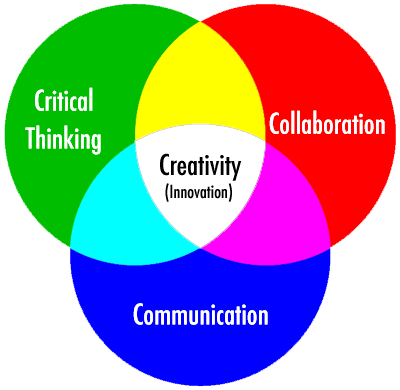
From numerous educational visionaries, we have more recently heard the essential need for 21st Century learning skills, including creativity, critical thinking, collaboration, and communications, and yet our political focus continues to be on high-stakes standardized testing and the ‘common core’ (and very limiting) subjects.

Definitions of Creativity

Numerous scholars, scientists, and educational leaders have provided their perspective on the meaning of creativity:

  • Creativity is defined as the tendency to generate or recognize ideas, alternatives, or possibilities that may be useful in solving problems, communicating with others, and entertaining ourselves and others (from Human Motivation, 3rd ed., by Robert E. Franken)
  • Creative refers to novel products of value, as in “The airplane was a creative invention.” Creative also refers to the person who produces the work, as in, “Picasso was creative.” Creativity, then, refers both to the capacity to produce such works, as in “How can we foster our employees’ creativity?” and to the activity of generating such products, as in “Creativity requires hard work”(from Creativity – Beyond the Myth of Genius by Robert W. Weisberg).
  • Creativity is generating new ideas and concepts, or making connections between ideas where none previously existed (from SmartStorming by Mitchell Rigie and Keith Harmeyer).
  • Creativity is the ability to find new solutions to a problem or new modes of expression; thus it brings into existence something new to the individual and to the culture (from Drawing on the Right Side of the Brain by Dr. Betty Edwards).

Creativity According to Sir Ken

“Creativity is the process of having original ideas that have value.”

“Think of creativity as applied imagination.”

The above quotes are from Sir Ken Robinson, internationally recognized leader in the development of education and creativity, famous for his 2006 and 2010 talks at the prestigious TED Conference, estimated to have been seen by more than 200 million people.

Sir Ken Robinson champions a radical rethink of our school systems, to cultivate creativity, and acknowledge multiple types of intelligence. He has been known to say, “We are educating people out of their creativity,” and “Creativity is now as important in education as literacy, and we should teach it with the same status.”

Sir Ken embraces the written works of Howard Gardner (Multiple Intelligences), Robert Steinberg’s three intelligences (analytical, creative, and practical), and Robert Cooper’s “heart brain” and “gut brain.” His own “three features of intelligence” are that they are “diverse, dynamic, and distinctive.”

Through his numerous lectures and online videos, Sir Ken has tried to dispel a few myths on creativity:

  1. Only a few people are really creative. “Everybody has tremendous creative capacities.”
  2. Creativity is for the arts only. “Creativity is a function of everything we do. Education for creativity is about the whole curriculum, not just part of it.”
  3. Creativity is just about letting yourself go. “No, creativity is a disciplined process that requires skill, knowledge, and control, as well as imagination and inspiration.”

In a recent TEDTALKS video on YouTube, he defines three principles crucial for the human mind to flourish, but seem to be currently contradicted by the culture of education:

  • Diversity vs. conformity
  • Curiosity vs. compliance
  • Creativity vs. standardization

See http://www.ted.com/talks/ken_robinson_how_to_escape_education_s_death_valley.html for one of his lectures. If you like his presentations, you will love Sir Ken’s two books: Out of Our Mind – Learning to Be Creative, and The Element – How Finding Your Passion Changes Everything.

Eric Booth’s Creative Habits of Mind

Eric Booth, a teacher at the Kennedy Center, Stanford University, New York University and the Lincoln Center Institute, and founding editor of the Teaching Artist Journal, maintains that the arts are more than subject matter and disciplines. They serve as modes of cognition that are necessary for every content area and for success in life.

Centering on the essential skills of brainstorming, divergent thinking, metaphoric thinking, flexible thinking, multisensory engagement, and empathy, the following “habits of mind” according to Eric Booth, are key processes, actions, and attitudes activated when we invest ourselves in the flow of creating:

  1. Generating multiple ideas/solutions
  2. Sustaining an inner atmosphere of exploration
  3. Using one’s own voice
  4. Trusting one’s own judgments
  5. Formulating good questions and problems
  6. Improvising
  7. Finding humor
  8. Crafting
  9. Making choices based on a variety of criteria
  10. Inquiring skillfully
  11. Persisting
  12. Self-assessing
  13. Reflecting metacognitively
  14. Thinking analogically
  15. Willingly suspending disbelief
  16. Observing intentionally
  17. Going back and forth between parts & wholes
  18. Trying on multiple points of view
  19. Working with others
  20. Tapping & following intrinsic motivation

He concludes with advocating for the arts and more inquiry-based learning in the schools (quoting Booth):

The “artistic process” encompasses:

  • Asking great questions and identifying good problems
  • Experimenting, while carefully attending to results
  • Cultivating a productive relationship with failure
  • Anticipating challenges and generating imaginative solutions
  • Tolerating uncertainty (even taking pleasure in ambiguity)
  • Engaging in appropriate risk-taking
  • Being resilient
  • Focusing on quality and excellence
  • Self-assessing eagerly & naturally
  • Infusing ongoing reflection into the work at hand
  • Enjoying the process and getting personal satisfaction out of it
  • Connecting to others through an expression of who you really are

Pink’s Points

To round out this provocative philosophy of teaching creativity and creative processes for their own sake, we have the highly entertaining Daniel Pink, author of three best-sellers: A Whole New Mind: Why Right-Brainers Will Rule the Future, Drive: The Surprising Truth About What Motivates Us, and To Sell Is Human: the Surprising Truth About Moving Others

Daniel Pink talks about his first book on YouTube: http://www.youtube.com/watch?v=WhKLSTBSgwI

Pink’s core argument in A Whole New Mind… is that “the era of ‘left brain’ dominance, and the Information Age that it engendered, are giving way to a new world in which ‘right brain’ qualities – inventiveness, empathy, meaning – predominate.”

Tagged as “Pink’s six senses,” he proposes the following new “aptitudes” or abilities that individuals and organizations must master in an outsourced, automated age – and should become fundamental to updating our curriculum, enduring understandings (“big ideas”), essential questions, unit planning, and lesson learning targets:

  • Design
  • Story
  • Symphony
  • Empathy
  • Play
  • Meaning

Roger von Oech

Finally, a very appropriate example of defining creative thinking as “changing contexts” is described by Roger von Oech in his book Whack on the Side of the Head: How You Can Be More Creative:

In 1792, the musicians of Franz Joseph Haydn’s orchestra were mad because the Duke had promised them a vacation, but continually had postponed it. They asked Haydn to talk to the Duke about getting some time off. Haydn thought about it, decided to let the music do the talking, and wrote the “Farewell Symphony.” The performance began with a full orchestra, but as the piece goes along, it is scored to need fewer instruments. As each musician finished his part, he blew out his candle, and left the stage. They did this, one by one, until the stage was empty. The Duke got the message and gave them a vacation.

Von Oech concludes with stating that this example illustrates “the creative mind power to transform one thing into another. By changing perspective and playing with our knowledge, we can make the ordinary extraordinary.”

More to come… Care to join the debate?

[Answer to the 4 by 4 rectangles’ puzzle at the top of the page: Remember, a rectangle can be two columns by one row or three rows by one column, etc. The total number is 100!]

Segments of this and other articles on my blog are reprinted from PMEA News, the state journal of the Pennsylvania Music Educators Association. To see more writings or the complete three-part series on creativity, please go to the following:

PKF

© 2015 Paul K. Fox

Creative Teaching and Teaching Creativity – Part I – How Creative Are You?

“Creativity is putting your imagination to work, and it’s produced the most extraordinary results in human culture.” – Sir Ken Robinson

The following series of excerpts were originally published in a three-part series for PMEA News, the state journal of the Pennsylvania Music Educators Association. To read the articles in their entirety, please visit my blog page “Creativity in Education – Are We Ready for a New Paradigm Shift?” at https://paulkfoxusc.wordpress.com/creativity-in-education-are-we-ready-for-a-new-paradigm-shift/. I have taken the liberty to extract, condense, and even add to this material.

Introduction

Before the Common Core movement came “crashing down on us” commanding an exhaustive redesign of our curriculum and new high-stakes standardized testing, perhaps the more promising and innovative “buzz” was a recommendation to adopt 21st Century learning skill initiatives. Companies, businesses, and governments – the employers of the vast majority of the future work force – did not want their employees to settle for an education based on a “regurgitation of facts and figures,” but to demonstrate mastery of the work-related skills of communications and collaboration, and the thinking skills of critical thinking, problem solving, and creativity. According to the Partnership for 21st Century Skills (P21) group, in order for the United States to be able to “compete in a global society,” a refocus is essential on learning the skills of personal innovation. Advocating for 21st century readiness of every student, P21 emphasizes education in the best practices of creativity, originality, divergent thinking, flexibility and adaptability, communication, personal initiative and self-direction, and leadership and responsibility, among other themes including collaboration, global awareness, financial, economic, business, and entrepreneurial literacy, health and wellness awareness, and technology.

How Creative Are You?

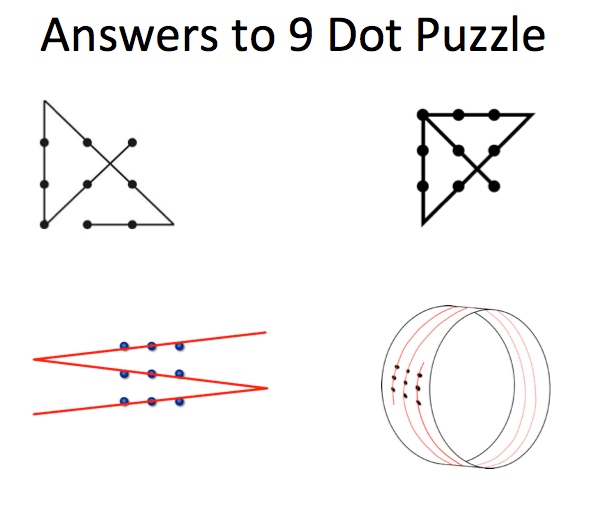
Take this quick test, and try to think “outside the box.” This puzzle, first introduced to many of us by Michael Kumer at an early PMEA Summer Leadership Conference, instructs you to link all nine dots using four or fewer straight lines without lifting the pen, and without tracing the same line more than once. Can you solve this using four lines? For advanced visionaries, how about completing it with only three lines? Believe it or not, a super-creative person may be able to find a way to solve this problem with ONE line! (Answers at the end of this article.)

5832546922_a9b8b0eab4_b

Numerous measurements have been proposed to evaluate a person’s creativity potential. Check out several of these:

Mind Tools’ questionnaire at http://www.mindtools.com/pages/article/creativity-quiz.htm illustrates a model for the “highly creative” personality.

How many of these terms describe YOU?

  • Willingness to take risks
  • Perseverance, drive, commitment to task
  • Curiosity
  • Openness, open-mindedness
  • Tolerance for ambiguity
  • Broad interests
  • Valuing originality
  • Intuition, being perceptive
  • Embracing the need to find solutions to problems
  • Being internally occupied, withdrawn, needing privacy
  • Awareness of own creativeness
  • Sense of humor
  • Being attracted by complexity and novelty

Feel free to share your perspective!

Respond to this blog. Be as creative as you want!

(More to come….)

PKF

© 2015 Paul K. Fox

ninedotsolutions

Welcome to Fox’s Fireside

PaulFox_Logo

Greetings from a happily retired public school music educator who has time to burn learning how to “WordPress.”

Here’s to sharing our thoughts about creativity, music and music education, and retirement. Ironically, my pulpit of “random observations” spans both ends of the career spectrum… ranging from marketing strategies and interview techniques for new/recently transferred professionals trying to find a school music teaching job to our “seniors” transitioning that formidable “life changing” passage of stepping down from full-time directing/teaching.

This blog will also serve as a vault of my personal essays and articles (many published in the Pennsylvania Music Educators Association state journal PMEA News or workshop handouts at in-service conferences).

In my final days as a teacher/administrator, I was inspired to research and write a series of articles on “Creativity for Teachers” in PMEA News. For access, please see “Creativity in Education – Are We Ready for A New Paradigm Shift?” title link at the top of this site.

For a complete listing of all of my blogs, click on the “Inside…” tab above or go to https://paulkfoxusc.wordpress.com/why/.

Warning! The views expressed here are the sole responsibility of that “crazy as a fox” former music teacher and Performing Arts Curriculum Leader of the Upper St. Clair School District. These are offered as food-for-thought, a “pause in reflection” (for foxes, isn’t it “paws?”). Hopefully, all of us can collaborate, explore some insight, and generate meaningful discussion as we possibly solve a few problems along the way.

I welcome your input… so check back here often for future blog posts as I learn the (for me) “new technology!”

PKF

foxpaws_logo