Engaging Retiring/Retired Educators

Ask not what NAfME or your state MEA can do for you, but what YOU, a retiree, can do for your professional association and music education.
An adaptation of the famous excerpt from the 35th U.S. President John F. Kennedy’s inaugural address of January 20, 1961.

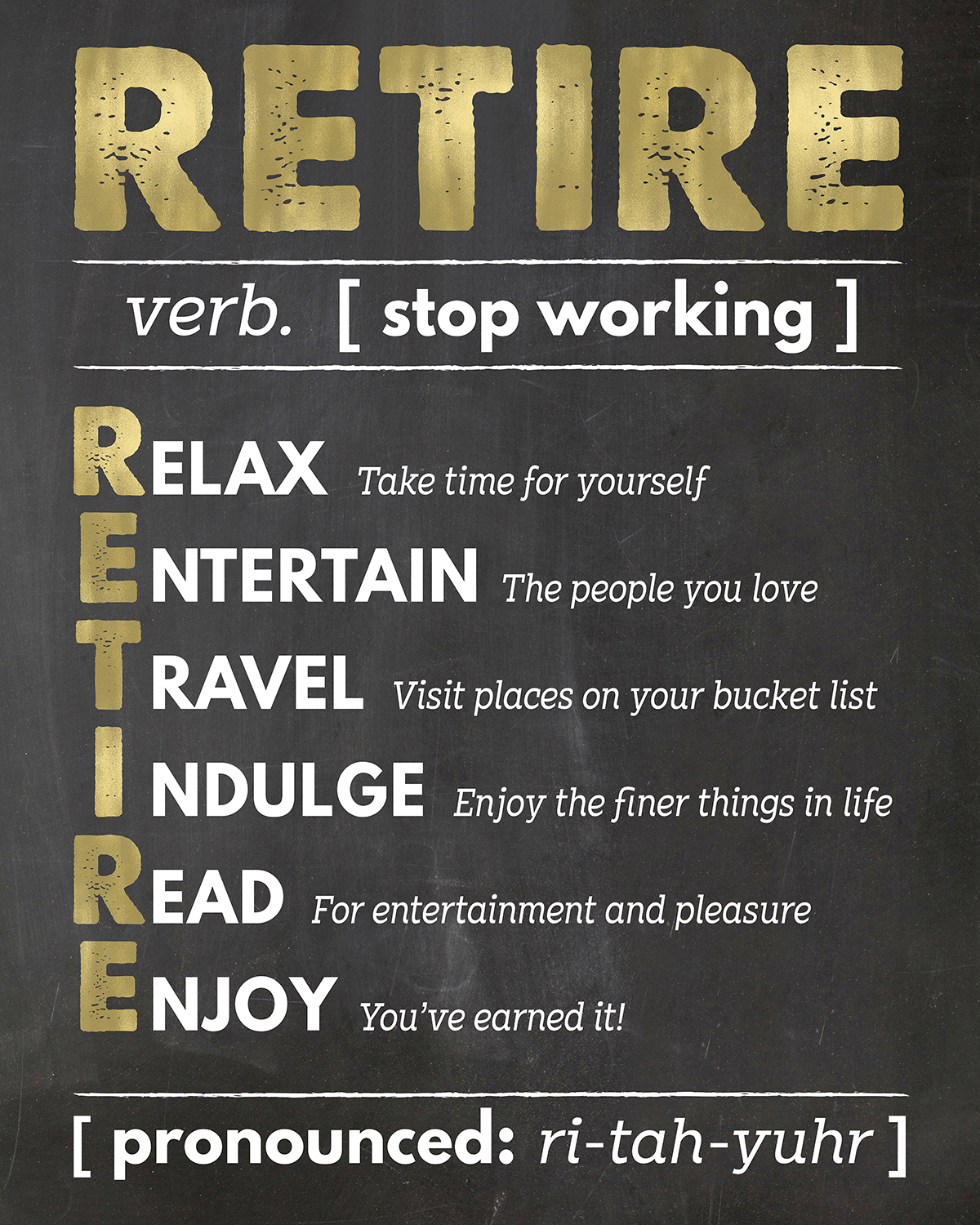
Surfing the ‘Net, I found an appropriate acronym for R.E.T.I.R.E. by Tangled Tulip Designs in pinterestRelax, Entertain, Travel, Indulge, Read and Enjoy! Most retirees would probably agree! The cessation of full-time employment may offer a great release from the day-to-day stress and drudgery of the job and the freedom to venture out, self-reinvent, make future goals, nurture relationships, and explore new personal growth opportunities.

Many attribute embracing a career in music education as “a calling” as opposed to just a form of employment or livelihood. From my experience, I have witnessed that most music educators are passionate for the cause of fostering creative self-expression in their students, more of a 24/7 mission, bringing intense focus and dedication to their lifework.

More to the point: Do we ever truly retire from making music ourselves and fostering this love in others?

THE “WHY!” Retirees matter and are critically needed!

One of my favorite inspirational speakers (Simon Sinek) would say, “start with the WHY!” WHY is this discussion on professional engagement of retired educators so important today?

  1. Their need: An informal poll of my former local educators and administrators revealed that half of them “hate retirement!” According to Dr. Robert P. Delamontagne in his book Retiring Mind (Fairview Imprints), “50% of retirees will suffer some form of acute emotional distress. This is potentially a very large problem given the fact that 10,000 people are becoming eligible for Social Security every day for the next 20 years in the US alone.” Remember this statistic the next time a senior citizen cuts you off on the road or bangs a shopping cart into your leg at the checkout!
  2. Our need: We are facing shortages of qualified teaching candidates across the country with unfilled openings in public school music positions and the critical need of training/mentoring the new hires.
  3. Society’s need: All of our voices should be combined to support the advocacy of music education, actively promoting access to school music by sharing its academic and social benefits with decision-makers, building relationships with administrators and policymakers, and utilizing resources from organizations like NAfME and the NAMM Foundation.

Despite its proven benefits, music education is often the first program to face budget cuts in schools. This is especially concerning in underserved communities, where access to music programs can be life-changing. Now more than ever, we must advocate for music education to ensure that every child has the opportunity to experience its benefits. Investing in music education is an investment in the future of our communities — helping to cultivate the next generation of creative, resilient, and innovative leaders. 
“Why Music Education Matters More Now Than Ever” by Music Will, February 2025

For eleven years (and counting), I serve as the Pennsylvania Music Educators Association (PMEA) Retired Member State Coordinator, as well as the Past State Chair (current member) of the PMEA Council for Teacher Training, Recruitment and Retention. I believe my responsibility to the state association is two-fold:

  • Assist soon-to-retire professionals in achieving a smooth transition to a happy and satisfying retirement; to help them cope with the commonly-experienced emotional ups-and-downs of this life passage, wrestling with the question “what do you want to be or do when you grow up?” and making new life lesson plans and personal goals.
  • Reach out to and build meaningful connections with retirees in order to fully engage them towards becoming active in their professional association; to recount, represent, and revitalize the activities of our post full-time employed music educators.

This article proposes a roadmap of crucial pathways to help music teachers approach “retirement bliss” while tapping into their hard-earned knowledge, strengths, and experiences by cultivating the benefits of their renewed participation in our professional associations.

What can NAfME and State MEAs offer retirees?

You have devoted your entire life to inspiring the development of personal artistry and “ah-ha” musical moments in others. Now it is your turn to reap the benefits (and privileges) of this commitment to the profession. NAfME and your MEAs can provide the resources and motivation of “sharing and caring,” directing retirees “places to go, people to meet, and things to do” for fulfilling that “next chapter” or (perhaps better terms) the “refirement” or “rewirement” of senior living.

Do you feel “needed” and know you “make a difference?” Research has shown that the one of the most important motivators for involvement in a professional association is that its members recognize that they are essential to its success. This quote is from Revitalizing Retirement: Reshaping Your Identity, Relationships, and Purpose by Nancy Schlossberg, attributed to Rosenberg/McCullough:

 “It has been suggested that one problem of retirement is that one no longer matters; others no longer depend on us… The reward of retirement, involving a surcease from labor, can be the punishment of not mattering. Existence loses its point and savor when one no longer makes a difference.”

Most people who are one to five years away from “pulling their pin” and putting in their walking papers “do not know what they do not know.” Experts agree: “Retirement preparation is not only about the money!” Our silver-haired colleagues who have already Crossed the Rubicon and are now “living the dream” in retirement can share their trials, tribulations, and (more importantly) numerous success stories about coping with this transition!

NAfME, PMEA and this paulfox.blog/for-retirees site have archived an exhaustive number of self-help articles. Check out this omnibus NAfME blog “Retirement Prep Top-Ten Treasures.”

The benefits of retired MEA membership are numerous. Besides providing helpful transitioning advice, these advantages also come to mind:

  1. Answers to questions like “What have you always wanted to sing, compose, play, record, conduct, write, publish or present?” and “Where can I share my hard-won expertise and help others in the field?”
  2. Networks and contacts to help you develop “encore careers” in other musical or educational arenas (e.g., higher education, music industry, festival organization, travel/tour planning, composition, guest conducting, private studio teaching, church music, etc.)
  3. Opportunities to “rekindle your expressiveness” by participation in adult community or full/part time performance groups (playing “gigs”)
  4. Places to go/things to see/hear: NAfME/MEA conferences, workshops, and concerts
  5. Exclusive discounts and other benefits (reduced dues and registration fees)

What can retirees offer NAfME and their state MEA?

The relationship of active and retired membership in our MEAs is symbiotic. We know from the history of our associations, “giving back to the profession” remains a high priority with most retirees. This may come in many forms and settings:

  • Leadership or membership in local, state, or national MEA/NAfME office, staff, advisor, or council/committee position
  • Advocates for the promotion of music education to local and state government officials
  • Service as presiding chair or member of the conference or workshop planning committee
  • Service as evaluator of performance groups, conference sessions, or articles for publication
  • Judges of local/state MEA adjudication or commercial festival
  • Accompanists, coaches, arrangers, or guest conductors for festivals or school/community groups
  • Services to the local music teacher in private teaching, piano playing, marching band charting, sectional coaching, choreography, music technology, instrumental repair, stage tech, etc.
  • Writers for state MEA and NAfME publications and blog sites
  • Contributors to online music education forums or the NAfME Connections
  • Donors to and/or fund-raisers of music education charitable projects, scholarship initiatives, etc.

The PMEA Model of Retired Member Participation

PMEA values the vast wealth of experience and contributions of our retired members. We’re proud of the many programs we offer to retirees and invite you to visit our website to peruse additional information and sample digital newsletters and articles.

Retired members in Pennsylvania are involved in:

  • PMEA elected and appointed offices, staff, committee chairs, and membership on councils
  • PMEA Strategic Plan and Bylaws, Conference Planning, and other state/regional committees
  • Retired Resource Registry* (informal mentoring for new teachers and transfers)
  • How-to-Retire Webinar, Prepping for Retirement, and the Ultimate Retiree Resource Guide
  • Retired Member Breakfast at PMEA Annual Conference
  • Retirement 101 (The Who, What, When, Where, Why, and How) session at PMEA Annual Conference (training for all members retiring or soon-to-retire)
  • Maintenance of PA Community Band, Chorus, Orchestra, and Theater group catalogs
  • Maintenance of PMEA member compositions library
  • Mock Job Interview Committee for music education majors
  • Coffee & Conversations informal “ask an expert” lounge at PMEA Annual Conference
  • Volunteering as presiding chairs for sessions and registration aides at conferences/workshops
  • Pool of conference clinicians, guest lecturers, and members on discussion panels
  • Participation in “Sponsor a Collegiate to Attend the Conference” campaigns
  • All-State Program Patron, or contributor to the annual Irene Christman Scholarship or Margaret Bauer Grant programs.

As of October 1, 2025, there are 61 advisors in the PMEA Retired Resource Registry.

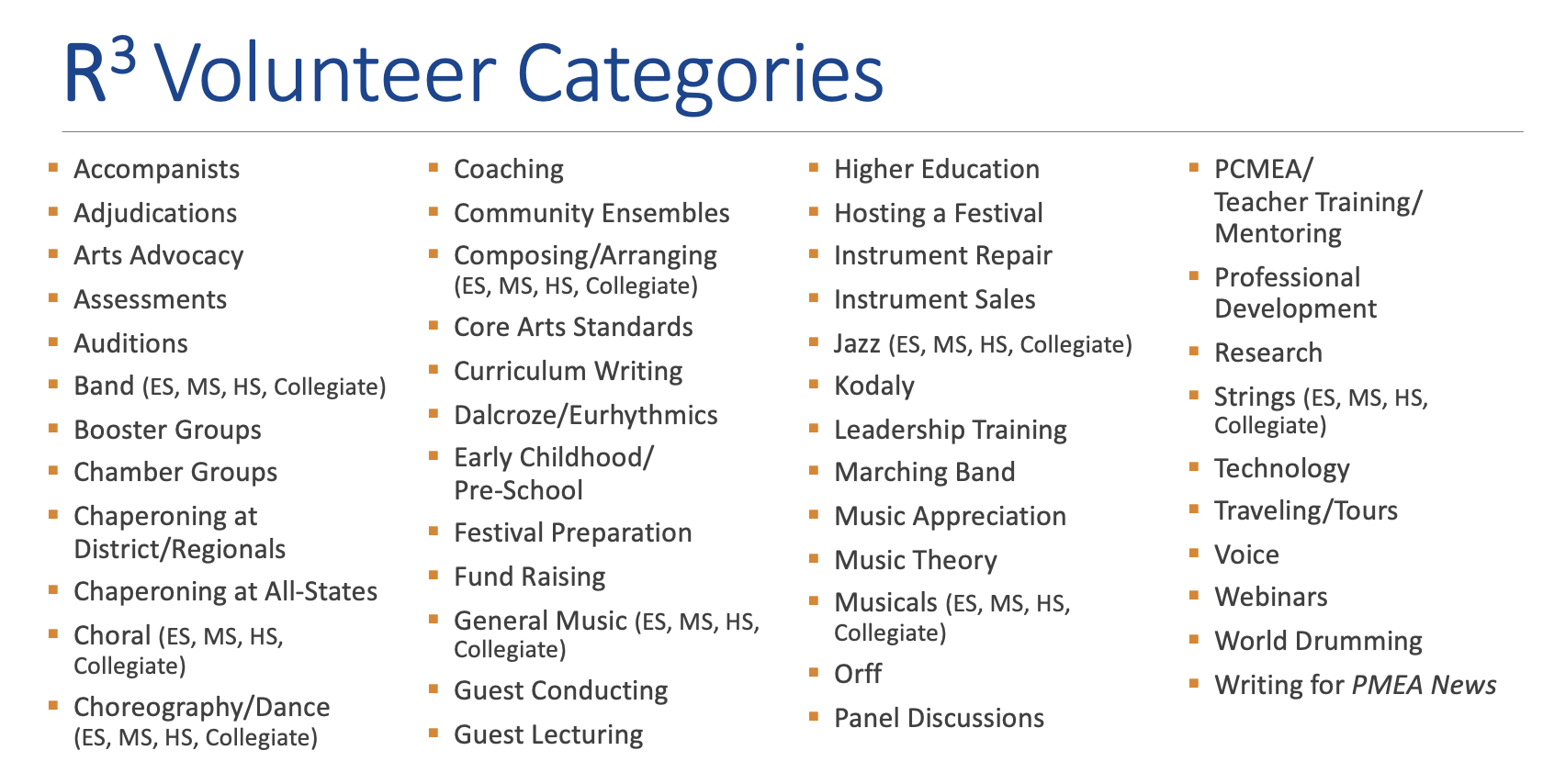
*During their annual membership registration, PMEA Retired Members may choose to sign-up for the R3 Retired Member Registry (above volunteer categories) to become available to informally offer advice to college music education majors, new hires, transfers, and newcomers to any music specialty. R3 members may handle inquiries like “What warm-up would you recommend for my middle school choir?” OR “Do you have an idea for an elementary string ensemble concert opener?” OR “How do you teach improvisation… steady beat… breath support?”

The other option with more time commitment is that Retired Members can be officially “trained” as a PMEA Mentor and be assigned to specific individuals who request assistance in their early career assignments.

Coda

How can we help?

What is the future of retired music educator professional engagement? In a word: connections!

Last month, I reached out to Elizabeth Welsh Lasko, NAfME Assistant Executive Director for Membership, Organizational Development, and Marketing Communications and “volunteered” OUR assistance. I suggested that, in keeping with the NAfME 2022 Vision Statement “…an association where all people are heard, seen, and feel they belong throughout their lifelong experiences in music” we should all intentionally recruit more hands-on involvement of our retirees. I pointed out that in the late 1980s, we had a Music Educators National Conference (MENC) Committee for Retired Members led by a National Chairman who served on the NAfME National Assembly. (An excellent booklet, TIPS: Retirement for Music Educators, Copyright © 1989 MENC, was compiled by A. Verne Wilson, then the Past National Chairman of the MENC Committee for Retired Music Educators.)

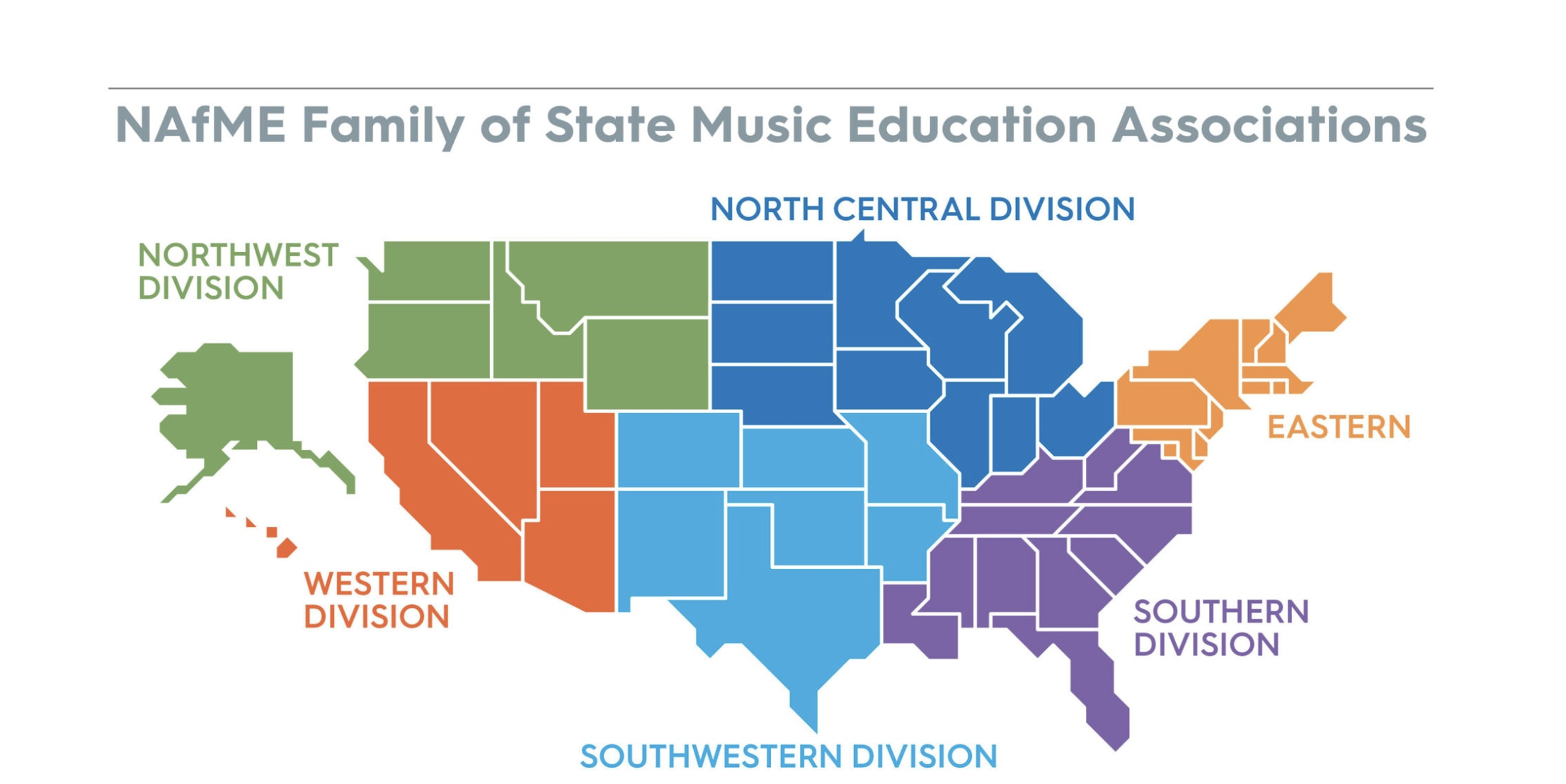
Ms. Lasko encouraged me to “reach out to retirees” beginning with this article. At the next NAfME Eastern Division Conference, I plan to hold a meeting of retired members, and also connect with all state MEA retired member coordinators (those states who have them). We’re available and on the move! Let’s collaborate and share our resources!

Finally, just for fun, I recently posted the blog “For Book Lovers – Retired or Not” on NAfME Connections (formerly called Amplify). There are already 1,810 members in the NAfME “Retired Members Community.” Please JOIN US! Using this forum, get in touch with me, and respond with YOUR OWN retirement stories, strategies, perspectives on this “life passage,” and more ideas to grow the professional engagement of our music teacher retirees.

Happy trails!

© 2025 Paul K. Fox

Bigger Dreams, Bigger Home

How Retirees Can Upsize for Homesteading and Hosting

Featured image via Pexels

[Editor’s Note: My favorite and most prolific “guest blogger” Ed Carter has returned with a piece on upsizing NOT downsizing in retirement. Please enjoy (below) “Bigger Dreams, Bigger Home.” Thanks, Ed!

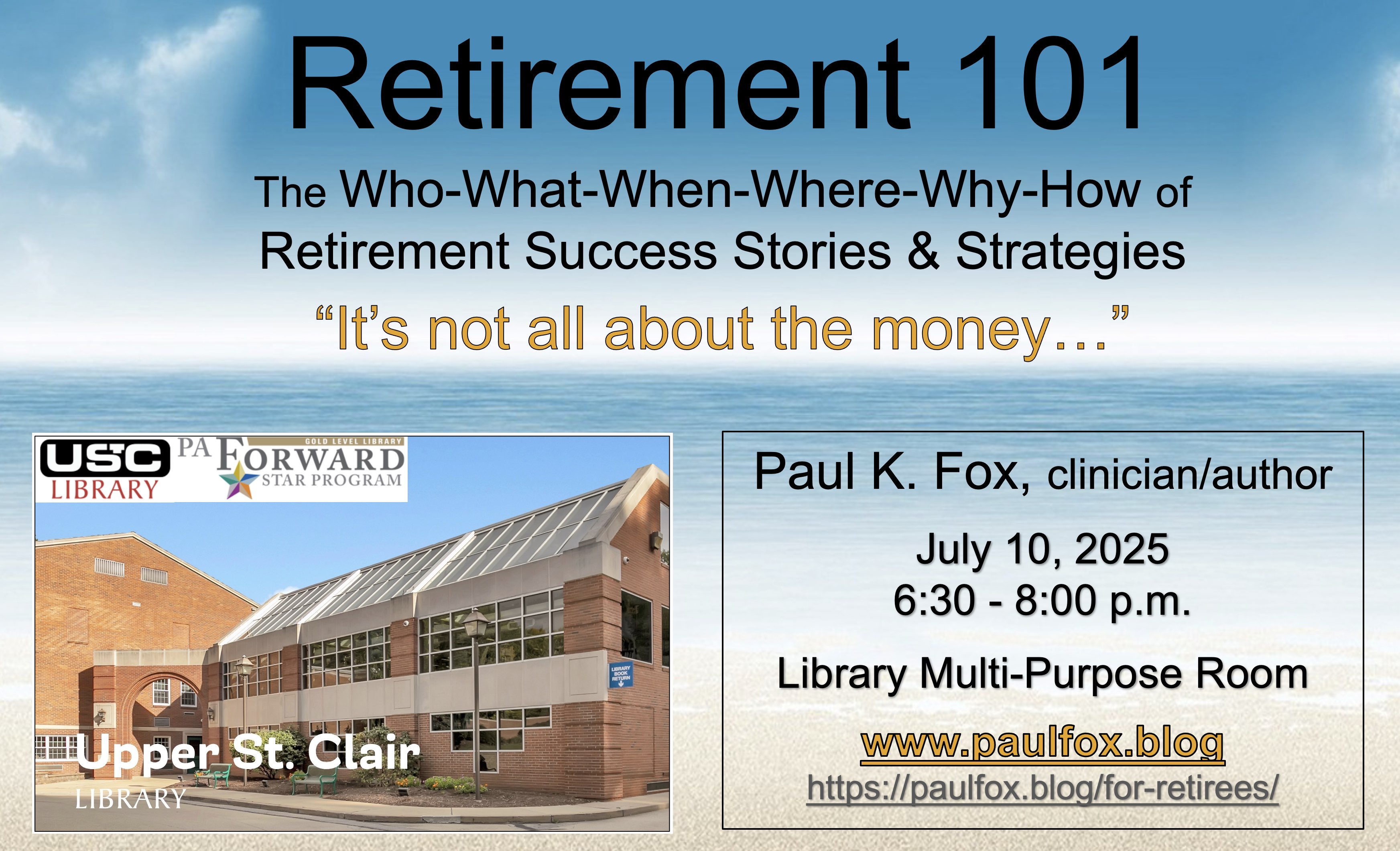
In addition, for attendees to my “Retirement 101 – It’s Not All About the Money” session at the Upper St. Clair Township Library on July 10, 2025 (and any other interested retired or soon-to-retire individuals), please click on the following links to printer-friendly copies of my slide handouts and the updated “Ultimate Retiree Resource Guide.”]


Article by Ed Carter

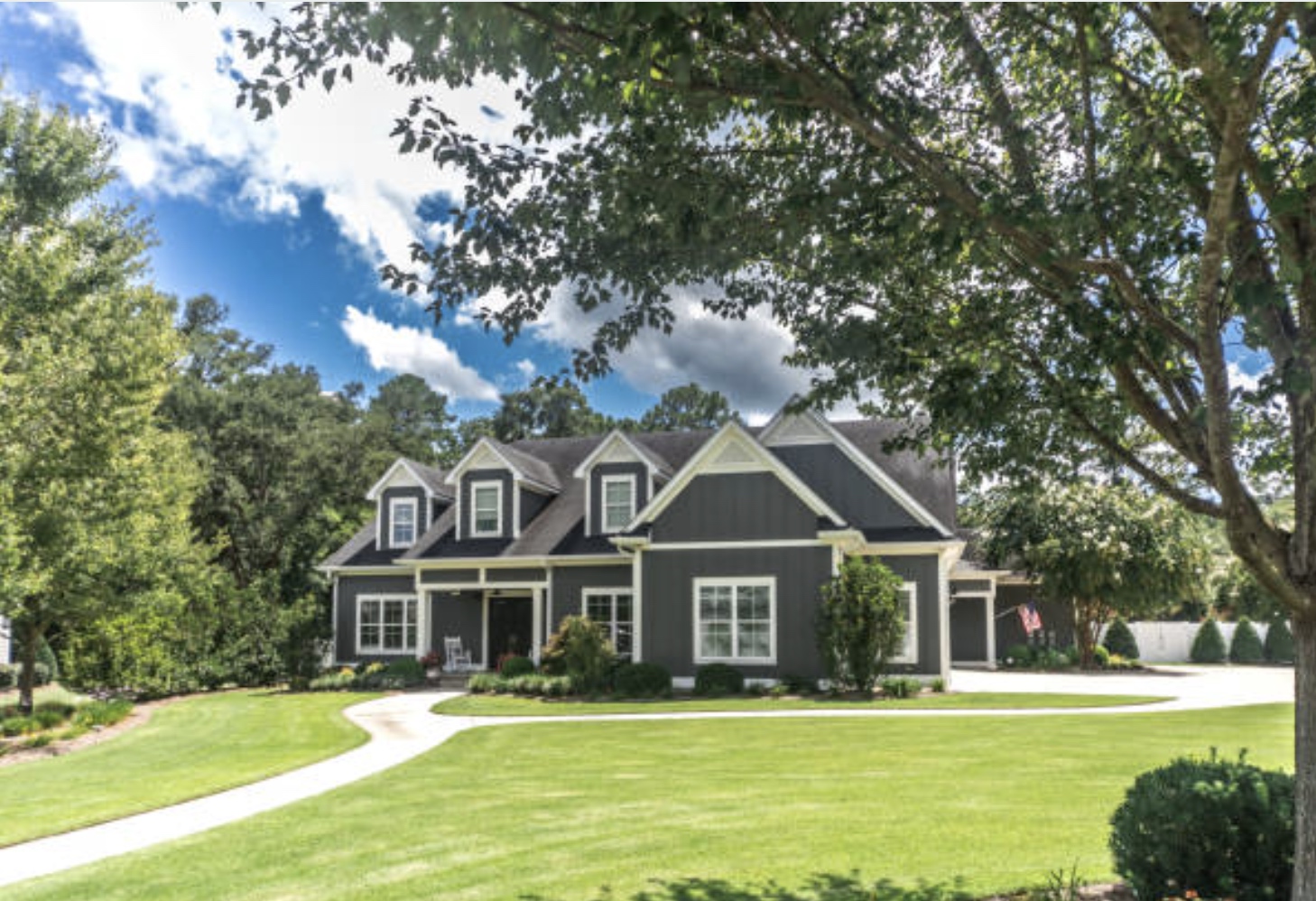
Retirement doesn’t always mean downsizing. For many retirees, it’s the perfect time to invest in a larger home—one with room to explore new hobbies, welcome visiting family, and enjoy the lifestyle they’ve spent years working toward. If you’re dreaming about homesteading or want to transform your home into a hub of activity and connection, buying a bigger property may be more practical than it sounds. With the right planning, you can find a home that fits your vision and your budget.

Know What You Really Want

Before you start searching, take the time to clarify what matters most to you in this “next chapter.” Are you dreaming of cultivating your own garden, raising chickens, or simply having more space to host grandkids and holiday gatherings? Think about square footage, land size, and features that support your lifestyle, like a home office, workshop, or playroom. Visualizing your daily routines in your new home can help you prioritize what’s essential versus what’s just nice to have.

Focus on Land and Layout

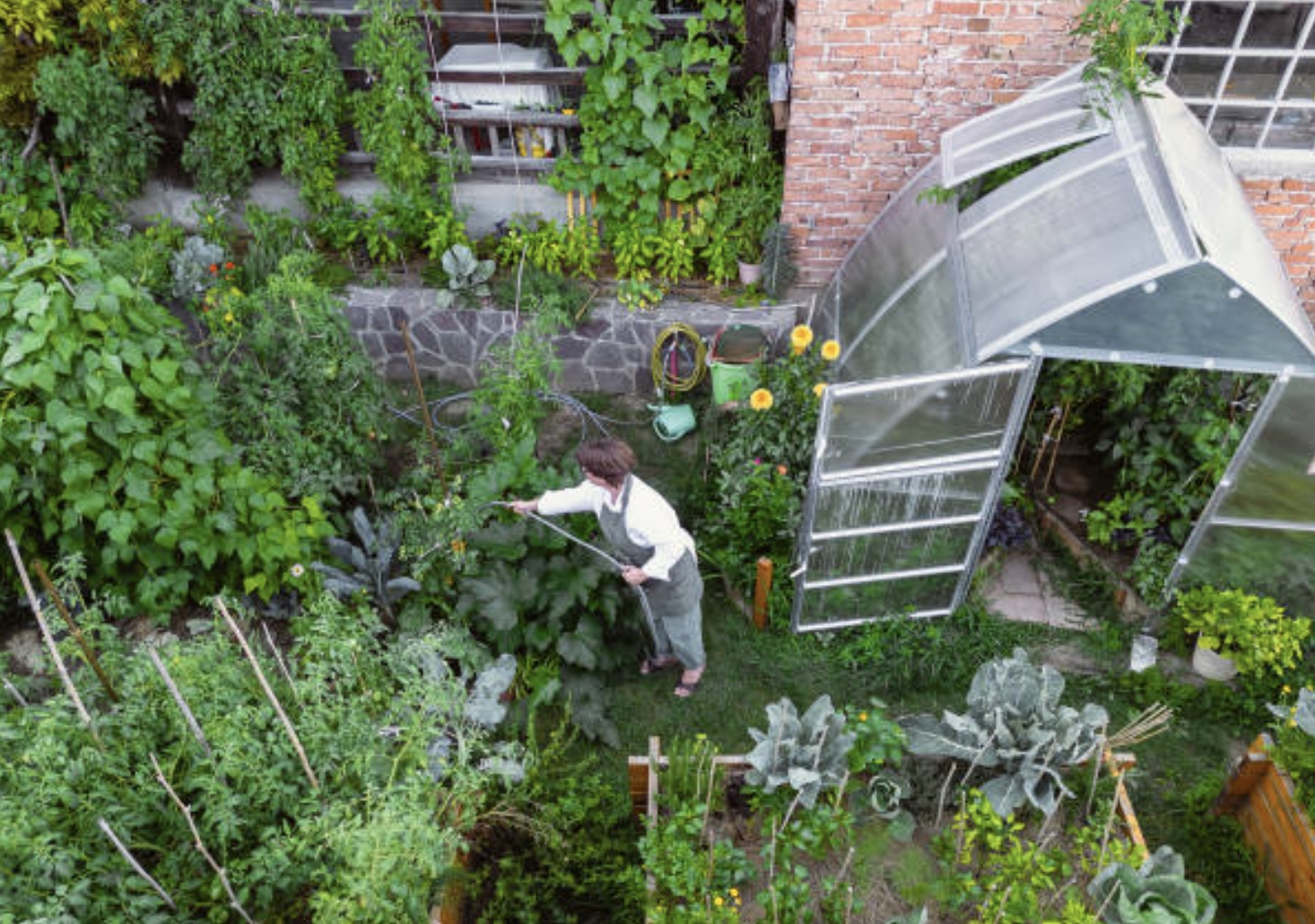
Homesteading takes space—and not just any kind of space. You’ll want to look for properties with usable land that’s suitable for gardening, small livestock, or even fruit trees. Check for sun exposure, drainage, fencing, and access to water. A good layout indoors is just as important; think open kitchens for canning or entertaining, extra rooms for hobbies or guests, and easy access from the house to outdoor areas. A few extra acres can go a long way when your goal is to live more sustainably and independently.

Transform Your Homesteading Hobby Into Income

Many retirees find that homesteading isn’t just fulfilling—it’s also a gateway to a small business. Whether you’re selling fresh eggs, handmade soaps, canned goods, or seasonal vegetables, turning your passion into profit can be deeply rewarding. Going back to school for a business degree can sharpen your skills in marketing, operations, and financial planning—key tools for running your homestead as a business. Online degrees make it easier to balance learning with daily responsibilities, and there are many inspiring online business degree success stories that prove it’s never too late to invest in yourself.

Set a Budget That Reflects Your Goals

Buying a bigger home doesn’t mean blowing through your retirement savings. Start with a clear picture of what you can comfortably spend, keeping in mind property taxes, insurance, maintenance, and any future upgrades. Talk to a financial advisor about how to structure your budget based on your income sources, and consider using proceeds from the sale of a current home if you’re upsizing. You may even find that relocating to a rural or semi-rural area gives you more for your money than staying in a high-cost urban zone.

Explore All the Financing Options

Just because you’re retired doesn’t mean you’re out of options when it comes to financing. Many retirees use a mix of cash, retirement funds, or home equity to buy a new property. Others explore mortgage options like a reverse mortgage (with careful consideration) or traditional loans with manageable terms. It’s essential to speak with a lender who understands your unique income structure post-retirement. The right financing plan ensures you get the home you want without financial stress down the line.

Use a Realtor Who Understands Your Vision

A real estate agent who knows the homesteading lifestyle can help you find properties that truly fit. They’ll understand the value of extra land, zoning laws for small-scale farming, and the features that can make your homestead thrive. Share your vision early in the process—whether it’s selling homegrown produce, raising bees, or hosting family reunions—so they can narrow your options to homes that support both functionality and comfort.

Turn Space Into Opportunity

Once you find your home, think about all the ways to make the most of it. Spare bedrooms can become artist studios or guest rooms for visiting grandchildren. Garages can be converted into workshops or woodworking spaces. Basements can turn into cozy family rooms or even a small business headquarters. Outdoor space can serve multiple purposes: vegetable gardens, orchards, outdoor kitchens, or shaded play areas. With a little imagination, your home becomes a full-time lifestyle—one that supports both your hobbies and your relationships.

Buying a bigger home as a retiree isn’t about having more—it’s about doing more. It’s about designing a life that reflects your passions, supports your independence, and brings your family closer. Whether you want to dig into the soil, start a new business, or simply have space to live fully and comfortably, this move can be the start of something deeply fulfilling. With the right property, the right plan, and the right support, your next chapter can be your most exciting yet.

Peruse more insightful articles and resources here at paulfox.blog, where every post is a step towards a more fulfilling and informed life journey!

PKF

© 2025 Paul K. Fox and Ed Carter

Sharing is Caring!

Join the “Fox Network”

“There is no joy in possession without sharing.”
— Erasmus

“Share your knowledge. It is a way to achieve immortality.”
— His Holiness the Dalai Lama

“There is no delight in owning anything unshared.”
— Seneca

“The miracle is this: The more we share the more we have.”
— Leonard Nimoy

This is a quick blog-post to announce my upcoming professional development initiatives, and an invitation to share your own pet peeves or “thoughts, theories, and teachings.” Of course, I will give you full credit for any contributions, “tips and techniques,” background research, or “quotables” provided!

It has been a challenge motivating any reactions to these articles. Although they would be most welcomed, we typically receive very few online remarks. (If you would like to voice your opinion or add anything to the conversation, PLEASE click on the “comment” button next to the title at the top of the page.)

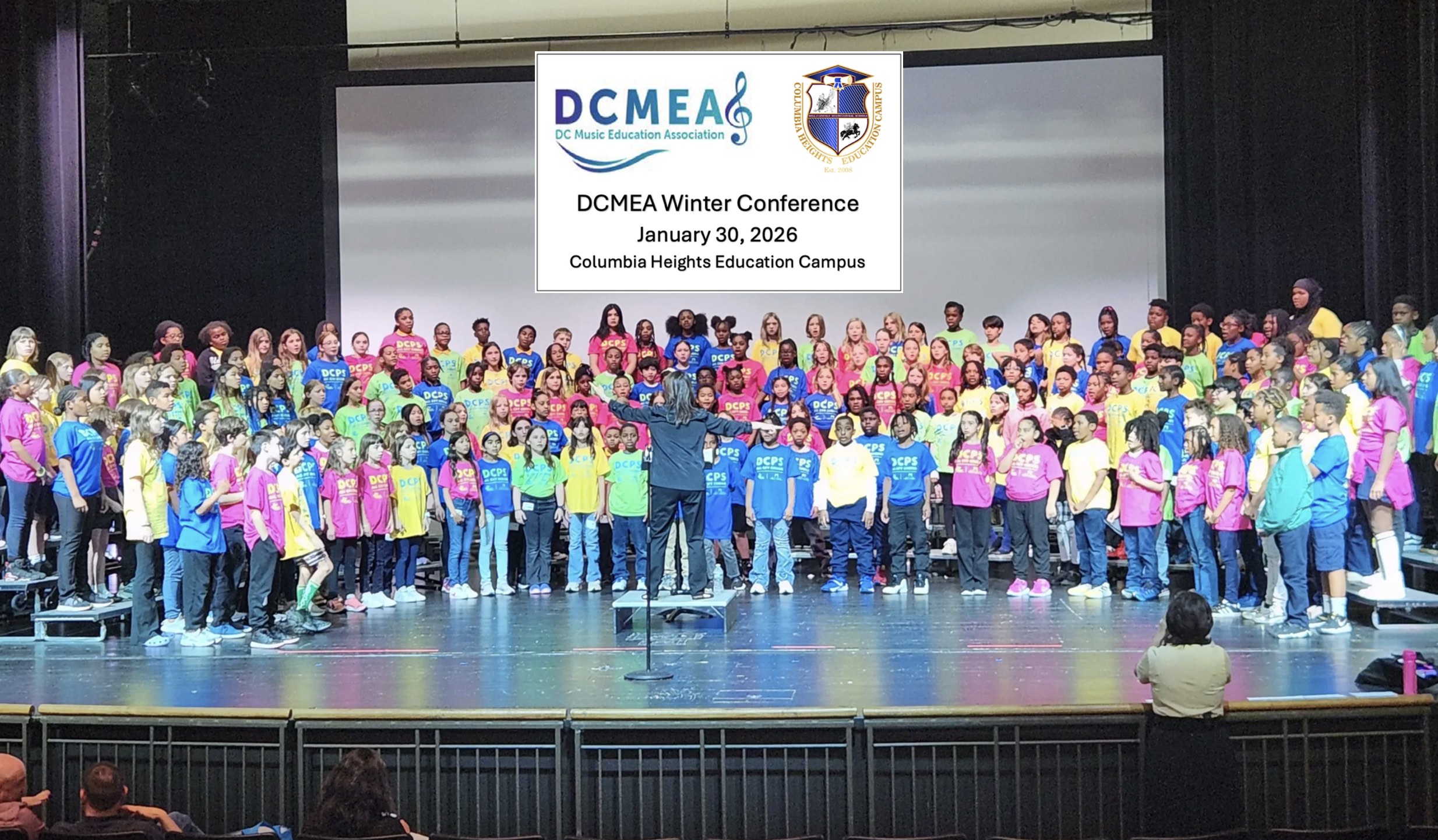
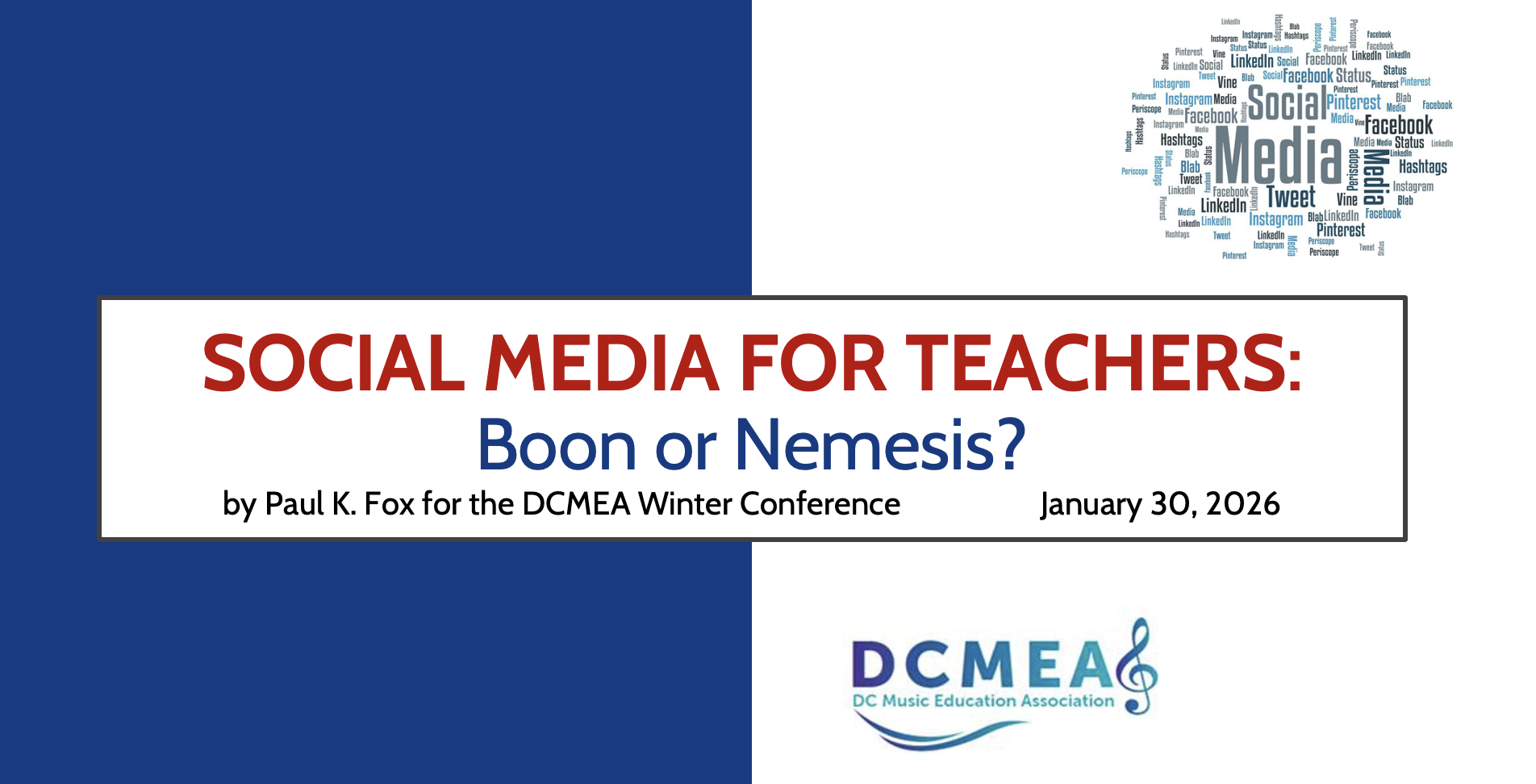
I feel privileged to have been asked to present three sessions at the DCMEA Winter Conference at the Columbia Heights Education Campus (3101 16th St NW, Washington, DC 20010) on January 30, 2026. These are for music educators undergoing pre- and in-service training and include the following:

  • SOCIAL MEDIA – Boon or Nemesis?
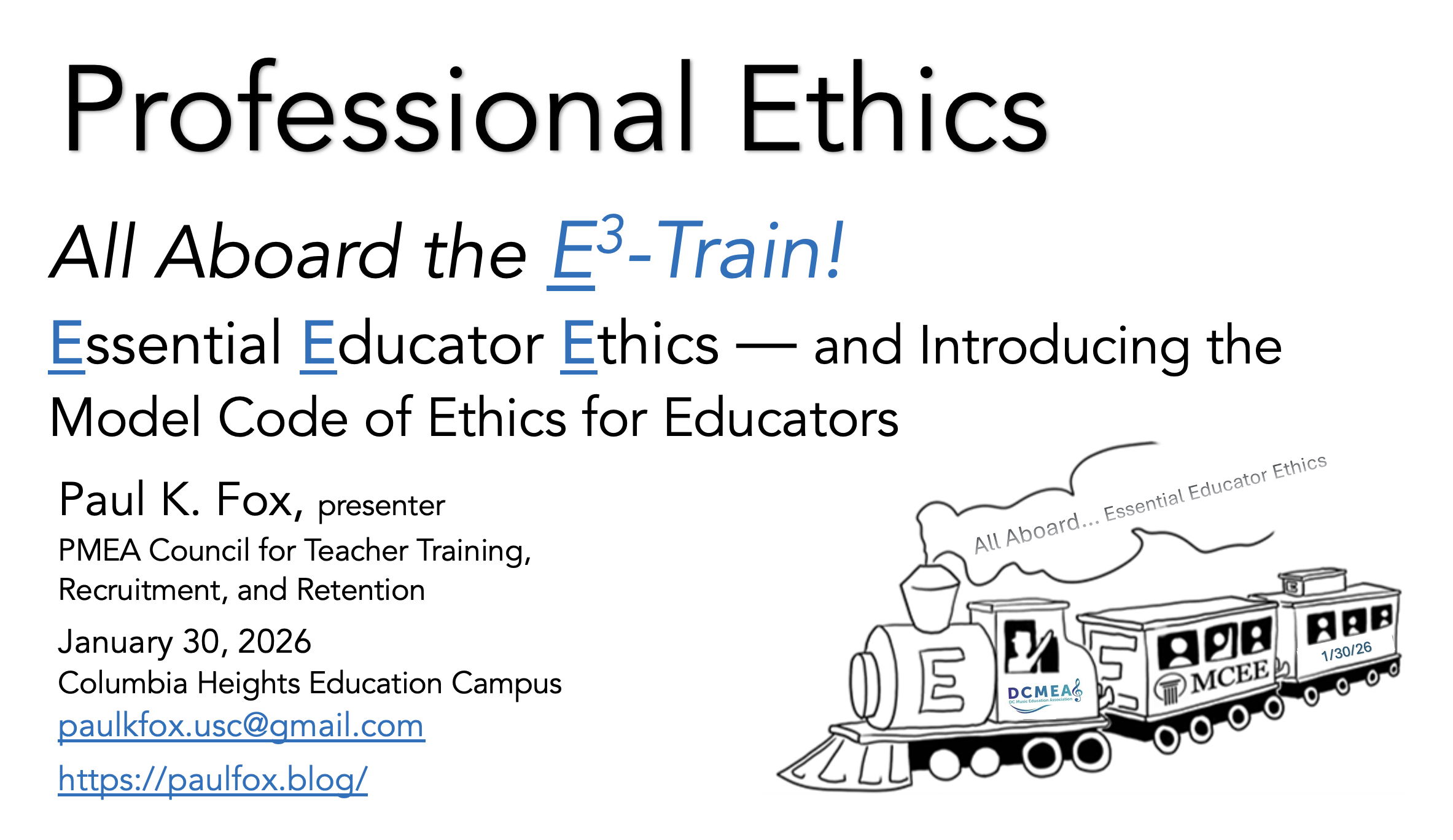
  • ALL ABOARD THE E3 TRAIN – Essential Ethics for Educators
  • SELF-CARE COOKBOOK – Reflections, RECIPES, and Resources for Music Teachers

I would especially appreciate learning about any of YOUR “success stories” or resources on…

  • Favorite examples of “safe and meaningful” social media for teaching music students.
  • Anecdotes of ethical “conundrums” or issues in the daily decision-making of music educators.
  • Sample “stress-reducers,” time management tips, and other self-care strategies to avoid music teacher burnout.

In addition, I am in the process of updating my INTERVIEW 101 and EMPOWERING EDUCATOR & STUDENT LEADERSHIP clinics for future blog posts and clinics. Any thoughts?

Finally, I would also love to hear from you if you have any feedback on a proposed future sharing session for the parents of music students called ADVICE TO MUSIC BOOSTERS. If you have ever sponsored a music parents advocacy group for your school music program, what suggestions would you give to your colleagues and booster officers?

Feel free to reach out to me via email here. Thank you for your willingness to help our profession!

Editor’s Note (things to look forward to): In mid-July, our next blog for this series geared to “the life cycle of a music educator” will be from guest author Ed Carter entitled “Bigger Dreams, Bigger Home: How Retirees Can Upsize for Homesteading and Hosting.” In addition, I plan to share links to materials of the “Retirement 101 – It’s Not All About the Money,” a free workshop I am presenting to residents at the Upper St. Clair Township Library on July 10, 2025.

PKF

© 2025 Paul K. Fox
Bookends – Part Two

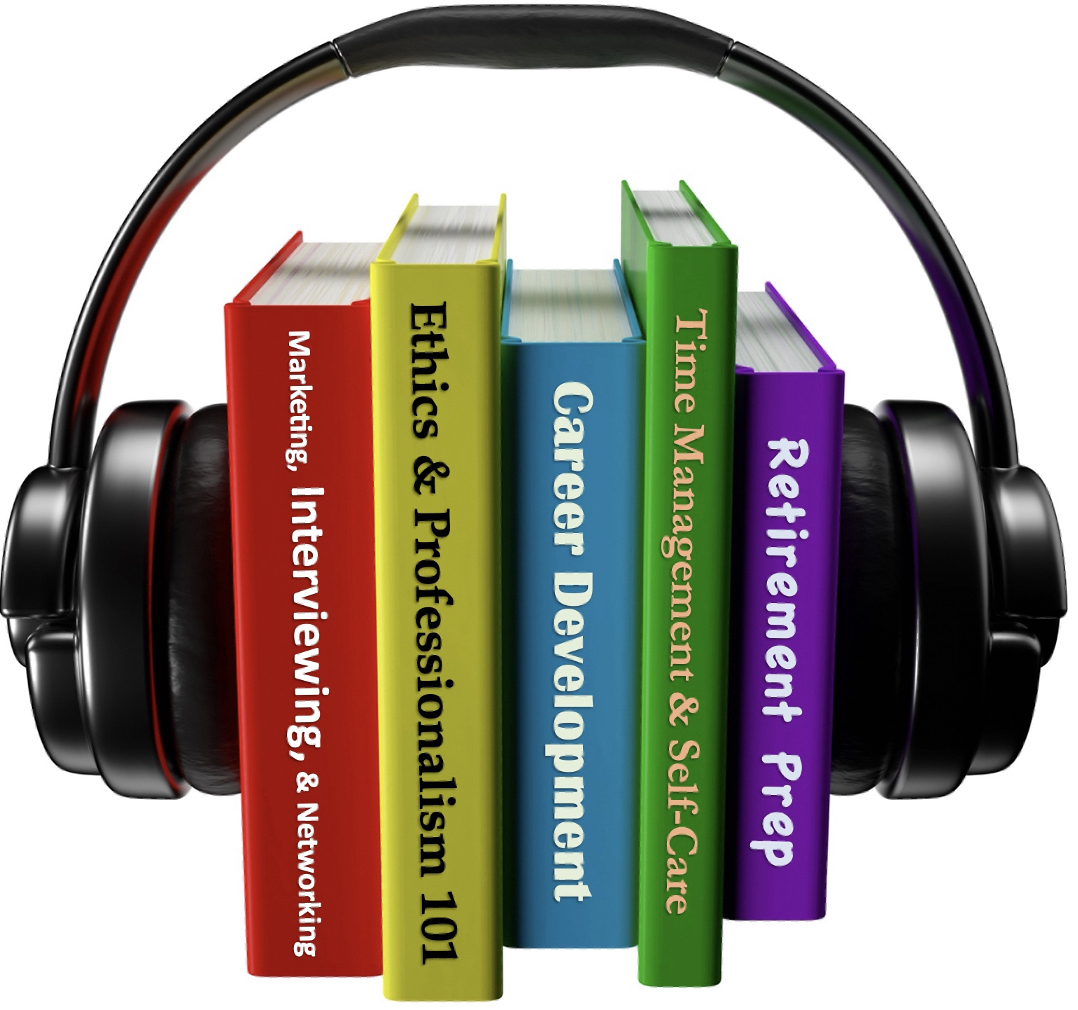
The Life Cycle of a Successful and Happy Music Educator

Joyous Holidays, Season Greetings, and Happy New Year from “The Foxes!” This is a time for reflection and gratitude… and we feel blessed for all the opportunities allowing us to share our insights, gifts and experiences with other music education professionals.

We hope to inspire YOU and literally model the concepts in this blog series. We continue with our discussion first introduced a month ago in Bookends – Part One – The Life Cycle of a Successful and Happy Music Educator, exploring:

  • Stage 3: Inservice/Growing Years (this blog)
  • Stage 4: Veteran/Sustaining Years (future blog)
  • Stage 5: Next Chapter/Living the Dream (future blog)

This article is an abstract from a session presented to Seton Hill University music education student teachers on October 17, 2023. Click on this link to download the slide summary in PDF format.

“I have written a lot of articles in support of these topics… now compiling them for your easy access. Depending on your current status and interests, feel free to peruse the checklists (links) in this series. It is possible a few of the resources contained within these blogs have gone inactive, but I believe enough are there for you to gain the insight, tools and motivation to achieve professional development for life.”

– Paul Fox

Stage 3 – Inservice/Growing Years

[ ] 8. Becoming a Music Educator: For a review of Bookends – Part One, take a step backward and revisit what you have done to “get ready” for your “rookie years.” Take special note on the things-to-do list (“secrets”) as a first-year educator (perhaps completed during your student teaching semester):

  • Subscribe to a discounted NAfME + PMEA first-year membership (If you are a recent college graduate in your first year of teaching, or if you are the spouse of a current or retired NAfME member, contact NAfME at 800-336-3768 or email memberservices@nafme.org) to find out if you qualify for a reduced rate.
  • Hook up to PMEA Mentor or other state’s MEA support program for new teachers.
  • Look into finding an informal advisor in the PMEA Retiree Resource Registry for PA music teachers.
  • Need to fill in a few gaps missing from your college courses in skills and knowledge? Continue your “enrichment” viewing PMEA Webinars and the exhaustive video library in the NAfME Academy.
  • Take advantage of earning professional development credits just for reading an article in the NAfME Music Educators Journal
  • At some point you will be writing/editing curriculum, so research the awesome resource of Model Curriculum Framework (Have to be a PMEA member)
  • Too busy to participate in the PMEA Annual Conference or NAfME national events? Look into going to a PMEA summer conference (usually at a lower-cost!). Check out your own state’s MEA discounts and offers for collegiate members and new teachers!
  • Numerous free and timely blog posts from NAfME Music in a Minuet and here (paulfox.blog).

[ ] 9. The Care & Feeding of Your Principal: Although not covered in any detail during the Seton Hill University presentation, it is recommended that you read in its entirety “The New Teacher’s Guide to Fostering Positive Relations and Good Interactions with School Administrators” offering a wealth of excellent recommendations from these trustworthy sources:

A favorite question I pose to college music ed seniors is, “In what professional associations are you a member and actively involved?” For the price of consuming one fewer Starbucks latte a week, you can open up the Wonderful World of “C’s” – Contacts, Coachings, and other Connections, including research and resources that will benefit your Continuing Education. You can’t afford NOT to join groups like these.

To help “nail down” a few related definitions critical to personal growth and career development in our profession, especially “engagement,” “professionalism,” “collaboration,” and “networking,” please take a little time to travel and consume the following archived blog postings.

[ ] 10. The Meaning of PRO: This is one of the oldest articles at the paulfox.blog site. How about a little soul searching? Are you truly a professional? Do you have the skills, habits, and attitudes of a professional in the field of education?

[ ] 11. Transitioning from Collegiate to Professional (Part II): New teachers have to move away from “book learning” or higher education research and emphasize “practical application,” and at the same time, assess the precise areas needed for immediate (re-)training… everything from new exposure to specialized teaching areas and grade level focus for the job to which you have been assigned, to the enhanced skills of classroom management, student assessment, curriculum writing, class or ensemble warm-up materials, music repertoire and programming, etc.

While we are on the subject, it is important to intentionally seek out mentors or consultants in your early years of becoming an educator. PMEA offers a mentoring program (read all about it here) and PMEA Retired Members are also an excellent resource to “phone a friend” for advice as needed (see their section on the PMEA website here). That leads us to the next most essential “habit” of attending professional conferences… #12 below.

[ ] 12. Getting the Most Out of Music Conferences: Our PMEA Annual Conference sites are cyclical. This article, written on March 5, 2017, showcased that year’s event at the Erie Bayfront Convention Center – coincidentally the same location for this year’s PMEA Annual Conference: April 17-20, 2023. For a sneak peek at the proposed sessions and guest performers, click here.

There are a myriad of conferences offered every year… something for everybody in just about every state. Make plans to go, “recharge your batteries,” and pick up new state-of-the-art ideas, lessons, music, technology, etc. Again, you cannot afford NOT to attend… or becoming stale in your teaching or “stuck in a rut!” Besides, going to your state’s or national conferences and regional workshops are FUN places to meet other like-minded, inspiring colleagues! This is how professionals network, collaborate, and share their “latest and greatest!

A couple upcoming events:

What are you waiting for? It’s time to DIVE INTO your customized career development!

Coming Soon…

Bookends Part Three – Stages 4 & 5

PKF

© 2023 Paul K. Fox

On the Road Again (2023)

“Doing My Thing…” — Professional Development Conferences for Music Educators

It’s been awhile since I posted here… arguably the longest editorial break I have taken since retirement and starting this blog-site. What’s that line retirees often say? “It’s a good thing I am retired from my job; otherwise I would not have enough time to do everything!”

This has been an extremely busy couple months of renovating three bathrooms, promoting the 30th Anniversary Gala Celebration of the Community Foundation of Upper St. Clair featuring a CASINO NIGHT & the local band NO BAD JUJU (to which I can’t even go because it is on the same day as PMEA), staffing a transition of new editors and an office manager for the UPPER ST. CLAIR TODAY community magazine, “keeping my hand in” by conducting a small nonprofit community ensemble (now in our 40th season of the South Hills Junior Orchestra), volunteering at the hospital (see my Tales from a Wheelchair Jockey article), developing new PDE Act 45 and 48 programs on ethics (school system leaders and educators respectively), and… (deep breath): preparing four PowerPoint presentations for two music conferences in April. Yes, and loving every minute of this frenzied activity!

Pennsylvania and Eastern Division music education colleagues: Hopefully by now, you have registered for the coming conferences on the horizon:

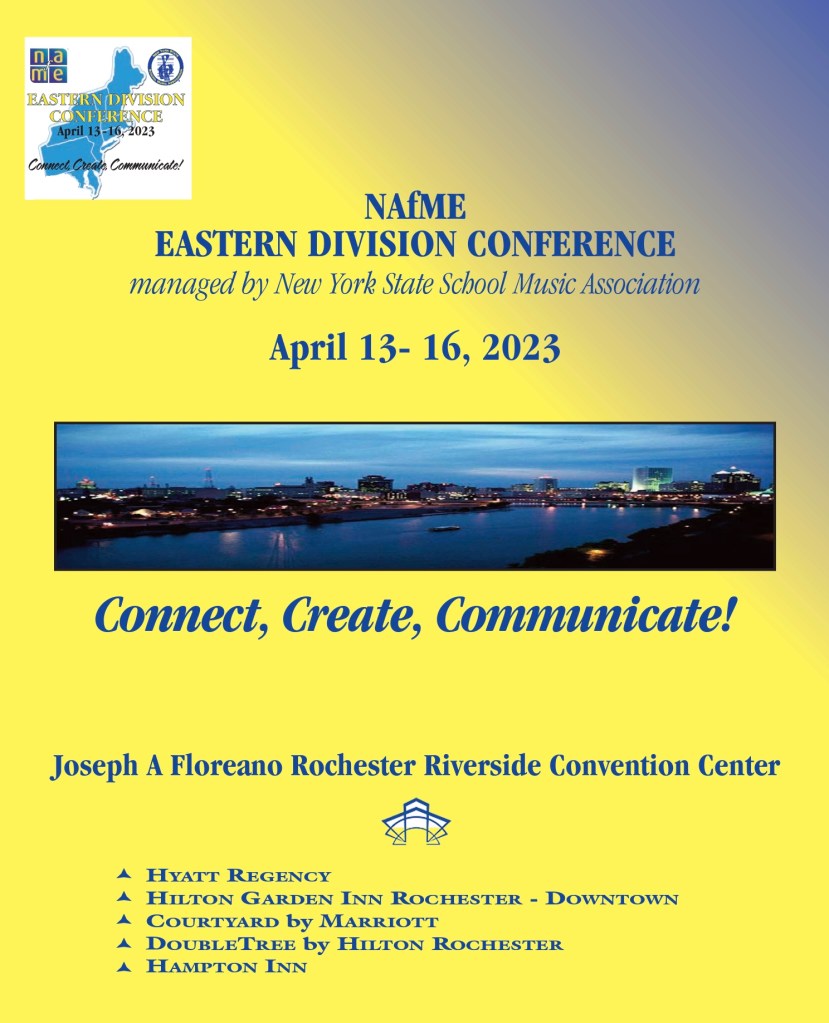
NAfME Eastern Division Conference, April 13-16, 2023, Rochester, NY

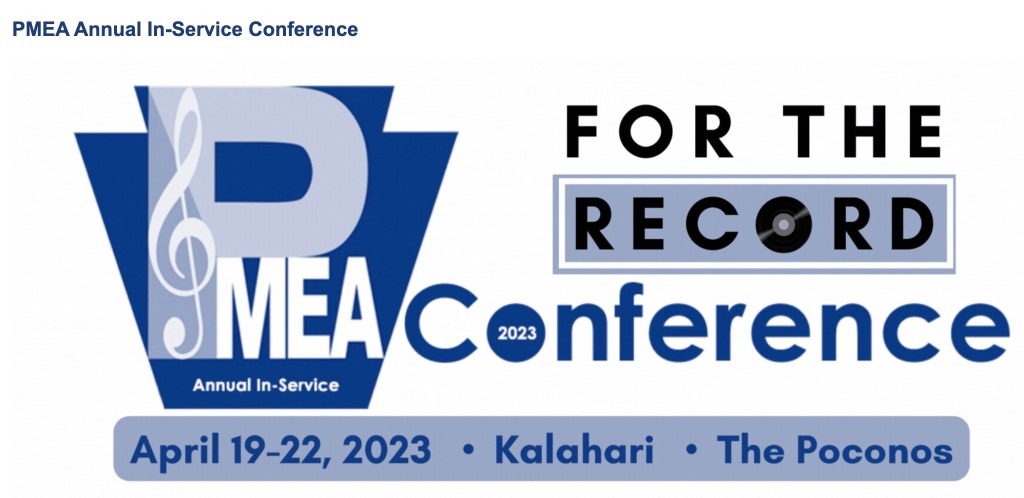
PMEA Annual Conference, April 19-22, 2023, in the Poconos

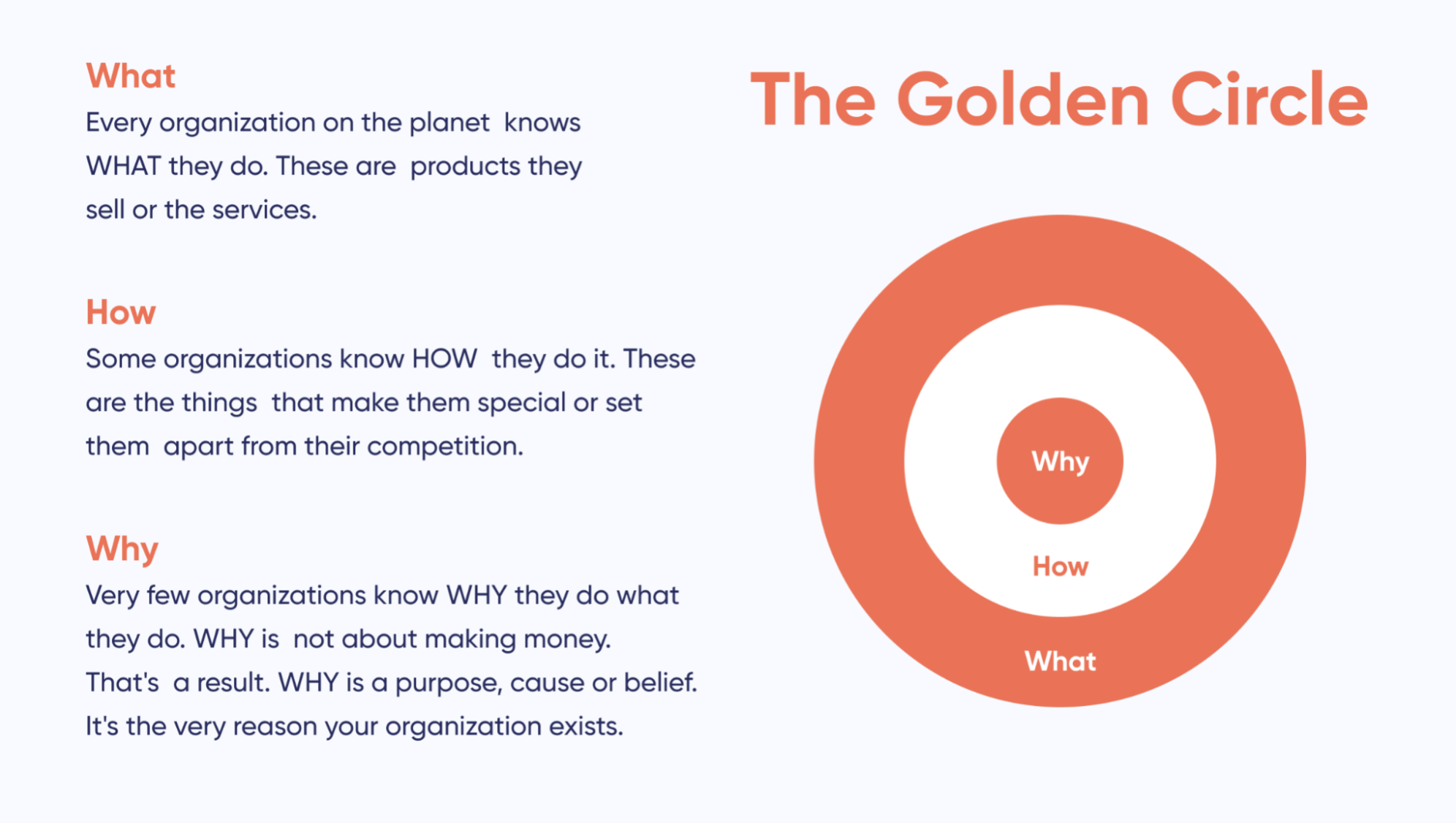
Now to quote the inspiration of Simon Sinek — his theory of value proposition to ‘start with why’ — how leaders can inspire cooperation, trust, and change based on research into how the most successful organizations think, act, and communicate if they start with why. Check out his rationale with The Golden Circle:

The “why” of attending your professional development conferences, “sharpening your saw” (self-renewal by Stephen Covey) aka “recharging your batteries,” learning what’s new and innovative on the forefront of “the state of the art,” and networking with colleagues, and has been addressed often in past blogs:

Simply put — to maintain your mastery of music and methods and build on your “best practices” and professionalism, you MUST attend as many educational conferences and workshops as possible!

Now to my “bags of tricks” for April 2023

Mark your calendars:

April 15, 2023 at 10:45 a.m. in Hyatt Susan B. Anthony (NAfME) – OR –
April 21, 2023 at 11:30 p.m. in Kalahari Suite 40/50 (PMEA)

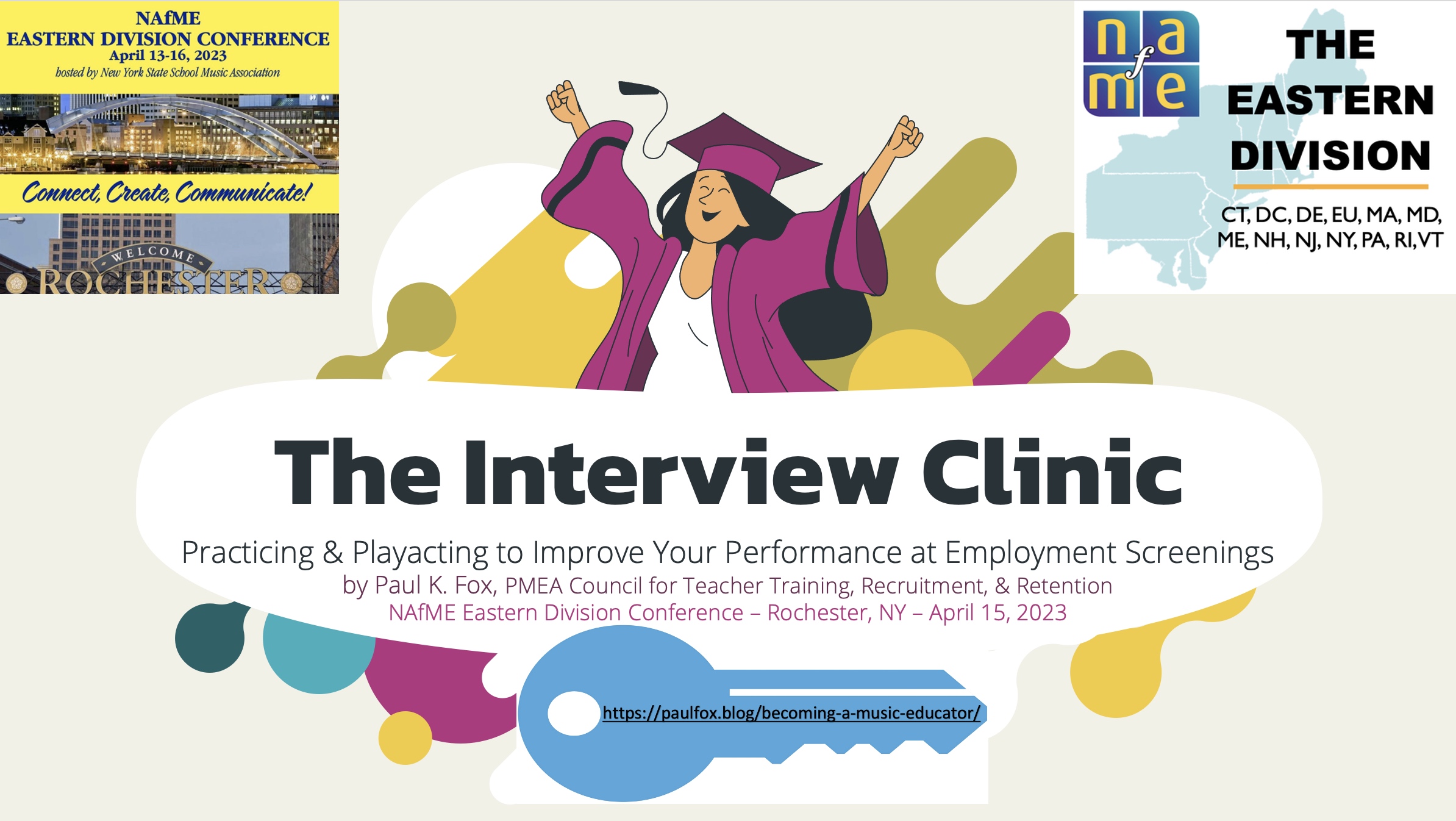
I was blessed to have been asked to present THE INTERVIEW CLINIC — Practicing & Playacting to Improve Your Performance at Employment Screenings at both the NAfME and PMEA conferences. This will be FUN! Perfect for college music education majors, soon-to-be or recent graduates, new transfers to the profession, teachers seeking to change positions while openings seem to be “heating up,” or first-timers looking for employment, the session targets will provide interactive exercises to build self-confidence and develop better insights, practices, and strategies to successfully land a job. “The key is in the preparation” of:

  • Standards—Defining/modeling professionalism, versatility, and ethics
  • Marketing—Branding, networking, and selling yourself
  • Skills—Interviewing, storytelling, and organizing
  • Assessment—Observing, reviewing, diagnosing, and improving

Interactive exercises, you say? Yes! Get ready to meet new people and perhaps dive into a few activities slightly outside your “comfort zone!” (We promise NOT to embarrass anyone!) We will break up into small groups or “duet partners,” and explore defining our professional “essence,” telling anecdotes about our strengths and past problems we have “crushed,” and focusing on learning “the golden gift of gab” — storytelling.

Portions of this workshop will come from material in the past posts Storytelling, etc. Part 2 and When it Comes to Getting-a-Job, S Is for Successful Storytelling. (Your homework? Peruse these before coming to either session at NAfME or PMEA!)

As always, articles, resources, and slide summaries will be posted under the “Training/Jobs” menu tab (above).

Mark your calendars:

April 20, 2023 at 3:00 p.m. in Kalahari Suite 30 (PMEA)

How many of you feel at times a little overwhelmed, exhausted, stressed out, disorganized, demoralized, or disenfranchised?

Are you at the end of your rope and wondering how you’re going to “keep it all together” over the next week, month, year?

Is your health is interfering with your ability to do your job and find success, balance, and meaning in your personal life and relationships? Then… it is time for a change.

We are still dealing with the effects of the pandemic which has brought on a “gap year” to most of our music programs, the stress of “working harder not smarter,” more teacher burnouts, and the resulting bail outs, staff shortages, and/or job cuts. We need to embrace NEW strategies for personal self-care and SEL (social and emotional learning). Do you still enjoy teaching? How have you coped with all of the changes? How will you achieve a better work/life balance and skills in time/priority management and personal health and wellness?

The prescriptions and RECIPES towards stress reduction and developing a self-care plan are here! Doug Sands, a consulting hypnotist and founder of AnywhereHypnosis.com, joins me to “throw in everything and the kitchen sink” to alleviate these problems, with NO cookie-cutter, “one-size-fits-all” solutions from the chefs:

  • What has COVID done to all of us?
  • Instant personal online stress assessment
  • Taking an inventory of the ingredients towards a healthier lifestyle
  • Definitions, symptoms, and remediations for teacher stress and burnout
  • Why teachers are so exhausted and what to do about it
  • Time management tips
  • Breathe like a Navy SEAL
  • Coping and learning “acceptance”
  • How to “coach overwhelm!”
  • The role of meals, movement, music, and mindfulness (thank you, Lesley Moffat!)
  • From MEJ: A suggested self-care plan and “cognitive distortions” to avoid
  • Focusing on ONE self-care strategy from a “sea of solutions”

We’re in this together… so we need to join forces and SHARE the secret recipes for a happier life! Add your own “baking tips,” and I promise, you’ll leave with a better understanding of how we all can celebrate the coming year or decades in music education!

By the way, my “mindfulness partner” for this workshop, Doug Sands, promises us he will not hypnotize any of us during this session (although he could!).

For more about his work, including “15 Rapid Tools (and Counting) to Wipe Out Anxiety, Stress, and Panic,” please go to his website here.

You are invited to stop in to see him at his PMEA booth in the Kalahari exhibit hall.

POST-CONFERENCE NOTE: Doug sent us his Anti-Panic Toolkit entitled, 15 Rapid Tools (and Counting) to Wipe out Anxiety, Stress, and Panic – Wherever They Strike! Click here.

If you would like a sneak preview of the revised handout for the Self-Care workshop, go to the Care menu section at the top menu bar.

Taking a peek at our recent past…

Workshop for Orchestra & String Teachers

In case you missed the PMEA District 5 Professional Development Day, my wife Donna and I presented “Plucking Our Minds” at Grove City College on February 20, 2023.

We were privileged to “share some of our secret sauces” gleaned from over 80 combined years of experience on a variety of topics:

  • CommUNITY Music-Making
  • Online Academy
  • Summer String Camp
  • Assessment Projects
  • Collaborative/Creativity Projects
  • Library of “Fox Firesides”

If would be a shame to waste these resources… and reading them could inspire new adaptations to your instrumental program.

Click here for a copy of the slide handouts. Feel free to comment (above) or send an email to me (paulkfox.usc@gmail.com) if you have any questions.

Our Crystal Ball

Future Accredited Workshops on Ethics in Education

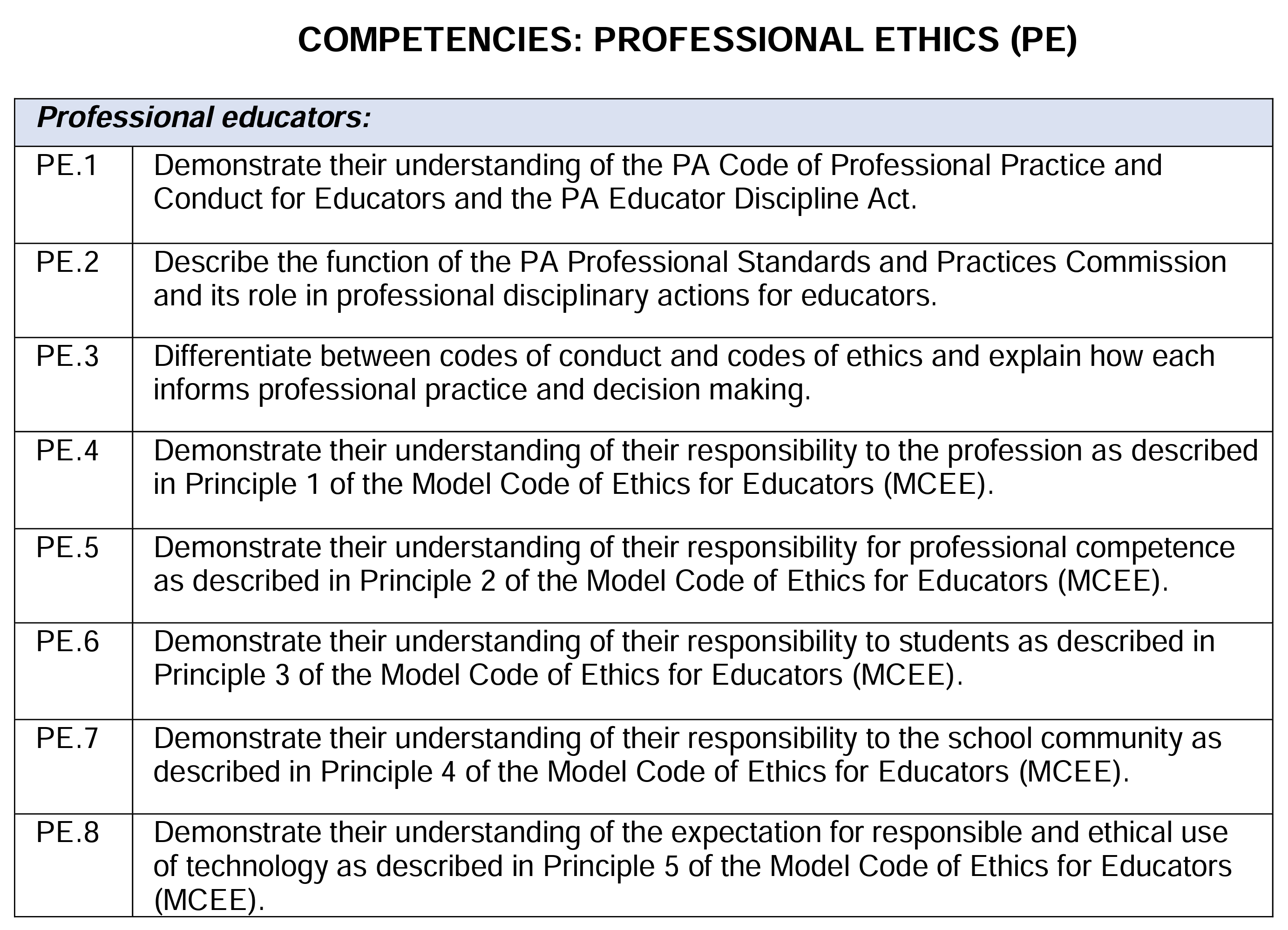
Are you aware that the Pennsylvania Department of Education (PDE) has recently revised the PA educators’ Code of Professional Practice and Conduct AND adopted the Model Code of Ethics for Educators developed by the National Association of State Directors for Teacher Education and Certification? Have you seen the new Professional Ethics Program Framework Guidelines? PA Chapter 49 requires instruction in professional ethics to be integrated in educator preparation, induction, and continuing professional development programs as follows:

  • Continuing professional development programs must integrate the professional ethics competencies no later than the 2023-24 academic year.
  • Educator preparation and induction programs must integrate the professional ethics competencies no later than the 2024-25 academic year.

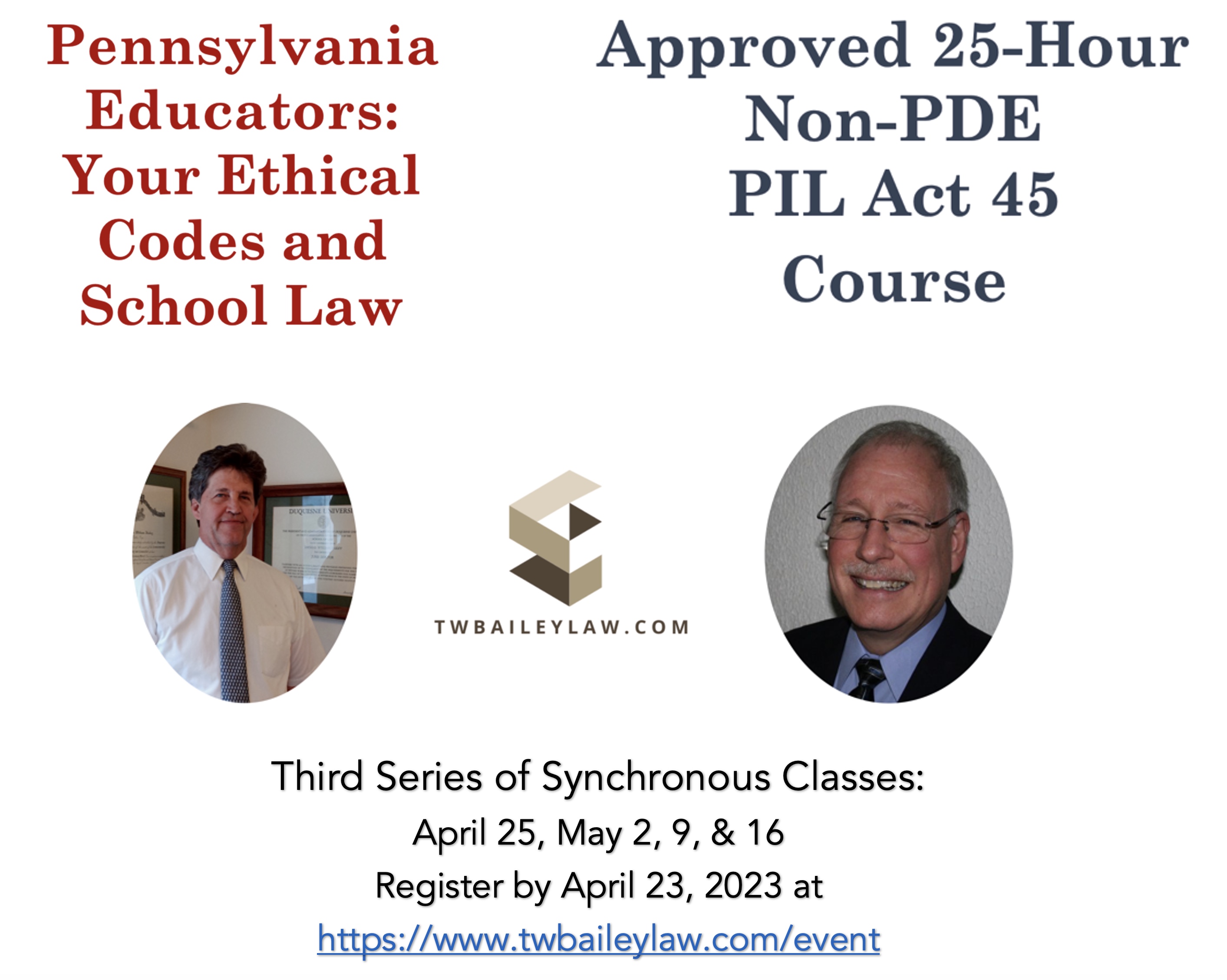
Not one to let grass grow (or mud sink) under his feet, retired social studies teacher, current attorney-at-law, and past PMEA conference presenter Thomas Bailey has partnered with me to design new ethics training classes for school system leaders (25-hour Act 45 PIL course) and educators (four-hour Act 48 continuing education course). In addition, we are introducing a new “hybrid” program for school administrators involving four-hour pre-recorded asynchronous webcasts (site license), along with a three-hour synchronous webinar using the webcast videos and adding facilitated interactive discussions of three ethical case studies either via Zoom OR in-person follow-up workshops led by both clinicians.

In Depth Ethics Training for PA Educators:

  • PA Model Code of Ethics for Educators
  • PA Code of Professional Practice and Conduct
  • Professional Standards and Practices Commission
  • PA Educator Discipline Act

Click here for to register for Act 45 PIL Course.
Next series: April 25, May 2, 9, & 16, 2023

Click here for more information on the Ethics Webcast/Webinar and general information/landing page for the TWBaileyLaw website.

Click here for timeline of educator ethics presentations and clinicians’ bios.

Also review the Educators Court Case Blog and William Penn SD vs. PDE Blog.

Numerous articles have already been published on the subject of educator ethics, professionalism, and decision-making:

Hope to see you at one of these conferences or workshop sessions! Yes, it means a lot more to attend these IN PERSON!

PKF

© 2023 Paul K. Fox
It’s Time for… the PMEA Summer Conference!

The summertime academic break is essential for the health and wellness of every music educator. Hopefully you are enjoying a little TIME OFF and an emotional and intellectual break and release from thinking about your professional responsibilities and anything about school!

Europeans swear that it takes no fewer than three weeks of what we would call an extended vacation. They say we need that much time to totally unwind, de-stress, rest, and, if necessary, lick our wounds and even “heal ourselves!” Summer should allow us to focus on family, friends, and leisure activities FIRST – to re-adjust our “work/life balance.” After an appropriate interval, then we can get ready to re-charge and re-energize, to recommit emphasis on new music program goals and professional development.

If you are fortunate enough to live in Pennsylvania and be a member of the Pennsylvania Music Educators Association (PMEA), I have a wonderful “crosswalk” solution to accomplishing this REBOOT – a combined “refresh and re-invest” makeover – to first get out of dodge for a change in scenery and then take care of your own social-emotional learning to come back to school raring to go! It’s simple! Sign-up to participate in the 2022 PMEA Summer Conference to be held in-person at the Doubletree by Hilton Hotel in Reading, PA on July 18-19, 2022.

Here’s the link to registration and detailed schedule: https://www.pmea.net/pmea-summer-conference/.

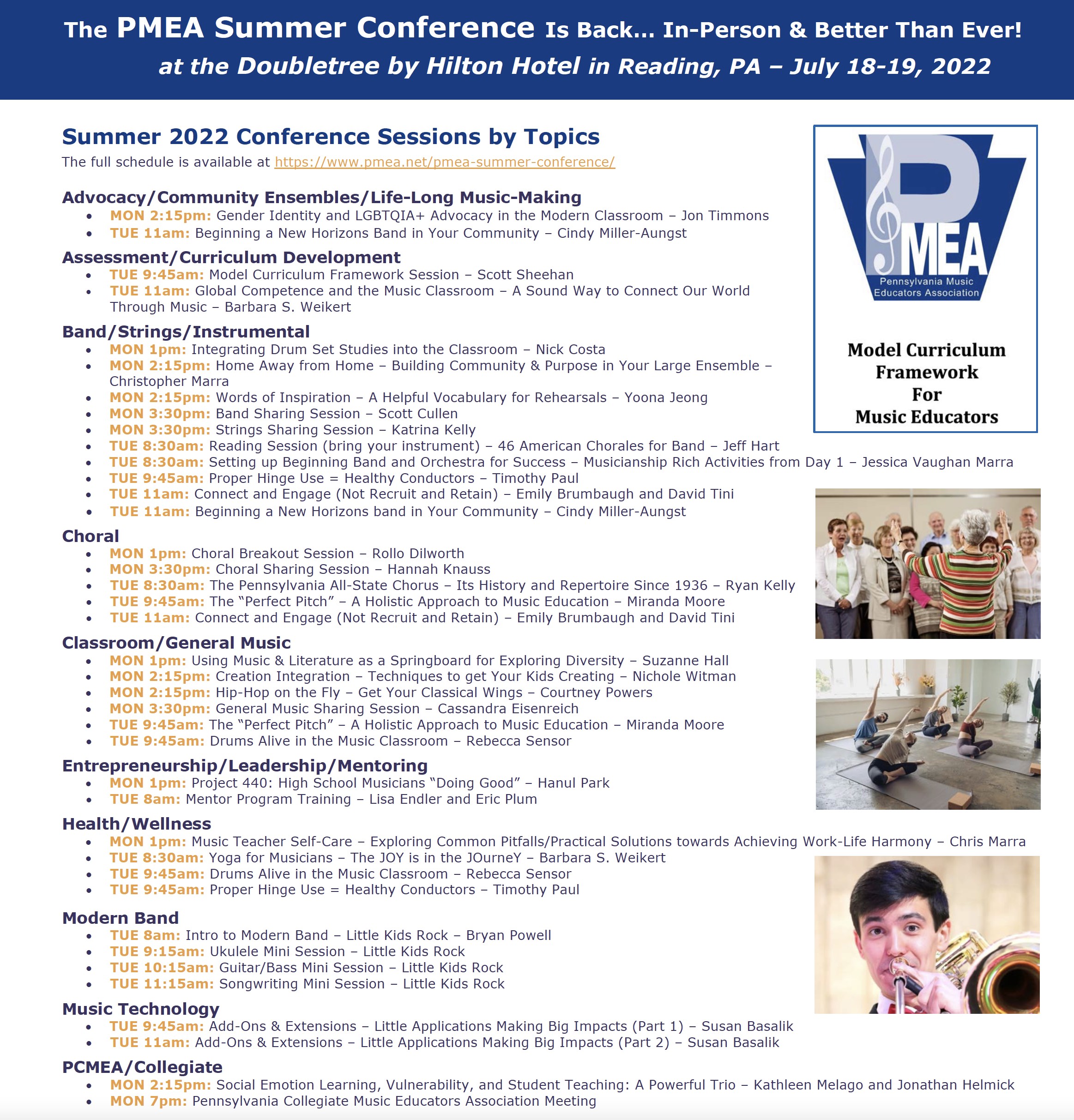
Once again, PMEA is “crushing COVID” and returning to some level of normalcy to offer a face-to-face summer conference of many “awesome” professional development venues – everything from hands-on music reading, member “sharing” sessions, clinics on advocacy, band, choral, classroom music, community ensembles, conducting, curriculum writing, gender identity, health/wellness, mentor training, Modern Band, music technology, recruitment, strings, and so much more!

Check out this summary of wonderful workshops:

Update as of 6/28/22

Approximately Nine (9) hours of Act 48 credit will be available.

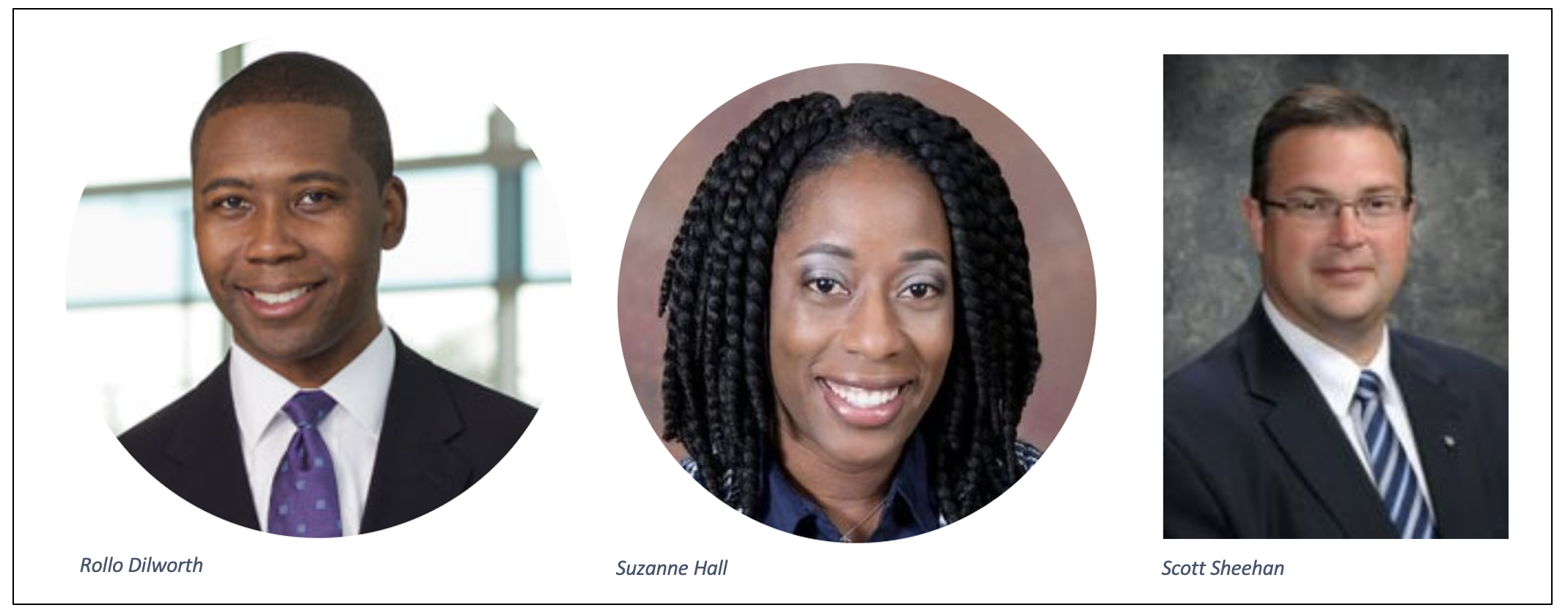
This year’s event will include keynote speakers Suzanne Hall and Rollo Dilworth from Temple University as well as NAfME President and PA’s very-own super-star Scott Sheehan.

Feeling a little charitable, altruistic, or eleemosynary? (Great word – look it up!) On Tuesday, July 19, there will be a “Give-Back to the Community” event: PMEA’s Second Annual Day of Service at Goggle Works.

Now, what about that EXTRA FUN part? Well, you can turn your conference into a family vacation by just arriving a little early and/or leaving a little later.

First, how about attending a Minor League baseball game? PMEA acquired tickets to the Reading Fightin’ Phils vs. New Hampshire Fisher Cats contest on Sunday, July 17 at 5:15 p.m. at the FirstEnergy Stadium.

Next, there are a lot of terrific family-fun things-to-do in Reading, PA and the surroundings… (Special thanks to https://uncoveringpa.com/things-to-do-in-reading-pa for this “awesome” travel resource!)

Berks County, a combination of rich farm country, industry, beautiful parks, lots of entertainment, and top-notch educational institutions, is home to one of Pennsylvania’s largest cities, Reading, as well as many small communities that offer a lot of history and natural beauty. For PMEA members going to the Summer Conference, it is the perfect opportunity to enjoy a wide variety of family-friendly attractions, recreation pursuits, touring of the landscape scenery, and other day trips. If you were to visit the area before and/or after the conference, here are at least 18 places-to-go before returning home:

Source: 21 of the Best Things to Do in Reading, PA
  1. Reading Pagoda, Mount Penn https://uncoveringpa.com/reading-pagoda
  2. Nolde Forest, 600-acres and miles of hiking trails https://uncoveringpa.com/nolde-forest
  3. Hawk Mountain Sanctuary, scenic overlooks, hiking trails, bird-watching https://www.hawkmountain.org/
  4. Daniel Boone Homestead, birthplace of the frontiersman https://uncoveringpa.com/daniel-boone-homestead
  5. Goggle Works, former factory, art galleries (site of the PMEA Service Project) https://goggleworks.org/
  6. Covered Bridges, at least five of them close to Reading https://uncoveringpa.com/covered-bridges-berks-county-pa
  7. Reading Railroad Museum, railroad memorabilia https://uncoveringpa.com/reading-railroad-heritage-museum
  8. Neversink Mountain, miles of hiking trails (including City Overlook and Witches Hat) https://berksnature.org/trails/
  9. Mid-Atlantic Air Museum, WWII history, artifacts, and tours https://uncoveringpa.com/mid-atlantic-air-museum-reading
  10. Chatty Monks Brewing, restaurant/craft brewery https://uncoveringpa.com/chatty-monks-brewing-west-reading
  11. Blue Marsh Lake, swimming, fishing, boating https://www.nap.usace.army.mil/Missions/Civil-Works/Blue-Marsh-Lake/ 
  12. Berks County Heritage Center, museums and trails http://www.co.berks.pa.us/dept/parks/pages/heritagecenter.aspx
  13. Boyertown Museum of Historic Vehicles, antique autos https://uncoveringpa.com/boyertown-museum-of-historic-vehicles
  14. Crystal Cave, first “show cave” located near Kutztown https://uncoveringpa.com/exploring-crystal-cave
  15. Reading Public Museum, exhibits, paintings, geology, planetarium https://uncoveringpa.com/reading-public-museum 
  16. Hopewell Furnace Historic Site, iron furnace https://uncoveringpa.com/visiting-hopewell-furnace-national-historic-site
  17. Golden Age Air Museum, WWI planes http://www.goldenageair.org/ 
  18. Pennsylvania German Cultural Heritage Center, Kutztown University https://www.kutztown.edu/about-ku/administrative-offices/pennsylvania-german-cultural-heritage-center.html

Finally, if you need any additional urging, here’s our new PMEA State President Scott Cullen with his invitation for you to join us at the Summer Conference: https://fb.watch/dYrKOvAHkG/.

But, don’t wait! Register today for the PMEA Summer Conference at this link.

The deadline for hotel registration is fast approaching! The discounted block of rooms at the Reading Doubletree will close out at the end of the day on Friday, July 1.

See you in Reading, PA!

PKF

© 2022 Paul K. Fox
PMEA’s Unique “Together” Conference

The return of in-person gatherings of PA music educators and students!

Here’s a “sneak preview” of the upcoming annual professional development convention for members of the Pennsylvania Music Educators Association (PMEA) and Pennsylvania Collegiate Music Educators Association (PCMEA).

https://www.pmea.net/pmea-annual-in-service-conference/

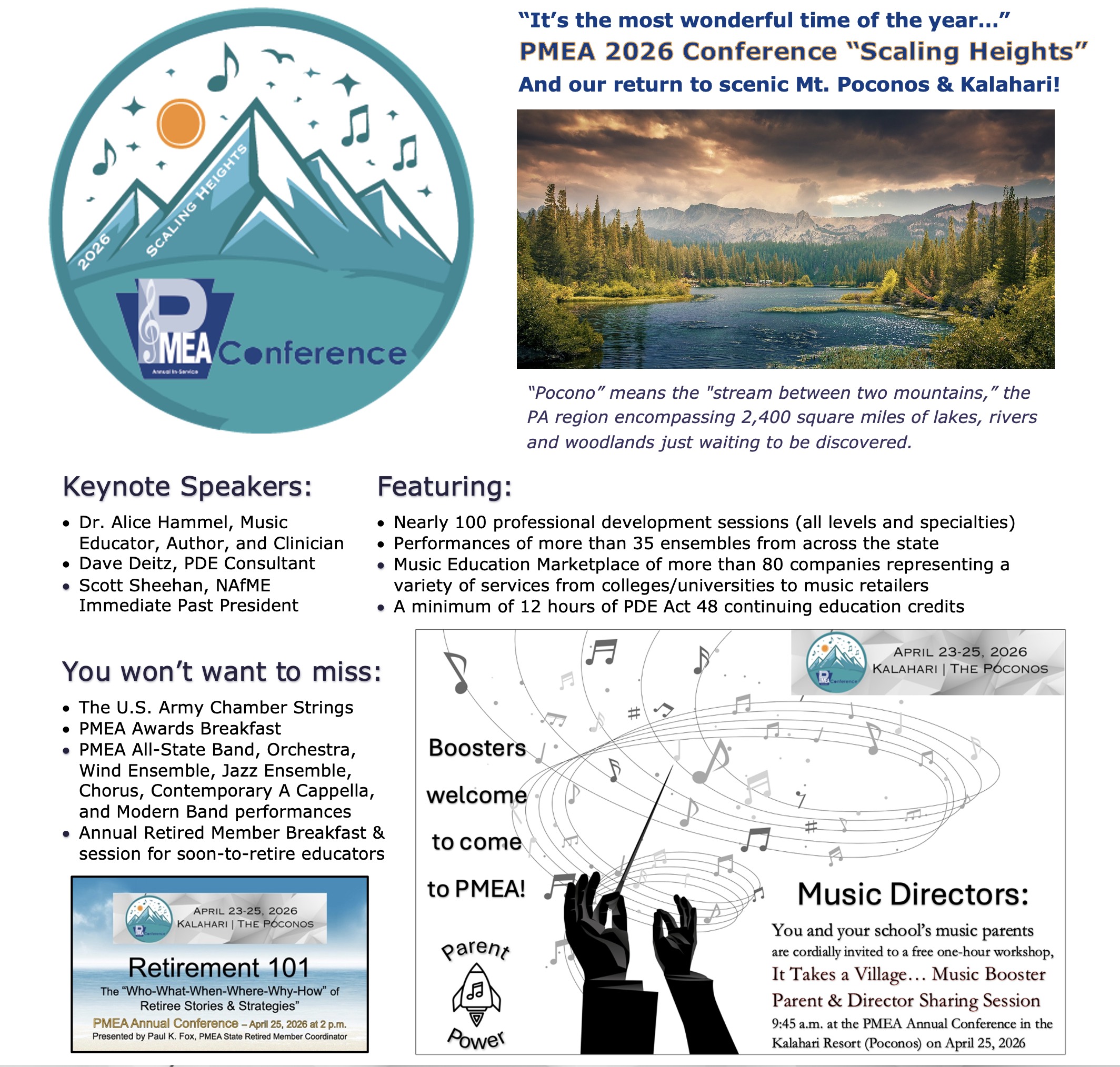
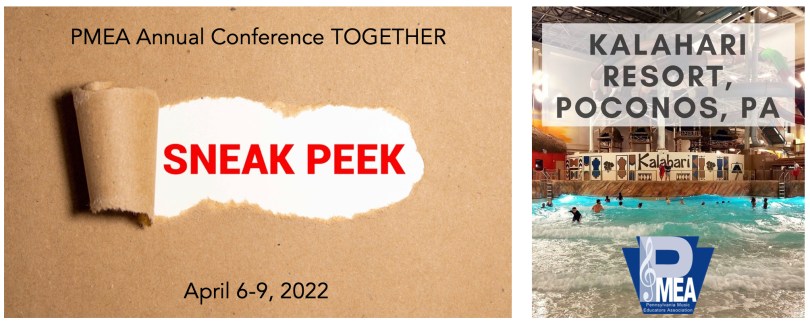
After being “hunkered down” for two years of online workshops, virtual conferences, digital music industry exhibits, and Zoom rehearsals of PMEA All-State ensembles, we can now “crush COVID-19” with “face-to-face” meetings of the PMEA TOGETHER CONFERENCE on April 6-9, 2022 at the Kalahari Resort in the Poconos.

Not just a “play on words,” this LIVE event brings TOGETHER the awesome and inspiring vision and efforts of the PMEA Professional Development Council, state officers, and staff, along with a twist from tradition – offering a place to getaway from it all!

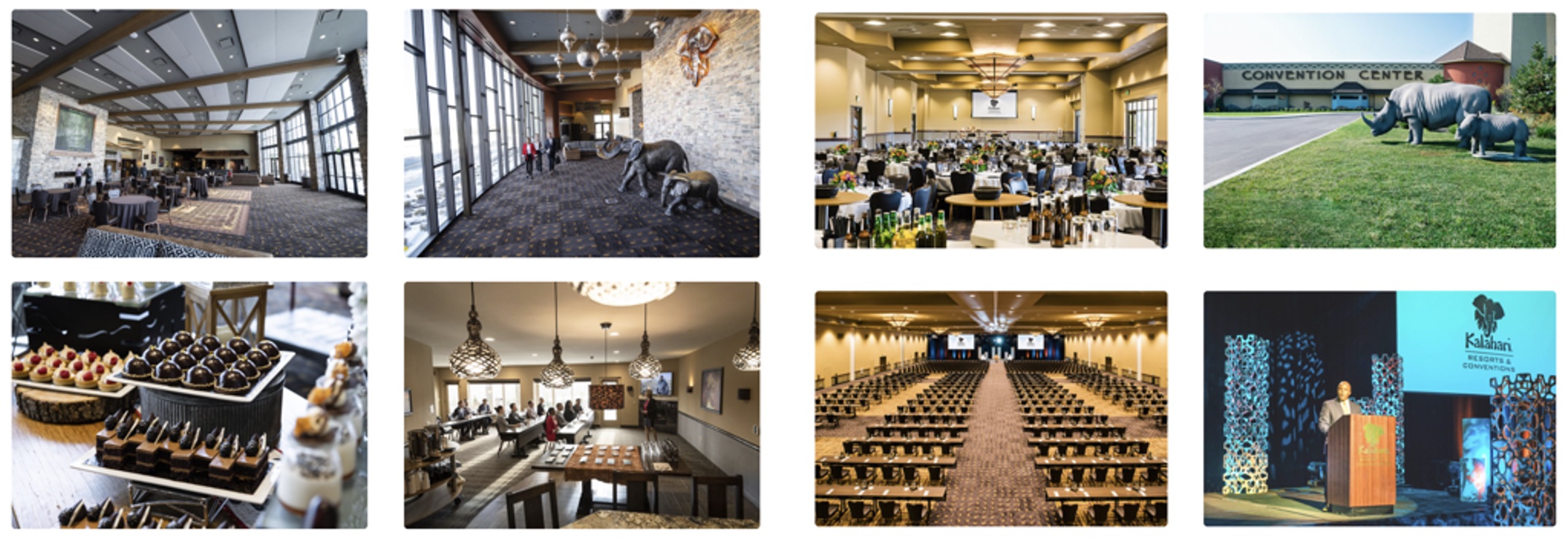
Ask your spouse or “significant other,” children or grandchildren, nieces or nephews, other fun-loving family members, or close friends if they are available to join you for a three-day escape to the Poconos – “the world’s largest indoor waterpark” at Kalahari Resort! Experience great music, career development sessions, catching-up with colleagues, reconnection with your loved-ones, and entertainment for all ages – all wrapped up in one location.

https://www.kalahariresorts.com/pennsylvania/

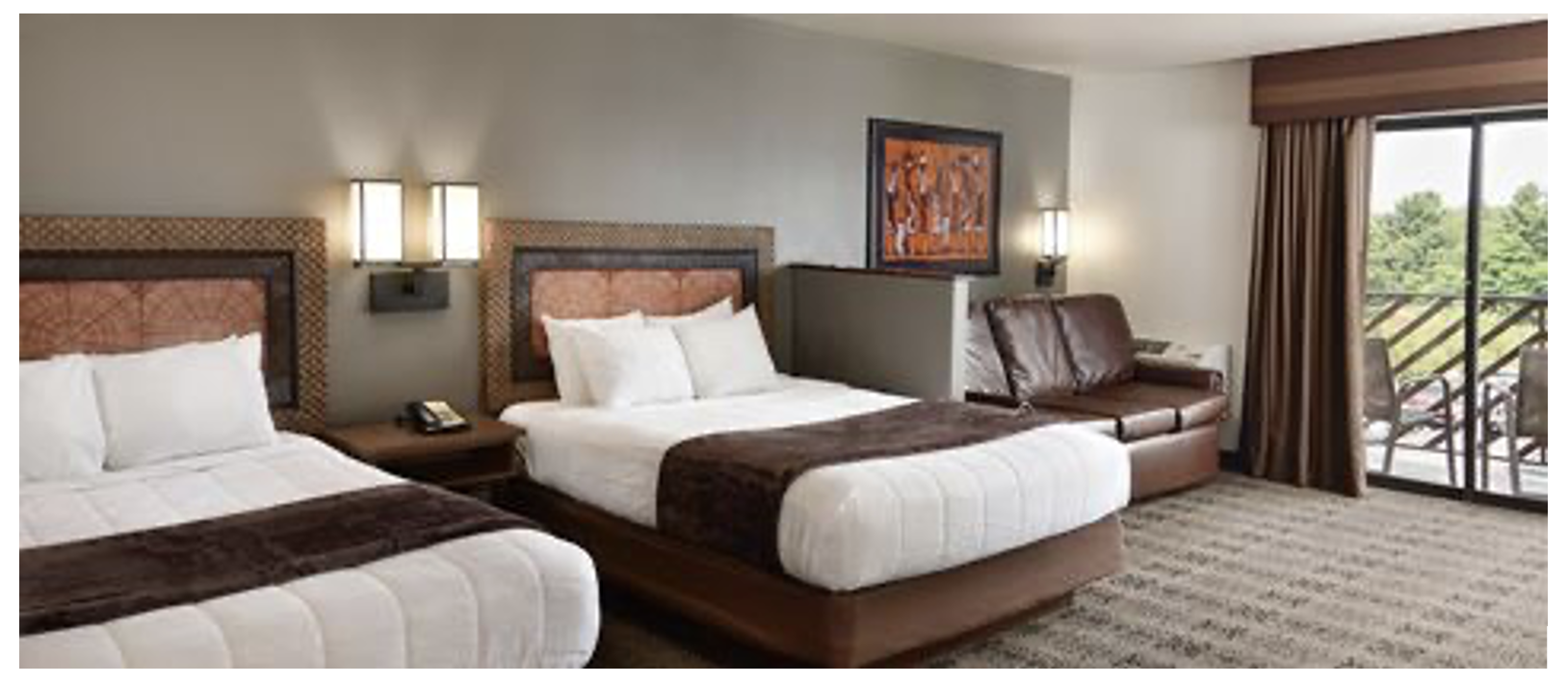
Bring the family? Each spacious hotel room comes equipped with two double beds, a pullout sofa, microwave, and refrigerator, and the discounted $149/night conference rate allows you to register up to four people with access to all the resort’s amenities for no extra charge!

What resort amenities? Enjoy rides and slides (lots to “splash in” or just relax on the lazy river), a “big game” room, mini golf, mini bowling, 7-D motion theater, gourmet restaurants, spa, salon, fitness center, and amazing shopping and sightseeing excursions in PA’s northeastern region. While YOU are attending PMEA keynote sessions, clinics, concerts, and exhibits, the rest of your party could be “living it up” on as many as 29 waterpark thrills (from “mild” to “wild,” check out all of them on their website):

  • Anaconda
  • Barreling Baboon
  • Bugs Burrow
  • Cheetah Race
  • Coral Cove
  • Elephant’s Trunk
  • Flowrider
  • Indoor Outdoor Spas
  • Kenya Korkscrew
  • Lazy RIver
  • Lost Lagoon
  • Outdoor Pool
  • Rippling Rhino
  • Sahara Sidewinders
  • Screaming Hyena
  • Shark Attack
  • Splashdown Safari
  • Tiko’s Watering Hole
  • Victoria Falls
  • VR Waterslide
  • Wave Pool
  • Wild Wildebeest
  • Zig Zag Zebra

Source: Pocono Mountains Visitor Bureau

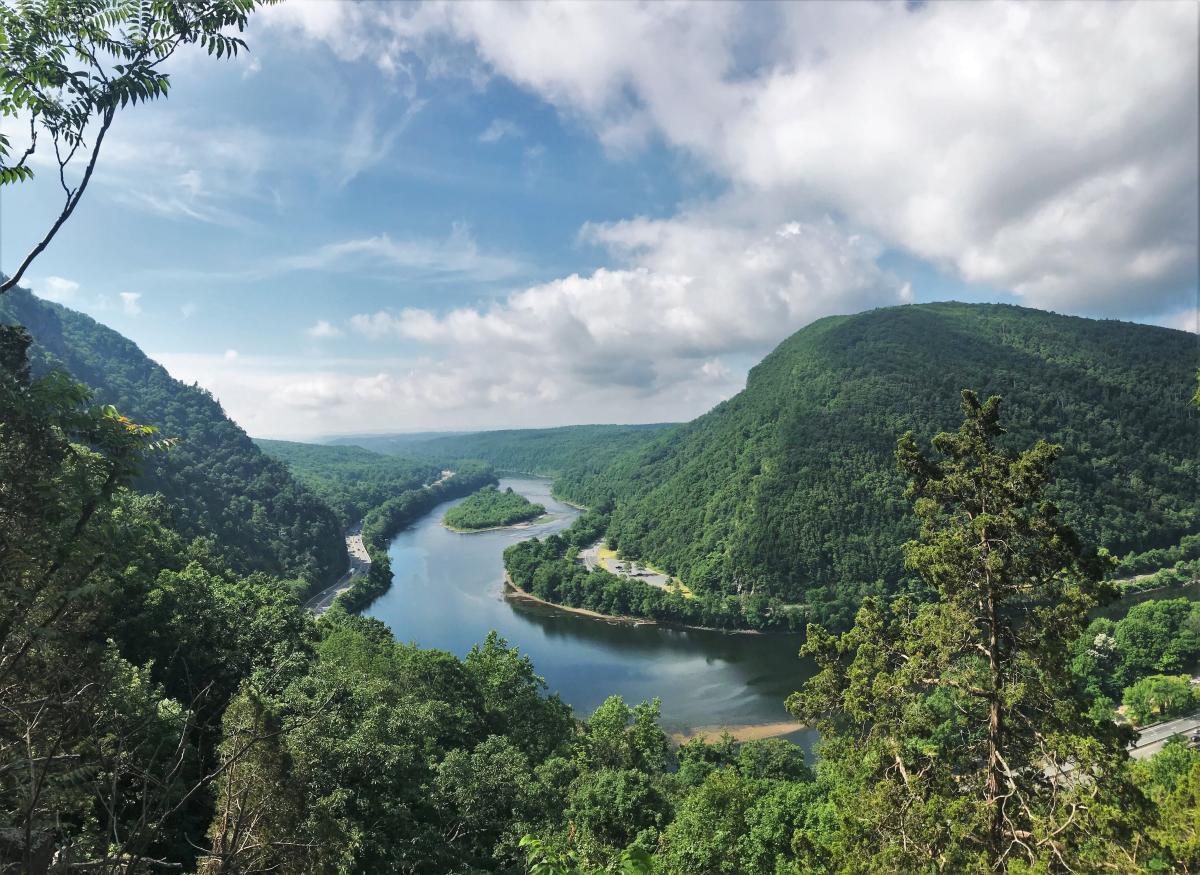
A joyful car trip to local scenes and attractions? The word “Pocono” means “the stream between two mountains.” This region encompasses 2,400 square miles of lakes, rivers, and woodlands just waiting to be discovered. Just how adventurous are you?

  • Explore numerous opportunities to hike, bike, bird watch, ski, fish, and photograph the wildlife, waterfalls, and other breathtaking landscapes.
  • Peruse the various exhibits of local artists at the White Mills Art Factory, 736 Texas Palmyra Highway (Route 6) from 10 a.m. to 5 p.m. (closed Wednesdays).
  • Try your luck at the Mount Airy Casino Resort Spa.
  • Or be a “wandering tourist” and visit nearby Stroudsburg, Milford, Jim Thorpe Honesdale, Lake Wallenpaupack, Hawley, Skytop, Bushkill, Lake Harmony, or Tannersville.
  • Check out this Poconos Mountains interactive map: https://www.poconomountains.com/interactivemap/.

Keynote speakers David Wish and Lesley Moffat

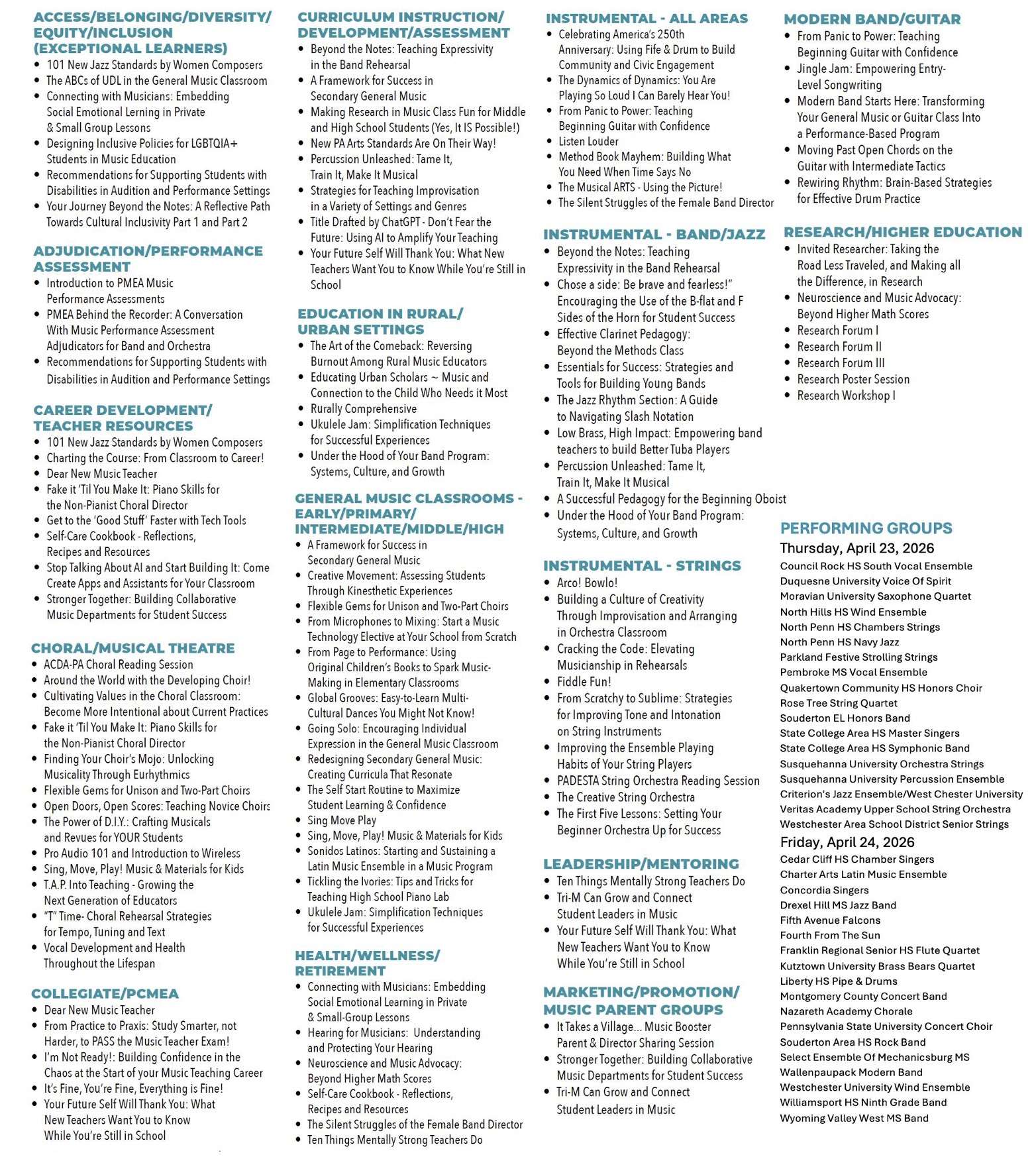
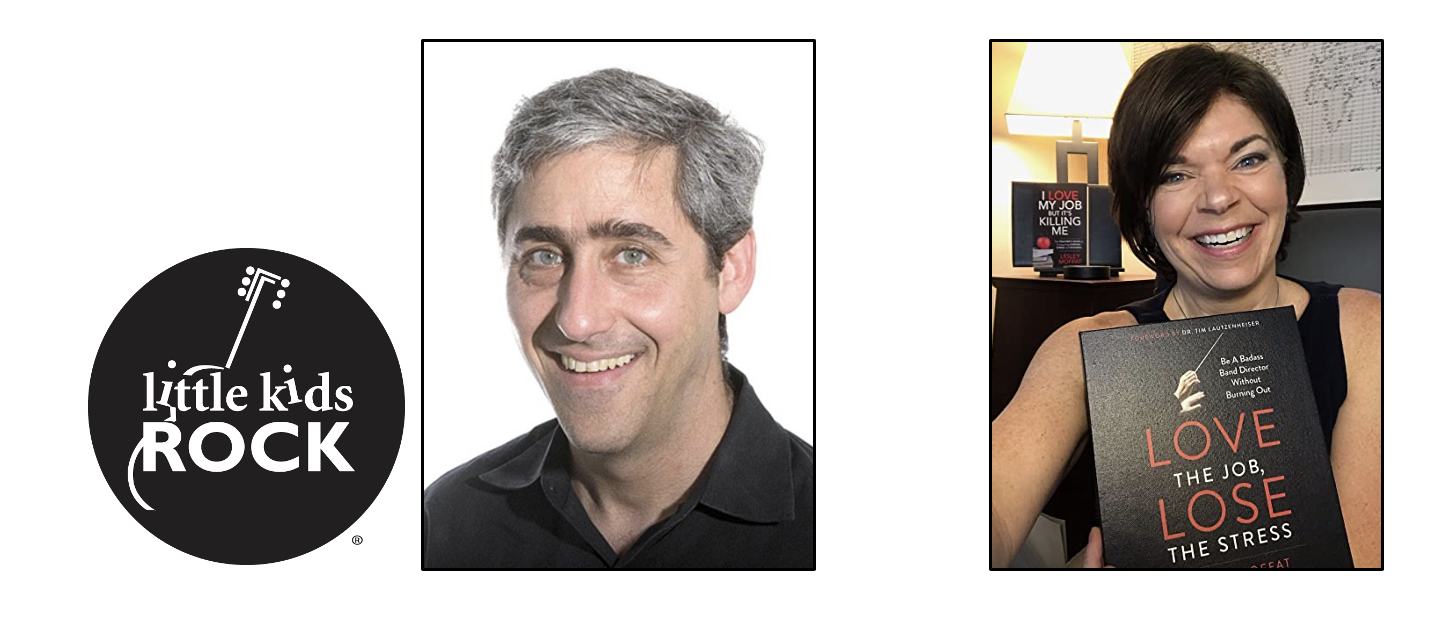
Now down to the business of professional development! In your free time from the above refreshing and re-invigorating moments of “down time,” you won’t want to miss the PMEA general sessions featuring keynoters David Wish of Little Kids Rock and Lesley Moffat, author of Love the Job, Lose the Stress. After opening the music industry and collegiate exhibits, numerous workshops, interactive demonstrations, and panel discussions will be hosted on a variety of “state-of-the-art” and timely topics:

  • Adjudication
  • Assessment
  • Career Development
  • Choral
  • Collegiate
  • Curriculum Development
  • Diversity/Equity/Inclusion
  • Exceptional Learners
  • Health and Wellness
  • Instrumental
  • Leadership/Mentoring
  • Modern Band
  • Music Technology

Draft of proposed 2022 PMEA Conference sessions

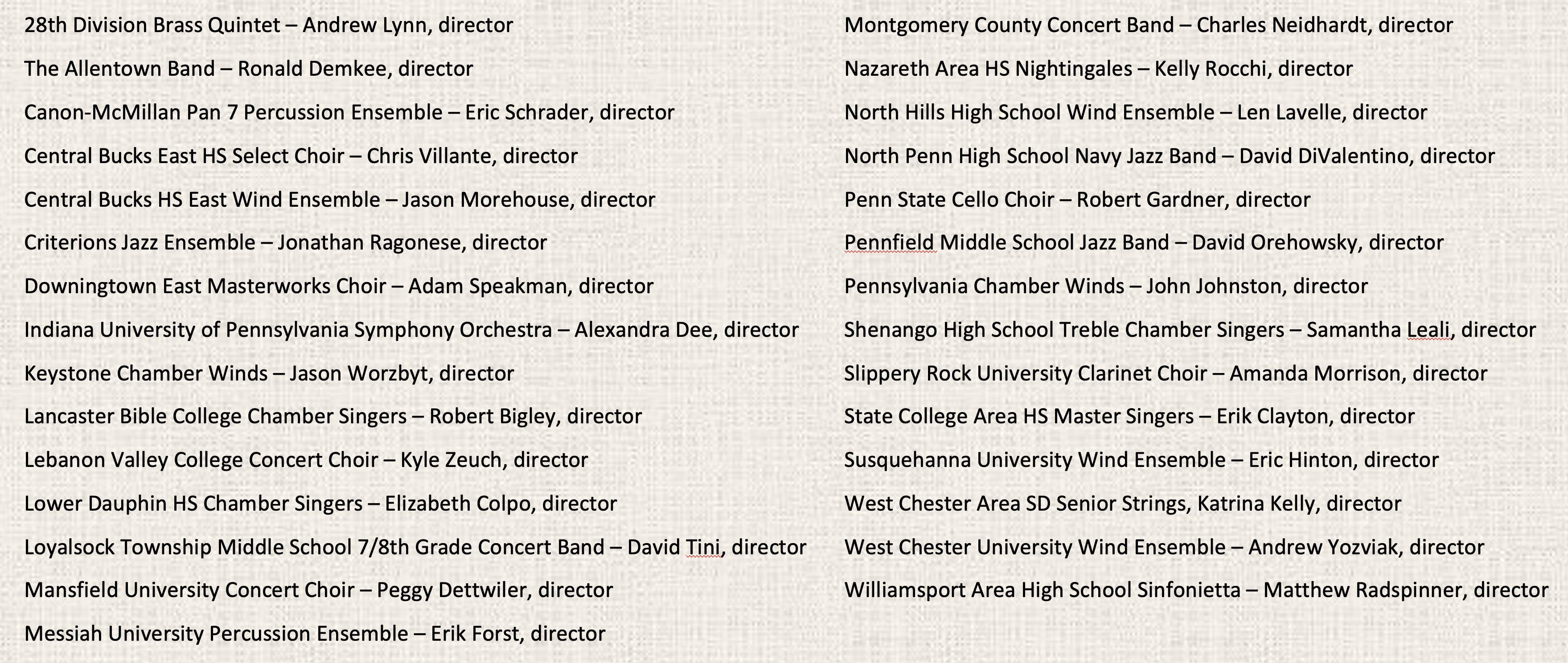
Sandwiched in between these clinics and meetings of PCMEA, PA Society for Music Teacher Education, PMEA Council for Teacher Training, Recruitment, and Retention, PMEA Retired Members, Pennsylvania-Delaware String Teachers Association, and others will be opportunities to observe rehearsals and performances of the PMEA All-State Band, Chorus, Jazz, Orchestra, and Vocal Jazz, and attend concerts of guest performing ensembles – among “Pennsylvania’s finest.” Congratulations to:

Looking for that new classroom accessory, concert selection, educational travel group, fundraiser, instrument, technology tool, or uniform, or seeking to talk to representatives from music schools? Take time to visit the exhibits. PMEA thanks the continuing support of its PMEA Corporate Sponsors.

Early-bird registration of 2022 PMEA Conference Exhibitors

Yours truly (blogger) is proud to announce he is presenting three sessions at the conference:

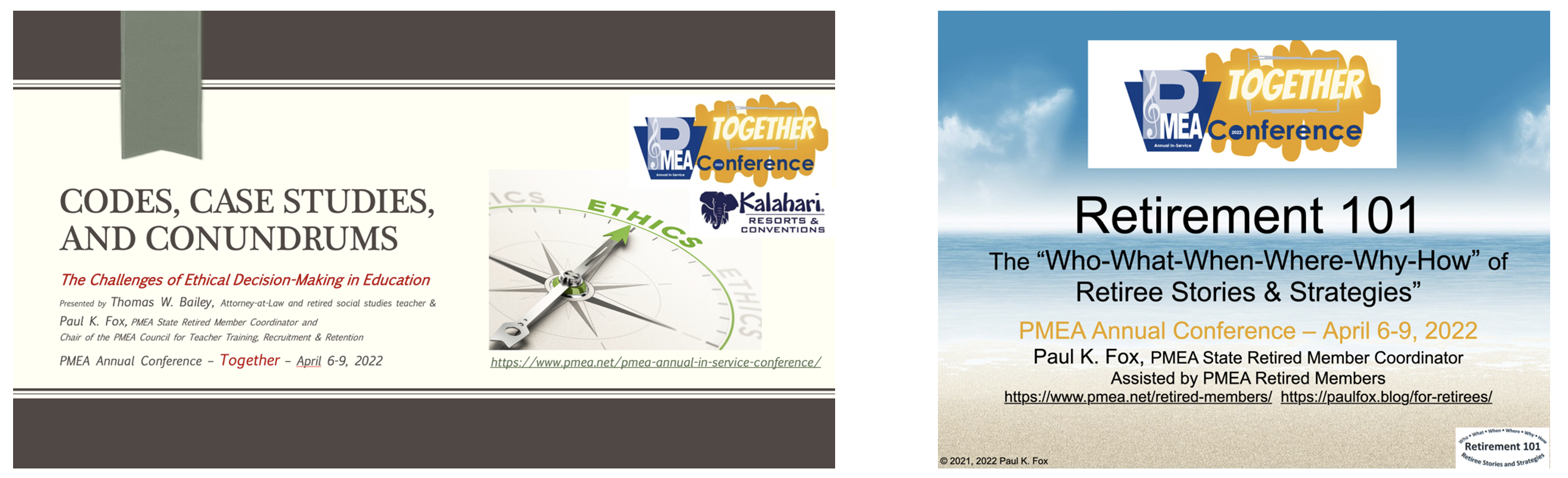
  • CODES, CASE STUDIES, and CONUNDRUMS – The Challenges of Ethical Decision-Making in Education
  • THE INTERVIEW CLINIC – Practicing and Playacting to Improve Your Performance at Employment Screenings
  • RETIREMENT 101 – The Who, What, When, Where, Why, & How of Preparing for Post-Employment

PMEA will need volunteers to assist as presiding chairs or to serve at the INFO BOOTH near registration. In addition, the PMEA Retired Member Coordinator is seeking retirees to help serve on a guest panel of “semi-experts” for the retirement session.

It’s still a little early for much additional detail. However, check out this MOVIE TRAILER preview of the 2022 Conference, featuring The Pennsylvania March composed by PMEA retired member Ron DeGrandis.

As of January 17, 2022 (Martin Luther King Jr. Day), Kalahari Resort room reservations are open! The link to conference registration will be coming soon. For more information, please visit the PMEA website. Keep your eye out for revisions in future PMEA News, UPDATES, and other e-publications.

PKF

© 2022 by Paul K. Fox
Giving Back to the Association

A Pep Talk for Teachers to Become “Team Members!”

I found myself this past Monday morning with a few extra minutes checking my almost empty “to-do” list and, with the exception of planning to watch the Pittsburgh Steelers football game and the endless chore of raking leaves in my yard (I immediately rejected the latter), I discovered I had very few professional or personal priorities to focus on this week! Wow! Some additional “free time!” Shh… don’t tell anyone!

Down time? As I mentioned in a previous blog-post, since the summer, things had been a little hectic for “this retiree.” When I accepted the position of “admin” to the marching band of the school from where I retired, I discovered how fast we can fill up our schedules with meetings, rehearsals, and performances… to the point that it is hard to imagine how I could possibly have done all of this unless I retired from the regular job! My wife jokingly said, “Those were the days!” (perhaps a little unsympathetically?) as she watched me takeoff for band camp, parent salute nights, late night away football games, etc., while she remained cozy at home. “Been there. Done that! Not anymore!”

Only one professional association got me through more than five decades in music education and 35+ years of full-time directing, equipping me to handle the twists and turns of an ever-changing career (e.g., becoming a choral director even though I had never sang in a high school or college choir), and even attending music festivals as a viola and tuba student for four years in the Penn Hills school district. Who do I credit for giving me this “life force,” “teacher chops,” and music mastery? PMEA. We are so fortunate to have this priceless “collaboration of our colleagues,” numerous resources for the benefit of our own professional development, and services we provide to our music students. Cut me and I bleed PMEA blue!

How Are YOU Feeling?

This blog’s “call to action” is necessary because of the turmoil the pandemic has left the arts education community, new school health and safety mandates, re-prioritization of district resources (in some places away from the arts in spite of the need for more not less social emotional learning), reports of the drop in music participant enrollments, decrease in membership renewals, and teacher shortages.

The crush of COVID-19 and all of the program delays, suspensions, (and hopefully not) permanent losses have made this one of the most challenging times I can ever recall. The only way we can get through this is “together…” and frankly, “if you’re not part of the solution, you’re part of the problem!” This is NO TIME to let your membership and involvement lapse! PMEA and other professional music education organizations (like NAfME, ACDA, ASTA) need your “dedication to the cause,” willingness to help “the team” and one other,  and active participation.

Collegiate members, full active members, and retired members – all of us joining forces – can truly “make a difference!” No matter how busy or stressed you are and how much you feel you are “slugging it out in the trenches” alone, we all need to become partners and devote time for and dedication to the associations we are blessed to have right now that support music educators in the Commonwealth, the nation, and the profession.

The Essential Role of Associations

It does not matter which profession you have chosen! You NEED an ASSOCIATION!

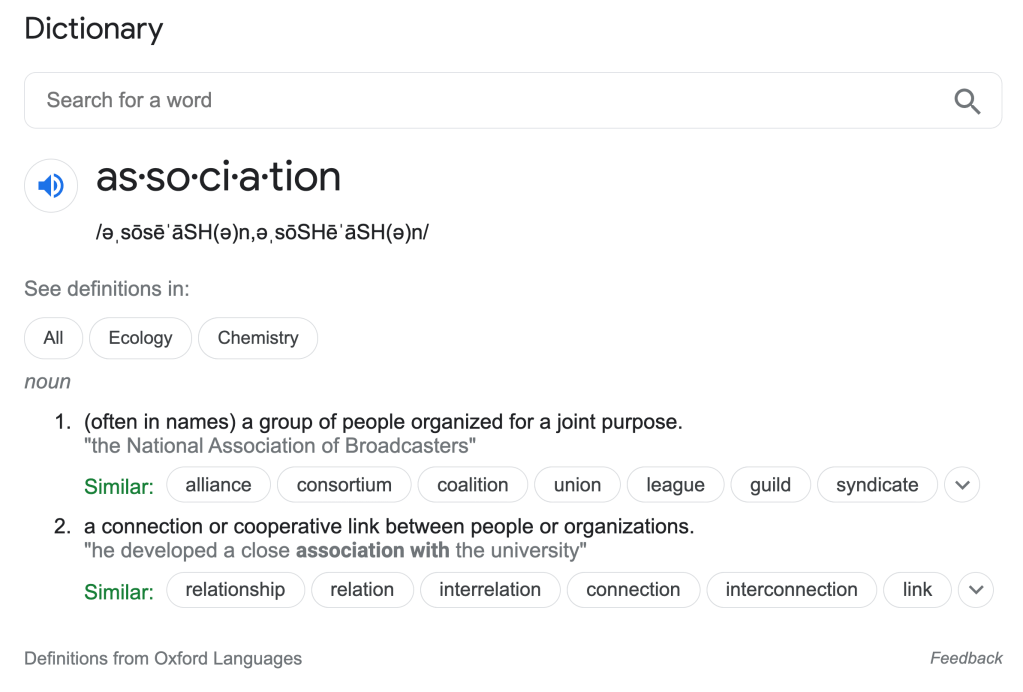
Google English Dictionary provided by Oxford Languages

The architects may have defined “this essential bond” best:

Membership in the relevant professional organization is one of the things that separates a profession from a conventional job. It is a key element that defines a professional. Membership in one’s professional organization is expected of all professionals. It is important to support the advancement of one’s profession, and becoming a member of the professional organization is a part of that advancement.

Involvement with a professional society will afford the participant an opportunity to network with other colleagues in industry and practice. Making connections with others who have similar interests reinforces why one has chosen this career. It enables new professionals to associate with senior members of the profession and learn from them. Joining a professional organization is critical in keeping abreast of the latest knowledge and practices locally, regionally, and globally. It helps the professional to stay abreast of current issues and opportunities and will also assist in personal advancement for the member who becomes involved.

Many professional organizations offer continuing education, seminars, and lectures along with other opportunities for learning. An active participant will have the opportunity to serve in professional development. Working with people outside of one’s own firm and volunteering will build leadership skills. Opportunities for working with the community for the betterment of society and the local economy will be available. There will be possibilities for making real contributions to the human condition through projects the professional organization may take on as a part of giving back to the community. There are events that will call for public speaking skills and professional visibility which will assist in moving one’s career to another level by connecting with other professions and local leaders in the area. The profession will benefit from members’ service and the members will be rewarded in return by such things as personal fulfillment, professional enrichment, and building a stronger resume as a result.

Further definition of the professional responsibilities and ethical practices will come in part from the professional organization. It is a central core for regulation, education, revitalization, networking and service. Joining a professional organization provides occasions and experiences to renew one’s enthusiasm for the practice of interior design. The interaction can be both inspirational and enlightening. Being a member of a professional organization is a symbiotic relationship between the organization and the member that will benefit them both.

Alabama Board for Registered Interior Designers

My “top-ten” benefits for membership in a professional association like PMEA are:

  1. Development and sharing of the standards and best practices of the profession
  2. Student festivals and music performance assessments
  3. Professional development and career advancement opportunities: workshops, conferences, and publications
  4. Leadership training
  5. Collaborative projects such as health and wellness seminars, ethics training, library of online resources, etc.
  6. Networking opportunities
  7. Models and resources for curriculum writing
  8. Coaching and mentoring resources
  9. Resources in job hunting and interviewing techniques
  10. Advocacy of music education and “a voice” (more political “clout”) in defining future government public policy

So, What’s in it for Me?

Review a few of the synonyms of “association” mentioned above: “alliance,” “consortium,” “coalition,” “connection,” etc. I am sure you’ve heard the saying: “TEAM stands for Together Everyone Achieves More.” Or, to quote the philosopher Aristotle: “the whole is greater than the sum of its parts.”

The easiest way for me to show the value of joining PMEA and becoming more active, engaged, and successful in your teaching assignment (no matter what the primary specialty – general music, vocal, band, strings, jazz, music theory, technology, etc) is to take a snapshot of the benefits displayed on the www.pmea.net website. Why try to reinvent the wheel? You might be surprised the extent of the HELP that is available just around the corner! Go ahead… click away! Take a peek at what you may be missing!

On a personal note, PMEA has provided me the insight, inspiration, and opportunities for substantial career growth, “places to go and people to meet” to fill-in-the-gaps of the skill training I may have felt were missing, for example methods and media for teaching a high school choral program for more than 16 years and directing/producing 37+ musicals. In addition, PMEA and NAfME have been the sole institutions that I have turned to for more than 50 years for their sponsorship of choral and orchestral music festivals and other enrichment that have provided my students new and highly motivating musical challenges and countless state-of-the-art once-in-a-lifetime experiences.

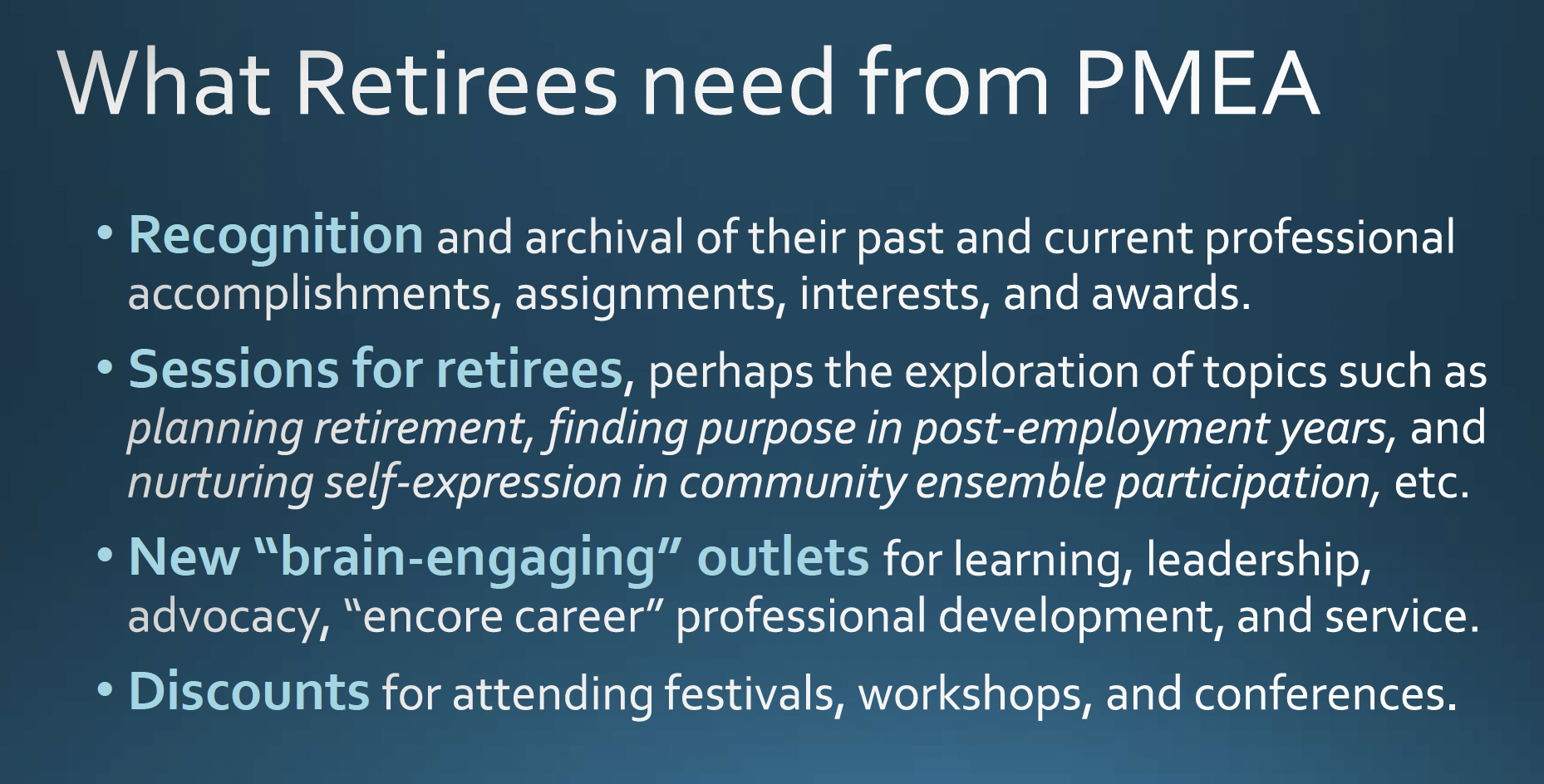
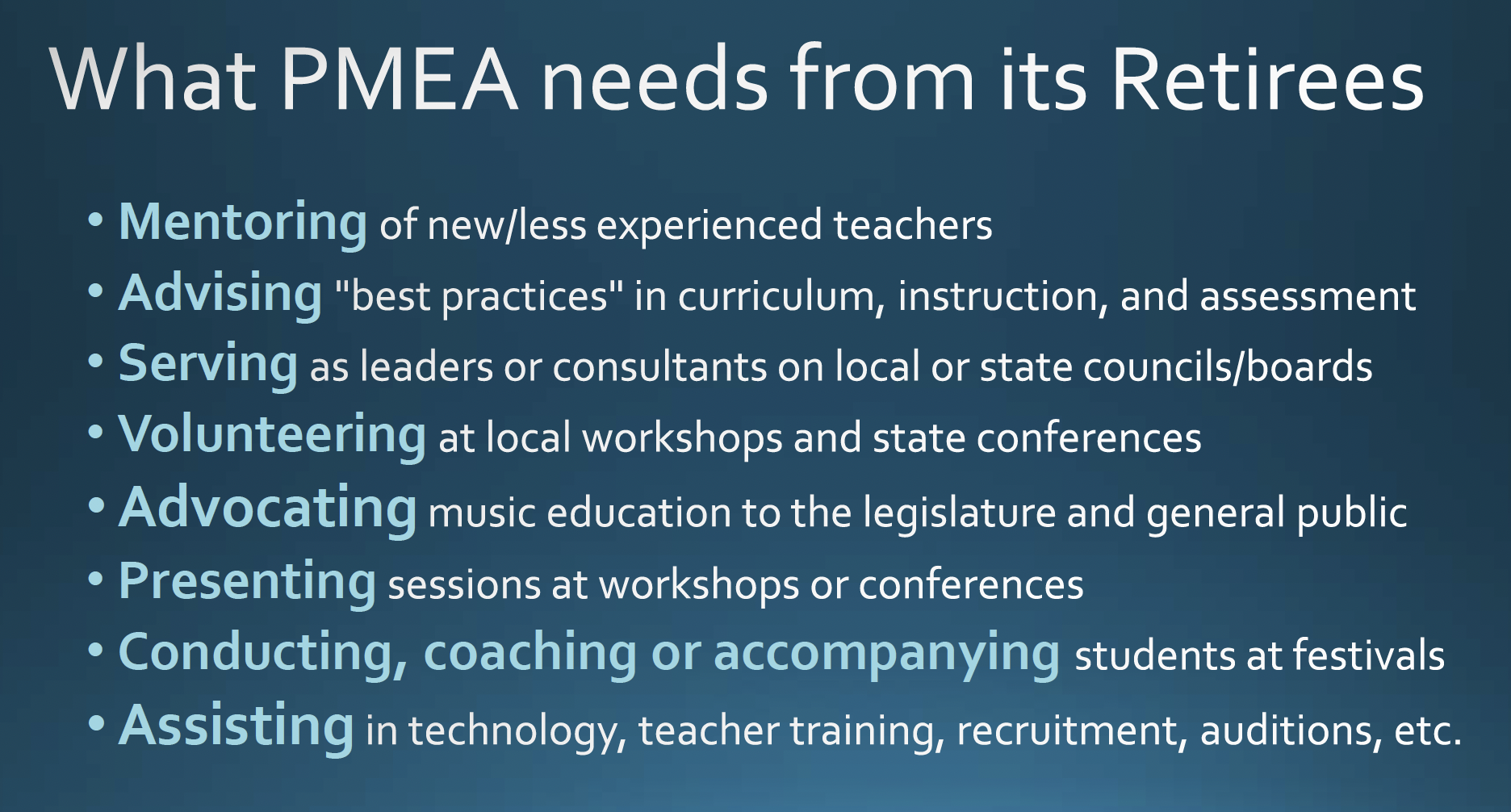
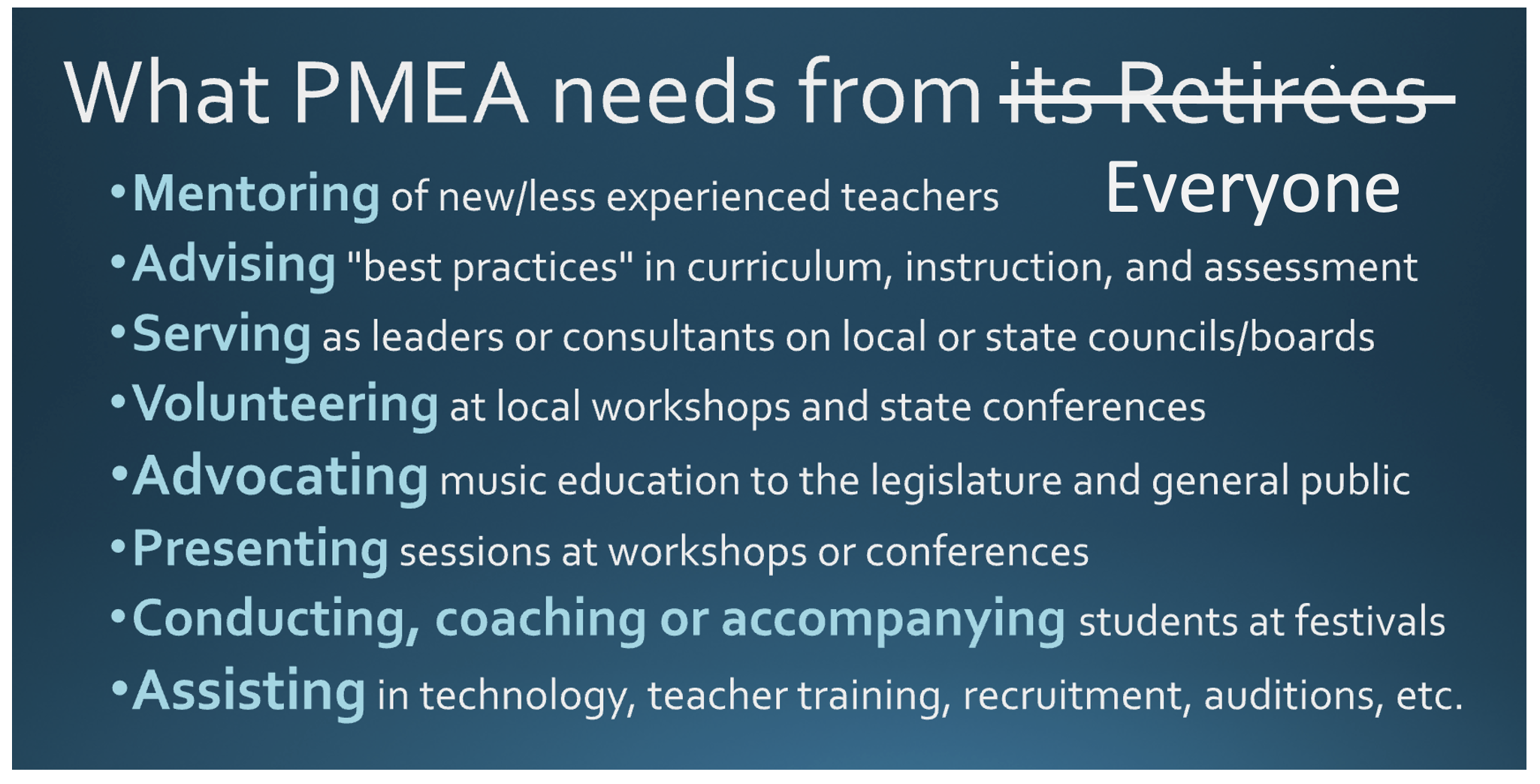
So now, reflect on the title of this blog! It is essential to give back to our association – to help it achieve its mission: “to advance comprehensive and innovative music education for all students through quality teaching, rigorous learning, and meaningful music engagement.” We’re all in this together, and together we can make it better! Slide #6 at the bottom of the retired members’ webpage proposes what PMEA needs from all members (not just retirees):

The number one thing you can do for ANY association is to pay your annual dues, attend its meetings, be active and HELP OUT! In return, PMEA can assist you in finding and sustaining your passions! What are you waiting for? If you have not renewed for the 2021-2022 year, please visit this PMEA membership webpage.

PKF

© 2021 Paul K. Fox
Pictures from Pixabay.com by artist Augusto Ordóñez

Spring is for… Music Conferences!

In our neck of the woods (Allegheny County in Western PA), we are thawing out from what was a pretty mild winter, and welcome the sounds of birds chirping and sights of flowers blooming and grass turning green! Spring is the time for re-birth and growth… including professional development of all kinds for music educators – everyone from pre-service (future music educators) to in-service teachers and even retirees!

Let’s get recharged, re-energized, and re-inspired! Sign-up for one or more of these conferences.

COVID-19 has placed restrictions on all of our PMEA and NAfME venues, and so far, 2021 conferences will be held in a “virtual” platform. This is both good and bad news. The disadvantage remains that we cannot “get close and personal,” shake hands, network, collaborate, and “catch-up” with our friends and colleagues, meet new people, and sight-see places like the Poconos, Erie, Reading, or Pittsburgh! However, the advantage of these online events is that all sessions are being offered “on-demand” for at least several months after each closing event. In the virtual setting, you can take the time and view every workshop at your leisure!

If you have never attended a music education conference, take a moment and review one of these articles:

Yours truly is privileged to present several sessions on some of his “favorite topics” previously posted on this site:

  • Self-Care Cookbook – Reflections, Recipes, and Resources for Teachers (PMEA ANNUAL CONFERENCE)
  • Countdown to Retirement – Preparations for “Living-the-Dream” (PMEA ANNUAL CONFERENCE)
  • Hands-On Conducting (PMEA CRESCENDO FOR STUDENTS)
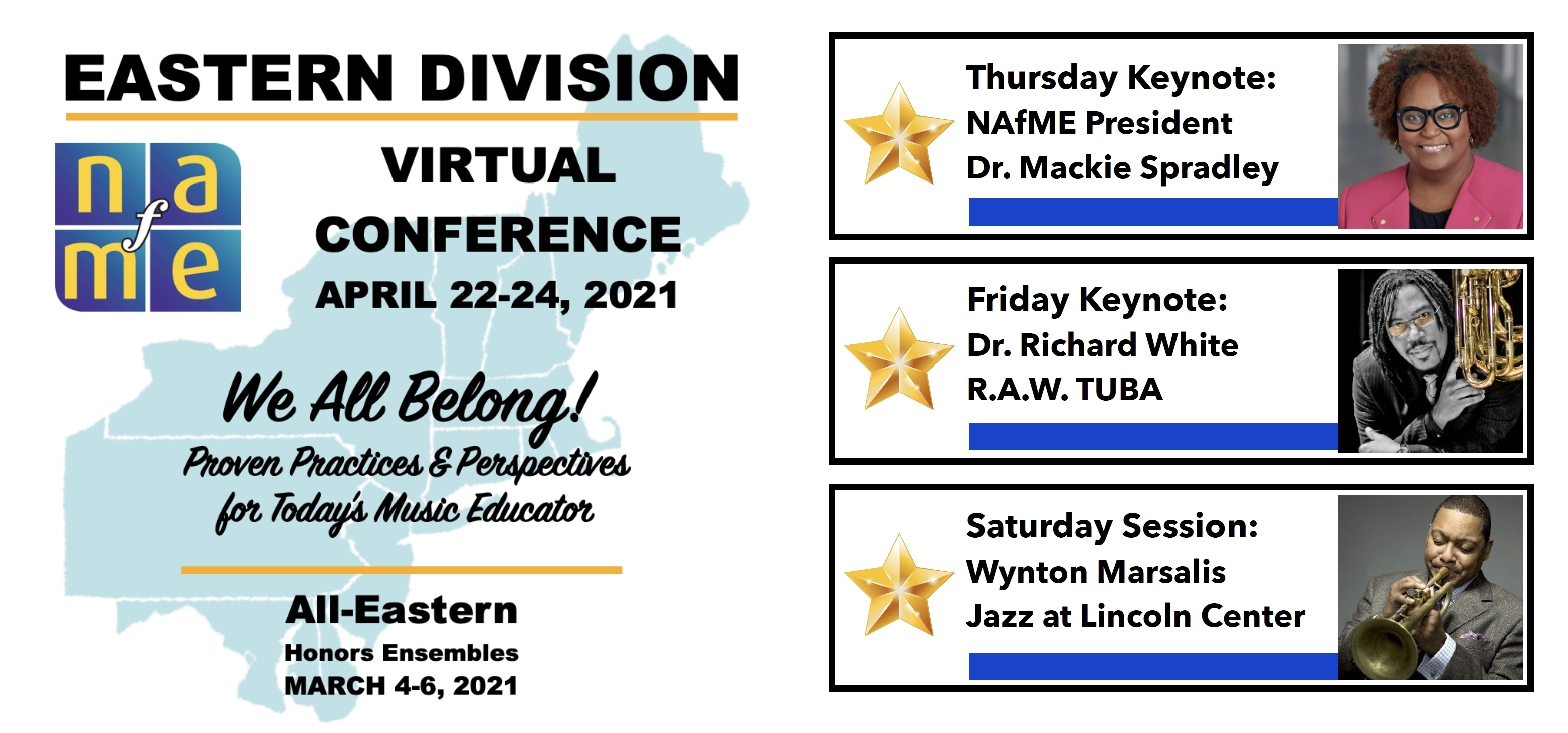
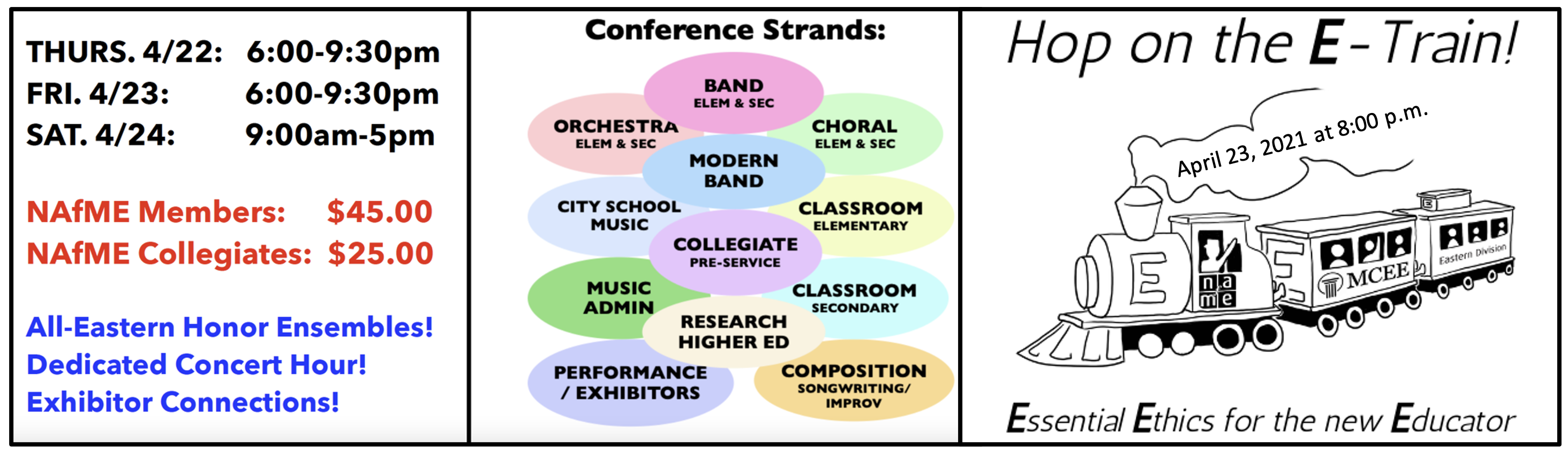
  • Hop on the E-Train – Essential Ethics for the new Educator (NAfME EASTERN DIVISION)

Update on 5/27/21:

PMEA Summer Conference 2021 – Rejuvenate!

The 2021 PMEA Summer Conference will be held virtually beginning Wednesday, July 21 and concluding on Friday, July 23. Most sessions will be presented live and will be recorded for attendees to access at a later time. 

For more information, go to https://www.pmea.net/pmea-summer-conference/.

PMEA Annual Conference 2021 – Renew!

The PMEA Annual Conference kicks-off on April 14, 2021 for three days and four nights of professional development activities.

PMEA will utilize the same online platform for this event as it did for its 2020 Summer Conference. The virtual annual conference will also include a virtual exhibit hall. With the theme of Renew, the 2021 Conference invites music educators to use this time together to Renew the way you think about music education, to Renew plans for the 2021-22 school year, to Renew connections with fellow music educators, to Renew our hope for a return to making music together, and to Renew our collective passion for the power of music education. All registrants will have access to the majority of the conference content for 90 days. Online registration is available. 

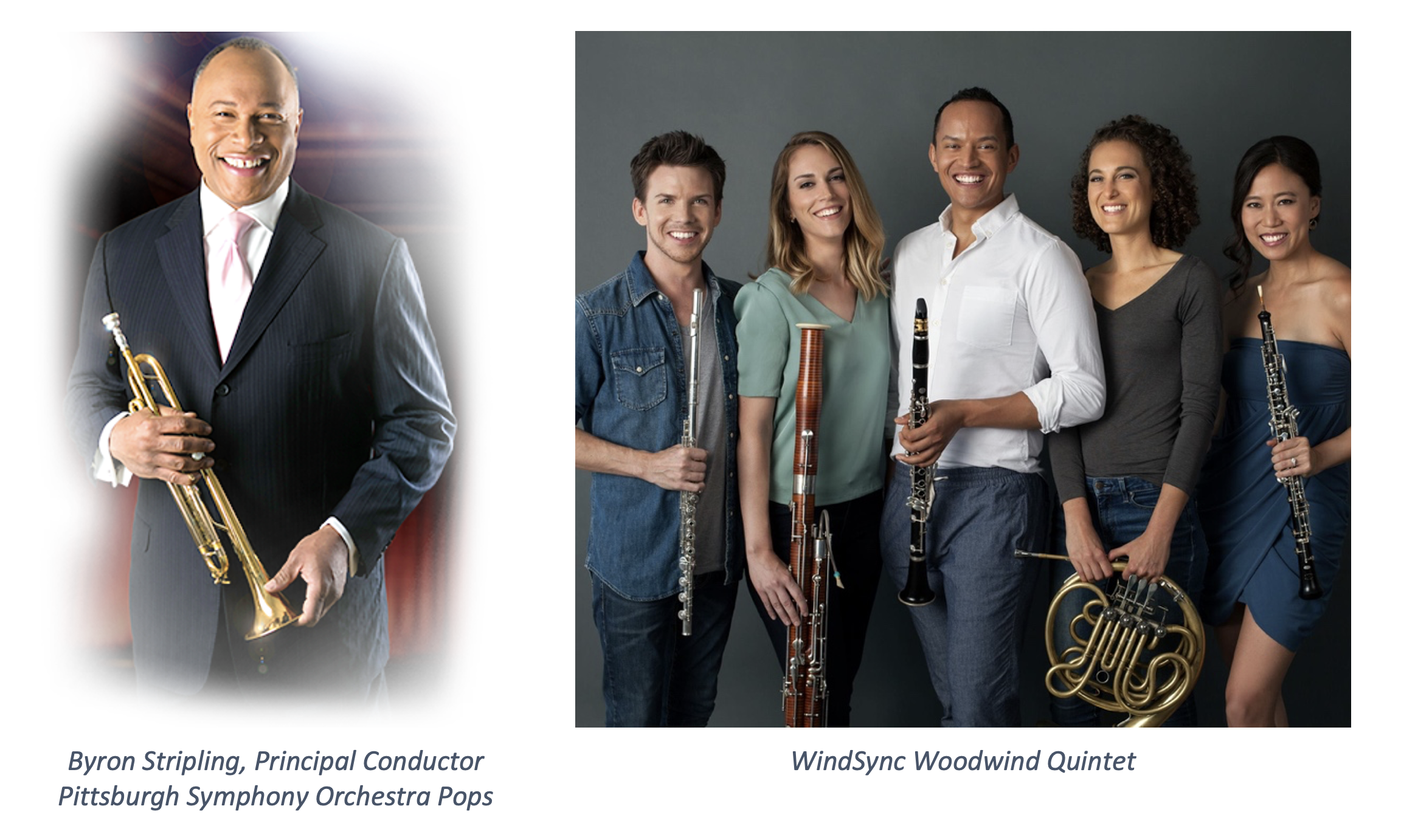
Thursday evening will feature synchronous open forum discussions and an Invited Researcher session with Elizabeth Parker, Temple University, as well as a keynote presentation by Byron Stripling, Principal Pops Conductor, Pittsburgh Symphony Orchestra. The evening will end with college/university receptions, held in the virtual space this year.

Synchronous research sessions will also be available on Friday in the late afternoon/early evening. The Saturday schedule includes a performance by the woodwind quintet WindSync and a presentation by Julie Duty, Founder & Executive Director of United Sound, an organization which offers the solution for music educators who desire to include students with disabilities in their music programs but struggle with the “how” and the “when.”

This year’s event will also include opportunities to network with fellow attendees, as well as an online Music Education Marketplace (exhibit hall) – allowing participants to connect directly with exhibitors within the platform. While the exhibit hall will be “open” the duration of the event, there will be specific hours, beginning Wednesday evening and concluding Saturday afternoon, when the exhibitors will be available for live interaction.

CRESCENDO Virtual Conference for Students

Students in grades 8-12 are invited to participate in the first-of-its-kind PMEA CRESCENDO, an online event to be held on April 17, 2021. Designed for student musicians who are interested in learning about opportunities to make music or find a career in music, the one-day conference will bring together some of the best speakers and teachers from a variety of music worlds.

Keynoters will feature Dave Wish, founder/CEO of Little Kids Rock, and ChaRonDon, rapper/hip-hop artist.

Sessions will include:

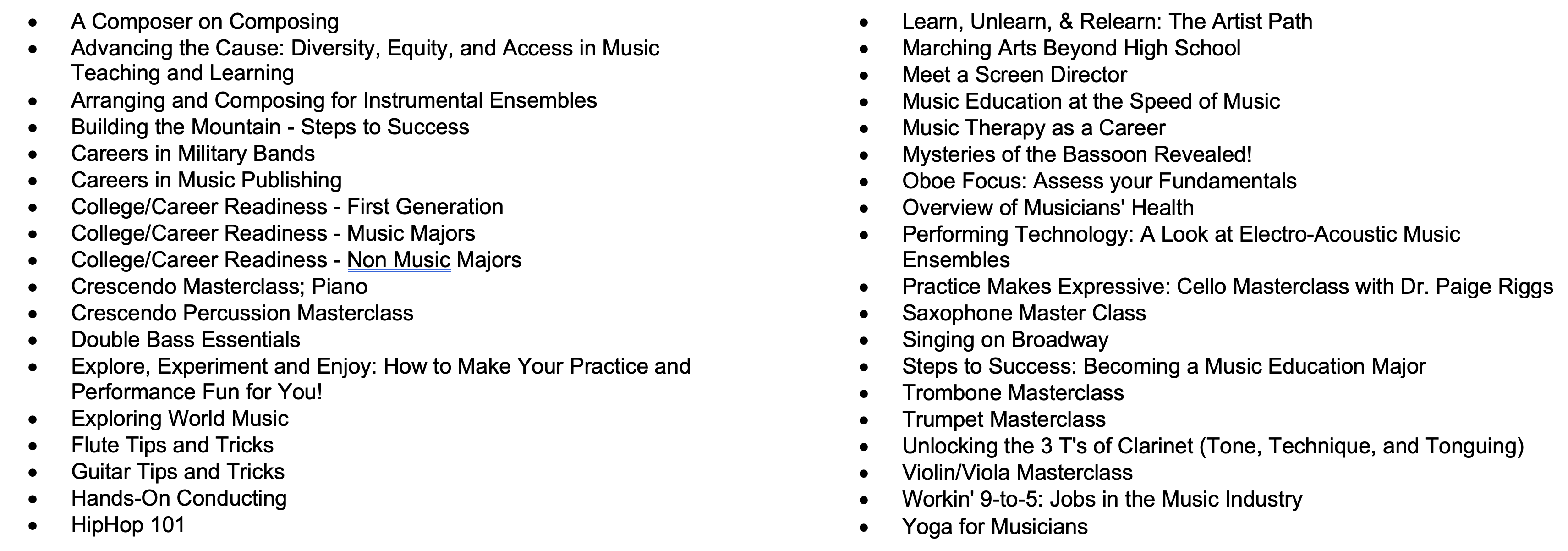
  • Careers in music (areas like music therapy, musical theatre, music education, military careers, music performance, music publishing, composition, retail and repair, and music production)
  • Breakout sessions (learning about drum corps, conducting, meet a composer, music technology, song writing, yoga for musicians, rap/hip hop, vocal jazz, leadership, and more!)
  • Masterclasses from experts on their instruments. Students will have the chance to spend some time learning more about their instrument or vocal performance area and get tips from the pros in unique online masterclass settings.

Proposed mini-workshops:

PA STUDENTS interested in participating in PMEA CRESCENDO should fill out this form.

PA MUSIC EDUCATORS recommending a student for this conference should fill out this form.

57th Biennial NAfME Eastern Division Conference

Finally, you won’t want to miss the following week’s frenzy of enriching and enlightening professional development, the 57th Biennial NAfME Eastern Division Virtual Conference!

In addition to the NAfME workshop sessions being only 30-minutes (colleagues sharing quick “tips, techniques, and solutions” and more opportunities to peruse additional sessions), there will be a designated Thursday evening “concert time” with 5 programs to play at 8:45 p.m. (Orchestra, Chorus, Band, Jazz, Modern Band) along with performances from the Division’s colleges and universities. 

The master schedule is posted here. Registration can be completed here. Hope to “see” you there!

© 2021 Paul K. Fox

Coming Soon… Books to Put on Your Reading List

Pixabay spring picture: Crocus-Flower-Spring by MichaelGaida

Teacher Self-Care During the Pandemic

We thought our next article in this series on music teacher health and wellness was going to center around burn-out. But then… COVID-19 struck (was this really only 3-4 months ago?), we were forced into self-isolation, and all “brick and mortar” schools closed. In the ensuing panic, we all scurried about seeking solutions to reconnect and engage our students from afar in compliance with strict shelter-in-place restrictions.

“Seemingly overnight, the world changed. Teachers and school leaders have had to revamp their entire instructional systems with, in many instances, only a day’s notice. To say many of us are experiencing whiplash, disorientation, and anxiety is an understatement.”

virus-4928021_1920_HoagyPeterma“Our students are feeling it too. Typically, nationwide, one in three teenagers has experienced clinically significant anxiety in their lifetime (Merikangas et al., 2010). It’s probable that during a pandemic that heavily impacts everyday life, levels of anxiety in children and teens are even higher, and the possibility of subsequent trauma greater.”

“In these unprecedented times, teachers are rising to the occasion creatively and quickly to shift to remote learning amidst school closures. Even in a traditional classroom, it can be a challenge to support students with anxiety and trauma histories to stay calm and learn. With distance learning, this difficulty is magnified. However, there is much teachers can do to reduce anxiety in students even while teaching remotely. During this crisis, we need to prioritize students’ mental health over academics. The impact of trauma can be lifelong, so what students learn during this time ultimately won’t be as important as whether they feel safe.”

“Maintaining Connections, Reducing Anxiety While School Is Closed” by Jessica Minahan in ASCD Educational Leadership, Summer 2020

My opinion? The Internet and other forms of media can be a godsend or a contributing factor to our feelings of malaise. The 24/7 nature and immediacy of news programs and web posts updating the statistics of new coronavirus cases, hospital admissions, deaths, shortages of personal protection equipment and respirators, unemployment numbers, and the stock market’s roller-coaster ride, have added fear, stress, and “noise” to the real problem… our ability to cope with the ramifications of this pandemic!

Well, at least a lot of dialogue has been generated “out there” about recommended remediation and “success stories.” The purpose of this blog-post is to share some of this “advice from the experts.” Many of you (I hope) may say, “This is just common sense.” True, but however “common” it is, more people than you think are not applying these principles to their own personal lives. And like the one online post that caught my eye the other day, “Teachers Are Breaking” by Jessica Lifshitz, all of us should share our anecdotes… the trials, internal struggles, and tribulations… to make it through this emergency.

Together, we are stronger!

books-4843726_1920_Myriams-Fotos

I have been accused of being a little too emotional and I should not “feed into the negativity,” as one reader complained in reaction to one of my blogs. However, according to this article by Christina Cipriano and Marc Brackett, “emotions drive effective teaching and learning, the decisions educators make, classroom and school climate, and educator well-being.”

“At the end of March, our team at the Yale Center for Emotional Intelligence, along with our colleagues at the Collaborative for Social Emotional and Academic Learning, known as CASEL, launched a survey to unpack the emotional lives of teachers during the COVID-19 crisis.”

“In the span of just three days, over 5,000 U.S. teachers responded to the survey. We asked them to describe, in their own words, the three most frequent emotions they felt each day.”

“The five most-mentioned feelings among all teachers were: anxious, fearful, worried, overwhelmed and sad. Anxiety, by far, was the most frequently mentioned emotion.”

Navigating Uncertain Times: How Schools Can Cope With Coronavirus

Almost in unison, the strategies that seem to be echoed most often by medical and mental health professionals, educators on the front line, and even technology specialists, are outlined by this “wellness map of to-do’s!”

  1. Don’t obsess. Calm yourself. Set priorities.
  2. Connect and communicate often with your family members and your students.
  3. Set and maintain boundaries.
  4. Practice mindfulness.
  5. Take the necessary steps to maintain your own physical and mental health!

burnout-4778253_1920_Tumisu

Avoiding Becoming Overwhelmed

As a retiree, I “only” lost the spring season of my community youth orchestra to this crisis. In my position as state chair of the PMEA Council Teacher Training, Recruitment, and Retention (PMEA Council TTRR), I tried to soothe the “hysteria” of many of my still-working friends and colleagues who were grappling with the instantaneous roll-out of distance learning. After researching online music education resources, we were able to place countless links on the PMEA Council TTRR website (here). After 7+ weeks, one of our “omnibus Google Docs” has grown to 15+ pages and more than 225 separate sources of virtual, remote, and alternative music learning media and methods.

computer-768608_1920_free-photosFor some, this has made matters worse… an “overload of abundance!” The multitude of venues and opportunities (too many unexplored “new technologies” for many of us baby-boomers!) included information about virtual ensembles, YouTube libraries, music games, lessons plans and platforms for synchronous and asynchronous e-learning, video-conferencing techniques, hardware and software reviews, etc.

Take a deep breath! Focus! Prioritize your goals. What are you trying to accomplish? Don’t try to consume all of the available resources “out there,” nor use every application or online lesson that you find on Facebook groups like https://www.facebook.com/groups/mecol/. What was it my mother used to say at the dinner table? “Sip and chew slowly… don’t gulp!” Take away what might help your situation, but approach anything brand new in moderation!

online-5059831_1920_TumisuGo ahead and sign-up for a webinar or planned learning community meeting or two. Many professional development workshops are provided with “no extra fees” right now, like the NAfME library here, the aforementioned Facebook group and others, and if you already have a membership in PMEA, this website.

BUT… plan to take away ONLY one or two new “teaching tools” from each session… maybe consider trying-out one new app or lesson idea every other week?

As if to anticipate our needs, more than a year ago, Elena Aguilar published the in-depth piece “How to Coach the Overwhelmed Teacher” in Education Week blog, summarizing excellent stress-reduction treatments. (Share these if you think they will help you or some else! Read the entire article for more detail!)

desperate-5011953_1920_Peggy_MarcoFive tips for coaching overwhelm:

  1. Describe it.
  2. Recall previous experiences.
  3. Identify one tiny next step.
  4. Listen.
  5. Plan for action.

“When coaching someone experiencing strong emotions, it’s important to know the signs and indicators of depression and anxiety disorders. Emotions can turn into moods, and if moods hang around long enough, they may become depression or an anxiety disorder. People who feel overwhelmed a great deal may be experiencing depression, whereas those who are ‘stressed’ a lot may be experiencing anxiety. This resource, AppD Depression_Anxiety.pdf, can be offered to your coachees or used to consider whether someone may need professional help.”

“When coaching any strong emotion, it’s useful to remember that emotions can be guides to self-understanding. They are a normal part of being a human being, and strong emotions show up to get us to pay attention to what’s going on. We can welcome strong emotions—in ourselves and in our coachees—and explore them to gain insight into ourselves and humans and educators.” — Elena Aguilar

coronavirus-4991979_1920_enriquelopezgarre

Making Connections

Your loved-ones and friends probably need you now more than ever!

And, a myriad of research supports the assertion that social connections significantly improve our own physical and mental health and emotional well-being, such as published by the “Center of Compassion & Altruism Research & Education” of the Stanford Medical School:

“Strong social connection leads to a 50% increased chance of longevity, strengthens your immune system (research by Steve Cole shows that genes impacted by loneliness also code for immune function and inflammation), helps you recover from disease faster, [and] may even lengthen your life!”

“People who feel more connected to others have lower levels of anxiety and depression. Moreover, studies show they also have higher self-esteem, greater empathy for others, are more trusting and cooperative and, as a consequence, others are more open to trusting and cooperating with them. In other words, social connectedness generates a positive feedback loop of social, emotional and physical well-being.” — Dr. Emma Seppala

There’s even evidence that “human touch” and close connections with other people increase our body’s levels of the beneficial hormones serotonin and cortisol.

Just more common sense? Right? Probably!

human-2944064_1920_geralt

The first thing I did during that initial announcement of school/activity closures was to reach-out to my “musical kids.” Many music directors told me they quickly sponsored a Zoom/Google Hangout meeting of their ensemble members, mostly just to check-in with their players or singers and get everyone “on board” for future online interactions.

Perhaps COVID-19 has made me a better “citizen,” too. Much more frequently, I now call or text a friend, colleague, volunteer co-worker, or neighbor to see how they are doing. It’s terrible to admit that it took a world disaster to improve my interpersonal communications skills!

Finally, here’s a good “recap.” In spite of the need for social distancing, these examples of “safe connections” are suggested by Jennifer Wickham from The Mayo Clinic:

  • Use electronics to stay in contact with friends, neighbors and loved ones. This could include using video-conference programs, making voice calls instead of sending texts, or talking with a neighbor through windows while maintaining a safe distance.
  • Spend quality time with the people you live with, such as playing board games or completing an indoor project.
  • Make a family meal or dessert recipe that reminds you of friends or family you are unable to visit, and then call them to tell them about it. This way, you get an experience of internal and external connection.
  • Write in a journal about your experiences during this time of social distancing. Not only will this help you sort out what you are thinking and feeling, but also it can be shared going forward as a way for future generations to connect with the past.

timetable-2467247_1920_Comfreak

Setting Boundaries

Something else I admit to NOT doing!

“Going Google,” “exploring e-learning,” or “doing digital” –  it is easy to get carried away and not notice you just spent 12 hours in-a-row of “screen time” participating in online meetings or creating new remote learning opportunities for your music students. Exactly when are your classroom and office hours? You are likely pushing yourself too hard, even in your pajamas! This insane pace will only promote other health concerns!

The foresight of Elisa Janson Jones was evident for writing this in her blog “7 Self-Care Strategies to Prevent Burnout” back in September 2018 before the pandemic:

bulletin-board-3233653_1920_geralt“It’s hard to create a work-life balance when life is filled with work. Teachers are known for working long hours off-the-clock for no additional compensation. This is even more prevalent in music education. We add performances, competitions, musicals, individual lessons, fundraising, data entry, and even music composition and arranging to our task list.”

“We may find pride in saying we worked 60 hours this week, flaunting to our friends that we got to school in the dark and left in the dark. Perhaps we find self-importance in their pity and admiration.”

“However, to thrive in our profession, we must remember that teaching music is our career, not our entire life. Hobbies, families, volunteering, and other ways we contribute to our communities and our homes are also aspects of who we are.”

“Setting clear boundaries between when we are working for our paycheck and when we are working for ourselves helps us carve out space where we offer ourselves time to be free of obligations and burdens of our career. Whether it’s a few hours per day, a full day per week, or both, setting strict boundaries for when you’re on-the-clock and when you’re off is essential.” — Elisa Janson Jones

yoga-4595164_1920_laurajuarez

Mindfulness and “Living” in the Present

Another concept that Elisa Janson Jones covered in her Smartmusic blog: mindfulness.

Now is the time for a little nonjudgmental “free reflection,” or what the psychologists call the best practice of “mindfulness” – a focus with full attention on your thoughts, feelings, and sensations “in the moment.” I think the “Teaching with Orff” website really nailed it in the article “7 Self Care Tips for Quarantined Music Teachers.”  Read co-author Zoe Kumagai’s examples of affirmations: “How do I want to feel today?”

  • I allow myself time and space to reflect.
  • My mind is aware of the present.
  • My heart feels compassionate and is full of love.
  • My mind is stimulated by books, stories, art, scholarly articles, music that inspire me to be my best self.
  • I maintain boundaries with technology and intake of the news.
  • My body is free to dance.
  • My voice is clear to sing, laugh and converse authentically.

According to this Harvard Medical HelpGuide, the habits and techniques of mindfulness can improve well-being, physical health, and mental health:

“There is more than one way to practice mindfulness, but the goal of any mindfulness technique is to achieve a state of alert, focused relaxation by deliberately paying attention to thoughts and sensations without judgment… Allow thoughts to come and go without judgment and return to your focus on breath or mantra.” — HelpGuide

Band director, best-selling author, and acclaimed clinician Lesley Moffat devoted an entire chapter to mindfulness in her book I Love My Job But It’s Killing Me. You know what they say, “What’s good for the goose is good for the gander.” After learning the techniques for herself, she adopted mindfulness practice at the beginning of each band rehearsal for her students, a 4-5 minute routine of guided breathing and relaxation exercises leading up to the daily warmup chorale.


snowglobes-437383_1920_jojokejohn

I love the symbolism in her “snow globe” analogy:

“Just like a snow globe that’s been shaken up, it takes time for your mind and body to settle down. If you try to get the snow globe to settle down while you’re still holding it and carrying on with your regular activities, the snow may fall slower, but it won’t completely stop and allow you to see the objects in the snow globe. You must allow it to be completely still long enough for the water to stop swirling and the glitter to follow the pull of gravity and settle on the bottom. It only takes a matter of minutes until it settles, revealing the magical scene inside, and the very glitter that was covering up the view when it was moving around has become a lovely blanket of snow that grounds the scene in the snow globe. But without a few minutes of stillness, it is impossible for it to become completely settled. So it goes with a mindfulness practice. Your mind and body needs time to go from hyper-speed to a pace that serves you well, a place where you have space to think – and space to not think. That begins by bringing stillness to your body and to your mind. Easy to say – hard to do… until you practice it every day and it becomes habit.” Lesley Moffat

Love the Job, Loss the StressHer book should be required reading for all music teachers, even retirees who want to remain active in the profession. (Read my previous review here.) It serves as a true treasure-house of practical applications for de-stressing and re-centering your life. Her “mPower Method of Meals, Movement, Music, and Mindfulness” may be the solution to improving your situation.

FYI, her next book, Love the Job, Lose the Stress, is on the way. You can request an advance e-copy here.


“Do as I Say… Don’t Do as I Do!”

The worst part of this? We seldom take our own advice. Hey teacher, “heal thyself,” and “practice what you preach.” Taking care of our children or elderly relatives, we are probably the last to comply with the tenets of our own sermons on health and wellness.

Lesley Moffat also devoted a chapter in her book to the airline safety bulletin “Put On Your Own Oxygen Mask First.” You cannot take care of someone else (your family members or your music students) unless you first take care of yourself!

salad-374173_1920_stevepbMake self-care PRIORITY ONE for YOU! I know, you have heard all of these before:

  • Eat a balanced diet.
  • Hydrate.
  • Get enough sleep.
  • Exercise daily.
  • “Flex your brain.”

The latter “exercising your mind” is referenced in the Teaching with Orff website, and is a frequent emphasis on my blog-site (with examples here, here, and here). Pursue your own avenues of creative self-expression, and grow and learn something new every day!

According to charitable organization Waterford.org, the definition of “self-care” is “any action that you use to improve your health and well-being.” They cite extensive research from the National Institute of Mental Illness (NAMI), corroborating the statement that there are six elements to self-care:

  • Physical
  • Psychological
  • Emotional
  • Spiritual
  • Social
  • Professional

self-care-4899284_1920_Wokandapix

And, as explained in the article “Why Teacher Self-Care Matters, and How to Practice Self-Care in Your School,” self-care is not about selfishness.

“Self-care is an important component of a teacher’s mental health, but there are misconceptions about what it is. It’s common for educators to dismiss the self-care movement as ‘selfish’ or ‘superficial.’ But for teachers, self-care is so much more than breakfast in bed or treating yourself to a spa day. It’s about taking care of your health so that you’re prepared to be the best teacher you can be for yourself and your students.”

Waterford.org

These endorsements probably represent just “the tip of the iceberg!” Peruse all of the resources listed below. In addition, perhaps we should take a close look at Alex Wiggin’s ASCD article,  “A Brave New World: A Teacher’s Take on Surviving Distance Learning” (Educational Leadership, Summer 2020), considering the adoption of these four lessons learned from the past four months:

  1. Relying on a team reduces work and stress.
  2. Connecting with students boosts morale.
  3. Learning new technology isn’t so bad.
  4. Model being a life-long learner

I predict that the hardest part, coming to the end of May and the completion of our first-ever “virtual spring semester,” is coming to grips with our “fear of the unknown!” At the date of this writing, no one really knows when “we” are going back to “in person” schools, how we will resume large group music instruction like band, choir, or orchestra rehearsals, and what will the “new normal” look like to successfully “move on!”

Summer break is just around the corner… a good time to stop and reflect! And yes, we will make it through this.

Please stay safe! PKF

park-5040260_1920_Queven


References


© 2020 Paul K. Fox


Photo credits (in order)

From Pixabay.com