Leaders Flush!

Leadership lessons for the classroom or staff development

This blog is a follow-up resource for my Empowering Educator and Student Leadership presentation at the PA Department of Education SAS INSTITUTE state conference on December 9, 2025 and provides a “fill-in-the-gap” narrative about many of the concepts we have already presented at this blog site:

If you would like to review my PDF slide summary from the SAS INSTITUTE, click here.

Did the main title (above) get your attention? What on earth could “leaders flush” have to do with this topic? In teaching (and modeling) leadership skills to my students, we discuss what it means to Faire sans Dire or “do without saying,” the English translation to this crest:

Heraldry coat of arms emblem: Earl of Ilchester

In other words, if you see something that needs to be done (flush the toilet?), don’t assume it’s someone else’s job. A true leader embraces the philosophy Carpe Diem (“seize the day”), identifies the problem and its solution, rolls up his/her sleeve, and “gets it done!”

Why teach leadership in the curriculum & extracurricular activities?

“Leadership is an essential skill that extends beyond the classroom, shaping how students engage with the world around them. Whether leading a group project, organizing an event, or voicing their opinions in discussions, leadership skills empower students to take initiative and make meaningful contributions. These abilities are not only beneficial during school years but also serve as the foundation for lifelong personal and professional success.”
Bloomster

In the past, I have used a multitude of opportunities and settings to teach these life skills in summer leadership camps, section leader and student conductor seminars, drum major and marching band captain auditions, student director, producer, and musical crew head staff meetings, and for 25+ years, preparing student counselors for a comprehensive, six-day, grades 8-12 Township String Camp program.

To sum it up, teaching leadership in Grades K-12 and college settings will:

  • Develop communication skills
  • Build confidence & self-awareness
  • Enhance problem-solving abilities
  • Encourage teamwork & collaboration
  • Shape future success

Why teach leadership to educators?

My December session at SAS Institute was geared to school/system leaders, department heads, and other administrators, but actually the focus on leadership as a skill set necessary for school/staff/individual professional improvement is essential for all educators and school support staff.

From district administrators and school principals to instructional coaches and curriculum coordinators, leaders in education have a direct impact on the learning outcomes of all students. According to UNESCO, educational leadership is considered one of the most influential factors on student outcomes, falling just behind engaging teaching. As a result, leadership training for educators has become an essential part of the professional development experience for teachers at all levels of education.
“Building Leadership Skills – From Classroom Teacher to Educational Leader”

School improvement rarely occurs without effective leadership, and school leadership is only second to classroom teaching in its influence on student achievement. A new evidence review report from Global School Leaders paints a complex and ever-changing picture of school leaders, with their roles, responsibilities, and impact varying around the world.
3 Reasons Why School Leadership Is Vital to Teacher Success”

The literature suggests that empowering educators with leadership training will:

  • Improve student achievement
  • Empower and retain teachers
  • Support new staff members
  • Drive innovation and adaptability
  • Bridge the gap between instruction and administration
  • Build/model a positive attitude
  • Enhance strategic thinking and decision-making
  • Promote a positive and collaborative school climate
  • Develop soft skills such as communication, conflict resolution, and building trust… both in and outside the classroom

Leadership assessments

“A leadership skills assessment is a formal evaluation used to identify and measure a person’s leadership potential and competencies, such as communication, decision-making, and emotional intelligence. These assessments can be used by organizations to evaluate current leaders, identify high-potential candidates for promotions, and inform hiring decisions. Common methods include personality tests, scenario-based assessments, and 360-degree feedback, with tools like CliftonStrengths, Hogan Assessments, and DISC being popular examples.” 
“Leadership Assessment Test – A Complete Guide 2025”

There is a large body of information out there, especially commercial resources, for evaluating the leadership quotient and achievement of corporate managers, CEOs, CFOs, etc. I was impressed with the scope and depth of the research, including these sample firms advertising the availability of third-party consultants and advisors.

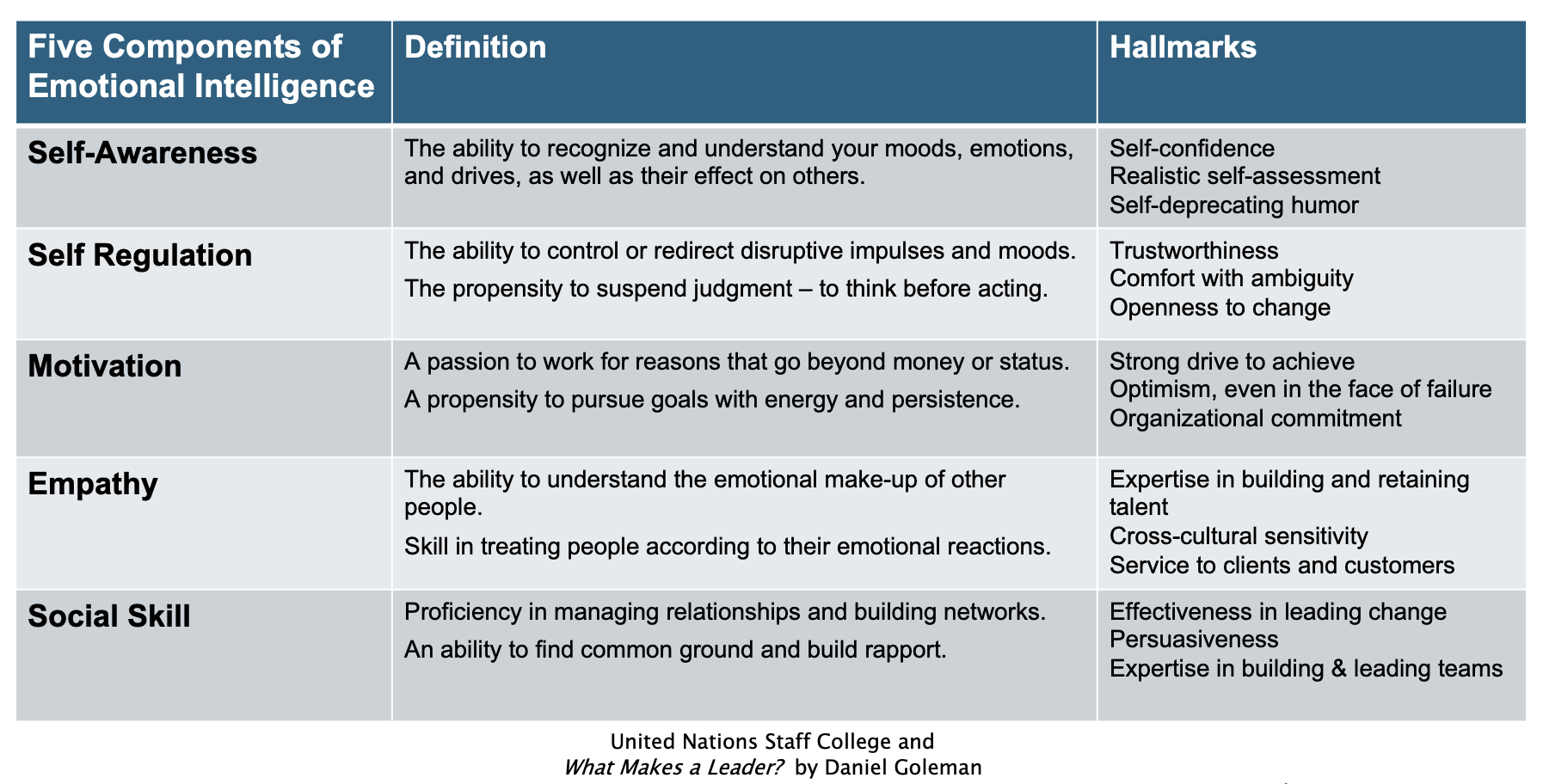
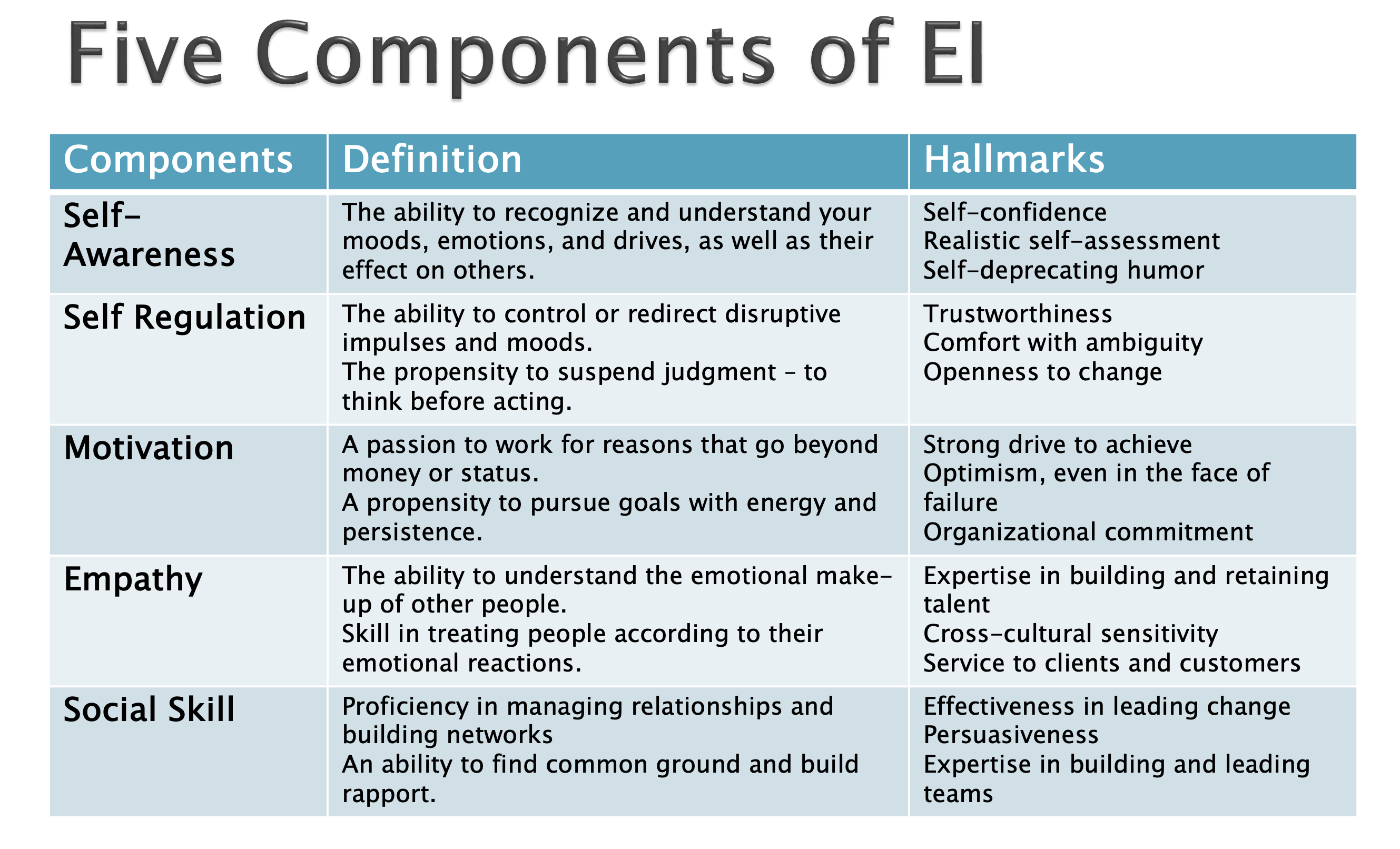
One night I randomly scanned through a handful of YouTube reels of company fraud and mismanagement (e.g., “Revenge of the Coffee Pot,” “Revenge with Karen,” and “Silent Revenge”), painting (fictitious) stories of bosses stealing intellectual property or assuming credit for the innovations/achievements of their subordinates, patent infringement, nepotism or incompetent hirings… all with arrogance, lack of professionalism, the total disregard of employee morale, and blatant patterns of poor executive decision-making, communication, emotional intelligence, strategic thinking, and the ability to influence and guide a team. “Emotional intelligence” (as defined above by Daniel Goleman in What Makes a Leader? also attributed to the United Nations Staff College) should include the “best practices” of self-awareness, self regulation, motivation, empathy, and social skills. Added to these YouTube (fake) scripted deficiencies are the mitigating effects of corporate politics, inconsistent application of compliance or HR policies, unclear contract language, and problems in the chain of command… with the eventual result of the boss receiving a fall from grace, termination, and other legal consequences. Most of these episodes imply only the Board of Directors evaluates the top executives (like school superintendents?), and even with the inclusion of employee satisfaction surveys, staff retention data, third-party auditors, and whistle-blower protections in some instances, the catastrophic actions of these leaders nearly destroy the businesses. For these videos, it seems that leadership assessments and goals are never ongoing, the benchmarks are seldom reviewed, and nothing is PROACTIVE… and therefore not preventive. Therefore, for the school district and corporate worlds alike, we need to intentionally provide formative assessments of our leaders (and ourselves). Exactly what do we need to know and do to improve?

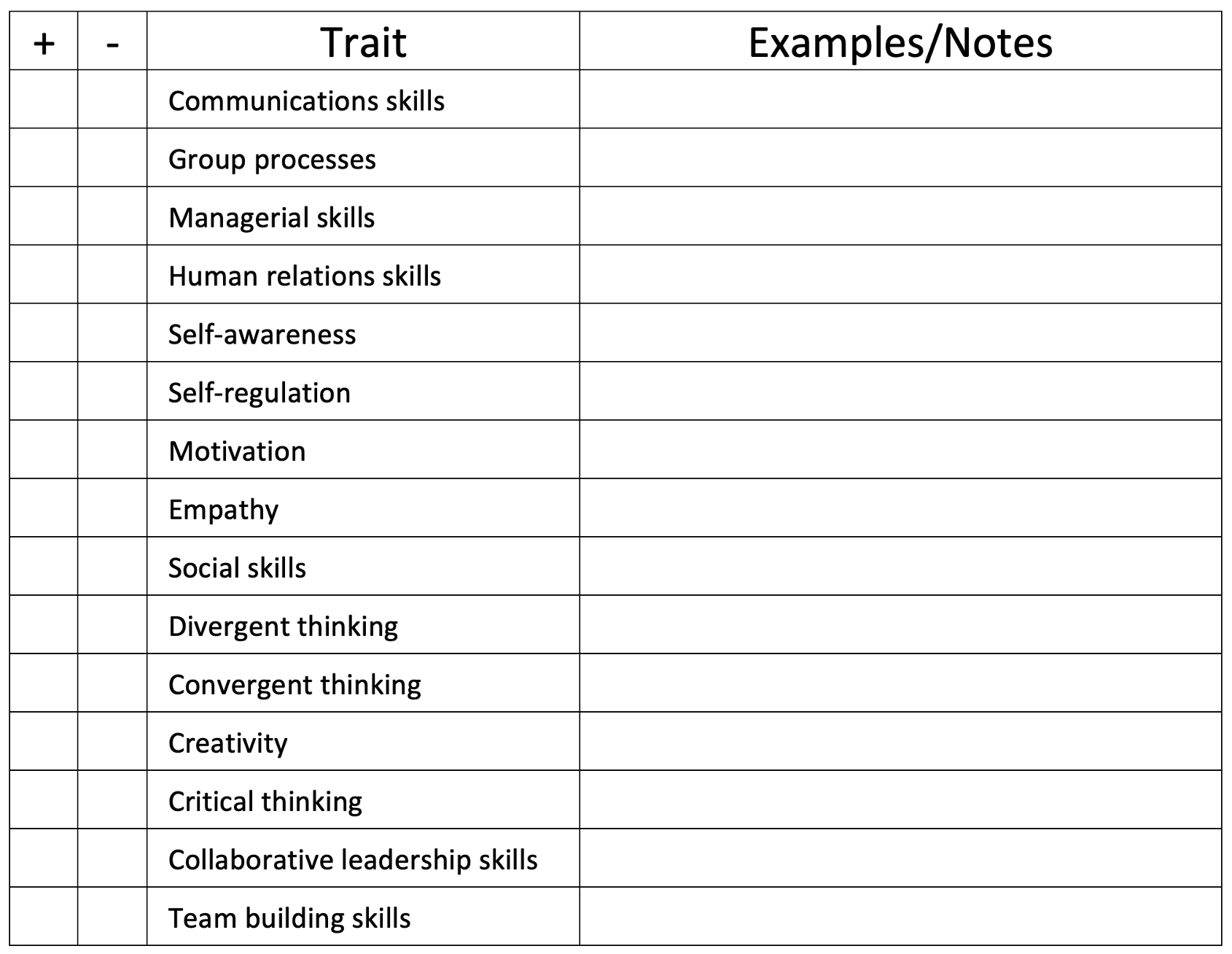
In my blog Growing Student Leaders and the SAS Institute 2025 presentation, I offered the above image as an informal personal checklist to evaluate leadership traits. Coincidentally, while I was writing this article, a scholarship committee of the Community Foundation of Upper St. Clair (for which I serve as Communications Director and Arts Chair) was developing an assessment rubric for ranking applications of a new student leadership scholarship. Although still under development, here are a few of the categories being considered:

  • Communication: Includes listening skills, clarity in speaking, and the ability to make others feel heard.
  • Integrity: Acting ethically, being trustworthy, and aligning actions with words.
  • Accountability: Taking ownership of actions and commitments.
  • Collaboration: Working effectively with others, valuing different perspectives, and resolving conflicts.
  • Self-awareness: Understanding one’s own strengths, weaknesses, and biases.
  • Drive/Initiative: A bias for action and the ability to move projects forward.
  • Courage: The bravery to speak truthfully, admit shortcomings, and make difficult decisions.
  • Humility: Recognizing the contributions of others and remaining a lifelong learner.

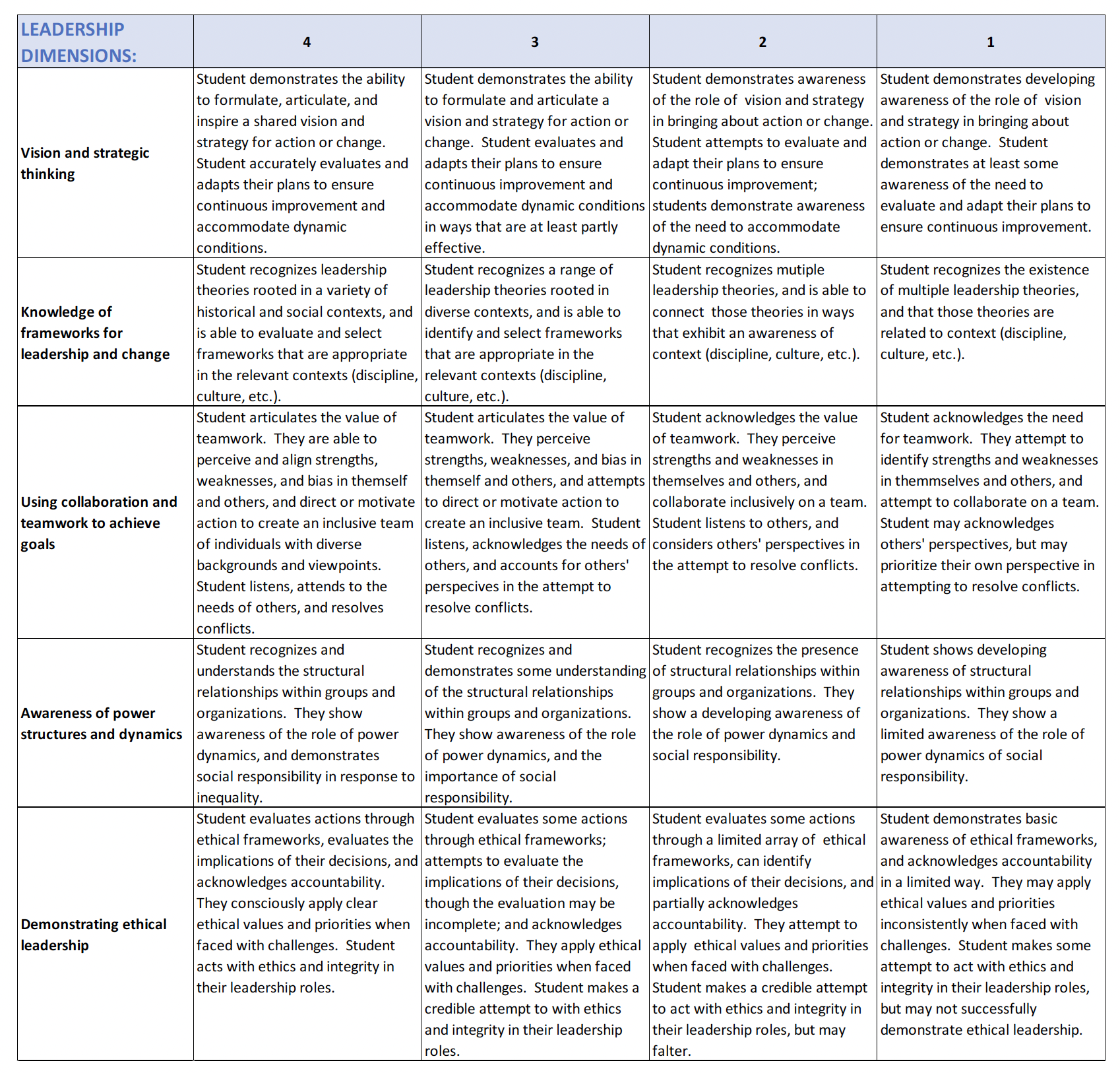
The University of Massachusetts Lowell developed the above rubric for their River Hawk Experience Distinction Leadership Program, defining specific criteria with a clear description of what each trait should look like at different performance levels, in order to provide a standardized way of measuring and assessing leadership skills

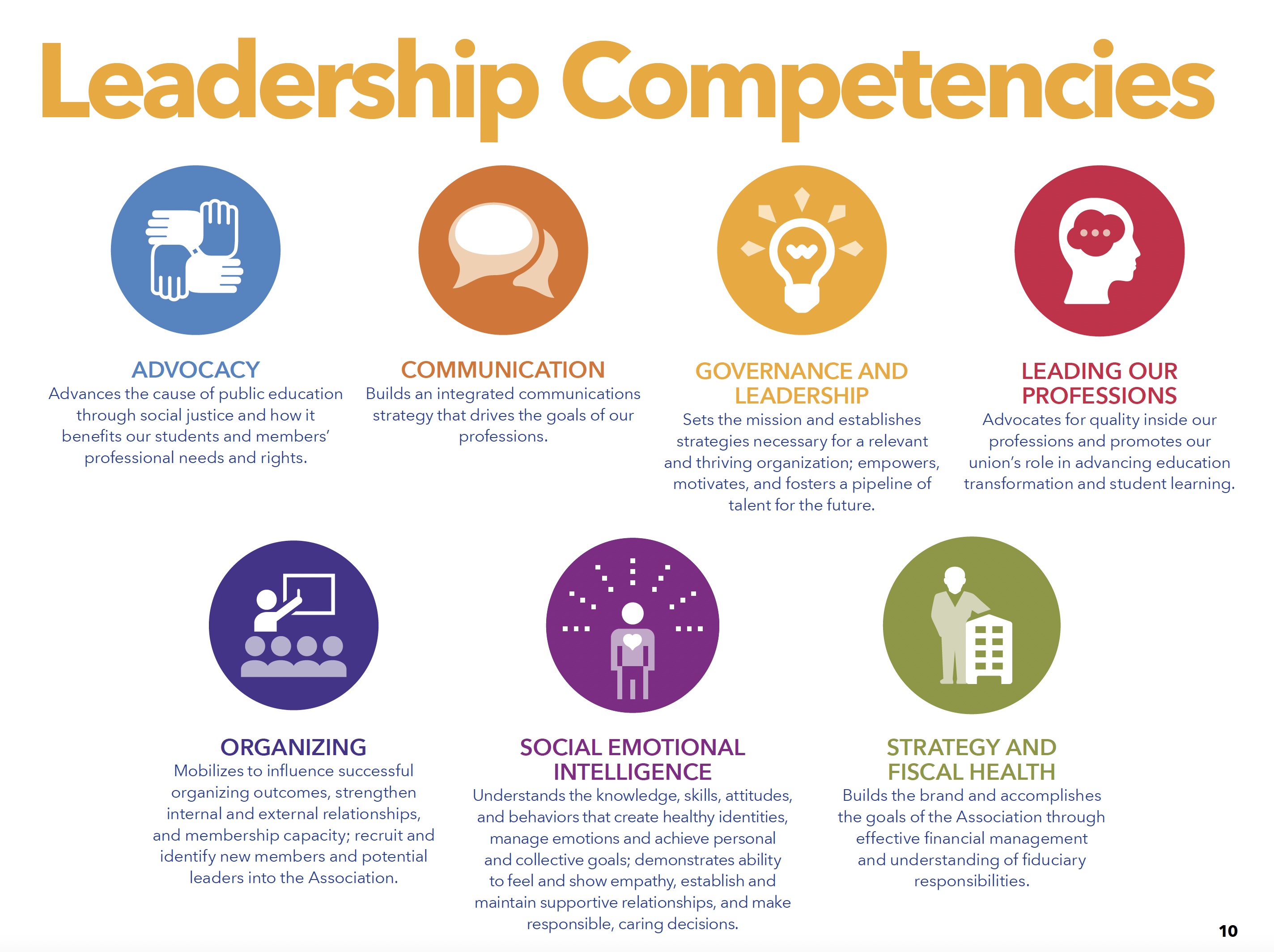
In addition, the National Education Association has created the above NEA Leadership Competency Guide worth downloading.

My favorite inspirational speaker Simon Sinek has also weighed in on this topic of “What Makes a Great Leader?” refining/simplifying it to just three traits:

  • Courage
  • Integrity
  • Communication

Additional resources

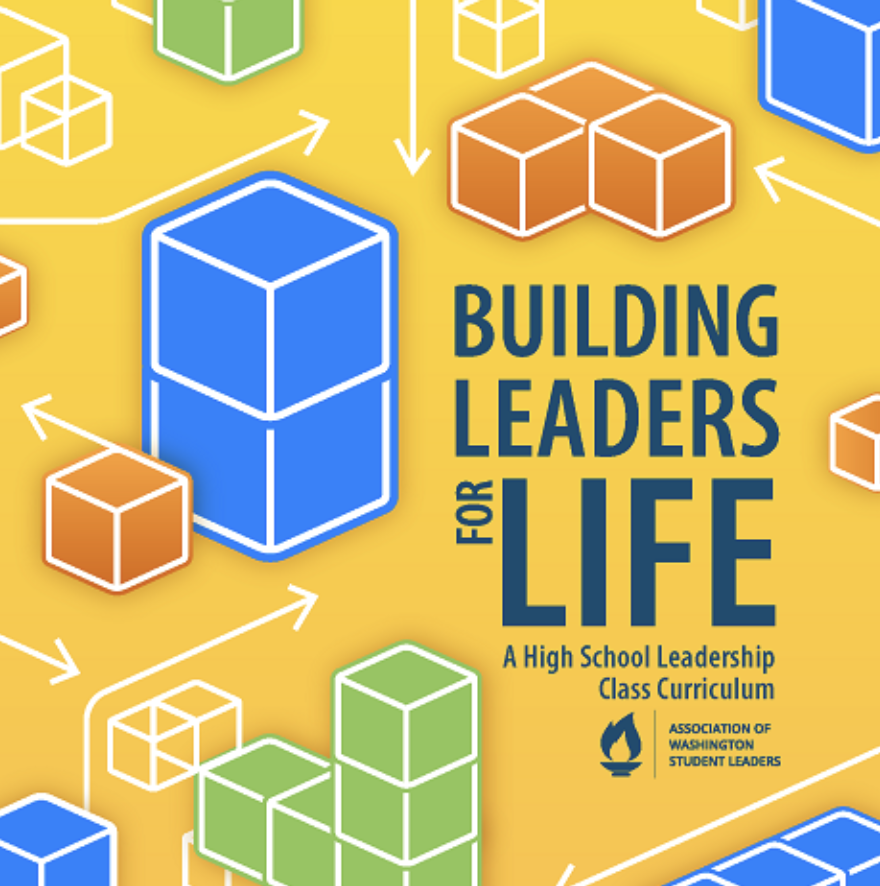
If you are an educator looking for supplemental material on developing leadership skills in your students, besides these SAS INSTITUTE 2025 slides (of which the original PowerPoint file is available to download for free in order to adapt for your classroom – please email me), I recommend perusing the full-blown “Building Leaders for Life” (second edition) curriculum (94 lessons in five subject areas, 355 pages of lesson materials, 137 student handouts) created by the Association of Washington Student Leaders (a division of the Washington School Principals’ Education Foundation). Click here to view their website. They also have a middle school and elementary series!

If you attend my SAS INSTITUTE workshop on December 9, 2025 (starting at 9:40 a.m. in Magnolia C, Hershey Lodge & Convention Center), ask me to see sample materials from their high school course of study.

Finally, here is the “homework for future leaders” I provided at the SAS INSTITUTE and during a 2024 summer camp at Upper St. Clair High School, providing additional links to many inspiring minds. Enjoy!


Leadership is not about being in charge. It is about taking care of those in your charge. — Simon Sinek

A leader is one who knows the way, goes the way, and shows the way. — John C. Maxwell

Do not follow where the path may lead. Go instead where there is no path and leave a trail.
— Ralph Waldo Emerson

The greatest leader is not necessarily the one who does the greatest things. He is the one who gets people to do the greatest things. — Ronald Reagan

What you do has far greater impact than what you say. — Stephen Covey

PKF

© 2025 Paul K. Fox

Growing Student Leaders

The following course content, outline and supplemental materials were presented at the Upper St. Clair High School Leadership Academy on July 24, 2024.

As a follow-up to my workshop for the attendees and to grant full access to important links, a facsimile of the slide presentation, and printable handouts, please download the PDF documents below.

Below is a comprehensive summary of “Leadership 101.”

7/27/24 Update – Leadership Presentation

At the invitation of Upper St. Clair High School (USCHS) German teacher and summer leadership instructor Jacob Reis, it was my pleasure to meet and share my thoughts on “Leadership 101” with students in phase 2 of the USCHS Leadership Academy on Wednesday, July 24, 2024.

The national award-winning USCHS Leadership Academy is a one-week summer workshop offering students exposure to leadership concepts and practices. Students identify their leadership strengths and learn how these skills may be used to make them successful in all stages of life. Through experiential learning strategies, group projects, and hands-on activities, students experience the application of leadership skills, building confidence in their abilities and enhancing their capacity to serve in leadership roles. https://www.uscsd.k12.pa.us/Page/495

I enjoyed my interactions with about 30 rising sophomores who demonstrated they were already well on their way to becoming significant student leaders… and the proof was taking a week off from their summer vacation to enroll in the academy and then enthusiastically participating in my 45-minute workshop right after lunch! (Instead of nap time?) Hopefully, I was able to provoke some new thinking on the further development of their advancing leadership skills.

The only negative comment about the day is that I did not fully cover everything I intended (probably needing at least a full hour but would have enjoyed a half-day!)… thus the rationale for creating this blog-post. I only hope these budding “future leaders” will revisit this material and devote more time on it in research and self-analysis… and complete my optional homework to explore more perspectives on “the definitions of, distinctions in, and directions to becoming a dynamic and dedicated leader.”

Let the Games Begin

With a backdrop of more than 52 years in the field of education (beginning with my own HS days offering private lessons) and incorporating the experiences of an ongoing 44-year relationship in the Upper St. Clair schools, I was able to share philosophies, “best practices,” and anecdotes of lessons learned in working with countless past Fine and Performing Arts student leaders… so many “cream of the crop” drum majors, section leaders, concertmasters, producers, directors, rehearsal assistants, crew heads, leads, etc. Several of the hands-on interactive exercises we have explored in past student staff meetings and even at PMEA/PCMEA conferences were beneficial (“doing” works better than “saying!”), including:

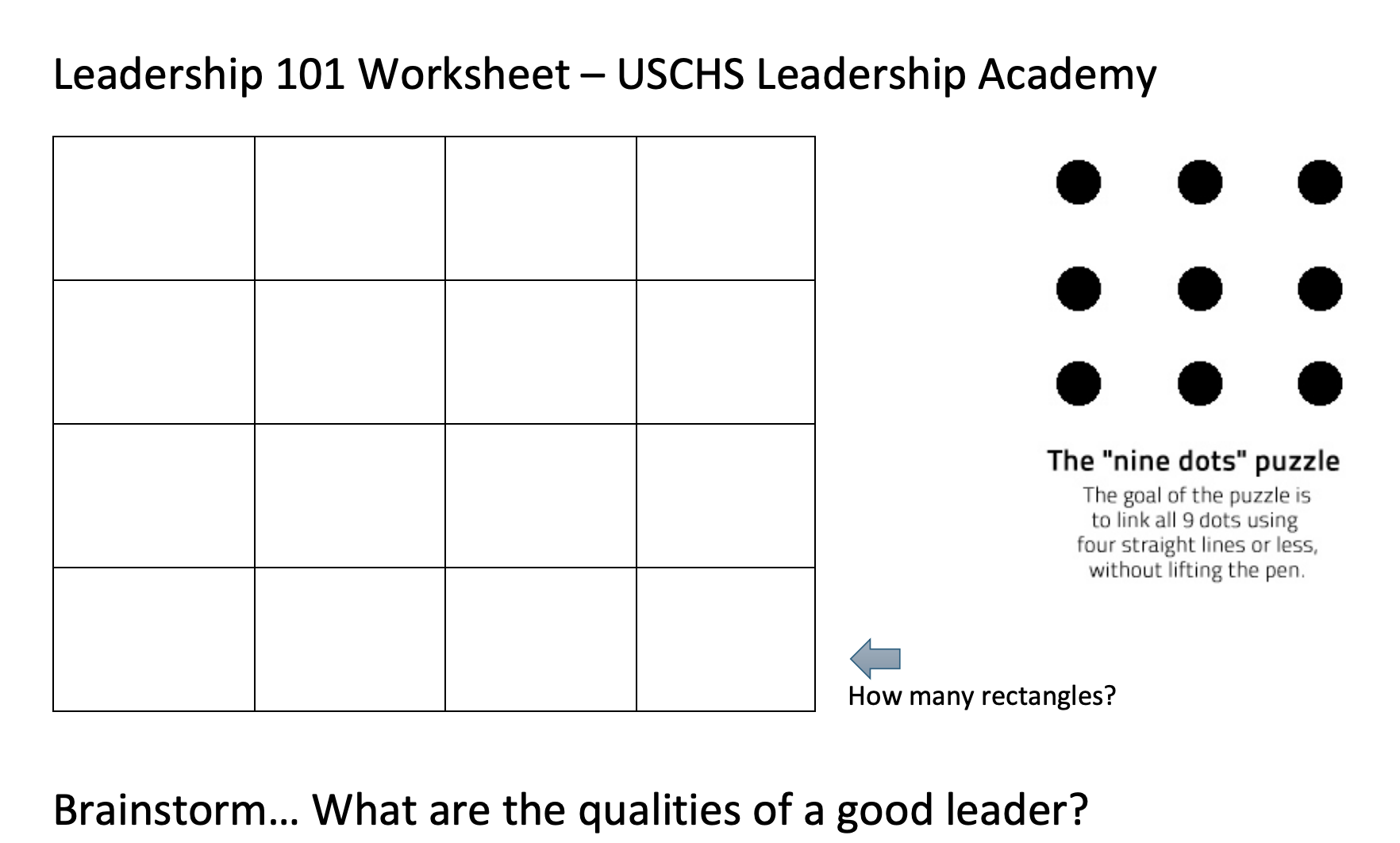
  • How Many Rectangles (thinking outside the box): See this 2015 Part II blog-post on Creativity.
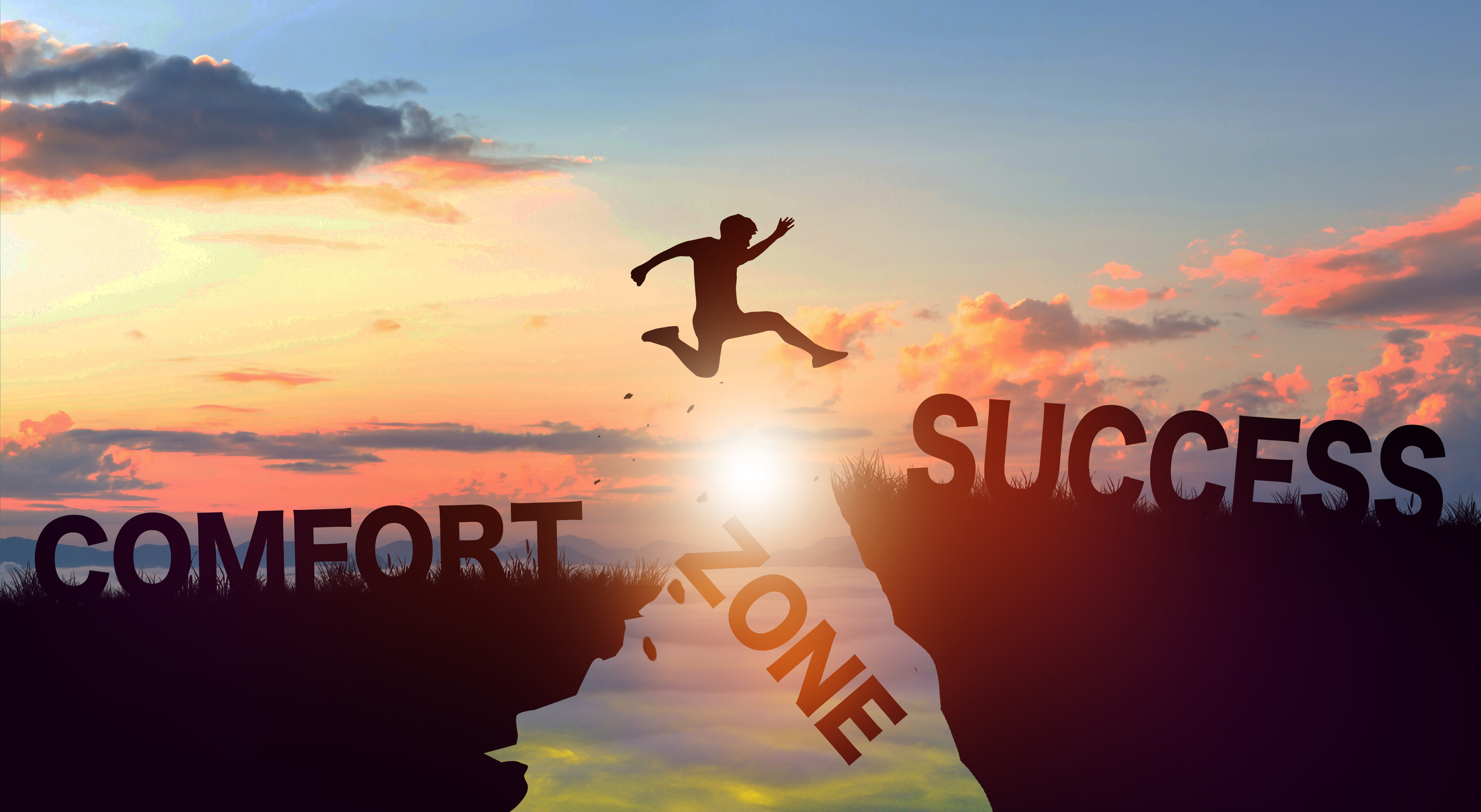
  • The Clapping Game (stepping outside your comfort zone): “Put your hands together, clap and hold. Is your right thumb over your left or vice versa? Now try it the opposite way… until you can do it just as confidently! Now you have expanded your comfort zone! This is how we GROW!”
  • The Nine-Dot Puzzle (how creative are you?): See this 2015 Part I blog-post on Creativity.

Now Some Definitions

We reviewed some common “leadership vocabulary” during the session. Recognizing that there is a wide divergence in opinion on what makes a great leader, I chose to focus on portraying three triple-threat skill types that LEADERS ARE…

  • Visionaries
  • Coaches
  • Managers

I have always felt that leaders need to embrace change, not be afraid to “upset the apple cart,” foster a shift in new directions, create goals, and make improvements to the status quo… to bravely go out and figuratively “break something!” Things to do with a problem:

  • Ignore it
  • Resist it
  • Define it
  • Enjoy it
  • Find a use for it
  • Find a bigger problem

Numerous giants in the field of coaching and education have shared these one-line gems:

  • Leaders embrace new ideas or challenges.
  • Leaders are catalysts for change.
  • Leaders make goals and define targets.
  • Leaders model commitment and passion.
  • Leadership is all about creativity, innovation, and problem solving.
  • Leadership is about taking risks.
  • Leaders have positive self-esteem.
  • Leaders master good listening skills.

Extra handouts: Last week, I was not able to distribute these leadership quotes or the stuff and tasks of leadership, including words of wisdom from “leader luminaries” like the late great Babe Ruth, Abraham Lincoln, Vince Lombardi, Theodore Roosevelt, and my first USC school administrator and mentor Thomas Harshman.

Citing elements from the “curriculum” created by The Association of Washington Student Leaders (AWSL), a division of the Washington School Principals’ Education Foundation, we briefly touched on these leadership effectiveness goals (peruse my slides #18-25):

  • Communication skills
  • Group processes
  • Managerial skills
  • Self-awareness
  • Human relations skills

…which led us into diving into this table of emotional intelligence (EI) skills, supporting the self-awareness goals of AWSL and prescribed by the United Nations System Staff College and a book by Daniel Goleman What Makes a Great Leader:

Types of Thinking… and Leading

There was not enough time to unpack these “chapters,” much of it inspired by the research and work of Professor Curtis Bonk from Indiana University of Bloomington (check out slides #32-52 for descriptions):

  • Divergent thinking
  • Convergent thinking
  • Critical thinking
  • Cooperative/collaborative thinking
    (team-building)

Are You in the Right (or Left) Mind?

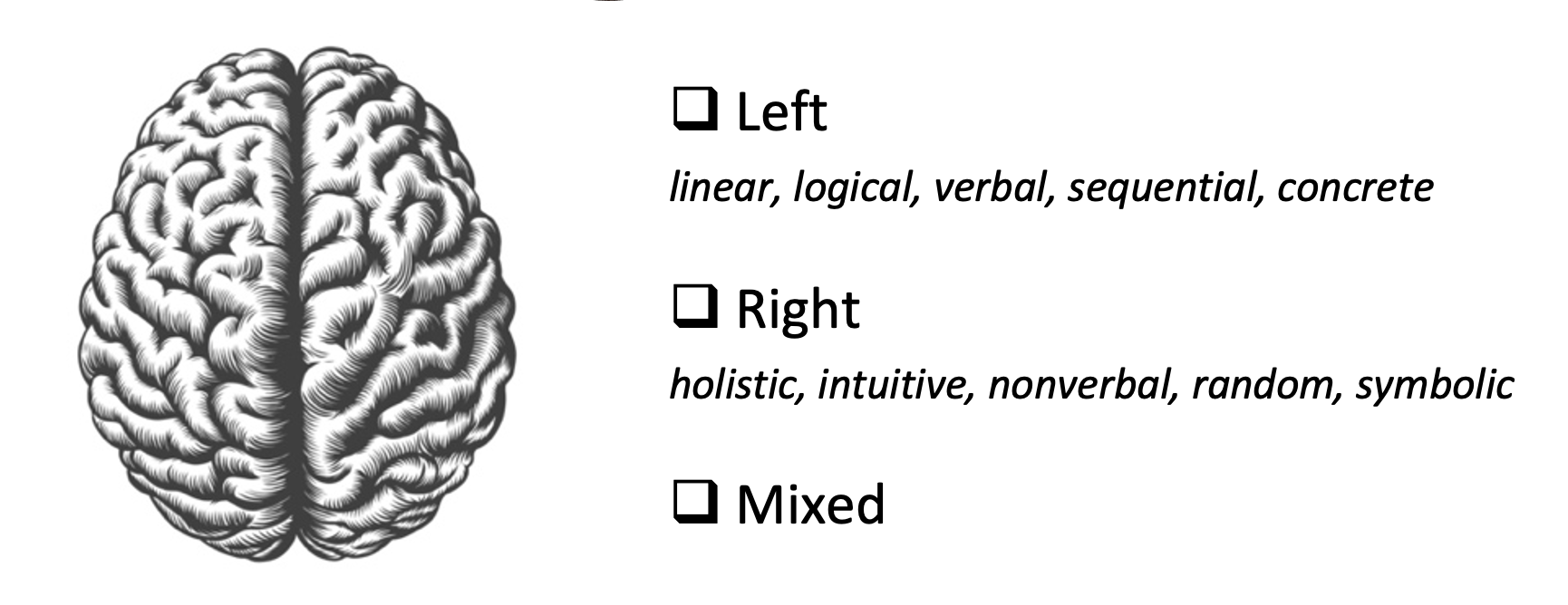
At the Leadership Academy session, we did enjoy taking an insightful quiz about left or right brain hemispheric dominance (although we were unable to finish scoring it), something which was first introduced to me at a teacher in-service led by USC Supervisor of Curriculum John Small, and many years later, shared in a virtual session of my community orchestra during the pandemic. Examples of the type of questions: Would you choose to complete a crossword puzzle (left-brain) or a jigsaw puzzle (right-brain), or view a movie (right) or read a book (left)?

This test introduces “thinking styles” and a taste of lateral brain research. (Disclaimer: There has been a lot of scientific debate on whether there is any value in measuring brain dominance. In addition, a true test of hemispheric brain dominance would take hours, MANY MORE questions, and still only offer a few generalizations! This exercise is only provided to give us a little more understanding in the way we think and how others may respond to our attempts to lead them.) I concluded with the following statement:

Now apply this to the “types” of people you may lead. The lefty “analyticals” may want meetings to start and end on time, keep to the agenda, follow Robert’s Rules of Order, receive written documentation, etc. “Righties” (a.k.a. “spatials”) may arrive late, prefer more time for free discussion (“bird-walking?”), enjoy more charts/graphs, demonstrations, and “hands-on,” offer good brainstorming… but fewer restrictions or rules to organizing the meeting.

More Self-Reflection Exercises and the “Oreo Cookie Technique”

Back to interactive “show-don’t-tell” FUN activities! We introduced several tools to motivate additional self-analysis (insights into current leadership skills/tendencies and future needs):

  • Brainstorming of Leadership Habits: “Close your eyes and visualize a ‘model leader’ you have known and admired. What were his/her outstanding personality characteristics? In 30 seconds, write down as many of these traits and others that would define a great leader.”
  • Step #2 Brainstorming: “Circle three of these qualities you feel are the most important for success.
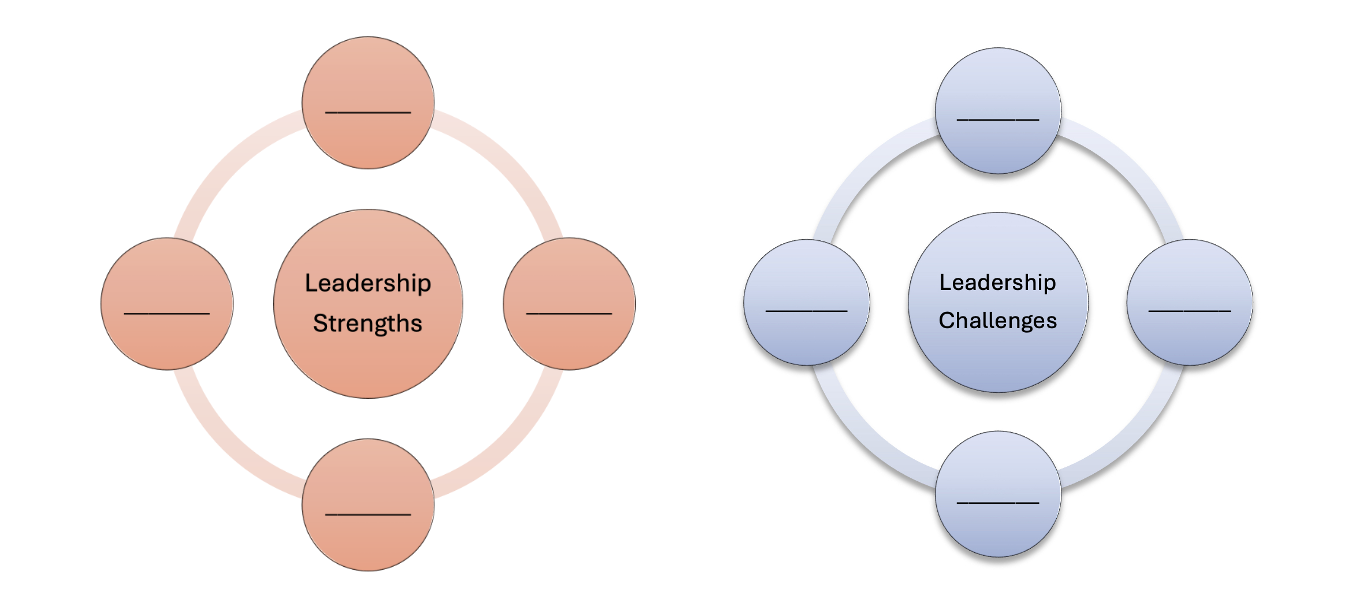
  • Step #3 Brainstorming: “Highlight, underline, or star two of these traits that YOU model – your most developed skills. Now print these in the top two bubbles of the pink graphic below.
  • Step #4 Brainstorming: “Review the EI chart of the Union Nations Systems Staff College, outline of AWSL leadership skills, and the types of thinking/leading skills (above), and add one or two characteristics you feel YOU are well on your way to mastering (understanding that, as my wife would remind me, ‘pobody is nerfect!’ and there’s always room for even more work on them.”
  • Step #5 Brainstorming: “Once you have completed a self-analysis of the material covered in this session (blog-post + handouts + slides), select up to four ‘challenges’ you would consider for further study or goals for self-improvement.”

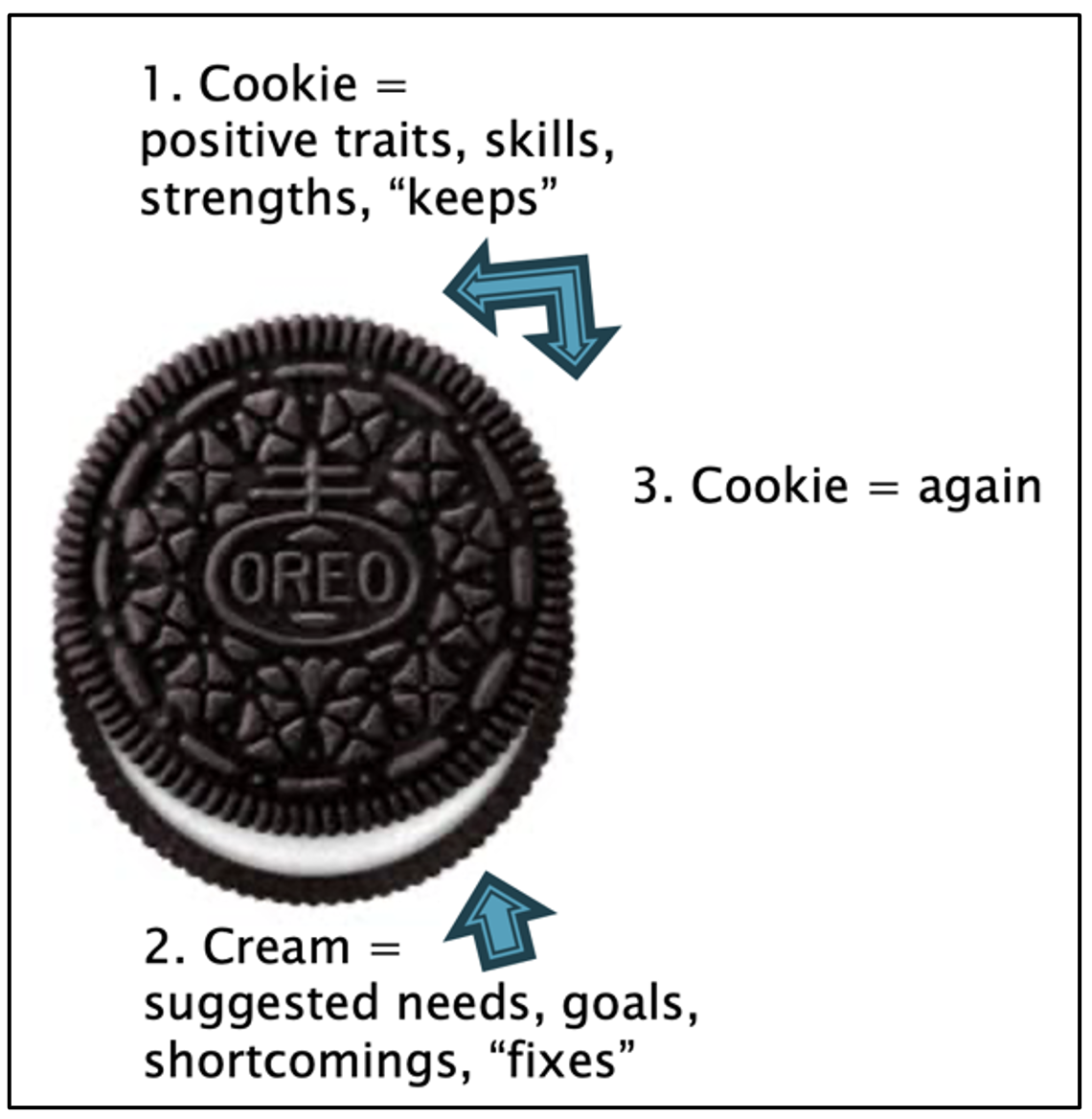
Now, the process for “peeling back the onion skin” and doing a deep dive into a critique of an individual’s strengths and weaknesses (without crushing egos) is best done by first using positive reinforcement (what are the good things already accomplished?), followed by the problem(s), need(s), or trait(s) that resoundly land “outside the comfort zone.” This punch list of one or more items will be the basis for generating an action plan for making positive changes. Finally, you should always end everything with the positive… a reflection on the progress that has already been made, observation of past achievements or gifts, and confidence that a set of recently adopted S.M.A.R.T. goals (below) would be attainable:

  • Specific
  • Measurable
  • Achievable
  • Relevant
  • Time-bound

The Oreo cookie symbolizes layers, a progression from top to bottom, starting with the chocolate cookie (dunk it in milk if you wish!) which represents “the positives,” next going to the cream which depicts a “focus on improvements,” and then finishing off the bottom cookie (return to “the positives”). This is relevant for self-analysis as well as a model for the care and motivation of team members. The experienced and empathetic leader knows that “you catch more flies with honey than with vinegar…” and most people respond better to positive-first feedback along with a little sensitivity and diplomacy when pointing out their shortcomings. Whenever you can, “sandwich” the cocoa’s good things (“keeps”) around the cream’s criticism (“fixes”)… for yourself and in others within all work/school settings!

Coda: Personal Inventory Profile

I hope throughout this workshop attendees will self-assess their leadership potential and make a few plans for ongoing personal development. The above checklist outlining my USCHS leadership academy content was provided in this handout to help examine areas of interest and to formulate new goals. I also recommend taking time to peruse the homework for future leaders and especially read a few of my past posts on creativity in education and leadership showcasing several exemplary models of leadership… outstanding visionaries, coaches, and managers:

How’s your LQ = leadership quotient?

PKF

© 2024 Paul K. Fox

The Importance of Music Education

One Teacher’s Views on the Advocacy of Music in the Schools

Here are partial transcripts, excerpts, and commentary about this blogger’s perspectives on the value and benefits of music education, paraphrased from the program The Edge, produced by the Peters Township High School On-Air Talent class: Episode No. 45, “The Importance of Music Education,”https://archive.org/details/The_Edge_-_Episode_45_-_The_Importance_of_Music_Education


The Edge Episode 45


music-1781579_1280_GDJOver the years, I have been a strong advocate of equal-access to music and the arts as an essential part the education of all children. This blog will give me an opportunity to put a lot of my thoughts in one place. I am aware that there are many people “out there” who offer the premise that studying music makes you successful in other areas, and you will see that this assumption is well-supported. However, I am not a brain scientist. I cannot confirm research that seems to point to a direct correlation that “the music itself makes us smarter.” It could be that students who are attracted to and become proficient in the arts are somehow uniquely “wired,” have a greater work ethic, or are better intellectually “equipped” to become successful engineers, doctors, lawyers, educators, scientists – you name the career – and enjoy life-long happiness and self-realization. So many of those music-in-our-schools-month fliers say “music is basic,” “music is math,” “music is reading,” “music is science,” etc. and they are right! So, it’s not wrong to bring it up. But we should be fully aware that the primary goal of an education in the arts is for the development of creative self-expression.

In short: music for music’s sake.

When revising our Fine and Performing Arts mission and goals of music education for Middle States accreditation, the music and art teachers in my district centered on several primary goals. Probably the most important one was “to promote the skills of creative self-expression by using music, art, dance, and/or drama as vehicles for defining the students’ self-identity, learning concepts, communicating thoughts and feelings, and exploring mankind’s musical heritage in order to gain a broad cultural and historical perspective.” This statement was written many years ago… prior to the advent of Internet and social media, but perhaps it is even more relevant today!

However, there’s plenty of room here to provide you a wide spectrum of rationale and research from multiple vantage points.

It was my joy to be interviewed by host Sam D’Addieco, a junior percussion player in my South Hills Junior Orchestra. This link takes you to a 30-minute Vimeo recorded in the Peters Township Community Television studio on May 6, 2019. Although this was his assignment for a media class, it really prompted me to do some additional introspection about “what I think I think.” These were some of the issues we discussed… by no means verbatim, but, after all, this is my website. Now I can say what I really meant…

harp-3961060_1920_Noemi-Italy

Initial Questions and Responses

  1. Why did you choose to become a music educator? Music teaching is the greatest job in the world. Every day you deal with the inspirational subject matter of music, and then share it with students who want to be in your class! What could be any better? We guide students towards finding their personal identities, innate artistic and expressive potentials, and successes in making music.
  2. What inspired you to become a music educator in the first place? Were you always going to be a music teacher? I was one of those “goobers” who wanted to “live” in the music room… if I could, participating in band and orchestra eight periods a day! But, up to my Freshman year, I was going to be a doctor or surgeon, thinking that the field of medicine, “saving people’s lives,” would be the most exalted career. That is until my Special Biology teacher gave each of us a needle, alcohol swipe, and blood type testing strip, and I found out I was too squeamish to poke myself. What did I really want to do with my life? Share my love of music!
  3. How did you get started in music? Before grade school, my mother signed me up for piano lessons, and I practiced on our Howard baby grand (Baldwin brand) at home reveling in its big, beautiful tone. At school in California, I started out on the snare drum. My piano teacher also introduced me to the violin in the summer between fifth and sixth grade. After that, every new band director I had when I moved to different school districts in Western Pennsylvania switched me to a “what was needed for the band” instrument (baritone then tuba), and my private string teacher moved me to the viola, probably due to the length of my fingers, which eventually became my “major” in college.
  4. Did you have any mentors that helped you along the way? I was blessed with many outstanding music educators, school directors, conductors of local community orchestras, and private instructors. Probablymusic-students-246844_1920_musikschule the one who had the greatest influence on my going into a career of music teaching was Eugene Reichenfeld, who I saw the last period of every day in Orchestra at Penn Hills HS, at least once a week in a private lesson and rehearsals of the Wilkinsburg Civic Symphony on Thursday nights, and over the three summers at the Kennerdell Music and Arts Festival in Venango County. What a role model! Partially blind and losing his hearing, Mr. Reichenfeld played violin, cello, and guitar, and taught uninterrupted until three weeks before he died at the ripe old age of 103!
  5. Any regrets? Absolutely not! My classmates in college dubbed me “mister music ed.” But some of my well-meaning supporters saw other skills in me and tried to talk me into other pursuits. From my senior year in high school to four of five years enrolled in Carnegie-Mellon University, my string professor George Grossman prepared me for employment as a professional musician, even to consider auditioning for the Pittsburgh Symphony Orchestra. I said, I want to teach students! My CMU music department chair Robert Page and Fine Arts Dean Akram Midani in 1977 urged me to look into enrolling in Harvard summer arts management courses. Again: I want to teach students! Believe-it-or-not, even my own dad encouraged me to rethink my plans. After attending my first Edgewood Elementary 4th grade musical production (1979), he marveled about how much time I devoted  to making music… 6-7 days a week including evenings! He asked me what were my earnings. We compared my first-year salary of $8200 vs. his position as manager in the nuclear division of Westinghouse Company (move the decimal point to the right – nearly $82,000 annual compensation). He suggested a partnership. “Why don’t you join with me, form a company together, and become entrepreneurs, and with a little luck and your obvious work ethic, we could both make a million dollars in a few years.”
  6. conductor-4189841_1280_GordonJohnsonDid your father ever realize why you chose music? In December 1986, Dad came to my choral/orchestra department production of Scrooge, involving over 250 students at my second career assignment, Upper St. Clair High School. After the closing curtain, he came up to me and asked, “Did you do all of this yourself? I answered, “Well, I had a lot of help. I did prepare the students on the dialogue parts in the script, the leads’ solos, chorus harmonies, and orchestra accompaniment, but I needed a drama specialist for coaching the actors and a choreographer for the dances. And yes, I am also the show’s producer, responsible for the printing of the program and tickets, finding people to assist in sewing the costumes, building the sets, running the stage tech, and applying the make-up.” After a short pause, he said something I will never forget: “Wow! This was incredible! You really made a difference to so many of your students’ lives.” He was proud of me, and finally expressed it! (It was a good thing too… he died suddenly of a heart attack exactly two years later when I was in the middle of staging USCHS’s Joseph and the Amazing Technicolor Dreamcoat.)


Statistics in Support of Music Education

What is the purpose of music in schools? Why is it important to take a creative arts elective throughout your middle to high school education?

smart-187696_1920_RondellMelling

Okay, we can start with the huge body of research published just about everywhere that indicates “music makes you smarter.” Here are just a few examples and sample supportive documentation. (Please take the time to peruse these links!)

Other skills:

singer-1545903_1920_hawk5555

More attitudes:

Several more general links, additional literature that supports the inclusion of music in the school curriculum:


violin-1617787_1920_sarab123

Learning Styles and “Intelligences”

Ever felt like you were a square peg trying to fit in a round hole? Now, lets dive into the concept that “music is a means to learning.”

Intelligence is often defined as our intellectual potential; something we are born with, something that can be measured, and a capacity that is difficult to change. In recent years, however, other views of intelligence have emerged. Also, more research has been applied to learning styles and preferences… all to promote better success in education.

“Many of us are familiar with three general categories in which people learn: visual learners, auditory learners, and kinesthetic learners. Beyond these three general categories, many theories of and approaches toward human potential have been developed.”

— North Illinois University: https://www.niu.edu/facdev/_pdf/guide/learning/howard_gardner_theory_multiple_intelligences.pdf

In 1983, the theory of “multiple intelligences” was formed by Dr. Howard Gardner, Professor Education at Harvard University, and widely read in his initial book offering Frames of Mind: The Theory of Multiple Intelligences.

Supported by Thomas Armstrong (books such as Multiple Intelligences in the Classroom), “the traditional notion of intelligence, based on I.Q. testing, is far too limited.” Instead, Dr. Gardner proposed nine different intelligences to account for a broader range of human potential in children and adults (the first one is my favorite):

  • choral-3871734_1280_gustavorezendeMusical (sound smart)
  • Naturalist (nature smart)
  • Logical-mathematical (number/reasoning smart)
  • Existential (life smart)
  • Interpersonal (people smart)
  • Bodily-kinesthetic (body smart)
  • Linguistic (word smart)
  • Intra-personal (self smart)
  • Spatial (picture smart)

“Dr. Gardner says that our schools and culture focus most of their attention on linguistic and logical-mathematical intelligence. We esteem the highly articulate or logical people of our culture. However, Dr. Gardner says that we should also place equal attention on individuals who show gifts in the other intelligences: the artists, architects, musicians, naturalists, designers, dancers, therapists, entrepreneurs, and others who enrich the world in which we live. Unfortunately, many children who have these gifts don’t receive much reinforcement for them in school. Many of these kids, in fact, end up being labeled “learning disabled,” “ADD (attention deficit disorder,” or simply underachievers, when their unique ways of thinking and learning aren’t addressed by a heavily linguistic or logical-mathematical classroom.”

— American Institute for Learning and Human Development: http://www.institute4learning.com/resources/articles/multiple-intelligences/
saxophone-3246650_1920_congerdesignTransforming the way schools should be run, the multiple intelligences theory suggests that teachers be trained to present their lessons in a wide variety of ways using music, cooperative learning, art activities, role play, multimedia, field trips, inner reflection, and much more. This approach truly “customizes the learning” and provides eight or more potential pathways to learning.

“If a teacher is having difficulty reaching a student in the more traditional linguistic or logical ways of instruction, the theory of multiple intelligences suggests several other ways in which the material might be presented to facilitate effective learning.”

— Thomas Armstrong: http://www.institute4learning.com/resources/articles/multiple-intelligences/

“While a person might be particularly strong in a specific area, such as musical intelligence, he or she most likely possesses a range of abilities. For example, an individual might be strong in verbal, musical, and naturalistic intelligence.”

— Kendra Cherry: https://www.verywellmind.com/gardners-theory-of-multiple-intelligences-2795161

The bottom line? We need music in the schools for a variety of reasons, not the least to systemically and intentionally provide avenues of learning for “music smart” kids as well as to share resources that all teachers across the disciplines may use to enrich their lessons, differentiate the instruction, and “reach” their students.


Ever Heard of the Four C’s?

How about defending the rationale that “music makes connections, within us and from the world around us?” Easy!

Music and art courses offer great rigor in developing 21st Century learning skills:
band-526330_1920_Greyerbaby

Released by the Partnership for 21st Century Skills (2010), the best resource I found when this movement made the headlines was this P21 Arts Skills Map. It was developed to “illustrate the intersection between 21st Century Skills and the Arts. The maps will enable educators, administrators and policymakers to gain concrete examples of how 21st Century Skills can be integrated into core subjects.” With so much more detail, this document provides skill definitions, core subject interactions, outcomes and examples:

  • Critical Thinking and Problem Solving
  • Communication
  • Collaboration
  • Creativity
  • stones-451329_1920_dweedon1Innovation
  • Information Literacy
  • Media Literacy
  • Information, Communication, and Technology Literacy
  • Flexibility and Adaptability
  • Initiative and Self-Direction
  • Social and Cross-Cultural Skills
  • Productivity and Accountability
  • Leadership and Responsibility
  • Interdisciplinary Themes

“The music classroom is a perfect place to teach critical thinking and problem solving,” says MENC [now NAfME] member Donna Zawatski. Instead of giving students the answers, she asks questions that will clarify the process and lead to better solutions from the students. “Students will define the problem, come up with solutions based on their previous experience, create, and then reflect on what they’ve created,” she says.

— Donna Zawatski, “4C + 1C = 1TGMT,” Illinois Music Educator, Volume 71, No. 3.


Creativity is Number One!

One of my favorite educational gurus, probably an expert on creativity in the schools, is Sir Ken Robinson. His most viewed Ted-Talk “Do Schools Kill Creativity?” (18 million+) should be required of all pre-service teachers. A great story-teller with a wonderfully dry English sense of humor, Robinson tells a narrative about a child who was not “behaving” very well in school… “coloring outside the lines” and fidgeting in class. According to the primary teacher, she was distracting the other students, and was hard to “contain” and keep her sitting in her seat.

At the insistence of school staff, the parents took the little girl to a psychiatrist. He did a battery of tests on her to find out why she was so “antsy” and… The counselor’s analysis? He said to her parents: “Your child is not sick. She is a dancer. She likes to express herself in movement. Take her to a school that emphasizes dancing.”

ballet-3362682_1920_sobima

A “quick-from-the-hip” diagnosis might have resulted in prescribing drugs in order to “calm her down” and make her “fit in” better with the traditional school setting.

The rest of the story? The incident he was talking about described the childhood of the super-successful multi-millionaire English ballerina and choreographer of Cats and Phantom of the Opera on Broadway, the late Gillian Lynne.

Creativity is probably the single most essential learning skill… and I have devoted a whole section of my website on the subject, starting with “Creativity in Education” to numerous blogs here.


Flexible Thinking, Adaptability, and Problem Solving

In the interview, I asked the question, “What is 1 + 1 + 1?” What I meant to elicit was, “Besides the obvious response of 3, how many different answers can you find to solve this math problem?”

  • 111
  • 11 (in binary)
  • 1 (draw it in the air, one vertical line and two horizontal lines making the Roman numeral I)

Living in the real world (as well as learning the arts), there are very few “one-right answers!” Unlike other subject areas and pursuits, music fosters abstract decision-making in situations where there are no standard answers, analysis of and response to nonverbal communication, and adaptations and respect of divergent styles and methods for personal expression and thinking.
piano-78492_1920_nightowl

The arts foster divergent thinking (the ability to consciously generate new ideas that branch out to many possible solutions for a given problem) as well as convergent thinking (the ability to correctly hone in to a single correct solution to a problem).  According to Professor Curtis Bonk on his insightful “Best of Bob” – Instructional Strategies for Thinking, Collaboration, and Motivation” website, “In creativity, convergent thinking often requires taking a novel approach to the problem, seeing the problem from a different perspective, or making a unique association  between parts of the problem.”

“Knowledge is only a rumor until it lives in the muscle.”

— Proverb quoted by Brené Brown, author of Daring Greatly


Are You of the “Right Mind?”

First, take the Left-Brain/Right-Brain test at the “Best of Bob” website above.

RThe 60s work of Nobel Peace Prize scientist Dr. Roger Sperry pointed to different sections of the brain being used for unique functions of the mind. Accordingly, the left brain is supposed to be more verbal, analytical, and orderly than the right brain. It’s sometimes called the digital brain. It’s better at things like reading, writing, and computations. In contrast, the right brain is purported to be more visual and intuitive. It’s sometimes referred to as the analog brain. It has a more creative and less organized way of thinking.

However, portions of his research, especially about brain hemisphere dominance have been disputed.

“Magnetic resonance imaging of 1,000 people revealed that the human brain doesn’t actually favor one side over the other. The networks on one side aren’t generally stronger than the networks on the other side.”

“The two hemispheres are tied together by bundles of nerve fibers, creating an information highway. Although the two sides function differently, they work together and complement each other. You don’t use only one side of your brain at a time.”

“Whether you’re performing a logical or creative function, you’re receiving input from both sides of your brain. For example, the left brain is credited with language, but the right brain helps you understand context and tone. The left brain handles mathematical equations, but right brain helps out with comparisons and rough estimates.”

Healthline: https://www.healthline.com/health/left-brain-vs-right-brain

brain-2062055_1920_ElisaRiva.jpg

Here is what I believe. Parts of what we do in music, like interpretation, expressiveness, phrasing, aesthetic sensitivity, and perception of man’s creations around us, etc. involve imagination and intuition, and are more holistic, intuitive – I will call it “right” brained.

In his book A Whole New Mind – Why Right-Brainers Will Rule the World, Daniel Pink, formerly a lawyer and the speechwriter to Vice President Al Gore, forecast that most future careers throughout the world will involve the learning skills normally attributed to the right side of the brain – innovation, invention, ingenuity, adaptability, critical thinking and problem-solving, etc., not jobs that are dominated by predetermined or routine actions, instructions, scripting (e.g. tasks that can be done by robots, Legal Zoom for simple wills, or 1-800 tech help hotlines).

I recommend looking into Pink’s books and his “Discussion Guide for Educators.”

wow-3569893_1920_geralt

In conclusion, with so many memories swimming around in my mind, I was asked by Sam what I thought was the greatest achievement of my career (or perhaps he meant what single student did I “inspire” to greatness?).  I replied that there were far too many to count, those blessed “AH HA” moments when a musician, singer, actor, or dancer goes for his dream and realizes his potential… “I made it!” Sometimes they don’t believe in themselves, are afraid to try, and the teacher has to nudge or encourage them. But, once it happens, you can see the sparkle in their eyes! And, even in retirement, they never let you forget their accomplishment(s) and the difference you made in their lives!

Finally, I agree wholeheartedly with the following statements regarding music’s role in everything from self-esteem development to building “symphonic” relationships and connections between seemingly unrelated or dissociated items or events – “putting the pieces of the puzzle together!”

“To be able to play a musical instrument (increasingly well), to be able to express oneself musically, to become friends with others making the same accomplishments, to reach musical goals and achievements — these things help people feel good about themselves. That has lasting value as it relates to nearly all other things in their lives, according to the music educators.”

The Herald Paladium, September 10, 2000

Music also boosts creativity and the ability to see the relationships between seemingly unrelated things—enhancing all learning. Children who have studied music develop faster socially, mentally, and even physically.

Woodwind Brasswind: “How Music Study Relates to Nearly Every School Discipline”

children-246848_1920_musikschule

Simply put, making music in school and life-long learning as adults are FUN! It nurtures our inner voice, feelings, and self-worth. We enjoy the social interactions of participation in an ensemble. Literally, we explore our artistic “souls” and embrace the beauty within and around us. A career of 40+ years of directing orchestras, both in formalized classes and community/youth groups, has been the most inspirational and life-satisfying of pursuits… something I hope I can do for many more years until I reach Moses’ age!

PKF


Photo credits in order from Pixabay.com:
wooden-train-2066492_1920_Couleur

© 2019 Paul K. Fox
TEAM = “Together Everyone Achieves More”

A Twist on an Old Fable… Who Really Won the Race?

Photo credit: FreeImages.com, photographer Eric Thibodeau


Before you do anything else, I want you to “take four,” fire up your computer, and view this YouTube video: https://www.youtube.com/watch?v=xevQ2yTyK9Y.

foxsfiresidesWhat is the moral to the final story of these two racers… the turtle and the rabbit?
To all student instrumentalists: SHJO and your school music ensemble represent a “TEAM” – not only inspiring your own creative self-expression and skill development, but learning to communicate, connect “symphonically,” and come together with all the musicians to achieve common goals.

For similar advice, we can go all the way back to the famous Greek philosopher Aristotle:

“The whole is greater than the sum of its parts.”

According to Wikipedia, synergy is the creation of “a whole that is greater than the simple sum of its parts.” The term synergy comes from the word synergos (συνεργός) meaning “working together.”

Another way to reflect on this concept is with this parable “Whose Job Is It” (author unknown) demonstrating apathy:

This is a story about four people named Everybody, Somebody, Anybody, and Nobody.  There was an important job to be done and Everybody was asked to do it. Everybody was sure Somebody would do it.  Anybody could have done it, but Nobody did it. Somebody got angry about that, because it was Everybody’s job. Everybody thought Anybody could do it but Nobody realized that Everybody wouldn’t do it. It ended up that Everybody blamed Somebody when Nobody did what Anybody could have done.

If you want to create the life and musical success you want, don’t be like Everybody, Somebody, Anybody and Nobody. Be true to yourself. Take responsibility for your life! Don’t let Everybody, Somebody, Anybody or Nobody stop you from doing what you need to achieve what you want and deserve for yourself and the TEAM!

The “take-a-ways” from this fable? What is your charge “for the good of the TEAM?”

  • Take personal responsibility for defining what life and musical success means to you.
  • Take personal responsibility for building your self-confidence. (Practice!)
  • Take personal responsibility to participate in rehearsals regularly. (Attend every week!)
  • Take personal responsibility for developing the competencies (skills) and preparations (focus on the hard passages) you need to succeed in the music.
  • Take personal responsibility for putting sufficient time seriestoshare-logo-01into the “TEAM.”
  • Take personal responsibility for building and nurturing relationships in the orchestra that will help you promote success.
  • Take personal responsibility in supporting the TEAM in “fun” raising (socials) and fund-raising projects… as we used to say back in the 60s, “be there or be square!”

At a SHJO rehearsal last Saturday, I expressed concerns that the reality of inconsistent attendance and inadequate at-home practice is making it difficult to rehearse and achieve progress. However, rest assured, I know our concerts will be great!

In every fifth-year anniversary milestone of SHJO, we have given back to those who have given us a very special gift… a permanent home. Our fund-raising efforts are lagging behind and we need all Friends of SHJO to “step up to the plate.”

In the future, you will have the opportunity to engage with other booster members and their leadership team to proceed toward our fund-raising goal of $12,000 for a gift to our gracious hosts, the Upper St. Clair School District. Ads and patron donations received as we go forward will be acknowledged in future concert programs, and we look forward to your generous assistance.

You are encouraged to peruse the South Hills Junior Orchestra website. Under “Resources,” check out the free “Series to Share…” additional “Fox’s Fireside” issues by Paul K. Fox, and “Music Enrichment Workshop” presentations by Donna Stark Fox.

PKF

© 2017 Paul K. Fox


SHJO35yr

This “Series to Share” is brought to you by… the Founding Directors of the South Hills Junior Orchestra (SHJO), “a community orchestra for all ages” based in Western Pennsylvania. Feel free to download a printable copy and distribute to music students, parents, teachers, and fellow amateur musicians.

Ethics for Music Educators I

Part I: Back to Basics

I keep a close watch on this heart of mine
I keep my eyes wide open all the time
I keep the ends out for the tie that binds
Because you’re mine, I walk the line.  — Johnny Cash

Johnny Cash sang his love song, “I walk the line…” but for teachers in the education profession, it is a “fine line” to maintain the standards and appearances of professionalism, morality, and ethical codes of conduct in the school workplace.

piano-prodigy-1508755

The purpose of this blog series is to explore an introduction to the definitions, philosophy, and practices of teacher ethics, integrity, professional standards, and behavior “codes,” and some of the available resources, perspectives, and “legalese” on proper relationships among students, parents, and other professionals, appropriate student-teacher boundaries, warnings of vulnerabilities and dilemmas at the workplace, and tips to avoid the problems of unacceptable appearances and actions.

ethics 3However, the disclaimer is that I am not an attorney, human resource manager, nor scholar on school ethics, nor was I ever trained in a single workshop, college class, teacher induction or in-service program on this subject. After reading this article, you should immediately visit the website of your state’s education department, and search on the topic of “code of ethics” or “code of conduct.” A few examples of the “real deal” are listed below, and yes, you must study “every word of” the entire document and  applicable rules from the state you are/will be employed.

Teacher Rules — The Good Old Days?

OLYMPUS DIGITAL CAMERAAccording to Snopes (see http://www.snopes.com/language/document/1872rule.asp), the following “rules of conduct for teachers” — one of the similar “the way we were” documents of questionable origin — may have been circulating since at least the 1930s.

“Nobody has ever been able to verify the authenticity of this list of rules. It has been reproduced in countless newspapers and books over the last fifty years, and copies of it have been displayed in numerous museums throughout North America, with each exhibitor claiming that it originated with their county or school district.”

However accurate, one can only marvel at the real or perceived grimness of the late nineteenth/early twentieth century American schoolteacher’s lot: “the profession was lowly regarded, the work was physically demanding and involved long hours on the job, the position paid poorly, retirement benefits were non-existent, and teachers were expected to be among the most morally upright members of their community.”

Sample Rules for (Female) Teachers 1915

  1. You will not marry during the term of your contract.
  2. You are not to keep company with men.
  3. You must be home between the hours of 8 PM and 6 AM unless attending a school function.
  4. You may not loiter downtown in ice cream stores.
  5. You may not travel beyond the city limits unless you have the permission of the chairman of the board.
  6. You may not ride in a carriage or automobile with any man except your father or brother.
  7. You may not smoke cigarettes.
  8. You may not dress in bright colors.
  9. You may under no circumstances dye your hair.
  10. You must wear at least two petticoats.
  11. Your dresses may not be any shorter than two inches above the ankles.
  12. To keep the classroom neat and clean, you must sweep the floor at least once a day, scrub the floor at least once a week with hot, soapy water, clean the blackboards at least once a day, and start the fire at 7 AM to have the school warm by 8 AM.

— http://www.snopes.com/language/document/1872rule.asp

Professionalism

Like medicine and law, teaching is a “professional practice,” a “conservative” occupation with high expectations and close public scrutiny. Although many have considered the 24/7 nature of a career in music education a “calling,” the true qualities of the teaching professional include these values also embraced by doctors and attorneys:

  • on-the-phone-closing-the-deal-1241406 Michael RoachAchievement of higher education, constant training and retooling, specific goals, and self-improvement
  • Adoption and refinement of “best practices”
  • Habits of creativity, critical thinking, problem solving, and communication skills
  • Acceptance of criticism, peer review, teamwork, compromise, and group vision
  • High standards of behavior, etiquette, appearance, language, and ethics

According to “The California BTES – Overview of the Ethnographic Study” by David Berliner and William Tikunoff, “an effective teacher” is distinguished by exceptionally high standards:

Effective teachers score high on accepting, adult involvement, attending, consistency of message, conviviality, cooperation, student engagement, knowledge of subject, monitoring learning, optimism, pacing, promoting self-sufficiency, and structuring.

Effective teachers score low on abruptness, belittling, counting hours or “clock punching,” defiance, illogical statements, mood swings, oneness (treating whole as “one”), and recognition-seeking. — David Berliner and William Tikunoff

Referred to as “moral professionalism” (see Wynne, E.A. 1995. “The moral dimension of teaching.” In A.C. Ornstein Ed. Teaching: Theory into Practice. pp. 190-202. Boston: Alyn and Bacon),  the bar is further raised:

  • Coming to work regularly and on time
  • Being well informed about their student-matter
  • Planning and conducting classes with care
  • Regularly reviewing and updating instructional practices
  • Cooperating with, or if necessary, confronting parents of underachieving students
  • Cooperating with colleagues and observing school policies so the whole institution works effectively
  • Tactfully but firmly criticizing unsatisfactory school policies and proposing constructive improvement


balance-1172786 Stephen Stacey

Ethics

Webster’s definition of eth·ics is “the discipline dealing with what is good and bad and with moral duty and obligation” or “a set of moral principles.” Others have tried to clarify the meaning of these terms with more in depth interpretations:

Ethics is knowing the difference between what you have a right to do and what is right to do. — Potter Stewart

Ethical behavior is doing the right thing when no one else is watching – even when doing the wrong thing is legal. — Aldo Leopold

Ethics and morals relate to “right” and “wrong” conduct. While they are sometimes used interchangeably, they are different: ethics refer to rules provided by an external source, e.g., codes of conduct in workplaces or principles in religions. Morals refer to an individual’s own principles regarding right and wrong.

— “Ethics vs. Morals” at Diffen http://www.diffen.com/difference/Ethics_vs_Morals

According to Laurie Futterman, former Heart Transplant Coordinator at Jackson Memorial Medical Center and now chair of the science department and gifted middle school science teacher at David Lawrence Jr. K-8 Center, “ethics is a branch of moral philosophy.” Futterman wrote the following in the March 31, 2015 issue of Miami Herald about how ethics “involves defending and recommending concepts of right and wrong conduct.”

“In discussion however, ethics can become eclipsed by commingling concepts of values and morals. They all provide behavioral rules, so what are the differences?

  • Values are rules from which we make our personal decisions about what is right and what is wrong, good or bad. Values help direct us to what is more important and past what is less important. This helps guide us when making decisions.
  • Morals tend to be broad yet are more far reaching because of their strong link to good and bad. We judge others by their morals rather than their values.
  • Ethics, in contrast, are a set of rules that tend to be adopted and upheld by a group of people. This could include medical ethics, journalism and advertising ethics and educational ethics. So ethics or intent, tends to be viewed as something upheld and adopted internally, such as professionalism, while morals are ideals we impose on others.”

http://www.miamiherald.com/news/local/community/miami-dade/community-voices/article17030966.html#storylink=cpy

In addition, there are distinctions between “Codes of Conduct” and “Codes of Ethics.” Although they both provide self-regulation of (un)acceptable  behaviors,  frequently the Code of Ethics outlines a set of principles that affect/govern decision making, while the Code of Conduct delineates specific behaviors that are required or prohibited and governs actions.

ethics 29

For the sake of our discussion here about ethics in education, I will add the qualifier that gavel-1238036JasonMorrisona “violation of ethics” is usually associated with significant consequences or punishment, like charges of medical malpractice or lawyers facing an “ethics committee” hearing. Confirmed unethical behavior may result in censure, suspension of license or certification, or other discipline action. Most state education governing entities post legally-binding “educator discipline acts” or codes of professional standards, ethics, and/or behavior, with extensive penalties.


Discipline

The grounds for imposition of discipline are broad and far-reaching, and will be governed by the state or county education system to where you are employed. As an example, “the laws” defining infractions in Pennsylvania are:

  • Immorality
  • Incompetency
  • Intemperance
  • Cruelty
  • Negligence
  • Sexual misconduct, abuse or exploitation
  • Violation of the PA Code for Professional Practice and Conduct Section 5(a)(10)
  • Illegal use of professional title
  • Failure to comply with duties under this act, including the mandatory reporting duties in section 9a.
  • Actions taken by an educator to threaten, coerce or discriminate or otherwise retaliate against an individual who in good faith reports actual or suspected misconduct under this act or against complainants, victims, witnesses or other individuals participating or cooperating in proceedings under this act.

— PA Educator’s Discipline Act: 24 P.S. §§2070.1 et seq. Chapter 237/Definition of Terms: http://www.pacode.com/secure/data/022/chapter237/chap237toc.html

For more discussion on these definitions, visit http://www.pspc.education.pa.gov/Promoting-Ethical-Practices-Resources/Ethics-Toolkit/The-Commission-Professional-Discipline-and-the-code/Pages/Educator-Misconduct.aspx.

Violations range from exhibiting poor behavior or even the semblance of impropriety to “breaking the code” or criminal offenses. (Yes, “appearances” can get you in trouble, due to one’s interpretations of the above charges of “immorality,” “intemperance,” and “negligence!”) In short, from bad (unprofessional) to worse (illegal), this illustration ethics 22defines misconducts.

The first two on the bottom of the figure (unprofessional or immoral incidents) may only (?) result in damage to one’s professional reputation, lowering the year-end teacher evaluation score, earning a “warning” or “write-up” by the principal/supervisor, or a job re-assignment, but unethical or illegal conduct usually results in further investigation and possible major (and often permanent) disciplinary action:

  • Private Reprimand
  • Public Reprimand
  • Suspension (temporary termination of certificate)
  • Revocation (termination of certificate)
  • Surrender (of certificate)
  • Supplemental Sanctions
  • Legal (Criminal) Action (fines, suspension, jail time, other penalties)
  • Civil Action


Ethical Equilibrium: Consequential “Codes of Conduct” vs. Professional Ethics

“From a decision-making standpoint, I tend to look at it from the perspective of Ethical Equilibrium (some work by Troy Hutchings). Teachers weigh the moral (personal) dimensions with regulatory ones (the law) with the ethics of the profession (ethics of teaching?). While focusing on consequences is important, I worry that teachers may interpret this to mean that as long as they don’t break the law, they can still be unprofessional and immoral.”

– Dr. Oliver Dreon, Associate Professor at Millersville University and author of the Pennsylvania Professional Standards and Practices Commission Ethics Tool Kit.

The foundations of “what’s right or wrong” and what your mother always said was “behaving appropriately when no one is watching you” are all about professional ethical standards that guide decision-making. The work of Troy Hutchings (among other leaders in this field) helps to further clarify these sometimes blurred definitions:

  • Personal Morality: “Personal values and beliefs derived from one’s life experiences… subjective and may/may not align with community mores.”
  • Regulations of Law: “Policies, statues, and judicial activity that articulate conduct absolutes.”
  • Professional Ethics: Professional ethical standards that assist practitioners within situation and systemic contexts in choosing the best course-of-action.”
  • Professional Dispositions: “Agreed upon professional attitudes, values and beliefs to be held by educational practitioners.”

See the slide below borrowed from the American Association of Colleges for Teacher Education webinar presentation “Beyond the Obvious: The Intersection of Educator Dispositions, Ethics, and Law” by Troy Hutchings and David P. Thompson.

Hutchings Nexus Between Ethics and Conduct

In other words, the intent of these essays on ethics is not to emphasize the “lowest standards of acceptable behavior” or the consequences of misconduct for music teachers. We will strive to move from “obedience and punishment orientation” (stage 1) and “self-interest orientation” (stage 2) to “social contract orientation” (stage 5) and “universal ethical principles (stage 6) of Lawrence Kohlberg’s “Six Stages of Moral Development.” (See http://ww3.haverford.edu/psychology/ddavis/p109g/kohlberg.stages.html).


Sample Codes of Ethics

MCEEOne of the best examples endorsed by many states, college education methods programs, and other institutions, the National Association of State Directors of Teacher Education and Certification has published its “Model Code of Ethics for Educators” (see http://www.nasdtec.net/?page=MCEE_Doc) outlining the following principles:
  • Responsibility to the Profession
  • Responsibility for Professional Competence
  • Responsibility to Students
  • Responsibility to the School Community
  • Responsible and Ethical Use of Technology

In addition, it would be valuable to study the standards proclaimed by other organizations, such as

The latter “Music Code of Ethics” was revised and ratified in 1973 by the Music Educators National Conference (now the National Association for Music Education), American Federation of Musicians, and the American Association of School Administration (now the School Superintendent’s Association). It is worth reading mutual agreement of these parties regarding which performance events are sanctioned for music education programs and those that are only appropriate for professional musicians who make their livelihood in the field of “entertainment.”

music-1237358-1


To be continued…

Part II: The Nitty Gritty will review:

  • Societal Changes Promoting Ethical Disputes
  • The Role of Education in Upholding Standards of Behavior
  • Philosophies in Moral Development
  • Sample Code of Professional Practices and Conduct
  • The Teacher-Student Relationship
  • Vulnerabilities
  • Social Media


Special thanks and credits go to Dr. Oliver Dreon, Associate Professor at Millersville University (in Pennsylvania), and one of the authors of the Pennsylvania’s Educator Ethics and Conduct Toolkit, the source of much of the research, quotes, and perspective of this three-part series comes.


PKF

© 2017 Paul K. Fox


Photo credits (in order) from FreeImages.com: “Ethics” by Olivier Le Moal, “Piano Prodigy” by Crissy Pauley, “Old School House” by Vikki Hansen, “On the Phone Closing the Deal” by Michael Roach, “Balance” by Stephen Stacey, “Gavel” by Jason Morrison, and “Music” by Ricardo Vasquez.