

The clock may be ticking (28+ years in the field?), and you are the most senior music staff member.
“They” are all out there waiting for your decision.
When are you going to retire?
Like it or not, your “education community” and the coworkers with whom you have collaborated as much as half of your life, will want to share this special moment with you. You should expect the planning of multiple sets of farewell parties (especially if you were assigned to teach in several school buildings – I had four functions) and the second your retirement is posted, “your friends” will start collecting for gifts and maybe even begin speech-writing for a roast or two!
We want to be there for the “big event!”
And, it’s none of their business.

People need to respect your privacy on this life-changing passage to self-renewal and reinvention. If you’re about to make that decision to “bite the bullet,” you have to be sure you are psychologically prepared for it (there’s usually no turning back), and then hopefully be permitted to announce it in your own way and on your own time. Well, not exactly…
You will be compelled to officially state your intentions.
Yes, you’re probably contractually required to put in your “walking papers” early in the second semester so that the school district can start the process of hiring a replacement, but there are a lot more issues at stake here. And, like it or not, there is probably no way to keep it “under wraps” for very long!
When the time is right, your fellow teachers and other school staff will want to celebrate your many years of meritorious service. They will hardly be able to contain themselves experiencing a myriad of emotions associated with living vicariously… excitement, joy, jealousy, pride, optimism, anxiety, fear of the unknown, and even “what’s in it for me?”
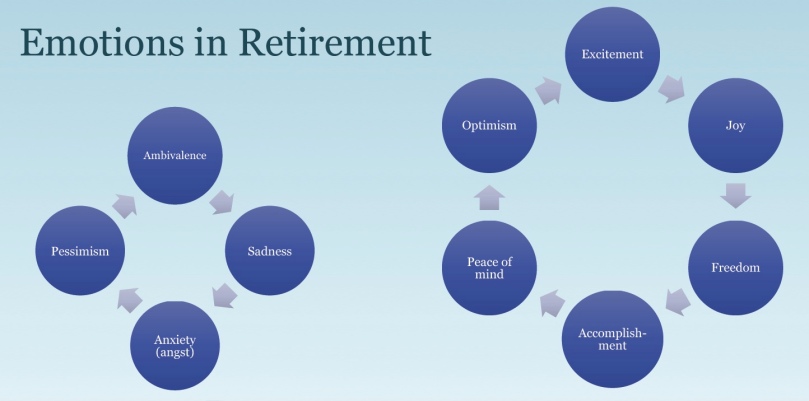
Some of my colleagues have told me, when they were ready, they just wanted to fade away from the landscape, and quietly go without fanfare or festivities. Call it modesty, discretion, shyness, timidity, or social awkwardness? The sad truth, a few were leaving before they were really ready. They would admit they had more to give and still enjoyed teaching children and making music. However, they felt they had to retire early because of a perception that there was declining support for the music program, fear of staff/class reductions or student enrollment decreases, negative updates on the status of the labor negotiations, predictable loss of benefits as defined by a new contract, possible emotional burn-out or fatigue, or simply a sense of being devalued or ignored as a professional, “kicked to the curb” or “it’s time to leave before anything gets worse!”
You didn’t appreciate me when I was teaching here, so don’t make a lot of whoop-la as I prepare to retire!

Of course, other reasons to retire are more concrete: health problems (yours or other members of your family), your spouse is retiring or relocating, opportunities to travel, you were offered a new position (higher education or other field), etc.
One big issue is how to you tell your students. My own story was that (although a very good indication of strong community support in my high school spring musical production) I had several school board members serving as theater volunteers. I was required to tell the superintendent of my plans by February, and he then distributed the list of projected staff retirements at a Board meeting the last week of the month. “The word was out” before opening night, and I had to scramble to tell my grades 5-12 string students, even taking into consideration a few of their feelings of guilt or abandonment while alleviating unsubstantiated fears for the future of the orchestra program.
That’s not how our former music teacher Mr./Ms. _____ used to do it!

Someone wise once told me that no matter how you perceive your standing or “popularity” with the kids, 30% of them will be upset at your leaving, 30% of them will be happy or at least interested in someone new taking over your position, and 40% will be ambivalent. For those of us teaching instrumental and choral electives (saddled with the overall responsibility for our own recruitment and retention), it is important that during this transition, you encourage your students to support and assist the new hire, and continue their enrollment in the class and positive behavior, motivation, and participation in the program. I remember a few lectures about the “benefits of change” and “patience” and the role of student leadership in the process.
 The music parents are another matter. I had great support of both the band/string parents and my loyal “theater angels” throughout my career, and I made sure to attend meetings as early as possible to tell them “in person” my future plans so that they did not have to rely on those “rumors on the street!” One advantage I had was I lived in the district. I promised to roll-up my sleeves and support a fund-raiser or two, and was able to attend numerous concerts and musicals to support my “extended family” as a nonjudgmental retiree.
If some of your parents are more of a pressure group or negative influence, you may wish to discuss their role in your impending departure and warn an administrator. Avoid being a part of any gossip or political controversy… it’s no longer your “sandbox.”
Of course, you should NOT be involved at all in the search, interviewing, or even training of your replacement. Sure, it is a good idea to meet with the new teacher once or twice to “hand over the reins” and perhaps tell him/her where the closets are if not the skeletons. Willingly give out your phone number if the newcomer wants help, but then STAY AWAY. No one can BE YOU, and trying to “clone” your essence in a potential “protege” or well-tutored graduate from your program is an invitation to disaster. The new staff member must find his/her own way, making more than a few mistakes along the way (like you did a long time ago?), but not experience any interference from the “old veteran!” You have to trust that your superintendent, HR/personnel director, and other school leaders found the most qualified and talented candidate available and will support him/her during that “sometimes bumpy” orientation/transitional period
What is your legacy?

Now would be a good time for you to review “for posterity” your professional record quietly behind-the-scenes or even share this with your closest colleagues or supervisors. Sort of like writing your own obituary (a little morbid?), reflect on and frame your career in music education. For what do you want to be remembered? What was most important to you? (It was disappointing to me that one of my principals showed he didn’t know me very well at our last faculty meeting and my final “sendoff.” In his speech, he focused on my tendency for long and sometimes passionate emails as the single greatest contribution to 33+ years in his building.)
 In Pennsylvania, we are fortunate to have the PMEA Retiree Resource Registry (R3), which besides providing a pool of well-qualified consultants and unofficial mentors for PMEA members, pre-service teachers, and “rookies” who want advice, it allows our retired members to archive their achievements, awards, and teaching assignments online. I believe it’s just good mental health for recent retirees to look backwards and revel in a little personal gratification, esteem, and peace-of-mind for their contributions to the profession. Yes, you deserve to be proud.
You truly “made a difference.”
PKF
© 2018 Paul K. Fox

Photo credits (in order) from Pixabay.com: “shaking-hands” by geralt, “best wishes” by artsy-bee, “man” by geralt, “guitar-player” by couleur, “woman” by cnort, “gratitude” by johnhain, “piano” by stevepb, and “couple” by memorycatcher.







 This will sound like an advertisement (it is)… for retaining one’s professionalism, keeping involved albeit less active in the profession, supporting the future of music education, and on occasion lending a hand to PMEA throughout retirement! In return, the association will provide you opportunities to record and post your career accomplishments and position assignments (past and in the future), network with your friends and colleagues retired or still “in the trenches,” and nurture your personal quest for creative self-expression and artistry… everything from guest conducting or adjudicating ensembles to writing for PMEA publications or presenting sessions at the conferences. It is all about YOU!
 Research indicates that people either LOVE retirement or HATE it, and their journey to the blessed “golden years” can have many ups and downs, especially for type-A, peak-performing individuals who (used to) spend large amounts of time and personally identified with “the job…” like many music educators. Since retiring myself from the Upper St. Clair School District in June 2013, my goal has been to help others enjoy this life-changing passage, cope with life-style changes/altered expectations, and find creative new ways to self-reinvent and thrive. Objectives for retired members in 2016-18 are:
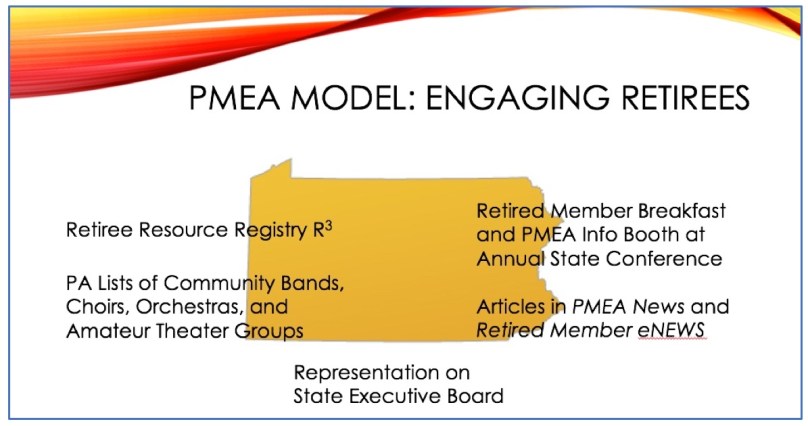
 Are you still willing to “lend a hand” on PMEA projects or share your expertise and provide a free (but priceless) consultant service to new/transferred PMEA members and officers? We constantly update and publish a Retiree Resource Registry
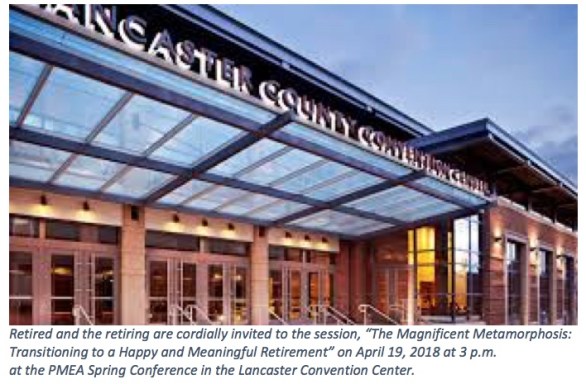
  In addition, retired member registration at the annual PMEA Spring Conference is… (drum-roll, please!) ONLY $10 early-bird! Our next spring conference will be held on April 19-21, 2018 at the Lancaster Marriott & Convention Center. Music teacher retirees get to enjoy some social time to “swap stories” with a FREE breakfast on Friday, April 20. In addition, we are looking for volunteers to help man the PMEA Info Booth… of course, “retired members to the rescue!” Invitations and more details will go out to current members next month, but check out this section on the PMEA website for more information about the conference:
  As a part of reflection and sharing of positive strategies for “Crossing the Rubicon” to a happy, healthy, and meaningful retirement, I have assembled a super-site of every website, article, book, publication, etc. of post-employment “gurus” that I could find. Visit the top menu link


 Denial



 paulfox.blog