
ALL ABOARD THE E-TRAIN… Embarking and Embracing a Journey of Essential Educator Ethics
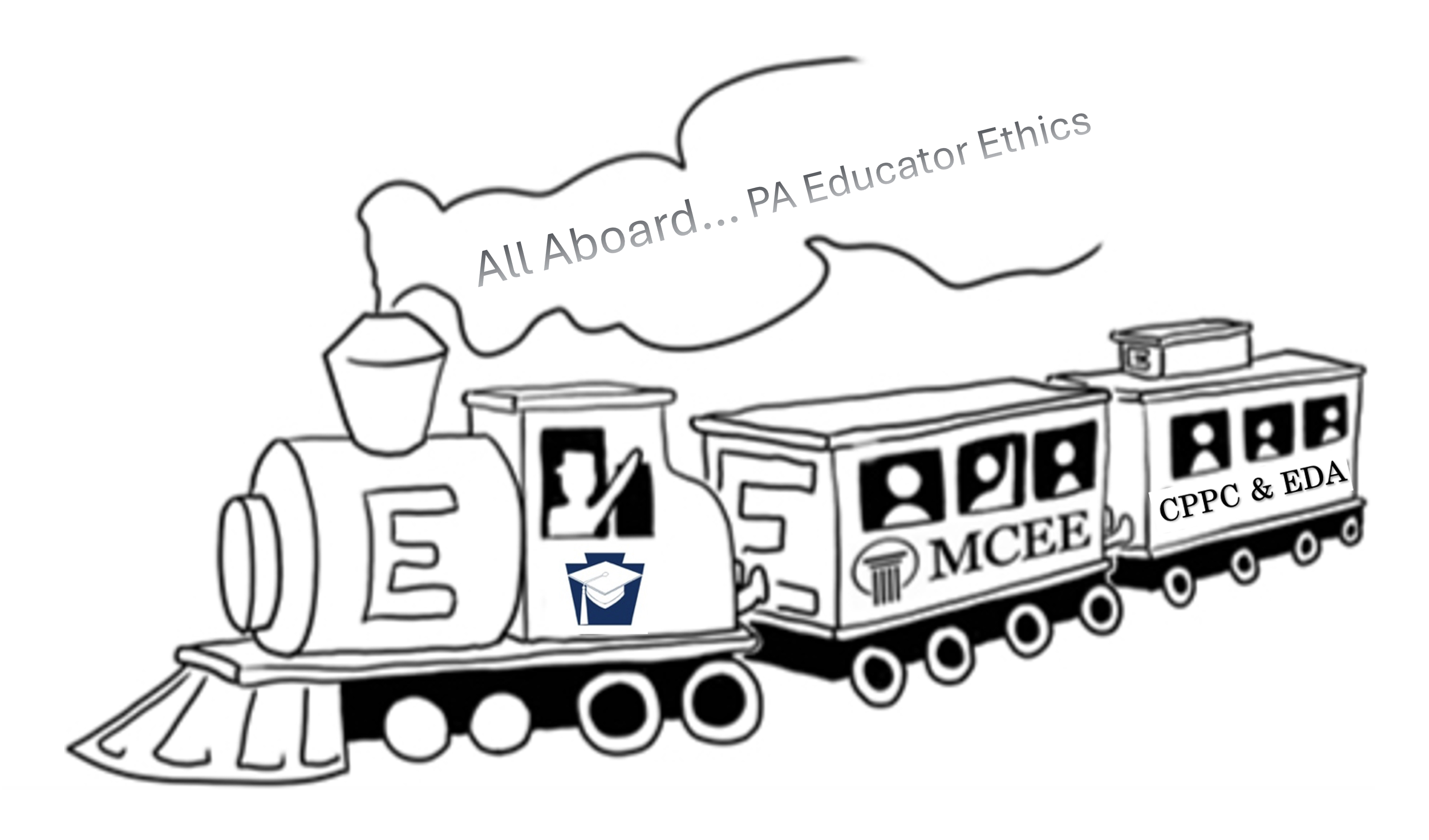
The wheels of the train go round and round…
“All black, well stacked, goin’ down the track clickety clack” = the train looked good on the visual roll-by inspection.
“Highball it out of here” = proceed at maximum permissible speed
“Let’s pull the pin and roll” = uncouple so we can get out of here
The fall season is bringing upon us a series of ethical workshops, classes, and the creation of other resources, and the perfect time to warehouse everything at the main rail terminal! Take an excursion below to learn more about “staying on track” with research on the responsibilities and “regs” for serving as an educator.

First, let’s take a pretest of your knowledge and experience on the subject of school ethics. Which of the following statements has the least validity?
- Moral professionalism involves being well informed about students, education, and content, confronting parents of underachieving students, cooperating with colleagues to observe school policies, and criticizing unsatisfactory policies and proposing constructive improvement.
- Teachers, attorneys, doctors, nurses, counselors, therapists, and the clergy have “fiduciary” duties: own the highest legal duties of good faith and trust and are bound ethically to act in another party’s best interest.
- Although not always defined in exact terms of school law or policies, professional ethics are “standards that assist practitioners within situation and systemic contexts in choosing the best course-of-action.”
- A code of ethics outlines a set of principles that affect decision making, while a code of conduct delineates specific behaviors that are required or prohibited and governs actions.
- The primary goal of professional ethics training is to emphasize the “minimum standards of acceptable behavior” and focus on specific illegal and unethical actions that may result in disciplinary actions.
After a thorough exploration of the materials below, you should feel confident in responding to this question. (If you need help, scroll down to answer at the end of this blog-post.)
Classes and Conferences on Ethics, Oh My!
I am looking forward to sharing insights on ethical issues and especially the seeming “conundrums” or conflicts in the myriad of snap judgments of daily decision-making, both in and outside of our classrooms. Upcoming opportunities are on the ethics e-train schedule.
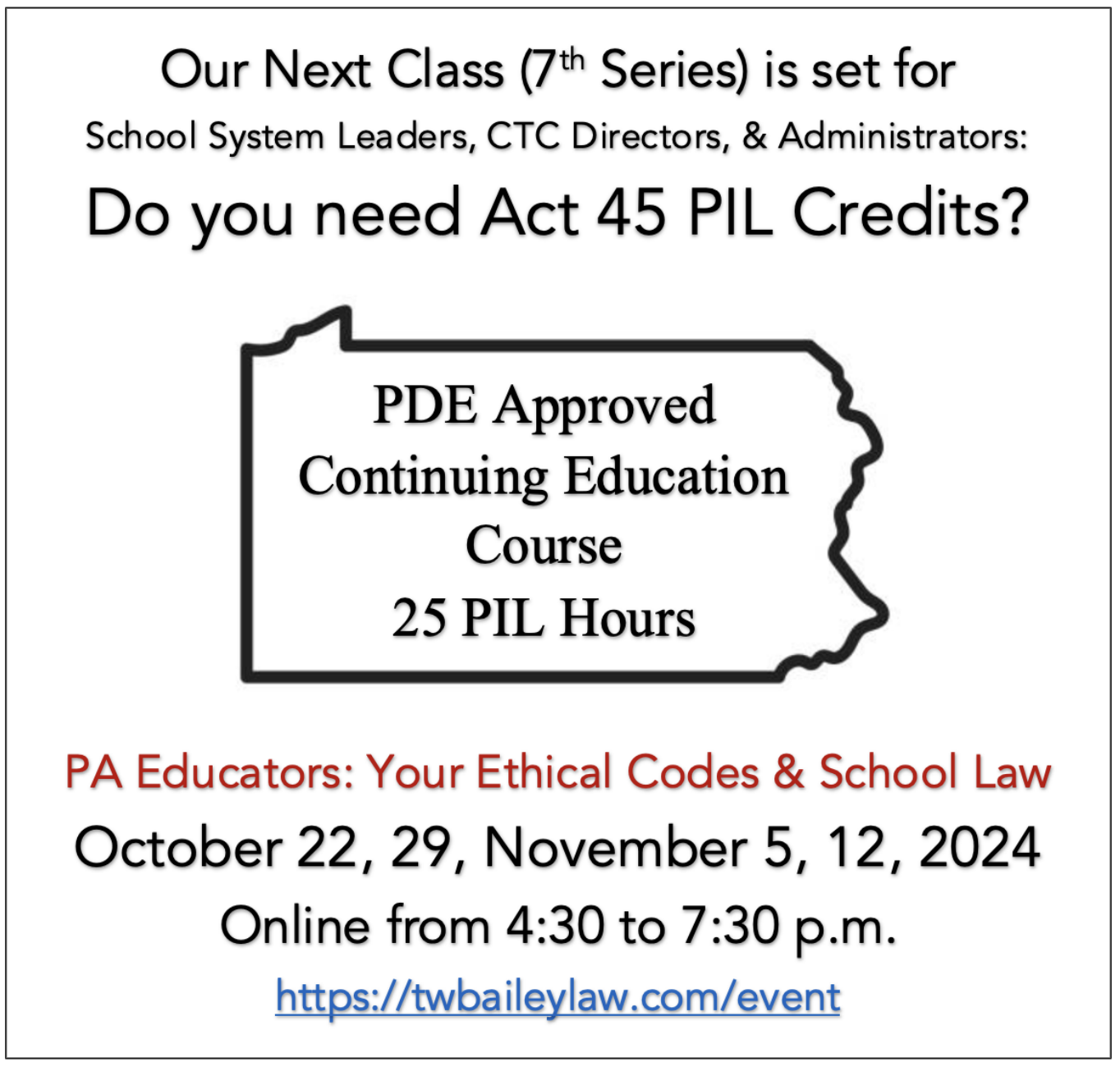
Currently, we are completing the sixth series of our 25-hour PDE-approved Act 45/PIL online course for school/system leaders, career and technical center directors, and other administrators. Sponsored by my colleague Thomas W. Bailey (check out his website here), the next class “PA Educators: Your Ethical Codes & School Law” begins on October 22 for four consecutive Tuesdays from 4:30 to 7:30 p.m.
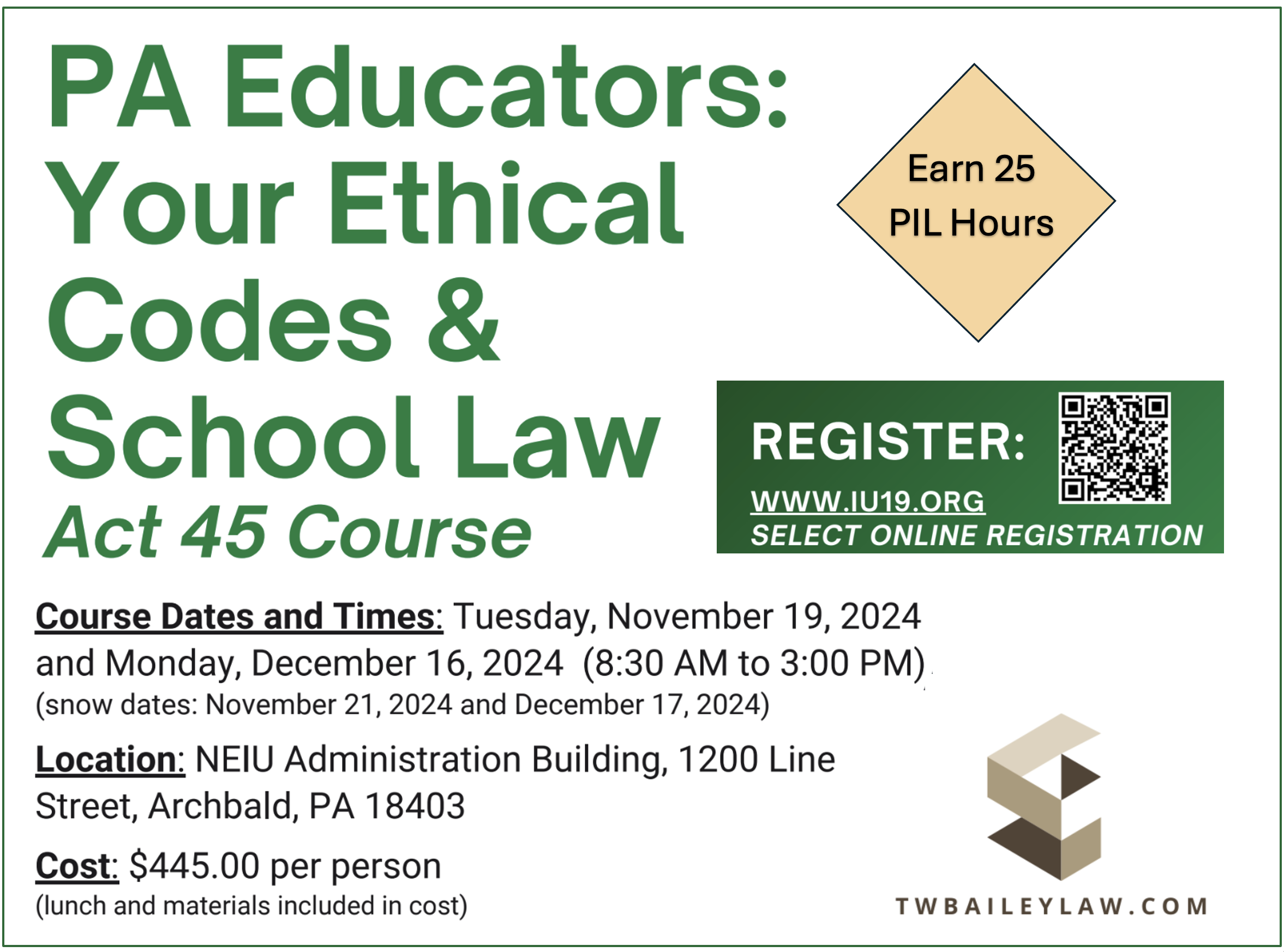
Thomas Bailey and I were also invited to present this Act 45/PIL course for the Northeastern Intermediate Unit #19 as a two-day workshop on November 19 and December 16, 2024. Visit http://www.iu19.org or click here to register.
I am venturing out of the Western PA to Eagleville, PA (near Valley Forge) to provide a 70-minute in-service, a school ethics “refresh” for the faculty at Methacton School District on October 14, 2024. Click here to download a copy of the slide summary with all links active.
Finally, I am happy to report that I was invited back to the PDE SAS Institute to do two sessions: “Planning School Ethics Training, Part I – Definitions, Codes, and the Commission” and Planning School Ethics Training, Part II – Model Code of Ethics for Educators. My proposal to present the session “CATCH THE E-TRAIN – Codes, Case Studies, and the Challenges of Ethical Decision-Making” was not approved for the 2025 PMEA Annual Conference in Kalahari Resort (Poconos). However, a facsimile of similar slides from past NAfME/PMEA workshops and webinars on educator ethics is available here.
Supplemental Resources for the Study of Codes, Case Studies, and the Challenges of Daily Decision-Making in Education
And now, the grand daddy of school ethics destinations…
Past paulfox.blog posts on educator ethics
- Ethical Conundrums Revisited — Part I (August 20, 2018)
- Ethical Conundrums Revisited — Part II (October 14, 2018)
- Ethical Scenarios (July 16, 2019)
- Ethics for Music Educators — Part I (August 28, 2017)
- Ethics for Music Educators — Part II (August 30, 2017)
- Ethics for Music Educators — Part III (September 1, 2017)
- Ethics Follow-up (October 19, 2017)
- Launching PA Educators Ethics Training (November 26, 2023)
- Model Code of Ethics for Educators (February 11, 2021)
- PA Educator Ethics Update (October 6, 2021)
- Rising Educators Conference (June 12, 2024)
- Studies in Educator Ethics Case Law (June 26, 2021)
Especially for Pennsylvania educators, pre-service students, and newcomers to the Commonwealth (citing the PA Professional Practices and Standards Commission website)
- Code of Professional Practice and Conduct (printable/one-page/two-sided)
- Commission Publications
- Discipline System Overview
- Educator Ethics and Conduct Tool Kit
- Model Code of Ethics for Educators (full color brochure)
- Model Code of Ethics for Educators (NASDTEC website)
- Model Code of Ethics for Educators (preview of free video series)
- Promoting Ethical Practices
- Statutes, Regulations, Policies, and Forms
From other state governments (all rights reserved)
- Connecticut State Department of Education TEAM Overview Module 5
- Connecticut State Department of Education TEAM Introduction to Module 5 SLIDES (2021)
- Connecticut State Department of Education TEAM Facilitators Guide Module 5 (2024)
- Connecticut State Department of Education TEAM Participants Workbook Module 5 (2024)
- Iowa Board of Educators Examiners Ethics Facilitators Guide (2017)
- Iowa Board of Educational Examiners Educator Ethics SLIDES (2017)
- Texas Education Agency Lesson Plan Ethical Standards for Educators (2017)
- Texas Education Agency Teacher Ethics Training Module – Boundaries (sample video)
An additional sampling of articles
- EDUCATION WEEK: Schools Are Full of Ethical Dilemmas – Can Ethicists Help? by Benjamin Herald
- EDUTOPIA: Various articles on “educator ethics”
- Ethics in Education – The Importance of Good Leadership by John Pijanowski
- PASCD: Got Ethics? An Introduction to a Teacher’s Moral Decision-Making Compass by Paul Fox
- Professional Ethics Education for Future Teachers – A Narrative Review of the Scholarly Writings by Bruce Maxwell and Marina Schwimmer
- Protecting the Profession – Professional Ethics in the Classroom by Troy Hutchings
- Teachers’ Critical Incidents – Ethical Dilemmas in Teaching Practice by Orly Shapira-Lishchinsky
- Using Ethical Dilemmas in the Classroom by David B. Wangaard
WHY STUDY ETHICS? Answer to the PRETEST above.
A code of ethics sets a higher threshold than regulatory codes of conduct or even a nonprofit organization’s bylaws and compliance rules enforced by the government. A code of conduct, such as the Pennsylvania “Code of Professional Practices and Conduct” of the PSPC, provides absolutes for employment, licensure, and/or civil/criminal sanctions. In contrast, the Model Code of Ethics for Educators document serves more as a general compass to help steer professionals towards sound judgment in their daily decision-making. What is unique about a true code of ethics vs. a code of conduct is that the principles are not defined in exact terms of law or policies, nor do they necessarily model family morals or values on which we as individual educators have been raised. The proposed standards are not about definite issues of right/wrong or black/white, but shades of grey. They are more open-ended, offering opportunities to discuss recommendations for consideration from a set of possible choices based on the circumstances of each ethical dilemma or resolution.
– excerpt from “The Ethical Music Educator,” Winter 2020 issue of PMEA News

Teachers are ethical professionals. Our moral aspirations, the “codes” and “standards” we subscribe to, and our professionalism are important to us, our students, our programs, and our communities. Essentially, these are the beliefs for which we stand, the values and behavior we model in our day-to-day decision-making to “make a difference” in the lives of our students, and the overall integrity of the profession. Therefore, the answer to the PRETEST above is #5. (#1-4 are TRUE!) But, as stated in #5, the goal of meaningful ethics training is NOT to emphasize the minimum standards of acceptable behavior or to focus on specific illegal and unethical actions that may result in disciplinary actions.
Do you have anything to add to this collection? ALL ABOARD! The conductor would appreciate feedback! Please feel free to make a comment to this blog (see link next to the title).
PKF
© 2024 Paul K. Fox





 The number one “tool” for finding a job is not a tool at all – it is all about modeling professionalism, networking with other college students and music teachers, and becoming actively engaged in your state/national music education associations (click on the acronyms to go to their websites) – National Association for Music Education
  Your “travel document” (paper copy you bring to the interview or “one-of-kind” attachment in response to email application) should be easy-to-modify based on the specific job posting to which you are applying. Your philosophy, goals, education, and teaching experience should focus on and reflect your competencies in alignment with the requirements for the music position. Your professional website and online resume should be more “general” and not rule out being considered for employment assignments outside your major. The PA teaching certificate states you are licensed to teach music in grades pre-K to 12… which means you should be qualified for any opening in elementary, middle, and high school general music, band, choir, jazz, keyboard lab, and strings, right?
 band for a year, conducting a small instrumental ensemble to accompany your youth church choir, giving a few summer lessons to the bell players in the local drum line where you live, etc. In addition, prior to the first employment screening and mock lesson at the interviews, you could “bone up” on your instrumental methods, suitable middle and elementary band warmups/literature, the meaning/concept of “middle school education,” and perhaps even pull out and brush up playing a few scales on that flute (or whatever) in your closet.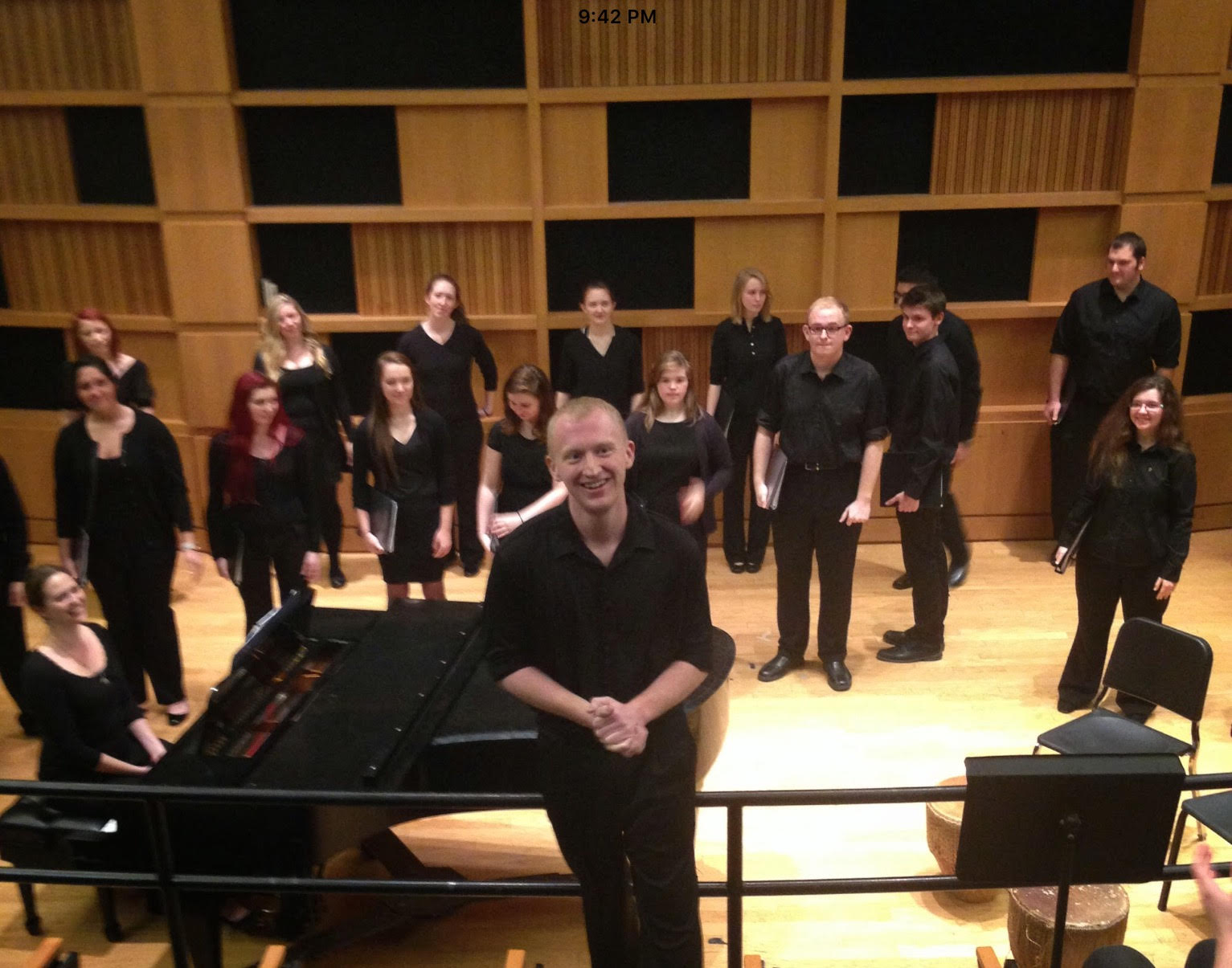
 Another great reason you should be a member of your professional association (PMEA or PCMEA) if you are looking for a job in PA is… the PMEA Job Board. Many PMEA members have relied on the Job Board for the most recent information when it comes to available PA music teacher positions.

 Do you have a business card, e-portfolio, resume, and professional website?
 Merriam-Webster defines “networking” (noun) as “the exchange of information or services among individuals, groups, or institutions; the cultivation of productive relationships for employment or business.”
 During the 17th century, especially during the reign of Louis the 14th, the “calling card” made its heyday in Europe. “…An individual’s success or failure in society often depended on the strength of their personal promotion.”
 informing customers of its location and services available.
 It gives others a taste of your work, style and personality.
 display… traits of artistry, collaboration, commitment, discipline, even temperament, goal-minded, initiative, leadership, mastery of music and music education, organization, positive outlook, style, tact, and/or teamwork… or just the opposite?
 a new full-time job!
 first ten seconds, and after four minutes, it’s all over. For employment consideration, others have written that you are evaluated by 7% what you say, 38% by your vocal tone, and 55% by your facial expressions.
 After the opportunity presents itself to exchange business cards, you need to save and organize his/her data in a way to be able to place/find the acquaintance for future reference. Why was this professional important to you to remember his or her name? How, when, and where did you meet? Reference the subjects you may have discussed, school affiliation, title, and locality of the contact, so at some point, you can lay your fingers on the name in your file; just search on the “key” word or phrase like “choral director” or “XYZ School District.”
 Plan your first impression


 Depending on the structure of the interview, the hiring procedures of the institution, and the type of session (whether it is a general screening prior to any job opening, or the first round, second round, demonstration lesson, final round with the superintendent, etc. in order to fill a specific position), you will be exposed to many different kinds of questions.
 As I go out to help at job fairs and mock interviews for music education majors, I advise the soon-to-be candidates to practice their storytelling skills and recall relevant personal anecdotes in order to satisfy the interviewers’ questioning, promote an image of competency and self-confidence, “show that you have what it takes” and would be a “good fit” for their school district, and ultimately “ace” the examination.
 you are, adoption of “customer-first” philosophy and habits, a savvy business sense, focused motivation, and a strong work ethic. Narrate an anecdote rather than list facts. Plan (and dress rehearse) something like this script: “My route was small, so I surveyed my existing customers, asked about their needs, desires, and their definition of a ‘perfect paper delivery,’ and how I could help them. I tagged and followed-up on their unique requests, like ‘hiding the pile of papers that end up accumulating during vacation periods’ (advertising to the world that homeowner is out-of-town), and ‘when NOT to place the paper in the screen door early in the morning so as to avoid waking up the dogs and the whole household.’ I also solicited business from non-subscribers, asking them how I could be of assistance. Pretty soon, word got around, and my enhanced customer-care translated into almost doubling the number of the people on my route.”
 settings) and form your responses. View and assess your performances. What are your strengths and weaknesses, and what improvements could be recommended? Besides the content and clarity of your answers, monitor and evaluate your body language, eye contact, and posture, vocal tone and projection, and those intangibles like “charm,” “attitude,” and “first impressions.” If you do this in a group (roommates, collegiate music education chapter, methods class, etc.), request feedback from your “critics.”
 “stress interviews” are still conducted by some institutions. You’ll know immediately if for some reason you are thrown into one of these seemingly “hostile environments.” No matter what you say or how you respond to a question, the interviewer(s) will exhibit a negative attitude, look disinterested, inattentive, unimpressed, or disappointed, or even act angry, belligerent, or argumentative. Talk about “playing to a dead crowd!” Actually, their sole purpose is to evaluate your behavior during artificially-induced tension or conflict. Your only strategy? Play the game! Stay calm, cool, and collected.
 like, “I haven’t had the pleasure of teaching long enough to totally comprehend what I would do in that situation.” Or perhaps, “I am not to familiar with that term/method/philosophy, but I am willing to research it, ask my building principal or supervisor for his/her advice,” etc.
 What is your view of the teacher’s role in the classroom? (Educational Philosophy)
 What role does the Common Core have in general music (or music ensembles)? (Written Expression)
 How would you structure a general music (or ensemble rehearsal) classroom of the future? (Innovation)
 How would you improve the intonation/tone quality/bow technique of a string players? [STRINGS]

 I will probably never tire writing articles for new or prospective music educators seeking a public school position. I am subject to a flash of inspiration – epiphanies or revelations – at any moment, many of which come while I am walking the dogs or driving the car. Here are some random loose-ends I have not covered before, the results of recent bouts of brainstorming and mind wandering! Hopefully, they will provide you additional insight towards success in the job hunt process. Good luck!
 their school administration in the months of February, March or April to receive some of their “golden handshake” benefits. For the school district, it helps them plan for future hiring. For you, it should focus your attention and organize your work at a time when the jobs are just becoming available. (Don’t wait for summer vacation!)
 PA-educator.com which broadcast data on the pool of candidates. Regardless, I sent a custom-designed letter to every superintendent of school “in my hot zone” announcing that I was interested, met all education and certification requirements, and was available for immediate employment consideration. You should prominently share the name/location of your professional website. In addition, this would be the perfect place to mention if you student-taught or served as a private teacher, coach, summer camp counselor, or marching band/musical assistant in their area. For me, this meant a lot of extra work (looking-up the names/addresses, and you can’t just send a blanket form-letter “To Whom It May Concern”), but it seemed to give me a little edge, a foot in the door so-to-speak, and the opportunity to place follow-up calls later to the HR department to confirm they received the letter and did not need anything to add to the file (transcripts/portfolio, etc.). If you’re not restricted to a specific geographic area, saturation this way would probably not be feasible.
 domain name (something simple like yourname.edu or .com). Graduating this year from West Virginia University, my former student David Dockan
  anything trendy, mod, or “cool,” and guys, this means you wear a tie and a jacket. Unkempt or unusual length/coloring of hair, extra body piercings, and visible tattoos will not help project the classic corporate image of “conservatism” which most administrators seek in teachers. Sure, you do have the right to be “unconventional,” “artsy,” “one-of-kind” or “make a statement,” but you also have the right never to get a public school job!
 n your portfolio. This would look particularly good fulfilling Charlotte Danielson’s Domain 4c “Communicating with Families” in
  employment search process and preparation for interviews. For examples, you already have many lists of employment screening questions:


 Start thinking of yourself as a brand




















 paulfox.blog