

The Three T’s to Build Technique, Key Literacy, and Endurance

Just like an athlete’s regular workout to achieve specific goals for improvement in form, strength, and stamina, musicians need to adopt consistent practice habits, and apply a daily routine of the Three T’s:
- Tuning and slow/long-tone warmup
- Three Scales a Day
- Technical Etude or Study
Even if time is very limited, the music directors of the South Hills Junior Orchestra recommend that, at a minimum, every musician spends at least ten minutes a day on a regime of playing scales and at least one technical exercise or etude (usually prescribed by a private teacher) to “maintain their chops,” increase flexibility and resilence, and further their technical proficiency.
The TECH TIP #1 outline below provides a suggested framework to follow (especially suitable for violin, viola, cello, and string players, but adaptable to any instrument).
This involves the following approach:
- Consistent drill (ten minutes a day, seven days a week)
- Focused drill (no distractions or interruptions, or it doesn’t count)
- Repetitive drill (many revolutions and repeats)
- Creative drill (innovative and inventive: new keys, articulations, rhythms, etc.)
How to Practice: “Variety is the Spice of Life!”
Key to this formula is venturing out of your “comfort zone” and exploring the entire “Circle of Fifths” – different key signatures (don’t just play in the same key every day), 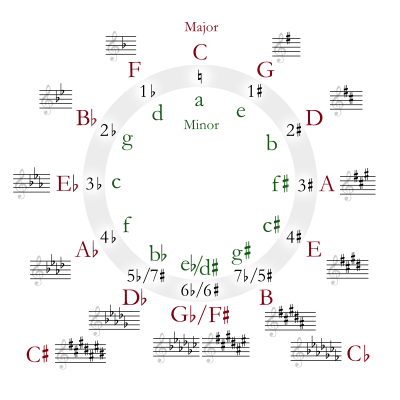 Major and minor scales, and numerous varied patterns:
- Repeated notes
- Unique rhythms
- Slow to fast tempos
- Slurs
- Bowings (strings)
- Intervals (e.g. scales in thirds, etc.)
- Arpeggios
- Dynamics and other expressive markings
Other practice strategies have been previously shared here (click on the “fireside” menu above or go to https://paulkfoxusc.wordpress.com/foxs-firesides/), and offer a host of problem solving techniques suitable for instrumentalists of any age and abilty level.
In addition, here are a few more tips for effective practice:
- Play your instrument every day, at least 5-7 times per week. Practicing in short amounts daily is more preferable than “cramming.” Developing technique is much like an exercise workout. Teach your muscles by doing a little bit daily.
- Set regular time(s) to practice. Consistency is the key to success.
- Find a comfortable, well-lit, quiet place to practice. No television or telephone interruptions!
- Practice standing up, not sitting (except cello players). Remember to keep muscles relaxed and loose. Relaxation and breathing exercises prior to the start of a practice session can be especially helpful.
- Use a mirror to visually check your form and technique. Use a recorder to aurally check your playing.
- When trying to improve intonation, play SLOWLY. Try to memorize your music or passage, close your eyes or play in the dark. By restricting visual input, you may help enhance your aural ability, becoming more sensitive and “attuned” to tuning.
- Experts say “start slow and small.” After sight-reading (without stopping) your new selection, break it down into “practice goals” and “problem solve.” At each session, focus on a small section or difficult passage(s). Gradually increase your tempos or add more difficult fingerings/positions/bowings. As you learn each section, overlap your practice goals into repetitive longer “run-throughs” of the music.
- Test yourself performing “ten-times-in-a-row” with 100% accurate notes, rhythms and articulations.
- LISTEN! If you are having trouble with an orchestra piece, or a new solo work, buy a recording, research it on YouTube, or try to get one from the library. Even better, get multiple recordings of it so you can hear different interpretations. Then, listen to it a lot. Listen to it in the car, on your headphones while taking a walk, as background music while talking to a friend, during dinner, etc.
 Don’t forget that the ultimate goal is not to produce the notes you see on the page as you would type in words on a keyboard—the goal is to produce beautiful music. Listen to yourself and “make music” as you practice.
SHJO’s mission is all about supporting school music programs. (For more information, about the Southwestern PA community ensemble, please visit www.shjo.org.) Consult your band or orchestra teacher, as well as a private teacher (if you have one) for more detailed instruction on warmups, tuning, scale reading, and etude assignments.
Sample Scales
If you do not own a scale book, here are a few guides for string players:
Best wishes on setting up a daily ten minute PRACTICE PLAN!
PKF

Three T’s to Build Technique, Key Literacy, and Endurance
- Tuning
- Three Scales a Day (two Major and one minor)
- Technical Etude or Study
What is needed?
- SmartMusic, eTuner, or other standalone digital tuner
- Lists of scales in different keys
- Supplemental materials (such as Essentials for Strings or Essential Elements 2000 for Strings Book 2 p. 44-45)
- Violin or Viola Etudes: VIOLIN/VIOLA: Wohlfahrt Foundation Studies Book 1 or Wohlfahrt Foundation Studies Book 2*
- Cello Etudes: Sebastian Lee or Alwin Schroeder*
- String Bass Etudes: Simandl*
Other instruments: any etude appropriate to your instrument *(ask your private teacher)
Recommendations
- Per daily warm-up, perform two Major scales and one minor scale.
- Play one scale slow with focus on natural tone production/vibrato and precise intonation.
- lay one scale fast with emphasis on articulation or bowing style.
- Play one scale using unique rhythmic, slurring, melodic patterns, shifting or in positions.
- Play at least one of the above scales in a flat key (Major or minor).
- epending on level of achievement, two octaves is the norm; one octave for novices or playing new keys starting on D (violin), G (viola/cello), A (bass) strings, C (all other instruments); three octaves for advanced string students.
- Check off the different keys you play on the Circle of Fifths. (The goal is that all string musicians should be able to play scales in keys of 1-5 sharps and 1 to 4 flats.)
- Vary your workout to include a range of expressive elements including articulations (staccato, marcato, legato, spiccato, hooked bows, pizzicato) and dynamics (forte to piano).
Definitions
- Major Scale: Do-1 Re-2 Mi-3 Fa-4 Sol-5 La-6 Ti-7 Do-8 half steps between 3-4 and 7-8
- Natural Minor: Do-1 Re-2 Me-3 Fa-4 Sol-5 Le-6 Te-7 Do-8 half steps 2-3 and 5-6
- Harmonic Minor: Do-1 Re-2 Me-3 Fa-4 Sol-5 Le-6 Ti-7 Do-8 half steps 2-3, 5-6, and 7-8
- Melodic Minor UP: Do-1 Re-2 Me-3 Fa-4 Sol-5 La-6 Ti-7 Do-8 half steps 2-3 and 7-8
- Melodic Minor DOWN (same as Natural Minor)
- Speedy Rhythm Drill (looks like an upside-down pyramid): four sixteenth notes per scale note (up and down), three sixteenths, two sixteenths, and one sixteenth
- Speedy Slur Drill (looks like a normal pyramid): one quarter note (once up and down), two eighth notes slurred played twice, three notes (triplet) slurred played three times, and four sixteenth notes slurred played four times.
- Slow-Fast drills: four eighth notes followed by four sixteenths (or vice versa)
- The 2 + 1 Pattern (or 1 + 2): Triplets Do-Do-Re (or Do-Re-Re), Mi-Mi-Fa, Sol-Sol-La, etc. playing the entire scale using a steady beat in a moderate to fast tempo.
- The 3 + 1 Pattern (or 1 + 3): Sixteenths Do-Do-Do-Re (or Do-Re-Re-Re), Mi-Mi-Mi-Fa, etc. playing the entire scale using a steady beat in a moderate to fast tempo.
For a printable copy of this TECH TIP #1, click below:
Music Tech Tips TEN MINUTES A DAY
© 2018 Paul K. Fox
Photo credit from Pixabay.com: “Fire” by Alexas_Fotos

 now would be the perfect time to explore supplemental resources and get a “head-start” on additional pre-service training for next fall. These tips are especially valuable to anyone entering his/her senior or final year as a music education major, finely honing in and marketing your skills as a professional in order to be prepared for finding and succeeding at your first job.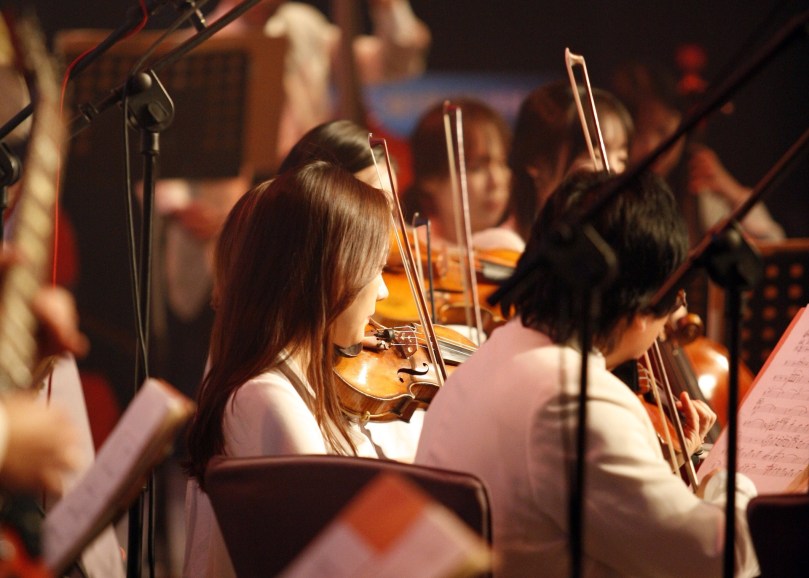

 Mix and mingle to improve your networking opportunities

 Understanding specific educational jargon and the latest approaches, applications, and technologies in the profession (e.g. Backwards Design, The Common Core, Whole Child Initiatives, Multiple Intelligences, Depth of Knowledge and Higher Order of Thinking Skills, Formative, Summative, Diagnostic, and Authentic Assessment, etc. – Do you know the meaning of these terms?)
 You need to ask yourself the question, “What are my greatest weaknesses in music education?” Or, to put it another way, “What school assignments would I feel the least confident to teach? After earning your state’s all-essential credential, your certificate will likely be general and only say “music Pre-K to Grade 12.” Administrators will expect you can “do it all” – introducing jazz improvisation at the middle school, accompany on the piano or guitar all of the songs in the grades 1-6 music textbook series, directing the marching band at the high school or the musical at the middle school, starting an elementary string program, etc.
 Since music teachers are all “fiduciaries” (do you know the meaning of the word?) and legally responsible for our “charges,” wouldn’t it be a good idea to review our state’s regulations and code of conduct, and hear about the challenges and pitfalls of ethical decision-making before we jump in and get “over our heads,” so-to-speak?
 ask your cooperating teacher (or his/her supervisor’s) permission. Some school districts have “do not photo” rosters. (However, in my district, only a few elementary students were “on the list” and most defaulted to a “permissible” status unless the parent opted out. The principal’s secretary had a record of all exceptions.) It is also suggested that you focus your camera mostly on YOU and not the students, from the back of the classroom or rehearsal facility (possibly from afar), so that the student faces are not clearly discernible. To respect their privacy, in the recorded excerpts, do not use any segment announcing the names of your students.

 Create four new scale variations every day and add them to your “journal.” Creative new variations should make playing scales more enjoyable. Some examples are unusual rhythms (pizza toppings, desserts, interesting proper names), more difficult slurs, scales in thirds, etc.
 Visit the local music store and browse. Explore new publications of Classical, pop, folk, fiddle/jazz, show tunes or other styles.
 Purchase a duet book for mix or matched instruments (such as Beautiful Music for 2 Stringed Instruments by Applebaum—Book I (easy), Book II (medium), Book III advanced). Team up with another musician (band or string) and share non-transposing parts (flute or oboe with violin, trombone with cello, etc.).
 Plan a vacation or academic break around an out-of-state music workshop or concert series.
 Read books or magazine articles about famous musicians, performers, conductors or composers.


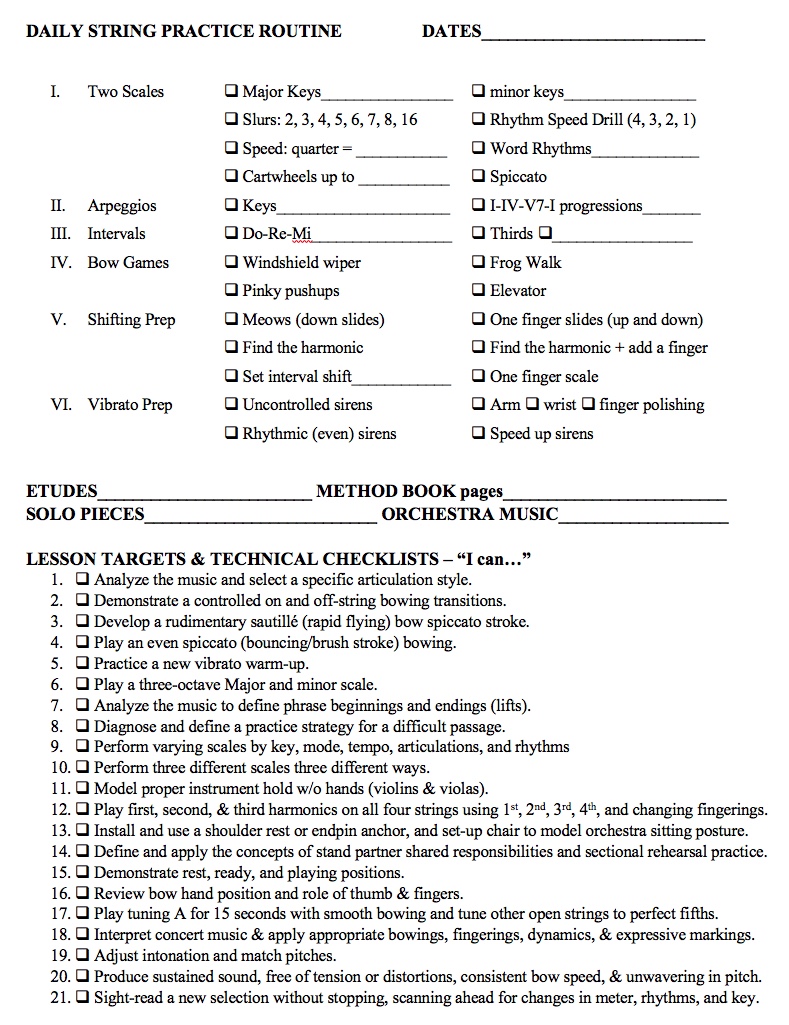
 In your “customized” journal, I recommend leaving space for metronome markings, special articulations, practicing tips and instructions (like “repeat it three-times-in-a-row perfectly” or “work on measures #1-8 today, #5-12 tomorrow,” etc.) and time spent. Remember, you are a problem solver and seek ways to integrate your “tool box of tricks” to learn each challenging passage. What works for you? What doesn’t? That’s the true magic of a journal… in with the good, and out the bad!
 What is the moral to the final story of these two racers… the turtle and the rabbit?
 into the “TEAM.”

 At lessons, some music teachers refer to batting averages, and point out how a .333 baseball hitting average is outstanding in the Major Leagues (when big-league pitchers are throwing 90-mile hour balls at you), but terrible for a musician who plays one note right to two notes wrong. Since each practice session builds neural-connections across brain cells (physical “memory” to do the skill again), in order to “play it right” consistently, we have to repeat it accurately over and over again, thus “the Ten Times Rule.” Musicians have to achieve a .950 or better average, and practicing their challenging musical “slice” ten times in a row will do the most good. Cumulative effort over different sessions or days is also the key to success! If a hard passage is played 10-20 times today, repeated 10-20 times tomorrow, another set of 10-20 drills the next day, etc. until the part can be played perfectly “in a row” every time, the player will have NO WORRIES when it comes time to perform it at the concert.
 However, the disclaimer is that I am not an attorney, human resource manager, nor scholar on school ethics, nor was I ever trained in a single workshop, college class, teacher induction or in-service program on this subject. After reading this article, you should immediately visit the website of your state’s education department, and search on the topic of “code of ethics” or “code of conduct.” A few examples of the “real deal” are listed below, and yes, you must study “every word of” the entire document and applicable rules from the state you are/will be employed.
 According to Snopes
  Achievement of higher education, constant training and retooling, specific goals, and self-improvement
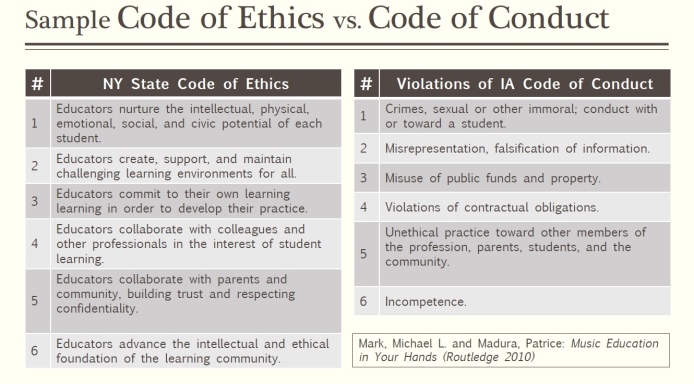
 a “violation of ethics” is usually associated with significant consequences or punishment, like charges of medical malpractice or lawyers facing an “ethics committee” hearing. Confirmed unethical behavior may result in censure, suspension of license or certification, or other discipline action. Most state education governing entities post legally-binding “educator discipline acts” or codes of professional standards, ethics, and/or behavior, with extensive penalties.
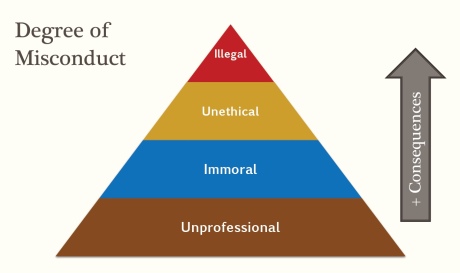 defines misconducts.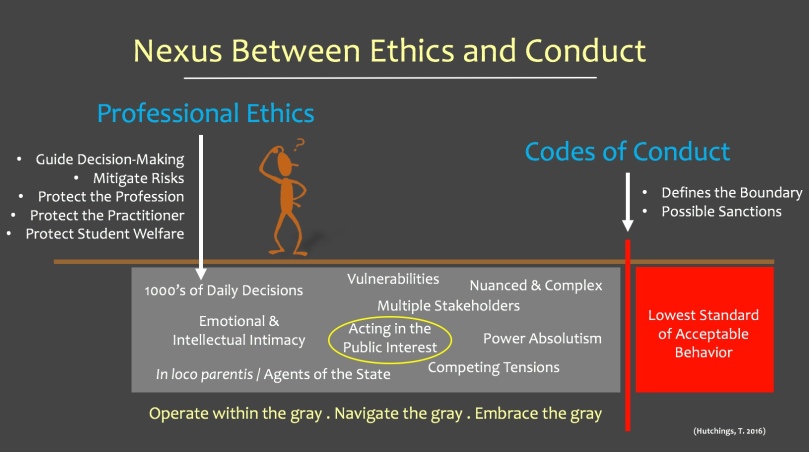
 One of the best examples endorsed by many states, college education methods programs, and other institutions, the National Association of State Directors of Teacher Education and Certification has published its

 prioritize what’s the most important, and define several new “practice plans.”
 Your practice should have well-defined goals. What do you want to learn as a musician? Are there particular pieces of music, styles, or technical skills you would like to be able to play? Knowing what you want to accomplish will help you decide what work is needed and assist defining specific learning targets. If you have a private teacher, he/she will automatically prescribe objectives for you, based on your present strengths and weaknesses. But if you desire to join the local youth symphony, participate in a music festival, play in a pit orchestra, perform solos or chamber music, become a conductor, help coach your peers, or want to improve a specific technical skill or general musicianship, make sure your teachers know it! They may be able to share warm-ups, strategies, or practice materials that will help you improve and expand your knowledge, technique, expressiveness, sight-reading and ear training.
 Yes, practicing should be heard at home. It is NOT enough simply to play at school. The long-tested “success equation” is TIME + MAKING PROGRESS = FUN (encouraging more time, progress and fun). Practicing on a regular basis improves technique, musicianship, self-confidence, endurance, reading skills, and besides… playing better is a lot more FUN!
