February Updates…

PROfessional Development!

Education, ethics, professionalism, and lifelong learning.

Hope you are enjoying the winter season and, for many of you, the anticipation of warmer weather returning soon! Sorry, skiers! I am sick of shoveling snow!!

Here’s a quick “catch-up” on things going on in educator professional development.

For PA School Administrators & Educators
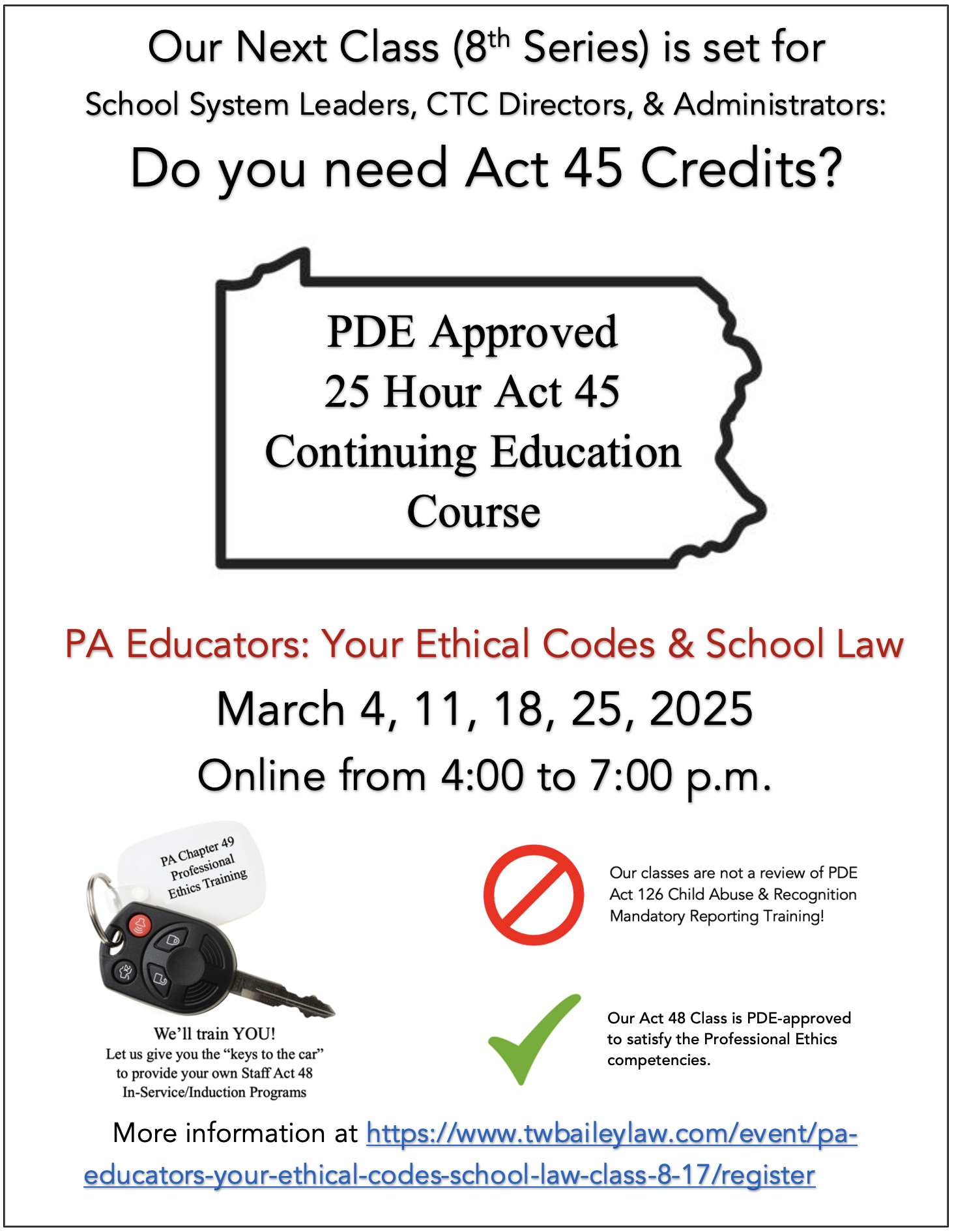
There is still time to register for the upcoming 25-hour, PDE-approved, Act 45 course, “PA Educators: Your Ethical Codes & School Law,” which will cover the recently mandated PA Title 22 Chapter 49 (Certification) Professional Ethics Competencies. The next online series of Act 45 classes will be held Tuesday afternoons in March, and provide “the keys to the car” planning for your own school district’s future continuing education and induction programs in ethics training as required by the PDE.

Now sponsoring our eighth series of classes, I am designated a “qualified instructor” in partnership with the course’s creator/facilitator, retired social studies teacher and attorney Thomas W. Bailey. For more information, please click on these links to his website:

In addition, since over the past year PDE revised their website (and changed most of the content links), I compiled a super-index of “places-to-go” and “things-to-read,” sites of supplemental resources on school ethics here. I recommend visiting this blog if you are interested in our library of links to the Pennsylvania Code of Professional Practice and Conduct, the Model Code of Ethics for Educators, the PA Educators Discipline Act, and research and citations from the PDE, PA Professional Standards and Practices Commission, Connecticut State Department of Education, and Iowa Board of Educational Examiners, among many others.
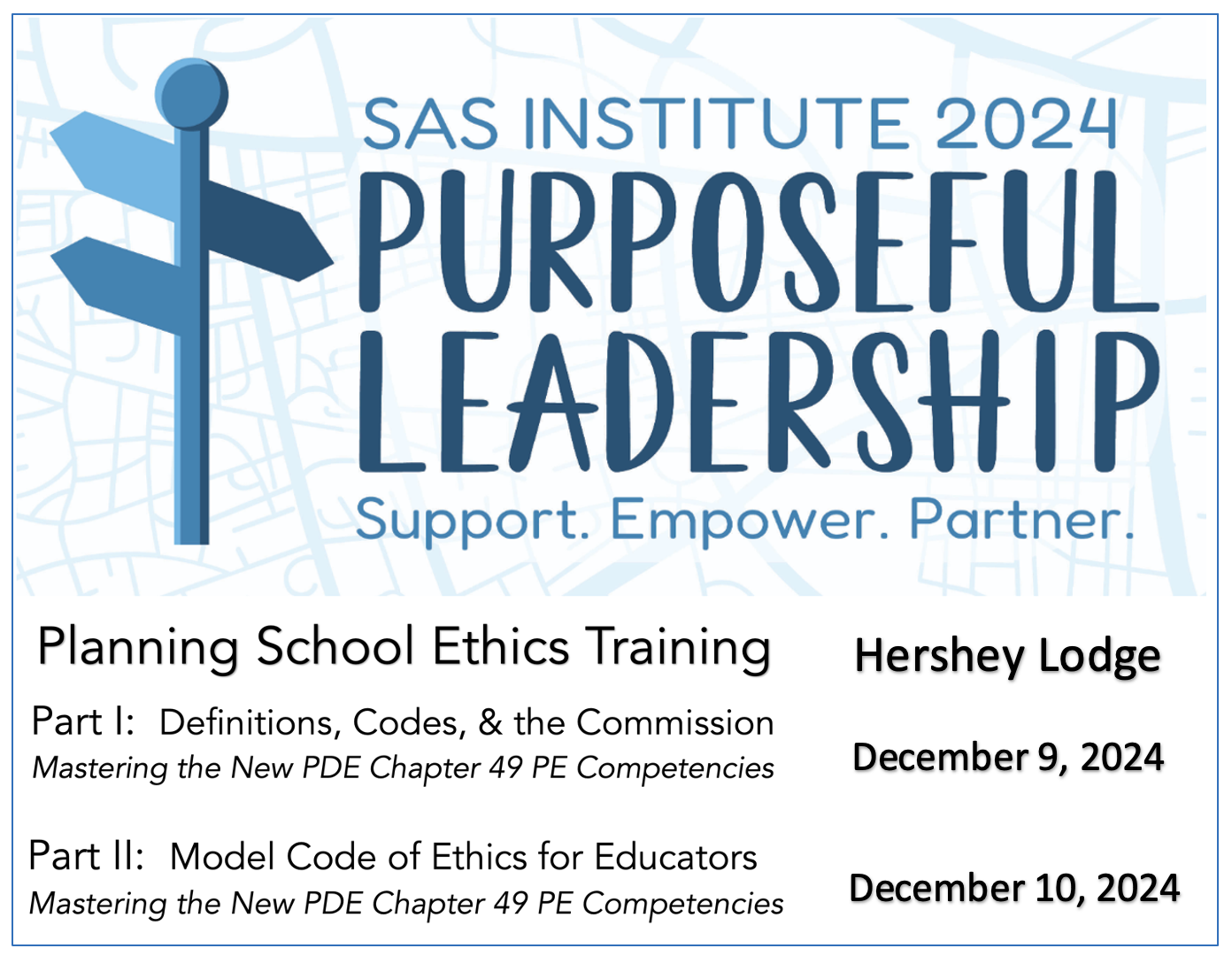
If you would like to see the kind of things we cover in these classes, take a look at the slide summaries I posted from my presentation at the PDE SAS Institute “Purposeful Leadership” state conference last December:

From Pre-Service to Veteran Music Teachers!
It’s that time of the year… again! The PMEA Annual Conference on April 9-12, 2025 will be held in the family-friendly, perfect-for-a-mini-vacation spot in northeastern PA: the Kalahari Resort in the Poconos.

There is still time to register! (Click here.) If you would like to see a summary of the sessions and performances, go to the PMEA website here or download this PDF brochure.

Why attend the conference? In my five-plus decades in education, I may have missed only two or three of the annual PMEA state events, and heartily recommend you remain actively involved in your professional association. This is what I wrote about it in a recent PMEA Retired Member Network eNEWS:

For some of us, it’s a just chance to catch-up with our colleagues, see our friends, and socialize. Others are more focused and take advantage of the near-perfect opportunity to network with other professionals, perhaps seeking new working relationships, partnerships, or even employment. Many are on a look-out for newly published music, that perfect music lesson or teaching strategy, technology tools, fundraisers, advance educational venues, or much-needed equipment to purchase for our ensembles or classrooms. Most come to hear/see the “state of the art” in music education – concerts, demonstrations, keynote speeches, panel discussions, exhibits, research presentations, and workshops. PMEA’s PD Council would likely submit that the primary purpose of a conference is for professional self-improvement… What did Stephen Covey call it? His Habit #7 of “sharpening the saw” – to build a balanced program of self-renewal in the four areas of your life: physical, social/emotional, mental, and spiritual. Covey would insist we embrace “the process that empowers us to move on an upward spiral of growth and change, of continuous improvement.” So, in short, conferences help us “grow” – to revive, re-inspire, re-energize, rejuvenate, re-direct, and re-motivate all of us – pre-service, active in-service, and retired teachers towards making successful new connections, updating our knowledge and skills, and forming new goals. This is how we “keep up” with all the new standards, benchmarks, and cutting-edge advances, and meet the “movers-and-shakers,” visionaries, and leaders in the profession!

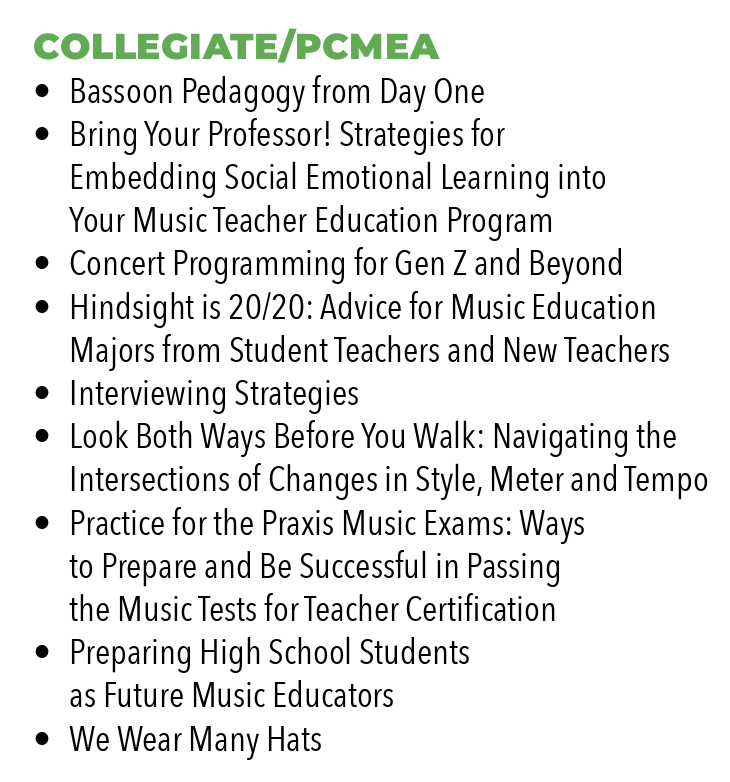
There’s a lot in store for college music education majors. Besides the aforementioned state meetings, concerts, clinics, and keynote addresses no one should miss, the music industry exhibits (new innovations in sheet music, instruments, technology, summer school and graduate programs, etc.), and the chance to introduce yourself to other music colleagues (aren’t some of you looking for a job soon?), there will be a “coffee and connections” informal lounge to ASK-AN-EXPERT on Thursday afternoon to pick-the-brains of PMEA mentors and retirees on any subject. Do you have a question about conducting technique, musical literature, lesson plan idea, classroom or time management tip, or teaching method? And, just take look these sessions the PMEA Professional Development Council has targeted specifically for YOU:
For Retirees… They are special, too!

PMEA Retired Members, consider this your personal invitation to join us at the Kalahari Resort in the Poconos for the chance to catch-up, connect, collaborate and communicate with other colleagues throughout the Commonwealth! (a plethora of “C’s!”)

As usual, we will “break bread” together Friday morning (April 11, 2025) with the annual retiree breakfast. Be sure to register soon for the PMEA Annual Conference (now only $25) and check the “yes” box that you will attend our meeting. Those in attendance will be treated to some “conference swag!”

Retirees are a valuable resource to PMEA! Our experienced retired members are among the best-trained (unofficial) mentors in PMEA. Facing many years of “boots on the ground,” we have at our fingertips numerous strategies to solve problems in education. Frankly, in my opinion, we have a lot to offer “the future of the profession!”
If you are a retired PA music educator, hopefully you have maintained your PMEA membership (dues significantly discounted), and have signed up for the Retired Member Resource Registry to help future “rookie” music educators. (To reach the R3, first login to your PMEA portal here.)
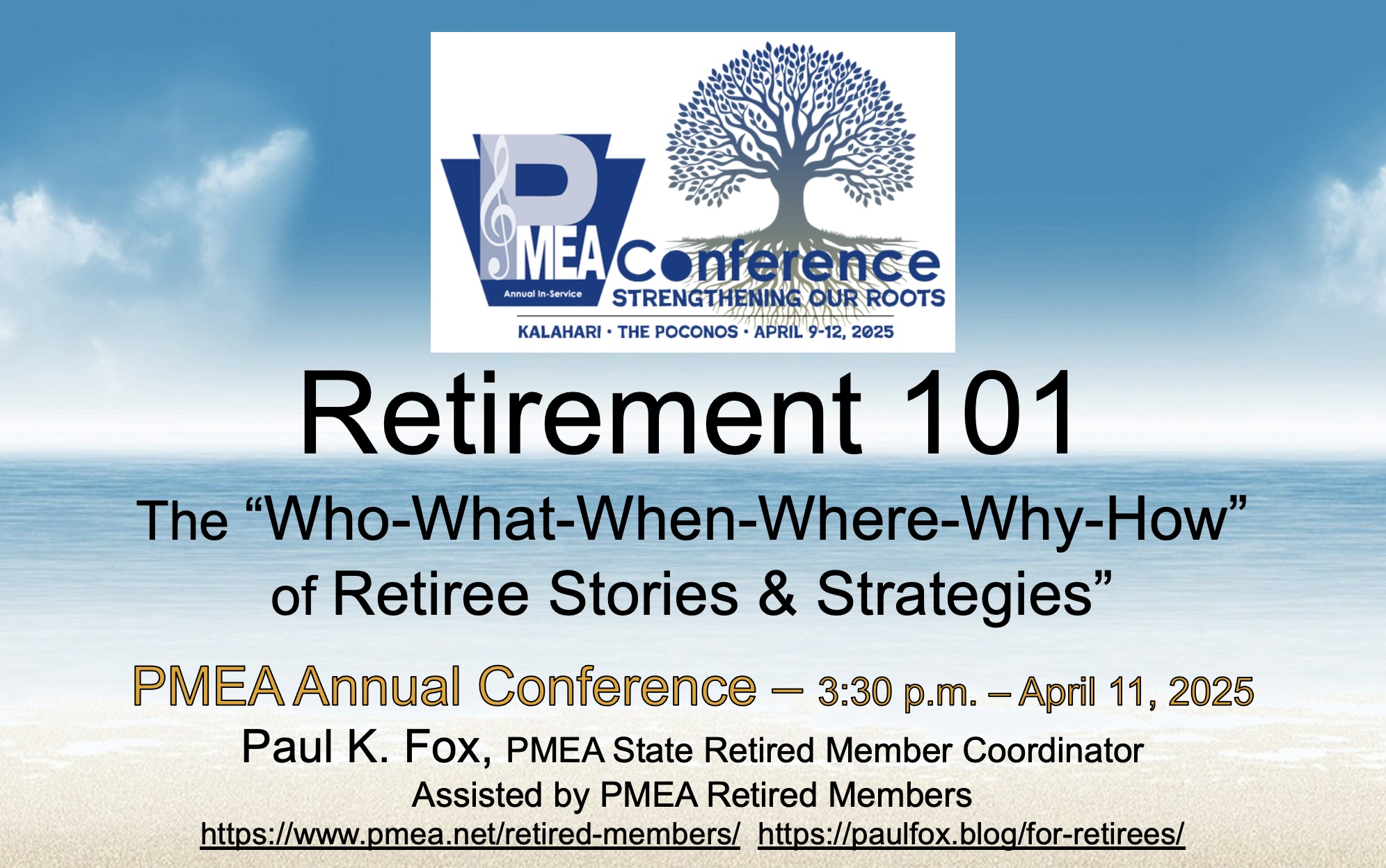
On Friday, April 11, at 3:30 p.m., we are offering a special sharing session for soon-to-retire teachers… the annual one-hour Retirement 101 workshop joined by a panel of experienced retirees: Rick Coulter, Jeffrey Dent, Sister Kathleen Doutt, Dan Klingbeil, Chuck Neidhardt, and Louise & Richard Victor. Active educators who plan to retire over the 1-5 years can learn valuable techniques from us for a smooth transition to post-full-time employment and successfully reinvent, reprogram, and “recharge” themselves to modifying those essential elements of purpose, structure, and community throughout their “golden years!”

My Professional Advertisement

You may have noticed in my last blog-post an outline of past article topics archived at this site, and a complaint that I feel I must repeat myself (or repackage the material) to meet the changing personalized “bookends” – life cycles – specific passages of my readers. The earlier February post was mostly for job seekers. If you were not looking for employment or coming fresh out of college, it may have seemed irrelevant. The same goes for specialty articles on self-care, ethics training, or retirement transitioning… WHEN WOULD YOU BE MOTIVATED TO STUDY THESE?

I have decided to maintain a comprehensive index of my writings (see “Inside” link in the top menu bar). Please visit the sections of this blog-site that matter to you most… and, when things change, come back and look again. You may find something that “hits the spot” or satisfies the needs of your new journey in education or personal/professional life.

I remain willing and able (aka “very interested”) in doing in-person or online sessions for college methods classes, PCMEA chapter meetings, PMEA festival directors’ meetings, PMEA District or Regional PD workshops, or school district/department inservices. Just give me a call. My contact information can be found in the top “About” link. Please visit this section for catalogs of my presentations and articles. FYI, I created this trifold of some of my past work.

Best wishes on your future successes in career development and professional goal setting.

PKF

© 2025 Paul K. Fox

Bookends – Part Two

The Life Cycle of a Successful and Happy Music Educator

Joyous Holidays, Season Greetings, and Happy New Year from “The Foxes!” This is a time for reflection and gratitude… and we feel blessed for all the opportunities allowing us to share our insights, gifts and experiences with other music education professionals.

We hope to inspire YOU and literally model the concepts in this blog series. We continue with our discussion first introduced a month ago in Bookends – Part One – The Life Cycle of a Successful and Happy Music Educator, exploring:

  • Stage 3: Inservice/Growing Years (this blog)
  • Stage 4: Veteran/Sustaining Years (future blog)
  • Stage 5: Next Chapter/Living the Dream (future blog)

This article is an abstract from a session presented to Seton Hill University music education student teachers on October 17, 2023. Click on this link to download the slide summary in PDF format.

“I have written a lot of articles in support of these topics… now compiling them for your easy access. Depending on your current status and interests, feel free to peruse the checklists (links) in this series. It is possible a few of the resources contained within these blogs have gone inactive, but I believe enough are there for you to gain the insight, tools and motivation to achieve professional development for life.”

– Paul Fox

Stage 3 – Inservice/Growing Years

[ ] 8. Becoming a Music Educator: For a review of Bookends – Part One, take a step backward and revisit what you have done to “get ready” for your “rookie years.” Take special note on the things-to-do list (“secrets”) as a first-year educator (perhaps completed during your student teaching semester):

  • Subscribe to a discounted NAfME + PMEA first-year membership (If you are a recent college graduate in your first year of teaching, or if you are the spouse of a current or retired NAfME member, contact NAfME at 800-336-3768 or email memberservices@nafme.org) to find out if you qualify for a reduced rate.
  • Hook up to PMEA Mentor or other state’s MEA support program for new teachers.
  • Look into finding an informal advisor in the PMEA Retiree Resource Registry for PA music teachers.
  • Need to fill in a few gaps missing from your college courses in skills and knowledge? Continue your “enrichment” viewing PMEA Webinars and the exhaustive video library in the NAfME Academy.
  • Take advantage of earning professional development credits just for reading an article in the NAfME Music Educators Journal
  • At some point you will be writing/editing curriculum, so research the awesome resource of Model Curriculum Framework (Have to be a PMEA member)
  • Too busy to participate in the PMEA Annual Conference or NAfME national events? Look into going to a PMEA summer conference (usually at a lower-cost!). Check out your own state’s MEA discounts and offers for collegiate members and new teachers!
  • Numerous free and timely blog posts from NAfME Music in a Minuet and here (paulfox.blog).

[ ] 9. The Care & Feeding of Your Principal: Although not covered in any detail during the Seton Hill University presentation, it is recommended that you read in its entirety “The New Teacher’s Guide to Fostering Positive Relations and Good Interactions with School Administrators” offering a wealth of excellent recommendations from these trustworthy sources:

A favorite question I pose to college music ed seniors is, “In what professional associations are you a member and actively involved?” For the price of consuming one fewer Starbucks latte a week, you can open up the Wonderful World of “C’s” – Contacts, Coachings, and other Connections, including research and resources that will benefit your Continuing Education. You can’t afford NOT to join groups like these.

To help “nail down” a few related definitions critical to personal growth and career development in our profession, especially “engagement,” “professionalism,” “collaboration,” and “networking,” please take a little time to travel and consume the following archived blog postings.

[ ] 10. The Meaning of PRO: This is one of the oldest articles at the paulfox.blog site. How about a little soul searching? Are you truly a professional? Do you have the skills, habits, and attitudes of a professional in the field of education?

[ ] 11. Transitioning from Collegiate to Professional (Part II): New teachers have to move away from “book learning” or higher education research and emphasize “practical application,” and at the same time, assess the precise areas needed for immediate (re-)training… everything from new exposure to specialized teaching areas and grade level focus for the job to which you have been assigned, to the enhanced skills of classroom management, student assessment, curriculum writing, class or ensemble warm-up materials, music repertoire and programming, etc.

While we are on the subject, it is important to intentionally seek out mentors or consultants in your early years of becoming an educator. PMEA offers a mentoring program (read all about it here) and PMEA Retired Members are also an excellent resource to “phone a friend” for advice as needed (see their section on the PMEA website here). That leads us to the next most essential “habit” of attending professional conferences… #12 below.

[ ] 12. Getting the Most Out of Music Conferences: Our PMEA Annual Conference sites are cyclical. This article, written on March 5, 2017, showcased that year’s event at the Erie Bayfront Convention Center – coincidentally the same location for this year’s PMEA Annual Conference: April 17-20, 2023. For a sneak peek at the proposed sessions and guest performers, click here.

There are a myriad of conferences offered every year… something for everybody in just about every state. Make plans to go, “recharge your batteries,” and pick up new state-of-the-art ideas, lessons, music, technology, etc. Again, you cannot afford NOT to attend… or becoming stale in your teaching or “stuck in a rut!” Besides, going to your state’s or national conferences and regional workshops are FUN places to meet other like-minded, inspiring colleagues! This is how professionals network, collaborate, and share their “latest and greatest!

A couple upcoming events:

What are you waiting for? It’s time to DIVE INTO your customized career development!

Coming Soon…

Bookends Part Three – Stages 4 & 5

PKF

© 2023 Paul K. Fox

Two New PMEA Scholarships

This message goes out to all of my Pennsylvania music education colleagues and especially any currently enrolled Freshman through Graduate college students in the Commonwealth.

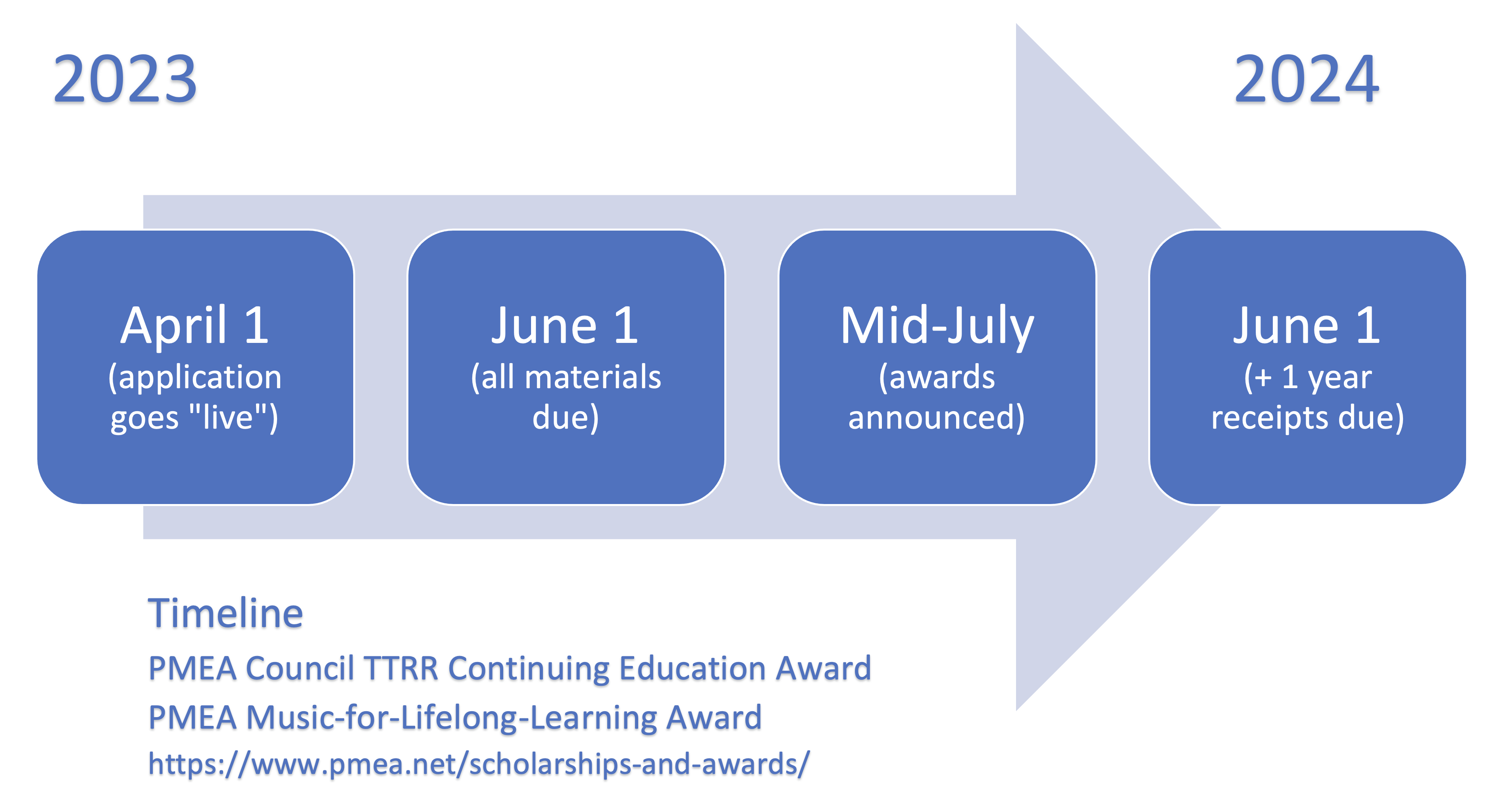
My wife and I are proud to announce the launch of two new scholarships for the 2023-24 school year, financed by the Stark-Fox Family Fund, and managed by the Pennsylvania Music Educators Association (PMEA). Official applications will be available soon (spring semester 2023) on the PMEA website here. All materials are due on or before June 1, 2023.

Do you know someone who is currently attending a PA university, college, or conservatory? Is he or she majoring in music education AND is a member of Pennsylvania Collegiate Music Educators Association (PCMEA) OR majoring in a science-technology-engineering-mathematics (or related) field of study AND participating in their collegiate music ensemble for credit?

Then… SPREAD THE WORD!

Here is a general summary of the eligibility requirements and expectations for application approval, subject to change by the PMEA EXCOM and staff. A performance video (or submission of an original composition) is required for either scholarship, and interested candidates could begin now (during the semester break) to prepare their piece(s), update their resume, assemble a digital portfolio, and write the essay.

PMEA Council TTRR Continuing Music Education Award

  • Amount and number of scholarships may vary from year-to-year
  • Full-time enrollment of at least one year (two complete semesters) as an undergraduate or graduate music education major in an accredited PA institution
  • Nonrenewable (selection of a different candidate each year)
  • Paid directly to candidate as reimbursement for college tuition, dorm/apartment rent, meals on campus, textbook purchases, and/or the purchase of a new instrument (must provide receipts)
  • Blind judging by PMEA members with at least one member from the PMEA Council of Teacher Training, Recruitment, and Retention, PMEA EXCOM, and/or PMEA staff
  • Criteria for selection
    • A minimum of at least one year as PCMEA member in good standing with letter of affirmation from the PCMEA sponsor
    • Submission of college transcript reflecting 3.5 GPA or higher
    • Demonstration of solo performance skills (recorded video) or submission of composition(s)
    • Presentation of a music education portfolio with sample lesson plans, philosophy, and development of creative instructional activities with a focus on the arts at the center of STEAM
    • Participation in at least one PMEA-sponsored professional development program e.g., the Annual Conference, Summer Conference, Webinar, or Regional Workshop
    • Completion of essay in response to the question “Why have you chosen a career in music education?” and portrayal of leadership and well-defined goals and aspirations towards a career in music education.
    • Letter of recommendation from at least one music education professor
https://www.pmea.net/council-for-ttrr/

PMEA Music-for-Lifelong-Learning Award

  • Amount of scholarship may vary from year-to-year
  • Full-time enrollment of at least one year (two complete semesters) as an undergraduate or graduate science-technology-engineering-mathematics major in an accredited PA institution
  • Enrollment for at least one semester in a music performance course e.g., band, chamber music, chorus, jazz, or orchestra earning the letter grade of an “A” or equivalent with submission of letter of recommendation (and transcript) from ensemble director
  • Nonrenewable (selection of a different candidate each year)
  • Paid directly to candidate as reimbursement for college tuition, dorm/apartment rent, meals on campus, textbook purchases, and/or the purchase of a new instrument (must provide receipts)
  • Blind judging by PMEA members with at least one member from the PMEA Council of Teacher Training, Recruitment, and Retention, PMEA EXCOM, and/or PMEA staff
  • Criteria for selection
    • 3.5 GPA or higher on college transcripts
    • Demonstration of solo performance skills (recorded video)
    • Presentation of a music portfolio with high school and college history of participation in music ensembles and pursuits in creative self-expression, concert programs, and/or evidence of the development of creative activities or projects with a focus on the arts at the center of STEAM
    • Completion of essay that reflects musical leadership, community service, and/or the ccandidate’s rationale and aspirations for the continuation of “music study as a life-skill”
    • Response to the question, “How does the study of music enhance your knowledge, skills, and depth of understanding for a career in science-technology-engineering-mathematics?”

We are hopeful that these will become annual awards of substantial amounts (with a goal of at least $5K to $15K per person based on market conditions), provided as reimbursement of the scholarship recipient’s higher education expenses. If you are a potentially eligible candidate, get to work on the selection process and documentation NOW and… good luck!

PKF

The Stark-Fox Family Fund supports PMEA and PCMEA.

© 2022 Paul K. Fox

PMEA’s Unique “Together” Conference

The return of in-person gatherings of PA music educators and students!

Here’s a “sneak preview” of the upcoming annual professional development convention for members of the Pennsylvania Music Educators Association (PMEA) and Pennsylvania Collegiate Music Educators Association (PCMEA).

https://www.pmea.net/pmea-annual-in-service-conference/

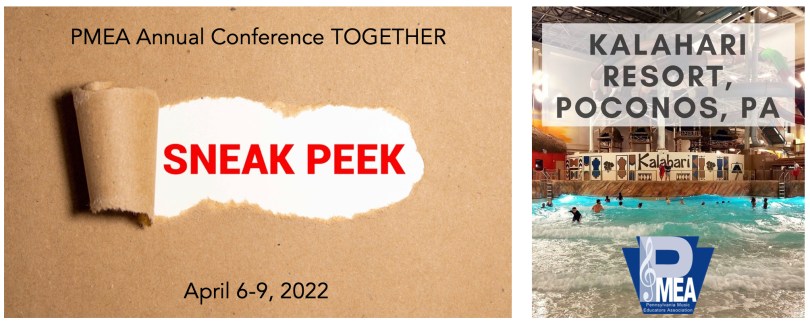
After being “hunkered down” for two years of online workshops, virtual conferences, digital music industry exhibits, and Zoom rehearsals of PMEA All-State ensembles, we can now “crush COVID-19” with “face-to-face” meetings of the PMEA TOGETHER CONFERENCE on April 6-9, 2022 at the Kalahari Resort in the Poconos.

Not just a “play on words,” this LIVE event brings TOGETHER the awesome and inspiring vision and efforts of the PMEA Professional Development Council, state officers, and staff, along with a twist from tradition – offering a place to getaway from it all!

Ask your spouse or “significant other,” children or grandchildren, nieces or nephews, other fun-loving family members, or close friends if they are available to join you for a three-day escape to the Poconos – “the world’s largest indoor waterpark” at Kalahari Resort! Experience great music, career development sessions, catching-up with colleagues, reconnection with your loved-ones, and entertainment for all ages – all wrapped up in one location.

https://www.kalahariresorts.com/pennsylvania/

Bring the family? Each spacious hotel room comes equipped with two double beds, a pullout sofa, microwave, and refrigerator, and the discounted $149/night conference rate allows you to register up to four people with access to all the resort’s amenities for no extra charge!

What resort amenities? Enjoy rides and slides (lots to “splash in” or just relax on the lazy river), a “big game” room, mini golf, mini bowling, 7-D motion theater, gourmet restaurants, spa, salon, fitness center, and amazing shopping and sightseeing excursions in PA’s northeastern region. While YOU are attending PMEA keynote sessions, clinics, concerts, and exhibits, the rest of your party could be “living it up” on as many as 29 waterpark thrills (from “mild” to “wild,” check out all of them on their website):

  • Anaconda
  • Barreling Baboon
  • Bugs Burrow
  • Cheetah Race
  • Coral Cove
  • Elephant’s Trunk
  • Flowrider
  • Indoor Outdoor Spas
  • Kenya Korkscrew
  • Lazy RIver
  • Lost Lagoon
  • Outdoor Pool
  • Rippling Rhino
  • Sahara Sidewinders
  • Screaming Hyena
  • Shark Attack
  • Splashdown Safari
  • Tiko’s Watering Hole
  • Victoria Falls
  • VR Waterslide
  • Wave Pool
  • Wild Wildebeest
  • Zig Zag Zebra

Source: Pocono Mountains Visitor Bureau

A joyful car trip to local scenes and attractions? The word “Pocono” means “the stream between two mountains.” This region encompasses 2,400 square miles of lakes, rivers, and woodlands just waiting to be discovered. Just how adventurous are you?

  • Explore numerous opportunities to hike, bike, bird watch, ski, fish, and photograph the wildlife, waterfalls, and other breathtaking landscapes.
  • Peruse the various exhibits of local artists at the White Mills Art Factory, 736 Texas Palmyra Highway (Route 6) from 10 a.m. to 5 p.m. (closed Wednesdays).
  • Try your luck at the Mount Airy Casino Resort Spa.
  • Or be a “wandering tourist” and visit nearby Stroudsburg, Milford, Jim Thorpe Honesdale, Lake Wallenpaupack, Hawley, Skytop, Bushkill, Lake Harmony, or Tannersville.
  • Check out this Poconos Mountains interactive map: https://www.poconomountains.com/interactivemap/.

Keynote speakers David Wish and Lesley Moffat

Now down to the business of professional development! In your free time from the above refreshing and re-invigorating moments of “down time,” you won’t want to miss the PMEA general sessions featuring keynoters David Wish of Little Kids Rock and Lesley Moffat, author of Love the Job, Lose the Stress. After opening the music industry and collegiate exhibits, numerous workshops, interactive demonstrations, and panel discussions will be hosted on a variety of “state-of-the-art” and timely topics:

  • Adjudication
  • Assessment
  • Career Development
  • Choral
  • Collegiate
  • Curriculum Development
  • Diversity/Equity/Inclusion
  • Exceptional Learners
  • Health and Wellness
  • Instrumental
  • Leadership/Mentoring
  • Modern Band
  • Music Technology

Draft of proposed 2022 PMEA Conference sessions

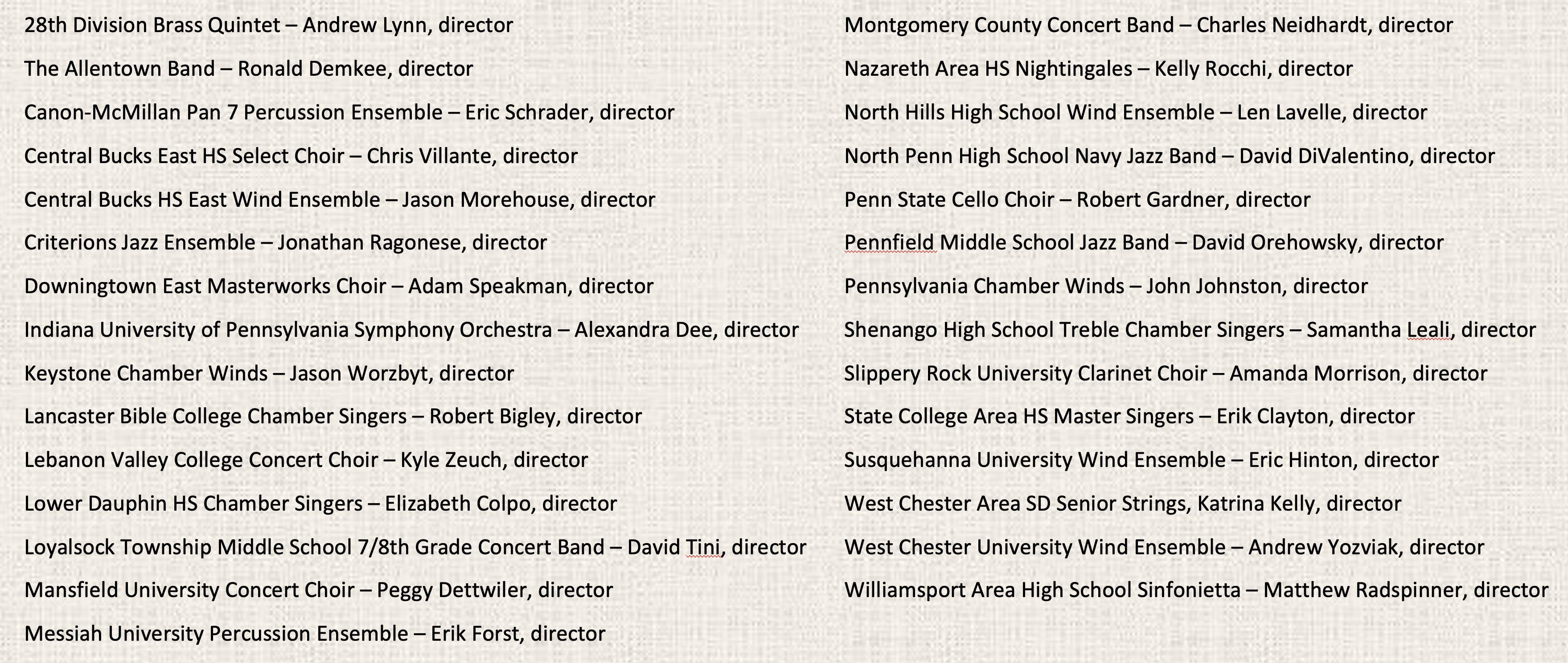
Sandwiched in between these clinics and meetings of PCMEA, PA Society for Music Teacher Education, PMEA Council for Teacher Training, Recruitment, and Retention, PMEA Retired Members, Pennsylvania-Delaware String Teachers Association, and others will be opportunities to observe rehearsals and performances of the PMEA All-State Band, Chorus, Jazz, Orchestra, and Vocal Jazz, and attend concerts of guest performing ensembles – among “Pennsylvania’s finest.” Congratulations to:

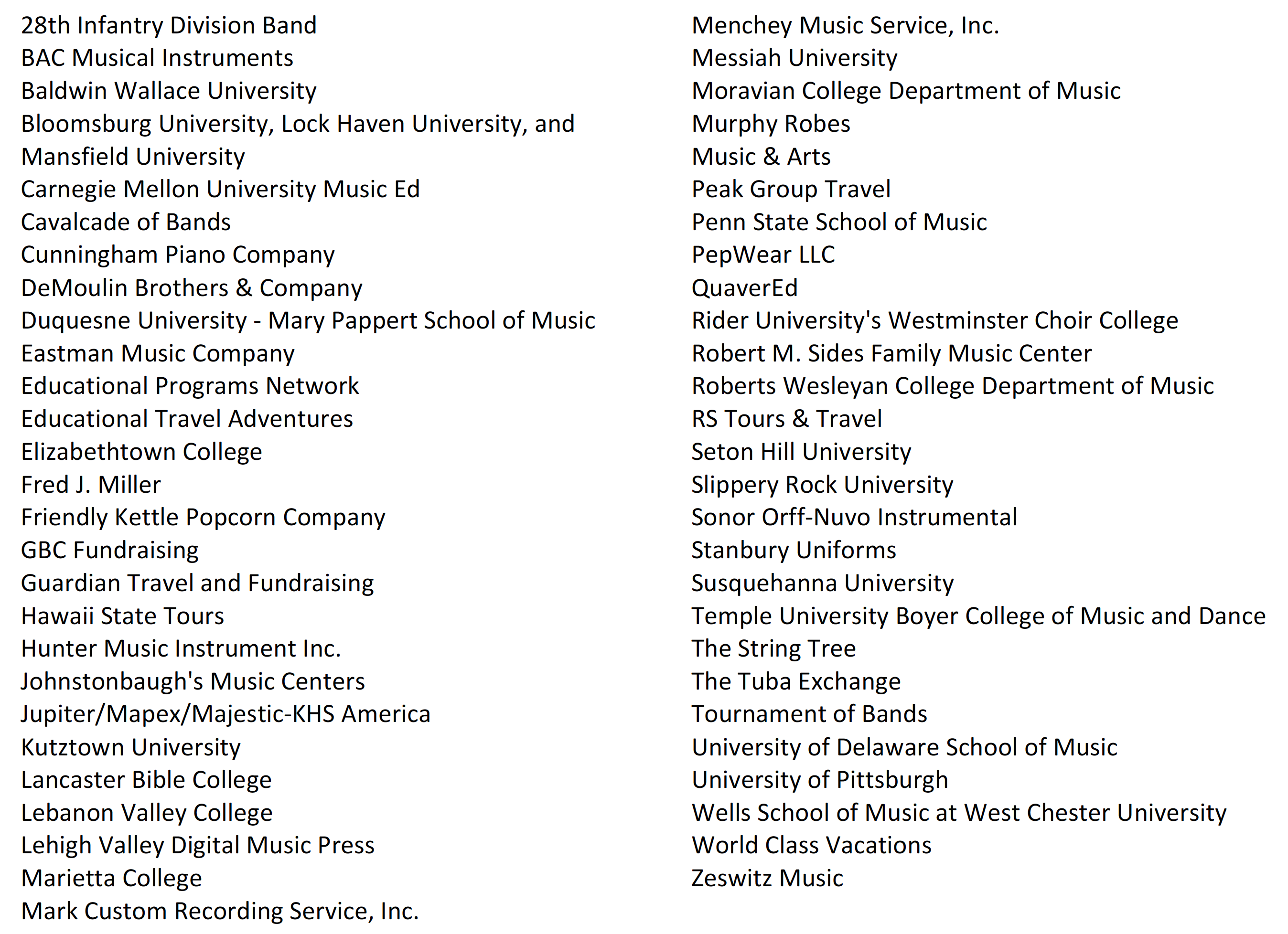
Looking for that new classroom accessory, concert selection, educational travel group, fundraiser, instrument, technology tool, or uniform, or seeking to talk to representatives from music schools? Take time to visit the exhibits. PMEA thanks the continuing support of its PMEA Corporate Sponsors.

Early-bird registration of 2022 PMEA Conference Exhibitors

Yours truly (blogger) is proud to announce he is presenting three sessions at the conference:

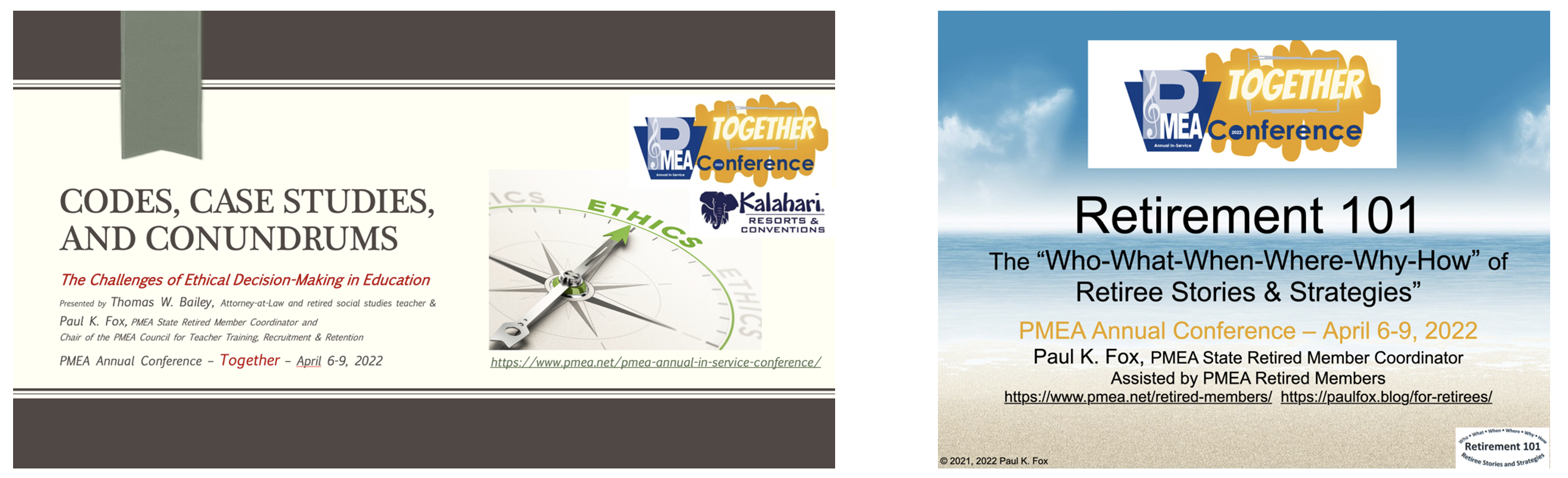
  • CODES, CASE STUDIES, and CONUNDRUMS – The Challenges of Ethical Decision-Making in Education
  • THE INTERVIEW CLINIC – Practicing and Playacting to Improve Your Performance at Employment Screenings
  • RETIREMENT 101 – The Who, What, When, Where, Why, & How of Preparing for Post-Employment

PMEA will need volunteers to assist as presiding chairs or to serve at the INFO BOOTH near registration. In addition, the PMEA Retired Member Coordinator is seeking retirees to help serve on a guest panel of “semi-experts” for the retirement session.

It’s still a little early for much additional detail. However, check out this MOVIE TRAILER preview of the 2022 Conference, featuring The Pennsylvania March composed by PMEA retired member Ron DeGrandis.

As of January 17, 2022 (Martin Luther King Jr. Day), Kalahari Resort room reservations are open! The link to conference registration will be coming soon. For more information, please visit the PMEA website. Keep your eye out for revisions in future PMEA News, UPDATES, and other e-publications.

PKF

© 2022 by Paul K. Fox
Giving Back to the Association

A Pep Talk for Teachers to Become “Team Members!”

I found myself this past Monday morning with a few extra minutes checking my almost empty “to-do” list and, with the exception of planning to watch the Pittsburgh Steelers football game and the endless chore of raking leaves in my yard (I immediately rejected the latter), I discovered I had very few professional or personal priorities to focus on this week! Wow! Some additional “free time!” Shh… don’t tell anyone!

Down time? As I mentioned in a previous blog-post, since the summer, things had been a little hectic for “this retiree.” When I accepted the position of “admin” to the marching band of the school from where I retired, I discovered how fast we can fill up our schedules with meetings, rehearsals, and performances… to the point that it is hard to imagine how I could possibly have done all of this unless I retired from the regular job! My wife jokingly said, “Those were the days!” (perhaps a little unsympathetically?) as she watched me takeoff for band camp, parent salute nights, late night away football games, etc., while she remained cozy at home. “Been there. Done that! Not anymore!”

Only one professional association got me through more than five decades in music education and 35+ years of full-time directing, equipping me to handle the twists and turns of an ever-changing career (e.g., becoming a choral director even though I had never sang in a high school or college choir), and even attending music festivals as a viola and tuba student for four years in the Penn Hills school district. Who do I credit for giving me this “life force,” “teacher chops,” and music mastery? PMEA. We are so fortunate to have this priceless “collaboration of our colleagues,” numerous resources for the benefit of our own professional development, and services we provide to our music students. Cut me and I bleed PMEA blue!

How Are YOU Feeling?

This blog’s “call to action” is necessary because of the turmoil the pandemic has left the arts education community, new school health and safety mandates, re-prioritization of district resources (in some places away from the arts in spite of the need for more not less social emotional learning), reports of the drop in music participant enrollments, decrease in membership renewals, and teacher shortages.

The crush of COVID-19 and all of the program delays, suspensions, (and hopefully not) permanent losses have made this one of the most challenging times I can ever recall. The only way we can get through this is “together…” and frankly, “if you’re not part of the solution, you’re part of the problem!” This is NO TIME to let your membership and involvement lapse! PMEA and other professional music education organizations (like NAfME, ACDA, ASTA) need your “dedication to the cause,” willingness to help “the team” and one other,  and active participation.

Collegiate members, full active members, and retired members – all of us joining forces – can truly “make a difference!” No matter how busy or stressed you are and how much you feel you are “slugging it out in the trenches” alone, we all need to become partners and devote time for and dedication to the associations we are blessed to have right now that support music educators in the Commonwealth, the nation, and the profession.

The Essential Role of Associations

It does not matter which profession you have chosen! You NEED an ASSOCIATION!

Google English Dictionary provided by Oxford Languages

The architects may have defined “this essential bond” best:

Membership in the relevant professional organization is one of the things that separates a profession from a conventional job. It is a key element that defines a professional. Membership in one’s professional organization is expected of all professionals. It is important to support the advancement of one’s profession, and becoming a member of the professional organization is a part of that advancement.

Involvement with a professional society will afford the participant an opportunity to network with other colleagues in industry and practice. Making connections with others who have similar interests reinforces why one has chosen this career. It enables new professionals to associate with senior members of the profession and learn from them. Joining a professional organization is critical in keeping abreast of the latest knowledge and practices locally, regionally, and globally. It helps the professional to stay abreast of current issues and opportunities and will also assist in personal advancement for the member who becomes involved.

Many professional organizations offer continuing education, seminars, and lectures along with other opportunities for learning. An active participant will have the opportunity to serve in professional development. Working with people outside of one’s own firm and volunteering will build leadership skills. Opportunities for working with the community for the betterment of society and the local economy will be available. There will be possibilities for making real contributions to the human condition through projects the professional organization may take on as a part of giving back to the community. There are events that will call for public speaking skills and professional visibility which will assist in moving one’s career to another level by connecting with other professions and local leaders in the area. The profession will benefit from members’ service and the members will be rewarded in return by such things as personal fulfillment, professional enrichment, and building a stronger resume as a result.

Further definition of the professional responsibilities and ethical practices will come in part from the professional organization. It is a central core for regulation, education, revitalization, networking and service. Joining a professional organization provides occasions and experiences to renew one’s enthusiasm for the practice of interior design. The interaction can be both inspirational and enlightening. Being a member of a professional organization is a symbiotic relationship between the organization and the member that will benefit them both.

Alabama Board for Registered Interior Designers

My “top-ten” benefits for membership in a professional association like PMEA are:

  1. Development and sharing of the standards and best practices of the profession
  2. Student festivals and music performance assessments
  3. Professional development and career advancement opportunities: workshops, conferences, and publications
  4. Leadership training
  5. Collaborative projects such as health and wellness seminars, ethics training, library of online resources, etc.
  6. Networking opportunities
  7. Models and resources for curriculum writing
  8. Coaching and mentoring resources
  9. Resources in job hunting and interviewing techniques
  10. Advocacy of music education and “a voice” (more political “clout”) in defining future government public policy

So, What’s in it for Me?

Review a few of the synonyms of “association” mentioned above: “alliance,” “consortium,” “coalition,” “connection,” etc. I am sure you’ve heard the saying: “TEAM stands for Together Everyone Achieves More.” Or, to quote the philosopher Aristotle: “the whole is greater than the sum of its parts.”

The easiest way for me to show the value of joining PMEA and becoming more active, engaged, and successful in your teaching assignment (no matter what the primary specialty – general music, vocal, band, strings, jazz, music theory, technology, etc) is to take a snapshot of the benefits displayed on the www.pmea.net website. Why try to reinvent the wheel? You might be surprised the extent of the HELP that is available just around the corner! Go ahead… click away! Take a peek at what you may be missing!

On a personal note, PMEA has provided me the insight, inspiration, and opportunities for substantial career growth, “places to go and people to meet” to fill-in-the-gaps of the skill training I may have felt were missing, for example methods and media for teaching a high school choral program for more than 16 years and directing/producing 37+ musicals. In addition, PMEA and NAfME have been the sole institutions that I have turned to for more than 50 years for their sponsorship of choral and orchestral music festivals and other enrichment that have provided my students new and highly motivating musical challenges and countless state-of-the-art once-in-a-lifetime experiences.

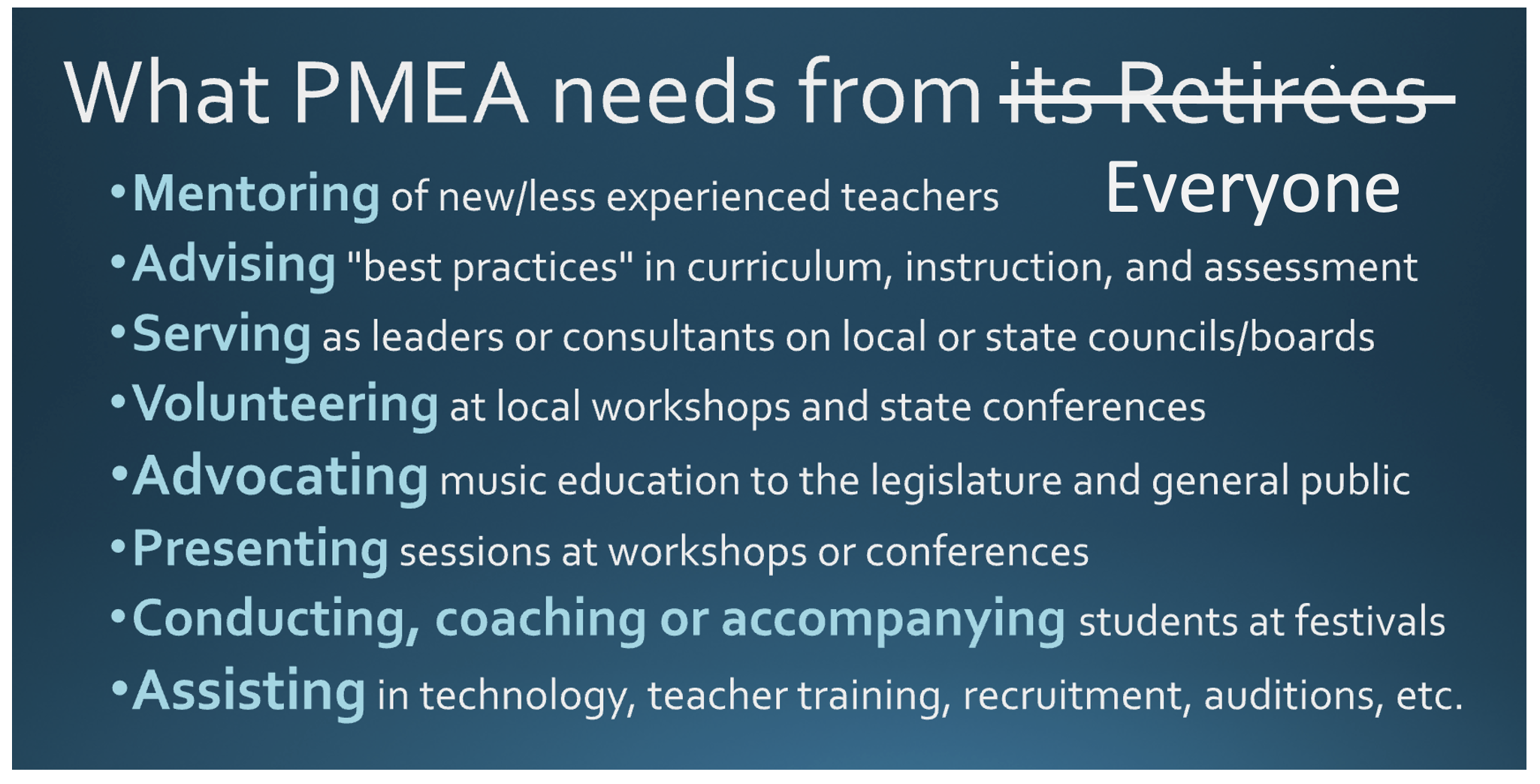
So now, reflect on the title of this blog! It is essential to give back to our association – to help it achieve its mission: “to advance comprehensive and innovative music education for all students through quality teaching, rigorous learning, and meaningful music engagement.” We’re all in this together, and together we can make it better! Slide #6 at the bottom of the retired members’ webpage proposes what PMEA needs from all members (not just retirees):

The number one thing you can do for ANY association is to pay your annual dues, attend its meetings, be active and HELP OUT! In return, PMEA can assist you in finding and sustaining your passions! What are you waiting for? If you have not renewed for the 2021-2022 year, please visit this PMEA membership webpage.

PKF

© 2021 Paul K. Fox

Pictures from Pixabay.com by artist Augusto Ordóñez

Questions for the 3 Phases of Interviews

Asks for “The Before,” “The During,” and “The After”

interview-2204251_1920_Geralt

These Responses Are Critical for Marketing Yourself & Landing a Job

pcmea

This article was inspired by my recent participation in virtual mock interviews on Zoom for PCMEA members and senior music education majors.

It is up to you to do the research and plan ahead!

What is that “scout’s motto?” Be prepared!

Or, to put it another way, more “near and dear” to the average music student:

  • “How do you get to Carnegie Hall?” (Practice, practice, practice!)
  • “How do you get a job?” (Practice, practice, practice!) AND
    (Prepare, prepare, prepare!)
    a focus on the BEFORE, DURING, and AFTER phases of an interview!

magnifying-glass-4785076_1920_geralt


The Before

Prior to every job screening, walk in well-informed. Investigate in advance the background information of the school district:

  • The job opening and responsibilities
  • Details about the overall music program, number of staff, courses offered, etc.
  • School district’s mission/vision/value statements
  • Validation of administrative support for the arts
  • Examples of community support for music education
  • Work environment and employee attitudes

Be a detective! Look for responses to these inquiries “surfing the ‘Net,” studying the district’s website, reading local media releases, and, if you are able to, finding someone who is already employed there:

  1. What do you know about this school district?
  2. What is the average make-up (socioeconomic, education, racial, etc.) of the community? Is it mostly urban, rural, suburban? Are the majority of the jobs blue collar, white collar, entrepreneurial, agricultural, or mixed?
  3. What educational, cultural, and sport/leisure activities are available to the residents in and around the area?
  4. What philosophies or approaches are emphasized in the school district’s strategic plan and/or annual Board of School Director’s goals?
  5. What are samples of student, staff, building, and school district awards and traditions?
  6. magnifying-glass-106803_1920_geraltHow many class periods (not counting lunch) are structured for the academic day? Are specific grade levels or buildings organized in block scheduling, “period 0” and/or before/after-school curricular or co-curricular classes, lesson pullouts, period rotations or A/B weeks, etc.?
  7. How often is the curriculum revised or updated?
  8. What is the school district grading scale and music grading policy/practice?
  9. What music classes and extra-curricular activities are offered?
  10. Are any specialties or disciplines emphasized or promoted, e.g. Kodaly, Orff, Dalcroze, Little Kids Rock or Modern Band, World Drumming, Suzuki, Competitive Marching Band, Strolling Strings, etc.?
  11. What position(s) is(are) open and what duties are required?
  12. What avenues of professional development exist?
  13. What percentage of students are in the music program?
  14. What percentage of the music students own instruments, take lessons, and seek participation in outside ensembles?
  15. What indicators of cooperative parental and community support exist (concert attendance, private teachers, booster groups, community arts organizations, etc.)?
  16. What resources are budgeted (sheet music, music technology, field trips, piano tuning, instruments and instrumental repair, teacher in-service, festivals, etc.)

What answers you cannot find, you may ask at the end of the interview.

how to ace your job interview


The During

So much has already been written about commonly asked interview questions. (Please revisit the blogs posted at https://paulfox.blog/becoming-a-music-educator/.) To “let the cat out of the bag,” when I am asked to do “mock interviews” for music education majors, the following are “my favorites.” You may also want to read my last article, “Coaching Advice for Acing Those Employment Interview Questions” at https://paulfox.blog/2020/01/26/more-on-teacher-interviews/.

  1. Tell us something about yourself… your strengths, weaknesses, and goals for the future.
  2. Who had the greatest influence on you becoming a music teacher and why?
  3. What are the most important qualities of an outstanding music educator?
  4. Describe a successful lesson plan you have developed.
  5. How will you accommodate students with special needs or varied interests in your music program?
  6. How would you recruit/encourage students and “grow” interest and participation in the music program?
  7. interview-2207741_1920_geraltDescribe your approach to introducing a musical concept: singing matching pitches, keeping a steady
  8. Why is it important for students to be actively engaged in the performing arts?
  9. Why should I hire you for this position?
  10. Describe your background and knowledge of each of the following methodologies, and for a general music position, which one is your favorite? Orff, Kodaly, Dalcroze?
  11. Describe a lesson that did not materialize in a manner that you expected. What did you learn from this experience?
  12. If you were hired as a high school band director at the last minute the third week of September, and the marching style was contrary to your preference to teach, how would you adapt?
  13. What are three adjectives students would use to describe you?
  14. How would you assess the learning in your rehearsals?
  15. What is most important to you? Music outcomes, content, or process?

You will probably be asked, “Do you have any questions for me?” by the interviewer. You should show your interest, forethought, and advanced preparation by coming up with a few, or adapt several of the 16 pre-interview samples in the “Before” section above. At the very least, if the principal or supervisor of the posted position happens to be in the room, you could inquire: “Where do you see the program in 10 years?” or “What is the most valued attribute of a ______ School District educator?”

Raising the bar


The After

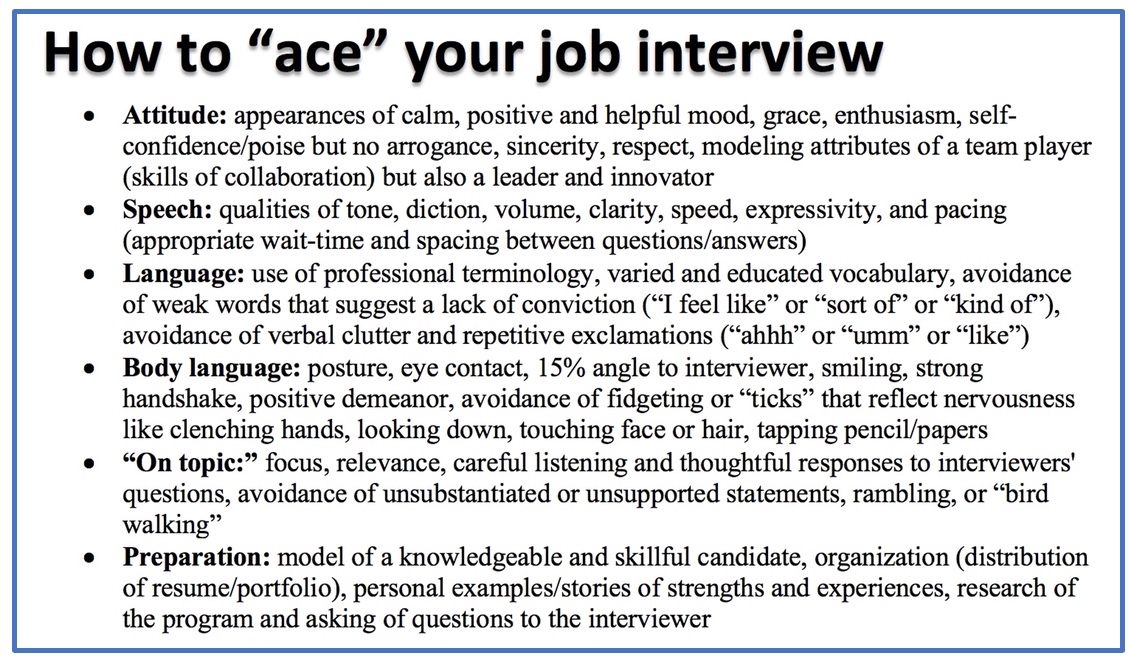
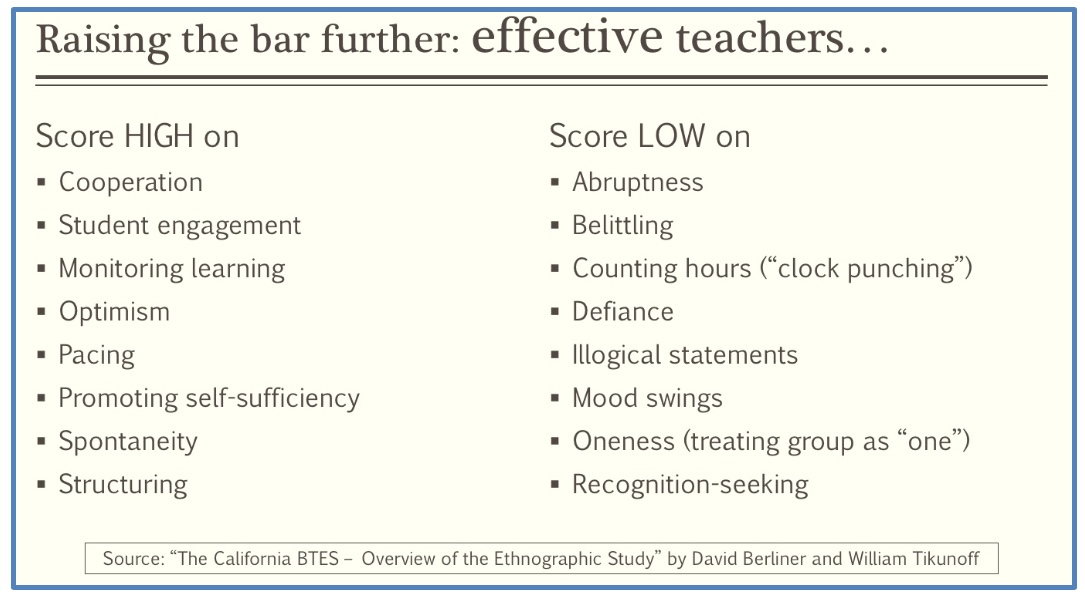
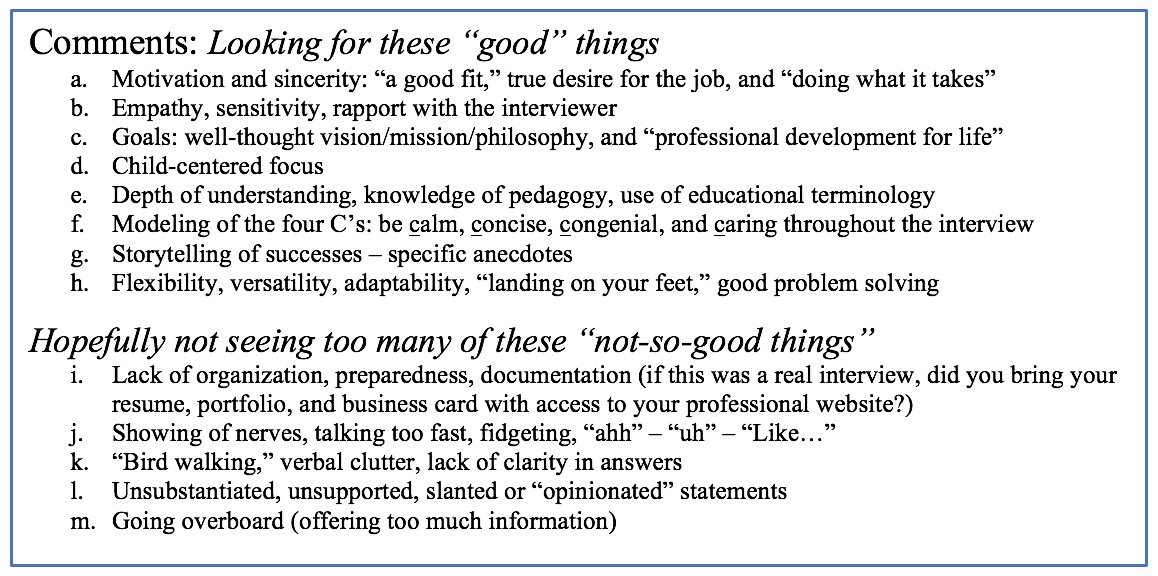
As soon as it is over (immediately when you get home – don’t put it off!), debrief yourself. Do an assessment of your positives and areas for improvement or needs for further practice. To formalize this process, try any number of evaluative rubrics (for examples, visit https://paulfox.blog/2019/05/14/job-interview-rubrics/). Or, just summarize your observations into strengths (+) and weaknesses (-) referencing the elements of attitude, speech, language, body language, content/on topic, and preparation. (See the first box above.)

feedback-796140_1920_geraltAre you telling me it’s time to bring up more questions? Yep, to finalize your interview’s “postmortem,” reflect on these queries, which will become your focal points in preparation of your next job screening.

The first “biggie critique” might take a little while to follow-up and re-train. This is important since most of the professionals who serve on interview screening committees are administrators, HR staff members, or curriculum supervisors (not music content specialists). And, in the same breath, most music education majors are not well versed on these “buzz words” since they may be only briefly mentioned during their music courses.

1.     How many times did you use appropriate general educational terminology and current school jargon? Here are a few samples of “the ABCs.” If you do not know the meanings, Google search them or look up sites like https://resilienteducator.com/classroom-resources/education-terminology-jargon/, https://www.teachervision.com/dictionary-educational-jargon, and https://wwndtd.wordpress.com/education-jargon/. (If you really want to dive into an interesting “lingo generator,” experiment with https://www.sciencegeek.net/lingo.html, which may also help you define associations among related educational terms used in the composition of reports, grant applications, and other documents for accreditation.)

  • Assessments – Authentic, Formative (“for learning”), Summative (“of learning”), and Diagnostic
  • CCCC (The Four C’s) – 21st Century Learning Skills of Creativity, Collaboration, Communication, and Critical Thinking
  • Classroom Management and the concepts of “Assertive Discipline” and “Ladder of Referral”
  • Charlotte Danielson’s Four Domains – Planning and Preparation, Classroom Environment, Instruction, and Professional Responsibilities
  • DOK – Depth of Knowledge and HOTS – Higher Order Thinking Skills
  • ESSA – Every Student Succeeds Act (2015), successor to NCLB (No Child Left Behind)
  • knowledge-5014345_1920_geraltIEPs  – Individualized Education Program, including IDEA (disabilities), 504 plans, accommodations for special needs, differentiated and customized learning, etc.
  • LMS – Learning Management System (software used by schools to track grades, take attendance, deliver curriculum, and offer/evaluate courses, etc.)
  • Middle School (or Middle Level Learner) Philosophy
  • PLN/PLC – A Personal Learning Network or Professional Learning Community
  • PBL – One of two different concepts: Project-Based or Problem-Based Learning
  • SEL – Social-Emotional Learning
  • SAS – Standards Aligned Systems of the PDE (Pennsylvania Department of Education)
  • STEAM – Science, Technology, Engineering, Arts, and Math
  • UBD – Understanding by Design, “backwards-design” curriculum development with EU (Enduring Understandings) and EQ (Essential Questions)

Of course, if you were “nailed” by not knowing terminology or acronyms of which you never heard, don’t “fake it!” Just be honest with the interviewers (they cannot expect a “raw recruit” fresh out of college to know everything), but never-the-less, look it up as soon as you return home. You’ll be ready for the next interview. (“Catch me once, shame on you. Catch me twice, shame on me!”)

More questions to help you evaluate your performance:

2.     At the interview, did you project the image that you are solely qualified to serve as a specific music content-area specialist? In other words, are you only a “band director,” “vocal conductor,” EL/MS general music teacher, piano/guitar accompanist, jazz instructor, music theorist, or string “maestro?” Did you basically imply to the screener(s) that you would not accept any assignment outside your “comfort zone,” and that your Music Pre-K-12 Instructional I Certificate is not worth the paper on which it is printed?

3.     If you had videotaped the interview, how would you characterize your rapport with the screening individual or committee? To what extent did you demonstrate an attitude of openness, cooperation, sensitivity to the interviewer’s style/personality, and fostering of the four C’s of the model interviewee behavior – be calm, caring (motivated), congenial, and considerate?

4.     Were you “engaged” in treating the session as a mutually beneficial exchange of information?

5.     learn-3653430_1920_geraltDid you respond to the interviewer’s questions “on topic” with clear, concise, and substantiated statements, supported by specific anecdotes/stories or examples of your skills or experiences?

6.     Did you avoid “bird walking,” “tap-dancing,” having verbal clutter (too many run-on statements), rambling, fast talking, sounding verbose, being flip or too casual/informal in conversation, or going overboard with your answers?

7.     How many times (count them) did you use the words “ah,” “um,” or “like?”

8.     Did you promote your strengths and all experiences (musical and non-musical) you have had interacting positively with children, and not discount your potential and capabilities due to a limited past job record or shortened time in student teaching?

9.     How successful were you in controlling your nerves, looking interested, “being yourself,” and demonstrating good eye contact, pleasant facial expressions, and relaxed and professional speech, posture, and body language?

10.  Did you avoid the use of “weak words” that suggest a lack of conviction: “kind of,” or “sort of,” or “I feel like?”

11.  Did you limit any form of “fidgeting,” such as tapping or shuffling feet, cracking knuckles, touching hair or face, drumming or spinning a pen between your fingers, wiggling in your seat, etc.?

12.  How many times did you use the name of the interviewer(s) during your interview? It shows respect and is the best way to get/keep his/her attention.


Observations at interview

In summary, treat the job search process more scientific:

  • Be diligent in practicing mock interviewing with classmates, friends, and family members,
  • Plan ahead, and
  • Formalize your questions and self-assessments.

The jobs are out there… waiting for you to “hook them in,” and as every good fisherman knows: “Nothing replaces time on the water, patience, and the ability to admit to yourself there is always something to learn and a better way to do it.”

PKF


hand-648448_1920_geralt

Photo credits from Pixabay.com by Gerd Altmann (geralt):


© 2020 Paul K. Fox

Transitioning from Collegiate to Professional – Part III

The Final Leap from Pre-Service to In-Service:

The Metamorphosis and Integration of Philosophy, Maturity, and Teacher Preparation

trumpet-1495108_1920_congerdesignTo “wrap-up” our final segment, we will review the development of a professional “marketing plan.” This is blog #3 out of 3. (Be sure to also check out #1 and #2, too.)

These are three critical skills you need to foster in the search for a school music position, marketing yourself, interviewing, and landing a “good” job:

  • Personal branding (who are you, what makes you unique, and what do you have to offer?)
  • Story telling (anecdotes) of your positive attributes and personal brand, including a record of your habits of “engagement” in music education, and
  • Networking (associating with other professionals and getting your positive stories “out there”).


skills-3262172_1920_diwou

branding

Personal Branding

“Personal branding is the practice of people marketing themselves and their careers as brands. While previous self-help management techniques were about self-improvement, the personal-branding concept suggests instead that success comes from self-packaging… Personal branding is essentially the ongoing process of establishing a prescribed image or impression in the mind of others about an individual, group, or organization.”

– Wikipedia: https://en.wikipedia.org/wiki/Personal_branding

What is the difference between marketing and branding? According to some, “marketing is what you do, branding is what you are.” (www.tronviggroup.com/the-difference-between-marketing-and-branding/)

phone-2840244_1920_RobinWiggins13Shama Hyder posted “7 Things You Can Do to Build an Awesome Personal Brand” at http://www.forbes.com/sites/shamahyder/2014/08/18/7-things-you-can-do-to-build-an-awesome-personal-brand/, including the following outlined summary:

  1. Start thinking of yourself as a brand
  2. Audit your online presence
  3. Secure a personal website
  4. Find ways to produce value
  5. Be purposeful in what you share
  6. Associate with other strong brands
  7. Reinvent

During these waning months for college music education seniors, now is the time to finalize the preparations for personal branding and beginning the employment search! Personal branding is critical to help you “stand above the rest,” showing that you have what it takes and would be a major asset to a prospective employer, and defining and marketing your own unique qualities that would make you “a good fit” for the specific job openings.

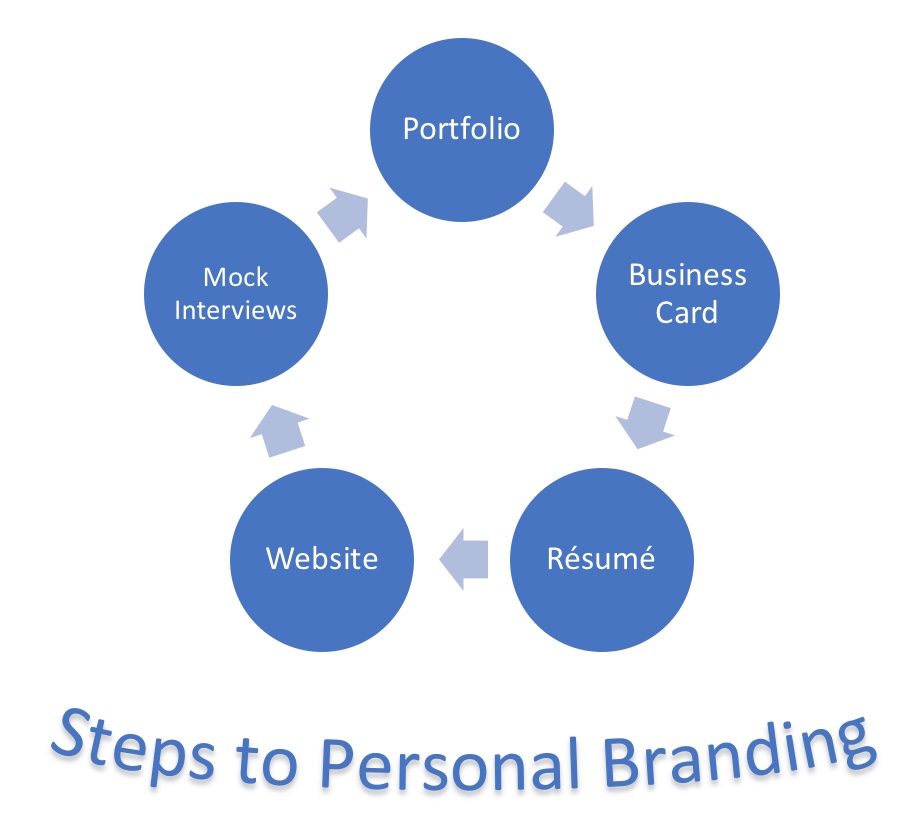
Steps to Personal BrandingThe branding process involves first developing your philosophy of music education, archiving your awards and accomplishments, documenting your grades and ok-3061659_1920_RobinHiggins12experiences, and collecting stories/personal anecdotes of your strengths. The next steps include the creation of a written and electronic portfolio, business card, resume, and website. Finally, you must compile/assemble everything together and practice (and self-assess) your “story-telling skills” to answer those important questions at well-rehearsed “mock interviews.”

You will likely not have enough time to complete all of these tasks during methods classes or student teaching seminars. That’s okay. If you are serious about prepping yourself to find a great music teaching job, the valuable links (see below) and articles are out there… just manage your time and start reading.

feedback-2990424_1920_geralt

networking

Networking

According to the article “Network Your Way to Secure a Teaching Job” at https://resumes-for-teachers.com/job-search-help/teacher-network/, many people are unaware of the basics of networking and how to use them it to their advantage in securing a job:

“Networking simply refers to finding job-related contacts. Most teachers who are just beginning their careers may feel that they have few, if any, networking contacts in the teaching field. It is important to consider the many different areas of networking as you create your own group of networking contacts to help you secure a teaching job. It is interesting to note that many of the teaching positions that are filled each year are filled by those who came to the attention of personnel managers by recommendation.”

“Always think about adding to your teaching network. When meeting new people, be certain to add them to your network. Talk to them about your skills, education, experience, and learn about their jobs. Make sure that you always ask for a business card.”

Do you have a business card? Is your résumé updated and available online on your professional website?

young-3061653_1920As I laid out in a previous blog “Networking Niceties: The ‘How-To Schmooze’ Guide for Prospective Music Teachers” at https://paulkfoxusc.wordpress.com/2016/04/04/networking-niceties/, the concept of networking is two-way communications. Just like collective sets of nerve synapses, two-way connections are expected to fire repeatedly in all directions. That’s actually the science behind memory. For professional networking, it is your “charge” to create multiple pathways to/from school HR managers and secretaries, administrators, music supervisors and department heads, and music teachers… and YOU – your skills, accomplishments, unique qualities, experience, education, and personality traits.

pcmeaThe above blog-post also explores setting up a good organizational system to manage your professional contacts.

If you are a Pennsylvania collegiate member (PCMEA), I heartily recommend the article “Networking 101” by Dr. Kathleen Melago, PCMEA State Advisor and Associate Professor of Music Education at Slippery Rock University, published in the Summer 2017 issue of the state journal PMEA News (pages 40-42). Here are several quotes from her work:

“One of the most common ways music educators can plan to network is at conventions. First, try to avoid interacting only with people from your school or people you already know from other schools. Go to sessions that interest you and look for opportunities to meet people there. Before the session starts, introduce yourself to people sitting around you. Use your social skills to assess whether they seem like they want to engage in a conversation or not. After the session, go up and meet the presenter.”

“Of course, social media is another great way to build your network. Networking with professionals already in the field can help you see what they are doing and help you build ideas of what you would like to do in your program someday.”

“Sometimes, you might find yourself networking unexpectedly. For example, you might go into school to work with their clarinet section during band camp and just happened to meet the choir teacher. That is networking!”

“To help your networking be most effective you need to have good communication skills. When interacting with others in a networking situation, be sure to focus on the person with whom you are speaking. Avoid looking off into the distance as if you were to anticipating someone else more important coming by. But your cell phone away and be present to the conversation.”

“Be yourself in your networking interactions. If you pretend that you are someone you are not, you will either end up unhappy or you’ll be discovered is someone who is not genuine.”

Dr. Melago goes on to provide a myriad of excellent examples of networking skills and opportunities.

Another resource specifically for networking at music teachers conferences is posted at https://nafme.org/getting-music-conferences/.


music-1237358-2 ricardo vasquez


engagement

Engagement

Here is an excellent definition of “professional engagement” from “Domains of Teaching” of the Australian Institute for Teaching and School Leadership at https://www.aitsl.edu.au/teach/understand-the-teacher-standards/domains-of-teaching.

Teachers model effective learning. They identify their own learning needs and analyze, evaluate and expand their professional learning, both collegially and individually.

Teachers demonstrate respect and professionalism in all their interactions with students, colleagues, parents/carers and the community. They are sensitive to the needs of parents/carers and can communicate effectively with them about their children’s learning.

Teachers value opportunities to engage with their school communities within and beyond the classroom to enrich the educational context for students. They understand the links between school, home and community in the social and intellectual development of their students.

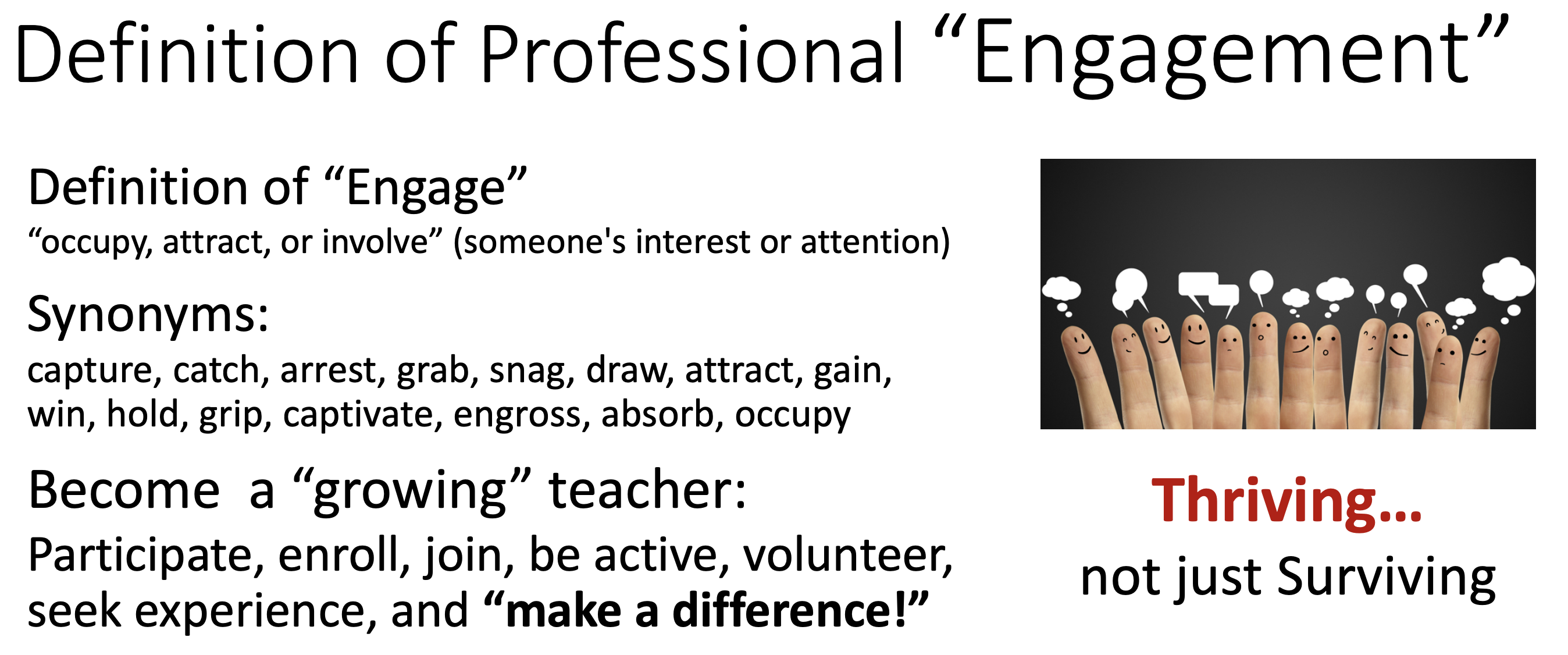
Engagement for prospective music teacher may include synonyms like “participate,” “enroll,” “join,” “be active,” “volunteer,” “seek experience,” and “make a difference!”

Are you a member of your professional music education associations?

  • NAfME National Association for Music Education
  • PCMEA Pennsylvania Collegiate Music Educators Association, or another state’s local NAfME collegiate chapter
  • pmeaPMEA Pennsylvania Music Educators Association, or another state’s NAfME-affiliated MEA
  • ACDA American Choral Directors Association
  • ASTA American String Teachers Association
  • NBA National Band Association

Did (or will) you attend your state music teachers’ conference and local workshops on music education and professional development?

To prove you are “professionally engaged,” I would expect to see a consistent record of modeling in the following areas:

  1. excited-3126449_1920_RobinHiggins9Self-reflection of the professional’s teaching practices and modification of these as needed to match changes in the environment and circumstances
  2. Self-assessment of the professional’s methods and approaches, as well as the progress of the students’ learning, using both formative and summative methods for constant and ongoing improvement
  3. Identification and planning of professional learning needs.
  4. Unsupervised (or unplanned by school administration) goal-setting and self-guided implementation of opportunities for professional development
  5. Association with professional learning communities, school and community meetings, and other collaborative projects
  6. Volunteer service in music and music education
  7. Membership and subscription to music education journals and participation in online professional community discussion groups

Many have said that aspiring to be a music educator is a lot like a calling. One school superintendent I know said he expected prospective new recruits to show high energy, enthusiasm, sense of purpose, and dedication during the interview… even a supposed willingness to “lay down in front of a school bus” or “do what ever it takes” to make the students (and the educational program) successful. That’s engagement!

classical-music-1838390_1920_Pexels

In summary, becoming a music educator is about finding your inner confidence, a mindset that you know what you’re doing, and that you’re ready for that real world experience. You’ve learned those essential skills in conducting, piano accompaniment, arranging, student behavior modification and discipline, music diagnosis and remediation, and even how to market your professionalism. Now… drum roll, please! Here’s… a master music teacher!

target-3306771_1920_geralt

In closing, here are supplementary materials to help you to “get your feet wet,” all free and available online. The following lists, although not comprehensive, are a good place to start (courtesy of https://www.pmea.net/wp-content/uploads/2012/10/Collegiate-Communique-No11-022218-2.pdf):

Good luck!


Personal Branding, Marketing, and Networking

Business Cards

Résumés

Portfolios and Websites

Interview Questions, Techniques, and Skills of “Story-Telling”


PKF

© 2018 Paul K. Fox
 

Photo credits (in order) from Pixabay.com: “tutor” by nrjfalcon1, “trumpet” by congerdesign, “skills” by diwou, “phone” by Robin-Higgins, “OK” by Robin-Higgins, “feedback” by geralt, “young” by Robin-Higgins, “music” by ricardo-vasquez, “excited” by Robin-Higgins, and “classical-music” by pexels.

21st Century Job Search Techniques

“New Age” Employment Tools for Music Teachers

Portions of this blog-post reprinted from “Job Searching in the 21st Century – The 5 W’s of the Application” in the Summer 2016 issue of PMEA News, the state journal of the Pennsylvania Music Educator Association. Special thanks goes to contributor Joshua Gibson, PMEA State Director of Member Engagement. PMEA members should go directly to the website, download and read the entire insightful article: http://www.pmea.net/resources/pmea-news/.

Hello and welcome to all collegiate music education majors and prospective job seekers! Here are a few more suggestions to help you go out and find the perfect public school music position, especially in Pennsylvania. But first, if you have not read my past blogs on this subject, please click on the above link “Becoming a Music Educator.”

Are you a PCMEA or PMEA member?

pmeaThe number one “tool” for finding a job is not a tool at all – it is all about modeling professionalism, networking with other college students and music teachers, and becoming actively engaged in your state/national music education associations (click on the acronyms to go to their websites) – National Association for Music Education (NAfME), Pennsylvania Music Educators Association (PMEA) and Pennsylvania Collegiate Music Education Association (PCMEA). Interaction with others in your field is essential to build and maintain connections to what is “state-of-the-art” in curriculum/instruction, innovations in teaching and technology, news, trends, and other information related to the field of music education, and even “leads” to possible openings in PA school districts via job banks and conversations with other colleagues at state conferences and meetings. If you are not already a member of NAfME and PCMEA, you are walking away from numerous opportunities and benefits that could help you land a job!

The Mobile Resume

Much has been written about the curriculum vitae (CV) or employment resume. One recommendation is for it to be constantly updating, adaptable, flexible, and “very digital.” dockan1Your “travel document” (paper copy you bring to the interview or “one-of-kind” attachment in response to email application) should be easy-to-modify based on the specific job posting to which you are applying. Your philosophy, goals, education, and teaching experience should focus on and reflect your competencies in alignment with the requirements for the music position. Your professional website and online resume should be more “general” and not rule out being considered for employment assignments outside your major. The PA teaching certificate states you are licensed to teach music in grades pre-K to 12… which means you should be qualified for any opening in elementary, middle, and high school general music, band, choir, jazz, keyboard lab, and strings, right?

If your professional “contacts” (or the school district’s website) help you discover more specifics about the type of music position to which you are applying, you can include on your resume past performances and interactions with students even remotely related to this subject area, as well as become better prepared for the questions and a demonstration lesson at the interview. For example, the school district from which I retired recently began looking for a middle and elementary school band director and high school assistant marching band director. Even if you majored or emphasized in voice, piano, or strings in college, “if you really want the job,” you should be able to revise your resume to include such experiences like playing the flute in your HS marchingdockan2 band for a year, conducting a small instrumental ensemble to accompany your youth church choir, giving a few summer lessons to the bell players in the local drum line where you live, etc. In addition, prior to the first employment screening and mock lesson at the interviews, you could “bone up” on your instrumental methods, suitable middle and elementary band warmups/literature, the meaning/concept of “middle school education,” and perhaps even pull out and brush up playing a few scales on that flute (or whatever) in your closet.
Electronic Business Card

Past blogs (see https://paulkfoxusc.wordpress.com/category/marketing-professionalism/) discuss personal branding, the set-up of a professional website, business cards, and networking. Have you thought about placing a Q code on your business card that scanning would go directly to your e-portfolio and sample recordings, perhaps displaying an excerpt from your senior recital and several videos of your teaching or conducting?

Check out these online resources that are “pro” using a Q code:

To be fair, these sites recommend against placing a Q code on your card:

At the every least, you need to print on your business card the URL listing to your website or LinkedIn pages… access to find “everything you always wanted to know about” you as a candidate.

dockan3

Where Are the Jobs? Websites and Online Hiring Agencies

PMEA State Director of Member Engagement Joshua Gibson shared his research on using the Internet to search for music teacher openings posted in Pennsylvania. (PCMEA and PMEA members should read the entire article, “Job Searching in the 21st Century – The 5 W’s of the Application Process” on pages 62-63 in the Summer 2016 issue of PMEA News.)

With descriptions printed in the journal, you should become familiar with these sites:

PMEA Educational Entities Map

pcmeaAnother great reason you should be a member of your professional association (PMEA or PCMEA) if you are looking for a job in PA is… the PMEA Job Board. Many PMEA members have relied on the Job Board for the most recent information when it comes to available PA music teacher positions.

Adapted from Google Maps, Gibson recently created/unveiled the latest interactive tool to facilitate a hunt for PA musical jobs: PMEA Educational Entities Map. His explanation:

The PMEA Educational Entities Map will “allow anyone to be able to search jobs in any geographical area in the Commonwealth of Pennsylvania. You can sort by Public School Districts (red), Charter Schools (blue), Career and Technology Centers (green), High Education (yellow), and Intermediate Units (orange).”

The job seeker can also use a specific PA county overlay to outline a specific area, as well as correlate with the PMEA District and PMEA Region maps.

In summary, “Once you click on the specific entry, you will be given the name, address, phone number, website, the employment website, and county of residence.”

For more information about the PMEA Job Board, go to http://www/pmea.net/job-board/. Gibson invites comments or questions for using the PMEA Interactive Map at jgibson@pmea.net.

dockan4

Break-a-leg! Hopefully these 21st Century marketing hints will do the trick! Best wishes on starting (or restarting) your music teaching career!

Photo credits: David Dockan, my former student and graduate of West Virginia University. Check out his professional website: http://www.daviddockan.com/.

Additional Blogs of “Tips and Techniques” for Getting Hired


PKF

© 2016 Paul K. Fox