Exceptional Ethics Training

A Follow-up to the Pennsylvania Educators E-TRAIN

SCHOOL SYSTEM LEADERS, CTC DIRECTORS, & OTHER ADMINISTRATORS:
In case you missed my last update here in September 2024, this “express car” blog post will help you “catch-up” on the PDE “company line,” “supply new freight” to your continuing professional development and induction programs, get back “on track” and avoid being “sidetracked” or “derailed” for meeting the newly revised PA Chapter 49 “guard rails” of professional ethics training competencies.
THE ETHICAL WHEELS GO ROUND & ROUND…

You may have noticed that due to compliance regulations, the PDE website was revised with many of its former URL “tracks” leading to “train wrecks.” This “propelled” us towards making an “overhaul” to “connect” the new references (research “destinations”) in my slide presentations. Please use the following index (substituting old “routes”) and travel to our renovated “union station” with the new schedules.

Okay… I will stop “conducting” any more train “puns!”

Recent Ethics Sessions
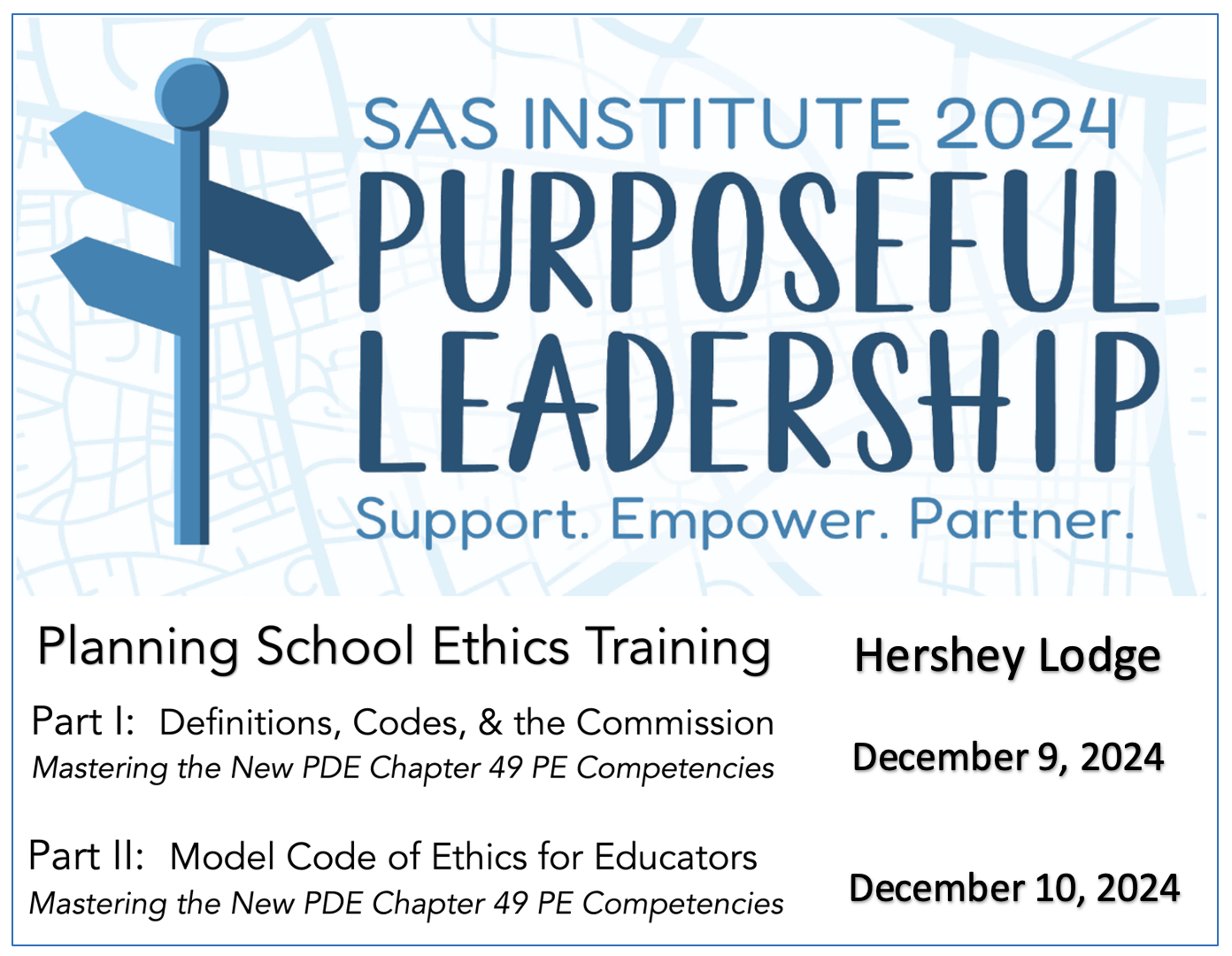
Slide Summaries for the PDE Purposeful Leadership Conference (if you attended) are available from the SAS Institute’s conference app: Eventsquid.

Upon completion of the 25-hour course, the PowerPoints for all four sessions of the Thomas W. Bailey Act 45 class series were emailed to the participants.

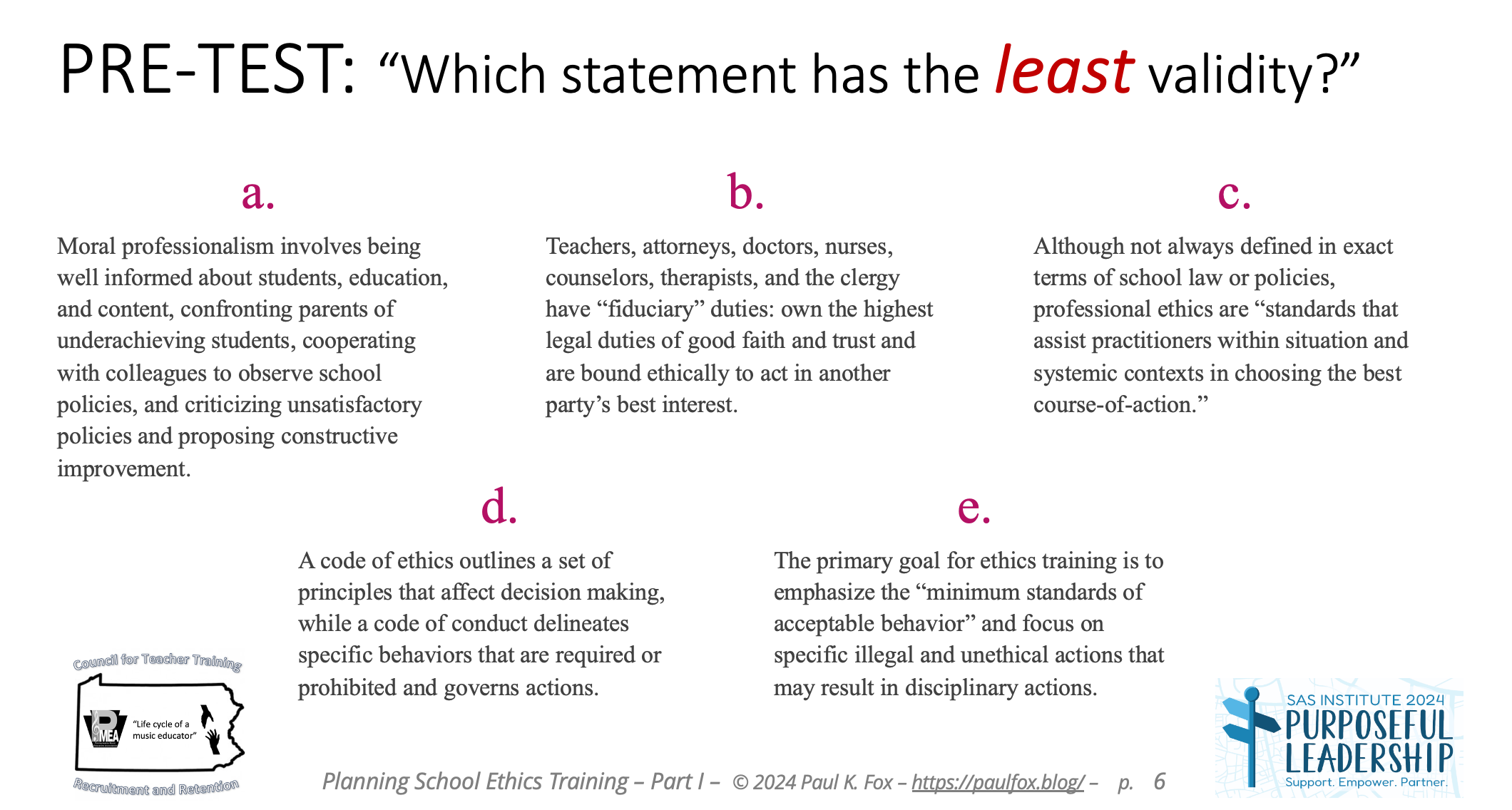
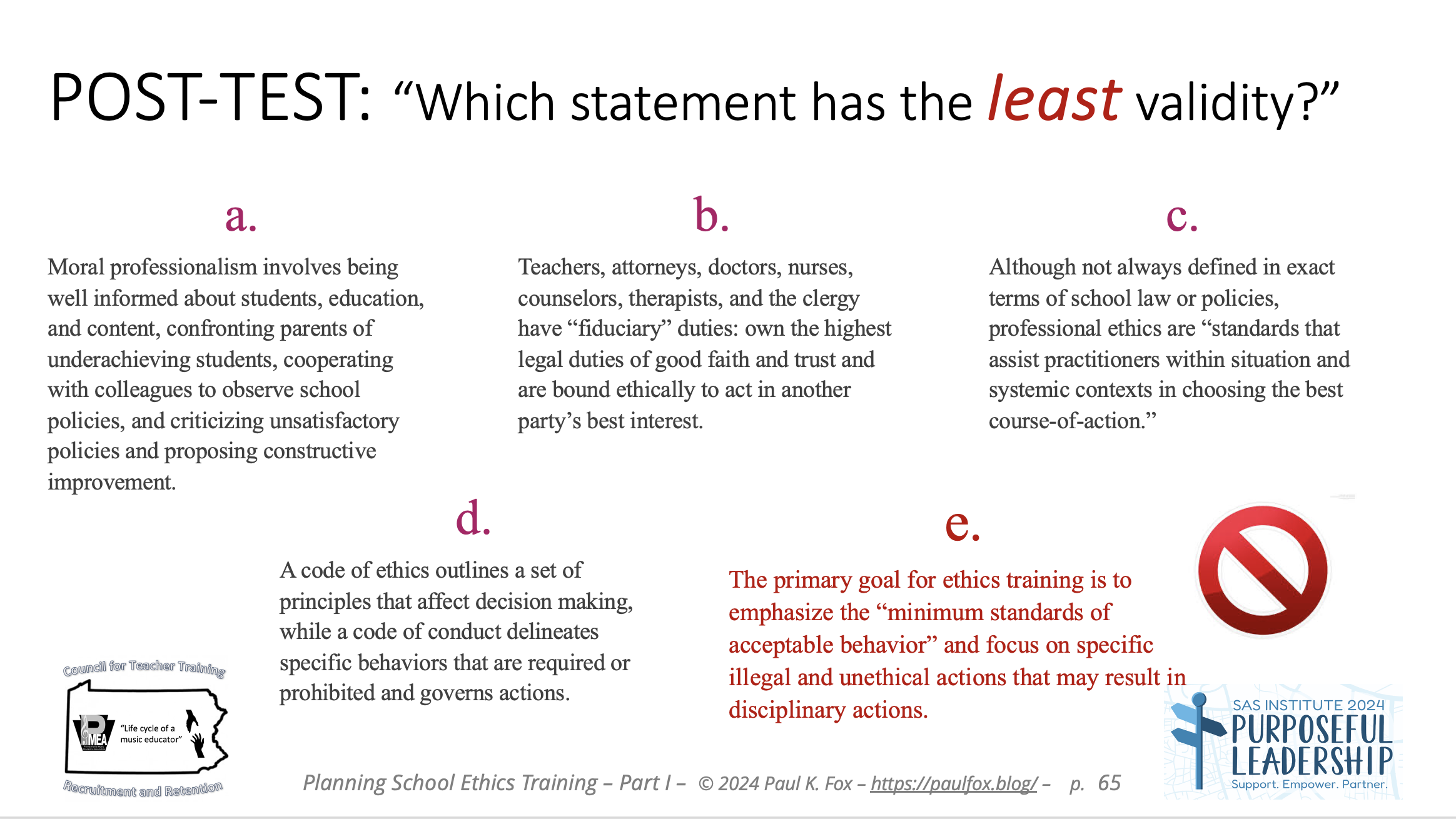
Here is the PRE-TEST for both events.

What is your “best guess?”
UPDATES TO RESEARCH LINKS

Act 126 Child Abuse and Reporting Training
https://www.pa.gov/agencies/pspc/content-pages/outreach/act-126-training.html

Adjudications & Orders (PA Certificate Actions)
https://www.pa.gov/agencies/education/programs-and-services/educators/educator-misconduct/certification-actions.html

Attorney (PA) Rules of Professional Conduct
https://www.padisciplinaryboard.org/for-attorneys/rules

California BTES – Overview of the Ethnographic Study by David Berliner and William Tikunoff
https://journals.sagepub.com/doi/abs/10.1177/002248717602700107?journalCode=jtea

Certificate Actions (Adjudications & Orders)
https://www.pa.gov/agencies/education/programs-and-services/educators/educator-misconduct/certification-actions.html

Chapter 49 Ethics Training
https://www.pa.gov/agencies/pspc/resources/chapter-49-ethics-training.html

Cleveland Board of Education v. James Loudermill (US Supreme Court 1985)
https://www.twbaileylaw.com/blog/educator-court-case-blog-1/may-a-school-district-employee-be-dismissed-without-prior-opportunity-to-respond-to-allegations-of-wrongdoing-4

Code of Professional Practice and Conduct
https://www.pacodeandbulletin.gov/Display/pacode?file=/secure/pacode/data/022/chapter235/chap235toc.html&d=reduce OR
https://paulfox.blog/wp-content/uploads/2024/12/code-of-conduct-revised.pdf

Codes (Conduct vs. Ethics), Types of
https://www.amazon.com/Music-Education-Your-Hands-Introduction/dp/0415800900

Commission Publications (Professional Standards & Practices Commission)
https://www.pa.gov/agencies/pspc/resources/commission-publications.html

Connecticut State Department of Education TEAM Program Manual
https://portal.ct.gov/sde/team/teacher-education-and-mentoring-team-program/documents

Contract Termination 11-1122 Public School Code of 1949
https://govt.westlaw.com/pac/Document/NB5B9C950342F11DA8A989F4EECDB8638?viewType=FullText&originationContext=documenttoc&transitionType=CategoryPageItem&contextData=(sc.Default)

Criminal History 1-111 Public School Code of 1949
https://govt.westlaw.com/pac/Document/NB6D6E91007EE11EA8D85D136C641FF9C?viewType=FullText&originationContext=documenttoc&transitionType=CategoryPageItem&contextData=(sc.Default)

The Danielson Group
https://danielsongroup.org/

Digital Tips (Online Boundaries) for Educators (Professional Standards and Practices Commission)
https://www.pa.gov/agencies/pspc/resources/commission-publications/digital-tips-for-educators.html

Educator Discipline Act
https://www.pa.gov/content/dam/copapwp-pagov/en/pspc/documents/statutes-regs-forms/educator%20discipline%20act.pdf and
https://www.pspc.education.pa.gov/Statutes-Regulations-Policies-Forms/Educator-Discipline-Act/Pages/default.aspx

Educator Misconduct
https://www.pa.gov/agencies/education/programs-and-services/educators/educator-misconduct.html

Ethical Dilemmas of In-Service Music Educators by Joelle L. Lien
https://act.maydaygroup.org/articles/Lien11_1.pdf

The Ethical Educator (Frequently Asked Questions)
https://www.pa.gov/content/dam/copapwp-pagov/en/pspc/documents/ethical-practices/publications/the%20ethical%20educator%20and%20professional%20practices.pdf

Ethical Equilibrium – Troy Hutchings’ work
https://slideplayer.com/slide/12243050/ and
https://vimeo.com/126979216

Ethics Toolkit – Teacher Preparation Programs (missing from revised PDE website?)
https://www.pa.gov/agencies/pspc/resources/information-for-school-administrators/teacher-preparation-programs.html
Web archive: https://web.archive.org/web/20240807121601/https://www.pspc.education.pa.gov/Promoting-Ethical-Practices-Resources/Ethics-Toolkit/Pages/default.aspx

General Assembly (PA)
tps://www.legis.state.pa.us/

Iowa Board of Education Examiners (Moral vs. Ethical Standards)
https://slideplayer.com/slide/12203932/

Loudermill Hearings – Court Case Blog (US Supreme Court 1985)
https://www.twbaileylaw.com/blog/educator-court-case-blog-1/may-a-school-district-employee-be-dismissed-without-prior-opportunity-to-respond-to-allegations-of-wrongdoing-4

Model Code of Ethics for Educators
https://www.nasdtec.net/page/MCEE_Doc and
https://www.nasdtec.net/page/MCEE_Video_Series

Moral Development Philosophy by Lawrence Kohlberg
https://archive.org/details/essaysonmoraldev0000kohl

Moral Professionalism (Wynne, E. A. (1995). The moral dimension of teaching)
https://www.itejournal.org/wp-content/pdfs-issues/spring-2013/08bergman.pdf

Moral v. Ethical Standards (Iowa Board of Educational Examiners)
https://slideplayer.com/slide/12203932/

National Association of State Directors of Teacher Education and Certification
https://www.nasdtec.net/ and
https://www.nasdtec.net/page/MCEE_Video_Series

Pennsylvania Code & Bulletin (Title 22 Education)
https://www.pacodeandbulletin.gov/Display/pacode?titleNumber=022&file=/secure/pacode/data/022/022toc.html&searchunitkeywords=&operator=OR&title=null

Pennsylvania Code (Title 23 Child Protection Services)
https://govt.westlaw.com/pac/Document/NAD136501756B11E88795828A65D8C1A1?viewType=FullText&originationContext=documenttoc&transitionType=CategoryPageItem&contextData=(sc.Default)

Professional Ethics Program Framework Competencies
https://www.pa.gov/content/dam/copapwp-pagov/en/education/documents/educators/certifications/professional%20ethics%20program%20framework%20guidelines.pdf

Professional Standards and Practices Commission
https://www.pa.gov/agencies/pspc.html and
https://www.pacodeandbulletin.gov/Display/pacode?file=/secure/pacode/data/022/chapter233/chap233toc.html and
https://www.pa.gov/agencies/pspc/resources/commission-publications.html

Public School Code of 1949
https://www.legis.state.pa.us/WU01/LI/LI/US/HTM/1949/0/0014..HTM or
https://govt.westlaw.com/pac/Document/NB5B9C950342F11DA8A989F4EECDB8638?viewType=FullText&originationContext=documenttoc&transitionType=CategoryPageItem&contextData=(sc.Default)

Rules for Teachers (1872 & 1915)
https://www.openculture.com/2013/09/rules-for-teachers-in-1872-1915-no-drinking-smoking-or-trips-to-barber-shops-and-ice-cream-parlors.html

Simon Sinek
https://simonsinek.com/

Slater v. PDE Case Citation
https://caselaw.findlaw.com/court/pa-commonwealth-court/1465107.html

Statutes, Regulations, Policies and Forms (Department of Education)
https://www.pa.gov/search.html#q=Statutes%20Regulations&f-copapwpagency=Department%20of%20Education,Department%20of%20Health or
https://www.pa.gov/agencies/education/programs-and-services/educators.html

Teacher Preparation Programs
https://www.pa.gov/en/agencies/pspc/resources/information-for-school-administrators/teacher-preparation-programs.html

Thomas W. Bailey Court Case Blogs
https://www.twbaileylaw.com/blog

Thomas W. Bailey PDE-Approved Act 45/PIL and Act 48 Courses
https://www.twbaileylaw.com/

If you missed the SAS Institute 2024 in Hershey and still need help in designing your own educator ethics training in-service or mentor/mentee induction programs, check out the Thomas W. Bailey website here. Consider registering for our next 25-hour PDE-approved Act 45 online course.
Finally, the answer to the above PRE-TEST is letter “D” (NOT):
Please reach out to Paul Fox (click here) if you find any of the above links have gone inactive or have suggestions/updates to this blog-post.

PKF

© 2024 Paul K. Fox
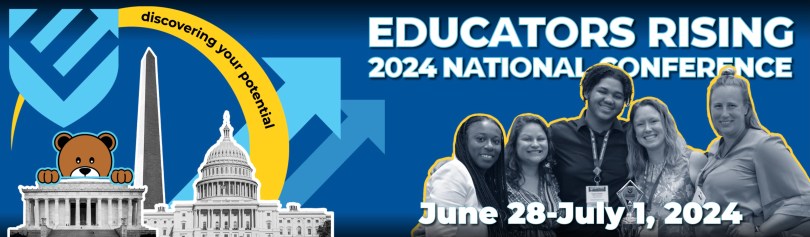
Rising Educators Conference

June 28-July 1, 2024
Marriott Marquis – Washington D.C

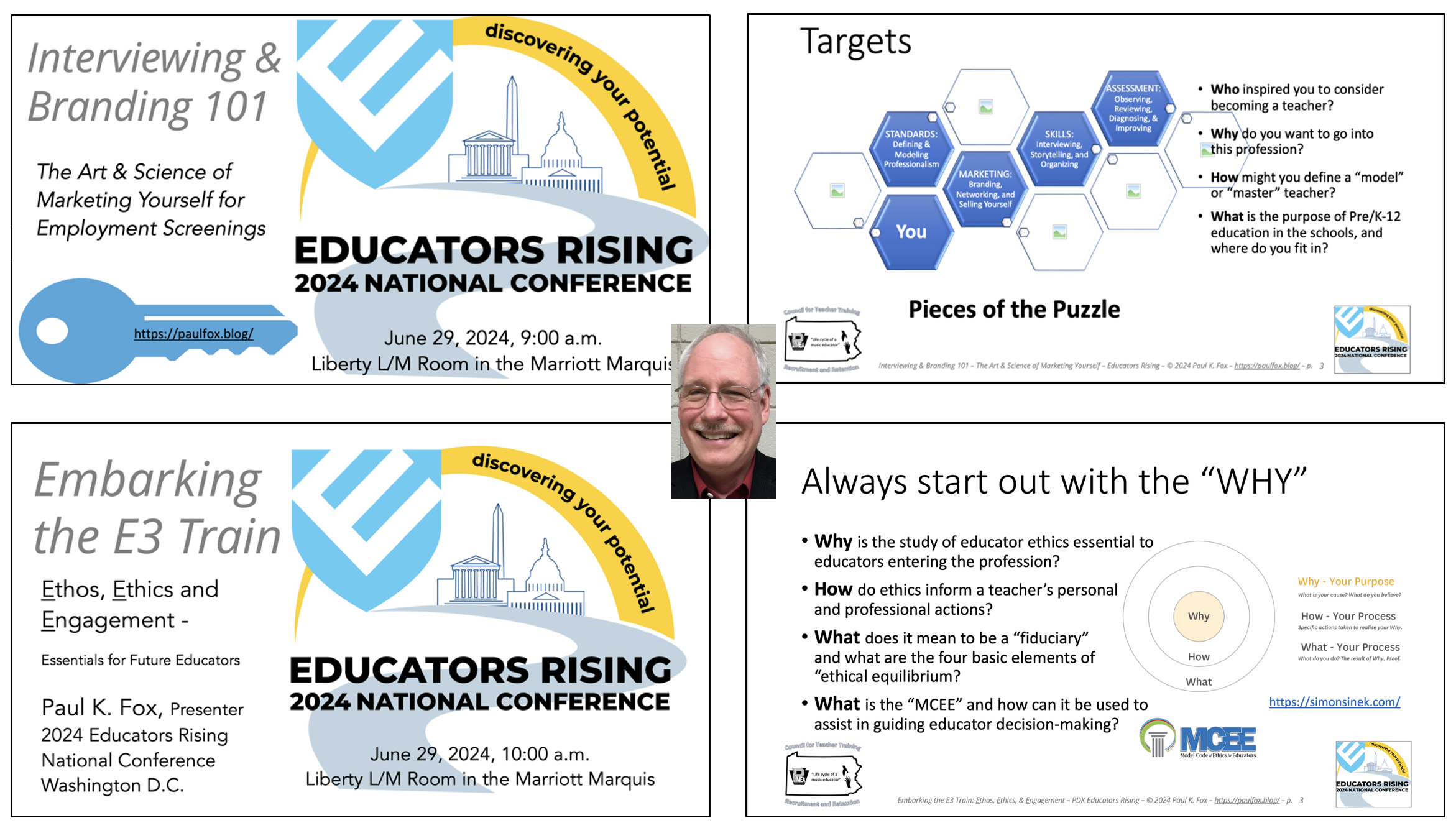
It is my pleasure to be invited to present two sessions at the Educators Rising Conference on June 29, 2024 in the Liberty L/M Room of the Marriott Marquis in Washington D.C.

This is a very unique venue, something in which I encourage other educators and clinicians to consider participating. The event brings together prospective future educators, middle to high school and college education majors, with veteran practitioners and experienced educators in the profession. This is from their website:

Each year, Educators Rising hosts a national conference to convene our network of rising educators and teacher leaders. It’s a unique opportunity for students and their teacher leaders to:

  • Connect and learn from each other through more than 40 breakout sessions;
  • Network with other members from across the country;
  • Compete for national titles in competitive events designed to allow students to develop and showcase their teaching skills; and
  • Be inspired by keynote presentations from national education leaders

Want to learn more about what you can look forward to for 2024? Check out the 2023 National Conference Program Book, 2023’s Conference Daily, and our conference highlight video to see what current and future educators experienced last year.

An outline of the conference schedule may be viewed here. Additional information may be found at the conference website here. You can still register for the event.

My two offerings will not come as a surprise to anyone who has been following my work at this site:

GETTING A JOB

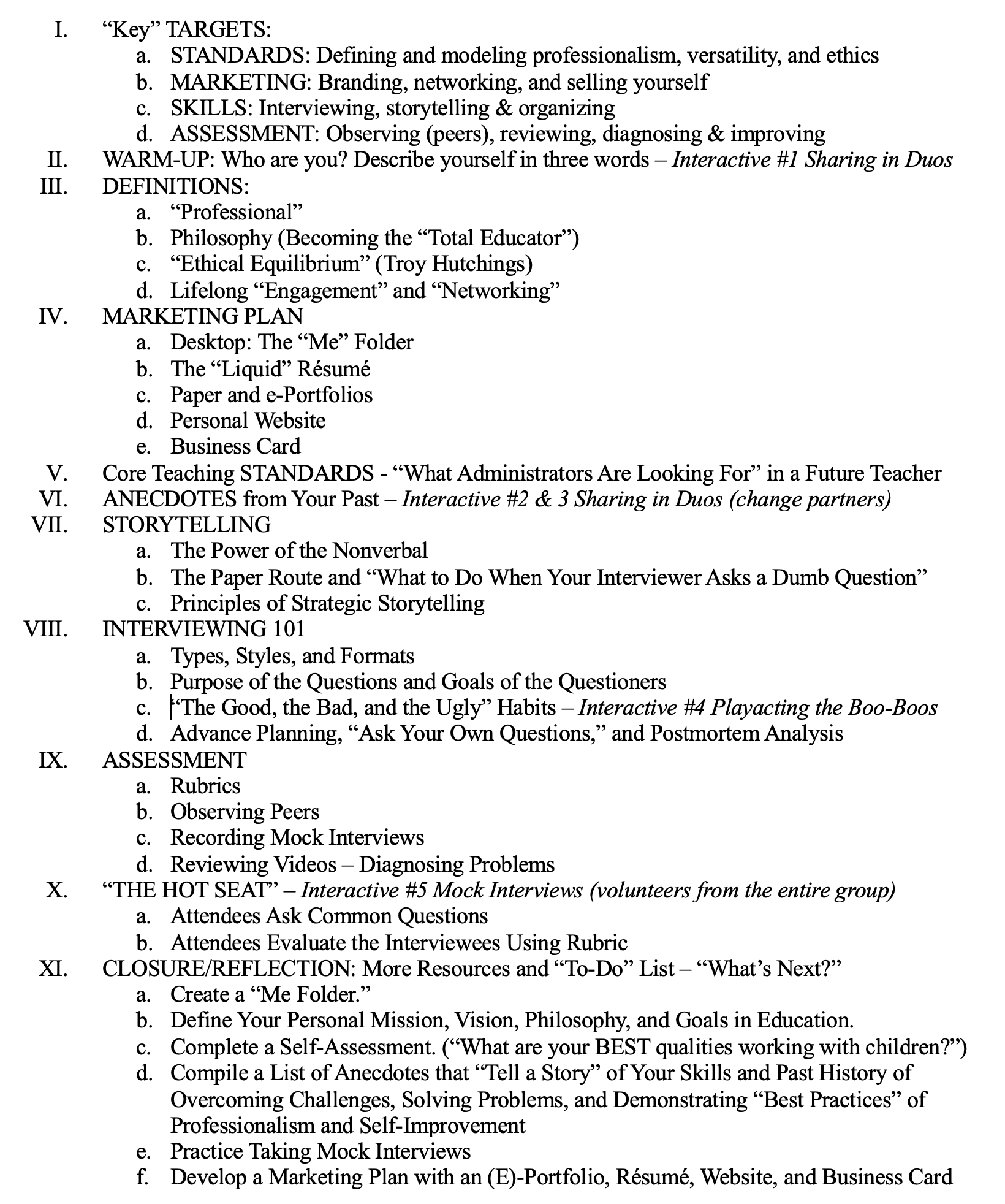
My first workshop, “Interviewing & Branding 101” (Saturday, June 29 at 9 a.m.) will provide an overview of important definitions (e.g., “professional,” “total educator,” etc.) and dive into interactive exercises to exploring the basic building blocks of personal self-assessment, building “a brand” and “marketing plan” for the job search, practicing networking and storytelling skills, and analyzing and “playacting” better interviewing techniques. Although I will need to shorten the presentation to fit in the 45-minute time block allotted and provide more focus on the interactive partner and small group exercises, this was the initial outline that was accepted by the Rising Educators Conference Session Selection Committee:

My favorite candy, Hershey Symphony bars, will be distribute as incentives for the more “brave” attendees who volunteer themselves to serve as good (as well as bad) models of the mock interviews.

In conclusion, this is “the session” I wish someone would have provided me before I went out into the labor market! We will have some fun connecting with each other, learning something new about our core values, goals, and strengths – especially those areas we want to broadcast to future employers – building a marketing plan of the essentials to promote ourselves in future employment screenings, and breaking-out into “duos” and small groups to “practice-practice-practice!” The branding and interviewing exercises and suggestions may be applied to finding any job, but will definitely be a big help for landing “the one” teaching position you always wanted.

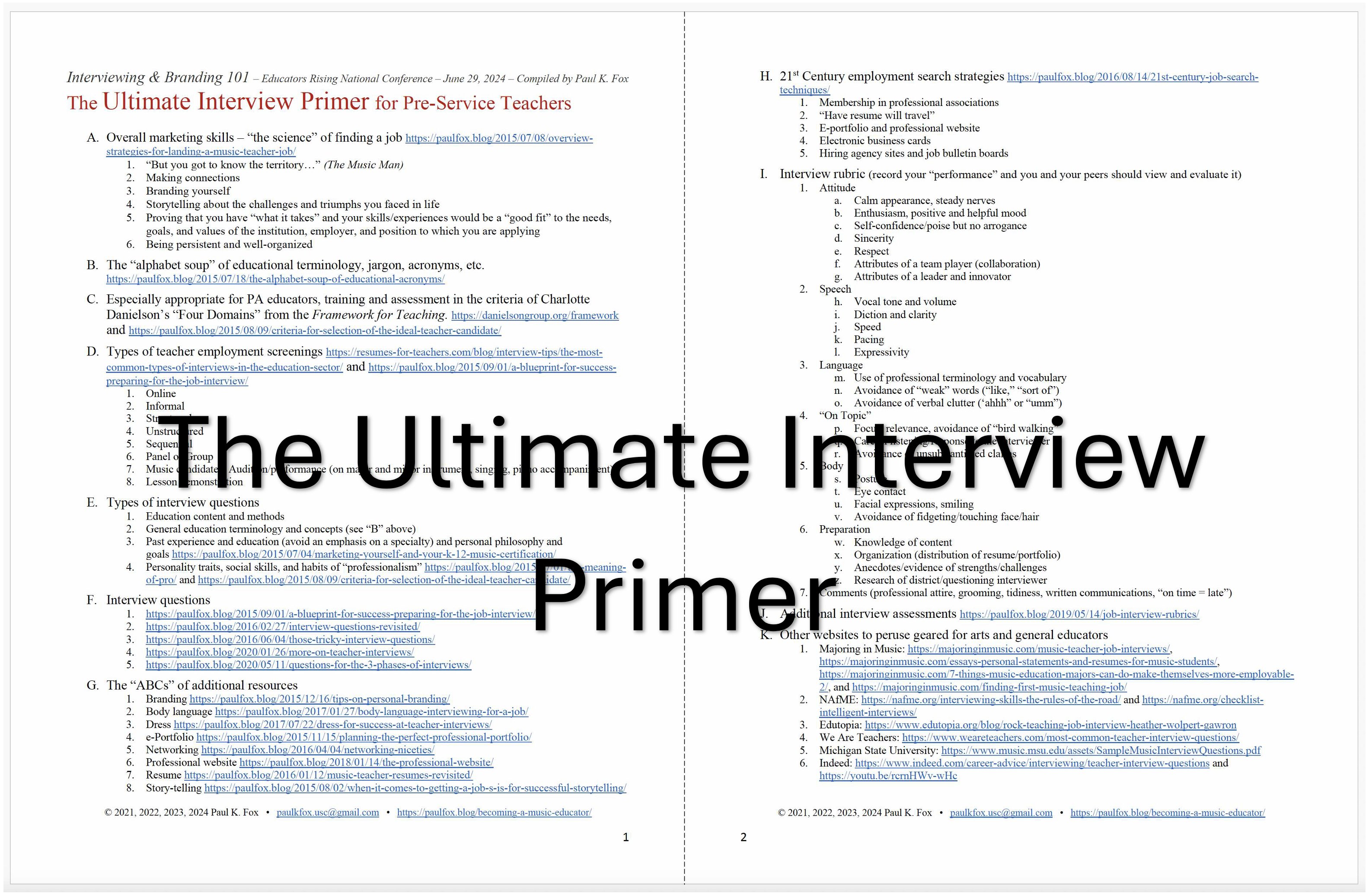
For the participants who attend my session (facsimile of slides available after June 28), here are links to the printed handouts and other supplemental materials:

EDUCATOR ETHICS

My second workshop (offered one hour later), “Embarking the E3 Train – Ethos, Ethics, & Engagement,” brings to fruition my passion for the preparation of future educators to embrace the essential ethical standards of our profession. Again, back in 1977, no college methods course nor student teaching prep covered the meaning behind such terms as “fiduciary,” “ethical equilibrium,” “moral professionalism,” etc. To be fair to my college professors, Pennsylvania had not yet written its Code of Professional Practice and Conduct which now “governs” the educators in our Commonwealth, nor had the National Association of State Directors of Teacher Education and Certification facilitated the creation of the amazing document called The Model Code of Ethics for Educators. It was not until 2017 (four years after I retired) when I was asked to research and present my first educator ethics session for PMEA District 7 did I “discover” the need for interactive, open, peer discussion of these core questions:

  • How do ethics inform a teacher’s personal and professional actions?
  • Why is the study of educator ethics essential for all educators entering the profession?
  • What does it mean to be a “fiduciary” and “moral exemplar” in the community?
  • What is the difference between a “Code of Conduct” and a “Code of Ethics?” Is one more important than the other?
  • How do you avoid any action and/or appearance of impropriety, and prevent the “slippery slope” of inappropriate student-teacher relationships, and other ethical problems?

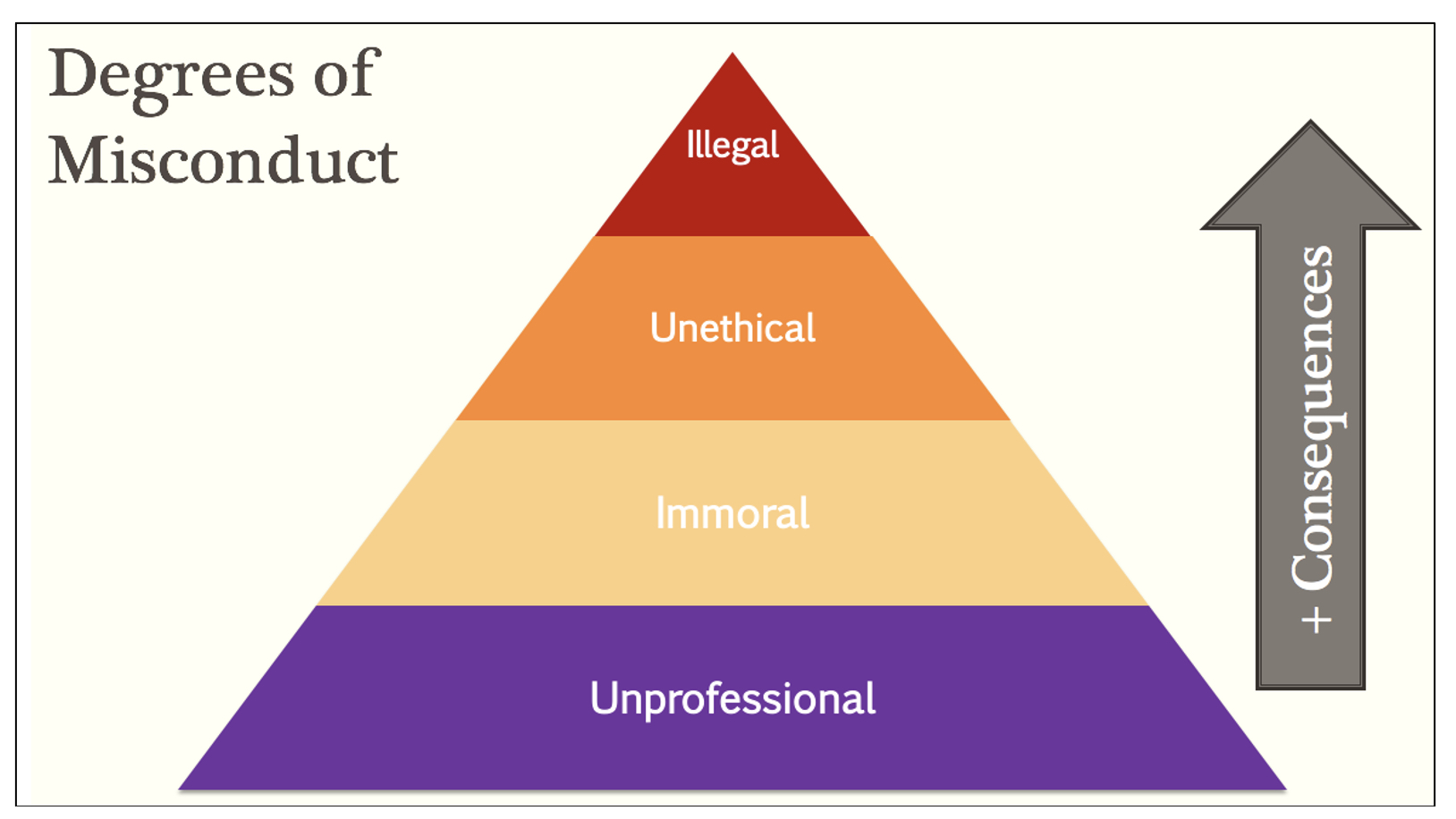
During this presentation on Saturday, June 29 at 10 a.m., we will discuss the thousands of daily rapid-fire decisions (many snap judgments) of teachers and evaluate the potential effects of any who “stray” – “levels of misconduct + consequences.” Furthermore, we will unpack and review a portion of the five principles, 18 sections, and 86 standards in the Model Code of Ethics for Educators. Fostering open and interactive discussion, we will empanel a mock “ethics jury” (volunteers from the attendees) to assess fictitious “fact scenarios” of potential ethical issues, hazardous choices or vulnerabilities, and even tackle a few “conundrums” or problems in educator decision-making. Our jurors will receive our thanks and an Educators Rising Mock Jury t-shirt for their “willingness to serve as guinea-pigs.”

Admittedly, some of our past material on ethics was “for mature audiences only” resulting in the need for adjustments to be made to some of the hypothetical case studies (serious infractions) for group analysis. However, the majority of my work on educator ethics is available for review on this site (in reverse chronological order) by clicking here.

Here are additional case studies for group discussions of ethical dilemmas.

For the participants who attend my Washington D.C. session on June 29, 2024, a facsimile of “Embarking the E3 Train” slides are available. (CLICK HERE.)

PKF

© 2024 Paul K. Fox

Launching PA Educator Ethics Training

Implementing the NEW PDE Chapter 49 “PE” Competencies – “The WHO, WHAT, WHY, & HOW!”

Blogger’s Note: We will return to Part II of “Bookends” next month to explore:

  • Stage 3: Inservice/Growing Years
  • Stage 4: Veteran/Sustaining Years
  • Stage 5: Next Chapter/Living the Dream

Instead, our November blog will share methods, modes, media, and other materials to provide meaningful professional development on ETHICS for EDUCATORS in the Commonwealth, resources from my upcoming presentation to school administrators at the Pennsylvania Department of Education’s SAS Institute – Successful Leadership – Shaping Your School’s Story to be held in the Hershey Lodge and Convention Center on December 11-13, 2023. Click below for my handouts.


PKFox

Interested in joining us at the Hershey Lodge on December 11-13, 2023? Please click here for more information or to register.

A Summary of My SAS Institute Ethics Session

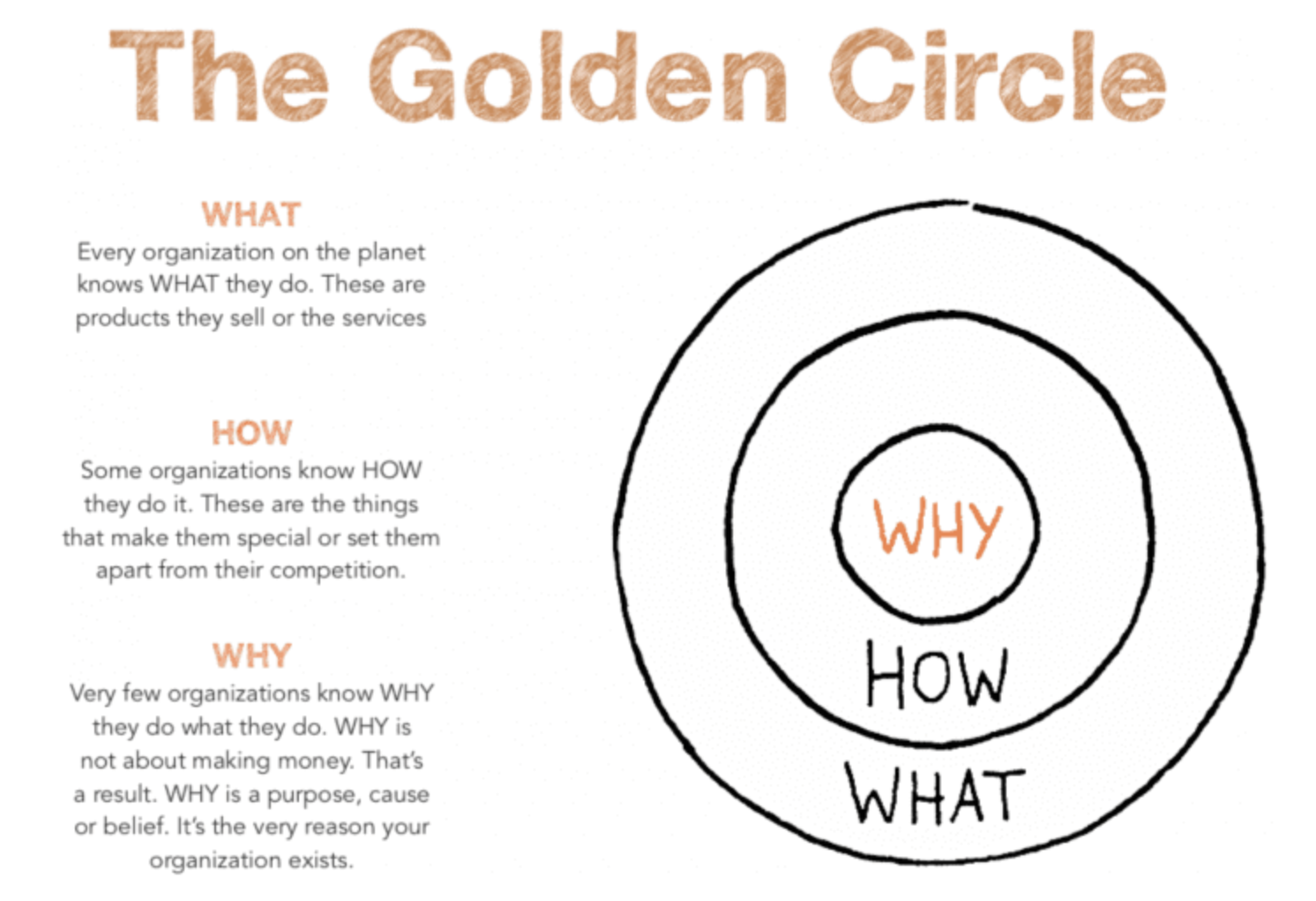
To paraphrase the wisdom of one of my favorite recent visionaries and online workshop presenters, Simon Sinek, “Every organization should begin with “the WHY!” According to SmartInsights, Sinek’s Golden Circle theory explains “how leaders can inspire cooperation, trust and change in a business based on his research into how the most successful organizations think, act and communicate if they start with why.” On his website, he declares his own WHY: “We are here to inspire people to do the things that inspire them so that, together, each of us can change our world for the better.” I love his mission!

https://www.smartinsights.com/digital-marketing-strategy/online-value-proposition/start-with-why-creating-a-value-proposition-with-the-golden-circle-model/

“Your WHY is your purpose, cause, or belief. WHY does your company exist? WHY do you get out of bed every morning? And WHY should anyone care about the work you do?” – Simon Sinek

So… lets ask the questions that define our own golden circle, my session, and this article:

  • WHY should we be so concerned about professional development in ethics for PA educators?
    (Why should you even be reading this blogpost?)
  • HOW should we train our staff?
  • WHAT should be introduced and reinforced over the long term?

And, I will add one additional question: WHO is responsible for all of this?

Well, the quick response to that last query is EVERYONE in the profession. However, this blog is particularly geared to school system leaders, career and technical center directors, and administrators charged with the responsibility of continuing education/professional development and induction programs for their PA educators.

The “WHY!”

Quick. Calling on all PA teachers! Without looking on the Internet, can you identify the exact title of your “code of conduct” (1)? Do you know the PA agency responsible for writing this code and adjudicating its rules (2)? Can you name the “code of ethics” recently adopted by PDE and the Board of Education which provides school staff comprehensive guidance in professional decision-making based on context (3)?

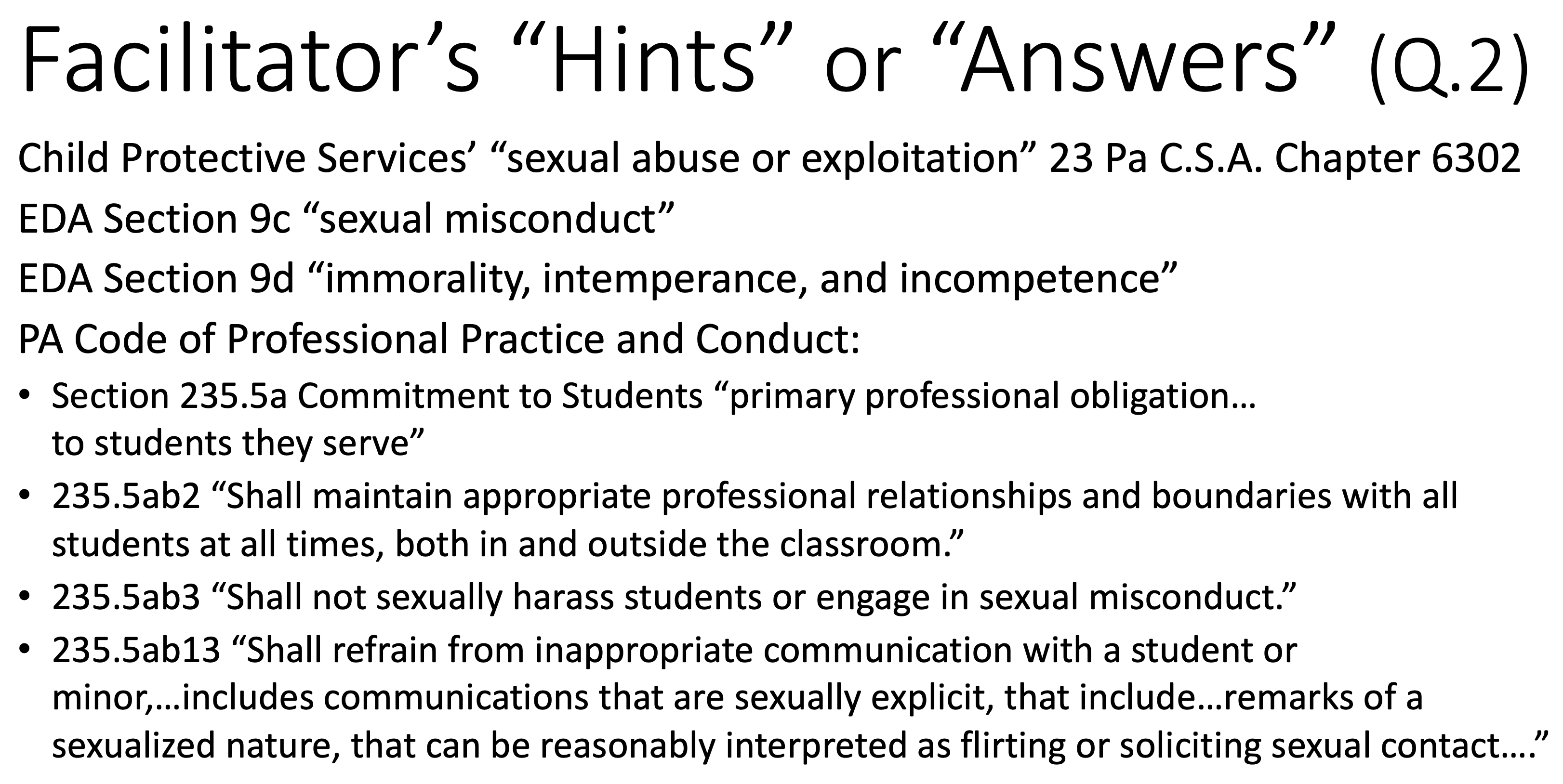
Hints? How about a few acronyms?

  1. CPPC
  2. PSPC
  3. MCEE?

Don’t you think “we” should at least be familiar with the commission that grants us the license to teach in PA as well as the document that “governs” our behavior, violations of which could remove us from our job or revoke our certificate?

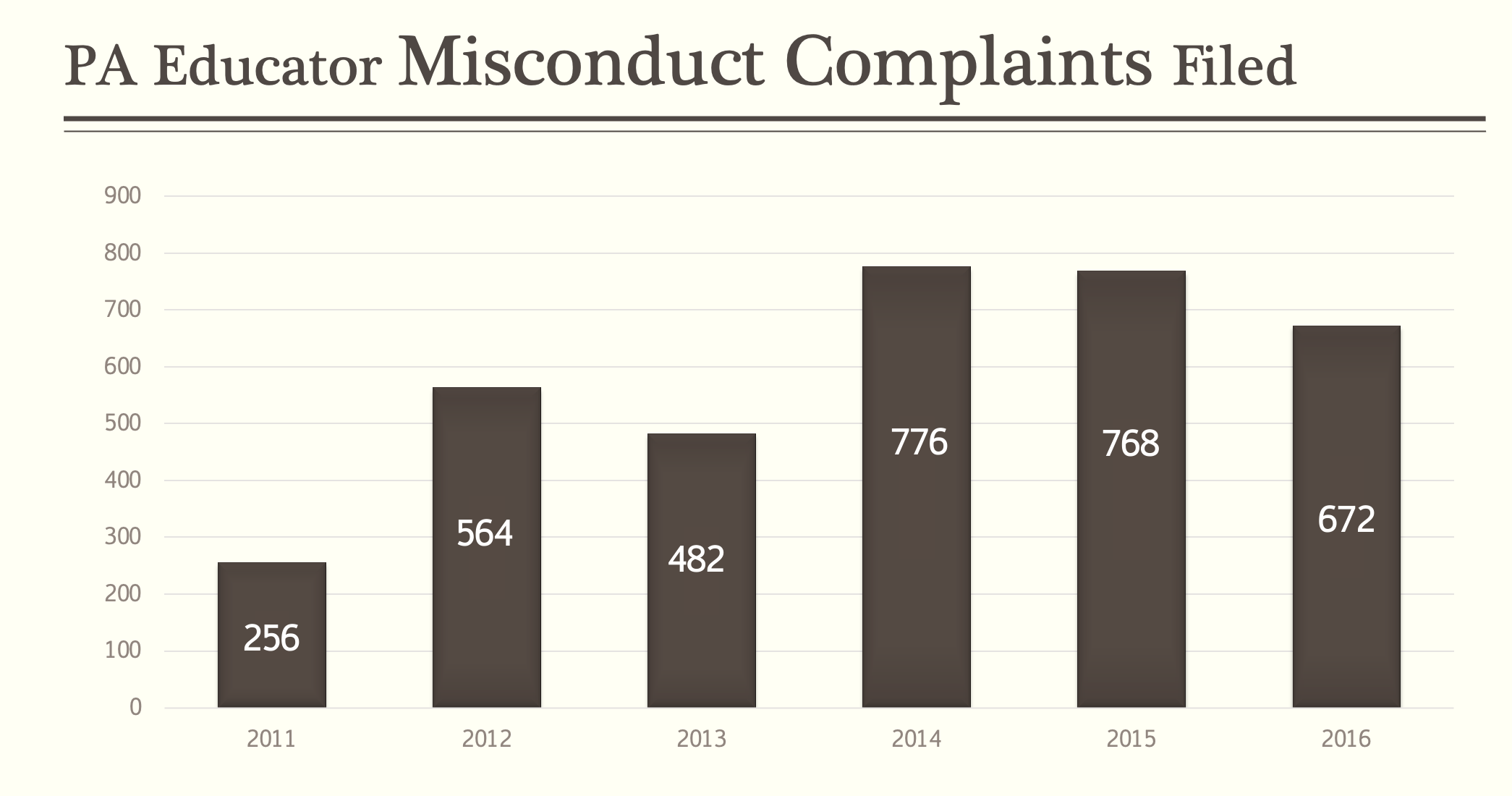
Of course, six years ago, even I didn’t know we had a PA “code of conduct!” (I started teaching in the public schools in 1978 and it wasn’t written until 1992!) After retiring from full-time teaching in 2013, I was asked to present my first ethics workshop back in 2017 for a Pennsylvania Music Educators Association (PMEA) Regional In-Service Program. Already scheduling me for two other sessions, the organizer came to me, “Could you add a presentation on educator ethics?” My first reaction was, WHY? Why would this be necessary? I promised him I would do a little research before getting back to him… and found these (now updated) statistics. Here’s the WHY in a nutshell!

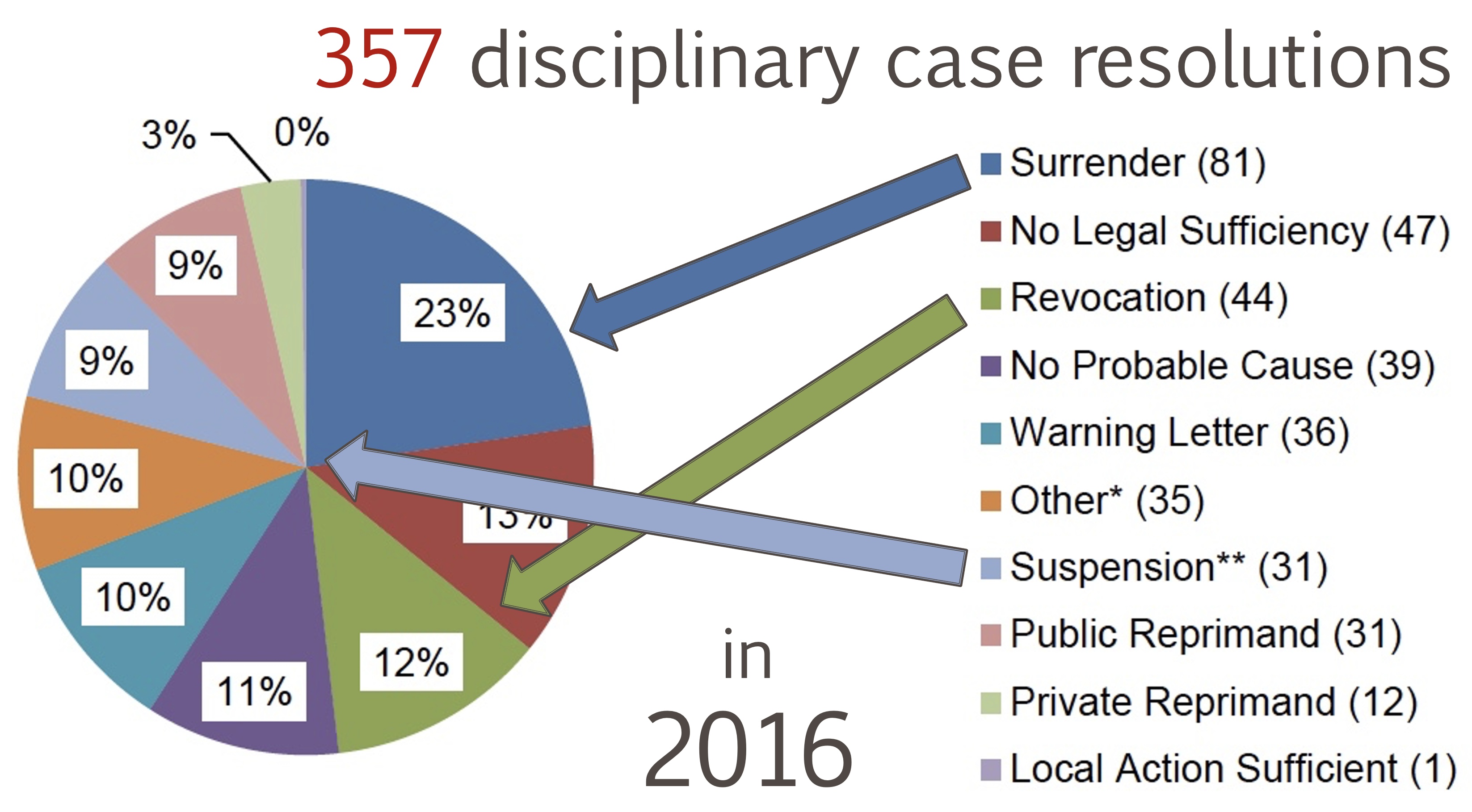
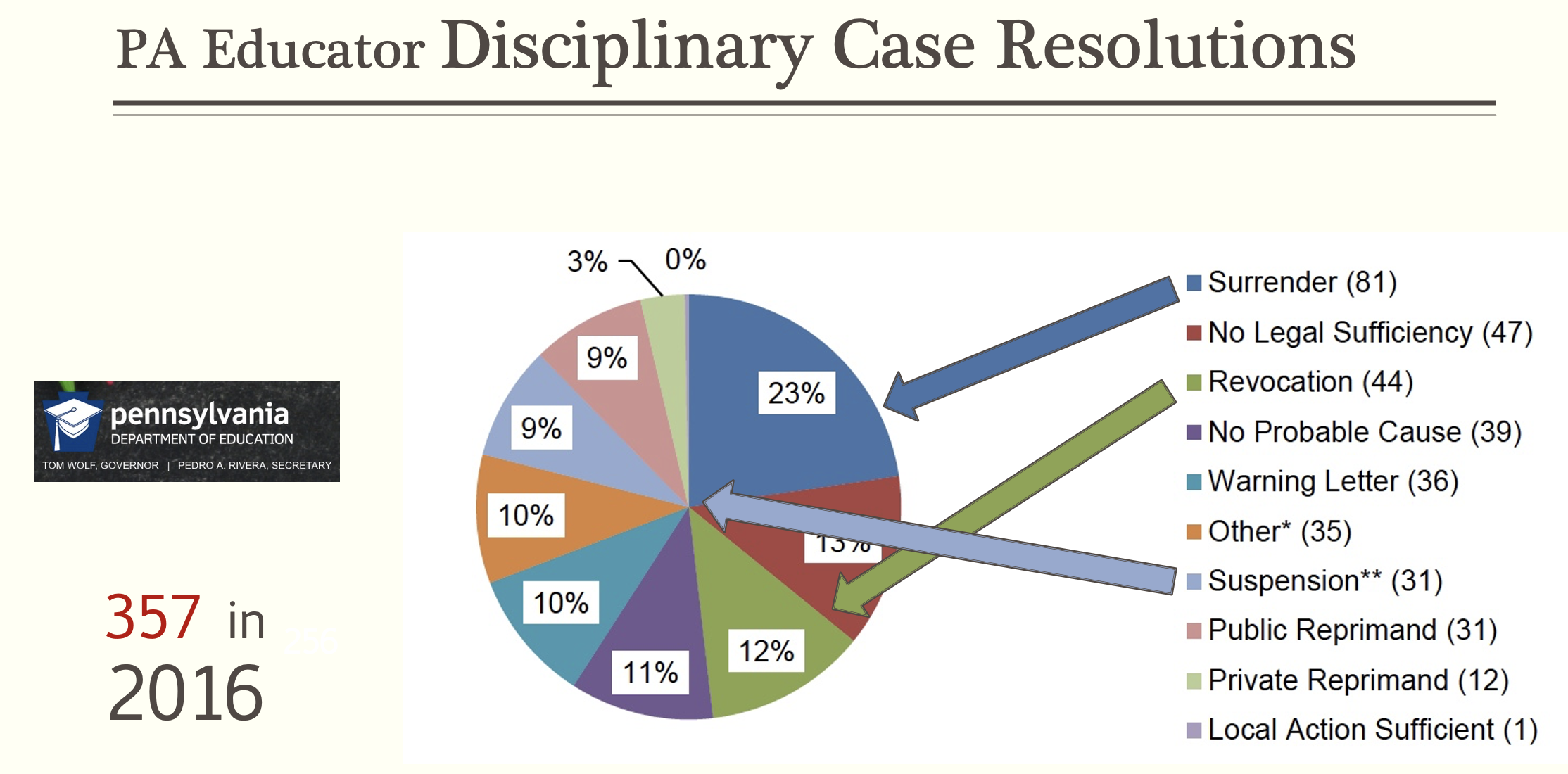
HORRIBLE! These are the number of PA educators by year who had misconduct complaints filed against them. Sure, a majority of their cases were not always fully prosecuted nor did they all result in a “guilty” verdict or plea, as this glimpse of educator disciplinary resolutions for 2016 (out of 672) for comparison shows (statistics from PDE):

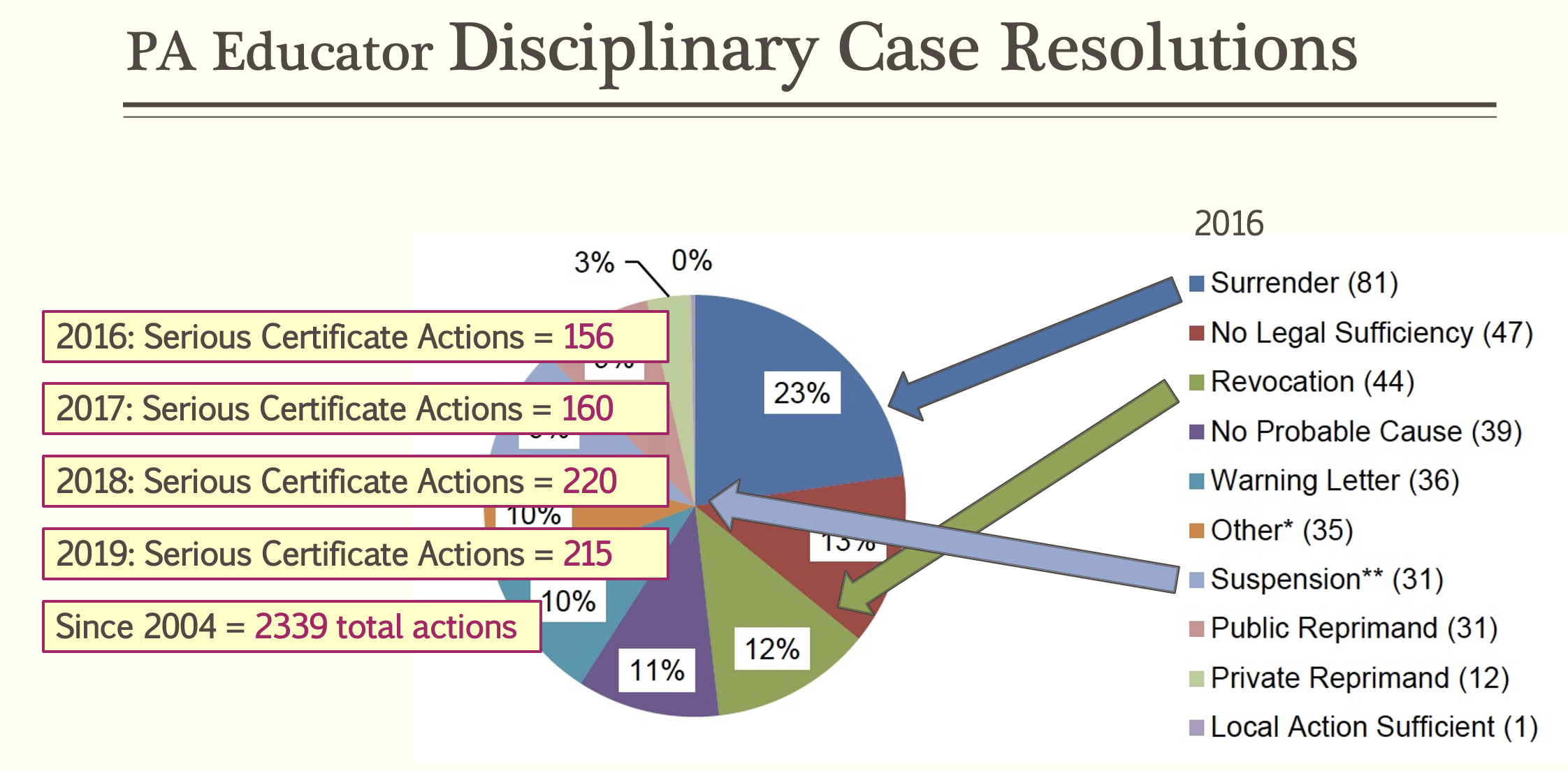
But, if you can read the above graphic, that means that in 2016, 156 educators surrendered their license or had their certificate suspended or revoked! Obviously, no matter how you interpret the stats, this is a SERIOUS PROBLEM! And it may be due to a lack of training or understanding of the regulations and principles of ethical decision-making!

Why is this topic crucial for all pre-service, “rookie,” AND experienced professional educators? It is essential… not so much to serve as a reminder of the penalties for ethical infractions or spotlighting the occurrences you read or hear about in the news… but, because ETHICS are what we all stand for, the values we exhibit in our day-to-day decision-making, the integrity of the profession, and our “making a difference” in the lives of the students.

Ignorance of the law is no excuse for breaking it.

(Oliver Wendell Holmes)

The “WHAT!”

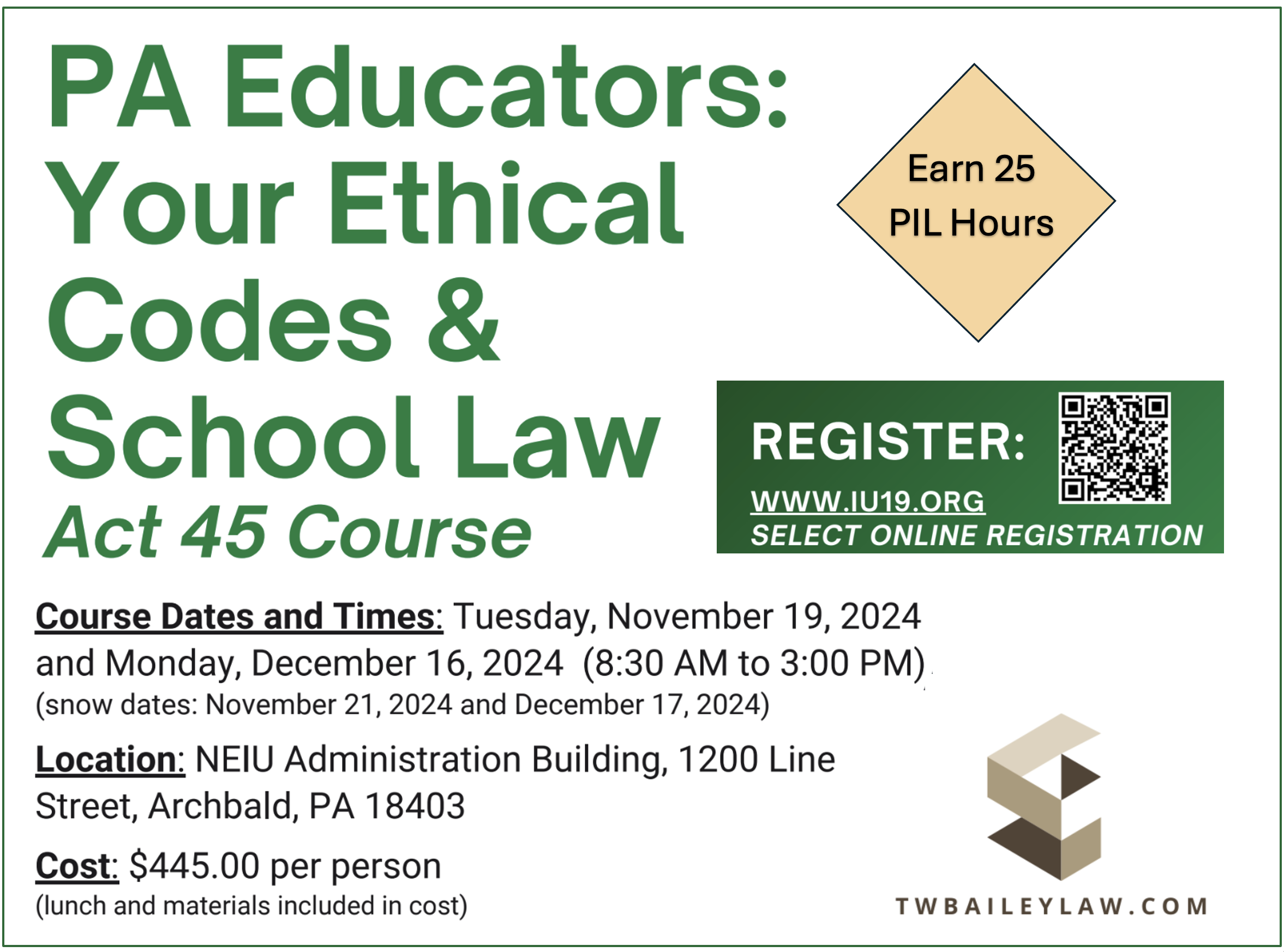
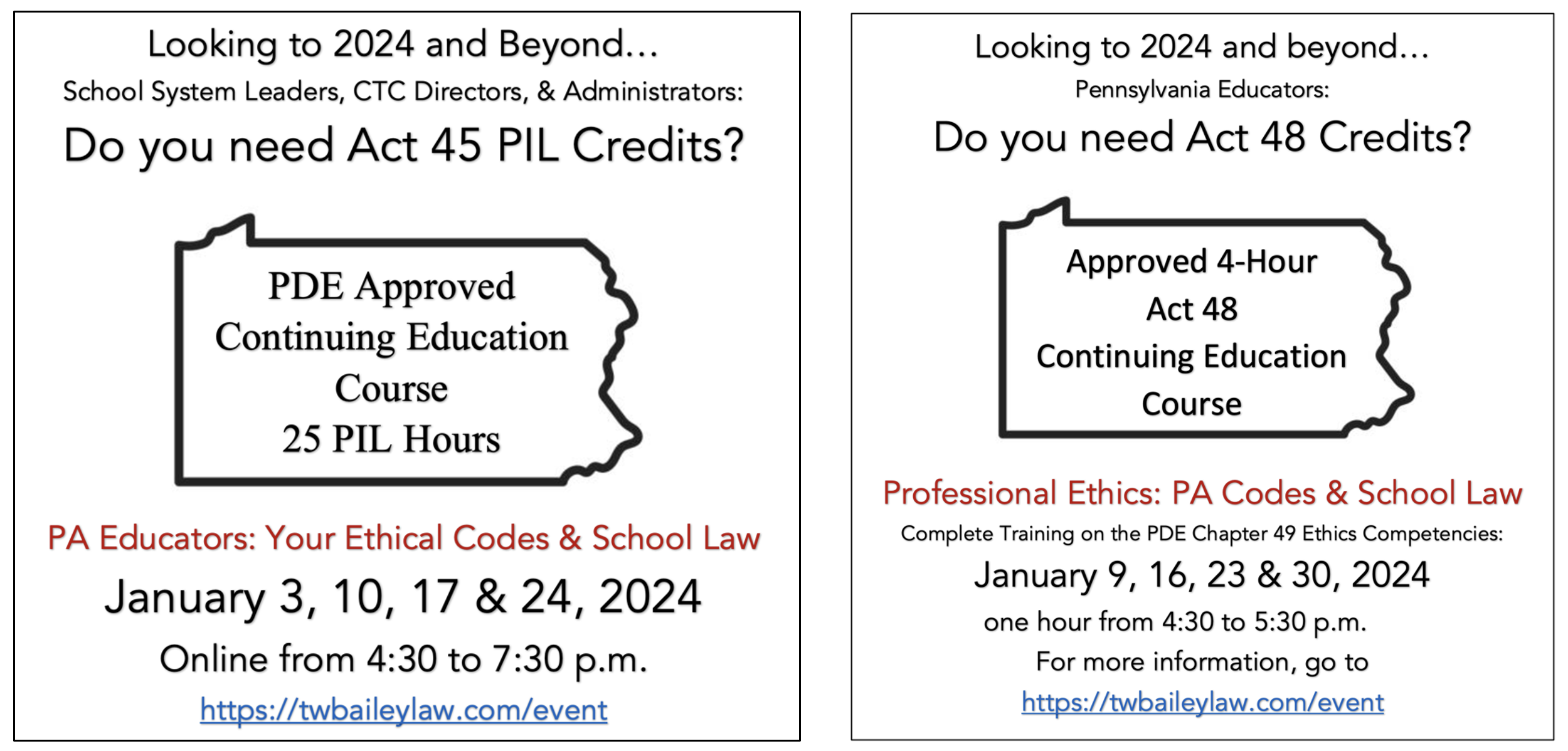
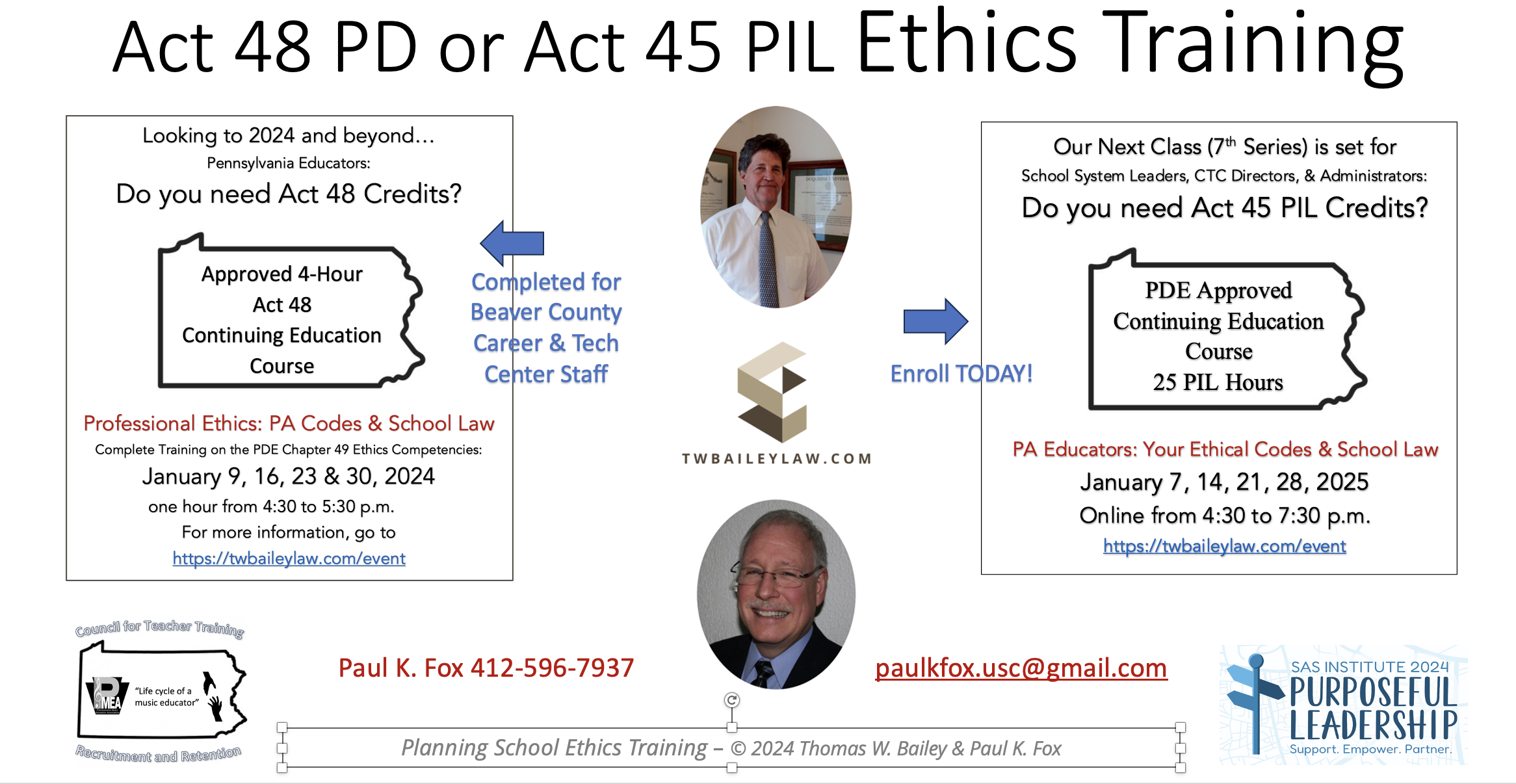
My colleague Thomas W. Bailey, a retired social studies teacher who reinstated his law license, and I set ourselves the goal of creating continuing education courses to provide REAL ethics training for PA educators. Thomas applied to the Pennsylvania Department of Education and received approval for a four-hour online Act 48 continuing education course for all PA educators (earning credits in PERMS) and a 25-hour online Act 45 PIL continuing education course for school system leaders, career and technical center directors, and other administrators responsible for planning the professional development of their school staff. The dates for our next two series of classes with open for enrollment in January 2024 are:

To register for either course, please go to Tom’s website: https://www.twbaileylaw.com/event.

Both of our courses satisfy the recently revised PDE Chapter 49 requirements of learning the “professional ethics” program framework guidelines:

For school system leaders and other administrators, PDE has set high expectations with the release of the following DEADLINES in April 2022:

“Chapter 49 requires instruction in professional ethics to be integrated in educator preparation, induction, and continuing professional development programs as follows.

  • Continuing professional development programs must integrate the professional ethics competencies no later than the 2023-24 academic year.
  • Educator preparation and induction programs must integrate the professional ethics competencies no later than the 2024-25 academic year.

Our Act 45 and Act 48 courses cover the following subjects, definitions, and applications of these terms:

  • Fiduciary
  • Ethical Equilibrium
  • Personal Morality
  • Regulations of Law
  • Professional Ethics
  • Professional Dispositions
  • Moral Professionalism
  • Differences Between Moral and Ethical Standards (with Examples)
  • Codes of Conduct (Examples)
  • Codes of Ethics (Examples)
  • Differences Between a Code of Conduct and a Code of Ethics
  • PA Professional Standards and Practices Commission
  • Paths of Educator Discipline in PA (Local and State)
  • Loudermill Hearings
  • State Discipline System (from Misconduct Complaint to Appeals)
  • PA Code of Professional Practice and Conduct
  • The Educator Discipline Act
  • National Association of State Directors of Teacher Education and Certification
  • Model Code of Ethics for Educators

The “How!”

I know this will sound a lot like bragging, but what makes the Thomas Bailey + Paul Fox ethics courses truly effective and different from everyone else in the game (albeit there are few “classes on the codes” sponsored in our geographic area) is the process – a focus on top-down training (administrator to teacher to student), interactive discussion, and a major emphasis on borrowing from the research of “Principled Teaching” in Domains 4a, 4d, 4e, and 4f of the Charlotte Danielson Framework for Teaching, the Teacher Education And Mentoring (TEAM) Module 5 Guide of the Connecticut State Department of Education, and the Facilitators Guide of the Iowa Board of Educational Examiners.

In my SAS presentation, I review several different modes of case study analysis, from simple to comprehensive, modeling small group interactive peer review, encouraging healthy discussions of diverse opinions in an “open,” non-threatening environment. The following approaches could be adapted to your setting of in-service programs or inductions:

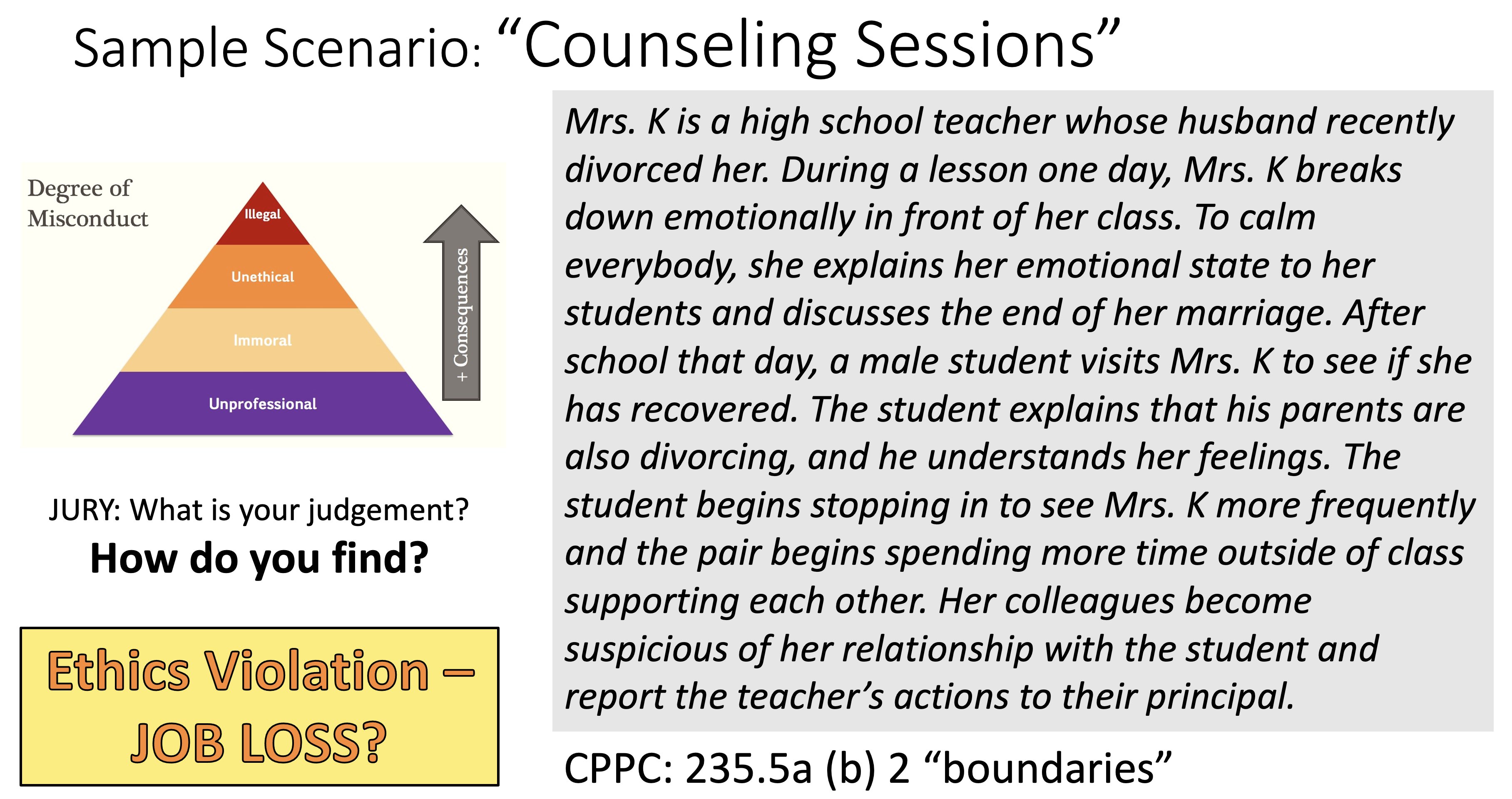
MOCK JURY

Degree of Misconduct, scenarios for learning the PA Code of Professional Practice and Conduct (CPPC): For more details, revisit the application of my misconduct rubric and explanation in the blog “Ethical Scenarios” here.

In collegiate sessions, I have used color-coded popsicle sticks and handouts of different hypothetical case studies for “the jury” to evaluate the behavior and “find the relevant code” in the CPPC.

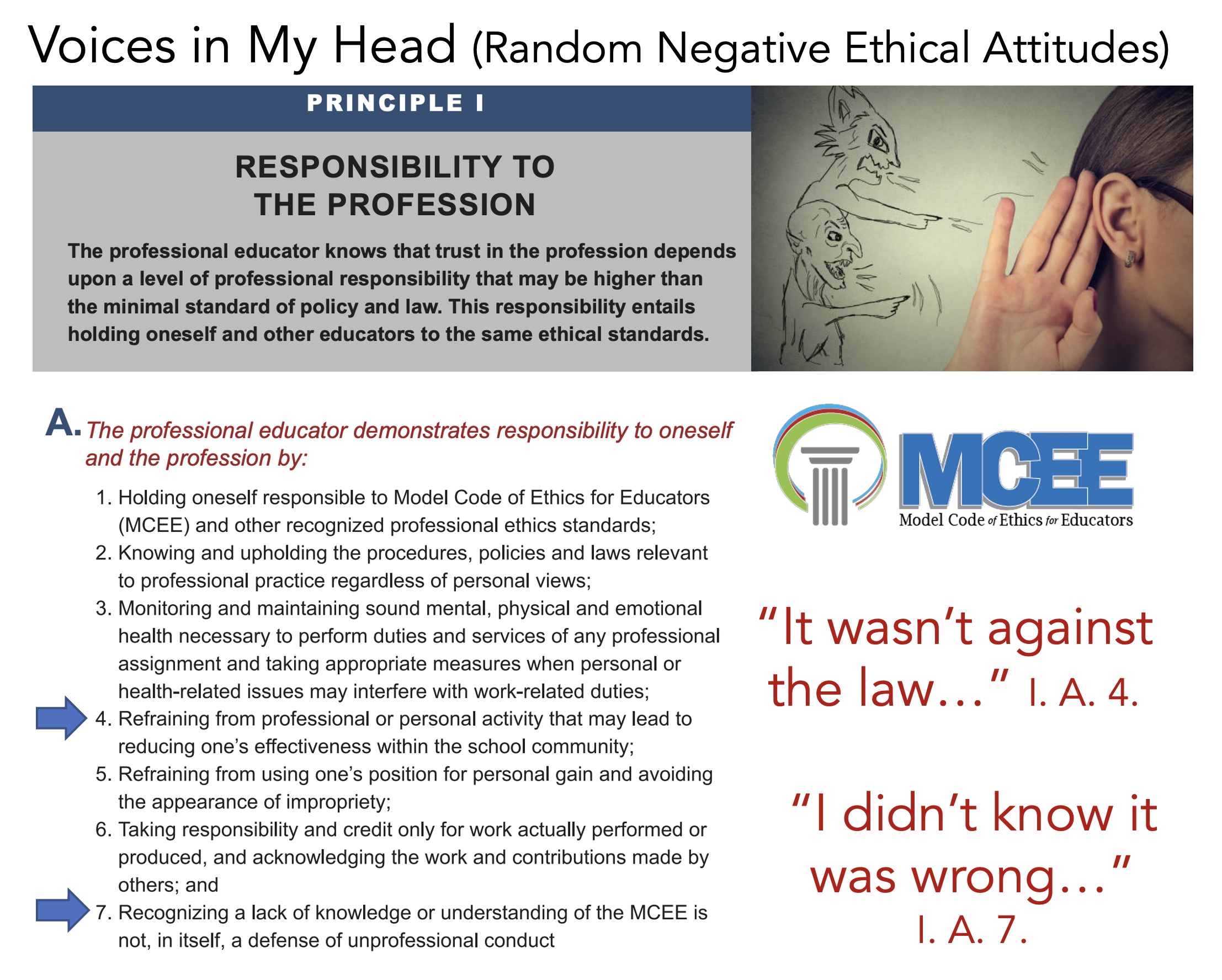
VOICES IN MY HEAD

Random Bad Attitudes for review of the standards in the Model Code of Ethics for Educators: I doubt (or sincerely hope) you would not hear too many of these directly from the school staff, but comments like, “Don’t ask for permission, beg for forgiveness” are NOT ethical precepts! Let’s dissect these bad boys!

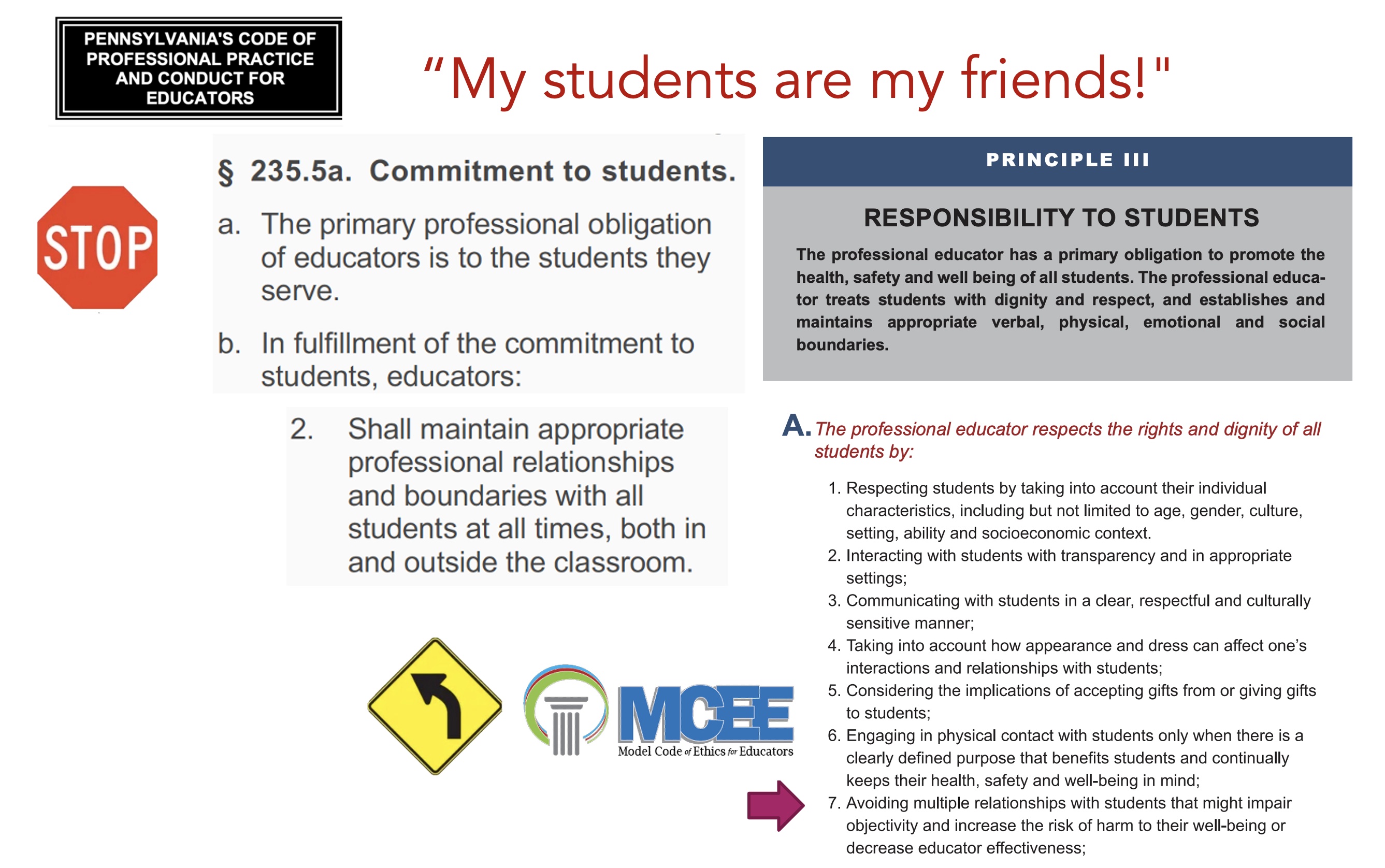
SEARCH FOR THE STANDARDS

Hybrid Approach for using “the negative voices” and researching appropriate provisions in both the CPPC and MCEE: Select a single bad attitude and break off into two or three teams, each focused on corroborating related ethical principles in CPPC, MCEE, and even the PA Educator Discipline Act (EDA).

ALL CODES

Deep Dive” Case Study Analyses in small group break outs for comprehensive interactive discussions using an adaptation of the questions in the Connecticut State Department of Education TEAM Manual:

  1. What possible issues/concerns might this scenario raise?
  2. How could this situation conflict with school policy, CPPC, EDA, MCEE, or case law?
  3. In this situation, what are some potential negative consequences for the educator’s students, fellow educators, and the school community-at-large?
  4. What responses/actions will result in a more positive outcome and/or what proactive measures might be considered?

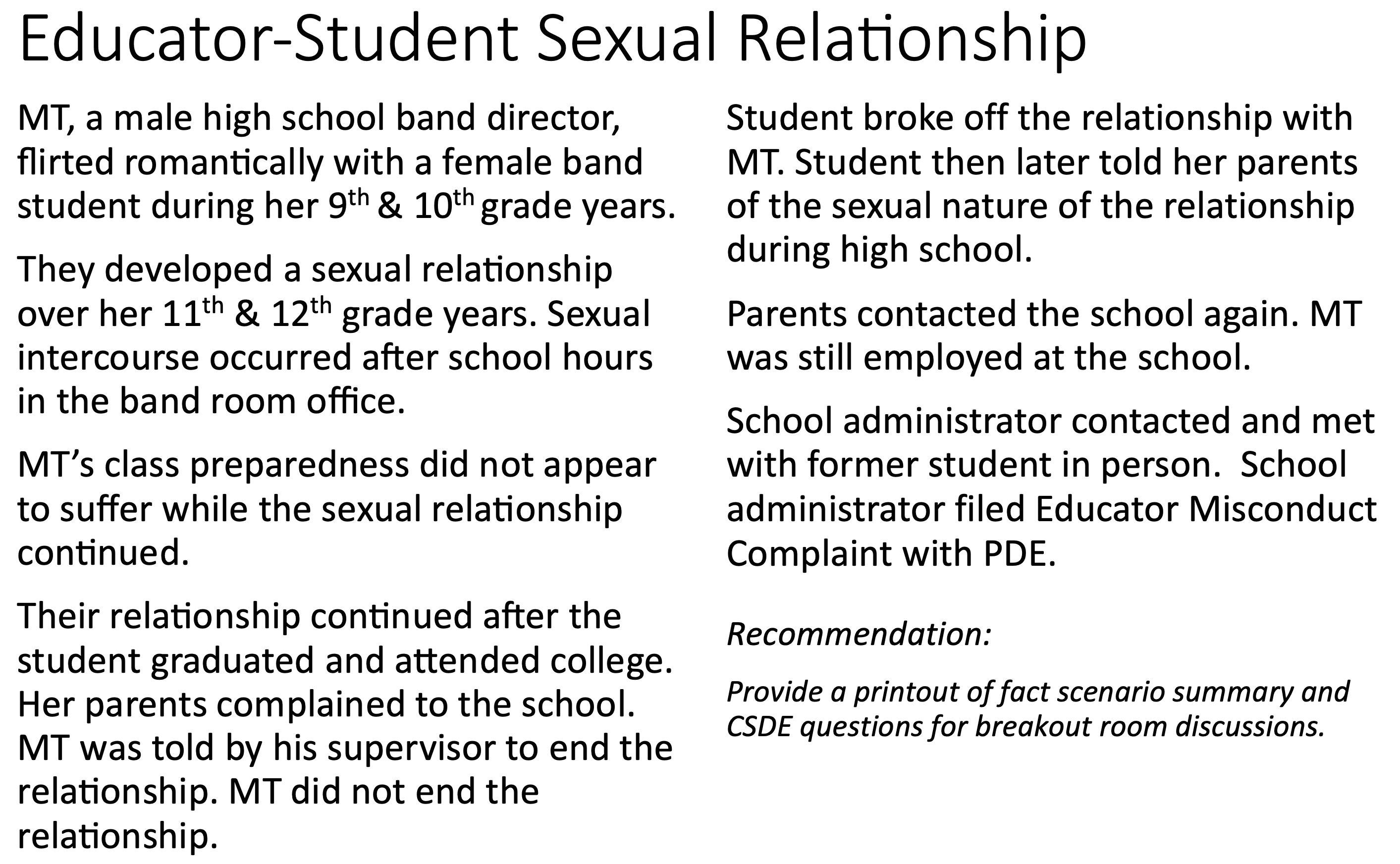
A single hypothetical scenario would first be presented to the full group, and then the educators would break off into 4-6 smaller groups to review these questions. Individuals may or may not all agree. A group leader is usually appointed to record their responses and then upon reconvening, report back to “the whole.” Here is a sample case study (painful reading; fictitious but based on actual past incidents):

The moderator may promote further discussion (sample answers below) and even pose additional questions like the following:

  1. What if the relationship was always of mutual consent?
  2. What if the teacher never taught the student while she was enrolled in his school?
  3. What if the relationship did not start until after the student graduated?
  4. What if his student was over the age of 18 during the time of the relationship?

It deserves mention here that this final training mode, representing perhaps the highest degree of scaffolding of the learning for the ethics training of your staff, proposes the establishment of a permanent school district Professional Learning Community (PLC) or ethics committee. We know from our past experiences in providing continuing professional development of educators that promote free, open, healthy sharing of potential professional decision-making conflicts or ethical “conundrums” – “what would you do” scenarios – will foster lasting long-term benefits. Danielson Framework for Teaching (Domain 4) and CSDE reinforce this philosophy of peer collaboration.

“Teachers must engage in district-facilitated conversations that focus on ethical and professional dilemmas and their professional responsibility to students, the larger school/district educational community, and to families.”

Connecticut State Department of Education

My educator ethics mentor and “hero” Troy Hutchings, Senior Policy Advisor to the National Association of State Directors of Teacher Education and Certification, admitted that in his early years of teaching, he felt a little reticent about going to his principal for advice in handling a situation of a student developing a “romantic crush” on him. To paraphrase his remarks during his webinar, “I was concerned that my supervisor might think I was encouraging the girl… Who could I turn to?” Sharing these anecdotes and talking informally with other faculty members will go far in building teamwork, mentor-mentee relationships, and intra-building trust in allowing more peer review towards enhanced educator decision-making.

If you need a resource on PLCs, my colleague (PA Principal of the Year to be honored at the upcoming 2023 SAS Institute) Dr. Tim Wagner recommended the handbook Learning by Doing by Richard DuFour, Rebecca DuFour, Robert Eaker, Thomas W. Many, and Mike Mattos (Solution Tree Press, 2016).

The authors’ summary of reasons to implement a PLC in your school building(s) are to:

  1. Improve staff’s individual and collective practice
  2. Build on staff’s “shared knowledge and experiences”
  3. Build clarity and understanding in the use of a common vocabulary
  4. Develop a library of accessible tools, templates, and protocols (i.e., ethical scenarios)
  5. Promote non-threatening, thought-provoking discussion on ethical decision-making

Wrapping It Up with More Resources

Every school setting is different, and your application of these staff ethics training ideas will be unique. Hopefully I have given any interested PA school system leader, CTC director, professional development or building administrator, or department chair some “food for thought.” For example, if you wanted to set up a PLC to meet regularly to discuss ethical issues, many of you may need to involve your teacher’s professional association and/or review their contract… or perhaps on-your-own implement a rotation of educators to experience these case study discussions during pre-scheduled inservice or induction days.

For “the keys to the car” to build your own local ethics professional development programs, we encourage you to sign-up for one of our classes here. For our PIL series, Thomas Bailey shares the native files of his PowerPoint presentations so that they can be turned around and taught to other educators, and then even students who are studying their own discipline code or online anti-bullying school policies. Here is an image of our PIL brochure which will be offered beginning on January 3, 2024.

I also suggest perusing Thomas Bailey’s free videos on this topic, slide #61 (page 31) from the handouts to my SAS Institute presentation (above), and these links to other blogs on paulfox.blog.

NOW YOU HAVE IT… the entire toolkit and rationale… the “who, what, how, and why” of educator ethics training and satisfying the new PDE Chapter 49 “PE” competencies.

© 2023 Paul K. Fox

PA Educator Ethics Update

Our Quest for the Training of Ethical Decision-Making

With thanks to Thomas W. Bailey, attorney-at-law, collaborator on ethics-in-education workshops
This blog is dedicated to pre- and in-service educators residing and working in the Commonwealth of Pennsylvania

News from the Pennsylvania Department of Education

In Pennsylvania (as well as the rest of the country), the statistics on school staff misconducts have been rising alarmingly. Sample data from Pennsylvania Department of Education (PDE):

Involving more than 2545 PA school staff members since 2004 when they began reporting them, PDE maintains a database of all disciplinary infractions, the names of the offenders and their offenses here.

Besides criminal prosecution, based on the Pennsylvania Code of Professional Practices and Conduct for Educators, conduct that can trigger professional discipline include behavior defined as:

  • Immorality – Immorality is conduct which offends the morals of the Commonwealth and is a bad example to the youth whose ideals a professional educator or a charter school staff member has a duty to foster and elevate.
  • Incompetency – Incompetency is a continuing or persistent mental or intellectual inability or incapacity to perform the services expected of a professional educator or a charter school staff member.
  • Intemperance – Intemperance is a loss of self-control or self-restraint, which may result from excessive conduct.
  • Cruelty – Cruelty is the intentional, malicious and unnecessary infliction of physical or psychological pain upon living creatures, particularly human beings.
  • Negligence – Negligence is a continuing or persistent action or omission in violation of a duty. A duty may be established by law, by promulgated school rules, policies or procedures, by express direction from superiors or by duties of professional responsibility, including duties prescribed by Chapter 235 (relating to Code of Professional Practice and Conduct for Educators).

“Typically, charges initiated against a teacher on any of the grounds listed above may result in a hearing before a Professional Standards and Practices Commission (PSPC) hearing officer. If an educator elects not to contest the charges, however, a decision on the matter may be made without a hearing. When charges are brought against an educator on non-criminal grounds, the PSPC has discretion to determine if the conduct occurred, if the conduct constitutes one of the grounds for discipline, and what discipline should be imposed, if any. In contrast to cases arising on criminal grounds, the PSPC maintains full adjudicatory discretion in cases filed on the above-described grounds.”

Professional Standards and Practices Commission

Ethics Training… on a Personal Note!

As a music teacher for nearly a half-century (35 years full-time involvement in the public schools), not once did I experience someone other than myself and retired social studies teacher Thomas Bailey present a course, class, or even an hour-long workshop on ethics. Obviously, the growing statistics are a concern, but what do you expect when almost no PA-certified teacher you ask can name the title or content of his/her “code of conduct?” Updated frequently, a comprehensive section on this blog-site is devoted to a much-needed exploration of the definitions, research, sample case studies, and “conundrums” in professional and ethical decision-making. Here are some highlights of past articles for your perusal:

For PMEA, I have directed numerous professional development webinars or sessions at conferences. Check out the “free” materials posted here.

An excellent perspective on the judicial process for educator ethics prosecutions and interpretation of the PA law can be found on Thomas Bailey’s website and this blog-post.

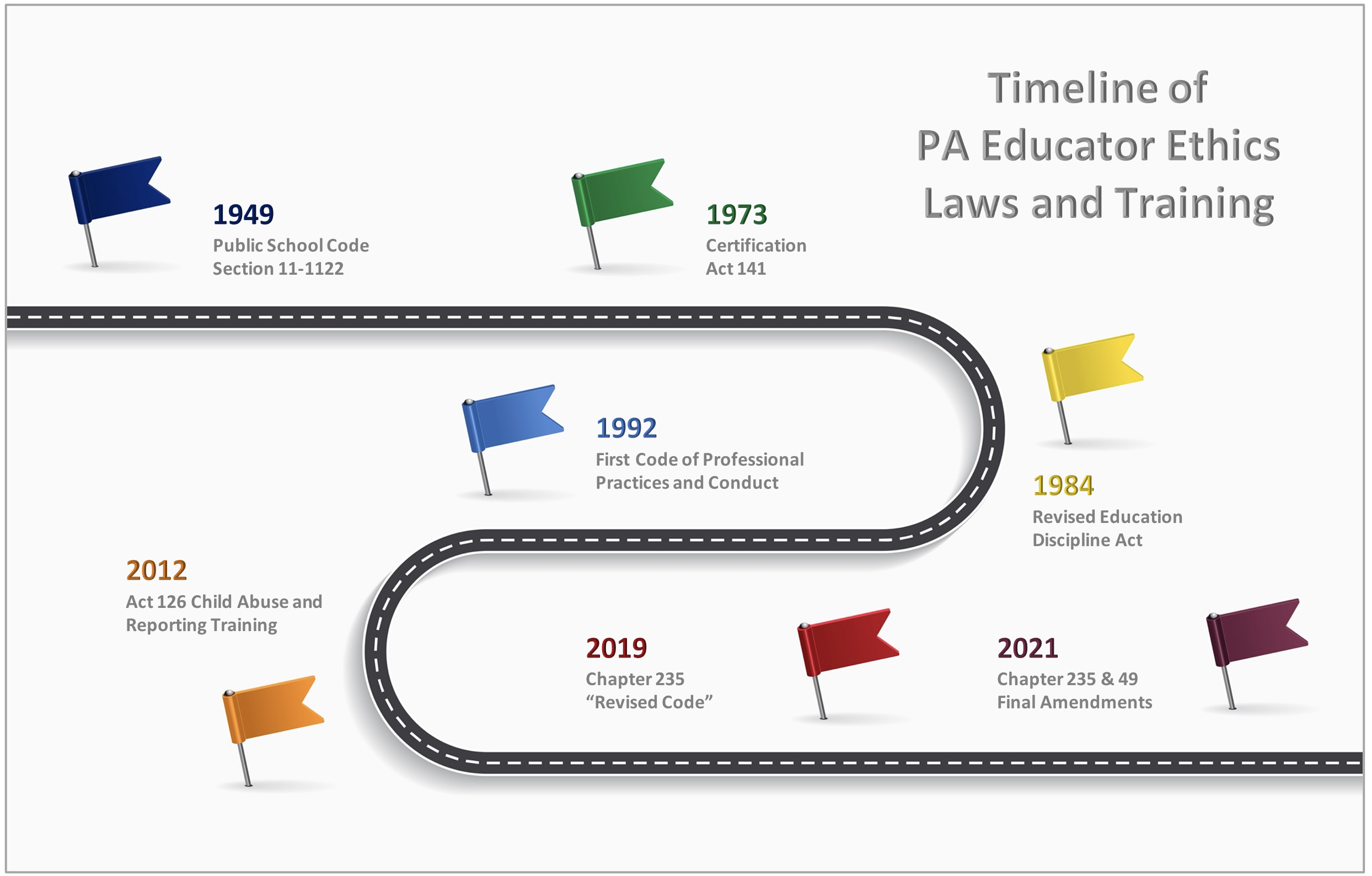
Finally, it seems that the Pennsylvania Board of Education and PDE have also awakened to this “cause.” In the last several years, there’s been significant movement in the rewriting of statues and regulations, and mandating ethics training in future pre-service, induction, and in-service programs. Below is a quick look at the history (albeit a very slow progress) sponsored by our state government.

History of PA Legislative & Executive Branch Rules Revisions

Professional development workshops for PA Act 48 credit are offered by Thomas Bailey here.

What’s Needed for the Future? Let’s Renew the Mandate to Share Knowledge and Peer Engagement in Ethics Training

Based on Thomas Bailey’s and my experience in providing more than four years of local and state educator ethics and professional decision-making workshops, we recommend the following:

  • Presentations should be interactive, allowing time for group discussion, question/answer periods, and “empaneling the ethics jury” to review fact scenarios of identifying levels of ethical misconduct, violations of code and/or policies, and the possible negative consequences, risks, and harm to the students, school staff, and community-at-large.
  • Case studies should uncover all aspects of professional educator decision-making: pedagogy, enforcement, resource allocation, relationships, and diversity, and illuminate possible ethical conflicts, contradictions, or “conundrums.”
  • Content should include definitions of common vocabulary (e.g. “fiduciary”), and an in-depth examination of the PA Code of Professional Practices and Conduct, Public School Code of 1949 and the Educator Discipline Act, and PA Chapter 126.
  • In relation to the PDE Discipline Process, all educators in the Commonwealth should be made aware of PA “governance” and its three independent branches: legislative (statutes), executive (regulations), and judicial (case law), as well as their rights for due process.
  • Following the research of Troy Hutchings, the principles of educator “ethical equilibrium” and understanding the differences between a “code of conduct” (more explicit and well defined) vs. a code of ethics (more open-ended, based on the circumstances/context of the situation) should be discussed comparing representative examples.
  • Presenters should unpack and apply the standards in the National Association of State Directors of Teacher Education and Certification (NASDTEC) Model Code of Ethics for Educators (MCEE). Since the PA Board of Education endorsed the NASDTEC MCEE in January 2017, little has been publicized (even on the PSPC website) about understanding and implementation of this national “teacher code of ethics.”

Thomas Bailey and I are available to present virtual or in-person workshops on professional and ethical decision-making of educators. Please email any interest or questions here.

PKF

© 2021 Paul K. Fox

Social Media – Boon or Nemesis?

This is an expanded version of an excerpt from my August 30, 2017 blog-post multi-part series entitled “Ethics for Music Educators II,” crossing over to multiple categories and perspectives for veteran music teachers, new or pre-service educators, and retirees, and touching on the timely issues of ethics, student/teacher safety, professional development, and personal branding.


social-media-3352921_1920_mohamed_hassan

The Paradox: Online Technology Pitfalls vs. Innovations in Education

This may be hard to believe, but when I started teaching in 1978, “social media” did not exist. If you can imagine this, there was no Internet yet, and most of us did not have computers. Flip or smart phones and tablets were only the subject of science fiction or Star Trek episodes. Guidelines for use or to avoid abuse of social media were not even a “seed” in our imaginations.

notes-3236566_1920_Alehandra13When MySpace and Facebook came upon the scene in 2003 and 2004, most school administrators recommended “stay away from these.” The online sharing and archiving of photos initiated the adoption of many other social media apps (Flickr and later Instagram, Tumblr, Snapchat, etc), which provoked new challenges in maintaining privacy, appropriateness, and professionalism. Danger, danger, danger!

However, very soon after, school leaders starting rolling out revolutionary “technology” such as “teacher pages” and school webpages, online bulletin board services, interactive forums, virtual learning environments like Blackboard and Blended Schools, and other educational tools which encouraged two-way communications among students in the class and the teacher. All of this is here to stay… so how should we use technology safely?

Cons – Negatives – Warnings

Paraphrasing current and past postings from the Pennsylvania Department of Education Professional Standards and Practices Commission Educator Ethics and Conduct Toolkit, social media and other digital communications may perpetuate the following problems:

  1. network-3354116_1920_geraltCommunicating digitally or electronically with students may lead to the blurring of appropriate teacher-student boundaries and create additional challenges to maintaining and protecting confidentiality.
  2. Texts, emails, and social media postings are not private, and may be seen by others, forwarded, and/or copied or printed.
  3. Out of context, they may be misinterpreted, appear to be inappropriate, and/or lead to a violation of “The Code.”
  4. It is the responsibility of the teacher to control his or her “public brand,” how he or she wants to be perceived by students, parents, colleagues, and the public. One’s public brand can and does impact perceptions, which in turn can impinge upon effectiveness.

“Let’s debunk the free speech myth: Many teachers believe they have the absolute First Amendment right to post anything they want on social networking sites, including party pix and diatribes about the boss. After all, they’re on their own time and using their own resources. Sadly, the courts say otherwise.”

– National Education Association

There are a lot of pretty scary scenarios out there modeling “real” ethical dilemmas for teachers in the use of emerging technology and social media. If you can, take the time to preview a few of these case studies and videos:

facebook-76536_1920_Simon

Many have said that Facebook and educators, in particular, should never mix. Although not entirely accurate or perhaps fair to the social media “giant” (you can carefully set-up private, content-specific Facebook groups with restricted access and limited privileges), this seems to be supported  by one news story about a Math teacher who loss her job because she failed to notice changes in her Facebook privacy settings, and the other, a clever Facebook vs. teacher presentation by R. Osterman. In my opinion, both of these should be “required viewing” by all college music education majors and current educators in all subject areas.


Pros – Positives – Recommendations

By no means are we implying that all forms of technology are “bad” or “dangerous” for music teachers. For example, some of us have explored the valuable web-based music education platforms of SmartMusic (MakeMusic, Inc.) and MusicFirst, and I can give you a handful of fantastic (free) links to online resources for the teaching of music theory, ear-training, and even sight-singing:

One of my favorite music educator blog-sites is Mrs. Miracle’s Music Room. Her March 2017 post, “Social Media for Music Teachers,” provides excellent insights into the safe and philosophically-sound use of Pinterest, Facebook, Twitter, Instagram, and YouTube. I cannot recall how many times I visited YouTube’s exhaustive library of recordings, sharing with my students both good and bad examples of the orchestral literature we were studying.

Another impressive article, “How Music Teachers Can Use the Power of Social Media” by Amanda Green, focuses on using the Internet to send out practice reminders, encourage practice uploads, share amazing performances, and communicate tips and reminders.

“Some people mistakenly assume that social media doesn’t apply to them. Take music teachers. Their work is done in person, one student at a time, right? Not at all. If you’re a music teacher and you don’t already have a Twitter account, a Facebook page, and a Tumblr blog set up for your music studio, you’re not taking advantage of all of the ways that social media can help your students. As the TakeLessons team notes: the Internet has enabled students to learn music from anywhere, often from teachers who are Skyping halfway across the country.” – Amanda Green

Here are several supplemental resources provided in NAfME Music in a Minuet:

woman-3190829_1920_shy_kurji

Finally, I urge you to review Chad Criswell’s submission, “Social Media and Communication in the Music Classroom,” which was published in the February 2012 NAfME Teaching Music.


Exercising Good Judgment and Professionalism Using Technology

Ethics are all about making good choices. Returning to “my state’s” excellent ethics tool kit, the following links were suggested for additional study:

Guiding questions about the above links from the PA Professional Standards and Practices Commission:

  • “After examining these resource guides for emerging technology, did any of the guidelines surprise you?”
  • “Do you envision any problem for you personally in adhering to these guidelines?”

During my sessions on ethics in music education, I quote these ten rules from the American Board for the Certification of Teacher Excellence:

  1. Know your school district or state’s policies on social media.
  2. Never “friend” or “follow” students on your personal accounts.
  3. Keep your profile photos clean
  4. Do not affiliate yourself with your school on a personal profile.
  5. Do not geo-tag your connection-3330561_1920_TheDigitalArtistposts with your school’s location.
  6. “Snaps” are forever! Anyone can take a screen shot of your posts.
  7. Never mention your school or the names of staff or students in any post.
  8. Set your Instagram account to private.
  9. Never complain about your job online.
  10. Never post photos of your students on social media

The final word, the most eloquent and comprehensive guide for all of us to use in our daily decision-making in the profession is the Model Code of Ethics for Educators, created by the National Association of State Directors of Teacher Education and Certification (NASDTEC).

“The Model Code of Ethics for Educators (MCEE) serves as a guide for future and current educators faced with the complexities of P-12 education. The code establishes principles for ethical best practice, mindfulness, self-reflection, and decision-making, setting the groundwork for self-regulation and self-accountability. The establishment of this professional code of ethics by educators for educators honors the public trust and upholds the dignity of the profession.” – NASDTEC

Here is the specific section applicable to social media and other technology. I cannot imagine that, after all of this, there is anything else left to say!

PKF

MCEE Responsible Use of Technology


Photo credits (in order) from Pixabay.com: “Internet” by TheDigitalArtist, “notes” by Alehandra, “social-media” by mohamed_hassan, “network” by geralt, “Facebook” by Simon, “Internet” (2) by TheDigitalArtist, “portrait” by Karla_Campos, “woman” by shy_kurji, “smartphone” by TeroVesalainen, and “connection” by TheDigitalArtist.


© 2018 Paul K. Fox