
More on Developing Employment Marketing Skills
If you have not read it, as a warm-up, check out our first blog-post: “When It Comes to Getting a Job, ‘S’ is for Successful Storytelling.”
Since posting a plethora of resources on the job search, interview preparation and questions, branding, and networking, we came upon a few more perspectives, tips, and hands-on exercises you can use to “practice – practice – practice” landing gainful employment as a school music teacher – especially on building your capacity to “tell your own story,” who you have become, what unique qualities you bring to the mix, and how/why you have chosen music education as your “calling!”
Probably the most extensive set of links ever compiled on the subject can be downloaded from here:
But, be warned! It may take you days to read and absorb all of these past blog-posts and articles! They represent the ideal prerequisite – knowledge is power! Before going any further, take the afternoon off, find an easy chair, and focus your attention on creating a successful “action plan” for handling your upcoming employment screenings.
The Exercises
In a recent session for the Pennsylvania Music Educators Association Annual Conference in Kalahari/Poconos, we explored the following reflective/interactive activities. These work best in pairs or small groups, but you can adapt/individualize them for self-study:
- Close your eyes. Who had the greatest influence on you becoming a music educator? (Do you see his/her face?) What did your “model” musician or music educator have or exhibit… name at least three attractive personality or professional traits he/she had and that you would desire to develop in yourself? WRITE THEM DOWN – LIST #1. In a group setting, share at least one of these with your neighbor. (Swap!)
- Now it’s time to turn the attention on YOU. On a separate piece of paper, WRITE DOWN (LIST #2) YOUR three most redeeming qualities, unique professional/personal traits that any employer would be proud to know about you. Again, in a group setting, share at least one of these with your neighbor.
- For now, put these lists aside. There are no RIGHT or WRONG answers, but in past interview workshops, these terms often get repeated (for both Lists #1 and #2): Charisma, Creativity, Dedication, Dynamo, Excitement, Expertise, Humor, Intuition, Kindness, Leadership, Musicianship, Problem-Solver, Sensitivity, Tirelessness, Versatility, Virtuosity, and Visionary. On another piece of paper, add 1-3 more of these you may not have originally thought were among your positive attributes – WRITE THEM DOWN ON LIST #3.
- According to “The California BTES – Overview of the Ethnographic Study” by David Berliner and William Tikunoff, effective teachers (the ones for whom HR/employers are searching) score high on these skill sets/characteristics: Accepting, Adult Involvement, Attending, Consistency of Message, Conviviality, Cooperation, Student Engagement, Knowledge of Subject, Monitoring Learning, Optimism, Pacing, Promoting Self-Sufficiency, Spontaneity, Structuring. Do a self-assessment and apply these to yourself. WRITE DOWN 3-4 OF THESE ON LIST #4. Pick new ones you have not mentioned in #1 through #3.
- Now comes the FUN part. It’s time to generate stories about past experiences you have had that would model these terms. For this exercise, we recommend writing down at least one unique anecdote from each list which would “show not say” your ability, new learning, or achievement. The “plot” of your story should be concise, focused on the one trait, and when told out loud, not take longer than a minute. Instead of “bragging” you are a problem-solver or adaptable, tell that story of how you had to instantly initiate a “plan b” lesson when it was obvious that the students needed more work on a concept you thought they had already mastered. Remember how you handled your first discipline problem or a child in crisis? If you feel you have the qualities of a leader or a team player, share specific examples of your interactions with children in high school, college, field observations/student teaching, church or community groups, volunteer jobs, etc. If you have trouble coming up with these, try to remember the funny or surprising moments, or even the challenging miscues or big boo-boo’s – all okay to share as long as you resolved the situation positively, created a solution that resolved the problem, or learned a new insight or skill to handle future episodes. No one expects perfection from a new teacher, just enthusiasm, professionalism, willingness to self-assess, and commitment to the cause.
- Now you should have a library of stories ready to practice on your roommate, friends and fellow collegiates. You cannot bring the scripts with you, so these have to be at your fingertips: memorized, well-rehearsed, short and sweet (and if you can make them humorous, go for it!).
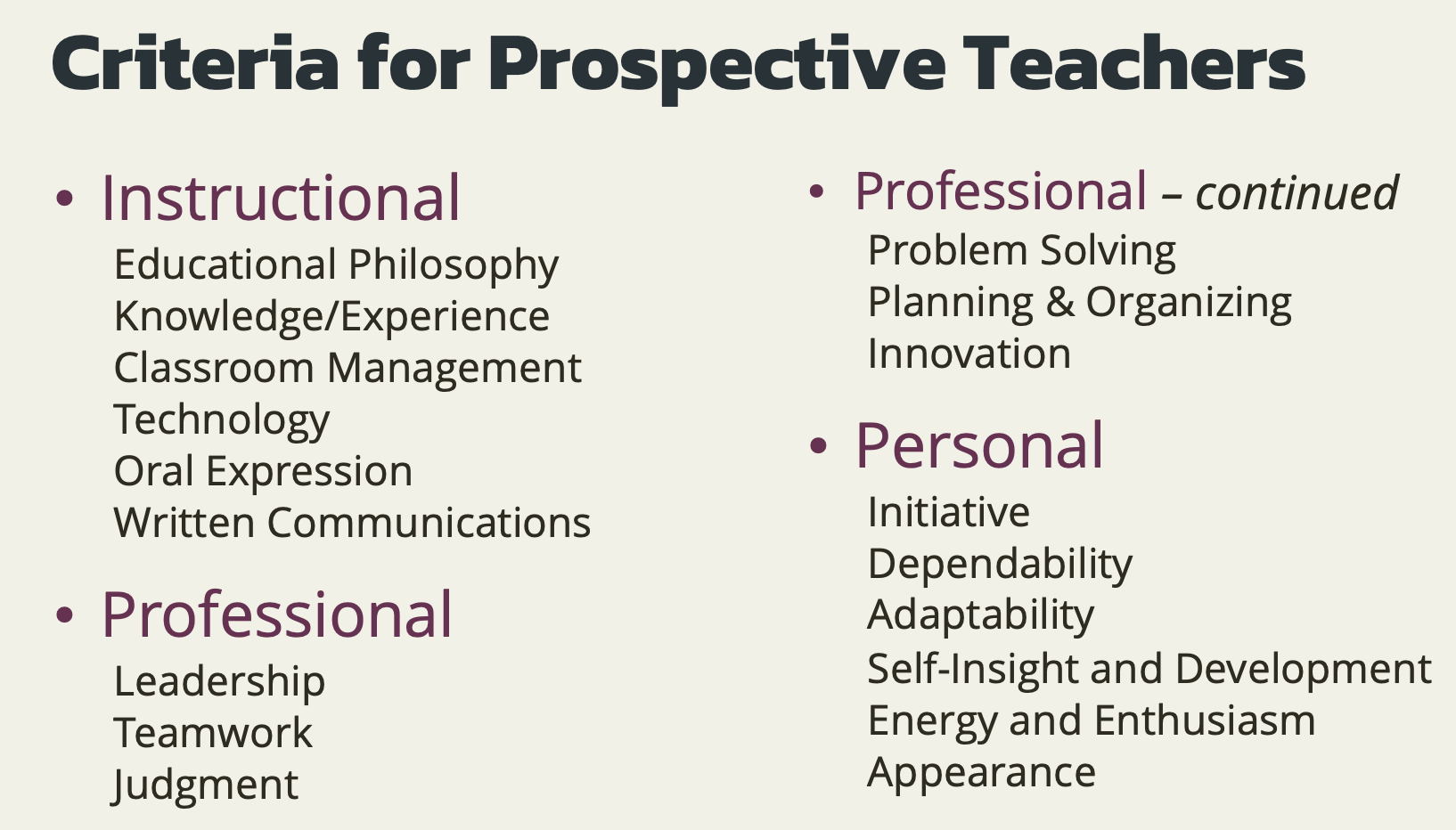
- Every week from now through the job search process, add new stories to your collection. Scan your (e-)portfolio for more ideas. These are the criteria used by my former school district (from where I retired) to evaluative prospective candidates. Ideally, you should have anecdotes that cover each area:
My Favorite Rubric
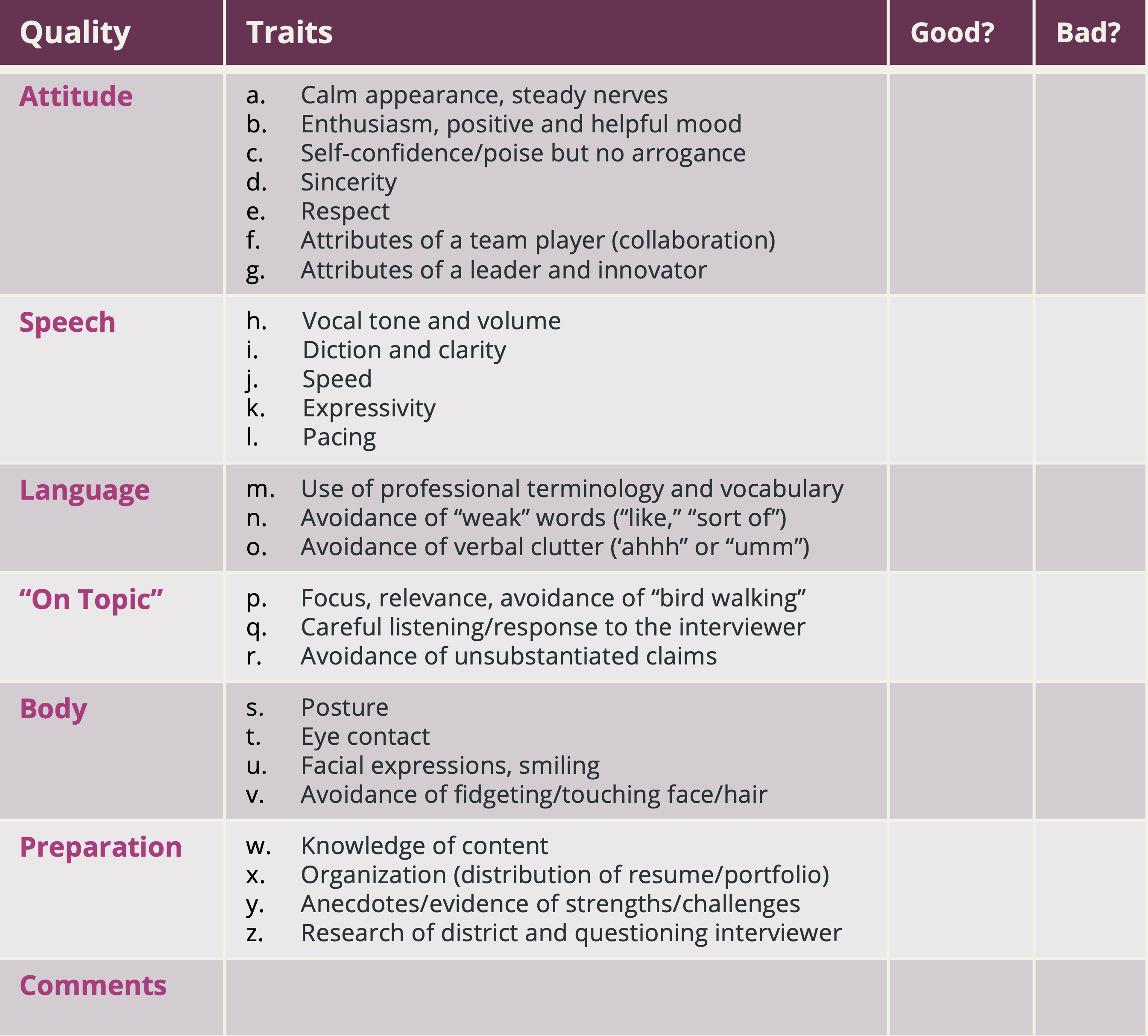
At some point, you are going to have to “face the music” and practice swapping these stories with family members, friends, and/or fellow job seeking students. We’re all in this together! At your next college chapter of NAfME, music education methods class, or student teachers’ wrap-up meeting, try to schedule some “down time” to appoint each other to serve as interviewers/ees. At first, it may not be easy. Using randomly selected questions from the Ultimate Interview Primer above (pull numbers out of a hat), tell a story or two to exemplify your past history, competencies, and professional traits. Your “buddy” (who will be on the hot seat next) could evaluate your performance using the following rubric. Apply the Oreo cookie format (something good first/top cookie, something needing improvement/cream in the center, and end with something positive/bottom cookie) to avoid crushing anyone’s ego. Consider recording your mock interviews for future assessment. Here is a copy of the form with sample questions.
More Odds and Ends on Storytelling
These outside sources focus on the essential skill of storytelling, the whole point of the above exercises. After reading these, you may be able to assemble more meaningful anecdotes that truly model your positive qualities and experiences by telling “short stories” – and “actions do speak louder than words!”
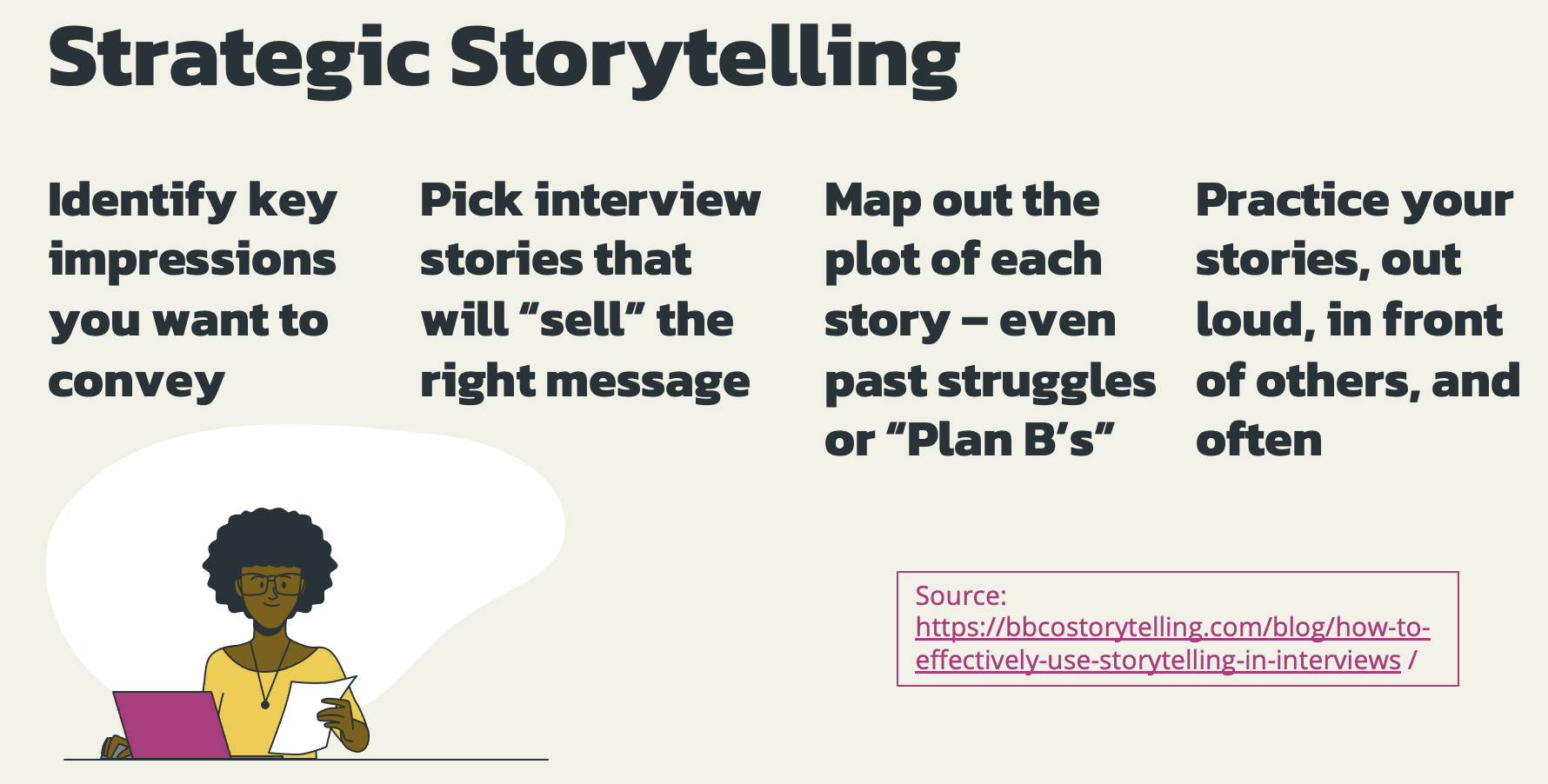
We found this excellent website “How to Effectively Use Storytelling in Interviews” by Bill Baker on “strategic storytelling” that is worth your perusal. It sums up everything above nicely.
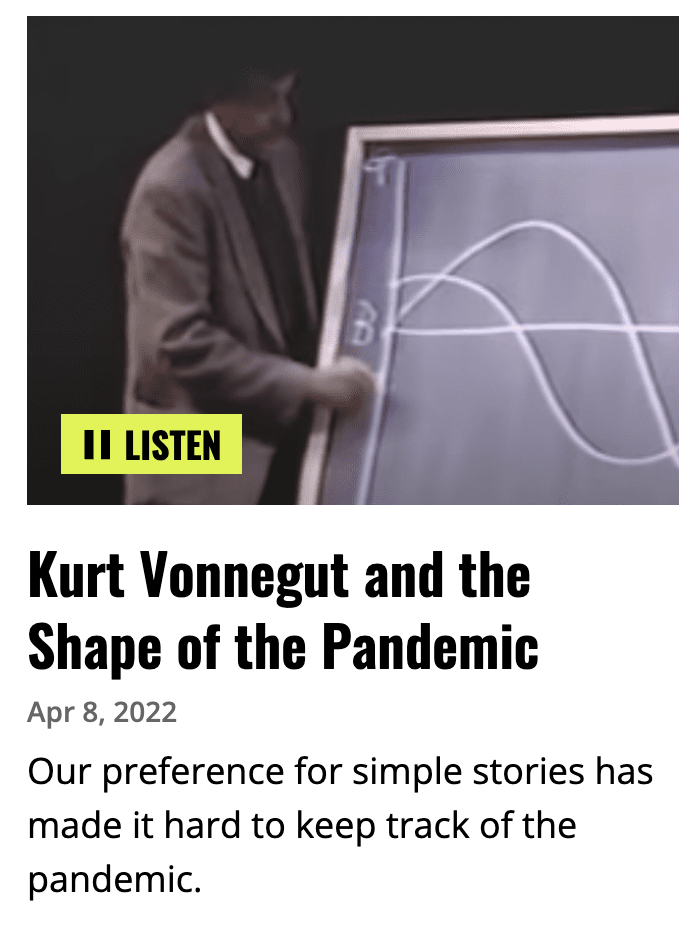
On the Media from NYC Public Radio offered an interesting radio show, coincidentally aired during my 5.5 hour drive back from the 2022 PMEA Annual Conference in Kalahari/Poconos. They dove into the geometric shapes of stories… and what they have to do with reporting on the pandemic AND perhaps (my perspective) considerations for telling better narratives (including ups and downs) at job interviews: https://www.wnycstudios.org/podcasts/otm/segments/kurt-vonnegut-and-shape-pandemic2
Even the popular website indeed advises us on interview stories: “10 Storytelling Interview Questions With Sample Answers.” This STAR approach is discussed with specific examples of questions and anecdotes:
- Situation: Describe a situation you experienced in the workplace relevant to the question.
- Task: Mention a task you had to complete in this situation.
- Action: Summarize the actions you took to complete the task.
- Result: Discuss the outcome of your actions.

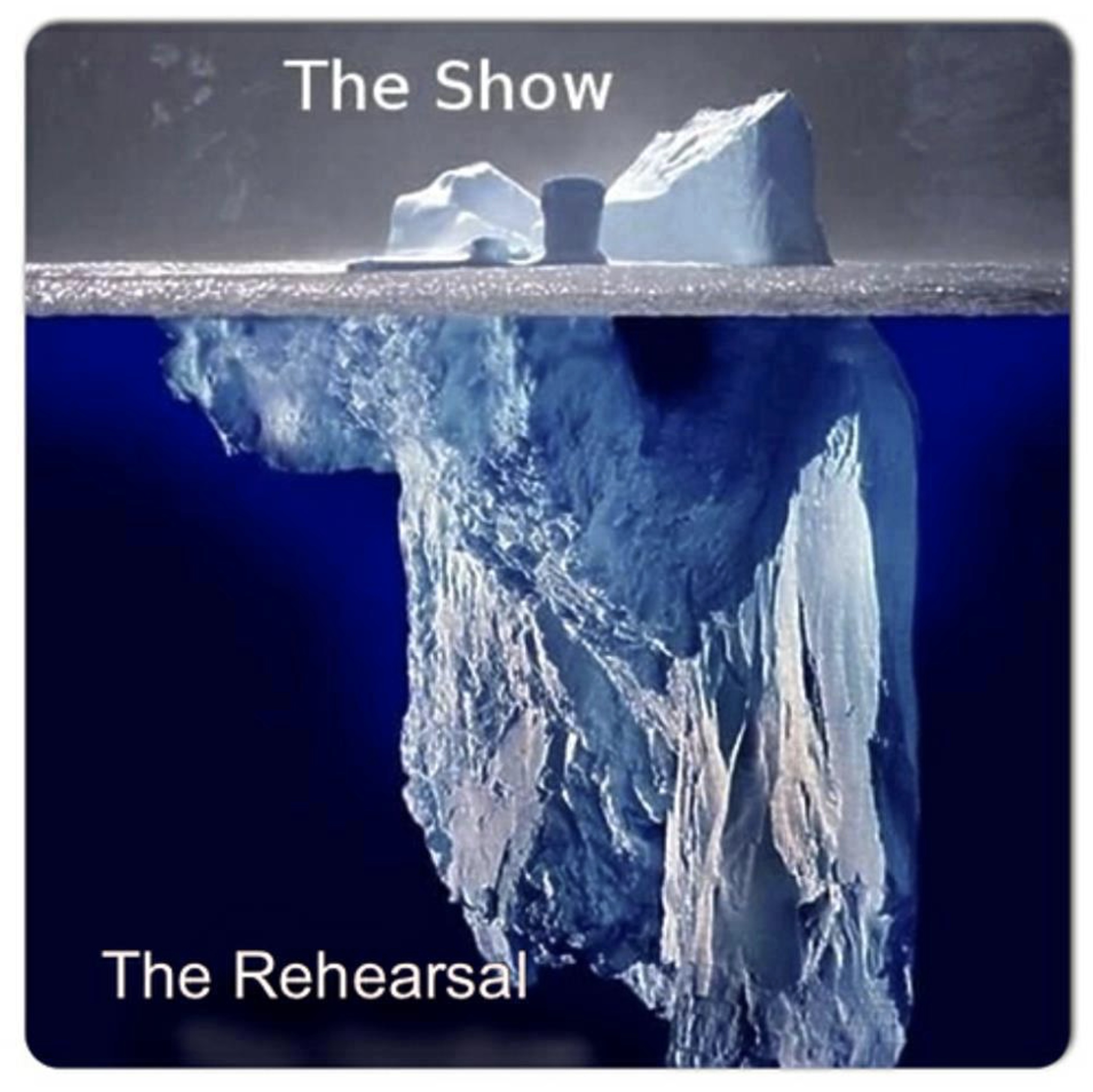
Finally, here are a handful of YouTube videos… just the tip of the iceberg. Remember that iceberg metaphor? The part that you see above the ocean is the performance, the show, the interview, the product… while the mandatory practice, rehearsals, preparations, and planning take up much more space and are almost never seen. ARE YOU READY TO TELL YOUR STORIES?
- Tell Me Something About Yourself (career webinar)
- Storytelling During Your Interview (career tips)
- Telling Stories to Improve Interview Success (TedTalk)
- The Hero’s Journey (sales focused)
Enjoy! Now the ball is in YOUR court!
PKF
© 2022 Paul K. Fox

 I submit there are basically three ways to learn something new by reading about it. One is the tutorial format, a.k.a. an instrument of “programmed learning.” Another approach is the comprehensive reference manual or user guide. Finally, many people prefer a narrative story, perhaps a fictitious account that features characters exploring and revealing insights on the topic you are studying.
 If you were looking for the reference manual, I recommend Ernie Zelinski’s How to Retire Happy, Wild, and Free (2016). The chapters are laid out by general concepts you need to understand. However, as in many user guides, you could turn to almost any page in the volume, jump around (in any order) to specific areas on which to focus, e.g. tips on travel (page 165) to health/wellness (page 109), and not lose the overall meaning.
 The contents of It’s Never Too Late to Begin Again are divided into a weekly course of study:
 The fictitious “Larry and Janice Sparks” share anecdotes of their experiences, modeling potential opportunities of retirees enhancing their relationships, stimulating their minds, revitalizing their bodies, growing spiritually… basically rekindling passion in every area of their lives.
 You will notice that all three texts cover many of the same subjects, but are vastly different in methodology, style/design, and overall structure.
 at the Seven Springs Mountain Resort in Pennsylvania on July 11-13, 2016.
 paulfox.blog