The Get-a-Job Toolbox

Preparing for Those Upcoming Employment Screenings
So much of what I do at this blog-site is to archive articles offering advice on a host of topics:

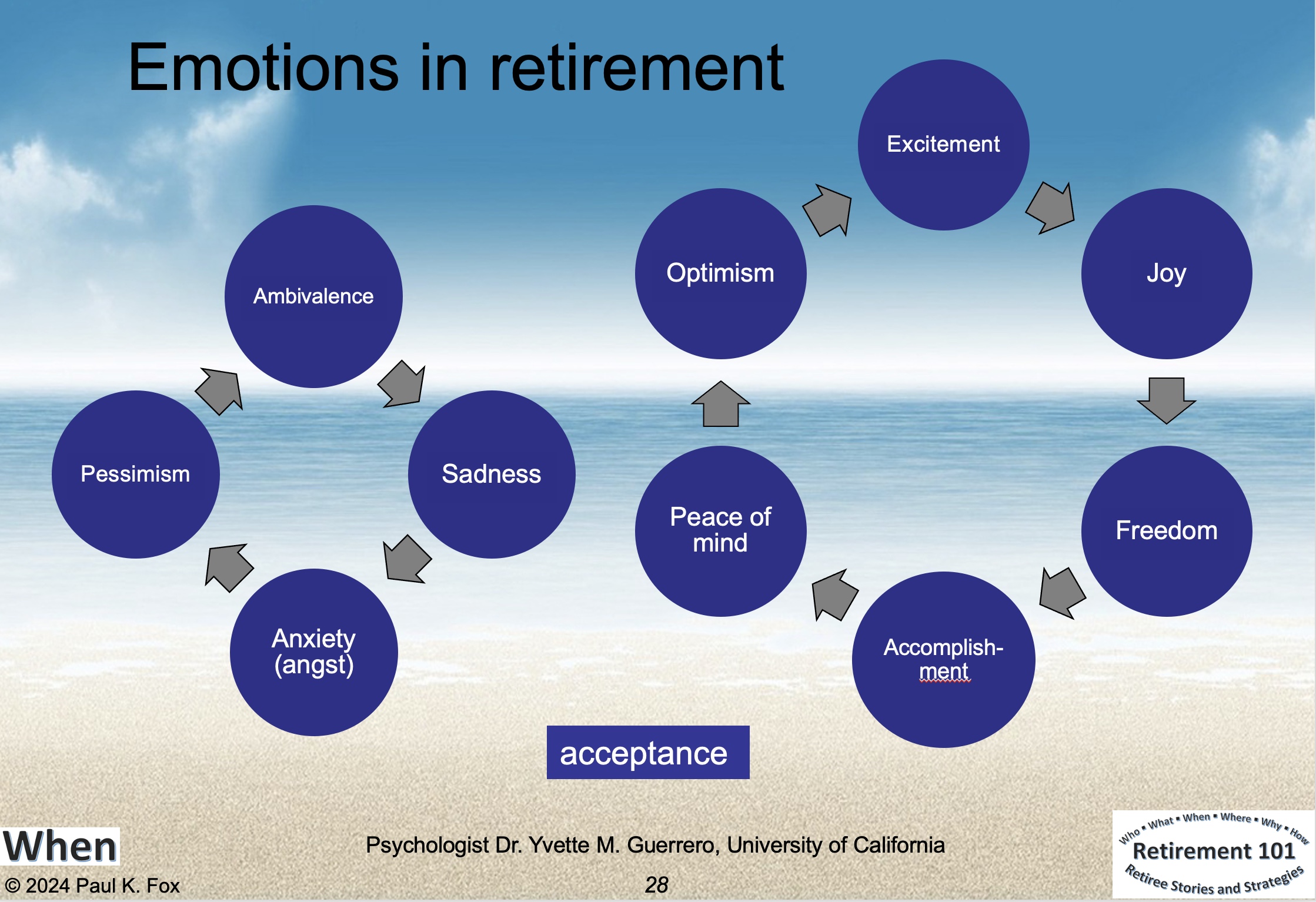
Surveying my past blogs, I feel like I had to repeat (repackage) the content until my readers reached that particular stage in their career. Once they experience first-hand that sometimes tumultuous “passage,” they would be ready to reflect on this information. But, I doubt they would closely examine it until then. As an example, for more than a decade as the PMEA Retired Member Coordinator, these past articles I wrote for PMEA News and the PMEA Annual Conference’s session Retirement 101 revisit the voluminous insight of gerontologists exploring the “who, what, when, where, and why” of retirement. Regardless at how often it is presented, you tend not to consume advice on coping with post-employment until you feel you are “ready” to retire. This is the same issue for soon-to-graduate collegiates and those transitioning to a new job; who wants to read about branding, marketing, and interviewing until they are in the middle of seeking first-time (or new) employment?

Please click on the “plethora” of links throughout this article to be redirected to these past writings. My apologies in advance to what may seem like to be a lot of duplication!
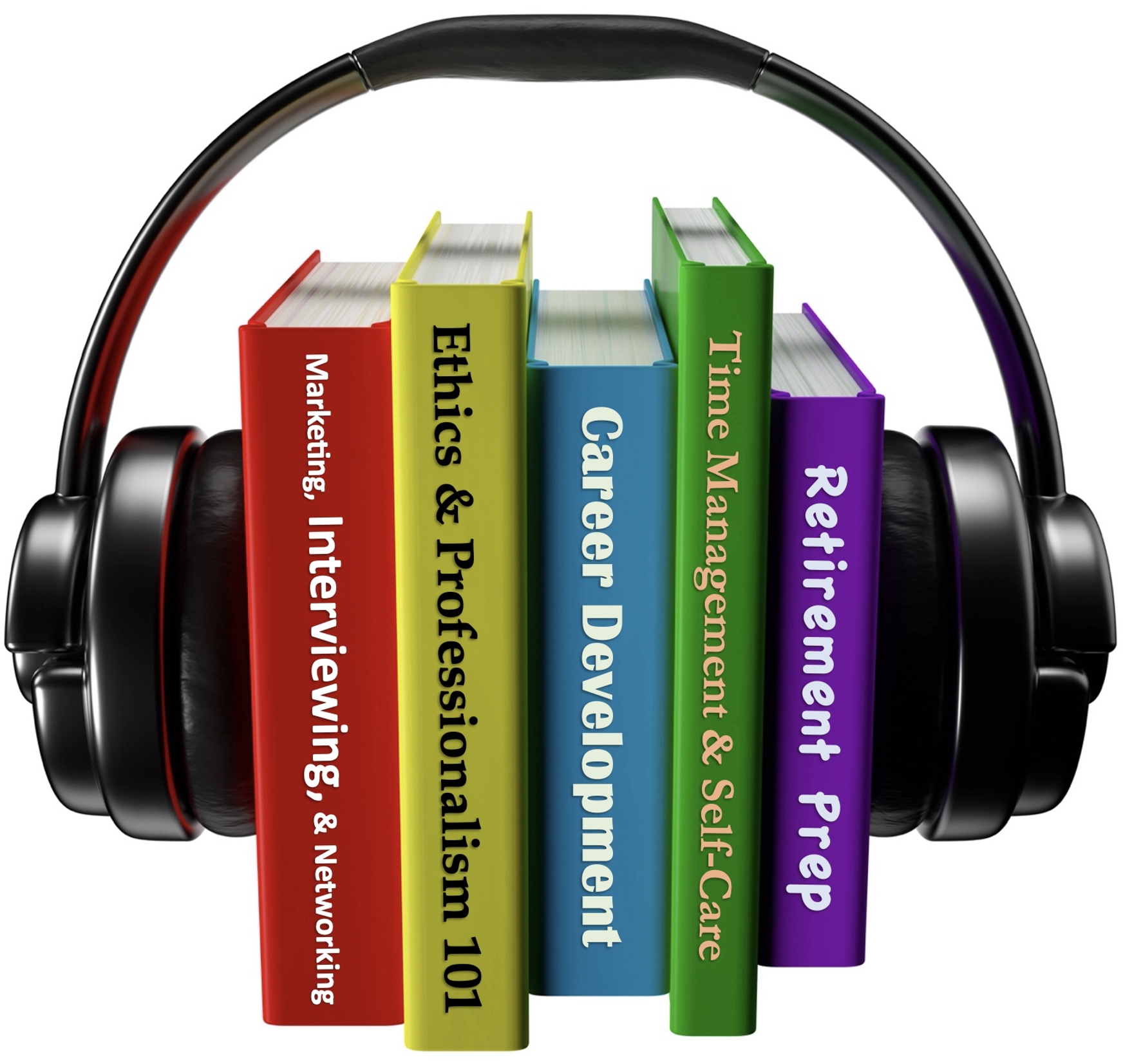
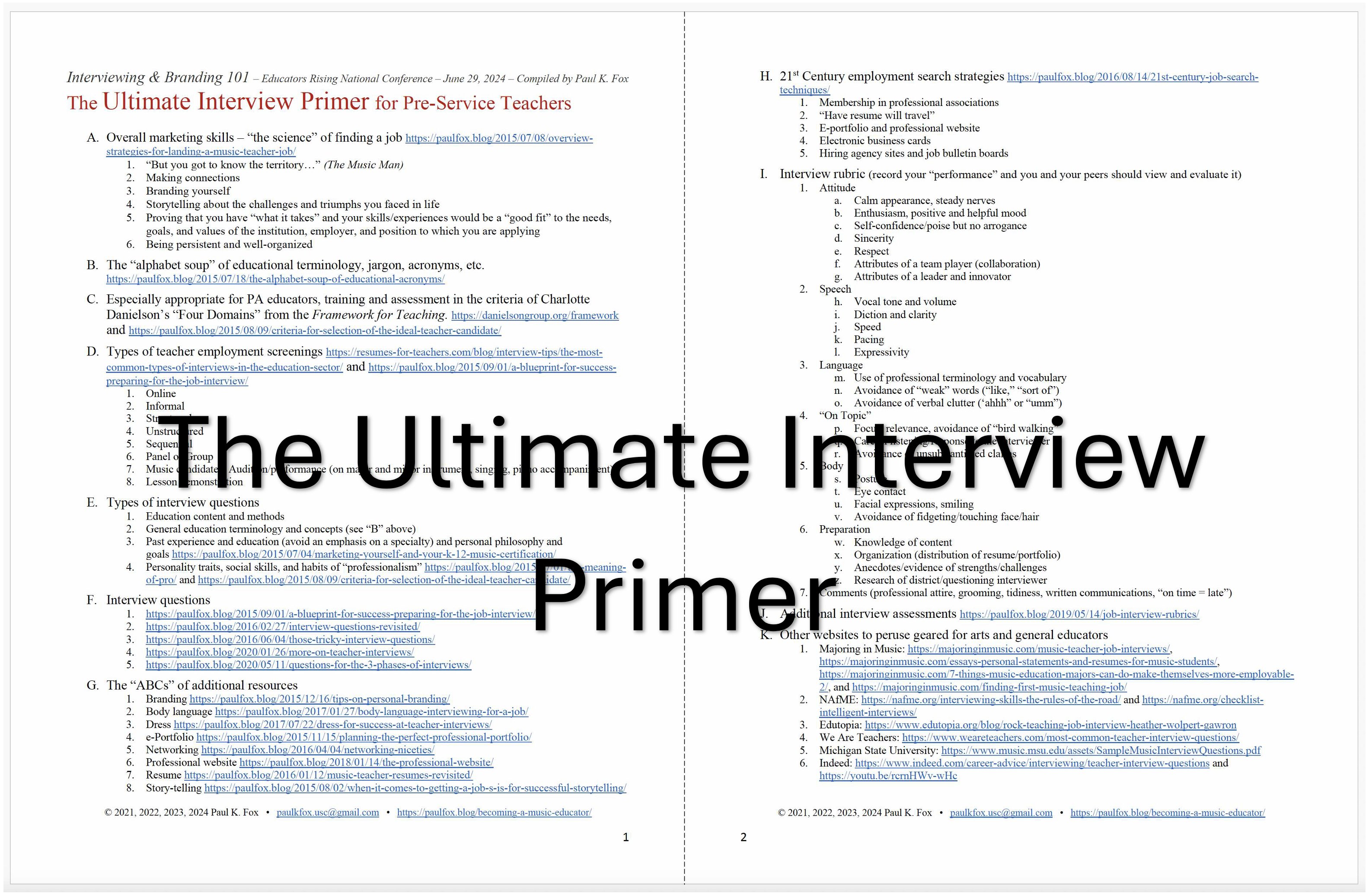
I went as far as updating the most comprehensive and “perfect” PowerPoint for collegiates: Bookends – The Life Cycle of a Successful and Happy Music Educator – portions of which I have presented several times to Professor Jessica Vaughan-Marra’s Seton Hill University music student teachers. This slide handout starts with the material from the first three bullets in the first paragraph above and then adds information about teacher health and wellness, time management, and retirement. We offer Bookends… to preservice music educators in their junior, senior, or graduate years and “rookies” to the profession. I encourage you to download this resource, visit the PCMEA website (click here/scroll down) to read past issues of Collegiate Communique, and the paulfox.blog posts. While you’re at it, acquire your own copy of the Ultimate Interview Primer. Click away before these links become inactive.
Soon it will time for graduates to enter the workforce… and boy, do we need you! By most accounts in PA and the surrounding states, we are experiencing a teacher shortage. School districts are seeking quality candidates to apply for their open positions. But, much of what happens in the job screening process seems to be influenced by chance. Collegiates, ask yourself: Are you truly prepared to market your experiences and abilities, share your brand and stories of your interactions with children in educational programs, and relate positive anecdotes of your teaching, problem solving skills, and other professional attributes? I may have been a little Type-A when I first applied for those music teaching positions back in 1978, focused on saturation publicity and persistence, and organized with a large paper portfolio of past experiences, but I was clueless in responding to those tricky interview questions and what administrators actually wanted to see in prospective new members of their staff.
One more piece advice for first-year and recent transfers to music education: Seek out a PMEA mentor and/or a member of the Retired Resource Registry (access from the PMEA Retired Member focus area after you login to your member portal)… both are groups of volunteers willing and able to help “newbies.”

Have a question about selecting music for your ensemble, a dynamic lesson plan, classroom management issue, interviewing, curriculum innovation, or a conducting tip? Stop by the “coffee and conversations” informal lounge at the PMEA Annual Conference on April 10 and “sit-a-spell” with us!

In conclusion, the following is a sequential outline – a “to-do in this order” list – a preservice toolbox of past posts and other resources for you to assemble a marketing plan. Take time to sort through these “nuts and bolts” (all links in this blog), process the information, save anything you want to read further, and then “practice, practice, practice!” This “gift” to PCMEA and music education majors embraces my best wishes for successfully finding the job you always wanted and preparing yourself for the greatest “calling” of your life – an enriching and satisfying lifelong career in music education! Good luck!
Using the Collegiate Toolbox – A Roadmap for Becoming a Music Educator

  1. Peruse everything in this and past paulfox.blog postings.
  2. Download the PDF documents to your hard drive. Review a portion of them each week!
  3. On your computer, create a “ME” file documenting your accomplishments, awards, experiences interacting with children, etc. – a library of the things you may wish to include in your future resume, professional website, and (e-)portfolio. Add to this folder throughout your college years.
  4. To reflect on your perceived strengths and weaknesses, complete a self-assessment of YOU from a typical professional evaluation form, these ideal effective teacher attributes and more criteria
  5. Prioritize what you think you need most. Write down your goals! Pobody is nerfect!
  6. While you are still attending college, work on shoring up any weak content areas or specialty skills (e.g., how is your “piano chops,” knowledge of specific methods, grade level repertoire, etc.?)
  7. Write a philosophy of school music education (overview) and your mission statement: “Why do you want to teach?”
  8. Be ready to answer the question (and defend your response), “What is your vision of the role of music education in the schools?”
  9. Be ready to define your “brand.” What are your professional attributes? What makes you unique? Why would you be a good candidate for a school music position?
  10. Begin to assemble a list of stories that would “show not tell” your positive attributes.
  11. Identify the impressions you want to “sell” yourself, and practice strategic storytelling.
  12. Practice answering interview questions and use a rubric to evaluate your performance. If you can, share all of this with your peers and sponsor mock interview sessions. Record/assess yourself.
  13. Get started on drafting the marketing tools you will need (e.g., your professional website, resume, portfolio, etc.)
  14. Review educational acronyms, jargon, and terminology such as this list plus these recent additions: CR-SE (Culturally Relevant & Sustaining Education), DEIB (Diversity, Equity, Inclusion, Belonging), and SEL (Social-Emotional Learning). These terms may come up at your next interview.
  15. Read cover-to-cover your PA code of conduct (CPPC) and the Model Code of Ethics for Educators.
  16. Practice ethical decision-making (with your peers) by reviewing these mock scenarios, first deciding what level of misconduct (if any) is reached in each case study, and then more discussion on the incident’s effect on the students, parents, staff, and community, and what proactive steps may be taken to remediate the situation.
  17. Join and become active in appropriate music education professional organizations (renew your memberships and add new ones): ACDA, AOSA, ASTA, NAfME, NBA, PMEA, etc. to name a few.
  18. Attend a conference of your professional association(s) and network with other colleagues. For PA colleagues, register for the PMEA Annual Conference (April 9-12) at the Kalahari Resort (Poconos).

Feel free to leave comments about this blog. (See the link just below the title.) How did you use these tools? What was particularly beneficial? What suggestions would you have for future music teacher applicants?

To PCMEA chapter officers/members, music education majors, and college instructors: I am available to present Bookends or other online or in-person workshops for college students. Send me an email.

© 2025 Paul K. Fox

Retirement Transitioning Advice from AI?

Season Greetings and Happy New Year from your Pennsylvania Music Educators Association State Retired Member Coordinator. Best wishes for a happy, healthy, and prosperous 2025!

First, on Christmas Eve, here are a few announcements geared to PA music educators… those who have retired from full-time teaching and anyone considering retirement over the next one to five years.

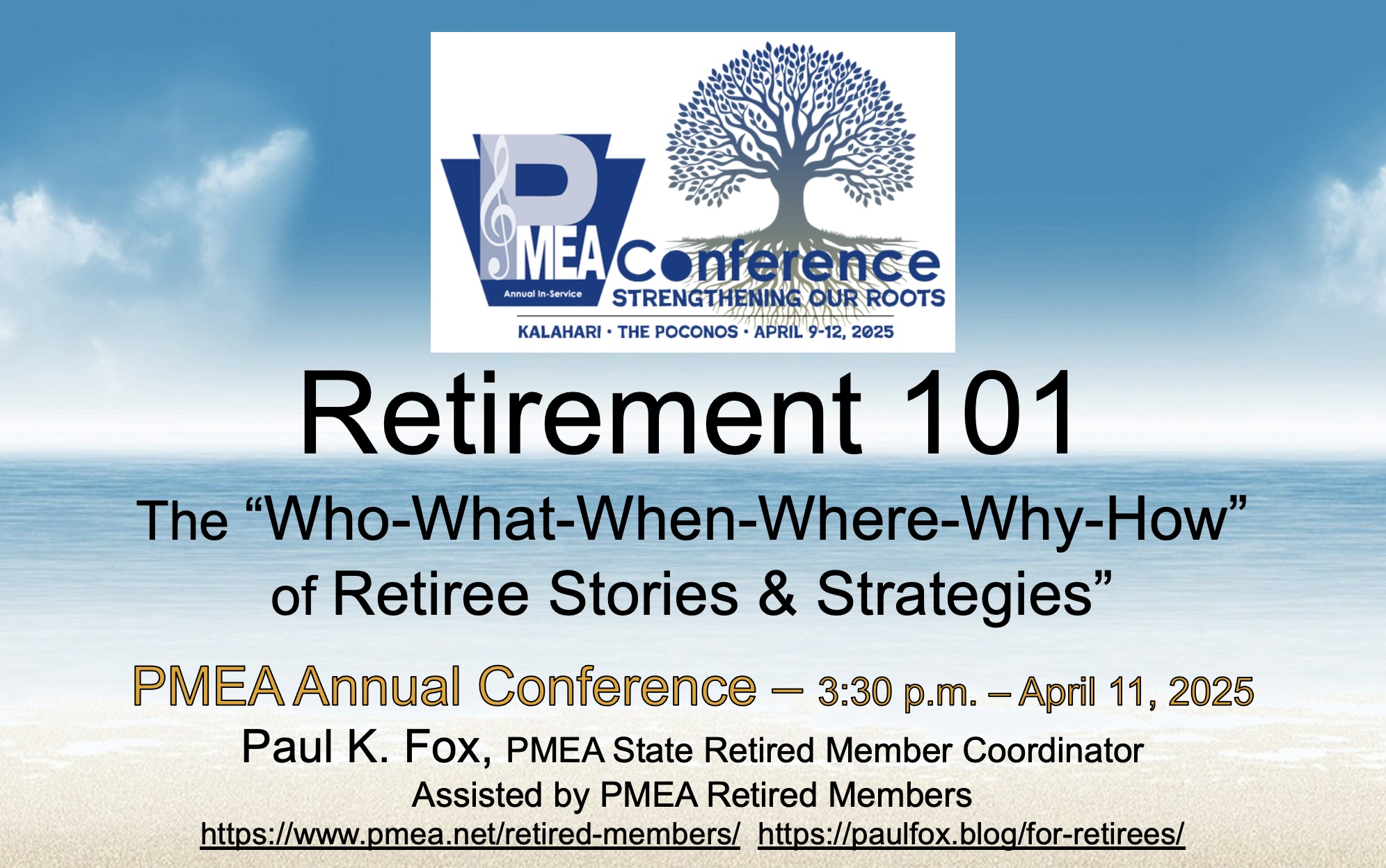
Back by popular demand (or is that just ego and in my head?), we will offer the session “Retirement 101 – the Who, What, When, Where, Why and How of Retiree Stories & Strategies” on Friday, April 11, 2025 (3:30 p.m.) during the PMEA Annual Conference at the Kalahari Resort in the Poconos. A guest panel of PMEA Retired Members will assist and offer their advice answering key questions like the following:

  1. How have you found happiness and success in retirement?
  2. What “new” hobbies, volunteer projects, trips, family connections, and encore careers have you been exploring?
  3. What did you do to reinvent yourself and how did you satisfy those essential “big three” goals of post-full-time employment: finding purpose, structure, and community?
  4. How did you navigate the early phases of retirement? imagination, anticipation, liberation, etc.
  5. What were some of the transitional “ups and downs” you experienced and how did you cope with them?
  6. What are you still doing in music and education?

We are looking for more PMEA retiree volunteers who are planning to attend the conference to join “expert panelists” Rick Coulter, Jeffrey Dent, Dan Klingbeil, Chuck Neidhardt, Louise Victor, and Rich Victor. (Just email me if you’re interested.)

Retired Members are a valuable resource to PMEA. Many of us already serve on PMEA Councils and in District or State official positions. All of us in the profession benefit from the sharing of their extensive “boots-on-the-ground” experiences and wisdom. At the upcoming conference, Retired Members can serve as Presiding Chairs and introduce a session/concert or two. In addition, plans are also underway to sponsor (possibly on Thursday, April 9) a “coffee & conversation” corner or an “ask the expert” lounge. Spaces and the schedule are packed, but if it is possible, Executive Director Abi Young is trying to fit in an informal sitting area with retirees and mentors as “friendly folks” to serve as “gurus” for PCMEA members, newcomers to a music education specialty, or recent transfers to the field. Won’t you join us?

A longstanding tradition, we will be treated to a PMEA Retired Member Breakfast on Friday morning. (Just check the box on the registration form if you are coming… and, by the way, the conference fee is only $20 for Retired Members! What a deal!)

Why Attend the PMEA Annual Conference?

“For some of us, it’s a just chance to catch-up with our colleagues, see our friends, and socialize. Others are more focused and take advantage of the near-perfect opportunity to network with other professionals, perhaps seeking new working relationships, partnerships, or even employment. Many are on a look-out for newly published music, that perfect music lesson or teaching strategy, technology tools, fund-raisers, advance educational venues, or much-needed equipment to purchase for our ensembles or classrooms. Most come to hear/see the “state of the art” in music education – concerts, demonstrations, keynote speeches, panel discussions, exhibits, research presentations, and workshops. PMEA’s PD Council would likely submit that the primary purpose of a conference is for professional self-improvement… What did Stephen Covey call it? His Habit #7 of “sharpening the saw” – to build a balanced program of self-renewal in the four areas of your life: physical, social/emotional, mental, and spiritual. Covey would insist we embrace “the process that empowers us to move on an upward spiral of growth and change, of continuous improvement.” So, in short, conferences help us “grow” – to revive, re-inspire, re-energize, rejuvenate, re-direct, and re-motivate all of us – pre-service, active in-service, and retired teachers towards making successful new connections, updating our knowledge & skills, and forming new goals.”  – PMEA Retired Member Network eNEWS Winter 2024

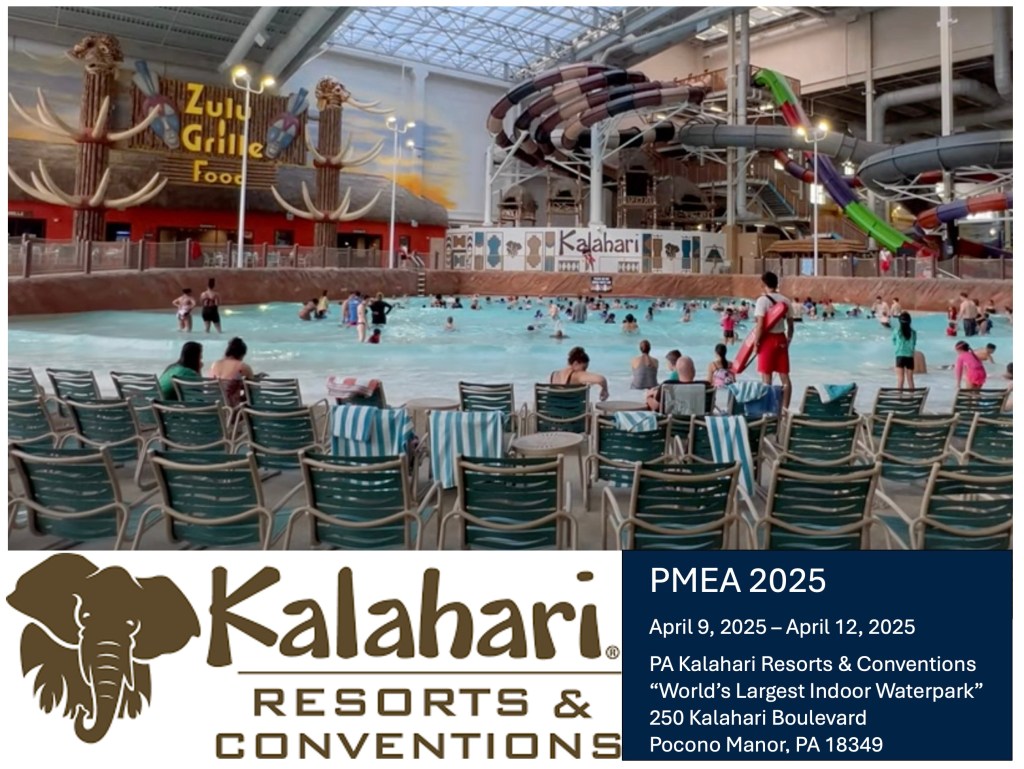
In addition, Kalahari Resort boasts “the world’s largest indoor water park,” the perfect place to bring family members to enjoy… especially (grand)children, (grand)nieces/nephews, etc.

Next month’s retirement blog by guest author Sierra Powell

One final announcement: In several weeks at this blog-site, we plan to feature a new guest blog entitled “Five Things You Need for a Comfortable Retirement” by Sierra Powell, along with updates of other resources for “living the dream!” See you next year?

OK, What is that “AI Thing?”

This 69-year old educator who has spent more than five decades in fostering creative self-expression in his students is fervently opposed to artificial intelligence. Actually, I thought I was allergic to “AI!” Every time I receive an Apple iPhone update or some new download for my computer, I complain, “Why have they moved that button? It doesn’t look or work the same! Why does everything have to change every month?” Slow down, techies!

However, to dabble in this new technology everyone’s talking about, I printed in my last PMEA Retired Member Network eNEWS on page one a sample article (click here for the Winter issue) compiled by AI Overview (Google). I shared this with an adult violin student from my Saturday orchestra who decided to show me the power of AI (not the old AI I am more familiar with – artistic intelligence!). She used her subscription to a ChatGPT to process my brief outline on the topic “retirement transitioning.” Below is the result generated from a few of my random notes. Created in the first person, AI matched my writing style, a chatty/informal letter printed for soon-to-retire colleagues along with research citations. Frankly, it scares me how close this sounds like something I could have composed! Can you tell it was artificially generated? Does this mean we will we have to teach this old dog (fox) new tricks?

Check out these valuable retirement hints courtesy of ChatGPT!

The Retiree Life: Navigating the Art of Reinvention & Emotional Balance

Here with some reflections, tips, and maybe even a little nudge for us all as we continue this grand adventure called retirement. Whether you’re still finding your rhythm or already feel like a pro at this, there’s always room to reflect, grow, and laugh along the way.

This week, let’s talk about something near and dear to every retiree’s journey: reinventing yourself and coping with the emotional ups and downs that come with this new chapter.

Reinventing Yourself: A Second Act Worth Applauding

Remember when we taught our students to embrace creativity and adapt to change? Turns out, retirement demands the same skills. It’s no longer just about what you did—it’s about who you are.

Reinvention isn’t about completely overhauling your identity. Think of it as expanding your repertoire. Studies show that retirees who actively pursue new interests or roles report higher life satisfaction (Wang et al., 2011). Whether it’s picking up the instrument you haven’t touched in decades, volunteering, traveling, or even starting a small business, the key is to stay engaged.

Here’s a thought experiment: What did you always wish you had time to do but never could because of lesson planning, rehearsals, or concerts? Now’s your chance. I’ve recently heard about retirees dabbling in everything from watercolor painting to writing mystery novels. One retiree even became a beekeeper—talk about a sweet second act!

(From past blogs, the Retirement 101 session, and Retired Member Network eNEWS reviews)

The Emotional Journey: Ups, Downs, and Everything in Between

Let’s not sugarcoat it: retirement is a mixed bag. There’s the freedom (hooray!), but also the occasional pang of loss—of identity, routine, or the camaraderie we had in our teaching careers.

The good news? You’re not alone. Research by Pinquart and Schindler (2007) highlights how important it is to acknowledge these feelings rather than sweep them under the rug. Adjusting to retirement is a process, and it’s okay to feel a little off-balance at times.

Here are a few tried-and-true strategies to help you navigate the emotional terrain:

  • Stay Connected: Loneliness can creep in when you least expect it. Keep up with PMEA activities, or start a retirees’ coffee group. Who better to laugh with about the time your marching band got rained out?
  • Practice Mindfulness: Before you roll your eyes, hear me out! Even just five minutes of quiet reflection a day can reduce stress and boost mood (Chopra et al., 2020).
  • Find Meaning: Volunteering or mentoring can give you a sense of purpose that’s deeply fulfilling. You’ve got a wealth of wisdom—share it!

AI of the future?

The Bottom Line

Retirement isn’t a destination; it’s a journey. And like any good road trip, it comes with unexpected detours, scenic overlooks, and, yes, the occasional pothole. The trick is to embrace it all with curiosity and a sense of humor.

If you’re struggling, remember: reinventing yourself doesn’t happen overnight. Take it one day at a time, and don’t be afraid to reach out for support—whether it’s from family, friends, or your fellow PMEA retirees.

Let’s keep the conversation going. What’s your “second act”? Have you discovered a new hobby or way to cope with the emotional shifts of retirement? Shoot me an email or share your story at our next meeting. Together, we’ll continue to learn, grow, and make this chapter one to remember.

Until next time, keep smiling and stay curious!

References:

Wang, M., Henkens, K., & van Solinge, H. (2011). Retirement adjustment: A review of theoretical and empirical advancements. American Psychologist, 66(3), 204–213.

Pinquart, M., & Schindler, I. (2007). Changes of life satisfaction in the transition to retirement: A latent-class approach. Psychology and Aging, 22(3), 442–455.

Chopra, A., Anthonisen, S., & Reeves, A. (2020). The role of mindfulness in retirement satisfaction. Mindfulness in Aging Journal, 7(4), 312–320.

PKF

© 2024 Paul K. Fox

WHEN Should You Retire?

The Skills and Models of a Happy Retirement

[Portions reprinted from the state journal of the Pennsylvania Music Educators Association, PMEA News, Spring 2019 issue – All rights reserved.]


man-2546107_1920_geralt

Is It TIME to Retire?

This is a personal question that no one but YOU can answer… not even your PMEA Retired Member Coordinator! By the time you read this article in the Spring edition of PMEA News, this choice may be uppermost in your mind, especially if you are within a couple years of that so-called “retirement age.” Most school districts require advance notification of an employee’s plan to retire in order to retain full benefits and exit bonuses, and to allow planning for the job replacement search and screening process. (Check your teacher’s contract!)

In music educator conference sessions, director meetings at festivals, and printed in PMEA News and the online e-publication Retired Member Network eNEWS, much has pmeabeen discussed about the “what,” “how,” and most recently, “where” of retirement, even issues of “privacy” regarding your decision. For a review of these areas and a bibliography of resources, please visit:


The “why” of retirement is also relevant. There may be a lot of influences for someone to consider leaving their full-time career:

  1. Boredom or lack of stimulation in the current job
  2. Changing employment status or responsibilities
  3. Health problems (yours or other members of your family)
  4. Spouse retiring
  5. Your or family member’s desire to relocate
  6. Needs for caregiving (grandchildren, parents, or elderly family members)
  7. Travel opportunities
  8. Acceptance of a new position or the start or expansion of an “encore career” (higher education, music industry, travel/tour planning, or another field)

Other involuntary or more negative motivations may “encourage” you to resign your position:

  • Music and/or staff are eliminated from the curriculum or building in which you teach.
  • You are experiencing a decline in music program enrollment or participation.
  • You feel unappreciated, unsupported, devalued, or ignored as a professional.
  • You conclude you must retire early to avoid losing existing contractual benefits.

elderly-lady-4025995_1920_MabelAmber

However, the most important reflection on WHEN to retire should begin with the question, “Are you ready for retirement?” and…

Do You Have What It Takes for a Happy Retirement?

A successful retirement is not “all about the money.” Certainly, you are well-advised to make an appointment with an estate planner, elder attorney, and/or financial advisor (probably all three). Bring a copy of your bank and investment statements, annual reports on your pension, social security, annuities, and insurance documents. Make sure you have the “big picture” of your net worth and accomplish the following (https://www.fisherinvestments.com/en-us):

  • Determine your goals, objectives and time horizon;
  • Make key distinctions between income and cash flow;
  • Develop a basic plan to help achieve your retirement goals.

However, probably even more important, experts say there are many other requirements that foster preparedness to enjoying your post-full-time employment years. For example, proposed by the editorial team of the NewRetirement website, there are eight essential keys to a potential retiree’s “happy transition.” (Read the entire article for a greater perspective at https://www.newretirement.com/retirement/8-skills-you-need-for-best-retirement/.)

  1. A Knack for Dealing with Uncertainty
  2. Resilience: Can You Overcome Adversity?
  3. Capability to Maintain a Set of Friends
  4. Cash Flow Mastery
  5. Ability to Set Your Own Schedule and Stay Motivated
  6. Can You Relax?
  7. Capacity to Have a Purpose and Follow Passions
  8. Do You Know How to Manage an Overall Retirement Plan?

senior-2642041_1920_RitaE2

These concepts are supported by the book Happy Retirement: The Psychology of Reinvention by Kenneth S. Shultz (DK Publishing, 2015) which focuses on the question, “Are you psychologically prepared to retire?”

  1. How important is your job when it comes to getting a sense of life satisfaction?
  2. How many non-work activities do you have that  give you a sense of purpose?
  3. How do you imagine your life to be once you stop working?
  4. How do you think retirement will affect your relationship with family and friends?
  5. How much energy for work do you have these days?

Being “psyched” for the “big day” also involves learning personal coping skills, modeling these characteristics of good mental health (from the book The Psychology of Retirement: Coping with the Transition from Work by Derek Milne, 2013):

  • Being able to use your talents and energy productively
  • Enjoying challenges and gaining pleasure from accomplishing tasks
  • Being capable of sustaining a meaningful love relationship
  • Finding meaning in belonging and contributing to your community
  • Being responsive, sensitive, and empathic to other people’s needs and feelings
  • Appreciating and responding to humor
  • Coming to terms with painful experiences from the past
  • Being comfortable and at ease in social situations;
  • Being energetic and outgoing
  • Being conscientious and responsible.


woman-3186741_1920_silviarita

Should I or Shouldn’t I Go Now?

No, this won’t be an easy decision… but, you knew that, right? There seems to be a plethora of free advice “out there” to help (?) you deliberate. (Well, you get what you pay for!) A few samples from the Internet:

7 Signs It Is Time (http://www.plannersearch.org/financial-planning/7-signs-its-time-to-retire)

  1. Your bank accounts
  2. Your bucket lists
  3. Your health
  4. The markets
  5. Health care benefits
  6. Social Security benefits
  7. Your spouse

10 Signs It Is Not Time (https://www.investopedia.com/articles/personal-finance/021716/10-signs-you-are-not-ok-retire.asp)

  1. Struggling to pay bills
  2. You have lots of debt
  3. Have major expenses
  4. Don’t know your SS benefits?
  5. Need monthly financial plan
  6. Need long term financial plan
  7. What about the effects of inflation?
  8. Need to re-balance portfolio
  9. Retirement worries you
  10. You love your job

old-couple-2435629_1920_MonicaVolpin_

Happy retirement = busy retirement. We keep going back to what PMEA MIOSM Chair Chuck Neidhardt said about venturing into retirement – also the perfect bumper-sticker: “Have a plan!” In almost every case study, retiring music teachers must “move on” to an equally engaging and active life style, finding new purpose and meaning in their “senior years!” Considering that many professionals are “addicted to achievement” and the sudden cessation from work may cause some emotional turmoil (Sydney Lagier in US News and World Report, July 20, 2010), we should study examples of those who have happily “Crossed the Rubicon” ahead of us into “retirement bliss.”

Leaving your school employment does not mean you won’t continue doing what you have always enjoyed… personal music (or dance or drama) making, performing in or conducting an ensemble, composing, accompanying, etc. The PMEA Retiree Resource Registry – the proverbial “directory of past leaders in PA music programs” – lists many retired members who continue to offer their talents and experience to help others in the profession. This is a good place to start for asking “advice from the experts” on just about any topic… perhaps even tips on deciding WHEN to retire: https://www.pmea.net/retired-members/.

How about a couple more “models and mentors” who made this “change of life” adjustment and explored new directions towards self-reinvention in retirement?

ben-franklin-3589235_1920_ericdunham

Ben Franklin, Founding Father
“Having worked as a successful shopkeeper with a keen eye for investments, Franklin had earned his leisure, but rather than cultivate the fine art of indolence, ‘retirement,’ he said, was ‘time for doing something useful.’ Hence, the many activities of Franklin’s retirement were: scientist, statesman, and sage, as well as one-man civic society for the city of Philadelphia. His post-employment accomplishments earned him the sobriquet of ‘The First American’ in his own lifetime, and yet, for succeeding generations, the endeavor that was considered his most ‘useful’ was the working life he left behind when he embarked on a life of leisure….”

https://www.theatlantic.com/business/archive/2015/09/how-america-lost-track-of-benjamin-franklins-definition-of-success/400808/

2000 – “The Year of Retirement?” for two musical superstars
Barbra Streisand, singer, songwriter, actress, and filmmaker
Garth Brooks, country-music singer and songwriter
“In 2000, Barbra Streisand performed four farewell concerts to mark her retirement from performing live. At the time, she was 58 years old and wanted to focus more on acting, directing and recording albums, reported ABC News.”

“Her retirement ended in 2016 when she returned to the stage for her The Music… The Mem’ries… The Magic! tour, which grossed $53 million over 16 performances, according to Billboard.”

“Garth Brooks shocked fans in October 2000 when he announced his plan to retire to Oklahoma until the youngest of his three daughters graduated from high school, reported Billboard. The country music superstar was 42 years old when he began his early retirement.”

“During his semi-retirement, he did a few sold-out stints at arenas and a 186-show Las Vegas residency with wife Trisha Yearwood, according to Billboard, but he largely stayed out of the spotlight. Brooks returned to touring in September 2014 and continued until December 2017, performing a total of 390 shows, reported Billboard. Forbes cited his 2017 earnings as $60 million. Together, Brooks and Yearwood are one of the richest celebrity couples.”

https://www.gobankingrates.com/net-worth/celebrities/celebrities-who-came-out-of-retirement/

grandma-736004_1920_fujidreams_

“If money can buy you happiness,” supposedly these ten athletes were financially more successful after retirement, as opposed to the total earnings they generated during their original sports careers:

  • Muhammad Ali
  • Jim Brown
  • Oscar De La Hoya
  • Lenny Dykstra
  • George Foreman
  • Dwayne Johnson (“The Rock”)
  • Magic Johnson
  • Michael Jordan
  • Nolan Ryan
  • Dave Whelan

https://www.complex.com/sports/2012/01/10-athletes-who-made-more-money-after-retiring/


Agatha Christie, British writer
Finally, to answer the question, “What would Agatha Christie do in retirement?” best-selling author Ernie Zelinski quoted in his The Retirement Cafe website the following list of activities proposed to be “her favorite things” from the publication Agatha Christie: An Autobiography (Dodd, Mead & Co., 1977).

  • Sunshine
  • Apples
  • Almost any kind of music
  • Railway trains
  • Numerical puzzles and anything to do with numbers
  • Going to the sea
  • Bathing and swimming
  • Silence
  • Sleeping
  • Dreaming
  • Eating
  • The smell of coffee
  • Lilies of the valley
  • Most dogs
  • Going to the theatre

Ernie concluded, “This list of activities and things that Christie loved may trigger some of the stuff that turns you on and which you can use for an active retirement. This will go a long way towards conquering retirement boredom.”

http://www.retirement-cafe.com/Fun-Things-to-Do-When-You-Retire.html

fisherman-1624704_1920_paulbr75_

Is the time ripe for you to retire? Again, only YOU can answer that!

When it becomes the right moment for you to make that “big plunge” to “living your dreams…” KUDOS and BEST WISHES on your rebirth as you explore your own pursuit of retirement self-reinvention and post-employment “freedom!”

PKF

© 2019 Paul K. Fox


Photo credits in order from Pixabay.com: “old” by dietcheese, “man” by geralt, “elderly lady” by mabelamber, “senior” by ritae, “woman” by silviarita, “old couple” by monicavolpin, “ben-franklin” by ericdunham, “Fisherman” by paulbr75, “grandma” by fujidreams, and “wooden-train-toys-train-first-class” by Couleur.

wooden-train-2066492_1920_Couleur