

Resources for Music and Music Education Majors
Increasingly, in some parts of the country there are new shortages of qualified, experienced, skilled, and engaging public and private school teachers, even in the fields of Performing Arts. (For examples, see https://www.washingtonpost.com/news/answer-sheet/wp/2017/08/28/teacher-shortages-affecting-every-state-as-2017-18-school-year-begins/?utm_term=.c599b1d39405.)
At the same time, although it may not seem to be  documented to a great extent, stress, burnout, and stage fright have become real concerns for music education majors completing their coursework, juries/recitals/concerts, methods exams, student teaching, and other field experiences. This may be affecting statistics on college enrollments, graduation rates, and job placements!
It would seem we should be recruiting more music educators (not losing them as “failed” music/music education majors). Where should we look for answers to this problem?
“Burnout is fatigue and diminished interest caused by long-term stress. It is characterized by emotional exhaustion, depersonalization, and lack of personal accomplishment. In the university music atmosphere, stress and burnout are prevalent accepted as part of the culture. Symptoms and causes of general stress and burnout have been well researched, but much less has been presented on college musicians’ burnout, let alone how to deal with it.” — Helen Orzel

The purpose of this blog-post is to share studies, surveys, and articles of research on the causes for stress and “drop-outs” of music and music educator majors, along with proposals of remedies for reducing college student anxiety and recommendations for alleviating the problem of attrition.
An overview of collegiate performance anxiety elucidates numerous emotional triggers:
 College funding
- Academic pressures: acquiring new knowledge, understandings, skills, etc.
- Competition (both in self-perception of achievement and in relation to peers)
- Trends in seeking perfectionism
- Coping with being away from home
- Sleep deprivation
- Challenges with personal relationships
- Development of new strategies and systems of personal organization and time management
If you find additional sources or statistics, please pass them on. Click on the above comment link so we can add them to this discussion.

College Student Stress
The best summary I have found on this subject is from the recently released Fall 2018 issue of the state journal of the Pennsylvania Music Educators Association (PMEA) – PMEA News. (For full access, become a member of PMEA.) Read the article on page 52, “Music Major Anxiety – Causes and Coping” by Kevin Shorner-Johnson, National Association for Music Education (NAfME) Society for  Music Teacher Education (SMTE) PA State Chair and Director of Music Education at Elizabethtown College. He talks about anxiety as “the leading mental health issue among adolescents and college students,” and examines the stressors of academic expectations, time management, “perfectionism,” and amygdala and cortex-rooted stress disorders, as well as cultivating practices of self-care and coping skills.
Shorner-Johnson recommends the book, Rewire Your Anxious Brain: How to Use the Neuroscience of Fear to End Anxiety, Panic, and Worry by Catherine Pittman and Elizabeth Karle (2015).
“Pittman and Karle provide beautiful guides and checklists that may assist students in building coping skills such as deep breathing, progressive muscle relaxation, meditation, prayer, yoga, exercise, and chanting. Coping strategies can allow us to enter into tension, getting to know origins and triggers, and transforming anxieties into new forms of centered awareness. Like music, coping strategies are skills that can only be cultivated through practice. When we practice self-care, we rewire associated connections and empower new responses.” — Kevin Shorner-Johnson

For a comprehensive survey on the stressors of music majors, peruse the illuminating thesis of H.J. Orzel (2010) “Undergraduate Music Student Stress and Burnout.” She states that her study has a two-fold purpose:
- Examine sources of stress and burnout for undergraduate music students, and
- Examine existing methods of controlling stress and burnout.
- This information can also be a tool for college music students needing
help with stress and burnout.
“A college musician’s environment can significantly influence stress levels. Environmental stressors include overworked professors unable to provide support,
competitive peers, lack of resources such as practice space or counseling services,
overburdened schedules, and high standards and expectations set by institutions…
Developing and maintaining a healthy lifestyle can help reduce the effects of environmental stress, promoting resilience.” — Helen Orzel
In her conclusion, she mentions these possible strategies to alleviate stress:
 Learning to “manage your burdens,” class schedules, assignments, calendar, etc.
- Improvement of personal time management towards greater work/life balance
- Development of coping skills for new environments
- Exploration of new practice venues and study routines
- Allocation of more time with supportive peers
- Learning to make manageable choices, setting of limitations and reasonable expectations for making future commitments
- Practice of relaxation, slow breathing, and meditation exercises
- Strategies for reduction of performance anxiety and “stage fright”
- Reflection on and rehash of personal mission, goals, and motivations, and “what first inspired them to pursue music”

H. Christian Bernard II from the State University of New York at Fredonia offers his research-based article Contemplative Practices in Music Teacher Education, describing efforts to incorporate contemplative studies within a music curriculum (Sarath 2006), mindfulness instruction on the music listening experiences (Diaz 2013), mindfulness-based stress reduction intervention instruction (Shapiro, Schwartz, and Bonner 1998), short-term meditation practices on attention and self-regulation (Tang  2009), “deep listening” as “a way of hearing in which we are fully present with what is happening in the moment” (Barbezat and Bush 2014), contemplative movement activities including methodologies of Orff, Kodaly, Dalcroze, and Gordon adapted for other music teaching contexts (Benedict, 2010), walking meditation, tai chi ch’uan, yoga, and labyrinth walking (Center for Contemplative Mind in Society, 2016), contemplative reading, writing, and other self-help practices.
“Contemplation is not the opposite of thinking but its complement. It is not the emptying of the mind of thoughts but the cultivation of awareness of thoughts within the mind. Through contemplation, the mind is open to itself.” — D.P. Barbezat and M. Bush.
“Utilizing contemplative practices including meditation, reading and writing, movement, and listening can offer students and teachers opportunities for meaningful experiences while simultaneously reducing levels of stress and anxiety. While mindfulness is a prerequisite for all contemplative practices, this secular and academic application goes beyond deepening of awareness and compassion to also include deepening of thinking and learning. Care should be used when selecting resources and activities, as the use of contemplative practices should always serve as an aid to, not a replacement for, effective music teaching and learning.” — H. Christian Bernard II
Bernard also provides an excellent bibliography for further study, and has also written many other related articles:
- Burnout and the College Music Education Major” in the NAfME Journal of Music Teacher Education (2005) http://journals.sagepub.com/doi/pdf/10.1177/10570837050150010107
- “Contemplative Practices in Music Teacher Education” in New Directions (Issue #3) https://www.newdirectionsmsu.org/issue-3/bernhard-contemplative-practices-in-music-education/

Burnout
An outstanding series of YouTube video presentations dives into what “five different research studies have to say about burnout and the undergraduate music education major, and the implications these studies have for students, professors, and administrators when it comes to managing the stress often associated with this degree.” As a requirement for her graduate music psychology class, Meghan Johnson presented “Burnout and the Undergraduate Music Education Major: Surviving the Stress” in 2010:
- https://www.youtube.com/watch?v=DZ_fCDDCOnY
- https://www.youtube.com/watch?v=qdD4CCWci5U
- https://www.youtube.com/watch?v=HQqrWzN5hCg
- https://www.youtube.com/watch?v=OB4IPl_u4mU
Additional resources regarding pre- and in-service music teacher burnout:
- “When Music Goes Up in Flames: The Impact of Advising on Music Major Burnout” by Marilee Teasley and Erin Buchanan in NACADA: The Global Community for Academic Advising (2016) http://www.nacadajournal.org/doi/full/10.12930/NACADA-15-002?code=naaa-site
- “A Survey of Attitudes Towards Burnout Among Music Students at The University of South Carolina School of Music” by Philip David Castro (2016) https://scholarcommons.sc.edu/cgi/viewcontent.cgi?article=4546&context=etd
- “Reducing Music Teacher Burnout and Its Consequences” by Sung Eun Kim and David Barg in Music Education Policy Briefs (2010) https://www.bu.ed
 u/muedpolicyproject/brief2.pdf
 - “Ways to Manage Stress and Avoid Teacher Burnout” by John Hylton in the NAfME Music Educators Journal (1989)
- “Teacher Burnout…” NAfME eNEWS and Music in a Minuet blog-posts https://nafme.org/tag/teacher-burnout/
- “65 Things You Should Do Right Now to Avoid Burnout” in Monster Teaching Community http://teaching.monster.com/benefits/articles/7938-65-things-you-should-do-right-now-to-avoid-burnout
Performance Anxiety
Dr. Natalie Ozeas, formerly Professor and Head of Music Education at Carnegie-Mellon University (CMU), shares a new local initiative for addressing the problem of stage fright by Anne Jackovic Moskal, a member of the Pittsburgh Benedum Orchestra and solfege teacher at the CMU School of Music.
“The text that I use for my class is Musician’s Yoga by Mia Olson. We work a lot with meditation, especially focused towards the music we are currently working on. We practice by either listening to recordings or simply thinking of the whole work in their mind and how to continuously breath through it. The thought is that they will be able to move past anxious moments in performances and feel the constant breath instead. Additionally, we take meditation walks and practice the same method. Some of these methods are addressed in this book. We also have a physical practice to reinforce breathing through challenges. However, a significant part is to stretch, repair, restore, and strengthen our bodies from the damage of long practice sessions.” — Anne Jackovic Moskal
There are a myriad of sources on the web geared to performers for lessening stage fright, including blogposts like “A Few Things Every Musician Should Know About Stage Fright” by Noa K Kageyama from BulletproofMusician.
NAfME members have free access to numerous articles on performance anxiety. Several articles published in the Music Educators Journal (MEJ) include “Stress in the Lives of Music Students” by David J. Sternbach (January 2008), “The Other Side of Stage Fright” by Donald L. Hamann (April 1985), and “Stage Fright – Its Cause and Cure” by Rowland W. Dunham (1953).
“To help your students reduce stress, address the ways they critique their practice and prepare for performance… Excessive self-criticism in practicing can be a predisposing factor for performance anxiety.” — David J. Sternbach
“When musicians think about performing, they eventually think about performance anxiety — ‘stage fright.’ Performance anxiety can be defined as a physical and mental deviation from a ‘normal state’ and is perhaps one of the most misunderstood areas of performance practice… A reduction in anxiety levels especially with musicians with extensive formal training may actually diminish performance quality. For musicians with low mastery skills, the prudent approach would seem to be to undertake more formal training.” — Donald L. Hamann
“Here is the cure for stage fright. If you have strength of mind and a conscientious determination, you can walk onto the stage for a solo with almost the same certainty you have in practicing. There is the added and thrilling incentive now of an audience. By ignoring what you may fancy to be their opinion of you — which does not matter anyway — you have a new angle: giving emotional joy, spiritual nobility, or dramatic stimulation.With an honest artistic outlook, stage fright goes out the window. In its place you have the pleasure of adding something to he lives of your listeners.” — Rowland W. Dunham
Additional resources on stage fright and other anxiety issues:
- “Reducing Music Performance Anxiety” by Ruth Rootberg in Majoring in Music (2011): https://majoringinmusic.com/reducing-music-performance-anxiety/
- “How to Overcome Stage Fright and Performance Anxiety” by Corey Lee (2017) http://www.liberatedperformer.com/stage-fright-blog1/how-to-overcome-stage-fright-and-performance-anxiety-ultimate-guide
- “Music Performance Anxiety and Teaching Anxiety – A Review of Literature and Implications for Music Education” by Christopher E. Strong (2013) http://cardinalscholar.bsu.edu/bitstream/handle/123456789/197255/StrongC_2013-2_BODY.pdf;sequence=1
- “Depression and Anxiety in University Music Students” by Brenda G. Wristen in NAfME Update: Applications of Research in Music Education (2013) http://journals.sagepub.com/doi/abs/10.1177/8755123312473613

Finally, even though there is so much more to cover, a good “coda” on the subject of stress in music school might be to look at the article “Reality 101” by Gary C. Mortenson in the December 1991 issue of Music Educators Journal. Citing the University of Massachusetts student Erin Martin’s column “Real World 101: A Needed Course” in the October 1990 issue of U. — The National College Newspaper, college students could use help in areas not traditionally included in undergraduate curriculum:
 Job placement
- Financial planning
- Raising a family
- Stress management
Mortenson creates several excellent “mock scenarios” fostering critical thinking and problem solving of teacher-student relationships, teacher-parent relationships, and criticism and stress that are issues in every teaching career.
“Life would be much easier if we could learn to handle real-world problems before we have to face them on our own.” — Erin Martin
“Teaching requires the ability to manage a variety of challenging situations. It is as complex and changeable as the society we live in. In college, future teachers assimilate a great deal of information that prepares them to share knowledge with their students. No one, however, can teach all of the skills needed to make complex decisions on all possible future real-life circumstances. These must ultimately be arrived at on an individual basis according to one’s own instincts and conscience. By giving more thought to how the problems and issues that confront students, parents, and colleagues will affect us, however, we can better equip ourselves to respond in an intelligent way to these challenges.” — Gary C. Mortenson
UPDATE (January 3, 2019)
Just after the release of this blog-post, the timely article “The Mindful Music Educator – Strategies for Reducing Stress and Increasing Well-being” by Dana Arbaugh Varona came out in the NAfME Music Educators Journal, Volume 5 Issue 2, 2018. (See https://journals.sagepub.com/doi/full/10.1177/0027432118804035.) You must be a member of NAfME to read the December 2018 issue in its entirety.
UPDATE (June 30, 2021)
Grace Jackson, Community Manager of OnlineTherapy.com, reached out to us to offer an excellent article on “Addiction Treatment – What Families Need to Know,” providing comprehensive information and helpful resources for handling substance abuse issues. Although this is not the focal point of this blogpost, for many, addiction causes significant problems leading to anxiety, depression, poor physical and mental health, loss of productivity (and even death). We felt it needed to be shared here and on the “Care” subcategory of this website.
PKF
© 2018, 2019, 2021 Paul K. Fox

Photo credits in order from Pixabay.com: “stress” by TheDigitalArtist, “hustle and bustle” by geralt, “people” by tweetyspics, “anxiety” by Wokandapix, “woman” by Comfreak, “stress-2883638” by geralt, “stress-391657” by geralt, “woman” by Pexels, “lonely” by PoseMuse, “stress-22670” by geralt, “cello” by enbuscadelosdragones0, “trumpeter” by klimkin, “marching-band” by skeeze, “hug” by markzfilter, “hurry” by TeroVesalainen, and “laptop” by JESHOOTScom.


 Denial


 Take a deep breath, find an easy chair, ignore your cell phone’s texts/calls, and plunge into her full website:
  As a music educator, this last title peaked my interest. We urge every retiree to revisit their creativity roots and seek renewed opportunities to enjoy music as a lifelong pursuit. (We have already posted reprints of several of my articles on this subject from PMEA News, the state journal of the Pennsylvania Music Educators Association, including
  Generally, I am not much in favor of perusing commercial websites on planning for retirement, especially those by investment counselors, but Ernie Zelinski (author of bestsellers like How to Retire Happy, Wild, and Free) sent me this link:
  The final entry at goldretiree.com, AARP is worth mentioning here
  p Guides,”

 Updates to my presentation “Surviving and Reveling in Retirement” for the PMEA Summer 2016 Conference are posted on the PMEA retired members website:

 I submit there are basically three ways to learn something new by reading about it. One is the tutorial format, a.k.a. an instrument of “programmed learning.” Another approach is the comprehensive reference manual or user guide. Finally, many people prefer a narrative story, perhaps a fictitious account that features characters exploring and revealing insights on the topic you are studying.
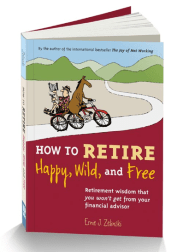 If you were looking for the reference manual, I recommend Ernie Zelinski’s How to Retire Happy, Wild, and Free (2016). The chapters are laid out by general concepts you need to understand. However, as in many user guides, you could turn to almost any page in the volume, jump around (in any order) to specific areas on which to focus, e.g. tips on travel (page 165) to health/wellness (page 109), and not lose the overall meaning.
 The contents of It’s Never Too Late to Begin Again are divided into a weekly course of study:
 The fictitious “Larry and Janice Sparks” share anecdotes of their experiences, modeling potential opportunities of retirees enhancing their relationships, stimulating their minds, revitalizing their bodies, growing spiritually… basically rekindling passion in every area of their lives.
 You will notice that all three texts cover many of the same subjects, but are vastly different in methodology, style/design, and overall structure.
 at the Seven Springs Mountain Resort in Pennsylvania on July 11-13, 2016.
 Do music teachers ever retire? Not really!

 Practice and go out on a few gigs with your own jazz, rock, Barbershop, or chamber music group
 education? Of course, the best part of retirement is that you get to pick what you want to do every day for the rest of your life. So go ahead and say yes to those extra conducting gigs, writing/publishing your own “Mr. Holland’s Opus,” working with the church or community choir, accompanying a handful recitals, volunteering to help your favorite local marching band or civic theater, serving as an adjudicator for a music festival, supervising student teachers or teaching college music education methods classes, etc.
 As long as I am alive, I will continue to inspire in others that music makes a difference!
 On the subject of music teachers exiting the job market, one area we have not ventured into with these blogs on “retirement resources” is the most difficult to handle – having to face a forced resignation or involuntary leave.
 Depression

 Evaluate your response to stress since you were summarily eliminated from your district. It is worth reviewing the definition of PTSD and see if it should be applied to your behavior and the emotional upheaval you are feeling (from the online blog of the Dr. Oz Show at
  It’s time to “dust off your chops” (join a community band/orchestra)


 The Romans giving tribute to the god Janus, for whom the month of January is named.
 my top-ten recommendations to help you “grow” and enjoy a glorious 2016!
 grandchildren (your own or adopted ones), enjoy them! Not only is your generous super-competent babysitting services providing ever-so-essential care-taking of your love-ones, “playing with the kids” is wonderful for your own mood and mental health. “Keep around young people and you will stay forever young!” However, invest your time wisely. You deserve a life of your own and unstructured time off. It is easy to be taken advantage of, so don’t let this childcare schedule dominate everything you do in your retirement.
 The single most satisfying pastime for all of us is to be or do something creative. With few exceptions, every day you need to find venue(s) to express yourself. This could mean pulling out your instrument or singing, with a renewed focus on exploring your musicianship, interpretation, composition, or improvisational skills. Creating new musical works, like adding to your own “Mr. Holland’s Opus,” can “make your day!” Other projects in creativity could involve conducting, acting, dancing, creating two or three-dimensional artworks, sewing, gardening, and my personal favorite, writing. Whether it is fiction or nonfiction, articles, books, poems, letters-to-editors – the activity is very personal – and possibly profitable? Try to assemble in words your long-practiced insights and experiences acquired working as a teacher. I am particularly inspired by the prospects of creating and posting blogs on just about any subject that motivates or moves me. Check out the opportunities that WordPress.com can give you. (I am not too shy to refer you to my own website, showing off my articles and “pet peeves” on the subjects of creativity in education, marketing professionalism, and retirement resources:
  Every week for the rest of your life, spend some time “giving back!” Volunteer or share your hobbies, interests, or expertise helping out wherever it is most needed… in local churches, hospitals, charitable organizations, schools, pet sanctuaries, or senior care centers. I never understood why some enterprising entrepreneur does not buy a large piece of land to build a combined animal shelter, childcare center, and assisted-living facility, connected with easy access to each other… mutually beneficial opportunities for needy children, lonely seniors, and rescued pets for interaction with each other! That’s a “win-win-win!”
 Stay involved in PMEA. Help new or recently transferred music teachers by joining the PMEA Retiree Resource Registry, the free (but priceless!) adviser/ consultant service





 paulfox.blog