Leaders Flush!

Leadership lessons for the classroom or staff development

This blog is a follow-up resource for my Empowering Educator and Student Leadership presentation at the PA Department of Education SAS INSTITUTE state conference on December 9, 2025 and provides a “fill-in-the-gap” narrative about many of the concepts we have already presented at this blog site:
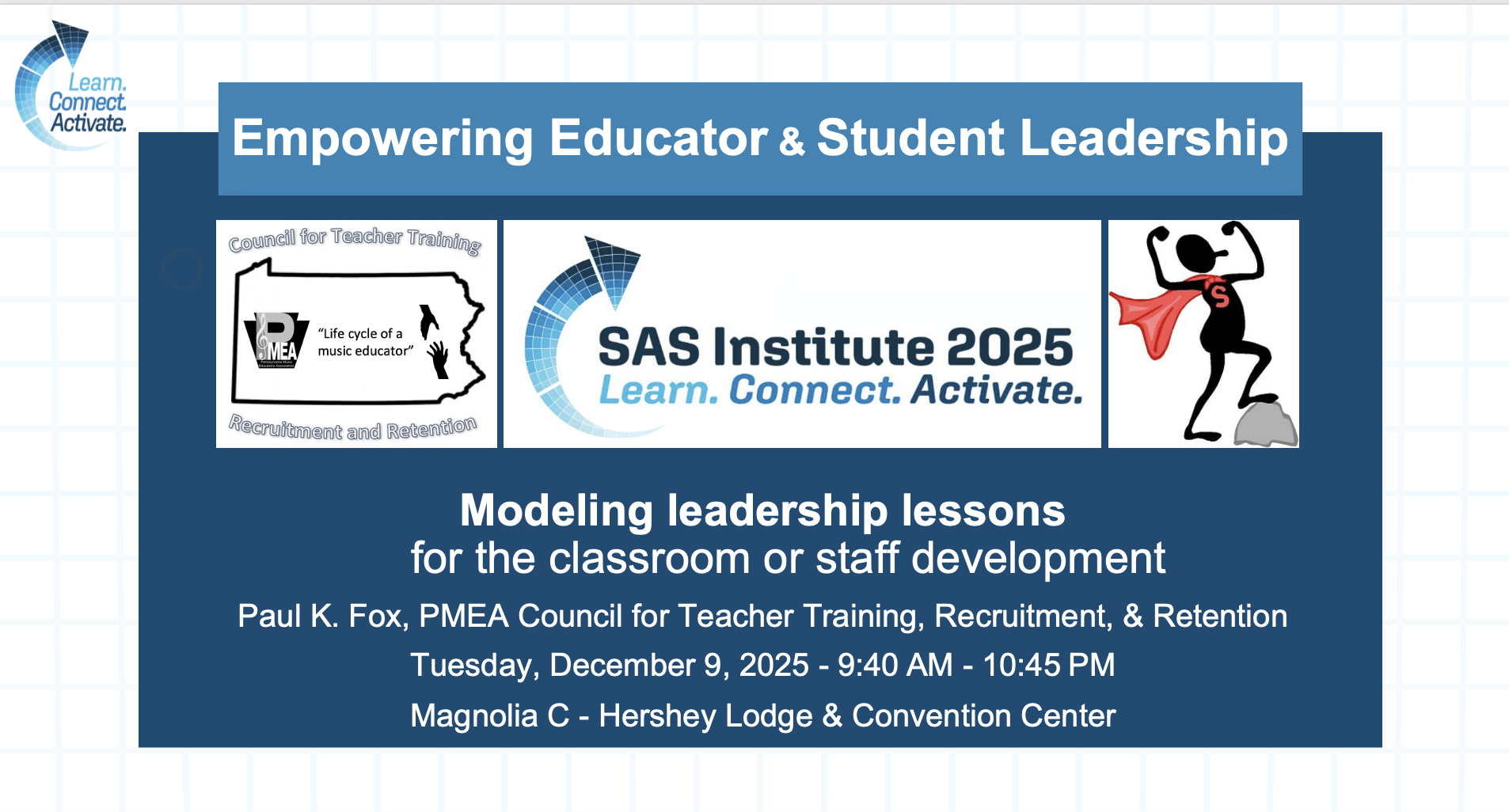
If you would like to review my PDF slide summary from the SAS INSTITUTE, click here.

Did the main title (above) get your attention? What on earth could “leaders flush” have to do with this topic? In teaching (and modeling) leadership skills to my students, we discuss what it means to Faire sans Dire or “do without saying,” the English translation to this crest:

Heraldry coat of arms emblem: Earl of Ilchester

In other words, if you see something that needs to be done (flush the toilet?), don’t assume it’s someone else’s job. A true leader embraces the philosophy Carpe Diem (“seize the day”), identifies the problem and its solution, rolls up his/her sleeve, and “gets it done!”

Why teach leadership in the curriculum & extracurricular activities?

“Leadership is an essential skill that extends beyond the classroom, shaping how students engage with the world around them. Whether leading a group project, organizing an event, or voicing their opinions in discussions, leadership skills empower students to take initiative and make meaningful contributions. These abilities are not only beneficial during school years but also serve as the foundation for lifelong personal and professional success.”
Bloomster

In the past, I have used a multitude of opportunities and settings to teach these life skills in summer leadership camps, section leader and student conductor seminars, drum major and marching band captain auditions, student director, producer, and musical crew head staff meetings, and for 25+ years, preparing student counselors for a comprehensive, six-day, grades 8-12 Township String Camp program.

To sum it up, teaching leadership in Grades K-12 and college settings will:

  • Develop communication skills
  • Build confidence & self-awareness
  • Enhance problem-solving abilities
  • Encourage teamwork & collaboration
  • Shape future success

Why teach leadership to educators?

My December session at SAS Institute was geared to school/system leaders, department heads, and other administrators, but actually the focus on leadership as a skill set necessary for school/staff/individual professional improvement is essential for all educators and school support staff.

From district administrators and school principals to instructional coaches and curriculum coordinators, leaders in education have a direct impact on the learning outcomes of all students. According to UNESCO, educational leadership is considered one of the most influential factors on student outcomes, falling just behind engaging teaching. As a result, leadership training for educators has become an essential part of the professional development experience for teachers at all levels of education.
“Building Leadership Skills – From Classroom Teacher to Educational Leader”

School improvement rarely occurs without effective leadership, and school leadership is only second to classroom teaching in its influence on student achievement. A new evidence review report from Global School Leaders paints a complex and ever-changing picture of school leaders, with their roles, responsibilities, and impact varying around the world.
3 Reasons Why School Leadership Is Vital to Teacher Success”
The literature suggests that empowering educators with leadership training will:

  • Improve student achievement
  • Empower and retain teachers
  • Support new staff members
  • Drive innovation and adaptability
  • Bridge the gap between instruction and administration
  • Build/model a positive attitude
  • Enhance strategic thinking and decision-making
  • Promote a positive and collaborative school climate
  • Develop soft skills such as communication, conflict resolution, and building trust… both in and outside the classroom

Leadership assessments

“A leadership skills assessment is a formal evaluation used to identify and measure a person’s leadership potential and competencies, such as communication, decision-making, and emotional intelligence. These assessments can be used by organizations to evaluate current leaders, identify high-potential candidates for promotions, and inform hiring decisions. Common methods include personality tests, scenario-based assessments, and 360-degree feedback, with tools like CliftonStrengths, Hogan Assessments, and DISC being popular examples.” 
“Leadership Assessment Test – A Complete Guide 2025”

There is a large body of information out there, especially commercial resources, for evaluating the leadership quotient and achievement of corporate managers, CEOs, CFOs, etc. I was impressed with the scope and depth of the research, including these sample firms advertising the availability of third-party consultants and advisors.
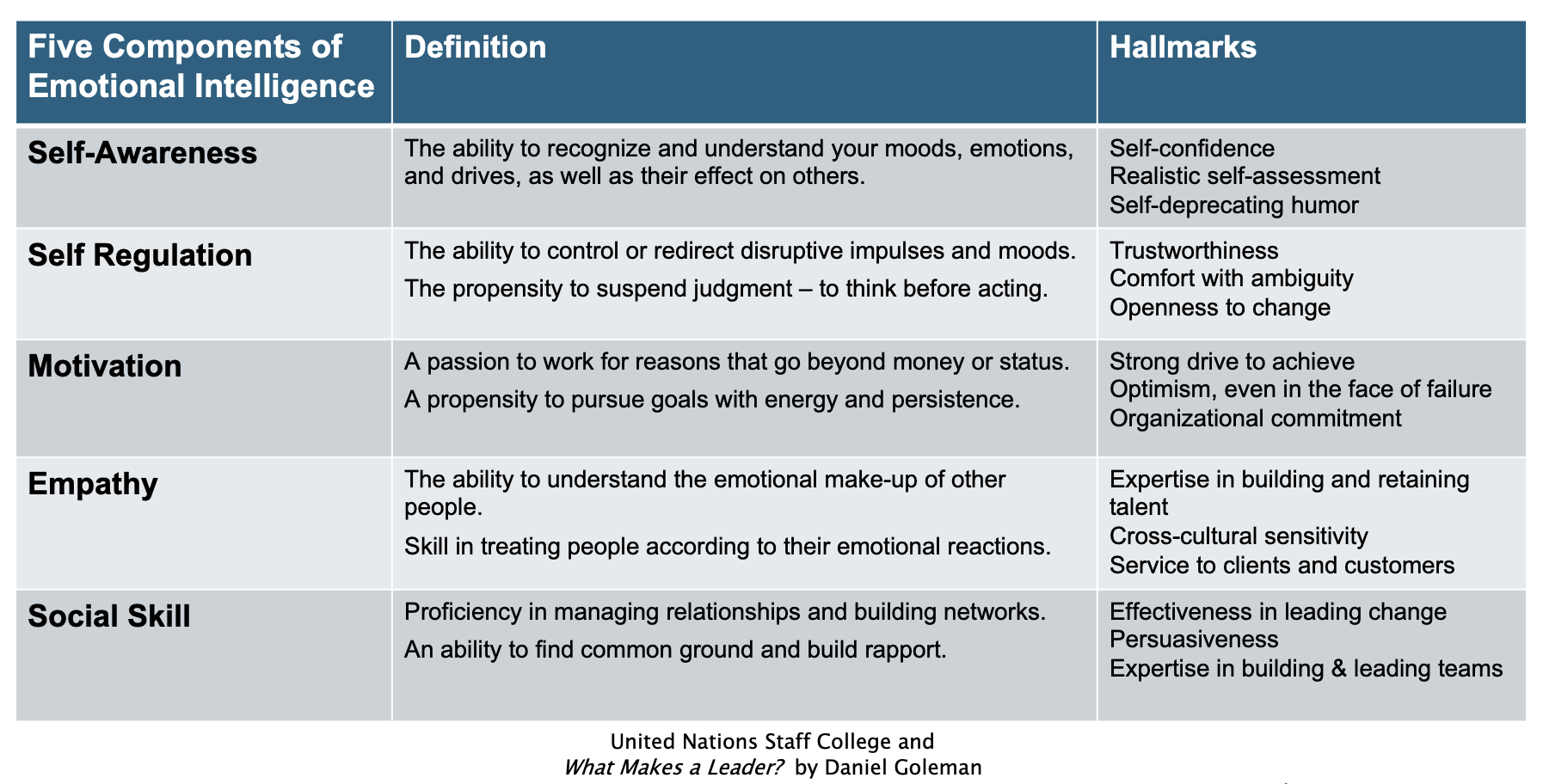
One night I randomly scanned through a handful of YouTube reels of company fraud and mismanagement (e.g., “Revenge of the Coffee Pot,” “Revenge with Karen,” and “Silent Revenge”), painting (fictitious) stories of bosses stealing intellectual property or assuming credit for the innovations/achievements of their subordinates, patent infringement, nepotism or incompetent hirings… all with arrogance, lack of professionalism, the total disregard of employee morale, and blatant patterns of poor executive decision-making, communication, emotional intelligence, strategic thinking, and the ability to influence and guide a team. “Emotional intelligence” (as defined above by Daniel Goleman in What Makes a Leader? also attributed to the United Nations Staff College) should include the “best practices” of self-awareness, self regulation, motivation, empathy, and social skills. Added to these YouTube (fake) scripted deficiencies are the mitigating effects of corporate politics, inconsistent application of compliance or HR policies, unclear contract language, and problems in the chain of command… with the eventual result of the boss receiving a fall from grace, termination, and other legal consequences. Most of these episodes imply only the Board of Directors evaluates the top executives (like school superintendents?), and even with the inclusion of employee satisfaction surveys, staff retention data, third-party auditors, and whistle-blower protections in some instances, the catastrophic actions of these leaders nearly destroy the businesses. For these videos, it seems that leadership assessments and goals are never ongoing, the benchmarks are seldom reviewed, and nothing is PROACTIVE… and therefore not preventive. Therefore, for the school district and corporate worlds alike, we need to intentionally provide formative assessments of our leaders (and ourselves). Exactly what do we need to know and do to improve?
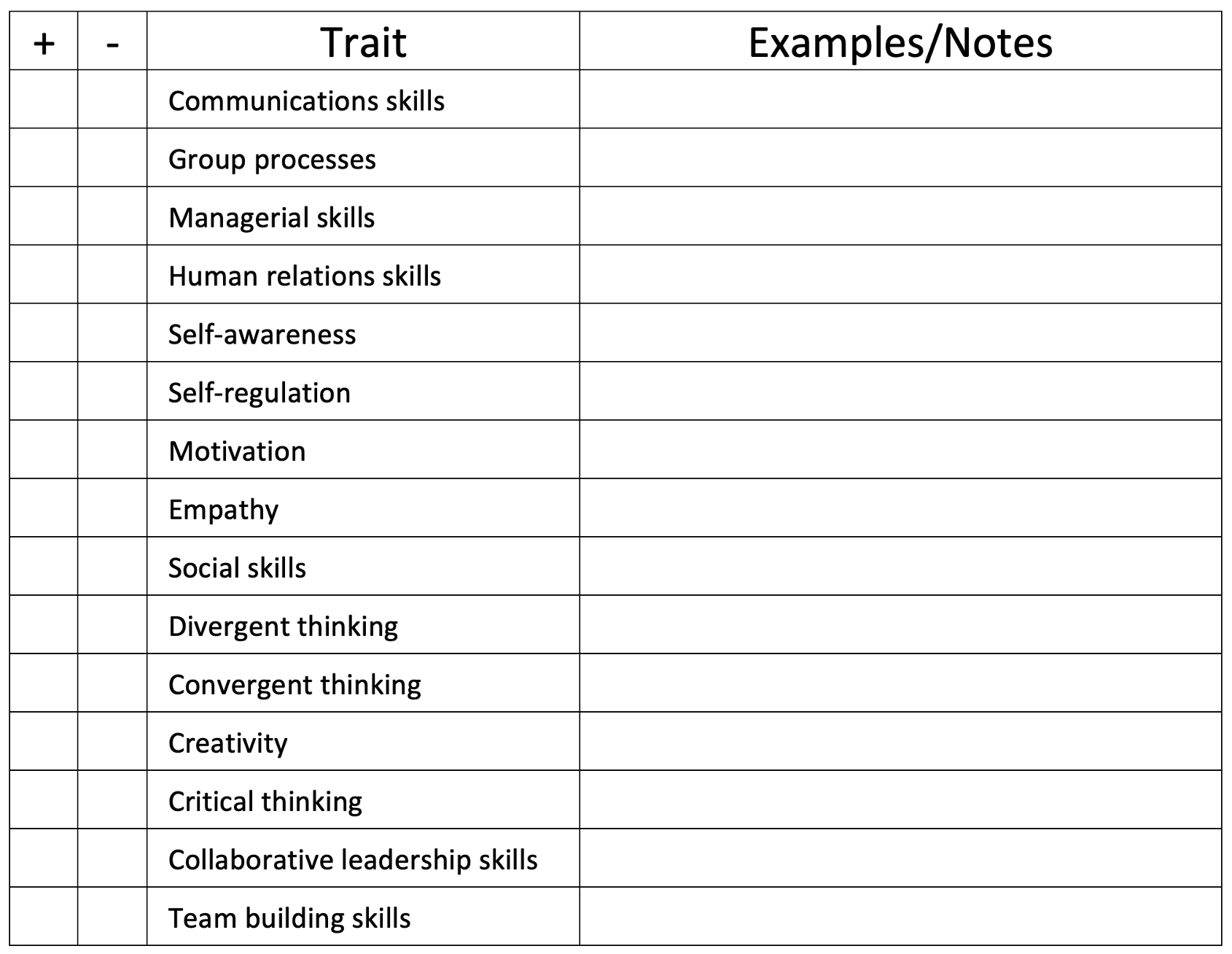
In my blog Growing Student Leaders and the SAS Institute 2025 presentation, I offered the above image as an informal personal checklist to evaluate leadership traits. Coincidentally, while I was writing this article, a scholarship committee of the Community Foundation of Upper St. Clair (for which I serve as Communications Director and Arts Chair) was developing an assessment rubric for ranking applications of a new student leadership scholarship. Although still under development, here are a few of the categories being considered:

  • Communication: Includes listening skills, clarity in speaking, and the ability to make others feel heard.
  • Integrity: Acting ethically, being trustworthy, and aligning actions with words.
  • Accountability: Taking ownership of actions and commitments.
  • Collaboration: Working effectively with others, valuing different perspectives, and resolving conflicts.
  • Self-awareness: Understanding one’s own strengths, weaknesses, and biases.
  • Drive/Initiative: A bias for action and the ability to move projects forward.
  • Courage: The bravery to speak truthfully, admit shortcomings, and make difficult decisions.
  • Humility: Recognizing the contributions of others and remaining a lifelong learner.
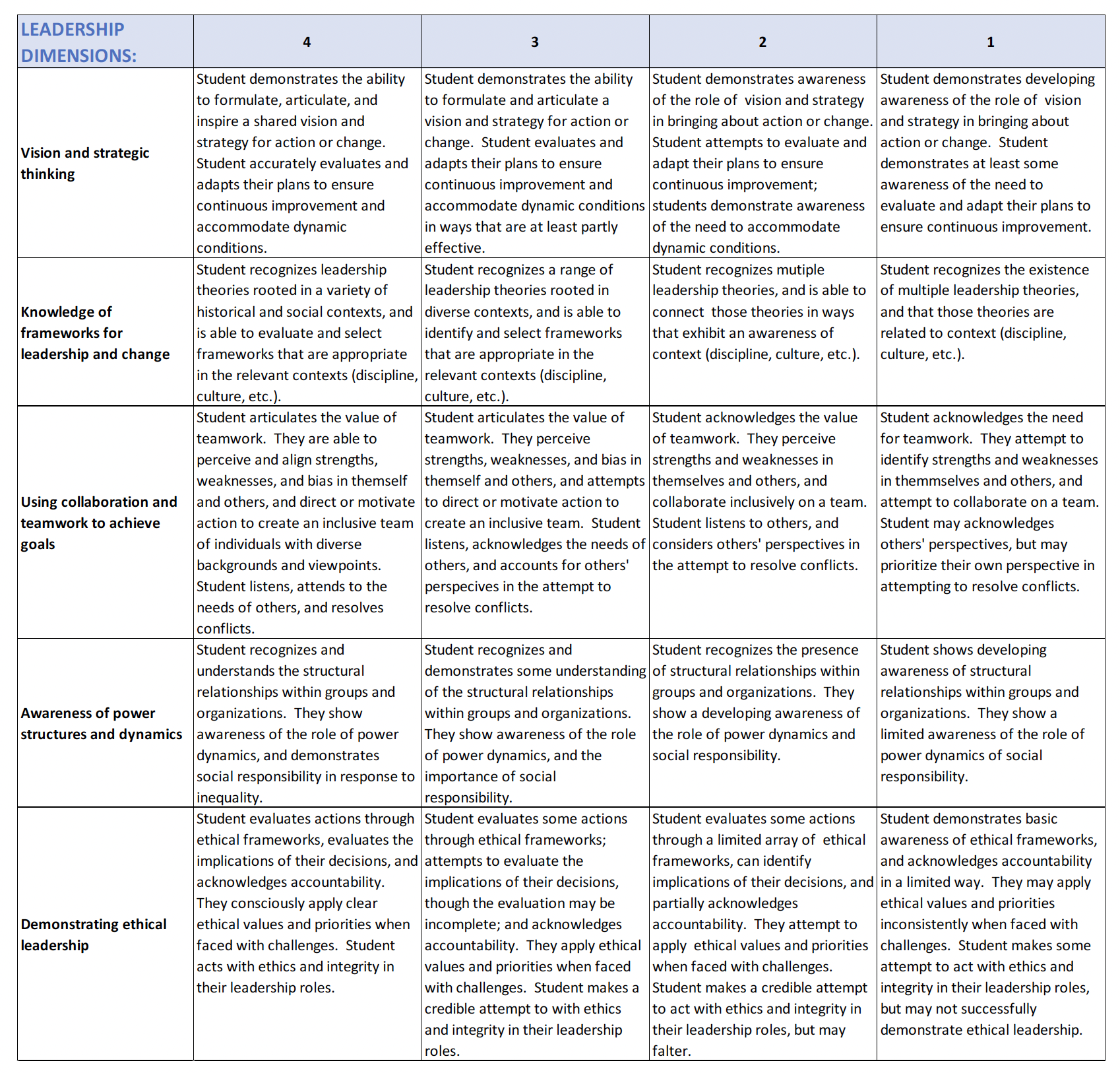
The University of Massachusetts Lowell developed the above rubric for their River Hawk Experience Distinction Leadership Program, defining specific criteria with a clear description of what each trait should look like at different performance levels, in order to provide a standardized way of measuring and assessing leadership skills
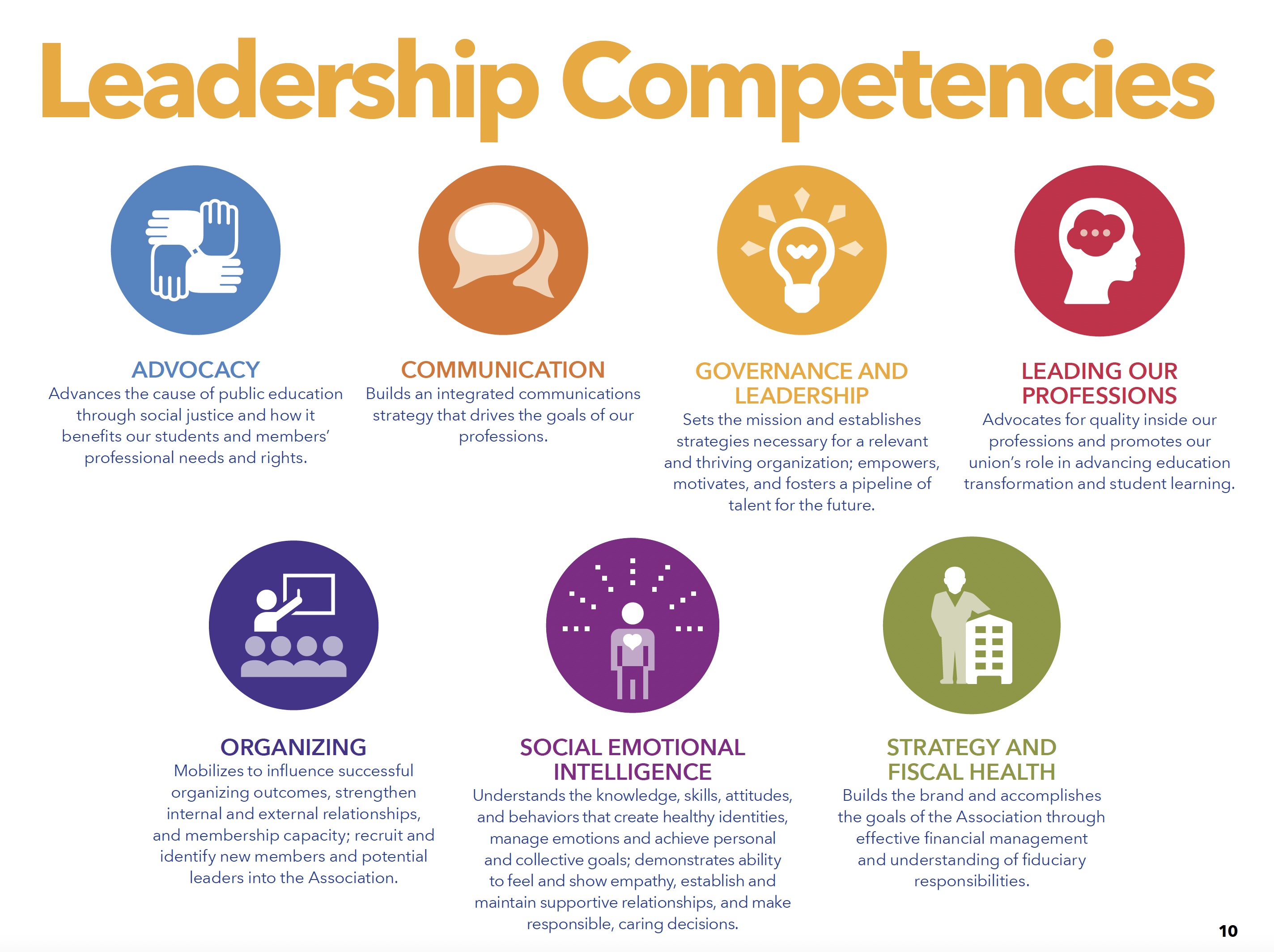
In addition, the National Education Association has created the above NEA Leadership Competency Guide worth downloading.

My favorite inspirational speaker Simon Sinek has also weighed in on this topic of “What Makes a Great Leader?” refining/simplifying it to just three traits:

  • Courage
  • Integrity
  • Communication

Additional resources

If you are an educator looking for supplemental material on developing leadership skills in your students, besides these SAS INSTITUTE 2025 slides (of which the original PowerPoint file is available to download for free in order to adapt for your classroom – please email me), I recommend perusing the full-blown “Building Leaders for Life” (second edition) curriculum (94 lessons in five subject areas, 355 pages of lesson materials, 137 student handouts) created by the Association of Washington Student Leaders (a division of the Washington School Principals’ Education Foundation). Click here to view their website. They also have a middle school and elementary series!

If you attend my SAS INSTITUTE workshop on December 9, 2025 (starting at 9:40 a.m. in Magnolia C, Hershey Lodge & Convention Center), ask me to see sample materials from their high school course of study.

Finally, here is the “homework for future leaders” I provided at the SAS INSTITUTE and during a 2024 summer camp at Upper St. Clair High School, providing additional links to many inspiring minds. Enjoy!


Leadership is not about being in charge. It is about taking care of those in your charge. — Simon Sinek

A leader is one who knows the way, goes the way, and shows the way. — John C. Maxwell

Do not follow where the path may lead. Go instead where there is no path and leave a trail.
— Ralph Waldo Emerson

The greatest leader is not necessarily the one who does the greatest things. He is the one who gets people to do the greatest things. — Ronald Reagan

What you do has far greater impact than what you say. — Stephen Covey

PKF

© 2025 Paul K. Fox

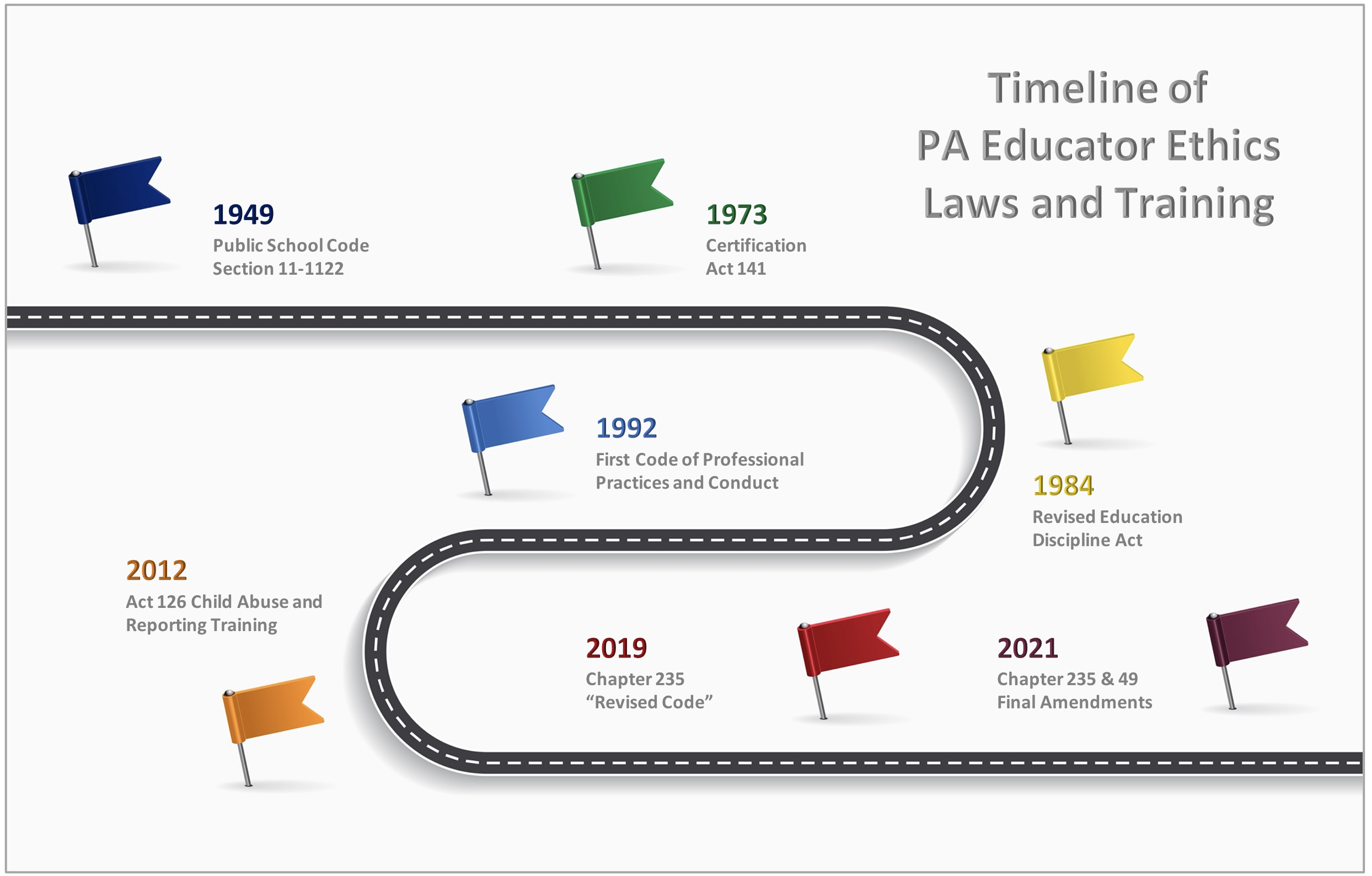
Launching PA Educator Ethics Training

Implementing the NEW PDE Chapter 49 “PE” Competencies – “The WHO, WHAT, WHY, & HOW!”

Blogger’s Note: We will return to Part II of “Bookends” next month to explore:

  • Stage 3: Inservice/Growing Years
  • Stage 4: Veteran/Sustaining Years
  • Stage 5: Next Chapter/Living the Dream

Instead, our November blog will share methods, modes, media, and other materials to provide meaningful professional development on ETHICS for EDUCATORS in the Commonwealth, resources from my upcoming presentation to school administrators at the Pennsylvania Department of Education’s SAS Institute – Successful Leadership – Shaping Your School’s Story to be held in the Hershey Lodge and Convention Center on December 11-13, 2023. Click below for my handouts.


PKFox

Interested in joining us at the Hershey Lodge on December 11-13, 2023? Please click here for more information or to register.

A Summary of My SAS Institute Ethics Session

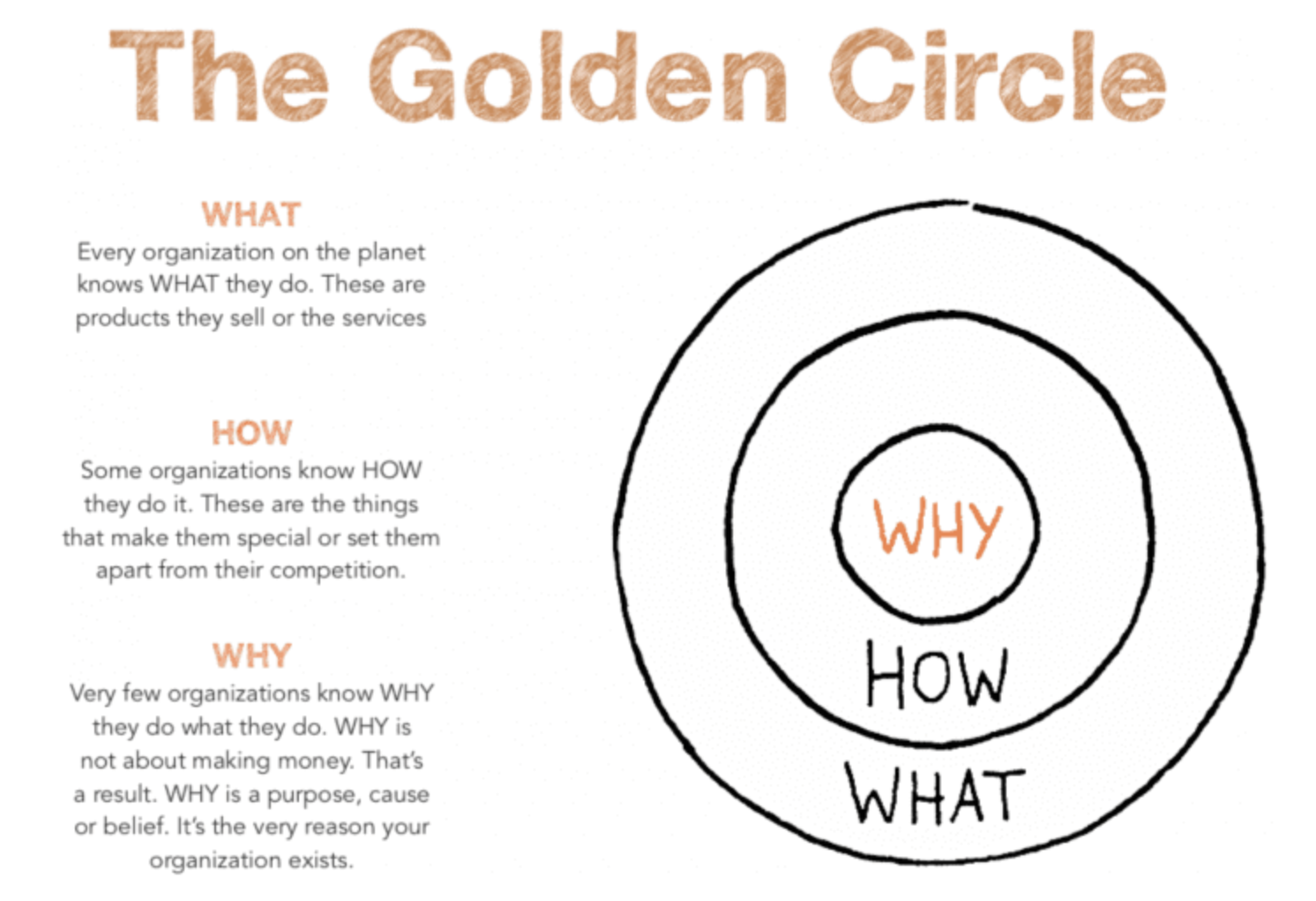
To paraphrase the wisdom of one of my favorite recent visionaries and online workshop presenters, Simon Sinek, “Every organization should begin with “the WHY!” According to SmartInsights, Sinek’s Golden Circle theory explains “how leaders can inspire cooperation, trust and change in a business based on his research into how the most successful organizations think, act and communicate if they start with why.” On his website, he declares his own WHY: “We are here to inspire people to do the things that inspire them so that, together, each of us can change our world for the better.” I love his mission!

https://www.smartinsights.com/digital-marketing-strategy/online-value-proposition/start-with-why-creating-a-value-proposition-with-the-golden-circle-model/

“Your WHY is your purpose, cause, or belief. WHY does your company exist? WHY do you get out of bed every morning? And WHY should anyone care about the work you do?” – Simon Sinek

So… lets ask the questions that define our own golden circle, my session, and this article:

  • WHY should we be so concerned about professional development in ethics for PA educators?
    (Why should you even be reading this blogpost?)
  • HOW should we train our staff?
  • WHAT should be introduced and reinforced over the long term?

And, I will add one additional question: WHO is responsible for all of this?

Well, the quick response to that last query is EVERYONE in the profession. However, this blog is particularly geared to school system leaders, career and technical center directors, and administrators charged with the responsibility of continuing education/professional development and induction programs for their PA educators.

The “WHY!”

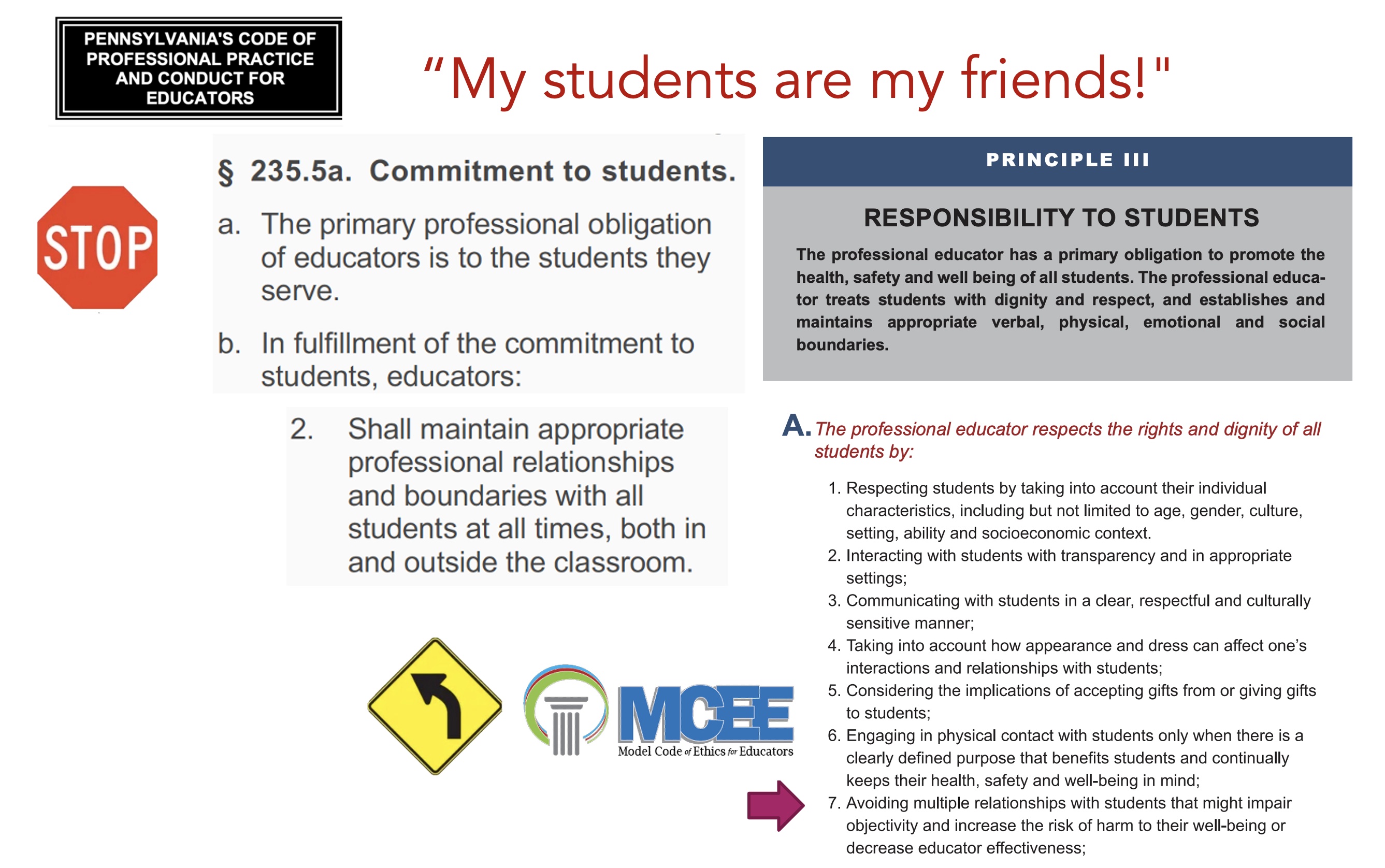
Quick. Calling on all PA teachers! Without looking on the Internet, can you identify the exact title of your “code of conduct” (1)? Do you know the PA agency responsible for writing this code and adjudicating its rules (2)? Can you name the “code of ethics” recently adopted by PDE and the Board of Education which provides school staff comprehensive guidance in professional decision-making based on context (3)?

Hints? How about a few acronyms?

  1. CPPC
  2. PSPC
  3. MCEE?

Don’t you think “we” should at least be familiar with the commission that grants us the license to teach in PA as well as the document that “governs” our behavior, violations of which could remove us from our job or revoke our certificate?

Of course, six years ago, even I didn’t know we had a PA “code of conduct!” (I started teaching in the public schools in 1978 and it wasn’t written until 1992!) After retiring from full-time teaching in 2013, I was asked to present my first ethics workshop back in 2017 for a Pennsylvania Music Educators Association (PMEA) Regional In-Service Program. Already scheduling me for two other sessions, the organizer came to me, “Could you add a presentation on educator ethics?” My first reaction was, WHY? Why would this be necessary? I promised him I would do a little research before getting back to him… and found these (now updated) statistics. Here’s the WHY in a nutshell!

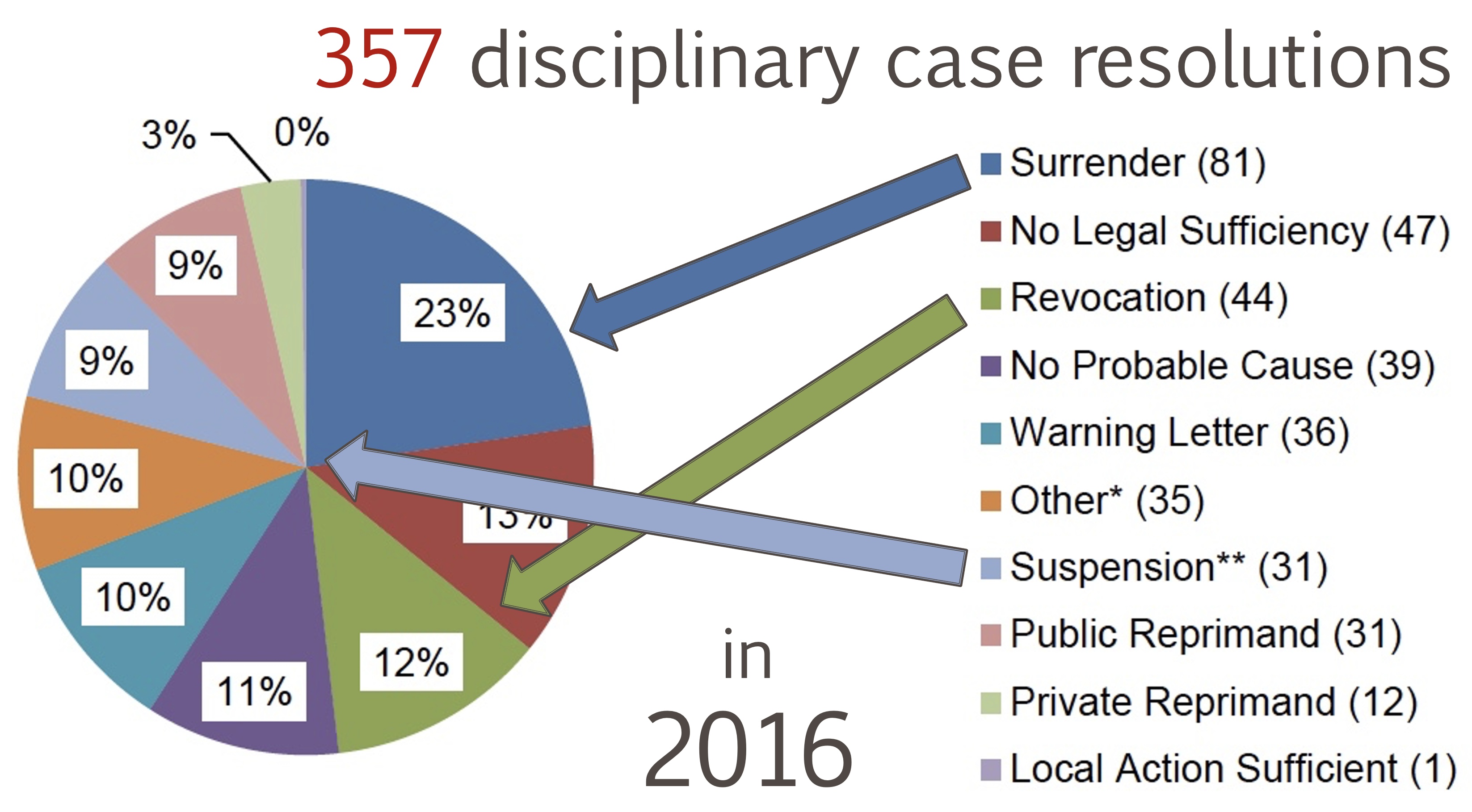
HORRIBLE! These are the number of PA educators by year who had misconduct complaints filed against them. Sure, a majority of their cases were not always fully prosecuted nor did they all result in a “guilty” verdict or plea, as this glimpse of educator disciplinary resolutions for 2016 (out of 672) for comparison shows (statistics from PDE):

But, if you can read the above graphic, that means that in 2016, 156 educators surrendered their license or had their certificate suspended or revoked! Obviously, no matter how you interpret the stats, this is a SERIOUS PROBLEM! And it may be due to a lack of training or understanding of the regulations and principles of ethical decision-making!

Why is this topic crucial for all pre-service, “rookie,” AND experienced professional educators? It is essential… not so much to serve as a reminder of the penalties for ethical infractions or spotlighting the occurrences you read or hear about in the news… but, because ETHICS are what we all stand for, the values we exhibit in our day-to-day decision-making, the integrity of the profession, and our “making a difference” in the lives of the students.

Ignorance of the law is no excuse for breaking it.

(Oliver Wendell Holmes)

The “WHAT!”

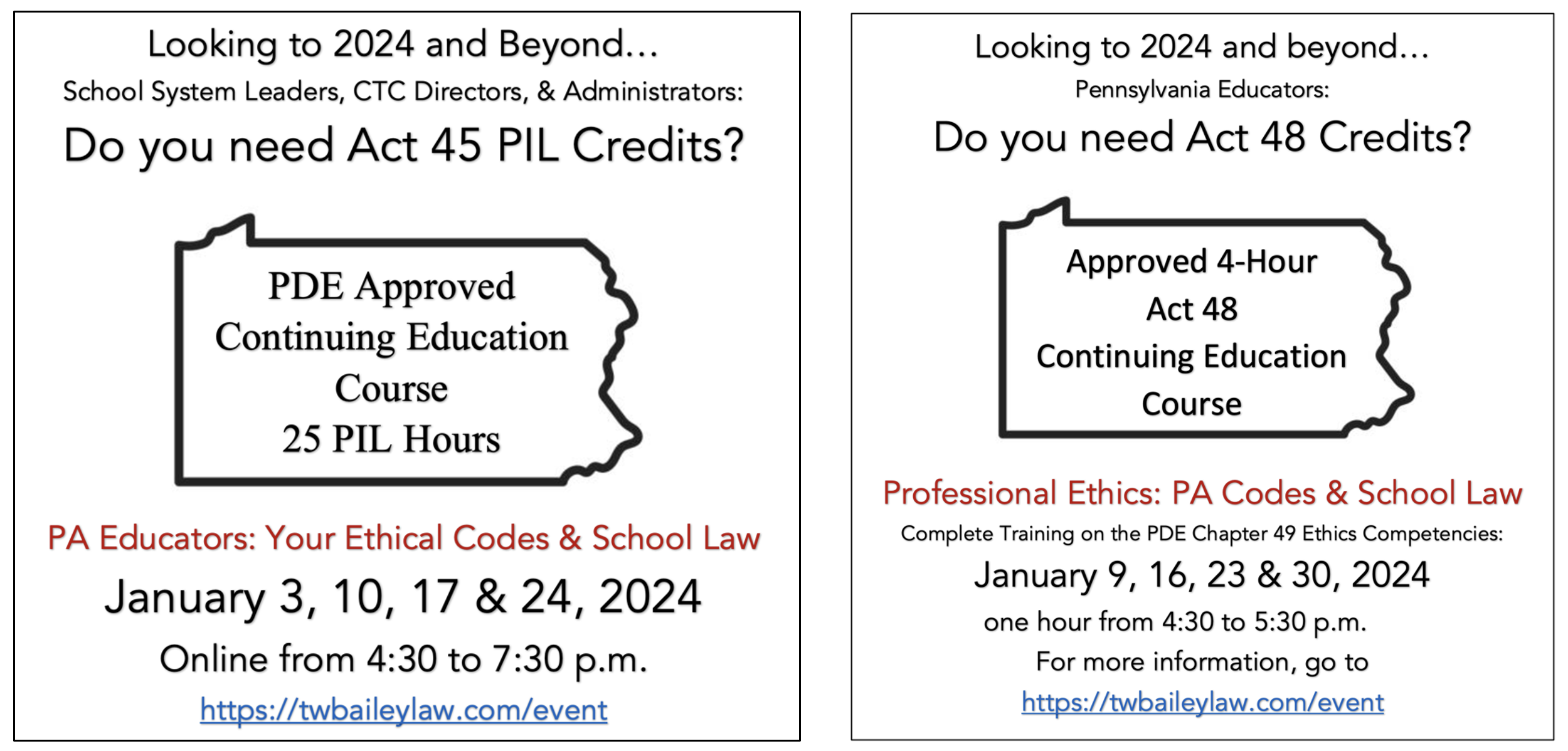
My colleague Thomas W. Bailey, a retired social studies teacher who reinstated his law license, and I set ourselves the goal of creating continuing education courses to provide REAL ethics training for PA educators. Thomas applied to the Pennsylvania Department of Education and received approval for a four-hour online Act 48 continuing education course for all PA educators (earning credits in PERMS) and a 25-hour online Act 45 PIL continuing education course for school system leaders, career and technical center directors, and other administrators responsible for planning the professional development of their school staff. The dates for our next two series of classes with open for enrollment in January 2024 are:

To register for either course, please go to Tom’s website: https://www.twbaileylaw.com/event.

Both of our courses satisfy the recently revised PDE Chapter 49 requirements of learning the “professional ethics” program framework guidelines:

For school system leaders and other administrators, PDE has set high expectations with the release of the following DEADLINES in April 2022:

“Chapter 49 requires instruction in professional ethics to be integrated in educator preparation, induction, and continuing professional development programs as follows.

  • Continuing professional development programs must integrate the professional ethics competencies no later than the 2023-24 academic year.
  • Educator preparation and induction programs must integrate the professional ethics competencies no later than the 2024-25 academic year.

Our Act 45 and Act 48 courses cover the following subjects, definitions, and applications of these terms:

  • Fiduciary
  • Ethical Equilibrium
  • Personal Morality
  • Regulations of Law
  • Professional Ethics
  • Professional Dispositions
  • Moral Professionalism
  • Differences Between Moral and Ethical Standards (with Examples)
  • Codes of Conduct (Examples)
  • Codes of Ethics (Examples)
  • Differences Between a Code of Conduct and a Code of Ethics
  • PA Professional Standards and Practices Commission
  • Paths of Educator Discipline in PA (Local and State)
  • Loudermill Hearings
  • State Discipline System (from Misconduct Complaint to Appeals)
  • PA Code of Professional Practice and Conduct
  • The Educator Discipline Act
  • National Association of State Directors of Teacher Education and Certification
  • Model Code of Ethics for Educators

The “How!”

I know this will sound a lot like bragging, but what makes the Thomas Bailey + Paul Fox ethics courses truly effective and different from everyone else in the game (albeit there are few “classes on the codes” sponsored in our geographic area) is the process – a focus on top-down training (administrator to teacher to student), interactive discussion, and a major emphasis on borrowing from the research of “Principled Teaching” in Domains 4a, 4d, 4e, and 4f of the Charlotte Danielson Framework for Teaching, the Teacher Education And Mentoring (TEAM) Module 5 Guide of the Connecticut State Department of Education, and the Facilitators Guide of the Iowa Board of Educational Examiners.

In my SAS presentation, I review several different modes of case study analysis, from simple to comprehensive, modeling small group interactive peer review, encouraging healthy discussions of diverse opinions in an “open,” non-threatening environment. The following approaches could be adapted to your setting of in-service programs or inductions:

MOCK JURY

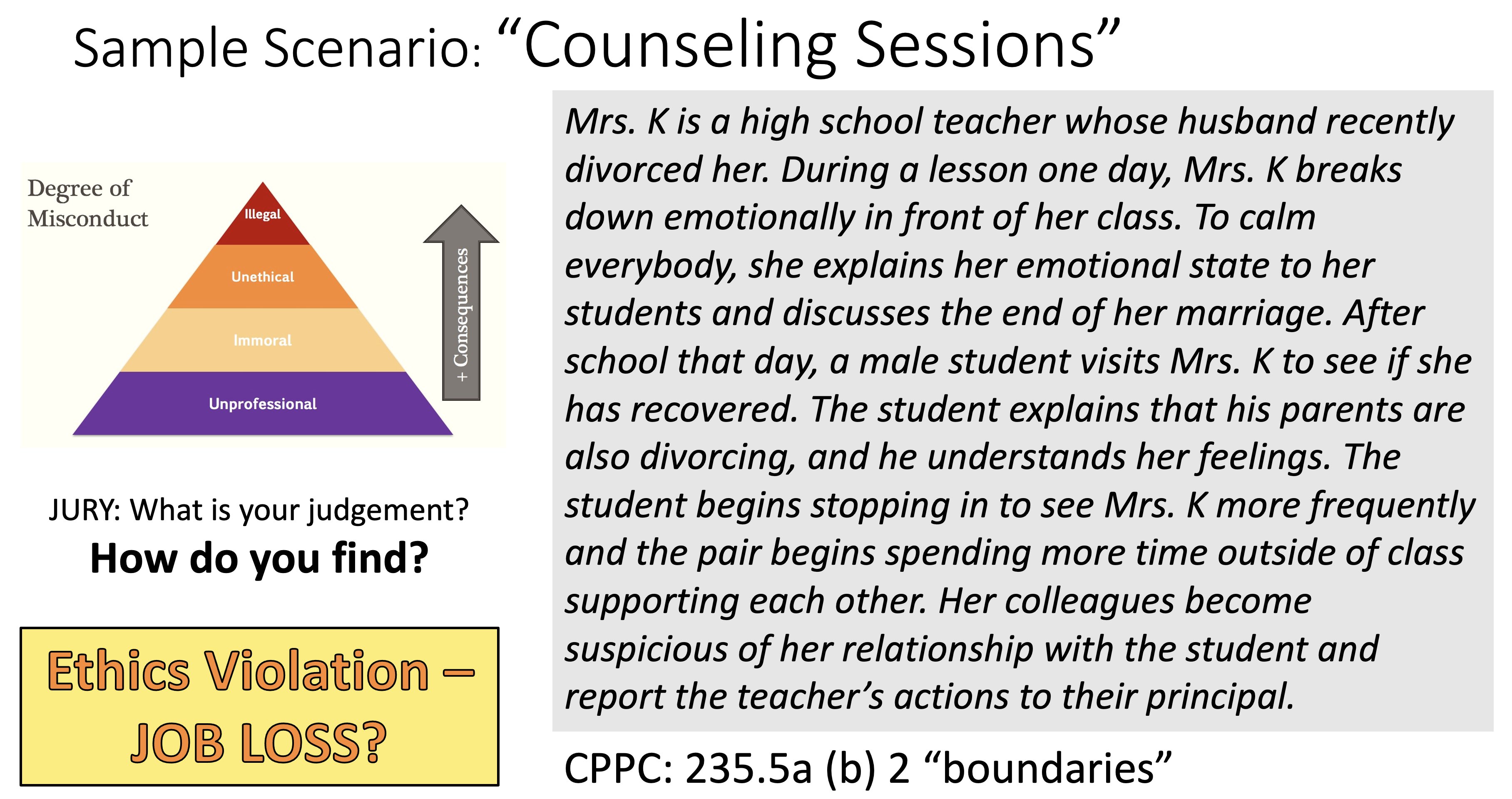
Degree of Misconduct, scenarios for learning the PA Code of Professional Practice and Conduct (CPPC): For more details, revisit the application of my misconduct rubric and explanation in the blog “Ethical Scenarios” here.

In collegiate sessions, I have used color-coded popsicle sticks and handouts of different hypothetical case studies for “the jury” to evaluate the behavior and “find the relevant code” in the CPPC.

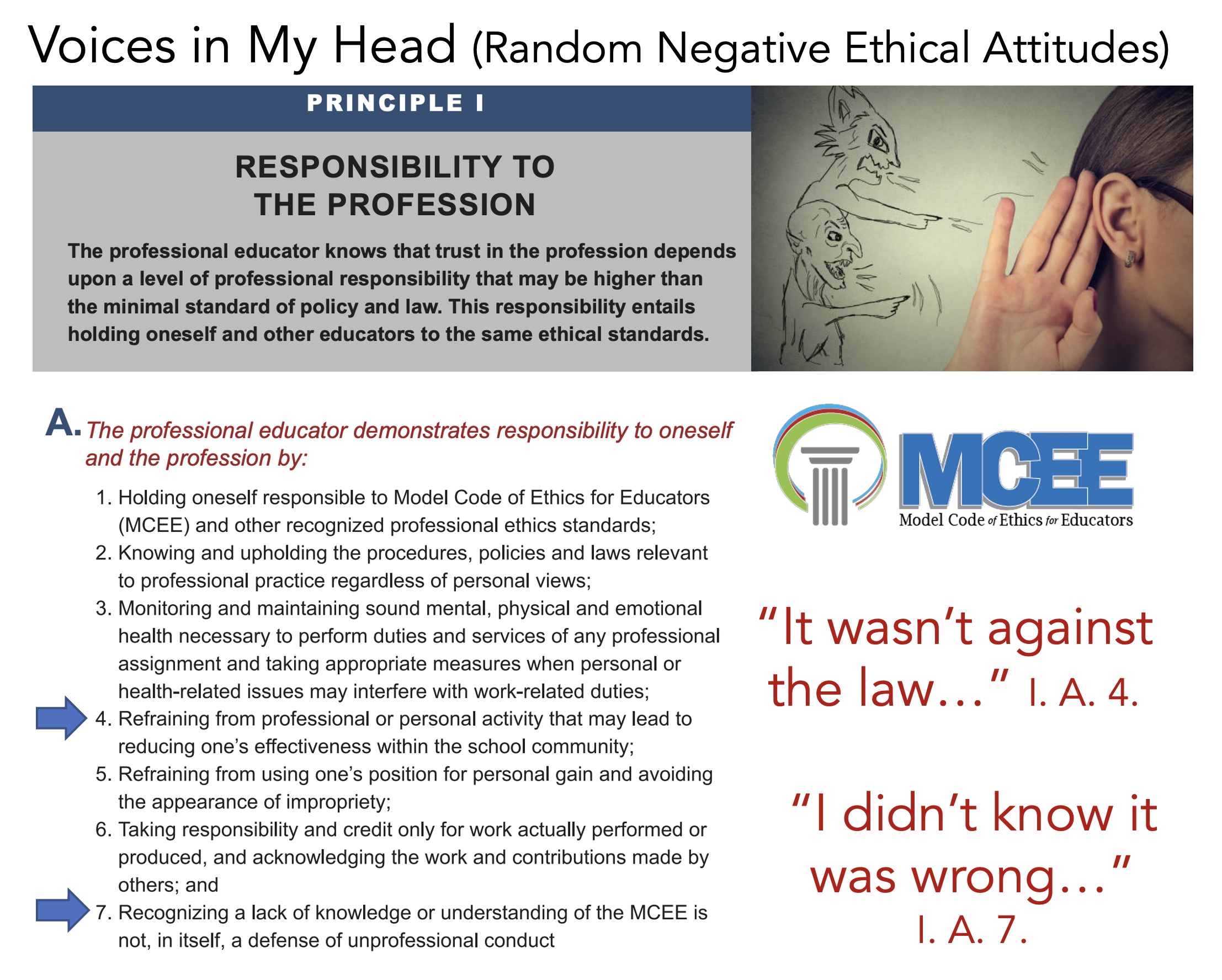
VOICES IN MY HEAD

Random Bad Attitudes for review of the standards in the Model Code of Ethics for Educators: I doubt (or sincerely hope) you would not hear too many of these directly from the school staff, but comments like, “Don’t ask for permission, beg for forgiveness” are NOT ethical precepts! Let’s dissect these bad boys!

SEARCH FOR THE STANDARDS

Hybrid Approach for using “the negative voices” and researching appropriate provisions in both the CPPC and MCEE: Select a single bad attitude and break off into two or three teams, each focused on corroborating related ethical principles in CPPC, MCEE, and even the PA Educator Discipline Act (EDA).

ALL CODES

Deep Dive” Case Study Analyses in small group break outs for comprehensive interactive discussions using an adaptation of the questions in the Connecticut State Department of Education TEAM Manual:

  1. What possible issues/concerns might this scenario raise?
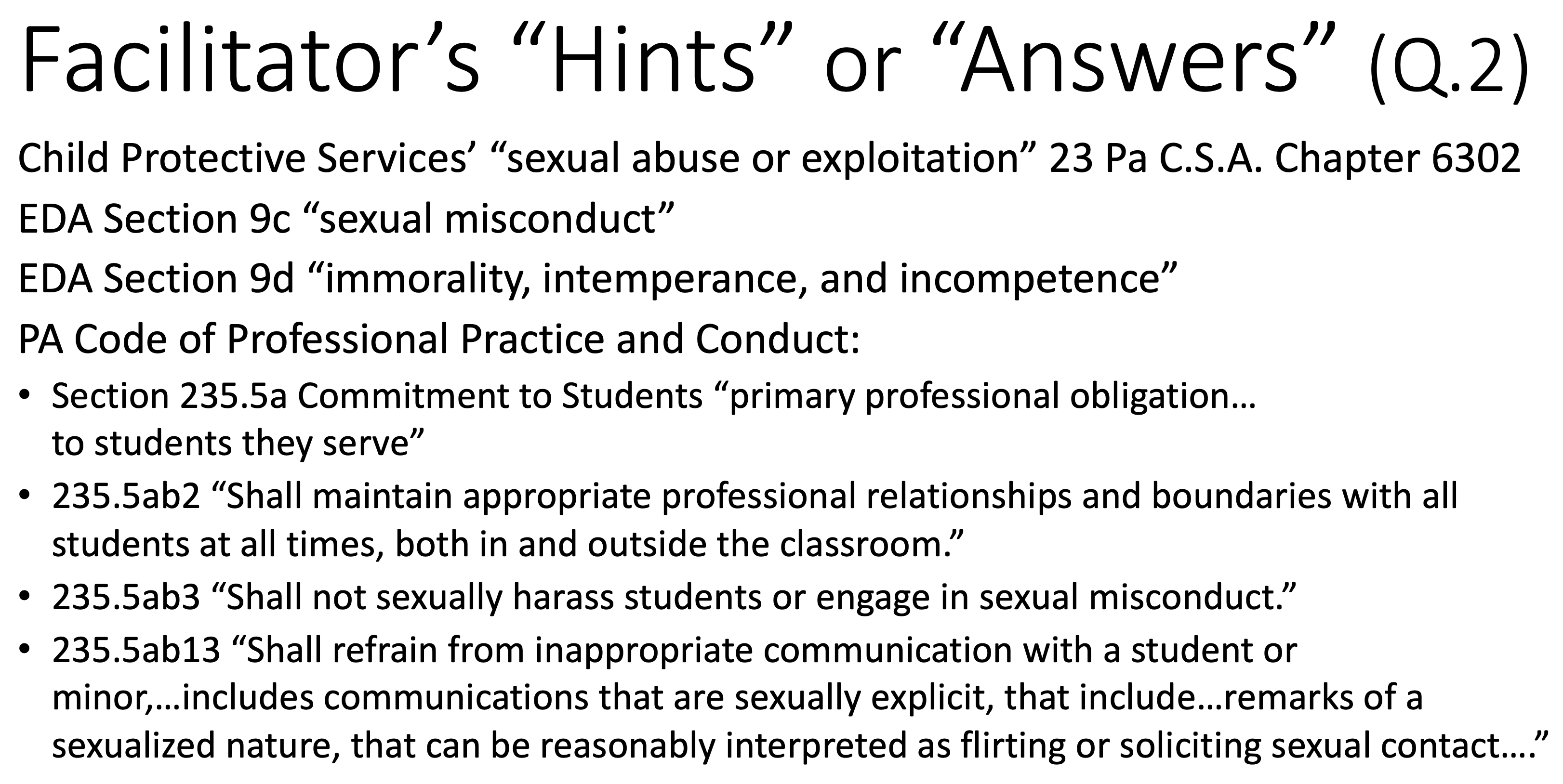
  2. How could this situation conflict with school policy, CPPC, EDA, MCEE, or case law?
  3. In this situation, what are some potential negative consequences for the educator’s students, fellow educators, and the school community-at-large?
  4. What responses/actions will result in a more positive outcome and/or what proactive measures might be considered?

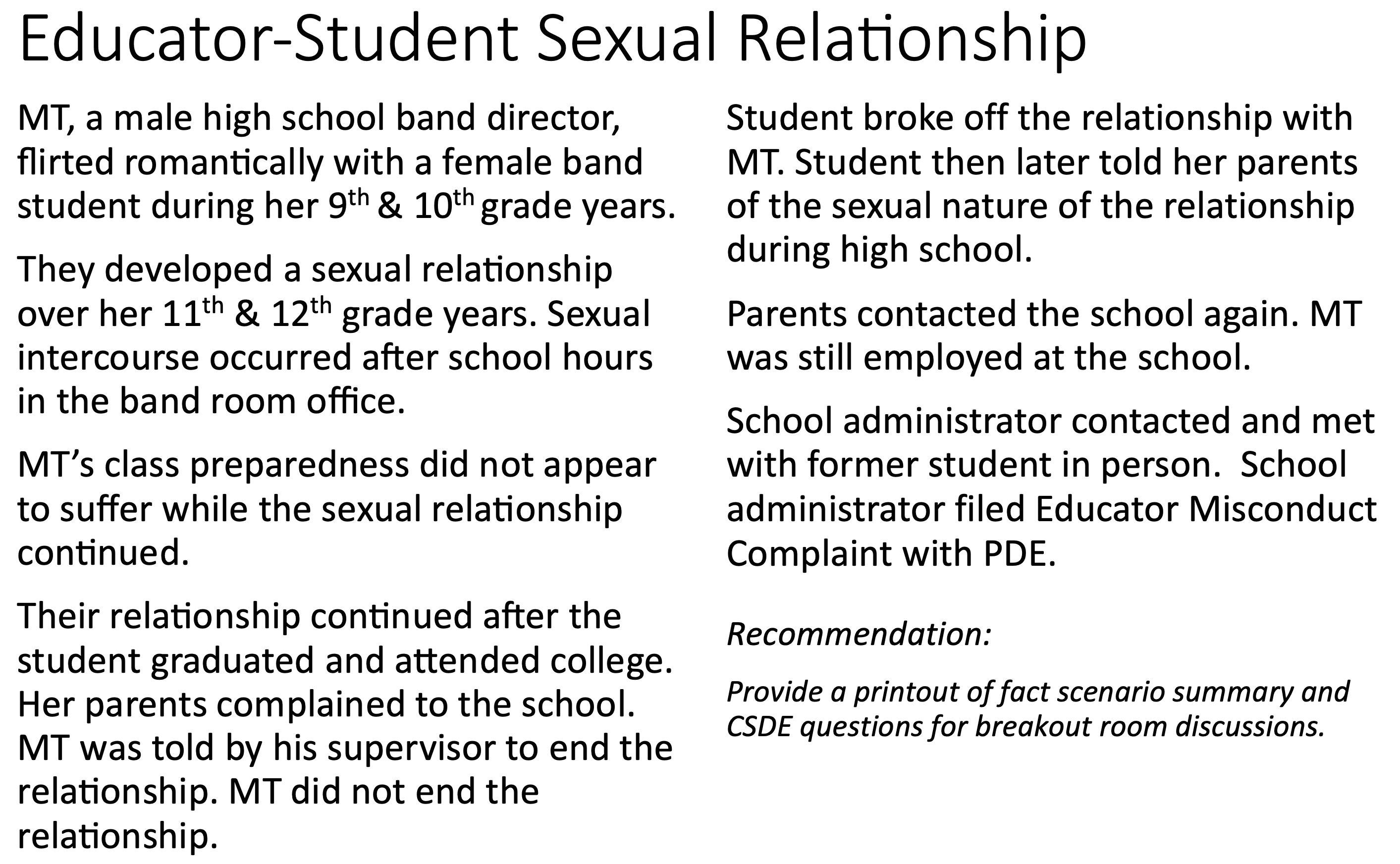
A single hypothetical scenario would first be presented to the full group, and then the educators would break off into 4-6 smaller groups to review these questions. Individuals may or may not all agree. A group leader is usually appointed to record their responses and then upon reconvening, report back to “the whole.” Here is a sample case study (painful reading; fictitious but based on actual past incidents):

The moderator may promote further discussion (sample answers below) and even pose additional questions like the following:

  1. What if the relationship was always of mutual consent?
  2. What if the teacher never taught the student while she was enrolled in his school?
  3. What if the relationship did not start until after the student graduated?
  4. What if his student was over the age of 18 during the time of the relationship?

It deserves mention here that this final training mode, representing perhaps the highest degree of scaffolding of the learning for the ethics training of your staff, proposes the establishment of a permanent school district Professional Learning Community (PLC) or ethics committee. We know from our past experiences in providing continuing professional development of educators that promote free, open, healthy sharing of potential professional decision-making conflicts or ethical “conundrums” – “what would you do” scenarios – will foster lasting long-term benefits. Danielson Framework for Teaching (Domain 4) and CSDE reinforce this philosophy of peer collaboration.

“Teachers must engage in district-facilitated conversations that focus on ethical and professional dilemmas and their professional responsibility to students, the larger school/district educational community, and to families.”

Connecticut State Department of Education

My educator ethics mentor and “hero” Troy Hutchings, Senior Policy Advisor to the National Association of State Directors of Teacher Education and Certification, admitted that in his early years of teaching, he felt a little reticent about going to his principal for advice in handling a situation of a student developing a “romantic crush” on him. To paraphrase his remarks during his webinar, “I was concerned that my supervisor might think I was encouraging the girl… Who could I turn to?” Sharing these anecdotes and talking informally with other faculty members will go far in building teamwork, mentor-mentee relationships, and intra-building trust in allowing more peer review towards enhanced educator decision-making.

If you need a resource on PLCs, my colleague (PA Principal of the Year to be honored at the upcoming 2023 SAS Institute) Dr. Tim Wagner recommended the handbook Learning by Doing by Richard DuFour, Rebecca DuFour, Robert Eaker, Thomas W. Many, and Mike Mattos (Solution Tree Press, 2016).

The authors’ summary of reasons to implement a PLC in your school building(s) are to:

  1. Improve staff’s individual and collective practice
  2. Build on staff’s “shared knowledge and experiences”
  3. Build clarity and understanding in the use of a common vocabulary
  4. Develop a library of accessible tools, templates, and protocols (i.e., ethical scenarios)
  5. Promote non-threatening, thought-provoking discussion on ethical decision-making

Wrapping It Up with More Resources

Every school setting is different, and your application of these staff ethics training ideas will be unique. Hopefully I have given any interested PA school system leader, CTC director, professional development or building administrator, or department chair some “food for thought.” For example, if you wanted to set up a PLC to meet regularly to discuss ethical issues, many of you may need to involve your teacher’s professional association and/or review their contract… or perhaps on-your-own implement a rotation of educators to experience these case study discussions during pre-scheduled inservice or induction days.

For “the keys to the car” to build your own local ethics professional development programs, we encourage you to sign-up for one of our classes here. For our PIL series, Thomas Bailey shares the native files of his PowerPoint presentations so that they can be turned around and taught to other educators, and then even students who are studying their own discipline code or online anti-bullying school policies. Here is an image of our PIL brochure which will be offered beginning on January 3, 2024.

I also suggest perusing Thomas Bailey’s free videos on this topic, slide #61 (page 31) from the handouts to my SAS Institute presentation (above), and these links to other blogs on paulfox.blog.

NOW YOU HAVE IT… the entire toolkit and rationale… the “who, what, how, and why” of educator ethics training and satisfying the new PDE Chapter 49 “PE” competencies.

© 2023 Paul K. Fox
Studies in PA Educator Ethics Case Law

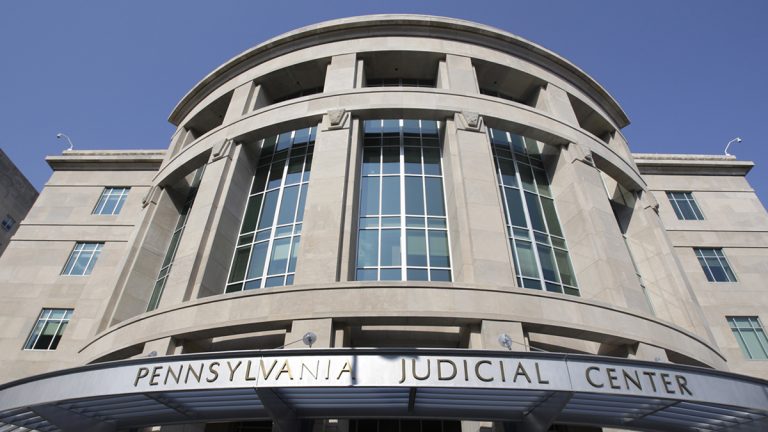
Photo by Associated Press: Pennsylvania Commonwealth Court

Reviews of Court Cases on PA Education Regulations & School Staff Misconducts

Special thanks to guest blogger Thomas W. Bailey, current attorney-at-law and retired social studies teacher, who provides Act 48 courses of continuing education in professional decision-making, analyzing educator ethics, the law, PA Code of Professional Practices and Conduct, and discussion and interpretation of sample fact scenarios based upon classroom dilemmas.

Previously, this blog site (category = ethics) has offered numerous articles on defining issues of morality, ethics, regulations, professional aspirations, codes of conduct and codes of ethics, teacher-student relationships and boundaries, confidentiality, mandatory reporting, and reviews by “mock juries” of educator misconduct case studies. For my PMEA music education colleagues, PCMEA members, and education majors and newcomers to the profession throughout the Commonwealth, one area that still needs to be addressed is a discussion on Pennsylvania case law. One essential question is applicable to ALL pre- and in-service educators across the country: Have you informed yourself about the structure of YOUR state’s three branches of government, laws governing school staff responsibilities, prohibitions, and discipline, specific codes of conduct and/or ethics, and the judicial review process and case law?

“Ignorantia juris non excusat.” (Ignorance of the law excuses not.)

Manitoba Law Journal, October 1885

Thomas Bailey has provided an outstanding resource for learning more about PA regulations, court decisions, and putting into practice the values of ethical decision making. Below is a glimpse of his court case blog. Please visit his website for more detailed information and to sign-up for online classes: https://twbaileylaw.com/.

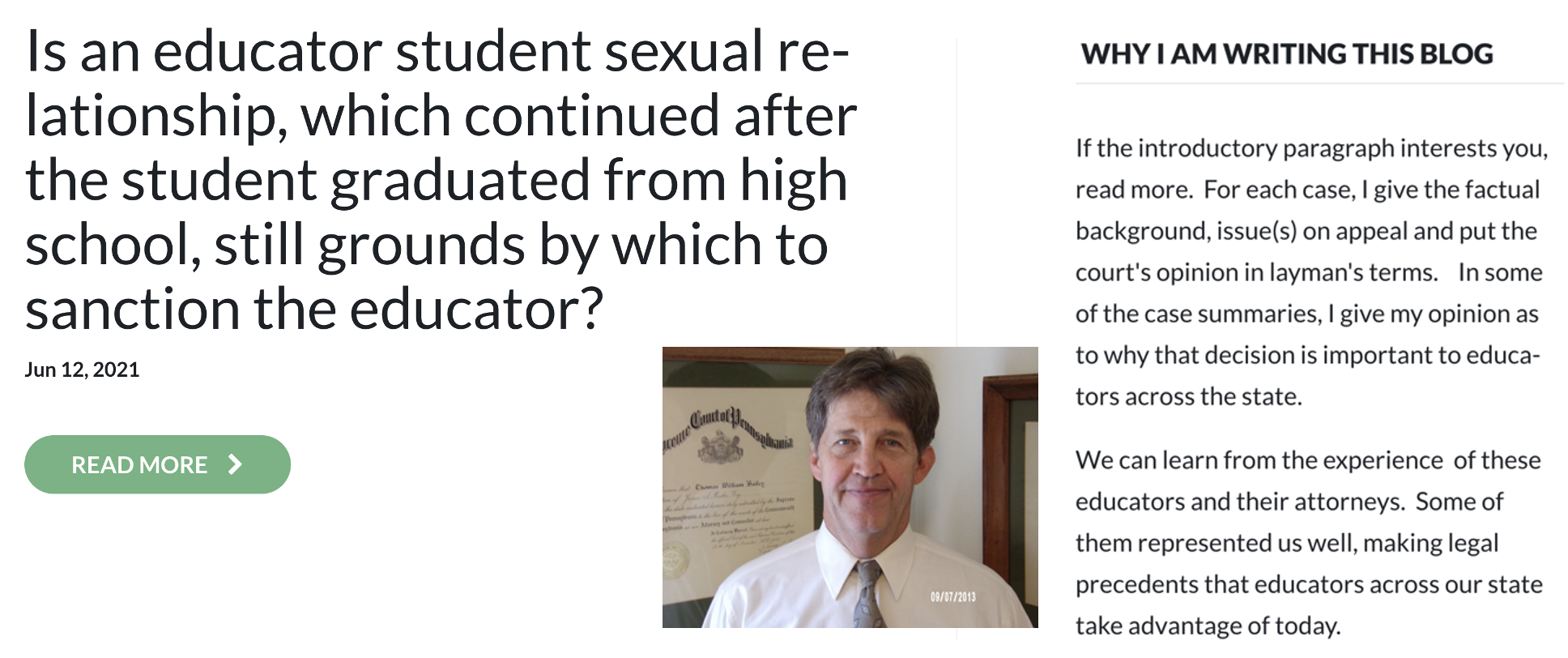
PA Commonwealth Court Case – Music Teacher Charged with Immorality

M.T. v. PA Department of Education: Analysis written by Thomas W. Bailey

Background

A male high school instrumental instructor and band director, M.T., began a romantic relationship with a 10th grade female band student (Student) in 2001 while employed for a Pennsylvania school district (District). M.T. continued the relationship with the Student to include sexual acts during her junior and senior years. The Student testified several sexual acts occurred within the District’s band room and band room office ending in 2004 with her graduation. M.T. continued to contact the Student when she attended college.  Her parents complained to the District of continual communication by M.T. while their daughter was in college.  In July, 2004 the District gave a written reprimand to M.T. to cease contact with the Student.  M.T. continued contacting the Student after the reprimand.

The Student subsequently broke off the relationship with M.T. in the Spring, 2005 and told her parents of their sexual relationship. The parents then contacted the District where M.T. was still employed.

In April, 2005, M.T. was suspended without pay by District based upon the parent complaint. 

PSPC website

On November 7, 2007, the Pennsylvania Department of Education (PDE) filed a Notice of Charges with the Professional Standards & Practices Commission (Commission) and served a copy to M.T. Charges from the Educator Discipline Act (EDA) included immorality, negligence, intemperance, cruelty, incompetence, sexual abuse or exploitation, and violations of the Code of Professional Practice and Conduct for Educators (Code of Practices). The violations of the Code of Practices included provisions prohibiting the acceptance of gifts by teachers and prohibiting sexual conduct between a teacher and student. PDE also claimed that M.T. posed an immediate threat to the health, safety, and welfare of students and sought immediate suspension of his certificates.

The Commission appointed a Hearing Officer (HO) who heard three days of testimony from the Student, M.T. and others. M.T. was represented by counsel.

The HO’s recommendation to the Commission include his Findings of Fact and Conclusions of Law which determined PDE had met its burden of proof on all but two charges. The Hearing Officer’s recommendation did not find M.T. to have given a prohibited gift to Student and that he was not an immediate threat to students. M.T. filed many exceptions with the Commission. M.T. claimed the technical rules of admissibility of evidence apply during Commission hearings, that his alleged, immoral conduct was not testified to by third party witnesses and that PDE did not offer sufficient evidence of professional incompetence, among other exceptions. PDE asserted M.T. remained an imminent threat to students. 

Upon review, the Commission denied M.T.’s exceptions, found him to be responsible on all charges except the gift and immediately revoked his teaching certificates.

Issues Before the Commonwealth Court

  1. Do the technical rules of courtroom evidence apply during an EDA hearing?
  2. What educator conduct constitutes immorality in a relationship with a student?
  3. What educator conduct constitutes lack of professional competence for an educator engaged in a sexual relationship with a student?
The Commonwealth Court of PA was established in 1968 and is one of two statewide intermediate appellate courts.

Commonwealth Court’S Opinion

Technical rules of evidence followed in courtroom litigation do not apply to a Commission Hearing Officer. The strict rules of evidence practiced in Pennsylvania Common Pleas Courts and US District Courts are not followed. All relevant evidence of reasonably probative value may be received.

Sexual intercourse with a student inside the band room office constituted educator immorality. “Immorality is conduct which offends the morals of the Commonwealth and is a bad example to the youth whose ideals a professional educator or charter school staff member has a duty to foster and elevate.” Third party testimony to the immoral acts was not necessary. Immorality with a student violated EDA Section 9c(1).

M.T.’s professional competence in teaching kids did not appear to suffer during the sexual relationship with the student. Incompetency is a continuing or persistent mental or intellectual inability or incapacity to perform the services expected of a professional educator or a charter school staff member. Absence evidence of failure to prepare for class or uphold assigned duties, the educator was not proven by the preponderance of evidence presented to be incompetent in his actions. PDE failed to carry its burden to prove this Charge.

Importance

Immorality of educator student sexual relationship defined in detail. Criteria for professional incompetence explained as well as PDE’s burden of proof before the Commission.  PDE must prove elements by preponderance of the evidence: over 50% of the evidence produced exhibits culpability. 2-25-21

M.T. v. PA Department of Education 56 A3d 1 (Pa. Commonwealth Court 2010)

M.T. pro se

Attorney Nicole Werner for Pennsylvania Department of Education

https://twbaileylaw.com/blog/court-cases-4

Additional Court Case Summaries on the Thomas Bailey Blog Site

It behooves us to learn more about Pennsylvania case law. Read and share these additional analyses They will enlighten you and may foster additional discussion with colleagues. Feel free to post your own comments on Thomas Bailey’s website.

The final court judgment (Horosko v. Mt. Pleasant Township SD above) is one of the oldest, dating back to 1939, and may be considered the foundation and precedent for current PA school employee regulations and discipline, especially in the confirmation of the following quote from the PA Professional Standards and Practices Commission of the Pennsylvania Department of Education:

“Professional expectations do not always distinguish between teachers’ on or off-duty conduct. Accordingly, teachers must act in their private lives in a way that does not undermine their efficacy in the classroom, demean their employing school entity, or damage their position as a moral exemplars in the community.”

Unit 1, The Ethics of Teaching (Ethics Tool Kit)

What you say or do, both inside and outside the classroom, can and will affect your teaching effectiveness, professional reputation, and school employment status! But, if it is ever needed, be sure to know and exercise your rights, obtain the advice of a competent attorney, and avail yourself of due process.

PKF

© 2021 Paul K. Fox

Summer Reading

Teachers, you’re in the home stretch now! You are within weeks of a long vacation break and the chance to rest, refresh, recharge, rewind, and rejuvenate. After what COVID-19 dished out to us, you deserve some time off! Here comes much-anticipated trips, family visits, sleeping in, and going dormant for at least 2-3 weeks!

However, most music educators never totally shut down. We seek out new enrichment opportunities by attending conferences or music reading workshops, researching new methods, and “retooling” for our lessons ahead.

Modeling the annual Peanuts comic strip’s January theme of Lucy Van Pelt assigning Charlie Brown a long and unwanted list of New Year’s Resolutions, yours truly (a retired teacher with a lot less stress) is about to do the same and recommend YOU kick off your shoes, climb into a comfortable lounge chair, tune out all extraneous noise and media distractions, and crack open some “serious summer reading…”

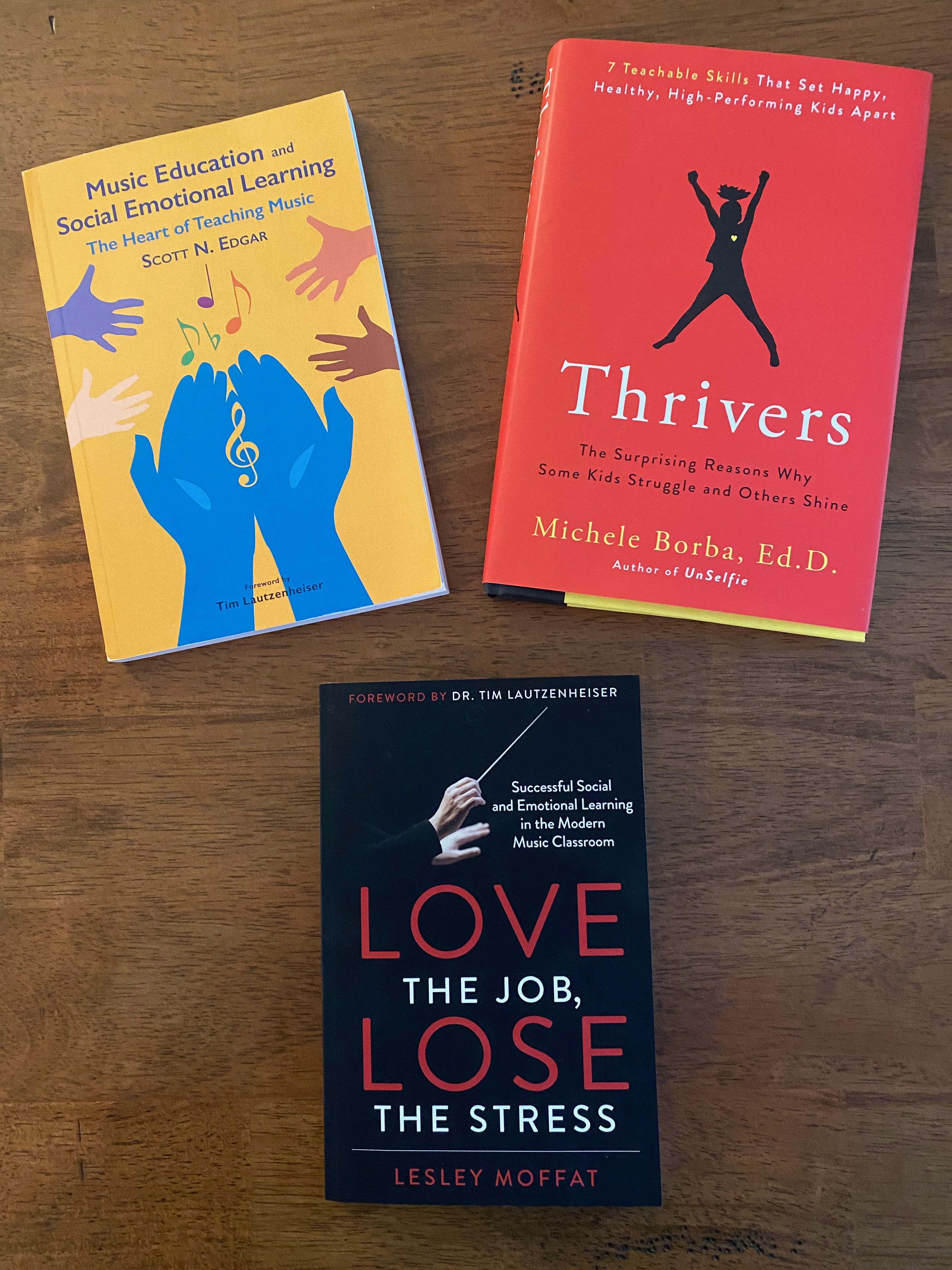
Here are my three favorite books for the season to take with you when you go to the beach or sit by the pool!

In keeping with an alliteration of all those “r’s” to promote healing and health during this “recess,” take time to prepare for 2021-2022 and reflect on and restock your reservoir of resilience, robustness, and resourcefulness!

Teachers Pay Teachers SEL blog

S is for “SEL”

Yes, the values and life skills of emotional/mental/social “balance” begin at home. But the expectation is that schools and teachers are always relied upon to be the “safety net” – pick up the pieces or fulfill the needs not provided at home. And it should not have taken a pandemic for us to discover how important social emotional learning (SEL) is to the health, wellness, and success of every child (and their family members) we serve in our classrooms, ensembles, lessons, and after-school programs.

“Music educators are in a prime position to help students become socially and emotionally competent while at the same time develop excellent musicianship. For every child to be successful in the music classroom, teachers need to be aware of the whole student. How do music educators create success when students every day struggle with social awareness, bullying, communication, problem solving, and other challenges? This pioneering book by Scott Edgar addresses how music educators can utilize Social Emotional Learning (SEL) to maximize learning in the choral, instrumental, and general music classroom at all levels, and at the same time support a student’s social and emotional growth.”

— back cover of Music Education and Social Emotional Learning – The Heart of Teaching Music

“Finally! Thank you, Scott Edgar, for your willingness to walk boldly into this often trodden, but rarely addressed aspect of music education you have rightfully labeled social emotional learning. For every music educator, from preschool through a PhD program, we know the opportunity to “develop the whole person” is right in front of us each and every day. Where else in the academic community is there such a perfect forum that cultivates both the cognitive and effective growth of those involved? Ultimately, the rehearsal room/music classroom becomes a society within society, and the skills needed to grow and succeed at the highest levels are simultaneously offered in content and context. And yet, there are very few resources to guide the mentor in a positive, productive fashion. Now there is and this book is a powerful blueprint leading us to a worthy outcome and more.”

— Foreword by Tim Lautzenheiser for Music Education and Social Emotional Learning – The Heart of Teaching Music

Probably the most authoritative textbook on SEL for music teachers, it may be hard to believe that Scott Edgar wrote it in 2017, long before the crush of COVID-19. SEL is now coming to forefront due to the “pandemic-related” problems of students feeling disconnected, stressed, over- or underwhelmed, and unmotivated during their physical isolation from in-person schooling and remote learning (See Edutopia at https://www.edutopia.org/article/3-ways-support-students-emotional-well-being-during-pandemic and Education Week https://www.edweek.org/leadership/the-pandemic-will-affect-students-mental-health-for-years-to-come-how-schools-can-help/2021/03).

SEL sources

You have a wide variety of choices to explore this topic, and all of these are from Scott Edgar!

The NAfME Professional Learning Community: Music Education and SEL – An Advocacy Tool for Music Educators accessible as a video: https://vimeo.com/426070325

Music for All webinar series:

  • Episode 1Teaching Music Through Social Emotional LearningComposing with Heart hosted by Scott N. Edgar with guest presenters Brian Balmages, Brandon Boyd, Richard Saucedo, Alex Shapiro (composers) and Bob Morrison https://youtu.be/6HIbK23TmaE
  • Episode 10Teaching Music Through Social Emotional Learning Narwhals and Waterfalls hosted by Scott N. Edgar with guest presenters Paige Bell and Adrien Palmer: https://youtu.be/BlbxX1DP-5c

The NAfME Music in a Minuet blog: https://nafme.org/music-education-social-emotional-learning/

Music Education and Social Emotional Learning – The Heart of Teaching Music in book form is available from Amazon and https://giamusic.com/store/resource/music-education-and-social-emotional-learning-book-g9418?artist=tpVEu30fe0uy.

Check out his all-encompassing Table of Contents:

Section One – Teaching Music Beyond the Notes

  • Chapter 1: What is Social Emotional Learning
  • Chapter 2: Socialization in the Music Classroom by Jacqueline Kelly-McHale
  • Chapter 3: Bullying in the Music Classroom by Jared Rawlings
  • Chapter 4: Music Educators Are Not Counselors

Section Two – Social Emotional Learning (SEL) and Music Education

  • Chapter 5: Self-Awareness and Self-Management in Music Education – Self-Discipline and the Music WIthin
  • Chapter 6: Social-Awareness and Relationship Skills in Music Education – Sharing and Communicating Through Music
  • Chapter 7: Responsible Decision-Making in Music Education – Problem Solving Through Music

Conclusion: The Heart of Music Education – Our Common Bond

SEL – the new “buzz word?” What is Social and Emotional Learning?

“Social and emotional learning (SEL) is the process through which children and adults acquire and effectively apply the knowledge, attitudes, and skills necessary to understand and manage emotions, set and achieve positive goals, feel and show empathy for others, establish and maintain positive relationships, and make responsible decisions.” — Collaborative for Academic, Social, & Emotional Learning

Social emotional learning describes the development of skills in three domains: self, others, and responsible decision making.

“Self” includes:

  • Self-awareness skills such as ability to identify and recognize emotions
  • Self management skills such as perseverance in the ability to manage impulse control

“Others” includes:

  • Relationship skills such as cooperation, empathy, and respectful communication
  • Social awareness skills such as the ability to recognize diverse thoughts and opinions.

“Responsible decision-making” includes:

  • Behavioral skills such as situation analysis, anticipating consequences and generating alternative solutions.
  • Cooperative skills such as balancing personal in group expectations.

The three key pillars of SEL:

  1. identity
  2. belonging
  3. agency

Probably the best conclusion I have ever read about the value of SEL in the arts comes from Scott Edgar in the last section of his book:

“The music classroom is a melting pot of students from different backgrounds, musics of different cultures, varied personalities, and diverse values. All of this diversity is united under the common bond of music… Music classrooms, possibly more profoundly than any other academic setting, can help students and teachers cooperate to recognize diversity, engage in respectful dialogue to resolve conflict, and empathetically respect human dignity, because this is how music has functioned for centuries. Music classrooms are social because making music is, has, and always will be a social activity. In a time when there are so many divisive forces, music and music education can be a powerful uniting weapon. The tenets of SEL interwoven into a musical education strengthens both entities. Emphasizing self- and social-awareness makes music education richer and more personal. Music education brings humanity and culture into a world of personal and interpersonal interactions.”

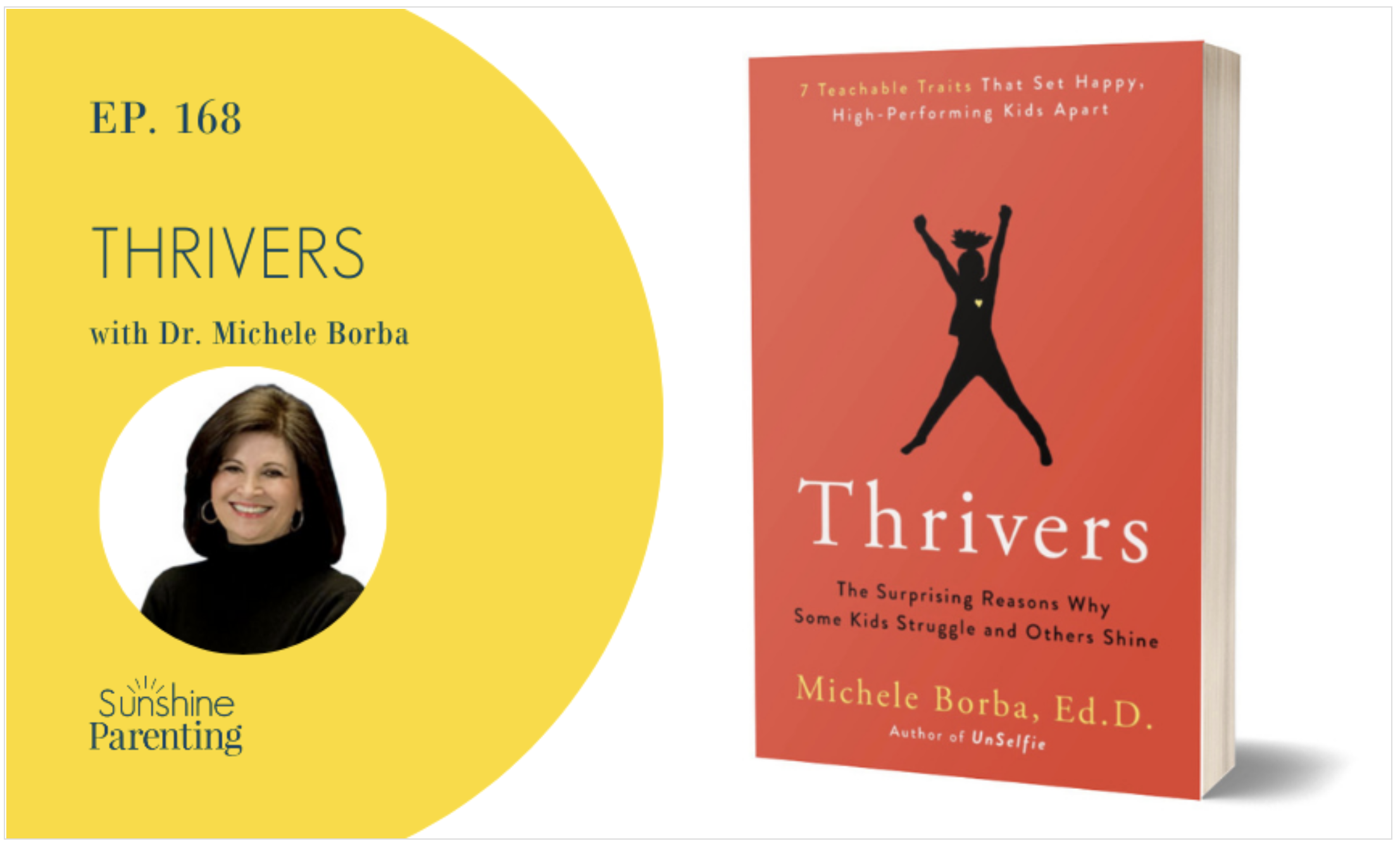
Sunshine Parenting video by Audrey Monke featuring Dr. Michele Borba

Seven Teachable Skills to Cultivate & Nurture THRIVERS

The latest book by Michele Borba, Ed.D., Thrivers – The Surprising Reasons Why Some Kids Struggle and Others Shine, is a definite must-read from cover-to-cover.

“Michele Borba has been a teacher, educational consultant, and parent for 40 years – and she’s never been more worried about kids than she is right now. The high-achieving students she talks with every day are more accomplished, better educated, and more privileged than ever before. But the old markers of success (grades, test scores) aren’t what these kids need to thrive in these uncertain times – and they know it. They’re more stressed, unhappier, and struggling with anxiety, depression, and burnout at younger and younger ages – “We’re like pretty packages with nothing inside,” said one teen. Thrivers are different: they flourish in our fast-paced, digital-driven, ever-changing world. Why? Dr. Borba combed scientific studies on resilience, spoke to dozens of researchers/experts in the field, and interviewed more than 100 young people from all walks of life, and she found something surprising: the difference between those who struggle and those who succeed comes down not to grades or test scores, but the seven character traits that set Thrivers apart (and set them up for happiness and greater accomplishment later in life).”


— from the front flap of Thrivers

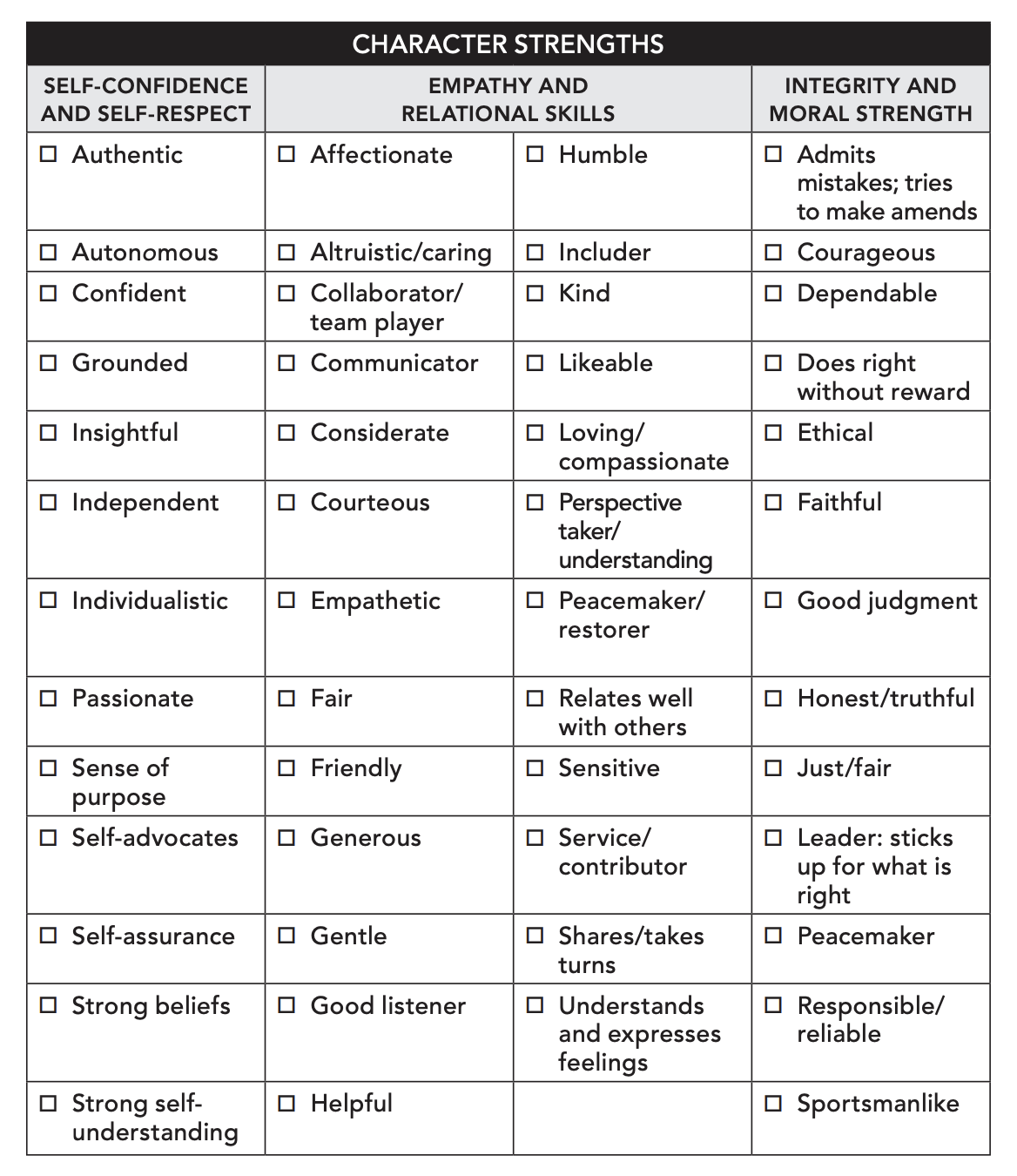
The first thing you need to do (after you order and read both her original best-seller UnSelfie – Why Empathetic Kids Succeed in Our All-About-Me World and this sequel) is to download her give-away “Core Assets Survey” from https://www.micheleborba.com/wp-content/uploads/2021/03/Thrivers_CoreAssets.pdf. Here is a sample page of her assessment checklist for her seven character strengths.

How to use Borba’s book

Although it is generally marketed as a guide for parents (and grandparents), this is a perfect “program and process” for everyone who serves as youth caregivers and educational professionals. Borba prescribes these steps to use the book with the above evaluation tool:

  1. Assess your child’s character strengths: self-confidence, empathy, integrity, self-control, curiosity, perseverance, and optimism.
  2. Tally up the points, prioritize his needs, and address initially the one or two traits receiving the lowest score.
  3. Read each chapter of “evidence-backed strategies and skills” which can be easily transferred and taught to your child from preschool through high school.
  4. Motivate and help your child to adopt each character strength “as a lifelong habit to optimize his potential in thrive.”
  5. Choose one ability a month, focus on it, and “practice it with your child a few minutes a day until he can use it without reminders.”

For teachers, this is a wonderful “soft curriculum” for nurturing these seven essential personal traits, each broken down into “character strength description,” “abilities to teach,” and “outcomes.” It will become apparent to you that these are directly related to SEL.

Besides the character strengths (#1 above), the reader is introduced to several revised definitions and new acronyms that may help to reshape our perspectives for teaching kids (these are a few samples): C.A.L.M. (chill-assert-look strong-mean it – p. 239), C.A.R.E. (console, assist, reassure, empathize – p. 90), comebacks (p. 240), creativity (p. 178), C.U.R.I.O.U.S (child-driven-unmanaged-risky-intrinsic-open-ended-unusual-solitude, p. 175), digital limits (p. 78), emotions (p. 76), goals (p. 209), gratitude (p. 86), growth mindset (p. 205), micromanaging (p. 171), mindfulness (p. 133), moral identity (p. 148), multitask (p. 110), “the four P’s of peers, passion, projects, and play” (p. 163), parenting styles (dysfunctional) – “enabler,” “impatient,” “coddler,” “competitor,” “rescuer” (p. 127), triggers (p. 121), self-esteem (p. 33), T.A.L.E.N.T. (tenacity-attention-learning-eagerness-need-tone – p. 39), and well-rounded (p. 36).

Activities throughout the book are categorized for age-suitability: Y = young children, toddlers, and preschoolers; s = school-age; t = tweens and older; a = all ages.

In the final pages of the book, Borba poses some excellent group discussion questions to facilitate a thorough review of her work. A few of these especially resonated with me:

  • Do you think raising children who can thrive today is easier, no different, or more difficult than when your parents raised you? Why?
  • What influences children’s character and thriving development most: peers, media, education, parents, pop culture, or something else?
  • Which of the seven character strengths are more difficult to teach to children today? Why?
  • What kind of person do you want your child (or your student) to become? How will you help your child become that person?
  • What are some of the sayings, proverbs, or experiences you recall from your childhood that helped you define your values?
  • [As a teacher] what would you like your greatest legacy to be for your [students]? What will you do to ensure that your [children] attain that legacy?

Her specific anecdotes, object lessons, and research for each character strength are priceless!

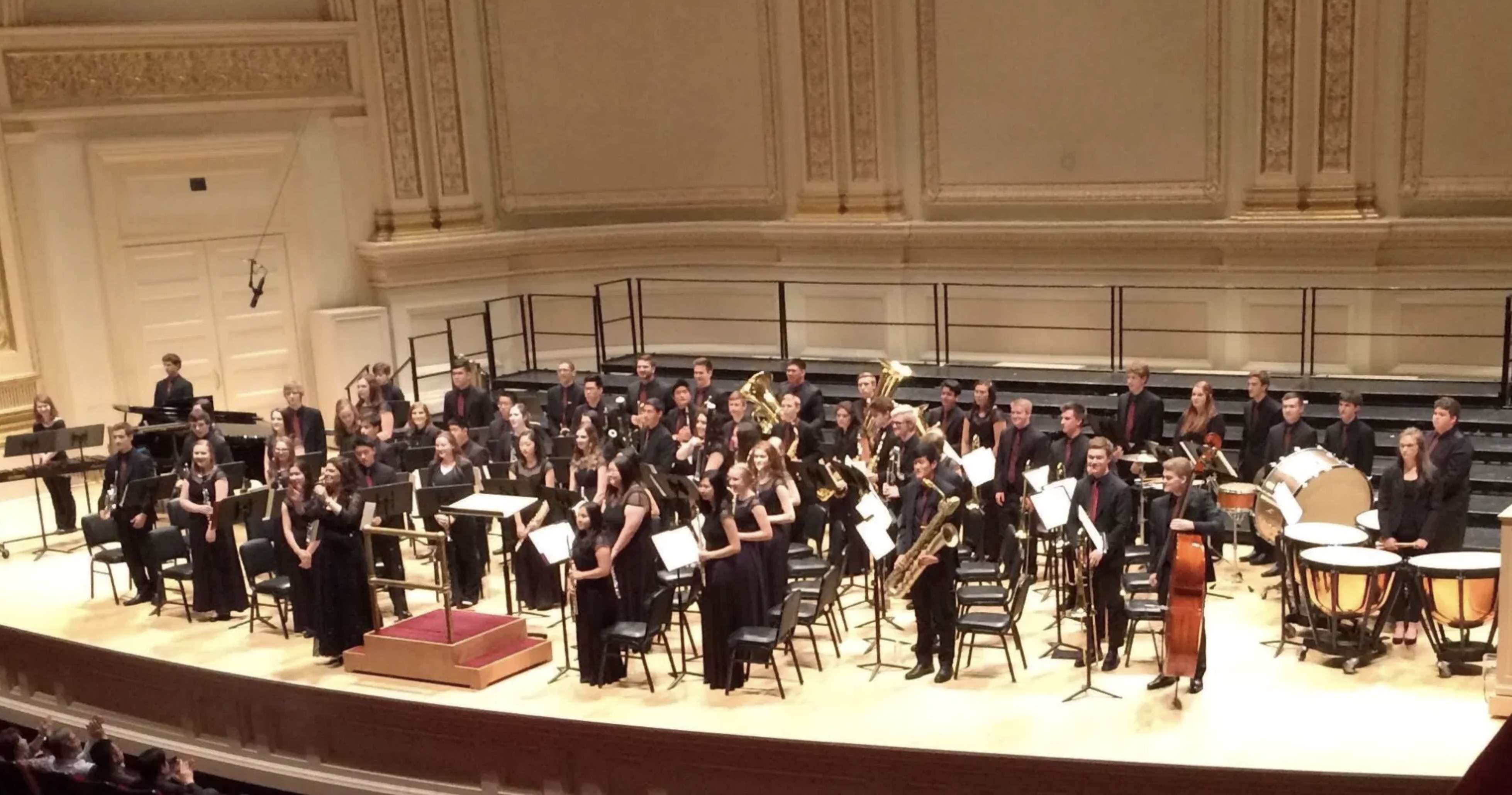
Lesley Moffat at Carnegie Hall

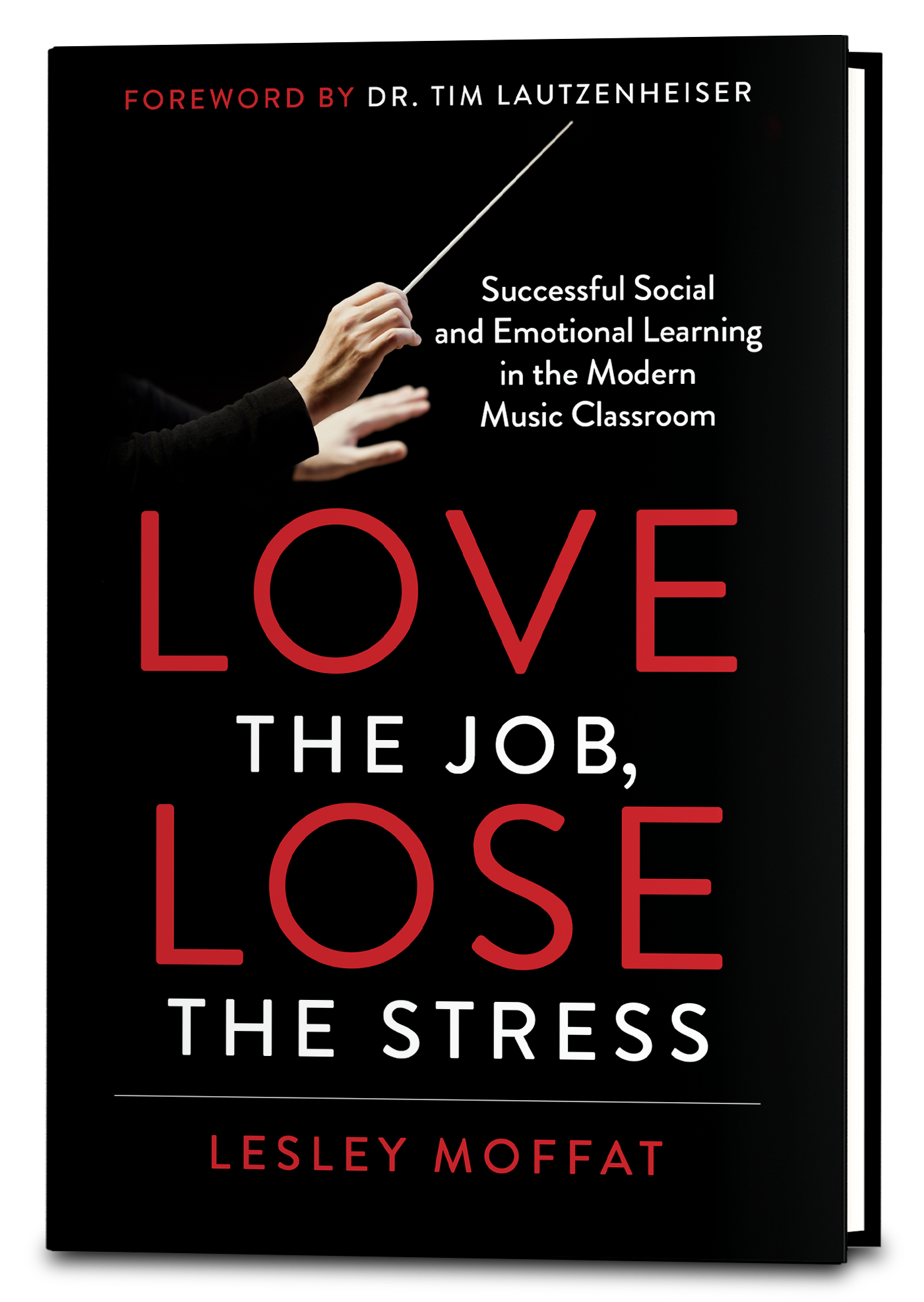
LOVE the Job, LOSE the Stress

In my “New Year’s blog” posted on December 29, 2020, I shared my advice on “how to make a difference in 2021” and told readers to find their own good role models and “positive gurus” to sustain their vision, motivation, and drive throughout the year.

Someone who has recently become inspirational to me is the wonderfully uplifting Lesley Moffat, probably an expert on the search for “mindfulness” in personal life and even during her band warm ups. In my opinion, her transformative stories provide the roadmap for happiness and wellbeing! She now has published two books (you need to read both) – I Love My Job But It’s Killing Me, and Love the Job, Lose the Stress, and if you are still teaching music full-time, you need to peruse her website: https://mpowerededucator.com/.

Now her latest book ties in all of the above enrichment and enlightenment – “successful social and emotional learning in the modern music classroom” – and adds an essential focus on teacher self-care and wellness. What was that saying attributed to Molesey Crawford in Unlocking the Queen Code?

  • Know thyself.
  • Love thyself.
  • Heal thyself.
  • Be thyself.

Lesley Moffat has taught high school band for over 32 years in the Pacific Northwest, with her ensembles earning superior ratings and performing all over the US, Canada, and even in Carnegie Hall. She was planning to retire at the end of 2019-2020 when the pandemic hit. (As far as I know at this time, she has not retired yet – “for the sake of her kids” she stayed throughout this challenging time of COVID-19 and the slow reopening of schools!) She clarifies this in the introduction to her Love the Job, Lose the Stress book:

“I completed the first draft of this manuscript on March 3, 2020. Ten days later, schools across the world began shutting down as the coronavirus began sweeping the globe… The ultimate purpose of this book is to share the protocol I created that has become the basis of the social and emotional learning needs for my students (and truth be told, for me). Everything I talk about in this book was true before the pandemic, and it has proven to be as powerful in a virtual environment as it is in person… The great news is that you can give your students the gift of learning to self-regulate, calm down, and focus without distraction through intentional design and practice.”

She offers an intriguing set of easy-to-read chapters in her “hard to put down” 191-page work.

  1. My Life’s Work Is So Much More Than Just A Job
  2. I Love My Job But It’s Killing Me
  3. The Badass Band Director’s Bible
  4. Step One: The Moffat Music Teacher Mojo Meter
  5. Step Two: Identifying the Three C’s – Care, Clarity, and Consistency
  6. Step Three: Identifying Your Priorities
  7. Step Four: SNaP Strategies for Music Teachers
  8. Step Five: Tuning Our Bodies
  9. Step Six: Creating Your Own First Four Minute Protocols
  10. Coda
  11. Fine

Highlights of suggestions from Love the Job, Lose the Stress

Like her last book, the Moffat Music Teacher Mojo Meter returns. If you are ever privileged to have her as a clinician for a local workshop, it is likely she may send out this survey to the participants in advance. These fifteen questions will provide her an individualized needs assessment of the stressors attendees are experiencing so she can differentiate the planning of her “help session” (page 48).

You’ll have a lot more questions to answer in Chapter 5 (page 50). Read and identify (and define for yourself) her three C’s for success: care, clarity, consistency.

In Chapter 6 (page 67), she wants you to identify your priorities. This is your chance to dream big! You’ll have to read her story (with wide swings of emotion) about her Jackson HS Honors Wind Ensemble performing at Carnegie Hall.

Also returning from her previous book, Chapter 7 (page 81) shares her Start Now and Progress – or SNaP to it – strategies for music teachers. Revisit her amazing tale about doing (of all things) push-ups: “By taking small incremental steps that build upon what I did each day before, I was able to take a skill that was very difficult for me on April 1 and do it 60 times just 30 days later.” She sums up three SNaP Strategies “for busy band directors” (page 90).

  1. Gratitude for the attitude
  2. Time stealers
  3. Reset yourself

Don’t miss her Chapter 10 (page 156) and “Lesley’s Top Ten Badass Band Director Tips!”

Finally, probably worth 1000-times the price of the book and all the time you will put into it is her Chapter 8 “Tuning Our Bodies” (page 103) and Chapter 9 “Creating Your Own First Four Minute Protocol” (page 129). This is where you will take what you read, reflect on her philosophies and system of classroom management and warm-ups, and adapt it to your situation. Adding to your teacher’s toolbox the techniques of mindfulness, breathing exercises, and listening skills – and practicing them with your students daily – will make all the difference in the SEL of your own lessons and overall program.

BRAVO and thank you Lesley for being so intuitive, upfront, and personal… and being so generous in sharing your secrets!

We applaud your efforts, and agree with Dr. Tim Lautzenheiser who said in the Foreword to Love the Job, Lose the Stress:

“This latest-greatest contribution offers a tried-and-true blueprint for vocational success while embracing the critical importance of fueling one’s mental, emotional and physical health. Spot on! Bull’s eye!”

“This is not a book you read and then put on the shelf; rather it is a file cabinet of priceless data certain to boister the health, happiness, and good fortune of every (music) teacher.”

“As music teachers, we teach students how to develop all kinds of skills, from mental to physical, in order for them to be well-rounded musicians. We show them how to properly form and embouchure, the correct fingerings to use, how to read music, what proper posture looks like, how to be artistic and expressive, and so much more. And we always tell them to “pay attention and “focus.” But do we ever teach them how to pay attention and focus? The secret to getting students engaged, focused, and curious so you can teach them all the cool stuff about music is teaching them how to actually build those skills until they become habits. Once you’ve taught them how to learn, then everything else becomes a million times easier for you and for them.”

— from the back cover of the Love the Job, Lose the Stress

Now you have it… a collection of at least three potential life-changing inspirations for summer study.

In addition to these “finds,” I need to mention a couple other educational publications for your consideration (see picture below). But, first-things-first as Stephen Covey would say! Check out Music Education and Social Emotional Learning – The Heart of Teaching Music by Scott Edgar, Thrivers – The Surprising Reasons Why Some Kids Struggle and Others Shine by Michele Borba, and Love the Job, Lose the Stress by Lesley Moffat. PKF

Future Book Reviews

© 2021 Paul K. Fox
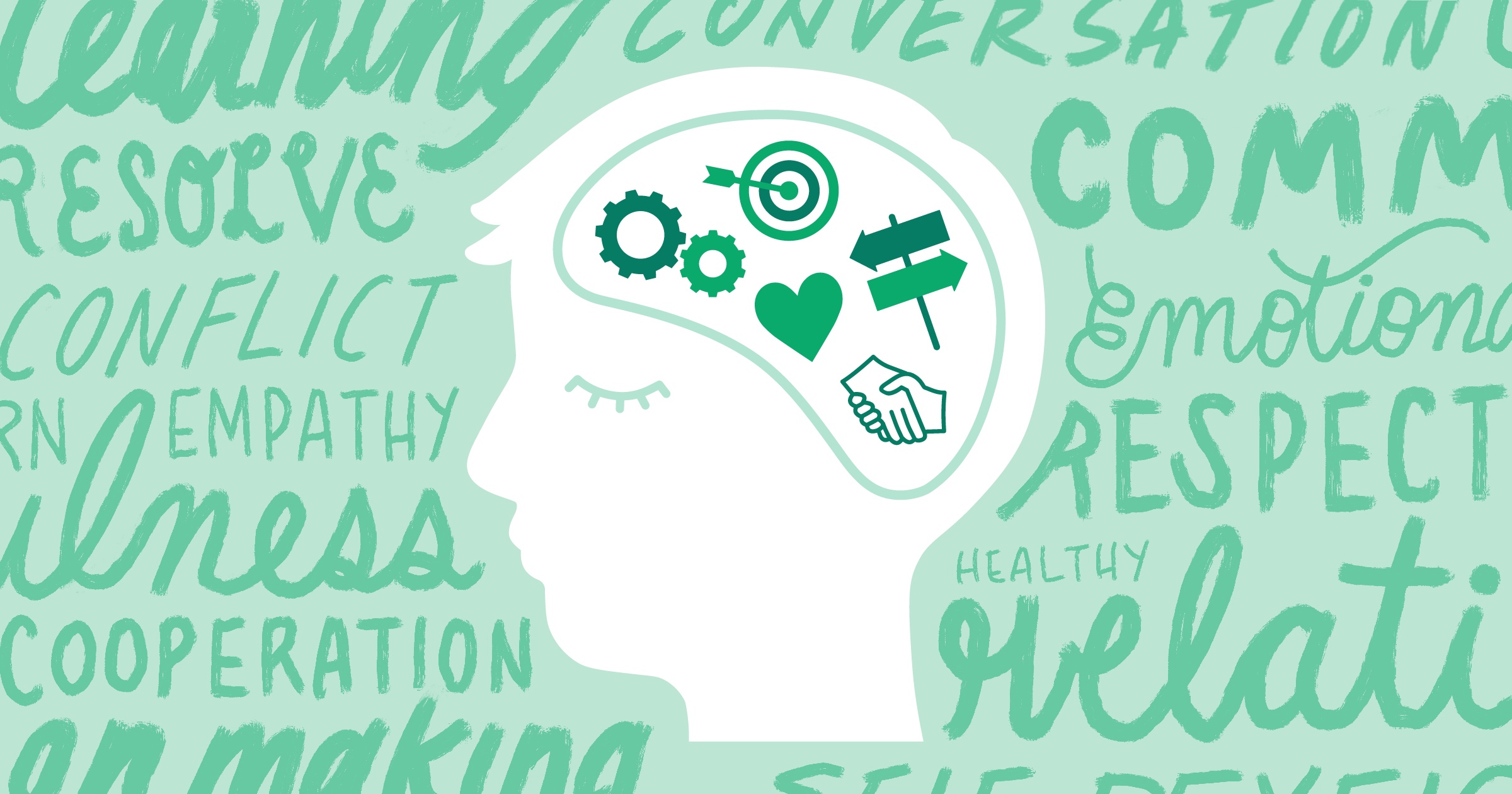
Image by csharker from Pixabay

The Future of Music Education

Spring 2020 Final Lecture to the Music Education Graduate Students

by Rich Victor, PMEA Past State President and Adjunct Instructor for the University at Buffalo Graduate School Online

victor logos

Originally posted in the Facebook group PLAN: The PA Leadership Advocacy Network


This course, “Supervision of Music Learning Programs,” was focused on programs as they existed before this year. Obviously, some things have changed.

What has changed and what has stayed the same? To answer that question let’s take another look at this graphic from Unit 4.

Rich Victor Decision Making Process

All decisions should flow from the mission statement. That should not change.

As you discovered, most school district mission statements focus on ideals such as “success, life-long learning, and becoming responsible citizens in the community.” An effective music department mission statement will be in alignment with the stated district mission. It will inform the administration and the community how the study of music helps the district achieve their stated mission through the skills and knowledge children learn in music. It also explains what children would lose if the subject were not offered because no other discipline is available in the school district where children can learn those skills and knowledge as well as in music classes.

The school mission and the department mission define the WHY.

Victor3Once the WHY has been determined, then the district must determine the WHAT. WHAT learning activities need to be offered to the students in the district in order to help them achieve the desired outcomes stated in the mission? The answer to that question should help determine the curriculum for music.

The content for the music curriculum is determined partially by the district and department missions, partially by state mandated Arts Standards, partially by local school district inter-disciplinary curriculum requirements, and partially by the music department’s desire to provide each child with a comprehensive and high-quality music education based on National Standards.

The outcomes from those learning activities – the WHAT – should not change.

In pre-COVID-19 times, the next decision would be to determine how much time is needed for students to master the curriculum and succeed in their activities. How many years will each facet of that curriculum require? How many hours of instruction should be allocated in each year and WHEN should that time be scheduled in order to provide the maximum number of learning opportunities for each child?

The WHEN might stay synchronous or change to asynchronous instruction. The number of instructional hours provided to each teacher and each subject may need to be flexible. That is yet to be determined and we should prepare for all possibilities. However, keep in mind that the WHEN should not alter the WHAT.

Once it is decided how many hours of instruction should be allocated annually and when Victor2those hours would be scheduled, then the district must figure out exactly how many teachers will be needed to deliver that instruction and what qualifications those teachers should possess. The “WHO” part of the process – the staffing piece of the puzzle – should still be driven by the needs of the curriculum and should not change.

It will be the HOW and WHERE parts of this process where the largest changes will occur.

Obviously, the decision WHERE teachers and students will be in the fall will impact HOW music will be taught and what equipment and materials can be used for learning activities.

Facilities in school buildings must be adapted to provide appropriate space for instructional activities to take place and to conveniently store all of the materials and equipment used in those activities while following whatever social distancing protocols and approved procedures for safely handling musical materials are adopted. The WHERE may continue to be the student’s home or a combination of school and distance learning. Once again, we need to prepare for all possibilities.

The most important thing to keep in mind is that the outcomes of the K-12 music curriculum – the WHAT – should not change. Teachers need to keep “the end in mind” rather than just focusing in on their own period of time with each student. Then, following the principles of Understanding by Design, K-12 music staff must work as a team to create appropriate learning activities that are designed to help each student make progress through each grade and ultimately achieve the specific learning outcomes Victor1of the K-12 music program using the WHEN, WHO, HOW and WHERE pieces that we will have to work with.

As my friend and colleague Bob Morrison said in a recent presentation “Change the HOW not the WHAT!”

Yes, it will be challenging. The challenges caused by these changes may appear to be daunting at first, but they are not insurmountable!

Fortunately, there are some great thinkers in our profession who are already coming up with ideas to make the best of the situation for both classroom and performance teachers. Even if you are the only music teacher in your school district – you are NOT alone! Wonderful ideas for solutions to these challenges can be found in social media and through webinars.

The most important thing to know at this time is that discussions are occurring right now in every school district throughout the country. When students might return to school, and how classes might be scheduled will be determined soon. You must be proactive and become part of that decision-making process BEFORE the decisions are made! Be at the table so that decisions affecting music education in your district happen WITH you and not TO you.

The future of music education is in YOUR hands. It will be what you make it. Good luck and keep in touch!

Editor’s note: As a follow-up to Rich Victor’s article, check out these PMEA webpages:


UB1

About the Guest Blogger

Victor0Richard Victor is currently Adjunct Instructor for the University at Buffalo Graduate School Online.

Richard Victor had a 37-year career as State College Area High School Band Director. In 1987, he was also appointed to the position of Coordinator of Music for the State College Area School District. He was President of the Pennsylvania Music Educators Association (PMEA) from 2000-2002 and served as its Advocacy Chair. He was President of the PA Unit of the International Association of Jazz Educators (IAJE) from 1989-1993, the PMEA All-State Jazz Coordinator and PMEA News Jazz Editor from 1993-1998, and chair for the NAfME Council for Jazz Education from 2014-2018. He has also served on the advisory board for the NAfME Teaching Music magazine and held the office of President of the Penn State Alumni Blue Band Association. Other professional memberships include Phi Beta Mu and The Gordon Institute for Music Learning (GIML).

Mr. Victor has been a guest conductor and adjudicator for concert band and jazz events in Delaware, Maryland, Pennsylvania, and Virginia, and currently serves as an instrumental adjudicator for Music in the Parks. He frequently provides services as a clinician, consultant, and/or featured speaker for school districts and music events throughout Pennsylvania. He has presented sessions at five NAfME (formerly MENC) national conferences, three NAfME Eastern Division conferences, and the 2008 Americans for the Arts National Convention. He also has been a presenter for six different MEA state conferences, three JEN National Conferences, and three International Conferences on Music Learning Theory.


Ethical Conundrums Revisited – Part II

More About Ethics in Education

“Food for Thought” for Teachers

Resolving Problems in Daily Professional Decision-Making


Business Ethics

For a review of Part I of this article, please visit https://paulkfoxusc.wordpress.com/2018/08/20/ethical-conundrums-revisited-part-i/. The entire blog-series can be read (in reverse chronological order) at https://paulkfoxusc.wordpress.com/category/ethics/.

Regardless of whether you are a first-year teacher, recently hired or transferred, or someone who has many years of experience, we know that little training is provided for handling our daily contradictions or controversies in school ethics. This investigation illustrates several additional obstacles in maintaining appropriate professional and ethical behavior and exploring the application of the moral decision-making “compass” for educators. Here we will rehash more modern-day dilemmas using “mock scenarios” in the workplace, encourage business-woman-2137559_1920_andreas160578you to reflect and respond to “what would you do?” and even re-orient you to the paradoxes in which you may encounter that may not seem to offer an obvious resolution.

It’s time to put on your “thinking caps!” What are your initial impressions of a few of these “conundrums” or conflicts?

MCEETo foster meaningful scrutiny and study of the bulleted issues in bold above, we will sort these problems by Principle III “Responsibility to Students” and Principle IV “Responsibility to the School Community” of the National Association of State Directors of Teacher Education and Certification (NASDTEC) “Model Code of Ethics for Educators” (MCEE):  https://www.nasdtec.net/general/custom.asp?page=MCEE_Doc. In addition, whenever possible, a link to a scenario or case study about the subject will be shared. It is recommended that, in a small group of your peers, you view each video/text resource and assess its ramifications on the ethical appearances (professional image) and actions (intent and interpretation). In my opinion, this is the BEST way to study ethical dilemmas. Here are a few key essential questions to help promote in-depth dialogue:

  1. What possible ethical concerns might this scenario raise?
  2. How could this situation become a violation of state law, the “Code” or school/district policies?
  3. In this situation, what are some potential negative consequences for the teacher, student, parents, school staff, and/or community?
  4. How would this episode affect a teacher’s efficacy in his/her classroom, demean the employing school entity, or damage his/her position as a moral exemplar in the community?


fear-2012536_1920_ElisaRiva


Responsibility to Students

MCEE III A 2, 5, 6

Study scenarios on INAPPROPRIATE RELATIONSHIPS:

CONUNDRUM: Coming home from a successful musical performance, my wife noticed on my tuxedo stains of stage make-up caused by several actors’ “musical hugs.” “Should you let the performers hug you backstage?” she asked, and scolded me to “be more careful!”

“No touch” policies for teachers in schools really do not make a lot of sense. There are many who agree that casual contact like a pat on the back may even be helpful. See:

MY ADVICE: Music teachers “touch” their students all the time; it is part of the natural process of assisting them to hold and play a new instrument. I am not opposed to an occasional celebratory or consoling hug. The factors that may contribute to the moment being judged “okay” vs. “inappropriate” boil down to:hug-1315552_1920_markzfilter

  • Intent
  • Setting
  • Length of time
  • Frequency or patterns of repetition
  • Comfort level of the student
  • Age level of the student
  • Being in public
  • Who started it?

If a child is in distress, pulling him/her aside from the rest of the class and consoling with a light/half/side hug should not be a problem. This issue is one that requires judgement based on common sense – don’t encourage repeated contacts or “get carried away.”

However, young/rookie teachers may be surprised about one violation included in the official definition of “sexual misconduct,” judged as “crossing the boundaries” and inappropriate by most state codes: “exchange of gifts with no educational purpose.” (Reference from the PA Professional Standards and Practices Commission)


bag-1868758_1920_Pexels

MCEE III C 1, 2, 3

Study scenarios on STUDENT PRIVACY RIGHTS:

Legal protections for student confidentiality are mandated by the Family Educational Rights and Privacy Act (FERPA) and other Federal regulations. (See previous blog-post, “Ethics Follow-up” at https://paulkfoxusc.wordpress.com/category/ethics/.) You must remain very discrete about divulging or transferring any “non-directory data” about “your charges.” The operative saying is, “When in doubt, don’t give it out.”

privacy-policy-1624400_1920_succo

REMEMBER – NEVER GOSSIP! Discussing an incident or behavior concern with another teacher in the hallway between classes or sitting down in the teacher’s room is never advisable, and it is probably illegal! Educators must, at all costs, avoid inadvertently disclosing personal information about the lives or actions of our students “in public.” Even carrying on a conversation with a student in an open or common area that could be construed as a “private matter” may be accidentally overheard, and therefore violate a student’s privacy rights.

EXCEPTIONS to third-party disclosure prohibitions (source):

  • Other educators or officials within the same school who have legitimate educational interests in the student.
  • When disclosure of information is necessary to protect the safety and health of the student.
  • Another school to which a student is transferring.
  • In order to comply with a judicial order.
  • Interested parties who are determining a student’s financial aid eligibility.

CONUNDRUM: How do you resolve the apparent contradiction of the recommendation of never holding a meeting alone with a student with the need to provide a safe/secure place to share information?

MY SOLUTION: Confer with your student in a place with sight-lines to the hallway (windows) but sound insulated from hearing the voices inside and/or where there is a high probability of someone interrupting and stopping the conversation.


conference-2110770_1920_geralt

Responsibility to the School Community

MCEE IV A 1, 2

Study scenarios and articles on INTERACTIONS WITH PARENTS AND STAFF:

CONUNDRUM: You receive a call from an angry parent who wants to know why her daughter was not awarded the lead in the school play. The mother wants a detailed assessment of her child’s skills and advice on how to prepare for future auditions.

board-3700116_1920_athree23MY SOLUTION: This is more common than you would like. This episode compels you to figure out how to wear two unique hats simultaneously – the educator and the judge. Assuming you were clear (in writing) on the requirements of the try-outs, even sharing the blank rubric that would be used for the evaluations, you are now charged to find the “best” person for each lead assignment based on a number of criteria:

  • Needed solo character parts in the play
  • Voice part of the candidate
  • Musical skills
  • Dramatic skills, which may be further categorized/ranked by oral/voice technique, projection, character development, understanding of text, and stage presence
  • Dancing/movement skills
  • Type of projection: the potential for acting a comedic vs. romantic role
  • Height (relevant if partnered with another character)
  • Overall preparation

Of course, these expectations and targeted assessments should have been shared with everyone before the auditions were held.

Parents want “what is right” for their kids and for them to feel successful. You as the director want the ideal cast for the show, providing the best chance for the entire company’s success in performance, but must show that the entire process is impartial, consistent, and fair.  As a teacher, it is your responsibility to listen to the students’ and parents’ concerns, but I feel it is not realistic nor appropriate for you to “adjudicate” each actor’s audition. I wrote about this distinction HERE in my last “Fox’s Fireside” blog-post. This is an article you can “pass around” prior to your next tryout.


argument-238529_1920_RyanMcGuire.jpg

MCEE IV B 1, 2, 4, 8

CONUNDRUM: Maintaining professional relationships with your teaching colleagues vs. the mandatory reporting of unethical behavior and inappropriate speech/actions.

A member of the staff is “bad mouthing” you, the principal or other school staff members in public. You are assigned to work side-by-side with him, and yet he does not interact with the staff with civility or respect, nor does he support the academic achievement and related goals that promote the best interests of students.

MY SOLUTION: Thankfully, I have had no personal experience with this scenario, but can recommend that you first try to deal directly with the unethical colleague. According to MCEE, professionals must collaborate and maintain effective and appropriate relationships with the faculty, “resolving conflicts, whenever possible, privately and respectfully and in accordance with district policy.” Before you bring up the matter with your supervisor or building administrator (which you have the right and even responsibility to do, especially if the students hear any improper speech first-hand or that the incidents rise to the level of bullying or aggressive behavior), talk to the unhappy team member one-on-one. Be calm and sensitive, but hold your ground: you must assert that his/her behavior/language is unacceptable and will not be tolerated in the future.

The suggestions of Mind Tool’s article “Five Ways to Deal With Rudeness at the enraged-804311_1920_johnhainWorkplace” are applicable (read their entire blog-post at https://www.mindtools.com/pages/article/five-ways-deal-with-rudeness.htm):

  1. Be a good role model.
  2. Don’t ignore it.
  3. Deal directly with the culprit.
  4. Listen.
  5. Follow-up on any offender.

As for anything that is a violation of the teachers’ code of ethical conduct, you are mandated to report the transgressions of a colleague that threaten the health and safety of the students, especially any observations (or even suspicions) of verbal, physical, or sexual abuse/misconducts.

As for one’s “freedom of expression” to complain about administrators or co-workers, especially in the use of social media, the National Education Association responds:

“Let’s debunk the free speech myth: Many teachers believe they have the absolute First Amendment right to post anything they want on social networking sites, including party pix and diatribes about the boss. After all, they’re on their own time and using their own resources. Sadly, the courts say otherwise.”


music-students-246844_1920_musikschule

As a follow-up, visit additional resources in “Becoming a Music Educator.” Please feel free to leave your comments and links to share other scenarios of ethical “conundrums.”

PKF

© 2018 Paul K. Fox

Photo credits (in order) from Pixabay.com: “meadow” by geralt, “business woman” by andreas160578, “trumpeter” by klimkin, “fear” by ElisaRiva, “fear” by markzfilter , “bag” by Pexels, “privacy policy” by succo, “conference” by geralt, “Board” by athree23, “argument” by RyanMcGuire, “enraged” by johnhain, and “music students” by musikschule.

Ethical Conundrums Revisited

More About Ethics in Education – Part I

“Food for Thought”

Facing Those Misconceptions, Dilemmas, and Problems in Daily Professional Decision-Making

business-1869266_1280

As I travel around Pennsylvania presenting sessions on “Ethics for Music Educators” at state conferences, regional professional development workshops, and collegiate music education seminars, as well as writing articles for PMEA News and hosting webinars, I seemed to have stirred up a lot of questions (which is GREAT!) and some confusion (not so good). This “hot topic” has become a lot like “peeling an onion.”

After discovering that few music or other subject area teachers have had formalized ethics training (pre-service or in-service), in fact most never even seeing their state’s “code of ethical conduct,” I feel like this is more complicated than it appears to be. Indeed, here and in other blog-posts, I am endeavoring to “peel the onion” – explore the problem one layer (step) at a time, to thoroughly understand what’s causing the conflict.

As a prerequisite, if you have not read my other articles on ethics from this website, please review the following:


A Closer Look at the Definitions

Ethics: moral principles that controls a person’s behavior.

Conundrum: a difficult problem or situation

ethics-2110621_1920_3dman_eu

An ethical conundrum is a problem that causes one to make a decision based on their personal values. It may question an individual’s beliefs of what is right and wrong. Ethical conundrums can range from simple everyday problems to serious illegal infractions.

What is the difference between an ethical conundrum and a dilemma? Thanks to https://www.quora.com/What-is-the-difference-between-conundrum-and-dilemma-Can-you-give-example-with-respect-to-a-context, we have a little more clarity (or barring that, at least a lot more detail to consider):

“Remember this phrase — on the horns of a dilemma.”

“A dilemma… [by definition] is a difficult choice between two (and only two) things or courses of action (as in two horns), both of which have some kind of undesirable consequences.”

“A choice of two things isn’t a dilemma — it may be a conundrum. A choice of one good thing and one bad isn’t a dilemma. A choice of two bad things is a dilemma.”

“A conundrum is about one thing — it’s just a difficult or confusing problem, and nearly always in the sense of having no possible solution or answer, or it’s an unbelievably hard challenge to produce the solution or answer. In short, a riddle.”

– Robert Charles Lee

These examples may be helpful, and were provided on the Quora website:

Dilemmas:

  • “We’re stuck in this dilemma of either jumping into shark-infested waters, or staying on board the burning ship and be burned alive.”
  • The proverb “Die if you do, die if you don’t.”

The classic conundrum facing thousands of students everywhere every year is which college to pick (the ‘one’ thing). College No. 1 has a better faculty but not fun. College No. 2 has a reputation of being more enjoyable and a more socially active student body. College No. 3 has average faculty but always get overseas placements. Which college is better for your future happiness?

A conundrum that resembles a dilemma: Should I work abroad alone for high pay? Or should I stay locally with my family for average pay?

A conundrum that feels like a dilemma: Do I save my mother or my children?

How about dealing with the sometimes controversial terms ethics vs. morality? This is from https://www.diffen.com/difference/Ethics_vs_Morals:

Ethics vs. Morals

“One professional example of ethics conflicting with morals is the work of a defense attorney. A lawyer’s morals may tell her that murder is reprehensible and that murderers should be punished, but her ethics as a professional lawyer require her to defend her client to the best of her abilities, even if she knows that the client is guilty.”

“Another example can be found in the medical field. In most parts of the world, a doctor may not euthanize a patient, even at the patient’s request, as per ethical standards for health professionals. However, the same doctor may personally believe in a patient’s right to die, as per the doctor’s own morality.”

– Diffen.com


Sample Situations in Daily Life

“A tree falls in the forest, is there sound?” Apply that “open-ended” philosophical approach to the ethics question, “If you find a $100 bill on the sidewalk and no one is around, what should you do?”

There are a myriad of real-life scenarios from numerous sources that may provide more insight in the adoption of ethical and moral “best practices.”

  • “Disabled placard abuse is a big problem in downtown San Diego. Handicap parking places are occasionally abused by people who do not possess a disability. These people typically use a family member’s handicap placards, for their own benefit. This leaves no accessible parking places for the people who truly need them. Would you?”
  • “Involving limited space and sold-out reservations, is it ethical for a hotel to charge someone for late cancellation (family emergency) in the case when no income would be lost because the room is easily sold to another hotel guest?”


ethics-2991600_1920_Tumisu

Jeffrey Selgin of RealSimple.com released a thought-provoking article, “10 Ethical Questions – Answered” on the CNN news feed website: http://www.cnn.com/2010/LIVING/wayoflife/03/10/rs.10.ethical.questions/index.html.

“Stealing is a no-no; cheating is bad. When it comes to moral quandaries, the thou shalt-nots are no-brainers.”

“The truly tough dilemmas are those small, more ambiguous ones that you may stumble upon anytime, anywhere.”

“The ethical decisions we confront daily are toughest when there’s a significant downside to making the ‘correct’ choice — or when it’s unclear what that choice is. Here’s how to identify the right thing to do; it’s up to you to do it.”

Selgin offers an interpretation of the morality of these sample questions for day-to-day reflection:

  1. If something at a yard sale is far more valuable than the posted price, do I have to let the seller know?
  2. Is it considered stealing to take pens from a bank? What about extra napkins from a fast-food restaurant?
  3. If a charity sends me free address labels and I don’t make a contribution, is it OK to use them?
  4. Is it unfair to move into better (open) seats at a sporting event or a concert?
  5. My boss gave me credit for a project on which a colleague did most of the work. Should I accept the praise?
  6. If someone tells an offensive joke, is it my responsibility to speak up about it?


Ethical Conundrums in the Professions

We will start start with a perspective from the science profession, also providing a good summary of the “fiduciary” and moral responsibilities of the medical and law professions:  (https://helix.northwestern.edu/blog/2014/07/ethical-conundrums).

“Medical students, before commencing their duties as compassionate caregivers, take the Hippocratic oath, promising to always treat the ill to the best of their ability and to make decisions that are in the best interest of their patients.”

“Law students, before beginning their duties as defenders of the world, take an oath of professionalism, promising to honor and advocate for the community with integrity and cooperation towards others.”

“Now, let’s talk about scientists, the lab-coat wearing, world-saving breed of professionals, most commonly seen in their natural habitat surrounding long-standing rows of benches usually filled with biological and chemical substances that they use to save lives. Where is their oath?”

– Khyati Meghani


scientist-2141259_1920_luvqs

Responsible for discovering drugs or other therapies that could stop us from aging,  finding the cure for cancer or the common cold, or for inventing miniaturized medical devices that could track the health of vital organs from within the blood stream, medical scientists are entrusted with our lives and must face “awesome” ethical obligations.

“Let’s take a time tour starting in the 1800’s. Meet, Alfred Nobel – a chemist and the inventor of dynamite, after whom the very famous Nobel Prize is named. Although his intention in developing dynamite was to create something more stable than nitroglycerine, and even though he is not responsible for killing millions around the world, he is still accountable for creating the invention that did. But, it is important to mention here that Nobel did establish the Nobel Foundation, which is funded by the wealth that he accumulated during his lifetime.”

“Next, meet Shiro Ishii, a microbiologist who had no ethical conscience while unleashing deadly pathogens on thousands of human research subjects under the delusional idea of creating a bacteriological weapons program.”

– Khyati Meghani

In his blog-post, “Ethical Conundrums,”  Khyati Meghani could give us countless other examples where scientists have conducted unethical research either for their love of science or under the delusion that they were helping mankind.

Why don’t we expect all professionals who deal closely with children (especially teachers) to take an oath to adhere to the highest standards of ethics and personal morality? It has always bothered me that educators are the only “fiduciary” whose charges are a “captive audience” and patently uninformed about the subject with little initial “ethics training” or “refresher” workshops. Even my investment counselor has to master (usually monthly) online course work on ethical practices.

poses-1367416_1920_NDE

In one published study of educator scenarios (Shapira-Lishchinsky, O., Teachers’ critical incidents: Ethical dilemmas in teaching practice, Teaching and Teacher Education 2010, doi:10.1016/j.tate.2010.11.003), the aim was to “explore ethical dilemmas in critical incidents and the emerged responses that these incidents elicit.”

“Teachers deal with many ethical problems in their practice. They encounter issues such as inappropriate allocation of resources, situations in which pupils are being discussed inappropriately, and irresponsible colleagues. When teachers’ sense of proper action is constrained by complex factors in educational practice and decisions are made and carried out contrary to the ‘right course,’ critical incidents which involve ethical conflict and moral distress result.”

– O. Shapira-Lishchinsky

Five main categories of 50 critical incidents were reviewed:

1. Caring climate versus formal climate.
2. Distributive justice versus school standards.
3. Confidentiality versus school rules.
4. Loyalty to colleagues versus school norms
5. Family agenda versus educational standards

For examples of these incidents, read the entire research study at https://pdfs.semanticscholar.org/8bbd/62c820d76cfaa35181319dcc3906790a4f00.pdf.

boys-286245_1920_White77


I was also happy to run across the excellent online article “Ethics in the Classroom” by Leah Shafer from the Usable Knowledge blog-site of the Harvard Graduate School of Education: https://www.gse.harvard.edu/news/uk/16/04/ethics-classroom.

“Ethical dilemmas abound in education. Should middle school teachers let a failing eighth-grade student graduate, knowing that if she’s held back, she’ll likely drop out? Should a private school principal condone inflated grades? Should an urban district pander to white, middle-class families — at the expense of poor, minority families — in order to boost the achievement of all schools?”

“Teachers, principals, superintendents, and education policymakers face questions such as these every day. And for many, amid the tangle of conflicting needs, disparate perspectives, and frustration over circumstances, lies the worry that discussing an ethical dilemma with colleagues will implicate you as not knowing how to make the right choice — or as already having made the wrong one.”

– Leah Shafer

Research compiled by educational philosopher Meira Levinson and doctoral student Jacob Fay take up these challenges in their new book Dilemmas of Educational Ethics: Cases and Commentaries (http://hepg.org/hep-home/books/dilemmas-of-educational-ethics). “In detailing the moral predicaments that arise in schools, the researchers also provide a framework for educators to discuss their own dilemmas with colleagues, opening the door to making these conversations more common.”

Their book offers “six detailed case studies of common educational dilemmas, each accompanied by commentaries of varying viewpoints.”

“Case studies offer a safe way for educators to begin recognizing and discussing ethical dilemmas they may face in their own work, since no real person is implicated. ‘We hope that by reading and talking about the cases and commentaries, professional communities can become more practiced and comfortable in having these sorts of discussions, so that when their own particular dilemmas arise, they have the cases and a language to be able to speak about what it is they’re struggling with in their own practice,’ says Fay.”

– Leah Shafer


yes-3100993_1920_geralt

Referencing the National Education Association’s Code of Ethics (http://www.nea.org/home/30442.htm), and the Council for Exceptional Children’s Ethical Principles and Professional Practice Standards for Special Educators (https://www.cec.sped.org/Standards/Ethical-Principles-and-Practice-Standards), RedOrbit posted an outstanding blog “Teachers’ Ethical Dilemmas – What Would You Do?” written by Jessica L Bucholz, Cassandra L Keller, and Michael P. Brady: https://www.redorbit.com/news/education/1141680/teachers_ethical_dilemmas_what_would_you_do/.

“What is considered ethical often comes down to determining what is in the best interest of the student. ‘Behaving ethically is more than a matter of following the rules or not breaking the law-it means acting in a way that promotes the learning and growth of students and helps them realize their potential’ (Parkay, 2004, p. 195). When professionals or students engage in unethical behavior, it can damage a good student-teacher relationship. Unethical behavior can ruin trust and respect between teachers and their colleagues. In extreme situations unethical behavior can result in a teacher losing his or her teaching position and/or certification. Resolving ethical dilemmas requires difficult educational decisions that do not always have a clear-cut ‘right’ answer.

Here we present several short vignettes of ethical dilemmas that both veteran and novice teachers have faced. We then ask you to consider the possible solutions for these examples and ask you what you would do if faced with a similar situation. Finally, we analyze each vignette using either the NEA’s or CEC’s code of ethics, identify ethical indicators that cover the situation, and propose a solution for each dilemma based on the code.”

– Jessica L Bucholz, Cassandra L Keller, and Michael P. Brady

Interesting classroom ethical scenarios are offered with recommended solutions. These six “mock dilemmas” are discussed in detail:

  • Possible learning disability
  • Assessment conflict
  • Medication
  • Standardized tests
  • Petty behavior
  • Religion


More to Come

From politicians to movie stars, CEOs to the companies they lead, and especially heinous – teachers, coaches, and other school personnel, ethical misconducts are being uncovered and aired daily in the news. This is too important not to sponsor a frank discussion on ethical standards applied to professional decision-making.

For Part II of this series “Ethical Conundrums Revisited,” we will rehash a few more modern-day scenarios in the school music education workplace, prod you to respond “what would you do?” (at least in your mind) to address these problems, and even explore a few areas you may not think are true “ethical issues.” What are your views on…

  • Privacy protection versus “open door” meetings with students?
  • Acceptance of congratulatory “musical hugs” versus the practice of avoiding all physical contact from students?
  • Refusal of gifts from music industry vendors versus acceptance of “free” offers or dinner meetings?
  • Use of social media networks to support student learning versus the risk of crossing the student/teacher boundary with inappropriate informal communications?
  • The sharing of anecdotes or details of an incident that occurred during a class or school activity with family members or colleagues?
  • The sharing of contact information with outside organizations or businesses?
  • Identification of individuals (especially the names of students), geographical locations, or specific information about your school district on social media?
  • Certification of inaccurate or exaggerated reports, such as “fudging” data on time-in and time-out attendance logins?
  • The exercise of a teacher’s “freedom of speech” rights versus the practice of maligning school administrators or their decisions in public?
  • The exercise of a teacher’s “freedom of expression” rights in having tattoos, body piercings, or wearing certain fad or provocative clothing versus compliance to school policies and norms?


PKF

© 2018 Paul K. Fox
Photo credits (in order) from Pixabay.com: “meadow” by geralt, “ethics” by 3dman_eu, “ethics” by Tumisu, “scientist” by luvqs, “poses” by NDE, “boys” by White77, and “yes” by geralt.


Business Ethics