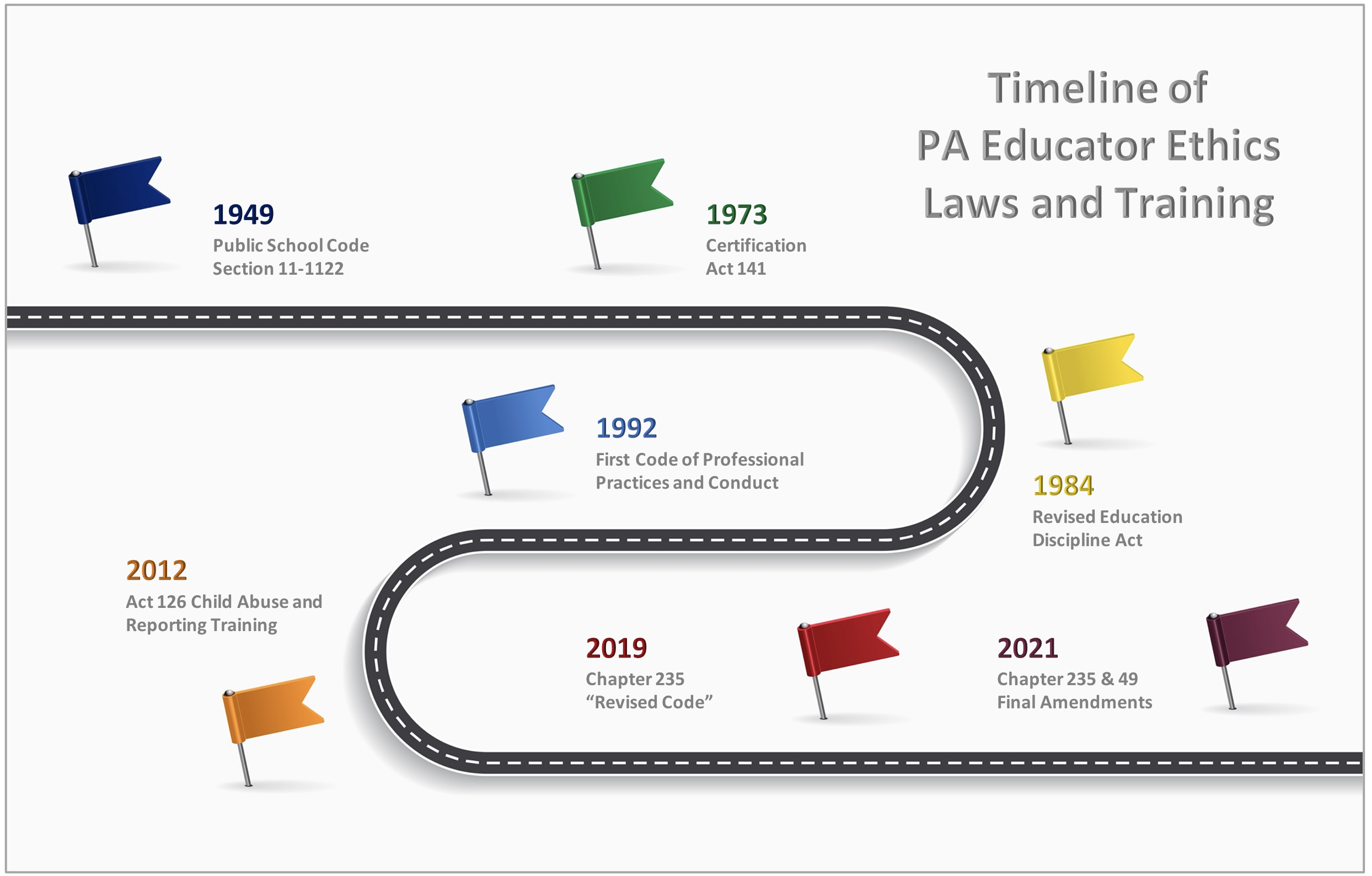
Exceptional Ethics Training

A Follow-up to the Pennsylvania Educators E-TRAIN

SCHOOL SYSTEM LEADERS, CTC DIRECTORS, & OTHER ADMINISTRATORS:
In case you missed my last update here in September 2024, this “express car” blog post will help you “catch-up” on the PDE “company line,” “supply new freight” to your continuing professional development and induction programs, get back “on track” and avoid being “sidetracked” or “derailed” for meeting the newly revised PA Chapter 49 “guard rails” of professional ethics training competencies.
THE ETHICAL WHEELS GO ROUND & ROUND…

You may have noticed that due to compliance regulations, the PDE website was revised with many of its former URL “tracks” leading to “train wrecks.” This “propelled” us towards making an “overhaul” to “connect” the new references (research “destinations”) in my slide presentations. Please use the following index (substituting old “routes”) and travel to our renovated “union station” with the new schedules.

Okay… I will stop “conducting” any more train “puns!”

Recent Ethics Sessions
Slide Summaries for the PDE Purposeful Leadership Conference (if you attended) are available from the SAS Institute’s conference app: Eventsquid.

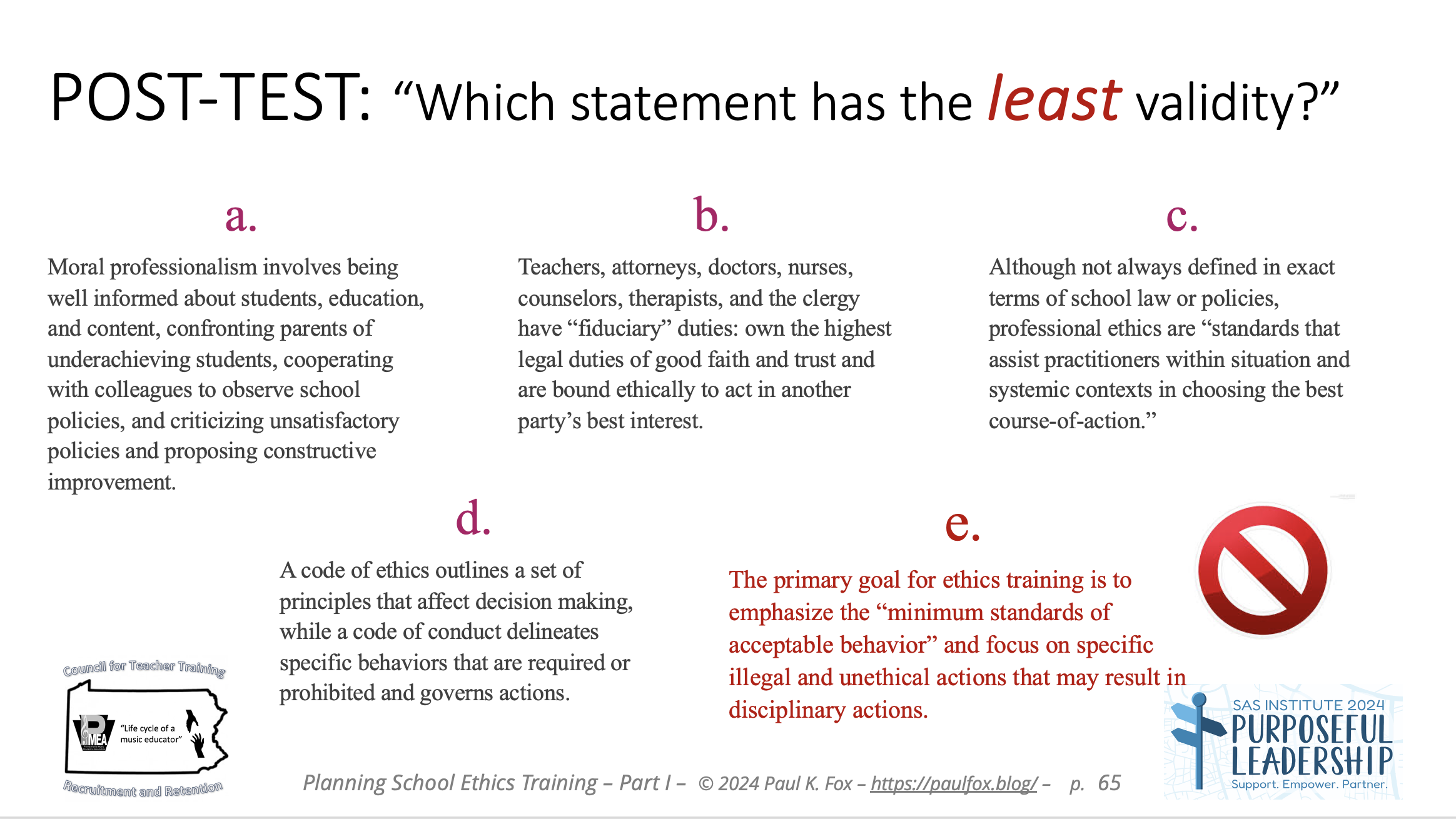
Upon completion of the 25-hour course, the PowerPoints for all four sessions of the Thomas W. Bailey Act 45 class series were emailed to the participants.

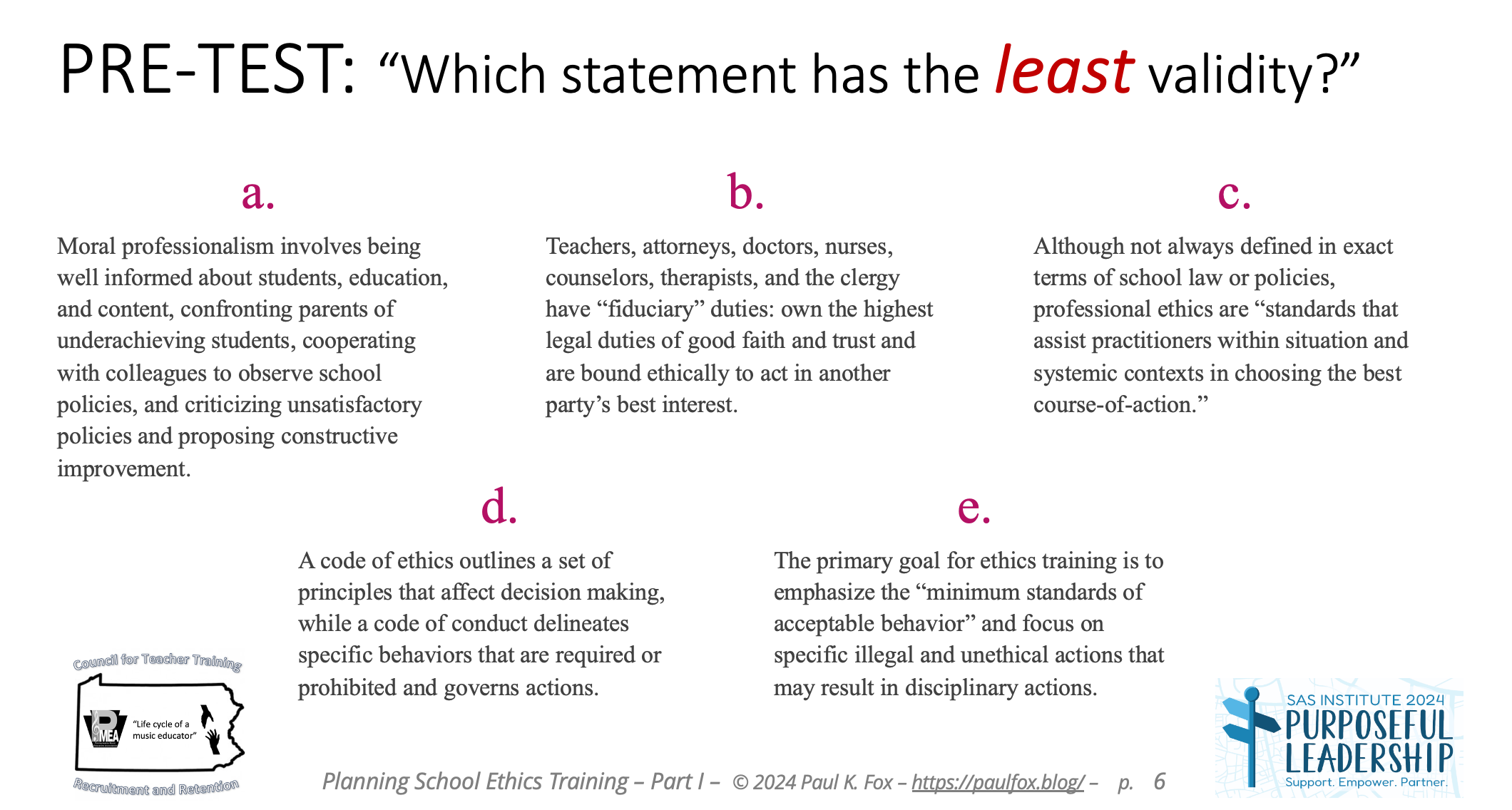
Here is the PRE-TEST for both events.

What is your “best guess?”
UPDATES TO RESEARCH LINKS

Act 126 Child Abuse and Reporting Training
https://www.pa.gov/agencies/pspc/content-pages/outreach/act-126-training.html

Adjudications & Orders (PA Certificate Actions)
https://www.pa.gov/agencies/education/programs-and-services/educators/educator-misconduct/certification-actions.html

Attorney (PA) Rules of Professional Conduct
https://www.padisciplinaryboard.org/for-attorneys/rules

California BTES – Overview of the Ethnographic Study by David Berliner and William Tikunoff
https://journals.sagepub.com/doi/abs/10.1177/002248717602700107?journalCode=jtea

Certificate Actions (Adjudications & Orders)
https://www.pa.gov/agencies/education/programs-and-services/educators/educator-misconduct/certification-actions.html

Chapter 49 Ethics Training
https://www.pa.gov/agencies/pspc/resources/chapter-49-ethics-training.html

Cleveland Board of Education v. James Loudermill (US Supreme Court 1985)
https://www.twbaileylaw.com/blog/educator-court-case-blog-1/may-a-school-district-employee-be-dismissed-without-prior-opportunity-to-respond-to-allegations-of-wrongdoing-4

Code of Professional Practice and Conduct
https://www.pacodeandbulletin.gov/Display/pacode?file=/secure/pacode/data/022/chapter235/chap235toc.html&d=reduce OR
https://paulfox.blog/wp-content/uploads/2024/12/code-of-conduct-revised.pdf

Codes (Conduct vs. Ethics), Types of
https://www.amazon.com/Music-Education-Your-Hands-Introduction/dp/0415800900

Commission Publications (Professional Standards & Practices Commission)
https://www.pa.gov/agencies/pspc/resources/commission-publications.html

Connecticut State Department of Education TEAM Program Manual
https://portal.ct.gov/sde/team/teacher-education-and-mentoring-team-program/documents

Contract Termination 11-1122 Public School Code of 1949
https://govt.westlaw.com/pac/Document/NB5B9C950342F11DA8A989F4EECDB8638?viewType=FullText&originationContext=documenttoc&transitionType=CategoryPageItem&contextData=(sc.Default)

Criminal History 1-111 Public School Code of 1949
https://govt.westlaw.com/pac/Document/NB6D6E91007EE11EA8D85D136C641FF9C?viewType=FullText&originationContext=documenttoc&transitionType=CategoryPageItem&contextData=(sc.Default)

The Danielson Group
https://danielsongroup.org/

Digital Tips (Online Boundaries) for Educators (Professional Standards and Practices Commission)
https://www.pa.gov/agencies/pspc/resources/commission-publications/digital-tips-for-educators.html

Educator Discipline Act
https://www.pa.gov/content/dam/copapwp-pagov/en/pspc/documents/statutes-regs-forms/educator%20discipline%20act.pdf and
https://www.pspc.education.pa.gov/Statutes-Regulations-Policies-Forms/Educator-Discipline-Act/Pages/default.aspx

Educator Misconduct
https://www.pa.gov/agencies/education/programs-and-services/educators/educator-misconduct.html

Ethical Dilemmas of In-Service Music Educators by Joelle L. Lien
https://act.maydaygroup.org/articles/Lien11_1.pdf

The Ethical Educator (Frequently Asked Questions)
https://www.pa.gov/content/dam/copapwp-pagov/en/pspc/documents/ethical-practices/publications/the%20ethical%20educator%20and%20professional%20practices.pdf

Ethical Equilibrium – Troy Hutchings’ work
https://slideplayer.com/slide/12243050/ and
https://vimeo.com/126979216

Ethics Toolkit – Teacher Preparation Programs (missing from revised PDE website?)
https://www.pa.gov/agencies/pspc/resources/information-for-school-administrators/teacher-preparation-programs.html
Web archive: https://web.archive.org/web/20240807121601/https://www.pspc.education.pa.gov/Promoting-Ethical-Practices-Resources/Ethics-Toolkit/Pages/default.aspx

General Assembly (PA)
tps://www.legis.state.pa.us/

Iowa Board of Education Examiners (Moral vs. Ethical Standards)
https://slideplayer.com/slide/12203932/

Loudermill Hearings – Court Case Blog (US Supreme Court 1985)
https://www.twbaileylaw.com/blog/educator-court-case-blog-1/may-a-school-district-employee-be-dismissed-without-prior-opportunity-to-respond-to-allegations-of-wrongdoing-4

Model Code of Ethics for Educators
https://www.nasdtec.net/page/MCEE_Doc and
https://www.nasdtec.net/page/MCEE_Video_Series

Moral Development Philosophy by Lawrence Kohlberg
https://archive.org/details/essaysonmoraldev0000kohl

Moral Professionalism (Wynne, E. A. (1995). The moral dimension of teaching)
https://www.itejournal.org/wp-content/pdfs-issues/spring-2013/08bergman.pdf

Moral v. Ethical Standards (Iowa Board of Educational Examiners)
https://slideplayer.com/slide/12203932/

National Association of State Directors of Teacher Education and Certification
https://www.nasdtec.net/ and
https://www.nasdtec.net/page/MCEE_Video_Series

Pennsylvania Code & Bulletin (Title 22 Education)
https://www.pacodeandbulletin.gov/Display/pacode?titleNumber=022&file=/secure/pacode/data/022/022toc.html&searchunitkeywords=&operator=OR&title=null

Pennsylvania Code (Title 23 Child Protection Services)
https://govt.westlaw.com/pac/Document/NAD136501756B11E88795828A65D8C1A1?viewType=FullText&originationContext=documenttoc&transitionType=CategoryPageItem&contextData=(sc.Default)

Professional Ethics Program Framework Competencies
https://www.pa.gov/content/dam/copapwp-pagov/en/education/documents/educators/certifications/professional%20ethics%20program%20framework%20guidelines.pdf

Professional Standards and Practices Commission
https://www.pa.gov/agencies/pspc.html and
https://www.pacodeandbulletin.gov/Display/pacode?file=/secure/pacode/data/022/chapter233/chap233toc.html and
https://www.pa.gov/agencies/pspc/resources/commission-publications.html

Public School Code of 1949
https://www.legis.state.pa.us/WU01/LI/LI/US/HTM/1949/0/0014..HTM or
https://govt.westlaw.com/pac/Document/NB5B9C950342F11DA8A989F4EECDB8638?viewType=FullText&originationContext=documenttoc&transitionType=CategoryPageItem&contextData=(sc.Default)

Rules for Teachers (1872 & 1915)
https://www.openculture.com/2013/09/rules-for-teachers-in-1872-1915-no-drinking-smoking-or-trips-to-barber-shops-and-ice-cream-parlors.html

Simon Sinek
https://simonsinek.com/

Slater v. PDE Case Citation
https://caselaw.findlaw.com/court/pa-commonwealth-court/1465107.html

Statutes, Regulations, Policies and Forms (Department of Education)
https://www.pa.gov/search.html#q=Statutes%20Regulations&f-copapwpagency=Department%20of%20Education,Department%20of%20Health or
https://www.pa.gov/agencies/education/programs-and-services/educators.html

Teacher Preparation Programs
https://www.pa.gov/en/agencies/pspc/resources/information-for-school-administrators/teacher-preparation-programs.html

Thomas W. Bailey Court Case Blogs
https://www.twbaileylaw.com/blog

Thomas W. Bailey PDE-Approved Act 45/PIL and Act 48 Courses
https://www.twbaileylaw.com/

If you missed the SAS Institute 2024 in Hershey and still need help in designing your own educator ethics training in-service or mentor/mentee induction programs, check out the Thomas W. Bailey website here. Consider registering for our next 25-hour PDE-approved Act 45 online course.
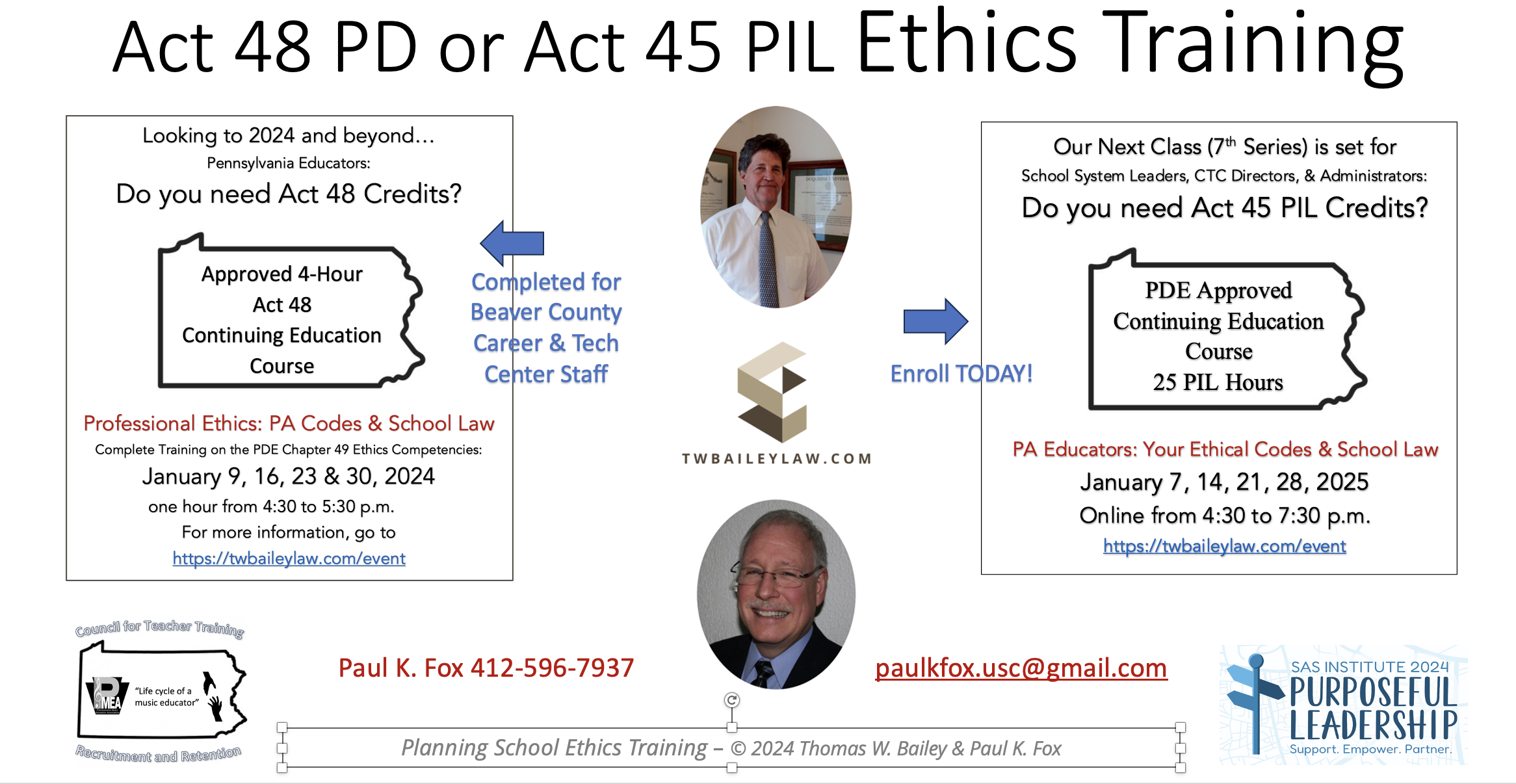
Finally, the answer to the above PRE-TEST is letter “D” (NOT):
Please reach out to Paul Fox (click here) if you find any of the above links have gone inactive or have suggestions/updates to this blog-post.

PKF

© 2024 Paul K. Fox
Educator Ethics Training Revisited!

ALL ABOARD THE E-TRAIN… Embarking and Embracing a Journey of Essential Educator Ethics

The wheels of the train go round and round…

“All black, well stacked, goin’ down the track clickety clack” = the train looked good on the visual roll-by inspection.

“Highball it out of here” = proceed at maximum permissible speed

“Let’s pull the pin and roll” = uncouple so we can get out of here

The fall season is bringing upon us a series of ethical workshops, classes, and the creation of other resources, and the perfect time to warehouse everything at the main rail terminal! Take an excursion below to learn more about “staying on track” with research on the responsibilities and “regs” for serving as an educator.

Can you name the exact title of your Code of Conduct? What agency enforces it? Do educators have a Code of Ethics? Are school teachers fiduciaries or model exemplars? What does all of this mean?

First, let’s take a pretest of your knowledge and experience on the subject of school ethics. Which of the following statements has the least validity?

  1. Moral professionalism involves being well informed about students, education, and content, confronting parents of underachieving students, cooperating with colleagues to observe school policies, and criticizing unsatisfactory policies and proposing constructive improvement.
  2. Teachers, attorneys, doctors, nurses, counselors, therapists, and the clergy have “fiduciary” duties: own the highest legal duties of good faith and trust and are bound ethically to act in another party’s best interest.
  3. Although not always defined in exact terms of school law or policies, professional ethics are “standards that assist practitioners within situation and systemic contexts in choosing the best course-of-action.”
  4. A code of ethics outlines a set of principles that affect decision making, while a code of conduct delineates specific behaviors that are required or prohibited and governs actions.
  5. The primary goal of professional ethics training is to emphasize the “minimum standards of acceptable behavior” and focus on specific illegal and unethical actions that may result in disciplinary actions.

After a thorough exploration of the materials below, you should feel confident in responding to this question. (If you need help, scroll down to answer at the end of this blog-post.)

Classes and Conferences on Ethics, Oh My!

I am looking forward to sharing insights on ethical issues and especially the seeming “conundrums” or conflicts in the myriad of snap judgments of daily decision-making, both in and outside of our classrooms. Upcoming opportunities are on the ethics e-train schedule.

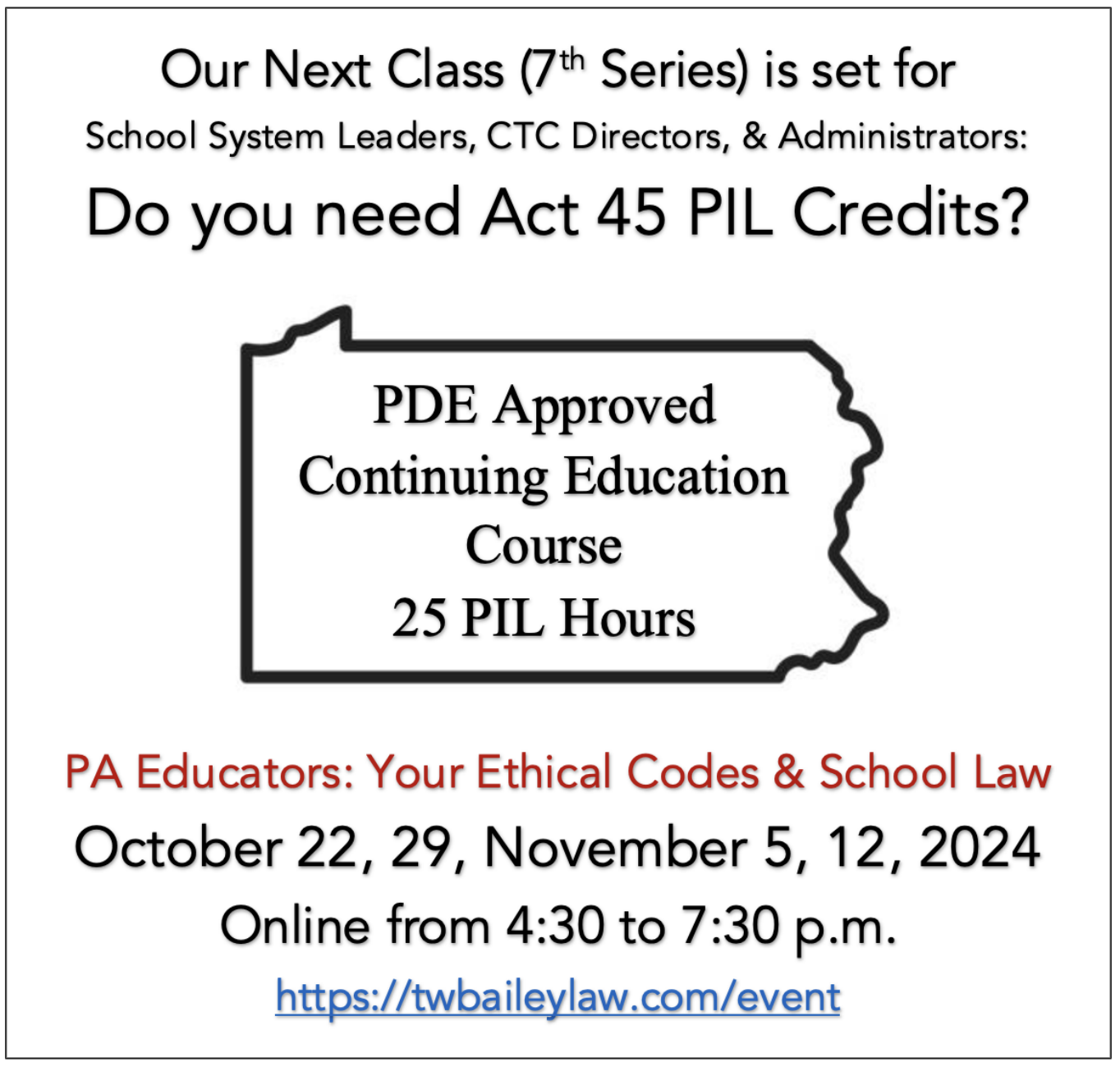
Currently, we are completing the sixth series of our 25-hour PDE-approved Act 45/PIL online course for school/system leaders, career and technical center directors, and other administrators. Sponsored by my colleague Thomas W. Bailey (check out his website here), the next class “PA Educators: Your Ethical Codes & School Law” begins on October 22 for four consecutive Tuesdays from 4:30 to 7:30 p.m.

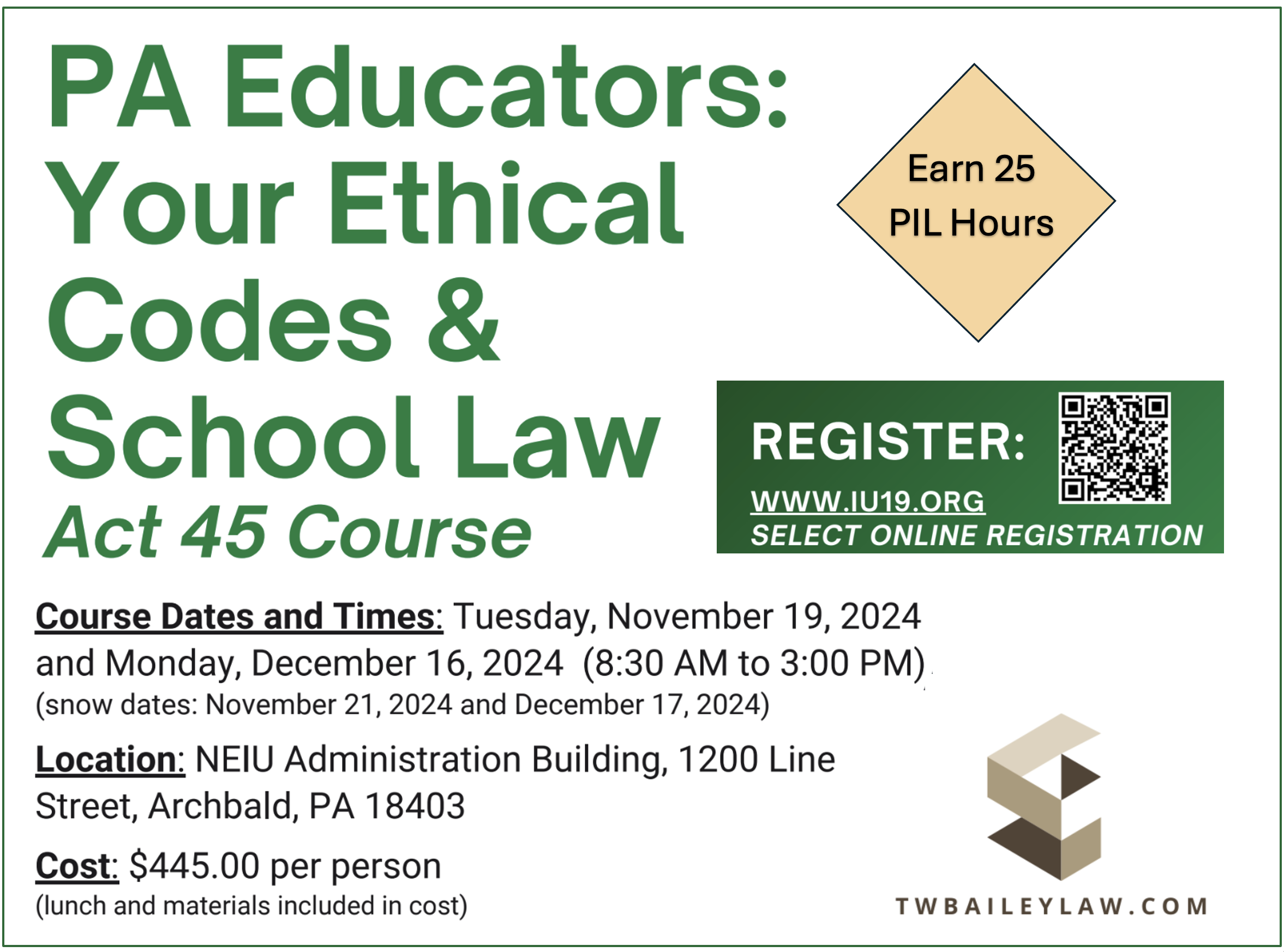
Thomas Bailey and I were also invited to present this Act 45/PIL course for the Northeastern Intermediate Unit #19 as a two-day workshop on November 19 and December 16, 2024. Visit http://www.iu19.org or click here to register.

I am venturing out of the Western PA to Eagleville, PA (near Valley Forge) to provide a 70-minute in-service, a school ethics “refresh” for the faculty at Methacton School District on October 14, 2024. Click here to download a copy of the slide summary with all links active.

Finally, I am happy to report that I was invited back to the PDE SAS Institute to do two sessions: “Planning School Ethics Training, Part I – Definitions, Codes, and the Commission” and Planning School Ethics Training, Part II – Model Code of Ethics for Educators. My proposal to present the session “CATCH THE E-TRAIN – Codes, Case Studies, and the Challenges of Ethical Decision-Making” was not approved for the 2025 PMEA Annual Conference in Kalahari Resort (Poconos). However, a facsimile of similar slides from past NAfME/PMEA workshops and webinars on educator ethics is available here.

Supplemental Resources for the Study of Codes, Case Studies, and the Challenges of Daily Decision-Making in Education

And now, the grand daddy of school ethics destinations…

Past paulfox.blog posts on educator ethics

Especially for Pennsylvania educators, pre-service students, and newcomers to the Commonwealth (citing the PA Professional Practices and Standards Commission website)

From other state governments (all rights reserved)

An additional sampling of articles

WHY STUDY ETHICS? Answer to the PRETEST above.

A code of ethics sets a higher threshold than regulatory codes of conduct or even a nonprofit organization’s bylaws and compliance rules enforced by the government. A code of conduct, such as the Pennsylvania “Code of Professional Practices and Conduct” of the PSPC, provides absolutes for employment, licensure, and/or civil/criminal sanctions. In contrast, the Model Code of Ethics for Educators document serves more as a general compass to help steer professionals towards sound judgment in their daily decision-making. What is unique about a true code of ethics vs. a code of conduct is that the principles are not defined in exact terms of law or policies, nor do they necessarily model family morals or values on which we as individual educators have been raised. The proposed standards are not about definite issues of right/wrong or black/white, but shades of grey. They are more open-ended, offering opportunities to discuss recommendations for consideration from a set of possible choices based on the circumstances of each ethical dilemma or resolution.

– excerpt from “The Ethical Music Educator,” Winter 2020 issue of PMEA News

Teachers are ethical professionals. Our moral aspirations, the “codes” and “standards” we subscribe to, and our professionalism are important to us, our students, our programs, and our communities. Essentially, these are the beliefs for which we stand, the values and behavior we model in our day-to-day decision-making to “make a difference” in the lives of our students, and the overall integrity of the profession. Therefore, the answer to the PRETEST above is #5. (#1-4 are TRUE!) But, as stated in #5, the goal of meaningful ethics training is NOT to emphasize the minimum standards of acceptable behavior or to focus on specific illegal and unethical actions that may result in disciplinary actions.

Do you have anything to add to this collection? ALL ABOARD! The conductor would appreciate feedback! Please feel free to make a comment to this blog (see link next to the title).

PKF

© 2024 Paul K. Fox

Launching PA Educator Ethics Training

Implementing the NEW PDE Chapter 49 “PE” Competencies – “The WHO, WHAT, WHY, & HOW!”

Blogger’s Note: We will return to Part II of “Bookends” next month to explore:

  • Stage 3: Inservice/Growing Years
  • Stage 4: Veteran/Sustaining Years
  • Stage 5: Next Chapter/Living the Dream

Instead, our November blog will share methods, modes, media, and other materials to provide meaningful professional development on ETHICS for EDUCATORS in the Commonwealth, resources from my upcoming presentation to school administrators at the Pennsylvania Department of Education’s SAS Institute – Successful Leadership – Shaping Your School’s Story to be held in the Hershey Lodge and Convention Center on December 11-13, 2023. Click below for my handouts.


PKFox

Interested in joining us at the Hershey Lodge on December 11-13, 2023? Please click here for more information or to register.

A Summary of My SAS Institute Ethics Session

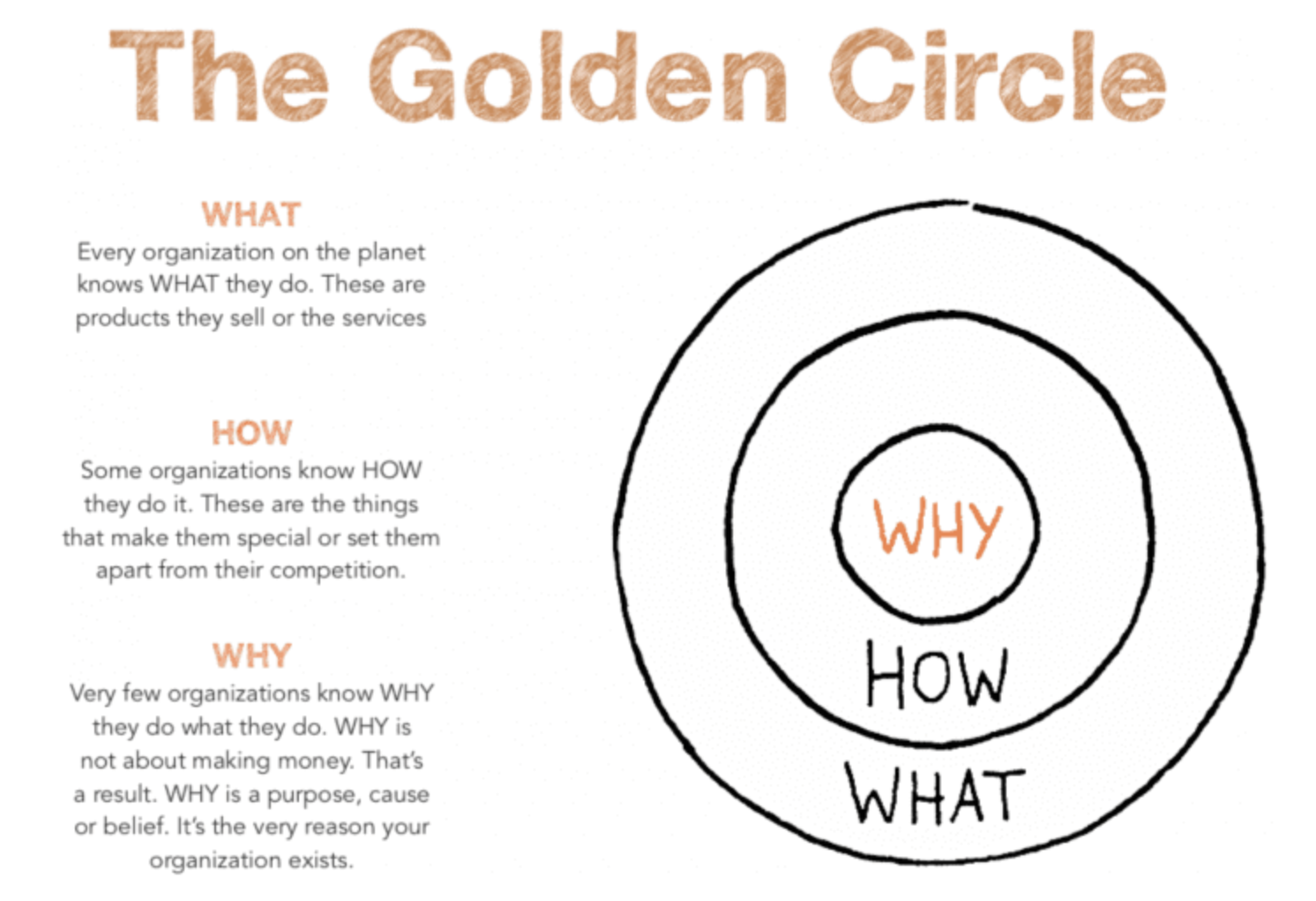
To paraphrase the wisdom of one of my favorite recent visionaries and online workshop presenters, Simon Sinek, “Every organization should begin with “the WHY!” According to SmartInsights, Sinek’s Golden Circle theory explains “how leaders can inspire cooperation, trust and change in a business based on his research into how the most successful organizations think, act and communicate if they start with why.” On his website, he declares his own WHY: “We are here to inspire people to do the things that inspire them so that, together, each of us can change our world for the better.” I love his mission!

https://www.smartinsights.com/digital-marketing-strategy/online-value-proposition/start-with-why-creating-a-value-proposition-with-the-golden-circle-model/

“Your WHY is your purpose, cause, or belief. WHY does your company exist? WHY do you get out of bed every morning? And WHY should anyone care about the work you do?” – Simon Sinek

So… lets ask the questions that define our own golden circle, my session, and this article:

  • WHY should we be so concerned about professional development in ethics for PA educators?
    (Why should you even be reading this blogpost?)
  • HOW should we train our staff?
  • WHAT should be introduced and reinforced over the long term?

And, I will add one additional question: WHO is responsible for all of this?

Well, the quick response to that last query is EVERYONE in the profession. However, this blog is particularly geared to school system leaders, career and technical center directors, and administrators charged with the responsibility of continuing education/professional development and induction programs for their PA educators.

The “WHY!”

Quick. Calling on all PA teachers! Without looking on the Internet, can you identify the exact title of your “code of conduct” (1)? Do you know the PA agency responsible for writing this code and adjudicating its rules (2)? Can you name the “code of ethics” recently adopted by PDE and the Board of Education which provides school staff comprehensive guidance in professional decision-making based on context (3)?

Hints? How about a few acronyms?

  1. CPPC
  2. PSPC
  3. MCEE?

Don’t you think “we” should at least be familiar with the commission that grants us the license to teach in PA as well as the document that “governs” our behavior, violations of which could remove us from our job or revoke our certificate?

Of course, six years ago, even I didn’t know we had a PA “code of conduct!” (I started teaching in the public schools in 1978 and it wasn’t written until 1992!) After retiring from full-time teaching in 2013, I was asked to present my first ethics workshop back in 2017 for a Pennsylvania Music Educators Association (PMEA) Regional In-Service Program. Already scheduling me for two other sessions, the organizer came to me, “Could you add a presentation on educator ethics?” My first reaction was, WHY? Why would this be necessary? I promised him I would do a little research before getting back to him… and found these (now updated) statistics. Here’s the WHY in a nutshell!

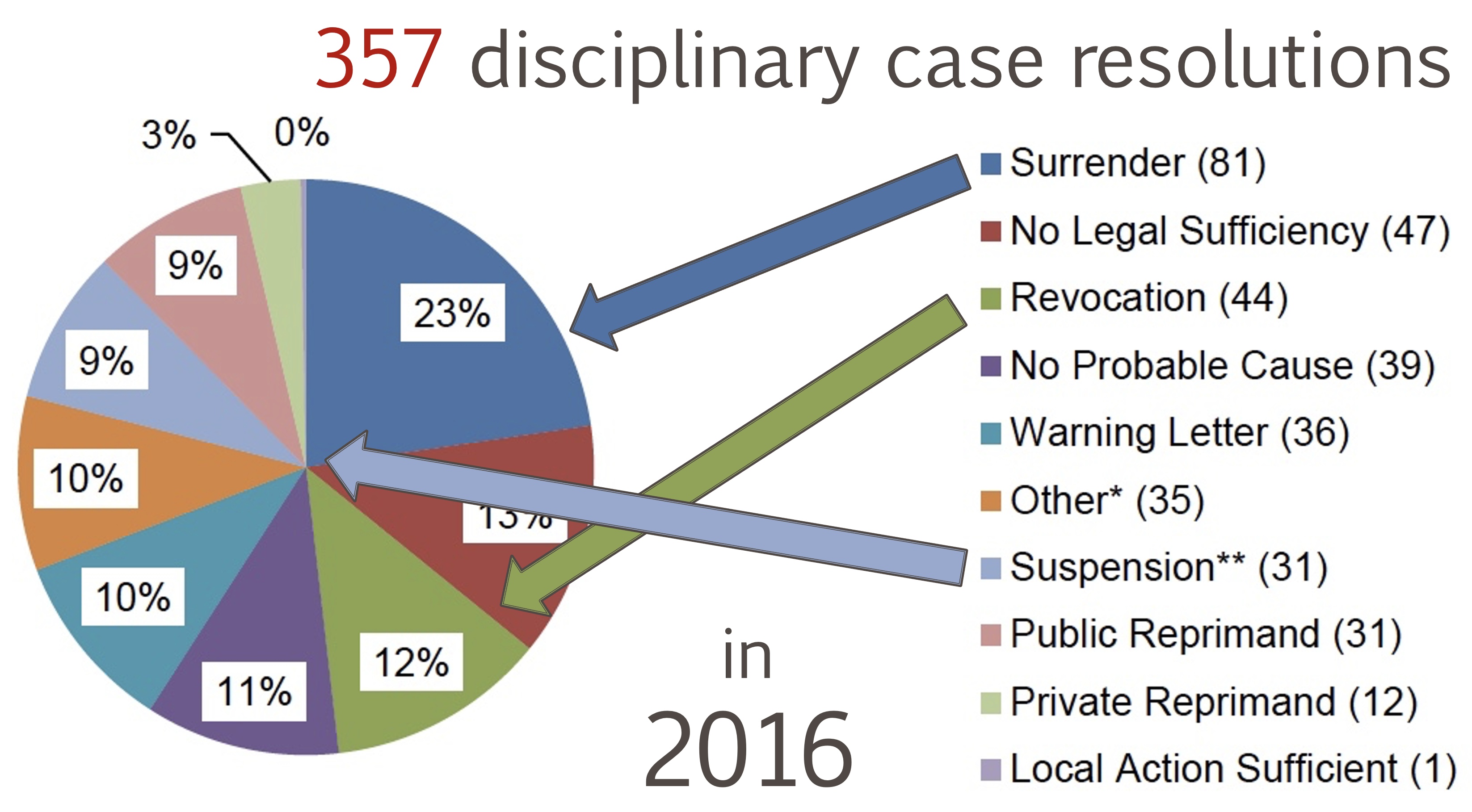
HORRIBLE! These are the number of PA educators by year who had misconduct complaints filed against them. Sure, a majority of their cases were not always fully prosecuted nor did they all result in a “guilty” verdict or plea, as this glimpse of educator disciplinary resolutions for 2016 (out of 672) for comparison shows (statistics from PDE):

But, if you can read the above graphic, that means that in 2016, 156 educators surrendered their license or had their certificate suspended or revoked! Obviously, no matter how you interpret the stats, this is a SERIOUS PROBLEM! And it may be due to a lack of training or understanding of the regulations and principles of ethical decision-making!

Why is this topic crucial for all pre-service, “rookie,” AND experienced professional educators? It is essential… not so much to serve as a reminder of the penalties for ethical infractions or spotlighting the occurrences you read or hear about in the news… but, because ETHICS are what we all stand for, the values we exhibit in our day-to-day decision-making, the integrity of the profession, and our “making a difference” in the lives of the students.

Ignorance of the law is no excuse for breaking it.

(Oliver Wendell Holmes)

The “WHAT!”

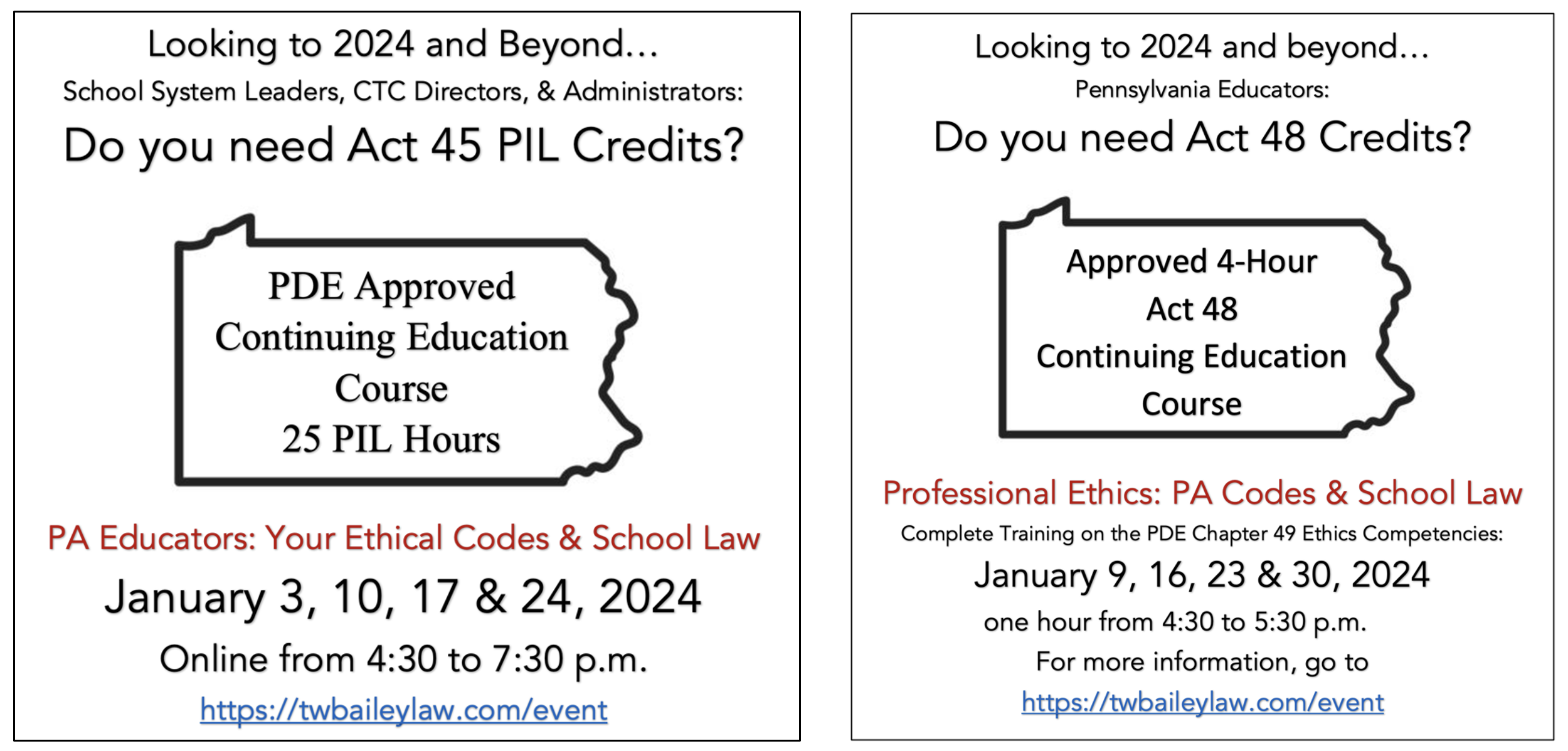
My colleague Thomas W. Bailey, a retired social studies teacher who reinstated his law license, and I set ourselves the goal of creating continuing education courses to provide REAL ethics training for PA educators. Thomas applied to the Pennsylvania Department of Education and received approval for a four-hour online Act 48 continuing education course for all PA educators (earning credits in PERMS) and a 25-hour online Act 45 PIL continuing education course for school system leaders, career and technical center directors, and other administrators responsible for planning the professional development of their school staff. The dates for our next two series of classes with open for enrollment in January 2024 are:

To register for either course, please go to Tom’s website: https://www.twbaileylaw.com/event.

Both of our courses satisfy the recently revised PDE Chapter 49 requirements of learning the “professional ethics” program framework guidelines:

For school system leaders and other administrators, PDE has set high expectations with the release of the following DEADLINES in April 2022:

“Chapter 49 requires instruction in professional ethics to be integrated in educator preparation, induction, and continuing professional development programs as follows.

  • Continuing professional development programs must integrate the professional ethics competencies no later than the 2023-24 academic year.
  • Educator preparation and induction programs must integrate the professional ethics competencies no later than the 2024-25 academic year.

Our Act 45 and Act 48 courses cover the following subjects, definitions, and applications of these terms:

  • Fiduciary
  • Ethical Equilibrium
  • Personal Morality
  • Regulations of Law
  • Professional Ethics
  • Professional Dispositions
  • Moral Professionalism
  • Differences Between Moral and Ethical Standards (with Examples)
  • Codes of Conduct (Examples)
  • Codes of Ethics (Examples)
  • Differences Between a Code of Conduct and a Code of Ethics
  • PA Professional Standards and Practices Commission
  • Paths of Educator Discipline in PA (Local and State)
  • Loudermill Hearings
  • State Discipline System (from Misconduct Complaint to Appeals)
  • PA Code of Professional Practice and Conduct
  • The Educator Discipline Act
  • National Association of State Directors of Teacher Education and Certification
  • Model Code of Ethics for Educators

The “How!”

I know this will sound a lot like bragging, but what makes the Thomas Bailey + Paul Fox ethics courses truly effective and different from everyone else in the game (albeit there are few “classes on the codes” sponsored in our geographic area) is the process – a focus on top-down training (administrator to teacher to student), interactive discussion, and a major emphasis on borrowing from the research of “Principled Teaching” in Domains 4a, 4d, 4e, and 4f of the Charlotte Danielson Framework for Teaching, the Teacher Education And Mentoring (TEAM) Module 5 Guide of the Connecticut State Department of Education, and the Facilitators Guide of the Iowa Board of Educational Examiners.

In my SAS presentation, I review several different modes of case study analysis, from simple to comprehensive, modeling small group interactive peer review, encouraging healthy discussions of diverse opinions in an “open,” non-threatening environment. The following approaches could be adapted to your setting of in-service programs or inductions:

MOCK JURY

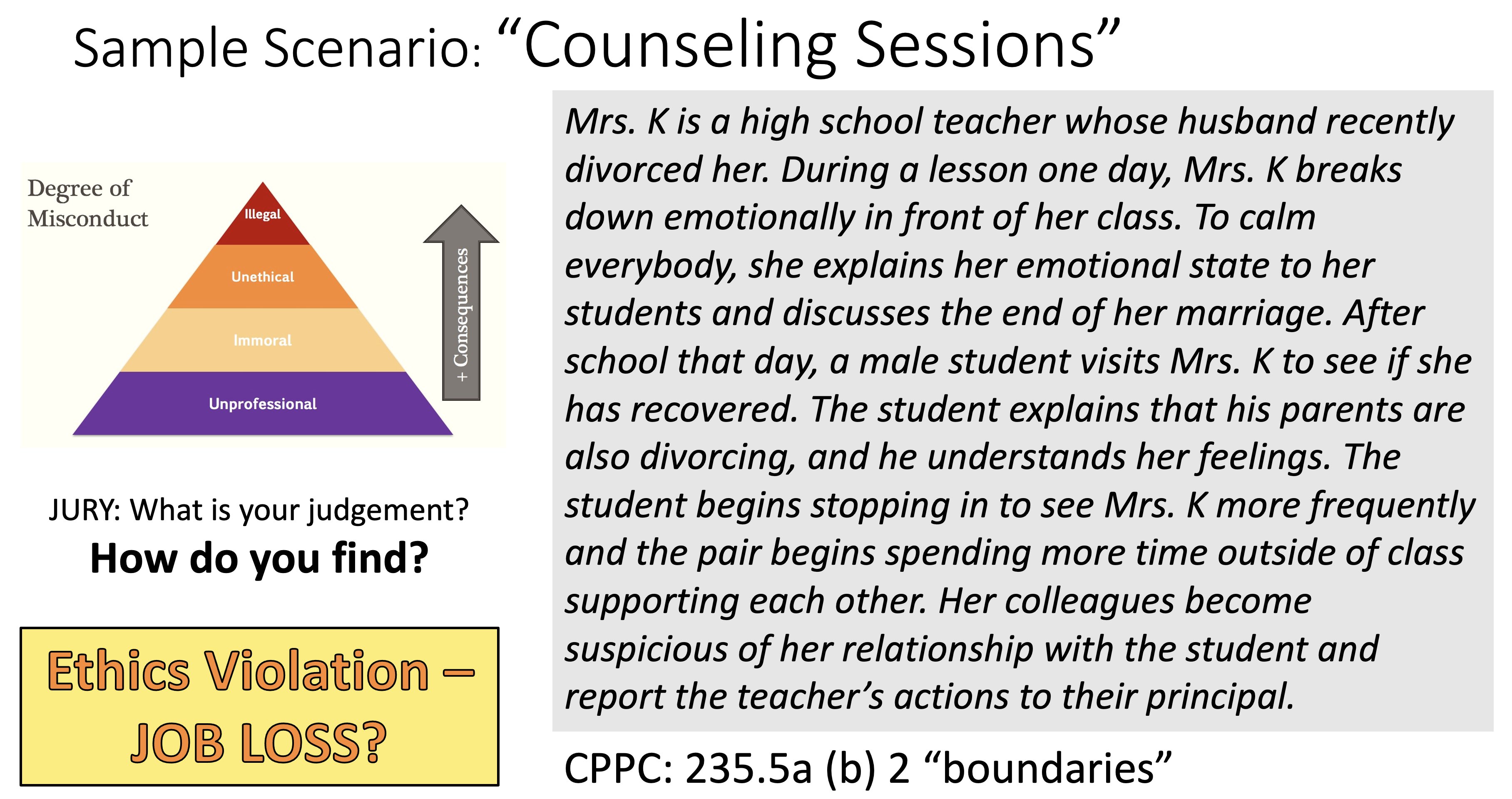
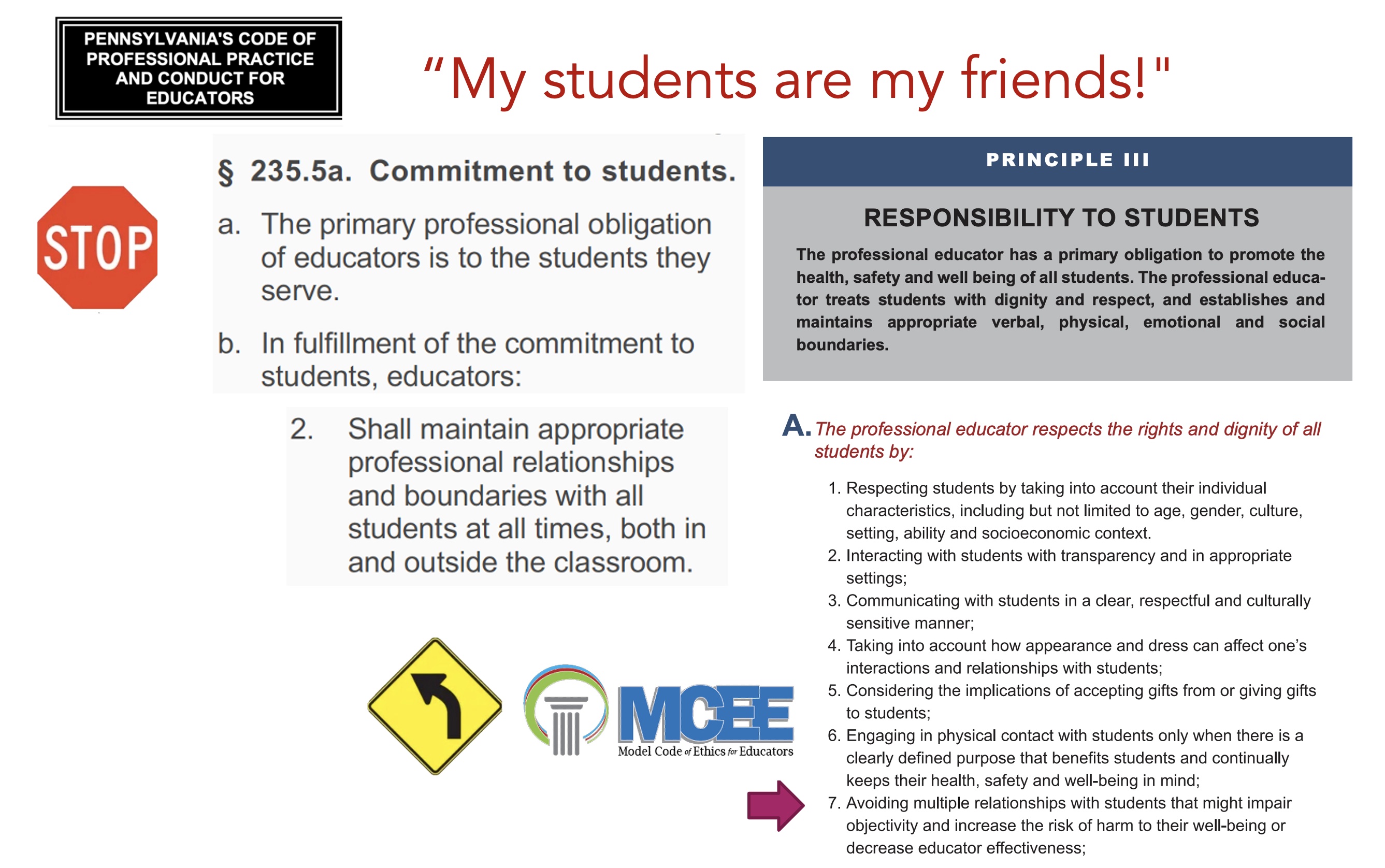
Degree of Misconduct, scenarios for learning the PA Code of Professional Practice and Conduct (CPPC): For more details, revisit the application of my misconduct rubric and explanation in the blog “Ethical Scenarios” here.

In collegiate sessions, I have used color-coded popsicle sticks and handouts of different hypothetical case studies for “the jury” to evaluate the behavior and “find the relevant code” in the CPPC.

VOICES IN MY HEAD

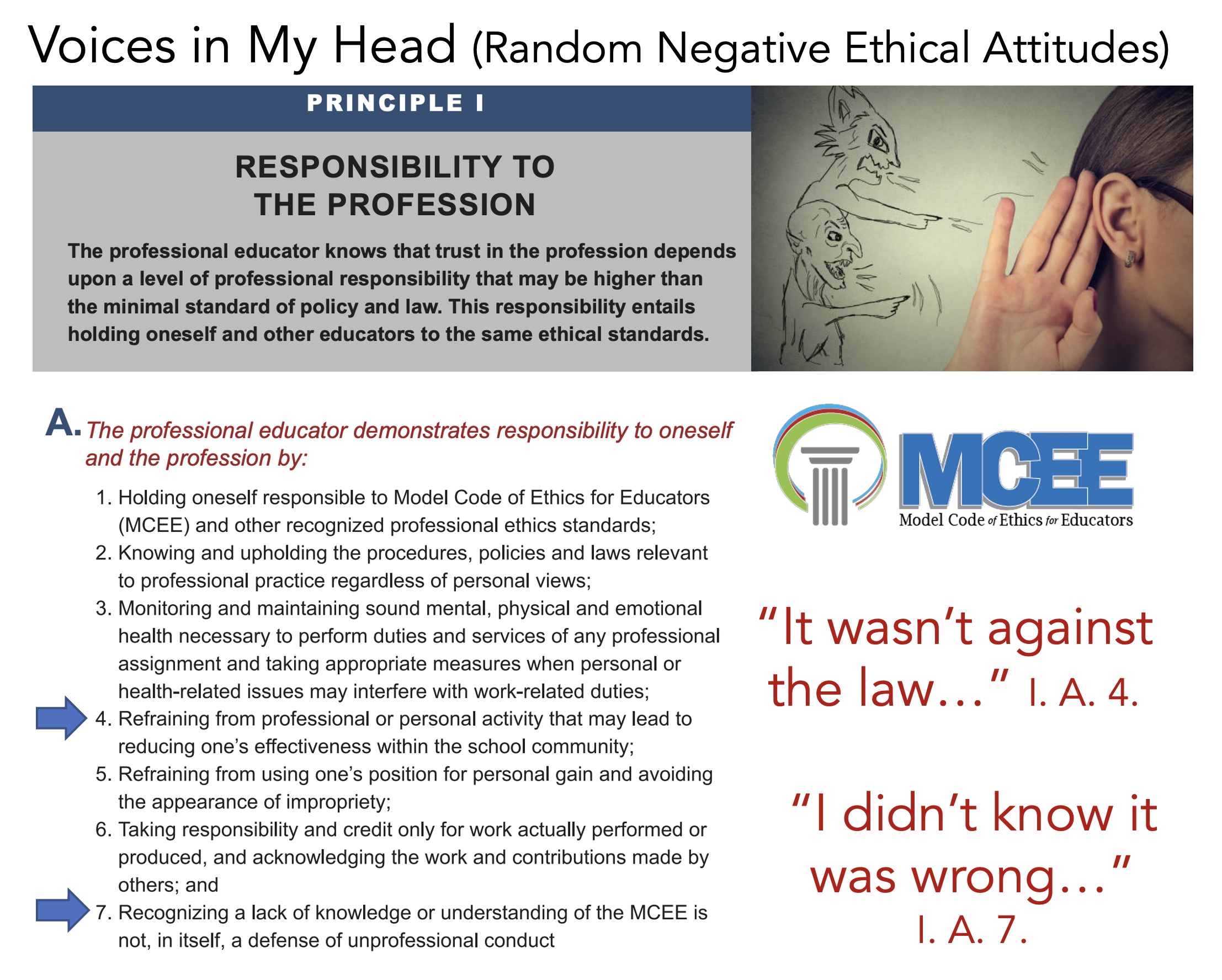
Random Bad Attitudes for review of the standards in the Model Code of Ethics for Educators: I doubt (or sincerely hope) you would not hear too many of these directly from the school staff, but comments like, “Don’t ask for permission, beg for forgiveness” are NOT ethical precepts! Let’s dissect these bad boys!

SEARCH FOR THE STANDARDS

Hybrid Approach for using “the negative voices” and researching appropriate provisions in both the CPPC and MCEE: Select a single bad attitude and break off into two or three teams, each focused on corroborating related ethical principles in CPPC, MCEE, and even the PA Educator Discipline Act (EDA).

ALL CODES

Deep Dive” Case Study Analyses in small group break outs for comprehensive interactive discussions using an adaptation of the questions in the Connecticut State Department of Education TEAM Manual:

  1. What possible issues/concerns might this scenario raise?
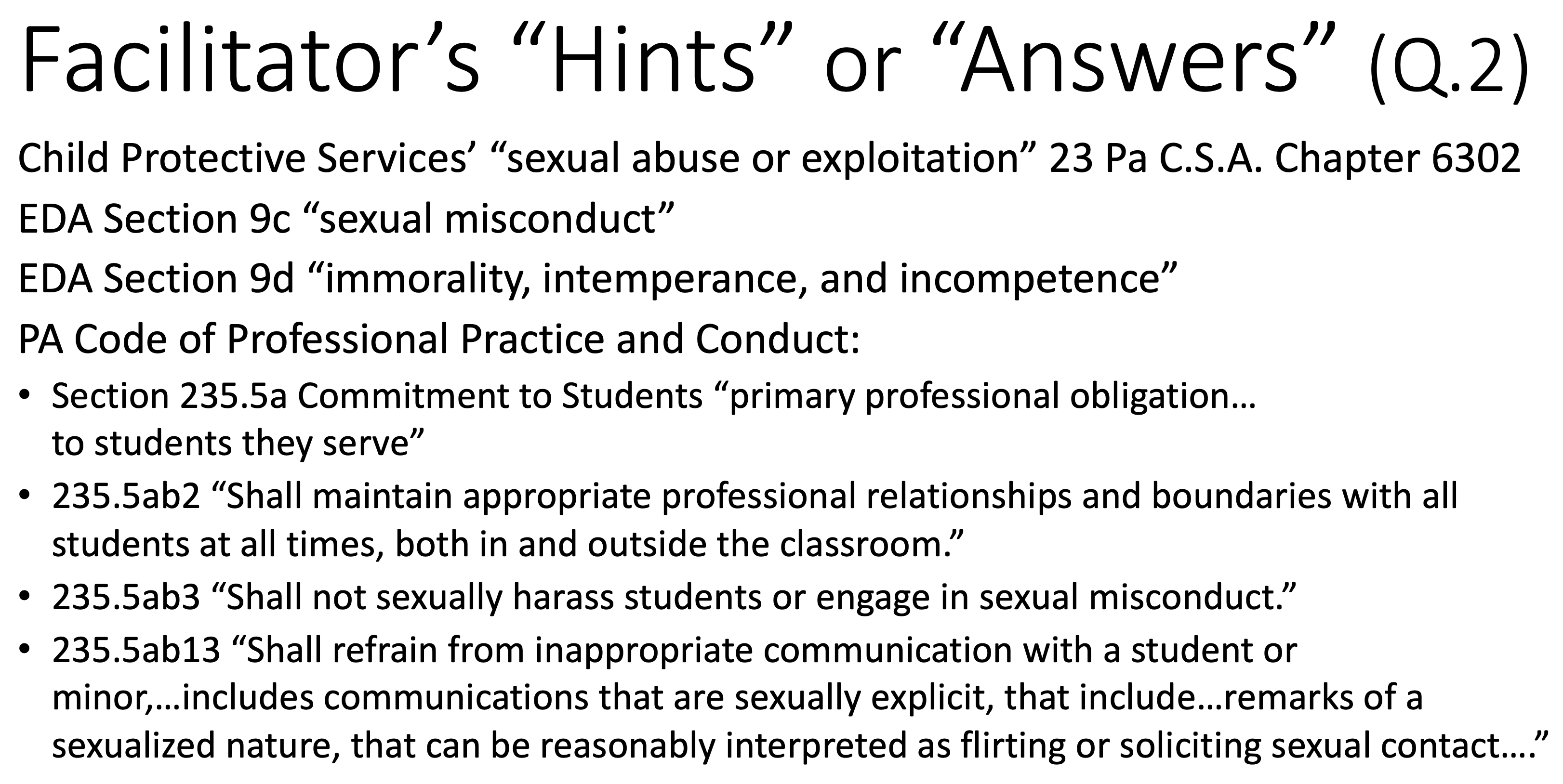
  2. How could this situation conflict with school policy, CPPC, EDA, MCEE, or case law?
  3. In this situation, what are some potential negative consequences for the educator’s students, fellow educators, and the school community-at-large?
  4. What responses/actions will result in a more positive outcome and/or what proactive measures might be considered?

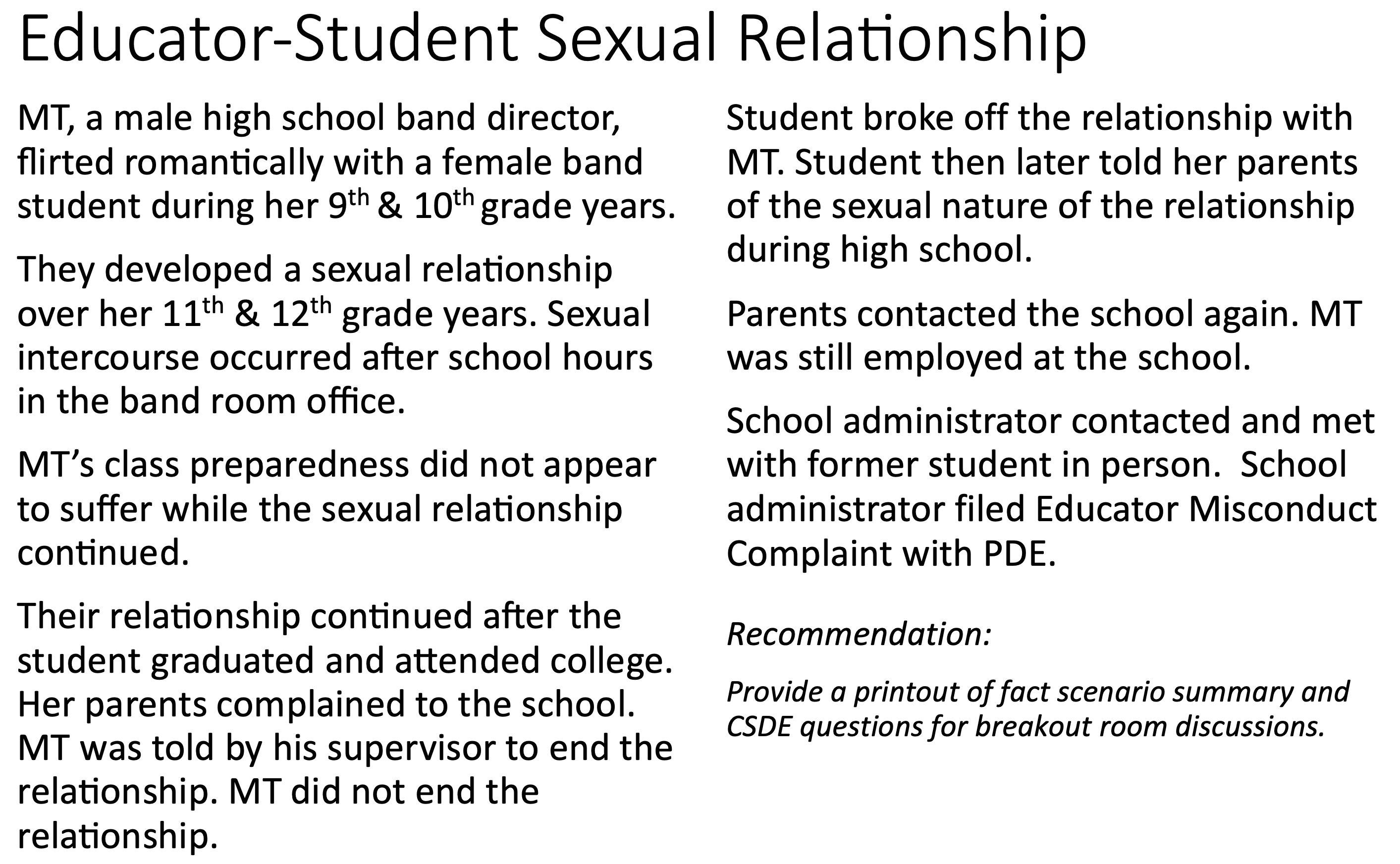
A single hypothetical scenario would first be presented to the full group, and then the educators would break off into 4-6 smaller groups to review these questions. Individuals may or may not all agree. A group leader is usually appointed to record their responses and then upon reconvening, report back to “the whole.” Here is a sample case study (painful reading; fictitious but based on actual past incidents):

The moderator may promote further discussion (sample answers below) and even pose additional questions like the following:

  1. What if the relationship was always of mutual consent?
  2. What if the teacher never taught the student while she was enrolled in his school?
  3. What if the relationship did not start until after the student graduated?
  4. What if his student was over the age of 18 during the time of the relationship?

It deserves mention here that this final training mode, representing perhaps the highest degree of scaffolding of the learning for the ethics training of your staff, proposes the establishment of a permanent school district Professional Learning Community (PLC) or ethics committee. We know from our past experiences in providing continuing professional development of educators that promote free, open, healthy sharing of potential professional decision-making conflicts or ethical “conundrums” – “what would you do” scenarios – will foster lasting long-term benefits. Danielson Framework for Teaching (Domain 4) and CSDE reinforce this philosophy of peer collaboration.

“Teachers must engage in district-facilitated conversations that focus on ethical and professional dilemmas and their professional responsibility to students, the larger school/district educational community, and to families.”

Connecticut State Department of Education

My educator ethics mentor and “hero” Troy Hutchings, Senior Policy Advisor to the National Association of State Directors of Teacher Education and Certification, admitted that in his early years of teaching, he felt a little reticent about going to his principal for advice in handling a situation of a student developing a “romantic crush” on him. To paraphrase his remarks during his webinar, “I was concerned that my supervisor might think I was encouraging the girl… Who could I turn to?” Sharing these anecdotes and talking informally with other faculty members will go far in building teamwork, mentor-mentee relationships, and intra-building trust in allowing more peer review towards enhanced educator decision-making.

If you need a resource on PLCs, my colleague (PA Principal of the Year to be honored at the upcoming 2023 SAS Institute) Dr. Tim Wagner recommended the handbook Learning by Doing by Richard DuFour, Rebecca DuFour, Robert Eaker, Thomas W. Many, and Mike Mattos (Solution Tree Press, 2016).

The authors’ summary of reasons to implement a PLC in your school building(s) are to:

  1. Improve staff’s individual and collective practice
  2. Build on staff’s “shared knowledge and experiences”
  3. Build clarity and understanding in the use of a common vocabulary
  4. Develop a library of accessible tools, templates, and protocols (i.e., ethical scenarios)
  5. Promote non-threatening, thought-provoking discussion on ethical decision-making

Wrapping It Up with More Resources

Every school setting is different, and your application of these staff ethics training ideas will be unique. Hopefully I have given any interested PA school system leader, CTC director, professional development or building administrator, or department chair some “food for thought.” For example, if you wanted to set up a PLC to meet regularly to discuss ethical issues, many of you may need to involve your teacher’s professional association and/or review their contract… or perhaps on-your-own implement a rotation of educators to experience these case study discussions during pre-scheduled inservice or induction days.

For “the keys to the car” to build your own local ethics professional development programs, we encourage you to sign-up for one of our classes here. For our PIL series, Thomas Bailey shares the native files of his PowerPoint presentations so that they can be turned around and taught to other educators, and then even students who are studying their own discipline code or online anti-bullying school policies. Here is an image of our PIL brochure which will be offered beginning on January 3, 2024.

I also suggest perusing Thomas Bailey’s free videos on this topic, slide #61 (page 31) from the handouts to my SAS Institute presentation (above), and these links to other blogs on paulfox.blog.

NOW YOU HAVE IT… the entire toolkit and rationale… the “who, what, how, and why” of educator ethics training and satisfying the new PDE Chapter 49 “PE” competencies.

© 2023 Paul K. Fox