Engaging Retiring/Retired Educators

Ask not what NAfME or your state MEA can do for you, but what YOU, a retiree, can do for your professional association and music education.
An adaptation of the famous excerpt from the 35th U.S. President John F. Kennedy’s inaugural address of January 20, 1961.
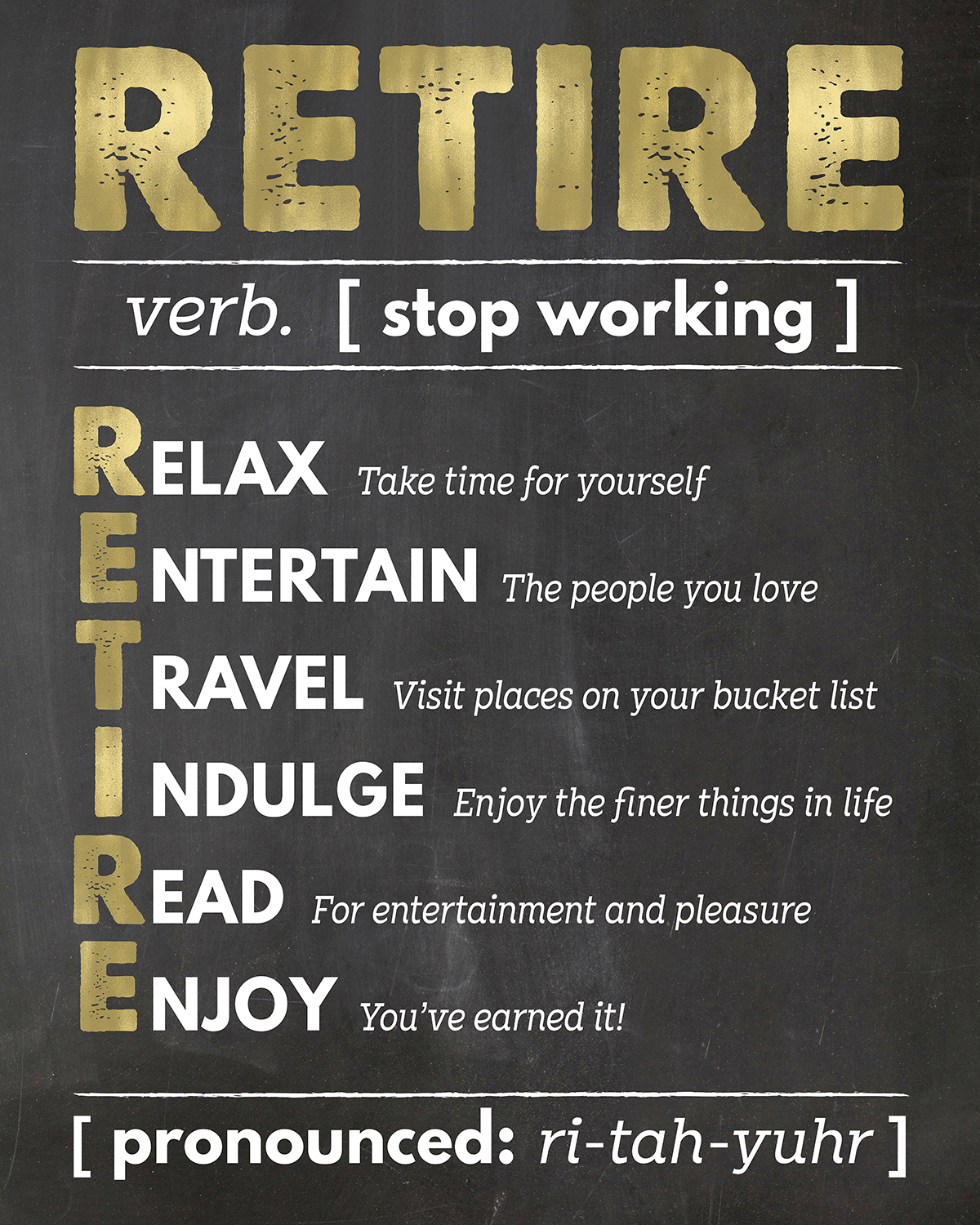
Surfing the ‘Net, I found an appropriate acronym for R.E.T.I.R.E. by Tangled Tulip Designs in pinterestRelax, Entertain, Travel, Indulge, Read and Enjoy! Most retirees would probably agree! The cessation of full-time employment may offer a great release from the day-to-day stress and drudgery of the job and the freedom to venture out, self-reinvent, make future goals, nurture relationships, and explore new personal growth opportunities.

Many attribute embracing a career in music education as “a calling” as opposed to just a form of employment or livelihood. From my experience, I have witnessed that most music educators are passionate for the cause of fostering creative self-expression in their students, more of a 24/7 mission, bringing intense focus and dedication to their lifework.

More to the point: Do we ever truly retire from making music ourselves and fostering this love in others?

THE “WHY!” Retirees matter and are critically needed!

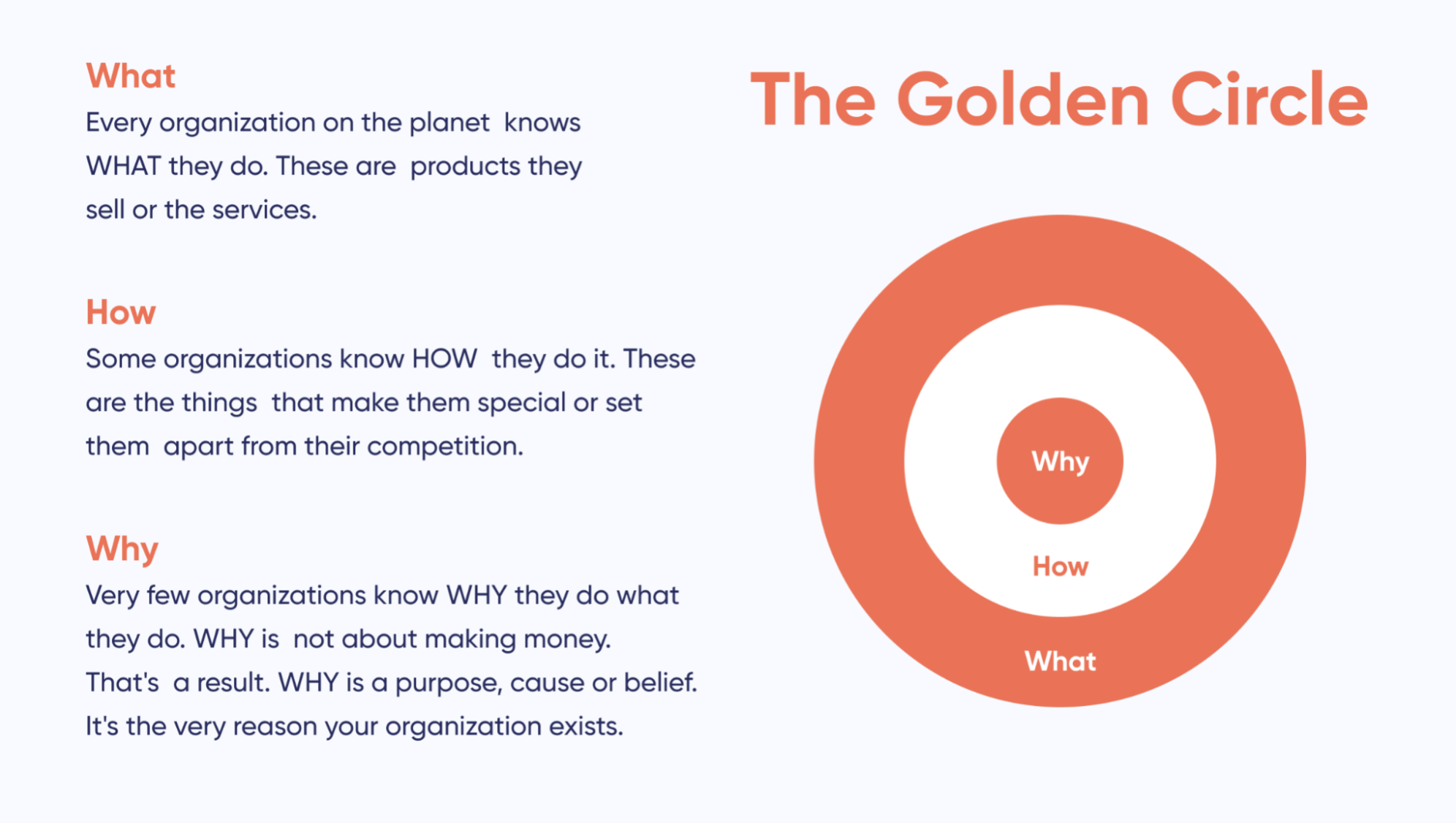
One of my favorite inspirational speakers (Simon Sinek) would say, “start with the WHY!” WHY is this discussion on professional engagement of retired educators so important today?

  1. Their need: An informal poll of my former local educators and administrators revealed that half of them “hate retirement!” According to Dr. Robert P. Delamontagne in his book Retiring Mind (Fairview Imprints), “50% of retirees will suffer some form of acute emotional distress. This is potentially a very large problem given the fact that 10,000 people are becoming eligible for Social Security every day for the next 20 years in the US alone.” Remember this statistic the next time a senior citizen cuts you off on the road or bangs a shopping cart into your leg at the checkout!
  2. Our need: We are facing shortages of qualified teaching candidates across the country with unfilled openings in public school music positions and the critical need of training/mentoring the new hires.
  3. Society’s need: All of our voices should be combined to support the advocacy of music education, actively promoting access to school music by sharing its academic and social benefits with decision-makers, building relationships with administrators and policymakers, and utilizing resources from organizations like NAfME and the NAMM Foundation.

Despite its proven benefits, music education is often the first program to face budget cuts in schools. This is especially concerning in underserved communities, where access to music programs can be life-changing. Now more than ever, we must advocate for music education to ensure that every child has the opportunity to experience its benefits. Investing in music education is an investment in the future of our communities — helping to cultivate the next generation of creative, resilient, and innovative leaders. 
“Why Music Education Matters More Now Than Ever” by Music Will, February 2025

For eleven years (and counting), I serve as the Pennsylvania Music Educators Association (PMEA) Retired Member State Coordinator, as well as the Past State Chair (current member) of the PMEA Council for Teacher Training, Recruitment and Retention. I believe my responsibility to the state association is two-fold:

  • Assist soon-to-retire professionals in achieving a smooth transition to a happy and satisfying retirement; to help them cope with the commonly-experienced emotional ups-and-downs of this life passage, wrestling with the question “what do you want to be or do when you grow up?” and making new life lesson plans and personal goals.
  • Reach out to and build meaningful connections with retirees in order to fully engage them towards becoming active in their professional association; to recount, represent, and revitalize the activities of our post full-time employed music educators.

This article proposes a roadmap of crucial pathways to help music teachers approach “retirement bliss” while tapping into their hard-earned knowledge, strengths, and experiences by cultivating the benefits of their renewed participation in our professional associations.

What can NAfME and State MEAs offer retirees?

You have devoted your entire life to inspiring the development of personal artistry and “ah-ha” musical moments in others. Now it is your turn to reap the benefits (and privileges) of this commitment to the profession. NAfME and your MEAs can provide the resources and motivation of “sharing and caring,” directing retirees “places to go, people to meet, and things to do” for fulfilling that “next chapter” or (perhaps better terms) the “refirement” or “rewirement” of senior living.

Do you feel “needed” and know you “make a difference?” Research has shown that the one of the most important motivators for involvement in a professional association is that its members recognize that they are essential to its success. This quote is from Revitalizing Retirement: Reshaping Your Identity, Relationships, and Purpose by Nancy Schlossberg, attributed to Rosenberg/McCullough:

 “It has been suggested that one problem of retirement is that one no longer matters; others no longer depend on us… The reward of retirement, involving a surcease from labor, can be the punishment of not mattering. Existence loses its point and savor when one no longer makes a difference.”

Most people who are one to five years away from “pulling their pin” and putting in their walking papers “do not know what they do not know.” Experts agree: “Retirement preparation is not only about the money!” Our silver-haired colleagues who have already Crossed the Rubicon and are now “living the dream” in retirement can share their trials, tribulations, and (more importantly) numerous success stories about coping with this transition!
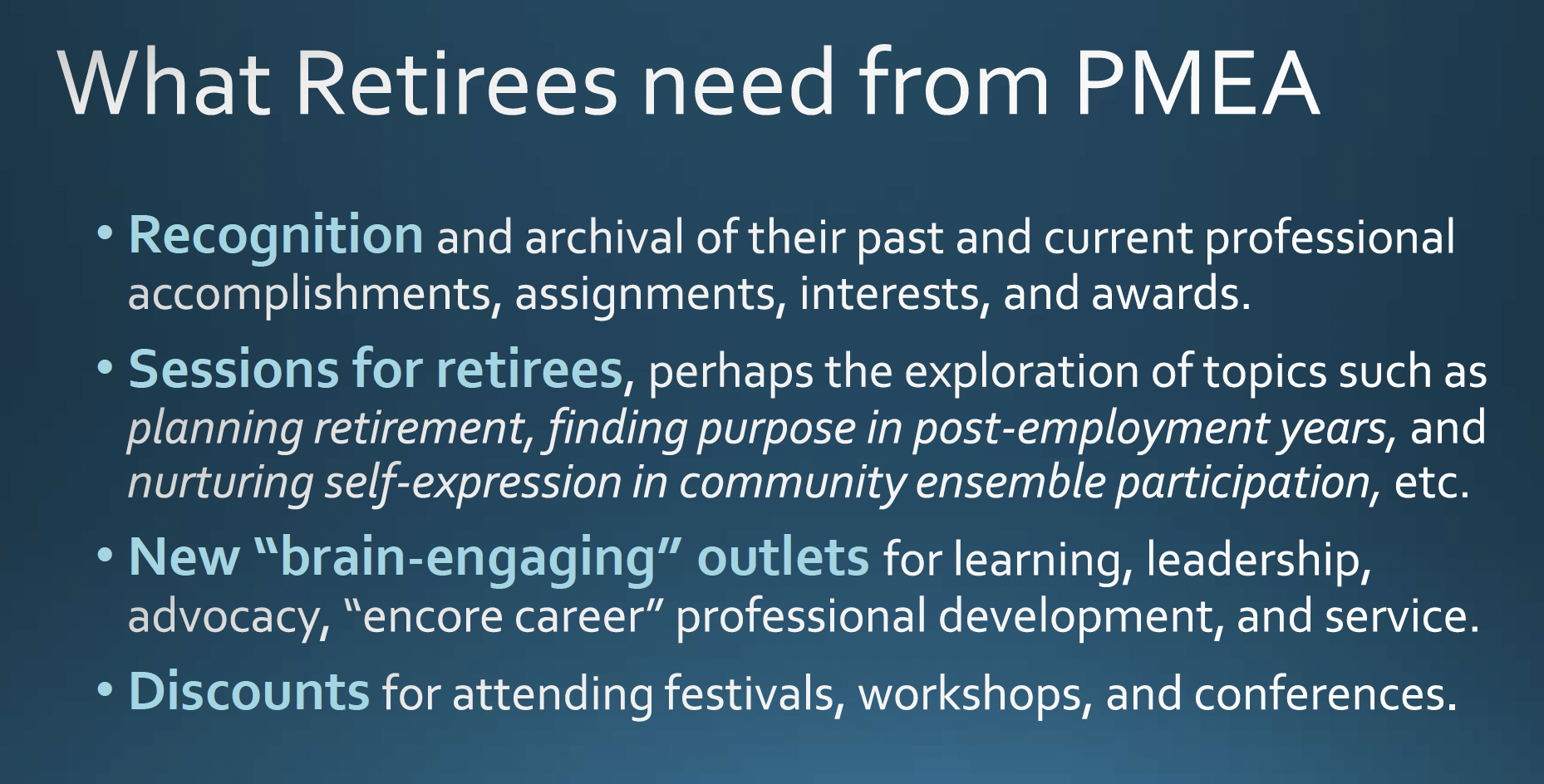
NAfME, PMEA and this paulfox.blog/for-retirees site have archived an exhaustive number of self-help articles. Check out this omnibus NAfME blog “Retirement Prep Top-Ten Treasures.”

The benefits of retired MEA membership are numerous. Besides providing helpful transitioning advice, these advantages also come to mind:

  1. Answers to questions like “What have you always wanted to sing, compose, play, record, conduct, write, publish or present?” and “Where can I share my hard-won expertise and help others in the field?”
  2. Networks and contacts to help you develop “encore careers” in other musical or educational arenas (e.g., higher education, music industry, festival organization, travel/tour planning, composition, guest conducting, private studio teaching, church music, etc.)
  3. Opportunities to “rekindle your expressiveness” by participation in adult community or full/part time performance groups (playing “gigs”)
  4. Places to go/things to see/hear: NAfME/MEA conferences, workshops, and concerts
  5. Exclusive discounts and other benefits (reduced dues and registration fees)
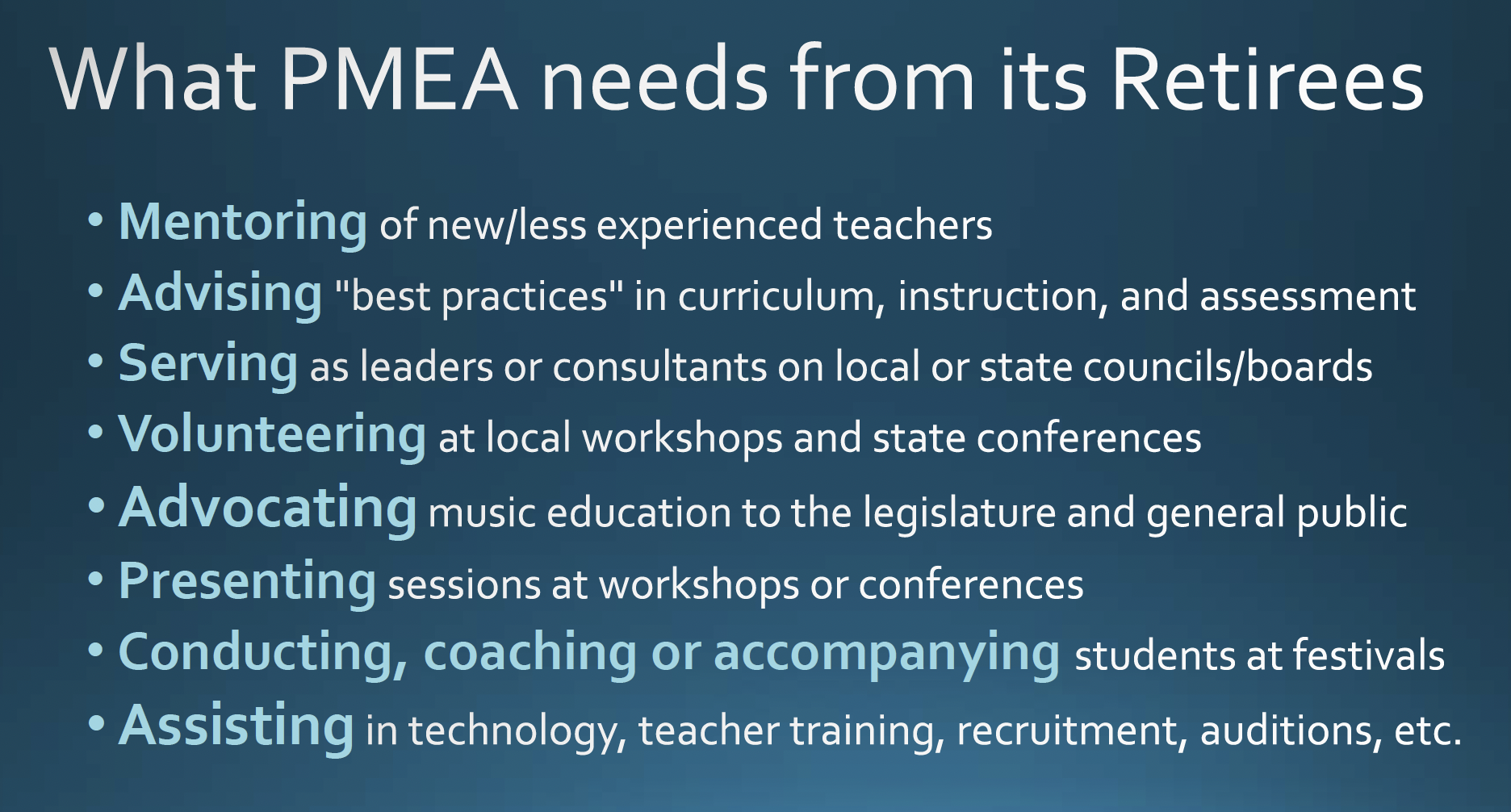
What can retirees offer NAfME and their state MEA?

The relationship of active and retired membership in our MEAs is symbiotic. We know from the history of our associations, “giving back to the profession” remains a high priority with most retirees. This may come in many forms and settings:

  • Leadership or membership in local, state, or national MEA/NAfME office, staff, advisor, or council/committee position
  • Advocates for the promotion of music education to local and state government officials
  • Service as presiding chair or member of the conference or workshop planning committee
  • Service as evaluator of performance groups, conference sessions, or articles for publication
  • Judges of local/state MEA adjudication or commercial festival
  • Accompanists, coaches, arrangers, or guest conductors for festivals or school/community groups
  • Services to the local music teacher in private teaching, piano playing, marching band charting, sectional coaching, choreography, music technology, instrumental repair, stage tech, etc.
  • Writers for state MEA and NAfME publications and blog sites
  • Contributors to online music education forums or the NAfME Connections
  • Donors to and/or fund-raisers of music education charitable projects, scholarship initiatives, etc.
The PMEA Model of Retired Member Participation
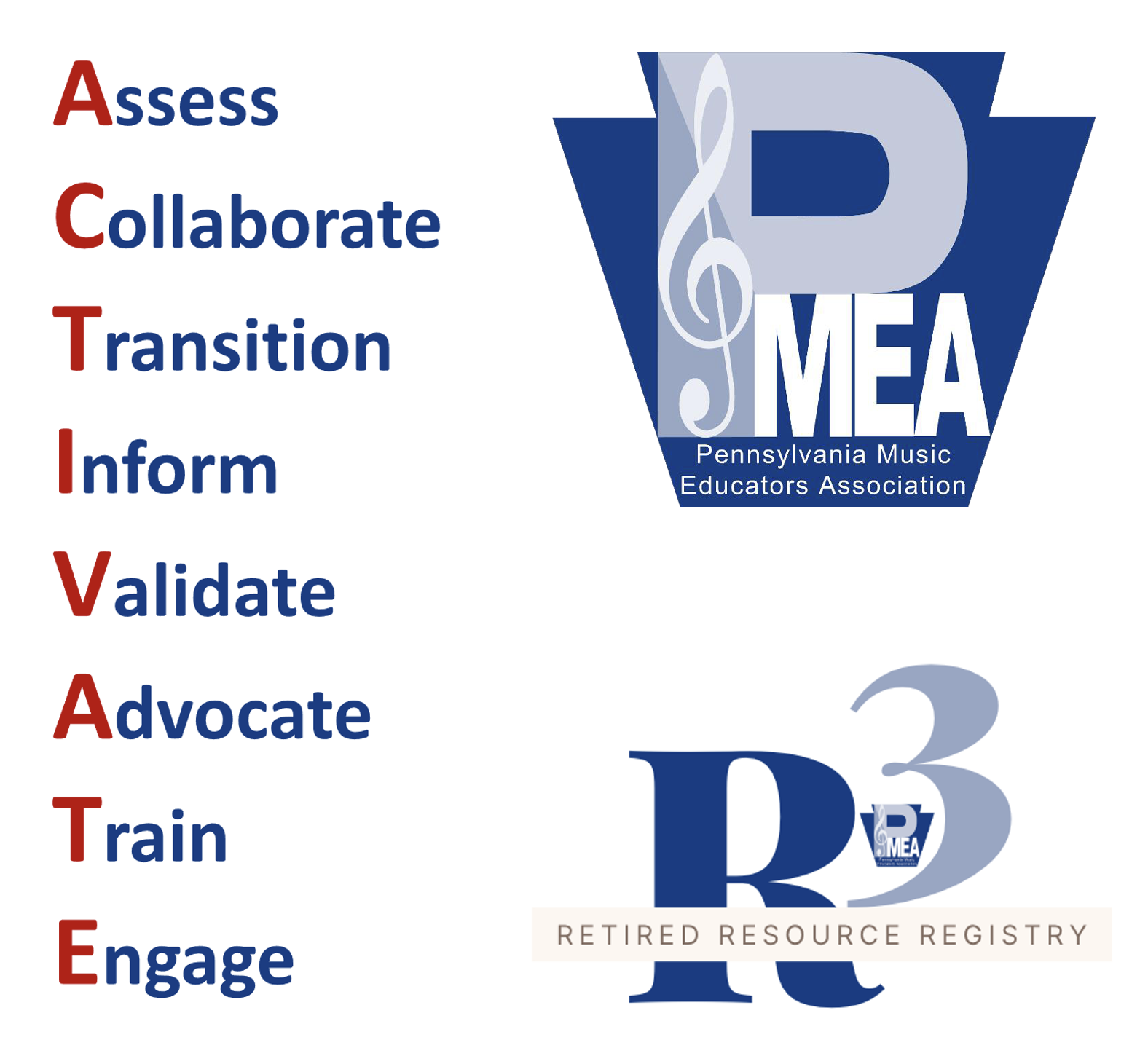
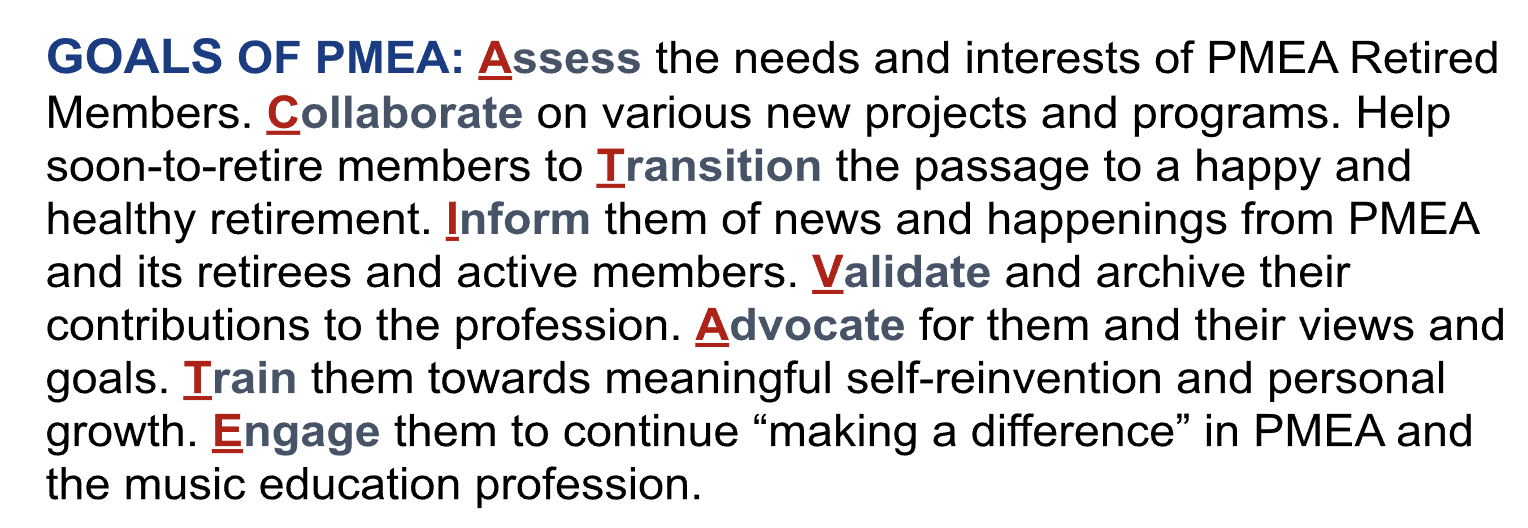
PMEA values the vast wealth of experience and contributions of our retired members. We’re proud of the many programs we offer to retirees and invite you to visit our website to peruse additional information and sample digital newsletters and articles.

Retired members in Pennsylvania are involved in:

  • PMEA elected and appointed offices, staff, committee chairs, and membership on councils
  • PMEA Strategic Plan and Bylaws, Conference Planning, and other state/regional committees
  • Retired Resource Registry* (informal mentoring for new teachers and transfers)
  • How-to-Retire Webinar, Prepping for Retirement, and the Ultimate Retiree Resource Guide
  • Retired Member Breakfast at PMEA Annual Conference
  • Retirement 101 (The Who, What, When, Where, Why, and How) session at PMEA Annual Conference (training for all members retiring or soon-to-retire)
  • Maintenance of PA Community Band, Chorus, Orchestra, and Theater group catalogs
  • Maintenance of PMEA member compositions library
  • Mock Job Interview Committee for music education majors
  • Coffee & Conversations informal “ask an expert” lounge at PMEA Annual Conference
  • Volunteering as presiding chairs for sessions and registration aides at conferences/workshops
  • Pool of conference clinicians, guest lecturers, and members on discussion panels
  • Participation in “Sponsor a Collegiate to Attend the Conference” campaigns
  • All-State Program Patron, or contributor to the annual Irene Christman Scholarship or Margaret Bauer Grant programs.
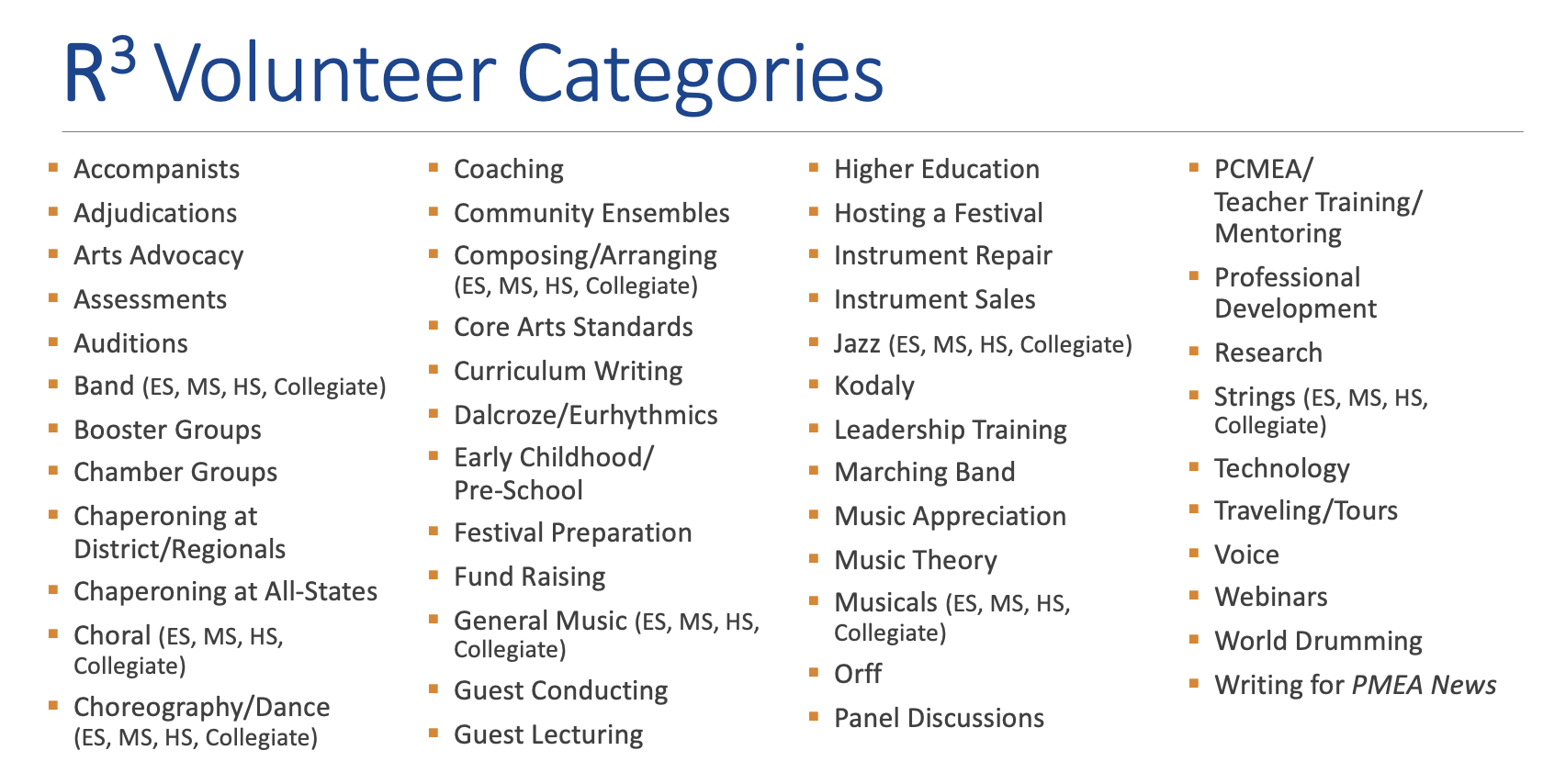
As of October 1, 2025, there are 61 advisors in the PMEA Retired Resource Registry.

*During their annual membership registration, PMEA Retired Members may choose to sign-up for the R3 Retired Member Registry (above volunteer categories) to become available to informally offer advice to college music education majors, new hires, transfers, and newcomers to any music specialty. R3 members may handle inquiries like “What warm-up would you recommend for my middle school choir?” OR “Do you have an idea for an elementary string ensemble concert opener?” OR “How do you teach improvisation… steady beat… breath support?”

The other option with more time commitment is that Retired Members can be officially “trained” as a PMEA Mentor and be assigned to specific individuals who request assistance in their early career assignments.

Coda

How can we help?

What is the future of retired music educator professional engagement? In a word: connections!

Last month, I reached out to Elizabeth Welsh Lasko, NAfME Assistant Executive Director for Membership, Organizational Development, and Marketing Communications and “volunteered” OUR assistance. I suggested that, in keeping with the NAfME 2022 Vision Statement “…an association where all people are heard, seen, and feel they belong throughout their lifelong experiences in music” we should all intentionally recruit more hands-on involvement of our retirees. I pointed out that in the late 1980s, we had a Music Educators National Conference (MENC) Committee for Retired Members led by a National Chairman who served on the NAfME National Assembly. (An excellent booklet, TIPS: Retirement for Music Educators, Copyright © 1989 MENC, was compiled by A. Verne Wilson, then the Past National Chairman of the MENC Committee for Retired Music Educators.)

Ms. Lasko encouraged me to “reach out to retirees” beginning with this article. At the next NAfME Eastern Division Conference, I plan to hold a meeting of retired members, and also connect with all state MEA retired member coordinators (those states who have them). We’re available and on the move! Let’s collaborate and share our resources!
Finally, just for fun, I recently posted the blog “For Book Lovers – Retired or Not” on NAfME Connections (formerly called Amplify). There are already 1,810 members in the NAfME “Retired Members Community.” Please JOIN US! Using this forum, get in touch with me, and respond with YOUR OWN retirement stories, strategies, perspectives on this “life passage,” and more ideas to grow the professional engagement of our music teacher retirees.

Happy trails!

© 2025 Paul K. Fox

Launching PA Educator Ethics Training

Implementing the NEW PDE Chapter 49 “PE” Competencies – “The WHO, WHAT, WHY, & HOW!”

Blogger’s Note: We will return to Part II of “Bookends” next month to explore:

  • Stage 3: Inservice/Growing Years
  • Stage 4: Veteran/Sustaining Years
  • Stage 5: Next Chapter/Living the Dream

Instead, our November blog will share methods, modes, media, and other materials to provide meaningful professional development on ETHICS for EDUCATORS in the Commonwealth, resources from my upcoming presentation to school administrators at the Pennsylvania Department of Education’s SAS Institute – Successful Leadership – Shaping Your School’s Story to be held in the Hershey Lodge and Convention Center on December 11-13, 2023. Click below for my handouts.


PKFox

Interested in joining us at the Hershey Lodge on December 11-13, 2023? Please click here for more information or to register.

A Summary of My SAS Institute Ethics Session

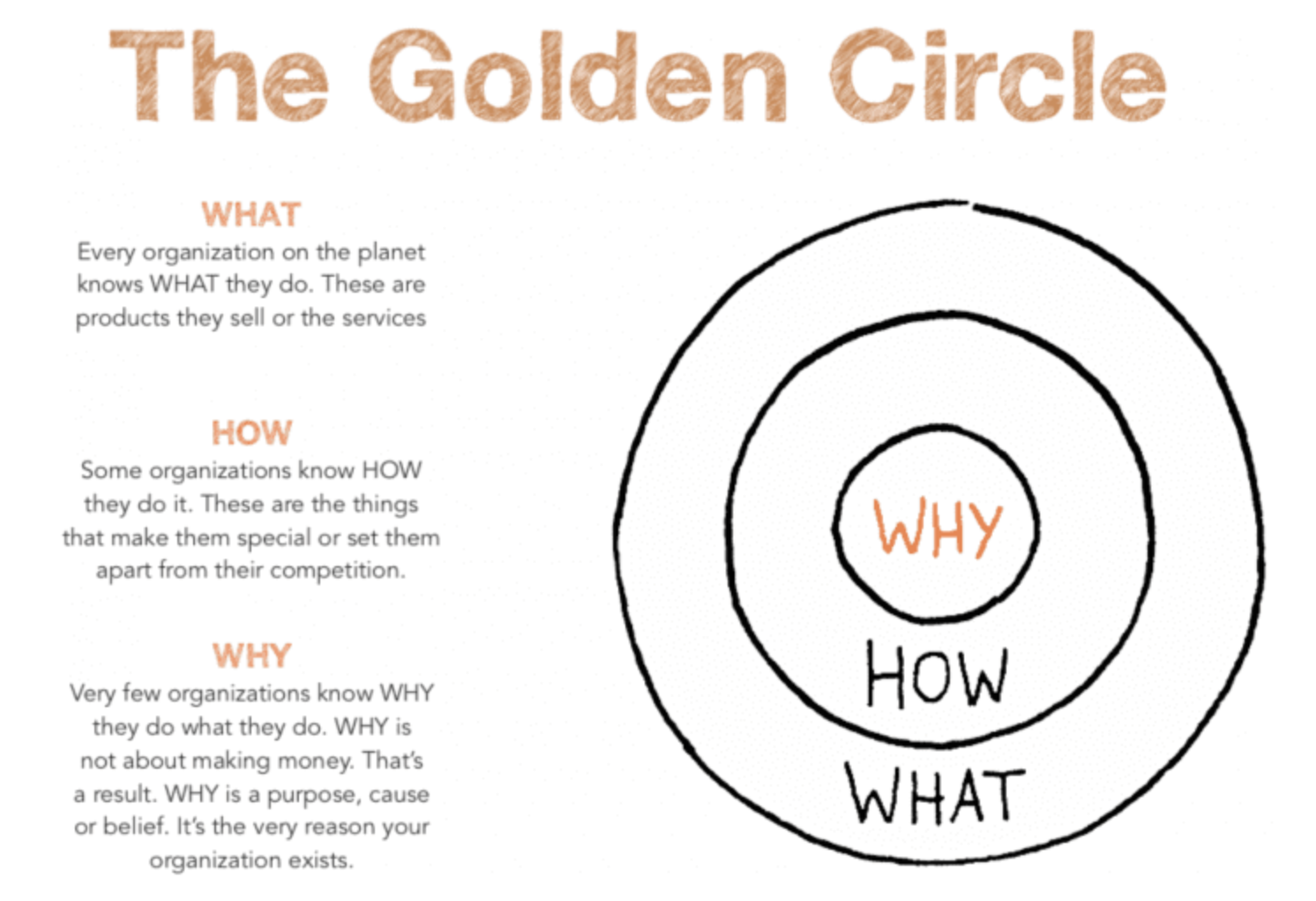
To paraphrase the wisdom of one of my favorite recent visionaries and online workshop presenters, Simon Sinek, “Every organization should begin with “the WHY!” According to SmartInsights, Sinek’s Golden Circle theory explains “how leaders can inspire cooperation, trust and change in a business based on his research into how the most successful organizations think, act and communicate if they start with why.” On his website, he declares his own WHY: “We are here to inspire people to do the things that inspire them so that, together, each of us can change our world for the better.” I love his mission!

https://www.smartinsights.com/digital-marketing-strategy/online-value-proposition/start-with-why-creating-a-value-proposition-with-the-golden-circle-model/

“Your WHY is your purpose, cause, or belief. WHY does your company exist? WHY do you get out of bed every morning? And WHY should anyone care about the work you do?” – Simon Sinek

So… lets ask the questions that define our own golden circle, my session, and this article:

  • WHY should we be so concerned about professional development in ethics for PA educators?
    (Why should you even be reading this blogpost?)
  • HOW should we train our staff?
  • WHAT should be introduced and reinforced over the long term?

And, I will add one additional question: WHO is responsible for all of this?

Well, the quick response to that last query is EVERYONE in the profession. However, this blog is particularly geared to school system leaders, career and technical center directors, and administrators charged with the responsibility of continuing education/professional development and induction programs for their PA educators.

The “WHY!”

Quick. Calling on all PA teachers! Without looking on the Internet, can you identify the exact title of your “code of conduct” (1)? Do you know the PA agency responsible for writing this code and adjudicating its rules (2)? Can you name the “code of ethics” recently adopted by PDE and the Board of Education which provides school staff comprehensive guidance in professional decision-making based on context (3)?

Hints? How about a few acronyms?

  1. CPPC
  2. PSPC
  3. MCEE?

Don’t you think “we” should at least be familiar with the commission that grants us the license to teach in PA as well as the document that “governs” our behavior, violations of which could remove us from our job or revoke our certificate?

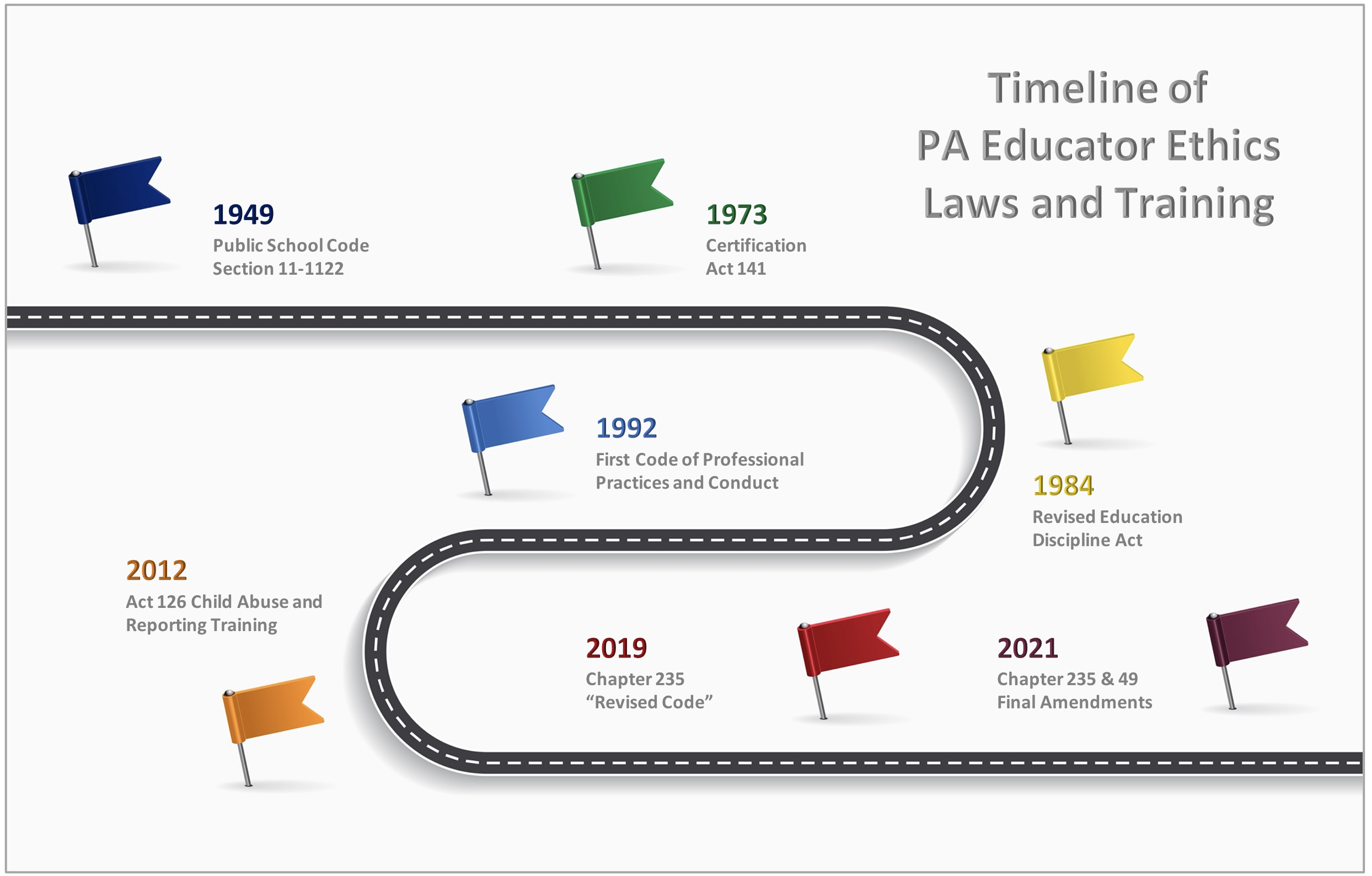
Of course, six years ago, even I didn’t know we had a PA “code of conduct!” (I started teaching in the public schools in 1978 and it wasn’t written until 1992!) After retiring from full-time teaching in 2013, I was asked to present my first ethics workshop back in 2017 for a Pennsylvania Music Educators Association (PMEA) Regional In-Service Program. Already scheduling me for two other sessions, the organizer came to me, “Could you add a presentation on educator ethics?” My first reaction was, WHY? Why would this be necessary? I promised him I would do a little research before getting back to him… and found these (now updated) statistics. Here’s the WHY in a nutshell!

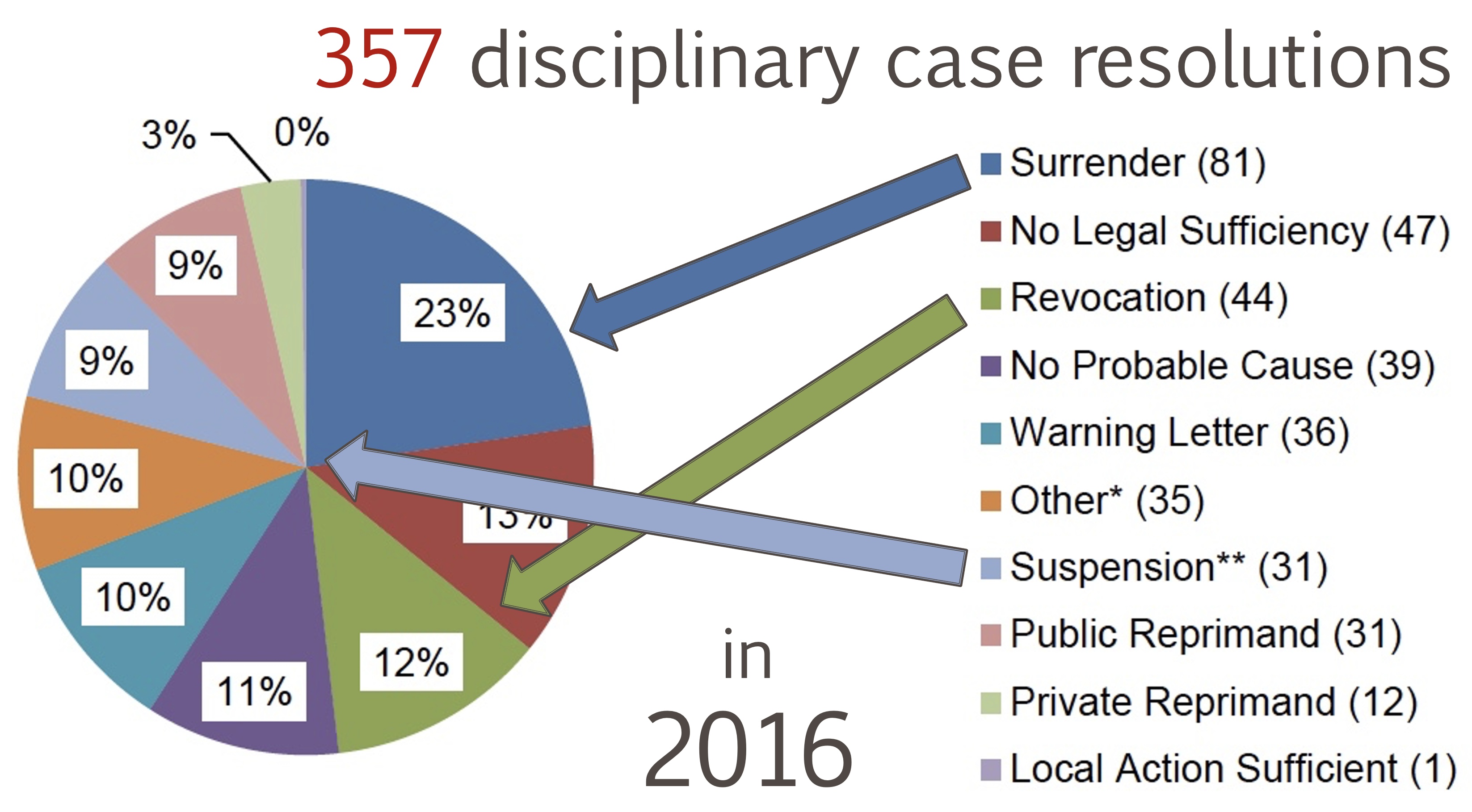
HORRIBLE! These are the number of PA educators by year who had misconduct complaints filed against them. Sure, a majority of their cases were not always fully prosecuted nor did they all result in a “guilty” verdict or plea, as this glimpse of educator disciplinary resolutions for 2016 (out of 672) for comparison shows (statistics from PDE):

But, if you can read the above graphic, that means that in 2016, 156 educators surrendered their license or had their certificate suspended or revoked! Obviously, no matter how you interpret the stats, this is a SERIOUS PROBLEM! And it may be due to a lack of training or understanding of the regulations and principles of ethical decision-making!

Why is this topic crucial for all pre-service, “rookie,” AND experienced professional educators? It is essential… not so much to serve as a reminder of the penalties for ethical infractions or spotlighting the occurrences you read or hear about in the news… but, because ETHICS are what we all stand for, the values we exhibit in our day-to-day decision-making, the integrity of the profession, and our “making a difference” in the lives of the students.

Ignorance of the law is no excuse for breaking it.

(Oliver Wendell Holmes)

The “WHAT!”

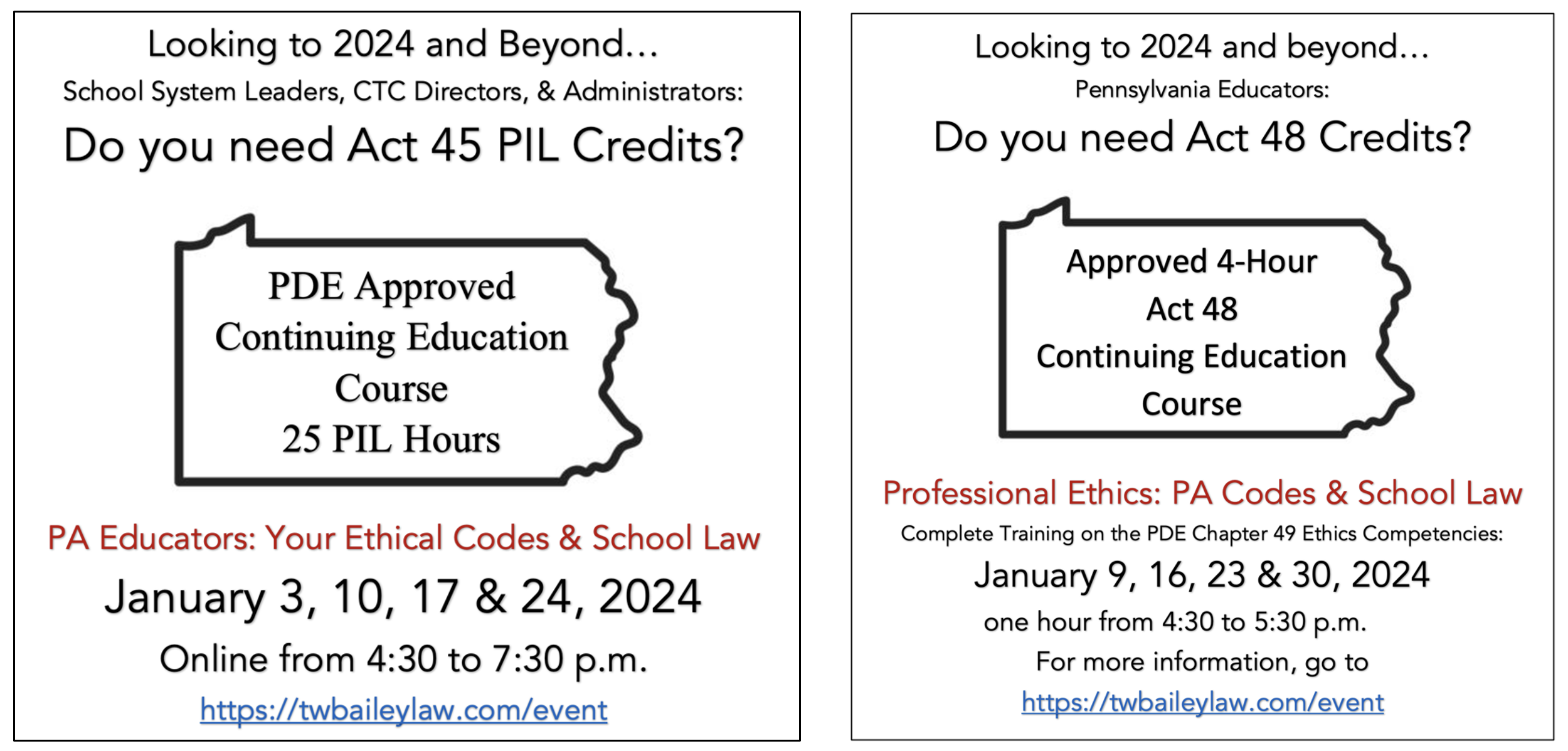
My colleague Thomas W. Bailey, a retired social studies teacher who reinstated his law license, and I set ourselves the goal of creating continuing education courses to provide REAL ethics training for PA educators. Thomas applied to the Pennsylvania Department of Education and received approval for a four-hour online Act 48 continuing education course for all PA educators (earning credits in PERMS) and a 25-hour online Act 45 PIL continuing education course for school system leaders, career and technical center directors, and other administrators responsible for planning the professional development of their school staff. The dates for our next two series of classes with open for enrollment in January 2024 are:

To register for either course, please go to Tom’s website: https://www.twbaileylaw.com/event.

Both of our courses satisfy the recently revised PDE Chapter 49 requirements of learning the “professional ethics” program framework guidelines:

For school system leaders and other administrators, PDE has set high expectations with the release of the following DEADLINES in April 2022:

“Chapter 49 requires instruction in professional ethics to be integrated in educator preparation, induction, and continuing professional development programs as follows.

  • Continuing professional development programs must integrate the professional ethics competencies no later than the 2023-24 academic year.
  • Educator preparation and induction programs must integrate the professional ethics competencies no later than the 2024-25 academic year.

Our Act 45 and Act 48 courses cover the following subjects, definitions, and applications of these terms:

  • Fiduciary
  • Ethical Equilibrium
  • Personal Morality
  • Regulations of Law
  • Professional Ethics
  • Professional Dispositions
  • Moral Professionalism
  • Differences Between Moral and Ethical Standards (with Examples)
  • Codes of Conduct (Examples)
  • Codes of Ethics (Examples)
  • Differences Between a Code of Conduct and a Code of Ethics
  • PA Professional Standards and Practices Commission
  • Paths of Educator Discipline in PA (Local and State)
  • Loudermill Hearings
  • State Discipline System (from Misconduct Complaint to Appeals)
  • PA Code of Professional Practice and Conduct
  • The Educator Discipline Act
  • National Association of State Directors of Teacher Education and Certification
  • Model Code of Ethics for Educators

The “How!”

I know this will sound a lot like bragging, but what makes the Thomas Bailey + Paul Fox ethics courses truly effective and different from everyone else in the game (albeit there are few “classes on the codes” sponsored in our geographic area) is the process – a focus on top-down training (administrator to teacher to student), interactive discussion, and a major emphasis on borrowing from the research of “Principled Teaching” in Domains 4a, 4d, 4e, and 4f of the Charlotte Danielson Framework for Teaching, the Teacher Education And Mentoring (TEAM) Module 5 Guide of the Connecticut State Department of Education, and the Facilitators Guide of the Iowa Board of Educational Examiners.

In my SAS presentation, I review several different modes of case study analysis, from simple to comprehensive, modeling small group interactive peer review, encouraging healthy discussions of diverse opinions in an “open,” non-threatening environment. The following approaches could be adapted to your setting of in-service programs or inductions:

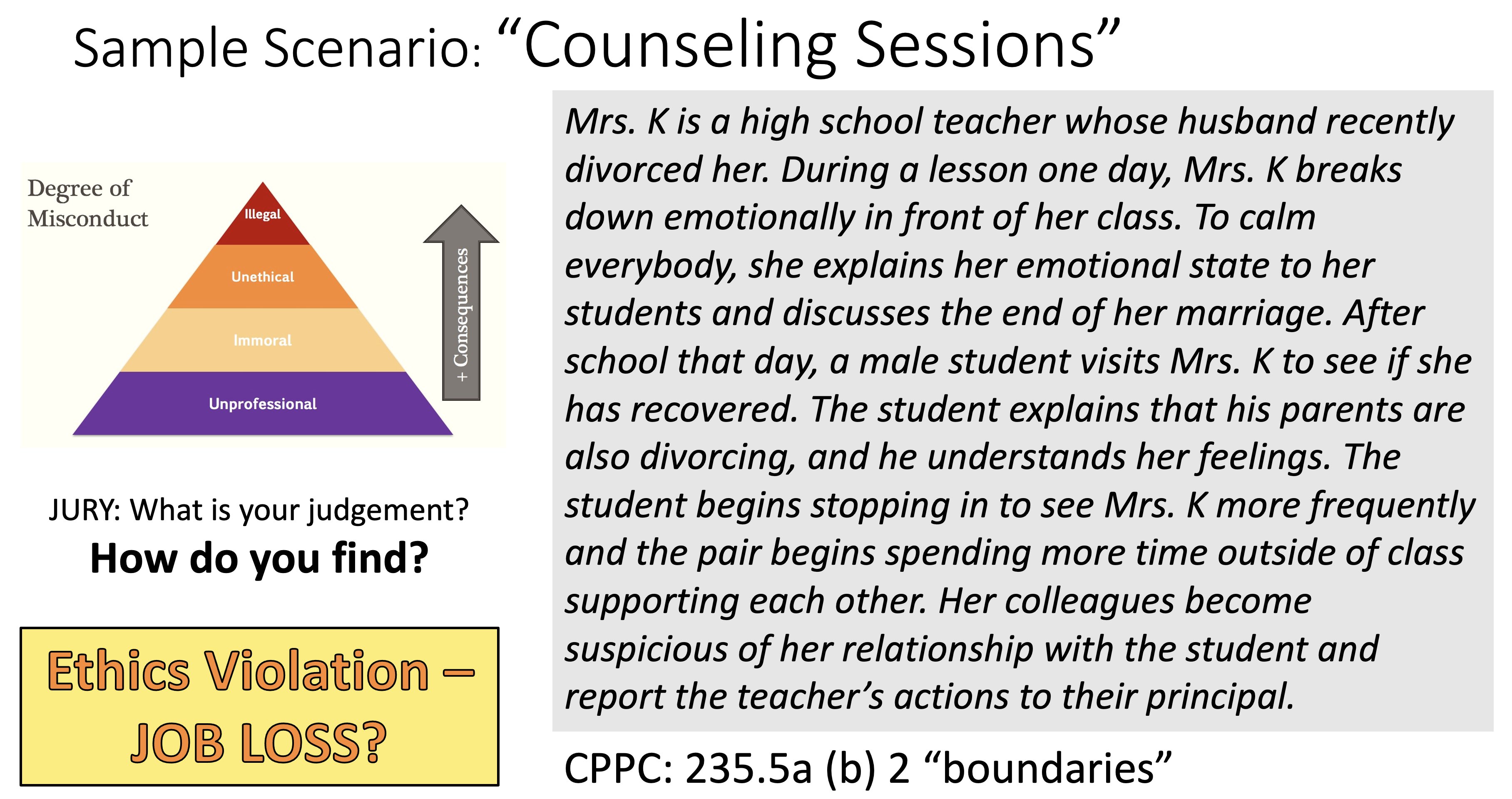
MOCK JURY

Degree of Misconduct, scenarios for learning the PA Code of Professional Practice and Conduct (CPPC): For more details, revisit the application of my misconduct rubric and explanation in the blog “Ethical Scenarios” here.

In collegiate sessions, I have used color-coded popsicle sticks and handouts of different hypothetical case studies for “the jury” to evaluate the behavior and “find the relevant code” in the CPPC.

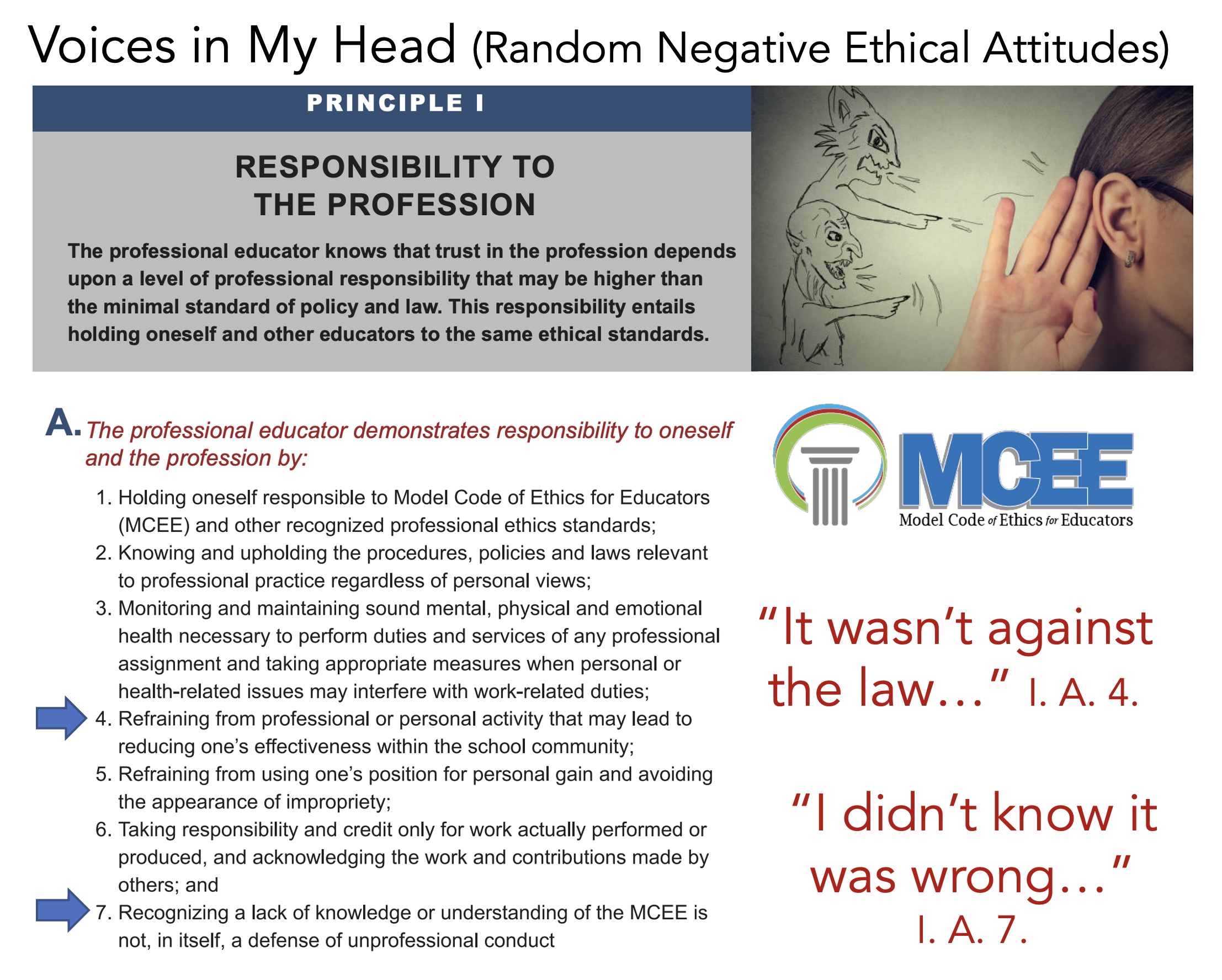
VOICES IN MY HEAD

Random Bad Attitudes for review of the standards in the Model Code of Ethics for Educators: I doubt (or sincerely hope) you would not hear too many of these directly from the school staff, but comments like, “Don’t ask for permission, beg for forgiveness” are NOT ethical precepts! Let’s dissect these bad boys!

SEARCH FOR THE STANDARDS

Hybrid Approach for using “the negative voices” and researching appropriate provisions in both the CPPC and MCEE: Select a single bad attitude and break off into two or three teams, each focused on corroborating related ethical principles in CPPC, MCEE, and even the PA Educator Discipline Act (EDA).

ALL CODES

Deep Dive” Case Study Analyses in small group break outs for comprehensive interactive discussions using an adaptation of the questions in the Connecticut State Department of Education TEAM Manual:

  1. What possible issues/concerns might this scenario raise?
  2. How could this situation conflict with school policy, CPPC, EDA, MCEE, or case law?
  3. In this situation, what are some potential negative consequences for the educator’s students, fellow educators, and the school community-at-large?
  4. What responses/actions will result in a more positive outcome and/or what proactive measures might be considered?

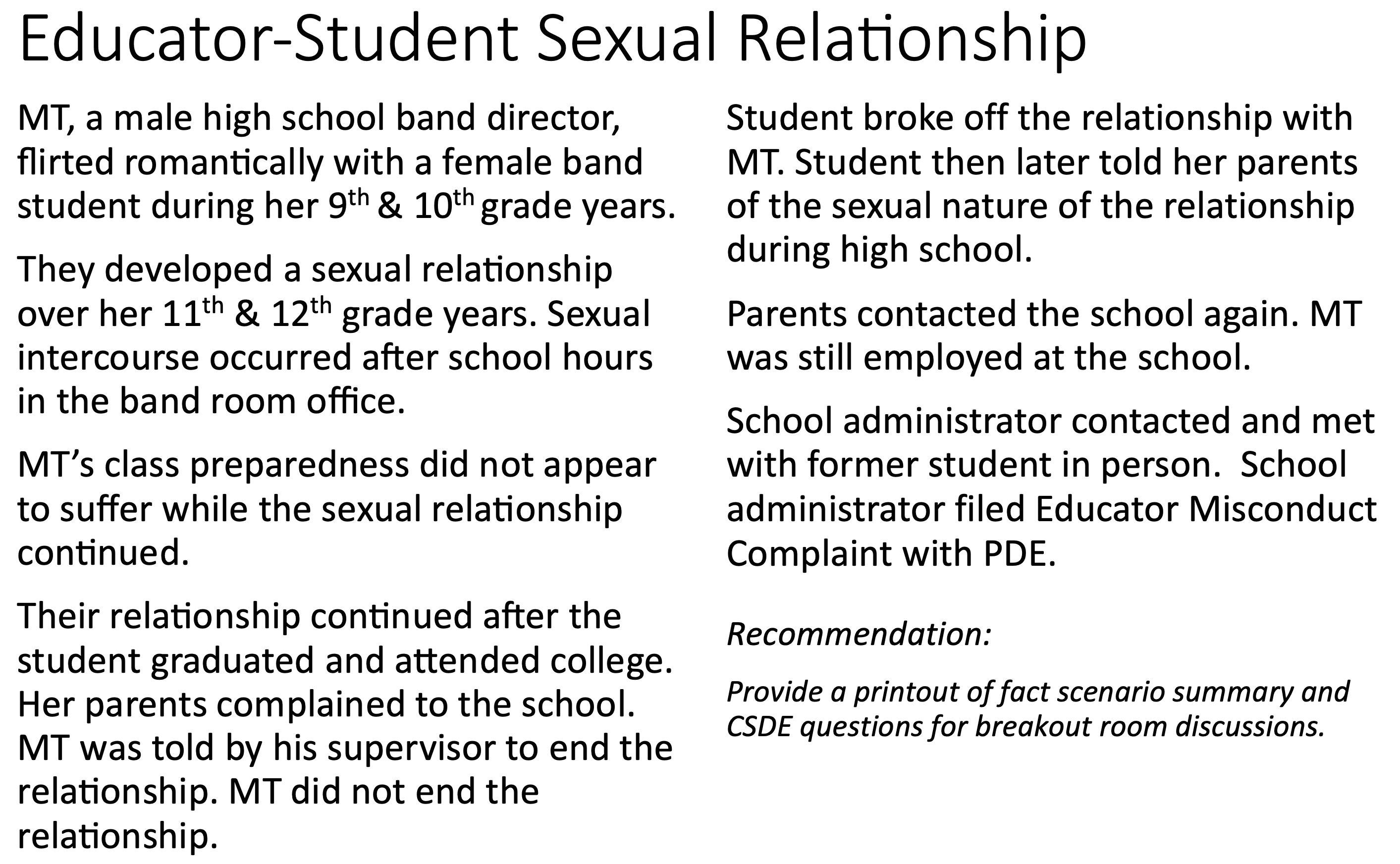
A single hypothetical scenario would first be presented to the full group, and then the educators would break off into 4-6 smaller groups to review these questions. Individuals may or may not all agree. A group leader is usually appointed to record their responses and then upon reconvening, report back to “the whole.” Here is a sample case study (painful reading; fictitious but based on actual past incidents):

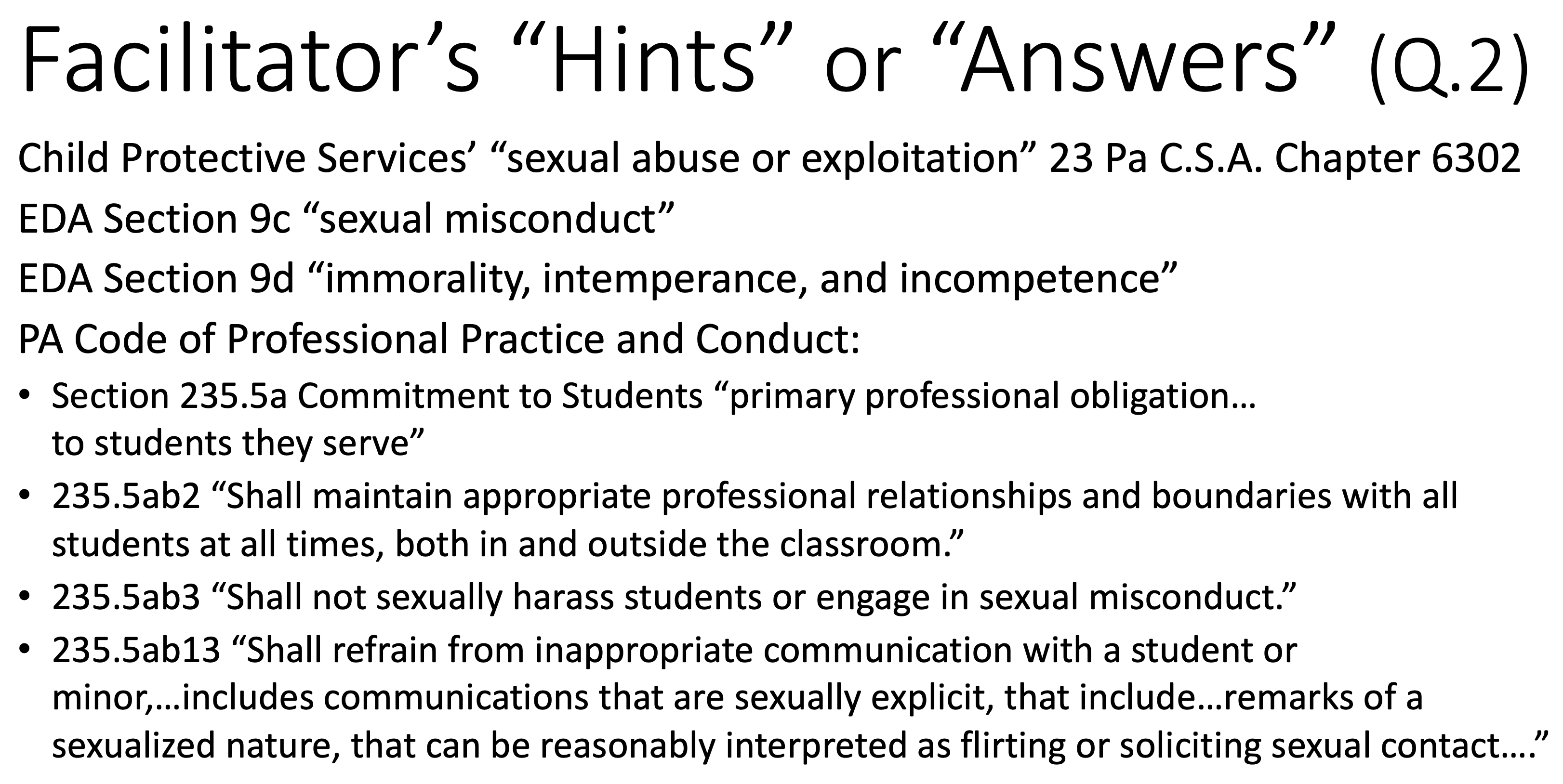
The moderator may promote further discussion (sample answers below) and even pose additional questions like the following:

  1. What if the relationship was always of mutual consent?
  2. What if the teacher never taught the student while she was enrolled in his school?
  3. What if the relationship did not start until after the student graduated?
  4. What if his student was over the age of 18 during the time of the relationship?

It deserves mention here that this final training mode, representing perhaps the highest degree of scaffolding of the learning for the ethics training of your staff, proposes the establishment of a permanent school district Professional Learning Community (PLC) or ethics committee. We know from our past experiences in providing continuing professional development of educators that promote free, open, healthy sharing of potential professional decision-making conflicts or ethical “conundrums” – “what would you do” scenarios – will foster lasting long-term benefits. Danielson Framework for Teaching (Domain 4) and CSDE reinforce this philosophy of peer collaboration.

“Teachers must engage in district-facilitated conversations that focus on ethical and professional dilemmas and their professional responsibility to students, the larger school/district educational community, and to families.”

Connecticut State Department of Education

My educator ethics mentor and “hero” Troy Hutchings, Senior Policy Advisor to the National Association of State Directors of Teacher Education and Certification, admitted that in his early years of teaching, he felt a little reticent about going to his principal for advice in handling a situation of a student developing a “romantic crush” on him. To paraphrase his remarks during his webinar, “I was concerned that my supervisor might think I was encouraging the girl… Who could I turn to?” Sharing these anecdotes and talking informally with other faculty members will go far in building teamwork, mentor-mentee relationships, and intra-building trust in allowing more peer review towards enhanced educator decision-making.

If you need a resource on PLCs, my colleague (PA Principal of the Year to be honored at the upcoming 2023 SAS Institute) Dr. Tim Wagner recommended the handbook Learning by Doing by Richard DuFour, Rebecca DuFour, Robert Eaker, Thomas W. Many, and Mike Mattos (Solution Tree Press, 2016).

The authors’ summary of reasons to implement a PLC in your school building(s) are to:

  1. Improve staff’s individual and collective practice
  2. Build on staff’s “shared knowledge and experiences”
  3. Build clarity and understanding in the use of a common vocabulary
  4. Develop a library of accessible tools, templates, and protocols (i.e., ethical scenarios)
  5. Promote non-threatening, thought-provoking discussion on ethical decision-making

Wrapping It Up with More Resources

Every school setting is different, and your application of these staff ethics training ideas will be unique. Hopefully I have given any interested PA school system leader, CTC director, professional development or building administrator, or department chair some “food for thought.” For example, if you wanted to set up a PLC to meet regularly to discuss ethical issues, many of you may need to involve your teacher’s professional association and/or review their contract… or perhaps on-your-own implement a rotation of educators to experience these case study discussions during pre-scheduled inservice or induction days.

For “the keys to the car” to build your own local ethics professional development programs, we encourage you to sign-up for one of our classes here. For our PIL series, Thomas Bailey shares the native files of his PowerPoint presentations so that they can be turned around and taught to other educators, and then even students who are studying their own discipline code or online anti-bullying school policies. Here is an image of our PIL brochure which will be offered beginning on January 3, 2024.

I also suggest perusing Thomas Bailey’s free videos on this topic, slide #61 (page 31) from the handouts to my SAS Institute presentation (above), and these links to other blogs on paulfox.blog.

NOW YOU HAVE IT… the entire toolkit and rationale… the “who, what, how, and why” of educator ethics training and satisfying the new PDE Chapter 49 “PE” competencies.

© 2023 Paul K. Fox
On the Road Again (2023)

“Doing My Thing…” — Professional Development Conferences for Music Educators

It’s been awhile since I posted here… arguably the longest editorial break I have taken since retirement and starting this blog-site. What’s that line retirees often say? “It’s a good thing I am retired from my job; otherwise I would not have enough time to do everything!”

This has been an extremely busy couple months of renovating three bathrooms, promoting the 30th Anniversary Gala Celebration of the Community Foundation of Upper St. Clair featuring a CASINO NIGHT & the local band NO BAD JUJU (to which I can’t even go because it is on the same day as PMEA), staffing a transition of new editors and an office manager for the UPPER ST. CLAIR TODAY community magazine, “keeping my hand in” by conducting a small nonprofit community ensemble (now in our 40th season of the South Hills Junior Orchestra), volunteering at the hospital (see my Tales from a Wheelchair Jockey article), developing new PDE Act 45 and 48 programs on ethics (school system leaders and educators respectively), and… (deep breath): preparing four PowerPoint presentations for two music conferences in April. Yes, and loving every minute of this frenzied activity!

Pennsylvania and Eastern Division music education colleagues: Hopefully by now, you have registered for the coming conferences on the horizon:

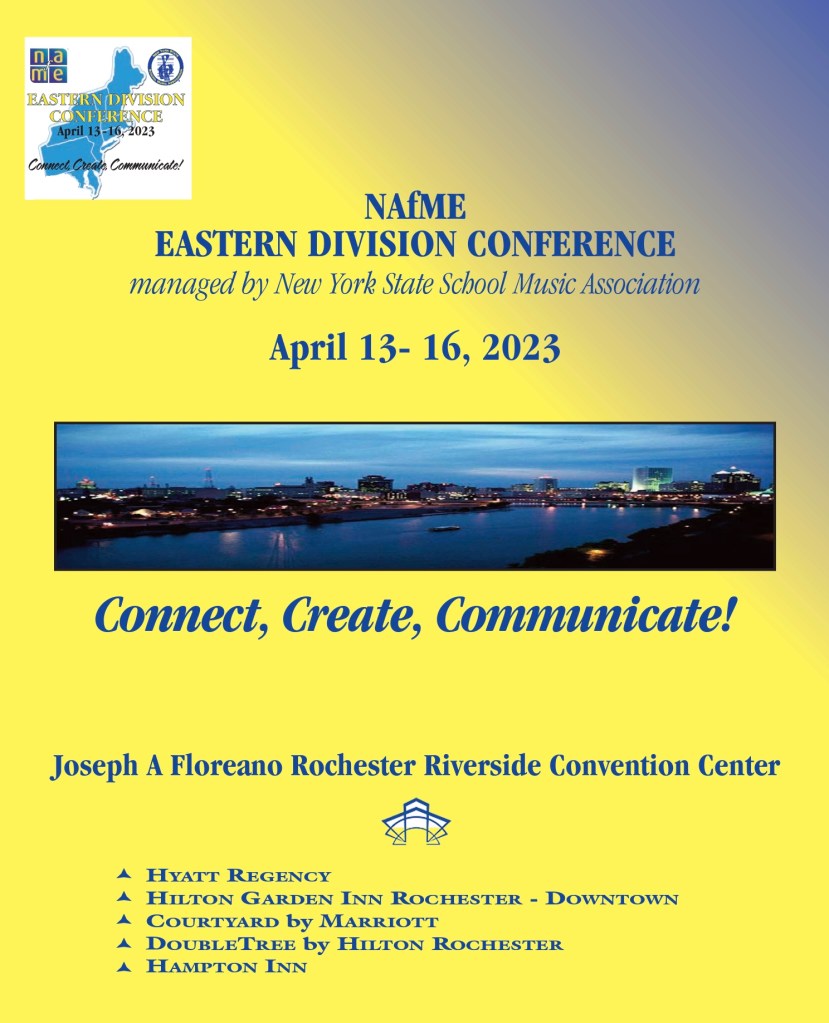
NAfME Eastern Division Conference, April 13-16, 2023, Rochester, NY

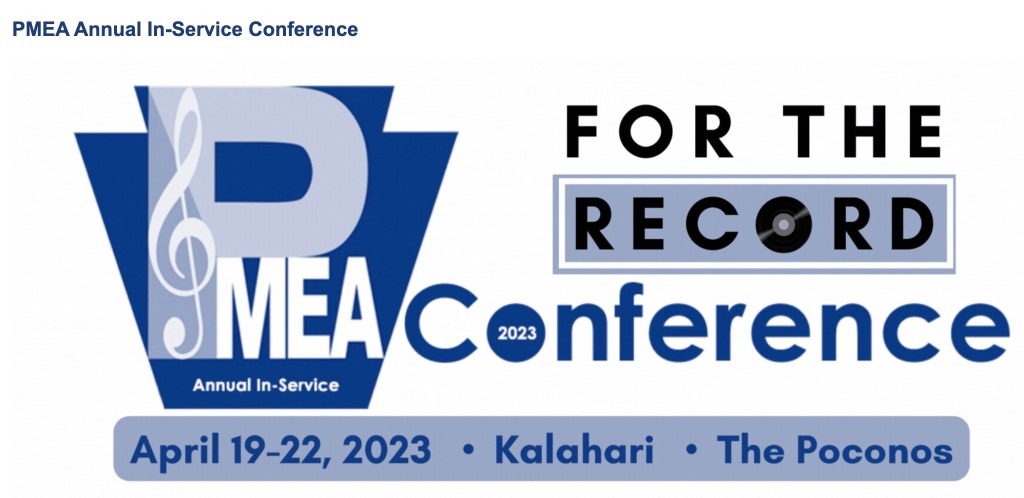
PMEA Annual Conference, April 19-22, 2023, in the Poconos

Now to quote the inspiration of Simon Sinek — his theory of value proposition to ‘start with why’ — how leaders can inspire cooperation, trust, and change based on research into how the most successful organizations think, act, and communicate if they start with why. Check out his rationale with The Golden Circle:

The “why” of attending your professional development conferences, “sharpening your saw” (self-renewal by Stephen Covey) aka “recharging your batteries,” learning what’s new and innovative on the forefront of “the state of the art,” and networking with colleagues, and has been addressed often in past blogs:

Simply put — to maintain your mastery of music and methods and build on your “best practices” and professionalism, you MUST attend as many educational conferences and workshops as possible!

Now to my “bags of tricks” for April 2023

Mark your calendars:

April 15, 2023 at 10:45 a.m. in Hyatt Susan B. Anthony (NAfME) – OR –
April 21, 2023 at 11:30 p.m. in Kalahari Suite 40/50 (PMEA)

I was blessed to have been asked to present THE INTERVIEW CLINIC — Practicing & Playacting to Improve Your Performance at Employment Screenings at both the NAfME and PMEA conferences. This will be FUN! Perfect for college music education majors, soon-to-be or recent graduates, new transfers to the profession, teachers seeking to change positions while openings seem to be “heating up,” or first-timers looking for employment, the session targets will provide interactive exercises to build self-confidence and develop better insights, practices, and strategies to successfully land a job. “The key is in the preparation” of:

  • Standards—Defining/modeling professionalism, versatility, and ethics
  • Marketing—Branding, networking, and selling yourself
  • Skills—Interviewing, storytelling, and organizing
  • Assessment—Observing, reviewing, diagnosing, and improving

Interactive exercises, you say? Yes! Get ready to meet new people and perhaps dive into a few activities slightly outside your “comfort zone!” (We promise NOT to embarrass anyone!) We will break up into small groups or “duet partners,” and explore defining our professional “essence,” telling anecdotes about our strengths and past problems we have “crushed,” and focusing on learning “the golden gift of gab” — storytelling.

Portions of this workshop will come from material in the past posts Storytelling, etc. Part 2 and When it Comes to Getting-a-Job, S Is for Successful Storytelling. (Your homework? Peruse these before coming to either session at NAfME or PMEA!)

As always, articles, resources, and slide summaries will be posted under the “Training/Jobs” menu tab (above).

Mark your calendars:

April 20, 2023 at 3:00 p.m. in Kalahari Suite 30 (PMEA)

How many of you feel at times a little overwhelmed, exhausted, stressed out, disorganized, demoralized, or disenfranchised?

Are you at the end of your rope and wondering how you’re going to “keep it all together” over the next week, month, year?

Is your health is interfering with your ability to do your job and find success, balance, and meaning in your personal life and relationships? Then… it is time for a change.

We are still dealing with the effects of the pandemic which has brought on a “gap year” to most of our music programs, the stress of “working harder not smarter,” more teacher burnouts, and the resulting bail outs, staff shortages, and/or job cuts. We need to embrace NEW strategies for personal self-care and SEL (social and emotional learning). Do you still enjoy teaching? How have you coped with all of the changes? How will you achieve a better work/life balance and skills in time/priority management and personal health and wellness?

The prescriptions and RECIPES towards stress reduction and developing a self-care plan are here! Doug Sands, a consulting hypnotist and founder of AnywhereHypnosis.com, joins me to “throw in everything and the kitchen sink” to alleviate these problems, with NO cookie-cutter, “one-size-fits-all” solutions from the chefs:

  • What has COVID done to all of us?
  • Instant personal online stress assessment
  • Taking an inventory of the ingredients towards a healthier lifestyle
  • Definitions, symptoms, and remediations for teacher stress and burnout
  • Why teachers are so exhausted and what to do about it
  • Time management tips
  • Breathe like a Navy SEAL
  • Coping and learning “acceptance”
  • How to “coach overwhelm!”
  • The role of meals, movement, music, and mindfulness (thank you, Lesley Moffat!)
  • From MEJ: A suggested self-care plan and “cognitive distortions” to avoid
  • Focusing on ONE self-care strategy from a “sea of solutions”

We’re in this together… so we need to join forces and SHARE the secret recipes for a happier life! Add your own “baking tips,” and I promise, you’ll leave with a better understanding of how we all can celebrate the coming year or decades in music education!

By the way, my “mindfulness partner” for this workshop, Doug Sands, promises us he will not hypnotize any of us during this session (although he could!).

For more about his work, including “15 Rapid Tools (and Counting) to Wipe Out Anxiety, Stress, and Panic,” please go to his website here.

You are invited to stop in to see him at his PMEA booth in the Kalahari exhibit hall.

POST-CONFERENCE NOTE: Doug sent us his Anti-Panic Toolkit entitled, 15 Rapid Tools (and Counting) to Wipe out Anxiety, Stress, and Panic – Wherever They Strike! Click here.

If you would like a sneak preview of the revised handout for the Self-Care workshop, go to the Care menu section at the top menu bar.

Taking a peek at our recent past…

Workshop for Orchestra & String Teachers

In case you missed the PMEA District 5 Professional Development Day, my wife Donna and I presented “Plucking Our Minds” at Grove City College on February 20, 2023.

We were privileged to “share some of our secret sauces” gleaned from over 80 combined years of experience on a variety of topics:

  • CommUNITY Music-Making
  • Online Academy
  • Summer String Camp
  • Assessment Projects
  • Collaborative/Creativity Projects
  • Library of “Fox Firesides”

If would be a shame to waste these resources… and reading them could inspire new adaptations to your instrumental program.

Click here for a copy of the slide handouts. Feel free to comment (above) or send an email to me (paulkfox.usc@gmail.com) if you have any questions.

Our Crystal Ball

Future Accredited Workshops on Ethics in Education

Are you aware that the Pennsylvania Department of Education (PDE) has recently revised the PA educators’ Code of Professional Practice and Conduct AND adopted the Model Code of Ethics for Educators developed by the National Association of State Directors for Teacher Education and Certification? Have you seen the new Professional Ethics Program Framework Guidelines? PA Chapter 49 requires instruction in professional ethics to be integrated in educator preparation, induction, and continuing professional development programs as follows:

  • Continuing professional development programs must integrate the professional ethics competencies no later than the 2023-24 academic year.
  • Educator preparation and induction programs must integrate the professional ethics competencies no later than the 2024-25 academic year.

Not one to let grass grow (or mud sink) under his feet, retired social studies teacher, current attorney-at-law, and past PMEA conference presenter Thomas Bailey has partnered with me to design new ethics training classes for school system leaders (25-hour Act 45 PIL course) and educators (four-hour Act 48 continuing education course). In addition, we are introducing a new “hybrid” program for school administrators involving four-hour pre-recorded asynchronous webcasts (site license), along with a three-hour synchronous webinar using the webcast videos and adding facilitated interactive discussions of three ethical case studies either via Zoom OR in-person follow-up workshops led by both clinicians.

In Depth Ethics Training for PA Educators:

  • PA Model Code of Ethics for Educators
  • PA Code of Professional Practice and Conduct
  • Professional Standards and Practices Commission
  • PA Educator Discipline Act

Click here for to register for Act 45 PIL Course.
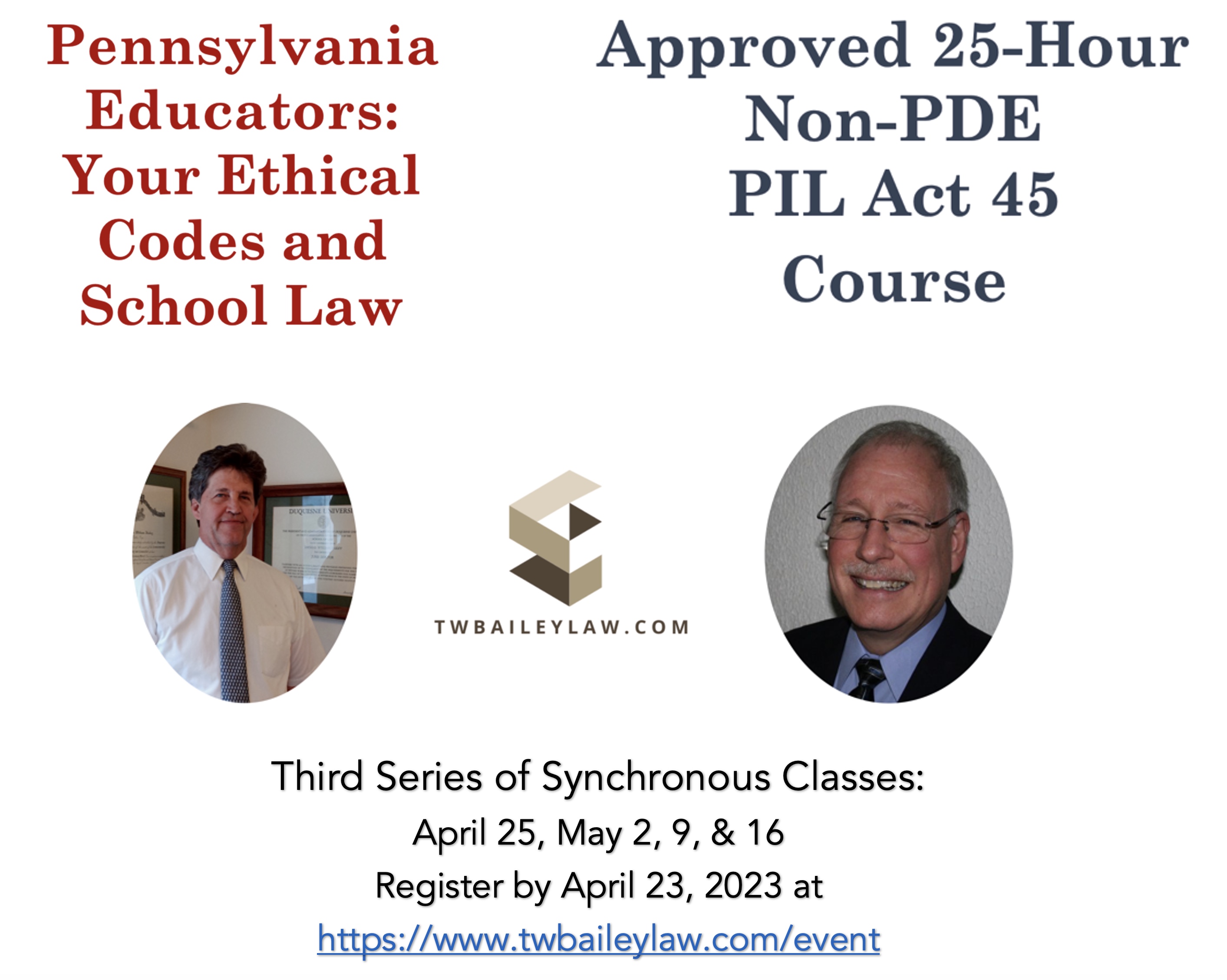
Next series: April 25, May 2, 9, & 16, 2023

Click here for more information on the Ethics Webcast/Webinar and general information/landing page for the TWBaileyLaw website.

Click here for timeline of educator ethics presentations and clinicians’ bios.

Also review the Educators Court Case Blog and William Penn SD vs. PDE Blog.

Numerous articles have already been published on the subject of educator ethics, professionalism, and decision-making:

Hope to see you at one of these conferences or workshop sessions! Yes, it means a lot more to attend these IN PERSON!

PKF

© 2023 Paul K. Fox
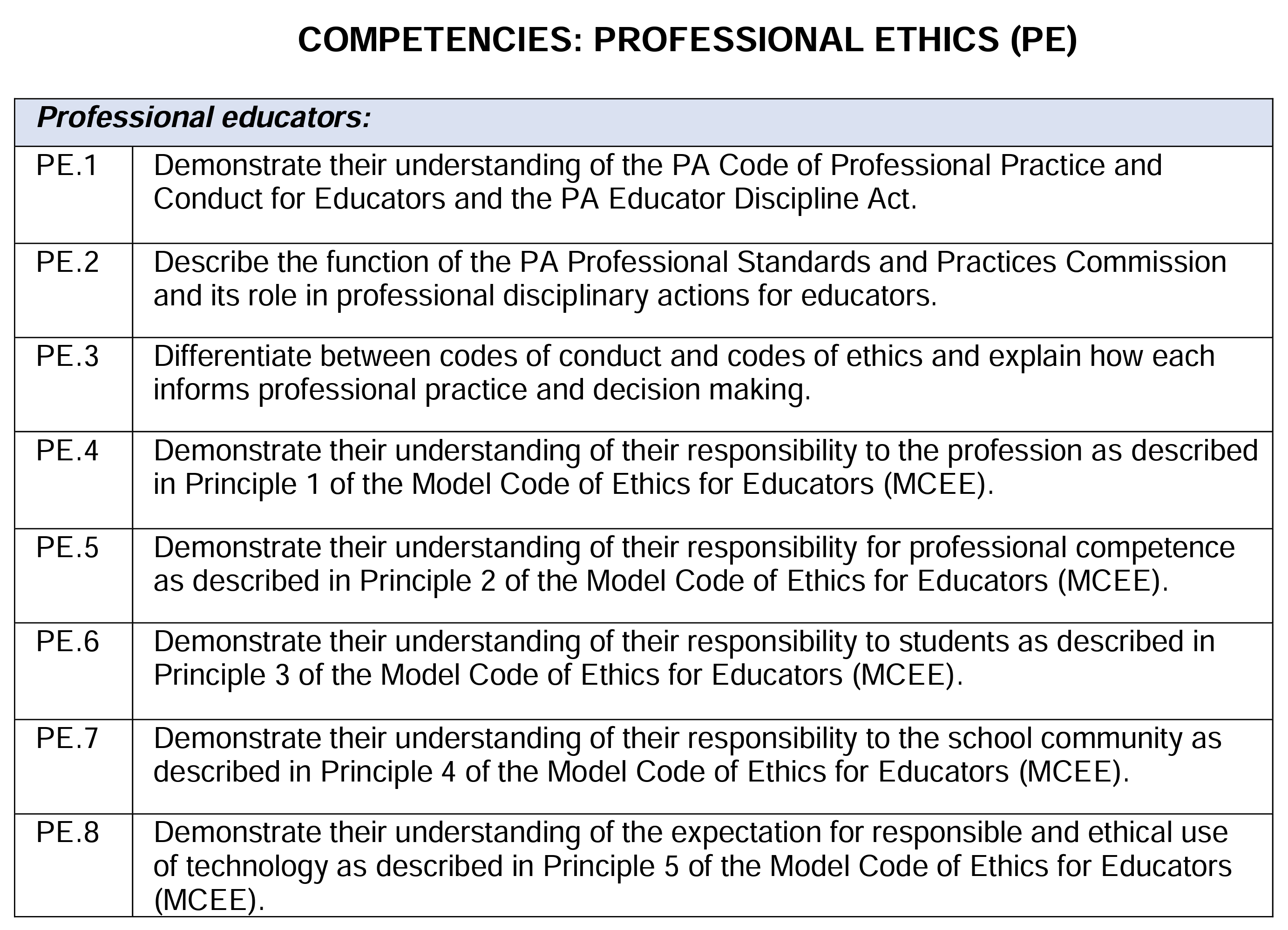
Model Code of Ethics for Educators

Don’t you love this quote from TeachThought?

“Teaching isn’t rocket science; it’s harder!”

Teachers make as many as 1,500 decisions a day for their classes and students… that’s as many as four educational choices per minute for the average teacher given six hours of class time. Surprised? (Not if you are an educator!) Check out this corroborating research:

Of course it can be exhausting… and as fast as “things” happen, even mind-numbing at times!

What do educators rely on for guidance, a sort of internal “ethical compass” for making these decisions, many of which are snap judgments?

  • Educational background
  • Teacher “chops” (professional experience)
  • Peer and administrative support
  • Personal moral code (derived from one’s life experiences and upbringing)
  • Aspirations, values, and beliefs generally agreed upon by educational practitioners
  • State’s code of conduct and other regulations, statutes, policies, and case law
  • Professional ethics

Or all of the above?

At this juncture during my workshops on ethics, I usually quote Dr. Oliver Dreon, Assistant Professor and Coordinator of the Digital Learning Studio at Millersville University of Pennsylvania and one of the authors of the Educator Ethics and Conduct Tool Kit of the Pennsylvania Professional Standards and Practices Commission:

“From a decision-making standpoint, I tend to look at it from the perspective of Ethical Equilibrium (work by Troy Hutchings). Teachers weigh the moral (personal) dimensions with regulatory ones (the law) with the ethics of the profession…  While focusing on consequences is important, I worry that teachers may interpret this to mean that as long as they don’t break the law, they can still be unprofessional and immoral.”   

– Dr. Oliver Dreon

From college students participating in their first field observations to rookie teachers (and even veterans in the field), I recommend searching the term “ethics” on the website of your State Board of Education. In Pennsylvania, checkout the following:

Now enters probably the single most valuable document of our time, an all-encompassing philosophy for embracing the highest standards of what it means to be an ethical educator: the Model Code of Ethics for Educators (MCEE), developed under the leadership of the National Association of State Directors of Teacher Education and Certification (NASDTEC). With the collaboration of numerous development partners including the American Federation of Teachers, National Education Association, National Association of Elementary School Principals, National Association of Secondary School Principals, Council of Chief State School Officers, and American Association of Colleges of Teacher Education – to name a few – MCEE is comprised of five core principles (like spokes in a wheel – all with equal emphasis), 18 sections, and 86 standards.

“The purpose of the Model Code of Ethics for Educators (MCEE) is to serve as a shared ethical guide for future and current educators faced with the complexities of P-12 education.  The code establishes principles for ethical best practice, mindfulness, self-reflection and decision-making, setting the groundwork for self-regulation and self-accountability.  The establishment of this professional code of ethics by educators for educators honors the public trust and upholds the dignity of the profession.”

MCEE Framing Document

Although pre- and in-service training on both are essential, the differences between a “code of conduct” and a “code of ethics” are vast. Codes of conduct like the Code of Professional Practice and Conduct for Pennsylvania teachers are specific mandates and prohibitions that govern educator actions. A code of ethics is a set of principles that guide professional decision making, not necessarily issues of “right or wrong” (more shades of grey) nor defined in exact terms of law or policies. Codes of ethics are more open-ended, a selection of possible choices, usually depended on the context or circumstances of the situation.

“The interpretability of The Model Code of Ethics for Educators allows for robust professional discussions and targeted applications that are unique to every schooling community.”

Troy Hutchings, Senior Policy Advisor, NASDTEC

The music teacher and administrator colleagues with whom I have been privileged to work for more than 40 years are highly dedicated and competent visionaries who focus on “making a difference” in the lives of their students, modeling “moral professionalism” and the highest ethical standards for their classes, schools, and communities, in support of maintaining the overall integrity of the profession.

However, let’s unpack some of “the wisdom” of MCEE as it addresses the rare “nay-sayers” and entrenched teacher attitudes, failing to understand “the difference between what you have a right to do and what is right to do…” (Potter Stewart) or “doing the right thing when no one else is watching – even when doing the wrong thing is legal” (Aldo Leopold).

Here are sample negative responses, MCEE “exemplars,” and proposed assimilations for thoughtful and interactive peer discussion. Bring these to your next staff meeting or workshop, and apply them to a few mock scenarios (like these from my past blog ).

Principle I: Responsibility to the Profession

The professional educator is aware that trust in the profession depends upon a level of professional conduct and responsibility that may be higher than required by law. This entails holding one and other educators to the same ethical standards.

“I didn’t know it was wrong…”

Section I, A, 1: Acknowledging that lack of awareness, knowledge, or understanding of the Code is not, in itself, a defense to a charge of unethical conduct;

My comment: The old adage, “ignorance of the law is no excuse for breaking it.” – Oliver Wendell Holmes

“What’s the problem? I didn’t break the law!

MCEE Section I, A, 5: Refraining from professional or personal activity that may lead to reducing one’s effectiveness within the school community;

My comment: Any on or off-duty conduct or inappropriate language that undermines a teacher’s efficacy in the classroom, damages his/her position as a “moral exemplar” in the community, or demeans the employing school entity may result in loss of job, suspension or revocation of license, and/or other disciplinary sanctions.

http://pimaregionalsupport.org/event-2610673

“I’m not a rat fink…”

MCEE Section I, B, 2: Maintaining fidelity to the Code by taking proactive steps when having reason to believe that another educator may be approaching or involved in an unethical compromising situation;

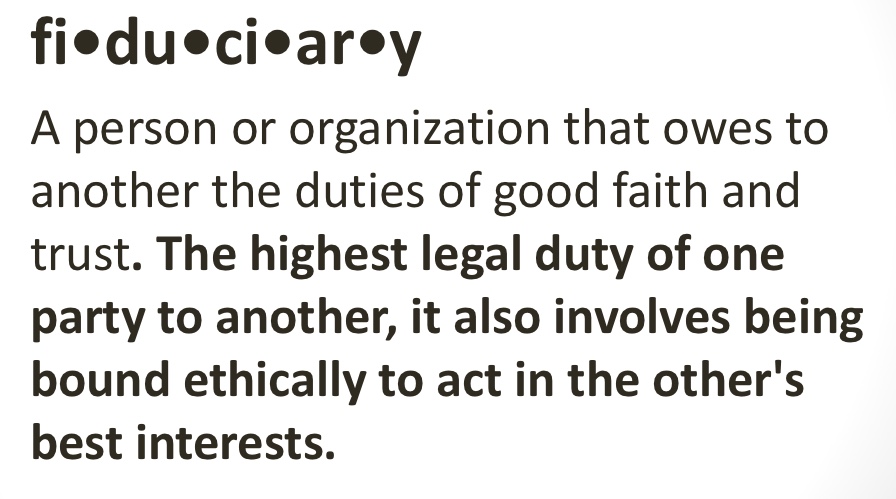
My comment: As a professional with “fiduciary” responsibilities, we must look out for the welfare of our students, proactively protecting them from harm by embracing all provisions of “mandatory reporting.”

“What’s in it for me?”

MCEE Section I, C, 3: Enhancing one’s professional effectiveness by staying current with ethical principles and decisions from relevant sources including professional organizations;

MCEE Section I, C, 4: Actively participating in educational and professional organizations and associations;

My comment: Keeping up-to-date and current, we are fortunate to avail ourselves with the exhaustive tools and resources of media, music, and methods provided by groups like the Pennsylvania Music Educators Association and National Association for Music Education.

Principle II: Responsibility for Professional Competence

The professional educator is committed to the highest levels of professional and ethical practice, including demonstration of the knowledge, skills, and dispositions required for professional competence.

“What’s the big deal about standards?”

Section II, A, 1: Incorporating into one’s practice state and national standards, including those specific to one’s discipline;

My comment: As professionals, we should volunteer to help write our school’s courses of study, content units, and learning goals for the subjects we teach, and take advantage of the National Core Arts Standards, the PMEA Model Curriculum Framework, and the state’s standards.

“Not another ‘flavor-of-the-month’ in-service program!”

Section II, A, 5: Reflecting upon and assessing one’s professional skills, content knowledge, and competency on an ongoing basis;

Section II, A, 6: Committing to ongoing professional development

My comment: Always “raising the bar,” being a member of a “profession” (like medical personnel, counselors, attorneys, etc.) requires the loftiest benchmarks of self-regulation and assessment, ongoing training, retooling, and self-improvement plans, revision and enforcement of “best practices,” and application of 21st Century learning skills.

“I needed to give him credit?”

MCEE Section II, B, 1: Appropriately recognizing others’ work by citing data or materials from published, unpublished, or electronic sources when disseminating information;

My comment: Especially during this period of online/virtual/remote education brought on by COVID-19, we must reference the owners of intellectual property (including sheet music) that we use and abide by all copyright regulations. In general, it is always “best practice” to cite research or authorship “giving credit where credit is due!”

“I’m just a music teacher! Don’t ask me to do anything else!”

MCEE Section II, C, 2: Working to engage the school community to close achievement, opportunity, and attainment gaps;

My comment: We teach “the whole child,” not a specialty or specific content area! I believe our ultimate mission is to facilitate our students’ capacity and desire to learn, inspire self-direction and self-confidence, and foster future success in life.

Principle III: Responsibility to Students

The professional educator has a primary obligation to treat students with dignity and respect. The professional educator promotes the health, safety, and well being of students by establishing and maintaining appropriate verbal, physical, emotional, and social boundaries.

“It’s just a gift…”

MCEE Section III, A, 5: Considering the implication of accepting gifts from or giving gifts to students;

My comment: It is not appropriate to give a gift to a student lacking an educational purpose. In some cases, this may be defined as a “sexual misconduct.” It begs the larger question: “Do you ensure that all of your interactions with students serve an educational purpose and occur in a setting consistent with that purpose?” Also from the PA Professional Standards and Practices Commission: “Teachers should refrain from accepting gifts or favors that might impair or appear to impair professional judgment.”

“You should never touch a student!”

MCEE Section III, A, 6: Engaging in physical contact with students only when there is a clearly defined purpose that benefits the student and continually keeps the safety and well-being of the student in mind;

My comment: We were told this warning in methods classes. However, as I mentioned in a previous blog here, this “rule” has little support in research or common “best practices.” It has been my experience that on occasion, most elementary instrumental teachers assist their students in acquiring the correct playing posture and hand positions by using some (limited) physical contact. Consoling an upset student with a pat on the shoulder is not out-of-line either. The factors that may contribute to the moment being judged “okay” vs. “inappropriate” boil down to:

  • Intent
  • Setting
  • Length of time
  • Frequency or patterns of repetition
  • Comfort level of the student
  • Age level of the student
  • Happening in public
  • Who started it?
busyteacher.org

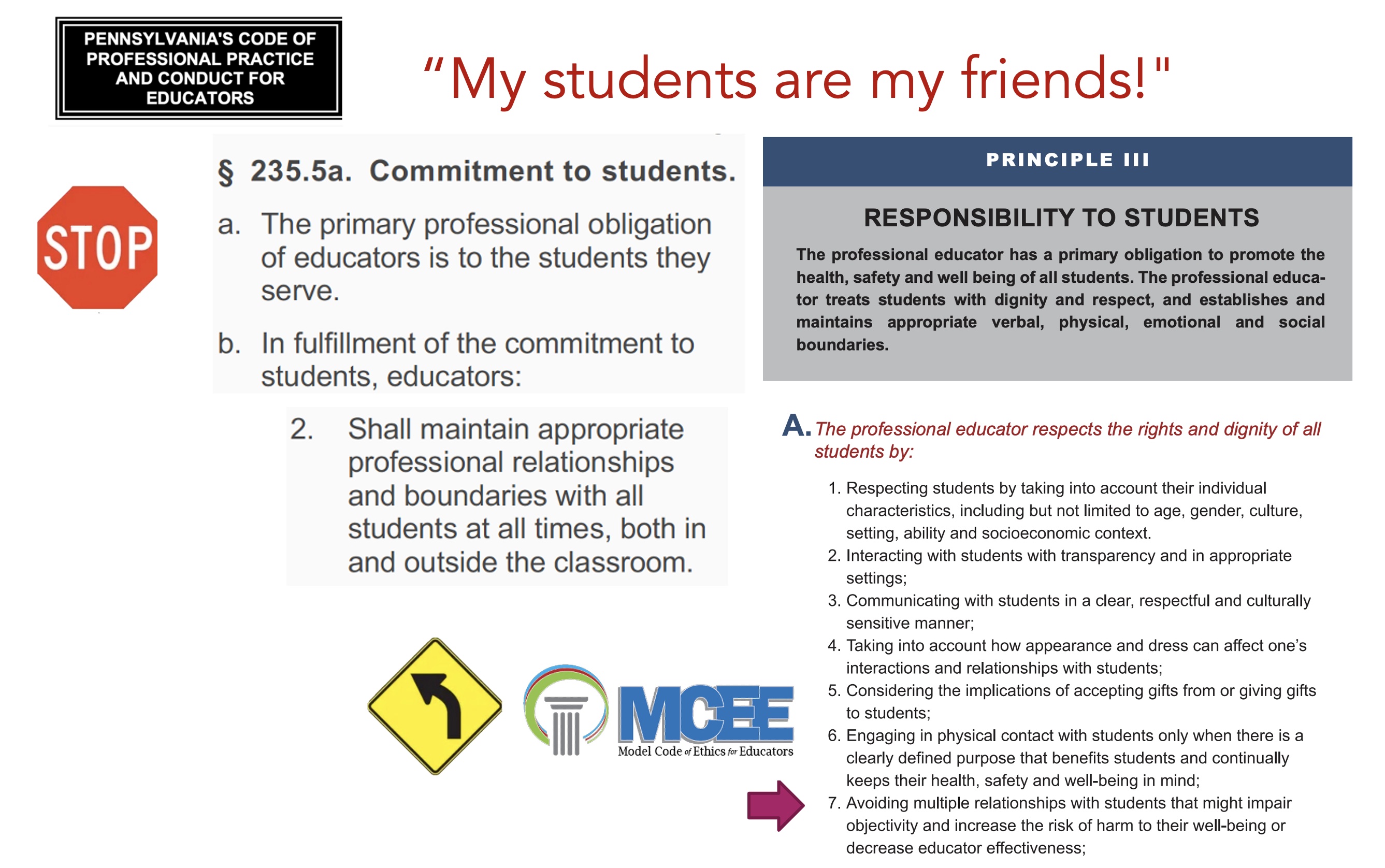
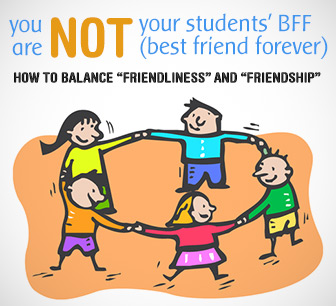
“My students are my friends!”

MCEE Section III, A, 7: Avoiding multiple relationships with students which might impair objectivity and increase the risk of harm to student learning or well-being or decrease educator effectiveness;

My comment: You cannot be their “friend.” You are their teacher, an authority figure that is looking out for them and doing what is necessary (“fiduciary” responsibilities) for their health and welfare… perhaps at times things they do not want you to do. Crossing the teacher/student boundary with familiarity, informality, and being their “confidant” or “friend” are more than just unprofessional acts – they can foster a dual relationship where roles are less defined, an ambiguity that may lead to additional inappropriate actions and educator misconduct.

“He’s weird…” or “He’s not one of us!”

MCEE Section III, B, 2: Respecting the dignity, worth, and uniqueness of each individual student including, but not limited to, actual and perceived gender, gender expression, gender identity, civil status, family status, sexual orientation, religion, age, disability, race, ethnicity, socio-economic status, and culture;

My comment: Check your prejudices and personal biases at the door. Being a teacher is all about sensitivity and caring of all individuals – students, parents, staff, etc. Embracing today’s focus on reprogramming community attitudes on “diversity,” an educator daily models the values of empathy, compassion, acceptance, and appreciation, not just settling with the “lower bar” of tolerance, allowance, and compliance!

“Wait ’til you hear what happened in class today!”

MCEE Section III, C, 1: Respecting the privacy of students and the need to hold in confidence certain forms of student communications, documents, or information obtained in the course of practice;

My comments: Gossiping about and “carrying tales” home or in the teachers’ room are serious breaches of the care and trust as well as your fiduciary responsibilities assigned to you on behalf of your students. As for “regulations,” your indiscretion may be a violation of your students’ confidentiality rights (“a federal crime” according to Family Educational Rights and Privacy Act, Grassley Amendment, Health Insurance Portability and Accountability Act, and Individuals with Disabilities Education Act). You are only permitted to share information about a student with another teacher, counselor, or administrator who is on a “needs-to-know” basis or is actively engaged in helping this student.

Principle IV: Responsibility to the School Community

The professional educator promotes positive relationships and effective interactions with members of the school community while maintaining professional boundaries.

“Don’t tell my parents!”

MCEE Section IV, A, 1: Communicating with parents/guardians in a timely and respectful manner that represents the students’ best interests;

My comment: I wish I had a nickel every time a student plead with me, “Don’t call my mom!” It is part of “moral professionalism,” your “code,” and good ethical standards to originate meaningful two-way dialogue, and if necessary, confront the parents of underachieving children. I also believe it goes on long way to nurture your relationships in the community if you notify parents when their kid has done something remarkable… “I caught him being good” or “The improvement has been extraordinary!”

“Did you hear what a staff member said about you… in front of the kids?”

MCEE Section IV, B, 1: Respecting colleagues as fellow professionals and maintaining civility when differences arise;

MCEE Section IV, B, 2: Resolving conflicts, whenever possible, privately and respectfully, and in accordance with district policy;

My comment: Before you bring up the matter with your supervisor or building administrator (which you have the right and even responsibility to do, especially if the students hear any improper speech first-hand or that the incidents rise to the level of bullying or aggressive behavior), first confirm the story. Talk to the unhappy team member one-on-one. Be calm and sensitive, but hold your ground: you must assert that his/her behavior/language is unacceptable and will not be tolerated in the future.

“Not another TEAM meeting?”

MCEE Section IV, B, 4: Collaborating with colleagues in a manner that supports academic achievement and related goals that promote the best interests of students;

My comment: We work together to insure that all educational goals are met. Open and interactive peer partnerships are helpful in the review, design, and application of new lessons, methods, media, and music.

“I was just teasing her…”

MCEE Section IV, B, 8: Working to ensure a workplace environment that is free from harassment.

My comment: Be extremely careful in the practice of any behavior or language of a kidding, sarcastic, cynical, or joking manner. It can be misinterpreted regardless of your intentions… and it can hurt someone’s feelings. And it is never appropriate or “professional” to “put down” another person.

“Don’t ask for permission… beg for forgiveness.”

MCEE Section IV, C, 3: Maintaining the highest professional standards of accuracy, honesty, and appropriate disclosure of information when representing the school or district within the community and in public communications;

My comment: Yes, I have heard this “view” a lot, advocates of whom will tell you to go ahead and stick your neck out to do something “for the good of the order,” and if needed later, “beg for forgiveness” if you decision is met with disapproval from administration. My advice? Less experienced teachers, run everything through your fellow colleagues (informally) and principal (formally). Don’t fall back on the lame “oops” and “beg for forgiveness.” I may have felt differently when I had three times as many years of experience under my belt than the supervisors who were assigned to “manage” me… but, even then, “venturing out without a paddle” usually did not serve the best interests of the students. There’s no reason to place “the teacher’s convenience” over the safety/welfare of the students. Besides, why not take advantage of the legal and political backup of your bosses if they are kept “in the loop?”

“He’s our preferred dealer and always takes care of us.”

MCEE Section IV, D, 4: Considering the implications of offering or accepting gifts and/or preferential treatment by vendors or an individual in a position of professional influence or power;

My comment: Formerly called “sweetheart deals” with music companies, you are on “shaky” ethical ground (and may also have “crossed the line” violating state laws/statutes) if you negotiate the rights of exclusive access to your school’s or booster’s purchasing. If you have any questions about your school’s policy on outside vendors, seek advice from your district’s business manager.

Principle V: Responsible and Ethical Use of Technology

The professional educator considers the impact of consuming, creating, distributing, and communicating information through all technologies. The ethical educator is vigilant to ensure appropriate boundaries of time, place, and role are maintained when using electronic communication.

“Isn’t use of social media forbidden?”

MCEE Section V, A, 1: Using social media responsibly, transparently, and primarily for purposes of teaching and learning per school and district policy. The professional educator considers the ramifications pf using social media and direct communications via technology on one’s interactions with students, colleagues, and the general public.

My comment: Professional educators’ use of a dedicated website or other social network application enables users to communicate with each other by posting information, comments, messages, images, etc. and “learn” together. However, using social media for sharing social interactions and personal relationships with your students, parents, and staff is unethical and dangerous. As they say, “a post (or snap) is forever.” Communicating digitally or electronically with students may lead to the blurring of appropriate teacher-student boundaries and create additional challenges to maintaining and protecting confidentiality.

The Final Word

In Pennsylvania (as well as the rest of the country), the statistics on school staff misconduct reports are rising alarmingly. Your own state’s “code of conduct” and the MCEE should help to clarify misunderstandings, but it has been my experience that the majority of educators do not receive regular collegiate, induction, or in-service training on educator ethics or moral professionalism. Luckily, we are fortunate to have access to many mock scenarios (see below) from state departments of education to review/discuss among ourselves common ethical conflicts and “conundrums” dealing with pedagogy, enforcement, resource allocation, relationships, and diversity. We all need to “refresh” our understanding of these issues from time to time and revisit “our codes” frequently to help “demagnetize” (and re-adjust) our decision-making compass.

Please peruse the ethics category of this blog-site for other articles and sample references below.

PKF

Resources

PIXABAY.COM GRAPHICS:

© 2021 Paul K. Fox

Interviews

READY TO HIRE: Strategies to Land a Job

For all future music teachers everywhere, especially members of a PCMEA or NAfME collegiate chapter, we post these handouts from past NAfME and PMEA music teacher conference sessions, all moderated by Scott Sheehan, Immediate Past President of NAfME Eastern Division and Past State President of PMEA.

As a tradition at the annual state conference, the session “Ready to Hire: Interviewing Strategies to Land a Job” has offered “tried & true tips to assist promising music education majors with developing interviewing skills to successfully land their dream job.” One of the features of the clinic is the set-up of a “hot seat” where volunteer candidates are put through one or more questions in a “mock interview,” and then assessed on their “performance.” The guest panelists often distribute a “takeaway” with valuable tips on interview techniques and questions, and developing personal branding, networking, and marketing skills.

These suggestions are offered as a way to “practice” taking employment interviews.

Best wishes on your job search. Now go out there and “nail” the interview!


NAfME Logo_eastern_division

NAfME Biennial Eastern Division/PMEA State Spring Conference

April 4-7, 2019 in Pittsburgh, PA


Sheehan: Interview Session Handout

Metelsky: Interview Worksheet

Pearlberg: Ready to Hire Interview Strategies

Fox: Job Interview Playbook


PMEA conferences.png

Pennsylvania Music Education Association Annual Spring Conference

(various years)


Basalik: Ready-Set-Interview

Baxter: Music Interviews

Fox: A to Z Job Interview Checklist

Fox: Marketing Your Professionalism


pcmea

Additional Resources

PMEA Job Board

NAfME:

Sullivan Interview Strategies that Work

Older blog-posts at this site:


Acknowledgments:

  • Sue Basalik
  • Howard Baxter
  • Marc Greene
  • Susan Metelsky
  • Alicia Mueller
  • Henry Pearlberg
  • Kathy Sanz
  • Scott Sheehan
  • Jill Sullivan
  • Lucy White

Image by Tumisu from Pixabay


© 2019 Paul K. Fox

All rights reserved by the individual authors of this material

A Collection of Collegiate “Treasures”

3 by 3: Essential Books + Websites for Music Ed Majors

By now, at least several weeks after the holiday/winter break, most of you have probably returned to school and are “back at it” fulfilling your studies in music and education methods. Welcome to the New Year (2019) and good luck on meeting your goals!

It has been my pleasure to present numerous workshops and conference sessions for pre-service, in-service, and retired music educators on a variety of topics: interviewing for a job, marketing professionalism, ethics, transitioning to retirement, supercharging the musical, etc., and have been asked on occasion, “Where do you find all of the information, research, and resources for your blog-posts and talks?

Well.. I’m glad you asked!

book-841171_1920_PourquoiPas

It would be hard to credit one or a few sources on reliable data, insights, and recommendations for career development. The following “gems” – a few ideas from someone who has taught music for more than 40 years – are just my New Year’s “gifts” to you… hopefully useful in your undergraduate or advance degree studies. Please enjoy!

This is probably the wrong time to suggest making a few “buys” for the sake of educational enrichment. College students are bombarded with many required readings of their (often expensive) textbooks and handouts from their comprehensive higher education courses of study. It is somewhat daunting to “cover all the bases,” especially when you may want specific advice and “answers” as a result of being recently thrown into “the real world” of field observations and student teaching. What else would a prospective music teacher need or have time to read? How can we better prepare you for the challenges of our profession?

Since you have to order books (or borrow them from a library), we’ll start with the printed publications. Here are my “top three” for your immediate consideration.


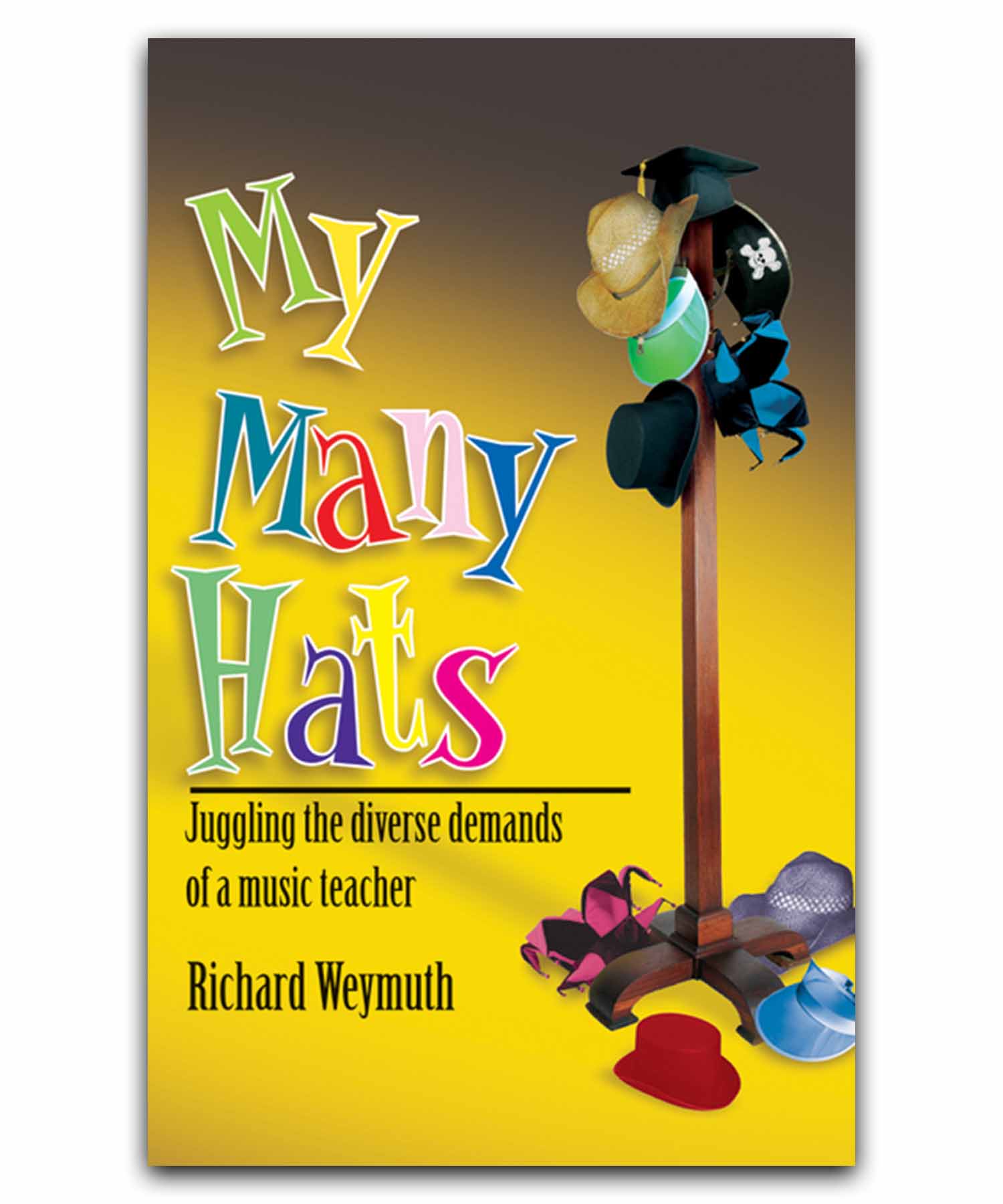
My Many Hats

My Many HatsIn the category of “things I wishes someone would have told me before I was hired to be a school music educator,” the inspirational book, My Many Hats: Juggling the Diverse Demands of a Music Teacher by Richard Weymuth, is a recommended “first stop” and easy “quick-read.” Published by Heritage Music Press (2005), the 130-page paperback serves as an excellent summary of the attributes (or “hats”) of a “master music teacher.” Based on the photos in his work (great “props”), I would have loved to have seen Weymuth’s conference presentations in person as he donned each hat symbolizing the necessary skill-set for a successful educator.

A quote from the author in his Introduction:

“I want my hats to put a smile on your face as you read this book, just as they do for the airport security guards as they go through my bags at the airport. They ask, “Are you a magician? A clown? An entertainer?” My answer is, “Yes, I am a teacher.”

His Table of Contents tells it all:

  1. The Hat of a Ringmaster: Managing your classroom and your time
  2. The Hat of a Leader: Setting the direction and tone of your classroom
  3. The Hat of a Scholar: Learning when “just the facts” are just fine, and when they aren’t
  4. The Hat of a Disciplinarian: The Three C’s: Caring, Consistency, and Control
  5. The Hat of an Eagle: Mastering your eagle eye
  6. The Hat of a Crab: Attitude is everything; what’s yours?
  7. The Hat of a Juggler: Balancing a complicated and demanding class schedule
  8. The Hat of a Banker: Fund raising and budgeting
  9. The Hat of an Artistic Director: Uniforms and musicals and bulletin boards, oh my!
  10. The Hat of a Lobster: Establishing the proper decorum with your students
  11. The Hat of a Pirate: Finding a job you will treasure
  12. The Hat of a Bear: Learning to “grin and bear it” in difficult situations
  13. The Hat of a Peacock: Having and creating pride in your program
  14. The Hat of Applause: Rewarding and recognizing yourself
  15. The Hat of a Flamingo: Sticking out your neck and flapping your wings

Here are a couple sections that should be emphasized if you are currently a junior or senior music education major.

All student or first-year teachers should focus on his/her three C’s of class discipline in Chapter 4: “Caring, Consistency, and Control.” In order to resolve problems and seek advice from local mentors (especially help from second and third-year teachers who may have just gone through similar conflicts), he poses these questions:

  • What is the specific discipline problem that is currently bothering you?
  • Who could you interview in your educational community to help with this problem?
  • How did they handle the problem?
  • What discipline solutions worked and what didn’t work?

girl-3718522_1920_nastya_gepp

Those getting ready for the job search and interviewing process this year must turn to Chapter 11 immediately! “Just like a pirate, you are searching for your treasure, or at least a job you will treasure.” Suggesting that first-year teachers should stay in their assignment for a minimum of three years (to show “you are a stable teacher and are dedicated to the district”), Weymuth offers guidance in these areas:

  • The Application Process
    • Cover Letter
    • Résumé
  • The Interview
    • Make a Good Impression
    • The First-Class Interview
    • Frequently Asked Questions
  • The Second Interview

The book is worth the $17.95 price alone for the interview questions on pages 85-88.

Once you “land a job” and are assigned extra-curricular duties like directing after-school ensembles, plays, and perhaps fund-raising for trips, shows, uniforms, or instruments, come back to Chapter 8 for “The Hat of a Banker” and Chapter 9 for “The Hat of an Artistic Director.” His guidelines for moneymaking and record-keeping include insightful sub-sections on:

  • Planning and Administering a Fund-Raising Activity
  • Possible Fund-Raisers
  • Motivating Students to Sell, Sell, Sell (Set Goals, Prizes, and Tracking)
  • Budgeting

Having previously posted a blog on “Supercharging the School Musical,”  I was impressed with his pages 65-69 on “Show and Concert Choir Dress” and The Musical,” and especially the “Appendix – Resources Books for Producing a Musical” in the back of the book.


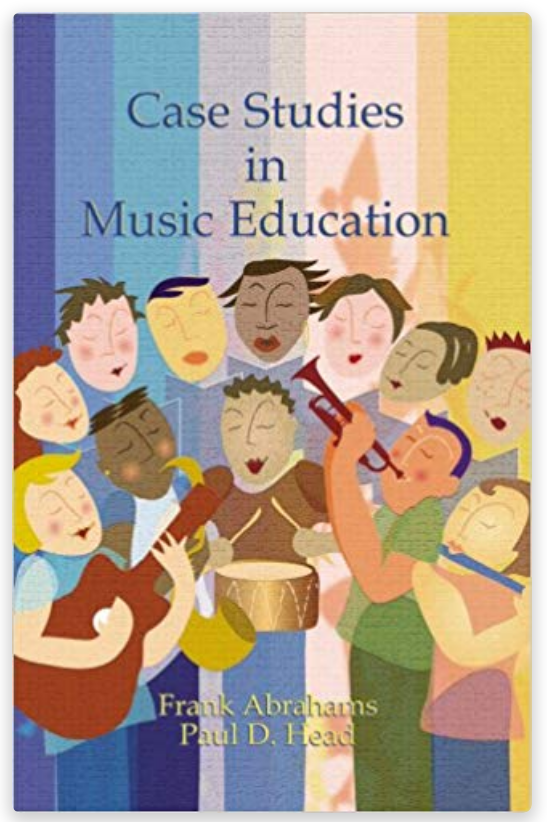
Case Studies in Music Education

Case Studies in Music EducationNext, I would like to direct pre-service and new music teachers to Case Studies in Music Education by Frank Abrahams and Paul D. Head. This would be an invaluable aid to “facilitate dialogue, problem posing, and problem solving” from college students (in methods classes?) and “rookie” teachers to veteran educators.

Using the format of Introduction, Exposition, Development, Improvisation, and Recapitulation known by all music professionals, each chapter presents a scenario with a moral dilemma that many music educators face in the daily execution of their teaching responsibilities.


“How should a music teacher balance learning and performing? What is the best way to handle an angry parent? What are the consequences of the grades teachers assign? What are the best ways to discipline students? How should teachers relate to the administrators and to other teachers? The emphasis here is not on the solution, but on the process. There are many viable approaches to nearly every obstacle, but before any meaningful long-term solutions can be made, teachers must identify their own personal philosophy of music education and recognize those traits that are admirable in another’s style.”

―Excerpt from back cover of Case Studies in Music Education, Second Edition, by Frank Abrahams and Paul D. Head

Case Studies in Music Education provides a frank discussion about the critical real-world issues music teachers face but are rarely addressed in college courses:

  • Balancing the goals of learning and performing music
  • Communications and relationships with parents, administrators, and other staff
  • “Fair use” and other copyright laws

If you are seeking more reflection and peer review of ethical issues in the music education profession, good for you! Few music teachers ever talk about the “e” word. What’s important is not only becoming aware of your state’s/district’s statues on the “teacher’s code of conduct” and dress/behavior expectations, but developing your own ethical “compass” for all professional decision-making. A good companion to the Abrahams and Head book is to peruse my previous blogs on ETHICS (posted in reverse chronological order).


fatigued-1822678_1920_sasint

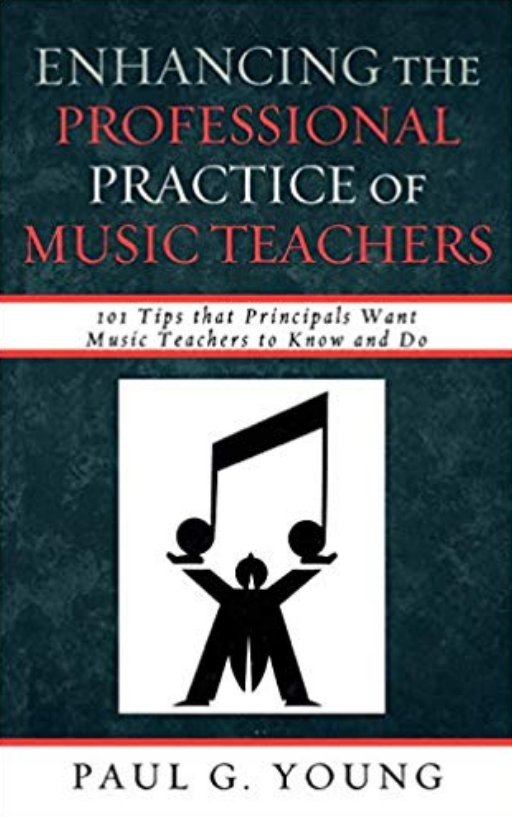
Enhancing the Professional Practice of Music Teachers

“Book number three” is probably the most expensive, and I could only wish you were already exposed to it in one of your music education courses. If you have not seen it, go ahead and “bite the bullet” in the purchase of Enhancing the Professional Practice of Music Teachers: 101 Tips that Principals Want Music Teachers to Know and Do by Paul G. Young, published by Rowman & Littlefield in 2009. [Note: Be sure to give them your NAfME membership number for a 25% discount!]

“If you want to improve your professional performance and set yourself apart from your colleagues—in any discipline—these tips are for you. If you desire anything less than achieving the very best, you won’t want this book. Rather than addressing research and theory about music education or the “how-to’s” of teaching, Enhancing the Professional Practice of Music Teachers focuses on common-sense qualities and standards of performance that are essential for success-everywhere. Whether you’re considering a career in music education, entering your first year of teaching, or nearing the end of a distinguished tenure, this advice applies to musicians in any setting. Affirming quality performance for experienced teachers and guiding, nurturing, and supporting the novice, Young outlines what great music teachers do. Easy to read and straightforward, read it from beginning to end or focus on tips of interest. Come back time and again for encouragement, ideas, and affirmation of your choice to teach music.”

– https://nafme.org/reading-list-music-educators/

ENhancing the Professional Practice of Music TeachersHis chapters are organized into six tips:

  • Tips That Establish Effective Practice with Students
  • Tips That Support Recruitment
  • Tips That Enhance Instruction
  • Tips That Enhance the Profession
  • Tips for Personal Growth
  • Tips for Professional Growth

Paul Young is a musician and band director who later became an elementary school principal. His book is derived from his experience as a music student, music teacher, and educational leader. The intent of the publication is to guide both new and experienced teachers in continued personal and professional growth. He uses his experience as an administrator to point out to music teachers the traits he has seen in individuals who have become successful in the profession.

Now that you ordered at least one of these for personal research and growth, I should point out other sources of book recommendations for the budding music educator, courtesy of NAfME:


Online Resources

Okay, now comes the “easy-peasy” part, and even more importantly, it’s mostly FREE!

NAfME blogThe first thing I want you to do (and you don’t even have to be a member of NAfME yet, although you should be!) is to take at least a half-hour, scroll down, and read through numerous NAfME “Music in a Minuet” blog-posts, bookmarking any you want to return to at a later date. Go to https://nafme.org/category/news/music-in-a-minuet/. Get ready to be totally immersed into the music education profession in a way no college professor can do, with articles like the following (just a recent sampling):


learn-868815_1920_geralt

Hopefully you did receive a little cash in your Christmas stocking… or something from grandma! Now is time to “belly up to the bar” and pay your dues. Every professional school music educator should be a member of their “national association…” NAfME!

Once you do this, get ready to reap countless benefits! First, besides offering a discounted rate for all collegiate members, you will be eligible for a significant price break for full active membership renewal during your first-year of teaching! Then, the doors will open wide to you for all of the many NAfME member services such as classroom resources, professional development, news and publications, special offers for members, etc.

Amplify

Once you are a NAfME member, open up your browser, and go immediately to the NAfME AMPLIFY community discussion platform, instructions posted here. Getting started on AMPLIFY is easy:

  • Go to community.nafme.org.
  • Edit your profile using your NAfME.org member username and personal password.
  • Control what information is visible on your profile.
  • Join/subscribe to communities of your choice – you will automatically be enrolled in Music Educator Central, our general community for all NAfME Members.
  • Control the frequency and format of email notifications from Amplify.

If you prefer, they have created a video or quick-start guide here to set-up your account’s profile, demonstrate the features, and provide some help navigating through the AMPLIFY menus.

Once you familiarize yourself with the forum, find the “Music Educator Central” and “Collegiate” discussion groups… and start reading. If you have a question, post it. AMPLIFY connects you with as many as 60,000 other NAfME members… a powerful resource for networking and finding out “tried and true” techniques, possible solutions to scenarios or problems in the varied settings of school music assignments, and the sharing of news, trends, perspectives, and more!

Try it… you’ll like it! When you feel comfortable with the platform, contribute your own posts, thoughtful responses to comments from the reflections of your “colleagues,” teaching anecdotes, personal pet-peeves, and ???  – you name it! The sky is the limit!

brass-3099922_1920_emkanicepic

Tooting My Own Horn… the “Paulkfoxusc” Website (now paulfox.blog)

Finally, if you have indeed “blown the budget” over family holiday purchases, I can suggest one freebie website that archives a comprehensive listings of blog-posts, links, and books. Under the category of “marketing professionalism,” you can search through blogs placed online in reverse chronological order at https://paulkfoxusc.wordpress.com/category/marketing-professionalism/ or you can “take everything in” from one super-site entitled “Becoming a Music Educator” at https://paulkfoxusc.wordpress.com/becoming-a-music-educator/.

Of course, I have a few “favorite” articles which may provide you a great start to your journey of self-fulfillment:

ipad-820272_1920_1_fancycrave1

Best wishes on you continuing your advancement and personal enrichment towards the realization of a wonderful career in music education!

PKF

© 2019 Paul K. Fox

 

Photo credits in order from Pixabay.com: “student” by geralt, “book” by PourquoiPas, “girl” by nastya_gepp, “fatigued” by sasint, “learn” by geralt, “brass” by emkanicepic, and “iPad” by fancycrave1


Practice Tips on Becoming a Conductor

Resources to Learn the Basics of Directing an Orchestra

foxsfiresides

One of my favorite times with the South Hills Junior Orchestra, leading up to preparations for the Charity Concert, is when members take the baton and conduct most of the carols.

According to “The Method Behind the Music” website at https://method-behind-the-music.com/conducting/intro/, “Conducting is more than waving your arms in front of the band/orchestra. The conductor has two primary responsibilities:

1.      To start the ensemble, to establish a clear, uniform tempo, and keep it throughout the performance.

2.      To help the musical quality of the piece (expression, dynamics, cues).”

I also like the comments from School Band & Orchestra (SB&O) digital newsletter:

 “As a conductor, you have one of the most creative jobs in the world – you sculpt sound with your hands! You evoke, shape, and inspire sound with your conducting. Have you ever asked a snare drummer to keep time for your ensemble? Many conductors are the visual equivalent of our snare drummer. If you were given the task of inventing conducting, would you pound the air on every beat regardless of the musical impetus? Or, rather, would you craft a set of gestures that indicates all aspects of the music, not just the meter. If you choose the latter, imagine your conducting as the artistic catalyst to inspired music making.” — SB&O

In other words, be an artist, and “shape the music!” Check out their “15 Conducting Tips for Inspired Musicianship” at http://sbomagazine.com/1269-archives/2320-59creative-conducting-15-conducting-tips-for-inspired-musicianship.html.

seriestoshare-logo-01The purpose of this short SHJO “Series to Share” is to get you started with some basic “how-to steps” to learn how to conduct. Truly, for success in directing an ensemble, the only thing you need to do is “give it a try” and practice those beat patterns with your favorite musical selections. During the Saturday SHJO rehearsals in December, we will give you the opportunity to direct the entire group and provide you a few hints!

Enjoy! PKF


1. Conducting in 2/4, 3/4 and 4/4 (mirror image – follow her)


2. Conducting in 6/8

https://ourpastimes.com/conducting-orchestra-in-68-time-13580341.html


3. Tips for Conducting an Orchestra (series):

Common Time Signatures for Symphony Orchestras


Hand Movements to Conduct an Orchestra


Mistakes of Beginning Conductors


4. The Conducting Beat Patterns

http://cnx.org/content/m20804/latest/


5. Use of Left Hand in Conducting

http://cnx.org/content/m20895/latest/


6. Advanced Concepts about Conducting

https://www.ted.com/topics/conducting


hi-res logo 2018The mission of South Hills Junior Orchestra, which rehearses and performs at the Upper St. Clair High School in Pittsburgh, PA, is to support and nurture local school band and orchestra programs, to develop knowledge, understanding, performance skills, and an appreciation of music, to increase an individual member’s self-esteem and self-motivation, and to continue to advance a life-long study of music. Members of the Orchestra learn, grow, and achieve positions of leadership to serve their fellow members.

(For more information about SHJO, please visit www.shjo.org.)

This and all Fox’s Fireside blog-posts are free and available to share with other music students, parents, directors, and supporters of the arts.

Click here for a printable copy of “Practice Tips on Becoming a Conductor”

Other “Fox Firesides” are available at https://paulkfoxusc.wordpress.com/foxs-firesides/.


© 2018 Paul K. Fox

Photo credit from Pixabay.com: “Fire” by JerzyGorecki.

Transitioning from Collegiate to Professional – Part I

The Final Leap from Pre-Service to In-Service:

The Metamorphosis and Integration of Philosophy, Maturity, and Teacher Preparation

Are you ready to assume the role of a music teacher? Besides the completion of your coursework and field experiences, have you acquired the necessary attitude and personal skills? Do you “have what it takes” to become an ethical role-model, leader, and “fiduciary” responsible for the welfare and special needs of your students?

music-3090204_1920_brendageisseBefore long, you will shed the label and function of a “college student” (although still remaining a life-long learner… and never stop the quest for new knowledge and self-improvement!). The focus will shift from YOU to YOUR STUDENTS. The prerequisites for a career in education are unique and do not resemble the same challenges as success in business, manufacturing, retail, service industry, or becoming an entrepreneur, blue-collar worker, or even a composer or professional musician. The sooner you realize these are world’s apart, the better, and now is the time to finish your major and life-changing transformation to… a professional music educator.

This series for college music education majors will explore perspectives and definitions involving the evolution and (dare we say?) “modulation” to a productive and successful career in music teaching.


profession

Professionalism

What does a “professional educator” look like? Do you belong as a member of this group?

  • Succeeded in and continues to embrace “higher education”
  • idea-3082824_1920Updates self with “constant education” and retooling
  • Seeks change and finding better ways of doing something
  • Like lawyers/doctors, “practices” the job; uses different techniques for different situations
  • Accepts criticism (tries to self-improve)
  • Proposes new and better things “for the good of the order”
  • Can seemingly work unlimited hours (24 hours a day, 7 days per week?)
  • Is salaried (does not think in terms of hourly compensation, nor expects pay for everything)
  • Is responsible for self and many others
  • Allows others to reap the benefits and receive credit for something he/she does
  • Has obligations for communications, attending meetings, and fulfilling deadlines
  • Values accountability, teamwork, compromise, group goals, vision, support, creativity, perseverance, honesty/integrity, fairness, and timeliness/promptness
  • Accepts and models a very high standard of behavior, etiquette, appearance, language, and ethics.

In addition to mastery of their subject matter, skills in collaboration, communication, critical thinking (problem solving), and creativity (also known as “the four C’s”), according to “The California BTES – Overview of the Ethnographic Study” by David Berliner and William Tikunoff, effective teachers regularly demonstrate these traits:

  • Accepting
  • Adult involvement
  • Attending
  • Consistency of message
  • Conviviality
  • woman-3061656_1920_RobinHigginsCooperation
  • Engagement of students
  • Knowledge of subject
  • Monitoring learning
  • Optimism
  • Pacing
  • Promoting self-sufficiency
  • Spontaneity
  • Structuring

However, effective teachers DO NOT score high on the negative attributes of abruptness, belittling, clock punching or counting hours, defiance, illogical views or statements, mood swings, oneness (treating the whole group as “one”), or self-recognition. Human resource personnel and administrators look for candidates who model (and can confirm their history of) the habits of the first group, with no evidence of the latter behaviors.

The bar is raised even further. In addition to holding oneself up to the highest standards of the education profession, teachers also exemplify “moral professionalism” in their daily work. As cited in the chapter “The Moral Dimension of Teaching” in Teaching: Theory Into Practice by E.A. Wynne, teachers must

  • Come to work regularly and on time;
  • Be well informed about their students and subject content-matter;
  • Plan and conduct classes with care;
  • Regularly review and update instructional practices;
  • Cooperate with, or if necessary, confronting parents of underachieving students;
  • Cooperate with colleagues and observe school policies so the whole institution works effectively;
  • Tactfully but firmly criticize unsatisfactory school policies and propose constructive improvement.


ethics


Ethics

Have you viewed your state’s teacher expectations, code of ethics, and code of conduct? It may surprise you that a number of seasoned professionals have never seen these documents. You may be ahead of the game if educator ethics were even mentioned briefly in a methods class, as indoctrination to student teaching, or orientation within the induction program of your first job.

The “code” defines the interactions between the individual educator, students, schools, and other professionals, what you can and cannot do or say, and the explicit values of the education profession.

No excuses! Better go look this stuff up. If you reside in Pennsylvania and plan to become employed there, go immediately to http://www.pspc.education.pa.gov/Pages/default.aspx. If your state does not have a code of ethics or state-specific conduct standards, download and consume this excellent reference: http://www.nasdtec.net/?page=MCEE_Doc. The young-3061652_1920_RobinHiggins2National Association of State Directors of Teacher Education and Certification proposes these principles:

  • Responsibility to the Profession
  • Responsibility for Professional Competence
  • Responsibility to Students
  • Responsibility to the School Community
  • Responsible and Ethical Use of Technology

After reading all of this, what would be on proverbial “ethics test?” Well, can you answer questions like these?

  • How do ethics inform a teacher’s personal and professional actions?
  • What does it mean to be a “moral exemplar” or “role model” in the community?
  • What are the professional expectations for working with diverse populations of students, parents, and colleagues?
  • How should teachers handle social media and other electronic interactions with students?
  • Do you see yourself as a potential “friend” or “confident” of the music students in your classes?
  • Is it okay to accept personal gifts from students, their parents, or music vendors who do business with your school… or to give presents to students for no educational reasons?

For the last two questions, the response should be a resounding NO!


fiduciaryHere’s another query. What five groups of people are both “professionals” and “fiduciaries…” and have a legal responsibility to serve the best interests of their “clients?” The answer is… doctors/nurses, lawyers, counselors (both mental health and investment), the clergy, and… teachers.

singer-84874_1920_BEPAlthough teachers seem to be the only one of these who DO NOT have formal pre- or in-service ethics training, and our “charges” represent a “captive audience,” our duty is clear: to act as a fiduciary for our students’ best interest, and to create and maintain a safe environment for them at all times.

The keystone of “right or wrong” and what your mother always said was “behaving appropriately when no one is watching you” are all about professional ethical standards that guide decision-making. The work of Troy Hutchings (among other leaders in this field) helps to further clarify these sometimes-blurred definitions:

Personal Morality: “Personal values and beliefs derived from one’s life experiences… subjective and may/may not align with community mores.”
Regulations of Law: “Policies, statues, and judicial activity that articulate conduct absolutes.”
Professional Ethics: “Professional ethical standards that assist practitioners within situation and systemic contexts in choosing the best course-of-action.”
Professional Dispositions: “Agreed-upon professional attitudes, values, and beliefs to be held by educational practitioners.”

For a comprehensive review on “Ethics for Music Educators,” please visit these links:

All of these are available at https://paulkfoxusc.wordpress.com/category/ethics/.

At this point, if most of this makes you feel uneasy or uncertain, then perhaps it is time to switch majors and look into pursuing another line of work!

yin-yang-1410178_1920_Printoid.png

Philosophy

Have you written your personal philosophy of music education?

Regina Zona wrote in her article, “For Teachers: Writing a Music Teaching Philosophy Statement” that a music education philosophy statement is “a way to connect on a personal level to your students (current and potential) by stating who you are as a teacher (your beliefs and ideals), how you do what you do, and how that positively impacts the study of music.” If you have not completed your philosophy, here are her essential questions to guide your thoughts:

  • music-2323517_1920_davorkrajinovicWhat do you believe about teaching?
  • What do you believe about learning? Why?
  • How is that played out in your studio/class?
  • How does student identity and background make a difference in how you teach?
  • What do you still struggle with in terms of teaching and student learning?

She adds, “If you are having a hard time answering these questions, maybe because you haven’t been teaching very long, think on a teacher who made an impact on you (positive or negative), your education, your life. How did they communicate? Did they have passion for their work and if so, how did they express that passion? What were their methods of imparting the information?”

Read Zona’s entire blog-post at http://musiclessonsresource.com/writing-a-teaching-philosophy-statement.

Borrowed from the esteemed colleague and CEO of MusicFirst, Jim Frankel, is the introduction to many of his music education technology sessions, the foundation for teaching music in the schools:

  • What is your personal mission? Why?
  • What is the role of music in a child’s education?
  • Are we creating performers, theorists, teachers… or lifelong music lovers?

If you are looking for sample philosophical statements, there are many “out there” on the Web. Here are several of my favorites:

isolated-3061649_1920Take time to peruse these and others. Most of these sites also offer excellent examples of personal branding and marketing of the prospective job hunters’ experiences, skills, and achievements… material for our next blog on this topic.

Future blogs in this series will continue with a focus on these concepts:

  • Moving from “Book Learning” to “Practical Application”
  • Cultivating a Mentor or Two
  • Personal Branding
  • Engagement
  • Networking


orchestra-2770149_1920_ernestoeslava

PKF

© 2018 Paul K. Fox

 

Photo credits (in order) from Pixabay.com: “tutor” by nrjfalcon1, “music” by brendageisse, “idea” by RobinHiggins, “woman” by RobinHiggins, “young” by RobinHiggins, “singer” by BEP, “ying-yang” by Printoid, “music” by davorkrajinovic, “isolated” by RobinHiggins, and “orchestra” by ernestoeslava.


Ethics Follow-up


Part IV: More Perspectives and Resolving a Few “Loose Ends”

Prior to this article, I recommend reading the following:


ethics-cropped-2110605_1920-edman_eu

Just when you thought it was safe to read another of my blog-posts… you bump into another one on ethics and music education!

When my colleague and friend James Kimmel, PMEA District 7 Professional Development Chair, approached me to consider doing an “ethics workshop” for his annual in-service conference (October 9, 2017 at Ephrata Middle School), two questions immediately popped into my mind: “Why is this necessary?” and “Who would want to attend a session on ethics?”

Of course, being retired and having a little more unassigned time on my hands, I took it as a challenge and began some preliminary research.

The first thing I discovered is that almost no one in the public-school music education sector has had formal ethics training (myself included), unless you count a couple thirty-minute segments at a teacher induction or staff in-service program on sensitivity training, nondiscrimination and diversity awareness, anti-bullying or workplace sexual harassment policies, or a review of FERPA (family educational rights and privacy act) and HIPAA (health insurance portability and accountability act) as “ethics!”

Okay all you Pennsylvania music teachers: Before this blog series, did any of you ever see a copy of the Pennsylvania Code of Professional Practices and Conduct for Educators? Prior to working on this project, neither did I, nor did a single band director to whom I spoke at two large fall marching band festivals and several football games! Do you know that earning a teaching certificate from your state and becoming eligible to be hired as an educator means you automatically agree to be legally bound by the prevailing government’s “Code?” The ethical or discipline code of your state will define the proper interactions between the individual teacher, students, schools, and other professionals, and make explicit the values of the education profession as well as regional standards and expectations. Wouldn’t you agree that NOW would be a good time to learn the details of these inherent responsibilities?


What is a Fiduciary?

club-2492011_1920-qimonoEducators are among the singular professions which have a “fiduciary” responsibility. The term “fiduciary” can be defined as “a person or organization that owes to another the duties of good faith and trust, the highest legal duty of one party to another, and being bound ethically to act in the other’s best interests.” Joining doctors, lawyers, clergy, and mental health therapists, educators ascribe to the highest standards of training, moral decision-making (“code of ethics”), behavior (“code of conduct”), and self-regulation and assessment of the “best practices” regarding the mastery of skills and subject areas necessary to their field. However, unlike these other professionals, teachers do not receive regular and systematic pre- and in-service training on ethics, and our “clients” are a “captive audience.”  Regardless, the duty of all teachers is to act as a fiduciary in their students’ best interest and to create and maintain a safe environment for them at all times.


Ethics Violations in the News

You must have seen the news stories! In a word, the trending statistics of state and USA teacher ethics violations and misconducts are abominable! For example, according to the Pennsylvania Department of Education (PDE) where I taught and currently live, in the year 2015, there was a 200 percent increase in PA educator misconduct investigations (768 reports) compared to the number of complaints filed in 2011 (256). Within PDE disciplinary case resolutions in 2015, 41% resulted in job loss and a permanent revocation or surrender of the teaching certificate.

If your curiosity is a little on the morbid side, you can look up on the PDE website and find the names of more than 1740 educators (“offenders” and their “offenses”) who have violated their ethics and received discipline and/or criminal prosecutions or civil proceedings from March 2004 to June 2017.

Well, we don’t have to just pick on Pennsylvania “bad-boys” (and girls). According to https://www.washingtonpost.com/posteverything/wp/2015/01/20/more-teachers-are-having-sex-with-their-students-heres-how-schools-can-stop-them/?utm_term=.6ee23703b040, the following statistics give teachers everywhere a black eye from shore to shore!

  • Texas had a 27% increase over 2015-17 of alleged inappropriate teacher-student relationships
  • Kentucky schools reported more than 45 sexual relationships between teachers and students in 2011, up from 25 just a year earlier.
  • Alabama investigated 31 cases during the year ending July 2013, nearly triple the number it had investigated just four years earlier.

cube-cropped-2110612_1920-3dman_eu

Eric Simpson shared more bad news in the Journal of Music Teacher Education. His study, “An examination of the relationship of teacher certification area to sexual misconduct: Florida as a case study,” analyzed 383 samples of FL teacher discipline cases in 2007-2010 and their area(s) of certification, with these results:

  • Teachers with multiple-certifications = 35.51%
  • Music teachers ~5%
  • Most frequent offense = sexual misconduct 25.77%

But, 60% of the offending music teachers in the sample were disciplined for sexual misconduct!

Can the data get any worse? In 2004, the U.S. Department of Education released the results of the Shakeshaft national study by the American Association of University Women, with 9.6 percent of students reporting that they had suffered some form of sexual abuse during their school careers. According to http://www.slate.com/articles/news_and_politics/explainer/2012/02/is_sexual_abuse_in_schools_very_common_.html “the list of such conduct included lewd comments, exposure to pornography, peeping in the locker room, and sexual touching or grabbing. Around one in 10 students said they had been the victim of one or more such things from a teacher or other school employee, and two-thirds of those reported the incident involved physical contact.”

If these numbers are accurate and truly representative of the student population nationwide, 4.5 million students currently in grades K-12 have suffered some form of sexual abuse by an educator or school staff member.


Mandatory Reporting

Another area I did not dive into during the last three articles is our legal mandate to report colleagues who violate “The Code,” especially for sexual misconduct. My own state’s regulations (similar to most) are as follows:

“All educators who know of any action, inaction or conduct which may constitute sexual abuse or exploitation or sexual misconduct are now required to file a mandatory report with the Department and shall report such misconduct to his or her chief school administrator and immediate supervisor.”

― Pennsylvania Department of Education: http://www.pspc.education.pa.gov/Educator-Discipline-System-and-Reporting/Mandatory-Reporting/Pages/default.aspx


If you are an administrator, the statute is more wide-ranging:

“Specifically, whenever you believe that an educator is involved in misconduct that implicates his or her fitness to serve children in the schools of Pennsylvania, you should report the misconduct to the Department…”

“Reporting to PDE does not relieve [the administrator] of any other duty to report to either law enforcement and/or child protective services.”

― Pennsylvania Department of Education: http://www.pspc.education.pa.gov/Educator-Discipline-System-and-Reporting/Mandatory-Reporting/Pages/default.aspx

Another moral obligation is to simply look out for our student’s welfare and keep our eyes open for any unusual behavior, conflicts, or inconsistencies.

questions-2212771_1920-geralt_euAlways looking for the signs of…

  • Physical abuse
  • Self-abuse or thoughts of suicide
  • Sexual abuse
  • Signs of neglect
  • Patterns of abuse

Teachers are required to report any suspicions of child abuse, neglect, drug or alcohol use, and mental health problems.

Most school districts have an internal mechanism of reporting to school counselors or administrators any observations (or suspicions) of these issues… everything from falling asleep in class, being “accident-prone” (lots of unexplained injuries), confirming a high absentee rate, exhibiting mood swings (up and down), and coming to school with blurry or blood-shot eyes, etc. No accusations! You just handover your comments to the authorities, and report on what you see, not necessarily what your interpretations are for the causes of the problems.

Music teachers often work with students in close proximity before or after-school hours, and sometimes on weekends. As a marching band assistant, musical producer, festival chaperone, or trip sponsor, I always had the personal or cell phone number of my building principal in case I needed to reach out for help.


Confidentiality

These are the regulations on protecting student privacy rights, and violations of which (even unintentionally) are “breaking the law.” (Sources: www.pc3connect.org/otherdocs/confidentiality%20and%20the%20law.pdf and http://searchhealthit.techtarget.com/definition/HIPAA.)

  • Family Educational Rights and Privacy Act (FERPA) of 1974 sets parameters on accessibility and disclosure of students records.
  • Grassley Amendment (1994) details privacy of student participation in surveys, analysis, and evaluation.
  • confidential-cropped-1726367_1920-HypnoArtHealth Insurance Portability and Accountability Act (HIPAA) of 1996 provides data privacy and security provisions for safeguarding medical information.
  • Drug and alcohol treatment records of students kept by any institution receiving federal assistance are protected under Drug Abuse Office and Treatment Act (1976).
  • Records of students in special education are affected by the above laws plus Individuals with Disabilities Education Act (IDEA, 1997).

Here are few additional ethical “conundrums” on which to reflect:

  • Discussing student information in open or common areas
    • How many times have you walked through a busy hallway discussing news or concerns about a student with another colleague or family member?
    • Avoid inadvertently disclosing any personal information about students and staff members “in public.”
    • Also, one should resist speaking to students in these areas as it could become violation of student confidentiality if overheard.
  • Sharing information with other colleagues who are not directly related to the student’s situation.
    • You might be tempted to reveal interesting cases or anecdotes to colleagues… DON’T!
    • FERPA regulations state that school officials must have a “legitimate educational interest” when sharing information.
    • Just because someone is employed in the district with you does not mean they have lawful access to student info.
    • There is a great risk of others passing on this information… like gossip!
    • Rules of thumb: Ask yourself, “Why am I sharing this information?” and “How will it benefit the student?”
  • However, you should be aware of exceptions to student privacy concerns.
    • Reporting of physical abuse, sexual assault, sexual harassment, or sexual violence.
    • Suspicion of serious mental health issues that may result in danger to the student (such as suicide)
    • On the occasion when a staff member working with a student is unsure how to proceed (e.g. seeking advice on disability)


woman-441415_1920-geralt

The “Grandma Litmus Test”

We have talked about many principles in this series on “Ethics for Music Educators.” Here is something about the “process,” an “ethical decision-making model” based on…

  • “What would grandma think about my action, behavior, or decision” and
  • “How would I feel if my actions are tomorrow’s breaking news?”

Answer the following questions about the contemplated activity or decision:

  1. Is it legal?
  2. Is it consistent with the profession’s values?
  3. Is it consistent with the teacher’s code of conduct?
  4. Is it consistent with your district’s policies?
  5. Would you be comfortable if this decision was published online or in the newspaper (or made known to your “grandma”)?
  6. Does it feel right? (Is it the right thing to do?)

If you answered “NO” to any one of the questions (1, 3, and 5), do not engage in the contemplated activity and seek additional guidance.

If you answered “YES” to all of the questions (2, 4, and 6), then you may proceed with the contemplated activity. However, if you have any lingering doubts, do not hesitate to seek additional guidance.

http://www.royceassociates.com/the-grandma-litmus-test-for-ethical-behaviour/


Final Thoughts

“It’s easier to ask forgiveness than it is to get permission.”

– Rear Admiral Mary Brace Hopper, an early computer programmer

board-1848717_1920-geraltProponents of this belief will tell you to go ahead and stick your neck out, feel free to do something “for the good of the order,” and later “beg for forgiveness” if/when it goes south and your administrators say they do not approve.

This may or may not work, and I cannot label this orientation as “ethical!”

Music teachers are usually the “lone rider” in their building when it comes to doing their job. Music directors, especially those who are involved in extra-curricular activities, are deluged with making many decisions every day… sometimes even on the hour. Few people (models or mentors) will be there to help guide you in your content area.

My advice: Less experienced teachers, run everything through your fellow colleagues (informally) and principal (formally). Don’t fall back on the lame “oops” and “beg for forgiveness.” I may have felt differently when I had twice as many years of experience than the building administrators who were assigned to “supervise” me… but, even then, “venturing out without a paddle” usually did not serve the best interests of the students… There’s no reason to place “the teacher’s convenience” over the safety/welfare of the students, without first obtaining the legal and political “backup” of your bosses. “Better safe than sorry!” (I am running out of cliches!)

“Perception is reality.”

– Lee Atwater

Perceptions/appearances vs. motivation and reality: It means that your behavior and its results matter infinitely more than your intentions.

It is the responsibility of the teacher to control his or her “public brand” – how he or she wants to be perceived by students, parents, colleagues, and the public. One’s public brand can and does impact perceptions, which in turn can impinge upon effectiveness.

males-2110573_1920-3dman_euMy advice: “Forget your rights” and be more aware of your image and how your actions will look to the public. Reputations are hard to restore. Being an effective teacher is all about trust and integrity, and (sorry, one more cliche) “your actions speak louder than words!”


Teaching is the most honorable and rewarding career on this planet. The rewards far outweigh the challenges and additional responsibilities. “Making a difference” in the lives of our music students has always inspired me, and the fact we have to uphold the highest standards in moral professionalism and behavior does not phase me in the least.


The purpose of these blog-posts on ethics, sort of a “refresher” course to reflect on our internal decision-making compass, was to reinforce Lawrence Kohlman’s sixth stage of moral development – principles of conscience – and the “best practices” of professional attitudes, values, and beliefs that guide the problem-solving we face in their daily work. Hopefully this content will promote thought-provoking discussion about doing what’s right when no one is looking… because, your mother would say, “You know better!”

Please feel free to comment… I would appreciate hearing from you!

business-1753098_1280-Maialisa

PKF

© 2017 Paul K. Fox


Photo credits (in order): from FreeImages.com: “Ethics” by Olivier Le Moal; from pixabay.com “Ethics” by 3dman_eu, “Club” by qimono_eu, “Cube” by 3dman_eu, “Questions” by geralt_eu, “Confidential” by HypoArt, “Woman” by geralt_eu, “Board” by geralt_eu, “Males” by 3dman_eu, “Business” by Maialisa.