How Musicians Can Grow Their Audience with Storytelling and Consistency

Guest Blog by Ed Carter
This month’s guest author’s submission is about creating, posting, and marketing digital music, something totally unfamiliar to me. However, Ed Carter’s focus on “storytelling” resonates in other fields. In past blog posts by yours truly, we have explored its application to the job interview process and provided strategies for prospective music educators to develop a consistent brand, marketing plan, and networking techniques for “selling” themselves (example here). Thanks Ed for your insights! PKF

Independent musicians building a career from their bedroom, rehearsal space, or local circuit often hit the same wall: the music is strong, but online presence growth feels random and exhausting. Posts disappear fast, algorithms feel fickle, and audience engagement challenges can make even consistent artists question their musician branding. Digital music marketing isn’t about being louder, it’s about being clearer and more repeatable so fans know what to connect with and come back for. With the right foundation, momentum stops depending on luck.

Understanding What “Consistent Storytelling” Really Means

The goal isn’t to post more. It’s to build a repeatable system that blends content consistency, simple storytelling, platform signals, and real fan interaction so your choices match how people actually follow artists. At the center is content consistency means your posts give a coherent impression, so new listeners instantly recognize what you’re about. Storytelling adds the human thread, and engagement turns casual scrollers into people who reply, save, and return.

This matters because guessing drains time and makes your growth feel like a slot machine. When your themes, formats, and cues stay steady, the algorithm and your audience both know what to do with your work. Think of it like a setlist. You keep a reliable structure, then rotate songs and stories to fit the room. With that framework, on-brand visuals become the fastest way to stay consistent.

Create Scroll-Stopping Visuals That Make Your Sound Look Like a World

Once your story is consistent, your visuals can do the heavy lifting of getting someone to stop and actually enter it. An AI art generator can help you turn the vibe of a song into bold, unexpected imagery that stands out in a crowded feed, think striking color palettes, surreal scenes, or character-driven art that makes people curious enough to tap, listen, and comment. Unique visuals don’t just look cool; they signal that your music has a point of view, which is exactly what earns attention across platforms. The real win comes from experimenting: try different styles, moods, and motifs until patterns emerge, and you’ll start to uncover a signature social aesthetic that fans recognize at a glance.

Capture → Tell → Schedule → Engage → Adjust

This workflow turns your song story into a repeatable audience building rhythm, so you are not reinventing your promo every time you post. It also keeps consistency from feeling like a grind by separating creative work, planning, and community time.

StageActionGoal
CaptureNote lyrics, themes, and one listener takeaway.A clear story hook for every post.
TellWrite 3 micro-stories: origin, meaning, and behind-the-scenes moment.Multiple angles from one song narrative.
ScheduleMatch each angle to one platform and posting day.Consistent visibility without daily scrambling.
PublishPost with one simple prompt question.Invite comments, saves, and shares.
EngageReply in batches, then pin one strong fan comment.Turn interaction into belonging and momentum.
AdjustReview what resonated and reuse winning formats next week.Compounding growth through small iterations.

A useful guide involves calming, feeling, thinking, doing, and reflecting, which mirrors how fans move from attention to connection to action. When you cycle through these stages weekly, storytelling stays coherent, and your consistency becomes predictable in a good way.

Weekly Habits for Story-Driven, Consistent Growth

Habits matter because they make your storytelling feel natural instead of forced, and they protect your time when life gets busy. When you repeat a few simple practices, your audience learns what to expect and you gain confidence showing up consistently.

The Two-Minute Story Capture

  • What it is: Jot one moment, emotion, and takeaway right after writing or practicing.
  • How often: Daily
  • Why it helps: You always have raw material for posts, even on low-energy days.

The Early-Start Content Buffer

  • What it is: Spread out the working process by drafting posts before release week.
  • How often: Weekly
  • Why it helps: A buffer reduces stress and prevents last-minute, rushed promo.

Three-Part Story Rotation

  • What it is: Rotate origin, meaning, and behind-the-scenes as your repeating content pillars.
  • How often: Weekly
  • Why it helps: One song fuels multiple posts without feeling repetitive.

One Clear Conversation Prompt

  • What it is: End each post with a simple question fans can answer in one sentence.
  • How often: Every post
  • Why it helps: More replies signal connection and keep your comments section alive.

Batch Reply and Pin

  • What it is: Respond in two short windows, then pin one thoughtful fan comment.
  • How often: Twice weekly
  • Why it helps: You build belonging without being online all day.

Build a Steady Audience with Story, Presence, and Routine

It’s easy to feel stuck when great music meets an inconsistent posting schedule and a scattered online footprint. The way through is simpler than it sounds: lean on storytelling and consistency, anchored by a clear digital presence summary that makes it easy for new listeners to find, trust, and follow. When that rhythm holds, empowering musicians online stops being a slogan and starts becoming a reliable process for consistent audience growth and real connection. Consistency turns attention into trust, and trust turns listeners into fans. Choose one repeatable growth strategy for the next 7 days, one small story you can share the same way each day, and let it run. That kind of steady momentum builds resilience, confidence, and a healthier creative life long after the algorithm shifts.

© 2026 Ed Carter and Paul K. Fox
Sharing a New Discovery for Band

Here’s my first try at a little musicology! Retired music teachers and those “shut-in” due to COVID-19 (which is almost everyone) can take some of their free time to “dabble” in a review of famous contributors and contributions to our music history…

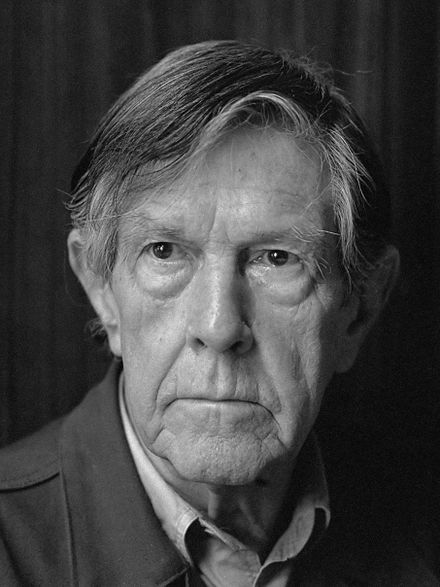
Quick! Can you name one of the most influential composers of the 20th century, a pupil of Henry Cowell and Arnold Schoenberg, who was also instrumental in the development of modern dance?

Hint? Here’s his picture.

John_Cage_(1988)

John Milton Cage Jr. (September 5, 1912 – August 12, 1992) was an American composer, music theorist, artist, and philosopher. A pioneer of indeterminacy in music, electroacoustic music, and non-standard use of musical instruments, Cage was one of the leading figures of the post-war avant-garde. — Greene, David Mason (2007). Greene’s Biographical Encyclopedia of Composers. p. 1407

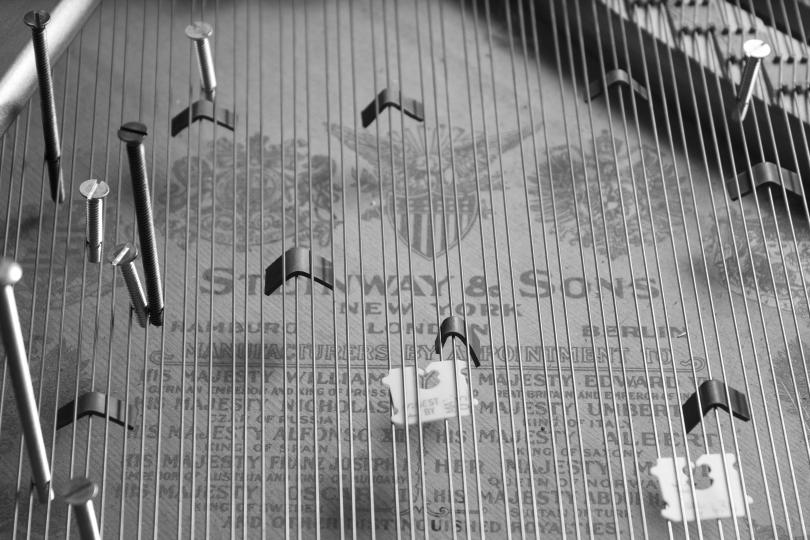
Cage was a pioneer of the prepared piano, an acoustic keyboard instrument with its sound altered by objects placed between or on its strings or hammers (see above photo), for which he wrote numerous dance-related works and a few concert pieces.

What may not be as well known was John Cage’s intense study of Indian philosophy and Zen Buddhism in the late 1940s, which led him to focusing on the concept of aleatoric or “chance-controlled music,” which he started composing in 1951.

The I Ching, an ancient Chinese classic text decision-making tool, which uses chance operations to suggest answers to questions one may pose, became Cage’s standard composition tool for the rest of his life. In a 1957 lecture, Experimental Music, he described music as “a purposeless play” which is “an affirmation of life – not an attempt to bring order out of chaos nor to suggest improvements in creation, but simply a way of waking up to the very life we’re living.” — https://en.wikipedia.org/wiki/John_Cage and https://johncage.org/

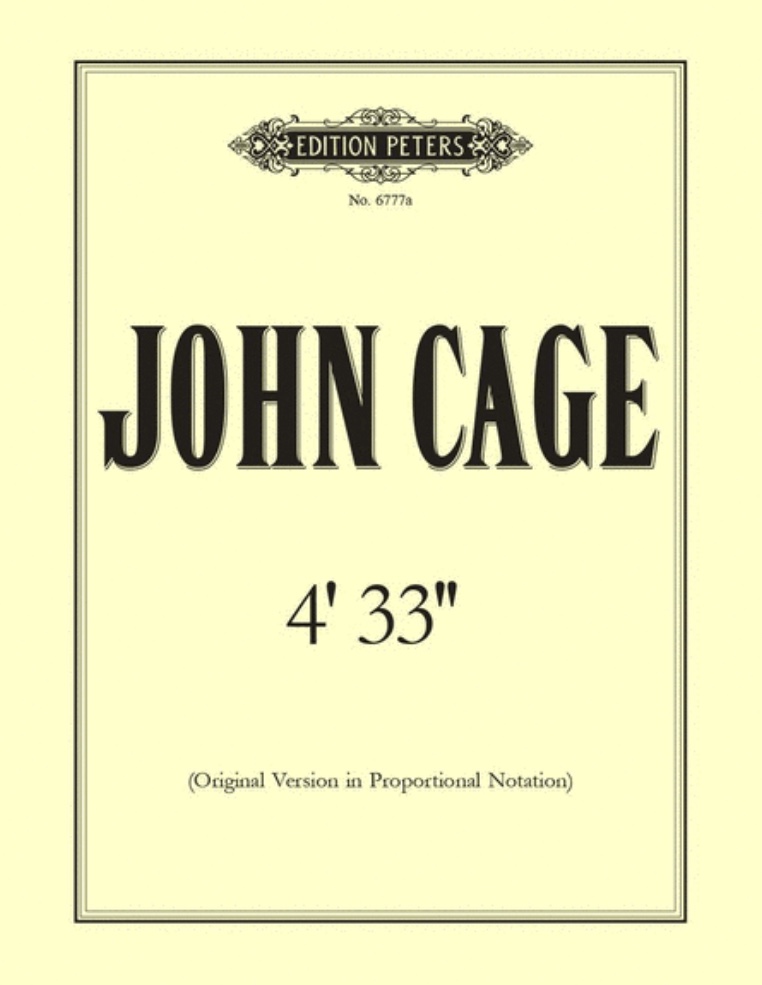
The “Classic” from John Cage’s collection

John Cage 4' 33"

Pianists and musicologists are familiar with the original Peters edition of one of his most notable works, titled 4′ 33″ (for its length), as well as his free use of exploratory and unconventional instrument types, equipment alterations, and groupings. John Cage was indeed most prolific with an exhaustive number of varied compositions to his credit, spanning his 80-year life:

From his Apprenticeship Period 1932-1936

  • Greek Ode for voice and piano (1932)
  • Three Easy Pieces (1. Round in A minor, 2. Duo in G major, 3. Infinite canon in F minor) for piano (1933)
  • Three Songs for voice and piano, (1932–33)
  • Sonata for Clarinet (1933)
  • Three pieces for two flutes (1935)
  • Quartet for any four percussion instruments (1935)
  • Two pieces for piano (1935?, revised 1974)
  • Trio for three percussionists (1936)

From his Modern Dance, Prepared Piano, and Transition to Chance Period 1937-1951

  • Music for Wind Instruments (wind quintet – 1938)
  • Bacchanale for prepared piano (1938)
  • Imaginary Landscape No. 1 for two variable-speed phonograph turntables, frequency recordings, muted piano and cymbal (1939)
  • First Construction (in Metal) for six percussionists and an assistant (1939)
  • Second Construction for four percussionists (1940)
  • Third Construction for four percussionists (1941)
  • The City Wears a Slouch Hat for narrator and six percussionists (1942)
  • Credo in Us for four performers with various objects (1942)
  • She Is Asleep: 1. Quartet for percussion, 2. Duet for voice and prepared piano (1943)
  • Ophelia for piano (1945)
  • Prelude in A minor  for flute, bassoon, trumpet, violin, cello and piano (1946)
  • In a Landscape for piano or harp (1948)
  • Sonatas and Interludes for prepared piano (1946–48)
  • Suite for Toy Piano (1948)
  • A Flower for voice and closed piano (1950)

Sample First Chance Works 1951-1958

  • Sixteen Dances for flute, trumpet, 4 percussionists, piano, violin and cello (1950–1951)
  • Imaginary Landscape No. 4 (March No. 2) for 12 radios, 24 performers and a conductor (1951)
  • Music of Changes for piano (1951)
  • Seven Haiku for piano (1951–1952)
  • Waiting for piano (January 7, 1952)
  • Music for Piano 4–19 for any number of pianos (1953)
  • 26’1.1499″ for a string player (1953–55, finished in 1955)
  • Music for Piano 21–36, 37–52 for piano solo or in an ensemble (1955)
  • Speech 1955 for news reader and 5 radios (1955)
  • 27’10.554″ for a percussionist (1956)
  • Radio Music for 1 to 8 performers using radios (1956)
  • Winter Music for piano (1957)
  • For Paul Taylor and Anita Dencks for piano (1957)
  • Fontana Mix for tape (1958)
  • Aria for voice (1958)

Sample Happenings, Theater Music 1959-1968

  • Sounds of Venice for television set (one performer) (1959)
  • Water Walk, a work for a TV show for one performer with a variety of objects (1959)
  • Cartridge Music for amplified sounds (1960)
  • Music for Carillon No. 4 for electronic instrument with accompaniment (1961)
  • Variations II for any number of performers and any kind and number of instruments (1961)
  • Music for Piano 85 for piano and electronics (1962)
  • Variations III for any number of people performing any actions (1962)
  • Electronic Music for solo piano (or any number of pianos) with electronics (1964)
  • Rozart Mix, tape loops (1965)
  • Variations V (1965)
  • Variations VI for a plurality of sound systems (1966)
  • Variations VIII no music or recordings (1967; revised 1978)
  • Assemblage for electronics (1968)

Samples of Return to Composition 1969-1986

  • HPSCHD for 1 to 7 amplified harpsichords and 1 to 51 tapes (1967–69, accompanied with Program (KNOBS) for the listener, an instruction for playing back the recording of the piece)
  • Cheap Imitation for piano (1969; orchestrated 1972, violin version 1977)
  • Bird Cage for 12 tapes (1972)
  • Etcetera for small orchestra, tape and, optionally, 3 conductors (1973)
  • Exercise for an orchestra of soloists (1973, based on Etcetera; second version completed in 1984)
  • Etudes Australes for piano (1974–75)
  • Some of the “Harmony of Maine” for organist and three assistants (1978)
  • Etudes Boreales for cello and/or piano (1978)
  • Hymns and Variations for twelve amplified voices (1979)
  • Ryoanji for double bass, trombone, oboe, voice, percussion, small orchestra (1983; parts added in 1983–85, and an unfinished cello part survives from 1992)
  • Selkus2 (1984)
  • ASLSP for piano or organ (1985)
  • Haikai for gamelan ensemble (1986)

Sample Number Pieces and Other Late Works 1987-1992

  • Twenty-Three for 13 violins, 5 violas and 5 cellos (1988)
  • Five Stone Wind for three performers with clay drums, electronics and unspecified instruments (1988)
  • 1O1 for orchestra (1988)
  • Four for string quartet (1989)
  • One2 for 1 to 4 pianos (1989)
  • Three for three recorders (1989)
  • One7 for any sound-producing object (1990)
  • Scottish Circus for Scottish folk band of any number of musicians and any instruments/voices (1990)
  • Twenty-Six for 26 violins (1991)
  • Twenty-Eight for wind ensemble (1991)
  • Muoyce II (Writing through Ulysses) for speaker and tapes (May 1992)
  • One11 for solo cinematographer (1992)

New “Bandstration” by John Cage

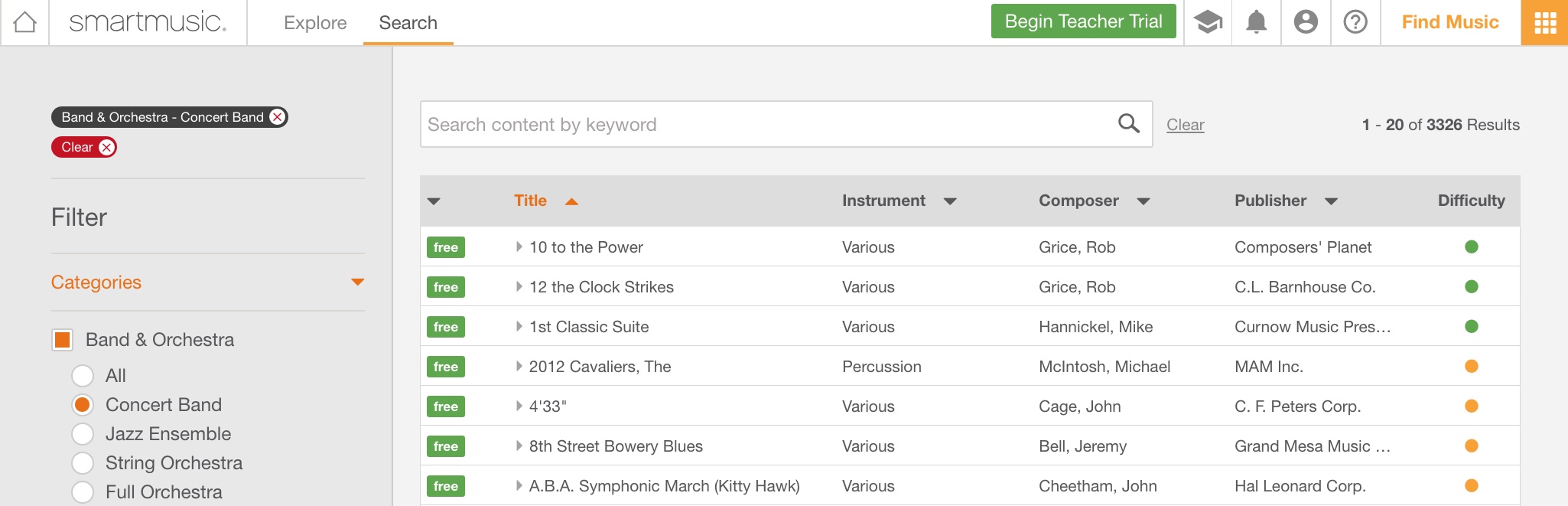
SmartMusic library

We are happy to announce a fairly recent discovery, a unique musical “find” for band directors, the first of which is a new adaptation of his work 4′ 33″ available for middle to high school concert band (full instrumentation, listed below) and a reduced, surprisingly easy-accessible arrangement for elementary band.

The music can be ordered from number of publishing houses, including C.F. Peters Corp., Sheet Music Plus, and J.W. Pepper.

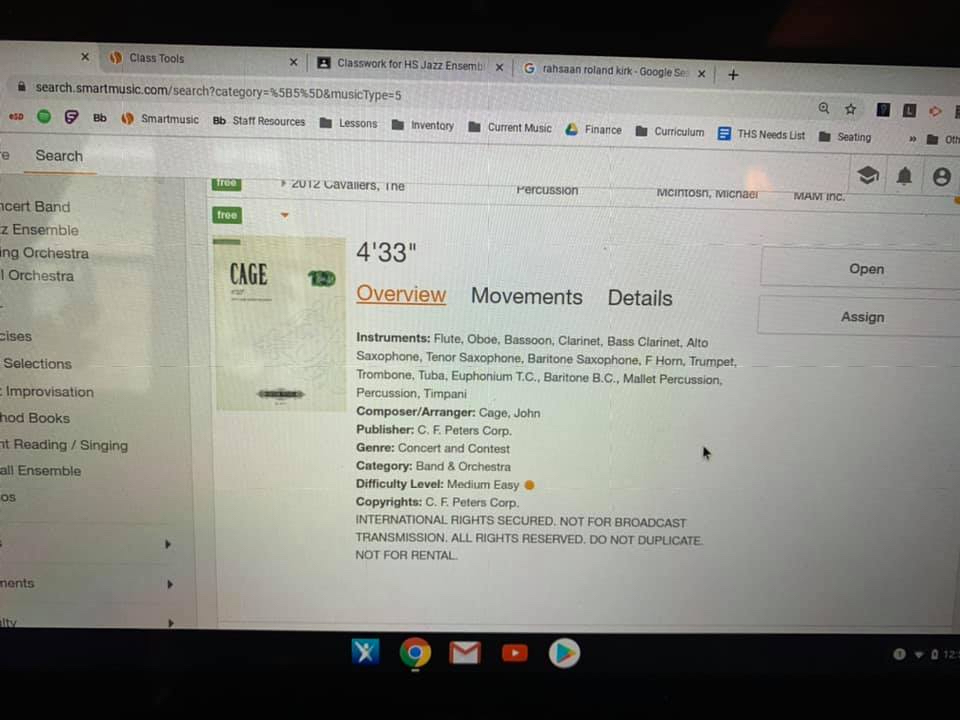
Cage arrangement for band in SmartMusic

Smartmusic (MakeMusic, Inc.) added the newest edition of 4′ 33″ to its music library, labeling it “concert” and “contest” genre at the “medium easy” level with options to practice, perform, and assess individual instruments from within the score, including:

  • Flute
  • Oboe
  • Bassoon
  • Clarinet
  • Bass Clarinet
  • Alto Saxophone
  • Tenor Saxophone
  • Baritone Saxophone
  • French Horn
  • Trumpet
  • Trombone
  • Euphonium T.C.
  • Euphonium B.C.
  • Tuba
  • Mallet Percussion
  • Percussion
  • Timpani

John Cage printed band arrangement

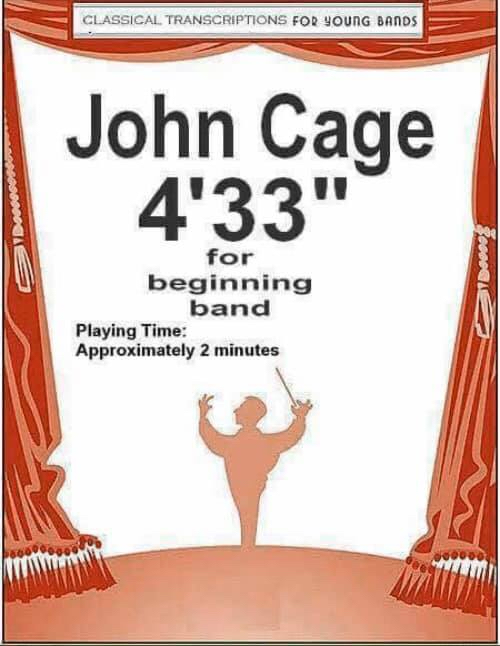
An even more simplistic elementary band version, with a recommended two minutes performance time, is published by Classical Arrangements for Young Bands.

Take time to explore the amazing life and music of John Cage. You won’t be sorry!

PKF


Bibliography


© 2020 Paul K. Fox