
Tips on Personal Branding

OLYMPUS DIGITAL CAMERA

Prospective Music Teachers: Why Personal Branding Might Help You Land a Job!

“A brand is anything—a symbol, design, name, sound, reputation, emotion, employees, tone, and much more—that separates one thing from another.”

– Neil Patel and Aaron Agius

optimism-1241418Quick – Who are you? Define yourself in three words!

This is one of the most common job interview questions. In my past blogs on the subject of getting a music teaching job (see https://paulkfoxusc.wordpress.com/category/marketing-professionalism/), we explored preparing for interviews, planning portfolios, developing stories/personal anecdotes of your strengths, defining criteria for the ideal music teacher candidate, and understanding the term “professionalism” as it applies to music education. Now to wrap-up your “marketing plan,” it is time to dive into “personal branding” as it is presented by quite a few experts in the field.

business-card-1238267What is Personal Branding? Google defines it as “essentially the ongoing process of establishing a prescribed image or impression in the mind of others about an individual, group or organization.”

Branding is critical to help you “stand above the rest,” showing you have what it takes and would be a major asset to a prospective employer, and marketing your own unique qualities that would make you “a good fit” for the specific job opening. But you don’t have to take my word on this… a quick search on the Internet yields numerous articles on branding and marketing yourself.

The question is no longer IF you have a personal brand, but whether you choose to guide and cultivate the brand or to let it be defined (or assumed) by others on your behalf.

According to Shama Hyder, bestselling author of The Zen of Social Media Marketing, “The term branding has long been relegated to companies, but today almost every individual has a personal brand. Not many of us have consciously cultivated these brands, but they exist nonetheless. A digital footprint in the sands of time and space crowd sourced by friends, colleagues, and bosses. According to an AVG study, 92 percent of children under the age of two already have a digital footprint.”

At http://www.forbes.com/sites/shamahyder/2014/08/18/7-things-you-can-do-to-build-an-awesome-personal-brand/, Hyder posted “7 Things You Can Do to Build an Awesome Personal Brand,” including the following outlined summary. (Take a look – you won’t be sorry!)
  1. A young caucasian woman outdoors in a meadow, working on her computerStart thinking of yourself as a brand
  2. Audit your online presence
  3. Secure a personal website
  4. Find ways to produce value
  5. Be purposeful in what you share
  6. Associate with other strong brands
  7. Reinvent

You can learn something about branding from an accountant. In “Five Tips on Branding Yourself” (by the American Institute of CPAs) at http://www.aicpa.org/InterestAreas/YoungCPANetwork/Resources/Career/Pages/FiveTipsToBrandingYourself.aspx, steps are offered to help build a positive image and promote your professionalism. Branding helps “to remain current in your field, opens doors for you, and creates a lasting impression…”

  1. Define your brand and become an expert.
  2. Establish a presence.
  3. Generate brand awareness through networking.
  4. Remember the 3 Cs of brandingclarity, consistency, constancy.
  5. Get feedback from those who know you best—at work, at home, anywhere.
marching-band-1440110-1For #1 above, hopefully you have already read my epistle (see https://paulkfoxusc.wordpress.com/2015/07/04/marketing-yourself-and-your-k-12-music-certification/) on not limiting your options or selling yourself short as a music specialist (e.g. band director or elementary vocal teacher). If you want a job with a Pennsylvania Music K-12 Instructional certificate or equivalent, you have to be “expert” on all types and grade levels of public school music.

The music curriculum leader/department chair/lead teacher involved in the employment screening will want to know your mastery of creating lessons in everything from the foundations of “steady beat” and “matching pitch” to developing advanced technique and musicianship in any/all instrumental and vocal ensembles, including jazz improvisation, a cappella singing, and string chamber music.

However, principals, HR staff, and other administrators will likely care more about your classroom management skills, ability to communicate and work with others, personal initiative and willingness to work after school and in the evenings, record of consistent attendance (low incidence of absenteeism or tardiness re: college classes and other work history), and other personality characteristics. Believe it or not, at more than one interview, I was asked, “Since you call yourself trained as a musician, are you temperamental?”

The single most comprehensive publication on branding (and it looks like it is provided as a free service!) is The Complete Guide to Building Your Personal Brand by Neil Patel and Aaron Agius” at https://www.quicksprout.com/the-complete-guide-to-building-your-personal-brand/.

According to them, the greatest rationale for building your personal brand is that it opens up more professional opportunities. “Creating a vision for your future and implementing that vision can lead to a better job…” You should take time to read the guide’s chapters in detail:
  • your-brand-new-website-1-1058679How to Create Your Personal Brand Vision
  • How to Define Your Target Audience
  • How to Build Up Your Online and Offline Assets
  • How to Build Your Brand Through Outreach
  • How to Get Free Press Coverage
  • How to Connect with Mentors
  • How to Monitor your Brand
  • Be Yourself Because Everyone Else Is Taken

After you peruse all of the above material on personal branding, here are my top ten “takeaways” specific to every budding music teacher.

  1. Your personal brand is everything about you – your values, attitudes, integrity, initiative, work ethic, skills, and personality traits.
  2. Remember, a career in public/private school education is based on very conservative values. Be cognizant of what you say, how you look and act, and the overall image you portray. “Everything you say and do (or have ever said or done) may be used against you…”
  3. In this profession, there’s no place for too much levity or a lack of respect for conformity, longstanding traditions, and the orthodox. At my first job interview, I carelessly made a crack about signing an outdated “loyalty” oath (“I promise I am not a communist and will not try to overthrow the government…”), the result of which the superintendent gave me a major tongue-lashing and a 20-minute lecture on patriotism (but, somehow I still got the job!).

  4. shame-1431469Clean up your social media sites (Facebook, etc.). A photo of you and your college buddies drinking “adult beverages” in bathing suits at a beach may be misinterpreted. Google your name to see what comes up. How would you define the content you see of yourself online?
  5. Create a personal website to warehouse the elements of your “professional brand,” including your philosophy of music education, mission, goals, and a digital resume of your education,  experience, and accomplishments. If your college/university does not set you up with a free online site, explore “doing-it-yourself” with WordPress, Wix, or Weebly.com.
  6. The only social medium I can recommend without reservation is LinkedIn. Create and optimize your professional identity on LinkedIn, everything from getting an excellent photo of yourself to providing copious samples of your references, writing, hands-on teaching experiences, etc.
  7. If you have personal essays on your educational philosophy and vision, share your priorities as they relate to music curriculum, lesson targets, concert programming, assertive discipline, collaborative projects, and professional development, and always be ready for the most commonly asked interview questions (beat them to the punch by posting in writing your thoughts): Why is music essential to a child’s education? Why did you choose to become a music educator? Who had the greatest influence on you and why? What are your greatest strengths and weaknesses in this field?

  8. PaulFox_LogoIf you have time, design a personal logo, a symbol of you wherever you go on websites, e-mail footer, digital and printed portfolios, business cards, etc. Although I retired in 2013, I created the illustration at the above right. It implies that I am “a happy fox” (my last name), involved in music, and especially love a certain Beethoven symphony, reinforcing that I am an orchestral musician.
  9. Better than providing quick one or two-sentence answers to the interviewers’ questions, try to assemble a collection of personal anecdotes that dramatically illustrate your musical and teaching skills, critical thinking and problem solving, personality traits like patience, compassion, self-control, and thoughtfulness, and past successes. (For more information on developing story-telling skills, go to https://paulkfoxusc.wordpress.com/2015/08/02/when-it-comes-to-getting-a-job-s-is-for-successful-storytelling/).
  10. Whenever possible, archive your student teaching and other field experiences. “A picture says a thousands words!” Post short online video, audio, and photo examples of your positive interactions in music and with students in all kinds of settings.

One final thought. The best advice I have learned about branding is that it is all about “work in progress.” According to Adii Pienaar in “How to Build Your Personal Brand: The Next Step to Anything” (http://thenextweb.com/entrepreneur/2013/08/18/your-personal-brand-the-next-step-to-anything/), “Your brand is a living organism just like you are as a human and it needs to mirror the same kind of progression, evolution and maturation that you experience in your own mac-stuff-4-1500018life. Whilst legacy is important (as it gives context to your brand), continuous improvement and change should be part of how you shape your brand over time.”

He adds, “Your brand should make mistakes and you should have the opportunity to learn from them.” Just like a model college-entrance essay relating how you have persevered and adapted to life’s challenges and solved problems, your online presence should reveal your dedication to and steps towards self-improvement.

Finally, I echo Pienaar’s conclusion that there is no time like the present to get to work on personal branding: “Start today and brand shamelessly.”


PKF

© 2015 Paul K. Fox

Planning the “Perfect” Professional Portfolio

Prospective Music Teachers: Here’s How to Create an Online Employment Profile/Dossier

“In short, creating a portfolio involves reflection, collection, selection, and connection.”

Read more at: http://langwitches.org/blog/2009/07/17/digital-teaching-portfolios/

To quote Cheryl Frazes Hill in “A Portfolio Model for Music Educators” in Music Educators Journal, Vol. 95, No. 1 (September 2008), pp. 61-72, “The portfolio used in education is an organized collection of artifacts (examples of works) documenting a person’s skill and growth in an educational program and a career.”

First, you need to do your homework – a comprehensive collection of “all the good stuff!” To support this, number 7 in the MajorMusic.com blog of “Seven Things Music Education Majors Can Do to Make Themselves More Employable” is “Keep an updated list of your skills, relevant experiences, and training.” (Peruse the whole article at http://majoringinmusic.com/7-things-music-education-majors-can-do-make-themselves-more-employable-2/).

I have always suggested to my college-bound students that they reserve a spot on their computer’s desktop, a file (appropriately) named “ME,” and place in it a bulleted document with chronological descriptions and dates of special achievements, awards, and appointments. From time to time, more updates of “good news” should be added. In addition, archive (drag into the folder) accompanying scans/pictures of all music programs, congratulatory letters, certificates of achievements, newspaper clippings, etc. In college, this should be expanded to include documentation and anecdotes/stories/reflections about music and music education field experiences, accomplishments, and especially any problems identified and problems solved. All of this is perfect fodder for future interviews… Do you have “what it takes” to be a professional music teacher?” In your opinion, what makes you qualified (“a good fit”) to be hired for a position in our institution?”

According to The EDU Edge at http://www.theeduedge.com/top-five-must-haves-top-five-could-haves-your-teacher-interview-portfolio/, the following “must-haves” and “should-haves” (paraphrased) should be incorporated into your portfolio:

  1. Educational philosophy
  2. Résumé or Curriculum Vitae
  3. Letters of recommendation
  4. Artifacts of student work
  5. Classroom observation documents/evaluations
  6. Statement about class management theory (discipline) and the steps that you would take inside your classroom to create a safe and orderly environment
  7. Letters from parents commending the work you did with their children
  8. Pictures (A direct quote The EDU Edge: “We cannot emphasize the power of pictures enough when it comes to portfolios. During interviews, committee members are trying to get to know you and trying to envision you teaching. Don’t trust their imaginations to do so, give them pictures. Pictures bring it together for committee members and verify the reality that you are meant to work with children. For this reason we recommend photos or newspaper articles of you: teaching students in the classroom, with students on field trips, learning excursions or outside class activities, with children while you are serving in adviser roles, with your students at musical or athletic events, coaching or working with children in a coaching capacity, as a leader and role model.”)

To this list, I would add a copy of college transcripts, Praxis® exam results, teaching certificate(s), samples of student assessments/rubrics, and excerpts (short videos) of you performing on your major instrument/voice, solo and chamber recitals, piano accompanying, playing in college ensembles, and especially teaching in as many settings as possible: small and large group instrumental (band and strings), choral ensembles, elementary classroom lessons, extracurricular activities like marching band and musical, private lessons, etc.

An excellent overview on this subject is from “our number one professional music teachers’ association” – the National Association for Music Education (NAfME): http://www.nafme.org/do-i-need-a-digital-teaching-portfolio/.

Carol Francis offers “Sixty Clean and Simple Examples of Portfolio Design” for WordPress users at http://www.onextrapixel.com/2013/01/23/60-clean-and-simple-examples-of-portfolio-design/.

It is worth downloading “ePortfolios in Music Teacher Education” by Vicki Lind from Innovate: Journal of Online Education at http://nsuworks.nova.edu/innovate/vol3/iss3/4/.

Numerous college and universities across the country have their own requirements and recommendations in the development of online credentials. Take a look at the Penn State University School of Music site “Undergraduate e-Portfolios” at http://music.psu.edu/musiced/e-portfolio.html. Another excellent outline is provided by the University of Texas at San Antonio at http://music.utsa.edu/docs/DevelopingPortfolio.pdf. Finally, Vanderbilt University’s Center for Teaching site offers good models and information on “Teaching Portfolios” at https://cft.vanderbilt.edu/guides-sub-pages/teaching-portfolios/.

In conclusion, take some time to examine the sample teaching portfolios (below) for more insights on design, style, and content. I also recommend you read my blogs on other subjects of “marketing professionalism” (click on the category link to the right of this article).

Good luck! PKF

“Imitation is the sincerest form of flattery” – Charles Caleb Colton

© 2015 Paul K. Fox

Criteria for Selection of the “Ideal” Teacher Candidate

“A good teacher can inspire hope, ignite the imagination, and instill a love of learning.”    – Brad Henry

Standards and Benchmarks of Top-Rated Educators in Music and Other Academic Subjects

OLYMPUS DIGITAL CAMERA

The best way to prepare for a job interview is to become aware of how you will be judged in comparison with your peers. What are the standards (or behaviors or criteria) of outstanding teachers? For what are administrators looking to fill the vacancies and build/maintain a quality staff?

Interviews will sort out (and rank) the competencies, certifications, education levels, and overall experience of the candidates. Obviously, mastery of subject content and teaching methods will be evaluated. However, you may be surprised that significant focus will be placed on personality traits, social skills, and evidence of personal drive, reliability, versatility, vision, and habits of professionalism.

In short, you may be the best musician this side of the Mississippi, the “model lesson planner,” and can conduct Orff’s Carmina Burana or Shostakovich‘s Festive Overture blindfolded, but if you cannot inspire students, work with coworkers, and communicate effectively, your interview and chances for being hired are doomed from the start.

Adapted from David Berliner and William Tikunoff, “The California BTES: Overview of the Ethnographic Study,” effective teachers score high on…

  • Accepting
  • Adult involvement
  • Attending
  • Consistency of message
  • Conviviality
  • OLYMPUS DIGITAL CAMERACooperation
  • Student engagement
  • Knowledge of subject
  • Monitoring learning
  • Optimism
  • Pacing
  • Promoting self-sufficiency
  • Spontaneity
  • Structuring

Effective teachers score low on…

  • Abruptness
  • Belittling
  • Student defiance
  • Counting hours or “clock punching”
  • Illogical statements
  • Mood swings
  • Oneness (treats whole group as “one”)
  • Recognition-seeking

In previous blogs (e.g. https://paulkfoxusc.wordpress.com/2015/07/01/the-meaning-of-pro/), I have defined the qualities of a “professional.” How many of these traits do you model?

  • Succeeded in and continues to embrace “higher education”
  • Updates self with “constant education” and retooling
  • Seeks change and finding better ways of doing something
  • Like lawyers/doctors, “practices” the job; uses different techniques for different situations
  • Accepts criticism (always trying to self-improve)
  • Proposes new things “for the good of the order”
  • interview-1238367Can seemingly work unlimited hours (24 hours a day, 7 days per week)
  • Is salaried (does not think in terms of hourly compensation, nor expects pay for everything)
  • Is responsible for self and many others
  • Allows others to reap benefits and credits for something he/she does
  • Has obligations for communications, attending meetings, and fulfilling deadlines
  • Values accountability, teamwork, compromise, group goals, vision, support, creativity, perseverance, honesty/integrity, fairness, and timeliness/promptness
  • Accepts and models a corporate standard of behavior and appearance

It is worth reading “Weigh In: What Makes a Great Teacher” by Jacqueline Heinze in the Winter 2011 issue of Administr@tor Magazine (see http://www.scholastic.com/browse/article.jsp?id=3755567). Among the numerous responses were these notable quotes:

  • “A great teacher must be resilient.”
  • “Great teachers are instructional leaders and curriculum designers.”
  • “Great teachers love what they do and perceive teaching as their calling.”
  • “Great teachers are empathetic and engaged.”

Also check out these websites for additional insight on the characteristics of a exemplary educator:

students-1460768Since the process of teacher selection in the public schools involves recruitment, screening, hiring, placement, induction, and evaluation, it is advisable for prospects to know the assessment practices already in place. According to the Pennsylvania Department of Education, Pennsylvania has adopted The Framework for Teaching as the overarching vision for effective instruction in the Commonwealth.

The Framework for Teaching is written by Charlotte Danielson, an internationally-recognized expert in the area of teacher effectiveness specializing in the design of teacher evaluation systems that, while ensuring teacher quality, also promote professional learning.

The introduction to The Framework of Instruction Evaluation Instrument 2013 states its purpose:

“The Framework for Teaching identifies those aspects of a teacher’s responsibilities that have been documented through empirical studies and theoretical research as promoting improved student learning. While the Framework is not the only possible description of practice, these responsibilities seek to define what teachers should know and be able to do in the exercise of their profession.” – Charlotte Danielson

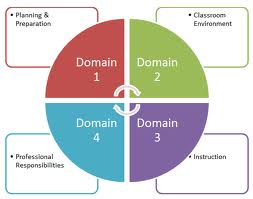
The model focuses the complex activity of teaching by defining four domains of teaching responsibility:

  1. Planning and Preparation
  2. Classroom Environment
  3. Instruction
  4. Professional Responsibilities

The domains can be further broken down into…

danielsons_image_dom1-4

Domain 1: Planning and Preparation

  • 1a Demonstrating Knowledge of Content & Pedagogy
  • 1b Demonstrating Knowledge of Students
  • 1c Setting Instructional Objectives
  • 1d Demonstrating Knowledge of Resources
  • 1e Designing Coherent Instruction
  • 1f Designing Student Assessments

Domain 2: Classroom Environment

  • 2a Creating an Environment of Respect and Rapport
  • 2b Establishing a Culture for Learning
  • 2c Managing Classroom Procedures
  • 2d Managing Student Behavior
  • 2e Organizing Physical Space

Domain 3: Instruction

  • 3a Communicating with Students
  • 3b Using Questioning and Discussion Techniques
  • 3c Engaging Students in Learning
  • 3d Using Assessment in Instruction
  • 3e Demonstrating Flexibility and Responsiveness

inside-a-class-room-school-1435436Domain 4: Professional Responsibilities

  • 4a Reflecting on Teaching
  • 4b Maintaining Accurate Records
  • 4c Communicating with Families
  • 4d Participating in a Professional Community
  • 4e Growing and Developing Professionally
  • 4f Showing Professionalism

Many Pennsylvania districts assess their professional staff and verify their teacher’s professional growth via rubrics or other evaluative tools, as well as the collection of artifacts that support these domains. Archives of these “best practices” would be assembled in portfolios for the principal’s year-end review (samples printed in blue below are possible artifacts for music educators in particular):

Domain 1: Planning

  • Assessment Tools
  • Lesson Plans
  • New Curriculum Innovations
  • Personal/Professional Goals
  • Music Repertoire/Program Lists
  • Subject Outlines

Domain 2: Classroom Environment

  • Audio-Visual Resources Including Recordings
  • Formal Observations
  • Informal Observations
  • PowerPoint Presentations
  • Sample Classroom Displays/Bulletin Boards

Domain 3: Instruction

  • Arrangements (Teacher Composed)
  • Conferences with Colleagues/PLCs/Teams
  • Meetings with Mentors/Curriculum Leaders/Principals
  • Printed Concert, Musical, Drama, or Recital Programs
  • pencils-1240400Sample Homework and Worksheets
  • Student Composed Music/Lyrics/Exercises
  • Warmup Drills and Style/History Handouts

Domain 4: Professionalism

  • Act 48 Clinics and Workshops
  • Congratulatory Notes from Parents/Staff
  • Grade Books and Attendance Records
  • Letters/Newsletters Sent Home
  • Minutes of Department Meetings
  • Professional Development Programs
  • Student Recommendations
  • Student Records

Individual school districts define their own “vision of a model teacher,” aligning the selection criteria with the goals of the school system and the needs of the individual schools. For example, Upper St. Clair School District (an Allegheny County public school system located in southwestern Pennsylvania, and where I worked 33 years as music educator and seven years as Performing Arts Curriculum Leader) adopted the following Assessment Criteria for Teacher Candidates (developed by Superintendent Dr. William Pope, Human Resource Director Ms. Jean Toner, and other staff). “In a nutshell,” these are what USC calls “core behaviors” or standards of personality traits, skills, and knowledge, and serve as categories for assessment of all job applicants during the interview process:

Instructional

  • Educational Philosophy
  • Knowledge/Experience
  • Classroom Management
  • Technology
  • Oral Expression
  • Written Communications

college-1241412Professional

  • Leadership
  • Teamwork
  • Judgment
  • Problem Solving
  • Planning & Organizing
  • Innovation

Personal

  • Initiative
  • Dependability
  • Adaptability
  • Self-Insight and Development
  • Energy and Enthusiasm
  • Appearance

My next blog on this subject will provide examples of music teacher interview questions for each of the above criteria… suitable for individual practice or group mock interview sessions, and to assist in the formulation of stories/anecdotes that would support a candidate’s mastery of each standard. The importance of this preparation is explored in a previous blog: https://paulkfoxusc.wordpress.com/2015/08/02/when-it-comes-to-getting-a-job-s-is-for-successful-storytelling/.

PKF

© 2015 Paul K. Fox

This post is featured by Twinkl in their ‘Teaching Writing’ blog.

When It Comes to Getting a Job, “S” is for Successful Storytelling!

Thoughts on Marketing Yourself and Sharing Personal Anecdotes at Employment Interviews for PCMEA and Prospective Music Teachers

This article was submitted for publication in PMEA News – the state journal of the Pennsylvania Music Educators Association.

pmeaMany schools are implementing behavior-based interviews as the preferred method for screening and evaluating applicants. This approach seeks to highlight past performance, experiences, behaviors, knowledge, skills, and abilities that are job-related. Throughout this process, the concept of marketing oneself for employment consideration is based on two principal skill sets: branding yourself and storytelling. It is not about “bragging” or false modesty, although you cannot come on too strong or too weak at the interviews. However, it is everything about “getting noticed,” “making connections” with the interviewers, and demonstrating that you have “what it takes” and would be a “good fit” for their school district.

Not everybody is a good storyteller, but music educators are generally good performers. In preparation of their craft, musicians music-1237358routinely model their knowledge of music making – poise, professionalism, and self-confidence in front of an audience, critical thinking, problem solving and repetitive drill towards a smooth, well-organized, and well-practiced performance, and all of those essential concepts of form and analysis, rhythms, articulations, tempos, phrasing (breathing!), dynamic contrasts, interpretation, and expressiveness… many skills inherently needed in the storytelling.

questions-1151886According to Antigone Orfanos in “Interviewing Techniques: The Art of Storytelling” (http://therapycareers.about.com/od/JobHuntSkillsStrategies/a/Job-Interview-Techniques.htm), knowing the questions an interviewer may ask is much less important than mastering your storytelling skills. “Think of all of your past accomplishments. Try to create a list of the most important successes you have had in your career and personal life. These are the stories that you want to highlight when your employer meets with you. The most important successes are the ones that are most likely to make the biggest impression on a potential employer. Then, use metaphors, analogies, and humorous anecdotes to capture an employer’s attention.”

reading-statue-1528168It turns out that stories are a very powerful tool, as validated by Lily Zhang in “The Interview Technique You Should Be Using” (see https://www.themuse.com/advice/the-interview-technique-you-should-be-using#). Jennifer Aaker, professor of marketing at the Stanford Graduate School of Business, explains that “stories are up to 22 times more memorable than facts alone” and “we are wired to remember stories much more than data, facts, and figures.” Zhang expands on this. “Our brains are just more active when we’re listening to a story. In fact, if you can tell a good story, you can actually synchronize your listener’s brain with your own. You can literally share the experience with someone else. Talk about making a connection!”

Worth reading in depth, Zhang details in her article the steps towards better storytelling at interviews:

  1. Tell the punch line early.
  2. Give some context.
  3. Introduce the situation or challenge.
  4. Describe your specific actions.

OLYMPUS DIGITAL CAMERA

In “Interview Story Telling – Personal Branding Blog – Stand Out in Your Career” (http://www.personalbrandingblog.com/interview-story-telling/), Kevin Monahan predicts that you will be asked to “Share a time when…” or “Provide an example where…” which provides the perfect opportunity to tell a story. He recommends that stories need to have a beginning that sets the stage (provide the setting), action items (what did you do?), and final outcome (how did you achieve the goal or influence an outcome?). He shares, “During one interview session, I was asked what my first job was. I could have told them in five seconds that my first job was a paper route when I was ten years old. Instead, I told a story.” He narrated a more detailed explanation on getting to know his customers, learning their individual preferences, and developing a connection with each of them… leading to better service and greater business generated.

Monahan concludes, “The key… is to connect the story to a desired skill set needed for the position. By relating the stories and examples back to the core competencies of the job, I communicated an image instead of just providing answers to questions.”

An available self-assessment of your storytelling performance skills is available at http://www.storyarts.org/classroom/usestories/storyrubric.html. Using Heather Forest’s rubrics on her website “Storytelling in the Classroom,” you could make and lady-1580621then evaluate a video recording of a “mock interview,” asking yourself in front of a camera common questions like the following:

  1. What are your greatest personal strengths (and weaknesses)?
  2. What techniques would you use to motivate (or discipline) students?
  3. Describe your educational philosophy.
  4. How would you assess the learning in your classroom?
  5. Who had the greatest influence on you becoming a teacher and why?
  6. What are your career objectives?

During the panel discussion “Ready to Hire: Interview Strategies for Music Educators” at the 2013 PMEA Annual In-Service Conference in Erie, PA, colleagues Susan Basalik, J. Howard Baxter, Susan Metelsky, and moderator Scott Sheenan were generous in providing supplemental materials, including sample questions and other tips for excellent interview (and story) preparation. These handouts are still available online at http://www.uscsd.k12.pa.us/Page/6361.

One final thought comes from Beth Kuhel in “The Secret to a Successful Interview: Great Storytelling” in the April 17, 2014 online article of U.S. News and World Report. In a TED Talk, “Toy Story” movie co-writer Andrew Stanton says that “a great story comes from using what you know, capturing a truth from experiencing it, and from expressing values you feel deeply.” He suggests, “You allow the listener to make his own deductions about you from the story. That is, don’t come out and say you’re collaborative, adaptable or anything – you tell a story that convinces your listener you possess these traits.” Stanton concludes that a well-told tale grips, excites, and engrosses.

preschool-hands-on-activities-1565836In summary, it is important to apply your skill in storytelling to employment interviews. Provide thoughtful, professional, and firm answers in response to the interviewer’s questions. Back up your statements with specific examples. Share the outcome or solution to a specific problem. Summarize to emphasize your strengths. Make yourself “stand out” as you tell stories about the challenges and triumphs you faced in life. Interconnect and relate these anecdotes proving your skills and experiences to the needs, goals, and values of the institution, employer, and position for which you are applying.

PKF

© 2015 Paul K. Fox

Overview – Strategies for Landing a Music Teacher Job

“Without ambition, one starts nothing. Without work, one finishes nothing. The prize will not be sent to you. You have to win it.” – Ralph Waldo Emerson

In a challenging job market with limited openings for public/private school music educators in many geographical areas of the country, there is great competition in the screening and evaluation of the applicants. I am happy to offer some tips and techniques towards successful career preparation, employment searches, interviewing, and promotion of your image and record of past performance, experiences, achievements, behaviors, knowledge, skills, and abilities that are job-related.

The concept of marketing oneself for employment is based on several skill sets:

  • Knowing the territory
  • Making connections
  • Branding yourself
  • Storytelling about the challenges and triumphs you faced in life
  • Proving that you have “what it takes” and your skills/experiences would be a “good fit” to the needs, goals, and values of the institution, employer, and position to which you are applying
  • Being persistent and well-organized

Here is my outline of general targets for marketing professionalism and a successful job hunt. Many of these subjects have been/will be shared in current or future blogs on this site.

  1. Develop and model your skills as a “professional.” (Read my July 1, 2015 blog “The Meaning of Pro.”)
  2. Complete a self-assessment of your content knowledge, teaching skills, musicianship, and personality traits. (Prepare in advance so that you will be able to share your “best” attributes.) One model for evaluation of prospective and current educators is Charlotte Danielson’s “Four Domains” from The Framework for Teaching. (To research these, see http://danielsongroup.org/framework/).
    • Planning and Preparation
    • Classroom Environment
    • Instruction
    • Professional Responsibilities
  3. Seek out avenues (while in college or around your music education peers) to practice and improve your weakest skill areas (less familiar band/string instruments, improvement in piano accompaniment, jazz improvisation, or singing)
  4. Assemble artifacts of your professional activities, the precursor for the development of a comprehensive résumé and portfolio.
    • Bulleted list of specific academic and music accomplishments with dates
    • College assessments and transcripts
    • Scholarships and other awards
    • Education experiences (e.g. lists, photos, and/or audio/video recordings of student teaching, observations, and other field assignments, private teaching, substitute teaching, other employment in the private and public schools, conducting or performing in community ensembles, summer camps, sports, scouts, church programs, marching band sectionals or field assistance, choral accompaniment or vocal/drama/dance coachings, etc.)
    • Sample solo recital and chamber/large group concert programs
    • Sample lesson plans, learning targets, rubrics, and other student assessments
    • Original compositions and arrangements
    • Congratulatory notes and letters of reference
  5. Create a philosophy of music education. Be ready to answer the key essential questions “What is your personal mission?” and “What is the role of music in a child’s education?” (To define a broad-based vision for becoming the ultimate “total music educator,” avoiding any prejudice to, limitations in, and restrictions of a particular music specialty, see my July 4, 2015 blog “Marketing Yourself and Your K-12 Music Certification.”)
  6. Familiarize yourself with current educational jargon, terminology, trends, and acronyms, possible topics administrators may check for understanding at a future interview. If you do not know the meaning of terms like The Common Core, formative/summative assessments, or 21st Century Learning Skills, look them up. (See my July 18, 2015 blog “The Alphabet Soup of Educational Acronyms.”)
  7. Compile a set of detailed professional anecdotes based on your positive attributes (see #2 above), artifacts (#4), and examples of your professionalism (#1) – the most important successes you have had in your education, career and personal life. Metaphors, analogies, and humorous anecdotes are the foundation for excellent storytelling at interviews. (See my August 2, 2015 blog “When It Comes to to Getting a Job, ‘S’ is for Successful Storytelling.”)
  8. Pre-interview preparation
    • Creation or revision of your résumé, interview handouts, electronic portfolio, and employment website
    • Practice and drill on answering common interview questions (including self-assessments of video samples) – see examples of interview questions from the 2013 Pennsylvania Music Educators Association In-Service Conference: http://www.uscsd.k12.pa.us/Page/6361
    • Research of the school district, music program, job opening, and unique local curricular innovations
    • Development of appropriate and meaningful questions to ask the interviewer
    • Trial run (know exactly where you are going, time needed, traffic patterns, etc.)
  9. Positive interview techniques (future blog)
  10. Post interview (debriefing yourself) and organization of the job search process (another future blog)

As they say in the theater, “break a leg” at your job interview!

“Strive not to be a success, but rather to be of value.” – Albert Einstein

PKF

© 2015 Paul K. Fox