Ethics for Job Seekers

Employment Etiquette & Standards of Morality

Ethics is knowing the difference between what you have a right to do and what is right to do. – Potter Stewart from http://www.brainyquote.com

Definitions

Google defines ETHICS as “moral principles that govern a person’s or group’s behavior.”

For more detail and an analysis of the “essential questions” on ETHICS, check out the blog “What is Ethics?” from the Markkula Center for Applied Ethics: https://www.scu.edu/ethics/ethics-resources/ethical-decision-making/what-is-ethics/.

From another perspective, according to Investopedia, “BUSINESS ETHICS is the study of proper business policies and practices regarding potentially controversial issues, such as corporate governance, insider trading, bribery, discrimination, corporate social responsibility and fiduciary responsibilities.” The full article can be read at http://www.investopedia.com/terms/b/business-ethics.asp.
the-truth-shall-make-you-free-1201069

Declining Standards of Behavior?

Jean Twenge, the author of the 2006 book Generation Me, considers Millennials (born between 1977 and 1994), along with younger members of Generation X, to be part of what she calls “Generation Me,” possessing a preponderance of the traits of confidence and tolerance, but also a strong sense of entitlement and narcissism. Wikipedia identifies the (older) “Me” generation in the United States, referring to “the baby boomer generation and the self-involved qualities that some people associated with it.”

According to Psychology Today in a blog-post The Truth About Lying by Allison Kornet (https://www.psychologytoday.com/articles/199705/the-truth-about-lying), “Deception is rampant—and sometimes we tell the biggest lies to those we love most.”

If, as the cliché has it, the 1980s was the decade of greed, then the quintessential sin of the 1990s might just have been lying. After all, think of the accusations of deceit leveled at politicians like Bob Packwood, Marion Barry, Dan Rostenkowski, Newt Gingrich, and Bill Clinton.

Regardless of these labels of societal trends, “generalizations about the generations,” and reflections on current social values and conscience in the media, how do you come to terms with the recent headlines of inconsistent (or “inconvenient”) ethics and morality?

  • State-sponsored doping of Russian athletes
  • Volkswagen emission cheating
  • Students saying, “If we don’t get caught” or “If they don’t find out,” it’s OK.
  • The rise of online plagiarism-checking programs such as turnitin.com.
  • The cynicism about “ethics in advertising: do we expect lies?”

hand-on-a-bible-1417265

And yet, some of us still recite the Boy Scouts oath (“honesty”), “swear to tell the truth” (on a bible) in a court of law, and strive to maintain an atmosphere of honesty in the workplace (see http://www.businessinsider.com/3-essential-rules-to-workplace-honesty-2013-1  and http://smallbusiness.chron.com/create-atmosphere-honesty-workplace-10098.html).

So, are we “losing” our moral compass? Does “our word” mean anything? Do we take the easy way out and “fake a little” here and “wink a little” there? Is it affecting the way we interact with each other, in educational institutions, the marketplace, family life, and even presenting ourselves to be hired for a job?

Blame it on upbringing? Past experience? Perhaps it is safe to say one’s personal judgment may be affected by ethics. If a member of your family has a handicap parking placard, is it ever used when the handicapped individual is not riding in the car? In terms of judgment and feelings of entitlement, it is probably ill-advised to bring up anything to do with driving… fighting over parking places, cutting off someone, tooting horns at slow drivers, etc. Besides, who actually ever comes to a complete stop at a stop sign?

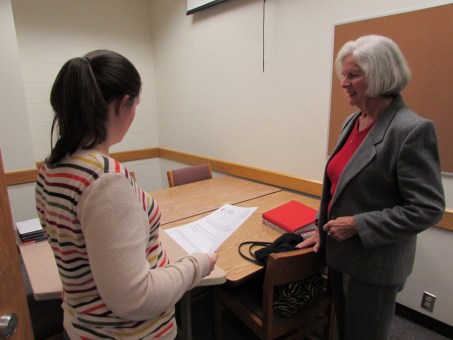
In the pre-employment planning stages, it is essential for you to make a honest personal and professional assessment, prepare to represent yourself accurately at interviews and on your resume and  e-portfolio, and model ethical personal branding. I would agree that “you cannot ‘fib’ and claim you are a ‘master’ of everything,” but if you are certified to teach music in grades K-12, not just band, or general music, or choir, or strings… you should state your proficiency to teach “the whole kit and caboodle.” At employment screenings, it’s more important to show you have learned the necessary 21st Century skills of critical thinking, problem-solving, collaboration, communications, creativity, and flexibility/adaptability… rather than whether you can play Paganini on the violin, sing a high “A,” improvise modern jazz styles, or piano accompany a musical production.
25774792772_259d73f98c_b

Stretching Things a Bit?

The concept of a “stretched resume” is detailed online by “Employee’s Ethics: Getting a Job, Getting a Promotion, Leaving,” Chapter 6 from the book Business Ethics. The author tells the true story of Robert Irvine, who used to host the Food Network’s popular Dinner: Impossible. He was fired when he was caught “lying” or providing gross exaggerations on his resume. You should read the interesting full account at this site: http://2012books.lardbucket.org/books/business-ethics/s10-employee-s-ethics-getting-a-jo.html.

The kind of resume misrepresentations are categorized as the following:

  • False credentials
  • False experience
  • Embellished experience
  • False chronology
  • False references

The best quote from this reference suggests that the outcome of resume misrepresentation is not worth the chances you would take if/when you are caught:

Ethical egoism means your moral responsibility is to act in your own interest no matter what that may require. This provides a license for outright résumé invention… But, as is always the case with egoism, the question must be asked whether job seekers really serve their own interests when they claim things that may later be revealed to be false or when they land jobs they later won’t be able to perform because their qualifications were fake.

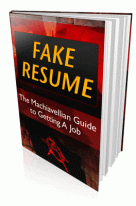
This source led me to the webpage http://fakeresume.com/ (aptly named) selling the book Fake Resume: The Machiavellian Guide to Getting a Job by Max Stirner (something I am not promoting!) You can peruse a segment of his work, “Five Reasons Why You Must Lie on Your Resume To Get a Job Today” at http://fakeresume.com/five-reasons-why-you-must-lie-on-your-resume.pdf. This excerpt is from his “Everyone Lies on Their Resume” section of his website:
fake-resume-ebook-vertical

The firm Hire Right released some interesting statistics that show how rampant resume fraud is in the United States. The company’s numbers show that 80 percent of all resumes are misleading. They also show that 20 percent state fraudulent degrees and 30 percent show altered employment dates. As if those numbers are not shocking enough, 40 percent have inflated salary claims and 30 percent have inaccurate job descriptions. Furthermore, the study shows 25 percent of people listing companies that no longer exist, and 27 percent giving falsified references; and these are only the people they have caught!

Guides to Employment Ethics

Regardless of what others do or say they do, marketing exaggeration and even falsehoods will not be in your best interest.

Richard Fein, Director of Career Management, Isenberg School of Management, University of Massachusetts-Amherst via Monstertrak.com wrote an excellent career guide on this subject: “Etiquette and Ethics in Your Job Search. What Are They and Why Should You Care?” Download the following to review the definitions, distinctions, and job search scenarios involving the terms “etiquette” and “ethics.” http://www.bu.edu/hospitality/files/pdf/ETIQUETTEANDETHICSINYOURJOBSEARCH1.pdf.

Another excellent resource is the “Job Search Ethics Brochure” from the University of Pennsylvania: http://www.vpul.upenn.edu/careerservices/files/Job_Search_Ethics_Brochure.pdf. In this thoughtful publication, additional terms are defined, such as “professional,” “integrity,” and “honor.”

word-true-on-the-dices-1237241

In addition, it should be “worth your while” to access some of the Franklin College’s “Helpful Handouts” under the Career Service section of their website: http://franklincollege.edu/student-life/career-services/students-alumni/helpful-handouts/. In particular, what stood out to me was their document “Job Search Ethics and Protocol,” which Assistant Dean of Students & Director of Career Services Kirk Bixler has graciously granted me permission to reprint below. (This is an excellent summary of many of the topics/tips we have posted at this site. Click on the “Marketing Professionalism” link to the right to read past blog-posts.)

  • Do NOT give into the temptation of carelessly completing an application. Do NOT make statements on an application like “see attached résumé.” Never leave spaces blank.
  • Apply for a job only if you have some realistic level of interest.
  • Absolute honesty on your résumé is imperative. Don’t overstate or understate. Don’t downplay your skills because you haven’t been featured in Business Week.
  • Request permission to use a person as a reference. Be prepared to explain to your reference what your job search plans are. Provide the reference with examples of qualities you possess. Offer a copy of your résumé. When interviewing, have your list of references on hand.
  • Don’t take advantage of an expense account when traveling for job interviews.
  • Show up for your interview. If you are visiting a person’s place of work, make sure your appearance, including mode of dress, is appropriate for that environment. You are not a student going to class. Consider yourself a professional trying to make a positive impression. How you present yourself is a partial reflection on the person with whom you are meeting.
  • Be a bit early for your appointment. Be mindful of the other person’s time. Come in prepared with questions & knowledge of the business.
  • Ask “How would you like to be addressed?” Be on the safe side; few people are offended by “Mister” or “Ms.” Be courteous to everyone you meet.
  • Everything you say must be true. On the other hand, you don’t need to say everything.

  • 25957630814_ee6ff87fe5_oYou may be asked to say something about another student or applicant. Speak only of your abilities & strengths. It is acceptable for an interviewer to ask you about other interviews, job offers & salary offers. You are not under an obligation to give a direct answer.
  • Be aware of illegal inquires. Employers may not ask, “How much alcohol do you drink?” “Have you ever been treated for mental health problems?” “What prescription drugs do you currently take?”
  • Thank you! Thank you! Thank you! Thank-you notes are a MUST in the job search process. They may be handwritten or typed. Address them to the person with whom you had the interview.
  • Be aware of drug screening requirements.
  • Call to inquire about your status in the employer’s hiring process. If a specific time has been communicated, wait until that time has passed before contacting the employer.
  • Let the employer be the first to mention salary. End it early if you are not interested. Let the employer know you are not interested in pursuing employment.
  • When offered the job, ask for time to think it over & ask for a formal offer letter.
  • You may receive one or more job offers you decide to reject. You should convey your decision to reject a job offer orally & in writing. The considerations here are speed & certainty of delivery. Call the person who signed your offer letter. Write a brief letter, also. Do both in a timely manner.
  • Only accept a job if you are really interested. Don’t settle. Once you accept a job offer, formally remove yourself from all other job searches. DO NOT continue looking.

These final bulleted items are echoed by another prestigious institution. “Ethical Internship and Job Search Policies” is posted on the University of Notre Dame’s Career Center webpage (http://careercenter.nd.edu/students/ethical-job-search-policies/):

When accepting an offer of full-time employment or an internship (either paid or unpaid), one must have every intention of honoring that commitment.  If a student accepts an offer of employment, admission to a graduate or professional school, or other post-graduate career opportunity, he/she must withdraw from the recruiting process immediately. This includes but is not limited to:

  • Not applying to future job postings.
  • Declining all future interview invitations.
  • Canceling any active applications.
  • Contacting all recruiters to inform them of your wish to be removed from the interviewing and recruitment process (this includes all scheduled interviews).

Ethics? It all boils down to two questions: “Who are you?” and “For what do you stand?” Besides the fear of “getting caught in lies” and being fired for misrepresentation (or doing an incompetent job because you did not have the qualities for which your employer was looking), it centers on “liking what you see” when you look at yourself in the mirror. Anyway, didn’t you mommy tell you your nose gets longer when you tell a fib?

mirror-on-wall-1413751

Ethics is nothing else than reverence for life.  – Albert Schweitzer
from http://www.brainyquote.com

PKF
© 2016 Paul K. Fox

Random Acts and Other Resolutions

One Music Teacher Retiree’s Reflections on New Year Resolutions

Cheers to a new year and another chance for us to get it right.  – Oprah Winfrey

pmea
Segment from the December 22, 2015 Pennsylvania Music Educators Association (PMEA) Retired Member Network eNEWS. For additional articles and blogs on the transition to retirement, please click on “retirement resources” at the right, or visit the PMEA website: http://www.pmea.net/retired-members/.


Ushering in the New Year is all about pursuing new directions or a sort of “rebirth,” making promises for self-improvements, and analyzing and revising our personal goals/visions… perhaps a little like the personal renaissance of retirement.

According to Wikipedia, the tradition of making resolutions is rooted in history, with many examples:

  • The Babylonians making promises to their gods at the start of each year “that they would return borrowed objects and pay their debts.”
  • rejoiceThe Romans giving tribute to the god Janus, for whom the month of January is named.


  • The knights in the Medieval era taking the “peacock vow” at the end of Christmas season to “re-affirm their commitment to chivalry.”
  • At “watch night services,” many Christians preparing for the year by praying and making New Year’s resolutions.
  • During Judaism’s New Year, Rosh Hashanah through the High Holidays and culminating in Yom Kippur, reflecting upon “one’s wrongdoings over the year” and seeking and offering forgiveness.

moving-forwards-5-1141707

While success and happiness are in the eye of the beholder, many resolutions do not stand the light of several days… you’d be lucky to “stick with it” for more than several weeks! However, the process of revival – re-examining what is important in our lives, and placing effort in establishing new habits and plans – is just plain “good for you.”

Here are happy-new-year-1184943my top-ten recommendations to help you “grow” and enjoy a glorious 2016!

  1. Read at least one new book each month, in spite of our society’s fascination with media, the web, movies, TV, etc. Multi-millionaires are known to reach out for new ideas, innovations, and leading-edge thoughts from recent publication releases.
  2. Take time for regular physical exercise and to “smell the roses.” For me, the three or four daily sessions of walking my dogs are extremely helpful for gathering my thoughts, calming my nerves, re-charging my batteries, and even brainstorming via speaking to Siri on my Apple iPhone. For example, using the Evernote, a note-taking/sharing app on my cell phone, was the tool for creating this article’s outline. I can even do it hands-free while I am driving (very carefully!), and with my “all thumbs” keyboarding skills, it sure beats typing everything out by hand!
  3. If you are fortunate enough to have reading-with-grandmother-in-wheelchair-1432646grandchildren (your own or adopted ones), enjoy them! Not only is your generous super-competent babysitting services providing ever-so-essential care-taking of your love-ones, “playing with the kids” is wonderful for your own mood and mental health. “Keep around young people and you will stay forever young!” However, invest your time wisely. You deserve a life of your own and unstructured time off. It is easy to be taken advantage of, so don’t let this childcare schedule dominate everything you do in your retirement.

  4. If travel is your thing, get out there and “book it!” One of the great advantages of retirement is the capability to go on trips while the kids are still in school. One of my least favorite memories of a family vacation was going to Disney World over Christmas break… Overcrowding closed the Epcot parking lot by Noon on December 27, and my wife had to endure 45-minute lines to use the ladies’ room.
  5. If you really like being “out on the road” a lot, consider offering your services to local travel agents as a music trip manager. Many PMEA retirees have already assumed new part or (nearly) full-time jobs organizing music groups’ out-of-town adjudications, festivals, workshops, and tours. Really, who is better qualified?
  6. flute-player-1506263-1920x1440The single most satisfying pastime for all of us is to be or do something creative. With few exceptions, every day you need to find venue(s) to express yourself. This could mean pulling out your instrument or singing, with a renewed focus on exploring your musicianship, interpretation, composition, or improvisational skills. Creating new musical works, like adding to your own “Mr. Holland’s Opus,” can “make your day!” Other projects in creativity could involve conducting, acting, dancing, creating two or three-dimensional artworks, sewing, gardening, and my personal favorite, writing. Whether it is fiction or nonfiction, articles, books, poems, letters-to-editors – the activity is very personal – and possibly profitable? Try to assemble in words your long-practiced insights and experiences acquired working as a teacher. I am particularly inspired by the prospects of creating and posting blogs on just about any subject that motivates or moves me. Check out the opportunities that WordPress.com can give you. (I am not too shy to refer you to my own website, showing off my articles and “pet peeves” on the subjects of creativity in education, marketing professionalism, and retirement resources: www.paulkusc.wordpress.com).

  7. At the very least, complete one new “random act of kindness” every week. Do the math! This would add 52 “good deeds” a year, and if every PMEA retired member adopted this resolution, that would total more than 22K caring moments in 2016.
  8. caring-teacher-1622554Every week for the rest of your life, spend some time “giving back!” Volunteer or share your hobbies, interests, or expertise helping out wherever it is most needed… in local churches, hospitals, charitable organizations, schools, pet sanctuaries, or senior care centers. I never understood why some enterprising entrepreneur does not buy a large piece of land to build a combined animal shelter, childcare center, and assisted-living facility, connected with easy access to each other… mutually beneficial opportunities for needy children, lonely seniors, and rescued pets for interaction with each other! That’s a “win-win-win!”
  9. Now that you have significantly more time on your hands than you ever had before, advocate for music education. It is not really up to somebody else to eloquently voice a thoughtful opinion about the essential need for music in the schools. Politics aside, writing to your congressman or senator is important, and who knows, might make a difference in proposing and passing upcoming legislation.
  10. r3_logoStay involved in PMEA. Help new or recently transferred music teachers by joining the PMEA Retiree Resource Registry, the free (but priceless!) adviser/ consultant service (go to http://www.pmea.net/retired-members/). This is one way to get more involved at the state or district level as a judge of adjudications, guest conductor or accompanist for festivals, guest presenter or member on a panel discussion for conferences, workshops, or webinars, etc.

moving-forwards-3-1141720

These are New Year’s resolutions I can live with, and hopefully fulfill. Time will tell! I recall the words of the classic Star Wars character Yoda: “Try not. Do, or do not. There is no try.”


Approach the New Year with resolve to find the opportunities hidden in each new day.- Michael Josephson, whatwillmatter.com

year-2009-1-1306478

PKF

© 2015 Paul K. Fox

52 Creative Tips to “Supercharge” the School Musical

Building Student and Community Support and Appreciation of Theater

Several “Tricks of the Trade” that Have Worked for the Upper St. Clair High School Spring Musical in Pittsburgh, PA. Adaptation of my 1992 article published in PMEA News, the state journal of the Pennsylvania Music Educators Association.

GOALS OF THE BLOG: Food for Thought!
  1. Brainstorm “tried and true” techniques that build support for the school musical.
  2. Share shortcuts for adding pizzazz to your PR – better ways to market your show.
  3. Generate discussion and collaborate on ideas… everything from student recruitment to ticket sales.
INTRODUCTION: Let’s examine “WHO and WHY” before “HOW and WHAT”

Multiple-choice question (choose your best guess):

Primarily, for what group of people do you sponsor a musical production?

A) Music students already enrolled in the choral and instrumental classes (and if you have them, drama/dance courses), who are more qualified and deserve the musical as a “reward” for their hard work and loyalty to the Fine Arts program.

Supercharge 1 dancers2B) A small core of the most talented students from the music program, probably those who have studied voice, drama, instruments and/or movement privately outside the school, participated in Pittsburgh Civic Light Opera (CLO) Mini Stars, CLO Academy, or other local professional-caliber performing arts school, amateur theater, dance studios, etc. – the “cream of the crop” – many of whom will continue in theater or music as a career, but will achieve a higher degree of professionalism in performance, and thereby help the musical gain prestige and respect – not a “typical high school show!”

C) The general student body of non-music majors, e.g. a “class play,” which may help to draw some of them into the music program in the future (recruitment), while placing no emphasis on it for the students currently enrolled in music classes since they already have public venues for their self-expression.

D) Members of the community (parents, past drama alumni, amateur performers) alongside the students to share their more advanced skills and provide a higher level of performance and “taste” of realism, while filling the more difficult parts on stage, in the pit, and backstage – in short, building a support base community members by direct participation

E) All of the above with some limitation in using adults as actors

PHILOSOPHY: Sharing a Few Ground Rules for Improving Your Productions
  • Nonlinear problem solving – There are no “right” answers in this business, only ideas.
  • “One size does not fit all!”
  • No one uses “all of this” at one time.
  • Supercharge 1 levels1Focus on your needs and prioritize.
  • Take slow “baby-steps” towards trying a few new things every year, and discard any that do not work!
  • Maintain (and share) YOUR secrets.

Two approaches that drive Upper St. Clair musicals: “bigger is better” and “throw out the rule book!”

SUPER TIPS: Creativity, Marketing, and Professionalism

The following 52 ideas are submitted for your consideration (and adaptation), under the categories of:

  • Encouragement of Larger Numbers of Student Participants (#1-11)
  • Student Leadership and Enrichment Activities (#12-20)
  • Involvement of the Parents and Community (#21-28)
  • Professionalism and Quality Productions (#29-34)
  • Real Promotion of the Show (#35-52)
  1. Supercharge 1 levels3Select a show that allows for large numbers in the cast (e.g. Music Man, Fiddler on the Roof, etc.). Many schools select a maximum of 30-40 cast members, which can severely limit the size and scope of the production as well as the audience. In a few scenes, try to stage bigger groups (up to 100-150).
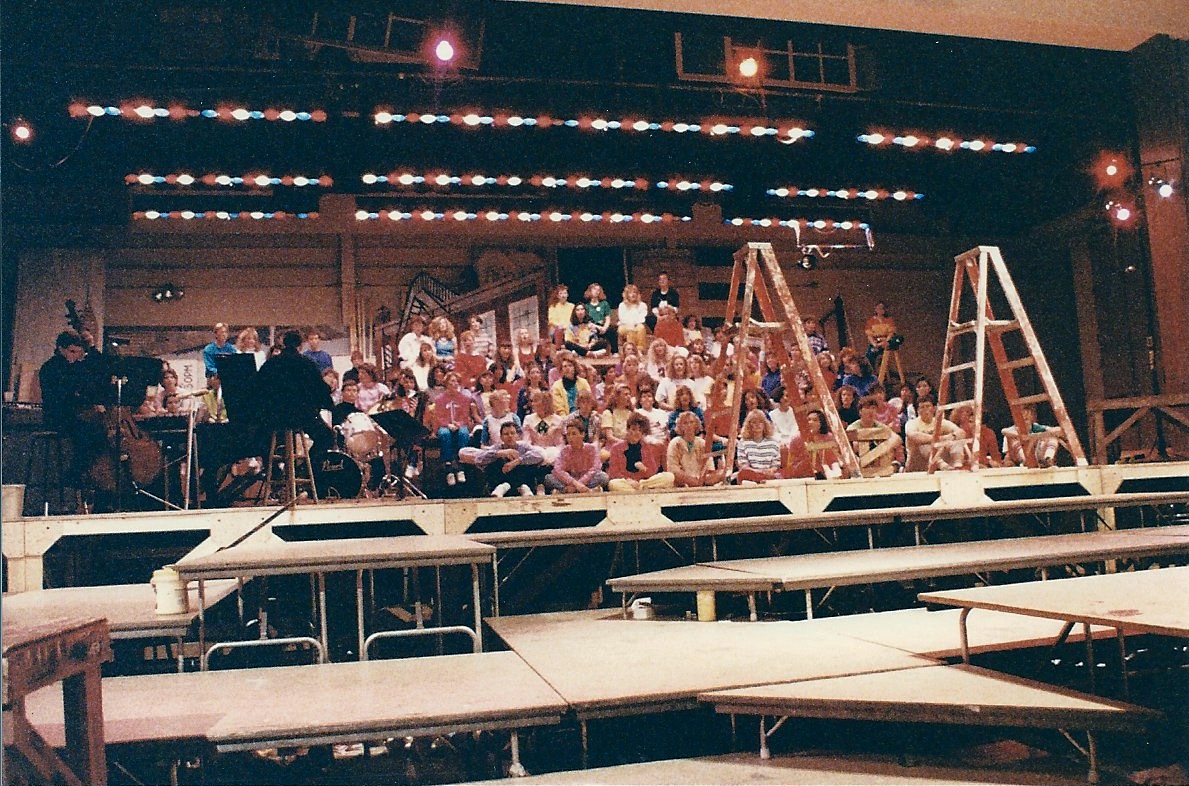
  2. Larger casts place greater demands on the staging director. Be creative in your blocking. Use the middle and side aisles, and build multi-level sets. (A two story set can support upwards of 150 singers for the “Iowa Stubborn” selection in Music Man! A second floor loft would be perfect for Oklahoma!)
  3. Bring the dramatic action on stage closer to the audience by constructing runways, pit ramps or other stage extensions. This also allows for staging a larger cast.
  4. A simpler solution to open up the space and add levels might be to construct a dozen large crates or benches. A low budget production could camouflage band risers.
  5. Supercharge 4 set projection31Adapt several of the song lyrics in the show for adding large choruses. (“Eloquence” from Hello Dolly, for example, can be expanded to have the entire cast enter and interact with the leads.)
  6. For even more color, choreograph these “encores” with a small ensemble of skilled dancers.
  7. Feel free to have the chorus sing several of the leads’ solo selections during the curtain calls.
  8. Be daring! Display your school’s (full size) marching band parading down the aisles for one scene in Music Man! Or use students in the 6th-8th Grade Chorus to sing “Food Glorious Food” in the opening scene of Oliver!
  9. Actively recruit students to try-out for the musical. Secure help from other school staff. For example, ask the football coach to mention the auditions to his players. Nothing will be more flashy (as well as hysterical) than a chorus line of football stars on the front thrust in Hello Dolly!
  10. Do not place limitations on student participation in the spring musical. Some school programs require the prerequisite of enrollment in choral or instrumental classes. The best recruitment of “outside” students to the Music Department may be their involvement and brief “taste” of a musical.
  11. Supercharge 4 south pacific scene1Offer pre-audition rehearsals on the required music, and/or simplify the try-out procedure as much as possible as to not “scare away” less confident students. Since the musical is geared for the entire student body (some of whom do not sing or act on a regular basis), make the try-outs a positive experience for all! Give the students a choice of songs and/or readings, as well as specifics on how to take an audition.
  12. Adopt an active and expanded Student Staff. The goal of quality education is to encourage students towards self-realization. In other words, the show should be “student run” – although selected, taught, and guided by adults. For example, once the scene changes have been rehearsed, the Student Stage Manager should actually call the cues.
  13. Persuade students who plan to major in communications, TV/radio, or theatre to join the student staff. Also, “get the word out” to other students who are not singers or instrumentalists that you have openings for carpenters (set construction), artists (painting), writers (publicity), seamstresses (costumes), etc.
  14. Develop comprehensive job descriptions for each student leadership position: Student Director, Producer, Rehearsal Assistant, Stage Manager, Crew Head, etc. Assign an adult sponsor for overall supervision of each area.
  15. Hold weekly student staff meetings, with student department reports, idea brainstorming, problem solving, and discussions on group morale. Get the students actively involved in the day-to-day operations of publicity, ticket sales, production schedules, etc.
  16. Supercharge 1 dancers3At all practices, Rehearsal Assistants should be placed at every exit (stage left, stage right, pit left, pit right, etc.), and should maintain script cues and warnings in order to call the actors and direct placement of props and sets.
  17. Present a leadership or motivational workshop for the entire company or the student staff alone. Two to three hour sessions are available on time management, teamwork, communications, personal initiative and leadership. Excellent clinicians in this area include Bill Galvin, Michael Kumer, Tim Lautzenheiser, etc.
  18. Announce a weekly S.M.I.L.E. award (“students most interested in leading effectively”) or other special recognition to spotlight extra achievement of individuals in the musical company. Display the winners (photograph and biographical information) on a public bulletin board.
  19. Reward the student cast and crews by sponsoring an all-night (“lock-in”) company party at the school or local restaurant after the final performance. This could turn out to be real incentive for future participation in the shows – a dance, late-night banquet, awards ceremony, swim party, bowling tournament, or a combination of all of these activities. Parents also appreciate a well chaperoned final celebration, instead of (in some cases) totally unsupervised house-to-house parties sponsored by individual students.
  20. Provide other perks for students. Plan field-trips around the community. Advertise the show by singing several selections at a local Women’s Club meeting or Rotary Club breakfast. Take the leads to the local TV/radio talk show, providing an audience for that thirty second “plug” of your show on the airwaves. Or sponsor an in-school theater production clinic (e.g. a make-up application session, underwritten by a local cosmetic firm).
  21. Try to fill your adult staff positions with school staff: shop, art, and English teachers, etc. Who is more knowledgeable and supportive of the students? You can encourage the integration of drama subjects in their curricula: scenery painting (art), costume design (home economics), set construction (wood shop), publicity (journalism/English), etc.
  22. Supercharge 3 costume angels1Establish a parent volunteer grouptheatre angels—to support the students in working on the production crews (costumes, painting, set construction, etc.). Grant the Angels special privileges (early ticket pre-sale) and “Honorary Thespian” status.
  23. Have the Angels man your box office to offer the public regular and varied hours for ticket sales.
  24. Utilize parents to set-up and supervise study halls for those long staging rehearsals. Set aside one room for absolute quiet and a separate waiting area for group study and socialization.
  25. Because of the large cast size, post hall monitors (parents) to assist during the night performances of the show (first aid, distribution of props, overall supervision, etc.).
  26. Hold sign-ups for the Angels during Open House or work through local PTA.
  27. On Saturdays, sponsor staff “cover dish” luncheons to give everyone the chance to interact socially.
  28. Invite a popular school administrator, public official, local actor, or other celebrity to narrate or assist in the show (e.g. the voice in How To Succeed in Business Without Really Trying).
  29. Set out to achieve the illusion of realism in the scenery. Utilize a large student and adult crew of carpenters and build substantial backdrops, wagons, and book pieces to support your larger cast.
  30. Supercharge 1 levels5Rent professional set drawings from theatrical houses (e.g. New Wilmington, PA firm Sceno Graphics).
  31. Ask for help from local professional theater companies (hand-me-down sets, props, or just advice).
  32. Always seek professionalism from the students on the stage. Are all of the actors consistently in character? Adolescents have short attention spans, and as a large chorus, must be coached in displaying real enthusiasm, self-discipline, and accurate characterizations one hundred percent of the time! Nothing is worse than an inanimate or lackluster chorus, talking on or backstage, or other noises that detract from the dramatic action portrayed by the leads.
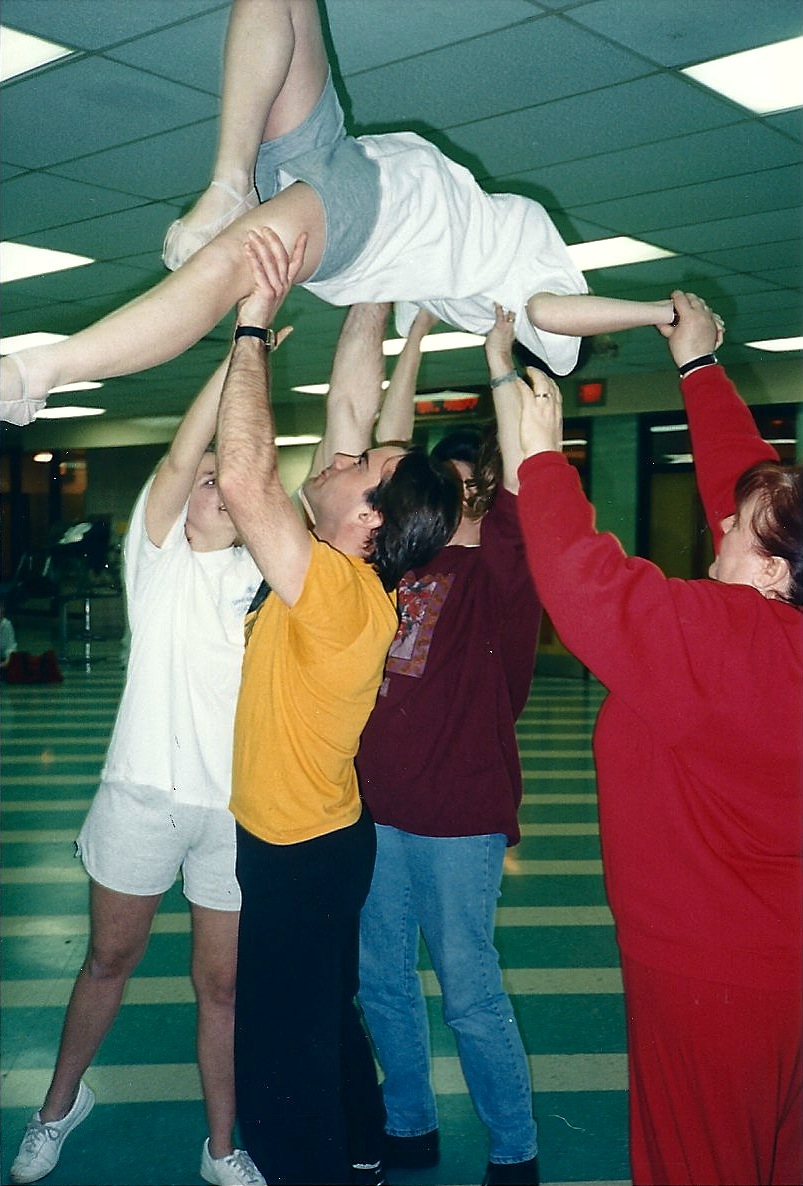
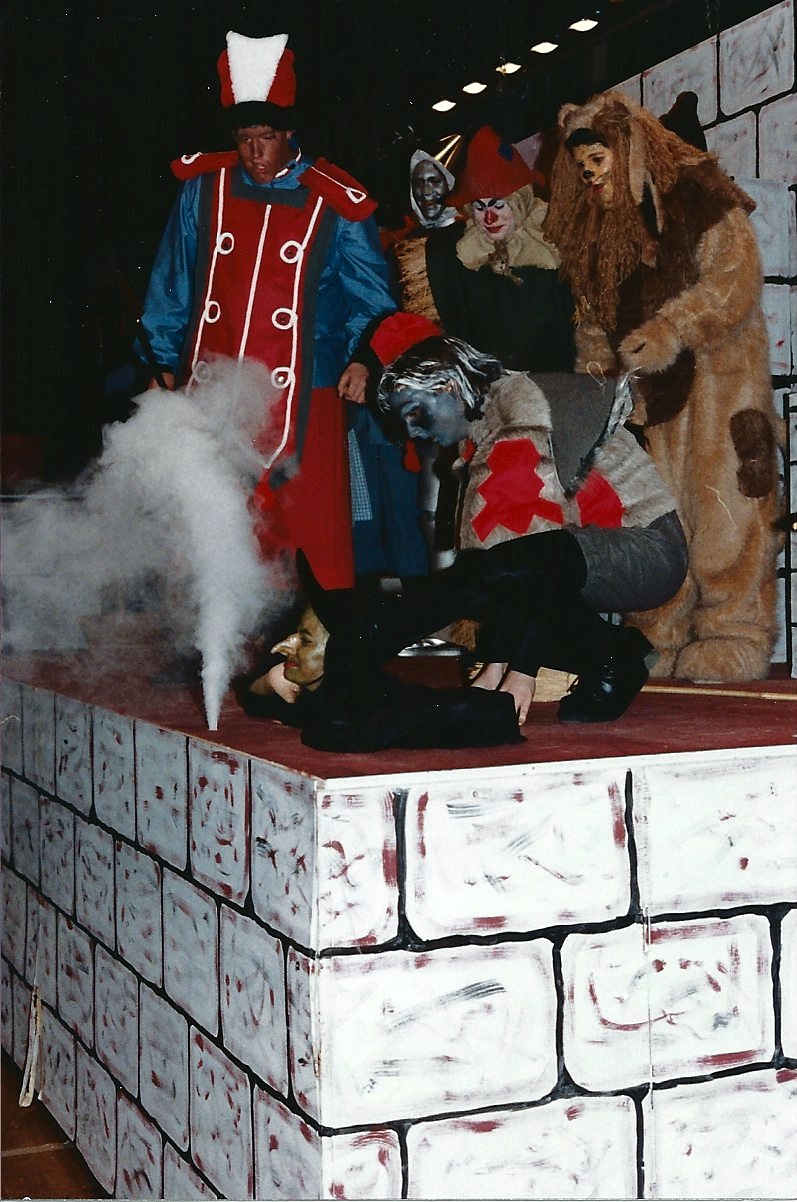
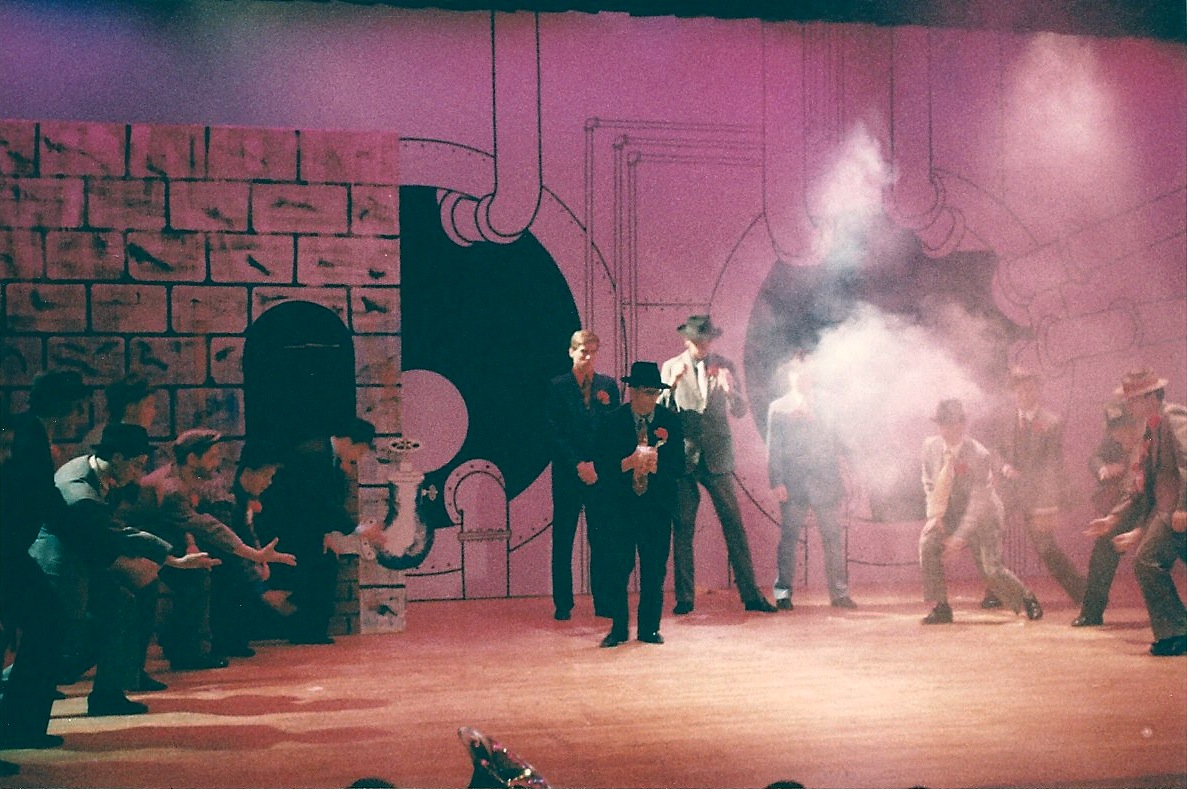
  33. Be imaginative with special effects! Melt a witch (Wizard of Oz) using a trap door and smoke effects. Exaggerate their sizes—a ten foot Fruma Sarah in Fiddler on the Roof can be created by putting your lightest girl on the shoulders of an athletic boy; use a ladder on wheels to present a 14 foot giant (Ghost of Xmas Present) in Scrooge—all hidden by the costume.
  34. Supercharge 4 melting witchSet a fast pace for the show. Avoid those periods of inertia, especially the Act II “doldrums!” Always execute smooth set changes and transitions. Never give the audience time to talk or lose their concentration.
  35. Use theater P.R. firms (e.g. Pioneer Drama Service) to buy official logos, posters, buttons and publicity packets.
  36. Design an official show t-shirt and button. Announce musical t-shirt days and give out random cash prizes to students who remember to wear their t-shirt and serve as a walking billboard!
  37. Sponsor a musical trivia contest. Create a crossword puzzle and publish it in the PTA newsletter.
  38. Type-set and distribute a special musical issue of the school newspaper (e.g. an “Anatevka Times” for Fiddler on the Roof) in order to devote space on the background of the play, local historical “splash-backs” in the time period of the musical, and a picture album of the cast and crews.
  39. Insert a theater flyer in the school district or PTA newsletter mailed home to residents. Print informative articles about the play (Hammerstein anecdotes for South Pacific or Oklahoma, etc.)
  40. Sponsor an elementary school art contest (e.g. draw your Little Orphan Annie).
  41. Supercharge 4 special effect smokeDevelop a partnership with your local merchants. Print pizza box advertisements, restaurant place mats, etc. Place messages on mall marquees, store magnetic signs, and in employee newsletters. In exchange for local business help in promoting your show, sponsor a special “employee discount” on tickets.
  42. Make clever P.A. announcements using the leads and adaptations of the script.
  43. Plan a pre-sale ticket lottery to determine the order students in the cast and crews can go to the box office to purchase their reserve seat admissions. This generates excitement and actually helps to sell additional tickets!
  44. Sponsor a school staff appreciation breakfast (donuts and coffee) thanking everyone for their support of the musical. At the breakfast, pass out ticket vouchers (two complimentary tickets) to the teachers.
  45. Help formulate creative school cafeteria menus using musical themes (e.g. “Wicked Witch” stew, “Jiggerbug Juice,” and “Toto’s Favorite Burgers”).
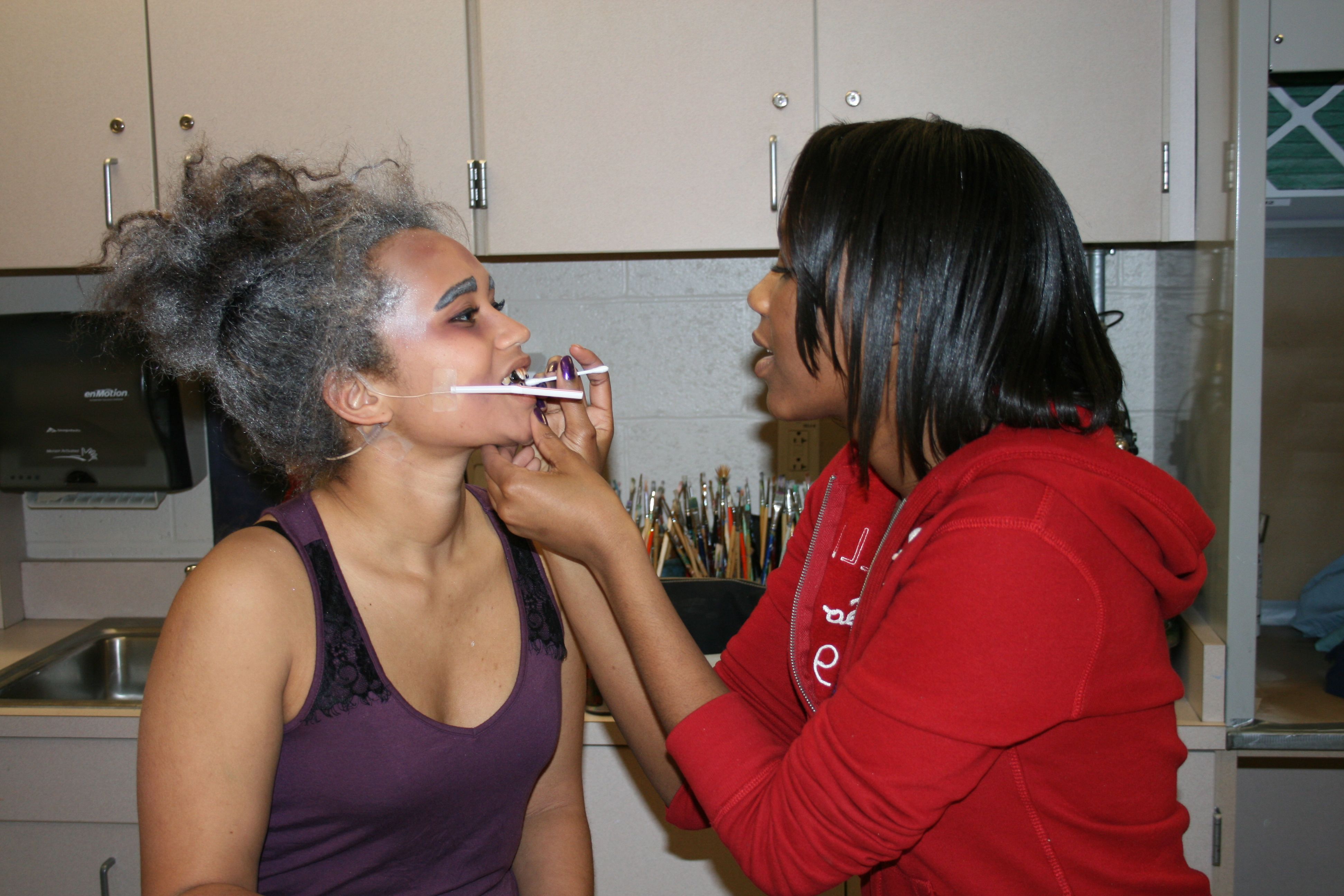
  46. Supercharge 4 makeup bloody mary1Schedule an in-school theatre education assembly for younger students. Give a short synopsis of the musical and demonstrate several scene changes, technical effects and lighting, application of character make-up, and several dances or songs from the current show (make sure you retain the rights to do a segment of the musical!).
  47. After the final dress rehearsal, sponsor a picture taking session for the parents. Actors can pose in costume and in front of the finished sets. The taking of photographs or audio/visual recording during the show is illegal!
  48. Construct an attractive hall display of cast and crew photographs, “Music In Our Schools Month” materials, etc. Always include a photographic history of the evolution of sets in construction, and the student names in the company.
  49. Designate one performance as children’s night. Offer it one hour earlier (on a school night), and provide a special discount for children ages 12 and under, as well as backstage tours of the scenery, spotlights, soundboard, costume room, autographs from the leads, etc.
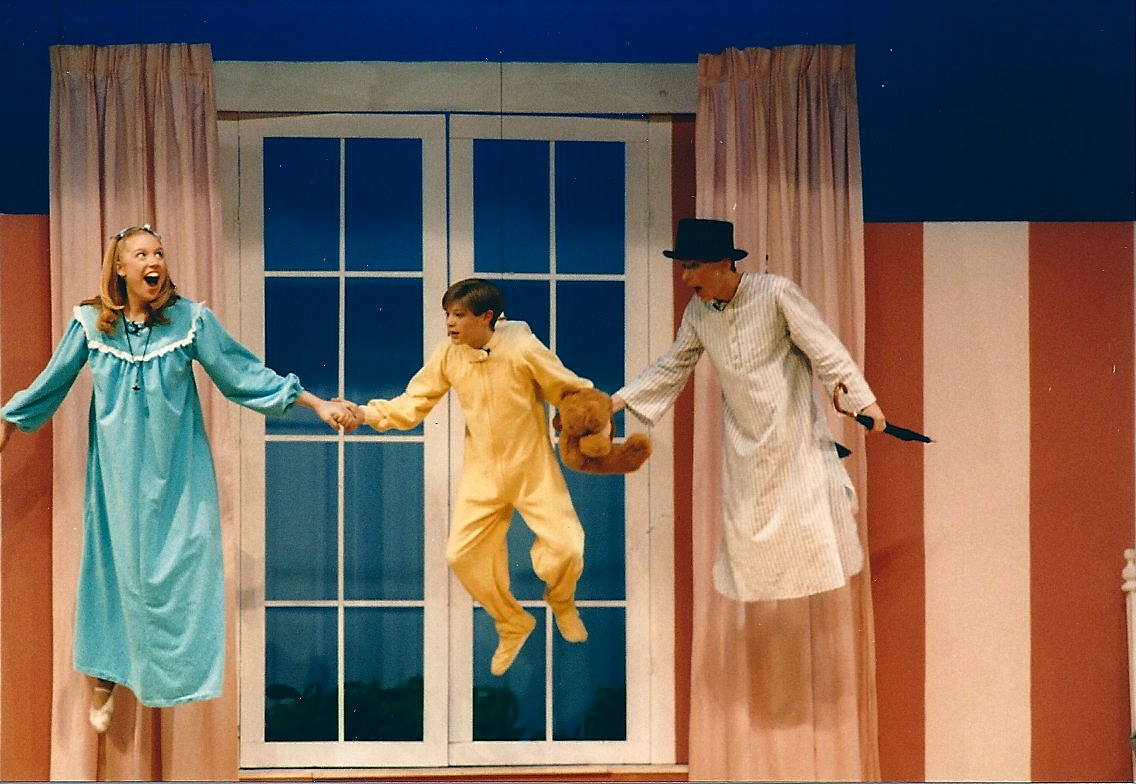
  50. Dedicate each performance of the show to a special adult contributor to the school music and theatre program. Invite the Supercharge 4 special effect flyinghonored guest to the pre-show cast meeting, and send him/her several free tickets. Announce the dedication on the P.A. before the Overture, and post it on the hall display in the auditorium lobby.
  51. Find a P.R. “hook” – something that might interest the media – such as sponsoring Annie “dog auditions” or twins casted in dual roles. Send a new press release to the media every two weeks.
  52. Print the musical performance dates on the computerized student report cards and school district payroll checks. Use inter-office mail to send personal invitations to all of the teachers. Be sure to list the names of the cast – teachers will be interested in coming up to see their former students.
SUMMARY: Concepts to Consider—BUILD is the Operative Word!
  • Involvement of greater numbers of students and parents will build audiences and community support.
  • Presentation of a quality production with student leadership and supplemental activities will build student enthusiasm and appreciation of the inherent “value” of theatre in school.
  • Finding the confidence to take risks and build on your own creativity—go ahead and adapt the score, script, set designs and staging to utilize your schools’ resources.
  • The allocation of ample time to publicity and promotional activities will build community awareness, attendance and EXCITEMENT in support of the show!
SAMPLE RESOURCES: Companies, Books, Sites

PKF

© 2015 and 2020 Paul K. Fox

Criteria for Selection of the “Ideal” Teacher Candidate

“A good teacher can inspire hope, ignite the imagination, and instill a love of learning.”    – Brad Henry

Standards and Benchmarks of Top-Rated Educators in Music and Other Academic Subjects

OLYMPUS DIGITAL CAMERA

The best way to prepare for a job interview is to become aware of how you will be judged in comparison with your peers. What are the standards (or behaviors or criteria) of outstanding teachers? For what are administrators looking to fill the vacancies and build/maintain a quality staff?

Interviews will sort out (and rank) the competencies, certifications, education levels, and overall experience of the candidates. Obviously, mastery of subject content and teaching methods will be evaluated. However, you may be surprised that significant focus will be placed on personality traits, social skills, and evidence of personal drive, reliability, versatility, vision, and habits of professionalism.

In short, you may be the best musician this side of the Mississippi, the “model lesson planner,” and can conduct Orff’s Carmina Burana or Shostakovich‘s Festive Overture blindfolded, but if you cannot inspire students, work with coworkers, and communicate effectively, your interview and chances for being hired are doomed from the start.

Adapted from David Berliner and William Tikunoff, “The California BTES: Overview of the Ethnographic Study,” effective teachers score high on…

  • Accepting
  • Adult involvement
  • Attending
  • Consistency of message
  • Conviviality
  • OLYMPUS DIGITAL CAMERACooperation
  • Student engagement
  • Knowledge of subject
  • Monitoring learning
  • Optimism
  • Pacing
  • Promoting self-sufficiency
  • Spontaneity
  • Structuring

Effective teachers score low on…

  • Abruptness
  • Belittling
  • Student defiance
  • Counting hours or “clock punching”
  • Illogical statements
  • Mood swings
  • Oneness (treats whole group as “one”)
  • Recognition-seeking

In previous blogs (e.g. https://paulkfoxusc.wordpress.com/2015/07/01/the-meaning-of-pro/), I have defined the qualities of a “professional.” How many of these traits do you model?

  • Succeeded in and continues to embrace “higher education”
  • Updates self with “constant education” and retooling
  • Seeks change and finding better ways of doing something
  • Like lawyers/doctors, “practices” the job; uses different techniques for different situations
  • Accepts criticism (always trying to self-improve)
  • Proposes new things “for the good of the order”
  • interview-1238367Can seemingly work unlimited hours (24 hours a day, 7 days per week)
  • Is salaried (does not think in terms of hourly compensation, nor expects pay for everything)
  • Is responsible for self and many others
  • Allows others to reap benefits and credits for something he/she does
  • Has obligations for communications, attending meetings, and fulfilling deadlines
  • Values accountability, teamwork, compromise, group goals, vision, support, creativity, perseverance, honesty/integrity, fairness, and timeliness/promptness
  • Accepts and models a corporate standard of behavior and appearance

It is worth reading “Weigh In: What Makes a Great Teacher” by Jacqueline Heinze in the Winter 2011 issue of Administr@tor Magazine (see http://www.scholastic.com/browse/article.jsp?id=3755567). Among the numerous responses were these notable quotes:

  • “A great teacher must be resilient.”
  • “Great teachers are instructional leaders and curriculum designers.”
  • “Great teachers love what they do and perceive teaching as their calling.”
  • “Great teachers are empathetic and engaged.”

Also check out these websites for additional insight on the characteristics of a exemplary educator:

students-1460768Since the process of teacher selection in the public schools involves recruitment, screening, hiring, placement, induction, and evaluation, it is advisable for prospects to know the assessment practices already in place. According to the Pennsylvania Department of Education, Pennsylvania has adopted The Framework for Teaching as the overarching vision for effective instruction in the Commonwealth.

The Framework for Teaching is written by Charlotte Danielson, an internationally-recognized expert in the area of teacher effectiveness specializing in the design of teacher evaluation systems that, while ensuring teacher quality, also promote professional learning.

The introduction to The Framework of Instruction Evaluation Instrument 2013 states its purpose:

“The Framework for Teaching identifies those aspects of a teacher’s responsibilities that have been documented through empirical studies and theoretical research as promoting improved student learning. While the Framework is not the only possible description of practice, these responsibilities seek to define what teachers should know and be able to do in the exercise of their profession.” – Charlotte Danielson

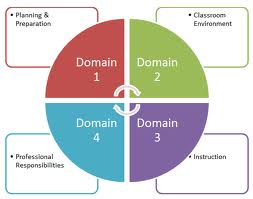
The model focuses the complex activity of teaching by defining four domains of teaching responsibility:

  1. Planning and Preparation
  2. Classroom Environment
  3. Instruction
  4. Professional Responsibilities

The domains can be further broken down into…

danielsons_image_dom1-4

Domain 1: Planning and Preparation

  • 1a Demonstrating Knowledge of Content & Pedagogy
  • 1b Demonstrating Knowledge of Students
  • 1c Setting Instructional Objectives
  • 1d Demonstrating Knowledge of Resources
  • 1e Designing Coherent Instruction
  • 1f Designing Student Assessments

Domain 2: Classroom Environment

  • 2a Creating an Environment of Respect and Rapport
  • 2b Establishing a Culture for Learning
  • 2c Managing Classroom Procedures
  • 2d Managing Student Behavior
  • 2e Organizing Physical Space

Domain 3: Instruction

  • 3a Communicating with Students
  • 3b Using Questioning and Discussion Techniques
  • 3c Engaging Students in Learning
  • 3d Using Assessment in Instruction
  • 3e Demonstrating Flexibility and Responsiveness

inside-a-class-room-school-1435436Domain 4: Professional Responsibilities

  • 4a Reflecting on Teaching
  • 4b Maintaining Accurate Records
  • 4c Communicating with Families
  • 4d Participating in a Professional Community
  • 4e Growing and Developing Professionally
  • 4f Showing Professionalism

Many Pennsylvania districts assess their professional staff and verify their teacher’s professional growth via rubrics or other evaluative tools, as well as the collection of artifacts that support these domains. Archives of these “best practices” would be assembled in portfolios for the principal’s year-end review (samples printed in blue below are possible artifacts for music educators in particular):

Domain 1: Planning

  • Assessment Tools
  • Lesson Plans
  • New Curriculum Innovations
  • Personal/Professional Goals
  • Music Repertoire/Program Lists
  • Subject Outlines

Domain 2: Classroom Environment

  • Audio-Visual Resources Including Recordings
  • Formal Observations
  • Informal Observations
  • PowerPoint Presentations
  • Sample Classroom Displays/Bulletin Boards

Domain 3: Instruction

  • Arrangements (Teacher Composed)
  • Conferences with Colleagues/PLCs/Teams
  • Meetings with Mentors/Curriculum Leaders/Principals
  • Printed Concert, Musical, Drama, or Recital Programs
  • pencils-1240400Sample Homework and Worksheets
  • Student Composed Music/Lyrics/Exercises
  • Warmup Drills and Style/History Handouts

Domain 4: Professionalism

  • Act 48 Clinics and Workshops
  • Congratulatory Notes from Parents/Staff
  • Grade Books and Attendance Records
  • Letters/Newsletters Sent Home
  • Minutes of Department Meetings
  • Professional Development Programs
  • Student Recommendations
  • Student Records

Individual school districts define their own “vision of a model teacher,” aligning the selection criteria with the goals of the school system and the needs of the individual schools. For example, Upper St. Clair School District (an Allegheny County public school system located in southwestern Pennsylvania, and where I worked 33 years as music educator and seven years as Performing Arts Curriculum Leader) adopted the following Assessment Criteria for Teacher Candidates (developed by Superintendent Dr. William Pope, Human Resource Director Ms. Jean Toner, and other staff). “In a nutshell,” these are what USC calls “core behaviors” or standards of personality traits, skills, and knowledge, and serve as categories for assessment of all job applicants during the interview process:

Instructional

  • Educational Philosophy
  • Knowledge/Experience
  • Classroom Management
  • Technology
  • Oral Expression
  • Written Communications

college-1241412Professional

  • Leadership
  • Teamwork
  • Judgment
  • Problem Solving
  • Planning & Organizing
  • Innovation

Personal

  • Initiative
  • Dependability
  • Adaptability
  • Self-Insight and Development
  • Energy and Enthusiasm
  • Appearance

My next blog on this subject will provide examples of music teacher interview questions for each of the above criteria… suitable for individual practice or group mock interview sessions, and to assist in the formulation of stories/anecdotes that would support a candidate’s mastery of each standard. The importance of this preparation is explored in a previous blog: https://paulkfoxusc.wordpress.com/2015/08/02/when-it-comes-to-getting-a-job-s-is-for-successful-storytelling/.

PKF

© 2015 Paul K. Fox

This post is featured by Twinkl in their ‘Teaching Writing’ blog.

Arts Advocacy – Everyone’s Job!

“If it is to be, it is up to me.” – William H. Johnsen

Can you imagine if there was only enough money in the education budget for one subject to be taught in school? What would it be?

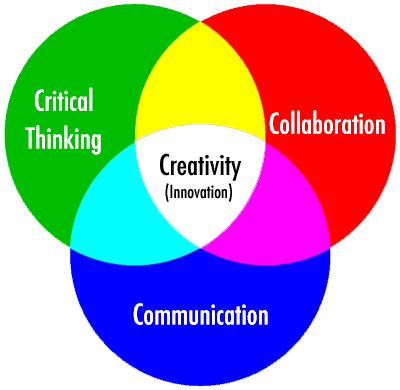
The education of the “whole child” to acquire 21st Century learning skills, with an emphasis on the “Four C’s” – Creativity, Critical thinking, Communications, and Collaboration – is essential to the success of every child, and paramount for the future continuation of arts and creative self-expression throughout the world. This mandates equal-access to quality learning of rigorous curricula, offered to all students enrolled in courses of Fine and Performing Arts, English, Math, Science, World Language, Social Studies, and Physical Education.

4cs-venn

(For an interesting set of articles detailing the above Venn diagram on the four C’s of 21st Century learning skills, see Margo Tripsa’s “Techie Teachers’ Tricks,” beginning with http://techieteacherstricks.com/2013/06/30/the-4-cs-critical-thinking/.)

Why the Arts?

An education in the arts benefits society because students of music, art, dance, and drama gain powerful tools for:

  • Understanding human experiences, both past and present;
  • Teamwork and collaboration;
  • Making decisions creatively when no prescribed answers exist;
  • Learning to adapt to and respect others’ (diverse) ways of thinking, working, and expressing themselves;
  • Learning problem recognition and problem solving, involving expressive, analytical, and developmental tools to every human situation (that is why we speak, for example, of the “art” of teaching or the “art” of politics);
  • Understanding the influence of the arts and their power to create and reflect cultures, the impact of design on our daily life, and in the interdependence of work in the arts with the broader worlds of ideas and action;
  • Developing the essential senses of sight, hearing, smell, taste, touch, and kinesthetics as intellectual, emotional, physical, creative, and expressive acts;
  • Analyzing nonverbal communication and making informed judgments about cultural products and issues;
  • Communicating effectively.

The “Whole Child” Approach to Education

All of us should already be on board promoting the concepts of “whole child” education in the public schools:

“The demands of the 21st century require a new approach to education to fully prepare students for college, career, and citizenship. Research, practice, and common sense confirm that a whole child approach to education will develop and prepare students for the challenges and opportunities of today and tomorrow by addressing students’ comprehensive needs through the shared responsibility of students, families, schools, and communities.” – ASCD Whole Child Education Initiative http://www.wholechildeducation.org/about/

wholechild-left

Launched in 2007, ASCD’s Whole Child Initiative was an effort to “change the conversation about education from a focus on narrowly defined academic achievement to one that promotes the long term development and success of children.”

My favorite tenets of “whole child” education are the following principles:

  • Each student has access to personalized learning…
  • Each student is actively engaged in learning and is connected to the school and broader community.
  • Each student is challenged academically…

Sounds a lot like the need for an education in the arts, right?

Need More Rationale?

21stcentury

The Partnership for 21st Century (P21) movement (see www.apple.com/education/docs/Apple-P21Framework.pdf) affirmed what prospective employees are seeking from graduates and others entering the work force –  21st Century learning skills, as well as an authentic work experience and achievement in and appreciation of the values of focus/attention, goal setting, perseverance, self-discipline, and cooperation. Would it surprise you that at every job interview in my life, I was never asked for the results of my SAT scores? For blue-collar and professional jobs alike, credentials/certification and past work/school history are important, but more than anything else, managers and “the big boss” want to know a job applicant’s record of absenteeism and tardiness, and if the candidate can take instruction, solve problems, innovate, communicate, and work well with others.

Where else but in the arts can students receive this exposure to and opportunities to explore and practice the work-related skills of communications and collaboration, and the thinking skills of critical thinking, problem solving, and creativity? You owe it to yourself to check out this more detailed layout:  P21 Arts Map.

If you have not viewed Sir Ken Robinson’s presentation of creativity in education, stop everything right now and go to one of these links:

Read my main page (above) for additional resources on Creativity in Education – Are We Ready for a New Paradigm Shift?

Also, it is worth perusing these sites:

How can you argue with all of this research?

Get Involved!

I find it amusing (albeit appropriate) that on my iPhone, Siri first translated “arts advocacy” as “arts have a good seat.”

There is a great need for arts advocates, and that means absolutely everybody… retired educators, current teachers, future/prospective employees of schools, students, parents, relatives of children attending school, and taxpayers who don’t have anyone enrolled in the public, private, or charter schools.

Politics is a numbers game. Your state legislators need to know that you care about education and the arts as priorities – justifying and finding more revenue and resources for music and art education. In addition, with all of the focus on high-stakes standardized tests and the Common Core (and very limiting) subjects, now more than ever, we all need to reach out to our elected officials and make our voices heard (above all of the din!). Yes, the arts do make a difference, but no one will know that unless you tell the decision-makers!

pmea

Now, here’s something you can do right now! If you reside in Pennsylvania, go to the advocacy section of the Pennsylvania Music Educators Association website: http://www.pmea.net/specialty-areas/advocacy/. If you need to find your particular legislator to send the letter/e-mail, first visit this website: http://www.legis.state.pa.us/cfdocs/legis/home/findyourlegislator/. If you feel strongly about the importance of arts education, your letter (the sample posted or something like it) should urge our elected officials to:

  1. Increase the basic education subsidy.
  2. Enact a fair funding formula.
  3. Restore the Pennsylvania Department of Education Arts Education Liaison for the curricular areas of music, visual art, theater, dance, and media arts.

(This process can be duplicated in a similar manner for every state in the union. Music and art programs are being cut daily!)

Don’t put this off! When was the last time you devoted a little time to express your opinion directly to your state representative? Didn’t we elect and charge them with the responsibility to do what is right for our educational programs and children? Music and art education needs your help NOW!

PKF

© 2015 Paul K. Fox

The “Alphabet Soup” of Educational Acronyms

“Learning never exhausts the mind.” – Leonardo da Vinci

pmeaArticle submitted for future publication in PMEA News – the state journal of the Pennsylvania Music Educators Association

foxpaws_logo

Preparing for an employment interview? Looking for that first job or interested in transferring to a new school district?

How well do you know current trends, key “buzz words,” and jargon in education? Even though no music teacher would have trouble identifying the meaning of our own abbreviations like D.C. al Coda or GM (G Major or General Music), administrators would expect that you know relevant and evolving general education terms, such as the following:

  • The Common Core
  • Customization and Differentiation of Instruction
  • The Four Cs – Creativity, Collaboration, Communication and Critical Thinking (21st Century Learning Skills)
  • Flipped Classrooms and Blended Schools
  • HOTS – Higher Order Thinking Skills and DOK – Depth of Knowledge
  • Assessments – Diagnostic, Formative, Summative, Authentic
  • PDE (Pennsylvania Department of Education) SAS (Standards Aligned Systems) Portal
  • UBD (Understanding By Design) Curriculum Development with EU (Enduring Understandings) and EQ (Essential Questions)

Keeping up with the formation of new acronyms is quite a challenge… something you will have to do throughout your entire career. Get started by looking up any of these with which you feel unfamiliar. You can never predict when one of these will pop-up at a job interview!

Just for the fun and the challenge of it, try taking this crossword puzzle. For a printable copy of this article, full-size puzzle grid, clues, the answers and definitions, click on the link at the bottom of the page. Enjoy! PKF

 puzgrid1

Across

1. A multi-tier approach to the early identification, intervention, and support of students with learning and behavioral needs.
3. Statements summarizing important ideas and core processes that are central to a discipline and have lasting value beyond the classroom – what students should understand – not just know or do.
4. A web-based resource for districts/schools to communicate performance results to various constituencies and assist districts and schools in aligning and focusing resources for continuous improvement.
7. A psychiatric disorder in which there are significant problems of attention hyperactivity or acting impulsively that are not age-appropriate.
8. Standards-based, criterion-referenced assessment used to measure a student’s attainment of the academic standards in reading, writing, math, and science.
10. Staff or programs to facilitate the acquisition of English language skills of students whose native or first language is not English.
11. Framework of study in science, technology, engineering, arts, in mathematics, bridging the gap between business and educational goals, and blending of science, the arts, and creativity in school.
13. A comprehensive, researched-based resource identifying six elements for improvement of student achievement developed by the Pennsylvania Department of Education.
15. Developed by Norman L. Webb, the complexity or depth of understanding required to answer or explain an assessment-related item.

Down

2. A customized statement of a child’s present level of performance, annual educational goals, modifications, accommodations, and special education supports and services to meet these goals.
5. A statistical analysis of Pennsylvania state assessments of growth and achievement data, allowing educators to make data-informed instructional decisions to promote student progress.
6. Using a backwards-design focus on the outcomes in order to design curriculum units, a tool utilize for educational planning in “Teaching for Understanding,” advocated by Jay McTighe and Grant Wiggins.
8. An extended learning opportunity such as a grade-level teaching team or a school committee form to foster collaborative learning among colleagues in order to improve student achievement.
9. Statewide nonprofit organization of over 4500 members, dedicated to promoting the musical development of all Pennsylvania residents, your number one professional development resource.
12. Inquiries focusing on the key concepts in the curriculum, the big ideas and core content, provoking deep thought, lively discussion, and new understanding as well as more questions.
14. A process to document a measure of educator effectiveness based on student achievement of content standards developed for Pennsylvania’s new Educator Effectiveness System.

Click here: Alphabet Soup Educational Acronyms puzzle with answers

Terms used in alphabetical order

ADHD…………. Attention Deficit Hyperactivity Disorder: A psychiatric disorder in which there are significant problems of attention, hyperactivity, or acting impulsively that are not age-appropriate.

DOK……………. Depth of Knowledge: Developed by Norman L. Webb, the complexity or depth of understanding required to answer or explain an assessment related item.

EQ………………. Essential Questions (UBD): Inquiries focusing on the key concepts in the curriculum, the big ideas and core content, provoking deep thought, lively discussion, and new understanding as well as more questions.

ESL……………… English as a Second Language: Staff or programs to facilitate the acquisition of English language skills of students whose native or first language is not English.

EU………………. Enduring Understandings (UBD): Statements summarizing important ideas and core processes that are central to a discipline and have lasting value beyond the classroom—what students should understand—not just know or do.

IEP………………. Individualized Education Program: A customized statement of a child’s present level of performance, annual educational goals, modifications, accommodations, and special education supports and services to meet these goals.

PLC…………….. Professional Learning Communities: An extended learning opportunity such as a grade-level teaching team or a school committee formed to foster collaborative learning among colleagues in order to improve student achievement.

PMEA………….. Pennsylvania Music Educators Association: Statewide nonprofit organization of over 4,500 members, dedicated to promoting the musical development of all PA residents – your number one professional development resource.

PSSA…………… Pennsylvania System of School Assessment: Standards-based, criterion-referenced assessment used to measure a student’s attainment of the academic standards while also determining the degree to which school programs enable students to attain proficiency.

PVAAS………… Pennsylvania Value Added Assessment System: A statistical analysis of PA state assessments of growth and achievement data, allowing educators to make data-informed instructional decisions to promote student progress.

RTI……………… Response to Intervention: A multi-tier approach to the early identification, intervention, and support of students with learning and behavioral needs.

SAS…………….. Standards Aligned Systems: A comprehensive, researched-based resource identifying six elements for improvement of student achievement developed by the Pennsylvania Department of Education.

SLO…………….. Student Learning Objectives: A process to document a measure of educator effectiveness based on student achievement of content standards developed for Pennsylvania’s new Educator Effectiveness System.

SPP……………… School Performance Profile: A web-based resource for districts/schools to communicate performance results to various constituencies and assist districts and schools in aligning and focusing resources for continuous improvement.

STEAM……….. Science, Technology, Engineering, Arts, Mathematics: Framework of study in science, technology, engineering, arts, and mathematics, bridging the gap between business and educational goals, and blending of science, the arts, and creativity in school.

UBD   Understanding By Design: Using a backwards-design focus on the outcomes in order to design curriculum units, a tool utilized for educational planning in “teaching for understanding” advocated by Jay McTighe and Grant Wiggins.

© 2015 Paul K. Fox