
Digest of Resources for Pre-Service Music Teachers
Acknowledgments: Special thanks for the contributions of Blair Chadwick and Johnathan Vest, who gave me permission to share information verbatim from their PowerPoint presentation, and to John Seybert (formerly of Seton Hill University), Ann C. Clements, Robert Gardner, Steven Hankle, Darrin Thornton, Linda Thornton, and Sarah Watt (Penn State University), Dr. Rachel Whitcomb (Duquesne University), and Robert Dell (Carnegie-Mellon University).
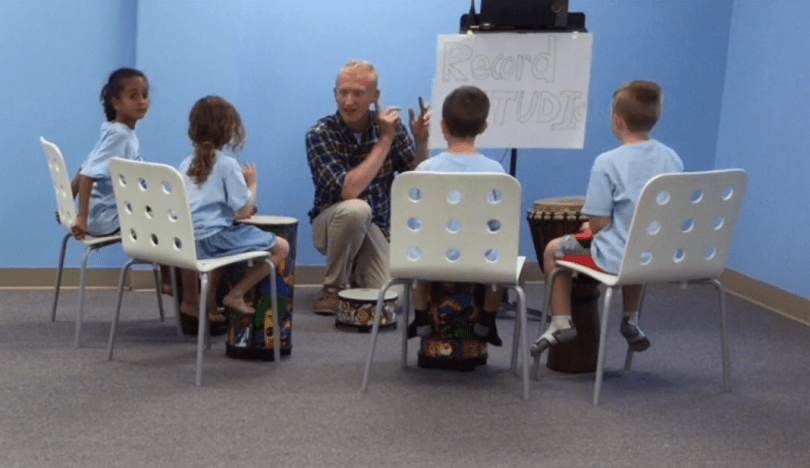
Photo credits: David Dockan, my former student, graduate of West Virginia University, now Choir Director / Music Teacher at JEJ Moore Middle School in Prince George, VA.
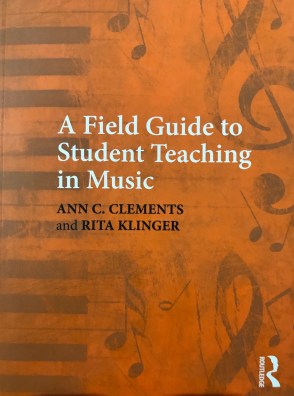 If you are not fortunate enough to own a copy of A Field Guide to Student Teaching in Music by Ann. C. Clements and Rita Klinger (which I heartily recommend you go out and buy, beg, borrow, or steal), this blog provides a practical overview of field experiences in music education, recommendations for the preparation of all music education majors, and a bibliographic summary of additional resources. Representing that most critical application of in-depth collegiate study of music education methods, conducting, score preparation, ear-training, and personal musicianship and understanding of pedagogy on voice, piano, guitar, and band and string instruments, the student teaching experience provides the culminating everyday “nuts and bolts” of effective music education practice in PreK-12 classrooms.
Possibly the best definition of “a master music teacher” and the process for “hands-on” field training comes from the Penn State University handbook, Partnership for Music Teacher Excellence: A Guide for Cooperating Teachers, Student Teachers, and University Supervisors.
“The goal of the Penn State Music Teacher Education Program is to prepare exemplary music teachers for K-12 music programs. Such individuals can provide outstanding personal and musical models for children and youth and have a firm foundation in pedagogy on which to build music teaching skills. Penn State B.M.E. graduates exhibit excellence in music teaching as defined below.”
“As PERSONAL MODELS for children and youth, music teachers are caring, sensitive individuals who are willing and able to empathize with widely diverse student populations. They exhibit a high sense of personal integrity and demonstrate a concern for improving the quality of life in their immediate as well as global environments. They establish and maintain positive relations with people both like and unlike themselves and demonstrate the ability to provide positive and constructive leadership. They are in good mental, physi
cal, and social health. They demonstrate the ability to establish and achieve personal goals. They have a positive outlook on life.”
“As MUSICAL MODELS, they provide musical leadership in a manner that enables others to experience music from a wide variety of cultures and genres with ever-‐‑increasing depth and sensitivity. They demonstrate technical accuracy, fluency, and musical understanding in their roles as performers, conductors, composers, arrangers, improvisers, and analyzers of music.”
“As emerging PEDAGOGUES, they are aware of patterns of human development, especially those of children and youth, and are knowledgeable about basic principles of music learning and learning theory. They are able to develop music curricula, select appropriate repertoire, plan instruction, and assess music learning of students that fosters appropriate interaction between learners and music that results in efficient learning.” — Penn State University School of Music
Making a smooth transition from “music student” to “music teacher” requires a focus on four goals:
- Preparation to your placement in music education field assignments
- Understanding of the relationships between your cooperating teacher(s) and the university supervisor (and you!) and promotion of positive communications
- Adjusting to new environments
- Development of professional responsibilities
As mentioned before, details of these should be reviewed in a reading of the introduction to A Field Guide to Student Teaching in Music by Ann. C. Clements and Rita Klinger.
Not to “toot my own horn,” but you are invited to peruse my past blogs on this subject:
- Transitioning from Collegiate to Professional – Part I
- Transitioning from Collegiate to Professional – Part II
- Transitioning from Collegiate to Professional – Part III
Observations
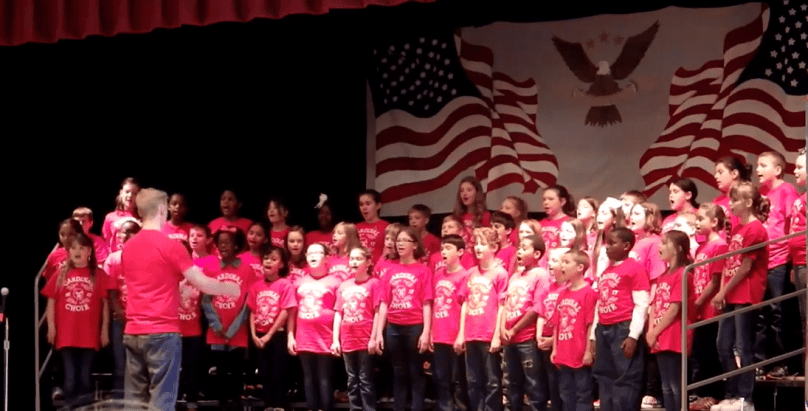
“Take baby steps,” they say? Before your college music education professors release you to direct a middle school band, teach a general music class, or rehearse the high school choir, you will be asked to observe as many music programs as possible.
My advice to all pre-service teachers is, regardless of your formal assignments by your music education coordinator, try to find time to observe a multitude of different locations, levels, and socioeconomic examples of music classes. Do not limit yourself to those types of jobs you “think” you eventually will seek or be employed:
- Urban, rural, and suburb settings in poor, middle, and upper-middle socioeconomic areas
- Large and small school populations
- Both private and public school entities
- Elementary, middle, and high school grades
- General music, tech/keyboard, guitar, jazz, band, choral, and string classes
- Assignments as different from your own experiences in music-making
Ann Clement and Rita Klinger make the distinction between simply observing and analyzing what you see:
“Observation is a scientific term that means to be or become aware of a phenomenon through careful and directed attention. To observe is to watch attentively with specific goals in mind. Inference is the act of deriving logical conclusions from premises known or assumed to be true. Inference is the act of reason upon an observation. A good observation will begin with pure observation devoid of inference. After an observation of the phenomenon being studied has been completed, it is appropriate to infer meaning to what has been observed. Adding inference after an observation completes the observation cycle — making it a meaningful observation.” — A Field Guide to Student Teaching in Music
Some tips (from Student Teaching in Music: Tips for a Successful Experience by Blair Chadwick and Dr. Johnathan Vest):
- Have a specific goal for the observation in mind before you begin
- Make copious notes, but don’t write down everything.
- Write down techniques, quotes, musical directions or teacher behaviors that seem important.
- Don’t be overly critical of your master or cooperating teacher during the observation process. Remember, they are the expert, you are the novice. Your perspective changes when you are in front of the class.
- Hand-write your notes. An electronic device, although convenient, is louder and can provide distraction for the teacher and students, and you. Write neatly so you can transcribe the notes later.
- An small audio recorder can be very useful in case you want to go back and hear something again.
It is appropriate to mention something here about archiving your notes and professional contacts. It is essential that you organize and compile all of the data as you go along… catalog the information in your “C” files (don’t just stuff papers in a drawer somewhere):
- Contacts (cooperating/master teachers and administrators’ phone/email addresses)
- Course work outlines and class observation journals
- Concerts (your own solo and ensemble literature and school repertoire)
- Conferences (session handouts, programs)
Why is this important? Don’t be surprised if/when you are asked to teach in a specialty or grade level outside your “major emphasis,” and you want to find that perfect teaching technique or musical selection previously observed that would be a help in your lesson.
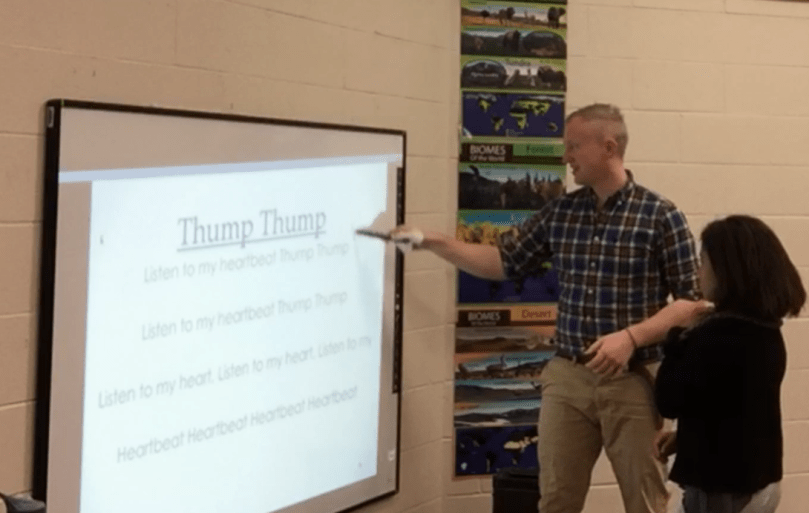
Student Teaching
The success of the student teaching experience depends on all its parts working together. They include:
- The Student Teacher
- The Cooperating Teacher
- The University Supervisor
- The Students
- The Administration and other teachers and personnel in the building
First, check out your university’s guidelines (of course), but here are “The Basics.”
- Punctuality (Early = on time; On time = late; Late = FIRED)
- Dress and Appearance: Be comfortable yet professional. Be aware of a dress code if one exists, as well as restrictions on tattoos, piercings, and long hair length (gentlemen.)
- Parking/Checking-In: Know this information BEFORE your first day
- Materials and Paperwork: Contact your Cooperating Teacher BEFORE the first day. Know what you need and bring it with you on the first day.
Teacher Hub in “A Student Teaching Survival Guide” spelled out a few more recommendations:
 Dress for success (professionally)
- Always be prepared (checklists, planner, to-do’s)
- Be confident and have a positive attitude (if needed, “fake” self-confidence)
- Participate in all school activities (everything you can fit into your schedule: staff meetings, extra-curricular activities assigned to the cooperating teacher, and even chaperone duties for a school dance, etc.)
- Stay clear of drama (no gossip!)
- Don’t take it personally (embracing constructive feedback and criticism)
- Ask for help (that’s why you and mentor teachers are there)
- Edit your social media accounts (privacy settings and no school student contacts)
- Approach student teaching as a long interview (always, throughout the student teaching assignment: “best foot forward” and showcase of all of your qualities)
- Stay healthy (handling stress, good sleep, and other positive health habits)
Common questions that may be asked by the student teacher (Chadwick and Vest):
- Will my cooperating teacher (CT) and school be a good fit for me?
- Will I “crash and burn” my first time in front of the class?
- What if my CT won’t let me teach?
- What if my CT “throws me to the wolves” on the first day?
- Will the students respect me?
- How will I be graded?
- Will I pass the Praxis??
Planning
Chapter 2 “Curriculum and Lesson Planning” in A Field Guide to Student Teaching in Music provides 12 pages covering scenarios, discussions, and worksheets on all aspects of instructional planning, including the topics of philosophy of music teaching, teaching with and without a plan, long-term planning, and assessment and grading.
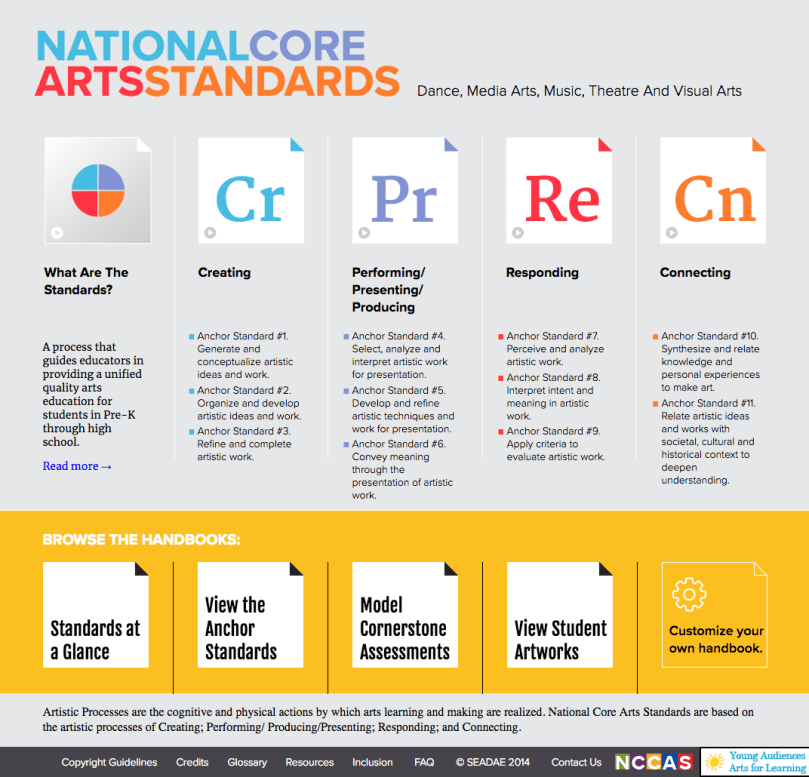
If you are unfamiliar with the terms “formative,” “summative,” “diagnostic” and “authentic” assessment, or other educational jargon, or are not fully aware of your state’s arts and humanities standards and the National Core Arts Standards, don’t panic. (Many of us “veteran” music teachers were in the same boat at the beginning of student teaching, regardless of how much material was introduced in our education methods courses.) Do some “catch-up” by visiting the corresponding websites. For example, in  Pennsylvania, you should be a member of PCMEA and take advantage of the research of the PMEA Interactive Model Curriculum Framework. Some educational “buzz words” and acronyms were explored in a previous blog here. It should be noted that, although you won’t be expected to know the full PreK-12 music curriculum while student teaching, when you are hired as “the music specialist,” you would likely be the professional who will be assigned to write and update that same curriculum… so get to know it ASAP. (On my second day in my first job, my JSHS principal came to me and said a course of study for 8th grade music appreciation was due on his desk by the last week of the semester! No, like you, I was not trained in writing curriculum in college!)
From the Penn State University Partnership for Music Teacher Excellence: A Guide for Cooperating Teachers, Student Teachers, and University Supervisors, the following criteria are recommended to be used by the cooperating teacher and the student teacher to assess the effectiveness of a long-term course of study. (Sample plans are provided here.)
- Stated learning principles are related to specific learner or student teacher
activities. - The importance of the course of study is explained in terms learners would likely
accept and understand. - Each goal is supported by specific objectives.
- The sequence of the objectives is appropriate.
- The goals and objectives are realistic for this group of learners.
- The objectives consider individual differences among learners.
- The content presentation indicates complete and sequential conceptual
understanding. - The presentation is detailed enough that any teacher in the same field could
teach this unit. - The amount of content is appropriate for the length of time available.
- A variety of teaching strategies are included in the daily activities.
- The teaching strategies indicate awareness of individual differences.
- The daily plans include a variety of materials and resources.
- The objectives, teaching strategies, and evaluations are consistent.
- A variety of evaluative techniques is employed.
- Provisions are made for communicating evaluative criteria to learners.
- The materials are neatly presented.
It is important sit side-by-side with your cooperating teacher and discuss some of these “essential questions” of instructional planning and assessment of student teaching:
- What is the purpose of the learning situation?
- What provision have you made for individual differences in learner needs, interests, and abilities?
- Are your plans flexible and yet focused on the subject?
- Have you provided alternative plans in case your initial planning was not adequate for the period (e.g. too short, too long, too easy, too hard)?
- Can you maintain your poise and sense of direction even if your plans do not go as you anticipated?
- Can you determine where in your plans you have succeeded or failed?
- On the basis of yesterday’s experiences, what should be covered today?
- Have you provided for the introduction of new material and the review of old material?
- Have you provided for the development of musical understanding and attitude as well as performance skills?
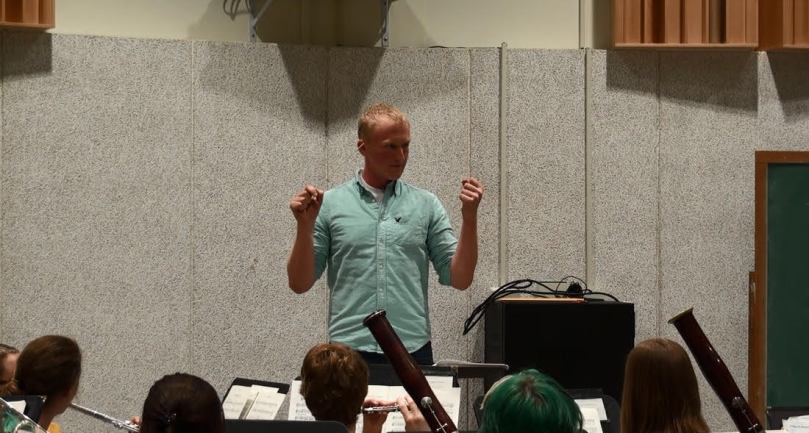
Getting Your Feet Wet… Becoming an “Educator”
[Source: Chadwick and Vest]
Be attentive to the needs of the students and your cooperating teacher. If you see a need that arises that the CT cannot or is not addressing, then take action. Don’t always wait to be told what to do. These situations may include:
- Singing or playing with students who are struggling
- Work with a section or small group of students
- Helping a student with seat/written work
- Attending to a a non-musical problem (such as student behavior)
Your supervising teacher or music education coordinator will probably instruct you on how much and when to teach, but each school and CT is different. In general, you should start teaching a class full-time by week 3 and have at least two weeks of full-load teaching per placement. (This is not always possible.)
Remember that any experience is good experience, so be grateful if you are asked to teach early-on in your experience.
What the supervising and/or cooperating teachers are looking for during an observation:
- The Lesson Plan
- Lesson organization (components, logical flow, pacing, time efficiency)
- Required components included
- National and State Standards Included—and these have/are changing!!!!
- Objectives stated in observable terms and tied directly to your assessment(s)
- What the US/CT is looking for during an observation
- Teaching Methods
- Questioning techniques (stimulate thought, higher order, open-ended, wait time)
- Appropriate terminology use
- Student activities that are instructionally effective
- Teacher monitoring of student activities, assisting, giving feedback
- Opportunities for higher order thinking
- Teacher energy/enthusiasm
- Classroom Management
- Media and materials are appropriate, interesting, organized and related to the unit of study.
- Teacher “with-it-ness”
- Student behavior management (consistency, classroom procedures in place, students understand expectations)
- Student Involvement/Interest/Participation in the Lesson
- Student verbal participation
- Balance of teacher talk/student talk
- Lots of “musicing” (singing, playing, listening, moving)
- Student motivation
- Student understanding of what to do and how to do it
- Classroom Atmosphere
- Positive, “can-do” atmosphere
- Student questions, teacher response
- Helpful feedback
- Verbal and non-verbal evidence that all students are accepted and feel that they belong
Student teaching is the opportunity of a lifetime. This is when you get to practice your pedagogical skills, make invaluable professional connections, and learn lifelong lessons. Sure, it will take a lot of hard work and dedication. As TeacherHub concluded, “Use this time to learn and grow and make a great impression. Stay positive and remember student teaching isn’t forever – if you play your cards right, you will have a classroom of your own very soon.”
PKF
Bibliography
A Field Guide to Student Teaching in Music, Ann C. Clements and Rita Klinger
A Guide to Student Teaching in Band, Dennis Fisher, Lissa Fleming May, and Erik Johnson, GIA 2019
Handbook for the Beginning Music Teacher, Colleen Conway and Tom Hodgman, 2006
Including Everyone: Creating Music Classrooms Where All Children Learn, Judith A. Jellison, 2015
Intelligent Music Teaching, Robert Duke
Music in Special Education, Mary S. Adamek and Alice Ann Darrow, 2010
Partnership for Music Teacher Excellence: A Guide for Cooperating Teachers,
Student Teachers, and University Supervisors, Penn State University Music Education Faculty Ann Clements, Robert Gardner, Steven Hankle, Darrin Thornton, Linda Thornton, Sarah Watts https://music.psu.edu/sites/music.psu.edu/files/music_education/pmte-student_teaching_handbook.pdf
Remixing the Classroom: Toward an Open Philosophy of Music Education, Randall Everett Allsup, 2016
A Student Teaching Survival Guide, Janelle Cox https://www.teachhub.com/student-teaching-survival-guide
Student Teaching in Music: Tips for a Successful Experience, Blair Chadwick and Dr. Johnathan Vest https://www.utm.edu/departments/musiced/_docs/NAfME%20%20Student%20Teaching%20in%20Music.pptx
Teaching Music in the Urban Classroom, Carol Frierson-Campbell, ed.
Teaching with Vitality: Pathways to Health and Wellness for Teachers and Schools, Peggy D. Bennett, 2017
© 2019 Paul K. Fox


 Karaoke Hack – Play the passage in conjunction with your favorite recording of the piece.


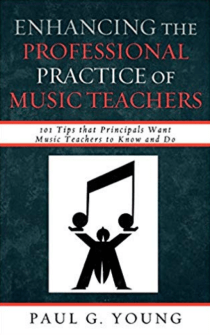
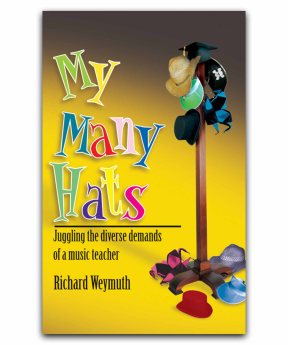 In the category of “things I wishes someone would have told me before I was hired to be a school music educator,” the inspirational book, My Many Hats: Juggling the Diverse Demands of a Music Teacher by Richard Weymuth, is a recommended “first stop” and easy “quick-read.” Published by Heritage Music Press (2005), the 130-page paperback serves as an excellent summary of the attributes (or “hats”) of a “master music teacher.” Based on the photos in his work (great “props”), I would have loved to have seen Weymuth’s conference presentations in person as he donned each hat symbolizing the necessary skill-set for a successful educator.
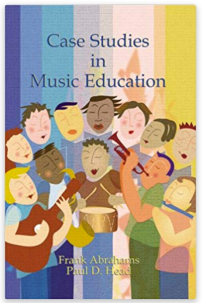 Next, I would like to direct pre-service and new music teachers to Case Studies in Music Education by Frank Abrahams and Paul D. Head. This would be an invaluable aid to “facilitate dialogue, problem posing, and problem solving” from college students (in methods classes?) and “rookie” teachers to veteran educators.
 His chapters are organized into six tips:
 The first thing I want you to do (and you don’t even have to be a member of NAfME yet, although you should be!) is to take at least a half-hour, scroll down, and read through numerous NAfME “Music in a Minuet” blog-posts, bookmarking any you want to return to at a later date. Go to





 Supported by Dan Ariely and his team at Timeful (a company acquired by Google), Srinivas Rao writes at
  Easy to set-up
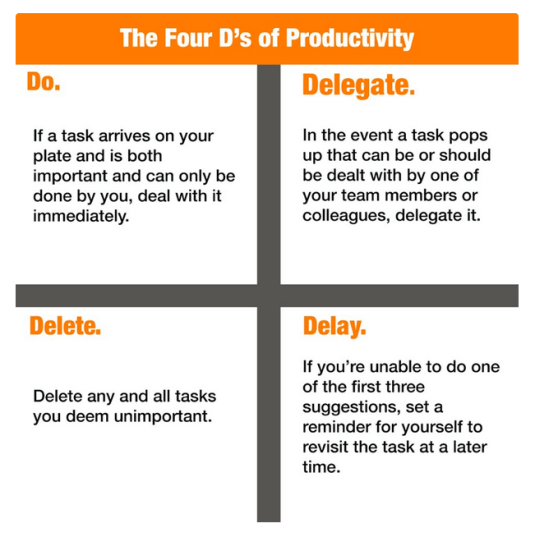
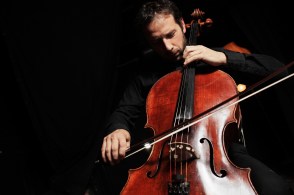 As musicians and music teachers, this suggestion may hit home: Do something that stimulates your “right brain” with acts of personal self-expression or artistry every day, and schedule it both intentionally and early!
 developing innovations, trends, and movements in their field, and embrace better instructional techniques and use of media for their students!
 The answer is… probably not.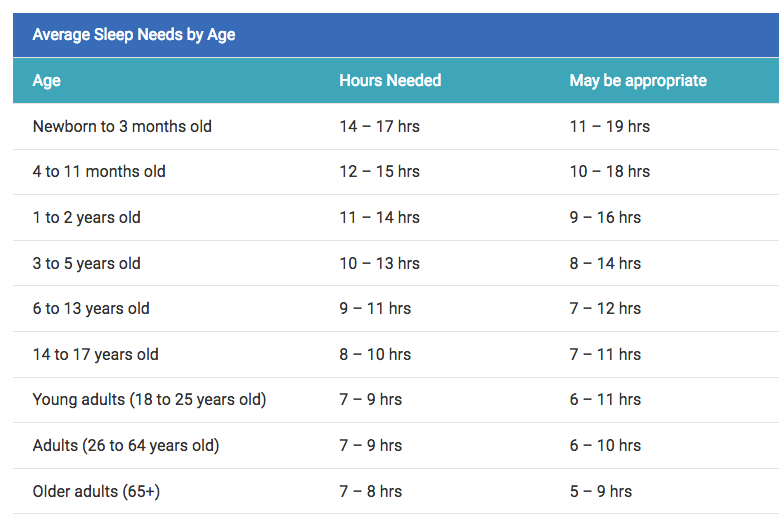
 I remember when I taught full-time and was in the middle of a full-blown musical production, I sometimes laid awake feeling “stirred up” inside trying to think of all the things I needed to do the next day. #5 of Brittney’s list is solved by putting a legal pad and a good pen by your bed stand, and without awakening your spouse, roll over and jot down a few of your “don’t forgets.” Or if you prefer to use the magic of technology, you can do this digitally… take a minute or so and use your tablet or smartphone, but don’t stay up very long and let the screen’s blue-light make your insomnia worse. Revisit title heading #2 above for note-taking apps.
 “Much like Gilligan and his infamous “three hour tour,” what I thought might be a quick clean-out extravaganza turned into an epic, six-month journey through the nether reaches of my closets and my psyche. Along the way, I learned many things from Maeve about organization — and more than a few things about myself that changed my relationship with my stuff.”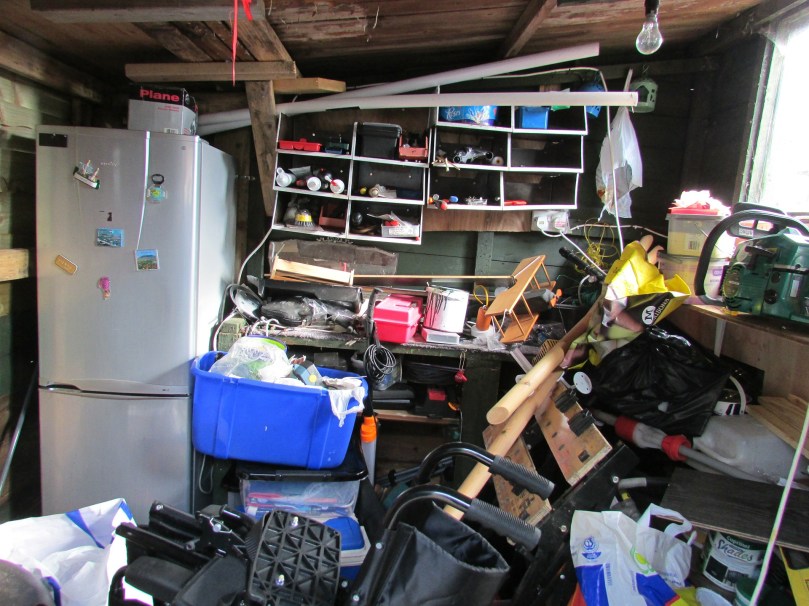


 The purpose of this short SHJO “Series to Share” is to get you started with some basic “how-to steps” to learn how to conduct. Truly, for success in directing an ensemble, the only thing you need to do is “give it a try” and practice those beat patterns with your favorite musical selections. During the Saturday SHJO rehearsals in December, we will give you the opportunity to direct the entire group and provide you a few hints!
 The mission of South Hills Junior Orchestra, which rehearses and performs at the Upper St. Clair High School in Pittsburgh, PA, is to support and nurture local school band and orchestra programs, to develop knowledge, understanding, performance skills, and an appreciation of music, to increase an individual member’s self-esteem and self-motivation, and to continue to advance a life-long study of music. Members of the Orchestra learn, grow, and achieve positions of leadership to serve their fellow members.
 documented to a great extent, stress, burnout, and stage fright have become real concerns for music education majors completing their coursework, juries/recitals/concerts, methods exams, student teaching, and other field experiences. This may be affecting statistics on college enrollments, graduation rates, and job placements!
 College funding
 Music Teacher Education
 Learning to “manage your burdens,” class schedules, assignments, calendar, etc.
 2009), “deep listening” as “a way of hearing in which we are fully present with what is happening in the moment” (Barbezat and Bush 2014), contemplative movement activities including methodologies of Orff, Kodaly, Dalcroze, and Gordon adapted for other music teaching contexts (Benedict, 2010), walking meditation, tai chi ch’uan, yoga, and labyrinth walking (Center for Contemplative Mind in Society, 2016), contemplative reading, writing, and other self-help practices.

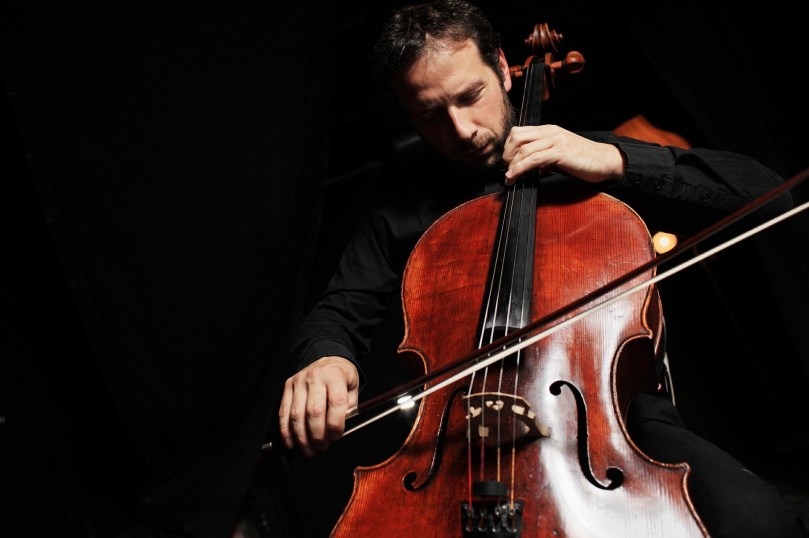
 “When musicians think about performing, they eventually think about performance anxiety — ‘stage fright.’ Performance anxiety can be defined as a physical and mental deviation from a ‘normal state’ and is perhaps one of the most misunderstood areas of performance practice… A reduction in anxiety levels especially with musicians with extensive formal training may actually diminish performance quality. For musicians with low mastery skills, the prudent approach would seem to be to undertake more formal training.” — Donald L. Hamann
 Job placement


 you to reflect and respond to “what would you do?” and even re-orient you to the paradoxes in which you may encounter that may not seem to offer an obvious resolution.
 Use of social media networks to support student learning versus the risk of crossing the student/teacher boundary with inappropriate informal communications? (See
  To foster meaningful scrutiny and study of the bulleted issues in bold above, we will sort these problems by Principle III “Responsibility to Students” and Principle IV “Responsibility to the School Community” of the National Association of State Directors of Teacher Education and Certification (NASDTEC) “Model Code of Ethics for Educators” (MCEE):



 MY SOLUTION: This is more common than you would like. This episode compels you to figure out how to wear two unique hats simultaneously – the educator and the judge. Assuming you were clear (in writing) on the requirements of the try-outs, even sharing the blank rubric that would be used for the evaluations, you are now charged to find the “best” person for each lead assignment based on a number of criteria:
 Workplace” are applicable









 now would be the perfect time to explore supplemental resources and get a “head-start” on additional pre-service training for next fall. These tips are especially valuable to anyone entering his/her senior or final year as a music education major, finely honing in and marketing your skills as a professional in order to be prepared for finding and succeeding at your first job.

 Mix and mingle to improve your networking opportunities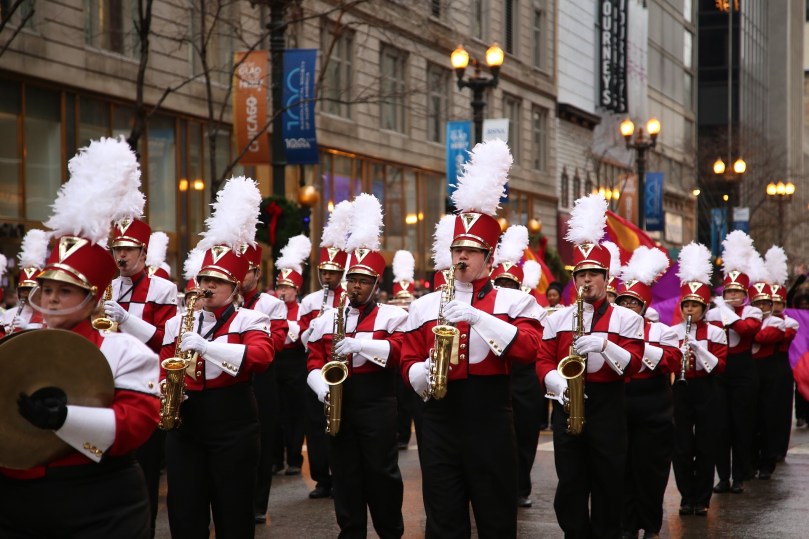
 Understanding specific educational jargon and the latest approaches, applications, and technologies in the profession (e.g. Backwards Design, The Common Core, Whole Child Initiatives, Multiple Intelligences, Depth of Knowledge and Higher Order of Thinking Skills, Formative, Summative, Diagnostic, and Authentic Assessment, etc. – Do you know the meaning of these terms?)
 You need to ask yourself the question, “What are my greatest weaknesses in music education?” Or, to put it another way, “What school assignments would I feel the least confident to teach? After earning your state’s all-essential credential, your certificate will likely be general and only say “music Pre-K to Grade 12.” Administrators will expect you can “do it all” – introducing jazz improvisation at the middle school, accompany on the piano or guitar all of the songs in the grades 1-6 music textbook series, directing the marching band at the high school or the musical at the middle school, starting an elementary string program, etc.
 Since music teachers are all “fiduciaries” (do you know the meaning of the word?) and legally responsible for our “charges,” wouldn’t it be a good idea to review our state’s regulations and code of conduct, and hear about the challenges and pitfalls of ethical decision-making before we jump in and get “over our heads,” so-to-speak?
 ask your cooperating teacher (or his/her supervisor’s) permission. Some school districts have “do not photo” rosters. (However, in my district, only a few elementary students were “on the list” and most defaulted to a “permissible” status unless the parent opted out. The principal’s secretary had a record of all exceptions.) It is also suggested that you focus your camera mostly on YOU and not the students, from the back of the classroom or rehearsal facility (possibly from afar), so that the student faces are not clearly discernible. To respect their privacy, in the recorded excerpts, do not use any segment announcing the names of your students.


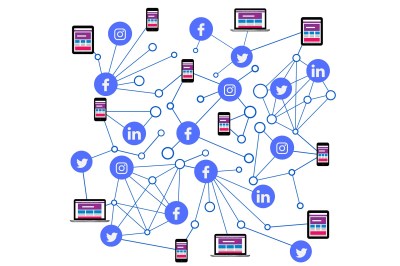
 When MySpace and Facebook came upon the scene in 2003 and 2004, most school administrators recommended “stay away from these.” The online sharing and archiving of photos initiated the adoption of many other social media apps (Flickr and later Instagram, Tumblr, Snapchat, etc), which provoked new challenges in maintaining privacy, appropriateness, and professionalism. Danger, danger, danger!
 Communicating digitally or electronically with students may lead to the blurring of appropriate teacher-student boundaries and create additional challenges to maintaining and protecting confidentiality.
 www.gmajormusictheory.org
 Pennsylvania State Education Association (PSEA):
  posts with your school’s location.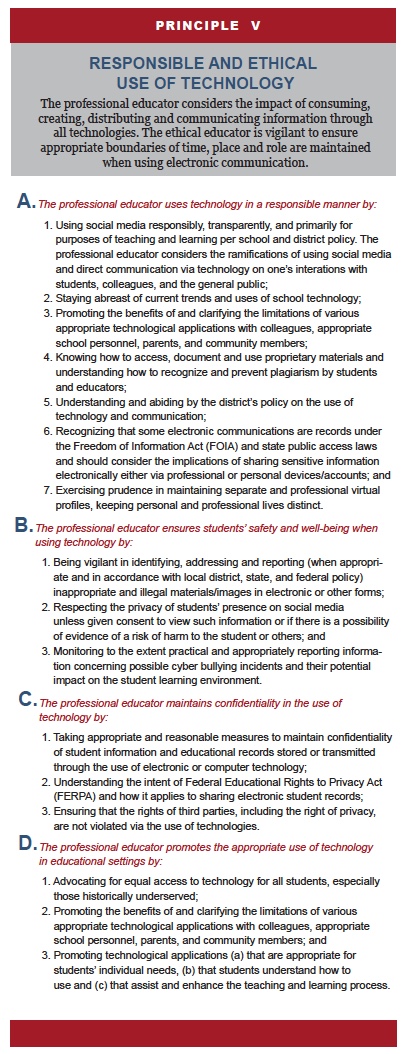
 paulfox.blog