Interviews

READY TO HIRE: Strategies to Land a Job

For all future music teachers everywhere, especially members of a PCMEA or NAfME collegiate chapter, we post these handouts from past NAfME and PMEA music teacher conference sessions, all moderated by Scott Sheehan, Immediate Past President of NAfME Eastern Division and Past State President of PMEA.

As a tradition at the annual state conference, the session “Ready to Hire: Interviewing Strategies to Land a Job” has offered “tried & true tips to assist promising music education majors with developing interviewing skills to successfully land their dream job.” One of the features of the clinic is the set-up of a “hot seat” where volunteer candidates are put through one or more questions in a “mock interview,” and then assessed on their “performance.” The guest panelists often distribute a “takeaway” with valuable tips on interview techniques and questions, and developing personal branding, networking, and marketing skills.

These suggestions are offered as a way to “practice” taking employment interviews.

Best wishes on your job search. Now go out there and “nail” the interview!


NAfME Logo_eastern_division

NAfME Biennial Eastern Division/PMEA State Spring Conference

April 4-7, 2019 in Pittsburgh, PA


Sheehan: Interview Session Handout

Metelsky: Interview Worksheet

Pearlberg: Ready to Hire Interview Strategies

Fox: Job Interview Playbook


PMEA conferences.png

Pennsylvania Music Education Association Annual Spring Conference

(various years)


Basalik: Ready-Set-Interview

Baxter: Music Interviews

Fox: A to Z Job Interview Checklist

Fox: Marketing Your Professionalism


pcmea

Additional Resources

PMEA Job Board

NAfME:

Sullivan Interview Strategies that Work

Older blog-posts at this site:


Acknowledgments:

  • Sue Basalik
  • Howard Baxter
  • Marc Greene
  • Susan Metelsky
  • Alicia Mueller
  • Henry Pearlberg
  • Kathy Sanz
  • Scott Sheehan
  • Jill Sullivan
  • Lucy White

Image by Tumisu from Pixabay


© 2019 Paul K. Fox

All rights reserved by the individual authors of this material

Collegiates – Clean Up Your Social Media

banner-935469_1920_geralt

Getting Ready to Apply for a Job? It’s Time to Curate Your Social Media!

[Portions of this blog-post were first published in the January 31, 2019 issue of the Collegiate Communique sponsored by the PMEA State Council for Teacher Training, Recruitment, and Retention.]


Have you ever gone on the Internet and searched for your name? Have you assessed tree-1148032_1920_geraltwhat your image (and “personal brand”) say about you on all the social media platforms?

According to a McAfee family safety blog, in anticipation of future employers researching you and everything with your name on it, you should make a concerted effort to “launder” your online presence.

People are watching you right now. Like it or not — agree with the intrusion or not — you are being Googled, judged, and analyzed by the body of content you’ve posted online. Whether you are applying to a college, for a summer job, or even currently employed, you can bet someone who matters to your future is on your digital trail.

 “10 Easy Ways to Clean Up & Curate Your Social Media” by Toni Birdsong


laptop-3087585_1920_jeshoots-com_

Also recommended by Birdsong, the new “best practice” is to A) clean up any questionable content from all social profiles and B) design your social content in a way that “reflects your best self.” This means you should delete permanently from Facebook and other platforms:

  • Provocative or inappropriate photographs, videos, or posts
  • Posts or photos that include drinking or using drugs
  • Discriminatory comments related to race, religion, gender, etc.
  • Content that complains about a previous employer or colleague
  • Posts that are overly cynical, grumpy, or mean

notebook-614213_1920_firmbeeInstead, your profile information should reflect integrity and responsibility, so you should expand or add content that:

  • Projects a professional image
  • Shows a friendly, positive personality
  • Demonstrates that you are well-rounded, with wide range of interests
  • Models that you have great communication skills

Think the whole “future employers checking your social media accounts” thing is just an annoying urban legend? Think again.

It turns out that one in three employers have rejected candidates based on something they found out about them online.

“How to Clean Up Your Social Media During the Job Search” by Lily Herman

personal-3139194_1920_geralt

The McAfee blog really does a good job summing up ten steps to a better online presence:

  1. Make a hit list
  2. Think like the decision maker.
  3. career-3478983_1920_mohamed_hassanStreamline your selfies.
  4. Review past blogs.
  5. Google yourself.
  6. Inventory all social profiles.
  7. Edit your Twitter feed.
  8. Secure names and URLs.
  9. Change your online persona – for good.
  10. Start a career-focused Blog.

There are many samples for that last tip, my favorite from a former student of mine freely sharing his professional website at daviddockan.com. (Use “Music” for the password.) David included his resume, philosophy of music education, employment history, and photo/video samples of his teaching… a very powerful digital portfolio and marketing/branding technique… and of course, he landed his first music teacher job immediately after graduating from West Virginia University!

online-3412473_1920_kreatikarIf you need more than ten suggestions or a lot more detailed instructions based on the specific social media platforms, check out 30 Quick Tips to Spring Clean Your Social Media Presence” by Yvonne Dutchover.

Related articles previously posted at this site:


Employers can learn a lot about you from your resume and interview, but sometimes it takes a little bit more to sell yourself (although there’s a delicate balance between selling yourself and being transparent in the hiring process). Take advantage of the benefits of social media – it’s an often-needed extra step to show what you bring to the table, a way to add flair to your application, and make a lasting impression on your potential employers.

– “How to Clean Up Your Social Media Presence Before the Job-Search” by Lauren McAdams

job-3790033_1920_tumisu

In short, keep it clean and professional! “Police” your social media image and brand. And, as they say, “break a leg” at your interviews! Good luck in job hunting!

PKF

© 2019 Paul K. Fox


Photo credits in order from Pixabay.com: “social media” by Alexas_Fotos, “banner” and “tree” by geralt, “laptop” by JESHOOTS-com, “notebook” by FirmBee, “personal” by geralt, “career” by mohamed_hassan, “online” by kreatikar, and “job” by Tumisu.

Transitioning from Collegiate to Professional – Part III

The Final Leap from Pre-Service to In-Service:

The Metamorphosis and Integration of Philosophy, Maturity, and Teacher Preparation

trumpet-1495108_1920_congerdesignTo “wrap-up” our final segment, we will review the development of a professional “marketing plan.” This is blog #3 out of 3. (Be sure to also check out #1 and #2, too.)

These are three critical skills you need to foster in the search for a school music position, marketing yourself, interviewing, and landing a “good” job:

  • Personal branding (who are you, what makes you unique, and what do you have to offer?)
  • Story telling (anecdotes) of your positive attributes and personal brand, including a record of your habits of “engagement” in music education, and
  • Networking (associating with other professionals and getting your positive stories “out there”).


skills-3262172_1920_diwou

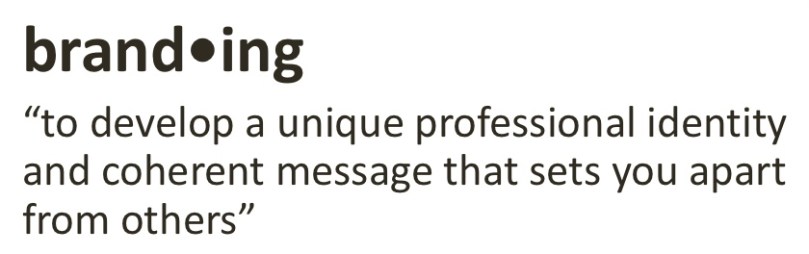
branding

Personal Branding

“Personal branding is the practice of people marketing themselves and their careers as brands. While previous self-help management techniques were about self-improvement, the personal-branding concept suggests instead that success comes from self-packaging… Personal branding is essentially the ongoing process of establishing a prescribed image or impression in the mind of others about an individual, group, or organization.”

– Wikipedia: https://en.wikipedia.org/wiki/Personal_branding

What is the difference between marketing and branding? According to some, “marketing is what you do, branding is what you are.” (www.tronviggroup.com/the-difference-between-marketing-and-branding/)

phone-2840244_1920_RobinWiggins13Shama Hyder posted “7 Things You Can Do to Build an Awesome Personal Brand” at http://www.forbes.com/sites/shamahyder/2014/08/18/7-things-you-can-do-to-build-an-awesome-personal-brand/, including the following outlined summary:

  1. Start thinking of yourself as a brand
  2. Audit your online presence
  3. Secure a personal website
  4. Find ways to produce value
  5. Be purposeful in what you share
  6. Associate with other strong brands
  7. Reinvent

During these waning months for college music education seniors, now is the time to finalize the preparations for personal branding and beginning the employment search! Personal branding is critical to help you “stand above the rest,” showing that you have what it takes and would be a major asset to a prospective employer, and defining and marketing your own unique qualities that would make you “a good fit” for the specific job openings.

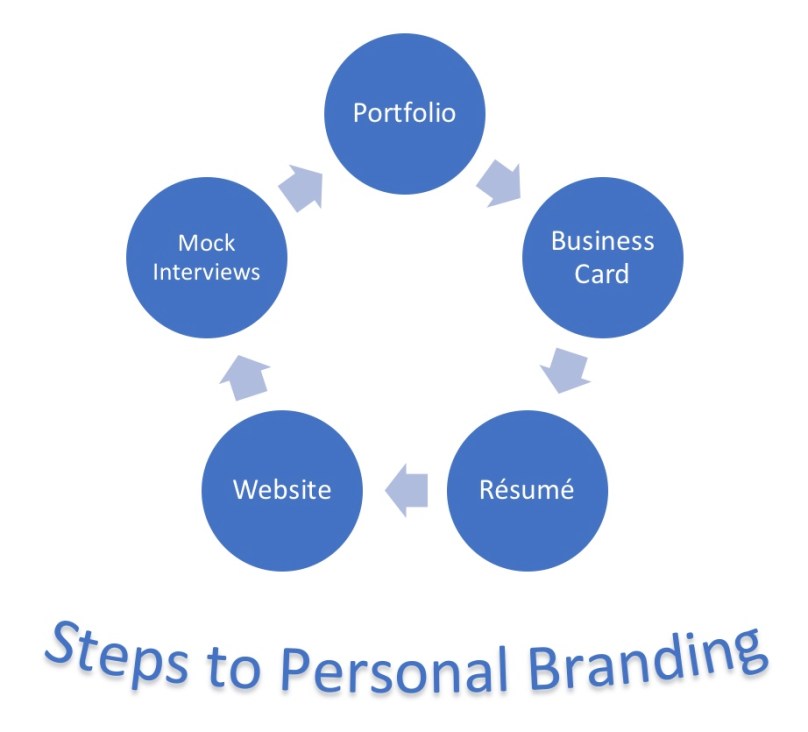
Steps to Personal BrandingThe branding process involves first developing your philosophy of music education, archiving your awards and accomplishments, documenting your grades and ok-3061659_1920_RobinHiggins12experiences, and collecting stories/personal anecdotes of your strengths. The next steps include the creation of a written and electronic portfolio, business card, resume, and website. Finally, you must compile/assemble everything together and practice (and self-assess) your “story-telling skills” to answer those important questions at well-rehearsed “mock interviews.”

You will likely not have enough time to complete all of these tasks during methods classes or student teaching seminars. That’s okay. If you are serious about prepping yourself to find a great music teaching job, the valuable links (see below) and articles are out there… just manage your time and start reading.

feedback-2990424_1920_geralt

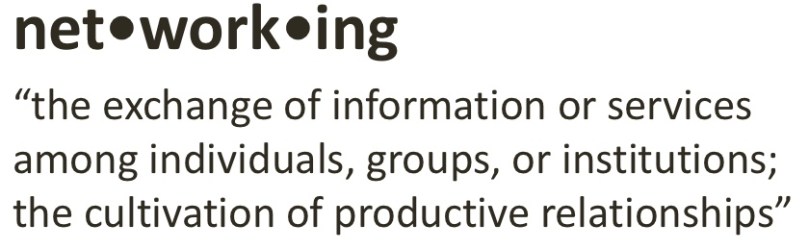
networking

Networking

According to the article “Network Your Way to Secure a Teaching Job” at https://resumes-for-teachers.com/job-search-help/teacher-network/, many people are unaware of the basics of networking and how to use them it to their advantage in securing a job:

“Networking simply refers to finding job-related contacts. Most teachers who are just beginning their careers may feel that they have few, if any, networking contacts in the teaching field. It is important to consider the many different areas of networking as you create your own group of networking contacts to help you secure a teaching job. It is interesting to note that many of the teaching positions that are filled each year are filled by those who came to the attention of personnel managers by recommendation.”

“Always think about adding to your teaching network. When meeting new people, be certain to add them to your network. Talk to them about your skills, education, experience, and learn about their jobs. Make sure that you always ask for a business card.”

Do you have a business card? Is your résumé updated and available online on your professional website?

young-3061653_1920As I laid out in a previous blog “Networking Niceties: The ‘How-To Schmooze’ Guide for Prospective Music Teachers” at https://paulkfoxusc.wordpress.com/2016/04/04/networking-niceties/, the concept of networking is two-way communications. Just like collective sets of nerve synapses, two-way connections are expected to fire repeatedly in all directions. That’s actually the science behind memory. For professional networking, it is your “charge” to create multiple pathways to/from school HR managers and secretaries, administrators, music supervisors and department heads, and music teachers… and YOU – your skills, accomplishments, unique qualities, experience, education, and personality traits.

pcmeaThe above blog-post also explores setting up a good organizational system to manage your professional contacts.

If you are a Pennsylvania collegiate member (PCMEA), I heartily recommend the article “Networking 101” by Dr. Kathleen Melago, PCMEA State Advisor and Associate Professor of Music Education at Slippery Rock University, published in the Summer 2017 issue of the state journal PMEA News (pages 40-42). Here are several quotes from her work:

“One of the most common ways music educators can plan to network is at conventions. First, try to avoid interacting only with people from your school or people you already know from other schools. Go to sessions that interest you and look for opportunities to meet people there. Before the session starts, introduce yourself to people sitting around you. Use your social skills to assess whether they seem like they want to engage in a conversation or not. After the session, go up and meet the presenter.”

“Of course, social media is another great way to build your network. Networking with professionals already in the field can help you see what they are doing and help you build ideas of what you would like to do in your program someday.”

“Sometimes, you might find yourself networking unexpectedly. For example, you might go into school to work with their clarinet section during band camp and just happened to meet the choir teacher. That is networking!”

“To help your networking be most effective you need to have good communication skills. When interacting with others in a networking situation, be sure to focus on the person with whom you are speaking. Avoid looking off into the distance as if you were to anticipating someone else more important coming by. But your cell phone away and be present to the conversation.”

“Be yourself in your networking interactions. If you pretend that you are someone you are not, you will either end up unhappy or you’ll be discovered is someone who is not genuine.”

Dr. Melago goes on to provide a myriad of excellent examples of networking skills and opportunities.

Another resource specifically for networking at music teachers conferences is posted at https://nafme.org/getting-music-conferences/.


music-1237358-2 ricardo vasquez


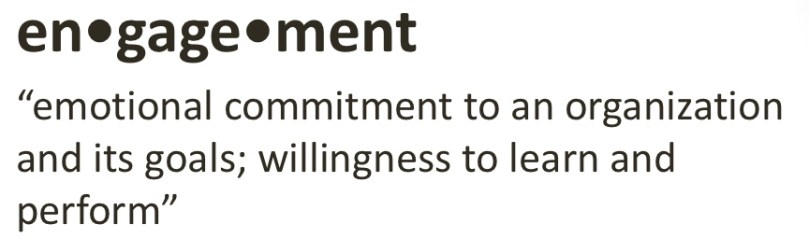
engagement

Engagement

Here is an excellent definition of “professional engagement” from “Domains of Teaching” of the Australian Institute for Teaching and School Leadership at https://www.aitsl.edu.au/teach/understand-the-teacher-standards/domains-of-teaching.

Teachers model effective learning. They identify their own learning needs and analyze, evaluate and expand their professional learning, both collegially and individually.

Teachers demonstrate respect and professionalism in all their interactions with students, colleagues, parents/carers and the community. They are sensitive to the needs of parents/carers and can communicate effectively with them about their children’s learning.

Teachers value opportunities to engage with their school communities within and beyond the classroom to enrich the educational context for students. They understand the links between school, home and community in the social and intellectual development of their students.

Engagement for prospective music teacher may include synonyms like “participate,” “enroll,” “join,” “be active,” “volunteer,” “seek experience,” and “make a difference!”

Are you a member of your professional music education associations?

  • NAfME National Association for Music Education
  • PCMEA Pennsylvania Collegiate Music Educators Association, or another state’s local NAfME collegiate chapter
  • pmeaPMEA Pennsylvania Music Educators Association, or another state’s NAfME-affiliated MEA
  • ACDA American Choral Directors Association
  • ASTA American String Teachers Association
  • NBA National Band Association

Did (or will) you attend your state music teachers’ conference and local workshops on music education and professional development?

To prove you are “professionally engaged,” I would expect to see a consistent record of modeling in the following areas:

  1. excited-3126449_1920_RobinHiggins9Self-reflection of the professional’s teaching practices and modification of these as needed to match changes in the environment and circumstances
  2. Self-assessment of the professional’s methods and approaches, as well as the progress of the students’ learning, using both formative and summative methods for constant and ongoing improvement
  3. Identification and planning of professional learning needs.
  4. Unsupervised (or unplanned by school administration) goal-setting and self-guided implementation of opportunities for professional development
  5. Association with professional learning communities, school and community meetings, and other collaborative projects
  6. Volunteer service in music and music education
  7. Membership and subscription to music education journals and participation in online professional community discussion groups

Many have said that aspiring to be a music educator is a lot like a calling. One school superintendent I know said he expected prospective new recruits to show high energy, enthusiasm, sense of purpose, and dedication during the interview… even a supposed willingness to “lay down in front of a school bus” or “do what ever it takes” to make the students (and the educational program) successful. That’s engagement!

classical-music-1838390_1920_Pexels

In summary, becoming a music educator is about finding your inner confidence, a mindset that you know what you’re doing, and that you’re ready for that real world experience. You’ve learned those essential skills in conducting, piano accompaniment, arranging, student behavior modification and discipline, music diagnosis and remediation, and even how to market your professionalism. Now… drum roll, please! Here’s… a master music teacher!

target-3306771_1920_geralt

In closing, here are supplementary materials to help you to “get your feet wet,” all free and available online. The following lists, although not comprehensive, are a good place to start (courtesy of https://www.pmea.net/wp-content/uploads/2012/10/Collegiate-Communique-No11-022218-2.pdf):

Good luck!


Personal Branding, Marketing, and Networking

Business Cards

Résumés

Portfolios and Websites

Interview Questions, Techniques, and Skills of “Story-Telling”


PKF

© 2018 Paul K. Fox


Photo credits (in order) from Pixabay.com: “tutor” by nrjfalcon1, “trumpet” by congerdesign, “skills” by diwou, “phone” by Robin-Higgins, “OK” by Robin-Higgins, “feedback” by geralt, “young” by Robin-Higgins, “music” by ricardo-vasquez, “excited” by Robin-Higgins, and “classical-music” by pexels.

The Professional Website

Pre-Service Music Educators Looking for Employment: Build a Web Platform to Promote Your “Brand”

beautiful-15728_1920_PublicDomainPictures

According to Wikipedia, “an electronic portfolio (also known as an eportfolio, e-portfolio, digital portfolio, or online portfolio) is a collection of electronic evidence assembled and managed by a user, usually on the Web. Such electronic evidence may include input text, electronic files, images, multimedia, blog entries, and hyperlinks. E-portfolios are both demonstrations of the user’s abilities and platforms for self-expression. If they are online, users can maintain them dynamically over time. One can regard an e-portfolio as a type of learning record that provides actual evidence of achievement…”

A couple years ago, I wrote a blog about the “perfect portfolio” for getting a job at https://paulkfoxusc.wordpress.com/2015/11/15/planning-the-perfect-professional-portfolio/. As a review, these elements were endorsed for inclusion in an e-portfolio:

  • Educational philosophy
  • Résumé or Curriculum Vitaeinternet-1181586_1920_the digitalartist
  • Letters of recommendation
  • College transcripts
  • Praxis® exam results
  • Copy of teaching certificate(s)
  • Artifacts of student work
  • Classroom observation documents/evaluations
  • Statement about class management theory (discipline) and the steps that you would take inside your classroom to create a safe and orderly environment
  • Letters from parents commending the work you did with their children
  • Samples of student assessments/rubrics
  • Excerpts (short video or audio recordings) of you performing on your major instrument/voice, solo and chamber recitals, piano accompanying, playing in college ensembles, and especially teaching in as many settings as possible: small and large group instrumental (band and strings), choral ensembles, elementary classroom lessons, extracurricular activities like marching band and musical, private lessons, etc.
  • Pictures (quote from http://www.theeduedge.com/top-five-must-haves-top-five-could-haves-your-teacher-interview-portfolio/): “We cannot emphasize the power of pictures enough when it comes to portfolios. During interviews, committee members are trying to get to know you and trying to envision you teaching. Don’t trust their imaginations to do so, give them pictures… photos or newspaper articles of you teaching students in the classroom, with students on field trips, learning excursions or outside class activities, with children while you are serving in adviser roles, with your students at business-15822_1920_PublicDomainPicturesmusical or athletic events, coaching or working with children in a coaching capacity, as a leader and role model.”

As I said in my article, all of this is “perfect fodder for marketing yourself” at future employment interviews. Do you have “what it takes” to be a professional music teacher?” In your opinion, what makes you qualified (“a good fit”) for a position in our institution?”

I also recommend you revisiting my blog-post “Tips on Personal Branding” at https://paulkfoxusc.wordpress.com/2015/12/16/tips-on-personal-branding/ for steps on warehousing the elements of your “professional brand.”

If your college does not set you up with a free online site, consider a “do-it-yourself” website creator from one of these, and read the rest of this blog-post:

  • WordPress.com
  • Wix.com
  • Weebly.com
  • SquareSpace.com
  • Web.com
  • Yola.com
  • GoDaddy.com
  • eHost.com
  • Site123.com

WordPress is a popular “open source” solution. This means you will need to independently set up a server, download a third party template, manage updates, set up a domain name, and configure everything on your own. This is what I did for this paulkfoxusc blog-site, and I paid zero for a domain name… but more on that later.

 

turn-on-3064510_1920_geralt


The Essential Step-by-Step Guide to Making Your Own Website

One of my favorite online “instruction manuals” for building a website comes from Christopher Heng’s “How to Start / Create a Website: The Beginner’s A-Z Guide” at  https://www.thesitewizard.com/gettingstarted/startwebsite.shtml. Their steps:

  1. Get Your Domain Name.
  2. Choose a Web Host and Sign Up for an Account.
  3. Designing your Web Pages.
  4. Testing Your Website.
  5. Collecting Credit Card Information, Making Money (not needed for us?).
  6. Getting Your Site Noticed.

This should be required reading… but take it slow, and click on all of the secondary links.

Some website builders and managers offer e-commerce and other special features. For a professional website to post your experience and accomplishments, you can avoid the extra cost of these nonessential additional web tools.

web-1738168_1920_CyberRabbitIf you can afford it, purchasing a simple domain name like your first and last name (something easy to remember) would be a great idea. Prospective employers will not have to write down a bunch of numbers, know your birthday, learn your nickname, etc. to find your e-portfolio. If you have an unique middle name or surname, you might luck out and be able to snag (and register) the perfect domain name. This was not possible for me! Do you know how many Paul Fox’s (even Paul K. Fox) are “out there” already taken?

In the process of obtaining an available email label, if needed, try rearranging your name (e.g. listing the last name first?), placing dots between the first and last name, etc.


Strategies for Saving Money and Seeking Tech Help

If you are like me, lacking a little confidence about advanced online technology or mastering a complicated website building program, read the following article for a general review of the process and terminology. Take the afternoon off (order a pizza, too) and totally consume it and “A Beginner’s Guide to Creating a WordPress Website” at https://www.smashingmagazine.com/2016/02/beginners-guide-creating-wordpress-website/#article-wpcom-wporg.

I suppose it would be fair to say that college students are not “made out of money,” so going to a professional website designer is probably “out of the picture,” even though this is one of your most essential tools for successfully communicating your brand! Are you going to lay out some big bucks for an impressive looking resume and business card?

However, have you considered the alternative of asking for help from your roommate, class buddy, or other student acquaintance who is majoring in communications? (Would “free pizza” be enough incentive for someone to sit down with you and get you started?)

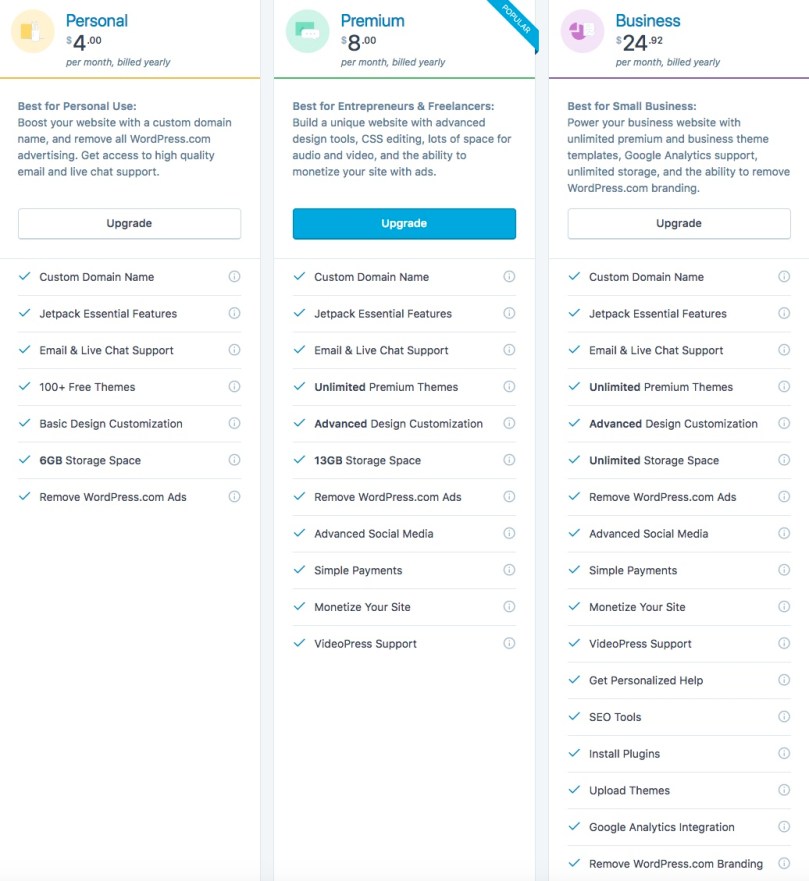
The most cost-effective approach may be to sign-up for their FREE plan and self-hosting within the WordPress.com environment. (I am still amazed that this entire blog-site of mine, now archiving more than 73 articles, has been 100% free!)

If you desire more features, a free domain name, and no advertising on your site, you can upgrade to a monthly plan for WordPress (or any of the above providers).


WordPress.com plans


For me, WordPress was/is an easy application to use. You do not have to learn a programming language or fancy commands to format your menus and text. There are a lot of samples you can (almost literally) copy. The hard part is just… GETTING STARTED!

One of the first decisions you have to make is to establish a domain name. If you decide to be “cheap” (like me), just create a Google email account with a suitably professional name. If it is available, you set-up one like “first name” + “middle name” + “last name” + “music educator” or something else appropriate. Dots can be inserted as dividers in an email address. Shortly before I retired (and would lose my school email account), I found that paulkfox.usc@gmail.com was available. (USC is where I taught and continue to live.)

It should be noted here that “partying tuba player” and “crazy singer” are probably not good “professional names.” If you need help, just ask your grandmother what she thinks is appropriate. Remember: teaching is one of the most conservative of professions!

WordPressTo create your web site’s identity, WordPress will remove the dots and add their company’s moniker “.wordpress.com” at the end of your email name. That is how https://paulkfoxusc.wordpress.com was born!

Your next choice will be the theme, style, and features of your website… probably challenging because there are so many free templates available. Check these out:

As an example, for this site, I use the FREE “Nucleare” theme by CrestaProject. Their description is the following: “Nucleare is a classic blog theme with a crisp, elegant design and plenty of handy features. A built-in search box, links to your favorite social networks, four widget areas, and beautifully styled post formats make this an ideal theme for your personal blog.” Nucleare also supports the following features:

  • Site logo
  • Social Links Menu
  • Post Formats
  • Custom Menus
  • Widgets
  • Custom Header
  • Custom Background
  • Full-Width Page Template


ipad-820272_1920_fancycrave1


A Model Music Teacher Website

Educators love it when one of their students leave their classroom and choose to become a significant contributing member to our “exalted” profession! I felt blessed and privileged to have had the opportunity of teaching David Dockan, a trumpet player in both our Upper St. Clair High School orchestra and marching band. He validated some of my advice for marketing himself to land a job, and has created a super website. Go to http://www.daviddockan.com/ and use the password “Music” to view his e-portfolio.

His menu sections:

  • Home (Introduction)
  • Teaching (General, Choral, Instrumental, assigned schools, Private Lessons)
  • Philosophy
  • Musicianship (Performance, Conducting)
  • Resume
  • Contact

A trumpet teacher colleague of mine, Ryan Wolf, messaged me on Facebook after he read the initial posting of this blog. He said he had great success hosting his professional website on Yola.com, but he maintains his e-portfolio on his Google Drive to make it easy to share.

In conclusion, I offer a few more recommendations for your consideration:

  1. Proofread your online presence very carefully… misspellings, bad punctuation, grammar mistakes, or poorly formatted displays would be negative PR and a detriment to your marketing plan.
  2. Websites require frequent updates. Keep yours up-to-date at all times!
  3. Print the link to your professional website on your business card and resume.
  4. Consider placing a Q-Code on your business card that, if scanned on a smartphone, would redirect your contact or prospective employer to your website.
  5. Be careful to obtain permission in advance to video record students for your e-portfolio. During your field experiences or student teaching, ask your cooperating teacher (or his/her supervisor’s) permission. Some schools have “do not photo” rosters. (However, in my district, only a few elementary students were “on the list” and most defaulted to a “permissible” status unless the parent opted out. The principal’s secretary had a record of all exceptions.) It is also suggested that you focus your camera mostly on YOU and not the students, from the back of the classroom or rehearsal facility (possibly from afar), so that the student faces are not clearly discernible. To respect their privacy, in the recorded excerpts, do not use any segment announcing the names of your students.

  6. maintenance-2422172_1920_geraltShowing your versatility, try to assemble a collection of still photos, audio examples, and videos that ideally represent all specialties in music education: choral, dance, general music, concert band and string instrumental, marching band, jazz, theater, etc., and demonstrate your proficiency in multiple settings at all grade levels.
  7. There are many blog-sites with tips on “curb appeal” – layout and design, style, overall impact, style, user-friendliness, etc. Since this involves a cross between artistry and efficiency, these advisors may not agree (one says use large images, another suggests smaller pictures mean faster loading speeds). A few samples:

If you were introducing a new “widget” to the market or promoting a sales campaign, you would spend a lot of time (and money) on advertising. A website and e-portfolio are a job hunter’s advertisement tool. Take advantage of any chance you have to present your personal brand, “sell yourself,” and connect with colleagues in the field of education. Archive your training, successes, and goals. Show off your professionalism, proficiency, and personality to prospective HR people and the decision-makers that hire future staff. Be sure to provide “live demos” of your traits of artistry, collaboration, commitment, discipline, even-temperament, initiative, leadership, mastery of music and education, organization, positive outlook, style, tact, and teamwork.

Good luck!!

PKF

© 2018 Paul K. Fox

people-3042093_1920_Akshay93

Photo credits (in order) from Pixabay.com: “men” by photoshootings, “beautiful” by PublicDomainPictures, “internet” by thedigitalartist, “business” by PublicDomainPictures, “turn-on” by geralt, “web” by CyberRabbit, “iPad” by fancycrave1, “maintenance” by geralt, and “people” by Akshay93.


Dress for Success at Teacher Interviews

Tips for Modeling the “Proficient Professional” Look

“Make no mistake — you are being judged as soon as you walk into the room and the interviewer has made an initial impression of you in the first few seconds they see you based on how you look. That may not be fair but it is reality in many cases. An interviewer is expecting you to dress appropriately for the interview. If not, you are showing the interviewer that you don’t understand the basics of what it takes to be successful in the workplace. If this is the case, you already have one strike against you.”  —  Andy Teach, author of From Graduation to Corporation, http://www.amazon.com/From-Graduation-Corporation-Practical-Corporate/dp/1438930631

Trolling online for a consensus on what to wear to school employment screenings, I found repetitions of the words “professional,” “appropriate,” and “comfortable,” but no single standard of dress. Most agree that you must exhibit an image of confidence, optimism-1241418-1competence, and responsibility, and should probably error on the side of more formal attire rather than day-to-day casual.

Dressing appropriately for your teacher interview makes your critical first impression on the interview committee. Betsy Weigle from Classroom Connection explains in a YouTube video how to avoid common mistakes plus tells you what to bring along for success at https://www.youtube.com/watch?v=r1FvnI7Bivg.

  1. Dress comfortably but dressier than what you would wear teaching in a classroom.
  2. Your appearance should be professional and appropriate, and show that you really want to be considered for the job.
  3. The focus should be on you, not what you are wearing.
  4. Ladies should wear a skirt or slacks, blouse and a little sweater. A dress would be fine, too (but don’t be too dressy).
  5. Shoes and jewelry should be comfortable AND yet not be noisy or distracting.
  6. No perfume or cologne: Your presence should not enter the room before you do.
  7. For men, a collared shirt is recommended. Dress-up a little bit.
  8. Jeans are never appropriate for a job interview.
  9. For both men and women, adding a little color is a great choice.
  10. Do not wear a mini-skirt, t-shirt, shorts, or sport shoes.

Hannah Hudson shares six hints in “Real Teachers Spill: What to Wear to a Teacher Interview” from We Are Teachers. She provides good photographic examples of her thoughts maintaining style and comfort while exhibiting professionalism, so be sure to read the entire article at https://www.weareteachers.com/best-of-teacher-helpline-what-to-wear-to-a-teacher-interview/.

  1. sharp-dressed-breast-1241310Suits are always a good choice.
  2. If a suit isn’t an option, try a pair of dress pants or skirt with coordinating top and blazer or cardigan.
  3. Women, consider a black sheath dress.
  4. For men who don’t want to go the suit route, we advise a button-down shirt and pants.
  5. Don’t forget the footwear!
  6. Choose a fun accessory.

In a blog entitled “Teacher Interview Style” posted on Classy in the Classroom at http://classyinaclassroom.blogspot.com/2014/07/teacher-interview-style.html, a very upbeat Amy Disbrow personally models her professional attire with remarks on selecting specific styles and colors.

Pictures are also provided in “How to Dress for an Interview” by Alison Doyle from the balance. Start reading the entire blog-post at https://www.thebalance.com/how-to-dress-for-an-interview-2061163. Sample interview outfits and advice for men are posted at https://www.thebalance.com/interview-outfits-for-men-2061090 and for women at https://www.thebalance.com/interview-outfits-for-women-2061091.

Michigan State University’s Career Services Network “Dressing for Interviews” offers additional recommendations (some hopefully under the category of “common sense”) at https://edubirdie.com/blog/dressing-for-interviews

  1. It is rarely appropriate to “dress down” for an interview, regardless of company [or school district] dress code policy. When in doubt, go conservative.
  2. Avoid loud colors and flashy ties.
  3. Clothing should be neat, clean, and pressed. If you don’t have an iron, either buy one or be prepared to visit the dry-cleaner’s often.
  4. Shower or bathe the morning of the interview. Wear deodorant. Don’t wear cologne or aftershave. You don’t want to smell overpowering or worse, cause an allergic reaction.
  5. Make sure you have fresh breath. Brush your teeth before you leave for the interview, and don’t eat before the interview. Don’t smoke right before an interview.

Finally, it is probably worth reading excerpts regarding school institutional dress codes. Good examples include the following:

caring-teacher-1622554-1

  • From Education World at http://www.educationworld.com/a_admin/admin/admin422_a.shtml: “The staff policy prohibits jeans, see-through clothing, torn clothing, short or very tight-fitting clothing, sweat suits, shorts, hats, with exception of religious head-wear, thongs (flip flops), and sneakers or athletic shoes, although gym teachers are permitted to wear athletic shoes.”
  • From the Association for American Educators at https://www.aaeteachers.org/index.php/blog/802-teacher-dress-codes: “Litchfield Elementary School District in Arizona piloted a policy designed to prohibit rubber-sole flip-flops, visible undergarments, any visible cleavage, bare midriffs, clothes that are deemed too tight, too loose or transparent, bare shoulders, short skirts and exercise pants. Administrators in the district also suggested guidelines for natural hair color, limiting piercings, and covering tattoos — all of which can come across as unprofessional.”
  • From Teaching Community “What Teachers Should Never (Ever) Wear” at http://teaching.monster.com/careers/articles/8431-what-teachers-should-never-ever-wear: “How you choose to dress each morning reflects how you feel about your job — that you take your position seriously, that you are ready to work and that you pay attention to detail and know what you expect to encounter that day. You wouldn’t go to a construction site in your favorite four-inch stilettos, right? Of course not, you’d go in a hard hat, because it’s appropriate for the situation. Appearances matter!”
  • From Edutopia “How Should Teachers Dress” by Kevin Jarrett at https://www.edutopia.org/discussion/how-should-teachers-dress: “There is a LOT to consider between formal district dress code policies, personal taste and preference, teaching assignment, community norms, individual income levels, and even climate concerns. As a new teacher, you obviously are going to get your cues from the existing teaching staff, and will probably aim a tad higher, at least initially, while you get established. For most men, this will mean a long-sleeve dress shirt and tie, maybe even a sport coat too. A suit is not out of the question.”

Over the span of my 35+ years in education, I, too, have noticed a significant “slip” or shift to more casual and informal clothing. Some change was expected. After all, in the Rules for Teaching 1915 (see http://www.openculture.com/2013/09/rules-for-teachers-in-1872-1915-no-drinking-smoking-or-trips-to-barber-shops-and-ice-cream-parlors.html), these guidelines were strictly enforced (mostly for woman teachers):

  • You may not smoke cigarettes.
  • You may not dress in bright colors.
  • You may under no circumstances dye your hair.
  • You must wear at least two petticoats.
  • Your dresses may not be any shorter than two inches above the ankles.

interview-1238367-1My view? Teaching is still among the most conservative of occupations. That is how it is viewed by the general public, parents of school-aged children, School Boards, administrators, and interview panels. You can certainly exercise your right to wear whatever you want and show-off numerous body piercings or tattoos… but, like it or not, the school districts are within their rights to choose someone else.

In dealing with our most “treasured blessings” – the students and future hopes of mankind – educators’ ethics and code of professional practices should continue to reach for the highest standards of conduct and appearances. Why? Our kids deserve it!

Hope these online sources help to give you a balanced perspective! Check out the rest of my articles on “Becoming a Music Educator” (click here). PKF

© 2017 Paul K. Fox

Photo credits (in order) from FreeImages.com: Rita Mezzela, Michael Roach, Keith Syvinski, Heriberto Herrera, and Martin Boulanger

inteREVIEWING the situation… and jobs

Senior Music Education Majors’ Employment Prep

Did you miss your state MEA conference?

Three of the most important recommendations for PCMEA members and other new or prospective music teachers wanting to develop a “personal brand” and presence on the job market are:

  1. Being an active member of your national (NAfME), state (PMEA), and local (college chapter) professional music teacher associations,
  2. Attending every possible music education meeting, workshop and conference, and
  3. Reading everything you can get your hands on from the first two resources above, modeling well-practiced habits of professionalism and networking skills, and getting yourself focused, organized, and prepared for the upcoming interviews.

That’s how you will get land your first employment as a full-time music educator.

pmea

If you live or go to school in PA, you should have attended the PMEA Spring Conference in Erie, PA last week. Just to “rub it in” a little, here are a few of the excellent sessions you missed that were especially geared for collegiate pre-service music teachers:

  • Getting the Most Out of Your Student Teaching Experience
  • Cracking the Graduate School Code: When, Where, Why, How, & How Much
  • Starting with the End in Mind – or – You’ve Got 4 Years, Use Them Wisely
  • Music Education & Gaming: Interdisciplinary Connections for the Classroom
  • Ready for Hire! Interview Strategies to Land a Job
  • Planning Strategies to Develop a Responsive Teaching Mindset

More importantly, if you are in your 4th year and were a no-show to your state conference this year, you missed out the chance to do a little networking, to “put your ear to the ground” listening for market trends and possible position openings for next year. You could have rubbed elbows at a bar (drinking a diet coke) or clinic or concert with a music supervisor, department chair, administrator, or high school band/choir director who knows who is taking a sabbatical or retiring from his/her school upon completion of the current semester.

Successful professionals stay up-to-date with their journals

PMEA NewsAs a “professional,” you have an open, inquisitive mind, constantly strive for self-improvement, continuing education, and retooling, embrace change and better ways of doing something, and “practice” your craft. This means you read your educational publications from cover to cover. For example, these were a few of the tips in a recent PMEA News article, “I’ve Got an Interview, Now What?” shared by Dr. Kathleen Melago, PCMEA State Advisor and Associate Professor of Music Education at Slippery Rock University, and Doug Bolasky, retired band and orchestra teacher and former Department Chair of the Southern Lehigh School District:



  1. “The interview process at each school district is likely as unique as the district itself, and while there is no foolproof way to know in advance what questions will be asked of you, it helps to give some thought to what questions may come your way.”
  2. “It’s easy to tell someone what you would like to do; more valuable to the interviewers is what you DID do. Be ready to cite instances from your student teaching and even field experiences.”
  3. “Think about items you could place into your portfolio that would help you answer the questions. For example, if you are answering a question about an idea you implemented that was creative, consider including an artifact in your portfolio that provides credibility to your answer. Avoid simply passing around your portfolio during the interview. Instead, use it as a visual aid…”
  4. “Enlist the aid of a friend and use a webcam to record yourself answering the questions as in a mock interview. Look for distracting mannerisms like playing with your hair, saying ‘um’ or ‘like,’ and so forth.

Are you ready? Assess yourself! Then, DO YOUR HOMEWORK NOW!

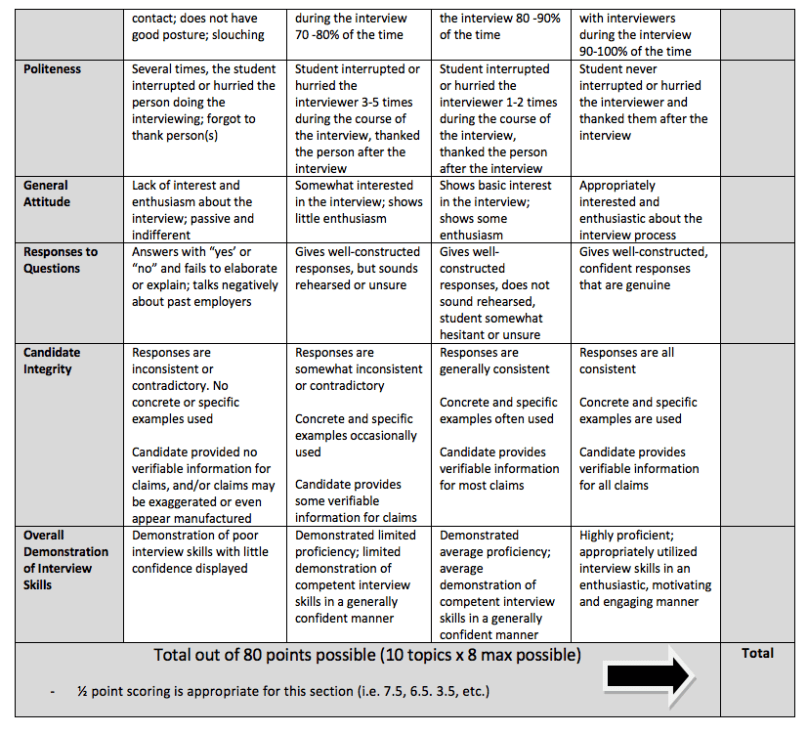
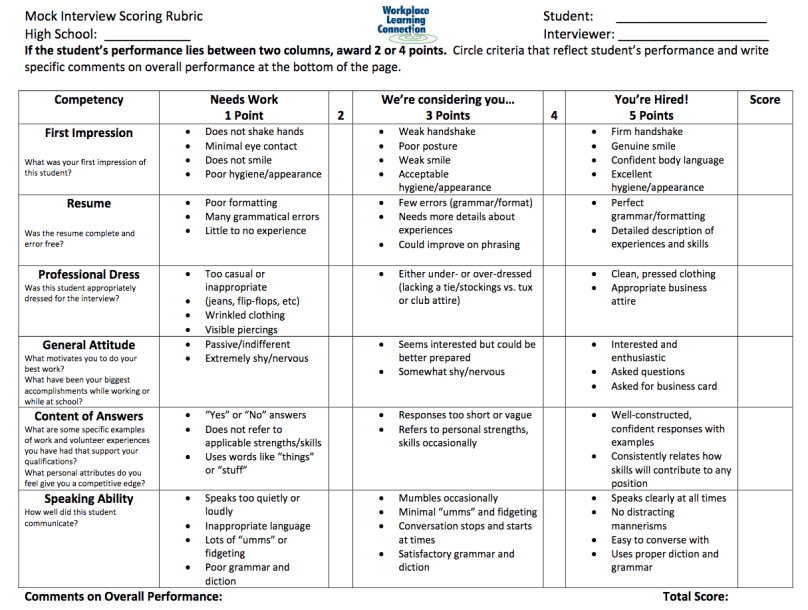
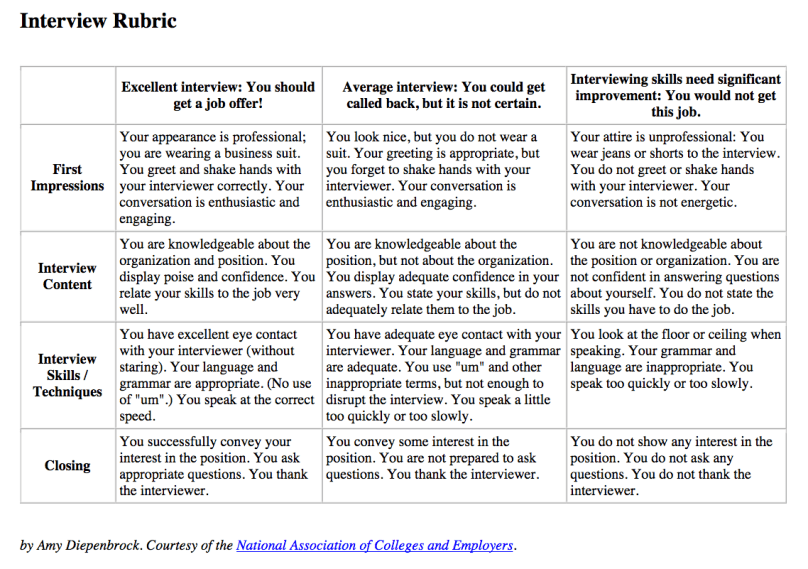
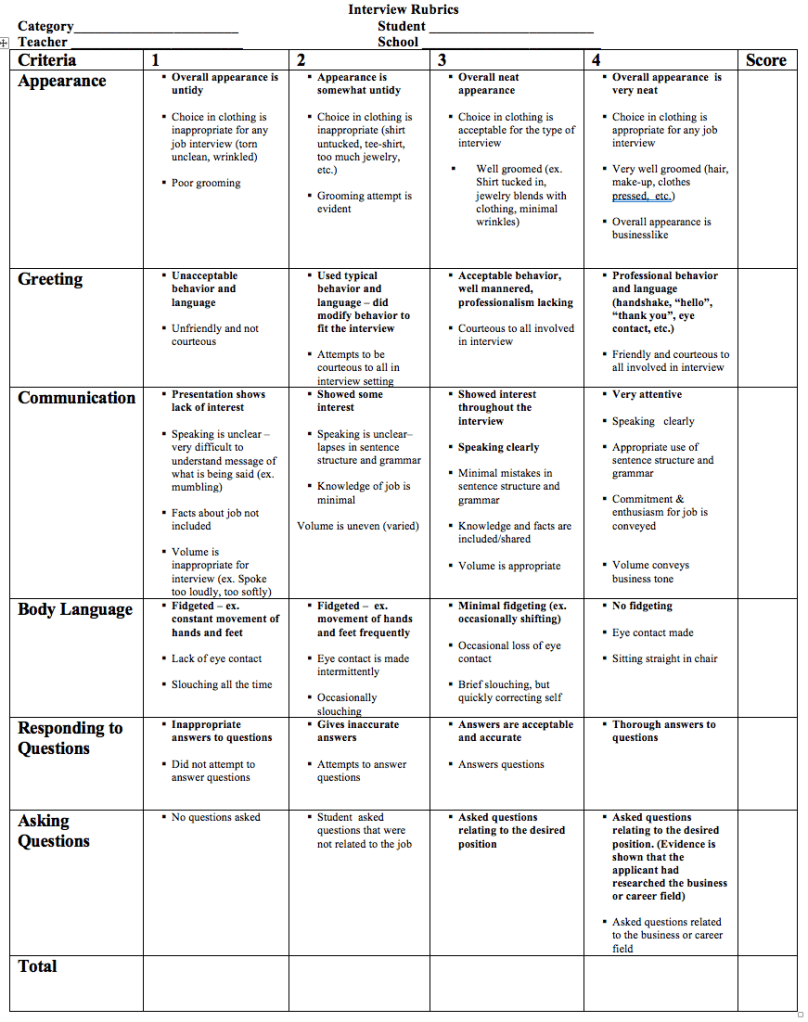
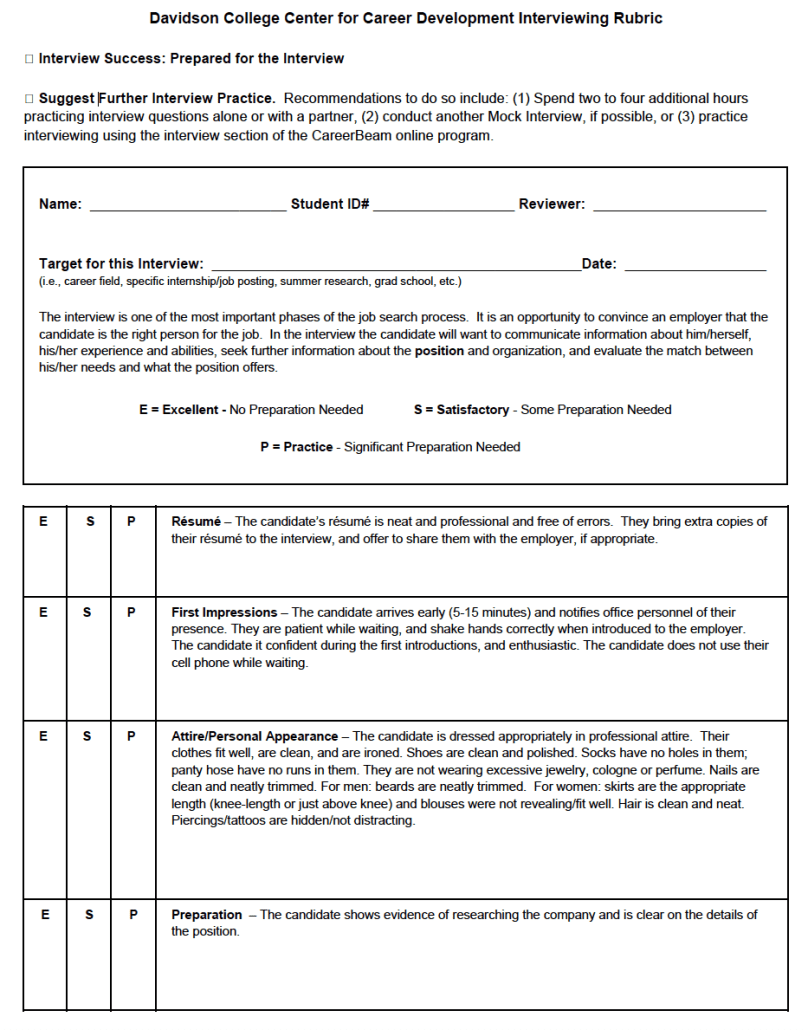
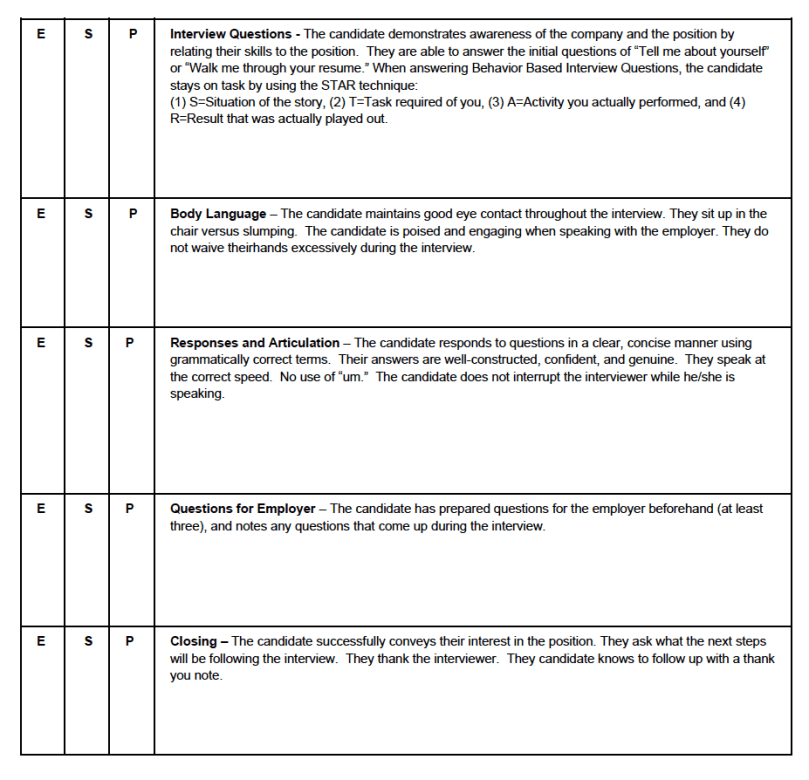
For those who are nearing completion of their coursework for a teaching certificate, the season of professional school interviews is coming… At this point, you should be familiar with assessment rubrics and other evaluative tools used in education. Right NOW how well do you stack up in prepping for employment screenings? Complete this checklist as honestly as possible. I am citing and “reviewing” past articles I have written at this blog-site… a perfect opportunity for you to “fill in the missing gaps” and get started on this process of finding the perfect job!

quiz-1-1189422

  1. [   ] I am familiar with numerous criteria for assessing teacher candidates (for what the employment screening committee may be looking), including specific instructional, professional, and personal skills, experiences, behaviors, or ”core teaching standards” of “Unsatisfactory,” “Satisfactory,” “Good,” or “Superior.” I know the Charlotte Danielson Framework (one evaluative model for professional development used by the PA Dept. of Education – (https://www.danielsongroup.org/) or sample school district assessment forms. DO YOUR HOMEWORK NOW: https://paulkfoxusc.wordpress.com/2015/08/09/criteria-for-selection-of-the-ideal-teacher-candidate/ and https://paulkfoxusc.wordpress.com/2015/09/01/a-blueprint-for-success-preparing-for-the-job-interview/.
  2. [   ] I have developed a comprehensive unified philosophy of music education that spotlights my abilities from the perspective of a generalist not a specialist. I can model competency and experience in general music, piano playing, vocal and instrumental (band, strings, and guitar) music, Classical, jazz, pop, and folk music styles, improvisation, composition and music theory, and technology teaching grades Pre-K to 12. DO YOUR HOMEWORK NOW: https://paulkfoxusc.wordpress.com/2015/07/04/marketing-yourself-and-your-k-12-music-certification/.
  3. [   ] I am comfortable with today’s jargon, current trends, and key “buzz words” in general education. This includes everything from “The Common Core” to “The Four C’s” of 21st Century learning, and all of those constantly changing acronyms like HOTS, DOK, RTI, and UBD. These terms may come up at interviews, so I have at least a precursory understanding about them, and if I am “stumped” with a particular question, I will admit needing clarification (and I will look it up when I get home). DO YOUR HOMEWORK NOW: https://paulkfoxusc.wordpress.com/2015/07/18/the-alphabet-soup-of-educational-acronyms/.
  4. [   ] I am becoming a proficient storyteller and have prepared a set of personal anecdotes to potential questions that may be asked at the interviews. I have practiced responding with specific examples of my past experience and accomplishments, not just “telling” my strengths but allowing the listener(s) to make his/her(their) own deductions about me from my stories. DO YOUR HOMEWORK NOW: https://paulkfoxusc.wordpress.com/2015/08/02/when-it-comes-to-getting-a-job-s-is-for-successful-storytelling/.
  5. [   ] I have practiced taking “mock interviews” in front of my peers and recorded myself for self-assessment of my ability to answer employment screening questions. DO YOUR HOMEWORK NOW: https://paulkfoxusc.wordpress.com/2015/10/11/the-dos-and-donts-of-interviewing/, https://paulkfoxusc.wordpress.com/2016/02/27/interview-questions-revisited/, https://paulkfoxusc.wordpress.com/2016/06/04/those-tricky-interview-questions/, and https://paulkfoxusc.wordpress.com/2017/01/27/body-language-interviewing-for-a-job/.
  6. I understand the concepts of…
  7. I have a high-quality…

What was YOUR score… out of 11?

Get to work… so you can get work!

job-concept-2-1140644-1

PKF

Photo credits: FreeImages.com, photographers hvaldez1 (studying for a test), Tory Byrne (quiz), and Svilen Milev (hire).

© 2017 Paul K. Fox

Body Language & Interviewing for a Job

More Sources to Prep You to Make a Good Impression at Employment Screenings

If you have been closely following this section of the https://paulkfoxusc.wordpress.com blog-site on “Marketing Professionalism,” you have consumed a lot of advice on numerous topics for preparing for the job search, developing your personal brand, and especially “conquering” employment interviews, such as:

body-language-3-1240767This article’s focus will be on the seemingly intangible… “body language!” Many say that during the interview, first impressions are critical — “the first ten seconds will create the interviewer’s first judgments about you, and then after four minutes, it’s all over.” The research also suggests that during the interview, the evaluation of your merit is based 7% on what you say, 38% on your voice or how you say it, and 55% on our facial expressions and non-verbal cues.

A good starting point to the introduction of “nonverbal communication” was posted by Jonathan Burston in his Interview Expert Academy website: http://www.interviewexpertacademy.com/body-language-the-3c-triangle/:

Using a triangle to symbolize his concepts, the “3Cs of Body Language” are:

  • Context of the situation/environment you are in… with friends (relaxed) or the boss (more stressed)
  • Clusters or groups of body language signals that you give off unconsciously
  • Congruence or links between what the person is saying, the tone of their voice, and the signals their body is giving off

He summarizes, “The 3C Triangle will help you understand the core parts of reading body language. Next time you’re with someone, either a friend, family member, work colleague or an interviewer, remember to use the 3C’s. Keep practicing.”

Probably one of the most unique presentations on this subject is a TED talk filmed in 2012: “Your Body Language Shapes Who You Are” by Amy Cuddy. Check out the transcript at http://www.ted.com/talks/amy_cuddy_your_body_language_shapes_who_you_are/transcript?language=en.

“Social psychologist Amy Cuddy shows how “power posing” — standing in a posture of confidence, even when we don’t feel confident — can affect testosterone and cortisol levels in the brain, and might even have an impact on our chances for success.”

Although some of her findings referenced in her talk are an ongoing debate among social scientists, Amy Cuddy’s research on body language reveals that we may be able to change other people’s perceptions — and even our own body chemistry — by simply changing body positions.

body-language-6-1240752Some of Cuddy’s assertions:

  • “When we think about nonverbal behavior, or body language — but we call it nonverbals as social scientists – it’s language, so we think about communication. When we think about communication, we think about interactions.”
  • “What are nonverbal expressions of power and dominance? …In the animal kingdom, they are about expanding. So you make yourself big, you stretch out, you take up space, you’re basically opening up.”
  • “What do we do when we feel powerless? We do exactly the opposite. We close up. We wrap ourselves up. We make ourselves small. We don’t want to bump into the person next to us.”
  • “We know that our minds change our bodies, but is it also true that our bodies change our minds? And when I say minds, in the case of the powerful, what am I talking about? …I’m talking about thoughts and feelings and the sort of physiological things that make up our thoughts and feelings, and in my case, that’s hormones.”
  • “Powerful people tend to be, not surprisingly, more assertive and more confident, more optimistic. They actually feel they’re going to win even at games of chance. They also tend to be able to think more abstractly…They take more risks.”
  • “Tiny tweaks can lead to big changes… Before you go into the next stressful evaluative situation, for two minutes, try doing this, in the elevator, in a bathroom stall, at your desk behind closed doors… Configure your brain to cope the best in that situation. Get your testosterone up. Get your cortisol down. Don’t leave that situation feeling like, oh, I didn’t show them who I am. Leave that situation feeling like, I really feel like I got to say who I am and show who I am.”

From Monster website, a very comprehensive article worth reviewing is “Body Language Can Make or Break a Job Interview” by Robert Ordona at https://www.monster.com/career-advice/article/body-language-can-make-or-break-a-job-interview-hot-jobs. He cites several body language experts. “You could be saying how great you are, but your body could be giving your true feelings away,” says Alison Craig, image consultant and author of Hello Job! How to Psych Up, Suit Up, & Show Up. Mark Bowden, author of Winning Body Language, agrees with Craig – and with the highly regarded Mehrabian communication study, which found that “if what’s coming out of your mouth doesn’t match what your body is saying, your audience is more likely to believe your body.”

Ordona’s blog-post sections provide the “nitty-gritty” of nonverbal communications:

  • Your “Great Entrance”
  • Showing your “good side”
  • First impressions
  • Handshakes
  • The walk to the interview
  • At the interview
  • The art of departing

Excerpts from Craig, Bowden, and Ordona’s work, here is a “top-ten list” of body language do’s (green) and don’ts (red):

  1. Be aware that the interview may start in the parking lot… you never know who may be observing you from a window or standing near you in the hallway. Regardless how you feel (inside yourself), model an attitude of outward calm, purpose, and confidence. This is no time to be frantically searching for your copies of your resume.
  2. The receptionist or secretary in the office may be informally assessing you (and the administrator may ask their opinion), so let them “observe you without letting on that you know they are watching.” Whenever possible, sit at right angles or offer your profile to them. “It makes them feel comfortable, and if they’re comfortable, they’re more likely to form a good impression.”
  3. While waiting, sit with good posture, back straight, and your chest open – additional signs you are “confident and assertive.” Don’t hunch your shoulders or tuck your chin into your chest, which may imply you are “closed off.” Don’t try to appear to comfortable or informal, for example “elongating your legs or throwing your arm across the back of the chair,” as it might make you look arrogant.
  4. If you can tell, try facing the direction from where the interviewer will come; “it’ll make the greeting more graceful.” Also, “don’t have so much stuff on your lap that you’re clumsily moving everything aside when you’re called.”
  5. body-language-5-1240757Practice handshaking with a friend before taking interviews. Avoid “the overly aggressive or death grip” as well as “the limp handshake.” Since you are going to shake with your right hand, arrange your belongings on your left side. “Offer your hand with you palm slightly up so that your interviewer’s hand covers yours,” a sign that “you’re giving them status.”

  6. Even the walk to the interview room is the perfect to time to use good body language: follow the hiring manager or assistant “to show you understand the protocol” (“I follow your lead”), mirroring that person’s tempo and demeanor, showing “you can easily fit into the environment.”
  7. Once in the interview room, it’s okay to place a slim portfolio on the table, “especially if you’ll be presenting its contents,” but place your other belongings on the floor beside you. “Holding a briefcase or handbag on your lap will make you seem as though you’re trying to create a barrier around yourself.” Again, it is recommended you sit a slight angle to offer your profile, avoiding creating a defensive barrier.
  8. Sit up straight and display your neck, chest, and stomach area, a signal to the interviewer that you’re open. “Avoid leaning forward, which makes you appear closed off.”
  9. Sit about a foot away from the table and keep hand gestures at a level above the desk (or slightly lower) and below your collarbone. Your goal is to communicate that “you’re centered, controlled, and calm – and that you want to help.”
  10. The final advice at the end of interview: “Gather your belongings calmly, rise smoothly, smile, and nod your head. If shaking hands with everyone in the room isn’t convenient, at least shake hands with the hiring manager and the person who brought you to the interview space.”

Another interesting online resource is Forbes, “10 Body Language Interview Mistakes” at http://www.forbes.com/pictures/lml45lide/10-body-language-interview-mistakes-2/#76cf48105767. Eleven slides illustrate suggestions about eye contact, the way you fix your hair, crossing your arms, and other “physical slip-ups in your next interview.”

Finally, Yohana Desta offers “9 Simple Body Language Tips for Your Next Job Interview” on Mashable at http://mashable.com/2014/11/17/body-language-job-interview/#UZoXdE1FEsqB.

“Job interviews are notorious tightrope walks. You want to be confident, but not obnoxious; intelligent but not a know-it-all. Trying to find a balance and also explain why you deserve a job is hard enough. But what if your body language could help you out?” – Yohana Desta

body-language-8-1240743Although “the experts” are not always in consensus, especially on the subjects of eye contact and leaning posture, Desta’s tips summarized below provide additional enlightenment on how to use body language to promote a positive image:



  1. Sit all the way back in your seat.
  2. Don’t go for direct eye contact.
  3. Use hand gestures while speaking.
  4. Show your palms.
  5. Plant your feet on the ground.
  6. Work on your walk.
  7. Nod your head while listening.
  8. Lean in.

In a challenging job market with limited openings for public/private school music educators in many geographical areas of the country, there is great competition in the screening and evaluation of the applicants. Hopefully these suggestions from “the experts on body language” will help you better prepare for employment interviews… and land that job you always wanted!

PKF

© 2017 Paul K. Fox

Picture credits: Photographers John Evans and Henk L. at http://www.freeimages.com

Happy Thanksgiving, Newbies!

“I would teach children music, physics, and philosophy; but most importantly music, for the patterns in music and all the arts are the keys to learning.” — Plato

digital-spray-paint-1160577

Things for Which Prospective Music Teachers and Students Majoring in Music Education Should Be Thankful… and on Which to Reflect Over This Holiday Season!

Music educators and those training for this honorable career have many reasons to feel blessed. This Thanksgiving 2016 blog is another one of my “pep talks” and an ongoing goal to share resources for pre-service professional development. Lets begin with a classic “top-ten” list — the fruits and cornerstones of our profession:

  1. prospective-music-student-1440071-1Music is one of life’s greatest treasures!

  2. You will always have your music. Your future employment is also your hobby, and even after 35 or more years, you will inclined to continue your music throughout the “golden years” of retirement.
  3. There are so many ways you can make a difference in the lives of children with music. Whether it is singing, playing an instrument, composing, listening, feeling, or moving in response to music, music fills a basic need!
  4. Although music is an excellent vehicle for developing 21st Century learning skills (the four C’s of creativity, critical thinking, collaboration, and communication), participating in music for music’s sake is paramount. To find true meaning and personal artistry, you cannot review the arts without “doing” (or creating) the arts.
  5. parade-band-1421028Your joy of creative self-expression and “making music” will sustain you through almost anything… and will transfer to your students’ success in life.

  6. In many settings of school music courses and extra-curricular activities, your students make a conscious effort to choose you and the study of music in order to spend as much time together. “They may have to take math and English, but they also want their daily dose of music!”
  7. Newcomers to this field, you do not have to be right or perfect all the time in class. During your student teaching and early years on the job, if you are enthusiastic, dedicated, and respectful of the feelings of your students, youkids-singing-christmas-songs-1438089r mistakes (and there will be many) will be forgiven. Besides, there are usually no “single right answers” in music and art – only opportunities for divergent and flexible thinking, adaptability, and personal expression.


  8. You’ll never forget your students… and when you bump into them after graduation, they will remind you all about “those good times!” Don’t be surprised when they tell you were the best part of their education.
  9. Your band, orchestra, and/or choral director back home (school district and university) are rooting for you… and want you to succeed. If you have questions, go see them. They would appreciate you asking for their advice.unwritten-solo-2-1314639
  10. Good news! Help is on the way! On this blog-site, there is a single link to all of the articles, handouts, PowerPoint slides, etc., everything from branding yourself to a review of the interview questions you will need to answer at job screenings. To help you market your professionalism, develop a philosophy of music education, learn the basics of networking, dive into making a business card, professional website or e-portfolio, or practice taking interviews, go to the link above or https://paulkfoxusc.wordpress.com/becoming-a-music-educator/.

Why Music? Why Do You Want to Become  a Music Educator?

It never hurts to embrace and share the excellent voices of our music education advocates. Check out these interesting online sources:

Ten Goals for the Holiday Break

After you finish your fall semester finals, juries, concerts, writing assignments, and other projects, you may have several weeks before you have to return to full-time classes at the university. Besides catching up on your sleep and visiting your family and friends, how many of these enrichment activities can you accomplish?

  1. Share your gifts. Play your instrument, accompany concert-1435286someone else, or sing solos at a local nursing home or senior center.

  2. Sit in with a church or community choir, band, or orchestra. Just ask the conductor if you could participate in a few rehearsals over your break.
  3. Learn something new about music… a different instrument, recent releases in sheet music or recordings, unique composer/arranger in your major area, music education article from a professional journal, innovative music software or interactive online programs (often free trials are available to future teachers), etc. For example, have you perused SmartMusic and MusicFirst?
  4. OLYMPUS DIGITAL CAMERASpend a lot of time sight-reading… especially on the piano. To take your ear-training training a step further, pull out your old folk-song sight-reading series  or Hindemith’s Elementary Training for Musicians and practice musicianship exercises.


  5. To improve your score reading, take a choral arrangement and play the individual vocal parts at sight (soprano + bass, alto + tenor, soprano + tenor + bass, etc.). Or, perform on the piano 2-4 parts of a string quartet score.
  6. Volunteer to assist coaching a sectional or large ensemble at your local public school.
  7. Attend as many local concerts as you can: school, amateur adult, and professional.
  8. Compose or arrange a short holiday, folk, or classical song for unusual instrumentation (e.g. flute, viola, baritone sax, and tuba). Who knows? Someday you may have to conduct an ensemble with such unique membership.flute-player-1567317
  9. Record video/audio excerpts of your major instrument/voice for placement on your professional website. Begin preparations on or update your e-portfolio.
  10. Read all of the “marketing professionalism” articles on this blog-site. Take notes or print the things to which you want to refer back. Make a list of the possible interview questions, and put yourself through several “mock job screenings” (alone or with one or more college buddies) with you answering these randomized questions in front of a camera. Assess your performance. During your”free time” over the holiday break, assemble your “personal stories” – anecdotes revealing your skills, personality traits, teaching experiences, and accomplishments that could be shared at future employment interviews. Most important article on this subject? Look at thanksgiving-turkey-1521430https://paulkfoxusc.wordpress.com/2016/02/27/interview-questions-revisited/.

Best wishes for a healthy, peaceful and fulfilling holiday. Please enjoy lots of turkey with your loved ones, but if you can, “catch up” on your long term preparation for becoming a music educator. Make every day count over the recess. Reflect on why you are becoming a music educator, and be grateful for the multitude of benefits! Finally, never forget your own creative roots… make time for music every day!

PKF

© 2016 Paul K. Fox

Photos are licensed by FreeImages.com (all rights reserved)

Ethics for Job Seekers

Employment Etiquette & Standards of Morality

Ethics is knowing the difference between what you have a right to do and what is right to do. – Potter Stewart from http://www.brainyquote.com

Definitions

Google defines ETHICS as “moral principles that govern a person’s or group’s behavior.”

For more detail and an analysis of the “essential questions” on ETHICS, check out the blog “What is Ethics?” from the Markkula Center for Applied Ethics: https://www.scu.edu/ethics/ethics-resources/ethical-decision-making/what-is-ethics/.

From another perspective, according to Investopedia, “BUSINESS ETHICS is the study of proper business policies and practices regarding potentially controversial issues, such as corporate governance, insider trading, bribery, discrimination, corporate social responsibility and fiduciary responsibilities.” The full article can be read at http://www.investopedia.com/terms/b/business-ethics.asp.

the-truth-shall-make-you-free-1201069

Declining Standards of Behavior?

Jean Twenge, the author of the 2006 book Generation Me, considers Millennials (born between 1977 and 1994), along with younger members of Generation X, to be part of what she calls “Generation Me,” possessing a preponderance of the traits of confidence and tolerance, but also a strong sense of entitlement and narcissism. Wikipedia identifies the (older) “Me” generation in the United States, referring to “the baby boomer generation and the self-involved qualities that some people associated with it.”

According to Psychology Today in a blog-post The Truth About Lying by Allison Kornet (https://www.psychologytoday.com/articles/199705/the-truth-about-lying), “Deception is rampant—and sometimes we tell the biggest lies to those we love most.”

If, as the cliché has it, the 1980s was the decade of greed, then the quintessential sin of the 1990s might just have been lying. After all, think of the accusations of deceit leveled at politicians like Bob Packwood, Marion Barry, Dan Rostenkowski, Newt Gingrich, and Bill Clinton.

Regardless of these labels of societal trends, “generalizations about the generations,” and reflections on current social values and conscience in the media, how do you come to terms with the recent headlines of inconsistent (or “inconvenient”) ethics and morality?

  • State-sponsored doping of Russian athletes
  • Volkswagen emission cheating
  • Students saying, “If we don’t get caught” or “If they don’t find out,” it’s OK.
  • The rise of online plagiarism-checking programs such as turnitin.com.
  • The cynicism about “ethics in advertising: do we expect lies?”
hand-on-a-bible-1417265

And yet, some of us still recite the Boy Scouts oath (“honesty”), “swear to tell the truth” (on a bible) in a court of law, and strive to maintain an atmosphere of honesty in the workplace (see http://www.businessinsider.com/3-essential-rules-to-workplace-honesty-2013-1  and http://smallbusiness.chron.com/create-atmosphere-honesty-workplace-10098.html).

So, are we “losing” our moral compass? Does “our word” mean anything? Do we take the easy way out and “fake a little” here and “wink a little” there? Is it affecting the way we interact with each other, in educational institutions, the marketplace, family life, and even presenting ourselves to be hired for a job?

Blame it on upbringing? Past experience? Perhaps it is safe to say one’s personal judgment may be affected by ethics. If a member of your family has a handicap parking placard, is it ever used when the handicapped individual is not riding in the car? In terms of judgment and feelings of entitlement, it is probably ill-advised to bring up anything to do with driving… fighting over parking places, cutting off someone, tooting horns at slow drivers, etc. Besides, who actually ever comes to a complete stop at a stop sign?

In the pre-employment planning stages, it is essential for you to make a honest personal and professional assessment, prepare to represent yourself accurately at interviews and on your resume and  e-portfolio, and model ethical personal branding. I would agree that “you cannot ‘fib’ and claim you are a ‘master’ of everything,” but if you are certified to teach music in grades K-12, not just band, or general music, or choir, or strings… you should state your proficiency to teach “the whole kit and caboodle.” At employment screenings, it’s more important to show you have learned the necessary 21st Century skills of critical thinking, problem-solving, collaboration, communications, creativity, and flexibility/adaptability… rather than whether you can play Paganini on the violin, sing a high “A,” improvise modern jazz styles, or piano accompany a musical production.

25774792772_259d73f98c_b

Stretching Things a Bit?

The concept of a “stretched resume” is detailed online by “Employee’s Ethics: Getting a Job, Getting a Promotion, Leaving,” Chapter 6 from the book Business Ethics. The author tells the true story of Robert Irvine, who used to host the Food Network’s popular Dinner: Impossible. He was fired when he was caught “lying” or providing gross exaggerations on his resume. You should read the interesting full account at this site: http://2012books.lardbucket.org/books/business-ethics/s10-employee-s-ethics-getting-a-jo.html.

The kind of resume misrepresentations are categorized as the following:

  • False credentials
  • False experience
  • Embellished experience
  • False chronology
  • False references

The best quote from this reference suggests that the outcome of resume misrepresentation is not worth the chances you would take if/when you are caught:

Ethical egoism means your moral responsibility is to act in your own interest no matter what that may require. This provides a license for outright résumé invention… But, as is always the case with egoism, the question must be asked whether job seekers really serve their own interests when they claim things that may later be revealed to be false or when they land jobs they later won’t be able to perform because their qualifications were fake.

This source led me to the webpage http://fakeresume.com/ (aptly named) selling the book Fake Resume: The Machiavellian Guide to Getting a Job by Max Stirner (something I am not promoting!) You can peruse a segment of his work, “Five Reasons Why You Must Lie on Your Resume To Get a Job Today” at http://fakeresume.com/five-reasons-why-you-must-lie-on-your-resume.pdf. This excerpt is from his “Everyone Lies on Their Resume” section of his website:

fake-resume-ebook-vertical

The firm Hire Right released some interesting statistics that show how rampant resume fraud is in the United States. The company’s numbers show that 80 percent of all resumes are misleading. They also show that 20 percent state fraudulent degrees and 30 percent show altered employment dates. As if those numbers are not shocking enough, 40 percent have inflated salary claims and 30 percent have inaccurate job descriptions. Furthermore, the study shows 25 percent of people listing companies that no longer exist, and 27 percent giving falsified references; and these are only the people they have caught!

Guides to Employment Ethics

Regardless of what others do or say they do, marketing exaggeration and even falsehoods will not be in your best interest.

Richard Fein, Director of Career Management, Isenberg School of Management, University of Massachusetts-Amherst via Monstertrak.com wrote an excellent career guide on this subject: “Etiquette and Ethics in Your Job Search. What Are They and Why Should You Care?” Download the following to review the definitions, distinctions, and job search scenarios involving the terms “etiquette” and “ethics.” http://www.bu.edu/hospitality/files/pdf/ETIQUETTEANDETHICSINYOURJOBSEARCH1.pdf.

Another excellent resource is the “Job Search Ethics Brochure” from the University of Pennsylvania: http://www.vpul.upenn.edu/careerservices/files/Job_Search_Ethics_Brochure.pdf. In this thoughtful publication, additional terms are defined, such as “professional,” “integrity,” and “honor.”

word-true-on-the-dices-1237241

In addition, it should be “worth your while” to access some of the Franklin College’s “Helpful Handouts” under the Career Service section of their website: http://franklincollege.edu/student-life/career-services/students-alumni/helpful-handouts/. In particular, what stood out to me was their document “Job Search Ethics and Protocol,” which Assistant Dean of Students & Director of Career Services Kirk Bixler has graciously granted me permission to reprint below. (This is an excellent summary of many of the topics/tips we have posted at this site. Click on the “Marketing Professionalism” link to the right to read past blog-posts.)

  • Do NOT give into the temptation of carelessly completing an application. Do NOT make statements on an application like “see attached résumé.” Never leave spaces blank.
  • Apply for a job only if you have some realistic level of interest.
  • Absolute honesty on your résumé is imperative. Don’t overstate or understate. Don’t downplay your skills because you haven’t been featured in Business Week.
  • Request permission to use a person as a reference. Be prepared to explain to your reference what your job search plans are. Provide the reference with examples of qualities you possess. Offer a copy of your résumé. When interviewing, have your list of references on hand.
  • Don’t take advantage of an expense account when traveling for job interviews.
  • Show up for your interview. If you are visiting a person’s place of work, make sure your appearance, including mode of dress, is appropriate for that environment. You are not a student going to class. Consider yourself a professional trying to make a positive impression. How you present yourself is a partial reflection on the person with whom you are meeting.
  • Be a bit early for your appointment. Be mindful of the other person’s time. Come in prepared with questions & knowledge of the business.
  • Ask “How would you like to be addressed?” Be on the safe side; few people are offended by “Mister” or “Ms.” Be courteous to everyone you meet.
  • Everything you say must be true. On the other hand, you don’t need to say everything.
  • 25957630814_ee6ff87fe5_oYou may be asked to say something about another student or applicant. Speak only of your abilities & strengths. It is acceptable for an interviewer to ask you about other interviews, job offers & salary offers. You are not under an obligation to give a direct answer.
  • Be aware of illegal inquires. Employers may not ask, “How much alcohol do you drink?” “Have you ever been treated for mental health problems?” “What prescription drugs do you currently take?”
  • Thank you! Thank you! Thank you! Thank-you notes are a MUST in the job search process. They may be handwritten or typed. Address them to the person with whom you had the interview.
  • Be aware of drug screening requirements.
  • Call to inquire about your status in the employer’s hiring process. If a specific time has been communicated, wait until that time has passed before contacting the employer.
  • Let the employer be the first to mention salary. End it early if you are not interested. Let the employer know you are not interested in pursuing employment.
  • When offered the job, ask for time to think it over & ask for a formal offer letter.
  • You may receive one or more job offers you decide to reject. You should convey your decision to reject a job offer orally & in writing. The considerations here are speed & certainty of delivery. Call the person who signed your offer letter. Write a brief letter, also. Do both in a timely manner.
  • Only accept a job if you are really interested. Don’t settle. Once you accept a job offer, formally remove yourself from all other job searches. DO NOT continue looking.

These final bulleted items are echoed by another prestigious institution. “Ethical Internship and Job Search Policies” is posted on the University of Notre Dame’s Career Center webpage (http://careercenter.nd.edu/students/ethical-job-search-policies/):

When accepting an offer of full-time employment or an internship (either paid or unpaid), one must have every intention of honoring that commitment.  If a student accepts an offer of employment, admission to a graduate or professional school, or other post-graduate career opportunity, he/she must withdraw from the recruiting process immediately. This includes but is not limited to:

  • Not applying to future job postings.
  • Declining all future interview invitations.
  • Canceling any active applications.
  • Contacting all recruiters to inform them of your wish to be removed from the interviewing and recruitment process (this includes all scheduled interviews).

Ethics? It all boils down to two questions: “Who are you?” and “For what do you stand?” Besides the fear of “getting caught in lies” and being fired for misrepresentation (or doing an incompetent job because you did not have the qualities for which your employer was looking), it centers on “liking what you see” when you look at yourself in the mirror. Anyway, didn’t you mommy tell you your nose gets longer when you tell a fib?

mirror-on-wall-1413751

Ethics is nothing else than reverence for life.  – Albert Schweitzer
from http://www.brainyquote.com
PKF
© 2016 Paul K. Fox

21st Century Job Search Techniques

“New Age” Employment Tools for Music Teachers

Portions of this blog-post reprinted from “Job Searching in the 21st Century – The 5 W’s of the Application” in the Summer 2016 issue of PMEA News, the state journal of the Pennsylvania Music Educator Association. Special thanks goes to contributor Joshua Gibson, PMEA State Director of Member Engagement. PMEA members should go directly to the website, download and read the entire insightful article: http://www.pmea.net/resources/pmea-news/.

Hello and welcome to all collegiate music education majors and prospective job seekers! Here are a few more suggestions to help you go out and find the perfect public school music position, especially in Pennsylvania. But first, if you have not read my past blogs on this subject, please click on the above link “Becoming a Music Educator.”

Are you a PCMEA or PMEA member?

pmeaThe number one “tool” for finding a job is not a tool at all – it is all about modeling professionalism, networking with other college students and music teachers, and becoming actively engaged in your state/national music education associations (click on the acronyms to go to their websites) – National Association for Music Education (NAfME), Pennsylvania Music Educators Association (PMEA) and Pennsylvania Collegiate Music Education Association (PCMEA). Interaction with others in your field is essential to build and maintain connections to what is “state-of-the-art” in curriculum/instruction, innovations in teaching and technology, news, trends, and other information related to the field of music education, and even “leads” to possible openings in PA school districts via job banks and conversations with other colleagues at state conferences and meetings. If you are not already a member of NAfME and PCMEA, you are walking away from numerous opportunities and benefits that could help you land a job!

The Mobile Resume

Much has been written about the curriculum vitae (CV) or employment resume. One recommendation is for it to be constantly updating, adaptable, flexible, and “very digital.” dockan1Your “travel document” (paper copy you bring to the interview or “one-of-kind” attachment in response to email application) should be easy-to-modify based on the specific job posting to which you are applying. Your philosophy, goals, education, and teaching experience should focus on and reflect your competencies in alignment with the requirements for the music position. Your professional website and online resume should be more “general” and not rule out being considered for employment assignments outside your major. The PA teaching certificate states you are licensed to teach music in grades pre-K to 12… which means you should be qualified for any opening in elementary, middle, and high school general music, band, choir, jazz, keyboard lab, and strings, right?

If your professional “contacts” (or the school district’s website) help you discover more specifics about the type of music position to which you are applying, you can include on your resume past performances and interactions with students even remotely related to this subject area, as well as become better prepared for the questions and a demonstration lesson at the interview. For example, the school district from which I retired recently began looking for a middle and elementary school band director and high school assistant marching band director. Even if you majored or emphasized in voice, piano, or strings in college, “if you really want the job,” you should be able to revise your resume to include such experiences like playing the flute in your HS marchingdockan2 band for a year, conducting a small instrumental ensemble to accompany your youth church choir, giving a few summer lessons to the bell players in the local drum line where you live, etc. In addition, prior to the first employment screening and mock lesson at the interviews, you could “bone up” on your instrumental methods, suitable middle and elementary band warmups/literature, the meaning/concept of “middle school education,” and perhaps even pull out and brush up playing a few scales on that flute (or whatever) in your closet.

Electronic Business Card

Past blogs (see https://paulkfoxusc.wordpress.com/category/marketing-professionalism/) discuss personal branding, the set-up of a professional website, business cards, and networking. Have you thought about placing a Q code on your business card that scanning would go directly to your e-portfolio and sample recordings, perhaps displaying an excerpt from your senior recital and several videos of your teaching or conducting?

Check out these online resources that are “pro” using a Q code:

To be fair, these sites recommend against placing a Q code on your card:

At the every least, you need to print on your business card the URL listing to your website or LinkedIn pages… access to find “everything you always wanted to know about” you as a candidate.

dockan3

Where Are the Jobs? Websites and Online Hiring Agencies

PMEA State Director of Member Engagement Joshua Gibson shared his research on using the Internet to search for music teacher openings posted in Pennsylvania. (PCMEA and PMEA members should read the entire article, “Job Searching in the 21st Century – The 5 W’s of the Application Process” on pages 62-63 in the Summer 2016 issue of PMEA News.)

With descriptions printed in the journal, you should become familiar with these sites:

PMEA Educational Entities Map

pcmeaAnother great reason you should be a member of your professional association (PMEA or PCMEA) if you are looking for a job in PA is… the PMEA Job Board. Many PMEA members have relied on the Job Board for the most recent information when it comes to available PA music teacher positions.

Adapted from Google Maps, Gibson recently created/unveiled the latest interactive tool to facilitate a hunt for PA musical jobs: PMEA Educational Entities Map. His explanation:

The PMEA Educational Entities Map will “allow anyone to be able to search jobs in any geographical area in the Commonwealth of Pennsylvania. You can sort by Public School Districts (red), Charter Schools (blue), Career and Technology Centers (green), High Education (yellow), and Intermediate Units (orange).”

The job seeker can also use a specific PA county overlay to outline a specific area, as well as correlate with the PMEA District and PMEA Region maps.

In summary, “Once you click on the specific entry, you will be given the name, address, phone number, website, the employment website, and county of residence.”

For more information about the PMEA Job Board, go to http://www/pmea.net/job-board/. Gibson invites comments or questions for using the PMEA Interactive Map at jgibson@pmea.net.

dockan4

Break-a-leg! Hopefully these 21st Century marketing hints will do the trick! Best wishes on starting (or restarting) your music teaching career!

Photo credits: David Dockan, my former student and graduate of West Virginia University. Check out his professional website: http://www.daviddockan.com/.

Additional Blogs of “Tips and Techniques” for Getting Hired


PKF

© 2016 Paul K. Fox