Did You Take the Summer Off?

Rebuilding instrumental technique after a long break

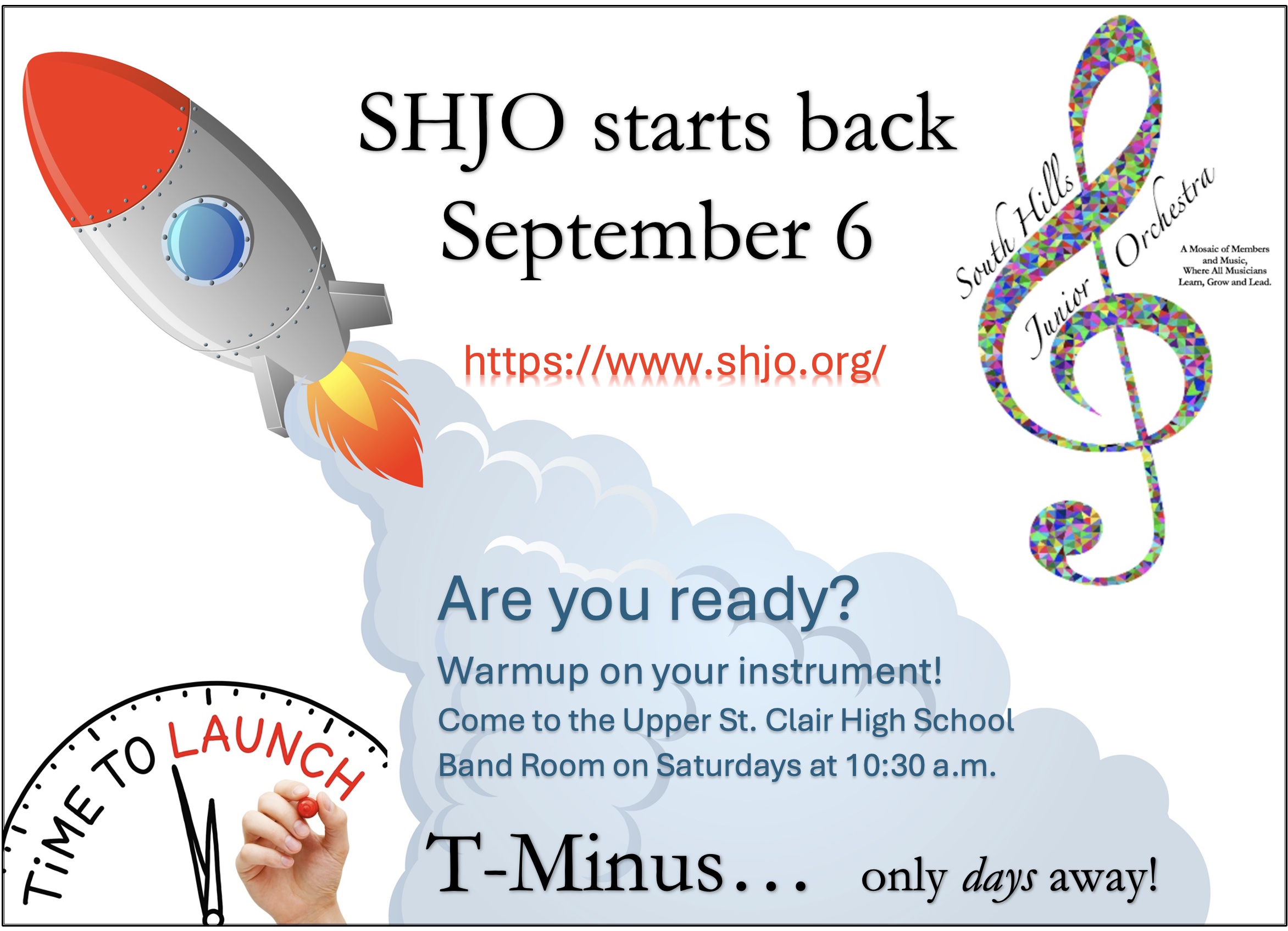
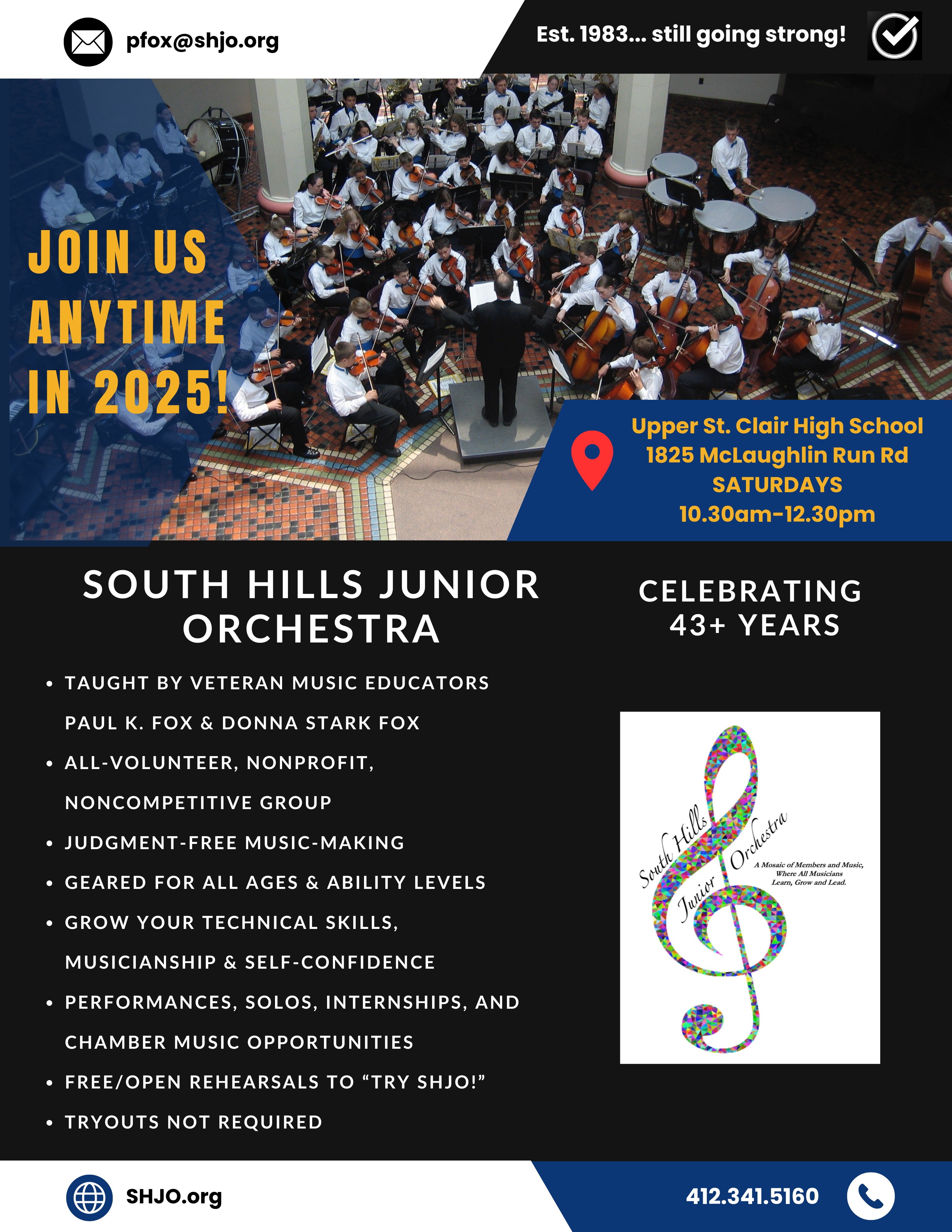
Director’s Note: This is the week to get ready for the return of the South Hills Junior Orchestra after all our vacations! If you live in the Southwestern PA area, we hope you will consider this a personal invitation to “TRY SHJO” and participate in several free and open rehearsals of our community orchestra – a totally “judgment-free” place for creative self-expression of all ages and ability levels. Practices are held in the Upper St. Clair High School Band (1825 McLaughlin Run Road, Pittsburgh, PA 15241) on Saturdays from 10:30 a.m. to 12:30 p.m.

A Google search on my computer fetched the following “AI Overview,” a nearly perfect summary for wind players to recover their “chops” and bring back good tone, intonation, breath support, flexibility of the embouchure, key literacy, and practice habits. For players of all orchestral instrumental sections, I recommend revisiting other articles in the Fox’s Fireside Library to develop a “practice plan” and adopt new musical goals. PKF

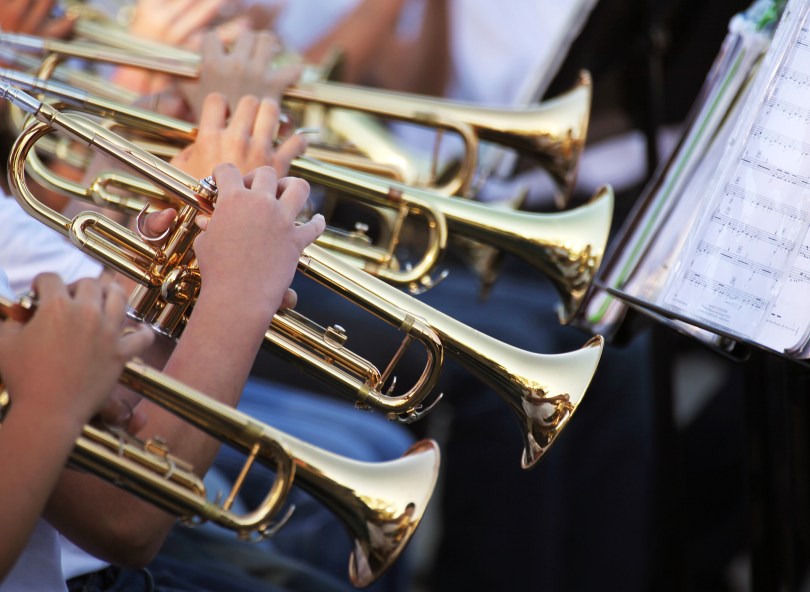
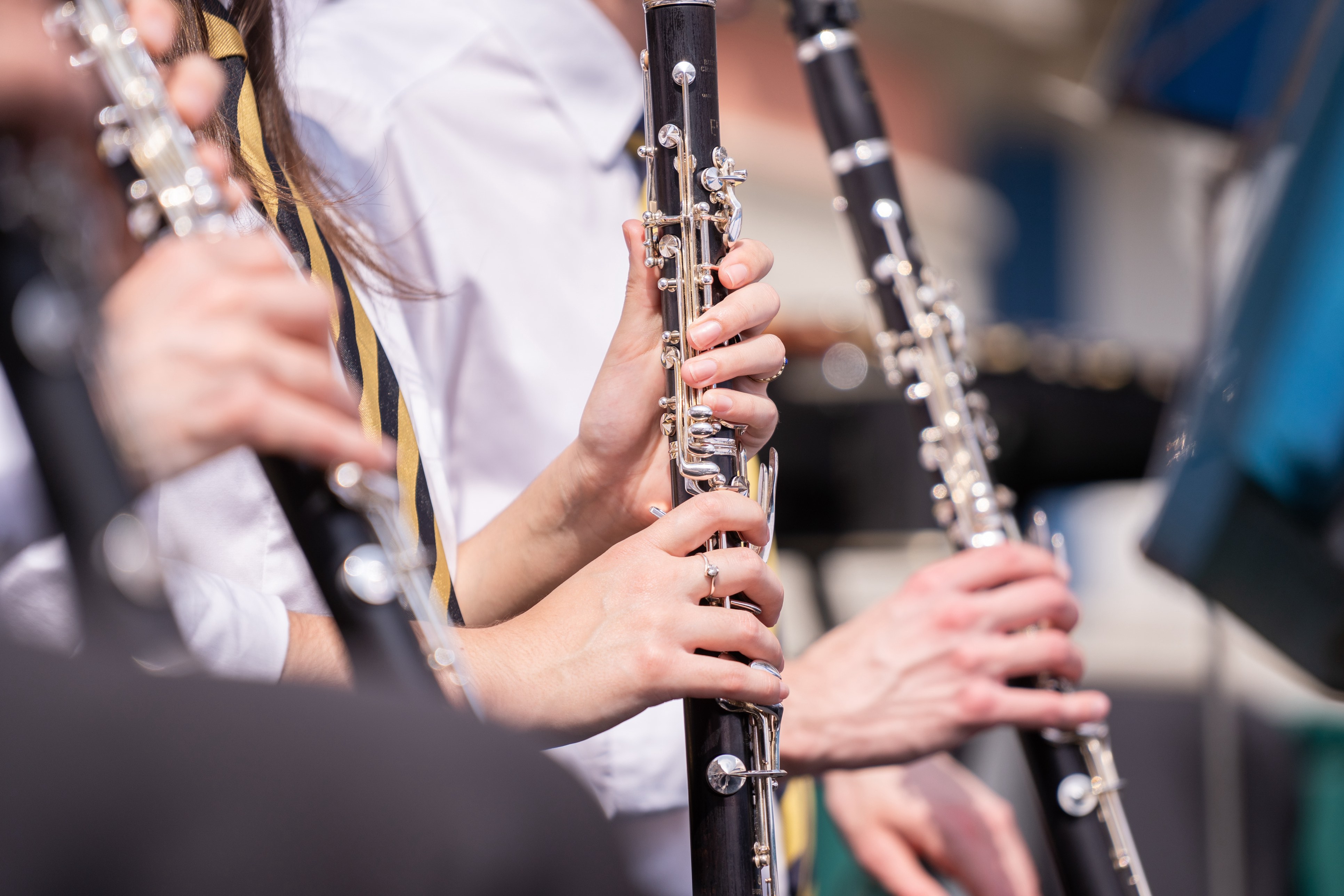
To rebuild your brass and woodwind instrumental technique after a long break, focus on the following gradual, three-stage process: first, restore your tone and response, then regain flexibility and dexterity, and finally, rebuild range and endurance. Prioritize short, consistent practice sessions, and avoid pushing too hard too early to prevent injury and bad habits.

Stage 1: Restore tone and response

Your primary goal is to reacquaint your body with the fundamentals of playing by focusing on soft dynamics and your lowest register.

  • Breathing exercises: Start without your instrument. Practice deep, diaphragmatic breathing to re-engage your respiratory system and expand your lung capacity. You can use simple routines like inhaling for four counts and exhaling for eight, or try the “pinwheel” exercise to visualize steady airflow.
  • Buzzing: Brass players should spend time buzzing with just their mouthpiece to get their lips vibrating efficiently again.
  • Long tones: On your instrument, play sustained, steady notes at a soft volume in your lower-to-middle range. Focus on producing a clear, characteristic tone. Use a tuner to monitor your pitch stability.
  • Short practice sessions: Limit your initial sessions to 5–20 minutes, with plenty of rest in between. This prevents over-straining your facial muscles and embouchure.

Stage 2: Regain flexibility and dexterity

Once your tone and response feel stable, you can begin to expand your comfortable playing range and improve finger speed.

  • Scales and arpeggios: Practice basic scales and arpeggios at a slow, controlled tempo. This helps rebuild muscle memory for your fingers while keeping the focus on even, beautiful tone.
  • Slurred partials (brass) and lip slurs (woodwind): Practice smoothly transitioning between notes without using your tongue. This strengthens your embouchure and improves air control.
  • Simple music: Play easy, melodic pieces you know well. This helps you focus on phrasing and musicality without the pressure of a difficult score.
  • Increase session length gradually: Slowly add time to your practice sessions, perhaps moving to 15–30 minutes at a time. Continue to take frequent breaks.

Stage 3: Rebuild range and endurance

After re-establishing your fundamentals, you can begin to increase the intensity and duration of your playing to return to your previous level.

  • Expand your range: Gently start working your way into your upper and lower registers, but maintain a soft dynamic level. Only increase volume once you can play a note softly with a good tone.
  • Louder dynamics: Once your full range is accessible, begin practicing with louder dynamics. This is physically demanding, so continue to take frequent rests.
  • Articulation: Incorporate tonguing exercises. Start with basic single tonguing before adding more complex techniques like double and triple tonguing.
  • Listen to your body: Your body will be the ultimate guide. If you feel any pain or unusual fatigue, ease up and incorporate more rest into your routine.
  • Mental preparation and practical tips
  • Listen to music: Remind yourself of what inspires you and listen to your favorite players to reconnect with the joy of playing.
  • Record yourself: Objectively evaluate your progress by listening back to recordings. This helps you identify areas that need work and celebrate your improvements.
  • Revisit old notebooks: Look back at any old lesson journals for useful reminders and insight into your past tendencies.
  • Service your instrument: A leaky pad or sticky valve can make returning to your instrument unnecessarily difficult. Have a technician give your instrument a “clean, oil, and adjust” to ensure it’s in prime playing condition.
  • Be patient: You are not expected to be at your former playing level immediately. Trust that your muscle memory will return with consistent, smart practice.

Click here to download a printer-friendly copy of this article.

 Here are additional resources shared in the SHJO eUPDATE newsletter (August 30, 2025):

PKF

© 2025 Paul K. Fox

Vote!

I’m not much into politics or voicing my opinion about the national, state, or local candidates in the upcoming elections. Frankly, serving five-plus decades (still actively involved) in education, I have always felt it may not be wise or even ethical to publicly endorse a party, position, or person running for office (especially a school board director!). And, with all the angry rhetoric, polarized (and fractured) debates in social media and on the news, with opposing sides literally calling each other a liar and no semblance of compromise, I literally “run the other away” to avoid confrontation in expressing my viewpoints. But, I do advocate for one of the foundations of our democracy and citizenship: GET OUT THERE AND VOTE!

The following quote seems to hit the nail square on its head:

Voting gives you the power to create positive change for your community and determine a better quality of life for you and your family. Voting together with your neighbors, family, and friends ensures that your shared values and issues are prioritized, that you play a key role in choosing who represents us, and where government funding and resources will go. The more we vote, the more powerful our voices become, and the likelier the issues that are important to us will be heard.
https://apiavote.org/how-to-vote/why-vote/

Now two weeks before the election (and ever-so-appropriate), it’s time to share a poem written by one of my former high school head custodians. I have proudly used Jay’s talents as a lyricist for several of my school musical productions. Now retired from Eisenhower Elementary (of the Upper St. Clair School District), he was also recognized for his poem “Shadow in the Outfield,” a tribute to Roberto Clemente, originally printed in the UPPER ST. CLAIR TODAY magazine – a copy of which has been placed in the Baseball Hall-of-Fame at Cooperstown, New York. Thank you, Jay, for this inspiration, and all the service you have given our students, parents, and staff!

Jay Walsh

What’s in a Vote?

Is the silent majority really the minority
Or the one true voice of the land?
Is the outspoken minority really the majority
Or only a loud drum in the band.

Ours is a special case like no other place
Where we’re permitted to raise our voice.
In some other land, they may not make that stand
To be governed by leaders by choice.

There are some people alive, who cannot strive
They’re not given the freedom to choose.
We should be glad that we don’t have it so bad
We don’t have to walk in their shoes.

Politicians will talk ‘around the clock
We listen and hear what they say.
We’re given the chance to let them advance
We may do it or just shy away.

May good souls will lose at the polls
Instead of first place, they’re in last.
Some were quite good and did what they could
But for them just a few votes were cast.

Don’t sit and gloat when it is time to vote
In the primaries or on Election Day.
Go make your choice so that you have a voice
Then hope it will turn out your way.

When the ballots are in and you know who did win
If you didn’t cast a vote it’s a shame.
Now if things get too tough don’t speak so rough
There is nobody else you can blame.

Let’s hope the silent majority is really the minority
And not the true voice of our land.
The outspoken minority is really the majority.
They’re the players who make up the band.

by Jay Walsh

Regardless of the “negative noise” out there in the media, please make YOUR VOICE count!
IT MATTERS! YOU MATTER! You ARE one of the players that make up the band!

PKF

© 2024 Paul K. Fox

Growing Student Leaders

The following course content, outline and supplemental materials were presented at the Upper St. Clair High School Leadership Academy on July 24, 2024.

As a follow-up to my workshop for the attendees and to grant full access to important links, a facsimile of the slide presentation, and printable handouts, please download the PDF documents below.

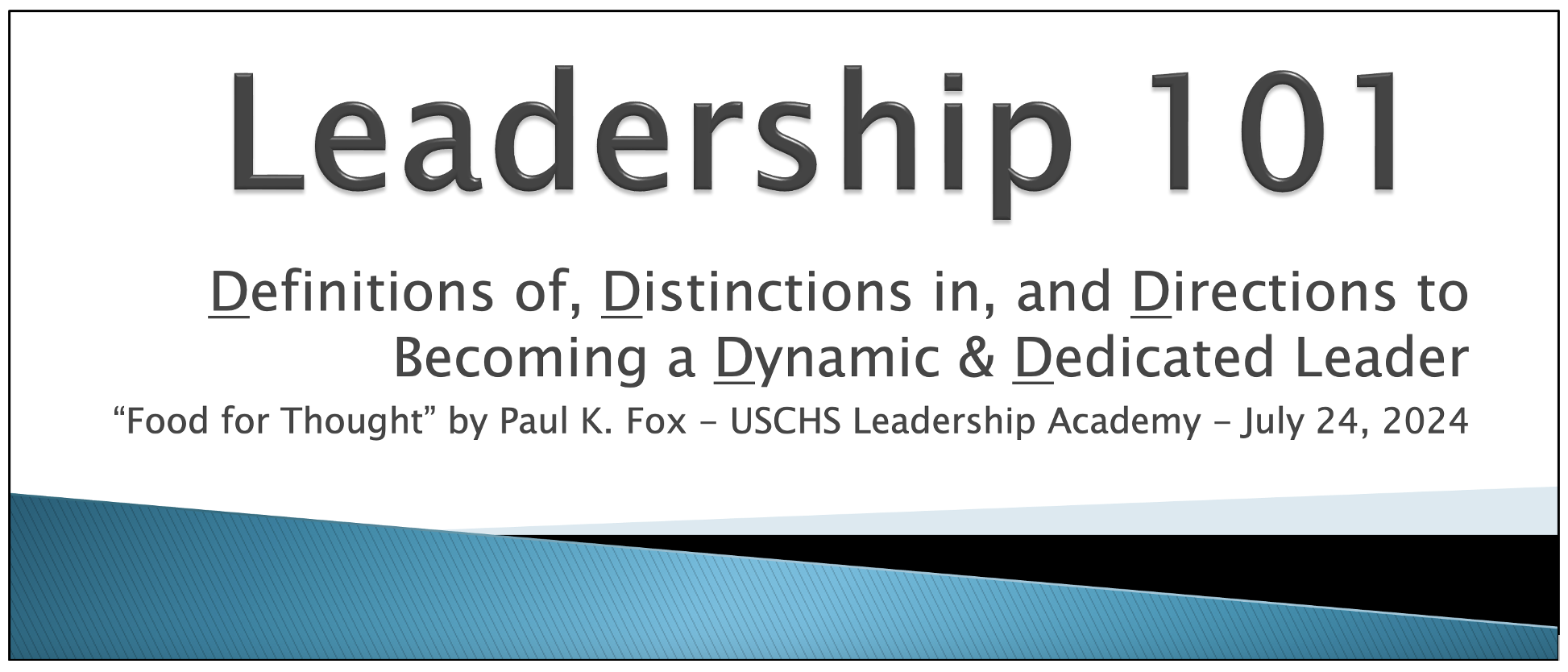
Below is a comprehensive summary of “Leadership 101.”

7/27/24 Update – Leadership Presentation

At the invitation of Upper St. Clair High School (USCHS) German teacher and summer leadership instructor Jacob Reis, it was my pleasure to meet and share my thoughts on “Leadership 101” with students in phase 2 of the USCHS Leadership Academy on Wednesday, July 24, 2024.

The national award-winning USCHS Leadership Academy is a one-week summer workshop offering students exposure to leadership concepts and practices. Students identify their leadership strengths and learn how these skills may be used to make them successful in all stages of life. Through experiential learning strategies, group projects, and hands-on activities, students experience the application of leadership skills, building confidence in their abilities and enhancing their capacity to serve in leadership roles. https://www.uscsd.k12.pa.us/Page/495

I enjoyed my interactions with about 30 rising sophomores who demonstrated they were already well on their way to becoming significant student leaders… and the proof was taking a week off from their summer vacation to enroll in the academy and then enthusiastically participating in my 45-minute workshop right after lunch! (Instead of nap time?) Hopefully, I was able to provoke some new thinking on the further development of their advancing leadership skills.

The only negative comment about the day is that I did not fully cover everything I intended (probably needing at least a full hour but would have enjoyed a half-day!)… thus the rationale for creating this blog-post. I only hope these budding “future leaders” will revisit this material and devote more time on it in research and self-analysis… and complete my optional homework to explore more perspectives on “the definitions of, distinctions in, and directions to becoming a dynamic and dedicated leader.”

Let the Games Begin

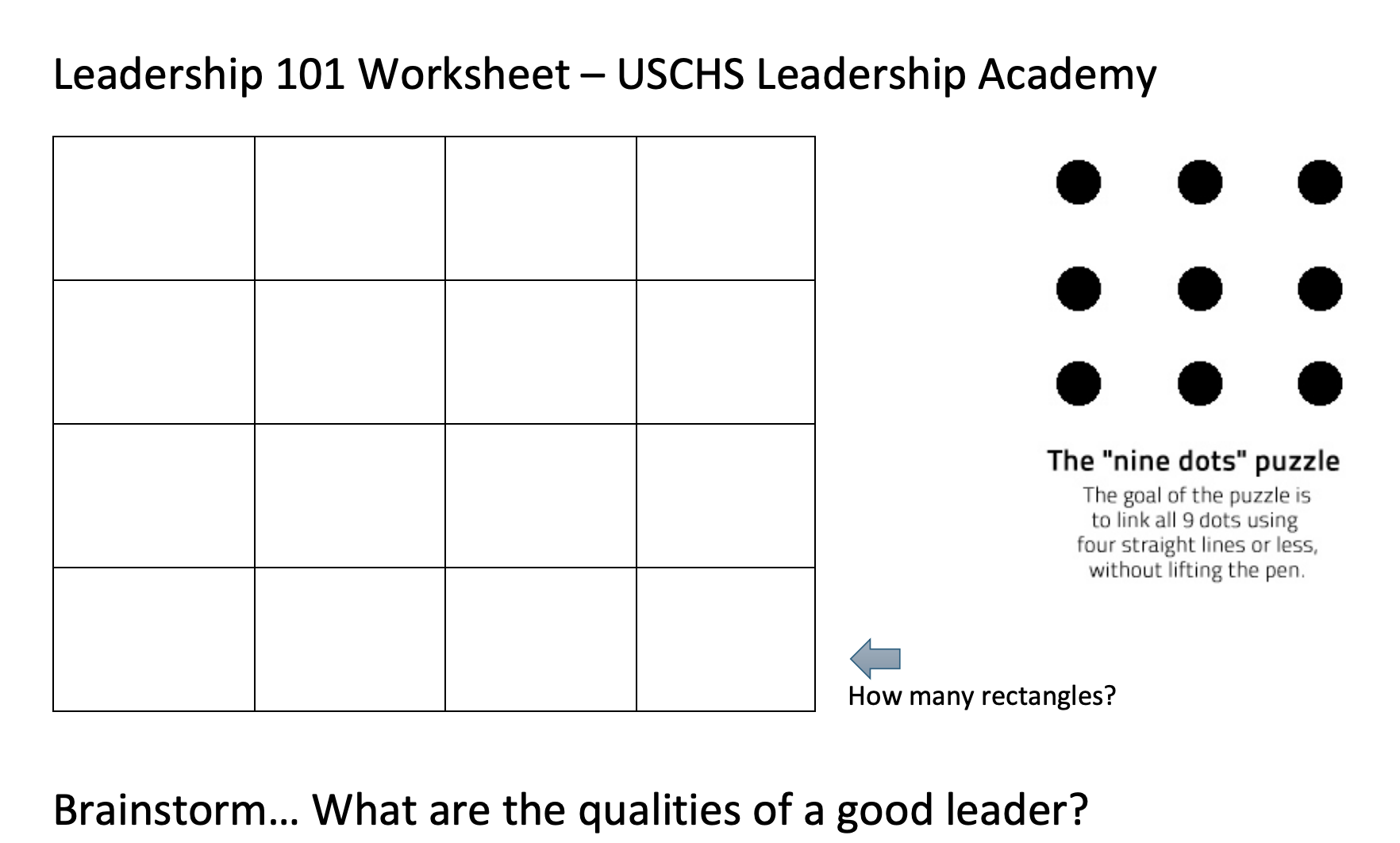
With a backdrop of more than 52 years in the field of education (beginning with my own HS days offering private lessons) and incorporating the experiences of an ongoing 44-year relationship in the Upper St. Clair schools, I was able to share philosophies, “best practices,” and anecdotes of lessons learned in working with countless past Fine and Performing Arts student leaders… so many “cream of the crop” drum majors, section leaders, concertmasters, producers, directors, rehearsal assistants, crew heads, leads, etc. Several of the hands-on interactive exercises we have explored in past student staff meetings and even at PMEA/PCMEA conferences were beneficial (“doing” works better than “saying!”), including:

  • How Many Rectangles (thinking outside the box): See this 2015 Part II blog-post on Creativity.
  • The Clapping Game (stepping outside your comfort zone): “Put your hands together, clap and hold. Is your right thumb over your left or vice versa? Now try it the opposite way… until you can do it just as confidently! Now you have expanded your comfort zone! This is how we GROW!”
  • The Nine-Dot Puzzle (how creative are you?): See this 2015 Part I blog-post on Creativity.

Now Some Definitions

We reviewed some common “leadership vocabulary” during the session. Recognizing that there is a wide divergence in opinion on what makes a great leader, I chose to focus on portraying three triple-threat skill types that LEADERS ARE…

  • Visionaries
  • Coaches
  • Managers

I have always felt that leaders need to embrace change, not be afraid to “upset the apple cart,” foster a shift in new directions, create goals, and make improvements to the status quo… to bravely go out and figuratively “break something!” Things to do with a problem:

  • Ignore it
  • Resist it
  • Define it
  • Enjoy it
  • Find a use for it
  • Find a bigger problem

Numerous giants in the field of coaching and education have shared these one-line gems:

  • Leaders embrace new ideas or challenges.
  • Leaders are catalysts for change.
  • Leaders make goals and define targets.
  • Leaders model commitment and passion.
  • Leadership is all about creativity, innovation, and problem solving.
  • Leadership is about taking risks.
  • Leaders have positive self-esteem.
  • Leaders master good listening skills.

Extra handouts: Last week, I was not able to distribute these leadership quotes or the stuff and tasks of leadership, including words of wisdom from “leader luminaries” like the late great Babe Ruth, Abraham Lincoln, Vince Lombardi, Theodore Roosevelt, and my first USC school administrator and mentor Thomas Harshman.

Citing elements from the “curriculum” created by The Association of Washington Student Leaders (AWSL), a division of the Washington School Principals’ Education Foundation, we briefly touched on these leadership effectiveness goals (peruse my slides #18-25):

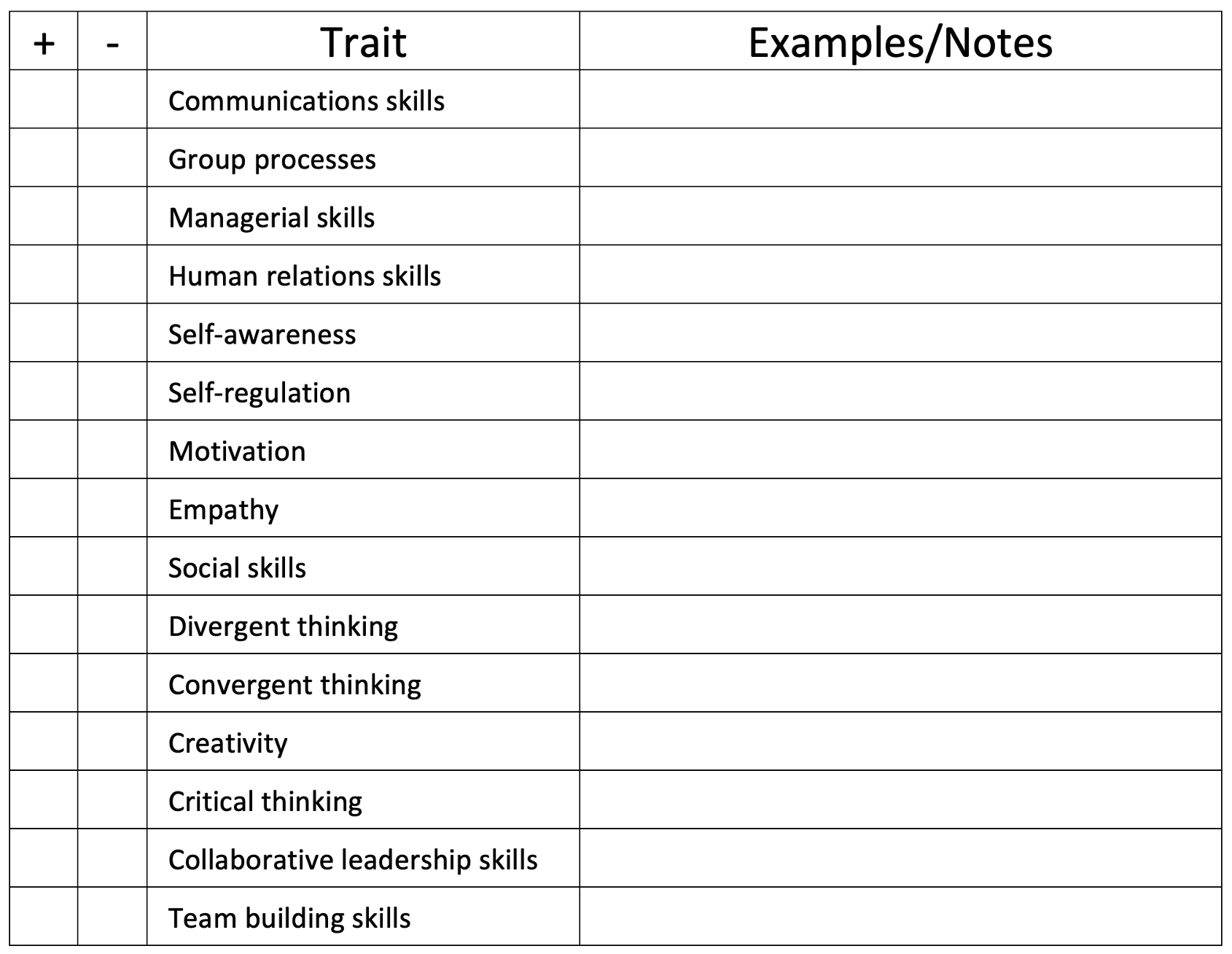
  • Communication skills
  • Group processes
  • Managerial skills
  • Self-awareness
  • Human relations skills

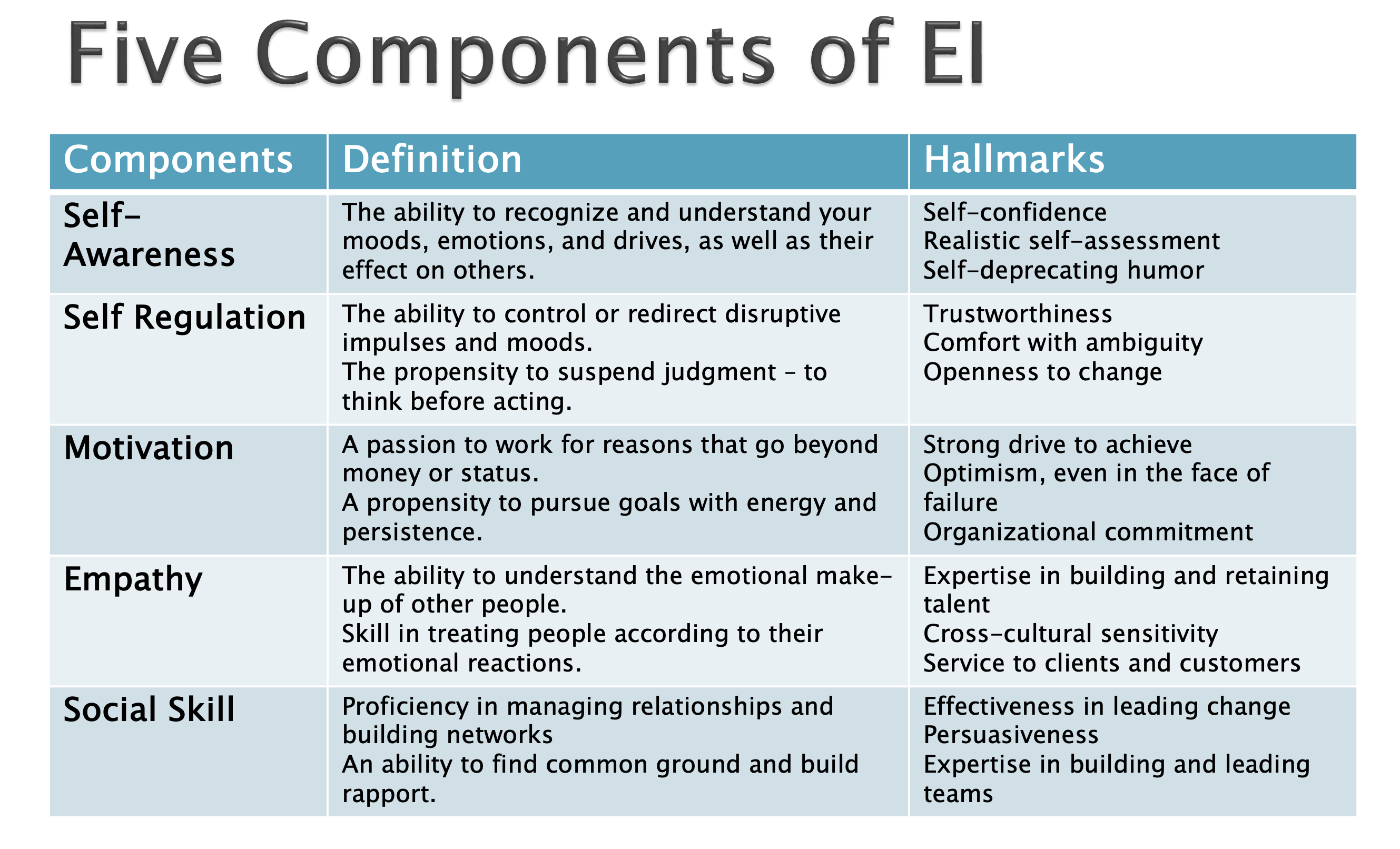
…which led us into diving into this table of emotional intelligence (EI) skills, supporting the self-awareness goals of AWSL and prescribed by the United Nations System Staff College and a book by Daniel Goleman What Makes a Great Leader:

Types of Thinking… and Leading

There was not enough time to unpack these “chapters,” much of it inspired by the research and work of Professor Curtis Bonk from Indiana University of Bloomington (check out slides #32-52 for descriptions):

  • Divergent thinking
  • Convergent thinking
  • Critical thinking
  • Cooperative/collaborative thinking
    (team-building)

Are You in the Right (or Left) Mind?

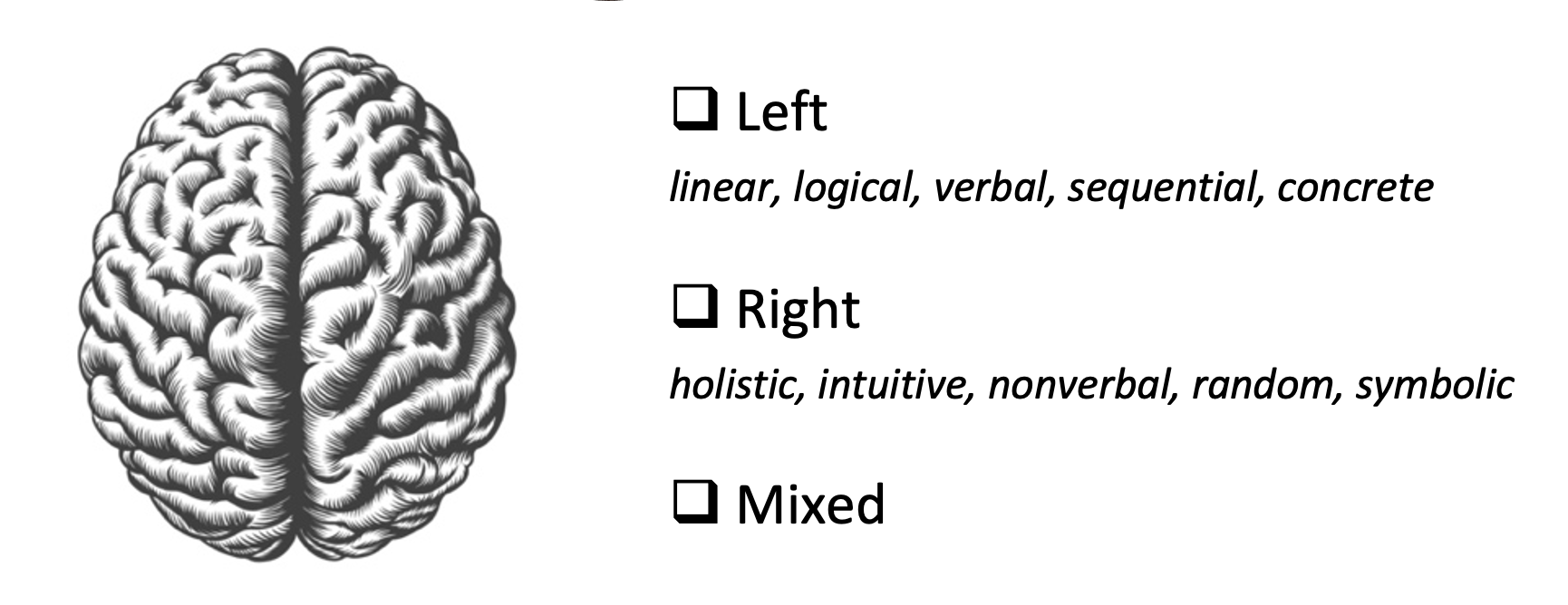
At the Leadership Academy session, we did enjoy taking an insightful quiz about left or right brain hemispheric dominance (although we were unable to finish scoring it), something which was first introduced to me at a teacher in-service led by USC Supervisor of Curriculum John Small, and many years later, shared in a virtual session of my community orchestra during the pandemic. Examples of the type of questions: Would you choose to complete a crossword puzzle (left-brain) or a jigsaw puzzle (right-brain), or view a movie (right) or read a book (left)?

This test introduces “thinking styles” and a taste of lateral brain research. (Disclaimer: There has been a lot of scientific debate on whether there is any value in measuring brain dominance. In addition, a true test of hemispheric brain dominance would take hours, MANY MORE questions, and still only offer a few generalizations! This exercise is only provided to give us a little more understanding in the way we think and how others may respond to our attempts to lead them.) I concluded with the following statement:

Now apply this to the “types” of people you may lead. The lefty “analyticals” may want meetings to start and end on time, keep to the agenda, follow Robert’s Rules of Order, receive written documentation, etc. “Righties” (a.k.a. “spatials”) may arrive late, prefer more time for free discussion (“bird-walking?”), enjoy more charts/graphs, demonstrations, and “hands-on,” offer good brainstorming… but fewer restrictions or rules to organizing the meeting.

More Self-Reflection Exercises and the “Oreo Cookie Technique”

Back to interactive “show-don’t-tell” FUN activities! We introduced several tools to motivate additional self-analysis (insights into current leadership skills/tendencies and future needs):

  • Brainstorming of Leadership Habits: “Close your eyes and visualize a ‘model leader’ you have known and admired. What were his/her outstanding personality characteristics? In 30 seconds, write down as many of these traits and others that would define a great leader.”
  • Step #2 Brainstorming: “Circle three of these qualities you feel are the most important for success.
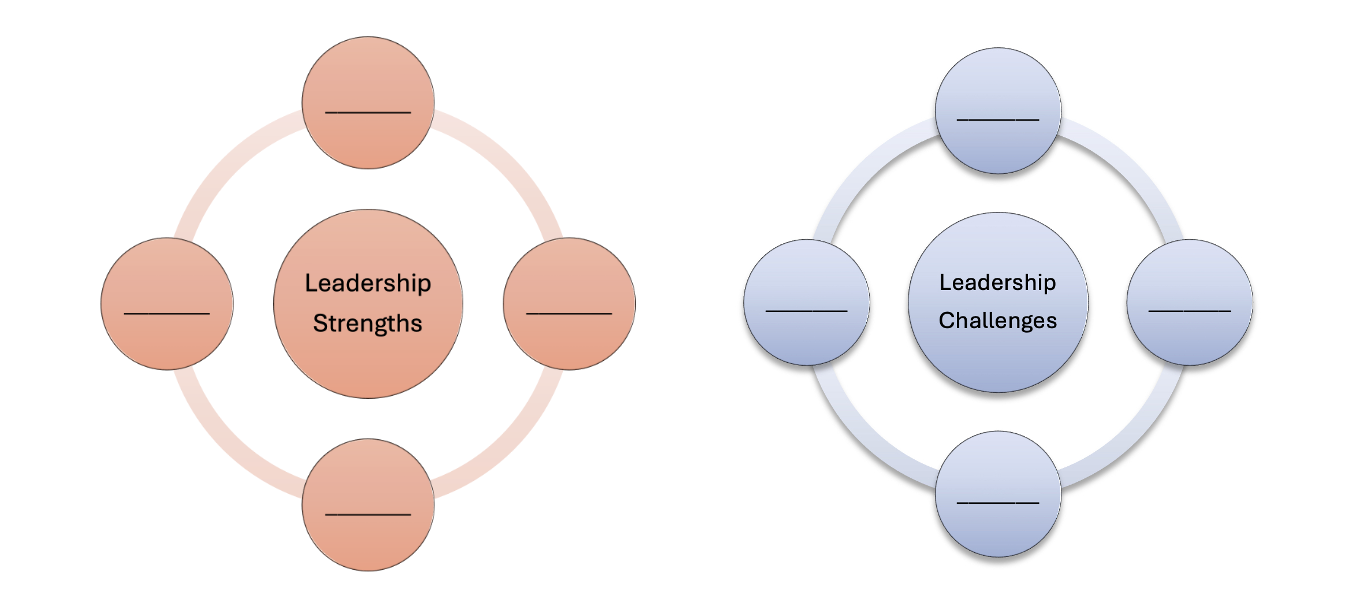
  • Step #3 Brainstorming: “Highlight, underline, or star two of these traits that YOU model – your most developed skills. Now print these in the top two bubbles of the pink graphic below.
  • Step #4 Brainstorming: “Review the EI chart of the Union Nations Systems Staff College, outline of AWSL leadership skills, and the types of thinking/leading skills (above), and add one or two characteristics you feel YOU are well on your way to mastering (understanding that, as my wife would remind me, ‘pobody is nerfect!’ and there’s always room for even more work on them.”
  • Step #5 Brainstorming: “Once you have completed a self-analysis of the material covered in this session (blog-post + handouts + slides), select up to four ‘challenges’ you would consider for further study or goals for self-improvement.”

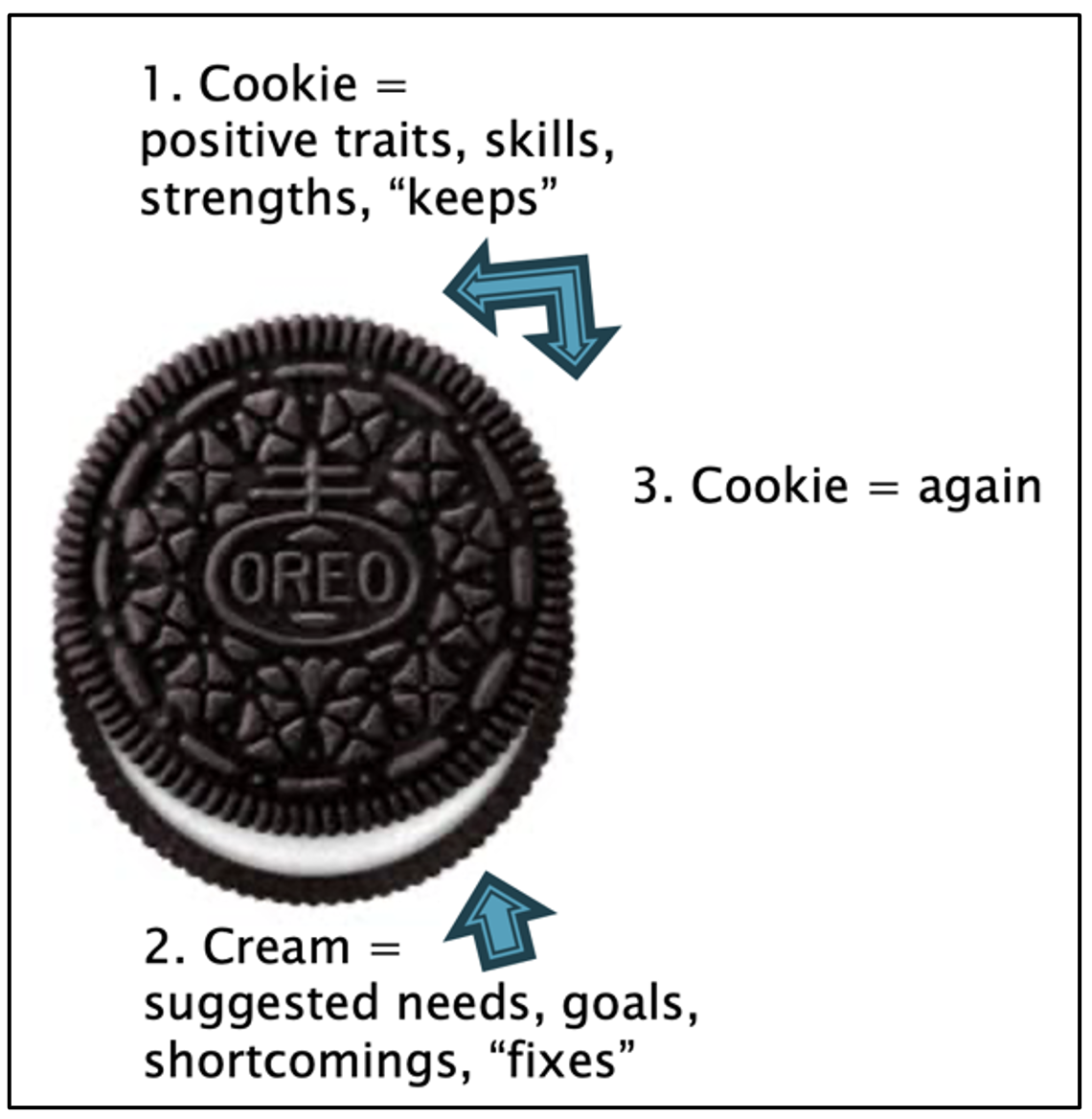
Now, the process for “peeling back the onion skin” and doing a deep dive into a critique of an individual’s strengths and weaknesses (without crushing egos) is best done by first using positive reinforcement (what are the good things already accomplished?), followed by the problem(s), need(s), or trait(s) that resoundly land “outside the comfort zone.” This punch list of one or more items will be the basis for generating an action plan for making positive changes. Finally, you should always end everything with the positive… a reflection on the progress that has already been made, observation of past achievements or gifts, and confidence that a set of recently adopted S.M.A.R.T. goals (below) would be attainable:

  • Specific
  • Measurable
  • Achievable
  • Relevant
  • Time-bound

The Oreo cookie symbolizes layers, a progression from top to bottom, starting with the chocolate cookie (dunk it in milk if you wish!) which represents “the positives,” next going to the cream which depicts a “focus on improvements,” and then finishing off the bottom cookie (return to “the positives”). This is relevant for self-analysis as well as a model for the care and motivation of team members. The experienced and empathetic leader knows that “you catch more flies with honey than with vinegar…” and most people respond better to positive-first feedback along with a little sensitivity and diplomacy when pointing out their shortcomings. Whenever you can, “sandwich” the cocoa’s good things (“keeps”) around the cream’s criticism (“fixes”)… for yourself and in others within all work/school settings!

Coda: Personal Inventory Profile

I hope throughout this workshop attendees will self-assess their leadership potential and make a few plans for ongoing personal development. The above checklist outlining my USCHS leadership academy content was provided in this handout to help examine areas of interest and to formulate new goals. I also recommend taking time to peruse the homework for future leaders and especially read a few of my past posts on creativity in education and leadership showcasing several exemplary models of leadership… outstanding visionaries, coaches, and managers:

How’s your LQ = leadership quotient?

PKF

© 2024 Paul K. Fox

Dear Music Parents…

We Need Your Help to Support Your “Kids” and Make Music Education More Effective

This message was sent to the parents and partners of the nonprofit community ensemble “for instrumentalists of all ages” – The South Hills Junior Orchestra – and participants in the SHJO Online Academy (SHJOOLA), but is applicable to all music families. School music directors everywhere need your assistance!

[http://www.shjo.org/]

Another first! A special “reach-out” via Fox’s Fireside geared exclusively to music parents.

Before we start with the nitty-gritty, on behalf of music educators everywhere, let us thank you in advance for all of your commitment and collaborative efforts in support of your child’s music program!

We hope this finds “you and yours” healthy, safe, productive, and happily engaged. Since many of the schools are within a month to the end of their fall semester and second nine-week grading periods, we thought now would be a good time to step back a little and offer our assessment of how things are going.

“When life hands you lemons, you make lemonade.” In spite of the limitations brought on by the pandemic, the directors are doing everything in their power to connect with, stimulate, and enlighten the players and singers. In general, we are satisfied with the musical progress of everyone – the students are showing technical growth, mastery of the music, and even more importantly, great resiliency in dealing with these challenging times. SHJOOLA and other remote teaching or alternative music learning serve only as a temporary stopgap measures until all of us can return to our the normal “live and in-person” rehearsals. However, it looks like this may not be until Spring 2021 or later.

[Feel free to share this blogpost or this PDF link.]

We would like to elicit the help of our music parents to check in and observe the online activities of your son or daughter, and if necessary, intervene on behalf of them. This would help us improve the quality of the virtual music programs run smoothly. We have all found that online teaching is very hard. The limitations of this technology (latency and inability to sync the visual and audio portions of zoom meetings) will not allow the chance to hear in real-time performances of individual players or the group altogether. The most important “takeaway” from this message is the camera on your household device needs to be operative and used every time we sponsor a class. In addition, it is not satisfactory for anyone to position their device so that we cannot see them, leave the meeting early, mute or disengage from the virtual lesson discussions, or turn off their camera at any time. Video feedback is the only avenue available to “monitor and adjust” our instruction during any “synchronous sessions.” We have found that Zoom runs quite well on smartphones and tablets, and the cameras on these devices will suffice if the computer hardware is not up to the task.

So, effective immediately, if your SHJOOLA child seems to be having trouble with his camera, we will notify you.

(Please let us know if you need any technical assistance. The cost of purchasing a new “web cam,” is as low as $16 at WalMart. If we cannot help you, we’ll find someone who can!)

As the character Jean-Luc Picard says in the Star Trek Next Generation series: ENGAGE! What are the number one concerns of all educators during this disruption to education caused by COVID-19, shared even by the “Plan B” strategies for music? – Loss of individual attention, sensitivity, communications, connectivity, empathy, and self-empowerment towards the pursuit of the students’ own inspired initiatives in learning!

In other words, “distance learning should not be distant.” To be effective, it needs to promote an exchange of dialogue, responsible online citizenship, and goals to reach-out and engage within this unique “music community!” (For those of you who enjoy reading about learning theory, feel free to peruse Mr. Fox’s recent educator blogpost about social emotional learning, “teacher presence,” emotional intelligence, “character” curriculum, and habits of empathy: https://paulfox.blog/2020/11/03/embracing-the-intangibles/.)  

[New players may join SHJOOLA at any time. We accept out-of-town musicians, too!]

Following the advice of several members and to keep the team more “connected,” our initial SHJOOLA Zoom meetings will open 10 minutes early to allow for a little informal chit-chat! How are you doing?

REMINDER: Whether hybrid or online, attendance is mandatory. Music directors understand that, on occasion, there will be illness, family, business, or other educational conflicts necessitating the missing of a Zoom meeting. For SHJOOLA, our attendance policy is flexible, but notification of the SHJO Managing Director in advance is mandated: mdirector@shjo.org. (Please include your name and the reason for missing the session.) Considering all of the prep time your music directors are devoting to the lessons, it would only be “common courtesy” for the absentees to keep themselves up to date on what was presented, view any available archived rehearsal videos or slides posted (for SHJOOLA posted weekly at http://www.shjo.org/online-academy), and make-up all missed work within a few days of the absence. Ensembles are teams and rely on camaraderie and responsibility: “the whole is greater than the sum of the parts!”

FYI, the software embedded in our SHJOOLA MusicFirst Classroom provides access to a valuable subscription that will last through June 2021. There are a lot of great applications for members to freely explore asynchronously (on-their-own at their convenience) in order to foster self-improvements in ear training, music theory, performance assessment, sight reading, and writing/analyzing music.

In conclusion, parents, we need you to “stop on by” and observe what’s happening!   For SHJOOLA, our goal is to continue offering our free professional services in making meaningful music, playing duets, performing with online soundtracks, learning new (and in greater detail) musical concepts to “grow” our musicianship and comprehension of orchestral literature, and to just have fun being successful. PKF

These things are “NOT COOL” during online music classes…

  • Arriving late to scheduled meetings (“early is on-time!”)
  • Missing sessions and not “catching up” on the missed work
  • Failing to download and print the music in advance
  • Not having instrument and music (in order) ahead of the start of the meeting
  • Turning off or re-positioning your camera so we cannot see you
  • Failing to respond to questions or participate in the discussions
  • Texting, emailing, or using any other device that distracts your attention
  • Allowing interruptions or loud noises during the class
  • Eating or drinking during rehearsals

Other “Fox Firesides” are available at https://paulfox.blog/foxs-firesides/.

© 2020 Paul K. Fox

Photo credit from Pixabay.com:
“Blaze-Fireplace-Campfire-Bonfire” by Pexels
“Learn Student Laptop Internet” by geralt

SMART Practice

Fox’s Fireside – Summer Camp Edition

foxsfiresides


My wife is a genius!

Well, I knew this before I married her in 1978, but every day I work “side by side” with her on music education projects like the South Hills Junior Orchestra Online Academy (SHJOOLA – pronounced shah-ZOH-lah), I discover even more of her amazing “hidden” talents and insights!

Donna Stark Fox is the author of 99% of this Fox’s Fireside.

We launched SHJOOLA and other digital/virtual/alternative programs (like SHJO.clips) to keep our community orchestra instrumentalists practicing inspite of the school closure and restrictions caused by the pandemic. We want to foster our players’ self-confidence and motivate even greater focus on new growth and achievement in instrumental technique, key literacy, ear-training, musicianship, personal goal-setting, and artistic enrichment. As the character Jean-Luc Picard from the Star Trek Next Generation series says, ENGAGE… in the pursuit of their own inspired initiatives in music learning!

ONLINE ACADEMY LOGO 1.2

During the first week of SHJOOLA, we introduced this SMART Practice Primer (download and adapt to your own practice regime). The philosophy comes from my wife’s (ahem) 55+ years in the field of music performance as a violinist and pianist and a versatile career of 38+ years in the public schools teaching strings, band, general music, elementary chorus, musicals, etc.

What are the secrets of practice success? Past Fox’s Firesides address many issues of time, goals, focus, mentors, problem solving, and various playing techniques. (You may also peruse this catalog of past articles and our SHJO.clip library here.)

This article hopes to bring out a new approaches to “practice builds self-confidence…”

Are you ready for SMART Practice?

  • Schedule time for practice by using a calendar.
  • Find a quiet place to practice and gather everything you need.
  • Set goals. Write them down, make them measurable, and be specific and realistic. Check them off and “raise” your goals frequently.
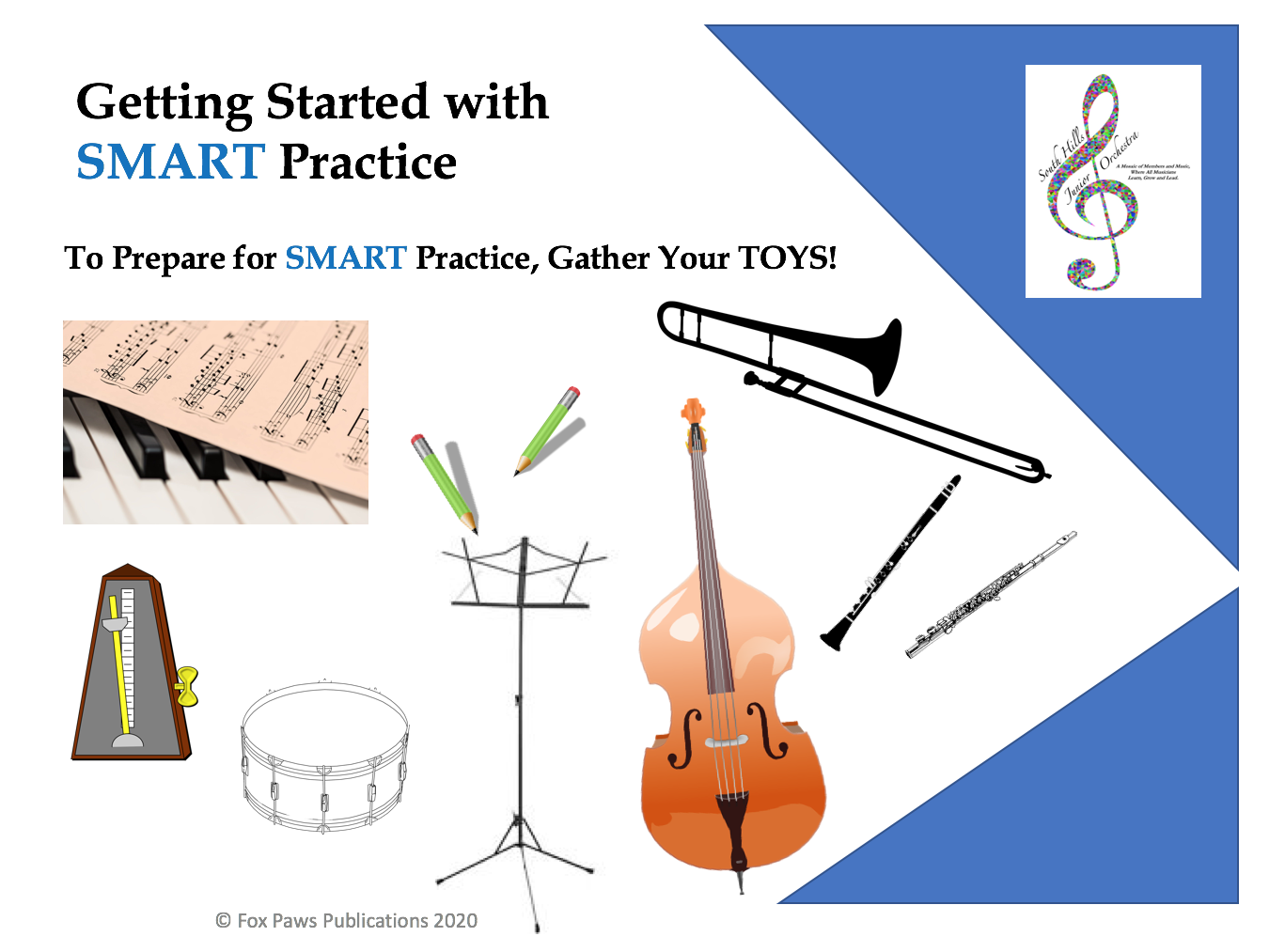
  • Gather your equipment, including your instrument, music stand, chair, pencils, music folder, metronome, and tuner.
  • Chart your practice with a list of what to practice, because writing it down is a promise to do it!
  • Keep a reflective journal to organize your thoughts, to analyze and to set new goals.
  • Regularly make audio or video recordings of yourself and keep them in a file in a folder on your electronic device.

Smart Practice 1

Success starts with a plan!

Begin with a long-range goal/dream.

  • I will perform a solo with a symphony orchestra.
  • I will become a professional musician.
  • I will play in a college orchestra or band.
  • I will enjoy music throughout my adult life.

Set medium-range goals.

  • I will play a Mozart Concerto before I am 16.
  • I want to upgrade to a better-quality instrument when I am 14.

Set and rest short-term goals on a weekly and even daily basis.

  • This week, I will play the Bach Fugue with accurate fingerings and pitch.
  • This week, I will play the Bach Fugue at performance tempo.

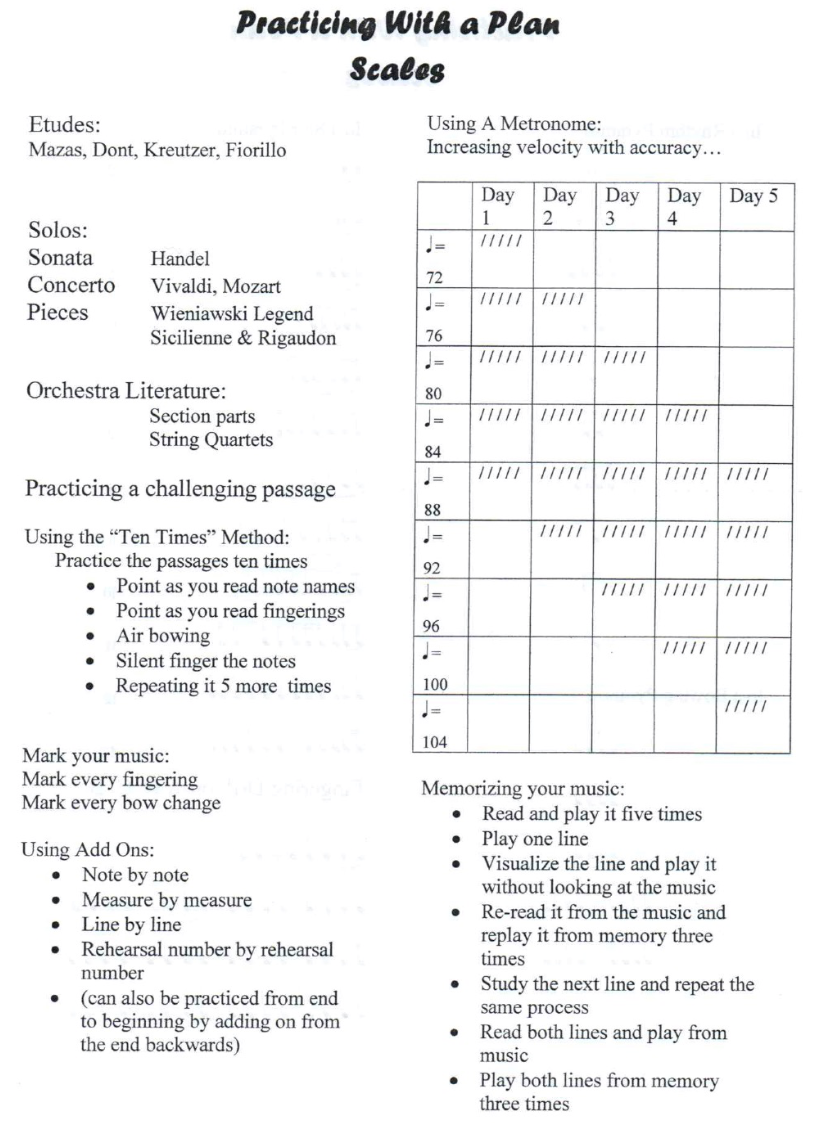
Here is an example of one violinist’s SMART Practice plan:


Practicing with a plan

Tips on SMART Practice

  1. Warm-up with drills and exercises.
  2. Identify the key of each selection you are practicing.
  3. Play the scale for the key you have identified, using a rhythm or articulation pyramid.
  4. Select a passage to improve and mark the fingerings in pencil.
  5. Say the note names in half notes. (“If you can say it, you can play it!”)
  6. Be sure you practice every note as a half note using the fingerings provided by the conductor.
  7. Use a metronome to “keep it honest.”
  8. Practice VERY SLOWLY using the original rhythm and bowings/articulations.
  9. Gradually increase the tempo by “inching up” on the metronome.
  10. How many times have you played the passage correctly?
  11. Ten consecutive times right today, and ten more tomorrow, will already make the passage 20 times better than it was before!
  12. Schedule your next practice session.
  13. Reflect in your journal and set new short-term goals for tomorrow!


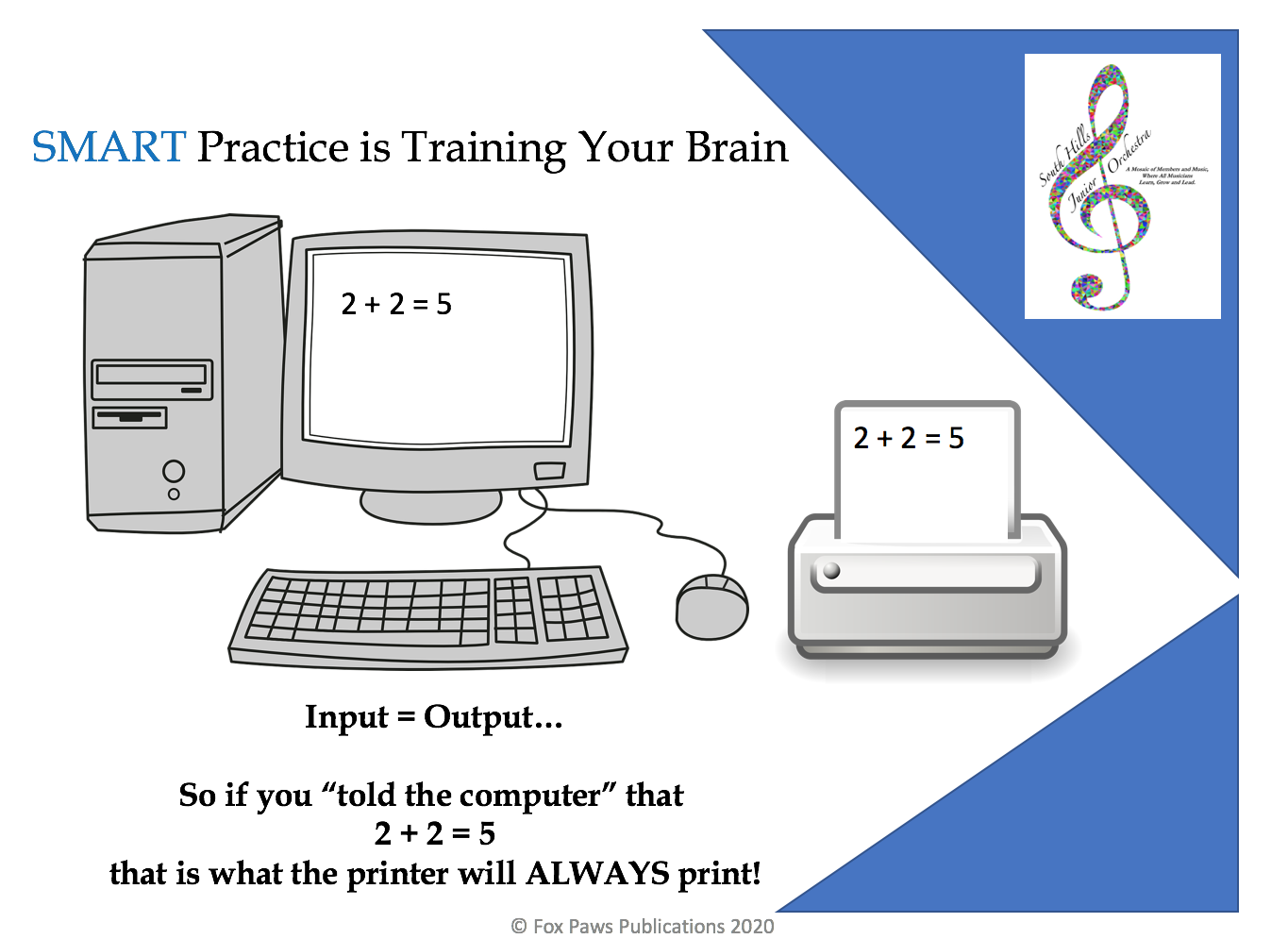
smart practice is training your brain

Training your brain is SMART Practice

  • Practice is a process.
  • Practice is all about habit development.
  • Practice leads to self-confidence.
  • Practice is an opportunity for self discovery.
  • Practice is cumulative.
  • Practice is where you can make mistakes privately.
  • Amateurs practice to get it right.
  • Professionals practice so that they never play it wrong.

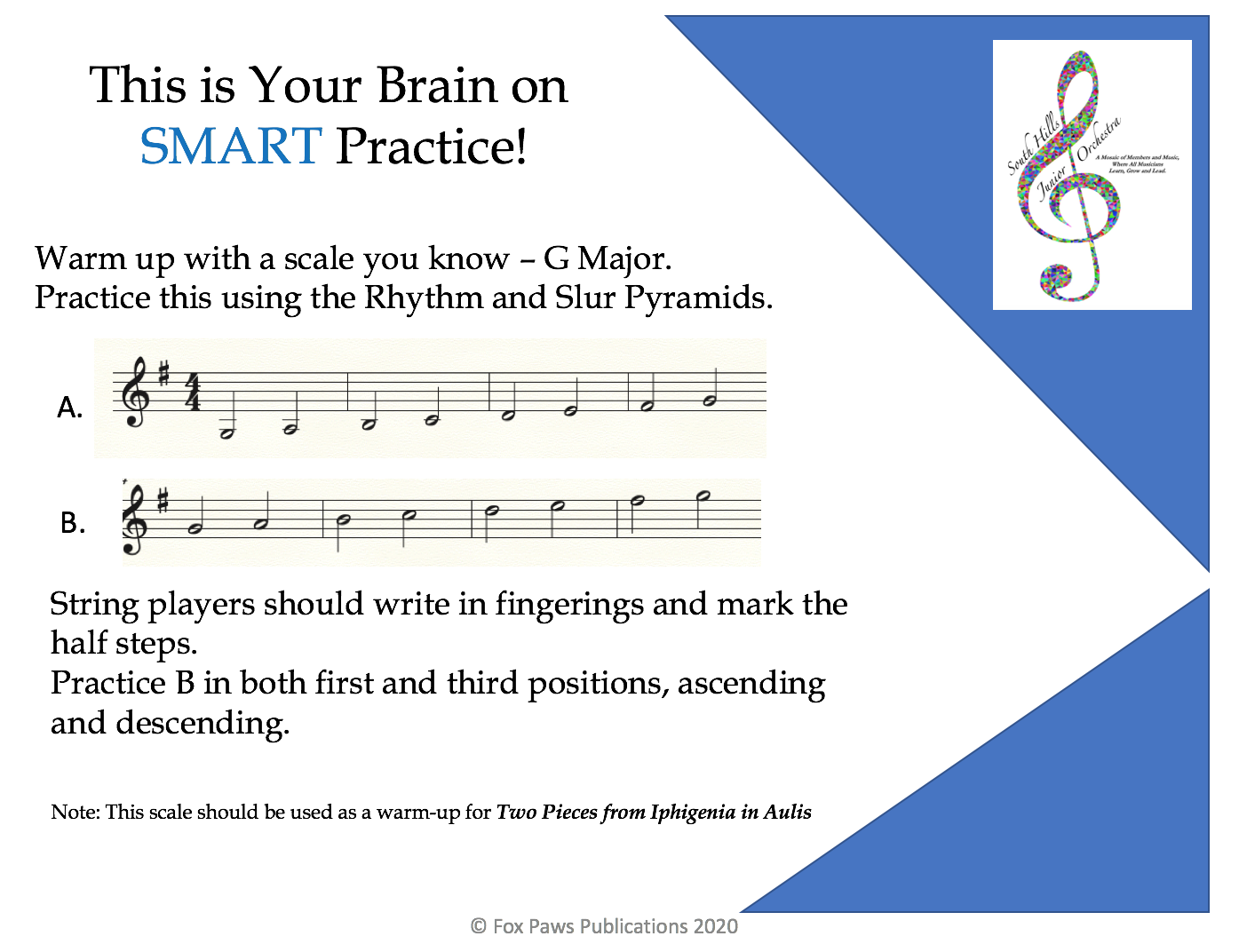
This is your brain on SMART Practice

Variety is the spice of life and music variations challenge the mind!

You may have heard these strategies before:

  • First make it easier, then progressively harder.
  • First subtract (e.g. remove slurred notes) and then progressively add more challenging elements to the music (dynamics, longer phrases, articulations, fingerings, positions, memorization, etc.)
  • First play it slower, then progressively faster.
  • First take smaller sections (measure by measure, phrase by phrase), then progressively expand to larger sections, eventually being able to play the entire piece.

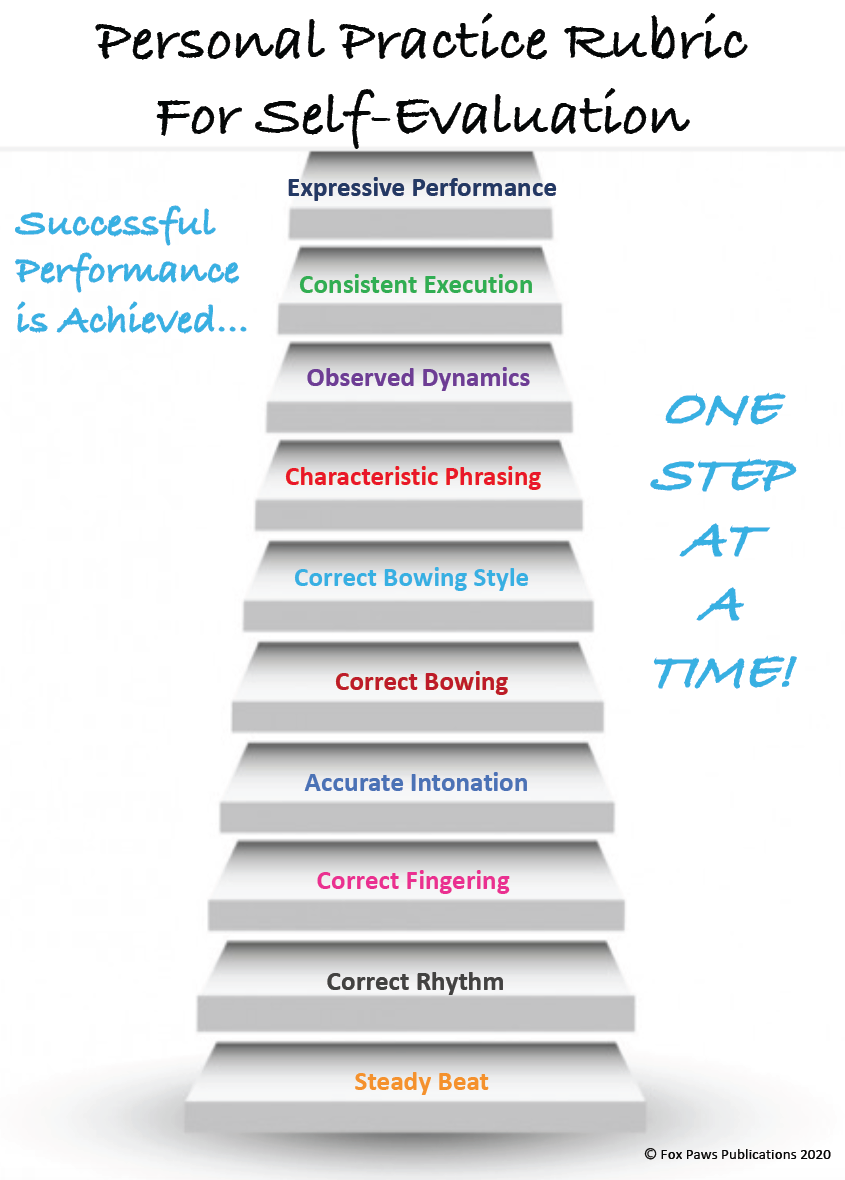
practice rubric

Try these rhythm and articulation pyramids on your scales, warmups, etudes, and any difficult passage in the music. Taking “baby steps,” create a new way to learn the part…

More to come… Part II will dive into additional recommendations for personal music problem solving with numerous examples.

Keep at it! You’ll make us all proud. Most importantly, especially yourself!

PKF

seriestoshare-logo-01

The mission of the nonprofit South Hills Junior Orchestra is to support and nurture local school band and orchestra programs, to develop knowledge, understanding, performance skills, and an appreciation of music, to increase an individual member’s self-esteem and self-motivation, and to continue to advance a life-long study of music. Members of the Orchestra learn, grow, and achieve positions of leadership to serve their fellow players.

The second half of our 37th season (Spring 2020) was postponed due to school closures and the pandemic. We are now offering SHJOOLA – the South Hills Junior Orchestra Online Academy. The program includes virtual sectional rehearsals, special workshop seminars via Zoom, and remote music learning activities, both synchronous and asynchronous instruction, and provides a one-year subscription to MusicFirst Classroom, PracticeFirst, Sight Reading Factory, Musition (music theory), Noteflight (score notation) and other apps. Western PA instrumentalists are welcome to apply for membership in one of the 25 remaining “seats” in SHJOOLA by contacting Managing Director Janet Vukotich.

(For more information about SHJO, please visit www.shjo.org.)

This and all Fox’s Fireside blog-posts are free and available to share with other music students, parents, directors, and supporters of the arts. For a printable, hard copy of this article, click here.


© 2020 by Paul K. Fox and Fox Paws Publications


Photo credit from Pixabay.com:

“Camp Fire” by Chris Aram


3 Simple Words – KEEP AT IT!

How Are You Spending YOUR Time?


FoxsFiresides

This is probably the most important message we can share with you during this period of coronavirus self-isolation.

learn-3653430_1920_geralt

No matter what this pandemic throws at us, or how long we remain away from close human interaction and participation in our ensembles or classes at the now closed “brick and mortar” schools, let’s keep a focus on maintaining our “chops,” building on our “musical momentum,” and practicing every day.

From an eco-friendly (“save our natural resources”) slant as well as an economist’s perspective, you have invested too much time and money on playing an instrument to give up now! So, nature and the COVID-19 have thrown you a few curve-balls these past seven weeks?

The only way we should respond to the challenge is to meet it head-on!

Take advantage of all of this available “free” stay-at-home time to further your artistic enrichment and make “new and improved” musical goals!

dual graphics

crying-146425_1280No teacher will have any patience listening to your whining or remarks of “could have,” “would have,” or “should have been” excuses. What have we always wished for? “If only I had enough time to learn that new scale, étude, or song!” “With all of my other academic assignments, sports events, and extracurricular activities, how can I fit in moments for listening to bands, orchestras, or classical virtuoso artists performing on the web?” “When am I ever going to have the chance to compose…” (or “arrange” or “record” or “memorize” or “conduct” or “choreograph”) “…that piece?” “When will I get around to learn this new technique, practice sight-reading, or dive into those drills designed to improve my key literacy, rhythmic precision, tone, intonation, range, form, coordination, embouchure, stick rudiments, or bow control?

The answer is… now only one word: NOW! 

What are you waiting for? You have too much at stake here, and soon, this crisis will pass, and we will all come back together – only much stronger and wiser for making good choices in the use of our time!

SHJOclips

We divided up the SHJO.clips into categories to develop your “well rounded” musicianship:

  • C = Create, invent, explore
  • L = Listen
  • I = Inspire, read, analyze
  • P = Practice, perform
  • S = Share, show others, play for fun

(Download the interactive CLIP JOURNAL here!)

How many of these have you accomplished? In your clip journal, do you show progress in all focus areas? Can you advise SHJO family members and directors on your recommendations on future projects to further our “collective” knowledge, skills, and appreciations in music? (We would LOVE to hear from you!)

Now get out there and learn, create, and share meaningful moments in music!

PKF


hi-res logo 2018The mission of South Hills Junior Orchestra, which rehearses and performs at the Upper St. Clair High School in Pittsburgh, PA, is to support and nurture local school band and orchestra programs, to develop knowledge, understanding, performance skills, and an appreciation of music, to increase an individual member’s self-esteem and self-motivation, and to continue to advance a life-long study of music. Members of the Orchestra learn, grow, and achieve positions of leadership to serve their fellow players.

(For more information about SHJO, please visit www.shjo.org.)

This and all Fox’s Fireside blog-posts are free and available to share with other music students, parents, directors, and supporters of the arts.

Click here for a printable copy of this article and the Interactive Clip Journal.

Other “Fox Firesides” are available at https://paulfox.blog/foxs-firesides/.


© 2020 Paul K. Fox

Photo credits from Pixabay.com:

“Campfire Stick Fire Flame Camping” by Free-Photos

“Learn Student Laptop Internet” by geralt

“Crying Smiley Emotion Sad” by OpenClipart-Vectors

Engaging Music Students Online

COVID-19Once the COVID-19 emergency was declared and universally all schools and outside activities were cancelled (for who knows how long?), the 37th spring season of my community youth (of all ages) orchestra was also “clobbered!” Up to this time, the Western PA-based South Hills Junior Orchestra (SHJO) regularly met on Saturdays from 10:30 a.m. to 12:30 p.m. at the school from where I retired: Upper St. Clair High School.

It immediately became apparent I must reach-out to my instrumentalists and keep them “at it” to continue their music practice and artistic enrichment. How should we stimulate our music students and embrace those activities most of us “traditional” music teachers may be less skilled/experienced in approaching:

  • digital
  • virtual
  • remote
  • alternative or
  • distance music learning?

First, using a free-version of Mailchimp, a software tool that helps generate and send out group emails, we messaged our ensemble players, trying to inspire “re-connections” and independent learning, and giving them “pep talks”  like this one on March 30, 2020: https://mailchi.mp/129b1cfdc54e/music-and-artistic-enrichment-3922957.

Then, it was time to research the wonderful world of online music education, such as this huge collection of ideas from “professionals in the know.” (See my last blog-post at https://mailchi.mp/129b1cfdc54e/music-and-artistic-enrichment-3922957  OR this regularly updated link on the PMEA Council for Teacher Training, Recruitment, and Retention website.)

The results of all of this are the following SHJO.clips, being distributed to our SHJO families several times a week. This is an ongoing process, and we welcome YOUR COMMENTS – questions, concerns, and new suggestions, too.

[All of these and future posts are available as PDF files at http://www.shjo.org/clips.]
seriestoshare-logo-01

CLIP #1

Inspire: Have you ever tried the “experiments” in Chrome Music Lab?

What can you create?

https://musiclab.chromeexperiments.com/Experiments

Listen: Critique this YouTube recording of the Fugue in G Minor

https://www.youtube.com/watch?v=QmZURoUJQe0

Questions for self-reflection:

  1. What are a few of the strengths or positive attributes of this performance?
  2. Generally, how were the quarter notes articulated? Legato, marcato, staccato? In your opinion, how should they have been played?
  3. What improvements would you offer for the posture of the performers?
  4. What sections in the music did the ensemble “hang together” and when did they “fall apart?”

Practice: Select and play your favorite major key…

…performing a scale up and down on your instrument:

  1. Long tones (quarter notes), focusing on good tone and intonation. Quarter note = 60
  2. Four eighth notes per pitch in a legato articulation (same tempo).
  3. Two eight notes per pitch (same tempo)
  4. One eighth note per pitch (same tempo)

Every day you practice, change the key (start on a different note).

MusicTechTeacher

CLIP #2

Listen: Easy Guide to Appreciating Classical Music

https://www.youtube.com/watch?v=v11OJNEdIn8

Sit back (wash your hands and pass the popcorn) and enjoy this introductory video for listening to Classical Music.

Did you know the definitions of opus, fugue, subject, recap?

How was the nickname “Moonlight” assigned to Beethoven’s famous Piano Sonata?

How many different periods of Classical music does the moderator mention? Could you name them?

Inspire: Are you a little bored staying home from school?

Just for fun, here are a few online music games your parents would approve of you playing to review terminology, composers, and notation.

Practice: “The Ladder of Music Achievement”

Ever wonder how a music teacher knows what and when to teach a specific musical concept? Here’s the “rubric!” Start at the bottom and work yourself up “step by step.” Take a passage from our music. How high can you go?

  • Level 12: I played expressively.
  • Level 11: I played with self-confidence.
  • Level 10: I played with phrasing.
  • Level 9: I played with the dynamics as marked.
  • Level 8: I played with characteristic tone (with vibrato).
  • Level 7: I played with the correct bowing style (legato/detaché, staccato/martelé, or spiccato).
  • Level 6: I played with the correct articulation (legato, marcato, or staccato).
  • Level 5: I played the bowings (down and up) and slurs correctly.
  • Level 4: I played the pitches with accurate intonation.
  • Level 3: I played the correct fingerings and pitches.
  • Level 2: I played the rhythm accurately.
  • Level 1: I held a steady beat.


noteflight

CLIP #3


Create: Learning to Hear & Compose Harmony for Our Favorite Theme

Video: https://www.youtube.com/watch?v=RomMDJmMUUc&fbclid=IwAR1TKISv7ICT7DouuQo5CZsyIQ6z7w_WTtQRoc3s-QykJFHopT8uvv5QARo

Score: https://www.noteflight.com/scores/view/f7c3185d04f2c9307dff1114e7ad6596eb46da3c

Website for Noteflight: https://www.noteflight.com/home

Not sure if SHJO members have access to Noteflight, a free program for generating sheet music, but just watching the video, you can learn a lot about creating harmony. If you are interested in “jumping into” learning Noteflight, go to their website above (ask for permission to sign-up – purchasing the premium version is not needed).

Listen: “Warren Music” series

Although focused on “popular” music and at times a bit repetitious, WARRENMUSIC provides a library of music theory and ear-training (even play-by-ear) lessons, enough to keep you busy for hours! Do you play guitar? You’ll love Warren! See samples below. If you want to “hit the street running,” peruse #5 and then videos #9 on.

https://www.youtube.com/watch?v=7wAux1hh9wU&list=PLz4ee9SDzhrpJ1v-o5VSqHSyMC3-rXjtP&index=1

https://www.youtube.com/watch?v=GWD5-xmSovo&list=PLz4ee9SDzhrpJ1v-o5VSqHSyMC3-rXjtP&index=5

https://www.youtube.com/watch?v=v7l6Y6fTPDw&list=PLz4ee9SDzhrpJ1v-o5VSqHSyMC3-rXjtP&index=9

Practice: “The Ladder of Music Achievement – Part 2”

Now let’s assess your practice. Pick out a passage from the SHJO folder or any excerpt (several measures or lines) from other challenging solo/ensemble repertoire.  Play the same section every day for a week. Create a journal with the date, problem solving observations, other comments, and rate your daily achievement using this meter:

  • Level 12: I played expressively. _______________________________________
  • Level 11: I played with self-confidence. _______________________________________
  • Level 10: I played with phrasing. _______________________________________
  • Level 9: I played with the dynamics as marked. _______________________________________
  • Level 8: I played with characteristic tone (with vibrato). _______________________________________
  • Level 7: I played with the correct bowing style (legato/detaché, staccato/martelé, or spiccato). _______________________________________
  • Level 6: I played the correct articulation (legato, marcato, staccato). _______________________________________
  • Level 5: I played bowings (down/up) & slurs correctly. _______________________________________
  • Level 4: I played the pitches with accurate intonation. _______________________________________
  • Level 3:  I played the correct fingerings and pitches. _______________________________________
  • Level 2: I played the rhythm accurately. _______________________________________
  • Level 1: I held a steady beat. _______________________________________

Inspire: 126+ More Musical Games and Quizzes!

http://www.musictechteacher.com/music_quizzes/music_quizzes.htm

Check the above link of MusicTechTeacher’s entire collection! You can review concepts while having fun GAMING!

CLIP #4

Inspire: “A Message from The Foxes’ Favorite Master Motivator”

“Dr. Tim!”

Did you sit down and view “A Message from Dr. Tim Lautzenheiser” we sent out in the last Mailchimp newsletter? If you do nothing else today, this should be your number one priority! (Share this with your family members.)

Here is the link: https://www.youtube.com/watch?v=4MwWVkBBREw

Think about trying one or two of the things he suggested for helping yourself and others during this break.

Listen: Pittsburgh Symphony “Extraordinary Measures”

We are always looking for more SHJO.clips, and Mackenzie Cloutier researched and found this link of five videos! Even live performances of the PSO have been cancelled, but they are playing “on the web” just for you! Go to:

https://pittsburghsymphony.org/pso_home/web/extraordinary-measures

Practice: “The Wheel of Fortune”

SHJO Practice Spinner

Do you need help deciding on WHAT TO PRACTICE? How about going tech with an online SPINNER to SELECT what you should work on? Mrs. Fox found this cool website: https://pickrandom.com/random-wheel/.

Spin to cover at least 3 categories a day. Use the setting that removes the number after you spin it (no repeats).

  • Zero = WARMUPS
  • One = SCALES
  • Two = ETUDES
  • Three = SOLOS
  • Four = ENSEMBLE MUSIC
  • Five = MEMORIZE A TUNE
  • Six = SIGHT-READ SOMETHING NEW
  • Seven = “OLDIES”
  • Eight = RECORD A SELECTION
  • Nine = PLAY A DUET WITH YOURSELF
  • Ten = PERFORM FOR SOMEONE

Share: We’re looking for more online games…

…that review music theory, history, notation, terms, etc.

Did you try all of these?  http://www.musictechteacher.com/music_quizzes/music_quizzes.htm

Sometimes music learning can be a lot like GAMING! Mr. Fox found another website with which to experiment:

Ultimate List of Online Music Games: https://cornerstoneconfessions.com/2012/08/the-ultimate-list-of-online-music.html

If you find something interesting – any game, recording, or website – share it by emailing Mr. Fox at pfox@shjo.org.

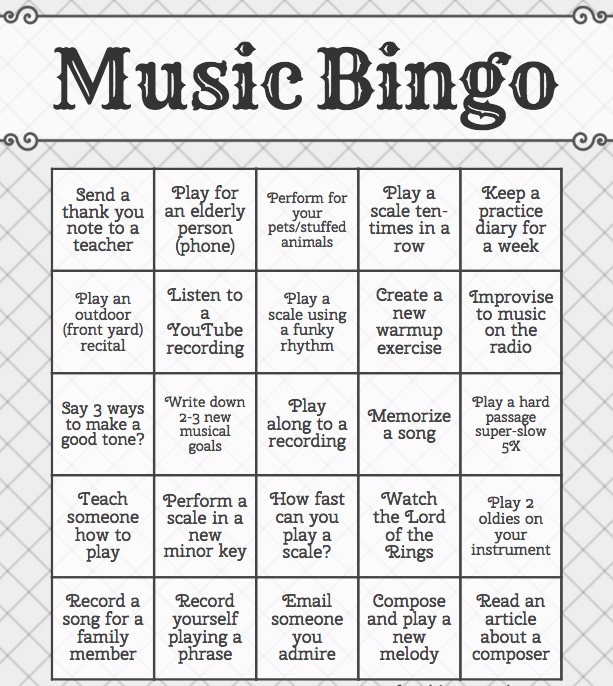
Create: BINGO CARD!

We are also looking for someone to design a fun practice card like this one: https://christina-yunghans.squarespace.com/s/Music-Bingo-Cards-sample.pdf.

Send a single copy to pfox@shjo.org.
Mr. Fox's Music Bingo

CLIP #5

Share: “On the Ear” News Reporter

Broadcast your own music review!

For this activity, you will need a device with voice recording capabilities, and a different device to listen to music selections, such as a radio or a record player, CD player, tape recorder, Music Choice channels on cable TV, or a computer on which you can view a YouTube selection, etc. Listen to an orchestral music selection or a recording of a selection for the instrument you play. (Examples: Bach Fugue in G minor, “The Lesser” or Haydn Trumpet Concerto, and so on.) As you listen to the music on one device, have you voice recorder ready to make running comments, just like a music reviewer or “play by play” sports event reporter. Download all of the instructions here:  http://www.shjo.org/s/Music-Reporter-032620.pdf

Inspire: “The Musicologist”

Free music theory review, courtesy of musictheory.net

We learned a lot last year using our Alfred Music Theory series. How much of it can you recall defining the “fundamentals of music notation?” (You do not have to purchase their Tenuto app as advertised on the website, although it is a reasonably priced option for further study! If you are a serious musician, Mr. Fox recommends it.)

Complimentary online instruction is available at https://www.musictheory.net/lessons.

To test your knowledge, here is the free link: https://www.musictheory.net/exercises.

Listen: “How Bad Can It Get?”

Classical music “fails” – just for fun!

Do you need a good laugh… conductors losing batons, concert disruptions, and much more? If you can get past the hideously out-of-tune and badly played introduction, see if you can find a violist making fun of a cell phone going off during his recital: https://www.youtube.com/watch?v=vPA31kvEUyY

Practice: “Mr. Fox’s Music Bingo”

A few ideas to keep on practicing and “give back” your music!     

If you want to print your own copy of the card or re-arrange the order of the activities, download from this link: https://christina-yunghans.squarespace.com/s/Music-Bingo-Cards-sample.pdf.

Practice: “Mr. Sheehan’s Practice Guide”

If you prefer a more cerebral plan, download/read/apply the excellent manual “What to Do When You Practice” written by the band director from Hollidaysburg Area Senior High School (PA), and the new President-Elect of the National Association for Music Education: http://www.shjo.org/s/What-to-Do-When-You-Practice-Booklet.pdf
Four-a-Day Music Researcher

CLIP #6

Share:Easy Classical Music Games”

Teach a younger sibling or neighbor the “basics of music!”

SHJO has a membership of all ages. Some of these clever activities are pretty easy, so “show your stuff” to a friend or family member: https://www.classicsforkids.com/games.html

Inspire: “Budding Composers: How to Avoid Getting Sued”

Mr. Fox’s latest YouTube video “find!”

How many Classical music themes seemed to be “borrowed” in popular music? A few tips on copyright law, too! Closer to home, do you remember SHJO’s playing of “Aura Lee?” Do you know the origins of the tune, who originally wrote the lyrics and music, and what popular piece/group used the melody? (Hint: Elvis Presley)

“14 Songs That Rip Off Classical Music” from the UK https://www.youtube.com/watch?v=yknBXOSlFQs

Practice: “Musical Dice”

A roll of the dice can lead to different pathways of music learning.

If you don’t have a dice, use this random number generator:  https://www.random.org/dice/

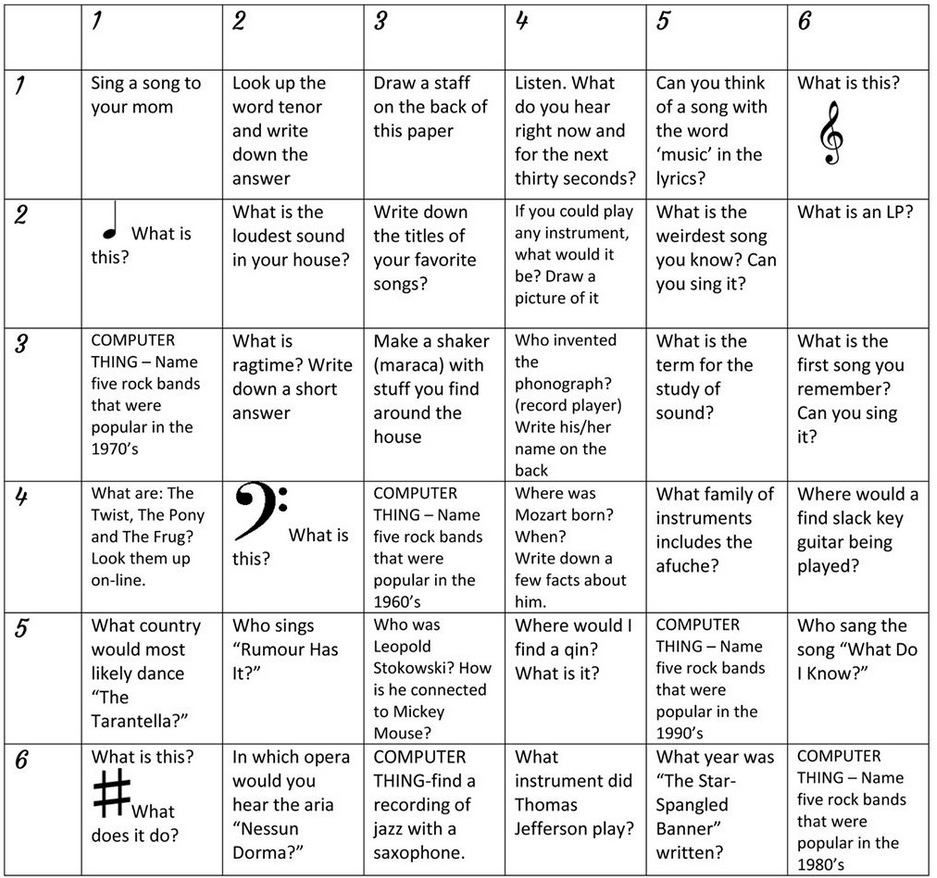
Start off with a “scavenger hunt” of researching music. First roll is the row, second is the column. (SEE ABOVE GRAPHIC)

Then, try a simpler dice game for individual practice on your instrument, rolling only once:

  1. Major or minor (alternate) scale and arpeggio
  2. A band or orchestra warmup (long tones, tuning, etc.)
  3. Slow lyrical section from your SHJO music (alternate)
  4. Favorite piece (solo, school ensemble, or SHJO)
  5. Fast passage from your SHJO music
  6. Section of a memorized piece (solo, school or SHJO) OR play along with a recording

Create: “Musical Dice II”

This time, YOU create-your-own practice game with the dice!

Write down and number six musical objectives you have, short school or SHJO sections, technical exercises, or solo pieces you want to learn. Divide up each “goal” into gradually more challenging success levels – focus on different excerpts, more measures, faster speeds, add dynamics, phrasing, articulations, etc.
SHJO Music Exploration graphic

CLIP #7

Listen:YouTube Kids Playlist

Discover new online music videos!

Parents: Did you know you can set up a free account for “completely safe viewings” of YouTube media? Go to  https://www.youtubekids.com/. Mr. Fox took an entire afternoon off perusing these recordings, a little something for everyone (a flute player, cellists, sax quartet, etc. who will “knock your socks off!”) The marble machine is just for fun… one link is a machine, the other a live band. What is “looping?” Registration may be required to access links:

Share: “Whack-a-Note”

Name these notes… fast!

http://artsedge.kennedy-center.org/interactives/steprightup/whackanote/

Like “Easy Classical Music Games” in CLIP #6, teach someone basic notation… or just have fun with it yourself.

Create: “Song or Music Writing”

A Few “Basics” for Getting Started with Composing (sample websites)

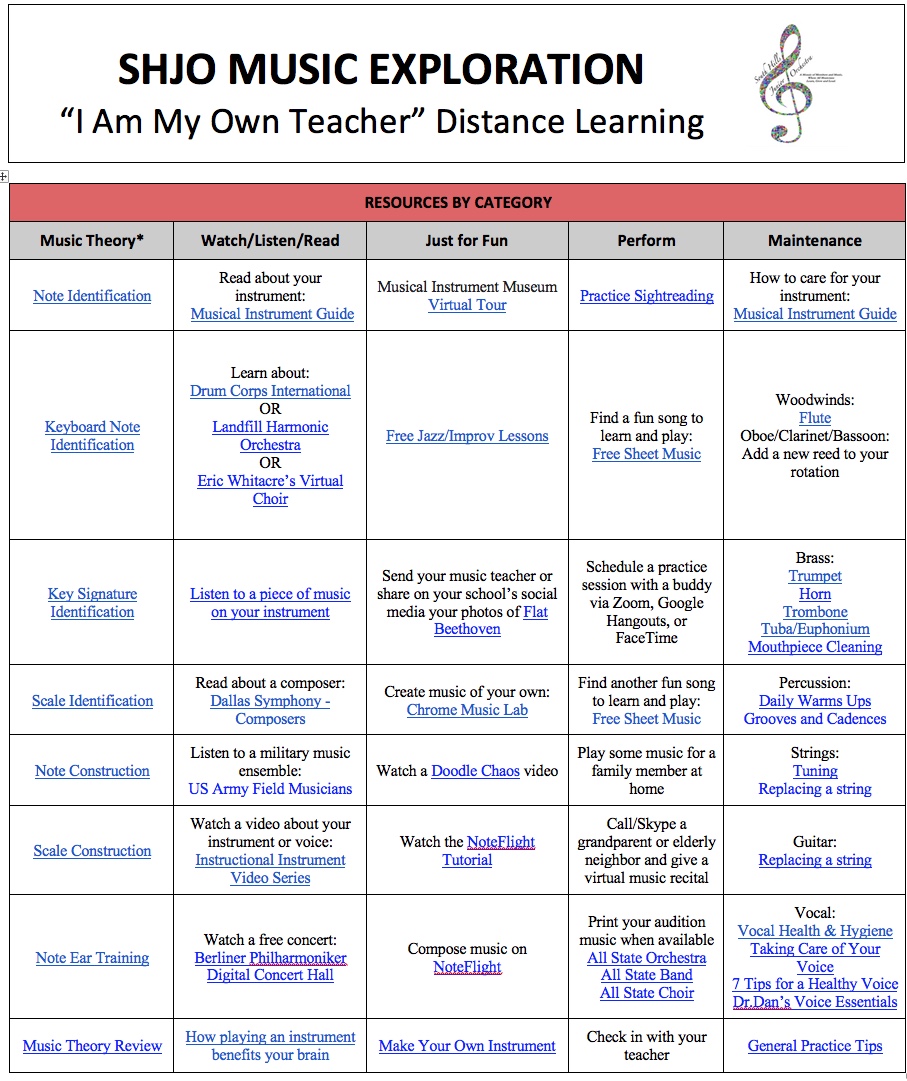
Inspire: “Music Exploration and Reflections”

Maintain a journal to keep track of your work.

(SEE ABOVE GRAPHIC – Special thanks to the Greeley-Evans Weld County School District 6 for sharing their music grades 6-12 materials.)

First, download the original, full-size two-page document (so that the links will work with “click and go”) from the SHJO.clips page: http://www.shjo.org/clips. (Word file is best so you can write on it;  if needed, this PDF version is also available: SHJO Music Exploration).

The grid on the second page will allow you to write down your progress, time spent, and reflections.

You act as your own music teacher – seeking out ways to enrich yourself with new knowledge of music.


© 2020 Paul K. Fox

Sharing a New Discovery for Band

Here’s my first try at a little musicology! Retired music teachers and those “shut-in” due to COVID-19 (which is almost everyone) can take some of their free time to “dabble” in a review of famous contributors and contributions to our music history…

Quick! Can you name one of the most influential composers of the 20th century, a pupil of Henry Cowell and Arnold Schoenberg, who was also instrumental in the development of modern dance?

Hint? Here’s his picture.

John_Cage_(1988)

John Milton Cage Jr. (September 5, 1912 – August 12, 1992) was an American composer, music theorist, artist, and philosopher. A pioneer of indeterminacy in music, electroacoustic music, and non-standard use of musical instruments, Cage was one of the leading figures of the post-war avant-garde. — Greene, David Mason (2007). Greene’s Biographical Encyclopedia of Composers. p. 1407

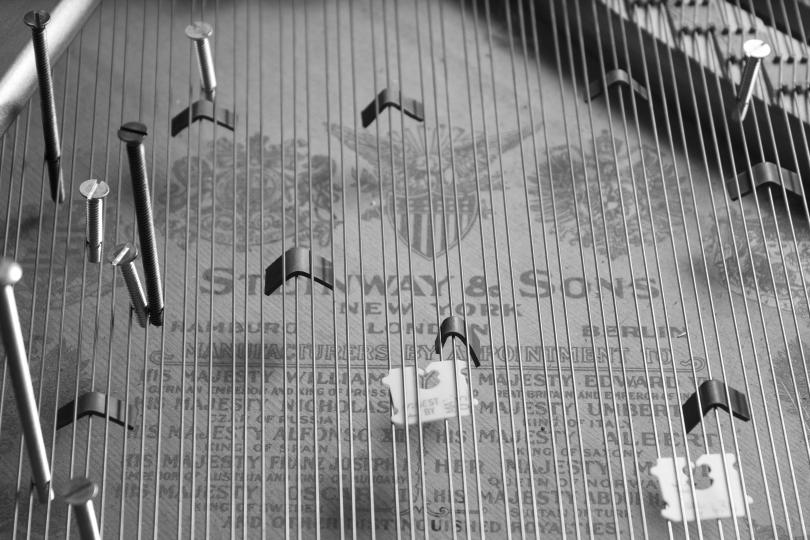
Cage was a pioneer of the prepared piano, an acoustic keyboard instrument with its sound altered by objects placed between or on its strings or hammers (see above photo), for which he wrote numerous dance-related works and a few concert pieces.

What may not be as well known was John Cage’s intense study of Indian philosophy and Zen Buddhism in the late 1940s, which led him to focusing on the concept of aleatoric or “chance-controlled music,” which he started composing in 1951.

The I Ching, an ancient Chinese classic text decision-making tool, which uses chance operations to suggest answers to questions one may pose, became Cage’s standard composition tool for the rest of his life. In a 1957 lecture, Experimental Music, he described music as “a purposeless play” which is “an affirmation of life – not an attempt to bring order out of chaos nor to suggest improvements in creation, but simply a way of waking up to the very life we’re living.” — https://en.wikipedia.org/wiki/John_Cage and https://johncage.org/

The “Classic” from John Cage’s collection

John Cage 4' 33"

Pianists and musicologists are familiar with the original Peters edition of one of his most notable works, titled 4′ 33″ (for its length), as well as his free use of exploratory and unconventional instrument types, equipment alterations, and groupings. John Cage was indeed most prolific with an exhaustive number of varied compositions to his credit, spanning his 80-year life:

From his Apprenticeship Period 1932-1936

  • Greek Ode for voice and piano (1932)
  • Three Easy Pieces (1. Round in A minor, 2. Duo in G major, 3. Infinite canon in F minor) for piano (1933)
  • Three Songs for voice and piano, (1932–33)
  • Sonata for Clarinet (1933)
  • Three pieces for two flutes (1935)
  • Quartet for any four percussion instruments (1935)
  • Two pieces for piano (1935?, revised 1974)
  • Trio for three percussionists (1936)

From his Modern Dance, Prepared Piano, and Transition to Chance Period 1937-1951

  • Music for Wind Instruments (wind quintet – 1938)
  • Bacchanale for prepared piano (1938)
  • Imaginary Landscape No. 1 for two variable-speed phonograph turntables, frequency recordings, muted piano and cymbal (1939)
  • First Construction (in Metal) for six percussionists and an assistant (1939)
  • Second Construction for four percussionists (1940)
  • Third Construction for four percussionists (1941)
  • The City Wears a Slouch Hat for narrator and six percussionists (1942)
  • Credo in Us for four performers with various objects (1942)
  • She Is Asleep: 1. Quartet for percussion, 2. Duet for voice and prepared piano (1943)
  • Ophelia for piano (1945)
  • Prelude in A minor  for flute, bassoon, trumpet, violin, cello and piano (1946)
  • In a Landscape for piano or harp (1948)
  • Sonatas and Interludes for prepared piano (1946–48)
  • Suite for Toy Piano (1948)
  • A Flower for voice and closed piano (1950)

Sample First Chance Works 1951-1958

  • Sixteen Dances for flute, trumpet, 4 percussionists, piano, violin and cello (1950–1951)
  • Imaginary Landscape No. 4 (March No. 2) for 12 radios, 24 performers and a conductor (1951)
  • Music of Changes for piano (1951)
  • Seven Haiku for piano (1951–1952)
  • Waiting for piano (January 7, 1952)
  • Music for Piano 4–19 for any number of pianos (1953)
  • 26’1.1499″ for a string player (1953–55, finished in 1955)
  • Music for Piano 21–36, 37–52 for piano solo or in an ensemble (1955)
  • Speech 1955 for news reader and 5 radios (1955)
  • 27’10.554″ for a percussionist (1956)
  • Radio Music for 1 to 8 performers using radios (1956)
  • Winter Music for piano (1957)
  • For Paul Taylor and Anita Dencks for piano (1957)
  • Fontana Mix for tape (1958)
  • Aria for voice (1958)

Sample Happenings, Theater Music 1959-1968

  • Sounds of Venice for television set (one performer) (1959)
  • Water Walk, a work for a TV show for one performer with a variety of objects (1959)
  • Cartridge Music for amplified sounds (1960)
  • Music for Carillon No. 4 for electronic instrument with accompaniment (1961)
  • Variations II for any number of performers and any kind and number of instruments (1961)
  • Music for Piano 85 for piano and electronics (1962)
  • Variations III for any number of people performing any actions (1962)
  • Electronic Music for solo piano (or any number of pianos) with electronics (1964)
  • Rozart Mix, tape loops (1965)
  • Variations V (1965)
  • Variations VI for a plurality of sound systems (1966)
  • Variations VIII no music or recordings (1967; revised 1978)
  • Assemblage for electronics (1968)

Samples of Return to Composition 1969-1986

  • HPSCHD for 1 to 7 amplified harpsichords and 1 to 51 tapes (1967–69, accompanied with Program (KNOBS) for the listener, an instruction for playing back the recording of the piece)
  • Cheap Imitation for piano (1969; orchestrated 1972, violin version 1977)
  • Bird Cage for 12 tapes (1972)
  • Etcetera for small orchestra, tape and, optionally, 3 conductors (1973)
  • Exercise for an orchestra of soloists (1973, based on Etcetera; second version completed in 1984)
  • Etudes Australes for piano (1974–75)
  • Some of the “Harmony of Maine” for organist and three assistants (1978)
  • Etudes Boreales for cello and/or piano (1978)
  • Hymns and Variations for twelve amplified voices (1979)
  • Ryoanji for double bass, trombone, oboe, voice, percussion, small orchestra (1983; parts added in 1983–85, and an unfinished cello part survives from 1992)
  • Selkus2 (1984)
  • ASLSP for piano or organ (1985)
  • Haikai for gamelan ensemble (1986)

Sample Number Pieces and Other Late Works 1987-1992

  • Twenty-Three for 13 violins, 5 violas and 5 cellos (1988)
  • Five Stone Wind for three performers with clay drums, electronics and unspecified instruments (1988)
  • 1O1 for orchestra (1988)
  • Four for string quartet (1989)
  • One2 for 1 to 4 pianos (1989)
  • Three for three recorders (1989)
  • One7 for any sound-producing object (1990)
  • Scottish Circus for Scottish folk band of any number of musicians and any instruments/voices (1990)
  • Twenty-Six for 26 violins (1991)
  • Twenty-Eight for wind ensemble (1991)
  • Muoyce II (Writing through Ulysses) for speaker and tapes (May 1992)
  • One11 for solo cinematographer (1992)

New “Bandstration” by John Cage

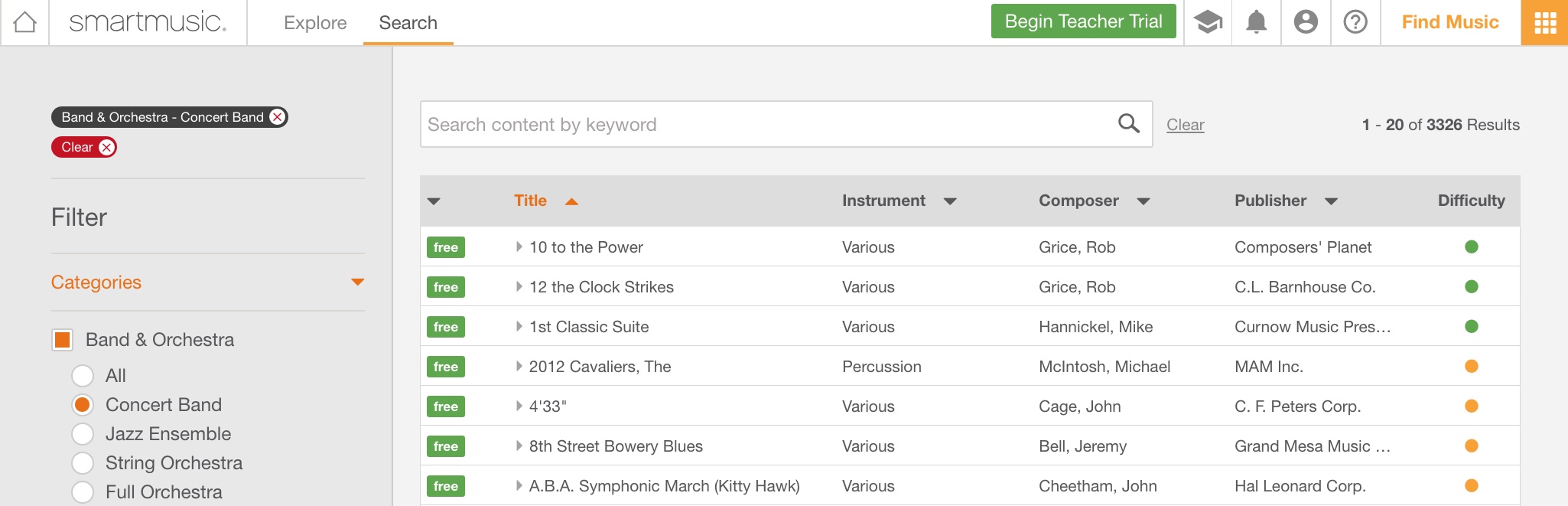
SmartMusic library

We are happy to announce a fairly recent discovery, a unique musical “find” for band directors, the first of which is a new adaptation of his work 4′ 33″ available for middle to high school concert band (full instrumentation, listed below) and a reduced, surprisingly easy-accessible arrangement for elementary band.

The music can be ordered from number of publishing houses, including C.F. Peters Corp., Sheet Music Plus, and J.W. Pepper.

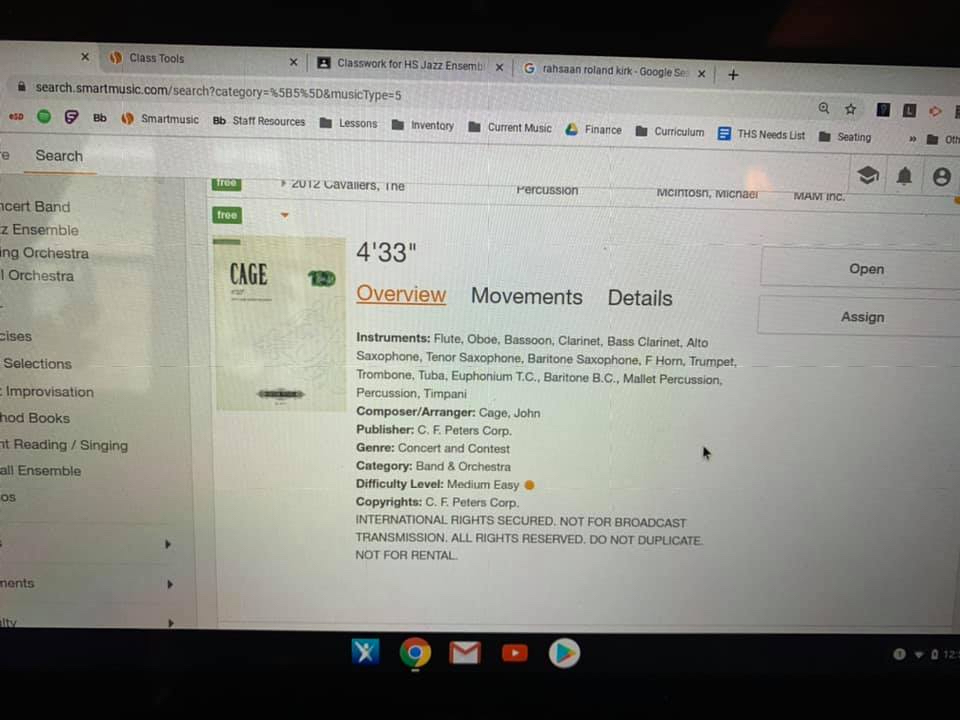
Cage arrangement for band in SmartMusic

Smartmusic (MakeMusic, Inc.) added the newest edition of 4′ 33″ to its music library, labeling it “concert” and “contest” genre at the “medium easy” level with options to practice, perform, and assess individual instruments from within the score, including:

  • Flute
  • Oboe
  • Bassoon
  • Clarinet
  • Bass Clarinet
  • Alto Saxophone
  • Tenor Saxophone
  • Baritone Saxophone
  • French Horn
  • Trumpet
  • Trombone
  • Euphonium T.C.
  • Euphonium B.C.
  • Tuba
  • Mallet Percussion
  • Percussion
  • Timpani

John Cage printed band arrangement

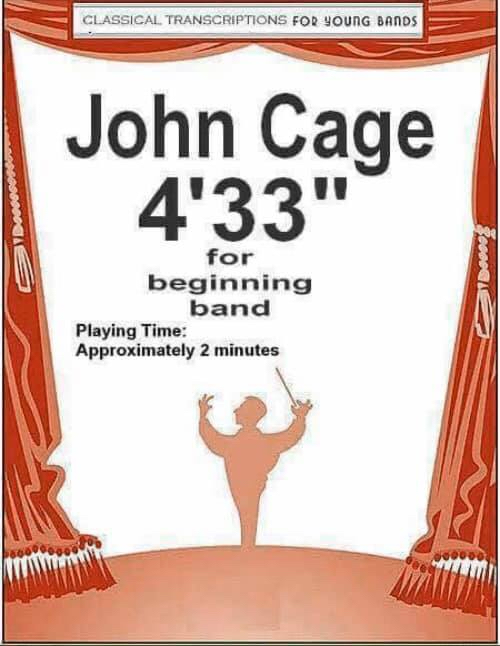
An even more simplistic elementary band version, with a recommended two minutes performance time, is published by Classical Arrangements for Young Bands.

Take time to explore the amazing life and music of John Cage. You won’t be sorry!

PKF


Bibliography


© 2020 Paul K. Fox

Virtual/Remote/Alternative Music Ed

Resources for Teaching Music Online During the COVID-19 Pandemic

COVID-19

The dreaded messages came to almost every educator:

EMERGENCY ALERT:

Out of an abundance of caution relating to the prevention of spreading the coronavirus, beginning on _____, all after-school, extra-curricular, and outside group meetings and rehearsals are postponed until further notice.

* * *

Dear Students, Parents, and Staff:

All ______ school programs such as sports, band and jazz concert, spring musical, choir festival, dance and voice recitals, booster meetings and fund-raisers, and the music department adjudication trip, are cancelled.

* * *

Important announcement:

The spring concert scheduled for March 28 at the Performance Hall will not take place. A decision about whether to cancel this performance or postpone it to another date will be made as the community health situation continues to evolve.

And then, the Governor closed the schools for two to eight weeks (or more?).

Governor Wolf
Pennsylvania Governor Tom Wolf

Dear Families,

Thanks for your patience as we work through the events that have been occurring and planning for what lies ahead. We hope you and your family are staying well, and we know that many of you are looking forward to a Virtual Learning experience for your child.

We want to share some important information with all of you as we prepare this transition. While we do not know how long our buildings will be closed, we want to be prepared for ______ Virtual Learning for as long as it is necessary.

The immediate effect? Suddenly, our kids were sent home for an extra-early spring break, hopefully remembering to bring their instruments and music! Trying to “embrace” this world emergency (from a safe distance, of course), no one had a “crystal ball” to predict or even imagine the far-reaching effects, many of which we are still awaiting answers!

  • When will we be able to go back to school?
  • How can we collaborate, grow, and share our music learning, personal progress, repertoire and skills learned over the past year?
  • What will happen to everything all of us were forced to leave unscheduled, unfinished, or “in production?”
  • Will commencement be cancelled, too?
  • Worst yet, will our seniors fail to graduate, receive their diplomas, and start college on time next fall?

Every music teacher I know cried out, “How can I reach-out to my students to help them find alternative avenues to making music? The challenge is now thrust upon us to find ways to inspire our students to continue building on their “musical momentum” in daily practice, as well as stimulate other sources of artistic enrichment and the self-motivation to create new music goals.

My first act as a community youth director was to “fire up” my orchestra’s website and Facebook page. We regularly send out Fox’s Firesides of articles on practice tips, music problem-solving techniques, goal-setting, keeping a journal, developing teamwork, learning to conduct, acquiring college references, showing concert etiquette, etc. and other notices to the members and parents using a free-version of Mailchimp.

SHJOclips

In addition, we launched something called SHJO.clips, low-tech but hopefully effective in “exciting” future music enrichment and exploration: online music games, worksheets, sample recordings and videos, practice excerpts, music theory exercises, sight-reading and ear training assignments, and much more… a treasure chest of FUN things-to-do or c.l.i.p.s. to do ON THEIR OWN: Create, Listen, Inspire, Practice, Share.

Archives of both Fox’s Firesides and SHJO.clips are available by clicking the menu at the top or visiting http://www.shjo.org/ (look under “resources”).

Are we permitted access to our students and classes online during the official closures? Does your school use Canvas or other virtual educational environments to hold digital classes, post learning activities, make assignments, provide feedback, and/or assess your students’ achievement? (Are you even allowed to do so? I cannot answer this essential question because I do not know school law and I retired from the public schools in 2013.)

smartmusic and musicfirst

Are you one of the “lucky ones” who had previously set-up either the Smartmusic or MusicFirst online platforms (and the students know how to use the it) and can continue encouraging your band instrumentalists, string players, or vocalists to sight-read, practice, explore new literature, perform, record, and assess themselves?

Do you and your students need cheering up with a “pep-talk” by Dr. Tim Lautzenheiser, the famous “music educator’s guru,” guest speaker and expert motivator often presented as the kick-off keynote session at music conferences. “Dr. Tim” challenges us all to focus on what’s important and how we can put our time to good use:

“Life is about 10% what happens to me and 90% how I react to it.”

The pessimist sees the challenge in every opportunity, but the optimist sees the opportunity in every challenge.”


Set aside 17 minutes to recharge with this video. Then, share it with your students!

I am proud to admit that, in a single act, our profession has so far risen to the occasion. In an effort to help our “stranded” programs and motivate music educators and their students, so many tech experts jumped into the fray to post their recommendations and resources. At the end of this blog-post is a (very long) list of links from them, at least active as of today, for distance learning strategies and virtual music education.

logo 2
https://www.pmea.net/council-for-ttrr/

We have taken the time to compile many of these suggestions and warehouse them on the Pennsylvania Music Educators Association State Council for Teacher Training, Recruitment, and Retention website here. Look under the heading “Virtual Music Learning – Engaging Students During the Break.” This is the impetus for this article. The samples provided below (probably only the “tip of the iceberg” and already out-of-date) are by no means all-comprising and fully comprehensive. With every minute of the day dragging on during this crisis and we are still “shut in” our homes away from our music students, new solutions are being posted to Facebook groups like Music Educators Creating Online Learning.

Click here if you would like a printable PDF file of this revision of resources.

Take the time to research what might work for you. At the very least, pass on the music games and puzzles offered at sites like Music Tech Teacher or Cornerstone Confessions. Venture into learning new apps like Zoom.com for webinar/meeting management.

Music does make a difference in all of our lives… and we need to keep our musicians and singers “at it” even during this catastrophe!

Best wishes to you and yours. Stay safe and healthy! Thank you for your dedication and contributions to music education!

(Editor’s Note: We have continued adding many more updates to the list below at the website of the PMEA Council for Teacher Training, Recruitment, and Retention accessible from this link.)

PKF


Sources of Online Music Media and Instruction

Photo credit from Pixabay.com: “child-play-game-technology-3264751” by ExplorerBob

© 2020 Paul K. Fox

Tis the Season for Musicals

Support and Participate in Your School Productions!

And now… a non-paid advertisement in support of MS/HS music drama programs… also perfect for celebrating “Music in Our Schools’ Month!” Please pass this on!

The coming springtime brings birds, flowers, bees, and… the magic of live theater! Lasting from early March to late May, the season of school musicals is now upon us! Here’s a friendly reminder from a retired public-school musical director/producer to attend one or more of your local shows! I guarantee it: You won’t be sorry! (For singers and instrumentalists already in a youth, church, or community ensemble, this is message is probably “singing to the choir!”)

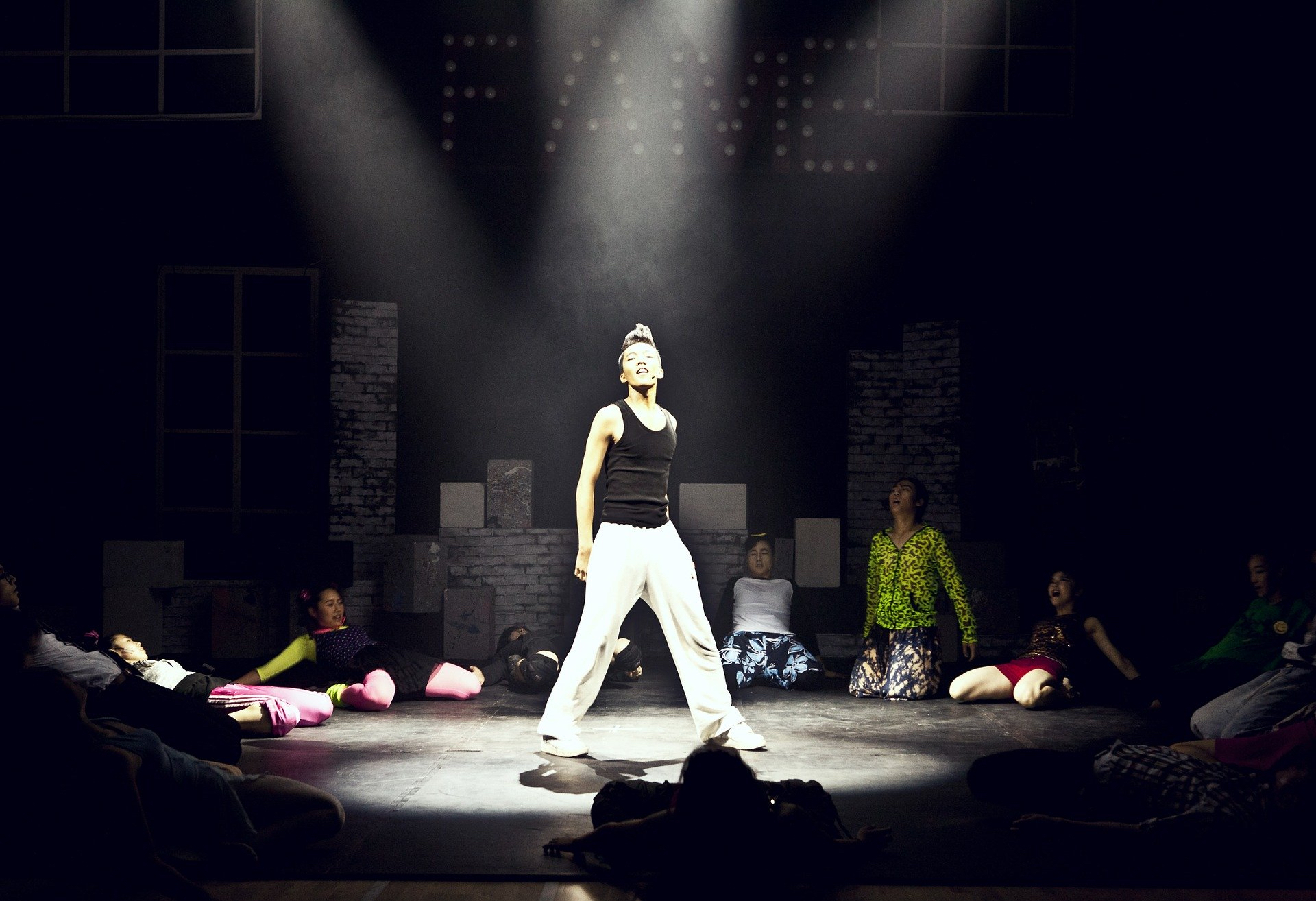
dance-430553_1920_ bigter choiThe school musical allows all of the Fine and Performing Arts the chance to collaborate, create, communicate, and “come together” in the presentation of a new transformed art form… everything from acting, dancing, choral, chamber, and solo singing, and instrumental accompaniment… to costumes, make-up, sets, props, lighting, sound, and special-effects. The music and stage crafts “make the magic” to stir your imagination for an evening or matinee of wonderful entertainment and enlightenment!

Many of our local high school musicals secure the rights for the same licensed productions that you see in downtown professional productions (like Pittsburgh Civic Light Opera and PNC Broadway series in my area) – one might say “professional grade” intended to be performed by seasoned professionals and not “watered down.” But, regardless of the incredibly challenging vocal ranges, dance steps and athleticism, virtuoso musical passages, and instant scene changes, the students always “rise to the occasion,” and perform amazingly artistic, realistic, funny, serious, romantic, thought-provoking, and inspiring numbers, providing a once-in-a-lifetime opportunity to share with your entire family!

supercharge the musical box
https://paulfox.blog/2015/08/18/52-creative-tips-to-supercharge-the-school-musical/

The scripts and scores for each show provide only the barest information on how to put everything together. The directors, choreographers, and set designers have to determine the selection and placement of the cast on the stage (defining their blocking and all entrances/exits) as well as the kind of backdrops, props, and platforms to build, position, and move (in and out) from scene to scene. Because of this, I can offer you the assurance that no two presentations of a single production will ever be the same. In addition, no two shows performed at different sites will even be remotely similar. The variety and unique talents of the leads, chorus, dancers, pit orchestra, and production crews, as well as the vision and leadership of the artistic staff, will assure that the audience will experience many surprises and excitement every time they come to the theater!

Support your talented musicians, singers, dancers, and production-crew members. Buy a ticket. Invite other members of your extended family, coworkers, and neighbors to escape their wintry doldrums and enjoy an outing. Do you love theater? Consider volunteering to help the musical, assisting in the peripheral such as sewing costumes, distributing posters, selling tickets, building sets, painting the scenery, buying a program advertisement or well-wisher announcement, or chaperoning the parties. Contact the school’s musical director or Performing Arts chairperson to find out additional ways to help “make a difference” in your school’s Performing Arts.

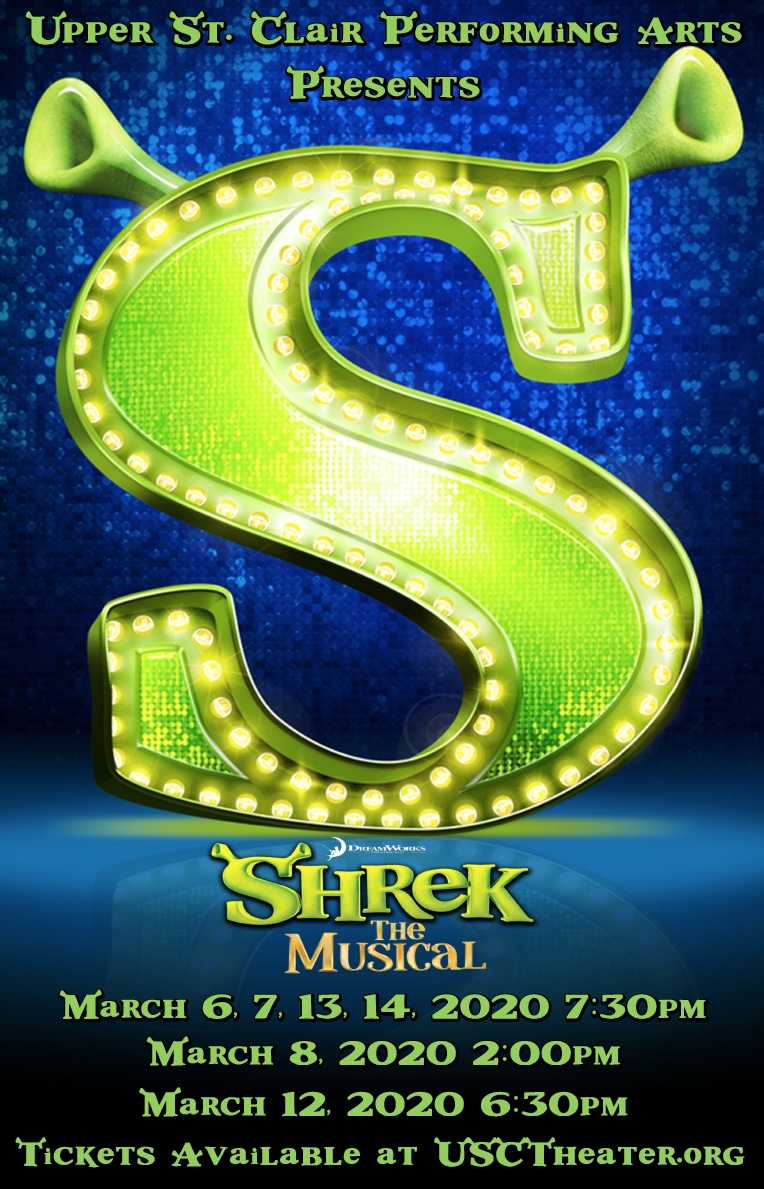
ShrekThe school district at which I am proud to have served for 33 years as music teacher, 30 years as HS producer, and 7 years as Performing Arts Curriculum Leader is putting on SHREK – The Musical. Their “grand opening” for two weeks of shows is March 6, 2020 at 7:30 p.m. in the Upper St. Clair HS Theater, 1825 McLaughlin Run Rd., Pittsburgh, PA 15241.

What else is happening in our southwestern PA area? At the time of this blog-post, we learned of a few of these upcoming HS musicals. (Be sure to check in with your local district to find out what is playing, dates, and times, and how to reserve show tickets. If all else fails and you cannot find the announcement on their school website, call the building principal’s secretary who usually knows “what’s going on!”)

Sampling of High School Spring Musicals

(Southwestern Pennsylvania from March 5 to May 9, 2020)

  • Ringgold HS: Thoroughly Modern Millie on March 5-7, 2020
  • Upper St. Clair HS: Shrek – The Musical! on March 6-8, 12-14
  • Thomas Jefferson HS Disney’s Newsies! on March 12-15
  • Bethel Park HS: Guys and Dolls on March 18-21
  • Bentworth HS: Shrek – The Musical on March 19-21
  • Peters Township HS: Big Fish on March 19-22
  • Chartiers Houston HS: Beauty and the Beast on March 20-22
  • West Allegheny HS: 9 to 5: The Musical on March 20-22, 27-28
  • West Mifflin HS: The Addams Family on March 26-29
  • South Park HS: Chicago: High School Edition on March 26-29
  • Baldwin HS: The Addams Family on April 1-4
  • Burgettstown MSHS: The Music Man, Jr. on April 2-4
  • Brentwood HS: Annie on April 2-4
  • Elizabeth Forward HS: Drowsy Chaperone on April 2-5
  • Mt. Lebanon HS: Once Upon a Mattress on May 7-9

PKF


hi-res logo 2018The mission of South Hills Junior Orchestra, which rehearses and performs at the Upper St. Clair HS in Pittsburgh, PA, is to support and nurture local school band and orchestra programs, to develop knowledge, understanding, performance skills, and an appreciation of music, to increase an individual member’s self-esteem and self-motivation, and to continue to advance a life-long study of music. Members of the Orchestra learn, grow, and achieve positions of leadership to serve their fellow players.

(For more information about SHJO, please visit www.shjo.org.)

This and all Fox’s Fireside blog-posts are free and available to share with other music students, parents, directors, and supporters of the arts.

Click here for a printable copy of Tis the Season for Musicals.

Other “Fox Firesides” are available at https://paulfox.blog/foxs-firesides/.


© 2020 Paul K. Fox
 

Photo credits from Pixabay.com: “Staging” by Mauricio Keller and “Dance” by bigter choi