Creative Ways Musicians Can Earn Extra Income

Making Digital Music, Money and Merchandising!

We welcome back guest blogger Ed Carter and his article on a subject I know next-to-nothing about… except that I, too, am a consumer of online media. We thank him for his research and insight! (Featured image by Freepik). PKF

TL;DR

Musicians today are diversifying income streams far beyond traditional gigs and streaming
royalties. From sync licensing and sample packs to branded teaching content and micro-
niche merch, the modern artist’s toolkit is packed with opportunity. Below, we explore 10
ways to earn more — creatively, sustainably, and independently.

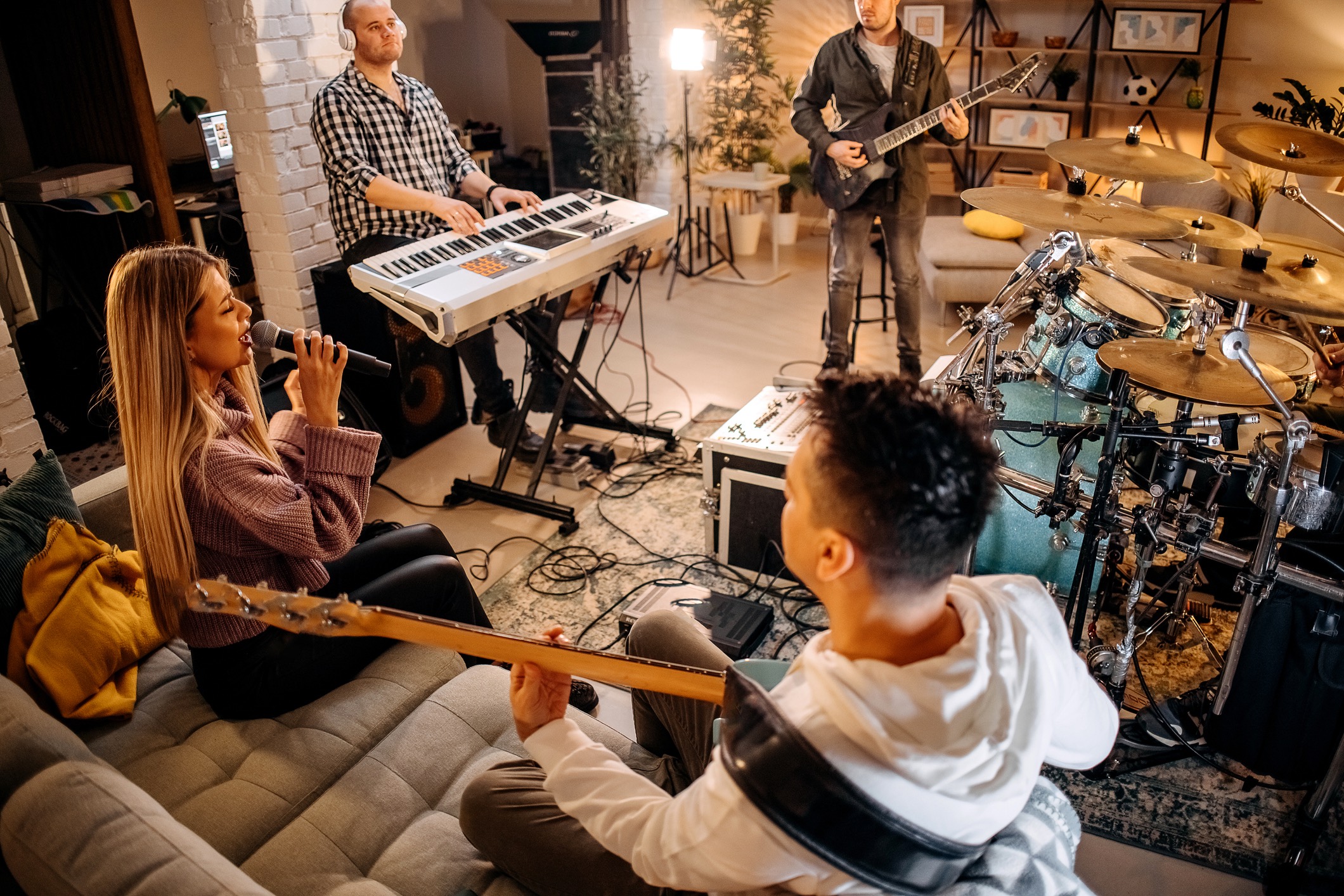
Host Micro-Events and “Living Room” Concerts

Forget stadium tours. Many fans crave intimacy. Many online platforms let artists perform
in unconventional venues — apartments, cafes, or backyards. You can set your own prices,
meet new fans directly, and keep the lion’s share of the door revenue.

Checklist for a Successful Small Show:

  • Pick a host with good acoustics and space for 20–40 people
  • Bring a small merch table (vinyl, zines, handmade items)
  • Capture the set for future promo content
  • Ask for tips digitally (Venmo or QR code)

Start a Music-Related Side Business

If you’re ready to formalize your music venture — whether selling courses, beats, or
branded merch — start it as a small business entity.

Launching a business might sound intimidating, but it doesn’t have to be. With an all-in-one
platform like ZenBusiness, you can form an LLC, manage compliance, create your website,
and even track finances in one place. A structured setup means tax deductions, legal
protection, and scalable growth.

License Your Music for Sync (Film, TV & Games)

Sync licensing has exploded. Sites like Epidemic Sound connect independent artists with
producers, ad agencies, and filmmakers. A single placement can earn $500–$5,000.
Pro Tip: Tag your tracks with clear mood and genre descriptors (e.g., uplifting cinematic
pop) so curators find you faster.

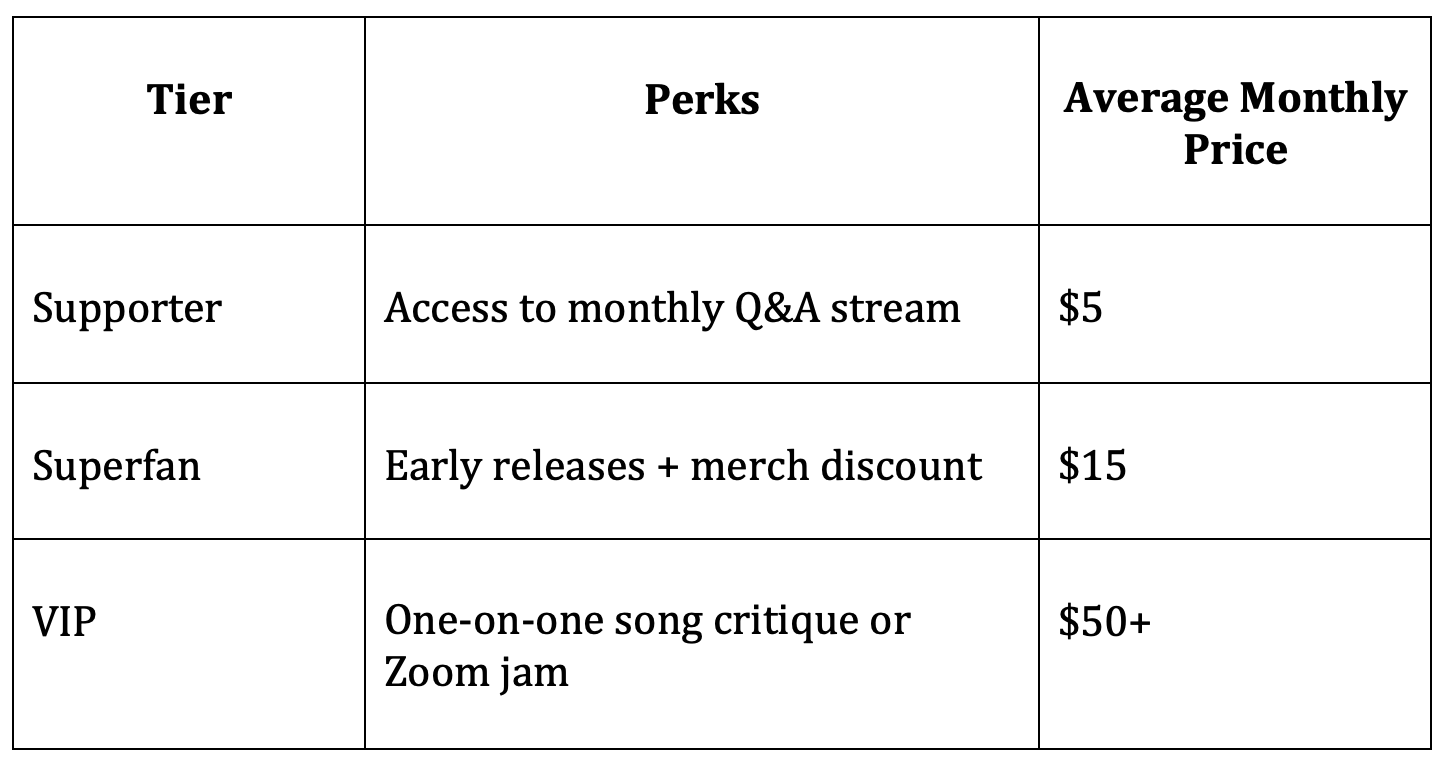
Offer Fan Subscriptions

Platforms like Bandzoogle let musicians monetize loyalty, not just streams. Offer behind-
the-scenes videos, early demos, or private songwriting sessions.

Create & Sell Sample Packs

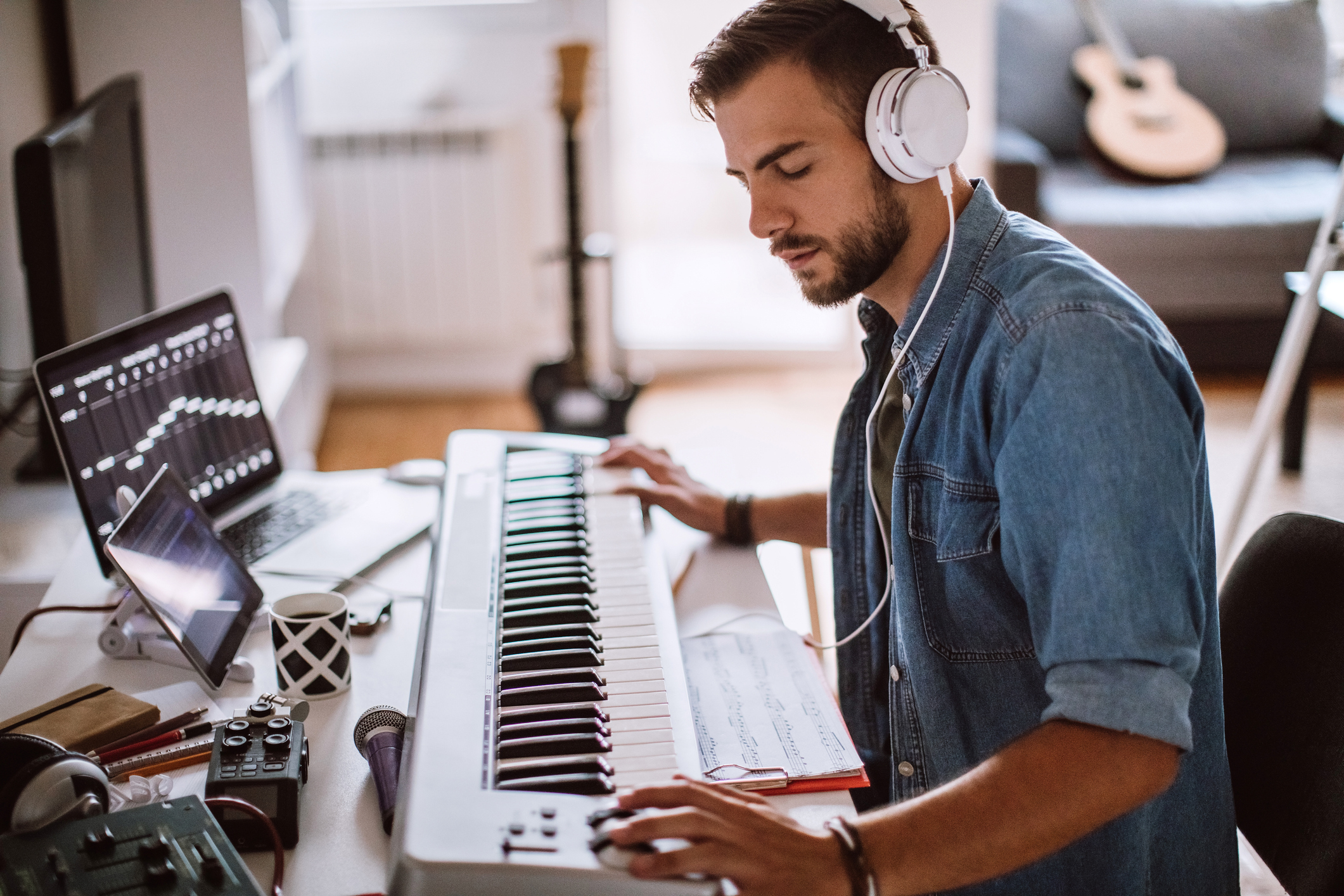
If you produce, you can sell your drum kits, synth presets, and loops. Marketplaces like
Noiiz let you upload your sounds and get royalties whenever producers use them.

How-To (Mini Guide):

  1. Curate your 50–100 best loops or hits.
  2. Label by BPM, key, and genre.
  3. Include a “demo track” showing them in action.
  4. Submit to platforms or sell directly on your site.

Teach (Without Leaving Your Studio)

Music education is booming online. Start by offering short video lessons on YouTube. Build
a following, then convert viewers into paying students.

Bullet List: Why Teaching Works

  • Generates recurring income
  • Builds your authority as a musician
  • Introduces new fans to your music

License Your Merch to Other Creators

Many artists overlook merch licensing. Your designs, logos, or slogans can appear on third-
party apparel via dropship sites like Redbubble.

Offer limited-run designs — scarcity sells.

Join Micro-Sync & Creator Libraries

YouTube creators and podcasters constantly need affordable background music. Sites like
AudioJungle pay per download or license. Even better: some offer recurring revenue if your
track gets consistent usage.

Sell Exclusive Content NFTs or Digital Collectibles

Though the NFT buzz has cooled, niche fan communities still buy one-of-a-kind assets —
unreleased demos, lyric art, or collectible stems. Marketplaces like Zora make it musician-
friendly again.

Offer Mixing, Mastering, or Session Work

You don’t have to be touring to make great money. Offer your technical expertise on
SoundBetter. Even basic editing jobs can supplement your main income stream — and help
you network globally.

FAQ: Quick Answers for Indie Artists

Do I need a large following to make real money?
No. Many creators with <1,000 dedicated fans make sustainable income by diversifying — think 10 income streams, not 10,000 followers.
What’s the best income path for producers?
Sync licensing and sample packs. They scale globally without physical touring.
Should I register my brand name as a business?
Yes, especially if you sell products or hire collaborators. Forming an LLC can protect your
personal finances and simplify taxes.

Glossary

  • Fan Subscriptions: Ongoing payments from fans for exclusive content.
  • LLC: A “Limited Liability Company” — a legal structure separating your business
    and personal assets.
  • Micro-Sync: Low-cost music licensing for YouTubers, podcasts, and small ads.
  • NFT (Non-Fungible Token): A unique digital identifier recorded on a blockchain that serves as a public certificate of ownership and authenticity for a specific digital or physical asset. Artists and creators can use NFTs to distribute their work, engage with fans, and potentially earn royalties from secondary sales, providing a new revenue stream.
  • Sample Pack: A bundle of sounds and loops producers can buy and reuse.
  • Sync Licensing: Letting TV, film, or brands use your music for a fee.

Conclusion

The modern musician’s mantra? Don’t wait for discovery — build income like an
entrepreneur. With smart licensing, direct-to-fan models, and structured business tools, you
can turn your creativity into stability — one micro stream at a time.

Check out other articles by Guest Author Ed Carter at this blog site:

© 2025 by Paul K. Fox and Ed Carter

Social Media – Revisited

Before you begin reading this article, please take a moment and peruse these past blog posts:

Although several of the cited research links may have expired (for example, PA Department of Education modified most of their website’s URLs), these provided the foundations of background information and references for the presentation I prepared for the DCMEA Virtual Conference in 2020 (during COVID) and serve as the starting point for the workshop I will share in-person at the DCMEA Winter Conference in January 2026. This blog provides updates and additional perspectives. Taken in combination with the above sources, you will be able to identify the benefits, positive models, precautions, and dangers of social media, social networks, professional learning networks, and sample emerging technologies as they apply to teachers’ professional development and education of students.


“THE WHY”

Before every clinic or publication I develop, I always try to spotlight the theme of “THE WHY” as preached by one of my favorite authors and motivational speakers – Simon Sinek! According to him, for organizations and individuals alike, “THE WHY” (rationale and priority) is more important than “THE WHAT” and “THE HOW.” (See this video.)

WHY is a collaborative discussion on social media essential? Why now?

 ”There’s a growing body of evidence suggesting that educators are facing increasing scrutiny regarding their social media use. Concerns include unprofessional conduct, inappropriate interactions with students, and the potential for cyberbullying and other negative impacts on student well-being.”

“Educators are increasingly concerned about how social media influences students’ social-emotional development and their interactions with others.” 
NEA Member Polling on Social Media…
NEA Impact on Social Media and Personal Devices on Mental Health
HHS Youth Mental Health and Social Media

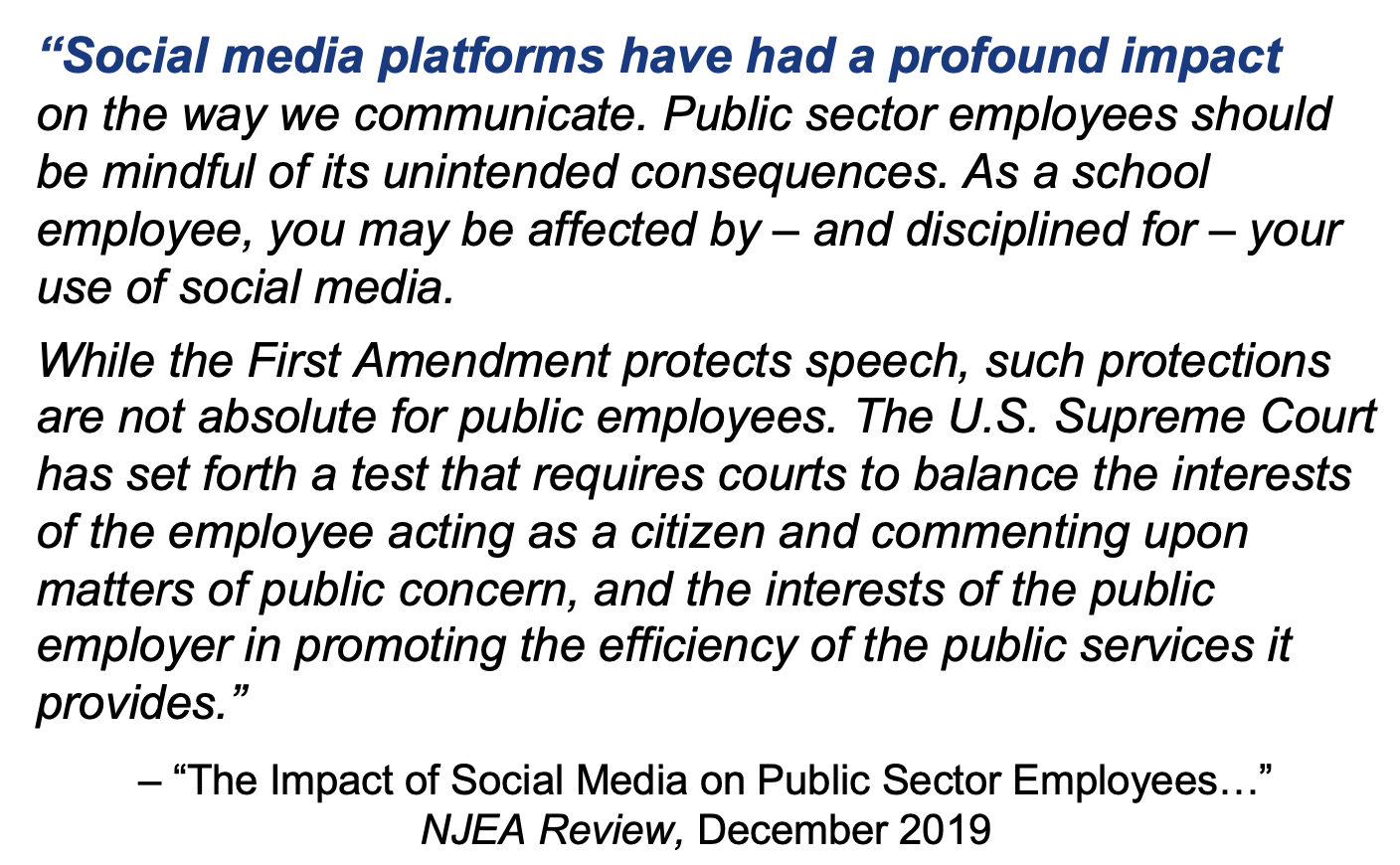
Frankly, there is still a lot of confusion about the dangers of social media, social networking, and other technology integrations into education. In Social Media – Boon or Nemesis, we mentioned that teachers should “debunk the free speech myth.” We demonstrated how the improper application of social media could get educators in trouble. Check out these sites for more info and corroborative stats:
Teacher Student Misconduct and the Critical Role of Social Media Screening
NCBA Social Media for School Employees
Social Media Hazards and Tips for Teachers

As always, our goal is to promote ethical practices in maintaining professionalism in the digital world.


“THE WHAT” Review of Definitions

“Social Media”

Social media are “websites and applications that enable users to create and share content or to participate in social networking.”
— Oxford Lexico.com online dictionary

“Social Network”

A social network is, 1. a network of social interactions and personal relationships.; 2. a dedicated website or other application which enables users to communicate with each other by posting information, comments, messages, images, etc.
— Oxford Lexico.com online dictionary

Professional Learning Community” (PLC)

A PLC is “a group of educators who meet regularly…” (usually in-person) “…to strategically enhance their teaching skills and improve student outcomes.”

versus “Professional Learning Network” (PLN)

A PLN is “a group of educators who gather more informally…” (usually in online communications) “…to problem-solve and generate ideas to enhance classroom practices. A PLN… often takes the form of an open forum, where participants can ask and answer questions based on their experiences.”
https://edtechmagazine.com/k12/article/2024/08/pln-vs-plc-perfcon


“THE HOW” Ethos of Care

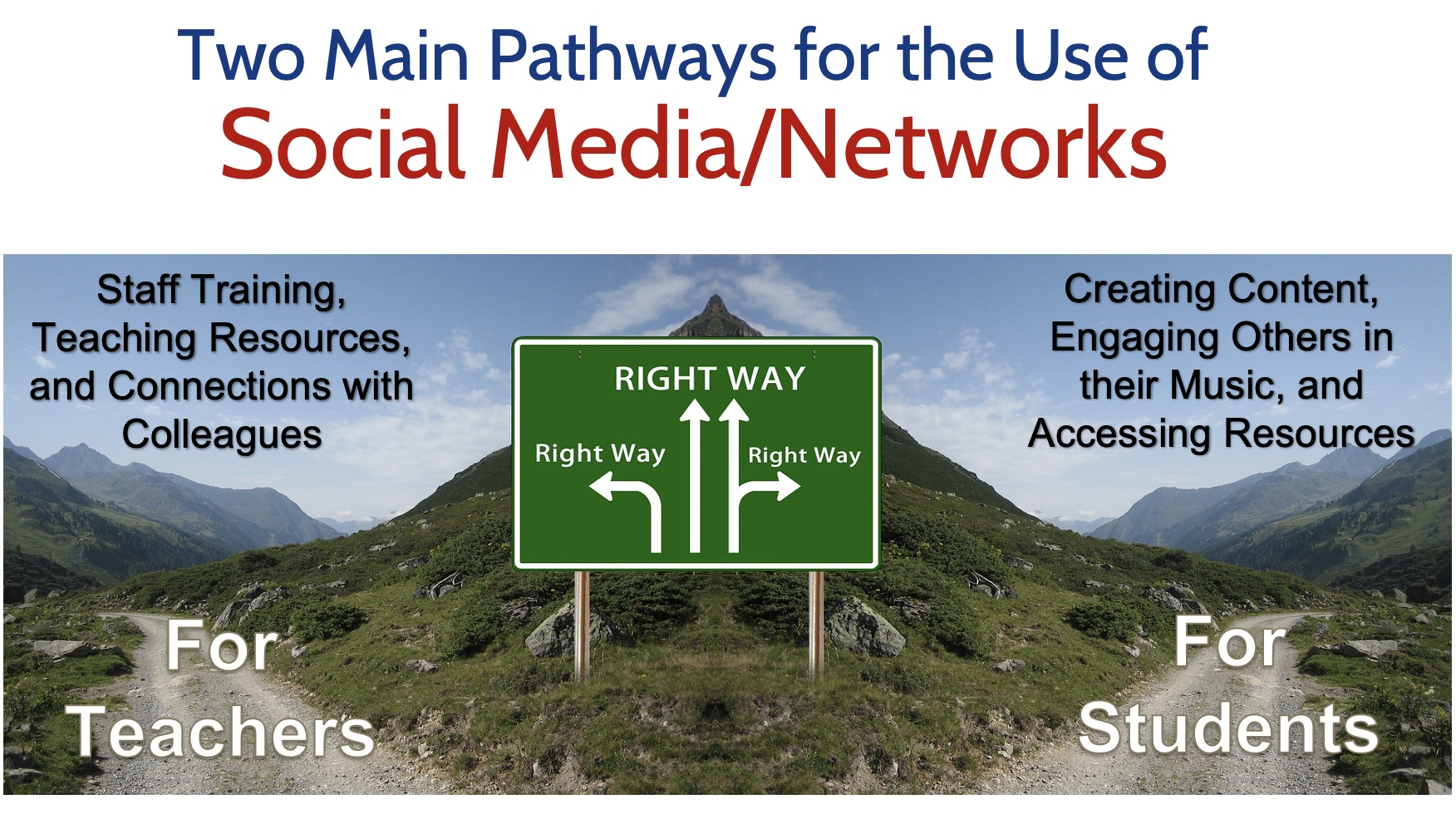
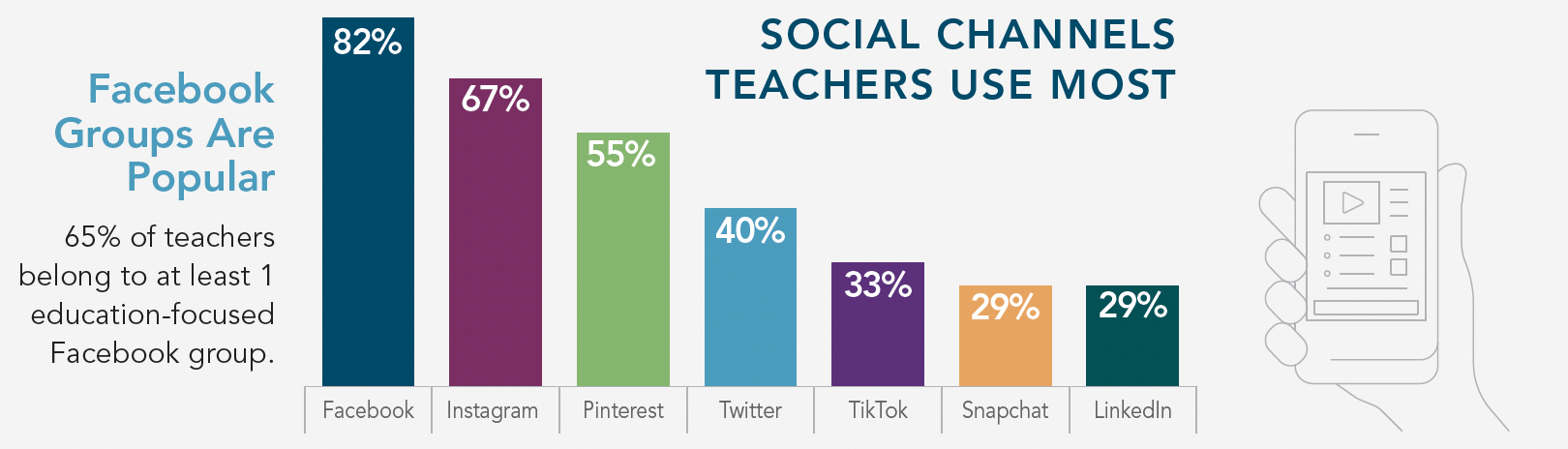
Teachers use social media to…

  • Get inspired with new teaching ideas
  • Find resources for the classroom
  • Connect with other educators
  • Stay on top of trends and news
  • participate in an online community
  • Find teacher discounts and deals
  • Follow education companies and organizations

How Teachers Use Social Media
Teachers Social Media Use

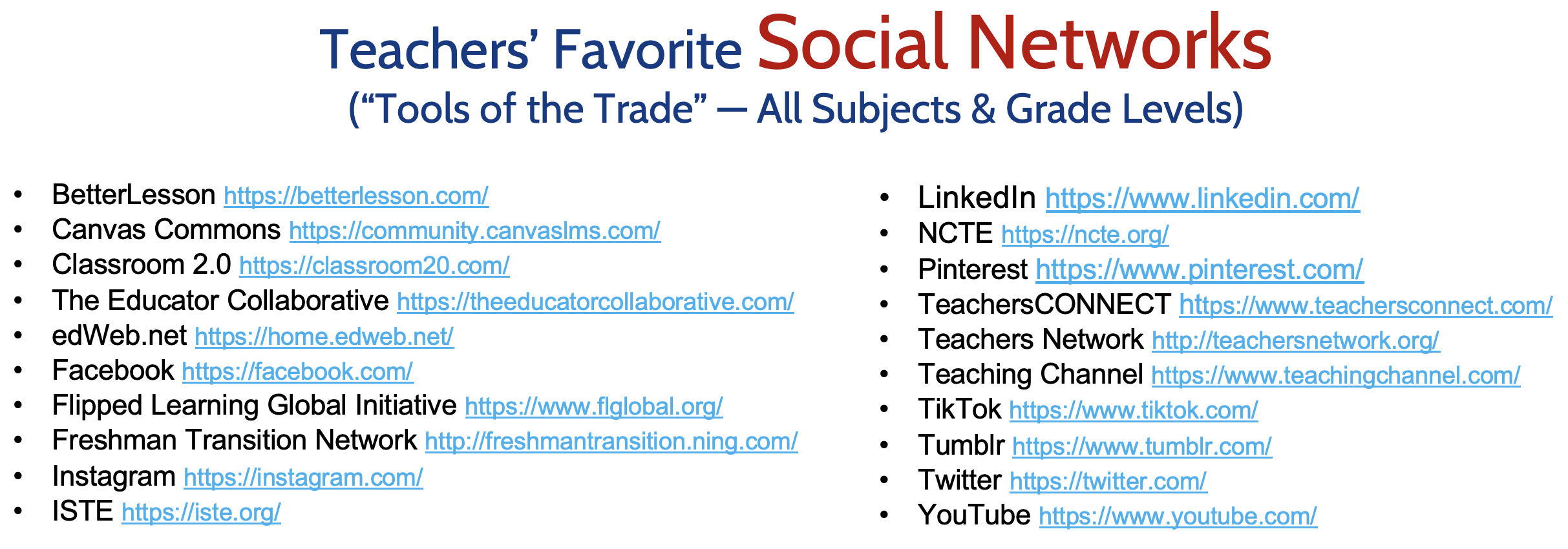
Social Networks for Teachers

We acknowledge that the benefits of social networking for educators are numerous by promoting professional collaboration and connections, including:

  1. Acquiring information to enhance understanding
  2. Keeping informed about latest developments in education
  3. Enhancing communications with students, parents, and the school community
  4. Fostering connections with colleagues in the field to expand an educator’s professional network.

Benefits of Social Media as an Educator

However, educators must exercise “sound judgment” and proper professional boundaries when using social media/networks with students. While the introduction of new technology provides many opportunities for teaching and learning, it is important to establish clear rules for appropriate student-teacher communication. In order to promote safety and appropriate boundaries while transitioning to a virtual teaching and learning environment, the Pennsylvania Professional Standards and Practices Commission offers suggestions to help educators protect themselves and their students.

  1. All technological resources and applications should be school entity-approved and only used in the manner prescribed. Ensure that you are familiar with the tools you are using in order to use them properly. 
  2. Communication with students should occur at designated times, consistent with traditional school day hours. Maintain transparency and protect yourself by keeping a record of all communications with students. 
  3. Clearly communicate when and how students should contact you and provide a timeframe for when students should expect responses to questions. 
  4. Avoid one-to-one interactions with students in chatrooms, FaceTime, Skype, or any other online space. School psychologists, school counselors and others providing one-to-one services to students should consult with school administration about the best mode of communication. 
  5. Use approved forms of communication by your school entity to connect with students and parents (i.e. Remind), use only your school email to communicate, and copy administration when communicating with parents or students. 
  6. When creating content or interacting in an online space with students, conduct yourself as you would if you were in school. If appearing on camera, dress professionally and be mindful of your surroundings and the camera’s view. 
  7. Do not “friend” or follow students on social media and do not allow students to “friend” or follow you on your personal social media. Remember, you do not have a “social” relationship with your students. 
  8. Keep your personal and professional lives separate. Do not share overly personal information about yourself with students.

PSPC Digital Tips for Educators

While exercising responsibility to maintain a respectful, safe, online environment, there are many benefits for the application of social media for students in the classroom:

  • Real-time communications can increase student engagement, collaboration, communication and overall participation
  • Many students may find it easier to participate in online discussions that in the classroom
  • Students can easily ask each other or their teacher questions about assignments outside of class
  • Students & teachers can quickly share resources at any time.
  • Teachers can easily share class announcements.
  • Social media can provide a contingency plan for last minute remote learning scenarios.
  • Students can organize school events with each other or with the help of a teacher.
  • Teachers can augment an online-only class by establishing a social media page or account simply for building community.
  • Students can practice using social platforms responsibly, including maintaining a respectful online discourse.
  • Teachers can communicate directly with parents as needed, and parents can stay informed of school news via a convenient, easily accessible platform.

However, please watch out for these potential drawbacks:

  • Social media can be a major distraction, especially if students are accessing their personal accounts independently.
  • If students primarily use social platforms to participate in class discussions, they can miss out on practicing face-to-face conversations and respectful in-person discourse.
  • Some students may see social media assignments as an opportunity to cyberbully their classmates, and there is always a risk of someone posting inappropriate content or language.

Social Media in Education


“THE WHAT” Several Success Stories

Balancing the positives and negatives and taking into account all of these precautions in order to maintaining professional boundaries, the integration of new technology into the classroom may offer excellent enrichment and increase student motivation for advanced learning. This may take many forms. Here are a few interesting models.

Prior to preparing for the DCMEA online session in 2020, I stumbled upon a truly inspiring post from Derek Muller, a gifted teacher, physicist, filmmaker, and founder of the YouTube channel Vertiasium which has captured millions of subscribers. He offers one of the BEST models of using social media to enrich the understanding of learning math and science (applicable to all fields of study), while at the same time, provides warnings against unbridled use of so-called “innovation for innovation’s sake.”

“I feel like people over the years are invariably drawn to use these words:  revolutionize and education. And there’s this sort of amnesia that we’ve had a hundred years’ worth of these predictions, worth of really groundbreaking technologies that have transformed other areas in our lives but have failed to fundamentally change the way we do education. So, I stand here today as a voice of caution, to think that the future of education is not one of revolutions…”

You need to watch this: How is Social Media Transforming the Future of Education? (2016)
Derek Muller

Say what you want about how COVID significantly disrupted our educational programs, evidence of learning loss, problems in socio-emotional development, decline of student engagement and self-motivation, rise in mental health struggles, decreased instructional time, and the effects of a new digital divide of under-served students (Annie E. Casey Foundation), happily there were surprisingly a few positive advancements the results of exploring new tools and methodologies we had to employ to tread water and cope with the catastrophe. (“When life hands you lemons, make lemonade!”)

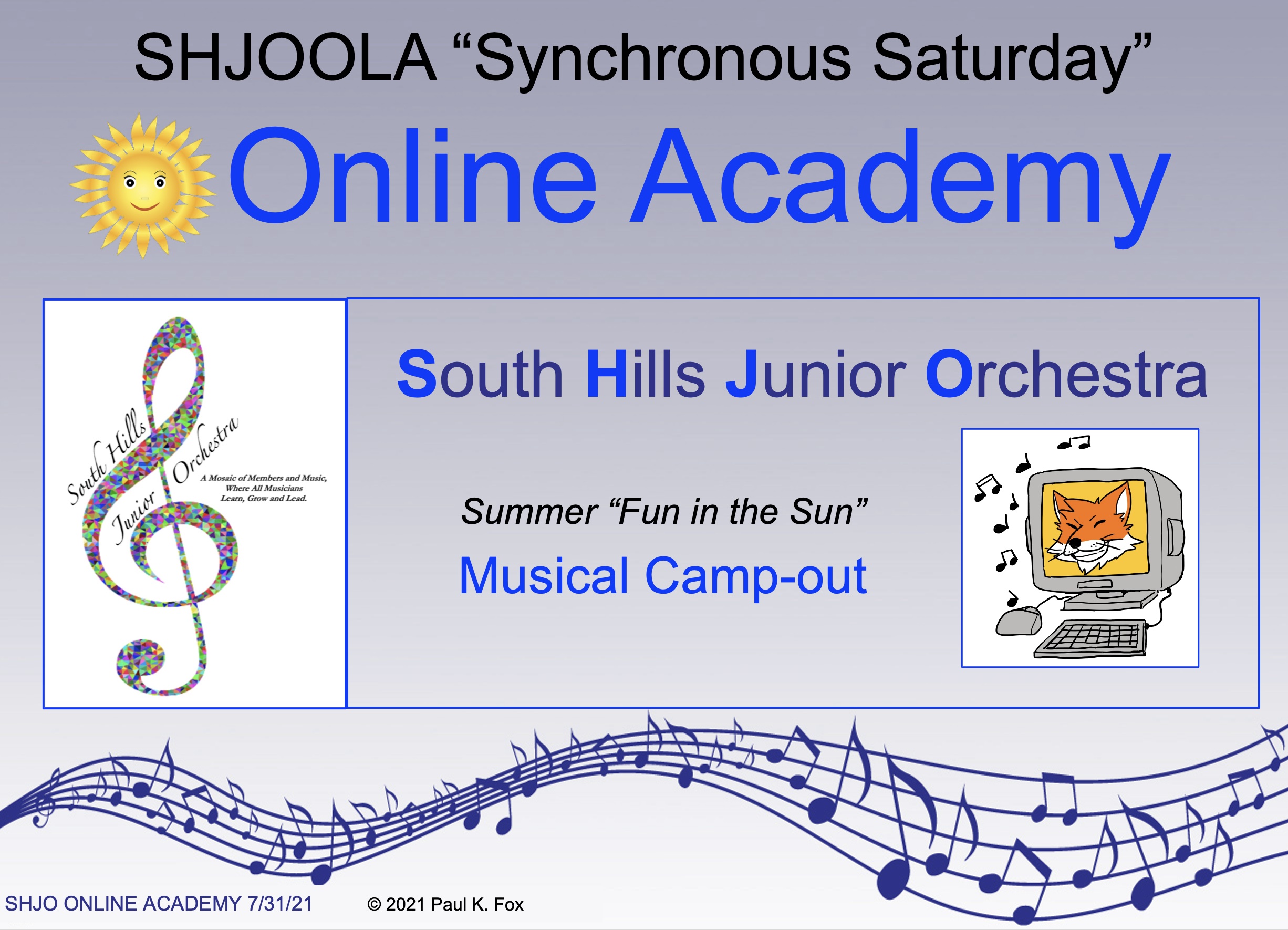
As one example, in the middle of preparing music for my community orchestra, we were shut down in 2020. No in-person rehearsals at the school. I then pivoted to creating my own online platform called SHJOOLA (South Hills Junior Orchestra Online Academy) in 2021 using MusicFirst. For a nominal yearly subscription fee, I was able to continue my Saturday morning classes (synchronous) as well as asynchronous (on-their-own time) learning using excellent applications in a virtual environment: MusicFirst Classroom, Focus on Sound, PracticeFirst, Sight-Reading Factory, Musition, Auralia, a web-based music notation program, and a huge library of method books and ensemble music. Several past blogs showed how we rolled out SHJOOLA:

The latter link above also provided a comprehensive list of supplementary resources (at the time) for online music education. Please peruse these even though some of them may have now gone inactive. We will provide supplemental links at the bottom of this article.

Another direction accented by the onslaught of the pandemic was digital streaming performances, incorporating technology in both the solo and ensemble settings. The following are two of my favorite examples of these to be viewed on YouTube:

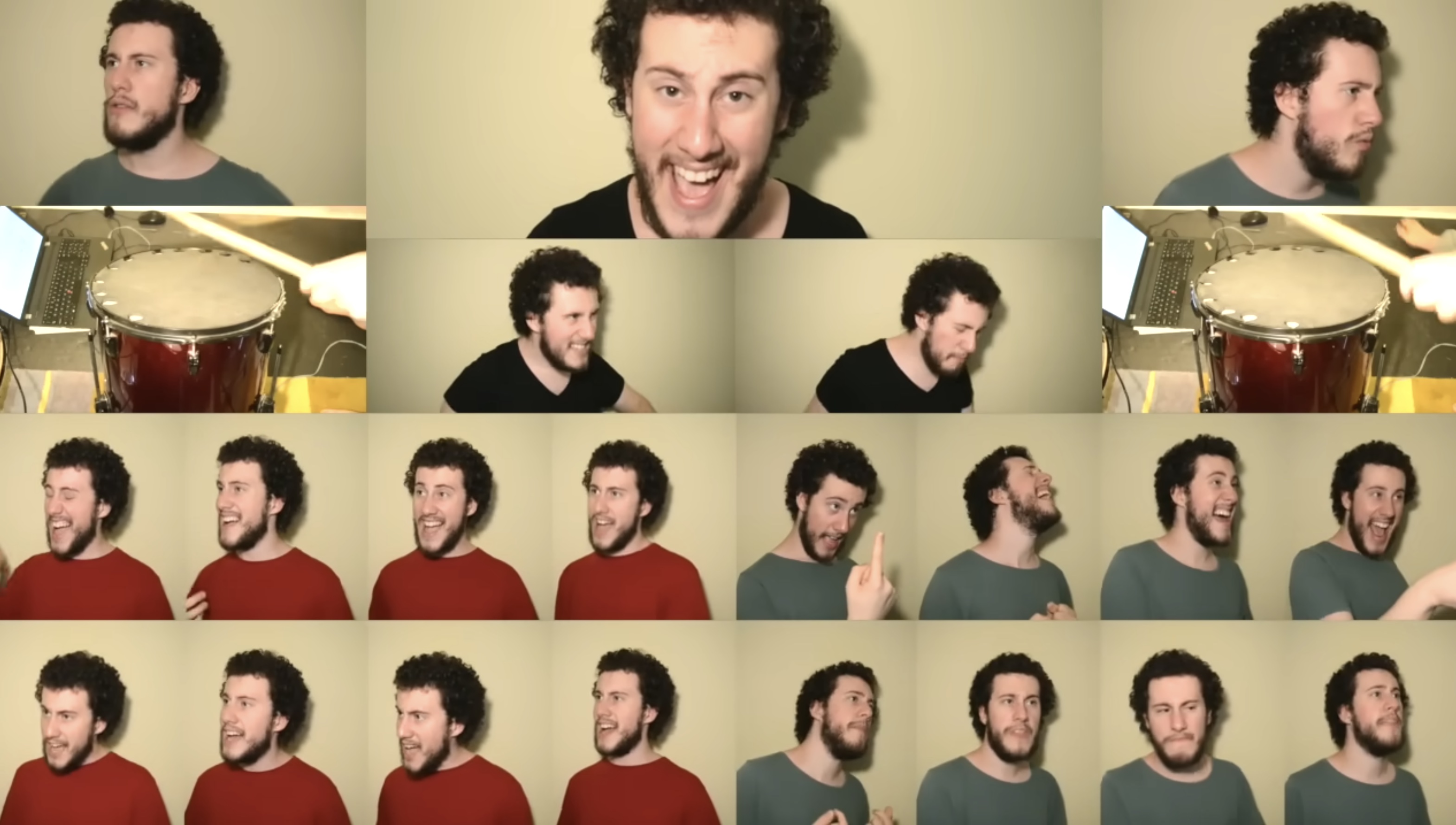
Circle of Life from Disney’s Lion King (2015-18) by Sam Robson, arranger, innovator and performer using multitrack recording of a single performer mixing as many as 50 voices at one time.

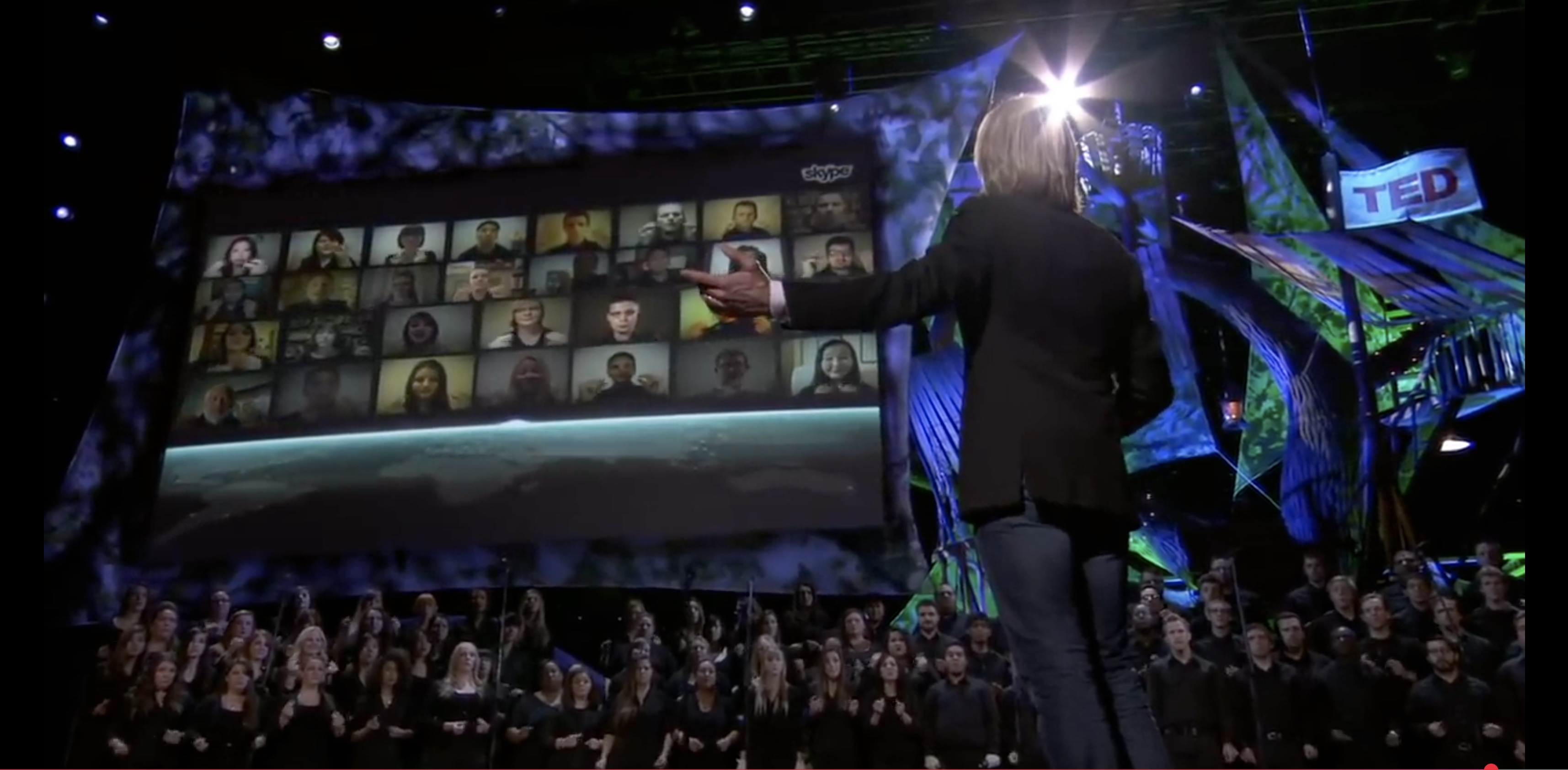
Cloudburst, a Virtual & Live Choir and TEDTALK (2013) by Eric Whitacre

Well… sorry this blog has grown to be so large! If you admit to understanding the potential hazards of and precautions for integrating social media, social networks and other technologies into education, we’ll close with the following bibliography of additional resources for further study. If that is not enough to whet your curiosity, stop back in several months to download a copy of my slide summary for the session I will present at the DCMEA Winter Conference on January 30, 2026.

Be careful stay safe and professionalbut ENJOY!

Sample Blogs

Several Major Platforms

Examples of Music Applications/Websites

PKF

© 2025 Paul K. Fox

Monetizing Our Skills & Passions

Creative Ways for Musicians to Make Money Beyond Gigs

Most of us who chose becoming music educators were motivated by our own experiences in creative self-expression and playing or singing in ensembles, and inspired by our incredibly dedicated school and private music teachers and ensemble directors. The “calling” of entering this profession was due to wanting to share this joy of making music! The best part of all of these musical experiences and training? Most of us retain these skills throughout our careers and even in retirement — many participating in community bands, orchestras, choirs, or jazz combos — some for hire!

Guest blogger Ed Carter reminds us that there are many ways to literally “cash in” our musicianship and supplement our income.

Article by Ed Carter

As a musician, making money can be challenging, especially when starting out. However, there are unique and unconventional ways through which musicians can earn extra money. Here are some ideas worth considering.

Live Streaming

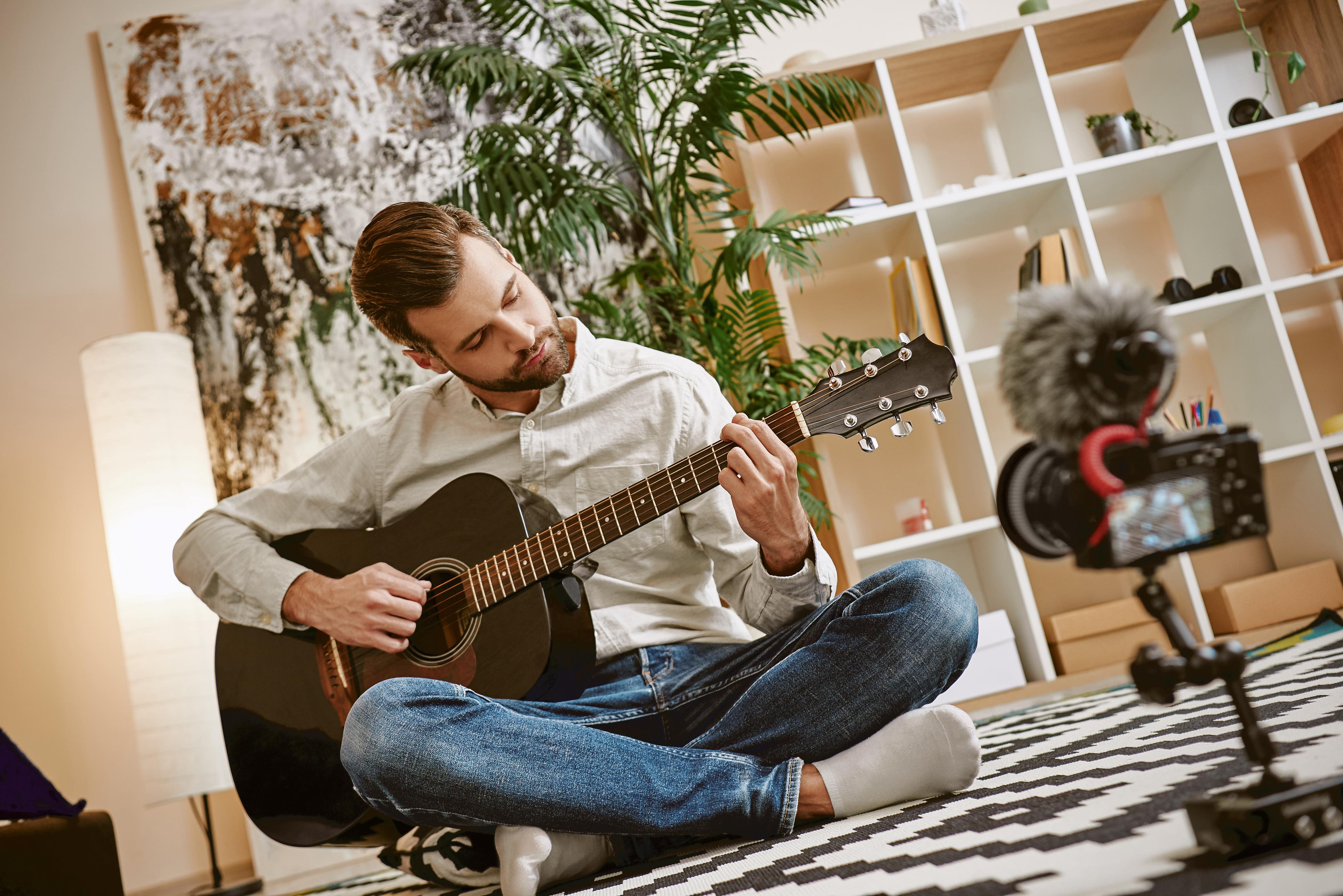
Live streaming has become a popular way to reach audiences, especially because of its convenience and cost-effectiveness. As a musician, you can leverage this platform by hosting online concerts, meet-and-greet sessions, and private performances. To earn money from these events, consider using these platforms.

Selling Merchandise

Merchandise sales are a great way to promote yourself while creating extra income.
Consider offering merch such as hats, stickers, or even signed t-shirts. The key is to make your offerings unique and appealing to your fans. To ensure maximum exposure and sales, consider selling your merchandise at live events and through your website or social media channels.

Starting a YouTube Channel

YouTube has proven to be a powerful platform for musicians to gain exposure, build their fan base, and earn money. You can create a channel hosting content such as behind-the-scenes clips, tutorials, or even live performances. To earn money through YouTube, consider joining the YouTube Partner Program or utilizing sponsored content. Additionally, use other forms of social media platforms to promote your channel and gain more subscribers.

Tutoring

By sharing skills and experience, musicians can earn money through teaching. Consider offering lessons to beginners or those looking to advance their skills. To ensure consistent income, you can offer both in-person and online lessons. Creating a lesson plan, setting a reasonable rate, and marketing your services online will help you attract students.

Networking

Getting involved in your local music scene is essential to connecting with other musicians and growing your fan base. Consider attending open mics, local concerts or festivals, joining a band or musical group, or even volunteering. By building relationships with other musicians, you can collaborate on projects, gain valuable experience, and increase your exposure.

Playing Gigs

Playing for events is a great way to not only earn extra money but also gain exposure to potential fans. Consider contacting event planners, wedding coordinators, and event organizers to offer your services. To succeed in this avenue, be reliable, punctual, and consistently produce quality music. By offering a unique musical experience, you will earn more referrals and increase your client base.

Composing

If you have experience in musical arrangement and composition, there is a high demand for those skills. Consider working with bands, orchestras, and other musical groups to create unique arrangements. To get started, create a portfolio of past arrangements, market your services online, and network with other musicians in your community.

Striking a First Impression

If you are a musician, having an engaging and memorable business card can help you stand out from the crowd and promote yourself. One solution to create professional and visually appealing cards is to use online tools. You can include your contact information, social media handles, and music style description on your card and distribute them at events, live performances, and networking opportunities. This may be a solution to help you make a lasting impression and expand your fanbase.

As a musician, there are various ways to earn extra money while building your career. By leveraging different platforms and services, such as live streaming, YouTube, and
merchandise sales, you can increase your revenue and grow your brand. Remember,
consistent quality and hard work are key to achieving success in the music industry.

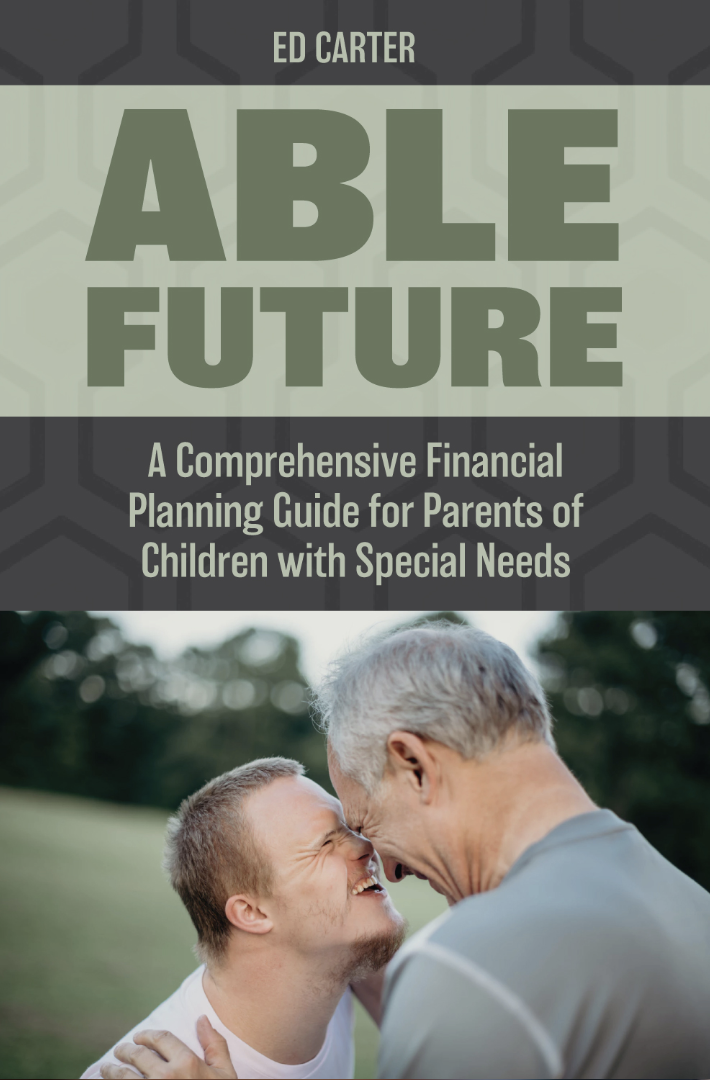
Book by Ed Carter

About Ed Carter, Guest Blogger

I’m Ed Carter, and I am a retired financial planner. Over the years, I’ve worked with clients of all ages, backgrounds and incomes. About 10 years into my career, I saw a need for financial planners who specialize in helping individuals and families living with disabilities. Regardless of their nature or how long they’ve affected someone, physical and mental limitations often cause stress and confusion when it comes to financial planning. Many people are unaware of just how many options they have when it comes to financial assistance and planning, so it’s an honor to offer my experience and change people’s lives for the better.

Now that I’m retired, I’m committed to continuing my services, even though I work on a broader scale than when I was working 9 to 5. I now spend my free time writing financial literacy articles for people to share on their blogs, collecting resource links for people to share on their websites, and collaborating with like-minded folks who want to make a difference.

From Ed Carter’s website

© 2023 Paul K. Fox

Engaging Music Students Online

COVID-19Once the COVID-19 emergency was declared and universally all schools and outside activities were cancelled (for who knows how long?), the 37th spring season of my community youth (of all ages) orchestra was also “clobbered!” Up to this time, the Western PA-based South Hills Junior Orchestra (SHJO) regularly met on Saturdays from 10:30 a.m. to 12:30 p.m. at the school from where I retired: Upper St. Clair High School.

It immediately became apparent I must reach-out to my instrumentalists and keep them “at it” to continue their music practice and artistic enrichment. How should we stimulate our music students and embrace those activities most of us “traditional” music teachers may be less skilled/experienced in approaching:

  • digital
  • virtual
  • remote
  • alternative or
  • distance music learning?

First, using a free-version of Mailchimp, a software tool that helps generate and send out group emails, we messaged our ensemble players, trying to inspire “re-connections” and independent learning, and giving them “pep talks”  like this one on March 30, 2020: https://mailchi.mp/129b1cfdc54e/music-and-artistic-enrichment-3922957.

Then, it was time to research the wonderful world of online music education, such as this huge collection of ideas from “professionals in the know.” (See my last blog-post at https://mailchi.mp/129b1cfdc54e/music-and-artistic-enrichment-3922957  OR this regularly updated link on the PMEA Council for Teacher Training, Recruitment, and Retention website.)

The results of all of this are the following SHJO.clips, being distributed to our SHJO families several times a week. This is an ongoing process, and we welcome YOUR COMMENTS – questions, concerns, and new suggestions, too.

[All of these and future posts are available as PDF files at http://www.shjo.org/clips.]
seriestoshare-logo-01

CLIP #1

Inspire: Have you ever tried the “experiments” in Chrome Music Lab?

What can you create?

https://musiclab.chromeexperiments.com/Experiments

Listen: Critique this YouTube recording of the Fugue in G Minor

https://www.youtube.com/watch?v=QmZURoUJQe0

Questions for self-reflection:

  1. What are a few of the strengths or positive attributes of this performance?
  2. Generally, how were the quarter notes articulated? Legato, marcato, staccato? In your opinion, how should they have been played?
  3. What improvements would you offer for the posture of the performers?
  4. What sections in the music did the ensemble “hang together” and when did they “fall apart?”

Practice: Select and play your favorite major key…

…performing a scale up and down on your instrument:

  1. Long tones (quarter notes), focusing on good tone and intonation. Quarter note = 60
  2. Four eighth notes per pitch in a legato articulation (same tempo).
  3. Two eight notes per pitch (same tempo)
  4. One eighth note per pitch (same tempo)

Every day you practice, change the key (start on a different note).

MusicTechTeacher

CLIP #2

Listen: Easy Guide to Appreciating Classical Music

https://www.youtube.com/watch?v=v11OJNEdIn8

Sit back (wash your hands and pass the popcorn) and enjoy this introductory video for listening to Classical Music.

Did you know the definitions of opus, fugue, subject, recap?

How was the nickname “Moonlight” assigned to Beethoven’s famous Piano Sonata?

How many different periods of Classical music does the moderator mention? Could you name them?

Inspire: Are you a little bored staying home from school?

Just for fun, here are a few online music games your parents would approve of you playing to review terminology, composers, and notation.

Practice: “The Ladder of Music Achievement”

Ever wonder how a music teacher knows what and when to teach a specific musical concept? Here’s the “rubric!” Start at the bottom and work yourself up “step by step.” Take a passage from our music. How high can you go?

  • Level 12: I played expressively.
  • Level 11: I played with self-confidence.
  • Level 10: I played with phrasing.
  • Level 9: I played with the dynamics as marked.
  • Level 8: I played with characteristic tone (with vibrato).
  • Level 7: I played with the correct bowing style (legato/detaché, staccato/martelé, or spiccato).
  • Level 6: I played with the correct articulation (legato, marcato, or staccato).
  • Level 5: I played the bowings (down and up) and slurs correctly.
  • Level 4: I played the pitches with accurate intonation.
  • Level 3: I played the correct fingerings and pitches.
  • Level 2: I played the rhythm accurately.
  • Level 1: I held a steady beat.


noteflight

CLIP #3


Create: Learning to Hear & Compose Harmony for Our Favorite Theme

Video: https://www.youtube.com/watch?v=RomMDJmMUUc&fbclid=IwAR1TKISv7ICT7DouuQo5CZsyIQ6z7w_WTtQRoc3s-QykJFHopT8uvv5QARo

Score: https://www.noteflight.com/scores/view/f7c3185d04f2c9307dff1114e7ad6596eb46da3c

Website for Noteflight: https://www.noteflight.com/home

Not sure if SHJO members have access to Noteflight, a free program for generating sheet music, but just watching the video, you can learn a lot about creating harmony. If you are interested in “jumping into” learning Noteflight, go to their website above (ask for permission to sign-up – purchasing the premium version is not needed).

Listen: “Warren Music” series

Although focused on “popular” music and at times a bit repetitious, WARRENMUSIC provides a library of music theory and ear-training (even play-by-ear) lessons, enough to keep you busy for hours! Do you play guitar? You’ll love Warren! See samples below. If you want to “hit the street running,” peruse #5 and then videos #9 on.

https://www.youtube.com/watch?v=7wAux1hh9wU&list=PLz4ee9SDzhrpJ1v-o5VSqHSyMC3-rXjtP&index=1

https://www.youtube.com/watch?v=GWD5-xmSovo&list=PLz4ee9SDzhrpJ1v-o5VSqHSyMC3-rXjtP&index=5

https://www.youtube.com/watch?v=v7l6Y6fTPDw&list=PLz4ee9SDzhrpJ1v-o5VSqHSyMC3-rXjtP&index=9

Practice: “The Ladder of Music Achievement – Part 2”

Now let’s assess your practice. Pick out a passage from the SHJO folder or any excerpt (several measures or lines) from other challenging solo/ensemble repertoire.  Play the same section every day for a week. Create a journal with the date, problem solving observations, other comments, and rate your daily achievement using this meter:

  • Level 12: I played expressively. _______________________________________
  • Level 11: I played with self-confidence. _______________________________________
  • Level 10: I played with phrasing. _______________________________________
  • Level 9: I played with the dynamics as marked. _______________________________________
  • Level 8: I played with characteristic tone (with vibrato). _______________________________________
  • Level 7: I played with the correct bowing style (legato/detaché, staccato/martelé, or spiccato). _______________________________________
  • Level 6: I played the correct articulation (legato, marcato, staccato). _______________________________________
  • Level 5: I played bowings (down/up) & slurs correctly. _______________________________________
  • Level 4: I played the pitches with accurate intonation. _______________________________________
  • Level 3:  I played the correct fingerings and pitches. _______________________________________
  • Level 2: I played the rhythm accurately. _______________________________________
  • Level 1: I held a steady beat. _______________________________________

Inspire: 126+ More Musical Games and Quizzes!

http://www.musictechteacher.com/music_quizzes/music_quizzes.htm

Check the above link of MusicTechTeacher’s entire collection! You can review concepts while having fun GAMING!

CLIP #4

Inspire: “A Message from The Foxes’ Favorite Master Motivator”

“Dr. Tim!”

Did you sit down and view “A Message from Dr. Tim Lautzenheiser” we sent out in the last Mailchimp newsletter? If you do nothing else today, this should be your number one priority! (Share this with your family members.)

Here is the link: https://www.youtube.com/watch?v=4MwWVkBBREw

Think about trying one or two of the things he suggested for helping yourself and others during this break.

Listen: Pittsburgh Symphony “Extraordinary Measures”

We are always looking for more SHJO.clips, and Mackenzie Cloutier researched and found this link of five videos! Even live performances of the PSO have been cancelled, but they are playing “on the web” just for you! Go to:

https://pittsburghsymphony.org/pso_home/web/extraordinary-measures

Practice: “The Wheel of Fortune”

SHJO Practice Spinner

Do you need help deciding on WHAT TO PRACTICE? How about going tech with an online SPINNER to SELECT what you should work on? Mrs. Fox found this cool website: https://pickrandom.com/random-wheel/.

Spin to cover at least 3 categories a day. Use the setting that removes the number after you spin it (no repeats).

  • Zero = WARMUPS
  • One = SCALES
  • Two = ETUDES
  • Three = SOLOS
  • Four = ENSEMBLE MUSIC
  • Five = MEMORIZE A TUNE
  • Six = SIGHT-READ SOMETHING NEW
  • Seven = “OLDIES”
  • Eight = RECORD A SELECTION
  • Nine = PLAY A DUET WITH YOURSELF
  • Ten = PERFORM FOR SOMEONE

Share: We’re looking for more online games…

…that review music theory, history, notation, terms, etc.

Did you try all of these?  http://www.musictechteacher.com/music_quizzes/music_quizzes.htm

Sometimes music learning can be a lot like GAMING! Mr. Fox found another website with which to experiment:

Ultimate List of Online Music Games: https://cornerstoneconfessions.com/2012/08/the-ultimate-list-of-online-music.html

If you find something interesting – any game, recording, or website – share it by emailing Mr. Fox at pfox@shjo.org.

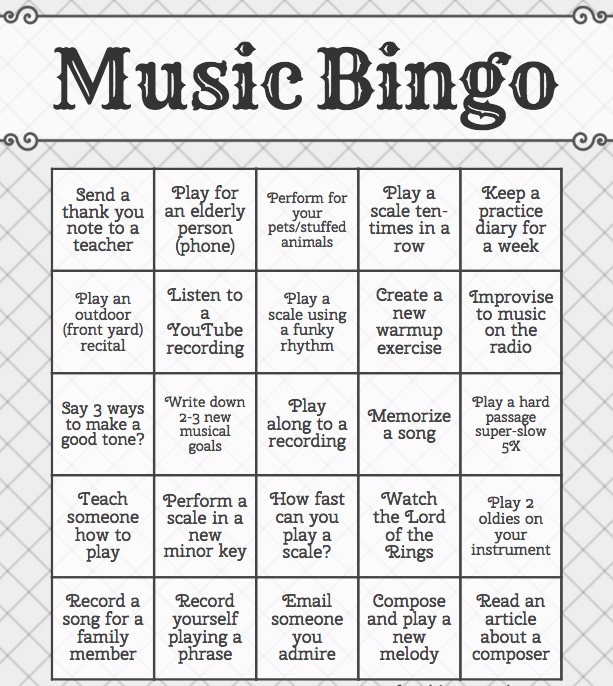
Create: BINGO CARD!

We are also looking for someone to design a fun practice card like this one: https://christina-yunghans.squarespace.com/s/Music-Bingo-Cards-sample.pdf.

Send a single copy to pfox@shjo.org.
Mr. Fox's Music Bingo

CLIP #5

Share: “On the Ear” News Reporter

Broadcast your own music review!

For this activity, you will need a device with voice recording capabilities, and a different device to listen to music selections, such as a radio or a record player, CD player, tape recorder, Music Choice channels on cable TV, or a computer on which you can view a YouTube selection, etc. Listen to an orchestral music selection or a recording of a selection for the instrument you play. (Examples: Bach Fugue in G minor, “The Lesser” or Haydn Trumpet Concerto, and so on.) As you listen to the music on one device, have you voice recorder ready to make running comments, just like a music reviewer or “play by play” sports event reporter. Download all of the instructions here:  http://www.shjo.org/s/Music-Reporter-032620.pdf

Inspire: “The Musicologist”

Free music theory review, courtesy of musictheory.net

We learned a lot last year using our Alfred Music Theory series. How much of it can you recall defining the “fundamentals of music notation?” (You do not have to purchase their Tenuto app as advertised on the website, although it is a reasonably priced option for further study! If you are a serious musician, Mr. Fox recommends it.)

Complimentary online instruction is available at https://www.musictheory.net/lessons.

To test your knowledge, here is the free link: https://www.musictheory.net/exercises.

Listen: “How Bad Can It Get?”

Classical music “fails” – just for fun!

Do you need a good laugh… conductors losing batons, concert disruptions, and much more? If you can get past the hideously out-of-tune and badly played introduction, see if you can find a violist making fun of a cell phone going off during his recital: https://www.youtube.com/watch?v=vPA31kvEUyY

Practice: “Mr. Fox’s Music Bingo”

A few ideas to keep on practicing and “give back” your music!     

If you want to print your own copy of the card or re-arrange the order of the activities, download from this link: https://christina-yunghans.squarespace.com/s/Music-Bingo-Cards-sample.pdf.

Practice: “Mr. Sheehan’s Practice Guide”

If you prefer a more cerebral plan, download/read/apply the excellent manual “What to Do When You Practice” written by the band director from Hollidaysburg Area Senior High School (PA), and the new President-Elect of the National Association for Music Education: http://www.shjo.org/s/What-to-Do-When-You-Practice-Booklet.pdf
Four-a-Day Music Researcher

CLIP #6

Share:Easy Classical Music Games”

Teach a younger sibling or neighbor the “basics of music!”

SHJO has a membership of all ages. Some of these clever activities are pretty easy, so “show your stuff” to a friend or family member: https://www.classicsforkids.com/games.html

Inspire: “Budding Composers: How to Avoid Getting Sued”

Mr. Fox’s latest YouTube video “find!”

How many Classical music themes seemed to be “borrowed” in popular music? A few tips on copyright law, too! Closer to home, do you remember SHJO’s playing of “Aura Lee?” Do you know the origins of the tune, who originally wrote the lyrics and music, and what popular piece/group used the melody? (Hint: Elvis Presley)

“14 Songs That Rip Off Classical Music” from the UK https://www.youtube.com/watch?v=yknBXOSlFQs

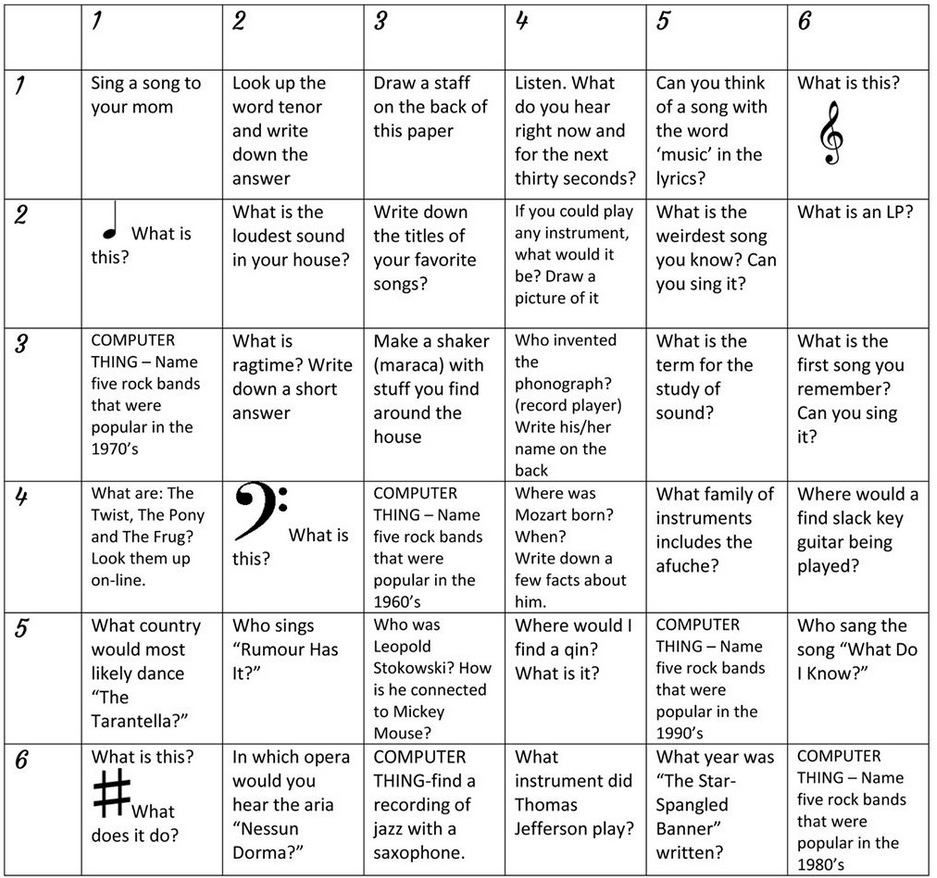
Practice: “Musical Dice”

A roll of the dice can lead to different pathways of music learning.

If you don’t have a dice, use this random number generator:  https://www.random.org/dice/

Start off with a “scavenger hunt” of researching music. First roll is the row, second is the column. (SEE ABOVE GRAPHIC)

Then, try a simpler dice game for individual practice on your instrument, rolling only once:

  1. Major or minor (alternate) scale and arpeggio
  2. A band or orchestra warmup (long tones, tuning, etc.)
  3. Slow lyrical section from your SHJO music (alternate)
  4. Favorite piece (solo, school ensemble, or SHJO)
  5. Fast passage from your SHJO music
  6. Section of a memorized piece (solo, school or SHJO) OR play along with a recording

Create: “Musical Dice II”

This time, YOU create-your-own practice game with the dice!

Write down and number six musical objectives you have, short school or SHJO sections, technical exercises, or solo pieces you want to learn. Divide up each “goal” into gradually more challenging success levels – focus on different excerpts, more measures, faster speeds, add dynamics, phrasing, articulations, etc.
SHJO Music Exploration graphic

CLIP #7

Listen:YouTube Kids Playlist

Discover new online music videos!

Parents: Did you know you can set up a free account for “completely safe viewings” of YouTube media? Go to  https://www.youtubekids.com/. Mr. Fox took an entire afternoon off perusing these recordings, a little something for everyone (a flute player, cellists, sax quartet, etc. who will “knock your socks off!”) The marble machine is just for fun… one link is a machine, the other a live band. What is “looping?” Registration may be required to access links:

Share: “Whack-a-Note”

Name these notes… fast!

http://artsedge.kennedy-center.org/interactives/steprightup/whackanote/

Like “Easy Classical Music Games” in CLIP #6, teach someone basic notation… or just have fun with it yourself.

Create: “Song or Music Writing”

A Few “Basics” for Getting Started with Composing (sample websites)

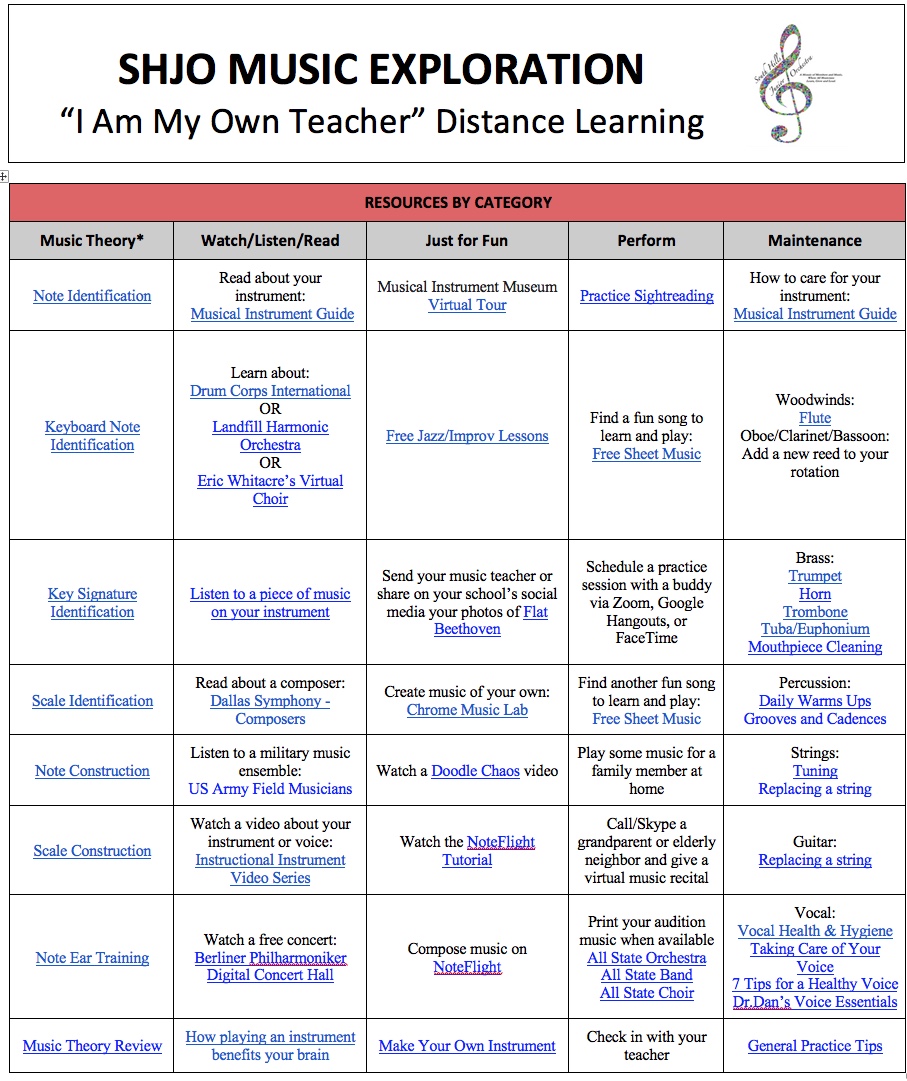
Inspire: “Music Exploration and Reflections”

Maintain a journal to keep track of your work.

(SEE ABOVE GRAPHIC – Special thanks to the Greeley-Evans Weld County School District 6 for sharing their music grades 6-12 materials.)

First, download the original, full-size two-page document (so that the links will work with “click and go”) from the SHJO.clips page: http://www.shjo.org/clips. (Word file is best so you can write on it;  if needed, this PDF version is also available: SHJO Music Exploration).

The grid on the second page will allow you to write down your progress, time spent, and reflections.

You act as your own music teacher – seeking out ways to enrich yourself with new knowledge of music.


© 2020 Paul K. Fox

Where Are the Models, Mentors, and Motivators?

Photo credit: FreeImages.com, photographer Peter C.


Are You Listening to Solo, Chamber, and Orchestral Music?

foxsfiresidesWhen I was teaching full-time school orchestra music grades 5-12, the following conversation by students in my program may have been shared at the dinner table. “He wants me to spend time and listen to several outstanding players. I was a little embarrassed when he called on me in class and asked, ‘Who is your favorite violinist?’ and I could not identify a single principal string player or even the current Concertmaster of the Pittsburgh Symphony Orchestra!”

I was dismayed that as many as 80% of my instrumentalists could not respond with the name of a famous classical musician who is currently playing their instrument! This brings the issue to the forefront of my greatest concern: DOES ANYONE LISTEN TO GOOD MUSIC ANYMORE?

Obviously, most people learning how to play golf, tennis, ballet, ice skating, gymnastics or any of the contact sports, could instantly name their “hero” and leading examples in their field. Can you imagine not watching a professional athlete model his/her technique? For example, if you wanted to learn how to be a high-diver or competitive swimmer, would you simply read a book on the subject, study the moves, take a few lessons, practice in the pool, and not once attend a local swim meet or watch the Olympic event when it appeared on TV?

seriestoshare-logo-01Pittsburgh has a strong cultural base, providing a home for the world-class Pittsburgh Symphony Orchestra and Pops, the Pittsburgh Ballet and Pittsburgh Opera companies, and the Pittsburgh Civic Light Opera productions, to name a few venues. We are also most fortunate that many amateur or semi-professional groups such as the Pittsburgh Civic Orchestra, Washington Symphony, and River City Brass Band are local (some concerts presented conveniently next door in the Upper St. Clair HS Theatre). Professional soloists and chamber groups visit our city nearly every month, and opportunities to enjoy free concerts are limitless on cable/FiOS television and WQED.

This revelation motivated me to bring my laptop computer to every music lesson and ensemble rehearsal to share musical examples. With truly “basic” technology, there is really no excuse for not exploring a sea of masterpieces, watching a virtuoso performing his craft up-close – thanks especially to online resources such as www.youtube.com. Here are just a few “totally free” audio examples:

Here is the musicianship prescription – tips on providing meaningful motivation, momentum, and exposure to GREAT works of art in order to become more culturally connected and musically literate:

  • Families: Take the music break and listen to Classical (all styles/eras), folk, pop/jazz music at least once a week.
  • Encourage your musician to regularly use his/her computer/tablet to watch performances on the web.
  • Choose several favorite soloists playing the same instrument you are studying, and follow them.
  • Buy CDs of music or download movements of concertos, sonatas, or symphonies from iTunes, etc.
  • Go to a live professional concert at least once a year – more often in the summer, if possible.

Take a trip to the South Hills Junior Orchestra website… Under “Resources,” check out the two sets of free “Series to Share…” additional “Fox’s Fireside” issues by Paul K. Fox, and “Music Enrichment Workshop” presentations by Donna Stark Fox. In particular, download and read the Listening Enrichment Session, the perfect companion to this article.

PKF

© 2017 Paul K. Fox

This “Series to Share” is brought to you by… the Founding Directors of the South Hills Junior Orchestra (SHJO), “A Community Orchestra for All Ages” based in Western Pennsylvania. Feel free to download a printable copy and distribute to music students, parents, teachers, and fellow amateur musicians.

SHJO rehearses most Saturdays in the band room of the Upper St. Clair High School, 1825 McLaughlin Run Road, Pittsburgh, PA 15241. New members are always welcome! For more information, please go to www.shjo.org.