Leaders Flush!

Leadership lessons for the classroom or staff development

This blog is a follow-up resource for my Empowering Educator and Student Leadership presentation at the PA Department of Education SAS INSTITUTE state conference on December 9, 2025 and provides a “fill-in-the-gap” narrative about many of the concepts we have already presented at this blog site:
If you would like to review my PDF slide summary from the SAS INSTITUTE, click here.

Did the main title (above) get your attention? What on earth could “leaders flush” have to do with this topic? In teaching (and modeling) leadership skills to my students, we discuss what it means to Faire sans Dire or “do without saying,” the English translation to this crest:

Heraldry coat of arms emblem: Earl of Ilchester

In other words, if you see something that needs to be done (flush the toilet?), don’t assume it’s someone else’s job. A true leader embraces the philosophy Carpe Diem (“seize the day”), identifies the problem and its solution, rolls up his/her sleeve, and “gets it done!”

Why teach leadership in the curriculum & extracurricular activities?

“Leadership is an essential skill that extends beyond the classroom, shaping how students engage with the world around them. Whether leading a group project, organizing an event, or voicing their opinions in discussions, leadership skills empower students to take initiative and make meaningful contributions. These abilities are not only beneficial during school years but also serve as the foundation for lifelong personal and professional success.”
Bloomster

In the past, I have used a multitude of opportunities and settings to teach these life skills in summer leadership camps, section leader and student conductor seminars, drum major and marching band captain auditions, student director, producer, and musical crew head staff meetings, and for 25+ years, preparing student counselors for a comprehensive, six-day, grades 8-12 Township String Camp program.

To sum it up, teaching leadership in Grades K-12 and college settings will:

  • Develop communication skills
  • Build confidence & self-awareness
  • Enhance problem-solving abilities
  • Encourage teamwork & collaboration
  • Shape future success

Why teach leadership to educators?

My December session at SAS Institute was geared to school/system leaders, department heads, and other administrators, but actually the focus on leadership as a skill set necessary for school/staff/individual professional improvement is essential for all educators and school support staff.

From district administrators and school principals to instructional coaches and curriculum coordinators, leaders in education have a direct impact on the learning outcomes of all students. According to UNESCO, educational leadership is considered one of the most influential factors on student outcomes, falling just behind engaging teaching. As a result, leadership training for educators has become an essential part of the professional development experience for teachers at all levels of education.
“Building Leadership Skills – From Classroom Teacher to Educational Leader”

School improvement rarely occurs without effective leadership, and school leadership is only second to classroom teaching in its influence on student achievement. A new evidence review report from Global School Leaders paints a complex and ever-changing picture of school leaders, with their roles, responsibilities, and impact varying around the world.
3 Reasons Why School Leadership Is Vital to Teacher Success”
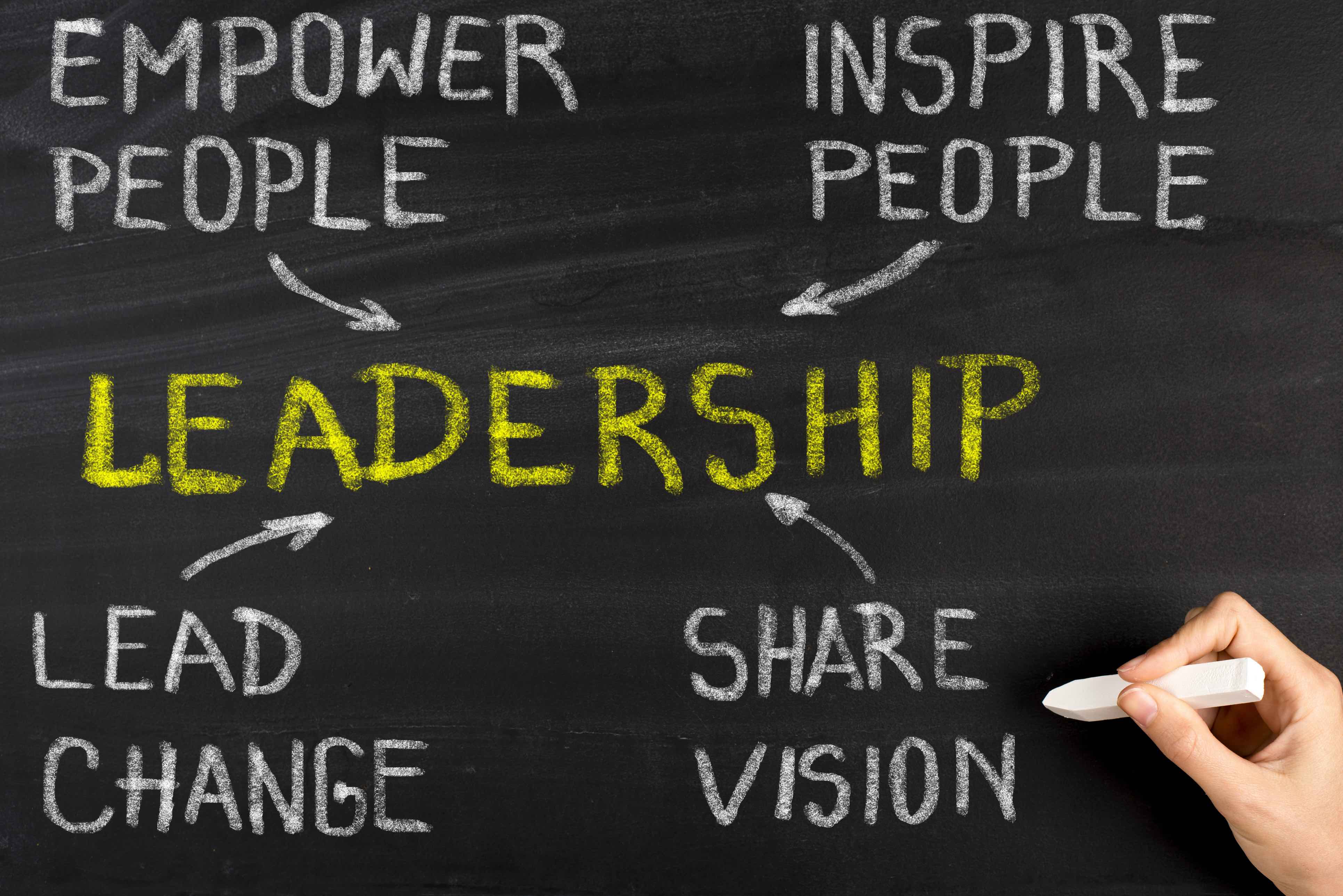
The literature suggests that empowering educators with leadership training will:

  • Improve student achievement
  • Empower and retain teachers
  • Support new staff members
  • Drive innovation and adaptability
  • Bridge the gap between instruction and administration
  • Build/model a positive attitude
  • Enhance strategic thinking and decision-making
  • Promote a positive and collaborative school climate
  • Develop soft skills such as communication, conflict resolution, and building trust… both in and outside the classroom

Leadership assessments

“A leadership skills assessment is a formal evaluation used to identify and measure a person’s leadership potential and competencies, such as communication, decision-making, and emotional intelligence. These assessments can be used by organizations to evaluate current leaders, identify high-potential candidates for promotions, and inform hiring decisions. Common methods include personality tests, scenario-based assessments, and 360-degree feedback, with tools like CliftonStrengths, Hogan Assessments, and DISC being popular examples.” 
“Leadership Assessment Test – A Complete Guide 2025”

There is a large body of information out there, especially commercial resources, for evaluating the leadership quotient and achievement of corporate managers, CEOs, CFOs, etc. I was impressed with the scope and depth of the research, including these sample firms advertising the availability of third-party consultants and advisors.
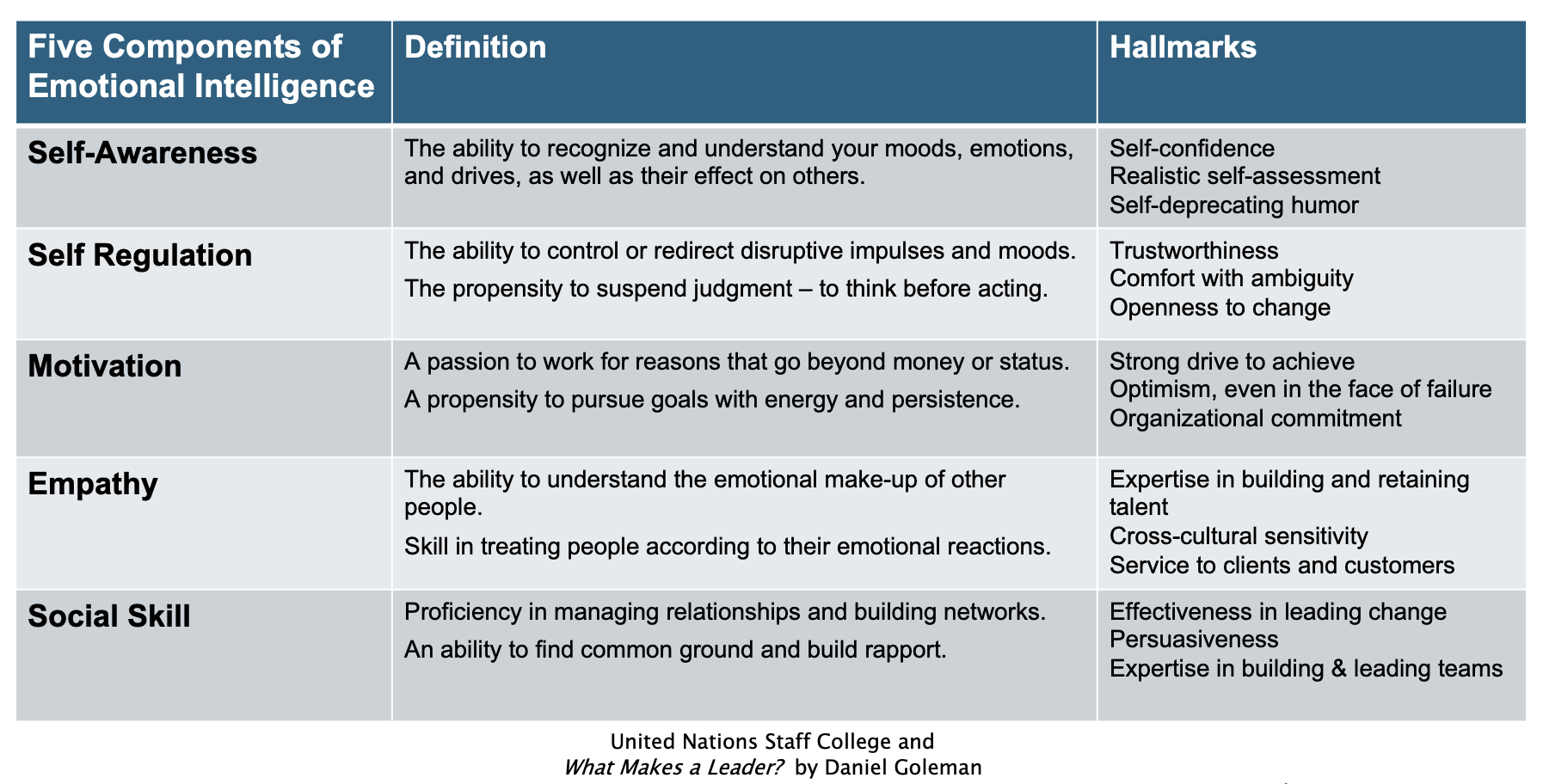
One night I randomly scanned through a handful of YouTube reels of company fraud and mismanagement (e.g., “Revenge of the Coffee Pot,” “Revenge with Karen,” and “Silent Revenge”), painting (fictitious) stories of bosses stealing intellectual property or assuming credit for the innovations/achievements of their subordinates, patent infringement, nepotism or incompetent hirings… all with arrogance, lack of professionalism, the total disregard of employee morale, and blatant patterns of poor executive decision-making, communication, emotional intelligence, strategic thinking, and the ability to influence and guide a team. “Emotional intelligence” (as defined above by Daniel Goleman in What Makes a Leader? also attributed to the United Nations Staff College) should include the “best practices” of self-awareness, self regulation, motivation, empathy, and social skills. Added to these YouTube (fake) scripted deficiencies are the mitigating effects of corporate politics, inconsistent application of compliance or HR policies, unclear contract language, and problems in the chain of command… with the eventual result of the boss receiving a fall from grace, termination, and other legal consequences. Most of these episodes imply only the Board of Directors evaluates the top executives (like school superintendents?), and even with the inclusion of employee satisfaction surveys, staff retention data, third-party auditors, and whistle-blower protections in some instances, the catastrophic actions of these leaders nearly destroy the businesses. For these videos, it seems that leadership assessments and goals are never ongoing, the benchmarks are seldom reviewed, and nothing is PROACTIVE… and therefore not preventive. Therefore, for the school district and corporate worlds alike, we need to intentionally provide formative assessments of our leaders (and ourselves). Exactly what do we need to know and do to improve?
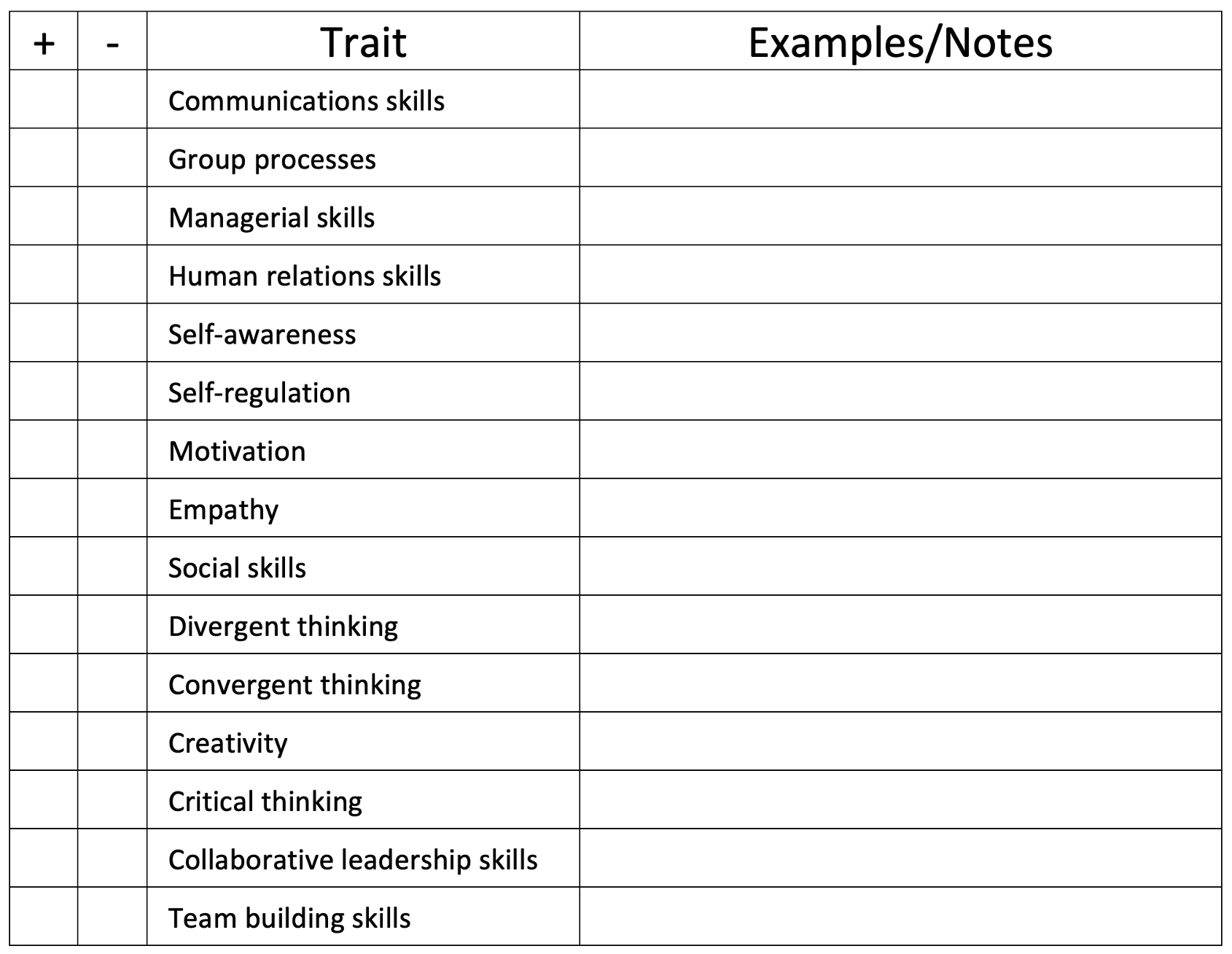
In my blog Growing Student Leaders and the SAS Institute 2025 presentation, I offered the above image as an informal personal checklist to evaluate leadership traits. Coincidentally, while I was writing this article, a scholarship committee of the Community Foundation of Upper St. Clair (for which I serve as Communications Director and Arts Chair) was developing an assessment rubric for ranking applications of a new student leadership scholarship. Although still under development, here are a few of the categories being considered:

  • Communication: Includes listening skills, clarity in speaking, and the ability to make others feel heard.
  • Integrity: Acting ethically, being trustworthy, and aligning actions with words.
  • Accountability: Taking ownership of actions and commitments.
  • Collaboration: Working effectively with others, valuing different perspectives, and resolving conflicts.
  • Self-awareness: Understanding one’s own strengths, weaknesses, and biases.
  • Drive/Initiative: A bias for action and the ability to move projects forward.
  • Courage: The bravery to speak truthfully, admit shortcomings, and make difficult decisions.
  • Humility: Recognizing the contributions of others and remaining a lifelong learner.
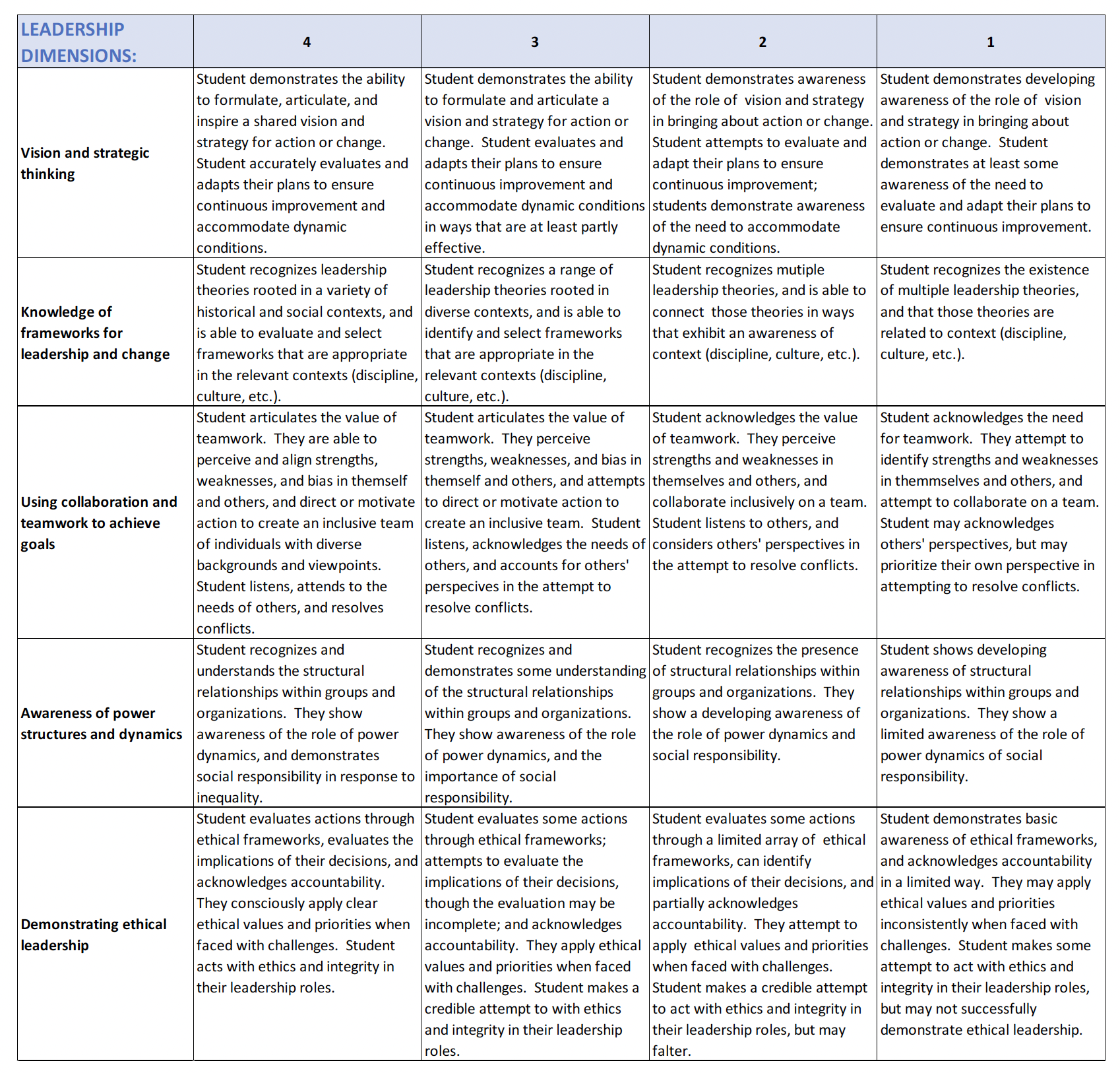
The University of Massachusetts Lowell developed the above rubric for their River Hawk Experience Distinction Leadership Program, defining specific criteria with a clear description of what each trait should look like at different performance levels, in order to provide a standardized way of measuring and assessing leadership skills
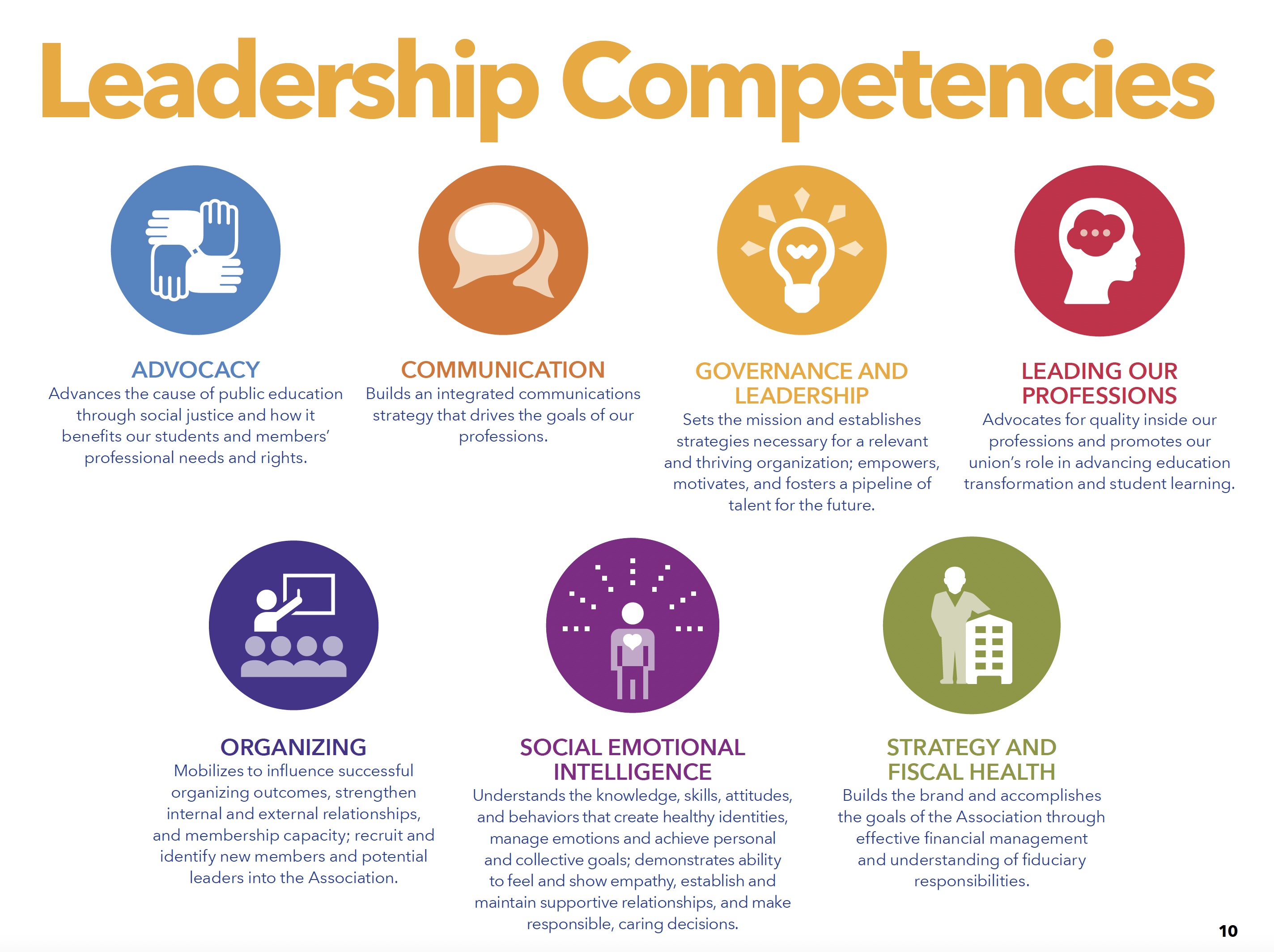
In addition, the National Education Association has created the above NEA Leadership Competency Guide worth downloading.

My favorite inspirational speaker Simon Sinek has also weighed in on this topic of “What Makes a Great Leader?” refining/simplifying it to just three traits:

  • Courage
  • Integrity
  • Communication

Additional resources

If you are an educator looking for supplemental material on developing leadership skills in your students, besides these SAS INSTITUTE 2025 slides (of which the original PowerPoint file is available to download for free in order to adapt for your classroom – please email me), I recommend perusing the full-blown “Building Leaders for Life” (second edition) curriculum (94 lessons in five subject areas, 355 pages of lesson materials, 137 student handouts) created by the Association of Washington Student Leaders (a division of the Washington School Principals’ Education Foundation). Click here to view their website. They also have a middle school and elementary series!

If you attend my SAS INSTITUTE workshop on December 9, 2025 (starting at 9:40 a.m. in Magnolia C, Hershey Lodge & Convention Center), ask me to see sample materials from their high school course of study.

Finally, here is the “homework for future leaders” I provided at the SAS INSTITUTE and during a 2024 summer camp at Upper St. Clair High School, providing additional links to many inspiring minds. Enjoy!


Leadership is not about being in charge. It is about taking care of those in your charge. — Simon Sinek

A leader is one who knows the way, goes the way, and shows the way. — John C. Maxwell

Do not follow where the path may lead. Go instead where there is no path and leave a trail.
— Ralph Waldo Emerson

The greatest leader is not necessarily the one who does the greatest things. He is the one who gets people to do the greatest things. — Ronald Reagan

What you do has far greater impact than what you say. — Stephen Covey

PKF

© 2025 Paul K. Fox
Burned Out or Bummed Out?

More on Teacher Self-Care: Diagnosis and Remediation

This is Part VI in a series of articles on educator health and wellness, following “Stressed Out!” and “Teacher Self-Care During the Pandemic.”

burnout-90345_1920_geralt

Do you recognize these signs of burnout experienced  by yourself, a coworker, neighbor, or someone you love?

  • Physical: tired, lowered immunity, illnesses, aches and pains, loss of appetite or sleep
  • Emotional: sense of self-doubt, failure, helplessness, loneliness, cynicism, loss of satisfaction/motivation
  • Behavioral: withdrawal, isolation, skipping work, procrastination, frustration, overuse of food, drugs, alcohol

By the time it gets to that third bullet, probably everyone would be aware of the trouble.

You may be on the road to burnout if:

  • Every day is a bad day.
  • Caring about your work or home life seems like a total waste of energy.
  • You’re exhausted all the time.
  • The majority of your day is spent on tasks you find either mind-numbingly dull or overwhelming.
  • You feel like nothing you do makes a difference or is appreciated.

Burnout Prevention and Recovery by Melinda Smith, M.A., Jeanne Segal, Ph.D., and Lawrence Robinson


star-5031540_1920_geralt

Gregory S. Perkins and Angela M. Guerriero, licensed Music Therapists from the Tempo! Music Therapy Services, provided much more detailed definitions of self-care in a session at the PMEA 2020 Virtual Summer Conference. (PMEA members may continue to register and view a video of this workshop until mid-September 2020.) You should know and be on the lookout for these terms:

The United Nations defines self-care as the actions that individuals take in order to develop, protect, maintain, and improve their own health and well being. Self-care involves a personal investment in maintaining physical, psychological and spiritual health, and pursuing a fulfilling, well-rounded life.

Brownout: “A practitioner essentially gives up or performs in a perfunctory manner when confronted with too much stress and too little gratification.” Guy, J. & Norcross, J. (2007). Leaving it at the office: a guide to psychotherapist self-care. New York, NY: Guilford Publications, Inc.

Burnout: “A syndrome of physical exhaustion including a negative self-concept, negative job attitude, and loss of concern and feelings.” Keidel, G. (2002). Burnout and compassion fatigue among hospice caregivers. American Journal of Hospice and Palliative Care, 19(3), 200-205

Recognizing the Need: Self-Care for Music Educators by Gregory S. Perkins, MT-BC, and Angela M. Guerriero, PhD, MT-BC

The Mayo Clinic offers numerous symptoms of “burnout.” How many of these have you “felt” too or noticed in someone else’s demeanor or behavior?

  1. Disillusionment over the job
  2. Cynicism at work
  3. Impatience with co-workers, administrators, and students
  4. Lack of satisfaction in accomplishments
  5. Dragging yourself to work and trouble getting started once you’re there
  6. Lack of energy
  7. Unexplained aches/pains
  8. Self-medicating with food, drugs, or alcohol
  9. Changes in sleep/eating patterns


despair-1235582_1920_geralt

Education Week adds many more danger signs. Are any of these striking close to home?

Exhaustion. This is a fatigue so deep that there’s no way to “turn it off,” no matter how badly you want to. It’s deep in your bones. The kind of tired where you just want to ooze into your bed and disconnect from life.

Extreme graveness. Realizing you go hours without smiling or laughing, or days without a belly laugh.

Anxiety. The constant, nagging feeling that you can and should do more, while simultaneously realizing you need to unplug and spend more time with your family. But there are so many things to do.

Being overwhelmed. Questioning how they can possibly add one more task, expectation, or mandate to your plate. Compromising your values of excellence just so you can check-off 15 more boxes to stay in compliance. All the while knowing it still won’t be enough.

Seeking. Losing your creativity, imagination, patience, and enthusiasm for daily challenges. Craving reflection time and productive collaboration rather than group complaining.

Isolation. Wanting to head for the deepest, darkest cave where no one will see your vulnerability. A place where your limits are unseen and unquestioned and all is quiet.

— Six Signs of and Solutions for Teacher Burnout by Wendi Pillars 


autonomy-298474_1920_geralt

What about the causes of burnout or brownout? Where should we place the blame?

According to Paul Murphy in his book, Exhausted – Why Teachers Are So Tired and What They Can Do About It, the stress of a few problems may stand out as leading culprits at your place of employment:

  1. Lack of autonomy
  2. Dysfunctional work environment
  3. Inadequate social support
  4. Extremes of activity
  5. Poor work/life balance

But, you have no one else but yourself to blame! You must take responsibility for your own health and welfare. Most of the sources in this blog-post (including a few mentioned in past articles from this “care” category) suggest solutions to better self-care, many of which offer answers to address the issue and CAN BE DONE RIGHT NOW.

Here are a few more self-care tips from PsychCentral:

  • Create a “no” list, with things you know you don’t like or you no longer want to do. Examples might include: Not checking emails at night, not attending gatherings you don’t like, not answering your phone during lunch/dinner.
  • Promote a nutritious, healthy diet.
  • Get enough sleep. Adults usually need 7-8 hours of sleep each night.
  • Exercise. In contrast to what many people think, exercise is as good for our emotional health as it is for our physical health. It increases serotonin levels, leading to improved mood and energy. In line with the self-care conditions, what’s important is that you choose a form of exercise that you like!
  • Follow-up with medical care. It is not unusual to put off checkups or visits to the doctor.
  • Use relaxation exercises and/or practice meditation. You can do these exercises at any time of the day.
  • Spend enough time with your loved ones.
  • Do at least one relaxing activity every day, whether it’s taking a walk or spending 30 minutes unwinding.
  • Do at least one pleasurable activity every day; from going to the cinema, to cooking or meeting with friends.
  • Look for opportunities to laugh!

What Self-Care Is and What It Isn’t by Raphailia Michael, MA


successful-2668386_1920_geralt

We should also review “Five Tips for Avoiding Teacher Burnout” by Mary Beth Hertz, an Edutopia blog (read the entire article for greater depth and clarity):

  1. Maintain your “other” life.
  2. Be a stakeholder when changes are made.
  3. Find lessons and opportunities in everything.
  4. Nurture peer connections.
  5. Keep it light.

Edutopia, from the George Lucas Educational Foundation, is a wonderful resource. Most recently, three valuable “streams” of articles have been released on coping with the preparations and stress in the reopening of schools for the 2020-2021 year:

I also recommend this blog-post of the Regional Education Laboratory Program which describes “teacher well being” as “the reaction to the individual and collective physical, environmental, and social events that shape how educators respond to their students and colleagues.” They discuss how three prominent human behavior frameworks— Maslow’s Hierarchy of Needs, the Five Stages of Grief and Loss, and the Concerns-Based Adoption Model (CBAM)— can be used to address the challenges that teachers face when adapting to change and identify approaches to support teacher well being.


help-4955863_1920_geralt

In addition, the following perspectives come from a variety of self-proclaimed practitioners:

“One of Leonardo da Vinci’s seven essential elements of genius is known as Sfumato, Italian for ‘smoked,’ or ‘going up in smoke.’ This principle is the ability to embrace uncertainty, the unknown, and the unknowable. In my interpretation, it’s also an ability to ‘let go’ of everything that’s left undone when you know you’ve done your best. Embrace Sfumato.”  — Wendy Pillars

“Self-care needs to be something you actively plan, rather than something that just happens. It is an active choice and you must treat it as such.” — Raphailia Michael

“Remember that example about putting on your own oxygen mask before helping others? This is where that analogy really comes in to play. It’s time for you to take a good hard look at your self-care versus your care for others and decide if you are in a place where you have a good balance or if you need to make this a priority… Why is self-care… such a critical component of your physical and mental health? Because in order for you to function at your peak, you need to meet the needs your body and mind have for rejuvenation, relaxation, and rebirth. If you are constantly putting out efforts toward other people and events but never taking time to refuel yourself, then you will run out of steam and it will manifest in your body as an illness, weight gain, acne, joint pain – you know the drill – again.” — Lesley Moffat in I Love My Job But It’s Killing Me

“It’s estimated that teachers make about 1,500 decisions every school day. When you combine those decisions with all the necessary self-regulation involved with teaching kids, it’s no wonder our willpower is gone by five o’clock. We are exhausted.” — Paul Murphy

The term “unprecedented times” has become a hallmark for describing the context in which leaders must respond to changing needs during the COVID-19 pandemic. Effective responses in education are dependent upon teachers as the front-line workers in classrooms, so it’s essential that administrators take care of teachers. When they do so, they also take care of students.

When teachers don’t have the resources they need, and especially when sustained job demands are high, teachers experience chronic stress — and eventually burnout.

Teachers who are burned out are less effective as teachers, have less supportive relationships with students and, in turn, the students they teach have lower academic and social outcomes.

How to Prevent Teacher Burnout During the Coronavirus Pandemic by Laura Sokal, Jeff Babb, and Leslie Eblie Trudel


man-4957154_1920_geralt

We should all read the above blog-post from The Conversation, which offers these conclusions based on a national Canadian education survey conducted in May 2020:

  1. Teachers’ concern for vulnerable students is one of the most stressful aspects of their jobs right now.
  2. Teachers are seeing magnified inequities.
  3. When giving teachers initial resources, less is more.
  4. Perceived support matters to teachers’ resiliency.
  5. Teachers are concerned about effectively engaging students through remote learning, and professional collaboration can help.

Finally, we’ll end this epistle on “things to do to avoid burnout” with a timely and practical article from Carlee Adams found on the We Are Teachers site: 15 Smart Ways to Prevent Teacher Burnout That Really Work. Repeating many of the suggestions above, these “find these” remedies resonated with me:

  • “Find someone you can be vulnerable with…”
  • “When you feel hopeless, find perspective…”
  • “Find your own voice and allow it to change over time…”
  • “Find your people; they get you!”

The bottom line? If you “feel” consistent periods of burnout, brownout, or being bummed out in your career as negative influences to your “calling” as a teacher, you cannot sit back and let things continue “as is!” Most professionals cannot self-diagnose this problem (but, perhaps a family member may clue you in!). If you notice that you are continually having trouble sleeping, difficulty with relationships or communicating your thoughts to others, or find yourself feeling significantly depressed or lethargic, it may be time to visit your health care professional.

PKF


Photo credits (in order) from Pixabay.com by Gerd Altmann


© 2020 Paul K. Fox