On the Road Again (2023)

“Doing My Thing…” — Professional Development Conferences for Music Educators

It’s been awhile since I posted here… arguably the longest editorial break I have taken since retirement and starting this blog-site. What’s that line retirees often say? “It’s a good thing I am retired from my job; otherwise I would not have enough time to do everything!”

This has been an extremely busy couple months of renovating three bathrooms, promoting the 30th Anniversary Gala Celebration of the Community Foundation of Upper St. Clair featuring a CASINO NIGHT & the local band NO BAD JUJU (to which I can’t even go because it is on the same day as PMEA), staffing a transition of new editors and an office manager for the UPPER ST. CLAIR TODAY community magazine, “keeping my hand in” by conducting a small nonprofit community ensemble (now in our 40th season of the South Hills Junior Orchestra), volunteering at the hospital (see my Tales from a Wheelchair Jockey article), developing new PDE Act 45 and 48 programs on ethics (school system leaders and educators respectively), and… (deep breath): preparing four PowerPoint presentations for two music conferences in April. Yes, and loving every minute of this frenzied activity!

Pennsylvania and Eastern Division music education colleagues: Hopefully by now, you have registered for the coming conferences on the horizon:

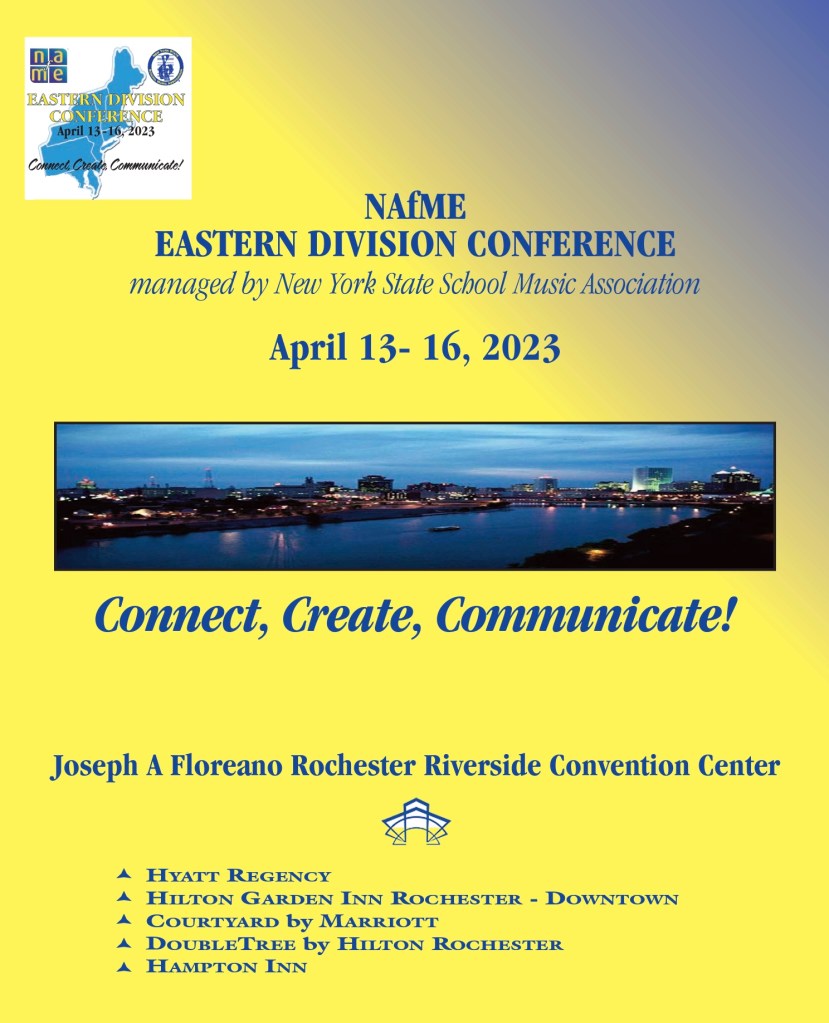
NAfME Eastern Division Conference, April 13-16, 2023, Rochester, NY
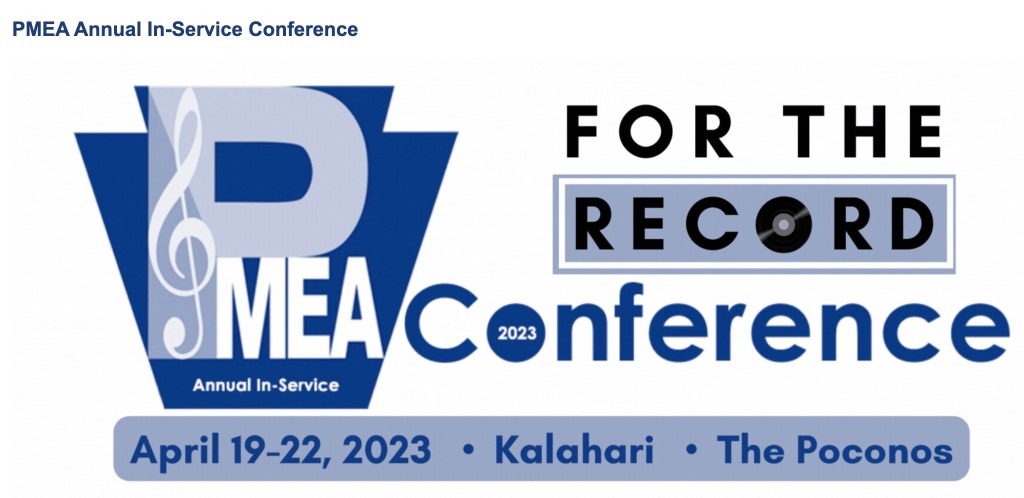
PMEA Annual Conference, April 19-22, 2023, in the Poconos
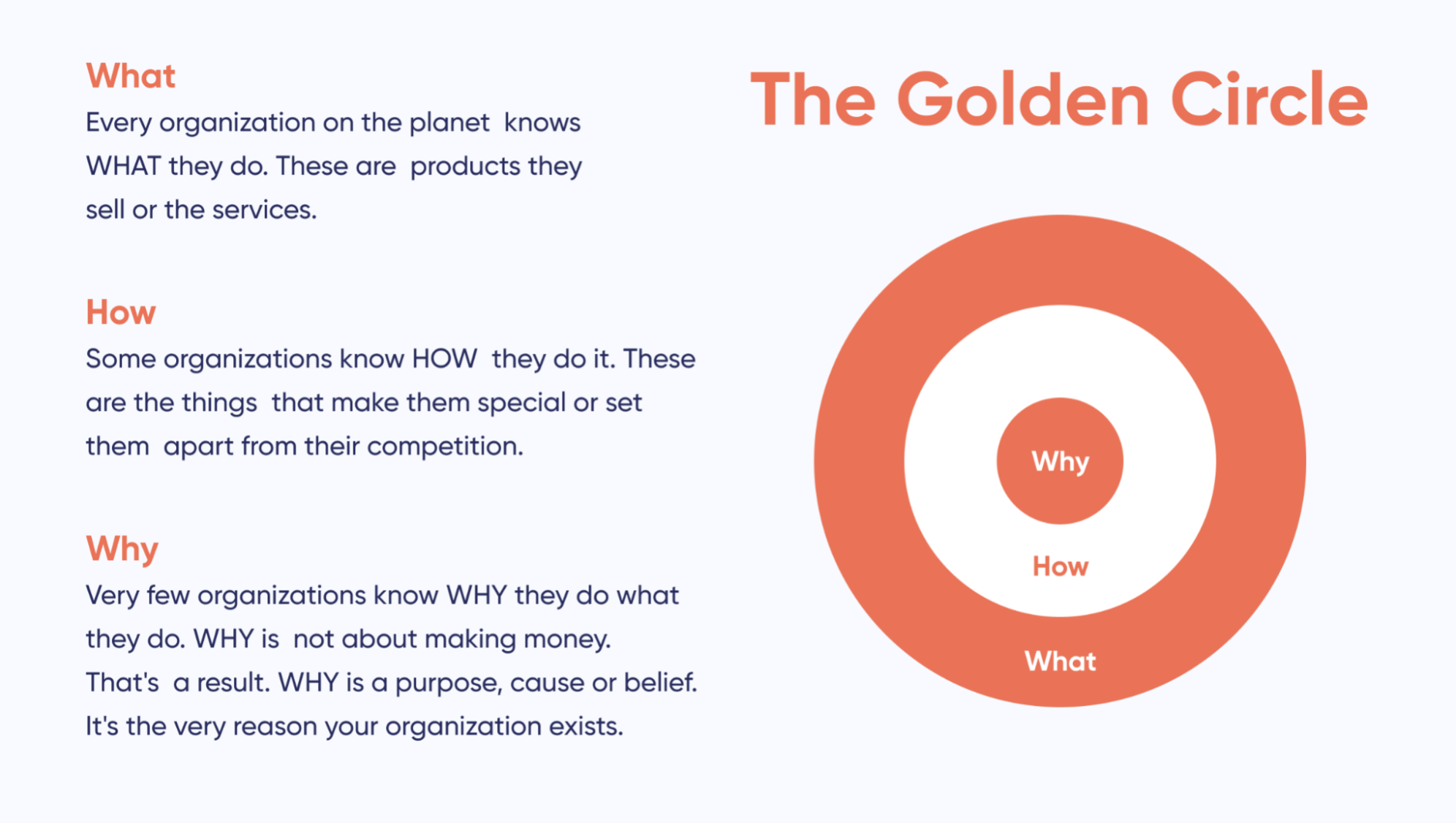
Now to quote the inspiration of Simon Sinek — his theory of value proposition to ‘start with why’ — how leaders can inspire cooperation, trust, and change based on research into how the most successful organizations think, act, and communicate if they start with why. Check out his rationale with The Golden Circle:
The “why” of attending your professional development conferences, “sharpening your saw” (self-renewal by Stephen Covey) aka “recharging your batteries,” learning what’s new and innovative on the forefront of “the state of the art,” and networking with colleagues, and has been addressed often in past blogs:

Simply put — to maintain your mastery of music and methods and build on your “best practices” and professionalism, you MUST attend as many educational conferences and workshops as possible!

Now to my “bags of tricks” for April 2023
Mark your calendars:

April 15, 2023 at 10:45 a.m. in Hyatt Susan B. Anthony (NAfME) – OR –
April 21, 2023 at 11:30 p.m. in Kalahari Suite 40/50 (PMEA)

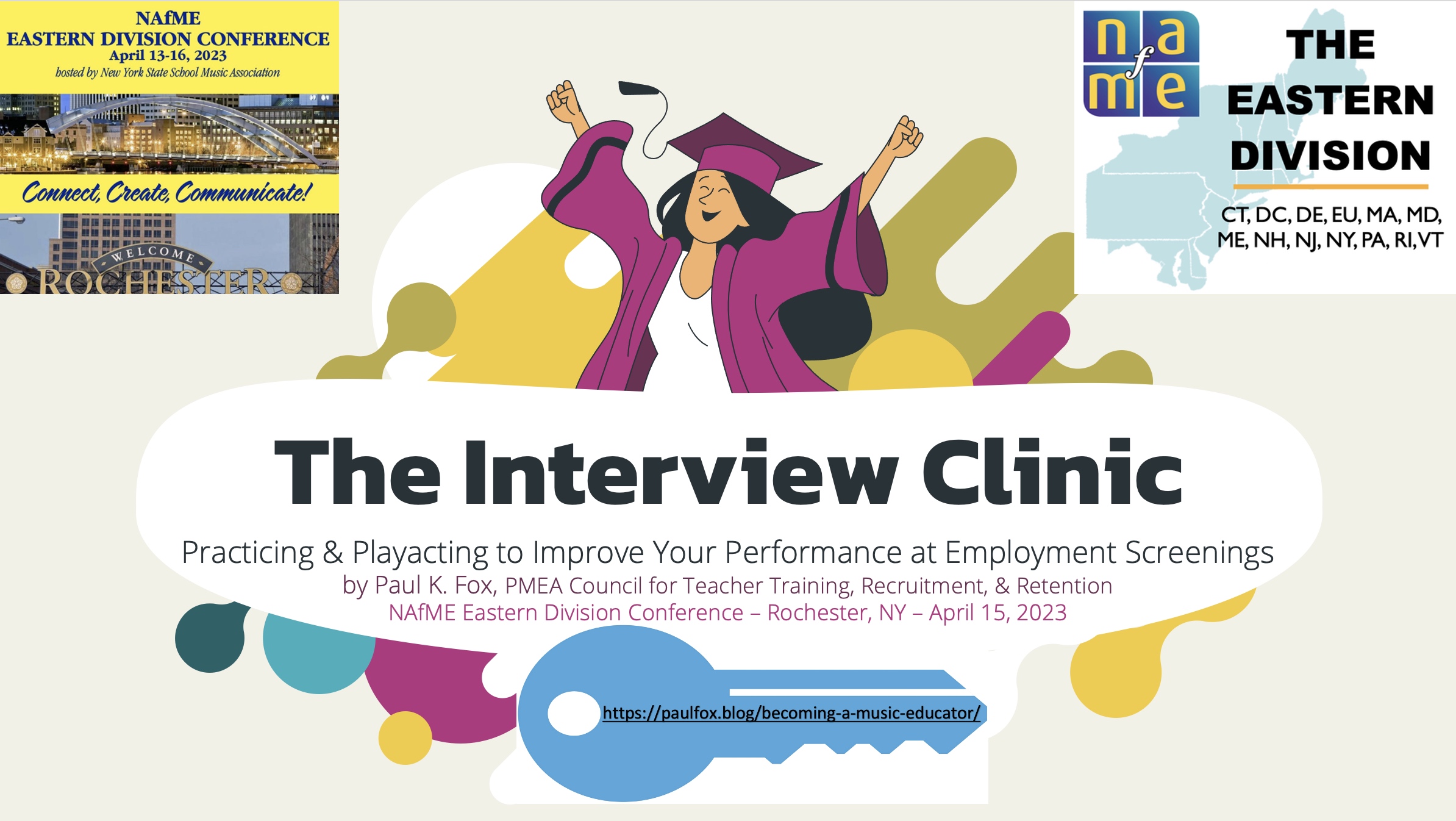
I was blessed to have been asked to present THE INTERVIEW CLINIC — Practicing & Playacting to Improve Your Performance at Employment Screenings at both the NAfME and PMEA conferences. This will be FUN! Perfect for college music education majors, soon-to-be or recent graduates, new transfers to the profession, teachers seeking to change positions while openings seem to be “heating up,” or first-timers looking for employment, the session targets will provide interactive exercises to build self-confidence and develop better insights, practices, and strategies to successfully land a job. “The key is in the preparation” of:

  • Standards—Defining/modeling professionalism, versatility, and ethics
  • Marketing—Branding, networking, and selling yourself
  • Skills—Interviewing, storytelling, and organizing
  • Assessment—Observing, reviewing, diagnosing, and improving

Interactive exercises, you say? Yes! Get ready to meet new people and perhaps dive into a few activities slightly outside your “comfort zone!” (We promise NOT to embarrass anyone!) We will break up into small groups or “duet partners,” and explore defining our professional “essence,” telling anecdotes about our strengths and past problems we have “crushed,” and focusing on learning “the golden gift of gab” — storytelling.

Portions of this workshop will come from material in the past posts Storytelling, etc. Part 2 and When it Comes to Getting-a-Job, S Is for Successful Storytelling. (Your homework? Peruse these before coming to either session at NAfME or PMEA!)

As always, articles, resources, and slide summaries will be posted under the “Training/Jobs” menu tab (above).

Mark your calendars:

April 20, 2023 at 3:00 p.m. in Kalahari Suite 30 (PMEA)

How many of you feel at times a little overwhelmed, exhausted, stressed out, disorganized, demoralized, or disenfranchised?

Are you at the end of your rope and wondering how you’re going to “keep it all together” over the next week, month, year?

Is your health is interfering with your ability to do your job and find success, balance, and meaning in your personal life and relationships? Then… it is time for a change.

We are still dealing with the effects of the pandemic which has brought on a “gap year” to most of our music programs, the stress of “working harder not smarter,” more teacher burnouts, and the resulting bail outs, staff shortages, and/or job cuts. We need to embrace NEW strategies for personal self-care and SEL (social and emotional learning). Do you still enjoy teaching? How have you coped with all of the changes? How will you achieve a better work/life balance and skills in time/priority management and personal health and wellness?

The prescriptions and RECIPES towards stress reduction and developing a self-care plan are here! Doug Sands, a consulting hypnotist and founder of AnywhereHypnosis.com, joins me to “throw in everything and the kitchen sink” to alleviate these problems, with NO cookie-cutter, “one-size-fits-all” solutions from the chefs:

  • What has COVID done to all of us?
  • Instant personal online stress assessment
  • Taking an inventory of the ingredients towards a healthier lifestyle
  • Definitions, symptoms, and remediations for teacher stress and burnout
  • Why teachers are so exhausted and what to do about it
  • Time management tips
  • Breathe like a Navy SEAL
  • Coping and learning “acceptance”
  • How to “coach overwhelm!”
  • The role of meals, movement, music, and mindfulness (thank you, Lesley Moffat!)
  • From MEJ: A suggested self-care plan and “cognitive distortions” to avoid
  • Focusing on ONE self-care strategy from a “sea of solutions”

We’re in this together… so we need to join forces and SHARE the secret recipes for a happier life! Add your own “baking tips,” and I promise, you’ll leave with a better understanding of how we all can celebrate the coming year or decades in music education!

By the way, my “mindfulness partner” for this workshop, Doug Sands, promises us he will not hypnotize any of us during this session (although he could!).

For more about his work, including “15 Rapid Tools (and Counting) to Wipe Out Anxiety, Stress, and Panic,” please go to his website here.

You are invited to stop in to see him at his PMEA booth in the Kalahari exhibit hall.

POST-CONFERENCE NOTE: Doug sent us his Anti-Panic Toolkit entitled, 15 Rapid Tools (and Counting) to Wipe out Anxiety, Stress, and Panic – Wherever They Strike! Click here.

If you would like a sneak preview of the revised handout for the Self-Care workshop, go to the Care menu section at the top menu bar.

Taking a peek at our recent past…

Workshop for Orchestra & String Teachers

In case you missed the PMEA District 5 Professional Development Day, my wife Donna and I presented “Plucking Our Minds” at Grove City College on February 20, 2023.

We were privileged to “share some of our secret sauces” gleaned from over 80 combined years of experience on a variety of topics:

  • CommUNITY Music-Making
  • Online Academy
  • Summer String Camp
  • Assessment Projects
  • Collaborative/Creativity Projects
  • Library of “Fox Firesides”

If would be a shame to waste these resources… and reading them could inspire new adaptations to your instrumental program.

Click here for a copy of the slide handouts. Feel free to comment (above) or send an email to me (paulkfox.usc@gmail.com) if you have any questions.

Our Crystal Ball

Future Accredited Workshops on Ethics in Education
Are you aware that the Pennsylvania Department of Education (PDE) has recently revised the PA educators’ Code of Professional Practice and Conduct AND adopted the Model Code of Ethics for Educators developed by the National Association of State Directors for Teacher Education and Certification? Have you seen the new Professional Ethics Program Framework Guidelines? PA Chapter 49 requires instruction in professional ethics to be integrated in educator preparation, induction, and continuing professional development programs as follows:

  • Continuing professional development programs must integrate the professional ethics competencies no later than the 2023-24 academic year.
  • Educator preparation and induction programs must integrate the professional ethics competencies no later than the 2024-25 academic year.
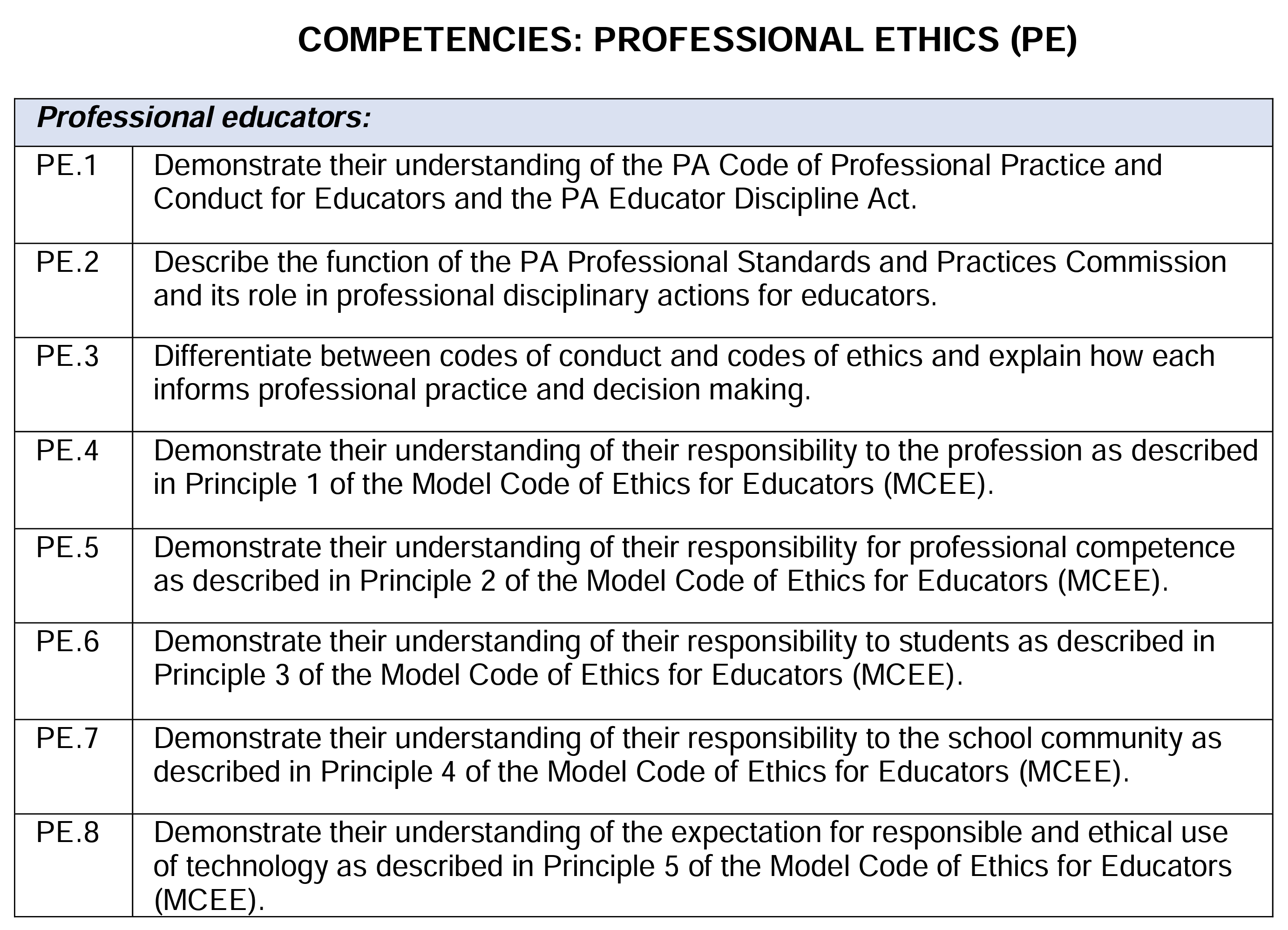
Not one to let grass grow (or mud sink) under his feet, retired social studies teacher, current attorney-at-law, and past PMEA conference presenter Thomas Bailey has partnered with me to design new ethics training classes for school system leaders (25-hour Act 45 PIL course) and educators (four-hour Act 48 continuing education course). In addition, we are introducing a new “hybrid” program for school administrators involving four-hour pre-recorded asynchronous webcasts (site license), along with a three-hour synchronous webinar using the webcast videos and adding facilitated interactive discussions of three ethical case studies either via Zoom OR in-person follow-up workshops led by both clinicians.

In Depth Ethics Training for PA Educators:

  • PA Model Code of Ethics for Educators
  • PA Code of Professional Practice and Conduct
  • Professional Standards and Practices Commission
  • PA Educator Discipline Act

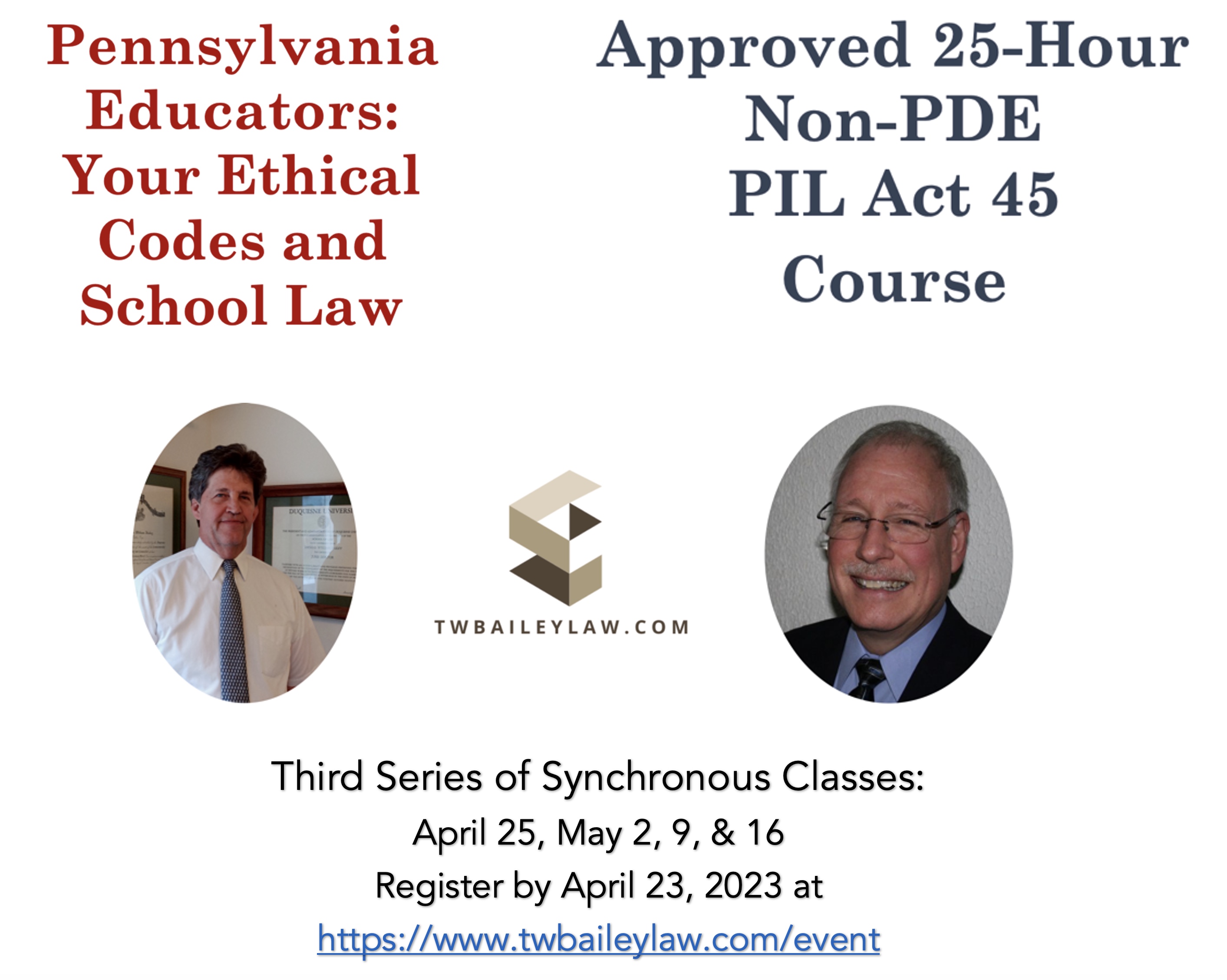
Click here for to register for Act 45 PIL Course.
Next series: April 25, May 2, 9, & 16, 2023

Click here for more information on the Ethics Webcast/Webinar and general information/landing page for the TWBaileyLaw website.

Click here for timeline of educator ethics presentations and clinicians’ bios.

Also review the Educators Court Case Blog and William Penn SD vs. PDE Blog.

Numerous articles have already been published on the subject of educator ethics, professionalism, and decision-making:

Hope to see you at one of these conferences or workshop sessions! Yes, it means a lot more to attend these IN PERSON!

PKF

© 2023 Paul K. Fox

Embracing the Intangibles

Teaching Empathy and Engagement

Admittedly, if we keep piling on more mandates for earning a teaching degree and professional certificate, our music education majors would have to continue several more years at the university. What has been added to the forefront of education? You name it: “backwards-designed curriculum,” ethics, the “four C’s” (creativity, critical thinking, collaboration, and communication), Common Core, social-emotional learning, special education, new technology, etc. We are already wrestling with the limits of time to cover a mastery of personal musicianship and artistry to find space to “squeeze in” at least a cursory study of the other more abstract but important “soft skills” of character development, cultural diversity and sensitivity training, nurture of emotional health and wellness, stress management, “charismatic” leadership, time management, and… humanity!

“Back in the dark ages” when I attended Carnegie-Mellon University, the pathway for becoming a teacher was to complete (and pay full-tuition!) five years to graduate with a Bachelor of Fine Arts degree and license to teach in the public schools. The fifth year was when we did our student teaching along with additional graduate credits applied towards a Master of Fine Arts in Music Education. This was conferred after a full year’s employment “in the field” (Year #6) and completion of additional summer courses of Philosophy in Music Education, Administration of Music Education, several more credits, and a master’s thesis addressing a self-targeted educational problem at our job. For my entire time at CMU, 80% of the coursework on my transcript was singularly focused on performance classes (lessons on piano and the “major” – mine was on viola – as well as chamber and large group ensemble rehearsals), conducting, instrumental and vocal methods, music history, sight-reading/ear training, harmony, orchestration, etc.

What’s Missing in Music Teacher Training?

It is amazing what we must learn “on our own” after we receive our diploma. Yes, I was competent to read a score, assess a solo, band, chamber group, choral, orchestra, or theatrical performance, compose/arrange and accompany a piece for a string class, coach a vocalist on warming up her voice, apply my knowledge of a composer’s life and music to interpret a masterwork, and start a new student on the cello or flute or tuba or drum! However, a quick reminiscence of “the ABCs for the 2009 opening day” agenda I presented to my music staff as their Performing Arts Curriculum Leader had little bearing on the pre-service training all of us received in higher education:

  • Assessment “of” (“Summative”) and “for” (“Formative”) Learning
  • Blackboard and Blended Schools
  • Bloom’s Taxonomy and Webb’s Depth of Knowledge
  • Curriculum Mapping and the Rubicon Atlas web program
  • Customization and Differentiation of Instruction
  • Essential Questions and Enduring Understandings
  • Multiple Intelligences Theory
  • The Pennsylvania Department of Education’s Standards-Aligned System
  • Teaching the “Whole Child”

So, if I became a “superintendent for a day” (or much longer), what would I now prioritize for induction and/or in-service training of educators?

We’ll start out with a taste of the inspiration led by my mentor and former superintendent of schools of Upper St. Clair School District where I taught for 33 years, the man who probably had the greatest influence for my getting hired and seeing something in me to channel my energy towards succeeding in several challenging assignments: Dr. William A. Pope. Way back in the 90’s, Bill was a proponent for studying “the stuff of human relationships,” including the introduction of elementary and middle level units on caring/compassion, courage, empathy, honesty, kindness, sensitivity, trust, among many others. Yes, you CAN teach values and acquiring a “moral compass” in the public schools!

I recently recalled many of these terms as they resonated within me during a motivating “The Presence of a Teacher” session presented by Penn State University Associate Professor of Theater Dr. Susan Russell. She opened the Pennsylvania Collegiate Music Educators Association Region III Virtual Workshop on November 1, 2020 with a “Zoom discussion” brainstorming the essential tools for building every teacher’s “presence” and “connectivity” with his/her students:

  • empathy
  • engagement
  • enthusiasm
  • listening
  • personal story-telling
  • self-care
  • sharing
  • vulnerability (acceptance to show)

A Different Kind of “Bucket List!’

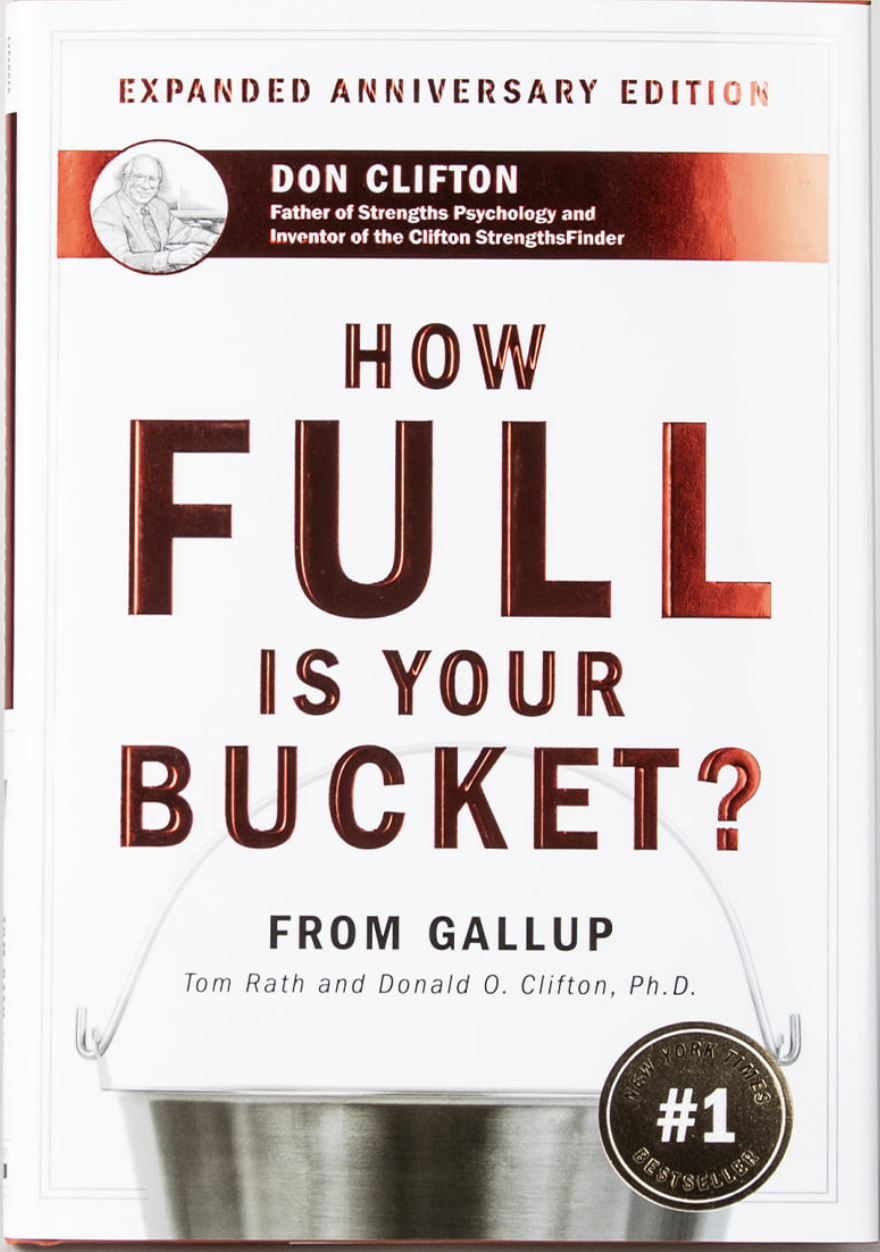
Next, let’s add to this mix the easy-to-read book How Full Is Your Bucket by Tom Rath and Donald Clifton, organized around the simple metaphor of a dipper and a bucket. Their work is grounded in 50 years of research and will show you how to greatly increase the positive moments in your work and your life – while reducing the negative – which, of course, can be applied to benefit your interactions with students (of paramount importance!), their parents, and school staff.

Admittedly, at times, this may be difficult. As I sit here putting on the finishing touches to a lesson plan for a virtual rehearsal of my online music academy – a “best I can do” replacement to in-person practices of our community youth orchestra’s 39th season, while absorbing the awful media broadcasts of recent spikes in the coronavirus across my region and the country, and trying to ignore the very angry rhetoric of a divided nation in the yet unresolved presidential election: How does one find “positivity” or project an image of hope? What’s that saying? “When the going gets tough, the tough get going!”

A “Thoughtful Drop” from a “Full Bucket” would emphasize the

  • Focus on the positive
  • Sharing of frequent small positive acts daily
  • Positive reinforcement to motivate learning
  • Promotion of positive emotions for your own good health

“How did you feel after your last interaction with another person?”

“Did that person – your spouse, best friend, coworker, or even a stranger – “fill your bucket” by making you feel more positive? Or did that person “dip from your bucket,” leaving you more negative than before?”

https://www.gallup.com/press/176132/full-bucket.aspx
https://crystalecho.com/gallup-profiling/

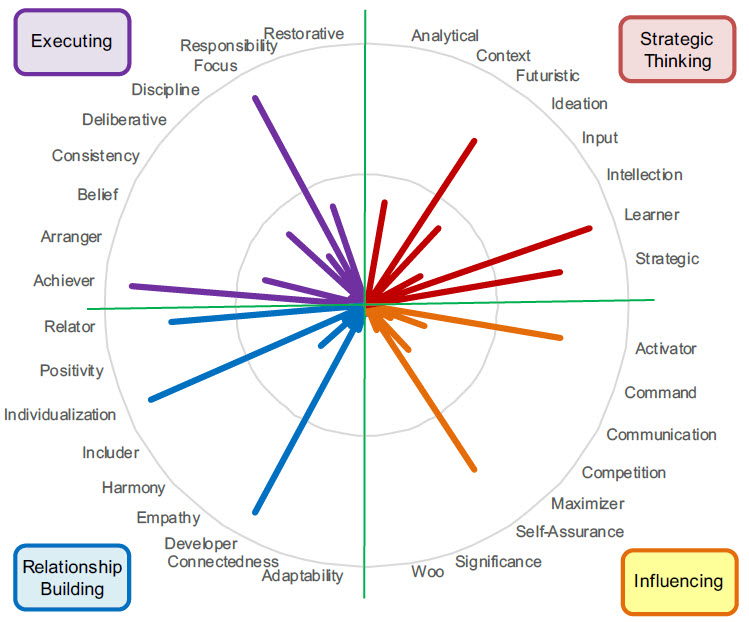
You can even take their Gallup Clifton Strengths poll to understand your “personality DNA” (above) and assess your potential: https://www.gallup.com/cliftonstrengths/en/home.aspx

Raising Caring, Successful Kids in a “Plugged-In, Trophy-Driven World”

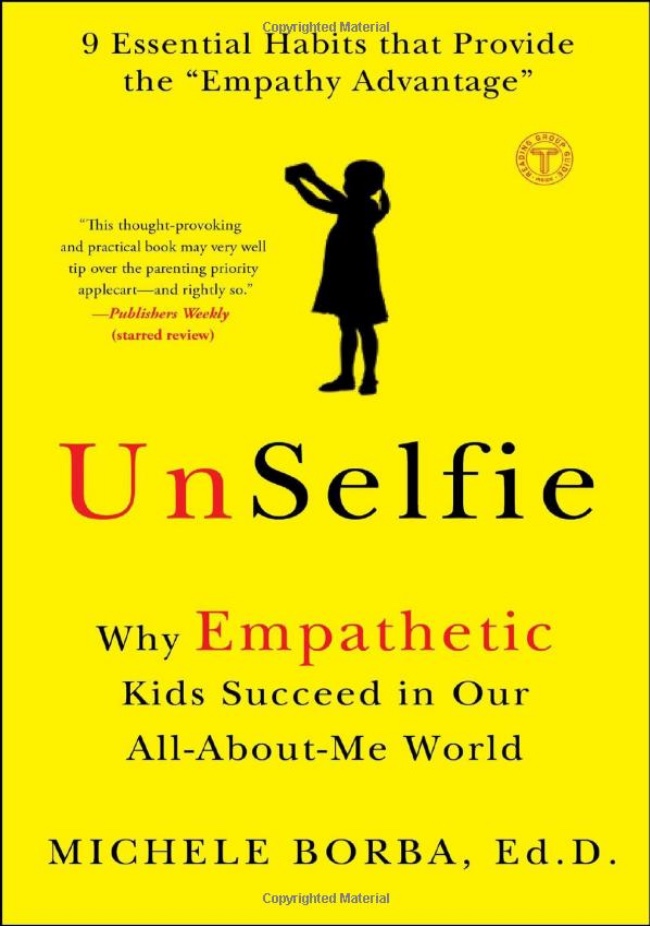
In any discussion on what children need most, are you surprised that the word “empathy” keeps coming up? We turn to, in my opinion, “the single most revolutionary book of our time,” UnSelfie – Why Empathetic Kids Succeed in Our All-About-Me World by Dr. Michele Borba, Ed.D., with her framework of nine essential habits of empathy:

  1. Emotional Literacy (recognition of the feelings and needs of self and others)
  2. Moral Identity (adoption of caring values that guide integrity and activate empathy)
  3. Perspective Taking (appreciation of another person’s feelings, thoughts, and views)
  4. Moral Imagination (use of literature, films, and emotionally charged images as a source of inspiration to feel with others)
  5. Self-Regulation (management of strong emotions and reduction of personal distress)
  6. Practicing Kindness (increased concern about the welfare and feelings of others)
  7. Collaboration (working together in the achievement of shared goals)
  8. Moral Courage (resolution to speak out, step in, and help others)
  9. Altruistic Leadership (motivation to make a difference for others)

Michele Borba emphasizes that the “selfie syndrome” is leading to excessive “self-promotion, personal branding, and self-interest at the exclusion of others’ feelings, needs, and concerns. It’s permeating our culture and slowly eroding our children’s character.” In short, she charges educators and parents alike to focus on enhancing the children’s “social-emotional competencies, resilience, academic success, leadership, healthy relationships, moral courage, happiness and mental health.”

I wrote this article for PMEA News about this phenomenon, examples of my impressions of the “dumbing down” or numbing of emotional quotient, less focus on “team” orientation, omission of studying “character” in our schools, and the seemingly increased emphasis on “the me – not the we!”

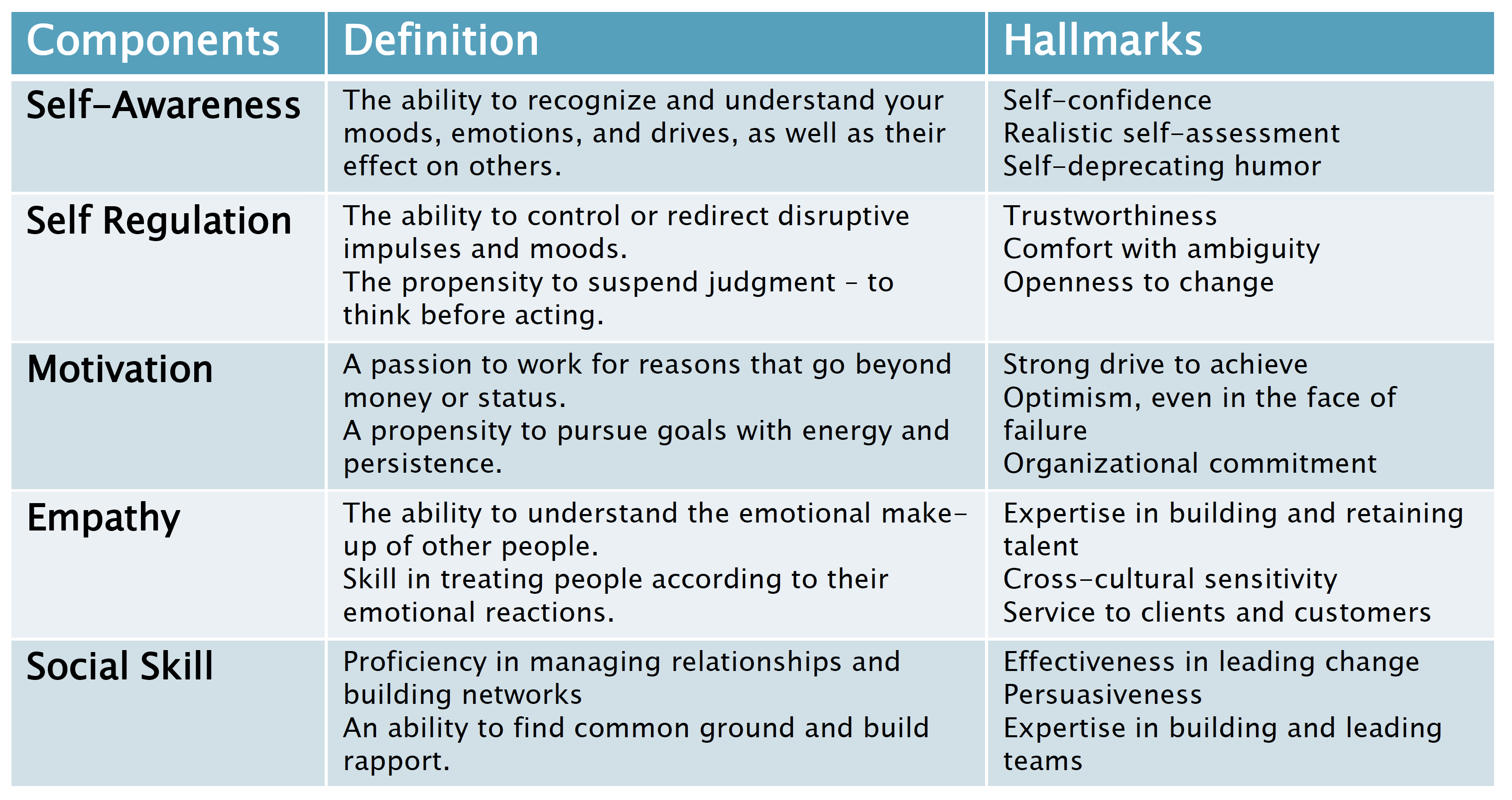
“Social-emotional learning” (SEL) was not a part of a college music education course catalog, even a few years ago. And yet, today more than ever, it is probably the single most valued “teaching skill” necessary for the care and engagement of students during the pandemic. Educators are “leaders” and often have a lasting influence (maybe only second to their parents) on the social-emotional health of their “charges!” Let’s review the principles of emotional intelligence (EI):

“Most effective leaders have a high degree of emotional intelligence: self-awareness, self-regulation, motivation, empathy, and social skills.”

United Nations Staff College https://www.unssc.org/ and What Makes a Leader? by Daniel Goleman https://hbr.org/2004/01/what-makes-a-leader

Why is SEL so important?

SEL provides a foundation for safe and positive learning, and enhances our students’ ability to succeed in school, careers, and life.

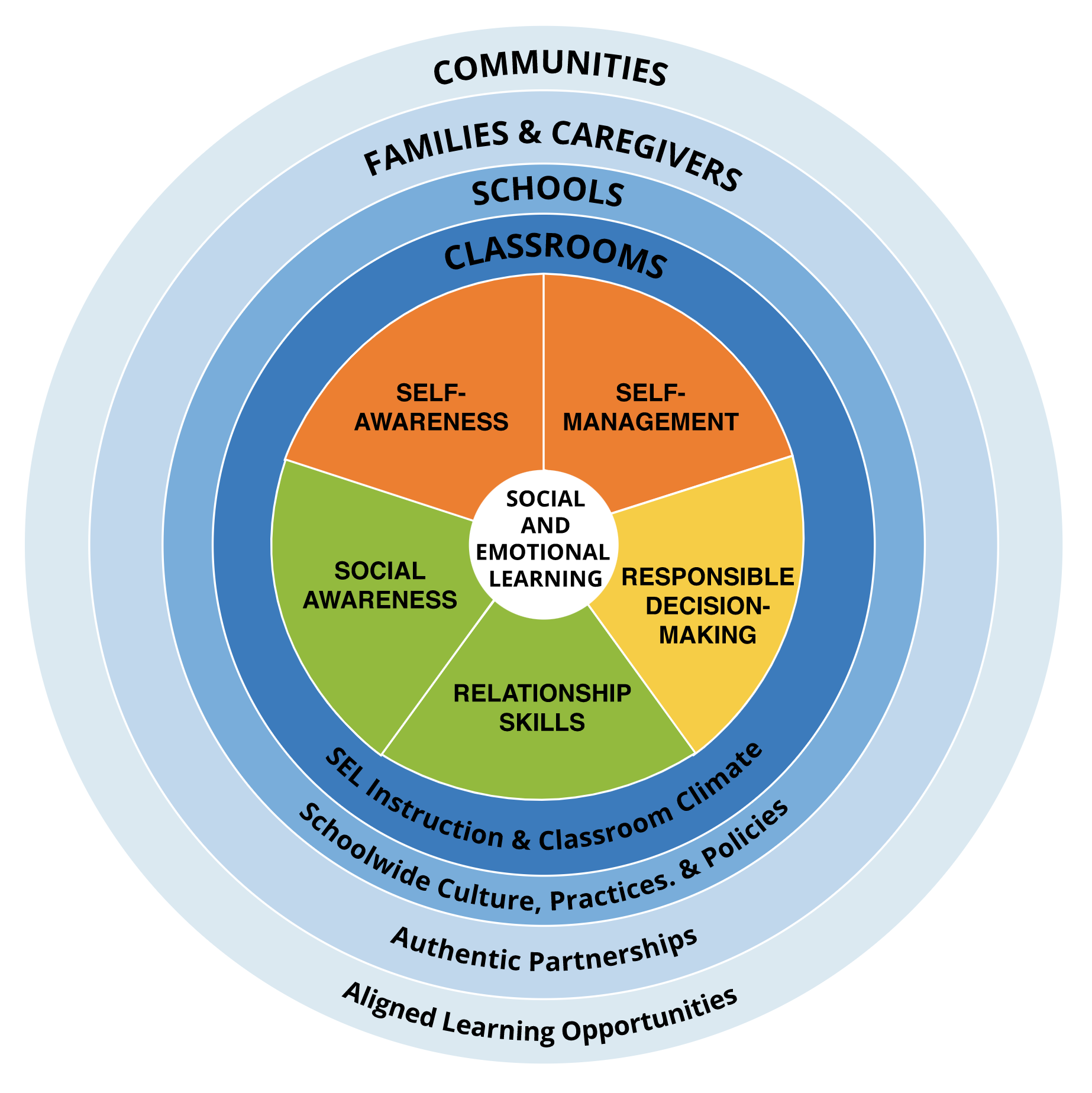
https://casel.org/sel-framework/

Social and emotional learning (SEL) is the process through which children and adults acquire and effectively apply the knowledge, attitudes, and skills necessary to understand and manage emotions, set and achieve positive goals, feel and show empathy for others, establish and maintain positive relationships, and make responsible decisions.

https://casel.org/overview-sel/

SEL can provide students with the SKILLS to confront their challenges by being self-aware, socially-aware, and to make responsible decisions. According to Associate Professor of Music, Music Education Chair, and Director of Bands at Lake Forest College Dr. Scott Edgar, this may take the form of reflection, discussion, and lecture, but to be most effective, it needs to be embedded in curriculum.

“For me, the music teacher can do this in a much more authentic way—through music… SEL should not feel like one more thing; it is THE thing. We teach music; we teach self-discipline; we teach collaboration. SEL is in our classrooms already; our job is to make it explicit, consistent, and structured.”

Dr. Scott Edgar https://nafme.org/music-education-social-emotional-learning/

According to Edgar, music teachers can help teach SEL by:

  • encouraging students to set their own musical goals
  • devising solutions for individual or group errors (instead of us always giving the answers)
  • navigating performance anxiety
  • understanding the power of music for social change

One more purchase recommendation:
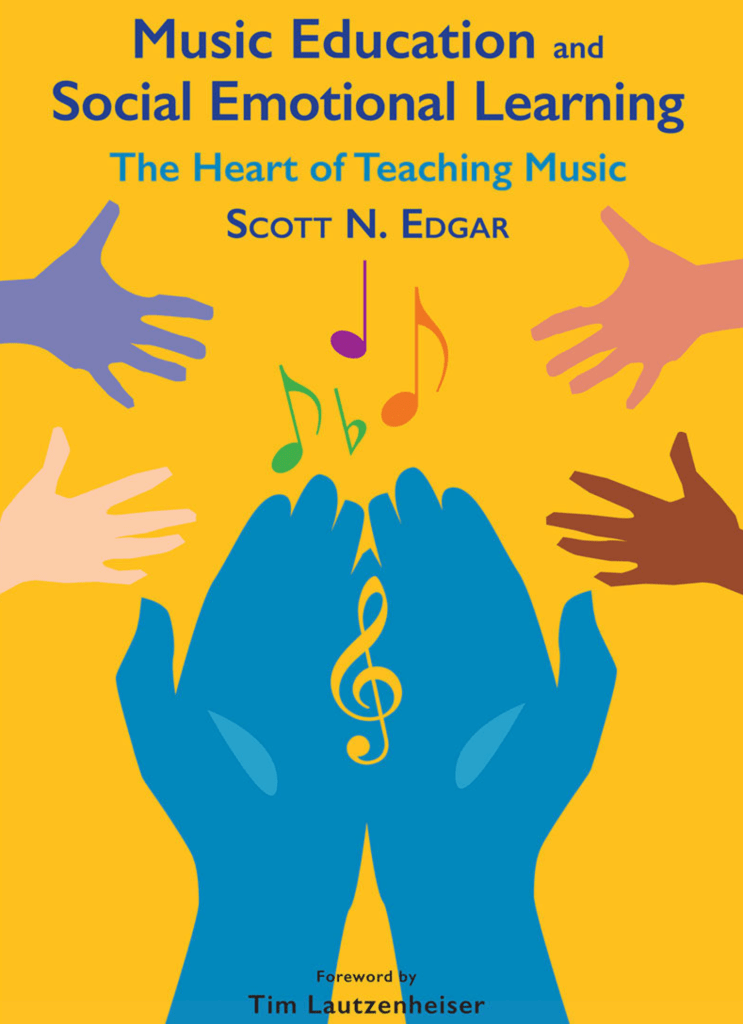
Music Education and Social and Emotional Learning – The Heart of Teaching Music
by Scott N. Edgar

“Music education helps our students learn how to be dedicated, to persevere, and to work together. It is our job to help students see that these skills are not isolated to the music classroom. These are the skills they need to be successful outside of music and to confront their challenges with strength and skill. Music can be the preventative mental health our students need so they have the skills to confront the life challenges ahead of them.”

Dr. Scott Edgar https://nafme.org/music-education-social-emotional-learning/

For a full understanding of SEL, it might be best to review the well-known “CASEL Wheel” (shown above) online at https://casel.org/sel-framework/. I also suggest you download this PDF file.

We have many additional resources to peruse for developing SEL:

When COVID-19 crashed into our lives wrecking havoc to almost all forms of live/in-person instruction, quarantining elements of the population, enforcing isolation and social-distancing requirements, closing schools and even cancelling most close-collaborative artistic ventures (music lessons, rehearsals, concerts, musicals, etc.), educators everywhere looked for a way to reconnect with their kids… and settled for the less-than-satisfactory, latency-prone, desensitizing virtual-conference environment! Overnight, schools and teachers resorted to “very” remote models of online learning only to view rows and rows of “trapped,” emotionally-detached, mummy or wax-museum-like faces of their students in windows of Zoom, Google Meet, or GoToMeeting platforms.

It’s time to retool and revamp. The most important thing we can do right now is to reach-out to, re-engage, and re-energize our music students, find out how they are doing, foster moments of meaningful dialogue, and share (there’s that word again) empathy… and that we care. We need to immerse ourselves into and apply the principles of human relationships, teacher presence, “bucket drops,” and recommended habits of empathy, EI and SEL explored above by a few wise educational leaders (a.k.a. “our models”).

PKF

Photo credits from Pixabay.com:

© 2020 Paul K. Fox