Admins Helping Teachers

This is an introductory blog-post perusing my early research and resources on supporting educator health/wellness in advance to my presentation Self-Care Cookbook 2.0 – Recipes and Resources for School Leaders for the PA Department of Education’s SAS Institute 2025 state conference scheduled for December 8-10, 2025 in Hershey, PA. Here is the summary description for the workshop:
“Do you find the harried pace of our profession overwhelming and at times crushing when buried beneath decades of keeping our noses to the grindstone and putting everyone else’s needs above our own? Do some of your staff members say they are stressed out, constantly tired, plagued by one ailment after another, or wondering how they’re going to “keep up?” If health is interfering with your colleagues’ abilities to do their jobs and find success, balance, and meaning in their lives, then it is time for change. The purpose of this session is to empower school leaders and teachers with skills and attitudes needed to make informed decisions to promote self-improvements in their lifelong health and wellbeing, to LEARN tools for better time management and to help remediate fatigue, stress and burnout, CONNECT and collaborate with your staff to inspire unique strategies for better personal self-care, and ACTIVATE creative new approaches to foster an improved workplace environment.”

Actually, previous articles at this site have dived into this subject of educator stress, burnout, and the development of a health and wellness self-care plan to build resilience, work/life balance, and reignite our motivation and passion for teaching. For a complete overview, I recommend you revisit these:

Always start with “THE WHY”

(Inspired by keynote speaker/author Simon Sinek): Why is this discussion so important now?
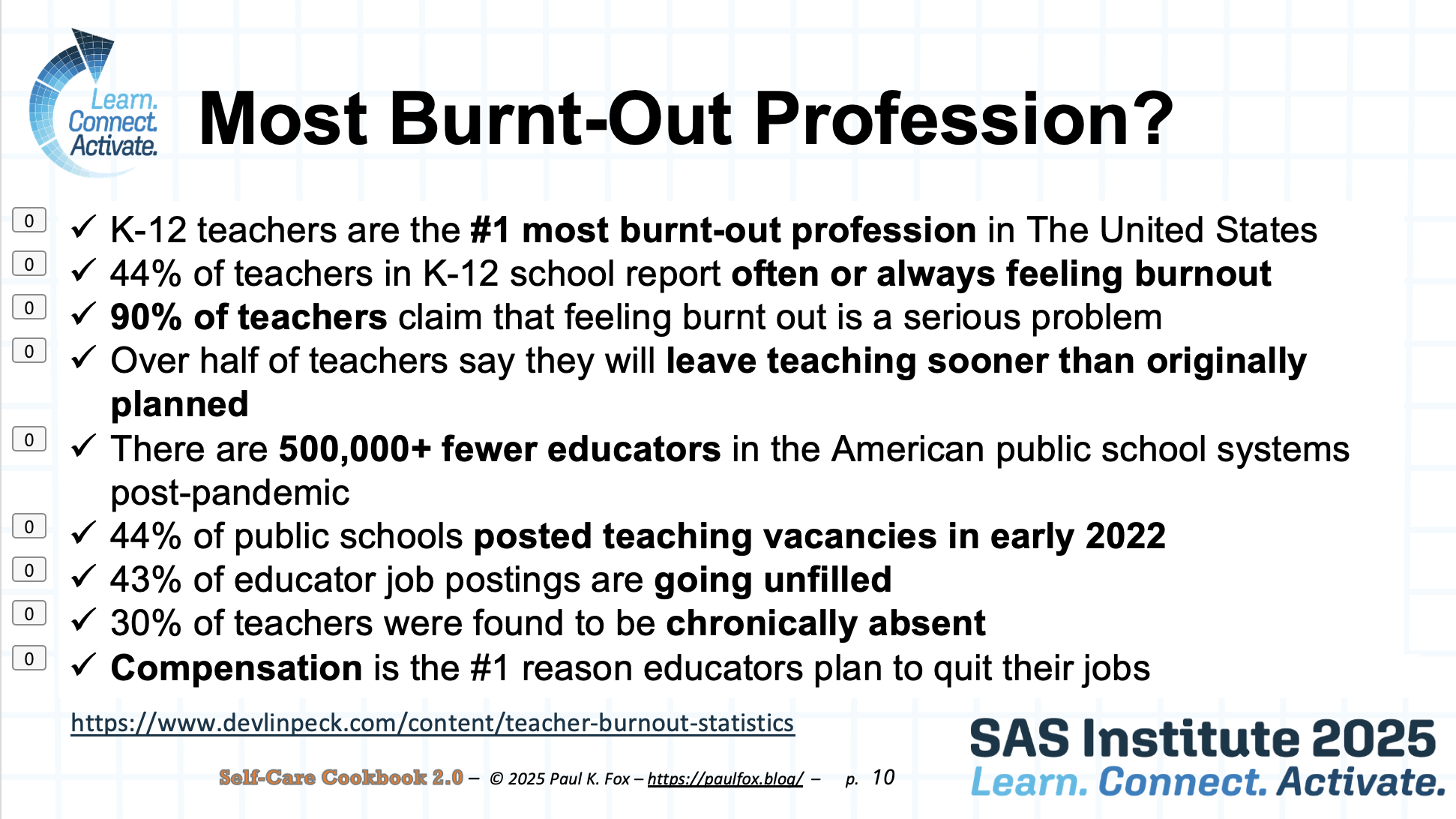
When I mentioned my research to my colleague (and former student) Dr. Timothy Wagner, Principal, Upper St. Clair High School (my former placement for full-time employment), he mentioned that this topic was timely and highly relevant, and suggested that perhaps there might be more statistics and resources “out there” on the stress of health-care workers and first-responders, which I found to be true. However, early looks have shown numerous parallels to the information in my 2023 Self-Care session.

My PDE SAS Institute session will become a “two-for-one” presentation, including the opportunity for school/system leaders, building administrators, and directors of school district professional development to also download my original “Self-Care Cookbook” (1.0) slides, recently updated for the DCMEA Annual State Conference (January 20, 2026). This self-help workshop is geared for educators to “on-their-own” explore strategies, implement use of individualized tools/remedies, and formulate new goals to improve health and wellness. Both sessions hope to cover these key questions:

  • Why is it essential to personal health to achieve balance in our lives, and how can we achieve it?
  • How does dedication to wellness lower the risk of illness, injury, and the quality of a person’s life?
  • What are the consequences of our choices in terms of time and stress management?
  • How do effective decision-making skills and goal setting influence healthier lifestyle choices?
  • What are suggestions, strategies, and samples for the development of a personal self-care plan?
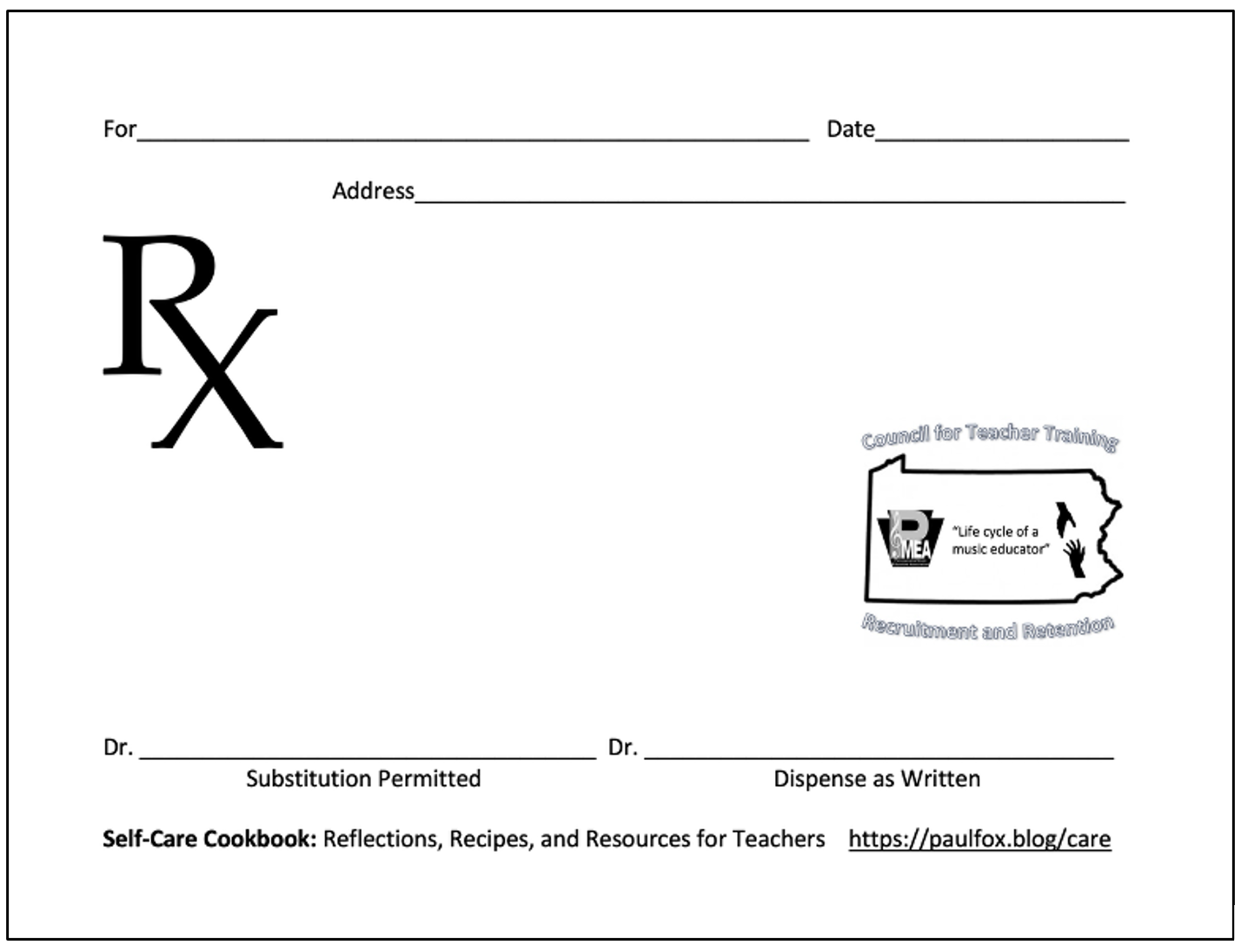
Using a facsimile of a prescription pad in Self-Care 1.0, I posed these personal reflections:

  1. How do I usually feel daily throughout the school year?
  2. What are the emotional and physical tolls of my job?
  3. What specific self-care activities do I need to incorporate to recharge and prevent burnout? 
  4. What boundaries do I need to set around my work to honor personal time?
  5. What support systems can I build and/or professional help should I seek to create a sustainable practice?
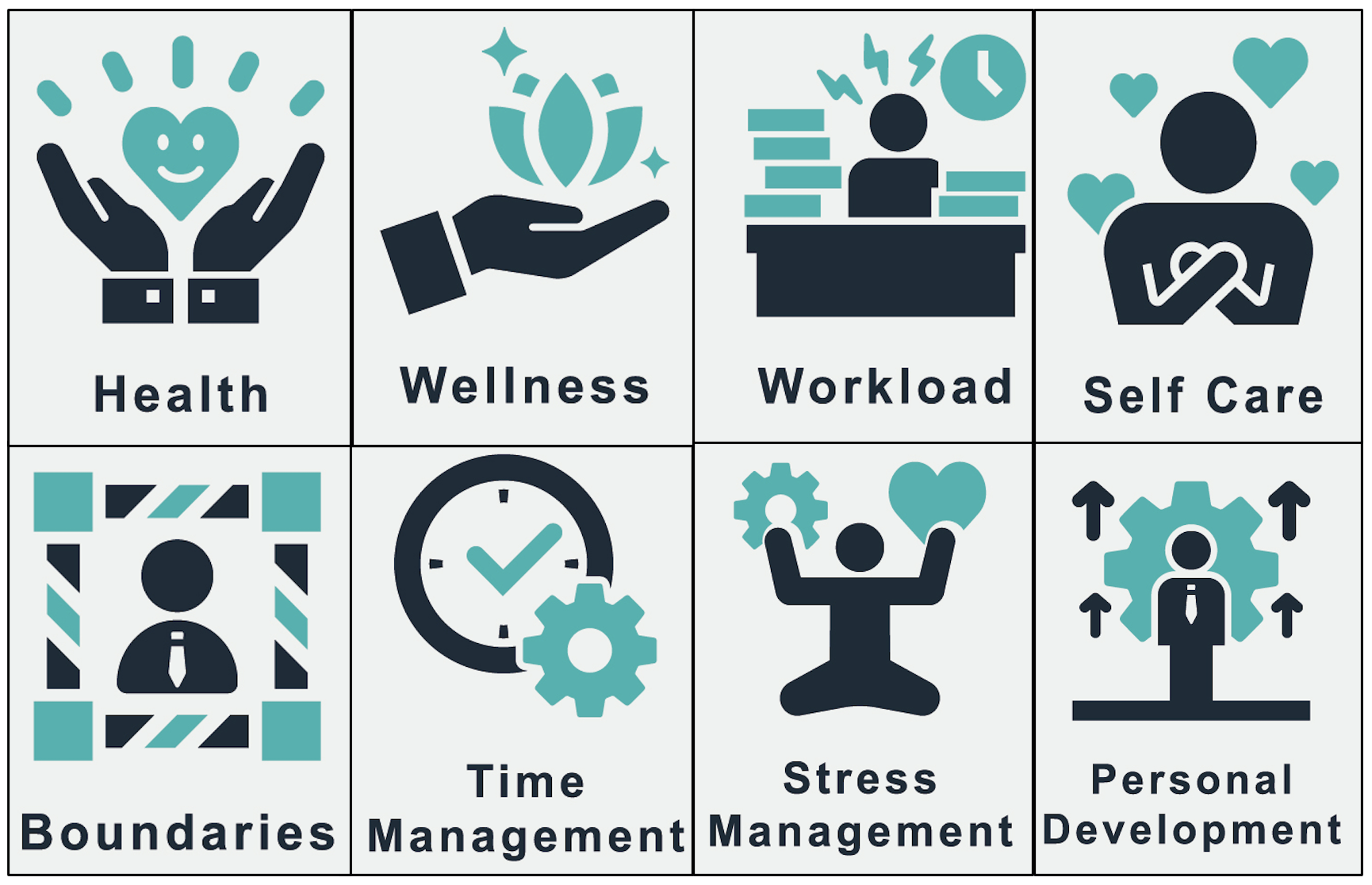
Good ideas…

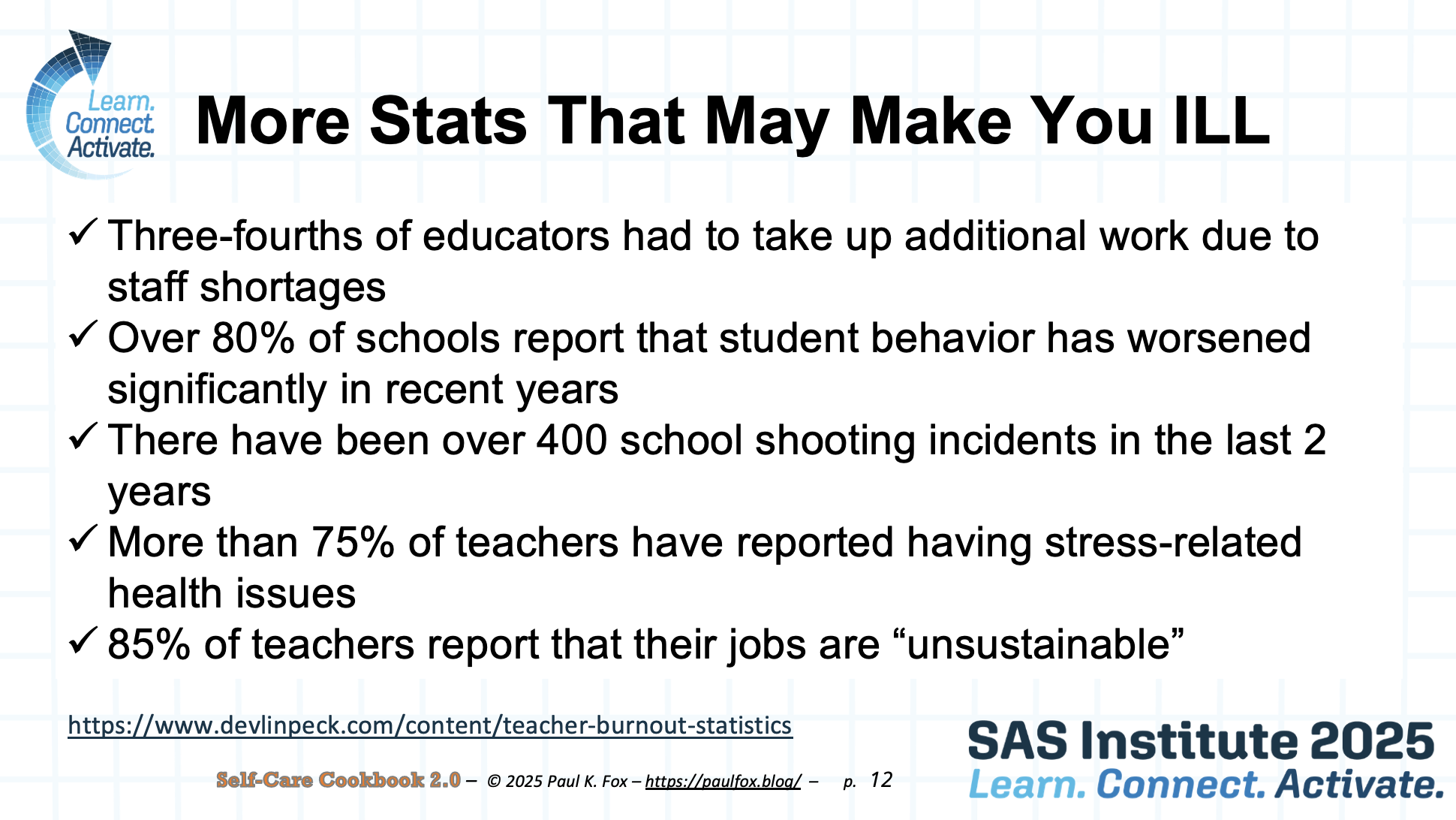
How can school admins support their staff in dealing with the climbing incidences of health problems, teacher exhaustion, call-offs, evidence of burnout, and high turnover rate? Sorting through a compendium of online research, these recommendations for school leaders occur repeatedly:

  1. Probably should go without saying: Show high visibility (“be seen by all”), recognition, and know everybody’s name. This goes a long way in building a sense of belonging of the staff and students.
  2. Provide more time for breaks and planning. Engage teachers in problem solving teams to identify and implement substantive ways to give them more time. Examples: cutting back on testing and data analysis; holding fewer and shorter meetings; putting a hold on new academic initiatives while increasing mental health initiatives conducted by school-based mental health professionals; hiring individuals who can assist with administrative tasks; compensating teachers for extra work; protecting classroom time by minimizing interruptions; reducing teaching hours to allow for more prep time and follow-up time.
  3. Foster a supportive community through mentorship programs.
  4. Distill high-impact strategies into a handful of manageable priorities. Once the goals are set, give teachers specific time within the school day or week to focus solely on them.
  5. Communicate directly, clearly, and frequently. “Supportive administrators know that a teacher’s time is valuable and that administrative meetings compete with individualized education programs, data teams, professional learning committees, cross-curricular planning meetings, and much more. So if a meeting is only for sharing straightforward information, it can be an email instead. It’s not necessary to have a meeting simply because the schedule says that faculty meetings are in the cafeteria on Mondays.” – Edutopia: “4 Practical Ways Administrators Support Teachers”
  6. Treat teachers with respect like the professionals they are, increasing mutual trust by decreasing micromanagement or reducing unnecessary accountability documentation.
  7. Shadow multiple teachers to experience first-hand the reality of their typical day.
  8. Allow educators the option to attend meetings and professional development activities virtually.
  9. Involve teachers in the creation of targeted professional development activities that are the most meaningful for them.
  10. Ask teachers about what specific help they need to improve classroom management.
  11. Develop a plan (with the Board of Education?) to increase teacher compensation over time, taking into account that many administrative and clerical tasks that are now required of teachers might ultimately be delegated to less highly compensated individuals.
  12. Address staff performance issues on an individual basis rather than issuing global reprimands that don’t apply to most teachers.
  13. Implement policies that encourage work-life balance. For example, recognize measurable indications of quality teaching rather than behaviors that signal a “more is better” approach (always coming in early and staying late, volunteering for everything, talking about working all weekend to catch up, etc.).
  14. Support educators by acknowledging stress, providing professional development on self-care, and creating a culture where asking for help is normalized.
  15. Ask teachers what mental health or other supports they need to cope with their own distress. Research has demonstrated the effectiveness of introducing trauma-informed strategies, including an emphasis on compassion fatigue and secondary trauma, as well as mindfulness strategies that are part of institutionalized wellness routines.
  16. Provide “safe spaces” (SEL) where educators can express themselves without fear of being judged, and practice “Mindful Leadership” to connect with and listen to them. “Getting to know your teachers on a more personal level makes it easier to identify the best thing you can do to support them, even if teachers aren’t sure what they need. The goal should be making sure everyone made it to work okay and that they’re in good spirits and ready to tackle the day.” – 7 MINDSETS: “5 Ways Administrators Can Support SEL for Teachers”
  17. Counteract “toxic positivity” by acknowledging that teachers are hurting and need space to grieve the continued losses associated with the pandemic.

Bad ideas…

These strategies cited by Effective School Solutions will NOT help teachers in the long-term:

  1. While “wear your jeans to work” days and offering coffee and donuts occasionally are nice employee appreciation efforts, they do nothing to address the underlying issues.
  2. Offering one-shot seminars or newsletters with suggestions about individual self-care activities (breathing exercises, physical exercise, time for self, etc.) can inadvertently place further burdens on teachers, conveying the impression that they are responsible for both creating and addressing the stress that is structural in nature.
  3. Don’t conduct teacher surveys or focus groups about how to reduce teacher stress and then proceed to ignore their suggestions about what would make things better.
  4. Don’t assume that short bursts of extra time (e.g., ending a meeting early to give teachers more time) is useful. Small, unexpected pieces of free time do not help teachers catch up with work that requires concentration and focus.
  5. Don’t avoid difficult conversations to address the performance problems of individual teachers by making blanket statements/warnings to all teachers, most of whom are not engaging in the problem behavior.

“Be careful not to adopt a stance of “Toxic Positivity,” that is, a stance that accentuates the positive (“we are all in this together,” “we are strong,” “it could be worse,” “look on the bright side”) while invalidating the very real pain that everyone is experiencing. Denying or ignoring unpleasant emotions tends to make them worse, not better.
Effective School Solutions

Free Downloads

I am putting on the final touches to the SAS INSTITUTE 2025 Self-Care Cookbook 2.0 session, but have already assembled a huge bibliography of resources for your review (see below). For a “sneak preview” of my slide summary, click here. Future updates will be posted here: https://paulfox.blog/care/.

Better yet, register for the SAS Institute 2025 to see everything in person.

Sample Books

  • 180 Days of Self-Care for Busy Educators by Tina H. Boogren, Solution Tree Press (2020)
  • Awakened – Change Your Mindset to Transform Your Teaching by Angela Watson, Due Season Press & Educational Services (2023)
  • The Balanced Band Director – Productivity and Wellness Tips to Amplify Your Impact, Not Your Workload by Lesley Moffat, Morgan James Publishing (2025)
  • Demoralized – Why Teachers Leave the Profession They Love and How They Can Stay by Doris Santoro, Harvard Education Press (2018)
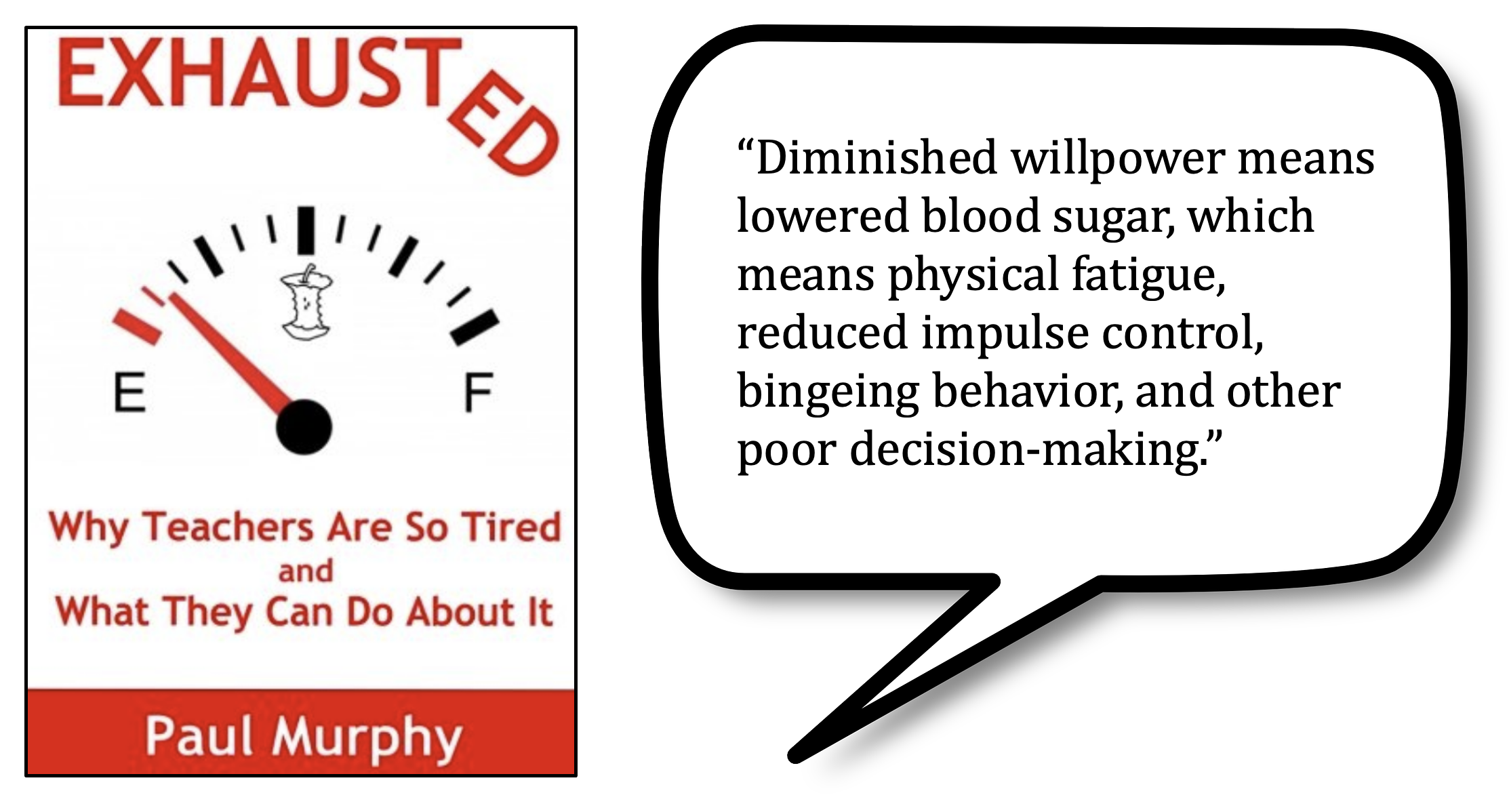
  • Exhausted – Why Teachers Are So Tired and What They Can Do About It by Paul Murphy, CreateSpace Independent Publishing Platform (2017)
  • Fewer Things, Better by Angela Watson (2019)
  • The Happy Teacher Habits by Michael Linsin, JME Publishing (2016)
  • Love the Job, Lose the Stress: Successful Social and Emotional Learning in the Modern Music Classroom by Lesley Moffat (2022)
  • Positive Mindset Habits for Teachers by Grace Stevens, Red Lotus 2018
  • Rekindle Your Professional Fire – Powerful Habits for Becoming a More Well-Balanced Teacher by Mike Anderson, ASCD (2024)
  • The Teacher’s Guide to Self-Care – Build Resilience, Avoid Burnout, and Bring a Happier and Healthier You to the Classroom by Sarah Forst, The Designer Teacher (2020)
  • The Teacher’s Guide to Self-Care – The Ultimate Cheat Sheet for Thriving Through the School Year by Melanie J. Pellowski, Skyhorse Publishing (2020)
  • Upbeat – Mindset, Mindfulness, and Leadership in Music Education and Beyond by Matthew Arau (GIA Publications (2022)
  • The Weekend Effect: The Life-Changing Benefits of Taking Time Off and Challenging the Cult of Overwork by Katrina Onstad, HarperOne (2024)

Sample Websites

PKF

© 2025 Paul K. Fox

Bookends – Part 3

As summer draws to a close and schools begin to reopen, we look forward to the coming autumn season (and hopefully some relief from the scorching weather). After all, tomorrow will be the first day of classes at my former place of employment (and the dress rehearsal for Friday’s marching band senior show). Soon we’ll enjoy one of my favorite transitions of the year! In Western Pennsylvania, deciduous trees will gradually change color (some bright red, orange and yellow) and then shed their leaves… the perfect metaphor for the final sections of my “Bookends” series.

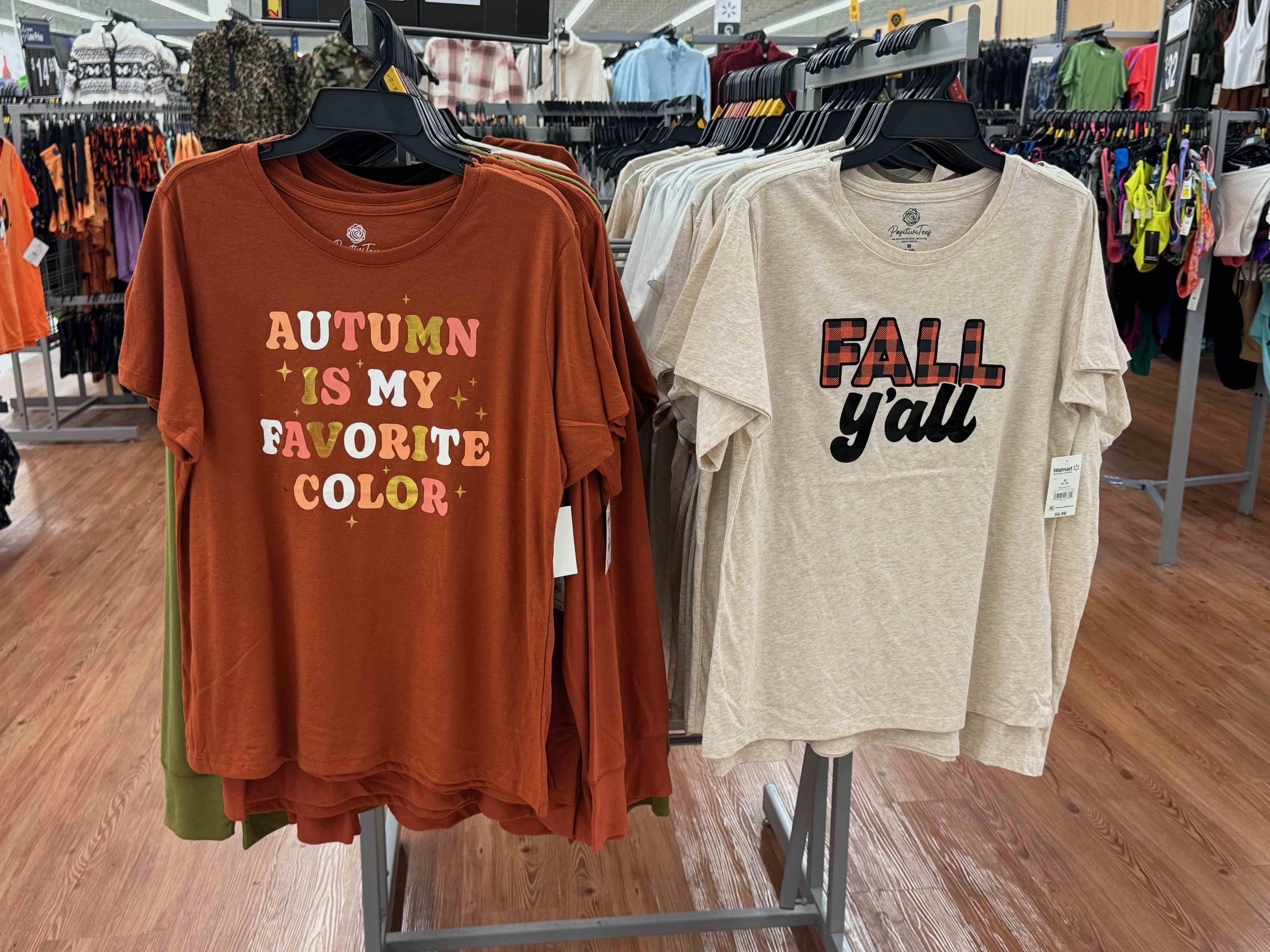
(Yes, fall is a month away… but, as you can see, the stores are way ahead in anticipation of the changing seasons!)

Autumn is a season of harvest, a time to reap the rewards of our hard work and reflect on the blessings in our lives. The Fall Equinox is a reminder for us to assess our accomplishments instead of our shortcomings.

www.inspiringactions.com

We return to a discussion first introduced last October in Bookends – Part One – The Life Cycle of a Successful and Happy Music Educator, exploring:

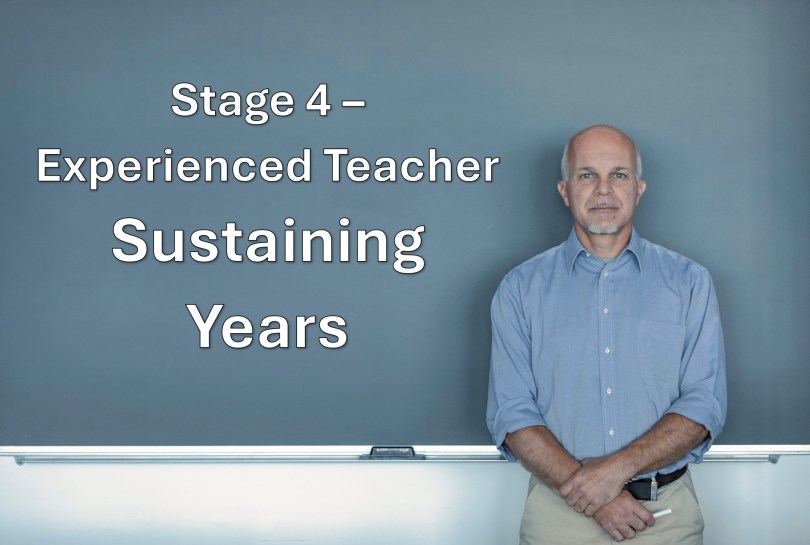
  • Stage 4: Veteran/Sustaining Years (this blog)
  • Stage 5: Next Chapter/Living the Dream (future blog)

When do we become “experts” in our field? When are we “master teachers?” Do we ever reach the apex of our achievements, the crowning glory of our career, or the pinnacle of our profession?

Never! You snooze, you lose. If you stop expanding on your knowledge and skills, forgo exploring new ideas, methods, and media, or become stagnant and settling into a rut at work, you might as well RETIRE (“Stage 5”). Instead, I direct you to revisit “Stage 3” in Bookends II here. As dedicated educators, the focus must be on constant retooling… reviewing/revising “best practices,” setting new goals, and building on the existing networks and engagement in the profession. These have always been the essential elements of a true professional.

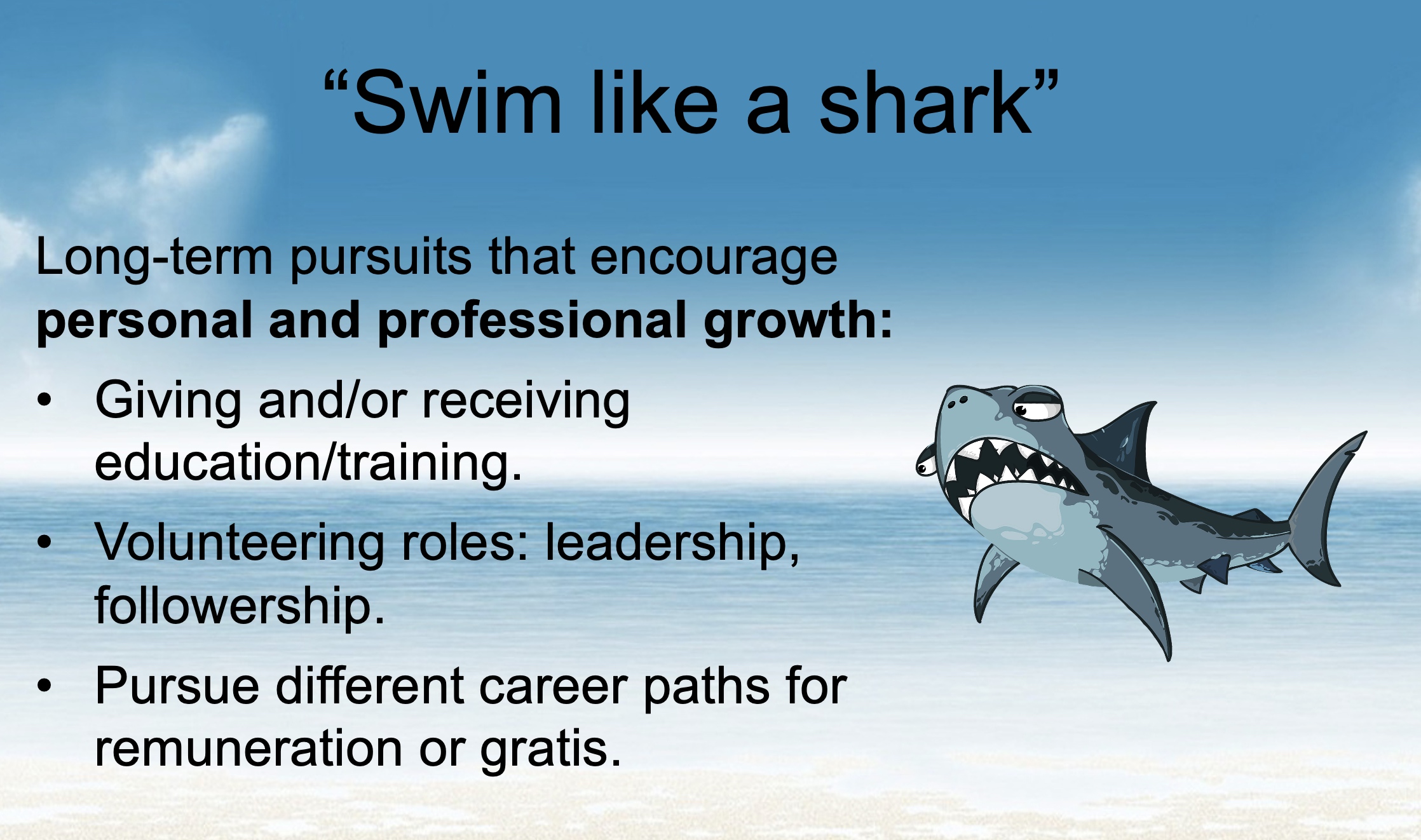
Now I should mention that during our middle-years, we sometimes return to education, get advanced degrees, new certifications or teaching specialties, apply for new job assignments, etc. When my PMEA colleague and fellow music teacher retiree John D’Ascenzo left full-time teaching, he went on to pursue a doctorate degree. Also appropriate for our next Bookends section, I have often quoted his analogy for all career stages to “swim like a shark” (since a shark never stops moving, even when it is sleeping). Sage advice for us all!

During my whirlwind of more than five decades in the field of music education, I went through several “first-year-of-teaching” passages, such as accepting my first job in general music at Edgewood School District (1978-1980), then being hired to direct strings (grades 6-12) at Upper St. Clair School District in 1979 followed by a 16-year appointment to the USCHS choral program of over 200 singers in 1980 on… transitions requiring massive job retraining and revitalized professional development. I may have not appreciated the stress of these “hurry up and relearn” periods at the time, but these periodic challenges made me GROW. In the end, I “lived” and embraced Robert Frost’s poem, “The Road Not Taken.” It may have not been the initial pathway I imagined for myself when I started in music education, but “I took the one less traveled by, And that has made all the difference.”

To this day, this violist and orchestra director has NO REGRETS teaching so many years outside of his so-called “specialty” or emphasis! It comes back to me every time I run into former choral or musical students, those I taught in those early years of being a vocal novice (at times when I felt less prepared). My past instrumentalists/singers/actors reminisce a little and literally rave about their musical experiences and what they meant to them.

My emphasis to foster success in our “veteran years” is also on teacher self-care: health and wellness, burnout prevention or remediation, stress and time management, and personal life and work balance.

Let’s start with examining the probable causes of STRESS in TEACHERS:

  • Overwhelming workload, long hours, and/or challenging classroom situations
  • Lack of administrative or social supports
  • Feeling a lack of respect, loss of job autonomy, or not being valued or appreciated in the organization or assignment
  • Dysfunctional or hostile work environment
  • Inconsistent hydration and consumption of a balanced diet and healthy quantities (length, depth, and frequency) of rest and sleep
  • Irregular amounts of daily aerobic physical exercise
  • Misuse of the voice at work and inadequate hearing conservation and protection from over-exposure to sound
  • Deficient scheduling of opportunities for mindfulness, meditation, and/or reflection
  • Deprivation of personal outlets for creative self-expression (not related to job) and the lack of time to explore hobbies, interests, and socialization with family and friends
  • Infrequent use of sick days or vacations even when they are needed for restorative health

We all have experienced at least a few of these “bumps along the road” (but hopefully NOT most of them). Although I generally had very supportive administrators throughout my years in the public schools (and no one would claim I exhibited any symptoms of “burnout”), I did model a few of the inconsistent habits of personal health (diet, sleep, etc.) and an unbalanced work/personal life schedule. And, perhaps it could be said that I did some of my best work totally exhausted!

As I have written in past blogs (especially here in “Burned Out or Bummed Out”), the best book I know on “teacher exhaustion” is by Paul Murphy (2017), and subtitled Why Teachers Are Do Tired and What They Can Do About It. I strongly recommend it as “a required read” for all new AND veteran teachers.

Besides being aware of your “body chemistry” (especially what the challenges of constant willpower, deferred gratification, and relentless scheduling can do to lower your blood glucose levels later in the day), to quote Murphy, some of his suggestions for remediation are NOT so easy to follow:

  • Work less/fewer hours
  • Time before school is worth more than twice as much as time after school
  • Use class time to check work
  • Leverage technology
  • Don’t grade everything
  • Stop assigning things

Sorry! My wife and I modeled the behavior of “more-than-full-time” music teachers with after-school rehearsals of marching bands, musicals, community orchestras, chamber ensembles, private lessons, music festival preparation, etc. How in the world do you work fewer hours? Also, since most music teachers do not assign “paper” homework requiring teacher correction, “checking for understanding” and in-class formative assessment could improve efficiency. Sometimes we are own worst enemies… We should “keep it simple” and focus on the priorities. That brings us to time management.

My favorite strategies for organizing our time and fostering a better work/life balance involve these resources (click on links below to past blogs at this site). PLEASE STUDY THESE!

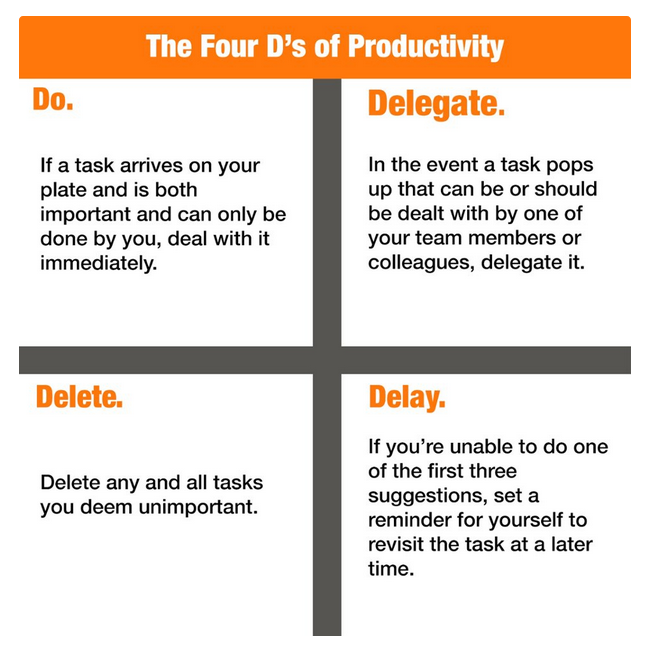
I return to the “Four D’s” concepts several times in past writings, and the “system” can be applied digitally as well… as long as you make a concerted effort to take the necessary time (10-20 minutes) every day to manage the up-front decision-making to “do immediately,” file, or weed out most of the “voluminous noise” (distractions) you get in email, texts, voicemail, snail-mail, etc. Get ready to push the “delete” button… over and over again!

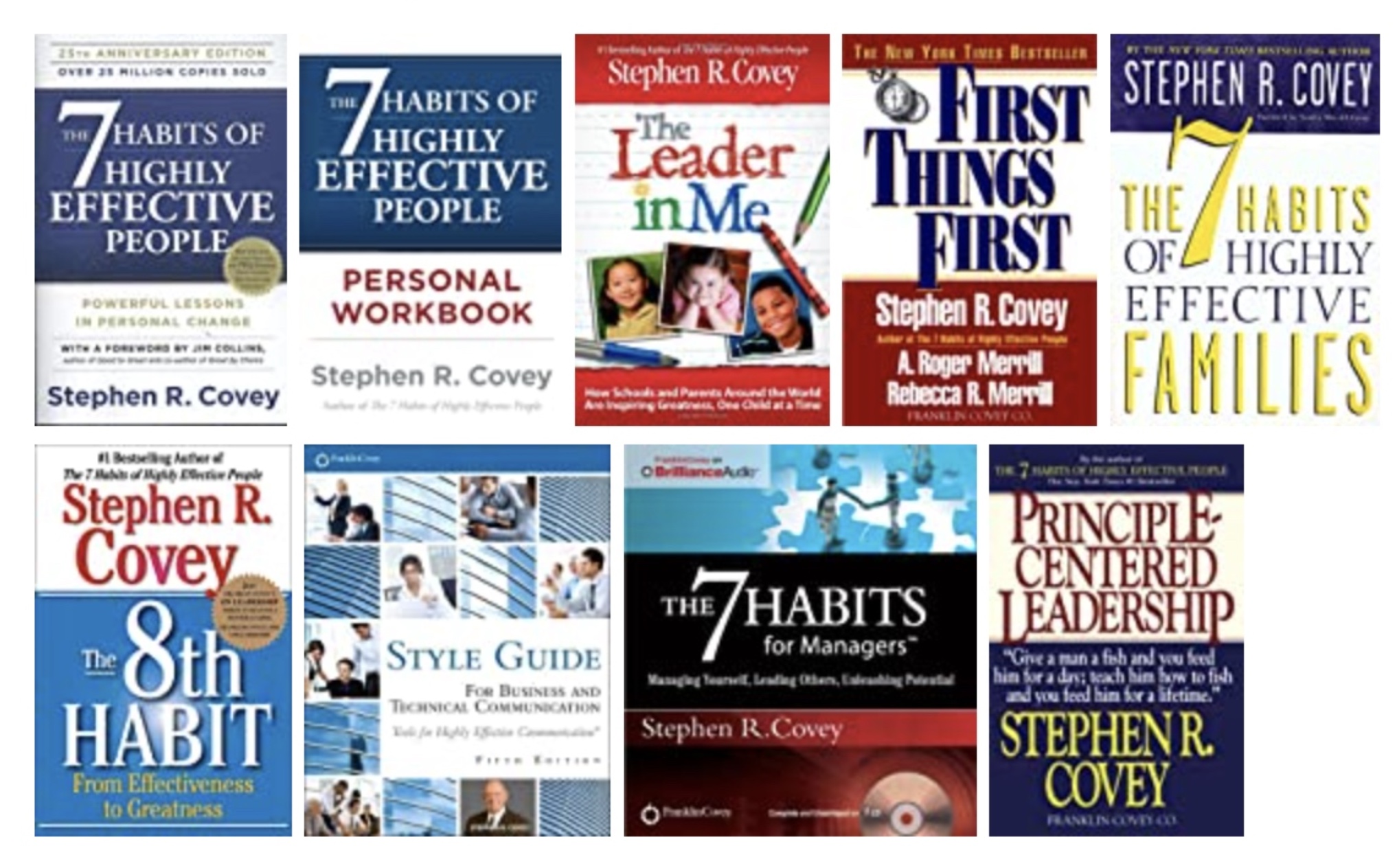
Then there are a few more ideas in “Top Ten Organizing Tips…” and any of the books by Stephen Covey (below). I particularly like the philosophy/demonstration attributed to him re: “start with the big rocks!”

Also, if you are a member of NAfME (National Association for Music Education), search their vast library of related blogs here, several articles to which I was fortunate to have contributed.

Final thoughts for the “sustaining years” of your profession and to avoid any touches of BURNOUT is to develop a self-care plan. My first go-to for building meaningful wellness habits comes from “What Self-Care Is and What it Isn’t.” In past health and wellness workshops, I echo these “basics.”

  • Promote a nutritious, healthy diet, and hydrate often.
  • Get enough sleep.
  • Exercise.
  • Follow-up with medical care.
  • Use relaxation exercises and/or practice meditation.
  • Spend enough time with loved ones.
  • Do at least one relaxing activity every day, whether it’s taking a walk or spending 30 minutes unwinding.
  • Do at least one pleasurable activity every day, from going to the cinema, cooking, or meeting with friends.
  • Find opportunities to laugh.

Self-care can take many forms, such as physical, spiritual, and emotional self-care. It’s an important factor in maintaining health and well-being.

Self-care might range from a hot soak and yoga to everyday activities like preparing meals you want to eat or dressing in your choice of style.

Self-care is not an indulgence. The WHO recognizes it as a crucial aspect of health maintenance.

Tailoring self-care for your budget, season in life, and personal needs for whole body wellness, inside and out, can be energizing and exciting in itself.

https://psychcentral.com/blog/what-self-care-is-and-what-it-isnt

Veteran full-time educators: To sustain and nurture success in the middle to twilight years of your career (Stage 4), seek to understand and practice personal wellness and work/life balance while continuing your pursuits in self-motivation, self-assessment, self-energizing, self-(re)invention, and “growing” personally and professionally, and if it becomes necessary, promote the diagnosis, prevention and self-remediation of debilitating stress and burnout.

PKF

© 2024 Paul K. Fox

OLD

This month’s “guest article” is on loan from a very wise and sensitive fellow-blogger:

Kathy Merlino.

We have been blessed with her generously and eloquently-shared thoughts and inspiration in past postings, including “A Penny” seen here last year and posted on her Kathy’s Retirement Blog of November 26, 2022 – a poignant piece coping with grief in the loss of a loved one.

Yes, those of us “over-65s” have experienced moments of “ageism” and discrimination because of our grey hair, wrinkled skin, slower driving habits, mobility challenges, or other signs of our advancing years. I believe most of this is unintentional… not deliberately meant to be condescending. But, Kathy hits the nail squarely on the head. You would think that with the swelling of our Baby-Boomer population stats (becoming more of a majority, not the minority?), ageism attitudes and bad behavior would disappear?

It all boils down to RESPECT! And, we should all “call out” any violators and demand change… like Kathy bravely did in her story!

How about getting even? Nah! But I do recall a funny episode from the National Geographic Channel’s Crowd Control series moderated by Daniel Pink about giving the people who parked illegally in handicap places their “just rewards!”

To stop able-bodied drivers from using handicapped parking places in Austin, Texas, Pink first rode around with a van full of local activists, blocking in offenders and making them wait while passengers in wheelchairs got out very slowly. A woman with an SUV apologized; a guy with a Porsche said, “I don’t do this; it’s not a habit,” lamely offering that he was just stopping in to see some friends for a 10-minute drink. “Now I’m that guy, and it doesn’t feel good,” he said, adding perhaps a little too easily: “I’m done being that guy.” But you could see that the human confrontation had somehow registered.

https://slate.com/human-interest/2014/11/dan-pinks-crowd-control-on-national-geographic-channel-uses-design-to-tackle-social-problems-across-america-video.html

Pink’s solution to this problem was to build social empathy with the very clever “Think of Me! Keep it Free” campaign.

And, ageist language goes both ways. A month ago I may have unintentionally offended a younger colleague who I have long admired (and frequently complimented her professional accomplishments publically) by using the familiar informal address in “thanks, kiddo.” Just as Kathy mentions we should eliminate the labels “old” or “elderly” and “dear” or “sweetie” from our vocabulary in conversations with our seniors, so should we abandon words like “kids, ” “kiddos,” “youngsters,” and “honey” in talking to our younger peers. RESPECT… both ways!

Join me in visiting Kathy’s Retirement Blog for this and other thought-provoking segments!

Kathy Merlino 2024OLD! by Kathy Merlino

A few months ago I went to my bank, something I rarely do in this world of banking apps and cash back at almost every retailer. As I waited in line
for my turn the woman in front of me struck up a conversation with the branch manager who was behind the teller counter attending to some unseen task.

The woman and branch manager apparently knew each other as they chatted easily about mutual acquaintances and activities.  

Everything was genial until she asked, “How’s your grandmother?”

The branch manager stopped what he was doing, straightened up, looked out into the lobby as he emphatically announced, “Old!”

The woman didn’t respond as her smiling face sunk into a bewildered expression, her eyes nervously darting around the lobby. I felt she was as stunned by his response as I was. Without another word he went back to what he was doing.

During the previous several months I had had a couple of ageist encounters with this early thirties-something man. Had he looked past the woman at me as he made what I thought was a disrespectful response, both for his grandmother and his acquaintance customer? Or was I just imagining? 

Not so sure I should let this pass without a word, I, too, looked around at the young faces behind the teller counter, at the personal banker in the glass cubicle chatting with a customer. They were all young twenty, thirty-somethings. The branch manager was the standard bearer for how to treat customers with respect and dignity. He was their leader, their guide from whom they took their cues. Since the previous manager was promoted to a higher level, which came as no surprise to me, I had noticed a change in the culture of this branch. Weighing the larger consequence of not saying anything about the incident, I was now sure I would say something and to whom I would say it. But, more on that later.

In recent weeks I’ve encountered a number of women speaking up about ageism in our society. During the last year I’ve become more conscious of ageism, mainly in the medical and health insurance fields as well as the experiences at my bank and a few stores. I’d like to know what you have experienced, if anything. One woman told me the ageism in the US is ‘shocking!’ Is it that way across the country? Is it that way in other countries? Several others have chimed in about how going grey was met with being called ‘old’ or ‘elderly’ followed by ‘dear’ and ‘sweetie.’ One woman even decided to start dyeing her hair again. Not me. I’d rather raise someone’s consciousness by speaking up about it. There’s nothing wrong with a little silver protest.

nih-logo-color-tagline-CROPAccording to the National Institute on Health (one of my favorite resources), “rising prejudices have spread concerning the elderly, who are seen as hindering productivity and social dynamism. Stereotypes about aging, beyond influencing behavior and ways of managing the care of elderly populations, can also impact personal experiences of aging.” The simple fact of the baby-boomer demographics makes our aging population larger than the generations which followed. What’s more, ageism influences our self-perceptions as well as our physical and mental health leading to such negative experiences like depression and isolation, which in turn translates into a shortened life span with a lower quality of life.


I have no doubt we live in a youth culture. Personally, I’m anti-anti-aging. All the ads by companies selling anti-aging products are laughingly, for the most part, using women at least 40 years younger than me to
show ‘results.’ It’s as if aging is a disease, which we have to keep at bay for as long as we can with creams, lotions, dyes, supplements, makeup, botox and even plastic surgery. Equally as pervasive is the vitamins and supplements industry raking in a hefty $150 billion per year globally. The US makes up nearly one third of that number. Age cannot be staved off forever, so we may as well accept that fact and enjoy life without going under the knife and getting our vitamins from healthy foods.  

Do I use creams and lotions? Of course I do. Who wants dry skin? My objective is to feel the best I can without being obsessed with my body and looks to the point of trying to hide my age. At 71, I’m comfortable in my own skin and love my grey hair. I stopped coloring my hair somewhere around 12 years ago. It was so freeing I’ve never thought about hair dyes again.  

But, the real issue is the devaluing of aging people due to accepted social norms centered around looking youthful, acting useful and contributing to society through a job. According to the NIH, “the most complete definition [of ageism] has been offered by [researchers] Iversen, Larsen, and Solem, who, after a review and analysis of all the definitions given over the years, defined ageism as negative or positive stereotypes, prejudice and/or discrimination against (or to the advantage of) elderly people on the basis of their chronological age or on the basis of a perception of them as being ‘old’ or ‘elderly’.” 

Town of Menaggio on lake Como, Milan, Italy

While visiting Italy I noticed a difference in the way I and my fellow aging travelers were treated. It was with a graciousness and respect that was palpable in transactions at stores, meals in restaurants and just strolling down the street. I believe the stereotyping of aging in Italy is a positive stereotyping where “respect your elders” is ingrained in the fabric of their social norms.  

I remember touring a villa where certain spaces were roped off. The very young woman serving as monitor wore dark goth makeup, spiked black and maroon hair, black army boots, pants and pea coat along with a deadpan expression. Visually scary. No one was going to touch a thing or cross a barrier with her walking behind us! Then, I had to make a run to the restroom, which was outside and down a long path on the grounds. Upon my return she let me in with a stern look. But, when I went looking for my group to catch up, she motioned to me with a smile, “Come. I show you a shortcut.” With that she led me around a roped barrier, across the living room’s ancient rug I was positive was not to be walked upon, around another barrier and down a hall where I joined my group. As I turned to thank her she winked and said, “Secret.”  Although with cameras all over the place I don’t think it was a secret. It was an act of kindness from someone who initially appeared so forbidding. A reverse lesson in not judging a book by its cover. I wonder now if the act of kindness was because of my grey hair and wrinkles and the Italian view of aging.

We are at once going through a transformation where aging is not what it once was as people continue to work, remain involved in their communities and are physically active.  Yet, at the same time, much of society views this natural part of life called aging with disdain or perhaps a bit of fear.  After all, following aging to the last is the grim reaper awaiting. For me exercising, eating a healthy diet, keeping my mind sharp, being involved in my community, having a spiritual practice and engaging with family, friends and my hobbies are the components of healthy aging. That is my anti-aging strategy.

Respect

What do we do about the disrespect, the minimizing of our value to society? I speak up and out about the situations I encounter. For example, the branch manager.  As mentioned I decided I had to do something about his attitude and comments, not only for the sake of other customers, but for his employees. Well, I emailed my contact at the bank and expressed my concern and how I had encountered what I believed to be ageism three times over a period of several months. The CEO and president of the bank asked if it would be ok if the branch manager’s supervisor called me, to which I, of course, agreed.  

I learned that the bank has training about what respect and dignity look like, on discrimination including ageism.  I learned that upper management was sincerely disappointed in the branch manager’s attitude and, as was appropriate, apologized for the ageist treatment. I haven’t been back because, as noted above, I don’t find it necessary to go to the bank very often. However, I do hope to see a cultural change on my next visit.  I also hope this young manager views the experience as an opportunity to grow and learn and set a positive example for his staff.  Lastly, I hope he learned that just because someone is “old!” with grey hair and a few wrinkles doesn’t mean they don’t have wisdom, influence and the power to create change.  

Would you like to comment on this article? Please visit Kathy Merlino’s website here.

Model Code of Ethics for Educators

Don’t you love this quote from TeachThought?

“Teaching isn’t rocket science; it’s harder!”

Teachers make as many as 1,500 decisions a day for their classes and students… that’s as many as four educational choices per minute for the average teacher given six hours of class time. Surprised? (Not if you are an educator!) Check out this corroborating research:

Of course it can be exhausting… and as fast as “things” happen, even mind-numbing at times!

What do educators rely on for guidance, a sort of internal “ethical compass” for making these decisions, many of which are snap judgments?

  • Educational background
  • Teacher “chops” (professional experience)
  • Peer and administrative support
  • Personal moral code (derived from one’s life experiences and upbringing)
  • Aspirations, values, and beliefs generally agreed upon by educational practitioners
  • State’s code of conduct and other regulations, statutes, policies, and case law
  • Professional ethics

Or all of the above?

At this juncture during my workshops on ethics, I usually quote Dr. Oliver Dreon, Assistant Professor and Coordinator of the Digital Learning Studio at Millersville University of Pennsylvania and one of the authors of the Educator Ethics and Conduct Tool Kit of the Pennsylvania Professional Standards and Practices Commission:

“From a decision-making standpoint, I tend to look at it from the perspective of Ethical Equilibrium (work by Troy Hutchings). Teachers weigh the moral (personal) dimensions with regulatory ones (the law) with the ethics of the profession…  While focusing on consequences is important, I worry that teachers may interpret this to mean that as long as they don’t break the law, they can still be unprofessional and immoral.”   

– Dr. Oliver Dreon

From college students participating in their first field observations to rookie teachers (and even veterans in the field), I recommend searching the term “ethics” on the website of your State Board of Education. In Pennsylvania, checkout the following:

Now enters probably the single most valuable document of our time, an all-encompassing philosophy for embracing the highest standards of what it means to be an ethical educator: the Model Code of Ethics for Educators (MCEE), developed under the leadership of the National Association of State Directors of Teacher Education and Certification (NASDTEC). With the collaboration of numerous development partners including the American Federation of Teachers, National Education Association, National Association of Elementary School Principals, National Association of Secondary School Principals, Council of Chief State School Officers, and American Association of Colleges of Teacher Education – to name a few – MCEE is comprised of five core principles (like spokes in a wheel – all with equal emphasis), 18 sections, and 86 standards.

“The purpose of the Model Code of Ethics for Educators (MCEE) is to serve as a shared ethical guide for future and current educators faced with the complexities of P-12 education.  The code establishes principles for ethical best practice, mindfulness, self-reflection and decision-making, setting the groundwork for self-regulation and self-accountability.  The establishment of this professional code of ethics by educators for educators honors the public trust and upholds the dignity of the profession.”

MCEE Framing Document

Although pre- and in-service training on both are essential, the differences between a “code of conduct” and a “code of ethics” are vast. Codes of conduct like the Code of Professional Practice and Conduct for Pennsylvania teachers are specific mandates and prohibitions that govern educator actions. A code of ethics is a set of principles that guide professional decision making, not necessarily issues of “right or wrong” (more shades of grey) nor defined in exact terms of law or policies. Codes of ethics are more open-ended, a selection of possible choices, usually depended on the context or circumstances of the situation.

“The interpretability of The Model Code of Ethics for Educators allows for robust professional discussions and targeted applications that are unique to every schooling community.”

Troy Hutchings, Senior Policy Advisor, NASDTEC

The music teacher and administrator colleagues with whom I have been privileged to work for more than 40 years are highly dedicated and competent visionaries who focus on “making a difference” in the lives of their students, modeling “moral professionalism” and the highest ethical standards for their classes, schools, and communities, in support of maintaining the overall integrity of the profession.

However, let’s unpack some of “the wisdom” of MCEE as it addresses the rare “nay-sayers” and entrenched teacher attitudes, failing to understand “the difference between what you have a right to do and what is right to do…” (Potter Stewart) or “doing the right thing when no one else is watching – even when doing the wrong thing is legal” (Aldo Leopold).

Here are sample negative responses, MCEE “exemplars,” and proposed assimilations for thoughtful and interactive peer discussion. Bring these to your next staff meeting or workshop, and apply them to a few mock scenarios (like these from my past blog ).

Principle I: Responsibility to the Profession

The professional educator is aware that trust in the profession depends upon a level of professional conduct and responsibility that may be higher than required by law. This entails holding one and other educators to the same ethical standards.

“I didn’t know it was wrong…”

Section I, A, 1: Acknowledging that lack of awareness, knowledge, or understanding of the Code is not, in itself, a defense to a charge of unethical conduct;

My comment: The old adage, “ignorance of the law is no excuse for breaking it.” – Oliver Wendell Holmes

“What’s the problem? I didn’t break the law!

MCEE Section I, A, 5: Refraining from professional or personal activity that may lead to reducing one’s effectiveness within the school community;

My comment: Any on or off-duty conduct or inappropriate language that undermines a teacher’s efficacy in the classroom, damages his/her position as a “moral exemplar” in the community, or demeans the employing school entity may result in loss of job, suspension or revocation of license, and/or other disciplinary sanctions.

http://pimaregionalsupport.org/event-2610673

“I’m not a rat fink…”

MCEE Section I, B, 2: Maintaining fidelity to the Code by taking proactive steps when having reason to believe that another educator may be approaching or involved in an unethical compromising situation;

My comment: As a professional with “fiduciary” responsibilities, we must look out for the welfare of our students, proactively protecting them from harm by embracing all provisions of “mandatory reporting.”

“What’s in it for me?”

MCEE Section I, C, 3: Enhancing one’s professional effectiveness by staying current with ethical principles and decisions from relevant sources including professional organizations;

MCEE Section I, C, 4: Actively participating in educational and professional organizations and associations;

My comment: Keeping up-to-date and current, we are fortunate to avail ourselves with the exhaustive tools and resources of media, music, and methods provided by groups like the Pennsylvania Music Educators Association and National Association for Music Education.

Principle II: Responsibility for Professional Competence

The professional educator is committed to the highest levels of professional and ethical practice, including demonstration of the knowledge, skills, and dispositions required for professional competence.

“What’s the big deal about standards?”

Section II, A, 1: Incorporating into one’s practice state and national standards, including those specific to one’s discipline;

My comment: As professionals, we should volunteer to help write our school’s courses of study, content units, and learning goals for the subjects we teach, and take advantage of the National Core Arts Standards, the PMEA Model Curriculum Framework, and the state’s standards.

“Not another ‘flavor-of-the-month’ in-service program!”

Section II, A, 5: Reflecting upon and assessing one’s professional skills, content knowledge, and competency on an ongoing basis;

Section II, A, 6: Committing to ongoing professional development

My comment: Always “raising the bar,” being a member of a “profession” (like medical personnel, counselors, attorneys, etc.) requires the loftiest benchmarks of self-regulation and assessment, ongoing training, retooling, and self-improvement plans, revision and enforcement of “best practices,” and application of 21st Century learning skills.

“I needed to give him credit?”

MCEE Section II, B, 1: Appropriately recognizing others’ work by citing data or materials from published, unpublished, or electronic sources when disseminating information;

My comment: Especially during this period of online/virtual/remote education brought on by COVID-19, we must reference the owners of intellectual property (including sheet music) that we use and abide by all copyright regulations. In general, it is always “best practice” to cite research or authorship “giving credit where credit is due!”

“I’m just a music teacher! Don’t ask me to do anything else!”

MCEE Section II, C, 2: Working to engage the school community to close achievement, opportunity, and attainment gaps;

My comment: We teach “the whole child,” not a specialty or specific content area! I believe our ultimate mission is to facilitate our students’ capacity and desire to learn, inspire self-direction and self-confidence, and foster future success in life.

Principle III: Responsibility to Students

The professional educator has a primary obligation to treat students with dignity and respect. The professional educator promotes the health, safety, and well being of students by establishing and maintaining appropriate verbal, physical, emotional, and social boundaries.

“It’s just a gift…”

MCEE Section III, A, 5: Considering the implication of accepting gifts from or giving gifts to students;

My comment: It is not appropriate to give a gift to a student lacking an educational purpose. In some cases, this may be defined as a “sexual misconduct.” It begs the larger question: “Do you ensure that all of your interactions with students serve an educational purpose and occur in a setting consistent with that purpose?” Also from the PA Professional Standards and Practices Commission: “Teachers should refrain from accepting gifts or favors that might impair or appear to impair professional judgment.”

“You should never touch a student!”

MCEE Section III, A, 6: Engaging in physical contact with students only when there is a clearly defined purpose that benefits the student and continually keeps the safety and well-being of the student in mind;

My comment: We were told this warning in methods classes. However, as I mentioned in a previous blog here, this “rule” has little support in research or common “best practices.” It has been my experience that on occasion, most elementary instrumental teachers assist their students in acquiring the correct playing posture and hand positions by using some (limited) physical contact. Consoling an upset student with a pat on the shoulder is not out-of-line either. The factors that may contribute to the moment being judged “okay” vs. “inappropriate” boil down to:

  • Intent
  • Setting
  • Length of time
  • Frequency or patterns of repetition
  • Comfort level of the student
  • Age level of the student
  • Happening in public
  • Who started it?
busyteacher.org

“My students are my friends!”

MCEE Section III, A, 7: Avoiding multiple relationships with students which might impair objectivity and increase the risk of harm to student learning or well-being or decrease educator effectiveness;

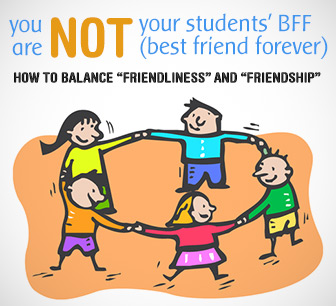
My comment: You cannot be their “friend.” You are their teacher, an authority figure that is looking out for them and doing what is necessary (“fiduciary” responsibilities) for their health and welfare… perhaps at times things they do not want you to do. Crossing the teacher/student boundary with familiarity, informality, and being their “confidant” or “friend” are more than just unprofessional acts – they can foster a dual relationship where roles are less defined, an ambiguity that may lead to additional inappropriate actions and educator misconduct.

“He’s weird…” or “He’s not one of us!”

MCEE Section III, B, 2: Respecting the dignity, worth, and uniqueness of each individual student including, but not limited to, actual and perceived gender, gender expression, gender identity, civil status, family status, sexual orientation, religion, age, disability, race, ethnicity, socio-economic status, and culture;

My comment: Check your prejudices and personal biases at the door. Being a teacher is all about sensitivity and caring of all individuals – students, parents, staff, etc. Embracing today’s focus on reprogramming community attitudes on “diversity,” an educator daily models the values of empathy, compassion, acceptance, and appreciation, not just settling with the “lower bar” of tolerance, allowance, and compliance!

“Wait ’til you hear what happened in class today!”

MCEE Section III, C, 1: Respecting the privacy of students and the need to hold in confidence certain forms of student communications, documents, or information obtained in the course of practice;

My comments: Gossiping about and “carrying tales” home or in the teachers’ room are serious breaches of the care and trust as well as your fiduciary responsibilities assigned to you on behalf of your students. As for “regulations,” your indiscretion may be a violation of your students’ confidentiality rights (“a federal crime” according to Family Educational Rights and Privacy Act, Grassley Amendment, Health Insurance Portability and Accountability Act, and Individuals with Disabilities Education Act). You are only permitted to share information about a student with another teacher, counselor, or administrator who is on a “needs-to-know” basis or is actively engaged in helping this student.

Principle IV: Responsibility to the School Community

The professional educator promotes positive relationships and effective interactions with members of the school community while maintaining professional boundaries.

“Don’t tell my parents!”

MCEE Section IV, A, 1: Communicating with parents/guardians in a timely and respectful manner that represents the students’ best interests;

My comment: I wish I had a nickel every time a student plead with me, “Don’t call my mom!” It is part of “moral professionalism,” your “code,” and good ethical standards to originate meaningful two-way dialogue, and if necessary, confront the parents of underachieving children. I also believe it goes on long way to nurture your relationships in the community if you notify parents when their kid has done something remarkable… “I caught him being good” or “The improvement has been extraordinary!”

“Did you hear what a staff member said about you… in front of the kids?”

MCEE Section IV, B, 1: Respecting colleagues as fellow professionals and maintaining civility when differences arise;

MCEE Section IV, B, 2: Resolving conflicts, whenever possible, privately and respectfully, and in accordance with district policy;

My comment: Before you bring up the matter with your supervisor or building administrator (which you have the right and even responsibility to do, especially if the students hear any improper speech first-hand or that the incidents rise to the level of bullying or aggressive behavior), first confirm the story. Talk to the unhappy team member one-on-one. Be calm and sensitive, but hold your ground: you must assert that his/her behavior/language is unacceptable and will not be tolerated in the future.

“Not another TEAM meeting?”

MCEE Section IV, B, 4: Collaborating with colleagues in a manner that supports academic achievement and related goals that promote the best interests of students;

My comment: We work together to insure that all educational goals are met. Open and interactive peer partnerships are helpful in the review, design, and application of new lessons, methods, media, and music.

“I was just teasing her…”

MCEE Section IV, B, 8: Working to ensure a workplace environment that is free from harassment.

My comment: Be extremely careful in the practice of any behavior or language of a kidding, sarcastic, cynical, or joking manner. It can be misinterpreted regardless of your intentions… and it can hurt someone’s feelings. And it is never appropriate or “professional” to “put down” another person.

“Don’t ask for permission… beg for forgiveness.”

MCEE Section IV, C, 3: Maintaining the highest professional standards of accuracy, honesty, and appropriate disclosure of information when representing the school or district within the community and in public communications;

My comment: Yes, I have heard this “view” a lot, advocates of whom will tell you to go ahead and stick your neck out to do something “for the good of the order,” and if needed later, “beg for forgiveness” if you decision is met with disapproval from administration. My advice? Less experienced teachers, run everything through your fellow colleagues (informally) and principal (formally). Don’t fall back on the lame “oops” and “beg for forgiveness.” I may have felt differently when I had three times as many years of experience under my belt than the supervisors who were assigned to “manage” me… but, even then, “venturing out without a paddle” usually did not serve the best interests of the students. There’s no reason to place “the teacher’s convenience” over the safety/welfare of the students. Besides, why not take advantage of the legal and political backup of your bosses if they are kept “in the loop?”

“He’s our preferred dealer and always takes care of us.”

MCEE Section IV, D, 4: Considering the implications of offering or accepting gifts and/or preferential treatment by vendors or an individual in a position of professional influence or power;

My comment: Formerly called “sweetheart deals” with music companies, you are on “shaky” ethical ground (and may also have “crossed the line” violating state laws/statutes) if you negotiate the rights of exclusive access to your school’s or booster’s purchasing. If you have any questions about your school’s policy on outside vendors, seek advice from your district’s business manager.

Principle V: Responsible and Ethical Use of Technology

The professional educator considers the impact of consuming, creating, distributing, and communicating information through all technologies. The ethical educator is vigilant to ensure appropriate boundaries of time, place, and role are maintained when using electronic communication.

“Isn’t use of social media forbidden?”

MCEE Section V, A, 1: Using social media responsibly, transparently, and primarily for purposes of teaching and learning per school and district policy. The professional educator considers the ramifications pf using social media and direct communications via technology on one’s interactions with students, colleagues, and the general public.

My comment: Professional educators’ use of a dedicated website or other social network application enables users to communicate with each other by posting information, comments, messages, images, etc. and “learn” together. However, using social media for sharing social interactions and personal relationships with your students, parents, and staff is unethical and dangerous. As they say, “a post (or snap) is forever.” Communicating digitally or electronically with students may lead to the blurring of appropriate teacher-student boundaries and create additional challenges to maintaining and protecting confidentiality.

The Final Word

In Pennsylvania (as well as the rest of the country), the statistics on school staff misconduct reports are rising alarmingly. Your own state’s “code of conduct” and the MCEE should help to clarify misunderstandings, but it has been my experience that the majority of educators do not receive regular collegiate, induction, or in-service training on educator ethics or moral professionalism. Luckily, we are fortunate to have access to many mock scenarios (see below) from state departments of education to review/discuss among ourselves common ethical conflicts and “conundrums” dealing with pedagogy, enforcement, resource allocation, relationships, and diversity. We all need to “refresh” our understanding of these issues from time to time and revisit “our codes” frequently to help “demagnetize” (and re-adjust) our decision-making compass.

Please peruse the ethics category of this blog-site for other articles and sample references below.

PKF

Resources

PIXABAY.COM GRAPHICS:

© 2021 Paul K. Fox