Admins Helping Teachers

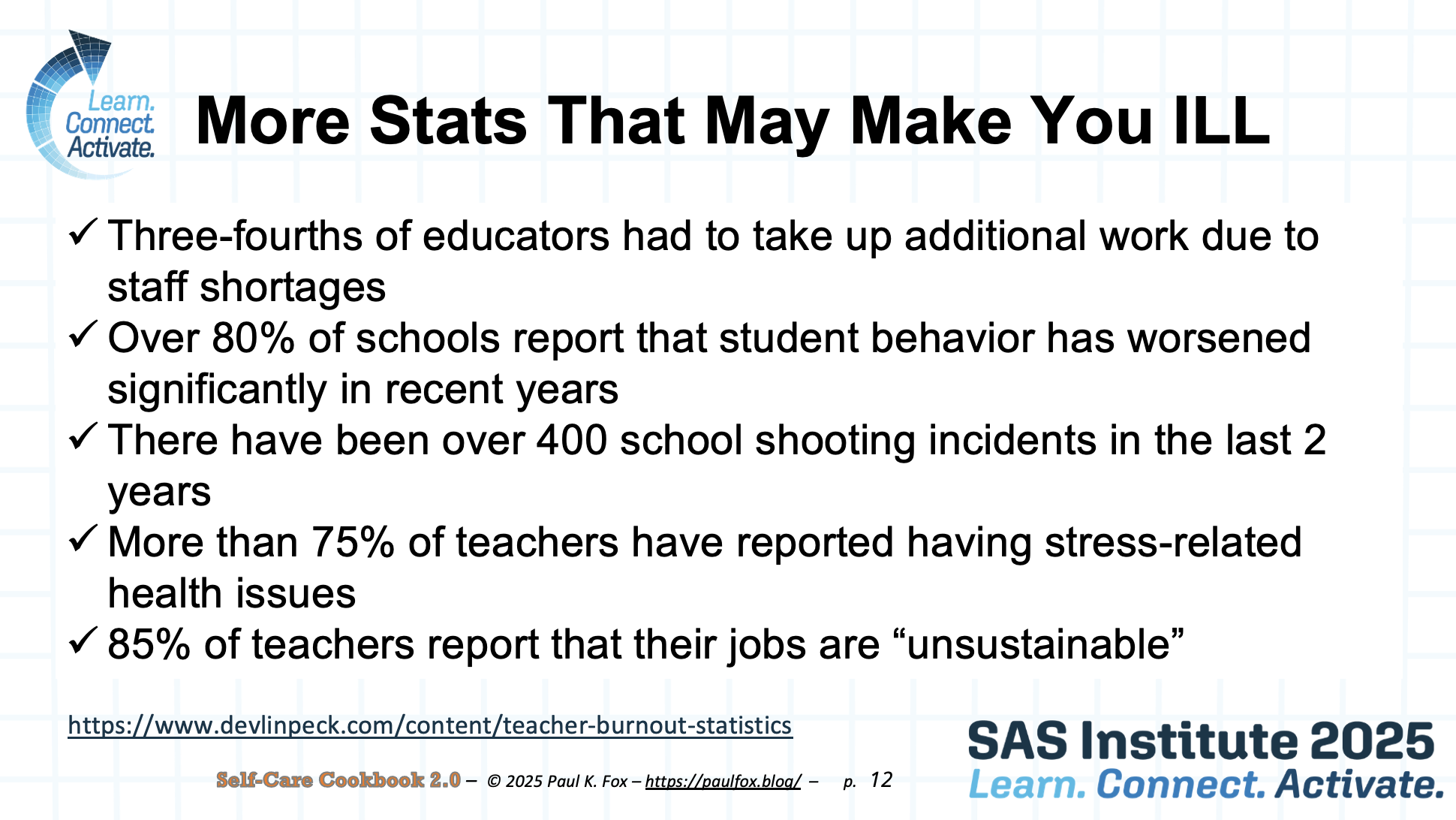
This is an introductory blog-post perusing my early research and resources on supporting educator health/wellness in advance to my presentation Self-Care Cookbook 2.0 – Recipes and Resources for School Leaders for the PA Department of Education’s SAS Institute 2025 state conference scheduled for December 8-10, 2025 in Hershey, PA. Here is the summary description for the workshop:
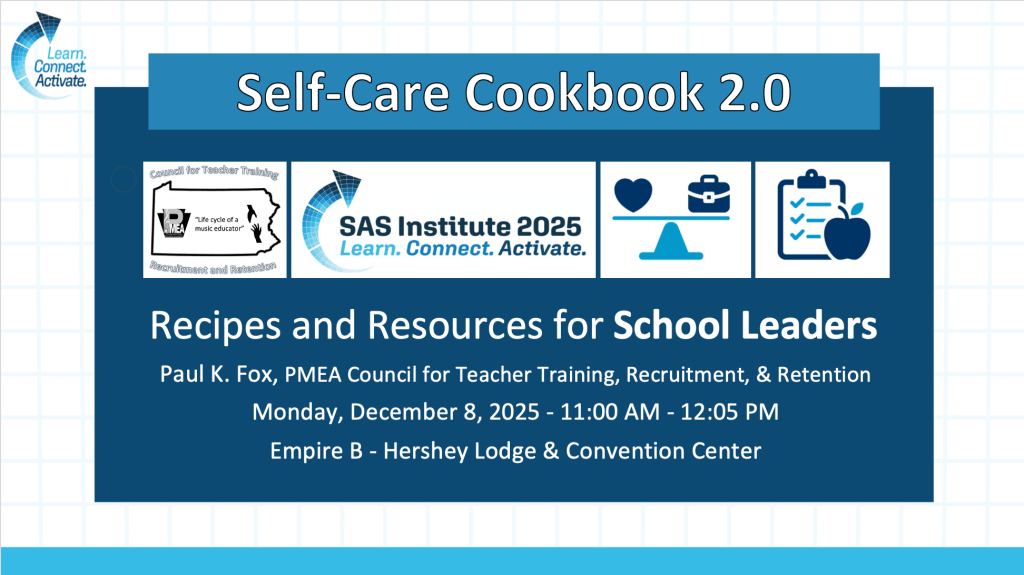
“Do you find the harried pace of our profession overwhelming and at times crushing when buried beneath decades of keeping our noses to the grindstone and putting everyone else’s needs above our own? Do some of your staff members say they are stressed out, constantly tired, plagued by one ailment after another, or wondering how they’re going to “keep up?” If health is interfering with your colleagues’ abilities to do their jobs and find success, balance, and meaning in their lives, then it is time for change. The purpose of this session is to empower school leaders and teachers with skills and attitudes needed to make informed decisions to promote self-improvements in their lifelong health and wellbeing, to LEARN tools for better time management and to help remediate fatigue, stress and burnout, CONNECT and collaborate with your staff to inspire unique strategies for better personal self-care, and ACTIVATE creative new approaches to foster an improved workplace environment.”

Actually, previous articles at this site have dived into this subject of educator stress, burnout, and the development of a health and wellness self-care plan to build resilience, work/life balance, and reignite our motivation and passion for teaching. For a complete overview, I recommend you revisit these:

Always start with “THE WHY”

(Inspired by keynote speaker/author Simon Sinek): Why is this discussion so important now?
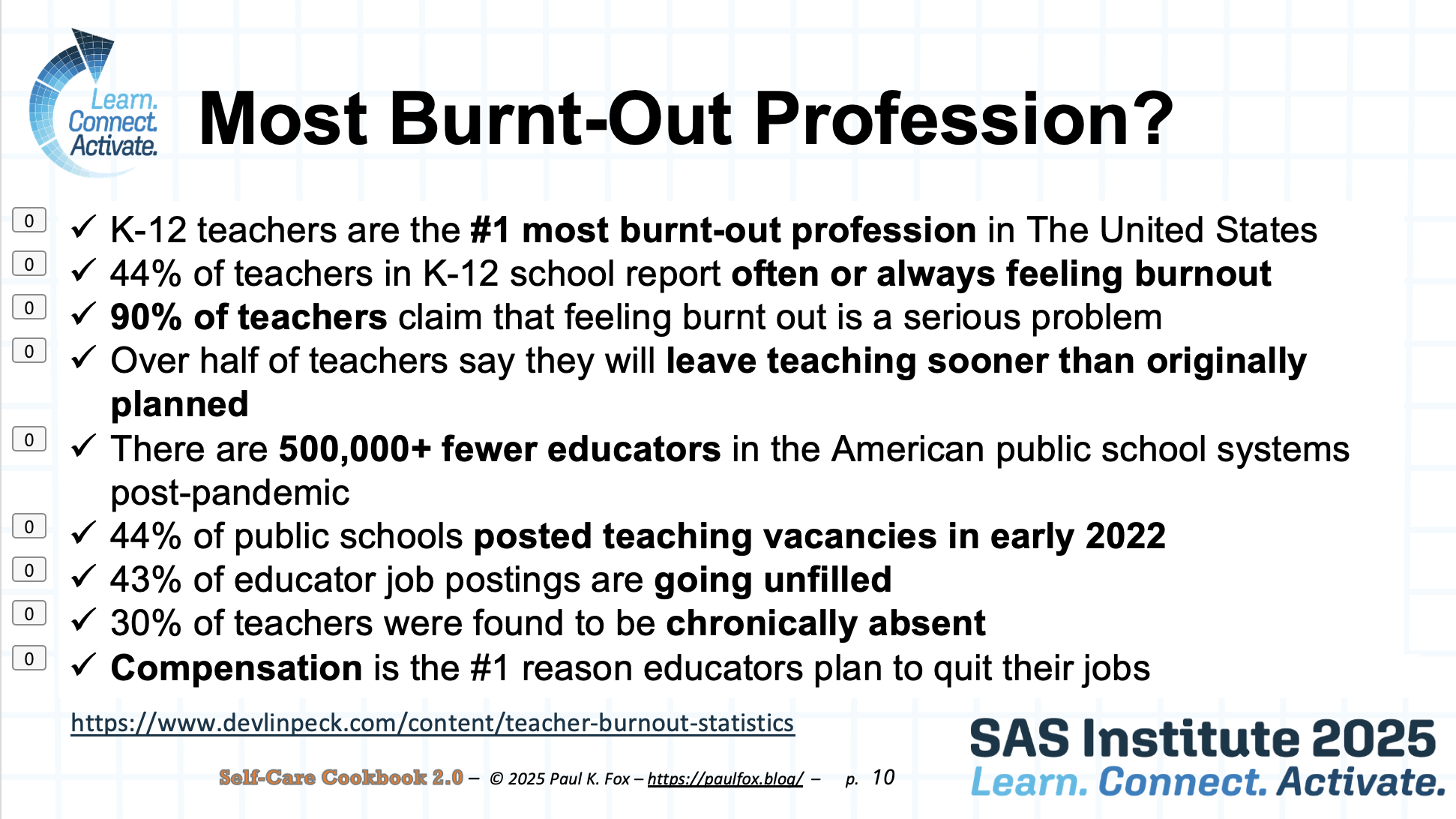
When I mentioned my research to my colleague (and former student) Dr. Timothy Wagner, Principal, Upper St. Clair High School (my former placement for full-time employment), he mentioned that this topic was timely and highly relevant, and suggested that perhaps there might be more statistics and resources “out there” on the stress of health-care workers and first-responders, which I found to be true. However, early looks have shown numerous parallels to the information in my 2023 Self-Care session.

My PDE SAS Institute session will become a “two-for-one” presentation, including the opportunity for school/system leaders, building administrators, and directors of school district professional development to also download my original “Self-Care Cookbook” (1.0) slides, recently updated for the DCMEA Annual State Conference (January 20, 2026). This self-help workshop is geared for educators to “on-their-own” explore strategies, implement use of individualized tools/remedies, and formulate new goals to improve health and wellness. Both sessions hope to cover these key questions:

  • Why is it essential to personal health to achieve balance in our lives, and how can we achieve it?
  • How does dedication to wellness lower the risk of illness, injury, and the quality of a person’s life?
  • What are the consequences of our choices in terms of time and stress management?
  • How do effective decision-making skills and goal setting influence healthier lifestyle choices?
  • What are suggestions, strategies, and samples for the development of a personal self-care plan?
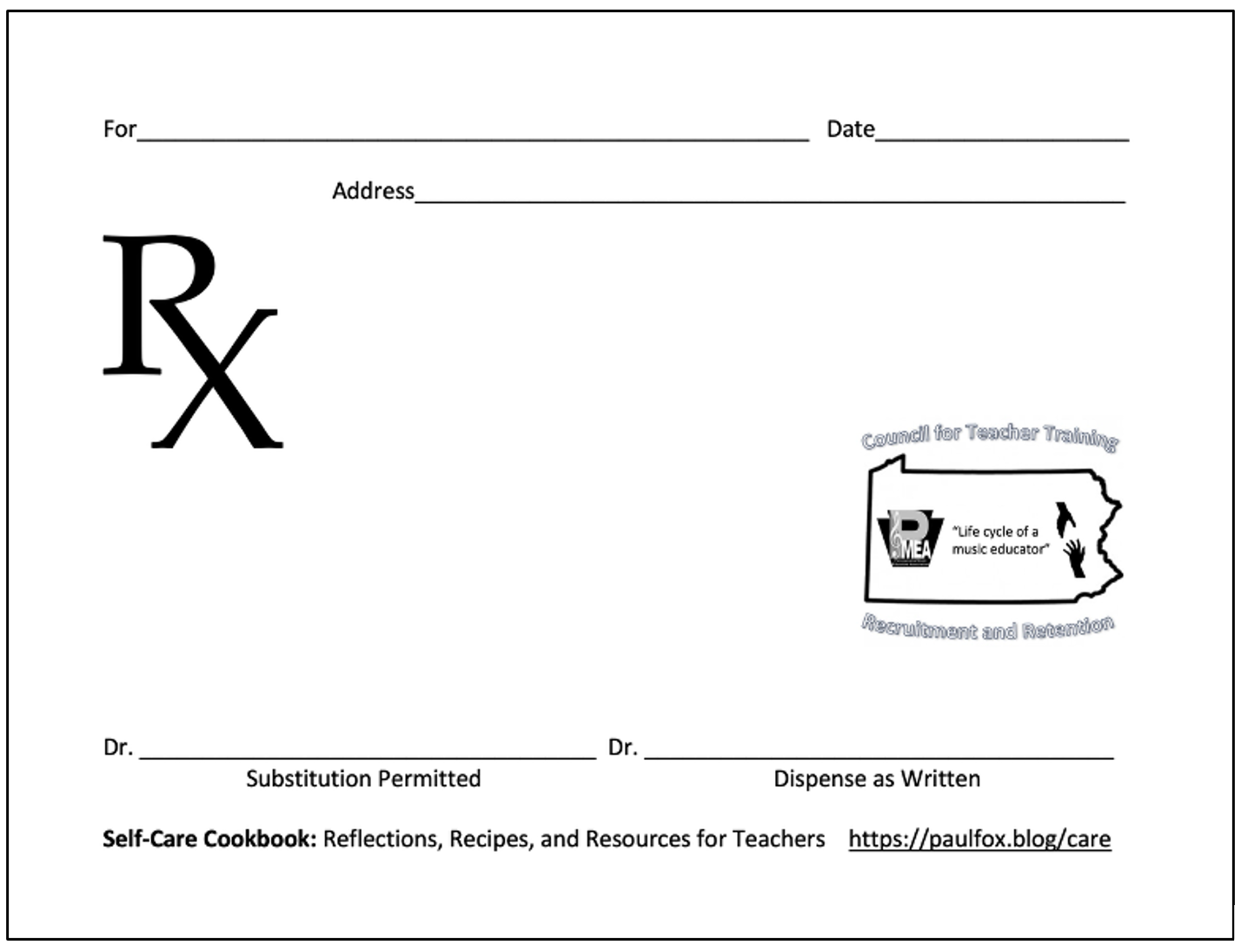
Using a facsimile of a prescription pad in Self-Care 1.0, I posed these personal reflections:

  1. How do I usually feel daily throughout the school year?
  2. What are the emotional and physical tolls of my job?
  3. What specific self-care activities do I need to incorporate to recharge and prevent burnout? 
  4. What boundaries do I need to set around my work to honor personal time?
  5. What support systems can I build and/or professional help should I seek to create a sustainable practice?
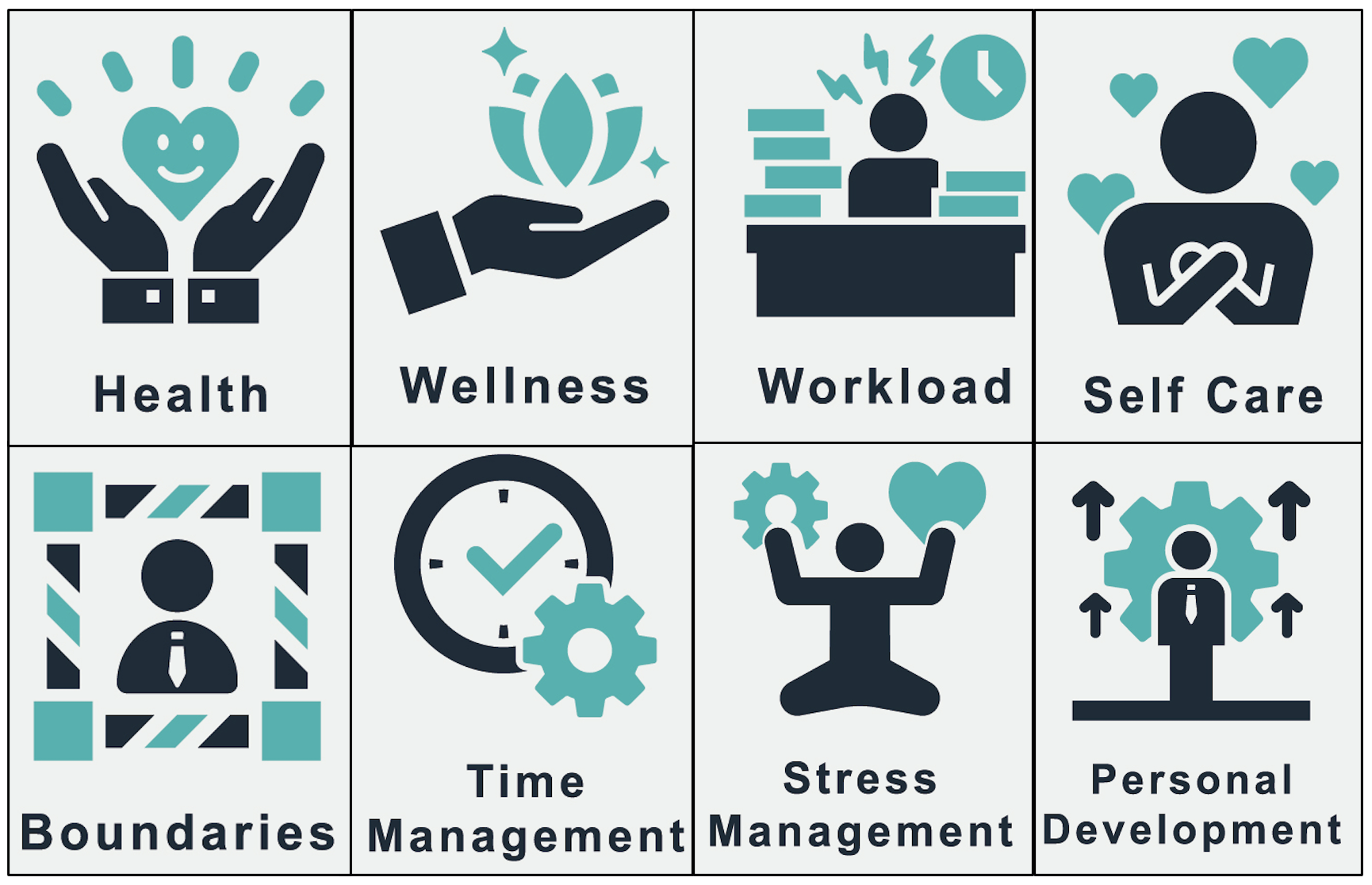
Good ideas…

How can school admins support their staff in dealing with the climbing incidences of health problems, teacher exhaustion, call-offs, evidence of burnout, and high turnover rate? Sorting through a compendium of online research, these recommendations for school leaders occur repeatedly:

  1. Probably should go without saying: Show high visibility (“be seen by all”), recognition, and know everybody’s name. This goes a long way in building a sense of belonging of the staff and students.
  2. Provide more time for breaks and planning. Engage teachers in problem solving teams to identify and implement substantive ways to give them more time. Examples: cutting back on testing and data analysis; holding fewer and shorter meetings; putting a hold on new academic initiatives while increasing mental health initiatives conducted by school-based mental health professionals; hiring individuals who can assist with administrative tasks; compensating teachers for extra work; protecting classroom time by minimizing interruptions; reducing teaching hours to allow for more prep time and follow-up time.
  3. Foster a supportive community through mentorship programs.
  4. Distill high-impact strategies into a handful of manageable priorities. Once the goals are set, give teachers specific time within the school day or week to focus solely on them.
  5. Communicate directly, clearly, and frequently. “Supportive administrators know that a teacher’s time is valuable and that administrative meetings compete with individualized education programs, data teams, professional learning committees, cross-curricular planning meetings, and much more. So if a meeting is only for sharing straightforward information, it can be an email instead. It’s not necessary to have a meeting simply because the schedule says that faculty meetings are in the cafeteria on Mondays.” – Edutopia: “4 Practical Ways Administrators Support Teachers”
  6. Treat teachers with respect like the professionals they are, increasing mutual trust by decreasing micromanagement or reducing unnecessary accountability documentation.
  7. Shadow multiple teachers to experience first-hand the reality of their typical day.
  8. Allow educators the option to attend meetings and professional development activities virtually.
  9. Involve teachers in the creation of targeted professional development activities that are the most meaningful for them.
  10. Ask teachers about what specific help they need to improve classroom management.
  11. Develop a plan (with the Board of Education?) to increase teacher compensation over time, taking into account that many administrative and clerical tasks that are now required of teachers might ultimately be delegated to less highly compensated individuals.
  12. Address staff performance issues on an individual basis rather than issuing global reprimands that don’t apply to most teachers.
  13. Implement policies that encourage work-life balance. For example, recognize measurable indications of quality teaching rather than behaviors that signal a “more is better” approach (always coming in early and staying late, volunteering for everything, talking about working all weekend to catch up, etc.).
  14. Support educators by acknowledging stress, providing professional development on self-care, and creating a culture where asking for help is normalized.
  15. Ask teachers what mental health or other supports they need to cope with their own distress. Research has demonstrated the effectiveness of introducing trauma-informed strategies, including an emphasis on compassion fatigue and secondary trauma, as well as mindfulness strategies that are part of institutionalized wellness routines.
  16. Provide “safe spaces” (SEL) where educators can express themselves without fear of being judged, and practice “Mindful Leadership” to connect with and listen to them. “Getting to know your teachers on a more personal level makes it easier to identify the best thing you can do to support them, even if teachers aren’t sure what they need. The goal should be making sure everyone made it to work okay and that they’re in good spirits and ready to tackle the day.” – 7 MINDSETS: “5 Ways Administrators Can Support SEL for Teachers”
  17. Counteract “toxic positivity” by acknowledging that teachers are hurting and need space to grieve the continued losses associated with the pandemic.

Bad ideas…

These strategies cited by Effective School Solutions will NOT help teachers in the long-term:

  1. While “wear your jeans to work” days and offering coffee and donuts occasionally are nice employee appreciation efforts, they do nothing to address the underlying issues.
  2. Offering one-shot seminars or newsletters with suggestions about individual self-care activities (breathing exercises, physical exercise, time for self, etc.) can inadvertently place further burdens on teachers, conveying the impression that they are responsible for both creating and addressing the stress that is structural in nature.
  3. Don’t conduct teacher surveys or focus groups about how to reduce teacher stress and then proceed to ignore their suggestions about what would make things better.
  4. Don’t assume that short bursts of extra time (e.g., ending a meeting early to give teachers more time) is useful. Small, unexpected pieces of free time do not help teachers catch up with work that requires concentration and focus.
  5. Don’t avoid difficult conversations to address the performance problems of individual teachers by making blanket statements/warnings to all teachers, most of whom are not engaging in the problem behavior.

“Be careful not to adopt a stance of “Toxic Positivity,” that is, a stance that accentuates the positive (“we are all in this together,” “we are strong,” “it could be worse,” “look on the bright side”) while invalidating the very real pain that everyone is experiencing. Denying or ignoring unpleasant emotions tends to make them worse, not better.
Effective School Solutions

Free Downloads

I am putting on the final touches to the SAS INSTITUTE 2025 Self-Care Cookbook 2.0 session, but have already assembled a huge bibliography of resources for your review (see below). For a “sneak preview” of my slide summary, click here. Future updates will be posted here: https://paulfox.blog/care/.

Better yet, register for the SAS Institute 2025 to see everything in person.

Sample Books

  • 180 Days of Self-Care for Busy Educators by Tina H. Boogren, Solution Tree Press (2020)
  • Awakened – Change Your Mindset to Transform Your Teaching by Angela Watson, Due Season Press & Educational Services (2023)
  • The Balanced Band Director – Productivity and Wellness Tips to Amplify Your Impact, Not Your Workload by Lesley Moffat, Morgan James Publishing (2025)
  • Demoralized – Why Teachers Leave the Profession They Love and How They Can Stay by Doris Santoro, Harvard Education Press (2018)
  • Exhausted – Why Teachers Are So Tired and What They Can Do About It by Paul Murphy, CreateSpace Independent Publishing Platform (2017)
  • Fewer Things, Better by Angela Watson (2019)
  • The Happy Teacher Habits by Michael Linsin, JME Publishing (2016)
  • Love the Job, Lose the Stress: Successful Social and Emotional Learning in the Modern Music Classroom by Lesley Moffat (2022)
  • Positive Mindset Habits for Teachers by Grace Stevens, Red Lotus 2018
  • Rekindle Your Professional Fire – Powerful Habits for Becoming a More Well-Balanced Teacher by Mike Anderson, ASCD (2024)
  • The Teacher’s Guide to Self-Care – Build Resilience, Avoid Burnout, and Bring a Happier and Healthier You to the Classroom by Sarah Forst, The Designer Teacher (2020)
  • The Teacher’s Guide to Self-Care – The Ultimate Cheat Sheet for Thriving Through the School Year by Melanie J. Pellowski, Skyhorse Publishing (2020)
  • Upbeat – Mindset, Mindfulness, and Leadership in Music Education and Beyond by Matthew Arau (GIA Publications (2022)
  • The Weekend Effect: The Life-Changing Benefits of Taking Time Off and Challenging the Cult of Overwork by Katrina Onstad, HarperOne (2024)

Sample Websites

PKF

© 2025 Paul K. Fox

It’s Time for… the PMEA Summer Conference!

The summertime academic break is essential for the health and wellness of every music educator. Hopefully you are enjoying a little TIME OFF and an emotional and intellectual break and release from thinking about your professional responsibilities and anything about school!

Europeans swear that it takes no fewer than three weeks of what we would call an extended vacation. They say we need that much time to totally unwind, de-stress, rest, and, if necessary, lick our wounds and even “heal ourselves!” Summer should allow us to focus on family, friends, and leisure activities FIRST – to re-adjust our “work/life balance.” After an appropriate interval, then we can get ready to re-charge and re-energize, to recommit emphasis on new music program goals and professional development.

If you are fortunate enough to live in Pennsylvania and be a member of the Pennsylvania Music Educators Association (PMEA), I have a wonderful “crosswalk” solution to accomplishing this REBOOT – a combined “refresh and re-invest” makeover – to first get out of dodge for a change in scenery and then take care of your own social-emotional learning to come back to school raring to go! It’s simple! Sign-up to participate in the 2022 PMEA Summer Conference to be held in-person at the Doubletree by Hilton Hotel in Reading, PA on July 18-19, 2022.

Here’s the link to registration and detailed schedule: https://www.pmea.net/pmea-summer-conference/.

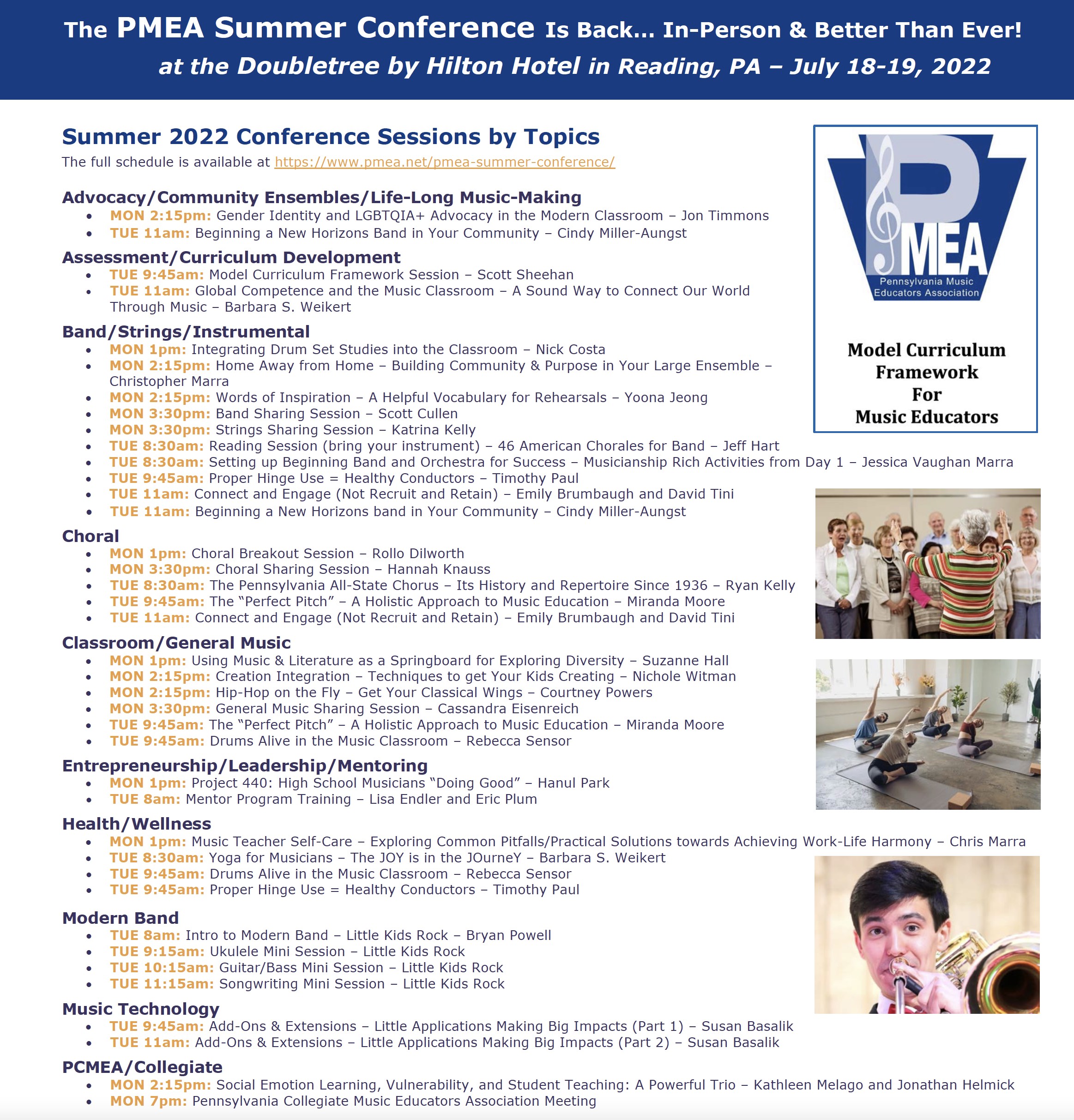
Once again, PMEA is “crushing COVID” and returning to some level of normalcy to offer a face-to-face summer conference of many “awesome” professional development venues – everything from hands-on music reading, member “sharing” sessions, clinics on advocacy, band, choral, classroom music, community ensembles, conducting, curriculum writing, gender identity, health/wellness, mentor training, Modern Band, music technology, recruitment, strings, and so much more!

Check out this summary of wonderful workshops:

Update as of 6/28/22

Approximately Nine (9) hours of Act 48 credit will be available.

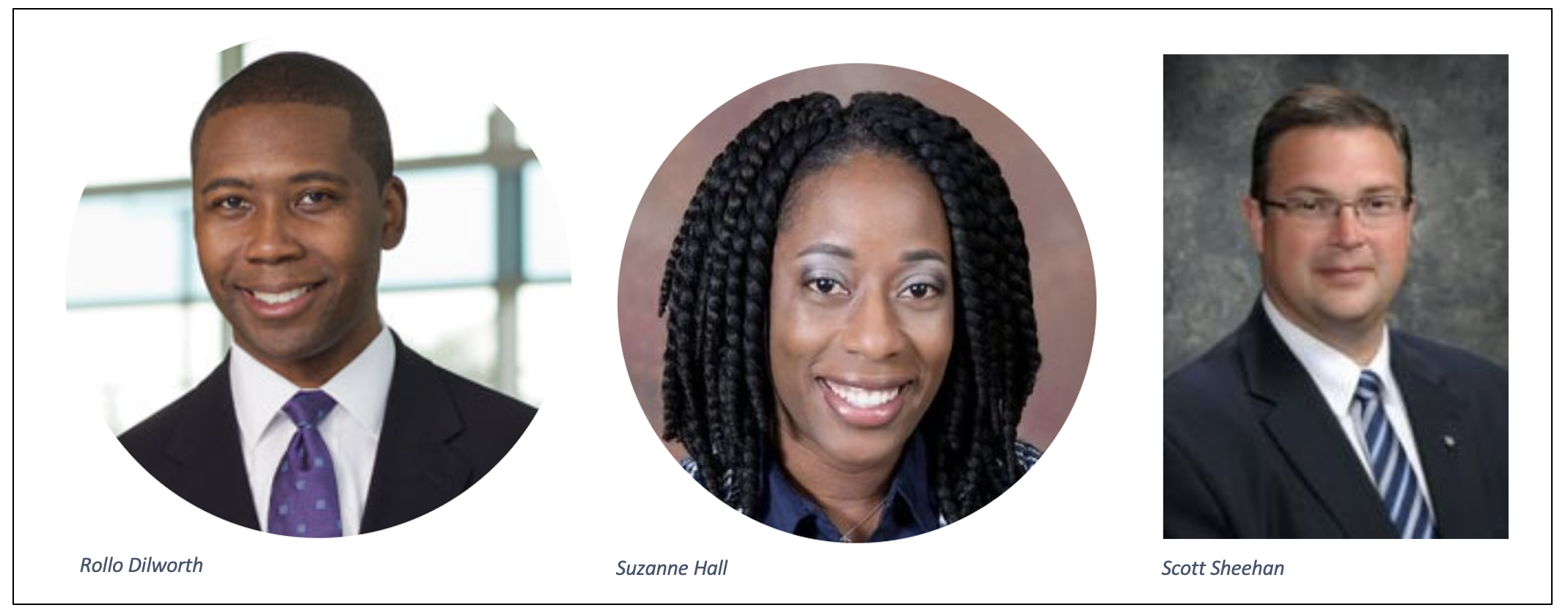
This year’s event will include keynote speakers Suzanne Hall and Rollo Dilworth from Temple University as well as NAfME President and PA’s very-own super-star Scott Sheehan.

Feeling a little charitable, altruistic, or eleemosynary? (Great word – look it up!) On Tuesday, July 19, there will be a “Give-Back to the Community” event: PMEA’s Second Annual Day of Service at Goggle Works.

Now, what about that EXTRA FUN part? Well, you can turn your conference into a family vacation by just arriving a little early and/or leaving a little later.

First, how about attending a Minor League baseball game? PMEA acquired tickets to the Reading Fightin’ Phils vs. New Hampshire Fisher Cats contest on Sunday, July 17 at 5:15 p.m. at the FirstEnergy Stadium.

Next, there are a lot of terrific family-fun things-to-do in Reading, PA and the surroundings… (Special thanks to https://uncoveringpa.com/things-to-do-in-reading-pa for this “awesome” travel resource!)

Berks County, a combination of rich farm country, industry, beautiful parks, lots of entertainment, and top-notch educational institutions, is home to one of Pennsylvania’s largest cities, Reading, as well as many small communities that offer a lot of history and natural beauty. For PMEA members going to the Summer Conference, it is the perfect opportunity to enjoy a wide variety of family-friendly attractions, recreation pursuits, touring of the landscape scenery, and other day trips. If you were to visit the area before and/or after the conference, here are at least 18 places-to-go before returning home:

Source: 21 of the Best Things to Do in Reading, PA
  1. Reading Pagoda, Mount Penn https://uncoveringpa.com/reading-pagoda
  2. Nolde Forest, 600-acres and miles of hiking trails https://uncoveringpa.com/nolde-forest
  3. Hawk Mountain Sanctuary, scenic overlooks, hiking trails, bird-watching https://www.hawkmountain.org/
  4. Daniel Boone Homestead, birthplace of the frontiersman https://uncoveringpa.com/daniel-boone-homestead
  5. Goggle Works, former factory, art galleries (site of the PMEA Service Project) https://goggleworks.org/
  6. Covered Bridges, at least five of them close to Reading https://uncoveringpa.com/covered-bridges-berks-county-pa
  7. Reading Railroad Museum, railroad memorabilia https://uncoveringpa.com/reading-railroad-heritage-museum
  8. Neversink Mountain, miles of hiking trails (including City Overlook and Witches Hat) https://berksnature.org/trails/
  9. Mid-Atlantic Air Museum, WWII history, artifacts, and tours https://uncoveringpa.com/mid-atlantic-air-museum-reading
  10. Chatty Monks Brewing, restaurant/craft brewery https://uncoveringpa.com/chatty-monks-brewing-west-reading
  11. Blue Marsh Lake, swimming, fishing, boating https://www.nap.usace.army.mil/Missions/Civil-Works/Blue-Marsh-Lake/ 
  12. Berks County Heritage Center, museums and trails http://www.co.berks.pa.us/dept/parks/pages/heritagecenter.aspx
  13. Boyertown Museum of Historic Vehicles, antique autos https://uncoveringpa.com/boyertown-museum-of-historic-vehicles
  14. Crystal Cave, first “show cave” located near Kutztown https://uncoveringpa.com/exploring-crystal-cave
  15. Reading Public Museum, exhibits, paintings, geology, planetarium https://uncoveringpa.com/reading-public-museum 
  16. Hopewell Furnace Historic Site, iron furnace https://uncoveringpa.com/visiting-hopewell-furnace-national-historic-site
  17. Golden Age Air Museum, WWI planes http://www.goldenageair.org/ 
  18. Pennsylvania German Cultural Heritage Center, Kutztown University https://www.kutztown.edu/about-ku/administrative-offices/pennsylvania-german-cultural-heritage-center.html

Finally, if you need any additional urging, here’s our new PMEA State President Scott Cullen with his invitation for you to join us at the Summer Conference: https://fb.watch/dYrKOvAHkG/.

But, don’t wait! Register today for the PMEA Summer Conference at this link.

The deadline for hotel registration is fast approaching! The discounted block of rooms at the Reading Doubletree will close out at the end of the day on Friday, July 1.

See you in Reading, PA!

PKF

© 2022 Paul K. Fox

Leadership Lessons

Summertime Reading Suggestions for Music Directors

3 leadership books

What do authors C.S. Forester, Simon Sinek, Jocko Willink, and Leif Babin have in common?

They offer a fresh perspective on leadership principles, reflections perfectly applicable for the skill-set development of music teachers who desire to better “lead” their music programs, students, and parent boosters.

It was no accident that I chose these books to help explore the truths of inspiring confidence and leading groups of people like we do daily in our classrooms, rehearsal halls, and on the stages or marching band fields. Their use of military (as well as company or government management) anecdotes defines and re-enacts the very essence of leaders, leadership concepts, goals, and public service.

“These [military group] organizations have strong cultures and shared values, understand the importance of teamwork, create trust among their members, maintain focus, and, most important, understand the importance of people and relationships to their mission success.”

— From the Foreword of Leaders Eat First

Why do we admire music teacher “heroes” and most sought-after conference keynoters in our profession such as “Dr. Tim” Lautzenheiser, Peter Boonshaft, Scott Edgar*, and Bob Morrison* (*the latter two to be featured in the PMEA Summer Virtual Conference on July 20-24, 2020). They inspire us. They recharge us and pick up our spirits. They serve as models of visionaries and coaches. They challenge the status quo and help us to grow!

I believe these books will do the same, assist in your career development to morph into an even better leader and teacher. Since many of us are “stuck at home” during the pandemic for awhile, here is a new “reading list” for personal self-improvement.

EPISODE 1-MUTINY
ITV/Rex Archive: Ioan Gruffudd in “Hornblower” 2001 TV series

Who is Horatio Hornblower?

To start with, how about a series of historical fiction from the Napoleonic-Wars era?

Hornblower is a courteous, intelligent, and skilled seaman, and perhaps one of my favorite examples of an adaptable “leader.” Although burdened by his (almost shy) reserve, introspection, and self-doubt (he is described as “unhappy and lonely”), the Forester collection illustrates numerous stories of his personal feats of extraordinary cunning, on-the-spot problem solving, and bravery. The first book spotlights an unpromising seasick midshipman who grows into a highly acclaimed, productive, and ethical officer of Her Majesty’s Royal Navy, gaining promotion steadily as a result of his skill and daring, despite his initial poverty and lack of influential friends. And yet, the common thread throughout is that he belittles his achievements by numerous rationalizations, remembering only his fears.

A_74_gun_Royal_Navy_ship_of_the_line,_c1794
74-gun Royal Navy Ship-of-the-line ~1794

“Hornblower’s leadership is thoroughly self-conscious: what makes him a great leader, morally, is that he assumes as a matter course that he must lead rather than he can lead; Hornblower’s pervasive sense of responsibility would be diminished if it all came to him naturally and that he acts therefore as each situation demands. He can be self-effacing or fierce, or obsequious, all depending on what is necessary to get the job done. As it happens, Hornblower‘s many other gifts, including a formidable diligence, always beyond the call of duty, and a supple intelligence, make him a man others trust and lean on; but for the reader, especially young reader, it’s his moral qualities that are most engaging, it is instructive.”

by Igor Webb, Hudson Review

This set is a wonderful “chestnut” to acquire, sit back in your leather recliner, and devour over the coming months. Even though it may take you some significant time to finish Forester’s eleven novels (one unfinished) and five short stories, I promise you, it will all be worth it!

[If you like the Hornblower assortment, also checkout the works by Alexander Kent and Dudley Pope, all drawing parallels to the exploits of real naval officers of the time: Sir George Cockburn, Lord Cochran, Sir Edward Pellew, Jeremiah Coghlan, Sir James Gordon, and Sir William Hoste.]

leader-2206099_1920_danymena88

Now, how can you personally glean new leadership habits from this treasure chest? Coincidental to doing some research for this blog, I bumped into the article on LinkedIn “Leadership Lessons Learned from Horatio Hornblower.” My sincere thanks and “attaboy” go to Amro Masaad, Education and STEM Leader at Middlesex County Academies, who gave me permission to share his documentation and insightful interpretation of the following leadership tips learned from Hornblower that we can all employ as “best practices” in the education profession:

  1. Don’t be afraid to stand up to a bully.
  2. Don’t insist that all of your successes be praised.
  3. Don’t let employees sabotage your mission.
  4. If you want excellence, you can’t look the other way.
  5. Prove yourself when the situation demands it.
  6. Take one for the team.
  7. Show sacrifice and honor, even with your enemies.

I have always been inspired by the adventures of Hornblower, mostly because of his displays of humanity at a time in history when things were inhumane and primitive. Hornblower consistently modeled his intentions for the care and success of his subordinates while other officers “stepped on them” to get advancement, his unimpeachable moral code that guided his every action, and “taking it on the chin” when necessary for his shipmates and the good of “god and country.”

professions-2065278_1920_Peggy_Marco with border

Leaders Eat Last

I was struck by this quote by Simon Sinek, the author of Start with Why – How Great Leaders Inspire Action, who posted a popular TedTalk lecture of the same name:

“There are leaders and there are those who lead. Leaders hold the position of power or authority, but those who lead, inspire us. Whether they are individuals or organizations, we follow those who lead, not because we have to, but because we want to. We follow those who lead, not for them, but for ourselves. And, it’s those who start with ‘the why’ that have the ability to inspire those around them or find others to inspire them.”

TEDxPugetSound

silent-drill-platoon-1398509_1920_skeezeHis latest book, Leaders Eat Last, brings up the rationale of mutual collaboration and prioritizing the mission and the needs of your team members. Sinek observed that some teams were able to trust each other 100%, so much so that they would be willing to put their lives on the line for each other, while other groups, no matter what enticements or special incentives were offered, were “doomed to infighting, fragmentation and failure.” Why was this true?
“The answer became clear during our conversation with the Marine Corps general. ‘Officers eat last,’ he said. Sinek watched as the most junior Marines ate first while the most senior Marines took their place at the back of the line. What’s symbolic in the chow hall is deadly serious on the battlefield: great leaders sacrifice their own comfort – even their own survival – for the good of those in their care.”

Leaders Eat Last by Simon Sinek

Throughout his book of vivid narratives from armed conflicts to business “revolutions” of take-overs or new CEO transformations, Sinek dives into the precepts of what constitutes “great” leadership:

  • The value of empathy should not be underestimated.
  • Trust and loyalty exist on a two-way street – to earn them, leaders must first extent them to their team members.
  • The role of leadership is to look out for (and take care of) those inside their “circle of safety.”
  • For the success of the team, goals must be tangible, visible, collaborative, and written down.
  • Leaders know: There is power in “paying it forward.” It feels good to help people, or when someone does something nice to us, or even when we witness someone else doing something good.
  • It’s also a big deal when leaders express that final personal touch and shake hands.
  • Leadership is all about service… to the “real, living, normal human beings with whom we work every day.”

I have never found a better source for defining the four “chemical incentives” in our bodies (also known as hormones) and numerous actual examples of their daily use (and misuse): endorphins, dopamine, serotonin and oxytocin.

UnSelfieAlso intriguing is an expanded Chapter 24 and Appendix section in the book called “A Practical Guide to Leading Millennials.” Similar to another suggestion for summer perusal, UnSelfie: Why Empathetic Kids Succeed in Our All-About-Me World by Michele Borba, Ed.D (Simon & Schuster, 2017) which focuses more on our current young “charges,” Sinek’s differentiation is provided to inspire and educate the ultimate multitaskers of the “distracted generation.”

“This is what it means to be a leader. It means they choose to go first into danger, headfirst toward the unknown. And when we feel sure they will keep us safe, we will march behind them and work tirelessly to see their visions come to life and proudly call ourselves their followers.”

“The biology is clear: When it matters most, leaders who are willing to eat last are rewarded with deeply loyal colleagues who will stop at nothing to advance their leaders vision and their organization’s interests. It’s amazing how well it works.”

Leaders Eat Last by Simon Sinek

boat-647049_1920_2_skeeze


Extreme Ownership

This next leadership philosophy, the core premise of the book Extreme Ownership – How U.S. Navy Seals Lead and Win by Jocko Willink and Leif Babin, will not surprise anyone who has ever taken on the inherently risky task of programming a student concert, marching field show, dance recital, or musical/play: the music director assumes full responsibility for the failures and faux pas that may occur during the performance, but instrumentalists, singers, actors, and/or dancers should get all the credit for a successful production.

“Combat, the most intense and dynamic environment imaginable, teaches the toughest leadership lessons with absolutely everything at stake. Jocko Willink and Leif Babin learned this reality firsthand on the most violent and dangerous battlefields in Iraqi. As leaders of SEAL Team Three’s Task Unit Bruiser, their mission was one many thought impossible: help US forces secure Ramada, a violent, insurgent-held city deemed “all but lost.“ In gripping, firsthand accounts of heroism, tragic loss, and hard-won victories, they learned that leadership – at every level – is the most important factor in whether a team succeeds or fails.”

Front panel of the hardback Extreme Ownership

be-unique-4909103_1920_mohamed_hassan

This is a comprehensive textbook on Leadership 101. Admittedly, the rehash of their battle scenes are scary. This is a world so far apart from anything I have ever experienced. We do owe all our veterans a massive depth of gratitude to face such dangers to defend our freedoms and way of life. (As an inexperienced teacher, the worst fear I ever had to face was a homeroom of 99 excitable and talkative Freshman girls in my first year as the high school choral director.)

When possible, I try to share the Contents (chapter titles) of my book recommendations, giving you a broad glimpse of the outline of their publication:

  1. Extreme Ownership
  2. US Navy SEAL Team Three [ST3][Patch][1.5]No Bad Teams, Only Bad Leaders
  3. Believe
  4. Check the Ego
  5. Cover and Move
  6. Simple
  7. Prioritize and Execute
  8. Decentralized Command
  9. Plan
  10. Leading Up and Down the Chain of Command
  11. Decisiveness Amid Uncertainty
  12. Discipline Equals Freedom – the Dichotomy of Leadership

From these sections, we can explore these fundamental building-blocks and mindsets necessary to lead and win.

Part I: Winning the War Within (Chapters 1-4)

  • Leaders must own everything in the world. There is no one else to blame.
  • A leader must be a true believer in the mission.
  • Even more important then “the how” and “the what” is “the why” of any plan. Not knowing the rationale of a decision or goal is a recipe for failure. It is a leader’s job to understand the mission and communicate it to his/her team members.*
  • During situations lacking clarity, leaders ask questions.
  • Leaders temper overconfidence by instilling culture within the team to never be satisfied and to push themselves harder to continuously improve performance.
  • Leaders know that over-inflated egos cloud judgment and disrupt everything: the planning process, the ability to take good advice, and the ability to except constructive criticism.

* Who said “great minds think alike?” (Answer: Carl Theodor von Unlanski.) The concept of “the why” is also described in great detail in the aforementioned TedTalk by Simon Sinek.

result-3236285_1920_geralt

Part II: Laws of Combat (Chapters 5-8)

  • Elements within the “greater team” are crucial and must work together to accomplish the mission, mutually supporting one another for that singular purpose.
  • In life, there are inherent complexities. It is critical to keep plans and communication simple. Complex goals and plans add to confusion which can compound into disaster.
  • Competent leaders can utilize their own version of the SEAL’s prioritize and execute. It is simple as, “relax, look around, and make a call.” Prioritize your problems and take care of them one at a time, the highest priority first. Don’t try to do everything at once or you won’t be successful.
  • Leaders delegate responsibility, trust and empower junior leaders to make decisions on their own as they become proactive to achieve the overall goal or task.

Part III: Sustaining Victory (Chapters 9-12)

  • Effective planning begins with an analysis of the mission’s purpose, definition of the goals, and communication of clear directives for the team.
  • Effective leaders keep the planning focused, simple, and understandable to all of the team members and stakeholders.
  • Leadership doesn’t just go down the chain of command, but up as well. Communication to your supervisors is also key.
  • Leaders must be decisive, comfortable under pressure, and act on logic, not emotion.
  • In challenging situations, there is no 100% right solution, and the picture is never complete.
  • Leaders have self-control and “intrinsic self-discipline,” a matter of personal will. They “make time” by getting up early.
  • Self-discipline makes you more flexible, adaptable, and efficient, and allows leaders and team members alike to be creative.
  • A leader must lead, but also be ready to follow.

chorus-515897_1920_ionasnicolae

A Leadership Recap for Music Teachers

I am probably not doing justice to these incredible resources. They offer an exhaustive body of knowledge and examples on leadership ideology as well as a dazzling array of practical advice on what habits/skills are essential to become an effective leader. You need to sit back and devour these books one-by-one, apply their relevance to your situation, and come to your own conclusions about prioritizing the needs for your own personal leadership development.

To sum up a few of the theories from all this literature, we could revisit page 277 in Extreme Ownership and quote “The Dichotomy of Leadership” by Jocko Willnick.

“A good leader must be:

  • confident but not cocky;
  • courageous but not foolhardy;
  • competitive but a gracious loser;
  • attentive to details but not obsessed by them;
  • strong but have endurance;
  • a leader and follower;
  • humble not passive;
  • aggressive not overbearing;
  • quiet not silent;
  • calm but not robotic;
  • logical but not devoid of emotions;
  • close with the troops but not so close that one becomes more important than another or more important than the good of the team; not so close that they forget who is in charge;
  • able to execute Extreme Ownership while exercising Decentralized Command.”

“A good leader has nothing to prove but everything to prove!”

—  Extreme Ownership

Many years ago, my wife and I were fortunate to participate in almost all of those early PMEA Summer Conferences that were basically leadership training workshops. Initiated and inspired by our first guest clinician Michael Kumer (who was then “modeling leadership” first-hand as Dean of Music for Duquesne University), we were exposed to a rich curriculum of “the greats” on leadership, team building, time management, and professional development. If you have not consumed them yourself, a few of these resources from the first couple years should be added to your reading list:

  • 7 HabitsOne Minute Manager by Ken Blanchard and Spencer Johnson

  • First Things First and other sections from The 7 Habits of Highly Effective People series by Stephen Covey
  • A Kick in the Seat of the Pants: Using Your Explorer, Artist, Judge, and Warrior to Be More Creative and A Whack on the Side of the Head: How You Can Be More Creative by Roger Von Oech

As a part of fulfilling “total ensemble experience” and to make the learning meaningful, I have always “taught” leadership to my students. The settings may have varied, whether it was as a part of the longstanding tradition of training marching band leaders, student conductors or principals’ who ran sectionals, our spring musical “leadership team” of directors, producers, and crew heads, elected high school choir officers, participants (grades 6-12) in a six-day string camp seminar, or even booster parents in a “chaperone orientation.” Many of my own often-repeated leadership quotes were passed down:

  • “Leaders aren’t born, they are made. And they are made just like anything else, through hard work. And that’s the price we’ll have to pay to achieve that goal, or any goal.” – Vince Lombardi
  • “You don’t lead by pointing and telling people some place to go. You lead by going to that place and making a case.” – Ken Kesey
  • “Things may come to those who wait, but only the things left by those who hustle.” – Abraham Lincoln
  • “The very essence of leadership is you have to have a vision. It’s got to be a vision you articulate forcefully on every occasion. You can’t blow an uncertain trumpet.” – Rev. Theodore Hesburgh
  • “Management is efficiency in climbing the ladder of success; leadership determines whether the ladder is leaning against the right wall.” – Stephen R. Covey

chess-2727443_1920_FelixMittermeier

Finally, to close this seemingly-endless essay, I would share one of my regular but more unique lessons: “leaders flush.” We advise our plebe leaders-in-training that when anyone on the team sees an opportunity to take care of something that’s not right, or someone who needs help, or a problem that can be resolved on their own, they should take it upon themselves to do what is necessary for the greater good. We cite the example that, if you visit a restroom and discover someone before you did not flush the toilet, you do what’s right. Leaders flush.

PKF


© 2020 Paul K. Fox

leadership-1714497_1920_TheDigitalArtist

Photo credits (in order) from Pixabay.com

“Top 10” Organizing Tips for 2019

Food for Thought for “Getting Your Stuff Together”

Once in awhile, someone suggests an article that might be suitable for everyone who stumbles upon this website… retired (but very busy) music teachers, active music educators, collegiates, and music students of all ages. Of course, I cannot resist putting together my own list of ways to become a better time manager and efficiency expert… mainly because I was never that organized when I taught classes in three buildings, assisted in marching band, produced plays and musicals, and served as a curriculum leader during my 35+-year career. (“Do as I say, don’t do as I do…” or did!) It’s now easy to recommend… and after trolling the Internet a little, backing up this advice with numerous “expert” protagonists.


checklist-2077023_1920_TeroVesalainen

1. Throw out the “to-do list” and use a calendar

“Millionaires don’t use to-do lists. If something truly matters to you, put it on your calendar. You’ll be amazed at how much the likelihood of getting it done increases.”

– Srinivas Rao at https://getpocket.com/explore/item/why-calendars-are-more-effective-than-to-do-lists

According to The Muse (https://www.themuse.com/advice/8-expertbacked-secrets-to-making-the-perfect-todo-list), “41% of to-do tasks are never completed.” Janet Choi on LifeHacker (https://lifehacker.com/5967563/master-the-art-of-the-to-do-list-by-understanding-how-they-fail) maintains that for most people, there are four problems for using to-do lists:

  1. We have too many to-do’s.
  2. We’re not good at making to-do lists.
  3. We give ourselves too much time.
  4. “The future is full of unknowns, interruptions, and change.”

paper-3141341_1920_rawpixelSupported by Dan Ariely and his team at Timeful (a company acquired by Google), Srinivas Rao writes at https://getpocket.com/explore/item/why-calendars-are-more-effective-than-to-do-lists that we should throw away the to-do list and use a calendar app like Google Calendar for tasks and reminders, to set goals, and to schedule meetings.

Srinivas adds, “Just the act of putting these things on the calendar for some reason seems to significantly increase the likelihood that I actually do them.”


2. But there’s still a good reason for keeping your a note-taking app.

Combine a virtual assistant like Apple “Siri” or Amazon “Alexa” with an application like “Evernote” for “brainstorming” to get your thoughts organized.

Perhaps creating to-do lists may or may not work in your day-to-day environment, but the use of note-taking apps with voice-activated personal assistants may be the ticket to sketch out your short to long-term planning and even respond to email or other forms of writing drafts. Basically, I find I talk faster than I can type!

Jill Duffy offers these assessment criteria for picking the “best for you” digital note-taking tool at the blog-site Zapier (see https://zapier.com/blog/best-note-taking-apps/):

  • EvernoteEasy to set-up
  • East to use
  • Specialized to fit your needs
  • Good value (some require no subscription fees)

She reviews Evernote (my personal favorite), Microsoft OneNote, Paper, Quip, and Simplenote for day-to-day use.

A lot of my blog writing is generated using voice recognition by Siri dropped into the Evernote app. It has worked well for me. However, if you are running errands in the car, or even taking a longer trip on the highway, it is not recommended to dictate your manuscript while driving! Your attention is drawn away from watching the road to check on the status of your “writings,” and Siri does not always hear things right the first time! Even if you do not look at your phone while talking to your device, you will find that your distracted “brainstorming out-loud” may cause you to miss an exit or even sit unresponsive at a green light. Never note-take and drive at the same time!


important-1705212_1920_geralt.png

3. Of course, you have to set priorities!

I was never good at going from brainstorming to finalizing the goals and action plans! It seems easier to “think outside the box” than to construct that multi-leveled box of jobs!

Tatyana Sussex at Liquid Paper (https://www.liquidplanner.com/blog/how-to-prioritize-work-when-everythings-1/) proposes these steps for “How to Prioritize Work When Everything Is Number 1.”

  1. Collect a list of all your tasks.
  2. Identify urgent vs. important.
  3. Assess value.
  4. Ordered tasks by estimated effort.
  5. Be flexible and adaptable.
  6. Know when to cut.

Benjamin Brandall contributes additional insight on systems for prioritizing at https://www.process.st/how-to-prioritize-tasks/, defining “the Four D’s” (see section #5) and my favorite concept, “When you have two frogs to eat, eat the ugliest one first.”

Finally, should you feel you need it, definitely revisit the inspiration of Stephen Covey, especially in his book, First Things First or this website: https://www.franklincovey.com/the-7-habits/habit-3.html.


4. Creative things should come first!

cello-521172_1920_enbuscadelosdragones0As musicians and music teachers, this suggestion may hit home: Do something that stimulates your “right brain” with acts of personal self-expression or artistry every day, and schedule it both intentionally and early!
What makes you want to get out of bed in the morning? Playing an instrument or singing? Composing? Writing? Painting or drawing?

I have previously blogged about ways to enhance your daily creativity quotient:

I also like this Inc. article: “32 Easy Exercises to Boost Your Creativity Every Day.”

“Here is what I’ve learned from these creative warm-ups: my thinking continues to be more flexible and multi-dimensional throughout the day. I approach work challenges with less fear and more playfully; I’m more open to see things in new and unexpected ways… And that makes all the difference.”

– Ayse Birsel, author of Design the Life You Love


board-2449726_1920_rawpixel

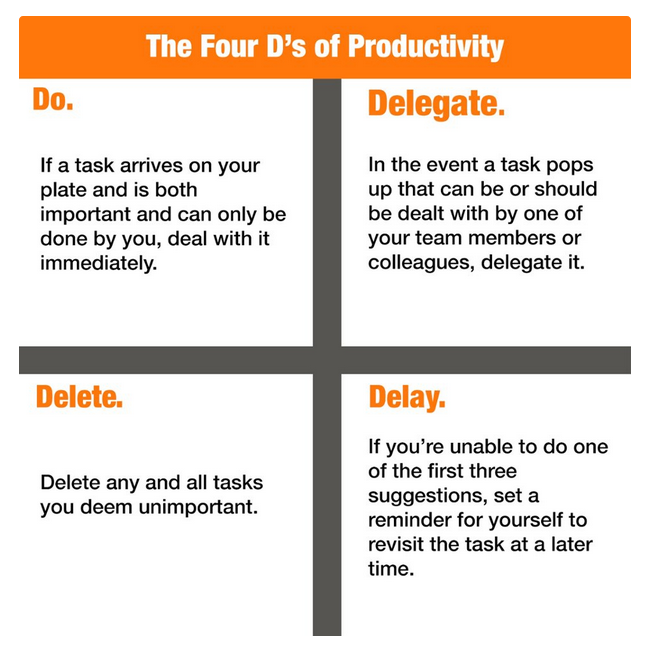
5. Adhere to the “four D’s” system of productivity.

Have you heard of Priority Manager or other systems of paper and digital notes management? My favorite… the four D’s was previously blogged at https://paulkfoxusc.wordpress.com/2017/12/01/help-how-does-one-keep-up/.

  • Do it! (Act on it immediately!)
  • Delay or Date it! (Assign it to the future!)
  • Delegate it! (Give it to someone else to do!) or
  • Dump it! (Delete or move it into the trash)

Check out the practical advice unveiled at https://blog.hubspot.com/sales/4-ds-of-productivity. I particularly liked Mike Renahan’s visual which sums up the system:

Four Ds


6. Devote at least 30 minutes a day to professional reading.

“Why did the busiest person in the world, former president Barack Obama, read an hour a day while in office?”

“Why has the best investor in history, Warren Buffett, invested 80% of his time in reading and thinking throughout his career?”

“Why has the world’s richest person, Bill Gates, read a book a week during his career? And why has he taken a yearly two-week reading vacation throughout his entire career?”

Answer? “If you’re not spending five hours per week learning, you’re being irresponsible.”

– Michael Simmons at https://qz.com/work/1124490/5-hour-rule-if-youre-not-spending-5-hours-per-week-learning-youre-being-irresponsible/

***

“In the busy teaching day, it can often be the last thing on your mind to dive into some professional reading. So, why should you make it a priority and how can you utilize your time effectively to fit it in?”

– Hazel Brinkworth at https://www.teachertoolkit.co.uk/2018/10/09/time-to-read/

It seems obvious, doesn’t it? Teachers have to “keep up” with their “craft,” explore mobile-791071_1920_kaboompicsdeveloping innovations, trends, and movements in their field, and embrace better instructional techniques and use of media for their students!

“I don’t have time” means you are not a true professional. Doctors and other medical care providers, lawyers, investment counselors, clergy, etc. – you name the “profession” – must continually renew their knowledge-base and “sharpen their saws.” Regular reading and attending conferences help motivate you, “recharge your batteries,” retool for the formation of new goals, review better strategies, and introduce improved teaching methods, materials, literature, and technologies.

The aforementioned Teacher Toolkit website scripts tips on how to get started:

  1. Focus your topic of interest.
  2. Know where to look.
  3. Listen instead of reading!
  4. Set aside a regular time slot in your week.
  5. Find a quiet place.


iphone-410324_1920_JESHOOTScom

7. Cut back on your “screen time,” especially closer to your bedtime.

“There’s a lot of debate about how much screen time is too much screen time, specifically for children, but also for adults. Likely you’ve heard about how it’s a good idea to stop using our electronics in the evening so you can wind your brain down for bed. But when it comes to screen time, the only thing that seems conclusive is that there’s such a thing as too much and that it may be different for everyone and depend on the circumstances.”

Interesting Engineering blog-site offers these “11 Easy Ways to Reduce Your Screen Time” (https://interestingengineering.com/11-easy-ways-to-reduce-your-screen-time).

  1. Eat your meals without a screen
  2. Limit your non-work screen time
  3. Don’t watch movies or TV in bed
  4. Cut down on computer socializing
  5. Set a timer
  6. Ban phone charging from the bedroom
  7. Take up another hobby for boredom
  8. Schedule a meeting phone call instead of using chat
  9. Think of other ways to access information
  10. Get your news in a condensed feed
  11. Exercise while you watch


8. Are you  getting enough sleep?

male-3730041_1920_Engin_AkyurtThe answer is… probably not.

According to a 2013 Gallup Study (the last year Gallup published a sleep study), the average American sleeps only 6.8 hours a day — and that number may be getting worse over the last several years.

Most experts recommend we receive 7 to 9 hours per night, but the quality of sleep is just as important as the quantity. The HelpGuide website (https://www.helpguide.org/articles/sleep/sleep-needs-get-the-sleep-you-need.htm/) posted this chart with data from the National Sleep Foundation:

sleep

Brittney Morgan at https://www.apartmenttherapy.com/how-to-hack-your-sleep-schedule-and-get-your-full-8-hours-242712 suggested these remedies:

  1. Ease into an earlier bedtime.
  2. Rethink how you use alarms.
  3. Create a sleep routine.
  4. Unplug and de-stress before bed.
  5. Write out your thoughts.
  6. Limit alcohol and caffeine

spiral-notebook-381032_1920_kathrin_I remember when I taught full-time and was in the middle of a full-blown musical production, I sometimes laid awake feeling “stirred up” inside trying to think of all the things I needed to do the next day. #5 of Brittney’s list is solved by putting a legal pad and a good pen by your bed stand, and without awakening your spouse, roll over and jot down a few of your “don’t forgets.” Or if you prefer to use the magic of technology, you can do this digitally… take a minute or so and use your tablet or smartphone, but don’t stay up very long and let the screen’s blue-light make your insomnia worse. Revisit title heading #2 above for note-taking apps.

It’s absolutely amazing the number of sources you can find on the web for additional advice for improving your sleep habits:


9. Get rid of the stuff you don’t need

“Now and again, everyone faces a big life transition. For me, it was when I lost my father — right around the time I realized my kids were rapidly growing up (funny how that sneaks up on you, huh?). I started to think about how I really wanted to live my day-to-day life. From the clothes on my body to stuff in my home, I wanted to stop perpetuating things that made me feel bad about myself.”

minimalism-241876_1920_bohemienne“Much like Gilligan and his infamous “three hour tour,” what I thought might be a quick clean-out extravaganza turned into an epic, six-month journey through the nether reaches of my closets and my psyche. Along the way, I learned many things from Maeve about organization — and more than a few things about myself that changed my relationship with my stuff.”

“This is tough for anyone, but it’s a crucial step in regaining control over your stuff. I was really honest with myself, and resolved to not beat myself up over getting rid of (or donating) things we didn’t need — even if they were in good shape. When you start to think of your things as part of an ecosystem for your life, it becomes easier to pare down to only the stuff you really love.”

Ask yourself, how often do you “purge the junk” from your home?

Showcased on Beginning Minimalist, Joshua Becker also shares “10 Creative Ways to De-Clutter Your House” at https://www.becomingminimalist.com/creative-ways-to-declutter/. Be sure to read what he refers to the Oprah Winfrey Closet Hanger Experiment, now my “new favorite” way of discarding seldom-worn clothing.


clutter-360058_1920_Kasman

10. Don’t forget to organize your living spaces.

In “7 Smart Organizing Tricks You Probably Have Not Tried” (https://www.realsimple.com/home-organizing/organizing/smart-organizing-tricks), Louisa Kamps recommends these logical time-savers and better spacing engineering techniques:

  1. Expose everything in your dresser drawers
  2. Store like with like.
  3. Be mindful of the pleasure your possessions give you.
  4. Keep your workspace clean and clutter free.
  5. Streamline your files.
  6. Create effective to-do lists (or see #1 above)
  7. Make “mise-en-place” a way of life.

Need more household tips? One Crazy House also provides a wealth of ideas in their blog-post, “17 Clever Organizing Tricks You’ll Wish You’d Known Sooner” by Donella Crigger at https://www.onecrazyhouse.com/organizing-tips-tricks/. And, if seventeen are not enough, what about over a hundred? Go to the Good Housekeeping’s site: https://www.goodhousekeeping.com/home/tips/g2610/best-organizing-tips/.


Hopefully these hints help you “tidy up” for the New Year, and bring you more productivity, peace of mind, and joy in your lives!

PKF

© 2018 Paul K. Fox

ring-binders-aligned-2654130_1920_AbsolutVision


Photo credits in order from Pixabay.com: “young” by kaboompics, “checklist” by TeroVesalainen, “paper” by rawpixel, “important” by geralt, “cello” by enbuscadelosdragones0, “board”by rawpixel, “mobile” by kaboompics, “iPhone” by JESHOOTScom, “male” by Engin_Akyurt, “spiral-notebook” by kathrin, “minimalism” by bohemienne, “clutter” by Kasman, and “ring-binders” by AbsolutVision.

The PMEA State Conference Primer

Getting the Most Out of Music Conferences… Suggestions for First-Time Attendees or New Teachers

Music conferences offer students as well as seasoned musicians a wealth of professional opportunities. They are motivating and help recharge your battery. They even help set future goals. Consider music conferences an essential component of your training and career…

CLICK HERE TO READ MORE – The original release of this article is at http://majoringinmusic.com/music-conferences/

Education’s purpose is to replace an empty mind with an open one. – Malcolm Forbes

The greatest benefits of attending an academic or professional conference are the opportunities to build your network and increase your awareness of new trends happening in your area of interest. – Emad Rahim http://www.coloradotech.edu/resources/blogs/june-2013/professional-conference

Networking with others in the field, getting new and innovative ideas, self-reflection and re-thinking of previous methods, and improving communication skills are just a few of the ways professionals can grow and develop.  – Conferences and Professional Development by the Grand Canyon University Center for Innovation in Research and Teaching https://cirt.gcu.edu/research/developmentresources/research_ready/presentationready/prof_develop

For professional networking, it is your “charge” to create multiple pathways to/from school administrators, HR managers and secretaries, music supervisors and department heads, and music teachers… and you – your skills, accomplishments, unique qualities, experience, education, and personality traits. Paul K. Fox https://paulkfoxusc.wordpress.com/2016/04/04/networking-niceties/

pcmea

Welcome to the annual state conference! For Pennsylvania Collegiate Music Education Association (PCMEA) members and soon-to-be-hired music educator prospects, this guide will help you get the most out of attending the 2017 Pennsylvania Music Educators Association (PMEA) Spring Conference (and future professional development events).

Reasons to “drop everything” and attend an in-service conference:

  1. Conferences “grow” your professional network and opportunities for future collaboration.
  2. Conferences build your knowledge base: to hear about potential job openings, stay current in the field, learn new ideas, music literature, classroom materials, curriculum initiatives, research, technology, and unique approaches to problems, and to see “state-of-the-art” (“model”) performances of student and professional music ensembles.
  3. Conferences expand your resources.
  4. Conference motivate (a.k.a. “recharge batteries”) and help you plan future goals.

People in academics cultivate exceptional resources—and they’re excited to share them with like-minded colleagues. During the conference, I had an opportunity to test out new technology, review upcoming publications, share teaching tools and techniques and obtain samples of textbooks, software and mobile applications. Conferences are full of people promoting new ideas, vendors selling new products, and consultants teaching new methodologies. I always take advantage of this opportunity to fill up my academic tool-shed with new techniques and technology to improve my career. – Emad Rahim

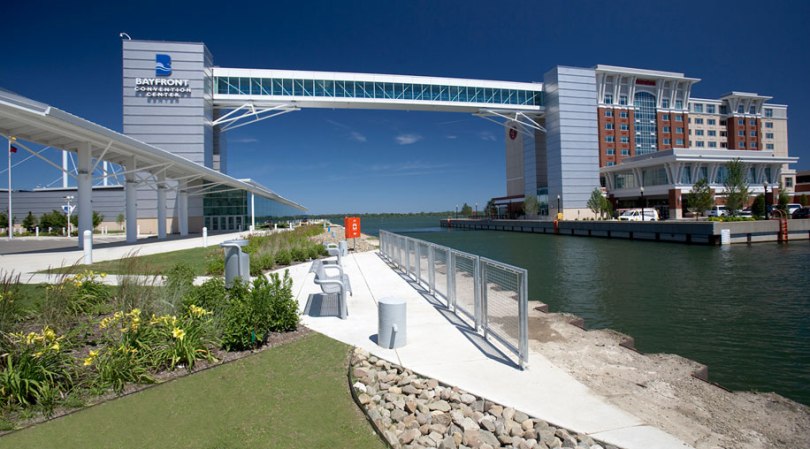
bayfront1_highThe annual PMEA Spring Conference will be held on April 19-22, 2017 at the Erie Bayfront Convention Center. These sessions may be “perfect for PCMEA!”

  • Opening General Session with Tim Lautzenheiser Thursday 8:30 a.m.
  • PCMEA meetings Thursday 10:30 a.m. and Friday 11:15 a.m.
  • Getting the Most Out of Your Student Teaching Experience Thursday 1:30 p.m.
  • Cracking the Graduate School Code: When, Where, Why, How, & How Much Thursday 3 p.m.
  • Starting with the End in Mind – or – You’ve Got Four Years, Use Them Wisely Thursday 4:30 p.m.
  • Music Education & Gaming: Interdisciplinary Connections for the Classroom Friday 8:15 a.m.
  • Ready for Hire! Interview Strategies to Land a Job Friday 9:45 a.m.
  • Planning Strategies to Develop a Responsive Teaching Mindset Friday 2:15 p.m.
  • Final General Session with NAfME Eastern Division President Scott Sheehan Friday 3:45 p.m.

For a complete conference schedule, consult PMEA News or this web-link: http://www.pmea.net/wp-content/uploads/2017/01/2017-PMEA-Annual-Conference-Schedule-for-Winter-News.pdf.

pmeaFirst things first! Prepare yourself in advance. Grab your winter or spring issue of PMEA News. Review the program of sessions which is usually laid out in chronological order and also by content strands (e.g. advocacy, choral, classroom music, collegiate, curriculum development/assessment, higher education research, instrumental, music technology, World Music, and special interest topics), as well as the list of keynote speakers, guest clinicians, showcase (music industry) demonstrations, association meetings (like PCMEA), and performances. Using an “old-fashioned” 20th century tool, mark up the conference schedule with two different colors of highlighter marking pens, first targeting “high interest” areas in yellow, and then “must attend” events in hot pink or other favorite color.

Next, download the PMEA Conference App (usually from Core-Apps.com). This is the 21st Century technique for setting up your conference schedule (“where to go and what to do”), reading the bios of the presenters, locating the session rooms and exhibit booths, finding out who is attending, taking and storing your notes, and learning about last minute changes. Here is the picture of the 2016 PMEA app:

pmea-app

More DO’s and DON’Ts for effective conference attendance:

  1. DON’T remain in your “comfort zone” by sitting exclusively with your friends or college buddies at every session and concert. DO socialize with your peers at meals, and DO attend meetings of your PCMEA. However, if you are trying to take advantage of networking opportunities, to get to know other professionals, possible job screeners, administrators, etc., DON’T just sit with people you know at every other event.
  2. SONY DSCDON’T focus exclusively on attending sessions or concerts in your specialty or most proficient areas, such as band if you’re a woodwind, brass or percussion major, orchestra if you are a string player, general music/choral if you are a vocalist or pianist. DO go to sessions that are not directly related to your major. You might be surprised at the connections you discover or the new interests that arise. Imagine “they” want to hire you next year as the next middle school jazz coach, HS marching band show designer, choreographer for the elementary musical, conductor of the string orchestra, teacher of AP music theory, etc. Could you select music for an elementary band (or choral) concert, create a bulletin board display for a middle school general music unit, set-up a composition project, or lead folk dancing at the kindergarten level?
  3. DO stay at (or near to) the hotel where the conference is being held… to see and DO more!
  4. Learn and DO the best practices of networking, personal branding, business card creation and distribution, and record-keeping of conference notes, job openings, and contact information. DO read my blog-post on Networking Niceties: The “How to Schmooze Guide” for Prospective Music Teachers at https://paulkfoxusc.wordpress.com/2016/04/04/networking-niceties/.
  5. playing-harp-1563567DON’T be shy! A conference is no place for being timid or afraid to start up a discussion with a more experienced music teacher. PMEA is all about circulating and introducing yourself, exhibiting your “charming self,” exploring resources and who are the experts/leaders in music education, getting the “lay of the land,” and adding as many names and emails to your professional contact data base as possible. Of course, DO follow-up with anyone who suggests that there may be a future employment posting from their school district!
  6. DO attend both general sessions, one usually scheduled on Thursday morning and the other on Friday afternoon. These will feature the keynote speakers and a special performance or award presentation. Since it is free and another opportunity to network, DO attend the Saturday morning awards breakfast and general membership meeting.
  7. DON’T be the first person to leave a session, and definitely DON’T “hop around” from one clinic or concert to another. Many attendees consider leaving early disruptive and rude, and it does not allow you to get the “whole picture” of the presentation. DON’T run in and grab the handouts… they will not have much meaning unless you attend the entire one-hour workshop. DO interact with the clinicians and conductors. If someone gave a talk, introduce yourspiano-and-laptop-1508835elf and ask a thoughtful question on some issue about which you are curious or found interesting.

  8. DO attend (and participate in) at least one panel discussion, music reading workshop, and technology session. DO search for special sessions held for college students on interviewing and landing a job. DO visit the displays of the PMEA Research Forums and the Exhibits.
  9. DON’T expect to get a lot of sleep at the conference. DON’T miss the interesting concerts to attend at night as well as early morning breakfast meetings and evening receptions. But, whatever you do, DO have FUN at your first music teacher conference!

Actually, PMEA represents only one of a series of outstanding music education conferences offered to school music teachers. In addition, you should look at:nafme

Hopefully, these tips on networking and taking advantage of the many professional benefits for attending an in-service conference will assist your successful pursuit for “landing” a job, discovering your own “calling” in the field of music education, and contributing a lifetime of meaningful work to our profession. See you in Erie!

Suggested Additional Readings:

  • Caffarella, R. S., & Zinn, L. F. (1999). Professional development for faculty: A conceptual framework of barriers and supports. Innovative Higher Education, 23(4), 241-254.
  • Guskey, T. R., & Huberman, M. (1995). Professional development in education: New paradigms and practices. Teachers College Press, 1234 Amsterdam Avenue, New York, NY 10027 (paperback: ISBN-0-8077-3425-X; clothbound: ISBN-0-8077-3426-8).
  • Guskey, T. R. (2000). Evaluating professional development. Corwin Press.
  • Snow-Gerono, J. L. (2005). Professional development in a culture of inquiry: PDS teachers identify the benefits of professional learning communities. Teaching and teacher education, 21(3), 241-256.
  • Sunal, D. W., Hodges, J., Sunal, C. S., Whitaker, K. W., Freeman, L. M., Edwards, L., … & Odell, M. (2001). Teaching science in higher education: Faculty professional development and barriers to change. School Science and Mathematics, 101(5), 246-257.

PKF

© 2017 Paul K. Fox

Photo credits: saxophone 24youphotography, harpist Gerrit Prenger, and computer/music keyboard LeslieR at FreeImages.com