Summertime Prep for Music Ed Majors

Collegiates: You snooze, you lose!

After a well-deserved break from your academics and other college or work deadlines, music-2674872_1920_kevinbismnow would be the perfect time to explore supplemental resources and get a “head-start” on additional pre-service training for next fall. These tips are especially valuable to anyone entering his/her senior or final year as a music education major, finely honing in and marketing your skills as a professional in order to be prepared for finding and succeeding at your first job.

Actually I hate to admit it, I enjoy assigning college students a little “homework!” But, most of this you can do from the comfort of your patio, beach blanket, swimming pool lounge chair, or couch in the game room. With the exception of “getting your feet wet” and diving into enriching music teaching field experiences and a summer workshop or two, all you need is a pencil to take notes and a device with access to the Internet.

There’s a lot to-do right now, and you only have the rest of July and August. Please try to “keep your eyes on the target” and squeeze in a few of these self-improvement plans around your vacation trips (seven lessons – see sections below) :

  1. Summer practicum
  2. Conferences
  3. Online research
  4. Skill gap-filling
  5. Ethics training
  6. Digital archiving
  7. Interview prep


orchestra-2496505_1920_HeungSoon


1. Are you really ever “on vacation” from music education?

Most veteran music educators would respond with “NEVER!” We maintain our professionalism by participating in workshops, reading teacher journals and online articles, perusing lesson materials and new music, practicing and advancing our personal musicianship, undergoing technology “tune-ups,” and focusing on other career development. This is a 12-month, even 7-day process, and academic breaks when they appear on our calendar allow us to “double-down” in areas we need the most help.

“Hands-on” training not only “fills-up your resume” with primary employment/volunteer sources, but more importantly, exposes you to realistic opportunities to expand your skills and knowledge of the “best practices” in music education and leadership training, while building techniques for handling student motivation and discipline best learned from “the school of hard knocks.”music-3090204_1920_brendageisse
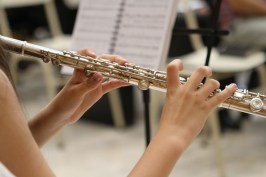
These placements don’t always come “knocking at your door.” Go out and seek a little adventure! For leads, talk to your high school band, string, or choir director. Your purpose is to find something that allows you some contact with children… free (usually) or paid, in or outside the field of music and the arts. Here are a few ideas:

  • Coach summer band sectionals, field rehearsals, marching or dance practices, etc.
  • “Put up your shingle” and teach private or small class music lessons.
  • Offer to arrange music or or provide choreography for local school drum-lines, marching bands and/or auxiliary units, or theater groups.
  • Sing in a community or church choir, and offer to help accompany, vocal coach, or conduct.
  • Sign-up to assist in local youth ballet, modern dance, or drama programs.
  • Sing, play, or teach solo or chamber music for summer religion or music camps, childcare facilities, hospitals, or senior citizen centers.
  • Volunteer (in almost any capacity) at a preschool or daycare center.

 

kids-1093758_1920_klimkin


2. The tools of the trade – CONFERENCES!

Summer is a GREAT time to grow your network of valuable opportunities for future collaboration, do a little goal setting, and “push the envelope” with professional development of the “latest and greatest” and “state of the art” music and methods.  The primary source for professional development is the education conference. There still may be time for you to find one close to you, perhaps in conjunction with a little sightseeing or visits with friends and relatives in the same city, like the following:

Thanks to www.takeflyte.com/reasons-to-attend-conferences, we know that attending workshop sessions are “good for you!” Participating in a conference helps you to…

  • Sharpen the saw (sharpen your skills – Stephen Covey’s seventh habit of highly effective people)
  • Meet experts and influencers face-to-face
  • pmeaMix and mingle to improve your networking opportunities
  • Find new tools and innovations
  • Learn in a New Space
  • Break out of your comfort zone
  • Be exposed to new tips and tactics
  • Relearn classic techniques with greater focus
  • Share experiences with like-minded individuals
  • Discover the value of the serendipity in a random workshop
  • Invest in yourself
  • Have fun!

If you really need any additional rationale for spending the money, click on the blog-post “Getting the Most Out of Music Conferences” at https://majoringinmusic.com/music-conferences/.

Finally, believe-it-or-not, you can bring the conferences to YOU! For the annual $20 subscription fee, you can view NAfME Academy professional development videos on almost any topic you can imagine. Check out the NAfME library of webinars: https://nafme.org/community/elearning/.
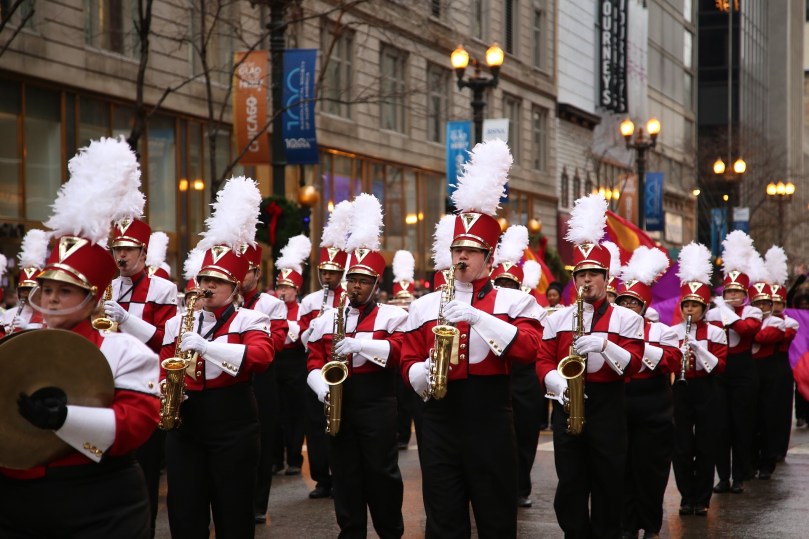
 

marching-band-1404489_1920_sam99929


3a. A winning website

The aforementioned Majoring in Music website is an excellent place to visit. It is amazingly extensive. You should read these articles for your “final year of prep.”


3b. These “awesome” resources are brought to you by NAfME

Besides the broad-based music subject matter and specific teaching skills, here’s some valuable advice, including how to “run a music program” (first link). I hope I am not stating the obvious: You should become a member of this national association for the advancement of music education.


Amplify

I also want to point you to the community discussion social media platform called Amplify, a benefit of NAfME membership. We are stockpiling a lot articles for college music education students, as well as sharing dialogue on everything from pedagogical issues to music equipment purchasing recommendations in both the collegiate member group and “music education central.” Go to https://nafme.org/introducing-amplify-largest-community-music-educators-country/.
 

guitar-2922536_1920_sunawang


4. “Filling in the gaps”

Your music education methods courses and other college classes were never expected to provide 100% of the necessary tools to become a competent teacher in every setting. This spotlights the need for professionalism. Once you land a job, you will have to “catch-up” and seek additional training to improve those areas in which you feel inadequate or unfamiliar. You can begin NOW to explore a few of these areas while enjoying your less stressful off-campus schedule:

  • child-621915_1920_skeezeUnderstanding specific educational jargon and the latest approaches, applications, and technologies in the profession (e.g. Backwards Design, The Common Core, Whole Child Initiatives, Multiple Intelligences, Depth of Knowledge and Higher Order of Thinking Skills, Formative, Summative, Diagnostic, and Authentic Assessment, etc. – Do you know the meaning of these terms?)
  • Teaching outside your “major” area or specialty (e.g. instrumental music for voice students, etc.)
  • Comprehending behavior management techniques and suggestive preventive disciplinary procedures
  • Mastering the use of valid assessments (e.g. can you give specific examples of diagnostic, authentic, formative, and summative assessments?) as well as a variety of music rubrics and evaluative criteria
  • Knowing the provisions of the Family Educational Rights and Privacy Act and other confidentiality statutes, Individual Education Plans and service agreements, and accommodating students with disabilities
flute-2245032_1920_congerdesignYou need to ask yourself the question, “What are my greatest weaknesses in music education?” Or, to put it another way, “What school assignments would I feel the least confident to teach? After earning your state’s all-essential credential, your certificate will likely be general and only say “music Pre-K to Grade 12.” Administrators will expect you can “do it all” – introducing jazz improvisation at the middle school, accompany on the piano or guitar all of the songs in the grades 1-6 music textbook series, directing the marching band at the high school or the musical at the middle school, starting an elementary string program, etc.

Figure out and face your greatest fears or worse skill areas. Work on them now! Take a few lessons, join a new ensemble of the “uncomfortable specialty,” ask help from your peers, etc.

More about this was printed in a previous post: https://paulkfoxusc.wordpress.com/2018/03/11/transitioning-from-collegiate-to-professional-part-ii/.

 

microphone-1804148_1920_klimkin2


5. The ABC’s of professional ethics

So far, have you been given any ethics training in college? Most pre-service educators only receive a cursory introduction to such things as codes of conduct, moral professionalism, guidelines to avoid conflicts in relationships with students, use of social media, confidentiality regulations, copyright infringement, pedagogical and economic decision-making, etc.

Now in my 46th year working in the field of music education (although retired from the public schools in 2013), I unblushingly admit I never had a full-blown course in ethics. Music colleagues have confirmed to me that it was barely (or not at all) touched-on in music methods classes, introduction to student teaching, school district orientation or induction sessions, or back-to-school in-service programs. choir-458173_1920-intmurrSince music teachers are all “fiduciaries” (do you know the meaning of the word?) and legally responsible for our “charges,” wouldn’t it be a good idea to review our state’s regulations and code of conduct, and hear about the challenges and pitfalls of ethical decision-making before we jump in and get “over our heads,” so-to-speak?
I can offer you two ways to immerse yourself into music education ethics. If you are a PCMEA or PMEA member and an “auditory learner,” you might prefer the FREE PMEA online webinar video (two-part) plus handouts at https://www.pmea.net/webinars/. Otherwise, visual learners and others may like this five-part blog series:


band-1850616_1920_Pexels


6. “A picture says a thousand words” in marketing yourself

Have you been archiving your last several year’s of field assignments? Have you recorded numerous moments of teaching, music directing, performing, and working with students? Are you prepared for the coming year’s student teaching, getting ready to take still photos, audio samples, and video excerpts?

“We cannot emphasize the power of pictures enough when it comes to portfolios. During interviews, committee members are trying to get to know you and trying to envision you teaching. Don’t trust their imaginations to do so, give them pictures… photos or newspaper articles of you teaching students in the classroom, with students on field trips, learning excursions or outside class activities, with children while you are serving in adviser roles, with your students at musical or athletic events, coaching or working with children in a coaching capacity, as a leader and role model.” – http://www.theeduedge.com/top-five-must-haves-top-five-could-haves-your-teacher-interview-portfolio/

As I mentioned in a previous blog, be careful to obtain permission in advance to video record students for your e-portfolio. During your field experiences or student teaching, little-girl-3043324_1920_Atlantiosask your cooperating teacher (or his/her supervisor’s) permission. Some school districts have “do not photo” rosters. (However, in my district, only a few elementary students were “on the list” and most defaulted to a “permissible” status unless the parent opted out. The principal’s secretary had a record of all exceptions.) It is also suggested that you focus your camera mostly on YOU and not the students, from the back of the classroom or rehearsal facility (possibly from afar), so that the student faces are not clearly discernible. To respect their privacy, in the recorded excerpts, do not use any segment announcing the names of your students.

What would be ideal to place on/in your website/e-portfolio? Show a wide spectrum of experience and training: elementary and/or middle school general music, band, choral and string ensembles (all grades), marching band, musicals, dance, music technology, piano and guitar accompanying, Dalcroze eurhythmics, Orff instruments, etc. Competency, versatility, and being well-rounded are the keys here.
 

boy-273279_1920_Silberfuchs


7. Teacher interviews – “practice makes perfect”

I have written a lot on the subjects of assembling a collection of your teaching anecdotes and stories, marketing your “personal brand,” and preparing for the employment screening process. (Have you wandered through the comprehensive listing at https://paulkfoxusc.wordpress.com/becoming-a-music-educator/?)

However, I recently came upon several new-to-me online articles that summarize the basics. Please take a look at these:

After reading all of these (and compile your own list of interview questions), you should get together informally with your fellow juniors and seniors and hold mock interviews, record them, and jointly assess the “try out” of your interviewing skills to land a job.

Finally, have you recently updated your resume, and created (or revised) your professional business card, website, and e-portfolio?
children-2685070_1920_mochilazocultural


Okay, I admit it. I got a little carried away. You would need TEN SUMMERS to cover everything above. What’s that saying? “There’s never enough hours in a day…”

Hopefully these resources  and recommendations are helpful “food for thought!” You cannot accomplish anything by procrastination… or just “sleeping in!”


Many have said that aspiring to be a music educator is a lot like a “calling.” Using your summer “free time” is all about “professional engagement.” One of my superintendents said he expected prospective new music teacher recruits to show high energy, enthusiasm, sense of purpose, and dedication during the interview… even a supposed willingness to “lay down in front of a school bus” or “do whatever it takes” to make the students (and the educational program) successful. Regardless of the hyperbole, that’s engagement!

So, what are you waiting for? Pass the sunscreen and the ice tea. Then, after a quick swim, jog, round of golf, or game of tennis, get started on your summer assignments!

PKF
 

piano-78492_1920_nightowl


© 2018 Paul K. Fox


Photo credits (in order) from Pixabay.com: “music” by ArtsyBee, “music” by KevinBism, “orchestra” by HeungSoon, “music” by brendageisse, “kids” by klimkin, “marching band” by sam99929, “guitar” by sunawang, “child” by skeeze, “flute” by congerdesign, “microphone” by klimkin, “choir” by intmurr, “band” by Pexels, “little girl” by Atlantios, “boy” by Silberfuchs, “children” by mochilazocultural, and “piano” by nightowl.

Summer or Anytime Music Enrichment

Focus on YOUR MUSIC during summer vacations, holidays, or academic breaks

foxsfiresides

The following idea-bank is a checklist offered to Band and Orchestra instrumentalists, their music teachers, and family members as “food for thought!”

Here are a few suggestions to consider as a TO-DO LIST after all the standardized tests, final concerts, and end-of-the-semester projects in all academic areas. Summertime is a wonderful way to “get to know” your instrument and build on your knowledge-base, technique, musicianship, and repertoire.

  1. Help organize your time by setting up a regular daily practice schedule. Practice a little every day. Consistency creates confidence!
  2. Create a “scale journal.” Write down on manuscript paper all your major and minor scales and the I, IV and V7 arpeggio series. Practice scales in all keys.
  3. Shriya NarasimhanCreate four new scale variations every day and add them to your “journal.” Creative new variations should make playing scales more enjoyable. Some examples are unusual rhythms (pizza toppings, desserts, interesting proper names), more difficult slurs, scales in thirds, etc.
  4. Explore the performance of one, two or three octaves of major, minor, chromatic, pentatonic and whole tone scales.
  5. To improve reading skills, play new music “at sight,” even music written for other instruments. Don’t be afraid to play a challenging piece above your ability level or even read a song from a piano score.
  6. Play through some of your “oldies” and favorites from past lessons or Band/Orchestra classes.
  7. shjo_Jonathan Pickell and Wendy HartVisit the local music store and browse. Explore new publications of Classical, pop, folk, fiddle/jazz, show tunes or other styles.
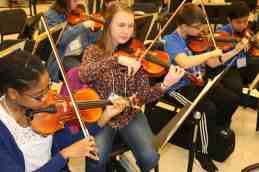
  8. Sign-up for a music camp or college classes of music appreciation, theory, eurhythmics, etc.
  9. Take a few private lessons. For enrichment, take piano, voice and/or learn a new instrument.
  10. Spend an entire day in the sheet music, recordings, and music book section at the local library.
  11. Purchase and learn the music audition requirements for your MEA band/orchestra ensemble or solo adjudication festivals.
  12. Form a chamber group with other players in your neighborhood and rehearse at least once a week.
  13. _shjo_violinistsPurchase a duet book for mix or matched instruments (such as Beautiful Music for 2 Stringed Instruments by Applebaum—Book I (easy), Book II (medium), Book III advanced). Team up with another musician (band or string) and share non-transposing parts (flute or oboe with violin, trombone with cello, etc.).
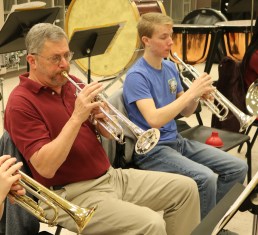
  14. Encourage yourself to “pick out a song by ear” and try to write it down on music paper.
  15. Sit in or join a local community or youth ensemble like the South Hills Junior Orchestra which rehearses on Saturdays in the Upper St. Clair High School (Western PA) Band Room. Rehearsals resume on September 8, 2018.
  16. shjo_David Levin_and_Devon AllenPlan a vacation or academic break around an out-of-state music workshop or concert series.
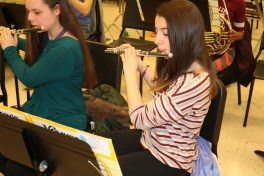
  17. Update your iTunes, Google Music, Amazon Music or other online music streaming services by purchasing and listening new solo or chamber works by artists who perform on the same instrument as you.
  18. Subscribe to SmartMusic, install/learn new music software, or peruse free online programs. Samples: Have you tried https://www.musictheory.net/ or https://www.good-ear.com/?
  19. Tune in to WQED FM, WDUQ or PBS and share a few minutes of classical music at least once a week. Attend concerts by professional musicians (like the Pittsburgh Symphony Orchestra, Civic Light Opera, or River City Brass).
  20. Prepare and perform a fifteen-minute recital for the residents of a local nursing home, hospital or Senior Citizen center.
  21. _shjo_in_rehearsal_031018 - 00Read books or magazine articles about famous musicians, performers, conductors or composers.


  22. Take a “field trip” to a luthier (person who makes or repairs string instruments) or the instrument dealer. Have your instrument examined, cleaned, adjusted and appraised. Purchase accessories and do any necessary repairs. If necessary, update your insurance!

How many of these can you accomplish over the months of June, July and August… or throughout the year? “Practice makes self-confidence,” and the more time you put into it, the more you take away from the experience. Please enjoy your summer or winter breaks, but learn to have fun with your instrument and EXPLORE MORE MUSIC!

Click here for a digital “take-away” of this list. Also, please feel free to share the other SHJO enrichment resources and “Fox Firesides” at http://www.shjo.org/foxs-fireside/ or https://paulkfoxusc.wordpress.com/foxs-firesides/.

seriestoshare-logo-01

Paul K. Fox, Director, South Hills Junior Orchestra        www.shjo.org

PKF

© 2018 Paul K. Fox

Photo credit from Pixabay.com: “fire” by skeeze.


Practice Journals Are “Notable” and the “Key” to Making Musical Progress

foxsfiresides

It’s all about defining focus, setting goals, practicing, and methodically solving problems!

A good way to “warm-up” to the benefits of making a personal practice diary, check out this video of cellist Sarah Joy “A Look Inside My Practice Journal.” https://www.youtube.com/watch?v=253UMKMfOoc.

(She has quite a collection of YouTube releases… everything from sight-reading tips to structuring your practice time. They are short and sweet!)

So, let’s get started with the “why” and “how” of using practice journals…

I asked the South Hills Junior Orchestra members to give me their insight on how they prioritize/plan their practice time. Thankfully, I received a thoughtful response from one of our violinists, Nicolette:

For practicing, I usually start out with a scale. Then, I’ll play a couple etudes I have. However, I won’t play all of them, instead I’ll leave some to play at the end of my practice. Then, I’ll move on to some of my easier pieces to practice. Moving on from that, I’ll play my harder pieces, or my orchestra music. I usually try to change it up a bit so I don’t get bored. Then I’ll finish up with the rest of my etudes. After I’m done practicing, I usually try to write in my practice journal. Whenever I practice, I will keep out my notes from my teacher and my practice journal to look back at while practicing.

For my practice journal, I try to write in it whenever I remember, because I would be lying if I said I wrote in it every day. When I do write in my practice journal, I write down what I need to practice the next day, whatever I was having difficulty with that day, and maybe some notes my teacher gave me.

If I’m starting to feel stressed and frustrated, or if I’m starting to get bored with practicing, I’ll start listening to music. The music can vary, but I mostly stick to musicals.

What do the experts say some of the rationales for maintaining a written journal for any serious educational pursuit?

  1. It defines targets for a more efficient use of time. http://www.essential-music-practice.com/efficient-practice.html
  2. Promotes accountability. http://theaspiringguitarist.net/guitar-practice-journal/
  3. Documents progress. https://www.musicindustryhowto.com/the-musicians-practice-journal-and-why-you-need-one/
  4. Keeps track of details. https://music.stackexchange.com/questions/3299/do-music-students-find-practice-journals-useful
  5. Harnesses creativity. https://lifehacker.com/why-you-should-keep-a-journal-and-how-to-start-yours-1547057185
  6. Explores what is important to you. http://blog.connectionsacademy.com/5-reasons-for-students-to-keep-a-journal/

What does a typical practice log/diary/journal look like?

The “basics” are lists of specific assignments, warm-ups, musical and technical goals, and repertoire. For example, the Fort Couch Band Director Dr. John Seybert distributes the following simple form to his grades 7-8 band students:

FCMS Practice Journal

Each entry should be dated and allow space to make comments and goals for your next session of practice. Many musicians divide up the page into segments, such as warmups, scales/exercises, etudes (studies), method book or solo pieces, and ensemble music, each with an area to jot down a narrative of what you did and how well things went.

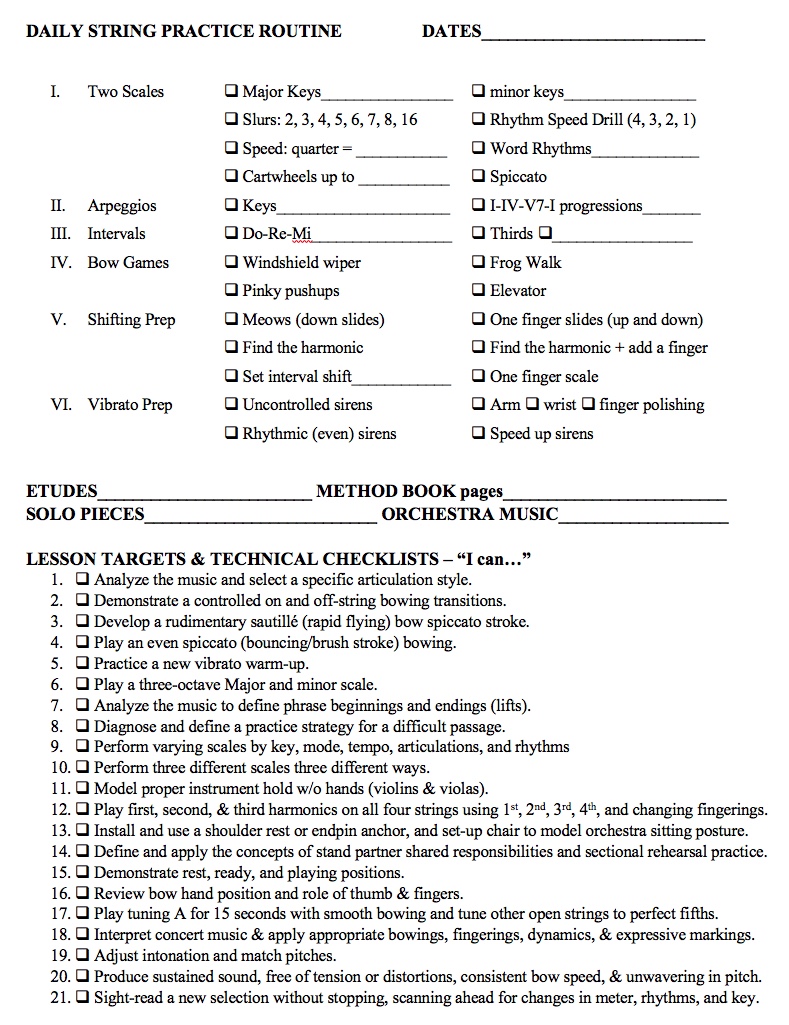
When I was teaching strings (grades 5-12), my students and I developed an extremely detailed daily practice regime, which included a year’s checklist of lesson targets:

Daily String Practice Routine

You can make your own “things-to-do” list, including the focal points your music teachers “harp on” for improving form and technique. What does the band or orchestra director say about long tones, tuning, good posture, steady beat, rhythms and note-reading, fingerings, ensemble blend and balance, etc.? Emphasize one or more of these for each practice session!

seriestoshare-logo-01In your “customized” journal, I recommend leaving space for metronome markings, special articulations, practicing tips and instructions (like “repeat it three-times-in-a-row perfectly” or “work on measures #1-8 today, #5-12 tomorrow,” etc.) and time spent. Remember, you are a problem solver and seek ways to integrate your “tool box of tricks” to learn each challenging passage. What works for you? What doesn’t? That’s the true magic of a journal… in with the good, and out the bad!


Several previous Fox’s Firesides have explored practice methods and the setting of goals: http://www.shjo.org/foxs-fireside/. There are many other online resources, samples, and articles about practice journals. A few sites try to sell you printed forms, but others just offer you advice on creating and using documents to set practice goals. Take time to peruse these:

What do you have to lose? Try setting up and maintaining a practice journal! It may improve the value and focus of the time you devote to working on your music… and make a real difference in your musical progress! Like Olympic athletes… go for the goals and the gold!

For a printable copy of this article, click here.

Feel free to share all SHJO enrichment resources and “Fox Firesides” at http://www.shjo.org/foxs-fireside/.

PKF

© 2018 Paul K. Fox

Photo credit from Pixabay.com: “Fire” by Alicja

TEAM = “Together Everyone Achieves More”

A Twist on an Old Fable… Who Really Won the Race?

Photo credit: FreeImages.com, photographer Eric Thibodeau


Before you do anything else, I want you to “take four,” fire up your computer, and view this YouTube video: https://www.youtube.com/watch?v=xevQ2yTyK9Y.

foxsfiresidesWhat is the moral to the final story of these two racers… the turtle and the rabbit?

To all student instrumentalists: SHJO and your school music ensemble represent a “TEAM” – not only inspiring your own creative self-expression and skill development, but learning to communicate, connect “symphonically,” and come together with all the musicians to achieve common goals.

For similar advice, we can go all the way back to the famous Greek philosopher Aristotle:

“The whole is greater than the sum of its parts.”

According to Wikipedia, synergy is the creation of “a whole that is greater than the simple sum of its parts.” The term synergy comes from the word synergos (συνεργός) meaning “working together.”

Another way to reflect on this concept is with this parable “Whose Job Is It” (author unknown) demonstrating apathy:

This is a story about four people named Everybody, Somebody, Anybody, and Nobody.  There was an important job to be done and Everybody was asked to do it. Everybody was sure Somebody would do it.  Anybody could have done it, but Nobody did it. Somebody got angry about that, because it was Everybody’s job. Everybody thought Anybody could do it but Nobody realized that Everybody wouldn’t do it. It ended up that Everybody blamed Somebody when Nobody did what Anybody could have done.

If you want to create the life and musical success you want, don’t be like Everybody, Somebody, Anybody and Nobody. Be true to yourself. Take responsibility for your life! Don’t let Everybody, Somebody, Anybody or Nobody stop you from doing what you need to achieve what you want and deserve for yourself and the TEAM!

The “take-a-ways” from this fable? What is your charge “for the good of the TEAM?”

  • Take personal responsibility for defining what life and musical success means to you.
  • Take personal responsibility for building your self-confidence. (Practice!)
  • Take personal responsibility to participate in rehearsals regularly. (Attend every week!)
  • Take personal responsibility for developing the competencies (skills) and preparations (focus on the hard passages) you need to succeed in the music.
  • Take personal responsibility for putting sufficient time seriestoshare-logo-01into the “TEAM.”
  • Take personal responsibility for building and nurturing relationships in the orchestra that will help you promote success.
  • Take personal responsibility in supporting the TEAM in “fun” raising (socials) and fund-raising projects… as we used to say back in the 60s, “be there or be square!”

At a SHJO rehearsal last Saturday, I expressed concerns that the reality of inconsistent attendance and inadequate at-home practice is making it difficult to rehearse and achieve progress. However, rest assured, I know our concerts will be great!

In every fifth-year anniversary milestone of SHJO, we have given back to those who have given us a very special gift… a permanent home. Our fund-raising efforts are lagging behind and we need all Friends of SHJO to “step up to the plate.”

In the future, you will have the opportunity to engage with other booster members and their leadership team to proceed toward our fund-raising goal of $12,000 for a gift to our gracious hosts, the Upper St. Clair School District. Ads and patron donations received as we go forward will be acknowledged in future concert programs, and we look forward to your generous assistance.

You are encouraged to peruse the South Hills Junior Orchestra website. Under “Resources,” check out the free “Series to Share…” additional “Fox’s Fireside” issues by Paul K. Fox, and “Music Enrichment Workshop” presentations by Donna Stark Fox.

PKF

© 2017 Paul K. Fox


SHJO35yr

This “Series to Share” is brought to you by… the Founding Directors of the South Hills Junior Orchestra (SHJO), “a community orchestra for all ages” based in Western Pennsylvania. Feel free to download a printable copy and distribute to music students, parents, teachers, and fellow amateur musicians.

Pizza, Batting Averages, and the “Ten Times Rule!”

Photo credit: FreeImages.com, photographer Sean Myers

More Practice Tools for Musical Preparation and Building Self-Confidence

foxsfiresidesInstrument lessons and orchestra practices provide opportunities for the music teacher to impart a few “tricks of the trade” in reading and then practicing music. I call these my “Craftsmen Tools” for successful musical construction… one note or one line of music at a time.

Take it from a world-famous maestro! According to Itzhak Perlman, practicing effectively “comes down to listening. What are you listening for when you practice?” He advises, “Just reduce it to small increments, two or three bars, and try to get a hold of everything at the same time… You can accomplish a lot more in less time. Practicing slowly is extremely important. Then you can figure out what’s going on. Nothing escapes you.”

You may have heard my reference to “cutting pizza” for the focus on a specific section, passage or “slice” in the music in order to repetitively drill to learn the notes. I suggest to my students that they should “take it small and take it slow,” and then gradually speed up the excerpt. Psychologists and education experts know that humans cannot absorb/retain/recite huge amounts of data at one time. (That is one of the reasons, for example, we separate long numbers with hyphens, like phone numbers, zip codes, and the social security identification. We CAN remember two, three and four digits at a glance, but most of us feel a little overwhelmed to memorize five or more numbers or places!)

In learning a new piece of music, the recommendation is to divide the work into segments. Our fast-paced life-style and hectic schedules do not usually allow for “gulping the whole thing” at one sitting (or playing through the entire folder of music, every note including the easy whole notes and rests). It is equally important to prioritize the “hard spots” in the music, and use slowed-down echo practice to our advantage. Labeling each section, and even going as far to marking the date each time it is practiced, will help our instrumentalists to focus on things that seem hard, logically plan (at first out-of-sequence), problem-solve, learn the day’s “goal,” and eventually put the pieces back together.

seriestoshare-logo-01At lessons, some music teachers refer to batting averages, and point out how a .333 baseball hitting average is outstanding in the Major Leagues (when big-league pitchers are throwing 90-mile hour balls at you), but terrible for a musician who plays one note right to two notes wrong. Since each practice session builds neural-connections across brain cells (physical “memory” to do the skill again), in order to “play it right” consistently, we have to repeat it accurately over and over again, thus “the Ten Times Rule.” Musicians have to achieve a .950 or better average, and practicing their challenging musical “slice” ten times in a row will do the most good. Cumulative effort over different sessions or days is also the key to success! If a hard passage is played 10-20 times today, repeated 10-20 times tomorrow, another set of 10-20 drills the next day, etc. until the part can be played perfectly “in a row” every time, the player will have NO WORRIES when it comes time to perform it at the concert.
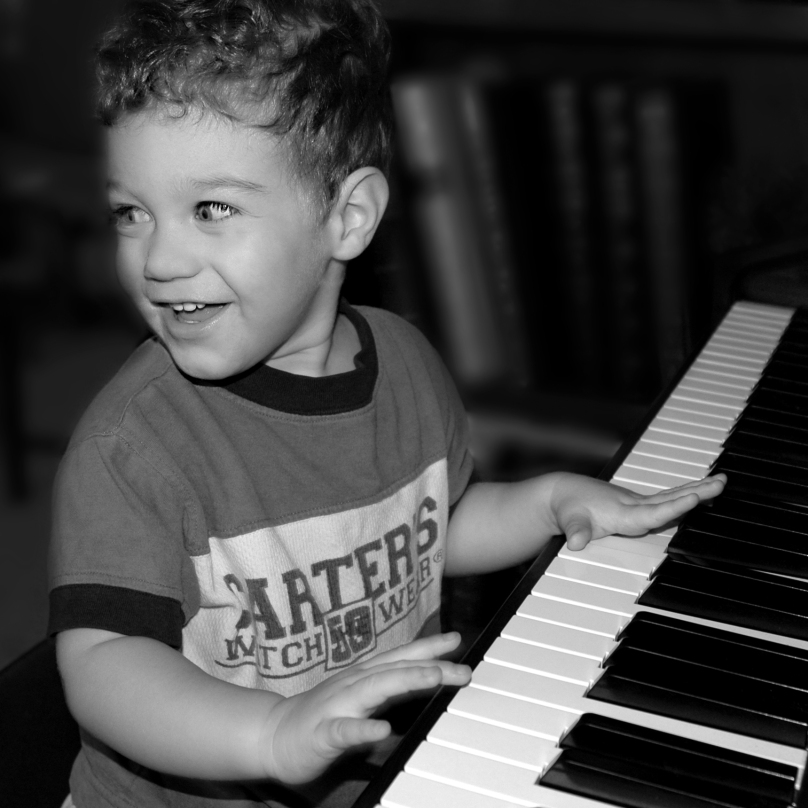

Several months prior to my senior viola recital at Carnegie-Mellon University, I told my professor I was a bit nervous. He said I was not practicing enough (on the hard sections). What I did not understand at the time was I lacked this drill-method of practicing to build my self-confidence and improve my “batting average.” If nothing but perfect sounding or “reruns” of music comes from your practice session, you are not properly focusing on “one slice at a time” nor winning with “the ten times rule!”

Take a trip to the South Hills Junior Orchestra website. Under “Resources,” check out the three sets of free “Series to Share…” additional “Fox’s Fireside” issues by Paul K. Fox, and “Music Enrichment Workshop” presentations by Donna Stark Fox.

PKF

© 2017 Paul K. Fox


SHJO35yr

This “Series to Share” is brought to you by… the Founding Directors of the South Hills Junior Orchestra (SHJO), “a community orchestra for all ages” based in Western Pennsylvania. Feel free to download a printable copy and distribute to music students, parents, teachers, and fellow amateur musicians.

SHJO rehearses most Saturdays in the band room of the Upper St. Clair High School, 1825 McLaughlin Run Road, Pittsburgh, PA 15241. New members are always welcome! For more information, please go to www.shjo.org.

Ethics for Music Educators I

Part I: Back to Basics

I keep a close watch on this heart of mine
I keep my eyes wide open all the time
I keep the ends out for the tie that binds
Because you’re mine, I walk the line.  — Johnny Cash

Johnny Cash sang his love song, “I walk the line…” but for teachers in the education profession, it is a “fine line” to maintain the standards and appearances of professionalism, morality, and ethical codes of conduct in the school workplace.

piano-prodigy-1508755

The purpose of this blog series is to explore an introduction to the definitions, philosophy, and practices of teacher ethics, integrity, professional standards, and behavior “codes,” and some of the available resources, perspectives, and “legalese” on proper relationships among students, parents, and other professionals, appropriate student-teacher boundaries, warnings of vulnerabilities and dilemmas at the workplace, and tips to avoid the problems of unacceptable appearances and actions.

ethics 3However, the disclaimer is that I am not an attorney, human resource manager, nor scholar on school ethics, nor was I ever trained in a single workshop, college class, teacher induction or in-service program on this subject. After reading this article, you should immediately visit the website of your state’s education department, and search on the topic of “code of ethics” or “code of conduct.” A few examples of the “real deal” are listed below, and yes, you must study “every word of” the entire document and  applicable rules from the state you are/will be employed.
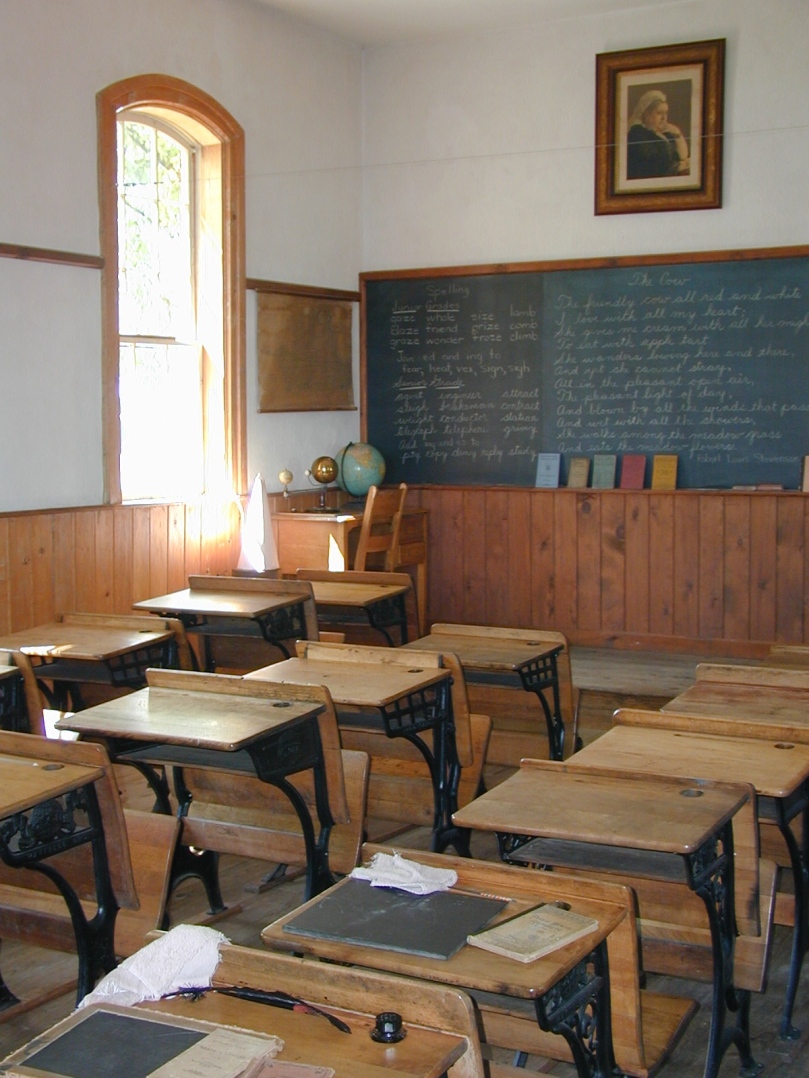
Teacher Rules — The Good Old Days?

OLYMPUS DIGITAL CAMERAAccording to Snopes (see http://www.snopes.com/language/document/1872rule.asp), the following “rules of conduct for teachers” — one of the similar “the way we were” documents of questionable origin — may have been circulating since at least the 1930s.

“Nobody has ever been able to verify the authenticity of this list of rules. It has been reproduced in countless newspapers and books over the last fifty years, and copies of it have been displayed in numerous museums throughout North America, with each exhibitor claiming that it originated with their county or school district.”

However accurate, one can only marvel at the real or perceived grimness of the late nineteenth/early twentieth century American schoolteacher’s lot: “the profession was lowly regarded, the work was physically demanding and involved long hours on the job, the position paid poorly, retirement benefits were non-existent, and teachers were expected to be among the most morally upright members of their community.”

Sample Rules for (Female) Teachers 1915

  1. You will not marry during the term of your contract.
  2. You are not to keep company with men.
  3. You must be home between the hours of 8 PM and 6 AM unless attending a school function.
  4. You may not loiter downtown in ice cream stores.
  5. You may not travel beyond the city limits unless you have the permission of the chairman of the board.
  6. You may not ride in a carriage or automobile with any man except your father or brother.
  7. You may not smoke cigarettes.
  8. You may not dress in bright colors.
  9. You may under no circumstances dye your hair.
  10. You must wear at least two petticoats.
  11. Your dresses may not be any shorter than two inches above the ankles.
  12. To keep the classroom neat and clean, you must sweep the floor at least once a day, scrub the floor at least once a week with hot, soapy water, clean the blackboards at least once a day, and start the fire at 7 AM to have the school warm by 8 AM.

— http://www.snopes.com/language/document/1872rule.asp

Professionalism

Like medicine and law, teaching is a “professional practice,” a “conservative” occupation with high expectations and close public scrutiny. Although many have considered the 24/7 nature of a career in music education a “calling,” the true qualities of the teaching professional include these values also embraced by doctors and attorneys:

  • on-the-phone-closing-the-deal-1241406 Michael RoachAchievement of higher education, constant training and retooling, specific goals, and self-improvement
  • Adoption and refinement of “best practices”
  • Habits of creativity, critical thinking, problem solving, and communication skills
  • Acceptance of criticism, peer review, teamwork, compromise, and group vision
  • High standards of behavior, etiquette, appearance, language, and ethics

According to “The California BTES – Overview of the Ethnographic Study” by David Berliner and William Tikunoff, “an effective teacher” is distinguished by exceptionally high standards:

Effective teachers score high on accepting, adult involvement, attending, consistency of message, conviviality, cooperation, student engagement, knowledge of subject, monitoring learning, optimism, pacing, promoting self-sufficiency, and structuring.

Effective teachers score low on abruptness, belittling, counting hours or “clock punching,” defiance, illogical statements, mood swings, oneness (treating whole as “one”), and recognition-seeking. — David Berliner and William Tikunoff

Referred to as “moral professionalism” (see Wynne, E.A. 1995. “The moral dimension of teaching.” In A.C. Ornstein Ed. Teaching: Theory into Practice. pp. 190-202. Boston: Alyn and Bacon),  the bar is further raised:

  • Coming to work regularly and on time
  • Being well informed about their student-matter
  • Planning and conducting classes with care
  • Regularly reviewing and updating instructional practices
  • Cooperating with, or if necessary, confronting parents of underachieving students
  • Cooperating with colleagues and observing school policies so the whole institution works effectively
  • Tactfully but firmly criticizing unsatisfactory school policies and proposing constructive improvement


balance-1172786 Stephen Stacey

Ethics

Webster’s definition of eth·ics is “the discipline dealing with what is good and bad and with moral duty and obligation” or “a set of moral principles.” Others have tried to clarify the meaning of these terms with more in depth interpretations:

Ethics is knowing the difference between what you have a right to do and what is right to do. — Potter Stewart

Ethical behavior is doing the right thing when no one else is watching – even when doing the wrong thing is legal. — Aldo Leopold

Ethics and morals relate to “right” and “wrong” conduct. While they are sometimes used interchangeably, they are different: ethics refer to rules provided by an external source, e.g., codes of conduct in workplaces or principles in religions. Morals refer to an individual’s own principles regarding right and wrong.

— “Ethics vs. Morals” at Diffen http://www.diffen.com/difference/Ethics_vs_Morals

According to Laurie Futterman, former Heart Transplant Coordinator at Jackson Memorial Medical Center and now chair of the science department and gifted middle school science teacher at David Lawrence Jr. K-8 Center, “ethics is a branch of moral philosophy.” Futterman wrote the following in the March 31, 2015 issue of Miami Herald about how ethics “involves defending and recommending concepts of right and wrong conduct.”

“In discussion however, ethics can become eclipsed by commingling concepts of values and morals. They all provide behavioral rules, so what are the differences?

  • Values are rules from which we make our personal decisions about what is right and what is wrong, good or bad. Values help direct us to what is more important and past what is less important. This helps guide us when making decisions.
  • Morals tend to be broad yet are more far reaching because of their strong link to good and bad. We judge others by their morals rather than their values.
  • Ethics, in contrast, are a set of rules that tend to be adopted and upheld by a group of people. This could include medical ethics, journalism and advertising ethics and educational ethics. So ethics or intent, tends to be viewed as something upheld and adopted internally, such as professionalism, while morals are ideals we impose on others.”

http://www.miamiherald.com/news/local/community/miami-dade/community-voices/article17030966.html#storylink=cpy

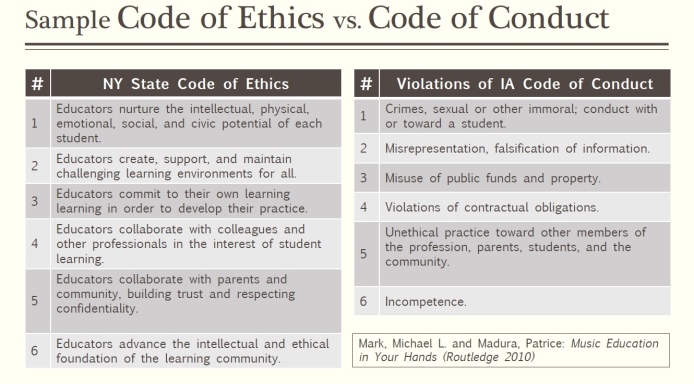
In addition, there are distinctions between “Codes of Conduct” and “Codes of Ethics.” Although they both provide self-regulation of (un)acceptable  behaviors,  frequently the Code of Ethics outlines a set of principles that affect/govern decision making, while the Code of Conduct delineates specific behaviors that are required or prohibited and governs actions.

ethics 29

For the sake of our discussion here about ethics in education, I will add the qualifier that gavel-1238036JasonMorrisona “violation of ethics” is usually associated with significant consequences or punishment, like charges of medical malpractice or lawyers facing an “ethics committee” hearing. Confirmed unethical behavior may result in censure, suspension of license or certification, or other discipline action. Most state education governing entities post legally-binding “educator discipline acts” or codes of professional standards, ethics, and/or behavior, with extensive penalties.
 

Discipline

The grounds for imposition of discipline are broad and far-reaching, and will be governed by the state or county education system to where you are employed. As an example, “the laws” defining infractions in Pennsylvania are:

  • Immorality
  • Incompetency
  • Intemperance
  • Cruelty
  • Negligence
  • Sexual misconduct, abuse or exploitation
  • Violation of the PA Code for Professional Practice and Conduct Section 5(a)(10)
  • Illegal use of professional title
  • Failure to comply with duties under this act, including the mandatory reporting duties in section 9a.
  • Actions taken by an educator to threaten, coerce or discriminate or otherwise retaliate against an individual who in good faith reports actual or suspected misconduct under this act or against complainants, victims, witnesses or other individuals participating or cooperating in proceedings under this act.

— PA Educator’s Discipline Act: 24 P.S. §§2070.1 et seq. Chapter 237/Definition of Terms: http://www.pacode.com/secure/data/022/chapter237/chap237toc.html

For more discussion on these definitions, visit http://www.pspc.education.pa.gov/Promoting-Ethical-Practices-Resources/Ethics-Toolkit/The-Commission-Professional-Discipline-and-the-code/Pages/Educator-Misconduct.aspx.

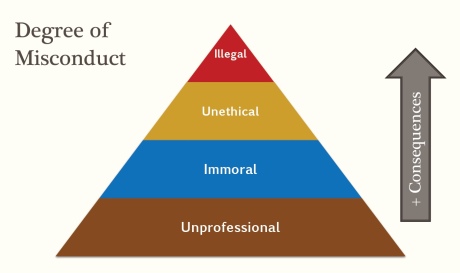
Violations range from exhibiting poor behavior or even the semblance of impropriety to “breaking the code” or criminal offenses. (Yes, “appearances” can get you in trouble, due to one’s interpretations of the above charges of “immorality,” “intemperance,” and “negligence!”) In short, from bad (unprofessional) to worse (illegal), this illustration ethics 22defines misconducts.

The first two on the bottom of the figure (unprofessional or immoral incidents) may only (?) result in damage to one’s professional reputation, lowering the year-end teacher evaluation score, earning a “warning” or “write-up” by the principal/supervisor, or a job re-assignment, but unethical or illegal conduct usually results in further investigation and possible major (and often permanent) disciplinary action:

  • Private Reprimand
  • Public Reprimand
  • Suspension (temporary termination of certificate)
  • Revocation (termination of certificate)
  • Surrender (of certificate)
  • Supplemental Sanctions
  • Legal (Criminal) Action (fines, suspension, jail time, other penalties)
  • Civil Action


Ethical Equilibrium: Consequential “Codes of Conduct” vs. Professional Ethics

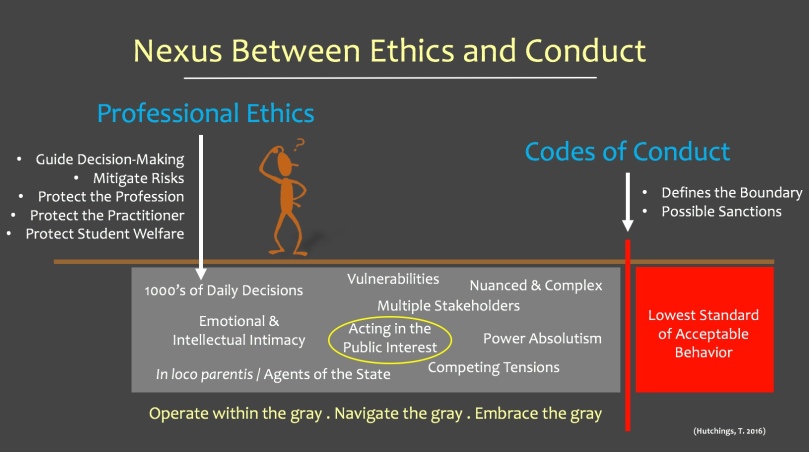
“From a decision-making standpoint, I tend to look at it from the perspective of Ethical Equilibrium (some work by Troy Hutchings). Teachers weigh the moral (personal) dimensions with regulatory ones (the law) with the ethics of the profession (ethics of teaching?). While focusing on consequences is important, I worry that teachers may interpret this to mean that as long as they don’t break the law, they can still be unprofessional and immoral.”

– Dr. Oliver Dreon, Associate Professor at Millersville University and author of the Pennsylvania Professional Standards and Practices Commission Ethics Tool Kit.

The foundations of “what’s right or wrong” and what your mother always said was “behaving appropriately when no one is watching you” are all about professional ethical standards that guide decision-making. The work of Troy Hutchings (among other leaders in this field) helps to further clarify these sometimes blurred definitions:

  • Personal Morality: “Personal values and beliefs derived from one’s life experiences… subjective and may/may not align with community mores.”
  • Regulations of Law: “Policies, statues, and judicial activity that articulate conduct absolutes.”
  • Professional Ethics: Professional ethical standards that assist practitioners within situation and systemic contexts in choosing the best course-of-action.”
  • Professional Dispositions: “Agreed upon professional attitudes, values and beliefs to be held by educational practitioners.”

See the slide below borrowed from the American Association of Colleges for Teacher Education webinar presentation “Beyond the Obvious: The Intersection of Educator Dispositions, Ethics, and Law” by Troy Hutchings and David P. Thompson.

Hutchings Nexus Between Ethics and Conduct

In other words, the intent of these essays on ethics is not to emphasize the “lowest standards of acceptable behavior” or the consequences of misconduct for music teachers. We will strive to move from “obedience and punishment orientation” (stage 1) and “self-interest orientation” (stage 2) to “social contract orientation” (stage 5) and “universal ethical principles (stage 6) of Lawrence Kohlberg’s “Six Stages of Moral Development.” (See http://ww3.haverford.edu/psychology/ddavis/p109g/kohlberg.stages.html).


Sample Codes of Ethics

MCEEOne of the best examples endorsed by many states, college education methods programs, and other institutions, the National Association of State Directors of Teacher Education and Certification has published its “Model Code of Ethics for Educators” (see http://www.nasdtec.net/?page=MCEE_Doc) outlining the following principles:
  • Responsibility to the Profession
  • Responsibility for Professional Competence
  • Responsibility to Students
  • Responsibility to the School Community
  • Responsible and Ethical Use of Technology

In addition, it would be valuable to study the standards proclaimed by other organizations, such as

The latter “Music Code of Ethics” was revised and ratified in 1973 by the Music Educators National Conference (now the National Association for Music Education), American Federation of Musicians, and the American Association of School Administration (now the School Superintendent’s Association). It is worth reading mutual agreement of these parties regarding which performance events are sanctioned for music education programs and those that are only appropriate for professional musicians who make their livelihood in the field of “entertainment.”

music-1237358-1


To be continued…

Part II: The Nitty Gritty will review:

  • Societal Changes Promoting Ethical Disputes
  • The Role of Education in Upholding Standards of Behavior
  • Philosophies in Moral Development
  • Sample Code of Professional Practices and Conduct
  • The Teacher-Student Relationship
  • Vulnerabilities
  • Social Media


Special thanks and credits go to Dr. Oliver Dreon, Associate Professor at Millersville University (in Pennsylvania), and one of the authors of the Pennsylvania’s Educator Ethics and Conduct Toolkit, the source of much of the research, quotes, and perspective of this three-part series comes.


PKF

© 2017 Paul K. Fox


Photo credits (in order) from FreeImages.com: “Ethics” by Olivier Le Moal, “Piano Prodigy” by Crissy Pauley, “Old School House” by Vikki Hansen, “On the Phone Closing the Deal” by Michael Roach, “Balance” by Stephen Stacey, “Gavel” by Jason Morrison, and “Music” by Ricardo Vasquez.


Goals for the Musical Road to Success

Photo credit: FreeImages.com, photographer Matt Hains

Making mature and meaningful decisions to plan personal practice

As the school concert season draws to a close and summer is almost upon us, now is the perfect time to reflect on a little musical goal-setting, complete a personal inventory and needs assessment (in what areas do I need help?), foxsfiresidesprioritize what’s the most important, and define several new “practice plans.”

Do you recall a cartoon with Lucy van Pelt bossing Charlie Brown around and handing him his own very long list of New Year’s resolutions? Except for your parents and the music teachers who know YOU, it isn’t usually effective for someone else to pick your goals. (Of course, if you don’t listen to the suggestions from your music directors and private teachers, there’s a good chance you will never improve!) Sitting around doing nothing, accepting things as they are now, and randomly floating from one task to another accidentally “making music” without foresight or planning are not likely to work. Inattention and osmosis are slow ways to achieve anything in life. Obviously, you must be motivated, ambitious, focused, and committed to “whatever it takes” on the pathways towards self-improvement and musical mastery!

According to “goals experts” (such as the One Minute Manager book by Kenneth Blanchard and the Utah State University recommendations below), to create meaningful personal goals, they should:

  • Be written down (Take the time and post them in your room!);
  • Be specific (Keep it focused, simple, and to the point!);
  • Be concrete (Exactly what/how do you need to do?);
  • Be measurable (How do you know when you’ve succeeded?);
  • Be viewed and reviewed often (Look at them daily/weekly/monthly, and every time you practice!);
  • Be shared (Show them to your music teacher and/or parents/spouse!);
  • Be flexible and change as needed (Modify and adjust – set new goals!);
  • Have a time frame (When will these have to be completed?).

ALL students, parents, and teachers – CLICK ON THIS LINK! Download, print, and read Getting What You Want – How to Make Goals: https://www.usu.edu/asc/assistance/pdf/goal_setting.pdf

seriestoshare-logo-01Your practice should have well-defined goals. What do you want to learn as a musician? Are there particular pieces of music, styles, or technical skills you would like to be able to play? Knowing what you want to accomplish will help you decide what work is needed and assist defining specific learning targets. If you have a private teacher, he/she will automatically prescribe objectives for you, based on your present strengths and weaknesses. But if you desire to join the local youth symphony, participate in a music festival, play in a pit orchestra, perform solos or chamber music, become a conductor, help coach your peers, or want to improve a specific technical skill or general musicianship, make sure your teachers know it! They may be able to share warm-ups, strategies, or practice materials that will help you improve and expand your knowledge, technique, expressiveness, sight-reading and ear training.


Here are some goal-related questions to ask yourself (consider several of these):

  1. Have you signed up for the local band or string camp?
  2. Have you made arrangements to take a few lessons on your instrument or even on piano or music theory over the summer?
  3. What was the last method book you used? Did you finish it? How many pieces can you memorize from it?
  4. When was the last time you performed a solo or two and recorded yourself? Wouldn’t it be fun to video yourself playing a mini-recital and sending the DVD to your grandmother or grandfather?
  5. One of the greatest challenges in performance is sight reading. Can you pull-out a random piece of music (even something written for a different instrument) and play it straight through without stopping?
  6. Pick your greatest weakness or problem on the instrument. What needs your attention? New keys, rhythms, articulations?
  7. Ask your teacher what would be an appropriate exercise book. Can you define several new challenging goals in playing scales, arpeggios, other warm-ups, or études specifically geared for your instrument?
  8. For Western Pennsylvania residents, did you know the South Hills Junior Orchestra is always open to new instrumentalists? SHJO begins its Saturday practices a week after Labor Day (USCHS Band Room 10:30 a.m. to 12:30 p.m.). Everyone is welcome to play in 2-4 free-trial practices!

Take a trip to the South Hills Junior Orchestra website. Under “Resources,” check out the three sets of free “Series to Share…” additional “Fox’s Fireside” issues by Paul K. Fox, and “Music Enrichment Workshop” presentations by Donna Stark Fox.

PKF

© 2017 Paul K. Fox

This “Series to Share” is brought to you by… the Founding Directors of the South Hills Junior Orchestra (SHJO), “A Community Orchestra for All Ages” based in Western Pennsylvania. Feel free to download a printable copy and distribute to music students, parents, teachers, and fellow amateur musicians.

SHJO rehearses most Saturdays in the band room of the Upper St. Clair High School, 1825 McLaughlin Run Road, Pittsburgh, PA 15241. New members are always welcome! For more information, please go to www.shjo.org.

Does Practice Make Perfect?

Photo credit: FreeImages.com, photographer Alexander Kalina


foxsfiresides

Tips on Developing Better Practicing Habits

Every good musician knows that regular practice is a must, but did you know that careless or inattentive practice can actually make you worse?

It is not necessary true that “practice makes perfect” – more likely that “perfect practice develops perfect playing.” Quality not quantity, you say? Your school music teachers will urge you to increase both the quality (focus, attention, goals/planning, etc.) as well as the number of minutes per week. Here are a few hints on improving practicing techniques. Read on… there are many additional resources for parents to guide their musicians to musical mastery!

  1. Designate a quiet place for practice at home
  2. Limit all distractions (TV, video games, computers, phones)
  3. Plan habits of consistent daily practice time(s) and weekly frequency
  4. Make practice goals (what do you hope to accomplish this week?)
  5. Take a few minutes to warm-up (scales, finger patterns, long tones, or lip slurs)
  6. Sandwich method (start at the bottom and work your way up)
    1. Review a song you already know (bottom slice of bread)
    2. Focus on a few “hard parts” (the meat in the middle of the sandwich)
    3. Sight-read something new (condiments, pickles or cheese)
    4. Review another well-prepared song (top slice of bread)
  7. Pizza slices
    1. Identify and prioritize the problems or hard sections
    2. Partition the entire song
    3. Focus on a “slice” of the music – a measure, phrase or line of music – at a time
    4. Drill (daily) on one or a few slices
    5. Next practice session, repeat then progress to next section
  8. Re-order the sections of a piece (scrambling)
  9. Target a difficult passage, play slow at first, then increase tempo gradually each time you play it
  10. Try patterns of instant slow/fast and then fast/slow
  11. Fire up different sections of the brain on a problem spot
    1. Say the letter names out loud (or sing them) – speech center
    2. Bow or tap the rhythms “in the air” – left-side psychomotor
    3. Finger the notes without the bow or mouthpiece – right-side psychomotor
    4. Combine a, b, and/or c on specific passages – all parts of the brain
  12. Create new rhythmic or articulation/bowing variations to challenge your playing of the passage
  13. To improve your musical batting average, implement the Ten-Times Rule (accurately in a-row)
  14. Always add expressive markings including dynamics, tempo and articulation changes, etc.

seriestoshare-logo-01Yes, practicing should be heard at home. It is NOT enough simply to play at school. The long-tested “success equation” is TIME + MAKING PROGRESS = FUN (encouraging more time, progress and fun). Practicing on a regular basis improves technique, musicianship, self-confidence, endurance, reading skills, and besides… playing better is a lot more FUN!

PARENTS: Here are several excellent websites on recommendations for developing better practice skills, but ask your school music director for more advice!

PKF

© 2017 Paul K. Fox

This “Series to Share” is brought to you by… the Founding Directors of the South Hills Junior Orchestra (SHJO), “A Community Orchestra for All Ages” based in Western Pennsylvania. Please feel free to download a printable copy (CLICK HERE) and distribute to music students, parents, teachers, and fellow amateur musicians.

SHJO rehearses most Saturdays in the band room of the Upper St. Clair High School, 1825 McLaughlin Run Road, Pittsburgh, PA 15241. New members are always welcome! For more information, please go to www.shjo.org.