

Senior Music Education Majors’ Employment Prep
Did you miss your state MEA conference?
Three of the most important recommendations for PCMEA members and other new or prospective music teachers wanting to develop a “personal brand” and presence on the job market are:
- Being an active member of your national (NAfME), state (PMEA), and local (college chapter) professional music teacher associations,
- Attending every possible music education meeting, workshop and conference, and
- Reading everything you can get your hands on from the first two resources above, modeling well-practiced habits of professionalism and networking skills, and getting yourself focused, organized, and prepared for the upcoming interviews.
That’s how you will get land your first employment as a full-time music educator.
If you live or go to school in PA, you should have attended the PMEA Spring Conference in Erie, PA last week. Just to “rub it in” a little, here are a few of the excellent sessions you missed that were especially geared for collegiate pre-service music teachers:
- Getting the Most Out of Your Student Teaching Experience
- Cracking the Graduate School Code: When, Where, Why, How, & How Much
- Starting with the End in Mind – or – You’ve Got 4 Years, Use Them Wisely
- Music Education & Gaming: Interdisciplinary Connections for the Classroom
- Ready for Hire! Interview Strategies to Land a Job
- Planning Strategies to Develop a Responsive Teaching Mindset
More importantly, if you are in your 4th year and were a no-show to your state conference this year, you missed out the chance to do a little networking, to “put your ear to the ground” listening for market trends and possible position openings for next year. You could have rubbed elbows at a bar (drinking a diet coke) or clinic or concert with a music supervisor, department chair, administrator, or high school band/choir director who knows who is taking a sabbatical or retiring from his/her school upon completion of the current semester.
Successful professionals stay up-to-date with their journals
 As a “professional,” you have an open, inquisitive mind, constantly strive for self-improvement, continuing education, and retooling, embrace change and better ways of doing something, and “practice” your craft. This means you read your educational publications from cover to cover. For example, these were a few of the tips in a recent PMEA News article, “I’ve Got an Interview, Now What?” shared by Dr. Kathleen Melago, PCMEA State Advisor and Associate Professor of Music Education at Slippery Rock University, and Doug Bolasky, retired band and orchestra teacher and former Department Chair of the Southern Lehigh School District:
- “The interview process at each school district is likely as unique as the district itself, and while there is no foolproof way to know in advance what questions will be asked of you, it helps to give some thought to what questions may come your way.”
- “It’s easy to tell someone what you would like to do; more valuable to the interviewers is what you DID do. Be ready to cite instances from your student teaching and even field experiences.”
- “Think about items you could place into your portfolio that would help you answer the questions. For example, if you are answering a question about an idea you implemented that was creative, consider including an artifact in your portfolio that provides credibility to your answer. Avoid simply passing around your portfolio during the interview. Instead, use it as a visual aid…”
- “Enlist the aid of a friend and use a webcam to record yourself answering the questions as in a mock interview. Look for distracting mannerisms like playing with your hair, saying ‘um’ or ‘like,’ and so forth.
Are you ready? Assess yourself! Then, DO YOUR HOMEWORK NOW!
For those who are nearing completion of their coursework for a teaching certificate, the season of professional school interviews is coming… At this point, you should be familiar with assessment rubrics and other evaluative tools used in education. Right NOW how well do you stack up in prepping for employment screenings? Complete this checklist as honestly as possible. I am citing and “reviewing” past articles I have written at this blog-site… a perfect opportunity for you to “fill in the missing gaps” and get started on this process of finding the perfect job!

- [ ] I am familiar with numerous criteria for assessing teacher candidates (for what the employment screening committee may be looking), including specific instructional, professional, and personal skills, experiences, behaviors, or ”core teaching standards” of “Unsatisfactory,” “Satisfactory,” “Good,” or “Superior.” I know the Charlotte Danielson Framework (one evaluative model for professional development used by the PA Dept. of Education – (https://www.danielsongroup.org/) or sample school district assessment forms. DO YOUR HOMEWORK NOW: https://paulkfoxusc.wordpress.com/2015/08/09/criteria-for-selection-of-the-ideal-teacher-candidate/ and https://paulkfoxusc.wordpress.com/2015/09/01/a-blueprint-for-success-preparing-for-the-job-interview/.
- [ ] I have developed a comprehensive unified philosophy of music education that spotlights my abilities from the perspective of a generalist not a specialist. I can model competency and experience in general music, piano playing, vocal and instrumental (band, strings, and guitar) music, Classical, jazz, pop, and folk music styles, improvisation, composition and music theory, and technology teaching grades Pre-K to 12. DO YOUR HOMEWORK NOW: https://paulkfoxusc.wordpress.com/2015/07/04/marketing-yourself-and-your-k-12-music-certification/.
- [ ] I am comfortable with today’s jargon, current trends, and key “buzz words” in general education. This includes everything from “The Common Core” to “The Four C’s” of 21st Century learning, and all of those constantly changing acronyms like HOTS, DOK, RTI, and UBD. These terms may come up at interviews, so I have at least a precursory understanding about them, and if I am “stumped” with a particular question, I will admit needing clarification (and I will look it up when I get home). DO YOUR HOMEWORK NOW: https://paulkfoxusc.wordpress.com/2015/07/18/the-alphabet-soup-of-educational-acronyms/.
- [ ] I am becoming a proficient storyteller and have prepared a set of personal anecdotes to potential questions that may be asked at the interviews. I have practiced responding with specific examples of my past experience and accomplishments, not just “telling” my strengths but allowing the listener(s) to make his/her(their) own deductions about me from my stories. DO YOUR HOMEWORK NOW: https://paulkfoxusc.wordpress.com/2015/08/02/when-it-comes-to-getting-a-job-s-is-for-successful-storytelling/.
- [ ] I have practiced taking “mock interviews” in front of my peers and recorded myself for self-assessment of my ability to answer employment screening questions. DO YOUR HOMEWORK NOW: https://paulkfoxusc.wordpress.com/2015/10/11/the-dos-and-donts-of-interviewing/, https://paulkfoxusc.wordpress.com/2016/02/27/interview-questions-revisited/, https://paulkfoxusc.wordpress.com/2016/06/04/those-tricky-interview-questions/, and https://paulkfoxusc.wordpress.com/2017/01/27/body-language-interviewing-for-a-job/.
- I understand the concepts of…
- [ ] Personal branding (https://paulkfoxusc.wordpress.com/2015/12/16/tips-on-personal-branding/), and
- [ ] Professional networking (https://paulkfoxusc.wordpress.com/2016/04/04/networking-niceties/).
- I have a high-quality…
- [ ] Resume (https://paulkfoxusc.wordpress.com/2016/01/12/music-teacher-resumes-revisited/),
- [ ] Business card (https://paulkfoxusc.wordpress.com/2016/04/04/networking-niceties/ and https://paulkfoxusc.wordpress.com/2016/08/14/21st-century-job-search-techniques/),
- [ ] Written and electronic portfolio (https://paulkfoxusc.wordpress.com/2015/11/15/planning-the-perfect-professional-portfolio/), and
- [ ] Professional website https://paulkfoxusc.wordpress.com/2018/01/14/the-professional-website/.
What was YOUR score… out of 11?
Get to work… so you can get work!

PKF
Photo credits: FreeImages.com, photographers hvaldez1 (studying for a test), Tory Byrne (quiz), and Svilen Milev (hire).
© 2017 Paul K. Fox

 The number one “tool” for finding a job is not a tool at all – it is all about modeling professionalism, networking with other college students and music teachers, and becoming actively engaged in your state/national music education associations (click on the acronyms to go to their websites) – National Association for Music Education
  Your “travel document” (paper copy you bring to the interview or “one-of-kind” attachment in response to email application) should be easy-to-modify based on the specific job posting to which you are applying. Your philosophy, goals, education, and teaching experience should focus on and reflect your competencies in alignment with the requirements for the music position. Your professional website and online resume should be more “general” and not rule out being considered for employment assignments outside your major. The PA teaching certificate states you are licensed to teach music in grades pre-K to 12… which means you should be qualified for any opening in elementary, middle, and high school general music, band, choir, jazz, keyboard lab, and strings, right?
 band for a year, conducting a small instrumental ensemble to accompany your youth church choir, giving a few summer lessons to the bell players in the local drum line where you live, etc. In addition, prior to the first employment screening and mock lesson at the interviews, you could “bone up” on your instrumental methods, suitable middle and elementary band warmups/literature, the meaning/concept of “middle school education,” and perhaps even pull out and brush up playing a few scales on that flute (or whatever) in your closet.
 Another great reason you should be a member of your professional association (PMEA or PCMEA) if you are looking for a job in PA is… the PMEA Job Board. Many PMEA members have relied on the Job Board for the most recent information when it comes to available PA music teacher positions.

 Do you have a business card, e-portfolio, resume, and professional website?
 Merriam-Webster defines “networking” (noun) as “the exchange of information or services among individuals, groups, or institutions; the cultivation of productive relationships for employment or business.”
 During the 17th century, especially during the reign of Louis the 14th, the “calling card” made its heyday in Europe. “…An individual’s success or failure in society often depended on the strength of their personal promotion.”
 informing customers of its location and services available.
 It gives others a taste of your work, style and personality.
 display… traits of artistry, collaboration, commitment, discipline, even temperament, goal-minded, initiative, leadership, mastery of music and music education, organization, positive outlook, style, tact, and/or teamwork… or just the opposite?
 a new full-time job!
 first ten seconds, and after four minutes, it’s all over. For employment consideration, others have written that you are evaluated by 7% what you say, 38% by your vocal tone, and 55% by your facial expressions.
 After the opportunity presents itself to exchange business cards, you need to save and organize his/her data in a way to be able to place/find the acquaintance for future reference. Why was this professional important to you to remember his or her name? How, when, and where did you meet? Reference the subjects you may have discussed, school affiliation, title, and locality of the contact, so at some point, you can lay your fingers on the name in your file; just search on the “key” word or phrase like “choral director” or “XYZ School District.”
 Plan your first impression
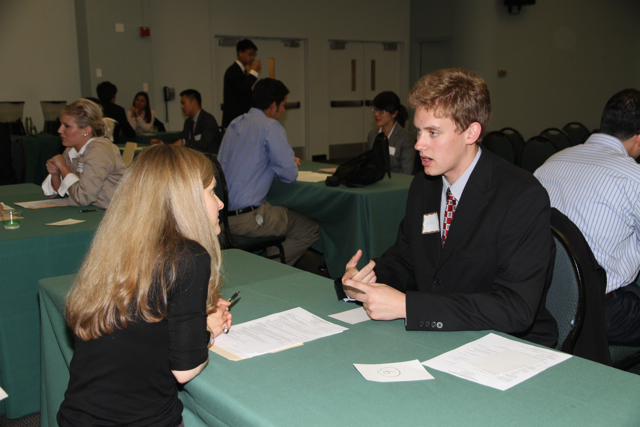
 I will probably never tire writing articles for new or prospective music educators seeking a public school position. I am subject to a flash of inspiration – epiphanies or revelations – at any moment, many of which come while I am walking the dogs or driving the car. Here are some random loose-ends I have not covered before, the results of recent bouts of brainstorming and mind wandering! Hopefully, they will provide you additional insight towards success in the job hunt process. Good luck!
 their school administration in the months of February, March or April to receive some of their “golden handshake” benefits. For the school district, it helps them plan for future hiring. For you, it should focus your attention and organize your work at a time when the jobs are just becoming available. (Don’t wait for summer vacation!)
 PA-educator.com which broadcast data on the pool of candidates. Regardless, I sent a custom-designed letter to every superintendent of school “in my hot zone” announcing that I was interested, met all education and certification requirements, and was available for immediate employment consideration. You should prominently share the name/location of your professional website. In addition, this would be the perfect place to mention if you student-taught or served as a private teacher, coach, summer camp counselor, or marching band/musical assistant in their area. For me, this meant a lot of extra work (looking-up the names/addresses, and you can’t just send a blanket form-letter “To Whom It May Concern”), but it seemed to give me a little edge, a foot in the door so-to-speak, and the opportunity to place follow-up calls later to the HR department to confirm they received the letter and did not need anything to add to the file (transcripts/portfolio, etc.). If you’re not restricted to a specific geographic area, saturation this way would probably not be feasible.
 domain name (something simple like yourname.edu or .com). Graduating this year from West Virginia University, my former student David Dockan
  anything trendy, mod, or “cool,” and guys, this means you wear a tie and a jacket. Unkempt or unusual length/coloring of hair, extra body piercings, and visible tattoos will not help project the classic corporate image of “conservatism” which most administrators seek in teachers. Sure, you do have the right to be “unconventional,” “artsy,” “one-of-kind” or “make a statement,” but you also have the right never to get a public school job!
 n your portfolio. This would look particularly good fulfilling Charlotte Danielson’s Domain 4c “Communicating with Families” in
  When Facing the Job Market” at http://majoringinmusic.com/7-things-music-education-majors-can-do-make-themselves-more-employable-2/,
 employment search process and preparation for interviews. For examples, you already have many lists of employment screening questions:
 The walking document of “everything you always wanted to know about you” is your professional resume.
 is the “Prepare Your Materials” section of the Institute for Music Leadership, Eastman School of Music (ESM)/University of Rochester, Careers and Professional Development
  “Professional resume writers urge their clients to first try to trim their resumes down to a maximum of two pages.” One exception for a three-pager might be if the job seeker was to transition from one field to another, having to cover both sets of the candidate’s skills, qualities, and experiences.
 and easy-to-read fonts in your collection. “Your goal is not to make your resume beautiful to your eyes… it’s to make it extremely readable to the people doing the screening and hiring.”
 behind the job assignments, field experiences, or awards… is better. What did you do in each situation, what did you learn, and how did you grow? Check out author Diana in NoVa’s ideas at
 conventions of grammar, punctuation, style, and order of presentation. For example, for new music educators entering the field, it is generally recommended that you list your experience, education, and achievements chronologically starting with the most recent at the top of each section. According to
  singing, etc. However, from an administrator’s perspective, it may be more important to know about the prospective music teacher’s field experiences and previous employment working with children, classroom management skills, professional development goals and initiative (would you be interested in coaching or directing extracurricular activities?), teamwork and leadership skills, personality traits like patience/even temperament/self-discipline, and knowledge of a few “buzz words” of educational terminology and acronyms (like The Common Core, DOK/HOTS, IEP, PLC, RTI, UBD, formative/summative assessments, etc. You are welcome to review some of these completing a crossword puzzle at
  Among her other suggestions are writing “an objective statement” which summarizes your goals to being employed at the school district, “support skills sets with problem solving examples” (see #4 above), and “proofread, proofread, proofread” for accuracy and to enhance your image. Sloppy resumes with typos or misspellings project the wrong message to prospective employers.


 paulfox.blog