
Practice Journals Are “Notable” and the “Key” to Making Musical Progress

foxsfiresides

It’s all about defining focus, setting goals, practicing, and methodically solving problems!

A good way to “warm-up” to the benefits of making a personal practice diary, check out this video of cellist Sarah Joy “A Look Inside My Practice Journal.” https://www.youtube.com/watch?v=253UMKMfOoc.

(She has quite a collection of YouTube releases… everything from sight-reading tips to structuring your practice time. They are short and sweet!)

So, let’s get started with the “why” and “how” of using practice journals…

I asked the South Hills Junior Orchestra members to give me their insight on how they prioritize/plan their practice time. Thankfully, I received a thoughtful response from one of our violinists, Nicolette:

For practicing, I usually start out with a scale. Then, I’ll play a couple etudes I have. However, I won’t play all of them, instead I’ll leave some to play at the end of my practice. Then, I’ll move on to some of my easier pieces to practice. Moving on from that, I’ll play my harder pieces, or my orchestra music. I usually try to change it up a bit so I don’t get bored. Then I’ll finish up with the rest of my etudes. After I’m done practicing, I usually try to write in my practice journal. Whenever I practice, I will keep out my notes from my teacher and my practice journal to look back at while practicing.

For my practice journal, I try to write in it whenever I remember, because I would be lying if I said I wrote in it every day. When I do write in my practice journal, I write down what I need to practice the next day, whatever I was having difficulty with that day, and maybe some notes my teacher gave me.

If I’m starting to feel stressed and frustrated, or if I’m starting to get bored with practicing, I’ll start listening to music. The music can vary, but I mostly stick to musicals.

What do the experts say some of the rationales for maintaining a written journal for any serious educational pursuit?

  1. It defines targets for a more efficient use of time. http://www.essential-music-practice.com/efficient-practice.html
  2. Promotes accountability. http://theaspiringguitarist.net/guitar-practice-journal/
  3. Documents progress. https://www.musicindustryhowto.com/the-musicians-practice-journal-and-why-you-need-one/
  4. Keeps track of details. https://music.stackexchange.com/questions/3299/do-music-students-find-practice-journals-useful
  5. Harnesses creativity. https://lifehacker.com/why-you-should-keep-a-journal-and-how-to-start-yours-1547057185
  6. Explores what is important to you. http://blog.connectionsacademy.com/5-reasons-for-students-to-keep-a-journal/

What does a typical practice log/diary/journal look like?

The “basics” are lists of specific assignments, warm-ups, musical and technical goals, and repertoire. For example, the Fort Couch Band Director Dr. John Seybert distributes the following simple form to his grades 7-8 band students:

FCMS Practice Journal

Each entry should be dated and allow space to make comments and goals for your next session of practice. Many musicians divide up the page into segments, such as warmups, scales/exercises, etudes (studies), method book or solo pieces, and ensemble music, each with an area to jot down a narrative of what you did and how well things went.

When I was teaching strings (grades 5-12), my students and I developed an extremely detailed daily practice regime, which included a year’s checklist of lesson targets:
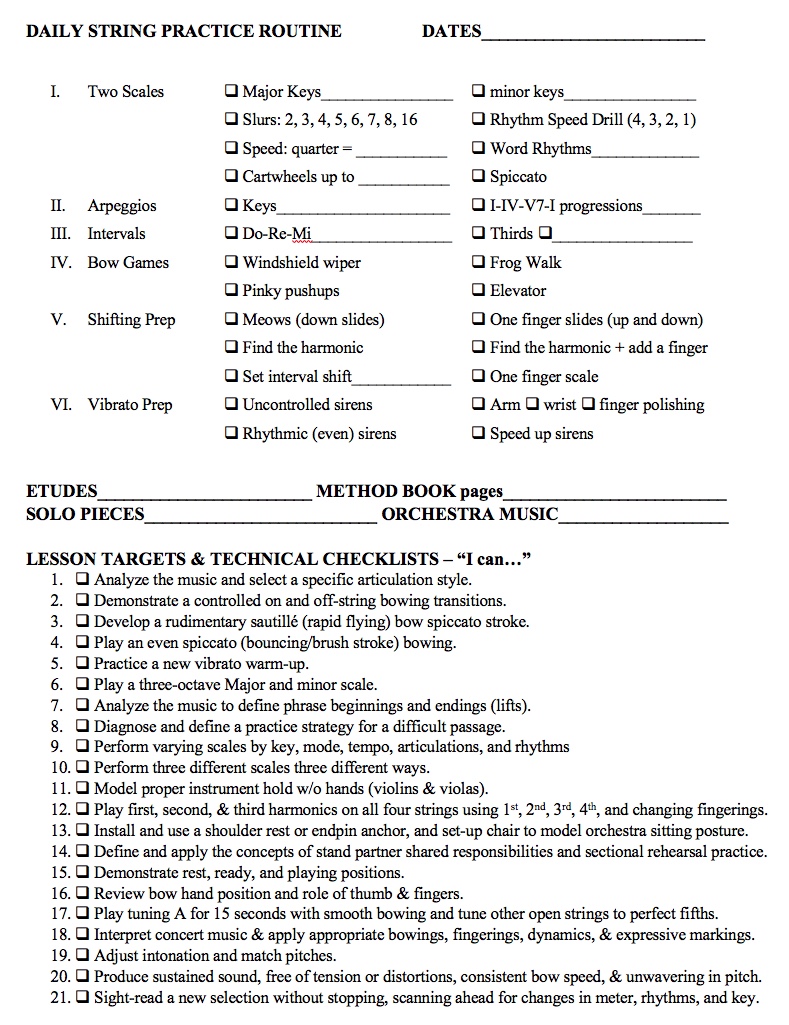
Daily String Practice Routine

You can make your own “things-to-do” list, including the focal points your music teachers “harp on” for improving form and technique. What does the band or orchestra director say about long tones, tuning, good posture, steady beat, rhythms and note-reading, fingerings, ensemble blend and balance, etc.? Emphasize one or more of these for each practice session!

seriestoshare-logo-01In your “customized” journal, I recommend leaving space for metronome markings, special articulations, practicing tips and instructions (like “repeat it three-times-in-a-row perfectly” or “work on measures #1-8 today, #5-12 tomorrow,” etc.) and time spent. Remember, you are a problem solver and seek ways to integrate your “tool box of tricks” to learn each challenging passage. What works for you? What doesn’t? That’s the true magic of a journal… in with the good, and out the bad!

Several previous Fox’s Firesides have explored practice methods and the setting of goals: http://www.shjo.org/foxs-fireside/. There are many other online resources, samples, and articles about practice journals. A few sites try to sell you printed forms, but others just offer you advice on creating and using documents to set practice goals. Take time to peruse these:

What do you have to lose? Try setting up and maintaining a practice journal! It may improve the value and focus of the time you devote to working on your music… and make a real difference in your musical progress! Like Olympic athletes… go for the goals and the gold!

For a printable copy of this article, click here.

Feel free to share all SHJO enrichment resources and “Fox Firesides” at http://www.shjo.org/foxs-fireside/.

PKF

© 2018 Paul K. Fox

Photo credit from Pixabay.com: “Fire” by Alicja

Help! How Does One Keep Up?

Time, Task, & Media Management for Pre-Service/New Music Educators


This article is in memory of the late Thomas Labanc (October 1946 – November 2017), my friend, colleague, Upper St. Clair School District social studies teacher, curriculum leader, and assistant to the superintendent, school historian, brilliant visionary and fellow risk-taker, who taught me the basics of Priority Management and collaborated on many of our school district’s communications and public relations projects, including the establishment of the highly successful community publication UPPER ST. CLAIR TODAY magazine. PKF


children-2685070_1920-mochilazocultural


Imagine there is a bank that credits your account each morning with $86,400.
It carries over no balance from day to day. Every evening the bank deletes whatever part of the balance you failed to use during the day.
What would you do? Draw out every cent, of course!!!
Each of us has such a bank. Its name is TIME.
Every morning, it credits you with 86,400 seconds.
Every night it writes off, as lost, whatever of this you have failed to invest to good purpose.
It carries over no balance. It allows no overdraft.
Each day it opens a new account for you.
Each night it burns the remains of the day.
If you fail to use the day’s deposits, the loss is yours.
There is no going back. There is no drawing against the “tomorrow.”
You must live in the present on today’s deposits.
Invest it so as to get from it the utmost in health, happiness, and success!
The clock is running. Make the most of today.
To realize the value of ONE YEAR, ask a student who failed a grade.
To realize the value of ONE MONTH, ask a mother who gave birth to a premature baby.
To realize the value of ONE WEEK, ask the editor of a weekly newspaper.
To realize the value of ONE HOUR, ask the lovers who are waiting to meet.
To realize the value of ONE MINUTE, ask a person who missed the train.
To realize the value of ONE SECOND, ask a person who just avoided an accident.
Treasure every moment that you have! And reassure it more because you shared it with someone special, special enough to spend your time.
Remember that time waits for no one.
Yesterday is history. Tomorrow is mystery. Today is a gift.
That’s why it’s called the present! – Pratheek Naidu


Philosophies of Time Management

stopwatch-2061848_1920-geraltEven though it is from a book on post-employment transitioning (Purposeful Retirement: How to Bring Happiness and Meaning to Your Retirement), the author Hyrum W. Smith suggests several thought-provoking questions on prioritizing time:
  1. Does your management of time reflect your governing values?
  2. Are you giving the most time to that which matters most?
  3. What can you do tomorrow to ensure your time aligns with your priorities?

A similar perspective but providing much more detail, I recommend consuming from cover-to-cover First Things First by Stephen R. Covey, who succinctly defines this conundrum about using time wisely.

“For many of us, there’s a gap between the compass and the clock – between what’s deeply important to us and the way we spend our time. And this gap is not closed by the traditional “time management” approach of doing things faster. In fact, many of us find that increasing our speed only makes things worse.” – Stephen Covey

The four sections of Covey’s book dive into these concepts:

  • The Clock and the Compass
  • The Main Thing is to Keep the Main Thing the Main Thing
  • The Synergy of Interdependence
  • The Power of and Peace of Principle-Centered Living

In addition, I found additional insight and inspiration in the philosophy of managing time from these links:

For those of you who have already begun your career in music education or even working as a day-to-day music sub, try these classroom and time management tips (thanks to NAfME):


parade-2657823_1920-Marmiche


The 4 D’s

Have you ever heard of a system called Priority Management (PM)? PM proposes methodology and business tools to immediately route every piece of paper and your daily “to-do tasks” that come into your life to one of the four D’s:

  • Do it! (now)
  • Date it! (assign it to the future)
  • Delegate it! (give it to someone else to do) or
  • Dump it! (into the trash)

PM’s “WorkingSm@rt method” promises to help you “gain control over your day, find balance, prioritize your work, and reach your goals,” giving you time to focus on the tasks that are important to you. The bottom line – every digital or printed post-it-note, piece of mail, receipt, publication, email or other communication – must be “put in its place” on the spot – either completed instantly, deferred to another time, given to someone else to do, or THROWN OUT!

time-management-2323612_1920-mohamed1982egYours truly, a “late baby boomer,” never enjoyed that prophesied and romanticized revolution of a “paperless society.” Did you? PM recommends the creation of a “future reading” file, a subcategory of “date it.” Experts on Google Mail will extol the merits of creating a folder and categorizing/storing messages such as emailed issues of MEJ, Kappan, SB&O, and other digital editions of professional newsletters. I have found that this doesn’t work very well, even in retirement. The file folder just fills up, and I never seem to get around to reviewing the things I thought were so important to save. Nor did the practice of our grandmothers’ generation clipping articles (and coupons) out of newspapers. You would think you could solve this media overload by just printing a small excerpt of what you want to peruse later and putting it in a letter tray near your desk? Nope. It just piles up! However, probably the ideal solution would be to designate a specific 15 minutes or more every day for something they used to give to the middle school students I taught: “silent and sustained reading.”


choir-458173_1920-intmurr


“Pros” Wrestle Control of Their “Free Time!” You Can Do That, Too!

“When you get right down to it, intentional living is about living your best story.”

time-481444_1920-geraltHow many times have you heard it? Make your plans and goals “intentional!” Besides all of the upcoming deadlines and appointments to which you are committed, include in your daily and weekly schedule opportunities for individual reflection and growth.


Plan 30-60 minutes of professional enrichment every day, throughout the year. The list below is based on an hour, but when time is really at a premium, just divide everything in half.

  • Read an article in a professional journal or digital newsletter (15 minutes)
  • “Keep up your chops” in ear training, sight-reading, and score reading. Have you ever used something like Elementary Training for Musicians by Hindenmith and practiced exercises that make you sing in syllables, tap a different rhythm independently with your left hand, conduct the beat pattern with your right hand, and beat your foot to the pulse? Revisit your college solfeggio assignments, and of course, sight-singing anything is also most beneficial. (10 minutes)
  • Perform on the piano, rotating weekly to different styles and forms of music. If you’re not a piano major or an accomplished choral  accompanist, include playing at sight several different voice parts simultaneously from choral octavos. (10 minutes)
  • Research and add professionals to update your contact file. Did you run into any new music teachers or school administrators this week? Search school district websites for the names of music department chairs and supervisors. (5 minutes)
  • Practice your story-telling skills (organized and “polished” telling of anecdotes about your achievements, teaching experience, “personality pluses,” and problem solving. Role play answering job-screening questions in video-recorded mock interviews, and allow time to assess your “performance.” (10 minutes)
  • Work on personal branding and marketing projects: making, refining, and customizing your e-portfolio, business card, professional website, and resume. (10 minutes)

The last three bullets above are covered extensively within this blog. Try these links:

If you “think” you are ready for the job search process, complete the self-assessment at https://paulkfoxusc.wordpress.com/2017/04/24/intereviewing-the-situation-and-jobs/.


box-2953722_1920-rawpixel

What about vacations or academic breaks when it seems there’s more time to spare? With some repetition to the above, in the December 2017 issue of Collegiate Communique, a digital publication of the PMEA Council for Teacher Training, Recruitment, and Retention (in support of the Pennsylvania Collegiate Music Educators Association and Society for Music Teacher Education), these recommendations were offered for college music majors who are leaving school for their winter or summer recesses.

“After you finish your semester finals, juries, concerts, writing assignments, and other projects, you may have several weeks before you have to return to full-time classes at the university. Besides catching up on your sleep and visiting your family and friends, how many of these enrichment activities can you accomplish?”

  1. Share your musical gifts.
  2. Sit in with a church or community choir, orchestra, or band.
  3. Learn something new about music… even outside your specialty.
  4. Spend a lot of time sight-reading.
  5. Improve your score reading and analysis.
  6. Volunteer to coach/conduct music rehearsals at the local public school.
  7. Attend as many concerts as you can.
  8. Compose a short seasonal, folk, jazz, or classical piece.
  9. Record video/audio excerpts of your major instrument/voice in preparation for placement in your e-portfolio.
  10. For upcoming employment prep and practice of mock interviews, review the marketing professionalism articles at https://paulkfoxusc.wordpress.com/becoming-a-music-educator/.

– Collegiate Communique #8

Of course, from a 35-year veteran teacher now retired, a snide remarkbusinessman-2929721_1920-Fotomek in response to feeling a little “stressed over the schedule” could be to “get used to the 24/7 nature of the job.” A music teacher works from sun-up (and before) to sun-down (and after), and constantly has to juggle multi-tasking on a wide variety of to-do’s, all landing at the same time: writing lesson plans, arranging music or drills, preparing scores or accompaniments, planning and rehearsing ensembles, managing the grade book and attendance records, attending faculty meetings and parent conferences, writing curriculum, student assessments, and lesson targets, preparing for extra-curricular activities like marching band, chorus, or the musical, finishing your own homework for graduate courses, district inductions, or professional development assignments, ETC.


But, if you “get organized,” you will love it! There is nothing better (albeit hectic) than the “calling” of serving your students and the profession as a music educator, inspiring creative self-expression, artistry, music appreciation, and life-long learning.

PKF

© 2017 Paul K. Fox


Photo credits from Pixabay.com: “hourglass” by annca, “children” by mochilazocultural, “stopwatch” by geralt, “parade” by Marmiche, “time management” by mohamed1982eg, “choir” by intmurr, “time” by geralt, “box” by rawpixel, and “businessman” by Fotomek.

T-Minus Three Years… and Counting!

Countdown to a Smooth and Satisfying Retirement

KONICA MINOLTA DIGITAL CAMERA

Are you retired, retiring this year or next, or thinking about “Crossing the Rubicon” to post-employment bliss over the next three or more years?

According to Ken Dychtwald, psychologist, gerontologist, and CEO of Age Wave, research on aging, health, and work issues defines five stages of retirement:

  • Stage 1: Imagination (5 to 15 years before retirement)
  • Stage 2: Anticipation (1 to 5 years before retirement)
  • Stage 3: Liberation (first year of retirement)OLYMPUS DIGITAL CAMERA
  • Stage 4: Re-engagement (1 to 15 years after retirement)
  • Stage 5: Reconciliation (ages late 70s and early 80s)

As reported by USA TODAY at https://www.usatoday.com/story/money/personalfinance/2014/10/12/five-stages-of-retirement/16975707/, these first three stages provide opportunities to rethink, recharge, reinvent, and even retool new ways to redefine one’s life-purpose and meaning, become productive, and begin that new chapter in their lives. The studies emphasize the need for the famous Boy Scouts’ motto – “be prepared” – and you should start reflecting on “what you are going to be when you grow up” at least three years prior to “the big day!”

Many people want to continue to work. In fact, 72% of pre-retirees, age 50 and older, say they want to keep working after they retire, according to a recent survey sponsored by Merrill Lynch in partnership with Age Wave. Almost half (47%) of current retirees either are working, have worked, or plan to work in retirement, the survey found.

Many people also want to devote more time to their family and friends. Some want to continue to learn, and others want to enjoy their favorite hobbies and develop new ones…

— Ken Dychtwald

The bottom line is, as suggested in “Retire Happy – What You Can Do Now to Guarantee a Great Retirement” in the USA TODAY/Nolo Series by Ralph Warner and Richard Stim, prior to leaving the work force, you should make a concerted effort to anticipate “life after work,” including:

  • Cultivate interests outside work
  • Lead a healthier lifestyle
  • Revitalize family relationships
  • Spend more time with spouse
  • Embrace spirituality or meditation
  • Nurture friendships and make new friends.


old-couple-1429242

FIRST THINGS FIRST

So, are YOU ready to retire from full-time music teaching? Are you sure?

For me, I cry out HURRAY for the FREEDOM, and enthusiastically take on exploring raising puppies, home improvements, more personal music making, conducting, writing, photography, community service, and volunteer work. And, as you can imagine, my calendar is as full as it has ever been!

However, not all of our newly retired colleagues feel the same way… at least, not at first. It should be said that not everyone may be ready to retire. Often heard employment complaints aside, “be careful for what you wish!” In general, few are ambivalent about this transition… leaving the day-to-day highly pressured, detailed, “rat-race” most music teachers embrace to jumping into the wide-open horizons of new vision, focus, and directions. Recent retirees either love or hate this “passage.”

— Paul K. Fox

If you are not sure of your current mental and financial preparation for retirement, checkout “7 Signs It’s Time to Retire” at http://www.plannersearch.org/financial-planning/7-signs-its-time-to-retire, and equally as important, “Ten Signs It’s Not Okay to Retire” at http://www.investopedia.com/articles/personal-finance/021716/10-signs-you-are-not-ok-retire.asp.

Have you seen this quote by Dr. Robert P. Delamontagne from his book Retiring Mind (Fairview Imprints, 2010), which provides statistics that are actually a little alarming?

50% of retirees will suffer some form of acute emotional distress. This is potentially a very large problem given the fact that 10,000 people are becoming eligible for Social Security every day for the next 20 years in the US alone.

— Dr. Robert P. Delamontagne

I also recommend taking the quiz, “Are You Psychologically Ready for Retirement?” at http://www.nextavenue.org/quiz-are-you-psychologically-ready-for-retirement/ from the book, Happy Retirement: The Psychology of Reinvention by Kenneth S. Shultz (DK Publishing, 2015), asking these five essential questions:

  1. How important is your job when it comes to getting a sense of life satisfaction?
  2. How many non-work activities do you have that give you a sense of purpose?
  3. How do you imagine your life to be once you stop working?
  4. How do you think retirement will affect your relationship with family and friends?
  5. How much energy for work do you have these days?


senior-portraits-2-1258401-loretta-humble

HAVE A PLAN

In the article “Are You Emotionally Ready to Retire?” published by the Wisconsin Medical Journal, Maureen E. Hansen illustrates the need for an “emotional retirement plan.” (Please visit https://www.wisconsinmedicalsociety.org/_WMS/publications/wmj/pdf/103/4/53.pdf).

The transition from a structured to an unstructured lifestyle can be unnerving if you are not prepared. When our clients retire, they often feel as if they are on vacation for the first month or so. After that, the realization that they are not returning to work starts to sink in. This is when anxiety can creep in. However, the process of adjusting can be far less stressful if you establish a plan well in advance.

— Maureen E. Hansen

She emphasizes that both financial and non-financial aspects of retirement need to be addressed. “Long before your going-away party at the office, you need to decide what you want for your retirement—leisure time, volunteer work, establishing a legacy?” Here are her several key issues to consider:

  1. Set lifestyle goals.
  2. Build a network.
  3. Consider your spouse’s feelings.
  4. Live your dream.

From Bankrate (http://www.bankrate.com/retirement/10-things-to-do-before-you-retire/), here is a checklist of considerations you should revisit as often as necessary before taking the retirement plunge:

  1. Prepare a balance sheet
  2. Get rid of debt
  3. Conduct a house check
  4. Assess life insurance needs
  5. Think about long-term care insurance
  6. Consider variable annuities
  7. Oversee estate planning
  8. Ditch college expenses
  9. Look at the big picture with a planner
  10. Prepare a budget

The Internet is deluged with a multitude of recommendations on retirement prep. Here are couple more to peruse at your leisure:


senior-portraits-1-1258399-loretta-humble

DOWN TO MORE SPECIFICS

In the August 26, 2017 PMEA Retired Member Network eNEWS, I shared the link to the AARP blog-post “10 Steps to Get You Ready for Retirement” at http://www.aarp.org/work/social-security/info-05-2011/10-steps-to-retire-every-day.html, with the following “executive summary” (but be sure to read the entire article for the detail):

  • Step 1: Define Your Retirement
  • Step 2: Take Stock of Your “Assets”
  • Step 3: Evaluate Your Health – Now
  • Step 4: Determine When to Collect Social Security
  • Step 5: Network Through Social Media & Other Methods
  • Step 6: Decide How Much You Want (or Need) to Work
  • Step 7: Create a Retirement Budget
  • Step 8: Find New Ways to Cut Your Expenses (Start Saving More)
  • Step 9: Prepare for the Unexpected
  • Step 10: Stick to Your Plan

I also offered my (now) “top-seven tips” for getting ready to “living the dream” for future PA music educator retirees:

  1. Download the Ultimate Retiree Resource Guide and peruse the myriad of contributions by “true experts in the field of retirement” posted on the PMEA retired member website: https://www.pmea.net/wp-content/uploads/2014/10/ultimate-retiree-resource-guide-111717.pdf.
  2. Scan through the plethora of other blog-posts at https://paulkfoxusc.wordpress.com/for-retirees/ and the official PMEA Retired Members’ website: https://www.pmea.net/retired-members/.
  3. Purchase a book or two by the “masters” of retirement transitioning (check out these authors and others from the sources above: David Borchard, Julie Cameron, Robert Delmontagne, Dave Hughes, Steven Price, Kenneth Shultz, Hyrum Smith, Verne Wilson, and Ernie Zelinski).
  4. Family Meeting: If you are married, sit down with your spouse (with no distractions) and map out the essential “who, what, when, where, and how” of retirement. Are you both ready to venture into your “golden years?” Are you and your wife/husband on the same page?
  5. dad-1-tommi-gronlundPSERS (PA pension fund) Planning: 12 months or more away from your projected retirement date, attend a “Foundations for Your Future” program (even attend it more than once), and request a retirement estimate (form PSRS-151), after which you will need to schedule the all-important “Exit Counseling Session.”


  6. Make an appointment with an estate planner, elder attorney, and/or financial advisor (probably all three). Bring a copy of your bank and investment statements, PSERS reports, social security, annuities, and insurance documents. You may need help in determining which PSERS “plan” to adopt. While you’re at it, update your will and other legal documents.
  7. To stay “connected” with your professional associations (e.g. Pennsylvania Music Educators Association and National Association for Music Education), be sure to update your personal profile at “headquarters” with your personal (not school) email address. Continue to participate in music and education, and reap the benefits of significantly discounted retired membership dues and conference registration fees. See the blog-post “PMEA in Retirement – What’s in it for Me?” at https://paulkfoxusc.wordpress.com/2016/12/15/pmea-in-retirement-whats-in-it-for-me/.

Finally, if you have not done so, I encourage you to revisit my last retirement blog-post   (https://paulkfoxusc.wordpress.com/2017/08/03/new-dreams-and-horizons/). Review those six essential things to do when you are a couple years “out” from making that “great leap to freedom,” solid advice from TIPS – Retirement for Music Educators book by Verne A. Wilson (MENC 1989), and to learn more about “nipping in the bud” those pesky retirement conundrums:

  1. Self-Identity and Change
  2. Free Time?
  3. Energy and Fortitude
  4. Losing Control and Perpetual Care

Yes, planning ahead makes all the difference. On this topic, our last inspiration also comes from TIPS – Retirement for Music Educators.

If you were planning to spend the rest of your life in another country, you would want to learn as much about it as possible. You would read books about the climate, people, history, and architecture. You would talk to people who had lived there. You might even learn a bit of its language. Old age is like another country. You’ll enjoy it more if you have prepared yourself before you go.

— B. F. Skinner and Margaret Vaughn

Best wishes for a happy retirement!

senior-portraits-4-1258408-loretta-humble

PKF

© 2017 Paul K. Fox


Photo credits from FreeImages.com (in order): “Happy Days” by Crissy Pauley, “Senior with Red Wine” by Walter Groesel, “Hour-Glass” by Aleksandra P., “Old Couple” by Ricardo Santengini, and “Senior Portraits 2” by Loretta Humble, “Senior Portraits 1” by Loretta Humble, “Dad 1” by Tommi Gronlund, and “Senior Portraits 4” by Loretta Humble.

Goals for the Musical Road to Success

Photo credit: FreeImages.com, photographer Matt Hains

Making mature and meaningful decisions to plan personal practice

As the school concert season draws to a close and summer is almost upon us, now is the perfect time to reflect on a little musical goal-setting, complete a personal inventory and needs assessment (in what areas do I need help?), foxsfiresidesprioritize what’s the most important, and define several new “practice plans.”

Do you recall a cartoon with Lucy van Pelt bossing Charlie Brown around and handing him his own very long list of New Year’s resolutions? Except for your parents and the music teachers who know YOU, it isn’t usually effective for someone else to pick your goals. (Of course, if you don’t listen to the suggestions from your music directors and private teachers, there’s a good chance you will never improve!) Sitting around doing nothing, accepting things as they are now, and randomly floating from one task to another accidentally “making music” without foresight or planning are not likely to work. Inattention and osmosis are slow ways to achieve anything in life. Obviously, you must be motivated, ambitious, focused, and committed to “whatever it takes” on the pathways towards self-improvement and musical mastery!

According to “goals experts” (such as the One Minute Manager book by Kenneth Blanchard and the Utah State University recommendations below), to create meaningful personal goals, they should:

  • Be written down (Take the time and post them in your room!);
  • Be specific (Keep it focused, simple, and to the point!);
  • Be concrete (Exactly what/how do you need to do?);
  • Be measurable (How do you know when you’ve succeeded?);
  • Be viewed and reviewed often (Look at them daily/weekly/monthly, and every time you practice!);
  • Be shared (Show them to your music teacher and/or parents/spouse!);
  • Be flexible and change as needed (Modify and adjust – set new goals!);
  • Have a time frame (When will these have to be completed?).

ALL students, parents, and teachers – CLICK ON THIS LINK! Download, print, and read Getting What You Want – How to Make Goals: https://www.usu.edu/asc/assistance/pdf/goal_setting.pdf

seriestoshare-logo-01Your practice should have well-defined goals. What do you want to learn as a musician? Are there particular pieces of music, styles, or technical skills you would like to be able to play? Knowing what you want to accomplish will help you decide what work is needed and assist defining specific learning targets. If you have a private teacher, he/she will automatically prescribe objectives for you, based on your present strengths and weaknesses. But if you desire to join the local youth symphony, participate in a music festival, play in a pit orchestra, perform solos or chamber music, become a conductor, help coach your peers, or want to improve a specific technical skill or general musicianship, make sure your teachers know it! They may be able to share warm-ups, strategies, or practice materials that will help you improve and expand your knowledge, technique, expressiveness, sight-reading and ear training.


Here are some goal-related questions to ask yourself (consider several of these):

  1. Have you signed up for the local band or string camp?
  2. Have you made arrangements to take a few lessons on your instrument or even on piano or music theory over the summer?
  3. What was the last method book you used? Did you finish it? How many pieces can you memorize from it?
  4. When was the last time you performed a solo or two and recorded yourself? Wouldn’t it be fun to video yourself playing a mini-recital and sending the DVD to your grandmother or grandfather?
  5. One of the greatest challenges in performance is sight reading. Can you pull-out a random piece of music (even something written for a different instrument) and play it straight through without stopping?
  6. Pick your greatest weakness or problem on the instrument. What needs your attention? New keys, rhythms, articulations?
  7. Ask your teacher what would be an appropriate exercise book. Can you define several new challenging goals in playing scales, arpeggios, other warm-ups, or études specifically geared for your instrument?
  8. For Western Pennsylvania residents, did you know the South Hills Junior Orchestra is always open to new instrumentalists? SHJO begins its Saturday practices a week after Labor Day (USCHS Band Room 10:30 a.m. to 12:30 p.m.). Everyone is welcome to play in 2-4 free-trial practices!

Take a trip to the South Hills Junior Orchestra website. Under “Resources,” check out the three sets of free “Series to Share…” additional “Fox’s Fireside” issues by Paul K. Fox, and “Music Enrichment Workshop” presentations by Donna Stark Fox.

PKF

© 2017 Paul K. Fox

This “Series to Share” is brought to you by… the Founding Directors of the South Hills Junior Orchestra (SHJO), “A Community Orchestra for All Ages” based in Western Pennsylvania. Feel free to download a printable copy and distribute to music students, parents, teachers, and fellow amateur musicians.

SHJO rehearses most Saturdays in the band room of the Upper St. Clair High School, 1825 McLaughlin Run Road, Pittsburgh, PA 15241. New members are always welcome! For more information, please go to www.shjo.org.

Does Practice Make Perfect?

Photo credit: FreeImages.com, photographer Alexander Kalina


foxsfiresides

Tips on Developing Better Practicing Habits

Every good musician knows that regular practice is a must, but did you know that careless or inattentive practice can actually make you worse?

It is not necessary true that “practice makes perfect” – more likely that “perfect practice develops perfect playing.” Quality not quantity, you say? Your school music teachers will urge you to increase both the quality (focus, attention, goals/planning, etc.) as well as the number of minutes per week. Here are a few hints on improving practicing techniques. Read on… there are many additional resources for parents to guide their musicians to musical mastery!

  1. Designate a quiet place for practice at home
  2. Limit all distractions (TV, video games, computers, phones)
  3. Plan habits of consistent daily practice time(s) and weekly frequency
  4. Make practice goals (what do you hope to accomplish this week?)
  5. Take a few minutes to warm-up (scales, finger patterns, long tones, or lip slurs)
  6. Sandwich method (start at the bottom and work your way up)
    1. Review a song you already know (bottom slice of bread)
    2. Focus on a few “hard parts” (the meat in the middle of the sandwich)
    3. Sight-read something new (condiments, pickles or cheese)
    4. Review another well-prepared song (top slice of bread)
  7. Pizza slices
    1. Identify and prioritize the problems or hard sections
    2. Partition the entire song
    3. Focus on a “slice” of the music – a measure, phrase or line of music – at a time
    4. Drill (daily) on one or a few slices
    5. Next practice session, repeat then progress to next section
  8. Re-order the sections of a piece (scrambling)
  9. Target a difficult passage, play slow at first, then increase tempo gradually each time you play it
  10. Try patterns of instant slow/fast and then fast/slow
  11. Fire up different sections of the brain on a problem spot
    1. Say the letter names out loud (or sing them) – speech center
    2. Bow or tap the rhythms “in the air” – left-side psychomotor
    3. Finger the notes without the bow or mouthpiece – right-side psychomotor
    4. Combine a, b, and/or c on specific passages – all parts of the brain
  12. Create new rhythmic or articulation/bowing variations to challenge your playing of the passage
  13. To improve your musical batting average, implement the Ten-Times Rule (accurately in a-row)
  14. Always add expressive markings including dynamics, tempo and articulation changes, etc.

seriestoshare-logo-01Yes, practicing should be heard at home. It is NOT enough simply to play at school. The long-tested “success equation” is TIME + MAKING PROGRESS = FUN (encouraging more time, progress and fun). Practicing on a regular basis improves technique, musicianship, self-confidence, endurance, reading skills, and besides… playing better is a lot more FUN!

PARENTS: Here are several excellent websites on recommendations for developing better practice skills, but ask your school music director for more advice!

PKF

© 2017 Paul K. Fox

This “Series to Share” is brought to you by… the Founding Directors of the South Hills Junior Orchestra (SHJO), “A Community Orchestra for All Ages” based in Western Pennsylvania. Please feel free to download a printable copy (CLICK HERE) and distribute to music students, parents, teachers, and fellow amateur musicians.

SHJO rehearses most Saturdays in the band room of the Upper St. Clair High School, 1825 McLaughlin Run Road, Pittsburgh, PA 15241. New members are always welcome! For more information, please go to www.shjo.org.